Tracking & Controlling  Assets Using  RFID & Bar Code Presented by Steve A. Doerfler, President Julia Deets, Marketing & Internal Sales Manager
What This Presentation Will Cover Factors to consider in selecting tracking technology Bar Code or RFID…or both RFID Benefits Benefits of using both RFID and Bar Code Universal RFID Tag Searching for and selecting an Integrator Case Studies Boeing Motorola
Selecting Tracking Technology – Factors to Consider RF Technology – many different aspects Type (i.e., passive, active, semi-active) Frequency (i.e., LF, HF UHF) For the purpose of this presentation,  we refer to passive UHF RFID technology.
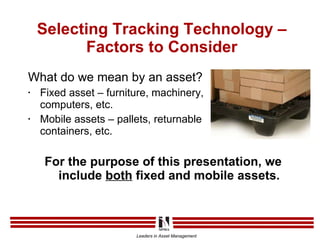
Selecting Tracking Technology – Factors to Consider What do we mean by an asset? Fixed asset – furniture, machinery, computers, etc. Mobile assets – pallets, returnable  containers, etc. For the purpose of this presentation, we include  both  fixed and mobile assets.
Selecting Tracking Technology – Factors to Consider Not RFID  vs .  Bar Code Objective is to collect and manage data; technology shouldn’t dictate What is the best solution for collecting and managing data?
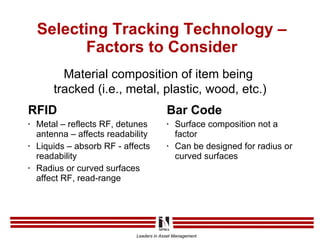
Selecting Tracking Technology – Factors to Consider RFID Metal – reflects RF, detunes antenna – affects readability Liquids – absorb RF - affects readability Radius or curved surfaces affect RF, read-range Bar Code Surface composition not a factor Can be designed for radius or curved surfaces Material composition of item being  tracked (i.e., metal, plastic, wood, etc.)
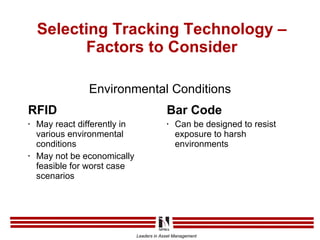
Selecting Tracking Technology – Factors to Consider RFID May react differently in various environmental conditions May not be economically feasible for worst case scenarios Bar Code Can be designed to resist exposure to harsh environments Environmental Conditions
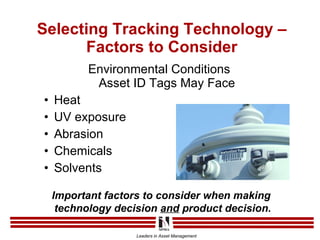
Selecting Tracking Technology – Factors to Consider Environmental Conditions  Asset ID Tags May Face Heat UV exposure Abrasion Chemicals Solvents Important factors to consider when making  technology decision  and  product decision.
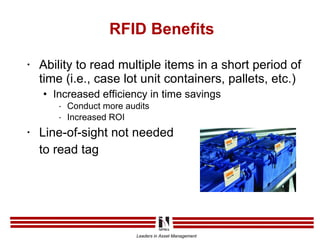
RFID Benefits Ability to read multiple items in a short period of time (i.e., case lot unit containers, pallets, etc.) Increased efficiency in time savings  Conduct more audits Increased ROI Line-of-sight not needed  to read tag
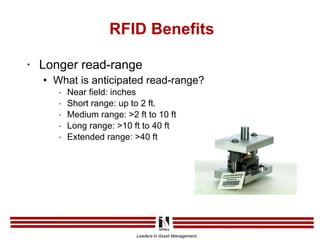
RFID Benefits Longer read-range What is anticipated read-range? Near field: inches Short range: up to 2 ft. Medium range: >2 ft to 10 ft Long range: >10 ft to 40 ft Extended range: >40 ft
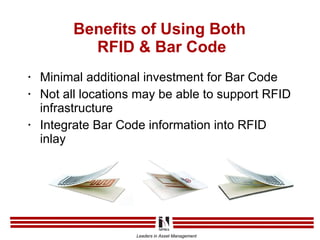
Benefits of Using Both  RFID & Bar Code Minimal additional investment for Bar Code Not all locations may be able to support RFID infrastructure Integrate Bar Code information into RFID inlay
Universal RFID Label Not always practical to use multiple types of labels in asset tracking application More inventory, additional cost, and confusion Inefficiencies created if specific labels not used for specific type of application (i.e., putting metal mount tag on plastic surface) Need one RFID label style consistent with “ One Label Solution”  for Bar Code
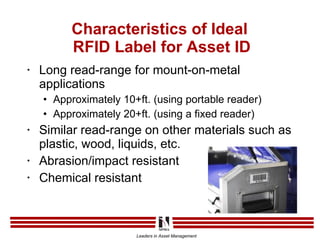
Characteristics of Ideal  RFID Label for Asset ID Long read-range for mount-on-metal applications Approximately 10+ft. (using portable reader) Approximately 20+ft. (using a fixed reader) Similar read-range on other materials such as plastic, wood, liquids, etc. Abrasion/impact resistant Chemical resistant
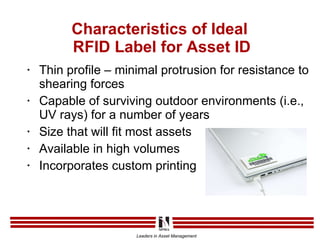
Characteristics of Ideal  RFID Label for Asset ID Thin profile – minimal protrusion for resistance to shearing forces Capable of surviving outdoor environments (i.e., UV rays) for a number of years Size that will fit most assets Available in high volumes Incorporates custom printing
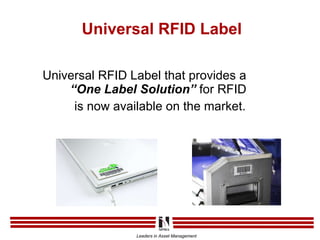
Universal RFID Label Universal RFID Label that provides a  “One Label Solution”  for RFID  is now available on the market.
Searching for & Selecting  an Integrator Why is an integrator necessary? Majority of end users not equipped for RFID Insufficient expertise in RF and RFID technology Qualified resources not available within company Inexperience in integrating hardware and software for complete solution Limited contact for providers and limited knowledge of the products and solutions on the market Time
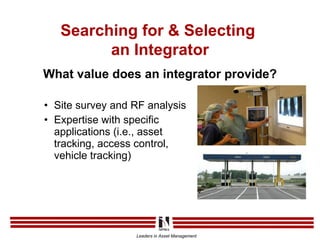
Site survey and RF analysis Expertise with specific applications (i.e., asset tracking, access control, vehicle tracking) What value does an integrator provide? Searching for & Selecting  an Integrator
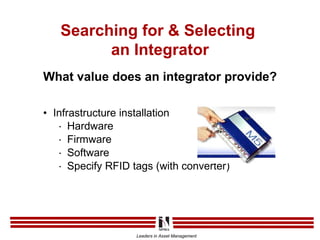
Infrastructure installation Hardware Firmware Software Specify RFID tags (with converter) What value does an integrator provide? Searching for & Selecting  an Integrator
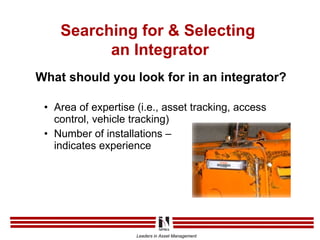
What should you look for in an integrator? Area of expertise (i.e., asset tracking, access control, vehicle tracking) Number of installations –  indicates experience Searching for & Selecting  an Integrator
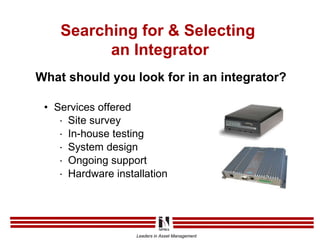
What should you look for in an integrator? Services offered  Site survey In-house testing  System design Ongoing support Hardware installation Searching for & Selecting  an Integrator
RFID Case Study – Boeing Problem Needed a solution to track more than 100,000 high value company-owned and government-owned equipment between three different locations More than 95% of the parts and equipment have external movement or go back and forth between Department of Defense customers
RFID Case Study – Boeing Problem As many as 20 parts are collected as a kit; each requiring manual inventory Many parts do not have a surface available to adhere a tag
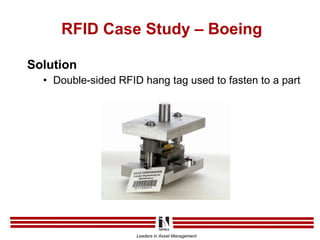
RFID Case Study – Boeing Solution Double-sided RFID hang tag used to fasten to a part
RFID Case Study - Boeing Result Time Savings – before system manufacturing staging area spent a weekend of overtime sorting and inventorying kits of parts Sorting 500 kits now takes five minutes! Real-time visibility in Boeing’s supply chain Reduces loss of high-value parts Misplaced tools or equipment can be “sniffed out” with handheld RFID reader
RFID Case Study – Motorola Problem Engineering Shared Services electrical label uses equipment worth more than $3 million – oscilloscopes, function generators, multimeters, calipers, power supplies, etc.) Equipment room attendant maintained inventory manually signing equipment in and out Misplaced and “lost” equipment was common
RFID Case Study – Motorola Solution RFID tags assigned to each piece of lab equipment with doorway hosting data exchange – first allowing access to the room and then allocating equipment to engineer
RFID Case Study – Motorola Result System provides automated issuance and return of equipment and maintenance Initial ROI was $250,000; generated by eliminating staff hours, cutting downtime to check in and out of equipment room, and securing equipment for maintenance to avoid costly replacements
Thank You!

Tracking and Controlling Assets Using Bar Code and RFID

  • 1.
    Tracking & Controlling Assets Using RFID & Bar Code Presented by Steve A. Doerfler, President Julia Deets, Marketing & Internal Sales Manager
  • 2.
    What This PresentationWill Cover Factors to consider in selecting tracking technology Bar Code or RFID…or both RFID Benefits Benefits of using both RFID and Bar Code Universal RFID Tag Searching for and selecting an Integrator Case Studies Boeing Motorola
  • 3.
    Selecting Tracking Technology– Factors to Consider RF Technology – many different aspects Type (i.e., passive, active, semi-active) Frequency (i.e., LF, HF UHF) For the purpose of this presentation, we refer to passive UHF RFID technology.
  • 4.
    Selecting Tracking Technology– Factors to Consider What do we mean by an asset? Fixed asset – furniture, machinery, computers, etc. Mobile assets – pallets, returnable containers, etc. For the purpose of this presentation, we include both fixed and mobile assets.
  • 5.
    Selecting Tracking Technology– Factors to Consider Not RFID vs . Bar Code Objective is to collect and manage data; technology shouldn’t dictate What is the best solution for collecting and managing data?
  • 6.
    Selecting Tracking Technology– Factors to Consider RFID Metal – reflects RF, detunes antenna – affects readability Liquids – absorb RF - affects readability Radius or curved surfaces affect RF, read-range Bar Code Surface composition not a factor Can be designed for radius or curved surfaces Material composition of item being tracked (i.e., metal, plastic, wood, etc.)
  • 7.
    Selecting Tracking Technology– Factors to Consider RFID May react differently in various environmental conditions May not be economically feasible for worst case scenarios Bar Code Can be designed to resist exposure to harsh environments Environmental Conditions
  • 8.
    Selecting Tracking Technology– Factors to Consider Environmental Conditions Asset ID Tags May Face Heat UV exposure Abrasion Chemicals Solvents Important factors to consider when making technology decision and product decision.
  • 9.
    RFID Benefits Abilityto read multiple items in a short period of time (i.e., case lot unit containers, pallets, etc.) Increased efficiency in time savings Conduct more audits Increased ROI Line-of-sight not needed to read tag
  • 10.
    RFID Benefits Longerread-range What is anticipated read-range? Near field: inches Short range: up to 2 ft. Medium range: >2 ft to 10 ft Long range: >10 ft to 40 ft Extended range: >40 ft
  • 11.
    Benefits of UsingBoth RFID & Bar Code Minimal additional investment for Bar Code Not all locations may be able to support RFID infrastructure Integrate Bar Code information into RFID inlay
  • 12.
    Universal RFID LabelNot always practical to use multiple types of labels in asset tracking application More inventory, additional cost, and confusion Inefficiencies created if specific labels not used for specific type of application (i.e., putting metal mount tag on plastic surface) Need one RFID label style consistent with “ One Label Solution” for Bar Code
  • 13.
    Characteristics of Ideal RFID Label for Asset ID Long read-range for mount-on-metal applications Approximately 10+ft. (using portable reader) Approximately 20+ft. (using a fixed reader) Similar read-range on other materials such as plastic, wood, liquids, etc. Abrasion/impact resistant Chemical resistant
  • 14.
    Characteristics of Ideal RFID Label for Asset ID Thin profile – minimal protrusion for resistance to shearing forces Capable of surviving outdoor environments (i.e., UV rays) for a number of years Size that will fit most assets Available in high volumes Incorporates custom printing
  • 15.
    Universal RFID LabelUniversal RFID Label that provides a “One Label Solution” for RFID is now available on the market.
  • 16.
    Searching for &Selecting an Integrator Why is an integrator necessary? Majority of end users not equipped for RFID Insufficient expertise in RF and RFID technology Qualified resources not available within company Inexperience in integrating hardware and software for complete solution Limited contact for providers and limited knowledge of the products and solutions on the market Time
  • 17.
    Site survey andRF analysis Expertise with specific applications (i.e., asset tracking, access control, vehicle tracking) What value does an integrator provide? Searching for & Selecting an Integrator
  • 18.
    Infrastructure installation HardwareFirmware Software Specify RFID tags (with converter) What value does an integrator provide? Searching for & Selecting an Integrator
  • 19.
    What should youlook for in an integrator? Area of expertise (i.e., asset tracking, access control, vehicle tracking) Number of installations – indicates experience Searching for & Selecting an Integrator
  • 20.
    What should youlook for in an integrator? Services offered Site survey In-house testing System design Ongoing support Hardware installation Searching for & Selecting an Integrator
  • 21.
    RFID Case Study– Boeing Problem Needed a solution to track more than 100,000 high value company-owned and government-owned equipment between three different locations More than 95% of the parts and equipment have external movement or go back and forth between Department of Defense customers
  • 22.
    RFID Case Study– Boeing Problem As many as 20 parts are collected as a kit; each requiring manual inventory Many parts do not have a surface available to adhere a tag
  • 23.
    RFID Case Study– Boeing Solution Double-sided RFID hang tag used to fasten to a part
  • 24.
    RFID Case Study- Boeing Result Time Savings – before system manufacturing staging area spent a weekend of overtime sorting and inventorying kits of parts Sorting 500 kits now takes five minutes! Real-time visibility in Boeing’s supply chain Reduces loss of high-value parts Misplaced tools or equipment can be “sniffed out” with handheld RFID reader
  • 25.
    RFID Case Study– Motorola Problem Engineering Shared Services electrical label uses equipment worth more than $3 million – oscilloscopes, function generators, multimeters, calipers, power supplies, etc.) Equipment room attendant maintained inventory manually signing equipment in and out Misplaced and “lost” equipment was common
  • 26.
    RFID Case Study– Motorola Solution RFID tags assigned to each piece of lab equipment with doorway hosting data exchange – first allowing access to the room and then allocating equipment to engineer
  • 27.
    RFID Case Study– Motorola Result System provides automated issuance and return of equipment and maintenance Initial ROI was $250,000; generated by eliminating staff hours, cutting downtime to check in and out of equipment room, and securing equipment for maintenance to avoid costly replacements
  • 28.