Financial Decision Making
7 Reasons & 4 Truths
Face of Finance 2013
Colleen Roller
This presentation




7 reasons why financial decision
making is difficult
4 truths about how people evaluate
options and decide
Areas of research


Behavioral decision theory




Cognitive psychology




The study of how people decide, and what affects the
decision making process and decision outcomes
The study of how people perceive, think, remember and
learn

Usability & UX Design


The science/art of creating successful design experiences
Why financial decision making is difficult

7 REASONS
7 reasons: reason 1

AMBIGUITY
The future is unknown







Health
Financial situation or needs
Cost of living
Performance of investments/markets
State of the world/economy
It’s a gamble


No guarantee that what we save today
will ever come back to us
7 reasons: reason 2

TEMPORAL DISTANCE
The future





Ability to envision the future depends
on how far away it is
The distant future is abstract
Hard to plan for the abstract
7 reasons: reason 3

NO DEADLINES
Easy to procrastinate



No definitive deadlines
Saving is easily postponed without
immediate penalty
7 reasons: reason 4

INERTIA
Inertia




Hard to get started
Easy to maintain status quo
Aversion to ‘work’ or effort
Inertia
7 reasons: reason 5

THE REWARD SYSTEM
Action / consequence



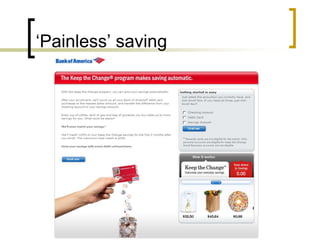
When I save, I incur pain today
When I don’t save, I get rewarded
today!
7 reasons: reason 6

CHOICES
Choices



Limited financial domain knowledge
Too many choices





Need to make the right choice
Fear of making the wrong choice

My needs are unique
Paralysis


Paralysis leads to no choice
7 reasons: reason 7

OVERCONFIDENCE
Above average


People are inherently confident and
optimistic
Bottom line


It’s really hard to make good financial
decisions!
How people evaluate options and decide

4 TRUTHS
How people assess value

COMPARISON
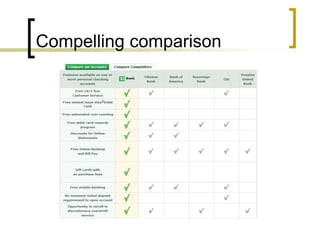
Compelling comparison
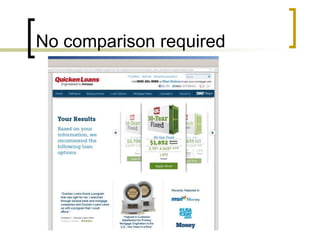
You need a loan…
No comparison required
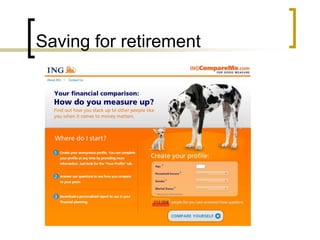
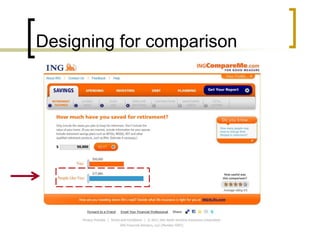
Saving for retirement
Designing for comparison
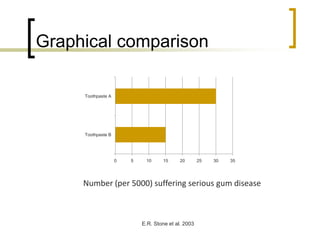
Graphical comparison
Toothpaste A

Toothpaste B

0

5

10

15

20

25

30

35

Number (per 5000) suffering serious gum disease

E.R. Stone et al. 2003
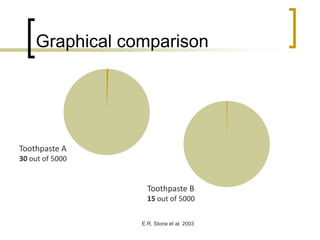
Graphical comparison

Toothpaste A
30 out of 5000

Toothpaste B
15 out of 5000
E.R. Stone et al. 2003
Comparison and UX Design




Are you designing for comparison?
What is the reference point?
What is salient?
Perception of

GAIN V. LOSS
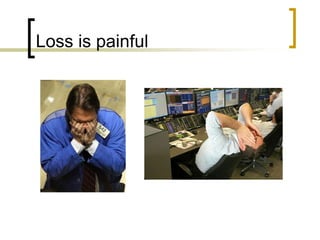
Loss is painful
‘Painless’ saving
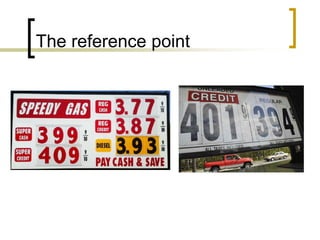
The reference point
Gain/Loss & UX Design



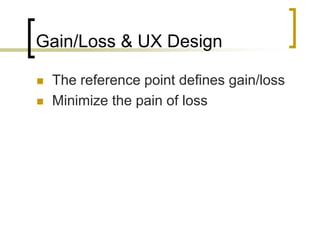
The reference point defines gain/loss
Minimize the pain of loss
How something is presented

FRAMING
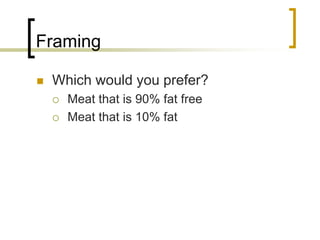
Framing


Which would you prefer?



Meat that is 90% fat free
Meat that is 10% fat
Rates of return


Choose between two investment funds
– stocks v. bonds



First group shown 1-yr rates of return
Second group shown 30-yr rates of return

Benartzi/Thaler, 2001
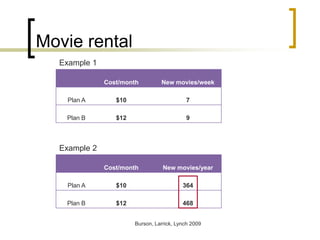
Movie rental
Example 1
Cost/month

New movies/week

Plan A

$10

7

Plan B

$12

9

Cost/month

New movies/year

Plan A

$10

364

Plan B

$12

468

Example 2

Burson, Larrick, Lynch 2009
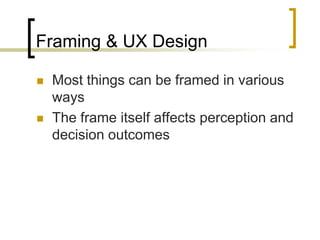
Framing & UX Design




Most things can be framed in various
ways
The frame itself affects perception and
decision outcomes
Important

People do not reframe
What captures attention

SALIENCE
Salience

obvious
Distinctive
prominent
Would you visit?
Salience
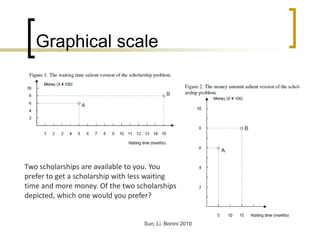
Graphical scale

Two scholarships are available to you. You
prefer to get a scholarship with less waiting
time and more money. Of the two scholarships
depicted, which one would you prefer?

Sun, Li, Bonini 2010
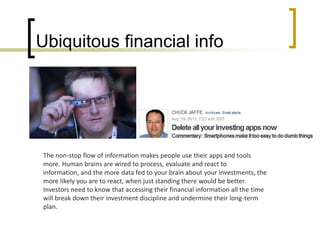
Ubiquitous financial info

The non-stop flow of information makes people use their apps and tools
more. Human brains are wired to process, evaluate and react to
information, and the more data fed to your brain about your investments, the
more likely you are to react, when just standing there would be better.
Investors need to know that accessing their financial information all the time
will break down their investment discipline and undermine their long-term

plan.
Salience & UX Design




Makes info concrete
Drives attention/focus
What is most salient in your design?
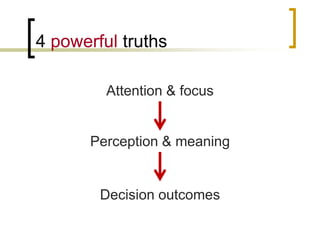
4 powerful truths
Attention & focus

Perception & meaning

Decision outcomes
The design matters

There is no neutral design
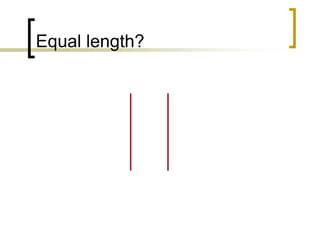
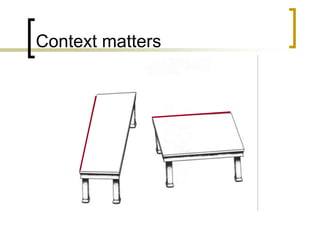
Equal length?
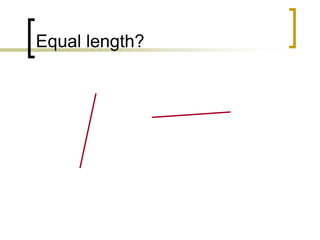
Equal length?
Context matters
7 reasons & 4 truths


Colleen Roller


UXmatters.com
UX magazine (uxmag.com)



croller520@gmail.com



Track b roller