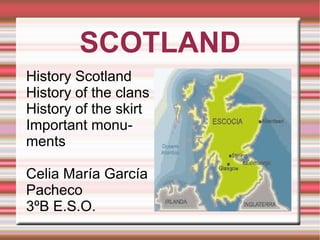
SCOTLAND
History Scotland
History of the clans
History of the skirt
Important monuments
Celia María García
Pacheco
3ºB E.S.O.
History:
PREHISTORY:
It's believed that the first groups of
hunter-gatherers arrived about 11,000 years
ago, when the ice of the first glaciation began
to retreat northward. The first settlements appeared on the Scottish territory about 9500
years ago, and the first villages about 6,000.
History:
ROMANIZATION OF SCOTLAND:
He written history of Scotland begins with the
romanization of central southern Britain. The
Romans called Caledonia initially to Scotland,
by the vast pine forest Caledonians. The main
people which sat in the region was of Scottish
Pictos, so called because of their habit of painting their bodies. The Escotos were Irish.
History:
MEDIEVAL HISTORY:
The kingdom of the Pictos had greatly expanded during the Middle Ages, perhaps in response to Roman imperialism itself. In the battle of Dunnichen (685) defeated the Pictos tribes Northumbria. The kingdom of the Pictos
occupied at this time, according to the description of the Venerable Bede, an area similar to
that later occupy the kingdom of the Escotos
during the reign of Alexander I (1107-1124).
Towards the end of s. XII, the kings of Alba had
added to their territories the English-speaking
area of southeastern Scotland and also dominated areas of Galloway and Caithness, at the
end of s. XIII, this kingdom had spread up to
the approximate extent of the current Scotland.
On the s. XIII introduced feudalism. In 1286 he
broke the line of succession of the reigning dynasty. This led to the intervention of Edward I of
England, put on the throne of his protege John
Balliol.When their relationship deteriorated, there was an attempted conquest of England by
William Wallace rejected by the Wars of Scottish Independence.
Meanwhile, Robert the Bruce was proclaimed
King of Scotland by the name of Robert I of
Scotland. The war with England continued for
several decades and the civil war between Robert the Bruce dynasty and supporters of Balliol, lasted until the middle of s. XIV. The absence of descendants of David II allowed his
nephew Robert II, ascended the throne and put
him to the Stuart dynasty. The Stuarts ruled
Scotland for the remainder of the Middle Ages.
Struggles continue with England and the internal division between the Highlands and Lowlands.
History:
MODERN HISTORY:
The Modern Age opened in Scottish history
with the Rough Wooing, a series of intermittent military offensives by which England tried
to force a marriage between Mary Queen of
Scots and Edward VI of England, finally failed
objective. Furthermore, the s. XVI of the Protestant Reformation, led in Scotland. In 1603,
Scotland remained an independent state.
Scotland threatened to choose a different Protestant king of England. In 1707, after British
the threats to close the trade with Scotland,
signed the Act of Union, which certified the creation of the Kingdom of Great Britain.
History:
SCOTTISH ENLIGHTENMENT:
The Scottish Enlightenment or School was a
cultural movement of the eighteenth century
production characterized by the prominent intellectual, scientific, and cultural work in Scotland, especially from the second half of the
century. Usually seen as a golden age in the
history of Scotland,
this move meant the cultural explosion Scots
becoming internationalized and Scotland in one
of the main cultural centers of Europe. The situation worsened after the First World War,
which killed a large number of Scots, mainly
from the Highlands, but especially after the Second World War, after which the economic situation deteriorated rapidly in Scotland, with the
disappearance of a large number of industries
that were no longer competitive in the international market. In the last decades of s. XX target country achieved economic and cultural recovery.
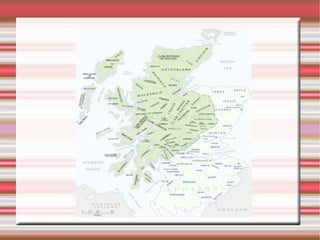
History of the clans:

They are a social group and structured Scottish identity, whose authority in matters of heraldry. From the nineteenth century and under the image of them were writers like Walter Scott, most clan tartans adopted themselves. The most powerful wore tartans of their
respective districts.
History of the skirt:
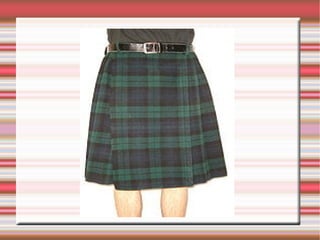
The kilt is the garment more typical of Scotland. Consists a skirt but has the peculiarity
that the men wear. Currently only for special
occasions like weddings, conventions, etc.
The kilt color differentiates the different clans
that exist in Scotland. Viewing color kilt could
know which clan he belonged. Because of the
big rains that fall in Scotland over the year, is
said to have used these skirts get wet to prevent the bottoms of his trousers. The particular
design of each box is called the clan tartan.
IMPORTANT MONUMENTS
Scotland The image is that of a clean and unpolluted paradise, has thousands of historic sites and attractions: stone circles, menhirs,
prehistoric burial chambers and abundant remains of Bronze Age, Iron Age and Stone
Age. would the Burrell Collection, Glasgow
Cathedral, Glasgow Science Centre and the
Kelvingrove Museum. Glasgow has Victorian
Gothic architecture and shopping.
Highlights include Stirling Castle and the William Wallace Monument. The University of
Saint Andrews (Scotland's oldest).

Trabajo sobre escocia

  • 1.
    SCOTLAND History Scotland History ofthe clans History of the skirt Important monuments Celia María García Pacheco 3ºB E.S.O.
  • 2.
    History: PREHISTORY: It's believed thatthe first groups of hunter-gatherers arrived about 11,000 years ago, when the ice of the first glaciation began to retreat northward. The first settlements appeared on the Scottish territory about 9500 years ago, and the first villages about 6,000.
  • 3.
    History: ROMANIZATION OF SCOTLAND: Hewritten history of Scotland begins with the romanization of central southern Britain. The Romans called Caledonia initially to Scotland, by the vast pine forest Caledonians. The main people which sat in the region was of Scottish Pictos, so called because of their habit of painting their bodies. The Escotos were Irish.
  • 4.
    History: MEDIEVAL HISTORY: The kingdomof the Pictos had greatly expanded during the Middle Ages, perhaps in response to Roman imperialism itself. In the battle of Dunnichen (685) defeated the Pictos tribes Northumbria. The kingdom of the Pictos occupied at this time, according to the description of the Venerable Bede, an area similar to that later occupy the kingdom of the Escotos during the reign of Alexander I (1107-1124).
  • 5.
    Towards the endof s. XII, the kings of Alba had added to their territories the English-speaking area of southeastern Scotland and also dominated areas of Galloway and Caithness, at the end of s. XIII, this kingdom had spread up to the approximate extent of the current Scotland. On the s. XIII introduced feudalism. In 1286 he broke the line of succession of the reigning dynasty. This led to the intervention of Edward I of England, put on the throne of his protege John Balliol.When their relationship deteriorated, there was an attempted conquest of England by William Wallace rejected by the Wars of Scottish Independence.
  • 6.
    Meanwhile, Robert theBruce was proclaimed King of Scotland by the name of Robert I of Scotland. The war with England continued for several decades and the civil war between Robert the Bruce dynasty and supporters of Balliol, lasted until the middle of s. XIV. The absence of descendants of David II allowed his nephew Robert II, ascended the throne and put him to the Stuart dynasty. The Stuarts ruled Scotland for the remainder of the Middle Ages. Struggles continue with England and the internal division between the Highlands and Lowlands.
  • 7.
    History: MODERN HISTORY: The ModernAge opened in Scottish history with the Rough Wooing, a series of intermittent military offensives by which England tried to force a marriage between Mary Queen of Scots and Edward VI of England, finally failed objective. Furthermore, the s. XVI of the Protestant Reformation, led in Scotland. In 1603, Scotland remained an independent state.
  • 8.
    Scotland threatened tochoose a different Protestant king of England. In 1707, after British the threats to close the trade with Scotland, signed the Act of Union, which certified the creation of the Kingdom of Great Britain.
  • 9.
    History: SCOTTISH ENLIGHTENMENT: The ScottishEnlightenment or School was a cultural movement of the eighteenth century production characterized by the prominent intellectual, scientific, and cultural work in Scotland, especially from the second half of the century. Usually seen as a golden age in the history of Scotland,
  • 10.
    this move meantthe cultural explosion Scots becoming internationalized and Scotland in one of the main cultural centers of Europe. The situation worsened after the First World War, which killed a large number of Scots, mainly from the Highlands, but especially after the Second World War, after which the economic situation deteriorated rapidly in Scotland, with the disappearance of a large number of industries that were no longer competitive in the international market. In the last decades of s. XX target country achieved economic and cultural recovery.
  • 11.
    History of theclans: They are a social group and structured Scottish identity, whose authority in matters of heraldry. From the nineteenth century and under the image of them were writers like Walter Scott, most clan tartans adopted themselves. The most powerful wore tartans of their respective districts.
  • 13.
    History of theskirt: The kilt is the garment more typical of Scotland. Consists a skirt but has the peculiarity that the men wear. Currently only for special occasions like weddings, conventions, etc. The kilt color differentiates the different clans that exist in Scotland. Viewing color kilt could know which clan he belonged. Because of the big rains that fall in Scotland over the year, is said to have used these skirts get wet to prevent the bottoms of his trousers. The particular design of each box is called the clan tartan.
  • 15.
    IMPORTANT MONUMENTS Scotland Theimage is that of a clean and unpolluted paradise, has thousands of historic sites and attractions: stone circles, menhirs, prehistoric burial chambers and abundant remains of Bronze Age, Iron Age and Stone Age. would the Burrell Collection, Glasgow Cathedral, Glasgow Science Centre and the Kelvingrove Museum. Glasgow has Victorian Gothic architecture and shopping.
  • 16.
    Highlights include StirlingCastle and the William Wallace Monument. The University of Saint Andrews (Scotland's oldest).