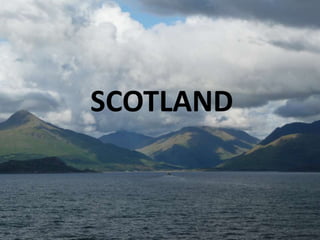
SCOTLAND
The national flower of Scotland is thistle
The Isle of Skye, mountain top called The
Old Man of Storr
GEOGRAPHY
Scotland is a country that
is part of the United
Kingdom, occupying the
northern third of the island
of Great Britain, it shares a
border with England to
the south and is bounded
by the North Sea to the
east, the Atlantic Ocean to
the north and west, and
the North Channel and
the Irish Sea to the
southwest. In addition to
the mainland, Scotland
includes over 790 islands.
8km walk to the mountain top
View from the top of the Storr mountain,
overlooking at Skye, and the Isle of Raasay
MOUNTAINS
From a geological perspective
the country has three main
sub-divisions: Highlands and
islands, Central Lowlands and
Southern Uplands.
1) The Northwest Highlands,
2) The Cuillin, on the Isle of
Skye
3) The Grampians, the main
belt of mountains across the
centre of Scotland.
4) The Cairngorms form the
eastern part of the Grampians.
5) The Torridon Hills of
Western Ross
The highest point on the British Isles – Ben Nevis 1344m
Rivers:
1. The River
Tay (193km),
2. The River
Spey (172km),
3.The River
Clyde (171km)
LAKES

1) Loch Lomond
(71 km2)
2)Loch Ness
(56km2)
3)Loch Awe
(39km2)

The deepest:
1)Loch Morar (310m);
2)Loch Ness (230m)
`
Loch Ness Monster
• Loch Ness is the alleged home of the Loch
Ness Monster (also known as "Nessie"),
a cryptid, reputedly a large unknown animal.
It is similar to other supposed lake monsters in
Scotland and elsewhere, though its
description varies from one account to the
next. Popular interest and belief in the
animal's existence has varied since it was first
brought to the world's attention in 1933
BIGGEST TOWNS
1) Glasgow – an important industrial
town finding its charm as a town of
galleries and museums (581 320)
2) Edinburgh – Scotland’s capital with
its famed international festivals
attract the world's leading
performers, galleries display
cutting-edge art, and bars,
restaurants and clubs create a
lively, cosmopolitan atmosphere
(454 280 )
3) Aberdeen – the Europe’s capital of
oil, “the Granite City” (183 000)
4) Dundee - is a lively commercial,
cultural, and artistic centre (142
000)
* Inverness - Known as the Capital of
the Highlands ( 44 000)
* Stirling - Scotland's heritage capital,
the stage for some of the most
significant events in the nation's
history. (33 710)

Stirling, William Wallace statue

Aberdeen
Portree, the capital of the Isle of Skye
The Royal Mile, Edinburgh
The Scotsman Hotel,
Princes Street, Edinburgh
International Film Festival in
Edinburgh, an outdoor cinema
Malleig
HISTORY
• Scotland was one of the last places in Europe
where people settled. 50000 years ago it was
mostly still covered with ice.
• Around 9000BC some hunters decided to stay. They
lived as nomads.
• Around 4000BC hunters stopped living as nomads,
but it was a slow change
• 2000BC a revolutionary new technology reached
Scotland. People learned how to work with a metal
mixture called bronze.
• 1200 BC – 200AC Celtic Scotland (a name given to
different cultures by ancient Greeks and Romans
who fought against Celtic people)
Celtic roundhouse in Scotland
CORACLE

CORACLE
BROCH
Celtic people
became powerful by
using their new
technology – ironworking. Knowledge
of how to smelt and
forge iron spread
from the area now
known as Austria to
Scotland between
700 – 400 BC
Fight for farmland
and wars made
Celtic people build
stronger houses –
brochs.
ROMAN
SCOTLAND
80 AD the Romans decided to
conquer Scotland. The
Roman troops marched
northwards, building roads
so that they could travel
quickly and camps and forts
from which they could
control the countryside.
Celtic chiefs and warriors
fought back but they were no
match for the Roman army. In
just 2 years the Romans
conquered most of Scotland
south of the River Tray.
SCOTLAND
DIVIDED
The Romans left the British Isles in
410AD. For the next 400 years and
more Scotland was divided into many
separate kingdoms. People living
there spoke different languages,
obeyed different laws, followed
different leaders and were often at
war.
In 794 AD and onwards the Vikings
started to make surprise raids on
churches, monasteries and farming
villages. They were looking for
excitement, adventure, new lands to
settle and rich treasures to carry away.
All the Scottish kingdoms now faced
crises. Some collapsed completely,
others joined together to fight back.
Eilean Donan Castle built in 1220 to fight against the
Vikings
BIRTH of a NATION
For thousands of years Scotland was
not a united nation. In 842 Kenneth
MacAlpin, a warlord from Western
Scotland took control of the Pictish
kingdom as well as his own lands.
For the first time, a large part of east
and west Scotland was united under
one rule. By 900 this combined
kingdom had a new name – ALBA.
For over 500 years, from around 900
– 1469, Scottish kings did not rule all
Scotland. The far north, the Orkney
and Shetland isles and the Hebredes
were ruled by the Vikings and by
kings of Norway.
Edinburgh Castle
WARS of INDEPENDENCE
Edward I of England was furious about the Scottish
alliance with France. In 1296, he sent an army to attack
the Scots and soon defeated them at the battle of
Dunbar. English knights captured Scottish king and sent
him to London as a prisoner. Once again, Scotland had no
king.
There were many Scots who refused to accept English
rule. They all joined together to fight Edward and were
led by Andrew Murray and William Wallace. In 1297 ,
they defeated the English army at Stirling Bridge.
Stirling Bridge
Glenfinnan Monument
The Heart of Midlothian “Spitting Stone”, Edinburgh
Rob Roy –a farmer who faught against English rulers
GREAT SCOTS
James Watt – designed improved
steam engines
William Symington – built the first
working steamboat (1801)

Adam Smith – the father of modern
economy and capitalism
Charles Maclntosh – invented a
process to make waterproof cloth
(1823)
James Neilson – invented the hotblast method of iron-making (1828)
Kirkpatrick Macmillan – made the
first bicycle (1828)
Lighthouse on the Isle of Skye
SCOTLAND TODAY
Today, Scotland is a mixture
of old and new. Scottish
people still feel proud of
their country’s heritage and
identity. They admire its
magnificent scenery, wear
kilts and eat traditional
foods such as haggis. Some
still speak Scots, the old
language of the Lowlands
and in the Highlands and
Islands children can go to
Gaelic-speaking schools.
THANK YOU FOR YOUR
ATTENTION!

Scotia

  • 1.
  • 2.
    The national flowerof Scotland is thistle
  • 3.
    The Isle ofSkye, mountain top called The Old Man of Storr
  • 4.
    GEOGRAPHY Scotland is acountry that is part of the United Kingdom, occupying the northern third of the island of Great Britain, it shares a border with England to the south and is bounded by the North Sea to the east, the Atlantic Ocean to the north and west, and the North Channel and the Irish Sea to the southwest. In addition to the mainland, Scotland includes over 790 islands.
  • 5.
    8km walk tothe mountain top
  • 6.
    View from thetop of the Storr mountain, overlooking at Skye, and the Isle of Raasay
  • 7.
    MOUNTAINS From a geologicalperspective the country has three main sub-divisions: Highlands and islands, Central Lowlands and Southern Uplands. 1) The Northwest Highlands, 2) The Cuillin, on the Isle of Skye 3) The Grampians, the main belt of mountains across the centre of Scotland. 4) The Cairngorms form the eastern part of the Grampians. 5) The Torridon Hills of Western Ross
  • 8.
    The highest pointon the British Isles – Ben Nevis 1344m
  • 11.
    Rivers: 1. The River Tay(193km), 2. The River Spey (172km), 3.The River Clyde (171km)
  • 13.
    LAKES 1) Loch Lomond (71km2) 2)Loch Ness (56km2) 3)Loch Awe (39km2) The deepest: 1)Loch Morar (310m); 2)Loch Ness (230m)
  • 14.
  • 15.
    Loch Ness Monster •Loch Ness is the alleged home of the Loch Ness Monster (also known as "Nessie"), a cryptid, reputedly a large unknown animal. It is similar to other supposed lake monsters in Scotland and elsewhere, though its description varies from one account to the next. Popular interest and belief in the animal's existence has varied since it was first brought to the world's attention in 1933
  • 16.
    BIGGEST TOWNS 1) Glasgow– an important industrial town finding its charm as a town of galleries and museums (581 320) 2) Edinburgh – Scotland’s capital with its famed international festivals attract the world's leading performers, galleries display cutting-edge art, and bars, restaurants and clubs create a lively, cosmopolitan atmosphere (454 280 ) 3) Aberdeen – the Europe’s capital of oil, “the Granite City” (183 000) 4) Dundee - is a lively commercial, cultural, and artistic centre (142 000) * Inverness - Known as the Capital of the Highlands ( 44 000) * Stirling - Scotland's heritage capital, the stage for some of the most significant events in the nation's history. (33 710) Stirling, William Wallace statue Aberdeen
  • 17.
    Portree, the capitalof the Isle of Skye
  • 18.
    The Royal Mile,Edinburgh
  • 19.
    The Scotsman Hotel, PrincesStreet, Edinburgh
  • 20.
    International Film Festivalin Edinburgh, an outdoor cinema
  • 21.
  • 22.
    HISTORY • Scotland wasone of the last places in Europe where people settled. 50000 years ago it was mostly still covered with ice. • Around 9000BC some hunters decided to stay. They lived as nomads. • Around 4000BC hunters stopped living as nomads, but it was a slow change • 2000BC a revolutionary new technology reached Scotland. People learned how to work with a metal mixture called bronze. • 1200 BC – 200AC Celtic Scotland (a name given to different cultures by ancient Greeks and Romans who fought against Celtic people)
  • 23.
  • 24.
  • 25.
    BROCH Celtic people became powerfulby using their new technology – ironworking. Knowledge of how to smelt and forge iron spread from the area now known as Austria to Scotland between 700 – 400 BC Fight for farmland and wars made Celtic people build stronger houses – brochs.
  • 26.
    ROMAN SCOTLAND 80 AD theRomans decided to conquer Scotland. The Roman troops marched northwards, building roads so that they could travel quickly and camps and forts from which they could control the countryside. Celtic chiefs and warriors fought back but they were no match for the Roman army. In just 2 years the Romans conquered most of Scotland south of the River Tray.
  • 27.
    SCOTLAND DIVIDED The Romans leftthe British Isles in 410AD. For the next 400 years and more Scotland was divided into many separate kingdoms. People living there spoke different languages, obeyed different laws, followed different leaders and were often at war. In 794 AD and onwards the Vikings started to make surprise raids on churches, monasteries and farming villages. They were looking for excitement, adventure, new lands to settle and rich treasures to carry away. All the Scottish kingdoms now faced crises. Some collapsed completely, others joined together to fight back.
  • 28.
    Eilean Donan Castlebuilt in 1220 to fight against the Vikings
  • 29.
    BIRTH of aNATION For thousands of years Scotland was not a united nation. In 842 Kenneth MacAlpin, a warlord from Western Scotland took control of the Pictish kingdom as well as his own lands. For the first time, a large part of east and west Scotland was united under one rule. By 900 this combined kingdom had a new name – ALBA. For over 500 years, from around 900 – 1469, Scottish kings did not rule all Scotland. The far north, the Orkney and Shetland isles and the Hebredes were ruled by the Vikings and by kings of Norway.
  • 30.
  • 31.
    WARS of INDEPENDENCE EdwardI of England was furious about the Scottish alliance with France. In 1296, he sent an army to attack the Scots and soon defeated them at the battle of Dunbar. English knights captured Scottish king and sent him to London as a prisoner. Once again, Scotland had no king. There were many Scots who refused to accept English rule. They all joined together to fight Edward and were led by Andrew Murray and William Wallace. In 1297 , they defeated the English army at Stirling Bridge.
  • 32.
  • 33.
  • 34.
    The Heart ofMidlothian “Spitting Stone”, Edinburgh
  • 35.
    Rob Roy –afarmer who faught against English rulers
  • 36.
    GREAT SCOTS James Watt– designed improved steam engines William Symington – built the first working steamboat (1801) Adam Smith – the father of modern economy and capitalism Charles Maclntosh – invented a process to make waterproof cloth (1823) James Neilson – invented the hotblast method of iron-making (1828) Kirkpatrick Macmillan – made the first bicycle (1828)
  • 38.
    Lighthouse on theIsle of Skye
  • 39.
    SCOTLAND TODAY Today, Scotlandis a mixture of old and new. Scottish people still feel proud of their country’s heritage and identity. They admire its magnificent scenery, wear kilts and eat traditional foods such as haggis. Some still speak Scots, the old language of the Lowlands and in the Highlands and Islands children can go to Gaelic-speaking schools.
  • 40.
    THANK YOU FORYOUR ATTENTION!