____________________________________________________________________________
1
t
ORGANIC AGRICULTURE
PRODUCTION NC II
TRAINING
REGULATIONS
AGRICULTURE AND FISHERY
SECTOR
TECHNICAL EDUCATION AND SKILLS DEVELOPMENT AUTHORITY
East Service Road, South Superhighway, Taguig City, Metro Manila
TABLE OF CONTENTS
AGRI-FISHERY SECTOR
ORGANIC AGRICULTURE PRODUCTION NC II
Page/s
Section 1 ORGANIC AGRICULTURE PRODUCTION
NC II QUALIFICATION
1
Section 2 COMPETENCY STANDARDS
1 Basic Competencies
2 Common Competencies
3 Core Competencies
4 Elective Competencies
2– 13
14 – 29
30 – 49
50 – 59
Section 3 TRAINING STANDARDS
3.1. Curriculum Design
3.1.1. Basic
3.1.2. Common
3.1.3. Core
3.1.4. Elective
3.2. Training Delivery
3.3. Trainee Entry Requirements
3.4. List of Tools, Equipment and Materials
3.5. Training Facilities
3.6. Trainers’ Qualifications
3.7. Institutional Assessment
60
61
62
63
64
65
65– 71
72
72
72
Section 4 NATIONAL ASSESSMENT AND CERTIFICATION
ARRANGEMENTS
73
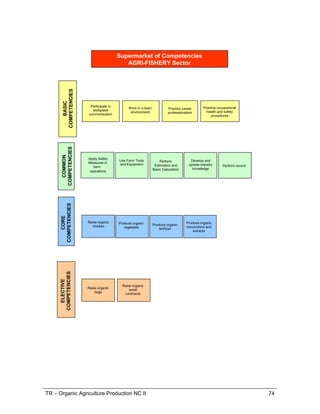
COMPETENCY MAP 74
DEFINITION OF TERMS 75-83
ACKNOWLEDGEMENTS 84-89
TR – Organic Agriculture Production NC II 1
TRAINING REGULATIONS FOR
ORGANIC AGRICULTURE PRODUCTION NC II
Section 1 ORGANIC AGRICULTURE PRODUCTION NCII QUALIFICATIONS
The ORGANIC AGRICULTURE PRODUCTION NC II Qualification consists of
competencies that a person must achieve to produce organic farm products such as
chicken and vegetables including producing of organic supplements such as fertilizer,
concoctions and extracts. It has two (2) elective competencies which are on raising
organic hogs and raising organic small ruminants.
This Qualification is packaged from the competency map of the Agri-Fishery Sector as
shown in Annex A.
The units of competency comprising this qualification include the following:
Code BASIC COMPETENCIES
500311105 Participate in workplace communication
500311104 Work in a team environment
500311107 Practice career professionalism
500311108 Practice occupational health and safety procedures
Code COMMON COMPETENCIES
AGR321201 Apply safety measures in farm operations
AGR321202 Use farm tools and equipment
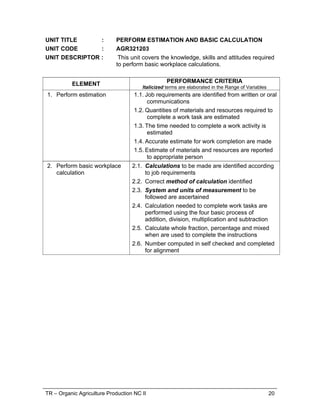
AGR321203 Perform estimation and calculations
TRS311201 Develop and update industry knowledge
AGR321205 Perform record keeping
Code CORE COMPETENCIES
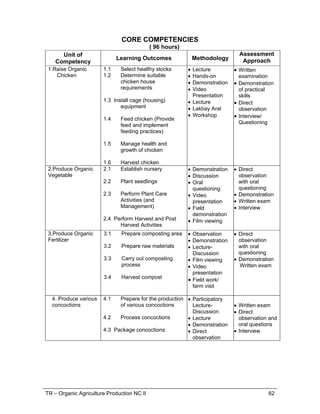
AGR612301 Raise organic chicken
AGR611306 Produce organic vegetables
AGR611301 Produce organic fertilizer
AGR611302 Produce organic concoctions and extracts
Code ELECTIVE COMPETENCIES
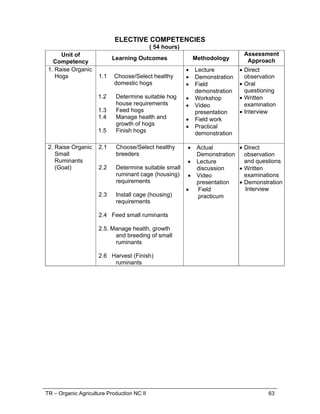
AGR612302 Raise organic hogs
AGR612303 Raise organic small ruminants
A person who has achieved this Qualification is competent to be:
• Organic Agriculture Farmer
• Organic Chicken Raiser
• Organic Hogs Raiser
• Organic Small Ruminants Raiser
• Organic Vegetables Farmer
• Organic Concoctions and Extracts Producer
• Organic Fertilizer Producer
TR – Organic Agriculture Production NC II 2
SECTION 2 COMPETENCY STANDARDS
BASIC COMPETENCIES
UNIT OF COMPETENCY : PARTICIPATE IN WORKPLACE COMMUNICATION
UNIT CODE : 500311105
UNIT DESCRIPTOR : This unit covers the knowledge, skills and attitudes
required to gather, interpret and convey information in
response to workplace requirements.
ELEMENT PERFORMANCE CRITERIA
Italicized terms are elaborated in the Range of Variables
1. Obtain and convey
workplace
information
1.1 Specific and relevant information is accessed from
appropriate sources
1.2 Effective questioning , active listening and speaking skills
are used to gather and convey information
1.3 Appropriate medium is used to transfer information and
ideas
1.4 Appropriate non- verbal communication is used
1.5 Appropriate lines of communication with supervisors and
colleagues are identified and followed
1.6 Defined workplace procedures for the location and storage
of information are used
1.7 Personal interaction is carried out clearly and concisely
2. Participate in
workplace meetings
and discussions
2.1 Team meetings are attended on time
2.2 Own opinions are clearly expressed and those of others are
listened to without interruption
2.3 Meeting inputs are consistent with the meeting purpose and
established protocols
2.4 Workplace interactions are conducted in a courteous
manner
2.5 Questions about simple routine workplace procedures and
maters concerning working conditions of employment are
asked and responded to
2.6 Meetings outcomes are interpreted and implemented
3. Complete relevant
work related
documents
3.1 Range of forms relating to conditions of employment are
completed accurately and legibly
3.2 Workplace data is recorded on standard workplace forms
and documents
3.3 Basic mathematical processes are used for routine
calculations
3.4 Errors in recording information on forms/ documents are
identified and properly acted upon
3.5 Reporting requirements to supervisor are completed
according to organizational guidelines
TR – Organic Agriculture Production NC II 3
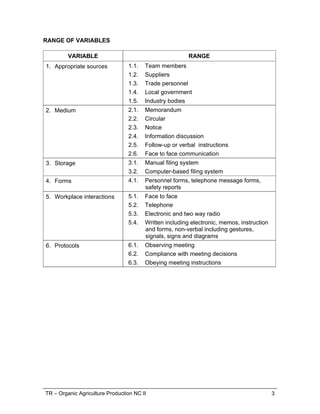
RANGE OF VARIABLES
VARIABLE RANGE
1. Appropriate sources 1.1. Team members
1.2. Suppliers
1.3. Trade personnel
1.4. Local government
1.5. Industry bodies
2. Medium 2.1. Memorandum
2.2. Circular
2.3. Notice
2.4. Information discussion
2.5. Follow-up or verbal instructions
2.6. Face to face communication
3. Storage 3.1. Manual filing system
3.2. Computer-based filing system
4. Forms 4.1. Personnel forms, telephone message forms,
safety reports
5. Workplace interactions 5.1. Face to face
5.2. Telephone
5.3. Electronic and two way radio
5.4. Written including electronic, memos, instruction
and forms, non-verbal including gestures,
signals, signs and diagrams
6. Protocols 6.1. Observing meeting
6.2. Compliance with meeting decisions
6.3. Obeying meeting instructions
TR – Organic Agriculture Production NC II 3
RANGE OF VARIABLES
VARIABLE RANGE
1. Appropriate sources 1.1. Team members
1.2. Suppliers
1.3. Trade personnel
1.4. Local government
1.5. Industry bodies
2. Medium 2.1. Memorandum
2.2. Circular
2.3. Notice
2.4. Information discussion
2.5. Follow-up or verbal instructions
2.6. Face to face communication
3. Storage 3.1. Manual filing system
3.2. Computer-based filing system
4. Forms 4.1. Personnel forms, telephone message forms,
safety reports
5. Workplace interactions 5.1. Face to face
5.2. Telephone
5.3. Electronic and two way radio
5.4. Written including electronic, memos, instruction
and forms, non-verbal including gestures,
signals, signs and diagrams
6. Protocols 6.1. Observing meeting
6.2. Compliance with meeting decisions
6.3. Obeying meeting instructions
TR – Organic Agriculture Production NC II 5
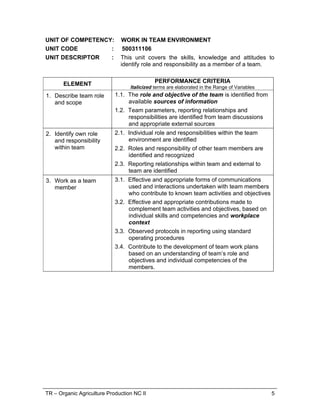
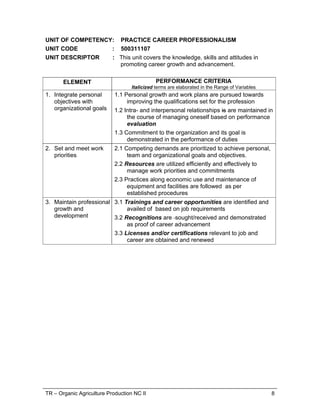
UNIT OF COMPETENCY: WORK IN TEAM ENVIRONMENT
UNIT CODE : 500311106
UNIT DESCRIPTOR : This unit covers the skills, knowledge and attitudes to
identify role and responsibility as a member of a team.
ELEMENT PERFORMANCE CRITERIA
Italicized terms are elaborated in the Range of Variables
1. Describe team role
and scope
1.1. The role and objective of the team is identified from
available sources of information
1.2. Team parameters, reporting relationships and
responsibilities are identified from team discussions
and appropriate external sources
2. Identify own role
and responsibility
within team
2.1. Individual role and responsibilities within the team
environment are identified
2.2. Roles and responsibility of other team members are
identified and recognized
2.3. Reporting relationships within team and external to
team are identified
3. Work as a team
member
3.1. Effective and appropriate forms of communications
used and interactions undertaken with team members
who contribute to known team activities and objectives
3.2. Effective and appropriate contributions made to
complement team activities and objectives, based on
individual skills and competencies and workplace
context
3.3. Observed protocols in reporting using standard
operating procedures
3.4. Contribute to the development of team work plans
based on an understanding of team’s role and
objectives and individual competencies of the
members.
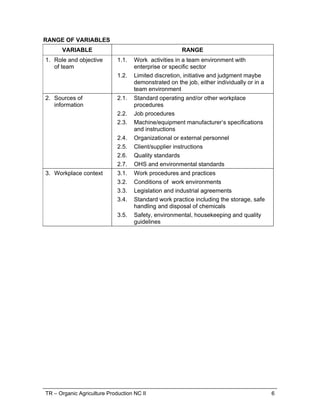
TR – Organic Agriculture Production NC II 6
RANGE OF VARIABLES
VARIABLE RANGE
1. Role and objective
of team
1.1. Work activities in a team environment with
enterprise or specific sector
1.2. Limited discretion, initiative and judgment maybe
demonstrated on the job, either individually or in a
team environment
2. Sources of
information
2.1. Standard operating and/or other workplace
procedures
2.2. Job procedures
2.3. Machine/equipment manufacturer’s specifications
and instructions
2.4. Organizational or external personnel
2.5. Client/supplier instructions
2.6. Quality standards
2.7. OHS and environmental standards
3. Workplace context 3.1. Work procedures and practices
3.2. Conditions of work environments
3.3. Legislation and industrial agreements
3.4. Standard work practice including the storage, safe
handling and disposal of chemicals
3.5. Safety, environmental, housekeeping and quality
guidelines
TR – Organic Agriculture Production NC II 7
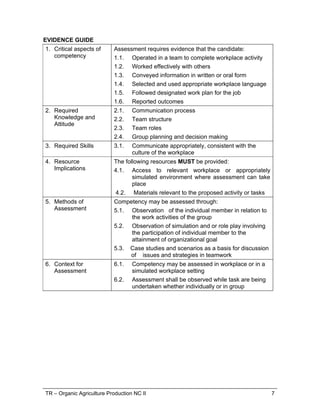
EVIDENCE GUIDE
1. Critical aspects of
competency
Assessment requires evidence that the candidate:
1.1. Operated in a team to complete workplace activity
1.2. Worked effectively with others
1.3. Conveyed information in written or oral form
1.4. Selected and used appropriate workplace language
1.5. Followed designated work plan for the job
1.6. Reported outcomes
2. Required
Knowledge and
Attitude
2.1. Communication process
2.2. Team structure
2.3. Team roles
2.4. Group planning and decision making
3. Required Skills 3.1. Communicate appropriately, consistent with the
culture of the workplace
4. Resource
Implications
The following resources MUST be provided:
4.1. Access to relevant workplace or appropriately
simulated environment where assessment can take
place
4.2. Materials relevant to the proposed activity or tasks
5. Methods of
Assessment
Competency may be assessed through:
5.1. Observation of the individual member in relation to
the work activities of the group
5.2. Observation of simulation and or role play involving
the participation of individual member to the
attainment of organizational goal
5.3. Case studies and scenarios as a basis for discussion
of issues and strategies in teamwork
6. Context for
Assessment
6.1. Competency may be assessed in workplace or in a
simulated workplace setting
6.2. Assessment shall be observed while task are being
undertaken whether individually or in group
TR – Organic Agriculture Production NC II 6
RANGE OF VARIABLES
VARIABLE RANGE
1. Role and objective
of team
1.1. Work activities in a team environment with
enterprise or specific sector
1.2. Limited discretion, initiative and judgment maybe
demonstrated on the job, either individually or in a
team environment
2. Sources of
information
2.1. Standard operating and/or other workplace
procedures
2.2. Job procedures
2.3. Machine/equipment manufacturer’s specifications
and instructions
2.4. Organizational or external personnel
2.5. Client/supplier instructions
2.6. Quality standards
2.7. OHS and environmental standards
3. Workplace context 3.1. Work procedures and practices
3.2. Conditions of work environments
3.3. Legislation and industrial agreements
3.4. Standard work practice including the storage, safe
handling and disposal of chemicals
3.5. Safety, environmental, housekeeping and quality
guidelines
TR – Organic Agriculture Production NC II 9
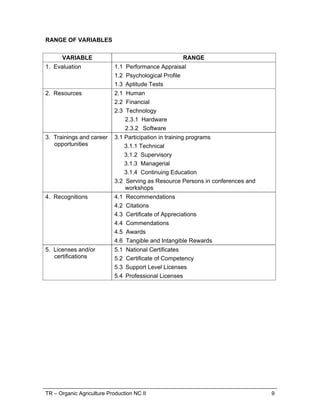
RANGE OF VARIABLES
VARIABLE RANGE
1. Evaluation 1.1 Performance Appraisal
1.2 Psychological Profile
1.3 Aptitude Tests
2. Resources 2.1 Human
2.2 Financial
2.3 Technology
2.3.1 Hardware
2.3.2 Software
3. Trainings and career
opportunities
3.1 Participation in training programs
3.1.1 Technical
3.1.2 Supervisory
3.1.3 Managerial
3.1.4 Continuing Education
3.2 Serving as Resource Persons in conferences and
workshops
4. Recognitions 4.1 Recommendations
4.2 Citations
4.3 Certificate of Appreciations
4.4 Commendations
4.5 Awards
4.6 Tangible and Intangible Rewards
5. Licenses and/or
certifications
5.1 National Certificates
5.2 Certificate of Competency
5.3 Support Level Licenses
5.4 Professional Licenses
TR – Organic Agriculture Production NC II 10
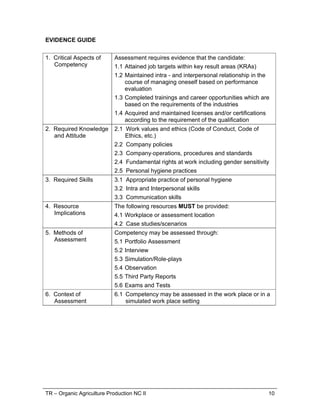
EVIDENCE GUIDE
1. Critical Aspects of
Competency
Assessment requires evidence that the candidate:
1.1 Attained job targets within key result areas (KRAs)
1.2 Maintained intra - and interpersonal relationship in the
course of managing oneself based on performance
evaluation
1.3 Completed trainings and career opportunities which are
based on the requirements of the industries
1.4 Acquired and maintained licenses and/or certifications
according to the requirement of the qualification
2. Required Knowledge
and Attitude
2.1 Work values and ethics (Code of Conduct, Code of
Ethics, etc.)
2.2 Company policies
2.3 Company operations, procedures and standards
2.4 Fundamental rights at work including gender sensitivity
2.5 Personal hygiene practices
3. Required Skills 3.1 Appropriate practice of personal hygiene
3.2 Intra and Interpersonal skills
3.3 Communication skills
4. Resource
Implications
The following resources MUST be provided:
4.1 Workplace or assessment location
4.2 Case studies/scenarios
5. Methods of
Assessment
Competency may be assessed through:
5.1 Portfolio Assessment
5.2 Interview
5.3 Simulation/Role-plays
5.4 Observation
5.5 Third Party Reports
5.6 Exams and Tests
6. Context of
Assessment
6.1 Competency may be assessed in the work place or in a
simulated work place setting
TR – Organic Agriculture Production NC II 11
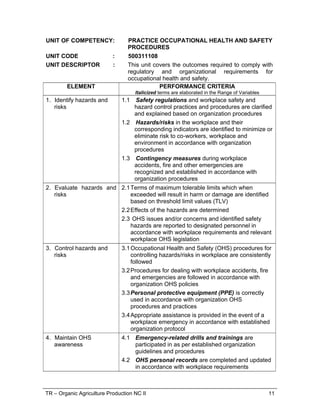
UNIT OF COMPETENCY: PRACTICE OCCUPATIONAL HEALTH AND SAFETY
PROCEDURES
UNIT CODE : 500311108
UNIT DESCRIPTOR : This unit covers the outcomes required to comply with
regulatory and organizational requirements for
occupational health and safety.
ELEMENT PERFORMANCE CRITERIA
Italicized terms are elaborated in the Range of Variables
1. Identify hazards and
risks
1.1 Safety regulations and workplace safety and
hazard control practices and procedures are clarified
and explained based on organization procedures
1.2 Hazards/risks in the workplace and their
corresponding indicators are identified to minimize or
eliminate risk to co-workers, workplace and
environment in accordance with organization
procedures
1.3 Contingency measures during workplace
accidents, fire and other emergencies are
recognized and established in accordance with
organization procedures
2. Evaluate hazards and
risks
2.1Terms of maximum tolerable limits which when
exceeded will result in harm or damage are identified
based on threshold limit values (TLV)
2.2Effects of the hazards are determined
2.3 OHS issues and/or concerns and identified safety
hazards are reported to designated personnel in
accordance with workplace requirements and relevant
workplace OHS legislation
3. Control hazards and
risks
3.1Occupational Health and Safety (OHS) procedures for
controlling hazards/risks in workplace are consistently
followed
3.2Procedures for dealing with workplace accidents, fire
and emergencies are followed in accordance with
organization OHS policies
3.3Personal protective equipment (PPE) is correctly
used in accordance with organization OHS
procedures and practices
3.4Appropriate assistance is provided in the event of a
workplace emergency in accordance with established
organization protocol
4. Maintain OHS
awareness
4.1 Emergency-related drills and trainings are
participated in as per established organization
guidelines and procedures
4.2 OHS personal records are completed and updated
in accordance with workplace requirements
TR – Organic Agriculture Production NC II 9
RANGE OF VARIABLES
VARIABLE RANGE
1. Evaluation 1.1 Performance Appraisal
1.2 Psychological Profile
1.3 Aptitude Tests
2. Resources 2.1 Human
2.2 Financial
2.3 Technology
2.3.1 Hardware
2.3.2 Software
3. Trainings and career
opportunities
3.1 Participation in training programs
3.1.1 Technical
3.1.2 Supervisory
3.1.3 Managerial
3.1.4 Continuing Education
3.2 Serving as Resource Persons in conferences and
workshops
4. Recognitions 4.1 Recommendations
4.2 Citations
4.3 Certificate of Appreciations
4.4 Commendations
4.5 Awards
4.6 Tangible and Intangible Rewards
5. Licenses and/or
certifications
5.1 National Certificates
5.2 Certificate of Competency
5.3 Support Level Licenses
5.4 Professional Licenses
TR – Organic Agriculture Production NC II 13
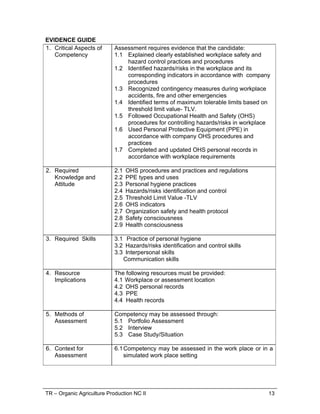
EVIDENCE GUIDE
1. Critical Aspects of
Competency
Assessment requires evidence that the candidate:
1.1 Explained clearly established workplace safety and
hazard control practices and procedures
1.2 Identified hazards/risks in the workplace and its
corresponding indicators in accordance with company
procedures
1.3 Recognized contingency measures during workplace
accidents, fire and other emergencies
1.4 Identified terms of maximum tolerable limits based on
threshold limit value- TLV.
1.5 Followed Occupational Health and Safety (OHS)
procedures for controlling hazards/risks in workplace
1.6 Used Personal Protective Equipment (PPE) in
accordance with company OHS procedures and
practices
1.7 Completed and updated OHS personal records in
accordance with workplace requirements
2. Required
Knowledge and
Attitude
2.1 OHS procedures and practices and regulations
2.2 PPE types and uses
2.3 Personal hygiene practices
2.4 Hazards/risks identification and control
2.5 Threshold Limit Value -TLV
2.6 OHS indicators
2.7 Organization safety and health protocol
2.8 Safety consciousness
2.9 Health consciousness
3. Required Skills 3.1 Practice of personal hygiene
3.2 Hazards/risks identification and control skills
3.3 Interpersonal skills
Communication skills
4. Resource
Implications
The following resources must be provided:
4.1 Workplace or assessment location
4.2 OHS personal records
4.3 PPE
4.4 Health records
5. Methods of
Assessment
Competency may be assessed through:
5.1 Portfolio Assessment
5.2 Interview
5.3 Case Study/Situation
6. Context for
Assessment
6.1Competency may be assessed in the work place or in a
simulated work place setting
TR – Organic Agriculture Production NC II 14
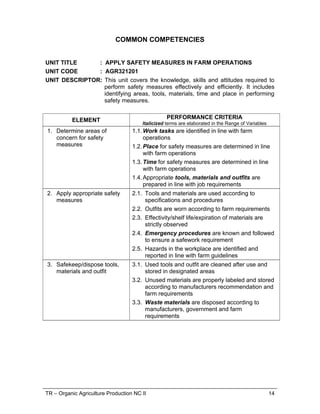
COMMON COMPETENCIES
UNIT TITLE : APPLY SAFETY MEASURES IN FARM OPERATIONS
UNIT CODE : AGR321201
UNIT DESCRIPTOR: This unit covers the knowledge, skills and attitudes required to
perform safety measures effectively and efficiently. It includes
identifying areas, tools, materials, time and place in performing
safety measures.
ELEMENT PERFORMANCE CRITERIA
Italicized terms are elaborated in the Range of Variables
1. Determine areas of
concern for safety
measures
1.1.Work tasks are identified in line with farm
operations
1.2.Place for safety measures are determined in line
with farm operations
1.3.Time for safety measures are determined in line
with farm operations
1.4.Appropriate tools, materials and outfits are
prepared in line with job requirements
2. Apply appropriate safety
measures
2.1. Tools and materials are used according to
specifications and procedures
2.2. Outfits are worn according to farm requirements
2.3. Effectivity/shelf life/expiration of materials are
strictly observed
2.4. Emergency procedures are known and followed
to ensure a safework requirement
2.5. Hazards in the workplace are identified and
reported in line with farm guidelines
3. Safekeep/dispose tools,
materials and outfit
3.1. Used tools and outfit are cleaned after use and
stored in designated areas
3.2. Unused materials are properly labeled and stored
according to manufacturers recommendation and
farm requirements
3.3. Waste materials are disposed according to
manufacturers, government and farm
requirements
TR – Organic Agriculture Production NC II 15
RANGE OF VARIABLES
VARIABLE RANGE
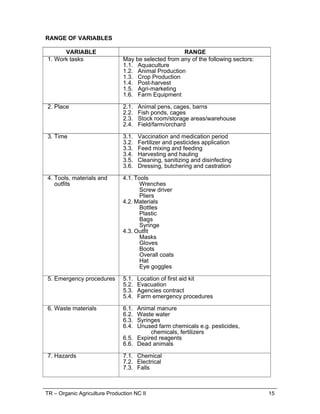
1. Work tasks May be selected from any of the following sectors:
1.1. Aquaculture
1.2. Animal Production
1.3. Crop Production
1.4. Post-harvest
1.5. Agri-marketing
1.6. Farm Equipment
2. Place 2.1. Animal pens, cages, barns
2.2. Fish ponds, cages
2.3. Stock room/storage areas/warehouse
2.4. Field/farm/orchard
3. Time 3.1. Vaccination and medication period
3.2. Fertilizer and pesticides application
3.3. Feed mixing and feeding
3.4. Harvesting and hauling
3.5. Cleaning, sanitizing and disinfecting
3.6. Dressing, butchering and castration
4. Tools, materials and
outfits
4.1. Tools
Wrenches
Screw driver
Pliers
4.2. Materials
Bottles
Plastic
Bags
Syringe
4.3. Outfit
Masks
Gloves
Boots
Overall coats
Hat
Eye goggles
5. Emergency procedures 5.1. Location of first aid kit
5.2. Evacuation
5.3. Agencies contract
5.4. Farm emergency procedures
6. Waste materials 6.1. Animal manure
6.2. Waste water
6.3. Syringes
6.4. Unused farm chemicals e.g. pesticides,
chemicals, fertilizers
6.5. Expired reagents
6.6. Dead animals
7. Hazards 7.1. Chemical
7.2. Electrical
7.3. Falls
TR – Organic Agriculture Production NC II 12
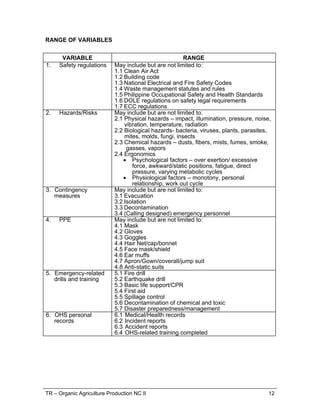
RANGE OF VARIABLES
VARIABLE RANGE
1. Safety regulations May include but are not limited to:
1.1 Clean Air Act
1.2 Building code
1.3 National Electrical and Fire Safety Codes
1.4 Waste management statutes and rules
1.5 Philippine Occupational Safety and Health Standards
1.6 DOLE regulations on safety legal requirements
1.7 ECC regulations
2. Hazards/Risks May include but are not limited to:
2.1 Physical hazards – impact, illumination, pressure, noise,
vibration, temperature, radiation
2.2 Biological hazards- bacteria, viruses, plants, parasites,
mites, molds, fungi, insects
2.3 Chemical hazards – dusts, fibers, mists, fumes, smoke,
gasses, vapors
2.4 Ergonomics
 Psychological factors – over exertion/ excessive
force, awkward/static positions, fatigue, direct
pressure, varying metabolic cycles
 Physiological factors – monotony, personal
relationship, work out cycle
3. Contingency
measures
May include but are not limited to:
3.1 Evacuation
3.2 Isolation
3.3 Decontamination
3.4 (Calling designed) emergency personnel
4. PPE May include but are not limited to:
4.1 Mask
4.2 Gloves
4.3 Goggles
4.4 Hair Net/cap/bonnet
4.5 Face mask/shield
4.6 Ear muffs
4.7 Apron/Gown/coverall/jump suit
4.8 Anti-static suits
5. Emergency-related
drills and training
5.1 Fire drill
5.2 Earthquake drill
5.3 Basic life support/CPR
5.4 First aid
5.5 Spillage control
5.6 Decontamination of chemical and toxic
5.7 Disaster preparedness/management
6. OHS personal
records
6.1 Medical/Health records
6.2 Incident reports
6.3 Accident reports
6.4 OHS-related training completed
TR – Organic Agriculture Production NC II 17
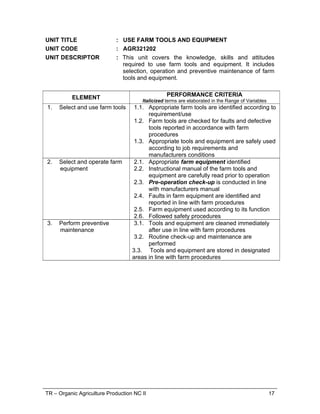
UNIT TITLE : USE FARM TOOLS AND EQUIPMENT
UNIT CODE : AGR321202
UNIT DESCRIPTOR : This unit covers the knowledge, skills and attitudes
required to use farm tools and equipment. It includes
selection, operation and preventive maintenance of farm
tools and equipment.
ELEMENT PERFORMANCE CRITERIA
Italicized terms are elaborated in the Range of Variables
1. Select and use farm tools 1.1. Appropriate farm tools are identified according to
requirement/use
1.2. Farm tools are checked for faults and defective
tools reported in accordance with farm
procedures
1.3. Appropriate tools and equipment are safely used
according to job requirements and
manufacturers conditions
2. Select and operate farm
equipment
2.1. Appropriate farm equipment identified
2.2. Instructional manual of the farm tools and
equipment are carefully read prior to operation
2.3. Pre-operation check-up is conducted in line
with manufacturers manual
2.4. Faults in farm equipment are identified and
reported in line with farm procedures
2.5. Farm equipment used according to its function
2.6. Followed safety procedures
3. Perform preventive
maintenance
3.1. Tools and equipment are cleaned immediately
after use in line with farm procedures
3.2. Routine check-up and maintenance are
performed
3.3. Tools and equipment are stored in designated
areas in line with farm procedures
TR – Organic Agriculture Production NC II 18
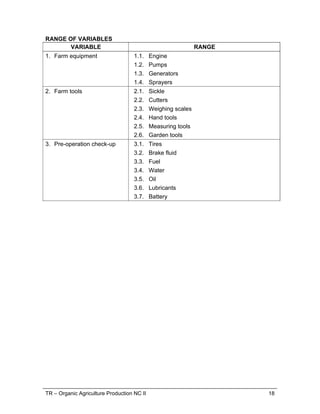
RANGE OF VARIABLES
VARIABLE RANGE
1. Farm equipment 1.1. Engine
1.2. Pumps
1.3. Generators
1.4. Sprayers
2. Farm tools 2.1. Sickle
2.2. Cutters
2.3. Weighing scales
2.4. Hand tools
2.5. Measuring tools
2.6. Garden tools
3. Pre-operation check-up 3.1. Tires
3.2. Brake fluid
3.3. Fuel
3.4. Water
3.5. Oil
3.6. Lubricants
3.7. Battery
TR – Organic Agriculture Production NC II 19
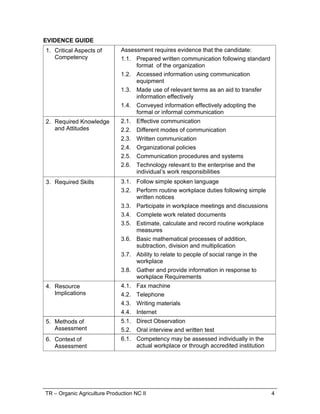
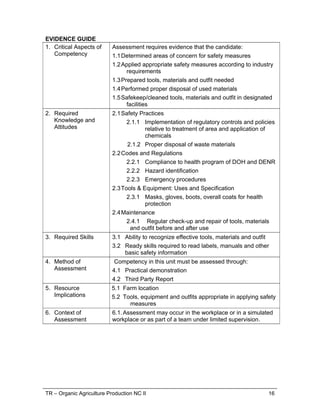
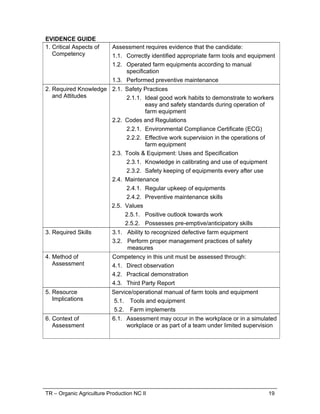
EVIDENCE GUIDE
1. Critical Aspects of
Competency
Assessment requires evidence that the candidate:
1.1. Correctly identified appropriate farm tools and equipment
1.2. Operated farm equipments according to manual
specification
1.3. Performed preventive maintenance
2. Required Knowledge
and Attitudes
2.1. Safety Practices
2.1.1. Ideal good work habits to demonstrate to workers
easy and safety standards during operation of
farm equipment
2.2. Codes and Regulations
2.2.1. Environmental Compliance Certificate (ECG)
2.2.2. Effective work supervision in the operations of
farm equipment
2.3. Tools & Equipment: Uses and Specification
2.3.1. Knowledge in calibrating and use of equipment
2.3.2. Safety keeping of equipments every after use
2.4. Maintenance
2.4.1. Regular upkeep of equipments
2.4.2. Preventive maintenance skills
2.5. Values
2.5.1. Positive outlook towards work
2.5.2. Possesses pre-emptive/anticipatory skills
3. Required Skills 3.1. Ability to recognized defective farm equipment
3.2. Perform proper management practices of safety
measures
4. Method of
Assessment
Competency in this unit must be assessed through:
4.1. Direct observation
4.2. Practical demonstration
4.3. Third Party Report
5. Resource
Implications
Service/operational manual of farm tools and equipment
5.1. Tools and equipment
5.2. Farm implements
6. Context of
Assessment
6.1. Assessment may occur in the workplace or in a simulated
workplace or as part of a team under limited supervision
TR – Organic Agriculture Production NC II 15
RANGE OF VARIABLES
VARIABLE RANGE
1. Work tasks May be selected from any of the following sectors:
1.1. Aquaculture
1.2. Animal Production
1.3. Crop Production
1.4. Post-harvest
1.5. Agri-marketing
1.6. Farm Equipment
2. Place 2.1. Animal pens, cages, barns
2.2. Fish ponds, cages
2.3. Stock room/storage areas/warehouse
2.4. Field/farm/orchard
3. Time 3.1. Vaccination and medication period
3.2. Fertilizer and pesticides application
3.3. Feed mixing and feeding
3.4. Harvesting and hauling
3.5. Cleaning, sanitizing and disinfecting
3.6. Dressing, butchering and castration
4. Tools, materials and
outfits
4.1. Tools
Wrenches
Screw driver
Pliers
4.2. Materials
Bottles
Plastic
Bags
Syringe
4.3. Outfit
Masks
Gloves
Boots
Overall coats
Hat
Eye goggles
5. Emergency procedures 5.1. Location of first aid kit
5.2. Evacuation
5.3. Agencies contract
5.4. Farm emergency procedures
6. Waste materials 6.1. Animal manure
6.2. Waste water
6.3. Syringes
6.4. Unused farm chemicals e.g. pesticides,
chemicals, fertilizers
6.5. Expired reagents
6.6. Dead animals
7. Hazards 7.1. Chemical
7.2. Electrical
7.3. Falls
TR – Organic Agriculture Production NC II 21
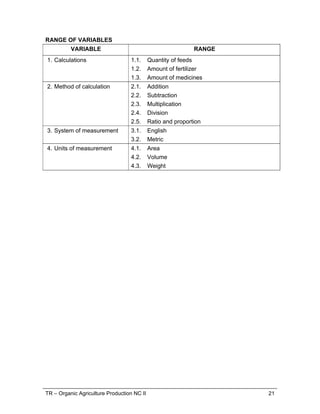
RANGE OF VARIABLES
VARIABLE RANGE
1. Calculations 1.1. Quantity of feeds
1.2. Amount of fertilizer
1.3. Amount of medicines
2. Method of calculation 2.1. Addition
2.2. Subtraction
2.3. Multiplication
2.4. Division
2.5. Ratio and proportion
3. System of measurement 3.1. English
3.2. Metric
4. Units of measurement 4.1. Area
4.2. Volume
4.3. Weight
TR – Organic Agriculture Production NC II 22
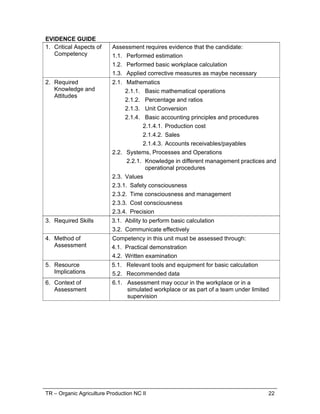
EVIDENCE GUIDE
1. Critical Aspects of
Competency
Assessment requires evidence that the candidate:
1.1. Performed estimation
1.2. Performed basic workplace calculation
1.3. Applied corrective measures as maybe necessary
2. Required
Knowledge and
Attitudes
2.1. Mathematics
2.1.1. Basic mathematical operations
2.1.2. Percentage and ratios
2.1.3. Unit Conversion
2.1.4. Basic accounting principles and procedures
2.1.4.1. Production cost
2.1.4.2. Sales
2.1.4.3. Accounts receivables/payables
2.2. Systems, Processes and Operations
2.2.1. Knowledge in different management practices and
operational procedures
2.3. Values
2.3.1. Safety consciousness
2.3.2. Time consciousness and management
2.3.3. Cost consciousness
2.3.4. Precision
3. Required Skills 3.1. Ability to perform basic calculation
3.2. Communicate effectively
4. Method of
Assessment
Competency in this unit must be assessed through:
4.1. Practical demonstration
4.2. Written examination
5. Resource
Implications
5.1. Relevant tools and equipment for basic calculation
5.2. Recommended data
6. Context of
Assessment
6.1. Assessment may occur in the workplace or in a
simulated workplace or as part of a team under limited
supervision
TR – Organic Agriculture Production NC II 23
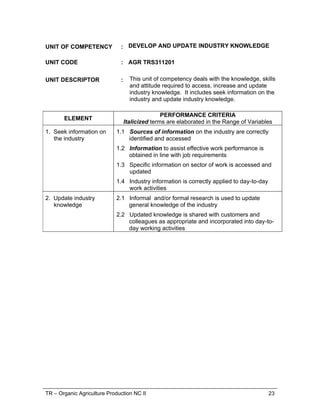
UNIT OF COMPETENCY : DEVELOP AND UPDATE INDUSTRY KNOWLEDGE
UNIT CODE : AGR TRS311201
UNIT DESCRIPTOR : This unit of competency deals with the knowledge, skills
and attitude required to access, increase and update
industry knowledge. It includes seek information on the
industry and update industry knowledge.
ELEMENT
PERFORMANCE CRITERIA
Italicized terms are elaborated in the Range of Variables
1. Seek information on
the industry
1.1 Sources of information on the industry are correctly
identified and accessed
1.2 Information to assist effective work performance is
obtained in line with job requirements
1.3 Specific information on sector of work is accessed and
updated
1.4 Industry information is correctly applied to day-to-day
work activities
2. Update industry
knowledge
2.1 Informal and/or formal research is used to update
general knowledge of the industry
2.2 Updated knowledge is shared with customers and
colleagues as appropriate and incorporated into day-to-
day working activities
TR – Organic Agriculture Production NC II 18
RANGE OF VARIABLES
VARIABLE RANGE
1. Farm equipment 1.1. Engine
1.2. Pumps
1.3. Generators
1.4. Sprayers
2. Farm tools 2.1. Sickle
2.2. Cutters
2.3. Weighing scales
2.4. Hand tools
2.5. Measuring tools
2.6. Garden tools
3. Pre-operation check-up 3.1. Tires
3.2. Brake fluid
3.3. Fuel
3.4. Water
3.5. Oil
3.6. Lubricants
3.7. Battery
TR – Organic Agriculture Production NC II 25
EVIDENCE GUIDE
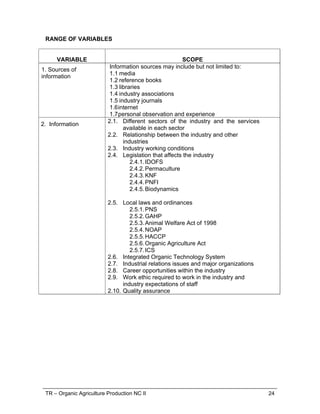
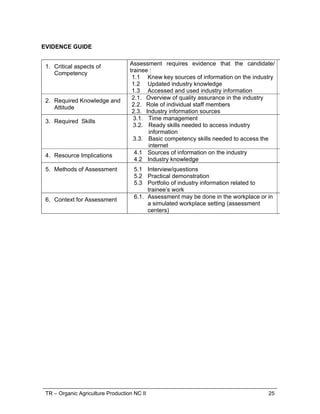
1. Critical aspects of
Competency
Assessment requires evidence that the candidate/
trainee :
1.1 Knew key sources of information on the industry
1.2 Updated industry knowledge
1.3 Accessed and used industry information
2. Required Knowledge and
Attitude
2.1. Overview of quality assurance in the industry
2.2. Role of individual staff members
2.3. Industry information sources
3. Required Skills 3.1. Time management
3.2. Ready skills needed to access industry
information
3.3. Basic competency skills needed to access the
internet
4. Resource Implications 4.1 Sources of information on the industry
4.2 Industry knowledge
5. Methods of Assessment 5.1 Interview/questions
5.2 Practical demonstration
5.3 Portfolio of industry information related to
trainee’s work
6. Context for Assessment 6.1. Assessment may be done in the workplace or in
a simulated workplace setting (assessment
centers)
TR – Organic Agriculture Production NC II 26
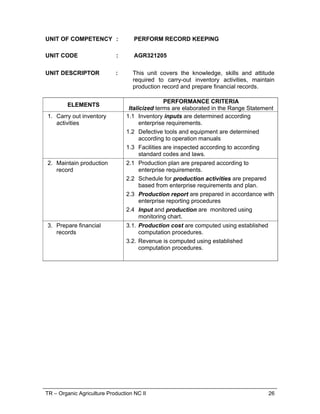
UNIT OF COMPETENCY : PERFORM RECORD KEEPING
UNIT CODE : AGR321205
UNIT DESCRIPTOR : This unit covers the knowledge, skills and attitude
required to carry-out inventory activities, maintain
production record and prepare financial records.
ELEMENTS
PERFORMANCE CRITERIA
Italicized terms are elaborated in the Range Statement
1. Carry out inventory
activities
1.1 Inventory inputs are determined according
enterprise requirements.
1.2 Defective tools and equipment are determined
according to operation manuals
1.3 Facilities are inspected according to according
standard codes and laws.
2. Maintain production
record
2.1 Production plan are prepared according to
enterprise requirements.
2.2 Schedule for production activities are prepared
based from enterprise requirements and plan.
2.3 Production report are prepared in accordance with
enterprise reporting procedures
2.4 Input and production are monitored using
monitoring chart.
3. Prepare financial
records
3.1. Production cost are computed using established
computation procedures.
3.2. Revenue is computed using established
computation procedures.
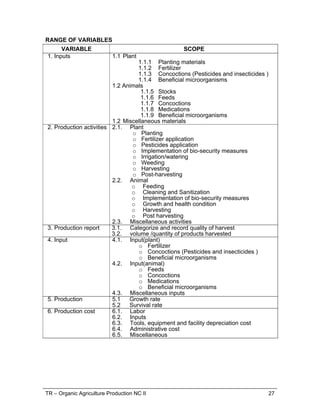
TR – Organic Agriculture Production NC II 27
RANGE OF VARIABLES
VARIABLE SCOPE
1. Inputs 1.1 Plant
1.1.1 Planting materials
1.1.2 Fertilizer
1.1.3 Concoctions (Pesticides and insecticides )
1.1.4 Beneficial microorganisms
1.2 Animals
1.1.5 Stocks
1.1.6 Feeds
1.1.7 Concoctions
1.1.8 Medications
1.1.9 Beneficial microorganisms
1.2 Miscellaneous materials
2. Production activities 2.1. Plant
o Planting
o Fertilizer application
o Pesticides application
o Implementation of bio-security measures
o Irrigation/watering
o Weeding
o Harvesting
o Post-harvesting
2.2. Animal
o Feeding
o Cleaning and Sanitization
o Implementation of bio-security measures
o Growth and health condition
o Harvesting
o Post harvesting
2.3. Miscellaneous activities
3. Production report 3.1. Categorize and record quality of harvest
3.2. volume /quantity of products harvested
4. Input 4.1. Input(plant)
o Fertilizer
o Concoctions (Pesticides and insecticides )
o Beneficial microorganisms
4.2. Input(animal)
o Feeds
o Concoctions
o Medications
o Beneficial microorganisms
4.3. Miscellaneous inputs
5. Production 5.1 Growth rate
5.2 Survival rate
6. Production cost 6.1. Labor
6.2. Inputs
6.3. Tools, equipment and facility depreciation cost
6.4. Administrative cost
6.5. Miscellaneous
TR – Organic Agriculture Production NC II 28
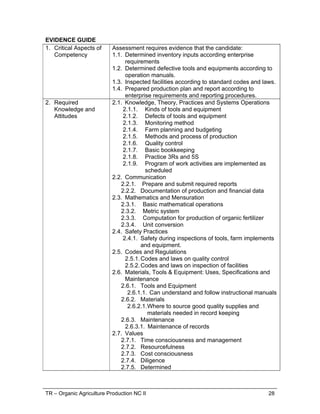
EVIDENCE GUIDE
1. Critical Aspects of
Competency
Assessment requires evidence that the candidate:
1.1. Determined inventory inputs according enterprise
requirements
1.2. Determined defective tools and equipments according to
operation manuals.
1.3. Inspected facilities according to standard codes and laws.
1.4. Prepared production plan and report according to
enterprise requirements and reporting procedures.
2. Required
Knowledge and
Attitudes
2.1. Knowledge, Theory, Practices and Systems Operations
2.1.1. Kinds of tools and equipment
2.1.2. Defects of tools and equipment
2.1.3. Monitoring method
2.1.4. Farm planning and budgeting
2.1.5. Methods and process of production
2.1.6. Quality control
2.1.7. Basic bookkeeping
2.1.8. Practice 3Rs and 5S
2.1.9. Program of work activities are implemented as
scheduled
2.2. Communication
2.2.1. Prepare and submit required reports
2.2.2. Documentation of production and financial data
2.3. Mathematics and Mensuration
2.3.1. Basic mathematical operations
2.3.2. Metric system
2.3.3. Computation for production of organic fertilizer
2.3.4. Unit conversion
2.4. Safety Practices
2.4.1. Safety during inspections of tools, farm implements
and equipment.
2.5. Codes and Regulations
2.5.1.Codes and laws on quality control
2.5.2.Codes and laws on inspection of facilities
2.6. Materials, Tools & Equipment: Uses, Specifications and
Maintenance
2.6.1. Tools and Equipment
2.6.1.1. Can understand and follow instructional manuals
2.6.2. Materials
2.6.2.1.Where to source good quality supplies and
materials needed in record keeping
2.6.3. Maintenance
2.6.3.1. Maintenance of records
2.7. Values
2.7.1. Time consciousness and management
2.7.2. Resourcefulness
2.7.3. Cost consciousness
2.7.4. Diligence
2.7.5. Determined
TR – Organic Agriculture Production NC II 29
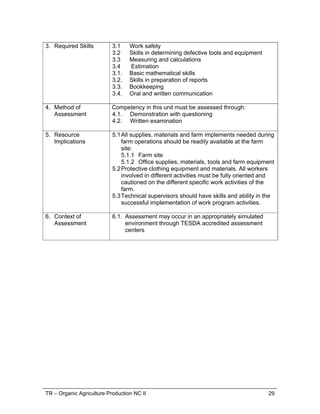
3. Required Skills 3.1 Work safety
3.2 Skills in determining defective tools and equipment
3.3 Measuring and calculations
3.4 Estimation
3.1. Basic mathematical skills
3.2. Skills in preparation of reports
3.3. Bookkeeping
3.4. Oral and written communication
4. Method of
Assessment
Competency in this unit must be assessed through:
4.1. Demonstration with questioning
4.2. Written examination
5. Resource
Implications
5.1All supplies, materials and farm implements needed during
farm operations should be readily available at the farm
site:
5.1.1 Farm site
5.1.2 Office supplies, materials, tools and farm equipment
5.2Protective clothing equipment and materials. All workers
involved in different activities must be fully oriented and
cautioned on the different specific work activities of the
farm.
5.3Technical supervisors should have skills and ability in the
successful implementation of work program activities.
6. Context of
Assessment
6.1. Assessment may occur in an appropriately simulated
environment through TESDA accredited assessment
centers
TR – Organic Agriculture Production NC II 23
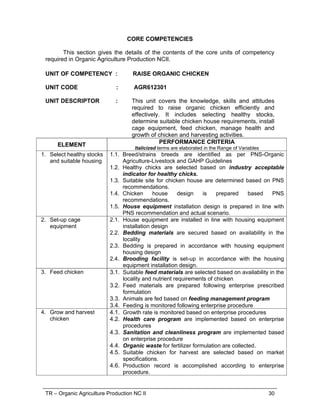
UNIT OF COMPETENCY : DEVELOP AND UPDATE INDUSTRY KNOWLEDGE
UNIT CODE : AGR TRS311201
UNIT DESCRIPTOR : This unit of competency deals with the knowledge, skills
and attitude required to access, increase and update
industry knowledge. It includes seek information on the
industry and update industry knowledge.
ELEMENT
PERFORMANCE CRITERIA
Italicized terms are elaborated in the Range of Variables
1. Seek information on
the industry
1.1 Sources of information on the industry are correctly
identified and accessed
1.2 Information to assist effective work performance is
obtained in line with job requirements
1.3 Specific information on sector of work is accessed and
updated
1.4 Industry information is correctly applied to day-to-day
work activities
2. Update industry
knowledge
2.1 Informal and/or formal research is used to update
general knowledge of the industry
2.2 Updated knowledge is shared with customers and
colleagues as appropriate and incorporated into day-to-
day working activities
TR – Organic Agriculture Production NC II 31
RANGE OF VARIABLES
VARIABLE SCOPE
1. Industry
acceptable
indicator for
healthy chicks
1.1. Bright eyes
1.2. Clean, downy feathers
1.3. Uniformity (90%-95%)
1.4. Alert
1.5. 21 day old chicks from organic farm from PNS/BAFPS
07:2003 ICS 65.020 (Organic Agriculture-Specification)
2. House equipment 2.1. Feeding troughs
2.2. Waterers
2.3. Containers of concoction
3. Bedding materials 3.1. Rice hull
3.2. Saw dust
3.3. Coco coir
3.4. Rice straw
4. Brooding facility 4.1 Bulb
4.2 Charcoal
4.3 Rice hull
5. Feed materials 5.1 Protein Sources (e.g. madre de agua; ipil-ipil) other
leguminous plants
5.2 Carbohydrate sources – rootcrops
5.3 Mineral sources – e.g. Calcium-eggshells, sea shells;
potassium –tubers (banana)
6. Feeding
management
program
6.1. Restricted
6.2. Adlibitum
6.3. Combination
7. Health care
program
7.1. Deworming
7.2. Vitamins/mineral supplementation using concoctions
8. Sanitation and
cleanliness
program
8.1. Cleaning
8.2. Application of beneficial micro-organism
8.3. Collection of manure
9. Organic waste 9.1. Animal manure
9.2. Waste/Rotten vegetables and fruits
TR – Organic Agriculture Production NC II 32
EVIDENCE GUIDE
1. Critical Aspects of
Competency
Assessment requires evidence that the candidate:
1.1Selected healthy stocks
1.2Determined suitable chicken house requirements
1.3Set-up cage equipment
1.4Fed chicken
1.5Managed health and growth of chicken
1.6Harvested chicken
2. Required
Knowledge and
Attitudes
2.1. Knowledge, Theory, Practices and Systems Operations
2.1.1. Different breeds of chickens
2.1.2. Criteria/indicators of healthy chicks
2.1.3. Characteristics of a suitable site
2.1.4. Housing designs and housing equipment
2.1.5. Housing equipment for chicken
2.1.6. Simple carpentry
2.1.7. Housing equipment for chicken
2.1.8. Types of bedding materials
2.1.9. Bedding preparation
2.1.10. Procedures in setting-up of brooding facilities
2.1.11. Characteristics of feed materials
2.1.12. Preparation of feeds
2.1.13. Advantages and disadvantages of different
feeding management
2.1.14. Knowledge on record-keeping
2.1.15. Organic-based health care products/materials
2.1.16. Practice 3Rs and 5S
2.1.17. Parts and functions of specific tools and farm
implements use in raising organic chicken
2.1.18. Program of work activities are implemented as
scheduled
2.2. Communication
2.2.1. Prepare and submit required reports
2.2.2. Documentation on chicken production/raising
2.2.3. Record keeping and filing
2.3. Mathematics and Mensuration
2.3.1. Basic mathematical operations
2.3.2. Computation for production of chicken
2.3.3. Unit conversion
2.3.4. Simple/basic calculation
2.4. Safety Practices
2.4.1. Proper application use of tools, farm implements
and equipment.
2.4.2. Proper use of carpentry and electrical tools
2.4.3. Wear appropriate PPE
2.4.4. Proper waste disposal
2.5. Codes and Regulations
2.5.1. Comply with Organic Law
2.5.2. Good Animal Husbandry Practices (GAHP)
2.5.3. DENR, zoning ordinances
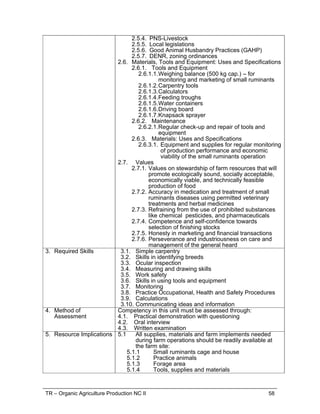
2.5.4. PNS/BAFPS 07:2003 ICS 65.020 (Organic
TR – Organic Agriculture Production NC II 33
Agriculture-Specification)
2.5.5. Animal Welfare Act – Minimum Standards on the
Welfare of Poultry
2.5.6. PNS – Livestock
2.6. Materials, Tools & Equipment: Uses, Specifications and
Maintenance
2.6.1. Tools and Equipment
2.6.1.1. Can understand and follow instructional
manuals
2.6.1.2. Safe keeping of equipments every after use
2.6.2. Materials
2.6.2.1. Where to source good quality supplies,
materials and equipment needed in the
operation of the farm
2.6.3. Maintenance
2.6.3.1. Regular upkeep of equipments and facilities
2.6.3.2. Preventive maintenance skills
2.7. Values
2.7.1. Safety consciousness
2.7.2. Time consciousness and management
2.7.3. Resourcefulness
2.7.4. Cost consciousness
2.7.5. Diligence
2.7.6. Determined
2.7.7. Observes hygiene
3. Required Skills 3.1. Work safety
3.2. Skills in using tools and equipment
3.3. Skills in identifying breeds
3.4. Skills in ocular inspection
3.5. Measuring and drawing skills
3.6. Carpentry
3.7. Basic electricity
3.8. Monitoring skills
3.9. Practicing occupational, health and safety procedures
3.10.Record keeping
3.11.Calculations
3.12.Basic mathematical skills
3.13.Skills in preparation of reports
3.14.Oral and written communication
4. Method of
Assessment
Competency in this unit must be assessed through:
1. Demonstration with oral questioning
2. Written examination
5. Resource
Implications
5.1All supplies, materials and farm implements needed during
farm operations should be readily available at the farm
site:
5.1.1 Chicken farm area (free range)
5.1.2 Chicken house
5.1.3 Brooding facility
5.1.4 Practice animal
5.1.5 Knapsack sprayer
TR – Organic Agriculture Production NC II 26
UNIT OF COMPETENCY : PERFORM RECORD KEEPING
UNIT CODE : AGR321205
UNIT DESCRIPTOR : This unit covers the knowledge, skills and attitude
required to carry-out inventory activities, maintain
production record and prepare financial records.
ELEMENTS
PERFORMANCE CRITERIA
Italicized terms are elaborated in the Range Statement
1. Carry out inventory
activities
1.1 Inventory inputs are determined according
enterprise requirements.
1.2 Defective tools and equipment are determined
according to operation manuals
1.3 Facilities are inspected according to according
standard codes and laws.
2. Maintain production
record
2.1 Production plan are prepared according to
enterprise requirements.
2.2 Schedule for production activities are prepared
based from enterprise requirements and plan.
2.3 Production report are prepared in accordance with
enterprise reporting procedures
2.4 Input and production are monitored using
monitoring chart.
3. Prepare financial
records
3.1. Production cost are computed using established
computation procedures.
3.2. Revenue is computed using established
computation procedures.
TR – Organic Agriculture Production NC II 35
UNIT OF COMPETENCY : PRODUCE ORGANIC VEGETABLES
UNIT CODE : AGR611306
UNIT DESCRIPTOR : This unit covers the knowledge, skills and attitude
required to establish nursery, plant seedlings, perform
plant care and perform harvest and post-harvest.
ELEMENT PERFORMANCE CRITERIA
Italicized terms are elaborated in the Range of Variables
1. Establish nursery 1.1. Seeds are selected in accordance with the PNS, and
NSQCS/BPI.
1.2. Seedbeds are prepared in accordance with planting
requirements based on Vegetable Production manual (VPM).
1.3. Care and maintenance of seedlings are done in
accordance with enterprise practice.
1.4. Potting media are prepared in accordance with enterprise
procedure.
2. Plant seedlings 2.1 Land preparation is carried out in accordance with enterprise
practice
2.2 Beneficial micro-organisms are introduced prior to planting in
accordance with enterprise procedure
2.3 Seedlings are transplanted/planted based on VPM
recommendations
2.4 Seedlings are watered based on VPM recommendations
3. Perform plant care and
management
3.1 Water management is implemented according to plan.
3.2 Effective control measures are determined on specific pest
and diseases as described under the “pest, disease and weed
management” of the PNS
3.3 All missing hills are replanted to maintain the desired plant
population of the area
3.4 Plant rejuvenation/rationing are maintained according to PNS.
3.5 Organic fertilizers are applied in accordance with fertilization
policy of the PNS
4. Perform harvest and
post-harvest activities
4.1. Products are checked using maturity indices according to to
PNS, PNS-organic agriculture and enterprise practice.
4.2. Marketable products are harvested according to PNS, PNS-
organic agriculture and enterprise practice.
4.3. Harvested vegetables are classified according to PNS, PNS-
organic agriculture and enterprise practice.
4.4. Appropriate harvesting tools and materials are used
according to PNS.
4.5. Post harvest practices are applied according to PNS and
GAP recommendations
4.6. Production record is accomplished according to enterprise
procedures.
TR – Organic Agriculture Production NC II 36
RANGE OF VARIABLES
VARIABLE SCOPE
1. Care and
maintenance of
seedlings
1.1. Handling
1.2. Watering
1.3. Organic foliar fertilizing
1.4. Pest management
2. Land preparation 2.1. Clearing
2.2. Plowing
2.3. Harrowing
2.4. Farrowing
3. Control measures 3.1. Crop rotation
3.2. Application of beneficial micro organisms
3.3. Inter-cropping
3.4. Planting botanical repellants
3.5. Displaying organic attractants and repellants
3.6. Preserve existing predators
3.7. Mulching
4. Organic fertilizers 4.1. Basal
4.2. Foliar
5. Post harvest
practices
5.1 Postharvest operations
5.2 Using of charts and manuals
5.3 Trimming, sorting, sizing and washing
5.4 Packaging labeling and storing
TR – Organic Agriculture Production NC II 37
EVIDENCE GUIDE
1. Critical Aspects of
Competency:
Assessment requires evidence that the candidate:
1.1 Established nursery
1.2 Planted seedlings
1.3 Performed plant care activities
1.4 Performed harvest and post-harvest activities
2. Required
Knowledge and
Attitude
2.1 Knowledge, Theory, Practices and Systems Operations
2.1.1. Germination testing
2.1.2. Seedbed preparation procedure
2.1.3. Proper handling of seedlings and plants
2.1.4. Proper water management and procedures
2.1.5. Organic method of pest and disease
management
2.1.6. Organic method of nutrient management
2.1.7. Potting media preparation and procedure
2.1.8. Land preparation activities
2.1.9. Procedure in applying beneficial micro-organisms
2.1.10. Principles of bio-dynamics
2.1.11. Transplanting and planting procedures
2.1.12. Types of pest and diseases
2.1.13. Organic method of preventing and controlling
pest and diseases
2.1.14. Maturity indices
2.1.15. Proper handling of harvesting tools and materials
2.1.16. Practices in post harvest of vegetables
2.1.17. Principles and guides in post harvest handling of
perishables
2.1.18. Practice 3Rs and 5S
2.1.19. Parts and functions of specific tools and farm
implements use in producing organic vegetables
2.1.20. Program of work activities are implemented as
scheduled
2.2 Communication
2.2.4. Prepare and submit required reports
2.2.5. Documentation on vegetable production
2.2.6. Proper book keeping
2.3 Mathematics and Mensuration
2.3.5. Basic mathematical operations
2.3.6. Computation for production of chicken
2.3.7. Unit conversion
2.3.8. Simple/basic calculation
2.4 Safety Practices
2.4.5. Proper application use of tools, farm implements
and equipment.
2.4.6. Proper use of carpentry and electrical tools
2.4.7. Wear appropriate PPE
2.4.8. Proper waste disposal
2.5 Codes and Regulations
TR – Organic Agriculture Production NC II 28
EVIDENCE GUIDE
1. Critical Aspects of
Competency
Assessment requires evidence that the candidate:
1.1. Determined inventory inputs according enterprise
requirements
1.2. Determined defective tools and equipments according to
operation manuals.
1.3. Inspected facilities according to standard codes and laws.
1.4. Prepared production plan and report according to
enterprise requirements and reporting procedures.
2. Required
Knowledge and
Attitudes
2.1. Knowledge, Theory, Practices and Systems Operations
2.1.1. Kinds of tools and equipment
2.1.2. Defects of tools and equipment
2.1.3. Monitoring method
2.1.4. Farm planning and budgeting
2.1.5. Methods and process of production
2.1.6. Quality control
2.1.7. Basic bookkeeping
2.1.8. Practice 3Rs and 5S
2.1.9. Program of work activities are implemented as
scheduled
2.2. Communication
2.2.1. Prepare and submit required reports
2.2.2. Documentation of production and financial data
2.3. Mathematics and Mensuration
2.3.1. Basic mathematical operations
2.3.2. Metric system
2.3.3. Computation for production of organic fertilizer
2.3.4. Unit conversion
2.4. Safety Practices
2.4.1. Safety during inspections of tools, farm implements
and equipment.
2.5. Codes and Regulations
2.5.1.Codes and laws on quality control
2.5.2.Codes and laws on inspection of facilities
2.6. Materials, Tools & Equipment: Uses, Specifications and
Maintenance
2.6.1. Tools and Equipment
2.6.1.1. Can understand and follow instructional manuals
2.6.2. Materials
2.6.2.1.Where to source good quality supplies and
materials needed in record keeping
2.6.3. Maintenance
2.6.3.1. Maintenance of records
2.7. Values
2.7.1. Time consciousness and management
2.7.2. Resourcefulness
2.7.3. Cost consciousness
2.7.4. Diligence
2.7.5. Determined
TR – Organic Agriculture Production NC II 39
 Comb-tooth harrow
 Computer
 Crates
 Farm/ field
 Greenhouse/ nursery
 Harvesting equipment
 Irrigation system (sprinkler, mist/ drip irrigation)
 Mower (grass cutter)
 Over head projector (OHP)
 Portable chain saw
 Post-Harvest treatment equipment
 Power sprayer
 Rotavator
 Service vehicle
 Sorting equipment
 Spike tooth harrow
 Storage room
 Surface irrigation system
5.1.2 Tools and instruments such as:
 Bolos
 Broomstick
 Calculator
 Container
 Cutting tools
 Digging tools
 Drying meter
 Fruit crate
 Harvesting tools
 Hat
 Knapsack sprayer
 Knife
 Light hoe
 Moisture meter
 Petri-dish
 pH meter
 Pick mattock
 Picking knife
 Plow
 Plumbing tools
 Post-Harvest treatment tools
 Protective gadgets
 Pruning shears
5.1.3 Supplies and Materials such as:
 Agri bags, plastic
 Bamboo stick
 Basket
 Bond paper
 Catching nets
 Clips
 Coconut dust
TR – Organic Agriculture Production NC II 40
 Compost
 Fertilizers
 First aide supplies/ medicine
 Flower inducer
 Fungicides
 Gloves
 Growing media (garden soil, sewed sand, compost, soil,
manure and sawdust/rice)
 Killing bottles
 Marking pens
 Masks
 Mulching material
 Hair nets
 Packaging materials, assorted
 Pail
5.2. All workers involved in different activities must be fully
oriented and cautioned on the different specific work
activities of the farm
5.3. Technical supervisors should have skills and ability in
the successful implementation of work program activities
6. Context of Assessment 6.1. Assessment may occur in an appropriately simulated
environment through TESDA accredited assessment
centers
TR – Organic Agriculture Production NC II 41
UNIT OF COMPETENCY : PRODUCE ORGANIC FERTILIZER
UNIT CODE : AGR611301
UNIT DESCRIPTOR : This unit covers the knowledge, skills and attitude
required to produce organic fertilizers which include
tasks such as preparing composting area and raw
materials and carrying-out composting activities and
finally, harvesting of fertilizer.
ELEMENTS
PERFORMANCE CRITERIA
Italicized terms are elaborated in the Range Statement
1. Prepare composting
area and raw materials
1.1 Site is selected based on compost fertilizer
production requirements and
1.2 Site lay-out is prepared based on location.
1.3 Bed is prepared in accordance with production
requirements
1.4 Materials are gather based on production
requirements and PNS for organic fertilizer
1.5 Prepare raw materials following enterprise
procedure and PNS for organic fertilizer
2. Compost and harvest
fertilizer
2.1 Appropriate composting methods are applied
based on production requirements
2.2 Compost is monitored based PNS indicators of
fully decomposed fertilizer
2.3 Quality of harvest is checked based on PNS
indicators of fully decomposed fertilizer
2.4 Processing of compost fertilizer are carried- out
based on production requirement.
2.5 Record keeping is performed according to
enterprise procedure.
TR – Organic Agriculture Production NC II 31
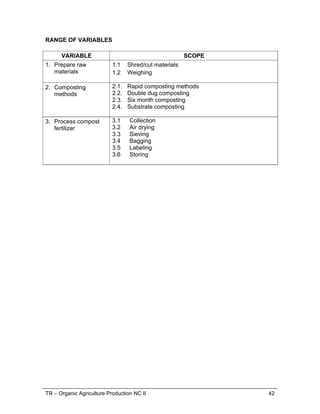
RANGE OF VARIABLES
VARIABLE SCOPE
1. Industry
acceptable
indicator for
healthy chicks
1.1. Bright eyes
1.2. Clean, downy feathers
1.3. Uniformity (90%-95%)
1.4. Alert
1.5. 21 day old chicks from organic farm from PNS/BAFPS
07:2003 ICS 65.020 (Organic Agriculture-Specification)
2. House equipment 2.1. Feeding troughs
2.2. Waterers
2.3. Containers of concoction
3. Bedding materials 3.1. Rice hull
3.2. Saw dust
3.3. Coco coir
3.4. Rice straw
4. Brooding facility 4.1 Bulb
4.2 Charcoal
4.3 Rice hull
5. Feed materials 5.1 Protein Sources (e.g. madre de agua; ipil-ipil) other
leguminous plants
5.2 Carbohydrate sources – rootcrops
5.3 Mineral sources – e.g. Calcium-eggshells, sea shells;
potassium –tubers (banana)
6. Feeding
management
program
6.1. Restricted
6.2. Adlibitum
6.3. Combination
7. Health care
program
7.1. Deworming
7.2. Vitamins/mineral supplementation using concoctions
8. Sanitation and
cleanliness
program
8.1. Cleaning
8.2. Application of beneficial micro-organism
8.3. Collection of manure
9. Organic waste 9.1. Animal manure
9.2. Waste/Rotten vegetables and fruits
TR – Organic Agriculture Production NC II 43
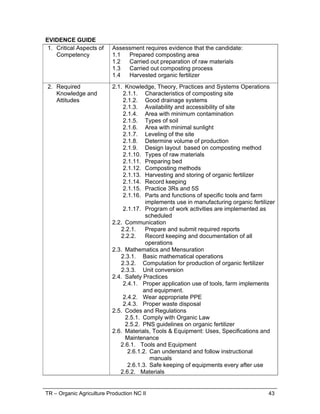
EVIDENCE GUIDE
1. Critical Aspects of
Competency
Assessment requires evidence that the candidate:
1.1 Prepared composting area
1.2 Carried out preparation of raw materials
1.3 Carried out composting process
1.4 Harvested organic fertilizer
2. Required
Knowledge and
Attitudes
2.1. Knowledge, Theory, Practices and Systems Operations
2.1.1. Characteristics of composting site
2.1.2. Good drainage systems
2.1.3. Availability and accessibility of site
2.1.4. Area with minimum contamination
2.1.5. Types of soil
2.1.6. Area with minimal sunlight
2.1.7. Leveling of the site
2.1.8. Determine volume of production
2.1.9. Design layout based on composting method
2.1.10. Types of raw materials
2.1.11. Preparing bed
2.1.12. Composting methods
2.1.13. Harvesting and storing of organic fertilizer
2.1.14. Record keeping
2.1.15. Practice 3Rs and 5S
2.1.16. Parts and functions of specific tools and farm
implements use in manufacturing organic fertilizer
2.1.17. Program of work activities are implemented as
scheduled
2.2. Communication
2.2.1. Prepare and submit required reports
2.2.2. Record keeping and documentation of all
operations
2.3. Mathematics and Mensuration
2.3.1. Basic mathematical operations
2.3.2. Computation for production of organic fertilizer
2.3.3. Unit conversion
2.4. Safety Practices
2.4.1. Proper application use of tools, farm implements
and equipment.
2.4.2. Wear appropriate PPE
2.4.3. Proper waste disposal
2.5. Codes and Regulations
2.5.1. Comply with Organic Law
2.5.2. PNS guidelines on organic fertilizer
2.6. Materials, Tools & Equipment: Uses, Specifications and
Maintenance
2.6.1. Tools and Equipment
2.6.1.2. Can understand and follow instructional
manuals
2.6.1.3. Safe keeping of equipments every after use
2.6.2. Materials
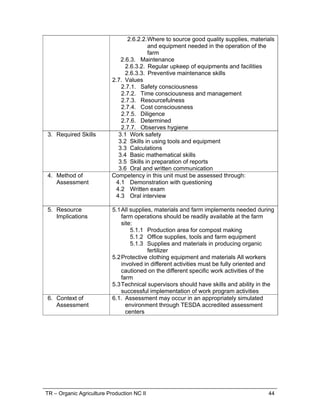
TR – Organic Agriculture Production NC II 44
2.6.2.2.Where to source good quality supplies, materials
and equipment needed in the operation of the
farm
2.6.3. Maintenance
2.6.3.2. Regular upkeep of equipments and facilities
2.6.3.3. Preventive maintenance skills
2.7. Values
2.7.1. Safety consciousness
2.7.2. Time consciousness and management
2.7.3. Resourcefulness
2.7.4. Cost consciousness
2.7.5. Diligence
2.7.6. Determined
2.7.7. Observes hygiene
3. Required Skills 3.1 Work safety
3.2 Skills in using tools and equipment
3.3 Calculations
3.4 Basic mathematical skills
3.5 Skills in preparation of reports
3.6 Oral and written communication
4. Method of
Assessment
Competency in this unit must be assessed through:
4.1 Demonstration with questioning
4.2 Written exam
4.3 Oral interview
5. Resource
Implications
5.1All supplies, materials and farm implements needed during
farm operations should be readily available at the farm
site:
5.1.1 Production area for compost making
5.1.2 Office supplies, tools and farm equipment
5.1.3 Supplies and materials in producing organic
fertilizer
5.2Protective clothing equipment and materials All workers
involved in different activities must be fully oriented and
cautioned on the different specific work activities of the
farm
5.3Technical supervisors should have skills and ability in the
successful implementation of work program activities
6. Context of
Assessment
6.1. Assessment may occur in an appropriately simulated
environment through TESDA accredited assessment
centers
TR – Organic Agriculture Production NC II 45
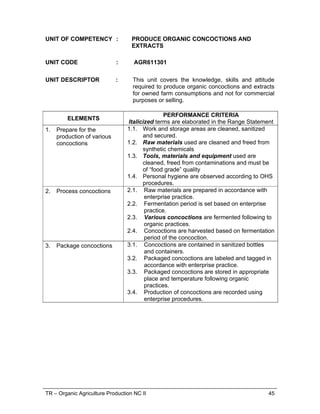
UNIT OF COMPETENCY : PRODUCE ORGANIC CONCOCTIONS AND
EXTRACTS
UNIT CODE : AGR611301
UNIT DESCRIPTOR : This unit covers the knowledge, skills and attitude
required to produce organic concoctions and extracts
for owned farm consumptions and not for commercial
purposes or selling.
ELEMENTS
PERFORMANCE CRITERIA
Italicized terms are elaborated in the Range Statement
1. Prepare for the
production of various
concoctions
1.1. Work and storage areas are cleaned, sanitized
and secured.
1.2. Raw materials used are cleaned and freed from
synthetic chemicals
1.3. Tools, materials and equipment used are
cleaned, freed from contaminations and must be
of “food grade” quality
1.4. Personal hygiene are observed according to OHS
procedures.
2. Process concoctions 2.1. Raw materials are prepared in accordance with
enterprise practice.
2.2. Fermentation period is set based on enterprise
practice.
2.3. Various concoctions are fermented following to
organic practices.
2.4. Concoctions are harvested based on fermentation
period of the concoction.
3. Package concoctions 3.1. Concoctions are contained in sanitized bottles
and containers.
3.2. Packaged concoctions are labeled and tagged in
accordance with enterprise practice.
3.3. Packaged concoctions are stored in appropriate
place and temperature following organic
practices.
3.4. Production of concoctions are recorded using
enterprise procedures.
TR – Organic Agriculture Production NC II 34
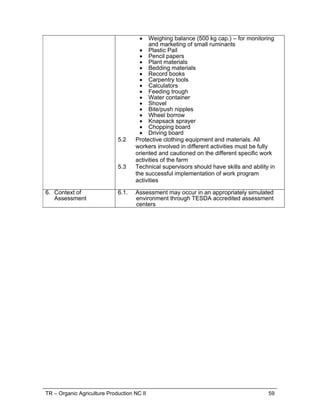
5.1.6 Tools, supplies and materials
 Pencil
 Papers
 Record books
 Plant materials
 Bedding materials
 Brooding materials -1 gal. capacity tin can; charcoal
 Protective gloves
 Masks
 Rubber boots
 Weighing scale
 Carpentry tools
 Push-Pull Ruled Tape
 Calculators
 Pail
 Feeding trough
 Water containers
 Bite/push nipples
 Shovel
 Wheel barrow
 Chopping board
 Electrical tools and supplies
5.2Organic chicken raising manual
5.3Protective clothing equipment and materials
5.4All workers involved in different activities must be fully
oriented and cautioned on the different specific work
activities of the farm
5.5Technical supervisors should have skills and ability in the
successful implementation of work program activities
6. Context of
Assessment
6.1.Assessment may occur in an appropriately simulated
environment through TESDA accredited assessment
centers
TR – Organic Agriculture Production NC II 47
2.3.4 String or rubber bands
2.3.5 Weighing scale
2.3.6 Chopping board
2.3.7 Knife
2.3.8 Marker
2.3.9 Strainer or nylon screen
2.3.10 Stone
2.4 Natural Immune Booster – Oriental Herbal Nutrient
(OHN)
2.4.1 Plastic pail
2.4.2 Wooden ladle
2.4.3 Manila paper or cheese cloth
2.4.4 String or rubber bands
2.4.5 Weighing scale
2.4.6 Chopping board
2.4.7 Knife
2.4.8 Marker
2.4.9 Strainer or nylon screen
2.5 Natural Calcium Phosphate Micro Nutrients (CALPHOS)
2.5.1 Plastic pail
2.5.2 Manila paper or cheese cloth
2.5.3 String or rubber bands
2.5.4 Weighing scale
2.5.5 Chopping board
2.5.6 Knife
2.5.7 Marker
2.5.8 Strainer or nylon screen
2.6 Beneficial Microorganism
2.6.1 Wooden ladle
2.6.2 Manila paper or cheese cloth
2.6.3 String or rubber bands
2.6.4 Weighing scale
2.6.5 Marker
2.6.6 wooden box or bamboo split-open or
plastic tray
2.7 Natural Enzymes – Lactic Acid Bacteria Serum (LABS)
2.7.1 Plastic container
2.7.2 Manila paper or cheese cloth
2.7.3 String or rubber bands
2.7.4 Weighing scale
2.7.5 Strainer or nylon screen
3 Various
concoctions
6.1. Fermented Fruit Juice-FFJ)
6.2. Fish Amino Acid (FAA)
6.3. Oriental Herbal Nutrient-OHN)
6.4. Natural Calcium Phosphate Micro-nutrients (CALPHOS)
6.5. Beneficial Microorganism
6.6. Natural Enzymes (Lactic Acid Bacteria Serum-LABS)
TR – Organic Agriculture Production NC II 48
EVIDENCE GUIDE
1. Critical Aspects of
Competency
Assessment requires evidence that the candidate:
1.1. Prepared for the production of various concoctions
1.2. Processed concoctions
1.3. Packaged concoctions
2. Required
Knowledge and
Attitudes
2.1. Knowledge, Theory, Practices and Systems Operations
2.1.1. Types and uses/benefits of concoctions
2.1.2. Sanitization procedure
2.1.3. Sterilization procedure
2.1.4. Tools and materials needed in producing
concoctions
2.1.5. Importance of cleanliness, sanitization and
hygiene in producing concoction
2.1.6. Good Manufacturing Practices
2.1.7. Preparation methods of different types of
concoctions
2.1.8. Raw material collection
2.1.9. Extraction procedure
2.1.10. Concoction formulation
2.1.11. Fermentation procedure
2.1.12. Putrification process
2.1.13. Harvesting procedures
2.1.14. Importance of proper labeling
2.1.15. Importance of proper storage
2.1.16. Record keeping
2.1.17. Practice 3Rs and 5S
2.1.18. Parts and functions of specific tools and farm
implements use in manufacturing organic
fertilizer
2.1.19. Program of work activities are implemented as
scheduled
2.2. Communication
2.2.1. Record keeping
2.2.2. Prepare and submit required reports
2.2.3. Documentation of harvesting operations
2.3. Mathematics and Mensuration
2.3.1. Basic mathematical operations
2.3.2. Computation for production of organic fertilizer
2.3.3. Unit conversion
2.4. Safety Practices
2.4.1. Proper application use of tools, farm
implements and equipment.
2.4.2. Safety precautions relevant to harvesting
concoctions
2.4.3. Wear appropriate PPE
2.4.4. Proper waste disposal
2.5. Codes and Regulations
2.5.1. Comply with Organic Law
2.5.2. Within the codes and regulations set by
Bureau of Plant Industry
2.6. Materials, Tools & Equipment: Uses, Specifications and
Maintenance
2.6.1. Tools and Equipment
2.6.1.1. Can understand and follow instructional
manuals
2.6.1.2. Safe keeping of equipments every after use
TR – Organic Agriculture Production NC II 49
2.6.2. Materials
2.6.2.1. Where to source good quality supplies,
materials and equipment needed in the
operation of the farm
2.6.3. Maintenance
2.6.3.1. Regular upkeep of equipments and facilities
2.6.3.2. Preventive maintenance skills
2.7. Values
2.7.1. Safety consciousness
2.7.2. Time consciousness and management
2.7.3. Resourcefulness
2.7.4. Cost consciousness
2.7.5. Diligence
2.7.6. Determined
2.7.7. Observes hygiene
3. Required Skills 3.1. Using appropriate tools
3.2. Mensurations and calculations
3.3. Calibration of measuring instruments
3.4. Work safety
3.5. Skills in preparation of reports and record keeping
3.6. Oral and written communication
4. Method of
Assessment
Competency in this unit must be assessed through:
4.1 Observation
4.2 Interview
4.3 Demonstration with questioning
5. Resource
Implications
5.1All supplies, materials and farm implements needed during
farm operations should be readily available at the farm
site:
5.1.1 Concoction area
5.1.2 Tools, supplies and materials
 Weighing scale (1000 kg. cap.) – for monitoring
ingredients weight
 Plastic Pail – for storing purposes
 Knife – for cutting purposes
 Wooden Ladle – for mixing purposes
 Manila Paper or Cheesecloth – for covering or
wrapping purposes
 Rubber Band or String – for sealing purposes
 Strainer or nylon screen
 Wooden box or bamboo split open or plastic tray
 Marker – for marking purposes
 Concoction manual
5.2Protective clothing equipment and materials. All workers
involved in different activities must be fully oriented and
cautioned on the different specific work activities of the
farm
5.3Technical supervisors should have skills and ability in the
successful implementation of work program activities
6. Context of
Assessment
6.1. Assessment may occur in an appropriately simulated
environment through TESDA accredited assessment
centers
TR – Organic Agriculture Production NC II 50
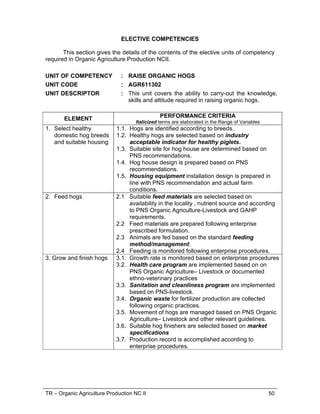
ELECTIVE COMPETENCIES
This section gives the details of the contents of the elective units of competency
required in Organic Agriculture Production NCII.
UNIT OF COMPETENCY : RAISE ORGANIC HOGS
UNIT CODE : AGR611302
UNIT DESCRIPTOR : This unit covers the ability to carry-out the knowledge,
skills and attitude required in raising organic hogs.
ELEMENT PERFORMANCE CRITERIA
Italicized terms are elaborated in the Range of Variables
1. Select healthy
domestic hog breeds
and suitable housing
1.1. Hogs are identified according to breeds.
1.2. Healthy hogs are selected based on industry
acceptable indicator for healthy piglets.
1.3. Suitable site for hog house are determined based on
PNS recommendations.
1.4. Hog house design is prepared based on PNS
recommendations.
1.5. Housing equipment installation design is prepared in
line with PNS recommendation and actual farm
conditions.
2. Feed hogs 2.1 Suitable feed materials are selected based on
availability in the locality , nutrient source and according
to PNS Organic Agriculture-Livestock and GAHP
requirements.
2.2 Feed materials are prepared following enterprise
prescribed formulation.
2.3 Animals are fed based on the standard feeding
method/management:
2.4 Feeding is monitored following enterprise procedures.
3. Grow and finish hogs 3.1. Growth rate is monitored based on enterprise procedures
3.2. Health care program are implemented based on on
PNS Organic Agriculture– Livestock or documented
ethno-veterinary practices
3.3. Sanitation and cleanliness program are implemented
based on PNS-livestock.
3.4. Organic waste for fertilizer production are collected
following organic practices.
3.5. Movement of hogs are managed based on PNS Organic
Agriculture– Livestock and other relevant guidelines.
3.6. Suitable hog finishers are selected based on market
specifications
3.7. Production record is accomplished according to
enterprise procedures.
TR – Organic Agriculture Production NC II 51
RANGE OF VARIABLES
VARIABLE SCOPE
1. Industry
acceptable
indicator for
healthy piglets
1.1. White pigs: 12-15 kgs at 45 days from birth; native pigs: 10
kgs at 90 days
1.2. Shiny haircoat
1.3. Gait
1.4. Uniformity (90%)
2. Housing
equipment
2.1. Feeding troughs
2.2. Waterers
2.3. Containers of concoction
3. Feed materials 3.1. Protein Sources (e.g. madre de agua; ipil-ipil; other
leguminous plants
3.2. Carbohydrate sources – rootcrops
3.3. Mineral sources – e.g. Calcium-eggshells, sea shells;
potassium –tubers (banana)
4. Feeding method/
management
4.1. Restricted
4.2. Adlibitum
4.3. Combination
5. Health care
program
5.1 Deworming
5.2 Vitamins/mineral supplementation using concoctions
6. Sanitation and
cleanliness
program
6.1. Cleaning of equipment (feeding trough, waterers)
6.2. Application of beneficial micro-organism
6.3. Collection of beddings where applicable
7. Organic waste 7.1. Animal manure
7.2. Waste/Rotten vegetables and fruits
8. Market
specifications
8.1. Lechon type (25-40 kgs)
8.2. Slaughter hogs (white pigs: 80-85)
TR – Organic Agriculture Production NC II 37
EVIDENCE GUIDE
1. Critical Aspects of
Competency:
Assessment requires evidence that the candidate:
1.1 Established nursery
1.2 Planted seedlings
1.3 Performed plant care activities
1.4 Performed harvest and post-harvest activities
2. Required
Knowledge and
Attitude
2.1 Knowledge, Theory, Practices and Systems Operations
2.1.1. Germination testing
2.1.2. Seedbed preparation procedure
2.1.3. Proper handling of seedlings and plants
2.1.4. Proper water management and procedures
2.1.5. Organic method of pest and disease
management
2.1.6. Organic method of nutrient management
2.1.7. Potting media preparation and procedure
2.1.8. Land preparation activities
2.1.9. Procedure in applying beneficial micro-organisms
2.1.10. Principles of bio-dynamics
2.1.11. Transplanting and planting procedures
2.1.12. Types of pest and diseases
2.1.13. Organic method of preventing and controlling
pest and diseases
2.1.14. Maturity indices
2.1.15. Proper handling of harvesting tools and materials
2.1.16. Practices in post harvest of vegetables
2.1.17. Principles and guides in post harvest handling of
perishables
2.1.18. Practice 3Rs and 5S
2.1.19. Parts and functions of specific tools and farm
implements use in producing organic vegetables
2.1.20. Program of work activities are implemented as
scheduled
2.2 Communication
2.2.4. Prepare and submit required reports
2.2.5. Documentation on vegetable production
2.2.6. Proper book keeping
2.3 Mathematics and Mensuration
2.3.5. Basic mathematical operations
2.3.6. Computation for production of chicken
2.3.7. Unit conversion
2.3.8. Simple/basic calculation
2.4 Safety Practices
2.4.5. Proper application use of tools, farm implements
and equipment.
2.4.6. Proper use of carpentry and electrical tools
2.4.7. Wear appropriate PPE
2.4.8. Proper waste disposal
2.5 Codes and Regulations
TR – Organic Agriculture Production NC II 53
2.1.11 Good Animal Husbandry Practices (GAHP)
2.1.12 DENR, zoning ordinances
2.6. . Materials, Tools & Equipment: Uses, Specifications
and Maintenance
2.6.1. Tools and Equipment
2.6.1.1. Weighing balance (500 kg cap.) – for
monitoring and marketing of hogs
2.6.1.2. Carpentry tools
2.6.1.3. Calculators
2.6.1.4. Feeding troughs
2.6.1.5. Water containers
2.6.1.6. Driving board
2.6.1.7. Knapsack sprayer
2.6.2. Maintenance
2.6.2.1. Regular check-up and repair of tools and
equipment
2.6.3. Materials: Uses and Specifications
2.6.3.1. Equipment and supplies for regular
monitoring of production performance and
economic viability of the hog operation
2.7. Values
2.7.1. Values on stewardship of farm resources that
will promote ecologically sound, socially
acceptable, economically viable, and
technically feasible production of food
2.7.2. Accuracy in medication and treatment of hog’s
diseases using permitted veterinary treatments
and herbal medicines
2.7.3. Refraining from the use of prohibited
substances like chemical pesticides, and
pharmaceuticals
2.7.4. Competence and self-confidence towards
selection of finishing stocks
2.7.5. Honesty in marketing and financial
transactions
2.7.6. Perseverance and industriousness on care
and management of the general heard
2 Required Skills 2.1 Skills in identifying the breeds
2.2 Ocular inspection
2.3 Measuring and drawing skills
2.4 Calculations
2.5 Monitoring
2.6 Work safety
2.7 Skills in using tools and equipment
2.8 Record keeping
2.9 Communicating ideas and information
3 Method of
Assessment
Competency in this unit must be assessed through:
3.1 Demonstration with questioning
3.2 Oral interviews
3.3 Written examination
5. Resource
Implications
5.1. All supplies, materials and farm implements needed
during farm operations should be readily available at
the farm site:
5.1.1 Pig pen
5.1.2 Practice animals
5.1.3 Tools, supplies and materials
TR – Organic Agriculture Production NC II 54
 Weighing scale (500 kg. cap.) – for monitoring
and marketing of hogs
 Plastic Pail
 Pencil papers
 Plant materials
 Bedding materials
 Papers
 Record books
 Carpentry tools
 Calculators
 Feeding trough
 Water container
 Shovel
 Bite/push nipples
 Wheel borrow
 Knapsack sprayer
 Chopping board
 Driving board
5.2. Protective clothing equipment and materials. All
workers involved in different activities must be fully
oriented and cautioned on the different specific work
activities of the farm
5.3. Technical supervisors should have skills and ability in
the successful implementation of work program
activities
6. Context of
Assessment
6.1. Assessment may occur in an appropriately simulated
environment through TESDA accredited assessment
centers
TR – Organic Agriculture Production NC II 55
UNIT OF COMPETENCY : RAISE ORGANIC SMALL RUMINANTS
UNIT CODE : AGR612303
UNIT DESCRIPTOR : This unit covers the ability to carry-out the knowledge,
skills and attitude required in raising organic small
ruminant.
ELEMENT PERFORMANCE CRITERIA
Italicized terms are elaborated in the Range of Variables
1. Select healthy
breeders and suitable
cages
1.1. Bucks and rams are identified according to breed
1.2. Healthy bucks/rams are selected based on industry
acceptable indicator for healthy small ruminants.
1.3. Suitable site for small ruminants are determined based on
PNS recommendations.
1.4. Small ruminants cage design is prepared based on Good
Animal Husbandry Practices (GAHP), DENR and zoning
ordinances PNS recommendations.
1.5. Cage equipment installation design is prepared in line with
PNS recommendation and actual farm conditions.
1.6. Cage equipment are set-up in line with housing equipment
installation design.
1.7. Rice straws are placed as bedding materials based on PNS
procedures.
2. Feed small ruminants 2.1. Suitable feed materials are selected based on availability in
the locality, nutrient requirements and PNS standards.
2.2. Feed materials are prepared following PNS procedures.
2.3. Maintenance of forage area are administered in accordance
with PNS procedures.
2.4. Animals are fed based on feeding management program of
PNS.
2.5. Feeding is monitored following PNS procedures.
3. Manage breeding of
small ruminants
3.1. Signs of heat are monitored among sexually mature does
and ewes
3.2. Breeding systems are identified based on PNS guidelines.
3.3. Animal pregnancy is monitored and tended based on
enterprise procedures.
3.4. Unproductive buck/ram and doe/ewe are culled based on
enterprise procedures.
4. Manage does/ewes and
their progenies
4.1 Signs of approaching kidding/lambing are monitored following
established farm procedures.
4.2 Placenta and dead kids/lambs are disposed properly
according to DENR law.
4.3 Assisted kids/lambs to suckle colostrums according to
organic practices.
4.4 Lambs/kids are weaned properly at 3 months from birth
based from established farm procedures.
4.5 Lactating goats and sheep are kept in clean and quiet
environment, and are separated from the breeder males
based from established farm procedures.
4.6 Forage grasses, supplements and adequate water supply are
provided according to PNS recommendations.
5. Grow and harvest small
ruminants
5.1 Growth rate is monitored based on enterprise procedures.
5.2 Health care program are implemented based on PNS and
GAHP requirements.
5.3 Sanitation and cleanliness program are implemented
based on GAHP requirements and PNS.
5.4 Organic wastes for fertilizer production are collected
according to PNS.
5.5 Suitable small ruminants for harvest are selected based on
PNS guidelines and market demand.
5.6 Production record is accomplished according to enterprise
procedure
TR – Organic Agriculture Production NC II 56
RANGE OF VARIABLES
VARIABLE SCOPE
1. Industry acceptable
indicator for healthy
piglets
1.1. Age : 8 months
1.2. Weight:
1.2.1. native-weight not less than15 kg
1.2.2. crossbreeds- not less than 20 kg
2. Cage equipment 2.1 Feeding troughs
2.2 Waterers
2.3 Containers of concoction
3. Feed materials 3.1 Protein Sources (e.g. madre de agua; ipil-ipil; other
leguminous plants
3.2 Carbohydrate sources – rootcrops
3.3 Mineral sources – e.g. Calcium-eggshells, sea shells;
potassium –tubers (banana)
4. Maintenance of
forage area
4.1 Cutting
4.2 Application of organic fertilizer
4.3 Watering
5. Feeding
management
program
5.1 Restricted
5.2 Adlibitum
5.3 Combination
6. Signs of heat 6.1 Swelling of external genitalia
6.2 Constant urination
6.3 Tail wagging and bleating
6.4 Wants to be mounted
6.5 Capacious appetite
6.6 Decrease in milk yield of lactating does/ewes
7. Unproductive
buck/ram and
doe/ewe
7.1 Infertile/abnormal sperm from the buck
7.2 Diseases such as brucellosis, leptospirosis and vibriosis
7.3 Poor growth traits and reproductive efficacy
7.4 Irregularity of estrus cycle
7.5 Poor growth and reproductive traits
7.6 Susceptibility to diseases
7.7 Production of abnormal eggs/ova
7.8 Overfat condition
8. Health care
program
8.1 Deworming
8.2 Vitamins/mineral supplementation using concoctions
9. Sanitation and
cleanliness
program
9.1 Cleaning of equipment (feeding trough, waterers)
9.2 Application of beneficial micro-organism
9.3 Collection manure
10.Organic waste 10.1 Animal manure
10.2 Feed refuse
10.3 Waste/Rotten vegetables and fruits
TR – Organic Agriculture Production NC II 57
EVIDENCE GUIDE
1. Critical Aspects of
Competency
Assessment requires evidence that the candidate:
1.1 Selected healthy breeders and suitable cages.
1.2 Fed small ruminants.
1.3 Managed breeding of small ruminants.
1.4 Managed does/ewes and their progenies.
1.5 Grew and harvested small ruminants.
2. Required Knowledge
and Attitudes
2.1. Knowledge, Theory, Practices and Systems Operations
2.1.1. Different breeds of small ruminants (goats)
2.1.2. Indicators/criteria of healthy small ruminants
2.1.3. Characteristics of a suitable site
2.1.4. Cage designs and housing equipment for small
ruminants
2.1.5. Characteristics of feed materials
2.1.6. Preparation of feeds
2.1.7. Advantage/disadvantages of different feeding
management
2.1.8. Knowledge on record-keeping
2.1.9. Different forage species
2.1.10. Signs of heat
2.1.11. Organic-based health care products/materials
2.1.12. Sanitation procedures using organic products
2.1.13. Collection of organic wastes
2.1.14. Characteristics of good finishers
2.1.15. Practice 3Rs and 5S
2.1.16. Parts and functions of specific tools and farm
implements use in raising organic small ruminants
2.1.17. Program of work activities are implemented as
scheduled
2.1.18. Selection of breeder and replacement stocks,
general care and herd health management from
small ruminants to marketable age and weight
2.2. Communication
2.2.1. Preparation of stock inventory, performance and
health records, mortality and morbidity rates,
financial transactions and indicators of production
efficiency
2.2.2. Record keeping
2.3. Safety Practices
2.3.1. Implementation of regulatory controls and policies
relative to proper handling, use and disposal of
permitted veterinary medications.
2.3.2. Proper disposal of placenta, dead fetuses and
other wastes
2.4. Mathematics and Mensuration
2.4.1. Computation of FCR productivity index, feed
conversion efficiency, herbal medicine mixtures,
parameters of reproductive efficiency and financial
viability of the organic small ruminants enterprise
2.4.2. Simple/basic calculations
2.5. Codes and Regulations
2.5.1. RA 10068: Organic Agriculture Act of 2010
2.5.2. Code of Good Animal Husbandry Practices
2.5.3. Animal Welfare Act of 1998
TR – Organic Agriculture Production NC II 42
RANGE OF VARIABLES
VARIABLE SCOPE
1. Prepare raw
materials
1.1 Shred/cut materials
1.2 Weighing
2. Composting
methods
2.1. Rapid composting methods
2.2. Double dug composting
2.3. Six month composting
2.4. Substrate composting
3. Process compost
fertilizer
3.1 Collection
3.2 Air drying
3.3 Sieving
3.4 Bagging
3.5 Labeling
3.6 Storing
TR – Organic Agriculture Production NC II 59
 Weighing balance (500 kg cap.) – for monitoring
and marketing of small ruminants
 Plastic Pail
 Pencil papers
 Plant materials
 Bedding materials
 Record books
 Carpentry tools
 Calculators
 Feeding trough
 Water container
 Shovel
 Bite/push nipples
 Wheel borrow
 Knapsack sprayer
 Chopping board
 Driving board
5.2 Protective clothing equipment and materials. All
workers involved in different activities must be fully
oriented and cautioned on the different specific work
activities of the farm
5.3 Technical supervisors should have skills and ability in
the successful implementation of work program
activities
6. Context of
Assessment
6.1. Assessment may occur in an appropriately simulated
environment through TESDA accredited assessment
centers
TR – Organic Agriculture Production NC II 44
2.6.2.2.Where to source good quality supplies, materials
and equipment needed in the operation of the
farm
2.6.3. Maintenance
2.6.3.2. Regular upkeep of equipments and facilities
2.6.3.3. Preventive maintenance skills
2.7. Values
2.7.1. Safety consciousness
2.7.2. Time consciousness and management
2.7.3. Resourcefulness
2.7.4. Cost consciousness
2.7.5. Diligence
2.7.6. Determined
2.7.7. Observes hygiene
3. Required Skills 3.1 Work safety
3.2 Skills in using tools and equipment
3.3 Calculations
3.4 Basic mathematical skills
3.5 Skills in preparation of reports
3.6 Oral and written communication
4. Method of
Assessment
Competency in this unit must be assessed through:
4.1 Demonstration with questioning
4.2 Written exam
4.3 Oral interview
5. Resource
Implications
5.1All supplies, materials and farm implements needed during
farm operations should be readily available at the farm
site:
5.1.1 Production area for compost making
5.1.2 Office supplies, tools and farm equipment
5.1.3 Supplies and materials in producing organic
fertilizer
5.2Protective clothing equipment and materials All workers
involved in different activities must be fully oriented and
cautioned on the different specific work activities of the
farm
5.3Technical supervisors should have skills and ability in the
successful implementation of work program activities
6. Context of
Assessment
6.1. Assessment may occur in an appropriately simulated
environment through TESDA accredited assessment
centers
TR – Organic Agriculture Production NC II 61
COMMON COMPETENCIES
(64 hours)
Unit of
Competency
Learning Outcomes Methodology
Assessment
Approach
1. Apply safety
measures in
farm operations
1.1 Determine areas of concern
for safety measures
1.2 Apply appropriate safety
measures
1.3 Safekeep/maintain/ dispose
tools, materials and outfit.
 Self-paced/
modular
 Lecture/
Discussion
 Interaction
 Practical
Demonstration
 Visit/tour
 Oral/Written
Interviews
 Direct
Observation
 Practical
Demonstration
2. Use farm tools
and equipment
2.1 Prepare and use farm tools
2.2 Prepare and operate farm
equipment
2.3 Perform preventive
maintenance
procedures/practices
 Self-paced/
modular
 Lecture/
Discussion
 Interaction
 Practical
Demonstration
 Visit/tour
 Oral/Written
Interviews
 Direct
Observation
 Practical
Demonstration
3. Perform
estimation and
basic calculation
3.1 Perform estimation
3.2 Perform basic workplace
calculation
 Self-paced/
modular
 Lecture/
Discussion
 Interaction
 Practical
Exercise
 Oral/Written
examination
 Practical
exercise
4. Perform records
keeping
Carry out inventory activities
Maintain production record
Prepare financial records
 Self-paced/
modular
 Lecture/
discussion
 Interaction
 Practical
exercise
 Computation
 Oral/written
examination
 Practical
exercise
 Practical
demonstration
5. Develop and
Update Industry
Knowledge
Seek information on the industry
Update continuously relevant
industry knowledge
 Self paced/
modular
 Demonstration
 Small group
discussion
 Distance
education
 Written/oral
examination
 Practical
demonstration
TR – Organic Agriculture Production NC II 62
CORE COMPETENCIES
( 96 hours)
Unit of
Competency
Learning Outcomes Methodology
Assessment
Approach
1.Raise Organic
Chicken
1.1 Select healthy stocks
1.2 Determine suitable
chicken house
requirements
1.3 Install cage (housing)
equipment
1.4 Feed chicken (Provide
feed and implement
feeding practices)
1.5 Manage health and
growth of chicken
1.6 Harvest chicken
 Lecture
 Hands-on
 Demonstration
 Video
Presentation
 Lecture
 Lakbay Aral
 Workshop
 Written
examination
 Demonstration
of practical
skills
 Direct
observation
 Interview/
Questioning
2.Produce Organic
Vegetable
2.1 Establish nursery
2.2 Plant seedlings
2.3 Perform Plant Care
Activities (and
Management)
2.4 Perform Harvest and Post
Harvest Activities
 Demonstration
 Discussion
 Oral
questioning
 Video
presentation
 Field
demonstration
 Film viewing
 Direct
observation
with oral
questioning
 Demonstration
 Written exam
 Interview
3.Produce Organic
Fertilizer
3.1 Prepare composting area
3.2 Prepare raw materials
3.3 Carry out composting
process
3.4 Harvest compost
 Observation
 Demonstration
 Lecture-
Discussion
 Film viewing
 Video
presentation
 Field work/
farm visit
 Direct
observation
with oral
questioning
 Demonstration
Written exam
4. Produce various
concoctions
4.1 Prepare for the production
of various concoctions
4.2 Process concoctions
4.3 Package concoctions
 Participatory
Lecture-
Discussion
 Lecture
 Demonstration
 Direct
observation
 Written exam
 Direct
observation and
oral questions
 Interview
TR – Organic Agriculture Production NC II 63
ELECTIVE COMPETENCIES
( 54 hours)
Unit of
Competency
Learning Outcomes Methodology
Assessment
Approach
1. Raise Organic
Hogs 1.1 Choose/Select healthy
domestic hogs
1.2 Determine suitable hog
house requirements
1.3 Feed hogs
1.4 Manage health and
growth of hogs
1.5 Finish hogs
 Lecture
 Demonstration
 Field
demonstration
 Workshop
 Video
presentation
 Field work
 Practical
demonstration
 Direct
observation
 Oral
questioning
 Written
examination
 Interview
2. Raise Organic
Small
Ruminants
(Goat)
2.1 Choose/Select healthy
breeders
2.2 Determine suitable small
ruminant cage (housing)
requirements
2.3 Install cage (housing)
requirements
2.4 Feed small ruminants
2.5. Manage health, growth
and breeding of small
ruminants
2.6 Harvest (Finish)
ruminants
 Actual
Demonstration
 Lecture
discussion
 Video
presentation
 Field
practicum
 Direct
observation
and questions
 Written
examinations
 Demonstration
Interview
TR – Organic Agriculture Production NC II 47
2.3.4 String or rubber bands
2.3.5 Weighing scale
2.3.6 Chopping board
2.3.7 Knife
2.3.8 Marker
2.3.9 Strainer or nylon screen
2.3.10 Stone
2.4 Natural Immune Booster – Oriental Herbal Nutrient
(OHN)
2.4.1 Plastic pail
2.4.2 Wooden ladle
2.4.3 Manila paper or cheese cloth
2.4.4 String or rubber bands
2.4.5 Weighing scale
2.4.6 Chopping board
2.4.7 Knife
2.4.8 Marker
2.4.9 Strainer or nylon screen
2.5 Natural Calcium Phosphate Micro Nutrients (CALPHOS)
2.5.1 Plastic pail
2.5.2 Manila paper or cheese cloth
2.5.3 String or rubber bands
2.5.4 Weighing scale
2.5.5 Chopping board
2.5.6 Knife
2.5.7 Marker
2.5.8 Strainer or nylon screen
2.6 Beneficial Microorganism
2.6.1 Wooden ladle
2.6.2 Manila paper or cheese cloth
2.6.3 String or rubber bands
2.6.4 Weighing scale
2.6.5 Marker
2.6.6 wooden box or bamboo split-open or
plastic tray
2.7 Natural Enzymes – Lactic Acid Bacteria Serum (LABS)
2.7.1 Plastic container
2.7.2 Manila paper or cheese cloth
2.7.3 String or rubber bands
2.7.4 Weighing scale
2.7.5 Strainer or nylon screen
3 Various
concoctions
6.1. Fermented Fruit Juice-FFJ)
6.2. Fish Amino Acid (FAA)
6.3. Oriental Herbal Nutrient-OHN)
6.4. Natural Calcium Phosphate Micro-nutrients (CALPHOS)
6.5. Beneficial Microorganism
6.6. Natural Enzymes (Lactic Acid Bacteria Serum-LABS)
TR – Organic Agriculture Production NC II 65
3.3 TRAINEE ENTRY REQUIREMENTS
Trainees or students wishing to enroll in this course should possess the
following requirements.
 Able to read and write;
 With good moral character;
 Ability to communicate, both oral and written
 Physically fit and mentally healthy as certified by a Public Health Officer
3.4 LIST OF TOOLS, EQUIPMENT AND MATERIALS
ORGANIC AGRICULTURE PRODUCTION– NC II
Recommended list of tools, equipment and materials for the training of 25 trainees
for Organic Agriculture Production NC II. The list comes into two forms, by full
qualification and by COC or Certificate of Competency.
RESOURCES:
EQUIPMENT TO BE UTILIZED IN ALL UNIT OF COMPETENCY
Qty Units Description Qty Units Description
5 sets Desktop Computer 1 unit LCD projector with Screen
1 unit Printer 1 unit Photo Copier
FOR EVERY COMPETENCY (CoC)
1. RAISE ORGANIC CHICKEN
TOOLS:
Qty Units Description Qty Units Description
5 pcs. Bolo 2 pcs. Sprinklers, 5 liters
5 pcs. Broomstick 1 units Step ladder 6 ft.
5 pcs. Plastic Pail (10 liter. capacity) 1 unit Storage tools/cabinet
1 set Carpentry tools 5 pcs. Feeding trough
2 units Knapsack sprayer 5 pcs. Waterer/drinker, 1 liter
capacity
5 pcs. Storage Container with cap,15
liter capacity
25 pcs. Rain coat
3 units Weighing scale, 2 kilos
capacity (2); 25 kilos capacity
(1)
5 pcs Plastic cup, 1 liter capacity
5 pcs. Shovel 3 pcs. Waste cans/bag
5 pcs. Knives
TR – Organic Agriculture Production NC II 66
EQUIPMENT:
Qty Units Description Qty Units Description
1 unit Booth/temporary shed 1 unit Cart
1 unit Shredder 1 unit Wheel barrow
1 unit Fire Extinguisher
MATERIALS:
Qty Units Description Qty Units Description
15 Kg. Feeds: starter, 5 liters Various
Concoctions/Extracts
15 Kg. Feeds: grower 15 Kg. Feeds: finisher
25 pcs 21-day old chicks 25 pcs 60-day old chicken
8 Bags
of
50kgs
Rice Hull 1 Bag
of
50kg.
Soil
Farm Soil
1 Bag of
50kg.
Soil
Sand 50 pcs Bamboo poles
50 meter Net, #10 mesh size 2 Kg. Monofilament Nylon#150
1 unit First Aid Kit 1 pc. Water Container Drum
15 pcs. Apron 10 pcs. Rags
5 pcs. Chopping Board 10 pcs. Waterer
10 pcs. Feeding trough 1 unit Feed Cart
2. PRODUCE ORGANIC VEGETABLES
TOOLS:
Qty Unit Description Qty Unit Description
5 pc. Bolo 5 pcs. Sprinklers, 5 liters
5 pc. Digging Blade/Bar 1 units Step ladder 6 ft.
5 pc. Spading Fork 10 units Holer, 4” diameter
2 set Hoe 5 pcs. Trimming knife
5 unit Rake 1 set. Carpentry tools
5 pc. Shovel 5 pcs. Knapsack sprayer
2 unit Weighing scale, 2 kilos
capacity (1); 25 kilos capacity
(1)
5 pcs Plastic cup, 1 liter capacity
3 pcs. Measuring cup; 1 liter
capacity
3 pcs. Waste cans/bag
5 pcs. Pruning Shear 2 set Plow
5 pcs. Petri Dish 1 Pc. Calculator
2 units Spike Tooth Horrow
TR – Organic Agriculture Production NC II 67
EQUIPMENT:
Qty Unit Description Qty Unit Description
1 unit Booth/temporary shed 1 unit Shredder
1 unit Wheel barrow 1 unit Cart
1 unit Carbonizer 1 unit Portable Soil Analyser Kit
1 pc. Soil Thermometer 1 unit PH meter
1 unit Fire Extinguisher
MATERIALS:
Qty Unit Description Qty Unit Description
5 Bag of
50 kg.
Basal Organic Fertilizer 5 Bags
of 50
kg.
Carbonized Rice Hull
5 liter Foliar Organic Fertilizer 5 liters Various
Concoctions/Extracts
6 pc Seedling Tray, plastic 6 pcs Seedling Tray, wooden
2 roll Plastic twine 10 pcs Bamboo poles
10 Pack Assorted Vegetable
Seedlings
1 pc. Water Container Drum
1 unit First Aid Kit 15 pcs. Apron
10 pcs. Rags 10 pcs. Stone (weights) ½ kilos
5 pcs. Strainer, Nylon Screen, fine
mesh
10 pcs. Sacks
3. MANUFACTURE (PRODUCE) ORGANIC FERTILIZER
TOOLS:
Qty Unit Description Qty Unit Description
5 pcs. Spade 5 pcs. Sprinklers, 5 liters
5 pcs. Spading Fork 1 set. Carpentry tools
2 sets Hoe 5 units Rake
5 pcs. Shovel 5 pcs. Knapsack sprayer
2 units Weighing scale, 2 kilos
capacity (1); 25 kilos capacity
(1)
5 pcs Plastic cup, 1 liter capacity
3 pcs Measuring cup; 1 liter
capacity
3 pcs. Waste cans/bag
EQUIPMENT:
Qty Unit Description Qty Unit Description
1 unit Booth/temporary shed 1 unit Wheel barrow
1 unit Shredder 1 unit Cart
1 unit Carbonizer 1 unit Portable Soil Analyzer Kit
1 pc. Moisture meter 1 unit PH meter
1 pc. Soil Thermometer 3 set Vermitea aerator, 60 liters
capacity, each
1 unit Fire Extinguisher
TR – Organic Agriculture Production NC II 50
ELECTIVE COMPETENCIES
This section gives the details of the contents of the elective units of competency
required in Organic Agriculture Production NCII.
UNIT OF COMPETENCY : RAISE ORGANIC HOGS
UNIT CODE : AGR611302
UNIT DESCRIPTOR : This unit covers the ability to carry-out the knowledge,
skills and attitude required in raising organic hogs.
ELEMENT PERFORMANCE CRITERIA
Italicized terms are elaborated in the Range of Variables
1. Select healthy
domestic hog breeds
and suitable housing
1.1. Hogs are identified according to breeds.
1.2. Healthy hogs are selected based on industry
acceptable indicator for healthy piglets.
1.3. Suitable site for hog house are determined based on
PNS recommendations.
1.4. Hog house design is prepared based on PNS
recommendations.
1.5. Housing equipment installation design is prepared in
line with PNS recommendation and actual farm
conditions.
2. Feed hogs 2.1 Suitable feed materials are selected based on
availability in the locality , nutrient source and according
to PNS Organic Agriculture-Livestock and GAHP
requirements.
2.2 Feed materials are prepared following enterprise
prescribed formulation.
2.3 Animals are fed based on the standard feeding
method/management:
2.4 Feeding is monitored following enterprise procedures.
3. Grow and finish hogs 3.1. Growth rate is monitored based on enterprise procedures
3.2. Health care program are implemented based on on
PNS Organic Agriculture– Livestock or documented
ethno-veterinary practices
3.3. Sanitation and cleanliness program are implemented
based on PNS-livestock.
3.4. Organic waste for fertilizer production are collected
following organic practices.
3.5. Movement of hogs are managed based on PNS Organic
Agriculture– Livestock and other relevant guidelines.
3.6. Suitable hog finishers are selected based on market
specifications
3.7. Production record is accomplished according to
enterprise procedures.
TR – Organic Agriculture Production NC II 69
MATERIALS:
Qty Unit Description Qty Unit Description
100 liter Molasses 25 pcs. Plastic Container, 15 liters
capacity
8 liter Various Concoctions/Extracts
for at least 1 liter per sample
10 pcs. Plastic Container, 60 liters
capacity
150 pcs. Weight (clean stone
100grams each)
5 meter Plastic Hose, 5mm dia.
50 pcs. Weight (empty plastic
container 250 to 500 ml
capacity)
3 pcs. Waste cans/bag
25 pcs. Plastic strainer, fine mesh, 1ft
x 1ft square
10 meter Plastic Sheet
25 pcs. Plastic strainer, small mesh,
1ft x 1 ft square
25 pcs. Manila Paper
50 pcs. Empty Plastic Container, 1
liter capacity
5 box Rubber Bond, Large
50 pcs. Empty Plastic Container, 5
liter capacity
5 pcs. Marking Pen
2 roll Plastic Tie box 5 pcs. Masking Tape, medium
1 unit First Aid Kit 1 pc. Water Container Drum
15 pcs. Apron 10 pcs. Rags
5. RAISE ORGANIC HOGS
TOOLS:
Qty Units Description Qty Units Description
5 pcs. Bolo 2 pcs. Sprinklers, 5 liters
5 pcs. Broomstick 1 unit Step ladder 6 ft.
5 pcs. Plastic Pail (10 liter. capacity) 1 unit Storage tools/cabinet
1 set Carpentry tools 5 pc Shovel
2 unit Knapsack sprayer 5 pc Digging Bar/Blade
5 pc. Storage Container with cap,15
liter capacity
2 unit Weighing scale, 10 kilos
capacity (1); 150 kilos
capacity (1)
5 pc Plastic cup, 1 liter capacity
5 pcs. Shovel 3 pc. Waste cans/bag
EQUIPMENT:
Qty Unit Description Qty Unit Description
1 unit Booth/temporary shed 1 unit Cart
1 unit Shredder 1 unit Wheel barrow
1 unit Fire Extinguisher
TR – Organic Agriculture Production NC II 70
MATERIALS:
Qty Unit Description Qty Unit Description
15 kg Hog Feeds: starter 5 liter Various
Concoctions/Extracts
15 kg Hog Feeds: grower 15 kg Hog Feeds: finisher
5 head 45-day old piglet 5 head 80-day old pig
8 Bag of
50kgs
Rice Hull 1 Bag
of 50
kgs
Soil
Farm Soil
1 Bag of
50kgs
Sand 50 pc Bamboo poles
10 liter Molasses 2 kg Monofilament Nylon#150
1 unit First Aid Kit 1 pc. Water Container Drum
15 pcs. Apron 10 pcs. Rags
6. RAISE ORGANIC RUMINANTS
TOOLS:
Qty Units Description Qty Units Description
5 pcs. Bolo 2 pcs. Sprinklers, 5 liters
5 pcs. Broomstick 1 unit Step ladder 6 ft.
5 pcs. Plastic Pail (10 liter. capacity) 1 unit Storage tools/cabinet
1 set Carpentry tools 5 pc Shovel
2 unit Knapsack sprayer 5 pc Digging Bar/Blade
5 pc. Storage Container with liter
capacity
5 pc Plastic cup, 1 liter capacity
2 unit Weighing scale, 10 kilos
capacity (1); 100 kilos
capacity (1)
3 pc. Waste cans/bag
5 pc. Shovel
EQUIPMENT:
Qty Unit Description Qty Unit Description
1 unit Booth/temporary shed 1 unit Cart
1 unit Shredder 1 unit Wheel barrow
1 unit Fire Extinguisher
TR – Organic Agriculture Production NC II 71
MATERIALS:
Qty Unit Description Qty Unit Description
15 kg Goat Feeds: starter, grower,
finisher
5 liter Various
Concoctions/Extracts
15 kg Goat Feeds: grower 15 kg Goat Feeds: finisher
4 head 45-day old Goat 4 head 80-day old Goat
8 Bags
of
50kgs
Rice Hull 1 Bag
of 50
kgs
Soil
Farm Soil
1 Bag of
50kgs
Soil
Sand 50 pc Bamboo poles
1 roll Plastic sheet 2 kg Monofilament Nylon#150
1 unit First Aid Kit 1 pc. Water Container Drum
15 pcs. Apron 10 pcs. Rags
TRAINING MATERIALS: PPE’s:
 Brochures
 Visual aids
 Reference manuals
 Procedural manuals
 Instructional supplies and materials
 Reference materials/books/VPM
 Data (result of soil analysis)
 Soil samples
 Reference materials-PNS (livestock)
- animal welfare
- GAHP
 Goggles
 Long Gloves/Arms Length
 Face Mask # 30
 Overall Suit
 Hair net
 Safety Shoes
 Rubber Boots
 Wide Brimmed Hats
 Long Sleeves
 Long Pants
TR – Organic Agriculture Production NC II 53
2.1.11 Good Animal Husbandry Practices (GAHP)
2.1.12 DENR, zoning ordinances
2.6. . Materials, Tools & Equipment: Uses, Specifications
and Maintenance
2.6.1. Tools and Equipment
2.6.1.1. Weighing balance (500 kg cap.) – for
monitoring and marketing of hogs
2.6.1.2. Carpentry tools
2.6.1.3. Calculators
2.6.1.4. Feeding troughs
2.6.1.5. Water containers
2.6.1.6. Driving board
2.6.1.7. Knapsack sprayer
2.6.2. Maintenance
2.6.2.1. Regular check-up and repair of tools and
equipment
2.6.3. Materials: Uses and Specifications
2.6.3.1. Equipment and supplies for regular
monitoring of production performance and
economic viability of the hog operation
2.7. Values
2.7.1. Values on stewardship of farm resources that
will promote ecologically sound, socially
acceptable, economically viable, and
technically feasible production of food
2.7.2. Accuracy in medication and treatment of hog’s
diseases using permitted veterinary treatments
and herbal medicines
2.7.3. Refraining from the use of prohibited
substances like chemical pesticides, and
pharmaceuticals
2.7.4. Competence and self-confidence towards
selection of finishing stocks
2.7.5. Honesty in marketing and financial
transactions
2.7.6. Perseverance and industriousness on care
and management of the general heard
2 Required Skills 2.1 Skills in identifying the breeds
2.2 Ocular inspection
2.3 Measuring and drawing skills
2.4 Calculations
2.5 Monitoring
2.6 Work safety
2.7 Skills in using tools and equipment
2.8 Record keeping
2.9 Communicating ideas and information
3 Method of
Assessment
Competency in this unit must be assessed through:
3.1 Demonstration with questioning
3.2 Oral interviews
3.3 Written examination
5. Resource
Implications
5.1. All supplies, materials and farm implements needed
during farm operations should be readily available at
the farm site:
5.1.1 Pig pen
5.1.2 Practice animals
5.1.3 Tools, supplies and materials
TR – Organic Agriculture Production NC II 73
SECTION 4 NATIONAL ASSESSMENT AND CERTIFICATION
ARRANGEMENTS
4.1 To attain the National Qualification of Organic Agriculture Production NC
II, the candidate must demonstrate competence in all units listed in
Section 1. Successful candidates shall be awarded a National Certificate
signed by the TESDA Director General.
4.2 The qualification of Organic Agriculture Production NC II may be attained
through:
4.2.1. Certificates of Competency (COCs) in the following
areas:
4.2.1.1. Raise organic chicken
4.2.1.2. Produce organic vegetables
4.2.1.3. Produce organic fertilizer
4.2.1.4. Produce organic concoctions and extract
4.2.2. The candidate can also choose one from these two (2)
elective units of competencies, and obtain Certificates of
Competency (COCs);
 Raise organic hogs
 Raise organic small ruminants
4.2.3. Organic Agriculture Production NC II can be attained
through accumulation of COCs of the four (4) Core
Competencies and one (1) Elective Competencies.
Successful candidates shall be awarded Certificates of
Competency (COCs) bearing the signature of the Regional
Director and Chair of the recognized local industry body.
4.2.4. Demonstration of competence through project-type
assessment covering all required units of qualification
4.2. Assessment shall focus on the core units of competency. The tool and
common units shall be integrated or assessed concurrently with the core
units.
4.3. Candidates can be assessed on individual units of competency and be
issued Certificates of Competency if found competent. Certificates of
Competency shall bear the signature of the Regional Director and Chair
of the recognized local industry body.
4.4. The following are qualified to apply for assessment and certification:
4.4.1. Graduates of formal, non – formal and informal including
enterprise – based training programs
4.4.2. Experienced workers (wage employed or self – employed)
4.9. The guidelines on assessment and certification are discussed in detail in
the Procedures Manual on Assessment and Certification and Guidelines
on the Implementation of the Philippine TVET Qualification and
Certification System (PTQCS).
TR – Organic Agriculture Production NC II 74
Supermarket of Competencies
AGRI-FISHERY Sector
Supermarket of Competencies
AGRI-FISHERY Sector
Raise organic
chicken
Produce organic
vegetable
Produce organic
fertilizer
Produce organic
concoctions and
extracts
CORE
COMPETENCIES
COMMON
COMPETENCIES
Apply Safely
Measures in
farm
operations
Use Farm Tools
and Equipment
Perform
Estimation and
Basic Calculation
Work in a team
environment
Participate in
workplace
communication
BASIC
COMPETENCIES
Practice career
professionalism
Practice occupational
health and safety
procedures
Develop and
update industry
knowledge
Perform record
keeping
Raise organic
hogs
ELECTIVE
COMPETENCIES
Raise organic
small
ruminants
TR – Organic Agriculture Production NC II 75
DEFINITION OF TERMS
Ad libitum feeding refers to the "free-feeding" weight of an animal, as opposed,
for example, to the weight after a restricted diet or pair
feeding.
Agricultural inputs are all substances or materials used in the production or
handling of organic agricultural products.
Agricultural products are any agricultural commodity or product, whether raw or
processed, including any commodity or product derived from
the livestock for human or livestock consumption.
Basal fertilizers are fertilizer which is apply near the base of the stems.
Bedding materials are materials used to provide a bed for animals.
Beneficial
microorganisms
are also known as harmless microorganisms. These are the
microorganisms which are involved in the production of
oxygen, biomass control and 'cleaning' the Earth of remnants
of dead organisms.
Biodynamics is a farming that combines organic methods, including crop
rotation and composting with special plant, animal, and
mineral preparations and the rhythmic influences of the sun,
moon, planets, and stars.
Bio-security
measures
is a set of preventive measures designed to reduce the risk of
transmission of infectious diseases, quarantined pests,
invasive alien species, living modified organisms.
Boar is an uncastrated male swine usually kept for breeding.
Breeder stock is a female livestock whose offspring may be incorporated for
organic operation at the time of their birth.
Breeds specific group of domestic animals or plants with a
homogeneous appearance, behavior, and other
characteristics that distinguish it from other animals or plants
of the same species, and arrived at through selective
breeding.
Breeding is a selection of plants or animals to reproduce and/or further
develop desired characteristics in succeeding generations.
Broiler is any commercial meat type chicken usually raised up to six
weeks of age.
Brooder is an area used for raising young fowl that provides sufficient
light and protection.
TR – Organic Agriculture Production NC II 76
Brooding is a management practice where chicks are given extra heat
and proper care and management.
Brucellosis is also called as Bang's disease, Crimean fever, Gibraltar
fever, Malta fever, Maltese fever, Mediterranean fever, rock
fever, or undulant fever; it is a highly contagious zoonosis
caused by ingestion of unsterilized milk or meat from infected
animals or close contact with their secretions.
Buck is the adult male of some animals, such as the deer, goat,
antelope, or rabbit. It is an intact (still has testicals) male
goat.
Buffer zone is a clearly defined identifiable boundary are bordering any
organic production site that is established to limit application
or contact with prohibited substances.
Cage Housing is a type or system of poultry housing where layers could be
kept alone, by two or in big groups in cage.
Colostrum is the first milk from a female animal after giving birth.
Composting is the breaking down organic waste into humus that is reused
as a beneficial nutrient can be done in several ways:
vermicomposting, which is most beneficial for composting
food waste; aerobic composting (with air); and anaerobic
composting (without air).
Compost is composed of organic matter that is recycled back into the
earth. Organic matter may include lawn clippings, vegetable
scraps from the kitchen, and untreated papers. These
materials are combined and become a nutrient-rich mixture
that enriches the soil.
Concoctions is a combination of various ingredients, usually herbs, spices,
condiments, powdery substances or minerals, mixed up
together, minced, dissolved or macerated into a liquid so as
they can be ingested or drunk. The term "concoction" is
sometimes loosely used metaphorically in order to describe a
cocktail or a motley assemblage of things, persons or ideas.
Contamination is the pollution of organic product or land , in contact with any
material that would render the product impure.
Conventional
agriculture
is farming systems dependent on the input of artificial
fertilizers and/or pesticides, or failing to conform to the Basic
Standards in any other way.
Conversion is the process of changing an agricultural system from
conventional to organic. This covers of what is sometimes
TR – Organic Agriculture Production NC II 77
known as transition.
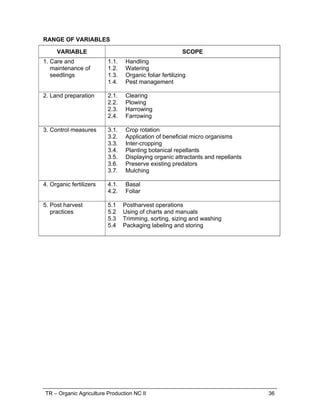
Crop rotation is the practice of alternating the species or families of annual
and/or biennial crops grown on a specific field in a planned
pattern or sequence so as to break weeds, pest and disease
cycles and to improve soil fertility and organic matter content.
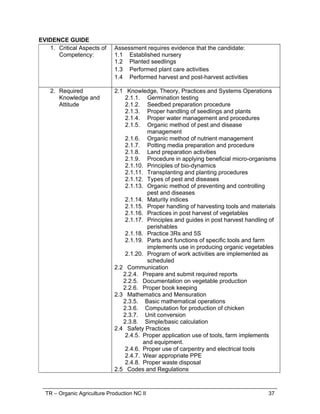
Crossbreed is a group of animals produced by mating two or more
different breeds or strains of animals.
Cover cropping is a crop that provides temporary protection for delicate
seedlings and/or provides a canopy for seasonal soil
protection and improvement between normal crop-production
periods. Except in orchards where permanent vegetative
cover is maintained, cover crops are usually grown for one
year or less. When plowed under and incorporated into the
soil, cover crops are also referred to as green manure crops.
Culling is the removal of undesirable or inferior animals in the herd
based on important economic traits and overall performance.
Depreciation cost is a term used to account for the loss of value in an item over
time.
Deworming (sometimes known as worming or drenching) is the giving of
an anthelmintic drug (a wormer, dewormer, or drench) to an
animal to rid it of intestinal parasites, such as roundworm and
tapeworm.
Disinfect is to reduce by physical or chemical means, the number of
microorganism in the environment, to a level that does not
compromise food safety or suitability.
Doe is the adult female of some animals, such as the deer, goat,
antelope, or rabbit use for breeding purposes.
Dung is the organic material that is used to fertilize land, usually
consisting of the faeces and urine of domestic livestock, with
or without litter such as straw, hay, or bedding.
Dry sow is a sow whose litter has been weaned but which has not yet
been bred or is not pregnant.
Estrus is a period of time when the female will accept male. Also
known as heat period.
Ewe is the adult female sheep.
Enzymes are biological molecules that catalyze (i.e., increase the rates
of) chemical reactions. In enzymatic reactions, the molecules
at the beginning of the process, called substrates, are
TR – Organic Agriculture Production NC II 56
RANGE OF VARIABLES
VARIABLE SCOPE
1. Industry acceptable
indicator for healthy
piglets
1.1. Age : 8 months
1.2. Weight:
1.2.1. native-weight not less than15 kg
1.2.2. crossbreeds- not less than 20 kg
2. Cage equipment 2.1 Feeding troughs
2.2 Waterers
2.3 Containers of concoction
3. Feed materials 3.1 Protein Sources (e.g. madre de agua; ipil-ipil; other
leguminous plants
3.2 Carbohydrate sources – rootcrops
3.3 Mineral sources – e.g. Calcium-eggshells, sea shells;
potassium –tubers (banana)
4. Maintenance of
forage area
4.1 Cutting
4.2 Application of organic fertilizer
4.3 Watering
5. Feeding
management
program
5.1 Restricted
5.2 Adlibitum
5.3 Combination
6. Signs of heat 6.1 Swelling of external genitalia
6.2 Constant urination
6.3 Tail wagging and bleating
6.4 Wants to be mounted
6.5 Capacious appetite
6.6 Decrease in milk yield of lactating does/ewes
7. Unproductive
buck/ram and
doe/ewe
7.1 Infertile/abnormal sperm from the buck
7.2 Diseases such as brucellosis, leptospirosis and vibriosis
7.3 Poor growth traits and reproductive efficacy
7.4 Irregularity of estrus cycle
7.5 Poor growth and reproductive traits
7.6 Susceptibility to diseases
7.7 Production of abnormal eggs/ova
7.8 Overfat condition
8. Health care
program
8.1 Deworming
8.2 Vitamins/mineral supplementation using concoctions
9. Sanitation and
cleanliness
program
9.1 Cleaning of equipment (feeding trough, waterers)
9.2 Application of beneficial micro-organism
9.3 Collection manure
10.Organic waste 10.1 Animal manure
10.2 Feed refuse
10.3 Waste/Rotten vegetables and fruits
TR – Organic Agriculture Production NC II 79
Green manure is a crop that is incorporated into the soil for the purpose of
soil improvement.
Growth rate is a measure of the increase in size, mass or number of crops
over a period of time.
Habitat is the area over which a plant or animal species naturally
exist, the area where a species occurs. e.g. seashore,
riverbank, woodland, grassland, etc.
Harrowing is breaking up and smoothing out the surface of the soil.
Harvest is the process of gathering mature crops from the fields.
Herbal medicine is actually products which is derived from a plant or plant part
which are used for its scent, flavor or therapeutic properties.
Also, herbal medicine products are dietary supplements that
people take to improve their health.
Inbreeding is the mating of closely related animals in a herd.
Inter cropping is the growing two or more crops as a mixture in the same
field at the same time. Intercropping can be one way of adding
diversity to a crop system.
Incubation refers to the development of the birds from the fertilized eggs
to fully formed chicks.
Ingredient is any substance, including a food additive, used in the
manufacture or preparation of a food or present in the final
product, although in a modified form.
Irrigation is the artificial application of water to the land or soil. It is used
to assist in the growing of agricultural crops, maintenance of
landscapes, and revegetation of disturbed soils in dry areas
and during periods of inadequate rainfall.
Kidding/lambing is the act of a pregnant doe giving birth.
Fish Amino Acid
(FAA)
is a liquid made from fish waste. FAA is of great value to both
plants and microorganisms in their growth, because it
contains an abundant amount of nutrients and various types
of amino acids.
Labeling is any written, printed or graphic presentation that is present
on the label of a product accompanies the product or
displayed near the product.
Land preparation is a farm activity typically involves plowing, harrowing, and
leveling the field to make it suitable for crop establishment.
TR – Organic Agriculture Production NC II 80
Lactating describes the secretion of milk from the mammary glands and
the period of time that a mother lactates to feed her young.
Leptospirosis is a rare and severe bacterial infection that occurs when
people are exposed to certain environment.
Livestock refers to domestic animals kept for use on a farm and raised
for sale and profit.
Litter is the offsprings at one birth of a multiparous or animal like
swine.
Litter Size refers to the aggregate number of piglets per farrowing.
Natural Calcium
Phosphate Micro
Nutrients (CALPHOS)
buffered calcium phosphate solution for foliar application used
to improve the quality, shelf life and storability of horticultural
crops.
Nutrients are food elements or substance found in the feeds such as
protein, carbohydrates, fats and others.
Microbe is a minute, often disease-causing organism.
Mulching A protective covering, usually of organic matter such as
leaves, straw, or peat, placed around plants to prevent the
evaporation of moisture, the freezing of roots, and the growth
of weeds.
Organic in this text the word refers to the particular farming and
processing systems described in these standards and not in
the classical Chemical sense (the latter shall be clearly
marked with a † for ease of identification). The term Organic is
nearly synonymous in other languages to “biological” or
“ecological.”
Organic farming is more than agricultural production without the use of
synthetic chemicals or genetically modified organisms, growth
regulators, and livestock feed additives. Organic farming
emphasizes on a holistic farm management approach, where
rotations and animals play an integral role to the system.
Organic farmer any farmer who uses organic farming methods.
Organic feed animal feed produced organically. It should be produced on
farm, but it may also be imported. The recommended
objective to produce feed on farm remains a challenge in
organic livestock and aquaculture production.
Organic waste is anything that comes from plants or animals that is
biodegradable.
TR – Organic Agriculture Production NC II 81
Organic agriculture as an ecological production management system that
promotes and enhances biodiversity, biological cycles, and
soil biological activity. It is based on minimal use of off-farm
inputs and on management practices that restore, maintain, or
enhance ecological harmony.
Organoleptic refers to any sensory properties of a food or other products,
including taste, colour, odour and texture.
Pasture land use for livestock grazing that is managed to provide feed
value and maintain or improve soil, water and vegetative
resources.
Permaculture (permanent+agriculture) is the conscious design and
maintenance of agriculturally productive ecosystems which
have the diversity, stability,and resilience of natural
ecosystems. It is a land use and community building
movement which strives for the harmonious integration of
human dwellings, microclimate, annual and perennial plants,
animals, soils, and water into stable, productive communities.
The focus is not on these elements themselves, but rather on
the relationships created among them by the way we place
them in the landscape.
Integrated Pest
management
is a broad based approach that integrates a range of practices
for economic control of pests.
Predators organism which hunts and eats other organisms. These
include both carnivores, which eat animals, and herbivores,
which eat plants.
Plowing in farming for initial cultivation of soil in preparation for sowing
seed or planting.
Post-harvesting is the stage of crop production immediately following harvest,
including cooling, cleaning, sorting and packing. The instant a
crop is removed from the ground, or separated from its parent
plant, it begins to deteriorate. Post-harvest treatment largely
determines final quality, whether a crop is sold for fresh
consumption, or used as an ingredient in a processed food
product.
Potting media is a medium in which to grow plants, herbs and vegetables in
a pot or other durable container.
Poultry a collective term for birds used either for breeding, egg
production, meat production and recreation.
Production means the operations undertaken to supply agricultural
TR – Organic Agriculture Production NC II 82
products in the state in which they occur on the farm,
including initial packaging and labelling of the product.
Production cost combined costs of raw material and labor incurred in
producing goods.
Purebreeding is the mating of the unrelated individuals in the same breed.
Putrification process is also known as decomposition, which is the breakdown or
decay of organic materials.
Ram is an intact (still has testicals) male sheep, used for breeding.
Rapid composting
method
is composting method which apply new, different procedures
and materials to speed up the process.
Ration the total amount of feeds taken in by an animal during a 24
hour period.
Raw materials all ingredients other than additives.
Rooster a matured male poultry used for breeding.
Rotavator a type of machine with rotating blades that break up soil.
Ruminants refers to animals with complex digestive system e.g. cattle,
carabao, goats and sheep.
Seedbed or seedling bed is the local soil environment in which seeds
are planted. Often it comprises not only the soil but also a
specially prepared cold frame, hotbed or raised bed used to
grow the seedlings in a controlled environment into larger
young plants before transplanting them into a garden or field.
A seedling bed is used to increase the number of seeds that
germinate.
Seedlings is a young plant sporophyte developing out of a plant embryo
from a seed. Seedling development starts with germination of
the seed. A typical young seedling consists of three main
parts: the radicle (embryonic root), the hypocotyl (embryonic
shoot), and the cotyledons (seed leaves).
Selection refers to the process of choosing males and females with
desirable characteristics either for breeding or replacement
stocks.
Simple stomach/non-
ruminant animals
animals that possess simple digestive system e.g. poultry,
horse and pigs.
Sow a mature female hog that had given birth.
TR – Organic Agriculture Production NC II 83
Stag a male swine castrated after sexual maturity.
Standards are norms ,sets of guidelines, requirements and principles that
are used as in organic agriculture and processing. The term
“standards” as used here refers to Philippine National
Standards relevant to local agroecosystems production.
Surface irrigation
system
is defined as the group of application techniques where water
is applied and distributed over the soil surface by gravity. It is
by far the most common form of irrigation throughout the
world and has been practiced in many areas virtually
unchanged for thousands of years.
Swine a collective term for hogs.
Tail wagging is a behavior that may function as both attractivity and
proceptivity. It is one of the signs of estrus exhibited by
females; high rates of tail wagging would arouse males,
increasing sexual performance.
Waterer equipment used in providing water to animals.
Weaning refers to a young animal of either sex which has been
separated from the mother at the end of the lactation period.
Weeding to clear or remove weeds.
Vermicomposting the process of using earthworms to breakdown kitchen and
garden waste, to create a faster than normal composting; to
be précised the product is called vermicompost (or worm
compost).
Vibriosis in cattle is an infectious bacterial (Campylobacter fetus)
disease of the genital tract causing infertility and occasional
abortions. It is a venereal disease spread by infected bulls
when they mate susceptible cows and heifers. It is
considered to be the most important cause of infertility in
cattle.
TR – Organic Agriculture Production NC II 59
 Weighing balance (500 kg cap.) – for monitoring
and marketing of small ruminants
 Plastic Pail
 Pencil papers
 Plant materials
 Bedding materials
 Record books
 Carpentry tools
 Calculators
 Feeding trough
 Water container
 Shovel
 Bite/push nipples
 Wheel borrow
 Knapsack sprayer
 Chopping board
 Driving board
5.2 Protective clothing equipment and materials. All
workers involved in different activities must be fully
oriented and cautioned on the different specific work
activities of the farm
5.3 Technical supervisors should have skills and ability in
the successful implementation of work program
activities
6. Context of
Assessment
6.1. Assessment may occur in an appropriately simulated
environment through TESDA accredited assessment
centers
TR – Organic Agriculture Production NC II 85
MS. MARLENE G. CALANGIAN
Senior Aquaculturist/Section Chief
Bureau of Fisheries and Aquatic
Resources (BFAR)
MS. VERA YSABEL DELA CRUZ
Science Research Specialist I
Bureau of Agriculture and Fisheries Product
Standards, Quezon City
MR. PATRICK R. LESACA
PDO II/Technical Staff
Bureau of Agricultural Research
Quezon City
MR. HERBERT C. SALAULA
Engineer III
Bureau of Agricultural Research
Quezon City
MS. MYLEN D. VILLAREAL
Technical Staff
Bureau of Agricultural Research
Quezon City
MS. SARAH JANE T. MAGBANUA
Administrative Aide V
Bureau of Fisheries and Aquatic Resources
Quezon City
MS. MA. THERESA C. FEROLINO
Senior Agriculturist
ATI-Region XI
Panabo City, Davao del Norte
MR. RICHARD C. RUBIS
Center Director
ATI-Region XI
Panabo City, Davao del Norte
MS. LUZVIMINDA J. RAZON
OIC, Chief, Extension Governance and
Policy Division (EGPD)
ATI-Central Office
Quezon City
MS. EVELYN D. TAGUD
Focal Extension Service Provider (ESP)
Accreditation/Senior Agriculturist
ATI-Central OfficeQuezon City
DR. KHAYANG LUY BATTAD
Senior Agriculturist
ATI-Central Office
Quezon City
MS. PAMELA MARIQUITA G. MAPPALA
Media Production Specialist III
ATI-Central Office
Quezon City
MR. ANGEL S. MORCOZO, JR.
Senior Agriculturist
ATI-Central Office
Quezon City
TR – Organic Agriculture Production NC II 86
THE PARTICIPANTS IN THE NATIONAL VALIDATION OF THESE TRAINING REGULATIONS
LUZON AREA
MR. RENATO A. BELEN
Farm owner
Ato Belen’s Farm
Brgy. San Juan, San Pablo City
MR. GIL A. CARANDANG
President
Herbana Farms
Calamba City, Laguna
MR. RODEN MARK F. COSTALES
Farm Manager
Costales Nature Farm
Brgy. Gagalot, Majayjay, Laguna
MR. EDUARDO A. GAMALANDO
Area Head
Costales Nature Farm
Brgy. Gagalot, Majayjay, Laguna
MR. JOHN MARK S. TODERO
Farm Worker (Fertilizer Production)
Costales Nature Farm
Brgy. Gagalot, Majayjay, Laguna
MR. CHRISTOPHER ARGETE
Area Head (Harvesting)
Costales Nature Farm
Brgy. Gagalot, Majayjay, Laguna
MR. MICHAEL ARGAÑOSA
Farm worker (Harvesting)
Costales Nature Farm
Brgy. Gagalot, Majayjay, Laguna
MS. RHEA GRANADA
Farm worker (Harvesting)
Costales Nature Farm
Brgy. Gagalot, Majayjay, Laguna
MS. CHONA GRANADA
Area Head (Seedling)
Costales Nature Farm
Brgy. Gagalot, Majayjay, Laguna
MR. RUSSAN JADE O. IMPERO
Area Head (Production)
Costales Nature Farm
Brgy. Gagalot, Majayjay, Laguna
MR. BRAYAN N. SEBOLINO
Area Head (Vegetable Production)
Costales Nature Farm
Brgy. Gagalot, Majayjay, Laguna
MR. NESTOR L. PURI
Area Head (Livestock)
Costales Nature Farm
Brgy. Gagalot, Majayjay, Laguna
MR.JERRY PEVIDA
Area Head (Organic Fertilizer)
Costales Nature Farm
Brgy. Gagalot, Majayjay, Laguna
MR. CANDIDO RUBIAN
Area Head (Crop Production)
Costales Nature Farm
Brgy. Gagalot, Majayjay, Laguna
MR. JEFFREY E. CADIZ
Area Head
Costales Nature Farm
Brgy. Gagalot, Majayjay, Laguna
MR. LUIS O. QUISANOS
Farmer/Chairman
Samahang Magsasaka sa Paraang
Organiko Para sa Kaunlaran ng
Tayabas(SAMAPOKATA)
City of Tayabas, Quezon
TR – Organic Agriculture Production NC II 87
VISAYAS AREA
MS. NORA S. CONEJAR
Small farmer/Manager
Sariri Multipurpose Coop
Sariri, Badiangan, Iloilo
MR. SAMUEL Q. HORLADOR
Farm worker
Ephrathah Farms
Sariri, Badiangan, Iloilo
MR. DIOSDADO L. LLAMADO
Farmer/ Member
St. Joseph Parish Organic Farmers
Program-Forum for Community
Alternative, Inc.
Brgy. Pototan, Iloilo
MS. ESPEREDION G. PENTECOSTES
Farmer/Member-Coordinator
St. Joseph Parish Organic Farmers
Program-Forum for Community
Alternative, Inc.
Brgy. Pototan, Iloilo
MR. CESAR C. CAMPEÑERO
Farmer
Brgy. Ilong bukid, Badiangan, Iloilo
MR. DOMINGO A. LUTERO
Farmer/Brgy. Kagawad
Badiangan Organic Farmer Association
Cabayogan, Badiangan, Iloilo
MS. AILYN R. CATEQUISTA
Farmer/Brgy. Kagawad
Brgy. Linaynan, Badiangan, Iloilo
MR. AMADO P. MANES
Organic Farmer/Brgy. Captain
Brgy. Linayuan, Badiangan, Iloilo
MR. NOEL S. SUPLICO
Farm Laborer (Fish hatchery)
Ephrathah Farms
Sariri, Badiangan, Iloilo
MR. ISIDRO A. VILLA,SR.
Owner-Farmer
Cabayogan, Badiangan, Iloilo
MS. LODELYN B. PELAEZ
Farmer/Member
St. Joseph Parish Organic Farmers
Program-Forum for Community
Alternative, Inc.
Brgy. Pototan, Iloilo
MR. IGMEDIO S. MONES
Organic Farmer
St. Joseph Parish Organic Farmers
Program-Forum for Community
Alternative, Inc.
Brgy. Pototan, Iloilo
MS. CLOTILDE D. PERUALILA
Farmer,
Nabitasan, Pototan, Iloilo
MS. VIRGIE P. PERRA
Organic Vegetable Farmer
Brgy. Nabitasan, Pototan, Iloilo
MS. VISITACION Q. CALISE
Organic Vegetable Farmer
Brgy. Nabitasan, Pototan, Iloilo
MR. CESARIO P. HORLADOR
Vice President
Badiangan Organic Farmer Association
Malublub, Badiangan, Iloilo
MARIETTA T. ALINGASA
Farmer
Brgy. Abangay, Pototan, Iloilo
MS. ROSARIO SUAREZ
Farm Worker
Sariri, Badiangan, Iloilo
TR – Organic Agriculture Production NC II 62
CORE COMPETENCIES
( 96 hours)
Unit of
Competency
Learning Outcomes Methodology
Assessment
Approach
1.Raise Organic
Chicken
1.1 Select healthy stocks
1.2 Determine suitable
chicken house
requirements
1.3 Install cage (housing)
equipment
1.4 Feed chicken (Provide
feed and implement
feeding practices)
1.5 Manage health and
growth of chicken
1.6 Harvest chicken
 Lecture
 Hands-on
 Demonstration
 Video
Presentation
 Lecture
 Lakbay Aral
 Workshop
 Written
examination
 Demonstration
of practical
skills
 Direct
observation
 Interview/
Questioning
2.Produce Organic
Vegetable
2.1 Establish nursery
2.2 Plant seedlings
2.3 Perform Plant Care
Activities (and
Management)
2.4 Perform Harvest and Post
Harvest Activities
 Demonstration
 Discussion
 Oral
questioning
 Video
presentation
 Field
demonstration
 Film viewing
 Direct
observation
with oral
questioning
 Demonstration
 Written exam
 Interview
3.Produce Organic
Fertilizer
3.1 Prepare composting area
3.2 Prepare raw materials
3.3 Carry out composting
process
3.4 Harvest compost
 Observation
 Demonstration
 Lecture-
Discussion
 Film viewing
 Video
presentation
 Field work/
farm visit
 Direct
observation
with oral
questioning
 Demonstration
Written exam
4. Produce various
concoctions
4.1 Prepare for the production
of various concoctions
4.2 Process concoctions
4.3 Package concoctions
 Participatory
Lecture-
Discussion
 Lecture
 Demonstration
 Direct
observation
 Written exam
 Direct
observation and
oral questions
 Interview
TR – Organic Agriculture Production NC II 89
MINDANAO AREA
MR. MARCOS M. DISTO
Farm Owner/Brgy. Captain
LGU-Makilala, New Bulatukan
Cotobato
MS. LEONEDA F. OCACION
Farmer
Bry 75-A, Zamzoma
Davao City
MR. COMMUNSITE B. CASUS
Vegetable Farmer
Bry 75-A
Dumalay I, Davao City
MR. ALAN C. CEQUIÑA
Farm Owner
Ursula Subd., Tagum City
Davao del Norte
MR.ROMEO V. ARDECO
Farmer/Bgry. Kagawad
Matina Aplaya, Davao City
MR. JIMMY D. POLIQUIT
Backyard Farmer
Matina Aplaya, Davao City
MS. ANABELLE D. POLINAR
Farm worker
ACES Farm
Peda St. , Panabo City, Davao del Norter
MS. AMIE E. CAJERA
Farm Owner/Bgry. Kagawad
Farm Malabog
Malabog, Davao City
MR. BENEDICTO M. PIONGYE
Farm worker
ACES Farm
Peda St. , Panabo City, Davao del Norter
MR. GERVIE D. EMNACE
Farm worker
ACES Farm
Peda St. , Panabo City, Davao del Norte
MR. MIGUEL V. CENABRE
Farmer/Brgy. Kagawad
Makilala, Cotobato
The Management and Staff of the TESDA Secretariat
 Qualification and Standards Office
 Competency Assessment and Certification Office

Tr oap

  • 1.
    ____________________________________________________________________________ 1 t ORGANIC AGRICULTURE PRODUCTION NCII TRAINING REGULATIONS AGRICULTURE AND FISHERY SECTOR TECHNICAL EDUCATION AND SKILLS DEVELOPMENT AUTHORITY East Service Road, South Superhighway, Taguig City, Metro Manila
  • 2.
    TABLE OF CONTENTS AGRI-FISHERYSECTOR ORGANIC AGRICULTURE PRODUCTION NC II Page/s Section 1 ORGANIC AGRICULTURE PRODUCTION NC II QUALIFICATION 1 Section 2 COMPETENCY STANDARDS 1 Basic Competencies 2 Common Competencies 3 Core Competencies 4 Elective Competencies 2– 13 14 – 29 30 – 49 50 – 59 Section 3 TRAINING STANDARDS 3.1. Curriculum Design 3.1.1. Basic 3.1.2. Common 3.1.3. Core 3.1.4. Elective 3.2. Training Delivery 3.3. Trainee Entry Requirements 3.4. List of Tools, Equipment and Materials 3.5. Training Facilities 3.6. Trainers’ Qualifications 3.7. Institutional Assessment 60 61 62 63 64 65 65– 71 72 72 72 Section 4 NATIONAL ASSESSMENT AND CERTIFICATION ARRANGEMENTS 73 COMPETENCY MAP 74 DEFINITION OF TERMS 75-83 ACKNOWLEDGEMENTS 84-89
  • 3.
    TR – OrganicAgriculture Production NC II 1 TRAINING REGULATIONS FOR ORGANIC AGRICULTURE PRODUCTION NC II Section 1 ORGANIC AGRICULTURE PRODUCTION NCII QUALIFICATIONS The ORGANIC AGRICULTURE PRODUCTION NC II Qualification consists of competencies that a person must achieve to produce organic farm products such as chicken and vegetables including producing of organic supplements such as fertilizer, concoctions and extracts. It has two (2) elective competencies which are on raising organic hogs and raising organic small ruminants. This Qualification is packaged from the competency map of the Agri-Fishery Sector as shown in Annex A. The units of competency comprising this qualification include the following: Code BASIC COMPETENCIES 500311105 Participate in workplace communication 500311104 Work in a team environment 500311107 Practice career professionalism 500311108 Practice occupational health and safety procedures Code COMMON COMPETENCIES AGR321201 Apply safety measures in farm operations AGR321202 Use farm tools and equipment AGR321203 Perform estimation and calculations TRS311201 Develop and update industry knowledge AGR321205 Perform record keeping Code CORE COMPETENCIES AGR612301 Raise organic chicken AGR611306 Produce organic vegetables AGR611301 Produce organic fertilizer AGR611302 Produce organic concoctions and extracts Code ELECTIVE COMPETENCIES AGR612302 Raise organic hogs AGR612303 Raise organic small ruminants A person who has achieved this Qualification is competent to be: • Organic Agriculture Farmer • Organic Chicken Raiser • Organic Hogs Raiser • Organic Small Ruminants Raiser • Organic Vegetables Farmer • Organic Concoctions and Extracts Producer • Organic Fertilizer Producer
  • 4.
    TR – OrganicAgriculture Production NC II 2 SECTION 2 COMPETENCY STANDARDS BASIC COMPETENCIES UNIT OF COMPETENCY : PARTICIPATE IN WORKPLACE COMMUNICATION UNIT CODE : 500311105 UNIT DESCRIPTOR : This unit covers the knowledge, skills and attitudes required to gather, interpret and convey information in response to workplace requirements. ELEMENT PERFORMANCE CRITERIA Italicized terms are elaborated in the Range of Variables 1. Obtain and convey workplace information 1.1 Specific and relevant information is accessed from appropriate sources 1.2 Effective questioning , active listening and speaking skills are used to gather and convey information 1.3 Appropriate medium is used to transfer information and ideas 1.4 Appropriate non- verbal communication is used 1.5 Appropriate lines of communication with supervisors and colleagues are identified and followed 1.6 Defined workplace procedures for the location and storage of information are used 1.7 Personal interaction is carried out clearly and concisely 2. Participate in workplace meetings and discussions 2.1 Team meetings are attended on time 2.2 Own opinions are clearly expressed and those of others are listened to without interruption 2.3 Meeting inputs are consistent with the meeting purpose and established protocols 2.4 Workplace interactions are conducted in a courteous manner 2.5 Questions about simple routine workplace procedures and maters concerning working conditions of employment are asked and responded to 2.6 Meetings outcomes are interpreted and implemented 3. Complete relevant work related documents 3.1 Range of forms relating to conditions of employment are completed accurately and legibly 3.2 Workplace data is recorded on standard workplace forms and documents 3.3 Basic mathematical processes are used for routine calculations 3.4 Errors in recording information on forms/ documents are identified and properly acted upon 3.5 Reporting requirements to supervisor are completed according to organizational guidelines
  • 5.
    TR – OrganicAgriculture Production NC II 3 RANGE OF VARIABLES VARIABLE RANGE 1. Appropriate sources 1.1. Team members 1.2. Suppliers 1.3. Trade personnel 1.4. Local government 1.5. Industry bodies 2. Medium 2.1. Memorandum 2.2. Circular 2.3. Notice 2.4. Information discussion 2.5. Follow-up or verbal instructions 2.6. Face to face communication 3. Storage 3.1. Manual filing system 3.2. Computer-based filing system 4. Forms 4.1. Personnel forms, telephone message forms, safety reports 5. Workplace interactions 5.1. Face to face 5.2. Telephone 5.3. Electronic and two way radio 5.4. Written including electronic, memos, instruction and forms, non-verbal including gestures, signals, signs and diagrams 6. Protocols 6.1. Observing meeting 6.2. Compliance with meeting decisions 6.3. Obeying meeting instructions
  • 6.
    TR – OrganicAgriculture Production NC II 3 RANGE OF VARIABLES VARIABLE RANGE 1. Appropriate sources 1.1. Team members 1.2. Suppliers 1.3. Trade personnel 1.4. Local government 1.5. Industry bodies 2. Medium 2.1. Memorandum 2.2. Circular 2.3. Notice 2.4. Information discussion 2.5. Follow-up or verbal instructions 2.6. Face to face communication 3. Storage 3.1. Manual filing system 3.2. Computer-based filing system 4. Forms 4.1. Personnel forms, telephone message forms, safety reports 5. Workplace interactions 5.1. Face to face 5.2. Telephone 5.3. Electronic and two way radio 5.4. Written including electronic, memos, instruction and forms, non-verbal including gestures, signals, signs and diagrams 6. Protocols 6.1. Observing meeting 6.2. Compliance with meeting decisions 6.3. Obeying meeting instructions
  • 7.
    TR – OrganicAgriculture Production NC II 5 UNIT OF COMPETENCY: WORK IN TEAM ENVIRONMENT UNIT CODE : 500311106 UNIT DESCRIPTOR : This unit covers the skills, knowledge and attitudes to identify role and responsibility as a member of a team. ELEMENT PERFORMANCE CRITERIA Italicized terms are elaborated in the Range of Variables 1. Describe team role and scope 1.1. The role and objective of the team is identified from available sources of information 1.2. Team parameters, reporting relationships and responsibilities are identified from team discussions and appropriate external sources 2. Identify own role and responsibility within team 2.1. Individual role and responsibilities within the team environment are identified 2.2. Roles and responsibility of other team members are identified and recognized 2.3. Reporting relationships within team and external to team are identified 3. Work as a team member 3.1. Effective and appropriate forms of communications used and interactions undertaken with team members who contribute to known team activities and objectives 3.2. Effective and appropriate contributions made to complement team activities and objectives, based on individual skills and competencies and workplace context 3.3. Observed protocols in reporting using standard operating procedures 3.4. Contribute to the development of team work plans based on an understanding of team’s role and objectives and individual competencies of the members.
  • 8.
    TR – OrganicAgriculture Production NC II 6 RANGE OF VARIABLES VARIABLE RANGE 1. Role and objective of team 1.1. Work activities in a team environment with enterprise or specific sector 1.2. Limited discretion, initiative and judgment maybe demonstrated on the job, either individually or in a team environment 2. Sources of information 2.1. Standard operating and/or other workplace procedures 2.2. Job procedures 2.3. Machine/equipment manufacturer’s specifications and instructions 2.4. Organizational or external personnel 2.5. Client/supplier instructions 2.6. Quality standards 2.7. OHS and environmental standards 3. Workplace context 3.1. Work procedures and practices 3.2. Conditions of work environments 3.3. Legislation and industrial agreements 3.4. Standard work practice including the storage, safe handling and disposal of chemicals 3.5. Safety, environmental, housekeeping and quality guidelines
  • 9.
    TR – OrganicAgriculture Production NC II 7 EVIDENCE GUIDE 1. Critical aspects of competency Assessment requires evidence that the candidate: 1.1. Operated in a team to complete workplace activity 1.2. Worked effectively with others 1.3. Conveyed information in written or oral form 1.4. Selected and used appropriate workplace language 1.5. Followed designated work plan for the job 1.6. Reported outcomes 2. Required Knowledge and Attitude 2.1. Communication process 2.2. Team structure 2.3. Team roles 2.4. Group planning and decision making 3. Required Skills 3.1. Communicate appropriately, consistent with the culture of the workplace 4. Resource Implications The following resources MUST be provided: 4.1. Access to relevant workplace or appropriately simulated environment where assessment can take place 4.2. Materials relevant to the proposed activity or tasks 5. Methods of Assessment Competency may be assessed through: 5.1. Observation of the individual member in relation to the work activities of the group 5.2. Observation of simulation and or role play involving the participation of individual member to the attainment of organizational goal 5.3. Case studies and scenarios as a basis for discussion of issues and strategies in teamwork 6. Context for Assessment 6.1. Competency may be assessed in workplace or in a simulated workplace setting 6.2. Assessment shall be observed while task are being undertaken whether individually or in group
  • 10.
    TR – OrganicAgriculture Production NC II 6 RANGE OF VARIABLES VARIABLE RANGE 1. Role and objective of team 1.1. Work activities in a team environment with enterprise or specific sector 1.2. Limited discretion, initiative and judgment maybe demonstrated on the job, either individually or in a team environment 2. Sources of information 2.1. Standard operating and/or other workplace procedures 2.2. Job procedures 2.3. Machine/equipment manufacturer’s specifications and instructions 2.4. Organizational or external personnel 2.5. Client/supplier instructions 2.6. Quality standards 2.7. OHS and environmental standards 3. Workplace context 3.1. Work procedures and practices 3.2. Conditions of work environments 3.3. Legislation and industrial agreements 3.4. Standard work practice including the storage, safe handling and disposal of chemicals 3.5. Safety, environmental, housekeeping and quality guidelines
  • 11.
    TR – OrganicAgriculture Production NC II 9 RANGE OF VARIABLES VARIABLE RANGE 1. Evaluation 1.1 Performance Appraisal 1.2 Psychological Profile 1.3 Aptitude Tests 2. Resources 2.1 Human 2.2 Financial 2.3 Technology 2.3.1 Hardware 2.3.2 Software 3. Trainings and career opportunities 3.1 Participation in training programs 3.1.1 Technical 3.1.2 Supervisory 3.1.3 Managerial 3.1.4 Continuing Education 3.2 Serving as Resource Persons in conferences and workshops 4. Recognitions 4.1 Recommendations 4.2 Citations 4.3 Certificate of Appreciations 4.4 Commendations 4.5 Awards 4.6 Tangible and Intangible Rewards 5. Licenses and/or certifications 5.1 National Certificates 5.2 Certificate of Competency 5.3 Support Level Licenses 5.4 Professional Licenses
  • 12.
    TR – OrganicAgriculture Production NC II 10 EVIDENCE GUIDE 1. Critical Aspects of Competency Assessment requires evidence that the candidate: 1.1 Attained job targets within key result areas (KRAs) 1.2 Maintained intra - and interpersonal relationship in the course of managing oneself based on performance evaluation 1.3 Completed trainings and career opportunities which are based on the requirements of the industries 1.4 Acquired and maintained licenses and/or certifications according to the requirement of the qualification 2. Required Knowledge and Attitude 2.1 Work values and ethics (Code of Conduct, Code of Ethics, etc.) 2.2 Company policies 2.3 Company operations, procedures and standards 2.4 Fundamental rights at work including gender sensitivity 2.5 Personal hygiene practices 3. Required Skills 3.1 Appropriate practice of personal hygiene 3.2 Intra and Interpersonal skills 3.3 Communication skills 4. Resource Implications The following resources MUST be provided: 4.1 Workplace or assessment location 4.2 Case studies/scenarios 5. Methods of Assessment Competency may be assessed through: 5.1 Portfolio Assessment 5.2 Interview 5.3 Simulation/Role-plays 5.4 Observation 5.5 Third Party Reports 5.6 Exams and Tests 6. Context of Assessment 6.1 Competency may be assessed in the work place or in a simulated work place setting
  • 13.
    TR – OrganicAgriculture Production NC II 11 UNIT OF COMPETENCY: PRACTICE OCCUPATIONAL HEALTH AND SAFETY PROCEDURES UNIT CODE : 500311108 UNIT DESCRIPTOR : This unit covers the outcomes required to comply with regulatory and organizational requirements for occupational health and safety. ELEMENT PERFORMANCE CRITERIA Italicized terms are elaborated in the Range of Variables 1. Identify hazards and risks 1.1 Safety regulations and workplace safety and hazard control practices and procedures are clarified and explained based on organization procedures 1.2 Hazards/risks in the workplace and their corresponding indicators are identified to minimize or eliminate risk to co-workers, workplace and environment in accordance with organization procedures 1.3 Contingency measures during workplace accidents, fire and other emergencies are recognized and established in accordance with organization procedures 2. Evaluate hazards and risks 2.1Terms of maximum tolerable limits which when exceeded will result in harm or damage are identified based on threshold limit values (TLV) 2.2Effects of the hazards are determined 2.3 OHS issues and/or concerns and identified safety hazards are reported to designated personnel in accordance with workplace requirements and relevant workplace OHS legislation 3. Control hazards and risks 3.1Occupational Health and Safety (OHS) procedures for controlling hazards/risks in workplace are consistently followed 3.2Procedures for dealing with workplace accidents, fire and emergencies are followed in accordance with organization OHS policies 3.3Personal protective equipment (PPE) is correctly used in accordance with organization OHS procedures and practices 3.4Appropriate assistance is provided in the event of a workplace emergency in accordance with established organization protocol 4. Maintain OHS awareness 4.1 Emergency-related drills and trainings are participated in as per established organization guidelines and procedures 4.2 OHS personal records are completed and updated in accordance with workplace requirements
  • 14.
    TR – OrganicAgriculture Production NC II 9 RANGE OF VARIABLES VARIABLE RANGE 1. Evaluation 1.1 Performance Appraisal 1.2 Psychological Profile 1.3 Aptitude Tests 2. Resources 2.1 Human 2.2 Financial 2.3 Technology 2.3.1 Hardware 2.3.2 Software 3. Trainings and career opportunities 3.1 Participation in training programs 3.1.1 Technical 3.1.2 Supervisory 3.1.3 Managerial 3.1.4 Continuing Education 3.2 Serving as Resource Persons in conferences and workshops 4. Recognitions 4.1 Recommendations 4.2 Citations 4.3 Certificate of Appreciations 4.4 Commendations 4.5 Awards 4.6 Tangible and Intangible Rewards 5. Licenses and/or certifications 5.1 National Certificates 5.2 Certificate of Competency 5.3 Support Level Licenses 5.4 Professional Licenses
  • 15.
    TR – OrganicAgriculture Production NC II 13 EVIDENCE GUIDE 1. Critical Aspects of Competency Assessment requires evidence that the candidate: 1.1 Explained clearly established workplace safety and hazard control practices and procedures 1.2 Identified hazards/risks in the workplace and its corresponding indicators in accordance with company procedures 1.3 Recognized contingency measures during workplace accidents, fire and other emergencies 1.4 Identified terms of maximum tolerable limits based on threshold limit value- TLV. 1.5 Followed Occupational Health and Safety (OHS) procedures for controlling hazards/risks in workplace 1.6 Used Personal Protective Equipment (PPE) in accordance with company OHS procedures and practices 1.7 Completed and updated OHS personal records in accordance with workplace requirements 2. Required Knowledge and Attitude 2.1 OHS procedures and practices and regulations 2.2 PPE types and uses 2.3 Personal hygiene practices 2.4 Hazards/risks identification and control 2.5 Threshold Limit Value -TLV 2.6 OHS indicators 2.7 Organization safety and health protocol 2.8 Safety consciousness 2.9 Health consciousness 3. Required Skills 3.1 Practice of personal hygiene 3.2 Hazards/risks identification and control skills 3.3 Interpersonal skills Communication skills 4. Resource Implications The following resources must be provided: 4.1 Workplace or assessment location 4.2 OHS personal records 4.3 PPE 4.4 Health records 5. Methods of Assessment Competency may be assessed through: 5.1 Portfolio Assessment 5.2 Interview 5.3 Case Study/Situation 6. Context for Assessment 6.1Competency may be assessed in the work place or in a simulated work place setting
  • 16.
    TR – OrganicAgriculture Production NC II 14 COMMON COMPETENCIES UNIT TITLE : APPLY SAFETY MEASURES IN FARM OPERATIONS UNIT CODE : AGR321201 UNIT DESCRIPTOR: This unit covers the knowledge, skills and attitudes required to perform safety measures effectively and efficiently. It includes identifying areas, tools, materials, time and place in performing safety measures. ELEMENT PERFORMANCE CRITERIA Italicized terms are elaborated in the Range of Variables 1. Determine areas of concern for safety measures 1.1.Work tasks are identified in line with farm operations 1.2.Place for safety measures are determined in line with farm operations 1.3.Time for safety measures are determined in line with farm operations 1.4.Appropriate tools, materials and outfits are prepared in line with job requirements 2. Apply appropriate safety measures 2.1. Tools and materials are used according to specifications and procedures 2.2. Outfits are worn according to farm requirements 2.3. Effectivity/shelf life/expiration of materials are strictly observed 2.4. Emergency procedures are known and followed to ensure a safework requirement 2.5. Hazards in the workplace are identified and reported in line with farm guidelines 3. Safekeep/dispose tools, materials and outfit 3.1. Used tools and outfit are cleaned after use and stored in designated areas 3.2. Unused materials are properly labeled and stored according to manufacturers recommendation and farm requirements 3.3. Waste materials are disposed according to manufacturers, government and farm requirements
  • 17.
    TR – OrganicAgriculture Production NC II 15 RANGE OF VARIABLES VARIABLE RANGE 1. Work tasks May be selected from any of the following sectors: 1.1. Aquaculture 1.2. Animal Production 1.3. Crop Production 1.4. Post-harvest 1.5. Agri-marketing 1.6. Farm Equipment 2. Place 2.1. Animal pens, cages, barns 2.2. Fish ponds, cages 2.3. Stock room/storage areas/warehouse 2.4. Field/farm/orchard 3. Time 3.1. Vaccination and medication period 3.2. Fertilizer and pesticides application 3.3. Feed mixing and feeding 3.4. Harvesting and hauling 3.5. Cleaning, sanitizing and disinfecting 3.6. Dressing, butchering and castration 4. Tools, materials and outfits 4.1. Tools Wrenches Screw driver Pliers 4.2. Materials Bottles Plastic Bags Syringe 4.3. Outfit Masks Gloves Boots Overall coats Hat Eye goggles 5. Emergency procedures 5.1. Location of first aid kit 5.2. Evacuation 5.3. Agencies contract 5.4. Farm emergency procedures 6. Waste materials 6.1. Animal manure 6.2. Waste water 6.3. Syringes 6.4. Unused farm chemicals e.g. pesticides, chemicals, fertilizers 6.5. Expired reagents 6.6. Dead animals 7. Hazards 7.1. Chemical 7.2. Electrical 7.3. Falls
  • 18.
    TR – OrganicAgriculture Production NC II 12 RANGE OF VARIABLES VARIABLE RANGE 1. Safety regulations May include but are not limited to: 1.1 Clean Air Act 1.2 Building code 1.3 National Electrical and Fire Safety Codes 1.4 Waste management statutes and rules 1.5 Philippine Occupational Safety and Health Standards 1.6 DOLE regulations on safety legal requirements 1.7 ECC regulations 2. Hazards/Risks May include but are not limited to: 2.1 Physical hazards – impact, illumination, pressure, noise, vibration, temperature, radiation 2.2 Biological hazards- bacteria, viruses, plants, parasites, mites, molds, fungi, insects 2.3 Chemical hazards – dusts, fibers, mists, fumes, smoke, gasses, vapors 2.4 Ergonomics  Psychological factors – over exertion/ excessive force, awkward/static positions, fatigue, direct pressure, varying metabolic cycles  Physiological factors – monotony, personal relationship, work out cycle 3. Contingency measures May include but are not limited to: 3.1 Evacuation 3.2 Isolation 3.3 Decontamination 3.4 (Calling designed) emergency personnel 4. PPE May include but are not limited to: 4.1 Mask 4.2 Gloves 4.3 Goggles 4.4 Hair Net/cap/bonnet 4.5 Face mask/shield 4.6 Ear muffs 4.7 Apron/Gown/coverall/jump suit 4.8 Anti-static suits 5. Emergency-related drills and training 5.1 Fire drill 5.2 Earthquake drill 5.3 Basic life support/CPR 5.4 First aid 5.5 Spillage control 5.6 Decontamination of chemical and toxic 5.7 Disaster preparedness/management 6. OHS personal records 6.1 Medical/Health records 6.2 Incident reports 6.3 Accident reports 6.4 OHS-related training completed
  • 19.
    TR – OrganicAgriculture Production NC II 17 UNIT TITLE : USE FARM TOOLS AND EQUIPMENT UNIT CODE : AGR321202 UNIT DESCRIPTOR : This unit covers the knowledge, skills and attitudes required to use farm tools and equipment. It includes selection, operation and preventive maintenance of farm tools and equipment. ELEMENT PERFORMANCE CRITERIA Italicized terms are elaborated in the Range of Variables 1. Select and use farm tools 1.1. Appropriate farm tools are identified according to requirement/use 1.2. Farm tools are checked for faults and defective tools reported in accordance with farm procedures 1.3. Appropriate tools and equipment are safely used according to job requirements and manufacturers conditions 2. Select and operate farm equipment 2.1. Appropriate farm equipment identified 2.2. Instructional manual of the farm tools and equipment are carefully read prior to operation 2.3. Pre-operation check-up is conducted in line with manufacturers manual 2.4. Faults in farm equipment are identified and reported in line with farm procedures 2.5. Farm equipment used according to its function 2.6. Followed safety procedures 3. Perform preventive maintenance 3.1. Tools and equipment are cleaned immediately after use in line with farm procedures 3.2. Routine check-up and maintenance are performed 3.3. Tools and equipment are stored in designated areas in line with farm procedures
  • 20.
    TR – OrganicAgriculture Production NC II 18 RANGE OF VARIABLES VARIABLE RANGE 1. Farm equipment 1.1. Engine 1.2. Pumps 1.3. Generators 1.4. Sprayers 2. Farm tools 2.1. Sickle 2.2. Cutters 2.3. Weighing scales 2.4. Hand tools 2.5. Measuring tools 2.6. Garden tools 3. Pre-operation check-up 3.1. Tires 3.2. Brake fluid 3.3. Fuel 3.4. Water 3.5. Oil 3.6. Lubricants 3.7. Battery
  • 21.
    TR – OrganicAgriculture Production NC II 19 EVIDENCE GUIDE 1. Critical Aspects of Competency Assessment requires evidence that the candidate: 1.1. Correctly identified appropriate farm tools and equipment 1.2. Operated farm equipments according to manual specification 1.3. Performed preventive maintenance 2. Required Knowledge and Attitudes 2.1. Safety Practices 2.1.1. Ideal good work habits to demonstrate to workers easy and safety standards during operation of farm equipment 2.2. Codes and Regulations 2.2.1. Environmental Compliance Certificate (ECG) 2.2.2. Effective work supervision in the operations of farm equipment 2.3. Tools & Equipment: Uses and Specification 2.3.1. Knowledge in calibrating and use of equipment 2.3.2. Safety keeping of equipments every after use 2.4. Maintenance 2.4.1. Regular upkeep of equipments 2.4.2. Preventive maintenance skills 2.5. Values 2.5.1. Positive outlook towards work 2.5.2. Possesses pre-emptive/anticipatory skills 3. Required Skills 3.1. Ability to recognized defective farm equipment 3.2. Perform proper management practices of safety measures 4. Method of Assessment Competency in this unit must be assessed through: 4.1. Direct observation 4.2. Practical demonstration 4.3. Third Party Report 5. Resource Implications Service/operational manual of farm tools and equipment 5.1. Tools and equipment 5.2. Farm implements 6. Context of Assessment 6.1. Assessment may occur in the workplace or in a simulated workplace or as part of a team under limited supervision
  • 22.
    TR – OrganicAgriculture Production NC II 15 RANGE OF VARIABLES VARIABLE RANGE 1. Work tasks May be selected from any of the following sectors: 1.1. Aquaculture 1.2. Animal Production 1.3. Crop Production 1.4. Post-harvest 1.5. Agri-marketing 1.6. Farm Equipment 2. Place 2.1. Animal pens, cages, barns 2.2. Fish ponds, cages 2.3. Stock room/storage areas/warehouse 2.4. Field/farm/orchard 3. Time 3.1. Vaccination and medication period 3.2. Fertilizer and pesticides application 3.3. Feed mixing and feeding 3.4. Harvesting and hauling 3.5. Cleaning, sanitizing and disinfecting 3.6. Dressing, butchering and castration 4. Tools, materials and outfits 4.1. Tools Wrenches Screw driver Pliers 4.2. Materials Bottles Plastic Bags Syringe 4.3. Outfit Masks Gloves Boots Overall coats Hat Eye goggles 5. Emergency procedures 5.1. Location of first aid kit 5.2. Evacuation 5.3. Agencies contract 5.4. Farm emergency procedures 6. Waste materials 6.1. Animal manure 6.2. Waste water 6.3. Syringes 6.4. Unused farm chemicals e.g. pesticides, chemicals, fertilizers 6.5. Expired reagents 6.6. Dead animals 7. Hazards 7.1. Chemical 7.2. Electrical 7.3. Falls
  • 23.
    TR – OrganicAgriculture Production NC II 21 RANGE OF VARIABLES VARIABLE RANGE 1. Calculations 1.1. Quantity of feeds 1.2. Amount of fertilizer 1.3. Amount of medicines 2. Method of calculation 2.1. Addition 2.2. Subtraction 2.3. Multiplication 2.4. Division 2.5. Ratio and proportion 3. System of measurement 3.1. English 3.2. Metric 4. Units of measurement 4.1. Area 4.2. Volume 4.3. Weight
  • 24.
    TR – OrganicAgriculture Production NC II 22 EVIDENCE GUIDE 1. Critical Aspects of Competency Assessment requires evidence that the candidate: 1.1. Performed estimation 1.2. Performed basic workplace calculation 1.3. Applied corrective measures as maybe necessary 2. Required Knowledge and Attitudes 2.1. Mathematics 2.1.1. Basic mathematical operations 2.1.2. Percentage and ratios 2.1.3. Unit Conversion 2.1.4. Basic accounting principles and procedures 2.1.4.1. Production cost 2.1.4.2. Sales 2.1.4.3. Accounts receivables/payables 2.2. Systems, Processes and Operations 2.2.1. Knowledge in different management practices and operational procedures 2.3. Values 2.3.1. Safety consciousness 2.3.2. Time consciousness and management 2.3.3. Cost consciousness 2.3.4. Precision 3. Required Skills 3.1. Ability to perform basic calculation 3.2. Communicate effectively 4. Method of Assessment Competency in this unit must be assessed through: 4.1. Practical demonstration 4.2. Written examination 5. Resource Implications 5.1. Relevant tools and equipment for basic calculation 5.2. Recommended data 6. Context of Assessment 6.1. Assessment may occur in the workplace or in a simulated workplace or as part of a team under limited supervision
  • 25.
    TR – OrganicAgriculture Production NC II 23 UNIT OF COMPETENCY : DEVELOP AND UPDATE INDUSTRY KNOWLEDGE UNIT CODE : AGR TRS311201 UNIT DESCRIPTOR : This unit of competency deals with the knowledge, skills and attitude required to access, increase and update industry knowledge. It includes seek information on the industry and update industry knowledge. ELEMENT PERFORMANCE CRITERIA Italicized terms are elaborated in the Range of Variables 1. Seek information on the industry 1.1 Sources of information on the industry are correctly identified and accessed 1.2 Information to assist effective work performance is obtained in line with job requirements 1.3 Specific information on sector of work is accessed and updated 1.4 Industry information is correctly applied to day-to-day work activities 2. Update industry knowledge 2.1 Informal and/or formal research is used to update general knowledge of the industry 2.2 Updated knowledge is shared with customers and colleagues as appropriate and incorporated into day-to- day working activities
  • 26.
    TR – OrganicAgriculture Production NC II 18 RANGE OF VARIABLES VARIABLE RANGE 1. Farm equipment 1.1. Engine 1.2. Pumps 1.3. Generators 1.4. Sprayers 2. Farm tools 2.1. Sickle 2.2. Cutters 2.3. Weighing scales 2.4. Hand tools 2.5. Measuring tools 2.6. Garden tools 3. Pre-operation check-up 3.1. Tires 3.2. Brake fluid 3.3. Fuel 3.4. Water 3.5. Oil 3.6. Lubricants 3.7. Battery
  • 27.
    TR – OrganicAgriculture Production NC II 25 EVIDENCE GUIDE 1. Critical aspects of Competency Assessment requires evidence that the candidate/ trainee : 1.1 Knew key sources of information on the industry 1.2 Updated industry knowledge 1.3 Accessed and used industry information 2. Required Knowledge and Attitude 2.1. Overview of quality assurance in the industry 2.2. Role of individual staff members 2.3. Industry information sources 3. Required Skills 3.1. Time management 3.2. Ready skills needed to access industry information 3.3. Basic competency skills needed to access the internet 4. Resource Implications 4.1 Sources of information on the industry 4.2 Industry knowledge 5. Methods of Assessment 5.1 Interview/questions 5.2 Practical demonstration 5.3 Portfolio of industry information related to trainee’s work 6. Context for Assessment 6.1. Assessment may be done in the workplace or in a simulated workplace setting (assessment centers)
  • 28.
    TR – OrganicAgriculture Production NC II 26 UNIT OF COMPETENCY : PERFORM RECORD KEEPING UNIT CODE : AGR321205 UNIT DESCRIPTOR : This unit covers the knowledge, skills and attitude required to carry-out inventory activities, maintain production record and prepare financial records. ELEMENTS PERFORMANCE CRITERIA Italicized terms are elaborated in the Range Statement 1. Carry out inventory activities 1.1 Inventory inputs are determined according enterprise requirements. 1.2 Defective tools and equipment are determined according to operation manuals 1.3 Facilities are inspected according to according standard codes and laws. 2. Maintain production record 2.1 Production plan are prepared according to enterprise requirements. 2.2 Schedule for production activities are prepared based from enterprise requirements and plan. 2.3 Production report are prepared in accordance with enterprise reporting procedures 2.4 Input and production are monitored using monitoring chart. 3. Prepare financial records 3.1. Production cost are computed using established computation procedures. 3.2. Revenue is computed using established computation procedures.
  • 29.
    TR – OrganicAgriculture Production NC II 27 RANGE OF VARIABLES VARIABLE SCOPE 1. Inputs 1.1 Plant 1.1.1 Planting materials 1.1.2 Fertilizer 1.1.3 Concoctions (Pesticides and insecticides ) 1.1.4 Beneficial microorganisms 1.2 Animals 1.1.5 Stocks 1.1.6 Feeds 1.1.7 Concoctions 1.1.8 Medications 1.1.9 Beneficial microorganisms 1.2 Miscellaneous materials 2. Production activities 2.1. Plant o Planting o Fertilizer application o Pesticides application o Implementation of bio-security measures o Irrigation/watering o Weeding o Harvesting o Post-harvesting 2.2. Animal o Feeding o Cleaning and Sanitization o Implementation of bio-security measures o Growth and health condition o Harvesting o Post harvesting 2.3. Miscellaneous activities 3. Production report 3.1. Categorize and record quality of harvest 3.2. volume /quantity of products harvested 4. Input 4.1. Input(plant) o Fertilizer o Concoctions (Pesticides and insecticides ) o Beneficial microorganisms 4.2. Input(animal) o Feeds o Concoctions o Medications o Beneficial microorganisms 4.3. Miscellaneous inputs 5. Production 5.1 Growth rate 5.2 Survival rate 6. Production cost 6.1. Labor 6.2. Inputs 6.3. Tools, equipment and facility depreciation cost 6.4. Administrative cost 6.5. Miscellaneous
  • 30.
    TR – OrganicAgriculture Production NC II 28 EVIDENCE GUIDE 1. Critical Aspects of Competency Assessment requires evidence that the candidate: 1.1. Determined inventory inputs according enterprise requirements 1.2. Determined defective tools and equipments according to operation manuals. 1.3. Inspected facilities according to standard codes and laws. 1.4. Prepared production plan and report according to enterprise requirements and reporting procedures. 2. Required Knowledge and Attitudes 2.1. Knowledge, Theory, Practices and Systems Operations 2.1.1. Kinds of tools and equipment 2.1.2. Defects of tools and equipment 2.1.3. Monitoring method 2.1.4. Farm planning and budgeting 2.1.5. Methods and process of production 2.1.6. Quality control 2.1.7. Basic bookkeeping 2.1.8. Practice 3Rs and 5S 2.1.9. Program of work activities are implemented as scheduled 2.2. Communication 2.2.1. Prepare and submit required reports 2.2.2. Documentation of production and financial data 2.3. Mathematics and Mensuration 2.3.1. Basic mathematical operations 2.3.2. Metric system 2.3.3. Computation for production of organic fertilizer 2.3.4. Unit conversion 2.4. Safety Practices 2.4.1. Safety during inspections of tools, farm implements and equipment. 2.5. Codes and Regulations 2.5.1.Codes and laws on quality control 2.5.2.Codes and laws on inspection of facilities 2.6. Materials, Tools & Equipment: Uses, Specifications and Maintenance 2.6.1. Tools and Equipment 2.6.1.1. Can understand and follow instructional manuals 2.6.2. Materials 2.6.2.1.Where to source good quality supplies and materials needed in record keeping 2.6.3. Maintenance 2.6.3.1. Maintenance of records 2.7. Values 2.7.1. Time consciousness and management 2.7.2. Resourcefulness 2.7.3. Cost consciousness 2.7.4. Diligence 2.7.5. Determined
  • 31.
    TR – OrganicAgriculture Production NC II 29 3. Required Skills 3.1 Work safety 3.2 Skills in determining defective tools and equipment 3.3 Measuring and calculations 3.4 Estimation 3.1. Basic mathematical skills 3.2. Skills in preparation of reports 3.3. Bookkeeping 3.4. Oral and written communication 4. Method of Assessment Competency in this unit must be assessed through: 4.1. Demonstration with questioning 4.2. Written examination 5. Resource Implications 5.1All supplies, materials and farm implements needed during farm operations should be readily available at the farm site: 5.1.1 Farm site 5.1.2 Office supplies, materials, tools and farm equipment 5.2Protective clothing equipment and materials. All workers involved in different activities must be fully oriented and cautioned on the different specific work activities of the farm. 5.3Technical supervisors should have skills and ability in the successful implementation of work program activities. 6. Context of Assessment 6.1. Assessment may occur in an appropriately simulated environment through TESDA accredited assessment centers
  • 32.
    TR – OrganicAgriculture Production NC II 23 UNIT OF COMPETENCY : DEVELOP AND UPDATE INDUSTRY KNOWLEDGE UNIT CODE : AGR TRS311201 UNIT DESCRIPTOR : This unit of competency deals with the knowledge, skills and attitude required to access, increase and update industry knowledge. It includes seek information on the industry and update industry knowledge. ELEMENT PERFORMANCE CRITERIA Italicized terms are elaborated in the Range of Variables 1. Seek information on the industry 1.1 Sources of information on the industry are correctly identified and accessed 1.2 Information to assist effective work performance is obtained in line with job requirements 1.3 Specific information on sector of work is accessed and updated 1.4 Industry information is correctly applied to day-to-day work activities 2. Update industry knowledge 2.1 Informal and/or formal research is used to update general knowledge of the industry 2.2 Updated knowledge is shared with customers and colleagues as appropriate and incorporated into day-to- day working activities
  • 33.
    TR – OrganicAgriculture Production NC II 31 RANGE OF VARIABLES VARIABLE SCOPE 1. Industry acceptable indicator for healthy chicks 1.1. Bright eyes 1.2. Clean, downy feathers 1.3. Uniformity (90%-95%) 1.4. Alert 1.5. 21 day old chicks from organic farm from PNS/BAFPS 07:2003 ICS 65.020 (Organic Agriculture-Specification) 2. House equipment 2.1. Feeding troughs 2.2. Waterers 2.3. Containers of concoction 3. Bedding materials 3.1. Rice hull 3.2. Saw dust 3.3. Coco coir 3.4. Rice straw 4. Brooding facility 4.1 Bulb 4.2 Charcoal 4.3 Rice hull 5. Feed materials 5.1 Protein Sources (e.g. madre de agua; ipil-ipil) other leguminous plants 5.2 Carbohydrate sources – rootcrops 5.3 Mineral sources – e.g. Calcium-eggshells, sea shells; potassium –tubers (banana) 6. Feeding management program 6.1. Restricted 6.2. Adlibitum 6.3. Combination 7. Health care program 7.1. Deworming 7.2. Vitamins/mineral supplementation using concoctions 8. Sanitation and cleanliness program 8.1. Cleaning 8.2. Application of beneficial micro-organism 8.3. Collection of manure 9. Organic waste 9.1. Animal manure 9.2. Waste/Rotten vegetables and fruits
  • 34.
    TR – OrganicAgriculture Production NC II 32 EVIDENCE GUIDE 1. Critical Aspects of Competency Assessment requires evidence that the candidate: 1.1Selected healthy stocks 1.2Determined suitable chicken house requirements 1.3Set-up cage equipment 1.4Fed chicken 1.5Managed health and growth of chicken 1.6Harvested chicken 2. Required Knowledge and Attitudes 2.1. Knowledge, Theory, Practices and Systems Operations 2.1.1. Different breeds of chickens 2.1.2. Criteria/indicators of healthy chicks 2.1.3. Characteristics of a suitable site 2.1.4. Housing designs and housing equipment 2.1.5. Housing equipment for chicken 2.1.6. Simple carpentry 2.1.7. Housing equipment for chicken 2.1.8. Types of bedding materials 2.1.9. Bedding preparation 2.1.10. Procedures in setting-up of brooding facilities 2.1.11. Characteristics of feed materials 2.1.12. Preparation of feeds 2.1.13. Advantages and disadvantages of different feeding management 2.1.14. Knowledge on record-keeping 2.1.15. Organic-based health care products/materials 2.1.16. Practice 3Rs and 5S 2.1.17. Parts and functions of specific tools and farm implements use in raising organic chicken 2.1.18. Program of work activities are implemented as scheduled 2.2. Communication 2.2.1. Prepare and submit required reports 2.2.2. Documentation on chicken production/raising 2.2.3. Record keeping and filing 2.3. Mathematics and Mensuration 2.3.1. Basic mathematical operations 2.3.2. Computation for production of chicken 2.3.3. Unit conversion 2.3.4. Simple/basic calculation 2.4. Safety Practices 2.4.1. Proper application use of tools, farm implements and equipment. 2.4.2. Proper use of carpentry and electrical tools 2.4.3. Wear appropriate PPE 2.4.4. Proper waste disposal 2.5. Codes and Regulations 2.5.1. Comply with Organic Law 2.5.2. Good Animal Husbandry Practices (GAHP) 2.5.3. DENR, zoning ordinances 2.5.4. PNS/BAFPS 07:2003 ICS 65.020 (Organic
  • 35.
    TR – OrganicAgriculture Production NC II 33 Agriculture-Specification) 2.5.5. Animal Welfare Act – Minimum Standards on the Welfare of Poultry 2.5.6. PNS – Livestock 2.6. Materials, Tools & Equipment: Uses, Specifications and Maintenance 2.6.1. Tools and Equipment 2.6.1.1. Can understand and follow instructional manuals 2.6.1.2. Safe keeping of equipments every after use 2.6.2. Materials 2.6.2.1. Where to source good quality supplies, materials and equipment needed in the operation of the farm 2.6.3. Maintenance 2.6.3.1. Regular upkeep of equipments and facilities 2.6.3.2. Preventive maintenance skills 2.7. Values 2.7.1. Safety consciousness 2.7.2. Time consciousness and management 2.7.3. Resourcefulness 2.7.4. Cost consciousness 2.7.5. Diligence 2.7.6. Determined 2.7.7. Observes hygiene 3. Required Skills 3.1. Work safety 3.2. Skills in using tools and equipment 3.3. Skills in identifying breeds 3.4. Skills in ocular inspection 3.5. Measuring and drawing skills 3.6. Carpentry 3.7. Basic electricity 3.8. Monitoring skills 3.9. Practicing occupational, health and safety procedures 3.10.Record keeping 3.11.Calculations 3.12.Basic mathematical skills 3.13.Skills in preparation of reports 3.14.Oral and written communication 4. Method of Assessment Competency in this unit must be assessed through: 1. Demonstration with oral questioning 2. Written examination 5. Resource Implications 5.1All supplies, materials and farm implements needed during farm operations should be readily available at the farm site: 5.1.1 Chicken farm area (free range) 5.1.2 Chicken house 5.1.3 Brooding facility 5.1.4 Practice animal 5.1.5 Knapsack sprayer
  • 36.
    TR – OrganicAgriculture Production NC II 26 UNIT OF COMPETENCY : PERFORM RECORD KEEPING UNIT CODE : AGR321205 UNIT DESCRIPTOR : This unit covers the knowledge, skills and attitude required to carry-out inventory activities, maintain production record and prepare financial records. ELEMENTS PERFORMANCE CRITERIA Italicized terms are elaborated in the Range Statement 1. Carry out inventory activities 1.1 Inventory inputs are determined according enterprise requirements. 1.2 Defective tools and equipment are determined according to operation manuals 1.3 Facilities are inspected according to according standard codes and laws. 2. Maintain production record 2.1 Production plan are prepared according to enterprise requirements. 2.2 Schedule for production activities are prepared based from enterprise requirements and plan. 2.3 Production report are prepared in accordance with enterprise reporting procedures 2.4 Input and production are monitored using monitoring chart. 3. Prepare financial records 3.1. Production cost are computed using established computation procedures. 3.2. Revenue is computed using established computation procedures.
  • 37.
    TR – OrganicAgriculture Production NC II 35 UNIT OF COMPETENCY : PRODUCE ORGANIC VEGETABLES UNIT CODE : AGR611306 UNIT DESCRIPTOR : This unit covers the knowledge, skills and attitude required to establish nursery, plant seedlings, perform plant care and perform harvest and post-harvest. ELEMENT PERFORMANCE CRITERIA Italicized terms are elaborated in the Range of Variables 1. Establish nursery 1.1. Seeds are selected in accordance with the PNS, and NSQCS/BPI. 1.2. Seedbeds are prepared in accordance with planting requirements based on Vegetable Production manual (VPM). 1.3. Care and maintenance of seedlings are done in accordance with enterprise practice. 1.4. Potting media are prepared in accordance with enterprise procedure. 2. Plant seedlings 2.1 Land preparation is carried out in accordance with enterprise practice 2.2 Beneficial micro-organisms are introduced prior to planting in accordance with enterprise procedure 2.3 Seedlings are transplanted/planted based on VPM recommendations 2.4 Seedlings are watered based on VPM recommendations 3. Perform plant care and management 3.1 Water management is implemented according to plan. 3.2 Effective control measures are determined on specific pest and diseases as described under the “pest, disease and weed management” of the PNS 3.3 All missing hills are replanted to maintain the desired plant population of the area 3.4 Plant rejuvenation/rationing are maintained according to PNS. 3.5 Organic fertilizers are applied in accordance with fertilization policy of the PNS 4. Perform harvest and post-harvest activities 4.1. Products are checked using maturity indices according to to PNS, PNS-organic agriculture and enterprise practice. 4.2. Marketable products are harvested according to PNS, PNS- organic agriculture and enterprise practice. 4.3. Harvested vegetables are classified according to PNS, PNS- organic agriculture and enterprise practice. 4.4. Appropriate harvesting tools and materials are used according to PNS. 4.5. Post harvest practices are applied according to PNS and GAP recommendations 4.6. Production record is accomplished according to enterprise procedures.
  • 38.
    TR – OrganicAgriculture Production NC II 36 RANGE OF VARIABLES VARIABLE SCOPE 1. Care and maintenance of seedlings 1.1. Handling 1.2. Watering 1.3. Organic foliar fertilizing 1.4. Pest management 2. Land preparation 2.1. Clearing 2.2. Plowing 2.3. Harrowing 2.4. Farrowing 3. Control measures 3.1. Crop rotation 3.2. Application of beneficial micro organisms 3.3. Inter-cropping 3.4. Planting botanical repellants 3.5. Displaying organic attractants and repellants 3.6. Preserve existing predators 3.7. Mulching 4. Organic fertilizers 4.1. Basal 4.2. Foliar 5. Post harvest practices 5.1 Postharvest operations 5.2 Using of charts and manuals 5.3 Trimming, sorting, sizing and washing 5.4 Packaging labeling and storing
  • 39.
    TR – OrganicAgriculture Production NC II 37 EVIDENCE GUIDE 1. Critical Aspects of Competency: Assessment requires evidence that the candidate: 1.1 Established nursery 1.2 Planted seedlings 1.3 Performed plant care activities 1.4 Performed harvest and post-harvest activities 2. Required Knowledge and Attitude 2.1 Knowledge, Theory, Practices and Systems Operations 2.1.1. Germination testing 2.1.2. Seedbed preparation procedure 2.1.3. Proper handling of seedlings and plants 2.1.4. Proper water management and procedures 2.1.5. Organic method of pest and disease management 2.1.6. Organic method of nutrient management 2.1.7. Potting media preparation and procedure 2.1.8. Land preparation activities 2.1.9. Procedure in applying beneficial micro-organisms 2.1.10. Principles of bio-dynamics 2.1.11. Transplanting and planting procedures 2.1.12. Types of pest and diseases 2.1.13. Organic method of preventing and controlling pest and diseases 2.1.14. Maturity indices 2.1.15. Proper handling of harvesting tools and materials 2.1.16. Practices in post harvest of vegetables 2.1.17. Principles and guides in post harvest handling of perishables 2.1.18. Practice 3Rs and 5S 2.1.19. Parts and functions of specific tools and farm implements use in producing organic vegetables 2.1.20. Program of work activities are implemented as scheduled 2.2 Communication 2.2.4. Prepare and submit required reports 2.2.5. Documentation on vegetable production 2.2.6. Proper book keeping 2.3 Mathematics and Mensuration 2.3.5. Basic mathematical operations 2.3.6. Computation for production of chicken 2.3.7. Unit conversion 2.3.8. Simple/basic calculation 2.4 Safety Practices 2.4.5. Proper application use of tools, farm implements and equipment. 2.4.6. Proper use of carpentry and electrical tools 2.4.7. Wear appropriate PPE 2.4.8. Proper waste disposal 2.5 Codes and Regulations
  • 40.
    TR – OrganicAgriculture Production NC II 28 EVIDENCE GUIDE 1. Critical Aspects of Competency Assessment requires evidence that the candidate: 1.1. Determined inventory inputs according enterprise requirements 1.2. Determined defective tools and equipments according to operation manuals. 1.3. Inspected facilities according to standard codes and laws. 1.4. Prepared production plan and report according to enterprise requirements and reporting procedures. 2. Required Knowledge and Attitudes 2.1. Knowledge, Theory, Practices and Systems Operations 2.1.1. Kinds of tools and equipment 2.1.2. Defects of tools and equipment 2.1.3. Monitoring method 2.1.4. Farm planning and budgeting 2.1.5. Methods and process of production 2.1.6. Quality control 2.1.7. Basic bookkeeping 2.1.8. Practice 3Rs and 5S 2.1.9. Program of work activities are implemented as scheduled 2.2. Communication 2.2.1. Prepare and submit required reports 2.2.2. Documentation of production and financial data 2.3. Mathematics and Mensuration 2.3.1. Basic mathematical operations 2.3.2. Metric system 2.3.3. Computation for production of organic fertilizer 2.3.4. Unit conversion 2.4. Safety Practices 2.4.1. Safety during inspections of tools, farm implements and equipment. 2.5. Codes and Regulations 2.5.1.Codes and laws on quality control 2.5.2.Codes and laws on inspection of facilities 2.6. Materials, Tools & Equipment: Uses, Specifications and Maintenance 2.6.1. Tools and Equipment 2.6.1.1. Can understand and follow instructional manuals 2.6.2. Materials 2.6.2.1.Where to source good quality supplies and materials needed in record keeping 2.6.3. Maintenance 2.6.3.1. Maintenance of records 2.7. Values 2.7.1. Time consciousness and management 2.7.2. Resourcefulness 2.7.3. Cost consciousness 2.7.4. Diligence 2.7.5. Determined
  • 41.
    TR – OrganicAgriculture Production NC II 39  Comb-tooth harrow  Computer  Crates  Farm/ field  Greenhouse/ nursery  Harvesting equipment  Irrigation system (sprinkler, mist/ drip irrigation)  Mower (grass cutter)  Over head projector (OHP)  Portable chain saw  Post-Harvest treatment equipment  Power sprayer  Rotavator  Service vehicle  Sorting equipment  Spike tooth harrow  Storage room  Surface irrigation system 5.1.2 Tools and instruments such as:  Bolos  Broomstick  Calculator  Container  Cutting tools  Digging tools  Drying meter  Fruit crate  Harvesting tools  Hat  Knapsack sprayer  Knife  Light hoe  Moisture meter  Petri-dish  pH meter  Pick mattock  Picking knife  Plow  Plumbing tools  Post-Harvest treatment tools  Protective gadgets  Pruning shears 5.1.3 Supplies and Materials such as:  Agri bags, plastic  Bamboo stick  Basket  Bond paper  Catching nets  Clips  Coconut dust
  • 42.
    TR – OrganicAgriculture Production NC II 40  Compost  Fertilizers  First aide supplies/ medicine  Flower inducer  Fungicides  Gloves  Growing media (garden soil, sewed sand, compost, soil, manure and sawdust/rice)  Killing bottles  Marking pens  Masks  Mulching material  Hair nets  Packaging materials, assorted  Pail 5.2. All workers involved in different activities must be fully oriented and cautioned on the different specific work activities of the farm 5.3. Technical supervisors should have skills and ability in the successful implementation of work program activities 6. Context of Assessment 6.1. Assessment may occur in an appropriately simulated environment through TESDA accredited assessment centers
  • 43.
    TR – OrganicAgriculture Production NC II 41 UNIT OF COMPETENCY : PRODUCE ORGANIC FERTILIZER UNIT CODE : AGR611301 UNIT DESCRIPTOR : This unit covers the knowledge, skills and attitude required to produce organic fertilizers which include tasks such as preparing composting area and raw materials and carrying-out composting activities and finally, harvesting of fertilizer. ELEMENTS PERFORMANCE CRITERIA Italicized terms are elaborated in the Range Statement 1. Prepare composting area and raw materials 1.1 Site is selected based on compost fertilizer production requirements and 1.2 Site lay-out is prepared based on location. 1.3 Bed is prepared in accordance with production requirements 1.4 Materials are gather based on production requirements and PNS for organic fertilizer 1.5 Prepare raw materials following enterprise procedure and PNS for organic fertilizer 2. Compost and harvest fertilizer 2.1 Appropriate composting methods are applied based on production requirements 2.2 Compost is monitored based PNS indicators of fully decomposed fertilizer 2.3 Quality of harvest is checked based on PNS indicators of fully decomposed fertilizer 2.4 Processing of compost fertilizer are carried- out based on production requirement. 2.5 Record keeping is performed according to enterprise procedure.
  • 44.
    TR – OrganicAgriculture Production NC II 31 RANGE OF VARIABLES VARIABLE SCOPE 1. Industry acceptable indicator for healthy chicks 1.1. Bright eyes 1.2. Clean, downy feathers 1.3. Uniformity (90%-95%) 1.4. Alert 1.5. 21 day old chicks from organic farm from PNS/BAFPS 07:2003 ICS 65.020 (Organic Agriculture-Specification) 2. House equipment 2.1. Feeding troughs 2.2. Waterers 2.3. Containers of concoction 3. Bedding materials 3.1. Rice hull 3.2. Saw dust 3.3. Coco coir 3.4. Rice straw 4. Brooding facility 4.1 Bulb 4.2 Charcoal 4.3 Rice hull 5. Feed materials 5.1 Protein Sources (e.g. madre de agua; ipil-ipil) other leguminous plants 5.2 Carbohydrate sources – rootcrops 5.3 Mineral sources – e.g. Calcium-eggshells, sea shells; potassium –tubers (banana) 6. Feeding management program 6.1. Restricted 6.2. Adlibitum 6.3. Combination 7. Health care program 7.1. Deworming 7.2. Vitamins/mineral supplementation using concoctions 8. Sanitation and cleanliness program 8.1. Cleaning 8.2. Application of beneficial micro-organism 8.3. Collection of manure 9. Organic waste 9.1. Animal manure 9.2. Waste/Rotten vegetables and fruits
  • 45.
    TR – OrganicAgriculture Production NC II 43 EVIDENCE GUIDE 1. Critical Aspects of Competency Assessment requires evidence that the candidate: 1.1 Prepared composting area 1.2 Carried out preparation of raw materials 1.3 Carried out composting process 1.4 Harvested organic fertilizer 2. Required Knowledge and Attitudes 2.1. Knowledge, Theory, Practices and Systems Operations 2.1.1. Characteristics of composting site 2.1.2. Good drainage systems 2.1.3. Availability and accessibility of site 2.1.4. Area with minimum contamination 2.1.5. Types of soil 2.1.6. Area with minimal sunlight 2.1.7. Leveling of the site 2.1.8. Determine volume of production 2.1.9. Design layout based on composting method 2.1.10. Types of raw materials 2.1.11. Preparing bed 2.1.12. Composting methods 2.1.13. Harvesting and storing of organic fertilizer 2.1.14. Record keeping 2.1.15. Practice 3Rs and 5S 2.1.16. Parts and functions of specific tools and farm implements use in manufacturing organic fertilizer 2.1.17. Program of work activities are implemented as scheduled 2.2. Communication 2.2.1. Prepare and submit required reports 2.2.2. Record keeping and documentation of all operations 2.3. Mathematics and Mensuration 2.3.1. Basic mathematical operations 2.3.2. Computation for production of organic fertilizer 2.3.3. Unit conversion 2.4. Safety Practices 2.4.1. Proper application use of tools, farm implements and equipment. 2.4.2. Wear appropriate PPE 2.4.3. Proper waste disposal 2.5. Codes and Regulations 2.5.1. Comply with Organic Law 2.5.2. PNS guidelines on organic fertilizer 2.6. Materials, Tools & Equipment: Uses, Specifications and Maintenance 2.6.1. Tools and Equipment 2.6.1.2. Can understand and follow instructional manuals 2.6.1.3. Safe keeping of equipments every after use 2.6.2. Materials
  • 46.
    TR – OrganicAgriculture Production NC II 44 2.6.2.2.Where to source good quality supplies, materials and equipment needed in the operation of the farm 2.6.3. Maintenance 2.6.3.2. Regular upkeep of equipments and facilities 2.6.3.3. Preventive maintenance skills 2.7. Values 2.7.1. Safety consciousness 2.7.2. Time consciousness and management 2.7.3. Resourcefulness 2.7.4. Cost consciousness 2.7.5. Diligence 2.7.6. Determined 2.7.7. Observes hygiene 3. Required Skills 3.1 Work safety 3.2 Skills in using tools and equipment 3.3 Calculations 3.4 Basic mathematical skills 3.5 Skills in preparation of reports 3.6 Oral and written communication 4. Method of Assessment Competency in this unit must be assessed through: 4.1 Demonstration with questioning 4.2 Written exam 4.3 Oral interview 5. Resource Implications 5.1All supplies, materials and farm implements needed during farm operations should be readily available at the farm site: 5.1.1 Production area for compost making 5.1.2 Office supplies, tools and farm equipment 5.1.3 Supplies and materials in producing organic fertilizer 5.2Protective clothing equipment and materials All workers involved in different activities must be fully oriented and cautioned on the different specific work activities of the farm 5.3Technical supervisors should have skills and ability in the successful implementation of work program activities 6. Context of Assessment 6.1. Assessment may occur in an appropriately simulated environment through TESDA accredited assessment centers
  • 47.
    TR – OrganicAgriculture Production NC II 45 UNIT OF COMPETENCY : PRODUCE ORGANIC CONCOCTIONS AND EXTRACTS UNIT CODE : AGR611301 UNIT DESCRIPTOR : This unit covers the knowledge, skills and attitude required to produce organic concoctions and extracts for owned farm consumptions and not for commercial purposes or selling. ELEMENTS PERFORMANCE CRITERIA Italicized terms are elaborated in the Range Statement 1. Prepare for the production of various concoctions 1.1. Work and storage areas are cleaned, sanitized and secured. 1.2. Raw materials used are cleaned and freed from synthetic chemicals 1.3. Tools, materials and equipment used are cleaned, freed from contaminations and must be of “food grade” quality 1.4. Personal hygiene are observed according to OHS procedures. 2. Process concoctions 2.1. Raw materials are prepared in accordance with enterprise practice. 2.2. Fermentation period is set based on enterprise practice. 2.3. Various concoctions are fermented following to organic practices. 2.4. Concoctions are harvested based on fermentation period of the concoction. 3. Package concoctions 3.1. Concoctions are contained in sanitized bottles and containers. 3.2. Packaged concoctions are labeled and tagged in accordance with enterprise practice. 3.3. Packaged concoctions are stored in appropriate place and temperature following organic practices. 3.4. Production of concoctions are recorded using enterprise procedures.
  • 48.
    TR – OrganicAgriculture Production NC II 34 5.1.6 Tools, supplies and materials  Pencil  Papers  Record books  Plant materials  Bedding materials  Brooding materials -1 gal. capacity tin can; charcoal  Protective gloves  Masks  Rubber boots  Weighing scale  Carpentry tools  Push-Pull Ruled Tape  Calculators  Pail  Feeding trough  Water containers  Bite/push nipples  Shovel  Wheel barrow  Chopping board  Electrical tools and supplies 5.2Organic chicken raising manual 5.3Protective clothing equipment and materials 5.4All workers involved in different activities must be fully oriented and cautioned on the different specific work activities of the farm 5.5Technical supervisors should have skills and ability in the successful implementation of work program activities 6. Context of Assessment 6.1.Assessment may occur in an appropriately simulated environment through TESDA accredited assessment centers
  • 49.
    TR – OrganicAgriculture Production NC II 47 2.3.4 String or rubber bands 2.3.5 Weighing scale 2.3.6 Chopping board 2.3.7 Knife 2.3.8 Marker 2.3.9 Strainer or nylon screen 2.3.10 Stone 2.4 Natural Immune Booster – Oriental Herbal Nutrient (OHN) 2.4.1 Plastic pail 2.4.2 Wooden ladle 2.4.3 Manila paper or cheese cloth 2.4.4 String or rubber bands 2.4.5 Weighing scale 2.4.6 Chopping board 2.4.7 Knife 2.4.8 Marker 2.4.9 Strainer or nylon screen 2.5 Natural Calcium Phosphate Micro Nutrients (CALPHOS) 2.5.1 Plastic pail 2.5.2 Manila paper or cheese cloth 2.5.3 String or rubber bands 2.5.4 Weighing scale 2.5.5 Chopping board 2.5.6 Knife 2.5.7 Marker 2.5.8 Strainer or nylon screen 2.6 Beneficial Microorganism 2.6.1 Wooden ladle 2.6.2 Manila paper or cheese cloth 2.6.3 String or rubber bands 2.6.4 Weighing scale 2.6.5 Marker 2.6.6 wooden box or bamboo split-open or plastic tray 2.7 Natural Enzymes – Lactic Acid Bacteria Serum (LABS) 2.7.1 Plastic container 2.7.2 Manila paper or cheese cloth 2.7.3 String or rubber bands 2.7.4 Weighing scale 2.7.5 Strainer or nylon screen 3 Various concoctions 6.1. Fermented Fruit Juice-FFJ) 6.2. Fish Amino Acid (FAA) 6.3. Oriental Herbal Nutrient-OHN) 6.4. Natural Calcium Phosphate Micro-nutrients (CALPHOS) 6.5. Beneficial Microorganism 6.6. Natural Enzymes (Lactic Acid Bacteria Serum-LABS)
  • 50.
    TR – OrganicAgriculture Production NC II 48 EVIDENCE GUIDE 1. Critical Aspects of Competency Assessment requires evidence that the candidate: 1.1. Prepared for the production of various concoctions 1.2. Processed concoctions 1.3. Packaged concoctions 2. Required Knowledge and Attitudes 2.1. Knowledge, Theory, Practices and Systems Operations 2.1.1. Types and uses/benefits of concoctions 2.1.2. Sanitization procedure 2.1.3. Sterilization procedure 2.1.4. Tools and materials needed in producing concoctions 2.1.5. Importance of cleanliness, sanitization and hygiene in producing concoction 2.1.6. Good Manufacturing Practices 2.1.7. Preparation methods of different types of concoctions 2.1.8. Raw material collection 2.1.9. Extraction procedure 2.1.10. Concoction formulation 2.1.11. Fermentation procedure 2.1.12. Putrification process 2.1.13. Harvesting procedures 2.1.14. Importance of proper labeling 2.1.15. Importance of proper storage 2.1.16. Record keeping 2.1.17. Practice 3Rs and 5S 2.1.18. Parts and functions of specific tools and farm implements use in manufacturing organic fertilizer 2.1.19. Program of work activities are implemented as scheduled 2.2. Communication 2.2.1. Record keeping 2.2.2. Prepare and submit required reports 2.2.3. Documentation of harvesting operations 2.3. Mathematics and Mensuration 2.3.1. Basic mathematical operations 2.3.2. Computation for production of organic fertilizer 2.3.3. Unit conversion 2.4. Safety Practices 2.4.1. Proper application use of tools, farm implements and equipment. 2.4.2. Safety precautions relevant to harvesting concoctions 2.4.3. Wear appropriate PPE 2.4.4. Proper waste disposal 2.5. Codes and Regulations 2.5.1. Comply with Organic Law 2.5.2. Within the codes and regulations set by Bureau of Plant Industry 2.6. Materials, Tools & Equipment: Uses, Specifications and Maintenance 2.6.1. Tools and Equipment 2.6.1.1. Can understand and follow instructional manuals 2.6.1.2. Safe keeping of equipments every after use
  • 51.
    TR – OrganicAgriculture Production NC II 49 2.6.2. Materials 2.6.2.1. Where to source good quality supplies, materials and equipment needed in the operation of the farm 2.6.3. Maintenance 2.6.3.1. Regular upkeep of equipments and facilities 2.6.3.2. Preventive maintenance skills 2.7. Values 2.7.1. Safety consciousness 2.7.2. Time consciousness and management 2.7.3. Resourcefulness 2.7.4. Cost consciousness 2.7.5. Diligence 2.7.6. Determined 2.7.7. Observes hygiene 3. Required Skills 3.1. Using appropriate tools 3.2. Mensurations and calculations 3.3. Calibration of measuring instruments 3.4. Work safety 3.5. Skills in preparation of reports and record keeping 3.6. Oral and written communication 4. Method of Assessment Competency in this unit must be assessed through: 4.1 Observation 4.2 Interview 4.3 Demonstration with questioning 5. Resource Implications 5.1All supplies, materials and farm implements needed during farm operations should be readily available at the farm site: 5.1.1 Concoction area 5.1.2 Tools, supplies and materials  Weighing scale (1000 kg. cap.) – for monitoring ingredients weight  Plastic Pail – for storing purposes  Knife – for cutting purposes  Wooden Ladle – for mixing purposes  Manila Paper or Cheesecloth – for covering or wrapping purposes  Rubber Band or String – for sealing purposes  Strainer or nylon screen  Wooden box or bamboo split open or plastic tray  Marker – for marking purposes  Concoction manual 5.2Protective clothing equipment and materials. All workers involved in different activities must be fully oriented and cautioned on the different specific work activities of the farm 5.3Technical supervisors should have skills and ability in the successful implementation of work program activities 6. Context of Assessment 6.1. Assessment may occur in an appropriately simulated environment through TESDA accredited assessment centers
  • 52.
    TR – OrganicAgriculture Production NC II 50 ELECTIVE COMPETENCIES This section gives the details of the contents of the elective units of competency required in Organic Agriculture Production NCII. UNIT OF COMPETENCY : RAISE ORGANIC HOGS UNIT CODE : AGR611302 UNIT DESCRIPTOR : This unit covers the ability to carry-out the knowledge, skills and attitude required in raising organic hogs. ELEMENT PERFORMANCE CRITERIA Italicized terms are elaborated in the Range of Variables 1. Select healthy domestic hog breeds and suitable housing 1.1. Hogs are identified according to breeds. 1.2. Healthy hogs are selected based on industry acceptable indicator for healthy piglets. 1.3. Suitable site for hog house are determined based on PNS recommendations. 1.4. Hog house design is prepared based on PNS recommendations. 1.5. Housing equipment installation design is prepared in line with PNS recommendation and actual farm conditions. 2. Feed hogs 2.1 Suitable feed materials are selected based on availability in the locality , nutrient source and according to PNS Organic Agriculture-Livestock and GAHP requirements. 2.2 Feed materials are prepared following enterprise prescribed formulation. 2.3 Animals are fed based on the standard feeding method/management: 2.4 Feeding is monitored following enterprise procedures. 3. Grow and finish hogs 3.1. Growth rate is monitored based on enterprise procedures 3.2. Health care program are implemented based on on PNS Organic Agriculture– Livestock or documented ethno-veterinary practices 3.3. Sanitation and cleanliness program are implemented based on PNS-livestock. 3.4. Organic waste for fertilizer production are collected following organic practices. 3.5. Movement of hogs are managed based on PNS Organic Agriculture– Livestock and other relevant guidelines. 3.6. Suitable hog finishers are selected based on market specifications 3.7. Production record is accomplished according to enterprise procedures.
  • 53.
    TR – OrganicAgriculture Production NC II 51 RANGE OF VARIABLES VARIABLE SCOPE 1. Industry acceptable indicator for healthy piglets 1.1. White pigs: 12-15 kgs at 45 days from birth; native pigs: 10 kgs at 90 days 1.2. Shiny haircoat 1.3. Gait 1.4. Uniformity (90%) 2. Housing equipment 2.1. Feeding troughs 2.2. Waterers 2.3. Containers of concoction 3. Feed materials 3.1. Protein Sources (e.g. madre de agua; ipil-ipil; other leguminous plants 3.2. Carbohydrate sources – rootcrops 3.3. Mineral sources – e.g. Calcium-eggshells, sea shells; potassium –tubers (banana) 4. Feeding method/ management 4.1. Restricted 4.2. Adlibitum 4.3. Combination 5. Health care program 5.1 Deworming 5.2 Vitamins/mineral supplementation using concoctions 6. Sanitation and cleanliness program 6.1. Cleaning of equipment (feeding trough, waterers) 6.2. Application of beneficial micro-organism 6.3. Collection of beddings where applicable 7. Organic waste 7.1. Animal manure 7.2. Waste/Rotten vegetables and fruits 8. Market specifications 8.1. Lechon type (25-40 kgs) 8.2. Slaughter hogs (white pigs: 80-85)
  • 54.
    TR – OrganicAgriculture Production NC II 37 EVIDENCE GUIDE 1. Critical Aspects of Competency: Assessment requires evidence that the candidate: 1.1 Established nursery 1.2 Planted seedlings 1.3 Performed plant care activities 1.4 Performed harvest and post-harvest activities 2. Required Knowledge and Attitude 2.1 Knowledge, Theory, Practices and Systems Operations 2.1.1. Germination testing 2.1.2. Seedbed preparation procedure 2.1.3. Proper handling of seedlings and plants 2.1.4. Proper water management and procedures 2.1.5. Organic method of pest and disease management 2.1.6. Organic method of nutrient management 2.1.7. Potting media preparation and procedure 2.1.8. Land preparation activities 2.1.9. Procedure in applying beneficial micro-organisms 2.1.10. Principles of bio-dynamics 2.1.11. Transplanting and planting procedures 2.1.12. Types of pest and diseases 2.1.13. Organic method of preventing and controlling pest and diseases 2.1.14. Maturity indices 2.1.15. Proper handling of harvesting tools and materials 2.1.16. Practices in post harvest of vegetables 2.1.17. Principles and guides in post harvest handling of perishables 2.1.18. Practice 3Rs and 5S 2.1.19. Parts and functions of specific tools and farm implements use in producing organic vegetables 2.1.20. Program of work activities are implemented as scheduled 2.2 Communication 2.2.4. Prepare and submit required reports 2.2.5. Documentation on vegetable production 2.2.6. Proper book keeping 2.3 Mathematics and Mensuration 2.3.5. Basic mathematical operations 2.3.6. Computation for production of chicken 2.3.7. Unit conversion 2.3.8. Simple/basic calculation 2.4 Safety Practices 2.4.5. Proper application use of tools, farm implements and equipment. 2.4.6. Proper use of carpentry and electrical tools 2.4.7. Wear appropriate PPE 2.4.8. Proper waste disposal 2.5 Codes and Regulations
  • 55.
    TR – OrganicAgriculture Production NC II 53 2.1.11 Good Animal Husbandry Practices (GAHP) 2.1.12 DENR, zoning ordinances 2.6. . Materials, Tools & Equipment: Uses, Specifications and Maintenance 2.6.1. Tools and Equipment 2.6.1.1. Weighing balance (500 kg cap.) – for monitoring and marketing of hogs 2.6.1.2. Carpentry tools 2.6.1.3. Calculators 2.6.1.4. Feeding troughs 2.6.1.5. Water containers 2.6.1.6. Driving board 2.6.1.7. Knapsack sprayer 2.6.2. Maintenance 2.6.2.1. Regular check-up and repair of tools and equipment 2.6.3. Materials: Uses and Specifications 2.6.3.1. Equipment and supplies for regular monitoring of production performance and economic viability of the hog operation 2.7. Values 2.7.1. Values on stewardship of farm resources that will promote ecologically sound, socially acceptable, economically viable, and technically feasible production of food 2.7.2. Accuracy in medication and treatment of hog’s diseases using permitted veterinary treatments and herbal medicines 2.7.3. Refraining from the use of prohibited substances like chemical pesticides, and pharmaceuticals 2.7.4. Competence and self-confidence towards selection of finishing stocks 2.7.5. Honesty in marketing and financial transactions 2.7.6. Perseverance and industriousness on care and management of the general heard 2 Required Skills 2.1 Skills in identifying the breeds 2.2 Ocular inspection 2.3 Measuring and drawing skills 2.4 Calculations 2.5 Monitoring 2.6 Work safety 2.7 Skills in using tools and equipment 2.8 Record keeping 2.9 Communicating ideas and information 3 Method of Assessment Competency in this unit must be assessed through: 3.1 Demonstration with questioning 3.2 Oral interviews 3.3 Written examination 5. Resource Implications 5.1. All supplies, materials and farm implements needed during farm operations should be readily available at the farm site: 5.1.1 Pig pen 5.1.2 Practice animals 5.1.3 Tools, supplies and materials
  • 56.
    TR – OrganicAgriculture Production NC II 54  Weighing scale (500 kg. cap.) – for monitoring and marketing of hogs  Plastic Pail  Pencil papers  Plant materials  Bedding materials  Papers  Record books  Carpentry tools  Calculators  Feeding trough  Water container  Shovel  Bite/push nipples  Wheel borrow  Knapsack sprayer  Chopping board  Driving board 5.2. Protective clothing equipment and materials. All workers involved in different activities must be fully oriented and cautioned on the different specific work activities of the farm 5.3. Technical supervisors should have skills and ability in the successful implementation of work program activities 6. Context of Assessment 6.1. Assessment may occur in an appropriately simulated environment through TESDA accredited assessment centers
  • 57.
    TR – OrganicAgriculture Production NC II 55 UNIT OF COMPETENCY : RAISE ORGANIC SMALL RUMINANTS UNIT CODE : AGR612303 UNIT DESCRIPTOR : This unit covers the ability to carry-out the knowledge, skills and attitude required in raising organic small ruminant. ELEMENT PERFORMANCE CRITERIA Italicized terms are elaborated in the Range of Variables 1. Select healthy breeders and suitable cages 1.1. Bucks and rams are identified according to breed 1.2. Healthy bucks/rams are selected based on industry acceptable indicator for healthy small ruminants. 1.3. Suitable site for small ruminants are determined based on PNS recommendations. 1.4. Small ruminants cage design is prepared based on Good Animal Husbandry Practices (GAHP), DENR and zoning ordinances PNS recommendations. 1.5. Cage equipment installation design is prepared in line with PNS recommendation and actual farm conditions. 1.6. Cage equipment are set-up in line with housing equipment installation design. 1.7. Rice straws are placed as bedding materials based on PNS procedures. 2. Feed small ruminants 2.1. Suitable feed materials are selected based on availability in the locality, nutrient requirements and PNS standards. 2.2. Feed materials are prepared following PNS procedures. 2.3. Maintenance of forage area are administered in accordance with PNS procedures. 2.4. Animals are fed based on feeding management program of PNS. 2.5. Feeding is monitored following PNS procedures. 3. Manage breeding of small ruminants 3.1. Signs of heat are monitored among sexually mature does and ewes 3.2. Breeding systems are identified based on PNS guidelines. 3.3. Animal pregnancy is monitored and tended based on enterprise procedures. 3.4. Unproductive buck/ram and doe/ewe are culled based on enterprise procedures. 4. Manage does/ewes and their progenies 4.1 Signs of approaching kidding/lambing are monitored following established farm procedures. 4.2 Placenta and dead kids/lambs are disposed properly according to DENR law. 4.3 Assisted kids/lambs to suckle colostrums according to organic practices. 4.4 Lambs/kids are weaned properly at 3 months from birth based from established farm procedures. 4.5 Lactating goats and sheep are kept in clean and quiet environment, and are separated from the breeder males based from established farm procedures. 4.6 Forage grasses, supplements and adequate water supply are provided according to PNS recommendations. 5. Grow and harvest small ruminants 5.1 Growth rate is monitored based on enterprise procedures. 5.2 Health care program are implemented based on PNS and GAHP requirements. 5.3 Sanitation and cleanliness program are implemented based on GAHP requirements and PNS. 5.4 Organic wastes for fertilizer production are collected according to PNS. 5.5 Suitable small ruminants for harvest are selected based on PNS guidelines and market demand. 5.6 Production record is accomplished according to enterprise procedure
  • 58.
    TR – OrganicAgriculture Production NC II 56 RANGE OF VARIABLES VARIABLE SCOPE 1. Industry acceptable indicator for healthy piglets 1.1. Age : 8 months 1.2. Weight: 1.2.1. native-weight not less than15 kg 1.2.2. crossbreeds- not less than 20 kg 2. Cage equipment 2.1 Feeding troughs 2.2 Waterers 2.3 Containers of concoction 3. Feed materials 3.1 Protein Sources (e.g. madre de agua; ipil-ipil; other leguminous plants 3.2 Carbohydrate sources – rootcrops 3.3 Mineral sources – e.g. Calcium-eggshells, sea shells; potassium –tubers (banana) 4. Maintenance of forage area 4.1 Cutting 4.2 Application of organic fertilizer 4.3 Watering 5. Feeding management program 5.1 Restricted 5.2 Adlibitum 5.3 Combination 6. Signs of heat 6.1 Swelling of external genitalia 6.2 Constant urination 6.3 Tail wagging and bleating 6.4 Wants to be mounted 6.5 Capacious appetite 6.6 Decrease in milk yield of lactating does/ewes 7. Unproductive buck/ram and doe/ewe 7.1 Infertile/abnormal sperm from the buck 7.2 Diseases such as brucellosis, leptospirosis and vibriosis 7.3 Poor growth traits and reproductive efficacy 7.4 Irregularity of estrus cycle 7.5 Poor growth and reproductive traits 7.6 Susceptibility to diseases 7.7 Production of abnormal eggs/ova 7.8 Overfat condition 8. Health care program 8.1 Deworming 8.2 Vitamins/mineral supplementation using concoctions 9. Sanitation and cleanliness program 9.1 Cleaning of equipment (feeding trough, waterers) 9.2 Application of beneficial micro-organism 9.3 Collection manure 10.Organic waste 10.1 Animal manure 10.2 Feed refuse 10.3 Waste/Rotten vegetables and fruits
  • 59.
    TR – OrganicAgriculture Production NC II 57 EVIDENCE GUIDE 1. Critical Aspects of Competency Assessment requires evidence that the candidate: 1.1 Selected healthy breeders and suitable cages. 1.2 Fed small ruminants. 1.3 Managed breeding of small ruminants. 1.4 Managed does/ewes and their progenies. 1.5 Grew and harvested small ruminants. 2. Required Knowledge and Attitudes 2.1. Knowledge, Theory, Practices and Systems Operations 2.1.1. Different breeds of small ruminants (goats) 2.1.2. Indicators/criteria of healthy small ruminants 2.1.3. Characteristics of a suitable site 2.1.4. Cage designs and housing equipment for small ruminants 2.1.5. Characteristics of feed materials 2.1.6. Preparation of feeds 2.1.7. Advantage/disadvantages of different feeding management 2.1.8. Knowledge on record-keeping 2.1.9. Different forage species 2.1.10. Signs of heat 2.1.11. Organic-based health care products/materials 2.1.12. Sanitation procedures using organic products 2.1.13. Collection of organic wastes 2.1.14. Characteristics of good finishers 2.1.15. Practice 3Rs and 5S 2.1.16. Parts and functions of specific tools and farm implements use in raising organic small ruminants 2.1.17. Program of work activities are implemented as scheduled 2.1.18. Selection of breeder and replacement stocks, general care and herd health management from small ruminants to marketable age and weight 2.2. Communication 2.2.1. Preparation of stock inventory, performance and health records, mortality and morbidity rates, financial transactions and indicators of production efficiency 2.2.2. Record keeping 2.3. Safety Practices 2.3.1. Implementation of regulatory controls and policies relative to proper handling, use and disposal of permitted veterinary medications. 2.3.2. Proper disposal of placenta, dead fetuses and other wastes 2.4. Mathematics and Mensuration 2.4.1. Computation of FCR productivity index, feed conversion efficiency, herbal medicine mixtures, parameters of reproductive efficiency and financial viability of the organic small ruminants enterprise 2.4.2. Simple/basic calculations 2.5. Codes and Regulations 2.5.1. RA 10068: Organic Agriculture Act of 2010 2.5.2. Code of Good Animal Husbandry Practices 2.5.3. Animal Welfare Act of 1998
  • 60.
    TR – OrganicAgriculture Production NC II 42 RANGE OF VARIABLES VARIABLE SCOPE 1. Prepare raw materials 1.1 Shred/cut materials 1.2 Weighing 2. Composting methods 2.1. Rapid composting methods 2.2. Double dug composting 2.3. Six month composting 2.4. Substrate composting 3. Process compost fertilizer 3.1 Collection 3.2 Air drying 3.3 Sieving 3.4 Bagging 3.5 Labeling 3.6 Storing
  • 61.
    TR – OrganicAgriculture Production NC II 59  Weighing balance (500 kg cap.) – for monitoring and marketing of small ruminants  Plastic Pail  Pencil papers  Plant materials  Bedding materials  Record books  Carpentry tools  Calculators  Feeding trough  Water container  Shovel  Bite/push nipples  Wheel borrow  Knapsack sprayer  Chopping board  Driving board 5.2 Protective clothing equipment and materials. All workers involved in different activities must be fully oriented and cautioned on the different specific work activities of the farm 5.3 Technical supervisors should have skills and ability in the successful implementation of work program activities 6. Context of Assessment 6.1. Assessment may occur in an appropriately simulated environment through TESDA accredited assessment centers
  • 62.
    TR – OrganicAgriculture Production NC II 44 2.6.2.2.Where to source good quality supplies, materials and equipment needed in the operation of the farm 2.6.3. Maintenance 2.6.3.2. Regular upkeep of equipments and facilities 2.6.3.3. Preventive maintenance skills 2.7. Values 2.7.1. Safety consciousness 2.7.2. Time consciousness and management 2.7.3. Resourcefulness 2.7.4. Cost consciousness 2.7.5. Diligence 2.7.6. Determined 2.7.7. Observes hygiene 3. Required Skills 3.1 Work safety 3.2 Skills in using tools and equipment 3.3 Calculations 3.4 Basic mathematical skills 3.5 Skills in preparation of reports 3.6 Oral and written communication 4. Method of Assessment Competency in this unit must be assessed through: 4.1 Demonstration with questioning 4.2 Written exam 4.3 Oral interview 5. Resource Implications 5.1All supplies, materials and farm implements needed during farm operations should be readily available at the farm site: 5.1.1 Production area for compost making 5.1.2 Office supplies, tools and farm equipment 5.1.3 Supplies and materials in producing organic fertilizer 5.2Protective clothing equipment and materials All workers involved in different activities must be fully oriented and cautioned on the different specific work activities of the farm 5.3Technical supervisors should have skills and ability in the successful implementation of work program activities 6. Context of Assessment 6.1. Assessment may occur in an appropriately simulated environment through TESDA accredited assessment centers
  • 63.
    TR – OrganicAgriculture Production NC II 61 COMMON COMPETENCIES (64 hours) Unit of Competency Learning Outcomes Methodology Assessment Approach 1. Apply safety measures in farm operations 1.1 Determine areas of concern for safety measures 1.2 Apply appropriate safety measures 1.3 Safekeep/maintain/ dispose tools, materials and outfit.  Self-paced/ modular  Lecture/ Discussion  Interaction  Practical Demonstration  Visit/tour  Oral/Written Interviews  Direct Observation  Practical Demonstration 2. Use farm tools and equipment 2.1 Prepare and use farm tools 2.2 Prepare and operate farm equipment 2.3 Perform preventive maintenance procedures/practices  Self-paced/ modular  Lecture/ Discussion  Interaction  Practical Demonstration  Visit/tour  Oral/Written Interviews  Direct Observation  Practical Demonstration 3. Perform estimation and basic calculation 3.1 Perform estimation 3.2 Perform basic workplace calculation  Self-paced/ modular  Lecture/ Discussion  Interaction  Practical Exercise  Oral/Written examination  Practical exercise 4. Perform records keeping Carry out inventory activities Maintain production record Prepare financial records  Self-paced/ modular  Lecture/ discussion  Interaction  Practical exercise  Computation  Oral/written examination  Practical exercise  Practical demonstration 5. Develop and Update Industry Knowledge Seek information on the industry Update continuously relevant industry knowledge  Self paced/ modular  Demonstration  Small group discussion  Distance education  Written/oral examination  Practical demonstration
  • 64.
    TR – OrganicAgriculture Production NC II 62 CORE COMPETENCIES ( 96 hours) Unit of Competency Learning Outcomes Methodology Assessment Approach 1.Raise Organic Chicken 1.1 Select healthy stocks 1.2 Determine suitable chicken house requirements 1.3 Install cage (housing) equipment 1.4 Feed chicken (Provide feed and implement feeding practices) 1.5 Manage health and growth of chicken 1.6 Harvest chicken  Lecture  Hands-on  Demonstration  Video Presentation  Lecture  Lakbay Aral  Workshop  Written examination  Demonstration of practical skills  Direct observation  Interview/ Questioning 2.Produce Organic Vegetable 2.1 Establish nursery 2.2 Plant seedlings 2.3 Perform Plant Care Activities (and Management) 2.4 Perform Harvest and Post Harvest Activities  Demonstration  Discussion  Oral questioning  Video presentation  Field demonstration  Film viewing  Direct observation with oral questioning  Demonstration  Written exam  Interview 3.Produce Organic Fertilizer 3.1 Prepare composting area 3.2 Prepare raw materials 3.3 Carry out composting process 3.4 Harvest compost  Observation  Demonstration  Lecture- Discussion  Film viewing  Video presentation  Field work/ farm visit  Direct observation with oral questioning  Demonstration Written exam 4. Produce various concoctions 4.1 Prepare for the production of various concoctions 4.2 Process concoctions 4.3 Package concoctions  Participatory Lecture- Discussion  Lecture  Demonstration  Direct observation  Written exam  Direct observation and oral questions  Interview
  • 65.
    TR – OrganicAgriculture Production NC II 63 ELECTIVE COMPETENCIES ( 54 hours) Unit of Competency Learning Outcomes Methodology Assessment Approach 1. Raise Organic Hogs 1.1 Choose/Select healthy domestic hogs 1.2 Determine suitable hog house requirements 1.3 Feed hogs 1.4 Manage health and growth of hogs 1.5 Finish hogs  Lecture  Demonstration  Field demonstration  Workshop  Video presentation  Field work  Practical demonstration  Direct observation  Oral questioning  Written examination  Interview 2. Raise Organic Small Ruminants (Goat) 2.1 Choose/Select healthy breeders 2.2 Determine suitable small ruminant cage (housing) requirements 2.3 Install cage (housing) requirements 2.4 Feed small ruminants 2.5. Manage health, growth and breeding of small ruminants 2.6 Harvest (Finish) ruminants  Actual Demonstration  Lecture discussion  Video presentation  Field practicum  Direct observation and questions  Written examinations  Demonstration Interview
  • 66.
    TR – OrganicAgriculture Production NC II 47 2.3.4 String or rubber bands 2.3.5 Weighing scale 2.3.6 Chopping board 2.3.7 Knife 2.3.8 Marker 2.3.9 Strainer or nylon screen 2.3.10 Stone 2.4 Natural Immune Booster – Oriental Herbal Nutrient (OHN) 2.4.1 Plastic pail 2.4.2 Wooden ladle 2.4.3 Manila paper or cheese cloth 2.4.4 String or rubber bands 2.4.5 Weighing scale 2.4.6 Chopping board 2.4.7 Knife 2.4.8 Marker 2.4.9 Strainer or nylon screen 2.5 Natural Calcium Phosphate Micro Nutrients (CALPHOS) 2.5.1 Plastic pail 2.5.2 Manila paper or cheese cloth 2.5.3 String or rubber bands 2.5.4 Weighing scale 2.5.5 Chopping board 2.5.6 Knife 2.5.7 Marker 2.5.8 Strainer or nylon screen 2.6 Beneficial Microorganism 2.6.1 Wooden ladle 2.6.2 Manila paper or cheese cloth 2.6.3 String or rubber bands 2.6.4 Weighing scale 2.6.5 Marker 2.6.6 wooden box or bamboo split-open or plastic tray 2.7 Natural Enzymes – Lactic Acid Bacteria Serum (LABS) 2.7.1 Plastic container 2.7.2 Manila paper or cheese cloth 2.7.3 String or rubber bands 2.7.4 Weighing scale 2.7.5 Strainer or nylon screen 3 Various concoctions 6.1. Fermented Fruit Juice-FFJ) 6.2. Fish Amino Acid (FAA) 6.3. Oriental Herbal Nutrient-OHN) 6.4. Natural Calcium Phosphate Micro-nutrients (CALPHOS) 6.5. Beneficial Microorganism 6.6. Natural Enzymes (Lactic Acid Bacteria Serum-LABS)
  • 67.
    TR – OrganicAgriculture Production NC II 65 3.3 TRAINEE ENTRY REQUIREMENTS Trainees or students wishing to enroll in this course should possess the following requirements.  Able to read and write;  With good moral character;  Ability to communicate, both oral and written  Physically fit and mentally healthy as certified by a Public Health Officer 3.4 LIST OF TOOLS, EQUIPMENT AND MATERIALS ORGANIC AGRICULTURE PRODUCTION– NC II Recommended list of tools, equipment and materials for the training of 25 trainees for Organic Agriculture Production NC II. The list comes into two forms, by full qualification and by COC or Certificate of Competency. RESOURCES: EQUIPMENT TO BE UTILIZED IN ALL UNIT OF COMPETENCY Qty Units Description Qty Units Description 5 sets Desktop Computer 1 unit LCD projector with Screen 1 unit Printer 1 unit Photo Copier FOR EVERY COMPETENCY (CoC) 1. RAISE ORGANIC CHICKEN TOOLS: Qty Units Description Qty Units Description 5 pcs. Bolo 2 pcs. Sprinklers, 5 liters 5 pcs. Broomstick 1 units Step ladder 6 ft. 5 pcs. Plastic Pail (10 liter. capacity) 1 unit Storage tools/cabinet 1 set Carpentry tools 5 pcs. Feeding trough 2 units Knapsack sprayer 5 pcs. Waterer/drinker, 1 liter capacity 5 pcs. Storage Container with cap,15 liter capacity 25 pcs. Rain coat 3 units Weighing scale, 2 kilos capacity (2); 25 kilos capacity (1) 5 pcs Plastic cup, 1 liter capacity 5 pcs. Shovel 3 pcs. Waste cans/bag 5 pcs. Knives
  • 68.
    TR – OrganicAgriculture Production NC II 66 EQUIPMENT: Qty Units Description Qty Units Description 1 unit Booth/temporary shed 1 unit Cart 1 unit Shredder 1 unit Wheel barrow 1 unit Fire Extinguisher MATERIALS: Qty Units Description Qty Units Description 15 Kg. Feeds: starter, 5 liters Various Concoctions/Extracts 15 Kg. Feeds: grower 15 Kg. Feeds: finisher 25 pcs 21-day old chicks 25 pcs 60-day old chicken 8 Bags of 50kgs Rice Hull 1 Bag of 50kg. Soil Farm Soil 1 Bag of 50kg. Soil Sand 50 pcs Bamboo poles 50 meter Net, #10 mesh size 2 Kg. Monofilament Nylon#150 1 unit First Aid Kit 1 pc. Water Container Drum 15 pcs. Apron 10 pcs. Rags 5 pcs. Chopping Board 10 pcs. Waterer 10 pcs. Feeding trough 1 unit Feed Cart 2. PRODUCE ORGANIC VEGETABLES TOOLS: Qty Unit Description Qty Unit Description 5 pc. Bolo 5 pcs. Sprinklers, 5 liters 5 pc. Digging Blade/Bar 1 units Step ladder 6 ft. 5 pc. Spading Fork 10 units Holer, 4” diameter 2 set Hoe 5 pcs. Trimming knife 5 unit Rake 1 set. Carpentry tools 5 pc. Shovel 5 pcs. Knapsack sprayer 2 unit Weighing scale, 2 kilos capacity (1); 25 kilos capacity (1) 5 pcs Plastic cup, 1 liter capacity 3 pcs. Measuring cup; 1 liter capacity 3 pcs. Waste cans/bag 5 pcs. Pruning Shear 2 set Plow 5 pcs. Petri Dish 1 Pc. Calculator 2 units Spike Tooth Horrow
  • 69.
    TR – OrganicAgriculture Production NC II 67 EQUIPMENT: Qty Unit Description Qty Unit Description 1 unit Booth/temporary shed 1 unit Shredder 1 unit Wheel barrow 1 unit Cart 1 unit Carbonizer 1 unit Portable Soil Analyser Kit 1 pc. Soil Thermometer 1 unit PH meter 1 unit Fire Extinguisher MATERIALS: Qty Unit Description Qty Unit Description 5 Bag of 50 kg. Basal Organic Fertilizer 5 Bags of 50 kg. Carbonized Rice Hull 5 liter Foliar Organic Fertilizer 5 liters Various Concoctions/Extracts 6 pc Seedling Tray, plastic 6 pcs Seedling Tray, wooden 2 roll Plastic twine 10 pcs Bamboo poles 10 Pack Assorted Vegetable Seedlings 1 pc. Water Container Drum 1 unit First Aid Kit 15 pcs. Apron 10 pcs. Rags 10 pcs. Stone (weights) ½ kilos 5 pcs. Strainer, Nylon Screen, fine mesh 10 pcs. Sacks 3. MANUFACTURE (PRODUCE) ORGANIC FERTILIZER TOOLS: Qty Unit Description Qty Unit Description 5 pcs. Spade 5 pcs. Sprinklers, 5 liters 5 pcs. Spading Fork 1 set. Carpentry tools 2 sets Hoe 5 units Rake 5 pcs. Shovel 5 pcs. Knapsack sprayer 2 units Weighing scale, 2 kilos capacity (1); 25 kilos capacity (1) 5 pcs Plastic cup, 1 liter capacity 3 pcs Measuring cup; 1 liter capacity 3 pcs. Waste cans/bag EQUIPMENT: Qty Unit Description Qty Unit Description 1 unit Booth/temporary shed 1 unit Wheel barrow 1 unit Shredder 1 unit Cart 1 unit Carbonizer 1 unit Portable Soil Analyzer Kit 1 pc. Moisture meter 1 unit PH meter 1 pc. Soil Thermometer 3 set Vermitea aerator, 60 liters capacity, each 1 unit Fire Extinguisher
  • 70.
    TR – OrganicAgriculture Production NC II 50 ELECTIVE COMPETENCIES This section gives the details of the contents of the elective units of competency required in Organic Agriculture Production NCII. UNIT OF COMPETENCY : RAISE ORGANIC HOGS UNIT CODE : AGR611302 UNIT DESCRIPTOR : This unit covers the ability to carry-out the knowledge, skills and attitude required in raising organic hogs. ELEMENT PERFORMANCE CRITERIA Italicized terms are elaborated in the Range of Variables 1. Select healthy domestic hog breeds and suitable housing 1.1. Hogs are identified according to breeds. 1.2. Healthy hogs are selected based on industry acceptable indicator for healthy piglets. 1.3. Suitable site for hog house are determined based on PNS recommendations. 1.4. Hog house design is prepared based on PNS recommendations. 1.5. Housing equipment installation design is prepared in line with PNS recommendation and actual farm conditions. 2. Feed hogs 2.1 Suitable feed materials are selected based on availability in the locality , nutrient source and according to PNS Organic Agriculture-Livestock and GAHP requirements. 2.2 Feed materials are prepared following enterprise prescribed formulation. 2.3 Animals are fed based on the standard feeding method/management: 2.4 Feeding is monitored following enterprise procedures. 3. Grow and finish hogs 3.1. Growth rate is monitored based on enterprise procedures 3.2. Health care program are implemented based on on PNS Organic Agriculture– Livestock or documented ethno-veterinary practices 3.3. Sanitation and cleanliness program are implemented based on PNS-livestock. 3.4. Organic waste for fertilizer production are collected following organic practices. 3.5. Movement of hogs are managed based on PNS Organic Agriculture– Livestock and other relevant guidelines. 3.6. Suitable hog finishers are selected based on market specifications 3.7. Production record is accomplished according to enterprise procedures.
  • 71.
    TR – OrganicAgriculture Production NC II 69 MATERIALS: Qty Unit Description Qty Unit Description 100 liter Molasses 25 pcs. Plastic Container, 15 liters capacity 8 liter Various Concoctions/Extracts for at least 1 liter per sample 10 pcs. Plastic Container, 60 liters capacity 150 pcs. Weight (clean stone 100grams each) 5 meter Plastic Hose, 5mm dia. 50 pcs. Weight (empty plastic container 250 to 500 ml capacity) 3 pcs. Waste cans/bag 25 pcs. Plastic strainer, fine mesh, 1ft x 1ft square 10 meter Plastic Sheet 25 pcs. Plastic strainer, small mesh, 1ft x 1 ft square 25 pcs. Manila Paper 50 pcs. Empty Plastic Container, 1 liter capacity 5 box Rubber Bond, Large 50 pcs. Empty Plastic Container, 5 liter capacity 5 pcs. Marking Pen 2 roll Plastic Tie box 5 pcs. Masking Tape, medium 1 unit First Aid Kit 1 pc. Water Container Drum 15 pcs. Apron 10 pcs. Rags 5. RAISE ORGANIC HOGS TOOLS: Qty Units Description Qty Units Description 5 pcs. Bolo 2 pcs. Sprinklers, 5 liters 5 pcs. Broomstick 1 unit Step ladder 6 ft. 5 pcs. Plastic Pail (10 liter. capacity) 1 unit Storage tools/cabinet 1 set Carpentry tools 5 pc Shovel 2 unit Knapsack sprayer 5 pc Digging Bar/Blade 5 pc. Storage Container with cap,15 liter capacity 2 unit Weighing scale, 10 kilos capacity (1); 150 kilos capacity (1) 5 pc Plastic cup, 1 liter capacity 5 pcs. Shovel 3 pc. Waste cans/bag EQUIPMENT: Qty Unit Description Qty Unit Description 1 unit Booth/temporary shed 1 unit Cart 1 unit Shredder 1 unit Wheel barrow 1 unit Fire Extinguisher
  • 72.
    TR – OrganicAgriculture Production NC II 70 MATERIALS: Qty Unit Description Qty Unit Description 15 kg Hog Feeds: starter 5 liter Various Concoctions/Extracts 15 kg Hog Feeds: grower 15 kg Hog Feeds: finisher 5 head 45-day old piglet 5 head 80-day old pig 8 Bag of 50kgs Rice Hull 1 Bag of 50 kgs Soil Farm Soil 1 Bag of 50kgs Sand 50 pc Bamboo poles 10 liter Molasses 2 kg Monofilament Nylon#150 1 unit First Aid Kit 1 pc. Water Container Drum 15 pcs. Apron 10 pcs. Rags 6. RAISE ORGANIC RUMINANTS TOOLS: Qty Units Description Qty Units Description 5 pcs. Bolo 2 pcs. Sprinklers, 5 liters 5 pcs. Broomstick 1 unit Step ladder 6 ft. 5 pcs. Plastic Pail (10 liter. capacity) 1 unit Storage tools/cabinet 1 set Carpentry tools 5 pc Shovel 2 unit Knapsack sprayer 5 pc Digging Bar/Blade 5 pc. Storage Container with liter capacity 5 pc Plastic cup, 1 liter capacity 2 unit Weighing scale, 10 kilos capacity (1); 100 kilos capacity (1) 3 pc. Waste cans/bag 5 pc. Shovel EQUIPMENT: Qty Unit Description Qty Unit Description 1 unit Booth/temporary shed 1 unit Cart 1 unit Shredder 1 unit Wheel barrow 1 unit Fire Extinguisher
  • 73.
    TR – OrganicAgriculture Production NC II 71 MATERIALS: Qty Unit Description Qty Unit Description 15 kg Goat Feeds: starter, grower, finisher 5 liter Various Concoctions/Extracts 15 kg Goat Feeds: grower 15 kg Goat Feeds: finisher 4 head 45-day old Goat 4 head 80-day old Goat 8 Bags of 50kgs Rice Hull 1 Bag of 50 kgs Soil Farm Soil 1 Bag of 50kgs Soil Sand 50 pc Bamboo poles 1 roll Plastic sheet 2 kg Monofilament Nylon#150 1 unit First Aid Kit 1 pc. Water Container Drum 15 pcs. Apron 10 pcs. Rags TRAINING MATERIALS: PPE’s:  Brochures  Visual aids  Reference manuals  Procedural manuals  Instructional supplies and materials  Reference materials/books/VPM  Data (result of soil analysis)  Soil samples  Reference materials-PNS (livestock) - animal welfare - GAHP  Goggles  Long Gloves/Arms Length  Face Mask # 30  Overall Suit  Hair net  Safety Shoes  Rubber Boots  Wide Brimmed Hats  Long Sleeves  Long Pants
  • 74.
    TR – OrganicAgriculture Production NC II 53 2.1.11 Good Animal Husbandry Practices (GAHP) 2.1.12 DENR, zoning ordinances 2.6. . Materials, Tools & Equipment: Uses, Specifications and Maintenance 2.6.1. Tools and Equipment 2.6.1.1. Weighing balance (500 kg cap.) – for monitoring and marketing of hogs 2.6.1.2. Carpentry tools 2.6.1.3. Calculators 2.6.1.4. Feeding troughs 2.6.1.5. Water containers 2.6.1.6. Driving board 2.6.1.7. Knapsack sprayer 2.6.2. Maintenance 2.6.2.1. Regular check-up and repair of tools and equipment 2.6.3. Materials: Uses and Specifications 2.6.3.1. Equipment and supplies for regular monitoring of production performance and economic viability of the hog operation 2.7. Values 2.7.1. Values on stewardship of farm resources that will promote ecologically sound, socially acceptable, economically viable, and technically feasible production of food 2.7.2. Accuracy in medication and treatment of hog’s diseases using permitted veterinary treatments and herbal medicines 2.7.3. Refraining from the use of prohibited substances like chemical pesticides, and pharmaceuticals 2.7.4. Competence and self-confidence towards selection of finishing stocks 2.7.5. Honesty in marketing and financial transactions 2.7.6. Perseverance and industriousness on care and management of the general heard 2 Required Skills 2.1 Skills in identifying the breeds 2.2 Ocular inspection 2.3 Measuring and drawing skills 2.4 Calculations 2.5 Monitoring 2.6 Work safety 2.7 Skills in using tools and equipment 2.8 Record keeping 2.9 Communicating ideas and information 3 Method of Assessment Competency in this unit must be assessed through: 3.1 Demonstration with questioning 3.2 Oral interviews 3.3 Written examination 5. Resource Implications 5.1. All supplies, materials and farm implements needed during farm operations should be readily available at the farm site: 5.1.1 Pig pen 5.1.2 Practice animals 5.1.3 Tools, supplies and materials
  • 75.
    TR – OrganicAgriculture Production NC II 73 SECTION 4 NATIONAL ASSESSMENT AND CERTIFICATION ARRANGEMENTS 4.1 To attain the National Qualification of Organic Agriculture Production NC II, the candidate must demonstrate competence in all units listed in Section 1. Successful candidates shall be awarded a National Certificate signed by the TESDA Director General. 4.2 The qualification of Organic Agriculture Production NC II may be attained through: 4.2.1. Certificates of Competency (COCs) in the following areas: 4.2.1.1. Raise organic chicken 4.2.1.2. Produce organic vegetables 4.2.1.3. Produce organic fertilizer 4.2.1.4. Produce organic concoctions and extract 4.2.2. The candidate can also choose one from these two (2) elective units of competencies, and obtain Certificates of Competency (COCs);  Raise organic hogs  Raise organic small ruminants 4.2.3. Organic Agriculture Production NC II can be attained through accumulation of COCs of the four (4) Core Competencies and one (1) Elective Competencies. Successful candidates shall be awarded Certificates of Competency (COCs) bearing the signature of the Regional Director and Chair of the recognized local industry body. 4.2.4. Demonstration of competence through project-type assessment covering all required units of qualification 4.2. Assessment shall focus on the core units of competency. The tool and common units shall be integrated or assessed concurrently with the core units. 4.3. Candidates can be assessed on individual units of competency and be issued Certificates of Competency if found competent. Certificates of Competency shall bear the signature of the Regional Director and Chair of the recognized local industry body. 4.4. The following are qualified to apply for assessment and certification: 4.4.1. Graduates of formal, non – formal and informal including enterprise – based training programs 4.4.2. Experienced workers (wage employed or self – employed) 4.9. The guidelines on assessment and certification are discussed in detail in the Procedures Manual on Assessment and Certification and Guidelines on the Implementation of the Philippine TVET Qualification and Certification System (PTQCS).
  • 76.
    TR – OrganicAgriculture Production NC II 74 Supermarket of Competencies AGRI-FISHERY Sector Supermarket of Competencies AGRI-FISHERY Sector Raise organic chicken Produce organic vegetable Produce organic fertilizer Produce organic concoctions and extracts CORE COMPETENCIES COMMON COMPETENCIES Apply Safely Measures in farm operations Use Farm Tools and Equipment Perform Estimation and Basic Calculation Work in a team environment Participate in workplace communication BASIC COMPETENCIES Practice career professionalism Practice occupational health and safety procedures Develop and update industry knowledge Perform record keeping Raise organic hogs ELECTIVE COMPETENCIES Raise organic small ruminants
  • 77.
    TR – OrganicAgriculture Production NC II 75 DEFINITION OF TERMS Ad libitum feeding refers to the "free-feeding" weight of an animal, as opposed, for example, to the weight after a restricted diet or pair feeding. Agricultural inputs are all substances or materials used in the production or handling of organic agricultural products. Agricultural products are any agricultural commodity or product, whether raw or processed, including any commodity or product derived from the livestock for human or livestock consumption. Basal fertilizers are fertilizer which is apply near the base of the stems. Bedding materials are materials used to provide a bed for animals. Beneficial microorganisms are also known as harmless microorganisms. These are the microorganisms which are involved in the production of oxygen, biomass control and 'cleaning' the Earth of remnants of dead organisms. Biodynamics is a farming that combines organic methods, including crop rotation and composting with special plant, animal, and mineral preparations and the rhythmic influences of the sun, moon, planets, and stars. Bio-security measures is a set of preventive measures designed to reduce the risk of transmission of infectious diseases, quarantined pests, invasive alien species, living modified organisms. Boar is an uncastrated male swine usually kept for breeding. Breeder stock is a female livestock whose offspring may be incorporated for organic operation at the time of their birth. Breeds specific group of domestic animals or plants with a homogeneous appearance, behavior, and other characteristics that distinguish it from other animals or plants of the same species, and arrived at through selective breeding. Breeding is a selection of plants or animals to reproduce and/or further develop desired characteristics in succeeding generations. Broiler is any commercial meat type chicken usually raised up to six weeks of age. Brooder is an area used for raising young fowl that provides sufficient light and protection.
  • 78.
    TR – OrganicAgriculture Production NC II 76 Brooding is a management practice where chicks are given extra heat and proper care and management. Brucellosis is also called as Bang's disease, Crimean fever, Gibraltar fever, Malta fever, Maltese fever, Mediterranean fever, rock fever, or undulant fever; it is a highly contagious zoonosis caused by ingestion of unsterilized milk or meat from infected animals or close contact with their secretions. Buck is the adult male of some animals, such as the deer, goat, antelope, or rabbit. It is an intact (still has testicals) male goat. Buffer zone is a clearly defined identifiable boundary are bordering any organic production site that is established to limit application or contact with prohibited substances. Cage Housing is a type or system of poultry housing where layers could be kept alone, by two or in big groups in cage. Colostrum is the first milk from a female animal after giving birth. Composting is the breaking down organic waste into humus that is reused as a beneficial nutrient can be done in several ways: vermicomposting, which is most beneficial for composting food waste; aerobic composting (with air); and anaerobic composting (without air). Compost is composed of organic matter that is recycled back into the earth. Organic matter may include lawn clippings, vegetable scraps from the kitchen, and untreated papers. These materials are combined and become a nutrient-rich mixture that enriches the soil. Concoctions is a combination of various ingredients, usually herbs, spices, condiments, powdery substances or minerals, mixed up together, minced, dissolved or macerated into a liquid so as they can be ingested or drunk. The term "concoction" is sometimes loosely used metaphorically in order to describe a cocktail or a motley assemblage of things, persons or ideas. Contamination is the pollution of organic product or land , in contact with any material that would render the product impure. Conventional agriculture is farming systems dependent on the input of artificial fertilizers and/or pesticides, or failing to conform to the Basic Standards in any other way. Conversion is the process of changing an agricultural system from conventional to organic. This covers of what is sometimes
  • 79.
    TR – OrganicAgriculture Production NC II 77 known as transition. Crop rotation is the practice of alternating the species or families of annual and/or biennial crops grown on a specific field in a planned pattern or sequence so as to break weeds, pest and disease cycles and to improve soil fertility and organic matter content. Crossbreed is a group of animals produced by mating two or more different breeds or strains of animals. Cover cropping is a crop that provides temporary protection for delicate seedlings and/or provides a canopy for seasonal soil protection and improvement between normal crop-production periods. Except in orchards where permanent vegetative cover is maintained, cover crops are usually grown for one year or less. When plowed under and incorporated into the soil, cover crops are also referred to as green manure crops. Culling is the removal of undesirable or inferior animals in the herd based on important economic traits and overall performance. Depreciation cost is a term used to account for the loss of value in an item over time. Deworming (sometimes known as worming or drenching) is the giving of an anthelmintic drug (a wormer, dewormer, or drench) to an animal to rid it of intestinal parasites, such as roundworm and tapeworm. Disinfect is to reduce by physical or chemical means, the number of microorganism in the environment, to a level that does not compromise food safety or suitability. Doe is the adult female of some animals, such as the deer, goat, antelope, or rabbit use for breeding purposes. Dung is the organic material that is used to fertilize land, usually consisting of the faeces and urine of domestic livestock, with or without litter such as straw, hay, or bedding. Dry sow is a sow whose litter has been weaned but which has not yet been bred or is not pregnant. Estrus is a period of time when the female will accept male. Also known as heat period. Ewe is the adult female sheep. Enzymes are biological molecules that catalyze (i.e., increase the rates of) chemical reactions. In enzymatic reactions, the molecules at the beginning of the process, called substrates, are
  • 80.
    TR – OrganicAgriculture Production NC II 56 RANGE OF VARIABLES VARIABLE SCOPE 1. Industry acceptable indicator for healthy piglets 1.1. Age : 8 months 1.2. Weight: 1.2.1. native-weight not less than15 kg 1.2.2. crossbreeds- not less than 20 kg 2. Cage equipment 2.1 Feeding troughs 2.2 Waterers 2.3 Containers of concoction 3. Feed materials 3.1 Protein Sources (e.g. madre de agua; ipil-ipil; other leguminous plants 3.2 Carbohydrate sources – rootcrops 3.3 Mineral sources – e.g. Calcium-eggshells, sea shells; potassium –tubers (banana) 4. Maintenance of forage area 4.1 Cutting 4.2 Application of organic fertilizer 4.3 Watering 5. Feeding management program 5.1 Restricted 5.2 Adlibitum 5.3 Combination 6. Signs of heat 6.1 Swelling of external genitalia 6.2 Constant urination 6.3 Tail wagging and bleating 6.4 Wants to be mounted 6.5 Capacious appetite 6.6 Decrease in milk yield of lactating does/ewes 7. Unproductive buck/ram and doe/ewe 7.1 Infertile/abnormal sperm from the buck 7.2 Diseases such as brucellosis, leptospirosis and vibriosis 7.3 Poor growth traits and reproductive efficacy 7.4 Irregularity of estrus cycle 7.5 Poor growth and reproductive traits 7.6 Susceptibility to diseases 7.7 Production of abnormal eggs/ova 7.8 Overfat condition 8. Health care program 8.1 Deworming 8.2 Vitamins/mineral supplementation using concoctions 9. Sanitation and cleanliness program 9.1 Cleaning of equipment (feeding trough, waterers) 9.2 Application of beneficial micro-organism 9.3 Collection manure 10.Organic waste 10.1 Animal manure 10.2 Feed refuse 10.3 Waste/Rotten vegetables and fruits
  • 81.
    TR – OrganicAgriculture Production NC II 79 Green manure is a crop that is incorporated into the soil for the purpose of soil improvement. Growth rate is a measure of the increase in size, mass or number of crops over a period of time. Habitat is the area over which a plant or animal species naturally exist, the area where a species occurs. e.g. seashore, riverbank, woodland, grassland, etc. Harrowing is breaking up and smoothing out the surface of the soil. Harvest is the process of gathering mature crops from the fields. Herbal medicine is actually products which is derived from a plant or plant part which are used for its scent, flavor or therapeutic properties. Also, herbal medicine products are dietary supplements that people take to improve their health. Inbreeding is the mating of closely related animals in a herd. Inter cropping is the growing two or more crops as a mixture in the same field at the same time. Intercropping can be one way of adding diversity to a crop system. Incubation refers to the development of the birds from the fertilized eggs to fully formed chicks. Ingredient is any substance, including a food additive, used in the manufacture or preparation of a food or present in the final product, although in a modified form. Irrigation is the artificial application of water to the land or soil. It is used to assist in the growing of agricultural crops, maintenance of landscapes, and revegetation of disturbed soils in dry areas and during periods of inadequate rainfall. Kidding/lambing is the act of a pregnant doe giving birth. Fish Amino Acid (FAA) is a liquid made from fish waste. FAA is of great value to both plants and microorganisms in their growth, because it contains an abundant amount of nutrients and various types of amino acids. Labeling is any written, printed or graphic presentation that is present on the label of a product accompanies the product or displayed near the product. Land preparation is a farm activity typically involves plowing, harrowing, and leveling the field to make it suitable for crop establishment.
  • 82.
    TR – OrganicAgriculture Production NC II 80 Lactating describes the secretion of milk from the mammary glands and the period of time that a mother lactates to feed her young. Leptospirosis is a rare and severe bacterial infection that occurs when people are exposed to certain environment. Livestock refers to domestic animals kept for use on a farm and raised for sale and profit. Litter is the offsprings at one birth of a multiparous or animal like swine. Litter Size refers to the aggregate number of piglets per farrowing. Natural Calcium Phosphate Micro Nutrients (CALPHOS) buffered calcium phosphate solution for foliar application used to improve the quality, shelf life and storability of horticultural crops. Nutrients are food elements or substance found in the feeds such as protein, carbohydrates, fats and others. Microbe is a minute, often disease-causing organism. Mulching A protective covering, usually of organic matter such as leaves, straw, or peat, placed around plants to prevent the evaporation of moisture, the freezing of roots, and the growth of weeds. Organic in this text the word refers to the particular farming and processing systems described in these standards and not in the classical Chemical sense (the latter shall be clearly marked with a † for ease of identification). The term Organic is nearly synonymous in other languages to “biological” or “ecological.” Organic farming is more than agricultural production without the use of synthetic chemicals or genetically modified organisms, growth regulators, and livestock feed additives. Organic farming emphasizes on a holistic farm management approach, where rotations and animals play an integral role to the system. Organic farmer any farmer who uses organic farming methods. Organic feed animal feed produced organically. It should be produced on farm, but it may also be imported. The recommended objective to produce feed on farm remains a challenge in organic livestock and aquaculture production. Organic waste is anything that comes from plants or animals that is biodegradable.
  • 83.
    TR – OrganicAgriculture Production NC II 81 Organic agriculture as an ecological production management system that promotes and enhances biodiversity, biological cycles, and soil biological activity. It is based on minimal use of off-farm inputs and on management practices that restore, maintain, or enhance ecological harmony. Organoleptic refers to any sensory properties of a food or other products, including taste, colour, odour and texture. Pasture land use for livestock grazing that is managed to provide feed value and maintain or improve soil, water and vegetative resources. Permaculture (permanent+agriculture) is the conscious design and maintenance of agriculturally productive ecosystems which have the diversity, stability,and resilience of natural ecosystems. It is a land use and community building movement which strives for the harmonious integration of human dwellings, microclimate, annual and perennial plants, animals, soils, and water into stable, productive communities. The focus is not on these elements themselves, but rather on the relationships created among them by the way we place them in the landscape. Integrated Pest management is a broad based approach that integrates a range of practices for economic control of pests. Predators organism which hunts and eats other organisms. These include both carnivores, which eat animals, and herbivores, which eat plants. Plowing in farming for initial cultivation of soil in preparation for sowing seed or planting. Post-harvesting is the stage of crop production immediately following harvest, including cooling, cleaning, sorting and packing. The instant a crop is removed from the ground, or separated from its parent plant, it begins to deteriorate. Post-harvest treatment largely determines final quality, whether a crop is sold for fresh consumption, or used as an ingredient in a processed food product. Potting media is a medium in which to grow plants, herbs and vegetables in a pot or other durable container. Poultry a collective term for birds used either for breeding, egg production, meat production and recreation. Production means the operations undertaken to supply agricultural
  • 84.
    TR – OrganicAgriculture Production NC II 82 products in the state in which they occur on the farm, including initial packaging and labelling of the product. Production cost combined costs of raw material and labor incurred in producing goods. Purebreeding is the mating of the unrelated individuals in the same breed. Putrification process is also known as decomposition, which is the breakdown or decay of organic materials. Ram is an intact (still has testicals) male sheep, used for breeding. Rapid composting method is composting method which apply new, different procedures and materials to speed up the process. Ration the total amount of feeds taken in by an animal during a 24 hour period. Raw materials all ingredients other than additives. Rooster a matured male poultry used for breeding. Rotavator a type of machine with rotating blades that break up soil. Ruminants refers to animals with complex digestive system e.g. cattle, carabao, goats and sheep. Seedbed or seedling bed is the local soil environment in which seeds are planted. Often it comprises not only the soil but also a specially prepared cold frame, hotbed or raised bed used to grow the seedlings in a controlled environment into larger young plants before transplanting them into a garden or field. A seedling bed is used to increase the number of seeds that germinate. Seedlings is a young plant sporophyte developing out of a plant embryo from a seed. Seedling development starts with germination of the seed. A typical young seedling consists of three main parts: the radicle (embryonic root), the hypocotyl (embryonic shoot), and the cotyledons (seed leaves). Selection refers to the process of choosing males and females with desirable characteristics either for breeding or replacement stocks. Simple stomach/non- ruminant animals animals that possess simple digestive system e.g. poultry, horse and pigs. Sow a mature female hog that had given birth.
  • 85.
    TR – OrganicAgriculture Production NC II 83 Stag a male swine castrated after sexual maturity. Standards are norms ,sets of guidelines, requirements and principles that are used as in organic agriculture and processing. The term “standards” as used here refers to Philippine National Standards relevant to local agroecosystems production. Surface irrigation system is defined as the group of application techniques where water is applied and distributed over the soil surface by gravity. It is by far the most common form of irrigation throughout the world and has been practiced in many areas virtually unchanged for thousands of years. Swine a collective term for hogs. Tail wagging is a behavior that may function as both attractivity and proceptivity. It is one of the signs of estrus exhibited by females; high rates of tail wagging would arouse males, increasing sexual performance. Waterer equipment used in providing water to animals. Weaning refers to a young animal of either sex which has been separated from the mother at the end of the lactation period. Weeding to clear or remove weeds. Vermicomposting the process of using earthworms to breakdown kitchen and garden waste, to create a faster than normal composting; to be précised the product is called vermicompost (or worm compost). Vibriosis in cattle is an infectious bacterial (Campylobacter fetus) disease of the genital tract causing infertility and occasional abortions. It is a venereal disease spread by infected bulls when they mate susceptible cows and heifers. It is considered to be the most important cause of infertility in cattle.
  • 86.
    TR – OrganicAgriculture Production NC II 59  Weighing balance (500 kg cap.) – for monitoring and marketing of small ruminants  Plastic Pail  Pencil papers  Plant materials  Bedding materials  Record books  Carpentry tools  Calculators  Feeding trough  Water container  Shovel  Bite/push nipples  Wheel borrow  Knapsack sprayer  Chopping board  Driving board 5.2 Protective clothing equipment and materials. All workers involved in different activities must be fully oriented and cautioned on the different specific work activities of the farm 5.3 Technical supervisors should have skills and ability in the successful implementation of work program activities 6. Context of Assessment 6.1. Assessment may occur in an appropriately simulated environment through TESDA accredited assessment centers
  • 87.
    TR – OrganicAgriculture Production NC II 85 MS. MARLENE G. CALANGIAN Senior Aquaculturist/Section Chief Bureau of Fisheries and Aquatic Resources (BFAR) MS. VERA YSABEL DELA CRUZ Science Research Specialist I Bureau of Agriculture and Fisheries Product Standards, Quezon City MR. PATRICK R. LESACA PDO II/Technical Staff Bureau of Agricultural Research Quezon City MR. HERBERT C. SALAULA Engineer III Bureau of Agricultural Research Quezon City MS. MYLEN D. VILLAREAL Technical Staff Bureau of Agricultural Research Quezon City MS. SARAH JANE T. MAGBANUA Administrative Aide V Bureau of Fisheries and Aquatic Resources Quezon City MS. MA. THERESA C. FEROLINO Senior Agriculturist ATI-Region XI Panabo City, Davao del Norte MR. RICHARD C. RUBIS Center Director ATI-Region XI Panabo City, Davao del Norte MS. LUZVIMINDA J. RAZON OIC, Chief, Extension Governance and Policy Division (EGPD) ATI-Central Office Quezon City MS. EVELYN D. TAGUD Focal Extension Service Provider (ESP) Accreditation/Senior Agriculturist ATI-Central OfficeQuezon City DR. KHAYANG LUY BATTAD Senior Agriculturist ATI-Central Office Quezon City MS. PAMELA MARIQUITA G. MAPPALA Media Production Specialist III ATI-Central Office Quezon City MR. ANGEL S. MORCOZO, JR. Senior Agriculturist ATI-Central Office Quezon City
  • 88.
    TR – OrganicAgriculture Production NC II 86 THE PARTICIPANTS IN THE NATIONAL VALIDATION OF THESE TRAINING REGULATIONS LUZON AREA MR. RENATO A. BELEN Farm owner Ato Belen’s Farm Brgy. San Juan, San Pablo City MR. GIL A. CARANDANG President Herbana Farms Calamba City, Laguna MR. RODEN MARK F. COSTALES Farm Manager Costales Nature Farm Brgy. Gagalot, Majayjay, Laguna MR. EDUARDO A. GAMALANDO Area Head Costales Nature Farm Brgy. Gagalot, Majayjay, Laguna MR. JOHN MARK S. TODERO Farm Worker (Fertilizer Production) Costales Nature Farm Brgy. Gagalot, Majayjay, Laguna MR. CHRISTOPHER ARGETE Area Head (Harvesting) Costales Nature Farm Brgy. Gagalot, Majayjay, Laguna MR. MICHAEL ARGAÑOSA Farm worker (Harvesting) Costales Nature Farm Brgy. Gagalot, Majayjay, Laguna MS. RHEA GRANADA Farm worker (Harvesting) Costales Nature Farm Brgy. Gagalot, Majayjay, Laguna MS. CHONA GRANADA Area Head (Seedling) Costales Nature Farm Brgy. Gagalot, Majayjay, Laguna MR. RUSSAN JADE O. IMPERO Area Head (Production) Costales Nature Farm Brgy. Gagalot, Majayjay, Laguna MR. BRAYAN N. SEBOLINO Area Head (Vegetable Production) Costales Nature Farm Brgy. Gagalot, Majayjay, Laguna MR. NESTOR L. PURI Area Head (Livestock) Costales Nature Farm Brgy. Gagalot, Majayjay, Laguna MR.JERRY PEVIDA Area Head (Organic Fertilizer) Costales Nature Farm Brgy. Gagalot, Majayjay, Laguna MR. CANDIDO RUBIAN Area Head (Crop Production) Costales Nature Farm Brgy. Gagalot, Majayjay, Laguna MR. JEFFREY E. CADIZ Area Head Costales Nature Farm Brgy. Gagalot, Majayjay, Laguna MR. LUIS O. QUISANOS Farmer/Chairman Samahang Magsasaka sa Paraang Organiko Para sa Kaunlaran ng Tayabas(SAMAPOKATA) City of Tayabas, Quezon
  • 89.
    TR – OrganicAgriculture Production NC II 87 VISAYAS AREA MS. NORA S. CONEJAR Small farmer/Manager Sariri Multipurpose Coop Sariri, Badiangan, Iloilo MR. SAMUEL Q. HORLADOR Farm worker Ephrathah Farms Sariri, Badiangan, Iloilo MR. DIOSDADO L. LLAMADO Farmer/ Member St. Joseph Parish Organic Farmers Program-Forum for Community Alternative, Inc. Brgy. Pototan, Iloilo MS. ESPEREDION G. PENTECOSTES Farmer/Member-Coordinator St. Joseph Parish Organic Farmers Program-Forum for Community Alternative, Inc. Brgy. Pototan, Iloilo MR. CESAR C. CAMPEÑERO Farmer Brgy. Ilong bukid, Badiangan, Iloilo MR. DOMINGO A. LUTERO Farmer/Brgy. Kagawad Badiangan Organic Farmer Association Cabayogan, Badiangan, Iloilo MS. AILYN R. CATEQUISTA Farmer/Brgy. Kagawad Brgy. Linaynan, Badiangan, Iloilo MR. AMADO P. MANES Organic Farmer/Brgy. Captain Brgy. Linayuan, Badiangan, Iloilo MR. NOEL S. SUPLICO Farm Laborer (Fish hatchery) Ephrathah Farms Sariri, Badiangan, Iloilo MR. ISIDRO A. VILLA,SR. Owner-Farmer Cabayogan, Badiangan, Iloilo MS. LODELYN B. PELAEZ Farmer/Member St. Joseph Parish Organic Farmers Program-Forum for Community Alternative, Inc. Brgy. Pototan, Iloilo MR. IGMEDIO S. MONES Organic Farmer St. Joseph Parish Organic Farmers Program-Forum for Community Alternative, Inc. Brgy. Pototan, Iloilo MS. CLOTILDE D. PERUALILA Farmer, Nabitasan, Pototan, Iloilo MS. VIRGIE P. PERRA Organic Vegetable Farmer Brgy. Nabitasan, Pototan, Iloilo MS. VISITACION Q. CALISE Organic Vegetable Farmer Brgy. Nabitasan, Pototan, Iloilo MR. CESARIO P. HORLADOR Vice President Badiangan Organic Farmer Association Malublub, Badiangan, Iloilo MARIETTA T. ALINGASA Farmer Brgy. Abangay, Pototan, Iloilo MS. ROSARIO SUAREZ Farm Worker Sariri, Badiangan, Iloilo
  • 90.
    TR – OrganicAgriculture Production NC II 62 CORE COMPETENCIES ( 96 hours) Unit of Competency Learning Outcomes Methodology Assessment Approach 1.Raise Organic Chicken 1.1 Select healthy stocks 1.2 Determine suitable chicken house requirements 1.3 Install cage (housing) equipment 1.4 Feed chicken (Provide feed and implement feeding practices) 1.5 Manage health and growth of chicken 1.6 Harvest chicken  Lecture  Hands-on  Demonstration  Video Presentation  Lecture  Lakbay Aral  Workshop  Written examination  Demonstration of practical skills  Direct observation  Interview/ Questioning 2.Produce Organic Vegetable 2.1 Establish nursery 2.2 Plant seedlings 2.3 Perform Plant Care Activities (and Management) 2.4 Perform Harvest and Post Harvest Activities  Demonstration  Discussion  Oral questioning  Video presentation  Field demonstration  Film viewing  Direct observation with oral questioning  Demonstration  Written exam  Interview 3.Produce Organic Fertilizer 3.1 Prepare composting area 3.2 Prepare raw materials 3.3 Carry out composting process 3.4 Harvest compost  Observation  Demonstration  Lecture- Discussion  Film viewing  Video presentation  Field work/ farm visit  Direct observation with oral questioning  Demonstration Written exam 4. Produce various concoctions 4.1 Prepare for the production of various concoctions 4.2 Process concoctions 4.3 Package concoctions  Participatory Lecture- Discussion  Lecture  Demonstration  Direct observation  Written exam  Direct observation and oral questions  Interview
  • 91.
    TR – OrganicAgriculture Production NC II 89 MINDANAO AREA MR. MARCOS M. DISTO Farm Owner/Brgy. Captain LGU-Makilala, New Bulatukan Cotobato MS. LEONEDA F. OCACION Farmer Bry 75-A, Zamzoma Davao City MR. COMMUNSITE B. CASUS Vegetable Farmer Bry 75-A Dumalay I, Davao City MR. ALAN C. CEQUIÑA Farm Owner Ursula Subd., Tagum City Davao del Norte MR.ROMEO V. ARDECO Farmer/Bgry. Kagawad Matina Aplaya, Davao City MR. JIMMY D. POLIQUIT Backyard Farmer Matina Aplaya, Davao City MS. ANABELLE D. POLINAR Farm worker ACES Farm Peda St. , Panabo City, Davao del Norter MS. AMIE E. CAJERA Farm Owner/Bgry. Kagawad Farm Malabog Malabog, Davao City MR. BENEDICTO M. PIONGYE Farm worker ACES Farm Peda St. , Panabo City, Davao del Norter MR. GERVIE D. EMNACE Farm worker ACES Farm Peda St. , Panabo City, Davao del Norte MR. MIGUEL V. CENABRE Farmer/Brgy. Kagawad Makilala, Cotobato The Management and Staff of the TESDA Secretariat  Qualification and Standards Office  Competency Assessment and Certification Office