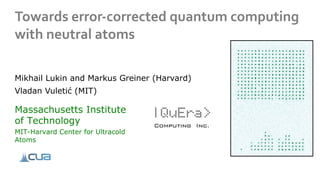
Towards error-corrected quantum computing
with neutral atoms
Massachusetts Institute
of Technology
MIT-Harvard Center for Ultracold
Atoms
Mikhail Lukin and Markus Greiner (Harvard)
Vladan Vuletić (MIT)
Outline
Basics of neutral-atom quantum computing
• Trapping and transporting atomic qubits
• Quantum gates through Rydberg interactions
• Physical-qubit gate fidelities
Logical qubits
• Surface-code qubit
• GHZ entangled state of logical qubits with error
detection
• First circuits with many logical qubits
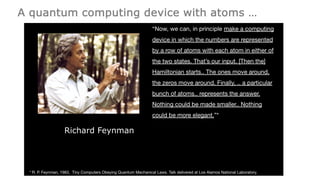
A quantum computing device with atoms …
Richard Feynman
Controlling individual atoms
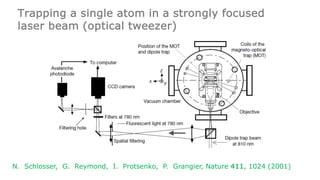
Trapping a single atom in a strongly focused
laser beam (optical tweezer)
N. Schlosser, G. Reymond, I. Protsenko, P. Grangier, Nature 411, 1024 (2001)
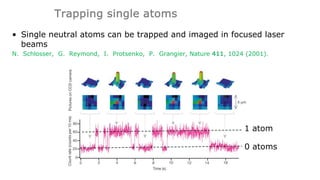
Trapping single atoms
• Single neutral atoms can be trapped and imaged in focused laser
beams
N. Schlosser, G. Reymond, I. Protsenko, P. Grangier, Nature 411, 1024 (2001).
1 atom
0 atoms
Trapping many single atoms
• Problem: probability to trap a single atom is only 50-60%
• The probability to trap N atoms simultaneously in N traps is
exponentially small
• Solution: observation and real-time feedback
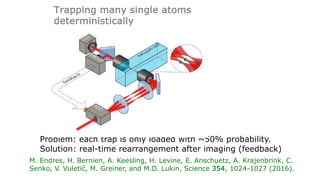
Trapping many single atoms
deterministically
Problem: each trap is only loaded with ~50% probability.
Solution: real-time rearrangement after imaging (feedback)
M. Endres, H. Bernien, A. Keesling, H. Levine, E. Anschuetz, A. Krajenbrink, C.
Senko, V. Vuletić, M. Greiner, and M.D. Lukin, Science 354, 1024-1027 (2016).
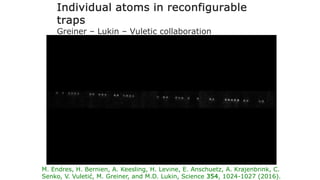
Individual atoms in reconfigurable
traps
Greiner – Lukin – Vuletic collaboration
• Use atom detection and feedback (trap rearrangement) to
deterministically fill large number of traps with exactly one
atom
• Fast deterministic preparation of N atoms in chain.
M. Endres, H. Bernien, A. Keesling, H. Levine, E. Anschuetz, A. Krajenbrink, C.
Senko, V. Vuletić, M. Greiner, and M.D. Lukin, Science 354, 1024-1027 (2016).
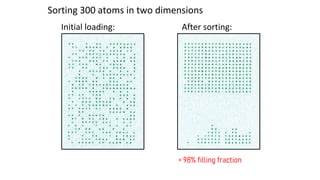
Sorting 300 atoms in two dimensions
Initial loading: After sorting:
> 98% filling fraction
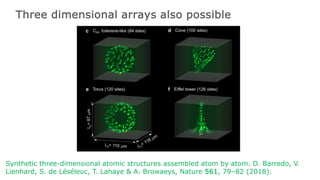
Three dimensional arrays also possible
Synthetic three-dimensional atomic structures assembled atom by atom. D. Barredo, V.
Lienhard, S. de Léséleuc, T. Lahaye & A. Browaeys, Nature 561, 79–82 (2018).
Quantum gates through Rydberg
interactions
• Atom can be addressed to create effective spin ½ system (qubit)
• We can trap and image individual atoms with optically resolvable
separation (few µm).
• Quantum gates require interactions.
• Can we make atoms interact over those optically resolvable
distances?
• Rydberg blockade:
D. Jaksch, J. I. Cirac, P. Zoller, S. L. Rolston, R. Côté, and M. D. Lukin, Phys.
Rev. Lett. 85, 2208 (2000).
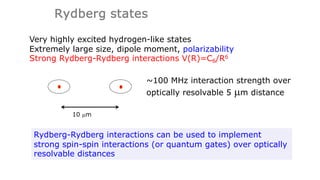
Rydberg states
Very highly excited hydrogen-like states
Extremely large size, dipole moment, polarizability
Strong Rydberg-Rydberg interactions V(R)=C6/R6
~100 MHz interaction strength over
optically resolvable 5 µm distance
Rydberg-Rydberg interactions can be used to implement
strong spin-spin interactions (or quantum gates) over optically
resolvable distances
10 µm
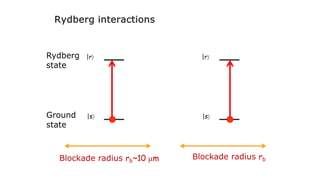
Rydberg interactions
|sñ
|rñ
Blockade radius rb~10 µm
|sñ
|rñ
Blockade radius rb
Ground
state
Rydberg
state
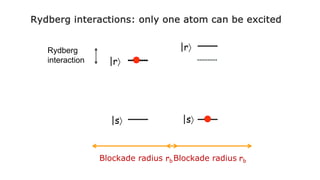
Rydberg interactions: only one atom can be excited
|sñ
|rñ
Blockade radius rbBlockade radius rb
Rydberg
interaction
|rñ
|sñ
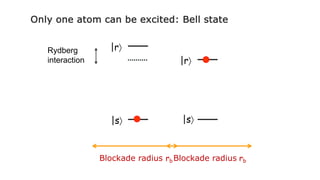
Only one atom can be excited: Bell state
|sñ
|rñ
Blockade radius rbBlockade radius rb
Rydberg
interaction |rñ
|sñ
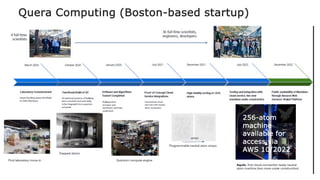
Quera Computing (Boston-based startup)
256-atom
machine
available for
access via
AWS 10/2022
Digital quantum machines
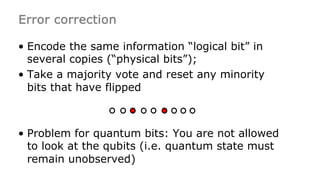
Error correction
• Encode the same information “logical bit” in
several copies (“physical bits”);
• Take a majority vote and reset any minority
bits that have flipped
• Problem for quantum bits: You are not allowed
to look at the qubits (i.e. quantum state must
remain unobserved)
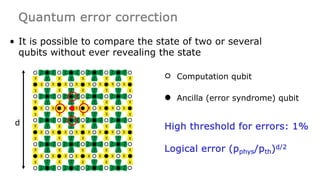
Quantum error correction
• It is possible to compare the state of two or several
qubits without ever revealing the state
Z
Z Z
X
X
X
Z
Z
Z
Z
X
X
X
X
X
X
X
Z
Z Z
X
X
X
X
Z
Z
Z
Z
X
X
X
X
X
X
X
X
X
X
X
X
X
X
Z
Z
Z
Z
Z
Z
Z
Z
Z
Z
Z
Z
Z
Z
Z
Z
Z
Z
Z
Z
Z
Z
Z
Z Z
Z
Z
Z
Z
X
X
X
X Z
Z Z
X
X
X
X
Z
Z
Z
Z
X
X
X
X
X
X
X
X
Z
Z
Z
Z
Z
Z
Z
Z
Z
Z
Z
Z
Z
Z
Z
Z
Z
Z
Z
Z
Z
Z
X
X
X
X
X
X
X
X
X
X
X
X
X
X
X
X
X
X
X
X
X
X
X
X
X
X
X
X
Computation qubit
Ancilla (error syndrome) qubit
High threshold for errors: 1%
Logical error (pphys/pth)d/2
d
Digital operation of Rydberg
arrays: quantum gates
• H. Levine, A. Keesling, A. Omran, H. Bernien, S. Schwartz, A.S. Zibrov, M. Endres,
M. Greiner, V. Vuletić, and M.D. Lukin, Phys. Rev. Lett. 121, 123603 (2018).
• H. Levine, A. Keesling, G. Semeghini, A. Omran, T. T. Wang, S. Ebadi, H. Bernien,
M. Greiner, V. Vuletić, H. Pichler, and M. D. Lukin, Phys. Rev. Lett. 123, 170503
(2019).
• S. Evered, D. Bluvstein, M. Kalinowski, S. Ebadi, T. Manowitz, H. Zhou, S.H. Li,
A.A. Geim, T. T. Wang, N. Maskara, H. Levine, G. Semeghini, M. Greiner, V.
Vuletić, and M.D. Lukin, arXiv:2304.05420
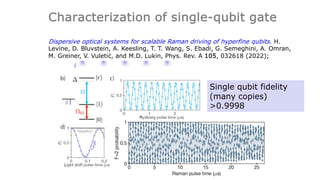
Characterization of single-qubit gate
Single qubit fidelity
(many copies)
>0.9998
Dispersive optical systems for scalable Raman driving of hyperfine qubits. H.
Levine, D. Bluvstein, A. Keesling, T. T. Wang, S. Ebadi, G. Semeghini, A. Omran,
M. Greiner, V. Vuletić, and M.D. Lukin, Phys. Rev. A 105, 032618 (2022);
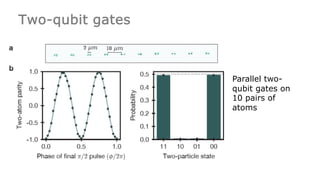
Two-qubit gates
Parallel two-
qubit gates on
10 pairs of
atoms
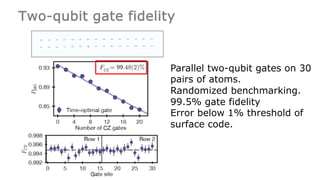
Two-qubit gate fidelity
Parallel two-qubit gates on 30
pairs of atoms.
Randomized benchmarking.
99.5% gate fidelity
Error below 1% threshold of
surface code.
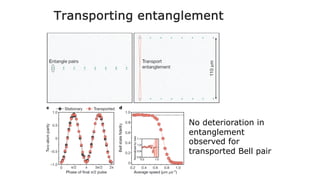
Transporting entanglement
No deterioration in
entanglement
observed for
transported Bell pair
Logical qubits
Logical quantum processor based on reconfigurable atom arrays.
D. Bluvstein, S.J. Evered, A.A. Geim, S.H. Li, H. Zhou, T. Manovitz, S.
Ebadi, M. Cain, M. Kalinowski, D. Hangleiter, J.P. Bonilla Ataides, N.
Maskara, I. Cong, X. Gao, P. Sales Rodriguez, T. Karolyshyn, G. Semeghini,
M.J. Gullans, M. Greiner, V. Vuletić, and M.D. Lukin, Nature (in print, 2023).
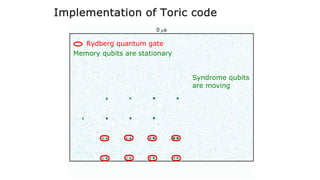
Implementation of Toric code
Rydberg quantum gate
Syndrome qubits
are moving
Memory qubits are stationary
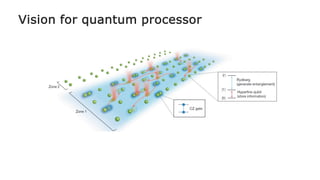
Vision for quantum processor
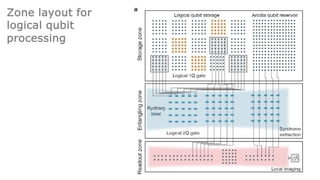
Zone layout for
logical qubit
processing
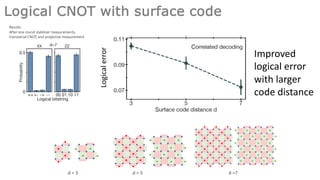
Logical CNOT with surface code
d = 3 d = 5 d =7
Results:
After one round stabilizer measurements,
transversal CNOT, and projective measurement
Improved
logical error
with larger
code distance
Logical
error
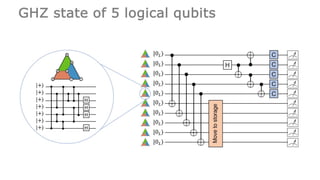
GHZ state of 5 logical qubits
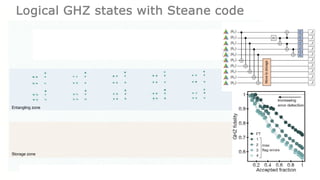
Storage zone
Entangling zone
Logical GHZ states with Steane code
Classically hard sampling circuits
with logical qubits: [[8,3,2]] hypercube
code
12 logical
qubits
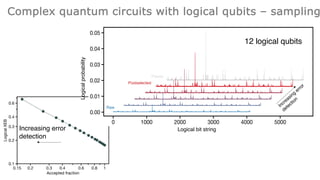
Complex quantum circuits with logical qubits – sampling
Increasing error
detection
Logical bit string
Logical
probability
Increasing
error
detection
Raw
Postselected
Theory
12 logical qubits
Summary and Outlook
• We are entering the era of first algorithms with logical
qubits
• Path towards large quantum simulators:
– ~1000 physical qubits achieved, 48 logical qubits
– 10,000-100,000 physical qubits within reach in next
1-2 years.
– Digital quantum simulators will be useful for science.
– Quantum error corrections seems feasible: 100 logical
qubits with error < 10-6 - 10-8 within next two years.
– What are the useful algorithms?
Towards Error-Corrected Quantum Computing with Neutral Atoms

Towards Error-Corrected Quantum Computing with Neutral Atoms

  • 1.
    Towards error-corrected quantumcomputing with neutral atoms Massachusetts Institute of Technology MIT-Harvard Center for Ultracold Atoms Mikhail Lukin and Markus Greiner (Harvard) Vladan Vuletić (MIT)
  • 2.
    Outline Basics of neutral-atomquantum computing • Trapping and transporting atomic qubits • Quantum gates through Rydberg interactions • Physical-qubit gate fidelities Logical qubits • Surface-code qubit • GHZ entangled state of logical qubits with error detection • First circuits with many logical qubits
  • 3.
    A quantum computingdevice with atoms … Richard Feynman
  • 4.
  • 5.
    Trapping a singleatom in a strongly focused laser beam (optical tweezer) N. Schlosser, G. Reymond, I. Protsenko, P. Grangier, Nature 411, 1024 (2001)
  • 6.
    Trapping single atoms •Single neutral atoms can be trapped and imaged in focused laser beams N. Schlosser, G. Reymond, I. Protsenko, P. Grangier, Nature 411, 1024 (2001). 1 atom 0 atoms
  • 7.
    Trapping many singleatoms • Problem: probability to trap a single atom is only 50-60% • The probability to trap N atoms simultaneously in N traps is exponentially small • Solution: observation and real-time feedback
  • 8.
    Trapping many singleatoms deterministically Problem: each trap is only loaded with ~50% probability. Solution: real-time rearrangement after imaging (feedback) M. Endres, H. Bernien, A. Keesling, H. Levine, E. Anschuetz, A. Krajenbrink, C. Senko, V. Vuletić, M. Greiner, and M.D. Lukin, Science 354, 1024-1027 (2016).
  • 9.
    Individual atoms inreconfigurable traps Greiner – Lukin – Vuletic collaboration • Use atom detection and feedback (trap rearrangement) to deterministically fill large number of traps with exactly one atom • Fast deterministic preparation of N atoms in chain. M. Endres, H. Bernien, A. Keesling, H. Levine, E. Anschuetz, A. Krajenbrink, C. Senko, V. Vuletić, M. Greiner, and M.D. Lukin, Science 354, 1024-1027 (2016).
  • 10.
    Sorting 300 atomsin two dimensions Initial loading: After sorting: > 98% filling fraction
  • 11.
    Three dimensional arraysalso possible Synthetic three-dimensional atomic structures assembled atom by atom. D. Barredo, V. Lienhard, S. de Léséleuc, T. Lahaye & A. Browaeys, Nature 561, 79–82 (2018).
  • 12.
    Quantum gates throughRydberg interactions • Atom can be addressed to create effective spin ½ system (qubit) • We can trap and image individual atoms with optically resolvable separation (few µm). • Quantum gates require interactions. • Can we make atoms interact over those optically resolvable distances? • Rydberg blockade: D. Jaksch, J. I. Cirac, P. Zoller, S. L. Rolston, R. Côté, and M. D. Lukin, Phys. Rev. Lett. 85, 2208 (2000).
  • 13.
    Rydberg states Very highlyexcited hydrogen-like states Extremely large size, dipole moment, polarizability Strong Rydberg-Rydberg interactions V(R)=C6/R6 ~100 MHz interaction strength over optically resolvable 5 µm distance Rydberg-Rydberg interactions can be used to implement strong spin-spin interactions (or quantum gates) over optically resolvable distances 10 µm
  • 14.
    Rydberg interactions |sñ |rñ Blockade radiusrb~10 µm |sñ |rñ Blockade radius rb Ground state Rydberg state
  • 15.
    Rydberg interactions: onlyone atom can be excited |sñ |rñ Blockade radius rbBlockade radius rb Rydberg interaction |rñ |sñ
  • 16.
    Only one atomcan be excited: Bell state |sñ |rñ Blockade radius rbBlockade radius rb Rydberg interaction |rñ |sñ
  • 17.
    Quera Computing (Boston-basedstartup) 256-atom machine available for access via AWS 10/2022
  • 18.
  • 19.
    Error correction • Encodethe same information “logical bit” in several copies (“physical bits”); • Take a majority vote and reset any minority bits that have flipped • Problem for quantum bits: You are not allowed to look at the qubits (i.e. quantum state must remain unobserved)
  • 20.
    Quantum error correction •It is possible to compare the state of two or several qubits without ever revealing the state Z Z Z X X X Z Z Z Z X X X X X X X Z Z Z X X X X Z Z Z Z X X X X X X X X X X X X X X Z Z Z Z Z Z Z Z Z Z Z Z Z Z Z Z Z Z Z Z Z Z Z Z Z Z Z Z Z X X X X Z Z Z X X X X Z Z Z Z X X X X X X X X Z Z Z Z Z Z Z Z Z Z Z Z Z Z Z Z Z Z Z Z Z Z X X X X X X X X X X X X X X X X X X X X X X X X X X X X Computation qubit Ancilla (error syndrome) qubit High threshold for errors: 1% Logical error (pphys/pth)d/2 d
  • 21.
    Digital operation ofRydberg arrays: quantum gates • H. Levine, A. Keesling, A. Omran, H. Bernien, S. Schwartz, A.S. Zibrov, M. Endres, M. Greiner, V. Vuletić, and M.D. Lukin, Phys. Rev. Lett. 121, 123603 (2018). • H. Levine, A. Keesling, G. Semeghini, A. Omran, T. T. Wang, S. Ebadi, H. Bernien, M. Greiner, V. Vuletić, H. Pichler, and M. D. Lukin, Phys. Rev. Lett. 123, 170503 (2019). • S. Evered, D. Bluvstein, M. Kalinowski, S. Ebadi, T. Manowitz, H. Zhou, S.H. Li, A.A. Geim, T. T. Wang, N. Maskara, H. Levine, G. Semeghini, M. Greiner, V. Vuletić, and M.D. Lukin, arXiv:2304.05420
  • 22.
    Characterization of single-qubitgate Single qubit fidelity (many copies) >0.9998 Dispersive optical systems for scalable Raman driving of hyperfine qubits. H. Levine, D. Bluvstein, A. Keesling, T. T. Wang, S. Ebadi, G. Semeghini, A. Omran, M. Greiner, V. Vuletić, and M.D. Lukin, Phys. Rev. A 105, 032618 (2022);
  • 23.
    Two-qubit gates Parallel two- qubitgates on 10 pairs of atoms
  • 24.
    Two-qubit gate fidelity Paralleltwo-qubit gates on 30 pairs of atoms. Randomized benchmarking. 99.5% gate fidelity Error below 1% threshold of surface code.
  • 25.
    Transporting entanglement No deteriorationin entanglement observed for transported Bell pair
  • 26.
    Logical qubits Logical quantumprocessor based on reconfigurable atom arrays. D. Bluvstein, S.J. Evered, A.A. Geim, S.H. Li, H. Zhou, T. Manovitz, S. Ebadi, M. Cain, M. Kalinowski, D. Hangleiter, J.P. Bonilla Ataides, N. Maskara, I. Cong, X. Gao, P. Sales Rodriguez, T. Karolyshyn, G. Semeghini, M.J. Gullans, M. Greiner, V. Vuletić, and M.D. Lukin, Nature (in print, 2023).
  • 27.
    Implementation of Toriccode Rydberg quantum gate Syndrome qubits are moving Memory qubits are stationary
  • 28.
  • 29.
    Zone layout for logicalqubit processing
  • 30.
    Logical CNOT withsurface code d = 3 d = 5 d =7 Results: After one round stabilizer measurements, transversal CNOT, and projective measurement Improved logical error with larger code distance Logical error
  • 31.
    GHZ state of5 logical qubits
  • 32.
    Storage zone Entangling zone LogicalGHZ states with Steane code
  • 33.
    Classically hard samplingcircuits with logical qubits: [[8,3,2]] hypercube code 12 logical qubits
  • 34.
    Complex quantum circuitswith logical qubits – sampling Increasing error detection Logical bit string Logical probability Increasing error detection Raw Postselected Theory 12 logical qubits
  • 35.
    Summary and Outlook •We are entering the era of first algorithms with logical qubits • Path towards large quantum simulators: – ~1000 physical qubits achieved, 48 logical qubits – 10,000-100,000 physical qubits within reach in next 1-2 years. – Digital quantum simulators will be useful for science. – Quantum error corrections seems feasible: 100 logical qubits with error < 10-6 - 10-8 within next two years. – What are the useful algorithms?