© 2011 IBM Corporation
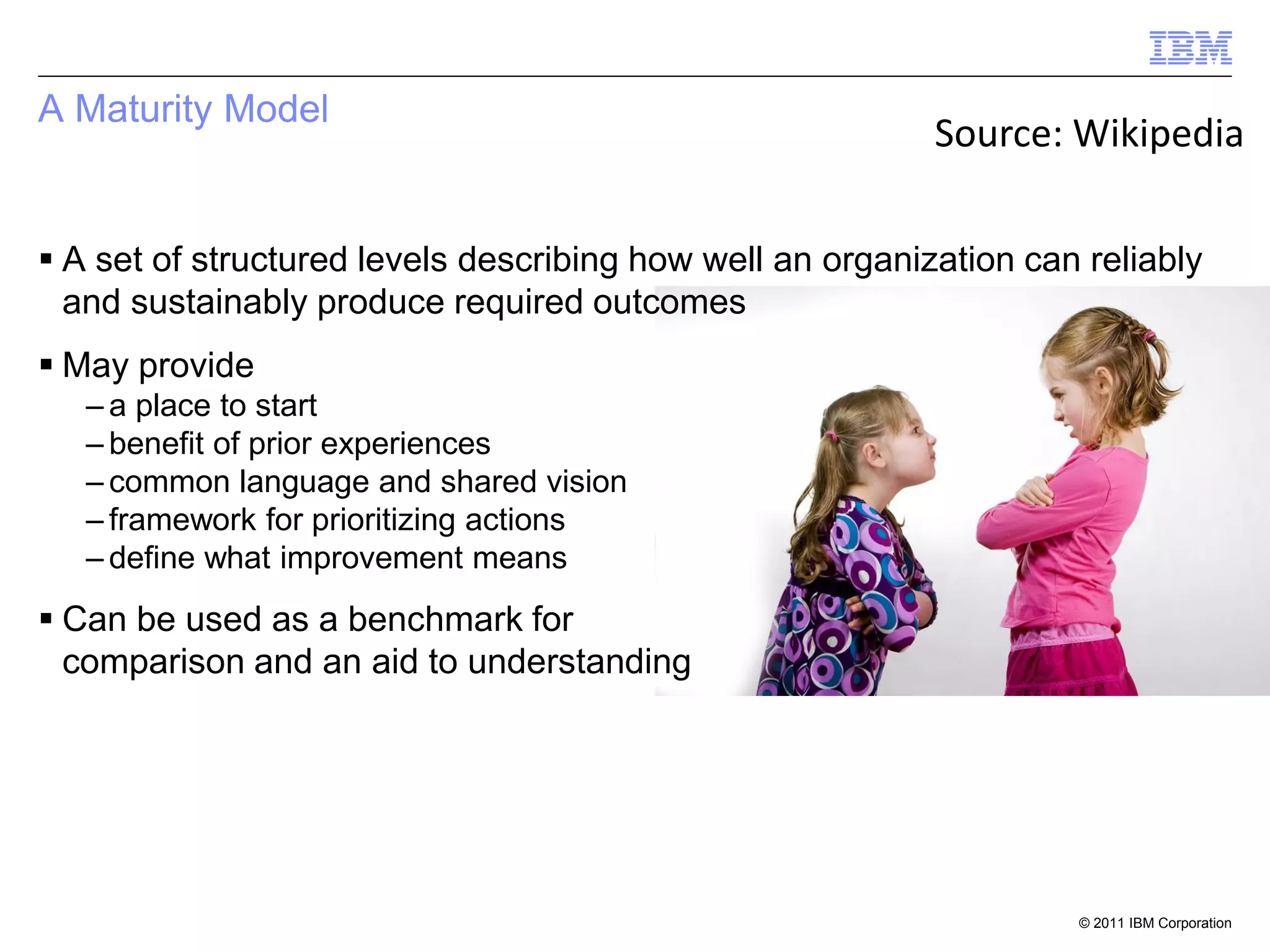
A Maturity Model
                                                           Source: Wikipedia

 A set of structured levels describing how well an organization can reliably
  and sustainably produce required outcomes
 May provide
   – a place to start
   – benefit of prior experiences
   – common language and shared vision
   – framework for prioritizing actions
   – define what improvement means
 Can be used as a benchmark for
  comparison and an aid to understanding


                                                                    © 2011 IBM Corporation
Modularity Maturity Model


 A Maturity Model for Modularity 
 Focus on organisational capability
 Modularity technology agnostic
 Drawn from observations from a number of projects and customers
 An 80:20 guide, not a 100% law


                                                               © 2011 IBM Corporation
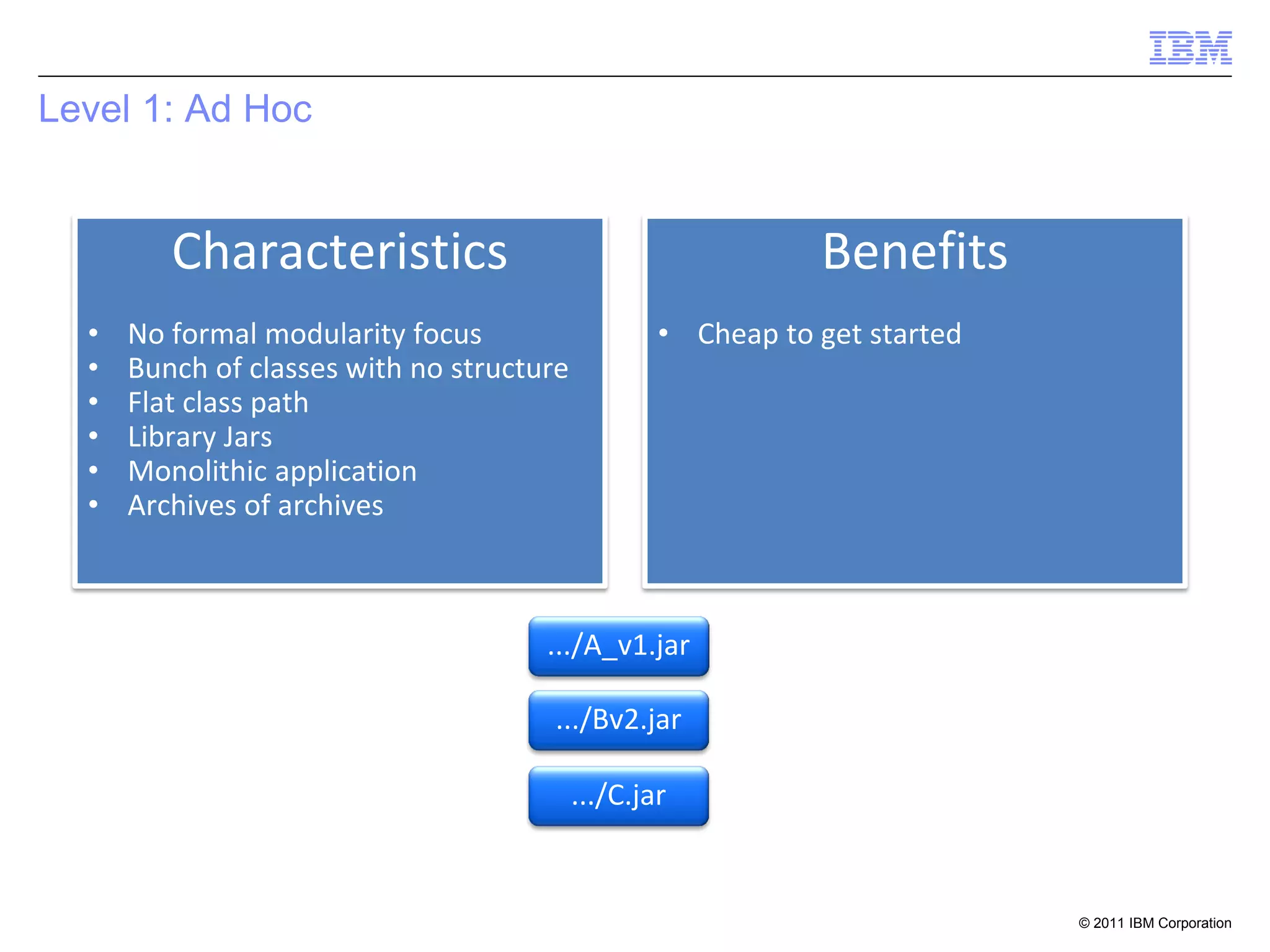
Level 1: Ad Hoc


         Characteristics                                      Benefits
  •   No formal modularity focus                   • Cheap to get started
  •   Bunch of classes with no structure
  •   Flat class path
  •   Library Jars
  •   Monolithic application
  •   Archives of archives


                                      .../A_v1.jar

                                      .../Bv2.jar

                                           .../C.jar


                                                                            © 2011 IBM Corporation
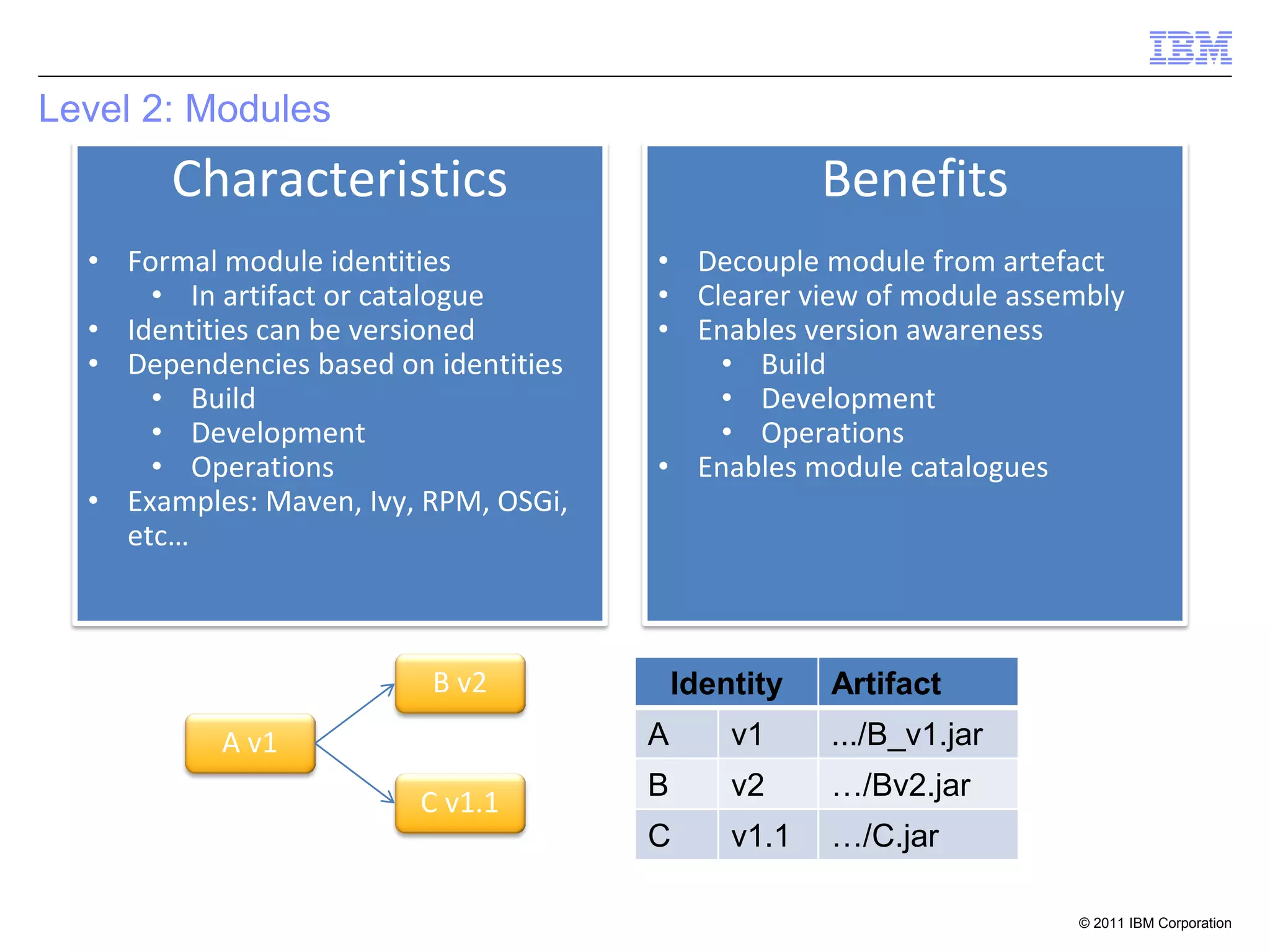
Level 2: Modules
       Characteristics                                Benefits
  • Formal module identities           • Decouple module from artefact
      • In artifact or catalogue       • Clearer view of module assembly
  • Identities can be versioned        • Enables version awareness
  • Dependencies based on identities       • Build
      • Build                              • Development
      • Development                        • Operations
      • Operations                     • Enables module catalogues
  • Examples: Maven, Ivy, RPM, OSGi,
    etc…


                          B v2             Identity   Artifact
           A v1                        A       v1     .../B_v1.jar
                                       B       v2     …/Bv2.jar
                         C v1.1
                                       C       v1.1   …/C.jar

                                                                     © 2011 IBM Corporation
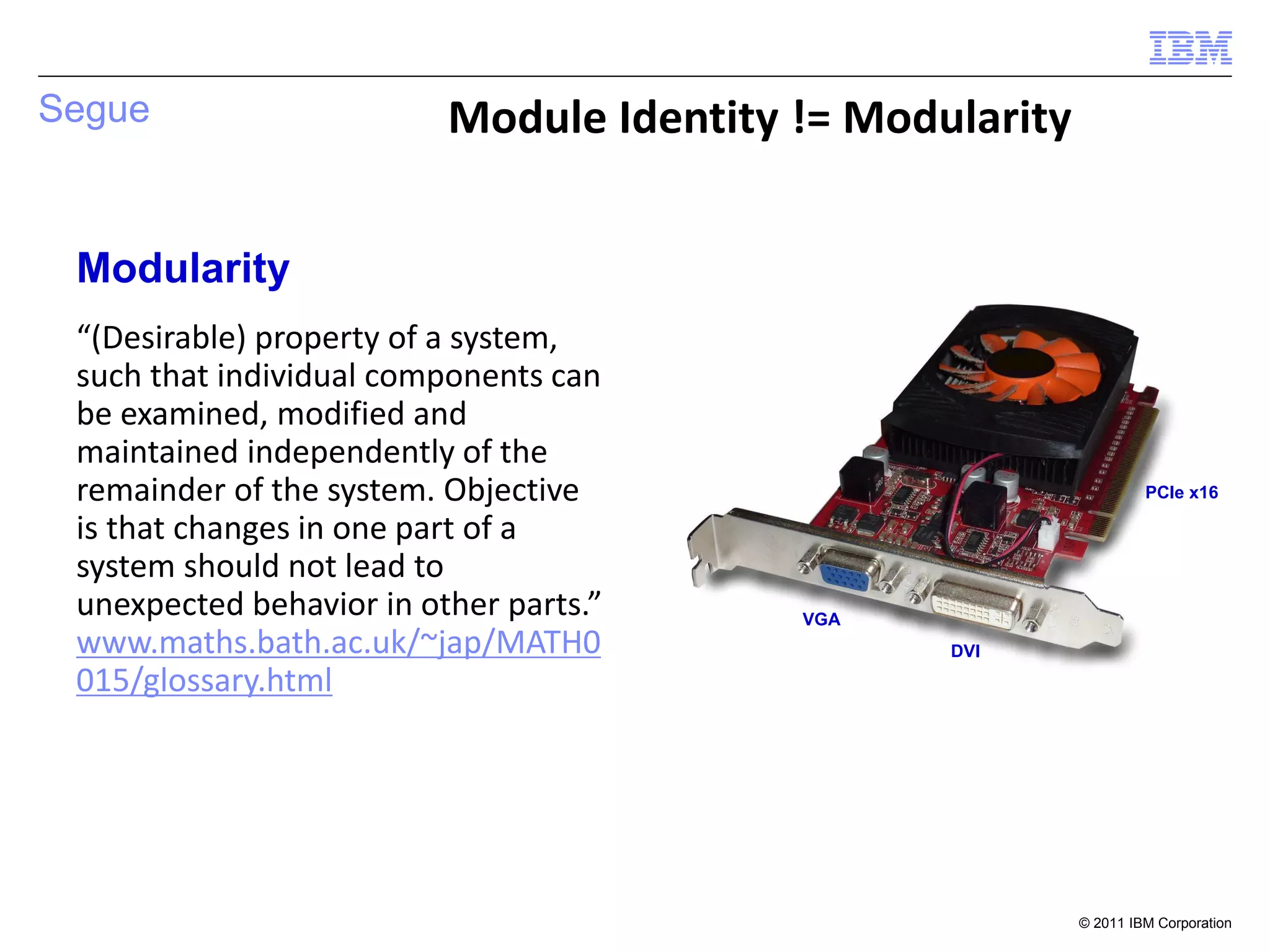
Segue                     Module Identity != Modularity


 Modularity
 “(Desirable) property of a system,
 such that individual components can
 be examined, modified and
 maintained independently of the
 remainder of the system. Objective                                PCIe x16

 is that changes in one part of a
 system should not lead to
 unexpected behavior in other parts.”     VGA
 www.maths.bath.ac.uk/~jap/MATH0                 DVI
 015/glossary.html


                                                          © 2011 IBM Corporation
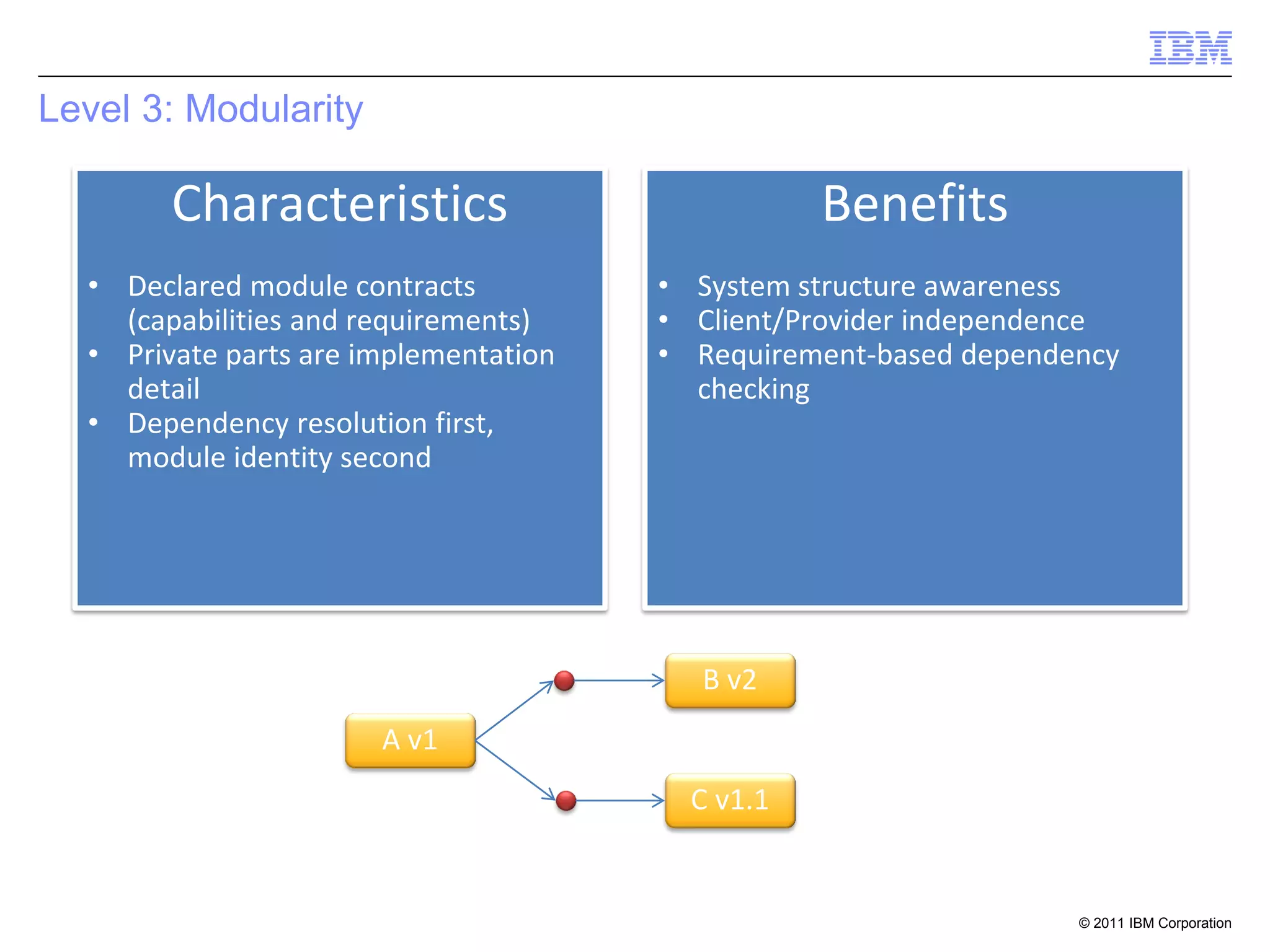
Level 3: Modularity

        Characteristics                           Benefits
  • Declared module contracts          • System structure awareness
    (capabilities and requirements)    • Client/Provider independence
  • Private parts are implementation   • Requirement-based dependency
    detail                               checking
  • Dependency resolution first,
    module identity second


                                         B v2
                       A v1
                                         C v1.1


                                                                  © 2011 IBM Corporation
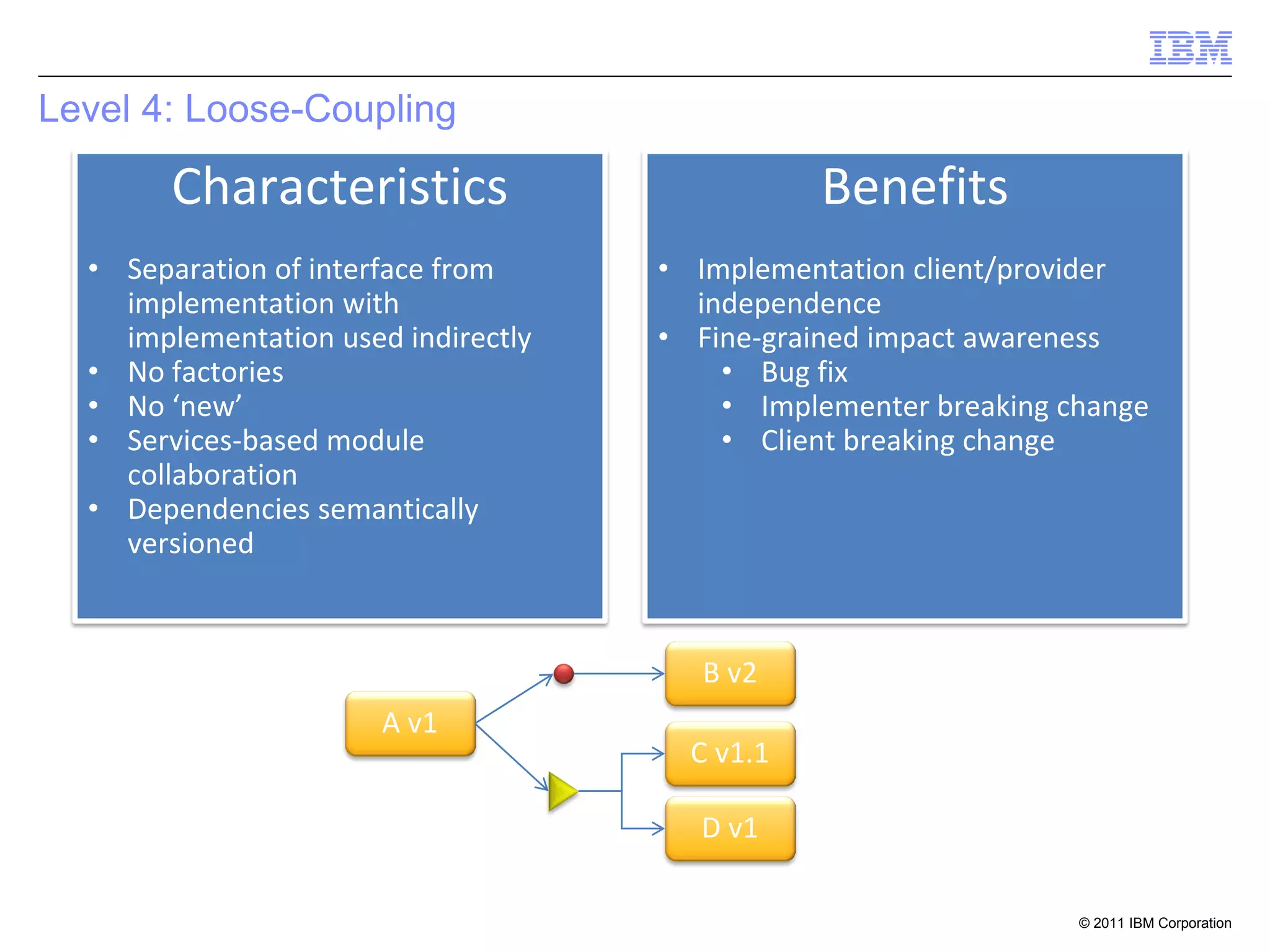
Level 4: Loose-Coupling

        Characteristics                         Benefits
  • Separation of interface from     • Implementation client/provider
    implementation with                independence
    implementation used indirectly   • Fine-grained impact awareness
  • No factories                         • Bug fix
  • No ‘new’                             • Implementer breaking change
  • Services-based module                • Client breaking change
    collaboration
  • Dependencies semantically
    versioned


                                        B v2
                       A v1
                                       C v1.1

                                       D v1

                                                                 © 2011 IBM Corporation
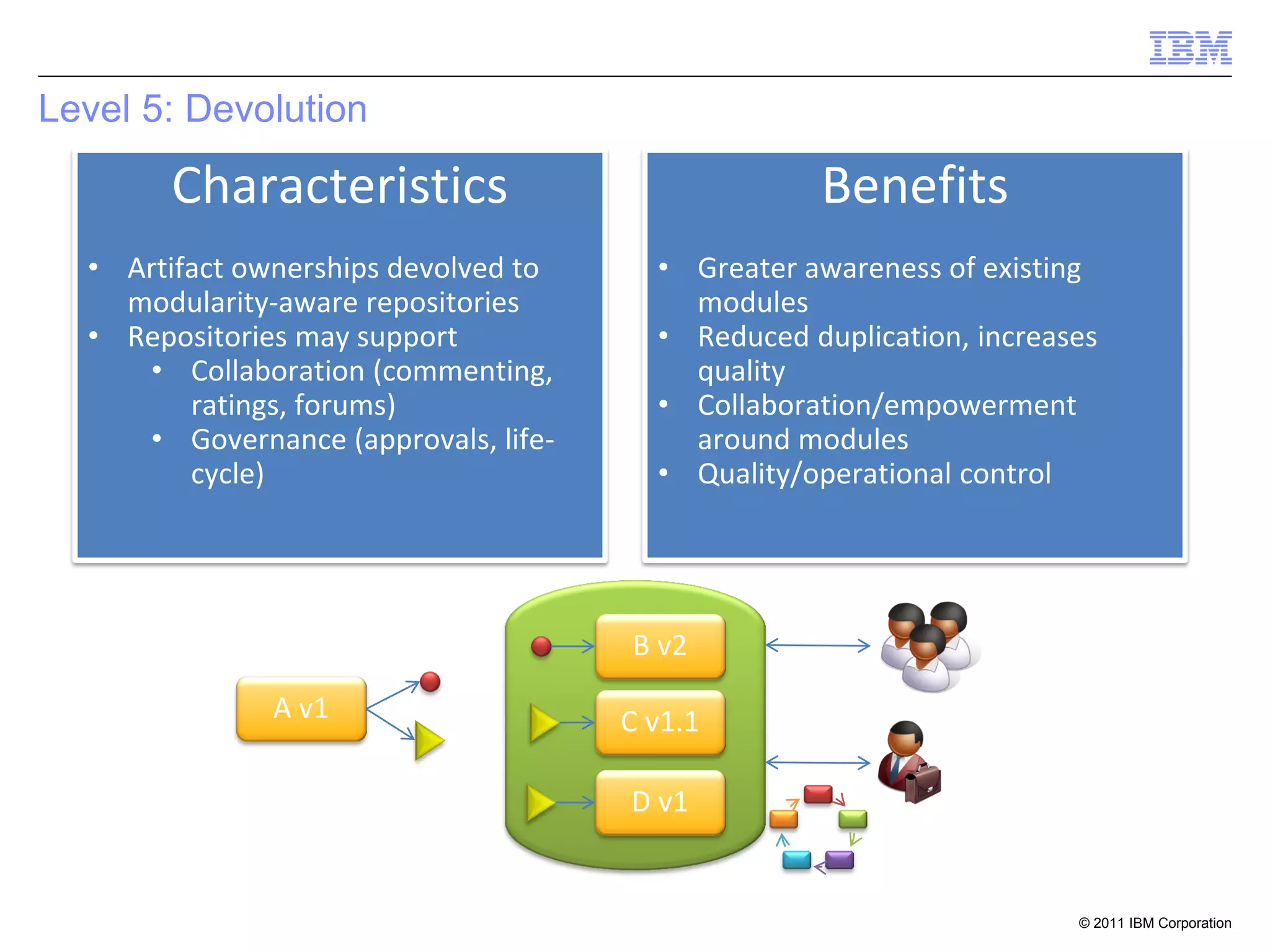
Level 5: Devolution

       Characteristics                             Benefits
  • Artifact ownerships devolved to     • Greater awareness of existing
    modularity-aware repositories         modules
  • Repositories may support            • Reduced duplication, increases
     • Collaboration (commenting,         quality
         ratings, forums)               • Collaboration/empowerment
     • Governance (approvals, life-       around modules
         cycle)                         • Quality/operational control


                                      B v2
               A v1                   C v1.1

                                      D v1


                                                                      © 2011 IBM Corporation
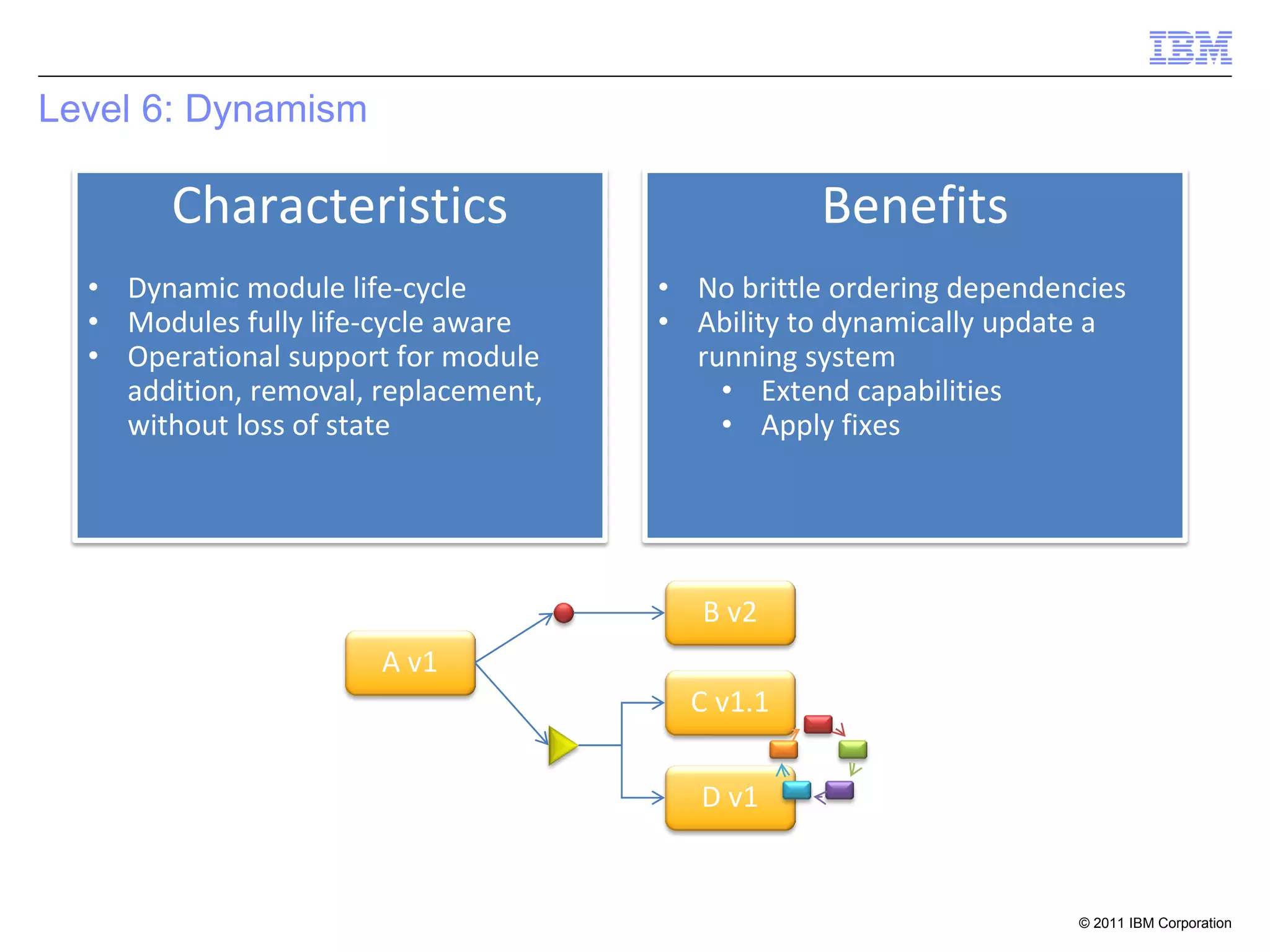
Level 6: Dynamism

        Characteristics                          Benefits
  • Dynamic module life-cycle         • No brittle ordering dependencies
  • Modules fully life-cycle aware    • Ability to dynamically update a
  • Operational support for module      running system
    addition, removal, replacement,       • Extend capabilities
    without loss of state                 • Apply fixes


                                         B v2
                       A v1
                                        C v1.1

                                         D v1


                                                                    © 2011 IBM Corporation
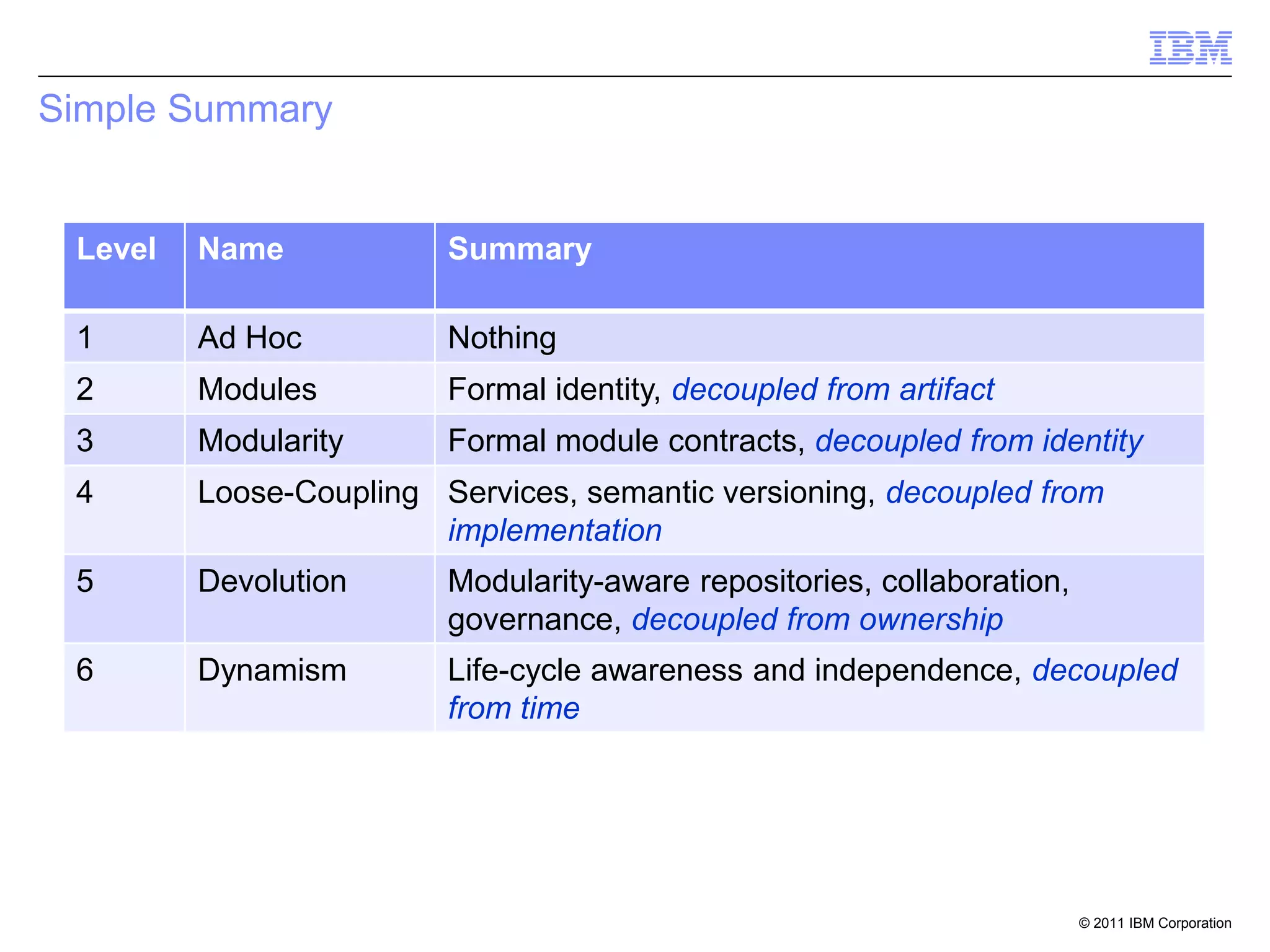
Simple Summary


 Level   Name            Summary

 1       Ad Hoc          Nothing
 2       Modules         Formal identity, decoupled from artifact
 3       Modularity      Formal module contracts, decoupled from identity
 4       Loose-Coupling Services, semantic versioning, decoupled from
                        implementation
 5       Devolution      Modularity-aware repositories, collaboration,
                         governance, decoupled from ownership
 6       Dynamism        Life-cycle awareness and independence, decoupled
                         from time


                                                                         © 2011 IBM Corporation
Time to apply...


   How do your projects and organization fair?
   How do some well-known projects fair?
   How are we doing as an industry?


   In answering these questions we can better
    understand the tasks and benefits ahead


                                                  © 2011 IBM Corporation
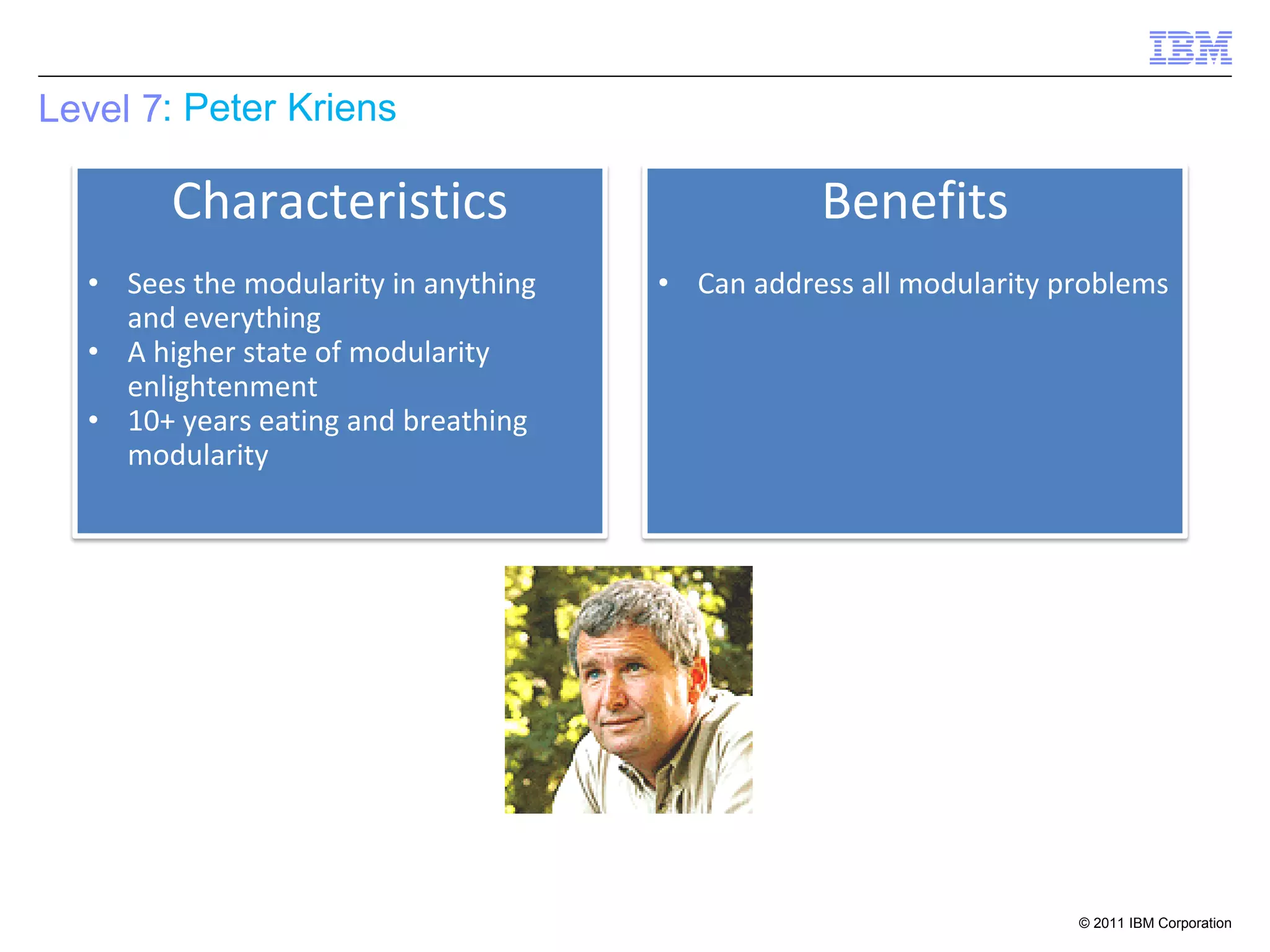
Level 7: Peter Kriens

        Characteristics                          Benefits
  • Sees the modularity in anything   • Can address all modularity problems
    and everything
  • A higher state of modularity
    enlightenment
  • 10+ years eating and breathing
    modularity


                                                                    © 2011 IBM Corporation
Trademarks


IBM and WebSphere are trademarks or registered trademarks of
International Business Machines Corp., registered in many
jurisdictions worldwide.

Java and all Java-based trademarks and logos are trademarks or
registered trademarks of Oracle and/or its affiliates.

Other product and service names might be trademarks of IBM or other
companies. A current list of IBM trademarks is available on the Web at
“Copyright and trademark information” at
www.ibm.com/legal/copytrade.shtml.


                                                                 © 2011 IBM Corporation

Towards a modularity maturity model - osgi users forum uk 16-nov2011

  • 1.
    © 2011 IBMCorporation
  • 2.
    A Maturity Model Source: Wikipedia  A set of structured levels describing how well an organization can reliably and sustainably produce required outcomes  May provide – a place to start – benefit of prior experiences – common language and shared vision – framework for prioritizing actions – define what improvement means  Can be used as a benchmark for comparison and an aid to understanding © 2011 IBM Corporation
  • 3.
    Modularity Maturity Model A Maturity Model for Modularity   Focus on organisational capability  Modularity technology agnostic  Drawn from observations from a number of projects and customers  An 80:20 guide, not a 100% law © 2011 IBM Corporation
  • 4.
    Level 1: AdHoc Characteristics Benefits • No formal modularity focus • Cheap to get started • Bunch of classes with no structure • Flat class path • Library Jars • Monolithic application • Archives of archives .../A_v1.jar .../Bv2.jar .../C.jar © 2011 IBM Corporation
  • 5.
    Level 2: Modules Characteristics Benefits • Formal module identities • Decouple module from artefact • In artifact or catalogue • Clearer view of module assembly • Identities can be versioned • Enables version awareness • Dependencies based on identities • Build • Build • Development • Development • Operations • Operations • Enables module catalogues • Examples: Maven, Ivy, RPM, OSGi, etc… B v2 Identity Artifact A v1 A v1 .../B_v1.jar B v2 …/Bv2.jar C v1.1 C v1.1 …/C.jar © 2011 IBM Corporation
  • 6.
    Segue Module Identity != Modularity Modularity “(Desirable) property of a system, such that individual components can be examined, modified and maintained independently of the remainder of the system. Objective PCIe x16 is that changes in one part of a system should not lead to unexpected behavior in other parts.” VGA www.maths.bath.ac.uk/~jap/MATH0 DVI 015/glossary.html © 2011 IBM Corporation
  • 7.
    Level 3: Modularity Characteristics Benefits • Declared module contracts • System structure awareness (capabilities and requirements) • Client/Provider independence • Private parts are implementation • Requirement-based dependency detail checking • Dependency resolution first, module identity second B v2 A v1 C v1.1 © 2011 IBM Corporation
  • 8.
    Level 4: Loose-Coupling Characteristics Benefits • Separation of interface from • Implementation client/provider implementation with independence implementation used indirectly • Fine-grained impact awareness • No factories • Bug fix • No ‘new’ • Implementer breaking change • Services-based module • Client breaking change collaboration • Dependencies semantically versioned B v2 A v1 C v1.1 D v1 © 2011 IBM Corporation
  • 9.
    Level 5: Devolution Characteristics Benefits • Artifact ownerships devolved to • Greater awareness of existing modularity-aware repositories modules • Repositories may support • Reduced duplication, increases • Collaboration (commenting, quality ratings, forums) • Collaboration/empowerment • Governance (approvals, life- around modules cycle) • Quality/operational control B v2 A v1 C v1.1 D v1 © 2011 IBM Corporation
  • 10.
    Level 6: Dynamism Characteristics Benefits • Dynamic module life-cycle • No brittle ordering dependencies • Modules fully life-cycle aware • Ability to dynamically update a • Operational support for module running system addition, removal, replacement, • Extend capabilities without loss of state • Apply fixes B v2 A v1 C v1.1 D v1 © 2011 IBM Corporation
  • 11.
    Simple Summary Level Name Summary 1 Ad Hoc Nothing 2 Modules Formal identity, decoupled from artifact 3 Modularity Formal module contracts, decoupled from identity 4 Loose-Coupling Services, semantic versioning, decoupled from implementation 5 Devolution Modularity-aware repositories, collaboration, governance, decoupled from ownership 6 Dynamism Life-cycle awareness and independence, decoupled from time © 2011 IBM Corporation
  • 12.
    Time to apply...  How do your projects and organization fair?  How do some well-known projects fair?  How are we doing as an industry?  In answering these questions we can better understand the tasks and benefits ahead © 2011 IBM Corporation
  • 13.
    Level 7: PeterKriens Characteristics Benefits • Sees the modularity in anything • Can address all modularity problems and everything • A higher state of modularity enlightenment • 10+ years eating and breathing modularity © 2011 IBM Corporation
  • 14.
    Trademarks IBM and WebSphereare trademarks or registered trademarks of International Business Machines Corp., registered in many jurisdictions worldwide. Java and all Java-based trademarks and logos are trademarks or registered trademarks of Oracle and/or its affiliates. Other product and service names might be trademarks of IBM or other companies. A current list of IBM trademarks is available on the Web at “Copyright and trademark information” at www.ibm.com/legal/copytrade.shtml. © 2011 IBM Corporation