1
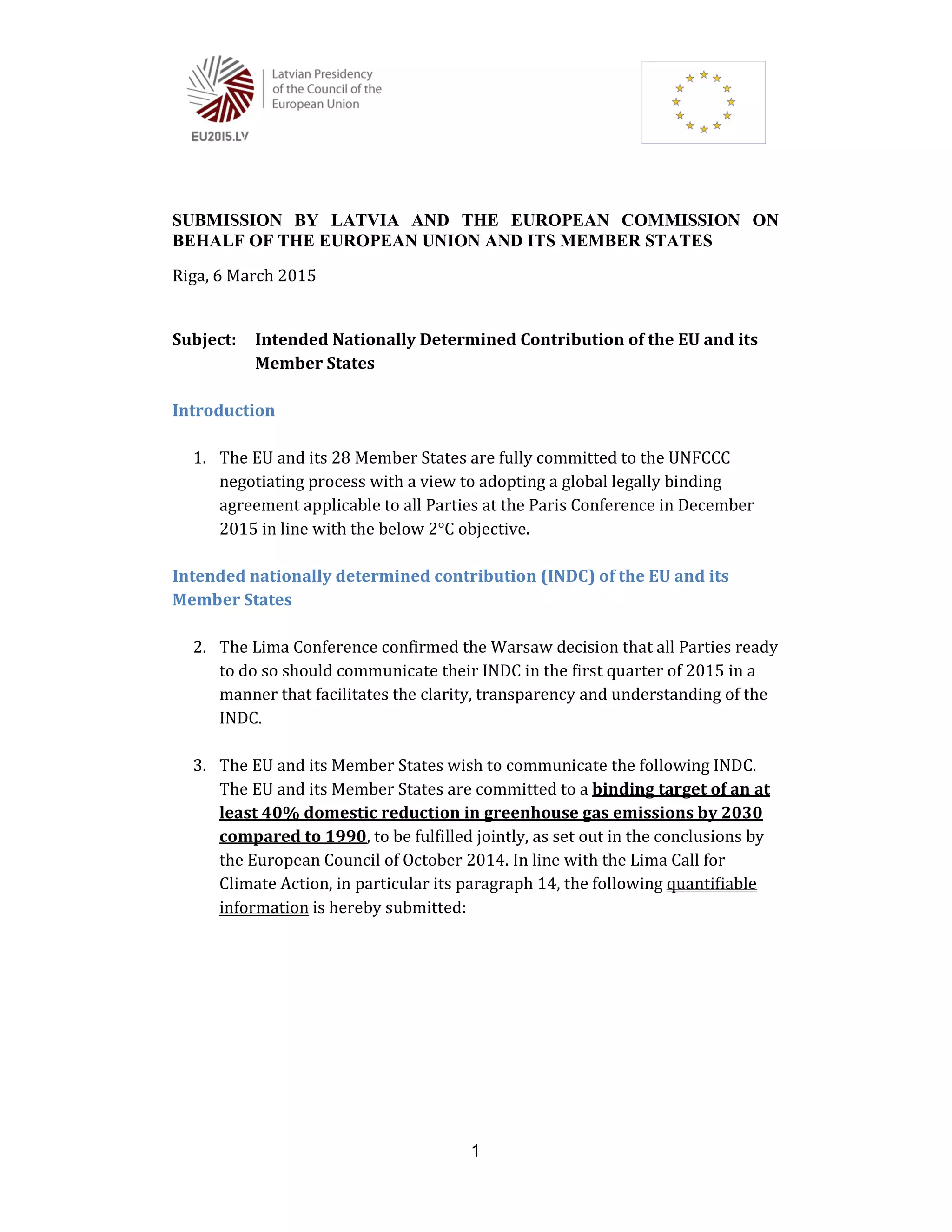
SUBMISSION BY LATVIA AND THE EUROPEAN COMMISSION ON
BEHALF OF THE EUROPEAN UNION AND ITS MEMBER STATES
Riga, 6 March 2015
Subject: Intended Nationally Determined Contribution of the EU and its
Member States
Introduction
1. The EU and its 28 Member States are fully committed to the UNFCCC
negotiating process with a view to adopting a global legally binding
agreement applicable to all Parties at the Paris Conference in December
2015 in line with the below 2°C objective.
Intended nationally determined contribution (INDC) of the EU and its
Member States
2. The Lima Conference confirmed the Warsaw decision that all Parties ready
to do so should communicate their INDC in the first quarter of 2015 in a
manner that facilitates the clarity, transparency and understanding of the
INDC.
3. The EU and its Member States wish to communicate the following INDC.
The EU and its Member States are committed to a binding target of an at
least 40% domestic reduction in greenhouse gas emissions by 2030
compared to 1990, to be fulfilled jointly, as set out in the conclusions by
the European Council of October 2014. In line with the Lima Call for
Climate Action, in particular its paragraph 14, the following quantifiable
information is hereby submitted:
2
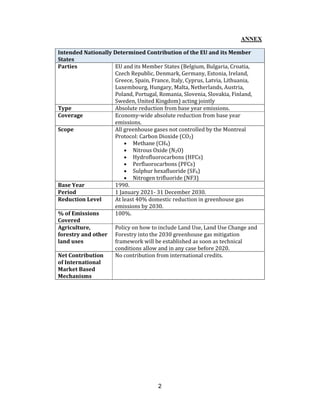
ANNEX
Intended Nationally Determined Contribution of the EU and its Member
States
Parties EU and its Member States (Belgium, Bulgaria, Croatia,
Czech Republic, Denmark, Germany, Estonia, Ireland,
Greece, Spain, France, Italy, Cyprus, Latvia, Lithuania,
Luxembourg, Hungary, Malta, Netherlands, Austria,
Poland, Portugal, Romania, Slovenia, Slovakia, Finland,
Sweden, United Kingdom) acting jointly
Type Absolute reduction from base year emissions.
Coverage Economy-wide absolute reduction from base year
emissions.
Scope All greenhouse gases not controlled by the Montreal
Protocol: Carbon Dioxide (CO2)
• Methane (CH4)
• Nitrous Oxide (N2O)
• Hydrofluorocarbons (HFCs)
• Perfluorocarbons (PFCs)
• Sulphur hexafluoride (SF6)
• Nitrogen trifluoride (NF3)
Base Year 1990.
Period 1 January 2021- 31 December 2030.
Reduction Level At least 40% domestic reduction in greenhouse gas
emissions by 2030.
% of Emissions
Covered
100%.
Agriculture,
forestry and other
land uses
Policy on how to include Land Use, Land Use Change and
Forestry into the 2030 greenhouse gas mitigation
framework will be established as soon as technical
conditions allow and in any case before 2020.
Net Contribution
of International
Market Based
Mechanisms
No contribution from international credits.
3
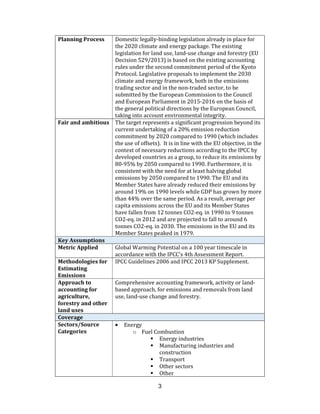
Planning Process Domestic legally-binding legislation already in place for
the 2020 climate and energy package. The existing
legislation for land use, land-use change and forestry (EU
Decision 529/2013) is based on the existing accounting
rules under the second commitment period of the Kyoto
Protocol. Legislative proposals to implement the 2030
climate and energy framework, both in the emissions
trading sector and in the non-traded sector, to be
submitted by the European Commission to the Council
and European Parliament in 2015-2016 on the basis of
the general political directions by the European Council,
taking into account environmental integrity.
Fair and ambitious The target represents a significant progression beyond its
current undertaking of a 20% emission reduction
commitment by 2020 compared to 1990 (which includes
the use of offsets). It is in line with the EU objective, in the
context of necessary reductions according to the IPCC by
developed countries as a group, to reduce its emissions by
80-95% by 2050 compared to 1990. Furthermore, it is
consistent with the need for at least halving global
emissions by 2050 compared to 1990. The EU and its
Member States have already reduced their emissions by
around 19% on 1990 levels while GDP has grown by more
than 44% over the same period. As a result, average per
capita emissions across the EU and its Member States
have fallen from 12 tonnes CO2-eq. in 1990 to 9 tonnes
CO2-eq. in 2012 and are projected to fall to around 6
tonnes CO2-eq. in 2030. The emissions in the EU and its
Member States peaked in 1979.
Key Assumptions
Metric Applied Global Warming Potential on a 100 year timescale in
accordance with the IPCC's 4th Assessment Report.
Methodologies for
Estimating
Emissions
IPCC Guidelines 2006 and IPCC 2013 KP Supplement.
Approach to
accounting for
agriculture,
forestry and other
land uses
Comprehensive accounting framework, activity or land-
based approach, for emissions and removals from land
use, land-use change and forestry.
Coverage
Sectors/Source
Categories
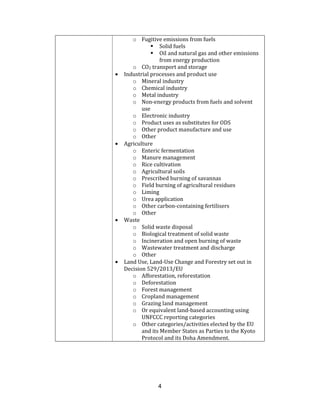
• Energy
o Fuel Combustion
Energy industries
Manufacturing industries and
construction
Transport
Other sectors
Other
4
o Fugitive emissions from fuels
Solid fuels
Oil and natural gas and other emissions
from energy production
o CO2 transport and storage
• Industrial processes and product use
o Mineral industry
o Chemical industry
o Metal industry
o Non-energy products from fuels and solvent
use
o Electronic industry
o Product uses as substitutes for ODS
o Other product manufacture and use
o Other
• Agriculture
o Enteric fermentation
o Manure management
o Rice cultivation
o Agricultural soils
o Prescribed burning of savannas
o Field burning of agricultural residues
o Liming
o Urea application
o Other carbon-containing fertilisers
o Other
• Waste
o Solid waste disposal
o Biological treatment of solid waste
o Incineration and open burning of waste
o Wastewater treatment and discharge
o Other
• Land Use, Land-Use Change and Forestry set out in
Decision 529/2013/EU
o Afforestation, reforestation
o Deforestation
o Forest management
o Cropland management
o Grazing land management
o Or equivalent land-based accounting using
UNFCCC reporting categories
o Other categories/activities elected by the EU
and its Member States as Parties to the Kyoto
Protocol and its Doha Amendment.
5
Follow up
4. The EU and its Member States urge all other Parties, in particular major
economies, to communicate their INDCs by the end of March 2015 in a
manner that facilitates their clarity, transparency and understanding.
5. The EU and its Member States request the UNFCCC Secretariat to publish
the INDC of the EU and its Member States on its website and to take it into
account when preparing the synthesis report on the aggregate effect of the
INDCs communicated by Parties.
6. The EU and its Member States look forward to discussing with other
Parties the fairness and ambition of INDCs in the context of the below 2°C
objective, their aggregate contribution to that objective and on ways to
collectively increase ambition further.
_____________

UE INDC

  • 1.
    1 SUBMISSION BY LATVIAAND THE EUROPEAN COMMISSION ON BEHALF OF THE EUROPEAN UNION AND ITS MEMBER STATES Riga, 6 March 2015 Subject: Intended Nationally Determined Contribution of the EU and its Member States Introduction 1. The EU and its 28 Member States are fully committed to the UNFCCC negotiating process with a view to adopting a global legally binding agreement applicable to all Parties at the Paris Conference in December 2015 in line with the below 2°C objective. Intended nationally determined contribution (INDC) of the EU and its Member States 2. The Lima Conference confirmed the Warsaw decision that all Parties ready to do so should communicate their INDC in the first quarter of 2015 in a manner that facilitates the clarity, transparency and understanding of the INDC. 3. The EU and its Member States wish to communicate the following INDC. The EU and its Member States are committed to a binding target of an at least 40% domestic reduction in greenhouse gas emissions by 2030 compared to 1990, to be fulfilled jointly, as set out in the conclusions by the European Council of October 2014. In line with the Lima Call for Climate Action, in particular its paragraph 14, the following quantifiable information is hereby submitted:
  • 2.
    2 ANNEX Intended Nationally DeterminedContribution of the EU and its Member States Parties EU and its Member States (Belgium, Bulgaria, Croatia, Czech Republic, Denmark, Germany, Estonia, Ireland, Greece, Spain, France, Italy, Cyprus, Latvia, Lithuania, Luxembourg, Hungary, Malta, Netherlands, Austria, Poland, Portugal, Romania, Slovenia, Slovakia, Finland, Sweden, United Kingdom) acting jointly Type Absolute reduction from base year emissions. Coverage Economy-wide absolute reduction from base year emissions. Scope All greenhouse gases not controlled by the Montreal Protocol: Carbon Dioxide (CO2) • Methane (CH4) • Nitrous Oxide (N2O) • Hydrofluorocarbons (HFCs) • Perfluorocarbons (PFCs) • Sulphur hexafluoride (SF6) • Nitrogen trifluoride (NF3) Base Year 1990. Period 1 January 2021- 31 December 2030. Reduction Level At least 40% domestic reduction in greenhouse gas emissions by 2030. % of Emissions Covered 100%. Agriculture, forestry and other land uses Policy on how to include Land Use, Land Use Change and Forestry into the 2030 greenhouse gas mitigation framework will be established as soon as technical conditions allow and in any case before 2020. Net Contribution of International Market Based Mechanisms No contribution from international credits.
  • 3.
    3 Planning Process Domesticlegally-binding legislation already in place for the 2020 climate and energy package. The existing legislation for land use, land-use change and forestry (EU Decision 529/2013) is based on the existing accounting rules under the second commitment period of the Kyoto Protocol. Legislative proposals to implement the 2030 climate and energy framework, both in the emissions trading sector and in the non-traded sector, to be submitted by the European Commission to the Council and European Parliament in 2015-2016 on the basis of the general political directions by the European Council, taking into account environmental integrity. Fair and ambitious The target represents a significant progression beyond its current undertaking of a 20% emission reduction commitment by 2020 compared to 1990 (which includes the use of offsets). It is in line with the EU objective, in the context of necessary reductions according to the IPCC by developed countries as a group, to reduce its emissions by 80-95% by 2050 compared to 1990. Furthermore, it is consistent with the need for at least halving global emissions by 2050 compared to 1990. The EU and its Member States have already reduced their emissions by around 19% on 1990 levels while GDP has grown by more than 44% over the same period. As a result, average per capita emissions across the EU and its Member States have fallen from 12 tonnes CO2-eq. in 1990 to 9 tonnes CO2-eq. in 2012 and are projected to fall to around 6 tonnes CO2-eq. in 2030. The emissions in the EU and its Member States peaked in 1979. Key Assumptions Metric Applied Global Warming Potential on a 100 year timescale in accordance with the IPCC's 4th Assessment Report. Methodologies for Estimating Emissions IPCC Guidelines 2006 and IPCC 2013 KP Supplement. Approach to accounting for agriculture, forestry and other land uses Comprehensive accounting framework, activity or land- based approach, for emissions and removals from land use, land-use change and forestry. Coverage Sectors/Source Categories • Energy o Fuel Combustion Energy industries Manufacturing industries and construction Transport Other sectors Other
  • 4.
    4 o Fugitive emissionsfrom fuels Solid fuels Oil and natural gas and other emissions from energy production o CO2 transport and storage • Industrial processes and product use o Mineral industry o Chemical industry o Metal industry o Non-energy products from fuels and solvent use o Electronic industry o Product uses as substitutes for ODS o Other product manufacture and use o Other • Agriculture o Enteric fermentation o Manure management o Rice cultivation o Agricultural soils o Prescribed burning of savannas o Field burning of agricultural residues o Liming o Urea application o Other carbon-containing fertilisers o Other • Waste o Solid waste disposal o Biological treatment of solid waste o Incineration and open burning of waste o Wastewater treatment and discharge o Other • Land Use, Land-Use Change and Forestry set out in Decision 529/2013/EU o Afforestation, reforestation o Deforestation o Forest management o Cropland management o Grazing land management o Or equivalent land-based accounting using UNFCCC reporting categories o Other categories/activities elected by the EU and its Member States as Parties to the Kyoto Protocol and its Doha Amendment.
  • 5.
    5 Follow up 4. TheEU and its Member States urge all other Parties, in particular major economies, to communicate their INDCs by the end of March 2015 in a manner that facilitates their clarity, transparency and understanding. 5. The EU and its Member States request the UNFCCC Secretariat to publish the INDC of the EU and its Member States on its website and to take it into account when preparing the synthesis report on the aggregate effect of the INDCs communicated by Parties. 6. The EU and its Member States look forward to discussing with other Parties the fairness and ambition of INDCs in the context of the below 2°C objective, their aggregate contribution to that objective and on ways to collectively increase ambition further. _____________