Teacher Diversity in the Classroom Lestene Amerson Jessica Heflin Aaron Hudson Darci Lange Beth Moten Crystal Terzic
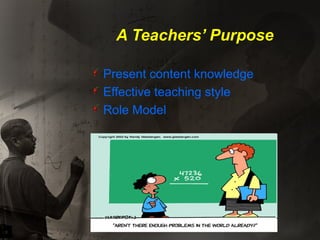
A Teachers’ Purpose Present content knowledge Effective teaching style Role Model
Why is there such a  need  for racially diverse educators?...What Can They Provide to Diverse Students? Role models Diverse perspectives and global views Provide a connection to African American and Hispanic communities
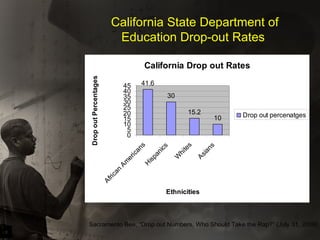
California State Department of Education Drop-out Rates   Sacramento Bee, “Drop out Numbers, Who Should Take the Rap?” (July 31, 2008)
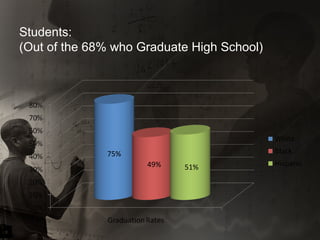
Students: (Out of the 68% who Graduate High School) 75% 49% 51%
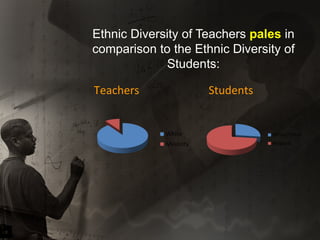
Ethnic Diversity of Teachers  pales  in comparison to the Ethnic Diversity of Students: Teachers Students
What to Consider: Is there a connection between the majority of teachers being WHITE and the majority of graduating students being WHITE? Is it significant that we have nearly all WHITE teachers while, in many cases, a majority of NON-WHITE students?
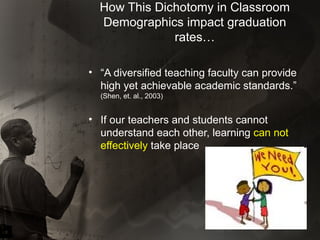
How This Dichotomy in Classroom Demographics impact graduation rates… “A diversified teaching faculty can provide high yet achievable academic standards.”  (Shen, et. al., 2003) If our teachers and students cannot understand each other, learning  can not   effectively  take place
 
Culture:   Cover vs Core Cover Behavior: referrals Low scores Dropout Core Raised expectations Increase Scores Graduate
Cultural Relevance:   A  Passive  &  Active  Process “ Know” Acceptance Trust Respect “ Do” Adaptation Motivation Participation
Why Minorities Choose Other Professions: Low Pay Prestige Testing
Position The lack of ethnic diversity among educators in the United States is a trend that  must  be reversed in order to provide a racially diverse perspective on life, education, and learning for all students.  A multi-cultural curriculum becomes multi-faceted in that a teacher of ethnic origin can draw upon their own life experiences to connect with students on both emotional and academic levels.
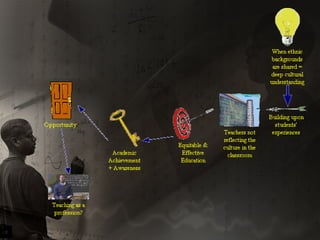
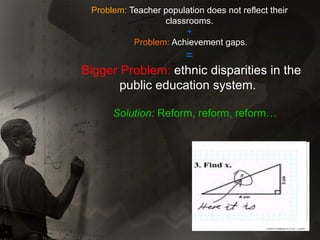
Problem:  Teacher population does not reflect their classrooms. +   Problem:  Achievement gaps. =  Bigger Problem:  ethnic disparities in the public education system.  Solution:  Reform, reform, reform…
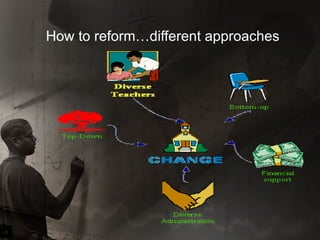
How to reform…different approaches
Change Does not Happen in a Vacuum!  Top-Down:  Critical Race Theory. Restart and Try again Bottom-up:  Invidualiatic, Teacher training (pre and employed), money incentives for minorities to pursue EDUC
Currently: Teacher Training  Seminars and Lectures to raise cultural awareness conducted on and off site Problem:  “I’m not a racist!” Problem:  “One size does not fit all!”
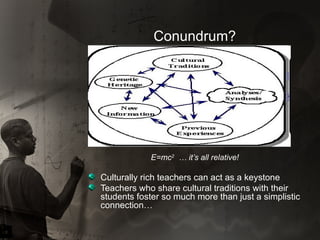
Conundrum?  E=mc 2   … it’s all relative! Culturally rich teachers can act as a keystone  Teachers who share cultural traditions with their students foster so much more than just a simplistic connection…
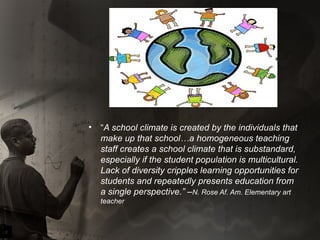
“ A school climate is created by the individuals that make up that school…a homogeneous teaching staff creates a school climate that is substandard, especially if the student population is multicultural. Lack of diversity cripples learning opportunities for students and repeatedly presents education from a single perspective.” – N. Rose Af. Am. Elementary art teacher
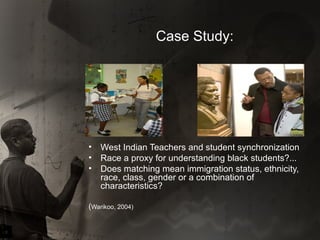
Case Study: West Indian Teachers and student synchronization Race a proxy for understanding black students?... Does matching mean immigration status, ethnicity, race, class, gender or a combination of characteristics? ( Warikoo, 2004)
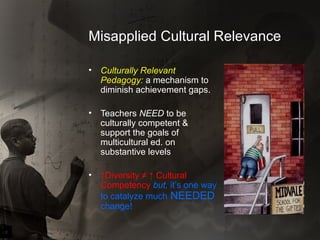
Misapplied Cultural Relevance Culturally Relevant Pedagogy:  a mechanism to diminish achievement gaps. Teachers  NEED  to be culturally competent & support the goals of multicultural ed. on substantive levels ↑ Diversity ≠ ↑ Cultural Competency  but,   it’s one way to catalyze much  NEEDED  change!

Ed364 Presentation

  • 1.
    Teacher Diversity inthe Classroom Lestene Amerson Jessica Heflin Aaron Hudson Darci Lange Beth Moten Crystal Terzic
  • 2.
    A Teachers’ PurposePresent content knowledge Effective teaching style Role Model
  • 3.
    Why is theresuch a need for racially diverse educators?...What Can They Provide to Diverse Students? Role models Diverse perspectives and global views Provide a connection to African American and Hispanic communities
  • 4.
    California State Departmentof Education Drop-out Rates Sacramento Bee, “Drop out Numbers, Who Should Take the Rap?” (July 31, 2008)
  • 5.
    Students: (Out ofthe 68% who Graduate High School) 75% 49% 51%
  • 6.
    Ethnic Diversity ofTeachers pales in comparison to the Ethnic Diversity of Students: Teachers Students
  • 7.
    What to Consider:Is there a connection between the majority of teachers being WHITE and the majority of graduating students being WHITE? Is it significant that we have nearly all WHITE teachers while, in many cases, a majority of NON-WHITE students?
  • 8.
    How This Dichotomyin Classroom Demographics impact graduation rates… “A diversified teaching faculty can provide high yet achievable academic standards.” (Shen, et. al., 2003) If our teachers and students cannot understand each other, learning can not effectively take place
  • 9.
  • 10.
    Culture: Cover vs Core Cover Behavior: referrals Low scores Dropout Core Raised expectations Increase Scores Graduate
  • 11.
    Cultural Relevance: A Passive & Active Process “ Know” Acceptance Trust Respect “ Do” Adaptation Motivation Participation
  • 12.
    Why Minorities ChooseOther Professions: Low Pay Prestige Testing
  • 13.
    Position The lackof ethnic diversity among educators in the United States is a trend that must be reversed in order to provide a racially diverse perspective on life, education, and learning for all students. A multi-cultural curriculum becomes multi-faceted in that a teacher of ethnic origin can draw upon their own life experiences to connect with students on both emotional and academic levels.
  • 14.
    Problem: Teacherpopulation does not reflect their classrooms. + Problem: Achievement gaps. = Bigger Problem: ethnic disparities in the public education system. Solution: Reform, reform, reform…
  • 15.
  • 16.
    Change Does notHappen in a Vacuum! Top-Down: Critical Race Theory. Restart and Try again Bottom-up: Invidualiatic, Teacher training (pre and employed), money incentives for minorities to pursue EDUC
  • 17.
    Currently: Teacher Training Seminars and Lectures to raise cultural awareness conducted on and off site Problem: “I’m not a racist!” Problem: “One size does not fit all!”
  • 18.
    Conundrum? E=mc2 … it’s all relative! Culturally rich teachers can act as a keystone Teachers who share cultural traditions with their students foster so much more than just a simplistic connection…
  • 19.
    “ A schoolclimate is created by the individuals that make up that school…a homogeneous teaching staff creates a school climate that is substandard, especially if the student population is multicultural. Lack of diversity cripples learning opportunities for students and repeatedly presents education from a single perspective.” – N. Rose Af. Am. Elementary art teacher
  • 20.
    Case Study: WestIndian Teachers and student synchronization Race a proxy for understanding black students?... Does matching mean immigration status, ethnicity, race, class, gender or a combination of characteristics? ( Warikoo, 2004)
  • 21.
    Misapplied Cultural RelevanceCulturally Relevant Pedagogy: a mechanism to diminish achievement gaps. Teachers NEED to be culturally competent & support the goals of multicultural ed. on substantive levels ↑ Diversity ≠ ↑ Cultural Competency but, it’s one way to catalyze much NEEDED change!