Sample performance appraisal
In this file, you can ref useful information about sample performance appraisal such as sample
performance appraisal methods, sample performance appraisal tips, sample performance
appraisal forms, sample performance appraisal phrases … If you need more assistant for sample
performance appraisal, please leave your comment at the end of file.
Other useful material for you:
• performanceappraisal123.com/1125-free-performance-review-phrases
• performanceappraisal123.com/free-28-performance-appraisal-forms
• performanceappraisal123.com/free-ebook-11-methods-for-performance-appraisal
I. Contents of getting sample performance appraisal
==================
A performance appraisal, also known as a post appraisal, is an evaluation of an employee’s work
over a period of time, rather than for a specific project. Performance appraisals, often delivered
during an annual review, focus on comparing the expectations a business has for a particular job
and the performance of the person holding it. Knowing what to expect during your annual review
can help you better prepare for a performance appraisal.
Job Description
The first part of a performance appraisal should be a review of the job description. This is the
guideline under which you should be operating during the year. If you don’t have a written job
description, your boss can review you based on responsibilities you didn’t know you had or don’t
think are yours. Ask for a written job description if you don’t have one. You also can prepare one
for yourself and submit it to your direct superior to ensure you both are on the same page.
Goals
The next step in a performance appraisal usually is a review of the goals and expectations of the
position to determine if you met them. A sales person might have a simple goal of a sales quota.
The position goals might include maintaining existing customer accounts and adding new ones,
or maintaining customer satisfaction benchmarks. A business might require more than just
accurate figures from its accounting department. An accountant might be expected to keep
financial data current so executives can quickly get real-time reports. The accountant might also
be expected to analyze financial data and project performance so management can take steps to
avoid problems or take advantage of opportunities.
Results
The key aspect of a performance appraisal is your delivery of the expected results for your
position. Without asking why or how, your superior will want to know what you achieved, and if
you fell short of, met or exceeded your goals. Now is not the time to make excuses or give
reasons; this part of the appraisal is simply to make sure both of you are on the same page as to
whether you did what was expected.
Evaluation
During the evaluation stage of a performance appraisal, you and your reviewer try to determine
why you performed as you did. This is your time to make your case for not being blamed for
shortfalls or being rewarded for exceeding expectations. For example, if an accountant isn’t
keeping financial data up to date, it might be a result of the company’s order-entry system that
allows sales people to wait to enter their orders for many days or even weeks after they close
deals. This is the time to explain any innovations you developed, such as ways to cut production
times, reduce labor costs or increase product quality. If you dreamed up an advertising campaign
or promotion that boosted sales, take credit for that during this portion of your appraisal. This is
the time when your employer makes subjective observations, such as on your interpersonal
skills, ability to communicate effectively, work habits and other personal behaviors the company
has noted. Before some annual reviews, you might be asked to fill out a self-appraisal, and
superiors and subordinates might be asked to evaluate you.
Determination
Once your evaluator has reviewed your job description, determined whether you met your
responsibilities and examined why you did or did not succeed, it’s time to talk about the future.
If you did not meet expectations, you might ask for more support or training. If you met
expectations, give suggestions for how you plan to improve your performance. If you exceeded
expectations, ask your superior how that benefited the company. Based on your overall appraisal
results, this is the time to ask for more resources, a promotion or improved compensation.
==================
III. Performance appraisal methods
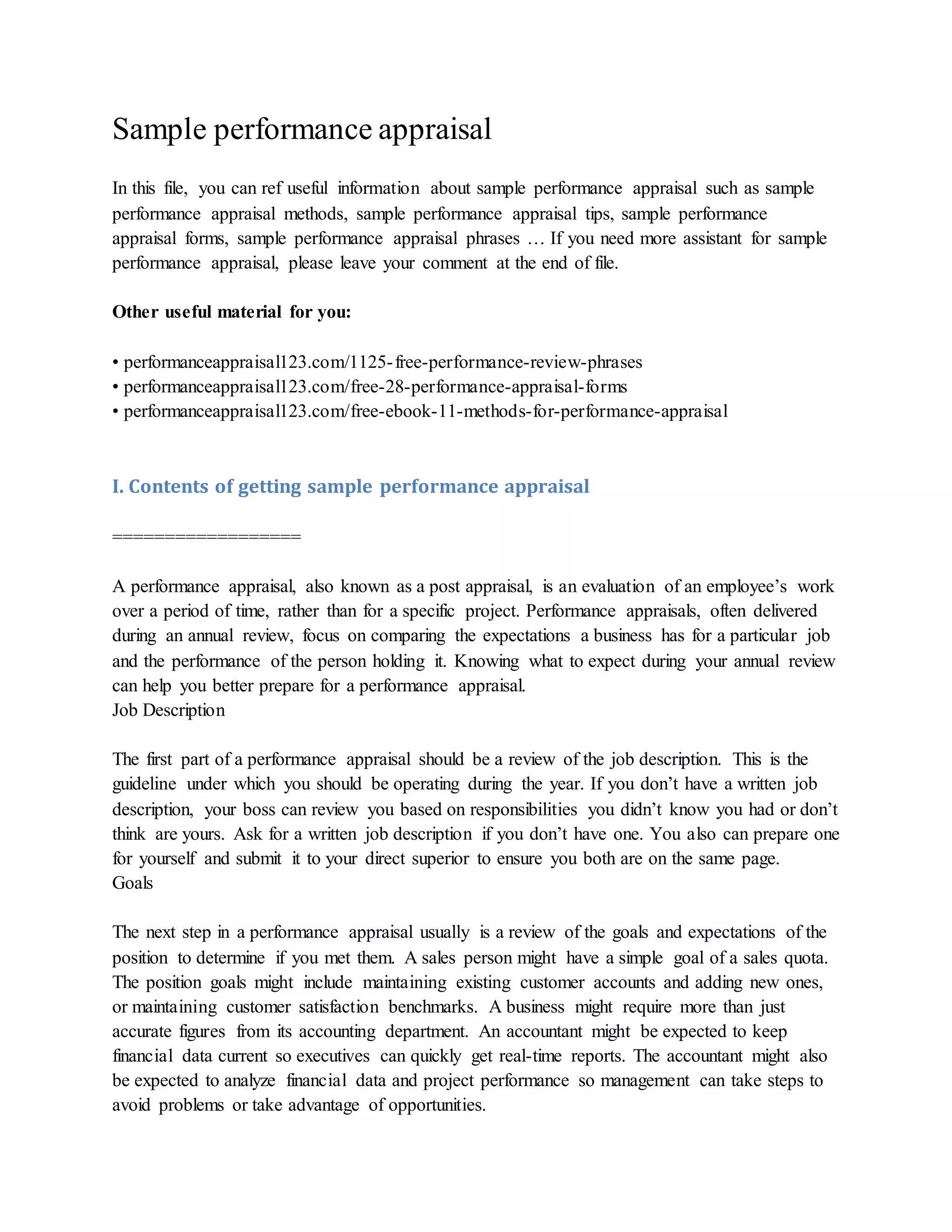
1.Ranking Method
The ranking system requires the rater to rank his
subordinates on overall performance. This consists in
simply putting a man in a rank order. Under this method,
the ranking of an employee in a work group is done
against that of another employee. The relative position of
each employee is tested in terms of his numerical rank. It
may also be done by ranking a person on his job
performance against another member of the competitive
group.
Advantages of Ranking Method
i. Employees are ranked according to their performance
levels.
ii. It is easier to rank the best and the worst employee.
Limitations of Ranking Method
i. The “whole man” is compared with another “whole man”
in this method. In practice, it is very difficult to compare
individuals possessing various individual traits.
ii. This method speaks only of the position where an
employee stands in his group. It does not test anything
about how much better or how much worse an employee
is when compared to another employee.
iii. When a large number of employees are working, ranking
of individuals become a difficult issue.
iv. There is no systematic procedure for ranking individuals
in the organization. The ranking system does not eliminate
the possibility of snap judgements.
2. Rating Scale
Rating scales consists of several numerical scales
representing job related performance criterions such as
dependability, initiative, output, attendance, attitude etc.
Each scales ranges from excellent to poor. The total
numerical scores are computed and final conclusions are
derived. Advantages – Adaptability, easy to use, low cost,
every type of job can be evaluated, large number of
employees covered, no formal training required.
Disadvantages – Rater’s biases
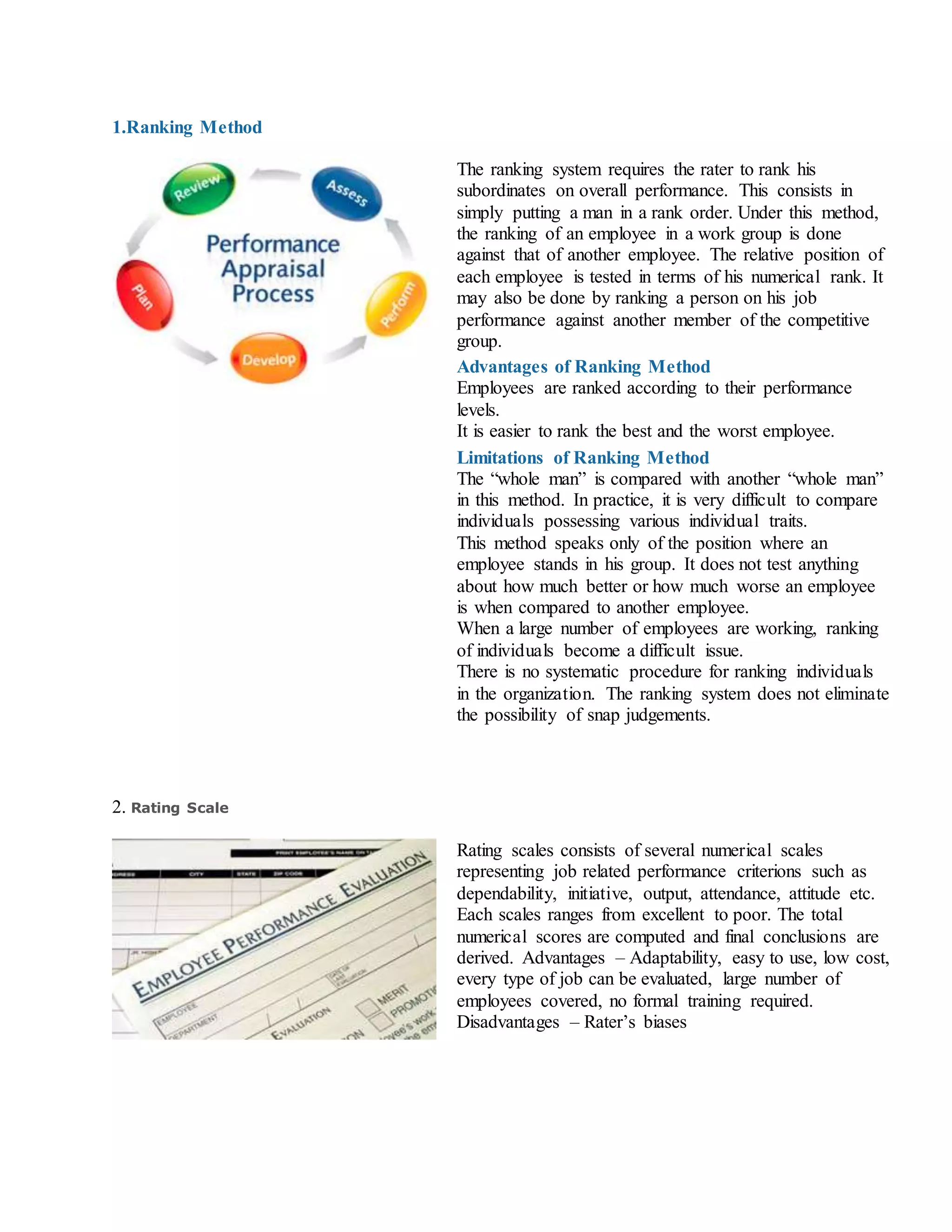
3. Checklist method
Under this method, checklist of statements of traits of
employee in the form of Yes or No based questions is
prepared. Here the rater only does the reporting or
checking and HR department does the actual evaluation.
Advantages – economy, ease of administration, limited
training required, standardization. Disadvantages – Raters
biases, use of improper weighs by HR, does not allow
rater to give relative ratings
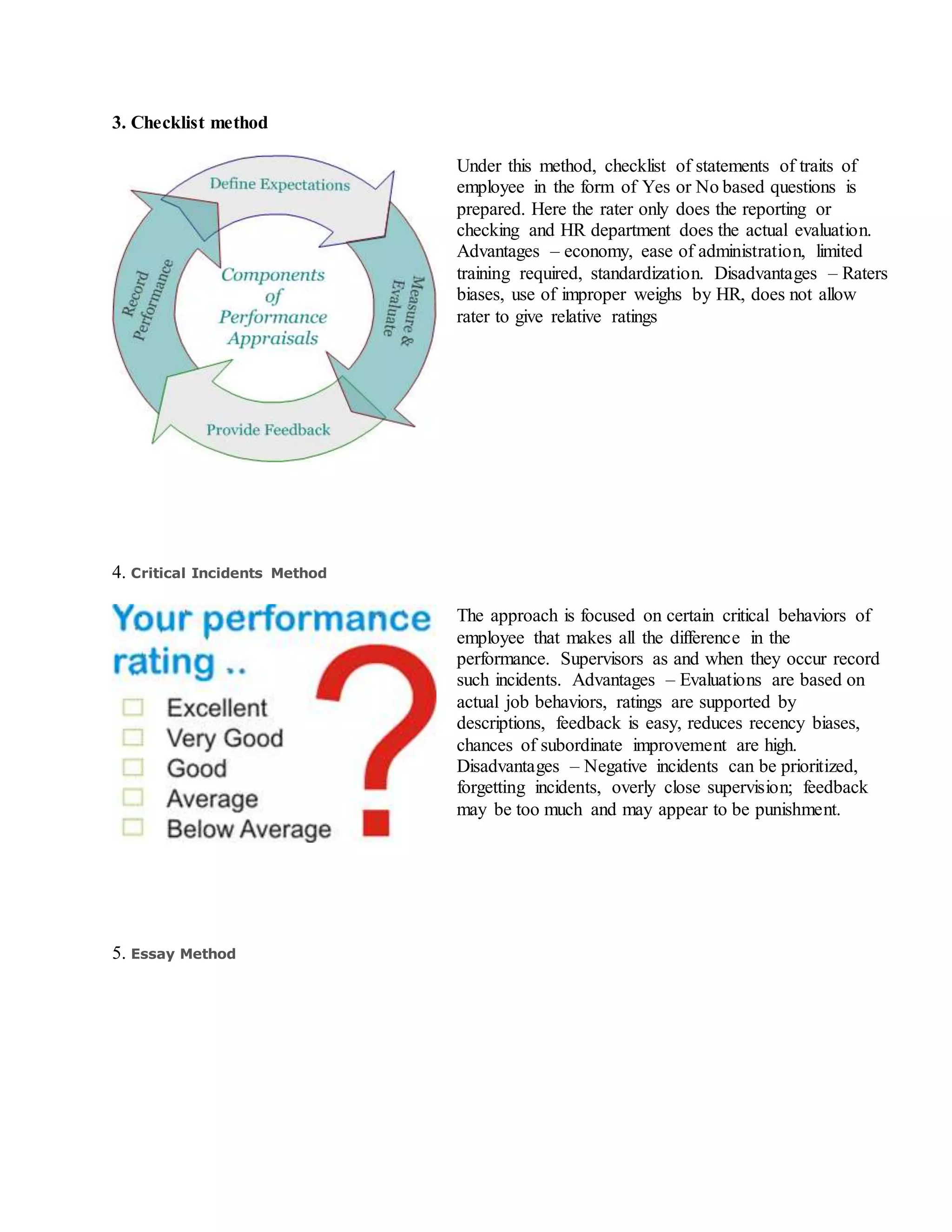
4. Critical Incidents Method
The approach is focused on certain critical behaviors of
employee that makes all the difference in the
performance. Supervisors as and when they occur record
such incidents. Advantages – Evaluations are based on
actual job behaviors, ratings are supported by
descriptions, feedback is easy, reduces recency biases,
chances of subordinate improvement are high.
Disadvantages – Negative incidents can be prioritized,
forgetting incidents, overly close supervision; feedback
may be too much and may appear to be punishment.
5. Essay Method
In this method the rater writes down the employee
description in detail within a number of broad categories
like, overall impression of performance, promoteability
of employee, existing capabilities and qualifications of
performing jobs, strengths and weaknesses and training
needs of the employee. Advantage – It is extremely
useful in filing information gaps about the employees
that often occur in a better-structured checklist.
Disadvantages – It its highly dependent upon the writing
skills of rater and most of them are not good writers.
They may get confused success depends on the memory
power of raters.
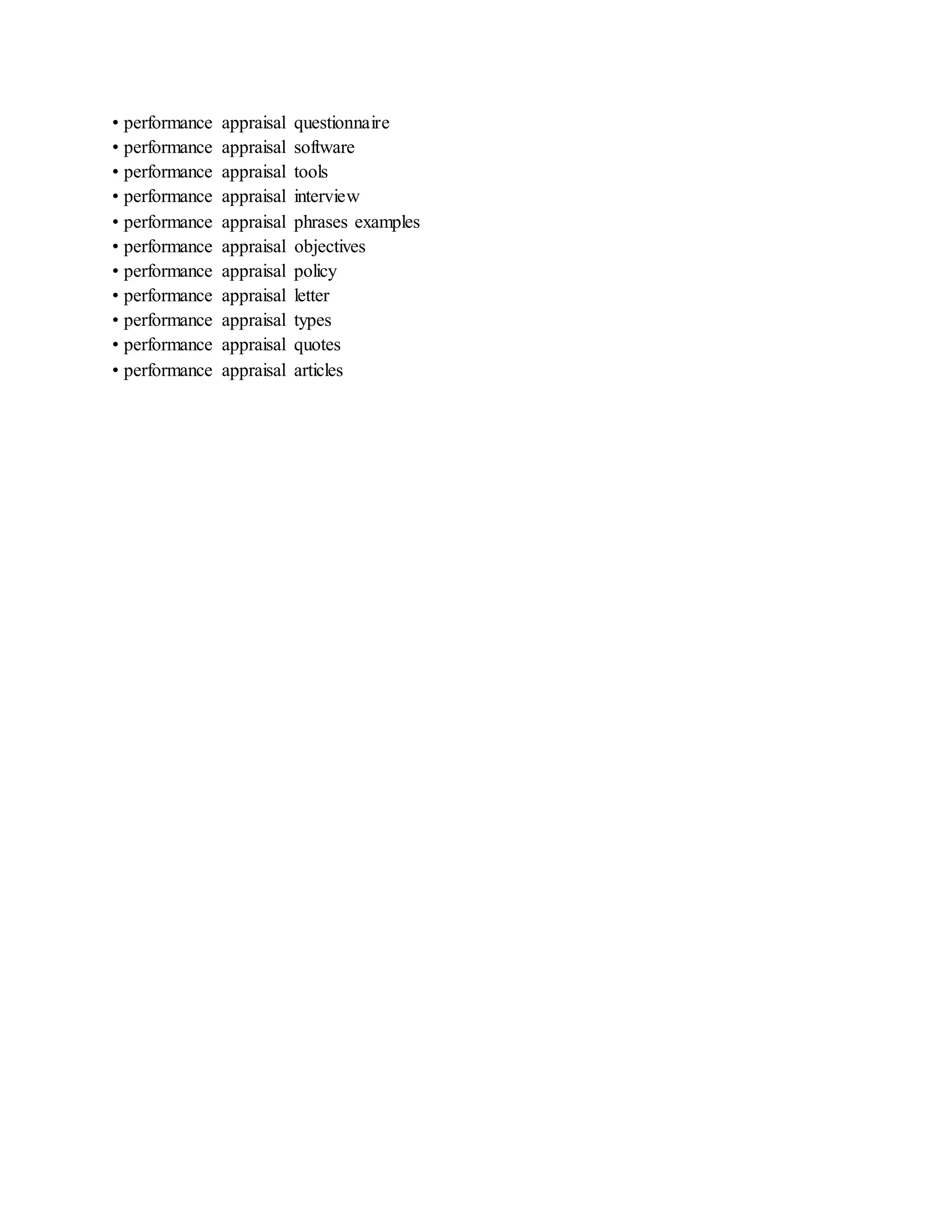
6. Behaviorally Anchored Rating Scales
statements of effective and ineffective behaviors
determine the points. They are said to be
behaviorally anchored. The rater is supposed to
say, which behavior describes the employee
performance. Advantages – helps overcome rating
errors. Disadvantages – Suffers from distortions
inherent in most rating techniques.
III. Other topics related to Sample performance appraisal (pdf download)
• Top 28 performance appraisal forms
• performance appraisal comments
• 11 performance appraisal methods
• 25 performance appraisal examples
• performance appraisal phrases
• performance appraisal process
• performance appraisal template
• performance appraisal system
• performance appraisal answers
• performance appraisal questions
• performance appraisal techniques
• performance appraisal format
• performance appraisal templates
• performance appraisal questionnaire
• performance appraisal software
• performance appraisal tools
• performance appraisal interview
• performance appraisal phrases examples
• performance appraisal objectives
• performance appraisal policy
• performance appraisal letter
• performance appraisal types
• performance appraisal quotes
• performance appraisal articles

Sample performance appraisal

  • 1.
    Sample performance appraisal Inthis file, you can ref useful information about sample performance appraisal such as sample performance appraisal methods, sample performance appraisal tips, sample performance appraisal forms, sample performance appraisal phrases … If you need more assistant for sample performance appraisal, please leave your comment at the end of file. Other useful material for you: • performanceappraisal123.com/1125-free-performance-review-phrases • performanceappraisal123.com/free-28-performance-appraisal-forms • performanceappraisal123.com/free-ebook-11-methods-for-performance-appraisal I. Contents of getting sample performance appraisal ================== A performance appraisal, also known as a post appraisal, is an evaluation of an employee’s work over a period of time, rather than for a specific project. Performance appraisals, often delivered during an annual review, focus on comparing the expectations a business has for a particular job and the performance of the person holding it. Knowing what to expect during your annual review can help you better prepare for a performance appraisal. Job Description The first part of a performance appraisal should be a review of the job description. This is the guideline under which you should be operating during the year. If you don’t have a written job description, your boss can review you based on responsibilities you didn’t know you had or don’t think are yours. Ask for a written job description if you don’t have one. You also can prepare one for yourself and submit it to your direct superior to ensure you both are on the same page. Goals The next step in a performance appraisal usually is a review of the goals and expectations of the position to determine if you met them. A sales person might have a simple goal of a sales quota. The position goals might include maintaining existing customer accounts and adding new ones, or maintaining customer satisfaction benchmarks. A business might require more than just accurate figures from its accounting department. An accountant might be expected to keep financial data current so executives can quickly get real-time reports. The accountant might also be expected to analyze financial data and project performance so management can take steps to avoid problems or take advantage of opportunities.
  • 2.
    Results The key aspectof a performance appraisal is your delivery of the expected results for your position. Without asking why or how, your superior will want to know what you achieved, and if you fell short of, met or exceeded your goals. Now is not the time to make excuses or give reasons; this part of the appraisal is simply to make sure both of you are on the same page as to whether you did what was expected. Evaluation During the evaluation stage of a performance appraisal, you and your reviewer try to determine why you performed as you did. This is your time to make your case for not being blamed for shortfalls or being rewarded for exceeding expectations. For example, if an accountant isn’t keeping financial data up to date, it might be a result of the company’s order-entry system that allows sales people to wait to enter their orders for many days or even weeks after they close deals. This is the time to explain any innovations you developed, such as ways to cut production times, reduce labor costs or increase product quality. If you dreamed up an advertising campaign or promotion that boosted sales, take credit for that during this portion of your appraisal. This is the time when your employer makes subjective observations, such as on your interpersonal skills, ability to communicate effectively, work habits and other personal behaviors the company has noted. Before some annual reviews, you might be asked to fill out a self-appraisal, and superiors and subordinates might be asked to evaluate you. Determination Once your evaluator has reviewed your job description, determined whether you met your responsibilities and examined why you did or did not succeed, it’s time to talk about the future. If you did not meet expectations, you might ask for more support or training. If you met expectations, give suggestions for how you plan to improve your performance. If you exceeded expectations, ask your superior how that benefited the company. Based on your overall appraisal results, this is the time to ask for more resources, a promotion or improved compensation. ================== III. Performance appraisal methods
  • 3.
    1.Ranking Method The rankingsystem requires the rater to rank his subordinates on overall performance. This consists in simply putting a man in a rank order. Under this method, the ranking of an employee in a work group is done against that of another employee. The relative position of each employee is tested in terms of his numerical rank. It may also be done by ranking a person on his job performance against another member of the competitive group. Advantages of Ranking Method i. Employees are ranked according to their performance levels. ii. It is easier to rank the best and the worst employee. Limitations of Ranking Method i. The “whole man” is compared with another “whole man” in this method. In practice, it is very difficult to compare individuals possessing various individual traits. ii. This method speaks only of the position where an employee stands in his group. It does not test anything about how much better or how much worse an employee is when compared to another employee. iii. When a large number of employees are working, ranking of individuals become a difficult issue. iv. There is no systematic procedure for ranking individuals in the organization. The ranking system does not eliminate the possibility of snap judgements. 2. Rating Scale Rating scales consists of several numerical scales representing job related performance criterions such as dependability, initiative, output, attendance, attitude etc. Each scales ranges from excellent to poor. The total numerical scores are computed and final conclusions are derived. Advantages – Adaptability, easy to use, low cost, every type of job can be evaluated, large number of employees covered, no formal training required. Disadvantages – Rater’s biases
  • 4.
    3. Checklist method Underthis method, checklist of statements of traits of employee in the form of Yes or No based questions is prepared. Here the rater only does the reporting or checking and HR department does the actual evaluation. Advantages – economy, ease of administration, limited training required, standardization. Disadvantages – Raters biases, use of improper weighs by HR, does not allow rater to give relative ratings 4. Critical Incidents Method The approach is focused on certain critical behaviors of employee that makes all the difference in the performance. Supervisors as and when they occur record such incidents. Advantages – Evaluations are based on actual job behaviors, ratings are supported by descriptions, feedback is easy, reduces recency biases, chances of subordinate improvement are high. Disadvantages – Negative incidents can be prioritized, forgetting incidents, overly close supervision; feedback may be too much and may appear to be punishment. 5. Essay Method
  • 5.
    In this methodthe rater writes down the employee description in detail within a number of broad categories like, overall impression of performance, promoteability of employee, existing capabilities and qualifications of performing jobs, strengths and weaknesses and training needs of the employee. Advantage – It is extremely useful in filing information gaps about the employees that often occur in a better-structured checklist. Disadvantages – It its highly dependent upon the writing skills of rater and most of them are not good writers. They may get confused success depends on the memory power of raters. 6. Behaviorally Anchored Rating Scales statements of effective and ineffective behaviors determine the points. They are said to be behaviorally anchored. The rater is supposed to say, which behavior describes the employee performance. Advantages – helps overcome rating errors. Disadvantages – Suffers from distortions inherent in most rating techniques. III. Other topics related to Sample performance appraisal (pdf download) • Top 28 performance appraisal forms • performance appraisal comments • 11 performance appraisal methods • 25 performance appraisal examples • performance appraisal phrases • performance appraisal process • performance appraisal template • performance appraisal system • performance appraisal answers • performance appraisal questions • performance appraisal techniques • performance appraisal format • performance appraisal templates
  • 6.
    • performance appraisalquestionnaire • performance appraisal software • performance appraisal tools • performance appraisal interview • performance appraisal phrases examples • performance appraisal objectives • performance appraisal policy • performance appraisal letter • performance appraisal types • performance appraisal quotes • performance appraisal articles