
Towards Better Use of the Internet among Asian CountriesWilliam T Torres, PhDwttorres@gmail.comMalaysian  Research and Education Network Seminar, 27-28 July 2010, Kuala Lumpur
Introduction/Outline Convergence of Communications	 and Computing    ICTICT Infrastructure and ICT ApplicationsICT and the Internet Internet in AsiaWhere we are nowWhere we should be going9/15/20102
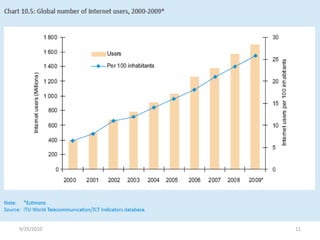
World Telecommunication/ICT Development Report 2010MONITORING THE WSIS TARGETS  A mid-term reviewThe following quotes are from the Foreword of the above report:“As this report shows, tremendous progress has been made over the past decade, with close to five billion mobile cellular subscriptions worldwide at the end of  2010, and almost two billion people throughout the world now having access to the Internet.”9/15/20103
“But there is still a vast amount of work to be done. In particular, we need to bring affordable fast broadband access within reach of the great majority of the world’s people — noting today that three quarters of the world’s inhabitants still have no access to the Internet at all. So what we need is to see a rapid and equitable spread of broadband networks matching the extraordinary growth of mobile cellular networks over the past decade.” 9/15/20104
“The key – as this report acknowledges – will be in recognizing that broadband networks deliver benefits right across society, and can quickly pay for themselves in terms of the savings gained through the more efficient provision of essential services such as healthcare, education, power, water, transportation and e-government.”End of Quotes9/15/20105
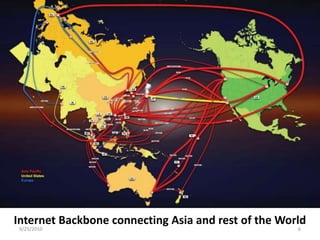
Internet Backbone connecting Asia and rest of the World9/15/20106
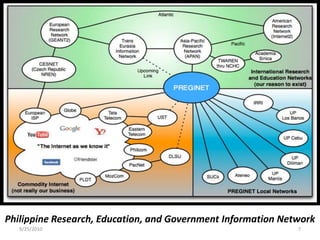
Philippine Research, Education, and Government Information Network 9/15/20107
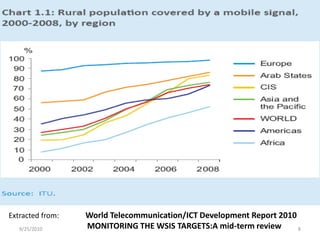
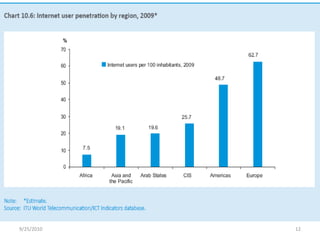
   Extracted from: 	          World Telecommunication/ICT Development Report 2010		          MONITORING THE WSIS TARGETS:A mid-term review9/15/20108
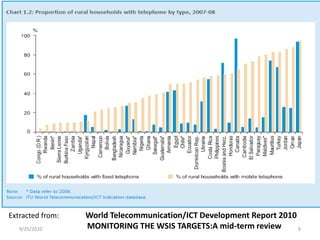
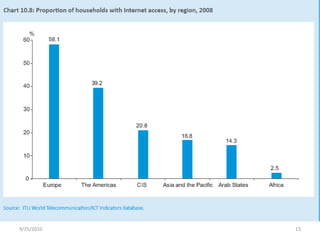
   Extracted from: 	          World Telecommunication/ICT Development Report 2010		          MONITORING THE WSIS TARGETS:A mid-term review9/15/20109
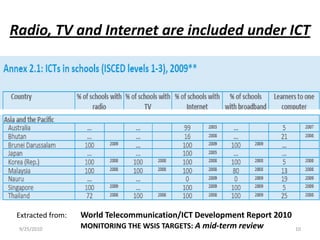
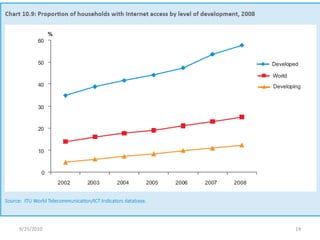
Radio, TV and Internet are included under ICT Extracted from: 	World Telecommunication/ICT Development Report 2010		MONITORING THE WSIS TARGETS: A mid-term review9/15/201010
9/15/201011
9/15/201012
9/15/201013
9/15/201014
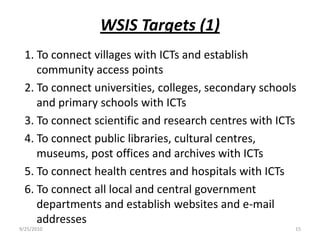
WSIS Targets (1)1. To connect villages with ICTs and establish community access points2. To connect universities, colleges, secondary schools and primary schools with ICTs3. To connect scientific and research centres with ICTs4. To connect public libraries, cultural centres, museums, post offices and archives with ICTs5. To connect health centres and hospitals with ICTs6. To connect all local and central government departments and establish websites and e-mail addresses9/15/201015
WSIS Targets (2)  7.  To adapt all primary and secondary school curricula to meet the challenges of the information society,        taking into account national circumstances   8. To ensure that all of the world’s population have access        to television and radio services   9. To encourage the development of content and put in place technical conditions in order to facilitate the 	   presence and use of all world languages on the Internet10.  To ensure that more than half the world’s inhabitants        have access to ICTs within their reach 9/15/201016
Development StrategiesICT infrastructure Can consist of a few or (grow into) many layersIt must be flexible to accommodate the evolution brought about by fast-paced changes in both the technology and demands of society. As end-users become ICT-savvy, they will develop applications on their own; thus, the ICT infrastructure must readily adapt to this new  and changing working environment.   Quickening the pace of ICT development More “technopreneurs” to develop/support an ever increasing number of applications in a variety of markets, e.g., health, education, entertainment, e-commerce, etc.9/15/201017
“Symbiosis” in the development of ICT applications and of ICT infrastructureProviding access to ICT services for the people outside the cities is feasible but is hindered by the high cost of reaching out to them.  Using wireless broadband can extend the reach of the telecom networks; it can also lower the cost of services to the end-users provided that the applications are quickly deployed as soon as the appropriately  configured ICT infrastructures are ready.Making heterogeneous infrastructures and/or applications interoperate can lower the costs to the users.  For example,  certain applications can have some components that run on the mobile phone infrastructure  and other components can run on the Internet. 9/15/201018
Thank you!9/15/201019

Torres: On Internet (Asia) - ppt with notes

  • 1.
    Towards Better Useof the Internet among Asian CountriesWilliam T Torres, PhDwttorres@gmail.comMalaysian Research and Education Network Seminar, 27-28 July 2010, Kuala Lumpur
  • 2.
    Introduction/Outline Convergence ofCommunications and Computing  ICTICT Infrastructure and ICT ApplicationsICT and the Internet Internet in AsiaWhere we are nowWhere we should be going9/15/20102
  • 3.
    World Telecommunication/ICT DevelopmentReport 2010MONITORING THE WSIS TARGETS A mid-term reviewThe following quotes are from the Foreword of the above report:“As this report shows, tremendous progress has been made over the past decade, with close to five billion mobile cellular subscriptions worldwide at the end of 2010, and almost two billion people throughout the world now having access to the Internet.”9/15/20103
  • 4.
    “But there isstill a vast amount of work to be done. In particular, we need to bring affordable fast broadband access within reach of the great majority of the world’s people — noting today that three quarters of the world’s inhabitants still have no access to the Internet at all. So what we need is to see a rapid and equitable spread of broadband networks matching the extraordinary growth of mobile cellular networks over the past decade.” 9/15/20104
  • 5.
    “The key –as this report acknowledges – will be in recognizing that broadband networks deliver benefits right across society, and can quickly pay for themselves in terms of the savings gained through the more efficient provision of essential services such as healthcare, education, power, water, transportation and e-government.”End of Quotes9/15/20105
  • 6.
    Internet Backbone connectingAsia and rest of the World9/15/20106
  • 7.
    Philippine Research, Education,and Government Information Network 9/15/20107
  • 8.
    Extracted from: World Telecommunication/ICT Development Report 2010 MONITORING THE WSIS TARGETS:A mid-term review9/15/20108
  • 9.
    Extracted from: World Telecommunication/ICT Development Report 2010 MONITORING THE WSIS TARGETS:A mid-term review9/15/20109
  • 10.
    Radio, TV andInternet are included under ICT Extracted from: World Telecommunication/ICT Development Report 2010 MONITORING THE WSIS TARGETS: A mid-term review9/15/201010
  • 11.
  • 12.
  • 13.
  • 14.
  • 15.
    WSIS Targets (1)1.To connect villages with ICTs and establish community access points2. To connect universities, colleges, secondary schools and primary schools with ICTs3. To connect scientific and research centres with ICTs4. To connect public libraries, cultural centres, museums, post offices and archives with ICTs5. To connect health centres and hospitals with ICTs6. To connect all local and central government departments and establish websites and e-mail addresses9/15/201015
  • 16.
    WSIS Targets (2) 7. To adapt all primary and secondary school curricula to meet the challenges of the information society, taking into account national circumstances 8. To ensure that all of the world’s population have access to television and radio services 9. To encourage the development of content and put in place technical conditions in order to facilitate the presence and use of all world languages on the Internet10. To ensure that more than half the world’s inhabitants have access to ICTs within their reach 9/15/201016
  • 17.
    Development StrategiesICT infrastructureCan consist of a few or (grow into) many layersIt must be flexible to accommodate the evolution brought about by fast-paced changes in both the technology and demands of society. As end-users become ICT-savvy, they will develop applications on their own; thus, the ICT infrastructure must readily adapt to this new and changing working environment. Quickening the pace of ICT development More “technopreneurs” to develop/support an ever increasing number of applications in a variety of markets, e.g., health, education, entertainment, e-commerce, etc.9/15/201017
  • 18.
    “Symbiosis” in thedevelopment of ICT applications and of ICT infrastructureProviding access to ICT services for the people outside the cities is feasible but is hindered by the high cost of reaching out to them. Using wireless broadband can extend the reach of the telecom networks; it can also lower the cost of services to the end-users provided that the applications are quickly deployed as soon as the appropriately configured ICT infrastructures are ready.Making heterogeneous infrastructures and/or applications interoperate can lower the costs to the users. For example, certain applications can have some components that run on the mobile phone infrastructure and other components can run on the Internet. 9/15/201018
  • 19.