I n t e r n a t i o n a l   Te l e c o m m u n i c a t i o n   U n i o n


World Telecommunication/ICT Development Report 2010

MONITORING THE WSIS TARGETS
A mid-term review


UN-DESA            WHO
I n t e r n a t i o n a l   Te l e c o m m u n i c a t i o n   U n i o n


World Telecommunication/ICT Development Report 2010

MONITORING THE WSIS TARGETS
A mid-term review


UN-DESA            WHO
© 2010 ITU
                                        International Telecommunication Union
                                                   Place des Nations
                                              CH-1211 Geneva Switzerland

                                        Original language of publication: English.

     All rights reserved. No part of this publication may be reproduced, stored in a retrieval system, or transmitted
     in any form or by any means, electronic, mechanical, photocopying, recording, or otherwise, without the prior
                               permission of the International Telecommunication Union.


ii
Foreword

The ninth edition of the World Telecommunication/ICT Development Report is being published at the half-way point
between the World Summit on the Information Society (WSIS) in 2005 and the target date for the Millennium De-
velopment Goals (MDGs) in 2015. This gives us a unique opportunity for a mid-term review — so this report focuses
on the WSIS targets, and shows us that while we have achieved much in some areas we still have far to go in others.

This is of critical importance in an era where Information and Communication Technologies (ICTs) underpin almost
every single activity undertaken in the modern world, and affect everyone on the planet — even those who do not
themselves have first-hand access to ICTs. Good examples include food distribution, power networks, water supplies
or mass transportation, all of which are controlled and managed today by ICT networks and applications.

As this report shows, tremendous progress has been made over the past decade, with close to five billion mobile
cellular subscriptions worldwide at the end of 2010, and almost two billion people throughout the world now having
access to the Internet.

But there is still a vast amount of work to be done. In particular, we need to bring affordable fast broadband access
within reach of the great majority of the world’s people — noting today that three quarters of the world’s inhabit-
ants still have no access to the Internet at all. So what we need is to see a rapid and equitable spread of broadband
networks matching the extraordinary growth of mobile cellular networks over the past decade.

The key — as this report acknowledges — will be in recognizing that broadband networks deliver benefits right across
society, and can quickly pay for themselves in terms of the savings gained through the more efficient provision of es-
sential services such as healthcare, education, power, water, transportation and e-government.

Personally I have tremendous faith that the public and private sectors will work together — as they did in the crea-
tion of mobile cellular networks — to roll out the necessary infrastructure and create the necessary services to bring
broadband to all the world’s people. For this to happen, we also need to recognize, as this report explains, the vital
importance of making sure that people are well-equipped to take advantage of all this new technology (through hu-
man capacity building) and that enough attention is paid to the need to create and share far more local-language
content across the Internet. And we need to continue to monitor and attain the WSIS targets by 2015, in line with
the MDGs.

I am absolutely certain that the next decade will be the decade of broadband. This is why ITU is working with UNESCO
in establishing the Broadband Commission for Digital Development. The commission will be chaired by President Paul
Kagame of Rwanda and Carlos Slim Helú, Honorary Lifetime Chairman of Grupo Carso, with Irina Bokova, Director-
General of UNESCO, and myself, as vice-chairs. The Broadband Commission has the full support of the UN Secretary-
General, Ban Ki-moon, and will report to the 2010 MDG Summit in September.

The commission complements ITU’s own “Build on Broadband” campaign, which is designed to increase awareness
of the vital role broadband will play in the 21st century in every country in the world. I therefore expect broadband
to be high on the agenda at the World Telecommunication Development Conference 2010, which is taking place in
Hyderabad, India, from 24 May to 4 June, and I look forward to seeing you there and to sharing in the debates which
will shape global ICT development over the next four years – and beyond.


                                               Dr Hamadoun I. Touré
                                                 Secretary-General
                                      International Telecommunication Union


                                                                                                                   iii
Preface

I am pleased to present the World Telecommunication/ICT Development Report (WTDR) 2010, which focuses on
Monitoring the WSIS targets. This ninth edition of the WTDR, which contains a mid-term review of the achievements
of the World Summit on the Information Society (WSIS), is a contribution to the World Telecommunication Develop-
ment Conference (WTDC) to take place in Hyderabad, India, from 24 May to 4 June, 2010.

ITU has a long history of measuring developments in the area of telecommunications and ICTs, both in terms of
infrastructure and — more recently — in terms of use. At the international level, the Union has taken on a lead role
not only in measuring and analysing ICT trends, but also in identifying indicators and definitions. Together with other
international and regional organizations, and within the framework of the Partnership on Measuring ICT for Develop-
ment, we have also been working towards a set of internationally comparable and harmonized data. Through this
report, ITU is reaffirming its leading role in measuring the information society.

The year 2010 marks the midpoint between the Tunis phase of WSIS (2005) and the deadline for achieving the ten
targets that governments agreed upon at the Summit (2015). These targets range from connecting villages, schools,
health centres, libraries and government agencies, to developing content, and providing ICT services to people. The
main objective of the report is to provide policy-makers with a comprehensive assessment of what has been achieved
so far, and what remains to be done. Besides highlighting actual progress and trends since WSIS, the report also
proposes quantitative indicators to measure the ten WSIS targets. This is the first time a full-scale global monitoring
process and assessment of the targets is being put in place.

The report highlights the major achievements that have been accomplished in connecting people via mobile tech-
nologies. Today, mobile cellular networks already cover close to 90 per cent of the world population, and we expect
coverage to reach 100 per cent by 2015. We are also confident that by 2015 more than half of the world population
will be using a mobile telephone. At the same time, the report shows that, in a number of areas, substantial efforts
need to be made to achieve the targets. Too many schools in developing countries continue to be deprived of access
to the Internet, and three-quarters of people in the world are not yet online. Only a very small proportion of the in-
formation hosted by libraries and archives has been digitized, and even less is available online. The report also points
to the persistent broadband divide, which policy-makers need to tackle urgently. Whereas, by the end of 2009, most
people in the developed countries enjoyed Internet access with a high-speed connection, broadband penetration
rates in the developing world stood at a meagre 3.5 per cent.

The WTDR is the fruit of a joint effort by several international organizations, led by ITU, and includes contributions
from UNESCO, WHO and UNDESA, as well as from representatives of civil society. This collaborative effort not only
reflects the broad range of subjects covered by WSIS, but also underlines the cross-cutting nature of the information
society, and the recognition that ICTs are truly a development enabler and hence of tremendous importance for any
development debate.

I am convinced that this report will prove useful in evaluating progress on the WSIS outcomes and the development
of the global information society. Its findings and recommendations will provide a valuable input to the debate at
WTDC.


                                             Sami Al Basheer Al Morshid
                                                       Director
                                   Telecommunication Development Bureau (BDT)
                                       International Telecommunication Union


                                                                                                                      v
Acknowledgements
 The World Telecommunication/ICT Development Report (WTDR) 2010: Monitoring the WSIS targets was prepared by the Mar-
 ket Information and Statistics Division within the Telecommunication Development Bureau of ITU. The core team included
 Susan Teltscher (Head of Division), Vanessa Gray (chapters on Targets 1, 2, 7, 8 and 10) and Desirée van Welsum (chapters
 on Targets 3, 4, 5, 6 and 9). Philippa Biggs of the ITU General Secretariat co-authored the chapter on Target 3. Esperanza
 Magpantay, Doris Olaya and Andreea Todoran (during her internship at ITU) provided substantive comments and inputs, as
 well as statistical tables, on various chapters of the report. Olivier Poupaert contributed to the data collection and analysis.
 Susan Schorr, Head, a.i., Special Initiatives Division, made helpful suggestions on the chapter on Target 10. The work was
 carried out under the overall direction of Mario Maniewicz, Chief, Policies and Strategies Department, Telecommunication
 Development Bureau.

 ITU is grateful to a large number of outside contributors who have collaborated in the drafting of this report. These include
 the following:

 The chapters on Targets 2 and 7 were contributed by the UNESCO Institute for Statistics (UIS), in particular Patrick Lucas,
 Claude Akpabie and Beatriz Valdez-Melgar. Katsiaryna Miniukovich (Ministry of Education of Belarus) provided useful inputs
 to the chapter on Target 2 and Joel Peetersoo (Ministry of Education and Research of Estonia) to the chapter on Target 7.

 The chapter on Target 5 was contributed by the World Health Organization (WHO), in particular Misha Kay, with Najeeb Al
 Shorbaji, Joan Dzenowagis, Marina Takane, Jonathan Santos and Diana Zandi.

 The chapter on Target 6 was contributed by the United Nations Department of Economic and Social Affairs (UNDESA), in par-
 ticular Seema Hafeez.

 The chapter on Target 9 was contributed by Daniel Pimienta from the Networks and Development Foundation (FUNRE-
 DES), with inputs from Daniel Prado (Union Latine), Jean-François C. Morfin (Intlnet), Viola Krebs (ICVolunteers) and Deirdre
 Williams (St Lucia). Matthew Zook from ZookNIC provided data on ccTDLs.

 Michael Minges provided substantive inputs to the chapters on Targets 1, 2, 4, 8 and 10. Guido Koller and Manuela Höfler
 of the Schweizerisches Bundesarchiv, and Annick Carteret of the International Council on Archives, provided inputs to the
 chapter on Target 4. The chapter also includes data from the Universal Postal Union (UPU), which is gratefully acknowledged.

 ITU also appreciates the cooperation of countries that responded to the 2009 ITU Questionnaire on the WSIS Targets.

 The report was edited by the ITU English Translation Section, led by Anthony Pitt. The desktop publishing was carried out
 by Nathalie Rollet, and the cover was designed by Stephane Rollet. Administrative support was provided by Herawasih
 Yasandikusuma.


vi
Contents

Foreword................................................................................................................................ iii

Preface..................................................................................................................................... v

Acknowledgements................................................................................................................. vi

List.of.abbreviations................................................................................................................xv

Executive.summary................................................................................................................xxi

Introduction............................................................................................................................. 1
     WSIS follow-up and implementation.......................................................................................................................2
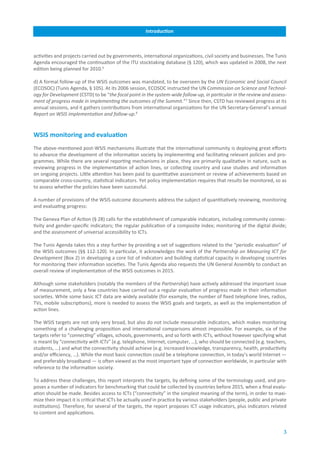
     WSIS monitoring and evaluation .............................................................................................................................3
     Methodology for preparing the report....................................................................................................................5
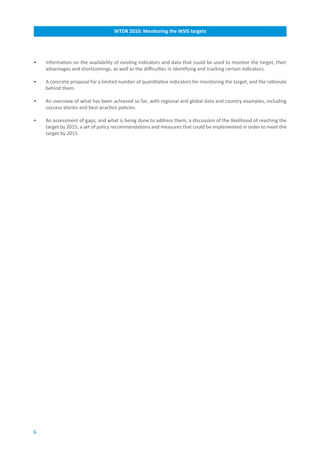
     Ten targets, ten chapters ........................................................................................................................................ 5
     References ............................................................................................................................................................... 8

Target.1:.Connect.villages.with.ICTs.and.establish.community.access.points....................... 9
     Introduction ............................................................................................................................................................ 9
     Measuring Target 1 — Proposed indicators ..........................................................................................................10
     Status of Target 1 .................................................................................................................................................. 13
     Conclusions and recommendations ......................................................................................................................23
     References ............................................................................................................................................................. 28

Target.2:.Connect.universities,.colleges,.secondary.schools.and.primary.schools.with.ICTs.... 29
     Introduction ........................................................................................................................................................... 29
     Measuring Target 2 — Proposed indicators ..........................................................................................................31
     Status of Target 2 .................................................................................................................................................. 33
     Conclusions and recommendations ......................................................................................................................40
     References ............................................................................................................................................................. 44
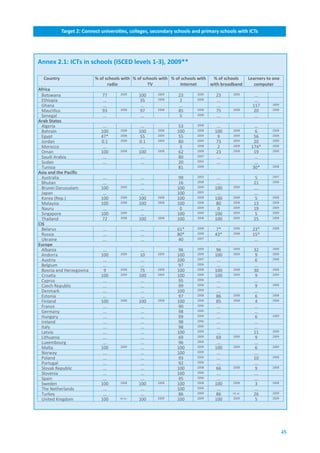
     Annex 2.1: ICTs in schools (ISCED levels 1-3), 2009 ...............................................................................................45

Target.3:.Connect.scientific.and.research.centres.with.ICTs......................................... 47
     Introduction ........................................................................................................................................................... 47
     Measuring Target 3 — Proposed indicators ..........................................................................................................50
     Status of the target ................................................................................................................................................ 51
     Conclusions and recommendations ......................................................................................................................60
     References ............................................................................................................................................................. 63


                                                                                                                                                                            vii
Annex 3.1: List of national research and education networks (NRENs) ................................................................64
    Annex 3.2: Extract from the TERENA Compendium 2009 questionnaire ..............................................................67
    Annex 3.3: Status of NRENs in Latin America, 2007 ..............................................................................................68

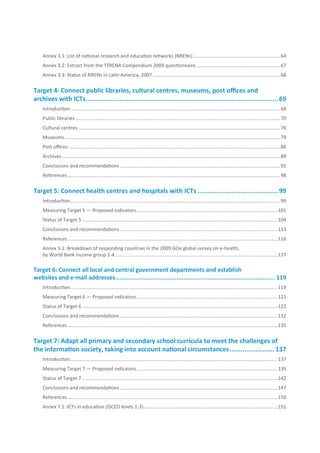
Target.4:.Connect.public.libraries,.cultural.centres,.museums,.post.offices.and..
archives.with.ICTs........................................................................................................ 69
    Introduction ........................................................................................................................................................... 69
    Public libraries ....................................................................................................................................................... 70
    Cultural centres ..................................................................................................................................................... 76
    Museums ............................................................................................................................................................... 79
    Post offices ............................................................................................................................................................ 86
    Archives ................................................................................................................................................................. 89
    Conclusions and recommendations ......................................................................................................................92
    References ............................................................................................................................................................. 98

Target.5:.Connect.health.centres.and.hospitals.with.ICTs............................................ 99
    Introduction ........................................................................................................................................................... 99
    Measuring Target 5 — Proposed indicators ........................................................................................................101
    Status of Target 5 ................................................................................................................................................ 104
    Conclusions and recommendations ....................................................................................................................113
    References ........................................................................................................................................................... 116
    Annex 5.1: Breakdown of responding countries in the 2009 GOe global survey on e-health,
    by World Bank income group 1-4 ........................................................................................................................117

Target.6:.Connect.all.local.and.central.government.departments.and.establish..
websites.and.e-mail.addresses............................................................................................. 119
    Introduction ......................................................................................................................................................... 119
    Measuring Target 6 — Proposed indicators ........................................................................................................121
    Status of Target 6 ................................................................................................................................................ 122
    Conclusions and recommendations ....................................................................................................................132
    References ........................................................................................................................................................... 135

Target.7:.Adapt.all.primary.and.secondary.school.curricula.to.meet.the.challenges.of.
the.information.society,.taking.into.account.national.circumstances......................... 137
    Introduction ......................................................................................................................................................... 137
    Measuring Target 7 — Proposed indicators ........................................................................................................139
    Status of Target 7 ................................................................................................................................................ 142
    Conclusions and recommendations ....................................................................................................................147
    References ........................................................................................................................................................... 150
    Annex 7.1: ICTs in education (ISCED levels 1-3)...................................................................................................151
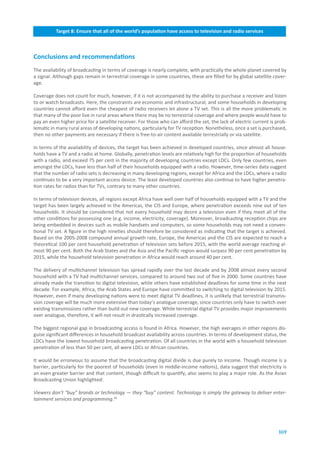
Target.8:.Ensure.that.all.of.the.world’s.population.have.access.to.television.and..
radio.services............................................................................................................ 153
    Introduction ......................................................................................................................................................... 153
    Measuring Target 8 — Proposed indicators ........................................................................................................154
    Status of Target 8 ................................................................................................................................................ 157
    Conclusions and recommendations ....................................................................................................................169
    References ........................................................................................................................................................... 173

Target.9:.Encourage.the.development.of.content.and.put.in.place.technical.conditions.
in.order.to.facilitate.the.presence.and.use.of.all.world.languages.on.the.Internet..... 175
    Introduction ......................................................................................................................................................... 175
    Measuring Target 9 — Proposed indicators ........................................................................................................178
    Status of Target 9 ................................................................................................................................................ 179
    Conclusions and recommendations ....................................................................................................................186
    References ........................................................................................................................................................... 192

Target.10:.Ensure.that.more.than.half.the.world’s.inhabitants.have.access.to.ICTs.
within.their.reach...................................................................................................... 193
    Introduction ........................................................................................................................................................ 193
    Measuring Target 10 — Proposed indicators ......................................................................................................194
    Status of Target 10 .............................................................................................................................................. 197
    Conclusion and recommendations ......................................................................................................................206
    References ........................................................................................................................................................... 210

Conclusions.and.the.way.forward......................................................................................... 211
    Monitoring progress: towards 2015 ....................................................................................................................212
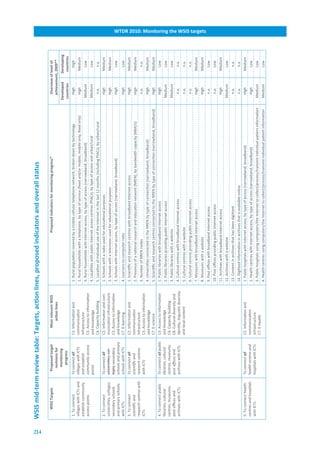
    WSIS mid-term review table: Targets, action lines, proposed indicators and overall status ..............................214

Annex.table.1..List.of.countries.that.responded.to.the.ITU.questionnaire.on.WSIS.targets. .. 217
                                                                                        .


                                                                                                                                                                          ix
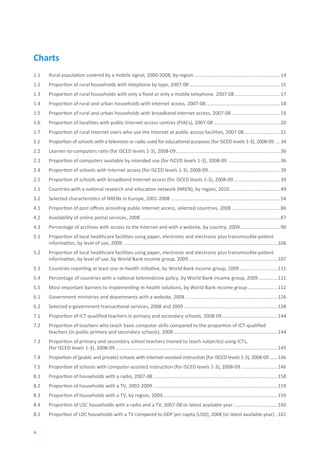
Charts
1.1   Rural population covered by a mobile signal, 2000-2008, by region ................................................................14
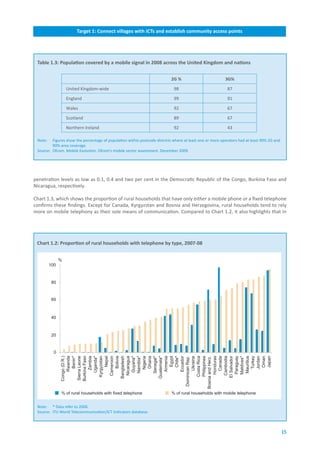
1.2   Proportion of rural households with telephone by type, 2007-08 ...................................................................15
1.3   Proportion of rural households with only a fixed or only a mobile telephone, 2007-08 ..................................17
1.4   Proportion of rural and urban households with Internet access, 2007-08 .......................................................18
1.5   Proportion of rural and urban households with broadband Internet access, 2007-08 ....................................19
1.6   Proportion of localities with public Internet access centres (PIACs), 2007-08 .................................................20
1.7   Proportion of rural Internet users who use the Internet at public access facilities, 2007-08 ...........................21
2.1   Proportion of schools with a television or radio used for educational purposes (for ISCED levels 1-3), 2008-09 .... 34
2.2   Learner-to-computers ratio (for ISCED levels 1-3), 2008-09 .............................................................................36
2.3   Proportion of computers available by intended use (for ISCED levels 1-3), 2008-09 .......................................36
2.4   Proportion of schools with Internet access (for ISCED levels 1-3), 2008-09 .....................................................39
2.5   Proportion of schools with broadband Internet access (for ISCED levels 1-3), 2008-09...................................39
3.1   Countries with a national research and education network (NREN), by region, 2010 .....................................49
3.2   Selected characteristics of NRENs in Europe, 2001-2008 .................................................................................54
4.1   Proportion of post offices providing public Internet access, selected countries, 2008 ....................................86
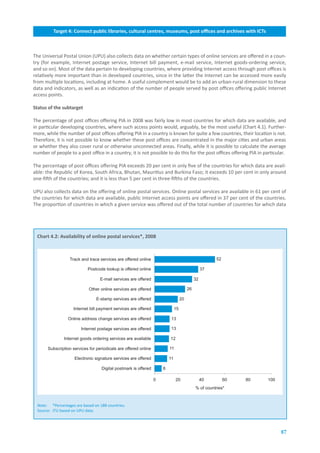
4.2   Availability of online postal services, 2008 .......................................................................................................87
4.3   Percentage of archives with access to the Internet and with a website, by country, 2009..............................90
5.1   Proportion of local healthcare facilities using paper, electronic and electronic plus transmissible patient
      information, by level of use, 2009 ..................................................................................................................106
5.2   Proportion of local healthcare facilities using paper, electronic and electronic plus transmissible patient
      information, by level of use, by World Bank income group, 2009 ..................................................................107
5.3   Countries reporting at least one m-health initiative, by World Bank income group, 2009 ............................111
5.4   Percentage of countries with a national telemedicine policy, by World Bank income group, 2009 ..............111
5.5   Most important barriers to implementing m-health solutions, by World Bank income group ......................112
6.1   Government ministries and departments with a website, 2008 ....................................................................126
6.2   Selected e-government transactional services, 2008 and 2009 .....................................................................128
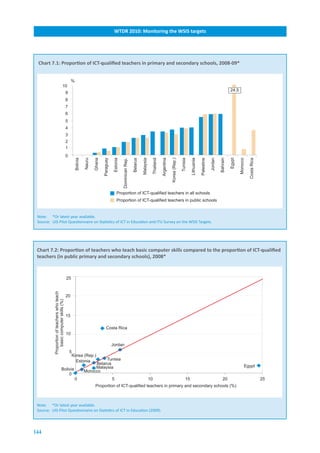
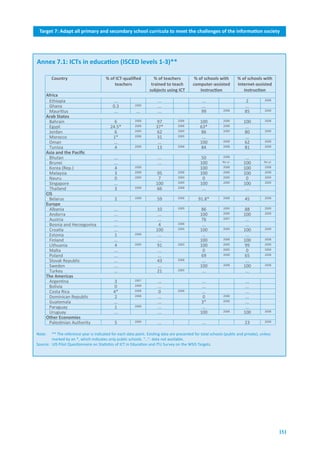
7.1   Proportion of ICT-qualified teachers in primary and secondary schools, 2008-09 .........................................144
7.2   Proportion of teachers who teach basic computer skills compared to the proportion of ICT-qualified
      teachers (in public primary and secondary schools), 2008 .............................................................................144
7.3   Proportion of primary and secondary school teachers trained to teach subject(s) using ICTs,
      (for ISCED levels 1-3), 2008-09 ........................................................................................................................145
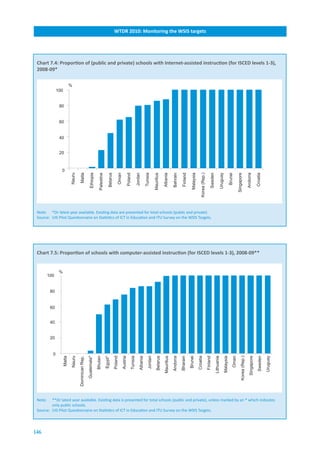
7.4   Proportion of (public and private) schools with Internet-assisted instruction (for ISCED levels 1-3), 2008-09 ...... 146
7.5   Proportion of schools with computer-assisted instruction (for ISCED levels 1-3), 2008-09 ...........................146
8.1   Proportion of households with a radio, 2007-08 ............................................................................................158
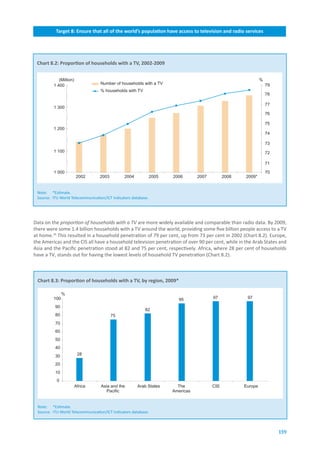
8.2   Proportion of households with a TV, 2002-2009 ............................................................................................159
8.3   Proportion of households with a TV, by region, 2009.....................................................................................159
8.4   Proportion of LDC households with a radio and a TV, 2007-08 or latest available year .................................160
8.5   Proportion of LDC households with a TV compared to GDP per capita (USD), 2008 (or latest available year) ..161


x
8.6    Proportion of LDC households with electricity, compared to households with a TV, 2008 (or latest available year) .161
8.7    Gap between LDC households with electricity and households with television, %, latest available year ......162
8.8    Households with cable TV, satellite TV, and IPTV, millions, world..................................................................163
9.1    Regional distribution of languages, 2009 ........................................................................................................180
9.2    Top ten languages on the Internet, 2009........................................................................................................182
9.3    Internet users and ccTLD registrations per 100 inhabitants, 2009* ...............................................................186
10.1   Global ICT development, 1998-2009...............................................................................................................195
10.2   Global mobile cellular subscriptions, 2000-2009 ............................................................................................198
10.3   Global mobile cellular penetration, by region, 2009 ......................................................................................198
10.4   Mobile cellular users versus mobile cellular subscriptions in Europe and countries where data are available, 2008 ......200
10.5   Global number of Internet users, 2000-2009 .................................................................................................201
10.6   Internet user penetration by region, 2009 .....................................................................................................202
10.7   Internet users by gender .................................................................................................................................202
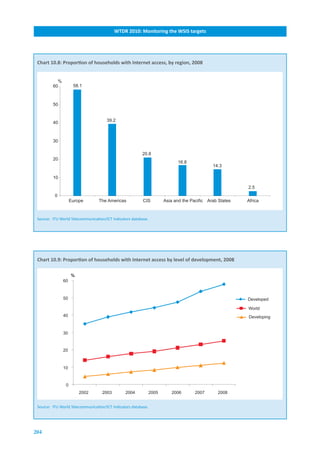
10.8   Proportion of households with Internet access, by region, 2008 ...................................................................204
10.9   Proportion of households with Internet access by level of development, 2008 ............................................204
10.10 Proportion of households with access to the Internet by type of access, 2008 .............................................205


Figures
2.1    Information needs at different levels of ICT penetration in educational systems ............................................32
5.6    Barriers to implementing telemedicine solutions, by World Bank income group ..........................................112
8.1    Television coverage and percentage of households with electricity and television, South Africa, 2007 .......154
9.1    Key figures for languages on the Internet, 2010 .............................................................................................181


Boxes
1      What are the WSIS targets? ................................................................................................................................2
2      The Partnership on Measuring ICT for Development and WSIS .........................................................................4
3      ITU Survey on the WSIS targets ..........................................................................................................................5
1.1    The spread of mobile telephony in rural areas: an example from Paraguay and Jordan .................................16
1.2    More broadband, please: Malaysia adapts universal service regulation ..........................................................18
1.3    Connect and inform every Colombian ..............................................................................................................21
1.4    Public Internet access in Peru ...........................................................................................................................22
1.5    More bandwidth for rural areas in East Africa ..................................................................................................23
1.6    Grameenphone in Bangladesh: From (just) mobile to mobile broadband .......................................................23
2.1    The benefits of connecting educational institutions for learners and teachers ...............................................30
2.2    Setting targets: Examples from the Americas, Africa and Australia ..................................................................32


                                                                                                                                                                 xi
2.3    Measuring progress — Case of Belarus ............................................................................................................37
2.4    Electricity before broadband?...........................................................................................................................40
2.5    The Chilean model — Partnering to connect schools .......................................................................................41
2.6    Uruguay closes the digital gap ..........................................................................................................................41
3.1    What is a national research and education network (NREN)? ..........................................................................49
3.2    Data collected by the Trans-European Research and Education Networking Association (TERENA) ...............51
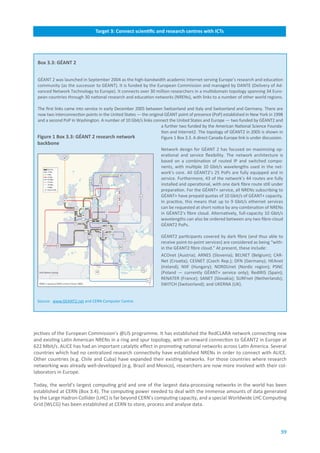
3.3    GÉANT 2 ............................................................................................................................................................59
3.4    A look to the future: the Worldwide LHC Computing Grid (WLCG) at CERN ....................................................60
4.1    Digital libraries ..................................................................................................................................................71
4.2    Examples of initiatives to connect libraries ......................................................................................................76
4.3    Examples of initiatives to connect cultural centres ..........................................................................................79
4.4    Virtual museum visits ........................................................................................................................................85
4.5    Examples of initiatives to connect post offices .................................................................................................88
4.6    The importance of digital archives ....................................................................................................................91
5.1    M-health .........................................................................................................................................................101
5.2    HINARI (Health InterNetwork Access to Research Initiative) — When content drives connectivity ..............102
5.3    The Global Observatory for eHealth ...............................................................................................................105
5.4    Belize — an example of a model national e-health programme in a developing country setting ..................109
6.1    The benefits of e-government ........................................................................................................................120
6.2    The level of e-government services in the EU .................................................................................................129
6.3    Use of e-government services by citizens and businesses ..............................................................................130
7.1    The six Education for All (EFA) goals ...............................................................................................................138
7.2    Estonia’s tiger leap from prerequisites to action ............................................................................................139
7.3    The use of ICT in curricula — A review of selected comparative assessments ...............................................140
7.4    How is ICT-assisted instruction defined? ........................................................................................................141
7.5    Integrating ICTs in the curricula — A priority in Jordan ..................................................................................143
8.1    Broadcasting and the Internet ........................................................................................................................155
8.2    Community radio ............................................................................................................................................158
8.3    TV in .tv (Tuvalu) .............................................................................................................................................160
8.4    More multichannel, more content, more demand: examples from South Asia .............................................164
8.5    Pan-regional direct-to-home (DTH) systems targeted at developing regions ................................................166
9.1    Understanding digital concepts ......................................................................................................................177
9.2    Requirements for the presence of languages on the Internet ........................................................................178
9.3    Measuring the number of webpages by language ..........................................................................................179
9.4    Active policies to boost content creation: The case of Catalan ......................................................................186
10.1   Examples of non-voice mobile phone applications for development in Africa...............................................196
10.2   Mobile success factors ....................................................................................................................................199
10.3   Government support crucial for Internet uptake: examples from Morocco and Viet Nam ...........................203


xii
Tables
1.1    Indicators for measuring Target 1 .....................................................................................................................10
1.2    Rural population covered by a mobile cellular signal, 2008 .............................................................................14
1.3    Population covered by a mobile signal in 2008 across the United Kingdom and nations ................................15
3.1    Public scientific and research centres with access to the Internet, 2009 .........................................................52
3.2    NRENs, 2009......................................................................................................................................................53
3.3    Types of institutions for which connection to the NREN is allowed (%), selected countries, 2008 ..................55
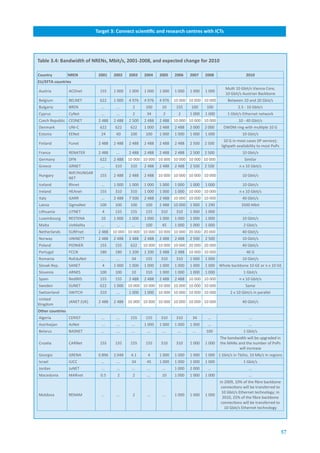
3.4    Bandwidth of NRENs, Mbit/s, 2001-2008, and expected change for 2010.......................................................57
4.1    Public libraries with access to the Internet, by type of access, and with a website, by country, 2009 ............74
4.2    Percentage of public libraries offering Internet access, by region, 2007 ..........................................................75
4.3    Percentage of public libraries with Internet access for users, and websites, 2006 or latest, Latin America
       and the Caribbean .............................................................................................................................................75
4.4    Cultural centres with Internet access, by country, by type of access, 2009 .....................................................78
4.5    Museums with access to the Internet by type of connection, and with a website, selected countries, 2009 .....81
4.6    Museums with a website, European countries, latest year available ...............................................................82
4.7    Selected museums with a website, Africa, 2007...............................................................................................83
4.8    Museums in selected countries in the Americas ..............................................................................................83
4.9    Websites of some of the world’s major museums............................................................................................84
4.10   Digitization of archived information, 2009 .......................................................................................................90
5.1    Proposed indicators for monitoring Target 5 ..................................................................................................103
5.2    Prime sources of health and ICT-related data.................................................................................................104
5.3    Percentage of health institutions with access to the Internet, 2009 ..............................................................106
5.4    Foundation actions .........................................................................................................................................108
5.5    Enabling actions for ICT for health ..................................................................................................................110
5.6    Preliminary WHO GOe survey results 2009 ....................................................................................................110
6.1    Percentage of government entities with Internet access, 2009 .....................................................................123
6.2    The use of ICT in government, New Zealand, 2008 ........................................................................................124
6.3    Countries with government websites, 2003 and 2009 ...................................................................................125
6.4    Government ministries connected to the national homepage, 2009 .............................................................126
6.5    Online services related to citizen participation, 2009 .....................................................................................128
8.1    Indicators (and definitions) to monitor access to TV and radio services ........................................................156
8.2    Mobile TV deployments, selected developing countries, status as of 2009 ...................................................168
9.1    Distribution of languages by number of first-language speakers, 2009 .........................................................180
9.2    Growth of social networking sites, by region, June 2007-June 2008 ..............................................................182
9.3    Production of webpages in French, by region and by country, 2007 (percentage of pages — productivity) ......... 183
9.4    Production of webpages in other languages, by country, 2007 (percentage of pages — productivity) .........183
9.5    Twenty ccTLDs with the strongest average annual growth of registrations, 2005-2009 ................................184
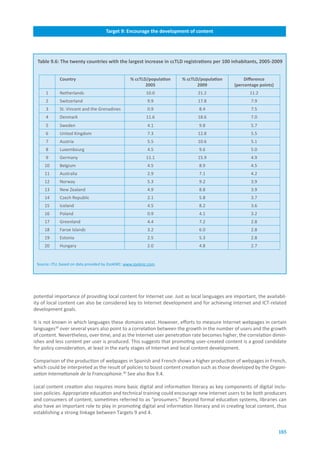
9.6    The twenty countries with the largest increase in ccTLD registrations per 100 inhabitants, 2005-2009 .......185


                                                                                                                                                                    xiii
List.of.abbreviations

3G            Third-generation (mobile technology)
4G            Fourth-generation (mobile technology)
ADSL          Asymmetric digital subscriber line
ALICE         America Latina Interconectada Con Europa
AM            Amplitude modulation
APAN          Asia-Pacific Advanced Network
ARCEP         Autorité de régulation des communications électroniques et des postes
ARNES         Academic and Research Network of Slovenia
ATM           Automated teller machine
BDT           Bangladesh Taka (currency)
kLBHIS        Belize Health Information System
BioGRID       Biological General Repository for Interaction Datasets
BLSS          Bhutan Living Standard Survey
CAGR          Compound annual growth rate
CAI           Computer-assisted instruction
CAREN         Central Asian Research and Education Network
CASBAA        Cable & Satellite Broadcasting Association of Asia
CATV          Cable television
ccTLDs        Country code top-level domains
CD/DVD        Compact disc/Digital versatile (or video) disc
CDMA          Code Division Multiple Access
cdmaOne       Code Division Multiple Access One
CDMA2000 1X Code Division Multiple Access 1 times Radio Transmission Technology
CDMA2000 1xEV-DO (Evolution-Data Optimized) Code Division Multiple Access 1x Evolution-Data Optimized
CERN          European Organization for Nuclear Research
CERNET        China Education and Research Network
CIC           Community information centre
CIS           Commonwealth of Independent States
CLARA         Cooperación Latino Americana de Redes Avanzadas
COSINE        Co-operation for Open Systems Interconnection in Europe
CSTNET        China Science and Technology Network
CyNet         Cyprus' National Research and Education Network
DANTE         Delivery of Advanced Network Technology to Europe
DBCDE         Department of Broadband, Communications and the Digital Economy (Australia)
DHS           Demographic and Health Survey


                                                                                                        xv
DICE       DANTE-Internet2-CANARIE-Esnet
DTH        Direct-to-home
DTT        Digital terrestrial television
DVB-H      Digital video broadcasting — Handheld
DVD        Digital versatile (or video) disc
DVG-H      Digital video broadcast — Handheld
ECA        See UNECA
ECLAC      See UNECLAC
ECOSOC     United Nations Economic and Social Council
EFA        Education for All
EFTA       European Free Trade Association
EGMUS      European Group on Museum Statistics
EHR/EMR    Electronic health records/Electronic medical records
eLAC       Strategy for the Information Society in Latin America and the Caribbean
ERNET      Education and Research Network
ESCAP      See UNESCAP
ESCWA      See UNESCWA
ESnet      Energy Sciences Network
EU         European Union
FAIFE      Free Access to Information and Freedom of Expression
FCC        Federal Communications Commission
FM         Frequency modulation
FTTH       Fibre-to-the-home
FUNREDES   Fundación Redes y Desarrollo
Gbit/s     Gigabits per second
GDP        Gross domestic product
GOe        Global Observatory for eHealth
GPRS       General Packet Radio Service
GPS        Global Positioning System
GSM        Global System for Mobile Communications
gTLD       Generic top-level domains
HIMSS      Healthcare Information and Management Systems Society
HINARI     Health InterNetwork Access to Research Initiative
HIV/AIDS   Human immunodeficiency virus/Acquired immune deficiency syndrome
HSPA       High Speed Packet Access
IAI        Internet-assisted instruction
ICA        International Council on Archives
ICANN      Internet Corporation for Assigned Names and Numbers
ICC        Israeli Cultural Centre

xvi
ICCROM   International Centre for the Study of the Preservation and Restoration of Cultural Property
ICOM     International Council of Museums
ICT      Information and communication technology
ICTs     Information and communication technologies
ICT4D    ICT for development
ICT4E    ICT for education
iDEN     Integrated Digital Enhanced Network
IDN      Internationalized domain names
IDRC     International Development Research Centre
IFLA     International Federation of Library Associations
IGF      Internet Governance Forum
IMF      International Monetary Fund
INEI     Instituto Nacional de Estadística e Informática
INR      Indian Rupee (currency)
IP       Internet Protocol
IPTV     Internet Protocol television
IPv6     Internet Protocol version 6
IQD      Iraqi dinar (currency)
ISCED    UNESCO’s International Standard Classification of Education
ISDB-T   Integrated services digital broadcasting — Terrestrial
ISP      Internet service provider
IT       Information technology
ITU      International Telecommunication Union
JPEG     Joint Photographic Experts Group
KES      Kenya shilling (currency)
LAN      Local area network
LHC      Large Hadron Collider
LDC      Least developed country
LKR      Sri Lanka rupee (currency)
LOP      Language Observatory Project
LW       Longwave
MAAYA    World Network for Linguistic Diversity
MAN      Metropolitan access network
Mbit/s   Megabits per second
MCIT     Ministry of Communication and Information Technology in Egypt
MCMC     Malaysian Communications and Multimedia Commission
MDGs     Millennium Development Goals
MMDS     Multichannel multipoint distribution service
MUR      Mauritius rupee (currency)

                                                                                                       xvii
MVNO        Mobile virtual network operator
NALIS       National Library and Information System Authority
NASA        National Aeronautics and Space Administration
NEPAD       New Partnership for Africa's Development
NGN         Nigerian naira (currency)
NGO         Non-governmental organization
NLB         National Library Board
NREN        National research and education network
NSO         National statistical office
OECD        Organisation for Economic Co-operation and Development
Ofcom       Office of Communications
OIF         Organisation internationale de la francophonie
OSILAC      Observatorio para la Sociedad de la Información en Latinoamérica y el Caribe
PC          Personal computer
PDA         Personal digital assistant
PDC         Personal Digital Cellular
PHP         Philippine peso (currency)
PIA         Public Internet access
PIAC        Public Internet access centre
PIAP        Public Internet access point
PISA        Programme for International Student Assessment
PoP         Point of presence
PPP         Public-private partnership
RAN         Radio access network
RARE        Réseaux associés pour la recherche européene
RCP         Red Cientifica Peruana
RENATER     Réseau national de télécommunications pour la technologie, l’enseignement et la recherche
R&D         Research and development
RIA         Research ICT Africa
SABC        South African Broadcasting Corporation
SCA-ECLAC   ECLAC Statistical Conference of the Americas
SKMM        Suruhanjaya Komunikasi and Multimedia Malaysia
SMATV       Satellite master antenna television
SW          Shortwave
T-DMB       Terrestrial digital multimedia broadcasting
TD-SCDMA    Time Division Synchronous Code Division Multiple Access
TDMA        Time Division Multiple Access
TEIN        Trans-Eurasia Information Network
TERENA      Trans-European Research and Education Networking Association

xviii
TGEG      Task Force on E-government Indicators
TLD       Top-level domain
TOEFEL    Test of English as a Foreign Language
TV        Television
UIS       UNESCO Institute for Statistics
UN        United Nations
UNCSTD    United Nations Commission on Science and Technology for Development
UNCTAD    United Nations Conference on Trade and Development
UNDESA    United Nations Department of Economic and Social Affairs
UNDP      United Nations Development Programme
UNECA     United Nations Economic Commission for Africa
UNECLAC   United Nations Economic Commission for Latin America and the Caribbean
UNESCAP   United Nations Economic and Social Commission for Asia and the Pacific
UNESCO    United Nations Educational, Scientific and Cultural Organization
UNESCWA   United Nations Economic and Social Commission for Western Asia
UNGIS     United Nations Group on the Information Society
UNHCR     United Nations High Commissioner for Refugees
UNSC      United Nations Statistical Commission
UPU       Universal Postal Union
USB       Universal serial bus
USD       United States dollar (currency)
VPN       Virtual private network
VSAT      Very small aperture terminal
WAN       Wide area network
WAP       Wireless Application Protocol
WCDMA     Wideband Code Division Multiple Access
WDL       World Digital Library
WHO       World Health Organization
Wi-Fi     Wireless fidelity
WiMax     Worldwide interoperability for microwave access
WISE      Working Group for ICT Statistics in Education
WLCG      Worldwide LHC Computing Grid
WSIS      World Summit on the Information Society
WTDR      World Telecommunication/ICT Development Report


                                                                                   xix
Executive.summary


Executive.summary


The World Summit on the Information Society (WSIS) held in Geneva (2003) and Tunis
(2005) brought together governments, civil society and the business sector to discuss a
broad range of subjects related to ICT for development. In the end, governments agreed
on a set of commitments and actions to foster the establishment of an inclusive infor-
mation society. In particular, ten targets were identified in the Geneva Plan of Action,
along with numerous recommendations based on different action lines (Action Lines C1
— C11). The targets, to be achieved by 2015, are:

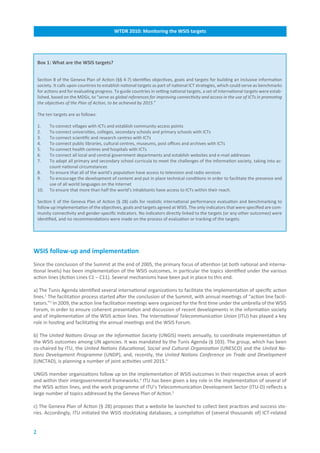
1.    To connect villages with ICTs and establish community access points
2.    To connect universities, colleges, secondary schools and primary schools with ICTs
3.    To connect scientific and research centres with ICTs
4.    To connect public libraries, cultural centres, museums, post offices and archives
      with ICTs
5.    To connect health centres and hospitals with ICTs
6.    To connect all local and central government departments and establish websites
      and e-mail addresses                                                                  At the midpoint
7.    To adapt all primary and secondary school curricula to meet the challenges of the     between 2005 and
      information society, taking into account national circumstances                       2015, WTDR 2010
8.    To ensure that all of the world’s population have access to television and radio
                                                                                            reviews progress
      services
9.    To encourage the development of content and put in place technical conditions in      towards the WSIS
      order to facilitate the presence and use of all world languages on the Internet       targets
10.   To ensure that more than half the world’s inhabitants have access to ICTs within
      their reach

The year 2010 marks the midpoint between the Tunis phase of WSIS (2005) and the
deadline for achieving the WSIS targets (2015), in line with the target date of the Mil-
lennium Development Goals (MDGs). This World Telecommunication/ICT Development
Report presents a mid-term review of the progress made towards achieving the ten
WSIS targets. The overall objective of the report is to provide policy-makers with a com-
prehensive assessment of the WSIS targets to date and, based on the findings, make
suggestions on the types of policy measures required to meet them. The report also
highlights the need for formal monitoring of progress towards achieving the WSIS tar-
gets. Currently, there are no agreed indicators for the targets which countries could use
for monitoring purposes.

The WSIS outcome documents make reference to quantitative review, monitoring and
evaluation of progress. The Geneva Plan of Action calls for the establishment of compa-

                                                                                                               xxi
WTDR.2010:.Monitoring.the.WSIS.targets


                       rable indicators, and the Tunis Agenda for the Information Society provides suggestions
                       related to the “periodic evaluation” of the WSIS outcomes. In particular, it acknowledg-
                       es the efforts of the Partnership on Measuring ICT for Development (hereinafter referred
                       to as the Partnership) to develop a core list of ICT indicators and to build statistical ca-
                       pability in developing countries in order to monitor their evolution towards becoming
                       information societies. It also requests the United Nations General Assembly to make an
                       overall review of the implementation of the WSIS outcomes in 2015.

Important develop-     Although some stakeholders, notably the members of the Partnership, have addressed
                       the important task of monitoring progress, the WSIS targets are very broad and cover
ments have occurred    areas which go beyond the Partnership’s core list and which are particularly challeng-
since WSIS, and the    ing to measure and compare internationally. The report reviews these challenges and
Internet has become    proposes quantitative indicators for monitoring the targets, along the lines of the inter-
a general-purpose      nationally agreed indicators used for tracking the MDGs.
technology like
                       The report also takes into consideration important ICT developments that have occurred
electricity            since the Geneva phase of the Summit, which were not anticipated at the time of WSIS.
                       The most striking example is the rise of mobile telephony and related applications. On
                       the technology side, the launch of new standards in the mobile sector, the convergence
                       of technologies and the steady increase in high-speed communication infrastructure
                       have significantly altered the way ICTs are accessed and used. The emergence of Web
                       2.0 and user-created content on the Internet are shaping today’s information society
                       developments.

                       It is widely recognized that ICTs are increasingly important for economic and social de-
                       velopment. Indeed, today the Internet is considered as a general-purpose technology
                       and access to broadband is regarded as a basic infrastructure, in the same way as elec-
                       tricity or roads. In some countries, such as Estonia, Finland and France, access to the
                       Internet is a fundamental human right for their citizens. Such developments need to be
                       taken into consideration when reviewing the WSIS targets and their achievement, and
                       appropriate adjustments to the targets need to be made, especially to include broad-
                       band Internet.

                       In view of the broad range of subjects covered by the WSIS outcome documents and the
WTDR 2010 is a         targets, the report has been drafted in close collaboration with other UN agencies and
collaborative effort   stakeholders, in particular the UNESCO Institute for Statistics (Targets 2 and 7), the UN
among UN agencies      Department of Social and Economic Affairs (Target 6) and the World Health Organization
                       (Target 5). Representatives from civil society provided substantive inputs to the chapter
                       covering Target 9.

                       The report is based on the latest available data. While some data are collected at the
                       international level, notably by ITU, UNESCO and UNDESA, overall data availability relat-
                       ing to the WSIS targets is poor. To complement these data sources, a survey was carried
                       out by ITU among its Member States, between September and November 2009. The
                       information provided by countries is featured throughout the report.

                       The following sections summarize the main findings and conclusions for each of the ten
                       targets.


xxii
Executive.summary


Target.1:.Connect.villages.with.ICTs.and.establish.community.ac-
cess.points
With no internationally agreed definition of what constitutes a “village,” and given the
lack of data on the number of villages by country, Target 1 measures ICTs in rural and
remote areas. This is consistent with the fundamental intent of Target 1, which was for-
mulated to ensure that people living in rural areas are not excluded from the informa-
tion society. Rural areas stand to benefit from connectivity even more than others, on
                                                                                               Seventy-five per cent
account of their geographical situation and because ICTs have the potential to deliver         of the world’s rural
health, education and other services that might otherwise be less widely available. The        population is covered
target further recognizes the need to ensure the availability of public Internet access.       by a mobile cellular
                                                                                               signal
Mobile technology is currently the most widely diffused ICT, and available data suggest
that by the end of 2008 almost three-quarters of the world’s rural inhabitants were cov-
ered by a mobile cellular signal, up from 40 per cent in 2003. The lowest coverage is in
Africa, where just over 50 per cent of the rural population is within reach of a mobile cel-
lular network. This still represents a significant improvement from 2003, however, when
coverage stood at only 20 per cent. Complete mobile coverage of all rural areas worldwide
by 2015, or even earlier, should become a clear policy target and would appear achievable
with the right policy emphasis. Countries also need to take advantage of wireless tech-
nologies to deliver high-speed Internet access and launch 3G networks, where they are
not yet available. To this end, policy-makers also need to monitor the percentage of the
population within reach of a 3G mobile cellular signal.
                                                                                               In many developing
Data on the proportion of households with a fixed and/or mobile telephone show that            countries, more than
rural households in developing countries rely predominantly on mobile telephony. The           half of rural house-
proportion of rural households with a mobile telephone has reached, or now exceeds,            holds have a mobile
50 per cent in many developing countries. In comparison, fixed (wired) telephone pen-
etration in rural households is much lower, and even non-existent in some areas.
                                                                                               telephone, but very
                                                                                               few have Internet
In contrast to the diffusion of mobile technologies, the report finds that many rural          access
households are still deprived of basic access to the Internet. A lack of electricity and the
high price of computers and Internet are major barriers in developing countries. Un-
surprisingly, broadband Internet penetration levels in rural households are even lower.

Where rural household Internet access is very low, community access points are critical
for bringing people online. Indeed, a growing number of developing countries are mov-
ing ahead with the installation of public Internet access facilities in rural areas, often
financed through universal access contributions or licence conditions. Existing data sug-
gest that, in many developing countries, people in rural areas use the Internet in public
locations. This is especially true in Latin America, where considerable policy emphasis
has been placed on setting up public Internet access centres. Nevertheless, the low pro-
                                                                                           More public Internet
portion of Internet users in developing countries (even lower in rural areas) suggests access facilities are
that much remains to be done to bring Internet to rural communities.                       necessary in order to
                                                                                               bring more people
There are a number of strategies and policies that governments should pursue so as to online
increase Internet and broadband access and usage in rural areas. These include inten-
sifying competition in all ICT markets, adapting universal access and service policies in
order to integrate the delivery of ICTs to rural areas, and fostering wireless broadband
access. Given the low number of Internet users in many developing countries, govern-
ments need to adopt the appropriate policies and provide the necessary resources
to encourage the establishment of sufficient public Internet access points, preferably
equipped with broadband technology, especially in rural areas. With increasing incomes
— and the availability of electricity — people will opt for the convenience of using ICTs
at home. Therefore, as household Internet access goes up, community access is likely to
go down. Policy-makers need to keep this relationship in mind and policies to promote


                                                                                                                xxiii
WTDR.2010:.Monitoring.the.WSIS.targets


                           public access need to move in tandem with facilitating home ICT access. As incomes rise,
                           the emphasis should shift from public towards household access.


                           Target.2:.Connect.universities,.colleges,.secondary.schools.and.
                           primary.schools.with.ICTs
                           Target 2 recognizes the multiple benefits of providing access to ICT infrastructure within
Too many schools in        education systems. ICT connectivity in schools provides students with new resources
developing countries       and pedagogical tools, allows them to acquire the skills required for the information so-
have no Internet           ciety, improves administrative processes and supports teacher training. Outside school
access                     hours, connected schools can provide access to ICTs for the community, including mar-
                           ginalized groups.

                           The target must address newer and older ICTs, both of which hold effective potential for
                           delivering educational content. Older (broadcasting) technologies, such as radio and TV,
                           may complement newer technologies, including the Internet and computers. For some
                           schools, they are the only relevant alternative if newer ICTs are not available, or afforda-
                           ble. Since it is assumed that higher-education institutions are largely connected to basic
                           ICTs, and Internet access in universities is covered by Target 3, the report proposes that
                           Target 2 focus solely on monitoring ICT connectivity in primary and secondary schools.

                      In terms of e-education technologies, Internet access in schools is the most widely
                      tracked indicator and often the subject of policy discussion and goals, suggesting that
Students in developed policy-makers attach great importance to it. In the main, in 2010 schools in developed
countries have access countries are connected to the Internet, and usually through high-speed broadband net-
to more computers     works, which offer the greatest potential for delivering innovative and useful applica-
                      tions and services. A number of developing countries have initiated projects to bring
                      ICTs to schools, have set clear targets and have achieved high levels of Internet and
                      even broadband penetration. Overall, though, Internet penetration levels in developing
                      countries are still low, and many schools remain deprived of any form of Internet access.
                      Unless many more governments take far-reaching policy decisions soon, it is unlikely
                      that all schools will be connected to the Internet by 2015, let alone through high-speed
                      networks.

                           Existing data on the learner-to-computer ratio show that there are important variations
                           across countries, with relatively more computers for fewer students in most developed
                           economies and less favourable ratios in the developing world. Many students today do
                           not have access to a computer at all.

                           In view of the very limited availability of newer ICTs in many developing countries, older
                           ICTs represent an important alternative. The availability and use of TVs and radios for
Governments need to        educational purposes in schools vary between developed and developing countries, but
set clear targets and      also within each group, suggesting that policies and objectives depend very much on
ensure that in the         national circumstances and priorities. Whereas in some countries, especially developing
long term schools are      countries, all schools use radios and TVs for educational purposes, penetration levels
online, at high speed      are very low in others. Although penetration levels for TV and radio are fairly similar,
                           TV-assisted instruction tends to dominate in a number of countries.

                           Data further suggest that, for a number of countries, broadcasting technologies are a
                           relevant alternative only if newer technologies are not available or affordable. Bringing
                           radios and TVs into schools could therefore be considered as a short- to medium-term
                           target that should ultimately be complemented by Internet access.

                           Besides identifying the most appropriate strategies to equip schools with ICTs, policy-
                           makers need to set clear targets and implement the necessary policies to ensure that,


xxiv
Executive.summary


in the long term, all primary and secondary schools are online, at high speed, and that
students have access to computers at schools.


Target.3:.Connect.scientific.and.research.centres.with.ICTs
Universities and research centres have been closely related to the Internet since its in-
ception. In some developing countries, the major universities or the academic network       Most research insti-
even acted as the first Internet service provider (ISP). Today, they continue to pioneer    tutes and universi-
advances in ICTs in network infrastructure, services and applications, including the latest
                                                                                            ties have access to
developments in grid and cloud computing. Most research centres and universities are
connected to the Internet, often with a broadband connection.                               the Internet, often
                                                                                            through a broadband
It is also important to connect scientific and research centres and universities to nation- connection
al research and educational networks (NRENs), defined as specialized ISPs dedicated to
supporting the needs of the research and education community. These NRENs not only
help to further knowledge and facilitate scientific discoveries — they can also help build
human capital and promote economic development. Many universities and research
institutes are connected to the NREN, where one exists. By early 2010, around 62 per
cent of countries had an NREN, ranging from 100 and 88 per cent of countries in the CIS
and Europe, respectively, to 33 per cent of countries in Africa.

When connected to international research networks, NRENs can also contribute to pro-
moting international collaboration and enabling positive research and development spill
overs. NRENs can also facilitate the expansion of Internet access to local populations, for
example by providing Internet access to students.                                           By 2010, around
                                                                                              62 per cent of coun-
Besides providing access to the Internet, NRENs administer and support high-speed
backbone networks employed by research projects. Data for European NRENs show sig- tries had a national
nificant growth in the bandwidth available to research networks, and between 2002 and research and educa-
2008 the bandwidth of NRENs in 44 countries increased from less than 20 000 to close tional network
to 200 000 Mbit/s. Over the same period, the number of countries with NRENs with
more than 10 Gigabits of bandwidth increased from just one to 14. While an increasing
number of NRENs are operating at Gigabit capacity, existing data suggest that the avail-
able network bandwidth varies greatly between countries, and NRENs in a number of
developing countries, in particular, are still restricted to only a few Megabits of capacity.

NRENs are increasingly interconnected and the number of international research net-
works is growing. While all regions enjoy at least some of the benefits of these ad-
vanced research and education networks, there is a need to interconnect regional
networks of NRENs still further and to establish these networks in countries where
they do not yet exist. It is important to ensure that developing countries, including
the least developed countries, can also benefit by participating in and contributing to
the pioneering developments in scientific and academic research that characterize the
information society.
                                                                                              Today, the band-
In order to promote the expansion of the NREN, and to include as many institutions as         width of countries’
possible (universities and research centres, but also government departments, schools,        national research and
hospitals, libraries and archives), governments must work with NRENs to ensure that
                                                                                              educational networks
they are fully embedded within the national innovation system and that they serve the
needs of the local research community. Governments could consider conducting consul-          ranges from just a
tations with NREN stakeholders in order to review challenges and bottlenecks to boost-        few Megabits to over
ing network deployment and connectivity. National policies should focus on the roll-out       10 Gigabits
and growth of NRENs in developing countries, and enhance their bandwidth capacities.
Governments should also consider prioritizing the research institutes to be connected to
the NREN, based on their size and the types of research performed. In addition, NRENs


                                                                                                                xxv
WTDR.2010:.Monitoring.the.WSIS.targets


                         should explore partnerships with other regional and global networks, and could negoti-
                         ate public-private partnerships with existing telecommunication operators.


                         Target.4:.Connect.public.libraries,.cultural.centres,.museums,.
                         post.offices.and.archives.with.ICTs
                         While the institutions covered by Target 4 are similar to the extent that they are all
                         highly knowledge- and information-intensive, they are also quite different, notably in
                         terms of the specific purpose they serve and the role they can play in providing Internet
                         access or online content. Indeed, the objective of connecting these institutions can be
In developed coun-       twofold: providing public Internet access (in libraries, cultural centres and post offices),
tries, most libraries,   and developing local content in local languages and preserving cultural heritage (nota-
museums and ar-          bly through libraries, museums and archives).
chives are connected
                         Internet access in the institutions covered by this target is highest in developed coun-
to the Internet, often   tries. The potential for improvement is greatest in developing countries, where much
at broadband speeds,     more needs to be done if all institutions are to have access to the Internet by 2015,
but not yet in devel-    especially for those located outside urban areas. At the same time, providing public
oping countries          Internet access is most relevant in developing countries, since in the developed world
                         more people have access to the Internet at home, at work or at school.

                         Libraries, post offices and — in certain cases — cultural centres are ideal locations for
                         providing public Internet access to the community. They already have an existing infra-
                         structure with a network of branches, and are open to the public, which means they
                         may reach a population that does not have access to the Internet at home or at work.

                         Libraries, museums and archives share the potential to provide online content. They
                         each host treasures of local content which should be digitized and made available online
                         so as to promote cultural diversity and provide wider access to the world’s cultural herit-
                         age for researchers and the general public. In most developed countries, these institu-
                         tions are present on the Internet, although the available online information needs to be
                         expanded. Some of the major institutions in developing countries also have a website,
                         although generally without as much accessible information. Therefore, one of the main
More should be done      challenges is to bring more institutions in developing countries online and to encourage
                         them to use the Internet to offer digitized content. Unfortunately, many developing
to encourage pub-
                         countries lack the resources for an information technology budget, and a broadband
lic Internet access      Internet connection is not always available or affordable.
through libraries and
post offices, espe-      With the right policy focus, Target 4 could be attained by 2015, even if there is still some
cially in areas where    way to go, especially in developing countries. There are many initiatives under way to
                         connect libraries, museums, post offices, cultural centres and archives, and the cost of
household Internet
                         connecting them is relatively low, especially relative to the potential benefits. Indeed,
penetration remains      there are relatively fewer of these institutions than, for example, households or schools,
low                      thus increasing the feasibility of reaching the target. Governments could look to sup-
                         plementary sources of funding, including the private sector, development agencies and
                         philanthropy organizations. Combining private funds with public resources could help to
                         connect these institutions and enable them to create websites.


xxvi
Executive.summary


Target.5:.Connect.health.centres.and.hospitals.with.ICTs
The health sector stands to benefit greatly from the use of ICTs and ICT applications, for
example through the more efficient delivery of healthcare services and the provision
                                                                                   Besides establishing
of health information to the general public. The use of ICTs in the health sector also
                                                                                   basic Internet access,
improves the collection, storage, retrieval and transmission of individual patient infor-
                                                                                   health institutions are
mation. Furthermore, given the soaring use of mobile technologies worldwide, m-health
                                                                                   starting to increase
(which refers to medical and public-health practices supported by mobile devices) holds
                                                                                   their use of ICTs, for
huge promise for improving the delivery of health services to an increasing share of the
world’s population. Thus, ICTs have the potential to contribute to more effective deliv-
                                                                                   example by introduc-
ery of health services and to increase the efficiency of health systems.
                                                                                   ing electronic patient
By the end of 2009, some progress had been made in establishing basic Internet ac- records
cess in health institutions, including in developing countries, but much more needs to
be done if all health institutions are to enjoy Internet access by 2015. It is likely that
progress will initially be made in the major cities of developing countries, and less so in
the remote and isolated regions, even though ICTs can potentially bring even greater
benefits in remote geographical areas.

In addition to growing access to the Internet, health institutions are increasingly using
ICTs for their own ends, for example through the connection of health institutions to
HINARI (an online initiative to provide access to health research). While most countries
have introduced some form of electronic patient records, in low-income countries this
facility is not yet used intensively, and most patient records are still kept primarily in
paper format.
                                                                                              M-health has great
Over 75 per cent of countries report at least one m-health initiative. This is an area        potential for growth,
which has great potential for further growth, especially in the developing world. M-          and for delivering
health or other applications, including telemedicine, can deliver healthcare services at      innovative health ap-
a distance, by providing and exchanging information for diagnosis, treatment and pre-
                                                                                              plications
vention of diseases and injuries. They can also promote research and evaluation, and
helping in the education of healthcare providers. Governments in developing countries
should therefore ensure the effective implementation of such initiatives.

Governments need to recognize the importance of ICT access and use in the health sec-
tor, and the benefits it will bring for the health of citizens, not to mention the potential
for cost savings, including through increased efficiencies. Policy-makers need to put in
place and implement enabling framework conditions for e-health, which will be critical
for increasing ICT in the health sector. Government support needs to be reflected in the
policy environment as well as the funding environment. Today, funding constitutes an
important barrier to the spread of e-health. Governments can look to alternative fund-
ing sources, such as donor or private funds, as well as public-private partnerships, in
order to complement public funding used for providing Internet access to health institu- Substantial efforts
tions and supporting the use of ICTs for the delivery of health services.                    are required if
                                                                                              Target 5 is to be
Interministerial cooperation is also crucial in the area of e-health. Any significant ICT     achieved by 2015, in-
initiatives in the e-health domain will need to be agreed on and governed by several          cluding interministe-
ministries, usually those in charge of health, ICTs and finance. The successful develop-
ment and implementation of e-health projects requires a common understanding by all           rial cooperation and
parties of some of the key issues, including the strategic approach and goals, costs and      adequate funding
financing mechanisms.


                                                                                                               xxvii
WTDR.2010:.Monitoring.the.WSIS.targets


                          Target.6:.Connect.all.local.and.central.government.departments.
                          and.establish.websites.and.e-mail.addresses
                          The use of ICT in government — referred to as e-government — can be key to achieving
                          specific social and economic development goals. Governments are increasingly recog-
Today, almost all         nizing the role ICTs can play in promoting effective and speedy solutions for develop-
                          ment through the delivery of public services. E-government can contribute effectively
central governments
                          to creating an enabling environment for development, by enhancing transparency and
have a web presence       accountability and promoting good governance in the public sector. As such, e-govern-
and provide at least      ment is a major tool for public-sector reform towards better governance, which is one
basic information to      of the objectives of the United Nations Millennium Declaration.
their citizens, includ-
                          Many countries have been reforming and modernizing their public-sector systems. This
ing in the developing
                          involves putting in place ICT infrastructure and promoting the use of ICTs to maximize
world                     impact and increase public-sector efficiency. Indeed, while investment in infrastructure
                          is necessary for the diffusion of ICTs, the impact will ultimately depend on the use that
                          is being made of them. Therefore, Target 6 also needs to address how governments use
                          ICTs to improve the provision of information and services to their citizens.

                          Some progress has been made in achieving Target 6. At the end of 2009, no fewer than
                          189 countries had a central government website and provided at least basic information
                          to their citizens, up from 173 in 2003. Also, in the majority of countries, government
                          ministries and departments had a web presence, suggesting that by 2015 this part of
                          the target will be achieved.

                          The government sector also plays an important role in making relevant applications and
In most developing        content available online. Some countries, especially developed countries, have started
countries, sophisti-      to provide more sophisticated interactive and transactional online services. In most de-
cated interactive and     veloping countries, however, such services are not yet provided online. By 2009, for
transactional online      example, only 21 (out of 192) countries worldwide offered tracking of (government-
services are not yet      provided) permits as an online service to their citizens. Much is therefore left to be done
                          to achieve this aspect of the target.
available
                          In developed countries, government institutions tend to have access to the Internet,
                          often through a broadband connection. Much less is known about Internet access for
                          government institutions in developing countries and in local government entities. In de-
                          veloping countries, a lack of resources — financial, human and infrastructure — is a
                          constraint for increasing access to the Internet.

                          It is also important to obtain more information about the use of ICTs within government
                          institutions, both in developed and developing countries, especially regarding the type
                          and quality of the connectivity, the extent of its diffusion (for example, what percent-
Most central govern-      age of staff in government institutions have access to the Internet), and the actual use
ment departments in       to which access to ICTs and the Internet is put. Indeed, little information is available on
developed countries       how ICTs are used, for example, for reforming and restructuring the interdepartmental
                          organization of different levels of government.
now have access to
the Internet, but less    In order to achieve the target on e-government by 2015, action needs to be taken at both
is known about the        the national and international levels. Specific recommendations include the formulation
situation in develop-     of a framework for an integrated e-government development strategy to exploit the
ing countries or in       synergies of new technologies in government departments and entities. Policy-makers
                          must ensure the deployment of infrastructure, in particular broadband, as well as the ef-
local governments         fective use of ICTs in government. Governments should also develop appropriate online
                          services which will attract users to utilize the Internet. By encouraging the development
                          of local content through partnerships with the private sector, development agencies,
                          non-governmental organizations and the academic and research sector, governments


xxviii
Executive.summary


can provide even more incentives for citizens to go online to access public services.
The dissemination of best practices and lessons learnt from experiences in effective e-
government and e-governance worldwide can inform such policies. Further recommen-
dations include the formal adoption of ICT-for-development and e-government plans,
continued follow-up on e-government development at the local level, and support for
e-government capacity building at the national and local level.


Target.7:.Adapt.all.primary.and.secondary.school.curricula.to.
meet.the.challenges.of.the.information.society,.taking.into.ac-
count.national.circumstances
Target 7 recognizes the need for countries to take active steps in investing in people and
their skills. It is the second target (besides Target 2) that focuses on schools, highlighting
the importance that education institutions have in enabling countries to effect the tran-
sition to information societies. It further implies that ICTs can be used to complement
                                                                                               Both developing and
conventional delivery mechanisms, so as to ensure quality and equal education oppor- developed countries
tunities for all, including traditionally underserved or marginalized groups.                  find it challenging
                                                                                              to train a sufficient
Addressing this target effectively means going beyond just connecting schools with ICT number of teachers
infrastructure and providing the human and physical resources necessary to adapt cur-
ricula. It needs to measure to what degree teachers are qualified to use and to teach
ICTs, since an adequate pool of skilled teachers is a prerequisite for adapting curricula to
meet the needs of the information society. The progress in achieving this target is also
analysed in terms of the adoption of computer- and Internet-assisted instruction.

The report finds that guaranteeing an adequate supply of trained teachers remains a
major challenge confronting many countries throughout both the developing and de-
veloped world. A number of developed and developing countries have taken concrete
steps to provide teachers with the necessary skills to teach and use ICTs. The percentage
of teachers who have ICT qualifications varies from zero to six per cent in countries with
available data.

Major discrepancies also exist in terms of the proportion of primary- and secondary-
school teachers trained to teach subjects using ICT facilities, with the proportion ranging
from zero in some countries to 100 per cent in others.

Similarly, where data are available on the different forms of ICT-assisted instruction, the
variation across countries is striking. Whereas in a number of countries an ICT-adapted
curriculum is present for all or a majority of primary and secondary schools, in many
developing countries only a small proportion of schools have effectively integrated ICTs
as part of the curriculum. Countries that have adopted full-scale implementation of
computer- and Internet-assisted instruction in their schools also have a relatively higher
proportion of trained teachers, whereas other countries show signs that they are still in More schools use
the early stages of implementation.
                                                                                          computers than the
The report also finds that, overall, the level of computer-assisted instruction is higher Internet to deliver
than the level of Internet-assisted instruction, suggesting that access to the Internet, educational content
which requires the availability of at least basic telecommunication/ICT infrastructure,
may be a barrier.

To adapt school curricula to meet the challenges of the information society, and hence
fulfil Target 7, policy imperatives must go beyond capital investments in ICT-related
infrastructure. It is essential that initiatives also develop ICT-skills building among the
teaching force, so that the knowledge can be passed down to students. While many
developing countries must continue to commit resources with a view to connecting edu-

                                                                                                                 xxix
WTDR.2010:.Monitoring.the.WSIS.targets


                          cational institutions to ICTs, policy-makers must at the same time address the challenges
                          of adapting curricula in primary and secondary schools to meet the demands of an ever-
                          changing society.


                          Target.8:.Ensure.that.all.of.the.world’s.population.have.access.to.
                          television.and.radio.services.
                          Target 8 specifically addresses the need to take advantage of broadcasting technologies
Today, the world’s
                          — often referred to as “older” or traditional ICTs — to help countries move towards the
surface is covered        information society. In addition to providing access to information and news, including
by terrestrial and/or     for illiterate segments of the population and in the case of emergencies, broadcasting
satellite radio and TV    services can also be employed for educational purposes. They complement printed me-
signals                   dia, and are particularly important in those countries and areas where Internet penetra-
                          tion levels are relatively low, or where the availability of online content in local lan-
                          guages is limited.

                          To monitor basic access to broadcasting services, it is important to go beyond the cover-
                          age of broadcasting signals, and to measure the availability of broadcasting devices (TVs
                          and radios). Furthermore, it is useful to track the availability of multichannel television
                          services, since these provide higher-quality services and more content, important fac-
                          tors for increasing demand for and leveraging the benefits of television services.

                          The report finds that Target 8 has largely been achieved in terms of access to broadcast-
                          ing signals, the entire world’s surface being covered by terrestrial and/or satellite radio
                          and TV. In terms of the devices that allow people to receive radio and TV services, access
                          is also widespread: the target has been achieved in the developed world, where almost
                          all households have access to a radio and TV, while in the developing world, a large pro-
A total of 1.4 billion    portion of households have access to a TV and/or a radio, although penetration rates
households — or five      vary among countries and regions.
billion people — have
                          TVs tend to be more popular and available than radios in many developing countries
a TV, half of them
                          and regions, except Africa. By the end of 2009, there were some 1.4 billion households
with multichannel         with a TV around the world, providing some five billion people access to a TV at home.
services                  This corresponds to a household TV penetration rate of 79 per cent, up from 73 per cent
                          in 2002. Europe, the Americas and the CIS all have household television penetration
                          rates exceeding 90 per cent, followed by the Arab States and Asia and the Pacific with
                          82 and 75 per cent, respectively. Africa stands out since, on average, only 28 per cent of
                          households possess a TV.

                          The delivery of multichannel television, including satellite, cable, IPTV and digital ter-
                          restrial TV, has spread rapidly over the last decade and, by 2008, close to 50 per cent
                          of households with a TV had multichannel services, compared to around 40 per cent in
                          2000.

                          Radios continue to play an important role in LDCs and in Africa, particularly in rural areas
The lack of electricity   where incomes tend to be relatively low and where electricity is limited. In LDCs, radios
and content are ma-       are also more prevalent than TVs: around a third of households on average have a TV,
jor barriers to over-     compared to two-thirds with a radio. These data suggest that in those countries more
coming the broad-         efforts need to be made to bring broadcasting services to all households, in particular
casting divide            in rural areas.

                          The report argues that the broadcasting digital divide is not a pure income divide. Al-
                          though income is without doubt an important factor, particularly in LDCs, the lack of
                          electricity and the lack of content are major barriers that governments need to tackle.
                          Policy-makers can also increase competition in the provision of content (for both TV and


xxx
Executive.summary


radio services), especially in countries with a limited number of broadcasters. Satellite
services offer the possibility for most developing countries to ensure nationwide broad-
casting coverage, and countries could take advantage of existing regional systems to
increase the availability of coverage and content. Increasing access to terrestrial digital
and multichannel TV, for example through government subsidies, is an important objec-
tive in the information society and another way of expanding on existing content.


Target.9:.Encourage.the.development.of.content.and.put.in.place.
technical.conditions.in.order.to.facilitate.the.presence.and.use.of.
all.world.languages.on.the.Internet
Most WSIS targets focus on providing Internet access to institutions and citizens. How-
ever, access is only part of the story. The true essence of the Internet is that it fosters      The persistent dig-
communication between humans (and with networked objects), and allows them to                    ital divide is at least
retrieve and exchange meaningful information. This implies that citizens need relevant           partly related to the
content, in their (local) language. The main objective of Target 9 is to ensure that the
                                                                                                 issue of languages
Internet serves people worldwide by offering the greatest possible diversity in terms of
content and languages.                                                                           and content on the
                                                                                                 Internet
Although discussions on the digital divide often focus on the availability of infrastruc-
ture, the lack of local content in local languages is critical: if there is nothing relevant
for people to find on the Internet, they have no reason to go online. Thus, greater avail-
ability of local content, in local languages, will encourage more people to use the Inter-
net. The development of user-friendly and affordable ICT applications targeted towards
citizens and local communities is critical for increasing Internet use and building an in-
clusive information society.

Until recently, progress on Target 9 has been held back by a number of technical details
with regard to the representation of different languages on the Internet, as well as the
                                                                                                 Even though English
idea that English can act as an Internet lingua franca. However, efforts are increasingly
being made not only to overcome technical barriers but also to encourage the produc-             is still the predomi-
tion of local content, in local languages. Producing more content in local languages is key      nant language on
to bringing more people online, especially since it is estimated that only 15 per cent of        the Internet, only an
the world population understands English. The proportion of English-speaking Internet            estimated 15 per cent
users is indeed declining, falling from 80 per cent in 1996 to around 30 per cent in 2007,
                                                                                                 of the world popula-
reflecting the fact that non-English speakers are increasingly going online.
                                                                                                 tion understands it
The WSIS process has made an important contribution by acknowledging the issue of
linguistic diversity and ensuring it has received higher priority on the global Internet-
related policy agenda in recent years. Some changes have already taken place, such as
the introduction of non-Latin script web addresses for domain names, reflecting the fact
that more than half of the 1.7 billion people who use the Internet today speak languages
with non-Latin scripts. This is likely to increase the demand for linguistic diversity on the
Internet, adding a bottom-up driver to the efforts made at the political level and in the
context of the WSIS process.
                                                                                                 The internation-
The number of initiatives to promote linguistic diversity is also rapidly increasing, and this   alization of domain
process can be expected to show some tangible results by 2015, with likely increases in          names is expected to
the number of languages that can be used on the Internet, the availability of local content,     increase demand for
and the number of language versions of the main software and applications used on the
Internet. However, it is difficult to determine precisely what drives the production of con-
                                                                                                 linguistic diversity on
tent and what incentives could be provided to stimulate the development of local content.        the Internet

Implementing Target 9 requires, for example, the development and implementation of
policies that promote diversity of cultural expression and indigenous knowledge and

                                                                                                                     xxxi
WTDR.2010:.Monitoring.the.WSIS.targets


                         traditions through the creation of varied information content. This requires, in turn,
                         the development of local content (including through the translation and adaptation of
                         existing content), digital archives and diverse forms of digital and traditional media, with
                         support from local authorities.

                         It is also important to nurture local capacity for the creation and distribution of software
                         in local languages. This calls for technologies and research in areas such as translation,
                         iconographies, and voice-assisted services; the required hardware and software mod-
                         els covering character sets, language codes, electronic dictionaries, terminology and
                         thesauri, multilingual search engines, machine-translation tools, internationalized do-
                         main names and content referencing; as well as general and application software which
                         should also be available in local languages.


Eighty-six per cent of   Target.10:.Ensure.that.more.than.half.the.world’s.inhabitants.
the world’s popula-      have.access.to.ICTs.within.their.reach
tion is covered by
                         Target 10 goes to the heart of all the WSIS targets, since the success of creating an infor-
a mobile cellular
                         mation society depends primarily on whether people have access to ICTs.
network
                         While the target sets a clear and quantifiable goal, i.e. “more than half the world’s in-
                         habitants,” it is vague in terms of the technologies or services concerned (“ICTs”). Two
                         key technologies which need to be covered are mobile cellular and Internet. Also, it is
                         important to monitor not only access to ICTs, but also their actual use. To reflect the
                         importance of the use of ICTs, the target could be amended to read “Ensure that more
                         than half the world’s inhabitants have access to ICTs within their reach and make use of
                         them.”

                         One of the most striking developments since the conclusion of the Summit, surpassing
By 2015, more than       all possible expectations, has been the rise of mobile telephony in all parts of the world.
half of world’s inhab-   Mobile cellular network coverage already stands at 86 per cent of the population, and is
itants are expected      likely to reach close to 100 per cent by 2015. This would translate into (potential) access
to be using a mobile     to telephone services for all people in the world.
phone                    The mid-term review reveals that, with respect to the number of mobile cellular sub-
                         scriptions, the target has been achieved. By the end of 2009, worldwide mobile cellular
                         penetration stood at 67 per cent, compared to 20 per cent in 2003, at the time of the
                         first phase of the Summit, when few foresaw the rapid take-up of mobile services. De-
                         veloping countries surpassed the 50 per cent penetration mark in 2008, and a number
                         of regions (Europe and CIS) have passed the 100 per cent penetration mark. These pen-
                         etration figures include double counts (because one person may have more than one
                         subscription or SIM card) and do not therefore equate exactly to the number of actual
                         users of mobile telephones. Recent data on the number of people who actually use a
By 2009, 1.7 billion     mobile phone show that most developed countries have already achieved Target 10 and
                         many developing countries are steadily approaching it. If countries manage to sustain
people — or 26 per       current growth rates, The target will be attained, with more than half of world’s inhabit-
cent of the world        ants expected to be using a mobile phone by 2015.
population — were
online and 25 per        It is not possible to talk about the information society without measuring how many peo-
cent of households       ple are using the Internet. By the end of 2009, some 1.7 billion people, or 26 per cent
                         of the world population, were online and global Internet user penetration has doubled
had access to the        between 2003 and 2009. While developed countries have achieved the target, with an
Internet                 estimated 64 per cent penetration rate at the end of 2009, less than 20 per cent of people
                         in the developing world were using the Internet. Data also show that in the majority of
                         countries still more men than women use the Internet. Major efforts are required to bring
                         half the world population — including half of the female population — online by 2015.


xxxii
Executive.summary


Target 10 specifies that ICTs should be “within reach.” The report therefore also examines
the availability of Internet access at home. Data show that at the end of 2008, some 25
per cent of households globally had Internet access. In the developed world, almost 60 per
cent of households had Internet, compared to only 12 per cent in the developing world.

The report finds that the broadband divide remains significant and while some countries
and regions of the world are going increasingly high-speed, others risk falling behind.
Whereas in the developed countries most households today enjoy a broadband connec-
tion, penetration levels in the developing countries remain much lower. By the end of
2009, the fixed (wired) broadband penetration rate of developing countries stood at only
3.5 per cent, up from around one per cent in 2003. While these figures refer to broadband
subscriptions rather than users (and one subscription is likely to benefit several users),
they are still a good indication of the long way left to go before reaching the target.

However, current developments in the mobile sector are expected to have a major im-
pact on wireless broadband access in the near future. Wireless broadband only started
                                                                                       While most people in
to take off after the conclusion of WSIS. While penetration rates are still as low as those
                                                                                       the developed world
for fixed (wired) broadband, especially in developing countries, an increasing number of
countries are offering 3G (and now even 4G) services, and the number of subscriptions  use a broadband
is expected to increase rapidly in the near future. Given the importance of high-speed Internet connection,
Internet access, the report proposes that Target 10 should aim at ensuring that more   the developing coun-
than half the world’s inhabitants have broadband Internet access by 2015.
                                                                                       tries are still far from
To achieve Target 10, governments need to take action on various fronts. This includes reaching the target
building the necessary infrastructure and providing public access; expanding skills; and
creating relevant and local content. On the infrastructure side, governments need to
exploit the potential of wireless broadband by expanding mobile network coverage, in-
cluding 3G coverage, to all segments of the population, and particularly to rural areas,
where fixed (wired) networks are limited. Governments can also encourage the uptake
and use of broadband networks by increasing competition to lower the cost of access,
and by providing public access for those portions of the population who cannot afford
home access. Increasing the use of ICTs also calls for appropriate policies to provide citi-
zens with ICT skills and to promote the development of locally relevant content. By cre-
ating an enabling environment for an inclusive information society, governments play a
key role in increasing ICT access and use.


Towards.2015
The assessment of each of the ten WSIS targets has shown that, since the Summit, the
area where most progress has been made is connecting people via mobile technolo-               Since WSIS, the great-
gies. Mobile cellular network coverage already stands at 86 per cent of the population,        est progress has been
and there is every chance it will rise to close to 100 per cent by 2015. Mobile cellular
telephony has grown sharply, and it looks very much like more than half of the world
                                                                                               made in connecting
population will be using a mobile telephone by 2015, thus fulfilling Target 10. Similarly,     people via mobile
basic radio and TV services are widely available, and could reach the majority of the          technologies, but
world population by 2015, provided electricity and broadcast content do not form a             three-quarters of the
barrier. Furthermore, global Internet user penetration has doubled between 2003 and            population are not
2009, and by the end of 2009 around one-quarter of the world population was online —
up from around 12 per cent in 2003. Good progress has also been made with respect to
                                                                                               yet on the Internet
bringing Internet access to central governments, research and scientific institutions and
to some extent schools, hospitals, museums, libraries and archives, at least in the major
cities of developing countries.

Despite these encouraging trends, by the end of 2009 three-quarters of the world popu-
lation (and more than 80 per cent of the developing countries’ population) were not


                                                                                                               xxxiii
WTDR.2010:.Monitoring.the.WSIS.targets


                         yet using the Internet, and even fewer via a broadband connection. In most developing
                         countries, households, schools, hospitals and other public institutions located outside
                         the major urban areas are not yet connected to (broadband) Internet. With five more
                         years to go to 2015, all stakeholders should step up efforts to bring high-speed Internet
                         to a larger number of people and institutions, especially in the developing world.

                         Turning.targets.into.actions

                         In view of the challenges highlighted, and to ensure that the WSIS targets and goals are
                         achieved by 2015, a concerted policy effort is needed on the part of all national, regional
                         and international stakeholders. It should also be remembered that, given the significant
                         impact that ICT use has on development in other economic and social areas, progress in
                         ICT development will also drive progress towards the attainment of other international
                         development goals, including the MDGs, also set for 2015. Policy action should focus on
                         three main areas:

                         1. Expanding.broadband.Internet.access. Affordable, high-speed Internet access is cen-
                         tral to the development of an information and knowledge-based society. Like the print-
                         ing press, electricity or the automobile, Internet is a technology that has far-reaching
                         impacts on society. Internet, and especially broadband Internet, is increasingly accepted
                         as a general-purpose technology that dramatically affects the way people communi-
Access to broadband      cate, do business, interact with governments and educate and inform themselves. This
Internet for half the    requires governments to pursue policies that will have a significant impact on Internet
world population by      usage, including an enhanced effort to deploy (fixed/wired and/or wireless) broadband
2015                     infrastructure and to include broadband in universal access plans. It might be possible
                         to reach the goal of providing broadband Internet access to at least half the population
                         by 2015 in view of the rapid spread of wireless broadband. Countries that have not yet
                         done so should launch 3G networks as soon as possible and take advantage of the op-
                         portunities that wireless broadband networks offer, in particular high-speed access to
                         the Internet. Developing countries need to seize the potential of wireless broadband
                         for stimulating competition in the Internet market and increasing access levels. This is
                         particularly relevant considering that fixed (wired) broadband options are extremely
                         limited in many developing nations.

                         2. Building.an.ICT-literate.society. In order to be used effectively, ICTs, particularly In-
                         ternet, require a basic level of ICT literacy. Furthermore, many people around the world
                         cannot use the Internet and its related applications (in areas such as health, education
ICT skills for ICT use   or government) because they are illiterate. This is tied to education, and learning op-
                         portunities must be universal if ICT use is to expand further. ICTs must be provided
                         in schools, and ICT-skills development should form part of the curriculum. In addition,
                         there are various segments of the population beyond school age who require ICT train-
                         ing. Policy-makers in developing countries, in partnership with the international com-
                         munity, should continue to commit resources to connecting education institutions to
                         ICTs and address the multifaceted challenges of adapting curricula in primary and sec-
                         ondary schools to meet the demands of an ever-changing society.

                         3. Developing.online.content.and.applications. Greater availability of local content, in
                         local languages, will drive more people to use the Internet. The development of user-
                         friendly and affordable ICT applications, geared to citizens and local communities, is
                         critical for increasing Internet use and building an inclusive information society. This
More online content      must include initiatives and applications in the areas of e-health, e-government and e-
in more languages        business. In order to make content accessible to local communities, language diversity is
                         of vital importance. Digitizing books, documents, exhibits and collections available in lo-
                         cal libraries, museums, archives and cultural institutions could dramatically increase the
                         availability of online content in local languages. Yet “e-culture” is often overlooked in
                         national ICT strategies. The digitization and online availability of existing content should
                         be a policy priority, and there are many best-practice examples that governments could

xxxiv
Executive.summary


follow. With more than half of the Internet users speaking languages with non-Latin
scripts, the recent opening up of Internet domain names to non-Latin script characters
is an important development that needs to be continued. This is likely to increase the
demand for content in local languages and can serve as an important driver from the
user side, to complement government-initiated projects.

Monitoring.progress

For each of the ten targets, the report has identified a set of measurable indicators,         In developed coun-
which could be used by countries in their monitoring efforts. The WSIS Mid-term Review         tries, most indica-
Table (at the end of the chapter “Conclusions and the way forward’) summarizes the             tors show a high
main results of the report, including proposed revisions to the targets to facilitate meas-    level of achievement,
urement, the most relevant action lines, and the indicators proposed to monitor each
of the targets. The table also provides an overall assessment of the status of the targets
                                                                                               whereas in develop-
and the indicators for which data were available. It shows that, whereas in developed          ing countries most
countries most indicators have a high level of achievement, this is not the case in de-        indicators still show
veloping countries, where only few indicators have reached a high level of achievement         low levels
and most indicators are still at a low level.

The phrasing of the existing targets is sometimes vague, making it problematical to in-
terpret the targets and select appropriate indicators. For measurement purposes, some
revisions to the wording are desirable, including the deletion or addition of components,
and the definition of more concrete targets. These suggestions may be found through-
out the report.

Some areas, although vital to the development of the information society, are not The WSIS targets
covered anywhere in the targets. The most critical of these is the use of ICTs in busi- need to be revised
ness, which is essential for participation in today’s knowledge-based economy and is
addressed in WSIS Action Line C7. The report therefore proposes that a new target be
added: “Connect all businesses with ICTs.” Indicators for measuring ICT use by busi-
nesses have been developed by the Partnership on Measuring ICT for Development and
are collected by an increasing number of countries. Other areas not addressed by the
targets are e-agriculture and e-environment, which are also included in Action Line C7;
building confidence and security (Action Line C5); and the ethical dimensions of the in-
formation society (Action Line C10). Progress in these areas should also be monitored,
and indicators defined to this end.

Limited data availability has constituted a major constraint in the preparation of this
mid-term review. Even the most basic indicators chosen are often not collected at the Governments and
national (or international) levels, or are outdated. It was therefore not possible to make international stake-
a comprehensive, global assessment of all targets.                                         holders need to
In the absence of data, it will be difficult to assess whether the WSIS goals and targets
                                                                                               collect data to moni-
are met by 2015. This is particularly alarming in the case of developing countries, where tor progress towards
ICT penetration levels are lower and which are lagging behind on several of the targets. 2015
There is therefore an urgent need for governments to collect the data required for mon-
itoring progress towards achieving the WSIS targets by 2015, and beyond.

The international community also needs to step in to assist countries in the measure-
ment process. The indicators presented in this report can serve as a starting point, but
they need to be further refined, and perhaps expanded, in consultation with the WSIS
community. As a follow-up to this report, it is therefore proposed that a monitoring
process be established under the framework of the Partnership on Measuring ICT for
Development, which has been tasked by the WSIS outcome documents, as well as by the
United Nations Economic and Social Council, to track progress towards the WSIS targets.
In close collaboration with relevant stakeholders, a final matrix for all targets and action
lines should be presented as soon as possible and disseminated widely in order to help

                                                                                                                xxxv
WTDR.2010:.Monitoring.the.WSIS.targets


countries in their monitoring efforts. Data should be compiled on a continuous basis and regular quantitative updates
of progress made on the goals should be prepared by the partners. A final report should then be prepared for 2015,
setting forth a global assessment of progress achieved in reaching the WSIS targets.


xxxvi
Introduction


Introduction


The World Summit on the Information Society (WSIS), held in Geneva (2003) and Tunis (2005), brought together gov-
ernments, civil society and the business sector to discuss a broad range of subjects related to information and com-
munication technology (ICT) for development. In the end, governments agreed on a set of commitments and actions
to foster the establishment of an inclusive information society. In particular, ten targets were identified in the Geneva
Plan of Action [ITU, 2005], along with numerous recommendations based on different action lines. The targets, to be
achieved by 2015, range from connecting villages, schools, health centres, libraries and government agencies to de-
veloping content, incorporating ICTs in school curricula and providing broadcasting services to all people in the world.
The action lines address issues related to — among others — ICT infrastructure, capacity building, cybersecurity, an
enabling policy environment and ICT applications in agriculture, education, business or the environment. The Tunis
Agenda for the Information Society [ITU, 2005] complemented the list by calling for increased financing of ICTs in the
developing world as well as continued discussion of Internet regulatory issues through the newly established Internet
Governance Forum (IGF).

In view of this broad range of topics and related programmes and policies to be implemented by national, regional
and international stakeholders, assessing progress made since WSIS is a challenging task. There are several mecha-
nisms and processes that endeavour to review implementation of the WSIS outcomes and commitments, which are
discussed further below. So far, none of them has produced a systematic overview of progress made in terms of
achieving the objectives, targets and goals of the Summit.

This World Telecommunication/ICT Development Report (WTDR) looks at the ten WSIS targets identified in the Ge-
neva Plan of Action (Box 1). The year 2010 marks the midpoint between the Tunis phase of WSIS (2005) and the
deadline for achieving the WSIS targets (2015), which is also the target date for the Millennium Development Goals
(MDGs). This report thus provides a mid-term review of the progress made towards achieving the ten WSIS targets.

No formal monitoring process was put in place by the Summit, and no global assessment of the targets has been
made to date. Similarly, there are no agreed indicators for all of the targets that countries could use for monitoring
purposes. While a core list of ICT indicators has been identified by the international community (Box 2), the WSIS
targets go far beyond these core indicators, covering subjects that are challenging to capture in quantitative terms,
let alone to compare at the international level.

This report fills this gap and sheds some light on the issue of monitoring and evaluating the WSIS outcomes. The
overall objective of this WTDR is to provide policy-makers with a comprehensive assessment of achievement of the
WSIS targets to date, identify the gaps to be filled by 2015 and, based on the findings, make suggestions on the type
of measures that could be taken in order to meet the targets within the time-frame.

Another goal of the report is to make policy-makers aware of the need to monitor information society targets, high-
lighting best international practices. The report also identifies specific quantitative indicators for tracking the targets,
along the lines of the internationally agreed indicators used for tracking the MDGs.

                                                                                                                          1
WTDR.2010:.Monitoring.the.WSIS.targets


    Box.1:.What.are.the.WSIS.targets?


    Section B of the Geneva Plan of Action (§§ 4-7) identifies objectives, goals and targets for building an inclusive information
    society. It calls upon countries to establish national targets as part of national ICT strategies, which could serve as benchmarks
    for actions and for evaluating progress. To guide countries in setting national targets, a set of international targets were estab-
    lished, based on the MDGs, to “serve as global references for improving connectivity and access in the use of ICTs in promoting
    the objectives of the Plan of Action, to be achieved by 2015.”

    The ten targets are as follows:

    1.    To connect villages with ICTs and establish community access points
    2.    To connect universities, colleges, secondary schools and primary schools with ICTs
    3.    To connect scientific and research centres with ICTs
    4.    To connect public libraries, cultural centres, museums, post offices and archives with ICTs
    5.    To connect health centres and hospitals with ICTs
    6.    To connect all local and central government departments and establish websites and e-mail addresses
    7.    To adapt all primary and secondary school curricula to meet the challenges of the information society, taking into ac-
          count national circumstances
    8.    To ensure that all of the world’s population have access to television and radio services
    9.    To encourage the development of content and put in place technical conditions in order to facilitate the presence and
          use of all world languages on the Internet
    10.   To ensure that more than half the world’s inhabitants have access to ICTs within their reach.

    Section E of the Geneva Plan of Action (§ 28) calls for realistic international performance evaluation and benchmarking to
    follow up implementation of the objectives, goals and targets agreed at WSIS. The only indicators that were specified are com-
    munity connectivity and gender-specific indicators. No indicators directly linked to the targets (or any other outcomes) were
    identified, and no recommendations were made on the process of evaluation or tracking of the targets.


WSIS.follow-up.and.implementation
Since the conclusion of the Summit at the end of 2005, the primary focus of attention (at both national and interna-
tional levels) has been implementation of the WSIS outcomes, in particular the topics identified under the various
action lines (Action Lines C1 – C11). Several mechanisms have been put in place to this end.

a) The Tunis Agenda identified several international organizations to facilitate the implementation of specific action
lines.1 The facilitation process started after the conclusion of the Summit, with annual meetings of “action line facili-
tators.”2 In 2009, the action line facilitation meetings were organized for the first time under the umbrella of the WSIS
Forum, in order to ensure coherent presentation and discussion of recent developments in the information society
and of implementation of the WSIS action lines. The International Telecommunication Union (ITU) has played a key
role in hosting and facilitating the annual meetings and the WSIS Forum.

b) The United Nations Group on the Information Society (UNGIS) meets annually, to coordinate implementation of
the WSIS outcomes among UN agencies. It was mandated by the Tunis Agenda (§ 103). The group, which has been
co-chaired by ITU, the United Nations Educational, Social and Cultural Organization (UNESCO) and the United Na-
tions Development Programme (UNDP), and, recently, the United Nations Conference on Trade and Development
(UNCTAD), is planning a number of joint activities until 2015.3

UNGIS member organizations follow up on the implementation of WSIS outcomes in their respective areas of work
and within their intergovernmental frameworks.4 ITU has been given a key role in the implementation of several of
the WSIS action lines, and the work programme of ITU’s Telecommunication Development Sector (ITU-D) reflects a
large number of topics addressed by the Geneva Plan of Action.5

c) The Geneva Plan of Action (§ 28) proposes that a website be launched to collect best practices and success sto-
ries. Accordingly, ITU initiated the WSIS stocktaking databases, a compilation of (several thousands of) ICT-related


2
Introduction


activities and projects carried out by governments, international organizations, civil society and businesses. The Tunis
Agenda encouraged the continuation of the ITU stocktaking database (§ 120), which was updated in 2008, the next
edition being planned for 2010.6

d) A formal follow-up of the WSIS outcomes was mandated, to be overseen by the UN Economic and Social Council
(ECOSOC) (Tunis Agenda, § 105). At its 2006 session, ECOSOC instructed the UN Commission on Science and Technol-
ogy for Development (CSTD) to be “the focal point in the system-wide follow-up, in particular in the review and assess-
ment of progress made in implementing the outcomes of the Summit.”7 Since then, CSTD has reviewed progress at its
annual sessions, and it gathers contributions from international organizations for the UN Secretary-General’s annual
Report on WSIS implementation and follow-up.8


WSIS.monitoring.and.evaluation
The above-mentioned post-WSIS mechanisms illustrate that the international community is deploying great efforts
to advance the development of the information society by implementing and facilitating relevant policies and pro-
grammes. While there are several reporting mechanisms in place, they are primarily qualitative in nature, such as
reviewing progress in the implementation of action lines, or collecting country and case studies and information
on ongoing projects. Little attention has been paid to quantitative assessment or review of achievements based on
comparable cross-country, statistical indicators. Yet policy implementation requires that results be monitored, so as
to assess whether the policies have been successful.

A number of provisions of the WSIS outcome documents address the subject of quantitatively reviewing, monitoring
and evaluating progress:

The Geneva Plan of Action (§ 28) calls for the establishment of comparable indicators, including community connec-
tivity and gender-specific indicators; the regular publication of a composite index; monitoring of the digital divide;
and the assessment of universal accessibility to ICTs.

The Tunis Agenda takes this a step further by providing a set of suggestions related to the “periodic evaluation” of
the WSIS outcomes (§§ 112-120). In particular, it acknowledges the work of the Partnership on Measuring ICT for
Development (Box 2) in developing a core list of indicators and building statistical capacity in developing countries
for monitoring their information societies. The Tunis Agenda also requests the UN General Assembly to conduct an
overall review of implementation of the WSIS outcomes in 2015.

Although some stakeholders (notably the members of the Partnership) have actively addressed the important issue
of measurement, only a few countries have carried out a regular evaluation of progress made in their information
societies. While some basic ICT data are widely available (for example, the number of fixed telephone lines, radios,
TVs, mobile subscriptions), more is needed to assess the WSIS goals and targets, as well as the implementation of
action lines.

The WSIS targets are not only very broad, but also do not include measurable indicators, which makes monitoring
something of a challenging proposition and international comparisons almost impossible. For example, six of the
targets refer to “connecting” villages, schools, governments, and so forth with ICTs, without however specifying what
is meant by “connectivity with ICTs” (e.g. telephone, Internet, computer, …), who should be connected (e.g. teachers,
students, …) and what the connectivity should achieve (e.g. increased knowledge, transparency, health, productivity
and/or efficiency, …). While the most basic connection could be a telephone connection, in today’s world Internet —
and preferably broadband — is often viewed as the most important type of connection worldwide, in particular with
reference to the information society.

To address these challenges, this report interprets the targets, by defining some of the terminology used, and pro-
poses a number of indicators for benchmarking that could be collected by countries before 2015, when a final evalu-
ation should be made. Besides access to ICTs (“connectivity” in the simplest meaning of the term), in order to maxi-
mize their impact it is critical that ICTs be actually used in practice by various stakeholders (people, public and private
institutions). Therefore, for several of the targets, the report proposes ICT usage indicators, plus indicators related
to content and applications.


                                                                                                                         3
WTDR.2010:.Monitoring.the.WSIS.targets


    Box.2:.The.Partnership on Measuring ICT for Development.and.WSIS9.


    Following the Geneva Summit in December 2003, the Partnership on Measuring ICT for Development (hereinafter the Partner-
    ship) was launched at UNCTAD XI (held in Brazil) in June 2004. Its members, at that time, were the three founding members
    (UNCTAD, ITU and OECD); the UNESCO Institute for Statistics (UIS); four UN Regional Commissions (UNECLAC; UNESCWA;
    UNESCAP; and UNECA); the UN ICT Task Force (whose mandate expired at the end of 2005); and the World Bank. Eurostat of-
    ficially joined the Partnership in February 2005 and the UN Department of Economic and Social Affairs (UNDESA) in May 2009.

    During the initial phase of the Partnership, emphasis was placed on building awareness at the national and international levels
    of the importance of ICT measurement for policy-making, and on developing agreed standards and methodologies to enhance
    the production of internationally comparable ICT statistics. The Partnership was an active contributor to the WSIS Tunis pre-
    paratory meetings and the Summit itself. This included the organization of a WSIS thematic meeting (February, 2005) resulting
    in the first core list of agreed ICT indicators; a series of regional ICT measurement events; and written inputs to the discussion
    and preparation of the WSIS outcome documents (Tunis Agenda). During the Tunis Summit, a parallel event was organized by
    the Partnership, to present the agreed core list of indicators to policy-makers, together with an accompanying methodologi-
    cal publication [Partnership, 2005a]; to debate the importance of measuring the information society for ICT policy-making
    and development; and to launch a publication providing an overview of the status and availability of ICT indicators worldwide
    [Partnership, 2005b].

    As a result of this work, the Tunis Agenda recognized the need for ICT measurement (§§ 112-119), and made specific refer-
    ence to the Partnership (§§ 114-115):

    “114. The development of ICT indicators is important for measuring the digital divide. We note the launch, in June 2004, of the
    Partnership on Measuring ICT for Development, and its efforts:

    a)    to develop a common set of core ICT indicators; to increase the availability of internationally comparable ICT statistics
          as well as to establish a mutually agreed framework for their elaboration, for further consideration and decision by the
          UN Statistical Commission;
    b)    to promote capacity building in developing countries for monitoring the information society;
    c)    to assess the current and potential impact of ICTs on development and poverty reduction;
    d)    to develop specific gender-disaggregated indicators to measure the digital divide in its various dimensions.

    115. We also note the launch of the ICT Opportunity Index and the Digital Opportunity Index, which will build upon the com-
    mon set of core ICT indicators as they were defined within the Partnership on Measuring ICT for Development.”

    Following the Tunis Summit, the core list of ICT indicators was further refined and presented to the UN Statistical Commis-
    sion (UNSC) in 2007 [Partnership, 2007], which endorsed the list and encouraged the Partnership to update it, especially with
    regard to measuring the use of ICT in education and in government — two areas that figure prominently in the WSIS targets;
    the contribution of ICT to economic growth and social development; and barriers to use of the technology. A revised core list
    was presented by the Partnership to UNSC in 2009, and published in 2010 [Partnership, 2010].

    Six years after its inception, the Partnership is recognized as a key international player in the area of ICT statistics. Members
    of the Partnership regularly report on progress made at meetings of the WSIS Forum, CSTD, UNGIS and action line facilitators,
    as well as at other events and conferences not directly related to WSIS.

    ITU has been an active member of the Partnership from the very beginning, and is part of its Steering Committee (along
    with UNCTAD and ECLAC). For more information about the Partnership and its activities, see http://www.itu.int/ict and
    http://measuring-ict.unctad.org.


Important ICT developments have taken place in recent years (especially since the Geneva phase of the Summit)
which were not anticipated at the time of WSIS. The most striking example is the rise of mobile telephony and its
associated applications. The emergence of Web 2.0 and user-created content on the Internet are also shaping to-
day’s development of the information society. On the technology side, the launch of new standards in the mobile
sector, the convergence of technologies (such as broadcasting and telecommunication) and the steady expansion of
high-speed communication infrastructure have significantly changed the way ICTs are accessed and used, and their
economic and socio-economic impact is ever increasing. Indeed, today the Internet is largely recognized as a general-
purpose technology, and broadband is regarded as a basic infrastructure, in the same way as electricity, water or


4
Introduction


roads. Many citizens even consider the Internet as a “fundamental human right,” and some countries have started to
put in place legislation stipulating that access to the Internet is a human right for their citizens.10 Such developments
need to be taken into consideration when reviewing the WSIS targets and their achievement, and appropriate adjust-
ments to the targets need to be made.


Methodology.for.preparing.the.report
Given the broad range of subjects covered by the WSIS outcome documents and the targets, this WTDR has been
drafted in close collaboration with other UN agencies and stakeholders, in particular UIS (Targets 2 and 7), the World
Health Organization (WHO) (Target 5) and UNDESA (Target 6). Representatives from civil society, especially the Net-
works and Development Foundation (FUNREDES), have provided substantive inputs to the chapter covering Target 9.

The data presented in this report are collected at the international level by ITU and the above-mentioned organiza-
tions. They have been supplemented by additional research on the indicators selected for each target. The report
presents a mid-term review based on the latest available data, which often relate to 2008, and only some to 2009. For
some targets (such as, for example, Target 9 on language diversity on the Internet, an area that is not likely to change
quickly), the most recent data may go back even further.

Since many of the WSIS targets stretch beyond the currently internationally available ICT data, a questionnaire was
sent to all ITU Member States between September and November 2009 (Box 3). This “Survey on the WSIS targets”
requested quantitative information on each of the ten targets. A total of 48 countries responded to the survey. The
information provided by countries is featured throughout the report.


    Box.3:.ITU.Survey.on.the.WSIS.targets


    With a view to preparing WTDR, ITU carried out a survey of its Member States in 2009. The survey requested quantitative in-
    formation on each of the ten WSIS targets, although questions on indicators already collected by ITU or by other international
    organizations through their regular data collection processes were not included.

    A total of 48 countries responded to the survey (see Annex 1 for a complete list of respondents), but not all countries replied
    to all questions on the different targets. An analysis of the results of the questionnaire shows that the number of replies per
    indicator varied between nine (on the “percentage of cultural centres with access to the Internet”) and 26 (on the “percent-
    age of public libraries and post offices with access to the Internet”). On average, each question elicited around 20 replies,
    which is only about ten per cent of all countries that received the questionnaire.

    This relatively low response rate points to a number of factors. First, it could be an indication that only a few countries are cur-
    rently tracking the WSIS targets, given that the Summit did not identify a concrete set of indicators, nor initiate a monitoring
    process. Second, it could mean that even if some of the data are available within a country, they are not compiled or central-
    ized within one government agency or ministry. This may be especially true insofar as the issues covered by WSIS span a very
    broad range of topics that are dealt with by different ministries and government agencies. Finally, and linked to the previous
    point, it should be borne in mind that the questionnaire was sent to ITU’s constituency, i.e. the telecommunication/ICT-
    related ministries and regulatory authorities. These institutions may not necessarily be aware of data collected by other gov-
    ernment entities. As a result, it is likely that data which might be available in some countries are not reflected in this report.


Ten.targets,.ten.chapters
The report features ten substantive chapters, each covering one of the WSIS targets. Each chapter includes:

•       A discussion of how the target could or should be interpreted, its context, rationale and expected impact, its
        relevance for development of the information society and its link to the WSIS action lines. In some cases, pro-
        posals are formulated for more precise definitions of the target, or revisions of the target’s wording.


                                                                                                                                           5
WTDR.2010:.Monitoring.the.WSIS.targets


•   Information on the availability of existing indicators and data that could be used to monitor the target, their
    advantages and shortcomings, as well as the difficulties in identifying and tracking certain indicators.

•   A concrete proposal for a limited number of quantitative indicators for monitoring the target, and the rationale
    behind them.

•   An overview of what has been achieved so far, with regional and global data and country examples, including
    success stories and best-practice policies.

•   An assessment of gaps, and what is being done to address them; a discussion of the likelihood of reaching the
    target by 2015; a set of policy recommendations and measures that could be implemented in order to meet the
    target by 2015.


6
Introduction


Notes
1
     See Annex to the Tunis Agenda for the Information Society [ITU, 2005].
2
     More information about the meetings of the action line facilitators is available at: http://www.itu.int/wsis/implementation/.
3
     For further information, see http://www.ungis.org/Default.aspx?tabid=620.
4
     For example, the ITU Council Working Group on WSIS (WG-WSIS) was created in 2002, and in November 2006 the ITU Plenipotentiary
     Conference requested WG-WSIS to facilitate membership input and guidance on ITU’s implementation of relevant WSIS outcomes and to
     elaborate proposals to the ITU Council that may be necessary for adapting ITU to its role in building the information society
     (http://www.itu.int/council/groups/wsis/).
5
     See ITU/BDT Doha Action Plan 2006 [ITU, 2006], § 3.2 (IV) on inclusion of the WSIS outcomes in the ITU-D activities (p. 5 and Annex 1), at:
     http://www.itu.int/ITU-D/conferences/wtdc/2006/pdf/dohaactionplan.pdf.
6
     http://www.itu.int/wsis/stocktaking/index.html.
7
     See ECOSOC Resolution 2006/46, available at: http://www.un.org/docs/ecosoc/documents/2006/resolutions/Resolution%202006-46.pdf.
8
     See http://www.unctad.org/Templates/Page.asp?intItemID=4239&lang=1 for further information on CSTD.
9
     For further information, see [Partnership, 2008] and http://www.itu.int/ITU-D/ict/partnership/index.html.
10
     Based on a survey of 27 000 adults in 26 countries carried out by BBC in 2010, around three-quarters of interviewees considered Internet
     access as a human right (see http://newsvote.bbc.co.uk/2/hi/technology/8548190.stm). Countries that have ruled that access to Internet
     is a human right for their citizens include Finland, France and Estonia.


                                                                                                                                              7
WTDR.2010:.Monitoring.the.WSIS.targets


References

International Telecommunication Union (2005), World Summit on the Information Society outcome documents,
      Geneva.
International Telecommunication Union (2006), Final Report, World Telecommunication Development Conference
      (WTDC-06), Geneva.
Partnership on Measuring ICT for Development (2005a), Core ICT Indicators, New York/Geneva.
Partnership on Measuring ICT for Development (2005b), Measuring ICT: The Global Status of ICT Indicators, New
     York/Geneva.
Partnership on Measuring ICT for Development (2007), “Report of the Partnership on Measuring Information and
     Communication Technologies for Development: information and communication technology statistics,” Re-
     port to the UN Statistical Commission, Thirty-eighth session,
     http://unstats.un.org/unsd/statcom/doc07/2007-5e-ICT.pdf.
Partnership on Measuring ICT for Development (2008), The Global Information Society: a Statistical View 2008,
     Santiago, Chile.
Partnership on Measuring ICT for Development (2010), Core ICT Indicators 2010, Geneva.


8
Target.1:.Connect.villages.with.ICTs.and.establish.community.access.points


Target.1:.Connect.villages.with.ICTs.and.
establish.community.access.points1

Introduction.

Although Target 1 does not explicitly mention “rural” populations, it is implicit from the use of the word “village”2
that the focus is on connecting people living in rural areas. In most countries, especially developing countries, there
is a large gap in the availability of information and communication technologies (ICTs) between urban and rural loca-
tions, and Target 1 is important for ensuring that rural areas are not excluded from the information society. Because
of their isolation, rural areas arguably stand to derive even more benefit from connectivity, since ICTs can deliver
health, education and other services that might be less widely available there.

There are two activities associated with this target: 1) connecting villages with ICTs, and 2) establishing community
access points. The second underpins the first, in that one of the most practical methods of providing ICTs in rural are-
as in many developing countries is through shared access. Given that incomes tend to be lower in rural locations com-
pared to urban areas, and many rural households simply cannot afford ICTs, shared access is a cost-effective means of
providing rural connectivity. The establishment of community access points is also related to Target 4 on connecting
public locations that can be used for shared access, such as libraries and post offices, and likewise to Target 10, which
sets the goal of ensuring that more than half the world’s inhabitants have access to ICTs within their reach. About
half of the world’s inhabitants live in rural areas, and one way of getting ICTs to them is through community access.

Insofar as the majority of the population in developed countries lives in urban areas and, moreover, rural areas in
those countries are in any case fairly well equipped in terms of connectivity (ITU estimates that 95 per cent of rural
areas in developed countries are covered by a mobile cellular network signal), the main focus of this chapter is neces-
sarily on developing nations. It does not, however, address exclusively developing countries, since even developed
nations still face some of the challenges of bringing ICTs to rural areas, particularly in terms of Internet and broad-
band access.

Target 1 is related to all the WSIS action lines, since connecting the places where people live with ICTs is one of the
most basic requirements for creating an information society. In some cases, there is a direct linkage:
                                                                                                                       9
WTDR.2010:.Monitoring.the.WSIS.targets


•      Action Line C2 (Information and communication infrastructure: an essential foundation for the information soci-
       ety) highlights that “infrastructure is central in achieving the goal of digital inclusion, enabling universal, sustain-
       able, ubiquitous and affordable access to ICTs by all, … to provide sustainable connectivity and access to remote
       and marginalized areas at national and regional levels.”3 This action line also calls on governments to provide
       ICT connectivity for schools, libraries, post offices, community centres and other institutions accessible to the
       public. This is directly related to the establishment of community access points, which is part of the target. The
       action line further calls for strengthening national broadband network infrastructure, which is critical for rolling
       out high-speed Internet access to rural areas. It also advocates national e-strategies to cater for disadvantaged
       and vulnerable groups, who are often found in rural areas, and refers to unused wireless capacity, including
       satellite, for providing access in remote areas.

•      Action Line C3 (Access to information and knowledge) is directly linked to Target 1 as it states that “Govern-
       ments, and other stakeholders, should establish sustainable multipurpose community public access points, pro-
       viding affordable or free-of-charge access for their citizens to the various communication resources, notably
       the Internet. These access points should, to the extent possible, have sufficient capacity to provide assistance to
       users, in libraries, educational institutions, public administrations, post offices or other public places, with special
       emphasis on rural and underserved areas....”4

•      Action Line C4 (Capacity building) is directly linked to Target 1, in that basic ICT literacy skills are essential for
       making use of the connectivity supplied to villages and via community access. Indeed, it explicitly refers to this
       potential: “Promote e-literacy skills for all... taking advantage of existing facilities such as libraries, multipurpose
       community centres, public access points”... It also calls for the empowerment of “local communities, especially
       those in rural and underserved areas, in ICT use and promote the production of useful and socially meaningful
       content for the benefit of all.”5

Another important issue is to ensure that once villages are connected with ICTs, they deliver relevant applications and
content for people in rural areas. The availability of relevant applications and content is addressed in Action Lines C7
(ICT applications) and C8 (Cultural diversity and identity, linguistic diversity and local content), as well as C9 (Media),
which makes reference to the need to reduce regional imbalances in infrastructure and to use “traditional media to
bridge the knowledge divide and to facilitate the flow of cultural content, particularly in rural areas.”6


Measuring.Target.1.—.Proposed.indicators7
Like other WSIS targets, Target 1 is vague in terms of the type of ICTs to which it refers. Five indicators are proposed
for measuring and tracking Target 1 (Table 1.1). Three of these will help track the availability of ICTs in rural areas,


    Table.1.1:.Indicators.for.measuring.Target.1

     Aspect..         Proposed.indicator                                                                Partnership core.
     measured                                                                                              indicator
     Rural            1. Percentage of rural population covered by a mobile cellular telephone net-           A7
     connectivity     work, broken down by technology (2G, 3G)
                      2. Proportion of rural households with a telephone, broken down by type of              HH3
                      network (fixed and/or mobile, mobile only, fixed only)
                      3. Proportion of rural households with Internet access, broken down by type             HH6
                      of access (narrowband, broadband)
     Community        4. Percentage of localities with public Internet access centres (PIACs), broken         A10
     connectivity     down by size of locality, or by urban/rural
                      5. Location of individual use of the Internet in the last 12 months                     HH8


10
Target.1:.Connect.villages.with.ICTs.and.establish.community.access.points


and two will serve specifically to track the prevalence and use of community access. All of these indicators are being
collected by ITU, directly from countries, under the Partnership on Measuring ICT for Development.8 They include
mobile cellular and Internet technologies, and cover both access to and use of these ICTs.

Measuring.rural.connectivity

As mentioned, “Connect villages with ICTs” is essentially aimed at rural areas. However, the use of the word villages
poses statistical challenges, since the term “village” is rarely used as a unit of measurement in national statistical
systems. When data are presented by administrative division, it is usually at the second administrative level (e.g.
region, province or state).

In order to measure this target based on villages, the number of villages would have to be determined. There is no
international standard defining what constitutes a village. Some countries report the number of localities broken
down by population size. However, such information is not widely available, and even if it were it does not solve the
problem of what size of locality should constitute a village. It would be logical to associate a village with a certain
population size considered as rural, but definitions vary widely. In many instances, other factors besides population
size are used to define “urban” and “rural,” such as administrative divisions or employment outside agriculture.9 In
the European Union, “rural” is not defined by the size of localities but by the population density (number of inhabit-
ants per km2).10

Apart from the methodological issue of what constitutes a village, not all countries publish the number of localities
they contain. In addition, factors such as migration, nomadic populations, civil war and resettlement also have an
impact on the ability to determine precisely where people live and how many localities there are in a country.11 Al-
though, in 2008, ITU did estimate the number of localities based on several proxy indicators (for example the number
of enumeration areas used by statistical offices for census and surveys), in order to track the availability of ICTs in
villages [ITU, 2008], it seems very difficult to track this information on a regular basis. Even for countries that publish
some information on the number of villages, there are large gaps in continuity and data are often only updated every
ten years, at the time of a census.

Another methodological challenge with Target 1 is that it refers to connectivity, which is a broad term. The target
does not specify which technology should be available in villages. Fixed-line telephony is the service for which data,
when available, have historically been gathered, and most universal service plans remain geared to the provision of
fixed telephone lines. Yet many countries do not produce data on the availability of fixed-line telephone service ac-
cording to size of community (of any magnitude, including cities) or population covered. Also, globally, the number
of fixed lines is stagnating and even decreasing in many countries, as fixed lines are increasingly replaced by mobile
telephony. It therefore does not seem appropriate to include an indicator for fixed lines to track Target 1.12

It would, however, be very useful to track Internet — and, specifically, broadband — access in villages, since these
are critical ICTs for full participation in the information society. Therefore the number of villages with Internet access
(broken down by urban/rural locality and narrowband/broadband access) is an important indicator. This is largely
covered by a very similar indicator, on public Internet access centres (PIACs), which will be discussed later in this
chapter, in the section on Measuring community connectivity.

If Target 1 cannot be tracked with “villages” as a denominator, it is analytically useful to present other indicators based
more broadly on rural areas, measuring for example rural access, coverage and use. Although these indicators may not
conform strictly to the letter of the target in terms of the exact wording (“villages”), they certainly convey information
that reflect its intent, which is to monitor ICT connectivity in rural areas. Furthermore, they are arguably more relevant,
since they cover popular technologies such as mobile cellular, and units of measurement directly related to universal
service (which refers to ICTs in households). Another major advantage is that indicators of rural access and coverage are
widely available, may be more comparable and feature historical data upon which to gauge trends. Finally, indicators
based on population coverage and households provide greater statistical reliability and are usually more up-to-date.

Today, mobile communications has become the most prevalent form of communications in almost every country in
the world. Mobile networks support voice communications as well as text messaging and Internet access (at increas-
ingly higher speeds, including broadband). Therefore, it is indispensable to factor in mobile networks in any analysis
of rural access to ICTs. Considering that a single mobile antenna may serve numerous localities depending on how
far they are apart, more localities enjoy mobile service than fixed telephone access. Although the availability of mo-

                                                                                                                        11
WTDR.2010:.Monitoring.the.WSIS.targets


bile coverage could be analysed by locality, this kind of data are not widely available. Instead, the common way of
expressing mobile coverage is in terms of population (or territory) within range of a signal. This indicator has been
adopted by the international statistical community as a core indicator: percentage of population covered by a mobile
cellular telephone network. The indicator refers to “the percentage of a country’s inhabitants that live within areas
served by a mobile cellular signal, irrespective of whether or not they choose to use it.”13 It therefore refers to the
theoretical ability to use mobile cellular services if a person has a cellular telephone and a subscription. It also refers
to terrestrial mobile coverage.14

National mobile population coverage figures are available for many countries and published by both regulators and
operators. Mobile population coverage could be dissected into urban and rural coverage, though data are not typi-
cally compiled in this manner. For the purposes of this report, the percentage of rural population covered by a mobile
cellular telephone network has been calculated on the assumption that at least all urban areas are covered, with any
remaining coverage assigned to rural areas.15

Another way of measuring rural ICT accessibility is at the household level. Household telephone penetration is the
basic measure of universal service and is an unambiguous measurement, since a household is a well-defined statisti-
cal concept and the maximum penetration level is 100 per cent. Household penetration is also useful for gauging how
theoretical access in localities or mobile coverage translate into practical ICT use.

A growing number of countries measure the availability of at least some ICTs in households. In addition, data are increas-
ingly disaggregated by urban and rural location. This makes household ICT penetration an attractive complement to other
indicators for measuring rural access. Tracking household penetration is increasingly relevant to middle-income nations
that are making the transition from universal access to universal service. In low-income countries, policies should be more
focused on universal access aimed at enhancing coverage and providing community services. It should be noted that a
country’s income level need not be the sole criterion influencing whether emphasis should be placed on universal access
or universal service. The link between income level and some types of ICT penetration has become increasingly tenuous
over the years, particularly for mobile telephony, which has low barriers to entry (e.g. declining handset prices, prepaid).

In the context of the target, relevant household indicators would be

1.   Proportion of rural households with a telephone, broken down by:
         • fixed and/or mobile telephone
         • mobile only
         • fixed only

2.   Proportion of rural households with Internet access, broken down by:
         • narrowband access
         • broadband access

These indicators have been adopted by the Partnership on Measuring ICT for Development.16

Measuring.community.connectivity.

While deploying ICT infrastructure to villages or rural areas is a first step, rural inhabitants then need a way to actually
use those ICT services in practice; hence the importance of “establishing community access points.” Target 1 recog-
nizes the importance of providing shared services where citizens do not have access to ICTs at home, as is the case in
many low-income countries, especially LDCs.

The Partnership has defined the following type of community access point, which can be used to measure this target:

A public Internet access centre (PIAC) is a site, location, or centre of instruction at which Internet access is made avail-
able to the public, on a full-time or part-time basis. PIACs include telecentres, digital community centres, Internet
cafés, libraries, education centres and other similar establishments, whenever they offer Internet access to the gen-
eral public. All such centres should have at least one public computer for Internet access.17

The Partnership proposes the indicator A10: Percentage of localities with public Internet access centres (PIACs). The
indicator is computed by dividing the number of localities with at least one PIAC by the total number of localities in

12
Target.1:.Connect.villages.with.ICTs.and.establish.community.access.points


the country, and then multiplying by 100. The indicator should be broken down by size of locality, or by urban/rural
localities. It reflects how many (urban/rural) localities in a country have a PIAC.

A related indicator would be the Partnership indicator HH8: Location of individual use of the Internet in the last
12 months, since two of the proposed range of locations are a “Community Internet access facility” or a “Commercial
Internet access facility.” This indicator is useful for measuring the demand side of public Internet facilities.

The community access target is also related to Target 4, particularly in regard to connectivity in public locations such
as libraries and post offices, which can serve as public access locations. The establishment of community access
points can also help to achieve Target 10, namely ensuring that half of the world’s inhabitants have access to ICTs
within their reach.


Status.of.Target.1
Given the problems with defining the term “village” and the lack of data on village connectivity, it is very difficult to
track the target in terms of the proportion of villages with ICTs. In 2008, ITU published some data on the percentage
of localities with different ICTs, by region. It found that in sub-Saharan Africa, for example, only 12 per cent of locali-
ties had telephone access and 1.4 per cent had access to the Internet [ITU, 2008].

One of the problems is that the data on which these estimates are established date back to between 2000 and 2006,
and only very few countries in the world collect data by locality. Two exceptions are China and India. China recently
announced that by the end of 2009, “voice telephony services were available to 99.86% of the country’s adminis-
trative villages (up from 98% a year earlier), while internet access covered 91.5% (up from 89%), according to data
from the regulator MIIT.”18 India has pursued a longstanding goal of providing its reported 593 485 villages with a
telephone. By December 2008, no fewer than 539 448 villages (91 per cent) had a telephone [TRAI, 2008]. While this
means that the world’s two largest developing nations — China and India — have largely attained Target 1 when
measured by telephone access in villages, most other countries do not track village connectivity, even though many
have initiated projects to connect rural areas. 19

Nor is the success of fixed lines likely to be replicated in many of the world’s least developed countries. Fixed tel-
ephone line growth has stagnated in most countries, overtaken by wireless communications. The cost of installing
wireless systems in rural areas is far less than that of fixed telephony, so it does not make economic sense to equip
villages with fixed telephone lines.

Given the rapid growth of wireless communications, a more appropriate indicator for measuring progress towards Tar-
get 1 is the percentage of rural population within reach of a mobile cellular signal. Existing data on the percentage of the
rural population covered by a mobile cellular telephone network suggests that almost three quarters of the world’s rural
inhabitants were covered by a mobile cellular signal by the end of 2008 (Table 1.2). The highest coverage is in Europe,
where practically all inhabitants of rural areas enjoy a mobile signal. Although the lowest rural coverage is in Africa,
2008 was a watershed year, with over half of the continent’s rural citizens now covered by mobile telephony. Africa also
recorded the biggest increase in rural mobile population coverage between 2000 and 2008 (Chart 1.1).

Based on recent trends, it seems possible that almost all regions will achieve full mobile coverage of rural populations
before 2015. The one exception is Africa, but even there rural coverage could exceed 90 per cent by 2015. Complete
mobile coverage of all rural areas around the world by 2015, or even earlier, would appear achievable with the right
policy emphasis.

Given the increase in the number of wireless broadband networks and subscriptions, the indicator should be broken
down by technology (2G, 3G, and eventually 4G). Many operators and an increasing number of regulators, including
France’s ARCEP and the United Kingdom’s Ofcom (Table 1.3), are tracking 3G population coverage, particularly in order
to track network coverage commitments.20 ITU is planning to add a new indicator to track 3G/4G mobile population
coverage to its list of indicators.

While an increasing number of developing countries are starting to collect data on the proportion of households with
a fixed and/or mobile telephone through official household surveys, some developed countries do not (or no longer)


                                                                                                                         13
WTDR.2010:.Monitoring.the.WSIS.targets


 Table.1.2:.Rural.population.covered.by.a.mobile.cellular.signal,.2008


                                            Overall.mo-        Rural.population.         Rural.popula-             Rural.
                                            bile.cellular.       covered.(%)             tion.covered.          population.
                                           coverage.(%)                                    (millions)           not.covered.
                                                                                                                 (millions)
            Africa                                     69                       52                    253                  230
            Americas                                   93                       73                    136                   50
            Arab States                                94                       86                    115                   18
            Asia and the Pacific                       85                       76                  1 720                  533
            CIS                                        94                       83                      83                  17
            Europe                                     99                       98                    159                       3
            WORLD                                      86                       74                  2.466                  852


 Note:   The rural population covered by a mobile cellular signal is calculated by the following formula:
         Proportion of rural population covered by a mobile cellular signal=
                   (Proportion of total population covered by a mobile cellular signal x Total population) — Urban population
                                                                     Rural population
 Source: ITU.


                                                                                 track this indicator. The European Union collected
 Chart.1.1:.Rural.population.covered.by.a.mobile.signal,..                       data on households’ share of main telephone lines
 2000-2008,.by.region                                                            for a number of years, but discontinued the series
                                                                                 as far back as 2006. It has never collected data on
                                                                                 rural household access to telephones.
        %
     100
                                                             Europe
      90                                                     The latest available household survey data sug-
     80                                                      gest that in most countries there are more rural
                                                             Arab States
     70                                        CIS           households with mobile phones than fixed lines.
     60                                        Asia and      The exceptions are Canada, Kyrgyzstan and Bos-
    50                                         the Pacific   nia and Herzegovina, where more households
    40                                         WORLD         have a fixed telephone than a mobile phone
    30                                         Americas      (Charts 1.2 and 1.3). One explanation is that fixed
    20                                         Africa        telephone calls in these countries are relatively
    10                                                       cheap or even free, as is the case in Canada, so
     0                                                       people have a strong incentive to keep their
        2000   2002     2004   2006   2008
                                                             landline. In several countries from the Americas
                                                             region, including Paraguay, El Salvador, Chile,
  Source: ITU.                                               Guatemala, and Nicaragua, household access is
                                                             dominated by mobile phones, and less than five
                                                             per cent of households have a fixed telephone.
The mobile phone is also very dominant in a number of low-income developing countries in Africa, including
Burkina Faso, Uganda and Cameroon, and in Asia and the Pacific, confirming that mobile cellular technology is
playing a crucial role in expanding communication networks (Box 1.1).

Overall, the proportion of rural households that have a mobile telephone ranges from as low as four per cent in the
Democratic Republic of the Congo to 95 per cent in Japan (Chart 1.2). Existing data, which are available for almost
40 countries at very different stages of development and across all regions, show that while low-income developing
countries tend to have relatively few households with a mobile telephone, many developing countries, including Ar-
menia, Egypt, Ecuador, the Dominican Republic, Ukraine and the Philippines have reached penetration levels above
50 per cent. Fixed telephone penetration, on the other hand, remains very limited in most rural households, with


14
Target.1:.Connect.villages.with.ICTs.and.establish.community.access.points


 Table.1.3:.Population.covered.by.a.mobile.signal.in.2008.across.the.United.Kingdom.and.nations


                                                                            2G.%                          3G%

                   United Kingdom-wide                                       98                            87

                   England                                                   99                            91

                   Wales                                                     92                            67

                   Scotland                                                  89                            67

                   Northern Ireland                                          92                            43

 Note:   Figures show the percentage of population within postcode districts where at least one or more operators had at least 90% 2G and
         90% area coverage.
 Source: Ofcom. Mobile Evolution. Ofcom’s mobile sector assessment. December 2009.


penetration levels as low as 0.1, 0.4 and two per cent in the Democratic Republic of the Congo, Burkina Faso and
Nicaragua, respectively.

Chart 1.3, which shows the proportion of rural households that have only either a mobile phone or a fixed telephone
confirms these findings. Except for Canada, Kyrgyzstan and Bosnia and Herzegovina, rural households tend to rely
more on mobile telephony as their sole means of communication. Compared to Chart 1.2, it also highlights that in


 Chart.1.2:.Proportion.of.rural.households.with.telephone.by.type,.2007-08


               %
         100


          80


          60


          40


          20


           0
                  Congo (D.R.)
                        Rwanda
                          Benin*
                  Sierra Leone
                  Burkina Faso
                         Zambia
                       Uganda*
                     Kyrgyzstan
                           Nepal
                     Cameroon
                          Bolivia
                    Bangladesh
                      Nicaragua
                       Guyana*
                       Namibia*
                         Nigeria
                          Ghana
                       Senegal*
                    Guatemala*
                        Armenia
                           Egypt
                           Chile*
                        Ecuador
                Dominican Rep.
                        Ukraine
                     Costa Rica
                     Philippines
               Bosnia and Herz.
                      Honduras
                        Canada
                      Cambodia
                    El Salvador
                      Paraguay
                      Maldives*
                       Mauritius
                          Turkey
                          Jordan
                           Oman
                           Japan


               % of rural households with fixed telephone                   % of rural households with mobile telephone


 Note: * Data refer to 2006.
 Source: ITU World Telecommunication/ICT Indicators database.


                                                                                                                                            15
WTDR.2010:.Monitoring.the.WSIS.targets


 Box.1.1:.The.spread.of.mobile.telephony.in.rural.areas:.an.example.from.Paraguay.and.Jordan


 Arguably the biggest ICT success story is the continuing spread of mobile cellular networks into rural areas. This has been driven
 by liberalization of the telecommunication sector worldwide, with particular emphasis on developing competition in the mobile
 cellular market. In the developing world, the far greater reach of mobile cellular networks compared to fixed-line networks
                                                                       would most likely not have been possible without compe-
                                                                       tition. Indeed, traditional monopoly fixed-line networks in
 Chart.1.Box.1.1:.Percentage.of.rural.households.with.a..              most developing countries have far less population reach
 mobile.telephone,.Paraguay                                            than mobile networks, even though they have been in op-
                                                                       eration for much longer. Likewise, although a number of
                                                                       countries have created universal service funds to stimu-
                 Percentage of Paraguayan rural
   90                                                                  late investment of mainly fixed lines in rural areas, for the
              households with a mobile telephone
                                                           78          most part they have been far less successful in expanding
   80
                                                                       access than mobile cellular companies.
     70                                            65
                                                                         Although there are numerous examples of this mobile
     60
                                            52                           revolution in rural areas, two in particular serve to illus-
     50                                                                  trate the impact of mobile communications on rural uni-
                                                                         versal service. Paraguay is a landlocked South American
     40                              35                                  nation with 6.2 million inhabitants, 41 per cent of whom
     30                                                                  live in rural areas. It launched its first mobile network
                       19     21                                         in 1992, with a second following in 1998 and a third in
     20   15     16
                                                                         1999. By the turn of the millennium, Paraguay had more
     10                                                                  mobile subscriptions than fixed lines. A fourth operator
                                                                         entered in 2001, making Paraguay one of the most com-
      0
          2001 2002 2003 2004 2005 2006 2007 2008                        petitive mobile markets in Latin America. This high level
                                                                         of competition has led to widespread infrastructure in-
                                                                         vestment in mobile networks, boosting population cov-
 Note: Data between surveys have been estimated.
                                                                         erage. By the end of 2008, a mobile signal was available
 Source: Adapted from DGEEC (Encuesta Permanente de Hogares).
                                                                         in practically all inhabited areas of the country.

 The manner in which mobile has penetrated into rural households is astounding given that a third of the country’s population
 lives below the poverty line, with many in small towns and villages. By 2008, over three quarters of rural households had a
 mobile telephone compared to 15 per cent in 2001 (Chart 1 Box 1.1). Only five per cent of rural households have a fixed line.
 Wireless is moving beyond voice in Paraguay, with the operators having launched 3G broadband mobile service. One of the
 mobile operators has launched a wireless WiMAX network and has the largest market share in the broadband market.

 Another example is Jordan, a Middle Eastern country with 5.7 million inhabitants. In 2002, only two in five rural households
 had a mobile phone. By 2007, this ratio had risen to more than four in five. Like Paraguay, Jordan is characterized by a highly
 competitive market with four mobile operators.

  Source: ITU.


several (mainly high-income) countries, only very few households have only a fixed or a mobile phone. In Japan,
for example, only five and six per cent of rural households have only a fixed or only a mobile phone, respectively,
whereas overall Japanese households have over 90 per cent household penetration for both phones. Mauritius also
has relatively few households (11 per cent with fixed only and 20 per cent with mobile only) that have only one
telephone. Although this might be surprising since Mauritius is a developing country, it has a relatively high GNI per
capita level, particularly compared to other African nations.

Another indicator proposed to monitor Target 1 is the proportion of rural households with Internet access. What is
striking about the data for this indicator is the complete lack of Internet access in rural homes in many of the de-
veloping countries, including for example Niger, Nicaragua, Mongolia and Colombia (Chart 1.4). In other countries,
including Bhutan, Armenia, Egypt, Chile and Thailand, home Internet access in rural areas remained below five per
cent by the year 2007-08. While these data are somewhat outdated, given that the Internet continues to spread
rapidly, including to rural areas, they suggest that Internet connectivity in rural areas remains very limited. Although
the reasons why so few rural households have Internet access are not known, these findings suggest that public ac-
cess in rural areas is very important in these countries. The proportion of rural households with Internet access at
home exceeds the 50 per cent mark only in developed and high-income economies, including New Zealand, Israel
and Japan. The Republic of Korea displayed the highest penetration rate, at 90 per cent. Two countries, Israel and

16
Target.1:.Connect.villages.with.ICTs.and.establish.community.access.points


 Chart.1.3:.Proportion.of.rural.households.with.only.a.fixed.or.only.a.mobile.telephone,.2007-08


               %
        100
                                                  % of rural households with fixed telephone only

                                                  % of rural households with mobile telephone only
         80


         60


         40


         20


           0
                   Canada

                             Japan

                                     Kyrgyzstan

                                                     Bosnia and Herz.

                                                                        Mauritius

                                                                                    Guyana*

                                                                                              Costa Rica

                                                                                                           Egypt

                                                                                                                   Cameroon

                                                                                                                              Nicaragua*

                                                                                                                                           Turkey

                                                                                                                                                    Armenia

                                                                                                                                                              Guatemala*

                                                                                                                                                                           Chile*

                                                                                                                                                                                    El Salvador

                                                                                                                                                                                                  Colombia

                                                                                                                                                                                                             Paraguay
 Note: * Data refer to 2006.
 Source: ITU World Telecommunication/ICT Indicators database.


Mauritius, stand out for actually having relatively more rural than urban households with Internet access. Mauritius is
a very rural country, with 94 per cent of the population living in rural areas.21 In Israel, on the other hand, only seven
per cent of the population live in rural areas, yet household Internet access stood at 69 per cent, compared to 59 per
cent in urban areas.

A comparison of urban versus rural households shows that, in developing countries, home Internet access levels
remain much higher in urban areas. In Mongolia, 4.9 per cent of urban households have Internet access, compared
to only 0.1 per cent of rural households. In Colombia, the difference is 16.4 per cent of urban households as against
0.4 per cent in rural areas. The rural digital divide is much less pronounced in developed countries, as highlighted by
Japan, Canada and New Zealand (Chart 1.4).

Fewer countries collect Internet household data broken down by type of access, but existing data suggest that broad-
band access in rural households remains very limited in developing countries and by 2007-08 did not exceed ten
per cent in any developing country for which data are available (Chart 1.5). At the same time, there are important
differences between the developed and high-income economies, with penetration levels ranging from a relatively
low 22 per cent in New Zealand to 71 per cent in the Republic of Korea. More and more developed and developing
countries, including the United States, Europe and Malaysia (Box 1.2), are recognizing the importance of high-speed
Internet access and have modified (or are in the process of modifying) universal service and access frameworks to
include the provision of broadband services in rural areas.

Chart 1.5 also compares the difference between home broadband access in urban versus rural areas and shows that
there are important variations in penetration rates. In Chile and in Thailand, for example, the penetration rate is
around nine times as high for urban as for rural areas and in Egypt urban broadband penetration in households stood
at twelve per cent compared to only two per cent in rural areas. Differences remain relatively high, even in devel-

                                                                                                                                                                                                                        17
WTDR.2010:.Monitoring.the.WSIS.targets


oped countries, such as Canada and Japan. In New Zealand, household broadband penetration in urban areas in 2008
stood at 35 per cent, compared to 22 per cent in rural areas. These data confirm the need to address the urban-rural
broadband divide in both developed and developing countries.

Indeed, extending broadband access in rural areas remains a policy focus even in developed nations, where low pop-
ulation density, landscape topography and vast geographic areas can often pose an ongoing challenge.22 The United
States, for example, recently allocated billions of dollars for expanding rural broadband as part of the economic
stimulus Recovery Act23, and one of the conclusions of the US National Broadband Plan reads as follows: “Broadband,
… is a modern necessity of life, not a luxury. It ought to be found in every village, in every home and on every farm in


 Box.1.2:.More.broadband,.please:.Malaysia.adapts.universal.service.regulation


 Malaysia’s universal service framework requires the country’s ICT regulator, the Malaysian Communications and Multimedia Com-
 mission (MCMC/SKMM), to designate areas of the country which are to benefit from government assistance for developing in-
 frastructure through the universal service fund. MCMC/SKMM has designated areas where telephone penetration is 20 per cent
 below the national average, and other localities where it finds that services are not widely available to the community. Its most
 recent analysis identified 86 localities as deficient in access compared to other regions of the country.25 The universal service regu-
 lations have been modified to incorporate broadband, with the aim of reaching a household broadband access penetration of 50
 per cent by 2010. By the end of 2008, these initiatives had resulted in the establishment of 85 community broadband centres and
 105 community broadband libraries. In addition, 42 rural Internet centres have been established through another programme.
 Mobile cellular coverage has also been included in universal service, whereby operators are given assistance for the roll-out of
 networks to rural areas. This will raise mobile population coverage from 92 per cent to 97 per cent by the end of 2010. 26


 Chart.1.4:.Proportion.of.rural.and.urban.households.with.Internet.access,.2007-08


                     %
              100

                                              Rural                                        Urban
               80


               60


               40


               20


                 0
                         Niger
                                 Nicaragua*
                                               Bhutan*
                                                         Guatemala*
                                                                      Mongolia
                                                                                 Guyana*
                                                                                            Armenia
                                                                                                      El Salvador
                                                                                                                    Dominican Rep.
                                                                                                                                     Honduras
                                                                                                                                                Ecuador
                                                                                                                                                          Egypt
                                                                                                                                                                  Mauritius
                                                                                                                                                                              Colombia
                                                                                                                                                                                         Thailand
                                                                                                                                                                                                    Bosnia and Herz.
                                                                                                                                                                                                                       Maldives*
                                                                                                                                                                                                                                   Costa Rica
                                                                                                                                                                                                                                                Chile*
                                                                                                                                                                                                                                                         Oman
                                                                                                                                                                                                                                                                Turkey
                                                                                                                                                                                                                                                                         Azerbaijan
                                                                                                                                                                                                                                                                                      Israel
                                                                                                                                                                                                                                                                                               New Zealand*
                                                                                                                                                                                                                                                                                                              Canada
                                                                                                                                                                                                                                                                                                                       Japan
                                                                                                                                                                                                                                                                                                                               Korea (Rep.)


 Note: * Data refer to 2006.
 Source: ITU World Telecommunication/ICT Indicators database.


18
Target.1:.Connect.villages.with.ICTs.and.establish.community.access.points


 Chart.1.5:.Proportion.of.rural.and.urban.households.with.broadband**.Internet.access,.2007-08


         Korea (Rep.)                                                                                          82
                                                                                                     71
              Canada*                                                                           68
                                                                   36
                Japan                                                                      64
                                                                                  55
         New Zealand                                              35
                                                        22
                Turkey                                       27
                                          10
                 Chile*                            17
                                  2
                 Egypt                        12
                                  2
             Thailand*                    9
                                  1
           Costa Rica                 6
                                  1
              Ecuador                 5
                              0
                                      5                                                                             Urban
             Mauritius
                                          10
                               1                                                                                    Rural
            Azerbaijan
                              0

                          0                        20              40                60                   80                100
                                                                          %


 Note: * Data refer to 2006. ** Broadband refers to both wireless and fixed (wired) broadband access.
 Source: ITU World Telecommunication/ICT Indicators database.


every part of the United States” [FCC, 2010]. Similar proposals exist in Europe, and the European Commission recently
announced plans to update the current telecom universal services law from 2002, which ensures access to fixed tel-
ephone and Internet services for all European Union citizens, regardless of their location. A revised law would expand
these services to include broadband access.24

The relatively low proportion of rural households in developing countries that have Internet access and the even
lower broadband penetration rates highlight, first, the importance of connecting more homes and, second, the need
to provide public Internet access — preferably high-speed — in rural areas. While the main reasons why people do
not have Internet access at home are not clearly known, it is likely that people cannot afford the home Internet con-
nection, or the computer, which continues to be the most popular access device. Since people in rural areas tend
to live on relatively lower incomes, the high price of Internet services, and particularly broadband, is obviously a
barrier to higher penetration levels.27 Depending on national circumstances, including geographic and demographic
conditions, many rural areas also lack the basic infrastructure. The recent growth of mobile broadband is expected
to have a major impact on broadband connectivity, particularly in rural and previously underserved areas. To track
the uptake of mobile broadband it is therefore suggested that countries collect data on households with broadband
access, both mobile and fixed.

There are insufficient data to provide a comprehensive picture of the current spread of community access centres
in localities or villages. According to data received by ITU from 60 respondents to a questionnaire in 2004, some 37
per cent of localities had a community access point. In rural localities, however, where public access is arguably most
needed, the figure dropped to under five per cent. ITU also carried out research on the number of localities with In-
ternet. The data were compiled in 2008 from a number of sources, such as government records, projects for installing
community Internet access and the number of points-of-presence of large ISPs, using data from between 2000 and


                                                                                                                                  19
WTDR.2010:.Monitoring.the.WSIS.targets


 Chart.1.6:.Proportion.of.localities.with.public.Internet.access.centres.(PIACs),.2007-08


              %
       100


         80


        60


         40


         20


          0
              Korea (Rep.)
                             Malawi
                                      Tonga
                                              Tuvalu
                                                       Congo
                                                               Costa Rica
                                                                            S. Tomé & Principe
                                                                                                 Paraguay
                                                                                                            Botswana
                                                                                                                       Myanmar
                                                                                                                                 Namibia
                                                                                                                                           Bhutan
                                                                                                                                                    Mali
                                                                                                                                                           Uganda
                                                                                                                                                                    Egypt
                                                                                                                                                                            Bulgaria
                                                                                                                                                                                       French Polynesia
                                                                                                                                                                                                          Guinea-Bissau
                                                                                                                                                                                                                          Kyrgyzstan
                                                                                                                                                                                                                                       Gabon
                                                                                                                                                                                                                                               St. Vincent
                                                                                                                                                                                                                                                             Dominican Rep.
                                                                                                                                                                                                                                                                              Maldives
                                                                                                                                                                                                                                                                                         Spain
                                                                                                                                                                                                                                                                                                 Colombia
                                                                                                                                                                                                                                                                                                            Hong Kong, China
                                                                                                                                                                                                                                                                                                                               Kazakhstan
                                                                                                                                                                                                                                                                                                                                            Luxembourg
                                                                                                                                                                                                                                                                                                                                                         Malta
                                                                                                                                                                                                                                                                                                                                                                 Monaco
                                                                                                                                                                                                                                                                                                                                                                          San Marino
                                                                                                                                                                                                                                                                                                                                                                                       Singapore
 Source: ITU World Telecommunication/ICT Indicators database.


2006. Except for Europe and the CIS, country averages for Internet access were very low. In the Americas, around
one in six communities had Internet access, compared to one in ten in the Asia and the Pacific region. Elsewhere, the
country average was below five per cent. Africa stood out with very low levels of access. For the developing world as
a whole, ITU estimated that eight per cent of localities had Internet access. Considering that this covered any type
of Internet access, the figure for localities with broadband access is lower.28 The data used to make these estimates
were from between 2000 and 2006, and it is not possible to track more recent changes. Secondly, most developed
countries and some developing countries are more focused on pushing Internet access into the home (universal
service) rather than to localities (universal access). Thirdly, the growing use of mobile cellular networks to access the
Internet has an impact on the analysis: as already discussed, a mobile signal can span multiple localities and coverage
is typically expressed in terms of population or land area covered rather than localities.

Some countries do track data on the proportion of localities with PIACs, and while these more recent (2007-2008)
data do not show the number of localities by population size or broken down by urban/rural area, they provide some
indication of the availability of public Internet access services nationwide (Chart 1.6). There are large differences in
terms of the proportion of localities with PIACs. Most developed or high-income economies have public access in all
localities. In a number of countries, including Tonga, the Republic of the Congo and Costa Rica, public Internet ac-
cess is not widely available, with five per cent of localities, or less, covered. Public access is particularly important in
countries and regions with low household penetration rates, since for some people it may be the only way to access
the Internet.

A number of governments of developing countries, including Colombia (Box 1.3), have created programmes aimed
at providing Internet access through community centres in rural areas. Specific government projects, but also grass-
roots initiatives, typically supported by non-governmental organizations and the academic sector, have had a major
impact on Internet access in some countries. There are also projects to leverage growing mobile coverage in order to
provide Internet access using cellular networks.


20
Target.1:.Connect.villages.with.ICTs.and.establish.community.access.points


 Box.1.3:.Connect.and.inform.every.Colombian


 Colombia’s Compartel programme,29 financed from telecommunication operator contributions to the universal fund, has a
 number of different projects for expanding access to ICTs and fulfilling the government’s vision that every Colombian “is to be
 connected and informed.”30 The programme has expanded from its initial focus on rural telephony to the provision of Internet
 in community centres (“telecentres”) and broadband connectivity in public institutions such as schools, municipal offices and
 libraries. The community telecentres also provide training and other services and are expected to receive a high degree of
 community input and support. There were 1 490 telecentres by mid-2008 serving some five million people, with plans for
 increasing the number to 10 000 by 2010.31 Community access is also extended through 140 educational institutions that
 provide after-school Internet access to the general public and 221 public libraries with broadband Internet.


The importance of public access is also highlighted by available data on the percentage of rural Internet users of
community and commercial Internet access facilities (Chart 1.7). In most of the developing countries in the Americas
which track this indicator, including in El Salvador, Nicaragua, Costa Rica, Paraguay and Ecuador, 40 per cent or more
of rural Internet users access the Internet at commercial or public Internet access facilities. Peru’s cabinas públicas
(public booths) have made a major contribution to expanding Internet access, especially to rural areas (Box 1.4). In
the Ukraine, about one third of the rural Internet users go to public Internet access facilities.

Unfortunately, too few governments track this indicator and no official data are available from Africa. However, be-
tween 2007 and 2008, Research ICT Africa (RIA) carried out household surveys across 17 African countries, including


  Chart.1.7:.Proportion.of.rural.Internet.users.who.use.the.Internet.at.public.access.facilities,.2007-08


                 %
          100

                            % of rural Internet users who used a community Internet access facility

           80               % of rural Internet users who used a commercial Internet access facility


           60


           40


           20


             0
                     Oman

                              Thailand

                                         Japan

                                                 Egypt

                                                         Mauritius

                                                                     Korea (Rep.)

                                                                                    Azerbaijan

                                                                                                 Palestine

                                                                                                             Turkey

                                                                                                                      Ecuador

                                                                                                                                Paraguay

                                                                                                                                           Costa Rica

                                                                                                                                                        Nicaragua

                                                                                                                                                                    El Salvador

                                                                                                                                                                                  Chile

                                                                                                                                                                                          Ukraine


  Note:   Community Internet access facilities refer to public libraries, publicly provided Internet kiosks, non-commercial telecentres,
          digital community centres, post offices, other government agencies; access is typically free and is available to the general
          public.
  Source: ITU World Telecommunication/ICT Indicators database.


                                                                                                                                                                                                    21
WTDR.2010:.Monitoring.the.WSIS.targets


 Box.1.4:.Public.Internet.access.in.Peru

 The Red Cientifica Peruana (Peruvian Scientific Network) pioneered a public Internet access model that has been extremely
 successful. RCP was formed in 1991 as a non-profit organization to promote Internet access in Peru. It was one of the coun-
 try’s first ISPs, starting out by mainly providing access to the education sector and NGOs. Its founder, Jose Soriano, had the
 idea of creating a network of public Internet access facilities modelled on the country’s public telephone booths. These Inter-
                                                                       net points thus became known as cabinas públicas (“pub-
                                                                       lic booths”). They developed rapidly, with RCP creating a
 Chart.1.Box.1.4:.Percentage.of.households.with.at.least. franchise model, assisting with financing and providing
 one.member.who.used.a.cabina pública,.Peru                            training.33 One measure of the success of this venture is
                                                                       that today cabina pública is the term used in Peru to re-
    50                                                                 fer to any public Internet facility, even though most have
                                            43     44     43
                                    39                                 since developed outside the auspices of RCP. This critical
    40                       34                                        mass of public Internet facilities has fed on itself, not only
                     27                                                creating a “public booth” culture but also resulting in in-
    30       25                      Peru
                                                          19           tense competition, leading to low costs (prices are USD
    20                               Rural areas                       0.15 - 0.30 per hour34) with beneficial results for users and
                                                      16
                                                                       growth of the Internet in Peru.
     10                                       13
                                      9
                              6
              4       4                                              The success of the public booths is reflected in Internet
     0
                                                                     usage statistics. In 2008, some 20.4 per cent of the popu-
         2002 2003 2004 2005 2006 2007 2008
                                                                     lation used public booths to access the Internet, and they
                                                                     were the most frequent place of access.35 The expansion
                                                                     of public booths beyond urban areas is also visible. In
 Source: Adapted from INEI.                                          19 per cent of rural households there was at least one
                                                                     member who used a public booth in 2008, up from just
                                                                     four per cent in 2002 (Chart 1 Box 1.4). It is worth noting
 that urban access from Internet cafés has been declining in the last few years, as more homes get their own Internet access.
 However, in rural areas it has continued to climb and the gap with the national average has shrunk between 2002 and 2008.


to collect data on the “points of access” used by Internet users. The survey clearly showed that the large majority
of Africans access the Internet at cybercafés or Internet cafés. In Benin, Burkina Faso, Cameroon and Côte d’Ivoire,
85 per cent or more of Internet users used such facilities.32

Regardless of data constraints, there are developments that should increase the availability of Internet access in rural
areas over the coming years. One barrier to greater Internet broadband usage in rural areas has been a lack of access
to backhaul high-speed transmission networks. A number of countries are developing national backbones to connect
to undersea fibre-optic cables. As a consequence, fibre-optic is reaching beyond metropolitan areas and passing under-
served parts of countries, which can then be connected to the fibre to obtain broadband capacity. One example is East
Africa (Box 1.5), where countries are extending backhaul transmission networks, bringing broadband connectivity to
more rural areas.36

Another development that is expected to increase rural connectivity and bring ICTs to villages is the spread of wire-
less broadband access. Wireless technology is cheaper and faster to implement than fixed broadband. A number of
developing nations are leveraging existing mobile networks to introduce broadband 3G Internet access. ITU reported
that mobile broadband subscriptions overtook fixed broadband subscriptions in 2008, highlighting the huge potential
for the mobile Internet.40 The challenge will be to extend these benefits into rural areas, including through innovative
projects as the Grameenphone’s community information centres (Box 1.6).


22
Target.1:.Connect.villages.with.ICTs.and.establish.community.access.points


 Box.1.5:.More.bandwidth.for.rural.areas.in.East.Africa


 The benefit of national fibre-optic backbones recently bore fruit with the launch of the SEACOM undersea fibre-optic cable in
 July 2009. A 1 500km fibre-optic cable links the SEACOM landing station in Mombasa, Kenya to Nairobi and on from there to
 landlocked Uganda.37 Kenya Data Networks built the fibre link from Mombasa via the capital Nairobi to the Ugandan border. In
 Uganda, the ISP Infocom leases the electricity utility’s spare fibre capacity from the border to the capital Kampala. Meanwhile,
 landlocked Rwanda can also access this international bandwidth via a 400 km fibre-optic cable running from the capital Kigali
 to the Ugandan border. Communities all along these fibre routes can theoretically tap into the high-speed capacity it provides.
 The role of the Kenyan government in facilitating the roll-out of fibre-optic cable was recognized by the GSM Association,
 which awarded it the annual Government Leadership Award.38

 Kenya is leveraging the roll-out of its national fibre-optic backbone through plans to install thousands of rural community
 Internet access centres throughout the country. The Digital Villages Project or “pasha centres” (pasha means “to inform” in
 Swahili) will be operated by local entrepreneurs, who will receive training and financial assistance from the government. The
 first group of pasha centres was launched in August 2009 and will undergo an evaluation phase to fine-tune operations before
 proceeding with large-scale roll-out.39


 Box.1.6:.Grameenphone.in.Bangladesh:.From.(just).mobile.to.mobile.broadband


 Grameenphone, a mobile operator in Bangladesh, has had a widely successful and replicated experience with the provision
 of telephone services in villages using mobile phones. In December 2006 it embarked on a new initiative to install community
 information centres (CIC) in order to provide Internet access in rural areas. A CIC is designed to be commercially sustainable
 and is operated by village entrepreneurs as a type of franchise. They purchase a CIC “kit,” consisting of a computer, a printer,
 a scanner and a wireless modem for Internet access. The initial investment in a typical CIC ranges between BDT 70 000 and
 100 000 (US 1 000 to 1 425) with financing available from Grameen.41 The CIC operator charges users and pays a small fee to
 Grameen. The Society for Economic and Basic Advancement has partnered with Grameen to select and train the CIC operators
 and handle marketing.

 By 2008, there were 525 CICs installed in 425 upazilas (a sub-district, the lowest level of administrative government in Bangla-
 desh of which there are 481 in total) and some 20 million people have potential access. According to one report:

       “The services have really improved the lives of the villagers, who previously would have had to travel around 35 kilome-
       tres to use the Internet.”42

 Internet access for CICs uses Grameenphone’s third-generation enhanced data rates for GSM evolution (EDGE) mobile network.42
 One advantage of EDGE is that it uses the operator’s existing spectrum so it does not require a new licence. Grameenphone’s EDGE
 network, launched in 2005, covers 98 per cent of the population, so almost every Bangladeshi has potential access to the Internet.
 Grameenphone has over 4.5 million EDGE subscribers, making the company the largest Internet service provider in the country.44


Conclusions.and.recommendations
Current data suggest that by the end of 2008 almost three quarters of the world’s rural inhabitants were covered by a
mobile cellular signal, which is a useful indicator to monitor rural connectivity. Complete mobile coverage of all rural
areas around the world by 2015, or even earlier, should become a clear policy target and would appear achievable
with the right policy emphasis. Nevertheless, despite the likelihood of a high level of mobile signal coverage, policy-
makers cannot become complacent, since coverage does not equate with usage. While it is estimated that over half
of rural areas in Africa are covered by a mobile signal, existing data suggest that only few rural households in the
region possess a mobile subscription (let alone a fixed one). Governments must strive to ensure that solutions are
found to make mobile service affordable for people living in rural areas.

Anecdotal evidence suggests that access to the Internet using mobile phones is a growing trend, including in many
developing countries and regions such as Africa.45 Providing mobile broadband access can be an attractive solution

                                                                                                                                 23
WTDR.2010:.Monitoring.the.WSIS.targets


for rural areas since it requires less investment than installing fixed broadband connections. Mobile broadband cov-
erage, or the percentage of the population within reach of a 3G mobile cellular signal, will therefore be an important
indicator to monitor.

The importance of mobile communication networks is also highlighted by data on the proportion of households with
a fixed and/or mobile telephone. Data show that mobile telephony is playing a key role in expanding communication
access to rural areas. Rural households in developing countries rely more on mobile than on fixed telephony, and
while fixed telephone penetration in rural households often remains below five per cent, mobile penetration rates
are much higher, reaching 50 per cent or more in a number of developing countries that collect this information.

Data on the availability of Internet access in rural households, on the other hand, paint a somewhat different picture.
In many developing countries, there is still some way to go before rural households enjoy conventional access to the
Internet. Whereas in many developed countries rural connectivity is on a par with urban connectivity, elsewhere
Internet access in rural households is not available at all, and a number of low-income developing countries actually
have zero per cent of rural households with Internet access. A lack of electricity and the high price of computers and
Internet access are major barriers.

Only very few developing countries collect data on the proportion of rural households with broadband Internet ac-
cess, but figures suggest that in most cases penetration levels remain extremely low in the majority of developing
countries, and particularly in low-income economies. Measuring rural household access to the Internet and broad-
band is important not only in order to understand how well connected rural households are but also to enable policy-
makers to make informed policy decisions. Especially where rural household Internet access is very low, governments
need to focus on establishing community access points, which ideally should have broadband connectivity.

A growing number of countries are indeed moving ahead with the installation of public Internet facilities in rural
areas, often financed through universal access contributions or licence conditions. Only a very small number of coun-
tries collect data on the availability of community access points, however, and even fewer provide a breakdown by
population size or by rural and urban areas. This makes it difficult to draw definitive conclusions about progress in
rural connectivity outside the home. By including a question on the location of individual use of the Internet as an
item in household surveys, a number of countries are able to gauge the importance of public Internet access from
the response category “community/commercial Internet access facilities.” While there are still too few countries that
track this indicator through official household surveys, existing data suggest that in many developing countries public
Internet access facilities remain one of the most important access locations for people in rural areas. This finding
highlights the need for governments to ensure that public access is provided throughout rural areas.

One difficulty in making recommendations for how countries can achieve Target 1 is the interrelationship between
community access and home access. Over time, it is expected that, as incomes rise and electricity becomes available,
households will opt for the convenience of using ICT services at home. Therefore, as household access increases,
community access is expected to fall. Policy-makers need to keep this linkage in mind and policies to promote com-
munity access in rural areas need to move in tandem with facilitating home ICT access. As incomes rise, the emphasis
should shift towards facilitating rural household access.

One development with widespread implications is the spread of mobile phone use and the deployment of 3G net-
works in rural areas. This has far-reaching repercussions for the future, given that, in addition to voice communica-
tions, mobile phone networks can also provide text messaging and Internet access.

Based on these findings, there are a number of strategies that countries can pursue to achieve greater mobile access
and use in rural areas and to ensure that Internet and broadband access becomes more widely available:

•    Introduce as much competition in the mobile sector as possible. The more operators the better, since they will
     compete to gain incremental customers and hence extend coverage into rural areas. In Thailand, where there
     is intense competition in the cities with up to five operators, mobile companies have been expanding into rural
     areas to gain new subscribers.46

•    Modify universal service policies to incorporate mobile deployment. Although mobile operators typically con-
     tribute to universal service funds, they generally receive little of the funding for mobile network expansion,
     even though it is cheaper to deploy wireless networks than fixed lines in rural areas. Furthermore, most of

24
Target.1:.Connect.villages.with.ICTs.and.establish.community.access.points


    these funds have yet to be spent and sit unused. According to the GSM Association, if these unspent funds plus
    the funds to be collected by the end of the decade were spent on extending mobile networks, then nearly the
    whole world would have mobile coverage within four years.47

•   Set targets in licences for the percentage of the population to be covered by a mobile cellular network. Some
    countries have not exploited the regulatory tool of imposing licence conditions on operators so as to expand
    coverage. This can be rectified when licences come up for renewal or when additional or new spectrum is
    awarded. Some countries have also been lax in enforcing coverage requirements, even though enforcement
    costs are far less than what it would cost to extend access through universal service funding schemes.

•   Encourage local partnerships to develop mobile access and applications. The Bangladesh village phone model
    shows how the combination of microfinance banking and mobile operators can be leveraged to provide access
    to mobile communications in rural areas. This model can be widely replicated to support the link between
    coverage and access. The development of rurally relevant mobile applications such as information about com-
    modity prices or transport schedules delivered via text messaging can help to drive demand.

•   Build out electricity. A lack of electricity is arguably the biggest barrier to extending mobile coverage and in-
    creasing access to other ICTs, including the Internet. The Bangladesh village phone programmme is currently
    limited to villages with electricity. Furthermore, electricity shortages force many mobile operators to use ex-
    pensive diesel generators, which drives up costs, making service less affordable for generally lower-income
    rural dwellers. At the same time, a lack of electricity makes it difficult to recharge phones. Though car batteries
    and other alternatives can be used for this purpose, they tend to be more expensive than grid electricity.

•   Foster wireless broadband access. Many non-voice applications are available over mobile networks and can be
    delivered to mobile handsets without the need for a computer. Broadband wireless networks are also growing
    in developing countries — both fixed (WiMax) and 3G mobile. These developments can help boost Internet
    and broadband access in rural areas. Policy-makers should facilitate the development of wireless broadband
    and consider incentives for rural deployment. Indicators to measure and monitor supply (such as rural wireless
    broadband coverage as a percentage of the rural population) and demand (such as subscribers in rural areas or
    surveys on wireless broadband usage in rural areas) should be compiled to track this important development.

•   In order to make services more affordable and increase the spread of the Internet and broadband, governments
    need to encourage greater market liberalization in the Internet market, and ensure particularly facilities-based
    competition. While many countries have encouraged the entry of Internet cafés or ISPs, true competition is
    constrained due to high prices for essential backbone infrastructure such as international gateways and leased
    lines. There are many rural households that would opt for Internet connectivity but cannot because of a lack of
    options and high prices.

•   In countries where universal Internet service is not feasible, governments need to promote the installation of
    public Internet facilities in rural areas. These can be financed through universal access contributions or licence
    conditions. Another approach is to use funding from e-government programmes to install public facilities for
    citizens to access information. This is essential to avoid an e-government digital divide whereby the rural pub-
    lic are unable to use government-to-consumer applications. Given the right market conditions, cooperative
    models together with the private sector can help deliver community access. There are a number of examples,
    including the Bangladesh community information centres and the Peruvian cabinas publicas described in this
    chapter. Lessons may also be learnt from ITU’s Connect a School, Connect a Community initiative48, a public-pri-
    vate partnership effort to promote broadband school connectivity to serve both students and the community.

•   Finally, policy-makers need to achieve the right mix between universal access and universal service strategies.
    Getting infrastructure to rural areas is just the first step. The population then needs to have access to services.
    While initially this might be through the public telephone service (whether mobile or fixed), eventually house-
    holds will want to have their own access. Policy-makers must find the right balance between public access and
    facilitating home access.


                                                                                                                    25
WTDR.2010:.Monitoring.the.WSIS.targets


Notes
1
     Substantial inputs to this chapter have been provided by Michael Minges.
2
     Villages have been defined as “a group of houses and other buildings, such as a church, a school and some shops, which is smaller than a
     town, usually in the countryside.” See Cambridge Advanced Learner’s Dictionary at http://dictionary.cambridge.org/.
3
     See WSIS Geneva Plan of Action, 2003, at: http://www.itu.int/wsis/docs/geneva/official/poa.html#c2.
4
     See WSIS Geneva Plan of Action, 2003, at: http://www.itu.int/wsis/docs/geneva/official/poa.html#c3.
5
     See WSIS Geneva Plan of Action, 2003, at: http://www.itu.int/wsis/docs/geneva/official/poa.html#c4.
6
     See WSIS Geneva Plan of Action, 2003, at: http://www.itu.int/wsis/docs/geneva/official/poa.html#c9.
7
     This section draws substantially on [ITU, 2009].
8
     The Partnership on Measuring ICT for Development is a multistakeholder partnership launched in 2004. To achieve its main objective —
     namely, to increase the availability and quality of internationally comparable ICT data — it has developed a core list of ICT indicators. For
     more information on the Partnership and its core list of indicators, see: http://www.itu.int/ITU-D/ict/partnership/index.html.
9
     Markandey Rai. “Operational Definitions of Urban, Rural and Urban Agglomeration for Monitoring Human Settlements.”
     http://www.scorus2006.ue.wroc.pl/modules/Downloads/presentations/Markandey_Rai.pdf.
10
     The European Union follows the OECD definition, while noting that: “The OECD definition is based on the share of population living in
     rural communes (i.e. with less than 150 inhabitants per km2). This is the only internationally recognised definition of rural areas. However,
     in some cases, it does not fully take into account the population living in more densely populated rural areas, particularly in peri-urban
     zones...” See: 2006/144/EC: Council Decision of 20 February 2006 on Community strategic guidelines for rural development (program-
     ming period 2007 to 2013) available at:
     http://eur-lex.europa.eu/LexUriServ/LexUriServ.do?uri=CELEX:32006D0144:EN:NOT.
11
     Villages can also be uninhabited or “non-revenue generating.” This is the case in India, where there are ongoing revisions to the figure
     reported in the 2001 census. See: [TRAI, 2008].
12
     In 2008, ITU published a report on the availability of ICTs in villages and rural areas [ITU, 2008). This report included estimates on the
     number and proportion of villages with a fixed telephone line. In view of the data constraints for this indicator, various proxies were used
     to make estimates about the number of localities with a fixed telephone line, such as the number of post offices (on the assumption that
     they would have telephone service) or the number of telephone exchanges (on the assumption there is one per locality).
13
     Partnership on Measuring ICT for Development, 2010.
14
     There are several Global Mobile Personal Communications by Satellite (GMPCS) service operators providing worldwide coverage. One
     application they are used for is providing service in rural and remote areas, often where there is no terrestrial mobile cellular signal. In
     Mauritania, GMPCS licences were awarded at no cost but the service providers are obligated to provide payphone service in all localities
     with more than 1 000 inhabitants. See: M. Mohamed Salem OULD LEKHAL. “Comment favoriser l’accès aux services de communications
     électroniques pour le plus grand nombre?,” 5th annual meeting of FRATEL, Montreux, Switzerland,
     7 - 9 November, 2007. http://www.fratel.org/espace_public/IMG/presentation_ARM_.pdf.
15
     Many regulators or operators provide national mobile population coverage. Assuming that urban areas are covered first, rural coverage
     can be estimated by subtracting the urban population from the total population covered by a mobile signal. The formula is:
                                         Proportion of rural population covered by a mobile cellular signal =
                      (Proportion of total population covered by a mobile cellular signal x Total population) - Urban population
                                                                  Rural population
16
     The Partnership encourages countries to include “...geographic ... classificatory variables if they are able to, as the output can provide
     very useful policy information.” See: ITU, Manual for measuring ICT access and use by households and individuals. [Geneva: ITU, 2009] at
     http://www.itu.int/ITU-D/ict/publications/hhmanual/2009/index.html.
17
     Partnership on Measuring ICT for Development, 2010.
18
     Telegeography, China improves rural coverage, January 2010, see:
     http://www.telegeography.com/cu/article.php?article_id=31529&email=html.
19
     The e-Cambodia Development Plan foresees connecting all districts, communes and eventually villages with ICTs, including telephony,
     Internet, videoconferencing, radio and video. See, for example, slide 4 of the presentation Regional Workshop on Community e-Centre for
     Rural development by Mr Noy Shoung, Deputy Secretary General, National ICT Development Authority , Cambodia, at the the UN ESCAP
     Regional Workshop on Community e-Centres for Rural Development , 29-30 October 2009, New Delhi , India, at:
     http://www.unescap.org/idd/events/2009_Delhi_WS/index.asp, as well as:
     http://ifap-is-observatory.ittk.hu/node/7.
20
     See, for example Telecompaper: Orange France, SFR warned over 3G network coverage, December 2009, at:
     http://www.telecompaper.com/news/article.aspx?cid=710603 and also the Austrian operator Optus’ online information on its 3G popu-
     lation coverage, including a coverage map, at: http://www.optus.com.au/portal/site/aboutoptus/menuitem.26a56e3a0149a03327b8681
     08c8ac7a0/?vgnextoid=0aa730ece1197010VgnVCM10000029867c0aRCRD.
21
     For a definition of ‘rural areas’ in Mauritius, see the Mauritius Central Statistical Office, at: http://www.gov.mu/portal/site/cso.
22
     See: http://www.oecdobserver.org/news/fullstory.php/aid/2663/Widening_broadband_s_reach.html.


26
Target.1:.Connect.villages.with.ICTs.and.establish.community.access.points


23
     See: http://wireless.fcc.gov/outreach/index.htm?job=recovery.
24
     Total Telecom, EU to revise broadband law to guarantee access to all, 02 March, 2010, at:
     http://www.totaltele.com/view.aspx?C=0&ID=453595.
25
     See: http://www.skmm.gov.my/link_file/what_we_do/usp/USP%20Notification2003.pdf.
26
     See: http://www.skmm.gov.my/link_file/what_we_do/usp/pdf/keynote2.pdf.
27
     The ITU’s Measuring the Information Society Report 2010 highlighted the relatively high price for basic broadband access in many devel-
     oping countries [ITU, 2010].
28
     See: [ITU, 2008], and
     http://www.itu.int/ITU-D/ict/newslog/Report+Measuring+ICT+Availability+In+Villages+And+Rural+Areas+Available+Now.aspx.
29
     See: http://www.compartel.gov.co/.
30
     Colombia, Ministry for Information and Communications Technologies, “The Colombian ICT sector and its perspectives: Bridging the
     digital divide while fostering private investment.” Presented on 5 October, 2009. Geneva, Switzerland.
31
     Colombia, Ministry of Communications: “Programa Compartel,” July 2008.
32
     Respondents had the possibility to choose several access points. See page 28 of [Gillwald, Alison and Stork, Christoph, 2008].
33
     Elkin, Noah, “eMarketer: RCP bridges the digital divide in Latin America.” EIU ebusiness forum, 8 March, 2001.
     http://globaltechforum.eiu.com/index.asp?layout=rich_story&doc_id=2669&categoryid=&channelid=&search=bridges.
34
     [Curioso, et al., 2007].
35
     See: http://www.inei.gob.pe/web/BoletinFlotante.asp?file=8175.pdf.
36
     The World Bank is supporting a number of these initiatives through the Africa Regional Communications Infrastructure Programme, see:
     http://go.worldbank.org/1UNCU3TTM0.
37
     See: https://communicationsdirectnews.com/do.php/120/37175.
38
     See: http://www.gsmworld.com/newsroom/press-releases/2010/4641.htm.
39
     See: http://newsroom.cisco.com/dlls/2009/prod_080409.html.
40
     See: http://www.itu.int/ITU-D/ict/material/Telecom09_flyer.pdf.
41
     See: http://www.telenor.com/en/resources/images/016-024_GrameenphoneCIC_tcm28-36855.pdf.
42
     GSMA Development Association, Case study: Grameenphone community information centres, Bangladesh. (2008).
     http://www.gsmworld.com/documents/GrameenPhone_bangladesh_hires.pdf.
43
     Although an ITU 3G mobile standard, actual speeds with initial EDGE implementation were less than broadband (<200 kbps). Improve-
     ments have seen speeds increase to around 200 kbps. A newer version of EDGE (Evolution) can achieve broadband speeds of up to 1
     Mbps with average throughput of around 400 kbps.
44
     Grameenphone, Grameenphone launches new vision for the Internet. Press Release, 11 February , 2009, at:
     http://www.grameenphone.com/index.php?id=474.
45
     For example Opera, an Internet browser for mobile phones, reported that the number of its users grew 154% between November 2008
     and November 2009, with triple digit mobile Internet usage growth in Africa. See: http://www.opera.com/smw/2009/11/.
46
     Nokia Siemens Networks, DTAC wins the rural market with Nokia Connect eRefill solution. (2007).
     http://www.nokiasiemensnetworks.com/NR/rdonlyres/D13517E1-B3B2-4E4C-93A1-3648EBAC4A5B/0/DTAC_eRefill.pdf.
47
     “If the unspent USD 4.4 billion universal service fund levies and the further USD 3.8 billion that will be collected between now and the
     end of the decade were spent on extending mobile networks, mobile coverage would be near 100% within 3.5 years.” See: [GSM Associa-
     tion, 2006].
48
     See: http://www.itu.int/ITU-D/connect/flagship_initiatives/connecting_children/index.html.


                                                                                                                                          27
WTDR.2010:.Monitoring.the.WSIS.targets


References

Curioso, W. H., M. M. Blas, B. Nodell, I. E. Alva, and A. E. Kurth (2007), “Opportunities for Providing Web-Based
     Interventions to Prevent Sexually Transmitted Infections in Peru,” PLoS Med, February 2007.
Federal Communications Commission (FCC) (2010), Connecting America. The National Broadband Plan.
GSM Association (2006), Universal access: How mobile can bring communications to all.
ITU (2010), Measuring the Information Society 2010, Geneva, 2010.
ITU (2009), Manual for measuring ICT access and use by households and individuals, Geneva, 2009.
ITU (2008), Measuring information and communication technology availability in villages and rural areas, Geneva,
      2008.
Partnership on Measuring ICT for Development (2010), Core ICT indicators, Geneva, 2010.
Gillwald, A. and C. Stork, (2008), Research ICT Africa (RIA), Towards evidence-based ICT policy and regulation. ICT
     access and use in Africa, Volume 1, 2008 — Policy Paper two.
Telecom Regulatory Authority of India (TRAI) (2008), Indian telecom services performance indicators October– De-
     cember 2007, April 2008.


28
Target.2:.Connect.universities,.colleges,.secondary.schools.and.primary.schools.with.ICTs


Target.2:.Connect.universities,.colleges,.
secondary.schools.and.primary.schools.
with.ICTs1

Introduction
Governments are increasingly recognizing the multiple benefits of providing access to information and communica-
tion technology (ICT) infrastructure within education systems. Connectivity provides a platform for students to obtain
information technology and communication skills, and can reduce costs associated with printing and the distribution
of books. Outside school hours, connected schools can also be used to provide connectivity for the community, in-
cluding marginalized groups, such as the elderly, minorities, the unemployed and people with disabilities.2

The benefits of integrating ICTs in education can have a multiplier effect throughout the education system by:

  • improving teaching and learning processes and allowing students to acquire new sets of skills required for the
    information society (Box 2.1);
  • providing learners with access to Internet resources and computers as pedagogical tools;
  • supporting teacher training through ICT-enabled distance-education programmes;
  • improving the administration of educational institutions in order to enhance the quality and efficiency of serv-
    ice delivery.

Target 2 is closely related to WSIS Action Line C2 (Information and communication infrastructure):

“In the context of national e-strategies, provide and improve ICT connectivity for all schools, universities, health insti-
tutions, libraries, post offices, community centres, museums and other institutions accessible to the public, in line with
the indicative targets.”3

It is also significant in the context of Action Line C7, in respect of e-learning, and Action Line C4 (Capacity building),
which enumerates a number of policies such as integrating ICTs in education and promoting e-literacy skills for all:


                                                                                                                        29
WTDR.2010:.Monitoring.the.WSIS.targets


 Box.2.1:.The.benefits.of.connecting.educational.institutions.for.learners.and.teachers

 In order to prepare students for the changing needs of labour markets and knowledge-based societies, education systems must
 adapt their curricula to include ICT-assisted instruction. An ICT skill that is essential for participating in knowledge-based societies
 is information literacy, which can be used in conjunction with other problem-solving and communication skills.5 In using the wealth
 of electronic resources available for pedagogical purposes via the latest Internet-based tools and digital technologies, learners can
 quickly expand their information literacy skills set. In essence, achieving full connectivity as sought by WSIS Target 2 is a precondition
 for attaining Target 7: “To adapt all primary and secondary school curricula to meet the challenges of the information society, taking
 into account national circumstances” .

 At the same time, ICTs can act as a catalyst for alleviating bottlenecks in education systems, particularly teacher shortages. Accord-
 ing to forecasts, a global total of 10.3 million teachers have to be recruited between 2007 and 2015 to meet the goal of universal
 primary education [UNESCO-UIS, 2009a], but the lack of trained teachers is a key challenge in achieving this goal. Sub-Saharan Africa
                                                                                                     has by far the greatest need for
                                                                                                     additional teachers, as shown by
 Chart.1.Box.2.1:.Increases.in.teacher.stocks.needed.by.2015
                                                                                                     Chart 1 Box 2.1. Three quarters of
                                                                                                     countries (27 out of 45) in the re-
                                                                                                     gion face a significant teacher gap,
            Sub-Saharan Africa                                                1 159
                                                                                                     estimated at 1.2 million teachers.

                   Arab States               282                                                     Since for many countries the
                                                                                                     conventional method of course
            South and West Asia             240
                                                                                                     delivery is not a viable option, ICT-
    North America and Western          125                                                           enabled distance-education pro-
                         Europe                                                                      grammes can be used to reach a
       East Asia and the Pacific      90                                                             greater number of primary-school
           Latin America and the   14                                                                age pupil populations, by com-
                      Caribbean                                                                      plementing and enhancing exist-
                    Central Asia   13                                                                ing teaching practices as well as
                                   4                                                                 providing additional content and
    Central and Eastern Europe
                                                                                                     delivery options, particularly in re-
                                 0     200     400     600    800 1 000 1 200 1 400                  mote or rural areas where teach-
                                                                                                     ers are scarce. They may also be
                                     Additional primary teachers needed (in thousands)
                                                                                                     used for teacher training. Setting
                                                                                                     up relevant curricula at a distance
 Source: UIS.                                                                                        based on an ICT-enabled environ-
                                                                                                     ment has the advantage of flexibil-
                                                                                                     ity, while achieving economies of
 scale in the dissemination of teacher-training content. Pedagogical content can thus be disseminated to potential populations at a
 declining unit cost, while also achieving a potential multiplier effect across the target populations.

 Teacher training can take place through ICT-enabled distance-education programmes, which exploit ICTs to deliver all or a sig-
 nificant proportion of the teaching to learners who are removed in space and time. Distance education can take various forms,
 such as Internet-based distance learning, whereby content can be transmitted either synchronously or asynchronously. National
 circumstances will dictate the most effective technological solutions for the purpose of pedagogical training and course delivery.
 Self-learning using CD or DVD-ROM, in which the learner interacts with content on a computer or other integrated device, is another
 practical tool for delivering training. Broadcast-based education, in which content is delivered via radio or television, is very effective
 in delivering content to a mass of potential teachers.

 To reap the full benefits and potential that Internet-based distance-education programmes have to offer, greater investment is
 required in infrastructure that can support broadband Internet services. As more web-based curriculum materials are developed
 using high-bandwidth applications, consumers of distance-education programmes in these new formats require access to the sup-
 porting infrastructure. Since many of the web-based applications make use of interactive media and streaming content in the de-
 livery of distance-education programmes, users with broadband Internet access can take full advantage of these applications. One
 of the dilemmas that persist is that investment in such technologies can only occur when there is a minimum customer base that
 will consume the broadband Internet services. Given the high fixed costs associated with supporting such services, a sustainable
 customer base is essential for guaranteeing the viability of a market in the long run. The systematic deployment of any web-based
 distance education programmes or government policy to support such initiatives must therefore take this into consideration in
 delivering the curriculum.
 Source: UIS.


30
Target.2:.Connect.universities,.colleges,.secondary.schools.and.primary.schools.with.ICTs


“Everyone should have the necessary skills to benefit fully from the information society. Therefore capacity building
and ICT literacy are essential. ICTs can contribute to achieving universal education worldwide, through delivery of
education and training of teachers, and offering improved conditions for lifelong learning, encompassing people that
are outside the formal education process, and improving professional skills.”4


Measuring.Target.2.—.Proposed.indicators
In order to monitor ICT in education from an international perspective, it is necessary to establish a consensus on
the conceptual framework. Moreover, the approach must emphasize that educational institutions (or schools) are
the main units of data collection, with aggregation at the country level. This method of data collection guarantees
international comparability for the effective monitoring of ICT infrastructure in education systems.

The UNESCO Institute for Statistics (UIS) is leading a process for the development and pilot testing of cross-nationally
comparable core indicators of ICT for education (ICT4E), under the auspices of the Partnership on Measuring ICT for
Development. The Partnership is mandated to establish international standards, indicators and benchmarks for sta-
tistical monitoring of the WSIS global policy goals.

A set of core ICT in education indicators that measure aspects of e-readiness and access to ICT in education systems
were submitted by the Partnership to the United Nations Statistical Commission (UNSC) at its 40th session in Febru-
ary 2009 [Partnership, 2010]. As a response to the need to expand the initial core list, UIS has established the inter-
national Working Group for ICT Statistics in Education (WISE). The purpose of the working group is to bring together
statisticians (national focal points) from ministries of education (or national statistical offices) from 25 countries
around the world to pilot the international Questionnaire on Statistics of ICT in Education. The four indicators sug-
gested to monitor Target 2 in the following sections are the result of this initiative [UNESCO-UIS, 2009b].

Apart from the efforts of UIS and the Partnership to monitor ICT in education at an international level, there have been
no other global initiatives to identify indicators or to provide data on school connectivity.6 Periodic surveys on school con-
nectivity have been carried out in Europe, usually under a project of the European Commission,7 and a number of studies
exist for other regions, including Latin America and the Caribbean. Mostly, however, data on ICT in education are not com-
parable across countries and are based on different sets of indicators and definitions. Some countries have collected ICT
in education data through statistical reports or one-time studies, especially to address policy needs. Often these data are
available only for one country, for one year, and/or are limited to a specific school level. While the results of the UIS survey
presented in this chapter provide important insights into the status of school connectivity, the survey is limited to 25 coun-
tries, including several developed countries. Not all data sets are available for all 25 countries. The UIS survey results were
complemented through data received from ITU’s Survey on the WSIS Targets, as well as some official data from regional or
national sources. Despite the fact that a number of countries and regions, including Africa, have set specific targets on ICT
in education (Box 2.2), relatively few countries seem to be actually able to track them.

Although Target 2 does not specifically say how many educational institutions should be connected, it could be inter-
preted as meaning “all” universities, colleges, secondary schools and primary schools. Nor does it specifically state
precisely which ICTs it refers to. Clearly, however, ICT-assisted instruction must encompass technologies that are
consistent with national circumstances and realities. In this sense, technologies and supporting infrastructure may
include older or more conventional ICT tools such as radio and television broadcasts (live and off-air) as well as the
latest digital technologies such as broadband Internet and computer software.

The type of indicators selected to measure Target 2 will depend to some extent on a country’s development status
and ICT-readiness. Countries that are in the early stages of introducing ICTs have different information needs from
countries that have longer experience with the technology. For instance, when introducing computers or Internet-
assisted instruction in education, it is important that teachers and learners have access to hardware and software to
acquire basic computer skills. Countries whose education systems have reached this level of ICT integration can be
characterized as being at the e-readiness stage (see Figure 2.1). As Target 2 aims to measure the overall presence of
ICT infrastructure and connectivity, key e-readiness indicators must be identified for this purpose.

Countries in the more advanced stages of ICT use in education have other priorities — such as the management of
pedagogical innovation, adaptive and inclusive curricula, organizational change, sustainable technical support, and


                                                                                                                             31
WTDR.2010:.Monitoring.the.WSIS.targets


 Box.2.2:.Setting.targets:.Examples.from.the.Americas,.Africa.and.Australia


 While Target 2 does not specify the percentage of schools that should be connected to ICTs, some regions and countries have
 set their own targets, usually in terms of Internet connectivity:

     • In Latin America and the Caribbean, eLAC 2010 established a target to connect 70 per cent of public educational insti-
       tutions by 2010, preferably via broadband, otherwise tripling the current number of public schools connected to the
       Internet.8

     • The New Partnership for Africa’s Development (NEPAD) e-Schools Initiative was announced in 2003 at the Africa Sum-
       mit of the World Economic Forum, for implementation until 2013. One of its goals was to equip “all African primary and
       secondary schools with ICT apparatus such as computers, radios and television sets, phones and fax machines, commu-
       nication equipment, scanners, digital cameras, copiers, etc., and to connect them to the Internet.”9

     • In 2009, Australia committed funding to provide 90 per cent of all schools with optical fibre progressively over the next
       eight years and to achieve a 1:1 learner-to-computer ratio for secondary schools by 2011.10 Schools connected will
       have access to broadband speeds of up to 100 Mbit/s. These initiatives are among the many that recognize the positive
       impact that ICTs have on education.
 Source: ECLAC; E-Africa Commission; Australian DBCDE.


 Figure.2.1:.Information.needs.at.different.levels.of.ICT.penetration.in.educational.systems


                                                                                                   ICT4E and economic productivity

                                                                  Tracer studies on ICT-skilled students in labour market
      Information requirements for policy-making


                                                                            ICT and student achievements
                                                                                                                            e-impact
                                                                          ICT for lifelong learning
                                                                                                                         Webcasting, podcasting,
                                                        Expansion of ICT-related fields of study                         Video/visio-Conferencing, etc.


                                                     New ICT vocational skills development                      Internet-enabled learning


                                                     ICT-enhanced content development and               e-intensity
                                                     innovative pedagogy management

                                                                                                      Distance education, virtual/open universities, virtual
                                                                                                      high schools, virtual laboratories and online
                                                                                                      simulations, digital libraries, etc.
                                                   Access to and use of basic ICT
                                                   infrastructure

                                                                                         ICT trained teachers and ICT support staff
                                                                              e-readiness
                                                                            Radio and TV instruction, educational software, e -mail, etc.


                                                                       Time - Level of ICT integration in the education system


 Source: UIS, adapted from [UNCTAD, 2007].


32
Target.2:.Connect.universities,.colleges,.secondary.schools.and.primary.schools.with.ICTs


continued staff development. Thus, the concerns of policy-makers and their information needs shift over time. For
some, measuring the impact of the implementation of ICT in education means gathering information on access, use
and learner outcomes. For others, in the early days of implementation, attention centres more on creating an ICT
infrastructure in order to provide schools with access to newer technologies, before moving on to focus on appropri-
ate ways to use ICT in order to achieve intended educational outcomes.

The notion of e-readiness in an educational setting depends largely on the availability of ICT infrastructure. At higher
levels of education, particularly in the contexts of colleges and universities, tracking Internet connectivity is less
relevant from the international monitoring perspective. In an advanced pedagogical setting, measuring the degree
of ICT intensity and use provides more meaningful information. For the purpose of international comparability and
for monitoring the availability of ICT infrastructure, the indicators discussed in this chapter will focus on connecting
primary and secondary schools with ICTs. Connecting learners early on will create the foundations required for the
progression into more advanced levels of education.

The four indicators identified to monitor connectivity in primary and secondary schools are the following:11

1. Proportion of schools with a radio used for educational purposes (for ISCED levels 1-3)

2. Proportion of schools with a television used for educational purposes (for ISCED levels 1-3)

3. Learners-to-computer ratio (for ISCED levels 1-3)

4. Proportion of schools with Internet access (for ISCED levels 1-3), by type of access (narrowband, broadband)

These indicators cover both “older” and “newer” ICTs. All of these indicators are part of the Partnership on Measur-
ing ICT for Development’s core list of indicators and, at the international level, are under the responsibility of UIS.
A detailed discussion of each indicator and an overview of available data will be presented in the following section.


Status.of.Target.2
Radios.and.TV

Radio- and television-assisted instruction represents an effective solution for delivering educational content, par-
ticularly in remote areas where investing in infrastructure to support telephony and Internet services may be costly.
While there are numerous benefits to be gained from spreading Internet connectivity throughout education systems,
many developing countries may see broadcast technologies as a viable alternative to these newer technologies. Live
radio broadcasts and off-air radio cassettes as well as television broadcasts and offline video-assisted technologies
are still considered valid and cost-effective modes of education delivery. In terms of delivering educational content,
they could be just as effective as the more interactive computer/Internet-based virtual education or online distance
learning.

A high value (or percentage) for indicators (1) and (2) implies that radio- and television-based technologies are a
widespread mode of instruction within schools in the country concerned, while a low value indicates the contrary. It
should be noted that these indicators only reflect the degree of radio and television availability in schools, and not
the actual intensity of use. By comparing them to the proportion of schools providing other ICT facilities as a delivery
mode, one can assess the relative predominance of the different technologies used for pedagogical purposes within
a country or across countries. Besides their use for international comparison, these indicators can also be calculated
and analysed by geographical region, urban/rural area and public/private institution in order to detect patterns and
potential discrepancies.

For the purpose of measuring radio-assisted instruction, a radio is defined as being a stand-alone device (in working
condition) capable of receiving broadcast radio signals, using popular frequencies (such as FM, AM, LW and SW).

Radio-assisted instruction includes both radio broadcast education and interactive radio instruction. Radio broadcast
education may be an audio lecture or lesson, with printed material for learners to follow it. Any teacher, not nec-


                                                                                                                     33
WTDR.2010:.Monitoring.the.WSIS.targets


essarily qualified in the subject matter, can use the radio programme as a primary instructional source. Broadcast
programmes follow the traditional model of education and can cover every subject in many different languages,
depending on the target audience.

Interactive radio instruction turns a typically one-way technology into a tool for active learning inside and outside the
classroom. It requires that learners react to questions and exercises through verbal responses to radio-programme

contributors, group work and physical and intellectual activities while the programme is on air. For both teacher and
learner, the lesson becomes an immediate hands-on practical guide [UNESCO, 2009c].

For the purpose of measuring television-assisted instruction, a television is defined as a stand-alone device (in work-
ing condition) capable of receiving broadcast television signals using popular access means (such as over-the-air,
cable and satellite).

Television-assisted instruction is similar to radio broadcast education, with the additional benefit of video. It helps
to bring abstract concepts to life through clips, animations, simulations, visual effects and dramatization. It can also
connect a classroom to the world, but shares the same rigid scheduling and lack of interactivity as radio broadcast
education.

Chart 2.1 shows that, in many countries (including Bahrain, Finland, Malaysia, Republic of Korea, Sweden and Oman),
television- and radio-assisted instruction is present throughout the entire education system, with 100 per cent of
primary and secondary schools having this type of instruction. In other countries, such as Jordan, there has been a
deliberate policy shift away from radio- and television-assisted instruction to focus on other types of ICT-assisted


 Chart.2.1:.Proportion.of.schools.with.a.television.or.radio.used.for.educational.purposes.(for.ISCED.levels.1-3),.
 2008-09**

                  %
          100


            80


            60


            40


            20


              0
                      Jordan
                               Dominican Rep.
                                                 Costa Rica
                                                              Guatemala
                                                                          Andorra
                                                                                    Brazil
                                                                                             Mexico
                                                                                                      Ethiopia
                                                                                                                 Egypt*
                                                                                                                          St. Lucia
                                                                                                                                      Bosnia and Herz.
                                                                                                                                                         Palestine
                                                                                                                                                                     Mauritius
                                                                                                                                                                                 Botswana
                                                                                                                                                                                             Bahrain
                                                                                                                                                                                                       Finland
                                                                                                                                                                                                                 Malaysia
                                                                                                                                                                                                                            Korea (Rep.)
                                                                                                                                                                                                                                           Sweden
                                                                                                                                                                                                                                                    Oman
                                                                                                                                                                                                                                                           Croatia
                                                                                                                                                                                                                                                                     United Kingdom
                                                                                                                                                                                                                                                                                      Brunei
                                                                                                                                                                                                                                                                                               Singapore
                                                                                                                                                                                                                                                                                                           Malta


                                                Proportion of total schools with a television                                                                                               Proportion of total schools with a radio


 Note: * Refers to public schools only. **Or latest available year.
 Source: UIS Pilot Questionnaire on Statistics of ICT in Education; ITU Survey on the WSIS Targets; national sources.


34
Target.2:.Connect.universities,.colleges,.secondary.schools.and.primary.schools.with.ICTs


instruction [UNESCO, 2009b]. This suggests that in some countries connecting schools to older ICTs is an alternative
when newer ICTs are not available.

Computers

Depending on the measurement objective, indicator (3) — the learners-to-computer ratio — may be calculated in
several ways. The most basic method involves the ratio of total learners to total available computers in particular
schools, irrespective of the intended use of the computers. A high value for this ratio depicts a situation where, on
average, there are many learners for each available computer in the schools. In a country which, in theory, enjoys
full-scale deployment of computer-assisted instruction (CAI), this may signal either a low overall level of computer
availability in the schools in question, or the existence of digital gaps, which can be identified when calculating and
analysing this indicator by geographical region and individual school. Alternatively, the learner-to-computer ratio can
be calculated for schools where CAI is deployed. A high value in this case signals that a greater number of learners
must share a fixed number of computers. Pedagogically speaking, this may imply that the available computers are
inadequate to serve the learning and practice needs of the learners.

In both circumstances a computer refers to a programmable electronic device that can store, retrieve and process
data, as well as share information in a highly structured manner. It performs high-speed mathematical or logical op-
erations according to a set of instructions. In collecting international data on the number of computers, a computer
will include personal computers (PCs), laptops, notebooks, terminals connected to mainframes and minicomputers
that are intended for shared use and are in working condition. Other additional criteria may be applied, such as the
age of the computer, its configuration and capacity, the kinds of software available, etc. From a statistical perspec-
tive, the criteria for “working condition” of computers are left to the countries’ discretion, taking into considera-
tion their own pedagogical requirements for schools, their technological environment and their financial capacities
[UNESCO, 2009c].

In the absence of national norms defined by pedagogues, a ratio of one learner to one computer suggests a perfect
adequacy in the provision of a computer to all learners officially entitled to benefit from a computer in schools that
offer CAI. However, except in cases where everyone has a privately owned computer, a perfect 1:1 match does not
necessarily constitute an ideal target, since sharing a school-owned computer might equally reflect cost-efficient
management of the resource. Not all subjects in curricula require the support of computers during the totality of
class time scheduled in a week, a month or a year. This indicator also needs to be analysed in the context of parallel
use of other, non-computer ICTs in schools.

Where national standards exist, a learner-to-computer ratio higher than the official norms implies that more efforts
are required from policy-makers to equip schools with computers in order to ensure equitable opportunity for all en-
titled learners across the country. By frequently updating this indicator, one can monitor and ensure that all schools
meet the required standard. Further methodological work will be required to test more robust measures than simple
averages (e.g. median, percentiles) in order to improve cross-country comparisons. The ratios are a measure neither
of actual use of computers in schools nor of the time learners actually spend using computers [UNESCO, 2009c].

The basic learner-to-computer ratio is an aggregate measure of the digital divide, irrespective of the type of school
or intended use of computers. Chart 2.2 shows that the variation in the learner-to-computer ratio is very high across
countries. Countries such as Sweden have a computer for every three learners in public primary and secondary
schools, while some developing countries have very high ratios, namely Morocco (174:1), Dominican Republic (179:1)
and Ghana (586:1). Belarus is an example of a developing country which has decreased its learner-to-computer ratio
from 41:1 in 2000 to 24:1 in 2008 (Box 2.3). Based on the available data for 20 countries, the median leaner-to-
computer ratio for public schools is 27:1.

Whereas Chart 2.2 shows aggregate access to computers, there is a caveat in the sense that not all learners and
teachers may have access to all of the available computers. Chart 2.3, on the other hand, shows the intended use of
the computers in all primary and secondary schools. A high proportion of Sweden’s computers are used for admin-
istrative purposes (25 per cent), whereas a relatively high proportion of the Republic of Korea’s computers are put
to both administrative and pedagogical use (33 per cent). Bahrain has the highest proportion of computers assigned
for pedagogical use (94 per cent) while the proportion of computers for administrative use is relatively low, at six per
cent.


                                                                                                                     35
WTDR.2010:.Monitoring.the.WSIS.targets


 Chart.2.2:.Learner-to-computers.ratio.(for.ISCED.levels.1-3),.2008-09*

                                                                                                                                                                                                                   586
               200
                                      Learners-to-computer ratio (Total schools)
                                      Learners-to-computer ratio (Public schools)

              150


               100


                50


                  0
                                Sweden
                                 Finland
                           Korea (Rep.)
                               Australia
                              Singapore
                        United Kingdom
                                   Malta
                                 Bahrain
                                Hungary
                                  Austria
                                 Estonia
                                Andorra
                            Czech Rep.
                               Lithuania
                                 Croatia
                            Slovak Rep.
                                  Poland
                                   Latvia
                                    Chile
                               Malaysia
                                  Russia
                                 Mexico
                                   Oman
                                   Nauru
                                  Jordan
                               Mauritius
                                 Bhutan
                                 Belarus
                               Thailand
                             Costa Rica
                                  Turkey
                       Bosnia and Herz.
                                 Albania
                              Argentina
                               St. Lucia
                               Palestine
                                   Egypt
                             St. Vincent
                                  Ghana
                                 Tunisia
                             Guatemala
                               Morocco
                        Dominican Rep.
 Note: * Or latest available year. Includes estimates.
 Source: UIS Pilot Questionnaire on Statistics of ICT in Education; ITU Survey on the WSIS Targets; national sources.


 Chart.2.3:.Proportion.of.computers.available.by.intended.use.(for.ISCED.levels.1-3),.2008-09*

                       %
                100                                                                                                                                                                                               94
                                                                                                                                  84                85               85             86              87
                                                                                                       81          81
                                                                                         78
                 80                                                        75
                                                          70
                                      58
                 60

                       40
                 40                             33
                                                                                25
                                                               17                                           19                         16
                 20                                                13                                                                                                     15             14              13
                                        10                                                                                                               9                                                                           11
                                                                                                                        7                                       6                                                         6
                                                                                                                                                                                                              0                  2
                                                                                                                                                                                                0                            0
                   0
                            Estonia


                                           Korea (Rep.)


                                                               Argentina


                                                                                Sweden


                                                                                              Poland


                                                                                                            Oman


                                                                                                                        Finland


                                                                                                                                       Costa Rica


                                                                                                                                                         Mauritius


                                                                                                                                                                          Belarus


                                                                                                                                                                                         Malaysia


                                                                                                                                                                                                         Jordan


                                                                                                                                                                                                                       Bahrain


                                                                                                                                                                                                                                 Egypt


                           Proportion of all computers which are strictly for pedagogical use
                           Proportion of all computers which are strictly for administrative use
                           Proportion of all computers which are used for both administrative and pedagogical use

 Note: *Or latest available year.
 Source: UIS Pilot Questionnaire on Statistics of ICT in Education.


36
Target.2:.Connect.universities,.colleges,.secondary.schools.and.primary.schools.with.ICTs


Box.2.3:.Measuring.progress.—.Case.of.Belarus12


Since 1998, the integration of ICTs in education in Belarus has been carried out under special state programmes. Indicators
monitoring ICTs in schools are calculated annually, and targets are tracked closely. To achieve universal connectivity, the
objective has been to set up computer labs that provide Internet access across educational institutions. By 2008, practically
all schools (99.2 per cent) were equipped with at least one computer lab (Chart 1 Box 2.3). Since in larger schools (those with
650 or more learners) one computer lab was considered insufficient to meet curricula needs, the Ministry of Education set a
new target: less than 31 learners to one computer for all schools by 2010. The target is being closely tracked, and differences
in urban and rural schools are getting smaller (Chart 2 Box 2.3).


Chart.1.Box.2.3:.Proportion.of.schools.with.a..                   Chart.2.Box.2.3:.Proportion.of.schools.with.a.ratio..
computer.lab,.Belarus                                             of.less.than.31.learners.for.one.computer,.Belarus
                                                                           %
         %                                                           100
  100
                                                                                  Rural       Urban           All
                                                                      90
    95                                                                80

                                                                      70                                            Planned
    90
                                                                      60

                                                                      50
    85
                           Rural          Urban    All                40
    80                                                                30
             2004     2005      2006        2007   2008                        2006         2007            2008     2010

Source: Ministry of Education, Belarus.                           Source: Ministry of Education, Belarus.


                                                                   By 2008, the learner-to-computer ratio in the country was 24,
Chart.3.Box.2.3:.Proportion.of.schools.with.Internet.              and all outdated computers had been replaced by modern
                                                                   computers.13 Approximately 80 per cent of schools had Inter-
access,.Belarus.
                                                                   net access and 67 per cent had dial-up Internet access, used
                                                                   mainly for administrative purposes. The objective for 2010 is
         %
   100                                                             to connect all schools with Internet access, and 80 per cent of
                                                                   schools with broadband access via cable or DSL to allow the
    80                                                             use of the Internet for pedagogical purposes (Chart 3 Box 2.3).

    60                                                              In order to evaluate the implementation of national poli-
                                              Planned               cies for ICT in education, the Ministry of Education devel-
     40                                                             oped an ICT-Readiness Index for Schools (ICT-R). The index
                                                                    ranks schools’ ICT-readiness by region, and is composed
     20                                                             of three indices which describe, respectively: readiness
                                                                    to use ICT for the development of ICT-literacy (Comput-
      0                                                             ing); quality, availability and improvement of educational
          2004 2005 2006 2007 2008 2010                             services (Other subjects); and efficient educational man-
             Leased line        Dial-up       No access             agement and planning (Administrative work). Each of the
                                                                    three component indices is in turn composed of subsidiary
Source: Ministry of Education, Belarus.
                                                                    technical, programme and staff-related readiness indices.
                                                                    For the current 2007-2010 programme, 16 indicators have
                                                                    been selected to calculate the index. The weightings used
in the aggregation reflect the relative importance of appropriate goals and objectives determined in the state’s national ICT in
education programme. Indicators and weightings are reviewed periodically when new programmes are under consideration.
The ICT-R, which showed, for example, that in the capital region of Belarus, Minsk, schools’ ICT-readiness is 24 per cent higher
than the average for the rest of the regions, is used for policy purposes. The values for the index and its component indices
and subsidiary indices help authorities to make informed decisions regarding investment in ICTs and the allocation of human
resources in order to improve the efficiency of educational service delivery in schools.


                                                                                                                                 37
WTDR.2010:.Monitoring.the.WSIS.targets


Internet

Indicator (4), the proportion of schools with Internet access, is central to understanding connectivity at the primary
and secondary level and hence to assessing Target 2. It measures the overall level of access to the Internet in schools,
and the opportunities or limitations in terms of the use of computers in primary and secondary schools. Access may
be through multiple wired or wireless devices (PCs, laptops, PDAs, smartphones, etc.). Given the paramount impor-
tance of broadband access, connectivity is also tracked by the type of Internet access. The proportion of schools with
fixed broadband Internet access provides a good indicator of the quality of Internet connections and the potential to
use ICTs for pedagogical purposes.14 Broadband (as opposed to narrowband) Internet access is particularly important
to exploit the Internet’s full potential, for example in providing students access to Internet resources or in supporting
online teacher training.

A high value or percentage for the proportion of schools with Internet access implies a high degree of access to the
Internet among the schools in a given country, while a low value indicates the contrary. The percentages by type
of Internet access can inform policies and decisions to expand and/or upgrade Internet connections in schools. The
indicator measures only the availability of Internet access in schools, and not intensity of use or the actual amount
of time that learners spend on the Internet for educational purposes. The type of Internet connection and access in
schools may also depend on existing national and subnational telecommunication infrastructures, which can be con-
strained by electric power (Box 2.4) and other technological limitations in a developing context.

Data to monitor Internet and broadband access in schools exist for many developed countries and a number of devel-
oping countries (see Charts 2.4 and 2.5). They suggest that, by 2010, practically all schools in developed countries will
be connected to the Internet. Many developed countries have in fact stopped tracking ICT infrastructure in schools,
since connectivity was approaching 100 per cent, and in most developed countries broadband penetration in schools
is either approaching or has already reached 100 per cent. For example, according to a report released by the Euro-
pean Union in 2006, the majority of schools in Europe had Internet access and in many countries, including Croatia,
Sweden and the United Kingdom, 100 per cent of schools were already connected with broadband.15 In the United
States, all public schools were connected to the Internet as of 2006, and 97 per cent had a broadband connection. In
Canada, 97 per cent of schools were connected to the Internet as early as 2004.

By comparison, the level of school connectivity is lower for middle-income and developing countries in the Ameri-
cas. Between 2007 and 2009, Argentina, Costa Rica, Mexico and St Vincent and the Grenadines have come close to
equipping half of their schools with Internet access, whereas Brazil and Chile have surpassed the 50 per cent mark. By
2009, Chile had connected three quarters of its schools to the Internet, of which 67 per cent had broadband (Box 2.5).
Uruguay has successfully provided all of its schools with broadband Internet access in a relatively short time, mainly
through a government-driven project (Box 2.6).

The developed economies in Asia and the Pacific display high levels of school connectivity, with all schools having
Internet access in Brunei, Japan, the Republic of Korea, Malaysia, Singapore and Thailand. Of these, Brunei, the
Republic of Korea, Singapore and Thailand offer 100 per cent broadband connectivity across schools. Australia had
almost achieved full Internet connectivity in all schools as far back as 2003, and one objective of its new super fast
National Broadband Network project is to connect 90 per cent of schools to a fibre-optic connection with speeds up
to 100 Mbit/s.23 Unfortunately, data on ICTs in education are lacking for both India and China, the two most popu-
lated nations in the region.24

Available data from between 2007 to 2009 for the Arab States show that several Arab countries, including Jordan,
Saudi Arabia and Tunisia, have connected over three quarters of their schools to the Internet. Bahrain has connected
all of its schools with broadband Internet access as well as a radio and a television set for educational purposes.
This can be attributed in part to policies pursued by the Ministry of Education aimed at enhancing and elevating the
level of education in Bahrain by integrating ICTs. The King Hamad’s School of the Future project, launched in 2004
to connect and link all schools in the kingdom to the Internet, is an example of such an initiative [UNESCWA, 2009].
Broadband penetration in schools is also relatively high in Jordan (73 per cent).

Data on ICTs in education are particularly scarce in Africa and what data do exist suggest that there is much room
for improvement. In Ethiopia and Senegal, less than ten per cent of schools are connected to the Internet, and only


38
Target.2:.Connect.universities,.colleges,.secondary.schools.and.primary.schools.with.ICTs


Chart.2.4:.Proportion.of.schools.with.Internet.access.(for.ISCED.levels.1-3),.2008-09**

           %
    100


      80

               Median: 77%
      60


      40


      20


       0
                          Bolivia
                           Nauru
                    Guatemala*
                        Ethiopia


                    Costa Rica*
                          Algeria
                           Egypt
                           Brazil
                         Belarus
                           Oman
                Dominican Rep.
                       Morocco
                        Senegal
                      Paraguay
                         Bhutan
                          Sudan
                      Botswana
                      Palestine
                      Colombia
                         Mexico
                     St. Vincent
                         Ukraine
                      Argentina


                            Chile
                          Jordan
                         Russia*
                  Saudi Arabia
                         Tunisia
                       Mauritius
                          Turkey
                       St. Lucia
                         Albania
                EU 27 Average
                        Canada
                       Australia
                        Andorra
                         Bahrain
               Bosnia and Herz.
                          Brunei
                         Croatia
                           Japan
                       Malaysia
                         Norway
                  Korea (Rep.)
                     Singapore
                       Thailand
                  United States
                       Uruguay
Note: **Or latest available year. Includes national estimates. *Refers to public schools only.
Source: UIS Pilot Questionnaire on Statistics of ICT in Education; ITU Survey on the WSIS Targets (including data for Egypt, which was also
        part of the UIS Pilot Questionnaire); national sources.


Chart.2.5:.Proportion.of.schools.with.broadband.Internet.access.(for.ISCED.levels.1-3),.2008-09**


               %
      100


        80         Median: 85%


        60


        40


        20


           0
                          Bolivia
                           Nauru
                       Morocco
                         Belarus
                           Egypt
                      Argentina
                      Botswana
                           Oman
                     St. Vincent
                         Russia*
                    Slovak Rep.
                            Chile
                       Lithuania
                          Jordan
                       Mauritius
                       Malaysia
                        Hungary
                         Finland
                          Turkey
                         Estonia
                       St. Lucia
                         Albania
                  United States
                       Thailand
                        Andorra
                         Bahrain
               Bosnia and Herz.
                          Brunei
                         Croatia
                           Malta
                   Korea (Rep.)
                      Singapore
                        Sweden
                United Kingdom
                       Uruguay


Note: **Or latest available year. Includes national estimates. *Refers to public schools only.
Source: UIS Pilot Questionnaire on Statistics of ICT in Education; ITU Survey on the WSIS Targets (including data for Egypt, which was also
        part of the UIS Pilot Questionnaire); national sources.


                                                                                                                                              39
WTDR.2010:.Monitoring.the.WSIS.targets


 Box.2.4:.Electricity.before.broadband?

 While the promise of broadband and wireless technologies heralds effective solutions for many education systems wishing to
 reap the benefits of ICT for their curricula, the relative scarcity of basic electric power in schools in many developing countries
 is an obstacle to accessing many of the technologies that support pedagogical objectives. Since high-income countries have
 full access to electric power in their educational institutions, monitoring this phenomenon is not seen as relevant. However,
 for the selection of countries for which data are available in Chart 1 Box 2.4, measuring progress in this area still has value. In
 some developing countries, such as Ghana (37 per cent, 29 per cent), Senegal (26 per cent, 18 per cent) and Ethiopia (5 per
 cent), only a minority of primary and secondary schools have electricity.


 Chart.1.Box.2.4:.Proportion.of.primary.and.secondary.schools.with.electricity.(for.ISCED.levels.1-3),.2009*


                  %
           100            Proportion of total schools with electricity                                      95 93
                          Proportion of public schools with electricity                        88 88


            80


            60                                                           55            56
                                                                              51


            40                                         37

                                       26                   29

                                            18
            20


                      5

              0
                      Ethiopia       Senegal           Ghana          Morocco      Guatemala   Paraguay    Argentina


  Note: *Or latest available year. Includes national estimates.
  Source: UIS Pilot Questionnaire on Statistics of ICT in Education


Botswana and Mauritius have data on both the percentage of schools connected to the Internet (23 and 85 per cent,
respectively) and the percentage of schools with broadband (23 per cent and 75 per cent).


Conclusions.and.recommendations
Setting targets and measuring progress in the area of ICTs in education involves a balancing act between identifying
quantifiable information to monitor international goals, on the one hand, and taking into account the heterogene-
ity of national circumstances, on the other. The four suggested indicators to track Target 2 serve to reconcile these
two conflicting aspects by monitoring the digital gap and the overall convergence between developing countries and


40
Target.2:.Connect.universities,.colleges,.secondary.schools.and.primary.schools.with.ICTs


 Box.2.5:.The.Chilean.model.—.Partnering.to.connect.schools


 In Chile, close collaboration between the Ministry of Education and Enlaces16 has long been considered a model of good
 practice by many policy-makers. What initially started as a pilot project to connect schools has evolved over time into a na-
 tional initiative to systematically integrate ICTs in subsidized state schools.17 With the help of Enlaces, the Chilean Centre for
 Education and Technology has provided Internet access to approximately 75 per cent of schools. No fewer than 67 per cent of
 schools have a broadband connection.18

 From the point of view of many middle-income and developing countries, implementing a national connectivity initiative of
 this magnitude can be quite cost-intensive. Enlaces has used a variety of financing sources and mechanisms to fulfil its man-
 date. In 1998, the Ministry of Education reached an agreement with the Compania de Telecomunicaciones de Chile through
 which the operator agreed to provide free unlimited Internet service to all schools in the country for a period of ten years. As
 part of its efforts to promote broadband access, Enlaces has been negotiating agreements with telecommunication operators
 since 2004 in order to obtain preferential rates for educational facilities, and subsequently established a fund through which
 schools could apply for subsidies totaling 50 to 100 per cent of their broadband connection fee.19

 Chile’s innovative thinking made it look beyond just connectivity towards teacher development and digital content long before
 other middle-income countries recognized the value added from educational technologies. At present, Enlaces is working with
 the Fondo de Desarrollo de Telecomunicaciones, the country’s universal service fund, to develop a project that will roll out
 fibre-optic cable to Chile’s largest schools.20


 Box.2.6:.Uruguay.closes.the.digital.gap


 Uruguay’s government, through its El Ceibal project, has made a strong commitment to making ICTs available in its schools,
 and to teachers and students, including the youngest ones.21 By 2008, Uruguay had connected all of its primary and secondary
 schools to the Internet, via a broadband connection. It further fulfilled its commitment to provide all primary school children
 and all teachers with a free laptop computer by the end of 2009.

 Closely linked to the One Laptop Per Child22 project, which manufactures the low-cost XO computer specifically designed for
 children in developing countries, El Ceibal seeks to link education with social networking. Beyond introducing ICTs for teach-
 ing and learning, the programme also aims at providing free broadband Internet access for schools and communities at large
 through servers located in schools and other access points, using students’ XO computers. Since the XOs are laptop computers
 capable of interconnecting with each other, they act as servers and form a wireless network.

 The project is founded on three pillars: to provide equal access, to enhance teaching and learning, and to integrate ICTs in
 schools in tandem with the environment outside school. For policy-makers, the priority is to provide equal opportunities for
 all primary school children and for various segments of society, a strategy designed to accelerate Uruguay’s integration in the
 information society.

 The findings of a preliminary study on monitoring and evaluation of El Ceibal [Salamano et al, 2009] detected some positive
 outcomes associated with the use of computers and Internet connectivity for teaching and learning. In particular, it showed an
 increase in computer literacy among children (grades 1 to 6) and among their parents, and a closing of the intergenerational
 ICT gap.


countries at advanced stages of ICT integration in education. Furthermore, the selected indicators aim to do justice to
an array of technologies with applications in an educational context. By monitoring both “old” and “new” technolo-
gies, there is a recognition that technological infrastructures and circumstances at the national level vary at any given
time across countries, as well as over time.

To make the target as concrete and measurable as possible, it is suggested that the word “all” be added in order
to seek to connect 100 per cent of educational institutions to either “old” or to “new” ICTs (or both) depending on
national circumstances, at least in the short term. At the same time, governments need to recognize the potential


                                                                                                                                  41
WTDR.2010:.Monitoring.the.WSIS.targets


of broadband access, and aim to equip educational institutions with high-speed Internet access, which opens up full
access to educational material and firmly grounds schools in the information society.

It is further suggested that Target 2 be amended to reflect that it is designed to track the availability of ICTs in primary
and secondary schools only. Monitoring ICT infrastructure is less relevant for higher-education institutions, since they
are expected to have basic access.

Target 2 would then read: “Connect all secondary schools and primary schools with ICTs”

Given today’s data limitations, it is not possible to provide a comprehensive review of progress towards achieving
the target. Based on available data, it is nevertheless possible to draw some conclusions for the most developed
countries and regions, especially in terms of Internet access in schools, the indicator which is currently tracked by the
greatest number of countries. The data presented in this chapter highlight that while schools in developed countries
are largely connected, and indeed to high-speed broadband networks, penetration levels in developing countries
vary considerably. Internet and especially broadband penetration in schools remains a major challenge in many
developing countries across the world. A number of developing countries which have initiated projects to bring ICTs
to schools and have set clear targets have attained high levels of Internet and even broadband penetration. This
highlights the importance of strong government policies and clear commitments and targets in the area of ICTs in
education.

Existing data on the learner-to-computer ratio show that there are sizeable variations between countries, with rela-
tively many computers for few students in most developed and high-income economies and less favourable ratios in
the developing world. While in general it must be seen as advantageous to have more computers for fewer students,
it is not clear what an ideal ratio might be. The “ideal” ratio will depend a lot on national circumstances and on how
computers are used, and it has been suggested that more research should be conducted in respect of this indicator.

Only relatively few countries collect and publish data on the proportion of schools with “older” ICTs, namely TVs and
radios. Penetration levels vary between developed and developing countries, but also among countries within each
category, suggesting that national policies and objectives vary. While some countries may try to achieve full penetra-
tion for both older and newer ICTs, others may see broadcasting technologies as a relevant alternative only if newer
technologies are not available or affordable. Bringing radios and TVs into schools could therefore be understood as a
short- to medium-term target that should be complemented by Internet access in the long term.


42
Target.2:.Connect.universities,.colleges,.secondary.schools.and.primary.schools.with.ICTs


Notes
1
     Substantial inputs to this chapter have been provided by Mr Patrick Lucas from the UNESCO Institue for Statistics (UIS), Mr Claude
     Akpabie (UIS), M. Beatriz Valdez-Melgar (UIS) and Dr Katsiaryna Miniukovich (Ministry of Education of Belarus). These inputs are greatly
     acknowledged.
2
     There are a number of examples of schools, which provide access to the Internet for the community at large after school hours. ITU’s Con-
     nect a School, Connect a Community initiative (http://www.itu.int/ITU-D/connect/flagship_initiatives/connecting_children/index.html) is an
     example of an effort to benefit both students and the communities in which they live by promoting broadband access in schools.
3
     See WSIS Geneva Plan of Action, 2003, at: http://www.itu.int/wsis/docs/geneva/official/poa.html#c2.
4
     See WSIS Geneva Plan of Action, 2003, at: http://www.itu.int/wsis/docs/geneva/official/poa.html#c4.
5
     Information literacy is defined as the capacity of people to recognize their information needs, locate and evaluate the quality of informa-
     tion, store and retrieve information, make effective and ethical use of information and apply information to create and communicate
     knowledge. See [UNESCO, 2008].
6
     The World Bank measured the percentage of schools connected to the Internet in its 2006 Information and Communications for Develop-
     ment Report, but the data presented were only available for selected countries, and for the year 2004.
7
     The latest is: European Commission, Information Society and Media Directorate. August 2006. General Benchmarking Access and Use of
     ICT in European Schools 2006: Final Report from Head Teacher and Classroom Teacher Surveys in 27 European Countries. Available at:
     http://ec.europa.eu/information_society/eeurope/i2010/benchmarking/index_en.htm.
8
     “San Salvador Commitment,” in Second Ministerial Conference on the Information society in Latin America and the Caribbean, LC/R.2144,
     (San Salvador, 2008).
     http://www.eclac.org/socinfo/elac/default.asp?idioma=IN.
9
     http://www.eafricacommission.org/projects/127/nepad-e-schools-initiative.
10
     See “Australia’s Digital Economy: Future Directions,” Department of Broadband, Communications and the Digital Economy (2009).
     http://www.dbcde.gov.au/__data/assets/pdf_file/0006/117681/DIGITAL_ECONOMY_FUTURE_DIRECTIONS_FINAL_REPORT.pdf.
11
     ISCED refers to the International Standard Classification of Education and is used to define the levels and fields of education. ISCED levels
     1, 2, and 3 refer to primary, lower secondary and (upper) secondary education. For more information, see [UNESCO 1997].
12
     The content of this box was contributed by by Dr Katsiaryna Miniukovich, Leading mathematician, Central Information and Analytical
     Centre at the Ministry of Education of Belarus. See [Ministry of Education of Belarus, 2009].
13
     Modern computer is considered as IBM-compatible with 32-bit operating system supporting graphic interface.
14
     Fixed broadband Internet refers to high-speed connectivity for public use of at least 256 kbit/s or more in one or both directions (down-
     load and upload). It includes cable modem Internet connections, DSL Internet connections of at least 256 kbit/s or higher, fibre and other
     fixed broadband technology connections (such as satellite broadband Internet, ethernet LANs, fixed-wireless access, wireless local area
     network, WiMAX, etc.). See [Partnership, 2010].
15
     By 2006 already, 71% of schools in the EU 27 countries were connected to broadband Internet access.
16
     Centro de Educacion y Tecnologia (Enlaces), Ministerio de Educacion, available at:
     http://www.enlaces.cl/index.php?t=44&i=2&cc=1273&tm=2.
17
     The education system in Chile is decentralized with municipal governments and private schools responsible for most administrative and
     financing aspects. Private institutions account for 43% of primary and secondary students. Some municipal schools are subsidized by the
     federal government. The Enlaces programme only applies to subsidized municipal schools. See http://www.chile-usa.org/education.html.
18
     Enlaces en Cifras, available at: http://www.enlaces.cl/index.php?t=44&i=2&cc=230&tm=2.
19
     Enlaces: 15 Años Integrando Tecnologia a la Educacion Chilena, page 64, available at:
     http://www.enlaces.cl/tp_enlaces/portales/tpee371c23bs52/uploadImg/File/libro_enlaces.pdf.
20
     En Marzo Habra Banda Ancha Real para Escuelas, La Nacion, October 2008, available at:
     http://www.lanacion.cl/prontus_noticias_v2/site/artic/20081021/pags/20081021215239.html.
21
     See: http://www.ceibal.edu.uy/.
22
     For more information on this project, see: http://www.laptop.org.
23
     See Joint Media Release by the Prime Minister, the Treasurer, and the Ministers for Finance and for Broadband, 7 April 2009, Canberra,
     at: http://www.minister.dbcde.gov.au/media/media_releases/2009/022.
24
     InfoDev is coordinating a survey of the use of information and communication technology for education in India and South Asia, including
     data on the connectedness of schools, see:
     http://www.infodev.org/en/Project.103.html.


                                                                                                                                               43
WTDR.2010:.Monitoring.the.WSIS.targets


References

Ministry of Education of Belarus (2009). Ministry of Education database — Central Information and Analytical
     Centre
Salamano, I., P. Pagés, A. Baraibar, H. Ferro, L. Pérez and M. Pérez, (2009), Monitoreo y evaluacion de impacto
     social del Plan CEIBAL. Metodología y primeros resultados a nivel nacional.
Partnership on Measuring ICT for Development (2010). Core ICT indicators, Geneva.
UNCTAD (2007). Manual for the Production of Statistics on the Information Economy. New York/Geneva: UNCTAD.
UNESCO (1997). International Standard Classification of Education. UNESCO, Paris, 1997.
UNESCO (2008). Towards Information Literacy Indicators. UNESCO, Paris, 2006.
UNESCO-UIS (2008). Proposal for internationally comparable core indicators on ICT in education. Montreal:
    UNESCO Institute for Statistics.
UNESCO-UIS (2009a). Projecting the Global Demand for Teachers: Meeting the Goal of Universal Primary Education
    by 2015. Montreal: UNESCO Institute for Statistics.
UNESCO-UIS (2009b). Pilot Questionnaire on Statistics of ICT in Education.
UNESCO-UIS (2009c). Guide to Measuring Information and Communication Technologies (ICT) in Education. Mon-
    treal: UNESCO Institute for Statistics.
UN ESCWA (2005). National Profile for the Information Society of Bahrain.
WSIS (2003). Geneva Plan of Action. Geneva: ITU.


44
Target.2:.Connect.universities,.colleges,.secondary.schools.and.primary.schools.with.ICTs


Annex.2.1:.ICTs.in.schools.(ISCED.levels.1-3),.2009**

.....Country                  %.of.schools.with. %.of.schools.with. %.of.schools.with. %.of.schools.    Learners.to.one.
                                    radio               TV              Internet      with.broadband       computer
Africa
  Botswana                       77       2009    100      2009      23       2009     23      2009        ...
  Ethiopia                       ...              35       2008      2        2008     ...                 ...
  Ghana                          ...               ...               ...               ...                117       2009
  Mauritius                      93       2008    97       2008      85       2008     75      2008       20        2008
  Senegal                        ...               ...               5        2008     ...                 ...
Arab.States
  Algeria                         ...              ...               53       2008     ...                ...
  Bahrain                        100      2008    100      2008      100      2008    100      2008       6         2008
  Egypt                          47*      2008    55       2009      55       2009     9       2009       56        2008
  Jordan                         0.1      2009    0.1      2009      80       2009    73       2009       20        2009
  Morocco                         ...              ...                3       2008     2       2008      174*       2008
  Oman                           100      2008    100      2008      62       2008    23       2008       19        2008
  Saudi Arabia                    ...              ...               80       2007     ...                ...
  Sudan                           ...              ...               20       2005     ...                ...
  Tunisia                                                            81       2008                       30*        2008
Asia.and.the.Pacific
  Australia                       ...              ...               99       2003     ...                5         2007
  Bhutan                          ...              ...               16       2008     ...                21        2008
  Brunei Darussalam              100      2009     ...               100      2009    100      2009       ...
  Japan                           ...              ...               100      2005     ...                ...
  Korea (Rep.)                   100      2008    100      2008      100      2008    100      2008       5         2008
  Malaysia                       100      2008    100      2008      100      2008    80       2008       13        2008
  Nauru                           ...              ...                0       2009     0       2009       19        2009
  Singapore                      100      2009     ...               100      2009    100      2009       5         2009
  Thailand                       72       2008    100      2008      100      2008    100      2009       25        2008
CIS
  Belarus                         ...              ...               61*      2008    7*       2008       23*       2008
  Russia                          ...              ...               80*      2008    43*      2008       15*
  Ukraine                         ...              ...               40       2007     ...                 ...
Europe
  Albania                         ...              ...                96      2009     96      2009       32        2009
  Andorra                        100      2009     10      2009      100      2009    100      2009        9        2009
  Austria                         ...              ...               100      2007     ...                 6        2008
  Belgium                         ...              ...                97      2006     ...                ...
  Bosnia and Herzegovina          9       2008     75      2008      100      2008    100      2008       30        2008
  Croatia                        100      2009    100      2009      100      2009    100      2009        9        2009
  Cyprus                          ...              ...                95      2006     ...                ...
  Czech Republic                  ...              ...                99      2006     ...                 9        2008
  Denmark                         ...              ...               100      2009     ...                ...
  Estonia                         ...              ...                97      2008     86      2008        6        2008
  Finland                        100      2008    100      2008      100      2008     85      2008        4        2008
  France                          ...              ...                90      2006     ...                ...
  Germany                         ...              ...                98      2006     ...                ...
  Hungary                         ...              ...               99       2009     ...                6         2009
  Ireland                         ...              ...               98       2006     ...                ...
  Italy                           ...              ...               98       2006     ...                ...
  Latvia                          ...              ...               100      2009     ...                11        2009
  Lithuania                       ...              ...               69       2009    69       2009       9         2009
  Luxembourg                      ...              ...               96       2006     ...                ...
  Malta                          100      2009     ...               100      2009    100      2009       6         2009
  Norway                          ...              ...               100      2009     ...                ...
  Poland                          ...              ...               93       2006     ...                10        2008
  Portugal                        ...              ...               92       2006     ...                ...
  Slovak Republic                 ...              ...               100      2008    66       2008       9         2008
  Slovenia                        ...              ...               100      2006     ...                ...
  Spain                           ...              ...               95       2006     ...                ...
  Sweden                         100      2008    100      2008      100      2008    100      2008       3         2008
  The Netherlands                 ...              ...               100      2006     ...                ...
  Turkey                          ...              ...               86       2009    86       no yr.     26        2009
  United Kingdom                 100     no yr.   100      2009      100      2009    100      2009       5         2009


                                                                                                                           45
WTDR.2010:.Monitoring.the.WSIS.targets


 Annex.2.1:.ICTs.in.schools.(ISCED.levels.1-3),.2009**.(continued)


 .....Country                     %.of.schools.with. %.of.schools.with. %.of.schools.with. %.of.schools.with. Learners.to.one.
                                        radio               TV              Internet          broadband          computer
 The.Americas
  Argentina                            ...                   ...                  42          2007       22        2007       34         2007
  Bolivia                              ...                   ...                   0          2008        0        2008       ...
  Brazil                               ...                   25        2009       56          2009       ...                  ...
  Canada                               ...                   ...                  100         1999       ...                  ...
  Chile                                ...                   ...                  75          2009       67        2009       13         2009
  Colombia                             ...                   ...                  29          2008       ...                  ...
  Costa Rica                           3         2008        2         2008       44*         2008       ...                  25         2008
  Dominican Republic                   ...                   1         2008        2          2008       ...                 179*        2008
  Guatemala                           0.2        2009        3         2009        0*         2009       ...                 95*         2009
  Mexico                               ...                   34        2008       31          2008       ...                  16         2008
  Paraguay                             ...                   ...                   8          2008       ...                  ...
  St. Lucia                           44         2009        64        2009       95          2009       90        2009       34         2009
  St. Vincent and the                  ...                   ...                  33          2009       31        2009       60         2009

    Grenadines
  Uguguay                              ...                   ...                  100         2008      100        2008        ...
  United States                        ...                   ...                  100         2005      97         2005        ...
 Other.economies
  Palestinian Authority                96        2009        91        2009        23         2009       ...                   37        2009


 Note    **Or latest available year. Includes estimates. Existing data are presented for total schools (public and private), unless marked by an
         * which indicates only public schools. “...”: data not available.
 Source: UIS Pilot Questionnaire on Statistics of ICT in Education; ITU Survey on the WSIS Targets; national sources.


46
Target.3:.Connect.scientific.and.research.centres.with.ICTs


Target.3:.Connect.scientific.and.research.
centres.with.ICTs1.


Introduction
According to the Geneva Plan of Action, WSIS Target 3 aims “to connect scientific and research centres with ICTs.” The
nature of this information and communication technology connectivity is undefined; however, further guidance is
provided in WSIS Action Line C7 (ICT applications), in regard to e-science, which states that stakeholders should “pro-
mote affordable and reliable high-speed Internet connection for all universities and research institutions to support
their critical role in information and knowledge production, education and training, and to support the establishment
of partnerships, cooperation and networking between these institutions.”2 It is therefore clear that the ICT connectiv-
ity of interest is high-speed Internet connectivity facilitating collaborative research.

Target 3 is thus of relevance not only to WSIS Action Line C7, but also to Action Lines C2 (Information and commu-
nication infrastructure) and C3 (Access to information and knowledge), as well as to WSIS Target 2 (which originally
included connecting universities).

Universities and research centres have been closely connected with the Internet since its inception. In some develop-
ing countries, the major universities or academic network even acted as the first or main Internet service provider
(ISP). Today, universities and research centres continue to pioneer advances in ICTs in respect of network infrastruc-
ture, services and applications, and the latest developments in grid and cloud computing. Advanced research and
education networks not only serve to further knowledge and facilitate scientific discoveries — they can also help
build human capital and promote economic development. It is thus essential to monitor access to ICTs by scientific
and research centres and to track the power and reach of academic and research networks around the world, as
acknowledged by Target 3.

This chapter focuses on public research centres, and reviews the indicators required for monitoring Target 3. It seeks
to illustrate what has been achieved so far in different regions of the world, and outlines possible policy options for


                                                                                                                    47
WTDR.2010:.Monitoring.the.WSIS.targets


achieving the target by 2015, in order to give policy-makers some ideas for formulating policies that take account of
the speed, quality and reliability of telecommunication infrastructure for scientific research purposes.

Scientific.and.research.centres

Scientific research is constantly evolving, matched by advances in data analysis and networking technologies. For
example, particle physics has only existed as a separate discipline for the last century, and modern bioengineering
for a mere two decades, but the data-computing requirements of advanced bioengineering are set to outstrip those
of particle physics during the next three years, at current growth rates. Advances in computing power and ICTs are
shaping modern science, and driving new forms of collaborative research and networking between institutions.

It is important to identify the set of scientific and research institutions within a country. Scientific and technical re-
search has been defined by UNESCO.3 Further UNESCO definitions delimit fundamental research (pure and oriented)
and applied research and development (R&D).4 Modern definitions of research frequently distinguish research ac-
cording to the agents and funding (public or private) involved, which may often influence the knowledge outcomes.
The definition of tertiary education institutes (including universities) is provided by UNESCO’s International Standard
Classification of Education (ISCED).5 Most universities should be included in the set of scientific and research centres
for Target 3, but not all — not all universities offer science degrees, and not all universities conduct research.

These UNESCO definitions are important, as they determine the overall set of scientific and research centres to be
connected with ICTs under Target 3. This set of research institutions is likely to be known to the national government,
and may have been endorsed by UNESCO. Having said that, the categorization of a research institution does not
necessarily give an idea of its role in education or research, the nature of its research or the extent of collaboration
with other institutions.

It is also essential to define the nature of the ICT connectivity. For some research institutions, basic connectivity to
the Internet and online access to scientific journals may be sufficient for many of their research needs. WSIS Action
Line C7, in particular § 22 thereof on e-science, prescribes that the ICT access should comprise an affordable and
reliable high-speed Internet connection. However, the WSIS outcome documents do not specify what the Internet
connectivity should be used for, other than “information and knowledge production, education and training, and to
support the establishment of partnerships, cooperation and networking.” In addition to simply ensuring access to
the Internet, “connecting research centres” could also be interpreted as meaning establishing links and networks
between them.

For modern scientific and research purposes, the existence of a national research and education network (NREN) is
one indicator of the use of ICTs by the research and education community, and thus, by inference, constitutes an
indicator of a country’s ability to participate in international research (see Box 3.1 — What is an NREN?). As scientific
research continues to evolve, connection to and participation in an NREN will become increasingly important. Eu-
rope’s Delivery of Advanced Network Technology to Europe (DANTE)6 notes that NRENs perform two main functions
in relation to scientific research:

•    NRENs act as high-capacity ICT infrastructures to support the work of researchers, promote collaboration,
     transfer data and share information or confirm experiments;

•    NRENs can also facilitate new research in their own right, by providing platforms and experimental test-beds for
     testing new services and advanced networking technologies.

A list of 120 known NRENs is presented in Annex 3.1, revealing substantial regional disparities (Chart 3.1). There are
a total of 14 NRENs located in Africa, 20 in the Americas, 25 in Asia and the Pacific, 12 in the Commonwealth of In-
dependent States (CIS) and 38 in Europe. The CIS is notable for being the only region where all countries have estab-
lished NRENs. The technologies used by an NREN are an important factor, as not all types of connectivity are equal,
and fibre-based networks are likely to be more “future-proof” than some other types of technology.


48
Target.3:.Connect.scientific.and.research.centres.with.ICTs


Box.3.1:.What.is.a.national.research.and.education.network.(NREN)?


A national research and education network (NREN) is a specialized Internet service provider dedicated to supporting the needs
of the research and education communities within a country. It usually administers and supports a high-speed backbone
network, often offering dedicated channels for individual research projects. The term “NREN” was originally a service mark
of the U.S. government, registered with the U.S. Patent and Trademark Office. However, since then, the term has come to be
applied to refer to national research and education networks more widely and, by inference, their regional and international
connectivity.

NREN in the United States had four original purposes, some of which are mirrored in other countries:

•      To encourage widespread use of high-capacity networks by the research and education communities to access high-
       performance computing systems and research facilities
•      To develop advanced high-performance networking technologies and accelerate their deployment and evaluation in
       research and education environments
•      To stimulate the widespread availability at reasonable cost of advanced network products and services from the private
       sector for the general research and education communities
•      To catalyse the rapid deployment of a high-speed general-purpose digital communications infrastructure for the nation.

Another example is India’s three educational networks — the Education and Research Network (ERNET), BIOGRID (a VPN of
the Department of Biotechnology, Government of India) and GARUDA (grid computing initiative). Each serves its respective
client bases — ERNET is the exclusive provider of international connectivity to all higher-education institutes. All the networks
deliver network connectivity (including Internet access) to universities, technology institutes and various government agen-
cies on a national basis. Private-sector operators provide further international connectivity via cable and satellite for personal
and commercial consumption.

Several points emerge from these examples. Firstly, the network administrator often acts as an ISP and is closely identified
with the network it oversees. Secondly, such NRENs usually offer a mix of dedicated channels and public Internet access, often
through a combination of dedicated backbones, leased lines or private-sector operators. Thirdly, such networks connect a
range of different institutions, often with different needs. In order to provide services to diverse clients, high capacity is often
important.

Source: NREN definition from http://www.nitrd.gov/pubs/implementation/1995/section.4.3.html and http://en.wikipedia.org/wiki/Na-
        tional_research_and_education_network. “High Performance Computing Networks for Research, Education, Science and Technology
        in India,” available at: http://garudaindia.in/pdf/papers_presentations/India-High%20Performance%20Computing%20Networks%20
        &%20NRENS.pdf.


Chart.3.1:.Countries.with.a.national.research.and.education.network.(NREN),.by.region,.2010


                                                   NREN                      No NREN present
                                       %
                                    100

                                    80
                                           100%
                                                        88%
                                    60
                                                                     64%
                                                                              62%
                                    40
                                                                                        57%
                                    20                                                                52%
                                                                                                                 33%

                                     0
                                           IS


                                                                                        as


                                                                                                      es


                                                                                                               a
                                                                    fic


                                                                              ld


                                                                                                            ric
                                                      pe
                                           C


                                                                            or
                                                                 ci


                                                                                       ic


                                                                                                   at


                                                                                                            Af
                                                                           W
                                                                Pa


                                                                                    er
                                                   ro


                                                                                               St
                                                                                   Am
                                                  Eu


                                                                                              ab
                                                             e
                                                           th


                                                                                            Ar
                                                         d
                                                       an
                                                   ia
                                                  As


Source: ITU (see also Annex 3.1).


                                                                                                                                  49
WTDR.2010:.Monitoring.the.WSIS.targets


Measuring.Target.3.—.Proposed.indicators
For the purposes of measuring Target 3, the focus is on public research centres; privately-owned or privately-funded
infrastructures used for scientific research are not considered, since they are proprietary and may be difficult to
measure (this is consistent with DANTE’s definition of research networking as the provision of data communications
for the use of the research and academic community).7 Nor is the target concerned with day-to-day operational net-
work performance indicators.

The following indicators are proposed to monitor this target:

1.   Percentage of public scientific and research centres8 with access to the Internet, by type of access

2.   Presence of a national research and education network (NREN), by bandwidth (Mbit/s)

3.   Number of national research and education network (NREN) nodes

4.   Percentage of universities connected to the national research and education network (NREN), by type of con-
     nection (narrowband, broadband)

5.   Percentage of public scientific and research centres connected to the national research and education network
     (NREN), by type of connection (narrowband, broadband).

The main emphasis of Target 3 is on “ICT connectivity.” However, connectivity alone does not provide any informa-
tion as to what the Internet access is likely to be used for — basic Internet connections may be utilized for e-mail only,
and not collaborative research or data processing which can sometimes require vast capacity. In fact, depending on
the speed, even a broadband Internet connection may still be insufficient for advanced research, data transfer and
processing.

The scale and connectivity of NRENs differ greatly. The number of NREN nodes in a country depicts the size of the
NREN, but such nodes are usually not all scientific and research centres and often include other institutes, such as
schools, museums, libraries, hospitals or government departments.

The Trans-European Research and Education Networking Association (TERENA) collects data on various aspects of
NRENs, mainly in European countries but also for some other networks (see Box 3.2, and Annex 3.2 for an extract of
their questionnaire).

Classification of NRENs and the collection of data on NRENs and NREN bandwidth come up against several meas-
urement challenges, however. Firstly, it is not always clear how “sovereignty” can be attributed to an international
network. For example, the European Organization for Nuclear Research (CERN) is an international organization com-
prising twenty countries, and it is not possible to ascribe its bandwidth to Switzerland or France as its host territories.
There may also be a risk of double-counting of bandwidth for trans-border links — i.e. both countries may report the
bandwidth of a single link, which may thus end up being counted twice.

The main focus for many NREN managers is on collecting information on network performance, including perform-
ance of the NREN and its connectivity to other NRENs through the backbone. Indeed, beyond initial installation and
expansion, their concern will be monitoring the real-time status of the network in terms of traffic volumes, reliability,
security and quality of service (QoS). Network performance indicators include link usage data (e.g. average traffic
volumes per day, month, year); achieved data rates; latency and jitter statistics (e.g. one-way delay, delay variation);
packet-loss rates; number of outages and/or breaches; and security concerns (e.g. the number of people author-
ized to access the network at any point in time). Methods used for collecting and analysing performance data vary
between research and education network domains,9 from simple data on levels of link usage and traffic-volume sta-
tistics to detailed protocol analysis.10 However, such detailed performance data are unlikely to prove relevant for the
purposes of monitoring the growth in capacity of international scientific and research networks.


50
Target.3:.Connect.scientific.and.research.centres.with.ICTs


 Box.3.2:.Data.collected.by.the.Trans-European.Research.and.Education.Networking.Association.(TERENA)


 The TERENA Compendium — TERENA’s main reference document — defines a point of presence (PoP) as a point on the NREN
 backbone which can connect client networks or aggregations of client networks or external networks [TERENA, 2009]. Institu-
 tions can be connected through a direct PoP on the NREN backbone, or through a metropolitan access network (MAN) or radio
 access network (RAN), or, alternatively, served through a connected site.

 The TERENA Compendium asks for:

 •     the total number of PoPs on the NREN;

 •     the number of places for core networking routing;

 •     the number of managed sites (where routing or switching equipment is managed); and

 •     the number of circuits carrying production traffic.

 In addition, TERENA also poses questions relating to the availability of optical PoPs and total length of dark fibre in kilometers,
 replacing a previous question asking for an estimate of bandwidth multiplied by distance, which NRENs found increasingly
 difficult to answer. TERENA asks for the typical core usable backbone capacity of the NREN, although questions on capacity
 distinguish between usable capacity, maximum capacity (excluding back-up routes) and total capacity (for different point-to-
 point IP links). The total capacity of the network does not apply to each institution that connects to it, and this distinction is
 made clear by these definitions. The TERENA Compendium distinguishes between lower, upper and typical access speeds to
 different types of institutions, in implicit recognition of their different needs.

 These indicators reveal the potential capacity of an NREN, the traffic volumes and transmission speeds of any research net-
 work, and its actual connectivity. They also enable growth in the extent, speed and capacity of networks to be monitored over
 time.


Status.of.the.target
ITU conducted an ad-hoc survey in 2009 in the context of monitoring the WSIS targets. This survey included questions
on Internet access in research centres (Table 3.1) and on NRENs (Table 3.2).

Every country for which data are available reported that scientific and research centres have Internet access, al-
most always with a broadband connection (Table 3.1). The number of reported scientific and research centres varies
greatly across countries, but this might reflect differences in definitions, not to mention differences in country size,
population, development and education levels.

Several countries also reported information on the presence of an NREN. An NREN exists in the majority of reporting
countries, but the bandwidth of the network varies greatly, from 1.55 Mbit/s and 2 Mbit/s in Mexico and Albania,
respectively, to 40 000 Mbit/s in the United Kingdom (Table 3.2). The survey did not include questions on whether
the NREN was linked to other countries or other regional networks, but this information would be useful to collect
in the future.

The number of nodes and countries covered are common indicators reported by any international collaborative re-
search network — for example, APAN covers 16 countries, TEIN2 covers 10 Asian countries, GÉANT2 and LHCG cover
34 countries, CLARA covers 15 countries, EUMEDCONNECT2 covers seven and NORDUNet five. According to DANTE,
the speed of the fastest links in pan-European networks has increased by a factor of 5 000 over the last decade, while
the number of European countries connected has more than doubled over the same period.11


                                                                                                                                   51
WTDR.2010:.Monitoring.the.WSIS.targets


 Table.3.1:.Public.scientific.and.research.centres.with.access.to.the.Internet,.2009*


 Country                          Number.of.public. Number.of.public. %.of.public.scien- Number.of.public.   %.of.public.scien-
                                    scientific.and.   scientific.and. tific.and.research. scientific.and.    tific.and.research.
                                  research.centres research.centres.     centres.with.   research.centres.       centres.with.
                                                    with.Internet.ac- Internet.access. with.Internet.ac-       Internet.access.
                                                    cess.(any.type.of. (any.type.of.con- cess.(broadband.    (broadband.con-
                                                       connection)          nection)     connection.only)       nection.only)
 Albania                                 50                50                 100               48                    96
 Andorra                                  2                 2                 100                2                   100
 Bhutan                                   5                 5                 100                ...                 100
 Bolivia                                 148                ...                ...               ...                  ...
 Bosnia and Herzegovina                  16                16                 100               16                   100
 Botswana                                 3                 3                 100                3                   100
 Brunei                                   0                 0                  ...               0                    ...
 Bulgaria                                139               139                100               139                  100
 Croatia                                 51                51                 100               51                   100
 Denmark                                 73                73                 100               73                   100
 Djibouti                                 1                 1                 100                1                   100
 Egypt                                   455               455                100               455                  100
 Hungary                                 57                57                 100               57                   100
 Korea (Rep.)                            27                27                 100               27                   100
 Latvia                                  126               126                100               126                  100
 Lithuania                               111                ...                ...               ...                  ...
 Morocco                                 22                22                 100               22                   100
 Myanmar                                  ...              40                  ...               ...                  ...
 Nauru                                    0                 0                  ...               0                    ...
 Netherlands                             100               100                100               100                  100
 New Zealand                             16                 ...                ...               ...                  ...
 Paraguay                                 4                 ...                ...               ...                  ...
 Singapore                               21                21                 100               21                   100
 United Kingdom                          153                ...                ...               ...                  ...

 Note: *Or latest year available. “...”: data not available.
 Source: ITU Survey on the WSIS Targets.


TERENA also collects data on connection policy, e.g. which institutions are formally permitted to connect to the
NREN, and the extent to which connection is achieved (Table 3.3). All NRENs allow universities, research institutes
and, with four exceptions, higher-education institutes to connect to the network. For other institutions, there are sig-
nificant differences in policy between NRENs. For example, some NRENs may only connect government departments
that are directly related to research and education [TERENA, 2008].

In many countries, all universities are connected to the NREN, although in some countries the proportion of universi-
ties connected to the NREN may be much lower, even 50 per cent or less, e.g. Georgia (50 per cent), Belarus (35 per
cent), Israel (25 per cent), Ukraine (22 per cent), Macedonia (20 per cent) and the Czech Republic (7 per cent). The
proportion of research institutes connected to the NREN tends to be lower than the proportion of universities con-
nected to the NREN, except in Georgia, Macedonia, Moldova and Ukraine.

The bandwidth of NRENs12 in EU and EFTA countries grew significantly between 2001 and 2008, and further increases
are expected in the near future (Table 3.4). For the EU/EFTA countries, the average bandwidth doubled over the
period.


52
Target.3:.Connect.scientific.and.research.centres.with.ICTs


Table.3.2:.NRENs,.2009*


                                 Does.your.coun-
                                   try.have.a.na-
                                                           Name.of.the..                                                    Bandwidth.of.the.
Country                         tional.educational.                                     Website.of.the.network
                                                            network                                                         network.(Mbit/s)
                                   and.research.
                                     network?
                                                        Albanian Academy
Albania                                 Yes                                               Under construction                       2
                                                            Network
Andorra                                 No                       -                                  -                              -
Bhutan                                  No                       -                                  -                              -
Bolivia                                 No                       -                                  -                              -
Bosnia and Herzegovina                  No                       -                                  -                              -
Botswana                                No                       -                                  -                              -
                                                      Rede Nacional de Esino
Brazil                                  Yes                                                   www.rnp.br                           ...
                                                           e Pesquisa
Brunei Darussalam                       No                       -                                  -                              -
                                                        Bulgarian Network
Bulgaria                                Yes           and Research Network                  www.nren-bg.eu                       1 000
                                                            (NREN-BG)
                                                      Croatian Academic and
Croatia                                 Yes            Research Network —                   www.carnet.hr                        10 000
                                                             CARNet
Czech Republic                          Yes                   CESNET 2                      www.cesnet.cz                        10 000
Denmark                                 Yes              Forskningsnettet              www.forskningsnettet.dk                     ...
                                                       Egyptian universities
Egypt                                   Yes                                                  www.eun.org                          310
                                                         network (EUN)
                                                                                www.csc.fi/english/institutions/funet/in-
Finland                                 Yes                    Funet                                                               ...
                                                                                              dex_html
Haiti                                   No                       -                                  -                              -
Hungary                                 Yes              NIIF/Hungarnet                       www.niif.hu                        10 000
Korea (Rep.)                            Yes             KOREN, KREONET             www.koren.kr, www.kreonet.re.kr                 ...
Latvia                                  Yes                   SigmaNet                     www.sigmanet.lv                       2 500
                                                      LITNET, Academic and
Lithuania                               Yes            Research Network in                   www.litnet.lt                         ...
                                                            Lithuania
Mexico                                  Yes                    CUDI                        www.cudi.edu.mx                        1.55
Morocco                                 Yes                   MARWAN                       www.marwan.ma                          100
Nauru                                   No                       -                                  -                              -
                                                      Research and Educa-
                                                       tion Advanced Net-
New Zealand                             Yes                                           http://reannz.co.nz/home/                  10 000
                                                      work New Zealand Ltd
                                                            (REANNZ)
                                                       Singapore Advanced
                                                          Research and
Singapore                               Yes                                              www.singaren.net.sg                     10 200
                                                        Education Network
                                                            SingAREN
                                                      SANET — Slovak Aca-
Slovak Republic                         Yes                                               http://www.sanet.sk                      ...
                                                        demic Network
Slovenia                                Yes                    ARNES                         www.arnes.si                          ...
Sweden                                  Yes                    SUNET                     http://basun.sunet.se                     ...
                                                                               www.uni.net.th/UniNet/Eng/index_eng.php
Thailand                                Yes            UNINET and ThaiREN       www.thairen.net.th/NewThaiRen/Thai/in-             ...
                                                                                             dex_th.php#
Turkey                                  Yes                   ULAKBIM           http://www.ulakbim.gov.tr/eng/ulaknet            3 000
United Kingdom                          Yes                    JANET               www.ja.net/company/about.html                 40 000

Note: *Or latest year available. “...”: data not available.
Source: ITU Survey on the WSIS Targets.


                                                                                                                                            53
WTDR.2010:.Monitoring.the.WSIS.targets


The growth in average bandwidth masks significant differences, however. For some NRENs, bandwidth remained
roughly the same, whereas for others (e.g. CyNet and ARNES), it increased a hundredfold or more. The highest
average NREN bandwidth capacities in Europe in 2008 were 20 Gbit/s, as against 10 Gbit/s in 2006. In comparison,
CANARIE of Canada had a bandwidth capacity of 50 Gbit/s in 2007. The evolution of bandwidth capacity in the
“Other” countries in Table 3.4 reflects the effect of the introduction of affordable Gigabit ethernet technology, which
is now used by many countries. In most countries, bandwidth capacity will evolve to multiples of 10 Gbit/s. Further-
more, even though many EU/EFTA countries already have high capacities, they foresee further upgrades in the next
two years. Many other countries also expect to upgrade to Gigabit capacities.

TERENA also notes a clear trend in the bandwidth of universities [TERENA, 2008]. In 2003, the “average” university
was connected to the NREN at Megabit capacity; by 2008, that had increased to Gigabit capacity. TERENA’s data show
a clear growth in total core capacity for NRENs in 44 countries over the period 2001-2008 (Chart 3.2, left). Over the
same period, the number of countries with NRENs with capacity of 10 Gbit/s or more also grew considerably (Chart
3.2, right). The trend is less pronounced in the countries outside the EU/EFTA area. Furthermore, the increases tend
to occur in steps, as new technologies are introduced. However, the organizational set-up of universities and other
institutes may vary significantly across countries, which can have an effect on university bandwidth requirements.
For example, research institutes may be part of universities, but not in all countries. There may also be substantial
differences among countries in terms of the number and/or size of universities. A university may have a single link to
the NREN, or multiple links, for example, to faculties or schools that form part of it, but are geographically at different
locations. In terms of total access capacity, in the EU/EFTA countries for which data are available, more than 80 per
cent of the access bandwidth capacity on average (weighted) is used for the tertiary education sector.

In addition to connecting universities and research centres to NRENs, it is also important to connect NRENs to each
other, for example through regional networks. The Observatory for the Information Society in Latin America (OSILAC)
collected data on the characteristics of NRENs in Latin-American countries, including whether they were connected
to the regional network RedCLARA (see Annex 3.3.) [OSILAC, 2007]. Almost all regions now enjoy positive spillovers
from access to advanced research and education networks — for example, CERN’s Global Lambda Interchange Facil-
ity includes connectivity to all global regions except Africa.

In some regions, NRENs are being aggregated into pan-regional networks — for example, the CARINE network being
set up across the CIS countries. The extension of high-capacity connectivity to a region often prompts countries that
did not previously have a research and education network to establish one — this happened, for example, in the case
of the ALICE project to connect Central and Latin American research institutions to European research institutions.
The growth of these networks is usually project-driven and funded on an individual project basis.


 Chart.3.2:.Selected.characteristics.of.NRENs.in.Europe,.2001-2008


                   Total bandwidth of NRENs, 44 countries,                                    Number of countries with NRENs
                                  2001-2008                                              14      of >10 Gbps, 2001-2008
             200 000
                                                                                         12
             180 000
                                                                   Number of countries


             160 000                                                                     10
             140 000
                                                                                         8
      Mbps


             120 000
             100 000                                                                     6
              80 000
              60 000                                                                     4
              40 000                                                                     2
              20 000
                  0                                                                      0
                           2002     2004     2006       2008                                    2002      2004     2006        2008


 Source: ITU (see also Annex 3.1).


54
Table.3.3:.Types.of.institutions.for.which.connection.to.the.NREN.is.allowed.(%)*,.selected.countries,.2008


                                                                                                                                                               Government.
                                                          Institutes.of.                                                    Libraries,.mu- Hospitals.(other.
                                                                            Research.insti-   Secondary.                                                       departments.
             Country            NREN      Universities   higher/.further.                                  Primary.schools seums,.national. than.university.                    Others
                                                                                tutes          schools                                                         (national,.re-
                                                            eduction                                                           archives       hospitals)
                                                                                                                                                               gional,.local)
     EU/EFTA.countries
     Austria           ACOnet                 100              50                 50              +              +                20              20                10            -
     Belgium           BELNET                 95                5                 80             30              35               5                5                10            +
     Cyprus            CYNET                  100              10                100              -               -               -                -                 -            +
     Czech Republic    CESNET                  7                3                 6              36              7                9                8                12            +
     Denmark           UNI-C                  100              80                 50              -               -               5               10                 -            +
     Estonia           EENet                  82               34                 49             57              57               11               +                 1            -
     Finland           Funet                  100               -                48.1             -               -               10               -                 1            +
     France            RENATER                100               +                 +               +               -               +                +                 +            -
     Germany           DFN                    98               98                 93              +              +                +                +                 +            -
     Greece            GRNET S.A.             100             100                100             100            99.8              1                -                 1            +
     Hungary           NIIF/HUNGARNET         100              80                100              5             0.2               85              30                 1            +
     Iceland           Rhnet                  100              90                 65              +               -               10               -                 -            -
     Ireland           HEAnet                 100             100                 60             96              96               1                -                 2            +
     Italy             GARR                   100             100                 98             0.5             1                7               12                 5            +
     Latvia            SigmaNet               70                5                 19             2.5              -              3.2              1.8                +            +
     Lithuania         LITNET                 100              85                 92             78              16               16              11                 5            +
                                                                                                                                                                                         Target.3:.Connect.scientific.and.research.centres.with.ICTs


     Luxembourg        RESTENA                100             100                100             100             80               50              90                 3            -
     Malta             UoM, IT Services       100              50                 +               +              +                +                                               +
     Netherlands       SURFnet                100              95                 80              2             0.5               15               1                 -            +
     Norway            UNINETT                100              90                 50              8              13               30               -                 -            +
     Poland            PIONIER                100               +                100              +              +                +                +                 +            +
     Portugal          FCCN                   95               90                 90             100            100               -                -                 2            -


55
56
     Table.3.3:.Types.of.institutions.for.which.connection.to.the.NREN.is.allowed.(%)*,.selected.countries,.2008.(continued)


                                                                                                                                                                               Government.
                                                                 Institutes.of.                                                         Libraries,.mu- Hospitals.(other.
                                                                                   Research.insti-     Secondary.                                                              departments.
          Country               NREN           Universities     higher/.further.                                       Primary.schools seums,.national. than.university.                             Others
                                                                                       tutes            schools                                                                (national,.re-
                                                                   eduction                                                                archives       hospitals)
                                                                                                                                                                               gional,.local)
     Slovak Republic    SANET                       100               100               100                10                 5                 10                 -                 10                 -
     Slovenia           ARNES                       100                98                80                95                 80                50                 -                  -                 -
     Spain              RedIRIS                     100                -                 95                 -                  -                 3                35                 5                  +
     Sweden             SUNET                       100                +                  +                 -                  -                 +                 -                 +                  +
     Switzerland        SWITCH                      100                5                 15                 5                 +                 10                 +                 10                 +
     United Kingdom     JANET(UK)                   100               100               100                95                100                 +                 -                 +                  +
     Romania            RoEduNet                    100                80                85                75                 20                70                 -                 25                 -
     Bulgaria           BREN                        75                 10                90                100                6                  1                 -                  -                 -

     Other countries
     Belarus            BASNET                      35                 +                 31                 +                 +                 14                 2                 1                  -
     Croatia            CARNet                      100               100               100                50                 50                 1                0.5               0.5                 +
     Georgia            GRENA                       50                 40                75                30                  -                 1                0.5               0.5                 +
     Israel             IUCC                        25                 -                  3                 -                  -                 +                 +                  -                 -
     Macedonia          MARNet                      20                 +                 38                 +                 +                 34                 +                 10                 +
     Moldova            RENAM                       62                 25                80                 +                 +                 30                 5                 5                  +
                                                                                                                                                                                                                WTDR.2010:.Monitoring.the.WSIS.targets


     Montenegro         MREN                        70                 -                 50                20                 20                20                 -                 10                 -
     Morocco            MARWAN                      100                96                50                 +                 +                 10                 +                 3                  -
     Russian    Federa- RBNet/RUNNet                70                 2                 40                10                  -                 4                 -                 1                  -
     tion
     Serbia             AMRES                       95                 5                 40                 2                 +                  5                 5                 5                  +
     Turkey             ULAKBIM                     95                 -                 60                 -                  -                 1                 -                 1                  -
     Ukraine            UARNET                      22                 45                34                 +                 +                  5                 -                 12


               means it is allowed but the percentage is not reported, means it is not allowed. The percentages in the table show the percentage of the total number of institutions connected to the NREN.
     * Note: ++means it is allowed but the percentage is not reported, --means it is not allowed. The percentages in the table show the percentage of the total number of institutions connected to the NREN.
              Public institutions connected to the NREN by other ISPs are not taken into account.
              TERENA Compendium 2008, Table 2.2.1, pp 25-26.
     Source: TERENA Compendium 2008, Table 2.2.1, pp 25-26.
Target.3:.Connect.scientific.and.research.centres.with.ICTs


Table.3.4:.Bandwidth.of.NRENs,.Mbit/s,.2001-2008,.and.expected.change.for.2010

Country           NREN           2001    2002    2003    2004    2005    2006     2007    2008                   2010
EU/EFTA.countries
                                                                                                     Multi 10 Gbit/s Vienna Core,
Austria           ACOnet          155    1 000   1 000   1 000   1 000   1 000    1 000   1 000
                                                                                                     10 Gbit/s Austrian Backbone
Belgium           BELNET          622    1 000   4 976   4 976   4 976   10 000 10 000 10 000          Between 10 and 20 Gbit/s
Bulgaria          BREN            ...     ...      2      100     10      155      100     100               2.5 - 10 Gbit/s
Cyprus            CyNet           ...     ...      2      34       2       2      1 000   1 000        1 Gbit/s Ethernet network
Czech Republic CESNET            2 488   2 488   2 500   2 488   2 488   10 000 10 000 10 000                10 - 40 Gbit/s
Denmark           UNI-C           622     622     622    1 000   2 488   2 488    2 000   2 000     DWDM ring with multiple 10 G
Estonia           EENet           24      60      100     100    1 000   1 000    1 000   1 000                10 Gbit/s
                                                                                                     10 G in most cases (IP service);
Finland           Funet          2 488   2 488   2 488   2 488   2 488   2 488    2 500   2 500
                                                                                                   lighpath availability to most PoPs
France            RENATER        2 488    ...    2 488   2 488   2 488   2 488    2 500   2 500                10 Gbit/s
Germany           DFN             622    2 488   10 000 10 000 10 000 10 000 10 000 10 000                      Similar
Greece            GRNET           ...     310     310    2 488   2 488   2 488    2 500   2 500              n x 10 Gbit/s
                  NIIF/HUNGAR
Hungary                           155    2 488   2 488   2 488   10 000 10 000 10 000 10 000                   10 Gbit/s
                  NET
Iceland           Rhnet           ...    1 000   1 000   1 000   1 000   1 000    1 000   1 000                10 Gbit/s
Ireland           HEAnet          155     310     310    1 000   1 000   1 000    10 000 10 000              n x 10 Gbit/s
Italy             GARR            ...    2 488   7 500   2 488   2 488   10 000 10 000 10 000                  40 Gbit/s
Latvia            SigmaNet        100     100     100     100    2 488   10 000   1 000   1 290                3500 Mbit
Lithuania         LITNET           4      155     155     155     310     310     1 000   1 000                    ...
Luxembourg        RESTENA         10     1 000   1 000   1 000   1 000   1 000    1 000   1 000                10 Gbit/s
Malta             UoMallta        ...     ...     ...     100     45     1 000    1 000   1 000                 2 Gbit/s
Netherlands       SURFnet        2 488   10 000 10 000 10 000 10 000 10 000 20 000 20 000                      40 Gbit/s
Norway            UNINETT        2 488   2 488   2 488   2 488   2 488   2 488    2 500   2 500                10 Gbit/s
Poland            PIONIER         155     155     622    10 000 10 000 10 000 20 000 20 000                    40 Gbit/s
Portugal          FCCN            180     180    1 200   1 200   2 488   2 488    10 000 10 000                   40 G
Romania           RoEduNet        ...     ...     34      155     310     310     1 000   1 000                10 Gbit/s
Slovak Rep.       SANET            4     1 000   1 000   1 000   1 000   1 000    1 000   1 000 Whole backbone 10 GE or n x 10 GE
Slovenia          ARNES           100     100     10      310    1 000   1 000    1 000   1 000                 1 Gbit/s
Spain             RedIRIS         155     155    2 488   2 488   2 488   2 488    10 000 10 000              n x 10 Gbit/s
Sweden            SUNET           622    1 000   10 000 10 000 10 000 10 000 10 000 10 000                       Same
Switzerland       SWITCH          310     ...    1 000   1 000   10 000 10 000 10 000 10 000            2 x 10 Gbit/s in parallel
United
                  JANET (UK)     2 488   2 488   10 000 10 000 10 000 10 000 10 000 10 000                     40 Gbit/s
Kingdom
Other.countries
Algeria           CERIST          ...     ...     155     155     310     310      34      ...                     ...
Azerbaijan        AzNet           ...     ...     ...    1 000   1 000   1 000    1 000    ...                     ...
Belarus           BASNET          ...     ...     ...     ...     ...     ...      ...    100                   1 Gbit/s
                                                                                                  The bandwidth will be upgraded in
Croatia           CARNet          155     155     155     155     310     310     1 000   1 000   the MANs and the number of PoPs
                                                                                                            will increase
Georgia           GRENA          0.896   2.048    4.1      4     1 000   1 000    1 000   1 000 1 Gbit/s in Tbilisi, 10 Mb/s in regions
Israel            IUCC            ...     ...     34      45     1 000   1 000    1 000   1 000                 1 Gbit/s
Jordan            JuNET           ...     ...     ...     ...     ...    1 000    2 000    ...                     ...
Macedonia         MARnet          0.5      2       2      ...     10     1 000    1 000   1 000                    ...
                                                                                                  In 2009, 10% of the fibre backbone
                                                                                                   connections will be transferred to
                                                                                                   10 Gbit/s Ethernet technology; in
Moldova           RENAM           ...     ...      2      ...     ...    1 000    1 000   1 000
                                                                                                    2010, 25% of the fibre backbone
                                                                                                   connections will be transferred to
                                                                                                     10 Gbit/s Ethernet technology


                                                                                                                                        57
WTDR.2010:.Monitoring.the.WSIS.targets


 Table.3.4:.Bandwidth.of.NRENs,.Mbit/s,.2001-2008,.and.expected.change.for.2010.(continued)

 Country          NREN              2001     2002     2003     2004     2005     2006     2007     2008                    2010
 Other.countries.(continued)
  Montenegro       MREN               ...      ...      ...      ...      ...      ...    1 000    1 000                     ...
  Morocco          MARWAN             ...      ...       2       34       45      155      155      155                      ...
  Palestinian
                   PADl2              ...      ...      ...      ...      ...      ...     100       ...                     ...
  Authority
                   RBNet/RUN
  Russia                              ...      ...     100       ...    2 488    2 488    2 488   10 000                  40 000
                   Net
                                                                                                            Same bandwidth with more optical
  Serbia           AMRES              ...       2      155      500      100     1 000    1 000    1 000      PoPs and backbone distance to
                                                                                                                        2 700 km
  Turkey           ULAKBIM            34       34      155      155       45      310      500      500                  10 Gbit/s
  Ukraine         UARNet              ...      ...      ...      ...      ...      ...      ...    10 GE               n x 10 Gbit/s

 Note:   Highlighted cells refer to speeds equal to or greater than 10 Gbit/s. In a number of cases, the information from earlier years refers to
         the capacity of external connections, not to the capacity of the backbone. “...”: data not available.
 Source: TERENA (2008), Table 3A.4.3, p. 38, and Table 3A.5.1, p. 40.


In Europe, GÉANT was launched in December 2001 to promote global research connectivity and cooperation be-
tween Europe, North America and Japan. The European GÉANT network established connections from the European
backbone to North America (NASA and the research networks Abilene, ESnet and CA*net4, in service since January
2002). It has been succeeded by GÉANT2 (Box 3.3) and will soon be upgraded to GÉANT3 offering truly global re-
search networking connectivity.

Other regional networking projects are now being implemented around the world — in Latin America (ALICE), the
Mediterranean (EUMEDCONNECT) and the Asia-Pacific region (TEIN2), some with funding assistance from the Euro-
pean Commission. DANTE-Internet2-CANARIE-ESnet (DICE) is an initiative for trans-Atlantic cooperation within the
framework of the GÉANT2 technical programme that enables engineers to work on advancing their research.

In the Mediterranean basin, EUMEDCONNECT2 is a high-capacity IP network serving the research and education com-
munities in seven countries (Algeria, Egypt, Jordan, Morocco, the Palestinian Authority, Syria and Tunisia). With direct
links to GÉANT2, EUMEDCONNECT2 connects some 2 million users in 700 institutions across North Africa and the Mid-
dle East, enabling them to collaborate with their peers at over 300 research and education establishments in Europe.

In Central Asia, the objective of the CAREN project is to establish a high-capacity research and education network
as a gateway to global research collaboration by the end of 2009. It aims to replace the Silk project’s satellite-based
connectivity with a broadband Internet network using terrestrial fibre with a direct link to GÉANT, so as to connect
researchers, educators and students in Kazakhstan, Kyrgyzstan, Tajikistan, Turkmenistan and Uzbekistan.

The Trans-Eurasia Information Network (TEIN2 network) was established to improve collaborative research network-
ing between Europe and the Asia-Pacific region. TEIN2 currently connects over 30 million users in 4 000 research
and education institutes, with direct connectivity to GÉANT2, across ten countries in Asia and the Pacific, including
China, Hong Kong (China), Indonesia, Japan, Republic of Korea, Malaysia, the Philippines, Singapore, Thailand and
Viet Nam, with the active participation of Australia.13 TEIN3 was awarded EUR 18 million of funding in October 2008
(EUR 12 million from the EU and EUR 6 million from Asian partners) and will run until 2011, offering higher-speed con-
nections to more Asian countries, such as Laos PDR. The ORIENT project was launched in March 2006 to provide dedi-
cated links to the Chinese research networks CERNET and CSTNET,14 connect the Shanghai Astronomical Observatory
to its European counterparts and promote the EUChinaGrid, a grid computing project uniting computing resources
in China and Europe [Ruggieri, 2005]. India’s research network ERNET was connected to GÉANT2 in October 2006.

In Latin America, the ALICE project was established in 2003 to develop an IP research network infrastructure towards
Europe. It sought to address what was then a lack of connectivity in Latin America, as well as the infrastructure ob-


58
Target.3:.Connect.scientific.and.research.centres.with.ICTs


 Box.3.3:.GÉANT.2


 GÉANT 2 was launched in September 2004 as the high-bandwidth academic Internet serving Europe’s research and education
 community (as the successor to GÉANT). It is funded by the European Commission and managed by DANTE (Delivery of Ad-
 vanced Network Technology to Europe). It connects over 30 million researchers in a multidomain topology spanning 34 Euro-
 pean countries through 30 national research and education networks (NRENs), with links to a number of other world regions.

 The first links came into service in early December 2005 between Switzerland and Italy and Switzerland and Germany. There are
 now two interconnection points in the United States — the original GÉANT point of presence (PoP) established in New York in 1998
 and a second PoP in Washington. A number of 10 Gbit/s links connect the United States and Europe — two funded by GÉANT2 and
                                                                  a further two funded by the American National Science Founda-
                                                                  tion and Internet2. The topology of GÉANT2 in 2005 is shown in
 Figure.1.Box.3.3:.GÉANT.2.research.network..                     Figure 1 Box 3.3. A direct Canada-Europe link is under discussion.
 backbone
                                                                  Network design for GÉANT 2 has focused on maximizing op-
                                                                  erational and service flexibility. The network architecture is
                                                                  based on a combination of routed IP and switched compo-
                                                                  nents, with multiple 10 Gbit/s wavelengths used in the net-
                                                                  work’s core. All GÉANT2’s 25 PoPs are fully equipped and in
                                                                  service. Furthermore, 43 of the network’s 44 routes are fully
                                                                  installed and operational, with one dark fibre route still under
                                                                  preparation. For the GÉANT+ service, all NRENs subscribing to
                                                                  GÉANT+ have prepaid quotas of 10 Gbit/s of GÉANT+ capacity.
                                                                  In practice, this means that up to 9 Gbit/s ethernet services
                                                                  can be requested at short notice by any combination of NRENs
                                                                  in GÉANT2’s fibre cloud. Alternatively, full-capacity 10 Gbit/s
                                                                  wavelengths can also be ordered between any two fibre-cloud
                                                                  GÉANT2 PoPs.

                                                                  GÉANT2 participants covered by dark fibre (and thus able to
                                                                  receive point-to-point services) are considered as being “with-
                                                                  in the GÉANT2 fibre cloud.” At present, these include:
                                                                  ACOnet (Austria); ARNES (Slovenia); BELNET (Belgium); CAR-
                                                                  Net (Croatia); CESNET (Czech Rep.); DFN (Germany); HEAnet
                                                                  (Ireland); NIIF (Hungary); NORDUnet (Nordic region); PSNC
                                                                  (Poland — currently GÉANT+ service only); RedIRIS (Spain);
                                                                  RENATER (France); SANET (Slovakia); SURFnet (Netherlands);
                                                                  SWITCH (Switzerland); and UKERNA (UK).


 Source: www.GEANT2.net and CERN Computer Centre.


jectives of the European Commission’s @LIS programme. It has established the RedCLARA network connecting new
and existing Latin American NRENs in a ring and spur topology, with an onward connection to GÉANT2 in Europe at
622 Mbit/s. ALICE has had an important catalytic effect in promoting national networks across Latin America. Several
countries which had no centralized research connectivity have established NRENs in order to connect with ALICE.
Other countries (e.g. Chile and Cuba) have expanded their existing networks. For those countries where research
networking was already well-developed (e.g. Brazil and Mexico), researchers are now more involved with their col-
laborators in Europe.

Today, the world’s largest computing grid and one of the largest data-processing networks in the world has been
established at CERN (Box 3.4). The computing power needed to deal with the immense amounts of data generated
by the Large Hadron Collider (LHC) is far beyond CERN’s computing capacity, and a special Worldwide LHC Computing
Grid (WLCG) has been established at CERN to store, process and analyse data.


                                                                                                                                  59
WTDR.2010:.Monitoring.the.WSIS.targets


     Box.3.4:.A.look.to.the.future:.the.Worldwide.LHC.Computing.Grid.(WLCG).at.CERN


     The Worldwide LHC Computing Grid (WLCG) is a global collaboration linking grid infrastructures and computer centres world-
     wide in order to distribute, store and analyse the immense amounts of data generated by the Large Hadron Collider (LHC)
     project at CERN in Geneva. It consists of massive, multipetabyte storage systems and computing clusters with thousands of
     nodes connected by high-speed networks. It uses specialized tools to manage the vast data storage systems needed for LHC
     data, and to allow applications to access the data for simulation and analysis.

     Today, WLCG combines the computing resources of more than 100 000 processors from over 170 sites in 34 countries, produc-
     ing a massive distributed computing infrastructure that provides over 8 000 physicists around the world with near real-time
     access to LHC data and the power to process it. WLCG consists of three layers or “tiers:”

     •     Tier-0 is the CERN Computing Centre. All data from the LHC pass through this central hub, but it provides less than
           20 per cent of the total computing capacity. CERN is connected to the other major tiers and grid services using dedicated
           10Gbit/s optical wide-area links.

     •     Tier-1 comprises eleven sites located in Canada, France, Germany, Italy, the Netherlands, the Nordic countries, Spain,
           Taiwan (China), the United Kingdom and the United States. These sites provide distribution networks, processing of raw
           data, data analysis and storage facilities.

     •     Tier-2 comprises around 160 sites around the world. Altogether, these sites provide approximately half the capacity
           needed to process LHC data.

     Exchanging data between WLCG centres is managed by the Grid File Transfer Service developed by the Enabling Grids for E-
     sciencE (EGEE) project for transferring large volumes of data across distributed computing grids securely and reliably. It has
     been tailored to support the special needs of grid computing, including authentication and confidentiality features, reliability
     and fault tolerance, and third party and file transfer.

     Source: CERN Computer Centre.


Conclusions.and.recommendations
Most research centres and universities are connected to the Internet, often with a broadband connection. Many uni-
versities and research institutes are also connected to the NREN, where one exists. By early 2010, around 62 per cent
of countries had an NREN, ranging from 100 and 88 per cent of countries in CIS and Europe, respectively, to 33 per
cent of countries in Africa.

Connecting NRENs to regional and international networks is essential for connecting scientific and research institu-
tions to the high-bandwidth networks needed for scientific research. Such networks promote international collabo-
ration and partnerships for building an advanced information society. In order to promote the expansion of NRENs,
governments in both developed and developing countries could consider the following policy recommendations to
connect scientific and research centres to advanced ICT networks, thus attaining Target 3:

•.       National.innovation.system: Governments and policy-makers should work with research and education institu-
         tions to ensure that the NREN is fully embedded within their overall national innovation system and serves the
         needs of the local research community. NRENs and international collaborative research networks are not just
         about connectivity, but must enable collaborative research for their full benefits to be realized (in developing
         research skills and advanced human capital). Related issues such as the “brain drain” or loss of expertise abroad
         should also be addressed as part of policy for strengthening the national innovation system and the NREN.

•        National.consultations: Governments could consider conducting consultations with the NREN and associated
         institutions in order to review challenges and bottlenecks to boosting network deployment and connectivity.
         These could include the regulation of international gateways, review of international routing options, the liber-
         alization of cheaper or efficient communication services such as Skype and VoIP and/or schemes and consortia
         for boosting fibre backbone access. The outcome of these consultations should inform national policies, which


60
Target.3:.Connect.scientific.and.research.centres.with.ICTs


     should focus on the roll-out and growth of NRENs in developing countries, and enhance their bandwidth capaci-
     ties.

•    Plan.of.priorities.for.connecting.institutions: Policy-makers should also consider prioritizing the research in-
     stitutes to be connected to the NREN, based on their size and the types of research performed there. Partner-
     ships and connection to existing regional and global networks should be explored (as along the lines of ALICE’s
     onward connection to GÉANT2 in Europe). Connectivity with at least two other regions is advisable in terms
     of back-up routes and supporting connectivity. The expansion of collaborative research networks generally
     progresses fastest where there are strong academic research links between different institutions in similar
     fields of research.

•    Public-private.partnerships.(PPPs): Establishing PPPs with incumbent telecommunication operators and new
     ISPs could be another important way of enhancing infrastructure and helping integrate international research
     network connectivity with existing incumbents’ networks.

Developing countries can consider formalizing their international research links and collaborative research initiatives.
Historically, research contacts are often personal or institutional, but these collaborations could be extended and
placed on an official footing so as to include formal projects extending linkages to NRENs. Developing countries may
also need to consider issues of routing and transit connectivity and regional networks, in order to ensure linkages and
stable back-up capacity to large-capacity networks in Europe, Asia and North America and to avoid situations such as
the Egyptian Internet blackout in January 2008.

While academic and research networks are being rolled out at an accelerating pace, quantifiable statistical meas-
urement of Target 3 in terms of scientific and research institutions may prove difficult for some countries. For each
country, it is necessary to determine the national set of scientific and research centres (including some universities,
but most likely not all) on the basis of UNESCO definitions. The basic Internet access connectivity of these institutions,
in particular universities, is likely to be high (see also the chapter on Target 2), especially since universities have been
closely connected with the Internet since its inception.

WSIS Action Line C7 refers to affordable and high-speed Internet access and, in the future information society, con-
nectivity for scientific and research purposes refers to academic NRENs that are increasingly being used for collabo-
rative research. The statistical evaluation of the roll-out of these networks is fraught with difficulty, most notably in
assigning sovereignty to an international network and in avoiding double-counting of bandwidth on routes between
countries. Furthermore, a network’s PoPs in a country and the total bandwidth available to a country are likely to
depend on the topology chosen for the network. Virtually all world regions now enjoy the benefits of these advanced
research and education networks, but there remains a need to integrate regional networks so as to ensure that de-
veloping countries can also benefit by participating in and contributing to the pioneering developments in scientific
and academic research that characterize the information society.


                                                                                                                         61
WTDR.2010:.Monitoring.the.WSIS.targets


Notes
1
     This chapter was co-authored by Phillippa Biggs and Desirée van Welsum of ITU, who gratefully acknowledge review and feedback from
     Susan Teltscher and other colleagues of the ITU Statistics Division.
2
     See WSIS Geneva Plan of Action, 2003, at: http://www.itu.int/wsis/docs/geneva/official/poa.html#c7.
3
     Scientific and technical research is defined as including “fundamental research, applied research (in such fields as agriculture, medicine,
     industrial chemistry etc.) and development work leading to new devices, products or processes” — UNESCO’s “Questionnaire on Statistics
     of Science and Technology,” available at: http://unesdoc.unesco.org/images/0017/001781/178114eb.pdf. It includes research related to
     economics or sociology, but excludes routine testing, censuses and market studies. For example, this means that national statistics offices
     are excluded from counts of research institutions for routine assessments, but could be included if the definition of research institutions
     focuses on research into economic or social problems.
4
     The survey “Main Trends of Inquiry in the Field of Natural Sciences” (UN and UNESCO, Paris 1961, UNESCO/NS/ROU/14), available at:
     http://unesdoc.unesco.org/images/0015/001542/154284eb.pdf.
5
     The International Standard Classification of Education (“ISCED 1997”) was approved by the 29th UNESCO General Conference in Novem-
     ber 1997. ISCED 1997 covers two main cross-classification variables (levels and fields of education) and provides definitions for primary,
     secondary and tertiary education institutes.
6
     DANTE (Delivery of Advanced Network Technology to Europe) plans, builds and operates networks for research and education. It is
     owned by European NRENs and works in partnership with them and the European Commission.
7
     http://www.dante.net/server/show/nav.00100e.
8
     Given recent developments in collaborative research, the current classification of scientific and technical institutions may be increasingly
     outdated and in need of revision. The classification and number of public scientific and research centres is not straightforward to meas-
     ure. Indeed, certain types of institutions (for example vocational training institutes, or institutions that have public-private partnerships
     or other types of collaboration) may need to be included additionally. It is doubtful that all universities should be included.
9
     http://www.geant2.net/server/show/conWebDoc.1017.
10
     http://www.geant2.net/server/show/conWebDoc.1010.
11
     http://www.dante.net/server/show/nav.00100e.
12
     TERENA refers to “core usable backbone capacity” as the typical core capacity of the linked nodes in the core. Some networks do not
     have a core backbone, for example, because they have a star topology. In those cases, TERENA asked for the maximum capacity into the
     central node of the network. Some NRENs have dark fibre with a very high theoretical capacity — in these cases, TERENA asked for the
     usable IP capacity.
13
     http://europa.eu/rapid/pressReleasesAction.do?reference=IP/08/1581&format=HTML&aged=0&language-EN&guiLanguage=en.
14
     http://www.dante.net/server/show/nav.1678&?PHPSESSID=de99b27200a4448c6029ada4c6747088.


62
Target.3:.Connect.scientific.and.research.centres.with.ICTs


References

OSILAC (2007), Monitoring eLAC2007: Progress and current state of development of Latin American and Caribbean
     information societies, ECLAC, Santiago.
TERENA (2008), TERENA Compendium 2008: http:www.terena.org/activities/compendium.
TERENA (2009), TERENA Compendium 2009: http:www.terena.org/activities/compendium.
Ruggieri, F. (2005), “GRID projects for the Mediterranean and China,” presentation given at the GARR Conference
     2005, Pisa, 11 May 2005: http://www.garr.it/conf_05/slides/f_ruggieri-med_china_grid.pdf.


                                                                                                                  63
WTDR.2010:.Monitoring.the.WSIS.targets


Annex.3.1:.List.of.national.research.and.education.networks.(NRENs)

•    AFRENA (Afghanistan)
•    ANA (Albania)
•    CERIST and CNTI (Algeria)
•    Australian Academic and Research Network, AARNet (Australia) — connected to TEIN2 and TEIN3 networks.
•    Red (Argentina)
•    ARENA (Armenia)
•    AZNET (Azerbaijan)
•    ACOnet (Austria)
•    BDREN (Bangladesh)
•    Belnet (Belgium)
•    BASNET (Belarus)
•    RUB (Bhutan)
•    BOLNET (Bolivia)
•    BIHARNET (Bosnia and Herzegovina)
•    RNP (Brazil)
•    Brunet (Brunei Darussalam)
•    BREN (Bulgaria)
•    ITC (Cambodia)
•    Cameroonian NRET (Cameroon)
•    CANARIE, CA*Net (Canada)
•    REUNA (Chile)
•    CERNET and CSTNET (China) — connected to TEIN2 network.
•    RENATA (Colombia)
•    eb@le (Democratic Republic of the Congo)
•    CR2Net (Costa Rica)
•    CARNet (Croatia)
•    RedUNIV (Cuba)
•    CYNET (Cyprus)
•    CESNET (Czech Republic)
•    Forskningsnettet (Denmark)
•    CEDIA (Ecuador)
•    EUN (Egypt) — connected to EUMEDCONNECT2.
•    RAICES (El Salvador)
•    EENet (Estonia)
•    FUNET (Finland)
•    RENATER (France)
•    DFN (Germany)
•    GRENA (Georgia)
•    GARNET (Ghana)
•    GRNET (Greece) — Greek Research & Technology Network.
•    RAGIE (Guatemala)
•    UNITEC (Honduras)
•    HARNET (Hong Kong, China) — connected to TEIN2 and TEIN3 networks.
•    NIIF and HUNGARNET (Hungary)
•    RHnet (Iceland)
•    ERNET (India)
•    INHERENT — Indonesia Higher Education & Research Network NREN — ITB (Indonesia) connected to TEIN2 and
     TEIN3 networks.
•    Iranet/IPM (Islamic Republic of Iran)
•    HEAnet (Ireland)
•    IUCC (Israel)
•    Consortium GARR (Italy). Also INFN — Instituto Nazionale di Fisica Nucleare (Italy).
•    SINET (Japan) — connected to TEIN2 and TEIN3 networks.
•    UniCo/JUNet, NITC (Jordan) — connected to EUMEDCONNECT2.

64
Target.3:.Connect.scientific.and.research.centres.with.ICTs


•   KazRENA (Kazakhstan) — connected to CAREN.
•   KOREN and KREONET (Republic of Korea) — connected to TEIN2 and TEIN3 networks.
•   KENET (Kenya)
•   KRENA-AKNET (Kyrgyzstan) — connected to CAREN.
•   LERNET (Laos PDR) to be connected to TEIN3 in 2011.
•   SigmaNet (Latvia)
•   CNRS (Lebanon)
•   LITNET (Lithuania)
•   RESTENA (Luxembourg)
•   MALICO/MAREN (Malawi)
•   MYREN (Malaysia) — connected to TEIN2 and TEIN3 networks.
•   University of Malta CSC (Malta)
•   CUDI (Mexico)
•   RENAM (Moldova)
•   MREN (Montenegro)
•   NARWAN (Morocco) — connected to EUMEDCONNECT2.
•   MoRENet (Mozambique)
•   NAMREN (Namibia)
•   Nepal Research and Education Network (Nepal)
•   SURFnet (Netherlands)
•   KIWI Advanced Research and Education Network (KAREN) and (REANNZ) New Zealand Research and Education
    Network (New Zealand)
•   RENIA (Nicaragua)
•   NgNER (Nigeria)
•   UNINETT (Norway)
•   GCC and PAD12 (Palestinian Authority) — connected to EUMEDCONNECT2.
•   PERN (Pakistan)
•   RedCyT (Panama)
•   PNGARNet (Papua New Guinea)
•   Arandu (Paraguay)
•   RAAP (Peru)
•   PREGINET (Philippines) — connected to TEIN2 and TEIN3 networks.
•   PIONIER (PCSS) (Poland — currently GÉANT+ service only).
•   FCCN (Portugal)
•   Qatar Foundation (Qatar)
•   RNC / RoEduNet (Romania)
•   RUNNet/RBNet — Russian University Network — and FREEnet (Russian Federation).
•   RwEdNet (Rwanda)
•   KAUST (Saudi Arabia)
•   RENER (Senegal)
•   AMRES (Serbia)
•   SingAREN (Singapore) — connected to TEIN2 and TEIN3 networks.
•   SANET (Slovakia)
•   ARNES (Slovenia)
•   TENET and SANReN (South Africa)
•   RedIRIS or RED.ES (Spain)
•   Lanka Education & Research Network LEARN (Sri Lanka)
•   SUIN Sudanese Universities Information Network SUIN (Sudan)
•   SUNET (Sweden)
•   SWITCH (Switzerland)
•   SHERN and HIAST (Syria) — connected to EUMEDCONNECT2.
•   TWAREN and ASGC (Taiwan, China)
•   TERNET (Tanzania)
•   TARENA (Tajikistan) — planned to be connected to CAREN.
•   MARNET (TFYR Macedonia)
•   ThaiREN and Uninet (Thailand) — connected to TEIN2 and TEIN3 networks.
•   TURENA (Turkmenistan) — planned to be connected to CAREN.

                                                                                                     65
WTDR.2010:.Monitoring.the.WSIS.targets


•     RNRST (Tunisia) — connected to EUMEDCONNECT2.
•     ULAKBIM (Turkey)
•     RENU (Uganda)
•     UARNet, URAN and UNREN (Ukraine)
•     UKERNA and JANET (JANET(UK)) (United Kingdom) — connected to GÉANT2;
•     United States:
          • Internet2 (UCAID) — de facto NREN of the United States
          • National LambdaRail (NLR) — United States NREN
          • CalREN — Californian NREN operated by CENIC
          • vBNS
•     RAU (Uruguay)
•     UzSciNet (Uzbekistan) — planned to be connected to CAREN.
•     REACCIUN (Venezuela)
•     VINAREN (Viet Nam) — connected to TEIN2 and TEIN3 networks.
•     ZAMREN (Zambia)

Regional.or.NREN.consortia:

•     Internet2 US Research and Education Network
•     Asia Pacific Advanced Network Consortium — Asia-Pacific Advanced Network
•     TERENA — Trans-European Research and Education Networking Association (Association of European NRENs)
      — see the Terena Compendium
•     DANTE — runs GÉANT2 backbone network on behalf of European NRENs
•     CLARA — Cooperación Latino Americana de Redes Avanzadas (Association of Latin American NRENs) that runs
      the RedCLARA backbone network
•     NORDUnet — Nordic backbone network


Source: ITU.


66
Target.3:.Connect.scientific.and.research.centres.with.ICTs


Annex.3.2:.Extract.from.the.TERENA.Compendium.2009.questionnaire


                                                     Section.B:.SERVICES

Network.&.connectivity.services

In this section, please provide information about the entire network that is managed by your organisation, excluding
links outside your national territory.

B.1. What.is.the.number.of.PoPs.on.your.network? (A PoP is defined here as a point on the NREN backbone which
     can connect client networks or aggregations of client networks such as MANs, or external networks.)

B.2. What.is.the.number.of.places.where.you.undertake.core.networking.routing?

B.3 What.is.the.number.of.managed.sites.on.your.network?.(i.e. the number of sites where youmanage routing or
    switching equipment)

B.4. At.how.many.places.do.you.offer.optical.PoPs?

B.5. How.many.of.these.optical.POPs.also.provide.L3.routing?

B.6. How.many.circuits (that carry production traffic).do.you.manage?

B.7. What.is.the.total.kilometric.length.of.dark.fibre.installed.on.your.network?

.       (This.question.replaces.the.previous.question.asking.for.an.estimate.of.bandwidth*distance.which.NRENs.
        have.found.increasingly.difficult.to.answer.)

B.8. What.is.the.current.typical.core.usable.backbone.capacity.on.your.network?.

B.9. Please.provide.a.list.of.the.operational.external.IP.connections.you.had.at.the.end.of.January.2009.(usable.
     links.excluding.backup.links):


    External.Network.IP.Connections                                                             Usable.capacity.(Mbit/s)

    Direct to GÉANT

    Indirectly to GÉANT
    via the SEEREN or EUMEDCONNECT project or another NREN
    (please specify each connection — adding as many lines as needed)

    Direct to NORDUnet

    Direct to other research locations
    (e.g. other NRENs, CERN, Starlight, Abilene)
    (please specify each connection — adding as many lines as needed)

    Direct connections to the Commercial Internet
    excluding Internet Exchanges
    (please specify each connection — adding as many lines as needed)

    Peerings, connections to Internet Exchanges
    (please specify each peering — adding as many lines as needed)

    Other — Please specify type

    Total:


                                                                                                                       67
WTDR.2010:.Monitoring.the.WSIS.targets


Annex.3.3:.Status.of.NRENs.in.Latin.America,.2007

                                                                                                                                   Whether.
                                                                  Number.of.
                  Name.of.        Year..   Type.of.coordinat-                                                                    connected.to.
County                                                            members               Characteristics.of.members
                  network       created     ing.organization                                                                      RedCLARA
                                                                 2004   2007                                                     2004   2007
                                                                               42 higher education institutions, 8 research
Argentina       InnovaRed        2006      ...                   52      55                                                       Yes      Yes
                                                                               organizations, 5 government agencies
                                           Public education
Bolivia         BOLNET           1990      organization (self-   20      ...   In process of reorganization via ADSIB             No       No
                                           financed)
                                                                               100 higher education institutions, 35 research
                                           Mixed non-profit                    organizations, 8 development organizations, 2
Brazil          RNP              1989                            369    156                                                       Yes      Yes
                                           organization                        hospitals, 6 governmental agencies,
                                                                               6 NGOs
                                           Currently being
                                                                               54 higher-education and research institutions,
                                           organized as a
Colombia        RENATA           2007                            75      57    and                                                No       Yes
                                           private nonprofit
                                                                               3 government agencies
                                           organization
                                           Governmental
                                           organization (Min-                  5 higher education institutions, 2 research
Costa Rica      CR2Net           2002                             ...    9                                                        No       No
                                           istry of Science                    organizations and 2 government agencies
                                           and Technology)
                                           Governmental
                                           organization                        17 higher education institutions, 5 research
Cuba            REDUNIV          2005                            21      22                                                       No       No
                                           (Ministry of Higher                 organizations
                                           Education)
                                           Self-financing
                                                                               15 higher-education institutions, 1 research
Chile           REUNA            1986      private non-profit    19      17                                                       Yes      Yes
                                                                               centre and CONICYT
                                           organization
                                           Governmental
                                                                               17 higher-education institutions, 3 research
                                           organization (Min-
Ecuador         CEDIA            2002                            38      24    organizations, 3 gov. agencies, 1 private-         No       Yes
                                           istry of Education
                                                                               sector organization
                                           and Culture)
                                           Self-financing
                                                                               8 higher education institutions, 1 research
El Salvador     RAICES           2003      private non-profit     8      9                                                        No       Yes
                                                                               organization
                                           organization
                                           Non-profit civic                    7 higher education institutions, 2 private-
Guatemala       RAGIE              ...                            ...    9                                                        No       Yes
                                           organization                        sector organizations
                                                                               Public and private universities, 1 private         Not
Honduras        RHUTA            2005      ...                    ...    ...                                                               No
                                                                               organization, 1 government agency                 applic.
                                                                               37 higher-education institutions, 37 research
                                           Non-profit civic
Mexico          CUDI             1999                             ...    80    organizations, 4 private organizations, 2          Yes      Yes
                                           organization
                                                                               international organizations
                                           Non-profit civic                    7 higher-education institutions, 1 private-        Not
Nicaragua       RENIA            2005                             ...    8                                                                 No
                                           organization                        sector organization, 1 NGO                        applic.
                                           Non-profit educa-                   7 higher-education institutions, 1 research
Panama          REDCYT           2002                            10      10                                                       Yes      Yes
                                           tional organization                 organization, 2 government agencies
                                Not ap-    Non-profit educa-
Paraguay        ARANDU*                                          22      ...   No physical network. The project is inactive.      No       No
                                plicable   tional organization
                                           Non-profit civic                    5 higher-education institutions, 2 research
Peru            RAAP             2003                             ...    7                                                         ...     Yes
                                           organization                        organizations
                                                                               4 higher-education institutions, 6 research
                                           Non-profit higher
                                                                               organizations, 4 government agencies, 1
Uruguay         RAU              1990      education institu-    16      16                                                       No       Yes
                                                                               international organization, 1 private-sector
                                           tion
                                                                               organization
                                           Non-profit civic
                                                                               34 higher-education institutions, 2 research
                                           organization (Min-
Venezuela       REACCIUN         1994                            73      67    organizations, 7 academic institutions, 5 foun-    Yes      Yes
                                           istry of Science
                                                                               dations, 19 government agencies
                                           and Technology)


Note: *Data as of July 2003. “...”: data/information not available.
Source: OSILAC (2007).


68
Target.4:.Connect.public.libraries,.cultural.centres,.museums,.post.offices.and.archives.with.ICTs


Target.4:.Connect.public.libraries,.cultural.
centres,.museums,.post.offices.and..
archives.with.ICTs1.

Introduction
Target 4 deals with highly knowledge- and information-intensive institutions, such as libraries, museums and ar-
chives. Therefore, it fits neatly into the overall WSIS objective, namely: “to build an inclusive information society; to
put the potential of knowledge and ICTs at the service of development; to promote the use of information and knowl-
edge for the achievement of internationally agreed development goals.”2

However, the target encompasses several “subtargets,” covering aspects related to both access (institutions provid-
ing access to the Internet) and content (institutions with websites, providing access to information, and contributing
to the preservation of cultural heritage). Because of this dual aspect of providing Internet access and generating
content online, it is especially relevant for the following WSIS action lines:

•    Action Line С2 (Information and communication infrastructure), specifically:
     c) In the context of national e-strategies, provide and improve ICT connectivity for all schools, universities, health
     institutions, libraries, post offices, community centres, museums and other institutions accessible to the public,
     in line with the indicative targets.3

•    Action Line C3 (Access to information and knowledge), specifically:
     h) Support the creation and development of a digital public library and archive services, adapted to the informa-
     tion society, including reviewing national library strategies and legislation, developing a global understanding
     of the need for “hybrid libraries,” and fostering worldwide cooperation between libraries.
     i) Encourage initiatives to facilitate access, including free and affordable access to open access journals and
     books, and open archives for scientific information.4


                                                                                                                        69
WTDR.2010:.Monitoring.the.WSIS.targets


•    Action Line C8 (Cultural diversity and identity, linguistic diversity and local content), specifically:
     b) Develop national policies and laws to ensure that libraries, archives, museums and other cultural institutions
     can play their full role of content — including traditional knowledge — providers in the information society,
     more particularly by providing continued access to recorded information.
     c) Support efforts to develop and use ICTs for the preservation of natural and cultural heritage, keeping it ac-
     cessible as a living part of today’s culture. This includes developing systems for ensuring continued access to
     archived digital information and multimedia content in digital repositories, and support archives, cultural col-
     lections and libraries as the memory of humankind.
     e) Support local content development, translation and adaptation, digital archives, and diverse forms of digital and
     traditional media by local authorities. These activities can also strengthen local and indigenous communities.5

It is also related to Target 1 insofar as some of the institutions concerned, notably libraries, cultural centres and post
offices, can also serve to provide public Internet access; and to Target 9, as they contribute to promoting the develop-
ment of online (local) content in local languages.

Last but not least, Action line C4 (Capacity building) is an important enabler in this context, especially in regard to the
need for training programmes for the use of ICTs by information professionals, who will include archivists, librarians,
museum professionals and postal workers.6

Even though the institutions covered by these subtargets have some points in common in that they all tend to pro-
vide highly information- and knowledge-intensive services, they are also quite different in other ways, in terms of the
specific purpose they serve and the role they can play in contributing to providing Internet access or online content.
Therefore, this chapter will deal with each of the five subtargets separately, proposing indicators and monitoring and
evaluating each subtarget individually, before wrapping up with an overall conclusion.


Public.libraries
The information society is about “information,” so it is logical that traditional repositories of tangible information
— libraries — should be a key player. Public libraries provide a venue for the community to read and learn and, like
the community access points referred to in Target 1, are ideally positioned to extend their mission by also providing
Internet access for people without easy or affordable access. One study found that 78 per cent of public libraries in
the United States are the sole location providing free access to computers and the Internet in their communities.7

This community connectivity aspect of libraries is emphasized in the WSIS Geneva Plan of Action. Libraries are specifi-
cally referenced in Action Line C2 as institutions to be provided with connectivity as part of the national e-strategy.
They are also important in several ways in the context of Action Line C3. First, they are repositories of information
and knowledge with their collections of books, journals and other items, so connecting libraries is therefore of direct
relevance, since it facilitates access to the information and knowledge they contain. Second, they are also cited as
candidates for housing community public access points. Finally, the action line specifically encourages the develop-
ment of a digital public library (and archives, see later in this chapter) and online access to journals and books.8

Libraries around the world have rich collections of historical documents that are an important source of cultural and
linguistic diversity and identity, which are thus highly relevant to Action Line C8, and strongly related to WSIS Target 9
which includes encouraging the development of local content. Libraries promote cultural diversity, linguistic diversity
and local content given that their collections feature national works in the language of the country.

It is imperative for libraries to digitize and document their holdings and create websites to provide online access to
this information for the global community. There are various aspects to library digitization, including digital books,
the digitization of key national heritage documents and the availability of a digital or electronic card catalogue. Sev-
eral initiatives to digitize libraries are described in Box 4.1.

Measuring.the.subtarget.—.Proposed.indicators

According to the UNESCO Institute of Statistics (UIS), a library is an “Organization, or part of an organization, the
main aims of which are to build and maintain a collection and to facilitate the use of such information resources and


70
Target.4:.Connect.public.libraries,.cultural.centres,.museums,.post.offices.and.archives.with.ICTs


Box.4.1:.Digital.libraries


There are a number of significant initiatives to improve the digital offerings of libraries and enhance their website presence.
The European Library groups 48 national libraries across the region through an online portal (www.theeuropeanlibrary.org).
Its vision is the “provision of equal access to promote worldwide understanding of the richness and diversity of European
learning and culture.”9 Key sections are available in the 35 languages of the participating libraries, with other pages in English,
French and German. In addition to coordinating multilingual aspects, participants are also working on standardizing and inte-
grating card catalogues.

The library includes items that have been digitized including books, journals, photographs and paintings; sound and movie files
and “born digital” files that were originally created in a digital format like e-books. The quality of the site is ensured through
the expertise of the professional national librarian staff.

Among the many features of the European Library is the ability to quickly identify and link to collections and exhibitions across
all libraries using various search criteria. For example, one can link to a special digital exhibit at the National Library of Sweden
about Dag Hammarskjöld, a Swedish diplomat and second Secretary-General of the United Nations. The multimedia exhibit
features photographs, key documents such as newspaper articles and television interviews structured across key periods in
his life. The National Library of Sweden is well advanced with digitization in order “to make its collections available to citizens
throughout all of Sweden via the Internet.”10 One example is the “Codex Gigas” (Devil’s Bible), supposedly the largest (by size)
surviving European manuscript. The National Library website features digitized pages of every page of the book as well as
documentation about the book’s history, comments about the text, a bibliography and a glossary. The Internet is the only way
the public at large can see the Codex Gigas since due to its age and condition it is stored in a climate-controlled room and not
available for display.

The European Commission, which has provided funding for the European Library, sees it as a flagship project for digital access
to Europe’s heritage, using ICTs to “...enable you to tap into Europe’s collective memory with a click of your mouse.”11

The World Digital Library (WDL) provides an example of using information technology to share the world’s historical heritage
in digitized format over the Internet. The concept was proposed by U.S. Librarian of Congress James H. Billington in 2006.
The Library of Congress worked with UNESCO and other libraries (Bibliotheca Alexandrina, the National Library of Brazil, the
National Library and Archives of Egypt, the National Library of Russia, and the Russian State Library) in a consultative process
along with the International Federation of Library Associations (IFLA) and around 40 countries, in order to develop a prototype.

A WDL Experts Meeting held in 200612 noted problems to be overcome: “... little cultural content was being digitized in many
countries and that developing countries in particular lacked the capacity to digitize and display their cultural treasures. Existing
websites often had poorly developed search and display functions. Multilingual access was not well developed. Many websites
maintained by cultural institutions (including libraries) were difficult to use and, in many cases, failed to appeal to users, par-
ticularly young users.”

Features of WDL include a user interface in seven languages and extensive information about the works. The project also
worked with digitization centres in Brazil, Egypt, Iraq and Russia to convert holdings to digital format. WDL was launched in
April 2009 and is available at: http://www.wdl.org.

Another initiative to digitize books is Google’s “Google Books,” launched in October 2004, which scans books and makes them
available online. If a book exists in Google’s database that matches a user’s search query, the results are returned. If the book
is not subject to copyright or the copyright has expired, the user can view the full text. Otherwise, there are links to where the
user can purchase it from. Currently, some seven million13 titles are available through Google Books.

Google has faced thorny copyright issues with its book service. One problem is knowing when the copyright has expired, since
this can vary by country. Google has also been sued by publishers and authors over perceived copyright violations. However,
a settlement has been reached that should make millions of additional books available online,14 helping progress towards the
quest to create “...the digital ... library of the future, making humanity’s entire body of knowledge accessible to everyone.”15


                                                                                                                                    71
WTDR.2010:.Monitoring.the.WSIS.targets


facilities as are required to meet the informational, research, educational, cultural or recreational needs of its users;
these are the basic requirements for a library and do not exclude any additional resources and services incidental to
its main purpose.”

The aims include facilitating the use of information resources to meet the needs of users. In that regard, UIS defines
electronic services of libraries as: “Electronic library services, which are either supplied from local servers or accessible
via networks, include online catalogues, the library website, electronic collection, electronic document delivery (me-
diated), electronic reference service, user training on electronic services and Internet access offered via the library.”

The target states the aim as being to “connect libraries.” This could mean equipping libraries themselves with In-
ternet access. However, there are two further aspects to consider. One is providing users with Internet access at
libraries, as a public Internet access point (PIAP). The second would be making library content available online. Ac-
complishing the latter would then permit access to computerized collection catalogues, digital documents and other
online library services. Thus, the following indicators are proposed:

1. Percentage of public libraries with access to the Internet, by type of access

2. Percentage of public libraries providing users with Internet access

3. Percentage of public libraries with a website.

These indicators have been used by UIS in a pilot survey on libraries for Latin America and the Caribbean.16 Out of
the 22 indicators in the survey covering various aspects of libraries (i.e. not just ICTs), the percentage of libraries
providing Internet access had the highest fulfilment rate and the percentage of libraries with a website had the sixth
highest. These indicators are emphasized because of their public-service orientation, but libraries equally need to
computerize their own internal workings by providing staff with computers and computer training, and using ICTs
to inventory and catalogue their collections. In fact, it is likely that libraries providing Internet access and having a
website will have a certain level of ICT use and competencies to apply to their internal operations. It might also be
useful to ascertain other details about a library’s public ICT services, such as whether computers or wireless Internet
access are available for library users.

There is a lack of comprehensive data coverage on the overall number of public libraries in countries, let alone the
number with Internet access or websites. The International Federation of Library Associations (IFLA) and the Commit-
tee on Free Access to Information and Freedom of Expression (FAIFE) compile a biennial yearbook that contains data
on the number of libraries in a country along with what proportion of libraries offer Internet access, in broad ranges.17
The 2007 edition features data for 115 countries. Apart from the limitation of not covering all United Nations Mem-
ber States, the statistical data are presented in an aggregated form. Country data can be obtained from the text of
the individual country reports, but the data on Internet access availability are presented in quintiles rather than the
exact percentage of libraries. There are also no data on the proportion of libraries with a website. Nevertheless, the
publication is a valuable starting point for measuring public-library connectivity.

One fundamental problem with monitoring the subtarget is defining the universe of public libraries. In some coun-
tries, public libraries are centrally administered while in others the library system is decentralized. It is not clear
whether surveys are capturing all of the relevant public-library units and whether branches and mobile units are
being included. For example, in the UIS data for Latin America and the Caribbean, there were only 27 public libraries
reported for Argentina compared to 167 for Uruguay, a much smaller country.18

A related issue to the uncertainty surrounding the number of public libraries is measuring the number of public
libraries with a website. In some countries, there is a network of public branches that are administered by a central
library. While the central library may have a website, the branches might not. Therefore, the percentage of libraries
with a website can be misleading, since it might be sufficient for the main branch to be online. On the other hand,


72
Target.4:.Connect.public.libraries,.cultural.centres,.museums,.post.offices.and.archives.with.ICTs


each individual library having a website would have advantages in terms of the potential ability to offer a full suite of
online services about information relevant to that particular library.

A few countries publish statistics on public-library connectivity. For example, Australia measures the number of In-
ternet workstations per public library, the percentage of libraries with a website and the percentage with their cata-
logues on the web.19 The U.S. National Centre for Education Statistics publishes a report that includes the percentage
of public libraries providing access to the Internet and the number of Internet terminals in public libraries for public
use per inhabitant and per library.20

The European Union includes the availability of electronic card catalogues in public libraries as one of the 20 policy
indicators comprising its e-government indicator. The percentage of public libraries with a website could be a proxy
for this indicator, because it would then be possible to access the catalogue online.

In the future it might be useful to obtain more detailed information about library ICT connectivity aspects such as the
number of terminals with Internet access available or the number of users of library Internet services.21

Status.of.the.subtarget.

There is no comprehensive international database on global library connectivity presented in a format that ade-
quately suits monitoring of the target. ITU carried out an ad-hoc survey in 2009 in the context of tracking the WSIS
targets. It included questions on access to the Internet for public libraries, by type of access, and whether libraries
had a website. The results point to large differences across countries (Table 4.1), reflecting at least in part some of
the measurement challenges described above.

The number of libraries varies widely, reflecting country size and population differences, as well as difficulties related
to the measurement unit mentioned above (central library, branches, etc.). Thus, the figure ranges from over 7 000 in
Mexico and over 5 000 in Czech Republic and Brazil, to just 4, 3 and 2 libraries in Djibouti, Lesotho and Bhutan, respec-
tively. Not all of these have access to the Internet, though. For example, only 32 per cent of the reported 7 283 librar-
ies in Mexico have access to the Internet, 23 per cent with a broadband connection. There is only one library with a
website. In Djibouti, three of the four libraries have access to the Internet, although each with a broadband connec-
tion, and two have a website. Overall, connectivity is high in developed countries. Furthermore, those libraries with
access to the Internet tend to have broadband access. The percentage of libraries with a website can be somewhat
misleading since, as mentioned above, there may be a single website covering a network of libraries and/or branches.

The IFLA/FAIFE data, though not complete in terms of coverage and with limitations in terms of data clarity, provide
some indication of the recent status of the provision of public Internet access in libraries (Table 4.2). According to the
data, only about a third of the respondent countries reported that at least 80 per cent of their public libraries offered
Internet access, whereas around 40 per cent of the respondent countries reported that less than 20 per cent of their
public libraries offered Internet access. No region reported that at least 80 per cent of all public libraries provided In-
ternet access. The lowest numbers reported were for Africa, where 71 per cent of the respondent countries reported
that less than 20 per cent of public libraries offered Internet access.

The UIS survey provides fairly comprehensive coverage for the Latin America and Caribbean region (Table 4.3).
The number of public libraries per 1 000 inhabitants ranges from 0.001 to 0.228. There is a wide range of library
connectivity achievement in the region. It is easier to provide Internet access to only a few libraries, so most of
the small island states in the Caribbean have a relatively high ratio of libraries providing Internet access. Fewer
data were available for public libraries with a website. Where data are available for this indicator, the figure
tends to be lower than for libraries providing Internet access. This may be due to the structural issue alluded
to above, i.e. branches of main libraries where only the main branch has a website. Even though some of the
connectivity rates are fairly low, there are a number of initiatives in place in all parts of the world to connect
libraries (Box 4.2).


                                                                                                                        73
WTDR.2010:.Monitoring.the.WSIS.targets


 Table.4.1:.Public.libraries.with.access.to.the.Internet,.by.type.of.access,.and.with.a.website,.by.country,.2009*


 Country                             Number.of.        Number.          %.of.public.    Number.       %.of.public.    Number.of.       %.of.public.
                                        public..       of.public.     libraries.with.   of.public.  libraries.with.      public..    libraries.with.
                                      libraries     libraries.with.   access.to.the. libraries.with. access.to.        libraries..     a.website
                                                    access.to.the.    Internet.(any. access.to.      the.Internet.       with.a..
                                                    Internet.(any.     type.of.con- the.Internet. (broadband.          website
                                                     type.of.con-        nection)     (broadband.        only)
                                                       nection)                           only)
 Albania                                 50              20                40             20              40               3               6
 Andorra                                  9               8                89              8              89               9              100
 Bhutan                                   2               2               100              ...            ...              1              50
 Bolivia                                2134             40                 2              4               0              20               1
 Bosnia and Herzegovina                  790             340               43             201             25             157              20
 Botswana                                27               4                15              4              15              ...              ...
 Brazil                                 5232              ...              ...             ...            ...             ...              ...
 Brunei                                   9               ...              ...             ...            ...              1              11
 Bulgaria                                47              47               100              ...            ...             ...              ...
 Croatia                                 202             194               96              ...            ...            197              98
 Czech Republic                         5438              ...              ...             ...            ...            1637             30
 Denmark                                 97              97               100             97             100              97              100
 Djibouti                                 4               3                75              3              75               2              50
 Egypt                                  2256             676               30              ...            ...             ...              ...
 Finland                                1660            1660              100              ...            ...             ...              ...
 Haiti                                   195              ...              ...             ...            ...             ...              ...
 Hungary                                2073            1521               73            1391             67             601              29
 Iraq                                    470              ...              ...             ...            ...             ...              ...
 Korea (Rep.)                            626             626              100             626            100              ...              ...
 Latvia                                  874             874              100             874            100              ...              ...
 Lesotho                                  3               3               100              1              33               0               0
 Lithuania                              1347            1021               76             598             44             144              11
 Malta                                   56               8                14              2               4              ...              ...
 Mexico                                 7283            2335               32            1650             23               1             0.01
 New Zealand                             317              ...              ...             ...            ...             ...              ...
 Paraguay                                37               5                14              5              14               3               8
 Singapore                               22              22               100             22             100              22              100
 St. Lucia                               18              12                67             12              67               0               0
 St. Vincent and the Grenadines          23              10                43             10              43               1               4
 Sweden                                 1286            1286              100              ...            ...            290              23
 Thailand                               1393              ...              ...             ...            ...             ...              ...
 Turkey                                 1150             673               59             673             59              33               3
 United Kingdom                         3500            3500              100            3500            100              ...              ...


 Note: *Or latest available year. “...”: data not available.
 Source: ITU Survey on the WSIS Targets.


74
Target.4:.Connect.public.libraries,.cultural.centres,.museums,.post.offices.and.archives.with.ICTs


Table.4.2:.Percentage.of.public.libraries.offering.Internet.access,.by.region,.2007


                                                                       Latin.America.&.
                  Africa               Asia               Europe                            North.America          Oceania                   Total
                                                                          Caribbean
            Coun-          %     Coun-        %     Coun-          %   Coun-        %       Coun-       %       Coun-        %      Coun-            %
             tries                tries              tries              tries                tries               tries               tries
81-100%       2            7.1     4          20     16        47.1      6         27.3       2        66.7       4         50          34       29.6
 61-80%       1            3.6     1          5       3        8.8       4         18.2       0         0         0          0          9            7.8
 41-60%       2            7.1     4          20      8        23.5      1         4.5        0         0         1        12.5         16       13.9
 21-40%       3        10.7        3          15      1        2.9       3         13.6       1        33.3       0          0          11           9.6
  ≤20%       20        71.4        8          40      6        17.6      8         36.4       0         0         3        37.5         45       39.1
  Total      28        100        20          100    34        100       22        100        3        100        8         100         115      100


Note:    % refers to the percentage of countries responding. For example, in two African countries, between 81 and 100 per cent of public
        libraries offer Internet access. These two countries make up 7.1 per cent of the African countries that replied to the survey.
Source: IFLA/FAIFE.


Table.4.3:.Percentage.of.public.libraries.with.Internet.access.for.users,.and.websites,.2006.or.latest,.Latin.
America.and.the.Caribbean

Country                                   Number.of.public.libraries          %.of.public.libraries.offering.         %.of.public.libraries.with..
                                                                                Internet.access.to.users                     websites
Antigua and Barbuda                                   1                                    100                                   100
Argentina                                            27                                    51.9                                 51.9
Bahamas                                              32                                    81.3                                  9.4
Brazil                                              4 801                                   9.3                                   ...
British Virgin Islands                                5                                     40                                   20
Chile                                                428                                    2.3                                  1.4
Colombia                                            1 595                                  15.2                                   2
Costa Rica                                           57                                    66.7                                   ...
Dominica                                              4                                     50                                    ...
Dominican Republic                                   398                                     ...                                  ...
El Salvador                                          16                                     25                                    ...
Guyana                                               21                                    28.6                                  4.8
Honduras                                             116                                    6.9                                   ...
Jamaica                                              615                                   14.8                                 14.8
Mexico                                              7 210                                  37.1                                   ...
Montserrat                                            1                                    100                                    ...
Netherlands Antilles                                  1                                    100                                   100
Peru                                                 826                                     ...                                  ...
St. Kitts and Nevis                                   3                                    100                                    ...
St. Lucia                                            18                                      ...                                  ...
St. Vincent & the Grenadines                         20                                      ...                                  5
Suriname                                              7                                    14.3                                   ...
Trinidad and Tobago                                  23                                    100                                   8.7
Uruguay                                              167                                   19.2                                   ...
Venezuela                                            728                                   100                                   0.1
Percentage of each indicator
                                                    100%                                  84%                                     48%
availability for all countries

Note: “...”: data not available.
Source: UNESCO Institute of Statistics.


                                                                                                                                                           75
WTDR.2010:.Monitoring.the.WSIS.targets


 Box.4.2:.Examples.of.initiatives.to.connect.libraries


 A number of countries have made progress in connecting their public libraries with ICTs. Some examples are discussed be-
 low, including the United States, which has used universal service funds to extend connectivity to public libraries; Venezuela,
 where public libraries are an important element of the country’s public Internet access programme; Singapore, which has
 implemented information technology in libraries through a series of plans; and Trinidad and Tobago, where public libraries
 are an important location for extending Internet access to the community. Philanthropy organizations may also play a role in
 providing Internet access for public libraries.

 The 2006 Telecommunications Act in the United States created a provision for schools and libraries to benefit from reduced
 service charges for Internet access, financed with subsidies from the country’s universal service fund (all licensed telecom-
 munication operators contribute a portion of their revenue to the fund). The discount, referred to as the “e-rate,” has made
 Internet access more affordable for public libraries, and the proportion of libraries with Internet access has risen from 28 per
 cent in 1996 to over 95 per cent today.22

 Venezuela is the only country in Latin America with all of its public libraries providing Internet access to library users. This was
 achieved as part of the country’s “Infocentro” project launched in 2000 for creating public Internet access centres.23 Libraries
 are a logical place in which to provide access, since they are already public places and in Venezuela they are spread throughout
 the country, with at least one in each state. The National Library of Venezuela has a website and a digital collection of Ven-
 ezuela’s historical documents, as well as an online card catalogue.24 It also participates in regional digital library initiatives.25

 Information technology has played a key role in transforming Singapore’s public libraries from “mediocre at best to world
 class.”26 The transformation began with the establishment of the National Library Board (NLB) in 1995 to implement the na-
 tion’s Library 2000 plan.27 From 1998, broadband was rolled out to the two dozen public libraries, and all of the libraries have
 Wi-Fi Internet access for users with their own laptops. In 2007, there were 38 million physical library visits, 7 million logins to
 the NLB website and 72 million electronic retrievals.28

 The public-library system in Trinidad and Tobago is recognized as one of the best in the Caribbean. The libraries are adminis-
 tered by the National Library and Information System Authority (NALIS).29 As of 2007, all 24 public libraries provided Internet
 access through 250 computers [Watson and Ramlal, 2007]. Some 17 000 people a month use the Internet facilities, where
 they can log on for one hour a day free of charge. A number of libraries also have Wi-Fi Internet access. The libraries’ websites
 provide an array of digital content, including exhibitions that have been held at NALIS; card catalogues showing, among other
 things, how many copies of a book exist, in which branch they are located and whether they are checked out or not; and digital
 versions of important historical collections and newspaper clippings.

 The Bill and Melinda Gates Foundation has been active in supporting Internet access in U.S. public libraries. It has expanded
 this activity overseas through the Global Library Initiative.30 The Foundation has granted over USD 200 million to libraries
 in ten countries (Chile, Mexico, Latvia, Lithuania, Romania, Viet Nam, Poland, Botswana, Bulgaria and Ukraine) to provide
 computers and Internet access.31 In 2006, the Public Library Development Project in Latvia received a grant of USD 16 million
 from the Foundation, along with USD 21 million from the Latvian government and USD 8 million from Microsoft to equip all
 874 Latvian public libraries with broadband Internet connections, provide Wi-Fi access and furnish around three computers
 per library.32


Cultural.centres
The concept of a “cultural centre” is not well defined, and even the Geneva Plan of Action does not specify what is
meant by the term. It is used only in the wording of the target itself.33 The Plan of Action does refer to “cultural insti-
tutions,” which can be assumed to include cultural centres, under Action Line C8.34

Depending on the definition adopted, there could be a public Internet access consideration, as cultural centres are
typically places where the public gathers,35 as well as a cultural heritage and local content aspect. Cultural centres

76
Target.4:.Connect.public.libraries,.cultural.centres,.museums,.post.offices.and.archives.with.ICTs


could include places for arts, educational and recreational activities, exhibitions, shows, social gatherings and so forth
(see below for definitions provided by countries). The subtarget would then be in line with Action lines C2, C3 and C8,
in particular through promoting the diversity and preservation of cultural heritage. As such, it is also strongly linked
to WSIS Targets 1 and 9.

Measuring.the.subtarget.—.Proposed.indicators

Given the dual aspect of public Internet access and local (cultural heritage) content, indicators that could be relevant
in the context of this subtarget include:

1. Percentage of cultural centres with access to the Internet, by type of access

2. Percentage of cultural centres with a website

3. Percentage of cultural centres providing public Internet access.

The first indicator deals with Internet access, and could constitute a first indication of the use of ICTs in cultural
centres, in this case as a first step, or basic indicator, towards providing Internet access to users and visitors of the
centre. The second indicator focuses on providing online content, looking at whether or not the cultural centre has a
website, a prerequisite for providing online information and access to content. The third indicator deals with public
Internet access, which could also be monitored under Target 1.

However, there is currently no organization or institution that collects data to construct such indicators, and as cul-
tural centres are not defined, and are extremely diverse (related to culture, arts, sports and other recreational activi-
ties, health, religion, etc.), it is extremely difficult to track this target at the international level.


Status.of.the.subtarget.

ITU carried out an ad-hoc survey in 2009 in the context of monitoring the WSIS targets. It included questions on In-
ternet access in cultural centres, including by type of access. The results point to large differences in connectivity, and
highlight the difficulties in measuring this subtarget. Indeed, the absence of a clear definition of the term “cultural
centre” makes it difficult to collect data. Several countries have reported statistics on the number of cultural centres,
though this may vary with the size of the country and its population, and the definitions provided highlight not only
the problem of circumscribing the concept, but also the diverse interpretations across countries.

The responses to the first question on the number of cultural centres already indicate differences across countries,
both in the number and the definition (if provided). Some countries reported very large numbers of cultural centres,
such as:

•    Bulgaria: 2 895.

•    Egypt: 969 — distinguishing between a culture palace, which is a multi-activity complex aiming to upgrade
     the cultural awareness of the public in different fields and located in the capital and major cities, and a culture
     house, which is a culture complex that serves villages, hamlets and the smaller districts.

•    Lithuania: 856 (in 2008), where a cultural centre is defined as a legal institution whose aim is to foster ethnic
     culture, promote amateur art, develop educational and recreational activities and meet the cultural needs of
     the community.

•    Latvia: 534 (in 2008), where a cultural centre is defined as a multifunctional institution whose aim it is to
     maintain and develop Latvian cultural diversity, to promote national and local cultural values and inheritance
     of traditions and to facilitate intercultural dialogue and cooperation and help establish an environment that
     encourages creation, social participation and lifelong education.

•    Korea: 390, where the term (public) cultural centre may refer to a “cultural and arts centre” or a “local cultural
     centre.” The term “cultural and arts centre” refers to a cultural complex with a main auditorium established by

                                                                                                                        77
WTDR.2010:.Monitoring.the.WSIS.targets


        the central or local government. The term “local cultural centre” refers to a public corporation established to
        carry out local cultural programmes for local culture promotion.36

At the other extreme, Nauru reported zero cultural centres, but did provide a definition (an organization, building
or complex that promotes Nauruan culture and arts). A single cultural centre was reported by Botswana, Brunei (an
attraction centre for ecotourism showcasing Malay culture and tradition), Lesotho, Mexico (where a cultural centre is
defined as a site or group of art spaces developed for entertainment and conducting exhibitions, shows, social gath-
erings and reading practice, and designed to hold activities to promote culture among its inhabitants that supports
education and updating knowledge) and St Lucia (where a cultural centre is defined as an institution for presenting
and developing cultural arts and a venue for the stimulation of national pride).

Remaining responses were provided by Djibouti (three — where a cultural centre is defined as a place for shows, con-
ferences, exhibitions and socio-cultural animations), Andorra (eight), Bhutan (21, including Dzongs which are centres
where traditional cultures are preserved), Paraguay (60), Bolivia (71) and Singapore (91 — including performing arts
centres, i.e. black boxes, prosceniums, theatres, multipurpose halls, auditoriums and concert halls; and visual arts
exhibition halls, i.e. exhibition halls, public galleries (excluding commercial galleries), dedicated art museums and
mega-trade exposition halls).

Among the countries that responded to the ITU questionnaire, few provided information on access to the Internet for
cultural centres (Table 4.4).37 The available information again points to substantial differences among countries. All
of Korea’s 390 and Singapore’s 91 cultural centres have broadband Internet access. In Egypt, 60 per cent of the 969
cultural centres have broadband Internet access. In Hungary, 70 per cent of the 3 487 cultural centres have Internet
access, but only 29 per cent have broadband Internet access.

These data are insufficient for measuring or monitoring the subtarget in a comprehensive manner, and for evaluat-
ing progress or the likelihood of achieving the subtarget by 2015. Nonetheless, there are initiatives in countries to
promote the connectivity of cultural centres (Box 4.3), suggesting that at least some progress has been made.


 Table.4.4:.Cultural.centres.with.Internet.access,.by.country,.by.type.of.access,.2009*

     Country              Number.of.cultural.     Number.of.cultural.       %.of.cultural.cen-    Number.of.cultural.       %.of.cultural.
                              centres             centres.with.access.     tres.with.access.to.   centres.with.access.   centres.with.access.
                                                  to.the.Internet.(any.     the.Internet.(any.      to.the.Internet.       to.the.Internet.
                                                  type.of.connection)     type.of.connection)      (broadband.only)       (broadband.only)

     Brunei                        1                       0                       0                       0                      0

     Djibouti                      3                       3                      100                      3                    100

     Egypt                        969                     586                      60                    586                     60

     Hungary                     3 487                   2 451                     70                   1 023                    29

     Korea (Rep.)                 390                     390                     100                    390                    100

     Latvia                       534                     103                      19                     ...                    ...

     Mexico                        1                       1                      100                      1                    100

     Paraguay                      60                      9                       15                     ...                    ...

     Singapore                     91                      91                     100                     91                    100

     St. Lucia                     1                       1                      100                      1                    100


 Note: * Or most recent available. “...”: data not available.
 Source: ITU Survey on the WSIS Targets.


78
Target.4:.Connect.public.libraries,.cultural.centres,.museums,.post.offices.and.archives.with.ICTs


 Box.4.3:.Examples.of.initiatives.to.connect.cultural.centres


 In Kharkov, Ukraine, the computer laboratory in the Israeli Cultural Centre (ICC) was opened on 12 January 2001. It offers PCs,
 server, printers and other office equipment. The main audience of the centre includes the participants in ICC programmes,
 both adults and children. The centre offers various computer qualification courses, and the computer lab is also home to the
 ICC’s Publishing Group which developed the centre’s website and the newspaper “Our news” (“Nashi novosti”).38

 The Communication Cultural Centre in Banda Aceh, the capital of Aceh province (Indonesia) focuses on providing ICT training.
 The centre was established by the UNESCO Jakarta office, under the project funded by United Nations Office of Coordination
 for Humanitarian Affairs (UN-OCHA). A Jakarta-based NGO, Nurul Fikri Foundation, is the implementing partner in the project.
 The centre became operational late June 2006 and is used by the communities to access and exchange information and to
 preserve and develop Acehnese culture.

 The centre provides an FM radio station (producing and broadcasting a variety of news, current affairs and music programmes,
 as well as talk shows and other interactive programmes), a place for art and culture activities, and an Internet café equipped
 with 10 computers, printer and scanner, offering free Internet access and ICT training courses. So far, participants in these
 training courses have come from diverse backgrounds, including Nasyid’s singers (a group of singers who sing religious songs),
 journalists, writers and Acehnese traditional dancers.39

 Connecting cultural centres can be useful in preserving cultural heritage. For example, in Western Australia as part of the
 “Saving traditions” project, between 1980 and 2003 a small group of the indigenous Ngalia people generated a lot of cultural
 research material, including a full Ngalia language dictionary and thesaurus, digital song archives, complex databases of ge-
 nealogy records, and maps of culturally significant resources — using GPS receivers to plot locations such as waterholes, rock
 formations and rivers. In 2006, the Ngalia community expanded their work to a youth participatory video project, in order
 to build on the interest shown by young people in using ICTs. The video project yielded many positive outcomes, including
 young people using traditional language, referring to plants of cultural significance and explaining their traditional uses. A
 second video, filmed and edited entirely by four Ngalia boys, further raised interest in the cultural history and provided a
 marketable product for the community. The Ngalia have continued to take advantage of new technologies to improve their
 communication facilities, notably by connecting the community cultural centre to a wireless network in 2007. Furthermore,
 an advocacy-related group around the Ngalia movement — the “Indigenous Land Justice: Ngalia Foundation Appeal” — was
 created using Facebook.40

 Connecting cultural centres can also be driven by public-access considerations, as shown in an example from Egypt, where
 the Ministry of Communication and Information Technology (MCIT) supports the creation of IT clubs in hosting organizations,
 including community centres. As the early pilot projects (in 1997) had limited reach (mainly children under 15 and local pro-
 fessionals), the ministry subsequently launched the IT Club initiative, designed to promote awareness and provide affordable
 access to ICTs for all Egyptian citizens, including those in underprivileged areas and those with little or no prior experience
 of ICTs. At least 40 per cent of the IT clubs have been established in youth centres, sports clubs, cultural centres, schools,
 mosques, churches and NGOs in every governorate. MCIT selects and supports hosting organizations, notably by providing the
 necessary equipment (computers, printers, LAN, Internet access, server, etc.) on the basis of a three-year lease. If the IT club
 is successful, it retains ownership of the equipment on lease maturity. Private-sector partners provide space, infrastructure,
 utilities, furniture and security.41


Museums
Providing museums with information and communication technology is essential for digitization and electronic dis-
semination of the world’s cultural heritage. WSIS highlights the importance of connectivity for museums in the Ge-
neva Plan of Action, emphasizing that museums must “... play their full role of content … providers in the information
society....”42 Putting museum collections online extends their reach to a much broader audience than those that can
physically visit the museum.


                                                                                                                                79
WTDR.2010:.Monitoring.the.WSIS.targets


Another reason for connecting museums is to improve the linkages between content and context. Many museums
and museum pieces are already on the Internet, whether voluntarily or not, through tourist blogs, travel agencies or
photos of the collection posted on social networking sites.43 In most cases there is only a superficial, if any, explana-
tion of the work, and the unofficial depiction of museum pieces is often unprofessional. Only museums posses the
curatorial skills required for documenting and providing professional insights into the significance of the pieces in
their collection.

Action Line C2 recommends that providing connectivity to museums be included in countries’ national e-strategies.44
Action Line C4, relating to capacity building, is also important in this context, especially the following provision:
“Design specific training programmes in the use of ICTs in order to meet the educational needs of information profes-
sionals, such as archivists, librarians, museum professionals, scientists, teachers, journalists, postal workers and other
relevant professional groups. Training of information professionals should focus not only on new methods and tech-
niques for the development and provision of information and communication services, but also on relevant manage-
ment skills to ensure the best use of technologies. Training of teachers should focus on the technical aspects of ICTs,
on development of content, and on the potential possibilities and challenges of ICTs.”45 Action Line C8 is also again
relevant, advocating that countries “Develop national policies and laws to ensure that libraries, archives, museums
and other cultural institutions can play their full role of content — including traditional knowledge — providers in
the information society, more particularly by providing continued access to recorded information,”46 thus linking this
target also to Target 9.

Measuring.the.subtarget.—.Proposed.indicators

The International Council of Museums (ICOM) defines a museum as: “... a non-profit, permanent institution in the
service of society and its development, open to the public, which acquires, conserves, researches, communicates and
exhibits the tangible and intangible heritage of humanity and its environment for the purposes of education, study
and enjoyment.”47 The interpretation of including “connect” in the target is that museums should have Internet
access. The benefits of online access to a museum’s resources are highlighted by statistics from the Smithsonian
Museums in the United States, which were visited by some 25.2 million people in 2008, eight times less than the
172.8 million who visited its websites.48

In addition to the percentage of museums with access to the Internet, by type of access, the proportion of museums
with a website could be a useful indicator towards measuring the online content availability of museums. Having
said that, the information featured on museum websites varies greatly, from just the address and opening hours to
interactive features showing museum collections.

Thus, the two indicators proposed to measure this subtarget are:

1.        Percentage of museums with access to the Internet, by type of access

2.        Percentage of museums with a website

It could also be useful to expand on the basic indicator on the percentage of museums with a website to include
demand-side indicators that reflect how often and in what way the websites are being used. A number of museums
publish statistics on the number of hits their websites receive each year. The Prado in Spain surveys visitors to find
out their impressions of the museum’s website. Some 18 per cent of visitors consulted the museum’s website prior
to their visit. The Musée d’Orsay tracks the percentage of website visitors by language. Mexico asks visitors how they
found about the museum, with the Internet being one of the choices. Australia publishes data on the percentage of
pieces in museum’s collections that are accessible online.

Status.of.the.subtarget.

A major weakness of museum statistics is that there is no official source for recent data on the number of museums broken
down by country.49 One problem is the lack of a satisfactory framework for cultural data within national statistical systems,
as pointed out by the European Commission: “The field of culture defined in this way does not equate to any particular eco-
nomic sector and therefore is not covered by sectoral surveys. It includes activities in numerous areas of social and economic
life, which are not always identifiable in economic classifications. As a result, statistics are missing for a number of activities
which cannot be singled out and examined from national and European surveys or data collections” [Eurostat, 2007].

80
Target.4:.Connect.public.libraries,.cultural.centres,.museums,.post.offices.and.archives.with.ICTs


 Table.4.5:.Museums.with.access.to.the.Internet.by.type.of.connection,.and.with.a.website,.selected.countries,.
 2009*

  Country                          Number.of.      Number.of.        %.of..      Number.of.        %.of..       Number.of.      %.of..
                                   museums          museums.      museums.       museums.       museums.        museums.      museums.
                                                  with.Internet. with.Internet. with.Internet. with.Internet.     with.a..   with.a.web-
                                                   access.(any. access.(any.       access.        access.        website         site
                                                  type.of.con- type.of.con- (broadband. (broadband.
                                                    nection)       nection)         only)          only)
  Albania                              28               27            96             18             64             12            43
  Andorra                              19               ...           ...            ...             ...            4            21
  Bhutan                                4               4            100             ...             ...            2            50
  Bolivia                              68               ...           ...            ...             ...           ...           ...
  Bosnia and Herzegovina               26               16            62             12             46             13            50
  Botswana                              7               1             14              1             14              1            14
  Brazil                              2618              ...           ...            ...             ...           ...           ...
  Brunei                                1               ...           ...            ...             ...            1           100
  Bulgaria                             222             154            69             ...             ...           85            38
  Croatia                              225             191            85             ...             ...           140           62
  Czech Republic                       491              ...           ...            ...             ...           351           71
  Denmark                              124             124           100            124             100            123           99
  Egypt                                104              20            19             20             19             ...           ...
  Hungary                              671             279            42            227             34             230           34
  Iraq                                 16               ...           ...            ...             ...           ...           ...
  Korea (Rep.)                         310             310           100            310             100            ...           ...
  Latvia                               128             115            90             ...             ...           45            35
  Lesotho                               1               ...           ...            ...             ...           ...           0
  Lithuania                            106             106           100              7              7             67            63
  Malta                                33               19            58             19             58             23            70
  Mexico                               135              ...           ...            ...             ...           ...           ...
  Singapore                             8               8            100              8             100             8           100
  St. Vincent and the                   1               1            100              1             100             0            0
  Grenadines
  Sweden                               205             205           100             ...             ...           205          100
  Thailand                            1123              ...           ...            ...             ...           ...           ...
  Turkey                               188             188           100            188             100            10            5

 Note: * Or latest available year. “...”: data not available.
 Source: ITU Survey on the WSIS Targets.


ITU included questions on the connectivity of museums in its 2009 ad-hoc survey carried out in the context of moni-
toring the WSIS targets. The results point to substantial differences across countries in the number of museums, their
connectivity and the percentage of museums with a website (Table 4.5). The reported number of museums ranges
from over 2 000 in Brazil and over 1 000 in Thailand, to a single museum in Brunei, Lesotho and St Vincent and the
Grenadines. Connectivity tends to be higher in developed than in developing countries, but the percentage of muse-
ums with a website lags almost everywhere.

In spite of the point made by the European Commission above, the only region with comprehensive data for mu-
seums is Europe. The European Group on Museum Statistics (EGMUS) provides a number of statistics by country,
including on the number of museums with a website (Table 4.6).50 Data are available for 28 countries, reporting some
18 500 museums.51 Among the countries reporting website data, 66 per cent of museums had a website.

ICOM supports an online directory of museums (the Virtual Library museums pages — VLmp).52 Theoretically, the links
could be aggregated at country level to determine the number of museums with a website. However, the directory is not


                                                                                                                                           81
WTDR.2010:.Monitoring.the.WSIS.targets


 Table.4.6:.Museums.with.a.website,.European.countries,.latest.year.available

     Country                         Year             Number.of..       Number.of.visits     Number.of.museums.with.a.website
                                                      museums
                                                                                                 Total                %
     Austria                        2006                 399              11 579 900               ...                …
     Belarus                        2008                 145               3 977 205               68                 47
     Belgium                        2004                 162               3 706 139              114                 70
     Croatia                        2007                 222               2 563 700              131                 59
     Czech Republic                 2008                 455               9 586 707               ...                …
     Denmark                        2004                 258              10 077 458               ...                …
     Estonia                        2008                 224               2 058 817              174                 78
     Finland                        2006                 322               4 527 830              159                 49
     France                         2003                 1 173            40 469 600              730                 62
     Germany                        2006                 6 175            102 645 078              ...                …
     Greece                         2007                 176               4 755 535              176                 100
     Hungary                        2008                 671              10 123 438               ...                …
     Ireland                        2005                 258                                       ...                …
     Italy                          2007                 430              34 443 085               ...                …
     Latvia                         2007                 128               2 402 581               ...                …
     Luxembourg                     2006                  39                  384                  20                 51
     Netherlands                    2005                 775              19 648 000              651                 84
     Norway                         2007                 173              10 193 903               ...                …
     Poland                         2005                 690              18 488 000               ...                …
     Portugal                       2007                 557               6 876 218               ...                …
     Romania                        2007                 446               3 633 443              236                 53
     Slovak Republic                2003                  85               3 886 928               85                 100
     Slovenia                       2006                 177               2 340 558              164                 93
     Spain                          2006                 1 343            53 174 971              768                 57
     Sweden                         2007                 207              18 903 000               ...                …
     Switzerland                    2005                 948               6 696 417              622                 66
     TFYR Macedonia                 2006                  22                  163                  5                  23
     United Kingdom                 1999                 1 850            74 600 000               ...                …
     EGMUS                            ...               18.510                 ...                 ...                66


 Note: See original source for detailed notes. “...”: data not available.
 Source: European Group on Museum Statistics (EGMUS). “Statistics.” http://www.egmus.eu/index.php?id=10&L=0&STIL=0.


comprehensive, as it does not necessarily contain each museum online for every country in the world, some of the links are
not functioning and some appear to be informal portals without official sanction.53 In any case, without knowing how many
museums there are in a country, such museum portals are of little use in determining the level of connectivity.

Data for other regions are also fairly limited. Among the around 1 000 museums in Africa, roughly a third are in
South Africa.54 Though connectivity is low, reflecting the overall poor level of Internet access in the region, there are
exceptions. UNESCO, the International Centre for the Study of the Preservation and Restoration of Cultural Property


82
Target.4:.Connect.public.libraries,.cultural.centres,.museums,.post.offices.and.archives.with.ICTs


 Table.4.7:.Selected.museums.with.a.website,.Africa,.2007

                                 Number.                                  Computer-
                                             AR*      MF.**      MR.***                                      Website
                                of.objects                                  ized.
  Musée historique
                                  1 400      Yes       Yes        Yes           0        http://www.epa-prema.net/abomey
  d'Abomey, Benin
  Musée national du              About                                         300.      http://www.culture.gov.bf/textes/etbl_museena-
                                             Yes       Yes        Yes
  Burkina Faso                   6 000                                       Stopped     tional.htm
  Libreville, Gabon               2 400      No        No         Yes          419       http://www.numibia.net/gabon/
  Robben Isld., South            About                                      Very few.
                                             Yes       No         Yes                    http://www.robben-island.org.za/
  Africa                         6 000                                      Stopped
                                 About                                                   http://www.museums.or.ke/content/blogcate-
  Kisumu, Kenya                              No        No         No
                                 2 500                                                   gory/14/20/
                                 About
  Huila, Angola                              No        Yes        No           No
                                 3 500
                                 About
  Sao Tomé                                   No        No         No           30
                                 1 400
                                 About                                    Few. Word
  Madagascar 1                               No        No         Yes
                                 1 300                                    (destroyed)
  Madagascar 2                    7 000      No        Yes        Yes       10%. Excel
                                 About
  Musée national du Mali                     Yes       Yes        Yes         3668       http://www.mnm-mali.org
                                 10 000

 Note: *AR=Accession Register. ** MF=Master File. *** MR=Movement Register.
 Source: Adapted from UNESCO/ICCROM/EPA.


(ICCROM) and the Ecole du Patrimoine Africain carried out a study of selected museums in Africa [ICCROM-UNESCO,
2007]. Of the ten museums for which data were collected, six had some type of information available on the web
(Table 4.7). One challenge the museums face is proper cataloguing, documentation and computerization of their col-
lections. This is an essential prerequisite in order for the pieces to be digitized and posted on a website.

Some countries in the Americas publish data on the number of museums (Table 4.8). Several have specific
sites dedicated to museum administration and information. Argentina and Canada have portals displaying the
locations of museums in the country. Few countries list the number of museums with a website, but anecdo-


 Table.4.8:.Museums.in.selected.countries.in.the.Americas

                      Number.
                      of.muse-       Year               Source                                            Portal
                        ums
  United States         4 763        2005             US Census
                                                                              http://www.museevirtuel-virtualmuseum.ca/Search.
  Canada                2 400                      Canadian Heritage
                                                                              do?mu=on&lang=en
                                                  Dirección Nacional de
  Argentina             863          2007                                http://sinca.cultura.gov.ar/sic/mapacultural/mapa_cultural.php
                                             Patrimonio y Museos (DNPYM)
                                             Sistema Brasileiro de Museus
  Brazil                2 618
                                                       — SBM
                                               Consejo Nacional para la
  Mexico                1 123        2007
                                                 Cultura y las Artes

 Source: ITU.


                                                                                                                                          83
WTDR.2010:.Monitoring.the.WSIS.targets


tal evidence suggests that the ratio is high (e.g. portal listings and dedicated national websites for cultural
heritage).

Some countries publish data on the number of museums, generally in statistical yearbooks under a culture section
or through publications of cultural ministries or agencies.55 According to the Russian Federation’s official museum
list, there are 2 204 museums in the country.56 All have a description on the portal supported by the Federal
Agency on Press and Mass Communications and a number of them have their own website.

Developed economies in the Asia and the Pacific region have information about the number of museums and typi-
cally have official museum portals including links to museum websites when available. For example, the Australian
Bureau of Statistics publishes statistics on the ICT services of museums; it reported that of the 1 329 museums in the
country at June 2004, 73.5 per cent had a website (and 11.8 per cent of the 54.9 million pieces in their collections
were available for viewing online).57 The Republic of Korea has 358 museums;58 the National Heritage site lists all the
museums with a description, and most have websites.59 In Japan, the Statistics Bureau reports 1 196 museums;60 the
Japan Internet Museum has entries for around 500, including websites when available. All of Singapore’s 50 or so
museums are online with an entry portal (http://www.museums.com.sg/museums/members/). The main museums
in the region’s large developing nations are online. China’s Statistics Bureau reported 1 722 museums in 2007, of
which the biggest is the National Museum of China (http://www.chnmuseum.cn). Six of the seven museums adminis-
tered by the Ministry of Culture in India have websites, including the oldest in the Asia and the Pacific region (Indian
Museum, Kolkata).

There are a variety of museum-related portals for the Arab States, which give an idea of the number of museums
and website availability. According to the Jordan Tourism Board, the country currently has 27 museums,61 of
which just over a fifth have websites. The Qatar Tourism Authority website lists five museums;62 two have their
own websites and information about the others can be obtained from the Qatar Museums Authority website.63
The Association of Egyptian Travel Businesses on the Internet lists 47 museums on their website.64 Most have a


 Table.4.9:.Websites.of.some.of.the.world’s.major.museums

                   Museum                           Annual.visitors                  Website                     Annual.web.visitors

 Musée du Louvre, Paris, France                   8 260 000 (2007)67              www.louvre.fr                   9.86 million (2007)

 Vatican Museums, Vatican City, Rome,
                                                           ...                http://mv.vatican.va                          ...
 Italy

 Metropolitan Museum of Art, New York 4.7 million (2008/09)                  www.metmuseum.org                  34.7 million (2008/09)

 J Paul Getty Centre, Los Angeles, Cali-
                                                   1.6 million (2008)      www.getty.edu/museum/                            ...
 fornia

 Musée d’Orsay, Paris, France                     3 025 164 (2008)68          www.musee-orsay.fr                   5 091 983 (2008)

 Uffizi Gallery, Florence, Italy                           ...                 www.uffizi.firenze.it                        ...

 Art Institute of Chicago, Illinois                1 434 000 (2008)            www.artic.edu/aic/                           ...

 Tate Modern, London, England                    4 647 881 (2008/09)       www.tate.org.uk/modern/                    18 494 657

 Prado Museum, Madrid, Spain                       2 759 029 (2008)         www.museodelprado.es                            ...

 National Gallery of Art, Washington, DC           4.8 million (2009)             www.nga.gov                   45 800 per day (2009)

 Note: “...”: data not available.
 Source: [Metropolitan Museum of Art, 2009], [J Paul Getty Trust, 2009], [Musée d’Orsay, 2008], [Art Institute of Chicago, 2008],
         [Tate Modern London, 2009], [Museo del Prado, 2008], [National Gallery of Art, 2009].


84
Target.4:.Connect.public.libraries,.cultural.centres,.museums,.post.offices.and.archives.with.ICTs


  Box.4.4:.Virtual.museum.visits


  Establishing a website is just the first step on a museum’s digital journey. A website can provide practical information such as
  the history of the museum, what it contains, its location, operating hours and admission fees. The purpose of any museum is to
  display its collection, and there are numerous ways the Internet can enhance and extend museum holdings. The most obvious
  is to feature digital versions of the key pieces in the collection. Digital photography has improved in quality and prices have
  come down, so high-quality digital cameras are becoming increasingly affordable for many museums around the world. Some
  museums have photographic units that predate the digital age, which were used for documenting collections and providing
  photos of works for catalogues. They are now moving to the digital age. The photography unit of the Indian Museum in Kolkata
  digitized 7 149 objects in 2008 [India Ministry of Culture, 2009]. Providing digital versions of key holdings is just a first step,
  the eventual goal being to provide online access to a museum’s whole collection. The Internet digitally extends a museum’s
  exhibition space, since a website can showcase all of a collection, including works that are not normally displayed because of
  a lack of exhibit area or because they are on loan.

  The collection can be further enriched over the Internet through extensive documentation. The Internet allows far more infor-
  mation to be provided in respect of a piece than can be offered on a physical visit, plus the ability to link it to related things.
  The Smithsonian Institute in the United States, which houses 137 million objects in its collection, envisions not only displaying
  Isaac Singer’s original sewing machine online but also linking it to a video showing how it works.69

  Some museums offer virtual tours on their website. The Louvre in Paris allows the viewer to pan and scroll Leonardo da Vinci’s
  masterpiece “Mona Lisa,” but without the crowds, and to tie in to events such as the film “The Da Vinci Code.”70 In addition to
  virtual tours, users can download podcasts from some museums to listen to when they visit the museum. The Metropolitan
  Museum in New York launched podcasts in 2005, and some 330 000 were downloaded in its 2009 fiscal year [Metropolitan
  Museum of Art, 2009]. Dozens of museums now offer podcasts through the Apple iTunes store.

  Other extras that museums are adding to their websites include e-commerce capabilities, so that users can purchase advance
  tickets online or order guides, catalogues and souvenirs from the museum’s shop. Multilingualism of the website is also im-
  portant. Paris’s Musée d’Orsay notes that 60 per cent of its website visitors used the French version in 2008, as against 25 per
  cent for English and 6 per cent each for Italian and Spanish [Musée d’Orsay, 2008].

  The flurry of activity surrounding museum website development is illustrated by growing international exchanges, assistance
  and conferences. Archives & Museum Informatics has been holding the annual “Museums and the Web” international confer-
  ence since 199771 and also organizes the annual “Best of the Web” awards, which recognize the top museums in a number of
  website categories.72


descriptive page on the association’s website. Collections of some of them are included in the Eternal Egypt web-
site,66 a collaboration of the Supreme Council of Antiquities, the Centre for Documentation of Cultural and Natural
Heritage and IBM Corporation.

Though complete statistics on the extent of museum connectivity around the world are not available, a number of
countries have made impressive progress. In addition to the availability of online information about museums, some
countries have created portals linking and geo-tagging their museums. For example, Greece, which reports that all of
its museums are online, adds functionality through a “cultural map” that displays the locations of all museums and
allows users to select specific types of museums and see their location on the map.

The world’s major museums all have advanced websites, often in different languages, and in addition to reporting the
number of physical visitors some also report the number of online visitors they receive (Table 4.9).66

While they often lack the sophistication of the world’s largest museums, a growing number of museums in develop-
ing countries have established a web presence. For example, the National Museums of Kenya portal features descrip-
tions of the 18 museums comprising the system (http://www.museums.or.ke). The Fiji Museum, which dates back to

                                                                                                                                   85
WTDR.2010:.Monitoring.the.WSIS.targets


the early 1900s, has a wealth of information on its website (http://www.fijimuseum.org.fj), including pictures of its
collections, links to its gift shop and a publications listing.

There are ongoing initiatives to improve the connectivity of museums and the online accessibility of collections
(Box 4.4).


Post.offices
In view of the vast network of post offices worldwide, connecting post offices can have a potentially big impact on
making ICTs available to a wider population who may not otherwise be connected, especially in developing countries.
Access is of course one of the main considerations of this subtarget, but this could also be tracked under Target 1;
indeed, many policies on connecting post offices specifically mention the intent to use them as public Internet access
points (Box 4.5). The subtarget fits in with both WSIS Action Lines C2 and C3. There is potentially also some content
aspect to this subtarget, when post offices offer online services, which are useful not only for individuals but also
for businesses. In some cases, post offices are used to complement other ICT-related initiatives. For example, in Sri
Lanka, the “Mobile ATM” programme uses mobile phones to confirm cash requests from users, who subsequently
receive their cash from a travelling agent, or though a post office. Verification of credentials can be done by bank
officers as well as post-office agents.73 Overall, connecting post offices could significantly expand access to ICTs in
previously unconnected areas which are nonetheless served by a post office.

Measuring.the.subtarget.—.Proposed.indicators

The two indicators proposed to measure this subtarget are:

1.       Percentage of post offices with access to the Internet, by type of access
2.       Percentage of post office offering public Internet access (PIA)


 Chart.4.1:.Proportion.of.post.offices*.providing.public.Internet.access,.selected.countries,.2008


                  %
            100


             80


             60


             40


             20


              0
                      Korea (Rep.)
                       South Africa
                            Bhutan
                          Mauritius
                      Burkina Faso
                        Venezuela
                  Hong Kong, China
                             Russia
                            Tunisia
                         Botswana
                               Togo
                          Comoros
                           Portugal
                           Rwanda
                            Burundi
                            Angola
                            Belarus
                           Gambia
                          Tanzania
                             Algeria
                         Barbados
                           Namibia
                                  Fiji
                         Swaziland
                         Singapore
                             Eritrea
                        Kyrgyzstan
                              Qatar
                             Congo
                      Mozambique
                             Malawi
                      Sierra Leone
                          Bahamas
                       Kazakhstan
                         Indonesia
                              Benin
                           Jamaica
                            Zambia
                       Madagascar
                               Syria
                   Solomon Islands
                        Zimbabwe
                               India
                           Uganda
                             Ghana
                            Mexico
                            Ukraine
                          Myanmar
                       Bangladesh
                          Malaysia


 Note: *Data include both permanent and mobile post offices.
 Source: ITU based on UPU data.


86
Target.4:.Connect.public.libraries,.cultural.centres,.museums,.post.offices.and.archives.with.ICTs


The Universal Postal Union (UPU) also collects data on whether certain types of online services are offered in a coun-
try (for example, Internet postage service, Internet bill payment, e-mail service, Internet goods-ordering service,
and so on). Most of the data pertain to developing countries, where providing Internet access through post offices is
relatively more important than in developed countries, since in the latter the Internet can be accessed more easily
from multiple locations, including at home. A useful complement would be to add an urban-rural dimension to these
data and indicators, as well as an indication of the number of people served by post offices offering public Internet
access points.

Status.of.the.subtarget.

The percentage of post offices offering PIA in 2008 was fairly low in most countries for which data are available, and
in particular developing countries, where such access points would, arguably, be the most useful (Chart 4.1). Further-
more, while the number of post offices offering PIA in a country is known for quite a few countries, their location is not.
Therefore, it is not possible to know whether these post offices are concentrated in the major cities and urban areas
or whether they also cover rural or otherwise unconnected areas. Finally, while it is possible to calculate the average
number of people to a post office in a country, it is not possible to do this for the post offices offering PIA in particular.

The percentage of post offices offering PIA exceeds 20 per cent in only five of the countries for which data are avail-
able: the Republic of Korea, South Africa, Bhutan, Mauritius and Burkina Faso; it exceeds 10 per cent in only around
one-fifth of the countries; and it is less than 5 per cent in three-fifths of the countries.

UPU also collects data on the offering of online postal services. Online postal services are available in 61 per cent of
the countries for which data are available, public Internet access points are offered in 37 per cent of the countries.
The proportion of countries in which a given service was offered out of the total number of countries for which data


  Chart.4.2:.Availability.of.online.postal.services*,.2008


                  Track and trace services are offered online                                           52

                            Postcode lookup is offered online                                      37

                                   E-mail services are offered                                32

                             Other online services are offered                           26

                                 E-stamp services are offered                       20

                    Internet bill payment services are offered                 15

                  Online address change services are offered               13

                         Internet postage services are offered             13

               Internet goods ordering services are available             12

       Subscription services for periodicals are offered online           11

                     Electronic signature services are offered            11

                                    Digital postmark is offered       6

                                                                  0            20                  40        60   80   100
                                                                                              % of countries*


  Note: *Percentages are based on 188 countries.
  Source: ITU based on UPU data.


                                                                                                                             87
WTDR.2010:.Monitoring.the.WSIS.targets


 Box.4.5:.Examples.of.initiatives.to.connect.post.offices


 This box relates some examples of policies or initiatives to connect post offices taken from ICT policy papers. However, as
 “before and after” data are not available, it is not possible to assess how successful these announcements and initiatives have
 been.


 In Lesotho, establishing public Internet access points in post offices was part of the 2005 ICT Policy Paper, within a broader
 strategy to use the post offices and the National Library of Lesotho and other public venues to provide public Internet access
 throughout the country. In particular, the Ministry of Communications, Science and Technology, in conjunction with relevant
 stakeholders from the ICT sector and the private sector, was to ensure that all post offices include public access points for the
 Internet and other ICT services by 2010 [Lesotho Ministry of Communications, Science and Technology, 2005].


 In Kenya, the 2006 ICT Policy Paper [Communication Commission of Kenya, 2006] stated that the “The government will also
 support the development, deployment and maintenance of multipurpose community, public library and post office owned
 public access centres.” Furthermore, the policy paper recognizes that “the use of modern communications technology can
 significantly improve the speed of mail delivery and funds transfer. The government’s ultimate aim is to have all post offices
 connected to the Internet to support electronic mail services.” According to UPU data, close to 52 per cent of post offices in
 Kenya offered public Internet access in 2006. While this is already a relatively important percentage of the total number of
 post offices, more still could be connected. Furthermore, in 2003 the number of post offices in Kenya also fell short of the UPU
 guidelines, with one post office for 36 000 inhabitants in Kenya, significantly less than the one for 6 000 recommended by UPU.


 In Mauritius, one aim under the ICT policy for 2007-2011 [Mauritius Ministry of Information Technology and Telecommunica-
 tions, 2007] is to use post offices for providing public Internet access points: “Government will provide access to ICTs through
 the enhancement of existing public Internet access points (PIAPs) in post offices and the setting up of PIAPs with multipurpose
 functions at new locations to be accessed by the whole community.” According to UPU data, some 32 per cent of post offices
 in Mauritius offered PIA in 2008, leaving plenty of scope for increasing post-office connectivity.


 In Jamaica, the September 2009 ICT policy statement on universal service74 specifies that the government will “continue to
 fund connectivity services and supporting infrastructure to educational institutions, libraries, post offices” using the Universal
 Service Fund to “(among other initiatives) support connectivity access, the provision of hardware, software and supporting in-
 frastructure to schools, provision of hardware and software to libraries and post offices; support content, information literacy,
 educational and technical training in ICTs.” According to UPU data, only 0.9 per cent of post offices in Jamaica provided public
 Internet access in 2008, indicating that there is still a huge potential for improvement.


 In Bhutan, post offices have been revamped into ICT centres. Since 2003, a joint project by ITU, UPU and the governments of
 India and Bhutan has managed to connect a total of 37 post offices, and to bring the benefits of digital technologies to people
 in rural and remote areas across Bhutan. The project covers some very remote locations that had no telecommunication infra-
 structure and now enjoy VSAT-based connectivity, providing their inhabitants with various ICTs, including basic telephone and
 fax services and Internet access. Access to telecommunication/ICT services has had a major impact on people’s lives. While
 it used to take postal mail five to seven days to reach certain villages, people can now send and receive messages or make
 phone calls instantaneously. The project also allowed people in newly connected areas to receive up-to-date information on
 the country’s 2008 election results, and helped to modernize Bhutan Post, which was able to improve some of its working
 methods and encourage innovation among its staff [ITU-UPU, 2009].


88
Target.4:.Connect.public.libraries,.cultural.centres,.museums,.post.offices.and.archives.with.ICTs


were available in 2008 is given in Chart 4.2. Tracking and tracing is the most widely available service (in 52 per cent of
the countries), followed by post code look-up (37 per cent), and e-mail services (32 per cent).

Even though the proportion of countries where post offices offer PIA is still fairly low, as is the proportion of countries
in which online postal services are available, there are initiatives under way in developing countries to connect post
offices (Box 4.5).


Archives
Connecting archives is extremely important from a content point of view, in particular in the context of the Action Lines C3
and C8. This subtarget is also closely related to Target 9 on encouraging the development of local content. As archives con-
stitute the memory of nations and of societies, they contribute to shaping their identity and support the respect, preserva-
tion, promotion and enhancement of cultural and linguistic diversity and cultural heritage within the information society.
Furthermore, “by guaranteeing citizens” rights of access to official information and to knowledge of their history, archives are
fundamental to democracy, accountability and good governance.”75 The objective to connect archives is important from the
point of view of granting access to stored information and knowledge, as well as for digitizing content in the form of digital
archives. Many countries have national archives to store important records, and some also have regional and local archives.

Measuring.the.subtarget.—.Proposed.indicators

As content can be considered an important part of Target 4, and archives should guarantee citizens access to official
information and knowledge, several indicators can be proposed to measure and monitor this aspect of the subtarget,
in addition to the Internet access aspect:

1. Archives with access to the Internet, by type of access

2. Archives with a website

3. Percentage of content in archives that has been digitized

4. Percentage of digitized information in archives that is available online

The first two are indicative of the use of ICTs in archives, and whether or not the archives have a website — a prereq-
uisite for providing online content. The third and fourth indicators deal directly with the information made available
online — the third measures the amount of content potentially available online and which can be preserved and
shared in digital formats, and the fourth measures the content actually available online.

Status.of.the.subtarget.

ITU included questions on the connectivity of archives in its 2009 ad-hoc survey carried out in the context of monitor-
ing the WSIS targets. In collaboration with the International Council on Archives (ICA), it also collected information
from ICA members76 on the following questions:77

1.    Does the national archive have a website?

2.    What percentage of the content has been digitized?

3.    What percentage of the (digitized) information is available online?

4.    What is the total number of archives in the country?

5.    What is the number of archives connected to the Internet?

6.    What is the number of archives with a broadband Internet connection?

7.    What is the number of archives with a website?

                                                                                                                             89
WTDR.2010:.Monitoring.the.WSIS.targets


  Chart.4.3:.Percentage.of.archives.with.access.to.the.Internet.and.with.a.website,.by.country,.2009


         % of archives connected to the Internet                                                         % of archives with a broadband connection                                                                     % of archives with a website

               %
            100
                90
                80
                70
                60
                50
                40
                30
                20
                10
                0
                     Denmark

                               Latvia

                                         St. Lucia*

                                                       Singapore*

                                                                    Sri Lanka*

                                                                                 St. Vincent*

                                                                                                Sweden

                                                                                                             Switzerland

                                                                                                                           Estonia

                                                                                                                                     Italy**

                                                                                                                                                Egypt

                                                                                                                                                        Austria

                                                                                                                                                                  Albania

                                                                                                                                                                            Mexico*

                                                                                                                                                                                        Bosnia and Herz.

                                                                                                                                                                                                           Lithuania

                                                                                                                                                                                                                       Croatia

                                                                                                                                                                                                                                 Serbia

                                                                                                                                                                                                                                          Hungary

                                                                                                                                                                                                                                                        Bolivia

                                                                                                                                                                                                                                                                  New Zealand
  Notes: *Only one national archive. **Italy does not have a national archive. It has a central state archive and a network of 103 state ar-
          chives.
  Source: ITU Survey on the WSIS Targets.


The available information reveals large differences across countries in the numbers of archives, the percentage of ar-
chives with access to the Internet and the percentage of archives with a website (Chart 4.3). For example, some coun-
tries reported only one national archive, while others reported as many as 250 archives (Austria and Switzerland),
500 archives (Sweden) and even 2 560 archives in Mexico.78 In most countries, archives that have access to the Internet
have a broadband connection. For now, relatively fewer archives have websites, although this could be because the
website of the national archive, or a central archive, covers several branches or a network of archives or branches.


Table.4.10:.Digitization.of.archived.information,.2009

                                        Percentage.of.    Percentage.                                                                                                                 Percentage.of.    Percentage.
                                         content.that.  of.(digitized).                                                                                                                content.that.  of.(digitized).
                                        has.been.digi-   information.                                                                                                                 has.been.digi-   information.
                                            tized      available.online                                                                                                                   tized      available.online
        Austria                                        5                                             100                                       Mexico                                                      5                                   24
        Bolivia                                       0.6                                                0                                     New Zealand                                                 1                                 <1*
        Burundi                                        0                                                 0                                     Sri Lanka                                                   0                                        0
        Estonia                                       0.8                                            100                                       Sweden                                                      5                                   40
        Italy                                         <1**                                      50-60**                                        Switzerland                                                 3                                 100

Note: * As a percentage of all content. ** In the state archives.
Source: ITU in collaboration with ICA.


90
Target.4:.Connect.public.libraries,.cultural.centres,.museums,.post.offices.and.archives.with.ICTs


Box.4.6:.The.importance.of.digital.archives


The importance of keeping information has been recognized in international organizations such as the International Council
on Archives (ICA), which promotes the preservation and use of archives around the world; UNESCO, which promotes archives
as a part of the World Cultural Heritage; and UNHCR, which stresses the importance of archives for dealing with both the past
and the present. The digital divide also affects the world of archives, and digital archiving is an important subject in the WSIS
follow-up and is, indirectly, part of the WSIS targets.

Dealing with the past covers a number of areas of activity, including fact-finding missions and carrying out justice. Truth com-
missions and national and international tribunals play a crucial part in this regard, as do projects for the rehabilitation and
compensation of victims. Archives, both public and private, are key institutions for identifying, selecting and protecting records
that are important for human rights, preserving them and making them available to underpin the principle of non-impunity.

An important project in this regard is the establishment of the Slave Trade Archives, launched by UNESCO 1999 with the aim
of improving access to, and safeguarding of, original documents related to the transatlantic slave trade and slavery. As part of
the Memory of the World programme, and in close cooperation with ICA, a feasibility study was carried out to identify national
archives and related institutions in African, Latin American and Caribbean countries, in order to upgrade their facilities and
services. The aim is to ensure adequate preservation of original records and to obtain copies and other documents pertaining
to slavery.

A famous example of preserving the World Cultural Heritage in Africa is the archive / library of Timbuktu, Mali, which contains
hundreds of thousands of ancient manuscripts, mostly written in Arabic; the documents provide a detailed record of daily and
intellectual life from the 12th century onward. The fragile manuscripts are digitized, translated, studied, catalogued and com-
municated digitally to preserve the originals.

Beside the cultural and “dealing with the past” aspects, archiving is a cornerstone of the interdependence of information
management and administrative transparency. Here, the monetary advantages of digital records management and archiving
are very important. According to estimates by various governments, millions of dollars are being saved annually in public ad-
ministrations thanks to advice from archives, especially on digital information and records management.

A rapidly increasing number of administrations will be carrying out their business processes electronically by the end of this
decade. As a result, documents and data will increasingly be created in digital form only. In addition, a large part of administra-
tive, scientific or economic data will be stored in databases. Archives will have to set up a standardized archiving procedure,
ranging from pre-archiving advisory services to document access, taking into account both the organizational and the techni-
cal dimensions. Take, for example, the case of Switzerland:

•     Electronic records management: the Swiss government has passed a range of measures regarding uniform and stand-
      ardized handling of electronic files, data and documents. The central aim is the comprehensive introduction of elec-
      tronic records and process management and the ancillary step of making the electronic documents legally binding.

•     Digital archiving at the Swiss Federal Archive (SFA) aims to reduce the volume of information, and technical complexity.
      It includes the following steps: selection of information; separation of data from specific IT environments (applications,
      operating systems, hardware); open, standardized environments that are as generic as possible; homogeneous storage
      infrastructure; standardization of file formats; and migration procedures.

Technical solutions for digital archiving exist, but further development and testing is necessary. In addition, digital archiving re-
quires archivists to develop new skills. In a period when the methodologies for handling huge quantities of recorded informa-
tion are gradually emerging, archivists need a solid knowledge of their own professional principles, as well as an understanding
of the risks and opportunities of new approaches. All these required investments cannot be made by single institutions. How-


                                                                                                                                    91
WTDR.2010:.Monitoring.the.WSIS.targets


 Box.4.6:.The.importance.of.digital.archives.(continued)

 ever, (digital) collaboration across industries that produce source and freeware solutions is a promising way forward. Such an
 approach will not only reduce the digital divide, but will also enable archives to integrate new knowledge by working with ICT
 professionals. The challenges of the digital age, therefore, provide opportunities as well as risks. However, reliable evidence
 with contextually embedded information will remain an important and valuable good that guarantees societal auditability,
 forms an economic asset, and is indispensable for scientific research and as a basis for trust.

 The 8th European Conference on Digital Archiving, 28 - 30 April 2010, Geneva

 The 8th European Conference on Digital Archiving was held in Geneva from 28 to 30 April 2010. It followed in the footsteps of
 the European Conferences on Archives of recent decades. However, by emphasizing digital elements and archiving as a func-
 tion instead of the archive as an institution, it sought to adopt a new approach. The future will be digital, but it is important
 also to preserve the analogue tradition: it is the responsibility of all archivists that the archive of the future be a safe place for
 the analogue and digital traces of the past.

 See: http://www.eca2010.ch.


Not many countries responded to the digitization questions (2 and 3 above). The available information suggests digi-
tization is still in its infancy (Table 4.10). However, there are attempts to raise awareness of the importance of digital
archives (Box 4.6).


Conclusions.and.recommendations
Target 4 groups together five different types of institutions: libraries, cultural centres, museums, post offices and
archives. Even though they are similar to the extent that they each provide highly information — and knowledge-
intensive services, they are also quite different, notably in terms of the specific purpose they serve and the role they
can play in contributing to providing Internet access or online content. Indeed, the objective of connecting these in-
stitutions can be twofold: providing public Internet access (notably in libraries, cultural centres and post offices), and
developing local content in local languages (libraries, museums and archives). As such, this target is strongly linked
to WSIS Targets 1 and 9, respectively.

Each of the subtargets is characterized by a lack of comprehensive, recent and internationally comparable data,
and in most cases the absence of a harmonized definition and measurement scope. The data that are available
suggest that, while some level of connectivity has been established in each of the five subtargets, much more
needs to be done to ensure that all museums, libraries, archives, cultural centres and post offices are con-
nected to the Internet by 2015. Apart from Internet access, there is also a lot to be done in terms of digitizing
information, including archived information and library and museum collections, and making it available online.
Even though data are even scarcer on this aspect, what material is available suggests there is still a long way
to go before large shares of cultural heritage and content are digitized and available online, let alone achieving
complete availability.

Overall, it is in regard to access to the Internet that the target is the most advanced in each of the five subtar-
gets. The provision of Internet access for the public and establishing websites tend to lag behind. Furthermore,
connectivity in most of these institutions is much higher in developed countries, and the potential for improve-
ment is greatest in developing countries; yet providing public Internet access is most relevant in the latter,
since in the developed world increasing proportions of people have Internet access either at home, at work or
at school.


92
Target.4:.Connect.public.libraries,.cultural.centres,.museums,.post.offices.and.archives.with.ICTs


Providing public Internet access

Libraries, post offices and — depending on the definition — cultural centres are ideal locations for providing the
community with public Internet access (PIA). They already have an existing infrastructure including a network of
branches, and are open to the public, which means they may reach a population that is not otherwise connected and/
or does not have access to other PIA locations. In addition, libraries hold a repository of information, and electronic
access to information seems a logical extension of their activities.

The available evidence suggests that most public libraries are keen to enter the digital age, but a lack of funding is
often the key barrier. While in developed countries most libraries tend to have access to the Internet, this is not yet
the case in developing countries. Where data on libraries providing public Internet access are available, such as in
Latin America and the Caribbean, they paint a mixed picture. The data for post offices show that offering PIA is not
widespread in most of the countries for which data are available, including in developing countries.

Establishing, or continuing to establish, PIA in libraries and post offices, particularly in developing countries, and
encouraging the provision of online information and services, is a worthwhile goal to pursue, as it has the potential
to reach substantial parts of the population, including those not yet “connected.” In some cases, this may require
greater private-sector involvement, for example through public-private partnerships.

Providing online content

Libraries, museums and archives each have the provision of online content in common. Many libraries have a treas-
ure of local content — from rare Buddhist texts in the National Library of Bhutan to historical documents dating back
to the time of Christopher Columbus in the National Library of Trinidad and Tobago. It is essential these be digitized
and made available online in order to promote cultural diversity (cf. Target 9). Similarly, putting the collections of all
museums and the information held in archives worldwide on the Internet is vital for providing wider access to the
world’s cultural heritage. In most developed countries, these institutions are present on the Internet, although the
available online information could be expanded; and some of the major institutions in developing countries also have
a website, although generally with less information that can be accessed online. Therefore, one of the main chal-
lenges is to bring more institutions in developing countries online and to enrich the content of those already having
a website.

Providing ICTs for libraries, museums and archives is critical for supporting the digitization of cultural heritage and
making it available online to researchers and the public. Unfortunately, many developing countries lack the resources
for basic museum upkeep, let alone budgets for information technology. Bandwidth is also often a constraint, in ad-
dition to Internet connection charges.

One interim solution would be for national cultural agencies to at least create an online portal listing the cultural
institutions in a country, along with a brief description. In the long run, a more progressive solution is required that
would allow individual institutions to build up content on their own websites.

Governments should step up efforts to provide appropriate resources to public libraries, museums and archives for
them to achieve full connectivity by 2015. Although there is still some way to go, especially in developing countries,
the target is attainable by 2015. Indeed, there are many initiatives under way to connect these institutions, and
the cost of connecting them is relatively low, especially since there are relatively fewer of them than households
or schools, thus increasing the feasibility of reaching the target. Supplementary sources of funding may include the
private sector, development agencies and philanthropy organizations, which can be combined with government
budgets to create partnerships for connecting these institutions and enabling them to create websites. An example
of partnerships might be for libraries, museums and archives in developed countries to “adopt” an institution in a
developing country.

There are also examples of private-sector involvement in bringing museum content in developing countries online.
One example of a public-private partnership is IBM working with China, Egypt and Russia to develop web presences
for their cultural heritage.79 The Getty Foundation, part of the Getty Institute that also includes the museum of the
same name, is working with Jordan’s Department of Antiquities to develop an Arabic-English website with a geo-
graphical information system featuring the locations of important cultural heritage sites [J Paul Getty Trust, 2008].


                                                                                                                       93
WTDR.2010:.Monitoring.the.WSIS.targets


There is also a content aspect to connecting post offices, since postal services can be offered online, although they
could also be accessed from other locations. The availability of online postal services is still fairly limited, as even the
most commonly offered service (online tracking and tracing) is available in only 52 per cent of countries.

It is ironic that despite complaints about lack of local content, few resources tend to be devoted to nurturing it. The
Geneva Plan of Action specifically mentions the importance of supporting efforts to develop and use ICTs for the
preservation of natural and cultural heritage, keeping it accessible as a living part of today’s culture. This includes
developing systems for ensuring continued access to archived digital information and multimedia content in digital
repositories, and for supporting archives, cultural collections and libraries as the memory of humankind. National
policies and laws thus need to be drawn up to ensure that libraries, archives, museums and other cultural institutions
can play their full role as purveyors of content, including traditional knowledge, in the information society, more
particularly by providing continued access to recorded information.

Monitoring progress towards 2015

Monitoring progress on these subtargets requires the collection of additional data. Going forward, it could be useful
to separate out the two different aspects of Target 4: on the one hand, providing PIA (which could also be tracked
under Target 1) and, on the other, the provision of (local) content online (which could also be tracked as part of
Target 9).

Where data are available, mainly for libraries and museums, definitions should be tightened and internationally har-
monized. The scope of the definitions should also be clear. In the case of libraries and archives, for example, there is
room for confusion as to whether the definition refers only to the central institution or whether the scope extends to
branches and networks. Data should also be collected in a timely manner for as many countries as possible, and ad-
ditional information and indicators need to be collected to enhance the analytical contribution that can be obtained.
In addition to countries, organizations such as IFLA, ICOM and ICA could perhaps also play a role in collecting data.
Data are available for post offices through UPU, which is the dedicated organization collecting data, including on the
provision of PIA.

Cultural centres are a specific case, in that data required to construct indicators for monitoring progress on this sub-
target are not currently collected by any organization or institution. As a result, it is not easy to assess how useful this
subtarget is. It would be helpful to have a harmonized definition of a cultural centre, as well as further guidance on
whether this subtarget is driven more by public access or by content considerations.


94
Target.4:.Connect.public.libraries,.cultural.centres,.museums,.post.offices.and.archives.with.ICTs


Notes
1
     Substantial inputs to the sections on libraries and museums have been provided by Michael Minges. Box 4.6 was provided by Guido Koller
     and Manuela Höfler of the Schweizerisches Bundesarchiv. Annick Carteret of the International Council on Archives assisted in the collec-
     tion of information from ICA members.
2
     See WSIS Geneva Plan of Action, 2003, at: http://www.itu.int/wsis/docs/geneva/official/poa.html, §4
3
     See WSIS Geneva Plan of Action, 2003, at: http://www.itu.int/wsis/docs/geneva/official/poa.html #c2, §9
4
     See WSIS Geneva Plan of Action, 2003, at: http://www.itu.int/wsis/docs/geneva/official/poa.html#c3, §10
5
     See WSIS Geneva Plan of Action, 2003, at: http://www.itu.int/wsis/docs/geneva/official/poa.html#c8, §23
6
     See WSIS Geneva Plan of Action, 2003, at: http://www.itu.int/wsis/docs/geneva/official/poa.html#c4, §11 k)
7
     http://www.ala.org/ala/research/initiatives/plftas/index.cfm.
8
     See WSIS Geneva Plan of Action, 2003, at: http://www.itu.int/wsis/docs/geneva/official/poa.html #c3, §10 h) and i).
9
     http://www.theeuropeanlibrary.org/portal/organisation/about_us/aboutus_en.html.
10
     http://www.kb.se/english/about/digitazation/.
11
     http://europa.eu/rapid/pressReleasesAction.do?reference=IP/06/253&type=HTML&aged=0&language=EN&guiLanguage=en.
13
     http://www.wdl.org/en/about/background.html.
13
     http://books.google.com/googlebooks/agreement/.
14
     http://www.google.com/intl/en/press/pressrel/20081027_booksearchagreement.html.
15
     http://www.spiegel.de/international/business/0,1518,473529-2,00.html.
16
     http://www.uis.unesco.org/ev.php?ID=6970_201&ID2=DO_TOPIC.
17
     IFLA/FAIFE, 2007, World Report, http://archive.ifla.org/faife/report/world_report_2007.htm.
18
     The discrepancy could also be caused by the definition of a public library as being primarily financed by public sources. There are around
     2 000 “popular” libraries in Argentina supported by local neighbourhood associations. See:
     http://www.conabip.gov.ar/contenidos/institucional/que-es-conabip.asp.
19
     Australian Bureau of Statistics, Public Libraries, Australia, 2003-04. (2005). http://www.abs.gov.au/AUSSTATS/abs@.nsf/
     Latestproducts/8561.0Main%20Features12003-04?opendocument&tabname=Summary&prodno=8561.0&issue=2003-04&num=&view=.
20
     National Center for Education Statistics (U.S.). March 2005. Public Libraries in the United States: Fiscal Year 2002.
     http://nces.ed.gov/pubsearch/pubsinfo.asp?pubid=2008301.
21
     The European Union has put emphasis on the availability of electronic card catalogues in public libraries and defined a six-stage process
     in terms of the online functionality [European Commission, 2007].
22
     Anon. E-rate and Universal Service. American Libarary Association. http://www.ala.org/ala/issuesadvocacy/telecom/erate/index.cfm.
     [Accessed 1 April 2010]
23
     http://www.infocentro.gob.ve/.
24
     http://www.bnv.gob.ve/.
25
     http://www.comunidadandina.org/bda/.
26
     http://harvardbusiness.org/product/transforming-singapore-s-public-libraries-abridged/an/805028-PDF-ENG.
27
     http://ifla.queenslibrary.org/IV/ifla62/62-sabj.htm.
28
     http://www.nlb.gov.sg:80/Corporate.portal?_nfpb=true&_pageLabel=Corporate_portal_page_aboutnlb&node=corporate%2FAbout+NLB
     %2FFast+Facts&corpCareerNLBParam=Fast+Facts.
29
     http://www2.nalis.gov.tt/Home/tabid/37/Default.aspx.
30
     http://www.gatesfoundation.org/topics/Pages/libraries.aspx.
31
     http://seattletimes.nwsource.com/html/nationworld/2009108724_apusgatesfoundationlibraries.html.
32
     http://www.3td.lv/index.php/en/par/apraksts/.
33
     See WSIS Geneva Plan of Action, 2003, at: http://www.itu.int/wsis/docs/geneva/official/poa.html, § 6d).
34
     See WSIS Geneva Plan of Action, 2003, at: http://www.itu.int/wsis/docs/geneva/official/poa.html #c8, § 23b)
35
     In this case, they should also be considered under Target 1 on community access points.
36
     Local Culture Promotion Act, Article 2.
37
     Latvia reported that in 2005, 103 cultural centres had access to the Internet, but the total number of cultural centres was not given for
     that year. However, 534 cultural centres were reported in 2008.


                                                                                                                                                 95
WTDR.2010:.Monitoring.the.WSIS.targets


38
     See http://ort.ru/en/sng/complete-list-of-ort-schools-and-centres-in-cis/ukraine/city-kharkov/.
39
     See http://portal.unesco.org/geography/en/ev.php-URL_ID=8503&URL_DO=DO_TOPIC&URL_SECTION=201.html.
40
     See http://www.comminit.com/en/node/269602/307.
41
     See http://www.arabdev.org/node/add/book/parent/90.
42
     See WSIS Geneva Plan of Action, 2003, at: http://www.itu.int/wsis/docs/geneva/official/poa.html #c8, § 23b).
43
     For example the Picasso Museum in Barcelona notes that over 500 unauthorized photos of its works are on Flickr, as well as over
     100 videos on YouTube. http://www.slideshare.net/museupicassobarcelona/museu-picasso-le-voyage-de-web-10-web-20.
44
     See WSIS Geneva Plan of Action, 2003, at: http://www.itu.int/wsis/docs/geneva/official/poa.html #c2.
45
     See WSIS Geneva Plan of Action, 2003, at: http://www.itu.int/wsis/docs/geneva/official/poa.html #c4, § 11k). This action line is also
     important for the other subtargets insofar as specific skills, including ICT skills, are required for building up online content and digitizing
     collections.
46
     See WSIS Geneva Plan of Action, 2003, at: http://www.itu.int/wsis/docs/geneva/official/poa.html #c8, § 23b).
47
     http://icom.museum/hist_def_eng.html.
48
     http://www.si.edu/about/.
49
     While the UNESCO Institute of Statistics lists a 1999 questionnaire for museum statistics, no data on museums are available from their
     website.
50
     http://www.egmus.eu/.
51
     http://www.egmus.eu/index.php?id=10&L=0&STIL=0.
52
     http://icom.museum/vlmp/.
53
     Another website, MuseumLink, claims “it will eventually contain links to every museum on the planet, from the world’s largest to the most
     obscure (assuming they have a website).” http://www.museumlink.com/.
54
     http://www.dac.gov.za/DACinstitutions.html.
55
     For example, Japan has data on the number of museums in the “Education and Culture” chapter of its Statistical Handbook [Statistics
     Bureau of Japan, 2007]. The Statistical Abstract of the United States has a section on “Arts, Recreation, and Travel” that includes data on
     the number of museums, number of employees and revenue (e.g. US Census Bureau, 2010). In Mexico, the number of museums and a
     breakdown by state are included in the publication “Estadísticas básicas de la cultura en México” [Consejo Nacional para la Cultura y las
     Artes, 2008].
56
     http://www.russianmuseums.info.
57
     http://www.ausstats.abs.gov.au/ausstats/subscriber.nsf/0/D4CDAABA966DC2CACA25700D00762129/$File/85600_2003-04.pdf.
58
     http://www.korea.net/detail.do?guid=28252.
59
     http://www.heritage.go.kr/eng/mus/nat_lis.jsp.
60
     http://www.stat.go.jp/english/data/handbook/c16cont.htm#cha16_3.
61
     http://www.visitjordan.com/visitjordan_cms/Museums/tabid/762/Default.aspx.
62
     http://www.qatartourism.gov.qa/pillars/index/1/culture/232.
63
     http://www.qma.com.qa/eng/index.php/qma/home.
64
     http://www.touregypt.net/museums.htm.
65
     http://www.eternalegypt.org/EternalEgyptWebsiteWeb/HomeServlet?ee_website_action_key=action.display.sites&language_id=1.
66
     The list has been compiled by a travel website based on the amount of traffic it gets to different listings. See:
     http://www.tripadvisor.com/PressCenter-i173-c1-Press_Releases.html.
67
     http://www.louvre.fr/media/repository/ressources/sources/pdf/src_document_54288_v2_m56577569831217194.pdf.
68
     http://www.musee-orsay.fr/fr/collections/histoire-du-musee/quelques-chiffres.html.
69
     http://www.si.edu/opa/annualrpts/2008report/Smithsonian2008.pdf.
70
     http://www.louvre.fr/llv/activite/detail_parcours.jsp?CURRENT_LLV_PARCOURS%3C%3Ecnt_id=10134198673458526&CONTENT%3C%3E
     cnt_id=10134198673458720&CURRENT_LLV_CHEMINEMENT%3C%3Ecnt_id=10134198673458720&FOLDER%3C%3Efolder_id=14084743
     95181115&bmLocale=en.
71
     http://www.archimuse.com/conferences/mw.html.
72
     http://conference.archimuse.com/forum/mw2009_best_web_sites_selected.
73
     See http://publius.cc/dialogue_icts_human_development_growth_and_poverty_reduction/091109 and http://aitec.usp.net/Banking%20
     &%20Payment%20Technologies%20EA,,17-19Feb2009/MarkHeffernan_SECTECS%20%5BCompatibility%20Mode%5D.pdf.


96
Target.4:.Connect.public.libraries,.cultural.centres,.museums,.post.offices.and.archives.with.ICTs


74
     See http://www.opm.gov.jm/node/1078.
75
     See the International Council on Archives: http://www.ica.org/en/about.
76
     Responses were received from 11 countries.
77
     Questions 5, 6 and 7 were also included in the ITU Survey on the WSIS Targets.
78
     The numbers for Sweden and Switzerland are estimates.
79
     http://www.ibm.com/ibm/ibmgives/grant/arts/index.shtml.


                                                                                                              97
WTDR.2010:.Monitoring.the.WSIS.targets


References

Art Institute of Chicago (2008), Report of the Treasurer.
Communications Commission of Kenya (2006), ICT Policy Paper.
Consejo Nacional para la Cultura y las Artes (2008), Estadísticas básicas de la cultura en México.
European Commission (2007), “The User Challenge Benchmarking The Supply Of Online Public Services,” report
     prepared by Gapgemini for European Commission Directorate for Information Society and Media, 7th Meas-
     urement, September 2007.
Eurostat (2007), Cultural Statistics, 2007 edition, Eurostat Pocket Books, European Commission, 2007.
India Ministry of Culture (2009), Annual Report 2008-09.
ITU-UPU (2009), Satellite Connectivity to Remote Areas and E-Services for Development: Initiatives through Post Of-
     fice Telekiosks in Bhutan. A cooperation project between the Royal Government of Bhutan, the Government
     of India, the International Telecommunication Union and the Universal Postal Union, ITU-UPU 2009.
ICCROM-UNESCO (2007), Partnership for the Preventive Conservation of Endangered Museum Collections in devel-
     oping countries. Documentation of collections summary of final report, 2007.
Getty Trust, J. P. (2009), 2008 Report.
Lesotho Ministry of Communications, Science and Technology (2005), ICT Policy for Lesotho.
Mauritius Ministry of Information Technology and Telecommunications (2007), National ICT Policy 2007-11.
Metropolitan Museum of Art (2009), Annual Report 2008-2009.
Musée d’Orsay (2008), Rapport d’Activités 2008.
Museo del Prado (2008), Informe Anual 2008.
National Gallery of Art (2009), National Gallery of Art Performance and Accountability Report for the year ended
     September 30, 2009, Washington DC.
Statistics Bureau of Japan (2007), Statistical Handbook of Japan, Chapter 16: Education and culture, Director-Gener-
      al for Policy Planning (Statistical Standards) and Statistical Research and Training Institute.
Tate Modern London (2009), Tate Report 08-09.
Watson, P. K., and B. Ramlal (2007), The Digital Divide in Trinidad & Tobago 2007, Telecommunication Authority of
    Trinidad and Tobago, 2007.


98
Target.5:.Connect.health.centres.and.hospitals.with.ICTs


Target.5:.Connect.health.centres.and.
hospitals.with.ICTs1

Introduction
As with most of the other WSIS targets, the wording of Target 5 aims to provide high-level guidance to countries,
allowing scope for interpretation. The ultimate goal of the targets is to connect the citizens of the world, and the
institutions and facilities which serve them, so as to provide the communications infrastructure to deliver online the
tools and services of the information age. The WSIS targets are essentially ICT targets, reflecting the composition of
the WSIS delegates, who were primarily from the ICT sector.

In the Geneva Declaration of Principles, all WSIS stakeholders resolved to work together to “ensure that everyone can
benefit from the opportunities that ICTs have to offer.” The health sector was among those identified as potentially
benefiting from ICT applications, for example through the more efficient delivery of healthcare services and the provi-
sion of health information to the general public, resulting in Target 5: Connect health centres and hospitals with ICTs.

At the second phase of WSIS, the Tunis Agenda for the Information Society stakeholders elaborated on Target 5 by
aligning the work more closely with that of the Millennium Development Goals (MDG), stating “we are committed
to improving access to the world’s health knowledge and telemedicine services….”2 It is proposed that governments
strategically align Target 5 with MDG Goal 8F, which promotes the public-private partnership (PPP) approach for
development, in order to “in cooperation with the private sector, make available the benefits of new technologies,
especially information and communications.”

Target 5 needs to be considered in the context of WSIS Action Line C6 (Enabling environment), which addresses the
creation of an enabling environment,3 and Action Line C2 (Information and communication infrastructure), which
states that, in the context of national e-strategies, countries should provide and improve ICT connectivity, including
for health institutions.4 The health sector is also specifically mentioned in Action Line C7 (ICT applications), which
relates to benefits in all aspects of life, notably through e-health applications.5


                                                                                                                     99
WTDR.2010:.Monitoring.the.WSIS.targets


Use.of.ICT.for.health.as.an.internationally.agreed.goal

The World Health Organization (WHO) defines the use of ICT for health as ”e-health.”6 Carefully planned introduction
of ICT into the health sector should result in improved ways in which data and information are collected, stored, re-
trieved and shared. ICT has proven to be a powerful tool in supporting more effective delivery of health services and
increasing the efficiency of health systems. Trends show that the adoption of e-health enabling policies and actions in
the health sector started to gain momentum in high-income and upper-middle income countries in the early 1990s.
Uptake by developing countries started more slowly, but has significantly accelerated since 2000 [WHO, 2006].

It should be noted that while Target 5 refers to hospitals and health centres, these are not well defined. Health sys-
tems are highly complex structures that vary from country to country and consist of many inter-related components.
These components are the facilities and institutions which care directly or indirectly for citizens’ health needs, profes-
sional and support staff, infrastructure, health commodities such as medication and technical equipment, logistics
management and finance. They deliver care in public health and educate and deploy the health workforce. As health
systems become increasingly sophisticated and, therefore, a greater challenge to manage, the use of ICTs in process-
ing patient, hospital and health-facility information is becoming an integral part of health-systems management at
all levels of care.

Health systems in most countries comprise three levels of service — primary, secondary and tertiary, but not all
countries have all of these levels. Primary care is the first level of care that a citizen will encounter. Primary care is
non-emergency care, and is usually provided by a medical or nursing practitioner in health centres. Secondary care is
more specialized, and is provided in a hospital setting as either inpatient or outpatient services. Tertiary care refers
to the provision of complex treatments offered in specialized hospitals and provided by medical specialists.

The health sector is highly information-intensive. Providing effective health services requires the extensive collection
of patient data in analogue and digital forms, which are then processed and disseminated within the same institu-
tion or sent to other institutions. Increasingly, these data will not only be shared within the same country, but will be
sent to other countries, if necessary for the treatment of the patient. E-health also serves to broaden the informa-
tion and communication horizons of healthcare workers. Knowledge, information and data can now be accessed and
exchanged locally, nationally, regionally and globally. These opportunities apply equally to developing countries and
to developed countries although, clearly, the challenges are greater in the developing world.

The face of public health services is changing as they adopt ICTs. Examples of applications in the health sector include:

•     Electronic health records/electronic medical records EHR/EMR (often used interchangeably): the use of ICTs to
      generate, store and share longitudinal real-time electronic records of a patient’s healthcare information

•     Telehealth/telemedicine: the use of ICTs to offer diagnostic and treatment services remotely

•     M-health/mobile health: the use of mobile devices such as mobile phones for health purposes (Box 5.1)

•     Decision-support systems (DSS): the use of online information resources for clinical decision-making

•     E-learning: the use of ICTs for the education and ongoing training of health professionals and students

•     E-journals: the use of ICTs to create and publish virtual journals and disseminate them via the Internet or CD/
      DVD if connectivity is poor.

An example of an initiative that supports the latter two applications is provided in Box 5.2.


100
Target.5:.Connect.health.centres.and.hospitals.with.ICTs


     Box.5.1:.M-health


     M-health (also known as mobile health) is a relatively recent term for medical and public health practice supported by mo-
     bile devices, such as mobile phones, patient monitoring devices, PDAs and other wireless devices [Germanakos et al., 2005].
     M-health presents a unique opportunity to improve health services. The massive expansion of mobile technology worldwide
     coupled with the continued lack of adequate Internet connectivity in many poorer countries provides fertile ground for m-
     health to grow. By the end of 2009, there were an estimated 4.6 billion mobile cellular subscriptions, 3.2 billion of which in
     the developing world [ITU, 2010]. Thus, with an estimated mobile cellular penetration rate of 56.8 per 100 inhabitants in the
     developing world, mobile technologies constitute a powerful tool for health-related purposes on a large scale.

     M-health offers a number of areas of application for public health, including:

     •     Remote diagnosis and support

     •     Medication adherence and remote monitoring

     •     Disease outbreak surveillance and associated data collection and reporting

     •     Mass dissemination of public health information.

     The following case study illustrates the use of m-health in the fight against HIV/AIDS in South Africa.

     The.use.of.cell.phones.in.combating.HIV/AIDS.in.South.Africa

     South Africa enjoys a very high mobile cellular penetration rate: 90.6 mobile cellular subscriptions per 100 inhabitants in 2008
     [ITU, 2010]. The prevalence rate of HIV and AIDS in adults aged 15 to 49 is 18.1 per cent.7 Cell-Life, a Cape Town-based NGO,
     is seizing the opportunity to capitalize on the existing highly developed mobile communications infrastructure to combat the
     AIDS epidemic by using mobile phones as a health communication tool.

     A major ongoing programme of Cell-Life is Aftercare, where health workers provide home-based care to HIV/AIDS patients
     receiving antiretroviral treatments (ART). The Aftercare programme uses mobile technology to support treatment. Regimens
     are discussed and clinical information is captured using mobile devices. The information is then sent as a text message to a
     central patient database. There, a care manager monitors incoming patient data and can respond to health workers’ questions
     or provide additional information for the patient. Not only is the programme proving to be effective due to its immediacy in
     providing information, but it is helping to build a database of the severity and prevalence of HIV in the region. The cost of the
     programme has been kept relatively low through the use of data-collection software which operates even on low-cost mobile
     phones.

     Source: WHO.


Measuring.Target.5.—.Proposed.indicators
As with the other WSIS targets, there is a need for further clarification of what is being measured and how it is to
be measured. Each element in the target requires a definition in order to ensure national and global consistency of
measurement and reporting and comparable results.

The following definitions are suggested for Target 5:9

1.       Hospital — Residential establishment equipped with inpatient facilities for 24-hour medical and nursing care,
         diagnosis, treatment and rehabilitation of the sick and injured, usually for both medical and surgical conditions,
         and staffed with at least one physician. The hospital may also provide outpatient services.


                                                                                                                                   101
WTDR.2010:.Monitoring.the.WSIS.targets


 Box.5.2:.HINARI (Health InterNetwork Access to Research Initiative) —.When.content.drives.connectivity.


 The HINARI project is a concrete example of how providing connectivity to teaching hospitals and universities can profoundly
 improve researchers and health professionals, in training and in practices, through access to the world of scientific literature.
 The initiative provides access for health professionals and students to thousands of online biomedical journals. It grew out of
 the Health Internetwork (HIN) which originated from the United Nations Millennium Summit in 2000. HIN builds its founda-
 tion for the successful introduction of digital initiatives on four pillars: connectivity, content, capacity building and supporting
 policy. As a programme, HINARI satisfies all of these criteria and has grown to be the largest electronic journals programme
 of its kind in the world.

 HINARI’s mission is to provide online access to the leading biomedical journals of the world at no, or very low, cost. The pro-
 gramme targets non-for-profit health-related institutions in developing countries, with the objective of bridging the digital
 knowledge divide between rich and poor countries. As a public-private partnership, HINARI is a collaborative effort between
 WHO and the world’s major academic publishers. Launched in 2002 with 1 500 online journals from just six publishers, the
 service has now grown to an offering of 6 200 journals from 150 publishers.8

 Eligible institutions include universities; schools of medicine, nursing, pharmacy, public health and dentistry; teaching hospi-
 tals; research institutes and national medical libraries. Eligibility and the pricing structure are based on World Bank GNI per
 capita figures. Countries with a GNI per capita of less than USD 1 250 enjoy free access to all journals. Countries with GNI per
 capita of between USD 1 250 and USD 3 500 pay USD 1 000 per annum per institution for unlimited access to the content.

 Most of the journal articles are in PDF format, resulting in large files and the need for adequate connectivity to download
 them. HINARI recommends a minimum speed of 56 kbit/s. It would be useful to know what the connection speed is for each
 of the four thousand participating institutions but, unfortunately, subscribing institutions provide only limited details when
 registering and connectivity data are not known to the service providers at WHO.

 At the beginning of 2010, the number of participating institutions had reached 4 221 across 109 countries (Table 1 Box 5.2).


 Table.1.Box.5.2:.HINARI.institutions.by.WHO.region,.2010

      WHO.Region                                  Number.of.institutions               Percentage.of.total.institutions.with.
                                                                                                     HINARI
      African Region                                        1 510                                         35
      Americas Region                                       724                                           17
      Eastern Mediterranean Region                          531                                           13
      European Region                                       578                                           14
      South East Asian Region                               459                                           11
      Western Pacific Region                                419                                           10
      World.total                                           4.221                                        100


 Note: These regions reflect WHO conventions.
 Source: HINARI programme data.


 The rapid distribution of up-to-date international health-science knowledge across so many developing countries would not
 have been possible without Internet connectivity. Not only would the cost have been prohibitive, so would the complex logis-
 tics of delivery and storage in these resource-poor settings. The digitization of the journals, and the selection, packaging and
 pricing of the content for developing-country environments, now makes it possible for WHO and its publishing partners to
 offer HINARI as an invaluable virtual library to over 100 developing countries at little or no cost.

 In summary, HINARI is an excellent example of how content can drive connectivity. In the early days of the programme many
 institutions were not well equipped or connected. The motivation to have access to the wealth of digital content on offer
 prompted institutions to arrange for connectivity and the operating costs were often borne by the institutions themselves.


102
Target.5:.Connect.health.centres.and.hospitals.with.ICTs


2. .    Health. centre — A facility that provides (ambulatory) medical and sanitary services to a specific group in a
        population.

3.      Connect — Reliable and continuous access to the Internet. In a health context, this is for obtaining information,
        processing and transmitting data, communicating, and providing and receiving e-health services. Broadband
        connectivity is now considered essential in order to be able to work effectively with e-health tools and services
        using ICT.

To date, no organization or institution is collecting data on the connectivity of health institutions at the interna-
tional level. The suggested indicators (Table 5.1) would be needed to track this target, though even these basic
indicators are not always straightforward to collect. Nonetheless, the ministries of health in countries should have
up-to-date registries of public hospitals, although health centres are far more difficult to track, and particularly in
developing countries.


     Table.5.1:.Proposed.indicators.for.monitoring.Target.5


     Indicator                              Description
     Hospital                               1. Proportion of public hospitals with Internet access, by type of access (narrow-
                                            band, broadband)
     Health centre                          2. Proportion of health centres with Internet access, by type of access (narrow-
                                            band, broadband)
     Electronic health records — hospital   3. Proportion of public hospitals using computers/the Internet to collect/process/
                                            transmit individual patient information
     Electronic health records — health     4. Proportion of health centres using computers/the Internet to collect/process/
     centre                                 transmit individual patient information


There are several measurement challenges. Many developing countries do not know how many health centres there
are in the country. Furthermore, these centres may only be staffed by one person on a rotating basis and open infre-
quently. Depending on the centre, the availability of staff, supplies and the size of the community it serves, it may be
the case that records are not kept. Hospitals pose a different measurement challenge. The WSIS target does not dif-
ferentiate between secondary or tertiary services. The situation is further complicated by the fact that most countries
have public, private and charity-based hospitals, as well as public and private health centres. Many countries have a
private healthcare system with private hospitals and clinics. The relative proportions of each vary across countries,
and the exact number of non-public facilities may not be known by the ministries of health. Thus, measurement of
healthcare entities is complicated by definitional problems, as well as, in many cases, incomplete records on the
number of facilities.

It should also be noted that there is no agreed international norm for measuring health facilities. The closest estab-
lished and measured indicator available is that of the number of hospital beds per 10 000 population published an-
nually by WHO in the World Health Statistics Database.10 This is not the same as measuring the number of hospitals,
and does not provide a breakdown by type of hospital. Health centres are not measured by WHO.

A few organizations collect data on health and ICT-related indicators (Table 5.2). WHO, through its Global Observa-
tory for eHealth (GOe), is currently the only international organization which focuses on trends and developments in
e-health worldwide (Box 5.3). The Healthcare Information and Management Systems Society (HIMSS) is well estab-
lished and offers detailed information at health-facility level, but only collects data in North America, although there
are plans to extend it to Europe and the Middle East. OECD data focus on OECD member countries. Thus, the GOe is
the only programme which collects data globally and with a dedicated focus on e-health in developed and develop-
ing countries. However, its level of granularity does not extend to measurement at the individual hospital or health-
centre level. In summary, none of the existing data sources provide comprehensive, global coverage of the indicators
relevant for measuring Target 5.

                                                                                                                                 103
WTDR.2010:.Monitoring.the.WSIS.targets


 Table.5.2:.Prime.sources.of.health.and.ICT-related.data


   Main.areas.reported.and.key.indica-                       Strengths                                 Weaknesses
   tors

   Global Observatory for eHealth (GOe)11

   • Global survey data on e-health from       • Data focusing on the adoption of         • Granularity of the data is at the
     over 110 countries                          e-health policies and other support-       country level; no lower-level data
   • Data on the uptake of e-health              ing actions to provide an enabling         (by region or by health facility)
     technologies and policies                   environment for growth of e-health       • Survey results based on self-report-
                                                 in countries                               ing
                                               • E-health country profiles for all par-   • Expert informants can change from
                                                 ticipating WHO Member States.              survey to survey
                                               • Data collected by survey every two
                                                 years

   Organisation for Economic Co-operation and Development (OECD)12

   • Data on ICT and health at the coun-       • A range of ICT indicators as well as     • Data available only for the 30 OECD
     try level                                   health-system indicators for OECD          Member Sates
   • Literature review and case stud-            countries. Case studies on e-health      • No comprehensive collection of
     ies of ICTs for health in four OECD         in OECD countries                          data on the use of ICTs in the health
     countries                                                                              sector


   Healthcare Information and Management Systems Society (HIMSS)13

   • Detailed information on ICT usage         • Continuously updated data based          • Data available only for health facili-
     at the health-facility level, including     on annual survey of health facilities      ties in the US and Canada.
     the type of network connection and        • Established data quality assurance
     service provider, for over 5 100 hos-       procedures, HIMSS peer-reviewed
     pitals and 32 000 medical facilities        research analysis
     in the US and Canada
   • EMR adoption model — scores hos-
     pitals based on their level of EMR
     adoption
   • Hospital benchmark reports


Status.of.Target.5
Internet.access

Currently, data on ICT access in health institutions are not collected internationally in a comprehensive or regular
manner. ITU carried out an ad-hoc survey in 2009 in the context of monitoring the WSIS targets. The questionnaire
included questions on ICT access in health institutions, including by type of access. The results point to large differ-
ences in connectivity, especially for broadband connections (Table 5.3). It is not surprising to find that connectivity
tends to be higher in developed than developing countries, and usually with broadband access. There are countries,
including developed countries like the Czech Republic, Latvia, Lithuania and New Zealand, where health institutions
with access to the Internet do not have a broadband connection. Internet access may also vary considerably within
a country. In Thailand, for example, 90 per cent of subdistrict health centres have access to the Internet, but only 60
per cent of them have broadband access.

Some countries also provided information on the number of health institutions with websites. For example, Croatia
reported that 64 per cent of health institutions had a website in 2009, while 18 per cent were connected to the Na-


104
Target.5:.Connect.health.centres.and.hospitals.with.ICTs


 Box.5.3:.The.Global.Observatory.for.eHealth


 In recognition of the rapidly growing importance of the use of ICT for health services and systems, the fifty-eighth World
 Health Assembly in May 2005 adopted Resolution WHA58.2814 establishing an e-health strategy for WHO. The resolution
 urged Member States to plan for appropriate e-health services in countries according to their needs. In the same year, WHO
 launched the Global Observatory for eHealth (GOe). The observatory is dedicated to the improvement of health systems and
 services by providing Member States with strategic information and guidance on effective practices, policies and standards in
 e-health. It is the only observatory to monitor e-health developments in countries through surveys conducted every two years.

 GOe publications include: 15
 •    eHealth Tools and Services: Needs of Member States (2006)
 •    Building Foundations for eHealth: Progress of Member States (2007)
 •    Building Foundations for eHealth in Europe (2008)

 Work is in progress on an eight-volume series based on the 2009 global survey on e-health. The first survey on m-health will
 be released in summer 2010.

 The 2009 survey focused on new areas such as:
 •     establishing enabling actions for e-health
 •     trends in the uptake and application of mobile health (m-health)
 •     the use of telehealth services and barriers to their introduction
 •     the adoption of e-learning for health professionals and students
 •     the transition from paper-based patient records to electronic health records
 •     legal and ethical issues in the e-health domain.

 To date, GOe surveys have been conducted at the national level and the data and information sources are provided through
 a group of nationally recognized experts in e-health. They are usually nominated by the ministry of health and draw on the
 expertise of other related sectors such as ICT, telecommunications, education, academia and research. Questions address
 national issues, as current financial resources are inadequate for carrying out the survey work at district or local level. It is
 anticipated that GOe, with suitable partners, will perform more detailed surveys at district level as funds become available.


tional Research and Educational Network (NREN). In the Czech Republic, over 16 per cent of health institutions had
a website (2008), as against five per cent in Lesotho (2007). In Hungary, half of all health institutions maintained a
portal (2009), while in Paraguay a unified site operates for 88 health institutions together (representing close to eight
per cent of total health institutions in 2009). In Singapore, each of the 24 hospitals reportedly had a website in 2009,
but no data were available for other types of health institutions.

Management.of.patient.information

The collection, storage and transmission of patient information can be considered as another measure of the uptake
of ICT by health facilities. Results from the WHO GOe survey 2009 demonstrate that, today, patient records are still
primarily kept in paper format (Chart 5.1), with exactly half of the responding countries reporting that this method
was used in more than 75 per cent of their health facilities. While 90 per cent of countries report at least some use
of electronic patient records, they appear to be used intensively in only a small proportion of responding coun-
tries. Indeed, only six per cent report that over 75 per cent of health facilities are using such records (“very high” in
Chart 5.1). Similarly, close to 80 per cent of countries report at least some use of electronic data transmission, but
only as little as three per cent of responding countries report that over 75 per cent of health facilities are transmit-
ting data to other health facilities (“very high” in Chart 5.1). It is these facilities that need ICT connectivity in order to
communicate data, so this gives an indication, but certainly not a reliable measurement, of the availability of Internet
access in healthcare facilities.

Looking at the results by World Bank income group (Chart 5.2), as may be expected, it is the high-income countries
which display the highest incidence of electronic patient data usage. Only countries in the high-income group re-
ported very high use of electronic data formats with the ability to transmit the data electronically (i.e. indicating
the use of Internet), with 22 per cent reporting high or very high use. Close to 90 per cent of upper-middle income

                                                                                                                               105
WTDR.2010:.Monitoring.the.WSIS.targets


 Table.5.3:.Percentage.of.health.institutions.with.access.to.the.Internet,.2009**

                                                                        Any.type.of.connection                   Broadband.only
 Andorra                                                                         100                                  100
 Bhutan                                                                          100                                     ...
 Bolivia                                                                          2                                      1
 Botswana                                                                         97                                    27
 Croatia                                                                         100                                    100
 Czech Republic                                                                   70                                    48
 Djibouti                                                                         14                                    14
 Egypt                                                                            6                                      1
 Finland                                                                         100                                     ...
 Hungary                                                                         100                                    100
 Korea (Rep.)                                                                    100                                    100
 Latvia                                                                           99                                    39
 Lesotho                                                                          6                                      ...
 Lithuania                                                                       100                                     65
 Mexico                                                                           5                                      ...
 Nauru                                                                           100                                    100
 New Zealand                                                                     100                                    47
 Paraguay                                                                         17                                     4
 Singapore*                                                                      100                                     ...
 Slovak Republic                                                                  77                                     77
 St. Vincent and the Grenadines                                                   3                                      3
 Sweden                                                                          100                                     ...
 Thailand                                                                         91                                     ...

 Note: * Hospitals only. ** Or latest available year. The country names in this table reflect ITU conventions. “...”: data not available.
 Source: ITU Survey on the WSIS Targets.


 Chart.5.1:.Proportion.of.local.healthcare.facilities.using.paper,.electronic.and.electronic.plus.transmissible.
 patient.information,.by.level.of.use,.2009

                                                   %
                                                100

                                                90
             Per cent of responding countries


                                                80

                                                70                                                                   Level of use
                                                                                                                         No answer
                                                60                                                                       None
                                                                                                                         Low
                                                50
                                                                                                                         Medium
                                                40                                                                       High
                                                                                                                         Very high
                                                30

                                                20

                                                10

                                                 0
                                                       Paper               Electronic            Transmission


 Source: WHO GOe survey 2009.


106
Target.5:.Connect.health.centres.and.hospitals.with.ICTs


countries report at least some electronic data transmission, compared with over 80 per cent of lower-middle income
countries, and around 40 per cent of low-income countries. However, even in the high-income category, high and
very high use of electronic records is only just under 40 per cent, reflecting the difficulties of making the transition
from a paper-based to an electronic health-record system. Countries in lower-income categories show greater use
of paper records and less use of electronic data and data with electronic transmission. In the low-income category,
no countries reported high or very high use of electronic data; 50 per cent reported that their health institutions do
not use electronic data transmission; and over 40 per cent reported that less than 25 per cent of health institutions
transmit data electronically (“low” in Chart 5.2).

Policy.framework.indicators

In order to complement the limited data on ICT access and use in health institutions, this section reviews data on
government efforts in the adoption of foundation actions for building health-sector connectivity. Measuring whether
foundation actions (Table 5.4) have been introduced in countries recognizes the importance of policy in developing
an enabling environment for e-health.

This method does not provide numerical data on, for example, the percentage of hospitals and health centres with
Internet access, but gives a broader overview of the state of progress in countries, at least with respect to the efforts
made to put the framework conditions for e-health into place.


  Chart.5.2:.Proportion.of.local.healthcare.facilities.using.paper,.electronic.and.electronic.plus.transmissible.
  patient.information,.by.level.of.use,.by.World.Bank.income.group*,.2009


                                                           %                High-income                                                                             %       Upper-middle income
                                            100                                                                                                            100
      in each World Bank income group


                                                                                                                  in each World Bank income group
       Per cent of responding countries


                                                                                                                   Per cent of responding countries


                                                      80                                                                                                       80
                                                                                                                                                                                      Level of use
                                                                                                                                                                                        No answer
                                                      60                                                                                                       60                       None
                                                                                                                                                                                        Low
                                                                                                                                                                                        Medium
                                                      40                                                                                                       40                       High
                                                                                                                                                                                        Very high
                                                      20                                                                                                       20

                                                      0                                                                                                        0
                                                                   Paper      Electronic   Transmission                                                                 Paper    Electronic    Transmission


                                                               %           Lower-middle income                                                                    %             Low-income
                                                      100                                                                                                      100
                                                                                                                           in each World Bank income group
                  in each World Bank income group


                                                                                                                            Per cent of responding countries
                   Per cent of responding countries


                                                       80                                                                                                      80

                                                       60                                                                                                      60

                                                       40                                                                                                      40

                                                       20                                                                                                      20

                                                           0                                                                                                    0
                                                                   Paper        Electronic Transmission                                                                 Paper     Electronic Transmission

  Note:   * See Annex 5.1.
  Source: WHO GOe survey 2009.


                                                                                                                                                                                                              107
WTDR.2010:.Monitoring.the.WSIS.targets


 Table.5.4:.Foundation.actions


   Indicator                              Description

   Policy framework                       E-health, ICT and other supporting policies such as e-government which provide
                                          the blueprint for development of e-health and the necessary connectivity in a
                                          country

   Funding framework                      Financial resources, including any combination of government, private, public-
                                          private partnership or donor funding, which support building connectivity for
                                          public institutions including the health sector

   Infrastructure planning                National e-strategies, or "roadmaps,” which plan for the building of country
                                          infrastructure, including the health sector

 Source: WHO.


Measurement of growth in the adoption of key policies, including infrastructure policies, and of the allocation of
funding resources, should provide a high-level overview of ICT development for health by country, region and glo-
bally. It is important to note, however, that while the adoption of these actions by countries is a clear signal of their
intent to connect the health sector, it does not necessarily mean that this connectivity has already been achieved.

At this time, the only body collecting these data systematically and internationally, although the data are not entirely
complete, is WHO’s GOe (Box 5.3). Although the data will provide a reliable picture of the environment and policy
support for action, it must be recognized that the final step in making progress on health-sector connectivity in a
country can only be through the joint action of the three key stakeholders, namely the ICT, finance and health sec-
tors. An example of health-sector reforms, including initiatives to put in place an electronic health-records system,
is given in Box 5.4.

GOe measures a series of indicators which are considered as enablers for the introduction of ICT for health. These are
listed in Table 5.5, and preliminary results are provided in Table 5.6.

National e-government policies will promote ICT access and use across the entire public sector, while national e-
health policies will drive ICT uptake specifically in the health sector. Preliminary results show that a very high pro-
portion of all responding countries (84 out of 101) have national e-government policies — 96 per cent of respond-
ing high-income and upper-middle income countries, and 72 per cent of responding lower-middle and low-income
countries (Table 5.6).

The figures for national e-health policies do not look quite as positive. Of 101 responding countries, 55 report having
an e-health policy — 79 per cent of responding lower-middle and low-income countries and 32 per cent of respond-
ing upper-middle and high-income countries. These data indicate that e-health enjoys less of a focus than other ICT
policies and that many countries start by adopting e-government policies first.

Looking at the funding support available, 63 out of 101 responding countries report donor support for e-health
development — 85 per cent of responding lower-middle and low-income countries, and 38 per cent of responding
high-income and upper-middle income countries. Public funding for e-health is available in 81 countries — 74 per
cent of responding lower-middle and low-income countries, and 96 per cent of responding high-income and upper-
middle income countries.

The aim of Target 5 is for countries to employ a strategic and sustainable approach to the introduction of connectiv-
ity for the health sector. This is only likely to happen if countries adopt a systematic approach to deployment of ICT
across the whole public sector, and if special rates for connectivity for public-sector services are negotiated with
providers. These elements should generally be addressed nationally through e-government or e-health policies.


108
Target.5:.Connect.health.centres.and.hospitals.with.ICTs


Box.5.4:.Belize.—.an.example.of.a.model.national.e-health.programme.in.a.developing.country.setting


Background
The beginnings of health-sector reform in Belize date back to 1999 when, working with a management consultancy, the newly
appointed regional health management teams identified that health-sector reform could only occur through the introduction of a
national health-information system. The Ministry of Health recognized the opportunity and made a significant investment in the
development of the Belize Health Information System (BHIS), an electronic health-records system developed by the country itself
and launched in 2004.

The Belize National Health Information System
BHIS works to improve the health of its population by providing comprehensive health information about patients which can be
accessed anywhere in the country by registered users as soon as the patient data have been entered into the system. System ar-
chitecture features include high levels of functionality, security and full interoperability. The mission is to ensure that all Belizeans
have their own individual health record. This appears to be realistic and achievable due to the relatively small population and the
rapid diffusion of technology in the country, and most importantly thanks to the commitment of government to the success of the
programme.

The system consists of a series of interconnected modules which form the core of a sophisticated electronic health-records system
and include:
•     Hospital admissions, transfer and discharge
•     Clinical order entry
•     Laboratory testing
•     Billing
•     Supply chain management
•     HIV/AIDS patient management.

In its next strategic move, the Belize government will extend the impact of BHIS by linking all other government sources of health
information including Vital Statistics, Social Security and the National Health Insurance Scheme. The government’s motivation is to
maximize the sharing and use of patient data, and to improve efficiency in the deployment of human resources for health services.

In 2009, it was estimated that approximately 80 per cent of encounters in the public health system were recorded and stored by
BHIS. The private-sector health services displayed a slightly lower percentage, but it was still significantly high.

Policy and funding environment
To gain a better picture as to why Belize has been so successful in its mission to build a successful electronic health-records system,
it is important to look at what enabling actions may have been put in place by the government. According to Belize’s response to the
2005 global survey on e-health, a number of key actions were taken which helped to build the system. In 2004, Belize introduced
both a national e-policy as well as a national e-health policy. These are fundamental elements to assist in the building of e-health
initiatives in the health sector. In addition, since 1998, e-health activities have been supported through both public and private fund-
ing, increasing the likelihood of sustainability. Citizen protection actions were introduced in 2004 in order to safeguard the privacy
of patient information, in particular in the context of electronic patient records. The adoption of e-health standards to promote
interoperability occurred in around 2005. ICT infrastructure development in the health sector is fundamental to ensuring access to
ICTs for health professionals in hospitals and health centres. This is supported by a National Plan for ICT Development in Health. The
plan, which sets targets for health-sector connectivity, was deployed from 2004, early on in the project.

Measuring system successes
Significant successes reported by BHIS include:
•      Highly improved management of mother-to-child HIV transmission, lowered from 20 per cent to one per cent per annum
•      90 per cent decrease in hospital cases of adverse drug reactions
•      Estimated decrease of over eight per cent in medical expenses thanks to increased efficiencies
•      H1N1 case information available in real time across the country due to efficiency in monitoring and reporting

These achievements are largely attributable to the effectiveness of the information system deployed and the staff who use it. It
could almost be taken for granted that the connectivity which is required to run such an operation was already there. For this system
to work, the Belize government has had to connect all elements of the health system, hospitals (public and private) as well as health
centres, so that they can all communicate with each other as one integrated system. Without this ICT connectivity a complex and
sophisticated national health information system could not exist.

Support for achievements
The national government has been a strong supporter of BHIS. Furthermore, Belize has received financial and technical support
from the Health Metrics Network, as well as technical support from Pan-American Health Organization (PAHO/WHO) and financial
support from the inter-Caribbean country meeting to share its lessons learned with Eastern Caribbean countries.


                                                                                                                                      109
WTDR.2010:.Monitoring.the.WSIS.targets


 Table.5.5:.Enabling.actions.for.ICT.for.health


      Indicator.                                      Description.(GOe.definitions)16

      National e-government policy                    Lays out the vision and objectives for the use of ICT to exchange informa-
                                                      tion, provide services and communicate with citizens, businesses and
                                                      other sectors.

      National e-health policy                        Lays out the vision and objectives to promote ICT specifically for the
                                                      health sector

      National ICT in health development              Also sometimes referred to as a “technology roadmap.” A plan for the
      plan*                                           national development and deployment of ICT infrastructure, services and
                                                      systems in the health sector

      Funding sources for e-health**                  Can be any combination of the following:

      Public funding                                  Support through financial resources provided by government — may come
                                                      from national, regional or district level government

      Private funding                                 Support through financial or in-kind services provided by the private or
                                                      commercial sector

      Donor/non-public funding                        Support through financial or in-kind resources provided by development
                                                      agencies, banks, foundations or other non-public funding bodies. These can
                                                      be international, regional or national bodies

      Public-private partnerships                     Joint ventures between public organizations and private-sector companies
                                                      to work together to achieve a common goal


 Note:   *This indicator was measured in the 2005-06 but not in 2009. **This does not cover all of the possible funding and investment
         sources.
 Source: WHO.


 Table.5.6:.Preliminary.WHO.GOe.survey.results.2009


  Indicator                             Total.number.of.countries.        %.World.Bank.upper.and.            %.World.Bank.lower-
                                         reporting.action.(n=.101)         upper-middle.income.             middle.and.low-income.
                                                                             countries.(n=48)                  countries.(n=53)

  National e-government policy                       84                            96% (46)                          72% (38)

  National e-health policy                           55                            79% (38)                          32% (17)

  Public funding                                     85                            96% (46)                          74% (39)

  Private funding                                    38                            42% (20)                          34% (18)

  Donor / non-public funding                         63                            38% (18)                          85% (45)

  Public-private partnerships                        40                            44% (21)                          36% (19)


 Source: WHO GOe survey 2009.


110
Target.5:.Connect.health.centres.and.hospitals.with.ICTs


M-health.and.telemedicine

Two other areas that are important for the uptake of e-health in countries relate to activities in m-health and tele-
medicine services.17 It has already been noted in this chapter that m-health has huge potential as a public health and
                                                                     medical practice supported by mobile devices.

  Chart.5.3:.Countries.reporting.at.least.one.m-health.initia-                                    The extent to which m-health has already been
  tive,.by.World.Bank.income.group*,.2009                                                         adopted by country health systems is illustrated
                                                                                                  in Chart 5.3. It shows that at least one m-health
                                                                                                  initiative has been implemented across the vast
                                         100                                                      majority of countries, and in most cases there are
                                                                                                  many more. The figures range from around 90
                                         90
     in each World Bank income group
      Per cent of responding countries


                                                                                                  per cent of responding countries in the upper and
                                         80
                                                                                                  lower-middle income groups, to about 75 per cent
                                         70                                                       for the upper-middle and lower-income groups. It
                                         60                                                       is encouraging to note the absence of a dramatic
                                         50
                                                                                                  difference in reported activity between the richer
                                                                                                  and poorer countries.
                                         40
                                         30                                                       The existence of a national telemedicine policy is
                                         20                                                       an indicator of the likelihood of a country offering
                                         10
                                                                                                  telemedicine services to its citizens. The propor-
                                                                                                  tion of countries in each income group reporting
                                          0
                                                                                                  the existence of a national telemedicine policy is
                                               High-income   Upper-    Lower-    Low-income
                                                              middle    middle                    relatively low: around 40 per cent of responding
                                                             income    income                     high-income and upper-middle income countries,
                                                                                                  around ten per cent of lower-middle income coun-
  Note: * See Annex 5.1.                                                                          tries, and around 20 per cent of low-income coun-
  Source: WHO GOe survey 2009.                                                                    tries (Chart 5.4). Although telemedicine is not a
                                                                                                  new e-health service, the data indicate that much
                                                                                                  work will need to be done before it is integrated
                                                                                                  into health services worldwide.

 Chart.5.4:.Percentage.of.countries.with.a.national.tele-                                         Another approach to assess ICT uptake in the
 medicine.policy,.by.World.Bank.income.group*,.2009                                               health sector would be to look at the reasons
                                                                                                  cited for not using m-health and telemedicine,
                                                                                                  which include infrastructure barriers. While this
                                                                                                  does not give an indication on what proportion of
     in each World Bank income group


                                         40
      Per cent of responding countries


                                                                                                  health centres have access to the Internet, it does
                                         35                                                       give an indication whether infrastructure, or oth-
                                         30                                                       er barriers, matter for taking up this application.
                                                                                                  Infrastructure is mentioned as a barrier to imple-
                                         25
                                                                                                  menting m-health solutions (except in the highest
                                         20                                                       income group), and the importance of this barrier
                                                                                                  is inversely related to income: the lower the in-
                                         15
                                                                                                  come level, the greater the percentage of coun-
                                         10                                                       tries citing infrastructure as a barrier (Chart 5.5).
                                          5
                                                                                                  Similarly, infrastructure is also cited as an im-
                                          0                                                       portant barrier to implementing telemedicine
                                               High-income   Upper-    Lower-    Low-income       solutions, including in the highest income group
                                                              middle    middle
                                                             income    income                     (Chart 5.6). Countries in the lower-middle income
                                                                                                  group cite this barrier relatively less often than
                                                                                                  those in the upper-middle and low-income groups.
 Note: * See Annex 5.1.                                                                           Indeed, infrastructure is more likely to be an issue
 Source: WHO GOe survey 2009.
                                                                                                  for telehealth than for m-health services, as the


                                                                                                                                                   111
WTDR.2010:.Monitoring.the.WSIS.targets


 Chart.5.5:.Most.important.barriers.to.implementing.m-health.solutions,.by.World.Bank.income.group*


                                                 70


                                                 60
       in each World Bank income group


                                                                                                                                                                                        High-income
        Per cent of responding countries


                                                                                                                                                                                        Upper-middle income
                                                 50
                                                                                                                                                                                        Lower-middle income
                                                 40                                                                                                                                     Low-income


                                                 30


                                                 20


                                                 10


                                                   0
                                                                                           e


                                                                                                     e


                                                                                                                                                                          se
                                                             s


                                                                                                                                 s


                                                                                                                                                            s
                                                                                                                                              y


                                                                                                                                                                                   er
                                                                        d


                                                                                                                l
                                                                                                              ga
                                                            es


                                                                                                                             st


                                                                                                                                                           ie
                                                                                         ur


                                                                                                    dg


                                                                                                                                          lic
                                                                       an


                                                                                                                                                                                th
                                                                                                                                                                       rti
                                                                                                                            co


                                                                                                                                                       rit
                                                                                      ct
                                                       en


                                                                                                                                         Po
                                                                                                          Le
                                                                                                le


                                                                                                                                                                               O
                                                                                                                                                                     pe
                                                                   em


                                                                                                                                                      io
                                                                                    ru


                                                                                               ow


                                                                                                                        g
                                                       iv


                                                                                                                                                     Pr


                                                                                                                                                                  ex
                                                                                 st


                                                                                                                      tin
                                                                   D
                                                  ct


                                                                                           Kn
                                                                              fra
                                                 ffe


                                                                                                                   ra


                                                                                                                                                                al
                                                                            In


                                                                                                                                                             ic
                                                                                                                pe
                                   te


                                                                                                                                                           hn
                                                                                                              O
                       os


                                                                                                                                                         c
                                                                                                                                                      Te
               C


 Note: * See Annex 5.1.
 Source: WHO GOe survey 2009.


 Figure.5.6:.Barriers.to.implementing.telemedicine.solutions,.by.World.Bank.income.group*


                                                  80

                                                  70
             in each World Bank income group
              Per cent of responding countries


                                                  60


                                                  50                                                                                                                                       High-income
                                                                                                                                                                                           Upper-middle income
                                                  40
                                                                                                                                                                                           Lower-middle income

                                                  30                                                                                                                                       Low-income


                                                  20

                                                  10

                                                       0
                                                                                      re


                                                                                                 e


                                                                                                                        re


                                                                                                                                                                       se
                                                                                                                                                  s


                                                                                                                                                             s
                                                                                                                                     y


                                                                                                                                                                                 er
                                                               t


                                                                          d


                                                                                                            l
                                                            os


                                                                                                          ga


                                                                                                                                                ie


                                                                                                                                                            rd
                                                                                               dg


                                                                                                                                   lic
                                                                       an


                                                                                    u


                                                                                                                      tu


                                                                                                                                                                                th
                                                                                                                                                                    rti
                                                                                                                                              rit


                                                                                                                                                          da
                                                                                 ct
                                                            C


                                                                                                                                 Po
                                                                                                         Le
                                                                                             le


                                                                                                                   ul


                                                                                                                                                                               O
                                                                                                                                                                  pe
                                                                   em


                                                                                                                                           io
                                                                                 ru


                                                                                           ow


                                                                                                                  C


                                                                                                                                                      an
                                                                                                                                         Pr


                                                                                                                                                                 Ex
                                                                              st
                                                                   D


                                                                                                                                                    St
                                                                                         Kn
                                                                         fra
                                                                        In


 Note: * See Annex 5.1.
 Source: WHO GOe survey 2009.


112
Target.5:.Connect.health.centres.and.hospitals.with.ICTs


former require adequate Internet access, as well as the additional hardware and software needed for the telehealth
service both at the service-provider and the patient location. The m-health infrastructure is being built by telecommu-
nication service providers and only requires a mobile cellular telephone.


Conclusions.and.recommendations
The available data point to some progress in connecting health institutions, including in developing countries. Many
countries have also introduced the use of ICTs, for example through the connection of health institutions to HINARI
or the introduction of electronic patient records, though these facilities are not yet intensively used. Over 75 per cent
of countries also report at least one m-health initiative, and mobile health is an area which holds great potential for
further growth given the soaring use of mobile technologies, including in the developing world.

Although incomplete, the available figures suggest there is some way to go before reaching full connectivity in health
centres and hospitals. However, with five years left until the deadline for the target it is still possible, and likely, that
much can be achieved, especially since this represents a fairly distant horizon in terms of ICT advancement. If coun-
tries find it possible to measure connectivity in hospitals and health centres, it is most likely that significant improve-
ments in the proportion of these health facilities having access to the Internet will be observed over the next five
years. However, it is also likely these trends will tend to occur first in the major cities of developing countries, and
less so in remote and isolated regions, even though ICTs can potentially bring even greater benefits in these latter
geographical areas.

Substantial efforts are required if the target is to be achieved by 2015. Attention needs to be paid to ensuring that
governments are putting in place and implementing foundation actions such as e-government and e-health poli-
cies, which will be critical for the successful and sustainable growth of connectivity in the health sector. WHO’s GOe
proposes to include a series of questions specific to this issue in the 2011 global e-health survey, while ensuring that
definitions and feasibility of accurate measurement are tested and piloted well in advance. WHO is also planning to
create guidelines for the development and evaluation of e-health strategies that will provide a valuable framework
for the many developing countries which still may be operating in an e-health policy vacuum.

Many of the indicators that could be used to measure Target 5 are broad and indirect measures. Most are such that
the measurement would generally be made in the public health sector only. An alternative approach would be to in-
vite individual countries to submit data by means of a special brief WSIS topic-specific survey conducted by WHO GOe
or any other appropriate institution. This could include questions on the above indicators, as well as questions ad-
dressing numbers of hospitals and health centres (if known) and the connectivity situation, both current and planned
by 2015. Should funding be available, the data could be collected, processed and analysed during a nine-month pe-
riod. Otherwise, more current data will be available after the 2011 GOe global survey on e-health.

Finally, a mix of policy recommendations is required to achieve Target 5, including:

•     Government support and recognition
      Large-scale national connectivity projects require the full support and commitment of governments in order
      to succeed. The government needs to recognize the importance of connectivity for the health sector, and the
      benefits it will bring for the health of citizens, not to mention the potential for cost savings through increased
      efficiencies. This support will need to be reflected in the policy environment as well as the funding environ-
      ment.

•     Creating an enabling environment
      The importance of an enabling environment to build connectivity and e-health has been emphasized through-
      out this chapter. E-government, e-health, e-strategies and funding approaches need to be in place to create an
      environment for growth in ICT connectivity.

•     Agreement by parties
      Any significant connectivity initiatives in the e-health domain will need to be agreed on and governed by three
      ministries: health, ICT/communications, and finance. An understanding and agreement on the mission, strate-
      gic approaches, costs and implementation time-line must be shared by all parties if the project is to succeed.


                                                                                                                         113
WTDR.2010:.Monitoring.the.WSIS.targets


•     Funding
      One of the biggest impediments to the spread of e-health is insufficient funding allocation to achieve the ob-
      jectives. Governments must be confident that e-health projects will be adequately funded. Not all sources will
      necessarily come from public funds. Donor or private funds may be available, as well as public-private partner-
      ships, which are central to the mission of connecting health facilities with ICT.


114
Target.5:.Connect.health.centres.and.hospitals.with.ICTs


Notes
1
     This chapter was prepared by Misha Kay with Najeeb Al-Shorbaji, Joan Dzenowagis, Marina Takane, Jonathan Santos and Diana Zandi
     from the World Health Organization, Geneva, in collaboration with ITU. The authors are staff members of the World Health Organization.
     The authors alone are responsible for the views expressed in this publication and they do not necessarily represent the decisions or poli-
     cies of the World Health Organization.
2
     See WSIS Tunis Agenda for the Information Society, 2005, at: http://www.itu.int/wsis/outcome/booklet/tunis-agenda_D.html , § 90g).
3
     See WSIS Geneva Plan of Action, 2003, at: http://www.itu.int/wsis/docs/geneva/official/poa.html#c6.
4
     See WSIS Geneva Plan of Action, 2003, at: http://www.itu.int/wsis/docs/geneva/official/poa.html#c2, § 9c).
5
     See WSIS Geneva Plan of Action, 2003, at: http://www.itu.int/wsis/docs/geneva/official/poa.html#c7.
6
     WHO Global Observatory for eHealth 2009 survey http://www.who.int/goe/data/global_e-health_survey_2009_en.pdf.
7
     UNAIDS South Africa Country Response http://www.unaids.org/en/CountryResponses/Countries/south_africa.asp.
8
     HINARI: http://www.who.int/hinari/en/.
9
     European Observatory on Health Systems and Policies: http://www.euro.who.int/observatory.
10
     World Health Statistics, Health workforce infrastructure, essential medicines, WHO 2009
     http://apps.who.int/whosis/data/Search.jsp?indicators=%5bIndicator%5d.%5bHSR%5d.Members.
11
     http://www.who.int/goe/en/.
12
     http://www.oecd.org.
13
     http://www.himss.org.
14
     http://apps.who.int/gb/ebwha/pdf_files/WHA58/WHA58_28-en.pdf.
15
     http://www.who.int/goe/publications.
16
     GOe glossary of survey terms: http://www.who.int/goe/data/Global_eHealth_Survey-Glossary-ENGLISH.pdf.
17
     Telemedicine (also known as telehealth) involves the delivery of healthcare services where distance is a critical factor. The telemedicine
     approach uses ICTs for the exchange of information for diagnosis, treatment and prevention of diseases and injuries, for research and
     evaluation, and for the continuing education of healthcare providers (WHO Global Observatory for eHealth 2009).


                                                                                                                                            115
WTDR.2010:.Monitoring.the.WSIS.targets


References

Germanakos, P., C. Mourlas and G. Samaras (2005), “A Mobile Agent Approach for Ubiquitous and Personalized
    eHealth Information Systems,” Proceedings of the Workshop on “Personalization for e-Health” of the 10th
    International Conference on User Modeling (UM’05). Edinburgh, July 29, 2005, pp. 67-70.
ITU (2010), Measuring the Information Society 2010, ITU, Geneva.
WHO (2006), Building Foundations for e-health — Progress of Member States, WHO Global Observatory for
   eHealth, WHO, Geneva.


116
Target.5:.Connect.health.centres.and.hospitals.with.ICTs


Annex.5.1:.Breakdown.of.responding.countries.in.the.2009.GOe.global.survey.on.e-
health,.by.World.Bank.income.group.1-4
   WB1.—.High.income                                               WB2.—.Upper-middle.income
   Austria                                                         Argentina
   Belgium                                                         Belarus
   Brunei Darussalam                                               Botswana
   Canada                                                          Brazil
   Croatia                                                         Bulgaria
   Cyprus                                                          Colombia
   Czech Republic                                                  Dominican Republic
   Denmark                                                         Fiji
   Estonia                                                         Latvia
   Finland                                                         Lebanon
   France                                                          Libya
   Germany                                                         Lithuania
   Greece                                                          Mauritius
   Hungary                                                         Mexico
   Iceland                                                         Montenegro
   Israel                                                          Panama
   Korea (Rep.)                                                    Peru
   Kuwait                                                          Poland
   Malta                                                           Seychelles
   New Zealand                                                     Turkey
   Norway
   Oman
   Portugal
   Slovak Republic
   Slovenia
   Spain
   Switzerland
   United Kingdom
   WB3.—.Lower-middle.income                                       WB4.—.Low.income
   Albania                                                         Bangladesh
   Armenia                                                         Benin
   Azerbaijan                                                      Burkina Faso
   Belize                                                          Burundi
   Bhutan                                                          Cambodia
   Cameroon                                                        Chad
   Cape Verde                                                      Comoros
   Congo                                                           Eritrea
   Egypt                                                           Ethiopia
   Indonesia                                                       Gambia
   Iran (I.R.)                                                     Ghana
   Jordan                                                          Guinea-Bissau
   Lesotho                                                         Kyrgyzstan
   Maldives                                                        Lao P.D.R.
   Moldova                                                         Madagascar
   Mongolia                                                        Mali
   Morocco                                                         Mauritania
   Pakistan                                                        Nepal
   Paraguay                                                        Niger
   Philippines                                                     Senegal
   S. Tomé & Principe                                              Sierra Leone
   Sri Lanka                                                       Togo
   Sudan                                                           Uzbekistan
   Syria                                                           Yemen
   Thailand                                                        Zambia
   Tonga                                                           Zimbabwe
   Turkmenistan
Note:   The country names in this table reflect ITU conventions.


                                                                                               117
Target.6:.Connect.all.local.and.central.government.departments.and.establish.websites.and.e-mail.addresses
                              Target.5:.Connect.health.centres.and.hospitals.with.ICTs


Target.6:.Connect.all.local.and.central.
government.departments.and.establish.
websites.and.e-mail.addresses1.

Introduction
The use of information and communication technology (ICT) in government — e-government — can be key to achiev-
ing specific social and economic development goals. In recent years, governments have increasingly begun to rec-
ognize the role ICTs can play in promoting effective and speedy solutions for development through the delivery of
public services. There is no doubt that e-government can contribute effectively to creating an enabling environment
for development, by enhancing transparency and accountability and promoting good governance in the public sec-
tor. As such, e-government is a key tool for public-sector reform towards better governance (see Box 6.1), which is
one of the objectives of the United Nations Millennium Declaration. Accordingly, many countries are reforming and
modernizing their public-sector systems. This involves putting in place ICT infrastructure (e-government readiness)
and promoting the use of ICTs (e-governance) in order to maximize impact and increase public-sector efficiency. In-
deed, while investment in infrastructure is necessary for the diffusion of ICTs, the impact will ultimately depend on
the use that is being made of them.

The need to employ ICTs for development, including in the public sector, has also been emphasized in international
forums. The United Nations has been an integral part of multistakeholder efforts to advance international coopera-
tion and development for the promotion of e-government, including through innovative ICT-enabled e-government
solutions and the development of global information repositories and databases. These endeavours have served to
create and exploit synergies among different stakeholders, and to identify good practices that will advance the vision
and concrete agenda set by WSIS.

The United Nations Department of Economic and Social Affairs (UNDESA) has taken the lead in promoting e-govern-
ment development in the context of WSIS Action Lines С1 (The role of public governance authorities and all stake-
holders in the promotion of ICTs for development), C7 (ICT applications, including e-government) and C11 (Interna-
tional and regional cooperation). In following the progress of Member States towards the WSIS objectives, UNDESA


                                                                                                                  119
WTDR.2010:.Monitoring.the.WSIS.targets


focuses on how governments use electronic or mobile tools and applications to improve the provision of information
and services to their citizens and enhance the functioning of the public sector.

The WSIS vision of e-government urges Member States to implement e-government solutions aimed at using ICTs in
government and in public-service delivery. More specifically, the WSIS e-government objectives call on governments
to:

•       implement e-government strategies focusing on applications aimed at innovating and promoting transparency
        in public administrations and democratic processes, improving efficiency and strengthening relations with citi-
        zens;

•       develop national e-government initiatives and services, at all levels, adapted to the needs of citizens and busi-
        ness, to achieve a more efficient allocation of resources and public goods;

•       support international cooperation initiatives in the field of e-government, in order to enhance transparency,
        accountability and efficiency at all levels of government.2

The WSIS e-government objectives reflect a growing recognition on the part of policy-makers that the judicious use
of ICTs can play a crucial role in pursuing the aims of the public sector and contribute towards achieving social and
economic development goals. The underlying principle of e-government has served to improve the internal workings
of the public sector by reducing financial costs and transaction times and strengthening linkages between different
government agencies, the private sector and civil society for the effective delivery of public services.


    Box.6.1:.The.benefits.of.e-government


    The multistakeholder effort at WSIS recognized that access to information and knowledge is critical for development. ICTs cut
    across sectors and provide support to key governance processes that are critical for improved functioning of the public sector
    and for good governance. The 24/7 availability of ICT tools enables faster and more efficient communication not only between
    the public sector and citizens, but also between government agencies, processes and systems. Thus, ICTs help governments
    operate more efficiently, improve the delivery of public services and enable more widespread information dissemination to
    citizens.

    E-government can facilitate communication and improve coordination between authorities at different levels of government,
    including within organizations. This is critical for improved policy coordination and better communication of the resulting de-
    cisions, which, in turn, is very important for policy coherence and achieving policy objectives. Increased transparency should
    also strengthen trust.

    E-government can enhance the speed and efficiency of operations, by streamlining processes, lowering costs, improv-
    ing research capabilities and improving documentation and record-keeping. By making more information publicly available,
    e-government solutions reduce uncertainty for other socio-economic actors, thus enhancing their resource-allocation decisions.

    E-government enables greater inclusion and participation of citizens in policy processes. By enhancing the government’s abil-
    ity to request, receive and take on board feedback from constituents, policy measures can be better tailored to meet the
    needs and priorities of citizens. Thus, e-government enables more participatory and potentially more democratic governance.

    Best practices indicate that the focus on service delivery is becoming intertwined with an emphasis on achieving cost savings
    and enhancing efficiency in the public sector. By lowering application processing and waiting times, innovative e-government-
    for-business solutions can reduce the cost of complying with government regulations, lighten the administrative burden for
    businesses and cut through red tape.

    Thus, innovation in e-government solutions at all levels of government enhances the speed and efficiency of public-sector op-
    erations, streamlines processes, lowers costs, improves service-delivery capabilities and improves documentation and record-
    keeping. At the same time, the underlying principle of e-government also serves to strengthen linkages between different
    government agencies, the private sector and civil society.


    Source: UNDESA.


120
Target.6:.Connect.all.local.and.central.government.departments.and.establish.websites.and.e-mail.addresses
                                   Target.5:.Connect.health.centres.and.hospitals.with.ICTs


Measuring.Target.6.—.Proposed.indicators
Target 6, namely “Connect.all.local.and.central.government.departments.and.establish.websites.and.e-mail.ad-
dresses,” can be interpreted as comprising three distinct goals:

i)       Connect central and local government departments
ii)      Establish websites for central and local government departments
iii)     Establish e-mail addresses for central and local government departments.

The conceptual framework of the target stemmed from an increasing recognition of the value of integrating technol-
ogy into government so as to find more effective and speedy solutions for more efficient functioning of governments,
improved delivery of basic services and wider dissemination of information to the citizen.

In establishing the WSIS target for e-government, it was deemed important that national and local/municipal gov-
ernments and departments should implement the use of ICTs, be connected online and make the relevant public
officials’ e-mail information available to the citizen as a first step towards providing online information.

However, as is the case for the other WSIS targets, it was not clear exactly how the terms “connecting” central and
local governments or “establishing a website” were to be interpreted. For example, government offices could have
Internet access and/or an established website at varying levels of use. A registered entry point for a ministry or gov-
ernment department does not mean that all its offices and staff are fully equipped with ICTs, or that links have been
established between different government entities. Similarly, simply having e-mail contact information posted on a
government website is not sufficient to allow a thorough assessment of the website in question in terms of effective
service delivery. Experience shows that countries utilize ICTs differently. Assessments based on ICT use show that the
establishment of a website without appropriate and useful navigation, interaction or transaction capability may not
have any impact in terms of developing effective e-government solutions.

The Partnership on Measuring ICT for Development (see Box 2 in the introductory chapter of this report), which was
set up in the wake of WSIS, through its Task Group on E-government Indicators (TGEG), is working on the develop-
ment of a global framework for measuring e-government, including recommendations on a proposed set of indica-
tors which can form a core group to be collected by Member States. Such an approach is important in order to root
out inconsistencies in definitions, methodology, reporting and monitoring of e-government indicators across — and
between — national and local governments, and will lend consistency to international and national benchmarking
efforts. A consistent global approach will also support the application of lessons learnt and best practices in e-gov-
ernment development around the world.

Based on the Partnership’s ongoing work, the following key indicators are proposed for measuring progress towards
Target 6. The proposed indicators consider basic access to and use of ICTs in government, as well as the role of the
government as a provider of public information and services. The suggestions also take into consideration the work
accomplished at the regional level by the Working Group on ICT Measurement of the ECLAC Statistical Conference of
the Americas (SCA-ECLAC), which has been discussing a core list of e-government indicators [OSILAC, 2009] [OSILAC,
2010]. The proposed indicators are based on a straightforward interpretation of the current wording of Target 6, and
the review of the target in the following section follows this interpretation. The indicators will be further refined in
due course, as part of the ongoing work of the Partnership.

Proposed.indicators:

Connect.central.and.local.government.departments
1.  Percentage of government employees using the Internet
2.  Percentage of government employees using computers
3.  Percentage of government institutions with Internet access, by type of access (narrowband, broadband)
4.  Percentage of government institutions using corporate networks (LAN, WAN, intranet, extranet)

Establish.central.and.local.government.websites
5.   Percentage of central government institutions with established websites3
6.   Percentage of local government institutions with established websites3


                                                                                                                    121
WTDR.2010:.Monitoring.the.WSIS.targets


Establish.e-mail.contact.information.

7.       Percentage of government institutions with online e-mail contact information3
8.       Percentage of government institutions offering online services, by type of service (interactive, transactional,
         connected)

Whereas proposed indicators 1-7 are self-evident, an explanatory note is required for indicator 8. Improving public-serv-
ice delivery is a key objective of most e-government development programmes. The initial focus of e-government has
given way to the notion of development of coordinated services such as one-stop shop services to citizens and business-
es. In this context, it is important to assess the extent of online public services offered by countries around the world.

For the purposes of assessing the WSIS target, indicator 8 shall also be broken down by level of complexity of service
and by type of service:

•        Level of complexity of service:

     - Basic level: Accessing general information about the institutions, services offered, requirements and/or docu-
       mentation; requesting information by e-mail
     - Intermediate level: Receiving answers to e-mail/phone inquiries; downloading forms (only); downloading and
       sending forms (document attachments)
     - Advanced level: Completing/lodging online forms; making online payments (bills, taxes, health, licences, certifi-
       cates); obtaining official certificates (through certification or electronic signature).

•        Type of service, for citizens and companies:

     -   Paying taxes
     -   Submitting requests / bids for service
     -   Citizen participation (vote system, public queries)
     -   Filing reports, complaints and claims
     -   Health services
     -   Education services
     -   Social security services
     -   Justice services
     -   Labour mediation
     -   Online training
     -   Companies register
     -   Other.


Status.of.Target.6
i).Connect.central.and.local.government.departments

This component of the target is assessed by looking at the percentage of government employees using the Internet,
the percentage of government employees using computers, the percentage of government institutions with Internet
access, by type of access (narrowband, broadband) and the percentage of government institutions using corporate
networks (LAN,WAN, intranet, extranet).

Table 6.1 presents the percentage of government entities with Internet access in 2009 for a few selected countries.
As can be seen, most of them reported 100 per cent of government entities with Internet access. With regard to the
adoption of newer technologies, whereas developed economies with high rates of access to ICTs such as Denmark,
Republic of Korea, Singapore and the United Kingdom indicate 100 per cent access to broadband connectivity, in
some countries such as Albania and Lithuania, the rate is much lower.

Internationally comparable data on the type of government connection (broadband or other), the use of networks
such as LAN or WAN, and the extent to which government employees are actually using ICTs such as computers


122
Target.6:.Connect.all.local.and.central.government.departments.and.establish.websites.and.e-mail.addresses
                              Target.5:.Connect.health.centres.and.hospitals.with.ICTs


 Table.6.1:.Percentage.of.government.entities.with.Internet.access,.2009*


                       Country                           Any.type.of.connection     Broadband.only
                       Albania                                        93                 58
                       Andorra                                       100                 100
                       Australia                                     100                  ...

                       Bhutan                                        100                  ...
                       Bolivia                                       100                  ...
                       Brunei                                        100                 100
                       Bulgaria                                      100                 40
                       Canada                                        100                  ...
                       Colombia                                      100                  ...
                       Croatia                                       100                 100
                       Czech Republic                                 99                 94
                       Denmark                                       100                 100
                       Djibouti                                      100                 100
                       Egypt                                          67                 49
                       Finland                                       100                  ...
                       Hungary                                        97                 87
                       Korea (Rep.)                                  100                 100
                       Latvia                                        100                  ...
                       Lithuania                                     100                 66
                       Mexico                                         87                  ...
                       Myanmar                                       100                  ...
                       Nauru                                         100                 100
                       Paraguay                                      100                 60
                       Singapore                                     100                 100
                       Thailand                                      100                 100
                       Turkey                                         75                  ...
                       United Kingdom                                100                 100
                       United States                                 100                  ...


 Note: * Or latest available year. Includes estimates. “...”: data not available.
 Source: ITU and national sources.


and the Internet, are scarce. While the data presented in Table 6.1 are indicative of government entities’ access to
Internet, it is not known how the Internet is being utilized. Available figures on Internet and broadband penetration
(see the Chapter on Target 10) suggest that overall government access and use of ICTs is still rather limited in many
developing countries.

The effectiveness of ICT for development is a function of the appropriate patterns of ICT use. Not surprisingly,
e-government development in a government entity with only one computer connected has been found to be
far less advanced than in government entities where all staff have access to computers. Similarly, how the
different government entities are connected to each other is often the determinant of effective solutions in
e-government.


                                                                                                                 123
WTDR.2010:.Monitoring.the.WSIS.targets


 Table.6.2:.The.use.of.ICT.in.government,.New.Zealand,.2008

      Organization.size               No..of.responding..
                                                                             Servers                       Desktops/laptops
      (No..of.employees)               organizations
      < 50                                    10                                41                                294
      50-99                                    6                                79                                479
      100-499                                 36                              1 503                              10 079
      500-999                                 14                              1 570                              8 730
      1000-4999                               29                              6 243                              53 616
      5000 or more                            10                              4 878                              68 516
      Organization.type
      Central government                      93                              11 726                            124 723
      State-owned enterprise                  12                              2 588                              16 991
      Overall                                 105                             14 314                            141 714

 Source: New Zealand State Services Commission report. Government Use of ICT 2008.
         http://www.e.govt.nz/resources/research/ict-survey-2008/govt-ict-survey-2008.pdf. p 16. Accessed 22 November 2009.


Comparable data on the use of ICTs in government are rare. A few surveys, mostly in developed countries, offer
pointers to the use of ICTs in national governments. For example, the New Zealand Government Use of ICT Survey
2008 provides information about the state of ICT use in order to inform government decisions and monitor progress
in how ICTs are supporting the goals of efficiency in government (Table 6.2). The survey was administered by the
State Services Commission and covered 163 state-sector organizations. Of these, 144 were central government or-
ganizations and 19 state-owned enterprises. The overall response rate was 64 per cent, but was somewhat higher
for larger organizations (95 per cent for organizations with more than 1 000 employees and 22 per cent for organi-
zations with less than 50 employees). The results illustrate that, after the initial rush by countries to adopt ICTs in
government, a more systematic effort is being made at this second stage to ascertain how ICTs are being used by
government departments and ministries. Though sporadic, these surveys suggest that, thus far, the potential syner-
gies created by use of ICTs in governments have been exploited only to a limited extent.

ii).Establish.central.and.local.government.websites.

Setting up a website is the entry point for governments to move online, and a basis for developing more sophisticated
online services. The indicator comprises the percentage of central government departments with established web-
sites and the percentage of local government departments with established websites.

Central government departments

A review of progress on the establishment of central government websites shows that the pattern of e-government
development in the last few years has been one of expansion and consolidation. Considerable progress has been
made by governments worldwide since the second phase of WSIS in Tunis towards providing information and serv-
ices through the use of ICTs. As e-government services have continued to expand around the world, website assess-
ment indicates that the majority of the UN Member States have vigorously embraced electronic service delivery.
Progress on achievement of the WSIS goal of establishing national websites has been rapid. Based on the UNDESA
survey findings, at the level of central governments, no fewer than 189 of the 192 UN Member States had set up
government websites by 2009 (Table 6.3).

In most developed countries, online presence was initially characterized by the development of a national
homepage as the point of entry. As e-government endeavours advanced, this gave way to integrated portals,
in some cases with enormous amounts of information and services. Often entitled the Official Government
site, Gateway to Government, or Government Electronic Portal, the evolution of these integrated portals in the


124
Target.6:.Connect.all.local.and.central.government.departments.and.establish.websites.and.e-mail.addresses
                              Target.5:.Connect.health.centres.and.hospitals.with.ICTs


 Table.6.3:.Countries.with.government.websites,.2003.and.2009

                                                                              2003                            2009
        Countries with central government websites                             173                             189
        Countries without central government websites                          18                               3
        Total UN Member States                                                 191                            192*

 Note:    *On 28 June 2006, Montenegro was accepted as a United Nations Member State, bringing the total UN Member States to 192.
 Source: [UNDESA, 2003] and [UNDESA, 2010].


past few years reflects increasing attention to user-friendliness for the convenient delivery of information and
services.

In some cases, national portals were consolidated in conjunction with standalone websites as an increasing number
of countries opted to establish separate, but connected, e-government portals, providing a one-stop-shop window
for easy access to all public services. For example, in 2005, the Government of Malta had two separate websites
aimed at different sets of users: one providing information, and one offering online services. Since then, the country
has moved forward in consolidating its online services into an integrated portal bringing together all e-government
services and offering quick, convenient and personalized access to public electronic services.

Some countries have opted for one national site as the main gateway, with links to other service delivery por-
tals aimed at different users (for example the U.S. FirstGov portal, http://www.firstgov.gov, and in Singapore,
http://www.gov.sg).

In another model of e-government, some countries have implemented national online presence with separate portals
designed to offer different access points for different audiences. For example, Norway has the official government
site, described as your gateway to the public sector in Norway (http://norge.no), and another government website
for information from the government and the ministries, (http://www.regjeringen.no) which provides public informa-
tion and services on a wide range of issues such as agriculture, asylum and refugee policy, taxes, the economy, etc.

Many developing countries have also chosen this audience-targeted portal approach. For example, Mauritius
(http://www.gov.mu) has set up dedicated subportals for citizens and the business sectors.

In some countries, instead of the national government website or portal serving as a single point of entry, the Head
of State website serves this purpose, with links to other departments. For example, Algeria has the President’s web-
page (http://www.el-mouradia.dz/francais/Sommaire.html) with links to national institutions such as the Presidency
of the Republic, the National People’s Assembly, the National Council and the various ministries. In other instances,
Head of State websites are provided in addition to a national homepage or a national portal. By 2008, 124 countries
out of the 192 UN Member States had a Head of State website, though in many cases in addition to the national
government website.

In most countries, many government ministries/departments are online, too. By 2008, some 82 per cent of all coun-
tries had established one or more sectoral websites for the ministries of finance, education, health, social welfare
and labour. In around three quarters of the 192 UN Member States, non-executive branches of governments were
also online (Chart 6.1).

As with national homepages/central portals, there is no discernible pattern to the establishment of departmental serv-
ices online. Models vary according to each country’s vision, strategy and needs. Some countries have set up links to the
national portal; others have done so to the Head of State website, where no national portal exists. A few have independ-
ent standalone ministry/department websites which may also serve as the country’s entry point. In Angola, for example,
there is no single national website; instead, there are standalone websites for the National Assembly, the Constitutional
Commission, the National Police, the National Bank of Angola, the Radio and the TV, and several ministries.


                                                                                                                                    125
WTDR.2010:.Monitoring.the.WSIS.targets


 Chart.6.1:.Government.ministries.and.departments.with.a.website,.2008


               Number                Number of countries                   Per cent of UN Member States      %
               180                                                                                            100

               160                                                                                            90

               140                                                                                            80

                                                                                                              70
               120
                                                                                                              60
               100
                                                                                                              50
                80
                                                                                                              40
                60
                                                                                                              30
                40                                                                                            20
                20                                                                                            10

                 0                                                                                            0
                           Government ministries / departments       Non-executive branches of government


 Source: [UNDESA, 2008].


 Table.6.4:.Government.ministries.connected.to.the.national.homepage,.2009

                                                             Number.of.ministries.linked.to.the.national.homepage
                                                            0               1-5              6-10           More.than.10
   Number of countries                                     52               13                 9                  118
   Percentage of total                                     27%              7%                5%                  61%

 Source: [UNDESA, 2010].


The number of online departments varies across countries as well. In larger and more advanced countries, all depart-
ments are online. In developing countries where e-government has not yet fully taken root, only a few individual
departments may be online, indicating little synergy. In such cases, the lack of a national website prevents countries
from enjoying the benefits of e-government that would stem from effective integration of back-end ministries and
departments.

In this context, a review carried out by UNDESA of Member States’ progress in interlinking ministries and other
government departments shows a mixed picture (Table 6.4). While there has been much progress in establishing
websites, less appears to have been done in linking together government departments to improve their combined
efficiency and enhance synergies. For example, whereas the majority (61 per cent) of countries had more than 10
ministries/departments connected to the country’s homepage or main portal, in almost one-third of the countries
none were connected, and another seven per cent had only one to five ministries connected. This suggests that ef-
forts to link up various government departments are still at an early stage worldwide.


126
Target.6:.Connect.all.local.and.central.government.departments.and.establish.websites.and.e-mail.addresses
                              Target.5:.Connect.health.centres.and.hospitals.with.ICTs


Local government departments

Whereas rapid progress has been made in establishing national government websites, the same does not hold true
at the local level. At the same time, it should be noted that data on local government online are less readily available
than for the national government. Local governments are simply not online, due to a lack of resources, slow imple-
mentation of the overall e-government programme or lack of an integrated e-government development. Where local
governments have come online, the strategy has followed two distinct paths. Local government websites are either
linked from the national webpage, or they exist as standalone sites, delivering services at the local level according to
the country’s constitutional and political governance.

By 2008, more than half of all countries had one or more local government sites connected via the national website
(111 countries, or 58 per cent of the 192 UN Member States [UNDESA, 2008]). In many of these, especially developed
countries, local-level information and services were also available via the integrated services portals, as indicated above.

Looking at the level of municipalities, [Holzer and Kim, 2007] examined digital governance in a selected number of
large cities in the 100 “most wired” economies. The study evaluated the official websites of each of these cities in
their native languages. In 2007, 86 of the 100 cities selected were found to have official municipal websites, and
Seoul, Hong Kong, Helsinki, Singapore and Madrid achieved the highest evaluation score. The study found substantial
regional disparities, even though these appear to ease somewhat over time. In 2007, 50 per cent of the cities selected
in Africa had established official city websites (compared to only 29 per cent in 2005). In Asia, the figure increased
from 78 per cent in 2005 to 89 per cent in 2007. By 2007, 70 per cent of the cities selected in North America had
established official city websites. In Europe, South America, and Oceania, 100 per cent of the selected cities had their
own official website.

iii).Establish.email.contact.and.provide.online.government.services

The fact that a government department has set up a website is a necessary but not a sufficient condition for effec-
tive e-government. Effective e-government is not achieved if the site does not include any information and features
to promote online public services. Collecting information about the types of services offered through the websites
is, therefore, crucial for assessing and identifying the potential impact of e-government. Indeed, the usefulness of a
public website depends primarily on the services offered (Box 6.2).

The UNDESA Global E-Government Readiness Survey monitors the 192 UN Member States in terms of their state of
e-government readiness. The survey is a comparative assessment of the willingness and ability of governments to
provide information and services as they progress towards higher levels of digitized public-service delivery, and an
appraisal of the use of e-government for the delivery of social services to the citizen.

The assessment of government websites is based upon a four-stage model of e-government development, which is
ascending in nature, each stage building upon the previous level of a state’s online services. The model defines stages
of e-readiness according to the degree of sophistication of the services offered. The websites are assessed on the ba-
sis of criteria such as the range of features available on the national portal or an official homepage; links to ministries/
departments; current and archived information, such as policies, laws and regulation, newsletters and downloadable
databases; and more sophisticated interactive and transactional services. The stages are: Stage I: Emerging (where
website information is mostly static and/or unidirectional, with information flowing essentially from government to
the citizen); Stage II: Enhanced (online services of the government enter the interactive mode, with services to en-
hance convenience for the citizen); Stage III: Transactional (two-way interaction and transactional services online);
and Stage IV: Connected (including features that allow citizens to communicate their views and opinions on public
policy issues).

A review of the type of services reveals that not only have countries come online during the past few years, but they
have expanded and consolidated their e-services. First-level participatory features such as contact information or e-
mail are increasingly the norm, as more and more countries around the world take the first online step towards pro-
moting transparency and accountability in the public sector and allowdirect online citizen contact with the relevant
public official. By 2008, 136 countries (out of the 192 UN Member States) had e-mail information available on their
national website, while additional contact information, such as telephone number/fax number, was available in 110
countries in 2008 and in 159 countries by 2009.


                                                                                                                        127
WTDR.2010:.Monitoring.the.WSIS.targets


 Chart.6.2:.Selected.e-government.transactional.services,.2008.and.2009


              Number of countries                                2008       2009
               45

               40

               35

               30

               25

               20

               15

               10

                5

                0
                         Online form      Online payment Online payment of Online bidding       Online tracking
                         submission           by card   individual registrations / for public     of permits
                                                                permits            contracts


 Source: [UNDESA, 2008,) and [UNDESA, 2010].


In regard to the more sophisticated services in Stage III, the availability of selected online transactional services of-
fered by countries on their websites is presented in Chart 6.2. In 2008, online form submission was the most widely
available service, being reported in 39 countries (one-fifth of all 192 UN Member States), and 31 countries offered us-
ers the possibility to make online payments with credit or debit cards. For each of the services for which two years of
data are available, there is an increase in the number of countries offering them. Online tracking of permits remained
the least common service, being offered in 11 countries in 2008, and 21 countries in 2009.

An important aspect of Stage IV (Connected) is the assessment of the government’s capability and capacity to pro-
vide website features for citizen participation in public policy-making. By enhancing government’s ability to request,
receive and take on board feedback from constituents, policy measures can be better tailored to meet the needs
and priorities of citizens. Online provision can be a catalyst for e-inclusion by offering new and better services. In
other words, e-government can contribute to more participatory and potentially more democratic governance. In
this context, it is important to assess how many countries are actively using ICTs for inclusive e-government. Some
progress has been made in the provision of more mature e-government services (Table 6.5). However, much of this
is confined to the more developed economies. Whereas a quarter of the countries have some kind of a statement
of policy encouraging citizen participation, less than half of these countries actually provide mechanisms for formal
consultation and only nine per cent of them provide any feedback to the citizen.


 Table.6.5:.Online.services.related.to.citizen.participation,.2009

                                       Statement.or.policy..            Formal.online..     Feedback.on.policies.through.
                                       encouraging.citizen..             consultation          the.online.consultation
                                          participation
   Number of countries                         53                            21                          18
   Percentage of total                         28%                          11%                          9%

 Source: UNDESA E-Government Survey 2010.


128
Target.6:.Connect.all.local.and.central.government.departments.and.establish.websites.and.e-mail.addresses
                              Target.5:.Connect.health.centres.and.hospitals.with.ICTs


 Box.6.2:.The.level.of.e-government.services.in.the.EU

 The EU assesses e-government according to a five-stage maturity model reflecting the ways in which businesses and citizens
 can interact with public authorities. It distinguishes the following stages: (i) Information, (ii) One-way interaction, (iii) Two-way
 interaction, (iv) Transaction, and (v) Targetization. [European Commission, 2009]

 Many European countries have already reached the third and the fourth levels, offering the possibility of two-way interactions
 and transactions. Examples of services on offer in these levels include the availability of electronic forms for most services, and
 full electronic case handling, where the user applies for and receives the service online without any additional paperwork. In
 the EU model, the fifth level, targetization, provides an indication of the extent to which front and back offices are integrated,
 data are re-used and services are delivered proactively. The fourth and fifth levels are jointly referred to as “full online avail-
 ability”.

 A key indicator used to assess the fourth and fifth stages of the e-government maturity model is the percentage of full online
 availability based on 20 basic public services for citizens and enterprises, including income taxes, corporate taxes, job search
 services, car registration, enrolment in higher education, health-related services and social contributions for employees. The
 four leading European Union nations are Austria, Malta, Portugal and the United Kingdom, each having achieved 100 per cent
 online availability in 2009 (Chart 1 Box 6.2).


 Chart.1.Box.6.2:.Percentage.of.full.online.availability.of.20.basic.public.services,.Europe


                %
             100                                                                                 2009
                                                                                                 2007
              80

                                                                                                EU 2009 average: 71 %
              60
                                                                                                 EU 2007average: 59 %

              40


              20


               0
                             Austria
                               Malta
                           Portugal
                   United Kingdom
                           Sweden
                          Slovenia
                            Estonia
                            Finland
                          Denmark
                             Ireland
                             France
                            Norway
                               Spain
                       Netherlands
                          Germany
                           Belgium
                                Italy
                      Luxembourg
                              Latvia
                           Hungary
                       Czech Rep.
                          Lithuania
                            Iceland
                       Slovak Rep.
                             Poland
                            Cyprus
                            Greece
                          Romania
                           Bulgaria
                            Croatia
                       Switzerland


 Source: Eurostat, e-Government Statistics Database


Whereas most governments have developed websites and are increasingly providing public services online, less is
known about how these services are being used. Information on the uptake of e-government services remains scant,
but some insights can be gained from regional or country-level surveys which assess how online services are being
used.

Use of government online services

How citizens and businesses have made use of online government services is illustrated in Box 6.3. The information is
based on the core ICT household and business indicators developed by the Partnership on Measuring ICT for Develop-
ment and collected at the international level by ITU, UNCTAD and Eurostat.


                                                                                                                                   129
WTDR.2010:.Monitoring.the.WSIS.targets


 Box.6.3:.Use.of.e-government.services.by.citizens.and.businesses

 As most governments have developed websites and are increasingly providing public services online, it is important to know
 how these services are being used by individuals and businesses. As can be seen from Chart 1 Box 6.3, in Europe the propor-
 tion of Internet users interacting with government institutions ranges from over 80 per cent in Iceland to over nine per cent
 in Serbia. For non-European economies, the numbers tend to be lower, ranging from 31 per cent in New Zealand (in 2006) to
 close to three per cent in Azerbaijan.

 In countries which are in the vanguard of e-government, the uptake of e-government by businesses is much higher than by
 the citizen. For businesses using government online services, a higher percentage of such enterprises interact with public
 administrations than do individuals, partly because businesses, in general, have greater Internet access and tend to be
 more connected than individuals. Since the use of ICTs for business offers the opportunity to increase efficiency, including
 through automation, it is to be expected that businesses use e-government services more than the citizen. In the European
 Union in 2008, 93 per cent of businesses (with 10 or more employees) had Internet connections, compared to 60 per cent
 of households.4

 Between 2004 and 2009, the proportion of businesses in EU countries interacting with government organizations over the
 Internet was higher, and growing at a faster rate, than the proportion of individuals. Overall, 70 per cent of EU businesses
 either obtained information or downloaded official forms from government websites in 2009 (Table 1 Box 6.3). The numbers
 remain relatively lower for e-procurement, with less than 15 per cent of enterprises submitting a proposal using an electronic
 tendering system.

 The use of online government services by business increases with the number of employees (Chart 2 Box 6.3), except in Ice-
 land where enterprises with 50-249 employees made greater use of online government services than enterprises with less
 than 250 employees. The numbers tend to be higher in European than non-European economies for which data are available.
 The United Arab Emirates, New Zealand, Singapore and Brazil are among the highest ranked non-European economies.

 Chart.1.Box.6.3:.Percentage.of.Internet.users.interacting.with.general.government.organizations.online,.2009*


              %
            90
            80
            70

            60
            50
            40

            30
            20
            10

             0
                               Iceland
                             Denmark
                               Norway
                               Finland
                              Sweden
                         Luxembourg
                                France
                          Netherlands
                               Estonia
                                Austria
                             Slovenia
                                  Spain
                             Germany
                               Cyprus
                              Portugal
                                Ireland
                      United Kingdom
                          Slovak Rep.
                                  Malta
                              Belgium
                              Hungary
                          Czech Rep.
                                 Latvia
                                   Italy
                                Poland
                             Lithuania
                         New Zealand
                               Greece
                               Croatia
                                Turkey
                              Canada
                     TFYR Macedonia
                              Bulgaria
                                  Brazil
                             Romania
                 United Arab Emirates


                                  Egypt
                   Hong Kong, China
                        Rep. of Korea
                                 Serbia
                             Mauritius

                           Azerbaijan


 Note: * Or most recent year available.
 Source: ITU based on [Eurostat, 2009] and national sources.


130
Target.6:.Connect.all.local.and.central.government.departments.and.establish.websites.and.e-mail.addresses
                             Target.5:.Connect.health.centres.and.hospitals.with.ICTs


Box.6.3:.Use.of.e-government.services.by.citizens.and.businesses.(continued)


Table.1.Box.6.3:.Enterprises.using.the.Internet.for.interaction.with.public.authorities,.EU.countries,.2009

                                                      Percentage.of.enterprises.using.the.Internet
                            For.obtaining.        For.obtaining.      For.returning.         For.full..           For..
                             information              forms           filled.in.forms    electronic.case.   e-procurement
                                                                                            handling
  All enterprises                 70                   70                   60                 48                 12
  Large enterprises               85                   84                   79                 63                 21
  Medium-sized                    78                   79                   72                 57                 16
  enterprises
  Small enterprises               62                   61                   51                 40                 10

Source: Eurostat, e-Government Statistics Database.


Chart.2.Box.6.3:.Percentage.of.enterprises.using.the.Internet.for.obtaining.information.from.general.govern-
ment.organizations,.2008.or.2007*


                      All          250+ employees           50-249 employees      10-49 employees      0-9 employees
          %
       100
        90
        80
        70
        60
        50
        40
        30
        20
        10
         0
                           Iceland
                         Denmark
                         Slovenia
                            Ireland
                     Luxembourg
                      Slovak Rep.
                      Netherlands
                          Sweden
                           Estonia
                               Italy
                              Malta
             United Arab Emirates
                           Austria
                           Norway
                      Czech Rep.
                          Portugal
                           France
                     New Zealand
                           Greece
                           Cyprus
                  United Kingdom
                        Singapore
                              Brazil
                              Spain
                           Poland
                          Hungary
                          Bulgaria
                             Latvia
                         Germany
                              Qatar
                         Romania
                 TFYR Macedonia
                      Kazakhstan
                              Egypt
                            Jordan


Note: * Includes estimates.
Source: UNCTAD, Information Economy Database.


                                                                                                                            131
WTDR.2010:.Monitoring.the.WSIS.targets


Conclusions.and.recommendations
Recent trends in ICT use by governments point to mixed progress in e-government development worldwide. How-
ever, in terms of the use of ICTs in government institutions, for countries where data are available (mainly developed
countries), most government departments have access to the Internet. Less is known about the level of Internet
access in governments in the rest of the world. Among developing countries, given the relatively low Internet user/
subscriber penetration it can be assumed that many government offices are not yet fully connected, in particular to
broadband Internet.

Comparable data on ICT use within government departments are scarce, especially on the type and quality of the
connectivity, the extent of its diffusion (for example, the proportion of staff in government departments who have
been connected) and the actual use that is made of the connectivity by governments. Relatively little information
exists on how ICTs are used, for example, for reforming and restructuring the interdepartmental organization of dif-
ferent levels of government. The lack of data on the use of ICTs by the government sector, and its impact, remains a
major barrier to an effective review and analysis of e-government efforts, which would be necessary to inform policy
decisions. It also limits the scope of learning from, and employing, best practices, underscoring the need to under-
take representative surveys.

Considerable progress has nevertheless been made on establishing public websites, one of the main components of
Target 6. Today, almost all countries have a central government website providing basic information online; most
of them also have contact details; and a large number of countries are on their way to provide more sophisticated
interactive and transactional services online.

While substantial progress has been made in recent years in establishing government websites, no single definitive
pattern of e-government development has emerged. Assessment of countries’ websites reveals a wide range of e-
government strategies as evidenced by varying conceptual frameworks, online entry points, levels of features and
services offered and visual representations. Even countries at a similar level of income or development appear to
conduct e-government programmes differently. The common thread between the various approaches is that the
wide variation among — and between — the national and departmental website offerings appears to be a function
of the level of economic, technological and human resource development in a country.

Further, wide disparity remains within and between countries. A major global challenge in the utilization of e-govern-
ment for economic and social development is inequitable access to and use of ICTs. Advanced countries which are in
the vanguard, with successful programmes, have developed these on the solid foundations of infrastructure and hu-
man resource development. Though most developing countries have followed suit in the adoption of ICTs for public-
service delivery, challenges remain in the form of weak capacity, ad hoc online presence and lack of full use of ICTs.

There is little systematic collection of local government website data. Part of the problem lies in the fact that rela-
tively few local governments are as yet fully online. This is especially true in the developing countries, where lack
of resources — financial, human and material — is a constraint. Where data exist at the local level, it is not strictly
comparable across countries due to differences in the political and economic regimes of national governments which
determine what service is local.

One of the challenges for monitoring the efficacy of e-government development is that most of the statistics are
derived from supply-side indicators and often from website assessments alone. Little information is available yet
regarding the demand side of e-government. Few surveys exist which would indicate “how” citizens use these serv-
ices and “what” they see as maximizing public value. Only a few studies have been carried out, mostly in advanced
economies. There is even less available in terms of impact assessment of national e-government programmes.

In order to achieve Target 6 on e-government by 2015, action needs to be taken at both the national and interna-
tional levels. Specific recommendations include:

•     development of a strategic framework for integrated e-government development aimed at harnessing the syn-
      ergies of new technologies in government departments and entities;


132
Target.6:.Connect.all.local.and.central.government.departments.and.establish.websites.and.e-mail.addresses
                                Target.5:.Connect.health.centres.and.hospitals.with.ICTs


•     greater focus by Member States on the development and implementation of policies to increase the diffusion
      of ICT infrastructure, in particular broadband connectivity;

•     dissemination of best practices and lessons learnt from experiences in effective e-government and e-govern-
      ance worldwide;

•     development and formal adoption by Member States of ICT-for-development and e-government plans that
      include access targets, within a holistic framework of the Millennium Development Goals;

•     continued follow-up on e-government development at the local level, where data are weak and compliance is
      sporadic. In this context, efforts are needed at the policy and programme level by the whole range of stakehold-
      ers to support Member States in highlighting the central role played by ICTs and e-government for develop-
      ment, in disseminating information through various international forums on local e-government development,
      and in supporting capacity-building efforts for both the development of local e-government programmes and
      the monitoring of progress through established indicators;

•     support through e-government capacity building at the national and local level for the development of a clear
      strategic e-government development and management framework which informs national goals and targets;

•     continued monitoring and assessment of national government websites to follow up on e-government develop-
      ment between now and 2015.

Finally, a global agreement on a consistent framework for measuring e-government development is called for in order
to avoid different meanings and interpretations by national and local governments, pave the way for the more effec-
tive adoption of best-practice solutions from around the world, and make progress in the international comparison
of e-government use and development. The indicators currently developed by the Partnership on Measuring ICT for
Development will contribute to collecting internationally comparable data that will serve to monitor e-government
development and analyse its impacts.


                                                                                                                  133
WTDR.2010:.Monitoring.the.WSIS.targets


Notes
1
      This chapter has been provided by Seema Hafeez from the United Nations Department of Economic and Social Affairs (UNDESA), in col-
      laboration with ITU.
2
      See: WSIS Geneva Plan of Action, 2003, § 15.
3
      Indicators 5 and 7 are included here as they are considered important for a review of the target to date. However, for future monitoring
      of e-government, these indicators may no longer be necessary in view of the high achievement rate.
4
      Eurostat e-Government Statistics: http://epp.eurostat.ec.europa.eu/statistics_explained/index.php/E-government_
      statistics#Development_of_e-government_services_usage, accessed 24 November 2009.


134
Target.6:.Connect.all.local.and.central.government.departments.and.establish.websites.and.e-mail.addresses
                              Target.5:.Connect.health.centres.and.hospitals.with.ICTs


References

European Commission (2009), Smarter, Faster, Better eGovernment, 8th Benchmark Measurement, report prepared
     by CAPGEMINI, RAND EUROPE, IDC, SOGETI and DTI for Directorate General for Information Society and Me-
     dia, Brussels, November 2009.
Eurostat (2009), Online interactions of European businesses and citizens with public administrations, Eurostat, Lux-
     embourg.
Holzer, M. and S.-T. Kim (2007), Digital Governance in Municipalities Worldwide (2007): A Longitudinal Assessment
     of Municipal Websites Throughout the World, The E-Governance Institute, Rutgers, the State University of
     New Jersey, Campus at Newark.
Observatory for the Information Society in Latin America and the Caribbean (OSILAC) (2009), “Developing e-Gov-
     ernment indicators: Proposal for a regional list of ICT e-government core indicators,” Document prepared by
     OSILAC, in cooperation with the Working Group on Information and Communications Technologies (ICT) of
     the Statistical Conference of the Americas of the Economic Commission for Latin America and the Caribbean
     (ECLAC), November 2009.
Observatory for the Information Society in Latin America and the Caribbean (OSILAC) (2010), “Methodological
     Guidelines for Core e-government indicators: ECLAC regional proposal,” Document prepared by OSILAC, in
     cooperation with the Working Group on Information and Communications Technologies (ICT) of the Statistical
     Conference of the Americas of the Economic Commission for Latin America and the Caribbean (ECLAC), Febru-
     ary 2010.
UNDESA (2003), 2003 Global E-Government Survey, United Nations, New York.
UNDESA (2008), 2008 Global E-government Survey, United Nations, New York.
UNDESA (2010), 2010 Global E-government Survey, United Nations, New York.


                                                                                                                  135
Target.7:.Adapt.all.primary.and.secondary.school.curricula.to.meet.the.challenges.of.the.information.society
                                              Executive.summary


Target.7:.Adapt.all.primary.and.secondary.
school.curricula.to.meet.the.challenges.of.
the.information.society,.taking.into..
account.national.circumstances1

Introduction
The challenges faced by traditional education systems are amplified by the rapidly changing skills demanded in an
increasingly globalized labour market. Insights into the direction in which information societies and technological
advances are moving reveal a changing vision and a shift away from traditional practices. The impact of technological
change on education calls for a critical examination of national policies, past and present. ICTs can play an important
role in redefining education to respond to contemporary information society needs. Thus, there is a need to review
education, from the earliest levels of schooling to the tertiary level, and to reorient and improve existing curricula
so as to capitalize on technological change. This policy response will help prepare a pool of competent and globally
competitive workers.

The action lines in the WSIS Geneva Plan of Action express a clear need for capacity building and skills development
in order to reap the full benefits of the information society. Teachers who are methodically trained in the fields of
ICT literacy and computing are best positioned to deliver curricula that build on the development of basic computer
skills in preparation for advanced studies and the labour market. As stated in WSIS Action Line C4, capacity build-
ing through e-learning initiatives will be an important precondition for the development of skills in the information
society:

     “Everyone should have the necessary skills to benefit fully from the information society. Therefore capacity
     building and ICT literacy are essential. ICTs can contribute to achieving universal education worldwide, through
     delivery of education and training of teachers, and offering improved conditions for lifelong learning, encom-
     passing people that are outside the formal education process, and improving professional skills.”2


                                                                                                                   137
WTDR.2010:.Monitoring.the.WSIS.targets


The key points within Action Line C4 pertaining to teacher training and ICT-adapted curricula are as follows:

  • Develop domestic policies to ensure that ICTs are fully integrated in education and training at all levels, including
    in curriculum development, teacher training, institutional administration and management, and in support of
    the concept of lifelong learning (§ 11a)

  • Develop pilot projects to demonstrate the impact of ICT-based alternative educational delivery systems, notably
    for achieving Education for All goals, including basic literacy targets (§ 11f)

  • Work on removing the gender barriers to ICT education and training and promoting equal training opportuni-
    ties in ICT-related fields for women and girls. Early intervention programmes in science and technology should
    target young girls with the aim of increasing the number of women in ICT careers. Promote the exchange of best
    practices on the integration of gender perspectives in ICT education (§ 11g)

  • Design specific training programmes in the use of ICT in order to meet the educational needs of information
    professionals, such as archivists, librarians, museum professionals, scientists, teachers, journalists, postal work-
    ers and other relevant professional groups. Training of information professionals should focus not only on new
    methods and techniques for the development and provision of information and communication services, but
    also on relevant management skills to ensure the best use of technologies. Training of teachers should focus on
    the technical aspects of ICTs, on development of content, and on the potential possibilities and challenges of
    ICTs (§ 11k).

In addition to the WSIS Geneva Plan of Action, two other international movements calling for equal education oppor-
tunities are the Millennium Development Goals (MDG)3 and the Education for All (EFA) goals. The EFA movement was
officially launched by the international community, including representatives from 155 countries, in 1990 in Jomtien,
Thailand.4 Ten years later, in Dakar, Senegal in 2000, with many countries still far from achieving their commitments,
the international community reaffirmed its support to providing Education for All, identifying six goals to be achieved
by 2015. The EFA goals5 aim to increase participation, equity and quality in schooling and lifelong learning for all, in
addition to diversifying the skills supply to match the demands of the information society. While it is highly important
that all of the goals be achieved, there are two EFA goals that are closely linked to the WSIS action lines, namely Goal
3 and Goal 6, which aim to enhance the quality of education and the development of essential life skills. The idea that
ICT-assisted instruction can help enhance the quality of education and expand learning opportunities is one of the


 Box.7.1:.The.six.Education.for.All.(EFA).goals


 Goal.1: Expanding and improving comprehensive early childhood care and education, especially for the most vulnerable and
         disadvantaged children

 Goal.2:.Ensuring that by 2015 all children, particularly girls, children in difficult circumstances and those belonging to ethnic
         minorities, have access to, and complete, free and compulsory primary education of good quality

 Goal.3:.Ensuring that the learning needs of all young people and adults are met through equitable access to appropriate learn-
         ing and life-skills programmes

 Goal.4: Achieving a 50 per cent improvement in levels of adult literacy by 2015, especially for women, and equitable access to
         basic and continuing education for all adults

 Goal.5: Eliminating gender disparities in primary and secondary education by 2005, and achieving gender equality in educa-
         tion by 2015, with a focus on ensuring girls’ full and equal access to and achievement in basic education of good quality

 Goal.6:.Improving all aspects of the quality of education and ensuring excellence of all so that recognized and measurable
         learning outcomes are achieved by all, especially in literacy, numeracy and essential life skills

 Source: UNESCO.


138
Target.7:.Adapt.all.primary.and.secondary.school.curricula.to.meet.the.challenges.of.the.information.society
                                              Executive.summary


 Box.7.2:.Estonia’s.tiger.leap.from.prerequisites.to.action7


 In 1993, the Estonian Information Network of Education and Science (EENet)8 was established by the Ministry of Education and
 Culture to improve Internet connectivity and computer training for teachers. Inspired by the early success of EENet’s initiative
 during the early nineties, the idea of distributing Internet-connected computers throughout Estonian high schools was first
 envisioned and articulated by a journalist in an 1995 newspaper article. Considering Estonia’s size and development trends at
 the time, the country was quick to embrace the idea of introducing this new paradigm and enhancing the quality of education,
 to join the “developed world” in a single “tiger leap.” The metaphor of a tiger leap became popular and was supported by all
 interest groups within society, including the President of the Republic, who announced the launch of the venture in a televi-
 sion speech in early 1996.9 The Tiger Leap Foundation was established at the end of 1996.

 The main focus of the project was on the acquisition of ICT hardware, the development of data communication networks and
 the creation of educational software. Another important policy element was teacher education, as well as fostering a virtual
 environment devoted to the Estonian language, culture and heritage.10, 11 Actual work in connecting schools to data communi-
 cation networks started after the project evaluation, at the end of 1997.

 By 2006, the Tiger Leap programme had succeeded in ensuring that Estonia’s schools were equipped with modern ICTs (in-
 cluding broadband access in the vast majority of schools) and had all integrated the use of ICTs in the curriculum. The focus
 of the 2006-2009 plan was on the creation of e-learning content and continued improvement of curriculum quality through
 the use of ICTs.


stepping stones towards achieving the education-related targets in the WSIS Plan of Action and the EFA goals (for a
complete list of the EFA goals, see Box 7.1).

In view of the challenges faced in meeting the WSIS, MDG6 and EFA targets, it seems unrealistic to assume that
conventional delivery mechanisms will be capable of ensuring the affordable and sustainable provision of quality
and equal education opportunities for all by 2015. Indeed, the biggest challenge for many education systems is to
be able to offer training or learning opportunities to traditionally underserved or marginalized groups. This includes
girls and women who face barriers to schooling; rural populations that are too dispersed to populate regular schools
cost-effectively with reasonable class sizes; children from families in extreme poverty; and special needs groups or
persons with disabilities who have no access to learning centres.

While the lack of ICT infrastructure remains a major constraint for many developing countries, some have gone
beyond connecting schools. Exemplary actions are being taken by governments in terms of policy initiatives that ad-
dress the multi-faceted challenges of adapting curricula in primary and secondary schools to meet the demands of an
ever-changing society (see, for example Estonia, Box 7.2)


Measuring.Target.7.—.Proposed.indicators
Monitoring curricula at the international level in relation to Target 7 can be understood in two ways. On the one
hand, monitoring will track the outputs of ICT-adapted curricula. Almost all existing data on outputs in education are
derived from sample-based international comparative assessments which rely on direct measurement of ICT use in
schools and curricula by students and teachers (see Box 7.3). On the other hand, and of prime importance for Target
7, monitoring must also focus on measuring the inputs required in order to gear curricula to the needs of the infor-
mation society. An evaluation over time of the requisite human and physical capital resources is essential, as these
constitute the foundation for curricula that meet the changing needs of society.

A set of core ICT in education indicators that measure aspects of e-readiness and access to ICT in education systems
was submitted by the Partnership on Measuring ICT for Development to the United Nations Statistical Commission
(UNSC) at its 40th session in February 2009 [Partnership, 2010]. As a response to the need to expand the initial
core list, UIS has established the international Working Group for ICT Statistics in Education (WISE). The purpose of
the working group is to bring together statisticians (national focal points) from ministries of education (or national
statistical offices) from 25 countries around the world to pilot the international Questionnaire on Statistics of ICT in


                                                                                                                              139
WTDR.2010:.Monitoring.the.WSIS.targets


  Box.7.3:.The.use.of.ICT.in.curricula.—.A.review.of.selected.comparative.assessments


  The International Association for the Evaluation of Educational Achievement (IEA) has performed international comparative
  assessments which focus on measuring student achievement in mathematics, science and reading, and include modules on
  ICT use by students and teachers as part of the curriculum. Examples of these studies include the Progress in International
  Reading Literacy (PIRLS)12 and the Trends in International Mathematics and Science Study (TIMSS).13 One of the first sample-
  based assessments aiming exclusively at measuring the use of ICT in education was the Second Information Technology in
  Education Studies (SITES). Initiated in 1997, SITES is a research programme focused on comparative assessment of ICT use in
  education across many countries.14 In addition to cross-national data collection, qualitative case studies of innovative peda-
  gogical practices were also undertaken.15 SITES 2006 is the third project in the series.16 Another important study is the Organi-
  sation for Economic Co-operation and Development’s (OECD) Programme for International Student Assessment (PISA). The
  programme, which is a standardized international assessment targeting the performance of 15-year old students, includes a
  specific module that examines ICT use by students [OECD, 2006].

  The growing prevalence and integration of technology for education over time shows that steps have been taken to bridge
  the digital divide in education. In Charts 1 and 2 of Box 7.3, a comparison between the years 2000 and 2006 reveals an overall
  increase in the frequency of use of computers at school for 15 year-old students. The median proportion of students that use
  computers every day for the same countries has risen modestly from five per cent to nine per cent, while the median value
  for the proportion of students that use computers once or twice a week17 reached a relatively high level in 2006 (46 per cent).
  Comparison of the figures for students who have never used a computer at school in 2000 (17 per cent) and 2006 (5 per cent)
  points to the growing proliferation and use of computers at schools in many countries.

  To date, international comparative student assessments remain the predominant source of information for policy questions
  regarding ICT use in education. These assessments are essential for identifying variables for the purposes of monitoring trends
  in the integration of ICTs in education.

  Chart.1.Box.7.3:.Frequency.of.computer.use.at.school,.             Chart.2.Box.7.3:.Frequency.of.computer.use.at.school,.
  2000                                                               2006

          %
                                                                              %
   60
                                                                         80       Almost every day (median 9%)
              Almost every day (median 5%)
              A few times each week (median 24%)                                  Once or twice a week (median 46%)
              Never (median 17%)                                         60       Never (median 5%)
   40

                                                                         40

   20
                                                                         20


                                                                         0
      0
                                                                                   Canada
                                                                                  Germany
                                                                                      Chile
                                                                                    Norway
                                                                                Switzerland
                                                                                    Ireland
                                                                                   Sweden
                                                                                  Denmark
                                                                                    Finland
                                                                                  Australia
                                                                                   Belgium
                                                                              Liechtenstein
                                                                                Czech Rep.
                                                                                   Bulgaria
                                                                                    Russia
                                                                                  Thailand
                                                                                     Latvia
                                                                                   Hungary
              Germany
          New Zealand
            Switzerland
                Russia
               Canada
                  Chile
                Ireland
                Norway
          Liechtenstein
               Belgium
            Czech Rep.
              Thailand
               Sweden
                 Latvia
              Australia
              Denmark
                Finland
               Bulgaria
               Hungary


  Source: OECD PISA database                                         Source: OECD PISA database


Education. The following four indicators18 suggested to monitor Target 7 in the following sections (Box 7.4) are the
result of this initiative [UNESCO-UIS, 2009a]:

1. Proportion of ICT-qualified teachers in primary and secondary schools (for ISCED levels 1-3)

2. Proportion of teachers trained to teach subjects using ICT (for ISCED levels 1-3)

3. Proportion of schools with computer-assisted instruction (for ISCED levels 1-3)

4. Proportion of schools with Internet-assisted instruction (for ISCED levels 1-3)


140
Target.7:.Adapt.all.primary.and.secondary.school.curricula.to.meet.the.challenges.of.the.information.society
                                              Executive.summary


  Box.7.4:.How.is.ICT-assisted.instruction.defined?


  ICT-assisted instruction refers to teaching methods or models of instruction delivery that employ ICT in supporting, enhancing
  and enabling course-content delivery. It includes any, all or combinations of the following: radio-, television-, computer- and
  Internet-assisted instruction

  What.are.ICT-related.fields?

  ICT-related fields include all programmes that comprise any of the following four fields of education and training [UNESCO-
  UIS, 2009a] [Eurostat, 1999]:

  Audiovisual techniques and media production is the study of techniques and the acquisition of skills to produce books,
  newspapers, radio/television programmes, films/videos, recorded music and graphic reproduction with ICT. It includes pro-
  grammes in methods of colour reproduction, photography and computer graphics, as well as the layout for pictures, words
  and decorations in the production of books, magazines, posters, advertisements, etc.

  Computer science is the study of the design and development of computer systems and computing environments. It includes
  the study of the design, maintenance and integration of software applications.

  Computer use is the study of using computers and computer software and applications for different purposes. These pro-
  grammes are generally of short duration.

  Electronics and automation (engineering and engineering trades) is the study of planning, designing, developing, maintaining
  and monitoring electronic equipment, machinery and systems. It includes designing computers and equipment for commu-
  nication.

 Source: [UNESCO-UIS, 2009a].


These indicators will measure the inputs or determinants required for the effective delivery of ICT-adapted curricula.
Inputs in this instance refer specifically to trained teachers as well as the required conditions for the delivery of ICT-
assisted instruction. They serve as the foundation for the integration of ICTs in education systems. The indicators that
monitor these inputs are statistically comparable at a cross-national level, and aim to track progress towards Target 7
and the corresponding action lines identified above. At the international level, the collection and dissemination of
these indicators are under the responsibility of UIS.

The stock of available human capital for teaching is seen as the hallmark for the effective delivery of any curriculum,
in particular one that involves ICT-assisted instruction (for a definition of this indicator, see Box 7.4). One useful
measure in monitoring the stock of human capital is thus the proportion of ICT-qualified teachers (or teachers trained
to teach basic computer skills) in primary and secondary schools. Such a measure sheds light on the extent to which
primary and secondary school teachers have the required ICT training to teach basic computer skills (or computing)
classes. This indicator is part of the core list of ICT indicators identified by the Partnership on Measuring ICT for De-
velopment (Partnership indicator ED8).

A high percentage of ICT-qualified teachers among the overall teaching staff in primary and secondary schools sug-
gests that a country aims to provide learners with basic ICT skills and to meet emerging and evolving skills require-
ments in the information society. This does not automatically mean, however, that basic computer skills (or com-
puting) classes are actually offered to learners by all teaching staff who have received formal training to teach basic
computer skills (e.g. in cases where certain other prerequisites — such as computer labs, basic computer skills course
syllabus, etc. — are not available in schools). Besides its use for international comparison, this indicator can also be
calculated and analysed at national and subnational levels (by ISCED level and grade, geographical region, urban/
rural area, and public/private school) in order to design tailored policies and help implement training actions and
deploy adequate numbers of ICT-trained teachers in schools.


                                                                                                                              141
WTDR.2010:.Monitoring.the.WSIS.targets


The proportion of ICT-qualified teachers is a measure of human capital stock based on a nationally defined qualifica-
tion in the core disciplines of ICT or a qualification to teach basic computer skills. The proportion of primary and sec-
ondary school teachers trained to teach subject(s) using ICT refers to those teachers who have received a nationally
defined minimum of formal training to teach one or more subjects at the relevant level(s) using ICT to support their
teaching.

A high percentage for the latter indicator can be interpreted as an appropriate measure of e-readiness. It means
that teachers have been sufficiently trained to use ICTs to teach subject(s) in primary and secondary schools. When
calculated by ISCED level, geographical region, urban/rural area and individual educational institution, and analysed
in conjunction with other indicators, this indicator can highlight discrepancies, so that appropriate policy steps can
be taken to assign trained teachers more effectively and to provide training to teachers.

Developing an informed assessment of curricula to meet the changing needs of the information society entails mul-
tiple dimensions. While targeted policies for the recommended use of ICTs in curricula and for human capital forma-
tion of teachers are vital to this assessment, other dimensions are required in order to monitor progress towards
achieving the WSIS targets. In tandem with these aspects, therefore, indicators that measure the actual number
or proportion of primary and secondary schools that offer computer-assisted instruction and/or Internet-assisted
instruction provides policy-makers with a sense of the intensity or magnitude of ICT use at the school level. Internet-
assisted instruction refers to an interactive learning method using the Internet to deliver instructional materials on a
computer or through other devices, in accordance with learners’ pedagogical needs. This mode of instruction helps
to develop autonomy in research activities as well as information literacy skills. Computer-assisted instruction, which
does not necessitate a cable or telephone line and is therefore more accessible, focuses more on the use of educa-
tional software and related tools in curricula, which can also increase information literacy skills.


Status.of.Target.7
While the results of existing surveys provide important insights into the status of school curricula, it is important to
note that data for each of the four indicators proposed for measuring Target 7 are limited to about 20-25 econo-
mies.19 Annex 7.1 provides an overview of all available data to track Target 7.

Existing figures for the proportion of ICT-qualified teachers20 range from zero (in Bolivia and Nauru) to six per cent
of the entire teaching force for a (limited and rather heterogeneous) selection of countries representing different
regions and income levels. Data are available for two developed countries from Europe (Estonia and Lithuania).
While Estonia has one per cent of ICT-qualified teachers, four per cent of teachers in Lithuania have ICT qualifications
(Chart 7.1). The economies with the largest proportion of ICT-qualified teachers in all schools are Bahrain, Jordan and
the Palestinian Authority. In Jordan, a country that has made ICTs a priority (see Box 7.5) the necessary qualification
to teach basic computer skills in the public education system has been formalized (and is held by six per cent of teach-
ers in public schools). All teachers that teach the subject have a formal qualification in computer science.

Nevertheless, this indicator only depicts the skilled teaching force available to deliver basic ICT skills (or computing)
classes based on nationally defined standards. This does not necessarily mean that each of the teachers recorded
as qualified actually teaches a basic ICT skills (or computing) course. Furthermore, in schools where there is no ICT
equipment or inadequate ICT equipment, course delivery may not be effective even though the schools have teach-
ers qualified to teach ICT. Given these limitations and the limited number of countries where data are available, it is
difficult to identify an ideal percentage of ICT-qualified teachers. Much will depend, therefore, on how a country’s
ICT-qualified teachers are employed; but the input indicators provide a good insight into teachers’ qualifications,
training and potential, allow policy-makers to set targets, measure progress and make international comparisons.

Having ascertained the stock of ICT-qualified teachers that have the nationally defined qualification to teach basic
computer skills, it is interesting to investigate the proportion of teachers who actually teach basic computer skills.
An obvious hypothesis is that there would be a one-to-one relationship between the two groups. Indeed, Chart 7.2
shows that there is evidence in many countries of a more or less linear relationship, indicating a perfect match. Econ-
omies such as Jordan, the Palestinian Authority and Tunisia display perfect proportionality (i.e. a one-to-one ratio)
between the two groups of teachers. Egypt shows a very high proportion of ICT-qualified teachers (24.5 per cent) as
against only a small proportion of teachers actually teaching basic computer skills (1.9 per cent). This extremely high


142
Target.7:.Adapt.all.primary.and.secondary.school.curricula.to.meet.the.challenges.of.the.information.society
                                              Executive.summary


 Box.7.5:.Integrating.ICTs.in.the.curricula.—.A.priority.in.Jordan21


 Recognizing the importance and potential impact of the ICT sector for economic development, Jordan has made extensive
 efforts to achieve a high level of ICT readiness. The country has committed significant investments to reform the current edu-
 cation system in order to allow individuals to participate in the knowledge-based economy. Initiatives have focused on estab-
 lishing and modernizing the infrastructure required to support ICT-assisted instruction. This includes the provision of Internet
 connectivity and computer labs that are equipped with relevant hardware and software. By 2009, 72 per cent of learners
 were entitled to use Internet laboratories at school as a pedagogical aid. Along with the development of electronic content,
                                                                      teacher-training initiatives were also deployed to comple-
                                                                      ment teaching and learning processes with the use of ICTs.
  Chart.1.Box.7.5:.Proportion.of.schools.with.Internet-
  assisted.instruction,.Jordan,.2009                                By 2009, 80 per cent of schools in Jordan had Internet-as-
                                                                    sisted instruction (IAI) — 71 per cent of private schools and
                                                                    82 per cent of public schools. Computer-assisted instruc-
             %                                                      tion (CAI) is practiced in 86 per cent of schools — 95 per
        85
                            82 %                                    cent of private schools and 83 per cent of public schools
                                                                    (see Charts 1 and 2 of Box 7.5).
        80
                                                                    Substantial advances have also been made in terms of
        75                                                          teacher training. By 2009, all teachers who teach subjects
                                                71 %
                                                                    involving computer literacy have a bachelor’s degree in
        70                                                          computer science. Overall, ICT-qualified teachers make
                                                                    up six per cent of the teaching force, and the proportion
        65
                                                                    of teachers trained to teach subject(s) using ICT facilities
                                                                    is 62 per cent. The proportion of female teachers trained
                                                                    is 37 per cent, compared to 26 per cent for men (Chart 3
        60
                    Public                 Private                  Box 7.5). The ratio of learners-to-“teachers using ICT to
                                                                    teach” is 26:1 (31:1 in public schools and 16:1 in private
                                                                    schools).
  Source: Jordan Ministry of Education.


 Chart.2.Box.7.5:.Proportion.of.schools.with.computer-             Chart.3.Box.7.5:.Proportion.of.teachers.trained.to.
 assisted.instruction,.Jordan,.2009                                teach.subjects.using.ICTs,.Jordan,.2009


            %                                                                 %
      100                                      95 %                      40                                    37 %
       95
                                                                         35
       90
                        83 %
       85                                                                30
                                                                                          26 %
       80
                                                                         25
       75

       70                                                                20
                   Public                 Private                                    Male                  Female


 Source: Jordan Ministry of Education.                             Source: Jordan Ministry of Education.


proportion of trained teachers in Egypt is attributed to a government policy by the Ministry of Education that spon-
sors teachers to take the International Computer Driving Licence.22 This internationally recognized certification helps
develop candidates’ computer skills and increases their overall level of competency in using personal computers and
common computer applications.23 Costa Rica, on the other hand, displays a different type of gap between theory


                                                                                                                               143
WTDR.2010:.Monitoring.the.WSIS.targets


 .Chart.7.1:.Proportion.of.ICT-qualified.teachers.in.primary.and.secondary.schools,.2008-09*


                                                   %
                                     10
                                                                                                                                                                                                                                             24.5
                                              9
                                              8
                                              7
                                              6
                                              5
                                              4
                                              3
                                              2
                                              1
                                              0
                                                       Bolivia

                                                                 Nauru

                                                                         Ghana

                                                                                 Paraguay

                                                                                             Estonia

                                                                                                       Dominican Rep.

                                                                                                                        Belarus

                                                                                                                                  Malaysia

                                                                                                                                                  Thailand

                                                                                                                                                             Argentina

                                                                                                                                                                         Korea (Rep.)

                                                                                                                                                                                        Tunisia

                                                                                                                                                                                                  Lithuania

                                                                                                                                                                                                              Palestine

                                                                                                                                                                                                                          Jordan

                                                                                                                                                                                                                                   Bahrain

                                                                                                                                                                                                                                             Egypt

                                                                                                                                                                                                                                                     Morocco

                                                                                                                                                                                                                                                               Costa Rica
                                                                                                 Proportion of ICT-qualified teachers in all schools
                                                                                                 Proportion of ICT-qualified teachers in public schools


 Note: *Or latest year available.
 Source: UIS Pilot Questionnaire on Statistics of ICT in Education and ITU Survey on the WSIS Targets.


 Chart.7.2:.Proportion.of.teachers.who.teach.basic.computer.skills.compared.to.the.proportion.of.ICT-qualified.
 teachers.(in.public.primary.and.secondary.schools),.2008*


                                              25
           Proportion of teachers who teach


                                              20
              basic computer skills (%)


                                              15

                                                                                    Costa Rica
                                              10

                                                                                            Jordan
                                                  5
                                                   Korea (Rep.)
                                                     Estonia               Tunisia
                                                                      Belarus
                                                                      Malaysia                                                                                                                                                                             Egypt
                                 Bolivia                         Morocco
                                     0
                                                    0                                       5                                                10                                              15                                       20                                    25
                                                                         Proportion of ICT-qualified teachers in primary and secondary schools (%)


 Note: *Or latest year available.
 Source: UIS Pilot Questionnaire on Statistics of ICT in Education (2009).


144
Target.7:.Adapt.all.primary.and.secondary.school.curricula.to.meet.the.challenges.of.the.information.society
                                              Executive.summary


and practice: as many as 12 per cent of teachers teach basic computer skills, yet only four per cent are ICT-qualified.
Conversely, figures suggest that Malaysia is not fully utilizing its pool of ICT-qualified teachers (2.5 per cent) to teach
basic computer skills, since only 1.3 per cent are teaching ICT courses.

Nationally defined ICT qualifications to teach basic computer skills may differ from one country to another. While
some countries may require a formal degree in an ICT-related field, others may have other forms of nationally de-
fined certification to deliver courses in basic computer skills in their curricula.

There is significant variation in terms of the availability of teachers with formalized training in ICT-assisted instruction
across the group of countries with available data. This is apparent in Chart 7.3, as the proportion of teachers trained
to teach subjects using ICT in schools (i.e. ICT-assisted instruction) ranges from zero (in Costa Rica) to 100 per cent (in
Singapore and Croatia). A high proportion of teachers are trained in the use of ICTs in both public and private schools
in countries such as Jordan (62 per cent, 68 per cent), Bahrain (70 per cent, 97 per cent) Malaysia (94 per cent, 95 per
cent) and Belarus (59 per cent for both). This usually reflects ongoing policies to fully integrate ICT into curricula and
training programmes in these countries. For instance, under the Malaysian plan to fulfil “Vision 2020,” a policy aimed
at developing a critically thinking and technologically literate workforce, the Ministry of Education has successfully
converted its schools into ICT-enabled “Smart Schools” through various phases beginning in 1999. The objective of
the Smart Schools is to enhance the quality of education through the introduction of technology. Different multime-
dia technologies create the enabling infrastructure for new teaching and learning processes within the education
network to link all Smart Schools.24

Many countries have moved beyond the initial e-readiness stage, to full penetration of Internet connectivity (see
Chart 7.4), with all primary and secondary schools making use of the world wide web in their curricula (Bahrain,
Finland, Malaysia, Republic of Korea, Sweden, Uruguay and the United States). In a number of developing countries,
including Oman, Jordan, Tunisia and Mauritius, a relatively large proportion of schools (between 60 and 90 per cent)
practise Internet-assisted instruction. Other countries such as Nauru, Malta, Guatemala and Ethiopia show either
low or no presence of Internet-assisted instruction. Having said that, these countries may use alternative technolo-


 Chart.7.3:.Proportion.of.primary.and.secondary.school.teachers.trained.to.teach.subject(s).using.ICTs,.(for.
 ISCED.levels.1-3),.2008-09*


                   %
            100


             80


             60


             40


             20


               0
                       Costa Rica

                                    Bosnia and Herz.

                                                       Nauru

                                                                 Albania

                                                                           Tunisia

                                                                                     Turkey

                                                                                              Morocco

                                                                                                        Slovak Rep.

                                                                                                                      Belarus

                                                                                                                                Jordan

                                                                                                                                         Thailand

                                                                                                                                                    Lithuania

                                                                                                                                                                Malaysia

                                                                                                                                                                           Bahrain

                                                                                                                                                                                     Singapore

                                                                                                                                                                                                 Croatia

                                                                                                                                                                                                           Egypt


                                                               Proportion of all teachers trained to teach subject(s) using ICT facilities
                                                               Proportion of public school teachers trained to teach subject(s) using ICT facilities


 Note: *Or latest year available. Includes national estimates.
 Source: UIS Pilot Questionnaire on Statistics of ICT in Education and ITU Survey on the WSIS Targets.


                                                                                                                                                                                                                   145
WTDR.2010:.Monitoring.the.WSIS.targets


 Chart.7.4:.Proportion.of.(public.and.private).schools.with.Internet-assisted.instruction.(for.ISCED.levels.1-3),.
 2008-09*

                             %
               100


                80


                60


                40


                20


                 0
                             Nauru

                                      Malta

                                                         Ethiopia

                                                                       Palestine

                                                                                       Belarus

                                                                                                      Oman

                                                                                                                       Poland

                                                                                                                                      Jordan

                                                                                                                                                    Tunisia

                                                                                                                                                                 Mauritius

                                                                                                                                                                              Albania

                                                                                                                                                                                           Bahrain

                                                                                                                                                                                                      Finland

                                                                                                                                                                                                                  Malaysia

                                                                                                                                                                                                                                 Korea (Rep.)

                                                                                                                                                                                                                                                     Sweden

                                                                                                                                                                                                                                                                          Uruguay

                                                                                                                                                                                                                                                                                               Brunei

                                                                                                                                                                                                                                                                                                           Singapore

                                                                                                                                                                                                                                                                                                                               Andorra

                                                                                                                                                                                                                                                                                                                                              Croatia
 Note: *Or latest year available. Existing data are presented for total schools (public and private)
 Source: UIS Pilot Questionnaire on Statistics of ICT in Education and ITU Survey on the WSIS Targets.


 Chart.7.5:.Proportion.of.schools.with.computer-assisted.instruction.(for.ISCED.levels.1-3),.2008-09**


                %
         100


          80


          60


          40


          20


           0
                     Malta
                             Nauru
                                     Dominican Rep.
                                                      Guatemala*
                                                                    Bhutan
                                                                                   Egypt*
                                                                                                 Poland
                                                                                                             Austria
                                                                                                                            Tunisia
                                                                                                                                          Albania
                                                                                                                                                        Jordan
                                                                                                                                                                    Belarus
                                                                                                                                                                               Mauritius
                                                                                                                                                                                           Andorra
                                                                                                                                                                                                     Bharain
                                                                                                                                                                                                                Brunei
                                                                                                                                                                                                                             Croatia
                                                                                                                                                                                                                                                Finland
                                                                                                                                                                                                                                                              Lithuania
                                                                                                                                                                                                                                                                                    Malaysia
                                                                                                                                                                                                                                                                                                    Oman
                                                                                                                                                                                                                                                                                                                Korea (Rep.)
                                                                                                                                                                                                                                                                                                                                  Singapore
                                                                                                                                                                                                                                                                                                                                               Sweden
                                                                                                                                                                                                                                                                                                                                                        Uruguay


 Note:   **Or latest year available. Existing data is presented for total schools (public and private), unless marked by an * which indicates
         only public schools.
 Source: UIS Pilot Questionnaire on Statistics of ICT in Education and ITU Survey on the WSIS Targets.


146
Target.7:.Adapt.all.primary.and.secondary.school.curricula.to.meet.the.challenges.of.the.information.society
                                              Executive.summary


gies such as radio-, and television-assisted instruction to complement course delivery, according to national circum-
stances.

Chart 7.5 shows that computer-assisted instruction is very prevalent in a number of countries. This type of instruction
is more accessible, because it does not require a cable or telephone connection. It is founded on the use of educa-
tional software and related tools in the curricula. As many as eight countries from different regions and at different
levels of development indicate that they have fully adopted this mode of instruction in their schools. A country’s
development status does not necessarily seem to determine the level of computer-assisted instruction, since both
Austria and Poland — two developed, European countries — have lower levels (76 and 69 per cent) than a number
of developing countries, including Tunisia, Jordan and Mauritius. A number of countries, including Malta, Nauru, the
Dominican Republic and Guatemala, report no or little computer-assisted instruction in their schools. On the other
hand, these countries may have a greater prevalence of other forms of ICT-assisted instruction such as television- and
radio-assisted instruction.


Conclusions.and.recommendations
Under the right conditions, it is believed that ICTs can have a massive impact on the expansion of learning oppor-
tunities to greater and more diverse populations, beyond cultural barriers, and outside the confines of teaching
institutions or geographical boundaries [Haddad and Draxler, 2002]. Indeed, technology can improve the teaching
and learning process by reforming conventional delivery systems. As a tool, ICTs enhance the quality of learning and
facilitate state-of-the-art skills formation.

Guaranteeing an adequate supply of trained teachers is of critical importance and remains a major challenge con-
fronting many countries throughout both the developing and developed world. While only a limited number of coun-
tries collect data on the proportion of ICT-qualified teachers, there are large variations among countries. Some en-
tirely lack trained staff and therefore remain unprepared to adapt their curricula to the information society. Similar
discrepancies exist in terms of the proportion of primary and secondary teachers trained to teach subjects using ICT
facilities, with the proportion ranging from zero in some countries to 100 per cent in others.

Without an adequate pool of skilled teachers, adapting curricula to meet the needs of the information society is argu-
ably unattainable. It is widely understood that ICTs by themselves cannot provide the education that learners need in
order to be productive citizens in society and to contribute to the economic, social and political life of their countries.
Success in implementing and leveraging ICTs in education in the conventional classroom setting is heavily dependent
on teachers. Moreover, without the necessary investments in infrastructure to support a curriculum that intends to
encapsulate ICT in the learning process, the formation of practical ICT skills of both learners as well as teachers is
hampered. By definition, schools that do not have the supporting ICT infrastructure and ICT-trained teachers are not
in a position to deliver pedagogical initiatives such as computer- and Internet-assisted instruction.

In a general sense, adapting curricula means modifying the way content is presented and delivered. It means adjust-
ing the curriculum to ensure that all ICT-mediated content is accessible to all students. Adapting the curriculum to in-
tegrate ICTs requires emphasis on design, development and implementation of instructional approaches that provide
multiple means of representation and multiple means of student engagement. The inclusion of ICTs in curriculum
design means that more flexibility is required in order to be able to adjust to learners.

For the limited sample of countries for which data are available on the different forms of ICT-assisted instruction, the
variation across countries is striking. While a number countries show evidence of an ICT-adapted curriculum in all or
a majority of their primary and secondary schools, only a small proportion of schools in many developing countries
have the requisite inputs to effectively integrate ICT as part of the curriculum. Countries which have adopted full-
scale implementation of computer- and Internet-assisted instruction in their schools also have a relatively higher
proportion of trained teachers, whereas other countries show signs that they are still in the early stages of imple-
mentation. Looking at the gap observed, albeit across the limited number of countries with available data, countries
which are in the earlier stages of e-readiness can propel their progress by seizing opportunities to determine what
activities or conditions are necessary, learning from more advanced countries which have employed effective models
and policies for integrating ICTs in their curricula.


                                                                                                                       147
WTDR.2010:.Monitoring.the.WSIS.targets


Indeed, to adapt school curricula to meet the challenges of the information society, and hence meet WSIS Target 7,
policies must go beyond mere capital investments in ICT-related infrastructure. It is imperative that initiatives also
develop ICT-skills building among the teaching force, so that the knowledge can be passed down to students. Policies
for developing ICT skills among teachers act as a catalyst for adapting new curricula that prepare student popula-
tions for knowledge-based economies. While many developing countries, in partnership with the international com-
munity, must continue to commit resources with a view to achieving Target 2 (Connect educational institutions to
ICTs), policy-makers must at the same time address the multi-faceted challenges of adapting curricula in primary and
secondary schools to meet the demands of an ever-changing society.


148
Target.7:.Adapt.all.primary.and.secondary.school.curricula.to.meet.the.challenges.of.the.information.society
                                                 Executive.summary


Notes
1
       Substantial inputs to this chapter have been provided by Mr Claude Akpabie from the UNESCO Institute for Statistics (UIS), Ms Beatriz
       Valdez-Melgar (UIS), Dr Khalida Shatat from the Jordan Ministry of Education and Mr Joel Peetersoo from the Estonian Ministry of Educa-
       tion and Research. These inputs are greatly acknowledged.
2
       See WSIS Geneva Plan of Action, § 11 at: http://www.itu.int/wsis/docs/geneva/official/poa.html#c4.
3
       MDG Target 2 is to “achieve universal primary education.” For more information on the target and its indicators, see:
       http://mdgs.un.org/unsd/mdg/Host.aspx?Content=Indicators/OfficialList.htm.
4
       The movement was launched at the World Conference on Education for All in 1990 by UNESCO, UNDP, UNFPA, UNICEF and the World
       Bank and signed by delegates from 155 countries, as well as representatives from some 150 governmental and non-governmental organi-
       zations. For more information, see: http://www.unesco.org/en/efa/the-efa-movement/efa-goals/.
5
       For an overview of the UNESCO Education for All Goals, see:
       http://portal.unesco.org/education/en/ev.php-URL_ID=50558&URL_DO=DO_TOPIC&URL_SECTION=201.html.
6
       The latest MDG regional assessment (progress chart) highlights that a number of regions are not on track for achieving target 2 of the
       MDGs, see: http://mdgs.un.org/unsd/mdg/Resources/Static/Products/Progress2009/MDG_Report_2009_Progress_Chart_En.pdf.
7
       The content of this box was contributed by Mr Joel Peetersoo, Analyst for Research and Development, Estonian Ministry of Education and
       Research. For more information on the “Tiger Leap,” see: http://www.tiigrihype.ee/.
8
       EENet. Akadeemilise andmeside areng Eestis, at: http://www.eenet.ee/EENet/40.html.
9
       Jõesaar, A. & Muuli, K. (2005). Ilves kavandab Eestile tiigrihüpet uude sajandisse, at: http://www.eenet.ee/EENet/18.html.
10
       Mattson, T. (1997). Tiiger ampsab tuleval aastal vaid 35,5 miljonit, at:
       http://www.postimees.ee/leht/96/09/24/kuum.htm and RISO (Estonia State Information System).
11
       Aastaraamat (1996). Infotehnoloogia rakendamisest ja infosüsteemide arengust valitsusasutustes, at:
       http://www.riso.ee/et/pub/1996it/p3.html.
12
       International Association for the Evaluation of Educational Achievements (IEA), PIRLS 2006, at: http://www.iea.nl/pirls20060.html.
13
       International Association for the Evaluation of Educational Achievements (IEA), TIMSS 2007, at: http://www.iea.nl/timss2007.html.
14
       International Association for the Evaluation of Educational Achievements (IEA) (1999). SITES M1, at:
       http://www.iea.nl/sites-m1.html?&no_cache=1&sword_list[]=m1.
15
       International Association for the Evaluation of Educational Achievements (IEA), 2002, SITES M2, at:
       http://www.iea.nl/sites-m2.html?&no_cache=1&sword_list[]=m2.
16
       International Association for the Evaluation of Educational Achievements (IEA), 2006,.SITES M3, at:
       http://www.iea.nl/sites20060.html?&no_cache=1&sword_list[]=m1.
17
       The wording for category items in the 2000 and 2006 questionnaire modules differs. The item for weekly frequency in the 2000 question-
       naire reads: “A few times each week” whereas the 2006 questionnaire item reads: “Once or twice a week.”
18
       ISCED refers to the International Standard Classification of Education and is used to define the levels and fields of education. ISCED levels
       1, 2, and 3 refer to primary, lower secondary and (upper) secondary education. For more information, see [UNESCO 1997].
19
       Data are based on the UIS Pilot Questionnaire on Statistics of ICT in Education (which is limited to a group of 25 economies, including the
       Palestinian Autonomous Territories (Palestinian Authority)), as well as on the ITU Survey on the WSIS Targets.
20
       Teachers trained to teach basic computer skills (or computing) refer to teachers considered qualified according to national standards
       or norms to teach basic computer skills (or computing) courses. All teachers trained specifically in ICTs under pre-service or in-service
       schemes according to nationally defined qualification standards are counted as qualified. At higher ISCED levels, in particular, teachers
       trained to teach computing should have a nationally required academic credential in an ICT-related field of study, such as computer sci-
       ence.
21
       The content of this box was contributed by Dr Khalida Shatat, Director of Studies and Technology Projects, Jordan Ministry of Education.
22
       http://www.icdlegypt.gov.eg/FactsAndFigures.aspx.
23
       http://www.icdlegypt.gov.eg/Inside.aspx.
24
       UNESCO Bangkok (2006). Malaysia — ICT in Education: Regional and Country Overviews. UNESCO, at:
       http://www.unescobkk.org/education/ict/themes/policy/regional-country-overviews/malaysia/.


                                                                                                                                                149
WTDR.2010:.Monitoring.the.WSIS.targets


References

Eurostat (1999), Fields of Education and Training — Manual, Luxembourg: Eurostat.
Haddad, W.D. and A. Draxler (eds.) (2002), Technologies for Education: Potentials, Parameters and Prospects, Paris:
    UNESCO and the Academy for Educational Development (AED).
OECD (2006), Programme for International Student Assessment (PISA). Retrieved from:
    http://www.pisa.oecd.org/pages/0,3417,en_32252351_32236130_1_1_1_1_1,00.html.
Partnership on Measuring ICT for Development (2010), Core ICT Indicators, Geneva.
UNESCO (1997), International Standard Classification of Education, UNESCO, Paris, 1997.
UNESCO — UIS (2009a), Pilot Questionnaire on Statistics of ICT in Education.
WSIS (2003), Geneva Plan of Action, Geneva: ITU


150
Target.7:.Adapt.all.primary.and.secondary.school.curricula.to.meet.the.challenges.of.the.information.society
                                             Executive.summary


Annex.7.1:.ICTs.in.education.(ISCED.levels.1-3)**

     .....Country                       %.of.ICT-qualified.          %.of.teachers.          %.of.schools.with.       %.of.schools.with.
                                            teachers               trained.to.teach.        computer-assisted.        Internet-assisted.
                                                                  subjects.using.ICT            instruction              instruction
     Africa
       Ethiopia                              ...                       ...                       ...                      2           2008
       Ghana                                0.3          2009          ...                       ...                      ...
       Mauritius                             ...          ...          ...                       99           2008        85          2008
     Arab.States
       Bahrain                               6           2008         97           2008         100           2008        100         2008
       Egypt                               24.5*         2008         37*          2008         63*           2008         ...
       Jordan                                6           2009         62           2009         86            2009        80          2009
       Morocco                              1*           2008         31           2009          ...                       ...
       Oman                                 ...                        ...                      100           2008        62          2008
       Tunisia                               4           2008         13           2008         84            2008        81          2008
     Asia.and.the.Pacific
       Bhutan                                ...                       ...                      50            2008         ...
       Brunei                                ...                       ...                      100          No yr.       100         No yr.
       Korea (Rep.)                          4           2008                                   100           2008        100         2008
       Malaysia                              3           2008         95           2008         100           2008        100         2008
       Nauru                                 0           2009          7           2009          0            2009         0          2009
       Singapore                             ...                      100          2009         100           2009        100         2009
       Thailand                              3           2008         66           2008          ...                       ...
     CIS
       Belarus                                2          2008          59          2008        91.8*          2008        45          2008
     Europe
       Albania                               ...                      10           2009         86            2009        88          2009
       Andorra                               ...                       ...                      100           2009        100         2009
       Austria                               ...                       ...                      76            2007         ...
       Bosnia and Herzegovina                ...                       4           2008          ...                       ...
       Croatia                               ...                      100          2009         100           2009        100         2009
       Estonia                               1           2008          ...                       ...                       ...
       Finland                               ...                       ...                      100           2008        100         2008
       Lithuania                             4           2009         91           2009         100           2009        99          2009
       Malta                                 ...                       ...                       0            2009         0          2009
       Poland                                ...                       ...                      69            2008        65          2008
       Slovak Republic                       ...                      43           2008          ...                       ...
       Sweden                                ...                       ...                      100           2008        100         2008
       Turkey                                ...                      21           2009          ...                       ...
     The.Americas
       Argentina                             3           2007          ...                       ...                       ...
       Bolivia                               0           2008          ...                       ...                       ...
       Costa Rica                            4*          2008          0           2008          ...                       ...
       Dominican Republic                    2           2008          ...                       0            2008         ...
       Guatemala                             ...                       ...                       3*           2009         ...
       Paraguay                              1           2008          ...                       ...                       ...
       Uruguay                               ...                       ...                      100           2008        100         2008
     Other.Economies
       Palestinian Authority                  5          2009          ...                       ...                      23          2009


Note:   ** The reference year is indicated for each data point. Existing data are presented for total schools (public and private), unless
        marked by an *, which indicates only public schools. “...”: data not available.
Source: UIS Pilot Questionnaire on Statistics of ICT in Education and ITU Survey on the WSIS Targets.


                                                                                                                                               151
Target.8:.Ensure.that.all.of.the.world’s.population.have.access.to.television.and.radio.services


Target.8:.Ensure.that.all.of.the.world’s.
population.have.access.to.television.and..
radio.services1.

Introduction
Target 8 specifically addresses the need to take advantage of broadcasting technologies — often referred to as “old-
er” or traditional ICTs — to help countries move towards the information society. In some countries, broadcasting
technologies will complement newer ICTs, while for others, especially those at early stages of ICT development, they
might represent a valid alternative when newer technologies are not available or affordable.

Making radio and television (TV) services widely available is important for enhancing national identity, providing an
outlet for domestic media content and informing the public about important news and information. The latter ele-
ment is critical in times of emergencies. Broadcasting can also serve important educational purposes by transmitting
courses and other instructional material (see Target 2). Radio and television programmes are a principal source of
news and information for illiterate segments of the population. They complement the printed media and are particu-
larly important in countries where few people use the Internet, or where local online content and content in local
languages are limited.

Broadcasting is mainly referred to in WSIS Action Line 9 (Media). It is essential for promoting linguistic diversity and
cultural identity, given its relatively high prevalence in relation to other ICTs. One of the elements of Action Line 9 is
to: “Encourage traditional media to bridge the knowledge divide and to facilitate the flow of cultural content, particu-
larly in rural areas.”2

Target 8 is also relevant to Action Line 2 (Information and communication infrastructure), since broadcasting con-
stitutes an important part of ICT infrastructure and widespread access to broadcasting services is fundamental for
reducing the digital divide. Broadcasting is also related to aspects of this action line concerning the availability of ad-
equate and affordable ICT equipment, given that radio and TV sets are needed in order to use broadcasting services.
Action Line 2 calls, moreover, for encouraging and promoting “traditional media.”3


                                                                                                                       153
WTDR.2010:.Monitoring.the.WSIS.targets


Broadcasting can provide content relevant to local cultures and languages, thus linking Target 8 to Action Line C8
(Cultural diversity and identity, linguistic diversity and local content), one element of which is also to: “Give support
to media based in local communities and support projects combining the use of traditional media and new technolo-
gies for their role in facilitating the use of local languages, for documenting and preserving local heritage... and as a
means to reach rural and isolated and nomadic communities...Enhance the capacity of indigenous peoples to develop
content in their own languages.”4 Broadcasting is arguably better placed than newer media to fulfill these roles, in
view of the wider dissemination of broadcast devices in developing countries compared to Internet access.

Although much of the discussion surrounding Action Line C3 (Access to information and knowledge) refers to newer
technologies, traditional ICTs such as broadcasting are important for disseminating “information and knowledge almost
instantaneously.”5


Measuring.Target.8.—.Proposed.indicators
A literal reading of Target 8 presents three methodological challenges. The first is that television and radio service
is a general term. In the past, it would have meant access to analogue terrestrial broadcasting transmissions using a
traditional radio or television set. Today’s digital world has multiplied the possibilities. Some countries are migrating
away from analogue, to digital terrestrial television, while in most developed nations and many developing ones a
majority of households are receiving multichannel TV broadcasting via coaxial cable or direct-to-home (DTH) satellite
networks (and more recently over broadband Internet connections). The ability to receive digital multichannel broad-
casting has significant quality and content advantages compared to analogue over-the-air transmissions.

A second complication is the term access. Access implies the ability to receive a broadcasting signal and would be
measured by the population within range of the signal. This has typically been measured on the basis of terrestrial
access, but today satellites serve the whole world and provide ubiquitous coverage, and signals can be received by
small satellite dishes. While coverage is important to determine if the prerequisite conditions for access exist, a radio


 Figure.8.1:.Television.coverage.and.percentage.of.households.with.electricity.and.television,.South.Africa,.
 2007


                  Terrestrial
                 TV coverage                                                               Households
                     91%                                                                  with electricity
                                                                                               80%

                                                          Households
                                                           with TV
                                                             66%


 Source: Adapted from SABC, Statistics South Africa.


154
Target.8:.Ensure.that.all.of.the.world’s.population.have.access.to.television.and.radio.services


or TV set is also essential to make use of the service. Furthermore, in the case of television, some form of electric
current is also needed (e.g. minimally equivalent to the power of a car battery). Figure 8.1 illustrates the relationship
between coverage, electricity and television set availability in the case of South Africa.

The third methodological concern relates to the unit of access. The target refers to population. While it can be useful
to measure the percentage of the population who can listen to or view broadcasting, in practice this kind of data is
not widely available across countries. While some broadcasting markets measure audience shares in terms of the
number of people listening to or watching a service, this does not capture the total potential market.

A more common and almost universally available measure is the percentage of households that have a broadcast de-
vice. This information is typically asked for in censuses and household surveys. It has been a useful measure of access,
since broadcasting is often a shared experience among family or friends. Furthermore, the existence of a broadcast-
ing receiver in a household suggests that different family members have access. Having said that, the personalization
of ICTs is resulting in more individual possession and usage of media devices. It is common in developed nations and
high-income developing-country households to find more than one broadcasting receiver. What is now different is
that individuals increasingly possess their own devices, such as mobile phones or laptop computers, which are also
capable of receiving terrestrial broadcasting signals or streamed broadcasts over the Internet (Box 8.1).


 Box.8.1:.Broadcasting.and.the.Internet


 Broadcast-like services are continually evolving on the Internet. Some are extensions of traditional broadcasting, such as con-
 ventional radio or television stations with websites that feature streaming of audio or video programmes (i.e. webcasting).
 Others are unique to the Internet, such as Internet-only broadcast stations.

 There are thousands of Internet radio stations. In 2008, some 33 million people in the United States listened to Internet radio
 stations at least once a week [Arbitron, 2008]. Many stations offer podcasts, providing users an opportunity to listen to the
 broadcast at a different time. Internet-only radio stations have been affected by copyright and licensing disputes with record
 labels, which have had an impact on their growth.6

 A growing number of television broadcasters provide back episodes of popular programmes on their websites. Some broad-
 casters’ websites also offer live programming, particularly for sporting events. Hulu, a US-based joint venture of several broad-
 casting companies, offers thousands of videos.7

 There is also a lot of unique audio and video on the Internet that does not fit into the traditional broadcasting realm. One of
 the most popular is YouTube, which started as a peer video upload site but now also has mainstream broadcasters such as
 BBC posting content.8

 While the Internet initially took ideas from broadcasting and applied them to the Internet, the reverse is now increasingly
 true. Some broadcasters flash their website across their programmes indicating where users can go for past episodes or more
 information about the programme. Multichannel TV operators have picked up on peer video such as YouTube by allowing
 subscribers to upload self-produced videos, which can be downloaded from on-demand channels.

 The popularity of the Internet for watching video is growing. In Germany, for example Internet users watched 6.4 billion videos
 on the Internet in August 2009 alone.9 The leading site was YouTube, with 2.7 billion videos viewed. Half of the top ten sites
 were those of traditional broadcasters, including local TV companies SAT1 and RTL.

 Traditional and new media synergies have expanded another step with the emergence of Internet-ready televisions. In ad-
 dition to traditional TV, these new hybrids can also search the Internet for the viewer, and display Internet content such as
 YouTube videos.10 Users that do not have Internet-ready televisions can access films and videos from rental sites over the
 Internet using streaming devices.

 So far, no Internet-only site has established a reputation for originally created news and information through their own
 network of correspondents around the world and professional studios. Traditional broadcasters are desperately trying to
 strengthen their web presence or strike collaborative deals with Internet sites in order to pre-empt this from happening. Inex-
 pensive digital cameras and camera phones would make it easy to get content from collaborators around the world, but thus
 far Internet-only broadcasters lack the credibility that traditional media outlets enjoy.


                                                                                                                               155
WTDR.2010:.Monitoring.the.WSIS.targets


Another consideration is community broadcast experiences in developing countries, where TV and radio access may
be available in public institutions such as a community centre or school. Data at the household level may therefore
understate the true reach of broadcasting in a country. However, data that would measure public access at a national
level is practically non-existent.

The indicators and definitions that the international community uses to measure basic access to broadcasting service
are the proportion of households with a radio and the proportion of households with a TV. These data are widely col-
lected in censuses and household surveys. There are various nuances to the data that can affect their accuracy but at
this time are not considered to cause serious comparability issues. For example, households may have televisions in
areas without terrestrial broadcasting coverage and use them only to watch prerecorded material on video recorders
or DVDs or to connect to game stations. Radio and TV reception chips can be embedded in electronic equipment such
as mobile phones, computers or music players, or reception devices can be installed in the USB ports of computers.

It is important, however, to go beyond simple household ownership of a radio or TV, and to track the availability of
multichannel television services. ”Multichannel” refers to the ability to receive more than just analogue terrestrial
free-to-air channels. Multichannel services can be provided by digital terrestrial television (DTT), cable television
(CATV), direct-to-home (DTH) satellite or Internet-Protocol television (IPTV). Multichannel TV services are important
because they provide higher-quality services and more content, important factors for increasing the demand for
television services.

In some countries, these data are compiled from household surveys. In others, they are available from administrative
statistics compiled by telecommunication and broadcasting regulatory authorities, industry associations or broad-
casting operators. There are various nuances that affect the comparability of the data. For example, some countries
consider only pay TV subscriptions, whereas there are a number of DTH systems that offer free-to-air channels and
for which viewers do not need to pay a subscription charge. There are also inconsistencies in how multichannel
multipoint distribution service (MMDS) (i.e. wireless pay television) subscribers are reported. In some countries,
subscribers may have cable TV, but only for the rebroadcast of analogue terrestrial channels, or similarly may receive


 Table.8.1:.Indicators.(and.definitions).to.monitor.access.to.TV.and.radio.services

      Indicator                                    Definition
      1. Proportion of households with a radio     A radio is a device capable of receiving broadcast radio signals, using
      (Partnership indicator HH1)                  popular frequencies, such as FM, AM, LW and SW. It includes a radio set
                                                   integrated in a car or an alarm clock but excludes radios integrated with a
                                                   mobile phone, a digital audio player (MP3 player) or in a computer
      2. Proportion of households with a TV        A TV (television) is a standalone device capable of receiving broadcast
      (Partnership indicator HH2)                  television signals, using popular access means such as over-the-air, cable
                                                   and satellite. It excludes TV functionality integrated with another device,
                                                   such as a computer or a mobile phone
      3. Proportion of households with             Multichannel television refers to services that provide additional program-
      multichannel television service, broken      ming beyond the free-to-air analogue terrestrial channels. Multichannel TV
      down by:                                     services should be broken down by CATV, DTH, IPTV and DTT
          • Cable television (CATV) service           • Cable television service refers to multichannel programming deliv-
          • Direct-to-home (DTH) satellite               ered over a coaxial cable for viewing on television sets
            dish television service                   • Direct-to-home satellite services are received via a satellite dish capa-
          • Internet-Protocol television serv-           ble of receiving satellite television broadcasts
            ice (IPTV)                                • Internet-Protocol TV is the delivery of multimedia services such as tel-
          • Digital terrestrial television (DTT)         evision/video/audio/text/graphics/data delivered over an IP-based
                                                         network
                                                      • Digital terrestrial television is the technological evolution and ad-
                                                         vance from analogue terrestrial television, which broadcasts land-
                                                         based (terrestrial) signals


156
Target.8:.Ensure.that.all.of.the.world’s.population.have.access.to.television.and.radio.services


only analogue terrestrial channels through a satellite master antenna television (SMATV) system. In a few cases, the
number of subscriptions may be underreported by operators in order to avoid regulatory fees or payments due to
content providers, or because they are not licensed to provide service.

The three indicators identified to monitor access to TV and radio services are listed in Table 8.1. The first two are part
of the Core List of Indicators adopted by the Partnership on Measuring ICT for Development [Partnership, 2010]. At
the international level, the data collection is under the responsibility of ITU.


Status.of.Target.8
This section analyses the current level of radio and television coverage and household penetration around the globe.
It also examines the worldwide status of multichannel television (terrestrial digital, cable, satellite and IPTV) and the
emergence of mobile TV, which is not included in the list of indicators to monitor Target 8 but could be considered a
useful indicator in the future. Given that TV penetration is very high in developed countries, the primary focus is on
developing countries.

In respect of access to broadcast signals, Target 8 has largely been achieved. Although recent data are not available,
terrestrial analogueue radio and TV coverage figures already stood at 95 and 89 per cent, respectively, in 2002.
If satellites are taken into account, then practically the whole world is covered by broadcasting. For example, the
WorldSpace system covers most of the world (except North America and Australia) with radio service through three
geostationary satellites. The beam of its AfriStar satellite, launched in 1998, covers all of Africa and has 59 channels.
There are numerous DTH satellite systems in operation around the world, offering both radio and TV channels.

Regarding the proportion of households with a radio, the majority of developed countries have stopped compiling
this statistic, since penetration levels are very high (usually close to 100 per cent) and there is more interest in newer
ICTs, particularly the Internet.

In the developing world, recent data on the proportion of households with a radio (Chart 8.1) show that, in the major-
ity of countries, more than 75 per cent of households have a radio. Only few countries with available data, including
Cameroon, India and Mongolia, have less than half of their households equipped with a radio.

In some developing countries, the proportion of households with a radio is actually decreasing. This may partly be
explained by methodological issues. While, according to the ITU definition, a radio is “a device capable of receiving
broadcast radio signals….It includes a radio set integrated in a car or an alarm clock and digital audio player (MP3
player), but excludes radios integrated with a mobile phone or in a computer” [Partnership, 2010] , some countries
still collect data only on standalone radio devices.

The decline in radios for some countries may also suggest that, if the conditions are right in terms of affordability,
coverage, content and electricity, then households may prefer TV viewing over radio listening. Radio service has
often been cited as the most important medium for low-income developing nations, given that it does not require
electricity and radio sets are relatively inexpensive. Yet television seems to be more popular when available. Data for
the Philippines, for example, show that TV is the main medium for acquiring knowledge and information even though
household radio penetration was higher.11

The difficulty with radio statistics is illustrated by Bangladesh, a least developed country (LDC). As opposed to what
may be expected, there are more households with a television in Bangladesh (30 per cent) than with radio (23 per
cent) [NIPORT, 2009].12 Adding to the confusion is the fact that more households have a mobile phone (32 per cent)
than either a TV or a radio.13 According to a study, less than a third of radios worked and only around a fifth of the
population listened to the radio, compared to over 60 per cent who watched television. The study notes that this may
be explained by a “rapid increase in the opportunity to watch TV in the country and the failure of the public radio to
attract people.” [Golam Nabi Jewel, 2006]

Despite the difficulties with radio statistics, radio continues to play an important role in many LDCs, particularly in
rural areas where electricity is limited (see Box 8.2 and Chart 8.4).


                                                                                                                      157
WTDR.2010:.Monitoring.the.WSIS.targets


 Chart.8.1:.Proportion.of.households.with.a.radio,.2007-08


                 %
           100

            90

            80

            70

            60

            50

            40

            30

            20

            10

             0
                                                                                                                                                                                                              Ukraine
                                                                                                                                                                                                                        Ecuador
                                                                                                                                                                                                                                  Ghana
                                                                                                                                                                                                                                          Nigeria
                                                                                                                                                                                                                                                    Namibia
                                                                                                                                                                                                                                                              Bahrain*
                                                                                                                                                                                                                                                                         Swaziland*
                                                                                                                                                                                                                                                                                      Egypt
                                                                                                                                                                                                                                                                                              Costa Rica
                                                                                                                                                                                                                                                                                                           Sri Lanka
                                                                                                                                                                                                                                                                                                                       Panama
                                                                                                                                                                                                                                                                                                                                El Salvador
                                                                                                                                                                                                                                                                                                                                              South Africa
                                                                                                                                                                                                                                                                                                                                                             Malaysia
                                                                                                                                                                                                                                                                                                                                                                        Honduras
                                                                                                                                                                                                                                                                                                                                                                                   Nicaragua*
                                                                                                                                                                                                                                                                                                                                                                                                Peru
                                                                                                                                                                                                                                                                                                                                                                                                       Venezuela
                                                                                                                                                                                                                                                                                                                                                                                                                   Paraguay
                                                                                                                                                                                                                                                                                                                                                                                                                              Bolivia
                                                                                                                                                                                                                                                                                                                                                                                                                                        Mexico
                                                                                                                                                                                                                                                                                                                                                                                                                                                 Brazil
                                                                                                                                                                                                                                                                                                                                                                                                                                                          Uruguay
                 Mongolia*
                             Pakistan*
                                         India*
                                                  United Arab Emirates
                                                                         Zimbabwe*
                                                                                     Indonesia
                                                                                                 Cameroon
                                                                                                            Sierra Leone
                                                                                                                           Jordan
                                                                                                                                    Thailand
                                                                                                                                               Montenegro
                                                                                                                                                            Dominican Rep.
                                                                                                                                                                             Bosnia and Herz.
                                                                                                                                                                                                Philippines


 Note:   *Data refer to 2006. Data in this chart are presented for all countries where data were available, except for LDCs since they are
         featured in Chart 8.4.
 Source: ITU World Telecommunication/ICT Indicators database and OSILAC, ECLAC.


 Box.8.2:.Community.radio


 Radio remains the prevalent broadcasting device in many least developed countries (LDCs). A transistor radio does not require
 electricity and is cheaper than a television. There are initiatives to reduce the operating cost of a radio to near zero through
 devices that do not require batteries. According to Freeplay, manufacturer of a wind-up radio, people in LDCs spend on aver-
 age six per cent of their income on batteries (USD 24/year).14 Freeplay has distributed over 400 000 batteryless radios to some
 40 developing countries since 2003, directly benefiting more than six million people.

 While radio devices have become more affordable for the developing world, users need something to listen to, particularly
 since conventional radio stations may not reach rural and remote areas. In some countries, community radio has been able to
 fill the void. Community radio is typically programmed and operated by local people, broadcasting informative content that
 is relevant to those that live in the area.

 Advocates of community radio point to a measurable impact on the local population in terms of improving lives through the
 provision of important information such as agricultural advice, as well as the power to effect positive behaviour change. For
 example, the Population Media Centre has community radio operations in 15 countries in Africa, Asia and the Pacific and
 Latin America, and reaches people through soap-opera type programmes on topics such as gender, HIV and family planning.
 It found that the radio programmes positively influenced behaviour and were a more appropriate and cost-effective solution
 than other media. [CIMA, 2007]

 While some governments have a lenient attitude towards community radio, others have been more restrictive, either forbid-
 ding it or imposing restrictive licensing conditions that include high spectrum charges for the use of radio frequencies or limit
 the coverage area of broadcasts.15


158
Target.8:.Ensure.that.all.of.the.world’s.population.have.access.to.television.and.radio.services


 Chart.8.2:.Proportion.of.households.with.a.TV,.2002-2009


            (Million)                                                                                          %
         1 400                     Number of households with a TV                                                  79
                                   % households with TV
                                                                                                                   78

                                                                                                                   77
         1 300
                                                                                                                   76

                                                                                                                   75
         1 200
                                                                                                                   74

                                                                                                                   73
         1 100                                                                                                     72

                                                                                                                   71

         1 000                                                                                                     70
                        2002      2003          2004            2005   2006       2007         2008   2009*


 Note: *Estimate.
 Source: ITU World Telecommunication/ICT Indicators database.


Data on the proportion of households with a TV are more widely available and comparable than radio data. By 2009,
there were some 1.4 billion households with a TV around the world, providing some five billion people access to a TV
at home.16 This resulted in a household penetration of 79 per cent, up from 73 per cent in 2002 (Chart 8.2). Europe,
the Americas and the CIS all have a household television penetration of over 90 per cent, while in the Arab States and
Asia and the Pacific penetration stood at 82 and 75 per cent, respectively. Africa, where 28 per cent of households
have a TV, stands out for having the lowest levels of household TV penetration (Chart 8.2).


 Chart.8.3:.Proportion.of.households.with.a.TV,.by.region,.2009*

               %
         100                                                             95              97            97

          90
                                                           82
          80                             75
          70
          60
          50
          40
          30             28

          20
          10
           0
                        Africa     Asia and the        Arab States       The             CIS          Europe
                                      Pacific                          Americas


 Note: *Estimate.
 Source: ITU World Telecommunication/ICT Indicators database.


                                                                                                                        159
WTDR.2010:.Monitoring.the.WSIS.targets


While many countries in the world have a higher proportion of households with a TV than with a radio, the contrary
is true for most African countries and LDCs.

A comparison of the majority of the world’s 50 least developed countries (LDCs) shows that radio is much more
prevalent than TV. In addition, there are important differences in penetration rates among countries. They range
from three per cent of households with a TV in Chad, to 86 per cent in the Maldives. The differences are smaller in
terms of the proportion of households with a radio, which range from 21 per cent in Myanmar, to almost 90 per
cent in Samoa, for countries where data are available (Chart 8.4). The LDC average shows that about one in three
households has a TV, compared to two out of three households with a radio. Also, only ten per cent of LDCs have a


 Chart.8.4:.Proportion.of.LDC.households.with.a.radio.and.a.TV,.2007-08.or.latest.available.year

               %
            100
                                          Households with a radio
             90
                                          Households with a TV
             80

             70

             60

             50

             40

             30

             20

             10

              0
                         Afghanistan
                              Angola
                         Bangladesh
                                Benin
                              Bhutan
                       Burkina Faso
                           Cambodia
                                Chad
                         Congo D.R.
                              Djibouti
                             Ethiopia
                              Guinea
                                 Haiti
                              Kiribati
                          Lao P.D.R.
                             Lesotho
                               Liberia
                        Madagascar
                              Malawi
                            Maldives
                                  Mali
                          Mauritania
                        Mozambique
                            Myanmar
                                Nepal
                                Niger
                             Rwanda
                  S. Tomé & Principe
                              Samoa
                             Senegal
                            Tanzania
                         Timor-Leste
                               Tuvalu
                             Uganda
                              Yemen
                              Zambia
                       LDC average


 Note: For LDCs that are not featured in this chart, no data are available.
 Source: ITU World Telecommunication/ICT Indicators database and DHS.


 Box.8.3:.TV.in..tv.(Tuvalu)


 Tuvalu’s some 10 000 inhabitants live on nine islands in the south Pacific with a total land area of around 25 km2, making it one of
 the smallest countries in the world. The nation’s Internet country code top-level domain (ccTLD) is the catchy “.tv”. Tuvalu struck
 a deal with Internet entrepreneurs to sell the domain name in 1999 in return for the payment of USD one million every three
 months.17 The idea was that television companies would be interested in having the domain. By January 2009, some 100 000 IP
 addresses had been assigned to the .tv domain name, including the music channel MTV and Liverpool Football Club.18

 Ironically, there is no terrestrial television service in Tuvalu. Nevertheless, around half of households have a television [Tuvalu
 Government, 2006]. Some use satellite dishes to watch overseas networks.19 It appears that many Tuvaluans are also using
 their television set to watch pre-recorded material and play games. There were just as many households with a DVD player as
 a TV, and 14 per cent had a PlayStation.


160
Target.8:.Ensure.that.all.of.the.world’s.population.have.access.to.television.and.radio.services


household television penetration higher than 50 per cent, as against half of LDCs with a household radio penetration
higher than 50 per cent.

Although radio penetration is higher in LDCs, the inconsistency of the data makes it difficult to draw definite conclu-
sions. In Laos, as household TV penetration goes up, radio — or at least possession of simple battery-powered radios
— goes down:

     “Household ownership increased from 31% to 41% for televisions... At the same time, ownership of radios ...
     went down. This should not be viewed as a sign of impoverishment. Rather, with higher income, households
     substitute radios with televisions...” [Schoenweger, 2006].

                                                                                                                In Tuvalu, half of the households have a TV even
                                                                                                                though there is no terrestrial television (see
 Chart.8.5:.Proportion.of.LDC.households.with.a.TV.com-                                                         Box 8.3).
 pared.to.GDP.per.capita.(USD),.2008.(or.latest.available.
 year)                                                                                                          Although LDCs are the world’s poorest nations,
                                                                                                                it may be surprising that income alone does not
                                                                                                                significantly explain the lack of access to broad-
                                %                                                                               casting, and seems to have less impact than other
                             100
                                                                                                                factors such as the availability of electricity and
                                                                                                                diversity of content. Statistically, there is less of a
                                    80
      Households with a TV


                                                                                                                relationship between household television own-
                                                                                           R 2= 0.50
                                    60                                                                          ership and income in the LDCs than there is with
                                                                                                                electricity (Charts 8.5 and 8.6). The importance of
                                    40                                                                          electricity and its close relationship to TV is con-
                                                                                                                firmed by numerous studies: TV is typically the
                                    20                                                                          second major reason (after lighting) that house-
                                                                                                                holds opt for electricity.20
                                            0
                                                0        1 000    2 000    3 000   4 000    5 000      6 000
                                                                                                                Differences in household TV penetration at simi-
                                                                   GDP per capita (USD)
                                                                                                                lar income levels reflect the uncertainty regard-
                                                                                                                ing the impact of income levels. Among the LDCs,
 Source: ITU World Telecommunication/ICT Indicators database and IMF
         (GDP per capita data).
                                                                                                                Angola is richer than the Maldives (based on
                                                                                                                2008 GDP per capita income). Yet the Maldives
                                                                                                                has a household TV penetration of 39 per cent,
                                                                                                                higher than Angola, mainly due to the availabil-
                                                                                                                ity of electricity. Household electrification is over
 Chart.8.6:.Proportion.of.LDC.households.with.electricity,.com-                                                 90 per cent in the Maldives, compared to just 38
 pared.to.households.with.a.TV,.2008.(or.latest.available.year)                                                 per cent in Angola. Another example is Cambodia,
                                                                                                                Haiti and Kiribati. They all have similar per capita
                                                                                                                incomes, yet Cambodia’s household TV penetra-
                                               %
                                            100                                                                 tion is over twice that of Haiti and five times more
                                                                                                                than Kiribati. What is interesting about this exam-
                                                                                                                ple is that Cambodia actually has a lower house-
                     Households with a TV


                                                80
                                                                                             R2= 0.73           hold electrification rate than Haiti or Kiribati. But
                                                60                                                              TV content is much more abundant in Cambodia.
                                                                                                                The country has seven terrestrial channels plus
                                                40
                                                                                                                a recently launched DTH service, compared to
                                                                                                                three terrestrial channels in Haiti and no domes-
                                                20
                                                                                                                tic television service in Kiribati. This vastly greater
                                                0
                                                                                                                amount of content has driven Cambodian house-
                                                     0       20           40       60          80         100   holds to overcome a lack of grid electricity by
                                                                 Households with electricity (%)                looking for other sources to power television sets,
                                                                                                                particularly car batteries.21
 Source: ITU World Telecommunication/ICT Indicators database and IMF
         (GDP per capita data).                                                                                 It is instructive to examine the gap between
                                                                                                                households with electricity and households with

                                                                                                                                                                   161
WTDR.2010:.Monitoring.the.WSIS.targets


 Chart.8.7:.Gap.between.LDC.households.with.electricity.and.households.with.television,.%,.latest.available.
 year


              Difference (D) in the proportion of households with electricity (a) and the proportion of households with a TV (b) [D=a-b]
              Proportion of households with a TV


      120
                   Group 1: more            Group 2: households have       Group 3: more households with electricity than with a TV
                households with a TV        similar TV and electricity
                 than with electricity                levels


       80


       40


        0
                           Niger
                        Angola


                  Madagascar


                        Malawi
                        Zambia
                            Mali

                         Liberia
                     Cambodia

                       Lesotho


                  Burkina Faso

                 Mozambique


                       Senegal
                           Chad
                    Congo D.R.
                      Tanzania
                       Rwanda

                       Uganda
                    Mauritania
                          Benin
                         Yemen

                   Cape Verde
                           Haiti
                        Guinea
                     Lao P.D.R.
                      Ethiopia
                      Maldives

            S. Tomé & Principe
                     Myanmar

                       Djibouti
                   Bangladesh
                   Timor-Leste
                          Nepal
                        Kiribati
                        Samoa
                        Bhutan
                         Tuvalu
      -40


 Source: ITU World Telecommunication/ICT Indicators database.


television in the LDCs (Chart 8.7). Many of the countries with the biggest gap — i.e. having a far higher level of
household electrification penetration than household TV penetration — are in the Pacific, where there are few or no
domestic terrestrial television stations (Group 3). Although households have the electricity to power television sets,
there is not enough compelling content to encourage them to own a TV. At the other extreme are countries where
household television penetration exceeds electricity (Group 1). It seems that compelling broadcast content is avail-
able to drive households to find other ways to power television sets. One such example is Cambodia, as mentioned
earlier. A third group are those countries where television availability in households is close to electricity availability
(Group 2). Here, the constraint seems to be both electrical and monetary. Household TV penetration rises with elec-
tricity availability, but either there is not enough compelling content, or incomes are too low to drive the demand
for off-grid electricity or to raise television ownership above electricity availability. These insights about different
barriers to TV uptake can help policy-makers identify barriers to higher TV penetration levels and thus make the right
policy decisions.

In conclusion, it would be erroneous to assume that the broadcasting digital divide is attributable solely to income.
Though income is indeed a barrier, particularly for the poorest of households (including in middle-income nations),
data suggest that electricity is an even bigger barrier and that content, though difficult to quantify, also seems to play
a major role. Steps to rectify the digital broadcasting divide must consider all these factors if they are to be successful.


162
Target.8:.Ensure.that.all.of.the.world’s.population.have.access.to.television.and.radio.services


 Chart.8.8:.Households.with.cable.TV,.satellite.TV,.and.IPTV,.millions,.world

                           500

                           450

                           400

                           350

                           300
                                                                                             Cable
                           250
                                                                                             Satellite
                           200
                                                                                             IPTV
                           150

                           100

                             50

                              0
                                  2000 2001 2002 2003 2004 2005 2006 2007 2008


  Source: ITU World Telecommunication/ICT Indicators database.


Multichannel.television

A noteworthy trend over the last decade is the development of multichannel television. The number of households
with multichannel TV rose from 400 million in 2000 to 650 million in 2008 (Chart 8.8). Around two out of five televi-
sion households were multichannel in 2000, compared to almost half by 2008.

The increase in multichannel TV has contributed to an increase in content, which in turn has increased the demand
for television services, as exemplified by a number of countries in South Asia (Box 8.4).

Cable, satellite, IPTV, terrestrial digital and mobile television are analysed in more detail below. While mobile televi-
sion — because of its limited availability worldwide — is not included in the indicators to be tracked, it is an important
technology that could be considered in the future.

Cable TV

Cable television (CATV) is the leading multichannel option, with 448 million CATV households around the world by
2008. The statistics are somewhat misleading, though, since in some instances CATV is used to retransmit terrestrial
channels without adding any new programming. Also, in some of the biggest markets such as China and India, many
cable subscriptions are analogue. However the cable industry has been reacting to increased competition from DTH
satellite and IPTV by upgrading networks. The ability to provide broadband access has also spurred cable operators
to make the necessary improvements to their technology.

China is by far the largest CATV market, accounting for some 64 per cent of the world’s subscribers. Cable is well
developed in the Americas, Asia and the Pacific and Europe regions, but virtually non-existent in the Arab States and
Africa. There is scarce traction to invest in new cable television networks in the Arab States and Africa, given the high
cost and the success of DTH satellite TV in those regions. One drawback to the non-availability of CATV is that com-
petition is reduced in the multichannel TV market. This can result in higher prices for other options. The lack of CATV
also means that high-speed Internet service deployed over cable modem will also be unavailable, which reduces
inter-modal competition in the broadband Internet market.


                                                                                                                      163
WTDR.2010:.Monitoring.the.WSIS.targets


 Box.8.4:.More.multichannel,.more.content,.more.demand:.examples.from.South.Asia


 Although the number of television households continues to grow in all developing nations, the South Asia region is particularly
 noteworthy. Most of the South-Asian nations were in the top ten in the absolute increase in household TV penetration between
 2000 and 2008. From less than a third of households in South Asia with a television in 2000, today over half have one, including
 over 75 per cent in Sri Lanka and 85 per cent in the Maldives (see Table 1 Box 8.4). Factors behind this big increase in home TV
 availability include rising incomes in the region and the extension of electricity to more households. Another key parameter is an
 explosion of content that has driven household demand for television. Direct-to-home (DTH) satellite broadcasting in particular has
 witnessed explosive growth. Over half of the television homes in the region receive multiple channels through either cable or DTH.

 India is a case in point. Although it is the world’s second largest cable TV market, DTH has recorded impressive gains there. This
 is all the more striking considering that DTH only started in 2004. Today, the country has the most competitive DTH market in
 the world, with six licensees. There are 12 million DTH homes receiving digital broadcasting, compared to only one million digital
 cable homes (the rest are analogue systems). Some 61 per cent of India’s television homes are multichannel. The government
 broadcaster Doordorshan has launched its own free-to-air DTH service, and all that is required to access it is a satellite dish.

 Although Sri Lankan homes are second only to the Maldives in the region in terms of TV set availability, the nation has lagged
 behind in multichannel penetration.22 This is beginning to change with the entry of Dialog TV, a DTH service. Launched in 2007, it
 had some 120 000 subscribers by the end of 2008. The set-top box and antenna cost USD 130, but payments can be spread out
 over a year. The subscription for the basic service, which includes 27 channels, is one of the cheapest in the world at USD 4.35
 per month. Users can also customize their channel selection through numerous plans for as little as LKR 50 (less than USD 0.50).

 Multichannel TV has also been on the rise on other South-Asian nations. Bhutan has 52 cable TV operators and Nepal 152,
 whereas the Maldives has seen an impressive rise in cable and DTH homes, from less than 10 per cent of TV households in 2000
 to around 60 per cent today. In Bangladesh and Pakistan, almost a third of television homes are multichannel.

 The success of the South-Asian countries reveals that low incomes need not be a barrier to greater broadcasting access. All of
 these nations are low-income countries, including four LDCs. The South-Asian countries still have some distance to go to achieve
 ubiquitous television in their households. But they have made impressive progress in this decade, a major factor being liberaliza-
 tion of multichannel television leading to explosive growth in content which is driving demand.


 Table.1.Box.8.4:.Television.indicators.for.South.Asia

                                                         Households.with.TV.(%)                             Multichannel.as.
                                                                                      Change.(2000-         %.of.TV.house-
                                                                                      2008,.or.latest.          holds,
        Country                              2000                    2008             available.year)            2008
        Bangladesh                             18                    30***                   12                     35
        Bhutan                                17*                    38***                   21                     68
        India                                  31                      55                    24                     61
        Sri Lanka                              41                    77***                   36                     2
        Maldives                               57                    85**                    28                     59
        Nepal                                  11                    28**                    17                     19
        Pakistan                               40                      58                    18                     31
        Weighted.average                       30                      53                    23                     55
        Simple.average                         31                      53                    22                     39

 Note: *Data refer to 2003. **Data refer to 2006. ***Data refer to 2007.
 Source: Adapted from Demographic and Health Survey (Bangladesh, Nepal), Zee TV (India), Department of National Planning (Maldives),
         BLSS (Bhutan) and CASBAA (Pakistan).


164
Target.8:.Ensure.that.all.of.the.world’s.population.have.access.to.television.and.radio.services


Satellite

Direct-to-home (DTH) satellite broadcasting covers the world and is growing in popularity. The number of households
around the world with DTH satellite dishes rose from 82 million in 2000 to 177 million in 2008.23

The most rapid growth has been in developing nations, where terrestrial channels are limited and cable TV is non-
existent, or where cable systems are antiquated with limited channels and features. Digital satellite broadcasting
also offers more channels, better quality and increased functionality compared to analogue cable. Satellite offers
the possibility for most developing countries to provide nationwide broadcasting coverage. Where markets are large
enough, it is cheaper to deploy DTH than to build out a cable network. Pan-regional satellite services, which are de-
veloping across the world (Box 8.5), help to achieve economies of scale and the large number of channels ensures
that demand for local content is satisfied.

Though some developing countries may have too small a market to justify the launch of a national system, they could
take advantage of existing regional systems. National broadcasters can arrange to have their channels made free-to-
air via DTH. For example, Nilesat carries the national channels of almost all Arab countries. On the other hand, there
are small markets which have been successful in launching DTH due to the economies of scale of incorporating a
wider area. Fiji TV, for example, commenced analogue television operations in 1994. A decade later it had achieved
85 per cent population coverage and was catering to some 700 000 people. To cover the remaining 15 per cent would
have been difficult due to their remote locations and the lack of electricity. Instead, Fiji TV launched a DTH service
in 2004 called Sky Pacific, which today has 16 channels. Sky Pacific covers all of Fiji and most of the Pacific Islands,
including Tonga, Samoa, Cook Islands, Kiribati, Tuvalu, Vanuatu, Solomon Islands, Nauru, Niue, Tokelau and New
Caledonia. The potential market size is around 7.6 million people, over 90 per cent of the Pacific region. In one year,
coverage increased from 700 000 to over seven million.24

IPTV

A relatively new option for multichannel television is Internet-Protocol TV (IPTV). This service is delivered over a
high-speed fixed ADSL or fibre-optic connection and provided by broadband operators, directly to consumers. IPTV
is a managed service, which distinguishes it from video services delivered over the public Internet. The first IPTV
networks were launched in 2002. At the beginning of 2008, IPTV was being commercially offered in over 40 countries
with some 9.9 million subscribers.28

Europe is the leading region for IPTV, accounting for half of all subscriptions at the start of 2008. IPTV currently has
limited potential for wide market reach in many developing countries due to inadequate fixed broadband connec-
tions. However, the vast size of some developing countries such as Brazil or China suggests that even though relative
broadband penetration is low, the sheer number of subscriptions is enough to generate interest. At the same time,
although the number of broadband subscriptions may be small in other developing countries (apart from Brazil and
China), IPTV has been successful in terms of take-up: Mauritius has low IPTV penetration due to the fact that only
three per cent of households have broadband, but 56 per cent of those broadband customers are IPTV subscribers.

Digital terrestrial television

Digital terrestrial television (DTT) provides better quality compared to analogue broadcasting. Other benefits of DTT
include additional channels, radio stations and interactive features.29 In order to receive DTT, analogue television an-
tennas are replaced with digital ones. Furthermore, consumers must replace analogue televisions with a DTT-capable
television or purchase a set-top box. This distinguishes DTT services from cable, satellite television and IPTV, since
subscribers to the latter services do not need to make a change if the service provider already transmits in digital
format.30 Given the expense of the conversion and the need to educate consumers, most governments that have
adopted DTT are phasing it in over a period of several years. They typically launch an awareness campaign to inform
consumers and in some cases also provide subsidies for some people to purchase DTT receivers.

At the 2006 ITU Regional Radiocommunication Conference (RRC-06), European, African and Middle Eastern nations
agreed to phase in digital broadcasting. They signed a treaty agreement calling for a nine-year phase-in of digital
broadcasting, beginning 17 June, 2006 with analogue broadcasts to cease in 2015. According to the press release
issued at the conference:


                                                                                                                    165
WTDR.2010:.Monitoring.the.WSIS.targets


 Box.8.5:.Pan-regional.direct-to-home.(DTH).systems.targeted.at.developing.regions


 There are a number of regional DTH satellite services catering for several countries within the following regions:

 •     Americas: DirectTV, the largest DTH broadcaster in the United States, also offers its services in Argentina, Brazil, Chile,
       Colombia, Mexico, Venezuela and other Latin American countries through its DIRECTV Latin America (DTVLA) subsidiary,
       using three satellites. It has leveraged its US experience to launch features such as DVRs and HD in the region. At the
       same time, it has adapted to the circumstances in Latin America by launching a prepaid service, and prepaid accounted
       for 8 per cent of total subscribers in 2008. DTVLA had 5.6 million subscribers in 2008, including 1.6 million in Brazil and
       1.8 million in Mexico. Spain’s Telefonica and Mexico’s Telmex also offer DTH service in some countries in the region.

 •     Arab.States: There are several Pan-Arab DTH services. For example, Egypt’s Nilesat, started in 1996, broadcasts over
       450 digital TV and over 100 radio channels of which three quarters are free-to-air. One of the features of these systems
       is that they carry practically all of the main local terrestrial channels from the region. DTH service has proven very suc-
       cessful in the Arab States, with over 20 million homes (i.e. over half of all households with a TV) receiving satellite signals
       in 2008.25 Factors have included a lack of cable television, synergy of a single language to leverage content and relaxed
       government regulation of the broadcasting industry.

 •     Africa: There are a couple of main pan-regional satellite operators in the region. Launched in 1996, South African-based
       MultiChoice provides digital broadcasting in 48 sub-Saharan countries. It operates through joint ventures in Botswana,
       Ghana, Kenya, Namibia, Nigeria, Tanzania, Uganda and Zambia and through agents in other countries. Its Digital Satel-
       lite Television service (DStv) features over 60 video channels and some 65 radio channels. It had around 700 000 sub-
       scribers in 2008 (excluding South Africa). The French Canal+ group broadcasts around the world over several satellites,
       including to 23 of 29 countries where French is the official language, and is using the Eutelsat satellite for broadcasting
       services in sub-Saharan Africa. Direct-to-home broadcasting using 60-80 cm dishes is available in 20 western and central
       African countries, while programming is also available over MMDS networks or through MultiChoice in 40 African coun-
       tries. There are more than 70 programmes and radio services broadcast with pricing between €8 - 65 per month. Canal+
       has around 950 000 subscribers in French Overseas Departments and Africa.

 •     Asia.and.the.Pacific: Unlike other regions, there is no major pan-regional satellite operator in the Asia and the Pacific
       region. One reason is that there is a greater variety of languages in the region. Another issue has been restrictive licens-
       ing policies for pan-regional operators.26 Instead, there are a number of national DTH systems, some of which attract
       subscribers from neighboring countries.27 One county where DTH has boomed is India. DTH has yet to make significant
       inroads into most of the predominantly Chinese-speaking economies in the region such as China, Macao (China) or Sin-
       gapore.

 Source: ITU research.


“…digitization of broadcasting in Europe, Africa, Middle East and the Islamic Republic of Iran by 2015 represents a
major landmark towards establishing a more equitable, just and people-centered information society. The digital
switchover will leapfrog existing technologies to connect the unconnected in underserved and remote communities
and close the digital divide.”31

European nations had already begun the switch to DTT before 2006. Some have completed the switchover and many
will have ceased analogue transmissions before 2015. Practically all Middle Eastern nations are digital-ready, insofar
as the majority of their households with TVs already receive digital television through DTH satellite.

Although the Africa region was a signatory at the RRC-06, it has the lowest analogue household television penetra-
tion rates in the world and some African countries are concerned about a lack of government action for meeting
the deadline.32 The Americas and Asia and the Pacific regions have not entered into any binding treaty agreements
regarding region-wide cutovers to DTT.

In Asia and the Pacific, the developed economies are on the way to full DTT migration over the next few years. China
announced its DTT standard in 2007 and provided coverage in a few cities for the 2008 Olympics. In 2008, officials an-


166
Target.8:.Ensure.that.all.of.the.world’s.population.have.access.to.television.and.radio.services


nounced that the switchover would be completed in three to five years.33 Although India adopted the DVB-T standard
back in 1999, DTT is operational only in a few urban areas and no date has been announced for switchover. Instead,
efforts seem to be focused on providing digital TV through DTH satellite.

In North America, the United States completed its DTT conversion on 12 June, 2009 when analogue terrestrial broad-
casts ceased. In Canada, this is scheduled to happen on 31 August, 2011. In Latin America and the Caribbean, many
countries are still in the process of selecting a DTT standard or have only recently done so. Brazil has launched DTT,
with the end of analogue broadcasts scheduled for 2016.34

Mobile.TV

The ability to transmit live radio and television programmes to mobile handsets could eventually help to increase ac-
cess to broadcasting. A growing number of mobile handsets have the capability to create and display video images.
The video can be created from a camera built into the handset, downloaded from digital cameras or the Internet, or
streamed over mobile networks. Mobile broadcasting goes a step further, by sending live programming to the mobile
handset.

Mobile handsets with radio reception chips to receive domestic analogue broadcasts have been available for some
time. A more recent phenomenon is the delivery of digital TV to mobile handsets equipped with a reception chip.
Japan, the Republic of Korea and the United States are the trendsetters in deploying this technology.

The Republic of Korea became the first country in the world to offer mobile TV in 2005. The service is delivered via
either terrestrial or satellite digital broadcasts, using Digital Mobile Broadcasting technology (T-DMB and S-DMB)35,
to mobile handsets with a reception chip. The number of mobile TV users in the Republic of Korea stood at 17 million
at the end of 2008, of whom almost two million were receiving satellite broadcasts. Many other developed countries
have followed suit. In Japan, the mobile TV service was launched in April 2006. The service is known as “1-seg” be-
cause it uses one of the thirteen segments that make up the Japanese digital broadcasting standard channel — Inte-
grated Services Digital Broadcasting-Terrestrial (ISDB-T).

Mobile TV was launched in the United States in 2006, with some operators partnering with MobiTV, which provides
broadcast signals either over the existing cellular network (thus expanding the number of handsets that can be used,
since a reception chip is not required) or to handsets with reception chips. MediaFLO is another mobile TV service
that uses spectrum freed up by the digital conversion in the United States. It provides the service to mobile opera-
tors, who in turn market it to their customers. There were an estimated 11 million mobile TV viewers in the United
States in 2008. [Nielsen, 2009]

In Europe, a number of countries have launched mobile TV using Digital Video Broadcast-Handheld (DVB-H) tech-
nology, which provides broadcasts of live digital terrestrial television channels. Countries that have launched com-
mercial mobile TV services include Albania, Austria, Finland, France, Hungary, Italy, the Netherlands and Switzerland.

Several developing countries have launched mobile TV services (see Table 8.2) and a number are conducting trials
(e.g. Ghana, Indonesia, Libya, Malaysia, Peru, South Africa, Uruguay). Ironically, some countries have launched digital
mobile TV before making terrestrial digital television available.

A key consideration for the mass take-up of mobile services in developing countries will be cost. The price of a TV-
capable mobile handset will inevitably be higher than that of an entry-level handset on account of the need to sup-
port video and, typically, for a TV signal reception chip. The decision will likely be based on the price of alternatives
(e.g. a digital television set or computer) and the desirability of mobility. Service pricing will also be a fundamental
factor. In some countries, mobile-delivered television is free, while in others there are service plans. Options such as
advertiser-sponsored programming or tiered pricing (making some channels free while charging for others) might be
alternatives.

Since only a limited number of countries have started launching mobile TV services by 2010 (with even fewer moni-
toring subscriber numbers), no indicator has been proposed. However, the number of mobile TV subscriptions or the
proportion of mobile TV subscriptions as a percentage of total mobile cellular subscriptions could be useful indicators
in the future.


                                                                                                                     167
WTDR.2010:.Monitoring.the.WSIS.targets


 Table.8.2:.Mobile.TV.deployments,.selected.developing.countries,.status.as.of.2009

      Country     Stand-    Provider          Chan-        Price            Notes
                  ard                         nels
      Ghana       T-DMB     Black Star,       6 video      Monthly          Accessories and the handset necessary for viewing,
                            One Touch         and 4        subscription     known as FonTV, cost GHC 350 (USD 345.66) and include
                                              audio        charge GHC       free service for the first three months.36
                                                           4 (USD 3.95)
                  DVB-H     DStv Mobile       ...          ...              Accra.
                            (MTN and
                            Multichoice)
      India       DVB-H     Doordar-          8            Free-to-air      Launched in May 2007. Currently available in Delhi.
                            shan                                            Initial handsets were around INR 30 000.
      Iraq        DVB-H     Alsumaria         20 audio     1 month va-      Service officially launched nationwide on 28 May 2009.
                            TV                and          lidity for IQD   Pay TV based on monthly subscriptions.
                                              video        18 000 (USD      Based on scratch cards (prepaid).
                                                           15.11)           Broadcast business model: handset not “sponsored” by
                                                                            the Mobile Operator (uses MicroSD cards).
                                                                            Covers Baghdad, Basra, Al Mousel, Diwanieh, and the
                                                                            Kurdistan area in Northern Iraq (Duhuk, Erbil, Sulaym-
                                                                            anieh).37
      Kenya       ...       DStv Mobile       10           KES 1 000        Covers Nairobi and Mombasa.
                            (Multichoice                   per month)
                            and Safari-                    (USD 12.68)
                            com)
      Mauritius   3G        Emtel             10           MUR 0.30         Broadcasting over 3G network.38
                                                           (USD 0.10)
                                                           per 100 kB
                  ...       Orange            14           MUR 250          MUR 2 per minute.39
                                                           (USD 7.82)
      Morocco     DVB-H     SNRT              5            Free-to-air      Launched May 2008 with coverage in Casablanca, Rabat,
                                                                            Oujda, Tanger and Meknès, with plans to eventually
                                                                            provide coverage to all areas covered by terrestrial
                                                                            digital TV.40
      Namibia     DVB-H     DStv Mobile       10           ...              Covers Windhoek. Launched March 2008. Samsung P910
                            (Multichoice                                    (NAD 2 499).41
                            and MTC)
      Nigeria     DVB-H     DStv Mobile,      10           Subscription     Launched April 2008. Coverage in Abuja, Lagos, Ibadan.
                            partnership                    fee              Uses ZTE F912 handset.42
                            between                        NGN 1 500
                            MTN and                        (USD 9.85)
                            Multichoice.                   per month,
      Philip-     DVB-H     Mobile            11 TV        Monthly          Commercial launch in April 2008. Available in Manila,
      pines                 operator                       subscription     Baguio, Tagaytay, Batangas, Cebu, Davao. Approximately
                            Smart with                     PHP 488          20 000 DVB-H enabled units. Works with Nokia N92
                            MediaScape                     (USD 10.69)      offered free for postpaid. For prepaid, suggested retail
                                                                            price of the Nokia N92 is PHP 22 990.43
      Viet Nam    DVB-H     Opera-            9 TV and     Monthly          Available in Hanoi, Ho Chi Minh, Haiphong.
                            tor is VTC        4 radio      subscription     Launched December 2006.
                            (Viet Nam                      of USD 5
                            Multimedia
                            Corpora-
                            tion)


 Note: “...”: no data/information available.
 Source: Adapted from http://www.dvb-h.org/services.htm.


168
Target.8:.Ensure.that.all.of.the.world’s.population.have.access.to.television.and.radio.services


Conclusions.and.recommendations
The availability of broadcasting in terms of coverage is nearly complete, with practically the whole planet covered by
a signal. Although gaps remain in terrestrial coverage in some countries, these are filled for by global satellite cover-
age.

Coverage does not count for much, however, if it is not accompanied by the ability to purchase a receiver and listen
to or watch broadcasts. Here, the constraints are economic and infrastructural, and some households in developing
countries cannot afford even the cheapest of radio receivers let alone a TV set. This is all the more problematic in
that many of the poor live in rural areas where there may be no terrestrial coverage and where people would have to
pay an even higher price for a satellite receiver. For those who can afford the set, the lack of electric current is prob-
lematic in many rural areas of developing nations, particularly for TV reception. Nonetheless, once a set is purchased,
then no other payments are necessary if there is free-to-air content available terrestrially or via satellite.

In terms of the availability of devices, the target has been achieved in developed countries, since almost all house-
holds have a TV and a radio at home. Globally, penetration levels are relatively high for the proportion of households
with a radio, and exceed 75 per cent in the majority of developing countries except LDCs. Only few countries, even
amongst the LDCs, have less than half of their households equipped with a radio. However, time-series data suggest
that the number of radio sets is decreasing in many developing regions, except for Africa and the LDCs, where a radio
continues to be a very important access device. The least developed countries also continue to have higher penetra-
tion rates for radios than for TVs, contrary to many other countries.

In terms of television devices, all regions except Africa have well over half of households equipped with a TV and the
target has been largely achieved in the Americas, the CIS and Europe, where penetration exceeds nine out of ten
households. It should be considered that not every household may desire a television even if they meet all of the
other conditions for possessing one (e.g. income, electricity, coverage). Moreover, broadcasting reception chips are
being embedded in devices such as mobile handsets and computers, so some households may not need a conven-
tional TV set. A figure in the high nineties should therefore be considered as indicating that the target is achieved.
Based on the 2005-2008 compound annual growth rate, Europe, the Americas and the CIS are expected to reach a
theoretical 100 per cent household penetration of television sets before 2015, with the world average reaching al-
most 90 per cent. Both the Arab States and the Asia and the Pacific region would surpass 90 per cent penetration by
2015, while the household television penetration in Africa would reach around 40 per cent.

The delivery of multichannel television has spread rapidly over the last decade and by 2008 almost every second
household with a TV had multichannel services, compared to around two out of five in 2000. Some countries have
already made the transition to digital television, while others have established deadlines for some time in the next
decade. For example, Africa, the Arab States and Europe have committed to switching to digital television by 2015.
However, even if many developing nations were to meet digital TV deadlines, it is unlikely that terrestrial transmis-
sion coverage will be much more extensive than today’s analogue coverage, since countries only have to switch over
existing transmissions rather than build out new coverage. While terrestrial digital TV provides major improvements
over analogue, therefore, it will not result in drastically increased coverage.

The biggest regional gap in broadcasting access is found in Africa. However, the high averages in other regions dis-
guise significant differences in household broadcast availability across countries. In terms of development status, the
LDCs have the lowest household broadcasting penetration. Of all countries in the world with a household television
penetration of less than 50 per cent, all were LDCs or African countries.

It would be erroneous to assume that the broadcasting digital divide is due purely to income. Though income is a
barrier, particularly for the poorest of households (even in middle-income nations), data suggest that electricity is
an even greater barrier and that content, though difficult to quantify, also seems to play a major role. As the Asian
Broadcasting Union highlighted:

Viewers don’t “buy” brands or technology — they “buy” content. Technology is simply the gateway to deliver enter-
tainment services and programming.44


                                                                                                                      169
WTDR.2010:.Monitoring.the.WSIS.targets


If they are to be successful, steps to rectify the digital broadcasting divide must consider all these factors, and a
number of conclusions can be drawn and recommendations made.

In countries where there is a single government broadcaster and multichannel alternatives are either non-existent or
prohibitively expensive or illegal, there is not much demand for television. On the other hand, where governments
have adopted a liberal attitude towards broadcasting, content is more varied and households find ways to get round
income or electricity constraints.

Countries could do more to encourage more content and more competition in the provision of content. In a number
of countries, broadcasting stations are limited to government-run operators. Allowing the private sector also to
operate stations will increase demand for broadcasting and encourage government broadcasters to offer more com-
pelling content. Governments should also encourage more competition in the multichannel market segment. Com-
petition is restricted in a number of countries, in different ways. Barriers include prohibiting satellite dishes and not
allowing new pay-TV operators. These barriers raise the costs of existing multichannel platforms, inhibiting access for
low-income population segments.

The transition to digital television offers potential benefits for consumers in terms of more available channels and
special features. Although many governments are committed to moving to digital television and some have even
completed the transition, it is unlikely that some developing countries will meet deadlines, in view of the cost of
upgrading. At the same time, is not clear why countries would want to build out terrestrial infrastructure given the
ubiquity of satellite. In India, for example, the cost of expanding terrestrial coverage would be high and take at least
a decade to complete. Satellite broadcasting appears to be a more reasonable option, and the national broadcaster
Doordarshan has launched a free-to-air DTH service. Some 10 000 dishes have been distributed free to public institu-
tions such as community centres and schools in areas not covered by terrestrial broadcasting.45

Satellite offers the possibility for most developing countries to provide nationwide broadcasting coverage. Although
some may have too small a market to justify the launch of a national system, they could take advantage of existing
regional systems, or national broadcasters can arrange to have their channels made free-to-air via DTH.

Governments might also consider the use of subsidies and other options for increasing access to terrestrial digital and
multichannel television, and a number of countries have subsidized digital terrestrial TV reception equipment. Mul-
tichannel operators can also contribute to making services more affordable by offering free-to-air channels, providing
low-priced options and making prepaid services available.

The basic indicators proposed for measuring Target 8 — household radio and television set availability — provide a
reasonable picture of access. However, there is also a critical qualitative aspect to this target. In a globalized world, it
is insufficient to have access to local channels only. Therefore, the conversion to digital TV and the deployment and
availability of multichannel television also need to be monitored.


170
Target.8:.Ensure.that.all.of.the.world’s.population.have.access.to.television.and.radio.services


Notes
1
     Substantial inputs to this chapter have been provided by Michael Minges.
2
     See WSIS Geneva Plan of Action, 2003, at: http://www.itu.int/wsis/docs/geneva/official/poa.html#c9.
3
     See WSIS Geneva Plan of Action, 2003, at: http://www.itu.int/wsis/docs/geneva/official/poa.html#c2.
4
     See WSIS Geneva Plan of Action, 2003, at: http://www.itu.int/wsis/docs/geneva/official/poa.html#c8.
5
     See WSIS Geneva Plan of Action, 2003, at: http://www.itu.int/wsis/docs/geneva/official/poa.html#c3.
6
     See: http://www.businessweek.com/technology/content/mar2007/tc20070307_534338.htm.
7
     See http://www.hulu.com.
8
     See http://news.bbc.co.uk/2/hi/business/6411017.stm.
9
     See http://www.comscore.com/Press_Events/Press_Releases/2009/10/36_Million_German_Internet_Users_Viewed_More_Than_6_Bil-
     lion_Videos_Online_in_August_2009.
10
     See http://online.wsj.com/article/SB123111603391052641.html.
11
     In 2003, household radio penetration was 71.3%, compared to 63.1% for television. See: Philippines National Statistics Office (NSO) and
     ORC Macro. 2004. National Demographic and Health Survey 2003. Calverton, Maryland: NSO and ORC Macro.
12
     National Institute of Population Research and Training (NIPORT, 2007), Mitra and Associates, and Macro International.
     2009. Bangladesh Demographic and Health Survey 2007. Dhaka, Bangladesh and Calverton, Maryland, United States:
     National Institute of Population Research and Training, Mitra and Associates, and Macro International.
13
     A mobile operator in the country recently launched a mobile phone with an integrated FM radio as well as camera for BDT 3 199 (USD
     45). “Grameenphone launches GP-branded handset,” Press Release, 31 August, 2009.
14
     See http://www.freeplayenergy.com/aid-and-development.
15
     See id21insights, Voices for change. Tuning in to community radio, id21 insights, no. 58. November 2005. Available from:
     http://www.eldis.org/id21ext/publications/index.html.
16
     See: http://www.itu.int/ITU-D/ict/material/Telecom09_flyer.pdf.
17
     See http://archive.salon.com/tech/view/2000/07/24/dot_tv/index.html.
18
     See http://ftp.isc.org/www/survey/reports/current/report.byname.
19
     See http://www.mediascape.ac.nz/cms/index.php?page=tuvalu-media.
20
     See http://go.worldbank.org/CBT6X32PL0.
21
     According to the Cambodian Renewable Energy & Rural Electrification project, “in 85% of the villages, car batteries are the most common
     sources of electricity. Almost 55% of households use a battery and about 32% of the households have a B/W TV set,” see:
     http://www.recambodia.org/energoverview.htm.
22
     One reason has been a high number of free-to-air terrestrial channels with two main government-run and eight private TV stations. See
     BBC News. Media. Sri Lanka country profile. http://news.bbc.co.uk/2/hi/south_asia/country_profiles/1168427.stm#media.
23
     Based on ITU data and data published by ASTRA (http://www.ses-astra.com) and EUTELSAT ( http://www.eutelsat.com).
24
     See http://www.cba.org.uk/conferences_and_events/2006_CBA_conference/documents/mesakenawari.pdf.
25
     The explosion of television channels in Arab countries is leaving some viewers bewildered. See
     http://www.zawya.com/Story.cfm/sidZAWYA20090827040916/Ramadan%20ratings%20war%20grips%20Tunisian%20TV%20market.
26
     For example, Skywave, a regional DTH subsidiary of AsiaSat, provides service in Hong Kong (China) and Macau (China) but business “...re-
     mained static in 2008, and is expected to do so for the foreseeable future, on account of the highly restricted market in which it operates.”
     See AsiaSat 2008, Annual Report.
27
     See http://www.dancewithshadows.com/tech/tata-sky-dishtv-dubai.asp.
28
     See http://www2.prnewswire.com/cgi-bin/stories.pl?ACCT=104&STORY=/www/story/04-18-2008/0004795720&EDATE.
29
     In the United Kingdom, users can receive 20 DTT channels (instead of only four with analogue television), ten radio stations and text serv-
     ices such as TV listings and interactivity. See http://www.digitaluk.co.uk/__data/assets/pdf_file/0008/19583/10-16-07_whitehaven_pre-
     switch.pdf.
30
     For example, Luxembourg found it easy to switch over to DTT since almost all of its households were already receiving digital signals
     through cable and satellite subscriptions. See www.mediacom.public.lu.
31
     See http://www.itu.int/newsroom/press_releases/2006/11.html.
32
     See: http://www.postzambia.com/content/view/9929/61/.


                                                                                                                                              171
WTDR.2010:.Monitoring.the.WSIS.targets


33
      See http://www.hktdc.com/info/mi/a/bacn/en/1X002ILX/1/Business-Alert-China/Digital-Terrestrial-TV-To-Cover-Entire-China-In-Three-
      To-Five-Years.htm.
34
      See http://www.teleco.com.br/tvdigital.asp.
35
      See http://eng.t-dmb.org.
36
      See http://www.pcworld.com/businesscenter/article/146267/ghana_is_now_home_for_digital_mobile_tv.html.
37
      See http://www.mobision.tv/en/we-are-mobision-your-mobile-tv.html.
38
      See http://emtel-ltd.com/3g.php?category=19.
39
      See http://www.orange.mu/mobile/mobile_tv.php.
40
      See http://snrt.wmaker.net/La-SNRT-deploie-le-reseau-de-la-Television-Mobile-Personnelle-DVB-H_a6986.html?print=1.
41
      See http://www.mtc.com.na/cell_pop.php?page_id=25.
42
      See http://www.mtnonline.com/index.php/dstvmobile.html.
43
      See http://smart.com.ph/gold/services/MyTV_FAQs.htm.
44
      http://www.wipo.int/edocs/mdocs/copyright/en/sccr_im_ge_09/sccr_im_ge_09_presentation5.ppt.
45
      “What is DD DIRECT+ ?,” DDI News. http://www.ddinews.gov.in/DTH/DDDIRECT (accessed 4 September, 2009).


172
Target.8:.Ensure.that.all.of.the.world’s.population.have.access.to.television.and.radio.services


References

Arbitron Radio Listening Report (2008), The Infinite Dial 2008: Radio’s Digital Platforms, Edison Media Research,
      2008.
Nabi Jewel, G. (2006), Community Radio: Ready to launch in Bangladesh. Bangladesh NGOs Network for Radio and
      Communication, November 2006.
Centre for International Media Assistance (CIMA, 2007), Community Radio: Its Impact and Challenges to its Devel-
     opment, Working Group Report, 2007.
Central Statistics Division, Ministry of Finance, Economic Planning & Industries, Tuvalu Government (Tuvalu, 2006),
     Household Income and Expenditure Survey (HIES) 2004/2005: Final Report, September 2006.
Nielsen (2009), Television, Internet and Mobile Usage in the U.S. A2/M2 Three Screen Report, 1st Quarter 2009.
National Institute of Population Research and Training (NIPORT, 2009), Mitra and Associates, and Macro Interna-
     tional, 2009. Bangladesh Demographic and Health Survey 2007. Dhaka, Bangladesh and Calverton, Maryland,
     United States.
Partnership on Measuring ICT for Development (2010), Core ICT Indicators 2010, Geneva.
Schoenweger, O. (2006), Imported Mass Media and Communication Services and Product in the Lao PDR — Social
     and Economic Impacts. UNDP, 2006. Available at: http://www.nsc.gov.la/NHDR.htm.


                                                                                                                    173
Target.3:.Connect.scientific.and.research.centres.with.ICTs
                                   Target.9:.Encourage.the.development.of.content


Target.9:.Encourage.the.development.of.
content.and.put.in.place.technical.condi-
tions.in.order.to.facilitate.the.presence.and.
use.of.all.world.languages.on.the.Internet1

Introduction
Internet access is the physical precondition for being able to use the Internet and enjoy its benefits. With the rapid
growth in the number of Internet users, reaching an estimated 26 per cent of the world’s population by the end of
2009 [ITU, 2010], the amount of content2 on the Internet has also been increasing, boosted by broadband Internet
applications and the emergence of Web 2.03 and social networks. There are no agreed figures for the number of
webpages,4 but the best testimony to the incredible size of the web is the fact that search engines have now ceased
indexing a significant portion of it.

Internet access is only part of the story, however. The true essence of the Internet is that it fosters communication
between humans (and with networked objects), and allows them to obtain and exchange meaningful information.
This raises the question of the relationship between content and users. It is imperative that all users worldwide
should be able to find Internet content which is meaningful to them. Hence, this content has to be available in their
mother tongue, which in turn means that content in local languages is required.

This is the issue of linguistic diversity in cyberspace addressed by WSIS Target 9. The aim is to achieve the greatest
possible diversity in order to serve the online needs of people everywhere. This is a relevant and indeed pressing is-
sue for establishing a global information society, since it is directly linked to the basic principle of equality of rights in
society, and indirectly to the ecology of cyberspace.

UNESCO, which conducted the process that culminated in the Convention on the Protection and Promotion of the
Diversity of Cultural Expressions [UNESCO, 2005], is coordinating WSIS Action Line C8, which identifies many priorities
to be considered for achieving the target, including the following:5

                                                                                                                          175
WTDR.2010:.Monitoring.the.WSIS.targets


•     Develop and implement policies that preserve, affirm, respect and promote diversity of cultural expression and
      indigenous knowledge and traditions through the creation of varied information content.

•     Support local content development, translation and adaptation, digital archives, and diverse forms of digital
      and traditional media by local authorities.

•     Provide content that is relevant to the cultures and languages of individuals in the information society.

•     Nurture the local capacity for the creation and distribution of software in local languages, as well as content
      that is relevant to different segments of population.

•     Cooperate with indigenous peoples and traditional communities to enable them to more effectively use and
      benefit from the use of their traditional knowledge in the information society.

•     Promote technologies and research in such areas as translation, iconographies, voice-assisted services and the
      development of necessary hardware and a variety of software models, including proprietary, open-source soft-
      ware and free software, such as standard character sets, language codes, electronic dictionaries, terminology
      and thesauri, multilingual search engines, machine-translation tools, internationalized domain names, content
      referencing as well as general and application software.

Some of the recommendations in Action Line C8 are directly aimed at indigenous populations, who are generally not
well represented on the Internet and deserve special attention. Most of the action line refers directly to ways of fos-
tering or encouraging the development of content (or the translation of existing content), and some provisions also
address the crucial issue of software. Other WSIS targets, such as Target 4 (Connect public libraries, cultural centres,
museums, post offices and archives with ICTs) also have a direct link to Target 9 in promoting linguistic diversity and
local content online.

Target 9 and the corresponding action lines are set in an extremely fast-changing context, with rapid growth of
Internet users and content. As a result of the concept of users evolving to include objects,6 the current Internet Pro-
tocol addressing scheme has been stretched to its limits, and IPv67 has been implemented (besides other protocol
improvements) in order to change the order of magnitude of the possible number of different networked entities,8
which will allow this exponential growth to continue for many years to come.

The persistence of the so-called “digital divide” [ITU, 2010] is also, at least partly, related to the issue of languages
and content on the Internet, in particular with regard to online equality [Pimienta, 2009). Equality is often interpreted
in terms of physical access, focusing on the gap between those who have access to the technology and those who
have not. Policies have been set accordingly to increase access, for example by putting in place shared resources (e.g.
telecentre projects and community access points — see also Targets 1 and 4), more affordable technologies (e.g. low-
cost PCs) or more pervasive technologies (e.g. cell phones).

However, in order to reduce the digital divide, barriers beyond mere access also need to be addressed to give all
users the potential to benefit from information and communication. Users need the skills to use the technology and
exploit the benefits it offers.9 The issue of content availability in the user’s language is fundamental: without content,
access itself becomes useless. There is no simple technological or practical answer for content production in cyber-
space, an activity which mirrors the complexity inherent in the economic behaviour of individuals.10 While ICT4D11
specialists tend to agree that local content production12 is desirable, the question of how to provide incentives to
achieve it in practice remains unresolved, for now.

One reason for the relatively low policy priority given to this issue is the lack of indicators on languages on the Inter-
net. To date, the digital divide has often been measured in terms of access rather than use and content, even though
the divides for the latter two are likely to be greater than the access divide.

For example, while Africa accounted for two per cent of total Internet users in 2007 (and 11 per cent of the world’s
population), its share of content production, in both national and local languages, was even lower. Furthermore, only
0.6 per cent of total worldwide content in English or French was in African servers (as estimated by FUNREDES/Union
Latine).13 The Language Observatory Project (LOP)14 estimated that the percentage of webpages accounted for by lo-
cal African languages (or at least the small subset of them which are localized)15 ranged from 0.06 per cent to 0.006

176
Target.3:.Connect.scientific.and.research.centres.with.ICTs
                                     Target.9:.Encourage.the.development.of.content


per cent of total Internet content. Even though in some cases these rates may have increased somewhat since then,
they are likely to have remained very low. In the case of local languages, the proportion may even be smaller, given
the speed of growth of Internet content in the main languages present on the Internet.

Some people consider English as a lingua franca16 in the digital world, thus minimizing the importance of the issue of
linguistic diversity and the availability of local content. However, while English is a major language for business or sci-
ence and the official language of many countries in Asia and Africa, it has been estimated that less than 15 per cent of
the world’s population understand it.17 Furthermore, in many countries where English is the official language, a large
proportion of the population does not actually use it (the same holds true for the use of French in many francophone
African countries or in Haiti, for example). If meaningful access to the digital world is considered a prerequisite for
becoming an active citizen of the information society, then the issues of access and content in local languages or
mother tongue are central to democracy in the information society.

Evidence from UNESCO studies18 suggests that not being educated in one’s mother tongue is a serious handicap. If
the Internet, which has become an important indirect source of information and knowledge and a practical compo-
nent in education systems, is meant to be for everyone, then it must speak everyone’s language, again highlighting
the importance of this target.

The top barriers to ICT uptake, or reasons cited for not having the Internet at home, are a lack of perceived need; cost
(of equipment and/or service); and a lack of skills [European Commission, 2009]. The results from a recent survey by
the US Federal Communications Commission (FCC) also highlight that, in order to further increase connectivity, it is
necessary to teach people who are not yet connected how to navigate the web and find online information that is
valuable to them, so that they learn to appreciate the benefits offered by connectivity [Horrigan, 2010] (see Box 9.1).

Given that a lot of content on the Internet, and “Internet-related vocabulary,” is in English (or at least this might be
the perception),19 countries with higher levels of English language scores could be expected to have higher Internet
adoption. There is indeed a positive correlation between the percentage of households with the Internet and the
number of Internet users, on the one hand, and proficiency in English, on the other, as proxied by TOEFL20 scores.21
This shows that being able to understand and use English terms could be a factor in Internet uptake and highlights
the importance of increasing the number of languages on the Internet.

Target 9 deals with two separate but related issues: first, the ability to use a given language on the Internet, and sec-
ond, the provision of appropriate content. The first can be addressed with technical solutions, whereas the second
requires a comprehensive set of conditions, many of which are not purely technical. It is one thing to ensure that the
technical conditions for a language to be used on the Internet (localization) are in place,22 but another for this lan-
guage to gain all the attributes of major languages on the Internet (full representation). See Box 9.2 for more details.


 Box.9.1:.Understanding.digital.concepts


 In addition to a lack of information about the benefits that can be obtained from using the Internet and a lack of digital literacy
 skills, the level of English language skills and the availability of local content could also be related factors in Internet usage levels,
 especially as English is sometimes considered as the lingua franca of the Internet. Using the recent US FCC survey results, [Horrigan,
 2010] finds that even in the United States where English is the first language, broadband users exhibit varying degrees of under-
 standing of digital concepts, which, in turn, influences what they do online. For example, survey respondents received a series of
 questions asking them how well they understood various terms related to computers and the Internet. The following shares of
 broadband users said they understood the listed terms very well: refresh or reload — 61 per cent, operating system — 44 per cent;
 Internet browser cookie — 42 per cent; JPEG file — 41 per cent; spyware or malware — 40 per cent; and widget — 16 per cent.
 The study found that those with greater understanding of these terms were more intensive users of the Internet. Some 29 per cent
 of broadband users said they did not understand any of the listed terms very well, while 24 per cent understood five or six of the
 terms very well. The former group was found to be doing only about half of the online activities that the better informed group did.
 These findings suggest that skills, including language skills, play a role in how the Internet is being used.


                                                                                                                                        177
WTDR.2010:.Monitoring.the.WSIS.targets


 Box.9.2:.Requirements.for.the.presence.of.languages.on.the.Internet


 There are many requirements for full representation of a language in cyberspace. A codification scheme for the alphabet and
 an appropriate keyboard layout are necessary but not sufficient conditions. Indeed, there is a set of conditions which, com-
 bined with an appropriate policy framework, will eventually permit the existence of content commensurate in just proportion
 with a language’s population of speakers. These are [Diki Kidiri, 2007]:

 •     a written form for the language (languages which are only oral do not receive the full range of benefits of digital processing);23
 •     a comprehensive codification for the alphabet and fonts (for reading and writing of documents);
 •     basic linguistic software for the language (word processor, e-mail management, messaging, browsing);
 •     a supported keyboard with the alphabet of the language;
 •     advanced linguistic software (for spellchecking, syntax checking, alternative choices for sequence of letters, online dictionar-
       ies, etc.);
 •     accessibility resources in the language for users with disabilities (such as software for the blind);
 •     human resources trained to perform the (above) activities of creation and implementation;
 •     an informed and motivated user community driving content production (this in turn drives indirect requirements for educa-
       tion packages in the language for digital literacy, information literacy and content production);
 •     comprehensive content responding to the needs of the user community;
 •     content duly indexed by existing search engines (or alternative search engines specialized in the language);
 •     articulation with other languages (in particular, translation software from/to a set of other languages);
 •     sufficient funding from governments or international organizations to support the process leading to the fulfilment of all
       these conditions.


The task of achieving this target is complex and can only be fully accomplished with the involvement of all stakehold-
ers. Indeed, a sufficient number of users have to be more than just content consumers, and also take responsibility
for content production, generating culturally meaningful content and useful services (for example for online com-
merce and tourism). User involvement would ideally occur as a bottom-up process, but for many languages the criti-
cal mass is not present and other key elements may be lacking, such as the existence of qualified leaders who pull the
process and/or the existence of a government sensitive to the importance of the issue and willing to put in place the
appropriate policies and incentives, in consultation with all relevant stakeholders.


Measuring.Target.9.—.Proposed.indicators
Internationally comparable and recent data on languages and content on the Internet are not widely available. In-
dicators on access to ICTs are more readily available than indicators on the use of ICTs, ICT skills or digital and in-
formation literacy.24 This dearth of indicators may also have contributed to a relative lack of policy attention given
to supporting linguistic diversity on the Internet. Measurement of languages on the Internet is also complicated by
technical difficulties, which are likely to worsen over time as the Internet continues to expand in size.

To measure this target, initial focus could be placed on collecting two basic indicators:

1. Proportion of Internet users by language

2. Proportion of webpages by language (Box 9.3)

These indicators could also be collected for different Internet “subspaces” such as the blogosphere, social networks
and newsgroups. Ideally, a breakdown by user characteristics (country, region, gender, age, family of languages)
would also be available, and compiled at regular intervals so as to follow the rapidly evolving trends in cyberspace.


178
Target.3:.Connect.scientific.and.research.centres.with.ICTs
                                      Target.9:.Encourage.the.development.of.content


    Box.9.3:.Measuring.the.number.of.webpages.by.language


    The basic method for measuring the percentage of webpages in a given language involves crawling the space to be measured
    and applying identification and counting techniques. Basically, if the language has a specific script for encoding, the pages are
    counted from that parameter. If the same script is shared by many languages (like for instance the Latin script), a language-
    recognition algorithm is required to identify the different languages sharing the same script.

    The major inconvenience of this method is the time required to crawl. Today, this factor even makes the method prohibitive
    as the size of the space to be crawled expands indefinitely. Alternative techniques are required to apply the crawling method
    in a smaller space while remaining statistically representative. Some methods use a small randomly obtained sample of the
    web, but the result is statistically questionable.

    LOP focuses on minority languages in top-level domains only (even removing countries with too large a webspace like China).
    Results, even if they are not fully representative, have shown a very low penetration of local languages on the web for Asian
    and African languages. It has been demonstrated [Nandasara et al, 2008] [Suzuki et al, 2002], that the local language percent-
    ages follow “Zipf’s Law” — the n-th ranked language speaker is one n-th of the population of the top-ranked language. This
    suggests that the number of webpages written in each language follows a progressive power-law curve where the order of
    magnitude of presence of local languages continues to decrease; the authors refer to this as the “digital language divide.”

    Finally, other methods have applied the power of search engines to a set of words which are carefully selected to hold the best
    semantic and syntactic equivalence across languages. This is the approach that has been followed by FUNREDES/Union Latine,
    which was able to offer consistent measurements, with more complex indicators, between 1998 and 2007, albeit only for a
    subset of languages. The continuing expansion of the size of the web is showing the limits of all of these methods, however,
    and further discussion is required to identify ways to produce reliable figures.

    For more details see [Paolillo, et al. 2005] and [Pimienta, 2008].


However, a number of additional indicators would be required as well in order to measure linguistic diversity in
cyberspace fully. These indicators should, ideally, reflect the behaviour of end users with regard to languages in cy-
berspace. This includes considerations such as: users’ mother tongue and second languages spoken, language set for
software interfaces, percentage of e-mails read or written by language, percentage of visited webpages by language.
Indirect indicators could also be complied, for example, by looking at the online availability of e-government informa-
tion and applications in different languages, and to what extent related applications are available for minorities or
immigrants in their mother tongue.


Status.of.Target.9
Unfortunately, the field of linguistic diversity indicators is still in its infancy and data are scant. Before looking at the
languages that can be found on the Internet, it is useful to get an overall picture of languages in today’s world. The
most recent indicative figures on living languages in the world are given in Table 9.1, and the regional distribution in
Chart 9.1. A country-level comparison of the number of Internet users and the number of living languages suggests
that there is a correlation between Internet penetration rates and language diversity, many countries (for example,
in Africa) with low Internet penetration having high language diversity, and vice versa.

Overall, the following facts can be reported about the state of languages in the world as at 2009: 25

•       1 per cent of languages are spoken by at least 10 million people

•       1 per cent of languages are spoken by 94 per cent of world population

•       96 per cent of languages are spoken by 4 per cent of world population

•       More than 50 per cent of languages are spoken by less than 10 000 people


                                                                                                                                  179
WTDR.2010:.Monitoring.the.WSIS.targets


    Table.9.1:.Distribution.of.languages.by.number.of.first-language.speakers,.2009

                  Population.range                            Living.languages                            Speakers
                                                           Number                 %               Number                 %
                  100 million to 1 billion                     8                 0.1          2 308 548 848            38.7
                  10 million to 100 million                   77                 1.1          2 346 900 757            39.4
                  1 million to 10 million                    304                 4.4           951 916 458             16.0
                  100 000 to 1 million                       895                13.0           283 116 716              4.8
                  10 000 to 100 000                         1 824               26.4            60 780 797              1.0
                  1 000 to 10 000                           2 014               29.2             7 773 810              0.1
                  100 to 1 000                              1 038               15.0              461 250              0.01
                  10 to 100                                  339                 4.9               12 560               0.0
                  1 to 10                                    133                 1.9                521                 0.0
                  Unknown                                    277                 4.0
                  TOTAL                                     6.909                100          5.959.511.717             100


    Source: [Lewis, 2009].


    Chart.9.1:.Regional.distribution.of.languages,.2009

        Percentage of languages*                                                    Percentage of speakers**
                                                                                                              Pacific 0.1
                   Pacific 18.1                                                                                               Africa 12.2
                                                                                         Europe 26.1                              Americas 0.8
                                                      Africa 30.5
            Europe 3.4


                                                                                                                                 Asia 60.8
                 Asia 33.6                          Americas 14.4


    Note:   * Living languages that originate in the specified area. ** People who use languages that originate in the specified area as their first
            language regardless of where in the world they may live.
    Source: [Lewis, 2009].


•       70 per cent of languages are spoken in only 20 (developing) countries

•       Less than one third of languages have a written form.26

There is no straightforward way of mapping these languages onto their online existence as there are very few data
and indicators on the state of languages online.

Indeed, indicators of linguistic diversity in cyberspace are very limited. A visual representation of the relative number
of languages represented in various ways in the virtual world, compared to the number of living languages in the real
world, is given in Figure 9.1.


180
Target.3:.Connect.scientific.and.research.centres.with.ICTs
                                      Target.9:.Encourage.the.development.of.content


 Figure.9.1:.Key.figures.for.languages.on.the.Internet,.2010


                                                                                                         Number of
                                                                                                         languages
                                                                41                                       recognized
                                                                                                         by Google


                                                               271
                                                      (number of languages
                                                      with Wikipedia entries)


                                                           500
                                           (estimated number of localized languages)


                                                           7 000
                                           (number of languages still in use in the world)


 Note:   There is no agreement among demo-linguists27 on the size of the language universe, but the figures usually range between 6 000
         and 9 000. Differences are explained by the difficulty of defining the distinction between a dialect and a language. The number of
         localized languages is an estimate.
 Source: Ethnologue, SIL International (Summer Institute of Linguistics), Wikipedia and Google.


Technically, measuring the online presence of languages is complicated. Unicode 28 does not encode languages
but scripts, a script being a collection of characters, some of which could be shared by different languages. In
many cases, a single script may be used to write tens or even hundreds of languages (e.g. the Latin script). In
other cases, only one language employs a particular script (e.g. Hangul, which is used only for the Korean lan-
guage).29 The approximate figure of 500 localized languages represents, therefore, the set of languages whose
character sets are covered by the set of 140 scripts which have been encoded so far, 90 of them related to writ-
ten languages.

One of the striking developments since the conclusion of WSIS is the growth of user-driven content and the emer-
gence of social networking sites. Although it is not possible to ascertain from available data whether the sites were
accessed in local languages, the Asia and the Pacific region registered the largest number of unique visitors between
June 2007 and June 2008 (Table 9.2). The Middle East and Africa showed the strongest growth in the numbers of
unique visitors (66 per cent), followed by Europe (35 per cent) and Latin America (33 per cent), though the Middle
East and Africa and Latin America are growing from much lower numbers. According to Facebook’s Timeline [Face-
book, 2010a], the number of active users grew from one million people in December 2004 to 400 million in Febru-
ary 2010. Of the active users, 100 million access Facebook through mobile devices [Facebook, 2010b]. Facebook is
growing strongly in the Asia and Pacific region and at the start of 2010, for example, there were 17 million users in
Indonesia with a monthly growth rate of 13 per cent. Other high growth rates were observed for India and Thailand
(both 12 per cent) and Malaysia (10 per cent) [Facebook, 2010c].

Given the significance of user-driven content, it is also important to look at the linguistic representation of social
networking sites, for example. Thus, as of early 2010, 52 languages were available for translation in Google translate,
and the Internet browsers Internet Explorer and Mozilla supported 63 and 70 languages, respectively. Furthermore,
many “international” websites, such as Amazon, eBay, Google and Facebook, now propose localized versions, often
also in local languages. Thus, Facebook was available in 67 languages, Blogger in 50, Youtube in 19, Flickr in 8, Twitter
in 6, and Linkedin in 4 languages.


                                                                                                                                              181
WTDR.2010:.Monitoring.the.WSIS.targets


  Table.9.2:.Growth.of.social.networking.sites,.by.region,.June.2007-June.2008,..
  Total worldwide audience, age 15+, home and work locations

                                                                           Unique.visitors.(thousands)
                                                           June.2007               June.2008              Percentage.change
      Worldwide                                            464 437                  580 510                       25%
      Asia and the Pacific                                 162 738                  200 555                       23%
      Europe                                               122 527                  165 256                       35%
      North America                                        120 848                  131 255                        9%
      Latin America                                         40 098                   53 248                       33%
      Middle East and Africa                                18 226                   30 197                       66%


 Source: comScore World Metrix [ComScore, 2008).


Microsoft also plans to translate Windows 7 and Office 2010 into a further 59 local languages by June 2011, in addi-
tion to the 101 languages (including Azeri, Georgian, Macedonian, Uzbek, Bosnian, Punjabi and Kyrgyz) into which its
most popular software packages have already been translated.30

                                                                              As the field of linguistic diversity indicators is still
                                                                              in its infancy, the only indicator which has been
 Chart.9.2:.Top.ten.languages.on.the.Internet,.2009                           available thus far (and without any reliable de-
                                                                              gree of precision) is the distribution of Internet
                                                                              users by language. This was offered, with a trans-
            English                                               464         parent methodology, by Globalstat, until 2005,31
           Chinese                                   321                      and subsequently by Internetworldstats, although
           Spanish                     131
                                                                              limited only to the figures for the top ten languag-
         Japanese                 94
                                                                              es in terms of users (Chart 9.2), and without much
            French              74
                                                                              information on the methodology and sources.32
       Portuguese               73
                                                                              Some of these figures are available over time.
           German            65
                                                                              Between 1996 and 2007, the percentage of Eng-
            Arabic         41
                                                                              lish-speaking Internet users33 has dropped from
           Russian         38
                                                                              80 per cent to around 30 per cent,34 reflecting the
            Korean         37
                                                                              fact that non-English speakers are increasingly
        All the rest                           258                            getting online.
                       0        100      200     300       400       500
                                   Internet users (millions)                  As for the number of webpages per language, the
                                                                              published data have shown huge discrepancies
 Source: Internet World Stats, www.internetworldstats.com/stats7.html.        since the first studies published back in 1996 (see
                                                                              [Pimienta et al, 2010] for more details).

                                                                    The most promising effort has been made by LOP,
which has been able to produce unique figures for minority languages in top-level domains of Africa and Asia. Howev-
er, the rapidly increasing size of the web makes it more and more difficult to crawl entire top-level domains. The most
consistent publisher of data, and the only one with the capacity to produce indicators by subcategories, has been
FUNREDES/Union Latine. However, its scope is limited to Latin languages, German and English, and, unfortunately,
as its methodology is based on search engines, since 2007 it is no longer in a position to produce reliable figures.
Indeed, in recent years the indexes of search engines have stopped reflecting a substantial proportion of the online
universe and the results are beginning to show obvious biases and errors in their search occurrence counting figures.

Therefore, just as Internet stakeholders are starting to acknowledge the importance of the production of reliable in-
dicators for linguistic diversity in order to set policies and measure their impact, the task of producing such indicators
182
Target.3:.Connect.scientific.and.research.centres.with.ICTs
                                      Target.9:.Encourage.the.development.of.content


is becoming even more difficult. New creative approaches are urgently required in order to overcome the technical
barriers to measurement created by the exponential growth of cyberspace.

It is also possible to look at what can be referred to as “linguistic productivity,” given by the number of webpages in
a given language divided by the number of Internet users in that language. This could offer an indicator of content
production.

The FUNREDES/Union Latine studies have produced indications of the production of webpages per language35 (Ta-
bles 9.3 and 9.4). A comparison of the figures over time shows that productivity initially rises in the phase of Internet
user growth, and subsequently declines once a certain penetration threshold has been reached. This supports the
hypothesis that increasing user access could be the first step towards content creation, followed by digital literacy
programmes focusing on why and how to create content in cyberspace. The studies have shown, for instance, that
French content was first driven by Quebec, then by Belgium and Switzerland and finally by France, following the
growth of Internet penetration in the respective countries. With respect to Spanish content, Portuguese-speaking
Brazil produced more Spanish content than most of the smallest countries of Latin America. In 2001, the US produced
one tenth of the number of webpages in Spanish produced by Spain, although at that time it had more Spanish-
speaking Internet users than Spain. At the same time, Mexico, a country with the highest immigrant population in the
US, has a very low content productivity. The findings could be used to design language policies in cyberspace. For ex-
ample, Spanish content would have been boosted by programmes targeting content production by Spanish-speaking
immigrants in the US. Finally, Germany, where English is not the first language, shows an extremely high productivity
of English webpages, and, in fact, all OECD countries are producing a significant proportion of their pages in English.36


 Table.9.3:.Production.of.webpages.in.French,.by.region.and.by.country,.2007
 (percentage.of.pages.—.productivity*)

    By.country                                                           By.region
    France                                      60% — 1.1                Europe                                     75%
    Canada                                      20% — 1.1                America                                    22%
    Belgium                                      7% — 0.6                Africa / Arab States                       0.3%
    Switzerland                                  5% — 0.9                Asia / Pacific                             0.2%
    Other                                        8% — 0.8                Other                                          2%

 Note: * Computed as the ratio of % of production per % of Internet users in the given language.
 Source: FUNREDES/Union Latine.


 Table.9.4:.Production.of.webpages.in.other.languages,.by.country,.2007
 (percentage.of.pages.—.productivity*)

                      Spanish                                      English                                 Portuguese
      Spain                     56 % — 3.4         United States             66 % — 1.0         Brazil              71 % — 0.9
      United States             10 % — 0.4         United Kingdom            7 % — 0.6          Portugal            15 % — 1.0
      Argentina                 9 % — 0.9          Canada                    4 % — 0.7          United States       4 % — 5.0
      Mexico                    8 % — 0.5          Australia                 2 % — 0.3          Spain               4 % — 3.7
                                                   Germany                   1 % — 39.0

 Note: * Computed as the ratio of % of production per % of Internet users in the given language.
 Source: FUNREDES/Union Latine.


                                                                                                                                 183
WTDR.2010:.Monitoring.the.WSIS.targets


  Table.9.5:.Twenty.ccTLDs.with.the.strongest.average.annual.growth.of.registrations,.2005-2009


                                       ccTLD                                 CAGR.05-09*           %.ccTLD/population.
                                                                                                         2009**
      1      Former Soviet Union                          su                    102.4                       na
      2      China                                        cn                     95.9                      1.0
      3      Tajikistan                                    tj                    88.2                      0.3
      4      Viet Nam                                     vn                     77.5                      0.1
      5      Russia                                        ru                    55.8                      1.7
      6      India                                         in                    54.4                      0.0
      7      Réunion                                       re                    52.7                      0.4
      8      Iran (I.R.)                                   ir                    49.4                      0.2
      9      Venezuela                                    ve                     48.8                      0.5
      10     Poland                                        pl                    44.5                      4.1
      11     Latvia                                        lv                    41.0                      3.5
      12     France                                        fr                    40.0                      2.5
      13     Portugal                                      pt                    39.4                      2.7
      14     Guadeloupe                                   gp                     39.1                      0.3
      15     Lithuania                                     lt                    39.0                      3.3
      16     Palestinian Authority                        ps                     36.1                      0.1
      17     Bosnia and Herzegovina                       ba                     35.3                      0.3
      18     Kenya                                        ke                     34.1                      0.0
      19     Albania                                       al                    32.8                      0.1
      20     Peru                                         pe                     31.1                      0.1


 Note: * India 05-08; ** India 2008. CAGR: Compound Annual Growth Rate.
 Source: ITU, based on data provided by ZookNIC: www.zooknic.com.


Another way of monitoring the development of local content is by using country code top-level domains (ccTLDss)37 regis-
tered in each country as a proxy.38 This is based on the assumption that domain-name registration reflects to some extent
the availability of local web presence and hence local content even though it provides no information about the languages
used. Based on the 98 countries for which data were available in both 2005 and 2009 (or 2008 in some cases), the 20
ccTLDs displaying the strongest average annual growth rates between 2005 and 2009 (except India: 2008) are given in Ta-
ble 9.5. Most of the countries concerned are growing from very low starting levels, even though in Poland, Latvia, Lithuania,
Portugal and France there are already more than two ccTLD registrations per 100 inhabitants.

The 20 ccTLDs with the highest growth rates for the number of ccTLD registrations per 100 inhabitants between 2005 and
2009 are given in Table 9.6. Some of the countries where the number of registrations per 100 inhabitants was already high
in 2005 continued to experience strong growth. Many of the relatively smaller European countries may be found in this list.

If ccTLDs are accepted as a proxy for the availability of local content, a greater number of ccTLD registrations per
100 inhabitants could be expected to be statistically associated with higher levels of household Internet usage.
Plotting Internet users per 100 inhabitants against the number of ccTLD registrations per 100 inhabitants for 2009
(Chart 9.3) shows a positive correlation (Spearman rank correlation = 0.8, and very highly statistically significant).
This shows that there is indeed a rather strong statistical association between these two variables, pointing to the


184
Target.3:.Connect.scientific.and.research.centres.with.ICTs
                                    Target.9:.Encourage.the.development.of.content


 Table.9.6:.The.twenty.countries.with.the.largest.increase.in.ccTLD.registrations.per.100.inhabitants,.2005-2009


             Country                               %.ccTLD/population.   %.ccTLD/population.       Difference..
                                                          2005                  2009           (percentage.points)
     1       Netherlands                                   10.0                 21.2                  11.2
     2       Switzerland                                    9.9                 17.8                   7.9
     3       St. Vincent and the Grenadines                 0.9                 8.4                    7.5
     4       Denmark                                       11.6                 18.6                   7.0
     5       Sweden                                         4.1                 9.8                    5.7
     6       United Kingdom                                 7.3                 12.8                   5.5
     7       Austria                                        5.5                 10.6                   5.1
     8       Luxembourg                                     4.5                 9.6                    5.0
     9       Germany                                       11.1                 15.9                   4.9
     10      Belgium                                        4.5                 8.9                    4.5
     11      Australia                                      2.9                 7.1                    4.2
     12      Norway                                         5.3                 9.2                    3.9
     13      New Zealand                                    4.9                 8.8                    3.9
     14      Czech Republic                                 2.1                 5.8                    3.7
     15      Iceland                                        4.5                 8.2                    3.6
     16      Poland                                         0.9                 4.1                    3.2
     17      Greenland                                      4.4                 7.2                    2.8
     18      Faroe Islands                                  3.2                 6.0                    2.8
     19      Estonia                                        2.5                 5.3                    2.8
     20      Hungary                                        2.0                 4.8                    2.7


 Source: ITU, based on data provided by ZookNIC: www.zooknic.com.


potential importance of providing local content for Internet use. Just as local languages are important, the availabil-
ity of local content can also be considered key to Internet development and for achieving Internet and ICT-related
development goals.

It is not known in which languages these domains exist. However, efforts to measure Internet webpages in certain
languages39 over several years also point to a correlation between the growth in the number of users and the growth
of content. Nevertheless, over time, and as the Internet user penetration rate becomes higher, the correlation dimin-
ishes and less content per user is produced. This suggests that promoting user-created content is a good candidate
for policy consideration, at least in the early stages of Internet and local content development.

Comparison of the production of webpages in Spanish and French shows a higher production of webpages in French,
which could be interpreted as the result of policies to boost content creation such as those developed by the Organi-
sation Internationale de la Francophonie.40 See also Box 9.4.

Local content creation also requires more basic digital and information literacy as key components of digital inclu-
sion policies. Appropriate education and technical training could encourage new Internet users to be both producers
and consumers of content, sometimes referred to as “prosumers.” Beyond formal education systems, libraries can
also have an important role to play in promoting digital and information literacy and in creating local content, thus
establishing a strong linkage between Targets 9 and 4.


                                                                                                                     185
WTDR.2010:.Monitoring.the.WSIS.targets


  Chart.9.3:.Internet.users.and.ccTLD.registrations.per.100.inhabitants,.2009*


                                        25


                                        20
           ccTLDs per 100 inhabitants


                                        15


                                        10


                                        5


                                        0
                                             0   10   20       30      40        50       60      70    80         90        100
                                                                 Internet users per 100 inhabitants


  Note:   *This includes the 98 countries for which data were available both in 2005 and 2009 (or in some cases 2008). The 2009 Internet
          users penetration rates are ITU estimates.
  Source: ITU, based on Eurostat and national sources and data provided by ZookNIC: www.zooknic.com.


  Box.9.4:.Active.policies.to.boost.content.creation:.The.case.of.Catalan


  In 2006, an original generic name was created “to serve the needs of the Catalan linguistic and cultural community on the Inter-
  net.”41 It is an interesting case, since Catalan is a fascinating success story of how a language which had been threatened during
  the years when Spain was ruled by dictatorship has been able, through appropriate linguistic policies, to make a complete
  revival. The result of measurements of Catalan webpages in 2006 and 2007 by FUNREDES/Union Latine (see http://funredes.
  org/lc) has shown a productivity greater than that of Spanish worldwide, though not greater than that of Spanish in Spain,
  and it was too soon to measure a strong impact in terms of Catalan content progression. Indeed .cat is the first TLD intended
  to promote a given language and its results in terms of boosting the presence of Catalan on the web deserve to be followed
  carefully as lessons can be learnt for other languages.

  It is not known whether the existence of a specific top-level domain would trigger content creation in a given language, but the
  promotion effect alone could be an important factor, as witnessed by proposals which have been inspired by .cat, for Welsh
  (.cym) or Quebec (.qc).


Conclusions.and.recommendations
Although there is still a long way to go before achieving Target 9, a huge step has been accomplished with the WSIS
process insofar as the issue of linguistic diversity has been acknowledged and has been given much higher priority on
the global Internet-related policy agenda.

This is the result of a combination of several factors. Many players in the field have worked to draw attention to the
issue of linguistic diversity on the Internet, from governments (like the Canadian Government International Develop-

186
Target.3:.Connect.scientific.and.research.centres.with.ICTs
                                 Target.9:.Encourage.the.development.of.content


ment Research Centre, IDRC42 in Asia43 and Africa44 with its Pan programmes) to civil society (like, for instance, the
World Network for Linguistic Diversity, MAAYA).45 The drastic changes in Internet demographics in recent years have
also contributed to raising awareness of this issue, especially the rapid increases in the number of Internet users from
the Asia and Pacific and the Arab States regions.

Until recently, the (technical) complexity of the issue and measurement costs, coupled with the idea that English can
act as a lingua franca for the Internet, have held back progress on this target. However, attitudes are changing and
the subject has gained higher visibility at the last three annual meetings of the Internet Governance Forum, which is
driving WSIS multistakeholder participation, and at the WSIS Forum meetings held annually in Geneva.46

Some changes have already taken place. The issue of internationalized domain names (IDN) has received consider-
able attention. More than half of the 1.7 billion people who use the Internet speak languages with non-Latin scripts,47
highlighting the importance of making provision to support all languages on the Internet. In 2009, the Internet Cor-
poration for Assigned Names and Numbers (ICANN) approved plans to open up Internet domain names to non-Latin
script characters and allow domain names in Arabic, Chinese and other scripts.

The implementation of domain names in local languages, which is now under way, is likely to increase demand for
linguistic diversity on the Internet, adding a bottom-up driver to the top-down efforts made at the political level and
in the context of the WSIS process. The number of initiatives to promote linguistic diversity is rapidly increasing, and
this process can be expected to show some tangible outcomes by 2015, with likely increases in the number of lan-
guages that can be used on the Internet, the availability of local content, and the number of language versions of the
main software and applications used on the Internet.

Nonetheless, the lack of available indicators to measure Target 9 makes it difficult to track progress on its achieve-
ment, at both the international and national levels. While there may be some anecdotal evidence and success sto-
ries, which may serve as good-practice ideas for other initiatives, there are not enough data to allow an objective
assessment of where the target currently stands. The main global stakeholders need to work together, highlight the
importance of the issues at stake, guide countries in what policies they could implement, and potentially come up
with and implement a plan for concrete actions. Indeed, the objective of linguistic diversity in cyberspace warrants
support on the global ICT and Internet-related policy agenda, not least to be able to exploit synergies among the
various stakeholders.

Collecting indicators in this field calls for a recommendation to the main global stakeholders. Following the Barcelona
symposium held in September 2009,48 an urgent effort is required to set up an action plan which should include:

•    incentives to the scientific community for initiating research projects geared to creating indicators for measur-
     ing languages and content on the Internet;

•    direct actions coordinated by international organizations to support projects for the development of indicators;

•    mainstreaming linguistic diversity in all aspects of ICT and information society measurement efforts.

International organizations can further contribute by making governments more aware of the importance of linguis-
tic diversity in cyberspace. This could include suggestions for programmes supporting the issues, and appropriate
guidelines.

Strategies also need to be designed to support the IDN implementation process and use it as a starting point for
building a more comprehensive perspective on the subject. In addition to the implementation of IDNs, many efforts
are emerging in different countries and sectors. It would be important to take stock of these initiatives and improve
coordination between them.

ICT4D donors should consider mainstreaming linguistic and cultural diversity in their project frameworks, as was
done for gender issues. One possibility would be to consider giving higher funding priority to projects that specifically
take linguistic diversity and local content into account. Developing countries’ diasporas could also play a strategic role
in all ICT4D efforts, and should be involved in content production for local languages.


                                                                                                                      187
WTDR.2010:.Monitoring.the.WSIS.targets


Technological innovation aimed at bringing communities not yet represented on the Internet online, and at improv-
ing digital literacy, including through the development of mobile web technologies, should be promoted.

Finally, the role of translators should be valued in the context of linguistic diversity, as well as cybervolunteer net-
works49 that can help with the promotion of languages online. The Bamako International Forum on Multilingualism50
was established in January 2009. An action plan was drawn up containing a chapter entitled “For a multilingual cyber-
space,” including a broad set of recommendations which could serve as valid inputs.51 As a follow-up, and as a way to
push the transformation of recommendations into an action plan, the main stakeholders should set up and commit
to a coordinated roadmap, including continuous monitoring of progress in linguistic diversity and local content in
cyberspace.


188
Target.3:.Connect.scientific.and.research.centres.with.ICTs
                                      Target.9:.Encourage.the.development.of.content


Notes
1
     Substantial contributions to this chapter were made by Daniel Pimienta from FUNREDES, with inputs from Daniel Prado (Union Latine),
     Jean-François C. Morfin (Intlnet), Viola Krebs (ICVolunteers), and Deirdre Williams (St Lucia). ITU is also very grateful for the ccTDL data
     provided by Matthew Zook from ZookNIC.
2
     On the Internet, content is any information (webpages, messages, software...) that is available for retrieval by the user, in any format
     (e.g. text, image, audio, video).
3
     The term Web 2.0 refers to what is perceived as a second-generation of the web, characterized by dynamic, shareable and user-generat-
     ed content, such as in social networks.
4
     It is worth noting that the size of the “invisible web” — the part of the web containing dynamic pages which are not indexable (such as
     data bases) — is estimated as being 500 times larger than the visible web [Bergman, 2001].
5
     See WSIS Geneva Plan of Action, 2003, at: http://www.itu.int/wsis/docs/geneva/official/poa.html#c8, §23.
6
     The term “Internet of objects,” or “Internet of things,” alludes to the idea that many devices (such as household coffee machines or
     refrigerators) will eventually be accessible via the Internet through innovative applications. See
     http://www.itu.int/wsis/tunis/newsroom/stats/The-Internet-of-Things-2005.pdf for more details.
7
     Internet Protocol version 6 (IPv6) is the next-generation Internet layer protocol for packet-switched networks and the Internet.
8
     IPv4 addresses use 32 bit/s, while IPv6 uses 128 bit/s, allowing 2128 (about 3.4×1038) addresses.
9
     See the eleven barriers to use of ICT for human development, presented in a spiral form in [Pimienta, 2009].
10
     It is not straightforward to describe individual decisions to produce and browse or not in a particular language. Nonetheless, incentives
     could be put in place to stimulate the production of local content, and/or content in local languages.
11
     Information and Communication Technologies for Development (ICT4D) refers to the application of ICTs for development in general and
     poverty reduction in particular.
12
     Local content production does not imply that the locally produced content is only consulted locally. As a matter of fact, empirical data
     lead to the observation that locally produced content in a globalized world tends to be consulted globally. The existence of diasporas and
     of people interested in research and study of local cultures from abroad are only two of the reasons to explain that phenomenon.
13
     All references from FUNREDES/Union Latine can be consulted in the FUNREDES/Union Latine Observatory of Linguistic and Cultural Diver-
     sity at: http://funredes.org/lc.
14
     The Language Observatory Project (http://www.language-observatory.org/) is a consortium of universities initiated and coordinated by
     the University of Technology of Nagaoka, Japan. For more information, see http://gii2.nagaokaut.ac.jp/gii/.
15
     “Localizing content” refers to the process of translation into the local language and adaptation of the content to the local culture. “Local-
     izing language” is meant in this chapter as the process of allowing a language to be usable in the digital environment, and it refers then
     basically to a technical process of codification of the corresponding character set.
16
     A lingua franca is a language systematically used to communicate between persons not sharing a mother tongue.
17
     While figures for speakers of a given language (especially a second language) vary considerably and up-to-date figures are hard to find,
     the low rate of change allows the use of less recent figures. In 1996, David Graddol, writing for the British Council, estimated ”speakers
     of English” to be 750 million (source “The Future of English” — http://www.britishcouncil.org/learning-elt-future.pdf), which, compared
     with the 5.7 billon world population for 1996, gives a percentage of 10 per cent. Ethnologue, citing sources from 1999, gives a figure
     of a little more than 508 million English speakers (341 million first language) which, compared with the 6 billon of world population for
     1999, gives a percentage of less than 8.5 per cent. [Malherbe, 1999] offered the figure of 600 million, which set against the 1999 world
     population gives a percentage of a little more than 10 per cent. Union Latine (cited in [Pimienta, 2009]) gave a figure of 670 million in
     2008, which also means a proportion of just over 10 per cent. Other sources may give higher figures (for example [Prado, 2010] provides
     estimates of 824 million or 729 million for 2009 depending on the assumptions made), which is why it is necessary to leave a margin by
     stating less than 15 per cent. In a similar context, [Graddol, 2006], using data from the World Tourism Organization, states that three-
     quarters of tourism situations involve non-English speakers in non-English-speaking countries.
18
     Children who are not educated in their mother tongue have lower grades as well as a higher rate of failure to go on to the next level (see
     http://www.unesco.org/en/languages-in-education/).
19
     Practical, or technical, computer language also does not exist in all languages. For example, words such as copy, paste, file, mouse, drive,
     operating system, network, burning a CD, download, broadband, Instant Messenger, etc. are often taken from English. This might consti-
     tute a barrier to people who do not speak English or do not feel at ease using English terminology.
20
     Test Of English as a Foreign Language. See http://www.ets.org. This is an imperfect proxy, because TOEFL exams tend to be taken by
     those who plan to live, work or study abroad. Therefore, it tends to be a relatively small proportion of individuals in a country who take
     TOEFL exams. Furthermore, this proportion may vary widely across countries, and is likely to reflect other factors such as the resources
     allocated to English teaching. Nonetheless, in spite of these limitations, TOEFL test scores currently constitute the only widely available
     measure of English proficiency where English is not the mother tongue.
21
     [OECD, 2006] and [van Welsum and Xu, 2007] use TOEFL scores as a proxy for English language skills, and [Lee, 2009] uses TOEFL scores
     to proxy the effect of English proficiency on economic growth.


                                                                                                                                                189
WTDR.2010:.Monitoring.the.WSIS.targets


22
      In Asia and Africa, IDRC supports the localization of local languages through initiatives which gather many partners from various coun-
      tries, in a collaborative manner. The Asian group is also strongly involved in the process of the development of IDNs. Both groups organ-
      ize regional meetings which contribute to the necessary awareness-raising among stakeholders.
23
      However, broadband evolution and the combined management of audio and video may eventually open the door for some type of digital
      processing for oral languages, while the Internet is becoming less and less text centred.
24
      Digital literacy consists of equipping people with ICT concepts, methods and skills to enable them to use and exploit ICTs. The related
      concept of information literacy consists of providing people with concepts and training in order to process data and transform them into
      information, knowledge and decisions. It includes methods to search and evaluate information, elements of information culture and its
      ethical aspects, as well as methodological and ethical aspects for communication in the digital world.
25
      Based on data from [Crystal, 2006], Ethnologue and UNESCO.
26
      Some sources state than only one tenth of languages have a written form.
27
      People with linguistic skills researching on the demographic elements of languages.
28
      UNICODE (http://unicode.org), one of the pillars of the progress made in multilingualism, is a non-profit association formed as a consor-
      tium which sets standards for encoding character sets and scripts.
29
      See http://unicode.org/standard/supported.html and http://unicode.org/iso15924/iso15924-num.html for more complete explanations
      and for the set of supported scripts.
30
      Balancing Act Africa, Issue No. 481, 20 November 2009 (http://www.balancingact-africa.com/).
31
      Thanks to the “Wayback engine” of archive.org, it is possible to see a snapshot of one of the latest products:
      http://web.archive.org/web/20041019013615/www.global-reach.biz/globstats/index.php3.
32
      http://www.internetworldstats.com/stats7.htm.
33
      These figures refer to both first and second language English speakers.
34
      The last figure for 2009, given by InternetWorldStats, is 27.6 per cent of English-speaking users on the Internet (source
      http://www.internetworldstats.com/stats7.htm).
35
      Limited to English, French, Portuguese and Spanish.
36
      See http://funredes.org/lc for more details.
37
      Top-level domains (TLDs) are divided into two classes. Generic top-level domains (gTLDs) include for example “.com” or “.org,” while
      country code top-level domains (ccTLDs) are used and reserved for countries or dependent territories expressed as two letter country
      codes [OECD, 2009].
38
      This is an imperfect proxy, as it does not take generic top-level domains (gTLDs) registered in each country into account, nor the fact that
      these registrations can be influenced by factors such as registration pricing policies. The relative shares of ccTLDs and gTLDs vary across
      countries. Nonetheless, domain-name registrations are an indicator of interest in adopting a web presence and ultimately an indicator of
      the development of the Internet [OECD, 2009].
39
      See http://funredes.org/lc and the observation of Latin languages, German and English.
40
      The Organisation Internationale de la Francophonie (OIF), a governmental organization bringing together 56 States, contributes to pro-
      moting diversity. Its four main action lines include one for “digital technologies.” OIF was present during the WSIS process as an advocate
      of linguistic and cultural diversity in cyberspace. Supporting content creation in French and in the local languages of the Member States
      is an indirect part of the objective “to support and value digital expression of francophone communities.” This translates, for example,
      into a programme to fund initiatives in the field (Information Highway Francophone Fund). Progress in content development in Spanish
      and French, and the productivity of French content relative to other languages, suggests that policies to support the production of local
      content can have measurable effects.
41
      See http://www.puntcat.cat/en_index.html.
42
      http://idrc.ca.
43
      http://www.panl10n.net/.
44
      http://www.panafril10n.org/.
45
      The MAAYA network brings together more than 25 partners with a dynamic of fostering collaboration in concrete projects. UNESCO,
      which is a member of the MAAYA network, is the UN body which promotes the theme of linguistic diversity, both in the real world
      (protecting endangered languages) and in the virtual world (for instance in a signed agreement with ICANN) and, as mentioned in the
      introduction, coordinates with ITU for WSIS Action Line C8. See http://maaya.org.
46
      See for instance the plenary session chaired in Rio de Janeiro by the Brazilian Minister of Culture in
      http://www.intgovforum.org/Rio_Meeting/IGF2-Diversity-13NOV07.txt.
47
      See http://news.bbc.co.uk/2/hi/8333194.stm.
48
      International Symposium on Multilingualism and Cyberspace, see http://maaya.org/spip.php?article105.
49
      In Latin America, the project “En mi Idioma” (in my language) enables the Misak community of Colombia to design a website for lan-
      guage education. Enlace Quiche, in Guatemala, trains bilingual teachers and supports the production of educational packages in Maya


190
Target.3:.Connect.scientific.and.research.centres.with.ICTs
                                    Target.9:.Encourage.the.development.of.content


     languages. ICVolunteers.org coordinates a network of volunteers, involved in cybervolunteerism and translation (over 10 000 volunteers
     registered). Its language and migration project assists migrants with their language needs and makes use of the web to do so.
50
     http://www.acalan.org/fr/confeven/forum/forum.php.
51
     See http://www.acalan.org/fr/confeven/forum/plan_action.pdf.


References

Bergman, M.K. (2001), White Paper: The Deep Web: Surfacing Hidden Value. in Ann Arbor, MI: Scholarly Publishing
     Office, University of Michigan, University Library vol. 7, no. 1, August, 2001
     http://quod.lib.umich.edu/cgi/t/text/text-idx?c=jep;view=text;rgn=main;idno=3336451.0007.104.
ComScore (2008), “Social Networking Explodes Worldwide as Sites Increase their Focus on Cultural Relevance,”
    http://www.comscore.com/Press_Events/Press_Releases/2008/08/Social_Networking_World_Wide.
Crystal, D. (2006), “Language and the Internet,” Second Edition, Cambridge University Press, 9/2006.
Diki-Kidiri, M. (2007), “Comment assurer la présence d’une langue dans le cyberespace?,” Unesco CI.2007/WS/1.,
      2007, http://unesdoc.unesco.org/images/0014/001497/149786F.pdf.
European Commission (2009), Europe’s Digital Competitiveness Report, European Commission, Brussels.
Facebook (2010a), Company Timeline page, http://www.facebook.com/press/info.php?timeline (accessed 2 March,
     2010).
Facebook (2010b), Statistics page, http://www.facebook.com/press/info.php?statistics (accessed 2 March, 2010).
Facebook (2010c), “Facebook’s February 2010 US Traffic by Age and Sex: All Groups Growing, Men More Quickly,”
     http://www.insidefacebook.com/ (accessed 2 March, 2010).
Graddol, D. (2006), “English Next,” British Council,
     http://www.britishcouncil.org/learning-research-english-next.pdf.
Horrigan, J. (2010), “Broadband Adoption and Use in America,” Results of FCC Survey, OBI Working Paper Series No. 1.
ITU (2010), “Measuring the Information Society 2010,” Geneva.
Lee, C. G. (2009), “English language and economic growth: Cross-country empirical evidence,” paper prepared for
      the Conference on Globalisation, Development and Growth in Asia,” held at the University of Nottingham,
      Malaysia Campus, January 14-15, 2009.
Lewis, M. (2009), “Ethnologue: Languages of the World, Sixteenth edition,” Dallas, Tex.: SIL International.
     http://www.ethnologue.com/.
Malherbe, M. (1999), “Les langues de l’humanité,” Editor: R. Laffont, Paris.
Nandasara, S.T., Kodama, S., Choong, C,Y., Caminero, R., Tarcan, A., Riza, H., Nagano, R.L. and Y. Mikami. (2008),
    “An Analysis of Asian Language Web Pages,”.in The International Journal on Advances in ICT for Emerging
    Regions (ICTer), Volume 1, No 1, 2008.
OECD (2006), 2006 OECD Information Technology Outlook, OECD, Paris.
OECD (2009), OECD Telecommunications Outlook 2009, OECD, Paris.
Paolillo, J., D. Pimienta, D. Prado, Y. Mikami and X. Fantognanet (2005), “Measuring linguistic diversity on the
      Internet,” UNESCO, Paris,
      http://portal.unesco.org/ci/en/ev.php-URL_ID=20882&URL_DO=DO_TOPIC&URL_SECTION=201.html.
Pimienta, D. (2008), “Accessing Contents,” in: Global Information Society Watch, APC, Hivos and ITeM.
     http://www.giswatch.org/gisw2008/thematic/AccessingContent.html.


                                                                                                                                        191
WTDR.2010:.Monitoring.the.WSIS.targets


Pimienta, D. (2009), “Digital divide, social divide, paradigmatic divide,” in: International Journal of Information Com-
     munication Technologies and Human Development, V1, N1, January-March 2009. Older version accessible at:
     http://funredes.org/mistica/english/cyberlibrary/thematic/Paradigmatic_Divide.pdf.
Pimienta, D., Prado D. and A. Blanco (2010), “Twelve years of measuring linguistic diversity in the Internet: balance
     and perspectives,” UNESCO, Paris. http://unesdoc.unesco.org/images/0018/001870/187016e.pdf.
Prado, D. (2010), “Présence des langues romanes dans la connaissance,” presentation made at “Présence, poids et
     valeur des langues romanes dans la société de la connaissance,” OIF, Paris, 30 April 2010.
Suzuki, I., Y. Mikami, A. Ohsato and Y. Chubachi (2002), “A Language and Character Set Determination Method
     Based on N-gram Statistics,” in: ACM Transactions on Asian Language Information Processing, Vol.1, No.3,
     September 2002, pp.270-279.
UNESCO (2005), Convention on the Protection and Promotion of the Diversity of Cultural Expressions, Document
    CLT-2005/CONVENTION DIVERSITE-CULT REV., Paris.
van Welsum, D. and Xu T. (2007), “Is China the new centre for the offshoring of ICT-enabled services?,” DSTI
     Information Economy Report, March 2007, OECD, Paris.


192
Target.10:.Ensure.that.more.than.half.the.world’s.inhabitants.have.access.to.ICTs.within.their.reach
          Target.8:.Ensure.that.all.of.the.world’s.population.have.access.to.television.and.radio.services


Target.10:.Ensure.that.more.than.half.
the.world’s.inhabitants.have.access.to.ICTs.
within.their.reach

Introduction.
The extent to which citizens use ICTs is perhaps the most objective measure of a country’s success in creating an in-
formation society. Therefore, the goal of ensuring that more than half of the world’s inhabitants have access to ICTs
within their reach is possibly the most relevant of the ten WSIS targets.

Target 10 is related to all of the WSIS action lines, since giving people access to ICTs is one of the most fundamental
requirements for creating an information society. Indeed, for some action lines, there is a very direct linkage:

•    Action Line C2 (Information and communication infrastructure: an essential foundation for the information
     society) is a basic requirement for providing access to ICTs.

•    Action Line C3 (Access to information and knowledge) is arguably the most relevant to Target 10, since access
     to ICTs is essential for allowing “...people, anywhere in the world, to access information and knowledge almost
     instantaneously. The situation is very different in most developing countries that collect these data. Fixed house-
     hold broadband penetration remains below five per cent in Costa Rica, Thailand and Ecuador. In Chile, about 15
     per cent of households have fixed broadband access, followed by Mexico with 9.6 per cent.”1

•    Action Line C6 (Enabling environment) has a major bearing on Target 10, insofar as a suitable regulatory envi-
     ronment can encourage investment in the telecommunication sector and lead to more infrastructure availabil-
     ity. Universal service/access regulations can also assist in expanding access to more people. Laws and regula-
     tions governing electronic transactions promote greater user trust in ICTs.

Another important issue, however, is ensuring that once ICTs are within reach, they are actually used. Action Lines


                                                                                                                    193
WTDR.2010:.Monitoring.the.WSIS.targets


C4 (Capacity building), C5 (Building confidence and security in the use of ICTs) and C8 (Cultural diversity and identity,
linguistic diversity and local content) seek to ensure that people have the necessary skills, confidence and incentives
to make use of ICTs.

While Target 10 sets a clear and quantifiable goal, i.e. “more than half the world’s inhabitants” (indeed, it is the only
WSIS target with a numerical objective), it is vague in terms of the technologies or services concerned (“ICTs”). This
chapter proposes the following four indicators to measure and track target 10 of WSIS:

1. Mobile cellular telephone subscriptions per 100 inhabitants

2. Proportion of individuals who used a mobile cellular telephone in the last 12 months

3. Proportion of individuals who used the Internet (from any location) in the last 12 months

4. Proportion of households with access to the Internet by type of access (narrowband, broadband)

All four are among the core list of ICT indicators drawn up by the Partnership on Measuring ICT for Development and
are being collected directly from countries by ITU.2 They refer to mobile cellular and Internet technologies, and cover
not only access but also, and importantly, use of these ICTs. By introducing two indicators that measure the actual
usage of ICTs, the proposed indicators go beyond the sole notion of “access.” To reflect this aspect, the wording of
the target could in fact be slightly amended to read: “Ensure that more than half the world’s inhabitants have access
to ICTs within their reach and make use of them.”


Measuring.Target.10.—.Proposed.indicators
Target 10, like most of the other WSIS targets, is vague. It calls for populations to have ICTs “within their reach.” This
concept is subjective and may be interpreted in different ways. One person’s “reach” differs from another’s. A five-
minute walk to a public phone may be easy for a young adult, but arduous for a senior citizen or disabled person.
The measurement basis can also vary: e.g. distance (to a communication service), or time (required to reach a com-
munication service). In any case, most countries do not measure either time or distance from ICTs, so there is no way
to consistently track the goal in such terms.

Chart 10.1 illustrates a number of alternative and popular indicators used to measure ICT uptake. It shows that ICT
services have grown steadily over the last decade. With the exception of fixed telephone lines, penetration rates for
ICT services, especially mobile cellular telephone subscriptions, have grown rapidly. Both fixed and mobile broad-
band are relatively recent technologies, but are also growing steadily. These findings suggest that communication
services are spreading rapidly and that more and more people are using ICTs.

One ICT service that lends itself to a literal interpretation of “within their reach” is mobile cellular communications. A
mobile subscription is usually personal, with the mobile handset carried by an individual. Few other ICTs can match
this in terms of proximity. Moreover, despite some shortcomings, data on mobile cellular subscriptions are widely
collected, so the target can be measured for practically every country in the world.

Measuring.mobile.uptake

A mobile subscription implies that a person not only has access to, but can also use, ICTs. This makes an indicator
like the number of mobile cellular telephone subscriptions preferable to a coverage indicator, such as “percentage
of the population covered by a mobile cellular signal”3, which does not provide access information (i.e. the “reach”
in the target would just be airwaves). While the number of laptop computers might also reflect the target’s focus on
proximity, many people do not have a laptop, either because they cannot afford one or choose not to have one. Fur-
thermore, unlike a mobile phone, a laptop computer by itself does not have connectivity. Although there are cases
where mobile subscriptions do not necessarily include a handset (e.g. when using a mobile broadband subscription
connected to a computer, or machine subscriptions such as ATMs), in the vast majority of cases they do. Finally, there
is considerable evidence that mobile is one service to which virtually all inhabitants over a certain age aspire. There-
fore, one indicator proposed for monitoring Target 10 is: Mobile cellular telephone subscriptions per 100 inhabitants
(Partnership indicator A2).

194
Target.10:.Ensure.that.more.than.half.the.world’s.inhabitants.have.access.to.ICTs.within.their.reach
          Target.8:.Ensure.that.all.of.the.world’s.population.have.access.to.television.and.radio.services


 Chart.10.1:.Global.ICT.development,.1998-2009

                                      80

                                      70
                                                                                                                         67.0
                                                     Fixed telephone lines
                                      60
                                                     Mobile cellular telephone subscriptions
                Per 100 inhabitants


                                      50             Internet users
                                                     Fixed broadband subscriptions
                                      40             Mobile broadband subscriptions

                                      30
                                                                                                                         25.9
                                      20
                                                                                                                         17.8
                                                                                                                         9.5
                                      10
                                                                                                                         7.1
                                       0
                                           98   99    2000     01     02     03      04        05   06   07   08   09*


 Note: *Estimate.
 Source: ITU World Telecommunication/ICT Indicators database.


Although up-to-date mobile subscription data are widely available for practically every country in the world, there
are methodological issues with this indicator. The main problem is that not every subscription maps onto one dis-
crete individual, with the result that subscription data can overstate the actual number of people that possess a
mobile phone. The main reasons for SIM-card duplications are:

  • Duplicate subscriptions: For a variety of reasons, the same user can have more than one subscription, for in-
    stance to separate work from personal calls or to benefit from cheaper on-net tariffs in countries that have not
    introduced number portability. India, for example, does not offer number portability, so mobile subscribers
    cannot keep the same phone number when switching operators. Instead, subscribers buy new SIM cards, a
    trend that has been accelerated by the recent introduction of phones with multiple SIM cards.4 ITU data show
    that, at the end of 2009, Belgium, for example, had a mobile cellular penetration of 112 per cent. According to
    the country’s household survey, however, “only” 88 per cent of Belgians had used a mobile telephone over the
    last 12 months.5 For countries where data are available, ITU analysis shows similar differences between mobile
    cellular penetration rates and mobile user data (See Chart 10.4).

  • Inactive subscriptions: Not every subscription is active. This is a particular issue for prepaid subscriptions, where
    operators’ practices differ regarding the length of time a subscription has to remain unused for it to be con-
    sidered inactive.6 While more and more operators and countries are trying to distinguish between active and
    non-active subscriptions, inactive accounts remain a data challenge.

  • Machine subscriptions: A growing number of non-human devices such as automatic teller machines (ATMs) use
    mobile networks for processing transactions.7

Conversely, mobile penetration looks at individual ownership and thus understates the number of people who may
actually have access to mobile communications, particularly in developing countries. People without their own mobile
phone can easily use somebody else’s, whether through a mobile public phone service or by borrowing a neighbour’s
or family member’s mobile handset. This is especially relevant in developing countries, where mobile subscription
penetration can sometimes understate overall accessibility to mobile communications. In the Democratic Republic of
the Congo , for example, subscription penetration was 10 per cent in 2007 whereas the number of households with
a mobile stood at 21 per cent.8


                                                                                                                                195
WTDR.2010:.Monitoring.the.WSIS.targets


 Box.10.1:.Examples.of.non-voice.mobile.phone.applications.for.development.in.Africa


 •       Ushahidi11 (Swahili for “testimony”) was launched in Kenya in response to post-election violence. Citizens can send in-
         formation about incidents by text message using their mobile phone. This is then displayed on the Ushahidi website for
         the wider community. Ushahidi has been deployed for citizen monitoring of election violence in other countries.

 •       The Pésinet12 project in Mali uses mobile technology to reduce child illness. “Agents de Pesée” (ADPs) are trained and
         provided with Java-enabled mobile phones to send information such as weight and symptoms about children in the
         community. The data are transmitted over mobile phones using the General Packet Radio Service (GPRS) network to a
         database which alerts doctors to any significant symptoms. A doctor can then send an SMS to the ADPs, who advise the
         family to bring the child to the health clinic for examination.

 •       Kenyan operator Safaricom developed the M-Pesa system to transfer “m-cash” over the mobile network without the
         need for a bank account.13 Users can use their M-Pesa account to withdraw cash, buy airtime or send money to others.
         Safaricom reported 6.18 million registered M-Pesa users as of March 2009.

 •       In Senegal, Manobi14 provides access to price data on various crops, collected from different markets across the country.
         Manobi personnel use mobile phones to send the price data to the Manobi database using the Wireless Application
         Protocol (WAP). Farmers use their mobile phones to query the database.

 •       Namibia became one of the first countries in Africa to offer digital television over mobile handsets. The DStv mobile
         service is a partnership between the local mobile operator MTC and the pan-African satellite provider Multichoice, and
         was launched in 2008.15

 Note:    Most of these examples were adapted from Beardon, Hannah (2009).


One way to overcome the limitations of mobile subscriptions as an indicator is to use a survey-based measure. The
Partnership has defined such an indicator:

      Proportion of individuals who used a mobile cellular telephone in the last 12 months
      (Partnership indicator HH10).

The definition of this indicator specifies that the mobile phone does not need to be owned or paid by the person
who used it, and may be “available through work, a friend or family member. It may be owned collectively by several
individuals or the use could be purchased from a public telephone call service.”9

Information on mobile phone usage can be collected through national household surveys. Although an increasing
number of countries are including questions on mobile phones in their ongoing surveys, data are still very limited,
particularly in developing nations. For this reason, it is necessary to continue monitoring subscription data in order to
have the widest coverage, while bearing in mind the limitations.

Today, mobile technology provides more than simple voice communications, and can therefore incorporate other
unspecified ICTs called for in the target (e.g. Internet access, broadcasting). For example, around a fifth of United
Kingdom mobile subscribers use their mobile phone to access news and information over the Internet or listen to mu-
sic.10 Box 10.1 lists several examples from Africa illustrating some non-voice mobile applications being used primarily
for beneficial socio-economic purposes in that region.

Measuring.Internet.uptake

Mobile technology alone is insufficient to depict the full gamut of ICT possibilities. Although mobiles can be used
for everything from voice to text messaging and from Internet access to watching television, there mere existence
of a mobile subscription does not indicate what it is being used for. Given that a mobile handset implies voice com-
munications as a minimum, that broadcasting is covered by Target 8 and that a computer by itself does not provide
the full benefit of connectivity, then it is also relevant to focus attention on Internet access, which is arguably the


196
Target.10:.Ensure.that.more.than.half.the.world’s.inhabitants.have.access.to.ICTs.within.their.reach
          Target.8:.Ensure.that.all.of.the.world’s.population.have.access.to.television.and.radio.services


most important of all ICTs in terms of functionality and its potential development impact. Therefore, a third indicator
proposed for measuring Target 10 is:

     Proportion of individuals who used the Internet (from any location) in the last 12 months
     (Partnership indicator HH7).

There are limitations with current Internet user data and, as is the case for mobile cellular use, the only reliable
method for obtaining this information is through a national household survey. Many economies, including most de-
veloping countries, do not conduct regular (annual) and/or representative surveys on Internet use. Instead, data are
often estimated based on Internet subscription data. These methods can be very unreliable, since there is no com-
mon yardstick for determining the multipliers, which can vary widely between countries.

Another important advantage of survey data is that they allow the target to be monitored at a disaggregated level.
For example, it would be useful not only to monitor aggregate access to mobile phones and the Internet but also to
understand how that access is distributed among different groups such as those living in rural areas, women com-
pared to men, people in different age groups and of varying educational levels, etc. For this reason, countries are
strongly encouraged to carry out regular and representative surveys to measure access to and use of ICTs by house-
holds and individuals.

It is widely recognized that broadband access to ICTs is crucial for delivering innovative applications and services,
including in the area of ICT for development (ICT4D). At the same time, a number of studies have highlighted the
spillover effects of broadband infrastructure and the impact it has on innovation and economic growth and on other
sectors, including education and health.16 Since the benefit of Internet access is so clearly amplified with a broad-
band subscription, it is important to add an indicator to measure the spread of broadband. However, measuring this
presents some challenges in terms of methodology and data availability. Broadband is available via both fixed (e.g.
ADSL, cable modem, fibre optic) and wireless (e.g. fixed wireless broadband such as WiMAX, 3G mobile) networks. Al-
though in theory the type of high-speed access should not be an issue as long as it is in line with the minimum defined
speed for broadband, there are limitations with 3G subscription data. In some countries, the number of 3G-enabled
handsets is reported rather than the actual number of subscribers actively using 3G broadband services. Also, there
are important differences in terms of speed and quality (for example, a fibre-to-the-home connection provides a
different online experience from a mobile broadband connection), and a breakdown by technology is needed. The
suggested indicator to track broadband uptake is therefore:

     Proportion of households with access to the Internet by type of access (Partnership indicator HH11).

The indicator distinguishes between narrowband, fixed broadband and mobile broadband, and should be collected
through a survey.

The indicator meets the target’s condition that the ICT be “within reach,” since “at home” is arguably the closest,
and the most convenient and accessible location possible. At the same time, “at home” is not the only (and, in
developing countries, often not the predominant) location where people access the Internet. Broadband could
also be available at work, at school, at a public location, at someone else’s home, etc. While it makes some sense
to assume that a 50 per cent penetration of households with broadband access corresponds to about 50 per cent
of a country’s inhabitants with high-speed access, the figure would therefore most likely underestimate the real
extent of broadband.


Status.of.Target.10
Mobile.uptake

If one were to consider only the number of mobile cellular subscriptions and assume it to be equal to the number of actual
mobile phone users, then the target of ensuring that half the world’s inhabitants have access to ICTs would be met. By the
end of 2009, there were two mobile subscriptions for every three people around the globe (Chart 10.2). Mobile cellular
subscriptions around the world (some 4.6 billion) account for over three quarters of all telephone subscriptions. Develop-
ing countries surpassed the 50 per cent penetration mark in 2008, and by 2009 over 70 economies had surpassed the magi-


                                                                                                                      197
WTDR.2010:.Monitoring.the.WSIS.targets


cal 100 per cent penetration mark, including a number of developing nations. Given this trend, it seems that eventually
most countries will attain a penetration of 100 per cent.

                                                                                                                                   In 2003, at the time of the first phase of
                                                                                                                                   WSIS, the number of mobile cellular sub-
 Chart.10.2:.Global.mobile.cellular.subscriptions,.2000-2009                                                                       scriptions around the world was only around
                                                                                                                                   one for every five persons, and few anticipat-
                                                                                                                                   ed the rapid take-up of mobile services. Mo-
                                     5000                 Subscriptions (Millions)                      80                         bile communications is an example of where
                                                                                                                                   many countries have “done the right thing,”
                                     4500
                                                          Per 100 inhabitants                           70                         which explains its success. It is difficult to sin-
                                     4000                                                                                          gle out any one country insofar as, over time,
                                                                                                        60                         most countries have come to adopt the nec-
      Subscriptions (Millions)


                                     3500
                                                                                                                                   essary policies for sustaining mobile growth.


                                                                                                             Per 100 inhabitants
                                                                                                        50                         However, identifiable success factors include
                                     3000
                                                                                                                                   a high degree of competition in the national
                                     2500                                                               40
                                                                                                                                   mobile market, the adoption of a common
                                     2000
                                                                                                        30
                                                                                                                                   technology, and the introduction of prepaid
                                                                                                                                   services (Box 10.2).
                                     1500
                                                                                                        20
                                     1000                                                                                          Two regions (Europe and the Common-
                                      500
                                                                                                        10                         wealth of Independent States) already have
                                                                                                                                   a mobile subscription penetration in excess
                                        0                                                               0                          of 100 per cent and in two more (Americas
                                              2000 01       02   03   04    05   06   07     08 2009*                              and Arab States), the number of mobile sub-
                                                                                                                                   scriptions was equivalent to, or above half of
 Note: * Estimate.
                                                                                                                                   their inhabitants by 2009 (Chart 10.3). Only
 Source: ITU World Telecommunication/ICT Indicators database.                                                                      the Asia and the Pacific and Africa regions
                                                                                                                                   have yet to reach this figure. Based on the
                                                                                                                                   regional compound annual growth rates
                                                                                                                                   (CAGR) for the last three years, all regions
                                                                                                                                   except for Africa will have surpassed a mo-
                                                                                                                                   bile penetration of 100 per cent by the end
 Chart.10.3:.Global.mobile.cellular.penetration,.by.region,.2009*
                                                                                                                                   of 2015. Based on the 2006-2008 CAGR, Afri-
                                                                                                                                   ca’s mobile cellular subscription penetration
                                                                                                                                   would reach 80 per cent by 2015.
            %
         140
                                               Mobile penetration
                                                                                                   118.6
                                                                                                                                   Since, as we have seen, the mobile sub-
         120                                                                                                                       scription numbers do not correspond to
                                                                                           106.6
                                                                                                                                   the actual number of mobile users, a much
         100                                                                                                                       better measure of mobile cellular uptake
                                                                             81.0                                                  is the proportion of individuals who used
                        80                                                                                                         a mobile cellular telephone. Currently,
                                                                  57.6                                                             however, data are only available for a
                        60
                                                     46.4                                                                          limited number of countries. A regional
                                            31.5
                                                                                                                                   average can only be produced for Europe,
                        40
                                                                                                                                   where, by the end of 2008, 91 per cent of
                        20                                                                                                         the population had used a mobile phone.
                                                                                                                                   In the Arab States, data are only available
                                 0                                                                                                 for Bahrain and Egypt, where 99 and 24
                                        Africa      Asia and      Arab     Americas        CIS     Europe                          per cent of the population used a mobile
                                                   the Pacific   States                                                            phone, respectively. In all of the econo-
                                                                                                                                   mies from Asia and the Pacific where data
                                                                                                                                   were available, more than half of the in-
 Note: * Estimate.                                                                                                                 habitants had used a mobile phone. In the
 Source: ITU estimates based on World Telecommunication/ICT Indicators database.
                                                                                                                                   Americas, only Chile had more than 50 per
                                                                                                                                   cent mobile users, followed by Panama

198
Target.10:.Ensure.that.more.than.half.the.world’s.inhabitants.have.access.to.ICTs.within.their.reach
           Target.8:.Ensure.that.all.of.the.world’s.population.have.access.to.television.and.radio.services


Box.10.2:.Mobile.success.factors

Over the last decade, no other ICT has grown as fast as mobile and connected previously unconnected areas in such a short space
of time. There are a number of factors that have made the mobile boom possible:

•       Competition: The introduction of second-generation technology opened up greater opportunities for new market entrants
        due to increased capacity and better spectrum efficiency. Most countries introduced competition with the launch of GSM
        networks. For many countries, this was their first taste of competition in the telecommunication sector. Competition has
        lowered prices, increased services and expanded coverage, creating the right conditions for mobile communications to grow.
        As of 2009, 90 per cent of countries allowed competition in their cellular mobile market (Chart 1 Box 10.2).

Chart.1.Box.10.2:.Percentage.of.countries.with.compe-                   • Common. technology: Europe established a common re-
tition.in.the.mobile.market,.2009                                       gional standard for second-generation digital mobile technol-
                                                                        ogy over a quarter century ago. This led to a de facto global
                                                                        standard for 2G mobile technology. Work on the Groupe Spé-
                                                                        cial Mobile (GSM) technology was launched by the European
                                  Monopoly
                                    10%                                 Conference of Postal and Telecommunications Administra-
                                                                        tions in 1982. EU governments worked closely to harmonize
                                                                        spectrum requirements and coordinate other technical issues
                                         Partial                        for the successful adoption of GSM. The first GSM network
                    Full               competition
                 competition              29%                           was launched in Finland in 1991, and Australia became the
                    61%                                                 first non-European country to join the GSM Association two
                                                                        years later. Today, nearly 800 operators in over 200 coun-
                                                                        tries operate GSM networks.17 GSM accounted for four out of
                                                                        every five mobile subscriptions around the world in June 2009
                                                                        (Chart 2 Box 10.2).
Source: ITU World Telecommunication Regulatory database.
                                                                        • Prepaid: The introduction of prepaid billing in 1996
Chart.2.Box.10.2:.Distribution.of.mobile.subscriptions.                 brought mobile to the masses. There are millions of people
by.technology,.June.2009                                                around the world who would not qualify for a postpaid mobile
                                                                        plan, let alone be able to afford the required monthly pay-
                                                                        ments. The majority of subscriptions in developing countries
                               WCDMA/                Other
                                HSPA                  1%                are prepaid, and in some regions such as Africa almost all mo-
                                 9% CDMA                                bile subscribers are prepaid. For example, the Kuwaiti mobile
                                      10%
                                                                        group Zain operates in 15 African countries where over 99 per
                                                                        cent of its subscriptions were prepaid in 2008.

                                                                        • Applications: The growing number of applications avail-
                                GSM
                                80%
                                                                        able with mobile networks has increased demand and usage.
                                                                        Roaming, text messaging and mobile broadband have become
                                                                        desirable applications for a growing number of people.

                                                                         • Equipment: Mobile equipment, both on the network infra-
Note:   CDMA includes cdmaOne, CDMA2000 1X, CDMA2000                     structure side as well as devices, has grown in sophistication
        1xEV-DO and CDMA200xEV-DO Rev. A. Other includes TD-
        SCDMA, TDMA, PDC, iDEN and analogue.                             while continuing to drop in price. The emergence of Chinese
Source: Adapted from GSM Association.                                    equipment vendors such as Huawei and ZTE has driven com-
                                                                         petition in the infrastructure segment, dramatically reducing
                                                                         the cost of installing a mobile network. Innovations in handset
        technology include the development of sophisticated smartphones such as the Blackberry and iPhone, which are driving de-
        mand for mobile data services, together with falling prices for low-end models, making them more affordable for more users
        around the world.


                                                                                                                                     199
WTDR.2010:.Monitoring.the.WSIS.targets


 Chart.10.4:.Mobile.cellular.users.versus.mobile.cellular.subscriptions.in.Europe.and.countries.where.data.are.
 available,.2008

              %
                                Proportion of individuals who used a mobile cellular telephone in the last 12 months
                                Mobile cellular subscriptions per 100 inhabitants


          150


          100


           50


             0
                  Bahrain

                            Iceland

                                      Norway

                                               EU-27

                                                       Croatia

                                                                 Korea (Rep.)

                                                                                New Zealand**

                                                                                                TFYR Macedonia

                                                                                                                 Serbia*

                                                                                                                           Japan

                                                                                                                                   Azerbaijan

                                                                                                                                                Turkey*

                                                                                                                                                          Hong Kong, China

                                                                                                                                                                             Thailand

                                                                                                                                                                                        Chile**

                                                                                                                                                                                                  Panama**

                                                                                                                                                                                                             Ecuador

                                                                                                                                                                                                                       Nicaragua**

                                                                                                                                                                                                                                     Honduras

                                                                                                                                                                                                                                                Egypt

                                                                                                                                                                                                                                                        Cuba**
 Note:   *Data refer to 2007. ** Data refer to 2006. Countries’ data refer to different target populations: ranges vary from 3 years old and
         over in Korea, to 16 to 74 years old in Europe.
 Source: ITU World Telecommunication/ICT Indicators database.


(44 per cent), Ecuador (37 per cent), Nicaragua (35 per cent), Honduras (30 per cent) and Cuba (1 per cent). No Afri-
can country has produced official data on the proportion of mobile users.

While, for the countries for which data are available, the number of mobile cellular subscriptions per 100 inhabitants
always exceeds the number of mobile users, the differences in the ratio between the two indicators vary consider-
ably, and it is not possible to derive an estimate of the number of mobile users from subscription data. For example,
in a number of countries, including the Republic of Korea, Japan, and Azerbaijan, the percentage of users and sub-
scriptions are relatively similar (70 per cent versus 75 per cent in Azerbaijan, for example). In other countries, includ-
ing Hong Kong (China) and Honduras, the mobile cellular penetration is about three times the level of the mobile user
penetration (Chart 10.4).

Because not many countries collect data on the number of mobile users, it is not possible to make a global or regional
estimate (except for Europe). There are sufficient data for developed countries to indicate that most of them have
achieved the 50 per cent threshold specified in the target. Existing data for about a dozen developing countries show
that, in a number of them, including in Azerbaijan, Thailand and Chile, more than half the population is using a mo-
bile phone. In Bahrain, which has one of the highest mobile cellular penetration levels in the world (187 per cent in
2008), 99 per cent of inhabitants use a mobile phone. In Ecuador, Nicaragua and Honduras, penetration rates at the
end of 2008 stood between 30 and 40 per cent, suggesting that these countries are likely to reach the 50 per cent
mark by 2015.


200
Target.10:.Ensure.that.more.than.half.the.world’s.inhabitants.have.access.to.ICTs.within.their.reach
          Target.8:.Ensure.that.all.of.the.world’s.population.have.access.to.television.and.radio.services


 Chart.10.5:.Global.number.of.Internet.users,.2000-2009*


                                         1 800                                                                            30

                                         1 600                 Users
                                                                                                                          25


                                                                                                                               Internet users per 100 inhabitants
                                         1 400                 Per 100 inhabitants
             Internet users (Millions)


                                         1 200                                                                            20

                                         1 000
                                                                                                                          15
                                          800

                                          600                                                                             10

                                          400
                                                                                                                          5
                                          200

                                             0                                                                            0
                                                 2000   2001   2002    2003    2004   2005   2006   2007   2008   2009*


 Note: *Estimate.
 Source: ITU World Telecommunication/ICT Indicators database.


Internet.uptake

Since the target of ensuring that more than half of the world’s inhabitants have access to the Internet goes to the
very essence of the information society, a country cannot be said to have an information society if the majority of
its citizens are not online. Currently, access to the Internet is far less widespread than mobile communications. At
the end of 2009, ITU estimated that some 1.7 billion people around the world were using the Internet, i.e. just over
a quarter of the world’s population (26 per cent, see Chart 10.5). In the developing world, less than 20 per cent
(17.8 per cent) were online. By the end of 2009, only Europe had achieved the target, with average Internet penetra-
tion at 63 per cent (Chart 10.6). The Americas, at 49 per cent Internet penetration, had almost reached the target.

There are a number of factors that make the Internet an ICT which is more difficult to disseminate. In a number of
countries, the Internet market, and particularly the backbone infrastructure and international gateway, remain under
the monopoly of the incumbent telecommunication operator. Limited competition and scarce international Internet
bandwidth tend to keep prices for Internet access high and often unaffordable in the area of fixed broadband access.
The relatively high price of a computer, which remains the most popular access device for Internet users, makes it
impossible for many people to have Internet access at home, and public access is the only way to go online. Using the
Internet also requires a certain level of education (much more so than using a mobile phone), and the lack of relevant
content in local languages is a major barrier to higher Internet user levels (see Chapter 9). To overcome these bar-
riers, it is particularly important for governments to take a proactive role, for example by making the Internet more
affordable, and by allowing as many people as possible to have home Internet access while at the same time ensuring
public access in rural areas and for people with low income levels (Box 10.3).

In ensuring that half the population has access to ICTs, it is also important to look at the gender dimension and to
ensure that women, who represent about half of the world’s population, have equal access. ITU’s Internet user
data broken down by gender show that in the majority of countries still more men than women use the Internet
(Chart 10.7).


                                                                                                                                                                    201
WTDR.2010:.Monitoring.the.WSIS.targets


 Chart.10.6:.Internet.user.penetration.by.region,.2009*


                            %
                            70
                                                                                                                                                                                                                                                             62.7
                            60                                                             Internet users per 100 inhabitants, 2009

                                                                                                                                                                                                                       48.7
                            50


                            40


                            30                                                                                                                                                  25.7

                                                                                                    19.1                                   19.6
                            20


                            10                          7.5


                             0
                                                   Africa                                       Asia and                          Arab States                                      CIS                          Americas                                    Europe
                                                                                               the Pacific


 Note: *Estimate.
 Source: ITU World Telecommunication/ICT Indicators database.


 Chart.10.7:.Internet.users.by.gender


                             %
                     100
                      90                                                                                        Male Internet users as a % of male population

                      80                                                                                       Female Internet users as a % of female population

                      70
                      60
                      50
                      40
                      30
                      20
                      10
                        0
                                 Korea (Rep.)
                                                Japan
                                                         Canada
                                                                  Hong Kong, China
                                                                                     New Zealand
                                                                                                   EU 27
                                                                                                           Macao, China
                                                                                                                          Chile
                                                                                                                                  Brazil
                                                                                                                                            Costa Rica
                                                                                                                                                         Ecuador
                                                                                                                                                                   Mexico
                                                                                                                                                                            Mauritius
                                                                                                                                                                                        Azerbaijan
                                                                                                                                                                                                     Oman
                                                                                                                                                                                                            Thailand
                                                                                                                                                                                                                       Paraguay
                                                                                                                                                                                                                                  Ukraine
                                                                                                                                                                                                                                            El Salvador
                                                                                                                                                                                                                                                          Egypt
                                                                                                                                                                                                                                                                  Nicaragua
                                                                                                                                                                                                                                                                              Honduras


 Note: Latest year available.
 Source: ITU based on Eurostat and national sources.


202
Target.10:.Ensure.that.more.than.half.the.world’s.inhabitants.have.access.to.ICTs.within.their.reach
           Target.8:.Ensure.that.all.of.the.world’s.population.have.access.to.television.and.radio.services


 Box.10.3:.Government.support.crucial.for.Internet.uptake:.examples.from.Morocco.and.Viet.Nam

 A number of governments have taken important steps in allowing more people to get online and to join the information soci-
 ety. They include Morocco and Viet Nam, two countries where Internet growth has been significant and where, by the end of
 2008, Internet penetration had reached 23 and 33 per cent, respectively:

 Morrocco — Although Morocco does not have the highest Internet penetration in the Arab States, it has had one of the fast-
 est growing markets in the region over the last half decade. Penetration rose from just 2 per cent of the population in 2002 to
 almost a quarter (24 per cent) by 2008. One factor has been ongoing price cuts, with the incumbent Maroc Telecom making
 four major reductions in the price of Internet access between 2005 and 2008, in addition to offering frequent promotions such
 as free modems, a month’s free subscription and higher bandwidth for broadband subscriptions at the same price. The price
 cuts have been triggered by competitive forces, regulatory requirements for wholesale access for Internet service providers
 and the government’s part ownership of Maroc Telecom to influence it to encourage Internet access. Another factor is Mo-
 rocco’s strategic location at the crossroads of major submarine fibre-optic cables under the Mediterranean Sea. The country
 is connected to four undersea fibre-optic cables and has augmented its international bandwidth from 1 Gbit/s in 2004 to
 25 Gbit/s in 2008. A veritable explosion in the number of cybercafes has also enhanced Internet usage, with an estimated
 11 500 in 2007,18 up from around 2 000 in 2004. The country’s desire to be a major software offshoring centere has contrib-
 uted to government support for ICTs. In addition, growing Arabic and French content has attracted users. There are signs that
 Internet growth is reaching a sustainable phase, with household computer and Internet access rising sharply between 2007
 and 2008 from 17 to 27 per cent and from 7 to 14 per cent, respectively. The launch of 3G broadband has also driven Internet
 use and, by the end of 2008, 30 per cent of household Internet connections were 3G subscriptions.

 Viet.Nam — According to the Viet Nam Internet Network Information Centre in the Ministry of Information and Communica-
 tions, Internet penetration has risen by twenty points over the last five years, from 3.8 per cent of the population in 2003
 to 24.4 per cent in 2008. International bandwidth increased even more spectacularly over the same period from 1 Gbit/s to
 50 Gbit/s. One factor has been strong government support. The Vietnamese government has targeted the ICT sector as a
 key industry. It has rolled out infrastructure through state-owned firms and introduced a degree of managed competition
 between them. It has not neglected rural areas, with telephone services rolled out to all of the some 9 000 communes. The
 government recently signed an agreement with the Bill and Melinda Gates Foundation for a pilot project to provide Internet
 connectivity at 99 public access points in rural areas.19 The project will also provide training on computer and Internet usage.
 The access points include post offices, libraries, schools and hospitals. Viet Nam’s sustained economic output of over five per
 cent a year for the last two decades has driven a rise in incomes, making access to ICTs more affordable. Although government
 commitment and economic growth has contributed to the availability of infrastructure and affordability, Viet Nam faces a
 major barrier in terms of content, given that it has a unique national language and alphabet. However, literacy is high at 90.3
 per cent, ranking it 69th in the world.20 Access to alternative sources of news and information over the Internet has been a
 big driver of demand21 and its large market of 21 million Internet users has attracted content development and applications.22

 Source: ITU.


Although Internet penetration has almost quadrupled since 2000, it is growing too slowly (only a few percentage
points of penetration per year), particularly compared to the explosive growth seen with mobile communications.
However, with the spread of mobile Internet, it is likely that these figures will change significantly in the near future.
It is therefore difficult to estimate future Internet user numbers on the basis of past growth rates, which mainly refer
to fixed Internet usage.

Data on the proportion of households with Internet access are available for the large majority of countries, either
through national household surveys or ITU estimates based on proxy indicators, including the number of Internet
subscribers. Household Internet penetration levels vary substantially between countries and regions. While by the
end of 2008 almost 60 per cent of households in Europe had Internet access, only about 2.5 per cent of African house-
holds were connected to the Internet. Penetration rates stood at 14, 17 and 21 per cent in the Arab States, Asia and
the Pacific and CIS, respectively, while countries in the Americas had on average close to 40 per cent of households
connected to the Internet (Chart 10.8) There are also major differences within regions, particularly between devel-
oped and high-income economies, on the one hand, and the developing countries, on the other.


                                                                                                                               203
WTDR.2010:.Monitoring.the.WSIS.targets


 Chart.10.8:.Proportion.of.households.with.Internet.access,.by.region,.2008


           %
         60          58.1


         50


         40                           39.2


         30

                                                         20.8
         20
                                                                             16.8
                                                                                              14.3

         10

                                                                                                          2.5
          0
                    Europe        The Americas            CIS          Asia and the Pacific Arab States   Africa


 Source: ITU World Telecommunication/ICT Indicators database.


 Chart.10.9:.Proportion.of.households.with.Internet.access.by.level.of.development,.2008

                    %
               60


               50                                                                                         Developed

                                                                                                          World
               40                                                                                         Developing


               30


               20


               10


                0
                        2002        2003        2004            2005      2006        2007      2008


 Source: ITU World Telecommunication/ICT Indicators database.


204
Target.10:.Ensure.that.more.than.half.the.world’s.inhabitants.have.access.to.ICTs.within.their.reach
            Target.8:.Ensure.that.all.of.the.world’s.population.have.access.to.television.and.radio.services


Even though, by the end of 2008, one out of four households in the world had access to the Internet on average,
only one out of eight households in the developing countries were connected, compared to three out of five in the
developed countries (Chart 10.9).

Fewer data are available on the proportion of households with access to the Internet by type of access. They show
that a number of high-income economies, including the United Arab Emirates, the Republic of Korea, Japan, Den-
mark, Iceland, Hong Kong (China) and Canada have surpassed the 50 per cent penetration mark for fixed broadband
access. In the Republic of Korea and Iceland, around 80 per cent of households were connected to the Internet
through high-speed Internet access. All of the EU-27 countries collect data that distinguish between a fixed broad-
band and a narrowband connection, and the regional average was 49 and 17 per cent, respectively, by end 2008
(Chart 10.10), with the former gradually replacing the latter.23

The situation is very different in most developing countries that collect these data. Fixed household broadband pen-
etration remains below five per cent in Costa Rica, Thailand and Ecuador. In Chile, about 15 per cent of households
have fixed broadband access, followed by Mexico with 9.6 per cent.

Only few countries currently collect data on mobile broadband access at home, although this is likely to change in the
near future, with more and more people using 3G mobile networks to connect to the Internet. In the Republic of Ko-
rea (a global leader in mobile broadband and one of the few countries to measure uptake), 93 per cent of households
already have mobile broadband access. In other countries where data are available, including in Chile, Mauritius and
Thailand, levels were still very low in 2008. At the same time, mobile broadband technology is expected to play a cru-
cial role for countries in bringing more people online and achieving Target 10. The indicator proposed here measures
both fixed and mobile Internet access in households. With the rapid uptake of mobile Internet, it is expected that the
values of the indicator will increase rapidly in the near future.


 Chart.10.10:.Proportion.of.households.with.access.to.the.Internet.by.type.of.access,.2008

                %
          100
           90                                                                                                                                                                       Narrowband
           80                                                                                                                                                                       Fixed broadband
           70                                                                                                                                                                       Mobile broadband

           60
           50

           40
           30
           20

           10
            0
                    Iceland

                              Korea (Rep.)

                                             Norway

                                                      Hong Kong, China

                                                                         Canada*

                                                                                   Japan

                                                                                           United Arab Emirates

                                                                                                                  EU 27

                                                                                                                          New Zealand

                                                                                                                                        Croatia

                                                                                                                                                  TFYR Macedonia

                                                                                                                                                                   Turkey

                                                                                                                                                                            Chile

                                                                                                                                                                                     Mauritius

                                                                                                                                                                                                 Mexico

                                                                                                                                                                                                          Serbia*

                                                                                                                                                                                                                    Egypt

                                                                                                                                                                                                                            Costa Rica

                                                                                                                                                                                                                                         Thailand

                                                                                                                                                                                                                                                    Ecuador

                                                                                                                                                                                                                                                              Bhutan

                                                                                                                                                                                                                                                                       Azerbaijan


 Note:   *Data refer to 2007. **Data refer to 2006. Whenever there are no data for the indicators “narrowband” and “mobile broadband”,
         this may be either because the technology is not used (=> the penetration is effectively “zero”), or because the country does not
         collect these data (=> the value is unknown).
 Source: ITU World Telecommunication/ICT Indicators database.


                                                                                                                                                                                                                                                                                    205
WTDR.2010:.Monitoring.the.WSIS.targets


Conclusion.and.recommendations
Target 10 is vague in terms of defining which ICTs are to be monitored and the exact meaning of “within their reach.”
In this chapter, the target has been interpreted as to the “reachability” aspect and specifically which ICTs to measure.
This is essential for monitoring the target in a concrete, clear and objective manner. The specific goal — more than
50 per cent of the world’s inhabitants — has not been altered.

The choice of the four indicators to measure Target 10 was based on the availability of data and on their usefulness
in tracking and measuring the target in a meaningful way:

Mobile cellular penetration (mobile cellular telephone subscriptions per 100 inhabitants) is the indicator that best
matches the “availability within reach” aspect of the target. On the basis of this indicator, the target has been
achieved since, by the end of 2009, worldwide mobile cellular penetration stood at 67 per cent. However, given that
the number of mobile cellular subscriptions does not necessarily correspond to the number of subscribers, or indeed
the number of users of mobile phones, this indicator does not measure how many people are actually making use of
a mobile phone.

An indicator that provides a more accurate measure of the number of mobile users is the proportion of individuals
who used a mobile cellular telephone during the past 12 months. As more and more countries collect this indicator
through household surveys, it should replace mobile cellular penetration as the primary measure. Currently, too few
countries collect data on actual usage to establish whether more than 50 per cent of the world’s inhabitants use a
mobile phone. Existing data, which are limited mainly to developed economies and only about a dozen develop-
ing economies, show that the Target 10 has been met in the developed world. Several developing countries have
achieved the target, and others are steadily approaching it. If countries manage to sustain current growth in and
demand for mobile telephony, the target could be met by 2015.

Since the information society is closely linked to Internet and the virtually unlimited amount of information it pro-
vides, the proportion of individuals who used the Internet (from any location) in the last 12 months was introduced to
measure Internet uptake. There are problems with Internet user data, Europe being the only region where virtually
all members carry out surveys to collect this information. In the absence of survey data, the number of Internet users
may be estimated based on proxy indicators (usually the number of Internet subscribers). Data show that Target 10
has yet to be achieved in respect of Internet use since, by the end of 2009, only 1.7 billion people, or 26 per cent of
the world’s population, were online. While the developed countries have achieved the target, less than 20 per cent
of people in the developing world were online by the end of 2009.

The indicator measuring the proportion of households with access to the Internet by type of access was introduced
in order to measure the uptake of broadband Internet access, which is essential for people to benefit fully from the
opportunities the Internet offers. Moreover, home access to the Internet satisfies the target’s requirement that ac-
cess be ‘within reach’. Currently, only about a dozen developing economies collect data on the number of households
with fixed broadband access, and even fewer collect data to track mobile broadband access at home. By the end of
2008, fixed broadband penetration in the EU-27 countries had reached 49 per cent, suggesting that many developed
countries have only recently attained the target. Available data for some of the developing countries show that they
are still a long way from following suit. However, current developments in the mobile sector and the increasing
number of mobile cellular subscriptions are expected to have a major impact on broadband access. While the pro-
gression of mobile broadband is not yet reflected in the country data currently available, it is likely to have a crucial
role in making the target achievable.

Recommendations.to.achieve.Target.10

A number of recommendations may be put forward with a view to achieving Target 10. While most of them are
specific to the four indicators identified to track the target, they also highlight the importance of the other WSIS
targets and the link between the various WSIS action lines. To create a global information society and to ensure that
more than half the world’s inhabitants not only have access to ICTs, but also actually use them, will call for actions on
various fronts. This includes building the necessary infrastructure and providing public access, expanding skills and
creating relevant and local content.


206
Target.10:.Ensure.that.more.than.half.the.world’s.inhabitants.have.access.to.ICTs.within.their.reach
          Target.8:.Ensure.that.all.of.the.world’s.population.have.access.to.television.and.radio.services


Mobile telephony has made impressive gains and is one of the fastest-growing consumer technologies ever intro-
duced. To sustain that growth and reach the goal of all adults using a mobile phone around the world, the following
policies need to be pursued:

•    Expanding mobile network coverage in developing countries, particularly in rural areas (a recommendation
     which is also related to Target 1 — Connect villages with ICTs). Coverage can be expanded through regulatory
     tools, such as including coverage requirements in licence conditions, or through universal service funding to
     deploy networks in underserved areas. Countries that have not yet done so should also launch 3G networks and
     exploit the potential that mobile broadband networks offer, including high-speed access to the Internet.

•    Lowering barriers to entry and usage through policies to increase competition and lower costs. Competition can
     be intensified by allowing more market entrants. About 30 per cent of countries today only have a duopoly or
     partial competition in their mobile market, and 10 per cent still lack any competition whatsoever (Chart 1 Box
     10.2). Competition can also be intensified through a number of regulatory tools, such as requiring wholesale
     service provision to retailers such as mobile virtual network operators (MVNOs); allowing users to keep their
     own number when changing mobile networks (mobile number portability); and correcting monopoly market
     power over mobile call termination by establishing cost-based caps on wholesale prices.24 High taxes in the
     form of import duties on handsets or special excise taxes on airtime have been documented as discouraging
     mobile take-up and usage.25

Like the printing press, electricity or the automobile, the Internet is a technology that has far-reaching impacts on
society. The Internet, and especially broadband Internet, is increasingly accepted as a general-purpose technology
that dramatically affects the way people communicate, do business, interact with governments, educate themselves
and obtain information.26 Unfortunately, these benefits have yet to spread to the majority of humankind. If the target
of ensuring that half of the world’s inhabitants have access to and use the Internet is to be achieved by 2015, govern-
ments will need to accelerate Internet and broadband take-up and pursue policies that will have a dramatic impact
on usage. This includes ensuring that women, who represent about half of the world’s population, have equal access.
Policy actions include:

•    Increasing competition to lower the cost of access. Although many countries claim to have competition in their
     retail Internet access market, the real bottleneck is in wholesale provision, particularly access to international
     connectivity, where competition is less prevalent. The cost of international bandwidth is one of the main un-
     derlying causes of high Internet (especially broadband Internet) prices in developing countries and needs to be
     reduced through greater competition in wholesale markets. When there is significant market power over key
     facilities such as submarine fibre-optic landing stations, appropriate regulatory remedies need to be adopted.
     Developing countries also need to seize the potential of wireless broadband for stimulating competition in the
     Internet access market. This is highly relevant considering that fixed broadband options are extremely limited
     in many developing nations. Countries that have not yet allocated the requisite spectrum for wireless should
     do so. Furthermore, countries need to consider using this opportunity to enhance broadband competition by
     licensing new players, setting aside some of the wireless broadband spectrum for new players or applying other
     incentives to attract new market entrants.

•    Expanding public access. The cost of computers and Internet access is a major barrier to household take-up
     in developing countries. Governments need to adopt the appropriate policies and provide the necessary re-
     sources to encourage the establishment of sufficient public access points for Internet access, particularly in
     rural areas. This policy emphasis should be considered as a priority, given that it is linked to a number of other
     WSIS targets: Target 1 (Establish community access points), Target 2 (Connect schools with ICTs) and Target 4
     (Connect public libraries, archives, museums, cultural centres and post offices with ICTs).

•    Providing citizens with the appropriate ICT skills. In order to be used effectively, ICTs, particularly the Internet,
     require a basic level of ICT literacy. Many people around the world cannot use the Internet because they are
     illiterate. This is tied to education, where opportunities for learning must be made universal if ICT use is also to
     expand. ICTs must also be provided in schools and ICT skills development must form part of the curriculum. In
     addition, there are various segments of the population beyond school age who require training in ICTs. This is
     related to Target 7, which calls for adapting school curricula to meet the challenges of the information society.


                                                                                                                     207
WTDR.2010:.Monitoring.the.WSIS.targets


•     Developing locally relevant content. Greater availability of local content, in local languages, will drive more peo-
      ple to use the Internet. Governments can help by developing appropriate online services that will attract users
      to utilize the Internet, and by encouraging local content development through partnerships with the private
      sector, development agencies, non-governmental organizations, the academic and research sector and other
      partners. This will also help in achieving Target 9, which calls for more local content and language diversity on
      the Internet.


208
Target.10:.Ensure.that.more.than.half.the.world’s.inhabitants.have.access.to.ICTs.within.their.reach
          Target.8:.Ensure.that.all.of.the.world’s.population.have.access.to.television.and.radio.services


Notes
1
     See WSIS Geneva Plan of Action , 2003, at: http://www.itu.int/wsis/docs/geneva/official/poa.html#c3.
2
     The Partnership on Measuring ICT for Development is a multistakeholder partnership launched in 2004. To achieve its main objective —
     namely, to increase the availability and quality of internationally comparable ICT data — it has developed a core list of ICT indicators.
     For more information on the Partnership and its core list of indicators, see: http://www.itu.int/ITU-D/ict/partnership/index.html and the
     introduction to this report.
3
     For more information on this indicator, see Chapter 1 of this report.
4
     Leahy, Joe (2010). India’s mobile sector gets a reality check, Financial Times, 2 March, 2010.
5
     The issue of duplicate subscriptions (multiple SIM cards) is confirmed by a 2007 study carried out by the operator Mobistar. The study
     found that in 2007 duplicate subscriptions in Belgium accounted for 14% of mobile penetration (84% instead of 98%). See: Mobistar.
     Analyst Presentation: Full year results 2007. 5 February 2008.
6
     The Partnership on Measuring ICT for Development recommends three months. See [Partnership, (2010)].
7
     Berg Insight estimates that the number of cellular network connections worldwide used for machine-to-machine communication will
     grow from 47.7 million connections in 2008 at a compound annual growth rate (CAGR) of 25.6% to 187.1 million connections in 2014. In
     the coming years millions of motor vehicles, utility meters, POS-terminals, security alarms and other machines will become networked.
     See: http://www.researchandmarkets.com/research/99ba52/the_global_wireles.
8
     Ministère du Plan et Macro International. 2008. Enquête Démographique et de Santé, République Démocratique du Congo 2007. Calver-
     ton, Maryland, U.S.A.: Ministère du Plan et Macro International.
9
     See [Partnership (2010)], page 25.
10
     See: http://www.comscore.com/Press_Events/Press_Releases/2009/3/UK_iPhone_Users.
11
     See: htt://pwww.ushahidi.com.
12
     See: http://www.pesinet.org/wp/.
13
     See: http://www.safaricom.co.ke/index.php?id=745.
14
     See: http://www.manobi.sn/sites/sn/.
15
     See: http://www.itweb.co.za/index.php?option=com_content&view=article&id=2508:namibia-takes-the-lead-in-mobile-
     television&catid=190:mobile-and-wireless-technology#prcontacts.
16
     See for example the United States Federal Communications Commission’s website on broadband, at http://www.fcc.gov/broadband/ and
     [OECD (2009b)].
17
     See: http://www.gsmworld.com/membership/our_members.htm.
18
     See: http://www.bladi.net/democratisation-d-internet-les-cybercafes-resisteront-ils.html.
19
     See: http://www.gatesfoundation.org/press-releases/Pages/improving-public-internet-access-in-vietnam-090420.aspx.
20
     See Human Development Report 2009, at: http://hdrstats.undp.org/en/countries/country_fact_sheets/cty_fs_VNM.html.
21
     See: http://news.bbc.co.uk/2/hi/asia-pacific/6169057.stm.
22
     See: http://www.reuters.com/article/pressRelease/idUS132289+28-May-2009+BW20090528.
23
     For a list of the 27 countries included in the EU-27 group, see: http://europa.eu/abc/european_countries/index_en.htm .
24
     For example, the European Commission finds that: “Higher mobile termination rates make it harder for fixed and small mobile opera-
     tors to compete with large mobile operators. These divergences, and differing regulatory approaches, undermine the Single Market and
     Europe’s competitiveness.” http://europa.eu/rapid/pressReleasesAction.do?reference=IP/09/710&format=HTML&aged=0&language=EN
     &guiLanguage=nl.
25
     GSMA, Global Mobile Tax Review 2006-2007. http://www.gsmworld.com/our-work/public-policy/regulatory-affairs/policy-recommenda-
     tions-for-developing-countries/global_mobile_tax_review.htm.
26
     See for example page 16 of the Executive Summary of [OECD(2009a)].


                                                                                                                                          209
WTDR.2010:.Monitoring.the.WSIS.targets


References

Beardon, H. (2009), Mobiles for Development: How Mobile Technologies Can Enhance Plan and Partners Work in
     Africa. Plan International.
Partnership on Measuring ICT for Development (2010), Core ICT Indicators. Geneva, 2010.
OECD (2009a), OECD Telecommunications Outlook 2009. OECD, Paris.
OECD (2009b), Network Developments in Support of Innovation and User Needs, Working Party on Communication
    Infrastructures and Services Policies. OECD, Paris.


210
Conclusions.and.the.way.forward


Conclusions.and.the.way.forward


This World Telecommunication/ICT Development Report (WTDR) reflects the first effort to carry out a comprehen-
sive global review of the international targets and goals agreed at the World Summit on the Information Society
(WSIS) in Geneva and Tunis, based on a set of measurable indicators. Only five years away from the target date of
2015, this mid-term review will help policy-makers assess what has been achieved since the conclusion of WSIS in
2005. It also provides concrete suggestions on how to monitor progress, and on the policies that could be imple-
mented to achieve the targets.

Overall, the analysis showed that considerable advances have been made in terms of global dissemination of ICT
since WSIS. In particular, mobile telephony has spread worldwide, making it likely that by 2015 half the world popu-
lation will be using mobile phones. Similarly, access to basic radio and TV services is widely available. The number
of Internet users has also been growing continuously, Internet user penetration having doubled between 2003 and
2009 (from around 12 per cent in 2003 to around 25 per cent by the end of 2009).

Good progress has also been made in bringing Internet access to central governments and scientific and research
institutions, and to some extent also to schools, hospitals, museums, libraries and archives, at least in the major cit-
ies. There are a large number of national initiatives to provide Internet access to museums and archives, in particu-
lar, including in the developing world. Given their relatively limited number worldwide (in relation to, for example,
households or schools), and as the majority of them are located in the developed world, connecting all museums and
archives by 2015 could be achieved with the right policy focus.

Nevertheless, by the end of 2009, 75 per cent of the world population (and more than 80 per cent of people in devel-
oping countries) were not yet using the Internet, and even fewer via a broadband connection. Yet broadband Inter-
net is increasingly considered as a general-purpose technology, on a par with electricity, and even as a basic human
right. With five more years to go before the 2015 target year, all stakeholders need to step up a gear in their efforts
to bring high-speed Internet to a large number of people and institutions, especially in the developing world, and in
particular to rural communities, schools, hospitals and local governments.

Furthermore, in order to harness the full potential of ICTs, and for countries to become knowledge-based societies,
there is a need to move from simply ensuring the provision of infrastructure and ICT access to encouraging the ef-
fective use of ICTs. Increasing people’s and organizations’ use of ICTs and developing applications in such areas as
e-health, e-learning, e-culture and e-government are thus essential, and have been included in the assessment of
the targets. Finally, much needs to be done to make the Internet truly multilingual in order to create an inclusive
information society.

In view of these findings, and to ensure that the WSIS targets and goals will be achieved by 2015, a concerted policy
effort is required on the part of all national, regional and international stakeholders. This is especially important given
the significant impact that ICT use has on other areas of social and economic development and, hence, the major role
ICT development can play in achieving the Millennium Development Goals (MDGs), also set for 2015.

                                                                                                                       211
WTDR.2010:.Monitoring.the.WSIS.targets


Each of the chapters of this report provides a set of specific policy recommendations for the respective target. Many
of the policy areas outlined in the report, and which require urgent attention, were also addressed in detail in the
WSIS outcome documents. Therefore, full implementation of the WSIS action lines will help to achieve the WSIS tar-
gets by 2015. Five years is a relatively short period for putting in place new policies and programmes and achieving
widespread impact. However, ICTs are in high demand and, if made accessible, affordable and meaningful, are likely
to be taken up and used quickly by citizens and institutions.

Given the importance of high-speed Internet access for full participation in the information society, universal access
to broadband should be a key policy focus in all countries without exception in the years to come. At the international
level, assistance should be provided to support developing countries in the establishment and implementation of
national broadband plans. ITU’s “Build on Broadband” initiative highlights the power of broadband as a tool for driv-
ing social and economic development, and urges governments to take the lead in forging partnerships with industry
in order to develop national broadband networks and ensure affordable, equitable access for all citizens.1 The newly
created high-level Broadband Commission for Digital Development, led by ITU and UNESCO and supported by the
UN Secretary-General, aims to promote the huge potential of high-speed communication networks for transforming
economies and accelerating achievement of the MDGs. In time for the 2010 MDG Review Summit, the Broadband
Commission will focus attention on fast-tracking the formulation and implementation of national ICT policies in line
with the MDGs, and propose a set of actions and initiatives to implement universal broadband access based on a
sector-wide approach.


Monitoring.progress:.towards.2015
A key objective of the report was to review the WSIS targets, revise them where necessary for measurement purpos-
es, and identify a set of measurable indicators that could be used by national, regional and international stakeholders
to monitor progress until 2015 — and beyond.

Not all the targets specify a quantitative goal such as “more than half” of the population should have ICTs within their
reach (Target 10), or “all” of the population should have access to TV and radio (Target 8). Much emphasis was placed
on “connecting” villages, schools, museums, hospitals etc. with ICTs, without however specifying the type of connec-
tivity or ICT, nor a fortiori the use that should be made of the technology. Therefore, each target was interpreted in
the context of today’s ICT developments, and rephrased where necessary for the purpose of measurement and to
identify the relevant indicators.

Some areas, although vital to the development of the information society, are not covered anywhere in the targets.
The most critical example is the use of ICTs by businesses, which is essential for participating in today’s knowledge-
based economy and being competitive. This area is reflected in Action Line C7, under “e-business,” which calls upon
governments to promote the use of e-business, especially in developing countries. It is therefore proposed that a
new target be added: “Connect all businesses with ICTs.” Indicators to monitor this proposed new target have been
defined by the Partnership on Measuring ICT for Development and are collected at the international level by the
United Nations Conference on Trade and Development (UNCTAD).2

Other areas not addressed by the targets are e-agriculture and e-environment, which are also included in Action Line
C7; building confidence and security (Action Line C5); and the ethical dimensions of the information society (Action
Line C10). Progress in these areas should also be monitored and indicators defined to this end.

The WSIS Mid-term Review Table (at the end of this chapter) summarizes the main results of the report, includ-
ing proposed revisions to the targets to facilitate measurement, the most relevant action lines, and the indicators
proposed to monitor each of the targets. The proposals should be considered as preliminary, and will be subject
to further consultation and refinement (see below).The table also provides an overall assessment of the status of
the targets and the indicators for which data were available, by developed and developing countries. It shows that,
whereas in developed countries most indicators have a high level of achievement, this is not the case in developing
countries, where only few indicators have reached a high level of achievement and most indicators are still at a low
level. This confirms the urgent need for policy action outlined throughout the report.


212
Conclusions.and.the.way.forward


The mid-term review clearly suffered from limited data availability. Even though the most basic indicators were cho-
sen, they are often not collected at the national (or international) level, or are outdated. It was therefore not possible
to perform a comprehensive global assessment of all targets. The questionnaire sent out by ITU in preparation for the
review was returned by 48 countries, but information was not always provided for all of the targets.

Without further and more extensive data collection at the national level, it will be difficult to assess whether the WSIS
goals and targets will be met by 2015. This is a problem for developing countries in particular, where ICT penetration
levels are lower and which are behind in meeting several of the targets.

One of the difficulties of measuring progress towards the WSIS targets has been the lack of concrete, measurable and
well-defined indicators. The Partnership on Measuring ICT for Development has drawn up a core list of ICT indicators,
and an increasing number of countries are using them to collect ICT statistics. However, the WSIS targets go beyond
the Partnership’s current core list. This report represents the first effort made at the international level to define a
set of quantifiable indicators related to each WSIS target. The proposed indicators can facilitate data collection and
comparisons between countries, and countries should find them useful in their efforts to monitor their information
society developments.

Monitoring progress towards the WSIS targets needs to be continued up to at least 2015. The international com-
munity needs to assist countries in the measurement process. The indicators presented in this report can serve as a
starting point, but they need to be further refined, and perhaps expanded, in consultation with the WSIS community.

As a follow-up to the mid-term review presented here, it is therefore proposed that a sustained effort be made by the
international community to develop a monitoring framework for the WSIS targets and assist the data collection proc-
ess at the national and international levels. The Partnership is best placed to take on such a task. Indeed, in 2008, the
United Nations Economic and Social Council (ECOSOC) recommended that the Partnership track progress towards
the achievement of the WSIS goals and targets (Resolution 2008/3, § 29). In particular, it

“Recommends that the Partnership on Measuring Information and Communication Technologies for Development
consider the creation of benchmarks and indicators, including impact indicators, for further consideration and deci-
sion by the Statistical Commission, in order to track progress towards the attainment of the specific goals and targets
set out in the outcome documents of the World Summit on the Information Society, particularly section B of the Plan
of Action adopted in Geneva.”

Under the umbrella of the Partnership, ITU, the co-authors of this report (UNESCO, WHO, UNDESA and representa-
tives from civil society, such as FUNREDES) and other Partnership members should work together to develop a meas-
urement framework for the WSIS targets, in close collaboration with other relevant stakeholders. A final matrix for
all targets and action lines should be presented as soon as possible and disseminated widely to help countries in their
monitoring efforts. Data should be compiled on a continuous basis, and regular quantitative updates of progress on
the goals should be prepared by the partners. A final report should then be prepared for 2015, setting forth a global
assessment of progress achieved in reaching the WSIS targets and goals.


                                                                                                                      213
WSIS.mid-term.review.table:.Targets,.action.lines,.proposed.indicators.and.overall.status


214
          WSIS.Targets            Proposed.target.          Most.relevant.WSIS..                                         Proposed.indicators.for.monitoring.progress*                                     Overview.of.level.of.
                                    revisions.for..            action.lines                                                                                                                              achievement,.2009**
                                     monitoring.                                                                                                                                                       Developed.     Developing.
                                      progress                                                                                                                                                         countries       countries
      1. To connect             To connect all          С2. Information and              1. Rural population covered by a mobile cellular telephone network, broken down by technology                   High            High
      villages with ICTs and    villages with ICTs      communication                    2. Rural households with a telephone, by type of service (fixed and/or mobile, mobile only, fixed only)         High          Medium
      establish community       and establish           infrastructure
                                                                                         3. Rural households with Internet access, by type of access (narrowband, broadband)                            Medium            Low
      access points             community access        C3. Access to information
                                points                  and knowledge                    4. Localities with public Internet access centres (PIACs), by type of access and urban/rural                   Medium            Low
                                                        C4. Capacity building            5. Location of individual use of the Internet in the last 12 months (including PIACs), by urban/rural            n.a.            n.a.
      2. To connect             To connect all          С2. Information and com-         1. Schools with a radio used for educational purposes                                                           High          Medium
      universities, colleges,   universities, col-      munication infrastructure        2. Schools with a television used for educational purposes                                                      High          Medium
      secondary schools         leges, secondary        C3. Access to information
                                                                                         3. Schools with Internet access, by type of access (narrowband, broadband)                                      High             Low
      and primary schools       schools and primary     and knowledge
      with ICTs                 schools with ICTs       C7. E-learning                   4. Learners-to-computer ratio                                                                                   High             Low
      3. To connect             To connect all          C2. Information and              1. Scientific and research centres with broadband Internet access                                               High          Medium
      scientific and            scientific and          communication                    2. Presence of a national research and education network (NREN), by bandwidth capacity (Mbit/s)                 High          Medium
      research centres with     research centres        infrastructure
                                                                                         3. Number of NREN nodes                                                                                          n.a.            n.a.
      ICTs                      with ICTs               C3. Access to information
                                                        and knowledge                    4. Universities connected to the NREN by type of connection (narrowband, broadband)                             High          Medium
                                                        C7. E-science                    5. Scientific and research centres connected to the NREN by type of connection (narrowband, broadband)          High          Medium
      4. To connect public      To connect all public   C3. Access to information        1. Public libraries with broadband Internet access                                                              High             Low
      libraries, cultural       libraries, cultural     and knowledge                    2. Public libraries providing public Internet access                                                           Medium            Low
      centres, museums,         centres, museums,       C4. Capacity building
                                                                                         3. Public libraries with a website                                                                             Medium            Low
      post offices and          post offices and        C8. Cultural diversity and
      archives with ICTs        archives with ICTs      identity, linguistic diversity   4. Cultural centres with broadband Internet access                                                               n.a.            n.a.
                                                        and local content                5. Cultural centres with a website                                                                               n.a.            n.a.
                                                                                         6. Cultural centres providing public Internet access                                                             n.a.            n.a.
                                                                                         7. Museums with broadband Internet access                                                                       High          Medium
                                                                                         8. Museums with a website                                                                                       High          Medium
                                                                                                                                                                                                                                    WTDR.2010:.Monitoring.the.WSIS.targets


                                                                                         9. Post offices with broadband Internet access                                                                   n.a.            Low
                                                                                         10. Post offices providing public Internet access                                                                n.a.            Low
                                                                                         11. Archives with broadband Internet access                                                                     High          Medium
                                                                                         12. Archives with a website                                                                                    Medium            Low
                                                                                         13. Content in archives that has been digitized                                                                  n.a.            n.a.
                                                                                         14. Digitized information in archives that is available online                                                   n.a.            n.a.
      5. To connect health      To connect all          С2. Information and              1. Public hospitals with Internet access, by type of access (narrowband, broadband)                             High          Medium
      centres and hospitals     health centres and      communication                    2. Health centres with Internet access, by type of access (narrowband, broadband)                               High             Low
      with ICTs                 hospitals with ICTs     infrastructure
                                                                                         3. Public hospitals using computers/the Internet to collect/process/transmit individual patient information    Medium            Low
                                                        C7. E-Health
                                                                                         4. Health centres using computers/the Internet to collect/process/transmit individual patient information      Medium            Low
WSIS.mid-term.review.table:.Targets,.action.lines,.proposed.indicators.and.overall.status.(continued)

           WSIS.Targets           Proposed.target.         Most.relevant.WSIS.                                           Proposed.indicators.for.monitoring.progress*                             Overview.of.level.of.
                                    revisions.for..           action.lines                                                                                                                       achievement,.2009**
                                     monitoring.                                                                                                                                               Developed.     Developing.
                                      progress                                                                                                                                                 countries       countries
       6. To connect all        To connect all local   С1. The role of public           1. Government employees using the Internet                                                                n.a.            n.a
       local and central        and central govern-    governance authorities and       2. Government employees using computers                                                                   n.a.            n.a.
       government depart-       ment departments       all stakeholders in the promo-
                                                                                        3. Government institutions with Internet access, by type of access (narrowband, broadband)***            High          Medium
       ments and establish      and establish          tion of ICTs for development
       websites and e-mail      websites and e-mail    С2. Information and com-         4. Government institutions with a website***                                                             High          Medium
       addresses                addresses              munication infrastructure        5. Government institutions using corporate networks (LAN, WAN, intranet, extranet)***                     n.a.            n.a.
                                                       C3. Access to information and    6. Government institutions offering online services, by type of service (interactive, transactional,    Medium            Low
                                                       knowledge                        connected)***
                                                       C7. E-government
       7. To adapt all pri-     (no revision pro-      C4. Capacity building            1. ICT-qualified teachers in primary and secondary schools                                                n.a.            n.a.
       mary and secondary       posed)                 C7. E-learning                   2. Teachers trained to teach subjects using ICT                                                         Medium            Low
       school curricula to
                                                                                        3. Schools with computer-assisted instruction                                                            High          Medium
       meet the challenges
       of the information                                                               4. Schools with Internet-assisted instruction                                                            High             Low
       society, taking into
       account national
       circumstances
       8. To ensure that all    (no revision pro-      С2. Information and com-         1. Households with a radio                                                                               High            High
       of the world’s popu-     posed)                 munication infrastructure        2. Households with a TV                                                                                  High            High
       lation have access to                           C3. Access to information
                                                                                        3. Households with multichannel television service, by type of service                                   High             Low
       television and radio                            and knowledge
       services                                        C9. Media
       9. To encourage the      (no revision pro-      C3. Access to information        1. Internet users, by language                                                                           Low              Low
       development of con-      posed)                 and knowledge                    2. Webpages, by language                                                                                 Low              Low
                                                                                                                                                                                                                            Conclusions.and.the.way.forward


       tent and put in place                           C8. Cultural diversity and
       technical conditions                            identity, linguistic diversity
       in order to facilitate                          and local content
       the presence and use
       of all world languages
       on the Internet
       10. To ensure that       To ensure that         С2. Information and com-         1. Mobile cellular telephone subscriptions per 100 inhabitants                                           High            High
       more than half the       more than half the     munication infrastructure        2. Individuals who used a mobile cellular telephone in the last 12 months                                High          Medium
       world’s inhabitants      world’s inhabitants    C3. Access to information and
                                                                                        3. Individuals who used the Internet (from any location) in the last 12 months                           High          Medium
       have access to ICTs      have access to ICTs,   knowledge
       within their reach       in particular broad-   C6. Enabling environment         4. Households with access to the Internet, by type of access (narrowband, broadband)                     High             Low
                                band Internet,         C7. ICT applications: benefits
                                within their reach     in all aspects of life
                                and make use of
                                them

      Note:   *Refers to percentages unless otherwise indicated. **High/medium/low level of achievement of indicator based on reported values; n.a. = data not available to determine overall status. Based on data
              available and featured in the chapters of this report. ***Includes local and central government institutions.


215
      Source: ITU.
WTDR.2010:.Monitoring.the.WSIS.targets


Notes
1
      For more information on the ITU Build on Broadband initiative, see http://www.itu.int/en/broadband/Pages/default.aspx.
2
      For more information on UNCTAD’s work on ICT measurement, see http://measuring-ict.unctad.org.


216
Annex


Annex.table.1..List.of.countries.that.responded.to.the.ITU.questionnaire.on.WSIS.targets

  Country                          Organization
  Albania                          Ministry of Transports, Public Works and Telecommunication (MPPTT)
  Andorra                          Andorra Telecom
  Austria                          Austrian Regulatory Authority for Broadcasting and Telecommunications
  Bhutan                           Ministry of Information and Communication
  Bolivia                          Viceministerio de Telecomunicaciones
  Bosnia and Herzegovina           Communications Regulatory Agency
  Botswana                         Department of telecommunications and Postal Services
  Brazil                           Agência Nacional de Telecomunicações (ANATEL)
  Brunei                           Authority of Info-Communications Technology Industry of Brunei Darussalam (AITI)
  Bulgaria                         Ministry of Transport, Information Technology and Communications
  Croatia                          Ministry of the Sea, Transport and Infrastructure
  Cyprus                           Department of Electronic Communications, Ministry of Communications and Works
  Czech Republic                   Ministry of Industry and Trade
  Denmark                          National IT- and Telecom Agency
  Djibouti                         Ministry of communication, culture, post and telecommunication
  Egypt                            MCIT information center
  Finland                          Finnish Communications Regulatory Authority (FICORA)
  Germany                          Federal Ministry of Economics and Technology
  Haiti                            Conseil National des Télécommunications (CONATEL)
  Hungary                          Prime Minister’s Office, State Secretariat for ICT
  Iraq                             Central organization for statistics and information technology
  Ireland                          Commission for Communications Regulation
  Korea (Rep.)                     Korea Communications Commission
  Kyrgyzstan                       National Communication Agency
  Latvia                           Ministry of Transport
  Lesotho                          Lesotho Communications Authority
  Lithuania                        Information Society Development Committee under the Government of Lithuania
  Malta                            Malta Communications Authority (MCA)
  Mexico                           Coordination of the Information and Knowledge Society
  Morocco                          National Telecommunication Regulatory Agency (ANRT)
  Myanmar                          Myanmar Posts and Telecommunications Department
  Nauru                            Department of Information and Communication Technologies
  Netherlands                      Statistics Holland
  New Zealand                      Ministry of Economic Development
  Nicaragua                        Instituto Nicaraguense de Telecomunicaciones y Correos (TELCOR)
  Paraguay                         Comision Nacional de Telecomunicaciones (CONATEL)
  Singapore                        Infocomm Development Authority of Singapore (IDA)
  Slovak Republic                  Ministry of Transport, Posts and Telecommunications of the Slovak Republic
  Slovenia                         Post and Electronic Communications Agency of Republic of Slovenia (APEK)
  St. Lucia                        Ministry of Education and Culture
  St. Vincent and the Grenadines   National telecommunications Regulatory Commission
  Sweden                           Statistics Sweden
  Thailand                         Ministry of Information and Communication Technology
  Turkey                           State Planning Organization
  United Kingdom                   Ofcom


                                                                                                                      217
Printed in Switzerland
        Geneva, 2010

Photo credits: Shutterstock®

ICT Devolpment Report 2010

  • 1.
    I n te r n a t i o n a l Te l e c o m m u n i c a t i o n U n i o n World Telecommunication/ICT Development Report 2010 MONITORING THE WSIS TARGETS A mid-term review UN-DESA WHO
  • 3.
    I n te r n a t i o n a l Te l e c o m m u n i c a t i o n U n i o n World Telecommunication/ICT Development Report 2010 MONITORING THE WSIS TARGETS A mid-term review UN-DESA WHO
  • 4.
    © 2010 ITU International Telecommunication Union Place des Nations CH-1211 Geneva Switzerland Original language of publication: English. All rights reserved. No part of this publication may be reproduced, stored in a retrieval system, or transmitted in any form or by any means, electronic, mechanical, photocopying, recording, or otherwise, without the prior permission of the International Telecommunication Union. ii
  • 5.
    Foreword The ninth editionof the World Telecommunication/ICT Development Report is being published at the half-way point between the World Summit on the Information Society (WSIS) in 2005 and the target date for the Millennium De- velopment Goals (MDGs) in 2015. This gives us a unique opportunity for a mid-term review — so this report focuses on the WSIS targets, and shows us that while we have achieved much in some areas we still have far to go in others. This is of critical importance in an era where Information and Communication Technologies (ICTs) underpin almost every single activity undertaken in the modern world, and affect everyone on the planet — even those who do not themselves have first-hand access to ICTs. Good examples include food distribution, power networks, water supplies or mass transportation, all of which are controlled and managed today by ICT networks and applications. As this report shows, tremendous progress has been made over the past decade, with close to five billion mobile cellular subscriptions worldwide at the end of 2010, and almost two billion people throughout the world now having access to the Internet. But there is still a vast amount of work to be done. In particular, we need to bring affordable fast broadband access within reach of the great majority of the world’s people — noting today that three quarters of the world’s inhabit- ants still have no access to the Internet at all. So what we need is to see a rapid and equitable spread of broadband networks matching the extraordinary growth of mobile cellular networks over the past decade. The key — as this report acknowledges — will be in recognizing that broadband networks deliver benefits right across society, and can quickly pay for themselves in terms of the savings gained through the more efficient provision of es- sential services such as healthcare, education, power, water, transportation and e-government. Personally I have tremendous faith that the public and private sectors will work together — as they did in the crea- tion of mobile cellular networks — to roll out the necessary infrastructure and create the necessary services to bring broadband to all the world’s people. For this to happen, we also need to recognize, as this report explains, the vital importance of making sure that people are well-equipped to take advantage of all this new technology (through hu- man capacity building) and that enough attention is paid to the need to create and share far more local-language content across the Internet. And we need to continue to monitor and attain the WSIS targets by 2015, in line with the MDGs. I am absolutely certain that the next decade will be the decade of broadband. This is why ITU is working with UNESCO in establishing the Broadband Commission for Digital Development. The commission will be chaired by President Paul Kagame of Rwanda and Carlos Slim Helú, Honorary Lifetime Chairman of Grupo Carso, with Irina Bokova, Director- General of UNESCO, and myself, as vice-chairs. The Broadband Commission has the full support of the UN Secretary- General, Ban Ki-moon, and will report to the 2010 MDG Summit in September. The commission complements ITU’s own “Build on Broadband” campaign, which is designed to increase awareness of the vital role broadband will play in the 21st century in every country in the world. I therefore expect broadband to be high on the agenda at the World Telecommunication Development Conference 2010, which is taking place in Hyderabad, India, from 24 May to 4 June, and I look forward to seeing you there and to sharing in the debates which will shape global ICT development over the next four years – and beyond. Dr Hamadoun I. Touré Secretary-General International Telecommunication Union iii
  • 7.
    Preface I am pleasedto present the World Telecommunication/ICT Development Report (WTDR) 2010, which focuses on Monitoring the WSIS targets. This ninth edition of the WTDR, which contains a mid-term review of the achievements of the World Summit on the Information Society (WSIS), is a contribution to the World Telecommunication Develop- ment Conference (WTDC) to take place in Hyderabad, India, from 24 May to 4 June, 2010. ITU has a long history of measuring developments in the area of telecommunications and ICTs, both in terms of infrastructure and — more recently — in terms of use. At the international level, the Union has taken on a lead role not only in measuring and analysing ICT trends, but also in identifying indicators and definitions. Together with other international and regional organizations, and within the framework of the Partnership on Measuring ICT for Develop- ment, we have also been working towards a set of internationally comparable and harmonized data. Through this report, ITU is reaffirming its leading role in measuring the information society. The year 2010 marks the midpoint between the Tunis phase of WSIS (2005) and the deadline for achieving the ten targets that governments agreed upon at the Summit (2015). These targets range from connecting villages, schools, health centres, libraries and government agencies, to developing content, and providing ICT services to people. The main objective of the report is to provide policy-makers with a comprehensive assessment of what has been achieved so far, and what remains to be done. Besides highlighting actual progress and trends since WSIS, the report also proposes quantitative indicators to measure the ten WSIS targets. This is the first time a full-scale global monitoring process and assessment of the targets is being put in place. The report highlights the major achievements that have been accomplished in connecting people via mobile tech- nologies. Today, mobile cellular networks already cover close to 90 per cent of the world population, and we expect coverage to reach 100 per cent by 2015. We are also confident that by 2015 more than half of the world population will be using a mobile telephone. At the same time, the report shows that, in a number of areas, substantial efforts need to be made to achieve the targets. Too many schools in developing countries continue to be deprived of access to the Internet, and three-quarters of people in the world are not yet online. Only a very small proportion of the in- formation hosted by libraries and archives has been digitized, and even less is available online. The report also points to the persistent broadband divide, which policy-makers need to tackle urgently. Whereas, by the end of 2009, most people in the developed countries enjoyed Internet access with a high-speed connection, broadband penetration rates in the developing world stood at a meagre 3.5 per cent. The WTDR is the fruit of a joint effort by several international organizations, led by ITU, and includes contributions from UNESCO, WHO and UNDESA, as well as from representatives of civil society. This collaborative effort not only reflects the broad range of subjects covered by WSIS, but also underlines the cross-cutting nature of the information society, and the recognition that ICTs are truly a development enabler and hence of tremendous importance for any development debate. I am convinced that this report will prove useful in evaluating progress on the WSIS outcomes and the development of the global information society. Its findings and recommendations will provide a valuable input to the debate at WTDC. Sami Al Basheer Al Morshid Director Telecommunication Development Bureau (BDT) International Telecommunication Union v
  • 8.
    Acknowledgements The WorldTelecommunication/ICT Development Report (WTDR) 2010: Monitoring the WSIS targets was prepared by the Mar- ket Information and Statistics Division within the Telecommunication Development Bureau of ITU. The core team included Susan Teltscher (Head of Division), Vanessa Gray (chapters on Targets 1, 2, 7, 8 and 10) and Desirée van Welsum (chapters on Targets 3, 4, 5, 6 and 9). Philippa Biggs of the ITU General Secretariat co-authored the chapter on Target 3. Esperanza Magpantay, Doris Olaya and Andreea Todoran (during her internship at ITU) provided substantive comments and inputs, as well as statistical tables, on various chapters of the report. Olivier Poupaert contributed to the data collection and analysis. Susan Schorr, Head, a.i., Special Initiatives Division, made helpful suggestions on the chapter on Target 10. The work was carried out under the overall direction of Mario Maniewicz, Chief, Policies and Strategies Department, Telecommunication Development Bureau. ITU is grateful to a large number of outside contributors who have collaborated in the drafting of this report. These include the following: The chapters on Targets 2 and 7 were contributed by the UNESCO Institute for Statistics (UIS), in particular Patrick Lucas, Claude Akpabie and Beatriz Valdez-Melgar. Katsiaryna Miniukovich (Ministry of Education of Belarus) provided useful inputs to the chapter on Target 2 and Joel Peetersoo (Ministry of Education and Research of Estonia) to the chapter on Target 7. The chapter on Target 5 was contributed by the World Health Organization (WHO), in particular Misha Kay, with Najeeb Al Shorbaji, Joan Dzenowagis, Marina Takane, Jonathan Santos and Diana Zandi. The chapter on Target 6 was contributed by the United Nations Department of Economic and Social Affairs (UNDESA), in par- ticular Seema Hafeez. The chapter on Target 9 was contributed by Daniel Pimienta from the Networks and Development Foundation (FUNRE- DES), with inputs from Daniel Prado (Union Latine), Jean-François C. Morfin (Intlnet), Viola Krebs (ICVolunteers) and Deirdre Williams (St Lucia). Matthew Zook from ZookNIC provided data on ccTDLs. Michael Minges provided substantive inputs to the chapters on Targets 1, 2, 4, 8 and 10. Guido Koller and Manuela Höfler of the Schweizerisches Bundesarchiv, and Annick Carteret of the International Council on Archives, provided inputs to the chapter on Target 4. The chapter also includes data from the Universal Postal Union (UPU), which is gratefully acknowledged. ITU also appreciates the cooperation of countries that responded to the 2009 ITU Questionnaire on the WSIS Targets. The report was edited by the ITU English Translation Section, led by Anthony Pitt. The desktop publishing was carried out by Nathalie Rollet, and the cover was designed by Stephane Rollet. Administrative support was provided by Herawasih Yasandikusuma. vi
  • 9.
    Contents Foreword................................................................................................................................ iii Preface..................................................................................................................................... v Acknowledgements.................................................................................................................vi List.of.abbreviations................................................................................................................xv Executive.summary................................................................................................................xxi Introduction............................................................................................................................. 1 WSIS follow-up and implementation.......................................................................................................................2 WSIS monitoring and evaluation .............................................................................................................................3 Methodology for preparing the report....................................................................................................................5 Ten targets, ten chapters ........................................................................................................................................ 5 References ............................................................................................................................................................... 8 Target.1:.Connect.villages.with.ICTs.and.establish.community.access.points....................... 9 Introduction ............................................................................................................................................................ 9 Measuring Target 1 — Proposed indicators ..........................................................................................................10 Status of Target 1 .................................................................................................................................................. 13 Conclusions and recommendations ......................................................................................................................23 References ............................................................................................................................................................. 28 Target.2:.Connect.universities,.colleges,.secondary.schools.and.primary.schools.with.ICTs.... 29 Introduction ........................................................................................................................................................... 29 Measuring Target 2 — Proposed indicators ..........................................................................................................31 Status of Target 2 .................................................................................................................................................. 33 Conclusions and recommendations ......................................................................................................................40 References ............................................................................................................................................................. 44 Annex 2.1: ICTs in schools (ISCED levels 1-3), 2009 ...............................................................................................45 Target.3:.Connect.scientific.and.research.centres.with.ICTs......................................... 47 Introduction ........................................................................................................................................................... 47 Measuring Target 3 — Proposed indicators ..........................................................................................................50 Status of the target ................................................................................................................................................ 51 Conclusions and recommendations ......................................................................................................................60 References ............................................................................................................................................................. 63 vii
  • 10.
    Annex 3.1: Listof national research and education networks (NRENs) ................................................................64 Annex 3.2: Extract from the TERENA Compendium 2009 questionnaire ..............................................................67 Annex 3.3: Status of NRENs in Latin America, 2007 ..............................................................................................68 Target.4:.Connect.public.libraries,.cultural.centres,.museums,.post.offices.and.. archives.with.ICTs........................................................................................................ 69 Introduction ........................................................................................................................................................... 69 Public libraries ....................................................................................................................................................... 70 Cultural centres ..................................................................................................................................................... 76 Museums ............................................................................................................................................................... 79 Post offices ............................................................................................................................................................ 86 Archives ................................................................................................................................................................. 89 Conclusions and recommendations ......................................................................................................................92 References ............................................................................................................................................................. 98 Target.5:.Connect.health.centres.and.hospitals.with.ICTs............................................ 99 Introduction ........................................................................................................................................................... 99 Measuring Target 5 — Proposed indicators ........................................................................................................101 Status of Target 5 ................................................................................................................................................ 104 Conclusions and recommendations ....................................................................................................................113 References ........................................................................................................................................................... 116 Annex 5.1: Breakdown of responding countries in the 2009 GOe global survey on e-health, by World Bank income group 1-4 ........................................................................................................................117 Target.6:.Connect.all.local.and.central.government.departments.and.establish.. websites.and.e-mail.addresses............................................................................................. 119 Introduction ......................................................................................................................................................... 119 Measuring Target 6 — Proposed indicators ........................................................................................................121 Status of Target 6 ................................................................................................................................................ 122 Conclusions and recommendations ....................................................................................................................132 References ........................................................................................................................................................... 135 Target.7:.Adapt.all.primary.and.secondary.school.curricula.to.meet.the.challenges.of. the.information.society,.taking.into.account.national.circumstances......................... 137 Introduction ......................................................................................................................................................... 137 Measuring Target 7 — Proposed indicators ........................................................................................................139 Status of Target 7 ................................................................................................................................................ 142 Conclusions and recommendations ....................................................................................................................147 References ........................................................................................................................................................... 150 Annex 7.1: ICTs in education (ISCED levels 1-3)...................................................................................................151
  • 11.
    Target.8:.Ensure.that.all.of.the.world’s.population.have.access.to.television.and.. radio.services............................................................................................................ 153 Introduction ......................................................................................................................................................... 153 Measuring Target 8 — Proposed indicators ........................................................................................................154 Status of Target 8 ................................................................................................................................................ 157 Conclusions and recommendations ....................................................................................................................169 References ........................................................................................................................................................... 173 Target.9:.Encourage.the.development.of.content.and.put.in.place.technical.conditions. in.order.to.facilitate.the.presence.and.use.of.all.world.languages.on.the.Internet..... 175 Introduction ......................................................................................................................................................... 175 Measuring Target 9 — Proposed indicators ........................................................................................................178 Status of Target 9 ................................................................................................................................................ 179 Conclusions and recommendations ....................................................................................................................186 References ........................................................................................................................................................... 192 Target.10:.Ensure.that.more.than.half.the.world’s.inhabitants.have.access.to.ICTs. within.their.reach...................................................................................................... 193 Introduction ........................................................................................................................................................ 193 Measuring Target 10 — Proposed indicators ......................................................................................................194 Status of Target 10 .............................................................................................................................................. 197 Conclusion and recommendations ......................................................................................................................206 References ........................................................................................................................................................... 210 Conclusions.and.the.way.forward......................................................................................... 211 Monitoring progress: towards 2015 ....................................................................................................................212 WSIS mid-term review table: Targets, action lines, proposed indicators and overall status ..............................214 Annex.table.1..List.of.countries.that.responded.to.the.ITU.questionnaire.on.WSIS.targets. .. 217 . ix
  • 12.
    Charts 1.1 Rural population covered by a mobile signal, 2000-2008, by region ................................................................14 1.2 Proportion of rural households with telephone by type, 2007-08 ...................................................................15 1.3 Proportion of rural households with only a fixed or only a mobile telephone, 2007-08 ..................................17 1.4 Proportion of rural and urban households with Internet access, 2007-08 .......................................................18 1.5 Proportion of rural and urban households with broadband Internet access, 2007-08 ....................................19 1.6 Proportion of localities with public Internet access centres (PIACs), 2007-08 .................................................20 1.7 Proportion of rural Internet users who use the Internet at public access facilities, 2007-08 ...........................21 2.1 Proportion of schools with a television or radio used for educational purposes (for ISCED levels 1-3), 2008-09 .... 34 2.2 Learner-to-computers ratio (for ISCED levels 1-3), 2008-09 .............................................................................36 2.3 Proportion of computers available by intended use (for ISCED levels 1-3), 2008-09 .......................................36 2.4 Proportion of schools with Internet access (for ISCED levels 1-3), 2008-09 .....................................................39 2.5 Proportion of schools with broadband Internet access (for ISCED levels 1-3), 2008-09...................................39 3.1 Countries with a national research and education network (NREN), by region, 2010 .....................................49 3.2 Selected characteristics of NRENs in Europe, 2001-2008 .................................................................................54 4.1 Proportion of post offices providing public Internet access, selected countries, 2008 ....................................86 4.2 Availability of online postal services, 2008 .......................................................................................................87 4.3 Percentage of archives with access to the Internet and with a website, by country, 2009..............................90 5.1 Proportion of local healthcare facilities using paper, electronic and electronic plus transmissible patient information, by level of use, 2009 ..................................................................................................................106 5.2 Proportion of local healthcare facilities using paper, electronic and electronic plus transmissible patient information, by level of use, by World Bank income group, 2009 ..................................................................107 5.3 Countries reporting at least one m-health initiative, by World Bank income group, 2009 ............................111 5.4 Percentage of countries with a national telemedicine policy, by World Bank income group, 2009 ..............111 5.5 Most important barriers to implementing m-health solutions, by World Bank income group ......................112 6.1 Government ministries and departments with a website, 2008 ....................................................................126 6.2 Selected e-government transactional services, 2008 and 2009 .....................................................................128 7.1 Proportion of ICT-qualified teachers in primary and secondary schools, 2008-09 .........................................144 7.2 Proportion of teachers who teach basic computer skills compared to the proportion of ICT-qualified teachers (in public primary and secondary schools), 2008 .............................................................................144 7.3 Proportion of primary and secondary school teachers trained to teach subject(s) using ICTs, (for ISCED levels 1-3), 2008-09 ........................................................................................................................145 7.4 Proportion of (public and private) schools with Internet-assisted instruction (for ISCED levels 1-3), 2008-09 ...... 146 7.5 Proportion of schools with computer-assisted instruction (for ISCED levels 1-3), 2008-09 ...........................146 8.1 Proportion of households with a radio, 2007-08 ............................................................................................158 8.2 Proportion of households with a TV, 2002-2009 ............................................................................................159 8.3 Proportion of households with a TV, by region, 2009.....................................................................................159 8.4 Proportion of LDC households with a radio and a TV, 2007-08 or latest available year .................................160 8.5 Proportion of LDC households with a TV compared to GDP per capita (USD), 2008 (or latest available year) ..161 x
  • 13.
    8.6 Proportion of LDC households with electricity, compared to households with a TV, 2008 (or latest available year) .161 8.7 Gap between LDC households with electricity and households with television, %, latest available year ......162 8.8 Households with cable TV, satellite TV, and IPTV, millions, world..................................................................163 9.1 Regional distribution of languages, 2009 ........................................................................................................180 9.2 Top ten languages on the Internet, 2009........................................................................................................182 9.3 Internet users and ccTLD registrations per 100 inhabitants, 2009* ...............................................................186 10.1 Global ICT development, 1998-2009...............................................................................................................195 10.2 Global mobile cellular subscriptions, 2000-2009 ............................................................................................198 10.3 Global mobile cellular penetration, by region, 2009 ......................................................................................198 10.4 Mobile cellular users versus mobile cellular subscriptions in Europe and countries where data are available, 2008 ......200 10.5 Global number of Internet users, 2000-2009 .................................................................................................201 10.6 Internet user penetration by region, 2009 .....................................................................................................202 10.7 Internet users by gender .................................................................................................................................202 10.8 Proportion of households with Internet access, by region, 2008 ...................................................................204 10.9 Proportion of households with Internet access by level of development, 2008 ............................................204 10.10 Proportion of households with access to the Internet by type of access, 2008 .............................................205 Figures 2.1 Information needs at different levels of ICT penetration in educational systems ............................................32 5.6 Barriers to implementing telemedicine solutions, by World Bank income group ..........................................112 8.1 Television coverage and percentage of households with electricity and television, South Africa, 2007 .......154 9.1 Key figures for languages on the Internet, 2010 .............................................................................................181 Boxes 1 What are the WSIS targets? ................................................................................................................................2 2 The Partnership on Measuring ICT for Development and WSIS .........................................................................4 3 ITU Survey on the WSIS targets ..........................................................................................................................5 1.1 The spread of mobile telephony in rural areas: an example from Paraguay and Jordan .................................16 1.2 More broadband, please: Malaysia adapts universal service regulation ..........................................................18 1.3 Connect and inform every Colombian ..............................................................................................................21 1.4 Public Internet access in Peru ...........................................................................................................................22 1.5 More bandwidth for rural areas in East Africa ..................................................................................................23 1.6 Grameenphone in Bangladesh: From (just) mobile to mobile broadband .......................................................23 2.1 The benefits of connecting educational institutions for learners and teachers ...............................................30 2.2 Setting targets: Examples from the Americas, Africa and Australia ..................................................................32 xi
  • 14.
    2.3 Measuring progress — Case of Belarus ............................................................................................................37 2.4 Electricity before broadband?...........................................................................................................................40 2.5 The Chilean model — Partnering to connect schools .......................................................................................41 2.6 Uruguay closes the digital gap ..........................................................................................................................41 3.1 What is a national research and education network (NREN)? ..........................................................................49 3.2 Data collected by the Trans-European Research and Education Networking Association (TERENA) ...............51 3.3 GÉANT 2 ............................................................................................................................................................59 3.4 A look to the future: the Worldwide LHC Computing Grid (WLCG) at CERN ....................................................60 4.1 Digital libraries ..................................................................................................................................................71 4.2 Examples of initiatives to connect libraries ......................................................................................................76 4.3 Examples of initiatives to connect cultural centres ..........................................................................................79 4.4 Virtual museum visits ........................................................................................................................................85 4.5 Examples of initiatives to connect post offices .................................................................................................88 4.6 The importance of digital archives ....................................................................................................................91 5.1 M-health .........................................................................................................................................................101 5.2 HINARI (Health InterNetwork Access to Research Initiative) — When content drives connectivity ..............102 5.3 The Global Observatory for eHealth ...............................................................................................................105 5.4 Belize — an example of a model national e-health programme in a developing country setting ..................109 6.1 The benefits of e-government ........................................................................................................................120 6.2 The level of e-government services in the EU .................................................................................................129 6.3 Use of e-government services by citizens and businesses ..............................................................................130 7.1 The six Education for All (EFA) goals ...............................................................................................................138 7.2 Estonia’s tiger leap from prerequisites to action ............................................................................................139 7.3 The use of ICT in curricula — A review of selected comparative assessments ...............................................140 7.4 How is ICT-assisted instruction defined? ........................................................................................................141 7.5 Integrating ICTs in the curricula — A priority in Jordan ..................................................................................143 8.1 Broadcasting and the Internet ........................................................................................................................155 8.2 Community radio ............................................................................................................................................158 8.3 TV in .tv (Tuvalu) .............................................................................................................................................160 8.4 More multichannel, more content, more demand: examples from South Asia .............................................164 8.5 Pan-regional direct-to-home (DTH) systems targeted at developing regions ................................................166 9.1 Understanding digital concepts ......................................................................................................................177 9.2 Requirements for the presence of languages on the Internet ........................................................................178 9.3 Measuring the number of webpages by language ..........................................................................................179 9.4 Active policies to boost content creation: The case of Catalan ......................................................................186 10.1 Examples of non-voice mobile phone applications for development in Africa...............................................196 10.2 Mobile success factors ....................................................................................................................................199 10.3 Government support crucial for Internet uptake: examples from Morocco and Viet Nam ...........................203 xii
  • 15.
    Tables 1.1 Indicators for measuring Target 1 .....................................................................................................................10 1.2 Rural population covered by a mobile cellular signal, 2008 .............................................................................14 1.3 Population covered by a mobile signal in 2008 across the United Kingdom and nations ................................15 3.1 Public scientific and research centres with access to the Internet, 2009 .........................................................52 3.2 NRENs, 2009......................................................................................................................................................53 3.3 Types of institutions for which connection to the NREN is allowed (%), selected countries, 2008 ..................55 3.4 Bandwidth of NRENs, Mbit/s, 2001-2008, and expected change for 2010.......................................................57 4.1 Public libraries with access to the Internet, by type of access, and with a website, by country, 2009 ............74 4.2 Percentage of public libraries offering Internet access, by region, 2007 ..........................................................75 4.3 Percentage of public libraries with Internet access for users, and websites, 2006 or latest, Latin America and the Caribbean .............................................................................................................................................75 4.4 Cultural centres with Internet access, by country, by type of access, 2009 .....................................................78 4.5 Museums with access to the Internet by type of connection, and with a website, selected countries, 2009 .....81 4.6 Museums with a website, European countries, latest year available ...............................................................82 4.7 Selected museums with a website, Africa, 2007...............................................................................................83 4.8 Museums in selected countries in the Americas ..............................................................................................83 4.9 Websites of some of the world’s major museums............................................................................................84 4.10 Digitization of archived information, 2009 .......................................................................................................90 5.1 Proposed indicators for monitoring Target 5 ..................................................................................................103 5.2 Prime sources of health and ICT-related data.................................................................................................104 5.3 Percentage of health institutions with access to the Internet, 2009 ..............................................................106 5.4 Foundation actions .........................................................................................................................................108 5.5 Enabling actions for ICT for health ..................................................................................................................110 5.6 Preliminary WHO GOe survey results 2009 ....................................................................................................110 6.1 Percentage of government entities with Internet access, 2009 .....................................................................123 6.2 The use of ICT in government, New Zealand, 2008 ........................................................................................124 6.3 Countries with government websites, 2003 and 2009 ...................................................................................125 6.4 Government ministries connected to the national homepage, 2009 .............................................................126 6.5 Online services related to citizen participation, 2009 .....................................................................................128 8.1 Indicators (and definitions) to monitor access to TV and radio services ........................................................156 8.2 Mobile TV deployments, selected developing countries, status as of 2009 ...................................................168 9.1 Distribution of languages by number of first-language speakers, 2009 .........................................................180 9.2 Growth of social networking sites, by region, June 2007-June 2008 ..............................................................182 9.3 Production of webpages in French, by region and by country, 2007 (percentage of pages — productivity) ......... 183 9.4 Production of webpages in other languages, by country, 2007 (percentage of pages — productivity) .........183 9.5 Twenty ccTLDs with the strongest average annual growth of registrations, 2005-2009 ................................184 9.6 The twenty countries with the largest increase in ccTLD registrations per 100 inhabitants, 2005-2009 .......185 xiii
  • 17.
    List.of.abbreviations 3G Third-generation (mobile technology) 4G Fourth-generation (mobile technology) ADSL Asymmetric digital subscriber line ALICE America Latina Interconectada Con Europa AM Amplitude modulation APAN Asia-Pacific Advanced Network ARCEP Autorité de régulation des communications électroniques et des postes ARNES Academic and Research Network of Slovenia ATM Automated teller machine BDT Bangladesh Taka (currency) kLBHIS Belize Health Information System BioGRID Biological General Repository for Interaction Datasets BLSS Bhutan Living Standard Survey CAGR Compound annual growth rate CAI Computer-assisted instruction CAREN Central Asian Research and Education Network CASBAA Cable & Satellite Broadcasting Association of Asia CATV Cable television ccTLDs Country code top-level domains CD/DVD Compact disc/Digital versatile (or video) disc CDMA Code Division Multiple Access cdmaOne Code Division Multiple Access One CDMA2000 1X Code Division Multiple Access 1 times Radio Transmission Technology CDMA2000 1xEV-DO (Evolution-Data Optimized) Code Division Multiple Access 1x Evolution-Data Optimized CERN European Organization for Nuclear Research CERNET China Education and Research Network CIC Community information centre CIS Commonwealth of Independent States CLARA Cooperación Latino Americana de Redes Avanzadas COSINE Co-operation for Open Systems Interconnection in Europe CSTNET China Science and Technology Network CyNet Cyprus' National Research and Education Network DANTE Delivery of Advanced Network Technology to Europe DBCDE Department of Broadband, Communications and the Digital Economy (Australia) DHS Demographic and Health Survey xv
  • 18.
    DICE DANTE-Internet2-CANARIE-Esnet DTH Direct-to-home DTT Digital terrestrial television DVB-H Digital video broadcasting — Handheld DVD Digital versatile (or video) disc DVG-H Digital video broadcast — Handheld ECA See UNECA ECLAC See UNECLAC ECOSOC United Nations Economic and Social Council EFA Education for All EFTA European Free Trade Association EGMUS European Group on Museum Statistics EHR/EMR Electronic health records/Electronic medical records eLAC Strategy for the Information Society in Latin America and the Caribbean ERNET Education and Research Network ESCAP See UNESCAP ESCWA See UNESCWA ESnet Energy Sciences Network EU European Union FAIFE Free Access to Information and Freedom of Expression FCC Federal Communications Commission FM Frequency modulation FTTH Fibre-to-the-home FUNREDES Fundación Redes y Desarrollo Gbit/s Gigabits per second GDP Gross domestic product GOe Global Observatory for eHealth GPRS General Packet Radio Service GPS Global Positioning System GSM Global System for Mobile Communications gTLD Generic top-level domains HIMSS Healthcare Information and Management Systems Society HINARI Health InterNetwork Access to Research Initiative HIV/AIDS Human immunodeficiency virus/Acquired immune deficiency syndrome HSPA High Speed Packet Access IAI Internet-assisted instruction ICA International Council on Archives ICANN Internet Corporation for Assigned Names and Numbers ICC Israeli Cultural Centre xvi
  • 19.
    ICCROM International Centre for the Study of the Preservation and Restoration of Cultural Property ICOM International Council of Museums ICT Information and communication technology ICTs Information and communication technologies ICT4D ICT for development ICT4E ICT for education iDEN Integrated Digital Enhanced Network IDN Internationalized domain names IDRC International Development Research Centre IFLA International Federation of Library Associations IGF Internet Governance Forum IMF International Monetary Fund INEI Instituto Nacional de Estadística e Informática INR Indian Rupee (currency) IP Internet Protocol IPTV Internet Protocol television IPv6 Internet Protocol version 6 IQD Iraqi dinar (currency) ISCED UNESCO’s International Standard Classification of Education ISDB-T Integrated services digital broadcasting — Terrestrial ISP Internet service provider IT Information technology ITU International Telecommunication Union JPEG Joint Photographic Experts Group KES Kenya shilling (currency) LAN Local area network LHC Large Hadron Collider LDC Least developed country LKR Sri Lanka rupee (currency) LOP Language Observatory Project LW Longwave MAAYA World Network for Linguistic Diversity MAN Metropolitan access network Mbit/s Megabits per second MCIT Ministry of Communication and Information Technology in Egypt MCMC Malaysian Communications and Multimedia Commission MDGs Millennium Development Goals MMDS Multichannel multipoint distribution service MUR Mauritius rupee (currency) xvii
  • 20.
    MVNO Mobile virtual network operator NALIS National Library and Information System Authority NASA National Aeronautics and Space Administration NEPAD New Partnership for Africa's Development NGN Nigerian naira (currency) NGO Non-governmental organization NLB National Library Board NREN National research and education network NSO National statistical office OECD Organisation for Economic Co-operation and Development Ofcom Office of Communications OIF Organisation internationale de la francophonie OSILAC Observatorio para la Sociedad de la Información en Latinoamérica y el Caribe PC Personal computer PDA Personal digital assistant PDC Personal Digital Cellular PHP Philippine peso (currency) PIA Public Internet access PIAC Public Internet access centre PIAP Public Internet access point PISA Programme for International Student Assessment PoP Point of presence PPP Public-private partnership RAN Radio access network RARE Réseaux associés pour la recherche européene RCP Red Cientifica Peruana RENATER Réseau national de télécommunications pour la technologie, l’enseignement et la recherche R&D Research and development RIA Research ICT Africa SABC South African Broadcasting Corporation SCA-ECLAC ECLAC Statistical Conference of the Americas SKMM Suruhanjaya Komunikasi and Multimedia Malaysia SMATV Satellite master antenna television SW Shortwave T-DMB Terrestrial digital multimedia broadcasting TD-SCDMA Time Division Synchronous Code Division Multiple Access TDMA Time Division Multiple Access TEIN Trans-Eurasia Information Network TERENA Trans-European Research and Education Networking Association xviii
  • 21.
    TGEG Task Force on E-government Indicators TLD Top-level domain TOEFEL Test of English as a Foreign Language TV Television UIS UNESCO Institute for Statistics UN United Nations UNCSTD United Nations Commission on Science and Technology for Development UNCTAD United Nations Conference on Trade and Development UNDESA United Nations Department of Economic and Social Affairs UNDP United Nations Development Programme UNECA United Nations Economic Commission for Africa UNECLAC United Nations Economic Commission for Latin America and the Caribbean UNESCAP United Nations Economic and Social Commission for Asia and the Pacific UNESCO United Nations Educational, Scientific and Cultural Organization UNESCWA United Nations Economic and Social Commission for Western Asia UNGIS United Nations Group on the Information Society UNHCR United Nations High Commissioner for Refugees UNSC United Nations Statistical Commission UPU Universal Postal Union USB Universal serial bus USD United States dollar (currency) VPN Virtual private network VSAT Very small aperture terminal WAN Wide area network WAP Wireless Application Protocol WCDMA Wideband Code Division Multiple Access WDL World Digital Library WHO World Health Organization Wi-Fi Wireless fidelity WiMax Worldwide interoperability for microwave access WISE Working Group for ICT Statistics in Education WLCG Worldwide LHC Computing Grid WSIS World Summit on the Information Society WTDR World Telecommunication/ICT Development Report xix
  • 23.
    Executive.summary Executive.summary The World Summiton the Information Society (WSIS) held in Geneva (2003) and Tunis (2005) brought together governments, civil society and the business sector to discuss a broad range of subjects related to ICT for development. In the end, governments agreed on a set of commitments and actions to foster the establishment of an inclusive infor- mation society. In particular, ten targets were identified in the Geneva Plan of Action, along with numerous recommendations based on different action lines (Action Lines C1 — C11). The targets, to be achieved by 2015, are: 1. To connect villages with ICTs and establish community access points 2. To connect universities, colleges, secondary schools and primary schools with ICTs 3. To connect scientific and research centres with ICTs 4. To connect public libraries, cultural centres, museums, post offices and archives with ICTs 5. To connect health centres and hospitals with ICTs 6. To connect all local and central government departments and establish websites and e-mail addresses At the midpoint 7. To adapt all primary and secondary school curricula to meet the challenges of the between 2005 and information society, taking into account national circumstances 2015, WTDR 2010 8. To ensure that all of the world’s population have access to television and radio reviews progress services 9. To encourage the development of content and put in place technical conditions in towards the WSIS order to facilitate the presence and use of all world languages on the Internet targets 10. To ensure that more than half the world’s inhabitants have access to ICTs within their reach The year 2010 marks the midpoint between the Tunis phase of WSIS (2005) and the deadline for achieving the WSIS targets (2015), in line with the target date of the Mil- lennium Development Goals (MDGs). This World Telecommunication/ICT Development Report presents a mid-term review of the progress made towards achieving the ten WSIS targets. The overall objective of the report is to provide policy-makers with a com- prehensive assessment of the WSIS targets to date and, based on the findings, make suggestions on the types of policy measures required to meet them. The report also highlights the need for formal monitoring of progress towards achieving the WSIS tar- gets. Currently, there are no agreed indicators for the targets which countries could use for monitoring purposes. The WSIS outcome documents make reference to quantitative review, monitoring and evaluation of progress. The Geneva Plan of Action calls for the establishment of compa- xxi
  • 24.
    WTDR.2010:.Monitoring.the.WSIS.targets rable indicators, and the Tunis Agenda for the Information Society provides suggestions related to the “periodic evaluation” of the WSIS outcomes. In particular, it acknowledg- es the efforts of the Partnership on Measuring ICT for Development (hereinafter referred to as the Partnership) to develop a core list of ICT indicators and to build statistical ca- pability in developing countries in order to monitor their evolution towards becoming information societies. It also requests the United Nations General Assembly to make an overall review of the implementation of the WSIS outcomes in 2015. Important develop- Although some stakeholders, notably the members of the Partnership, have addressed the important task of monitoring progress, the WSIS targets are very broad and cover ments have occurred areas which go beyond the Partnership’s core list and which are particularly challeng- since WSIS, and the ing to measure and compare internationally. The report reviews these challenges and Internet has become proposes quantitative indicators for monitoring the targets, along the lines of the inter- a general-purpose nationally agreed indicators used for tracking the MDGs. technology like The report also takes into consideration important ICT developments that have occurred electricity since the Geneva phase of the Summit, which were not anticipated at the time of WSIS. The most striking example is the rise of mobile telephony and related applications. On the technology side, the launch of new standards in the mobile sector, the convergence of technologies and the steady increase in high-speed communication infrastructure have significantly altered the way ICTs are accessed and used. The emergence of Web 2.0 and user-created content on the Internet are shaping today’s information society developments. It is widely recognized that ICTs are increasingly important for economic and social de- velopment. Indeed, today the Internet is considered as a general-purpose technology and access to broadband is regarded as a basic infrastructure, in the same way as elec- tricity or roads. In some countries, such as Estonia, Finland and France, access to the Internet is a fundamental human right for their citizens. Such developments need to be taken into consideration when reviewing the WSIS targets and their achievement, and appropriate adjustments to the targets need to be made, especially to include broad- band Internet. In view of the broad range of subjects covered by the WSIS outcome documents and the WTDR 2010 is a targets, the report has been drafted in close collaboration with other UN agencies and collaborative effort stakeholders, in particular the UNESCO Institute for Statistics (Targets 2 and 7), the UN among UN agencies Department of Social and Economic Affairs (Target 6) and the World Health Organization (Target 5). Representatives from civil society provided substantive inputs to the chapter covering Target 9. The report is based on the latest available data. While some data are collected at the international level, notably by ITU, UNESCO and UNDESA, overall data availability relat- ing to the WSIS targets is poor. To complement these data sources, a survey was carried out by ITU among its Member States, between September and November 2009. The information provided by countries is featured throughout the report. The following sections summarize the main findings and conclusions for each of the ten targets. xxii
  • 25.
    Executive.summary Target.1:.Connect.villages.with.ICTs.and.establish.community.ac- cess.points With no internationallyagreed definition of what constitutes a “village,” and given the lack of data on the number of villages by country, Target 1 measures ICTs in rural and remote areas. This is consistent with the fundamental intent of Target 1, which was for- mulated to ensure that people living in rural areas are not excluded from the informa- tion society. Rural areas stand to benefit from connectivity even more than others, on Seventy-five per cent account of their geographical situation and because ICTs have the potential to deliver of the world’s rural health, education and other services that might otherwise be less widely available. The population is covered target further recognizes the need to ensure the availability of public Internet access. by a mobile cellular signal Mobile technology is currently the most widely diffused ICT, and available data suggest that by the end of 2008 almost three-quarters of the world’s rural inhabitants were cov- ered by a mobile cellular signal, up from 40 per cent in 2003. The lowest coverage is in Africa, where just over 50 per cent of the rural population is within reach of a mobile cel- lular network. This still represents a significant improvement from 2003, however, when coverage stood at only 20 per cent. Complete mobile coverage of all rural areas worldwide by 2015, or even earlier, should become a clear policy target and would appear achievable with the right policy emphasis. Countries also need to take advantage of wireless tech- nologies to deliver high-speed Internet access and launch 3G networks, where they are not yet available. To this end, policy-makers also need to monitor the percentage of the population within reach of a 3G mobile cellular signal. In many developing Data on the proportion of households with a fixed and/or mobile telephone show that countries, more than rural households in developing countries rely predominantly on mobile telephony. The half of rural house- proportion of rural households with a mobile telephone has reached, or now exceeds, holds have a mobile 50 per cent in many developing countries. In comparison, fixed (wired) telephone pen- etration in rural households is much lower, and even non-existent in some areas. telephone, but very few have Internet In contrast to the diffusion of mobile technologies, the report finds that many rural access households are still deprived of basic access to the Internet. A lack of electricity and the high price of computers and Internet are major barriers in developing countries. Un- surprisingly, broadband Internet penetration levels in rural households are even lower. Where rural household Internet access is very low, community access points are critical for bringing people online. Indeed, a growing number of developing countries are mov- ing ahead with the installation of public Internet access facilities in rural areas, often financed through universal access contributions or licence conditions. Existing data sug- gest that, in many developing countries, people in rural areas use the Internet in public locations. This is especially true in Latin America, where considerable policy emphasis has been placed on setting up public Internet access centres. Nevertheless, the low pro- More public Internet portion of Internet users in developing countries (even lower in rural areas) suggests access facilities are that much remains to be done to bring Internet to rural communities. necessary in order to bring more people There are a number of strategies and policies that governments should pursue so as to online increase Internet and broadband access and usage in rural areas. These include inten- sifying competition in all ICT markets, adapting universal access and service policies in order to integrate the delivery of ICTs to rural areas, and fostering wireless broadband access. Given the low number of Internet users in many developing countries, govern- ments need to adopt the appropriate policies and provide the necessary resources to encourage the establishment of sufficient public Internet access points, preferably equipped with broadband technology, especially in rural areas. With increasing incomes — and the availability of electricity — people will opt for the convenience of using ICTs at home. Therefore, as household Internet access goes up, community access is likely to go down. Policy-makers need to keep this relationship in mind and policies to promote xxiii
  • 26.
    WTDR.2010:.Monitoring.the.WSIS.targets public access need to move in tandem with facilitating home ICT access. As incomes rise, the emphasis should shift from public towards household access. Target.2:.Connect.universities,.colleges,.secondary.schools.and. primary.schools.with.ICTs Target 2 recognizes the multiple benefits of providing access to ICT infrastructure within Too many schools in education systems. ICT connectivity in schools provides students with new resources developing countries and pedagogical tools, allows them to acquire the skills required for the information so- have no Internet ciety, improves administrative processes and supports teacher training. Outside school access hours, connected schools can provide access to ICTs for the community, including mar- ginalized groups. The target must address newer and older ICTs, both of which hold effective potential for delivering educational content. Older (broadcasting) technologies, such as radio and TV, may complement newer technologies, including the Internet and computers. For some schools, they are the only relevant alternative if newer ICTs are not available, or afforda- ble. Since it is assumed that higher-education institutions are largely connected to basic ICTs, and Internet access in universities is covered by Target 3, the report proposes that Target 2 focus solely on monitoring ICT connectivity in primary and secondary schools. In terms of e-education technologies, Internet access in schools is the most widely tracked indicator and often the subject of policy discussion and goals, suggesting that Students in developed policy-makers attach great importance to it. In the main, in 2010 schools in developed countries have access countries are connected to the Internet, and usually through high-speed broadband net- to more computers works, which offer the greatest potential for delivering innovative and useful applica- tions and services. A number of developing countries have initiated projects to bring ICTs to schools, have set clear targets and have achieved high levels of Internet and even broadband penetration. Overall, though, Internet penetration levels in developing countries are still low, and many schools remain deprived of any form of Internet access. Unless many more governments take far-reaching policy decisions soon, it is unlikely that all schools will be connected to the Internet by 2015, let alone through high-speed networks. Existing data on the learner-to-computer ratio show that there are important variations across countries, with relatively more computers for fewer students in most developed economies and less favourable ratios in the developing world. Many students today do not have access to a computer at all. In view of the very limited availability of newer ICTs in many developing countries, older ICTs represent an important alternative. The availability and use of TVs and radios for Governments need to educational purposes in schools vary between developed and developing countries, but set clear targets and also within each group, suggesting that policies and objectives depend very much on ensure that in the national circumstances and priorities. Whereas in some countries, especially developing long term schools are countries, all schools use radios and TVs for educational purposes, penetration levels online, at high speed are very low in others. Although penetration levels for TV and radio are fairly similar, TV-assisted instruction tends to dominate in a number of countries. Data further suggest that, for a number of countries, broadcasting technologies are a relevant alternative only if newer technologies are not available or affordable. Bringing radios and TVs into schools could therefore be considered as a short- to medium-term target that should ultimately be complemented by Internet access. Besides identifying the most appropriate strategies to equip schools with ICTs, policy- makers need to set clear targets and implement the necessary policies to ensure that, xxiv
  • 27.
    Executive.summary in the longterm, all primary and secondary schools are online, at high speed, and that students have access to computers at schools. Target.3:.Connect.scientific.and.research.centres.with.ICTs Universities and research centres have been closely related to the Internet since its in- ception. In some developing countries, the major universities or the academic network Most research insti- even acted as the first Internet service provider (ISP). Today, they continue to pioneer tutes and universi- advances in ICTs in network infrastructure, services and applications, including the latest ties have access to developments in grid and cloud computing. Most research centres and universities are connected to the Internet, often with a broadband connection. the Internet, often through a broadband It is also important to connect scientific and research centres and universities to nation- connection al research and educational networks (NRENs), defined as specialized ISPs dedicated to supporting the needs of the research and education community. These NRENs not only help to further knowledge and facilitate scientific discoveries — they can also help build human capital and promote economic development. Many universities and research institutes are connected to the NREN, where one exists. By early 2010, around 62 per cent of countries had an NREN, ranging from 100 and 88 per cent of countries in the CIS and Europe, respectively, to 33 per cent of countries in Africa. When connected to international research networks, NRENs can also contribute to pro- moting international collaboration and enabling positive research and development spill overs. NRENs can also facilitate the expansion of Internet access to local populations, for example by providing Internet access to students. By 2010, around 62 per cent of coun- Besides providing access to the Internet, NRENs administer and support high-speed backbone networks employed by research projects. Data for European NRENs show sig- tries had a national nificant growth in the bandwidth available to research networks, and between 2002 and research and educa- 2008 the bandwidth of NRENs in 44 countries increased from less than 20 000 to close tional network to 200 000 Mbit/s. Over the same period, the number of countries with NRENs with more than 10 Gigabits of bandwidth increased from just one to 14. While an increasing number of NRENs are operating at Gigabit capacity, existing data suggest that the avail- able network bandwidth varies greatly between countries, and NRENs in a number of developing countries, in particular, are still restricted to only a few Megabits of capacity. NRENs are increasingly interconnected and the number of international research net- works is growing. While all regions enjoy at least some of the benefits of these ad- vanced research and education networks, there is a need to interconnect regional networks of NRENs still further and to establish these networks in countries where they do not yet exist. It is important to ensure that developing countries, including the least developed countries, can also benefit by participating in and contributing to the pioneering developments in scientific and academic research that characterize the information society. Today, the band- In order to promote the expansion of the NREN, and to include as many institutions as width of countries’ possible (universities and research centres, but also government departments, schools, national research and hospitals, libraries and archives), governments must work with NRENs to ensure that educational networks they are fully embedded within the national innovation system and that they serve the needs of the local research community. Governments could consider conducting consul- ranges from just a tations with NREN stakeholders in order to review challenges and bottlenecks to boost- few Megabits to over ing network deployment and connectivity. National policies should focus on the roll-out 10 Gigabits and growth of NRENs in developing countries, and enhance their bandwidth capacities. Governments should also consider prioritizing the research institutes to be connected to the NREN, based on their size and the types of research performed. In addition, NRENs xxv
  • 28.
    WTDR.2010:.Monitoring.the.WSIS.targets should explore partnerships with other regional and global networks, and could negoti- ate public-private partnerships with existing telecommunication operators. Target.4:.Connect.public.libraries,.cultural.centres,.museums,. post.offices.and.archives.with.ICTs While the institutions covered by Target 4 are similar to the extent that they are all highly knowledge- and information-intensive, they are also quite different, notably in terms of the specific purpose they serve and the role they can play in providing Internet access or online content. Indeed, the objective of connecting these institutions can be In developed coun- twofold: providing public Internet access (in libraries, cultural centres and post offices), tries, most libraries, and developing local content in local languages and preserving cultural heritage (nota- museums and ar- bly through libraries, museums and archives). chives are connected Internet access in the institutions covered by this target is highest in developed coun- to the Internet, often tries. The potential for improvement is greatest in developing countries, where much at broadband speeds, more needs to be done if all institutions are to have access to the Internet by 2015, but not yet in devel- especially for those located outside urban areas. At the same time, providing public oping countries Internet access is most relevant in developing countries, since in the developed world more people have access to the Internet at home, at work or at school. Libraries, post offices and — in certain cases — cultural centres are ideal locations for providing public Internet access to the community. They already have an existing infra- structure with a network of branches, and are open to the public, which means they may reach a population that does not have access to the Internet at home or at work. Libraries, museums and archives share the potential to provide online content. They each host treasures of local content which should be digitized and made available online so as to promote cultural diversity and provide wider access to the world’s cultural herit- age for researchers and the general public. In most developed countries, these institu- tions are present on the Internet, although the available online information needs to be expanded. Some of the major institutions in developing countries also have a website, although generally without as much accessible information. Therefore, one of the main More should be done challenges is to bring more institutions in developing countries online and to encourage them to use the Internet to offer digitized content. Unfortunately, many developing to encourage pub- countries lack the resources for an information technology budget, and a broadband lic Internet access Internet connection is not always available or affordable. through libraries and post offices, espe- With the right policy focus, Target 4 could be attained by 2015, even if there is still some cially in areas where way to go, especially in developing countries. There are many initiatives under way to connect libraries, museums, post offices, cultural centres and archives, and the cost of household Internet connecting them is relatively low, especially relative to the potential benefits. Indeed, penetration remains there are relatively fewer of these institutions than, for example, households or schools, low thus increasing the feasibility of reaching the target. Governments could look to sup- plementary sources of funding, including the private sector, development agencies and philanthropy organizations. Combining private funds with public resources could help to connect these institutions and enable them to create websites. xxvi
  • 29.
    Executive.summary Target.5:.Connect.health.centres.and.hospitals.with.ICTs The health sectorstands to benefit greatly from the use of ICTs and ICT applications, for example through the more efficient delivery of healthcare services and the provision Besides establishing of health information to the general public. The use of ICTs in the health sector also basic Internet access, improves the collection, storage, retrieval and transmission of individual patient infor- health institutions are mation. Furthermore, given the soaring use of mobile technologies worldwide, m-health starting to increase (which refers to medical and public-health practices supported by mobile devices) holds their use of ICTs, for huge promise for improving the delivery of health services to an increasing share of the world’s population. Thus, ICTs have the potential to contribute to more effective deliv- example by introduc- ery of health services and to increase the efficiency of health systems. ing electronic patient By the end of 2009, some progress had been made in establishing basic Internet ac- records cess in health institutions, including in developing countries, but much more needs to be done if all health institutions are to enjoy Internet access by 2015. It is likely that progress will initially be made in the major cities of developing countries, and less so in the remote and isolated regions, even though ICTs can potentially bring even greater benefits in remote geographical areas. In addition to growing access to the Internet, health institutions are increasingly using ICTs for their own ends, for example through the connection of health institutions to HINARI (an online initiative to provide access to health research). While most countries have introduced some form of electronic patient records, in low-income countries this facility is not yet used intensively, and most patient records are still kept primarily in paper format. M-health has great Over 75 per cent of countries report at least one m-health initiative. This is an area potential for growth, which has great potential for further growth, especially in the developing world. M- and for delivering health or other applications, including telemedicine, can deliver healthcare services at innovative health ap- a distance, by providing and exchanging information for diagnosis, treatment and pre- plications vention of diseases and injuries. They can also promote research and evaluation, and helping in the education of healthcare providers. Governments in developing countries should therefore ensure the effective implementation of such initiatives. Governments need to recognize the importance of ICT access and use in the health sec- tor, and the benefits it will bring for the health of citizens, not to mention the potential for cost savings, including through increased efficiencies. Policy-makers need to put in place and implement enabling framework conditions for e-health, which will be critical for increasing ICT in the health sector. Government support needs to be reflected in the policy environment as well as the funding environment. Today, funding constitutes an important barrier to the spread of e-health. Governments can look to alternative fund- ing sources, such as donor or private funds, as well as public-private partnerships, in order to complement public funding used for providing Internet access to health institu- Substantial efforts tions and supporting the use of ICTs for the delivery of health services. are required if Target 5 is to be Interministerial cooperation is also crucial in the area of e-health. Any significant ICT achieved by 2015, in- initiatives in the e-health domain will need to be agreed on and governed by several cluding interministe- ministries, usually those in charge of health, ICTs and finance. The successful develop- ment and implementation of e-health projects requires a common understanding by all rial cooperation and parties of some of the key issues, including the strategic approach and goals, costs and adequate funding financing mechanisms. xxvii
  • 30.
    WTDR.2010:.Monitoring.the.WSIS.targets Target.6:.Connect.all.local.and.central.government.departments. and.establish.websites.and.e-mail.addresses The use of ICT in government — referred to as e-government — can be key to achieving specific social and economic development goals. Governments are increasingly recog- Today, almost all nizing the role ICTs can play in promoting effective and speedy solutions for develop- ment through the delivery of public services. E-government can contribute effectively central governments to creating an enabling environment for development, by enhancing transparency and have a web presence accountability and promoting good governance in the public sector. As such, e-govern- and provide at least ment is a major tool for public-sector reform towards better governance, which is one basic information to of the objectives of the United Nations Millennium Declaration. their citizens, includ- Many countries have been reforming and modernizing their public-sector systems. This ing in the developing involves putting in place ICT infrastructure and promoting the use of ICTs to maximize world impact and increase public-sector efficiency. Indeed, while investment in infrastructure is necessary for the diffusion of ICTs, the impact will ultimately depend on the use that is being made of them. Therefore, Target 6 also needs to address how governments use ICTs to improve the provision of information and services to their citizens. Some progress has been made in achieving Target 6. At the end of 2009, no fewer than 189 countries had a central government website and provided at least basic information to their citizens, up from 173 in 2003. Also, in the majority of countries, government ministries and departments had a web presence, suggesting that by 2015 this part of the target will be achieved. The government sector also plays an important role in making relevant applications and In most developing content available online. Some countries, especially developed countries, have started countries, sophisti- to provide more sophisticated interactive and transactional online services. In most de- cated interactive and veloping countries, however, such services are not yet provided online. By 2009, for transactional online example, only 21 (out of 192) countries worldwide offered tracking of (government- services are not yet provided) permits as an online service to their citizens. Much is therefore left to be done to achieve this aspect of the target. available In developed countries, government institutions tend to have access to the Internet, often through a broadband connection. Much less is known about Internet access for government institutions in developing countries and in local government entities. In de- veloping countries, a lack of resources — financial, human and infrastructure — is a constraint for increasing access to the Internet. It is also important to obtain more information about the use of ICTs within government institutions, both in developed and developing countries, especially regarding the type and quality of the connectivity, the extent of its diffusion (for example, what percent- Most central govern- age of staff in government institutions have access to the Internet), and the actual use ment departments in to which access to ICTs and the Internet is put. Indeed, little information is available on developed countries how ICTs are used, for example, for reforming and restructuring the interdepartmental organization of different levels of government. now have access to the Internet, but less In order to achieve the target on e-government by 2015, action needs to be taken at both is known about the the national and international levels. Specific recommendations include the formulation situation in develop- of a framework for an integrated e-government development strategy to exploit the ing countries or in synergies of new technologies in government departments and entities. Policy-makers must ensure the deployment of infrastructure, in particular broadband, as well as the ef- local governments fective use of ICTs in government. Governments should also develop appropriate online services which will attract users to utilize the Internet. By encouraging the development of local content through partnerships with the private sector, development agencies, non-governmental organizations and the academic and research sector, governments xxviii
  • 31.
    Executive.summary can provide evenmore incentives for citizens to go online to access public services. The dissemination of best practices and lessons learnt from experiences in effective e- government and e-governance worldwide can inform such policies. Further recommen- dations include the formal adoption of ICT-for-development and e-government plans, continued follow-up on e-government development at the local level, and support for e-government capacity building at the national and local level. Target.7:.Adapt.all.primary.and.secondary.school.curricula.to. meet.the.challenges.of.the.information.society,.taking.into.ac- count.national.circumstances Target 7 recognizes the need for countries to take active steps in investing in people and their skills. It is the second target (besides Target 2) that focuses on schools, highlighting the importance that education institutions have in enabling countries to effect the tran- sition to information societies. It further implies that ICTs can be used to complement Both developing and conventional delivery mechanisms, so as to ensure quality and equal education oppor- developed countries tunities for all, including traditionally underserved or marginalized groups. find it challenging to train a sufficient Addressing this target effectively means going beyond just connecting schools with ICT number of teachers infrastructure and providing the human and physical resources necessary to adapt cur- ricula. It needs to measure to what degree teachers are qualified to use and to teach ICTs, since an adequate pool of skilled teachers is a prerequisite for adapting curricula to meet the needs of the information society. The progress in achieving this target is also analysed in terms of the adoption of computer- and Internet-assisted instruction. The report finds that guaranteeing an adequate supply of trained teachers remains a major challenge confronting many countries throughout both the developing and de- veloped world. A number of developed and developing countries have taken concrete steps to provide teachers with the necessary skills to teach and use ICTs. The percentage of teachers who have ICT qualifications varies from zero to six per cent in countries with available data. Major discrepancies also exist in terms of the proportion of primary- and secondary- school teachers trained to teach subjects using ICT facilities, with the proportion ranging from zero in some countries to 100 per cent in others. Similarly, where data are available on the different forms of ICT-assisted instruction, the variation across countries is striking. Whereas in a number of countries an ICT-adapted curriculum is present for all or a majority of primary and secondary schools, in many developing countries only a small proportion of schools have effectively integrated ICTs as part of the curriculum. Countries that have adopted full-scale implementation of computer- and Internet-assisted instruction in their schools also have a relatively higher proportion of trained teachers, whereas other countries show signs that they are still in More schools use the early stages of implementation. computers than the The report also finds that, overall, the level of computer-assisted instruction is higher Internet to deliver than the level of Internet-assisted instruction, suggesting that access to the Internet, educational content which requires the availability of at least basic telecommunication/ICT infrastructure, may be a barrier. To adapt school curricula to meet the challenges of the information society, and hence fulfil Target 7, policy imperatives must go beyond capital investments in ICT-related infrastructure. It is essential that initiatives also develop ICT-skills building among the teaching force, so that the knowledge can be passed down to students. While many developing countries must continue to commit resources with a view to connecting edu- xxix
  • 32.
    WTDR.2010:.Monitoring.the.WSIS.targets cational institutions to ICTs, policy-makers must at the same time address the challenges of adapting curricula in primary and secondary schools to meet the demands of an ever- changing society. Target.8:.Ensure.that.all.of.the.world’s.population.have.access.to. television.and.radio.services. Target 8 specifically addresses the need to take advantage of broadcasting technologies Today, the world’s — often referred to as “older” or traditional ICTs — to help countries move towards the surface is covered information society. In addition to providing access to information and news, including by terrestrial and/or for illiterate segments of the population and in the case of emergencies, broadcasting satellite radio and TV services can also be employed for educational purposes. They complement printed me- signals dia, and are particularly important in those countries and areas where Internet penetra- tion levels are relatively low, or where the availability of online content in local lan- guages is limited. To monitor basic access to broadcasting services, it is important to go beyond the cover- age of broadcasting signals, and to measure the availability of broadcasting devices (TVs and radios). Furthermore, it is useful to track the availability of multichannel television services, since these provide higher-quality services and more content, important fac- tors for increasing demand for and leveraging the benefits of television services. The report finds that Target 8 has largely been achieved in terms of access to broadcast- ing signals, the entire world’s surface being covered by terrestrial and/or satellite radio and TV. In terms of the devices that allow people to receive radio and TV services, access is also widespread: the target has been achieved in the developed world, where almost all households have access to a radio and TV, while in the developing world, a large pro- A total of 1.4 billion portion of households have access to a TV and/or a radio, although penetration rates households — or five vary among countries and regions. billion people — have TVs tend to be more popular and available than radios in many developing countries a TV, half of them and regions, except Africa. By the end of 2009, there were some 1.4 billion households with multichannel with a TV around the world, providing some five billion people access to a TV at home. services This corresponds to a household TV penetration rate of 79 per cent, up from 73 per cent in 2002. Europe, the Americas and the CIS all have household television penetration rates exceeding 90 per cent, followed by the Arab States and Asia and the Pacific with 82 and 75 per cent, respectively. Africa stands out since, on average, only 28 per cent of households possess a TV. The delivery of multichannel television, including satellite, cable, IPTV and digital ter- restrial TV, has spread rapidly over the last decade and, by 2008, close to 50 per cent of households with a TV had multichannel services, compared to around 40 per cent in 2000. Radios continue to play an important role in LDCs and in Africa, particularly in rural areas The lack of electricity where incomes tend to be relatively low and where electricity is limited. In LDCs, radios and content are ma- are also more prevalent than TVs: around a third of households on average have a TV, jor barriers to over- compared to two-thirds with a radio. These data suggest that in those countries more coming the broad- efforts need to be made to bring broadcasting services to all households, in particular casting divide in rural areas. The report argues that the broadcasting digital divide is not a pure income divide. Al- though income is without doubt an important factor, particularly in LDCs, the lack of electricity and the lack of content are major barriers that governments need to tackle. Policy-makers can also increase competition in the provision of content (for both TV and xxx
  • 33.
    Executive.summary radio services), especiallyin countries with a limited number of broadcasters. Satellite services offer the possibility for most developing countries to ensure nationwide broad- casting coverage, and countries could take advantage of existing regional systems to increase the availability of coverage and content. Increasing access to terrestrial digital and multichannel TV, for example through government subsidies, is an important objec- tive in the information society and another way of expanding on existing content. Target.9:.Encourage.the.development.of.content.and.put.in.place. technical.conditions.in.order.to.facilitate.the.presence.and.use.of. all.world.languages.on.the.Internet Most WSIS targets focus on providing Internet access to institutions and citizens. How- ever, access is only part of the story. The true essence of the Internet is that it fosters The persistent dig- communication between humans (and with networked objects), and allows them to ital divide is at least retrieve and exchange meaningful information. This implies that citizens need relevant partly related to the content, in their (local) language. The main objective of Target 9 is to ensure that the issue of languages Internet serves people worldwide by offering the greatest possible diversity in terms of content and languages. and content on the Internet Although discussions on the digital divide often focus on the availability of infrastruc- ture, the lack of local content in local languages is critical: if there is nothing relevant for people to find on the Internet, they have no reason to go online. Thus, greater avail- ability of local content, in local languages, will encourage more people to use the Inter- net. The development of user-friendly and affordable ICT applications targeted towards citizens and local communities is critical for increasing Internet use and building an in- clusive information society. Until recently, progress on Target 9 has been held back by a number of technical details with regard to the representation of different languages on the Internet, as well as the Even though English idea that English can act as an Internet lingua franca. However, efforts are increasingly being made not only to overcome technical barriers but also to encourage the produc- is still the predomi- tion of local content, in local languages. Producing more content in local languages is key nant language on to bringing more people online, especially since it is estimated that only 15 per cent of the Internet, only an the world population understands English. The proportion of English-speaking Internet estimated 15 per cent users is indeed declining, falling from 80 per cent in 1996 to around 30 per cent in 2007, of the world popula- reflecting the fact that non-English speakers are increasingly going online. tion understands it The WSIS process has made an important contribution by acknowledging the issue of linguistic diversity and ensuring it has received higher priority on the global Internet- related policy agenda in recent years. Some changes have already taken place, such as the introduction of non-Latin script web addresses for domain names, reflecting the fact that more than half of the 1.7 billion people who use the Internet today speak languages with non-Latin scripts. This is likely to increase the demand for linguistic diversity on the Internet, adding a bottom-up driver to the efforts made at the political level and in the context of the WSIS process. The internation- The number of initiatives to promote linguistic diversity is also rapidly increasing, and this alization of domain process can be expected to show some tangible results by 2015, with likely increases in names is expected to the number of languages that can be used on the Internet, the availability of local content, increase demand for and the number of language versions of the main software and applications used on the Internet. However, it is difficult to determine precisely what drives the production of con- linguistic diversity on tent and what incentives could be provided to stimulate the development of local content. the Internet Implementing Target 9 requires, for example, the development and implementation of policies that promote diversity of cultural expression and indigenous knowledge and xxxi
  • 34.
    WTDR.2010:.Monitoring.the.WSIS.targets traditions through the creation of varied information content. This requires, in turn, the development of local content (including through the translation and adaptation of existing content), digital archives and diverse forms of digital and traditional media, with support from local authorities. It is also important to nurture local capacity for the creation and distribution of software in local languages. This calls for technologies and research in areas such as translation, iconographies, and voice-assisted services; the required hardware and software mod- els covering character sets, language codes, electronic dictionaries, terminology and thesauri, multilingual search engines, machine-translation tools, internationalized do- main names and content referencing; as well as general and application software which should also be available in local languages. Eighty-six per cent of Target.10:.Ensure.that.more.than.half.the.world’s.inhabitants. the world’s popula- have.access.to.ICTs.within.their.reach tion is covered by Target 10 goes to the heart of all the WSIS targets, since the success of creating an infor- a mobile cellular mation society depends primarily on whether people have access to ICTs. network While the target sets a clear and quantifiable goal, i.e. “more than half the world’s in- habitants,” it is vague in terms of the technologies or services concerned (“ICTs”). Two key technologies which need to be covered are mobile cellular and Internet. Also, it is important to monitor not only access to ICTs, but also their actual use. To reflect the importance of the use of ICTs, the target could be amended to read “Ensure that more than half the world’s inhabitants have access to ICTs within their reach and make use of them.” One of the most striking developments since the conclusion of the Summit, surpassing By 2015, more than all possible expectations, has been the rise of mobile telephony in all parts of the world. half of world’s inhab- Mobile cellular network coverage already stands at 86 per cent of the population, and is itants are expected likely to reach close to 100 per cent by 2015. This would translate into (potential) access to be using a mobile to telephone services for all people in the world. phone The mid-term review reveals that, with respect to the number of mobile cellular sub- scriptions, the target has been achieved. By the end of 2009, worldwide mobile cellular penetration stood at 67 per cent, compared to 20 per cent in 2003, at the time of the first phase of the Summit, when few foresaw the rapid take-up of mobile services. De- veloping countries surpassed the 50 per cent penetration mark in 2008, and a number of regions (Europe and CIS) have passed the 100 per cent penetration mark. These pen- etration figures include double counts (because one person may have more than one subscription or SIM card) and do not therefore equate exactly to the number of actual users of mobile telephones. Recent data on the number of people who actually use a By 2009, 1.7 billion mobile phone show that most developed countries have already achieved Target 10 and many developing countries are steadily approaching it. If countries manage to sustain people — or 26 per current growth rates, The target will be attained, with more than half of world’s inhabit- cent of the world ants expected to be using a mobile phone by 2015. population — were online and 25 per It is not possible to talk about the information society without measuring how many peo- cent of households ple are using the Internet. By the end of 2009, some 1.7 billion people, or 26 per cent of the world population, were online and global Internet user penetration has doubled had access to the between 2003 and 2009. While developed countries have achieved the target, with an Internet estimated 64 per cent penetration rate at the end of 2009, less than 20 per cent of people in the developing world were using the Internet. Data also show that in the majority of countries still more men than women use the Internet. Major efforts are required to bring half the world population — including half of the female population — online by 2015. xxxii
  • 35.
    Executive.summary Target 10 specifiesthat ICTs should be “within reach.” The report therefore also examines the availability of Internet access at home. Data show that at the end of 2008, some 25 per cent of households globally had Internet access. In the developed world, almost 60 per cent of households had Internet, compared to only 12 per cent in the developing world. The report finds that the broadband divide remains significant and while some countries and regions of the world are going increasingly high-speed, others risk falling behind. Whereas in the developed countries most households today enjoy a broadband connec- tion, penetration levels in the developing countries remain much lower. By the end of 2009, the fixed (wired) broadband penetration rate of developing countries stood at only 3.5 per cent, up from around one per cent in 2003. While these figures refer to broadband subscriptions rather than users (and one subscription is likely to benefit several users), they are still a good indication of the long way left to go before reaching the target. However, current developments in the mobile sector are expected to have a major im- pact on wireless broadband access in the near future. Wireless broadband only started While most people in to take off after the conclusion of WSIS. While penetration rates are still as low as those the developed world for fixed (wired) broadband, especially in developing countries, an increasing number of countries are offering 3G (and now even 4G) services, and the number of subscriptions use a broadband is expected to increase rapidly in the near future. Given the importance of high-speed Internet connection, Internet access, the report proposes that Target 10 should aim at ensuring that more the developing coun- than half the world’s inhabitants have broadband Internet access by 2015. tries are still far from To achieve Target 10, governments need to take action on various fronts. This includes reaching the target building the necessary infrastructure and providing public access; expanding skills; and creating relevant and local content. On the infrastructure side, governments need to exploit the potential of wireless broadband by expanding mobile network coverage, in- cluding 3G coverage, to all segments of the population, and particularly to rural areas, where fixed (wired) networks are limited. Governments can also encourage the uptake and use of broadband networks by increasing competition to lower the cost of access, and by providing public access for those portions of the population who cannot afford home access. Increasing the use of ICTs also calls for appropriate policies to provide citi- zens with ICT skills and to promote the development of locally relevant content. By cre- ating an enabling environment for an inclusive information society, governments play a key role in increasing ICT access and use. Towards.2015 The assessment of each of the ten WSIS targets has shown that, since the Summit, the area where most progress has been made is connecting people via mobile technolo- Since WSIS, the great- gies. Mobile cellular network coverage already stands at 86 per cent of the population, est progress has been and there is every chance it will rise to close to 100 per cent by 2015. Mobile cellular telephony has grown sharply, and it looks very much like more than half of the world made in connecting population will be using a mobile telephone by 2015, thus fulfilling Target 10. Similarly, people via mobile basic radio and TV services are widely available, and could reach the majority of the technologies, but world population by 2015, provided electricity and broadcast content do not form a three-quarters of the barrier. Furthermore, global Internet user penetration has doubled between 2003 and population are not 2009, and by the end of 2009 around one-quarter of the world population was online — up from around 12 per cent in 2003. Good progress has also been made with respect to yet on the Internet bringing Internet access to central governments, research and scientific institutions and to some extent schools, hospitals, museums, libraries and archives, at least in the major cities of developing countries. Despite these encouraging trends, by the end of 2009 three-quarters of the world popu- lation (and more than 80 per cent of the developing countries’ population) were not xxxiii
  • 36.
    WTDR.2010:.Monitoring.the.WSIS.targets yet using the Internet, and even fewer via a broadband connection. In most developing countries, households, schools, hospitals and other public institutions located outside the major urban areas are not yet connected to (broadband) Internet. With five more years to go to 2015, all stakeholders should step up efforts to bring high-speed Internet to a larger number of people and institutions, especially in the developing world. Turning.targets.into.actions In view of the challenges highlighted, and to ensure that the WSIS targets and goals are achieved by 2015, a concerted policy effort is needed on the part of all national, regional and international stakeholders. It should also be remembered that, given the significant impact that ICT use has on development in other economic and social areas, progress in ICT development will also drive progress towards the attainment of other international development goals, including the MDGs, also set for 2015. Policy action should focus on three main areas: 1. Expanding.broadband.Internet.access. Affordable, high-speed Internet access is cen- tral to the development of an information and knowledge-based society. Like the print- ing press, electricity or the automobile, Internet is a technology that has far-reaching impacts on society. Internet, and especially broadband Internet, is increasingly accepted as a general-purpose technology that dramatically affects the way people communi- Access to broadband cate, do business, interact with governments and educate and inform themselves. This Internet for half the requires governments to pursue policies that will have a significant impact on Internet world population by usage, including an enhanced effort to deploy (fixed/wired and/or wireless) broadband 2015 infrastructure and to include broadband in universal access plans. It might be possible to reach the goal of providing broadband Internet access to at least half the population by 2015 in view of the rapid spread of wireless broadband. Countries that have not yet done so should launch 3G networks as soon as possible and take advantage of the op- portunities that wireless broadband networks offer, in particular high-speed access to the Internet. Developing countries need to seize the potential of wireless broadband for stimulating competition in the Internet market and increasing access levels. This is particularly relevant considering that fixed (wired) broadband options are extremely limited in many developing nations. 2. Building.an.ICT-literate.society. In order to be used effectively, ICTs, particularly In- ternet, require a basic level of ICT literacy. Furthermore, many people around the world cannot use the Internet and its related applications (in areas such as health, education ICT skills for ICT use or government) because they are illiterate. This is tied to education, and learning op- portunities must be universal if ICT use is to expand further. ICTs must be provided in schools, and ICT-skills development should form part of the curriculum. In addition, there are various segments of the population beyond school age who require ICT train- ing. Policy-makers in developing countries, in partnership with the international com- munity, should continue to commit resources to connecting education institutions to ICTs and address the multifaceted challenges of adapting curricula in primary and sec- ondary schools to meet the demands of an ever-changing society. 3. Developing.online.content.and.applications. Greater availability of local content, in local languages, will drive more people to use the Internet. The development of user- friendly and affordable ICT applications, geared to citizens and local communities, is critical for increasing Internet use and building an inclusive information society. This More online content must include initiatives and applications in the areas of e-health, e-government and e- in more languages business. In order to make content accessible to local communities, language diversity is of vital importance. Digitizing books, documents, exhibits and collections available in lo- cal libraries, museums, archives and cultural institutions could dramatically increase the availability of online content in local languages. Yet “e-culture” is often overlooked in national ICT strategies. The digitization and online availability of existing content should be a policy priority, and there are many best-practice examples that governments could xxxiv
  • 37.
    Executive.summary follow. With morethan half of the Internet users speaking languages with non-Latin scripts, the recent opening up of Internet domain names to non-Latin script characters is an important development that needs to be continued. This is likely to increase the demand for content in local languages and can serve as an important driver from the user side, to complement government-initiated projects. Monitoring.progress For each of the ten targets, the report has identified a set of measurable indicators, In developed coun- which could be used by countries in their monitoring efforts. The WSIS Mid-term Review tries, most indica- Table (at the end of the chapter “Conclusions and the way forward’) summarizes the tors show a high main results of the report, including proposed revisions to the targets to facilitate meas- level of achievement, urement, the most relevant action lines, and the indicators proposed to monitor each of the targets. The table also provides an overall assessment of the status of the targets whereas in develop- and the indicators for which data were available. It shows that, whereas in developed ing countries most countries most indicators have a high level of achievement, this is not the case in de- indicators still show veloping countries, where only few indicators have reached a high level of achievement low levels and most indicators are still at a low level. The phrasing of the existing targets is sometimes vague, making it problematical to in- terpret the targets and select appropriate indicators. For measurement purposes, some revisions to the wording are desirable, including the deletion or addition of components, and the definition of more concrete targets. These suggestions may be found through- out the report. Some areas, although vital to the development of the information society, are not The WSIS targets covered anywhere in the targets. The most critical of these is the use of ICTs in busi- need to be revised ness, which is essential for participation in today’s knowledge-based economy and is addressed in WSIS Action Line C7. The report therefore proposes that a new target be added: “Connect all businesses with ICTs.” Indicators for measuring ICT use by busi- nesses have been developed by the Partnership on Measuring ICT for Development and are collected by an increasing number of countries. Other areas not addressed by the targets are e-agriculture and e-environment, which are also included in Action Line C7; building confidence and security (Action Line C5); and the ethical dimensions of the in- formation society (Action Line C10). Progress in these areas should also be monitored, and indicators defined to this end. Limited data availability has constituted a major constraint in the preparation of this mid-term review. Even the most basic indicators chosen are often not collected at the Governments and national (or international) levels, or are outdated. It was therefore not possible to make international stake- a comprehensive, global assessment of all targets. holders need to In the absence of data, it will be difficult to assess whether the WSIS goals and targets collect data to moni- are met by 2015. This is particularly alarming in the case of developing countries, where tor progress towards ICT penetration levels are lower and which are lagging behind on several of the targets. 2015 There is therefore an urgent need for governments to collect the data required for mon- itoring progress towards achieving the WSIS targets by 2015, and beyond. The international community also needs to step in to assist countries in the measure- ment process. The indicators presented in this report can serve as a starting point, but they need to be further refined, and perhaps expanded, in consultation with the WSIS community. As a follow-up to this report, it is therefore proposed that a monitoring process be established under the framework of the Partnership on Measuring ICT for Development, which has been tasked by the WSIS outcome documents, as well as by the United Nations Economic and Social Council, to track progress towards the WSIS targets. In close collaboration with relevant stakeholders, a final matrix for all targets and action lines should be presented as soon as possible and disseminated widely in order to help xxxv
  • 38.
    WTDR.2010:.Monitoring.the.WSIS.targets countries in theirmonitoring efforts. Data should be compiled on a continuous basis and regular quantitative updates of progress made on the goals should be prepared by the partners. A final report should then be prepared for 2015, setting forth a global assessment of progress achieved in reaching the WSIS targets. xxxvi
  • 39.
    Introduction Introduction The World Summiton the Information Society (WSIS), held in Geneva (2003) and Tunis (2005), brought together gov- ernments, civil society and the business sector to discuss a broad range of subjects related to information and com- munication technology (ICT) for development. In the end, governments agreed on a set of commitments and actions to foster the establishment of an inclusive information society. In particular, ten targets were identified in the Geneva Plan of Action [ITU, 2005], along with numerous recommendations based on different action lines. The targets, to be achieved by 2015, range from connecting villages, schools, health centres, libraries and government agencies to de- veloping content, incorporating ICTs in school curricula and providing broadcasting services to all people in the world. The action lines address issues related to — among others — ICT infrastructure, capacity building, cybersecurity, an enabling policy environment and ICT applications in agriculture, education, business or the environment. The Tunis Agenda for the Information Society [ITU, 2005] complemented the list by calling for increased financing of ICTs in the developing world as well as continued discussion of Internet regulatory issues through the newly established Internet Governance Forum (IGF). In view of this broad range of topics and related programmes and policies to be implemented by national, regional and international stakeholders, assessing progress made since WSIS is a challenging task. There are several mecha- nisms and processes that endeavour to review implementation of the WSIS outcomes and commitments, which are discussed further below. So far, none of them has produced a systematic overview of progress made in terms of achieving the objectives, targets and goals of the Summit. This World Telecommunication/ICT Development Report (WTDR) looks at the ten WSIS targets identified in the Ge- neva Plan of Action (Box 1). The year 2010 marks the midpoint between the Tunis phase of WSIS (2005) and the deadline for achieving the WSIS targets (2015), which is also the target date for the Millennium Development Goals (MDGs). This report thus provides a mid-term review of the progress made towards achieving the ten WSIS targets. No formal monitoring process was put in place by the Summit, and no global assessment of the targets has been made to date. Similarly, there are no agreed indicators for all of the targets that countries could use for monitoring purposes. While a core list of ICT indicators has been identified by the international community (Box 2), the WSIS targets go far beyond these core indicators, covering subjects that are challenging to capture in quantitative terms, let alone to compare at the international level. This report fills this gap and sheds some light on the issue of monitoring and evaluating the WSIS outcomes. The overall objective of this WTDR is to provide policy-makers with a comprehensive assessment of achievement of the WSIS targets to date, identify the gaps to be filled by 2015 and, based on the findings, make suggestions on the type of measures that could be taken in order to meet the targets within the time-frame. Another goal of the report is to make policy-makers aware of the need to monitor information society targets, high- lighting best international practices. The report also identifies specific quantitative indicators for tracking the targets, along the lines of the internationally agreed indicators used for tracking the MDGs. 1
  • 40.
    WTDR.2010:.Monitoring.the.WSIS.targets Box.1:.What.are.the.WSIS.targets? Section B of the Geneva Plan of Action (§§ 4-7) identifies objectives, goals and targets for building an inclusive information society. It calls upon countries to establish national targets as part of national ICT strategies, which could serve as benchmarks for actions and for evaluating progress. To guide countries in setting national targets, a set of international targets were estab- lished, based on the MDGs, to “serve as global references for improving connectivity and access in the use of ICTs in promoting the objectives of the Plan of Action, to be achieved by 2015.” The ten targets are as follows: 1. To connect villages with ICTs and establish community access points 2. To connect universities, colleges, secondary schools and primary schools with ICTs 3. To connect scientific and research centres with ICTs 4. To connect public libraries, cultural centres, museums, post offices and archives with ICTs 5. To connect health centres and hospitals with ICTs 6. To connect all local and central government departments and establish websites and e-mail addresses 7. To adapt all primary and secondary school curricula to meet the challenges of the information society, taking into ac- count national circumstances 8. To ensure that all of the world’s population have access to television and radio services 9. To encourage the development of content and put in place technical conditions in order to facilitate the presence and use of all world languages on the Internet 10. To ensure that more than half the world’s inhabitants have access to ICTs within their reach. Section E of the Geneva Plan of Action (§ 28) calls for realistic international performance evaluation and benchmarking to follow up implementation of the objectives, goals and targets agreed at WSIS. The only indicators that were specified are com- munity connectivity and gender-specific indicators. No indicators directly linked to the targets (or any other outcomes) were identified, and no recommendations were made on the process of evaluation or tracking of the targets. WSIS.follow-up.and.implementation Since the conclusion of the Summit at the end of 2005, the primary focus of attention (at both national and interna- tional levels) has been implementation of the WSIS outcomes, in particular the topics identified under the various action lines (Action Lines C1 – C11). Several mechanisms have been put in place to this end. a) The Tunis Agenda identified several international organizations to facilitate the implementation of specific action lines.1 The facilitation process started after the conclusion of the Summit, with annual meetings of “action line facili- tators.”2 In 2009, the action line facilitation meetings were organized for the first time under the umbrella of the WSIS Forum, in order to ensure coherent presentation and discussion of recent developments in the information society and of implementation of the WSIS action lines. The International Telecommunication Union (ITU) has played a key role in hosting and facilitating the annual meetings and the WSIS Forum. b) The United Nations Group on the Information Society (UNGIS) meets annually, to coordinate implementation of the WSIS outcomes among UN agencies. It was mandated by the Tunis Agenda (§ 103). The group, which has been co-chaired by ITU, the United Nations Educational, Social and Cultural Organization (UNESCO) and the United Na- tions Development Programme (UNDP), and, recently, the United Nations Conference on Trade and Development (UNCTAD), is planning a number of joint activities until 2015.3 UNGIS member organizations follow up on the implementation of WSIS outcomes in their respective areas of work and within their intergovernmental frameworks.4 ITU has been given a key role in the implementation of several of the WSIS action lines, and the work programme of ITU’s Telecommunication Development Sector (ITU-D) reflects a large number of topics addressed by the Geneva Plan of Action.5 c) The Geneva Plan of Action (§ 28) proposes that a website be launched to collect best practices and success sto- ries. Accordingly, ITU initiated the WSIS stocktaking databases, a compilation of (several thousands of) ICT-related 2
  • 41.
    Introduction activities and projectscarried out by governments, international organizations, civil society and businesses. The Tunis Agenda encouraged the continuation of the ITU stocktaking database (§ 120), which was updated in 2008, the next edition being planned for 2010.6 d) A formal follow-up of the WSIS outcomes was mandated, to be overseen by the UN Economic and Social Council (ECOSOC) (Tunis Agenda, § 105). At its 2006 session, ECOSOC instructed the UN Commission on Science and Technol- ogy for Development (CSTD) to be “the focal point in the system-wide follow-up, in particular in the review and assess- ment of progress made in implementing the outcomes of the Summit.”7 Since then, CSTD has reviewed progress at its annual sessions, and it gathers contributions from international organizations for the UN Secretary-General’s annual Report on WSIS implementation and follow-up.8 WSIS.monitoring.and.evaluation The above-mentioned post-WSIS mechanisms illustrate that the international community is deploying great efforts to advance the development of the information society by implementing and facilitating relevant policies and pro- grammes. While there are several reporting mechanisms in place, they are primarily qualitative in nature, such as reviewing progress in the implementation of action lines, or collecting country and case studies and information on ongoing projects. Little attention has been paid to quantitative assessment or review of achievements based on comparable cross-country, statistical indicators. Yet policy implementation requires that results be monitored, so as to assess whether the policies have been successful. A number of provisions of the WSIS outcome documents address the subject of quantitatively reviewing, monitoring and evaluating progress: The Geneva Plan of Action (§ 28) calls for the establishment of comparable indicators, including community connec- tivity and gender-specific indicators; the regular publication of a composite index; monitoring of the digital divide; and the assessment of universal accessibility to ICTs. The Tunis Agenda takes this a step further by providing a set of suggestions related to the “periodic evaluation” of the WSIS outcomes (§§ 112-120). In particular, it acknowledges the work of the Partnership on Measuring ICT for Development (Box 2) in developing a core list of indicators and building statistical capacity in developing countries for monitoring their information societies. The Tunis Agenda also requests the UN General Assembly to conduct an overall review of implementation of the WSIS outcomes in 2015. Although some stakeholders (notably the members of the Partnership) have actively addressed the important issue of measurement, only a few countries have carried out a regular evaluation of progress made in their information societies. While some basic ICT data are widely available (for example, the number of fixed telephone lines, radios, TVs, mobile subscriptions), more is needed to assess the WSIS goals and targets, as well as the implementation of action lines. The WSIS targets are not only very broad, but also do not include measurable indicators, which makes monitoring something of a challenging proposition and international comparisons almost impossible. For example, six of the targets refer to “connecting” villages, schools, governments, and so forth with ICTs, without however specifying what is meant by “connectivity with ICTs” (e.g. telephone, Internet, computer, …), who should be connected (e.g. teachers, students, …) and what the connectivity should achieve (e.g. increased knowledge, transparency, health, productivity and/or efficiency, …). While the most basic connection could be a telephone connection, in today’s world Internet — and preferably broadband — is often viewed as the most important type of connection worldwide, in particular with reference to the information society. To address these challenges, this report interprets the targets, by defining some of the terminology used, and pro- poses a number of indicators for benchmarking that could be collected by countries before 2015, when a final evalu- ation should be made. Besides access to ICTs (“connectivity” in the simplest meaning of the term), in order to maxi- mize their impact it is critical that ICTs be actually used in practice by various stakeholders (people, public and private institutions). Therefore, for several of the targets, the report proposes ICT usage indicators, plus indicators related to content and applications. 3
  • 42.
    WTDR.2010:.Monitoring.the.WSIS.targets Box.2:.The.Partnership on Measuring ICT for Development.and.WSIS9. Following the Geneva Summit in December 2003, the Partnership on Measuring ICT for Development (hereinafter the Partner- ship) was launched at UNCTAD XI (held in Brazil) in June 2004. Its members, at that time, were the three founding members (UNCTAD, ITU and OECD); the UNESCO Institute for Statistics (UIS); four UN Regional Commissions (UNECLAC; UNESCWA; UNESCAP; and UNECA); the UN ICT Task Force (whose mandate expired at the end of 2005); and the World Bank. Eurostat of- ficially joined the Partnership in February 2005 and the UN Department of Economic and Social Affairs (UNDESA) in May 2009. During the initial phase of the Partnership, emphasis was placed on building awareness at the national and international levels of the importance of ICT measurement for policy-making, and on developing agreed standards and methodologies to enhance the production of internationally comparable ICT statistics. The Partnership was an active contributor to the WSIS Tunis pre- paratory meetings and the Summit itself. This included the organization of a WSIS thematic meeting (February, 2005) resulting in the first core list of agreed ICT indicators; a series of regional ICT measurement events; and written inputs to the discussion and preparation of the WSIS outcome documents (Tunis Agenda). During the Tunis Summit, a parallel event was organized by the Partnership, to present the agreed core list of indicators to policy-makers, together with an accompanying methodologi- cal publication [Partnership, 2005a]; to debate the importance of measuring the information society for ICT policy-making and development; and to launch a publication providing an overview of the status and availability of ICT indicators worldwide [Partnership, 2005b]. As a result of this work, the Tunis Agenda recognized the need for ICT measurement (§§ 112-119), and made specific refer- ence to the Partnership (§§ 114-115): “114. The development of ICT indicators is important for measuring the digital divide. We note the launch, in June 2004, of the Partnership on Measuring ICT for Development, and its efforts: a) to develop a common set of core ICT indicators; to increase the availability of internationally comparable ICT statistics as well as to establish a mutually agreed framework for their elaboration, for further consideration and decision by the UN Statistical Commission; b) to promote capacity building in developing countries for monitoring the information society; c) to assess the current and potential impact of ICTs on development and poverty reduction; d) to develop specific gender-disaggregated indicators to measure the digital divide in its various dimensions. 115. We also note the launch of the ICT Opportunity Index and the Digital Opportunity Index, which will build upon the com- mon set of core ICT indicators as they were defined within the Partnership on Measuring ICT for Development.” Following the Tunis Summit, the core list of ICT indicators was further refined and presented to the UN Statistical Commis- sion (UNSC) in 2007 [Partnership, 2007], which endorsed the list and encouraged the Partnership to update it, especially with regard to measuring the use of ICT in education and in government — two areas that figure prominently in the WSIS targets; the contribution of ICT to economic growth and social development; and barriers to use of the technology. A revised core list was presented by the Partnership to UNSC in 2009, and published in 2010 [Partnership, 2010]. Six years after its inception, the Partnership is recognized as a key international player in the area of ICT statistics. Members of the Partnership regularly report on progress made at meetings of the WSIS Forum, CSTD, UNGIS and action line facilitators, as well as at other events and conferences not directly related to WSIS. ITU has been an active member of the Partnership from the very beginning, and is part of its Steering Committee (along with UNCTAD and ECLAC). For more information about the Partnership and its activities, see http://www.itu.int/ict and http://measuring-ict.unctad.org. Important ICT developments have taken place in recent years (especially since the Geneva phase of the Summit) which were not anticipated at the time of WSIS. The most striking example is the rise of mobile telephony and its associated applications. The emergence of Web 2.0 and user-created content on the Internet are also shaping to- day’s development of the information society. On the technology side, the launch of new standards in the mobile sector, the convergence of technologies (such as broadcasting and telecommunication) and the steady expansion of high-speed communication infrastructure have significantly changed the way ICTs are accessed and used, and their economic and socio-economic impact is ever increasing. Indeed, today the Internet is largely recognized as a general- purpose technology, and broadband is regarded as a basic infrastructure, in the same way as electricity, water or 4
  • 43.
    Introduction roads. Many citizenseven consider the Internet as a “fundamental human right,” and some countries have started to put in place legislation stipulating that access to the Internet is a human right for their citizens.10 Such developments need to be taken into consideration when reviewing the WSIS targets and their achievement, and appropriate adjust- ments to the targets need to be made. Methodology.for.preparing.the.report Given the broad range of subjects covered by the WSIS outcome documents and the targets, this WTDR has been drafted in close collaboration with other UN agencies and stakeholders, in particular UIS (Targets 2 and 7), the World Health Organization (WHO) (Target 5) and UNDESA (Target 6). Representatives from civil society, especially the Net- works and Development Foundation (FUNREDES), have provided substantive inputs to the chapter covering Target 9. The data presented in this report are collected at the international level by ITU and the above-mentioned organiza- tions. They have been supplemented by additional research on the indicators selected for each target. The report presents a mid-term review based on the latest available data, which often relate to 2008, and only some to 2009. For some targets (such as, for example, Target 9 on language diversity on the Internet, an area that is not likely to change quickly), the most recent data may go back even further. Since many of the WSIS targets stretch beyond the currently internationally available ICT data, a questionnaire was sent to all ITU Member States between September and November 2009 (Box 3). This “Survey on the WSIS targets” requested quantitative information on each of the ten targets. A total of 48 countries responded to the survey. The information provided by countries is featured throughout the report. Box.3:.ITU.Survey.on.the.WSIS.targets With a view to preparing WTDR, ITU carried out a survey of its Member States in 2009. The survey requested quantitative in- formation on each of the ten WSIS targets, although questions on indicators already collected by ITU or by other international organizations through their regular data collection processes were not included. A total of 48 countries responded to the survey (see Annex 1 for a complete list of respondents), but not all countries replied to all questions on the different targets. An analysis of the results of the questionnaire shows that the number of replies per indicator varied between nine (on the “percentage of cultural centres with access to the Internet”) and 26 (on the “percent- age of public libraries and post offices with access to the Internet”). On average, each question elicited around 20 replies, which is only about ten per cent of all countries that received the questionnaire. This relatively low response rate points to a number of factors. First, it could be an indication that only a few countries are cur- rently tracking the WSIS targets, given that the Summit did not identify a concrete set of indicators, nor initiate a monitoring process. Second, it could mean that even if some of the data are available within a country, they are not compiled or central- ized within one government agency or ministry. This may be especially true insofar as the issues covered by WSIS span a very broad range of topics that are dealt with by different ministries and government agencies. Finally, and linked to the previous point, it should be borne in mind that the questionnaire was sent to ITU’s constituency, i.e. the telecommunication/ICT- related ministries and regulatory authorities. These institutions may not necessarily be aware of data collected by other gov- ernment entities. As a result, it is likely that data which might be available in some countries are not reflected in this report. Ten.targets,.ten.chapters The report features ten substantive chapters, each covering one of the WSIS targets. Each chapter includes: • A discussion of how the target could or should be interpreted, its context, rationale and expected impact, its relevance for development of the information society and its link to the WSIS action lines. In some cases, pro- posals are formulated for more precise definitions of the target, or revisions of the target’s wording. 5
  • 44.
    WTDR.2010:.Monitoring.the.WSIS.targets • Information on the availability of existing indicators and data that could be used to monitor the target, their advantages and shortcomings, as well as the difficulties in identifying and tracking certain indicators. • A concrete proposal for a limited number of quantitative indicators for monitoring the target, and the rationale behind them. • An overview of what has been achieved so far, with regional and global data and country examples, including success stories and best-practice policies. • An assessment of gaps, and what is being done to address them; a discussion of the likelihood of reaching the target by 2015; a set of policy recommendations and measures that could be implemented in order to meet the target by 2015. 6
  • 45.
    Introduction Notes 1 See Annex to the Tunis Agenda for the Information Society [ITU, 2005]. 2 More information about the meetings of the action line facilitators is available at: http://www.itu.int/wsis/implementation/. 3 For further information, see http://www.ungis.org/Default.aspx?tabid=620. 4 For example, the ITU Council Working Group on WSIS (WG-WSIS) was created in 2002, and in November 2006 the ITU Plenipotentiary Conference requested WG-WSIS to facilitate membership input and guidance on ITU’s implementation of relevant WSIS outcomes and to elaborate proposals to the ITU Council that may be necessary for adapting ITU to its role in building the information society (http://www.itu.int/council/groups/wsis/). 5 See ITU/BDT Doha Action Plan 2006 [ITU, 2006], § 3.2 (IV) on inclusion of the WSIS outcomes in the ITU-D activities (p. 5 and Annex 1), at: http://www.itu.int/ITU-D/conferences/wtdc/2006/pdf/dohaactionplan.pdf. 6 http://www.itu.int/wsis/stocktaking/index.html. 7 See ECOSOC Resolution 2006/46, available at: http://www.un.org/docs/ecosoc/documents/2006/resolutions/Resolution%202006-46.pdf. 8 See http://www.unctad.org/Templates/Page.asp?intItemID=4239&lang=1 for further information on CSTD. 9 For further information, see [Partnership, 2008] and http://www.itu.int/ITU-D/ict/partnership/index.html. 10 Based on a survey of 27 000 adults in 26 countries carried out by BBC in 2010, around three-quarters of interviewees considered Internet access as a human right (see http://newsvote.bbc.co.uk/2/hi/technology/8548190.stm). Countries that have ruled that access to Internet is a human right for their citizens include Finland, France and Estonia. 7
  • 46.
    WTDR.2010:.Monitoring.the.WSIS.targets References International Telecommunication Union(2005), World Summit on the Information Society outcome documents, Geneva. International Telecommunication Union (2006), Final Report, World Telecommunication Development Conference (WTDC-06), Geneva. Partnership on Measuring ICT for Development (2005a), Core ICT Indicators, New York/Geneva. Partnership on Measuring ICT for Development (2005b), Measuring ICT: The Global Status of ICT Indicators, New York/Geneva. Partnership on Measuring ICT for Development (2007), “Report of the Partnership on Measuring Information and Communication Technologies for Development: information and communication technology statistics,” Re- port to the UN Statistical Commission, Thirty-eighth session, http://unstats.un.org/unsd/statcom/doc07/2007-5e-ICT.pdf. Partnership on Measuring ICT for Development (2008), The Global Information Society: a Statistical View 2008, Santiago, Chile. Partnership on Measuring ICT for Development (2010), Core ICT Indicators 2010, Geneva. 8
  • 47.
    Target.1:.Connect.villages.with.ICTs.and.establish.community.access.points Target.1:.Connect.villages.with.ICTs.and. establish.community.access.points1 Introduction. Although Target 1does not explicitly mention “rural” populations, it is implicit from the use of the word “village”2 that the focus is on connecting people living in rural areas. In most countries, especially developing countries, there is a large gap in the availability of information and communication technologies (ICTs) between urban and rural loca- tions, and Target 1 is important for ensuring that rural areas are not excluded from the information society. Because of their isolation, rural areas arguably stand to derive even more benefit from connectivity, since ICTs can deliver health, education and other services that might be less widely available there. There are two activities associated with this target: 1) connecting villages with ICTs, and 2) establishing community access points. The second underpins the first, in that one of the most practical methods of providing ICTs in rural are- as in many developing countries is through shared access. Given that incomes tend to be lower in rural locations com- pared to urban areas, and many rural households simply cannot afford ICTs, shared access is a cost-effective means of providing rural connectivity. The establishment of community access points is also related to Target 4 on connecting public locations that can be used for shared access, such as libraries and post offices, and likewise to Target 10, which sets the goal of ensuring that more than half the world’s inhabitants have access to ICTs within their reach. About half of the world’s inhabitants live in rural areas, and one way of getting ICTs to them is through community access. Insofar as the majority of the population in developed countries lives in urban areas and, moreover, rural areas in those countries are in any case fairly well equipped in terms of connectivity (ITU estimates that 95 per cent of rural areas in developed countries are covered by a mobile cellular network signal), the main focus of this chapter is neces- sarily on developing nations. It does not, however, address exclusively developing countries, since even developed nations still face some of the challenges of bringing ICTs to rural areas, particularly in terms of Internet and broad- band access. Target 1 is related to all the WSIS action lines, since connecting the places where people live with ICTs is one of the most basic requirements for creating an information society. In some cases, there is a direct linkage: 9
  • 48.
    WTDR.2010:.Monitoring.the.WSIS.targets • Action Line C2 (Information and communication infrastructure: an essential foundation for the information soci- ety) highlights that “infrastructure is central in achieving the goal of digital inclusion, enabling universal, sustain- able, ubiquitous and affordable access to ICTs by all, … to provide sustainable connectivity and access to remote and marginalized areas at national and regional levels.”3 This action line also calls on governments to provide ICT connectivity for schools, libraries, post offices, community centres and other institutions accessible to the public. This is directly related to the establishment of community access points, which is part of the target. The action line further calls for strengthening national broadband network infrastructure, which is critical for rolling out high-speed Internet access to rural areas. It also advocates national e-strategies to cater for disadvantaged and vulnerable groups, who are often found in rural areas, and refers to unused wireless capacity, including satellite, for providing access in remote areas. • Action Line C3 (Access to information and knowledge) is directly linked to Target 1 as it states that “Govern- ments, and other stakeholders, should establish sustainable multipurpose community public access points, pro- viding affordable or free-of-charge access for their citizens to the various communication resources, notably the Internet. These access points should, to the extent possible, have sufficient capacity to provide assistance to users, in libraries, educational institutions, public administrations, post offices or other public places, with special emphasis on rural and underserved areas....”4 • Action Line C4 (Capacity building) is directly linked to Target 1, in that basic ICT literacy skills are essential for making use of the connectivity supplied to villages and via community access. Indeed, it explicitly refers to this potential: “Promote e-literacy skills for all... taking advantage of existing facilities such as libraries, multipurpose community centres, public access points”... It also calls for the empowerment of “local communities, especially those in rural and underserved areas, in ICT use and promote the production of useful and socially meaningful content for the benefit of all.”5 Another important issue is to ensure that once villages are connected with ICTs, they deliver relevant applications and content for people in rural areas. The availability of relevant applications and content is addressed in Action Lines C7 (ICT applications) and C8 (Cultural diversity and identity, linguistic diversity and local content), as well as C9 (Media), which makes reference to the need to reduce regional imbalances in infrastructure and to use “traditional media to bridge the knowledge divide and to facilitate the flow of cultural content, particularly in rural areas.”6 Measuring.Target.1.—.Proposed.indicators7 Like other WSIS targets, Target 1 is vague in terms of the type of ICTs to which it refers. Five indicators are proposed for measuring and tracking Target 1 (Table 1.1). Three of these will help track the availability of ICTs in rural areas, Table.1.1:.Indicators.for.measuring.Target.1 Aspect.. Proposed.indicator Partnership core. measured indicator Rural 1. Percentage of rural population covered by a mobile cellular telephone net- A7 connectivity work, broken down by technology (2G, 3G) 2. Proportion of rural households with a telephone, broken down by type of HH3 network (fixed and/or mobile, mobile only, fixed only) 3. Proportion of rural households with Internet access, broken down by type HH6 of access (narrowband, broadband) Community 4. Percentage of localities with public Internet access centres (PIACs), broken A10 connectivity down by size of locality, or by urban/rural 5. Location of individual use of the Internet in the last 12 months HH8 10
  • 49.
    Target.1:.Connect.villages.with.ICTs.and.establish.community.access.points and two willserve specifically to track the prevalence and use of community access. All of these indicators are being collected by ITU, directly from countries, under the Partnership on Measuring ICT for Development.8 They include mobile cellular and Internet technologies, and cover both access to and use of these ICTs. Measuring.rural.connectivity As mentioned, “Connect villages with ICTs” is essentially aimed at rural areas. However, the use of the word villages poses statistical challenges, since the term “village” is rarely used as a unit of measurement in national statistical systems. When data are presented by administrative division, it is usually at the second administrative level (e.g. region, province or state). In order to measure this target based on villages, the number of villages would have to be determined. There is no international standard defining what constitutes a village. Some countries report the number of localities broken down by population size. However, such information is not widely available, and even if it were it does not solve the problem of what size of locality should constitute a village. It would be logical to associate a village with a certain population size considered as rural, but definitions vary widely. In many instances, other factors besides population size are used to define “urban” and “rural,” such as administrative divisions or employment outside agriculture.9 In the European Union, “rural” is not defined by the size of localities but by the population density (number of inhabit- ants per km2).10 Apart from the methodological issue of what constitutes a village, not all countries publish the number of localities they contain. In addition, factors such as migration, nomadic populations, civil war and resettlement also have an impact on the ability to determine precisely where people live and how many localities there are in a country.11 Al- though, in 2008, ITU did estimate the number of localities based on several proxy indicators (for example the number of enumeration areas used by statistical offices for census and surveys), in order to track the availability of ICTs in villages [ITU, 2008], it seems very difficult to track this information on a regular basis. Even for countries that publish some information on the number of villages, there are large gaps in continuity and data are often only updated every ten years, at the time of a census. Another methodological challenge with Target 1 is that it refers to connectivity, which is a broad term. The target does not specify which technology should be available in villages. Fixed-line telephony is the service for which data, when available, have historically been gathered, and most universal service plans remain geared to the provision of fixed telephone lines. Yet many countries do not produce data on the availability of fixed-line telephone service ac- cording to size of community (of any magnitude, including cities) or population covered. Also, globally, the number of fixed lines is stagnating and even decreasing in many countries, as fixed lines are increasingly replaced by mobile telephony. It therefore does not seem appropriate to include an indicator for fixed lines to track Target 1.12 It would, however, be very useful to track Internet — and, specifically, broadband — access in villages, since these are critical ICTs for full participation in the information society. Therefore the number of villages with Internet access (broken down by urban/rural locality and narrowband/broadband access) is an important indicator. This is largely covered by a very similar indicator, on public Internet access centres (PIACs), which will be discussed later in this chapter, in the section on Measuring community connectivity. If Target 1 cannot be tracked with “villages” as a denominator, it is analytically useful to present other indicators based more broadly on rural areas, measuring for example rural access, coverage and use. Although these indicators may not conform strictly to the letter of the target in terms of the exact wording (“villages”), they certainly convey information that reflect its intent, which is to monitor ICT connectivity in rural areas. Furthermore, they are arguably more relevant, since they cover popular technologies such as mobile cellular, and units of measurement directly related to universal service (which refers to ICTs in households). Another major advantage is that indicators of rural access and coverage are widely available, may be more comparable and feature historical data upon which to gauge trends. Finally, indicators based on population coverage and households provide greater statistical reliability and are usually more up-to-date. Today, mobile communications has become the most prevalent form of communications in almost every country in the world. Mobile networks support voice communications as well as text messaging and Internet access (at increas- ingly higher speeds, including broadband). Therefore, it is indispensable to factor in mobile networks in any analysis of rural access to ICTs. Considering that a single mobile antenna may serve numerous localities depending on how far they are apart, more localities enjoy mobile service than fixed telephone access. Although the availability of mo- 11
  • 50.
    WTDR.2010:.Monitoring.the.WSIS.targets bile coverage couldbe analysed by locality, this kind of data are not widely available. Instead, the common way of expressing mobile coverage is in terms of population (or territory) within range of a signal. This indicator has been adopted by the international statistical community as a core indicator: percentage of population covered by a mobile cellular telephone network. The indicator refers to “the percentage of a country’s inhabitants that live within areas served by a mobile cellular signal, irrespective of whether or not they choose to use it.”13 It therefore refers to the theoretical ability to use mobile cellular services if a person has a cellular telephone and a subscription. It also refers to terrestrial mobile coverage.14 National mobile population coverage figures are available for many countries and published by both regulators and operators. Mobile population coverage could be dissected into urban and rural coverage, though data are not typi- cally compiled in this manner. For the purposes of this report, the percentage of rural population covered by a mobile cellular telephone network has been calculated on the assumption that at least all urban areas are covered, with any remaining coverage assigned to rural areas.15 Another way of measuring rural ICT accessibility is at the household level. Household telephone penetration is the basic measure of universal service and is an unambiguous measurement, since a household is a well-defined statisti- cal concept and the maximum penetration level is 100 per cent. Household penetration is also useful for gauging how theoretical access in localities or mobile coverage translate into practical ICT use. A growing number of countries measure the availability of at least some ICTs in households. In addition, data are increas- ingly disaggregated by urban and rural location. This makes household ICT penetration an attractive complement to other indicators for measuring rural access. Tracking household penetration is increasingly relevant to middle-income nations that are making the transition from universal access to universal service. In low-income countries, policies should be more focused on universal access aimed at enhancing coverage and providing community services. It should be noted that a country’s income level need not be the sole criterion influencing whether emphasis should be placed on universal access or universal service. The link between income level and some types of ICT penetration has become increasingly tenuous over the years, particularly for mobile telephony, which has low barriers to entry (e.g. declining handset prices, prepaid). In the context of the target, relevant household indicators would be 1. Proportion of rural households with a telephone, broken down by: • fixed and/or mobile telephone • mobile only • fixed only 2. Proportion of rural households with Internet access, broken down by: • narrowband access • broadband access These indicators have been adopted by the Partnership on Measuring ICT for Development.16 Measuring.community.connectivity. While deploying ICT infrastructure to villages or rural areas is a first step, rural inhabitants then need a way to actually use those ICT services in practice; hence the importance of “establishing community access points.” Target 1 recog- nizes the importance of providing shared services where citizens do not have access to ICTs at home, as is the case in many low-income countries, especially LDCs. The Partnership has defined the following type of community access point, which can be used to measure this target: A public Internet access centre (PIAC) is a site, location, or centre of instruction at which Internet access is made avail- able to the public, on a full-time or part-time basis. PIACs include telecentres, digital community centres, Internet cafés, libraries, education centres and other similar establishments, whenever they offer Internet access to the gen- eral public. All such centres should have at least one public computer for Internet access.17 The Partnership proposes the indicator A10: Percentage of localities with public Internet access centres (PIACs). The indicator is computed by dividing the number of localities with at least one PIAC by the total number of localities in 12
  • 51.
    Target.1:.Connect.villages.with.ICTs.and.establish.community.access.points the country, andthen multiplying by 100. The indicator should be broken down by size of locality, or by urban/rural localities. It reflects how many (urban/rural) localities in a country have a PIAC. A related indicator would be the Partnership indicator HH8: Location of individual use of the Internet in the last 12 months, since two of the proposed range of locations are a “Community Internet access facility” or a “Commercial Internet access facility.” This indicator is useful for measuring the demand side of public Internet facilities. The community access target is also related to Target 4, particularly in regard to connectivity in public locations such as libraries and post offices, which can serve as public access locations. The establishment of community access points can also help to achieve Target 10, namely ensuring that half of the world’s inhabitants have access to ICTs within their reach. Status.of.Target.1 Given the problems with defining the term “village” and the lack of data on village connectivity, it is very difficult to track the target in terms of the proportion of villages with ICTs. In 2008, ITU published some data on the percentage of localities with different ICTs, by region. It found that in sub-Saharan Africa, for example, only 12 per cent of locali- ties had telephone access and 1.4 per cent had access to the Internet [ITU, 2008]. One of the problems is that the data on which these estimates are established date back to between 2000 and 2006, and only very few countries in the world collect data by locality. Two exceptions are China and India. China recently announced that by the end of 2009, “voice telephony services were available to 99.86% of the country’s adminis- trative villages (up from 98% a year earlier), while internet access covered 91.5% (up from 89%), according to data from the regulator MIIT.”18 India has pursued a longstanding goal of providing its reported 593 485 villages with a telephone. By December 2008, no fewer than 539 448 villages (91 per cent) had a telephone [TRAI, 2008]. While this means that the world’s two largest developing nations — China and India — have largely attained Target 1 when measured by telephone access in villages, most other countries do not track village connectivity, even though many have initiated projects to connect rural areas. 19 Nor is the success of fixed lines likely to be replicated in many of the world’s least developed countries. Fixed tel- ephone line growth has stagnated in most countries, overtaken by wireless communications. The cost of installing wireless systems in rural areas is far less than that of fixed telephony, so it does not make economic sense to equip villages with fixed telephone lines. Given the rapid growth of wireless communications, a more appropriate indicator for measuring progress towards Tar- get 1 is the percentage of rural population within reach of a mobile cellular signal. Existing data on the percentage of the rural population covered by a mobile cellular telephone network suggests that almost three quarters of the world’s rural inhabitants were covered by a mobile cellular signal by the end of 2008 (Table 1.2). The highest coverage is in Europe, where practically all inhabitants of rural areas enjoy a mobile signal. Although the lowest rural coverage is in Africa, 2008 was a watershed year, with over half of the continent’s rural citizens now covered by mobile telephony. Africa also recorded the biggest increase in rural mobile population coverage between 2000 and 2008 (Chart 1.1). Based on recent trends, it seems possible that almost all regions will achieve full mobile coverage of rural populations before 2015. The one exception is Africa, but even there rural coverage could exceed 90 per cent by 2015. Complete mobile coverage of all rural areas around the world by 2015, or even earlier, would appear achievable with the right policy emphasis. Given the increase in the number of wireless broadband networks and subscriptions, the indicator should be broken down by technology (2G, 3G, and eventually 4G). Many operators and an increasing number of regulators, including France’s ARCEP and the United Kingdom’s Ofcom (Table 1.3), are tracking 3G population coverage, particularly in order to track network coverage commitments.20 ITU is planning to add a new indicator to track 3G/4G mobile population coverage to its list of indicators. While an increasing number of developing countries are starting to collect data on the proportion of households with a fixed and/or mobile telephone through official household surveys, some developed countries do not (or no longer) 13
  • 52.
    WTDR.2010:.Monitoring.the.WSIS.targets Table.1.2:.Rural.population.covered.by.a.mobile.cellular.signal,.2008 Overall.mo- Rural.population. Rural.popula- Rural. bile.cellular. covered.(%) tion.covered. population. coverage.(%) (millions) not.covered. (millions) Africa 69 52 253 230 Americas 93 73 136 50 Arab States 94 86 115 18 Asia and the Pacific 85 76 1 720 533 CIS 94 83 83 17 Europe 99 98 159 3 WORLD 86 74 2.466 852 Note: The rural population covered by a mobile cellular signal is calculated by the following formula: Proportion of rural population covered by a mobile cellular signal= (Proportion of total population covered by a mobile cellular signal x Total population) — Urban population Rural population Source: ITU. track this indicator. The European Union collected Chart.1.1:.Rural.population.covered.by.a.mobile.signal,.. data on households’ share of main telephone lines 2000-2008,.by.region for a number of years, but discontinued the series as far back as 2006. It has never collected data on rural household access to telephones. % 100 Europe 90 The latest available household survey data sug- 80 gest that in most countries there are more rural Arab States 70 CIS households with mobile phones than fixed lines. 60 Asia and The exceptions are Canada, Kyrgyzstan and Bos- 50 the Pacific nia and Herzegovina, where more households 40 WORLD have a fixed telephone than a mobile phone 30 Americas (Charts 1.2 and 1.3). One explanation is that fixed 20 Africa telephone calls in these countries are relatively 10 cheap or even free, as is the case in Canada, so 0 people have a strong incentive to keep their 2000 2002 2004 2006 2008 landline. In several countries from the Americas region, including Paraguay, El Salvador, Chile, Source: ITU. Guatemala, and Nicaragua, household access is dominated by mobile phones, and less than five per cent of households have a fixed telephone. The mobile phone is also very dominant in a number of low-income developing countries in Africa, including Burkina Faso, Uganda and Cameroon, and in Asia and the Pacific, confirming that mobile cellular technology is playing a crucial role in expanding communication networks (Box 1.1). Overall, the proportion of rural households that have a mobile telephone ranges from as low as four per cent in the Democratic Republic of the Congo to 95 per cent in Japan (Chart 1.2). Existing data, which are available for almost 40 countries at very different stages of development and across all regions, show that while low-income developing countries tend to have relatively few households with a mobile telephone, many developing countries, including Ar- menia, Egypt, Ecuador, the Dominican Republic, Ukraine and the Philippines have reached penetration levels above 50 per cent. Fixed telephone penetration, on the other hand, remains very limited in most rural households, with 14
  • 53.
    Target.1:.Connect.villages.with.ICTs.and.establish.community.access.points Table.1.3:.Population.covered.by.a.mobile.signal.in.2008.across.the.United.Kingdom.and.nations 2G.% 3G% United Kingdom-wide 98 87 England 99 91 Wales 92 67 Scotland 89 67 Northern Ireland 92 43 Note: Figures show the percentage of population within postcode districts where at least one or more operators had at least 90% 2G and 90% area coverage. Source: Ofcom. Mobile Evolution. Ofcom’s mobile sector assessment. December 2009. penetration levels as low as 0.1, 0.4 and two per cent in the Democratic Republic of the Congo, Burkina Faso and Nicaragua, respectively. Chart 1.3, which shows the proportion of rural households that have only either a mobile phone or a fixed telephone confirms these findings. Except for Canada, Kyrgyzstan and Bosnia and Herzegovina, rural households tend to rely more on mobile telephony as their sole means of communication. Compared to Chart 1.2, it also highlights that in Chart.1.2:.Proportion.of.rural.households.with.telephone.by.type,.2007-08 % 100 80 60 40 20 0 Congo (D.R.) Rwanda Benin* Sierra Leone Burkina Faso Zambia Uganda* Kyrgyzstan Nepal Cameroon Bolivia Bangladesh Nicaragua Guyana* Namibia* Nigeria Ghana Senegal* Guatemala* Armenia Egypt Chile* Ecuador Dominican Rep. Ukraine Costa Rica Philippines Bosnia and Herz. Honduras Canada Cambodia El Salvador Paraguay Maldives* Mauritius Turkey Jordan Oman Japan % of rural households with fixed telephone % of rural households with mobile telephone Note: * Data refer to 2006. Source: ITU World Telecommunication/ICT Indicators database. 15
  • 54.
    WTDR.2010:.Monitoring.the.WSIS.targets Box.1.1:.The.spread.of.mobile.telephony.in.rural.areas:.an.example.from.Paraguay.and.Jordan Arguablythe biggest ICT success story is the continuing spread of mobile cellular networks into rural areas. This has been driven by liberalization of the telecommunication sector worldwide, with particular emphasis on developing competition in the mobile cellular market. In the developing world, the far greater reach of mobile cellular networks compared to fixed-line networks would most likely not have been possible without compe- tition. Indeed, traditional monopoly fixed-line networks in Chart.1.Box.1.1:.Percentage.of.rural.households.with.a.. most developing countries have far less population reach mobile.telephone,.Paraguay than mobile networks, even though they have been in op- eration for much longer. Likewise, although a number of countries have created universal service funds to stimu- Percentage of Paraguayan rural 90 late investment of mainly fixed lines in rural areas, for the households with a mobile telephone 78 most part they have been far less successful in expanding 80 access than mobile cellular companies. 70 65 Although there are numerous examples of this mobile 60 52 revolution in rural areas, two in particular serve to illus- 50 trate the impact of mobile communications on rural uni- versal service. Paraguay is a landlocked South American 40 35 nation with 6.2 million inhabitants, 41 per cent of whom 30 live in rural areas. It launched its first mobile network 19 21 in 1992, with a second following in 1998 and a third in 20 15 16 1999. By the turn of the millennium, Paraguay had more 10 mobile subscriptions than fixed lines. A fourth operator entered in 2001, making Paraguay one of the most com- 0 2001 2002 2003 2004 2005 2006 2007 2008 petitive mobile markets in Latin America. This high level of competition has led to widespread infrastructure in- vestment in mobile networks, boosting population cov- Note: Data between surveys have been estimated. erage. By the end of 2008, a mobile signal was available Source: Adapted from DGEEC (Encuesta Permanente de Hogares). in practically all inhabited areas of the country. The manner in which mobile has penetrated into rural households is astounding given that a third of the country’s population lives below the poverty line, with many in small towns and villages. By 2008, over three quarters of rural households had a mobile telephone compared to 15 per cent in 2001 (Chart 1 Box 1.1). Only five per cent of rural households have a fixed line. Wireless is moving beyond voice in Paraguay, with the operators having launched 3G broadband mobile service. One of the mobile operators has launched a wireless WiMAX network and has the largest market share in the broadband market. Another example is Jordan, a Middle Eastern country with 5.7 million inhabitants. In 2002, only two in five rural households had a mobile phone. By 2007, this ratio had risen to more than four in five. Like Paraguay, Jordan is characterized by a highly competitive market with four mobile operators. Source: ITU. several (mainly high-income) countries, only very few households have only a fixed or a mobile phone. In Japan, for example, only five and six per cent of rural households have only a fixed or only a mobile phone, respectively, whereas overall Japanese households have over 90 per cent household penetration for both phones. Mauritius also has relatively few households (11 per cent with fixed only and 20 per cent with mobile only) that have only one telephone. Although this might be surprising since Mauritius is a developing country, it has a relatively high GNI per capita level, particularly compared to other African nations. Another indicator proposed to monitor Target 1 is the proportion of rural households with Internet access. What is striking about the data for this indicator is the complete lack of Internet access in rural homes in many of the de- veloping countries, including for example Niger, Nicaragua, Mongolia and Colombia (Chart 1.4). In other countries, including Bhutan, Armenia, Egypt, Chile and Thailand, home Internet access in rural areas remained below five per cent by the year 2007-08. While these data are somewhat outdated, given that the Internet continues to spread rapidly, including to rural areas, they suggest that Internet connectivity in rural areas remains very limited. Although the reasons why so few rural households have Internet access are not known, these findings suggest that public ac- cess in rural areas is very important in these countries. The proportion of rural households with Internet access at home exceeds the 50 per cent mark only in developed and high-income economies, including New Zealand, Israel and Japan. The Republic of Korea displayed the highest penetration rate, at 90 per cent. Two countries, Israel and 16
  • 55.
    Target.1:.Connect.villages.with.ICTs.and.establish.community.access.points Chart.1.3:.Proportion.of.rural.households.with.only.a.fixed.or.only.a.mobile.telephone,.2007-08 % 100 % of rural households with fixed telephone only % of rural households with mobile telephone only 80 60 40 20 0 Canada Japan Kyrgyzstan Bosnia and Herz. Mauritius Guyana* Costa Rica Egypt Cameroon Nicaragua* Turkey Armenia Guatemala* Chile* El Salvador Colombia Paraguay Note: * Data refer to 2006. Source: ITU World Telecommunication/ICT Indicators database. Mauritius, stand out for actually having relatively more rural than urban households with Internet access. Mauritius is a very rural country, with 94 per cent of the population living in rural areas.21 In Israel, on the other hand, only seven per cent of the population live in rural areas, yet household Internet access stood at 69 per cent, compared to 59 per cent in urban areas. A comparison of urban versus rural households shows that, in developing countries, home Internet access levels remain much higher in urban areas. In Mongolia, 4.9 per cent of urban households have Internet access, compared to only 0.1 per cent of rural households. In Colombia, the difference is 16.4 per cent of urban households as against 0.4 per cent in rural areas. The rural digital divide is much less pronounced in developed countries, as highlighted by Japan, Canada and New Zealand (Chart 1.4). Fewer countries collect Internet household data broken down by type of access, but existing data suggest that broad- band access in rural households remains very limited in developing countries and by 2007-08 did not exceed ten per cent in any developing country for which data are available (Chart 1.5). At the same time, there are important differences between the developed and high-income economies, with penetration levels ranging from a relatively low 22 per cent in New Zealand to 71 per cent in the Republic of Korea. More and more developed and developing countries, including the United States, Europe and Malaysia (Box 1.2), are recognizing the importance of high-speed Internet access and have modified (or are in the process of modifying) universal service and access frameworks to include the provision of broadband services in rural areas. Chart 1.5 also compares the difference between home broadband access in urban versus rural areas and shows that there are important variations in penetration rates. In Chile and in Thailand, for example, the penetration rate is around nine times as high for urban as for rural areas and in Egypt urban broadband penetration in households stood at twelve per cent compared to only two per cent in rural areas. Differences remain relatively high, even in devel- 17
  • 56.
    WTDR.2010:.Monitoring.the.WSIS.targets oped countries, suchas Canada and Japan. In New Zealand, household broadband penetration in urban areas in 2008 stood at 35 per cent, compared to 22 per cent in rural areas. These data confirm the need to address the urban-rural broadband divide in both developed and developing countries. Indeed, extending broadband access in rural areas remains a policy focus even in developed nations, where low pop- ulation density, landscape topography and vast geographic areas can often pose an ongoing challenge.22 The United States, for example, recently allocated billions of dollars for expanding rural broadband as part of the economic stimulus Recovery Act23, and one of the conclusions of the US National Broadband Plan reads as follows: “Broadband, … is a modern necessity of life, not a luxury. It ought to be found in every village, in every home and on every farm in Box.1.2:.More.broadband,.please:.Malaysia.adapts.universal.service.regulation Malaysia’s universal service framework requires the country’s ICT regulator, the Malaysian Communications and Multimedia Com- mission (MCMC/SKMM), to designate areas of the country which are to benefit from government assistance for developing in- frastructure through the universal service fund. MCMC/SKMM has designated areas where telephone penetration is 20 per cent below the national average, and other localities where it finds that services are not widely available to the community. Its most recent analysis identified 86 localities as deficient in access compared to other regions of the country.25 The universal service regu- lations have been modified to incorporate broadband, with the aim of reaching a household broadband access penetration of 50 per cent by 2010. By the end of 2008, these initiatives had resulted in the establishment of 85 community broadband centres and 105 community broadband libraries. In addition, 42 rural Internet centres have been established through another programme. Mobile cellular coverage has also been included in universal service, whereby operators are given assistance for the roll-out of networks to rural areas. This will raise mobile population coverage from 92 per cent to 97 per cent by the end of 2010. 26 Chart.1.4:.Proportion.of.rural.and.urban.households.with.Internet.access,.2007-08 % 100 Rural Urban 80 60 40 20 0 Niger Nicaragua* Bhutan* Guatemala* Mongolia Guyana* Armenia El Salvador Dominican Rep. Honduras Ecuador Egypt Mauritius Colombia Thailand Bosnia and Herz. Maldives* Costa Rica Chile* Oman Turkey Azerbaijan Israel New Zealand* Canada Japan Korea (Rep.) Note: * Data refer to 2006. Source: ITU World Telecommunication/ICT Indicators database. 18
  • 57.
    Target.1:.Connect.villages.with.ICTs.and.establish.community.access.points Chart.1.5:.Proportion.of.rural.and.urban.households.with.broadband**.Internet.access,.2007-08 Korea (Rep.) 82 71 Canada* 68 36 Japan 64 55 New Zealand 35 22 Turkey 27 10 Chile* 17 2 Egypt 12 2 Thailand* 9 1 Costa Rica 6 1 Ecuador 5 0 5 Urban Mauritius 10 1 Rural Azerbaijan 0 0 20 40 60 80 100 % Note: * Data refer to 2006. ** Broadband refers to both wireless and fixed (wired) broadband access. Source: ITU World Telecommunication/ICT Indicators database. every part of the United States” [FCC, 2010]. Similar proposals exist in Europe, and the European Commission recently announced plans to update the current telecom universal services law from 2002, which ensures access to fixed tel- ephone and Internet services for all European Union citizens, regardless of their location. A revised law would expand these services to include broadband access.24 The relatively low proportion of rural households in developing countries that have Internet access and the even lower broadband penetration rates highlight, first, the importance of connecting more homes and, second, the need to provide public Internet access — preferably high-speed — in rural areas. While the main reasons why people do not have Internet access at home are not clearly known, it is likely that people cannot afford the home Internet con- nection, or the computer, which continues to be the most popular access device. Since people in rural areas tend to live on relatively lower incomes, the high price of Internet services, and particularly broadband, is obviously a barrier to higher penetration levels.27 Depending on national circumstances, including geographic and demographic conditions, many rural areas also lack the basic infrastructure. The recent growth of mobile broadband is expected to have a major impact on broadband connectivity, particularly in rural and previously underserved areas. To track the uptake of mobile broadband it is therefore suggested that countries collect data on households with broadband access, both mobile and fixed. There are insufficient data to provide a comprehensive picture of the current spread of community access centres in localities or villages. According to data received by ITU from 60 respondents to a questionnaire in 2004, some 37 per cent of localities had a community access point. In rural localities, however, where public access is arguably most needed, the figure dropped to under five per cent. ITU also carried out research on the number of localities with In- ternet. The data were compiled in 2008 from a number of sources, such as government records, projects for installing community Internet access and the number of points-of-presence of large ISPs, using data from between 2000 and 19
  • 58.
    WTDR.2010:.Monitoring.the.WSIS.targets Chart.1.6:.Proportion.of.localities.with.public.Internet.access.centres.(PIACs),.2007-08 % 100 80 60 40 20 0 Korea (Rep.) Malawi Tonga Tuvalu Congo Costa Rica S. Tomé & Principe Paraguay Botswana Myanmar Namibia Bhutan Mali Uganda Egypt Bulgaria French Polynesia Guinea-Bissau Kyrgyzstan Gabon St. Vincent Dominican Rep. Maldives Spain Colombia Hong Kong, China Kazakhstan Luxembourg Malta Monaco San Marino Singapore Source: ITU World Telecommunication/ICT Indicators database. 2006. Except for Europe and the CIS, country averages for Internet access were very low. In the Americas, around one in six communities had Internet access, compared to one in ten in the Asia and the Pacific region. Elsewhere, the country average was below five per cent. Africa stood out with very low levels of access. For the developing world as a whole, ITU estimated that eight per cent of localities had Internet access. Considering that this covered any type of Internet access, the figure for localities with broadband access is lower.28 The data used to make these estimates were from between 2000 and 2006, and it is not possible to track more recent changes. Secondly, most developed countries and some developing countries are more focused on pushing Internet access into the home (universal service) rather than to localities (universal access). Thirdly, the growing use of mobile cellular networks to access the Internet has an impact on the analysis: as already discussed, a mobile signal can span multiple localities and coverage is typically expressed in terms of population or land area covered rather than localities. Some countries do track data on the proportion of localities with PIACs, and while these more recent (2007-2008) data do not show the number of localities by population size or broken down by urban/rural area, they provide some indication of the availability of public Internet access services nationwide (Chart 1.6). There are large differences in terms of the proportion of localities with PIACs. Most developed or high-income economies have public access in all localities. In a number of countries, including Tonga, the Republic of the Congo and Costa Rica, public Internet ac- cess is not widely available, with five per cent of localities, or less, covered. Public access is particularly important in countries and regions with low household penetration rates, since for some people it may be the only way to access the Internet. A number of governments of developing countries, including Colombia (Box 1.3), have created programmes aimed at providing Internet access through community centres in rural areas. Specific government projects, but also grass- roots initiatives, typically supported by non-governmental organizations and the academic sector, have had a major impact on Internet access in some countries. There are also projects to leverage growing mobile coverage in order to provide Internet access using cellular networks. 20
  • 59.
    Target.1:.Connect.villages.with.ICTs.and.establish.community.access.points Box.1.3:.Connect.and.inform.every.Colombian Colombia’sCompartel programme,29 financed from telecommunication operator contributions to the universal fund, has a number of different projects for expanding access to ICTs and fulfilling the government’s vision that every Colombian “is to be connected and informed.”30 The programme has expanded from its initial focus on rural telephony to the provision of Internet in community centres (“telecentres”) and broadband connectivity in public institutions such as schools, municipal offices and libraries. The community telecentres also provide training and other services and are expected to receive a high degree of community input and support. There were 1 490 telecentres by mid-2008 serving some five million people, with plans for increasing the number to 10 000 by 2010.31 Community access is also extended through 140 educational institutions that provide after-school Internet access to the general public and 221 public libraries with broadband Internet. The importance of public access is also highlighted by available data on the percentage of rural Internet users of community and commercial Internet access facilities (Chart 1.7). In most of the developing countries in the Americas which track this indicator, including in El Salvador, Nicaragua, Costa Rica, Paraguay and Ecuador, 40 per cent or more of rural Internet users access the Internet at commercial or public Internet access facilities. Peru’s cabinas públicas (public booths) have made a major contribution to expanding Internet access, especially to rural areas (Box 1.4). In the Ukraine, about one third of the rural Internet users go to public Internet access facilities. Unfortunately, too few governments track this indicator and no official data are available from Africa. However, be- tween 2007 and 2008, Research ICT Africa (RIA) carried out household surveys across 17 African countries, including Chart.1.7:.Proportion.of.rural.Internet.users.who.use.the.Internet.at.public.access.facilities,.2007-08 % 100 % of rural Internet users who used a community Internet access facility 80 % of rural Internet users who used a commercial Internet access facility 60 40 20 0 Oman Thailand Japan Egypt Mauritius Korea (Rep.) Azerbaijan Palestine Turkey Ecuador Paraguay Costa Rica Nicaragua El Salvador Chile Ukraine Note: Community Internet access facilities refer to public libraries, publicly provided Internet kiosks, non-commercial telecentres, digital community centres, post offices, other government agencies; access is typically free and is available to the general public. Source: ITU World Telecommunication/ICT Indicators database. 21
  • 60.
    WTDR.2010:.Monitoring.the.WSIS.targets Box.1.4:.Public.Internet.access.in.Peru TheRed Cientifica Peruana (Peruvian Scientific Network) pioneered a public Internet access model that has been extremely successful. RCP was formed in 1991 as a non-profit organization to promote Internet access in Peru. It was one of the coun- try’s first ISPs, starting out by mainly providing access to the education sector and NGOs. Its founder, Jose Soriano, had the idea of creating a network of public Internet access facilities modelled on the country’s public telephone booths. These Inter- net points thus became known as cabinas públicas (“pub- lic booths”). They developed rapidly, with RCP creating a Chart.1.Box.1.4:.Percentage.of.households.with.at.least. franchise model, assisting with financing and providing one.member.who.used.a.cabina pública,.Peru training.33 One measure of the success of this venture is that today cabina pública is the term used in Peru to re- 50 fer to any public Internet facility, even though most have 43 44 43 39 since developed outside the auspices of RCP. This critical 40 34 mass of public Internet facilities has fed on itself, not only 27 creating a “public booth” culture but also resulting in in- 30 25 Peru 19 tense competition, leading to low costs (prices are USD 20 Rural areas 0.15 - 0.30 per hour34) with beneficial results for users and 16 growth of the Internet in Peru. 10 13 9 6 4 4 The success of the public booths is reflected in Internet 0 usage statistics. In 2008, some 20.4 per cent of the popu- 2002 2003 2004 2005 2006 2007 2008 lation used public booths to access the Internet, and they were the most frequent place of access.35 The expansion of public booths beyond urban areas is also visible. In Source: Adapted from INEI. 19 per cent of rural households there was at least one member who used a public booth in 2008, up from just four per cent in 2002 (Chart 1 Box 1.4). It is worth noting that urban access from Internet cafés has been declining in the last few years, as more homes get their own Internet access. However, in rural areas it has continued to climb and the gap with the national average has shrunk between 2002 and 2008. to collect data on the “points of access” used by Internet users. The survey clearly showed that the large majority of Africans access the Internet at cybercafés or Internet cafés. In Benin, Burkina Faso, Cameroon and Côte d’Ivoire, 85 per cent or more of Internet users used such facilities.32 Regardless of data constraints, there are developments that should increase the availability of Internet access in rural areas over the coming years. One barrier to greater Internet broadband usage in rural areas has been a lack of access to backhaul high-speed transmission networks. A number of countries are developing national backbones to connect to undersea fibre-optic cables. As a consequence, fibre-optic is reaching beyond metropolitan areas and passing under- served parts of countries, which can then be connected to the fibre to obtain broadband capacity. One example is East Africa (Box 1.5), where countries are extending backhaul transmission networks, bringing broadband connectivity to more rural areas.36 Another development that is expected to increase rural connectivity and bring ICTs to villages is the spread of wire- less broadband access. Wireless technology is cheaper and faster to implement than fixed broadband. A number of developing nations are leveraging existing mobile networks to introduce broadband 3G Internet access. ITU reported that mobile broadband subscriptions overtook fixed broadband subscriptions in 2008, highlighting the huge potential for the mobile Internet.40 The challenge will be to extend these benefits into rural areas, including through innovative projects as the Grameenphone’s community information centres (Box 1.6). 22
  • 61.
    Target.1:.Connect.villages.with.ICTs.and.establish.community.access.points Box.1.5:.More.bandwidth.for.rural.areas.in.East.Africa Thebenefit of national fibre-optic backbones recently bore fruit with the launch of the SEACOM undersea fibre-optic cable in July 2009. A 1 500km fibre-optic cable links the SEACOM landing station in Mombasa, Kenya to Nairobi and on from there to landlocked Uganda.37 Kenya Data Networks built the fibre link from Mombasa via the capital Nairobi to the Ugandan border. In Uganda, the ISP Infocom leases the electricity utility’s spare fibre capacity from the border to the capital Kampala. Meanwhile, landlocked Rwanda can also access this international bandwidth via a 400 km fibre-optic cable running from the capital Kigali to the Ugandan border. Communities all along these fibre routes can theoretically tap into the high-speed capacity it provides. The role of the Kenyan government in facilitating the roll-out of fibre-optic cable was recognized by the GSM Association, which awarded it the annual Government Leadership Award.38 Kenya is leveraging the roll-out of its national fibre-optic backbone through plans to install thousands of rural community Internet access centres throughout the country. The Digital Villages Project or “pasha centres” (pasha means “to inform” in Swahili) will be operated by local entrepreneurs, who will receive training and financial assistance from the government. The first group of pasha centres was launched in August 2009 and will undergo an evaluation phase to fine-tune operations before proceeding with large-scale roll-out.39 Box.1.6:.Grameenphone.in.Bangladesh:.From.(just).mobile.to.mobile.broadband Grameenphone, a mobile operator in Bangladesh, has had a widely successful and replicated experience with the provision of telephone services in villages using mobile phones. In December 2006 it embarked on a new initiative to install community information centres (CIC) in order to provide Internet access in rural areas. A CIC is designed to be commercially sustainable and is operated by village entrepreneurs as a type of franchise. They purchase a CIC “kit,” consisting of a computer, a printer, a scanner and a wireless modem for Internet access. The initial investment in a typical CIC ranges between BDT 70 000 and 100 000 (US 1 000 to 1 425) with financing available from Grameen.41 The CIC operator charges users and pays a small fee to Grameen. The Society for Economic and Basic Advancement has partnered with Grameen to select and train the CIC operators and handle marketing. By 2008, there were 525 CICs installed in 425 upazilas (a sub-district, the lowest level of administrative government in Bangla- desh of which there are 481 in total) and some 20 million people have potential access. According to one report: “The services have really improved the lives of the villagers, who previously would have had to travel around 35 kilome- tres to use the Internet.”42 Internet access for CICs uses Grameenphone’s third-generation enhanced data rates for GSM evolution (EDGE) mobile network.42 One advantage of EDGE is that it uses the operator’s existing spectrum so it does not require a new licence. Grameenphone’s EDGE network, launched in 2005, covers 98 per cent of the population, so almost every Bangladeshi has potential access to the Internet. Grameenphone has over 4.5 million EDGE subscribers, making the company the largest Internet service provider in the country.44 Conclusions.and.recommendations Current data suggest that by the end of 2008 almost three quarters of the world’s rural inhabitants were covered by a mobile cellular signal, which is a useful indicator to monitor rural connectivity. Complete mobile coverage of all rural areas around the world by 2015, or even earlier, should become a clear policy target and would appear achievable with the right policy emphasis. Nevertheless, despite the likelihood of a high level of mobile signal coverage, policy- makers cannot become complacent, since coverage does not equate with usage. While it is estimated that over half of rural areas in Africa are covered by a mobile signal, existing data suggest that only few rural households in the region possess a mobile subscription (let alone a fixed one). Governments must strive to ensure that solutions are found to make mobile service affordable for people living in rural areas. Anecdotal evidence suggests that access to the Internet using mobile phones is a growing trend, including in many developing countries and regions such as Africa.45 Providing mobile broadband access can be an attractive solution 23
  • 62.
    WTDR.2010:.Monitoring.the.WSIS.targets for rural areassince it requires less investment than installing fixed broadband connections. Mobile broadband cov- erage, or the percentage of the population within reach of a 3G mobile cellular signal, will therefore be an important indicator to monitor. The importance of mobile communication networks is also highlighted by data on the proportion of households with a fixed and/or mobile telephone. Data show that mobile telephony is playing a key role in expanding communication access to rural areas. Rural households in developing countries rely more on mobile than on fixed telephony, and while fixed telephone penetration in rural households often remains below five per cent, mobile penetration rates are much higher, reaching 50 per cent or more in a number of developing countries that collect this information. Data on the availability of Internet access in rural households, on the other hand, paint a somewhat different picture. In many developing countries, there is still some way to go before rural households enjoy conventional access to the Internet. Whereas in many developed countries rural connectivity is on a par with urban connectivity, elsewhere Internet access in rural households is not available at all, and a number of low-income developing countries actually have zero per cent of rural households with Internet access. A lack of electricity and the high price of computers and Internet access are major barriers. Only very few developing countries collect data on the proportion of rural households with broadband Internet ac- cess, but figures suggest that in most cases penetration levels remain extremely low in the majority of developing countries, and particularly in low-income economies. Measuring rural household access to the Internet and broad- band is important not only in order to understand how well connected rural households are but also to enable policy- makers to make informed policy decisions. Especially where rural household Internet access is very low, governments need to focus on establishing community access points, which ideally should have broadband connectivity. A growing number of countries are indeed moving ahead with the installation of public Internet facilities in rural areas, often financed through universal access contributions or licence conditions. Only a very small number of coun- tries collect data on the availability of community access points, however, and even fewer provide a breakdown by population size or by rural and urban areas. This makes it difficult to draw definitive conclusions about progress in rural connectivity outside the home. By including a question on the location of individual use of the Internet as an item in household surveys, a number of countries are able to gauge the importance of public Internet access from the response category “community/commercial Internet access facilities.” While there are still too few countries that track this indicator through official household surveys, existing data suggest that in many developing countries public Internet access facilities remain one of the most important access locations for people in rural areas. This finding highlights the need for governments to ensure that public access is provided throughout rural areas. One difficulty in making recommendations for how countries can achieve Target 1 is the interrelationship between community access and home access. Over time, it is expected that, as incomes rise and electricity becomes available, households will opt for the convenience of using ICT services at home. Therefore, as household access increases, community access is expected to fall. Policy-makers need to keep this linkage in mind and policies to promote com- munity access in rural areas need to move in tandem with facilitating home ICT access. As incomes rise, the emphasis should shift towards facilitating rural household access. One development with widespread implications is the spread of mobile phone use and the deployment of 3G net- works in rural areas. This has far-reaching repercussions for the future, given that, in addition to voice communica- tions, mobile phone networks can also provide text messaging and Internet access. Based on these findings, there are a number of strategies that countries can pursue to achieve greater mobile access and use in rural areas and to ensure that Internet and broadband access becomes more widely available: • Introduce as much competition in the mobile sector as possible. The more operators the better, since they will compete to gain incremental customers and hence extend coverage into rural areas. In Thailand, where there is intense competition in the cities with up to five operators, mobile companies have been expanding into rural areas to gain new subscribers.46 • Modify universal service policies to incorporate mobile deployment. Although mobile operators typically con- tribute to universal service funds, they generally receive little of the funding for mobile network expansion, even though it is cheaper to deploy wireless networks than fixed lines in rural areas. Furthermore, most of 24
  • 63.
    Target.1:.Connect.villages.with.ICTs.and.establish.community.access.points these funds have yet to be spent and sit unused. According to the GSM Association, if these unspent funds plus the funds to be collected by the end of the decade were spent on extending mobile networks, then nearly the whole world would have mobile coverage within four years.47 • Set targets in licences for the percentage of the population to be covered by a mobile cellular network. Some countries have not exploited the regulatory tool of imposing licence conditions on operators so as to expand coverage. This can be rectified when licences come up for renewal or when additional or new spectrum is awarded. Some countries have also been lax in enforcing coverage requirements, even though enforcement costs are far less than what it would cost to extend access through universal service funding schemes. • Encourage local partnerships to develop mobile access and applications. The Bangladesh village phone model shows how the combination of microfinance banking and mobile operators can be leveraged to provide access to mobile communications in rural areas. This model can be widely replicated to support the link between coverage and access. The development of rurally relevant mobile applications such as information about com- modity prices or transport schedules delivered via text messaging can help to drive demand. • Build out electricity. A lack of electricity is arguably the biggest barrier to extending mobile coverage and in- creasing access to other ICTs, including the Internet. The Bangladesh village phone programmme is currently limited to villages with electricity. Furthermore, electricity shortages force many mobile operators to use ex- pensive diesel generators, which drives up costs, making service less affordable for generally lower-income rural dwellers. At the same time, a lack of electricity makes it difficult to recharge phones. Though car batteries and other alternatives can be used for this purpose, they tend to be more expensive than grid electricity. • Foster wireless broadband access. Many non-voice applications are available over mobile networks and can be delivered to mobile handsets without the need for a computer. Broadband wireless networks are also growing in developing countries — both fixed (WiMax) and 3G mobile. These developments can help boost Internet and broadband access in rural areas. Policy-makers should facilitate the development of wireless broadband and consider incentives for rural deployment. Indicators to measure and monitor supply (such as rural wireless broadband coverage as a percentage of the rural population) and demand (such as subscribers in rural areas or surveys on wireless broadband usage in rural areas) should be compiled to track this important development. • In order to make services more affordable and increase the spread of the Internet and broadband, governments need to encourage greater market liberalization in the Internet market, and ensure particularly facilities-based competition. While many countries have encouraged the entry of Internet cafés or ISPs, true competition is constrained due to high prices for essential backbone infrastructure such as international gateways and leased lines. There are many rural households that would opt for Internet connectivity but cannot because of a lack of options and high prices. • In countries where universal Internet service is not feasible, governments need to promote the installation of public Internet facilities in rural areas. These can be financed through universal access contributions or licence conditions. Another approach is to use funding from e-government programmes to install public facilities for citizens to access information. This is essential to avoid an e-government digital divide whereby the rural pub- lic are unable to use government-to-consumer applications. Given the right market conditions, cooperative models together with the private sector can help deliver community access. There are a number of examples, including the Bangladesh community information centres and the Peruvian cabinas publicas described in this chapter. Lessons may also be learnt from ITU’s Connect a School, Connect a Community initiative48, a public-pri- vate partnership effort to promote broadband school connectivity to serve both students and the community. • Finally, policy-makers need to achieve the right mix between universal access and universal service strategies. Getting infrastructure to rural areas is just the first step. The population then needs to have access to services. While initially this might be through the public telephone service (whether mobile or fixed), eventually house- holds will want to have their own access. Policy-makers must find the right balance between public access and facilitating home access. 25
  • 64.
    WTDR.2010:.Monitoring.the.WSIS.targets Notes 1 Substantial inputs to this chapter have been provided by Michael Minges. 2 Villages have been defined as “a group of houses and other buildings, such as a church, a school and some shops, which is smaller than a town, usually in the countryside.” See Cambridge Advanced Learner’s Dictionary at http://dictionary.cambridge.org/. 3 See WSIS Geneva Plan of Action, 2003, at: http://www.itu.int/wsis/docs/geneva/official/poa.html#c2. 4 See WSIS Geneva Plan of Action, 2003, at: http://www.itu.int/wsis/docs/geneva/official/poa.html#c3. 5 See WSIS Geneva Plan of Action, 2003, at: http://www.itu.int/wsis/docs/geneva/official/poa.html#c4. 6 See WSIS Geneva Plan of Action, 2003, at: http://www.itu.int/wsis/docs/geneva/official/poa.html#c9. 7 This section draws substantially on [ITU, 2009]. 8 The Partnership on Measuring ICT for Development is a multistakeholder partnership launched in 2004. To achieve its main objective — namely, to increase the availability and quality of internationally comparable ICT data — it has developed a core list of ICT indicators. For more information on the Partnership and its core list of indicators, see: http://www.itu.int/ITU-D/ict/partnership/index.html. 9 Markandey Rai. “Operational Definitions of Urban, Rural and Urban Agglomeration for Monitoring Human Settlements.” http://www.scorus2006.ue.wroc.pl/modules/Downloads/presentations/Markandey_Rai.pdf. 10 The European Union follows the OECD definition, while noting that: “The OECD definition is based on the share of population living in rural communes (i.e. with less than 150 inhabitants per km2). This is the only internationally recognised definition of rural areas. However, in some cases, it does not fully take into account the population living in more densely populated rural areas, particularly in peri-urban zones...” See: 2006/144/EC: Council Decision of 20 February 2006 on Community strategic guidelines for rural development (program- ming period 2007 to 2013) available at: http://eur-lex.europa.eu/LexUriServ/LexUriServ.do?uri=CELEX:32006D0144:EN:NOT. 11 Villages can also be uninhabited or “non-revenue generating.” This is the case in India, where there are ongoing revisions to the figure reported in the 2001 census. See: [TRAI, 2008]. 12 In 2008, ITU published a report on the availability of ICTs in villages and rural areas [ITU, 2008). This report included estimates on the number and proportion of villages with a fixed telephone line. In view of the data constraints for this indicator, various proxies were used to make estimates about the number of localities with a fixed telephone line, such as the number of post offices (on the assumption that they would have telephone service) or the number of telephone exchanges (on the assumption there is one per locality). 13 Partnership on Measuring ICT for Development, 2010. 14 There are several Global Mobile Personal Communications by Satellite (GMPCS) service operators providing worldwide coverage. One application they are used for is providing service in rural and remote areas, often where there is no terrestrial mobile cellular signal. In Mauritania, GMPCS licences were awarded at no cost but the service providers are obligated to provide payphone service in all localities with more than 1 000 inhabitants. See: M. Mohamed Salem OULD LEKHAL. “Comment favoriser l’accès aux services de communications électroniques pour le plus grand nombre?,” 5th annual meeting of FRATEL, Montreux, Switzerland, 7 - 9 November, 2007. http://www.fratel.org/espace_public/IMG/presentation_ARM_.pdf. 15 Many regulators or operators provide national mobile population coverage. Assuming that urban areas are covered first, rural coverage can be estimated by subtracting the urban population from the total population covered by a mobile signal. The formula is: Proportion of rural population covered by a mobile cellular signal = (Proportion of total population covered by a mobile cellular signal x Total population) - Urban population Rural population 16 The Partnership encourages countries to include “...geographic ... classificatory variables if they are able to, as the output can provide very useful policy information.” See: ITU, Manual for measuring ICT access and use by households and individuals. [Geneva: ITU, 2009] at http://www.itu.int/ITU-D/ict/publications/hhmanual/2009/index.html. 17 Partnership on Measuring ICT for Development, 2010. 18 Telegeography, China improves rural coverage, January 2010, see: http://www.telegeography.com/cu/article.php?article_id=31529&email=html. 19 The e-Cambodia Development Plan foresees connecting all districts, communes and eventually villages with ICTs, including telephony, Internet, videoconferencing, radio and video. See, for example, slide 4 of the presentation Regional Workshop on Community e-Centre for Rural development by Mr Noy Shoung, Deputy Secretary General, National ICT Development Authority , Cambodia, at the the UN ESCAP Regional Workshop on Community e-Centres for Rural Development , 29-30 October 2009, New Delhi , India, at: http://www.unescap.org/idd/events/2009_Delhi_WS/index.asp, as well as: http://ifap-is-observatory.ittk.hu/node/7. 20 See, for example Telecompaper: Orange France, SFR warned over 3G network coverage, December 2009, at: http://www.telecompaper.com/news/article.aspx?cid=710603 and also the Austrian operator Optus’ online information on its 3G popu- lation coverage, including a coverage map, at: http://www.optus.com.au/portal/site/aboutoptus/menuitem.26a56e3a0149a03327b8681 08c8ac7a0/?vgnextoid=0aa730ece1197010VgnVCM10000029867c0aRCRD. 21 For a definition of ‘rural areas’ in Mauritius, see the Mauritius Central Statistical Office, at: http://www.gov.mu/portal/site/cso. 22 See: http://www.oecdobserver.org/news/fullstory.php/aid/2663/Widening_broadband_s_reach.html. 26
  • 65.
    Target.1:.Connect.villages.with.ICTs.and.establish.community.access.points 23 See: http://wireless.fcc.gov/outreach/index.htm?job=recovery. 24 Total Telecom, EU to revise broadband law to guarantee access to all, 02 March, 2010, at: http://www.totaltele.com/view.aspx?C=0&ID=453595. 25 See: http://www.skmm.gov.my/link_file/what_we_do/usp/USP%20Notification2003.pdf. 26 See: http://www.skmm.gov.my/link_file/what_we_do/usp/pdf/keynote2.pdf. 27 The ITU’s Measuring the Information Society Report 2010 highlighted the relatively high price for basic broadband access in many devel- oping countries [ITU, 2010]. 28 See: [ITU, 2008], and http://www.itu.int/ITU-D/ict/newslog/Report+Measuring+ICT+Availability+In+Villages+And+Rural+Areas+Available+Now.aspx. 29 See: http://www.compartel.gov.co/. 30 Colombia, Ministry for Information and Communications Technologies, “The Colombian ICT sector and its perspectives: Bridging the digital divide while fostering private investment.” Presented on 5 October, 2009. Geneva, Switzerland. 31 Colombia, Ministry of Communications: “Programa Compartel,” July 2008. 32 Respondents had the possibility to choose several access points. See page 28 of [Gillwald, Alison and Stork, Christoph, 2008]. 33 Elkin, Noah, “eMarketer: RCP bridges the digital divide in Latin America.” EIU ebusiness forum, 8 March, 2001. http://globaltechforum.eiu.com/index.asp?layout=rich_story&doc_id=2669&categoryid=&channelid=&search=bridges. 34 [Curioso, et al., 2007]. 35 See: http://www.inei.gob.pe/web/BoletinFlotante.asp?file=8175.pdf. 36 The World Bank is supporting a number of these initiatives through the Africa Regional Communications Infrastructure Programme, see: http://go.worldbank.org/1UNCU3TTM0. 37 See: https://communicationsdirectnews.com/do.php/120/37175. 38 See: http://www.gsmworld.com/newsroom/press-releases/2010/4641.htm. 39 See: http://newsroom.cisco.com/dlls/2009/prod_080409.html. 40 See: http://www.itu.int/ITU-D/ict/material/Telecom09_flyer.pdf. 41 See: http://www.telenor.com/en/resources/images/016-024_GrameenphoneCIC_tcm28-36855.pdf. 42 GSMA Development Association, Case study: Grameenphone community information centres, Bangladesh. (2008). http://www.gsmworld.com/documents/GrameenPhone_bangladesh_hires.pdf. 43 Although an ITU 3G mobile standard, actual speeds with initial EDGE implementation were less than broadband (<200 kbps). Improve- ments have seen speeds increase to around 200 kbps. A newer version of EDGE (Evolution) can achieve broadband speeds of up to 1 Mbps with average throughput of around 400 kbps. 44 Grameenphone, Grameenphone launches new vision for the Internet. Press Release, 11 February , 2009, at: http://www.grameenphone.com/index.php?id=474. 45 For example Opera, an Internet browser for mobile phones, reported that the number of its users grew 154% between November 2008 and November 2009, with triple digit mobile Internet usage growth in Africa. See: http://www.opera.com/smw/2009/11/. 46 Nokia Siemens Networks, DTAC wins the rural market with Nokia Connect eRefill solution. (2007). http://www.nokiasiemensnetworks.com/NR/rdonlyres/D13517E1-B3B2-4E4C-93A1-3648EBAC4A5B/0/DTAC_eRefill.pdf. 47 “If the unspent USD 4.4 billion universal service fund levies and the further USD 3.8 billion that will be collected between now and the end of the decade were spent on extending mobile networks, mobile coverage would be near 100% within 3.5 years.” See: [GSM Associa- tion, 2006]. 48 See: http://www.itu.int/ITU-D/connect/flagship_initiatives/connecting_children/index.html. 27
  • 66.
    WTDR.2010:.Monitoring.the.WSIS.targets References Curioso, W. H.,M. M. Blas, B. Nodell, I. E. Alva, and A. E. Kurth (2007), “Opportunities for Providing Web-Based Interventions to Prevent Sexually Transmitted Infections in Peru,” PLoS Med, February 2007. Federal Communications Commission (FCC) (2010), Connecting America. The National Broadband Plan. GSM Association (2006), Universal access: How mobile can bring communications to all. ITU (2010), Measuring the Information Society 2010, Geneva, 2010. ITU (2009), Manual for measuring ICT access and use by households and individuals, Geneva, 2009. ITU (2008), Measuring information and communication technology availability in villages and rural areas, Geneva, 2008. Partnership on Measuring ICT for Development (2010), Core ICT indicators, Geneva, 2010. Gillwald, A. and C. Stork, (2008), Research ICT Africa (RIA), Towards evidence-based ICT policy and regulation. ICT access and use in Africa, Volume 1, 2008 — Policy Paper two. Telecom Regulatory Authority of India (TRAI) (2008), Indian telecom services performance indicators October– De- cember 2007, April 2008. 28
  • 67.
    Target.2:.Connect.universities,.colleges,.secondary.schools.and.primary.schools.with.ICTs Target.2:.Connect.universities,.colleges,. secondary.schools.and.primary.schools. with.ICTs1 Introduction Governments are increasinglyrecognizing the multiple benefits of providing access to information and communica- tion technology (ICT) infrastructure within education systems. Connectivity provides a platform for students to obtain information technology and communication skills, and can reduce costs associated with printing and the distribution of books. Outside school hours, connected schools can also be used to provide connectivity for the community, in- cluding marginalized groups, such as the elderly, minorities, the unemployed and people with disabilities.2 The benefits of integrating ICTs in education can have a multiplier effect throughout the education system by: • improving teaching and learning processes and allowing students to acquire new sets of skills required for the information society (Box 2.1); • providing learners with access to Internet resources and computers as pedagogical tools; • supporting teacher training through ICT-enabled distance-education programmes; • improving the administration of educational institutions in order to enhance the quality and efficiency of serv- ice delivery. Target 2 is closely related to WSIS Action Line C2 (Information and communication infrastructure): “In the context of national e-strategies, provide and improve ICT connectivity for all schools, universities, health insti- tutions, libraries, post offices, community centres, museums and other institutions accessible to the public, in line with the indicative targets.”3 It is also significant in the context of Action Line C7, in respect of e-learning, and Action Line C4 (Capacity building), which enumerates a number of policies such as integrating ICTs in education and promoting e-literacy skills for all: 29
  • 68.
    WTDR.2010:.Monitoring.the.WSIS.targets Box.2.1:.The.benefits.of.connecting.educational.institutions.for.learners.and.teachers Inorder to prepare students for the changing needs of labour markets and knowledge-based societies, education systems must adapt their curricula to include ICT-assisted instruction. An ICT skill that is essential for participating in knowledge-based societies is information literacy, which can be used in conjunction with other problem-solving and communication skills.5 In using the wealth of electronic resources available for pedagogical purposes via the latest Internet-based tools and digital technologies, learners can quickly expand their information literacy skills set. In essence, achieving full connectivity as sought by WSIS Target 2 is a precondition for attaining Target 7: “To adapt all primary and secondary school curricula to meet the challenges of the information society, taking into account national circumstances” . At the same time, ICTs can act as a catalyst for alleviating bottlenecks in education systems, particularly teacher shortages. Accord- ing to forecasts, a global total of 10.3 million teachers have to be recruited between 2007 and 2015 to meet the goal of universal primary education [UNESCO-UIS, 2009a], but the lack of trained teachers is a key challenge in achieving this goal. Sub-Saharan Africa has by far the greatest need for additional teachers, as shown by Chart.1.Box.2.1:.Increases.in.teacher.stocks.needed.by.2015 Chart 1 Box 2.1. Three quarters of countries (27 out of 45) in the re- gion face a significant teacher gap, Sub-Saharan Africa 1 159 estimated at 1.2 million teachers. Arab States 282 Since for many countries the conventional method of course South and West Asia 240 delivery is not a viable option, ICT- North America and Western 125 enabled distance-education pro- Europe grammes can be used to reach a East Asia and the Pacific 90 greater number of primary-school Latin America and the 14 age pupil populations, by com- Caribbean plementing and enhancing exist- Central Asia 13 ing teaching practices as well as 4 providing additional content and Central and Eastern Europe delivery options, particularly in re- 0 200 400 600 800 1 000 1 200 1 400 mote or rural areas where teach- ers are scarce. They may also be Additional primary teachers needed (in thousands) used for teacher training. Setting up relevant curricula at a distance Source: UIS. based on an ICT-enabled environ- ment has the advantage of flexibil- ity, while achieving economies of scale in the dissemination of teacher-training content. Pedagogical content can thus be disseminated to potential populations at a declining unit cost, while also achieving a potential multiplier effect across the target populations. Teacher training can take place through ICT-enabled distance-education programmes, which exploit ICTs to deliver all or a sig- nificant proportion of the teaching to learners who are removed in space and time. Distance education can take various forms, such as Internet-based distance learning, whereby content can be transmitted either synchronously or asynchronously. National circumstances will dictate the most effective technological solutions for the purpose of pedagogical training and course delivery. Self-learning using CD or DVD-ROM, in which the learner interacts with content on a computer or other integrated device, is another practical tool for delivering training. Broadcast-based education, in which content is delivered via radio or television, is very effective in delivering content to a mass of potential teachers. To reap the full benefits and potential that Internet-based distance-education programmes have to offer, greater investment is required in infrastructure that can support broadband Internet services. As more web-based curriculum materials are developed using high-bandwidth applications, consumers of distance-education programmes in these new formats require access to the sup- porting infrastructure. Since many of the web-based applications make use of interactive media and streaming content in the de- livery of distance-education programmes, users with broadband Internet access can take full advantage of these applications. One of the dilemmas that persist is that investment in such technologies can only occur when there is a minimum customer base that will consume the broadband Internet services. Given the high fixed costs associated with supporting such services, a sustainable customer base is essential for guaranteeing the viability of a market in the long run. The systematic deployment of any web-based distance education programmes or government policy to support such initiatives must therefore take this into consideration in delivering the curriculum. Source: UIS. 30
  • 69.
    Target.2:.Connect.universities,.colleges,.secondary.schools.and.primary.schools.with.ICTs “Everyone should havethe necessary skills to benefit fully from the information society. Therefore capacity building and ICT literacy are essential. ICTs can contribute to achieving universal education worldwide, through delivery of education and training of teachers, and offering improved conditions for lifelong learning, encompassing people that are outside the formal education process, and improving professional skills.”4 Measuring.Target.2.—.Proposed.indicators In order to monitor ICT in education from an international perspective, it is necessary to establish a consensus on the conceptual framework. Moreover, the approach must emphasize that educational institutions (or schools) are the main units of data collection, with aggregation at the country level. This method of data collection guarantees international comparability for the effective monitoring of ICT infrastructure in education systems. The UNESCO Institute for Statistics (UIS) is leading a process for the development and pilot testing of cross-nationally comparable core indicators of ICT for education (ICT4E), under the auspices of the Partnership on Measuring ICT for Development. The Partnership is mandated to establish international standards, indicators and benchmarks for sta- tistical monitoring of the WSIS global policy goals. A set of core ICT in education indicators that measure aspects of e-readiness and access to ICT in education systems were submitted by the Partnership to the United Nations Statistical Commission (UNSC) at its 40th session in Febru- ary 2009 [Partnership, 2010]. As a response to the need to expand the initial core list, UIS has established the inter- national Working Group for ICT Statistics in Education (WISE). The purpose of the working group is to bring together statisticians (national focal points) from ministries of education (or national statistical offices) from 25 countries around the world to pilot the international Questionnaire on Statistics of ICT in Education. The four indicators sug- gested to monitor Target 2 in the following sections are the result of this initiative [UNESCO-UIS, 2009b]. Apart from the efforts of UIS and the Partnership to monitor ICT in education at an international level, there have been no other global initiatives to identify indicators or to provide data on school connectivity.6 Periodic surveys on school con- nectivity have been carried out in Europe, usually under a project of the European Commission,7 and a number of studies exist for other regions, including Latin America and the Caribbean. Mostly, however, data on ICT in education are not com- parable across countries and are based on different sets of indicators and definitions. Some countries have collected ICT in education data through statistical reports or one-time studies, especially to address policy needs. Often these data are available only for one country, for one year, and/or are limited to a specific school level. While the results of the UIS survey presented in this chapter provide important insights into the status of school connectivity, the survey is limited to 25 coun- tries, including several developed countries. Not all data sets are available for all 25 countries. The UIS survey results were complemented through data received from ITU’s Survey on the WSIS Targets, as well as some official data from regional or national sources. Despite the fact that a number of countries and regions, including Africa, have set specific targets on ICT in education (Box 2.2), relatively few countries seem to be actually able to track them. Although Target 2 does not specifically say how many educational institutions should be connected, it could be inter- preted as meaning “all” universities, colleges, secondary schools and primary schools. Nor does it specifically state precisely which ICTs it refers to. Clearly, however, ICT-assisted instruction must encompass technologies that are consistent with national circumstances and realities. In this sense, technologies and supporting infrastructure may include older or more conventional ICT tools such as radio and television broadcasts (live and off-air) as well as the latest digital technologies such as broadband Internet and computer software. The type of indicators selected to measure Target 2 will depend to some extent on a country’s development status and ICT-readiness. Countries that are in the early stages of introducing ICTs have different information needs from countries that have longer experience with the technology. For instance, when introducing computers or Internet- assisted instruction in education, it is important that teachers and learners have access to hardware and software to acquire basic computer skills. Countries whose education systems have reached this level of ICT integration can be characterized as being at the e-readiness stage (see Figure 2.1). As Target 2 aims to measure the overall presence of ICT infrastructure and connectivity, key e-readiness indicators must be identified for this purpose. Countries in the more advanced stages of ICT use in education have other priorities — such as the management of pedagogical innovation, adaptive and inclusive curricula, organizational change, sustainable technical support, and 31
  • 70.
    WTDR.2010:.Monitoring.the.WSIS.targets Box.2.2:.Setting.targets:.Examples.from.the.Americas,.Africa.and.Australia WhileTarget 2 does not specify the percentage of schools that should be connected to ICTs, some regions and countries have set their own targets, usually in terms of Internet connectivity: • In Latin America and the Caribbean, eLAC 2010 established a target to connect 70 per cent of public educational insti- tutions by 2010, preferably via broadband, otherwise tripling the current number of public schools connected to the Internet.8 • The New Partnership for Africa’s Development (NEPAD) e-Schools Initiative was announced in 2003 at the Africa Sum- mit of the World Economic Forum, for implementation until 2013. One of its goals was to equip “all African primary and secondary schools with ICT apparatus such as computers, radios and television sets, phones and fax machines, commu- nication equipment, scanners, digital cameras, copiers, etc., and to connect them to the Internet.”9 • In 2009, Australia committed funding to provide 90 per cent of all schools with optical fibre progressively over the next eight years and to achieve a 1:1 learner-to-computer ratio for secondary schools by 2011.10 Schools connected will have access to broadband speeds of up to 100 Mbit/s. These initiatives are among the many that recognize the positive impact that ICTs have on education. Source: ECLAC; E-Africa Commission; Australian DBCDE. Figure.2.1:.Information.needs.at.different.levels.of.ICT.penetration.in.educational.systems ICT4E and economic productivity Tracer studies on ICT-skilled students in labour market Information requirements for policy-making ICT and student achievements e-impact ICT for lifelong learning Webcasting, podcasting, Expansion of ICT-related fields of study Video/visio-Conferencing, etc. New ICT vocational skills development Internet-enabled learning ICT-enhanced content development and e-intensity innovative pedagogy management Distance education, virtual/open universities, virtual high schools, virtual laboratories and online simulations, digital libraries, etc. Access to and use of basic ICT infrastructure ICT trained teachers and ICT support staff e-readiness Radio and TV instruction, educational software, e -mail, etc. Time - Level of ICT integration in the education system Source: UIS, adapted from [UNCTAD, 2007]. 32
  • 71.
    Target.2:.Connect.universities,.colleges,.secondary.schools.and.primary.schools.with.ICTs continued staff development.Thus, the concerns of policy-makers and their information needs shift over time. For some, measuring the impact of the implementation of ICT in education means gathering information on access, use and learner outcomes. For others, in the early days of implementation, attention centres more on creating an ICT infrastructure in order to provide schools with access to newer technologies, before moving on to focus on appropri- ate ways to use ICT in order to achieve intended educational outcomes. The notion of e-readiness in an educational setting depends largely on the availability of ICT infrastructure. At higher levels of education, particularly in the contexts of colleges and universities, tracking Internet connectivity is less relevant from the international monitoring perspective. In an advanced pedagogical setting, measuring the degree of ICT intensity and use provides more meaningful information. For the purpose of international comparability and for monitoring the availability of ICT infrastructure, the indicators discussed in this chapter will focus on connecting primary and secondary schools with ICTs. Connecting learners early on will create the foundations required for the progression into more advanced levels of education. The four indicators identified to monitor connectivity in primary and secondary schools are the following:11 1. Proportion of schools with a radio used for educational purposes (for ISCED levels 1-3) 2. Proportion of schools with a television used for educational purposes (for ISCED levels 1-3) 3. Learners-to-computer ratio (for ISCED levels 1-3) 4. Proportion of schools with Internet access (for ISCED levels 1-3), by type of access (narrowband, broadband) These indicators cover both “older” and “newer” ICTs. All of these indicators are part of the Partnership on Measur- ing ICT for Development’s core list of indicators and, at the international level, are under the responsibility of UIS. A detailed discussion of each indicator and an overview of available data will be presented in the following section. Status.of.Target.2 Radios.and.TV Radio- and television-assisted instruction represents an effective solution for delivering educational content, par- ticularly in remote areas where investing in infrastructure to support telephony and Internet services may be costly. While there are numerous benefits to be gained from spreading Internet connectivity throughout education systems, many developing countries may see broadcast technologies as a viable alternative to these newer technologies. Live radio broadcasts and off-air radio cassettes as well as television broadcasts and offline video-assisted technologies are still considered valid and cost-effective modes of education delivery. In terms of delivering educational content, they could be just as effective as the more interactive computer/Internet-based virtual education or online distance learning. A high value (or percentage) for indicators (1) and (2) implies that radio- and television-based technologies are a widespread mode of instruction within schools in the country concerned, while a low value indicates the contrary. It should be noted that these indicators only reflect the degree of radio and television availability in schools, and not the actual intensity of use. By comparing them to the proportion of schools providing other ICT facilities as a delivery mode, one can assess the relative predominance of the different technologies used for pedagogical purposes within a country or across countries. Besides their use for international comparison, these indicators can also be calculated and analysed by geographical region, urban/rural area and public/private institution in order to detect patterns and potential discrepancies. For the purpose of measuring radio-assisted instruction, a radio is defined as being a stand-alone device (in working condition) capable of receiving broadcast radio signals, using popular frequencies (such as FM, AM, LW and SW). Radio-assisted instruction includes both radio broadcast education and interactive radio instruction. Radio broadcast education may be an audio lecture or lesson, with printed material for learners to follow it. Any teacher, not nec- 33
  • 72.
    WTDR.2010:.Monitoring.the.WSIS.targets essarily qualified inthe subject matter, can use the radio programme as a primary instructional source. Broadcast programmes follow the traditional model of education and can cover every subject in many different languages, depending on the target audience. Interactive radio instruction turns a typically one-way technology into a tool for active learning inside and outside the classroom. It requires that learners react to questions and exercises through verbal responses to radio-programme contributors, group work and physical and intellectual activities while the programme is on air. For both teacher and learner, the lesson becomes an immediate hands-on practical guide [UNESCO, 2009c]. For the purpose of measuring television-assisted instruction, a television is defined as a stand-alone device (in work- ing condition) capable of receiving broadcast television signals using popular access means (such as over-the-air, cable and satellite). Television-assisted instruction is similar to radio broadcast education, with the additional benefit of video. It helps to bring abstract concepts to life through clips, animations, simulations, visual effects and dramatization. It can also connect a classroom to the world, but shares the same rigid scheduling and lack of interactivity as radio broadcast education. Chart 2.1 shows that, in many countries (including Bahrain, Finland, Malaysia, Republic of Korea, Sweden and Oman), television- and radio-assisted instruction is present throughout the entire education system, with 100 per cent of primary and secondary schools having this type of instruction. In other countries, such as Jordan, there has been a deliberate policy shift away from radio- and television-assisted instruction to focus on other types of ICT-assisted Chart.2.1:.Proportion.of.schools.with.a.television.or.radio.used.for.educational.purposes.(for.ISCED.levels.1-3),. 2008-09** % 100 80 60 40 20 0 Jordan Dominican Rep. Costa Rica Guatemala Andorra Brazil Mexico Ethiopia Egypt* St. Lucia Bosnia and Herz. Palestine Mauritius Botswana Bahrain Finland Malaysia Korea (Rep.) Sweden Oman Croatia United Kingdom Brunei Singapore Malta Proportion of total schools with a television Proportion of total schools with a radio Note: * Refers to public schools only. **Or latest available year. Source: UIS Pilot Questionnaire on Statistics of ICT in Education; ITU Survey on the WSIS Targets; national sources. 34
  • 73.
    Target.2:.Connect.universities,.colleges,.secondary.schools.and.primary.schools.with.ICTs instruction [UNESCO, 2009b].This suggests that in some countries connecting schools to older ICTs is an alternative when newer ICTs are not available. Computers Depending on the measurement objective, indicator (3) — the learners-to-computer ratio — may be calculated in several ways. The most basic method involves the ratio of total learners to total available computers in particular schools, irrespective of the intended use of the computers. A high value for this ratio depicts a situation where, on average, there are many learners for each available computer in the schools. In a country which, in theory, enjoys full-scale deployment of computer-assisted instruction (CAI), this may signal either a low overall level of computer availability in the schools in question, or the existence of digital gaps, which can be identified when calculating and analysing this indicator by geographical region and individual school. Alternatively, the learner-to-computer ratio can be calculated for schools where CAI is deployed. A high value in this case signals that a greater number of learners must share a fixed number of computers. Pedagogically speaking, this may imply that the available computers are inadequate to serve the learning and practice needs of the learners. In both circumstances a computer refers to a programmable electronic device that can store, retrieve and process data, as well as share information in a highly structured manner. It performs high-speed mathematical or logical op- erations according to a set of instructions. In collecting international data on the number of computers, a computer will include personal computers (PCs), laptops, notebooks, terminals connected to mainframes and minicomputers that are intended for shared use and are in working condition. Other additional criteria may be applied, such as the age of the computer, its configuration and capacity, the kinds of software available, etc. From a statistical perspec- tive, the criteria for “working condition” of computers are left to the countries’ discretion, taking into considera- tion their own pedagogical requirements for schools, their technological environment and their financial capacities [UNESCO, 2009c]. In the absence of national norms defined by pedagogues, a ratio of one learner to one computer suggests a perfect adequacy in the provision of a computer to all learners officially entitled to benefit from a computer in schools that offer CAI. However, except in cases where everyone has a privately owned computer, a perfect 1:1 match does not necessarily constitute an ideal target, since sharing a school-owned computer might equally reflect cost-efficient management of the resource. Not all subjects in curricula require the support of computers during the totality of class time scheduled in a week, a month or a year. This indicator also needs to be analysed in the context of parallel use of other, non-computer ICTs in schools. Where national standards exist, a learner-to-computer ratio higher than the official norms implies that more efforts are required from policy-makers to equip schools with computers in order to ensure equitable opportunity for all en- titled learners across the country. By frequently updating this indicator, one can monitor and ensure that all schools meet the required standard. Further methodological work will be required to test more robust measures than simple averages (e.g. median, percentiles) in order to improve cross-country comparisons. The ratios are a measure neither of actual use of computers in schools nor of the time learners actually spend using computers [UNESCO, 2009c]. The basic learner-to-computer ratio is an aggregate measure of the digital divide, irrespective of the type of school or intended use of computers. Chart 2.2 shows that the variation in the learner-to-computer ratio is very high across countries. Countries such as Sweden have a computer for every three learners in public primary and secondary schools, while some developing countries have very high ratios, namely Morocco (174:1), Dominican Republic (179:1) and Ghana (586:1). Belarus is an example of a developing country which has decreased its learner-to-computer ratio from 41:1 in 2000 to 24:1 in 2008 (Box 2.3). Based on the available data for 20 countries, the median leaner-to- computer ratio for public schools is 27:1. Whereas Chart 2.2 shows aggregate access to computers, there is a caveat in the sense that not all learners and teachers may have access to all of the available computers. Chart 2.3, on the other hand, shows the intended use of the computers in all primary and secondary schools. A high proportion of Sweden’s computers are used for admin- istrative purposes (25 per cent), whereas a relatively high proportion of the Republic of Korea’s computers are put to both administrative and pedagogical use (33 per cent). Bahrain has the highest proportion of computers assigned for pedagogical use (94 per cent) while the proportion of computers for administrative use is relatively low, at six per cent. 35
  • 74.
    WTDR.2010:.Monitoring.the.WSIS.targets Chart.2.2:.Learner-to-computers.ratio.(for.ISCED.levels.1-3),.2008-09* 586 200 Learners-to-computer ratio (Total schools) Learners-to-computer ratio (Public schools) 150 100 50 0 Sweden Finland Korea (Rep.) Australia Singapore United Kingdom Malta Bahrain Hungary Austria Estonia Andorra Czech Rep. Lithuania Croatia Slovak Rep. Poland Latvia Chile Malaysia Russia Mexico Oman Nauru Jordan Mauritius Bhutan Belarus Thailand Costa Rica Turkey Bosnia and Herz. Albania Argentina St. Lucia Palestine Egypt St. Vincent Ghana Tunisia Guatemala Morocco Dominican Rep. Note: * Or latest available year. Includes estimates. Source: UIS Pilot Questionnaire on Statistics of ICT in Education; ITU Survey on the WSIS Targets; national sources. Chart.2.3:.Proportion.of.computers.available.by.intended.use.(for.ISCED.levels.1-3),.2008-09* % 100 94 84 85 85 86 87 81 81 78 80 75 70 58 60 40 40 33 25 17 19 16 20 13 15 14 13 10 9 11 7 6 6 0 2 0 0 0 Estonia Korea (Rep.) Argentina Sweden Poland Oman Finland Costa Rica Mauritius Belarus Malaysia Jordan Bahrain Egypt Proportion of all computers which are strictly for pedagogical use Proportion of all computers which are strictly for administrative use Proportion of all computers which are used for both administrative and pedagogical use Note: *Or latest available year. Source: UIS Pilot Questionnaire on Statistics of ICT in Education. 36
  • 75.
    Target.2:.Connect.universities,.colleges,.secondary.schools.and.primary.schools.with.ICTs Box.2.3:.Measuring.progress.—.Case.of.Belarus12 Since 1998, theintegration of ICTs in education in Belarus has been carried out under special state programmes. Indicators monitoring ICTs in schools are calculated annually, and targets are tracked closely. To achieve universal connectivity, the objective has been to set up computer labs that provide Internet access across educational institutions. By 2008, practically all schools (99.2 per cent) were equipped with at least one computer lab (Chart 1 Box 2.3). Since in larger schools (those with 650 or more learners) one computer lab was considered insufficient to meet curricula needs, the Ministry of Education set a new target: less than 31 learners to one computer for all schools by 2010. The target is being closely tracked, and differences in urban and rural schools are getting smaller (Chart 2 Box 2.3). Chart.1.Box.2.3:.Proportion.of.schools.with.a.. Chart.2.Box.2.3:.Proportion.of.schools.with.a.ratio.. computer.lab,.Belarus of.less.than.31.learners.for.one.computer,.Belarus % % 100 100 Rural Urban All 90 95 80 70 Planned 90 60 50 85 Rural Urban All 40 80 30 2004 2005 2006 2007 2008 2006 2007 2008 2010 Source: Ministry of Education, Belarus. Source: Ministry of Education, Belarus. By 2008, the learner-to-computer ratio in the country was 24, Chart.3.Box.2.3:.Proportion.of.schools.with.Internet. and all outdated computers had been replaced by modern computers.13 Approximately 80 per cent of schools had Inter- access,.Belarus. net access and 67 per cent had dial-up Internet access, used mainly for administrative purposes. The objective for 2010 is % 100 to connect all schools with Internet access, and 80 per cent of schools with broadband access via cable or DSL to allow the 80 use of the Internet for pedagogical purposes (Chart 3 Box 2.3). 60 In order to evaluate the implementation of national poli- Planned cies for ICT in education, the Ministry of Education devel- 40 oped an ICT-Readiness Index for Schools (ICT-R). The index ranks schools’ ICT-readiness by region, and is composed 20 of three indices which describe, respectively: readiness to use ICT for the development of ICT-literacy (Comput- 0 ing); quality, availability and improvement of educational 2004 2005 2006 2007 2008 2010 services (Other subjects); and efficient educational man- Leased line Dial-up No access agement and planning (Administrative work). Each of the three component indices is in turn composed of subsidiary Source: Ministry of Education, Belarus. technical, programme and staff-related readiness indices. For the current 2007-2010 programme, 16 indicators have been selected to calculate the index. The weightings used in the aggregation reflect the relative importance of appropriate goals and objectives determined in the state’s national ICT in education programme. Indicators and weightings are reviewed periodically when new programmes are under consideration. The ICT-R, which showed, for example, that in the capital region of Belarus, Minsk, schools’ ICT-readiness is 24 per cent higher than the average for the rest of the regions, is used for policy purposes. The values for the index and its component indices and subsidiary indices help authorities to make informed decisions regarding investment in ICTs and the allocation of human resources in order to improve the efficiency of educational service delivery in schools. 37
  • 76.
    WTDR.2010:.Monitoring.the.WSIS.targets Internet Indicator (4), theproportion of schools with Internet access, is central to understanding connectivity at the primary and secondary level and hence to assessing Target 2. It measures the overall level of access to the Internet in schools, and the opportunities or limitations in terms of the use of computers in primary and secondary schools. Access may be through multiple wired or wireless devices (PCs, laptops, PDAs, smartphones, etc.). Given the paramount impor- tance of broadband access, connectivity is also tracked by the type of Internet access. The proportion of schools with fixed broadband Internet access provides a good indicator of the quality of Internet connections and the potential to use ICTs for pedagogical purposes.14 Broadband (as opposed to narrowband) Internet access is particularly important to exploit the Internet’s full potential, for example in providing students access to Internet resources or in supporting online teacher training. A high value or percentage for the proportion of schools with Internet access implies a high degree of access to the Internet among the schools in a given country, while a low value indicates the contrary. The percentages by type of Internet access can inform policies and decisions to expand and/or upgrade Internet connections in schools. The indicator measures only the availability of Internet access in schools, and not intensity of use or the actual amount of time that learners spend on the Internet for educational purposes. The type of Internet connection and access in schools may also depend on existing national and subnational telecommunication infrastructures, which can be con- strained by electric power (Box 2.4) and other technological limitations in a developing context. Data to monitor Internet and broadband access in schools exist for many developed countries and a number of devel- oping countries (see Charts 2.4 and 2.5). They suggest that, by 2010, practically all schools in developed countries will be connected to the Internet. Many developed countries have in fact stopped tracking ICT infrastructure in schools, since connectivity was approaching 100 per cent, and in most developed countries broadband penetration in schools is either approaching or has already reached 100 per cent. For example, according to a report released by the Euro- pean Union in 2006, the majority of schools in Europe had Internet access and in many countries, including Croatia, Sweden and the United Kingdom, 100 per cent of schools were already connected with broadband.15 In the United States, all public schools were connected to the Internet as of 2006, and 97 per cent had a broadband connection. In Canada, 97 per cent of schools were connected to the Internet as early as 2004. By comparison, the level of school connectivity is lower for middle-income and developing countries in the Ameri- cas. Between 2007 and 2009, Argentina, Costa Rica, Mexico and St Vincent and the Grenadines have come close to equipping half of their schools with Internet access, whereas Brazil and Chile have surpassed the 50 per cent mark. By 2009, Chile had connected three quarters of its schools to the Internet, of which 67 per cent had broadband (Box 2.5). Uruguay has successfully provided all of its schools with broadband Internet access in a relatively short time, mainly through a government-driven project (Box 2.6). The developed economies in Asia and the Pacific display high levels of school connectivity, with all schools having Internet access in Brunei, Japan, the Republic of Korea, Malaysia, Singapore and Thailand. Of these, Brunei, the Republic of Korea, Singapore and Thailand offer 100 per cent broadband connectivity across schools. Australia had almost achieved full Internet connectivity in all schools as far back as 2003, and one objective of its new super fast National Broadband Network project is to connect 90 per cent of schools to a fibre-optic connection with speeds up to 100 Mbit/s.23 Unfortunately, data on ICTs in education are lacking for both India and China, the two most popu- lated nations in the region.24 Available data from between 2007 to 2009 for the Arab States show that several Arab countries, including Jordan, Saudi Arabia and Tunisia, have connected over three quarters of their schools to the Internet. Bahrain has connected all of its schools with broadband Internet access as well as a radio and a television set for educational purposes. This can be attributed in part to policies pursued by the Ministry of Education aimed at enhancing and elevating the level of education in Bahrain by integrating ICTs. The King Hamad’s School of the Future project, launched in 2004 to connect and link all schools in the kingdom to the Internet, is an example of such an initiative [UNESCWA, 2009]. Broadband penetration in schools is also relatively high in Jordan (73 per cent). Data on ICTs in education are particularly scarce in Africa and what data do exist suggest that there is much room for improvement. In Ethiopia and Senegal, less than ten per cent of schools are connected to the Internet, and only 38
  • 77.
    Target.2:.Connect.universities,.colleges,.secondary.schools.and.primary.schools.with.ICTs Chart.2.4:.Proportion.of.schools.with.Internet.access.(for.ISCED.levels.1-3),.2008-09** % 100 80 Median: 77% 60 40 20 0 Bolivia Nauru Guatemala* Ethiopia Costa Rica* Algeria Egypt Brazil Belarus Oman Dominican Rep. Morocco Senegal Paraguay Bhutan Sudan Botswana Palestine Colombia Mexico St. Vincent Ukraine Argentina Chile Jordan Russia* Saudi Arabia Tunisia Mauritius Turkey St. Lucia Albania EU 27 Average Canada Australia Andorra Bahrain Bosnia and Herz. Brunei Croatia Japan Malaysia Norway Korea (Rep.) Singapore Thailand United States Uruguay Note: **Or latest available year. Includes national estimates. *Refers to public schools only. Source: UIS Pilot Questionnaire on Statistics of ICT in Education; ITU Survey on the WSIS Targets (including data for Egypt, which was also part of the UIS Pilot Questionnaire); national sources. Chart.2.5:.Proportion.of.schools.with.broadband.Internet.access.(for.ISCED.levels.1-3),.2008-09** % 100 80 Median: 85% 60 40 20 0 Bolivia Nauru Morocco Belarus Egypt Argentina Botswana Oman St. Vincent Russia* Slovak Rep. Chile Lithuania Jordan Mauritius Malaysia Hungary Finland Turkey Estonia St. Lucia Albania United States Thailand Andorra Bahrain Bosnia and Herz. Brunei Croatia Malta Korea (Rep.) Singapore Sweden United Kingdom Uruguay Note: **Or latest available year. Includes national estimates. *Refers to public schools only. Source: UIS Pilot Questionnaire on Statistics of ICT in Education; ITU Survey on the WSIS Targets (including data for Egypt, which was also part of the UIS Pilot Questionnaire); national sources. 39
  • 78.
    WTDR.2010:.Monitoring.the.WSIS.targets Box.2.4:.Electricity.before.broadband? Whilethe promise of broadband and wireless technologies heralds effective solutions for many education systems wishing to reap the benefits of ICT for their curricula, the relative scarcity of basic electric power in schools in many developing countries is an obstacle to accessing many of the technologies that support pedagogical objectives. Since high-income countries have full access to electric power in their educational institutions, monitoring this phenomenon is not seen as relevant. However, for the selection of countries for which data are available in Chart 1 Box 2.4, measuring progress in this area still has value. In some developing countries, such as Ghana (37 per cent, 29 per cent), Senegal (26 per cent, 18 per cent) and Ethiopia (5 per cent), only a minority of primary and secondary schools have electricity. Chart.1.Box.2.4:.Proportion.of.primary.and.secondary.schools.with.electricity.(for.ISCED.levels.1-3),.2009* % 100 Proportion of total schools with electricity 95 93 Proportion of public schools with electricity 88 88 80 60 55 56 51 40 37 26 29 18 20 5 0 Ethiopia Senegal Ghana Morocco Guatemala Paraguay Argentina Note: *Or latest available year. Includes national estimates. Source: UIS Pilot Questionnaire on Statistics of ICT in Education Botswana and Mauritius have data on both the percentage of schools connected to the Internet (23 and 85 per cent, respectively) and the percentage of schools with broadband (23 per cent and 75 per cent). Conclusions.and.recommendations Setting targets and measuring progress in the area of ICTs in education involves a balancing act between identifying quantifiable information to monitor international goals, on the one hand, and taking into account the heterogene- ity of national circumstances, on the other. The four suggested indicators to track Target 2 serve to reconcile these two conflicting aspects by monitoring the digital gap and the overall convergence between developing countries and 40
  • 79.
    Target.2:.Connect.universities,.colleges,.secondary.schools.and.primary.schools.with.ICTs Box.2.5:.The.Chilean.model.—.Partnering.to.connect.schools InChile, close collaboration between the Ministry of Education and Enlaces16 has long been considered a model of good practice by many policy-makers. What initially started as a pilot project to connect schools has evolved over time into a na- tional initiative to systematically integrate ICTs in subsidized state schools.17 With the help of Enlaces, the Chilean Centre for Education and Technology has provided Internet access to approximately 75 per cent of schools. No fewer than 67 per cent of schools have a broadband connection.18 From the point of view of many middle-income and developing countries, implementing a national connectivity initiative of this magnitude can be quite cost-intensive. Enlaces has used a variety of financing sources and mechanisms to fulfil its man- date. In 1998, the Ministry of Education reached an agreement with the Compania de Telecomunicaciones de Chile through which the operator agreed to provide free unlimited Internet service to all schools in the country for a period of ten years. As part of its efforts to promote broadband access, Enlaces has been negotiating agreements with telecommunication operators since 2004 in order to obtain preferential rates for educational facilities, and subsequently established a fund through which schools could apply for subsidies totaling 50 to 100 per cent of their broadband connection fee.19 Chile’s innovative thinking made it look beyond just connectivity towards teacher development and digital content long before other middle-income countries recognized the value added from educational technologies. At present, Enlaces is working with the Fondo de Desarrollo de Telecomunicaciones, the country’s universal service fund, to develop a project that will roll out fibre-optic cable to Chile’s largest schools.20 Box.2.6:.Uruguay.closes.the.digital.gap Uruguay’s government, through its El Ceibal project, has made a strong commitment to making ICTs available in its schools, and to teachers and students, including the youngest ones.21 By 2008, Uruguay had connected all of its primary and secondary schools to the Internet, via a broadband connection. It further fulfilled its commitment to provide all primary school children and all teachers with a free laptop computer by the end of 2009. Closely linked to the One Laptop Per Child22 project, which manufactures the low-cost XO computer specifically designed for children in developing countries, El Ceibal seeks to link education with social networking. Beyond introducing ICTs for teach- ing and learning, the programme also aims at providing free broadband Internet access for schools and communities at large through servers located in schools and other access points, using students’ XO computers. Since the XOs are laptop computers capable of interconnecting with each other, they act as servers and form a wireless network. The project is founded on three pillars: to provide equal access, to enhance teaching and learning, and to integrate ICTs in schools in tandem with the environment outside school. For policy-makers, the priority is to provide equal opportunities for all primary school children and for various segments of society, a strategy designed to accelerate Uruguay’s integration in the information society. The findings of a preliminary study on monitoring and evaluation of El Ceibal [Salamano et al, 2009] detected some positive outcomes associated with the use of computers and Internet connectivity for teaching and learning. In particular, it showed an increase in computer literacy among children (grades 1 to 6) and among their parents, and a closing of the intergenerational ICT gap. countries at advanced stages of ICT integration in education. Furthermore, the selected indicators aim to do justice to an array of technologies with applications in an educational context. By monitoring both “old” and “new” technolo- gies, there is a recognition that technological infrastructures and circumstances at the national level vary at any given time across countries, as well as over time. To make the target as concrete and measurable as possible, it is suggested that the word “all” be added in order to seek to connect 100 per cent of educational institutions to either “old” or to “new” ICTs (or both) depending on national circumstances, at least in the short term. At the same time, governments need to recognize the potential 41
  • 80.
    WTDR.2010:.Monitoring.the.WSIS.targets of broadband access,and aim to equip educational institutions with high-speed Internet access, which opens up full access to educational material and firmly grounds schools in the information society. It is further suggested that Target 2 be amended to reflect that it is designed to track the availability of ICTs in primary and secondary schools only. Monitoring ICT infrastructure is less relevant for higher-education institutions, since they are expected to have basic access. Target 2 would then read: “Connect all secondary schools and primary schools with ICTs” Given today’s data limitations, it is not possible to provide a comprehensive review of progress towards achieving the target. Based on available data, it is nevertheless possible to draw some conclusions for the most developed countries and regions, especially in terms of Internet access in schools, the indicator which is currently tracked by the greatest number of countries. The data presented in this chapter highlight that while schools in developed countries are largely connected, and indeed to high-speed broadband networks, penetration levels in developing countries vary considerably. Internet and especially broadband penetration in schools remains a major challenge in many developing countries across the world. A number of developing countries which have initiated projects to bring ICTs to schools and have set clear targets have attained high levels of Internet and even broadband penetration. This highlights the importance of strong government policies and clear commitments and targets in the area of ICTs in education. Existing data on the learner-to-computer ratio show that there are sizeable variations between countries, with rela- tively many computers for few students in most developed and high-income economies and less favourable ratios in the developing world. While in general it must be seen as advantageous to have more computers for fewer students, it is not clear what an ideal ratio might be. The “ideal” ratio will depend a lot on national circumstances and on how computers are used, and it has been suggested that more research should be conducted in respect of this indicator. Only relatively few countries collect and publish data on the proportion of schools with “older” ICTs, namely TVs and radios. Penetration levels vary between developed and developing countries, but also among countries within each category, suggesting that national policies and objectives vary. While some countries may try to achieve full penetra- tion for both older and newer ICTs, others may see broadcasting technologies as a relevant alternative only if newer technologies are not available or affordable. Bringing radios and TVs into schools could therefore be understood as a short- to medium-term target that should be complemented by Internet access in the long term. 42
  • 81.
    Target.2:.Connect.universities,.colleges,.secondary.schools.and.primary.schools.with.ICTs Notes 1 Substantial inputs to this chapter have been provided by Mr Patrick Lucas from the UNESCO Institue for Statistics (UIS), Mr Claude Akpabie (UIS), M. Beatriz Valdez-Melgar (UIS) and Dr Katsiaryna Miniukovich (Ministry of Education of Belarus). These inputs are greatly acknowledged. 2 There are a number of examples of schools, which provide access to the Internet for the community at large after school hours. ITU’s Con- nect a School, Connect a Community initiative (http://www.itu.int/ITU-D/connect/flagship_initiatives/connecting_children/index.html) is an example of an effort to benefit both students and the communities in which they live by promoting broadband access in schools. 3 See WSIS Geneva Plan of Action, 2003, at: http://www.itu.int/wsis/docs/geneva/official/poa.html#c2. 4 See WSIS Geneva Plan of Action, 2003, at: http://www.itu.int/wsis/docs/geneva/official/poa.html#c4. 5 Information literacy is defined as the capacity of people to recognize their information needs, locate and evaluate the quality of informa- tion, store and retrieve information, make effective and ethical use of information and apply information to create and communicate knowledge. See [UNESCO, 2008]. 6 The World Bank measured the percentage of schools connected to the Internet in its 2006 Information and Communications for Develop- ment Report, but the data presented were only available for selected countries, and for the year 2004. 7 The latest is: European Commission, Information Society and Media Directorate. August 2006. General Benchmarking Access and Use of ICT in European Schools 2006: Final Report from Head Teacher and Classroom Teacher Surveys in 27 European Countries. Available at: http://ec.europa.eu/information_society/eeurope/i2010/benchmarking/index_en.htm. 8 “San Salvador Commitment,” in Second Ministerial Conference on the Information society in Latin America and the Caribbean, LC/R.2144, (San Salvador, 2008). http://www.eclac.org/socinfo/elac/default.asp?idioma=IN. 9 http://www.eafricacommission.org/projects/127/nepad-e-schools-initiative. 10 See “Australia’s Digital Economy: Future Directions,” Department of Broadband, Communications and the Digital Economy (2009). http://www.dbcde.gov.au/__data/assets/pdf_file/0006/117681/DIGITAL_ECONOMY_FUTURE_DIRECTIONS_FINAL_REPORT.pdf. 11 ISCED refers to the International Standard Classification of Education and is used to define the levels and fields of education. ISCED levels 1, 2, and 3 refer to primary, lower secondary and (upper) secondary education. For more information, see [UNESCO 1997]. 12 The content of this box was contributed by by Dr Katsiaryna Miniukovich, Leading mathematician, Central Information and Analytical Centre at the Ministry of Education of Belarus. See [Ministry of Education of Belarus, 2009]. 13 Modern computer is considered as IBM-compatible with 32-bit operating system supporting graphic interface. 14 Fixed broadband Internet refers to high-speed connectivity for public use of at least 256 kbit/s or more in one or both directions (down- load and upload). It includes cable modem Internet connections, DSL Internet connections of at least 256 kbit/s or higher, fibre and other fixed broadband technology connections (such as satellite broadband Internet, ethernet LANs, fixed-wireless access, wireless local area network, WiMAX, etc.). See [Partnership, 2010]. 15 By 2006 already, 71% of schools in the EU 27 countries were connected to broadband Internet access. 16 Centro de Educacion y Tecnologia (Enlaces), Ministerio de Educacion, available at: http://www.enlaces.cl/index.php?t=44&i=2&cc=1273&tm=2. 17 The education system in Chile is decentralized with municipal governments and private schools responsible for most administrative and financing aspects. Private institutions account for 43% of primary and secondary students. Some municipal schools are subsidized by the federal government. The Enlaces programme only applies to subsidized municipal schools. See http://www.chile-usa.org/education.html. 18 Enlaces en Cifras, available at: http://www.enlaces.cl/index.php?t=44&i=2&cc=230&tm=2. 19 Enlaces: 15 Años Integrando Tecnologia a la Educacion Chilena, page 64, available at: http://www.enlaces.cl/tp_enlaces/portales/tpee371c23bs52/uploadImg/File/libro_enlaces.pdf. 20 En Marzo Habra Banda Ancha Real para Escuelas, La Nacion, October 2008, available at: http://www.lanacion.cl/prontus_noticias_v2/site/artic/20081021/pags/20081021215239.html. 21 See: http://www.ceibal.edu.uy/. 22 For more information on this project, see: http://www.laptop.org. 23 See Joint Media Release by the Prime Minister, the Treasurer, and the Ministers for Finance and for Broadband, 7 April 2009, Canberra, at: http://www.minister.dbcde.gov.au/media/media_releases/2009/022. 24 InfoDev is coordinating a survey of the use of information and communication technology for education in India and South Asia, including data on the connectedness of schools, see: http://www.infodev.org/en/Project.103.html. 43
  • 82.
    WTDR.2010:.Monitoring.the.WSIS.targets References Ministry of Educationof Belarus (2009). Ministry of Education database — Central Information and Analytical Centre Salamano, I., P. Pagés, A. Baraibar, H. Ferro, L. Pérez and M. Pérez, (2009), Monitoreo y evaluacion de impacto social del Plan CEIBAL. Metodología y primeros resultados a nivel nacional. Partnership on Measuring ICT for Development (2010). Core ICT indicators, Geneva. UNCTAD (2007). Manual for the Production of Statistics on the Information Economy. New York/Geneva: UNCTAD. UNESCO (1997). International Standard Classification of Education. UNESCO, Paris, 1997. UNESCO (2008). Towards Information Literacy Indicators. UNESCO, Paris, 2006. UNESCO-UIS (2008). Proposal for internationally comparable core indicators on ICT in education. Montreal: UNESCO Institute for Statistics. UNESCO-UIS (2009a). Projecting the Global Demand for Teachers: Meeting the Goal of Universal Primary Education by 2015. Montreal: UNESCO Institute for Statistics. UNESCO-UIS (2009b). Pilot Questionnaire on Statistics of ICT in Education. UNESCO-UIS (2009c). Guide to Measuring Information and Communication Technologies (ICT) in Education. Mon- treal: UNESCO Institute for Statistics. UN ESCWA (2005). National Profile for the Information Society of Bahrain. WSIS (2003). Geneva Plan of Action. Geneva: ITU. 44
  • 83.
    Target.2:.Connect.universities,.colleges,.secondary.schools.and.primary.schools.with.ICTs Annex.2.1:.ICTs.in.schools.(ISCED.levels.1-3),.2009** .....Country %.of.schools.with. %.of.schools.with. %.of.schools.with. %.of.schools. Learners.to.one. radio TV Internet with.broadband computer Africa Botswana 77 2009 100 2009 23 2009 23 2009 ... Ethiopia ... 35 2008 2 2008 ... ... Ghana ... ... ... ... 117 2009 Mauritius 93 2008 97 2008 85 2008 75 2008 20 2008 Senegal ... ... 5 2008 ... ... Arab.States Algeria ... ... 53 2008 ... ... Bahrain 100 2008 100 2008 100 2008 100 2008 6 2008 Egypt 47* 2008 55 2009 55 2009 9 2009 56 2008 Jordan 0.1 2009 0.1 2009 80 2009 73 2009 20 2009 Morocco ... ... 3 2008 2 2008 174* 2008 Oman 100 2008 100 2008 62 2008 23 2008 19 2008 Saudi Arabia ... ... 80 2007 ... ... Sudan ... ... 20 2005 ... ... Tunisia 81 2008 30* 2008 Asia.and.the.Pacific Australia ... ... 99 2003 ... 5 2007 Bhutan ... ... 16 2008 ... 21 2008 Brunei Darussalam 100 2009 ... 100 2009 100 2009 ... Japan ... ... 100 2005 ... ... Korea (Rep.) 100 2008 100 2008 100 2008 100 2008 5 2008 Malaysia 100 2008 100 2008 100 2008 80 2008 13 2008 Nauru ... ... 0 2009 0 2009 19 2009 Singapore 100 2009 ... 100 2009 100 2009 5 2009 Thailand 72 2008 100 2008 100 2008 100 2009 25 2008 CIS Belarus ... ... 61* 2008 7* 2008 23* 2008 Russia ... ... 80* 2008 43* 2008 15* Ukraine ... ... 40 2007 ... ... Europe Albania ... ... 96 2009 96 2009 32 2009 Andorra 100 2009 10 2009 100 2009 100 2009 9 2009 Austria ... ... 100 2007 ... 6 2008 Belgium ... ... 97 2006 ... ... Bosnia and Herzegovina 9 2008 75 2008 100 2008 100 2008 30 2008 Croatia 100 2009 100 2009 100 2009 100 2009 9 2009 Cyprus ... ... 95 2006 ... ... Czech Republic ... ... 99 2006 ... 9 2008 Denmark ... ... 100 2009 ... ... Estonia ... ... 97 2008 86 2008 6 2008 Finland 100 2008 100 2008 100 2008 85 2008 4 2008 France ... ... 90 2006 ... ... Germany ... ... 98 2006 ... ... Hungary ... ... 99 2009 ... 6 2009 Ireland ... ... 98 2006 ... ... Italy ... ... 98 2006 ... ... Latvia ... ... 100 2009 ... 11 2009 Lithuania ... ... 69 2009 69 2009 9 2009 Luxembourg ... ... 96 2006 ... ... Malta 100 2009 ... 100 2009 100 2009 6 2009 Norway ... ... 100 2009 ... ... Poland ... ... 93 2006 ... 10 2008 Portugal ... ... 92 2006 ... ... Slovak Republic ... ... 100 2008 66 2008 9 2008 Slovenia ... ... 100 2006 ... ... Spain ... ... 95 2006 ... ... Sweden 100 2008 100 2008 100 2008 100 2008 3 2008 The Netherlands ... ... 100 2006 ... ... Turkey ... ... 86 2009 86 no yr. 26 2009 United Kingdom 100 no yr. 100 2009 100 2009 100 2009 5 2009 45
  • 84.
    WTDR.2010:.Monitoring.the.WSIS.targets Annex.2.1:.ICTs.in.schools.(ISCED.levels.1-3),.2009**.(continued) .....Country %.of.schools.with. %.of.schools.with. %.of.schools.with. %.of.schools.with. Learners.to.one. radio TV Internet broadband computer The.Americas Argentina ... ... 42 2007 22 2007 34 2007 Bolivia ... ... 0 2008 0 2008 ... Brazil ... 25 2009 56 2009 ... ... Canada ... ... 100 1999 ... ... Chile ... ... 75 2009 67 2009 13 2009 Colombia ... ... 29 2008 ... ... Costa Rica 3 2008 2 2008 44* 2008 ... 25 2008 Dominican Republic ... 1 2008 2 2008 ... 179* 2008 Guatemala 0.2 2009 3 2009 0* 2009 ... 95* 2009 Mexico ... 34 2008 31 2008 ... 16 2008 Paraguay ... ... 8 2008 ... ... St. Lucia 44 2009 64 2009 95 2009 90 2009 34 2009 St. Vincent and the ... ... 33 2009 31 2009 60 2009 Grenadines Uguguay ... ... 100 2008 100 2008 ... United States ... ... 100 2005 97 2005 ... Other.economies Palestinian Authority 96 2009 91 2009 23 2009 ... 37 2009 Note **Or latest available year. Includes estimates. Existing data are presented for total schools (public and private), unless marked by an * which indicates only public schools. “...”: data not available. Source: UIS Pilot Questionnaire on Statistics of ICT in Education; ITU Survey on the WSIS Targets; national sources. 46
  • 85.
    Target.3:.Connect.scientific.and.research.centres.with.ICTs Target.3:.Connect.scientific.and.research. centres.with.ICTs1. Introduction According to theGeneva Plan of Action, WSIS Target 3 aims “to connect scientific and research centres with ICTs.” The nature of this information and communication technology connectivity is undefined; however, further guidance is provided in WSIS Action Line C7 (ICT applications), in regard to e-science, which states that stakeholders should “pro- mote affordable and reliable high-speed Internet connection for all universities and research institutions to support their critical role in information and knowledge production, education and training, and to support the establishment of partnerships, cooperation and networking between these institutions.”2 It is therefore clear that the ICT connectiv- ity of interest is high-speed Internet connectivity facilitating collaborative research. Target 3 is thus of relevance not only to WSIS Action Line C7, but also to Action Lines C2 (Information and commu- nication infrastructure) and C3 (Access to information and knowledge), as well as to WSIS Target 2 (which originally included connecting universities). Universities and research centres have been closely connected with the Internet since its inception. In some develop- ing countries, the major universities or academic network even acted as the first or main Internet service provider (ISP). Today, universities and research centres continue to pioneer advances in ICTs in respect of network infrastruc- ture, services and applications, and the latest developments in grid and cloud computing. Advanced research and education networks not only serve to further knowledge and facilitate scientific discoveries — they can also help build human capital and promote economic development. It is thus essential to monitor access to ICTs by scientific and research centres and to track the power and reach of academic and research networks around the world, as acknowledged by Target 3. This chapter focuses on public research centres, and reviews the indicators required for monitoring Target 3. It seeks to illustrate what has been achieved so far in different regions of the world, and outlines possible policy options for 47
  • 86.
    WTDR.2010:.Monitoring.the.WSIS.targets achieving the targetby 2015, in order to give policy-makers some ideas for formulating policies that take account of the speed, quality and reliability of telecommunication infrastructure for scientific research purposes. Scientific.and.research.centres Scientific research is constantly evolving, matched by advances in data analysis and networking technologies. For example, particle physics has only existed as a separate discipline for the last century, and modern bioengineering for a mere two decades, but the data-computing requirements of advanced bioengineering are set to outstrip those of particle physics during the next three years, at current growth rates. Advances in computing power and ICTs are shaping modern science, and driving new forms of collaborative research and networking between institutions. It is important to identify the set of scientific and research institutions within a country. Scientific and technical re- search has been defined by UNESCO.3 Further UNESCO definitions delimit fundamental research (pure and oriented) and applied research and development (R&D).4 Modern definitions of research frequently distinguish research ac- cording to the agents and funding (public or private) involved, which may often influence the knowledge outcomes. The definition of tertiary education institutes (including universities) is provided by UNESCO’s International Standard Classification of Education (ISCED).5 Most universities should be included in the set of scientific and research centres for Target 3, but not all — not all universities offer science degrees, and not all universities conduct research. These UNESCO definitions are important, as they determine the overall set of scientific and research centres to be connected with ICTs under Target 3. This set of research institutions is likely to be known to the national government, and may have been endorsed by UNESCO. Having said that, the categorization of a research institution does not necessarily give an idea of its role in education or research, the nature of its research or the extent of collaboration with other institutions. It is also essential to define the nature of the ICT connectivity. For some research institutions, basic connectivity to the Internet and online access to scientific journals may be sufficient for many of their research needs. WSIS Action Line C7, in particular § 22 thereof on e-science, prescribes that the ICT access should comprise an affordable and reliable high-speed Internet connection. However, the WSIS outcome documents do not specify what the Internet connectivity should be used for, other than “information and knowledge production, education and training, and to support the establishment of partnerships, cooperation and networking.” In addition to simply ensuring access to the Internet, “connecting research centres” could also be interpreted as meaning establishing links and networks between them. For modern scientific and research purposes, the existence of a national research and education network (NREN) is one indicator of the use of ICTs by the research and education community, and thus, by inference, constitutes an indicator of a country’s ability to participate in international research (see Box 3.1 — What is an NREN?). As scientific research continues to evolve, connection to and participation in an NREN will become increasingly important. Eu- rope’s Delivery of Advanced Network Technology to Europe (DANTE)6 notes that NRENs perform two main functions in relation to scientific research: • NRENs act as high-capacity ICT infrastructures to support the work of researchers, promote collaboration, transfer data and share information or confirm experiments; • NRENs can also facilitate new research in their own right, by providing platforms and experimental test-beds for testing new services and advanced networking technologies. A list of 120 known NRENs is presented in Annex 3.1, revealing substantial regional disparities (Chart 3.1). There are a total of 14 NRENs located in Africa, 20 in the Americas, 25 in Asia and the Pacific, 12 in the Commonwealth of In- dependent States (CIS) and 38 in Europe. The CIS is notable for being the only region where all countries have estab- lished NRENs. The technologies used by an NREN are an important factor, as not all types of connectivity are equal, and fibre-based networks are likely to be more “future-proof” than some other types of technology. 48
  • 87.
    Target.3:.Connect.scientific.and.research.centres.with.ICTs Box.3.1:.What.is.a.national.research.and.education.network.(NREN)? A national researchand education network (NREN) is a specialized Internet service provider dedicated to supporting the needs of the research and education communities within a country. It usually administers and supports a high-speed backbone network, often offering dedicated channels for individual research projects. The term “NREN” was originally a service mark of the U.S. government, registered with the U.S. Patent and Trademark Office. However, since then, the term has come to be applied to refer to national research and education networks more widely and, by inference, their regional and international connectivity. NREN in the United States had four original purposes, some of which are mirrored in other countries: • To encourage widespread use of high-capacity networks by the research and education communities to access high- performance computing systems and research facilities • To develop advanced high-performance networking technologies and accelerate their deployment and evaluation in research and education environments • To stimulate the widespread availability at reasonable cost of advanced network products and services from the private sector for the general research and education communities • To catalyse the rapid deployment of a high-speed general-purpose digital communications infrastructure for the nation. Another example is India’s three educational networks — the Education and Research Network (ERNET), BIOGRID (a VPN of the Department of Biotechnology, Government of India) and GARUDA (grid computing initiative). Each serves its respective client bases — ERNET is the exclusive provider of international connectivity to all higher-education institutes. All the networks deliver network connectivity (including Internet access) to universities, technology institutes and various government agen- cies on a national basis. Private-sector operators provide further international connectivity via cable and satellite for personal and commercial consumption. Several points emerge from these examples. Firstly, the network administrator often acts as an ISP and is closely identified with the network it oversees. Secondly, such NRENs usually offer a mix of dedicated channels and public Internet access, often through a combination of dedicated backbones, leased lines or private-sector operators. Thirdly, such networks connect a range of different institutions, often with different needs. In order to provide services to diverse clients, high capacity is often important. Source: NREN definition from http://www.nitrd.gov/pubs/implementation/1995/section.4.3.html and http://en.wikipedia.org/wiki/Na- tional_research_and_education_network. “High Performance Computing Networks for Research, Education, Science and Technology in India,” available at: http://garudaindia.in/pdf/papers_presentations/India-High%20Performance%20Computing%20Networks%20 &%20NRENS.pdf. Chart.3.1:.Countries.with.a.national.research.and.education.network.(NREN),.by.region,.2010 NREN No NREN present % 100 80 100% 88% 60 64% 62% 40 57% 20 52% 33% 0 IS as es a fic ld ric pe C or ci ic at Af W Pa er ro St Am Eu ab e th Ar d an ia As Source: ITU (see also Annex 3.1). 49
  • 88.
    WTDR.2010:.Monitoring.the.WSIS.targets Measuring.Target.3.—.Proposed.indicators For the purposesof measuring Target 3, the focus is on public research centres; privately-owned or privately-funded infrastructures used for scientific research are not considered, since they are proprietary and may be difficult to measure (this is consistent with DANTE’s definition of research networking as the provision of data communications for the use of the research and academic community).7 Nor is the target concerned with day-to-day operational net- work performance indicators. The following indicators are proposed to monitor this target: 1. Percentage of public scientific and research centres8 with access to the Internet, by type of access 2. Presence of a national research and education network (NREN), by bandwidth (Mbit/s) 3. Number of national research and education network (NREN) nodes 4. Percentage of universities connected to the national research and education network (NREN), by type of con- nection (narrowband, broadband) 5. Percentage of public scientific and research centres connected to the national research and education network (NREN), by type of connection (narrowband, broadband). The main emphasis of Target 3 is on “ICT connectivity.” However, connectivity alone does not provide any informa- tion as to what the Internet access is likely to be used for — basic Internet connections may be utilized for e-mail only, and not collaborative research or data processing which can sometimes require vast capacity. In fact, depending on the speed, even a broadband Internet connection may still be insufficient for advanced research, data transfer and processing. The scale and connectivity of NRENs differ greatly. The number of NREN nodes in a country depicts the size of the NREN, but such nodes are usually not all scientific and research centres and often include other institutes, such as schools, museums, libraries, hospitals or government departments. The Trans-European Research and Education Networking Association (TERENA) collects data on various aspects of NRENs, mainly in European countries but also for some other networks (see Box 3.2, and Annex 3.2 for an extract of their questionnaire). Classification of NRENs and the collection of data on NRENs and NREN bandwidth come up against several meas- urement challenges, however. Firstly, it is not always clear how “sovereignty” can be attributed to an international network. For example, the European Organization for Nuclear Research (CERN) is an international organization com- prising twenty countries, and it is not possible to ascribe its bandwidth to Switzerland or France as its host territories. There may also be a risk of double-counting of bandwidth for trans-border links — i.e. both countries may report the bandwidth of a single link, which may thus end up being counted twice. The main focus for many NREN managers is on collecting information on network performance, including perform- ance of the NREN and its connectivity to other NRENs through the backbone. Indeed, beyond initial installation and expansion, their concern will be monitoring the real-time status of the network in terms of traffic volumes, reliability, security and quality of service (QoS). Network performance indicators include link usage data (e.g. average traffic volumes per day, month, year); achieved data rates; latency and jitter statistics (e.g. one-way delay, delay variation); packet-loss rates; number of outages and/or breaches; and security concerns (e.g. the number of people author- ized to access the network at any point in time). Methods used for collecting and analysing performance data vary between research and education network domains,9 from simple data on levels of link usage and traffic-volume sta- tistics to detailed protocol analysis.10 However, such detailed performance data are unlikely to prove relevant for the purposes of monitoring the growth in capacity of international scientific and research networks. 50
  • 89.
    Target.3:.Connect.scientific.and.research.centres.with.ICTs Box.3.2:.Data.collected.by.the.Trans-European.Research.and.Education.Networking.Association.(TERENA) TheTERENA Compendium — TERENA’s main reference document — defines a point of presence (PoP) as a point on the NREN backbone which can connect client networks or aggregations of client networks or external networks [TERENA, 2009]. Institu- tions can be connected through a direct PoP on the NREN backbone, or through a metropolitan access network (MAN) or radio access network (RAN), or, alternatively, served through a connected site. The TERENA Compendium asks for: • the total number of PoPs on the NREN; • the number of places for core networking routing; • the number of managed sites (where routing or switching equipment is managed); and • the number of circuits carrying production traffic. In addition, TERENA also poses questions relating to the availability of optical PoPs and total length of dark fibre in kilometers, replacing a previous question asking for an estimate of bandwidth multiplied by distance, which NRENs found increasingly difficult to answer. TERENA asks for the typical core usable backbone capacity of the NREN, although questions on capacity distinguish between usable capacity, maximum capacity (excluding back-up routes) and total capacity (for different point-to- point IP links). The total capacity of the network does not apply to each institution that connects to it, and this distinction is made clear by these definitions. The TERENA Compendium distinguishes between lower, upper and typical access speeds to different types of institutions, in implicit recognition of their different needs. These indicators reveal the potential capacity of an NREN, the traffic volumes and transmission speeds of any research net- work, and its actual connectivity. They also enable growth in the extent, speed and capacity of networks to be monitored over time. Status.of.the.target ITU conducted an ad-hoc survey in 2009 in the context of monitoring the WSIS targets. This survey included questions on Internet access in research centres (Table 3.1) and on NRENs (Table 3.2). Every country for which data are available reported that scientific and research centres have Internet access, al- most always with a broadband connection (Table 3.1). The number of reported scientific and research centres varies greatly across countries, but this might reflect differences in definitions, not to mention differences in country size, population, development and education levels. Several countries also reported information on the presence of an NREN. An NREN exists in the majority of reporting countries, but the bandwidth of the network varies greatly, from 1.55 Mbit/s and 2 Mbit/s in Mexico and Albania, respectively, to 40 000 Mbit/s in the United Kingdom (Table 3.2). The survey did not include questions on whether the NREN was linked to other countries or other regional networks, but this information would be useful to collect in the future. The number of nodes and countries covered are common indicators reported by any international collaborative re- search network — for example, APAN covers 16 countries, TEIN2 covers 10 Asian countries, GÉANT2 and LHCG cover 34 countries, CLARA covers 15 countries, EUMEDCONNECT2 covers seven and NORDUNet five. According to DANTE, the speed of the fastest links in pan-European networks has increased by a factor of 5 000 over the last decade, while the number of European countries connected has more than doubled over the same period.11 51
  • 90.
    WTDR.2010:.Monitoring.the.WSIS.targets Table.3.1:.Public.scientific.and.research.centres.with.access.to.the.Internet,.2009* Country Number.of.public. Number.of.public. %.of.public.scien- Number.of.public. %.of.public.scien- scientific.and. scientific.and. tific.and.research. scientific.and. tific.and.research. research.centres research.centres. centres.with. research.centres. centres.with. with.Internet.ac- Internet.access. with.Internet.ac- Internet.access. cess.(any.type.of. (any.type.of.con- cess.(broadband. (broadband.con- connection) nection) connection.only) nection.only) Albania 50 50 100 48 96 Andorra 2 2 100 2 100 Bhutan 5 5 100 ... 100 Bolivia 148 ... ... ... ... Bosnia and Herzegovina 16 16 100 16 100 Botswana 3 3 100 3 100 Brunei 0 0 ... 0 ... Bulgaria 139 139 100 139 100 Croatia 51 51 100 51 100 Denmark 73 73 100 73 100 Djibouti 1 1 100 1 100 Egypt 455 455 100 455 100 Hungary 57 57 100 57 100 Korea (Rep.) 27 27 100 27 100 Latvia 126 126 100 126 100 Lithuania 111 ... ... ... ... Morocco 22 22 100 22 100 Myanmar ... 40 ... ... ... Nauru 0 0 ... 0 ... Netherlands 100 100 100 100 100 New Zealand 16 ... ... ... ... Paraguay 4 ... ... ... ... Singapore 21 21 100 21 100 United Kingdom 153 ... ... ... ... Note: *Or latest year available. “...”: data not available. Source: ITU Survey on the WSIS Targets. TERENA also collects data on connection policy, e.g. which institutions are formally permitted to connect to the NREN, and the extent to which connection is achieved (Table 3.3). All NRENs allow universities, research institutes and, with four exceptions, higher-education institutes to connect to the network. For other institutions, there are sig- nificant differences in policy between NRENs. For example, some NRENs may only connect government departments that are directly related to research and education [TERENA, 2008]. In many countries, all universities are connected to the NREN, although in some countries the proportion of universi- ties connected to the NREN may be much lower, even 50 per cent or less, e.g. Georgia (50 per cent), Belarus (35 per cent), Israel (25 per cent), Ukraine (22 per cent), Macedonia (20 per cent) and the Czech Republic (7 per cent). The proportion of research institutes connected to the NREN tends to be lower than the proportion of universities con- nected to the NREN, except in Georgia, Macedonia, Moldova and Ukraine. The bandwidth of NRENs12 in EU and EFTA countries grew significantly between 2001 and 2008, and further increases are expected in the near future (Table 3.4). For the EU/EFTA countries, the average bandwidth doubled over the period. 52
  • 91.
    Target.3:.Connect.scientific.and.research.centres.with.ICTs Table.3.2:.NRENs,.2009* Does.your.coun- try.have.a.na- Name.of.the.. Bandwidth.of.the. Country tional.educational. Website.of.the.network network network.(Mbit/s) and.research. network? Albanian Academy Albania Yes Under construction 2 Network Andorra No - - - Bhutan No - - - Bolivia No - - - Bosnia and Herzegovina No - - - Botswana No - - - Rede Nacional de Esino Brazil Yes www.rnp.br ... e Pesquisa Brunei Darussalam No - - - Bulgarian Network Bulgaria Yes and Research Network www.nren-bg.eu 1 000 (NREN-BG) Croatian Academic and Croatia Yes Research Network — www.carnet.hr 10 000 CARNet Czech Republic Yes CESNET 2 www.cesnet.cz 10 000 Denmark Yes Forskningsnettet www.forskningsnettet.dk ... Egyptian universities Egypt Yes www.eun.org 310 network (EUN) www.csc.fi/english/institutions/funet/in- Finland Yes Funet ... dex_html Haiti No - - - Hungary Yes NIIF/Hungarnet www.niif.hu 10 000 Korea (Rep.) Yes KOREN, KREONET www.koren.kr, www.kreonet.re.kr ... Latvia Yes SigmaNet www.sigmanet.lv 2 500 LITNET, Academic and Lithuania Yes Research Network in www.litnet.lt ... Lithuania Mexico Yes CUDI www.cudi.edu.mx 1.55 Morocco Yes MARWAN www.marwan.ma 100 Nauru No - - - Research and Educa- tion Advanced Net- New Zealand Yes http://reannz.co.nz/home/ 10 000 work New Zealand Ltd (REANNZ) Singapore Advanced Research and Singapore Yes www.singaren.net.sg 10 200 Education Network SingAREN SANET — Slovak Aca- Slovak Republic Yes http://www.sanet.sk ... demic Network Slovenia Yes ARNES www.arnes.si ... Sweden Yes SUNET http://basun.sunet.se ... www.uni.net.th/UniNet/Eng/index_eng.php Thailand Yes UNINET and ThaiREN www.thairen.net.th/NewThaiRen/Thai/in- ... dex_th.php# Turkey Yes ULAKBIM http://www.ulakbim.gov.tr/eng/ulaknet 3 000 United Kingdom Yes JANET www.ja.net/company/about.html 40 000 Note: *Or latest year available. “...”: data not available. Source: ITU Survey on the WSIS Targets. 53
  • 92.
    WTDR.2010:.Monitoring.the.WSIS.targets The growth inaverage bandwidth masks significant differences, however. For some NRENs, bandwidth remained roughly the same, whereas for others (e.g. CyNet and ARNES), it increased a hundredfold or more. The highest average NREN bandwidth capacities in Europe in 2008 were 20 Gbit/s, as against 10 Gbit/s in 2006. In comparison, CANARIE of Canada had a bandwidth capacity of 50 Gbit/s in 2007. The evolution of bandwidth capacity in the “Other” countries in Table 3.4 reflects the effect of the introduction of affordable Gigabit ethernet technology, which is now used by many countries. In most countries, bandwidth capacity will evolve to multiples of 10 Gbit/s. Further- more, even though many EU/EFTA countries already have high capacities, they foresee further upgrades in the next two years. Many other countries also expect to upgrade to Gigabit capacities. TERENA also notes a clear trend in the bandwidth of universities [TERENA, 2008]. In 2003, the “average” university was connected to the NREN at Megabit capacity; by 2008, that had increased to Gigabit capacity. TERENA’s data show a clear growth in total core capacity for NRENs in 44 countries over the period 2001-2008 (Chart 3.2, left). Over the same period, the number of countries with NRENs with capacity of 10 Gbit/s or more also grew considerably (Chart 3.2, right). The trend is less pronounced in the countries outside the EU/EFTA area. Furthermore, the increases tend to occur in steps, as new technologies are introduced. However, the organizational set-up of universities and other institutes may vary significantly across countries, which can have an effect on university bandwidth requirements. For example, research institutes may be part of universities, but not in all countries. There may also be substantial differences among countries in terms of the number and/or size of universities. A university may have a single link to the NREN, or multiple links, for example, to faculties or schools that form part of it, but are geographically at different locations. In terms of total access capacity, in the EU/EFTA countries for which data are available, more than 80 per cent of the access bandwidth capacity on average (weighted) is used for the tertiary education sector. In addition to connecting universities and research centres to NRENs, it is also important to connect NRENs to each other, for example through regional networks. The Observatory for the Information Society in Latin America (OSILAC) collected data on the characteristics of NRENs in Latin-American countries, including whether they were connected to the regional network RedCLARA (see Annex 3.3.) [OSILAC, 2007]. Almost all regions now enjoy positive spillovers from access to advanced research and education networks — for example, CERN’s Global Lambda Interchange Facil- ity includes connectivity to all global regions except Africa. In some regions, NRENs are being aggregated into pan-regional networks — for example, the CARINE network being set up across the CIS countries. The extension of high-capacity connectivity to a region often prompts countries that did not previously have a research and education network to establish one — this happened, for example, in the case of the ALICE project to connect Central and Latin American research institutions to European research institutions. The growth of these networks is usually project-driven and funded on an individual project basis. Chart.3.2:.Selected.characteristics.of.NRENs.in.Europe,.2001-2008 Total bandwidth of NRENs, 44 countries, Number of countries with NRENs 2001-2008 14 of >10 Gbps, 2001-2008 200 000 12 180 000 Number of countries 160 000 10 140 000 8 Mbps 120 000 100 000 6 80 000 60 000 4 40 000 2 20 000 0 0 2002 2004 2006 2008 2002 2004 2006 2008 Source: ITU (see also Annex 3.1). 54
  • 93.
    Table.3.3:.Types.of.institutions.for.which.connection.to.the.NREN.is.allowed.(%)*,.selected.countries,.2008 Government. Institutes.of. Libraries,.mu- Hospitals.(other. Research.insti- Secondary. departments. Country NREN Universities higher/.further. Primary.schools seums,.national. than.university. Others tutes schools (national,.re- eduction archives hospitals) gional,.local) EU/EFTA.countries Austria ACOnet 100 50 50 + + 20 20 10 - Belgium BELNET 95 5 80 30 35 5 5 10 + Cyprus CYNET 100 10 100 - - - - - + Czech Republic CESNET 7 3 6 36 7 9 8 12 + Denmark UNI-C 100 80 50 - - 5 10 - + Estonia EENet 82 34 49 57 57 11 + 1 - Finland Funet 100 - 48.1 - - 10 - 1 + France RENATER 100 + + + - + + + - Germany DFN 98 98 93 + + + + + - Greece GRNET S.A. 100 100 100 100 99.8 1 - 1 + Hungary NIIF/HUNGARNET 100 80 100 5 0.2 85 30 1 + Iceland Rhnet 100 90 65 + - 10 - - - Ireland HEAnet 100 100 60 96 96 1 - 2 + Italy GARR 100 100 98 0.5 1 7 12 5 + Latvia SigmaNet 70 5 19 2.5 - 3.2 1.8 + + Lithuania LITNET 100 85 92 78 16 16 11 5 + Target.3:.Connect.scientific.and.research.centres.with.ICTs Luxembourg RESTENA 100 100 100 100 80 50 90 3 - Malta UoM, IT Services 100 50 + + + + + Netherlands SURFnet 100 95 80 2 0.5 15 1 - + Norway UNINETT 100 90 50 8 13 30 - - + Poland PIONIER 100 + 100 + + + + + + Portugal FCCN 95 90 90 100 100 - - 2 - 55
  • 94.
    56 Table.3.3:.Types.of.institutions.for.which.connection.to.the.NREN.is.allowed.(%)*,.selected.countries,.2008.(continued) Government. Institutes.of. Libraries,.mu- Hospitals.(other. Research.insti- Secondary. departments. Country NREN Universities higher/.further. Primary.schools seums,.national. than.university. Others tutes schools (national,.re- eduction archives hospitals) gional,.local) Slovak Republic SANET 100 100 100 10 5 10 - 10 - Slovenia ARNES 100 98 80 95 80 50 - - - Spain RedIRIS 100 - 95 - - 3 35 5 + Sweden SUNET 100 + + - - + - + + Switzerland SWITCH 100 5 15 5 + 10 + 10 + United Kingdom JANET(UK) 100 100 100 95 100 + - + + Romania RoEduNet 100 80 85 75 20 70 - 25 - Bulgaria BREN 75 10 90 100 6 1 - - - Other countries Belarus BASNET 35 + 31 + + 14 2 1 - Croatia CARNet 100 100 100 50 50 1 0.5 0.5 + Georgia GRENA 50 40 75 30 - 1 0.5 0.5 + Israel IUCC 25 - 3 - - + + - - Macedonia MARNet 20 + 38 + + 34 + 10 + Moldova RENAM 62 25 80 + + 30 5 5 + WTDR.2010:.Monitoring.the.WSIS.targets Montenegro MREN 70 - 50 20 20 20 - 10 - Morocco MARWAN 100 96 50 + + 10 + 3 - Russian Federa- RBNet/RUNNet 70 2 40 10 - 4 - 1 - tion Serbia AMRES 95 5 40 2 + 5 5 5 + Turkey ULAKBIM 95 - 60 - - 1 - 1 - Ukraine UARNET 22 45 34 + + 5 - 12 means it is allowed but the percentage is not reported, means it is not allowed. The percentages in the table show the percentage of the total number of institutions connected to the NREN. * Note: ++means it is allowed but the percentage is not reported, --means it is not allowed. The percentages in the table show the percentage of the total number of institutions connected to the NREN. Public institutions connected to the NREN by other ISPs are not taken into account. TERENA Compendium 2008, Table 2.2.1, pp 25-26. Source: TERENA Compendium 2008, Table 2.2.1, pp 25-26.
  • 95.
    Target.3:.Connect.scientific.and.research.centres.with.ICTs Table.3.4:.Bandwidth.of.NRENs,.Mbit/s,.2001-2008,.and.expected.change.for.2010 Country NREN 2001 2002 2003 2004 2005 2006 2007 2008 2010 EU/EFTA.countries Multi 10 Gbit/s Vienna Core, Austria ACOnet 155 1 000 1 000 1 000 1 000 1 000 1 000 1 000 10 Gbit/s Austrian Backbone Belgium BELNET 622 1 000 4 976 4 976 4 976 10 000 10 000 10 000 Between 10 and 20 Gbit/s Bulgaria BREN ... ... 2 100 10 155 100 100 2.5 - 10 Gbit/s Cyprus CyNet ... ... 2 34 2 2 1 000 1 000 1 Gbit/s Ethernet network Czech Republic CESNET 2 488 2 488 2 500 2 488 2 488 10 000 10 000 10 000 10 - 40 Gbit/s Denmark UNI-C 622 622 622 1 000 2 488 2 488 2 000 2 000 DWDM ring with multiple 10 G Estonia EENet 24 60 100 100 1 000 1 000 1 000 1 000 10 Gbit/s 10 G in most cases (IP service); Finland Funet 2 488 2 488 2 488 2 488 2 488 2 488 2 500 2 500 lighpath availability to most PoPs France RENATER 2 488 ... 2 488 2 488 2 488 2 488 2 500 2 500 10 Gbit/s Germany DFN 622 2 488 10 000 10 000 10 000 10 000 10 000 10 000 Similar Greece GRNET ... 310 310 2 488 2 488 2 488 2 500 2 500 n x 10 Gbit/s NIIF/HUNGAR Hungary 155 2 488 2 488 2 488 10 000 10 000 10 000 10 000 10 Gbit/s NET Iceland Rhnet ... 1 000 1 000 1 000 1 000 1 000 1 000 1 000 10 Gbit/s Ireland HEAnet 155 310 310 1 000 1 000 1 000 10 000 10 000 n x 10 Gbit/s Italy GARR ... 2 488 7 500 2 488 2 488 10 000 10 000 10 000 40 Gbit/s Latvia SigmaNet 100 100 100 100 2 488 10 000 1 000 1 290 3500 Mbit Lithuania LITNET 4 155 155 155 310 310 1 000 1 000 ... Luxembourg RESTENA 10 1 000 1 000 1 000 1 000 1 000 1 000 1 000 10 Gbit/s Malta UoMallta ... ... ... 100 45 1 000 1 000 1 000 2 Gbit/s Netherlands SURFnet 2 488 10 000 10 000 10 000 10 000 10 000 20 000 20 000 40 Gbit/s Norway UNINETT 2 488 2 488 2 488 2 488 2 488 2 488 2 500 2 500 10 Gbit/s Poland PIONIER 155 155 622 10 000 10 000 10 000 20 000 20 000 40 Gbit/s Portugal FCCN 180 180 1 200 1 200 2 488 2 488 10 000 10 000 40 G Romania RoEduNet ... ... 34 155 310 310 1 000 1 000 10 Gbit/s Slovak Rep. SANET 4 1 000 1 000 1 000 1 000 1 000 1 000 1 000 Whole backbone 10 GE or n x 10 GE Slovenia ARNES 100 100 10 310 1 000 1 000 1 000 1 000 1 Gbit/s Spain RedIRIS 155 155 2 488 2 488 2 488 2 488 10 000 10 000 n x 10 Gbit/s Sweden SUNET 622 1 000 10 000 10 000 10 000 10 000 10 000 10 000 Same Switzerland SWITCH 310 ... 1 000 1 000 10 000 10 000 10 000 10 000 2 x 10 Gbit/s in parallel United JANET (UK) 2 488 2 488 10 000 10 000 10 000 10 000 10 000 10 000 40 Gbit/s Kingdom Other.countries Algeria CERIST ... ... 155 155 310 310 34 ... ... Azerbaijan AzNet ... ... ... 1 000 1 000 1 000 1 000 ... ... Belarus BASNET ... ... ... ... ... ... ... 100 1 Gbit/s The bandwidth will be upgraded in Croatia CARNet 155 155 155 155 310 310 1 000 1 000 the MANs and the number of PoPs will increase Georgia GRENA 0.896 2.048 4.1 4 1 000 1 000 1 000 1 000 1 Gbit/s in Tbilisi, 10 Mb/s in regions Israel IUCC ... ... 34 45 1 000 1 000 1 000 1 000 1 Gbit/s Jordan JuNET ... ... ... ... ... 1 000 2 000 ... ... Macedonia MARnet 0.5 2 2 ... 10 1 000 1 000 1 000 ... In 2009, 10% of the fibre backbone connections will be transferred to 10 Gbit/s Ethernet technology; in Moldova RENAM ... ... 2 ... ... 1 000 1 000 1 000 2010, 25% of the fibre backbone connections will be transferred to 10 Gbit/s Ethernet technology 57
  • 96.
    WTDR.2010:.Monitoring.the.WSIS.targets Table.3.4:.Bandwidth.of.NRENs,.Mbit/s,.2001-2008,.and.expected.change.for.2010.(continued) Country NREN 2001 2002 2003 2004 2005 2006 2007 2008 2010 Other.countries.(continued) Montenegro MREN ... ... ... ... ... ... 1 000 1 000 ... Morocco MARWAN ... ... 2 34 45 155 155 155 ... Palestinian PADl2 ... ... ... ... ... ... 100 ... ... Authority RBNet/RUN Russia ... ... 100 ... 2 488 2 488 2 488 10 000 40 000 Net Same bandwidth with more optical Serbia AMRES ... 2 155 500 100 1 000 1 000 1 000 PoPs and backbone distance to 2 700 km Turkey ULAKBIM 34 34 155 155 45 310 500 500 10 Gbit/s Ukraine UARNet ... ... ... ... ... ... ... 10 GE n x 10 Gbit/s Note: Highlighted cells refer to speeds equal to or greater than 10 Gbit/s. In a number of cases, the information from earlier years refers to the capacity of external connections, not to the capacity of the backbone. “...”: data not available. Source: TERENA (2008), Table 3A.4.3, p. 38, and Table 3A.5.1, p. 40. In Europe, GÉANT was launched in December 2001 to promote global research connectivity and cooperation be- tween Europe, North America and Japan. The European GÉANT network established connections from the European backbone to North America (NASA and the research networks Abilene, ESnet and CA*net4, in service since January 2002). It has been succeeded by GÉANT2 (Box 3.3) and will soon be upgraded to GÉANT3 offering truly global re- search networking connectivity. Other regional networking projects are now being implemented around the world — in Latin America (ALICE), the Mediterranean (EUMEDCONNECT) and the Asia-Pacific region (TEIN2), some with funding assistance from the Euro- pean Commission. DANTE-Internet2-CANARIE-ESnet (DICE) is an initiative for trans-Atlantic cooperation within the framework of the GÉANT2 technical programme that enables engineers to work on advancing their research. In the Mediterranean basin, EUMEDCONNECT2 is a high-capacity IP network serving the research and education com- munities in seven countries (Algeria, Egypt, Jordan, Morocco, the Palestinian Authority, Syria and Tunisia). With direct links to GÉANT2, EUMEDCONNECT2 connects some 2 million users in 700 institutions across North Africa and the Mid- dle East, enabling them to collaborate with their peers at over 300 research and education establishments in Europe. In Central Asia, the objective of the CAREN project is to establish a high-capacity research and education network as a gateway to global research collaboration by the end of 2009. It aims to replace the Silk project’s satellite-based connectivity with a broadband Internet network using terrestrial fibre with a direct link to GÉANT, so as to connect researchers, educators and students in Kazakhstan, Kyrgyzstan, Tajikistan, Turkmenistan and Uzbekistan. The Trans-Eurasia Information Network (TEIN2 network) was established to improve collaborative research network- ing between Europe and the Asia-Pacific region. TEIN2 currently connects over 30 million users in 4 000 research and education institutes, with direct connectivity to GÉANT2, across ten countries in Asia and the Pacific, including China, Hong Kong (China), Indonesia, Japan, Republic of Korea, Malaysia, the Philippines, Singapore, Thailand and Viet Nam, with the active participation of Australia.13 TEIN3 was awarded EUR 18 million of funding in October 2008 (EUR 12 million from the EU and EUR 6 million from Asian partners) and will run until 2011, offering higher-speed con- nections to more Asian countries, such as Laos PDR. The ORIENT project was launched in March 2006 to provide dedi- cated links to the Chinese research networks CERNET and CSTNET,14 connect the Shanghai Astronomical Observatory to its European counterparts and promote the EUChinaGrid, a grid computing project uniting computing resources in China and Europe [Ruggieri, 2005]. India’s research network ERNET was connected to GÉANT2 in October 2006. In Latin America, the ALICE project was established in 2003 to develop an IP research network infrastructure towards Europe. It sought to address what was then a lack of connectivity in Latin America, as well as the infrastructure ob- 58
  • 97.
    Target.3:.Connect.scientific.and.research.centres.with.ICTs Box.3.3:.GÉANT.2 GÉANT2 was launched in September 2004 as the high-bandwidth academic Internet serving Europe’s research and education community (as the successor to GÉANT). It is funded by the European Commission and managed by DANTE (Delivery of Ad- vanced Network Technology to Europe). It connects over 30 million researchers in a multidomain topology spanning 34 Euro- pean countries through 30 national research and education networks (NRENs), with links to a number of other world regions. The first links came into service in early December 2005 between Switzerland and Italy and Switzerland and Germany. There are now two interconnection points in the United States — the original GÉANT point of presence (PoP) established in New York in 1998 and a second PoP in Washington. A number of 10 Gbit/s links connect the United States and Europe — two funded by GÉANT2 and a further two funded by the American National Science Founda- tion and Internet2. The topology of GÉANT2 in 2005 is shown in Figure.1.Box.3.3:.GÉANT.2.research.network.. Figure 1 Box 3.3. A direct Canada-Europe link is under discussion. backbone Network design for GÉANT 2 has focused on maximizing op- erational and service flexibility. The network architecture is based on a combination of routed IP and switched compo- nents, with multiple 10 Gbit/s wavelengths used in the net- work’s core. All GÉANT2’s 25 PoPs are fully equipped and in service. Furthermore, 43 of the network’s 44 routes are fully installed and operational, with one dark fibre route still under preparation. For the GÉANT+ service, all NRENs subscribing to GÉANT+ have prepaid quotas of 10 Gbit/s of GÉANT+ capacity. In practice, this means that up to 9 Gbit/s ethernet services can be requested at short notice by any combination of NRENs in GÉANT2’s fibre cloud. Alternatively, full-capacity 10 Gbit/s wavelengths can also be ordered between any two fibre-cloud GÉANT2 PoPs. GÉANT2 participants covered by dark fibre (and thus able to receive point-to-point services) are considered as being “with- in the GÉANT2 fibre cloud.” At present, these include: ACOnet (Austria); ARNES (Slovenia); BELNET (Belgium); CAR- Net (Croatia); CESNET (Czech Rep.); DFN (Germany); HEAnet (Ireland); NIIF (Hungary); NORDUnet (Nordic region); PSNC (Poland — currently GÉANT+ service only); RedIRIS (Spain); RENATER (France); SANET (Slovakia); SURFnet (Netherlands); SWITCH (Switzerland); and UKERNA (UK). Source: www.GEANT2.net and CERN Computer Centre. jectives of the European Commission’s @LIS programme. It has established the RedCLARA network connecting new and existing Latin American NRENs in a ring and spur topology, with an onward connection to GÉANT2 in Europe at 622 Mbit/s. ALICE has had an important catalytic effect in promoting national networks across Latin America. Several countries which had no centralized research connectivity have established NRENs in order to connect with ALICE. Other countries (e.g. Chile and Cuba) have expanded their existing networks. For those countries where research networking was already well-developed (e.g. Brazil and Mexico), researchers are now more involved with their col- laborators in Europe. Today, the world’s largest computing grid and one of the largest data-processing networks in the world has been established at CERN (Box 3.4). The computing power needed to deal with the immense amounts of data generated by the Large Hadron Collider (LHC) is far beyond CERN’s computing capacity, and a special Worldwide LHC Computing Grid (WLCG) has been established at CERN to store, process and analyse data. 59
  • 98.
    WTDR.2010:.Monitoring.the.WSIS.targets Box.3.4:.A.look.to.the.future:.the.Worldwide.LHC.Computing.Grid.(WLCG).at.CERN The Worldwide LHC Computing Grid (WLCG) is a global collaboration linking grid infrastructures and computer centres world- wide in order to distribute, store and analyse the immense amounts of data generated by the Large Hadron Collider (LHC) project at CERN in Geneva. It consists of massive, multipetabyte storage systems and computing clusters with thousands of nodes connected by high-speed networks. It uses specialized tools to manage the vast data storage systems needed for LHC data, and to allow applications to access the data for simulation and analysis. Today, WLCG combines the computing resources of more than 100 000 processors from over 170 sites in 34 countries, produc- ing a massive distributed computing infrastructure that provides over 8 000 physicists around the world with near real-time access to LHC data and the power to process it. WLCG consists of three layers or “tiers:” • Tier-0 is the CERN Computing Centre. All data from the LHC pass through this central hub, but it provides less than 20 per cent of the total computing capacity. CERN is connected to the other major tiers and grid services using dedicated 10Gbit/s optical wide-area links. • Tier-1 comprises eleven sites located in Canada, France, Germany, Italy, the Netherlands, the Nordic countries, Spain, Taiwan (China), the United Kingdom and the United States. These sites provide distribution networks, processing of raw data, data analysis and storage facilities. • Tier-2 comprises around 160 sites around the world. Altogether, these sites provide approximately half the capacity needed to process LHC data. Exchanging data between WLCG centres is managed by the Grid File Transfer Service developed by the Enabling Grids for E- sciencE (EGEE) project for transferring large volumes of data across distributed computing grids securely and reliably. It has been tailored to support the special needs of grid computing, including authentication and confidentiality features, reliability and fault tolerance, and third party and file transfer. Source: CERN Computer Centre. Conclusions.and.recommendations Most research centres and universities are connected to the Internet, often with a broadband connection. Many uni- versities and research institutes are also connected to the NREN, where one exists. By early 2010, around 62 per cent of countries had an NREN, ranging from 100 and 88 per cent of countries in CIS and Europe, respectively, to 33 per cent of countries in Africa. Connecting NRENs to regional and international networks is essential for connecting scientific and research institu- tions to the high-bandwidth networks needed for scientific research. Such networks promote international collabo- ration and partnerships for building an advanced information society. In order to promote the expansion of NRENs, governments in both developed and developing countries could consider the following policy recommendations to connect scientific and research centres to advanced ICT networks, thus attaining Target 3: •. National.innovation.system: Governments and policy-makers should work with research and education institu- tions to ensure that the NREN is fully embedded within their overall national innovation system and serves the needs of the local research community. NRENs and international collaborative research networks are not just about connectivity, but must enable collaborative research for their full benefits to be realized (in developing research skills and advanced human capital). Related issues such as the “brain drain” or loss of expertise abroad should also be addressed as part of policy for strengthening the national innovation system and the NREN. • National.consultations: Governments could consider conducting consultations with the NREN and associated institutions in order to review challenges and bottlenecks to boosting network deployment and connectivity. These could include the regulation of international gateways, review of international routing options, the liber- alization of cheaper or efficient communication services such as Skype and VoIP and/or schemes and consortia for boosting fibre backbone access. The outcome of these consultations should inform national policies, which 60
  • 99.
    Target.3:.Connect.scientific.and.research.centres.with.ICTs should focus on the roll-out and growth of NRENs in developing countries, and enhance their bandwidth capaci- ties. • Plan.of.priorities.for.connecting.institutions: Policy-makers should also consider prioritizing the research in- stitutes to be connected to the NREN, based on their size and the types of research performed there. Partner- ships and connection to existing regional and global networks should be explored (as along the lines of ALICE’s onward connection to GÉANT2 in Europe). Connectivity with at least two other regions is advisable in terms of back-up routes and supporting connectivity. The expansion of collaborative research networks generally progresses fastest where there are strong academic research links between different institutions in similar fields of research. • Public-private.partnerships.(PPPs): Establishing PPPs with incumbent telecommunication operators and new ISPs could be another important way of enhancing infrastructure and helping integrate international research network connectivity with existing incumbents’ networks. Developing countries can consider formalizing their international research links and collaborative research initiatives. Historically, research contacts are often personal or institutional, but these collaborations could be extended and placed on an official footing so as to include formal projects extending linkages to NRENs. Developing countries may also need to consider issues of routing and transit connectivity and regional networks, in order to ensure linkages and stable back-up capacity to large-capacity networks in Europe, Asia and North America and to avoid situations such as the Egyptian Internet blackout in January 2008. While academic and research networks are being rolled out at an accelerating pace, quantifiable statistical meas- urement of Target 3 in terms of scientific and research institutions may prove difficult for some countries. For each country, it is necessary to determine the national set of scientific and research centres (including some universities, but most likely not all) on the basis of UNESCO definitions. The basic Internet access connectivity of these institutions, in particular universities, is likely to be high (see also the chapter on Target 2), especially since universities have been closely connected with the Internet since its inception. WSIS Action Line C7 refers to affordable and high-speed Internet access and, in the future information society, con- nectivity for scientific and research purposes refers to academic NRENs that are increasingly being used for collabo- rative research. The statistical evaluation of the roll-out of these networks is fraught with difficulty, most notably in assigning sovereignty to an international network and in avoiding double-counting of bandwidth on routes between countries. Furthermore, a network’s PoPs in a country and the total bandwidth available to a country are likely to depend on the topology chosen for the network. Virtually all world regions now enjoy the benefits of these advanced research and education networks, but there remains a need to integrate regional networks so as to ensure that de- veloping countries can also benefit by participating in and contributing to the pioneering developments in scientific and academic research that characterize the information society. 61
  • 100.
    WTDR.2010:.Monitoring.the.WSIS.targets Notes 1 This chapter was co-authored by Phillippa Biggs and Desirée van Welsum of ITU, who gratefully acknowledge review and feedback from Susan Teltscher and other colleagues of the ITU Statistics Division. 2 See WSIS Geneva Plan of Action, 2003, at: http://www.itu.int/wsis/docs/geneva/official/poa.html#c7. 3 Scientific and technical research is defined as including “fundamental research, applied research (in such fields as agriculture, medicine, industrial chemistry etc.) and development work leading to new devices, products or processes” — UNESCO’s “Questionnaire on Statistics of Science and Technology,” available at: http://unesdoc.unesco.org/images/0017/001781/178114eb.pdf. It includes research related to economics or sociology, but excludes routine testing, censuses and market studies. For example, this means that national statistics offices are excluded from counts of research institutions for routine assessments, but could be included if the definition of research institutions focuses on research into economic or social problems. 4 The survey “Main Trends of Inquiry in the Field of Natural Sciences” (UN and UNESCO, Paris 1961, UNESCO/NS/ROU/14), available at: http://unesdoc.unesco.org/images/0015/001542/154284eb.pdf. 5 The International Standard Classification of Education (“ISCED 1997”) was approved by the 29th UNESCO General Conference in Novem- ber 1997. ISCED 1997 covers two main cross-classification variables (levels and fields of education) and provides definitions for primary, secondary and tertiary education institutes. 6 DANTE (Delivery of Advanced Network Technology to Europe) plans, builds and operates networks for research and education. It is owned by European NRENs and works in partnership with them and the European Commission. 7 http://www.dante.net/server/show/nav.00100e. 8 Given recent developments in collaborative research, the current classification of scientific and technical institutions may be increasingly outdated and in need of revision. The classification and number of public scientific and research centres is not straightforward to meas- ure. Indeed, certain types of institutions (for example vocational training institutes, or institutions that have public-private partnerships or other types of collaboration) may need to be included additionally. It is doubtful that all universities should be included. 9 http://www.geant2.net/server/show/conWebDoc.1017. 10 http://www.geant2.net/server/show/conWebDoc.1010. 11 http://www.dante.net/server/show/nav.00100e. 12 TERENA refers to “core usable backbone capacity” as the typical core capacity of the linked nodes in the core. Some networks do not have a core backbone, for example, because they have a star topology. In those cases, TERENA asked for the maximum capacity into the central node of the network. Some NRENs have dark fibre with a very high theoretical capacity — in these cases, TERENA asked for the usable IP capacity. 13 http://europa.eu/rapid/pressReleasesAction.do?reference=IP/08/1581&format=HTML&aged=0&language-EN&guiLanguage=en. 14 http://www.dante.net/server/show/nav.1678&?PHPSESSID=de99b27200a4448c6029ada4c6747088. 62
  • 101.
    Target.3:.Connect.scientific.and.research.centres.with.ICTs References OSILAC (2007), MonitoringeLAC2007: Progress and current state of development of Latin American and Caribbean information societies, ECLAC, Santiago. TERENA (2008), TERENA Compendium 2008: http:www.terena.org/activities/compendium. TERENA (2009), TERENA Compendium 2009: http:www.terena.org/activities/compendium. Ruggieri, F. (2005), “GRID projects for the Mediterranean and China,” presentation given at the GARR Conference 2005, Pisa, 11 May 2005: http://www.garr.it/conf_05/slides/f_ruggieri-med_china_grid.pdf. 63
  • 102.
    WTDR.2010:.Monitoring.the.WSIS.targets Annex.3.1:.List.of.national.research.and.education.networks.(NRENs) • AFRENA (Afghanistan) • ANA (Albania) • CERIST and CNTI (Algeria) • Australian Academic and Research Network, AARNet (Australia) — connected to TEIN2 and TEIN3 networks. • Red (Argentina) • ARENA (Armenia) • AZNET (Azerbaijan) • ACOnet (Austria) • BDREN (Bangladesh) • Belnet (Belgium) • BASNET (Belarus) • RUB (Bhutan) • BOLNET (Bolivia) • BIHARNET (Bosnia and Herzegovina) • RNP (Brazil) • Brunet (Brunei Darussalam) • BREN (Bulgaria) • ITC (Cambodia) • Cameroonian NRET (Cameroon) • CANARIE, CA*Net (Canada) • REUNA (Chile) • CERNET and CSTNET (China) — connected to TEIN2 network. • RENATA (Colombia) • eb@le (Democratic Republic of the Congo) • CR2Net (Costa Rica) • CARNet (Croatia) • RedUNIV (Cuba) • CYNET (Cyprus) • CESNET (Czech Republic) • Forskningsnettet (Denmark) • CEDIA (Ecuador) • EUN (Egypt) — connected to EUMEDCONNECT2. • RAICES (El Salvador) • EENet (Estonia) • FUNET (Finland) • RENATER (France) • DFN (Germany) • GRENA (Georgia) • GARNET (Ghana) • GRNET (Greece) — Greek Research & Technology Network. • RAGIE (Guatemala) • UNITEC (Honduras) • HARNET (Hong Kong, China) — connected to TEIN2 and TEIN3 networks. • NIIF and HUNGARNET (Hungary) • RHnet (Iceland) • ERNET (India) • INHERENT — Indonesia Higher Education & Research Network NREN — ITB (Indonesia) connected to TEIN2 and TEIN3 networks. • Iranet/IPM (Islamic Republic of Iran) • HEAnet (Ireland) • IUCC (Israel) • Consortium GARR (Italy). Also INFN — Instituto Nazionale di Fisica Nucleare (Italy). • SINET (Japan) — connected to TEIN2 and TEIN3 networks. • UniCo/JUNet, NITC (Jordan) — connected to EUMEDCONNECT2. 64
  • 103.
    Target.3:.Connect.scientific.and.research.centres.with.ICTs • KazRENA (Kazakhstan) — connected to CAREN. • KOREN and KREONET (Republic of Korea) — connected to TEIN2 and TEIN3 networks. • KENET (Kenya) • KRENA-AKNET (Kyrgyzstan) — connected to CAREN. • LERNET (Laos PDR) to be connected to TEIN3 in 2011. • SigmaNet (Latvia) • CNRS (Lebanon) • LITNET (Lithuania) • RESTENA (Luxembourg) • MALICO/MAREN (Malawi) • MYREN (Malaysia) — connected to TEIN2 and TEIN3 networks. • University of Malta CSC (Malta) • CUDI (Mexico) • RENAM (Moldova) • MREN (Montenegro) • NARWAN (Morocco) — connected to EUMEDCONNECT2. • MoRENet (Mozambique) • NAMREN (Namibia) • Nepal Research and Education Network (Nepal) • SURFnet (Netherlands) • KIWI Advanced Research and Education Network (KAREN) and (REANNZ) New Zealand Research and Education Network (New Zealand) • RENIA (Nicaragua) • NgNER (Nigeria) • UNINETT (Norway) • GCC and PAD12 (Palestinian Authority) — connected to EUMEDCONNECT2. • PERN (Pakistan) • RedCyT (Panama) • PNGARNet (Papua New Guinea) • Arandu (Paraguay) • RAAP (Peru) • PREGINET (Philippines) — connected to TEIN2 and TEIN3 networks. • PIONIER (PCSS) (Poland — currently GÉANT+ service only). • FCCN (Portugal) • Qatar Foundation (Qatar) • RNC / RoEduNet (Romania) • RUNNet/RBNet — Russian University Network — and FREEnet (Russian Federation). • RwEdNet (Rwanda) • KAUST (Saudi Arabia) • RENER (Senegal) • AMRES (Serbia) • SingAREN (Singapore) — connected to TEIN2 and TEIN3 networks. • SANET (Slovakia) • ARNES (Slovenia) • TENET and SANReN (South Africa) • RedIRIS or RED.ES (Spain) • Lanka Education & Research Network LEARN (Sri Lanka) • SUIN Sudanese Universities Information Network SUIN (Sudan) • SUNET (Sweden) • SWITCH (Switzerland) • SHERN and HIAST (Syria) — connected to EUMEDCONNECT2. • TWAREN and ASGC (Taiwan, China) • TERNET (Tanzania) • TARENA (Tajikistan) — planned to be connected to CAREN. • MARNET (TFYR Macedonia) • ThaiREN and Uninet (Thailand) — connected to TEIN2 and TEIN3 networks. • TURENA (Turkmenistan) — planned to be connected to CAREN. 65
  • 104.
    WTDR.2010:.Monitoring.the.WSIS.targets • RNRST (Tunisia) — connected to EUMEDCONNECT2. • ULAKBIM (Turkey) • RENU (Uganda) • UARNet, URAN and UNREN (Ukraine) • UKERNA and JANET (JANET(UK)) (United Kingdom) — connected to GÉANT2; • United States: • Internet2 (UCAID) — de facto NREN of the United States • National LambdaRail (NLR) — United States NREN • CalREN — Californian NREN operated by CENIC • vBNS • RAU (Uruguay) • UzSciNet (Uzbekistan) — planned to be connected to CAREN. • REACCIUN (Venezuela) • VINAREN (Viet Nam) — connected to TEIN2 and TEIN3 networks. • ZAMREN (Zambia) Regional.or.NREN.consortia: • Internet2 US Research and Education Network • Asia Pacific Advanced Network Consortium — Asia-Pacific Advanced Network • TERENA — Trans-European Research and Education Networking Association (Association of European NRENs) — see the Terena Compendium • DANTE — runs GÉANT2 backbone network on behalf of European NRENs • CLARA — Cooperación Latino Americana de Redes Avanzadas (Association of Latin American NRENs) that runs the RedCLARA backbone network • NORDUnet — Nordic backbone network Source: ITU. 66
  • 105.
    Target.3:.Connect.scientific.and.research.centres.with.ICTs Annex.3.2:.Extract.from.the.TERENA.Compendium.2009.questionnaire Section.B:.SERVICES Network.&.connectivity.services In this section, please provide information about the entire network that is managed by your organisation, excluding links outside your national territory. B.1. What.is.the.number.of.PoPs.on.your.network? (A PoP is defined here as a point on the NREN backbone which can connect client networks or aggregations of client networks such as MANs, or external networks.) B.2. What.is.the.number.of.places.where.you.undertake.core.networking.routing? B.3 What.is.the.number.of.managed.sites.on.your.network?.(i.e. the number of sites where youmanage routing or switching equipment) B.4. At.how.many.places.do.you.offer.optical.PoPs? B.5. How.many.of.these.optical.POPs.also.provide.L3.routing? B.6. How.many.circuits (that carry production traffic).do.you.manage? B.7. What.is.the.total.kilometric.length.of.dark.fibre.installed.on.your.network? . (This.question.replaces.the.previous.question.asking.for.an.estimate.of.bandwidth*distance.which.NRENs. have.found.increasingly.difficult.to.answer.) B.8. What.is.the.current.typical.core.usable.backbone.capacity.on.your.network?. B.9. Please.provide.a.list.of.the.operational.external.IP.connections.you.had.at.the.end.of.January.2009.(usable. links.excluding.backup.links): External.Network.IP.Connections Usable.capacity.(Mbit/s) Direct to GÉANT Indirectly to GÉANT via the SEEREN or EUMEDCONNECT project or another NREN (please specify each connection — adding as many lines as needed) Direct to NORDUnet Direct to other research locations (e.g. other NRENs, CERN, Starlight, Abilene) (please specify each connection — adding as many lines as needed) Direct connections to the Commercial Internet excluding Internet Exchanges (please specify each connection — adding as many lines as needed) Peerings, connections to Internet Exchanges (please specify each peering — adding as many lines as needed) Other — Please specify type Total: 67
  • 106.
    WTDR.2010:.Monitoring.the.WSIS.targets Annex.3.3:.Status.of.NRENs.in.Latin.America,.2007 Whether. Number.of. Name.of. Year.. Type.of.coordinat- connected.to. County members Characteristics.of.members network created ing.organization RedCLARA 2004 2007 2004 2007 42 higher education institutions, 8 research Argentina InnovaRed 2006 ... 52 55 Yes Yes organizations, 5 government agencies Public education Bolivia BOLNET 1990 organization (self- 20 ... In process of reorganization via ADSIB No No financed) 100 higher education institutions, 35 research Mixed non-profit organizations, 8 development organizations, 2 Brazil RNP 1989 369 156 Yes Yes organization hospitals, 6 governmental agencies, 6 NGOs Currently being 54 higher-education and research institutions, organized as a Colombia RENATA 2007 75 57 and No Yes private nonprofit 3 government agencies organization Governmental organization (Min- 5 higher education institutions, 2 research Costa Rica CR2Net 2002 ... 9 No No istry of Science organizations and 2 government agencies and Technology) Governmental organization 17 higher education institutions, 5 research Cuba REDUNIV 2005 21 22 No No (Ministry of Higher organizations Education) Self-financing 15 higher-education institutions, 1 research Chile REUNA 1986 private non-profit 19 17 Yes Yes centre and CONICYT organization Governmental 17 higher-education institutions, 3 research organization (Min- Ecuador CEDIA 2002 38 24 organizations, 3 gov. agencies, 1 private- No Yes istry of Education sector organization and Culture) Self-financing 8 higher education institutions, 1 research El Salvador RAICES 2003 private non-profit 8 9 No Yes organization organization Non-profit civic 7 higher education institutions, 2 private- Guatemala RAGIE ... ... 9 No Yes organization sector organizations Public and private universities, 1 private Not Honduras RHUTA 2005 ... ... ... No organization, 1 government agency applic. 37 higher-education institutions, 37 research Non-profit civic Mexico CUDI 1999 ... 80 organizations, 4 private organizations, 2 Yes Yes organization international organizations Non-profit civic 7 higher-education institutions, 1 private- Not Nicaragua RENIA 2005 ... 8 No organization sector organization, 1 NGO applic. Non-profit educa- 7 higher-education institutions, 1 research Panama REDCYT 2002 10 10 Yes Yes tional organization organization, 2 government agencies Not ap- Non-profit educa- Paraguay ARANDU* 22 ... No physical network. The project is inactive. No No plicable tional organization Non-profit civic 5 higher-education institutions, 2 research Peru RAAP 2003 ... 7 ... Yes organization organizations 4 higher-education institutions, 6 research Non-profit higher organizations, 4 government agencies, 1 Uruguay RAU 1990 education institu- 16 16 No Yes international organization, 1 private-sector tion organization Non-profit civic 34 higher-education institutions, 2 research organization (Min- Venezuela REACCIUN 1994 73 67 organizations, 7 academic institutions, 5 foun- Yes Yes istry of Science dations, 19 government agencies and Technology) Note: *Data as of July 2003. “...”: data/information not available. Source: OSILAC (2007). 68
  • 107.
    Target.4:.Connect.public.libraries,.cultural.centres,.museums,.post.offices.and.archives.with.ICTs Target.4:.Connect.public.libraries,.cultural. centres,.museums,.post.offices.and.. archives.with.ICTs1. Introduction Target 4 dealswith highly knowledge- and information-intensive institutions, such as libraries, museums and ar- chives. Therefore, it fits neatly into the overall WSIS objective, namely: “to build an inclusive information society; to put the potential of knowledge and ICTs at the service of development; to promote the use of information and knowl- edge for the achievement of internationally agreed development goals.”2 However, the target encompasses several “subtargets,” covering aspects related to both access (institutions provid- ing access to the Internet) and content (institutions with websites, providing access to information, and contributing to the preservation of cultural heritage). Because of this dual aspect of providing Internet access and generating content online, it is especially relevant for the following WSIS action lines: • Action Line С2 (Information and communication infrastructure), specifically: c) In the context of national e-strategies, provide and improve ICT connectivity for all schools, universities, health institutions, libraries, post offices, community centres, museums and other institutions accessible to the public, in line with the indicative targets.3 • Action Line C3 (Access to information and knowledge), specifically: h) Support the creation and development of a digital public library and archive services, adapted to the informa- tion society, including reviewing national library strategies and legislation, developing a global understanding of the need for “hybrid libraries,” and fostering worldwide cooperation between libraries. i) Encourage initiatives to facilitate access, including free and affordable access to open access journals and books, and open archives for scientific information.4 69
  • 108.
    WTDR.2010:.Monitoring.the.WSIS.targets • Action Line C8 (Cultural diversity and identity, linguistic diversity and local content), specifically: b) Develop national policies and laws to ensure that libraries, archives, museums and other cultural institutions can play their full role of content — including traditional knowledge — providers in the information society, more particularly by providing continued access to recorded information. c) Support efforts to develop and use ICTs for the preservation of natural and cultural heritage, keeping it ac- cessible as a living part of today’s culture. This includes developing systems for ensuring continued access to archived digital information and multimedia content in digital repositories, and support archives, cultural col- lections and libraries as the memory of humankind. e) Support local content development, translation and adaptation, digital archives, and diverse forms of digital and traditional media by local authorities. These activities can also strengthen local and indigenous communities.5 It is also related to Target 1 insofar as some of the institutions concerned, notably libraries, cultural centres and post offices, can also serve to provide public Internet access; and to Target 9, as they contribute to promoting the develop- ment of online (local) content in local languages. Last but not least, Action line C4 (Capacity building) is an important enabler in this context, especially in regard to the need for training programmes for the use of ICTs by information professionals, who will include archivists, librarians, museum professionals and postal workers.6 Even though the institutions covered by these subtargets have some points in common in that they all tend to pro- vide highly information- and knowledge-intensive services, they are also quite different in other ways, in terms of the specific purpose they serve and the role they can play in contributing to providing Internet access or online content. Therefore, this chapter will deal with each of the five subtargets separately, proposing indicators and monitoring and evaluating each subtarget individually, before wrapping up with an overall conclusion. Public.libraries The information society is about “information,” so it is logical that traditional repositories of tangible information — libraries — should be a key player. Public libraries provide a venue for the community to read and learn and, like the community access points referred to in Target 1, are ideally positioned to extend their mission by also providing Internet access for people without easy or affordable access. One study found that 78 per cent of public libraries in the United States are the sole location providing free access to computers and the Internet in their communities.7 This community connectivity aspect of libraries is emphasized in the WSIS Geneva Plan of Action. Libraries are specifi- cally referenced in Action Line C2 as institutions to be provided with connectivity as part of the national e-strategy. They are also important in several ways in the context of Action Line C3. First, they are repositories of information and knowledge with their collections of books, journals and other items, so connecting libraries is therefore of direct relevance, since it facilitates access to the information and knowledge they contain. Second, they are also cited as candidates for housing community public access points. Finally, the action line specifically encourages the develop- ment of a digital public library (and archives, see later in this chapter) and online access to journals and books.8 Libraries around the world have rich collections of historical documents that are an important source of cultural and linguistic diversity and identity, which are thus highly relevant to Action Line C8, and strongly related to WSIS Target 9 which includes encouraging the development of local content. Libraries promote cultural diversity, linguistic diversity and local content given that their collections feature national works in the language of the country. It is imperative for libraries to digitize and document their holdings and create websites to provide online access to this information for the global community. There are various aspects to library digitization, including digital books, the digitization of key national heritage documents and the availability of a digital or electronic card catalogue. Sev- eral initiatives to digitize libraries are described in Box 4.1. Measuring.the.subtarget.—.Proposed.indicators According to the UNESCO Institute of Statistics (UIS), a library is an “Organization, or part of an organization, the main aims of which are to build and maintain a collection and to facilitate the use of such information resources and 70
  • 109.
    Target.4:.Connect.public.libraries,.cultural.centres,.museums,.post.offices.and.archives.with.ICTs Box.4.1:.Digital.libraries There are anumber of significant initiatives to improve the digital offerings of libraries and enhance their website presence. The European Library groups 48 national libraries across the region through an online portal (www.theeuropeanlibrary.org). Its vision is the “provision of equal access to promote worldwide understanding of the richness and diversity of European learning and culture.”9 Key sections are available in the 35 languages of the participating libraries, with other pages in English, French and German. In addition to coordinating multilingual aspects, participants are also working on standardizing and inte- grating card catalogues. The library includes items that have been digitized including books, journals, photographs and paintings; sound and movie files and “born digital” files that were originally created in a digital format like e-books. The quality of the site is ensured through the expertise of the professional national librarian staff. Among the many features of the European Library is the ability to quickly identify and link to collections and exhibitions across all libraries using various search criteria. For example, one can link to a special digital exhibit at the National Library of Sweden about Dag Hammarskjöld, a Swedish diplomat and second Secretary-General of the United Nations. The multimedia exhibit features photographs, key documents such as newspaper articles and television interviews structured across key periods in his life. The National Library of Sweden is well advanced with digitization in order “to make its collections available to citizens throughout all of Sweden via the Internet.”10 One example is the “Codex Gigas” (Devil’s Bible), supposedly the largest (by size) surviving European manuscript. The National Library website features digitized pages of every page of the book as well as documentation about the book’s history, comments about the text, a bibliography and a glossary. The Internet is the only way the public at large can see the Codex Gigas since due to its age and condition it is stored in a climate-controlled room and not available for display. The European Commission, which has provided funding for the European Library, sees it as a flagship project for digital access to Europe’s heritage, using ICTs to “...enable you to tap into Europe’s collective memory with a click of your mouse.”11 The World Digital Library (WDL) provides an example of using information technology to share the world’s historical heritage in digitized format over the Internet. The concept was proposed by U.S. Librarian of Congress James H. Billington in 2006. The Library of Congress worked with UNESCO and other libraries (Bibliotheca Alexandrina, the National Library of Brazil, the National Library and Archives of Egypt, the National Library of Russia, and the Russian State Library) in a consultative process along with the International Federation of Library Associations (IFLA) and around 40 countries, in order to develop a prototype. A WDL Experts Meeting held in 200612 noted problems to be overcome: “... little cultural content was being digitized in many countries and that developing countries in particular lacked the capacity to digitize and display their cultural treasures. Existing websites often had poorly developed search and display functions. Multilingual access was not well developed. Many websites maintained by cultural institutions (including libraries) were difficult to use and, in many cases, failed to appeal to users, par- ticularly young users.” Features of WDL include a user interface in seven languages and extensive information about the works. The project also worked with digitization centres in Brazil, Egypt, Iraq and Russia to convert holdings to digital format. WDL was launched in April 2009 and is available at: http://www.wdl.org. Another initiative to digitize books is Google’s “Google Books,” launched in October 2004, which scans books and makes them available online. If a book exists in Google’s database that matches a user’s search query, the results are returned. If the book is not subject to copyright or the copyright has expired, the user can view the full text. Otherwise, there are links to where the user can purchase it from. Currently, some seven million13 titles are available through Google Books. Google has faced thorny copyright issues with its book service. One problem is knowing when the copyright has expired, since this can vary by country. Google has also been sued by publishers and authors over perceived copyright violations. However, a settlement has been reached that should make millions of additional books available online,14 helping progress towards the quest to create “...the digital ... library of the future, making humanity’s entire body of knowledge accessible to everyone.”15 71
  • 110.
    WTDR.2010:.Monitoring.the.WSIS.targets facilities as arerequired to meet the informational, research, educational, cultural or recreational needs of its users; these are the basic requirements for a library and do not exclude any additional resources and services incidental to its main purpose.” The aims include facilitating the use of information resources to meet the needs of users. In that regard, UIS defines electronic services of libraries as: “Electronic library services, which are either supplied from local servers or accessible via networks, include online catalogues, the library website, electronic collection, electronic document delivery (me- diated), electronic reference service, user training on electronic services and Internet access offered via the library.” The target states the aim as being to “connect libraries.” This could mean equipping libraries themselves with In- ternet access. However, there are two further aspects to consider. One is providing users with Internet access at libraries, as a public Internet access point (PIAP). The second would be making library content available online. Ac- complishing the latter would then permit access to computerized collection catalogues, digital documents and other online library services. Thus, the following indicators are proposed: 1. Percentage of public libraries with access to the Internet, by type of access 2. Percentage of public libraries providing users with Internet access 3. Percentage of public libraries with a website. These indicators have been used by UIS in a pilot survey on libraries for Latin America and the Caribbean.16 Out of the 22 indicators in the survey covering various aspects of libraries (i.e. not just ICTs), the percentage of libraries providing Internet access had the highest fulfilment rate and the percentage of libraries with a website had the sixth highest. These indicators are emphasized because of their public-service orientation, but libraries equally need to computerize their own internal workings by providing staff with computers and computer training, and using ICTs to inventory and catalogue their collections. In fact, it is likely that libraries providing Internet access and having a website will have a certain level of ICT use and competencies to apply to their internal operations. It might also be useful to ascertain other details about a library’s public ICT services, such as whether computers or wireless Internet access are available for library users. There is a lack of comprehensive data coverage on the overall number of public libraries in countries, let alone the number with Internet access or websites. The International Federation of Library Associations (IFLA) and the Commit- tee on Free Access to Information and Freedom of Expression (FAIFE) compile a biennial yearbook that contains data on the number of libraries in a country along with what proportion of libraries offer Internet access, in broad ranges.17 The 2007 edition features data for 115 countries. Apart from the limitation of not covering all United Nations Mem- ber States, the statistical data are presented in an aggregated form. Country data can be obtained from the text of the individual country reports, but the data on Internet access availability are presented in quintiles rather than the exact percentage of libraries. There are also no data on the proportion of libraries with a website. Nevertheless, the publication is a valuable starting point for measuring public-library connectivity. One fundamental problem with monitoring the subtarget is defining the universe of public libraries. In some coun- tries, public libraries are centrally administered while in others the library system is decentralized. It is not clear whether surveys are capturing all of the relevant public-library units and whether branches and mobile units are being included. For example, in the UIS data for Latin America and the Caribbean, there were only 27 public libraries reported for Argentina compared to 167 for Uruguay, a much smaller country.18 A related issue to the uncertainty surrounding the number of public libraries is measuring the number of public libraries with a website. In some countries, there is a network of public branches that are administered by a central library. While the central library may have a website, the branches might not. Therefore, the percentage of libraries with a website can be misleading, since it might be sufficient for the main branch to be online. On the other hand, 72
  • 111.
    Target.4:.Connect.public.libraries,.cultural.centres,.museums,.post.offices.and.archives.with.ICTs each individual libraryhaving a website would have advantages in terms of the potential ability to offer a full suite of online services about information relevant to that particular library. A few countries publish statistics on public-library connectivity. For example, Australia measures the number of In- ternet workstations per public library, the percentage of libraries with a website and the percentage with their cata- logues on the web.19 The U.S. National Centre for Education Statistics publishes a report that includes the percentage of public libraries providing access to the Internet and the number of Internet terminals in public libraries for public use per inhabitant and per library.20 The European Union includes the availability of electronic card catalogues in public libraries as one of the 20 policy indicators comprising its e-government indicator. The percentage of public libraries with a website could be a proxy for this indicator, because it would then be possible to access the catalogue online. In the future it might be useful to obtain more detailed information about library ICT connectivity aspects such as the number of terminals with Internet access available or the number of users of library Internet services.21 Status.of.the.subtarget. There is no comprehensive international database on global library connectivity presented in a format that ade- quately suits monitoring of the target. ITU carried out an ad-hoc survey in 2009 in the context of tracking the WSIS targets. It included questions on access to the Internet for public libraries, by type of access, and whether libraries had a website. The results point to large differences across countries (Table 4.1), reflecting at least in part some of the measurement challenges described above. The number of libraries varies widely, reflecting country size and population differences, as well as difficulties related to the measurement unit mentioned above (central library, branches, etc.). Thus, the figure ranges from over 7 000 in Mexico and over 5 000 in Czech Republic and Brazil, to just 4, 3 and 2 libraries in Djibouti, Lesotho and Bhutan, respec- tively. Not all of these have access to the Internet, though. For example, only 32 per cent of the reported 7 283 librar- ies in Mexico have access to the Internet, 23 per cent with a broadband connection. There is only one library with a website. In Djibouti, three of the four libraries have access to the Internet, although each with a broadband connec- tion, and two have a website. Overall, connectivity is high in developed countries. Furthermore, those libraries with access to the Internet tend to have broadband access. The percentage of libraries with a website can be somewhat misleading since, as mentioned above, there may be a single website covering a network of libraries and/or branches. The IFLA/FAIFE data, though not complete in terms of coverage and with limitations in terms of data clarity, provide some indication of the recent status of the provision of public Internet access in libraries (Table 4.2). According to the data, only about a third of the respondent countries reported that at least 80 per cent of their public libraries offered Internet access, whereas around 40 per cent of the respondent countries reported that less than 20 per cent of their public libraries offered Internet access. No region reported that at least 80 per cent of all public libraries provided In- ternet access. The lowest numbers reported were for Africa, where 71 per cent of the respondent countries reported that less than 20 per cent of public libraries offered Internet access. The UIS survey provides fairly comprehensive coverage for the Latin America and Caribbean region (Table 4.3). The number of public libraries per 1 000 inhabitants ranges from 0.001 to 0.228. There is a wide range of library connectivity achievement in the region. It is easier to provide Internet access to only a few libraries, so most of the small island states in the Caribbean have a relatively high ratio of libraries providing Internet access. Fewer data were available for public libraries with a website. Where data are available for this indicator, the figure tends to be lower than for libraries providing Internet access. This may be due to the structural issue alluded to above, i.e. branches of main libraries where only the main branch has a website. Even though some of the connectivity rates are fairly low, there are a number of initiatives in place in all parts of the world to connect libraries (Box 4.2). 73
  • 112.
    WTDR.2010:.Monitoring.the.WSIS.targets Table.4.1:.Public.libraries.with.access.to.the.Internet,.by.type.of.access,.and.with.a.website,.by.country,.2009* Country Number.of. Number. %.of.public. Number. %.of.public. Number.of. %.of.public. public.. of.public. libraries.with. of.public. libraries.with. public.. libraries.with. libraries libraries.with. access.to.the. libraries.with. access.to. libraries.. a.website access.to.the. Internet.(any. access.to. the.Internet. with.a.. Internet.(any. type.of.con- the.Internet. (broadband. website type.of.con- nection) (broadband. only) nection) only) Albania 50 20 40 20 40 3 6 Andorra 9 8 89 8 89 9 100 Bhutan 2 2 100 ... ... 1 50 Bolivia 2134 40 2 4 0 20 1 Bosnia and Herzegovina 790 340 43 201 25 157 20 Botswana 27 4 15 4 15 ... ... Brazil 5232 ... ... ... ... ... ... Brunei 9 ... ... ... ... 1 11 Bulgaria 47 47 100 ... ... ... ... Croatia 202 194 96 ... ... 197 98 Czech Republic 5438 ... ... ... ... 1637 30 Denmark 97 97 100 97 100 97 100 Djibouti 4 3 75 3 75 2 50 Egypt 2256 676 30 ... ... ... ... Finland 1660 1660 100 ... ... ... ... Haiti 195 ... ... ... ... ... ... Hungary 2073 1521 73 1391 67 601 29 Iraq 470 ... ... ... ... ... ... Korea (Rep.) 626 626 100 626 100 ... ... Latvia 874 874 100 874 100 ... ... Lesotho 3 3 100 1 33 0 0 Lithuania 1347 1021 76 598 44 144 11 Malta 56 8 14 2 4 ... ... Mexico 7283 2335 32 1650 23 1 0.01 New Zealand 317 ... ... ... ... ... ... Paraguay 37 5 14 5 14 3 8 Singapore 22 22 100 22 100 22 100 St. Lucia 18 12 67 12 67 0 0 St. Vincent and the Grenadines 23 10 43 10 43 1 4 Sweden 1286 1286 100 ... ... 290 23 Thailand 1393 ... ... ... ... ... ... Turkey 1150 673 59 673 59 33 3 United Kingdom 3500 3500 100 3500 100 ... ... Note: *Or latest available year. “...”: data not available. Source: ITU Survey on the WSIS Targets. 74
  • 113.
    Target.4:.Connect.public.libraries,.cultural.centres,.museums,.post.offices.and.archives.with.ICTs Table.4.2:.Percentage.of.public.libraries.offering.Internet.access,.by.region,.2007 Latin.America.&. Africa Asia Europe North.America Oceania Total Caribbean Coun- % Coun- % Coun- % Coun- % Coun- % Coun- % Coun- % tries tries tries tries tries tries tries 81-100% 2 7.1 4 20 16 47.1 6 27.3 2 66.7 4 50 34 29.6 61-80% 1 3.6 1 5 3 8.8 4 18.2 0 0 0 0 9 7.8 41-60% 2 7.1 4 20 8 23.5 1 4.5 0 0 1 12.5 16 13.9 21-40% 3 10.7 3 15 1 2.9 3 13.6 1 33.3 0 0 11 9.6 ≤20% 20 71.4 8 40 6 17.6 8 36.4 0 0 3 37.5 45 39.1 Total 28 100 20 100 34 100 22 100 3 100 8 100 115 100 Note: % refers to the percentage of countries responding. For example, in two African countries, between 81 and 100 per cent of public libraries offer Internet access. These two countries make up 7.1 per cent of the African countries that replied to the survey. Source: IFLA/FAIFE. Table.4.3:.Percentage.of.public.libraries.with.Internet.access.for.users,.and.websites,.2006.or.latest,.Latin. America.and.the.Caribbean Country Number.of.public.libraries %.of.public.libraries.offering. %.of.public.libraries.with.. Internet.access.to.users websites Antigua and Barbuda 1 100 100 Argentina 27 51.9 51.9 Bahamas 32 81.3 9.4 Brazil 4 801 9.3 ... British Virgin Islands 5 40 20 Chile 428 2.3 1.4 Colombia 1 595 15.2 2 Costa Rica 57 66.7 ... Dominica 4 50 ... Dominican Republic 398 ... ... El Salvador 16 25 ... Guyana 21 28.6 4.8 Honduras 116 6.9 ... Jamaica 615 14.8 14.8 Mexico 7 210 37.1 ... Montserrat 1 100 ... Netherlands Antilles 1 100 100 Peru 826 ... ... St. Kitts and Nevis 3 100 ... St. Lucia 18 ... ... St. Vincent & the Grenadines 20 ... 5 Suriname 7 14.3 ... Trinidad and Tobago 23 100 8.7 Uruguay 167 19.2 ... Venezuela 728 100 0.1 Percentage of each indicator 100% 84% 48% availability for all countries Note: “...”: data not available. Source: UNESCO Institute of Statistics. 75
  • 114.
    WTDR.2010:.Monitoring.the.WSIS.targets Box.4.2:.Examples.of.initiatives.to.connect.libraries Anumber of countries have made progress in connecting their public libraries with ICTs. Some examples are discussed be- low, including the United States, which has used universal service funds to extend connectivity to public libraries; Venezuela, where public libraries are an important element of the country’s public Internet access programme; Singapore, which has implemented information technology in libraries through a series of plans; and Trinidad and Tobago, where public libraries are an important location for extending Internet access to the community. Philanthropy organizations may also play a role in providing Internet access for public libraries. The 2006 Telecommunications Act in the United States created a provision for schools and libraries to benefit from reduced service charges for Internet access, financed with subsidies from the country’s universal service fund (all licensed telecom- munication operators contribute a portion of their revenue to the fund). The discount, referred to as the “e-rate,” has made Internet access more affordable for public libraries, and the proportion of libraries with Internet access has risen from 28 per cent in 1996 to over 95 per cent today.22 Venezuela is the only country in Latin America with all of its public libraries providing Internet access to library users. This was achieved as part of the country’s “Infocentro” project launched in 2000 for creating public Internet access centres.23 Libraries are a logical place in which to provide access, since they are already public places and in Venezuela they are spread throughout the country, with at least one in each state. The National Library of Venezuela has a website and a digital collection of Ven- ezuela’s historical documents, as well as an online card catalogue.24 It also participates in regional digital library initiatives.25 Information technology has played a key role in transforming Singapore’s public libraries from “mediocre at best to world class.”26 The transformation began with the establishment of the National Library Board (NLB) in 1995 to implement the na- tion’s Library 2000 plan.27 From 1998, broadband was rolled out to the two dozen public libraries, and all of the libraries have Wi-Fi Internet access for users with their own laptops. In 2007, there were 38 million physical library visits, 7 million logins to the NLB website and 72 million electronic retrievals.28 The public-library system in Trinidad and Tobago is recognized as one of the best in the Caribbean. The libraries are adminis- tered by the National Library and Information System Authority (NALIS).29 As of 2007, all 24 public libraries provided Internet access through 250 computers [Watson and Ramlal, 2007]. Some 17 000 people a month use the Internet facilities, where they can log on for one hour a day free of charge. A number of libraries also have Wi-Fi Internet access. The libraries’ websites provide an array of digital content, including exhibitions that have been held at NALIS; card catalogues showing, among other things, how many copies of a book exist, in which branch they are located and whether they are checked out or not; and digital versions of important historical collections and newspaper clippings. The Bill and Melinda Gates Foundation has been active in supporting Internet access in U.S. public libraries. It has expanded this activity overseas through the Global Library Initiative.30 The Foundation has granted over USD 200 million to libraries in ten countries (Chile, Mexico, Latvia, Lithuania, Romania, Viet Nam, Poland, Botswana, Bulgaria and Ukraine) to provide computers and Internet access.31 In 2006, the Public Library Development Project in Latvia received a grant of USD 16 million from the Foundation, along with USD 21 million from the Latvian government and USD 8 million from Microsoft to equip all 874 Latvian public libraries with broadband Internet connections, provide Wi-Fi access and furnish around three computers per library.32 Cultural.centres The concept of a “cultural centre” is not well defined, and even the Geneva Plan of Action does not specify what is meant by the term. It is used only in the wording of the target itself.33 The Plan of Action does refer to “cultural insti- tutions,” which can be assumed to include cultural centres, under Action Line C8.34 Depending on the definition adopted, there could be a public Internet access consideration, as cultural centres are typically places where the public gathers,35 as well as a cultural heritage and local content aspect. Cultural centres 76
  • 115.
    Target.4:.Connect.public.libraries,.cultural.centres,.museums,.post.offices.and.archives.with.ICTs could include placesfor arts, educational and recreational activities, exhibitions, shows, social gatherings and so forth (see below for definitions provided by countries). The subtarget would then be in line with Action lines C2, C3 and C8, in particular through promoting the diversity and preservation of cultural heritage. As such, it is also strongly linked to WSIS Targets 1 and 9. Measuring.the.subtarget.—.Proposed.indicators Given the dual aspect of public Internet access and local (cultural heritage) content, indicators that could be relevant in the context of this subtarget include: 1. Percentage of cultural centres with access to the Internet, by type of access 2. Percentage of cultural centres with a website 3. Percentage of cultural centres providing public Internet access. The first indicator deals with Internet access, and could constitute a first indication of the use of ICTs in cultural centres, in this case as a first step, or basic indicator, towards providing Internet access to users and visitors of the centre. The second indicator focuses on providing online content, looking at whether or not the cultural centre has a website, a prerequisite for providing online information and access to content. The third indicator deals with public Internet access, which could also be monitored under Target 1. However, there is currently no organization or institution that collects data to construct such indicators, and as cul- tural centres are not defined, and are extremely diverse (related to culture, arts, sports and other recreational activi- ties, health, religion, etc.), it is extremely difficult to track this target at the international level. Status.of.the.subtarget. ITU carried out an ad-hoc survey in 2009 in the context of monitoring the WSIS targets. It included questions on In- ternet access in cultural centres, including by type of access. The results point to large differences in connectivity, and highlight the difficulties in measuring this subtarget. Indeed, the absence of a clear definition of the term “cultural centre” makes it difficult to collect data. Several countries have reported statistics on the number of cultural centres, though this may vary with the size of the country and its population, and the definitions provided highlight not only the problem of circumscribing the concept, but also the diverse interpretations across countries. The responses to the first question on the number of cultural centres already indicate differences across countries, both in the number and the definition (if provided). Some countries reported very large numbers of cultural centres, such as: • Bulgaria: 2 895. • Egypt: 969 — distinguishing between a culture palace, which is a multi-activity complex aiming to upgrade the cultural awareness of the public in different fields and located in the capital and major cities, and a culture house, which is a culture complex that serves villages, hamlets and the smaller districts. • Lithuania: 856 (in 2008), where a cultural centre is defined as a legal institution whose aim is to foster ethnic culture, promote amateur art, develop educational and recreational activities and meet the cultural needs of the community. • Latvia: 534 (in 2008), where a cultural centre is defined as a multifunctional institution whose aim it is to maintain and develop Latvian cultural diversity, to promote national and local cultural values and inheritance of traditions and to facilitate intercultural dialogue and cooperation and help establish an environment that encourages creation, social participation and lifelong education. • Korea: 390, where the term (public) cultural centre may refer to a “cultural and arts centre” or a “local cultural centre.” The term “cultural and arts centre” refers to a cultural complex with a main auditorium established by 77
  • 116.
    WTDR.2010:.Monitoring.the.WSIS.targets the central or local government. The term “local cultural centre” refers to a public corporation established to carry out local cultural programmes for local culture promotion.36 At the other extreme, Nauru reported zero cultural centres, but did provide a definition (an organization, building or complex that promotes Nauruan culture and arts). A single cultural centre was reported by Botswana, Brunei (an attraction centre for ecotourism showcasing Malay culture and tradition), Lesotho, Mexico (where a cultural centre is defined as a site or group of art spaces developed for entertainment and conducting exhibitions, shows, social gath- erings and reading practice, and designed to hold activities to promote culture among its inhabitants that supports education and updating knowledge) and St Lucia (where a cultural centre is defined as an institution for presenting and developing cultural arts and a venue for the stimulation of national pride). Remaining responses were provided by Djibouti (three — where a cultural centre is defined as a place for shows, con- ferences, exhibitions and socio-cultural animations), Andorra (eight), Bhutan (21, including Dzongs which are centres where traditional cultures are preserved), Paraguay (60), Bolivia (71) and Singapore (91 — including performing arts centres, i.e. black boxes, prosceniums, theatres, multipurpose halls, auditoriums and concert halls; and visual arts exhibition halls, i.e. exhibition halls, public galleries (excluding commercial galleries), dedicated art museums and mega-trade exposition halls). Among the countries that responded to the ITU questionnaire, few provided information on access to the Internet for cultural centres (Table 4.4).37 The available information again points to substantial differences among countries. All of Korea’s 390 and Singapore’s 91 cultural centres have broadband Internet access. In Egypt, 60 per cent of the 969 cultural centres have broadband Internet access. In Hungary, 70 per cent of the 3 487 cultural centres have Internet access, but only 29 per cent have broadband Internet access. These data are insufficient for measuring or monitoring the subtarget in a comprehensive manner, and for evaluat- ing progress or the likelihood of achieving the subtarget by 2015. Nonetheless, there are initiatives in countries to promote the connectivity of cultural centres (Box 4.3), suggesting that at least some progress has been made. Table.4.4:.Cultural.centres.with.Internet.access,.by.country,.by.type.of.access,.2009* Country Number.of.cultural. Number.of.cultural. %.of.cultural.cen- Number.of.cultural. %.of.cultural. centres centres.with.access. tres.with.access.to. centres.with.access. centres.with.access. to.the.Internet.(any. the.Internet.(any. to.the.Internet. to.the.Internet. type.of.connection) type.of.connection) (broadband.only) (broadband.only) Brunei 1 0 0 0 0 Djibouti 3 3 100 3 100 Egypt 969 586 60 586 60 Hungary 3 487 2 451 70 1 023 29 Korea (Rep.) 390 390 100 390 100 Latvia 534 103 19 ... ... Mexico 1 1 100 1 100 Paraguay 60 9 15 ... ... Singapore 91 91 100 91 100 St. Lucia 1 1 100 1 100 Note: * Or most recent available. “...”: data not available. Source: ITU Survey on the WSIS Targets. 78
  • 117.
    Target.4:.Connect.public.libraries,.cultural.centres,.museums,.post.offices.and.archives.with.ICTs Box.4.3:.Examples.of.initiatives.to.connect.cultural.centres InKharkov, Ukraine, the computer laboratory in the Israeli Cultural Centre (ICC) was opened on 12 January 2001. It offers PCs, server, printers and other office equipment. The main audience of the centre includes the participants in ICC programmes, both adults and children. The centre offers various computer qualification courses, and the computer lab is also home to the ICC’s Publishing Group which developed the centre’s website and the newspaper “Our news” (“Nashi novosti”).38 The Communication Cultural Centre in Banda Aceh, the capital of Aceh province (Indonesia) focuses on providing ICT training. The centre was established by the UNESCO Jakarta office, under the project funded by United Nations Office of Coordination for Humanitarian Affairs (UN-OCHA). A Jakarta-based NGO, Nurul Fikri Foundation, is the implementing partner in the project. The centre became operational late June 2006 and is used by the communities to access and exchange information and to preserve and develop Acehnese culture. The centre provides an FM radio station (producing and broadcasting a variety of news, current affairs and music programmes, as well as talk shows and other interactive programmes), a place for art and culture activities, and an Internet café equipped with 10 computers, printer and scanner, offering free Internet access and ICT training courses. So far, participants in these training courses have come from diverse backgrounds, including Nasyid’s singers (a group of singers who sing religious songs), journalists, writers and Acehnese traditional dancers.39 Connecting cultural centres can be useful in preserving cultural heritage. For example, in Western Australia as part of the “Saving traditions” project, between 1980 and 2003 a small group of the indigenous Ngalia people generated a lot of cultural research material, including a full Ngalia language dictionary and thesaurus, digital song archives, complex databases of ge- nealogy records, and maps of culturally significant resources — using GPS receivers to plot locations such as waterholes, rock formations and rivers. In 2006, the Ngalia community expanded their work to a youth participatory video project, in order to build on the interest shown by young people in using ICTs. The video project yielded many positive outcomes, including young people using traditional language, referring to plants of cultural significance and explaining their traditional uses. A second video, filmed and edited entirely by four Ngalia boys, further raised interest in the cultural history and provided a marketable product for the community. The Ngalia have continued to take advantage of new technologies to improve their communication facilities, notably by connecting the community cultural centre to a wireless network in 2007. Furthermore, an advocacy-related group around the Ngalia movement — the “Indigenous Land Justice: Ngalia Foundation Appeal” — was created using Facebook.40 Connecting cultural centres can also be driven by public-access considerations, as shown in an example from Egypt, where the Ministry of Communication and Information Technology (MCIT) supports the creation of IT clubs in hosting organizations, including community centres. As the early pilot projects (in 1997) had limited reach (mainly children under 15 and local pro- fessionals), the ministry subsequently launched the IT Club initiative, designed to promote awareness and provide affordable access to ICTs for all Egyptian citizens, including those in underprivileged areas and those with little or no prior experience of ICTs. At least 40 per cent of the IT clubs have been established in youth centres, sports clubs, cultural centres, schools, mosques, churches and NGOs in every governorate. MCIT selects and supports hosting organizations, notably by providing the necessary equipment (computers, printers, LAN, Internet access, server, etc.) on the basis of a three-year lease. If the IT club is successful, it retains ownership of the equipment on lease maturity. Private-sector partners provide space, infrastructure, utilities, furniture and security.41 Museums Providing museums with information and communication technology is essential for digitization and electronic dis- semination of the world’s cultural heritage. WSIS highlights the importance of connectivity for museums in the Ge- neva Plan of Action, emphasizing that museums must “... play their full role of content … providers in the information society....”42 Putting museum collections online extends their reach to a much broader audience than those that can physically visit the museum. 79
  • 118.
    WTDR.2010:.Monitoring.the.WSIS.targets Another reason forconnecting museums is to improve the linkages between content and context. Many museums and museum pieces are already on the Internet, whether voluntarily or not, through tourist blogs, travel agencies or photos of the collection posted on social networking sites.43 In most cases there is only a superficial, if any, explana- tion of the work, and the unofficial depiction of museum pieces is often unprofessional. Only museums posses the curatorial skills required for documenting and providing professional insights into the significance of the pieces in their collection. Action Line C2 recommends that providing connectivity to museums be included in countries’ national e-strategies.44 Action Line C4, relating to capacity building, is also important in this context, especially the following provision: “Design specific training programmes in the use of ICTs in order to meet the educational needs of information profes- sionals, such as archivists, librarians, museum professionals, scientists, teachers, journalists, postal workers and other relevant professional groups. Training of information professionals should focus not only on new methods and tech- niques for the development and provision of information and communication services, but also on relevant manage- ment skills to ensure the best use of technologies. Training of teachers should focus on the technical aspects of ICTs, on development of content, and on the potential possibilities and challenges of ICTs.”45 Action Line C8 is also again relevant, advocating that countries “Develop national policies and laws to ensure that libraries, archives, museums and other cultural institutions can play their full role of content — including traditional knowledge — providers in the information society, more particularly by providing continued access to recorded information,”46 thus linking this target also to Target 9. Measuring.the.subtarget.—.Proposed.indicators The International Council of Museums (ICOM) defines a museum as: “... a non-profit, permanent institution in the service of society and its development, open to the public, which acquires, conserves, researches, communicates and exhibits the tangible and intangible heritage of humanity and its environment for the purposes of education, study and enjoyment.”47 The interpretation of including “connect” in the target is that museums should have Internet access. The benefits of online access to a museum’s resources are highlighted by statistics from the Smithsonian Museums in the United States, which were visited by some 25.2 million people in 2008, eight times less than the 172.8 million who visited its websites.48 In addition to the percentage of museums with access to the Internet, by type of access, the proportion of museums with a website could be a useful indicator towards measuring the online content availability of museums. Having said that, the information featured on museum websites varies greatly, from just the address and opening hours to interactive features showing museum collections. Thus, the two indicators proposed to measure this subtarget are: 1. Percentage of museums with access to the Internet, by type of access 2. Percentage of museums with a website It could also be useful to expand on the basic indicator on the percentage of museums with a website to include demand-side indicators that reflect how often and in what way the websites are being used. A number of museums publish statistics on the number of hits their websites receive each year. The Prado in Spain surveys visitors to find out their impressions of the museum’s website. Some 18 per cent of visitors consulted the museum’s website prior to their visit. The Musée d’Orsay tracks the percentage of website visitors by language. Mexico asks visitors how they found about the museum, with the Internet being one of the choices. Australia publishes data on the percentage of pieces in museum’s collections that are accessible online. Status.of.the.subtarget. A major weakness of museum statistics is that there is no official source for recent data on the number of museums broken down by country.49 One problem is the lack of a satisfactory framework for cultural data within national statistical systems, as pointed out by the European Commission: “The field of culture defined in this way does not equate to any particular eco- nomic sector and therefore is not covered by sectoral surveys. It includes activities in numerous areas of social and economic life, which are not always identifiable in economic classifications. As a result, statistics are missing for a number of activities which cannot be singled out and examined from national and European surveys or data collections” [Eurostat, 2007]. 80
  • 119.
    Target.4:.Connect.public.libraries,.cultural.centres,.museums,.post.offices.and.archives.with.ICTs Table.4.5:.Museums.with.access.to.the.Internet.by.type.of.connection,.and.with.a.website,.selected.countries,. 2009* Country Number.of. Number.of. %.of.. Number.of. %.of.. Number.of. %.of.. museums museums. museums. museums. museums. museums. museums. with.Internet. with.Internet. with.Internet. with.Internet. with.a.. with.a.web- access.(any. access.(any. access. access. website site type.of.con- type.of.con- (broadband. (broadband. nection) nection) only) only) Albania 28 27 96 18 64 12 43 Andorra 19 ... ... ... ... 4 21 Bhutan 4 4 100 ... ... 2 50 Bolivia 68 ... ... ... ... ... ... Bosnia and Herzegovina 26 16 62 12 46 13 50 Botswana 7 1 14 1 14 1 14 Brazil 2618 ... ... ... ... ... ... Brunei 1 ... ... ... ... 1 100 Bulgaria 222 154 69 ... ... 85 38 Croatia 225 191 85 ... ... 140 62 Czech Republic 491 ... ... ... ... 351 71 Denmark 124 124 100 124 100 123 99 Egypt 104 20 19 20 19 ... ... Hungary 671 279 42 227 34 230 34 Iraq 16 ... ... ... ... ... ... Korea (Rep.) 310 310 100 310 100 ... ... Latvia 128 115 90 ... ... 45 35 Lesotho 1 ... ... ... ... ... 0 Lithuania 106 106 100 7 7 67 63 Malta 33 19 58 19 58 23 70 Mexico 135 ... ... ... ... ... ... Singapore 8 8 100 8 100 8 100 St. Vincent and the 1 1 100 1 100 0 0 Grenadines Sweden 205 205 100 ... ... 205 100 Thailand 1123 ... ... ... ... ... ... Turkey 188 188 100 188 100 10 5 Note: * Or latest available year. “...”: data not available. Source: ITU Survey on the WSIS Targets. ITU included questions on the connectivity of museums in its 2009 ad-hoc survey carried out in the context of moni- toring the WSIS targets. The results point to substantial differences across countries in the number of museums, their connectivity and the percentage of museums with a website (Table 4.5). The reported number of museums ranges from over 2 000 in Brazil and over 1 000 in Thailand, to a single museum in Brunei, Lesotho and St Vincent and the Grenadines. Connectivity tends to be higher in developed than in developing countries, but the percentage of muse- ums with a website lags almost everywhere. In spite of the point made by the European Commission above, the only region with comprehensive data for mu- seums is Europe. The European Group on Museum Statistics (EGMUS) provides a number of statistics by country, including on the number of museums with a website (Table 4.6).50 Data are available for 28 countries, reporting some 18 500 museums.51 Among the countries reporting website data, 66 per cent of museums had a website. ICOM supports an online directory of museums (the Virtual Library museums pages — VLmp).52 Theoretically, the links could be aggregated at country level to determine the number of museums with a website. However, the directory is not 81
  • 120.
    WTDR.2010:.Monitoring.the.WSIS.targets Table.4.6:.Museums.with.a.website,.European.countries,.latest.year.available Country Year Number.of.. Number.of.visits Number.of.museums.with.a.website museums Total % Austria 2006 399 11 579 900 ... … Belarus 2008 145 3 977 205 68 47 Belgium 2004 162 3 706 139 114 70 Croatia 2007 222 2 563 700 131 59 Czech Republic 2008 455 9 586 707 ... … Denmark 2004 258 10 077 458 ... … Estonia 2008 224 2 058 817 174 78 Finland 2006 322 4 527 830 159 49 France 2003 1 173 40 469 600 730 62 Germany 2006 6 175 102 645 078 ... … Greece 2007 176 4 755 535 176 100 Hungary 2008 671 10 123 438 ... … Ireland 2005 258 ... … Italy 2007 430 34 443 085 ... … Latvia 2007 128 2 402 581 ... … Luxembourg 2006 39 384 20 51 Netherlands 2005 775 19 648 000 651 84 Norway 2007 173 10 193 903 ... … Poland 2005 690 18 488 000 ... … Portugal 2007 557 6 876 218 ... … Romania 2007 446 3 633 443 236 53 Slovak Republic 2003 85 3 886 928 85 100 Slovenia 2006 177 2 340 558 164 93 Spain 2006 1 343 53 174 971 768 57 Sweden 2007 207 18 903 000 ... … Switzerland 2005 948 6 696 417 622 66 TFYR Macedonia 2006 22 163 5 23 United Kingdom 1999 1 850 74 600 000 ... … EGMUS ... 18.510 ... ... 66 Note: See original source for detailed notes. “...”: data not available. Source: European Group on Museum Statistics (EGMUS). “Statistics.” http://www.egmus.eu/index.php?id=10&L=0&STIL=0. comprehensive, as it does not necessarily contain each museum online for every country in the world, some of the links are not functioning and some appear to be informal portals without official sanction.53 In any case, without knowing how many museums there are in a country, such museum portals are of little use in determining the level of connectivity. Data for other regions are also fairly limited. Among the around 1 000 museums in Africa, roughly a third are in South Africa.54 Though connectivity is low, reflecting the overall poor level of Internet access in the region, there are exceptions. UNESCO, the International Centre for the Study of the Preservation and Restoration of Cultural Property 82
  • 121.
    Target.4:.Connect.public.libraries,.cultural.centres,.museums,.post.offices.and.archives.with.ICTs Table.4.7:.Selected.museums.with.a.website,.Africa,.2007 Number. Computer- AR* MF.** MR.*** Website of.objects ized. Musée historique 1 400 Yes Yes Yes 0 http://www.epa-prema.net/abomey d'Abomey, Benin Musée national du About 300. http://www.culture.gov.bf/textes/etbl_museena- Yes Yes Yes Burkina Faso 6 000 Stopped tional.htm Libreville, Gabon 2 400 No No Yes 419 http://www.numibia.net/gabon/ Robben Isld., South About Very few. Yes No Yes http://www.robben-island.org.za/ Africa 6 000 Stopped About http://www.museums.or.ke/content/blogcate- Kisumu, Kenya No No No 2 500 gory/14/20/ About Huila, Angola No Yes No No 3 500 About Sao Tomé No No No 30 1 400 About Few. Word Madagascar 1 No No Yes 1 300 (destroyed) Madagascar 2 7 000 No Yes Yes 10%. Excel About Musée national du Mali Yes Yes Yes 3668 http://www.mnm-mali.org 10 000 Note: *AR=Accession Register. ** MF=Master File. *** MR=Movement Register. Source: Adapted from UNESCO/ICCROM/EPA. (ICCROM) and the Ecole du Patrimoine Africain carried out a study of selected museums in Africa [ICCROM-UNESCO, 2007]. Of the ten museums for which data were collected, six had some type of information available on the web (Table 4.7). One challenge the museums face is proper cataloguing, documentation and computerization of their col- lections. This is an essential prerequisite in order for the pieces to be digitized and posted on a website. Some countries in the Americas publish data on the number of museums (Table 4.8). Several have specific sites dedicated to museum administration and information. Argentina and Canada have portals displaying the locations of museums in the country. Few countries list the number of museums with a website, but anecdo- Table.4.8:.Museums.in.selected.countries.in.the.Americas Number. of.muse- Year Source Portal ums United States 4 763 2005 US Census http://www.museevirtuel-virtualmuseum.ca/Search. Canada 2 400 Canadian Heritage do?mu=on&lang=en Dirección Nacional de Argentina 863 2007 http://sinca.cultura.gov.ar/sic/mapacultural/mapa_cultural.php Patrimonio y Museos (DNPYM) Sistema Brasileiro de Museus Brazil 2 618 — SBM Consejo Nacional para la Mexico 1 123 2007 Cultura y las Artes Source: ITU. 83
  • 122.
    WTDR.2010:.Monitoring.the.WSIS.targets tal evidence suggeststhat the ratio is high (e.g. portal listings and dedicated national websites for cultural heritage). Some countries publish data on the number of museums, generally in statistical yearbooks under a culture section or through publications of cultural ministries or agencies.55 According to the Russian Federation’s official museum list, there are 2 204 museums in the country.56 All have a description on the portal supported by the Federal Agency on Press and Mass Communications and a number of them have their own website. Developed economies in the Asia and the Pacific region have information about the number of museums and typi- cally have official museum portals including links to museum websites when available. For example, the Australian Bureau of Statistics publishes statistics on the ICT services of museums; it reported that of the 1 329 museums in the country at June 2004, 73.5 per cent had a website (and 11.8 per cent of the 54.9 million pieces in their collections were available for viewing online).57 The Republic of Korea has 358 museums;58 the National Heritage site lists all the museums with a description, and most have websites.59 In Japan, the Statistics Bureau reports 1 196 museums;60 the Japan Internet Museum has entries for around 500, including websites when available. All of Singapore’s 50 or so museums are online with an entry portal (http://www.museums.com.sg/museums/members/). The main museums in the region’s large developing nations are online. China’s Statistics Bureau reported 1 722 museums in 2007, of which the biggest is the National Museum of China (http://www.chnmuseum.cn). Six of the seven museums adminis- tered by the Ministry of Culture in India have websites, including the oldest in the Asia and the Pacific region (Indian Museum, Kolkata). There are a variety of museum-related portals for the Arab States, which give an idea of the number of museums and website availability. According to the Jordan Tourism Board, the country currently has 27 museums,61 of which just over a fifth have websites. The Qatar Tourism Authority website lists five museums;62 two have their own websites and information about the others can be obtained from the Qatar Museums Authority website.63 The Association of Egyptian Travel Businesses on the Internet lists 47 museums on their website.64 Most have a Table.4.9:.Websites.of.some.of.the.world’s.major.museums Museum Annual.visitors Website Annual.web.visitors Musée du Louvre, Paris, France 8 260 000 (2007)67 www.louvre.fr 9.86 million (2007) Vatican Museums, Vatican City, Rome, ... http://mv.vatican.va ... Italy Metropolitan Museum of Art, New York 4.7 million (2008/09) www.metmuseum.org 34.7 million (2008/09) J Paul Getty Centre, Los Angeles, Cali- 1.6 million (2008) www.getty.edu/museum/ ... fornia Musée d’Orsay, Paris, France 3 025 164 (2008)68 www.musee-orsay.fr 5 091 983 (2008) Uffizi Gallery, Florence, Italy ... www.uffizi.firenze.it ... Art Institute of Chicago, Illinois 1 434 000 (2008) www.artic.edu/aic/ ... Tate Modern, London, England 4 647 881 (2008/09) www.tate.org.uk/modern/ 18 494 657 Prado Museum, Madrid, Spain 2 759 029 (2008) www.museodelprado.es ... National Gallery of Art, Washington, DC 4.8 million (2009) www.nga.gov 45 800 per day (2009) Note: “...”: data not available. Source: [Metropolitan Museum of Art, 2009], [J Paul Getty Trust, 2009], [Musée d’Orsay, 2008], [Art Institute of Chicago, 2008], [Tate Modern London, 2009], [Museo del Prado, 2008], [National Gallery of Art, 2009]. 84
  • 123.
    Target.4:.Connect.public.libraries,.cultural.centres,.museums,.post.offices.and.archives.with.ICTs Box.4.4:.Virtual.museum.visits Establishing a website is just the first step on a museum’s digital journey. A website can provide practical information such as the history of the museum, what it contains, its location, operating hours and admission fees. The purpose of any museum is to display its collection, and there are numerous ways the Internet can enhance and extend museum holdings. The most obvious is to feature digital versions of the key pieces in the collection. Digital photography has improved in quality and prices have come down, so high-quality digital cameras are becoming increasingly affordable for many museums around the world. Some museums have photographic units that predate the digital age, which were used for documenting collections and providing photos of works for catalogues. They are now moving to the digital age. The photography unit of the Indian Museum in Kolkata digitized 7 149 objects in 2008 [India Ministry of Culture, 2009]. Providing digital versions of key holdings is just a first step, the eventual goal being to provide online access to a museum’s whole collection. The Internet digitally extends a museum’s exhibition space, since a website can showcase all of a collection, including works that are not normally displayed because of a lack of exhibit area or because they are on loan. The collection can be further enriched over the Internet through extensive documentation. The Internet allows far more infor- mation to be provided in respect of a piece than can be offered on a physical visit, plus the ability to link it to related things. The Smithsonian Institute in the United States, which houses 137 million objects in its collection, envisions not only displaying Isaac Singer’s original sewing machine online but also linking it to a video showing how it works.69 Some museums offer virtual tours on their website. The Louvre in Paris allows the viewer to pan and scroll Leonardo da Vinci’s masterpiece “Mona Lisa,” but without the crowds, and to tie in to events such as the film “The Da Vinci Code.”70 In addition to virtual tours, users can download podcasts from some museums to listen to when they visit the museum. The Metropolitan Museum in New York launched podcasts in 2005, and some 330 000 were downloaded in its 2009 fiscal year [Metropolitan Museum of Art, 2009]. Dozens of museums now offer podcasts through the Apple iTunes store. Other extras that museums are adding to their websites include e-commerce capabilities, so that users can purchase advance tickets online or order guides, catalogues and souvenirs from the museum’s shop. Multilingualism of the website is also im- portant. Paris’s Musée d’Orsay notes that 60 per cent of its website visitors used the French version in 2008, as against 25 per cent for English and 6 per cent each for Italian and Spanish [Musée d’Orsay, 2008]. The flurry of activity surrounding museum website development is illustrated by growing international exchanges, assistance and conferences. Archives & Museum Informatics has been holding the annual “Museums and the Web” international confer- ence since 199771 and also organizes the annual “Best of the Web” awards, which recognize the top museums in a number of website categories.72 descriptive page on the association’s website. Collections of some of them are included in the Eternal Egypt web- site,66 a collaboration of the Supreme Council of Antiquities, the Centre for Documentation of Cultural and Natural Heritage and IBM Corporation. Though complete statistics on the extent of museum connectivity around the world are not available, a number of countries have made impressive progress. In addition to the availability of online information about museums, some countries have created portals linking and geo-tagging their museums. For example, Greece, which reports that all of its museums are online, adds functionality through a “cultural map” that displays the locations of all museums and allows users to select specific types of museums and see their location on the map. The world’s major museums all have advanced websites, often in different languages, and in addition to reporting the number of physical visitors some also report the number of online visitors they receive (Table 4.9).66 While they often lack the sophistication of the world’s largest museums, a growing number of museums in develop- ing countries have established a web presence. For example, the National Museums of Kenya portal features descrip- tions of the 18 museums comprising the system (http://www.museums.or.ke). The Fiji Museum, which dates back to 85
  • 124.
    WTDR.2010:.Monitoring.the.WSIS.targets the early 1900s,has a wealth of information on its website (http://www.fijimuseum.org.fj), including pictures of its collections, links to its gift shop and a publications listing. There are ongoing initiatives to improve the connectivity of museums and the online accessibility of collections (Box 4.4). Post.offices In view of the vast network of post offices worldwide, connecting post offices can have a potentially big impact on making ICTs available to a wider population who may not otherwise be connected, especially in developing countries. Access is of course one of the main considerations of this subtarget, but this could also be tracked under Target 1; indeed, many policies on connecting post offices specifically mention the intent to use them as public Internet access points (Box 4.5). The subtarget fits in with both WSIS Action Lines C2 and C3. There is potentially also some content aspect to this subtarget, when post offices offer online services, which are useful not only for individuals but also for businesses. In some cases, post offices are used to complement other ICT-related initiatives. For example, in Sri Lanka, the “Mobile ATM” programme uses mobile phones to confirm cash requests from users, who subsequently receive their cash from a travelling agent, or though a post office. Verification of credentials can be done by bank officers as well as post-office agents.73 Overall, connecting post offices could significantly expand access to ICTs in previously unconnected areas which are nonetheless served by a post office. Measuring.the.subtarget.—.Proposed.indicators The two indicators proposed to measure this subtarget are: 1. Percentage of post offices with access to the Internet, by type of access 2. Percentage of post office offering public Internet access (PIA) Chart.4.1:.Proportion.of.post.offices*.providing.public.Internet.access,.selected.countries,.2008 % 100 80 60 40 20 0 Korea (Rep.) South Africa Bhutan Mauritius Burkina Faso Venezuela Hong Kong, China Russia Tunisia Botswana Togo Comoros Portugal Rwanda Burundi Angola Belarus Gambia Tanzania Algeria Barbados Namibia Fiji Swaziland Singapore Eritrea Kyrgyzstan Qatar Congo Mozambique Malawi Sierra Leone Bahamas Kazakhstan Indonesia Benin Jamaica Zambia Madagascar Syria Solomon Islands Zimbabwe India Uganda Ghana Mexico Ukraine Myanmar Bangladesh Malaysia Note: *Data include both permanent and mobile post offices. Source: ITU based on UPU data. 86
  • 125.
    Target.4:.Connect.public.libraries,.cultural.centres,.museums,.post.offices.and.archives.with.ICTs The Universal PostalUnion (UPU) also collects data on whether certain types of online services are offered in a coun- try (for example, Internet postage service, Internet bill payment, e-mail service, Internet goods-ordering service, and so on). Most of the data pertain to developing countries, where providing Internet access through post offices is relatively more important than in developed countries, since in the latter the Internet can be accessed more easily from multiple locations, including at home. A useful complement would be to add an urban-rural dimension to these data and indicators, as well as an indication of the number of people served by post offices offering public Internet access points. Status.of.the.subtarget. The percentage of post offices offering PIA in 2008 was fairly low in most countries for which data are available, and in particular developing countries, where such access points would, arguably, be the most useful (Chart 4.1). Further- more, while the number of post offices offering PIA in a country is known for quite a few countries, their location is not. Therefore, it is not possible to know whether these post offices are concentrated in the major cities and urban areas or whether they also cover rural or otherwise unconnected areas. Finally, while it is possible to calculate the average number of people to a post office in a country, it is not possible to do this for the post offices offering PIA in particular. The percentage of post offices offering PIA exceeds 20 per cent in only five of the countries for which data are avail- able: the Republic of Korea, South Africa, Bhutan, Mauritius and Burkina Faso; it exceeds 10 per cent in only around one-fifth of the countries; and it is less than 5 per cent in three-fifths of the countries. UPU also collects data on the offering of online postal services. Online postal services are available in 61 per cent of the countries for which data are available, public Internet access points are offered in 37 per cent of the countries. The proportion of countries in which a given service was offered out of the total number of countries for which data Chart.4.2:.Availability.of.online.postal.services*,.2008 Track and trace services are offered online 52 Postcode lookup is offered online 37 E-mail services are offered 32 Other online services are offered 26 E-stamp services are offered 20 Internet bill payment services are offered 15 Online address change services are offered 13 Internet postage services are offered 13 Internet goods ordering services are available 12 Subscription services for periodicals are offered online 11 Electronic signature services are offered 11 Digital postmark is offered 6 0 20 40 60 80 100 % of countries* Note: *Percentages are based on 188 countries. Source: ITU based on UPU data. 87
  • 126.
    WTDR.2010:.Monitoring.the.WSIS.targets Box.4.5:.Examples.of.initiatives.to.connect.post.offices Thisbox relates some examples of policies or initiatives to connect post offices taken from ICT policy papers. However, as “before and after” data are not available, it is not possible to assess how successful these announcements and initiatives have been. In Lesotho, establishing public Internet access points in post offices was part of the 2005 ICT Policy Paper, within a broader strategy to use the post offices and the National Library of Lesotho and other public venues to provide public Internet access throughout the country. In particular, the Ministry of Communications, Science and Technology, in conjunction with relevant stakeholders from the ICT sector and the private sector, was to ensure that all post offices include public access points for the Internet and other ICT services by 2010 [Lesotho Ministry of Communications, Science and Technology, 2005]. In Kenya, the 2006 ICT Policy Paper [Communication Commission of Kenya, 2006] stated that the “The government will also support the development, deployment and maintenance of multipurpose community, public library and post office owned public access centres.” Furthermore, the policy paper recognizes that “the use of modern communications technology can significantly improve the speed of mail delivery and funds transfer. The government’s ultimate aim is to have all post offices connected to the Internet to support electronic mail services.” According to UPU data, close to 52 per cent of post offices in Kenya offered public Internet access in 2006. While this is already a relatively important percentage of the total number of post offices, more still could be connected. Furthermore, in 2003 the number of post offices in Kenya also fell short of the UPU guidelines, with one post office for 36 000 inhabitants in Kenya, significantly less than the one for 6 000 recommended by UPU. In Mauritius, one aim under the ICT policy for 2007-2011 [Mauritius Ministry of Information Technology and Telecommunica- tions, 2007] is to use post offices for providing public Internet access points: “Government will provide access to ICTs through the enhancement of existing public Internet access points (PIAPs) in post offices and the setting up of PIAPs with multipurpose functions at new locations to be accessed by the whole community.” According to UPU data, some 32 per cent of post offices in Mauritius offered PIA in 2008, leaving plenty of scope for increasing post-office connectivity. In Jamaica, the September 2009 ICT policy statement on universal service74 specifies that the government will “continue to fund connectivity services and supporting infrastructure to educational institutions, libraries, post offices” using the Universal Service Fund to “(among other initiatives) support connectivity access, the provision of hardware, software and supporting in- frastructure to schools, provision of hardware and software to libraries and post offices; support content, information literacy, educational and technical training in ICTs.” According to UPU data, only 0.9 per cent of post offices in Jamaica provided public Internet access in 2008, indicating that there is still a huge potential for improvement. In Bhutan, post offices have been revamped into ICT centres. Since 2003, a joint project by ITU, UPU and the governments of India and Bhutan has managed to connect a total of 37 post offices, and to bring the benefits of digital technologies to people in rural and remote areas across Bhutan. The project covers some very remote locations that had no telecommunication infra- structure and now enjoy VSAT-based connectivity, providing their inhabitants with various ICTs, including basic telephone and fax services and Internet access. Access to telecommunication/ICT services has had a major impact on people’s lives. While it used to take postal mail five to seven days to reach certain villages, people can now send and receive messages or make phone calls instantaneously. The project also allowed people in newly connected areas to receive up-to-date information on the country’s 2008 election results, and helped to modernize Bhutan Post, which was able to improve some of its working methods and encourage innovation among its staff [ITU-UPU, 2009]. 88
  • 127.
    Target.4:.Connect.public.libraries,.cultural.centres,.museums,.post.offices.and.archives.with.ICTs were available in2008 is given in Chart 4.2. Tracking and tracing is the most widely available service (in 52 per cent of the countries), followed by post code look-up (37 per cent), and e-mail services (32 per cent). Even though the proportion of countries where post offices offer PIA is still fairly low, as is the proportion of countries in which online postal services are available, there are initiatives under way in developing countries to connect post offices (Box 4.5). Archives Connecting archives is extremely important from a content point of view, in particular in the context of the Action Lines C3 and C8. This subtarget is also closely related to Target 9 on encouraging the development of local content. As archives con- stitute the memory of nations and of societies, they contribute to shaping their identity and support the respect, preserva- tion, promotion and enhancement of cultural and linguistic diversity and cultural heritage within the information society. Furthermore, “by guaranteeing citizens” rights of access to official information and to knowledge of their history, archives are fundamental to democracy, accountability and good governance.”75 The objective to connect archives is important from the point of view of granting access to stored information and knowledge, as well as for digitizing content in the form of digital archives. Many countries have national archives to store important records, and some also have regional and local archives. Measuring.the.subtarget.—.Proposed.indicators As content can be considered an important part of Target 4, and archives should guarantee citizens access to official information and knowledge, several indicators can be proposed to measure and monitor this aspect of the subtarget, in addition to the Internet access aspect: 1. Archives with access to the Internet, by type of access 2. Archives with a website 3. Percentage of content in archives that has been digitized 4. Percentage of digitized information in archives that is available online The first two are indicative of the use of ICTs in archives, and whether or not the archives have a website — a prereq- uisite for providing online content. The third and fourth indicators deal directly with the information made available online — the third measures the amount of content potentially available online and which can be preserved and shared in digital formats, and the fourth measures the content actually available online. Status.of.the.subtarget. ITU included questions on the connectivity of archives in its 2009 ad-hoc survey carried out in the context of monitor- ing the WSIS targets. In collaboration with the International Council on Archives (ICA), it also collected information from ICA members76 on the following questions:77 1. Does the national archive have a website? 2. What percentage of the content has been digitized? 3. What percentage of the (digitized) information is available online? 4. What is the total number of archives in the country? 5. What is the number of archives connected to the Internet? 6. What is the number of archives with a broadband Internet connection? 7. What is the number of archives with a website? 89
  • 128.
    WTDR.2010:.Monitoring.the.WSIS.targets Chart.4.3:.Percentage.of.archives.with.access.to.the.Internet.and.with.a.website,.by.country,.2009 % of archives connected to the Internet % of archives with a broadband connection % of archives with a website % 100 90 80 70 60 50 40 30 20 10 0 Denmark Latvia St. Lucia* Singapore* Sri Lanka* St. Vincent* Sweden Switzerland Estonia Italy** Egypt Austria Albania Mexico* Bosnia and Herz. Lithuania Croatia Serbia Hungary Bolivia New Zealand Notes: *Only one national archive. **Italy does not have a national archive. It has a central state archive and a network of 103 state ar- chives. Source: ITU Survey on the WSIS Targets. The available information reveals large differences across countries in the numbers of archives, the percentage of ar- chives with access to the Internet and the percentage of archives with a website (Chart 4.3). For example, some coun- tries reported only one national archive, while others reported as many as 250 archives (Austria and Switzerland), 500 archives (Sweden) and even 2 560 archives in Mexico.78 In most countries, archives that have access to the Internet have a broadband connection. For now, relatively fewer archives have websites, although this could be because the website of the national archive, or a central archive, covers several branches or a network of archives or branches. Table.4.10:.Digitization.of.archived.information,.2009 Percentage.of. Percentage. Percentage.of. Percentage. content.that. of.(digitized). content.that. of.(digitized). has.been.digi- information. has.been.digi- information. tized available.online tized available.online Austria 5 100 Mexico 5 24 Bolivia 0.6 0 New Zealand 1 <1* Burundi 0 0 Sri Lanka 0 0 Estonia 0.8 100 Sweden 5 40 Italy <1** 50-60** Switzerland 3 100 Note: * As a percentage of all content. ** In the state archives. Source: ITU in collaboration with ICA. 90
  • 129.
    Target.4:.Connect.public.libraries,.cultural.centres,.museums,.post.offices.and.archives.with.ICTs Box.4.6:.The.importance.of.digital.archives The importance ofkeeping information has been recognized in international organizations such as the International Council on Archives (ICA), which promotes the preservation and use of archives around the world; UNESCO, which promotes archives as a part of the World Cultural Heritage; and UNHCR, which stresses the importance of archives for dealing with both the past and the present. The digital divide also affects the world of archives, and digital archiving is an important subject in the WSIS follow-up and is, indirectly, part of the WSIS targets. Dealing with the past covers a number of areas of activity, including fact-finding missions and carrying out justice. Truth com- missions and national and international tribunals play a crucial part in this regard, as do projects for the rehabilitation and compensation of victims. Archives, both public and private, are key institutions for identifying, selecting and protecting records that are important for human rights, preserving them and making them available to underpin the principle of non-impunity. An important project in this regard is the establishment of the Slave Trade Archives, launched by UNESCO 1999 with the aim of improving access to, and safeguarding of, original documents related to the transatlantic slave trade and slavery. As part of the Memory of the World programme, and in close cooperation with ICA, a feasibility study was carried out to identify national archives and related institutions in African, Latin American and Caribbean countries, in order to upgrade their facilities and services. The aim is to ensure adequate preservation of original records and to obtain copies and other documents pertaining to slavery. A famous example of preserving the World Cultural Heritage in Africa is the archive / library of Timbuktu, Mali, which contains hundreds of thousands of ancient manuscripts, mostly written in Arabic; the documents provide a detailed record of daily and intellectual life from the 12th century onward. The fragile manuscripts are digitized, translated, studied, catalogued and com- municated digitally to preserve the originals. Beside the cultural and “dealing with the past” aspects, archiving is a cornerstone of the interdependence of information management and administrative transparency. Here, the monetary advantages of digital records management and archiving are very important. According to estimates by various governments, millions of dollars are being saved annually in public ad- ministrations thanks to advice from archives, especially on digital information and records management. A rapidly increasing number of administrations will be carrying out their business processes electronically by the end of this decade. As a result, documents and data will increasingly be created in digital form only. In addition, a large part of administra- tive, scientific or economic data will be stored in databases. Archives will have to set up a standardized archiving procedure, ranging from pre-archiving advisory services to document access, taking into account both the organizational and the techni- cal dimensions. Take, for example, the case of Switzerland: • Electronic records management: the Swiss government has passed a range of measures regarding uniform and stand- ardized handling of electronic files, data and documents. The central aim is the comprehensive introduction of elec- tronic records and process management and the ancillary step of making the electronic documents legally binding. • Digital archiving at the Swiss Federal Archive (SFA) aims to reduce the volume of information, and technical complexity. It includes the following steps: selection of information; separation of data from specific IT environments (applications, operating systems, hardware); open, standardized environments that are as generic as possible; homogeneous storage infrastructure; standardization of file formats; and migration procedures. Technical solutions for digital archiving exist, but further development and testing is necessary. In addition, digital archiving re- quires archivists to develop new skills. In a period when the methodologies for handling huge quantities of recorded informa- tion are gradually emerging, archivists need a solid knowledge of their own professional principles, as well as an understanding of the risks and opportunities of new approaches. All these required investments cannot be made by single institutions. How- 91
  • 130.
    WTDR.2010:.Monitoring.the.WSIS.targets Box.4.6:.The.importance.of.digital.archives.(continued) ever,(digital) collaboration across industries that produce source and freeware solutions is a promising way forward. Such an approach will not only reduce the digital divide, but will also enable archives to integrate new knowledge by working with ICT professionals. The challenges of the digital age, therefore, provide opportunities as well as risks. However, reliable evidence with contextually embedded information will remain an important and valuable good that guarantees societal auditability, forms an economic asset, and is indispensable for scientific research and as a basis for trust. The 8th European Conference on Digital Archiving, 28 - 30 April 2010, Geneva The 8th European Conference on Digital Archiving was held in Geneva from 28 to 30 April 2010. It followed in the footsteps of the European Conferences on Archives of recent decades. However, by emphasizing digital elements and archiving as a func- tion instead of the archive as an institution, it sought to adopt a new approach. The future will be digital, but it is important also to preserve the analogue tradition: it is the responsibility of all archivists that the archive of the future be a safe place for the analogue and digital traces of the past. See: http://www.eca2010.ch. Not many countries responded to the digitization questions (2 and 3 above). The available information suggests digi- tization is still in its infancy (Table 4.10). However, there are attempts to raise awareness of the importance of digital archives (Box 4.6). Conclusions.and.recommendations Target 4 groups together five different types of institutions: libraries, cultural centres, museums, post offices and archives. Even though they are similar to the extent that they each provide highly information — and knowledge- intensive services, they are also quite different, notably in terms of the specific purpose they serve and the role they can play in contributing to providing Internet access or online content. Indeed, the objective of connecting these in- stitutions can be twofold: providing public Internet access (notably in libraries, cultural centres and post offices), and developing local content in local languages (libraries, museums and archives). As such, this target is strongly linked to WSIS Targets 1 and 9, respectively. Each of the subtargets is characterized by a lack of comprehensive, recent and internationally comparable data, and in most cases the absence of a harmonized definition and measurement scope. The data that are available suggest that, while some level of connectivity has been established in each of the five subtargets, much more needs to be done to ensure that all museums, libraries, archives, cultural centres and post offices are con- nected to the Internet by 2015. Apart from Internet access, there is also a lot to be done in terms of digitizing information, including archived information and library and museum collections, and making it available online. Even though data are even scarcer on this aspect, what material is available suggests there is still a long way to go before large shares of cultural heritage and content are digitized and available online, let alone achieving complete availability. Overall, it is in regard to access to the Internet that the target is the most advanced in each of the five subtar- gets. The provision of Internet access for the public and establishing websites tend to lag behind. Furthermore, connectivity in most of these institutions is much higher in developed countries, and the potential for improve- ment is greatest in developing countries; yet providing public Internet access is most relevant in the latter, since in the developed world increasing proportions of people have Internet access either at home, at work or at school. 92
  • 131.
    Target.4:.Connect.public.libraries,.cultural.centres,.museums,.post.offices.and.archives.with.ICTs Providing public Internetaccess Libraries, post offices and — depending on the definition — cultural centres are ideal locations for providing the community with public Internet access (PIA). They already have an existing infrastructure including a network of branches, and are open to the public, which means they may reach a population that is not otherwise connected and/ or does not have access to other PIA locations. In addition, libraries hold a repository of information, and electronic access to information seems a logical extension of their activities. The available evidence suggests that most public libraries are keen to enter the digital age, but a lack of funding is often the key barrier. While in developed countries most libraries tend to have access to the Internet, this is not yet the case in developing countries. Where data on libraries providing public Internet access are available, such as in Latin America and the Caribbean, they paint a mixed picture. The data for post offices show that offering PIA is not widespread in most of the countries for which data are available, including in developing countries. Establishing, or continuing to establish, PIA in libraries and post offices, particularly in developing countries, and encouraging the provision of online information and services, is a worthwhile goal to pursue, as it has the potential to reach substantial parts of the population, including those not yet “connected.” In some cases, this may require greater private-sector involvement, for example through public-private partnerships. Providing online content Libraries, museums and archives each have the provision of online content in common. Many libraries have a treas- ure of local content — from rare Buddhist texts in the National Library of Bhutan to historical documents dating back to the time of Christopher Columbus in the National Library of Trinidad and Tobago. It is essential these be digitized and made available online in order to promote cultural diversity (cf. Target 9). Similarly, putting the collections of all museums and the information held in archives worldwide on the Internet is vital for providing wider access to the world’s cultural heritage. In most developed countries, these institutions are present on the Internet, although the available online information could be expanded; and some of the major institutions in developing countries also have a website, although generally with less information that can be accessed online. Therefore, one of the main chal- lenges is to bring more institutions in developing countries online and to enrich the content of those already having a website. Providing ICTs for libraries, museums and archives is critical for supporting the digitization of cultural heritage and making it available online to researchers and the public. Unfortunately, many developing countries lack the resources for basic museum upkeep, let alone budgets for information technology. Bandwidth is also often a constraint, in ad- dition to Internet connection charges. One interim solution would be for national cultural agencies to at least create an online portal listing the cultural institutions in a country, along with a brief description. In the long run, a more progressive solution is required that would allow individual institutions to build up content on their own websites. Governments should step up efforts to provide appropriate resources to public libraries, museums and archives for them to achieve full connectivity by 2015. Although there is still some way to go, especially in developing countries, the target is attainable by 2015. Indeed, there are many initiatives under way to connect these institutions, and the cost of connecting them is relatively low, especially since there are relatively fewer of them than households or schools, thus increasing the feasibility of reaching the target. Supplementary sources of funding may include the private sector, development agencies and philanthropy organizations, which can be combined with government budgets to create partnerships for connecting these institutions and enabling them to create websites. An example of partnerships might be for libraries, museums and archives in developed countries to “adopt” an institution in a developing country. There are also examples of private-sector involvement in bringing museum content in developing countries online. One example of a public-private partnership is IBM working with China, Egypt and Russia to develop web presences for their cultural heritage.79 The Getty Foundation, part of the Getty Institute that also includes the museum of the same name, is working with Jordan’s Department of Antiquities to develop an Arabic-English website with a geo- graphical information system featuring the locations of important cultural heritage sites [J Paul Getty Trust, 2008]. 93
  • 132.
    WTDR.2010:.Monitoring.the.WSIS.targets There is alsoa content aspect to connecting post offices, since postal services can be offered online, although they could also be accessed from other locations. The availability of online postal services is still fairly limited, as even the most commonly offered service (online tracking and tracing) is available in only 52 per cent of countries. It is ironic that despite complaints about lack of local content, few resources tend to be devoted to nurturing it. The Geneva Plan of Action specifically mentions the importance of supporting efforts to develop and use ICTs for the preservation of natural and cultural heritage, keeping it accessible as a living part of today’s culture. This includes developing systems for ensuring continued access to archived digital information and multimedia content in digital repositories, and for supporting archives, cultural collections and libraries as the memory of humankind. National policies and laws thus need to be drawn up to ensure that libraries, archives, museums and other cultural institutions can play their full role as purveyors of content, including traditional knowledge, in the information society, more particularly by providing continued access to recorded information. Monitoring progress towards 2015 Monitoring progress on these subtargets requires the collection of additional data. Going forward, it could be useful to separate out the two different aspects of Target 4: on the one hand, providing PIA (which could also be tracked under Target 1) and, on the other, the provision of (local) content online (which could also be tracked as part of Target 9). Where data are available, mainly for libraries and museums, definitions should be tightened and internationally har- monized. The scope of the definitions should also be clear. In the case of libraries and archives, for example, there is room for confusion as to whether the definition refers only to the central institution or whether the scope extends to branches and networks. Data should also be collected in a timely manner for as many countries as possible, and ad- ditional information and indicators need to be collected to enhance the analytical contribution that can be obtained. In addition to countries, organizations such as IFLA, ICOM and ICA could perhaps also play a role in collecting data. Data are available for post offices through UPU, which is the dedicated organization collecting data, including on the provision of PIA. Cultural centres are a specific case, in that data required to construct indicators for monitoring progress on this sub- target are not currently collected by any organization or institution. As a result, it is not easy to assess how useful this subtarget is. It would be helpful to have a harmonized definition of a cultural centre, as well as further guidance on whether this subtarget is driven more by public access or by content considerations. 94
  • 133.
    Target.4:.Connect.public.libraries,.cultural.centres,.museums,.post.offices.and.archives.with.ICTs Notes 1 Substantial inputs to the sections on libraries and museums have been provided by Michael Minges. Box 4.6 was provided by Guido Koller and Manuela Höfler of the Schweizerisches Bundesarchiv. Annick Carteret of the International Council on Archives assisted in the collec- tion of information from ICA members. 2 See WSIS Geneva Plan of Action, 2003, at: http://www.itu.int/wsis/docs/geneva/official/poa.html, §4 3 See WSIS Geneva Plan of Action, 2003, at: http://www.itu.int/wsis/docs/geneva/official/poa.html #c2, §9 4 See WSIS Geneva Plan of Action, 2003, at: http://www.itu.int/wsis/docs/geneva/official/poa.html#c3, §10 5 See WSIS Geneva Plan of Action, 2003, at: http://www.itu.int/wsis/docs/geneva/official/poa.html#c8, §23 6 See WSIS Geneva Plan of Action, 2003, at: http://www.itu.int/wsis/docs/geneva/official/poa.html#c4, §11 k) 7 http://www.ala.org/ala/research/initiatives/plftas/index.cfm. 8 See WSIS Geneva Plan of Action, 2003, at: http://www.itu.int/wsis/docs/geneva/official/poa.html #c3, §10 h) and i). 9 http://www.theeuropeanlibrary.org/portal/organisation/about_us/aboutus_en.html. 10 http://www.kb.se/english/about/digitazation/. 11 http://europa.eu/rapid/pressReleasesAction.do?reference=IP/06/253&type=HTML&aged=0&language=EN&guiLanguage=en. 13 http://www.wdl.org/en/about/background.html. 13 http://books.google.com/googlebooks/agreement/. 14 http://www.google.com/intl/en/press/pressrel/20081027_booksearchagreement.html. 15 http://www.spiegel.de/international/business/0,1518,473529-2,00.html. 16 http://www.uis.unesco.org/ev.php?ID=6970_201&ID2=DO_TOPIC. 17 IFLA/FAIFE, 2007, World Report, http://archive.ifla.org/faife/report/world_report_2007.htm. 18 The discrepancy could also be caused by the definition of a public library as being primarily financed by public sources. There are around 2 000 “popular” libraries in Argentina supported by local neighbourhood associations. See: http://www.conabip.gov.ar/contenidos/institucional/que-es-conabip.asp. 19 Australian Bureau of Statistics, Public Libraries, Australia, 2003-04. (2005). http://www.abs.gov.au/AUSSTATS/abs@.nsf/ Latestproducts/8561.0Main%20Features12003-04?opendocument&tabname=Summary&prodno=8561.0&issue=2003-04&num=&view=. 20 National Center for Education Statistics (U.S.). March 2005. Public Libraries in the United States: Fiscal Year 2002. http://nces.ed.gov/pubsearch/pubsinfo.asp?pubid=2008301. 21 The European Union has put emphasis on the availability of electronic card catalogues in public libraries and defined a six-stage process in terms of the online functionality [European Commission, 2007]. 22 Anon. E-rate and Universal Service. American Libarary Association. http://www.ala.org/ala/issuesadvocacy/telecom/erate/index.cfm. [Accessed 1 April 2010] 23 http://www.infocentro.gob.ve/. 24 http://www.bnv.gob.ve/. 25 http://www.comunidadandina.org/bda/. 26 http://harvardbusiness.org/product/transforming-singapore-s-public-libraries-abridged/an/805028-PDF-ENG. 27 http://ifla.queenslibrary.org/IV/ifla62/62-sabj.htm. 28 http://www.nlb.gov.sg:80/Corporate.portal?_nfpb=true&_pageLabel=Corporate_portal_page_aboutnlb&node=corporate%2FAbout+NLB %2FFast+Facts&corpCareerNLBParam=Fast+Facts. 29 http://www2.nalis.gov.tt/Home/tabid/37/Default.aspx. 30 http://www.gatesfoundation.org/topics/Pages/libraries.aspx. 31 http://seattletimes.nwsource.com/html/nationworld/2009108724_apusgatesfoundationlibraries.html. 32 http://www.3td.lv/index.php/en/par/apraksts/. 33 See WSIS Geneva Plan of Action, 2003, at: http://www.itu.int/wsis/docs/geneva/official/poa.html, § 6d). 34 See WSIS Geneva Plan of Action, 2003, at: http://www.itu.int/wsis/docs/geneva/official/poa.html #c8, § 23b) 35 In this case, they should also be considered under Target 1 on community access points. 36 Local Culture Promotion Act, Article 2. 37 Latvia reported that in 2005, 103 cultural centres had access to the Internet, but the total number of cultural centres was not given for that year. However, 534 cultural centres were reported in 2008. 95
  • 134.
    WTDR.2010:.Monitoring.the.WSIS.targets 38 See http://ort.ru/en/sng/complete-list-of-ort-schools-and-centres-in-cis/ukraine/city-kharkov/. 39 See http://portal.unesco.org/geography/en/ev.php-URL_ID=8503&URL_DO=DO_TOPIC&URL_SECTION=201.html. 40 See http://www.comminit.com/en/node/269602/307. 41 See http://www.arabdev.org/node/add/book/parent/90. 42 See WSIS Geneva Plan of Action, 2003, at: http://www.itu.int/wsis/docs/geneva/official/poa.html #c8, § 23b). 43 For example the Picasso Museum in Barcelona notes that over 500 unauthorized photos of its works are on Flickr, as well as over 100 videos on YouTube. http://www.slideshare.net/museupicassobarcelona/museu-picasso-le-voyage-de-web-10-web-20. 44 See WSIS Geneva Plan of Action, 2003, at: http://www.itu.int/wsis/docs/geneva/official/poa.html #c2. 45 See WSIS Geneva Plan of Action, 2003, at: http://www.itu.int/wsis/docs/geneva/official/poa.html #c4, § 11k). This action line is also important for the other subtargets insofar as specific skills, including ICT skills, are required for building up online content and digitizing collections. 46 See WSIS Geneva Plan of Action, 2003, at: http://www.itu.int/wsis/docs/geneva/official/poa.html #c8, § 23b). 47 http://icom.museum/hist_def_eng.html. 48 http://www.si.edu/about/. 49 While the UNESCO Institute of Statistics lists a 1999 questionnaire for museum statistics, no data on museums are available from their website. 50 http://www.egmus.eu/. 51 http://www.egmus.eu/index.php?id=10&L=0&STIL=0. 52 http://icom.museum/vlmp/. 53 Another website, MuseumLink, claims “it will eventually contain links to every museum on the planet, from the world’s largest to the most obscure (assuming they have a website).” http://www.museumlink.com/. 54 http://www.dac.gov.za/DACinstitutions.html. 55 For example, Japan has data on the number of museums in the “Education and Culture” chapter of its Statistical Handbook [Statistics Bureau of Japan, 2007]. The Statistical Abstract of the United States has a section on “Arts, Recreation, and Travel” that includes data on the number of museums, number of employees and revenue (e.g. US Census Bureau, 2010). In Mexico, the number of museums and a breakdown by state are included in the publication “Estadísticas básicas de la cultura en México” [Consejo Nacional para la Cultura y las Artes, 2008]. 56 http://www.russianmuseums.info. 57 http://www.ausstats.abs.gov.au/ausstats/subscriber.nsf/0/D4CDAABA966DC2CACA25700D00762129/$File/85600_2003-04.pdf. 58 http://www.korea.net/detail.do?guid=28252. 59 http://www.heritage.go.kr/eng/mus/nat_lis.jsp. 60 http://www.stat.go.jp/english/data/handbook/c16cont.htm#cha16_3. 61 http://www.visitjordan.com/visitjordan_cms/Museums/tabid/762/Default.aspx. 62 http://www.qatartourism.gov.qa/pillars/index/1/culture/232. 63 http://www.qma.com.qa/eng/index.php/qma/home. 64 http://www.touregypt.net/museums.htm. 65 http://www.eternalegypt.org/EternalEgyptWebsiteWeb/HomeServlet?ee_website_action_key=action.display.sites&language_id=1. 66 The list has been compiled by a travel website based on the amount of traffic it gets to different listings. See: http://www.tripadvisor.com/PressCenter-i173-c1-Press_Releases.html. 67 http://www.louvre.fr/media/repository/ressources/sources/pdf/src_document_54288_v2_m56577569831217194.pdf. 68 http://www.musee-orsay.fr/fr/collections/histoire-du-musee/quelques-chiffres.html. 69 http://www.si.edu/opa/annualrpts/2008report/Smithsonian2008.pdf. 70 http://www.louvre.fr/llv/activite/detail_parcours.jsp?CURRENT_LLV_PARCOURS%3C%3Ecnt_id=10134198673458526&CONTENT%3C%3E cnt_id=10134198673458720&CURRENT_LLV_CHEMINEMENT%3C%3Ecnt_id=10134198673458720&FOLDER%3C%3Efolder_id=14084743 95181115&bmLocale=en. 71 http://www.archimuse.com/conferences/mw.html. 72 http://conference.archimuse.com/forum/mw2009_best_web_sites_selected. 73 See http://publius.cc/dialogue_icts_human_development_growth_and_poverty_reduction/091109 and http://aitec.usp.net/Banking%20 &%20Payment%20Technologies%20EA,,17-19Feb2009/MarkHeffernan_SECTECS%20%5BCompatibility%20Mode%5D.pdf. 96
  • 135.
    Target.4:.Connect.public.libraries,.cultural.centres,.museums,.post.offices.and.archives.with.ICTs 74 See http://www.opm.gov.jm/node/1078. 75 See the International Council on Archives: http://www.ica.org/en/about. 76 Responses were received from 11 countries. 77 Questions 5, 6 and 7 were also included in the ITU Survey on the WSIS Targets. 78 The numbers for Sweden and Switzerland are estimates. 79 http://www.ibm.com/ibm/ibmgives/grant/arts/index.shtml. 97
  • 136.
    WTDR.2010:.Monitoring.the.WSIS.targets References Art Institute ofChicago (2008), Report of the Treasurer. Communications Commission of Kenya (2006), ICT Policy Paper. Consejo Nacional para la Cultura y las Artes (2008), Estadísticas básicas de la cultura en México. European Commission (2007), “The User Challenge Benchmarking The Supply Of Online Public Services,” report prepared by Gapgemini for European Commission Directorate for Information Society and Media, 7th Meas- urement, September 2007. Eurostat (2007), Cultural Statistics, 2007 edition, Eurostat Pocket Books, European Commission, 2007. India Ministry of Culture (2009), Annual Report 2008-09. ITU-UPU (2009), Satellite Connectivity to Remote Areas and E-Services for Development: Initiatives through Post Of- fice Telekiosks in Bhutan. A cooperation project between the Royal Government of Bhutan, the Government of India, the International Telecommunication Union and the Universal Postal Union, ITU-UPU 2009. ICCROM-UNESCO (2007), Partnership for the Preventive Conservation of Endangered Museum Collections in devel- oping countries. Documentation of collections summary of final report, 2007. Getty Trust, J. P. (2009), 2008 Report. Lesotho Ministry of Communications, Science and Technology (2005), ICT Policy for Lesotho. Mauritius Ministry of Information Technology and Telecommunications (2007), National ICT Policy 2007-11. Metropolitan Museum of Art (2009), Annual Report 2008-2009. Musée d’Orsay (2008), Rapport d’Activités 2008. Museo del Prado (2008), Informe Anual 2008. National Gallery of Art (2009), National Gallery of Art Performance and Accountability Report for the year ended September 30, 2009, Washington DC. Statistics Bureau of Japan (2007), Statistical Handbook of Japan, Chapter 16: Education and culture, Director-Gener- al for Policy Planning (Statistical Standards) and Statistical Research and Training Institute. Tate Modern London (2009), Tate Report 08-09. Watson, P. K., and B. Ramlal (2007), The Digital Divide in Trinidad & Tobago 2007, Telecommunication Authority of Trinidad and Tobago, 2007. 98
  • 137.
    Target.5:.Connect.health.centres.and.hospitals.with.ICTs Target.5:.Connect.health.centres.and. hospitals.with.ICTs1 Introduction As with mostof the other WSIS targets, the wording of Target 5 aims to provide high-level guidance to countries, allowing scope for interpretation. The ultimate goal of the targets is to connect the citizens of the world, and the institutions and facilities which serve them, so as to provide the communications infrastructure to deliver online the tools and services of the information age. The WSIS targets are essentially ICT targets, reflecting the composition of the WSIS delegates, who were primarily from the ICT sector. In the Geneva Declaration of Principles, all WSIS stakeholders resolved to work together to “ensure that everyone can benefit from the opportunities that ICTs have to offer.” The health sector was among those identified as potentially benefiting from ICT applications, for example through the more efficient delivery of healthcare services and the provi- sion of health information to the general public, resulting in Target 5: Connect health centres and hospitals with ICTs. At the second phase of WSIS, the Tunis Agenda for the Information Society stakeholders elaborated on Target 5 by aligning the work more closely with that of the Millennium Development Goals (MDG), stating “we are committed to improving access to the world’s health knowledge and telemedicine services….”2 It is proposed that governments strategically align Target 5 with MDG Goal 8F, which promotes the public-private partnership (PPP) approach for development, in order to “in cooperation with the private sector, make available the benefits of new technologies, especially information and communications.” Target 5 needs to be considered in the context of WSIS Action Line C6 (Enabling environment), which addresses the creation of an enabling environment,3 and Action Line C2 (Information and communication infrastructure), which states that, in the context of national e-strategies, countries should provide and improve ICT connectivity, including for health institutions.4 The health sector is also specifically mentioned in Action Line C7 (ICT applications), which relates to benefits in all aspects of life, notably through e-health applications.5 99
  • 138.
    WTDR.2010:.Monitoring.the.WSIS.targets Use.of.ICT.for.health.as.an.internationally.agreed.goal The World HealthOrganization (WHO) defines the use of ICT for health as ”e-health.”6 Carefully planned introduction of ICT into the health sector should result in improved ways in which data and information are collected, stored, re- trieved and shared. ICT has proven to be a powerful tool in supporting more effective delivery of health services and increasing the efficiency of health systems. Trends show that the adoption of e-health enabling policies and actions in the health sector started to gain momentum in high-income and upper-middle income countries in the early 1990s. Uptake by developing countries started more slowly, but has significantly accelerated since 2000 [WHO, 2006]. It should be noted that while Target 5 refers to hospitals and health centres, these are not well defined. Health sys- tems are highly complex structures that vary from country to country and consist of many inter-related components. These components are the facilities and institutions which care directly or indirectly for citizens’ health needs, profes- sional and support staff, infrastructure, health commodities such as medication and technical equipment, logistics management and finance. They deliver care in public health and educate and deploy the health workforce. As health systems become increasingly sophisticated and, therefore, a greater challenge to manage, the use of ICTs in process- ing patient, hospital and health-facility information is becoming an integral part of health-systems management at all levels of care. Health systems in most countries comprise three levels of service — primary, secondary and tertiary, but not all countries have all of these levels. Primary care is the first level of care that a citizen will encounter. Primary care is non-emergency care, and is usually provided by a medical or nursing practitioner in health centres. Secondary care is more specialized, and is provided in a hospital setting as either inpatient or outpatient services. Tertiary care refers to the provision of complex treatments offered in specialized hospitals and provided by medical specialists. The health sector is highly information-intensive. Providing effective health services requires the extensive collection of patient data in analogue and digital forms, which are then processed and disseminated within the same institu- tion or sent to other institutions. Increasingly, these data will not only be shared within the same country, but will be sent to other countries, if necessary for the treatment of the patient. E-health also serves to broaden the informa- tion and communication horizons of healthcare workers. Knowledge, information and data can now be accessed and exchanged locally, nationally, regionally and globally. These opportunities apply equally to developing countries and to developed countries although, clearly, the challenges are greater in the developing world. The face of public health services is changing as they adopt ICTs. Examples of applications in the health sector include: • Electronic health records/electronic medical records EHR/EMR (often used interchangeably): the use of ICTs to generate, store and share longitudinal real-time electronic records of a patient’s healthcare information • Telehealth/telemedicine: the use of ICTs to offer diagnostic and treatment services remotely • M-health/mobile health: the use of mobile devices such as mobile phones for health purposes (Box 5.1) • Decision-support systems (DSS): the use of online information resources for clinical decision-making • E-learning: the use of ICTs for the education and ongoing training of health professionals and students • E-journals: the use of ICTs to create and publish virtual journals and disseminate them via the Internet or CD/ DVD if connectivity is poor. An example of an initiative that supports the latter two applications is provided in Box 5.2. 100
  • 139.
    Target.5:.Connect.health.centres.and.hospitals.with.ICTs Box.5.1:.M-health M-health (also known as mobile health) is a relatively recent term for medical and public health practice supported by mo- bile devices, such as mobile phones, patient monitoring devices, PDAs and other wireless devices [Germanakos et al., 2005]. M-health presents a unique opportunity to improve health services. The massive expansion of mobile technology worldwide coupled with the continued lack of adequate Internet connectivity in many poorer countries provides fertile ground for m- health to grow. By the end of 2009, there were an estimated 4.6 billion mobile cellular subscriptions, 3.2 billion of which in the developing world [ITU, 2010]. Thus, with an estimated mobile cellular penetration rate of 56.8 per 100 inhabitants in the developing world, mobile technologies constitute a powerful tool for health-related purposes on a large scale. M-health offers a number of areas of application for public health, including: • Remote diagnosis and support • Medication adherence and remote monitoring • Disease outbreak surveillance and associated data collection and reporting • Mass dissemination of public health information. The following case study illustrates the use of m-health in the fight against HIV/AIDS in South Africa. The.use.of.cell.phones.in.combating.HIV/AIDS.in.South.Africa South Africa enjoys a very high mobile cellular penetration rate: 90.6 mobile cellular subscriptions per 100 inhabitants in 2008 [ITU, 2010]. The prevalence rate of HIV and AIDS in adults aged 15 to 49 is 18.1 per cent.7 Cell-Life, a Cape Town-based NGO, is seizing the opportunity to capitalize on the existing highly developed mobile communications infrastructure to combat the AIDS epidemic by using mobile phones as a health communication tool. A major ongoing programme of Cell-Life is Aftercare, where health workers provide home-based care to HIV/AIDS patients receiving antiretroviral treatments (ART). The Aftercare programme uses mobile technology to support treatment. Regimens are discussed and clinical information is captured using mobile devices. The information is then sent as a text message to a central patient database. There, a care manager monitors incoming patient data and can respond to health workers’ questions or provide additional information for the patient. Not only is the programme proving to be effective due to its immediacy in providing information, but it is helping to build a database of the severity and prevalence of HIV in the region. The cost of the programme has been kept relatively low through the use of data-collection software which operates even on low-cost mobile phones. Source: WHO. Measuring.Target.5.—.Proposed.indicators As with the other WSIS targets, there is a need for further clarification of what is being measured and how it is to be measured. Each element in the target requires a definition in order to ensure national and global consistency of measurement and reporting and comparable results. The following definitions are suggested for Target 5:9 1. Hospital — Residential establishment equipped with inpatient facilities for 24-hour medical and nursing care, diagnosis, treatment and rehabilitation of the sick and injured, usually for both medical and surgical conditions, and staffed with at least one physician. The hospital may also provide outpatient services. 101
  • 140.
    WTDR.2010:.Monitoring.the.WSIS.targets Box.5.2:.HINARI (HealthInterNetwork Access to Research Initiative) —.When.content.drives.connectivity. The HINARI project is a concrete example of how providing connectivity to teaching hospitals and universities can profoundly improve researchers and health professionals, in training and in practices, through access to the world of scientific literature. The initiative provides access for health professionals and students to thousands of online biomedical journals. It grew out of the Health Internetwork (HIN) which originated from the United Nations Millennium Summit in 2000. HIN builds its founda- tion for the successful introduction of digital initiatives on four pillars: connectivity, content, capacity building and supporting policy. As a programme, HINARI satisfies all of these criteria and has grown to be the largest electronic journals programme of its kind in the world. HINARI’s mission is to provide online access to the leading biomedical journals of the world at no, or very low, cost. The pro- gramme targets non-for-profit health-related institutions in developing countries, with the objective of bridging the digital knowledge divide between rich and poor countries. As a public-private partnership, HINARI is a collaborative effort between WHO and the world’s major academic publishers. Launched in 2002 with 1 500 online journals from just six publishers, the service has now grown to an offering of 6 200 journals from 150 publishers.8 Eligible institutions include universities; schools of medicine, nursing, pharmacy, public health and dentistry; teaching hospi- tals; research institutes and national medical libraries. Eligibility and the pricing structure are based on World Bank GNI per capita figures. Countries with a GNI per capita of less than USD 1 250 enjoy free access to all journals. Countries with GNI per capita of between USD 1 250 and USD 3 500 pay USD 1 000 per annum per institution for unlimited access to the content. Most of the journal articles are in PDF format, resulting in large files and the need for adequate connectivity to download them. HINARI recommends a minimum speed of 56 kbit/s. It would be useful to know what the connection speed is for each of the four thousand participating institutions but, unfortunately, subscribing institutions provide only limited details when registering and connectivity data are not known to the service providers at WHO. At the beginning of 2010, the number of participating institutions had reached 4 221 across 109 countries (Table 1 Box 5.2). Table.1.Box.5.2:.HINARI.institutions.by.WHO.region,.2010 WHO.Region Number.of.institutions Percentage.of.total.institutions.with. HINARI African Region 1 510 35 Americas Region 724 17 Eastern Mediterranean Region 531 13 European Region 578 14 South East Asian Region 459 11 Western Pacific Region 419 10 World.total 4.221 100 Note: These regions reflect WHO conventions. Source: HINARI programme data. The rapid distribution of up-to-date international health-science knowledge across so many developing countries would not have been possible without Internet connectivity. Not only would the cost have been prohibitive, so would the complex logis- tics of delivery and storage in these resource-poor settings. The digitization of the journals, and the selection, packaging and pricing of the content for developing-country environments, now makes it possible for WHO and its publishing partners to offer HINARI as an invaluable virtual library to over 100 developing countries at little or no cost. In summary, HINARI is an excellent example of how content can drive connectivity. In the early days of the programme many institutions were not well equipped or connected. The motivation to have access to the wealth of digital content on offer prompted institutions to arrange for connectivity and the operating costs were often borne by the institutions themselves. 102
  • 141.
    Target.5:.Connect.health.centres.and.hospitals.with.ICTs 2. . Health. centre — A facility that provides (ambulatory) medical and sanitary services to a specific group in a population. 3. Connect — Reliable and continuous access to the Internet. In a health context, this is for obtaining information, processing and transmitting data, communicating, and providing and receiving e-health services. Broadband connectivity is now considered essential in order to be able to work effectively with e-health tools and services using ICT. To date, no organization or institution is collecting data on the connectivity of health institutions at the interna- tional level. The suggested indicators (Table 5.1) would be needed to track this target, though even these basic indicators are not always straightforward to collect. Nonetheless, the ministries of health in countries should have up-to-date registries of public hospitals, although health centres are far more difficult to track, and particularly in developing countries. Table.5.1:.Proposed.indicators.for.monitoring.Target.5 Indicator Description Hospital 1. Proportion of public hospitals with Internet access, by type of access (narrow- band, broadband) Health centre 2. Proportion of health centres with Internet access, by type of access (narrow- band, broadband) Electronic health records — hospital 3. Proportion of public hospitals using computers/the Internet to collect/process/ transmit individual patient information Electronic health records — health 4. Proportion of health centres using computers/the Internet to collect/process/ centre transmit individual patient information There are several measurement challenges. Many developing countries do not know how many health centres there are in the country. Furthermore, these centres may only be staffed by one person on a rotating basis and open infre- quently. Depending on the centre, the availability of staff, supplies and the size of the community it serves, it may be the case that records are not kept. Hospitals pose a different measurement challenge. The WSIS target does not dif- ferentiate between secondary or tertiary services. The situation is further complicated by the fact that most countries have public, private and charity-based hospitals, as well as public and private health centres. Many countries have a private healthcare system with private hospitals and clinics. The relative proportions of each vary across countries, and the exact number of non-public facilities may not be known by the ministries of health. Thus, measurement of healthcare entities is complicated by definitional problems, as well as, in many cases, incomplete records on the number of facilities. It should also be noted that there is no agreed international norm for measuring health facilities. The closest estab- lished and measured indicator available is that of the number of hospital beds per 10 000 population published an- nually by WHO in the World Health Statistics Database.10 This is not the same as measuring the number of hospitals, and does not provide a breakdown by type of hospital. Health centres are not measured by WHO. A few organizations collect data on health and ICT-related indicators (Table 5.2). WHO, through its Global Observa- tory for eHealth (GOe), is currently the only international organization which focuses on trends and developments in e-health worldwide (Box 5.3). The Healthcare Information and Management Systems Society (HIMSS) is well estab- lished and offers detailed information at health-facility level, but only collects data in North America, although there are plans to extend it to Europe and the Middle East. OECD data focus on OECD member countries. Thus, the GOe is the only programme which collects data globally and with a dedicated focus on e-health in developed and develop- ing countries. However, its level of granularity does not extend to measurement at the individual hospital or health- centre level. In summary, none of the existing data sources provide comprehensive, global coverage of the indicators relevant for measuring Target 5. 103
  • 142.
    WTDR.2010:.Monitoring.the.WSIS.targets Table.5.2:.Prime.sources.of.health.and.ICT-related.data Main.areas.reported.and.key.indica- Strengths Weaknesses tors Global Observatory for eHealth (GOe)11 • Global survey data on e-health from • Data focusing on the adoption of • Granularity of the data is at the over 110 countries e-health policies and other support- country level; no lower-level data • Data on the uptake of e-health ing actions to provide an enabling (by region or by health facility) technologies and policies environment for growth of e-health • Survey results based on self-report- in countries ing • E-health country profiles for all par- • Expert informants can change from ticipating WHO Member States. survey to survey • Data collected by survey every two years Organisation for Economic Co-operation and Development (OECD)12 • Data on ICT and health at the coun- • A range of ICT indicators as well as • Data available only for the 30 OECD try level health-system indicators for OECD Member Sates • Literature review and case stud- countries. Case studies on e-health • No comprehensive collection of ies of ICTs for health in four OECD in OECD countries data on the use of ICTs in the health countries sector Healthcare Information and Management Systems Society (HIMSS)13 • Detailed information on ICT usage • Continuously updated data based • Data available only for health facili- at the health-facility level, including on annual survey of health facilities ties in the US and Canada. the type of network connection and • Established data quality assurance service provider, for over 5 100 hos- procedures, HIMSS peer-reviewed pitals and 32 000 medical facilities research analysis in the US and Canada • EMR adoption model — scores hos- pitals based on their level of EMR adoption • Hospital benchmark reports Status.of.Target.5 Internet.access Currently, data on ICT access in health institutions are not collected internationally in a comprehensive or regular manner. ITU carried out an ad-hoc survey in 2009 in the context of monitoring the WSIS targets. The questionnaire included questions on ICT access in health institutions, including by type of access. The results point to large differ- ences in connectivity, especially for broadband connections (Table 5.3). It is not surprising to find that connectivity tends to be higher in developed than developing countries, and usually with broadband access. There are countries, including developed countries like the Czech Republic, Latvia, Lithuania and New Zealand, where health institutions with access to the Internet do not have a broadband connection. Internet access may also vary considerably within a country. In Thailand, for example, 90 per cent of subdistrict health centres have access to the Internet, but only 60 per cent of them have broadband access. Some countries also provided information on the number of health institutions with websites. For example, Croatia reported that 64 per cent of health institutions had a website in 2009, while 18 per cent were connected to the Na- 104
  • 143.
    Target.5:.Connect.health.centres.and.hospitals.with.ICTs Box.5.3:.The.Global.Observatory.for.eHealth Inrecognition of the rapidly growing importance of the use of ICT for health services and systems, the fifty-eighth World Health Assembly in May 2005 adopted Resolution WHA58.2814 establishing an e-health strategy for WHO. The resolution urged Member States to plan for appropriate e-health services in countries according to their needs. In the same year, WHO launched the Global Observatory for eHealth (GOe). The observatory is dedicated to the improvement of health systems and services by providing Member States with strategic information and guidance on effective practices, policies and standards in e-health. It is the only observatory to monitor e-health developments in countries through surveys conducted every two years. GOe publications include: 15 • eHealth Tools and Services: Needs of Member States (2006) • Building Foundations for eHealth: Progress of Member States (2007) • Building Foundations for eHealth in Europe (2008) Work is in progress on an eight-volume series based on the 2009 global survey on e-health. The first survey on m-health will be released in summer 2010. The 2009 survey focused on new areas such as: • establishing enabling actions for e-health • trends in the uptake and application of mobile health (m-health) • the use of telehealth services and barriers to their introduction • the adoption of e-learning for health professionals and students • the transition from paper-based patient records to electronic health records • legal and ethical issues in the e-health domain. To date, GOe surveys have been conducted at the national level and the data and information sources are provided through a group of nationally recognized experts in e-health. They are usually nominated by the ministry of health and draw on the expertise of other related sectors such as ICT, telecommunications, education, academia and research. Questions address national issues, as current financial resources are inadequate for carrying out the survey work at district or local level. It is anticipated that GOe, with suitable partners, will perform more detailed surveys at district level as funds become available. tional Research and Educational Network (NREN). In the Czech Republic, over 16 per cent of health institutions had a website (2008), as against five per cent in Lesotho (2007). In Hungary, half of all health institutions maintained a portal (2009), while in Paraguay a unified site operates for 88 health institutions together (representing close to eight per cent of total health institutions in 2009). In Singapore, each of the 24 hospitals reportedly had a website in 2009, but no data were available for other types of health institutions. Management.of.patient.information The collection, storage and transmission of patient information can be considered as another measure of the uptake of ICT by health facilities. Results from the WHO GOe survey 2009 demonstrate that, today, patient records are still primarily kept in paper format (Chart 5.1), with exactly half of the responding countries reporting that this method was used in more than 75 per cent of their health facilities. While 90 per cent of countries report at least some use of electronic patient records, they appear to be used intensively in only a small proportion of responding coun- tries. Indeed, only six per cent report that over 75 per cent of health facilities are using such records (“very high” in Chart 5.1). Similarly, close to 80 per cent of countries report at least some use of electronic data transmission, but only as little as three per cent of responding countries report that over 75 per cent of health facilities are transmit- ting data to other health facilities (“very high” in Chart 5.1). It is these facilities that need ICT connectivity in order to communicate data, so this gives an indication, but certainly not a reliable measurement, of the availability of Internet access in healthcare facilities. Looking at the results by World Bank income group (Chart 5.2), as may be expected, it is the high-income countries which display the highest incidence of electronic patient data usage. Only countries in the high-income group re- ported very high use of electronic data formats with the ability to transmit the data electronically (i.e. indicating the use of Internet), with 22 per cent reporting high or very high use. Close to 90 per cent of upper-middle income 105
  • 144.
    WTDR.2010:.Monitoring.the.WSIS.targets Table.5.3:.Percentage.of.health.institutions.with.access.to.the.Internet,.2009** Any.type.of.connection Broadband.only Andorra 100 100 Bhutan 100 ... Bolivia 2 1 Botswana 97 27 Croatia 100 100 Czech Republic 70 48 Djibouti 14 14 Egypt 6 1 Finland 100 ... Hungary 100 100 Korea (Rep.) 100 100 Latvia 99 39 Lesotho 6 ... Lithuania 100 65 Mexico 5 ... Nauru 100 100 New Zealand 100 47 Paraguay 17 4 Singapore* 100 ... Slovak Republic 77 77 St. Vincent and the Grenadines 3 3 Sweden 100 ... Thailand 91 ... Note: * Hospitals only. ** Or latest available year. The country names in this table reflect ITU conventions. “...”: data not available. Source: ITU Survey on the WSIS Targets. Chart.5.1:.Proportion.of.local.healthcare.facilities.using.paper,.electronic.and.electronic.plus.transmissible. patient.information,.by.level.of.use,.2009 % 100 90 Per cent of responding countries 80 70 Level of use No answer 60 None Low 50 Medium 40 High Very high 30 20 10 0 Paper Electronic Transmission Source: WHO GOe survey 2009. 106
  • 145.
    Target.5:.Connect.health.centres.and.hospitals.with.ICTs countries report atleast some electronic data transmission, compared with over 80 per cent of lower-middle income countries, and around 40 per cent of low-income countries. However, even in the high-income category, high and very high use of electronic records is only just under 40 per cent, reflecting the difficulties of making the transition from a paper-based to an electronic health-record system. Countries in lower-income categories show greater use of paper records and less use of electronic data and data with electronic transmission. In the low-income category, no countries reported high or very high use of electronic data; 50 per cent reported that their health institutions do not use electronic data transmission; and over 40 per cent reported that less than 25 per cent of health institutions transmit data electronically (“low” in Chart 5.2). Policy.framework.indicators In order to complement the limited data on ICT access and use in health institutions, this section reviews data on government efforts in the adoption of foundation actions for building health-sector connectivity. Measuring whether foundation actions (Table 5.4) have been introduced in countries recognizes the importance of policy in developing an enabling environment for e-health. This method does not provide numerical data on, for example, the percentage of hospitals and health centres with Internet access, but gives a broader overview of the state of progress in countries, at least with respect to the efforts made to put the framework conditions for e-health into place. Chart.5.2:.Proportion.of.local.healthcare.facilities.using.paper,.electronic.and.electronic.plus.transmissible. patient.information,.by.level.of.use,.by.World.Bank.income.group*,.2009 % High-income % Upper-middle income 100 100 in each World Bank income group in each World Bank income group Per cent of responding countries Per cent of responding countries 80 80 Level of use No answer 60 60 None Low Medium 40 40 High Very high 20 20 0 0 Paper Electronic Transmission Paper Electronic Transmission % Lower-middle income % Low-income 100 100 in each World Bank income group in each World Bank income group Per cent of responding countries Per cent of responding countries 80 80 60 60 40 40 20 20 0 0 Paper Electronic Transmission Paper Electronic Transmission Note: * See Annex 5.1. Source: WHO GOe survey 2009. 107
  • 146.
    WTDR.2010:.Monitoring.the.WSIS.targets Table.5.4:.Foundation.actions Indicator Description Policy framework E-health, ICT and other supporting policies such as e-government which provide the blueprint for development of e-health and the necessary connectivity in a country Funding framework Financial resources, including any combination of government, private, public- private partnership or donor funding, which support building connectivity for public institutions including the health sector Infrastructure planning National e-strategies, or "roadmaps,” which plan for the building of country infrastructure, including the health sector Source: WHO. Measurement of growth in the adoption of key policies, including infrastructure policies, and of the allocation of funding resources, should provide a high-level overview of ICT development for health by country, region and glo- bally. It is important to note, however, that while the adoption of these actions by countries is a clear signal of their intent to connect the health sector, it does not necessarily mean that this connectivity has already been achieved. At this time, the only body collecting these data systematically and internationally, although the data are not entirely complete, is WHO’s GOe (Box 5.3). Although the data will provide a reliable picture of the environment and policy support for action, it must be recognized that the final step in making progress on health-sector connectivity in a country can only be through the joint action of the three key stakeholders, namely the ICT, finance and health sec- tors. An example of health-sector reforms, including initiatives to put in place an electronic health-records system, is given in Box 5.4. GOe measures a series of indicators which are considered as enablers for the introduction of ICT for health. These are listed in Table 5.5, and preliminary results are provided in Table 5.6. National e-government policies will promote ICT access and use across the entire public sector, while national e- health policies will drive ICT uptake specifically in the health sector. Preliminary results show that a very high pro- portion of all responding countries (84 out of 101) have national e-government policies — 96 per cent of respond- ing high-income and upper-middle income countries, and 72 per cent of responding lower-middle and low-income countries (Table 5.6). The figures for national e-health policies do not look quite as positive. Of 101 responding countries, 55 report having an e-health policy — 79 per cent of responding lower-middle and low-income countries and 32 per cent of respond- ing upper-middle and high-income countries. These data indicate that e-health enjoys less of a focus than other ICT policies and that many countries start by adopting e-government policies first. Looking at the funding support available, 63 out of 101 responding countries report donor support for e-health development — 85 per cent of responding lower-middle and low-income countries, and 38 per cent of responding high-income and upper-middle income countries. Public funding for e-health is available in 81 countries — 74 per cent of responding lower-middle and low-income countries, and 96 per cent of responding high-income and upper- middle income countries. The aim of Target 5 is for countries to employ a strategic and sustainable approach to the introduction of connectiv- ity for the health sector. This is only likely to happen if countries adopt a systematic approach to deployment of ICT across the whole public sector, and if special rates for connectivity for public-sector services are negotiated with providers. These elements should generally be addressed nationally through e-government or e-health policies. 108
  • 147.
    Target.5:.Connect.health.centres.and.hospitals.with.ICTs Box.5.4:.Belize.—.an.example.of.a.model.national.e-health.programme.in.a.developing.country.setting Background The beginnings ofhealth-sector reform in Belize date back to 1999 when, working with a management consultancy, the newly appointed regional health management teams identified that health-sector reform could only occur through the introduction of a national health-information system. The Ministry of Health recognized the opportunity and made a significant investment in the development of the Belize Health Information System (BHIS), an electronic health-records system developed by the country itself and launched in 2004. The Belize National Health Information System BHIS works to improve the health of its population by providing comprehensive health information about patients which can be accessed anywhere in the country by registered users as soon as the patient data have been entered into the system. System ar- chitecture features include high levels of functionality, security and full interoperability. The mission is to ensure that all Belizeans have their own individual health record. This appears to be realistic and achievable due to the relatively small population and the rapid diffusion of technology in the country, and most importantly thanks to the commitment of government to the success of the programme. The system consists of a series of interconnected modules which form the core of a sophisticated electronic health-records system and include: • Hospital admissions, transfer and discharge • Clinical order entry • Laboratory testing • Billing • Supply chain management • HIV/AIDS patient management. In its next strategic move, the Belize government will extend the impact of BHIS by linking all other government sources of health information including Vital Statistics, Social Security and the National Health Insurance Scheme. The government’s motivation is to maximize the sharing and use of patient data, and to improve efficiency in the deployment of human resources for health services. In 2009, it was estimated that approximately 80 per cent of encounters in the public health system were recorded and stored by BHIS. The private-sector health services displayed a slightly lower percentage, but it was still significantly high. Policy and funding environment To gain a better picture as to why Belize has been so successful in its mission to build a successful electronic health-records system, it is important to look at what enabling actions may have been put in place by the government. According to Belize’s response to the 2005 global survey on e-health, a number of key actions were taken which helped to build the system. In 2004, Belize introduced both a national e-policy as well as a national e-health policy. These are fundamental elements to assist in the building of e-health initiatives in the health sector. In addition, since 1998, e-health activities have been supported through both public and private fund- ing, increasing the likelihood of sustainability. Citizen protection actions were introduced in 2004 in order to safeguard the privacy of patient information, in particular in the context of electronic patient records. The adoption of e-health standards to promote interoperability occurred in around 2005. ICT infrastructure development in the health sector is fundamental to ensuring access to ICTs for health professionals in hospitals and health centres. This is supported by a National Plan for ICT Development in Health. The plan, which sets targets for health-sector connectivity, was deployed from 2004, early on in the project. Measuring system successes Significant successes reported by BHIS include: • Highly improved management of mother-to-child HIV transmission, lowered from 20 per cent to one per cent per annum • 90 per cent decrease in hospital cases of adverse drug reactions • Estimated decrease of over eight per cent in medical expenses thanks to increased efficiencies • H1N1 case information available in real time across the country due to efficiency in monitoring and reporting These achievements are largely attributable to the effectiveness of the information system deployed and the staff who use it. It could almost be taken for granted that the connectivity which is required to run such an operation was already there. For this system to work, the Belize government has had to connect all elements of the health system, hospitals (public and private) as well as health centres, so that they can all communicate with each other as one integrated system. Without this ICT connectivity a complex and sophisticated national health information system could not exist. Support for achievements The national government has been a strong supporter of BHIS. Furthermore, Belize has received financial and technical support from the Health Metrics Network, as well as technical support from Pan-American Health Organization (PAHO/WHO) and financial support from the inter-Caribbean country meeting to share its lessons learned with Eastern Caribbean countries. 109
  • 148.
    WTDR.2010:.Monitoring.the.WSIS.targets Table.5.5:.Enabling.actions.for.ICT.for.health Indicator. Description.(GOe.definitions)16 National e-government policy Lays out the vision and objectives for the use of ICT to exchange informa- tion, provide services and communicate with citizens, businesses and other sectors. National e-health policy Lays out the vision and objectives to promote ICT specifically for the health sector National ICT in health development Also sometimes referred to as a “technology roadmap.” A plan for the plan* national development and deployment of ICT infrastructure, services and systems in the health sector Funding sources for e-health** Can be any combination of the following: Public funding Support through financial resources provided by government — may come from national, regional or district level government Private funding Support through financial or in-kind services provided by the private or commercial sector Donor/non-public funding Support through financial or in-kind resources provided by development agencies, banks, foundations or other non-public funding bodies. These can be international, regional or national bodies Public-private partnerships Joint ventures between public organizations and private-sector companies to work together to achieve a common goal Note: *This indicator was measured in the 2005-06 but not in 2009. **This does not cover all of the possible funding and investment sources. Source: WHO. Table.5.6:.Preliminary.WHO.GOe.survey.results.2009 Indicator Total.number.of.countries. %.World.Bank.upper.and. %.World.Bank.lower- reporting.action.(n=.101) upper-middle.income. middle.and.low-income. countries.(n=48) countries.(n=53) National e-government policy 84 96% (46) 72% (38) National e-health policy 55 79% (38) 32% (17) Public funding 85 96% (46) 74% (39) Private funding 38 42% (20) 34% (18) Donor / non-public funding 63 38% (18) 85% (45) Public-private partnerships 40 44% (21) 36% (19) Source: WHO GOe survey 2009. 110
  • 149.
    Target.5:.Connect.health.centres.and.hospitals.with.ICTs M-health.and.telemedicine Two other areasthat are important for the uptake of e-health in countries relate to activities in m-health and tele- medicine services.17 It has already been noted in this chapter that m-health has huge potential as a public health and medical practice supported by mobile devices. Chart.5.3:.Countries.reporting.at.least.one.m-health.initia- The extent to which m-health has already been tive,.by.World.Bank.income.group*,.2009 adopted by country health systems is illustrated in Chart 5.3. It shows that at least one m-health initiative has been implemented across the vast 100 majority of countries, and in most cases there are many more. The figures range from around 90 90 in each World Bank income group Per cent of responding countries per cent of responding countries in the upper and 80 lower-middle income groups, to about 75 per cent 70 for the upper-middle and lower-income groups. It 60 is encouraging to note the absence of a dramatic 50 difference in reported activity between the richer and poorer countries. 40 30 The existence of a national telemedicine policy is 20 an indicator of the likelihood of a country offering 10 telemedicine services to its citizens. The propor- tion of countries in each income group reporting 0 the existence of a national telemedicine policy is High-income Upper- Lower- Low-income middle middle relatively low: around 40 per cent of responding income income high-income and upper-middle income countries, around ten per cent of lower-middle income coun- Note: * See Annex 5.1. tries, and around 20 per cent of low-income coun- Source: WHO GOe survey 2009. tries (Chart 5.4). Although telemedicine is not a new e-health service, the data indicate that much work will need to be done before it is integrated into health services worldwide. Chart.5.4:.Percentage.of.countries.with.a.national.tele- Another approach to assess ICT uptake in the medicine.policy,.by.World.Bank.income.group*,.2009 health sector would be to look at the reasons cited for not using m-health and telemedicine, which include infrastructure barriers. While this does not give an indication on what proportion of in each World Bank income group 40 Per cent of responding countries health centres have access to the Internet, it does 35 give an indication whether infrastructure, or oth- 30 er barriers, matter for taking up this application. Infrastructure is mentioned as a barrier to imple- 25 menting m-health solutions (except in the highest 20 income group), and the importance of this barrier is inversely related to income: the lower the in- 15 come level, the greater the percentage of coun- 10 tries citing infrastructure as a barrier (Chart 5.5). 5 Similarly, infrastructure is also cited as an im- 0 portant barrier to implementing telemedicine High-income Upper- Lower- Low-income solutions, including in the highest income group middle middle income income (Chart 5.6). Countries in the lower-middle income group cite this barrier relatively less often than those in the upper-middle and low-income groups. Note: * See Annex 5.1. Indeed, infrastructure is more likely to be an issue Source: WHO GOe survey 2009. for telehealth than for m-health services, as the 111
  • 150.
    WTDR.2010:.Monitoring.the.WSIS.targets Chart.5.5:.Most.important.barriers.to.implementing.m-health.solutions,.by.World.Bank.income.group* 70 60 in each World Bank income group High-income Per cent of responding countries Upper-middle income 50 Lower-middle income 40 Low-income 30 20 10 0 e e se s s s y er d l ga es st ie ur dg lic an th rti co rit ct en Po Le le O pe em io ru ow g iv Pr ex st tin D ct Kn fra ffe ra al In ic pe te hn O os c Te C Note: * See Annex 5.1. Source: WHO GOe survey 2009. Figure.5.6:.Barriers.to.implementing.telemedicine.solutions,.by.World.Bank.income.group* 80 70 in each World Bank income group Per cent of responding countries 60 50 High-income Upper-middle income 40 Lower-middle income 30 Low-income 20 10 0 re e re se s s y er t d l os ga ie rd dg lic an u tu th rti rit da ct C Po Le le ul O pe em io ru ow C an Pr Ex st D St Kn fra In Note: * See Annex 5.1. Source: WHO GOe survey 2009. 112
  • 151.
    Target.5:.Connect.health.centres.and.hospitals.with.ICTs former require adequateInternet access, as well as the additional hardware and software needed for the telehealth service both at the service-provider and the patient location. The m-health infrastructure is being built by telecommu- nication service providers and only requires a mobile cellular telephone. Conclusions.and.recommendations The available data point to some progress in connecting health institutions, including in developing countries. Many countries have also introduced the use of ICTs, for example through the connection of health institutions to HINARI or the introduction of electronic patient records, though these facilities are not yet intensively used. Over 75 per cent of countries also report at least one m-health initiative, and mobile health is an area which holds great potential for further growth given the soaring use of mobile technologies, including in the developing world. Although incomplete, the available figures suggest there is some way to go before reaching full connectivity in health centres and hospitals. However, with five years left until the deadline for the target it is still possible, and likely, that much can be achieved, especially since this represents a fairly distant horizon in terms of ICT advancement. If coun- tries find it possible to measure connectivity in hospitals and health centres, it is most likely that significant improve- ments in the proportion of these health facilities having access to the Internet will be observed over the next five years. However, it is also likely these trends will tend to occur first in the major cities of developing countries, and less so in remote and isolated regions, even though ICTs can potentially bring even greater benefits in these latter geographical areas. Substantial efforts are required if the target is to be achieved by 2015. Attention needs to be paid to ensuring that governments are putting in place and implementing foundation actions such as e-government and e-health poli- cies, which will be critical for the successful and sustainable growth of connectivity in the health sector. WHO’s GOe proposes to include a series of questions specific to this issue in the 2011 global e-health survey, while ensuring that definitions and feasibility of accurate measurement are tested and piloted well in advance. WHO is also planning to create guidelines for the development and evaluation of e-health strategies that will provide a valuable framework for the many developing countries which still may be operating in an e-health policy vacuum. Many of the indicators that could be used to measure Target 5 are broad and indirect measures. Most are such that the measurement would generally be made in the public health sector only. An alternative approach would be to in- vite individual countries to submit data by means of a special brief WSIS topic-specific survey conducted by WHO GOe or any other appropriate institution. This could include questions on the above indicators, as well as questions ad- dressing numbers of hospitals and health centres (if known) and the connectivity situation, both current and planned by 2015. Should funding be available, the data could be collected, processed and analysed during a nine-month pe- riod. Otherwise, more current data will be available after the 2011 GOe global survey on e-health. Finally, a mix of policy recommendations is required to achieve Target 5, including: • Government support and recognition Large-scale national connectivity projects require the full support and commitment of governments in order to succeed. The government needs to recognize the importance of connectivity for the health sector, and the benefits it will bring for the health of citizens, not to mention the potential for cost savings through increased efficiencies. This support will need to be reflected in the policy environment as well as the funding environ- ment. • Creating an enabling environment The importance of an enabling environment to build connectivity and e-health has been emphasized through- out this chapter. E-government, e-health, e-strategies and funding approaches need to be in place to create an environment for growth in ICT connectivity. • Agreement by parties Any significant connectivity initiatives in the e-health domain will need to be agreed on and governed by three ministries: health, ICT/communications, and finance. An understanding and agreement on the mission, strate- gic approaches, costs and implementation time-line must be shared by all parties if the project is to succeed. 113
  • 152.
    WTDR.2010:.Monitoring.the.WSIS.targets • Funding One of the biggest impediments to the spread of e-health is insufficient funding allocation to achieve the ob- jectives. Governments must be confident that e-health projects will be adequately funded. Not all sources will necessarily come from public funds. Donor or private funds may be available, as well as public-private partner- ships, which are central to the mission of connecting health facilities with ICT. 114
  • 153.
    Target.5:.Connect.health.centres.and.hospitals.with.ICTs Notes 1 This chapter was prepared by Misha Kay with Najeeb Al-Shorbaji, Joan Dzenowagis, Marina Takane, Jonathan Santos and Diana Zandi from the World Health Organization, Geneva, in collaboration with ITU. The authors are staff members of the World Health Organization. The authors alone are responsible for the views expressed in this publication and they do not necessarily represent the decisions or poli- cies of the World Health Organization. 2 See WSIS Tunis Agenda for the Information Society, 2005, at: http://www.itu.int/wsis/outcome/booklet/tunis-agenda_D.html , § 90g). 3 See WSIS Geneva Plan of Action, 2003, at: http://www.itu.int/wsis/docs/geneva/official/poa.html#c6. 4 See WSIS Geneva Plan of Action, 2003, at: http://www.itu.int/wsis/docs/geneva/official/poa.html#c2, § 9c). 5 See WSIS Geneva Plan of Action, 2003, at: http://www.itu.int/wsis/docs/geneva/official/poa.html#c7. 6 WHO Global Observatory for eHealth 2009 survey http://www.who.int/goe/data/global_e-health_survey_2009_en.pdf. 7 UNAIDS South Africa Country Response http://www.unaids.org/en/CountryResponses/Countries/south_africa.asp. 8 HINARI: http://www.who.int/hinari/en/. 9 European Observatory on Health Systems and Policies: http://www.euro.who.int/observatory. 10 World Health Statistics, Health workforce infrastructure, essential medicines, WHO 2009 http://apps.who.int/whosis/data/Search.jsp?indicators=%5bIndicator%5d.%5bHSR%5d.Members. 11 http://www.who.int/goe/en/. 12 http://www.oecd.org. 13 http://www.himss.org. 14 http://apps.who.int/gb/ebwha/pdf_files/WHA58/WHA58_28-en.pdf. 15 http://www.who.int/goe/publications. 16 GOe glossary of survey terms: http://www.who.int/goe/data/Global_eHealth_Survey-Glossary-ENGLISH.pdf. 17 Telemedicine (also known as telehealth) involves the delivery of healthcare services where distance is a critical factor. The telemedicine approach uses ICTs for the exchange of information for diagnosis, treatment and prevention of diseases and injuries, for research and evaluation, and for the continuing education of healthcare providers (WHO Global Observatory for eHealth 2009). 115
  • 154.
    WTDR.2010:.Monitoring.the.WSIS.targets References Germanakos, P., C.Mourlas and G. Samaras (2005), “A Mobile Agent Approach for Ubiquitous and Personalized eHealth Information Systems,” Proceedings of the Workshop on “Personalization for e-Health” of the 10th International Conference on User Modeling (UM’05). Edinburgh, July 29, 2005, pp. 67-70. ITU (2010), Measuring the Information Society 2010, ITU, Geneva. WHO (2006), Building Foundations for e-health — Progress of Member States, WHO Global Observatory for eHealth, WHO, Geneva. 116
  • 155.
    Target.5:.Connect.health.centres.and.hospitals.with.ICTs Annex.5.1:.Breakdown.of.responding.countries.in.the.2009.GOe.global.survey.on.e- health,.by.World.Bank.income.group.1-4 WB1.—.High.income WB2.—.Upper-middle.income Austria Argentina Belgium Belarus Brunei Darussalam Botswana Canada Brazil Croatia Bulgaria Cyprus Colombia Czech Republic Dominican Republic Denmark Fiji Estonia Latvia Finland Lebanon France Libya Germany Lithuania Greece Mauritius Hungary Mexico Iceland Montenegro Israel Panama Korea (Rep.) Peru Kuwait Poland Malta Seychelles New Zealand Turkey Norway Oman Portugal Slovak Republic Slovenia Spain Switzerland United Kingdom WB3.—.Lower-middle.income WB4.—.Low.income Albania Bangladesh Armenia Benin Azerbaijan Burkina Faso Belize Burundi Bhutan Cambodia Cameroon Chad Cape Verde Comoros Congo Eritrea Egypt Ethiopia Indonesia Gambia Iran (I.R.) Ghana Jordan Guinea-Bissau Lesotho Kyrgyzstan Maldives Lao P.D.R. Moldova Madagascar Mongolia Mali Morocco Mauritania Pakistan Nepal Paraguay Niger Philippines Senegal S. Tomé & Principe Sierra Leone Sri Lanka Togo Sudan Uzbekistan Syria Yemen Thailand Zambia Tonga Zimbabwe Turkmenistan Note: The country names in this table reflect ITU conventions. 117
  • 157.
    Target.6:.Connect.all.local.and.central.government.departments.and.establish.websites.and.e-mail.addresses Target.5:.Connect.health.centres.and.hospitals.with.ICTs Target.6:.Connect.all.local.and.central. government.departments.and.establish. websites.and.e-mail.addresses1. Introduction The use of information and communication technology (ICT) in government — e-government — can be key to achiev- ing specific social and economic development goals. In recent years, governments have increasingly begun to rec- ognize the role ICTs can play in promoting effective and speedy solutions for development through the delivery of public services. There is no doubt that e-government can contribute effectively to creating an enabling environment for development, by enhancing transparency and accountability and promoting good governance in the public sec- tor. As such, e-government is a key tool for public-sector reform towards better governance (see Box 6.1), which is one of the objectives of the United Nations Millennium Declaration. Accordingly, many countries are reforming and modernizing their public-sector systems. This involves putting in place ICT infrastructure (e-government readiness) and promoting the use of ICTs (e-governance) in order to maximize impact and increase public-sector efficiency. In- deed, while investment in infrastructure is necessary for the diffusion of ICTs, the impact will ultimately depend on the use that is being made of them. The need to employ ICTs for development, including in the public sector, has also been emphasized in international forums. The United Nations has been an integral part of multistakeholder efforts to advance international coopera- tion and development for the promotion of e-government, including through innovative ICT-enabled e-government solutions and the development of global information repositories and databases. These endeavours have served to create and exploit synergies among different stakeholders, and to identify good practices that will advance the vision and concrete agenda set by WSIS. The United Nations Department of Economic and Social Affairs (UNDESA) has taken the lead in promoting e-govern- ment development in the context of WSIS Action Lines С1 (The role of public governance authorities and all stake- holders in the promotion of ICTs for development), C7 (ICT applications, including e-government) and C11 (Interna- tional and regional cooperation). In following the progress of Member States towards the WSIS objectives, UNDESA 119
  • 158.
    WTDR.2010:.Monitoring.the.WSIS.targets focuses on howgovernments use electronic or mobile tools and applications to improve the provision of information and services to their citizens and enhance the functioning of the public sector. The WSIS vision of e-government urges Member States to implement e-government solutions aimed at using ICTs in government and in public-service delivery. More specifically, the WSIS e-government objectives call on governments to: • implement e-government strategies focusing on applications aimed at innovating and promoting transparency in public administrations and democratic processes, improving efficiency and strengthening relations with citi- zens; • develop national e-government initiatives and services, at all levels, adapted to the needs of citizens and busi- ness, to achieve a more efficient allocation of resources and public goods; • support international cooperation initiatives in the field of e-government, in order to enhance transparency, accountability and efficiency at all levels of government.2 The WSIS e-government objectives reflect a growing recognition on the part of policy-makers that the judicious use of ICTs can play a crucial role in pursuing the aims of the public sector and contribute towards achieving social and economic development goals. The underlying principle of e-government has served to improve the internal workings of the public sector by reducing financial costs and transaction times and strengthening linkages between different government agencies, the private sector and civil society for the effective delivery of public services. Box.6.1:.The.benefits.of.e-government The multistakeholder effort at WSIS recognized that access to information and knowledge is critical for development. ICTs cut across sectors and provide support to key governance processes that are critical for improved functioning of the public sector and for good governance. The 24/7 availability of ICT tools enables faster and more efficient communication not only between the public sector and citizens, but also between government agencies, processes and systems. Thus, ICTs help governments operate more efficiently, improve the delivery of public services and enable more widespread information dissemination to citizens. E-government can facilitate communication and improve coordination between authorities at different levels of government, including within organizations. This is critical for improved policy coordination and better communication of the resulting de- cisions, which, in turn, is very important for policy coherence and achieving policy objectives. Increased transparency should also strengthen trust. E-government can enhance the speed and efficiency of operations, by streamlining processes, lowering costs, improv- ing research capabilities and improving documentation and record-keeping. By making more information publicly available, e-government solutions reduce uncertainty for other socio-economic actors, thus enhancing their resource-allocation decisions. E-government enables greater inclusion and participation of citizens in policy processes. By enhancing the government’s abil- ity to request, receive and take on board feedback from constituents, policy measures can be better tailored to meet the needs and priorities of citizens. Thus, e-government enables more participatory and potentially more democratic governance. Best practices indicate that the focus on service delivery is becoming intertwined with an emphasis on achieving cost savings and enhancing efficiency in the public sector. By lowering application processing and waiting times, innovative e-government- for-business solutions can reduce the cost of complying with government regulations, lighten the administrative burden for businesses and cut through red tape. Thus, innovation in e-government solutions at all levels of government enhances the speed and efficiency of public-sector op- erations, streamlines processes, lowers costs, improves service-delivery capabilities and improves documentation and record- keeping. At the same time, the underlying principle of e-government also serves to strengthen linkages between different government agencies, the private sector and civil society. Source: UNDESA. 120
  • 159.
    Target.6:.Connect.all.local.and.central.government.departments.and.establish.websites.and.e-mail.addresses Target.5:.Connect.health.centres.and.hospitals.with.ICTs Measuring.Target.6.—.Proposed.indicators Target 6, namely “Connect.all.local.and.central.government.departments.and.establish.websites.and.e-mail.ad- dresses,” can be interpreted as comprising three distinct goals: i) Connect central and local government departments ii) Establish websites for central and local government departments iii) Establish e-mail addresses for central and local government departments. The conceptual framework of the target stemmed from an increasing recognition of the value of integrating technol- ogy into government so as to find more effective and speedy solutions for more efficient functioning of governments, improved delivery of basic services and wider dissemination of information to the citizen. In establishing the WSIS target for e-government, it was deemed important that national and local/municipal gov- ernments and departments should implement the use of ICTs, be connected online and make the relevant public officials’ e-mail information available to the citizen as a first step towards providing online information. However, as is the case for the other WSIS targets, it was not clear exactly how the terms “connecting” central and local governments or “establishing a website” were to be interpreted. For example, government offices could have Internet access and/or an established website at varying levels of use. A registered entry point for a ministry or gov- ernment department does not mean that all its offices and staff are fully equipped with ICTs, or that links have been established between different government entities. Similarly, simply having e-mail contact information posted on a government website is not sufficient to allow a thorough assessment of the website in question in terms of effective service delivery. Experience shows that countries utilize ICTs differently. Assessments based on ICT use show that the establishment of a website without appropriate and useful navigation, interaction or transaction capability may not have any impact in terms of developing effective e-government solutions. The Partnership on Measuring ICT for Development (see Box 2 in the introductory chapter of this report), which was set up in the wake of WSIS, through its Task Group on E-government Indicators (TGEG), is working on the develop- ment of a global framework for measuring e-government, including recommendations on a proposed set of indica- tors which can form a core group to be collected by Member States. Such an approach is important in order to root out inconsistencies in definitions, methodology, reporting and monitoring of e-government indicators across — and between — national and local governments, and will lend consistency to international and national benchmarking efforts. A consistent global approach will also support the application of lessons learnt and best practices in e-gov- ernment development around the world. Based on the Partnership’s ongoing work, the following key indicators are proposed for measuring progress towards Target 6. The proposed indicators consider basic access to and use of ICTs in government, as well as the role of the government as a provider of public information and services. The suggestions also take into consideration the work accomplished at the regional level by the Working Group on ICT Measurement of the ECLAC Statistical Conference of the Americas (SCA-ECLAC), which has been discussing a core list of e-government indicators [OSILAC, 2009] [OSILAC, 2010]. The proposed indicators are based on a straightforward interpretation of the current wording of Target 6, and the review of the target in the following section follows this interpretation. The indicators will be further refined in due course, as part of the ongoing work of the Partnership. Proposed.indicators: Connect.central.and.local.government.departments 1. Percentage of government employees using the Internet 2. Percentage of government employees using computers 3. Percentage of government institutions with Internet access, by type of access (narrowband, broadband) 4. Percentage of government institutions using corporate networks (LAN, WAN, intranet, extranet) Establish.central.and.local.government.websites 5. Percentage of central government institutions with established websites3 6. Percentage of local government institutions with established websites3 121
  • 160.
    WTDR.2010:.Monitoring.the.WSIS.targets Establish.e-mail.contact.information. 7. Percentage of government institutions with online e-mail contact information3 8. Percentage of government institutions offering online services, by type of service (interactive, transactional, connected) Whereas proposed indicators 1-7 are self-evident, an explanatory note is required for indicator 8. Improving public-serv- ice delivery is a key objective of most e-government development programmes. The initial focus of e-government has given way to the notion of development of coordinated services such as one-stop shop services to citizens and business- es. In this context, it is important to assess the extent of online public services offered by countries around the world. For the purposes of assessing the WSIS target, indicator 8 shall also be broken down by level of complexity of service and by type of service: • Level of complexity of service: - Basic level: Accessing general information about the institutions, services offered, requirements and/or docu- mentation; requesting information by e-mail - Intermediate level: Receiving answers to e-mail/phone inquiries; downloading forms (only); downloading and sending forms (document attachments) - Advanced level: Completing/lodging online forms; making online payments (bills, taxes, health, licences, certifi- cates); obtaining official certificates (through certification or electronic signature). • Type of service, for citizens and companies: - Paying taxes - Submitting requests / bids for service - Citizen participation (vote system, public queries) - Filing reports, complaints and claims - Health services - Education services - Social security services - Justice services - Labour mediation - Online training - Companies register - Other. Status.of.Target.6 i).Connect.central.and.local.government.departments This component of the target is assessed by looking at the percentage of government employees using the Internet, the percentage of government employees using computers, the percentage of government institutions with Internet access, by type of access (narrowband, broadband) and the percentage of government institutions using corporate networks (LAN,WAN, intranet, extranet). Table 6.1 presents the percentage of government entities with Internet access in 2009 for a few selected countries. As can be seen, most of them reported 100 per cent of government entities with Internet access. With regard to the adoption of newer technologies, whereas developed economies with high rates of access to ICTs such as Denmark, Republic of Korea, Singapore and the United Kingdom indicate 100 per cent access to broadband connectivity, in some countries such as Albania and Lithuania, the rate is much lower. Internationally comparable data on the type of government connection (broadband or other), the use of networks such as LAN or WAN, and the extent to which government employees are actually using ICTs such as computers 122
  • 161.
    Target.6:.Connect.all.local.and.central.government.departments.and.establish.websites.and.e-mail.addresses Target.5:.Connect.health.centres.and.hospitals.with.ICTs Table.6.1:.Percentage.of.government.entities.with.Internet.access,.2009* Country Any.type.of.connection Broadband.only Albania 93 58 Andorra 100 100 Australia 100 ... Bhutan 100 ... Bolivia 100 ... Brunei 100 100 Bulgaria 100 40 Canada 100 ... Colombia 100 ... Croatia 100 100 Czech Republic 99 94 Denmark 100 100 Djibouti 100 100 Egypt 67 49 Finland 100 ... Hungary 97 87 Korea (Rep.) 100 100 Latvia 100 ... Lithuania 100 66 Mexico 87 ... Myanmar 100 ... Nauru 100 100 Paraguay 100 60 Singapore 100 100 Thailand 100 100 Turkey 75 ... United Kingdom 100 100 United States 100 ... Note: * Or latest available year. Includes estimates. “...”: data not available. Source: ITU and national sources. and the Internet, are scarce. While the data presented in Table 6.1 are indicative of government entities’ access to Internet, it is not known how the Internet is being utilized. Available figures on Internet and broadband penetration (see the Chapter on Target 10) suggest that overall government access and use of ICTs is still rather limited in many developing countries. The effectiveness of ICT for development is a function of the appropriate patterns of ICT use. Not surprisingly, e-government development in a government entity with only one computer connected has been found to be far less advanced than in government entities where all staff have access to computers. Similarly, how the different government entities are connected to each other is often the determinant of effective solutions in e-government. 123
  • 162.
    WTDR.2010:.Monitoring.the.WSIS.targets Table.6.2:.The.use.of.ICT.in.government,.New.Zealand,.2008 Organization.size No..of.responding.. Servers Desktops/laptops (No..of.employees) organizations < 50 10 41 294 50-99 6 79 479 100-499 36 1 503 10 079 500-999 14 1 570 8 730 1000-4999 29 6 243 53 616 5000 or more 10 4 878 68 516 Organization.type Central government 93 11 726 124 723 State-owned enterprise 12 2 588 16 991 Overall 105 14 314 141 714 Source: New Zealand State Services Commission report. Government Use of ICT 2008. http://www.e.govt.nz/resources/research/ict-survey-2008/govt-ict-survey-2008.pdf. p 16. Accessed 22 November 2009. Comparable data on the use of ICTs in government are rare. A few surveys, mostly in developed countries, offer pointers to the use of ICTs in national governments. For example, the New Zealand Government Use of ICT Survey 2008 provides information about the state of ICT use in order to inform government decisions and monitor progress in how ICTs are supporting the goals of efficiency in government (Table 6.2). The survey was administered by the State Services Commission and covered 163 state-sector organizations. Of these, 144 were central government or- ganizations and 19 state-owned enterprises. The overall response rate was 64 per cent, but was somewhat higher for larger organizations (95 per cent for organizations with more than 1 000 employees and 22 per cent for organi- zations with less than 50 employees). The results illustrate that, after the initial rush by countries to adopt ICTs in government, a more systematic effort is being made at this second stage to ascertain how ICTs are being used by government departments and ministries. Though sporadic, these surveys suggest that, thus far, the potential syner- gies created by use of ICTs in governments have been exploited only to a limited extent. ii).Establish.central.and.local.government.websites. Setting up a website is the entry point for governments to move online, and a basis for developing more sophisticated online services. The indicator comprises the percentage of central government departments with established web- sites and the percentage of local government departments with established websites. Central government departments A review of progress on the establishment of central government websites shows that the pattern of e-government development in the last few years has been one of expansion and consolidation. Considerable progress has been made by governments worldwide since the second phase of WSIS in Tunis towards providing information and serv- ices through the use of ICTs. As e-government services have continued to expand around the world, website assess- ment indicates that the majority of the UN Member States have vigorously embraced electronic service delivery. Progress on achievement of the WSIS goal of establishing national websites has been rapid. Based on the UNDESA survey findings, at the level of central governments, no fewer than 189 of the 192 UN Member States had set up government websites by 2009 (Table 6.3). In most developed countries, online presence was initially characterized by the development of a national homepage as the point of entry. As e-government endeavours advanced, this gave way to integrated portals, in some cases with enormous amounts of information and services. Often entitled the Official Government site, Gateway to Government, or Government Electronic Portal, the evolution of these integrated portals in the 124
  • 163.
    Target.6:.Connect.all.local.and.central.government.departments.and.establish.websites.and.e-mail.addresses Target.5:.Connect.health.centres.and.hospitals.with.ICTs Table.6.3:.Countries.with.government.websites,.2003.and.2009 2003 2009 Countries with central government websites 173 189 Countries without central government websites 18 3 Total UN Member States 191 192* Note: *On 28 June 2006, Montenegro was accepted as a United Nations Member State, bringing the total UN Member States to 192. Source: [UNDESA, 2003] and [UNDESA, 2010]. past few years reflects increasing attention to user-friendliness for the convenient delivery of information and services. In some cases, national portals were consolidated in conjunction with standalone websites as an increasing number of countries opted to establish separate, but connected, e-government portals, providing a one-stop-shop window for easy access to all public services. For example, in 2005, the Government of Malta had two separate websites aimed at different sets of users: one providing information, and one offering online services. Since then, the country has moved forward in consolidating its online services into an integrated portal bringing together all e-government services and offering quick, convenient and personalized access to public electronic services. Some countries have opted for one national site as the main gateway, with links to other service delivery por- tals aimed at different users (for example the U.S. FirstGov portal, http://www.firstgov.gov, and in Singapore, http://www.gov.sg). In another model of e-government, some countries have implemented national online presence with separate portals designed to offer different access points for different audiences. For example, Norway has the official government site, described as your gateway to the public sector in Norway (http://norge.no), and another government website for information from the government and the ministries, (http://www.regjeringen.no) which provides public informa- tion and services on a wide range of issues such as agriculture, asylum and refugee policy, taxes, the economy, etc. Many developing countries have also chosen this audience-targeted portal approach. For example, Mauritius (http://www.gov.mu) has set up dedicated subportals for citizens and the business sectors. In some countries, instead of the national government website or portal serving as a single point of entry, the Head of State website serves this purpose, with links to other departments. For example, Algeria has the President’s web- page (http://www.el-mouradia.dz/francais/Sommaire.html) with links to national institutions such as the Presidency of the Republic, the National People’s Assembly, the National Council and the various ministries. In other instances, Head of State websites are provided in addition to a national homepage or a national portal. By 2008, 124 countries out of the 192 UN Member States had a Head of State website, though in many cases in addition to the national government website. In most countries, many government ministries/departments are online, too. By 2008, some 82 per cent of all coun- tries had established one or more sectoral websites for the ministries of finance, education, health, social welfare and labour. In around three quarters of the 192 UN Member States, non-executive branches of governments were also online (Chart 6.1). As with national homepages/central portals, there is no discernible pattern to the establishment of departmental serv- ices online. Models vary according to each country’s vision, strategy and needs. Some countries have set up links to the national portal; others have done so to the Head of State website, where no national portal exists. A few have independ- ent standalone ministry/department websites which may also serve as the country’s entry point. In Angola, for example, there is no single national website; instead, there are standalone websites for the National Assembly, the Constitutional Commission, the National Police, the National Bank of Angola, the Radio and the TV, and several ministries. 125
  • 164.
    WTDR.2010:.Monitoring.the.WSIS.targets Chart.6.1:.Government.ministries.and.departments.with.a.website,.2008 Number Number of countries Per cent of UN Member States % 180 100 160 90 140 80 70 120 60 100 50 80 40 60 30 40 20 20 10 0 0 Government ministries / departments Non-executive branches of government Source: [UNDESA, 2008]. Table.6.4:.Government.ministries.connected.to.the.national.homepage,.2009 Number.of.ministries.linked.to.the.national.homepage 0 1-5 6-10 More.than.10 Number of countries 52 13 9 118 Percentage of total 27% 7% 5% 61% Source: [UNDESA, 2010]. The number of online departments varies across countries as well. In larger and more advanced countries, all depart- ments are online. In developing countries where e-government has not yet fully taken root, only a few individual departments may be online, indicating little synergy. In such cases, the lack of a national website prevents countries from enjoying the benefits of e-government that would stem from effective integration of back-end ministries and departments. In this context, a review carried out by UNDESA of Member States’ progress in interlinking ministries and other government departments shows a mixed picture (Table 6.4). While there has been much progress in establishing websites, less appears to have been done in linking together government departments to improve their combined efficiency and enhance synergies. For example, whereas the majority (61 per cent) of countries had more than 10 ministries/departments connected to the country’s homepage or main portal, in almost one-third of the countries none were connected, and another seven per cent had only one to five ministries connected. This suggests that ef- forts to link up various government departments are still at an early stage worldwide. 126
  • 165.
    Target.6:.Connect.all.local.and.central.government.departments.and.establish.websites.and.e-mail.addresses Target.5:.Connect.health.centres.and.hospitals.with.ICTs Local government departments Whereas rapid progress has been made in establishing national government websites, the same does not hold true at the local level. At the same time, it should be noted that data on local government online are less readily available than for the national government. Local governments are simply not online, due to a lack of resources, slow imple- mentation of the overall e-government programme or lack of an integrated e-government development. Where local governments have come online, the strategy has followed two distinct paths. Local government websites are either linked from the national webpage, or they exist as standalone sites, delivering services at the local level according to the country’s constitutional and political governance. By 2008, more than half of all countries had one or more local government sites connected via the national website (111 countries, or 58 per cent of the 192 UN Member States [UNDESA, 2008]). In many of these, especially developed countries, local-level information and services were also available via the integrated services portals, as indicated above. Looking at the level of municipalities, [Holzer and Kim, 2007] examined digital governance in a selected number of large cities in the 100 “most wired” economies. The study evaluated the official websites of each of these cities in their native languages. In 2007, 86 of the 100 cities selected were found to have official municipal websites, and Seoul, Hong Kong, Helsinki, Singapore and Madrid achieved the highest evaluation score. The study found substantial regional disparities, even though these appear to ease somewhat over time. In 2007, 50 per cent of the cities selected in Africa had established official city websites (compared to only 29 per cent in 2005). In Asia, the figure increased from 78 per cent in 2005 to 89 per cent in 2007. By 2007, 70 per cent of the cities selected in North America had established official city websites. In Europe, South America, and Oceania, 100 per cent of the selected cities had their own official website. iii).Establish.email.contact.and.provide.online.government.services The fact that a government department has set up a website is a necessary but not a sufficient condition for effec- tive e-government. Effective e-government is not achieved if the site does not include any information and features to promote online public services. Collecting information about the types of services offered through the websites is, therefore, crucial for assessing and identifying the potential impact of e-government. Indeed, the usefulness of a public website depends primarily on the services offered (Box 6.2). The UNDESA Global E-Government Readiness Survey monitors the 192 UN Member States in terms of their state of e-government readiness. The survey is a comparative assessment of the willingness and ability of governments to provide information and services as they progress towards higher levels of digitized public-service delivery, and an appraisal of the use of e-government for the delivery of social services to the citizen. The assessment of government websites is based upon a four-stage model of e-government development, which is ascending in nature, each stage building upon the previous level of a state’s online services. The model defines stages of e-readiness according to the degree of sophistication of the services offered. The websites are assessed on the ba- sis of criteria such as the range of features available on the national portal or an official homepage; links to ministries/ departments; current and archived information, such as policies, laws and regulation, newsletters and downloadable databases; and more sophisticated interactive and transactional services. The stages are: Stage I: Emerging (where website information is mostly static and/or unidirectional, with information flowing essentially from government to the citizen); Stage II: Enhanced (online services of the government enter the interactive mode, with services to en- hance convenience for the citizen); Stage III: Transactional (two-way interaction and transactional services online); and Stage IV: Connected (including features that allow citizens to communicate their views and opinions on public policy issues). A review of the type of services reveals that not only have countries come online during the past few years, but they have expanded and consolidated their e-services. First-level participatory features such as contact information or e- mail are increasingly the norm, as more and more countries around the world take the first online step towards pro- moting transparency and accountability in the public sector and allowdirect online citizen contact with the relevant public official. By 2008, 136 countries (out of the 192 UN Member States) had e-mail information available on their national website, while additional contact information, such as telephone number/fax number, was available in 110 countries in 2008 and in 159 countries by 2009. 127
  • 166.
    WTDR.2010:.Monitoring.the.WSIS.targets Chart.6.2:.Selected.e-government.transactional.services,.2008.and.2009 Number of countries 2008 2009 45 40 35 30 25 20 15 10 5 0 Online form Online payment Online payment of Online bidding Online tracking submission by card individual registrations / for public of permits permits contracts Source: [UNDESA, 2008,) and [UNDESA, 2010]. In regard to the more sophisticated services in Stage III, the availability of selected online transactional services of- fered by countries on their websites is presented in Chart 6.2. In 2008, online form submission was the most widely available service, being reported in 39 countries (one-fifth of all 192 UN Member States), and 31 countries offered us- ers the possibility to make online payments with credit or debit cards. For each of the services for which two years of data are available, there is an increase in the number of countries offering them. Online tracking of permits remained the least common service, being offered in 11 countries in 2008, and 21 countries in 2009. An important aspect of Stage IV (Connected) is the assessment of the government’s capability and capacity to pro- vide website features for citizen participation in public policy-making. By enhancing government’s ability to request, receive and take on board feedback from constituents, policy measures can be better tailored to meet the needs and priorities of citizens. Online provision can be a catalyst for e-inclusion by offering new and better services. In other words, e-government can contribute to more participatory and potentially more democratic governance. In this context, it is important to assess how many countries are actively using ICTs for inclusive e-government. Some progress has been made in the provision of more mature e-government services (Table 6.5). However, much of this is confined to the more developed economies. Whereas a quarter of the countries have some kind of a statement of policy encouraging citizen participation, less than half of these countries actually provide mechanisms for formal consultation and only nine per cent of them provide any feedback to the citizen. Table.6.5:.Online.services.related.to.citizen.participation,.2009 Statement.or.policy.. Formal.online.. Feedback.on.policies.through. encouraging.citizen.. consultation the.online.consultation participation Number of countries 53 21 18 Percentage of total 28% 11% 9% Source: UNDESA E-Government Survey 2010. 128
  • 167.
    Target.6:.Connect.all.local.and.central.government.departments.and.establish.websites.and.e-mail.addresses Target.5:.Connect.health.centres.and.hospitals.with.ICTs Box.6.2:.The.level.of.e-government.services.in.the.EU The EU assesses e-government according to a five-stage maturity model reflecting the ways in which businesses and citizens can interact with public authorities. It distinguishes the following stages: (i) Information, (ii) One-way interaction, (iii) Two-way interaction, (iv) Transaction, and (v) Targetization. [European Commission, 2009] Many European countries have already reached the third and the fourth levels, offering the possibility of two-way interactions and transactions. Examples of services on offer in these levels include the availability of electronic forms for most services, and full electronic case handling, where the user applies for and receives the service online without any additional paperwork. In the EU model, the fifth level, targetization, provides an indication of the extent to which front and back offices are integrated, data are re-used and services are delivered proactively. The fourth and fifth levels are jointly referred to as “full online avail- ability”. A key indicator used to assess the fourth and fifth stages of the e-government maturity model is the percentage of full online availability based on 20 basic public services for citizens and enterprises, including income taxes, corporate taxes, job search services, car registration, enrolment in higher education, health-related services and social contributions for employees. The four leading European Union nations are Austria, Malta, Portugal and the United Kingdom, each having achieved 100 per cent online availability in 2009 (Chart 1 Box 6.2). Chart.1.Box.6.2:.Percentage.of.full.online.availability.of.20.basic.public.services,.Europe % 100 2009 2007 80 EU 2009 average: 71 % 60 EU 2007average: 59 % 40 20 0 Austria Malta Portugal United Kingdom Sweden Slovenia Estonia Finland Denmark Ireland France Norway Spain Netherlands Germany Belgium Italy Luxembourg Latvia Hungary Czech Rep. Lithuania Iceland Slovak Rep. Poland Cyprus Greece Romania Bulgaria Croatia Switzerland Source: Eurostat, e-Government Statistics Database Whereas most governments have developed websites and are increasingly providing public services online, less is known about how these services are being used. Information on the uptake of e-government services remains scant, but some insights can be gained from regional or country-level surveys which assess how online services are being used. Use of government online services How citizens and businesses have made use of online government services is illustrated in Box 6.3. The information is based on the core ICT household and business indicators developed by the Partnership on Measuring ICT for Develop- ment and collected at the international level by ITU, UNCTAD and Eurostat. 129
  • 168.
    WTDR.2010:.Monitoring.the.WSIS.targets Box.6.3:.Use.of.e-government.services.by.citizens.and.businesses Asmost governments have developed websites and are increasingly providing public services online, it is important to know how these services are being used by individuals and businesses. As can be seen from Chart 1 Box 6.3, in Europe the propor- tion of Internet users interacting with government institutions ranges from over 80 per cent in Iceland to over nine per cent in Serbia. For non-European economies, the numbers tend to be lower, ranging from 31 per cent in New Zealand (in 2006) to close to three per cent in Azerbaijan. In countries which are in the vanguard of e-government, the uptake of e-government by businesses is much higher than by the citizen. For businesses using government online services, a higher percentage of such enterprises interact with public administrations than do individuals, partly because businesses, in general, have greater Internet access and tend to be more connected than individuals. Since the use of ICTs for business offers the opportunity to increase efficiency, including through automation, it is to be expected that businesses use e-government services more than the citizen. In the European Union in 2008, 93 per cent of businesses (with 10 or more employees) had Internet connections, compared to 60 per cent of households.4 Between 2004 and 2009, the proportion of businesses in EU countries interacting with government organizations over the Internet was higher, and growing at a faster rate, than the proportion of individuals. Overall, 70 per cent of EU businesses either obtained information or downloaded official forms from government websites in 2009 (Table 1 Box 6.3). The numbers remain relatively lower for e-procurement, with less than 15 per cent of enterprises submitting a proposal using an electronic tendering system. The use of online government services by business increases with the number of employees (Chart 2 Box 6.3), except in Ice- land where enterprises with 50-249 employees made greater use of online government services than enterprises with less than 250 employees. The numbers tend to be higher in European than non-European economies for which data are available. The United Arab Emirates, New Zealand, Singapore and Brazil are among the highest ranked non-European economies. Chart.1.Box.6.3:.Percentage.of.Internet.users.interacting.with.general.government.organizations.online,.2009* % 90 80 70 60 50 40 30 20 10 0 Iceland Denmark Norway Finland Sweden Luxembourg France Netherlands Estonia Austria Slovenia Spain Germany Cyprus Portugal Ireland United Kingdom Slovak Rep. Malta Belgium Hungary Czech Rep. Latvia Italy Poland Lithuania New Zealand Greece Croatia Turkey Canada TFYR Macedonia Bulgaria Brazil Romania United Arab Emirates Egypt Hong Kong, China Rep. of Korea Serbia Mauritius Azerbaijan Note: * Or most recent year available. Source: ITU based on [Eurostat, 2009] and national sources. 130
  • 169.
    Target.6:.Connect.all.local.and.central.government.departments.and.establish.websites.and.e-mail.addresses Target.5:.Connect.health.centres.and.hospitals.with.ICTs Box.6.3:.Use.of.e-government.services.by.citizens.and.businesses.(continued) Table.1.Box.6.3:.Enterprises.using.the.Internet.for.interaction.with.public.authorities,.EU.countries,.2009 Percentage.of.enterprises.using.the.Internet For.obtaining. For.obtaining. For.returning. For.full.. For.. information forms filled.in.forms electronic.case. e-procurement handling All enterprises 70 70 60 48 12 Large enterprises 85 84 79 63 21 Medium-sized 78 79 72 57 16 enterprises Small enterprises 62 61 51 40 10 Source: Eurostat, e-Government Statistics Database. Chart.2.Box.6.3:.Percentage.of.enterprises.using.the.Internet.for.obtaining.information.from.general.govern- ment.organizations,.2008.or.2007* All 250+ employees 50-249 employees 10-49 employees 0-9 employees % 100 90 80 70 60 50 40 30 20 10 0 Iceland Denmark Slovenia Ireland Luxembourg Slovak Rep. Netherlands Sweden Estonia Italy Malta United Arab Emirates Austria Norway Czech Rep. Portugal France New Zealand Greece Cyprus United Kingdom Singapore Brazil Spain Poland Hungary Bulgaria Latvia Germany Qatar Romania TFYR Macedonia Kazakhstan Egypt Jordan Note: * Includes estimates. Source: UNCTAD, Information Economy Database. 131
  • 170.
    WTDR.2010:.Monitoring.the.WSIS.targets Conclusions.and.recommendations Recent trends inICT use by governments point to mixed progress in e-government development worldwide. How- ever, in terms of the use of ICTs in government institutions, for countries where data are available (mainly developed countries), most government departments have access to the Internet. Less is known about the level of Internet access in governments in the rest of the world. Among developing countries, given the relatively low Internet user/ subscriber penetration it can be assumed that many government offices are not yet fully connected, in particular to broadband Internet. Comparable data on ICT use within government departments are scarce, especially on the type and quality of the connectivity, the extent of its diffusion (for example, the proportion of staff in government departments who have been connected) and the actual use that is made of the connectivity by governments. Relatively little information exists on how ICTs are used, for example, for reforming and restructuring the interdepartmental organization of dif- ferent levels of government. The lack of data on the use of ICTs by the government sector, and its impact, remains a major barrier to an effective review and analysis of e-government efforts, which would be necessary to inform policy decisions. It also limits the scope of learning from, and employing, best practices, underscoring the need to under- take representative surveys. Considerable progress has nevertheless been made on establishing public websites, one of the main components of Target 6. Today, almost all countries have a central government website providing basic information online; most of them also have contact details; and a large number of countries are on their way to provide more sophisticated interactive and transactional services online. While substantial progress has been made in recent years in establishing government websites, no single definitive pattern of e-government development has emerged. Assessment of countries’ websites reveals a wide range of e- government strategies as evidenced by varying conceptual frameworks, online entry points, levels of features and services offered and visual representations. Even countries at a similar level of income or development appear to conduct e-government programmes differently. The common thread between the various approaches is that the wide variation among — and between — the national and departmental website offerings appears to be a function of the level of economic, technological and human resource development in a country. Further, wide disparity remains within and between countries. A major global challenge in the utilization of e-govern- ment for economic and social development is inequitable access to and use of ICTs. Advanced countries which are in the vanguard, with successful programmes, have developed these on the solid foundations of infrastructure and hu- man resource development. Though most developing countries have followed suit in the adoption of ICTs for public- service delivery, challenges remain in the form of weak capacity, ad hoc online presence and lack of full use of ICTs. There is little systematic collection of local government website data. Part of the problem lies in the fact that rela- tively few local governments are as yet fully online. This is especially true in the developing countries, where lack of resources — financial, human and material — is a constraint. Where data exist at the local level, it is not strictly comparable across countries due to differences in the political and economic regimes of national governments which determine what service is local. One of the challenges for monitoring the efficacy of e-government development is that most of the statistics are derived from supply-side indicators and often from website assessments alone. Little information is available yet regarding the demand side of e-government. Few surveys exist which would indicate “how” citizens use these serv- ices and “what” they see as maximizing public value. Only a few studies have been carried out, mostly in advanced economies. There is even less available in terms of impact assessment of national e-government programmes. In order to achieve Target 6 on e-government by 2015, action needs to be taken at both the national and interna- tional levels. Specific recommendations include: • development of a strategic framework for integrated e-government development aimed at harnessing the syn- ergies of new technologies in government departments and entities; 132
  • 171.
    Target.6:.Connect.all.local.and.central.government.departments.and.establish.websites.and.e-mail.addresses Target.5:.Connect.health.centres.and.hospitals.with.ICTs • greater focus by Member States on the development and implementation of policies to increase the diffusion of ICT infrastructure, in particular broadband connectivity; • dissemination of best practices and lessons learnt from experiences in effective e-government and e-govern- ance worldwide; • development and formal adoption by Member States of ICT-for-development and e-government plans that include access targets, within a holistic framework of the Millennium Development Goals; • continued follow-up on e-government development at the local level, where data are weak and compliance is sporadic. In this context, efforts are needed at the policy and programme level by the whole range of stakehold- ers to support Member States in highlighting the central role played by ICTs and e-government for develop- ment, in disseminating information through various international forums on local e-government development, and in supporting capacity-building efforts for both the development of local e-government programmes and the monitoring of progress through established indicators; • support through e-government capacity building at the national and local level for the development of a clear strategic e-government development and management framework which informs national goals and targets; • continued monitoring and assessment of national government websites to follow up on e-government develop- ment between now and 2015. Finally, a global agreement on a consistent framework for measuring e-government development is called for in order to avoid different meanings and interpretations by national and local governments, pave the way for the more effec- tive adoption of best-practice solutions from around the world, and make progress in the international comparison of e-government use and development. The indicators currently developed by the Partnership on Measuring ICT for Development will contribute to collecting internationally comparable data that will serve to monitor e-government development and analyse its impacts. 133
  • 172.
    WTDR.2010:.Monitoring.the.WSIS.targets Notes 1 This chapter has been provided by Seema Hafeez from the United Nations Department of Economic and Social Affairs (UNDESA), in col- laboration with ITU. 2 See: WSIS Geneva Plan of Action, 2003, § 15. 3 Indicators 5 and 7 are included here as they are considered important for a review of the target to date. However, for future monitoring of e-government, these indicators may no longer be necessary in view of the high achievement rate. 4 Eurostat e-Government Statistics: http://epp.eurostat.ec.europa.eu/statistics_explained/index.php/E-government_ statistics#Development_of_e-government_services_usage, accessed 24 November 2009. 134
  • 173.
    Target.6:.Connect.all.local.and.central.government.departments.and.establish.websites.and.e-mail.addresses Target.5:.Connect.health.centres.and.hospitals.with.ICTs References European Commission (2009), Smarter, Faster, Better eGovernment, 8th Benchmark Measurement, report prepared by CAPGEMINI, RAND EUROPE, IDC, SOGETI and DTI for Directorate General for Information Society and Me- dia, Brussels, November 2009. Eurostat (2009), Online interactions of European businesses and citizens with public administrations, Eurostat, Lux- embourg. Holzer, M. and S.-T. Kim (2007), Digital Governance in Municipalities Worldwide (2007): A Longitudinal Assessment of Municipal Websites Throughout the World, The E-Governance Institute, Rutgers, the State University of New Jersey, Campus at Newark. Observatory for the Information Society in Latin America and the Caribbean (OSILAC) (2009), “Developing e-Gov- ernment indicators: Proposal for a regional list of ICT e-government core indicators,” Document prepared by OSILAC, in cooperation with the Working Group on Information and Communications Technologies (ICT) of the Statistical Conference of the Americas of the Economic Commission for Latin America and the Caribbean (ECLAC), November 2009. Observatory for the Information Society in Latin America and the Caribbean (OSILAC) (2010), “Methodological Guidelines for Core e-government indicators: ECLAC regional proposal,” Document prepared by OSILAC, in cooperation with the Working Group on Information and Communications Technologies (ICT) of the Statistical Conference of the Americas of the Economic Commission for Latin America and the Caribbean (ECLAC), Febru- ary 2010. UNDESA (2003), 2003 Global E-Government Survey, United Nations, New York. UNDESA (2008), 2008 Global E-government Survey, United Nations, New York. UNDESA (2010), 2010 Global E-government Survey, United Nations, New York. 135
  • 175.
    Target.7:.Adapt.all.primary.and.secondary.school.curricula.to.meet.the.challenges.of.the.information.society Executive.summary Target.7:.Adapt.all.primary.and.secondary. school.curricula.to.meet.the.challenges.of. the.information.society,.taking.into.. account.national.circumstances1 Introduction The challenges faced by traditional education systems are amplified by the rapidly changing skills demanded in an increasingly globalized labour market. Insights into the direction in which information societies and technological advances are moving reveal a changing vision and a shift away from traditional practices. The impact of technological change on education calls for a critical examination of national policies, past and present. ICTs can play an important role in redefining education to respond to contemporary information society needs. Thus, there is a need to review education, from the earliest levels of schooling to the tertiary level, and to reorient and improve existing curricula so as to capitalize on technological change. This policy response will help prepare a pool of competent and globally competitive workers. The action lines in the WSIS Geneva Plan of Action express a clear need for capacity building and skills development in order to reap the full benefits of the information society. Teachers who are methodically trained in the fields of ICT literacy and computing are best positioned to deliver curricula that build on the development of basic computer skills in preparation for advanced studies and the labour market. As stated in WSIS Action Line C4, capacity build- ing through e-learning initiatives will be an important precondition for the development of skills in the information society: “Everyone should have the necessary skills to benefit fully from the information society. Therefore capacity building and ICT literacy are essential. ICTs can contribute to achieving universal education worldwide, through delivery of education and training of teachers, and offering improved conditions for lifelong learning, encom- passing people that are outside the formal education process, and improving professional skills.”2 137
  • 176.
    WTDR.2010:.Monitoring.the.WSIS.targets The key pointswithin Action Line C4 pertaining to teacher training and ICT-adapted curricula are as follows: • Develop domestic policies to ensure that ICTs are fully integrated in education and training at all levels, including in curriculum development, teacher training, institutional administration and management, and in support of the concept of lifelong learning (§ 11a) • Develop pilot projects to demonstrate the impact of ICT-based alternative educational delivery systems, notably for achieving Education for All goals, including basic literacy targets (§ 11f) • Work on removing the gender barriers to ICT education and training and promoting equal training opportuni- ties in ICT-related fields for women and girls. Early intervention programmes in science and technology should target young girls with the aim of increasing the number of women in ICT careers. Promote the exchange of best practices on the integration of gender perspectives in ICT education (§ 11g) • Design specific training programmes in the use of ICT in order to meet the educational needs of information professionals, such as archivists, librarians, museum professionals, scientists, teachers, journalists, postal work- ers and other relevant professional groups. Training of information professionals should focus not only on new methods and techniques for the development and provision of information and communication services, but also on relevant management skills to ensure the best use of technologies. Training of teachers should focus on the technical aspects of ICTs, on development of content, and on the potential possibilities and challenges of ICTs (§ 11k). In addition to the WSIS Geneva Plan of Action, two other international movements calling for equal education oppor- tunities are the Millennium Development Goals (MDG)3 and the Education for All (EFA) goals. The EFA movement was officially launched by the international community, including representatives from 155 countries, in 1990 in Jomtien, Thailand.4 Ten years later, in Dakar, Senegal in 2000, with many countries still far from achieving their commitments, the international community reaffirmed its support to providing Education for All, identifying six goals to be achieved by 2015. The EFA goals5 aim to increase participation, equity and quality in schooling and lifelong learning for all, in addition to diversifying the skills supply to match the demands of the information society. While it is highly important that all of the goals be achieved, there are two EFA goals that are closely linked to the WSIS action lines, namely Goal 3 and Goal 6, which aim to enhance the quality of education and the development of essential life skills. The idea that ICT-assisted instruction can help enhance the quality of education and expand learning opportunities is one of the Box.7.1:.The.six.Education.for.All.(EFA).goals Goal.1: Expanding and improving comprehensive early childhood care and education, especially for the most vulnerable and disadvantaged children Goal.2:.Ensuring that by 2015 all children, particularly girls, children in difficult circumstances and those belonging to ethnic minorities, have access to, and complete, free and compulsory primary education of good quality Goal.3:.Ensuring that the learning needs of all young people and adults are met through equitable access to appropriate learn- ing and life-skills programmes Goal.4: Achieving a 50 per cent improvement in levels of adult literacy by 2015, especially for women, and equitable access to basic and continuing education for all adults Goal.5: Eliminating gender disparities in primary and secondary education by 2005, and achieving gender equality in educa- tion by 2015, with a focus on ensuring girls’ full and equal access to and achievement in basic education of good quality Goal.6:.Improving all aspects of the quality of education and ensuring excellence of all so that recognized and measurable learning outcomes are achieved by all, especially in literacy, numeracy and essential life skills Source: UNESCO. 138
  • 177.
    Target.7:.Adapt.all.primary.and.secondary.school.curricula.to.meet.the.challenges.of.the.information.society Executive.summary Box.7.2:.Estonia’s.tiger.leap.from.prerequisites.to.action7 In 1993, the Estonian Information Network of Education and Science (EENet)8 was established by the Ministry of Education and Culture to improve Internet connectivity and computer training for teachers. Inspired by the early success of EENet’s initiative during the early nineties, the idea of distributing Internet-connected computers throughout Estonian high schools was first envisioned and articulated by a journalist in an 1995 newspaper article. Considering Estonia’s size and development trends at the time, the country was quick to embrace the idea of introducing this new paradigm and enhancing the quality of education, to join the “developed world” in a single “tiger leap.” The metaphor of a tiger leap became popular and was supported by all interest groups within society, including the President of the Republic, who announced the launch of the venture in a televi- sion speech in early 1996.9 The Tiger Leap Foundation was established at the end of 1996. The main focus of the project was on the acquisition of ICT hardware, the development of data communication networks and the creation of educational software. Another important policy element was teacher education, as well as fostering a virtual environment devoted to the Estonian language, culture and heritage.10, 11 Actual work in connecting schools to data communi- cation networks started after the project evaluation, at the end of 1997. By 2006, the Tiger Leap programme had succeeded in ensuring that Estonia’s schools were equipped with modern ICTs (in- cluding broadband access in the vast majority of schools) and had all integrated the use of ICTs in the curriculum. The focus of the 2006-2009 plan was on the creation of e-learning content and continued improvement of curriculum quality through the use of ICTs. stepping stones towards achieving the education-related targets in the WSIS Plan of Action and the EFA goals (for a complete list of the EFA goals, see Box 7.1). In view of the challenges faced in meeting the WSIS, MDG6 and EFA targets, it seems unrealistic to assume that conventional delivery mechanisms will be capable of ensuring the affordable and sustainable provision of quality and equal education opportunities for all by 2015. Indeed, the biggest challenge for many education systems is to be able to offer training or learning opportunities to traditionally underserved or marginalized groups. This includes girls and women who face barriers to schooling; rural populations that are too dispersed to populate regular schools cost-effectively with reasonable class sizes; children from families in extreme poverty; and special needs groups or persons with disabilities who have no access to learning centres. While the lack of ICT infrastructure remains a major constraint for many developing countries, some have gone beyond connecting schools. Exemplary actions are being taken by governments in terms of policy initiatives that ad- dress the multi-faceted challenges of adapting curricula in primary and secondary schools to meet the demands of an ever-changing society (see, for example Estonia, Box 7.2) Measuring.Target.7.—.Proposed.indicators Monitoring curricula at the international level in relation to Target 7 can be understood in two ways. On the one hand, monitoring will track the outputs of ICT-adapted curricula. Almost all existing data on outputs in education are derived from sample-based international comparative assessments which rely on direct measurement of ICT use in schools and curricula by students and teachers (see Box 7.3). On the other hand, and of prime importance for Target 7, monitoring must also focus on measuring the inputs required in order to gear curricula to the needs of the infor- mation society. An evaluation over time of the requisite human and physical capital resources is essential, as these constitute the foundation for curricula that meet the changing needs of society. A set of core ICT in education indicators that measure aspects of e-readiness and access to ICT in education systems was submitted by the Partnership on Measuring ICT for Development to the United Nations Statistical Commission (UNSC) at its 40th session in February 2009 [Partnership, 2010]. As a response to the need to expand the initial core list, UIS has established the international Working Group for ICT Statistics in Education (WISE). The purpose of the working group is to bring together statisticians (national focal points) from ministries of education (or national statistical offices) from 25 countries around the world to pilot the international Questionnaire on Statistics of ICT in 139
  • 178.
    WTDR.2010:.Monitoring.the.WSIS.targets Box.7.3:.The.use.of.ICT.in.curricula.—.A.review.of.selected.comparative.assessments The International Association for the Evaluation of Educational Achievement (IEA) has performed international comparative assessments which focus on measuring student achievement in mathematics, science and reading, and include modules on ICT use by students and teachers as part of the curriculum. Examples of these studies include the Progress in International Reading Literacy (PIRLS)12 and the Trends in International Mathematics and Science Study (TIMSS).13 One of the first sample- based assessments aiming exclusively at measuring the use of ICT in education was the Second Information Technology in Education Studies (SITES). Initiated in 1997, SITES is a research programme focused on comparative assessment of ICT use in education across many countries.14 In addition to cross-national data collection, qualitative case studies of innovative peda- gogical practices were also undertaken.15 SITES 2006 is the third project in the series.16 Another important study is the Organi- sation for Economic Co-operation and Development’s (OECD) Programme for International Student Assessment (PISA). The programme, which is a standardized international assessment targeting the performance of 15-year old students, includes a specific module that examines ICT use by students [OECD, 2006]. The growing prevalence and integration of technology for education over time shows that steps have been taken to bridge the digital divide in education. In Charts 1 and 2 of Box 7.3, a comparison between the years 2000 and 2006 reveals an overall increase in the frequency of use of computers at school for 15 year-old students. The median proportion of students that use computers every day for the same countries has risen modestly from five per cent to nine per cent, while the median value for the proportion of students that use computers once or twice a week17 reached a relatively high level in 2006 (46 per cent). Comparison of the figures for students who have never used a computer at school in 2000 (17 per cent) and 2006 (5 per cent) points to the growing proliferation and use of computers at schools in many countries. To date, international comparative student assessments remain the predominant source of information for policy questions regarding ICT use in education. These assessments are essential for identifying variables for the purposes of monitoring trends in the integration of ICTs in education. Chart.1.Box.7.3:.Frequency.of.computer.use.at.school,. Chart.2.Box.7.3:.Frequency.of.computer.use.at.school,. 2000 2006 % % 60 80 Almost every day (median 9%) Almost every day (median 5%) A few times each week (median 24%) Once or twice a week (median 46%) Never (median 17%) 60 Never (median 5%) 40 40 20 20 0 0 Canada Germany Chile Norway Switzerland Ireland Sweden Denmark Finland Australia Belgium Liechtenstein Czech Rep. Bulgaria Russia Thailand Latvia Hungary Germany New Zealand Switzerland Russia Canada Chile Ireland Norway Liechtenstein Belgium Czech Rep. Thailand Sweden Latvia Australia Denmark Finland Bulgaria Hungary Source: OECD PISA database Source: OECD PISA database Education. The following four indicators18 suggested to monitor Target 7 in the following sections (Box 7.4) are the result of this initiative [UNESCO-UIS, 2009a]: 1. Proportion of ICT-qualified teachers in primary and secondary schools (for ISCED levels 1-3) 2. Proportion of teachers trained to teach subjects using ICT (for ISCED levels 1-3) 3. Proportion of schools with computer-assisted instruction (for ISCED levels 1-3) 4. Proportion of schools with Internet-assisted instruction (for ISCED levels 1-3) 140
  • 179.
    Target.7:.Adapt.all.primary.and.secondary.school.curricula.to.meet.the.challenges.of.the.information.society Executive.summary Box.7.4:.How.is.ICT-assisted.instruction.defined? ICT-assisted instruction refers to teaching methods or models of instruction delivery that employ ICT in supporting, enhancing and enabling course-content delivery. It includes any, all or combinations of the following: radio-, television-, computer- and Internet-assisted instruction What.are.ICT-related.fields? ICT-related fields include all programmes that comprise any of the following four fields of education and training [UNESCO- UIS, 2009a] [Eurostat, 1999]: Audiovisual techniques and media production is the study of techniques and the acquisition of skills to produce books, newspapers, radio/television programmes, films/videos, recorded music and graphic reproduction with ICT. It includes pro- grammes in methods of colour reproduction, photography and computer graphics, as well as the layout for pictures, words and decorations in the production of books, magazines, posters, advertisements, etc. Computer science is the study of the design and development of computer systems and computing environments. It includes the study of the design, maintenance and integration of software applications. Computer use is the study of using computers and computer software and applications for different purposes. These pro- grammes are generally of short duration. Electronics and automation (engineering and engineering trades) is the study of planning, designing, developing, maintaining and monitoring electronic equipment, machinery and systems. It includes designing computers and equipment for commu- nication. Source: [UNESCO-UIS, 2009a]. These indicators will measure the inputs or determinants required for the effective delivery of ICT-adapted curricula. Inputs in this instance refer specifically to trained teachers as well as the required conditions for the delivery of ICT- assisted instruction. They serve as the foundation for the integration of ICTs in education systems. The indicators that monitor these inputs are statistically comparable at a cross-national level, and aim to track progress towards Target 7 and the corresponding action lines identified above. At the international level, the collection and dissemination of these indicators are under the responsibility of UIS. The stock of available human capital for teaching is seen as the hallmark for the effective delivery of any curriculum, in particular one that involves ICT-assisted instruction (for a definition of this indicator, see Box 7.4). One useful measure in monitoring the stock of human capital is thus the proportion of ICT-qualified teachers (or teachers trained to teach basic computer skills) in primary and secondary schools. Such a measure sheds light on the extent to which primary and secondary school teachers have the required ICT training to teach basic computer skills (or computing) classes. This indicator is part of the core list of ICT indicators identified by the Partnership on Measuring ICT for De- velopment (Partnership indicator ED8). A high percentage of ICT-qualified teachers among the overall teaching staff in primary and secondary schools sug- gests that a country aims to provide learners with basic ICT skills and to meet emerging and evolving skills require- ments in the information society. This does not automatically mean, however, that basic computer skills (or com- puting) classes are actually offered to learners by all teaching staff who have received formal training to teach basic computer skills (e.g. in cases where certain other prerequisites — such as computer labs, basic computer skills course syllabus, etc. — are not available in schools). Besides its use for international comparison, this indicator can also be calculated and analysed at national and subnational levels (by ISCED level and grade, geographical region, urban/ rural area, and public/private school) in order to design tailored policies and help implement training actions and deploy adequate numbers of ICT-trained teachers in schools. 141
  • 180.
    WTDR.2010:.Monitoring.the.WSIS.targets The proportion ofICT-qualified teachers is a measure of human capital stock based on a nationally defined qualifica- tion in the core disciplines of ICT or a qualification to teach basic computer skills. The proportion of primary and sec- ondary school teachers trained to teach subject(s) using ICT refers to those teachers who have received a nationally defined minimum of formal training to teach one or more subjects at the relevant level(s) using ICT to support their teaching. A high percentage for the latter indicator can be interpreted as an appropriate measure of e-readiness. It means that teachers have been sufficiently trained to use ICTs to teach subject(s) in primary and secondary schools. When calculated by ISCED level, geographical region, urban/rural area and individual educational institution, and analysed in conjunction with other indicators, this indicator can highlight discrepancies, so that appropriate policy steps can be taken to assign trained teachers more effectively and to provide training to teachers. Developing an informed assessment of curricula to meet the changing needs of the information society entails mul- tiple dimensions. While targeted policies for the recommended use of ICTs in curricula and for human capital forma- tion of teachers are vital to this assessment, other dimensions are required in order to monitor progress towards achieving the WSIS targets. In tandem with these aspects, therefore, indicators that measure the actual number or proportion of primary and secondary schools that offer computer-assisted instruction and/or Internet-assisted instruction provides policy-makers with a sense of the intensity or magnitude of ICT use at the school level. Internet- assisted instruction refers to an interactive learning method using the Internet to deliver instructional materials on a computer or through other devices, in accordance with learners’ pedagogical needs. This mode of instruction helps to develop autonomy in research activities as well as information literacy skills. Computer-assisted instruction, which does not necessitate a cable or telephone line and is therefore more accessible, focuses more on the use of educa- tional software and related tools in curricula, which can also increase information literacy skills. Status.of.Target.7 While the results of existing surveys provide important insights into the status of school curricula, it is important to note that data for each of the four indicators proposed for measuring Target 7 are limited to about 20-25 econo- mies.19 Annex 7.1 provides an overview of all available data to track Target 7. Existing figures for the proportion of ICT-qualified teachers20 range from zero (in Bolivia and Nauru) to six per cent of the entire teaching force for a (limited and rather heterogeneous) selection of countries representing different regions and income levels. Data are available for two developed countries from Europe (Estonia and Lithuania). While Estonia has one per cent of ICT-qualified teachers, four per cent of teachers in Lithuania have ICT qualifications (Chart 7.1). The economies with the largest proportion of ICT-qualified teachers in all schools are Bahrain, Jordan and the Palestinian Authority. In Jordan, a country that has made ICTs a priority (see Box 7.5) the necessary qualification to teach basic computer skills in the public education system has been formalized (and is held by six per cent of teach- ers in public schools). All teachers that teach the subject have a formal qualification in computer science. Nevertheless, this indicator only depicts the skilled teaching force available to deliver basic ICT skills (or computing) classes based on nationally defined standards. This does not necessarily mean that each of the teachers recorded as qualified actually teaches a basic ICT skills (or computing) course. Furthermore, in schools where there is no ICT equipment or inadequate ICT equipment, course delivery may not be effective even though the schools have teach- ers qualified to teach ICT. Given these limitations and the limited number of countries where data are available, it is difficult to identify an ideal percentage of ICT-qualified teachers. Much will depend, therefore, on how a country’s ICT-qualified teachers are employed; but the input indicators provide a good insight into teachers’ qualifications, training and potential, allow policy-makers to set targets, measure progress and make international comparisons. Having ascertained the stock of ICT-qualified teachers that have the nationally defined qualification to teach basic computer skills, it is interesting to investigate the proportion of teachers who actually teach basic computer skills. An obvious hypothesis is that there would be a one-to-one relationship between the two groups. Indeed, Chart 7.2 shows that there is evidence in many countries of a more or less linear relationship, indicating a perfect match. Econ- omies such as Jordan, the Palestinian Authority and Tunisia display perfect proportionality (i.e. a one-to-one ratio) between the two groups of teachers. Egypt shows a very high proportion of ICT-qualified teachers (24.5 per cent) as against only a small proportion of teachers actually teaching basic computer skills (1.9 per cent). This extremely high 142
  • 181.
    Target.7:.Adapt.all.primary.and.secondary.school.curricula.to.meet.the.challenges.of.the.information.society Executive.summary Box.7.5:.Integrating.ICTs.in.the.curricula.—.A.priority.in.Jordan21 Recognizing the importance and potential impact of the ICT sector for economic development, Jordan has made extensive efforts to achieve a high level of ICT readiness. The country has committed significant investments to reform the current edu- cation system in order to allow individuals to participate in the knowledge-based economy. Initiatives have focused on estab- lishing and modernizing the infrastructure required to support ICT-assisted instruction. This includes the provision of Internet connectivity and computer labs that are equipped with relevant hardware and software. By 2009, 72 per cent of learners were entitled to use Internet laboratories at school as a pedagogical aid. Along with the development of electronic content, teacher-training initiatives were also deployed to comple- ment teaching and learning processes with the use of ICTs. Chart.1.Box.7.5:.Proportion.of.schools.with.Internet- assisted.instruction,.Jordan,.2009 By 2009, 80 per cent of schools in Jordan had Internet-as- sisted instruction (IAI) — 71 per cent of private schools and 82 per cent of public schools. Computer-assisted instruc- % tion (CAI) is practiced in 86 per cent of schools — 95 per 85 82 % cent of private schools and 83 per cent of public schools (see Charts 1 and 2 of Box 7.5). 80 Substantial advances have also been made in terms of 75 teacher training. By 2009, all teachers who teach subjects 71 % involving computer literacy have a bachelor’s degree in 70 computer science. Overall, ICT-qualified teachers make up six per cent of the teaching force, and the proportion 65 of teachers trained to teach subject(s) using ICT facilities is 62 per cent. The proportion of female teachers trained is 37 per cent, compared to 26 per cent for men (Chart 3 60 Public Private Box 7.5). The ratio of learners-to-“teachers using ICT to teach” is 26:1 (31:1 in public schools and 16:1 in private schools). Source: Jordan Ministry of Education. Chart.2.Box.7.5:.Proportion.of.schools.with.computer- Chart.3.Box.7.5:.Proportion.of.teachers.trained.to. assisted.instruction,.Jordan,.2009 teach.subjects.using.ICTs,.Jordan,.2009 % % 100 95 % 40 37 % 95 35 90 83 % 85 30 26 % 80 25 75 70 20 Public Private Male Female Source: Jordan Ministry of Education. Source: Jordan Ministry of Education. proportion of trained teachers in Egypt is attributed to a government policy by the Ministry of Education that spon- sors teachers to take the International Computer Driving Licence.22 This internationally recognized certification helps develop candidates’ computer skills and increases their overall level of competency in using personal computers and common computer applications.23 Costa Rica, on the other hand, displays a different type of gap between theory 143
  • 182.
    WTDR.2010:.Monitoring.the.WSIS.targets .Chart.7.1:.Proportion.of.ICT-qualified.teachers.in.primary.and.secondary.schools,.2008-09* % 10 24.5 9 8 7 6 5 4 3 2 1 0 Bolivia Nauru Ghana Paraguay Estonia Dominican Rep. Belarus Malaysia Thailand Argentina Korea (Rep.) Tunisia Lithuania Palestine Jordan Bahrain Egypt Morocco Costa Rica Proportion of ICT-qualified teachers in all schools Proportion of ICT-qualified teachers in public schools Note: *Or latest year available. Source: UIS Pilot Questionnaire on Statistics of ICT in Education and ITU Survey on the WSIS Targets. Chart.7.2:.Proportion.of.teachers.who.teach.basic.computer.skills.compared.to.the.proportion.of.ICT-qualified. teachers.(in.public.primary.and.secondary.schools),.2008* 25 Proportion of teachers who teach 20 basic computer skills (%) 15 Costa Rica 10 Jordan 5 Korea (Rep.) Estonia Tunisia Belarus Malaysia Egypt Bolivia Morocco 0 0 5 10 15 20 25 Proportion of ICT-qualified teachers in primary and secondary schools (%) Note: *Or latest year available. Source: UIS Pilot Questionnaire on Statistics of ICT in Education (2009). 144
  • 183.
    Target.7:.Adapt.all.primary.and.secondary.school.curricula.to.meet.the.challenges.of.the.information.society Executive.summary and practice: as many as 12 per cent of teachers teach basic computer skills, yet only four per cent are ICT-qualified. Conversely, figures suggest that Malaysia is not fully utilizing its pool of ICT-qualified teachers (2.5 per cent) to teach basic computer skills, since only 1.3 per cent are teaching ICT courses. Nationally defined ICT qualifications to teach basic computer skills may differ from one country to another. While some countries may require a formal degree in an ICT-related field, others may have other forms of nationally de- fined certification to deliver courses in basic computer skills in their curricula. There is significant variation in terms of the availability of teachers with formalized training in ICT-assisted instruction across the group of countries with available data. This is apparent in Chart 7.3, as the proportion of teachers trained to teach subjects using ICT in schools (i.e. ICT-assisted instruction) ranges from zero (in Costa Rica) to 100 per cent (in Singapore and Croatia). A high proportion of teachers are trained in the use of ICTs in both public and private schools in countries such as Jordan (62 per cent, 68 per cent), Bahrain (70 per cent, 97 per cent) Malaysia (94 per cent, 95 per cent) and Belarus (59 per cent for both). This usually reflects ongoing policies to fully integrate ICT into curricula and training programmes in these countries. For instance, under the Malaysian plan to fulfil “Vision 2020,” a policy aimed at developing a critically thinking and technologically literate workforce, the Ministry of Education has successfully converted its schools into ICT-enabled “Smart Schools” through various phases beginning in 1999. The objective of the Smart Schools is to enhance the quality of education through the introduction of technology. Different multime- dia technologies create the enabling infrastructure for new teaching and learning processes within the education network to link all Smart Schools.24 Many countries have moved beyond the initial e-readiness stage, to full penetration of Internet connectivity (see Chart 7.4), with all primary and secondary schools making use of the world wide web in their curricula (Bahrain, Finland, Malaysia, Republic of Korea, Sweden, Uruguay and the United States). In a number of developing countries, including Oman, Jordan, Tunisia and Mauritius, a relatively large proportion of schools (between 60 and 90 per cent) practise Internet-assisted instruction. Other countries such as Nauru, Malta, Guatemala and Ethiopia show either low or no presence of Internet-assisted instruction. Having said that, these countries may use alternative technolo- Chart.7.3:.Proportion.of.primary.and.secondary.school.teachers.trained.to.teach.subject(s).using.ICTs,.(for. ISCED.levels.1-3),.2008-09* % 100 80 60 40 20 0 Costa Rica Bosnia and Herz. Nauru Albania Tunisia Turkey Morocco Slovak Rep. Belarus Jordan Thailand Lithuania Malaysia Bahrain Singapore Croatia Egypt Proportion of all teachers trained to teach subject(s) using ICT facilities Proportion of public school teachers trained to teach subject(s) using ICT facilities Note: *Or latest year available. Includes national estimates. Source: UIS Pilot Questionnaire on Statistics of ICT in Education and ITU Survey on the WSIS Targets. 145
  • 184.
    WTDR.2010:.Monitoring.the.WSIS.targets Chart.7.4:.Proportion.of.(public.and.private).schools.with.Internet-assisted.instruction.(for.ISCED.levels.1-3),. 2008-09* % 100 80 60 40 20 0 Nauru Malta Ethiopia Palestine Belarus Oman Poland Jordan Tunisia Mauritius Albania Bahrain Finland Malaysia Korea (Rep.) Sweden Uruguay Brunei Singapore Andorra Croatia Note: *Or latest year available. Existing data are presented for total schools (public and private) Source: UIS Pilot Questionnaire on Statistics of ICT in Education and ITU Survey on the WSIS Targets. Chart.7.5:.Proportion.of.schools.with.computer-assisted.instruction.(for.ISCED.levels.1-3),.2008-09** % 100 80 60 40 20 0 Malta Nauru Dominican Rep. Guatemala* Bhutan Egypt* Poland Austria Tunisia Albania Jordan Belarus Mauritius Andorra Bharain Brunei Croatia Finland Lithuania Malaysia Oman Korea (Rep.) Singapore Sweden Uruguay Note: **Or latest year available. Existing data is presented for total schools (public and private), unless marked by an * which indicates only public schools. Source: UIS Pilot Questionnaire on Statistics of ICT in Education and ITU Survey on the WSIS Targets. 146
  • 185.
    Target.7:.Adapt.all.primary.and.secondary.school.curricula.to.meet.the.challenges.of.the.information.society Executive.summary gies such as radio-, and television-assisted instruction to complement course delivery, according to national circum- stances. Chart 7.5 shows that computer-assisted instruction is very prevalent in a number of countries. This type of instruction is more accessible, because it does not require a cable or telephone connection. It is founded on the use of educa- tional software and related tools in the curricula. As many as eight countries from different regions and at different levels of development indicate that they have fully adopted this mode of instruction in their schools. A country’s development status does not necessarily seem to determine the level of computer-assisted instruction, since both Austria and Poland — two developed, European countries — have lower levels (76 and 69 per cent) than a number of developing countries, including Tunisia, Jordan and Mauritius. A number of countries, including Malta, Nauru, the Dominican Republic and Guatemala, report no or little computer-assisted instruction in their schools. On the other hand, these countries may have a greater prevalence of other forms of ICT-assisted instruction such as television- and radio-assisted instruction. Conclusions.and.recommendations Under the right conditions, it is believed that ICTs can have a massive impact on the expansion of learning oppor- tunities to greater and more diverse populations, beyond cultural barriers, and outside the confines of teaching institutions or geographical boundaries [Haddad and Draxler, 2002]. Indeed, technology can improve the teaching and learning process by reforming conventional delivery systems. As a tool, ICTs enhance the quality of learning and facilitate state-of-the-art skills formation. Guaranteeing an adequate supply of trained teachers is of critical importance and remains a major challenge con- fronting many countries throughout both the developing and developed world. While only a limited number of coun- tries collect data on the proportion of ICT-qualified teachers, there are large variations among countries. Some en- tirely lack trained staff and therefore remain unprepared to adapt their curricula to the information society. Similar discrepancies exist in terms of the proportion of primary and secondary teachers trained to teach subjects using ICT facilities, with the proportion ranging from zero in some countries to 100 per cent in others. Without an adequate pool of skilled teachers, adapting curricula to meet the needs of the information society is argu- ably unattainable. It is widely understood that ICTs by themselves cannot provide the education that learners need in order to be productive citizens in society and to contribute to the economic, social and political life of their countries. Success in implementing and leveraging ICTs in education in the conventional classroom setting is heavily dependent on teachers. Moreover, without the necessary investments in infrastructure to support a curriculum that intends to encapsulate ICT in the learning process, the formation of practical ICT skills of both learners as well as teachers is hampered. By definition, schools that do not have the supporting ICT infrastructure and ICT-trained teachers are not in a position to deliver pedagogical initiatives such as computer- and Internet-assisted instruction. In a general sense, adapting curricula means modifying the way content is presented and delivered. It means adjust- ing the curriculum to ensure that all ICT-mediated content is accessible to all students. Adapting the curriculum to in- tegrate ICTs requires emphasis on design, development and implementation of instructional approaches that provide multiple means of representation and multiple means of student engagement. The inclusion of ICTs in curriculum design means that more flexibility is required in order to be able to adjust to learners. For the limited sample of countries for which data are available on the different forms of ICT-assisted instruction, the variation across countries is striking. While a number countries show evidence of an ICT-adapted curriculum in all or a majority of their primary and secondary schools, only a small proportion of schools in many developing countries have the requisite inputs to effectively integrate ICT as part of the curriculum. Countries which have adopted full- scale implementation of computer- and Internet-assisted instruction in their schools also have a relatively higher proportion of trained teachers, whereas other countries show signs that they are still in the early stages of imple- mentation. Looking at the gap observed, albeit across the limited number of countries with available data, countries which are in the earlier stages of e-readiness can propel their progress by seizing opportunities to determine what activities or conditions are necessary, learning from more advanced countries which have employed effective models and policies for integrating ICTs in their curricula. 147
  • 186.
    WTDR.2010:.Monitoring.the.WSIS.targets Indeed, to adaptschool curricula to meet the challenges of the information society, and hence meet WSIS Target 7, policies must go beyond mere capital investments in ICT-related infrastructure. It is imperative that initiatives also develop ICT-skills building among the teaching force, so that the knowledge can be passed down to students. Policies for developing ICT skills among teachers act as a catalyst for adapting new curricula that prepare student popula- tions for knowledge-based economies. While many developing countries, in partnership with the international com- munity, must continue to commit resources with a view to achieving Target 2 (Connect educational institutions to ICTs), policy-makers must at the same time address the multi-faceted challenges of adapting curricula in primary and secondary schools to meet the demands of an ever-changing society. 148
  • 187.
    Target.7:.Adapt.all.primary.and.secondary.school.curricula.to.meet.the.challenges.of.the.information.society Executive.summary Notes 1 Substantial inputs to this chapter have been provided by Mr Claude Akpabie from the UNESCO Institute for Statistics (UIS), Ms Beatriz Valdez-Melgar (UIS), Dr Khalida Shatat from the Jordan Ministry of Education and Mr Joel Peetersoo from the Estonian Ministry of Educa- tion and Research. These inputs are greatly acknowledged. 2 See WSIS Geneva Plan of Action, § 11 at: http://www.itu.int/wsis/docs/geneva/official/poa.html#c4. 3 MDG Target 2 is to “achieve universal primary education.” For more information on the target and its indicators, see: http://mdgs.un.org/unsd/mdg/Host.aspx?Content=Indicators/OfficialList.htm. 4 The movement was launched at the World Conference on Education for All in 1990 by UNESCO, UNDP, UNFPA, UNICEF and the World Bank and signed by delegates from 155 countries, as well as representatives from some 150 governmental and non-governmental organi- zations. For more information, see: http://www.unesco.org/en/efa/the-efa-movement/efa-goals/. 5 For an overview of the UNESCO Education for All Goals, see: http://portal.unesco.org/education/en/ev.php-URL_ID=50558&URL_DO=DO_TOPIC&URL_SECTION=201.html. 6 The latest MDG regional assessment (progress chart) highlights that a number of regions are not on track for achieving target 2 of the MDGs, see: http://mdgs.un.org/unsd/mdg/Resources/Static/Products/Progress2009/MDG_Report_2009_Progress_Chart_En.pdf. 7 The content of this box was contributed by Mr Joel Peetersoo, Analyst for Research and Development, Estonian Ministry of Education and Research. For more information on the “Tiger Leap,” see: http://www.tiigrihype.ee/. 8 EENet. Akadeemilise andmeside areng Eestis, at: http://www.eenet.ee/EENet/40.html. 9 Jõesaar, A. & Muuli, K. (2005). Ilves kavandab Eestile tiigrihüpet uude sajandisse, at: http://www.eenet.ee/EENet/18.html. 10 Mattson, T. (1997). Tiiger ampsab tuleval aastal vaid 35,5 miljonit, at: http://www.postimees.ee/leht/96/09/24/kuum.htm and RISO (Estonia State Information System). 11 Aastaraamat (1996). Infotehnoloogia rakendamisest ja infosüsteemide arengust valitsusasutustes, at: http://www.riso.ee/et/pub/1996it/p3.html. 12 International Association for the Evaluation of Educational Achievements (IEA), PIRLS 2006, at: http://www.iea.nl/pirls20060.html. 13 International Association for the Evaluation of Educational Achievements (IEA), TIMSS 2007, at: http://www.iea.nl/timss2007.html. 14 International Association for the Evaluation of Educational Achievements (IEA) (1999). SITES M1, at: http://www.iea.nl/sites-m1.html?&no_cache=1&sword_list[]=m1. 15 International Association for the Evaluation of Educational Achievements (IEA), 2002, SITES M2, at: http://www.iea.nl/sites-m2.html?&no_cache=1&sword_list[]=m2. 16 International Association for the Evaluation of Educational Achievements (IEA), 2006,.SITES M3, at: http://www.iea.nl/sites20060.html?&no_cache=1&sword_list[]=m1. 17 The wording for category items in the 2000 and 2006 questionnaire modules differs. The item for weekly frequency in the 2000 question- naire reads: “A few times each week” whereas the 2006 questionnaire item reads: “Once or twice a week.” 18 ISCED refers to the International Standard Classification of Education and is used to define the levels and fields of education. ISCED levels 1, 2, and 3 refer to primary, lower secondary and (upper) secondary education. For more information, see [UNESCO 1997]. 19 Data are based on the UIS Pilot Questionnaire on Statistics of ICT in Education (which is limited to a group of 25 economies, including the Palestinian Autonomous Territories (Palestinian Authority)), as well as on the ITU Survey on the WSIS Targets. 20 Teachers trained to teach basic computer skills (or computing) refer to teachers considered qualified according to national standards or norms to teach basic computer skills (or computing) courses. All teachers trained specifically in ICTs under pre-service or in-service schemes according to nationally defined qualification standards are counted as qualified. At higher ISCED levels, in particular, teachers trained to teach computing should have a nationally required academic credential in an ICT-related field of study, such as computer sci- ence. 21 The content of this box was contributed by Dr Khalida Shatat, Director of Studies and Technology Projects, Jordan Ministry of Education. 22 http://www.icdlegypt.gov.eg/FactsAndFigures.aspx. 23 http://www.icdlegypt.gov.eg/Inside.aspx. 24 UNESCO Bangkok (2006). Malaysia — ICT in Education: Regional and Country Overviews. UNESCO, at: http://www.unescobkk.org/education/ict/themes/policy/regional-country-overviews/malaysia/. 149
  • 188.
    WTDR.2010:.Monitoring.the.WSIS.targets References Eurostat (1999), Fieldsof Education and Training — Manual, Luxembourg: Eurostat. Haddad, W.D. and A. Draxler (eds.) (2002), Technologies for Education: Potentials, Parameters and Prospects, Paris: UNESCO and the Academy for Educational Development (AED). OECD (2006), Programme for International Student Assessment (PISA). Retrieved from: http://www.pisa.oecd.org/pages/0,3417,en_32252351_32236130_1_1_1_1_1,00.html. Partnership on Measuring ICT for Development (2010), Core ICT Indicators, Geneva. UNESCO (1997), International Standard Classification of Education, UNESCO, Paris, 1997. UNESCO — UIS (2009a), Pilot Questionnaire on Statistics of ICT in Education. WSIS (2003), Geneva Plan of Action, Geneva: ITU 150
  • 189.
    Target.7:.Adapt.all.primary.and.secondary.school.curricula.to.meet.the.challenges.of.the.information.society Executive.summary Annex.7.1:.ICTs.in.education.(ISCED.levels.1-3)** .....Country %.of.ICT-qualified. %.of.teachers. %.of.schools.with. %.of.schools.with. teachers trained.to.teach. computer-assisted. Internet-assisted. subjects.using.ICT instruction instruction Africa Ethiopia ... ... ... 2 2008 Ghana 0.3 2009 ... ... ... Mauritius ... ... ... 99 2008 85 2008 Arab.States Bahrain 6 2008 97 2008 100 2008 100 2008 Egypt 24.5* 2008 37* 2008 63* 2008 ... Jordan 6 2009 62 2009 86 2009 80 2009 Morocco 1* 2008 31 2009 ... ... Oman ... ... 100 2008 62 2008 Tunisia 4 2008 13 2008 84 2008 81 2008 Asia.and.the.Pacific Bhutan ... ... 50 2008 ... Brunei ... ... 100 No yr. 100 No yr. Korea (Rep.) 4 2008 100 2008 100 2008 Malaysia 3 2008 95 2008 100 2008 100 2008 Nauru 0 2009 7 2009 0 2009 0 2009 Singapore ... 100 2009 100 2009 100 2009 Thailand 3 2008 66 2008 ... ... CIS Belarus 2 2008 59 2008 91.8* 2008 45 2008 Europe Albania ... 10 2009 86 2009 88 2009 Andorra ... ... 100 2009 100 2009 Austria ... ... 76 2007 ... Bosnia and Herzegovina ... 4 2008 ... ... Croatia ... 100 2009 100 2009 100 2009 Estonia 1 2008 ... ... ... Finland ... ... 100 2008 100 2008 Lithuania 4 2009 91 2009 100 2009 99 2009 Malta ... ... 0 2009 0 2009 Poland ... ... 69 2008 65 2008 Slovak Republic ... 43 2008 ... ... Sweden ... ... 100 2008 100 2008 Turkey ... 21 2009 ... ... The.Americas Argentina 3 2007 ... ... ... Bolivia 0 2008 ... ... ... Costa Rica 4* 2008 0 2008 ... ... Dominican Republic 2 2008 ... 0 2008 ... Guatemala ... ... 3* 2009 ... Paraguay 1 2008 ... ... ... Uruguay ... ... 100 2008 100 2008 Other.Economies Palestinian Authority 5 2009 ... ... 23 2009 Note: ** The reference year is indicated for each data point. Existing data are presented for total schools (public and private), unless marked by an *, which indicates only public schools. “...”: data not available. Source: UIS Pilot Questionnaire on Statistics of ICT in Education and ITU Survey on the WSIS Targets. 151
  • 191.
    Target.8:.Ensure.that.all.of.the.world’s.population.have.access.to.television.and.radio.services Target.8:.Ensure.that.all.of.the.world’s. population.have.access.to.television.and.. radio.services1. Introduction Target 8 specificallyaddresses the need to take advantage of broadcasting technologies — often referred to as “old- er” or traditional ICTs — to help countries move towards the information society. In some countries, broadcasting technologies will complement newer ICTs, while for others, especially those at early stages of ICT development, they might represent a valid alternative when newer technologies are not available or affordable. Making radio and television (TV) services widely available is important for enhancing national identity, providing an outlet for domestic media content and informing the public about important news and information. The latter ele- ment is critical in times of emergencies. Broadcasting can also serve important educational purposes by transmitting courses and other instructional material (see Target 2). Radio and television programmes are a principal source of news and information for illiterate segments of the population. They complement the printed media and are particu- larly important in countries where few people use the Internet, or where local online content and content in local languages are limited. Broadcasting is mainly referred to in WSIS Action Line 9 (Media). It is essential for promoting linguistic diversity and cultural identity, given its relatively high prevalence in relation to other ICTs. One of the elements of Action Line 9 is to: “Encourage traditional media to bridge the knowledge divide and to facilitate the flow of cultural content, particu- larly in rural areas.”2 Target 8 is also relevant to Action Line 2 (Information and communication infrastructure), since broadcasting con- stitutes an important part of ICT infrastructure and widespread access to broadcasting services is fundamental for reducing the digital divide. Broadcasting is also related to aspects of this action line concerning the availability of ad- equate and affordable ICT equipment, given that radio and TV sets are needed in order to use broadcasting services. Action Line 2 calls, moreover, for encouraging and promoting “traditional media.”3 153
  • 192.
    WTDR.2010:.Monitoring.the.WSIS.targets Broadcasting can providecontent relevant to local cultures and languages, thus linking Target 8 to Action Line C8 (Cultural diversity and identity, linguistic diversity and local content), one element of which is also to: “Give support to media based in local communities and support projects combining the use of traditional media and new technolo- gies for their role in facilitating the use of local languages, for documenting and preserving local heritage... and as a means to reach rural and isolated and nomadic communities...Enhance the capacity of indigenous peoples to develop content in their own languages.”4 Broadcasting is arguably better placed than newer media to fulfill these roles, in view of the wider dissemination of broadcast devices in developing countries compared to Internet access. Although much of the discussion surrounding Action Line C3 (Access to information and knowledge) refers to newer technologies, traditional ICTs such as broadcasting are important for disseminating “information and knowledge almost instantaneously.”5 Measuring.Target.8.—.Proposed.indicators A literal reading of Target 8 presents three methodological challenges. The first is that television and radio service is a general term. In the past, it would have meant access to analogue terrestrial broadcasting transmissions using a traditional radio or television set. Today’s digital world has multiplied the possibilities. Some countries are migrating away from analogue, to digital terrestrial television, while in most developed nations and many developing ones a majority of households are receiving multichannel TV broadcasting via coaxial cable or direct-to-home (DTH) satellite networks (and more recently over broadband Internet connections). The ability to receive digital multichannel broad- casting has significant quality and content advantages compared to analogue over-the-air transmissions. A second complication is the term access. Access implies the ability to receive a broadcasting signal and would be measured by the population within range of the signal. This has typically been measured on the basis of terrestrial access, but today satellites serve the whole world and provide ubiquitous coverage, and signals can be received by small satellite dishes. While coverage is important to determine if the prerequisite conditions for access exist, a radio Figure.8.1:.Television.coverage.and.percentage.of.households.with.electricity.and.television,.South.Africa,. 2007 Terrestrial TV coverage Households 91% with electricity 80% Households with TV 66% Source: Adapted from SABC, Statistics South Africa. 154
  • 193.
    Target.8:.Ensure.that.all.of.the.world’s.population.have.access.to.television.and.radio.services or TV setis also essential to make use of the service. Furthermore, in the case of television, some form of electric current is also needed (e.g. minimally equivalent to the power of a car battery). Figure 8.1 illustrates the relationship between coverage, electricity and television set availability in the case of South Africa. The third methodological concern relates to the unit of access. The target refers to population. While it can be useful to measure the percentage of the population who can listen to or view broadcasting, in practice this kind of data is not widely available across countries. While some broadcasting markets measure audience shares in terms of the number of people listening to or watching a service, this does not capture the total potential market. A more common and almost universally available measure is the percentage of households that have a broadcast de- vice. This information is typically asked for in censuses and household surveys. It has been a useful measure of access, since broadcasting is often a shared experience among family or friends. Furthermore, the existence of a broadcast- ing receiver in a household suggests that different family members have access. Having said that, the personalization of ICTs is resulting in more individual possession and usage of media devices. It is common in developed nations and high-income developing-country households to find more than one broadcasting receiver. What is now different is that individuals increasingly possess their own devices, such as mobile phones or laptop computers, which are also capable of receiving terrestrial broadcasting signals or streamed broadcasts over the Internet (Box 8.1). Box.8.1:.Broadcasting.and.the.Internet Broadcast-like services are continually evolving on the Internet. Some are extensions of traditional broadcasting, such as con- ventional radio or television stations with websites that feature streaming of audio or video programmes (i.e. webcasting). Others are unique to the Internet, such as Internet-only broadcast stations. There are thousands of Internet radio stations. In 2008, some 33 million people in the United States listened to Internet radio stations at least once a week [Arbitron, 2008]. Many stations offer podcasts, providing users an opportunity to listen to the broadcast at a different time. Internet-only radio stations have been affected by copyright and licensing disputes with record labels, which have had an impact on their growth.6 A growing number of television broadcasters provide back episodes of popular programmes on their websites. Some broad- casters’ websites also offer live programming, particularly for sporting events. Hulu, a US-based joint venture of several broad- casting companies, offers thousands of videos.7 There is also a lot of unique audio and video on the Internet that does not fit into the traditional broadcasting realm. One of the most popular is YouTube, which started as a peer video upload site but now also has mainstream broadcasters such as BBC posting content.8 While the Internet initially took ideas from broadcasting and applied them to the Internet, the reverse is now increasingly true. Some broadcasters flash their website across their programmes indicating where users can go for past episodes or more information about the programme. Multichannel TV operators have picked up on peer video such as YouTube by allowing subscribers to upload self-produced videos, which can be downloaded from on-demand channels. The popularity of the Internet for watching video is growing. In Germany, for example Internet users watched 6.4 billion videos on the Internet in August 2009 alone.9 The leading site was YouTube, with 2.7 billion videos viewed. Half of the top ten sites were those of traditional broadcasters, including local TV companies SAT1 and RTL. Traditional and new media synergies have expanded another step with the emergence of Internet-ready televisions. In ad- dition to traditional TV, these new hybrids can also search the Internet for the viewer, and display Internet content such as YouTube videos.10 Users that do not have Internet-ready televisions can access films and videos from rental sites over the Internet using streaming devices. So far, no Internet-only site has established a reputation for originally created news and information through their own network of correspondents around the world and professional studios. Traditional broadcasters are desperately trying to strengthen their web presence or strike collaborative deals with Internet sites in order to pre-empt this from happening. Inex- pensive digital cameras and camera phones would make it easy to get content from collaborators around the world, but thus far Internet-only broadcasters lack the credibility that traditional media outlets enjoy. 155
  • 194.
    WTDR.2010:.Monitoring.the.WSIS.targets Another consideration iscommunity broadcast experiences in developing countries, where TV and radio access may be available in public institutions such as a community centre or school. Data at the household level may therefore understate the true reach of broadcasting in a country. However, data that would measure public access at a national level is practically non-existent. The indicators and definitions that the international community uses to measure basic access to broadcasting service are the proportion of households with a radio and the proportion of households with a TV. These data are widely col- lected in censuses and household surveys. There are various nuances to the data that can affect their accuracy but at this time are not considered to cause serious comparability issues. For example, households may have televisions in areas without terrestrial broadcasting coverage and use them only to watch prerecorded material on video recorders or DVDs or to connect to game stations. Radio and TV reception chips can be embedded in electronic equipment such as mobile phones, computers or music players, or reception devices can be installed in the USB ports of computers. It is important, however, to go beyond simple household ownership of a radio or TV, and to track the availability of multichannel television services. ”Multichannel” refers to the ability to receive more than just analogue terrestrial free-to-air channels. Multichannel services can be provided by digital terrestrial television (DTT), cable television (CATV), direct-to-home (DTH) satellite or Internet-Protocol television (IPTV). Multichannel TV services are important because they provide higher-quality services and more content, important factors for increasing the demand for television services. In some countries, these data are compiled from household surveys. In others, they are available from administrative statistics compiled by telecommunication and broadcasting regulatory authorities, industry associations or broad- casting operators. There are various nuances that affect the comparability of the data. For example, some countries consider only pay TV subscriptions, whereas there are a number of DTH systems that offer free-to-air channels and for which viewers do not need to pay a subscription charge. There are also inconsistencies in how multichannel multipoint distribution service (MMDS) (i.e. wireless pay television) subscribers are reported. In some countries, subscribers may have cable TV, but only for the rebroadcast of analogue terrestrial channels, or similarly may receive Table.8.1:.Indicators.(and.definitions).to.monitor.access.to.TV.and.radio.services Indicator Definition 1. Proportion of households with a radio A radio is a device capable of receiving broadcast radio signals, using (Partnership indicator HH1) popular frequencies, such as FM, AM, LW and SW. It includes a radio set integrated in a car or an alarm clock but excludes radios integrated with a mobile phone, a digital audio player (MP3 player) or in a computer 2. Proportion of households with a TV A TV (television) is a standalone device capable of receiving broadcast (Partnership indicator HH2) television signals, using popular access means such as over-the-air, cable and satellite. It excludes TV functionality integrated with another device, such as a computer or a mobile phone 3. Proportion of households with Multichannel television refers to services that provide additional program- multichannel television service, broken ming beyond the free-to-air analogue terrestrial channels. Multichannel TV down by: services should be broken down by CATV, DTH, IPTV and DTT • Cable television (CATV) service • Cable television service refers to multichannel programming deliv- • Direct-to-home (DTH) satellite ered over a coaxial cable for viewing on television sets dish television service • Direct-to-home satellite services are received via a satellite dish capa- • Internet-Protocol television serv- ble of receiving satellite television broadcasts ice (IPTV) • Internet-Protocol TV is the delivery of multimedia services such as tel- • Digital terrestrial television (DTT) evision/video/audio/text/graphics/data delivered over an IP-based network • Digital terrestrial television is the technological evolution and ad- vance from analogue terrestrial television, which broadcasts land- based (terrestrial) signals 156
  • 195.
    Target.8:.Ensure.that.all.of.the.world’s.population.have.access.to.television.and.radio.services only analogue terrestrialchannels through a satellite master antenna television (SMATV) system. In a few cases, the number of subscriptions may be underreported by operators in order to avoid regulatory fees or payments due to content providers, or because they are not licensed to provide service. The three indicators identified to monitor access to TV and radio services are listed in Table 8.1. The first two are part of the Core List of Indicators adopted by the Partnership on Measuring ICT for Development [Partnership, 2010]. At the international level, the data collection is under the responsibility of ITU. Status.of.Target.8 This section analyses the current level of radio and television coverage and household penetration around the globe. It also examines the worldwide status of multichannel television (terrestrial digital, cable, satellite and IPTV) and the emergence of mobile TV, which is not included in the list of indicators to monitor Target 8 but could be considered a useful indicator in the future. Given that TV penetration is very high in developed countries, the primary focus is on developing countries. In respect of access to broadcast signals, Target 8 has largely been achieved. Although recent data are not available, terrestrial analogueue radio and TV coverage figures already stood at 95 and 89 per cent, respectively, in 2002. If satellites are taken into account, then practically the whole world is covered by broadcasting. For example, the WorldSpace system covers most of the world (except North America and Australia) with radio service through three geostationary satellites. The beam of its AfriStar satellite, launched in 1998, covers all of Africa and has 59 channels. There are numerous DTH satellite systems in operation around the world, offering both radio and TV channels. Regarding the proportion of households with a radio, the majority of developed countries have stopped compiling this statistic, since penetration levels are very high (usually close to 100 per cent) and there is more interest in newer ICTs, particularly the Internet. In the developing world, recent data on the proportion of households with a radio (Chart 8.1) show that, in the major- ity of countries, more than 75 per cent of households have a radio. Only few countries with available data, including Cameroon, India and Mongolia, have less than half of their households equipped with a radio. In some developing countries, the proportion of households with a radio is actually decreasing. This may partly be explained by methodological issues. While, according to the ITU definition, a radio is “a device capable of receiving broadcast radio signals….It includes a radio set integrated in a car or an alarm clock and digital audio player (MP3 player), but excludes radios integrated with a mobile phone or in a computer” [Partnership, 2010] , some countries still collect data only on standalone radio devices. The decline in radios for some countries may also suggest that, if the conditions are right in terms of affordability, coverage, content and electricity, then households may prefer TV viewing over radio listening. Radio service has often been cited as the most important medium for low-income developing nations, given that it does not require electricity and radio sets are relatively inexpensive. Yet television seems to be more popular when available. Data for the Philippines, for example, show that TV is the main medium for acquiring knowledge and information even though household radio penetration was higher.11 The difficulty with radio statistics is illustrated by Bangladesh, a least developed country (LDC). As opposed to what may be expected, there are more households with a television in Bangladesh (30 per cent) than with radio (23 per cent) [NIPORT, 2009].12 Adding to the confusion is the fact that more households have a mobile phone (32 per cent) than either a TV or a radio.13 According to a study, less than a third of radios worked and only around a fifth of the population listened to the radio, compared to over 60 per cent who watched television. The study notes that this may be explained by a “rapid increase in the opportunity to watch TV in the country and the failure of the public radio to attract people.” [Golam Nabi Jewel, 2006] Despite the difficulties with radio statistics, radio continues to play an important role in many LDCs, particularly in rural areas where electricity is limited (see Box 8.2 and Chart 8.4). 157
  • 196.
    WTDR.2010:.Monitoring.the.WSIS.targets Chart.8.1:.Proportion.of.households.with.a.radio,.2007-08 % 100 90 80 70 60 50 40 30 20 10 0 Ukraine Ecuador Ghana Nigeria Namibia Bahrain* Swaziland* Egypt Costa Rica Sri Lanka Panama El Salvador South Africa Malaysia Honduras Nicaragua* Peru Venezuela Paraguay Bolivia Mexico Brazil Uruguay Mongolia* Pakistan* India* United Arab Emirates Zimbabwe* Indonesia Cameroon Sierra Leone Jordan Thailand Montenegro Dominican Rep. Bosnia and Herz. Philippines Note: *Data refer to 2006. Data in this chart are presented for all countries where data were available, except for LDCs since they are featured in Chart 8.4. Source: ITU World Telecommunication/ICT Indicators database and OSILAC, ECLAC. Box.8.2:.Community.radio Radio remains the prevalent broadcasting device in many least developed countries (LDCs). A transistor radio does not require electricity and is cheaper than a television. There are initiatives to reduce the operating cost of a radio to near zero through devices that do not require batteries. According to Freeplay, manufacturer of a wind-up radio, people in LDCs spend on aver- age six per cent of their income on batteries (USD 24/year).14 Freeplay has distributed over 400 000 batteryless radios to some 40 developing countries since 2003, directly benefiting more than six million people. While radio devices have become more affordable for the developing world, users need something to listen to, particularly since conventional radio stations may not reach rural and remote areas. In some countries, community radio has been able to fill the void. Community radio is typically programmed and operated by local people, broadcasting informative content that is relevant to those that live in the area. Advocates of community radio point to a measurable impact on the local population in terms of improving lives through the provision of important information such as agricultural advice, as well as the power to effect positive behaviour change. For example, the Population Media Centre has community radio operations in 15 countries in Africa, Asia and the Pacific and Latin America, and reaches people through soap-opera type programmes on topics such as gender, HIV and family planning. It found that the radio programmes positively influenced behaviour and were a more appropriate and cost-effective solution than other media. [CIMA, 2007] While some governments have a lenient attitude towards community radio, others have been more restrictive, either forbid- ding it or imposing restrictive licensing conditions that include high spectrum charges for the use of radio frequencies or limit the coverage area of broadcasts.15 158
  • 197.
    Target.8:.Ensure.that.all.of.the.world’s.population.have.access.to.television.and.radio.services Chart.8.2:.Proportion.of.households.with.a.TV,.2002-2009 (Million) % 1 400 Number of households with a TV 79 % households with TV 78 77 1 300 76 75 1 200 74 73 1 100 72 71 1 000 70 2002 2003 2004 2005 2006 2007 2008 2009* Note: *Estimate. Source: ITU World Telecommunication/ICT Indicators database. Data on the proportion of households with a TV are more widely available and comparable than radio data. By 2009, there were some 1.4 billion households with a TV around the world, providing some five billion people access to a TV at home.16 This resulted in a household penetration of 79 per cent, up from 73 per cent in 2002 (Chart 8.2). Europe, the Americas and the CIS all have a household television penetration of over 90 per cent, while in the Arab States and Asia and the Pacific penetration stood at 82 and 75 per cent, respectively. Africa, where 28 per cent of households have a TV, stands out for having the lowest levels of household TV penetration (Chart 8.2). Chart.8.3:.Proportion.of.households.with.a.TV,.by.region,.2009* % 100 95 97 97 90 82 80 75 70 60 50 40 30 28 20 10 0 Africa Asia and the Arab States The CIS Europe Pacific Americas Note: *Estimate. Source: ITU World Telecommunication/ICT Indicators database. 159
  • 198.
    WTDR.2010:.Monitoring.the.WSIS.targets While many countriesin the world have a higher proportion of households with a TV than with a radio, the contrary is true for most African countries and LDCs. A comparison of the majority of the world’s 50 least developed countries (LDCs) shows that radio is much more prevalent than TV. In addition, there are important differences in penetration rates among countries. They range from three per cent of households with a TV in Chad, to 86 per cent in the Maldives. The differences are smaller in terms of the proportion of households with a radio, which range from 21 per cent in Myanmar, to almost 90 per cent in Samoa, for countries where data are available (Chart 8.4). The LDC average shows that about one in three households has a TV, compared to two out of three households with a radio. Also, only ten per cent of LDCs have a Chart.8.4:.Proportion.of.LDC.households.with.a.radio.and.a.TV,.2007-08.or.latest.available.year % 100 Households with a radio 90 Households with a TV 80 70 60 50 40 30 20 10 0 Afghanistan Angola Bangladesh Benin Bhutan Burkina Faso Cambodia Chad Congo D.R. Djibouti Ethiopia Guinea Haiti Kiribati Lao P.D.R. Lesotho Liberia Madagascar Malawi Maldives Mali Mauritania Mozambique Myanmar Nepal Niger Rwanda S. Tomé & Principe Samoa Senegal Tanzania Timor-Leste Tuvalu Uganda Yemen Zambia LDC average Note: For LDCs that are not featured in this chart, no data are available. Source: ITU World Telecommunication/ICT Indicators database and DHS. Box.8.3:.TV.in..tv.(Tuvalu) Tuvalu’s some 10 000 inhabitants live on nine islands in the south Pacific with a total land area of around 25 km2, making it one of the smallest countries in the world. The nation’s Internet country code top-level domain (ccTLD) is the catchy “.tv”. Tuvalu struck a deal with Internet entrepreneurs to sell the domain name in 1999 in return for the payment of USD one million every three months.17 The idea was that television companies would be interested in having the domain. By January 2009, some 100 000 IP addresses had been assigned to the .tv domain name, including the music channel MTV and Liverpool Football Club.18 Ironically, there is no terrestrial television service in Tuvalu. Nevertheless, around half of households have a television [Tuvalu Government, 2006]. Some use satellite dishes to watch overseas networks.19 It appears that many Tuvaluans are also using their television set to watch pre-recorded material and play games. There were just as many households with a DVD player as a TV, and 14 per cent had a PlayStation. 160
  • 199.
    Target.8:.Ensure.that.all.of.the.world’s.population.have.access.to.television.and.radio.services household television penetrationhigher than 50 per cent, as against half of LDCs with a household radio penetration higher than 50 per cent. Although radio penetration is higher in LDCs, the inconsistency of the data makes it difficult to draw definite conclu- sions. In Laos, as household TV penetration goes up, radio — or at least possession of simple battery-powered radios — goes down: “Household ownership increased from 31% to 41% for televisions... At the same time, ownership of radios ... went down. This should not be viewed as a sign of impoverishment. Rather, with higher income, households substitute radios with televisions...” [Schoenweger, 2006]. In Tuvalu, half of the households have a TV even though there is no terrestrial television (see Chart.8.5:.Proportion.of.LDC.households.with.a.TV.com- Box 8.3). pared.to.GDP.per.capita.(USD),.2008.(or.latest.available. year) Although LDCs are the world’s poorest nations, it may be surprising that income alone does not significantly explain the lack of access to broad- % casting, and seems to have less impact than other 100 factors such as the availability of electricity and diversity of content. Statistically, there is less of a 80 Households with a TV relationship between household television own- R 2= 0.50 60 ership and income in the LDCs than there is with electricity (Charts 8.5 and 8.6). The importance of 40 electricity and its close relationship to TV is con- firmed by numerous studies: TV is typically the 20 second major reason (after lighting) that house- holds opt for electricity.20 0 0 1 000 2 000 3 000 4 000 5 000 6 000 Differences in household TV penetration at simi- GDP per capita (USD) lar income levels reflect the uncertainty regard- ing the impact of income levels. Among the LDCs, Source: ITU World Telecommunication/ICT Indicators database and IMF (GDP per capita data). Angola is richer than the Maldives (based on 2008 GDP per capita income). Yet the Maldives has a household TV penetration of 39 per cent, higher than Angola, mainly due to the availabil- ity of electricity. Household electrification is over Chart.8.6:.Proportion.of.LDC.households.with.electricity,.com- 90 per cent in the Maldives, compared to just 38 pared.to.households.with.a.TV,.2008.(or.latest.available.year) per cent in Angola. Another example is Cambodia, Haiti and Kiribati. They all have similar per capita incomes, yet Cambodia’s household TV penetra- % 100 tion is over twice that of Haiti and five times more than Kiribati. What is interesting about this exam- ple is that Cambodia actually has a lower house- Households with a TV 80 R2= 0.73 hold electrification rate than Haiti or Kiribati. But 60 TV content is much more abundant in Cambodia. The country has seven terrestrial channels plus 40 a recently launched DTH service, compared to three terrestrial channels in Haiti and no domes- 20 tic television service in Kiribati. This vastly greater 0 amount of content has driven Cambodian house- 0 20 40 60 80 100 holds to overcome a lack of grid electricity by Households with electricity (%) looking for other sources to power television sets, particularly car batteries.21 Source: ITU World Telecommunication/ICT Indicators database and IMF (GDP per capita data). It is instructive to examine the gap between households with electricity and households with 161
  • 200.
    WTDR.2010:.Monitoring.the.WSIS.targets Chart.8.7:.Gap.between.LDC.households.with.electricity.and.households.with.television,.%,.latest.available. year Difference (D) in the proportion of households with electricity (a) and the proportion of households with a TV (b) [D=a-b] Proportion of households with a TV 120 Group 1: more Group 2: households have Group 3: more households with electricity than with a TV households with a TV similar TV and electricity than with electricity levels 80 40 0 Niger Angola Madagascar Malawi Zambia Mali Liberia Cambodia Lesotho Burkina Faso Mozambique Senegal Chad Congo D.R. Tanzania Rwanda Uganda Mauritania Benin Yemen Cape Verde Haiti Guinea Lao P.D.R. Ethiopia Maldives S. Tomé & Principe Myanmar Djibouti Bangladesh Timor-Leste Nepal Kiribati Samoa Bhutan Tuvalu -40 Source: ITU World Telecommunication/ICT Indicators database. television in the LDCs (Chart 8.7). Many of the countries with the biggest gap — i.e. having a far higher level of household electrification penetration than household TV penetration — are in the Pacific, where there are few or no domestic terrestrial television stations (Group 3). Although households have the electricity to power television sets, there is not enough compelling content to encourage them to own a TV. At the other extreme are countries where household television penetration exceeds electricity (Group 1). It seems that compelling broadcast content is avail- able to drive households to find other ways to power television sets. One such example is Cambodia, as mentioned earlier. A third group are those countries where television availability in households is close to electricity availability (Group 2). Here, the constraint seems to be both electrical and monetary. Household TV penetration rises with elec- tricity availability, but either there is not enough compelling content, or incomes are too low to drive the demand for off-grid electricity or to raise television ownership above electricity availability. These insights about different barriers to TV uptake can help policy-makers identify barriers to higher TV penetration levels and thus make the right policy decisions. In conclusion, it would be erroneous to assume that the broadcasting digital divide is attributable solely to income. Though income is indeed a barrier, particularly for the poorest of households (including in middle-income nations), data suggest that electricity is an even bigger barrier and that content, though difficult to quantify, also seems to play a major role. Steps to rectify the digital broadcasting divide must consider all these factors if they are to be successful. 162
  • 201.
    Target.8:.Ensure.that.all.of.the.world’s.population.have.access.to.television.and.radio.services Chart.8.8:.Households.with.cable.TV,.satellite.TV,.and.IPTV,.millions,.world 500 450 400 350 300 Cable 250 Satellite 200 IPTV 150 100 50 0 2000 2001 2002 2003 2004 2005 2006 2007 2008 Source: ITU World Telecommunication/ICT Indicators database. Multichannel.television A noteworthy trend over the last decade is the development of multichannel television. The number of households with multichannel TV rose from 400 million in 2000 to 650 million in 2008 (Chart 8.8). Around two out of five televi- sion households were multichannel in 2000, compared to almost half by 2008. The increase in multichannel TV has contributed to an increase in content, which in turn has increased the demand for television services, as exemplified by a number of countries in South Asia (Box 8.4). Cable, satellite, IPTV, terrestrial digital and mobile television are analysed in more detail below. While mobile televi- sion — because of its limited availability worldwide — is not included in the indicators to be tracked, it is an important technology that could be considered in the future. Cable TV Cable television (CATV) is the leading multichannel option, with 448 million CATV households around the world by 2008. The statistics are somewhat misleading, though, since in some instances CATV is used to retransmit terrestrial channels without adding any new programming. Also, in some of the biggest markets such as China and India, many cable subscriptions are analogue. However the cable industry has been reacting to increased competition from DTH satellite and IPTV by upgrading networks. The ability to provide broadband access has also spurred cable operators to make the necessary improvements to their technology. China is by far the largest CATV market, accounting for some 64 per cent of the world’s subscribers. Cable is well developed in the Americas, Asia and the Pacific and Europe regions, but virtually non-existent in the Arab States and Africa. There is scarce traction to invest in new cable television networks in the Arab States and Africa, given the high cost and the success of DTH satellite TV in those regions. One drawback to the non-availability of CATV is that com- petition is reduced in the multichannel TV market. This can result in higher prices for other options. The lack of CATV also means that high-speed Internet service deployed over cable modem will also be unavailable, which reduces inter-modal competition in the broadband Internet market. 163
  • 202.
    WTDR.2010:.Monitoring.the.WSIS.targets Box.8.4:.More.multichannel,.more.content,.more.demand:.examples.from.South.Asia Althoughthe number of television households continues to grow in all developing nations, the South Asia region is particularly noteworthy. Most of the South-Asian nations were in the top ten in the absolute increase in household TV penetration between 2000 and 2008. From less than a third of households in South Asia with a television in 2000, today over half have one, including over 75 per cent in Sri Lanka and 85 per cent in the Maldives (see Table 1 Box 8.4). Factors behind this big increase in home TV availability include rising incomes in the region and the extension of electricity to more households. Another key parameter is an explosion of content that has driven household demand for television. Direct-to-home (DTH) satellite broadcasting in particular has witnessed explosive growth. Over half of the television homes in the region receive multiple channels through either cable or DTH. India is a case in point. Although it is the world’s second largest cable TV market, DTH has recorded impressive gains there. This is all the more striking considering that DTH only started in 2004. Today, the country has the most competitive DTH market in the world, with six licensees. There are 12 million DTH homes receiving digital broadcasting, compared to only one million digital cable homes (the rest are analogue systems). Some 61 per cent of India’s television homes are multichannel. The government broadcaster Doordorshan has launched its own free-to-air DTH service, and all that is required to access it is a satellite dish. Although Sri Lankan homes are second only to the Maldives in the region in terms of TV set availability, the nation has lagged behind in multichannel penetration.22 This is beginning to change with the entry of Dialog TV, a DTH service. Launched in 2007, it had some 120 000 subscribers by the end of 2008. The set-top box and antenna cost USD 130, but payments can be spread out over a year. The subscription for the basic service, which includes 27 channels, is one of the cheapest in the world at USD 4.35 per month. Users can also customize their channel selection through numerous plans for as little as LKR 50 (less than USD 0.50). Multichannel TV has also been on the rise on other South-Asian nations. Bhutan has 52 cable TV operators and Nepal 152, whereas the Maldives has seen an impressive rise in cable and DTH homes, from less than 10 per cent of TV households in 2000 to around 60 per cent today. In Bangladesh and Pakistan, almost a third of television homes are multichannel. The success of the South-Asian countries reveals that low incomes need not be a barrier to greater broadcasting access. All of these nations are low-income countries, including four LDCs. The South-Asian countries still have some distance to go to achieve ubiquitous television in their households. But they have made impressive progress in this decade, a major factor being liberaliza- tion of multichannel television leading to explosive growth in content which is driving demand. Table.1.Box.8.4:.Television.indicators.for.South.Asia Households.with.TV.(%) Multichannel.as. Change.(2000- %.of.TV.house- 2008,.or.latest. holds, Country 2000 2008 available.year) 2008 Bangladesh 18 30*** 12 35 Bhutan 17* 38*** 21 68 India 31 55 24 61 Sri Lanka 41 77*** 36 2 Maldives 57 85** 28 59 Nepal 11 28** 17 19 Pakistan 40 58 18 31 Weighted.average 30 53 23 55 Simple.average 31 53 22 39 Note: *Data refer to 2003. **Data refer to 2006. ***Data refer to 2007. Source: Adapted from Demographic and Health Survey (Bangladesh, Nepal), Zee TV (India), Department of National Planning (Maldives), BLSS (Bhutan) and CASBAA (Pakistan). 164
  • 203.
    Target.8:.Ensure.that.all.of.the.world’s.population.have.access.to.television.and.radio.services Satellite Direct-to-home (DTH) satellitebroadcasting covers the world and is growing in popularity. The number of households around the world with DTH satellite dishes rose from 82 million in 2000 to 177 million in 2008.23 The most rapid growth has been in developing nations, where terrestrial channels are limited and cable TV is non- existent, or where cable systems are antiquated with limited channels and features. Digital satellite broadcasting also offers more channels, better quality and increased functionality compared to analogue cable. Satellite offers the possibility for most developing countries to provide nationwide broadcasting coverage. Where markets are large enough, it is cheaper to deploy DTH than to build out a cable network. Pan-regional satellite services, which are de- veloping across the world (Box 8.5), help to achieve economies of scale and the large number of channels ensures that demand for local content is satisfied. Though some developing countries may have too small a market to justify the launch of a national system, they could take advantage of existing regional systems. National broadcasters can arrange to have their channels made free-to- air via DTH. For example, Nilesat carries the national channels of almost all Arab countries. On the other hand, there are small markets which have been successful in launching DTH due to the economies of scale of incorporating a wider area. Fiji TV, for example, commenced analogue television operations in 1994. A decade later it had achieved 85 per cent population coverage and was catering to some 700 000 people. To cover the remaining 15 per cent would have been difficult due to their remote locations and the lack of electricity. Instead, Fiji TV launched a DTH service in 2004 called Sky Pacific, which today has 16 channels. Sky Pacific covers all of Fiji and most of the Pacific Islands, including Tonga, Samoa, Cook Islands, Kiribati, Tuvalu, Vanuatu, Solomon Islands, Nauru, Niue, Tokelau and New Caledonia. The potential market size is around 7.6 million people, over 90 per cent of the Pacific region. In one year, coverage increased from 700 000 to over seven million.24 IPTV A relatively new option for multichannel television is Internet-Protocol TV (IPTV). This service is delivered over a high-speed fixed ADSL or fibre-optic connection and provided by broadband operators, directly to consumers. IPTV is a managed service, which distinguishes it from video services delivered over the public Internet. The first IPTV networks were launched in 2002. At the beginning of 2008, IPTV was being commercially offered in over 40 countries with some 9.9 million subscribers.28 Europe is the leading region for IPTV, accounting for half of all subscriptions at the start of 2008. IPTV currently has limited potential for wide market reach in many developing countries due to inadequate fixed broadband connec- tions. However, the vast size of some developing countries such as Brazil or China suggests that even though relative broadband penetration is low, the sheer number of subscriptions is enough to generate interest. At the same time, although the number of broadband subscriptions may be small in other developing countries (apart from Brazil and China), IPTV has been successful in terms of take-up: Mauritius has low IPTV penetration due to the fact that only three per cent of households have broadband, but 56 per cent of those broadband customers are IPTV subscribers. Digital terrestrial television Digital terrestrial television (DTT) provides better quality compared to analogue broadcasting. Other benefits of DTT include additional channels, radio stations and interactive features.29 In order to receive DTT, analogue television an- tennas are replaced with digital ones. Furthermore, consumers must replace analogue televisions with a DTT-capable television or purchase a set-top box. This distinguishes DTT services from cable, satellite television and IPTV, since subscribers to the latter services do not need to make a change if the service provider already transmits in digital format.30 Given the expense of the conversion and the need to educate consumers, most governments that have adopted DTT are phasing it in over a period of several years. They typically launch an awareness campaign to inform consumers and in some cases also provide subsidies for some people to purchase DTT receivers. At the 2006 ITU Regional Radiocommunication Conference (RRC-06), European, African and Middle Eastern nations agreed to phase in digital broadcasting. They signed a treaty agreement calling for a nine-year phase-in of digital broadcasting, beginning 17 June, 2006 with analogue broadcasts to cease in 2015. According to the press release issued at the conference: 165
  • 204.
    WTDR.2010:.Monitoring.the.WSIS.targets Box.8.5:.Pan-regional.direct-to-home.(DTH).systems.targeted.at.developing.regions Thereare a number of regional DTH satellite services catering for several countries within the following regions: • Americas: DirectTV, the largest DTH broadcaster in the United States, also offers its services in Argentina, Brazil, Chile, Colombia, Mexico, Venezuela and other Latin American countries through its DIRECTV Latin America (DTVLA) subsidiary, using three satellites. It has leveraged its US experience to launch features such as DVRs and HD in the region. At the same time, it has adapted to the circumstances in Latin America by launching a prepaid service, and prepaid accounted for 8 per cent of total subscribers in 2008. DTVLA had 5.6 million subscribers in 2008, including 1.6 million in Brazil and 1.8 million in Mexico. Spain’s Telefonica and Mexico’s Telmex also offer DTH service in some countries in the region. • Arab.States: There are several Pan-Arab DTH services. For example, Egypt’s Nilesat, started in 1996, broadcasts over 450 digital TV and over 100 radio channels of which three quarters are free-to-air. One of the features of these systems is that they carry practically all of the main local terrestrial channels from the region. DTH service has proven very suc- cessful in the Arab States, with over 20 million homes (i.e. over half of all households with a TV) receiving satellite signals in 2008.25 Factors have included a lack of cable television, synergy of a single language to leverage content and relaxed government regulation of the broadcasting industry. • Africa: There are a couple of main pan-regional satellite operators in the region. Launched in 1996, South African-based MultiChoice provides digital broadcasting in 48 sub-Saharan countries. It operates through joint ventures in Botswana, Ghana, Kenya, Namibia, Nigeria, Tanzania, Uganda and Zambia and through agents in other countries. Its Digital Satel- lite Television service (DStv) features over 60 video channels and some 65 radio channels. It had around 700 000 sub- scribers in 2008 (excluding South Africa). The French Canal+ group broadcasts around the world over several satellites, including to 23 of 29 countries where French is the official language, and is using the Eutelsat satellite for broadcasting services in sub-Saharan Africa. Direct-to-home broadcasting using 60-80 cm dishes is available in 20 western and central African countries, while programming is also available over MMDS networks or through MultiChoice in 40 African coun- tries. There are more than 70 programmes and radio services broadcast with pricing between €8 - 65 per month. Canal+ has around 950 000 subscribers in French Overseas Departments and Africa. • Asia.and.the.Pacific: Unlike other regions, there is no major pan-regional satellite operator in the Asia and the Pacific region. One reason is that there is a greater variety of languages in the region. Another issue has been restrictive licens- ing policies for pan-regional operators.26 Instead, there are a number of national DTH systems, some of which attract subscribers from neighboring countries.27 One county where DTH has boomed is India. DTH has yet to make significant inroads into most of the predominantly Chinese-speaking economies in the region such as China, Macao (China) or Sin- gapore. Source: ITU research. “…digitization of broadcasting in Europe, Africa, Middle East and the Islamic Republic of Iran by 2015 represents a major landmark towards establishing a more equitable, just and people-centered information society. The digital switchover will leapfrog existing technologies to connect the unconnected in underserved and remote communities and close the digital divide.”31 European nations had already begun the switch to DTT before 2006. Some have completed the switchover and many will have ceased analogue transmissions before 2015. Practically all Middle Eastern nations are digital-ready, insofar as the majority of their households with TVs already receive digital television through DTH satellite. Although the Africa region was a signatory at the RRC-06, it has the lowest analogue household television penetra- tion rates in the world and some African countries are concerned about a lack of government action for meeting the deadline.32 The Americas and Asia and the Pacific regions have not entered into any binding treaty agreements regarding region-wide cutovers to DTT. In Asia and the Pacific, the developed economies are on the way to full DTT migration over the next few years. China announced its DTT standard in 2007 and provided coverage in a few cities for the 2008 Olympics. In 2008, officials an- 166
  • 205.
    Target.8:.Ensure.that.all.of.the.world’s.population.have.access.to.television.and.radio.services nounced that theswitchover would be completed in three to five years.33 Although India adopted the DVB-T standard back in 1999, DTT is operational only in a few urban areas and no date has been announced for switchover. Instead, efforts seem to be focused on providing digital TV through DTH satellite. In North America, the United States completed its DTT conversion on 12 June, 2009 when analogue terrestrial broad- casts ceased. In Canada, this is scheduled to happen on 31 August, 2011. In Latin America and the Caribbean, many countries are still in the process of selecting a DTT standard or have only recently done so. Brazil has launched DTT, with the end of analogue broadcasts scheduled for 2016.34 Mobile.TV The ability to transmit live radio and television programmes to mobile handsets could eventually help to increase ac- cess to broadcasting. A growing number of mobile handsets have the capability to create and display video images. The video can be created from a camera built into the handset, downloaded from digital cameras or the Internet, or streamed over mobile networks. Mobile broadcasting goes a step further, by sending live programming to the mobile handset. Mobile handsets with radio reception chips to receive domestic analogue broadcasts have been available for some time. A more recent phenomenon is the delivery of digital TV to mobile handsets equipped with a reception chip. Japan, the Republic of Korea and the United States are the trendsetters in deploying this technology. The Republic of Korea became the first country in the world to offer mobile TV in 2005. The service is delivered via either terrestrial or satellite digital broadcasts, using Digital Mobile Broadcasting technology (T-DMB and S-DMB)35, to mobile handsets with a reception chip. The number of mobile TV users in the Republic of Korea stood at 17 million at the end of 2008, of whom almost two million were receiving satellite broadcasts. Many other developed countries have followed suit. In Japan, the mobile TV service was launched in April 2006. The service is known as “1-seg” be- cause it uses one of the thirteen segments that make up the Japanese digital broadcasting standard channel — Inte- grated Services Digital Broadcasting-Terrestrial (ISDB-T). Mobile TV was launched in the United States in 2006, with some operators partnering with MobiTV, which provides broadcast signals either over the existing cellular network (thus expanding the number of handsets that can be used, since a reception chip is not required) or to handsets with reception chips. MediaFLO is another mobile TV service that uses spectrum freed up by the digital conversion in the United States. It provides the service to mobile opera- tors, who in turn market it to their customers. There were an estimated 11 million mobile TV viewers in the United States in 2008. [Nielsen, 2009] In Europe, a number of countries have launched mobile TV using Digital Video Broadcast-Handheld (DVB-H) tech- nology, which provides broadcasts of live digital terrestrial television channels. Countries that have launched com- mercial mobile TV services include Albania, Austria, Finland, France, Hungary, Italy, the Netherlands and Switzerland. Several developing countries have launched mobile TV services (see Table 8.2) and a number are conducting trials (e.g. Ghana, Indonesia, Libya, Malaysia, Peru, South Africa, Uruguay). Ironically, some countries have launched digital mobile TV before making terrestrial digital television available. A key consideration for the mass take-up of mobile services in developing countries will be cost. The price of a TV- capable mobile handset will inevitably be higher than that of an entry-level handset on account of the need to sup- port video and, typically, for a TV signal reception chip. The decision will likely be based on the price of alternatives (e.g. a digital television set or computer) and the desirability of mobility. Service pricing will also be a fundamental factor. In some countries, mobile-delivered television is free, while in others there are service plans. Options such as advertiser-sponsored programming or tiered pricing (making some channels free while charging for others) might be alternatives. Since only a limited number of countries have started launching mobile TV services by 2010 (with even fewer moni- toring subscriber numbers), no indicator has been proposed. However, the number of mobile TV subscriptions or the proportion of mobile TV subscriptions as a percentage of total mobile cellular subscriptions could be useful indicators in the future. 167
  • 206.
    WTDR.2010:.Monitoring.the.WSIS.targets Table.8.2:.Mobile.TV.deployments,.selected.developing.countries,.status.as.of.2009 Country Stand- Provider Chan- Price Notes ard nels Ghana T-DMB Black Star, 6 video Monthly Accessories and the handset necessary for viewing, One Touch and 4 subscription known as FonTV, cost GHC 350 (USD 345.66) and include audio charge GHC free service for the first three months.36 4 (USD 3.95) DVB-H DStv Mobile ... ... Accra. (MTN and Multichoice) India DVB-H Doordar- 8 Free-to-air Launched in May 2007. Currently available in Delhi. shan Initial handsets were around INR 30 000. Iraq DVB-H Alsumaria 20 audio 1 month va- Service officially launched nationwide on 28 May 2009. TV and lidity for IQD Pay TV based on monthly subscriptions. video 18 000 (USD Based on scratch cards (prepaid). 15.11) Broadcast business model: handset not “sponsored” by the Mobile Operator (uses MicroSD cards). Covers Baghdad, Basra, Al Mousel, Diwanieh, and the Kurdistan area in Northern Iraq (Duhuk, Erbil, Sulaym- anieh).37 Kenya ... DStv Mobile 10 KES 1 000 Covers Nairobi and Mombasa. (Multichoice per month) and Safari- (USD 12.68) com) Mauritius 3G Emtel 10 MUR 0.30 Broadcasting over 3G network.38 (USD 0.10) per 100 kB ... Orange 14 MUR 250 MUR 2 per minute.39 (USD 7.82) Morocco DVB-H SNRT 5 Free-to-air Launched May 2008 with coverage in Casablanca, Rabat, Oujda, Tanger and Meknès, with plans to eventually provide coverage to all areas covered by terrestrial digital TV.40 Namibia DVB-H DStv Mobile 10 ... Covers Windhoek. Launched March 2008. Samsung P910 (Multichoice (NAD 2 499).41 and MTC) Nigeria DVB-H DStv Mobile, 10 Subscription Launched April 2008. Coverage in Abuja, Lagos, Ibadan. partnership fee Uses ZTE F912 handset.42 between NGN 1 500 MTN and (USD 9.85) Multichoice. per month, Philip- DVB-H Mobile 11 TV Monthly Commercial launch in April 2008. Available in Manila, pines operator subscription Baguio, Tagaytay, Batangas, Cebu, Davao. Approximately Smart with PHP 488 20 000 DVB-H enabled units. Works with Nokia N92 MediaScape (USD 10.69) offered free for postpaid. For prepaid, suggested retail price of the Nokia N92 is PHP 22 990.43 Viet Nam DVB-H Opera- 9 TV and Monthly Available in Hanoi, Ho Chi Minh, Haiphong. tor is VTC 4 radio subscription Launched December 2006. (Viet Nam of USD 5 Multimedia Corpora- tion) Note: “...”: no data/information available. Source: Adapted from http://www.dvb-h.org/services.htm. 168
  • 207.
    Target.8:.Ensure.that.all.of.the.world’s.population.have.access.to.television.and.radio.services Conclusions.and.recommendations The availability ofbroadcasting in terms of coverage is nearly complete, with practically the whole planet covered by a signal. Although gaps remain in terrestrial coverage in some countries, these are filled for by global satellite cover- age. Coverage does not count for much, however, if it is not accompanied by the ability to purchase a receiver and listen to or watch broadcasts. Here, the constraints are economic and infrastructural, and some households in developing countries cannot afford even the cheapest of radio receivers let alone a TV set. This is all the more problematic in that many of the poor live in rural areas where there may be no terrestrial coverage and where people would have to pay an even higher price for a satellite receiver. For those who can afford the set, the lack of electric current is prob- lematic in many rural areas of developing nations, particularly for TV reception. Nonetheless, once a set is purchased, then no other payments are necessary if there is free-to-air content available terrestrially or via satellite. In terms of the availability of devices, the target has been achieved in developed countries, since almost all house- holds have a TV and a radio at home. Globally, penetration levels are relatively high for the proportion of households with a radio, and exceed 75 per cent in the majority of developing countries except LDCs. Only few countries, even amongst the LDCs, have less than half of their households equipped with a radio. However, time-series data suggest that the number of radio sets is decreasing in many developing regions, except for Africa and the LDCs, where a radio continues to be a very important access device. The least developed countries also continue to have higher penetra- tion rates for radios than for TVs, contrary to many other countries. In terms of television devices, all regions except Africa have well over half of households equipped with a TV and the target has been largely achieved in the Americas, the CIS and Europe, where penetration exceeds nine out of ten households. It should be considered that not every household may desire a television even if they meet all of the other conditions for possessing one (e.g. income, electricity, coverage). Moreover, broadcasting reception chips are being embedded in devices such as mobile handsets and computers, so some households may not need a conven- tional TV set. A figure in the high nineties should therefore be considered as indicating that the target is achieved. Based on the 2005-2008 compound annual growth rate, Europe, the Americas and the CIS are expected to reach a theoretical 100 per cent household penetration of television sets before 2015, with the world average reaching al- most 90 per cent. Both the Arab States and the Asia and the Pacific region would surpass 90 per cent penetration by 2015, while the household television penetration in Africa would reach around 40 per cent. The delivery of multichannel television has spread rapidly over the last decade and by 2008 almost every second household with a TV had multichannel services, compared to around two out of five in 2000. Some countries have already made the transition to digital television, while others have established deadlines for some time in the next decade. For example, Africa, the Arab States and Europe have committed to switching to digital television by 2015. However, even if many developing nations were to meet digital TV deadlines, it is unlikely that terrestrial transmis- sion coverage will be much more extensive than today’s analogue coverage, since countries only have to switch over existing transmissions rather than build out new coverage. While terrestrial digital TV provides major improvements over analogue, therefore, it will not result in drastically increased coverage. The biggest regional gap in broadcasting access is found in Africa. However, the high averages in other regions dis- guise significant differences in household broadcast availability across countries. In terms of development status, the LDCs have the lowest household broadcasting penetration. Of all countries in the world with a household television penetration of less than 50 per cent, all were LDCs or African countries. It would be erroneous to assume that the broadcasting digital divide is due purely to income. Though income is a barrier, particularly for the poorest of households (even in middle-income nations), data suggest that electricity is an even greater barrier and that content, though difficult to quantify, also seems to play a major role. As the Asian Broadcasting Union highlighted: Viewers don’t “buy” brands or technology — they “buy” content. Technology is simply the gateway to deliver enter- tainment services and programming.44 169
  • 208.
    WTDR.2010:.Monitoring.the.WSIS.targets If they areto be successful, steps to rectify the digital broadcasting divide must consider all these factors, and a number of conclusions can be drawn and recommendations made. In countries where there is a single government broadcaster and multichannel alternatives are either non-existent or prohibitively expensive or illegal, there is not much demand for television. On the other hand, where governments have adopted a liberal attitude towards broadcasting, content is more varied and households find ways to get round income or electricity constraints. Countries could do more to encourage more content and more competition in the provision of content. In a number of countries, broadcasting stations are limited to government-run operators. Allowing the private sector also to operate stations will increase demand for broadcasting and encourage government broadcasters to offer more com- pelling content. Governments should also encourage more competition in the multichannel market segment. Com- petition is restricted in a number of countries, in different ways. Barriers include prohibiting satellite dishes and not allowing new pay-TV operators. These barriers raise the costs of existing multichannel platforms, inhibiting access for low-income population segments. The transition to digital television offers potential benefits for consumers in terms of more available channels and special features. Although many governments are committed to moving to digital television and some have even completed the transition, it is unlikely that some developing countries will meet deadlines, in view of the cost of upgrading. At the same time, is not clear why countries would want to build out terrestrial infrastructure given the ubiquity of satellite. In India, for example, the cost of expanding terrestrial coverage would be high and take at least a decade to complete. Satellite broadcasting appears to be a more reasonable option, and the national broadcaster Doordarshan has launched a free-to-air DTH service. Some 10 000 dishes have been distributed free to public institu- tions such as community centres and schools in areas not covered by terrestrial broadcasting.45 Satellite offers the possibility for most developing countries to provide nationwide broadcasting coverage. Although some may have too small a market to justify the launch of a national system, they could take advantage of existing regional systems, or national broadcasters can arrange to have their channels made free-to-air via DTH. Governments might also consider the use of subsidies and other options for increasing access to terrestrial digital and multichannel television, and a number of countries have subsidized digital terrestrial TV reception equipment. Mul- tichannel operators can also contribute to making services more affordable by offering free-to-air channels, providing low-priced options and making prepaid services available. The basic indicators proposed for measuring Target 8 — household radio and television set availability — provide a reasonable picture of access. However, there is also a critical qualitative aspect to this target. In a globalized world, it is insufficient to have access to local channels only. Therefore, the conversion to digital TV and the deployment and availability of multichannel television also need to be monitored. 170
  • 209.
    Target.8:.Ensure.that.all.of.the.world’s.population.have.access.to.television.and.radio.services Notes 1 Substantial inputs to this chapter have been provided by Michael Minges. 2 See WSIS Geneva Plan of Action, 2003, at: http://www.itu.int/wsis/docs/geneva/official/poa.html#c9. 3 See WSIS Geneva Plan of Action, 2003, at: http://www.itu.int/wsis/docs/geneva/official/poa.html#c2. 4 See WSIS Geneva Plan of Action, 2003, at: http://www.itu.int/wsis/docs/geneva/official/poa.html#c8. 5 See WSIS Geneva Plan of Action, 2003, at: http://www.itu.int/wsis/docs/geneva/official/poa.html#c3. 6 See: http://www.businessweek.com/technology/content/mar2007/tc20070307_534338.htm. 7 See http://www.hulu.com. 8 See http://news.bbc.co.uk/2/hi/business/6411017.stm. 9 See http://www.comscore.com/Press_Events/Press_Releases/2009/10/36_Million_German_Internet_Users_Viewed_More_Than_6_Bil- lion_Videos_Online_in_August_2009. 10 See http://online.wsj.com/article/SB123111603391052641.html. 11 In 2003, household radio penetration was 71.3%, compared to 63.1% for television. See: Philippines National Statistics Office (NSO) and ORC Macro. 2004. National Demographic and Health Survey 2003. Calverton, Maryland: NSO and ORC Macro. 12 National Institute of Population Research and Training (NIPORT, 2007), Mitra and Associates, and Macro International. 2009. Bangladesh Demographic and Health Survey 2007. Dhaka, Bangladesh and Calverton, Maryland, United States: National Institute of Population Research and Training, Mitra and Associates, and Macro International. 13 A mobile operator in the country recently launched a mobile phone with an integrated FM radio as well as camera for BDT 3 199 (USD 45). “Grameenphone launches GP-branded handset,” Press Release, 31 August, 2009. 14 See http://www.freeplayenergy.com/aid-and-development. 15 See id21insights, Voices for change. Tuning in to community radio, id21 insights, no. 58. November 2005. Available from: http://www.eldis.org/id21ext/publications/index.html. 16 See: http://www.itu.int/ITU-D/ict/material/Telecom09_flyer.pdf. 17 See http://archive.salon.com/tech/view/2000/07/24/dot_tv/index.html. 18 See http://ftp.isc.org/www/survey/reports/current/report.byname. 19 See http://www.mediascape.ac.nz/cms/index.php?page=tuvalu-media. 20 See http://go.worldbank.org/CBT6X32PL0. 21 According to the Cambodian Renewable Energy & Rural Electrification project, “in 85% of the villages, car batteries are the most common sources of electricity. Almost 55% of households use a battery and about 32% of the households have a B/W TV set,” see: http://www.recambodia.org/energoverview.htm. 22 One reason has been a high number of free-to-air terrestrial channels with two main government-run and eight private TV stations. See BBC News. Media. Sri Lanka country profile. http://news.bbc.co.uk/2/hi/south_asia/country_profiles/1168427.stm#media. 23 Based on ITU data and data published by ASTRA (http://www.ses-astra.com) and EUTELSAT ( http://www.eutelsat.com). 24 See http://www.cba.org.uk/conferences_and_events/2006_CBA_conference/documents/mesakenawari.pdf. 25 The explosion of television channels in Arab countries is leaving some viewers bewildered. See http://www.zawya.com/Story.cfm/sidZAWYA20090827040916/Ramadan%20ratings%20war%20grips%20Tunisian%20TV%20market. 26 For example, Skywave, a regional DTH subsidiary of AsiaSat, provides service in Hong Kong (China) and Macau (China) but business “...re- mained static in 2008, and is expected to do so for the foreseeable future, on account of the highly restricted market in which it operates.” See AsiaSat 2008, Annual Report. 27 See http://www.dancewithshadows.com/tech/tata-sky-dishtv-dubai.asp. 28 See http://www2.prnewswire.com/cgi-bin/stories.pl?ACCT=104&STORY=/www/story/04-18-2008/0004795720&EDATE. 29 In the United Kingdom, users can receive 20 DTT channels (instead of only four with analogue television), ten radio stations and text serv- ices such as TV listings and interactivity. See http://www.digitaluk.co.uk/__data/assets/pdf_file/0008/19583/10-16-07_whitehaven_pre- switch.pdf. 30 For example, Luxembourg found it easy to switch over to DTT since almost all of its households were already receiving digital signals through cable and satellite subscriptions. See www.mediacom.public.lu. 31 See http://www.itu.int/newsroom/press_releases/2006/11.html. 32 See: http://www.postzambia.com/content/view/9929/61/. 171
  • 210.
    WTDR.2010:.Monitoring.the.WSIS.targets 33 See http://www.hktdc.com/info/mi/a/bacn/en/1X002ILX/1/Business-Alert-China/Digital-Terrestrial-TV-To-Cover-Entire-China-In-Three- To-Five-Years.htm. 34 See http://www.teleco.com.br/tvdigital.asp. 35 See http://eng.t-dmb.org. 36 See http://www.pcworld.com/businesscenter/article/146267/ghana_is_now_home_for_digital_mobile_tv.html. 37 See http://www.mobision.tv/en/we-are-mobision-your-mobile-tv.html. 38 See http://emtel-ltd.com/3g.php?category=19. 39 See http://www.orange.mu/mobile/mobile_tv.php. 40 See http://snrt.wmaker.net/La-SNRT-deploie-le-reseau-de-la-Television-Mobile-Personnelle-DVB-H_a6986.html?print=1. 41 See http://www.mtc.com.na/cell_pop.php?page_id=25. 42 See http://www.mtnonline.com/index.php/dstvmobile.html. 43 See http://smart.com.ph/gold/services/MyTV_FAQs.htm. 44 http://www.wipo.int/edocs/mdocs/copyright/en/sccr_im_ge_09/sccr_im_ge_09_presentation5.ppt. 45 “What is DD DIRECT+ ?,” DDI News. http://www.ddinews.gov.in/DTH/DDDIRECT (accessed 4 September, 2009). 172
  • 211.
    Target.8:.Ensure.that.all.of.the.world’s.population.have.access.to.television.and.radio.services References Arbitron Radio ListeningReport (2008), The Infinite Dial 2008: Radio’s Digital Platforms, Edison Media Research, 2008. Nabi Jewel, G. (2006), Community Radio: Ready to launch in Bangladesh. Bangladesh NGOs Network for Radio and Communication, November 2006. Centre for International Media Assistance (CIMA, 2007), Community Radio: Its Impact and Challenges to its Devel- opment, Working Group Report, 2007. Central Statistics Division, Ministry of Finance, Economic Planning & Industries, Tuvalu Government (Tuvalu, 2006), Household Income and Expenditure Survey (HIES) 2004/2005: Final Report, September 2006. Nielsen (2009), Television, Internet and Mobile Usage in the U.S. A2/M2 Three Screen Report, 1st Quarter 2009. National Institute of Population Research and Training (NIPORT, 2009), Mitra and Associates, and Macro Interna- tional, 2009. Bangladesh Demographic and Health Survey 2007. Dhaka, Bangladesh and Calverton, Maryland, United States. Partnership on Measuring ICT for Development (2010), Core ICT Indicators 2010, Geneva. Schoenweger, O. (2006), Imported Mass Media and Communication Services and Product in the Lao PDR — Social and Economic Impacts. UNDP, 2006. Available at: http://www.nsc.gov.la/NHDR.htm. 173
  • 213.
    Target.3:.Connect.scientific.and.research.centres.with.ICTs Target.9:.Encourage.the.development.of.content Target.9:.Encourage.the.development.of. content.and.put.in.place.technical.condi- tions.in.order.to.facilitate.the.presence.and. use.of.all.world.languages.on.the.Internet1 Introduction Internet access is the physical precondition for being able to use the Internet and enjoy its benefits. With the rapid growth in the number of Internet users, reaching an estimated 26 per cent of the world’s population by the end of 2009 [ITU, 2010], the amount of content2 on the Internet has also been increasing, boosted by broadband Internet applications and the emergence of Web 2.03 and social networks. There are no agreed figures for the number of webpages,4 but the best testimony to the incredible size of the web is the fact that search engines have now ceased indexing a significant portion of it. Internet access is only part of the story, however. The true essence of the Internet is that it fosters communication between humans (and with networked objects), and allows them to obtain and exchange meaningful information. This raises the question of the relationship between content and users. It is imperative that all users worldwide should be able to find Internet content which is meaningful to them. Hence, this content has to be available in their mother tongue, which in turn means that content in local languages is required. This is the issue of linguistic diversity in cyberspace addressed by WSIS Target 9. The aim is to achieve the greatest possible diversity in order to serve the online needs of people everywhere. This is a relevant and indeed pressing is- sue for establishing a global information society, since it is directly linked to the basic principle of equality of rights in society, and indirectly to the ecology of cyberspace. UNESCO, which conducted the process that culminated in the Convention on the Protection and Promotion of the Diversity of Cultural Expressions [UNESCO, 2005], is coordinating WSIS Action Line C8, which identifies many priorities to be considered for achieving the target, including the following:5 175
  • 214.
    WTDR.2010:.Monitoring.the.WSIS.targets • Develop and implement policies that preserve, affirm, respect and promote diversity of cultural expression and indigenous knowledge and traditions through the creation of varied information content. • Support local content development, translation and adaptation, digital archives, and diverse forms of digital and traditional media by local authorities. • Provide content that is relevant to the cultures and languages of individuals in the information society. • Nurture the local capacity for the creation and distribution of software in local languages, as well as content that is relevant to different segments of population. • Cooperate with indigenous peoples and traditional communities to enable them to more effectively use and benefit from the use of their traditional knowledge in the information society. • Promote technologies and research in such areas as translation, iconographies, voice-assisted services and the development of necessary hardware and a variety of software models, including proprietary, open-source soft- ware and free software, such as standard character sets, language codes, electronic dictionaries, terminology and thesauri, multilingual search engines, machine-translation tools, internationalized domain names, content referencing as well as general and application software. Some of the recommendations in Action Line C8 are directly aimed at indigenous populations, who are generally not well represented on the Internet and deserve special attention. Most of the action line refers directly to ways of fos- tering or encouraging the development of content (or the translation of existing content), and some provisions also address the crucial issue of software. Other WSIS targets, such as Target 4 (Connect public libraries, cultural centres, museums, post offices and archives with ICTs) also have a direct link to Target 9 in promoting linguistic diversity and local content online. Target 9 and the corresponding action lines are set in an extremely fast-changing context, with rapid growth of Internet users and content. As a result of the concept of users evolving to include objects,6 the current Internet Pro- tocol addressing scheme has been stretched to its limits, and IPv67 has been implemented (besides other protocol improvements) in order to change the order of magnitude of the possible number of different networked entities,8 which will allow this exponential growth to continue for many years to come. The persistence of the so-called “digital divide” [ITU, 2010] is also, at least partly, related to the issue of languages and content on the Internet, in particular with regard to online equality [Pimienta, 2009). Equality is often interpreted in terms of physical access, focusing on the gap between those who have access to the technology and those who have not. Policies have been set accordingly to increase access, for example by putting in place shared resources (e.g. telecentre projects and community access points — see also Targets 1 and 4), more affordable technologies (e.g. low- cost PCs) or more pervasive technologies (e.g. cell phones). However, in order to reduce the digital divide, barriers beyond mere access also need to be addressed to give all users the potential to benefit from information and communication. Users need the skills to use the technology and exploit the benefits it offers.9 The issue of content availability in the user’s language is fundamental: without content, access itself becomes useless. There is no simple technological or practical answer for content production in cyber- space, an activity which mirrors the complexity inherent in the economic behaviour of individuals.10 While ICT4D11 specialists tend to agree that local content production12 is desirable, the question of how to provide incentives to achieve it in practice remains unresolved, for now. One reason for the relatively low policy priority given to this issue is the lack of indicators on languages on the Inter- net. To date, the digital divide has often been measured in terms of access rather than use and content, even though the divides for the latter two are likely to be greater than the access divide. For example, while Africa accounted for two per cent of total Internet users in 2007 (and 11 per cent of the world’s population), its share of content production, in both national and local languages, was even lower. Furthermore, only 0.6 per cent of total worldwide content in English or French was in African servers (as estimated by FUNREDES/Union Latine).13 The Language Observatory Project (LOP)14 estimated that the percentage of webpages accounted for by lo- cal African languages (or at least the small subset of them which are localized)15 ranged from 0.06 per cent to 0.006 176
  • 215.
    Target.3:.Connect.scientific.and.research.centres.with.ICTs Target.9:.Encourage.the.development.of.content per cent of total Internet content. Even though in some cases these rates may have increased somewhat since then, they are likely to have remained very low. In the case of local languages, the proportion may even be smaller, given the speed of growth of Internet content in the main languages present on the Internet. Some people consider English as a lingua franca16 in the digital world, thus minimizing the importance of the issue of linguistic diversity and the availability of local content. However, while English is a major language for business or sci- ence and the official language of many countries in Asia and Africa, it has been estimated that less than 15 per cent of the world’s population understand it.17 Furthermore, in many countries where English is the official language, a large proportion of the population does not actually use it (the same holds true for the use of French in many francophone African countries or in Haiti, for example). If meaningful access to the digital world is considered a prerequisite for becoming an active citizen of the information society, then the issues of access and content in local languages or mother tongue are central to democracy in the information society. Evidence from UNESCO studies18 suggests that not being educated in one’s mother tongue is a serious handicap. If the Internet, which has become an important indirect source of information and knowledge and a practical compo- nent in education systems, is meant to be for everyone, then it must speak everyone’s language, again highlighting the importance of this target. The top barriers to ICT uptake, or reasons cited for not having the Internet at home, are a lack of perceived need; cost (of equipment and/or service); and a lack of skills [European Commission, 2009]. The results from a recent survey by the US Federal Communications Commission (FCC) also highlight that, in order to further increase connectivity, it is necessary to teach people who are not yet connected how to navigate the web and find online information that is valuable to them, so that they learn to appreciate the benefits offered by connectivity [Horrigan, 2010] (see Box 9.1). Given that a lot of content on the Internet, and “Internet-related vocabulary,” is in English (or at least this might be the perception),19 countries with higher levels of English language scores could be expected to have higher Internet adoption. There is indeed a positive correlation between the percentage of households with the Internet and the number of Internet users, on the one hand, and proficiency in English, on the other, as proxied by TOEFL20 scores.21 This shows that being able to understand and use English terms could be a factor in Internet uptake and highlights the importance of increasing the number of languages on the Internet. Target 9 deals with two separate but related issues: first, the ability to use a given language on the Internet, and sec- ond, the provision of appropriate content. The first can be addressed with technical solutions, whereas the second requires a comprehensive set of conditions, many of which are not purely technical. It is one thing to ensure that the technical conditions for a language to be used on the Internet (localization) are in place,22 but another for this lan- guage to gain all the attributes of major languages on the Internet (full representation). See Box 9.2 for more details. Box.9.1:.Understanding.digital.concepts In addition to a lack of information about the benefits that can be obtained from using the Internet and a lack of digital literacy skills, the level of English language skills and the availability of local content could also be related factors in Internet usage levels, especially as English is sometimes considered as the lingua franca of the Internet. Using the recent US FCC survey results, [Horrigan, 2010] finds that even in the United States where English is the first language, broadband users exhibit varying degrees of under- standing of digital concepts, which, in turn, influences what they do online. For example, survey respondents received a series of questions asking them how well they understood various terms related to computers and the Internet. The following shares of broadband users said they understood the listed terms very well: refresh or reload — 61 per cent, operating system — 44 per cent; Internet browser cookie — 42 per cent; JPEG file — 41 per cent; spyware or malware — 40 per cent; and widget — 16 per cent. The study found that those with greater understanding of these terms were more intensive users of the Internet. Some 29 per cent of broadband users said they did not understand any of the listed terms very well, while 24 per cent understood five or six of the terms very well. The former group was found to be doing only about half of the online activities that the better informed group did. These findings suggest that skills, including language skills, play a role in how the Internet is being used. 177
  • 216.
    WTDR.2010:.Monitoring.the.WSIS.targets Box.9.2:.Requirements.for.the.presence.of.languages.on.the.Internet Thereare many requirements for full representation of a language in cyberspace. A codification scheme for the alphabet and an appropriate keyboard layout are necessary but not sufficient conditions. Indeed, there is a set of conditions which, com- bined with an appropriate policy framework, will eventually permit the existence of content commensurate in just proportion with a language’s population of speakers. These are [Diki Kidiri, 2007]: • a written form for the language (languages which are only oral do not receive the full range of benefits of digital processing);23 • a comprehensive codification for the alphabet and fonts (for reading and writing of documents); • basic linguistic software for the language (word processor, e-mail management, messaging, browsing); • a supported keyboard with the alphabet of the language; • advanced linguistic software (for spellchecking, syntax checking, alternative choices for sequence of letters, online dictionar- ies, etc.); • accessibility resources in the language for users with disabilities (such as software for the blind); • human resources trained to perform the (above) activities of creation and implementation; • an informed and motivated user community driving content production (this in turn drives indirect requirements for educa- tion packages in the language for digital literacy, information literacy and content production); • comprehensive content responding to the needs of the user community; • content duly indexed by existing search engines (or alternative search engines specialized in the language); • articulation with other languages (in particular, translation software from/to a set of other languages); • sufficient funding from governments or international organizations to support the process leading to the fulfilment of all these conditions. The task of achieving this target is complex and can only be fully accomplished with the involvement of all stakehold- ers. Indeed, a sufficient number of users have to be more than just content consumers, and also take responsibility for content production, generating culturally meaningful content and useful services (for example for online com- merce and tourism). User involvement would ideally occur as a bottom-up process, but for many languages the criti- cal mass is not present and other key elements may be lacking, such as the existence of qualified leaders who pull the process and/or the existence of a government sensitive to the importance of the issue and willing to put in place the appropriate policies and incentives, in consultation with all relevant stakeholders. Measuring.Target.9.—.Proposed.indicators Internationally comparable and recent data on languages and content on the Internet are not widely available. In- dicators on access to ICTs are more readily available than indicators on the use of ICTs, ICT skills or digital and in- formation literacy.24 This dearth of indicators may also have contributed to a relative lack of policy attention given to supporting linguistic diversity on the Internet. Measurement of languages on the Internet is also complicated by technical difficulties, which are likely to worsen over time as the Internet continues to expand in size. To measure this target, initial focus could be placed on collecting two basic indicators: 1. Proportion of Internet users by language 2. Proportion of webpages by language (Box 9.3) These indicators could also be collected for different Internet “subspaces” such as the blogosphere, social networks and newsgroups. Ideally, a breakdown by user characteristics (country, region, gender, age, family of languages) would also be available, and compiled at regular intervals so as to follow the rapidly evolving trends in cyberspace. 178
  • 217.
    Target.3:.Connect.scientific.and.research.centres.with.ICTs Target.9:.Encourage.the.development.of.content Box.9.3:.Measuring.the.number.of.webpages.by.language The basic method for measuring the percentage of webpages in a given language involves crawling the space to be measured and applying identification and counting techniques. Basically, if the language has a specific script for encoding, the pages are counted from that parameter. If the same script is shared by many languages (like for instance the Latin script), a language- recognition algorithm is required to identify the different languages sharing the same script. The major inconvenience of this method is the time required to crawl. Today, this factor even makes the method prohibitive as the size of the space to be crawled expands indefinitely. Alternative techniques are required to apply the crawling method in a smaller space while remaining statistically representative. Some methods use a small randomly obtained sample of the web, but the result is statistically questionable. LOP focuses on minority languages in top-level domains only (even removing countries with too large a webspace like China). Results, even if they are not fully representative, have shown a very low penetration of local languages on the web for Asian and African languages. It has been demonstrated [Nandasara et al, 2008] [Suzuki et al, 2002], that the local language percent- ages follow “Zipf’s Law” — the n-th ranked language speaker is one n-th of the population of the top-ranked language. This suggests that the number of webpages written in each language follows a progressive power-law curve where the order of magnitude of presence of local languages continues to decrease; the authors refer to this as the “digital language divide.” Finally, other methods have applied the power of search engines to a set of words which are carefully selected to hold the best semantic and syntactic equivalence across languages. This is the approach that has been followed by FUNREDES/Union Latine, which was able to offer consistent measurements, with more complex indicators, between 1998 and 2007, albeit only for a subset of languages. The continuing expansion of the size of the web is showing the limits of all of these methods, however, and further discussion is required to identify ways to produce reliable figures. For more details see [Paolillo, et al. 2005] and [Pimienta, 2008]. However, a number of additional indicators would be required as well in order to measure linguistic diversity in cyberspace fully. These indicators should, ideally, reflect the behaviour of end users with regard to languages in cy- berspace. This includes considerations such as: users’ mother tongue and second languages spoken, language set for software interfaces, percentage of e-mails read or written by language, percentage of visited webpages by language. Indirect indicators could also be complied, for example, by looking at the online availability of e-government informa- tion and applications in different languages, and to what extent related applications are available for minorities or immigrants in their mother tongue. Status.of.Target.9 Unfortunately, the field of linguistic diversity indicators is still in its infancy and data are scant. Before looking at the languages that can be found on the Internet, it is useful to get an overall picture of languages in today’s world. The most recent indicative figures on living languages in the world are given in Table 9.1, and the regional distribution in Chart 9.1. A country-level comparison of the number of Internet users and the number of living languages suggests that there is a correlation between Internet penetration rates and language diversity, many countries (for example, in Africa) with low Internet penetration having high language diversity, and vice versa. Overall, the following facts can be reported about the state of languages in the world as at 2009: 25 • 1 per cent of languages are spoken by at least 10 million people • 1 per cent of languages are spoken by 94 per cent of world population • 96 per cent of languages are spoken by 4 per cent of world population • More than 50 per cent of languages are spoken by less than 10 000 people 179
  • 218.
    WTDR.2010:.Monitoring.the.WSIS.targets Table.9.1:.Distribution.of.languages.by.number.of.first-language.speakers,.2009 Population.range Living.languages Speakers Number % Number % 100 million to 1 billion 8 0.1 2 308 548 848 38.7 10 million to 100 million 77 1.1 2 346 900 757 39.4 1 million to 10 million 304 4.4 951 916 458 16.0 100 000 to 1 million 895 13.0 283 116 716 4.8 10 000 to 100 000 1 824 26.4 60 780 797 1.0 1 000 to 10 000 2 014 29.2 7 773 810 0.1 100 to 1 000 1 038 15.0 461 250 0.01 10 to 100 339 4.9 12 560 0.0 1 to 10 133 1.9 521 0.0 Unknown 277 4.0 TOTAL 6.909 100 5.959.511.717 100 Source: [Lewis, 2009]. Chart.9.1:.Regional.distribution.of.languages,.2009 Percentage of languages* Percentage of speakers** Pacific 0.1 Pacific 18.1 Africa 12.2 Europe 26.1 Americas 0.8 Africa 30.5 Europe 3.4 Asia 60.8 Asia 33.6 Americas 14.4 Note: * Living languages that originate in the specified area. ** People who use languages that originate in the specified area as their first language regardless of where in the world they may live. Source: [Lewis, 2009]. • 70 per cent of languages are spoken in only 20 (developing) countries • Less than one third of languages have a written form.26 There is no straightforward way of mapping these languages onto their online existence as there are very few data and indicators on the state of languages online. Indeed, indicators of linguistic diversity in cyberspace are very limited. A visual representation of the relative number of languages represented in various ways in the virtual world, compared to the number of living languages in the real world, is given in Figure 9.1. 180
  • 219.
    Target.3:.Connect.scientific.and.research.centres.with.ICTs Target.9:.Encourage.the.development.of.content Figure.9.1:.Key.figures.for.languages.on.the.Internet,.2010 Number of languages 41 recognized by Google 271 (number of languages with Wikipedia entries) 500 (estimated number of localized languages) 7 000 (number of languages still in use in the world) Note: There is no agreement among demo-linguists27 on the size of the language universe, but the figures usually range between 6 000 and 9 000. Differences are explained by the difficulty of defining the distinction between a dialect and a language. The number of localized languages is an estimate. Source: Ethnologue, SIL International (Summer Institute of Linguistics), Wikipedia and Google. Technically, measuring the online presence of languages is complicated. Unicode 28 does not encode languages but scripts, a script being a collection of characters, some of which could be shared by different languages. In many cases, a single script may be used to write tens or even hundreds of languages (e.g. the Latin script). In other cases, only one language employs a particular script (e.g. Hangul, which is used only for the Korean lan- guage).29 The approximate figure of 500 localized languages represents, therefore, the set of languages whose character sets are covered by the set of 140 scripts which have been encoded so far, 90 of them related to writ- ten languages. One of the striking developments since the conclusion of WSIS is the growth of user-driven content and the emer- gence of social networking sites. Although it is not possible to ascertain from available data whether the sites were accessed in local languages, the Asia and the Pacific region registered the largest number of unique visitors between June 2007 and June 2008 (Table 9.2). The Middle East and Africa showed the strongest growth in the numbers of unique visitors (66 per cent), followed by Europe (35 per cent) and Latin America (33 per cent), though the Middle East and Africa and Latin America are growing from much lower numbers. According to Facebook’s Timeline [Face- book, 2010a], the number of active users grew from one million people in December 2004 to 400 million in Febru- ary 2010. Of the active users, 100 million access Facebook through mobile devices [Facebook, 2010b]. Facebook is growing strongly in the Asia and Pacific region and at the start of 2010, for example, there were 17 million users in Indonesia with a monthly growth rate of 13 per cent. Other high growth rates were observed for India and Thailand (both 12 per cent) and Malaysia (10 per cent) [Facebook, 2010c]. Given the significance of user-driven content, it is also important to look at the linguistic representation of social networking sites, for example. Thus, as of early 2010, 52 languages were available for translation in Google translate, and the Internet browsers Internet Explorer and Mozilla supported 63 and 70 languages, respectively. Furthermore, many “international” websites, such as Amazon, eBay, Google and Facebook, now propose localized versions, often also in local languages. Thus, Facebook was available in 67 languages, Blogger in 50, Youtube in 19, Flickr in 8, Twitter in 6, and Linkedin in 4 languages. 181
  • 220.
    WTDR.2010:.Monitoring.the.WSIS.targets Table.9.2:.Growth.of.social.networking.sites,.by.region,.June.2007-June.2008,.. Total worldwide audience, age 15+, home and work locations Unique.visitors.(thousands) June.2007 June.2008 Percentage.change Worldwide 464 437 580 510 25% Asia and the Pacific 162 738 200 555 23% Europe 122 527 165 256 35% North America 120 848 131 255 9% Latin America 40 098 53 248 33% Middle East and Africa 18 226 30 197 66% Source: comScore World Metrix [ComScore, 2008). Microsoft also plans to translate Windows 7 and Office 2010 into a further 59 local languages by June 2011, in addi- tion to the 101 languages (including Azeri, Georgian, Macedonian, Uzbek, Bosnian, Punjabi and Kyrgyz) into which its most popular software packages have already been translated.30 As the field of linguistic diversity indicators is still in its infancy, the only indicator which has been Chart.9.2:.Top.ten.languages.on.the.Internet,.2009 available thus far (and without any reliable de- gree of precision) is the distribution of Internet users by language. This was offered, with a trans- English 464 parent methodology, by Globalstat, until 2005,31 Chinese 321 and subsequently by Internetworldstats, although Spanish 131 limited only to the figures for the top ten languag- Japanese 94 es in terms of users (Chart 9.2), and without much French 74 information on the methodology and sources.32 Portuguese 73 Some of these figures are available over time. German 65 Between 1996 and 2007, the percentage of Eng- Arabic 41 lish-speaking Internet users33 has dropped from Russian 38 80 per cent to around 30 per cent,34 reflecting the Korean 37 fact that non-English speakers are increasingly All the rest 258 getting online. 0 100 200 300 400 500 Internet users (millions) As for the number of webpages per language, the published data have shown huge discrepancies Source: Internet World Stats, www.internetworldstats.com/stats7.html. since the first studies published back in 1996 (see [Pimienta et al, 2010] for more details). The most promising effort has been made by LOP, which has been able to produce unique figures for minority languages in top-level domains of Africa and Asia. Howev- er, the rapidly increasing size of the web makes it more and more difficult to crawl entire top-level domains. The most consistent publisher of data, and the only one with the capacity to produce indicators by subcategories, has been FUNREDES/Union Latine. However, its scope is limited to Latin languages, German and English, and, unfortunately, as its methodology is based on search engines, since 2007 it is no longer in a position to produce reliable figures. Indeed, in recent years the indexes of search engines have stopped reflecting a substantial proportion of the online universe and the results are beginning to show obvious biases and errors in their search occurrence counting figures. Therefore, just as Internet stakeholders are starting to acknowledge the importance of the production of reliable in- dicators for linguistic diversity in order to set policies and measure their impact, the task of producing such indicators 182
  • 221.
    Target.3:.Connect.scientific.and.research.centres.with.ICTs Target.9:.Encourage.the.development.of.content is becoming even more difficult. New creative approaches are urgently required in order to overcome the technical barriers to measurement created by the exponential growth of cyberspace. It is also possible to look at what can be referred to as “linguistic productivity,” given by the number of webpages in a given language divided by the number of Internet users in that language. This could offer an indicator of content production. The FUNREDES/Union Latine studies have produced indications of the production of webpages per language35 (Ta- bles 9.3 and 9.4). A comparison of the figures over time shows that productivity initially rises in the phase of Internet user growth, and subsequently declines once a certain penetration threshold has been reached. This supports the hypothesis that increasing user access could be the first step towards content creation, followed by digital literacy programmes focusing on why and how to create content in cyberspace. The studies have shown, for instance, that French content was first driven by Quebec, then by Belgium and Switzerland and finally by France, following the growth of Internet penetration in the respective countries. With respect to Spanish content, Portuguese-speaking Brazil produced more Spanish content than most of the smallest countries of Latin America. In 2001, the US produced one tenth of the number of webpages in Spanish produced by Spain, although at that time it had more Spanish- speaking Internet users than Spain. At the same time, Mexico, a country with the highest immigrant population in the US, has a very low content productivity. The findings could be used to design language policies in cyberspace. For ex- ample, Spanish content would have been boosted by programmes targeting content production by Spanish-speaking immigrants in the US. Finally, Germany, where English is not the first language, shows an extremely high productivity of English webpages, and, in fact, all OECD countries are producing a significant proportion of their pages in English.36 Table.9.3:.Production.of.webpages.in.French,.by.region.and.by.country,.2007 (percentage.of.pages.—.productivity*) By.country By.region France 60% — 1.1 Europe 75% Canada 20% — 1.1 America 22% Belgium 7% — 0.6 Africa / Arab States 0.3% Switzerland 5% — 0.9 Asia / Pacific 0.2% Other 8% — 0.8 Other 2% Note: * Computed as the ratio of % of production per % of Internet users in the given language. Source: FUNREDES/Union Latine. Table.9.4:.Production.of.webpages.in.other.languages,.by.country,.2007 (percentage.of.pages.—.productivity*) Spanish English Portuguese Spain 56 % — 3.4 United States 66 % — 1.0 Brazil 71 % — 0.9 United States 10 % — 0.4 United Kingdom 7 % — 0.6 Portugal 15 % — 1.0 Argentina 9 % — 0.9 Canada 4 % — 0.7 United States 4 % — 5.0 Mexico 8 % — 0.5 Australia 2 % — 0.3 Spain 4 % — 3.7 Germany 1 % — 39.0 Note: * Computed as the ratio of % of production per % of Internet users in the given language. Source: FUNREDES/Union Latine. 183
  • 222.
    WTDR.2010:.Monitoring.the.WSIS.targets Table.9.5:.Twenty.ccTLDs.with.the.strongest.average.annual.growth.of.registrations,.2005-2009 ccTLD CAGR.05-09* %.ccTLD/population. 2009** 1 Former Soviet Union su 102.4 na 2 China cn 95.9 1.0 3 Tajikistan tj 88.2 0.3 4 Viet Nam vn 77.5 0.1 5 Russia ru 55.8 1.7 6 India in 54.4 0.0 7 Réunion re 52.7 0.4 8 Iran (I.R.) ir 49.4 0.2 9 Venezuela ve 48.8 0.5 10 Poland pl 44.5 4.1 11 Latvia lv 41.0 3.5 12 France fr 40.0 2.5 13 Portugal pt 39.4 2.7 14 Guadeloupe gp 39.1 0.3 15 Lithuania lt 39.0 3.3 16 Palestinian Authority ps 36.1 0.1 17 Bosnia and Herzegovina ba 35.3 0.3 18 Kenya ke 34.1 0.0 19 Albania al 32.8 0.1 20 Peru pe 31.1 0.1 Note: * India 05-08; ** India 2008. CAGR: Compound Annual Growth Rate. Source: ITU, based on data provided by ZookNIC: www.zooknic.com. Another way of monitoring the development of local content is by using country code top-level domains (ccTLDss)37 regis- tered in each country as a proxy.38 This is based on the assumption that domain-name registration reflects to some extent the availability of local web presence and hence local content even though it provides no information about the languages used. Based on the 98 countries for which data were available in both 2005 and 2009 (or 2008 in some cases), the 20 ccTLDs displaying the strongest average annual growth rates between 2005 and 2009 (except India: 2008) are given in Ta- ble 9.5. Most of the countries concerned are growing from very low starting levels, even though in Poland, Latvia, Lithuania, Portugal and France there are already more than two ccTLD registrations per 100 inhabitants. The 20 ccTLDs with the highest growth rates for the number of ccTLD registrations per 100 inhabitants between 2005 and 2009 are given in Table 9.6. Some of the countries where the number of registrations per 100 inhabitants was already high in 2005 continued to experience strong growth. Many of the relatively smaller European countries may be found in this list. If ccTLDs are accepted as a proxy for the availability of local content, a greater number of ccTLD registrations per 100 inhabitants could be expected to be statistically associated with higher levels of household Internet usage. Plotting Internet users per 100 inhabitants against the number of ccTLD registrations per 100 inhabitants for 2009 (Chart 9.3) shows a positive correlation (Spearman rank correlation = 0.8, and very highly statistically significant). This shows that there is indeed a rather strong statistical association between these two variables, pointing to the 184
  • 223.
    Target.3:.Connect.scientific.and.research.centres.with.ICTs Target.9:.Encourage.the.development.of.content Table.9.6:.The.twenty.countries.with.the.largest.increase.in.ccTLD.registrations.per.100.inhabitants,.2005-2009 Country %.ccTLD/population. %.ccTLD/population. Difference.. 2005 2009 (percentage.points) 1 Netherlands 10.0 21.2 11.2 2 Switzerland 9.9 17.8 7.9 3 St. Vincent and the Grenadines 0.9 8.4 7.5 4 Denmark 11.6 18.6 7.0 5 Sweden 4.1 9.8 5.7 6 United Kingdom 7.3 12.8 5.5 7 Austria 5.5 10.6 5.1 8 Luxembourg 4.5 9.6 5.0 9 Germany 11.1 15.9 4.9 10 Belgium 4.5 8.9 4.5 11 Australia 2.9 7.1 4.2 12 Norway 5.3 9.2 3.9 13 New Zealand 4.9 8.8 3.9 14 Czech Republic 2.1 5.8 3.7 15 Iceland 4.5 8.2 3.6 16 Poland 0.9 4.1 3.2 17 Greenland 4.4 7.2 2.8 18 Faroe Islands 3.2 6.0 2.8 19 Estonia 2.5 5.3 2.8 20 Hungary 2.0 4.8 2.7 Source: ITU, based on data provided by ZookNIC: www.zooknic.com. potential importance of providing local content for Internet use. Just as local languages are important, the availabil- ity of local content can also be considered key to Internet development and for achieving Internet and ICT-related development goals. It is not known in which languages these domains exist. However, efforts to measure Internet webpages in certain languages39 over several years also point to a correlation between the growth in the number of users and the growth of content. Nevertheless, over time, and as the Internet user penetration rate becomes higher, the correlation dimin- ishes and less content per user is produced. This suggests that promoting user-created content is a good candidate for policy consideration, at least in the early stages of Internet and local content development. Comparison of the production of webpages in Spanish and French shows a higher production of webpages in French, which could be interpreted as the result of policies to boost content creation such as those developed by the Organi- sation Internationale de la Francophonie.40 See also Box 9.4. Local content creation also requires more basic digital and information literacy as key components of digital inclu- sion policies. Appropriate education and technical training could encourage new Internet users to be both producers and consumers of content, sometimes referred to as “prosumers.” Beyond formal education systems, libraries can also have an important role to play in promoting digital and information literacy and in creating local content, thus establishing a strong linkage between Targets 9 and 4. 185
  • 224.
    WTDR.2010:.Monitoring.the.WSIS.targets Chart.9.3:.Internet.users.and.ccTLD.registrations.per.100.inhabitants,.2009* 25 20 ccTLDs per 100 inhabitants 15 10 5 0 0 10 20 30 40 50 60 70 80 90 100 Internet users per 100 inhabitants Note: *This includes the 98 countries for which data were available both in 2005 and 2009 (or in some cases 2008). The 2009 Internet users penetration rates are ITU estimates. Source: ITU, based on Eurostat and national sources and data provided by ZookNIC: www.zooknic.com. Box.9.4:.Active.policies.to.boost.content.creation:.The.case.of.Catalan In 2006, an original generic name was created “to serve the needs of the Catalan linguistic and cultural community on the Inter- net.”41 It is an interesting case, since Catalan is a fascinating success story of how a language which had been threatened during the years when Spain was ruled by dictatorship has been able, through appropriate linguistic policies, to make a complete revival. The result of measurements of Catalan webpages in 2006 and 2007 by FUNREDES/Union Latine (see http://funredes. org/lc) has shown a productivity greater than that of Spanish worldwide, though not greater than that of Spanish in Spain, and it was too soon to measure a strong impact in terms of Catalan content progression. Indeed .cat is the first TLD intended to promote a given language and its results in terms of boosting the presence of Catalan on the web deserve to be followed carefully as lessons can be learnt for other languages. It is not known whether the existence of a specific top-level domain would trigger content creation in a given language, but the promotion effect alone could be an important factor, as witnessed by proposals which have been inspired by .cat, for Welsh (.cym) or Quebec (.qc). Conclusions.and.recommendations Although there is still a long way to go before achieving Target 9, a huge step has been accomplished with the WSIS process insofar as the issue of linguistic diversity has been acknowledged and has been given much higher priority on the global Internet-related policy agenda. This is the result of a combination of several factors. Many players in the field have worked to draw attention to the issue of linguistic diversity on the Internet, from governments (like the Canadian Government International Develop- 186
  • 225.
    Target.3:.Connect.scientific.and.research.centres.with.ICTs Target.9:.Encourage.the.development.of.content ment Research Centre, IDRC42 in Asia43 and Africa44 with its Pan programmes) to civil society (like, for instance, the World Network for Linguistic Diversity, MAAYA).45 The drastic changes in Internet demographics in recent years have also contributed to raising awareness of this issue, especially the rapid increases in the number of Internet users from the Asia and Pacific and the Arab States regions. Until recently, the (technical) complexity of the issue and measurement costs, coupled with the idea that English can act as a lingua franca for the Internet, have held back progress on this target. However, attitudes are changing and the subject has gained higher visibility at the last three annual meetings of the Internet Governance Forum, which is driving WSIS multistakeholder participation, and at the WSIS Forum meetings held annually in Geneva.46 Some changes have already taken place. The issue of internationalized domain names (IDN) has received consider- able attention. More than half of the 1.7 billion people who use the Internet speak languages with non-Latin scripts,47 highlighting the importance of making provision to support all languages on the Internet. In 2009, the Internet Cor- poration for Assigned Names and Numbers (ICANN) approved plans to open up Internet domain names to non-Latin script characters and allow domain names in Arabic, Chinese and other scripts. The implementation of domain names in local languages, which is now under way, is likely to increase demand for linguistic diversity on the Internet, adding a bottom-up driver to the top-down efforts made at the political level and in the context of the WSIS process. The number of initiatives to promote linguistic diversity is rapidly increasing, and this process can be expected to show some tangible outcomes by 2015, with likely increases in the number of lan- guages that can be used on the Internet, the availability of local content, and the number of language versions of the main software and applications used on the Internet. Nonetheless, the lack of available indicators to measure Target 9 makes it difficult to track progress on its achieve- ment, at both the international and national levels. While there may be some anecdotal evidence and success sto- ries, which may serve as good-practice ideas for other initiatives, there are not enough data to allow an objective assessment of where the target currently stands. The main global stakeholders need to work together, highlight the importance of the issues at stake, guide countries in what policies they could implement, and potentially come up with and implement a plan for concrete actions. Indeed, the objective of linguistic diversity in cyberspace warrants support on the global ICT and Internet-related policy agenda, not least to be able to exploit synergies among the various stakeholders. Collecting indicators in this field calls for a recommendation to the main global stakeholders. Following the Barcelona symposium held in September 2009,48 an urgent effort is required to set up an action plan which should include: • incentives to the scientific community for initiating research projects geared to creating indicators for measur- ing languages and content on the Internet; • direct actions coordinated by international organizations to support projects for the development of indicators; • mainstreaming linguistic diversity in all aspects of ICT and information society measurement efforts. International organizations can further contribute by making governments more aware of the importance of linguis- tic diversity in cyberspace. This could include suggestions for programmes supporting the issues, and appropriate guidelines. Strategies also need to be designed to support the IDN implementation process and use it as a starting point for building a more comprehensive perspective on the subject. In addition to the implementation of IDNs, many efforts are emerging in different countries and sectors. It would be important to take stock of these initiatives and improve coordination between them. ICT4D donors should consider mainstreaming linguistic and cultural diversity in their project frameworks, as was done for gender issues. One possibility would be to consider giving higher funding priority to projects that specifically take linguistic diversity and local content into account. Developing countries’ diasporas could also play a strategic role in all ICT4D efforts, and should be involved in content production for local languages. 187
  • 226.
    WTDR.2010:.Monitoring.the.WSIS.targets Technological innovation aimedat bringing communities not yet represented on the Internet online, and at improv- ing digital literacy, including through the development of mobile web technologies, should be promoted. Finally, the role of translators should be valued in the context of linguistic diversity, as well as cybervolunteer net- works49 that can help with the promotion of languages online. The Bamako International Forum on Multilingualism50 was established in January 2009. An action plan was drawn up containing a chapter entitled “For a multilingual cyber- space,” including a broad set of recommendations which could serve as valid inputs.51 As a follow-up, and as a way to push the transformation of recommendations into an action plan, the main stakeholders should set up and commit to a coordinated roadmap, including continuous monitoring of progress in linguistic diversity and local content in cyberspace. 188
  • 227.
    Target.3:.Connect.scientific.and.research.centres.with.ICTs Target.9:.Encourage.the.development.of.content Notes 1 Substantial contributions to this chapter were made by Daniel Pimienta from FUNREDES, with inputs from Daniel Prado (Union Latine), Jean-François C. Morfin (Intlnet), Viola Krebs (ICVolunteers), and Deirdre Williams (St Lucia). ITU is also very grateful for the ccTDL data provided by Matthew Zook from ZookNIC. 2 On the Internet, content is any information (webpages, messages, software...) that is available for retrieval by the user, in any format (e.g. text, image, audio, video). 3 The term Web 2.0 refers to what is perceived as a second-generation of the web, characterized by dynamic, shareable and user-generat- ed content, such as in social networks. 4 It is worth noting that the size of the “invisible web” — the part of the web containing dynamic pages which are not indexable (such as data bases) — is estimated as being 500 times larger than the visible web [Bergman, 2001]. 5 See WSIS Geneva Plan of Action, 2003, at: http://www.itu.int/wsis/docs/geneva/official/poa.html#c8, §23. 6 The term “Internet of objects,” or “Internet of things,” alludes to the idea that many devices (such as household coffee machines or refrigerators) will eventually be accessible via the Internet through innovative applications. See http://www.itu.int/wsis/tunis/newsroom/stats/The-Internet-of-Things-2005.pdf for more details. 7 Internet Protocol version 6 (IPv6) is the next-generation Internet layer protocol for packet-switched networks and the Internet. 8 IPv4 addresses use 32 bit/s, while IPv6 uses 128 bit/s, allowing 2128 (about 3.4×1038) addresses. 9 See the eleven barriers to use of ICT for human development, presented in a spiral form in [Pimienta, 2009]. 10 It is not straightforward to describe individual decisions to produce and browse or not in a particular language. Nonetheless, incentives could be put in place to stimulate the production of local content, and/or content in local languages. 11 Information and Communication Technologies for Development (ICT4D) refers to the application of ICTs for development in general and poverty reduction in particular. 12 Local content production does not imply that the locally produced content is only consulted locally. As a matter of fact, empirical data lead to the observation that locally produced content in a globalized world tends to be consulted globally. The existence of diasporas and of people interested in research and study of local cultures from abroad are only two of the reasons to explain that phenomenon. 13 All references from FUNREDES/Union Latine can be consulted in the FUNREDES/Union Latine Observatory of Linguistic and Cultural Diver- sity at: http://funredes.org/lc. 14 The Language Observatory Project (http://www.language-observatory.org/) is a consortium of universities initiated and coordinated by the University of Technology of Nagaoka, Japan. For more information, see http://gii2.nagaokaut.ac.jp/gii/. 15 “Localizing content” refers to the process of translation into the local language and adaptation of the content to the local culture. “Local- izing language” is meant in this chapter as the process of allowing a language to be usable in the digital environment, and it refers then basically to a technical process of codification of the corresponding character set. 16 A lingua franca is a language systematically used to communicate between persons not sharing a mother tongue. 17 While figures for speakers of a given language (especially a second language) vary considerably and up-to-date figures are hard to find, the low rate of change allows the use of less recent figures. In 1996, David Graddol, writing for the British Council, estimated ”speakers of English” to be 750 million (source “The Future of English” — http://www.britishcouncil.org/learning-elt-future.pdf), which, compared with the 5.7 billon world population for 1996, gives a percentage of 10 per cent. Ethnologue, citing sources from 1999, gives a figure of a little more than 508 million English speakers (341 million first language) which, compared with the 6 billon of world population for 1999, gives a percentage of less than 8.5 per cent. [Malherbe, 1999] offered the figure of 600 million, which set against the 1999 world population gives a percentage of a little more than 10 per cent. Union Latine (cited in [Pimienta, 2009]) gave a figure of 670 million in 2008, which also means a proportion of just over 10 per cent. Other sources may give higher figures (for example [Prado, 2010] provides estimates of 824 million or 729 million for 2009 depending on the assumptions made), which is why it is necessary to leave a margin by stating less than 15 per cent. In a similar context, [Graddol, 2006], using data from the World Tourism Organization, states that three- quarters of tourism situations involve non-English speakers in non-English-speaking countries. 18 Children who are not educated in their mother tongue have lower grades as well as a higher rate of failure to go on to the next level (see http://www.unesco.org/en/languages-in-education/). 19 Practical, or technical, computer language also does not exist in all languages. For example, words such as copy, paste, file, mouse, drive, operating system, network, burning a CD, download, broadband, Instant Messenger, etc. are often taken from English. This might consti- tute a barrier to people who do not speak English or do not feel at ease using English terminology. 20 Test Of English as a Foreign Language. See http://www.ets.org. This is an imperfect proxy, because TOEFL exams tend to be taken by those who plan to live, work or study abroad. Therefore, it tends to be a relatively small proportion of individuals in a country who take TOEFL exams. Furthermore, this proportion may vary widely across countries, and is likely to reflect other factors such as the resources allocated to English teaching. Nonetheless, in spite of these limitations, TOEFL test scores currently constitute the only widely available measure of English proficiency where English is not the mother tongue. 21 [OECD, 2006] and [van Welsum and Xu, 2007] use TOEFL scores as a proxy for English language skills, and [Lee, 2009] uses TOEFL scores to proxy the effect of English proficiency on economic growth. 189
  • 228.
    WTDR.2010:.Monitoring.the.WSIS.targets 22 In Asia and Africa, IDRC supports the localization of local languages through initiatives which gather many partners from various coun- tries, in a collaborative manner. The Asian group is also strongly involved in the process of the development of IDNs. Both groups organ- ize regional meetings which contribute to the necessary awareness-raising among stakeholders. 23 However, broadband evolution and the combined management of audio and video may eventually open the door for some type of digital processing for oral languages, while the Internet is becoming less and less text centred. 24 Digital literacy consists of equipping people with ICT concepts, methods and skills to enable them to use and exploit ICTs. The related concept of information literacy consists of providing people with concepts and training in order to process data and transform them into information, knowledge and decisions. It includes methods to search and evaluate information, elements of information culture and its ethical aspects, as well as methodological and ethical aspects for communication in the digital world. 25 Based on data from [Crystal, 2006], Ethnologue and UNESCO. 26 Some sources state than only one tenth of languages have a written form. 27 People with linguistic skills researching on the demographic elements of languages. 28 UNICODE (http://unicode.org), one of the pillars of the progress made in multilingualism, is a non-profit association formed as a consor- tium which sets standards for encoding character sets and scripts. 29 See http://unicode.org/standard/supported.html and http://unicode.org/iso15924/iso15924-num.html for more complete explanations and for the set of supported scripts. 30 Balancing Act Africa, Issue No. 481, 20 November 2009 (http://www.balancingact-africa.com/). 31 Thanks to the “Wayback engine” of archive.org, it is possible to see a snapshot of one of the latest products: http://web.archive.org/web/20041019013615/www.global-reach.biz/globstats/index.php3. 32 http://www.internetworldstats.com/stats7.htm. 33 These figures refer to both first and second language English speakers. 34 The last figure for 2009, given by InternetWorldStats, is 27.6 per cent of English-speaking users on the Internet (source http://www.internetworldstats.com/stats7.htm). 35 Limited to English, French, Portuguese and Spanish. 36 See http://funredes.org/lc for more details. 37 Top-level domains (TLDs) are divided into two classes. Generic top-level domains (gTLDs) include for example “.com” or “.org,” while country code top-level domains (ccTLDs) are used and reserved for countries or dependent territories expressed as two letter country codes [OECD, 2009]. 38 This is an imperfect proxy, as it does not take generic top-level domains (gTLDs) registered in each country into account, nor the fact that these registrations can be influenced by factors such as registration pricing policies. The relative shares of ccTLDs and gTLDs vary across countries. Nonetheless, domain-name registrations are an indicator of interest in adopting a web presence and ultimately an indicator of the development of the Internet [OECD, 2009]. 39 See http://funredes.org/lc and the observation of Latin languages, German and English. 40 The Organisation Internationale de la Francophonie (OIF), a governmental organization bringing together 56 States, contributes to pro- moting diversity. Its four main action lines include one for “digital technologies.” OIF was present during the WSIS process as an advocate of linguistic and cultural diversity in cyberspace. Supporting content creation in French and in the local languages of the Member States is an indirect part of the objective “to support and value digital expression of francophone communities.” This translates, for example, into a programme to fund initiatives in the field (Information Highway Francophone Fund). Progress in content development in Spanish and French, and the productivity of French content relative to other languages, suggests that policies to support the production of local content can have measurable effects. 41 See http://www.puntcat.cat/en_index.html. 42 http://idrc.ca. 43 http://www.panl10n.net/. 44 http://www.panafril10n.org/. 45 The MAAYA network brings together more than 25 partners with a dynamic of fostering collaboration in concrete projects. UNESCO, which is a member of the MAAYA network, is the UN body which promotes the theme of linguistic diversity, both in the real world (protecting endangered languages) and in the virtual world (for instance in a signed agreement with ICANN) and, as mentioned in the introduction, coordinates with ITU for WSIS Action Line C8. See http://maaya.org. 46 See for instance the plenary session chaired in Rio de Janeiro by the Brazilian Minister of Culture in http://www.intgovforum.org/Rio_Meeting/IGF2-Diversity-13NOV07.txt. 47 See http://news.bbc.co.uk/2/hi/8333194.stm. 48 International Symposium on Multilingualism and Cyberspace, see http://maaya.org/spip.php?article105. 49 In Latin America, the project “En mi Idioma” (in my language) enables the Misak community of Colombia to design a website for lan- guage education. Enlace Quiche, in Guatemala, trains bilingual teachers and supports the production of educational packages in Maya 190
  • 229.
    Target.3:.Connect.scientific.and.research.centres.with.ICTs Target.9:.Encourage.the.development.of.content languages. ICVolunteers.org coordinates a network of volunteers, involved in cybervolunteerism and translation (over 10 000 volunteers registered). Its language and migration project assists migrants with their language needs and makes use of the web to do so. 50 http://www.acalan.org/fr/confeven/forum/forum.php. 51 See http://www.acalan.org/fr/confeven/forum/plan_action.pdf. References Bergman, M.K. (2001), White Paper: The Deep Web: Surfacing Hidden Value. in Ann Arbor, MI: Scholarly Publishing Office, University of Michigan, University Library vol. 7, no. 1, August, 2001 http://quod.lib.umich.edu/cgi/t/text/text-idx?c=jep;view=text;rgn=main;idno=3336451.0007.104. ComScore (2008), “Social Networking Explodes Worldwide as Sites Increase their Focus on Cultural Relevance,” http://www.comscore.com/Press_Events/Press_Releases/2008/08/Social_Networking_World_Wide. Crystal, D. (2006), “Language and the Internet,” Second Edition, Cambridge University Press, 9/2006. Diki-Kidiri, M. (2007), “Comment assurer la présence d’une langue dans le cyberespace?,” Unesco CI.2007/WS/1., 2007, http://unesdoc.unesco.org/images/0014/001497/149786F.pdf. European Commission (2009), Europe’s Digital Competitiveness Report, European Commission, Brussels. Facebook (2010a), Company Timeline page, http://www.facebook.com/press/info.php?timeline (accessed 2 March, 2010). Facebook (2010b), Statistics page, http://www.facebook.com/press/info.php?statistics (accessed 2 March, 2010). Facebook (2010c), “Facebook’s February 2010 US Traffic by Age and Sex: All Groups Growing, Men More Quickly,” http://www.insidefacebook.com/ (accessed 2 March, 2010). Graddol, D. (2006), “English Next,” British Council, http://www.britishcouncil.org/learning-research-english-next.pdf. Horrigan, J. (2010), “Broadband Adoption and Use in America,” Results of FCC Survey, OBI Working Paper Series No. 1. ITU (2010), “Measuring the Information Society 2010,” Geneva. Lee, C. G. (2009), “English language and economic growth: Cross-country empirical evidence,” paper prepared for the Conference on Globalisation, Development and Growth in Asia,” held at the University of Nottingham, Malaysia Campus, January 14-15, 2009. Lewis, M. (2009), “Ethnologue: Languages of the World, Sixteenth edition,” Dallas, Tex.: SIL International. http://www.ethnologue.com/. Malherbe, M. (1999), “Les langues de l’humanité,” Editor: R. Laffont, Paris. Nandasara, S.T., Kodama, S., Choong, C,Y., Caminero, R., Tarcan, A., Riza, H., Nagano, R.L. and Y. Mikami. (2008), “An Analysis of Asian Language Web Pages,”.in The International Journal on Advances in ICT for Emerging Regions (ICTer), Volume 1, No 1, 2008. OECD (2006), 2006 OECD Information Technology Outlook, OECD, Paris. OECD (2009), OECD Telecommunications Outlook 2009, OECD, Paris. Paolillo, J., D. Pimienta, D. Prado, Y. Mikami and X. Fantognanet (2005), “Measuring linguistic diversity on the Internet,” UNESCO, Paris, http://portal.unesco.org/ci/en/ev.php-URL_ID=20882&URL_DO=DO_TOPIC&URL_SECTION=201.html. Pimienta, D. (2008), “Accessing Contents,” in: Global Information Society Watch, APC, Hivos and ITeM. http://www.giswatch.org/gisw2008/thematic/AccessingContent.html. 191
  • 230.
    WTDR.2010:.Monitoring.the.WSIS.targets Pimienta, D. (2009),“Digital divide, social divide, paradigmatic divide,” in: International Journal of Information Com- munication Technologies and Human Development, V1, N1, January-March 2009. Older version accessible at: http://funredes.org/mistica/english/cyberlibrary/thematic/Paradigmatic_Divide.pdf. Pimienta, D., Prado D. and A. Blanco (2010), “Twelve years of measuring linguistic diversity in the Internet: balance and perspectives,” UNESCO, Paris. http://unesdoc.unesco.org/images/0018/001870/187016e.pdf. Prado, D. (2010), “Présence des langues romanes dans la connaissance,” presentation made at “Présence, poids et valeur des langues romanes dans la société de la connaissance,” OIF, Paris, 30 April 2010. Suzuki, I., Y. Mikami, A. Ohsato and Y. Chubachi (2002), “A Language and Character Set Determination Method Based on N-gram Statistics,” in: ACM Transactions on Asian Language Information Processing, Vol.1, No.3, September 2002, pp.270-279. UNESCO (2005), Convention on the Protection and Promotion of the Diversity of Cultural Expressions, Document CLT-2005/CONVENTION DIVERSITE-CULT REV., Paris. van Welsum, D. and Xu T. (2007), “Is China the new centre for the offshoring of ICT-enabled services?,” DSTI Information Economy Report, March 2007, OECD, Paris. 192
  • 231.
    Target.10:.Ensure.that.more.than.half.the.world’s.inhabitants.have.access.to.ICTs.within.their.reach Target.8:.Ensure.that.all.of.the.world’s.population.have.access.to.television.and.radio.services Target.10:.Ensure.that.more.than.half. the.world’s.inhabitants.have.access.to.ICTs. within.their.reach Introduction. The extent to which citizens use ICTs is perhaps the most objective measure of a country’s success in creating an in- formation society. Therefore, the goal of ensuring that more than half of the world’s inhabitants have access to ICTs within their reach is possibly the most relevant of the ten WSIS targets. Target 10 is related to all of the WSIS action lines, since giving people access to ICTs is one of the most fundamental requirements for creating an information society. Indeed, for some action lines, there is a very direct linkage: • Action Line C2 (Information and communication infrastructure: an essential foundation for the information society) is a basic requirement for providing access to ICTs. • Action Line C3 (Access to information and knowledge) is arguably the most relevant to Target 10, since access to ICTs is essential for allowing “...people, anywhere in the world, to access information and knowledge almost instantaneously. The situation is very different in most developing countries that collect these data. Fixed house- hold broadband penetration remains below five per cent in Costa Rica, Thailand and Ecuador. In Chile, about 15 per cent of households have fixed broadband access, followed by Mexico with 9.6 per cent.”1 • Action Line C6 (Enabling environment) has a major bearing on Target 10, insofar as a suitable regulatory envi- ronment can encourage investment in the telecommunication sector and lead to more infrastructure availabil- ity. Universal service/access regulations can also assist in expanding access to more people. Laws and regula- tions governing electronic transactions promote greater user trust in ICTs. Another important issue, however, is ensuring that once ICTs are within reach, they are actually used. Action Lines 193
  • 232.
    WTDR.2010:.Monitoring.the.WSIS.targets C4 (Capacity building),C5 (Building confidence and security in the use of ICTs) and C8 (Cultural diversity and identity, linguistic diversity and local content) seek to ensure that people have the necessary skills, confidence and incentives to make use of ICTs. While Target 10 sets a clear and quantifiable goal, i.e. “more than half the world’s inhabitants” (indeed, it is the only WSIS target with a numerical objective), it is vague in terms of the technologies or services concerned (“ICTs”). This chapter proposes the following four indicators to measure and track target 10 of WSIS: 1. Mobile cellular telephone subscriptions per 100 inhabitants 2. Proportion of individuals who used a mobile cellular telephone in the last 12 months 3. Proportion of individuals who used the Internet (from any location) in the last 12 months 4. Proportion of households with access to the Internet by type of access (narrowband, broadband) All four are among the core list of ICT indicators drawn up by the Partnership on Measuring ICT for Development and are being collected directly from countries by ITU.2 They refer to mobile cellular and Internet technologies, and cover not only access but also, and importantly, use of these ICTs. By introducing two indicators that measure the actual usage of ICTs, the proposed indicators go beyond the sole notion of “access.” To reflect this aspect, the wording of the target could in fact be slightly amended to read: “Ensure that more than half the world’s inhabitants have access to ICTs within their reach and make use of them.” Measuring.Target.10.—.Proposed.indicators Target 10, like most of the other WSIS targets, is vague. It calls for populations to have ICTs “within their reach.” This concept is subjective and may be interpreted in different ways. One person’s “reach” differs from another’s. A five- minute walk to a public phone may be easy for a young adult, but arduous for a senior citizen or disabled person. The measurement basis can also vary: e.g. distance (to a communication service), or time (required to reach a com- munication service). In any case, most countries do not measure either time or distance from ICTs, so there is no way to consistently track the goal in such terms. Chart 10.1 illustrates a number of alternative and popular indicators used to measure ICT uptake. It shows that ICT services have grown steadily over the last decade. With the exception of fixed telephone lines, penetration rates for ICT services, especially mobile cellular telephone subscriptions, have grown rapidly. Both fixed and mobile broad- band are relatively recent technologies, but are also growing steadily. These findings suggest that communication services are spreading rapidly and that more and more people are using ICTs. One ICT service that lends itself to a literal interpretation of “within their reach” is mobile cellular communications. A mobile subscription is usually personal, with the mobile handset carried by an individual. Few other ICTs can match this in terms of proximity. Moreover, despite some shortcomings, data on mobile cellular subscriptions are widely collected, so the target can be measured for practically every country in the world. Measuring.mobile.uptake A mobile subscription implies that a person not only has access to, but can also use, ICTs. This makes an indicator like the number of mobile cellular telephone subscriptions preferable to a coverage indicator, such as “percentage of the population covered by a mobile cellular signal”3, which does not provide access information (i.e. the “reach” in the target would just be airwaves). While the number of laptop computers might also reflect the target’s focus on proximity, many people do not have a laptop, either because they cannot afford one or choose not to have one. Fur- thermore, unlike a mobile phone, a laptop computer by itself does not have connectivity. Although there are cases where mobile subscriptions do not necessarily include a handset (e.g. when using a mobile broadband subscription connected to a computer, or machine subscriptions such as ATMs), in the vast majority of cases they do. Finally, there is considerable evidence that mobile is one service to which virtually all inhabitants over a certain age aspire. There- fore, one indicator proposed for monitoring Target 10 is: Mobile cellular telephone subscriptions per 100 inhabitants (Partnership indicator A2). 194
  • 233.
    Target.10:.Ensure.that.more.than.half.the.world’s.inhabitants.have.access.to.ICTs.within.their.reach Target.8:.Ensure.that.all.of.the.world’s.population.have.access.to.television.and.radio.services Chart.10.1:.Global.ICT.development,.1998-2009 80 70 67.0 Fixed telephone lines 60 Mobile cellular telephone subscriptions Per 100 inhabitants 50 Internet users Fixed broadband subscriptions 40 Mobile broadband subscriptions 30 25.9 20 17.8 9.5 10 7.1 0 98 99 2000 01 02 03 04 05 06 07 08 09* Note: *Estimate. Source: ITU World Telecommunication/ICT Indicators database. Although up-to-date mobile subscription data are widely available for practically every country in the world, there are methodological issues with this indicator. The main problem is that not every subscription maps onto one dis- crete individual, with the result that subscription data can overstate the actual number of people that possess a mobile phone. The main reasons for SIM-card duplications are: • Duplicate subscriptions: For a variety of reasons, the same user can have more than one subscription, for in- stance to separate work from personal calls or to benefit from cheaper on-net tariffs in countries that have not introduced number portability. India, for example, does not offer number portability, so mobile subscribers cannot keep the same phone number when switching operators. Instead, subscribers buy new SIM cards, a trend that has been accelerated by the recent introduction of phones with multiple SIM cards.4 ITU data show that, at the end of 2009, Belgium, for example, had a mobile cellular penetration of 112 per cent. According to the country’s household survey, however, “only” 88 per cent of Belgians had used a mobile telephone over the last 12 months.5 For countries where data are available, ITU analysis shows similar differences between mobile cellular penetration rates and mobile user data (See Chart 10.4). • Inactive subscriptions: Not every subscription is active. This is a particular issue for prepaid subscriptions, where operators’ practices differ regarding the length of time a subscription has to remain unused for it to be con- sidered inactive.6 While more and more operators and countries are trying to distinguish between active and non-active subscriptions, inactive accounts remain a data challenge. • Machine subscriptions: A growing number of non-human devices such as automatic teller machines (ATMs) use mobile networks for processing transactions.7 Conversely, mobile penetration looks at individual ownership and thus understates the number of people who may actually have access to mobile communications, particularly in developing countries. People without their own mobile phone can easily use somebody else’s, whether through a mobile public phone service or by borrowing a neighbour’s or family member’s mobile handset. This is especially relevant in developing countries, where mobile subscription penetration can sometimes understate overall accessibility to mobile communications. In the Democratic Republic of the Congo , for example, subscription penetration was 10 per cent in 2007 whereas the number of households with a mobile stood at 21 per cent.8 195
  • 234.
    WTDR.2010:.Monitoring.the.WSIS.targets Box.10.1:.Examples.of.non-voice.mobile.phone.applications.for.development.in.Africa • Ushahidi11 (Swahili for “testimony”) was launched in Kenya in response to post-election violence. Citizens can send in- formation about incidents by text message using their mobile phone. This is then displayed on the Ushahidi website for the wider community. Ushahidi has been deployed for citizen monitoring of election violence in other countries. • The Pésinet12 project in Mali uses mobile technology to reduce child illness. “Agents de Pesée” (ADPs) are trained and provided with Java-enabled mobile phones to send information such as weight and symptoms about children in the community. The data are transmitted over mobile phones using the General Packet Radio Service (GPRS) network to a database which alerts doctors to any significant symptoms. A doctor can then send an SMS to the ADPs, who advise the family to bring the child to the health clinic for examination. • Kenyan operator Safaricom developed the M-Pesa system to transfer “m-cash” over the mobile network without the need for a bank account.13 Users can use their M-Pesa account to withdraw cash, buy airtime or send money to others. Safaricom reported 6.18 million registered M-Pesa users as of March 2009. • In Senegal, Manobi14 provides access to price data on various crops, collected from different markets across the country. Manobi personnel use mobile phones to send the price data to the Manobi database using the Wireless Application Protocol (WAP). Farmers use their mobile phones to query the database. • Namibia became one of the first countries in Africa to offer digital television over mobile handsets. The DStv mobile service is a partnership between the local mobile operator MTC and the pan-African satellite provider Multichoice, and was launched in 2008.15 Note: Most of these examples were adapted from Beardon, Hannah (2009). One way to overcome the limitations of mobile subscriptions as an indicator is to use a survey-based measure. The Partnership has defined such an indicator: Proportion of individuals who used a mobile cellular telephone in the last 12 months (Partnership indicator HH10). The definition of this indicator specifies that the mobile phone does not need to be owned or paid by the person who used it, and may be “available through work, a friend or family member. It may be owned collectively by several individuals or the use could be purchased from a public telephone call service.”9 Information on mobile phone usage can be collected through national household surveys. Although an increasing number of countries are including questions on mobile phones in their ongoing surveys, data are still very limited, particularly in developing nations. For this reason, it is necessary to continue monitoring subscription data in order to have the widest coverage, while bearing in mind the limitations. Today, mobile technology provides more than simple voice communications, and can therefore incorporate other unspecified ICTs called for in the target (e.g. Internet access, broadcasting). For example, around a fifth of United Kingdom mobile subscribers use their mobile phone to access news and information over the Internet or listen to mu- sic.10 Box 10.1 lists several examples from Africa illustrating some non-voice mobile applications being used primarily for beneficial socio-economic purposes in that region. Measuring.Internet.uptake Mobile technology alone is insufficient to depict the full gamut of ICT possibilities. Although mobiles can be used for everything from voice to text messaging and from Internet access to watching television, there mere existence of a mobile subscription does not indicate what it is being used for. Given that a mobile handset implies voice com- munications as a minimum, that broadcasting is covered by Target 8 and that a computer by itself does not provide the full benefit of connectivity, then it is also relevant to focus attention on Internet access, which is arguably the 196
  • 235.
    Target.10:.Ensure.that.more.than.half.the.world’s.inhabitants.have.access.to.ICTs.within.their.reach Target.8:.Ensure.that.all.of.the.world’s.population.have.access.to.television.and.radio.services most important of all ICTs in terms of functionality and its potential development impact. Therefore, a third indicator proposed for measuring Target 10 is: Proportion of individuals who used the Internet (from any location) in the last 12 months (Partnership indicator HH7). There are limitations with current Internet user data and, as is the case for mobile cellular use, the only reliable method for obtaining this information is through a national household survey. Many economies, including most de- veloping countries, do not conduct regular (annual) and/or representative surveys on Internet use. Instead, data are often estimated based on Internet subscription data. These methods can be very unreliable, since there is no com- mon yardstick for determining the multipliers, which can vary widely between countries. Another important advantage of survey data is that they allow the target to be monitored at a disaggregated level. For example, it would be useful not only to monitor aggregate access to mobile phones and the Internet but also to understand how that access is distributed among different groups such as those living in rural areas, women com- pared to men, people in different age groups and of varying educational levels, etc. For this reason, countries are strongly encouraged to carry out regular and representative surveys to measure access to and use of ICTs by house- holds and individuals. It is widely recognized that broadband access to ICTs is crucial for delivering innovative applications and services, including in the area of ICT for development (ICT4D). At the same time, a number of studies have highlighted the spillover effects of broadband infrastructure and the impact it has on innovation and economic growth and on other sectors, including education and health.16 Since the benefit of Internet access is so clearly amplified with a broad- band subscription, it is important to add an indicator to measure the spread of broadband. However, measuring this presents some challenges in terms of methodology and data availability. Broadband is available via both fixed (e.g. ADSL, cable modem, fibre optic) and wireless (e.g. fixed wireless broadband such as WiMAX, 3G mobile) networks. Al- though in theory the type of high-speed access should not be an issue as long as it is in line with the minimum defined speed for broadband, there are limitations with 3G subscription data. In some countries, the number of 3G-enabled handsets is reported rather than the actual number of subscribers actively using 3G broadband services. Also, there are important differences in terms of speed and quality (for example, a fibre-to-the-home connection provides a different online experience from a mobile broadband connection), and a breakdown by technology is needed. The suggested indicator to track broadband uptake is therefore: Proportion of households with access to the Internet by type of access (Partnership indicator HH11). The indicator distinguishes between narrowband, fixed broadband and mobile broadband, and should be collected through a survey. The indicator meets the target’s condition that the ICT be “within reach,” since “at home” is arguably the closest, and the most convenient and accessible location possible. At the same time, “at home” is not the only (and, in developing countries, often not the predominant) location where people access the Internet. Broadband could also be available at work, at school, at a public location, at someone else’s home, etc. While it makes some sense to assume that a 50 per cent penetration of households with broadband access corresponds to about 50 per cent of a country’s inhabitants with high-speed access, the figure would therefore most likely underestimate the real extent of broadband. Status.of.Target.10 Mobile.uptake If one were to consider only the number of mobile cellular subscriptions and assume it to be equal to the number of actual mobile phone users, then the target of ensuring that half the world’s inhabitants have access to ICTs would be met. By the end of 2009, there were two mobile subscriptions for every three people around the globe (Chart 10.2). Mobile cellular subscriptions around the world (some 4.6 billion) account for over three quarters of all telephone subscriptions. Develop- ing countries surpassed the 50 per cent penetration mark in 2008, and by 2009 over 70 economies had surpassed the magi- 197
  • 236.
    WTDR.2010:.Monitoring.the.WSIS.targets cal 100 percent penetration mark, including a number of developing nations. Given this trend, it seems that eventually most countries will attain a penetration of 100 per cent. In 2003, at the time of the first phase of WSIS, the number of mobile cellular sub- Chart.10.2:.Global.mobile.cellular.subscriptions,.2000-2009 scriptions around the world was only around one for every five persons, and few anticipat- ed the rapid take-up of mobile services. Mo- 5000 Subscriptions (Millions) 80 bile communications is an example of where many countries have “done the right thing,” 4500 Per 100 inhabitants 70 which explains its success. It is difficult to sin- 4000 gle out any one country insofar as, over time, 60 most countries have come to adopt the nec- Subscriptions (Millions) 3500 essary policies for sustaining mobile growth. Per 100 inhabitants 50 However, identifiable success factors include 3000 a high degree of competition in the national 2500 40 mobile market, the adoption of a common 2000 30 technology, and the introduction of prepaid services (Box 10.2). 1500 20 1000 Two regions (Europe and the Common- 500 10 wealth of Independent States) already have a mobile subscription penetration in excess 0 0 of 100 per cent and in two more (Americas 2000 01 02 03 04 05 06 07 08 2009* and Arab States), the number of mobile sub- scriptions was equivalent to, or above half of Note: * Estimate. their inhabitants by 2009 (Chart 10.3). Only Source: ITU World Telecommunication/ICT Indicators database. the Asia and the Pacific and Africa regions have yet to reach this figure. Based on the regional compound annual growth rates (CAGR) for the last three years, all regions except for Africa will have surpassed a mo- bile penetration of 100 per cent by the end Chart.10.3:.Global.mobile.cellular.penetration,.by.region,.2009* of 2015. Based on the 2006-2008 CAGR, Afri- ca’s mobile cellular subscription penetration would reach 80 per cent by 2015. % 140 Mobile penetration 118.6 Since, as we have seen, the mobile sub- 120 scription numbers do not correspond to 106.6 the actual number of mobile users, a much 100 better measure of mobile cellular uptake 81.0 is the proportion of individuals who used 80 a mobile cellular telephone. Currently, 57.6 however, data are only available for a 60 46.4 limited number of countries. A regional 31.5 average can only be produced for Europe, 40 where, by the end of 2008, 91 per cent of 20 the population had used a mobile phone. In the Arab States, data are only available 0 for Bahrain and Egypt, where 99 and 24 Africa Asia and Arab Americas CIS Europe per cent of the population used a mobile the Pacific States phone, respectively. In all of the econo- mies from Asia and the Pacific where data were available, more than half of the in- Note: * Estimate. habitants had used a mobile phone. In the Source: ITU estimates based on World Telecommunication/ICT Indicators database. Americas, only Chile had more than 50 per cent mobile users, followed by Panama 198
  • 237.
    Target.10:.Ensure.that.more.than.half.the.world’s.inhabitants.have.access.to.ICTs.within.their.reach Target.8:.Ensure.that.all.of.the.world’s.population.have.access.to.television.and.radio.services Box.10.2:.Mobile.success.factors Over the last decade, no other ICT has grown as fast as mobile and connected previously unconnected areas in such a short space of time. There are a number of factors that have made the mobile boom possible: • Competition: The introduction of second-generation technology opened up greater opportunities for new market entrants due to increased capacity and better spectrum efficiency. Most countries introduced competition with the launch of GSM networks. For many countries, this was their first taste of competition in the telecommunication sector. Competition has lowered prices, increased services and expanded coverage, creating the right conditions for mobile communications to grow. As of 2009, 90 per cent of countries allowed competition in their cellular mobile market (Chart 1 Box 10.2). Chart.1.Box.10.2:.Percentage.of.countries.with.compe- • Common. technology: Europe established a common re- tition.in.the.mobile.market,.2009 gional standard for second-generation digital mobile technol- ogy over a quarter century ago. This led to a de facto global standard for 2G mobile technology. Work on the Groupe Spé- cial Mobile (GSM) technology was launched by the European Monopoly 10% Conference of Postal and Telecommunications Administra- tions in 1982. EU governments worked closely to harmonize spectrum requirements and coordinate other technical issues Partial for the successful adoption of GSM. The first GSM network Full competition competition 29% was launched in Finland in 1991, and Australia became the 61% first non-European country to join the GSM Association two years later. Today, nearly 800 operators in over 200 coun- tries operate GSM networks.17 GSM accounted for four out of every five mobile subscriptions around the world in June 2009 (Chart 2 Box 10.2). Source: ITU World Telecommunication Regulatory database. • Prepaid: The introduction of prepaid billing in 1996 Chart.2.Box.10.2:.Distribution.of.mobile.subscriptions. brought mobile to the masses. There are millions of people by.technology,.June.2009 around the world who would not qualify for a postpaid mobile plan, let alone be able to afford the required monthly pay- ments. The majority of subscriptions in developing countries WCDMA/ Other HSPA 1% are prepaid, and in some regions such as Africa almost all mo- 9% CDMA bile subscribers are prepaid. For example, the Kuwaiti mobile 10% group Zain operates in 15 African countries where over 99 per cent of its subscriptions were prepaid in 2008. • Applications: The growing number of applications avail- GSM 80% able with mobile networks has increased demand and usage. Roaming, text messaging and mobile broadband have become desirable applications for a growing number of people. • Equipment: Mobile equipment, both on the network infra- Note: CDMA includes cdmaOne, CDMA2000 1X, CDMA2000 structure side as well as devices, has grown in sophistication 1xEV-DO and CDMA200xEV-DO Rev. A. Other includes TD- SCDMA, TDMA, PDC, iDEN and analogue. while continuing to drop in price. The emergence of Chinese Source: Adapted from GSM Association. equipment vendors such as Huawei and ZTE has driven com- petition in the infrastructure segment, dramatically reducing the cost of installing a mobile network. Innovations in handset technology include the development of sophisticated smartphones such as the Blackberry and iPhone, which are driving de- mand for mobile data services, together with falling prices for low-end models, making them more affordable for more users around the world. 199
  • 238.
    WTDR.2010:.Monitoring.the.WSIS.targets Chart.10.4:.Mobile.cellular.users.versus.mobile.cellular.subscriptions.in.Europe.and.countries.where.data.are. available,.2008 % Proportion of individuals who used a mobile cellular telephone in the last 12 months Mobile cellular subscriptions per 100 inhabitants 150 100 50 0 Bahrain Iceland Norway EU-27 Croatia Korea (Rep.) New Zealand** TFYR Macedonia Serbia* Japan Azerbaijan Turkey* Hong Kong, China Thailand Chile** Panama** Ecuador Nicaragua** Honduras Egypt Cuba** Note: *Data refer to 2007. ** Data refer to 2006. Countries’ data refer to different target populations: ranges vary from 3 years old and over in Korea, to 16 to 74 years old in Europe. Source: ITU World Telecommunication/ICT Indicators database. (44 per cent), Ecuador (37 per cent), Nicaragua (35 per cent), Honduras (30 per cent) and Cuba (1 per cent). No Afri- can country has produced official data on the proportion of mobile users. While, for the countries for which data are available, the number of mobile cellular subscriptions per 100 inhabitants always exceeds the number of mobile users, the differences in the ratio between the two indicators vary consider- ably, and it is not possible to derive an estimate of the number of mobile users from subscription data. For example, in a number of countries, including the Republic of Korea, Japan, and Azerbaijan, the percentage of users and sub- scriptions are relatively similar (70 per cent versus 75 per cent in Azerbaijan, for example). In other countries, includ- ing Hong Kong (China) and Honduras, the mobile cellular penetration is about three times the level of the mobile user penetration (Chart 10.4). Because not many countries collect data on the number of mobile users, it is not possible to make a global or regional estimate (except for Europe). There are sufficient data for developed countries to indicate that most of them have achieved the 50 per cent threshold specified in the target. Existing data for about a dozen developing countries show that, in a number of them, including in Azerbaijan, Thailand and Chile, more than half the population is using a mo- bile phone. In Bahrain, which has one of the highest mobile cellular penetration levels in the world (187 per cent in 2008), 99 per cent of inhabitants use a mobile phone. In Ecuador, Nicaragua and Honduras, penetration rates at the end of 2008 stood between 30 and 40 per cent, suggesting that these countries are likely to reach the 50 per cent mark by 2015. 200
  • 239.
    Target.10:.Ensure.that.more.than.half.the.world’s.inhabitants.have.access.to.ICTs.within.their.reach Target.8:.Ensure.that.all.of.the.world’s.population.have.access.to.television.and.radio.services Chart.10.5:.Global.number.of.Internet.users,.2000-2009* 1 800 30 1 600 Users 25 Internet users per 100 inhabitants 1 400 Per 100 inhabitants Internet users (Millions) 1 200 20 1 000 15 800 600 10 400 5 200 0 0 2000 2001 2002 2003 2004 2005 2006 2007 2008 2009* Note: *Estimate. Source: ITU World Telecommunication/ICT Indicators database. Internet.uptake Since the target of ensuring that more than half of the world’s inhabitants have access to the Internet goes to the very essence of the information society, a country cannot be said to have an information society if the majority of its citizens are not online. Currently, access to the Internet is far less widespread than mobile communications. At the end of 2009, ITU estimated that some 1.7 billion people around the world were using the Internet, i.e. just over a quarter of the world’s population (26 per cent, see Chart 10.5). In the developing world, less than 20 per cent (17.8 per cent) were online. By the end of 2009, only Europe had achieved the target, with average Internet penetra- tion at 63 per cent (Chart 10.6). The Americas, at 49 per cent Internet penetration, had almost reached the target. There are a number of factors that make the Internet an ICT which is more difficult to disseminate. In a number of countries, the Internet market, and particularly the backbone infrastructure and international gateway, remain under the monopoly of the incumbent telecommunication operator. Limited competition and scarce international Internet bandwidth tend to keep prices for Internet access high and often unaffordable in the area of fixed broadband access. The relatively high price of a computer, which remains the most popular access device for Internet users, makes it impossible for many people to have Internet access at home, and public access is the only way to go online. Using the Internet also requires a certain level of education (much more so than using a mobile phone), and the lack of relevant content in local languages is a major barrier to higher Internet user levels (see Chapter 9). To overcome these bar- riers, it is particularly important for governments to take a proactive role, for example by making the Internet more affordable, and by allowing as many people as possible to have home Internet access while at the same time ensuring public access in rural areas and for people with low income levels (Box 10.3). In ensuring that half the population has access to ICTs, it is also important to look at the gender dimension and to ensure that women, who represent about half of the world’s population, have equal access. ITU’s Internet user data broken down by gender show that in the majority of countries still more men than women use the Internet (Chart 10.7). 201
  • 240.
    WTDR.2010:.Monitoring.the.WSIS.targets Chart.10.6:.Internet.user.penetration.by.region,.2009* % 70 62.7 60 Internet users per 100 inhabitants, 2009 48.7 50 40 30 25.7 19.1 19.6 20 10 7.5 0 Africa Asia and Arab States CIS Americas Europe the Pacific Note: *Estimate. Source: ITU World Telecommunication/ICT Indicators database. Chart.10.7:.Internet.users.by.gender % 100 90 Male Internet users as a % of male population 80 Female Internet users as a % of female population 70 60 50 40 30 20 10 0 Korea (Rep.) Japan Canada Hong Kong, China New Zealand EU 27 Macao, China Chile Brazil Costa Rica Ecuador Mexico Mauritius Azerbaijan Oman Thailand Paraguay Ukraine El Salvador Egypt Nicaragua Honduras Note: Latest year available. Source: ITU based on Eurostat and national sources. 202
  • 241.
    Target.10:.Ensure.that.more.than.half.the.world’s.inhabitants.have.access.to.ICTs.within.their.reach Target.8:.Ensure.that.all.of.the.world’s.population.have.access.to.television.and.radio.services Box.10.3:.Government.support.crucial.for.Internet.uptake:.examples.from.Morocco.and.Viet.Nam A number of governments have taken important steps in allowing more people to get online and to join the information soci- ety. They include Morocco and Viet Nam, two countries where Internet growth has been significant and where, by the end of 2008, Internet penetration had reached 23 and 33 per cent, respectively: Morrocco — Although Morocco does not have the highest Internet penetration in the Arab States, it has had one of the fast- est growing markets in the region over the last half decade. Penetration rose from just 2 per cent of the population in 2002 to almost a quarter (24 per cent) by 2008. One factor has been ongoing price cuts, with the incumbent Maroc Telecom making four major reductions in the price of Internet access between 2005 and 2008, in addition to offering frequent promotions such as free modems, a month’s free subscription and higher bandwidth for broadband subscriptions at the same price. The price cuts have been triggered by competitive forces, regulatory requirements for wholesale access for Internet service providers and the government’s part ownership of Maroc Telecom to influence it to encourage Internet access. Another factor is Mo- rocco’s strategic location at the crossroads of major submarine fibre-optic cables under the Mediterranean Sea. The country is connected to four undersea fibre-optic cables and has augmented its international bandwidth from 1 Gbit/s in 2004 to 25 Gbit/s in 2008. A veritable explosion in the number of cybercafes has also enhanced Internet usage, with an estimated 11 500 in 2007,18 up from around 2 000 in 2004. The country’s desire to be a major software offshoring centere has contrib- uted to government support for ICTs. In addition, growing Arabic and French content has attracted users. There are signs that Internet growth is reaching a sustainable phase, with household computer and Internet access rising sharply between 2007 and 2008 from 17 to 27 per cent and from 7 to 14 per cent, respectively. The launch of 3G broadband has also driven Internet use and, by the end of 2008, 30 per cent of household Internet connections were 3G subscriptions. Viet.Nam — According to the Viet Nam Internet Network Information Centre in the Ministry of Information and Communica- tions, Internet penetration has risen by twenty points over the last five years, from 3.8 per cent of the population in 2003 to 24.4 per cent in 2008. International bandwidth increased even more spectacularly over the same period from 1 Gbit/s to 50 Gbit/s. One factor has been strong government support. The Vietnamese government has targeted the ICT sector as a key industry. It has rolled out infrastructure through state-owned firms and introduced a degree of managed competition between them. It has not neglected rural areas, with telephone services rolled out to all of the some 9 000 communes. The government recently signed an agreement with the Bill and Melinda Gates Foundation for a pilot project to provide Internet connectivity at 99 public access points in rural areas.19 The project will also provide training on computer and Internet usage. The access points include post offices, libraries, schools and hospitals. Viet Nam’s sustained economic output of over five per cent a year for the last two decades has driven a rise in incomes, making access to ICTs more affordable. Although government commitment and economic growth has contributed to the availability of infrastructure and affordability, Viet Nam faces a major barrier in terms of content, given that it has a unique national language and alphabet. However, literacy is high at 90.3 per cent, ranking it 69th in the world.20 Access to alternative sources of news and information over the Internet has been a big driver of demand21 and its large market of 21 million Internet users has attracted content development and applications.22 Source: ITU. Although Internet penetration has almost quadrupled since 2000, it is growing too slowly (only a few percentage points of penetration per year), particularly compared to the explosive growth seen with mobile communications. However, with the spread of mobile Internet, it is likely that these figures will change significantly in the near future. It is therefore difficult to estimate future Internet user numbers on the basis of past growth rates, which mainly refer to fixed Internet usage. Data on the proportion of households with Internet access are available for the large majority of countries, either through national household surveys or ITU estimates based on proxy indicators, including the number of Internet subscribers. Household Internet penetration levels vary substantially between countries and regions. While by the end of 2008 almost 60 per cent of households in Europe had Internet access, only about 2.5 per cent of African house- holds were connected to the Internet. Penetration rates stood at 14, 17 and 21 per cent in the Arab States, Asia and the Pacific and CIS, respectively, while countries in the Americas had on average close to 40 per cent of households connected to the Internet (Chart 10.8) There are also major differences within regions, particularly between devel- oped and high-income economies, on the one hand, and the developing countries, on the other. 203
  • 242.
    WTDR.2010:.Monitoring.the.WSIS.targets Chart.10.8:.Proportion.of.households.with.Internet.access,.by.region,.2008 % 60 58.1 50 40 39.2 30 20.8 20 16.8 14.3 10 2.5 0 Europe The Americas CIS Asia and the Pacific Arab States Africa Source: ITU World Telecommunication/ICT Indicators database. Chart.10.9:.Proportion.of.households.with.Internet.access.by.level.of.development,.2008 % 60 50 Developed World 40 Developing 30 20 10 0 2002 2003 2004 2005 2006 2007 2008 Source: ITU World Telecommunication/ICT Indicators database. 204
  • 243.
    Target.10:.Ensure.that.more.than.half.the.world’s.inhabitants.have.access.to.ICTs.within.their.reach Target.8:.Ensure.that.all.of.the.world’s.population.have.access.to.television.and.radio.services Even though, by the end of 2008, one out of four households in the world had access to the Internet on average, only one out of eight households in the developing countries were connected, compared to three out of five in the developed countries (Chart 10.9). Fewer data are available on the proportion of households with access to the Internet by type of access. They show that a number of high-income economies, including the United Arab Emirates, the Republic of Korea, Japan, Den- mark, Iceland, Hong Kong (China) and Canada have surpassed the 50 per cent penetration mark for fixed broadband access. In the Republic of Korea and Iceland, around 80 per cent of households were connected to the Internet through high-speed Internet access. All of the EU-27 countries collect data that distinguish between a fixed broad- band and a narrowband connection, and the regional average was 49 and 17 per cent, respectively, by end 2008 (Chart 10.10), with the former gradually replacing the latter.23 The situation is very different in most developing countries that collect these data. Fixed household broadband pen- etration remains below five per cent in Costa Rica, Thailand and Ecuador. In Chile, about 15 per cent of households have fixed broadband access, followed by Mexico with 9.6 per cent. Only few countries currently collect data on mobile broadband access at home, although this is likely to change in the near future, with more and more people using 3G mobile networks to connect to the Internet. In the Republic of Ko- rea (a global leader in mobile broadband and one of the few countries to measure uptake), 93 per cent of households already have mobile broadband access. In other countries where data are available, including in Chile, Mauritius and Thailand, levels were still very low in 2008. At the same time, mobile broadband technology is expected to play a cru- cial role for countries in bringing more people online and achieving Target 10. The indicator proposed here measures both fixed and mobile Internet access in households. With the rapid uptake of mobile Internet, it is expected that the values of the indicator will increase rapidly in the near future. Chart.10.10:.Proportion.of.households.with.access.to.the.Internet.by.type.of.access,.2008 % 100 90 Narrowband 80 Fixed broadband 70 Mobile broadband 60 50 40 30 20 10 0 Iceland Korea (Rep.) Norway Hong Kong, China Canada* Japan United Arab Emirates EU 27 New Zealand Croatia TFYR Macedonia Turkey Chile Mauritius Mexico Serbia* Egypt Costa Rica Thailand Ecuador Bhutan Azerbaijan Note: *Data refer to 2007. **Data refer to 2006. Whenever there are no data for the indicators “narrowband” and “mobile broadband”, this may be either because the technology is not used (=> the penetration is effectively “zero”), or because the country does not collect these data (=> the value is unknown). Source: ITU World Telecommunication/ICT Indicators database. 205
  • 244.
    WTDR.2010:.Monitoring.the.WSIS.targets Conclusion.and.recommendations Target 10 isvague in terms of defining which ICTs are to be monitored and the exact meaning of “within their reach.” In this chapter, the target has been interpreted as to the “reachability” aspect and specifically which ICTs to measure. This is essential for monitoring the target in a concrete, clear and objective manner. The specific goal — more than 50 per cent of the world’s inhabitants — has not been altered. The choice of the four indicators to measure Target 10 was based on the availability of data and on their usefulness in tracking and measuring the target in a meaningful way: Mobile cellular penetration (mobile cellular telephone subscriptions per 100 inhabitants) is the indicator that best matches the “availability within reach” aspect of the target. On the basis of this indicator, the target has been achieved since, by the end of 2009, worldwide mobile cellular penetration stood at 67 per cent. However, given that the number of mobile cellular subscriptions does not necessarily correspond to the number of subscribers, or indeed the number of users of mobile phones, this indicator does not measure how many people are actually making use of a mobile phone. An indicator that provides a more accurate measure of the number of mobile users is the proportion of individuals who used a mobile cellular telephone during the past 12 months. As more and more countries collect this indicator through household surveys, it should replace mobile cellular penetration as the primary measure. Currently, too few countries collect data on actual usage to establish whether more than 50 per cent of the world’s inhabitants use a mobile phone. Existing data, which are limited mainly to developed economies and only about a dozen develop- ing economies, show that the Target 10 has been met in the developed world. Several developing countries have achieved the target, and others are steadily approaching it. If countries manage to sustain current growth in and demand for mobile telephony, the target could be met by 2015. Since the information society is closely linked to Internet and the virtually unlimited amount of information it pro- vides, the proportion of individuals who used the Internet (from any location) in the last 12 months was introduced to measure Internet uptake. There are problems with Internet user data, Europe being the only region where virtually all members carry out surveys to collect this information. In the absence of survey data, the number of Internet users may be estimated based on proxy indicators (usually the number of Internet subscribers). Data show that Target 10 has yet to be achieved in respect of Internet use since, by the end of 2009, only 1.7 billion people, or 26 per cent of the world’s population, were online. While the developed countries have achieved the target, less than 20 per cent of people in the developing world were online by the end of 2009. The indicator measuring the proportion of households with access to the Internet by type of access was introduced in order to measure the uptake of broadband Internet access, which is essential for people to benefit fully from the opportunities the Internet offers. Moreover, home access to the Internet satisfies the target’s requirement that ac- cess be ‘within reach’. Currently, only about a dozen developing economies collect data on the number of households with fixed broadband access, and even fewer collect data to track mobile broadband access at home. By the end of 2008, fixed broadband penetration in the EU-27 countries had reached 49 per cent, suggesting that many developed countries have only recently attained the target. Available data for some of the developing countries show that they are still a long way from following suit. However, current developments in the mobile sector and the increasing number of mobile cellular subscriptions are expected to have a major impact on broadband access. While the pro- gression of mobile broadband is not yet reflected in the country data currently available, it is likely to have a crucial role in making the target achievable. Recommendations.to.achieve.Target.10 A number of recommendations may be put forward with a view to achieving Target 10. While most of them are specific to the four indicators identified to track the target, they also highlight the importance of the other WSIS targets and the link between the various WSIS action lines. To create a global information society and to ensure that more than half the world’s inhabitants not only have access to ICTs, but also actually use them, will call for actions on various fronts. This includes building the necessary infrastructure and providing public access, expanding skills and creating relevant and local content. 206
  • 245.
    Target.10:.Ensure.that.more.than.half.the.world’s.inhabitants.have.access.to.ICTs.within.their.reach Target.8:.Ensure.that.all.of.the.world’s.population.have.access.to.television.and.radio.services Mobile telephony has made impressive gains and is one of the fastest-growing consumer technologies ever intro- duced. To sustain that growth and reach the goal of all adults using a mobile phone around the world, the following policies need to be pursued: • Expanding mobile network coverage in developing countries, particularly in rural areas (a recommendation which is also related to Target 1 — Connect villages with ICTs). Coverage can be expanded through regulatory tools, such as including coverage requirements in licence conditions, or through universal service funding to deploy networks in underserved areas. Countries that have not yet done so should also launch 3G networks and exploit the potential that mobile broadband networks offer, including high-speed access to the Internet. • Lowering barriers to entry and usage through policies to increase competition and lower costs. Competition can be intensified by allowing more market entrants. About 30 per cent of countries today only have a duopoly or partial competition in their mobile market, and 10 per cent still lack any competition whatsoever (Chart 1 Box 10.2). Competition can also be intensified through a number of regulatory tools, such as requiring wholesale service provision to retailers such as mobile virtual network operators (MVNOs); allowing users to keep their own number when changing mobile networks (mobile number portability); and correcting monopoly market power over mobile call termination by establishing cost-based caps on wholesale prices.24 High taxes in the form of import duties on handsets or special excise taxes on airtime have been documented as discouraging mobile take-up and usage.25 Like the printing press, electricity or the automobile, the Internet is a technology that has far-reaching impacts on society. The Internet, and especially broadband Internet, is increasingly accepted as a general-purpose technology that dramatically affects the way people communicate, do business, interact with governments, educate themselves and obtain information.26 Unfortunately, these benefits have yet to spread to the majority of humankind. If the target of ensuring that half of the world’s inhabitants have access to and use the Internet is to be achieved by 2015, govern- ments will need to accelerate Internet and broadband take-up and pursue policies that will have a dramatic impact on usage. This includes ensuring that women, who represent about half of the world’s population, have equal access. Policy actions include: • Increasing competition to lower the cost of access. Although many countries claim to have competition in their retail Internet access market, the real bottleneck is in wholesale provision, particularly access to international connectivity, where competition is less prevalent. The cost of international bandwidth is one of the main un- derlying causes of high Internet (especially broadband Internet) prices in developing countries and needs to be reduced through greater competition in wholesale markets. When there is significant market power over key facilities such as submarine fibre-optic landing stations, appropriate regulatory remedies need to be adopted. Developing countries also need to seize the potential of wireless broadband for stimulating competition in the Internet access market. This is highly relevant considering that fixed broadband options are extremely limited in many developing nations. Countries that have not yet allocated the requisite spectrum for wireless should do so. Furthermore, countries need to consider using this opportunity to enhance broadband competition by licensing new players, setting aside some of the wireless broadband spectrum for new players or applying other incentives to attract new market entrants. • Expanding public access. The cost of computers and Internet access is a major barrier to household take-up in developing countries. Governments need to adopt the appropriate policies and provide the necessary re- sources to encourage the establishment of sufficient public access points for Internet access, particularly in rural areas. This policy emphasis should be considered as a priority, given that it is linked to a number of other WSIS targets: Target 1 (Establish community access points), Target 2 (Connect schools with ICTs) and Target 4 (Connect public libraries, archives, museums, cultural centres and post offices with ICTs). • Providing citizens with the appropriate ICT skills. In order to be used effectively, ICTs, particularly the Internet, require a basic level of ICT literacy. Many people around the world cannot use the Internet because they are illiterate. This is tied to education, where opportunities for learning must be made universal if ICT use is also to expand. ICTs must also be provided in schools and ICT skills development must form part of the curriculum. In addition, there are various segments of the population beyond school age who require training in ICTs. This is related to Target 7, which calls for adapting school curricula to meet the challenges of the information society. 207
  • 246.
    WTDR.2010:.Monitoring.the.WSIS.targets • Developing locally relevant content. Greater availability of local content, in local languages, will drive more peo- ple to use the Internet. Governments can help by developing appropriate online services that will attract users to utilize the Internet, and by encouraging local content development through partnerships with the private sector, development agencies, non-governmental organizations, the academic and research sector and other partners. This will also help in achieving Target 9, which calls for more local content and language diversity on the Internet. 208
  • 247.
    Target.10:.Ensure.that.more.than.half.the.world’s.inhabitants.have.access.to.ICTs.within.their.reach Target.8:.Ensure.that.all.of.the.world’s.population.have.access.to.television.and.radio.services Notes 1 See WSIS Geneva Plan of Action , 2003, at: http://www.itu.int/wsis/docs/geneva/official/poa.html#c3. 2 The Partnership on Measuring ICT for Development is a multistakeholder partnership launched in 2004. To achieve its main objective — namely, to increase the availability and quality of internationally comparable ICT data — it has developed a core list of ICT indicators. For more information on the Partnership and its core list of indicators, see: http://www.itu.int/ITU-D/ict/partnership/index.html and the introduction to this report. 3 For more information on this indicator, see Chapter 1 of this report. 4 Leahy, Joe (2010). India’s mobile sector gets a reality check, Financial Times, 2 March, 2010. 5 The issue of duplicate subscriptions (multiple SIM cards) is confirmed by a 2007 study carried out by the operator Mobistar. The study found that in 2007 duplicate subscriptions in Belgium accounted for 14% of mobile penetration (84% instead of 98%). See: Mobistar. Analyst Presentation: Full year results 2007. 5 February 2008. 6 The Partnership on Measuring ICT for Development recommends three months. See [Partnership, (2010)]. 7 Berg Insight estimates that the number of cellular network connections worldwide used for machine-to-machine communication will grow from 47.7 million connections in 2008 at a compound annual growth rate (CAGR) of 25.6% to 187.1 million connections in 2014. In the coming years millions of motor vehicles, utility meters, POS-terminals, security alarms and other machines will become networked. See: http://www.researchandmarkets.com/research/99ba52/the_global_wireles. 8 Ministère du Plan et Macro International. 2008. Enquête Démographique et de Santé, République Démocratique du Congo 2007. Calver- ton, Maryland, U.S.A.: Ministère du Plan et Macro International. 9 See [Partnership (2010)], page 25. 10 See: http://www.comscore.com/Press_Events/Press_Releases/2009/3/UK_iPhone_Users. 11 See: htt://pwww.ushahidi.com. 12 See: http://www.pesinet.org/wp/. 13 See: http://www.safaricom.co.ke/index.php?id=745. 14 See: http://www.manobi.sn/sites/sn/. 15 See: http://www.itweb.co.za/index.php?option=com_content&view=article&id=2508:namibia-takes-the-lead-in-mobile- television&catid=190:mobile-and-wireless-technology#prcontacts. 16 See for example the United States Federal Communications Commission’s website on broadband, at http://www.fcc.gov/broadband/ and [OECD (2009b)]. 17 See: http://www.gsmworld.com/membership/our_members.htm. 18 See: http://www.bladi.net/democratisation-d-internet-les-cybercafes-resisteront-ils.html. 19 See: http://www.gatesfoundation.org/press-releases/Pages/improving-public-internet-access-in-vietnam-090420.aspx. 20 See Human Development Report 2009, at: http://hdrstats.undp.org/en/countries/country_fact_sheets/cty_fs_VNM.html. 21 See: http://news.bbc.co.uk/2/hi/asia-pacific/6169057.stm. 22 See: http://www.reuters.com/article/pressRelease/idUS132289+28-May-2009+BW20090528. 23 For a list of the 27 countries included in the EU-27 group, see: http://europa.eu/abc/european_countries/index_en.htm . 24 For example, the European Commission finds that: “Higher mobile termination rates make it harder for fixed and small mobile opera- tors to compete with large mobile operators. These divergences, and differing regulatory approaches, undermine the Single Market and Europe’s competitiveness.” http://europa.eu/rapid/pressReleasesAction.do?reference=IP/09/710&format=HTML&aged=0&language=EN &guiLanguage=nl. 25 GSMA, Global Mobile Tax Review 2006-2007. http://www.gsmworld.com/our-work/public-policy/regulatory-affairs/policy-recommenda- tions-for-developing-countries/global_mobile_tax_review.htm. 26 See for example page 16 of the Executive Summary of [OECD(2009a)]. 209
  • 248.
    WTDR.2010:.Monitoring.the.WSIS.targets References Beardon, H. (2009),Mobiles for Development: How Mobile Technologies Can Enhance Plan and Partners Work in Africa. Plan International. Partnership on Measuring ICT for Development (2010), Core ICT Indicators. Geneva, 2010. OECD (2009a), OECD Telecommunications Outlook 2009. OECD, Paris. OECD (2009b), Network Developments in Support of Innovation and User Needs, Working Party on Communication Infrastructures and Services Policies. OECD, Paris. 210
  • 249.
    Conclusions.and.the.way.forward Conclusions.and.the.way.forward This World Telecommunication/ICTDevelopment Report (WTDR) reflects the first effort to carry out a comprehen- sive global review of the international targets and goals agreed at the World Summit on the Information Society (WSIS) in Geneva and Tunis, based on a set of measurable indicators. Only five years away from the target date of 2015, this mid-term review will help policy-makers assess what has been achieved since the conclusion of WSIS in 2005. It also provides concrete suggestions on how to monitor progress, and on the policies that could be imple- mented to achieve the targets. Overall, the analysis showed that considerable advances have been made in terms of global dissemination of ICT since WSIS. In particular, mobile telephony has spread worldwide, making it likely that by 2015 half the world popu- lation will be using mobile phones. Similarly, access to basic radio and TV services is widely available. The number of Internet users has also been growing continuously, Internet user penetration having doubled between 2003 and 2009 (from around 12 per cent in 2003 to around 25 per cent by the end of 2009). Good progress has also been made in bringing Internet access to central governments and scientific and research institutions, and to some extent also to schools, hospitals, museums, libraries and archives, at least in the major cit- ies. There are a large number of national initiatives to provide Internet access to museums and archives, in particu- lar, including in the developing world. Given their relatively limited number worldwide (in relation to, for example, households or schools), and as the majority of them are located in the developed world, connecting all museums and archives by 2015 could be achieved with the right policy focus. Nevertheless, by the end of 2009, 75 per cent of the world population (and more than 80 per cent of people in devel- oping countries) were not yet using the Internet, and even fewer via a broadband connection. Yet broadband Inter- net is increasingly considered as a general-purpose technology, on a par with electricity, and even as a basic human right. With five more years to go before the 2015 target year, all stakeholders need to step up a gear in their efforts to bring high-speed Internet to a large number of people and institutions, especially in the developing world, and in particular to rural communities, schools, hospitals and local governments. Furthermore, in order to harness the full potential of ICTs, and for countries to become knowledge-based societies, there is a need to move from simply ensuring the provision of infrastructure and ICT access to encouraging the ef- fective use of ICTs. Increasing people’s and organizations’ use of ICTs and developing applications in such areas as e-health, e-learning, e-culture and e-government are thus essential, and have been included in the assessment of the targets. Finally, much needs to be done to make the Internet truly multilingual in order to create an inclusive information society. In view of these findings, and to ensure that the WSIS targets and goals will be achieved by 2015, a concerted policy effort is required on the part of all national, regional and international stakeholders. This is especially important given the significant impact that ICT use has on other areas of social and economic development and, hence, the major role ICT development can play in achieving the Millennium Development Goals (MDGs), also set for 2015. 211
  • 250.
    WTDR.2010:.Monitoring.the.WSIS.targets Each of thechapters of this report provides a set of specific policy recommendations for the respective target. Many of the policy areas outlined in the report, and which require urgent attention, were also addressed in detail in the WSIS outcome documents. Therefore, full implementation of the WSIS action lines will help to achieve the WSIS tar- gets by 2015. Five years is a relatively short period for putting in place new policies and programmes and achieving widespread impact. However, ICTs are in high demand and, if made accessible, affordable and meaningful, are likely to be taken up and used quickly by citizens and institutions. Given the importance of high-speed Internet access for full participation in the information society, universal access to broadband should be a key policy focus in all countries without exception in the years to come. At the international level, assistance should be provided to support developing countries in the establishment and implementation of national broadband plans. ITU’s “Build on Broadband” initiative highlights the power of broadband as a tool for driv- ing social and economic development, and urges governments to take the lead in forging partnerships with industry in order to develop national broadband networks and ensure affordable, equitable access for all citizens.1 The newly created high-level Broadband Commission for Digital Development, led by ITU and UNESCO and supported by the UN Secretary-General, aims to promote the huge potential of high-speed communication networks for transforming economies and accelerating achievement of the MDGs. In time for the 2010 MDG Review Summit, the Broadband Commission will focus attention on fast-tracking the formulation and implementation of national ICT policies in line with the MDGs, and propose a set of actions and initiatives to implement universal broadband access based on a sector-wide approach. Monitoring.progress:.towards.2015 A key objective of the report was to review the WSIS targets, revise them where necessary for measurement purpos- es, and identify a set of measurable indicators that could be used by national, regional and international stakeholders to monitor progress until 2015 — and beyond. Not all the targets specify a quantitative goal such as “more than half” of the population should have ICTs within their reach (Target 10), or “all” of the population should have access to TV and radio (Target 8). Much emphasis was placed on “connecting” villages, schools, museums, hospitals etc. with ICTs, without however specifying the type of connec- tivity or ICT, nor a fortiori the use that should be made of the technology. Therefore, each target was interpreted in the context of today’s ICT developments, and rephrased where necessary for the purpose of measurement and to identify the relevant indicators. Some areas, although vital to the development of the information society, are not covered anywhere in the targets. The most critical example is the use of ICTs by businesses, which is essential for participating in today’s knowledge- based economy and being competitive. This area is reflected in Action Line C7, under “e-business,” which calls upon governments to promote the use of e-business, especially in developing countries. It is therefore proposed that a new target be added: “Connect all businesses with ICTs.” Indicators to monitor this proposed new target have been defined by the Partnership on Measuring ICT for Development and are collected at the international level by the United Nations Conference on Trade and Development (UNCTAD).2 Other areas not addressed by the targets are e-agriculture and e-environment, which are also included in Action Line C7; building confidence and security (Action Line C5); and the ethical dimensions of the information society (Action Line C10). Progress in these areas should also be monitored and indicators defined to this end. The WSIS Mid-term Review Table (at the end of this chapter) summarizes the main results of the report, includ- ing proposed revisions to the targets to facilitate measurement, the most relevant action lines, and the indicators proposed to monitor each of the targets. The proposals should be considered as preliminary, and will be subject to further consultation and refinement (see below).The table also provides an overall assessment of the status of the targets and the indicators for which data were available, by developed and developing countries. It shows that, whereas in developed countries most indicators have a high level of achievement, this is not the case in developing countries, where only few indicators have reached a high level of achievement and most indicators are still at a low level. This confirms the urgent need for policy action outlined throughout the report. 212
  • 251.
    Conclusions.and.the.way.forward The mid-term reviewclearly suffered from limited data availability. Even though the most basic indicators were cho- sen, they are often not collected at the national (or international) level, or are outdated. It was therefore not possible to perform a comprehensive global assessment of all targets. The questionnaire sent out by ITU in preparation for the review was returned by 48 countries, but information was not always provided for all of the targets. Without further and more extensive data collection at the national level, it will be difficult to assess whether the WSIS goals and targets will be met by 2015. This is a problem for developing countries in particular, where ICT penetration levels are lower and which are behind in meeting several of the targets. One of the difficulties of measuring progress towards the WSIS targets has been the lack of concrete, measurable and well-defined indicators. The Partnership on Measuring ICT for Development has drawn up a core list of ICT indicators, and an increasing number of countries are using them to collect ICT statistics. However, the WSIS targets go beyond the Partnership’s current core list. This report represents the first effort made at the international level to define a set of quantifiable indicators related to each WSIS target. The proposed indicators can facilitate data collection and comparisons between countries, and countries should find them useful in their efforts to monitor their information society developments. Monitoring progress towards the WSIS targets needs to be continued up to at least 2015. The international com- munity needs to assist countries in the measurement process. The indicators presented in this report can serve as a starting point, but they need to be further refined, and perhaps expanded, in consultation with the WSIS community. As a follow-up to the mid-term review presented here, it is therefore proposed that a sustained effort be made by the international community to develop a monitoring framework for the WSIS targets and assist the data collection proc- ess at the national and international levels. The Partnership is best placed to take on such a task. Indeed, in 2008, the United Nations Economic and Social Council (ECOSOC) recommended that the Partnership track progress towards the achievement of the WSIS goals and targets (Resolution 2008/3, § 29). In particular, it “Recommends that the Partnership on Measuring Information and Communication Technologies for Development consider the creation of benchmarks and indicators, including impact indicators, for further consideration and deci- sion by the Statistical Commission, in order to track progress towards the attainment of the specific goals and targets set out in the outcome documents of the World Summit on the Information Society, particularly section B of the Plan of Action adopted in Geneva.” Under the umbrella of the Partnership, ITU, the co-authors of this report (UNESCO, WHO, UNDESA and representa- tives from civil society, such as FUNREDES) and other Partnership members should work together to develop a meas- urement framework for the WSIS targets, in close collaboration with other relevant stakeholders. A final matrix for all targets and action lines should be presented as soon as possible and disseminated widely to help countries in their monitoring efforts. Data should be compiled on a continuous basis, and regular quantitative updates of progress on the goals should be prepared by the partners. A final report should then be prepared for 2015, setting forth a global assessment of progress achieved in reaching the WSIS targets and goals. 213
  • 252.
    WSIS.mid-term.review.table:.Targets,.action.lines,.proposed.indicators.and.overall.status 214 WSIS.Targets Proposed.target. Most.relevant.WSIS.. Proposed.indicators.for.monitoring.progress* Overview.of.level.of. revisions.for.. action.lines achievement,.2009** monitoring. Developed. Developing. progress countries countries 1. To connect To connect all С2. Information and 1. Rural population covered by a mobile cellular telephone network, broken down by technology High High villages with ICTs and villages with ICTs communication 2. Rural households with a telephone, by type of service (fixed and/or mobile, mobile only, fixed only) High Medium establish community and establish infrastructure 3. Rural households with Internet access, by type of access (narrowband, broadband) Medium Low access points community access C3. Access to information points and knowledge 4. Localities with public Internet access centres (PIACs), by type of access and urban/rural Medium Low C4. Capacity building 5. Location of individual use of the Internet in the last 12 months (including PIACs), by urban/rural n.a. n.a. 2. To connect To connect all С2. Information and com- 1. Schools with a radio used for educational purposes High Medium universities, colleges, universities, col- munication infrastructure 2. Schools with a television used for educational purposes High Medium secondary schools leges, secondary C3. Access to information 3. Schools with Internet access, by type of access (narrowband, broadband) High Low and primary schools schools and primary and knowledge with ICTs schools with ICTs C7. E-learning 4. Learners-to-computer ratio High Low 3. To connect To connect all C2. Information and 1. Scientific and research centres with broadband Internet access High Medium scientific and scientific and communication 2. Presence of a national research and education network (NREN), by bandwidth capacity (Mbit/s) High Medium research centres with research centres infrastructure 3. Number of NREN nodes n.a. n.a. ICTs with ICTs C3. Access to information and knowledge 4. Universities connected to the NREN by type of connection (narrowband, broadband) High Medium C7. E-science 5. Scientific and research centres connected to the NREN by type of connection (narrowband, broadband) High Medium 4. To connect public To connect all public C3. Access to information 1. Public libraries with broadband Internet access High Low libraries, cultural libraries, cultural and knowledge 2. Public libraries providing public Internet access Medium Low centres, museums, centres, museums, C4. Capacity building 3. Public libraries with a website Medium Low post offices and post offices and C8. Cultural diversity and archives with ICTs archives with ICTs identity, linguistic diversity 4. Cultural centres with broadband Internet access n.a. n.a. and local content 5. Cultural centres with a website n.a. n.a. 6. Cultural centres providing public Internet access n.a. n.a. 7. Museums with broadband Internet access High Medium 8. Museums with a website High Medium WTDR.2010:.Monitoring.the.WSIS.targets 9. Post offices with broadband Internet access n.a. Low 10. Post offices providing public Internet access n.a. Low 11. Archives with broadband Internet access High Medium 12. Archives with a website Medium Low 13. Content in archives that has been digitized n.a. n.a. 14. Digitized information in archives that is available online n.a. n.a. 5. To connect health To connect all С2. Information and 1. Public hospitals with Internet access, by type of access (narrowband, broadband) High Medium centres and hospitals health centres and communication 2. Health centres with Internet access, by type of access (narrowband, broadband) High Low with ICTs hospitals with ICTs infrastructure 3. Public hospitals using computers/the Internet to collect/process/transmit individual patient information Medium Low C7. E-Health 4. Health centres using computers/the Internet to collect/process/transmit individual patient information Medium Low
  • 253.
    WSIS.mid-term.review.table:.Targets,.action.lines,.proposed.indicators.and.overall.status.(continued) WSIS.Targets Proposed.target. Most.relevant.WSIS. Proposed.indicators.for.monitoring.progress* Overview.of.level.of. revisions.for.. action.lines achievement,.2009** monitoring. Developed. Developing. progress countries countries 6. To connect all To connect all local С1. The role of public 1. Government employees using the Internet n.a. n.a local and central and central govern- governance authorities and 2. Government employees using computers n.a. n.a. government depart- ment departments all stakeholders in the promo- 3. Government institutions with Internet access, by type of access (narrowband, broadband)*** High Medium ments and establish and establish tion of ICTs for development websites and e-mail websites and e-mail С2. Information and com- 4. Government institutions with a website*** High Medium addresses addresses munication infrastructure 5. Government institutions using corporate networks (LAN, WAN, intranet, extranet)*** n.a. n.a. C3. Access to information and 6. Government institutions offering online services, by type of service (interactive, transactional, Medium Low knowledge connected)*** C7. E-government 7. To adapt all pri- (no revision pro- C4. Capacity building 1. ICT-qualified teachers in primary and secondary schools n.a. n.a. mary and secondary posed) C7. E-learning 2. Teachers trained to teach subjects using ICT Medium Low school curricula to 3. Schools with computer-assisted instruction High Medium meet the challenges of the information 4. Schools with Internet-assisted instruction High Low society, taking into account national circumstances 8. To ensure that all (no revision pro- С2. Information and com- 1. Households with a radio High High of the world’s popu- posed) munication infrastructure 2. Households with a TV High High lation have access to C3. Access to information 3. Households with multichannel television service, by type of service High Low television and radio and knowledge services C9. Media 9. To encourage the (no revision pro- C3. Access to information 1. Internet users, by language Low Low development of con- posed) and knowledge 2. Webpages, by language Low Low Conclusions.and.the.way.forward tent and put in place C8. Cultural diversity and technical conditions identity, linguistic diversity in order to facilitate and local content the presence and use of all world languages on the Internet 10. To ensure that To ensure that С2. Information and com- 1. Mobile cellular telephone subscriptions per 100 inhabitants High High more than half the more than half the munication infrastructure 2. Individuals who used a mobile cellular telephone in the last 12 months High Medium world’s inhabitants world’s inhabitants C3. Access to information and 3. Individuals who used the Internet (from any location) in the last 12 months High Medium have access to ICTs have access to ICTs, knowledge within their reach in particular broad- C6. Enabling environment 4. Households with access to the Internet, by type of access (narrowband, broadband) High Low band Internet, C7. ICT applications: benefits within their reach in all aspects of life and make use of them Note: *Refers to percentages unless otherwise indicated. **High/medium/low level of achievement of indicator based on reported values; n.a. = data not available to determine overall status. Based on data available and featured in the chapters of this report. ***Includes local and central government institutions. 215 Source: ITU.
  • 254.
    WTDR.2010:.Monitoring.the.WSIS.targets Notes 1 For more information on the ITU Build on Broadband initiative, see http://www.itu.int/en/broadband/Pages/default.aspx. 2 For more information on UNCTAD’s work on ICT measurement, see http://measuring-ict.unctad.org. 216
  • 255.
    Annex Annex.table.1..List.of.countries.that.responded.to.the.ITU.questionnaire.on.WSIS.targets Country Organization Albania Ministry of Transports, Public Works and Telecommunication (MPPTT) Andorra Andorra Telecom Austria Austrian Regulatory Authority for Broadcasting and Telecommunications Bhutan Ministry of Information and Communication Bolivia Viceministerio de Telecomunicaciones Bosnia and Herzegovina Communications Regulatory Agency Botswana Department of telecommunications and Postal Services Brazil Agência Nacional de Telecomunicações (ANATEL) Brunei Authority of Info-Communications Technology Industry of Brunei Darussalam (AITI) Bulgaria Ministry of Transport, Information Technology and Communications Croatia Ministry of the Sea, Transport and Infrastructure Cyprus Department of Electronic Communications, Ministry of Communications and Works Czech Republic Ministry of Industry and Trade Denmark National IT- and Telecom Agency Djibouti Ministry of communication, culture, post and telecommunication Egypt MCIT information center Finland Finnish Communications Regulatory Authority (FICORA) Germany Federal Ministry of Economics and Technology Haiti Conseil National des Télécommunications (CONATEL) Hungary Prime Minister’s Office, State Secretariat for ICT Iraq Central organization for statistics and information technology Ireland Commission for Communications Regulation Korea (Rep.) Korea Communications Commission Kyrgyzstan National Communication Agency Latvia Ministry of Transport Lesotho Lesotho Communications Authority Lithuania Information Society Development Committee under the Government of Lithuania Malta Malta Communications Authority (MCA) Mexico Coordination of the Information and Knowledge Society Morocco National Telecommunication Regulatory Agency (ANRT) Myanmar Myanmar Posts and Telecommunications Department Nauru Department of Information and Communication Technologies Netherlands Statistics Holland New Zealand Ministry of Economic Development Nicaragua Instituto Nicaraguense de Telecomunicaciones y Correos (TELCOR) Paraguay Comision Nacional de Telecomunicaciones (CONATEL) Singapore Infocomm Development Authority of Singapore (IDA) Slovak Republic Ministry of Transport, Posts and Telecommunications of the Slovak Republic Slovenia Post and Electronic Communications Agency of Republic of Slovenia (APEK) St. Lucia Ministry of Education and Culture St. Vincent and the Grenadines National telecommunications Regulatory Commission Sweden Statistics Sweden Thailand Ministry of Information and Communication Technology Turkey State Planning Organization United Kingdom Ofcom 217
  • 258.
    Printed in Switzerland Geneva, 2010 Photo credits: Shutterstock®