Materials and Labour
Business Accounting – ACC 1644
Chapter Outline
1. Classification of materials
i. Direct material
ii. Indirect material
iii. Work-in-progress
iv. Finished goods
v. Inventory
2. Stock control
i. Carrying costs
ii. Ordering costs
iii. Stock-out costs
iv. Lead time
v. Economic order quantity (EOQ)
vi. Reorder level (ROL)
3. Stock valuation methods
i. The perpetual inventory system
ii. The periodic inventory systems
iii. First-In-First-Out Method
iv. Weighted Average Method
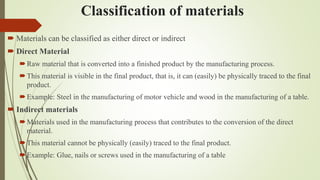
Classification of materials
 Materials can be classified as either direct or indirect
 Direct Material
Raw material that is converted into a finished product by the manufacturing process.
This material is visible in the final product, that is, it can (easily) be physically traced to the final
product.
Example: Steel in the manufacturing of motor vehicle and wood in the manufacturing of a table.
 Indirect materials
Materials used in the manufacturing process that contributes to the conversion of the direct
material.
This material cannot be physically (easily) traced to the final product.
Example: Glue, nails or screws used in the manufacturing of a table
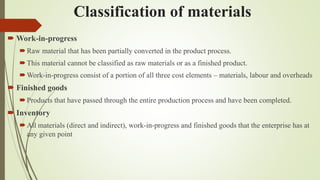
Classification of materials
 Work-in-progress
Raw material that has been partially converted in the product process.
This material cannot be classified as raw materials or as a finished product.
Work-in-progress consist of a portion of all three cost elements – materials, labour and overheads
 Finished goods
Products that have passed through the entire production process and have been completed.
 Inventory
All materials (direct and indirect), work-in-progress and finished goods that the enterprise has at
any given point
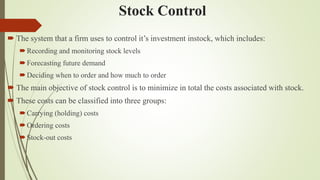
Stock Control
 The system that a firm uses to control it’s investment instock, which includes:
Recording and monitoring stock levels
Forecasting future demand
Deciding when to order and how much to order
 The main objective of stock control is to minimize in total the costs associated with stock.
 These costs can be classified into three groups:
Carrying (holding) costs
Ordering costs
Stock-out costs
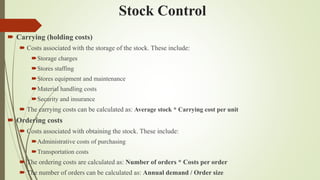
Stock Control
 Carrying (holding costs)
 Costs associated with the storage of the stock. These include:
Storage charges
Stores staffing
Stores equipment and maintenance
Material handling costs
Security and insurance
 The carrying costs can be calculated as: Average stock * Carrying cost per unit
 Ordering costs
 Costs associated with obtaining the stock. These include:
Administrative costs of purchasing
Transportation costs
 The ordering costs are calculated as: Number of orders * Costs per order
 The number of orders can be calculated as: Annual demand / Order size
Stock Control
 Stock-out costs
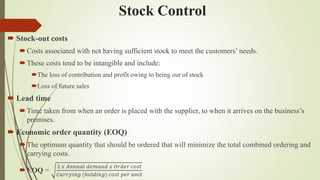
Costs associated with not having sufficient stock to meet the customers’ needs.
These costs tend to be intangible and include:
The loss of contribution and profit owing to being out of stock
Loss of future sales
 Lead time
Time taken from when an order is placed with the supplier, to when it arrives on the business’s
premises.
 Economic order quantity (EOQ)
The optimum quantity that should be ordered that will minimize the total combined ordering and
carrying costs.
EOQ =
2 𝑥 𝐴𝑛𝑛𝑢𝑎𝑙 𝑑𝑒𝑚𝑎𝑛𝑑 𝑥 𝑂𝑟𝑑𝑒𝑟 𝑐𝑜𝑠𝑡
𝐶𝑎𝑟𝑟𝑦𝑖𝑛𝑔 (ℎ𝑜𝑙𝑑𝑖𝑛𝑔) 𝑐𝑜𝑠𝑡 𝑝𝑒𝑟 𝑢𝑛𝑖𝑡
Stock Control
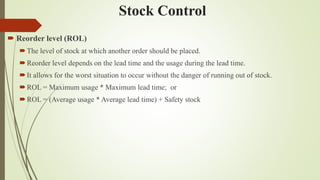
 Reorder level (ROL)
The level of stock at which another order should be placed.
Reorder level depends on the lead time and the usage during the lead time.
It allows for the worst situation to occur without the danger of running out of stock.
ROL = Maximum usage * Maximum lead time; or
ROL = (Average usage * Average lead time) + Safety stock
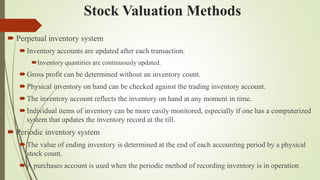
Stock Valuation Methods
 Perpetual inventory system
Inventory accounts are updated after each transaction.
Inventory quantities are continuously updated.
Gross profit can be determined without an inventory count.
Physical inventory on hand can be checked against the trading inventory account.
The inventory account reflects the inventory on hand at any moment in time.
Individual items of inventory can be more easily monitored, especially if one has a computerized
system that updates the inventory record at the till.
 Periodic inventory system
The value of ending inventory is determined at the end of each accounting period by a physical
stock count.
A purchases account is used when the periodic method of recording inventory is in operation
Stock Valuation Methods
 First-in-first-out method
 Physical stock count is done at the end of the accounting period to determine the inventory on hand (closing
balance).
 The cost of most recent purchase is used, after which the cost of goods sold can be computed.
 Material that is purchased first is used(issued) first. The oldest stock is issued first at the price at which it
was originally purchased.
 Weighted-average-method
 Periodic Inventory System
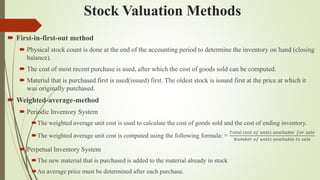
The weighted average unit cost is used to calculate the cost of goods sold and the cost of ending inventory.
The weighted average unit cost is computed using the following formula: =
𝑇𝑜𝑡𝑎𝑙 𝑐𝑜𝑠𝑡 𝑜𝑓 𝑢𝑛𝑖𝑡𝑠 𝑎𝑣𝑎𝑖𝑙𝑎𝑏𝑙𝑒 𝑓𝑜𝑟 𝑠𝑎𝑙𝑒
𝑁𝑢𝑚𝑏𝑒𝑟 𝑜𝑓 𝑢𝑛𝑖𝑡𝑠 𝑎𝑣𝑎𝑖𝑙𝑎𝑏𝑙𝑒 𝑡𝑜 𝑠𝑎𝑙𝑒
 Perpetual Inventory System
The new material that is purchased is added to the material already in stock
An average price must be determined after each purchase.
Topic_2-_Materials_and_labour_(inventory).pdf

Topic_2-_Materials_and_labour_(inventory).pdf

  • 1.
    Materials and Labour BusinessAccounting – ACC 1644
  • 2.
    Chapter Outline 1. Classificationof materials i. Direct material ii. Indirect material iii. Work-in-progress iv. Finished goods v. Inventory 2. Stock control i. Carrying costs ii. Ordering costs iii. Stock-out costs iv. Lead time v. Economic order quantity (EOQ) vi. Reorder level (ROL)
  • 3.
    3. Stock valuationmethods i. The perpetual inventory system ii. The periodic inventory systems iii. First-In-First-Out Method iv. Weighted Average Method
  • 4.
    Classification of materials Materials can be classified as either direct or indirect  Direct Material Raw material that is converted into a finished product by the manufacturing process. This material is visible in the final product, that is, it can (easily) be physically traced to the final product. Example: Steel in the manufacturing of motor vehicle and wood in the manufacturing of a table.  Indirect materials Materials used in the manufacturing process that contributes to the conversion of the direct material. This material cannot be physically (easily) traced to the final product. Example: Glue, nails or screws used in the manufacturing of a table
  • 5.
    Classification of materials Work-in-progress Raw material that has been partially converted in the product process. This material cannot be classified as raw materials or as a finished product. Work-in-progress consist of a portion of all three cost elements – materials, labour and overheads  Finished goods Products that have passed through the entire production process and have been completed.  Inventory All materials (direct and indirect), work-in-progress and finished goods that the enterprise has at any given point
  • 6.
    Stock Control  Thesystem that a firm uses to control it’s investment instock, which includes: Recording and monitoring stock levels Forecasting future demand Deciding when to order and how much to order  The main objective of stock control is to minimize in total the costs associated with stock.  These costs can be classified into three groups: Carrying (holding) costs Ordering costs Stock-out costs
  • 7.
    Stock Control  Carrying(holding costs)  Costs associated with the storage of the stock. These include: Storage charges Stores staffing Stores equipment and maintenance Material handling costs Security and insurance  The carrying costs can be calculated as: Average stock * Carrying cost per unit  Ordering costs  Costs associated with obtaining the stock. These include: Administrative costs of purchasing Transportation costs  The ordering costs are calculated as: Number of orders * Costs per order  The number of orders can be calculated as: Annual demand / Order size
  • 8.
    Stock Control  Stock-outcosts Costs associated with not having sufficient stock to meet the customers’ needs. These costs tend to be intangible and include: The loss of contribution and profit owing to being out of stock Loss of future sales  Lead time Time taken from when an order is placed with the supplier, to when it arrives on the business’s premises.  Economic order quantity (EOQ) The optimum quantity that should be ordered that will minimize the total combined ordering and carrying costs. EOQ = 2 𝑥 𝐴𝑛𝑛𝑢𝑎𝑙 𝑑𝑒𝑚𝑎𝑛𝑑 𝑥 𝑂𝑟𝑑𝑒𝑟 𝑐𝑜𝑠𝑡 𝐶𝑎𝑟𝑟𝑦𝑖𝑛𝑔 (ℎ𝑜𝑙𝑑𝑖𝑛𝑔) 𝑐𝑜𝑠𝑡 𝑝𝑒𝑟 𝑢𝑛𝑖𝑡
  • 9.
    Stock Control  Reorderlevel (ROL) The level of stock at which another order should be placed. Reorder level depends on the lead time and the usage during the lead time. It allows for the worst situation to occur without the danger of running out of stock. ROL = Maximum usage * Maximum lead time; or ROL = (Average usage * Average lead time) + Safety stock
  • 10.
    Stock Valuation Methods Perpetual inventory system Inventory accounts are updated after each transaction. Inventory quantities are continuously updated. Gross profit can be determined without an inventory count. Physical inventory on hand can be checked against the trading inventory account. The inventory account reflects the inventory on hand at any moment in time. Individual items of inventory can be more easily monitored, especially if one has a computerized system that updates the inventory record at the till.  Periodic inventory system The value of ending inventory is determined at the end of each accounting period by a physical stock count. A purchases account is used when the periodic method of recording inventory is in operation
  • 11.
    Stock Valuation Methods First-in-first-out method  Physical stock count is done at the end of the accounting period to determine the inventory on hand (closing balance).  The cost of most recent purchase is used, after which the cost of goods sold can be computed.  Material that is purchased first is used(issued) first. The oldest stock is issued first at the price at which it was originally purchased.  Weighted-average-method  Periodic Inventory System The weighted average unit cost is used to calculate the cost of goods sold and the cost of ending inventory. The weighted average unit cost is computed using the following formula: = 𝑇𝑜𝑡𝑎𝑙 𝑐𝑜𝑠𝑡 𝑜𝑓 𝑢𝑛𝑖𝑡𝑠 𝑎𝑣𝑎𝑖𝑙𝑎𝑏𝑙𝑒 𝑓𝑜𝑟 𝑠𝑎𝑙𝑒 𝑁𝑢𝑚𝑏𝑒𝑟 𝑜𝑓 𝑢𝑛𝑖𝑡𝑠 𝑎𝑣𝑎𝑖𝑙𝑎𝑏𝑙𝑒 𝑡𝑜 𝑠𝑎𝑙𝑒  Perpetual Inventory System The new material that is purchased is added to the material already in stock An average price must be determined after each purchase.