URTICARIA, ANGIOEDEMA   นสพ.อาทิ ต ย์ เชยคาดี
      AND ANAPHYLAXIS
URTICARIA

Definition
 Urtica in Latin is Nettle rash
 Urticaria (or hives)
    irregularly shaped wheal with a blanched center
     surrounded by a red flare
    itchy rash consisting of a raised
    Rapid disappear to normal skin in 1-24 hr.
      But can appear in other area
URTICARIA
URTICARIA


Classification
 Spontaneous urticaria
  Acute Urticaria
    Episodes of hives that continue for <6 wk
  Chronic Urticaria
    persist for >6 wk
    Chronic continuous urticaria
    Chronic recurrent urticaria
URTICARIA

Classification
  Physical urticaria
    Cold contact urticaria
    Delayed pressure urticaria
    Heat contact urticaria
    Solar urticaria
    Urticaria factitia/dermographic urticaria
    Vibratory urticaria/angioedema
    Aquagenic urticaria
    Cholinergic urticaria
    Contact urticaria
    Exercise-induced urticaria
ETIOLOGY OF ACUTE URTICARIA

 Foods Egg, milk, wheat, peanuts
 Medications Suspect all medications
 Insect stings Hymenoptera (honeybee, yellow jacket,
  hornets, wasp, fire ants), biting insects ( papular
  urticaria)
 Infections
 Contact allergy Latex, pollen, animal saliva, nettle
  plants, caterpillars
 Transfusion reactions Blood, blood products, or IV
  immunoglobulin administration
 Idiopathic
 EBV, Epstein-Barr virus.
ETIOLOGY OF CHRONIC URTICARIA

 Idiopathic 75–90%
 Rheumatologic
   Systemic lupus erythematosus
   Juvenile rheumatoid arthritis
 Endocrine Hyperthyroidism
   Hypothyroidism
 Neoplastic Lymphoma
   Mastocytosis
   Leukemia
 Angioedema Hereditary angioedema
   Acquired angioedema
   Angiotensin-converting enzyme inhibitors
URTICARIA - MECHANISMS

Immunologic
 IgE-mediated – histamine, PAF, PGD 2, LTC, LTD
   Foods/food additives
   Medications
   Hymenoptera venom
 Complement system activation
   Blood/blood products
 Neuropeptides
   Substance-P, Somatostatin, VIP
 Cytokines
MECHANISMS OF URTICARIA

Non-Immunologic
 Direct mast cell activation
   Radio contrast dye, opiates, polymyxin
 Modulation of the mast cell responsiveness
   Arachidonic acid metabolism (NSAIDs, Aspirin)
 Miscellaneous
   Physical, Cold, Pressure
DIFFERENTIAL DIAGNOSIS OF URTICARIA

 Urticaria pigmentosa
 Urticaria Vasculitis
 Erythema multiforme
 Insect bite reaction = papular urticaria
 Collagen vascular
 Immunobullous disease  Bullous pemphigoid
 Annular erythema
   Erythema marginatum
   Pityriasis Rosea
   Guttate psoriasis
   Erythema annulare centrifugum
   Erythema chronicum migrans
DIFFERENTIAL DIAGNOSIS OF URTICARIA

 Juvenile rheumatoid arthritis
 Kawasaki disease
 Viral examthems
 Acute febrile neutrophilic dermatosis (Sweet’s
  syndrome)
 Scabies
 Parasite  S.stercoralis  larva currens
Urticaria pigmentosa   Urticaria Vasculitis
Erythema multiforme
                      Sweet’s syndrome
Erythema annulare centrifugum   larva currens
DIAGNOSIS
ANGIOEDEMA

Definition
 Angioedema is the swelling of deep dermis,
  subcutaneous, or submucosal tissue due to
  vascular leakage
 Pain > itchy
 Often at Mucous membrane
 Recovery slower than wheal Duration 72 hr.
ANGIOEDEMA
ANGIOEDEMA

 Hereditary
   Type I
   Type II
   Hereditary angioedema with normal C1 INH in woman
 Acquired
     Allergic : food, drug, insect venoms, radiocontrast media etc.
     Idiopathic angioedema
     Drug : NSAID induced
     Angioedema associated with idiopathic or autoimmune urticaria
     Angioedema associated with enzyme-inhibitor-induced
     Angioedema associated with eosinophilia
     Angioedema associated with physical urticaria and with cholinergic
      urticaria
ANGIOEDEMA

 Acquired
     Angioedema associated with allergic contact urticaria
     Angioedema associated with urticarial vasculitis
     Angioedema associated with infection and infestation
     Acquired C1 INH deficiency
ANGIOEDEMA

 Normal or elevated serum complement levels
   IgE-mediated (atopic, specific antigen, exercise)
   Induced by physical agents
   Drug : Aspirin, NSAID, contrast media, opiates, polyanionic antibiotic
 Low serum complement levels
   Low C1 INH
     Genetic (Hereditary C1 INH deficiency; HAE)
         C1 INH deficiency type I and II
     Acquired (Acquired C1 INH deficiency; AAE)
         Lyphoproliferative disorders
         Anti-C1 INH antibodies
   Normal C1 INH
       Serum sickness, blood product reaction
       Necrotizing vasculitis
       Dyes : contrast media
       Idiosyncratic
HEREDITARY ANGIOEDEMA
 Autosomal dominant with incomplete penetrance.
    Spontaneous mutations in 50%
    Diminished C4 between attacks
    Very low C4 during attacks
 HAE I
    Low levels of C1 esterase inhibitor
 HAE II
    Dysfunctional C1 INH
 HAE III (estrogen-dependent angioedema)
    Normal C1 INH amount and function
    Normal complement levels
DIFFERENTIAL DIAGNOSIS OF ANGIOEDEMA

CHF
Lymphedema
Thrombophlebitis
Erysipelas
Cellulitis
Child abuse
Nephrotic syndrome
DIFFERENTIAL DIAGNOSIS OF ANGIOEDEMA

Superior vena cava syndrome
Myxedema from congenital hypothyroidism
Dermatomyositis
Scleroderma
Parasite  Trichinella spiralis
Allergic contact dermatitis
Crohn’s disease
Melkersson-Rosenthal syndrome
Cheilitis granulomatosa
Thrombophlebitis

Cellulitis
DIAGNOSIS OF URTICARIA/ANGIOEDEMA

History
  Time of onset of disease
  Frequency and Duration of healing
  Size, shape, area and distribution
  Urticaria and angioedema
  Pruritus or pain
  Family history (atopy)
  Present illness and past history about allergy
  Physical stimulation or exercise
DIAGNOSIS OF URTICARIA/ANGIOEDEMA

History
  Drug used history
  Food
  Smoking
  Occupation
  Relati onship to the menstrua l cycle
  Travel
  Surgical implantations
  Insect bite
  Stress
  Response to treatment
Urticaria/angioedema

           superficial                                            deep


> 24 hr.                 < 24 hr.           + Urticaria                                  - Urticaria

    Biopsy
                            Urticaria+angioedema
                                                              Unknown
  /phatology                                                   cause

                           < 6 WK           > 6 WK
    Vasculitis                                                              Abnormal            Pressure
                                                              Drug
                                                                             C1INH               test +

  Yes            No
                                            History/
                                        Demographism test                                      Delayed
                                                                     HAE        AAE
    Urticaria                                                                                  pressure
    Vasculitis                                                                                 urticaria
                          Acute urticaria


    Work up /                        Physical / Cholinergic
                                                                     Chronic urticaria
   autoimmune                              urticaria
MANAGEMENT

Identification and elimination of the underlying
 cause and/or trigger
Symptomatic therapy
  Drug
  Cold pack
  Avoid drug is trigger urticaria (NSAID, morphine, ACE
   inhibitor, ingredient  alcohol )
MANAGEMENT

 First-line drug therapies
   Antihistamine
     H1 –antihistamine first generation
       Chlopheniramine
       Diphenhydramine
       Hydroxyzine
     H1 –antihistamine second generation
         Cetirizine
         Desloratadine
         Fexofenadine
         Ketotifen
         Loratadine
         Levocetirizine
MANAGEMENT

Second-line drug therapies
  H2 –antihistamine
      Cimetidine
      Ranitidine
 Tricyclic antidepressant
    Doxepin
 Corticosteroids
 Leukotriene receptor antagonist
    Montelukast
MANAGEMENT

Third-line therapies
 Cyclosporine 2.5-5mg/kg/day
 Intravenous immnuoglobulin
 Immunosuppressive drugs
    methotrexate
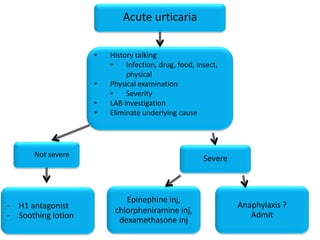
Acute urticaria

                      •   History talking
                          •    Infection, drug, food, insect,
                               physical
                      •   Physical examination
                          •    Severity
                      •   LAB investigation
                      •   Eliminate underlying cause


        Not severe
                                                        Severe


                              Epinephine inj,
-   H1 antagonist                                                Anaphylaxis ?
                           chlorpheniramine inj,                    Admit
-   Soothing lotion
                            dexamethasone inj
ผู้ป่วยมีภาวะ Anxiety หรื อผื่นเห่อช่วงกลางคืน
        ใช่                                                          ไม่ใช่

Sedating H1-antihistamine                                Non-sedating H1-
                                                          antihistamine


                          มีอาการมาก มี Angioedema
                    ใช่                               ไม่ใช่

เพิ่ม prednisolone 25mg/day
                                                        ให้ antihistamine ต่อ
       แล้ วหยุดยาใน 1-2 สัปดาห์


                               ยังควบคุมไม่ได้ หมด
ยังควบคุมโรคไม่ได้ หมด
       ใช่                                                       ไม่ใช่

     Add Leukotriene                                  ให้ antihistamine


                            ยังควบคุมไม่ได้
                  ใช่                            ไม่ใช่

เพิ่ม prednisolone 25mg/day                          Anti histamine +
        ลดลงจนควบคุมอาการได้                           leukotriene


                          ยังควบคุมไม่ได้ หมด
ยังควบคุมโรคไม่ได้ หมด
         ใช่                                                    ไม่ใช่

ยาทางเลือกอื่นๆ เช่น cyclosporine                     Anti histamine +
                                                       corticosteroid
CHRONIC URTICARIA
TREATMENT OF HEREDITARY
         ANGIOEDEMA
 Patient education very important; test family
 No regular medication needed in many cases
 Prophylactic stanozolol or danozol
 Fresh frozen plasma before emergency surgery
 C1 inhibitor
 Symptomatic treatment during attacks
 Steroids and antihistamines are NOT effective
SUMMARY OF TREATMENTS FOR C1
 ESTERASE INHIBITOR DEFICIENCY
CASE STUDY
CASE

 ผู้ป่ วยเด็ ก ชายไทย อายุ 12 ปี ภู มิ ลาเนา จัง หวัด แพร่
 CC : ปากบวมมี ผื่ น คั น หลั ง ฉี ด ยา 5 นาที
 PI : 1 วั น ก่ อ นมาโรงพยาบาล มี ไ ข้ ถ่ า ยอุ จ จาระเหลวเป็ นมู ก ปริ ม าณไม่ ม ากวั น ละ
  3 – 4 ครั ง มี อ าการอ่ อ นเพลี ย ได้ มาตรวจและแพทย์ ใ ห้ admit รั ก ษาด้ วยการให้
                ้
  สารน ้าทางหลอดเลื อ ดดาและยาฉี ด ceftriaxone 500 mg IV q 12 hr.
  หลั ง ฉี ด ยา5 นาที ผู้ ป่ วยมี ริ ม ฝี ปากบวม ผื่ น แดงคั น ตามตั ว และเวี ย นศี ร ษะคล้ ายจะ
  เป็ นลม
 PH : ปฏิ เ สธโรคประจาตั ว แต่ เ มื่ อ 1 ปี ก่ อ น เคยกิ น ยาฆ่ า เชื อ รั ก ษาอาการเจ็ บ คอ
                                                                         ้
  กิ น แล้ วมี ผื่ น ขึ น ตามตั ว อาการไม่ รุ น แรง หายไปเอง ไม่ ไ ด้ ไปพบแพทย์ ไม่ มี ป ระวั ติ แ พ้
                        ้
  ยาในครอบครั ว
CASE

 Physical examination
   V/S BT = 38.5 C , PR 120/min, RR = 20 /min, BP =80/40mmHg
   BW = 20 kg , Height 155 cm
   GA : A thai boy with good consciousness, no pallor, no
    jaundice, no cyanosis
   Skin : dry and swollen lips, flushing, generalized urticaria
    rash with facial angioedema
   Heart : tachycardia wit normal S1 S2, no murmur
   Lungs : expiratory Wheezing on both lungs, no crepitation
   Other : unremarkable
CASE

 Positive finding
   Fever
   Tachycardia
   Hypotension
   Hx of Drug allery
   Angioedema
   Urticaria
   expiratory Wheezing on both lungs
 Negative finding
   No stress
   No redness of body
   No brown macule
   No hx of psychological disorder
CASE

 Problem list
   Angioedema with generalize urticaria rash with anaphylaxis
   Fever with mucous diarrhea
PROVISIONAL DIAGNOSIS

Anaphylactic shock
Acute gastroenteritis
TREATMENT IN THIS CASE

Stop ceftriaxone
Adrenaline (1:1000) IM
0.9 % NaCl IV loading
Antihistamine
ANAPHYLAXIS
DEFINITION OF ANAPHYLAXIS

 systemic, immediate hypersensitivity

   Affects body as a whole

   Multiple organ systems may be involved

   Onset generally acute

   Manifestations vary from mild to fatal

   immunoglobulin E (IgE)-mediated

 Anaphylatoid

   Non – immunoglobulin E (IgE)-mediated
ANAPHYLACTOID REACTIONS

 Non–IgE-mediated
    Complement-mediated
       Anaphylatoxins, eg, blood products
    Direct stimulation
       eg, radiocontrast media
    Mechanism unknown
       Exercise
       NSAIDs
COMMON TRIGGERS OF PEDIATRIC
            ANAPHYLAXIS

 Foods (most common cause in children) – Milk, eggs,
  wheat, soy, fish, shellfish,
 Medicinals – Antibiotics (penicillins, cephalosporins),
  local anesthetics, NSAID, opiates,dextran, radiocontrast
  media
 Biologics – Venoms (bee sting, ant or snake bite), blood
  and blood products, vaccines, allergen extracts
 Preservatives and additives – Metabisulfite,
  monosodium glutamate
 Other – Latex, unknown/idiopathic
CLINICAL MANIFESTATIONS OF ANAPHYLAXIS


 Skin: Flushing, pruritus, urticaria, angioedema
 Upper respiratory: Congestion, rhinorrhea
 Lower respiratory: Bronchospasm, throat or
  chest tightness, hoarseness, wheezing,
  shortness of breath, cough
CLINICAL MANIFESTATIONS OF
              ANAPHYLAXIS

Gastrointestinal tract:
  Oral pruritus
  Cramps, nausea, vomiting, diarrhea
Cardiovascular system:
  Tachycardia, bradycardia, hypotension/shock,
   arrhythmias, ischemia, chest pain
CRITERIA FOR ANAPHYLAXIS

Criterion 1 – Acute onset of an illness
 involving the skin, mucous membranes
 at least one of the following:
 Respiratory compromise
 Decreased blood pressure or associated symptoms
  of end-organ dysfunction
CRITERIA FOR ANAPHYLAXIS

Criterion 2 – Two or more of the following that
 occur rapidly after exposure to an allergen that is
 likely for that patient
  Involvement of the skin and/or mucous
   membranes
  Respiratory compromise
  Decreased blood pressure or associated symptoms
  Persistent gastrointestinal symptoms
CRITERIA FOR ANAPHYLAXIS

Criterion 3 – Decreased blood pressure after
 exposure of a known allergen for that patient
  Decreased blood pressure is defined in adults as a systolic
   BP of less than 90 mmHg or >30% decrease from that
   patient’s baseline.
  In infants and children, decreased BP is defined as low
   systolic
     BP of less than 70 mmHg from one month up to one
      year
     less than (70mmHg + [2 x age]} from one to ten years
     less than 90 mmHg from 11 to 17 years.
DIFFERENTIAL DIAGNOSIS

 Vasovagal reactions
 Flush syndrome
   Carcinoid
   Pheochromcytoma
   Medullary thyroid carcinoma
 Resturant syndrome
   Monosodium glutamate
 Excessive production of histamine
   Systemic maastocytosis
   Basophilic leukemia
 Shock
   Hemorrhagic / hypovolemic
   Cardiogenic
   Septic
DIFFERENTIAL DIAGNOSIS

 Acute respiratory failure
   Status asthmaticus
   Foreign body aspiration
   Pulmonary embolism
   Epiglottitis
 Non organic disease
   Panic attack
   Munchausen’s stridor
   Vocal cord dysfunction
 Other
   Red man syndrome (Vancomycin)
   Hereditary angioedema
LAB INVESTIGATION

 Serum tryptase
     Peak at 60- 90 min
     > 10 nanogram/ml
     > 1.4 times or 2 nanogram/ml at 1-2 wk after anaphylaxis
     Sensitivity 73% specific 98 %
     In some case are normal but mastocytosis  rise
 Specific – IgE
   Skin test 6 wk after anaphylaxis
   Serum specific IgE antibody
TREATMENT

 Support the airway and ventilation; and Give
  supplementary oxygen.
 Intramuscular 1: 1000 (1 mg/ml) adrenaline at a dose of
  0.01 mg/kg (0.01 ml/kg) body weight up to a maximum
  dose of 0.5 mg (0.5 ml)
 Resuscitate with intravenous saline (20 ml/kg body
  weight)
 Bronchodilator
 Systemic corticosteroid
   Hydrocortisone (5mg/kg q 6 hr.)
   Methylprednisolone (1mg/kg q 6 hr.)
TREATMENT

 Antihistamine
   Chlorpheniramine 0.1mg/kg q 6 hr.
   Cimetidine 4mg/kg max 300mg q 8-12 hr.
 Refractory anaphylaxis in patient used beta -blocker
   Glucagon 20-30 mcg/kg max 1 mg slow push in 5 min and IV drip 5-15
    mcg/min until BP stable
 Bradycardia
   Atropine 0.5 mg q 10 min cumulative dose 2 mg
PREVENTION

 Agents causing anaphylaxis should be identified when possible
  and avoided
 Individuals at high risk for anaphylaxis should be issued
  epinephrine syringes for self -administration and instructed in
  their use
 Beta-adrenergic antagonists should be avoided, whenever
  possible.
 Children and their care -givers should be offered a written
  emergency plan in case of accidental ingestion.
 Pre-treatment with glucocorticosteroids and H1 and H2
  antihistamines when used radio contrast media in some case
PREVENTION

 Patients with egg allergy should be tested before receiving
  measles, influenza or yellow fever vaccines which contain egg
  protein.
 In cases of food-associated exercise-induced anaphylaxis,
  children must not exercise within 4 hours of ingesting the
  triggering food
 Reactions to medications can be reduced and minimized by using
  oral medications in preference to injected forms.
 The use of powder-free, low allergen gloves and materials should
  be used in children undergoing multiple surgeries.
REFERENCE

 Zuberbier T, Bindslev-Jensen C, Canonica W, Grattan CE, Greaves
  MW, Henz BM, et al. EAACI/GA2LEN/EDF guideline: definition,
  classifica tion and diagnosis of urticaria. Allergy 2006; 61:316-20.
 Zuberbier T, Bindslev-Jensen C, Canonica W, Grattan CE, Greaves
  MW, Henz BM, et al. EAACI/GA2LEN/EDF guideline: management of
  urticaria. Allergy 2006; 61:321-31.
 Grattan CEH, Humphreys. Guidelines for evaluation and
  management of urticaria in adults and children. Br J Dermatol 2007;
  157: 1116-23.
 M. Scott Linscott, Anaphylaxis: Diagnosis and Management in the
  Rural Emergency Department. American Journal of Clinical Medicine
  2012 ; 91.
 Donald Y.M. Leung, Stephen C. Dreskin. Urticaria (Hives) and
  Angioedema. In: Behrman RE, Kliegman RM, Jenson HB. Nelson
  Textbook of Pediatrics. 18th ed. Philadelphia PA: W.B. Saunders;
  2007.
 Elham Hossny. Anaphylaxis in children. Egypt J Pediatr Allergy
  Immunol 2007; 5(2): 47-54.

Topic urticaria, angioedema and anaphylaxis final

  • 1.
    URTICARIA, ANGIOEDEMA นสพ.อาทิ ต ย์ เชยคาดี AND ANAPHYLAXIS
  • 2.
    URTICARIA Definition Urtica inLatin is Nettle rash Urticaria (or hives)  irregularly shaped wheal with a blanched center surrounded by a red flare  itchy rash consisting of a raised  Rapid disappear to normal skin in 1-24 hr.  But can appear in other area
  • 3.
  • 4.
    URTICARIA Classification Spontaneous urticaria Acute Urticaria  Episodes of hives that continue for <6 wk Chronic Urticaria  persist for >6 wk  Chronic continuous urticaria  Chronic recurrent urticaria
  • 5.
    URTICARIA Classification  Physicalurticaria  Cold contact urticaria  Delayed pressure urticaria  Heat contact urticaria  Solar urticaria  Urticaria factitia/dermographic urticaria  Vibratory urticaria/angioedema  Aquagenic urticaria  Cholinergic urticaria  Contact urticaria  Exercise-induced urticaria
  • 6.
    ETIOLOGY OF ACUTEURTICARIA  Foods Egg, milk, wheat, peanuts  Medications Suspect all medications  Insect stings Hymenoptera (honeybee, yellow jacket, hornets, wasp, fire ants), biting insects ( papular urticaria)  Infections  Contact allergy Latex, pollen, animal saliva, nettle plants, caterpillars  Transfusion reactions Blood, blood products, or IV immunoglobulin administration  Idiopathic  EBV, Epstein-Barr virus.
  • 7.
    ETIOLOGY OF CHRONICURTICARIA  Idiopathic 75–90%  Rheumatologic  Systemic lupus erythematosus  Juvenile rheumatoid arthritis  Endocrine Hyperthyroidism  Hypothyroidism  Neoplastic Lymphoma  Mastocytosis  Leukemia  Angioedema Hereditary angioedema  Acquired angioedema  Angiotensin-converting enzyme inhibitors
  • 8.
    URTICARIA - MECHANISMS Immunologic IgE-mediated – histamine, PAF, PGD 2, LTC, LTD  Foods/food additives  Medications  Hymenoptera venom Complement system activation  Blood/blood products Neuropeptides  Substance-P, Somatostatin, VIP Cytokines
  • 9.
    MECHANISMS OF URTICARIA Non-Immunologic Direct mast cell activation  Radio contrast dye, opiates, polymyxin Modulation of the mast cell responsiveness  Arachidonic acid metabolism (NSAIDs, Aspirin) Miscellaneous  Physical, Cold, Pressure
  • 10.
    DIFFERENTIAL DIAGNOSIS OFURTICARIA  Urticaria pigmentosa  Urticaria Vasculitis  Erythema multiforme  Insect bite reaction = papular urticaria  Collagen vascular  Immunobullous disease  Bullous pemphigoid  Annular erythema  Erythema marginatum  Pityriasis Rosea  Guttate psoriasis  Erythema annulare centrifugum  Erythema chronicum migrans
  • 11.
    DIFFERENTIAL DIAGNOSIS OFURTICARIA  Juvenile rheumatoid arthritis  Kawasaki disease  Viral examthems  Acute febrile neutrophilic dermatosis (Sweet’s syndrome)  Scabies  Parasite  S.stercoralis  larva currens
  • 12.
    Urticaria pigmentosa Urticaria Vasculitis
  • 13.
    Erythema multiforme Sweet’s syndrome
  • 14.
  • 15.
  • 16.
    ANGIOEDEMA Definition Angioedema isthe swelling of deep dermis, subcutaneous, or submucosal tissue due to vascular leakage Pain > itchy Often at Mucous membrane Recovery slower than wheal Duration 72 hr.
  • 17.
  • 18.
    ANGIOEDEMA  Hereditary  Type I  Type II  Hereditary angioedema with normal C1 INH in woman  Acquired  Allergic : food, drug, insect venoms, radiocontrast media etc.  Idiopathic angioedema  Drug : NSAID induced  Angioedema associated with idiopathic or autoimmune urticaria  Angioedema associated with enzyme-inhibitor-induced  Angioedema associated with eosinophilia  Angioedema associated with physical urticaria and with cholinergic urticaria
  • 19.
    ANGIOEDEMA  Acquired  Angioedema associated with allergic contact urticaria  Angioedema associated with urticarial vasculitis  Angioedema associated with infection and infestation  Acquired C1 INH deficiency
  • 20.
    ANGIOEDEMA  Normal orelevated serum complement levels  IgE-mediated (atopic, specific antigen, exercise)  Induced by physical agents  Drug : Aspirin, NSAID, contrast media, opiates, polyanionic antibiotic  Low serum complement levels  Low C1 INH  Genetic (Hereditary C1 INH deficiency; HAE)  C1 INH deficiency type I and II  Acquired (Acquired C1 INH deficiency; AAE)  Lyphoproliferative disorders  Anti-C1 INH antibodies  Normal C1 INH  Serum sickness, blood product reaction  Necrotizing vasculitis  Dyes : contrast media  Idiosyncratic
  • 21.
    HEREDITARY ANGIOEDEMA  Autosomaldominant with incomplete penetrance.  Spontaneous mutations in 50%  Diminished C4 between attacks  Very low C4 during attacks  HAE I  Low levels of C1 esterase inhibitor  HAE II  Dysfunctional C1 INH  HAE III (estrogen-dependent angioedema)  Normal C1 INH amount and function  Normal complement levels
  • 22.
    DIFFERENTIAL DIAGNOSIS OFANGIOEDEMA CHF Lymphedema Thrombophlebitis Erysipelas Cellulitis Child abuse Nephrotic syndrome
  • 23.
    DIFFERENTIAL DIAGNOSIS OFANGIOEDEMA Superior vena cava syndrome Myxedema from congenital hypothyroidism Dermatomyositis Scleroderma Parasite  Trichinella spiralis Allergic contact dermatitis Crohn’s disease Melkersson-Rosenthal syndrome Cheilitis granulomatosa
  • 24.
  • 25.
    DIAGNOSIS OF URTICARIA/ANGIOEDEMA History  Time of onset of disease  Frequency and Duration of healing  Size, shape, area and distribution  Urticaria and angioedema  Pruritus or pain  Family history (atopy)  Present illness and past history about allergy  Physical stimulation or exercise
  • 26.
    DIAGNOSIS OF URTICARIA/ANGIOEDEMA History  Drug used history  Food  Smoking  Occupation  Relati onship to the menstrua l cycle  Travel  Surgical implantations  Insect bite  Stress  Response to treatment
  • 27.
    Urticaria/angioedema superficial deep > 24 hr. < 24 hr. + Urticaria - Urticaria Biopsy Urticaria+angioedema Unknown /phatology cause < 6 WK > 6 WK Vasculitis Abnormal Pressure Drug C1INH test + Yes No History/ Demographism test Delayed HAE AAE Urticaria pressure Vasculitis urticaria Acute urticaria Work up / Physical / Cholinergic Chronic urticaria autoimmune urticaria
  • 28.
    MANAGEMENT Identification and eliminationof the underlying cause and/or trigger Symptomatic therapy  Drug  Cold pack  Avoid drug is trigger urticaria (NSAID, morphine, ACE inhibitor, ingredient  alcohol )
  • 29.
    MANAGEMENT  First-line drugtherapies  Antihistamine  H1 –antihistamine first generation  Chlopheniramine  Diphenhydramine  Hydroxyzine  H1 –antihistamine second generation  Cetirizine  Desloratadine  Fexofenadine  Ketotifen  Loratadine  Levocetirizine
  • 30.
    MANAGEMENT Second-line drug therapies  H2 –antihistamine  Cimetidine  Ranitidine Tricyclic antidepressant  Doxepin Corticosteroids Leukotriene receptor antagonist  Montelukast
  • 31.
    MANAGEMENT Third-line therapies Cyclosporine2.5-5mg/kg/day Intravenous immnuoglobulin Immunosuppressive drugs  methotrexate
  • 32.
    Acute urticaria • History talking • Infection, drug, food, insect, physical • Physical examination • Severity • LAB investigation • Eliminate underlying cause Not severe Severe Epinephine inj, - H1 antagonist Anaphylaxis ? chlorpheniramine inj, Admit - Soothing lotion dexamethasone inj
  • 33.
    ผู้ป่วยมีภาวะ Anxiety หรือผื่นเห่อช่วงกลางคืน ใช่ ไม่ใช่ Sedating H1-antihistamine Non-sedating H1- antihistamine มีอาการมาก มี Angioedema ใช่ ไม่ใช่ เพิ่ม prednisolone 25mg/day ให้ antihistamine ต่อ แล้ วหยุดยาใน 1-2 สัปดาห์ ยังควบคุมไม่ได้ หมด
  • 34.
    ยังควบคุมโรคไม่ได้ หมด ใช่ ไม่ใช่ Add Leukotriene ให้ antihistamine ยังควบคุมไม่ได้ ใช่ ไม่ใช่ เพิ่ม prednisolone 25mg/day Anti histamine + ลดลงจนควบคุมอาการได้ leukotriene ยังควบคุมไม่ได้ หมด
  • 35.
    ยังควบคุมโรคไม่ได้ หมด ใช่ ไม่ใช่ ยาทางเลือกอื่นๆ เช่น cyclosporine Anti histamine + corticosteroid
  • 36.
  • 37.
    TREATMENT OF HEREDITARY ANGIOEDEMA  Patient education very important; test family  No regular medication needed in many cases  Prophylactic stanozolol or danozol  Fresh frozen plasma before emergency surgery  C1 inhibitor  Symptomatic treatment during attacks  Steroids and antihistamines are NOT effective
  • 38.
    SUMMARY OF TREATMENTSFOR C1 ESTERASE INHIBITOR DEFICIENCY
  • 39.
  • 40.
    CASE  ผู้ป่ วยเด็ก ชายไทย อายุ 12 ปี ภู มิ ลาเนา จัง หวัด แพร่  CC : ปากบวมมี ผื่ น คั น หลั ง ฉี ด ยา 5 นาที  PI : 1 วั น ก่ อ นมาโรงพยาบาล มี ไ ข้ ถ่ า ยอุ จ จาระเหลวเป็ นมู ก ปริ ม าณไม่ ม ากวั น ละ 3 – 4 ครั ง มี อ าการอ่ อ นเพลี ย ได้ มาตรวจและแพทย์ ใ ห้ admit รั ก ษาด้ วยการให้ ้ สารน ้าทางหลอดเลื อ ดดาและยาฉี ด ceftriaxone 500 mg IV q 12 hr. หลั ง ฉี ด ยา5 นาที ผู้ ป่ วยมี ริ ม ฝี ปากบวม ผื่ น แดงคั น ตามตั ว และเวี ย นศี ร ษะคล้ ายจะ เป็ นลม  PH : ปฏิ เ สธโรคประจาตั ว แต่ เ มื่ อ 1 ปี ก่ อ น เคยกิ น ยาฆ่ า เชื อ รั ก ษาอาการเจ็ บ คอ ้ กิ น แล้ วมี ผื่ น ขึ น ตามตั ว อาการไม่ รุ น แรง หายไปเอง ไม่ ไ ด้ ไปพบแพทย์ ไม่ มี ป ระวั ติ แ พ้ ้ ยาในครอบครั ว
  • 41.
    CASE  Physical examination  V/S BT = 38.5 C , PR 120/min, RR = 20 /min, BP =80/40mmHg  BW = 20 kg , Height 155 cm  GA : A thai boy with good consciousness, no pallor, no jaundice, no cyanosis  Skin : dry and swollen lips, flushing, generalized urticaria rash with facial angioedema  Heart : tachycardia wit normal S1 S2, no murmur  Lungs : expiratory Wheezing on both lungs, no crepitation  Other : unremarkable
  • 42.
    CASE  Positive finding  Fever  Tachycardia  Hypotension  Hx of Drug allery  Angioedema  Urticaria  expiratory Wheezing on both lungs  Negative finding  No stress  No redness of body  No brown macule  No hx of psychological disorder
  • 43.
    CASE  Problem list  Angioedema with generalize urticaria rash with anaphylaxis  Fever with mucous diarrhea
  • 44.
  • 45.
    TREATMENT IN THISCASE Stop ceftriaxone Adrenaline (1:1000) IM 0.9 % NaCl IV loading Antihistamine
  • 46.
  • 47.
    DEFINITION OF ANAPHYLAXIS systemic, immediate hypersensitivity  Affects body as a whole  Multiple organ systems may be involved  Onset generally acute  Manifestations vary from mild to fatal  immunoglobulin E (IgE)-mediated  Anaphylatoid  Non – immunoglobulin E (IgE)-mediated
  • 48.
    ANAPHYLACTOID REACTIONS  Non–IgE-mediated  Complement-mediated  Anaphylatoxins, eg, blood products  Direct stimulation  eg, radiocontrast media  Mechanism unknown  Exercise  NSAIDs
  • 49.
    COMMON TRIGGERS OFPEDIATRIC ANAPHYLAXIS  Foods (most common cause in children) – Milk, eggs, wheat, soy, fish, shellfish,  Medicinals – Antibiotics (penicillins, cephalosporins), local anesthetics, NSAID, opiates,dextran, radiocontrast media  Biologics – Venoms (bee sting, ant or snake bite), blood and blood products, vaccines, allergen extracts  Preservatives and additives – Metabisulfite, monosodium glutamate  Other – Latex, unknown/idiopathic
  • 51.
    CLINICAL MANIFESTATIONS OFANAPHYLAXIS Skin: Flushing, pruritus, urticaria, angioedema Upper respiratory: Congestion, rhinorrhea Lower respiratory: Bronchospasm, throat or chest tightness, hoarseness, wheezing, shortness of breath, cough
  • 52.
    CLINICAL MANIFESTATIONS OF ANAPHYLAXIS Gastrointestinal tract: Oral pruritus Cramps, nausea, vomiting, diarrhea Cardiovascular system: Tachycardia, bradycardia, hypotension/shock, arrhythmias, ischemia, chest pain
  • 53.
    CRITERIA FOR ANAPHYLAXIS Criterion1 – Acute onset of an illness involving the skin, mucous membranes  at least one of the following: Respiratory compromise Decreased blood pressure or associated symptoms of end-organ dysfunction
  • 54.
    CRITERIA FOR ANAPHYLAXIS Criterion2 – Two or more of the following that occur rapidly after exposure to an allergen that is likely for that patient Involvement of the skin and/or mucous membranes Respiratory compromise Decreased blood pressure or associated symptoms Persistent gastrointestinal symptoms
  • 55.
    CRITERIA FOR ANAPHYLAXIS Criterion3 – Decreased blood pressure after exposure of a known allergen for that patient  Decreased blood pressure is defined in adults as a systolic BP of less than 90 mmHg or >30% decrease from that patient’s baseline.  In infants and children, decreased BP is defined as low systolic  BP of less than 70 mmHg from one month up to one year  less than (70mmHg + [2 x age]} from one to ten years  less than 90 mmHg from 11 to 17 years.
  • 56.
    DIFFERENTIAL DIAGNOSIS  Vasovagalreactions  Flush syndrome  Carcinoid  Pheochromcytoma  Medullary thyroid carcinoma  Resturant syndrome  Monosodium glutamate  Excessive production of histamine  Systemic maastocytosis  Basophilic leukemia  Shock  Hemorrhagic / hypovolemic  Cardiogenic  Septic
  • 57.
    DIFFERENTIAL DIAGNOSIS  Acuterespiratory failure  Status asthmaticus  Foreign body aspiration  Pulmonary embolism  Epiglottitis  Non organic disease  Panic attack  Munchausen’s stridor  Vocal cord dysfunction  Other  Red man syndrome (Vancomycin)  Hereditary angioedema
  • 58.
    LAB INVESTIGATION  Serumtryptase  Peak at 60- 90 min  > 10 nanogram/ml  > 1.4 times or 2 nanogram/ml at 1-2 wk after anaphylaxis  Sensitivity 73% specific 98 %  In some case are normal but mastocytosis  rise  Specific – IgE  Skin test 6 wk after anaphylaxis  Serum specific IgE antibody
  • 59.
    TREATMENT  Support theairway and ventilation; and Give supplementary oxygen.  Intramuscular 1: 1000 (1 mg/ml) adrenaline at a dose of 0.01 mg/kg (0.01 ml/kg) body weight up to a maximum dose of 0.5 mg (0.5 ml)  Resuscitate with intravenous saline (20 ml/kg body weight)  Bronchodilator  Systemic corticosteroid  Hydrocortisone (5mg/kg q 6 hr.)  Methylprednisolone (1mg/kg q 6 hr.)
  • 60.
    TREATMENT  Antihistamine  Chlorpheniramine 0.1mg/kg q 6 hr.  Cimetidine 4mg/kg max 300mg q 8-12 hr.  Refractory anaphylaxis in patient used beta -blocker  Glucagon 20-30 mcg/kg max 1 mg slow push in 5 min and IV drip 5-15 mcg/min until BP stable  Bradycardia  Atropine 0.5 mg q 10 min cumulative dose 2 mg
  • 62.
    PREVENTION  Agents causinganaphylaxis should be identified when possible and avoided  Individuals at high risk for anaphylaxis should be issued epinephrine syringes for self -administration and instructed in their use  Beta-adrenergic antagonists should be avoided, whenever possible.  Children and their care -givers should be offered a written emergency plan in case of accidental ingestion.  Pre-treatment with glucocorticosteroids and H1 and H2 antihistamines when used radio contrast media in some case
  • 63.
    PREVENTION  Patients withegg allergy should be tested before receiving measles, influenza or yellow fever vaccines which contain egg protein.  In cases of food-associated exercise-induced anaphylaxis, children must not exercise within 4 hours of ingesting the triggering food  Reactions to medications can be reduced and minimized by using oral medications in preference to injected forms.  The use of powder-free, low allergen gloves and materials should be used in children undergoing multiple surgeries.
  • 64.
    REFERENCE  Zuberbier T,Bindslev-Jensen C, Canonica W, Grattan CE, Greaves MW, Henz BM, et al. EAACI/GA2LEN/EDF guideline: definition, classifica tion and diagnosis of urticaria. Allergy 2006; 61:316-20.  Zuberbier T, Bindslev-Jensen C, Canonica W, Grattan CE, Greaves MW, Henz BM, et al. EAACI/GA2LEN/EDF guideline: management of urticaria. Allergy 2006; 61:321-31.  Grattan CEH, Humphreys. Guidelines for evaluation and management of urticaria in adults and children. Br J Dermatol 2007; 157: 1116-23.  M. Scott Linscott, Anaphylaxis: Diagnosis and Management in the Rural Emergency Department. American Journal of Clinical Medicine 2012 ; 91.  Donald Y.M. Leung, Stephen C. Dreskin. Urticaria (Hives) and Angioedema. In: Behrman RE, Kliegman RM, Jenson HB. Nelson Textbook of Pediatrics. 18th ed. Philadelphia PA: W.B. Saunders; 2007.  Elham Hossny. Anaphylaxis in children. Egypt J Pediatr Allergy Immunol 2007; 5(2): 47-54.