Topic 3 Geometrical Optics
• Reflection
• Refraction
- Snell’s law
• Total Internal Reflection
• Lenses and Optical Instruments
- Formation of image by a plane mirror, convex mirror and concave
mirror
- Formation of image by a convex lens and concave lens
- Types of optical instruments
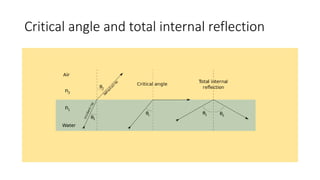
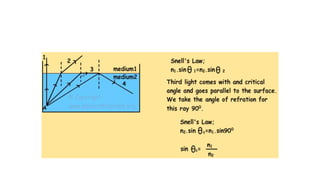
Critical angle and total internal reflection
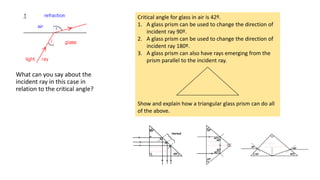
What can you say about the
incident ray in this case in
relation to the critical angle?
Critical angle for glass in air is 42º.
1. A glass prism can be used to change the direction of
incident ray 90º.
2. A glass prism can be used to change the direction of
incident ray 180º.
3. A glass prism can also have rays emerging from the
prism parallel to the incident ray.
Show and explain how a triangular glass prism can do all
of the above.
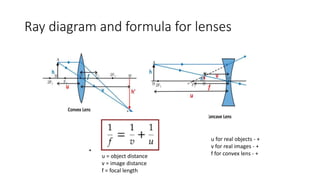
Ray diagram and formula for lenses
u for real objects - +
v for real images - +
f for convex lens - +
u = object distance
v = image distance
f = focal length
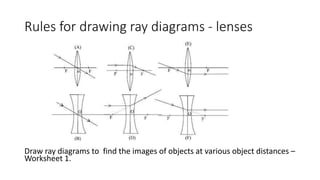
Rules for drawing ray diagrams - lenses
Draw ray diagrams to find the images of objects at various object distances –
Worksheet 1.
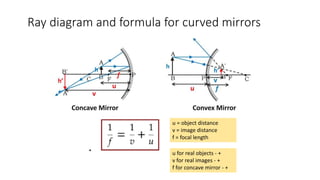
Ray diagram and formula for curved mirrors
u for real objects - +
v for real images - +
f for concave mirror - +
u = object distance
v = image distance
f = focal length
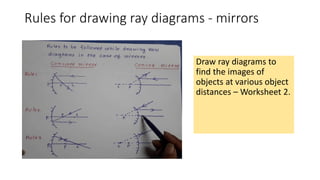
Rules for drawing ray diagrams - mirrors
Draw ray diagrams to
find the images of
objects at various object
distances – Worksheet 2.

Topic 3 Geometrical optics.pptx

  • 1.
    Topic 3 GeometricalOptics • Reflection • Refraction - Snell’s law • Total Internal Reflection • Lenses and Optical Instruments - Formation of image by a plane mirror, convex mirror and concave mirror - Formation of image by a convex lens and concave lens - Types of optical instruments
  • 2.
    Critical angle andtotal internal reflection
  • 4.
    What can yousay about the incident ray in this case in relation to the critical angle? Critical angle for glass in air is 42º. 1. A glass prism can be used to change the direction of incident ray 90º. 2. A glass prism can be used to change the direction of incident ray 180º. 3. A glass prism can also have rays emerging from the prism parallel to the incident ray. Show and explain how a triangular glass prism can do all of the above.
  • 5.
    Ray diagram andformula for lenses u for real objects - + v for real images - + f for convex lens - + u = object distance v = image distance f = focal length
  • 6.
    Rules for drawingray diagrams - lenses Draw ray diagrams to find the images of objects at various object distances – Worksheet 1.
  • 7.
    Ray diagram andformula for curved mirrors u for real objects - + v for real images - + f for concave mirror - + u = object distance v = image distance f = focal length
  • 8.
    Rules for drawingray diagrams - mirrors Draw ray diagrams to find the images of objects at various object distances – Worksheet 2.