Topic 1a
Simple Harmonic Motion
Cycle, amplitude, period, frequency
Energy
Equations
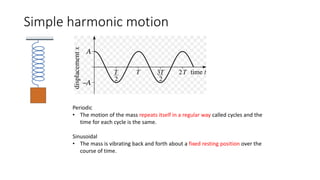
Simple harmonic motion
Periodic
• The motion of the mass repeats itself in a regular way called cycles and the
time for each cycle is the same.
Sinusoidal
• The mass is vibrating back and forth about a fixed resting position over the
course of time.
Sinusoidal motion
One complete cycle
Amplitude
Period
Frequency
1. How many cycles are shown in
the graph?
2. What is the amplitude?
3. What is the period?
4. What is the frequency?
1. 2 ¼
2. A
3. T
4. 1/T
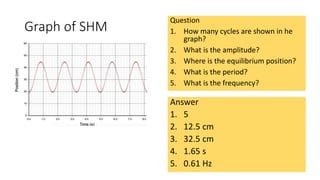
Graph of SHM
Question
1. How many cycles are shown in he
graph?
2. What is the amplitude?
3. Where is the equilibrium position?
4. What is the period?
5. What is the frequency?
Answer
1. 5
2. 12.5 cm
3. 32.5 cm
4. 1.65 s
5. 0.61 Hz
Motion in SHM systems
1. Is the velocity of the mass the same
throughout the motion?
2. What is the velocity of the mass at
point A?
3. What is the velocity of the mass at
point B?
4. What is the velocity of the mass at
point C?
5. Describe what happens in terms of
the mass’ velocity when the mass
moves from
a) A to B
b) B to C
c) C to B
d) B to A
A
B
C
Answers: 1. No , 2. 0, 3. Max, 4. 0, 5a) speeds
up, downwards 5b) slows down, downwards 5c)
speeds up, upward 5d) slows down, upwards
Which of the two graphs,
a) or b) is the velocity-time
graph for the position-time
graph above?
a)
b)
a
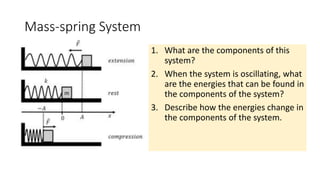
Mass-spring System
1. What are the components of this
system?
2. When the system is oscillating, what
are the energies that can be found in
the components of the system?
3. Describe how the energies change in
the components of the system.
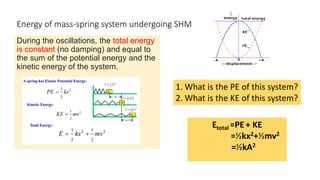
Energy of mass-spring system undergoing SHM
During the oscillations, the total energy
is constant (no damping) and equal to
the sum of the potential energy and the
kinetic energy of the system.
Etotal =PE + KE
=½kx2+½mv2
=½kA2
1. What is the PE of this system?
2. What is the KE of this system?
Energy of pendulum undergoing SHM
Etotal =PE+ KE
=mgh+½mv2
1. What is the formula for the potential
energy of the system?
2. What is the formula for the kinetic
energy of the system?
In a SHM kinetic and potential energies becomes equal
when the displacement is 1/√(2) times the amplitude.
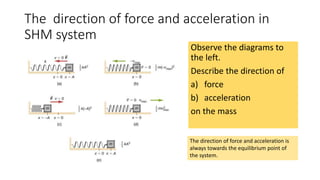
The direction of force and acceleration in
SHM system
Observe the diagrams to
the left.
Describe the direction of
a) force
b) acceleration
on the mass
The direction of force and acceleration is
always towards the equilibrium point of
the system.
SHM equations
System starting at
equilibrium
System starting at
maximum
displacement
x = Asin(t)
v = Acos(t)
a = -A2sin(t)
x = Acos(t)
v = -Asin(t)
a = -A2cos(t)
a=-2x
For spring-mass system
=
𝑘
𝑚
T = 2/ = 2 
𝑚
𝑘
For pendulum
=
𝑔
𝑙
T = 2/ = 2 
𝑙
𝑔
=2f
T=1/f
Simple harmonic motion (SHM)
Simple harmonic motion is a periodic motion of an
object such that its acceleration is always towards
the equilibrium position and is proportional to its
distance from that position.

Topic 1a Simple harmonic motion.pptx

  • 1.
    Topic 1a Simple HarmonicMotion Cycle, amplitude, period, frequency Energy Equations
  • 2.
    Simple harmonic motion Periodic •The motion of the mass repeats itself in a regular way called cycles and the time for each cycle is the same. Sinusoidal • The mass is vibrating back and forth about a fixed resting position over the course of time.
  • 3.
    Sinusoidal motion One completecycle Amplitude Period Frequency 1. How many cycles are shown in the graph? 2. What is the amplitude? 3. What is the period? 4. What is the frequency? 1. 2 ¼ 2. A 3. T 4. 1/T
  • 4.
    Graph of SHM Question 1.How many cycles are shown in he graph? 2. What is the amplitude? 3. Where is the equilibrium position? 4. What is the period? 5. What is the frequency? Answer 1. 5 2. 12.5 cm 3. 32.5 cm 4. 1.65 s 5. 0.61 Hz
  • 5.
    Motion in SHMsystems 1. Is the velocity of the mass the same throughout the motion? 2. What is the velocity of the mass at point A? 3. What is the velocity of the mass at point B? 4. What is the velocity of the mass at point C? 5. Describe what happens in terms of the mass’ velocity when the mass moves from a) A to B b) B to C c) C to B d) B to A A B C Answers: 1. No , 2. 0, 3. Max, 4. 0, 5a) speeds up, downwards 5b) slows down, downwards 5c) speeds up, upward 5d) slows down, upwards
  • 6.
    Which of thetwo graphs, a) or b) is the velocity-time graph for the position-time graph above? a) b) a
  • 7.
    Mass-spring System 1. Whatare the components of this system? 2. When the system is oscillating, what are the energies that can be found in the components of the system? 3. Describe how the energies change in the components of the system.
  • 8.
    Energy of mass-springsystem undergoing SHM During the oscillations, the total energy is constant (no damping) and equal to the sum of the potential energy and the kinetic energy of the system. Etotal =PE + KE =½kx2+½mv2 =½kA2 1. What is the PE of this system? 2. What is the KE of this system?
  • 9.
    Energy of pendulumundergoing SHM Etotal =PE+ KE =mgh+½mv2 1. What is the formula for the potential energy of the system? 2. What is the formula for the kinetic energy of the system? In a SHM kinetic and potential energies becomes equal when the displacement is 1/√(2) times the amplitude.
  • 10.
    The direction offorce and acceleration in SHM system Observe the diagrams to the left. Describe the direction of a) force b) acceleration on the mass The direction of force and acceleration is always towards the equilibrium point of the system.
  • 11.
    SHM equations System startingat equilibrium System starting at maximum displacement x = Asin(t) v = Acos(t) a = -A2sin(t) x = Acos(t) v = -Asin(t) a = -A2cos(t) a=-2x For spring-mass system = 𝑘 𝑚 T = 2/ = 2  𝑚 𝑘 For pendulum = 𝑔 𝑙 T = 2/ = 2  𝑙 𝑔 =2f T=1/f
  • 12.
    Simple harmonic motion(SHM) Simple harmonic motion is a periodic motion of an object such that its acceleration is always towards the equilibrium position and is proportional to its distance from that position.