Pharmacology NUR 2302
Drugs Affecting the Central
Nervous System
(CNS)
Analgesic Agents
Presented by
Mohammad Alsadi, RN, PhD
https://youtu.be/fUKlpuz2VTs?si=GeOrBaxftDIquDG1
https://youtu.be/uOaiaYDoUnA?si=KBqGn2b28mJI44NF
Outlines
• Definition of Pain
• Controlling pain
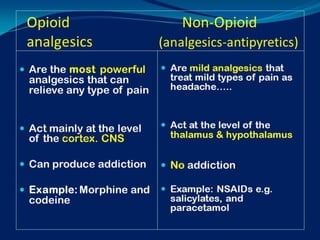
• Opioids and non-opioid analgesics
• Indications and adverse reactions of opioid analgesics.
• Physiologic dependence, psychologic dependence, and
drug toxicity.
• Implications for the administration of opioid analgesics.
• Opioid analgesics pharmacologic profile.
• Pharmacological profile of commonly used opioids
Intended Learning Outcomes
At the end of this lecture, students will be able to:
• (K) Define Pain
• (K) Identify important terms related to pain control
• (C) Compare between opioids and non-opioid analgesics
• (K) Describe indications and adverse reactions of opioid
analgesics.
• (K) Define physiologic dependence, psychologic
dependence, and drug toxicity.
• (K) Discuss nursing implications for the administration
of opioid analgesics.
• (C) Analyze the pharmacologic profile of opioid
analgesics.
• (C) Compare between Pethidine and Morphine.
Controlling Pain - Important terms
▪Analgesics: Are the drugs which selectively relieves pain
by acting in the CNS or on peripheral pain mechanisms,
without significantly altering the consciousness
“Painkillers”– Opioids and Non-steroidal anti-
inflammatory drugs (NSAIDs).
▪Opioids: Any drug which binds to the opioid receptors
(Pharmacologically related) in the CNS and antagonized by
Naloxone.
▪Narcotics: Drugs derived from opium or opium like
compounds, with potent analgesic effects associated with
significant alteration of mood and behavior, and with the
potential for dependence and tolerance following repeated
administration.
Opioid Analgesics
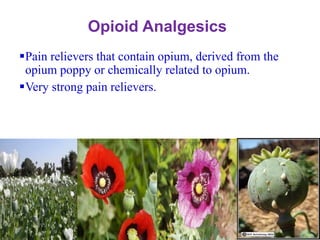
▪Pain relievers that contain opium, derived from the
opium poppy or chemically related to opium.
▪Very strong pain relievers.
Opioid Analgesics
1. Natural Opium Alkaloids: Morphine and Codeine
2. Semi-synthetic: Diacetylmorphine (Heroin)
3. Synthetic Opioids: Pethidine (Meperidine) and
Fentanyl
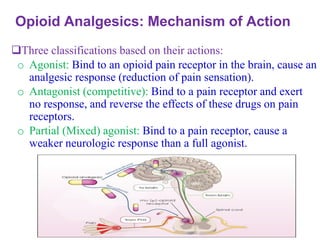
Opioid Analgesics: Mechanism of Action
❑Three classifications based on their actions:
o Agonist: Bind to an opioid pain receptor in the brain, cause an
analgesic response (reduction of pain sensation).
o Antagonist (competitive): Bind to a pain receptor and exert
no response, and reverse the effects of these drugs on pain
receptors.
o Partial (Mixed) agonist: Bind to a pain receptor, cause a
weaker neurologic response than a full agonist.
Opioid Analgesics: Indications
• Main use: to alleviate moderate to severe pain
• Often given with adjuvant analgesic drugs to assist
primary drugs with pain relief.
• Opioids are also used for:
• Codeine, and Hydrocodone are used as cough center
suppression.
• Fentanyl is used in combination with anesthetics
during surgery “Balanced Anesthesia”.
Opioid Analgesics: Contraindication
Opioid analgesics are contraindicated for patients with
known drug allergy and having severe asthma. Also it
use with extreme caution if:
• Respiratory insufficiency
• Elevated intracranial pressure
• Morbid obesity
• Sleep apnea
• Paralytic ileus
Opioid Analgesics: Adverse Effects
• Euphoria
• CNS depression leads to respiratory depression (The
most serious adverse effect)
• Nausea and vomiting
• Urinary retention
• Diaphoresis and flushing
• Pupil constriction (miosis)
• Constipation
• Itching
Opioid Analgesics: Adverse Reactions
• CNS: Sedation, increased intracranial pressure
• Respiratory: Depressed breathing
• GI: Constipation, anorexia, biliary tract spasms
• Cardiovascular: Tachycardia, bradycardia, peripheral
circulatory collapse
• Genitourinary: Urinary retention/hesitancy
• Allergic reactions: Pruritus, rash, urticaria.
Opioids Analgesics: Opioid Tolerance
•A common physiologic result of chronic opioid
treatment, then larger dose is required to maintain the
same level of analgesia.
Opioids Analgesics: Physiologic
Dependence
 Physiologic adaptation of the body to the presence
of an opioid.
 Physical dependence is seen when the opioid is
abruptly discontinued or when an opioid
antagonist is administered (Opioid withdrawal/
abstinence syndrome).
❖ Withdrawal symptoms manifested as: Anxiety,
irritability, chills and hot flashes, joint pain,
lacrimation, rhinorrhea, diaphoresis, nausea,
vomiting, abdominal cramps, diarrhea, and
confusion.
Opioids Analgesics: Psychologic
Dependence
 A pattern of compulsive drug use characterized by a
continued craving [desire] for an opioid and the need
to use the opioid for effects other than pain relief.
 Opioid tolerance and physical dependence are
expected with long-term opioid treatment and should
not be confused with psychologic dependence
(addiction).
Opioids Analgesics: Toxicity and
Management of Overdose
❖Naloxone (Narcan) or Naltrexone (Revia)
•These drugs bind to opiate receptors and prevent a
response
•Used for complete or partial reversal of opioid-
induced respiratory depression
•Regardless of withdrawal symptoms, when a
patient experiences severe respiratory
depression, an opioid antagonist should be
given!!.
‫مهم‬
Opioid Analgesics: Interactions
• Alcohol; Antihistamines; Antidepressants;
Sedatives; increased risk for CNS depression
• Barbiturates (sedative-hypnotic) : (e.g.
methohexital before operation, can be used to treat
insomnia and anxiety).
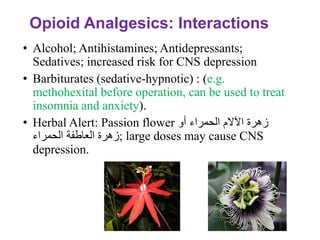
• Herbal Alert: Passion flower ‫أو‬ ‫الحمراء‬ ‫اآلالم‬ ‫زهرة‬
‫العاطفة‬ ‫زهرة‬
‫الحمراء‬ ; large doses may cause CNS
depression.
• Before beginning therapy, perform a thorough history
regarding allergies and use of other medications,
including alcohol, health history, and medical history.
• Obtain baseline vital signs and I&O.
• Assess for potential contraindications and drug
interactions.
• Perform a thorough pain assessment, including pain
intensity and character, onset, location, description,
precipitating and relieving factors, type, remedies, and
other pain treatments (Rate pain on a 0 to 10 scale).
• Assessment of pain is now being considered a “fifth
vital sign”.
Opioid Analgesics: Implications for
Administration
Opioid Analgesics: Implications for
Administration
• Be sure to medicate patients before the pain becomes severe
so as to provide adequate analgesia and pain control.
• Pain management includes pharmacologic and
nonpharmacologic approaches; be sure to include other
interventions as indicated.
• Instruct patients to notify physician for signs of allergic
reaction or adverse effects.
• Oral forms should be taken with food to minimize gastric
upset.
• Ensure safety measures, such as keeping side rails up, to
prevent injury.
Opioid Analgesics: Implications for
Administration
•Withhold dose and contact physician if there is a decline
in the patient’s condition or if vital signs are abnormal,
especially if respiratory rate is less than 10 to 12
breaths/min.
•Patients should be instructed to change positions slowly
to prevent possible orthostatic hypotension.
•Constipation is a common adverse effect and may be
prevented with adequate fluid and fiber intake.
•Instruct patients to follow directions for administration
carefully and to keep a record of their pain experience
and response to treatments.
Monitor for Adverse Effects
▪Contact a physician immediately if vital signs change,
the patient’s condition declines, or the pain continues.
✓Report a significant increase or decrease in the
pulse rate or a change in the pulse quality.
✓Report a significant decrease in blood pressure
(systolic or diastolic) or a systolic pressure below
100 mm Hg
▪Respiratory depression may be manifested by a
respiratory rate of less than 10 breaths/min, dyspnea,
diminished breath sounds, or shallow breathing.
Monitor for Therapeutic Effects
Desired Outcomes: Decreased severity of pain without
a significant alteration in level of consciousness or
respiratory status.
• Decreased complaints of pain
• Decreased severity of pain
• Increased periods of comfort
• Improved activities of daily living, appetite, and sense
of well-being.
Potential Nursing Diagnoses
● Acute pain (Indications).
● Disturbed sensory perception (auditory, visual)
(Side Effects).
● Risk for injury (Side Effects).
● Deficient knowledge, related to disease process and
medication regimen (Patient/Family Teaching).
Patient/Family Teaching
•Instruct patient on how and when to ask for pain
medication.
•Explain the therapeutic value of medication before
administration to enhance the analgesic effect.
•Medication may cause drowsiness or dizziness. Caution
patient to call for assistance when ambulating and to
avoid driving or other activities requiring alertness until
response to medication is known.
•Advise patient to make position changes slowly to
minimize orthostatic hypotension.
•Regularly administered doses may be more effective
than PRN administration.
Patient/Family Teaching
•Co-administration with nonopioid analgesics (e.g.
Acetaminophen, NSAIDs) may have additive analgesic
effects and may permit lower doses.
•Medication should be discontinued gradually after long-
term use to prevent withdrawal symptoms.
•Caution patient to avoid concurrent use of alcohol or
other CNS depressants with this medication.
✓Encourage the patient to turn, cough, and breathe
deeply every 2 hrs. to prevent atelectasis (complete
or partial collapse of the lungs).
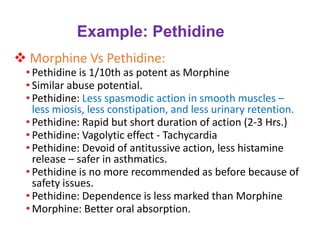
Example: Pethidine
❖ Morphine Vs Pethidine:
• Pethidine is 1/10th as potent as Morphine
• Similar abuse potential.
• Pethidine: Less spasmodic action in smooth muscles –
less miosis, less constipation, and less urinary retention.
• Pethidine: Rapid but short duration of action (2-3 Hrs.)
• Pethidine: Vagolytic effect - Tachycardia
• Pethidine: Devoid of antitussive action, less histamine
release – safer in asthmatics.
• Pethidine is no more recommended as before because of
safety issues.
• Pethidine: Dependence is less marked than Morphine
• Morphine: Better oral absorption.
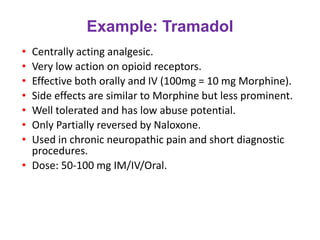
Example: Tramadol
• Centrally acting analgesic.
• Very low action on opioid receptors.
• Effective both orally and IV (100mg = 10 mg Morphine).
• Side effects are similar to Morphine but less prominent.
• Well tolerated and has low abuse potential.
• Only Partially reversed by Naloxone.
• Used in chronic neuropathic pain and short diagnostic
procedures.
• Dose: 50-100 mg IM/IV/Oral.
References
• Lilley, L.L., Collins, S. R, Snyder, J. S. (2020).
Pharmacology and the nursing process. 9th Edition.
• Michelle J. Willihnganz, Samuel L. Gurevitz, Bruce D.
Clayton. Clayton’s Basic Pharmacology for Nurses (2013),
(18th edition). Philadelphia, Elsevier Mosby.
• Paul Barber and Deborah Robertson (2020,) Essential of
pharmacology for nurses, (Fourth edition).
28
The End
29

Topic 3- Drugs Affecting CNS-Analgesics.pdf

  • 1.
    Pharmacology NUR 2302 DrugsAffecting the Central Nervous System (CNS) Analgesic Agents Presented by Mohammad Alsadi, RN, PhD https://youtu.be/fUKlpuz2VTs?si=GeOrBaxftDIquDG1 https://youtu.be/uOaiaYDoUnA?si=KBqGn2b28mJI44NF
  • 2.
    Outlines • Definition ofPain • Controlling pain • Opioids and non-opioid analgesics • Indications and adverse reactions of opioid analgesics. • Physiologic dependence, psychologic dependence, and drug toxicity. • Implications for the administration of opioid analgesics. • Opioid analgesics pharmacologic profile. • Pharmacological profile of commonly used opioids
  • 3.
    Intended Learning Outcomes Atthe end of this lecture, students will be able to: • (K) Define Pain • (K) Identify important terms related to pain control • (C) Compare between opioids and non-opioid analgesics • (K) Describe indications and adverse reactions of opioid analgesics. • (K) Define physiologic dependence, psychologic dependence, and drug toxicity. • (K) Discuss nursing implications for the administration of opioid analgesics. • (C) Analyze the pharmacologic profile of opioid analgesics. • (C) Compare between Pethidine and Morphine.
  • 4.
    Controlling Pain -Important terms ▪Analgesics: Are the drugs which selectively relieves pain by acting in the CNS or on peripheral pain mechanisms, without significantly altering the consciousness “Painkillers”– Opioids and Non-steroidal anti- inflammatory drugs (NSAIDs). ▪Opioids: Any drug which binds to the opioid receptors (Pharmacologically related) in the CNS and antagonized by Naloxone. ▪Narcotics: Drugs derived from opium or opium like compounds, with potent analgesic effects associated with significant alteration of mood and behavior, and with the potential for dependence and tolerance following repeated administration.
  • 6.
    Opioid Analgesics ▪Pain relieversthat contain opium, derived from the opium poppy or chemically related to opium. ▪Very strong pain relievers.
  • 7.
    Opioid Analgesics 1. NaturalOpium Alkaloids: Morphine and Codeine 2. Semi-synthetic: Diacetylmorphine (Heroin) 3. Synthetic Opioids: Pethidine (Meperidine) and Fentanyl
  • 8.
    Opioid Analgesics: Mechanismof Action ❑Three classifications based on their actions: o Agonist: Bind to an opioid pain receptor in the brain, cause an analgesic response (reduction of pain sensation). o Antagonist (competitive): Bind to a pain receptor and exert no response, and reverse the effects of these drugs on pain receptors. o Partial (Mixed) agonist: Bind to a pain receptor, cause a weaker neurologic response than a full agonist.
  • 9.
    Opioid Analgesics: Indications •Main use: to alleviate moderate to severe pain • Often given with adjuvant analgesic drugs to assist primary drugs with pain relief. • Opioids are also used for: • Codeine, and Hydrocodone are used as cough center suppression. • Fentanyl is used in combination with anesthetics during surgery “Balanced Anesthesia”.
  • 10.
    Opioid Analgesics: Contraindication Opioidanalgesics are contraindicated for patients with known drug allergy and having severe asthma. Also it use with extreme caution if: • Respiratory insufficiency • Elevated intracranial pressure • Morbid obesity • Sleep apnea • Paralytic ileus
  • 11.
    Opioid Analgesics: AdverseEffects • Euphoria • CNS depression leads to respiratory depression (The most serious adverse effect) • Nausea and vomiting • Urinary retention • Diaphoresis and flushing • Pupil constriction (miosis) • Constipation • Itching
  • 12.
    Opioid Analgesics: AdverseReactions • CNS: Sedation, increased intracranial pressure • Respiratory: Depressed breathing • GI: Constipation, anorexia, biliary tract spasms • Cardiovascular: Tachycardia, bradycardia, peripheral circulatory collapse • Genitourinary: Urinary retention/hesitancy • Allergic reactions: Pruritus, rash, urticaria.
  • 13.
    Opioids Analgesics: OpioidTolerance •A common physiologic result of chronic opioid treatment, then larger dose is required to maintain the same level of analgesia.
  • 14.
    Opioids Analgesics: Physiologic Dependence Physiologic adaptation of the body to the presence of an opioid.  Physical dependence is seen when the opioid is abruptly discontinued or when an opioid antagonist is administered (Opioid withdrawal/ abstinence syndrome). ❖ Withdrawal symptoms manifested as: Anxiety, irritability, chills and hot flashes, joint pain, lacrimation, rhinorrhea, diaphoresis, nausea, vomiting, abdominal cramps, diarrhea, and confusion.
  • 15.
    Opioids Analgesics: Psychologic Dependence A pattern of compulsive drug use characterized by a continued craving [desire] for an opioid and the need to use the opioid for effects other than pain relief.  Opioid tolerance and physical dependence are expected with long-term opioid treatment and should not be confused with psychologic dependence (addiction).
  • 16.
    Opioids Analgesics: Toxicityand Management of Overdose ❖Naloxone (Narcan) or Naltrexone (Revia) •These drugs bind to opiate receptors and prevent a response •Used for complete or partial reversal of opioid- induced respiratory depression •Regardless of withdrawal symptoms, when a patient experiences severe respiratory depression, an opioid antagonist should be given!!. ‫مهم‬
  • 17.
    Opioid Analgesics: Interactions •Alcohol; Antihistamines; Antidepressants; Sedatives; increased risk for CNS depression • Barbiturates (sedative-hypnotic) : (e.g. methohexital before operation, can be used to treat insomnia and anxiety). • Herbal Alert: Passion flower ‫أو‬ ‫الحمراء‬ ‫اآلالم‬ ‫زهرة‬ ‫العاطفة‬ ‫زهرة‬ ‫الحمراء‬ ; large doses may cause CNS depression.
  • 18.
    • Before beginningtherapy, perform a thorough history regarding allergies and use of other medications, including alcohol, health history, and medical history. • Obtain baseline vital signs and I&O. • Assess for potential contraindications and drug interactions. • Perform a thorough pain assessment, including pain intensity and character, onset, location, description, precipitating and relieving factors, type, remedies, and other pain treatments (Rate pain on a 0 to 10 scale). • Assessment of pain is now being considered a “fifth vital sign”. Opioid Analgesics: Implications for Administration
  • 19.
    Opioid Analgesics: Implicationsfor Administration • Be sure to medicate patients before the pain becomes severe so as to provide adequate analgesia and pain control. • Pain management includes pharmacologic and nonpharmacologic approaches; be sure to include other interventions as indicated. • Instruct patients to notify physician for signs of allergic reaction or adverse effects. • Oral forms should be taken with food to minimize gastric upset. • Ensure safety measures, such as keeping side rails up, to prevent injury.
  • 20.
    Opioid Analgesics: Implicationsfor Administration •Withhold dose and contact physician if there is a decline in the patient’s condition or if vital signs are abnormal, especially if respiratory rate is less than 10 to 12 breaths/min. •Patients should be instructed to change positions slowly to prevent possible orthostatic hypotension. •Constipation is a common adverse effect and may be prevented with adequate fluid and fiber intake. •Instruct patients to follow directions for administration carefully and to keep a record of their pain experience and response to treatments.
  • 21.
    Monitor for AdverseEffects ▪Contact a physician immediately if vital signs change, the patient’s condition declines, or the pain continues. ✓Report a significant increase or decrease in the pulse rate or a change in the pulse quality. ✓Report a significant decrease in blood pressure (systolic or diastolic) or a systolic pressure below 100 mm Hg ▪Respiratory depression may be manifested by a respiratory rate of less than 10 breaths/min, dyspnea, diminished breath sounds, or shallow breathing.
  • 22.
    Monitor for TherapeuticEffects Desired Outcomes: Decreased severity of pain without a significant alteration in level of consciousness or respiratory status. • Decreased complaints of pain • Decreased severity of pain • Increased periods of comfort • Improved activities of daily living, appetite, and sense of well-being.
  • 23.
    Potential Nursing Diagnoses ●Acute pain (Indications). ● Disturbed sensory perception (auditory, visual) (Side Effects). ● Risk for injury (Side Effects). ● Deficient knowledge, related to disease process and medication regimen (Patient/Family Teaching).
  • 24.
    Patient/Family Teaching •Instruct patienton how and when to ask for pain medication. •Explain the therapeutic value of medication before administration to enhance the analgesic effect. •Medication may cause drowsiness or dizziness. Caution patient to call for assistance when ambulating and to avoid driving or other activities requiring alertness until response to medication is known. •Advise patient to make position changes slowly to minimize orthostatic hypotension. •Regularly administered doses may be more effective than PRN administration.
  • 25.
    Patient/Family Teaching •Co-administration withnonopioid analgesics (e.g. Acetaminophen, NSAIDs) may have additive analgesic effects and may permit lower doses. •Medication should be discontinued gradually after long- term use to prevent withdrawal symptoms. •Caution patient to avoid concurrent use of alcohol or other CNS depressants with this medication. ✓Encourage the patient to turn, cough, and breathe deeply every 2 hrs. to prevent atelectasis (complete or partial collapse of the lungs).
  • 26.
    Example: Pethidine ❖ MorphineVs Pethidine: • Pethidine is 1/10th as potent as Morphine • Similar abuse potential. • Pethidine: Less spasmodic action in smooth muscles – less miosis, less constipation, and less urinary retention. • Pethidine: Rapid but short duration of action (2-3 Hrs.) • Pethidine: Vagolytic effect - Tachycardia • Pethidine: Devoid of antitussive action, less histamine release – safer in asthmatics. • Pethidine is no more recommended as before because of safety issues. • Pethidine: Dependence is less marked than Morphine • Morphine: Better oral absorption.
  • 27.
    Example: Tramadol • Centrallyacting analgesic. • Very low action on opioid receptors. • Effective both orally and IV (100mg = 10 mg Morphine). • Side effects are similar to Morphine but less prominent. • Well tolerated and has low abuse potential. • Only Partially reversed by Naloxone. • Used in chronic neuropathic pain and short diagnostic procedures. • Dose: 50-100 mg IM/IV/Oral.
  • 28.
    References • Lilley, L.L.,Collins, S. R, Snyder, J. S. (2020). Pharmacology and the nursing process. 9th Edition. • Michelle J. Willihnganz, Samuel L. Gurevitz, Bruce D. Clayton. Clayton’s Basic Pharmacology for Nurses (2013), (18th edition). Philadelphia, Elsevier Mosby. • Paul Barber and Deborah Robertson (2020,) Essential of pharmacology for nurses, (Fourth edition). 28
  • 29.