SUBJECT: APPLIED PHYSICS – II [BS104]
UNIT – 1 : Wave Motion And It’s Applications
(Part – 1)
1ST YEAR 2ND SEMESTER
ANINDITA CHATTOPADHYAY
(LECTURER) PHYSICS
SHREE RAMKRISHNA INSTITUTE
OF SCIENCE AND TECHNOLOGY
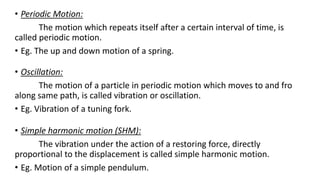
• Periodic Motion:
The motion which repeats itself after a certain interval of time, is
called periodic motion.
• Eg. The up and down motion of a spring.
• Oscillation:
The motion of a particle in periodic motion which moves to and fro
along same path, is called vibration or oscillation.
• Eg. Vibration of a tuning fork.
• Simple harmonic motion (SHM):
The vibration under the action of a restoring force, directly
proportional to the displacement is called simple harmonic motion.
• Eg. Motion of a simple pendulum.
Characteristics of SHM:
•Motion is linear
•Motion is periodic
•Motion is oscillatory
•Restoring force is proportional to the
displacement from mean position [i.e. F ∞ y ]
•Restoring force is directed towards the mean
position. [ i.e. F ∞ - y ]
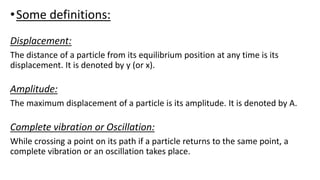
•Some definitions:
Displacement:
The distance of a particle from its equilibrium position at any time is its
displacement. It is denoted by y (or x).
Amplitude:
The maximum displacement of a particle is its amplitude. It is denoted by A.
Complete vibration or Oscillation:
While crossing a point on its path if a particle returns to the same point, a
complete vibration or an oscillation takes place.
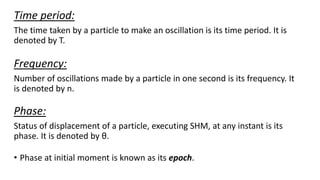
Time period:
The time taken by a particle to make an oscillation is its time period. It is
denoted by T.
Frequency:
Number of oscillations made by a particle in one second is its frequency. It
is denoted by n.
Phase:
Status of displacement of a particle, executing SHM, at any instant is its
phase. It is denoted by θ.
• Phase at initial moment is known as its epoch.
If y = A sin(ωt+φ) …(1)
be the equation of a SHM, then,
• y = displacement [unit : m or cm]
• A= amplitude [unit : m or cm]
• ω= angular frequency =2πn, where n= linear frequency [unit : s-1]
• T= time period = 1/n = 2π/ω [unit : s]
• ωt+φ = phase [unitless]
• φ = epoch [unitless]
• Equation of motion (EOM) of SHM:
According to the nature of restoring force,
F = -sy …(2)
→ 𝑚
𝑑2𝑦
𝑑𝑡2 = -sy
→
𝑑2𝑦
𝑑𝑡2 + 𝜔2
𝑦 = 0 …(3)
This is the equation of motion of SHM.
Here s = force constant [unit : N/m]
𝜔 =
𝑠
𝑚
= angular frequency
𝑇 =
2𝜋
ω
= time period of oscillation
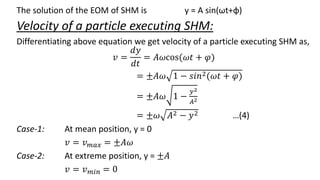
The solution of the EOM of SHM is y = A sin(ωt+φ)
Velocity of a particle executing SHM:
Differentiating above equation we get velocity of a particle executing SHM as,
𝑣 =
𝑑𝑦
𝑑𝑡
= 𝐴𝜔cos(𝜔𝑡 + 𝜑)
= ±𝐴𝜔 1 − 𝑠𝑖𝑛2(𝜔𝑡 + 𝜑)
= ±𝐴𝜔 1 −
𝑦2
𝐴2
= ±𝜔 𝐴2 − 𝑦2 …(4)
Case-1: At mean position, y = 0
𝑣 = 𝑣𝑚𝑎𝑥 = ±𝐴𝜔
Case-2: At extreme position, y = ±𝐴
𝑣 = 𝑣𝑚𝑖𝑛 = 0
Acceleration of a particle executing SHM:
Differentiating equation (1) two times we get acceleration of a particle
executing SHM as
f =
𝑑𝑣
𝑑𝑡
=
𝑑2𝑦
𝑑𝑡2 = −𝐴𝜔2 sin 𝜔𝑡 + 𝜑 = −𝜔2𝑦 … (5)
Case-1: At mean position, y = 0
𝑓 = 𝑓𝑚𝑖𝑛 = 0
Case-2: At extreme position, y = ±𝐴
𝑓 = 𝑓𝑚𝑎𝑥 = ∓𝐴𝜔2
Note: When the velocity of a particle executing SHM is maximum, its
acceleration is minimum and vise-versa.
Phase relations of displacement, velocity and
acceleration:
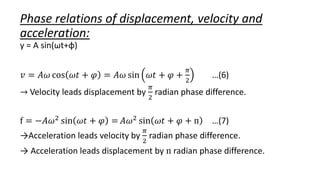
y = A sin(ωt+φ)
𝑣 = 𝐴𝜔 cos 𝜔𝑡 + 𝜑 = 𝐴𝜔 sin 𝜔𝑡 + 𝜑 +
𝜋
2
…(6)
→ Velocity leads displacement by
𝜋
2
radian phase difference.
f = −𝐴𝜔2
sin 𝜔𝑡 + 𝜑 = 𝐴𝜔2
sin 𝜔𝑡 + 𝜑 + ᴨ …(7)
→Acceleration leads velocity by
𝜋
2
radian phase difference.
→ Acceleration leads displacement by ᴨ radian phase difference.
Study of vibrations of cantilever:
Cantilever:
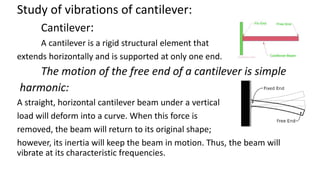
A cantilever is a rigid structural element that
extends horizontally and is supported at only one end.
The motion of the free end of a cantilever is simple
harmonic:
A straight, horizontal cantilever beam under a vertical
load will deform into a curve. When this force is
removed, the beam will return to its original shape;
however, its inertia will keep the beam in motion. Thus, the beam will
vibrate at its characteristic frequencies.
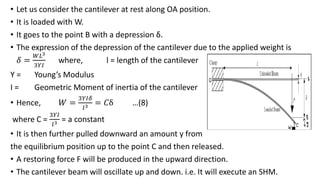
• Let us consider the cantilever at rest along OA position.
• It is loaded with W.
• It goes to the point B with a depression δ.
• The expression of the depression of the cantilever due to the applied weight is
𝛿 =
𝑊𝐿3
3𝑌𝐼
where, l = length of the cantilever
Y = Young’s Modulus
I = Geometric Moment of inertia of the cantilever
• Hence, 𝑊 =
3𝑌𝐼𝛿
𝑙3 = 𝐶δ …(8)
where C =
3𝑌𝐼
𝑙3 = a constant
• It is then further pulled downward an amount y from
the equilibrium position up to the point C and then released.
• A restoring force F will be produced in the upward direction.
• The cantilever beam will oscillate up and down. i.e. It will execute an SHM.
EOM of the cantilever:
The forces acting on the loaded cantilever :
1. The weight hanged (downward) [W]
2. The restoring force in the opposite direction of the depression (upward)
[F]
The displacement of the tip of the cantilever :
1. Due to the weight (W) hanged δ
2. Due to the applied force (F) on the tip of the
cantilever y
Hence, 𝑊 − 𝐹 = 𝐶(𝛿 + 𝑦) … (9)
Putting (9) in (8) we get, 𝐶𝛿 − 𝐹 = 𝐶𝛿 + 𝑦
→ 𝐹 = −𝐶𝑦 … (10)
→𝐹 ∞ − 𝑦
Hence, The motion of the free end of a cantilever is simple harmonic.
From equation (10) we get,
→𝑚
𝑑2𝑦
𝑑𝑡2 = -Cy
→
𝑑2𝑦
𝑑𝑡2 +
𝐶
𝑚
𝑦 = 0 …(11)
Hence, comparing the EOM of a SHM i.e. equation (3) we get for the motion of
the end of a cantilever has the
angular frequency =𝜔 =
𝐶
𝑚
=
3𝑌𝐼
𝑙3 𝑚
[Using (8)]
linear frequency = n =
ω
2𝜋
=
1
2𝜋
3𝑌𝐼
𝑙3 𝑚
[Using (8)]
time period of oscillation = 𝑇 =
2𝜋
ω
= 2𝜋
𝑚𝑙3
3𝑌𝐼
[Using (8)]
Damped vibration:
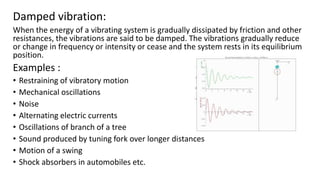
When the energy of a vibrating system is gradually dissipated by friction and other
resistances, the vibrations are said to be damped. The vibrations gradually reduce
or change in frequency or intensity or cease and the system rests in its equilibrium
position.
Examples :
• Restraining of vibratory motion
• Mechanical oscillations
• Noise
• Alternating electric currents
• Oscillations of branch of a tree
• Sound produced by tuning fork over longer distances
• Motion of a swing
• Shock absorbers in automobiles etc.
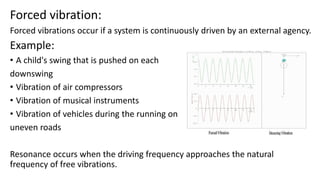
Forced vibration:
Forced vibrations occur if a system is continuously driven by an external agency.
Example:
• A child's swing that is pushed on each
downswing
• Vibration of air compressors
• Vibration of musical instruments
• Vibration of vehicles during the running on
uneven roads
Resonance occurs when the driving frequency approaches the natural
frequency of free vibrations.

APII_Unit1_part1.pptx

  • 1.
    SUBJECT: APPLIED PHYSICS– II [BS104] UNIT – 1 : Wave Motion And It’s Applications (Part – 1) 1ST YEAR 2ND SEMESTER ANINDITA CHATTOPADHYAY (LECTURER) PHYSICS SHREE RAMKRISHNA INSTITUTE OF SCIENCE AND TECHNOLOGY
  • 2.
    • Periodic Motion: Themotion which repeats itself after a certain interval of time, is called periodic motion. • Eg. The up and down motion of a spring. • Oscillation: The motion of a particle in periodic motion which moves to and fro along same path, is called vibration or oscillation. • Eg. Vibration of a tuning fork. • Simple harmonic motion (SHM): The vibration under the action of a restoring force, directly proportional to the displacement is called simple harmonic motion. • Eg. Motion of a simple pendulum.
  • 3.
    Characteristics of SHM: •Motionis linear •Motion is periodic •Motion is oscillatory •Restoring force is proportional to the displacement from mean position [i.e. F ∞ y ] •Restoring force is directed towards the mean position. [ i.e. F ∞ - y ]
  • 4.
    •Some definitions: Displacement: The distanceof a particle from its equilibrium position at any time is its displacement. It is denoted by y (or x). Amplitude: The maximum displacement of a particle is its amplitude. It is denoted by A. Complete vibration or Oscillation: While crossing a point on its path if a particle returns to the same point, a complete vibration or an oscillation takes place.
  • 5.
    Time period: The timetaken by a particle to make an oscillation is its time period. It is denoted by T. Frequency: Number of oscillations made by a particle in one second is its frequency. It is denoted by n. Phase: Status of displacement of a particle, executing SHM, at any instant is its phase. It is denoted by θ. • Phase at initial moment is known as its epoch.
  • 6.
    If y =A sin(ωt+φ) …(1) be the equation of a SHM, then, • y = displacement [unit : m or cm] • A= amplitude [unit : m or cm] • ω= angular frequency =2πn, where n= linear frequency [unit : s-1] • T= time period = 1/n = 2π/ω [unit : s] • ωt+φ = phase [unitless] • φ = epoch [unitless]
  • 7.
    • Equation ofmotion (EOM) of SHM: According to the nature of restoring force, F = -sy …(2) → 𝑚 𝑑2𝑦 𝑑𝑡2 = -sy → 𝑑2𝑦 𝑑𝑡2 + 𝜔2 𝑦 = 0 …(3) This is the equation of motion of SHM. Here s = force constant [unit : N/m] 𝜔 = 𝑠 𝑚 = angular frequency 𝑇 = 2𝜋 ω = time period of oscillation
  • 8.
    The solution ofthe EOM of SHM is y = A sin(ωt+φ) Velocity of a particle executing SHM: Differentiating above equation we get velocity of a particle executing SHM as, 𝑣 = 𝑑𝑦 𝑑𝑡 = 𝐴𝜔cos(𝜔𝑡 + 𝜑) = ±𝐴𝜔 1 − 𝑠𝑖𝑛2(𝜔𝑡 + 𝜑) = ±𝐴𝜔 1 − 𝑦2 𝐴2 = ±𝜔 𝐴2 − 𝑦2 …(4) Case-1: At mean position, y = 0 𝑣 = 𝑣𝑚𝑎𝑥 = ±𝐴𝜔 Case-2: At extreme position, y = ±𝐴 𝑣 = 𝑣𝑚𝑖𝑛 = 0
  • 9.
    Acceleration of aparticle executing SHM: Differentiating equation (1) two times we get acceleration of a particle executing SHM as f = 𝑑𝑣 𝑑𝑡 = 𝑑2𝑦 𝑑𝑡2 = −𝐴𝜔2 sin 𝜔𝑡 + 𝜑 = −𝜔2𝑦 … (5) Case-1: At mean position, y = 0 𝑓 = 𝑓𝑚𝑖𝑛 = 0 Case-2: At extreme position, y = ±𝐴 𝑓 = 𝑓𝑚𝑎𝑥 = ∓𝐴𝜔2 Note: When the velocity of a particle executing SHM is maximum, its acceleration is minimum and vise-versa.
  • 10.
    Phase relations ofdisplacement, velocity and acceleration: y = A sin(ωt+φ) 𝑣 = 𝐴𝜔 cos 𝜔𝑡 + 𝜑 = 𝐴𝜔 sin 𝜔𝑡 + 𝜑 + 𝜋 2 …(6) → Velocity leads displacement by 𝜋 2 radian phase difference. f = −𝐴𝜔2 sin 𝜔𝑡 + 𝜑 = 𝐴𝜔2 sin 𝜔𝑡 + 𝜑 + ᴨ …(7) →Acceleration leads velocity by 𝜋 2 radian phase difference. → Acceleration leads displacement by ᴨ radian phase difference.
  • 11.
    Study of vibrationsof cantilever: Cantilever: A cantilever is a rigid structural element that extends horizontally and is supported at only one end. The motion of the free end of a cantilever is simple harmonic: A straight, horizontal cantilever beam under a vertical load will deform into a curve. When this force is removed, the beam will return to its original shape; however, its inertia will keep the beam in motion. Thus, the beam will vibrate at its characteristic frequencies.
  • 12.
    • Let usconsider the cantilever at rest along OA position. • It is loaded with W. • It goes to the point B with a depression δ. • The expression of the depression of the cantilever due to the applied weight is 𝛿 = 𝑊𝐿3 3𝑌𝐼 where, l = length of the cantilever Y = Young’s Modulus I = Geometric Moment of inertia of the cantilever • Hence, 𝑊 = 3𝑌𝐼𝛿 𝑙3 = 𝐶δ …(8) where C = 3𝑌𝐼 𝑙3 = a constant • It is then further pulled downward an amount y from the equilibrium position up to the point C and then released. • A restoring force F will be produced in the upward direction. • The cantilever beam will oscillate up and down. i.e. It will execute an SHM.
  • 13.
    EOM of thecantilever: The forces acting on the loaded cantilever : 1. The weight hanged (downward) [W] 2. The restoring force in the opposite direction of the depression (upward) [F] The displacement of the tip of the cantilever : 1. Due to the weight (W) hanged δ 2. Due to the applied force (F) on the tip of the cantilever y Hence, 𝑊 − 𝐹 = 𝐶(𝛿 + 𝑦) … (9) Putting (9) in (8) we get, 𝐶𝛿 − 𝐹 = 𝐶𝛿 + 𝑦 → 𝐹 = −𝐶𝑦 … (10) →𝐹 ∞ − 𝑦 Hence, The motion of the free end of a cantilever is simple harmonic.
  • 14.
    From equation (10)we get, →𝑚 𝑑2𝑦 𝑑𝑡2 = -Cy → 𝑑2𝑦 𝑑𝑡2 + 𝐶 𝑚 𝑦 = 0 …(11) Hence, comparing the EOM of a SHM i.e. equation (3) we get for the motion of the end of a cantilever has the angular frequency =𝜔 = 𝐶 𝑚 = 3𝑌𝐼 𝑙3 𝑚 [Using (8)] linear frequency = n = ω 2𝜋 = 1 2𝜋 3𝑌𝐼 𝑙3 𝑚 [Using (8)] time period of oscillation = 𝑇 = 2𝜋 ω = 2𝜋 𝑚𝑙3 3𝑌𝐼 [Using (8)]
  • 15.
    Damped vibration: When theenergy of a vibrating system is gradually dissipated by friction and other resistances, the vibrations are said to be damped. The vibrations gradually reduce or change in frequency or intensity or cease and the system rests in its equilibrium position. Examples : • Restraining of vibratory motion • Mechanical oscillations • Noise • Alternating electric currents • Oscillations of branch of a tree • Sound produced by tuning fork over longer distances • Motion of a swing • Shock absorbers in automobiles etc.
  • 16.
    Forced vibration: Forced vibrationsoccur if a system is continuously driven by an external agency. Example: • A child's swing that is pushed on each downswing • Vibration of air compressors • Vibration of musical instruments • Vibration of vehicles during the running on uneven roads Resonance occurs when the driving frequency approaches the natural frequency of free vibrations.