PUB 321
Strategic Negotiation
& Mediation
Topic 4
Successful Negotiator & Barriers to
Effective Negotiation
Learning Objectives
 Explain the characteristics of successful negotiator.
 Understand the barriers to effective negotiation.
Effective Negotiation
 As a negotiator, we must have intelligence and sharp
focus as we start the negotiation process but more
importantly:
– We need a good measure of wisdom to broaden our
perspective.
– Tips for Effective Negotiation
•ƒShould someone decline a request you make, do not
immediately withdraw from the negotiation but rather
retreat within the negotiation. ƒ
•Should one party becomes stressed and tense during a
negotiation, lessen the rate of your speech, lower the
tone of your voice, breathe deeply and more slowly, and
generally present a relaxed image.
Tips for Effective Negotiation
 Do not prejudge a person or problem before you have
acquired sufficient information. ƒ
 Do not spend a lot of time thinking about what worked in the
past; historical perspectives may not necessarily be valid or
applicable.
 Negotiation is a future oriented skill, so you need to think of
negotiations as the art of the possible, not the impossible.
 Instead of defining or describing the situation, try thinking in
terms of what can be achieved, i.e. "how can we develop a
situation where people will be happy with our service or
products," as opposed to, "what is causing people to dismiss
our service or product?"
Characteristics of Successful Negotiator
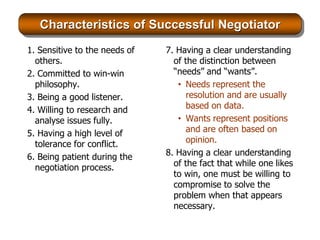
1. Sensitive to the needs of
others.
2. Committed to win-win
philosophy.
3. Being a good listener.
4. Willing to research and
analyse issues fully.
5. Having a high level of
tolerance for conflict.
6. Being patient during the
negotiation process.
7. Having a clear understanding
of the distinction between
“needs” and “wants”.
• Needs represent the
resolution and are usually
based on data.
• Wants represent positions
and are often based on
opinion.
8. Having a clear understanding
of the fact that while one likes
to win, one must be willing to
compromise to solve the
problem when that appears
necessary.
Challenges to Successful Negotiation
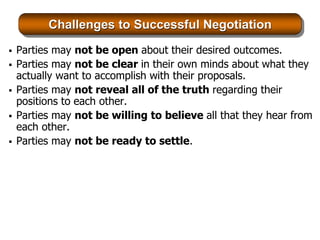
 Parties may not be open about their desired outcomes.
 Parties may not be clear in their own minds about what they
actually want to accomplish with their proposals.
 Parties may not reveal all of the truth regarding their
positions to each other.
 Parties may not be willing to believe all that they hear from
each other.
 Parties may not be ready to settle.
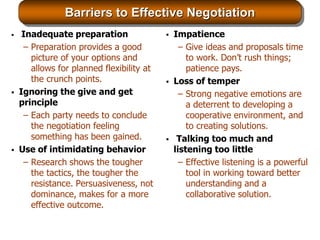
Barriers to Effective Negotiation
 Inadequate preparation
– Preparation provides a good
picture of your options and
allows for planned flexibility at
the crunch points.
 Ignoring the give and get
principle
– Each party needs to conclude
the negotiation feeling
something has been gained.
 Use of intimidating behavior
– Research shows the tougher
the tactics, the tougher the
resistance. Persuasiveness, not
dominance, makes for a more
effective outcome.
 Impatience
– Give ideas and proposals time
to work. Don’t rush things;
patience pays.
 Loss of temper
– Strong negative emotions are
a deterrent to developing a
cooperative environment, and
to creating solutions.
 Talking too much and
listening too little
– Effective listening is a powerful
tool in working toward better
understanding and a
collaborative solution.
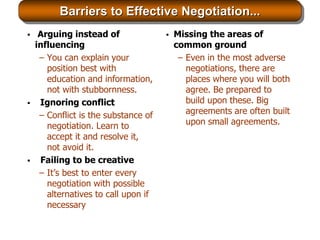
Barriers to Effective Negotiation...
 Arguing instead of
influencing
– You can explain your
position best with
education and information,
not with stubbornness.
 Ignoring conflict
– Conflict is the substance of
negotiation. Learn to
accept it and resolve it,
not avoid it.
 Failing to be creative
– It’s best to enter every
negotiation with possible
alternatives to call upon if
necessary
 Missing the areas of
common ground
– Even in the most adverse
negotiations, there are
places where you will both
agree. Be prepared to
build upon these. Big
agreements are often built
upon small agreements.
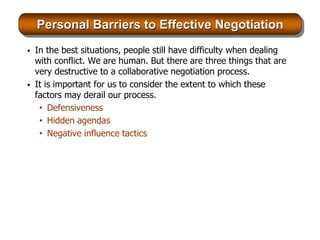
Personal Barriers to Effective Negotiation
 In the best situations, people still have difficulty when dealing
with conflict. We are human. But there are three things that are
very destructive to a collaborative negotiation process.
 It is important for us to consider the extent to which these
factors may derail our process.
• Defensiveness
• Hidden agendas
• Negative influence tactics
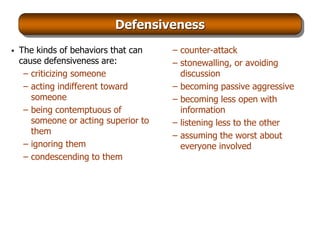
Defensiveness
 The kinds of behaviors that can
cause defensiveness are:
– criticizing someone
– acting indifferent toward
someone
– being contemptuous of
someone or acting superior to
them
– ignoring them
– condescending to them
– counter-attack
– stonewalling, or avoiding
discussion
– becoming passive aggressive
– becoming less open with
information
– listening less to the other
– assuming the worst about
everyone involved
Hidden Agendas
 Hidden agendas are desires for outcomes or actions
that you want to keep from the group.
 Your actions are motivated by these agendas, but you
do not want others to know that.
 Hidden agendas are often caused by a concern about
one’s image or one’s role or power in the group.
Negative Influence Tactics
– Talking over someone else
– Dominating the conversation or holding the floor
– Semantic boxing (arguing over terms rather than
the issue)
– Being overly ambiguous
– Withdrawing from the conversation
– Being very pessimistic
– Threatening others

Topic 4 - Effective Negotiation.ppt

  • 1.
    PUB 321 Strategic Negotiation &Mediation Topic 4 Successful Negotiator & Barriers to Effective Negotiation
  • 2.
    Learning Objectives  Explainthe characteristics of successful negotiator.  Understand the barriers to effective negotiation.
  • 3.
    Effective Negotiation  Asa negotiator, we must have intelligence and sharp focus as we start the negotiation process but more importantly: – We need a good measure of wisdom to broaden our perspective. – Tips for Effective Negotiation •ƒShould someone decline a request you make, do not immediately withdraw from the negotiation but rather retreat within the negotiation. ƒ •Should one party becomes stressed and tense during a negotiation, lessen the rate of your speech, lower the tone of your voice, breathe deeply and more slowly, and generally present a relaxed image.
  • 4.
    Tips for EffectiveNegotiation  Do not prejudge a person or problem before you have acquired sufficient information. ƒ  Do not spend a lot of time thinking about what worked in the past; historical perspectives may not necessarily be valid or applicable.  Negotiation is a future oriented skill, so you need to think of negotiations as the art of the possible, not the impossible.  Instead of defining or describing the situation, try thinking in terms of what can be achieved, i.e. "how can we develop a situation where people will be happy with our service or products," as opposed to, "what is causing people to dismiss our service or product?"
  • 5.
    Characteristics of SuccessfulNegotiator 1. Sensitive to the needs of others. 2. Committed to win-win philosophy. 3. Being a good listener. 4. Willing to research and analyse issues fully. 5. Having a high level of tolerance for conflict. 6. Being patient during the negotiation process. 7. Having a clear understanding of the distinction between “needs” and “wants”. • Needs represent the resolution and are usually based on data. • Wants represent positions and are often based on opinion. 8. Having a clear understanding of the fact that while one likes to win, one must be willing to compromise to solve the problem when that appears necessary.
  • 6.
    Challenges to SuccessfulNegotiation  Parties may not be open about their desired outcomes.  Parties may not be clear in their own minds about what they actually want to accomplish with their proposals.  Parties may not reveal all of the truth regarding their positions to each other.  Parties may not be willing to believe all that they hear from each other.  Parties may not be ready to settle.
  • 7.
    Barriers to EffectiveNegotiation  Inadequate preparation – Preparation provides a good picture of your options and allows for planned flexibility at the crunch points.  Ignoring the give and get principle – Each party needs to conclude the negotiation feeling something has been gained.  Use of intimidating behavior – Research shows the tougher the tactics, the tougher the resistance. Persuasiveness, not dominance, makes for a more effective outcome.  Impatience – Give ideas and proposals time to work. Don’t rush things; patience pays.  Loss of temper – Strong negative emotions are a deterrent to developing a cooperative environment, and to creating solutions.  Talking too much and listening too little – Effective listening is a powerful tool in working toward better understanding and a collaborative solution.
  • 8.
    Barriers to EffectiveNegotiation...  Arguing instead of influencing – You can explain your position best with education and information, not with stubbornness.  Ignoring conflict – Conflict is the substance of negotiation. Learn to accept it and resolve it, not avoid it.  Failing to be creative – It’s best to enter every negotiation with possible alternatives to call upon if necessary  Missing the areas of common ground – Even in the most adverse negotiations, there are places where you will both agree. Be prepared to build upon these. Big agreements are often built upon small agreements.
  • 9.
    Personal Barriers toEffective Negotiation  In the best situations, people still have difficulty when dealing with conflict. We are human. But there are three things that are very destructive to a collaborative negotiation process.  It is important for us to consider the extent to which these factors may derail our process. • Defensiveness • Hidden agendas • Negative influence tactics
  • 10.
    Defensiveness  The kindsof behaviors that can cause defensiveness are: – criticizing someone – acting indifferent toward someone – being contemptuous of someone or acting superior to them – ignoring them – condescending to them – counter-attack – stonewalling, or avoiding discussion – becoming passive aggressive – becoming less open with information – listening less to the other – assuming the worst about everyone involved
  • 11.
    Hidden Agendas  Hiddenagendas are desires for outcomes or actions that you want to keep from the group.  Your actions are motivated by these agendas, but you do not want others to know that.  Hidden agendas are often caused by a concern about one’s image or one’s role or power in the group.
  • 12.
    Negative Influence Tactics –Talking over someone else – Dominating the conversation or holding the floor – Semantic boxing (arguing over terms rather than the issue) – Being overly ambiguous – Withdrawing from the conversation – Being very pessimistic – Threatening others