TOP-Change
  A framework for management of change in the fifth
               technology revolution
                                           Leon Dohmen
                                           January 2010

                                   Translation by William Martin


Theories and concepts concerning the best approach for organisational changes are in abundance.
 However, changes in organisations are still difficult and lead frequently to insufficient results. The
reason for this is that almost all of the existing theories and conceptions concerning management of
                                    change have a very limited view.
TOP-Change

Introduction
The term, management of change, has no unambiguous definition. For a good understanding,
this article uses the definition: to give optimal steering to change. Steering means: to guide in
a certain direction.
In the article ’The irrational side of change management’ McKinsey writes that in spite of
Kotter, still only 30% of the changes succeed. McKinsey concludes therefore that the rational
approach of Kotter does not work. According to McKinsey, changes must be carried out in a
more irrational manner. Apart from the fact many organisations now actually change
according to the approach of Kotter, it is interesting to look further into the comments of
McKinsey. Because, also with McKinsey’s approach, only a maximum of 30% of the changes
will succeed. If changes are rational or irrationally approached, in both cases it only concerns
the domain people as a component of the change. This view is much too limited. There are
still two other domains – technology and organisation – which have a considerable influence
on the success rate of changes.

The fifth technology revolution
According to Carlota Perez, we are presently in the fifth technology revolution. Changes in
this period are especially driven by Information Technology (IT). The five minute long video
‘Did you know’ on YouTube - http://www.youtube.com/watch?v=jpEnFwiqdx8 - sums up
pieces of information that typify this period. The conclusion of this video is: ‘We are living in
exponential times’. In the fifth technology revolution, technology, organisation and people
are the most important domains which are involved in changes.

Technology
This is the supply of available technology and the possibilities, limitations and the
impossibilities that this technology has. Where IT is concerned, the available technology is
limited to the IT domain. Even with this limitation, the supply of available technology is
enormous. Characteristically, the life cycle of new technology is (still) becoming shorter.

Organisation
Here it concerns processes and structure (including location) of the organisation.
Organisations commit IT for the realisation of their organisational goals. The application of
technology is tuned on this. In some branches, the application of new technology has an
enormous influence on the existing processes, structures and relationships. Internet
technology has made it possible to create a virtual world (V-world) next to a physical world in
which the meaning of the terms place, time and presence has drastically changed.

People
A new IT solution often means new work content and changing cooperation with colleagues
or people outside its own organisation. Often, because of this, interests of people change. The
main question is: How fast are people able to make new IT solutions their own and apply
them within their work situation? Other behaviour, new knowledge and skills must be
developed. This will be nearly always coupled with a learning process. However, this learning
process can be different for each person. It is popular to distinguish between people who have
grown up with IT (digital natives) and the elderly (digital immigrants). Besides this, people
have different learning styles which also affect the learning process.


                                                                                               2
TOP-Change

Incomplete views
The view from the practice of the fifth technology revolution shows that there is a permanent
interaction between technology, organisation and people. For each issue where IT plays an
important role, the composition and interaction is different between the domains Technology,
Organisation and People. Each TOP-mix is unique and knows its own dynamics and
unpredictability. Results are never absolute and univocal. Here is where the most views that
the various professional fields and studies have developed go wrong. Many of these views
about how change can best be carried out limit itself to one or at most two domains of the
TOP-mix. Psychologists and behaviour scientists point to the importance of the people factor
and the developing of correct behaviour. IT project managers approach their issues from the
domain technology and restrict their IT project to this domain only. Most IT project managers
have no idea what takes place outside of their technical domain. Organisation scientists
especially evaluate processes and structures and explain which organisation form is most
                                                                    appropriate      for     an
                                                                    organisation. Each view
                                                                    from a separate field of
                                                                    study or profession is
                                                                    incomplete and without
                                                                    insight in the required
                                                                    contribution      of    and
                                                                    interaction between other
                                                                    domains, only a partial
                                                                    solution can be offered.
                                                                    Only thinking and acting
                                                                    over all domains, will
                                                                    considerably increase the
                                                                    success        rate      of
                                                                    organisational      changes
                                                                    where IT plays an
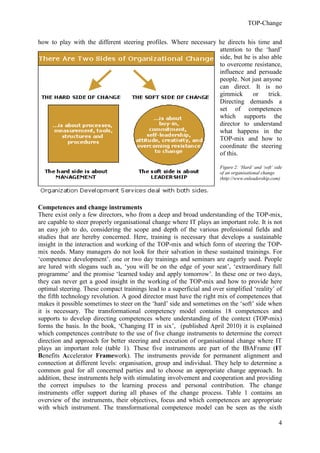
                                                                    important role. (Figure 1).

                                                                    Figure 1: Relation between
                                                                    domains of change and steering


Manager, leader, director
It has already been indicated in this article that each TOP-mix is unique, that the change
results are unpredictable and not univocal. Therefore, it is a big mistake to think that each
organisational change, where IT plays an important role, always take place in the same way.
There is not a sanctifying, always fitting form of steering. The steering of the change must be
tuned on the TOP-mix. Most organisations subconsciously choose a form of steering for an
organisational change where IT plays an important role. Mostly, without considering a
standard project management method, such as PRINCE2, is used.
There is a distinction between two basic steering profiles and a hybrid one. The two basic
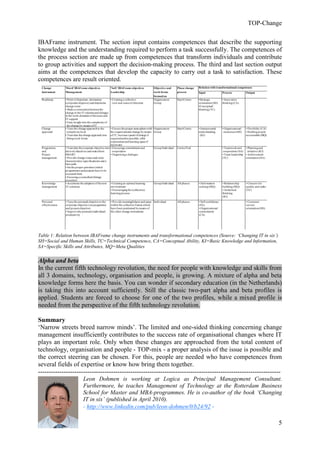
forms involve the ‘hard’ side and ‘soft’ side of change (Figure 2). The ‘soft’ side helps to
provide steering within the people domain and is called leadership. The ‘hard’ side which is
called management, helps with the steering within the domains technique and organisation.
The third steering profile, a hybrid of ‘hard’ and ‘soft’, is called directing. A director knows
the composition and interaction of the TOP-mix in order to choose appropriate steering for an
organisational change where IT plays an important role. Often a change can be subdivided in
smaller segments. Each part can have its own separate necessary steering. The director knows

                                                                                                3
TOP-Change

how to play with the different steering profiles. Where necessary he directs his time and
                                                                  attention to the ‘hard’
                                                                  side, but he is also able
                                                                  to overcome resistance,
                                                                  influence and persuade
                                                                  people. Not just anyone
                                                                  can direct. It is no
                                                                  gimmick      or     trick.
                                                                  Directing demands a
                                                                  set of competences
                                                                  which supports the
                                                                  director to understand
                                                                  what happens in the
                                                                  TOP-mix and how to
                                                                  coordinate the steering
                                                                  of this.

                                                                       Figure 2: ‘Hard’ and ‘soft’ side
                                                                       of an organisational change
                                                                       (http://www.enleadership.com)


Competences and change instruments
There exist only a few directors, who from a deep and broad understanding of the TOP-mix,
are capable to steer properly organisational change where IT plays an important role. It is not
an easy job to do, considering the scope and depth of the various professional fields and
studies that are hereby concerned. Here, training is necessary that develops a sustainable
insight in the interaction and working of the TOP-mix and which form of steering the TOP-
mix needs. Many managers do not look for their salvation in these sustained trainings. For
‘competence development’, one or two day trainings and seminars are eagerly used. People
are lured with slogans such as, ‘you will be on the edge of your seat’, ‘extraordinary full
programme’ and the promise ‘learned today and apply tomorrow’. In these one or two days,
they can never get a good insight in the working of the TOP-mix and how to provide here
optimal steering. These compact trainings lead to a superficial and over simplified ‘reality’ of
the fifth technology revolution. A good director must have the right mix of competences that
makes it possible sometimes to steer on the ‘hard’ side and sometimes on the ‘soft’ side when
it is necessary. The transformational competency model contains 18 competences and
supports to develop directing competences where understanding of the context (TOP-mix)
forms the basis. In the book, ‘Changing IT in six’, (published April 2010) it is explained
which competences contribute to the use of five change instruments to determine the correct
direction and approach for better steering and execution of organisational change where IT
plays an important role (table 1). These five instruments are part of the IBAFrame (IT
Benefits Accelerator Framework). The instruments provide for permanent alignment and
connection at different levels: organisation, group and individual. They help to determine a
common goal for all concerned parties and to choose an appropriate change approach. In
addition, these instruments help with stimulating involvement and cooperation and providing
the correct impulses to the learning process and personal contribution. The change
instruments offer support during all phases of the change process. Table 1 contains an
overview of the instruments, their objectives, focus and which competences are appropriate
with which instrument. The transformational competence model can be seen as the sixth

                                                                                                     4
TOP-Change

IBAFrame instrument. The section input contains competences that describe the supporting
knowledge and the understanding required to perform a task successfully. The competences of
the process section are made up from competences that transform individuals and contribute
to group activities and support the decision-making process. The third and last section output
aims at the competences that develop the capacity to carry out a task to satisfaction. These
competences are result oriented.
 Change          'Hard' IBAFrame objectives              'Soft' IBAFrame objectives         Objective and        Phase change   Relation with transformational competences
 instrument      Management                              Leadership                         work forms           process        Input               Process            Output
                                                                                            focused on
 Roadmap         • Point of departure, destination       • Creating a collective            Organisation/        Start/Centre   •Strategic          • Innovative
                 (corporate objective) and determine      view and sense of direction       Group                               orientation (SH)    thinking (CA)
                 change route                                                                                                   •Conceptual
                 • Make a connection between the                                                                                thinking (TC)
                 change in the IT solution and changes
                 in the work domains of the users and
                 IT support
                 • Gain insight into the complexity of
                  the change by means of IT
 Change          • Tune the change approach to the        • Ensure the proper atmosphere with Organisation/      Start/Centre   • Interpersonal     • Organisational   • Flexibility (CA)
 approach         complexity level                        the organisational change by means Group                              understanding        awareness (SH)    • Holding people
                 • Translate the change approach into     of IT; increase speed of change if                                     (KI)                                  accountable (MQ)
                  fitting work forms                      required and/or possible; offer
                                                          exploration and learning space if
                                                          necessary
 Programme       • Translate the corporate objective into • Encourage commitment and          Group/Individual   Centre/End                         • Teamwork and    • Planning and
 and             derived objectives and make them          cooperation                                                                               cooperation (SA) initiative (KI)
 Project         SMART                                    • Organising a dialogue                                                                   • Team leadership • Achievement
 management      • Provide change routes and route                                                                                                  (TC)              orientation (SA)
                 characteristics (specifications) and a
                 time path
                 • Set the proper priorities (which
                 programmes and projects have to be
                 executed first)
                 • Ensuring a controlled (fitting)
                 execution
 Knowledge       • Accelerate the adoption of the new • Creating an optimal learning          Group/Individual   All phases     • Information       • Relationship     • Concern for
 management      IT solutions                             environment                                                           seeking (MQ)        building (MQ)      quality and order
                                                          • Encouraging the (collective)                                                            • Analytical       (TC)
                                                          learning process                                                                          thinking
                                                                                                                                                    (KI)
 Personal        • Tune the personal objective to the    • Provide meaningfulness and space Individual           All phases     • Self confidence                      • Customer
 effectiveness   corporate objective (via programme      within the collective frames which                                     (SA)                                   service
                 and project objective)                  have been positioned by means of                                       • Organisational                       orientation (SH)
                 • Improve the personal (individual)     the other change instruments                                           commitment
                 productivity                                                                                                   (CA)


Table 1: Relation between IBAFrame change instruments and transformational competences (Source: ‘Changing IT in six’)
SH=Social and Human Skills, TC=Technical Competence, CA=Conceptual Ability, KI=Basic Knowledge and Information,
SA=Specific Skills and Attributes, MQ=Meta Qualities


Alpha and beta
In the current fifth technology revolution, the need for people with knowledge and skills from
all 3 domains, technology, organisation and people, is growing. A mixture of alpha and beta
knowledge forms here the basis. You can wonder if secondary education (in the Netherlands)
is taking this into account sufficiently. Still the classic two-part alpha and beta profiles is
applied. Students are forced to choose for one of the two profiles, while a mixed profile is
needed from the perspective of the fifth technology revolution.

Summary
‘Narrow streets breed narrow minds’. The limited and one-sided thinking concerning change
management insufficiently contributes to the success rate of organisational changes where IT
plays an important role. Only when these changes are approached from the total content of
technology, organisation and people - TOP-mix - a proper analysis of the issue is possible and
the correct steering can be chosen. For this, people are needed who have competences from
several fields of expertise or know how bring them together.
-----------------------------------------------------------------------------------------------------------------
                                Leon Dohmen is working at Logica as Principal Management Consultant.
                                Furthermore, he teaches Management of Technology at the Rotterdam Business
                                School for Master and MBA-programmes. He is co-author of the book ‘Changing
                                IT in six’ (published in April 2010).
                                - http://www.linkedin.com/pub/leon-dohmen/0/b24/92 -

                                                                                                                                                                                            5

TOP-Change for the fifth technology revolution

  • 1.
    TOP-Change Aframework for management of change in the fifth technology revolution Leon Dohmen January 2010 Translation by William Martin Theories and concepts concerning the best approach for organisational changes are in abundance. However, changes in organisations are still difficult and lead frequently to insufficient results. The reason for this is that almost all of the existing theories and conceptions concerning management of change have a very limited view.
  • 2.
    TOP-Change Introduction The term, managementof change, has no unambiguous definition. For a good understanding, this article uses the definition: to give optimal steering to change. Steering means: to guide in a certain direction. In the article ’The irrational side of change management’ McKinsey writes that in spite of Kotter, still only 30% of the changes succeed. McKinsey concludes therefore that the rational approach of Kotter does not work. According to McKinsey, changes must be carried out in a more irrational manner. Apart from the fact many organisations now actually change according to the approach of Kotter, it is interesting to look further into the comments of McKinsey. Because, also with McKinsey’s approach, only a maximum of 30% of the changes will succeed. If changes are rational or irrationally approached, in both cases it only concerns the domain people as a component of the change. This view is much too limited. There are still two other domains – technology and organisation – which have a considerable influence on the success rate of changes. The fifth technology revolution According to Carlota Perez, we are presently in the fifth technology revolution. Changes in this period are especially driven by Information Technology (IT). The five minute long video ‘Did you know’ on YouTube - http://www.youtube.com/watch?v=jpEnFwiqdx8 - sums up pieces of information that typify this period. The conclusion of this video is: ‘We are living in exponential times’. In the fifth technology revolution, technology, organisation and people are the most important domains which are involved in changes. Technology This is the supply of available technology and the possibilities, limitations and the impossibilities that this technology has. Where IT is concerned, the available technology is limited to the IT domain. Even with this limitation, the supply of available technology is enormous. Characteristically, the life cycle of new technology is (still) becoming shorter. Organisation Here it concerns processes and structure (including location) of the organisation. Organisations commit IT for the realisation of their organisational goals. The application of technology is tuned on this. In some branches, the application of new technology has an enormous influence on the existing processes, structures and relationships. Internet technology has made it possible to create a virtual world (V-world) next to a physical world in which the meaning of the terms place, time and presence has drastically changed. People A new IT solution often means new work content and changing cooperation with colleagues or people outside its own organisation. Often, because of this, interests of people change. The main question is: How fast are people able to make new IT solutions their own and apply them within their work situation? Other behaviour, new knowledge and skills must be developed. This will be nearly always coupled with a learning process. However, this learning process can be different for each person. It is popular to distinguish between people who have grown up with IT (digital natives) and the elderly (digital immigrants). Besides this, people have different learning styles which also affect the learning process. 2
  • 3.
    TOP-Change Incomplete views The viewfrom the practice of the fifth technology revolution shows that there is a permanent interaction between technology, organisation and people. For each issue where IT plays an important role, the composition and interaction is different between the domains Technology, Organisation and People. Each TOP-mix is unique and knows its own dynamics and unpredictability. Results are never absolute and univocal. Here is where the most views that the various professional fields and studies have developed go wrong. Many of these views about how change can best be carried out limit itself to one or at most two domains of the TOP-mix. Psychologists and behaviour scientists point to the importance of the people factor and the developing of correct behaviour. IT project managers approach their issues from the domain technology and restrict their IT project to this domain only. Most IT project managers have no idea what takes place outside of their technical domain. Organisation scientists especially evaluate processes and structures and explain which organisation form is most appropriate for an organisation. Each view from a separate field of study or profession is incomplete and without insight in the required contribution of and interaction between other domains, only a partial solution can be offered. Only thinking and acting over all domains, will considerably increase the success rate of organisational changes where IT plays an important role. (Figure 1). Figure 1: Relation between domains of change and steering Manager, leader, director It has already been indicated in this article that each TOP-mix is unique, that the change results are unpredictable and not univocal. Therefore, it is a big mistake to think that each organisational change, where IT plays an important role, always take place in the same way. There is not a sanctifying, always fitting form of steering. The steering of the change must be tuned on the TOP-mix. Most organisations subconsciously choose a form of steering for an organisational change where IT plays an important role. Mostly, without considering a standard project management method, such as PRINCE2, is used. There is a distinction between two basic steering profiles and a hybrid one. The two basic forms involve the ‘hard’ side and ‘soft’ side of change (Figure 2). The ‘soft’ side helps to provide steering within the people domain and is called leadership. The ‘hard’ side which is called management, helps with the steering within the domains technique and organisation. The third steering profile, a hybrid of ‘hard’ and ‘soft’, is called directing. A director knows the composition and interaction of the TOP-mix in order to choose appropriate steering for an organisational change where IT plays an important role. Often a change can be subdivided in smaller segments. Each part can have its own separate necessary steering. The director knows 3
  • 4.
    TOP-Change how to playwith the different steering profiles. Where necessary he directs his time and attention to the ‘hard’ side, but he is also able to overcome resistance, influence and persuade people. Not just anyone can direct. It is no gimmick or trick. Directing demands a set of competences which supports the director to understand what happens in the TOP-mix and how to coordinate the steering of this. Figure 2: ‘Hard’ and ‘soft’ side of an organisational change (http://www.enleadership.com) Competences and change instruments There exist only a few directors, who from a deep and broad understanding of the TOP-mix, are capable to steer properly organisational change where IT plays an important role. It is not an easy job to do, considering the scope and depth of the various professional fields and studies that are hereby concerned. Here, training is necessary that develops a sustainable insight in the interaction and working of the TOP-mix and which form of steering the TOP- mix needs. Many managers do not look for their salvation in these sustained trainings. For ‘competence development’, one or two day trainings and seminars are eagerly used. People are lured with slogans such as, ‘you will be on the edge of your seat’, ‘extraordinary full programme’ and the promise ‘learned today and apply tomorrow’. In these one or two days, they can never get a good insight in the working of the TOP-mix and how to provide here optimal steering. These compact trainings lead to a superficial and over simplified ‘reality’ of the fifth technology revolution. A good director must have the right mix of competences that makes it possible sometimes to steer on the ‘hard’ side and sometimes on the ‘soft’ side when it is necessary. The transformational competency model contains 18 competences and supports to develop directing competences where understanding of the context (TOP-mix) forms the basis. In the book, ‘Changing IT in six’, (published April 2010) it is explained which competences contribute to the use of five change instruments to determine the correct direction and approach for better steering and execution of organisational change where IT plays an important role (table 1). These five instruments are part of the IBAFrame (IT Benefits Accelerator Framework). The instruments provide for permanent alignment and connection at different levels: organisation, group and individual. They help to determine a common goal for all concerned parties and to choose an appropriate change approach. In addition, these instruments help with stimulating involvement and cooperation and providing the correct impulses to the learning process and personal contribution. The change instruments offer support during all phases of the change process. Table 1 contains an overview of the instruments, their objectives, focus and which competences are appropriate with which instrument. The transformational competence model can be seen as the sixth 4
  • 5.
    TOP-Change IBAFrame instrument. Thesection input contains competences that describe the supporting knowledge and the understanding required to perform a task successfully. The competences of the process section are made up from competences that transform individuals and contribute to group activities and support the decision-making process. The third and last section output aims at the competences that develop the capacity to carry out a task to satisfaction. These competences are result oriented. Change 'Hard' IBAFrame objectives 'Soft' IBAFrame objectives Objective and Phase change Relation with transformational competences instrument Management Leadership work forms process Input Process Output focused on Roadmap • Point of departure, destination • Creating a collective Organisation/ Start/Centre •Strategic • Innovative (corporate objective) and determine view and sense of direction Group orientation (SH) thinking (CA) change route •Conceptual • Make a connection between the thinking (TC) change in the IT solution and changes in the work domains of the users and IT support • Gain insight into the complexity of the change by means of IT Change • Tune the change approach to the • Ensure the proper atmosphere with Organisation/ Start/Centre • Interpersonal • Organisational • Flexibility (CA) approach complexity level the organisational change by means Group understanding awareness (SH) • Holding people • Translate the change approach into of IT; increase speed of change if (KI) accountable (MQ) fitting work forms required and/or possible; offer exploration and learning space if necessary Programme • Translate the corporate objective into • Encourage commitment and Group/Individual Centre/End • Teamwork and • Planning and and derived objectives and make them cooperation cooperation (SA) initiative (KI) Project SMART • Organising a dialogue • Team leadership • Achievement management • Provide change routes and route (TC) orientation (SA) characteristics (specifications) and a time path • Set the proper priorities (which programmes and projects have to be executed first) • Ensuring a controlled (fitting) execution Knowledge • Accelerate the adoption of the new • Creating an optimal learning Group/Individual All phases • Information • Relationship • Concern for management IT solutions environment seeking (MQ) building (MQ) quality and order • Encouraging the (collective) • Analytical (TC) learning process thinking (KI) Personal • Tune the personal objective to the • Provide meaningfulness and space Individual All phases • Self confidence • Customer effectiveness corporate objective (via programme within the collective frames which (SA) service and project objective) have been positioned by means of • Organisational orientation (SH) • Improve the personal (individual) the other change instruments commitment productivity (CA) Table 1: Relation between IBAFrame change instruments and transformational competences (Source: ‘Changing IT in six’) SH=Social and Human Skills, TC=Technical Competence, CA=Conceptual Ability, KI=Basic Knowledge and Information, SA=Specific Skills and Attributes, MQ=Meta Qualities Alpha and beta In the current fifth technology revolution, the need for people with knowledge and skills from all 3 domains, technology, organisation and people, is growing. A mixture of alpha and beta knowledge forms here the basis. You can wonder if secondary education (in the Netherlands) is taking this into account sufficiently. Still the classic two-part alpha and beta profiles is applied. Students are forced to choose for one of the two profiles, while a mixed profile is needed from the perspective of the fifth technology revolution. Summary ‘Narrow streets breed narrow minds’. The limited and one-sided thinking concerning change management insufficiently contributes to the success rate of organisational changes where IT plays an important role. Only when these changes are approached from the total content of technology, organisation and people - TOP-mix - a proper analysis of the issue is possible and the correct steering can be chosen. For this, people are needed who have competences from several fields of expertise or know how bring them together. ----------------------------------------------------------------------------------------------------------------- Leon Dohmen is working at Logica as Principal Management Consultant. Furthermore, he teaches Management of Technology at the Rotterdam Business School for Master and MBA-programmes. He is co-author of the book ‘Changing IT in six’ (published in April 2010). - http://www.linkedin.com/pub/leon-dohmen/0/b24/92 - 5