Speechwriting:
The Basics, and Fast
                   Michael Long
           Georgetown University
       Mike@MikeLongOnline.com
                   703.408.7570
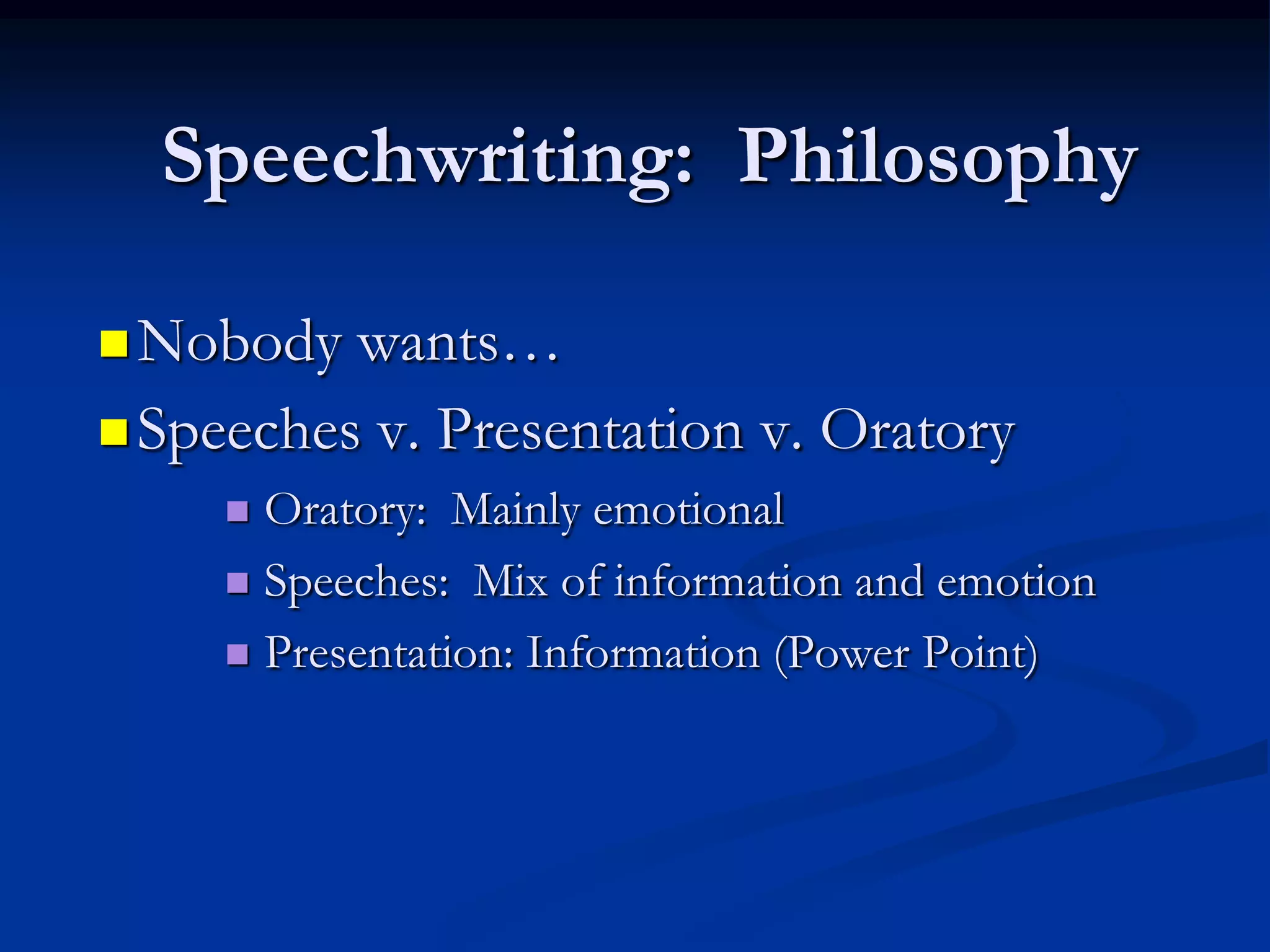
Speechwriting: Philosophy

 Nobody  wants…
 Speeches v. Presentation v. Oratory
      Oratory: Mainly emotional
      Speeches: Mix of information and emotion

      Presentation: Information (Power Point)
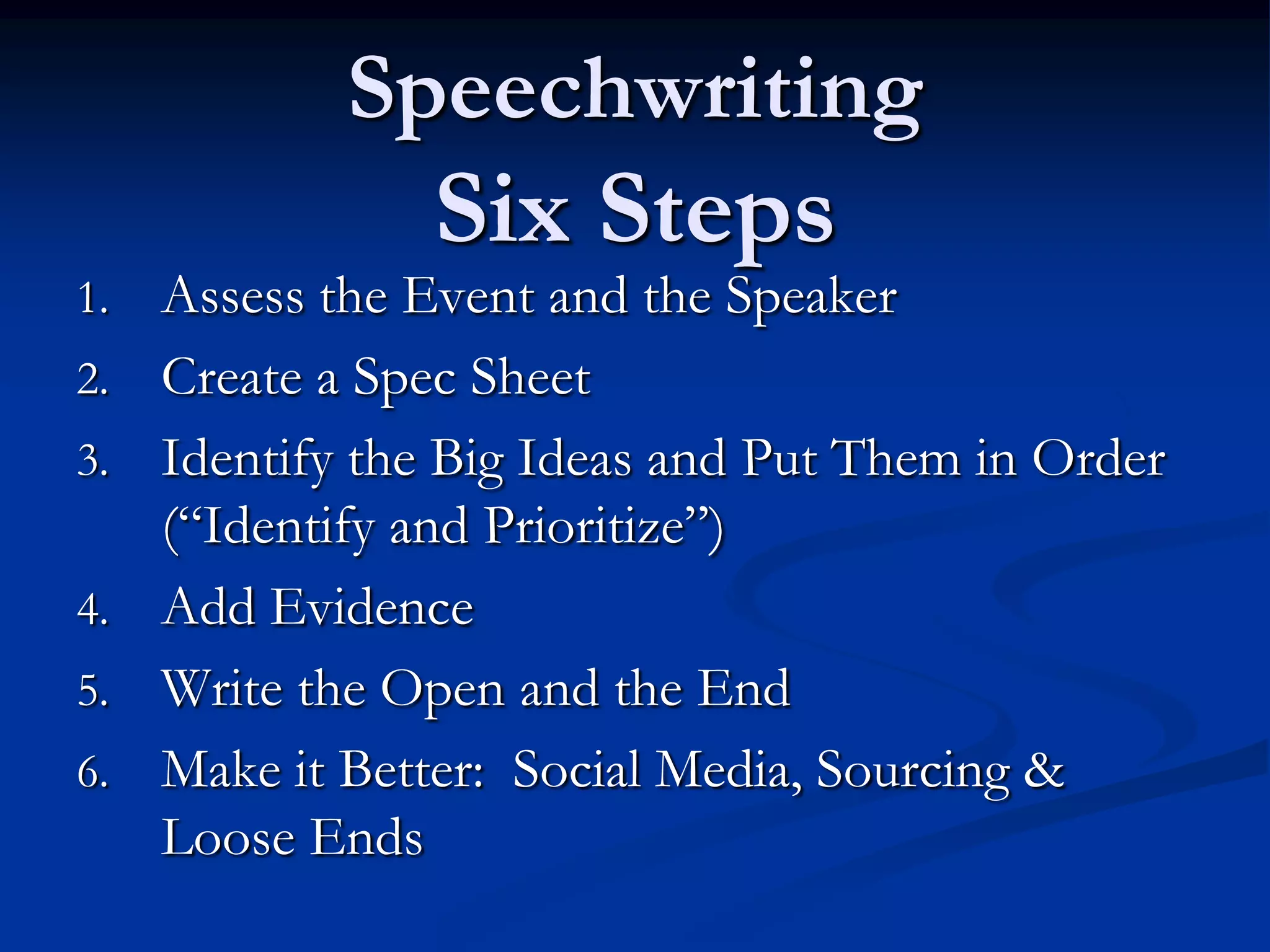
Speechwriting
                Six Steps
1.   Assess the Event and the Speaker
2.   Create a Spec Sheet
3.   Identify the Big Ideas and Put Them in Order
     (“Identify and Prioritize”)
4.   Add Evidence
5.   Write the Open and the End
6.   Make it Better: Social Media, Sourcing &
     Loose Ends
Speechwriting
                    Step 1
1.   Assess the Event and the Speaker
2.   Create a Spec Sheet
3.   Identify the Big Ideas and Put Them in Order
     (“Identify and Prioritize”)
4.   Add Evidence
5.   Write the Open and the End
6.   Make it Better: Social Media, Sourcing &
     Loose Ends
Speechwriting:
     Practicalities & Mechanics
   Collaborative
     w/principal (rarely)
     w/staff (usually)

   Timetables
   Iterations
   Getting it down on paper
   The rule: 1 minute = 100 words
Speechwriting
      THE

      KEY
       IS

ORGANIZATION
The Big Secret:

  The Music Man
        and
The Custom Garment
Speechwriting
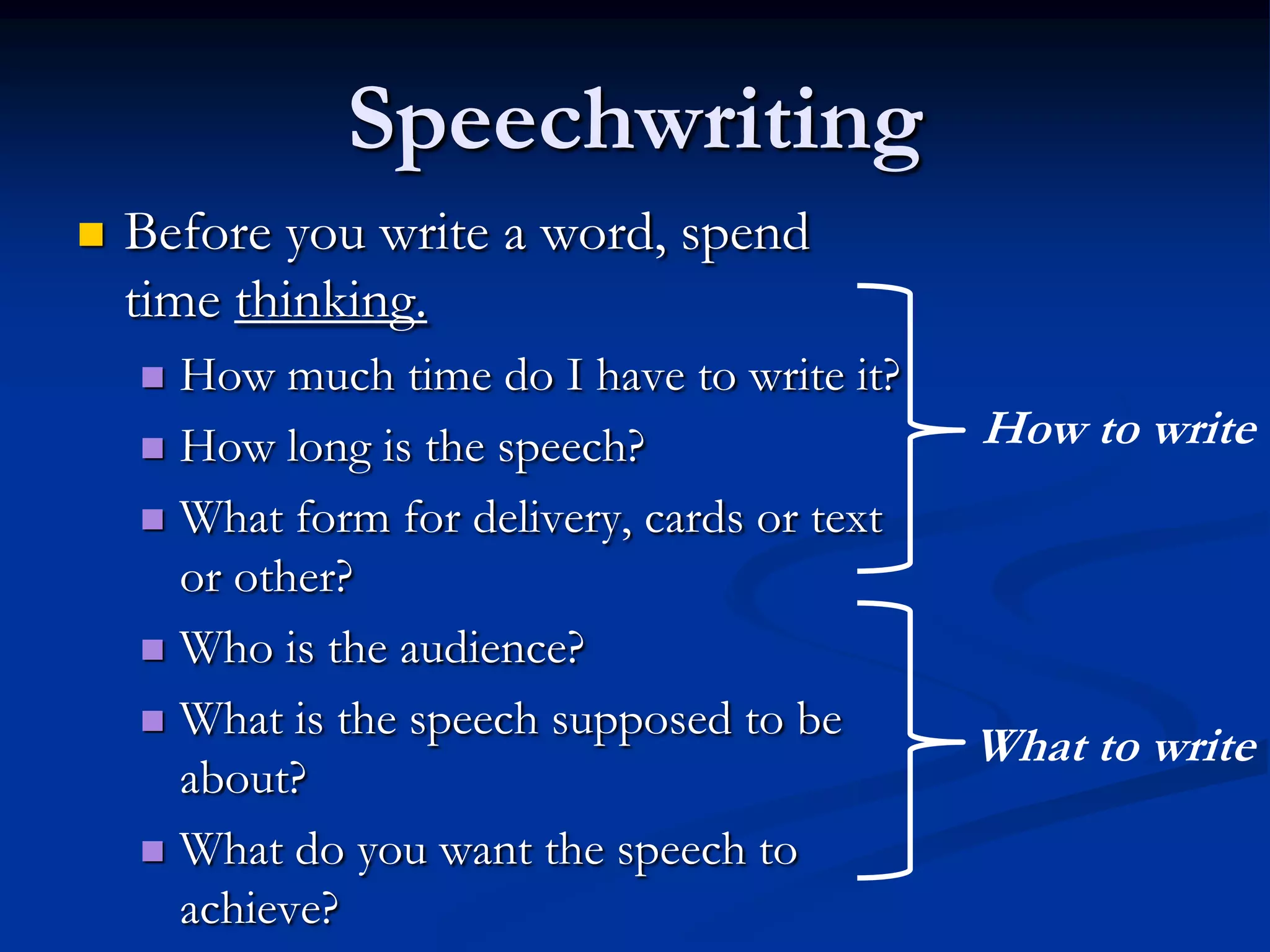
   Before you write a word, spend
    time thinking.
     How much time do I have to write it?
     How long is the speech?
                                              How to write
     What form for delivery, cards or text
      or other?
     Who is the audience?

     What is the speech supposed to be
                                              What to write
      about?
     What do you want the speech to
      achieve?
Speechwriting
                   Step 2
1.   Assess the Event and the Speaker
2.   Create a Spec Sheet
3.   Identify the Big Ideas and Put Them in Order
     (“Identify and Prioritize”)
4.   Add Evidence
5.   Write the Open and the End
6.   Make it Better: Social Media, Sourcing &
     Loose Ends
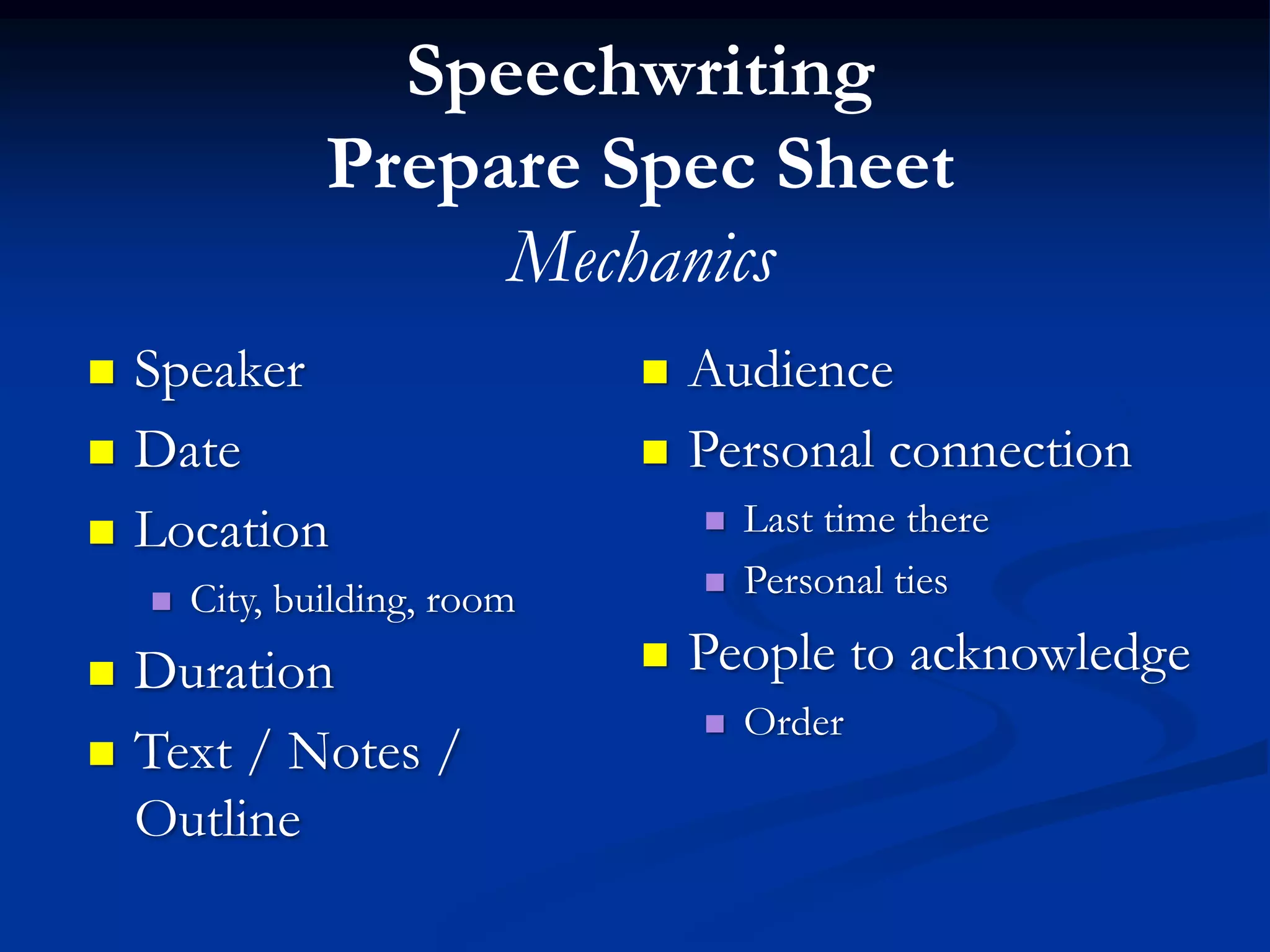
Speechwriting
                Prepare Spec Sheet
                     Mechanics
   Speaker                       Audience
   Date                          Personal connection
   Location                          Last time there
       City, building, room          Personal ties

   Duration                      People to acknowledge
                                      Order
   Text / Notes /
    Outline
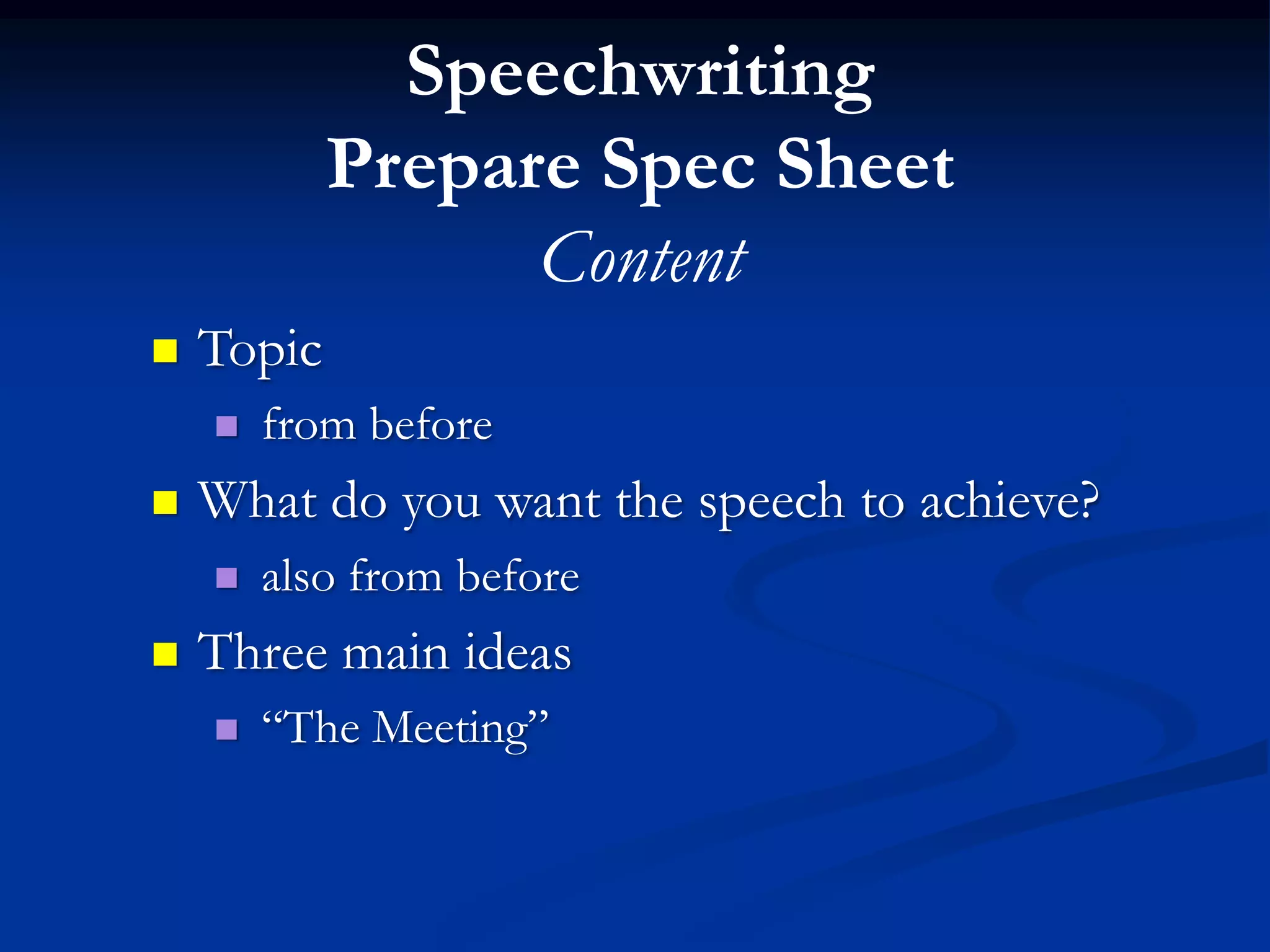
Speechwriting
            Prepare Spec Sheet
                  Content
   Topic
       from before
   What do you want the speech to achieve?
       also from before
   Three main ideas
       “The Meeting”
Speechwriting
                   Step 3
1.   Assess the Event and the Speaker
2.   Create a Spec Sheet
3.   Identify the Big Ideas and Put Them in
     Order (“Identify and Prioritize”)
4.   Add Evidence
5.   Write the Open and the End
6.   Make it Better: Social Media, Sourcing &
     Loose Ends
Speechwriting
   Identify and Prioritize
   Write the middle first: Outline the Structure
     Nothin’ fancy
     Make a list of the big points you need to make
         3 or 4 max
         No more than that, ever

         These will be the tent poles, the tree branches, etc
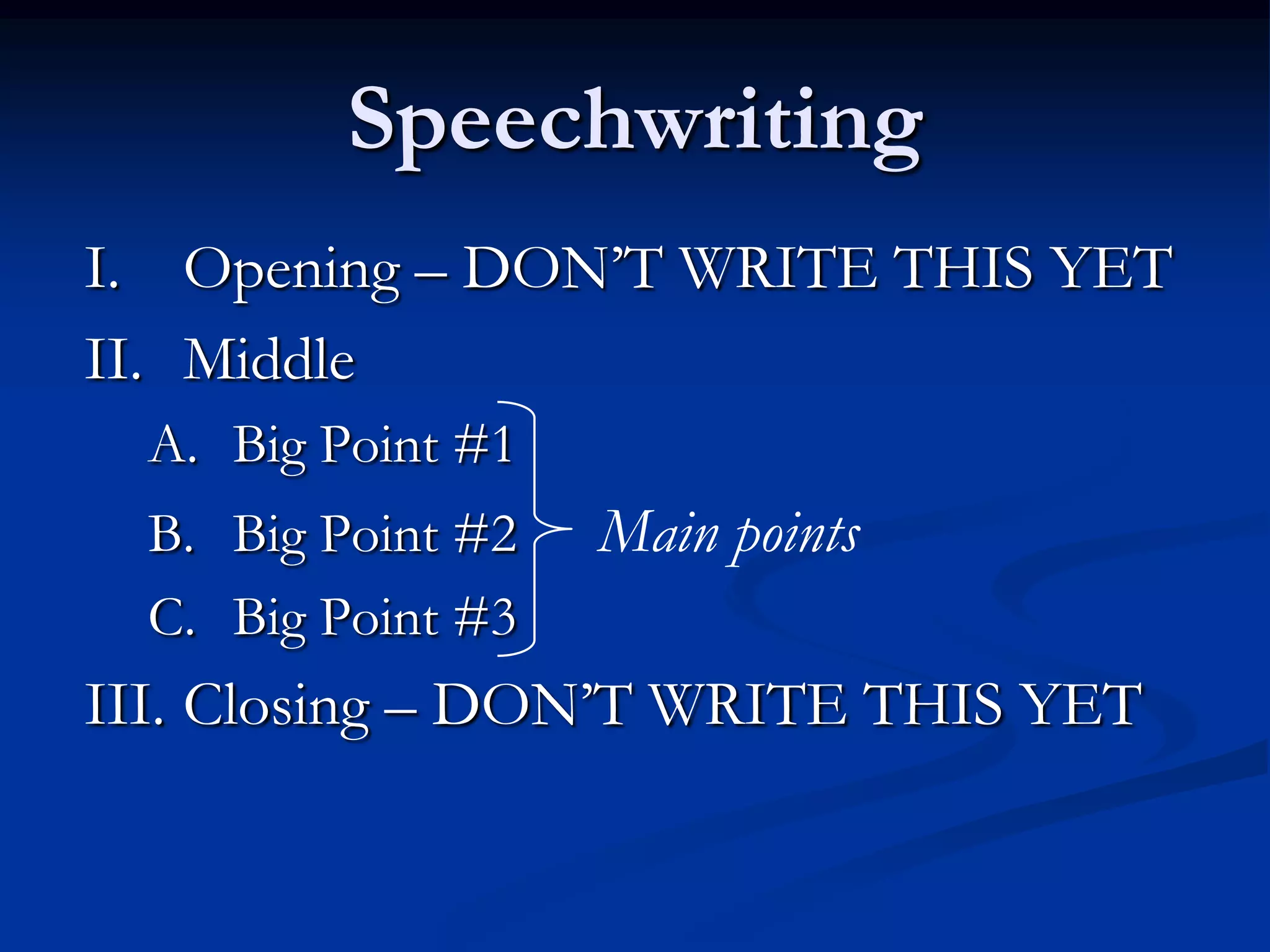
Speechwriting
I. Opening – DON’T WRITE THIS YET
II. Middle
  A. Big Point #1
  B. Big Point #2   Main points
  C. Big Point #3
III. Closing – DON’T WRITE THIS YET
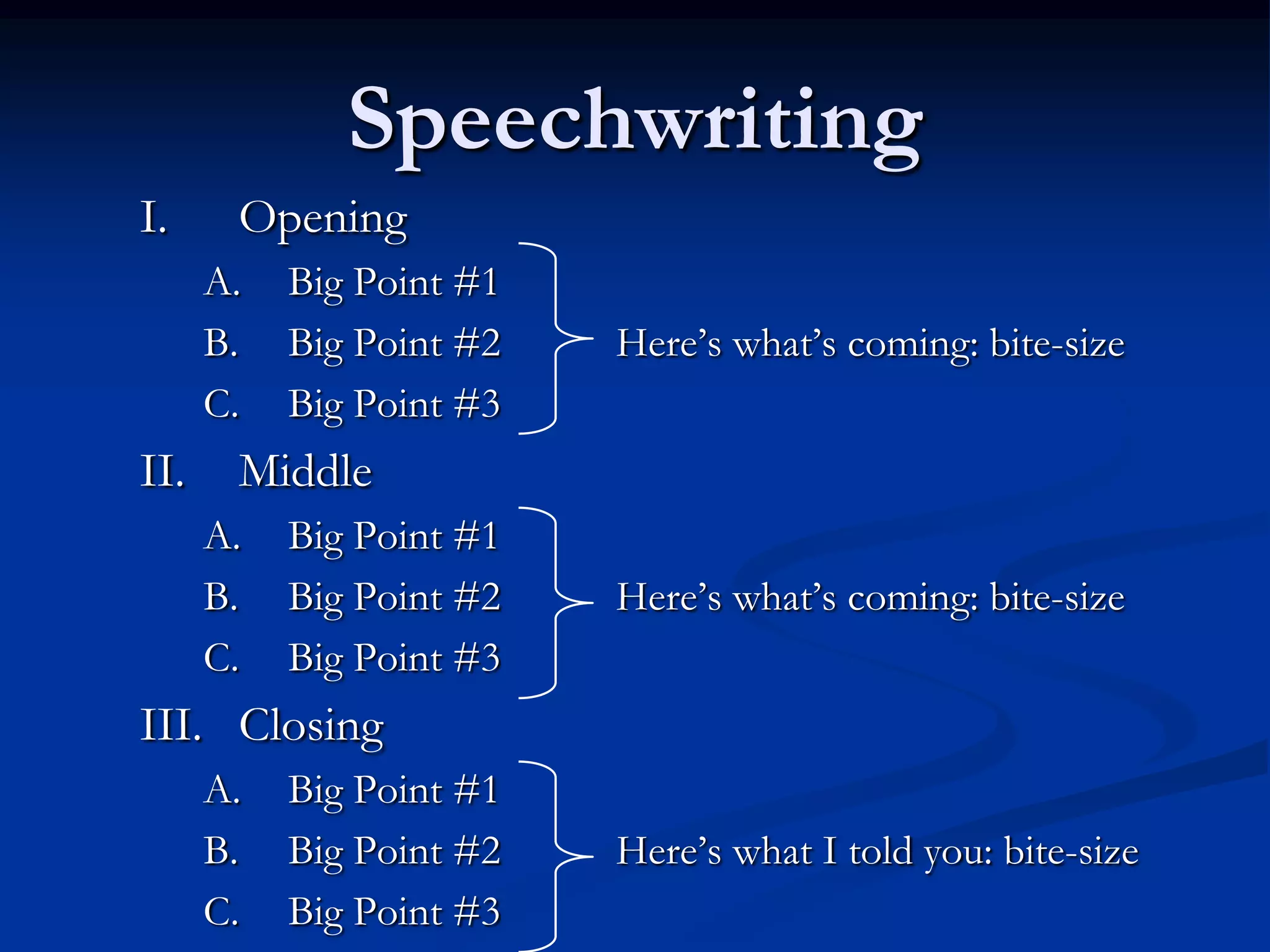
Speechwriting
I.     Opening
      A.   Big Point #1
      B.   Big Point #2   Here’s what’s coming: bite-size
      C.   Big Point #3
II.    Middle
      A.   Big Point #1
      B.   Big Point #2   Here’s what’s coming: bite-size
      C.   Big Point #3
III. Closing
      A.   Big Point #1
      B.   Big Point #2   Here’s what I told you: bite-size
      C.   Big Point #3
Speechwriting
                   Step 4
1.   Assess the Event and the Speaker
2.   Create a Spec Sheet
3.   Identify the Big Ideas and Put Them in Order
     (“Identify and Prioritize”)
4.   Add Evidence
5.   Write the Open and the End
6.   Make it Better: Social Media, Sourcing &
     Loose Ends
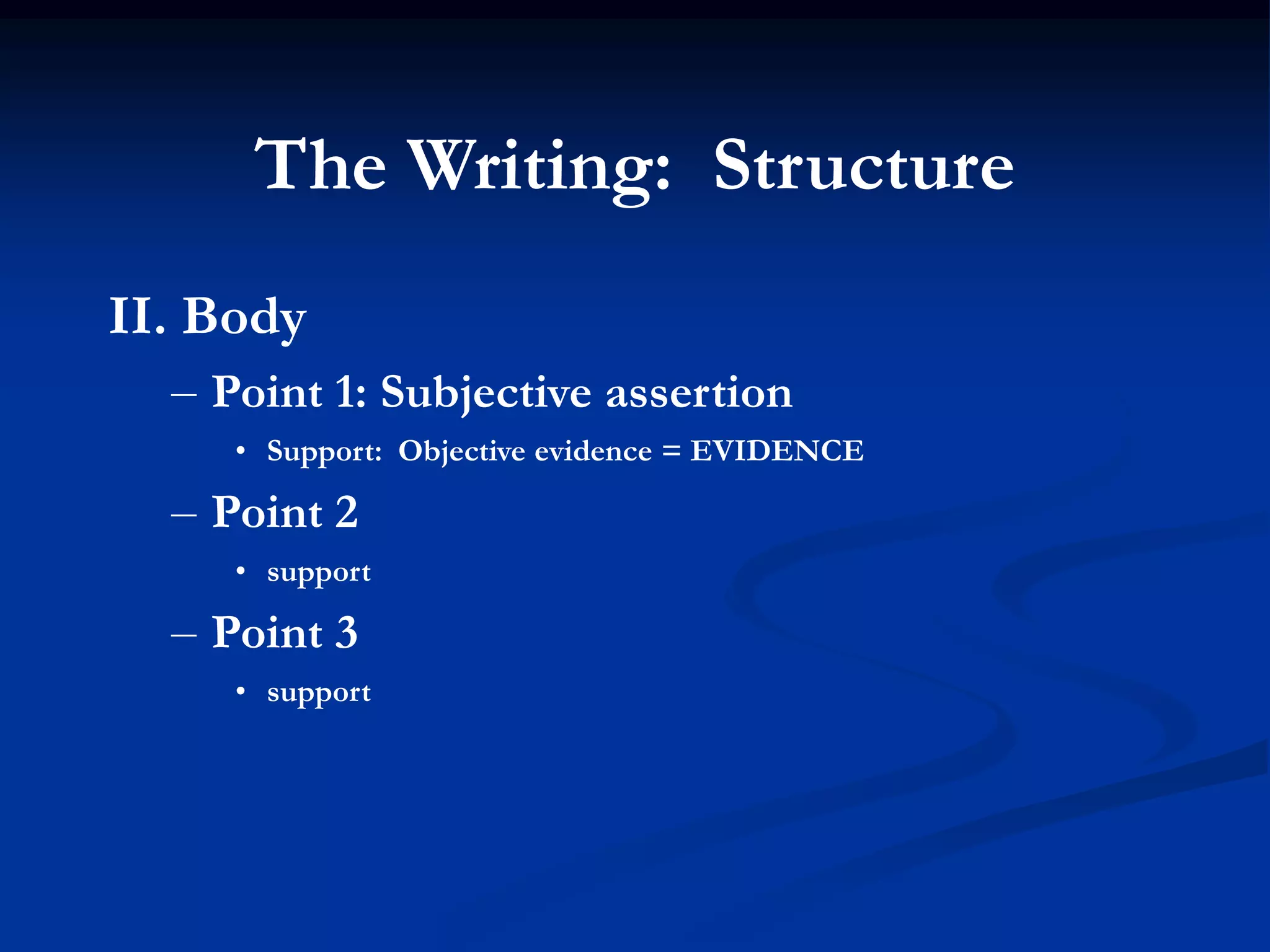
The Writing: Structure
II. Body
  – Point 1: Subjective assertion
     • Support: Objective evidence = EVIDENCE

  – Point 2
     • support

  – Point 3
     • support
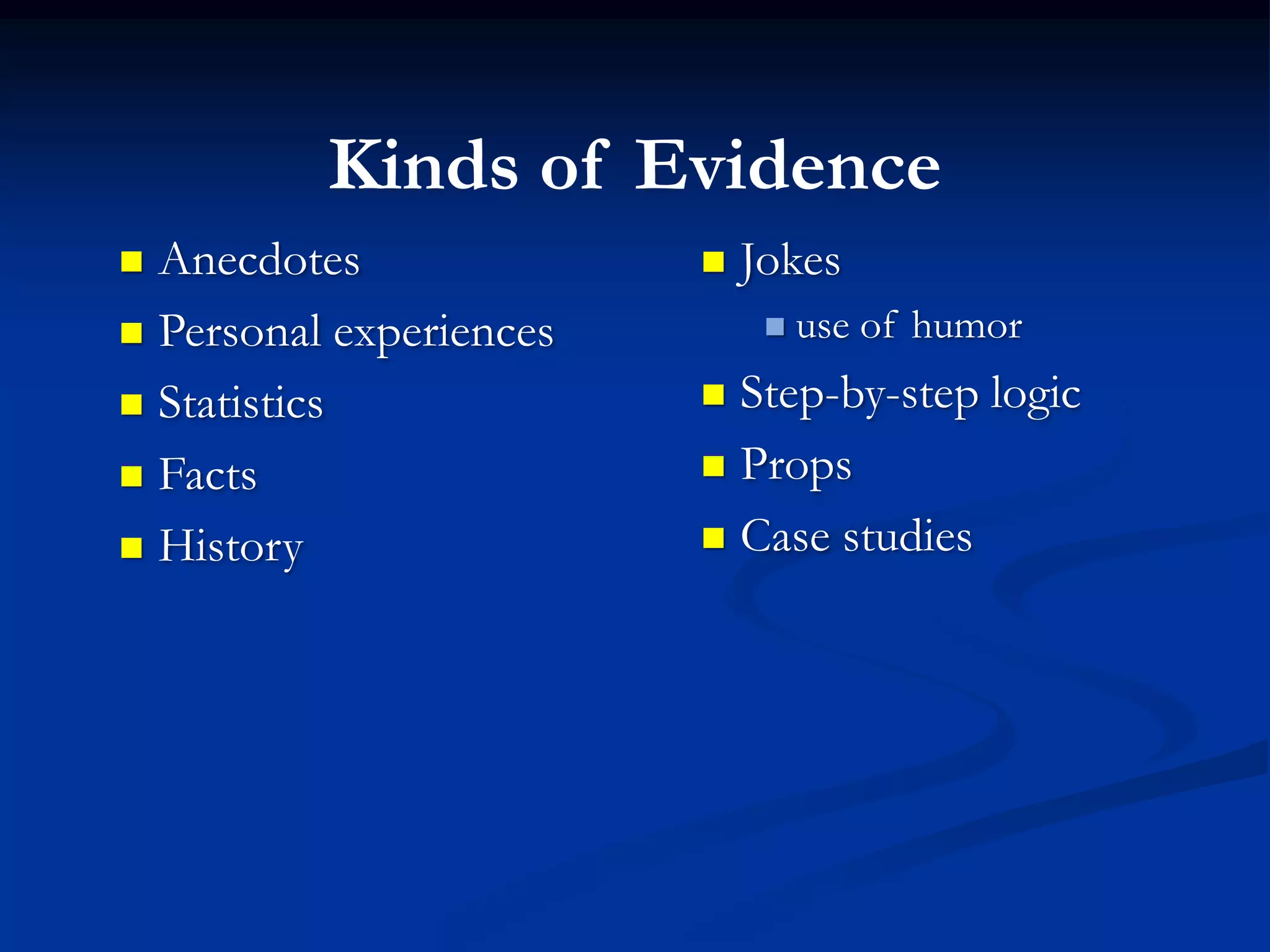
Kinds of Evidence
 Anecdotes                 Jokes
 Personal experiences           use of humor
 Statistics              Step-by-step logic
 Facts                   Props

 History                 Case studies
Speechwriting
                   Step 5
1.   Assess the Event and the Speaker
2.   Create a Spec Sheet
3.   Identify the Big Ideas and Put Them in Order
     (“Identify and Prioritize”)
4.   Add Evidence
5.   Write the Open and the End
6.   Make it Better: Social Media, Sourcing &
     Loose Ends
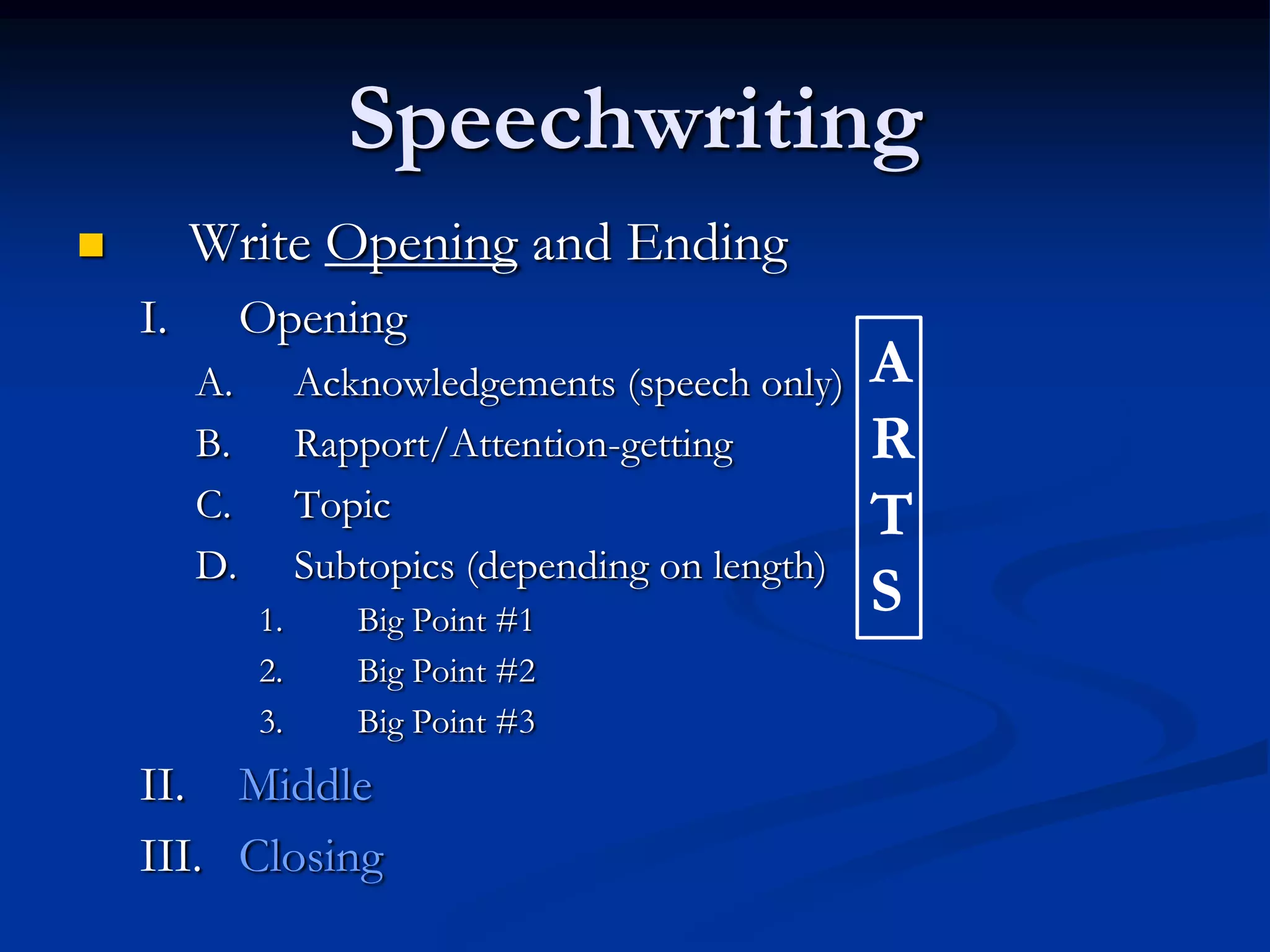
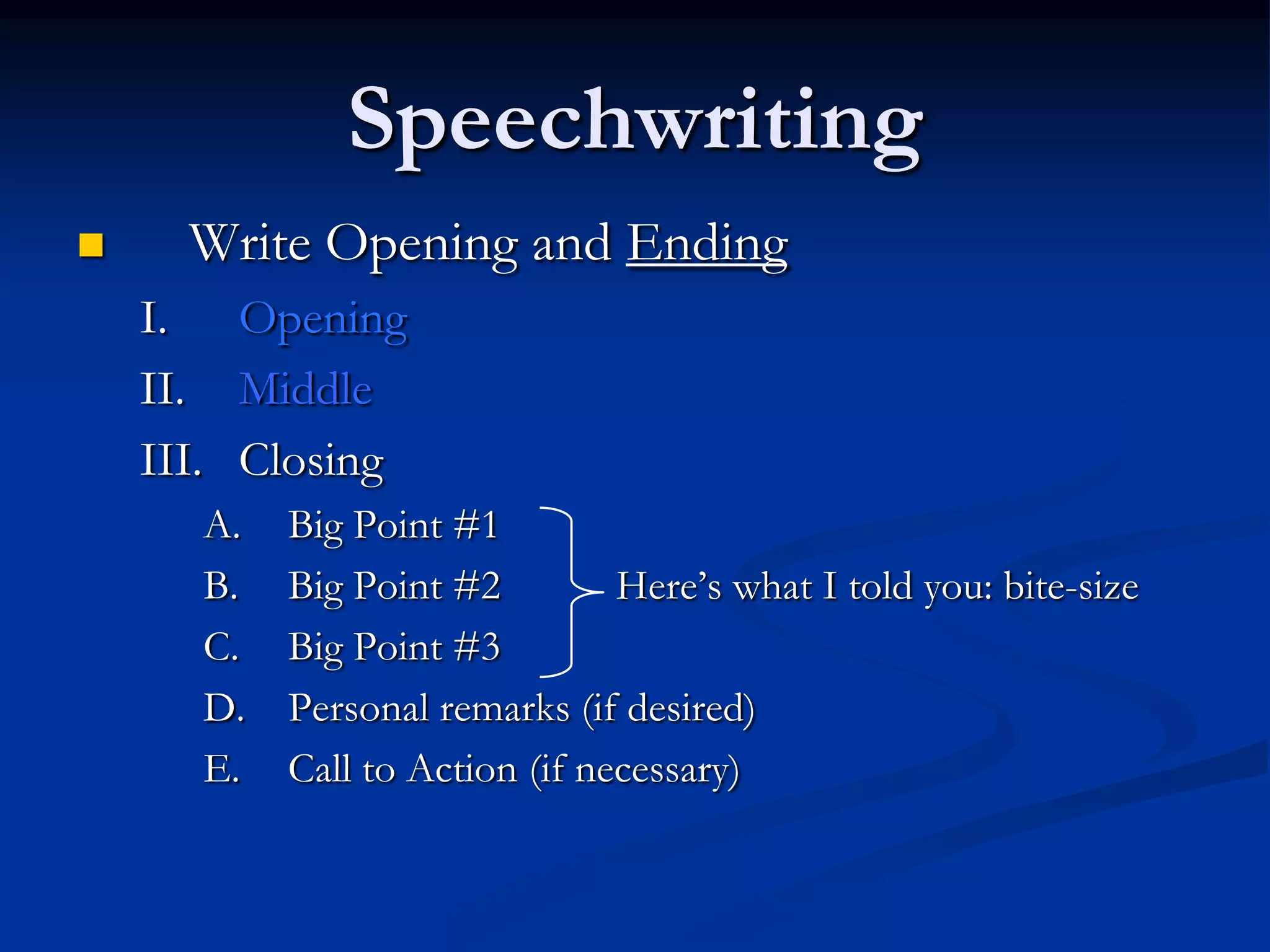
Speechwriting
        Write Opening and Ending
    I.        Opening
         A.        Acknowledgements (speech only)    A
         B.        Rapport/Attention-getting         R
         C.        Topic                             T
         D.        Subtopics (depending on length)
              1.      Big Point #1
                                                     S
              2.      Big Point #2
              3.      Big Point #3
    II. Middle
    III. Closing
Speechwriting
     Write Opening and Ending
    I. Opening
    II. Middle
    III. Closing
      A.   Big Point #1
      B.   Big Point #2         Here’s what I told you: bite-size
      C.   Big Point #3
      D.   Personal remarks (if desired)
      E.   Call to Action (if necessary)
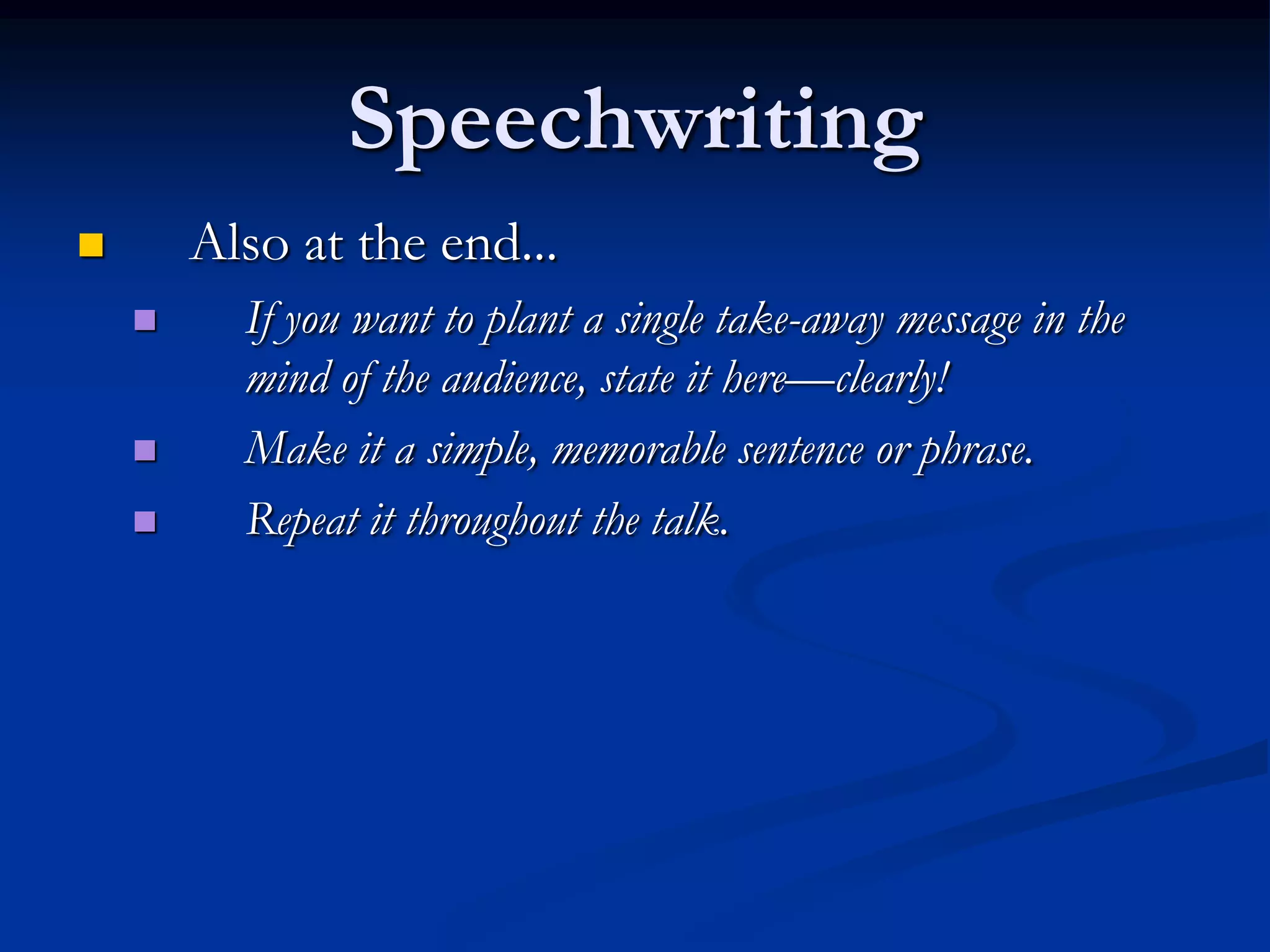
Speechwriting
       Also at the end...
         If you want to plant a single take-away message in the
          mind of the audience, state it here—clearly!
         Make it a simple, memorable sentence or phrase.
         Repeat it throughout the talk.
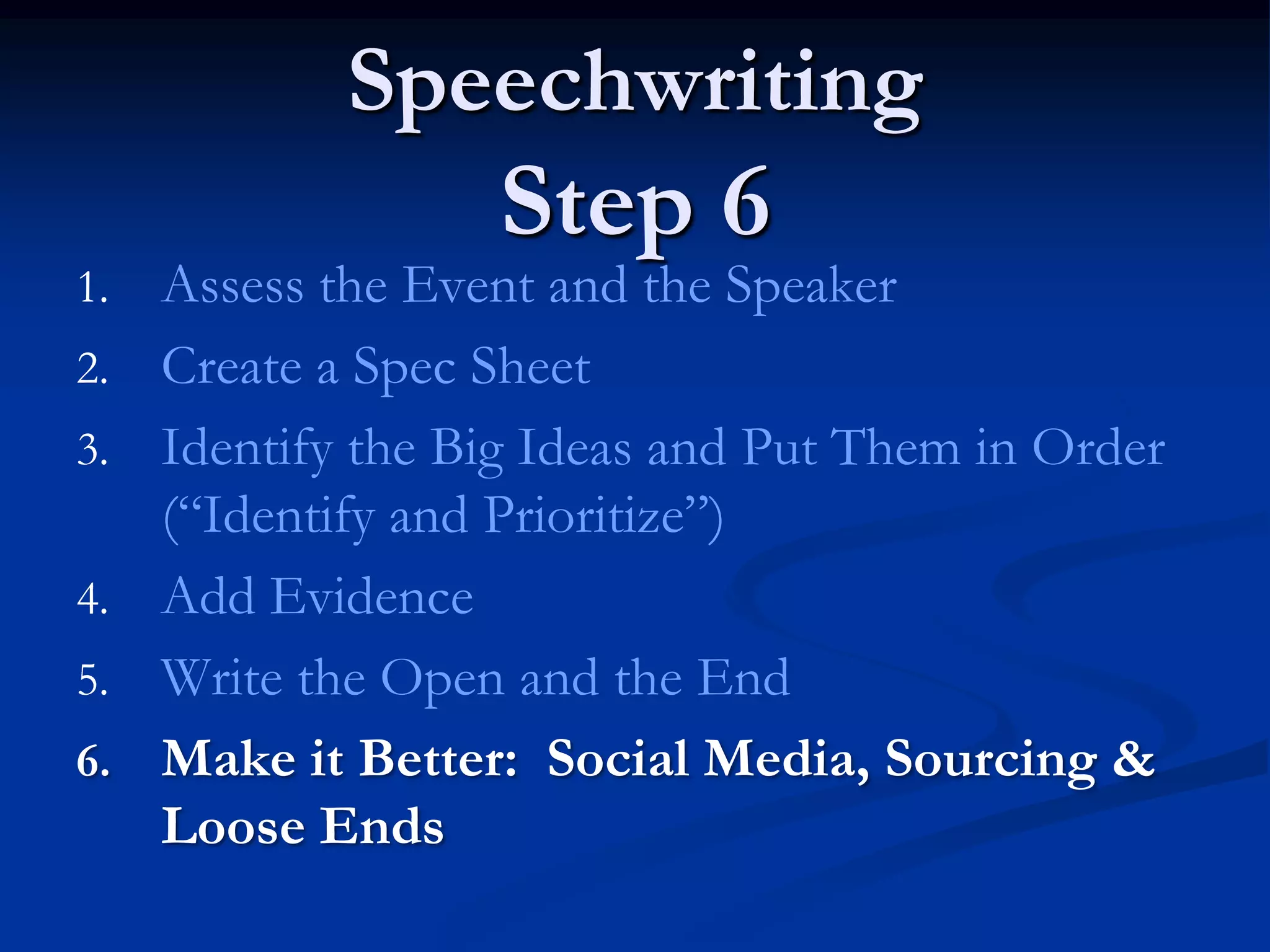
Speechwriting
                   Step 6
1.   Assess the Event and the Speaker
2.   Create a Spec Sheet
3.   Identify the Big Ideas and Put Them in Order
     (“Identify and Prioritize”)
4.   Add Evidence
5.   Write the Open and the End
6.   Make it Better: Social Media, Sourcing &
     Loose Ends
Speechwriting
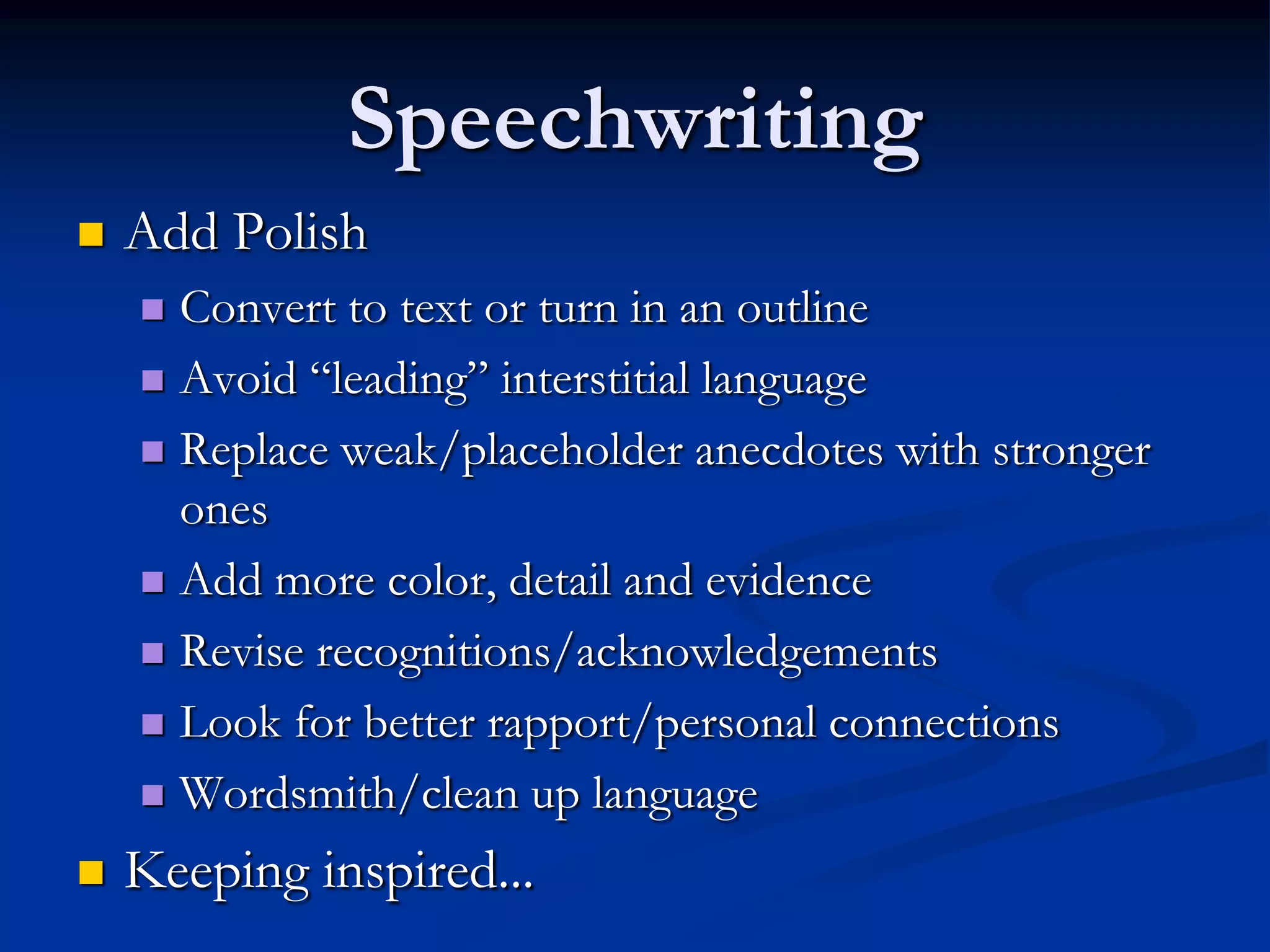
   Add Polish
       Think like a fourth-grader/sound like a PhD:
        “talk it out”
Speechwriting
   Add Polish
     Convert to text or turn in an outline
     Avoid “leading” interstitial language

     Replace weak/placeholder anecdotes with stronger
      ones
     Add more color, detail and evidence

     Revise recognitions/acknowledgements

     Look for better rapport/personal connections

     Wordsmith/clean up language

   Keeping inspired...
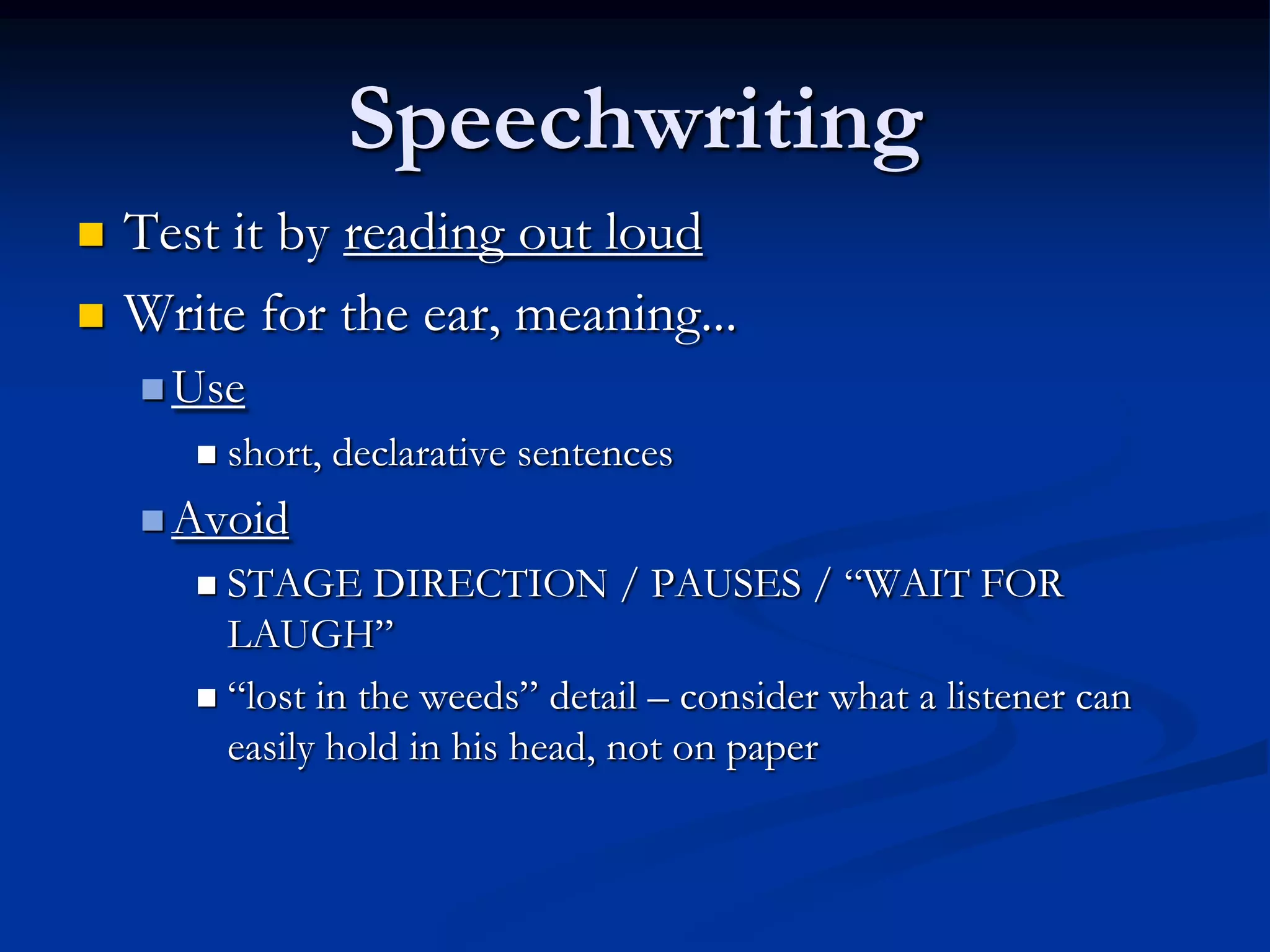
Speechwriting
   Test it by reading out loud
   Write for the ear, meaning...
     Use
          short, declarative sentences
     Avoid
        STAGE DIRECTION / PAUSES / “WAIT FOR
         LAUGH”
        “lost in the weeds” detail – consider what a listener can
         easily hold in his head, not on paper
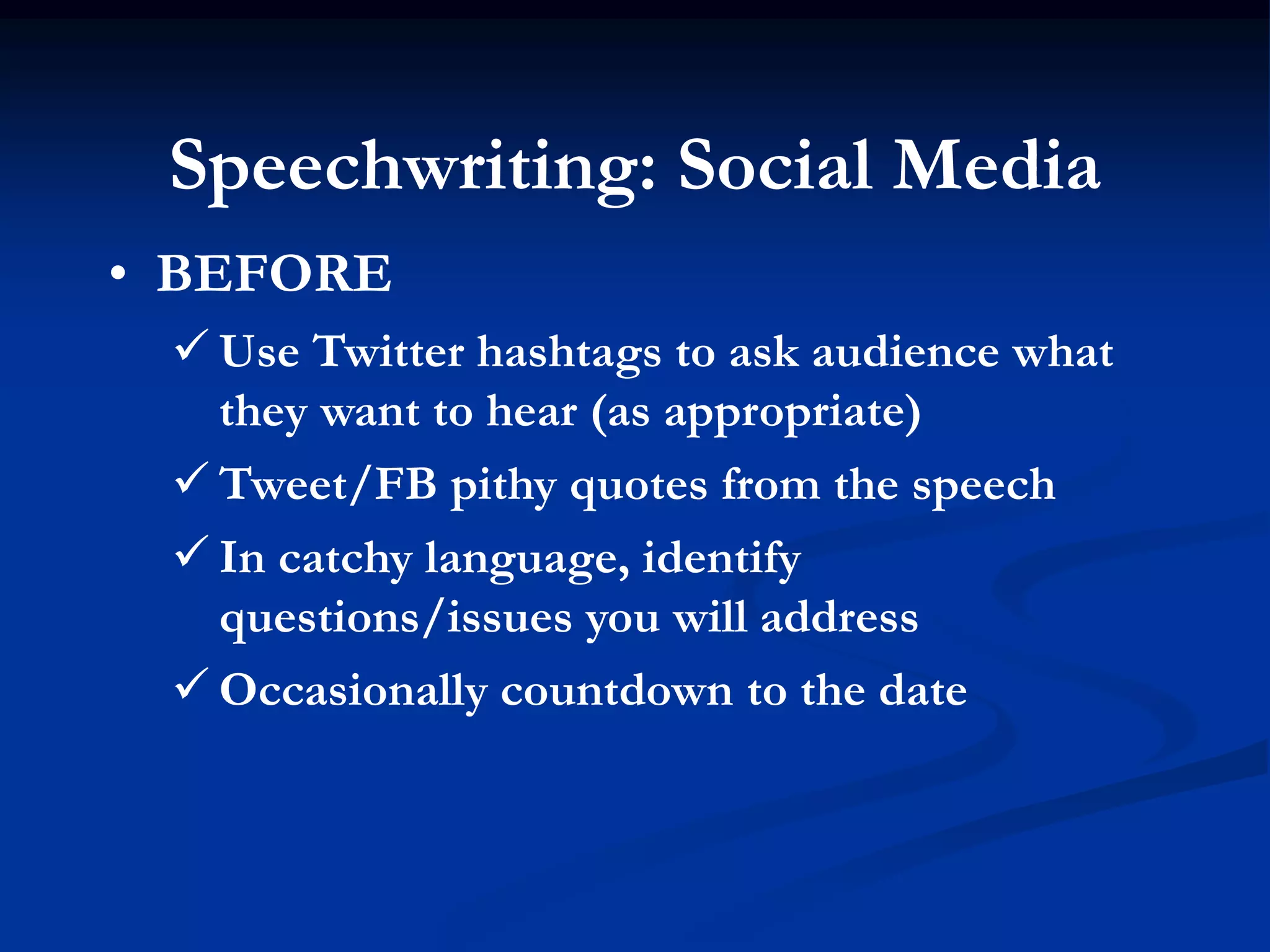
Speechwriting: Social Media
• BEFORE
  Use Twitter hashtags to ask audience what
   they want to hear (as appropriate)
  Tweet/FB pithy quotes from the speech
  In catchy language, identify
   questions/issues you will address
  Occasionally countdown to the date
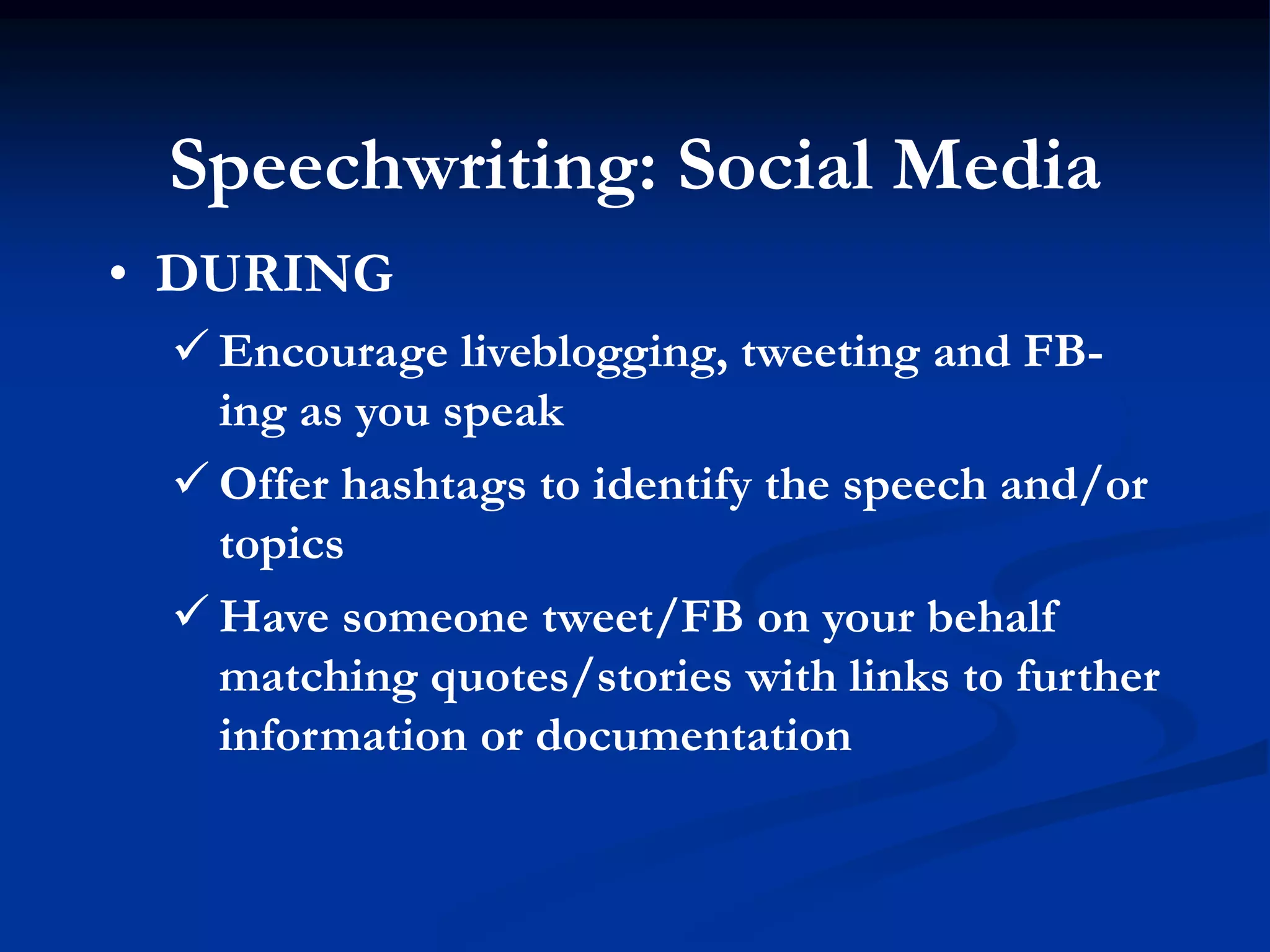
Speechwriting: Social Media
• DURING
  Encourage liveblogging, tweeting and FB-
   ing as you speak
  Offer hashtags to identify the speech and/or
   topics
  Have someone tweet/FB on your behalf
   matching quotes/stories with links to further
   information or documentation
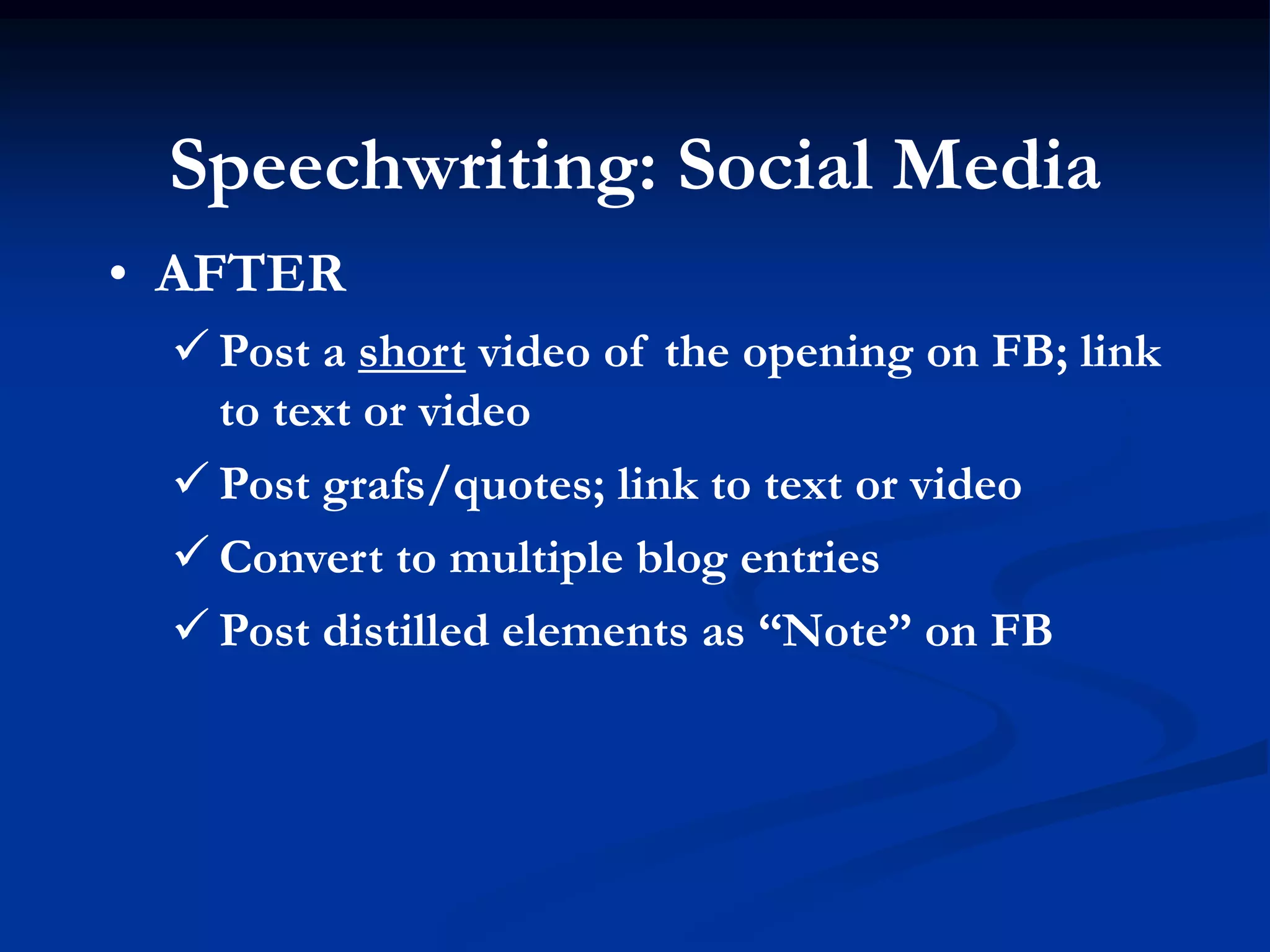
Speechwriting: Social Media
• AFTER
  Post a short video of the opening on FB; link
   to text or video
  Post grafs/quotes; link to text or video
  Convert to multiple blog entries
  Post distilled elements as “Note” on FB
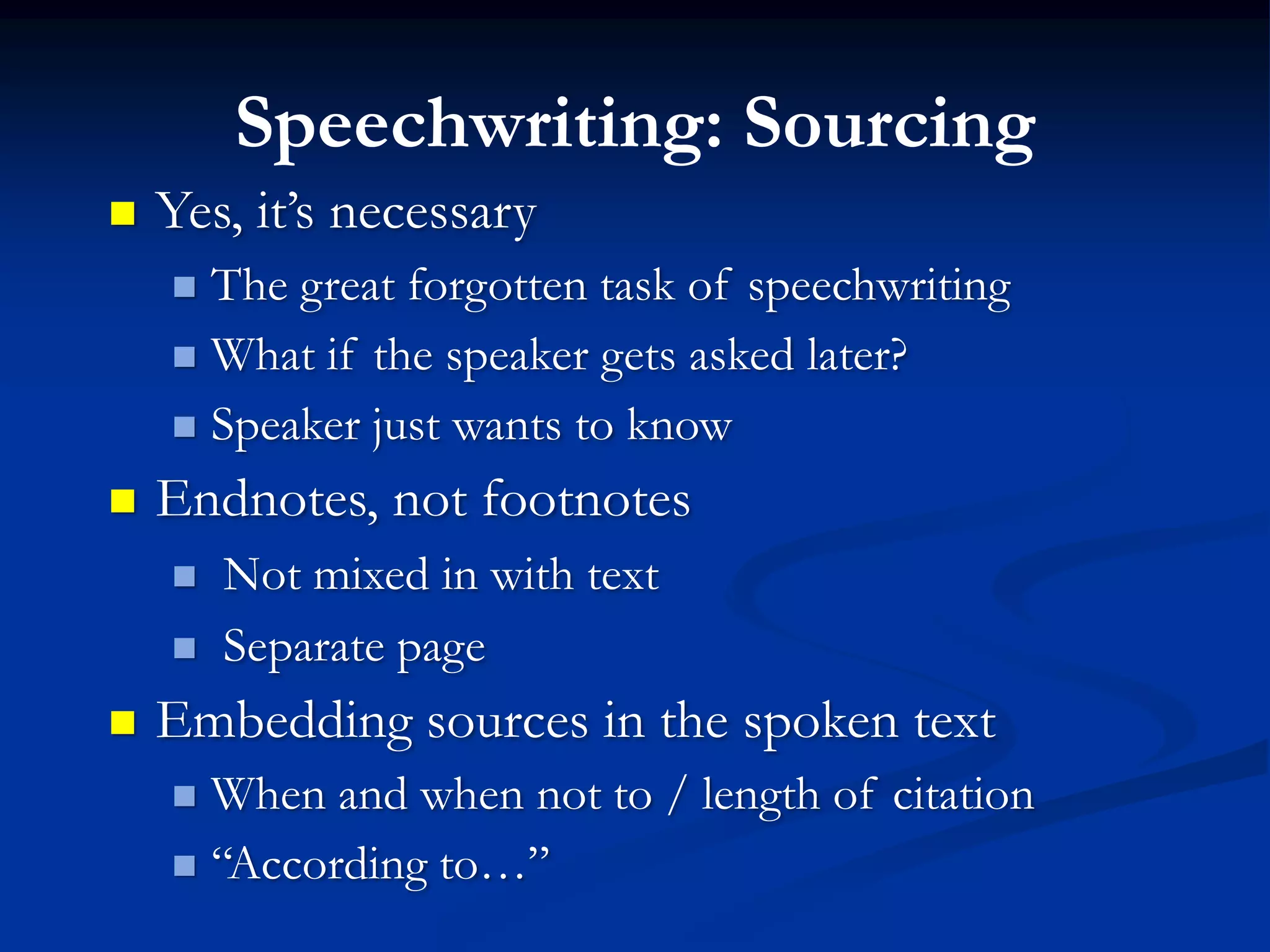
Speechwriting: Sourcing
   Yes, it’s necessary
     The great forgotten task of speechwriting
     What if the speaker gets asked later?

     Speaker just wants to know

   Endnotes, not footnotes
       Not mixed in with text
       Separate page
   Embedding sources in the spoken text
     When and when not to / length of citation
     “According to…”
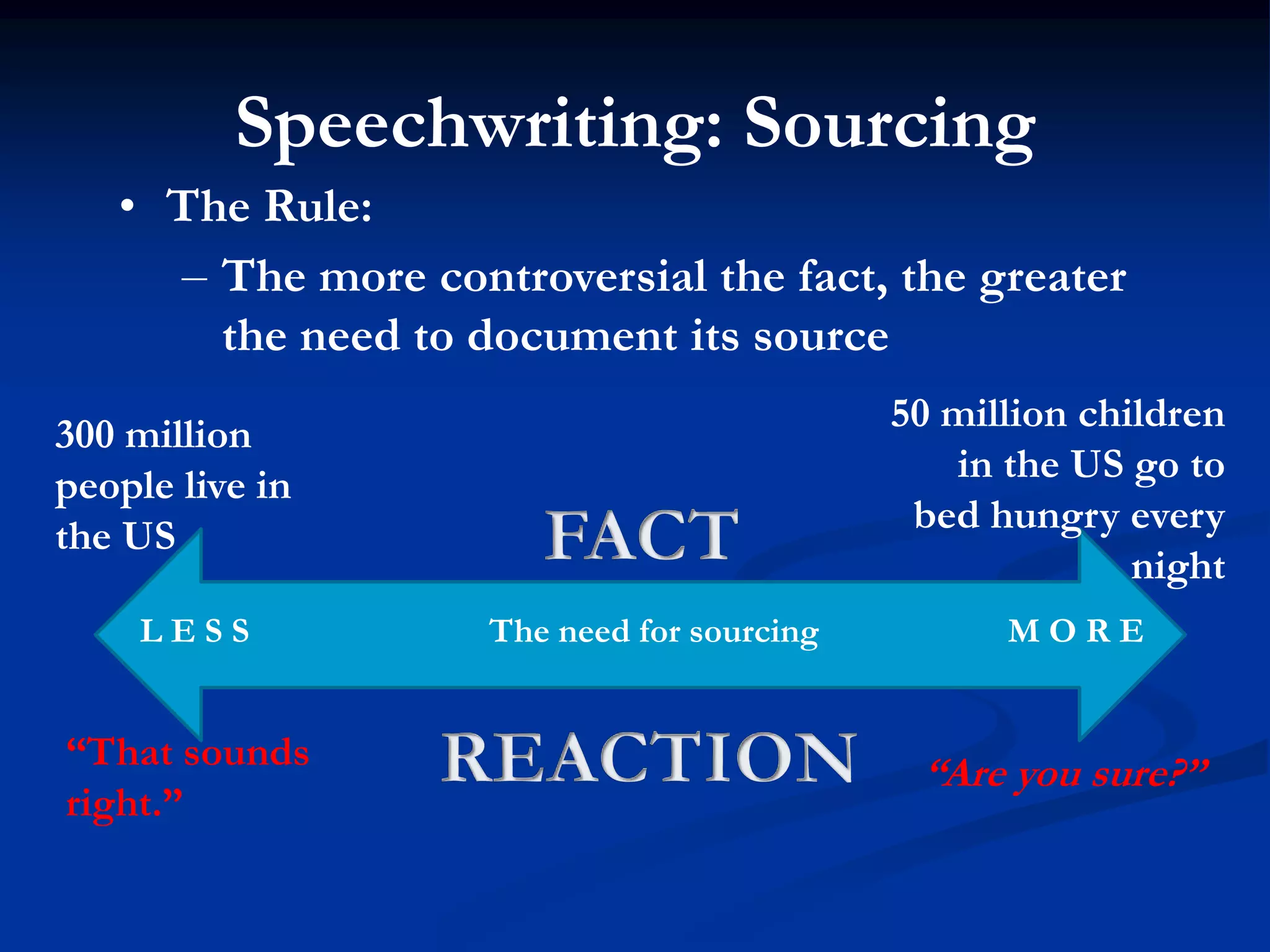
Speechwriting: Sourcing
   • The Rule:
     – The more controversial the fact, the greater
       the need to document its source
                                            50 million children
300 million
                                               in the US go to
people live in
                                             bed hungry every
the US
                                                          night
     LESS           The need for sourcing         MORE


“That sounds
                                             “Are you sure?”
right.”
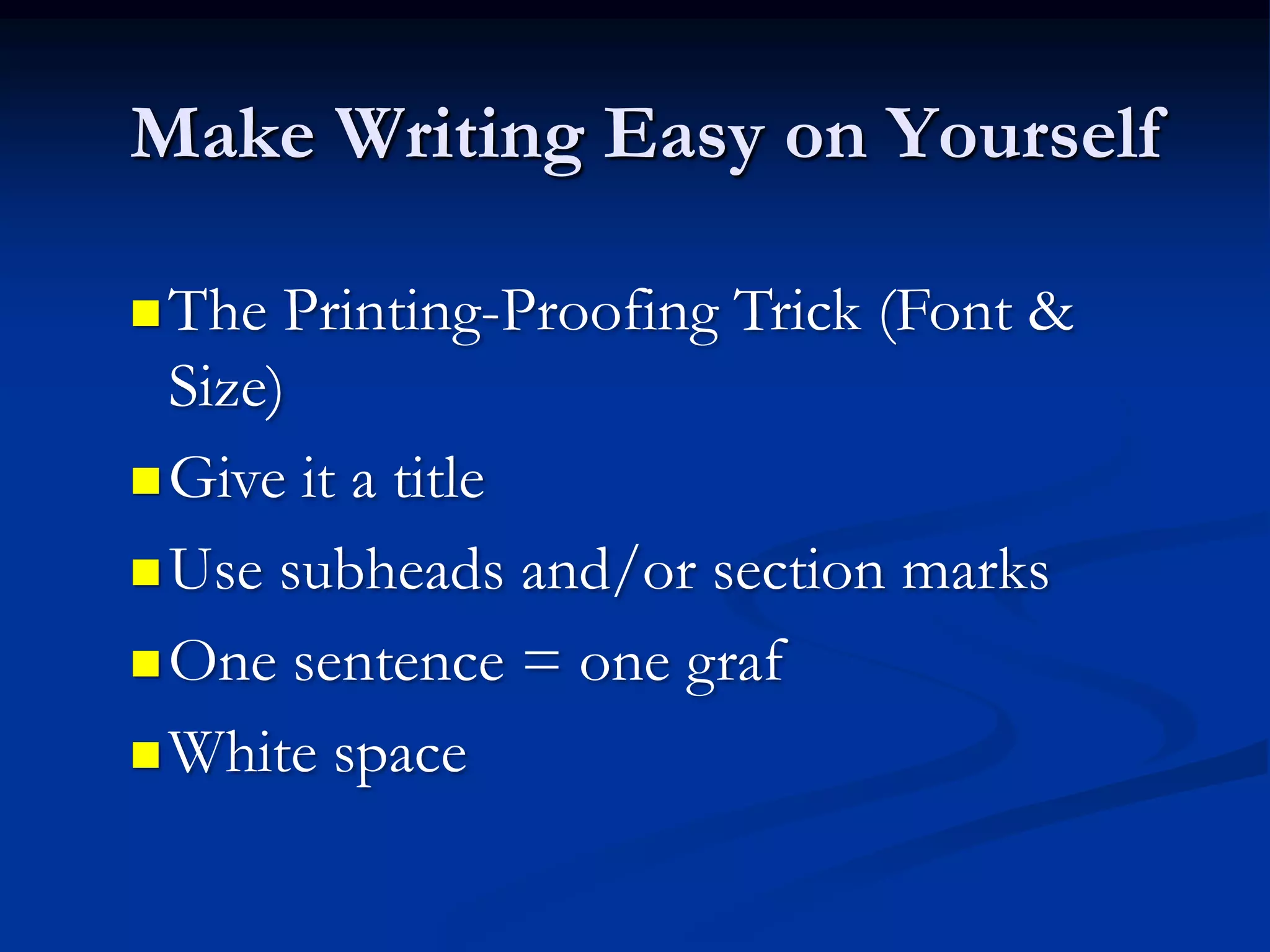
Make Writing Easy on Yourself

 The  Printing-Proofing Trick (Font &
  Size)
 Give it a title

 Use subheads and/or section marks

 One sentence = one graf

 White space
Your Questions
   How can I write talking points that are
    effective, and how can I do it more efficiently?
    Talking Points are
        phrases,

        sentences and

        very short paragraphs

    that a speaker can use as a basis for an extemporaneous
    talk.
Your Questions
                     Talking Points
   Keep them short.
   Get to the point.
   Write for the ear – when possible, use catchy phrases
       Alliteration, consonance, assonance, imagery
       Use this thinking for writing sound bites, too.
   Use white space and labels so the speaker can sort
    through the material at a glance.
   Also okay: Jumping off points to jog the memory to
    further comment
Your Questions
   When given a broad topic, how do I narrow it down
    to something manageable? (e.g., professionalism)
   How do I write quotable, memorable lines – sound
    bites?
   How do I drive home a line – how do I get reporters
    to pick up the line and how do I get audiences to
    remember it?
Your Questions
   How do I “break into” speechwriting inside the
    office?
   How do I capture the tone and voice of the speaker?
Your Questions
   What are some source materials for commencements,
    general remarks and other events that are oriented
    more toward mood than toward fact?
       “Condemned to Repeat It” by Wick Allison
       “This Day in Business History” by Raymond Francis
       “Tunesmith” by Jimmy Webb
       “Theatre” by David Mamet
       “Get some art in you…”
Speechwriting
        Review: Six Steps
1.   Assess the Event and the Speaker
2.   Create a Spec Sheet
3.   Identify the Big Ideas and Put Them in Order
     (“Identify and Prioritize”)
4.   Add Evidence
5.   Write the Open and the End
6.   Make it Better: Social Media, Sourcing &
     Loose Ends

Speechwriting: The Basics, and Fast, by Michael Long

  • 1.
    Speechwriting: The Basics, andFast Michael Long Georgetown University Mike@MikeLongOnline.com 703.408.7570
  • 2.
    Speechwriting: Philosophy  Nobody wants…  Speeches v. Presentation v. Oratory  Oratory: Mainly emotional  Speeches: Mix of information and emotion  Presentation: Information (Power Point)
  • 3.
    Speechwriting Six Steps 1. Assess the Event and the Speaker 2. Create a Spec Sheet 3. Identify the Big Ideas and Put Them in Order (“Identify and Prioritize”) 4. Add Evidence 5. Write the Open and the End 6. Make it Better: Social Media, Sourcing & Loose Ends
  • 4.
    Speechwriting Step 1 1. Assess the Event and the Speaker 2. Create a Spec Sheet 3. Identify the Big Ideas and Put Them in Order (“Identify and Prioritize”) 4. Add Evidence 5. Write the Open and the End 6. Make it Better: Social Media, Sourcing & Loose Ends
  • 5.
    Speechwriting: Practicalities & Mechanics  Collaborative  w/principal (rarely)  w/staff (usually)  Timetables  Iterations  Getting it down on paper  The rule: 1 minute = 100 words
  • 6.
    Speechwriting THE KEY IS ORGANIZATION
  • 7.
    The Big Secret: The Music Man and The Custom Garment
  • 8.
    Speechwriting  Before you write a word, spend time thinking.  How much time do I have to write it?  How long is the speech? How to write  What form for delivery, cards or text or other?  Who is the audience?  What is the speech supposed to be What to write about?  What do you want the speech to achieve?
  • 9.
    Speechwriting Step 2 1. Assess the Event and the Speaker 2. Create a Spec Sheet 3. Identify the Big Ideas and Put Them in Order (“Identify and Prioritize”) 4. Add Evidence 5. Write the Open and the End 6. Make it Better: Social Media, Sourcing & Loose Ends
  • 10.
    Speechwriting Prepare Spec Sheet Mechanics  Speaker  Audience  Date  Personal connection  Location  Last time there  City, building, room  Personal ties  Duration  People to acknowledge  Order  Text / Notes / Outline
  • 11.
    Speechwriting Prepare Spec Sheet Content  Topic  from before  What do you want the speech to achieve?  also from before  Three main ideas  “The Meeting”
  • 12.
    Speechwriting Step 3 1. Assess the Event and the Speaker 2. Create a Spec Sheet 3. Identify the Big Ideas and Put Them in Order (“Identify and Prioritize”) 4. Add Evidence 5. Write the Open and the End 6. Make it Better: Social Media, Sourcing & Loose Ends
  • 13.
    Speechwriting  Identify and Prioritize  Write the middle first: Outline the Structure  Nothin’ fancy  Make a list of the big points you need to make  3 or 4 max  No more than that, ever  These will be the tent poles, the tree branches, etc
  • 14.
    Speechwriting I. Opening –DON’T WRITE THIS YET II. Middle A. Big Point #1 B. Big Point #2 Main points C. Big Point #3 III. Closing – DON’T WRITE THIS YET
  • 15.
    Speechwriting I. Opening A. Big Point #1 B. Big Point #2 Here’s what’s coming: bite-size C. Big Point #3 II. Middle A. Big Point #1 B. Big Point #2 Here’s what’s coming: bite-size C. Big Point #3 III. Closing A. Big Point #1 B. Big Point #2 Here’s what I told you: bite-size C. Big Point #3
  • 16.
    Speechwriting Step 4 1. Assess the Event and the Speaker 2. Create a Spec Sheet 3. Identify the Big Ideas and Put Them in Order (“Identify and Prioritize”) 4. Add Evidence 5. Write the Open and the End 6. Make it Better: Social Media, Sourcing & Loose Ends
  • 17.
    The Writing: Structure II.Body – Point 1: Subjective assertion • Support: Objective evidence = EVIDENCE – Point 2 • support – Point 3 • support
  • 18.
    Kinds of Evidence Anecdotes  Jokes  Personal experiences  use of humor  Statistics  Step-by-step logic  Facts  Props  History  Case studies
  • 19.
    Speechwriting Step 5 1. Assess the Event and the Speaker 2. Create a Spec Sheet 3. Identify the Big Ideas and Put Them in Order (“Identify and Prioritize”) 4. Add Evidence 5. Write the Open and the End 6. Make it Better: Social Media, Sourcing & Loose Ends
  • 20.
    Speechwriting  Write Opening and Ending I. Opening A. Acknowledgements (speech only) A B. Rapport/Attention-getting R C. Topic T D. Subtopics (depending on length) 1. Big Point #1 S 2. Big Point #2 3. Big Point #3 II. Middle III. Closing
  • 21.
    Speechwriting  Write Opening and Ending I. Opening II. Middle III. Closing A. Big Point #1 B. Big Point #2 Here’s what I told you: bite-size C. Big Point #3 D. Personal remarks (if desired) E. Call to Action (if necessary)
  • 22.
    Speechwriting  Also at the end...  If you want to plant a single take-away message in the mind of the audience, state it here—clearly!  Make it a simple, memorable sentence or phrase.  Repeat it throughout the talk.
  • 23.
    Speechwriting Step 6 1. Assess the Event and the Speaker 2. Create a Spec Sheet 3. Identify the Big Ideas and Put Them in Order (“Identify and Prioritize”) 4. Add Evidence 5. Write the Open and the End 6. Make it Better: Social Media, Sourcing & Loose Ends
  • 24.
    Speechwriting  Add Polish  Think like a fourth-grader/sound like a PhD: “talk it out”
  • 25.
    Speechwriting  Add Polish  Convert to text or turn in an outline  Avoid “leading” interstitial language  Replace weak/placeholder anecdotes with stronger ones  Add more color, detail and evidence  Revise recognitions/acknowledgements  Look for better rapport/personal connections  Wordsmith/clean up language  Keeping inspired...
  • 26.
    Speechwriting  Test it by reading out loud  Write for the ear, meaning...  Use  short, declarative sentences  Avoid  STAGE DIRECTION / PAUSES / “WAIT FOR LAUGH”  “lost in the weeds” detail – consider what a listener can easily hold in his head, not on paper
  • 27.
    Speechwriting: Social Media •BEFORE  Use Twitter hashtags to ask audience what they want to hear (as appropriate)  Tweet/FB pithy quotes from the speech  In catchy language, identify questions/issues you will address  Occasionally countdown to the date
  • 28.
    Speechwriting: Social Media •DURING  Encourage liveblogging, tweeting and FB- ing as you speak  Offer hashtags to identify the speech and/or topics  Have someone tweet/FB on your behalf matching quotes/stories with links to further information or documentation
  • 29.
    Speechwriting: Social Media •AFTER  Post a short video of the opening on FB; link to text or video  Post grafs/quotes; link to text or video  Convert to multiple blog entries  Post distilled elements as “Note” on FB
  • 30.
    Speechwriting: Sourcing  Yes, it’s necessary  The great forgotten task of speechwriting  What if the speaker gets asked later?  Speaker just wants to know  Endnotes, not footnotes  Not mixed in with text  Separate page  Embedding sources in the spoken text  When and when not to / length of citation  “According to…”
  • 31.
    Speechwriting: Sourcing • The Rule: – The more controversial the fact, the greater the need to document its source 50 million children 300 million in the US go to people live in bed hungry every the US night LESS The need for sourcing MORE “That sounds “Are you sure?” right.”
  • 32.
    Make Writing Easyon Yourself  The Printing-Proofing Trick (Font & Size)  Give it a title  Use subheads and/or section marks  One sentence = one graf  White space
  • 33.
    Your Questions  How can I write talking points that are effective, and how can I do it more efficiently? Talking Points are  phrases,  sentences and  very short paragraphs that a speaker can use as a basis for an extemporaneous talk.
  • 34.
    Your Questions Talking Points  Keep them short.  Get to the point.  Write for the ear – when possible, use catchy phrases  Alliteration, consonance, assonance, imagery  Use this thinking for writing sound bites, too.  Use white space and labels so the speaker can sort through the material at a glance.  Also okay: Jumping off points to jog the memory to further comment
  • 35.
    Your Questions  When given a broad topic, how do I narrow it down to something manageable? (e.g., professionalism)  How do I write quotable, memorable lines – sound bites?  How do I drive home a line – how do I get reporters to pick up the line and how do I get audiences to remember it?
  • 36.
    Your Questions  How do I “break into” speechwriting inside the office?  How do I capture the tone and voice of the speaker?
  • 37.
    Your Questions  What are some source materials for commencements, general remarks and other events that are oriented more toward mood than toward fact?  “Condemned to Repeat It” by Wick Allison  “This Day in Business History” by Raymond Francis  “Tunesmith” by Jimmy Webb  “Theatre” by David Mamet  “Get some art in you…”
  • 38.
    Speechwriting Review: Six Steps 1. Assess the Event and the Speaker 2. Create a Spec Sheet 3. Identify the Big Ideas and Put Them in Order (“Identify and Prioritize”) 4. Add Evidence 5. Write the Open and the End 6. Make it Better: Social Media, Sourcing & Loose Ends