WELCOME TO 
ANNUAL MEETING
INTRODUCTION 
A PUBLIC LIMITED 
ISO 9001:2008 COMPANY 
PROMOTED BY A GROUP, WHICH HAS EXPERIENCE IN 
COMPUTER EDUCATION AND FINANCIAL SERVICES
OUR OBJECTIVES 
• TO MAKE OUR YOUTH EMPLOYABLE 
• TO PROVIDE QUALITY EDUCATION TO EVERY STUDENT, 
AT A REASONABLE PRICE AT HIS/HER PLACE 
• TO MAKE EVEN SMALL BUSINESSES A PROFITABLE 
PROPOSITION IN TODAY’S EDUCATION MARKET
JOB SCENARIO IN INDIA 
There is a huge demand for 
administrative assistants in 
offices, factories, trading houses 
and other business and non-business 
establishments
SELF EMPLOYMENT OPPORTUNITIES 
AFTER COMPLETING HARDWARE, 
NETWORKING OR DESKTOP PUBLISHING 
COURSE. A STUDENT CAN BECOME SELF 
EMPLOYED AS WELL AS GENERATE 
EMPLOYMENT FOR OTHERS
Basic Skills Required 
• UNDERSTANDING OF COMPUTER OPERATION, 
MAINTENANCE AND TROUBLESHOOTING 
• KNOWLEDGE OF OFFICE EQUIPMENTS LIKE PRINTERS, 
PHOTOCOPIERS, SCANNERS, FAX, INTERNET AND OTHERS 
• BOOK KEEPING
Additional Skills Required 
Some management or professional skills 
acquired through work experience or training- 
1. COMMUNICATION SKILLS, 
2. ORGANIZATIONAL SKILLS, 
3. TIME MANAGEMENT SKILLS, AND 
4. MULTI-TASKING SKILLS
SPECIALIZATIONS REQUIRED 
Any of the following or combination of skills can 
benefit in enhancing career prospects 
• A BASIC UNDERSTANDING OF MARKETING MANAGEMENT, 
COSTING, TAXATION, AUDITING AND BUSINESS LAW 
• ADVANCED COMMUNICATION SKILLS
QUALITY EDUCATION 
We are very keen to maintain an identical level of 
course delivery at each centres. So, a team is dedicated 
to centre visits to ensure proper course delivery as well 
as student’s satisfaction. 
Universally recognized ISO 9001:2008 certificates, 
verifiable on the website www.gurukuluniversal.in
BUSINESS MODEL 
Our business model is called hub and spokes 
model, where an anchor centre; like in present 
case Shahi Market centre at Cinema Road, 
Gorakhpur will serve as a hub and all franchisees 
will be serviced directly from that office. With the 
removal of distance, we are saved from time 
wastage as well as mis-communication
COURSES 
• MODULAR COURSES LIKE- 
(MS OFFICE, BUSY AND TALLY) 
• FOUNDATION COURSE IN BUSINESS 
• GURUKUL CERTIFICATE IN BUSINESS 
& FINANCE
Courses to be launched Soon 
• Certificate in DTP 
• Diploma in Computer Hardware 
• Advance Diploma in Hardware & 
Networking
GOLDEN OPPORTUNITY 
Any running centre can sign 
up our franchisee for Rs. 
25000 by paying a down 
payment of Rs. 5000 and post 
dated cheque of Rs. 20000
BENEFITS OF GURUKUL FRANCHISEE 
• Quality Study Material 
• Affordable Fees Structure 
• Job Oriented Courses 
• Consolidated Marketing 
• On Time Certification
GURUKUL’S UNIQUENESS 
• FREEDOM OF FEE STRUCTURE, EACH 
CENTRE CAN DECIDE ITS OWN FEE 
STRUCTURE 
• ONLINE CERTIFICATE VERIFICATION 
• FEEDBACK AND SUPPORT 
• WEBSITE BASED CRM SUPPORT
TECHNICAL & TRAINING 
SUPPORT 
• COMPANY WILL PROVIDE TRAINING TO 
FACULTIES FROM TIME TO TIME 
• ANY OTHER TECHNICAL SUPPORT IF REQUIRED 
FROM OUR SIDE SHALL BE PROVIDED
DEPARTMENTS 
1. Research & Development 
2. Training & Technical Support 
3. Examination & Certificates 
4. Website & Media 
5. CRM & Marketing 
6. Legal and Accounts 
7. Channel Development 
8. Stocks Department
MARKETING SUPPORT 
• COMPANY WILL PROVIDE AN ADM ON EVERY 
20 CENTRES 
• MONTHLY VISIT BY ADM 
• COMMON ADVERTISEMENT IN NEWSPAPERS 
& RADIO MANTRA
FEEDBACK 
Your feedback is 
welcome, it will help 
us improve our 
product and service
THANK 
YOU!
23
25
26
27
28
Letter Contents 
• Reference, Date, Address, Salutation, Subject 
(B/A), Body, Complimentary Close, Enclosures 
• Dear Glenn: or Dear Mr Helms: 
• Sincerely, and Cordially, 
• Open (Dear Glenn) and Closed (Dear Glenn:) 
• Second Page – Reader’s Name, Date, Page 
Number 
29
Formats for Letters and Memos 
• Open and closed punctuation 
– Full stops at end of addresses 
– Full stops in abbreviations (am/pm) 
• Block and Modified Block 
– Date and Signature 
– Subject Line – Optional and Rare 
30
Meeting Agenda 
• Time and place 
• Whether each item is presented for 
information, for discussion, or for a decision 
31
Minutes of the Meeting 
• Decisions Reached 
• Action Items 
• Open Issues 
32
Emails 
• Minutes a day - average worker? 
• 49 minutes 
• Hours a day - top managers? 
• 4 hours 
33
Subject 
• Be specific, concise, and catchy. 
– 28 characters 
– Will Attend 3 pm Meeting EOM 
34
– Travel Plans for Sales Meeting 
– Your Funding Request Approved 
– ASAP, BTW, FYI, IMHO 
– Smileys 
Body of the Email 
• Brief 
• Important points at the top 
• Bullets and numbering 
• Emphasize (NOT) 
• HTML (letterhead) 
• All rules of good writing 
36
Mailing Lists 
• Your boss could be reading! 
• Posts are archived. 
• Avoid using company email address. 
• Avoid conversations (one liners). 
• Do not rush to lists. 
37
Netiquette 
• Never flame. 
• Use FULL CAPS only to emphasize a word or 
two. 
38
• Send messages on a need basis. 
• Recipient’s work practice (one long or several 
short messages) 
• Quote briefly (B/A) while replying. 
• Attachments
Covering Letters 
• Brief 
– 3 paragraphs, bullets 
• Focus on 
– Major requirements 
– Differentiators 
• Research 
– Web, friends, colleagues 
40 
Tip: 
Do not plead.
Résumé or Curriculum Vitae 
• Name, Address, Contact Details 
• Objective, Education, Experience, Languages, 
Personal, References 
– Reverse chronological order 
• Personal details – Age, marital status, children 
41
Résumé Tips 
• Two pages maximum. 
– Less important details on 2nd page. 
• Highlight strengths, not weaknesses. 
– Job hoppers -- period 
• Create for each company. 
• Use templates – but enhance them. 
42
Business Communication 
Reports 
43
Which Reports? 
44 
Sales Reports 
Annual Reports 
Inspection Reports 
Audit Reports
Technical Writing Reports 
• Proposals 
• User Manuals 
• Technical Manuals 
• White Papers 
45
Classification of Reports 
• Formal Reports and Informal Reports 
• Information Reports 
• Analytical Reports 
• Recommendation Reports 
46
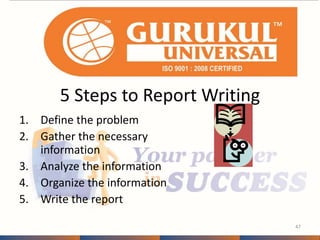
5 Steps to Report Writing 
1. Define the problem 
2. Gather the necessary 
information 
3. Analyze the information 
4. Organize the information 
5. Write the report 
47
Organizing Reports 
• Comparison/contrast 
• Problem-solution 
• Elimination of alternatives 
48
• General to particular 
• Geographic or spatial 
• Functional 
• Chronological
Words, Words, Words 
• UK English and US English 
– International English and Indian English 
• Denotation and Connotation 
– Let me know when you’re free next week for a meeting. 
– Could you let me know what times you have free? 
50
• Tone 
– Ajit is hung up on trivial details. 
– Ajit is meticulous and takes care of details that others 
sometimes ignore.
Writing Style 
• Brief writing style 
– Omit needless words 
– Combine sentences 
52
– Rewrite 
– Campus Jewellers' main objective is to increase sales. 
Specifically, the objective is to double sales in the next five 
years by becoming a more successful business. 
– Campus Jewellers' objective is to double sales in the next 
five years.
Anatomy of a Report 
• Cover Page 
• Title Page 
• Letter of Transmittal 
54
• Table of Contents 
• List of Illustrations 
• Executive Summary 
• Report Body 
• Appendices
Report Body 
• Introduction 
– Purpose and Scope; Limitations, Assumptions, and 
Methods 
• Background/History of the Problem 
56
• Body 
– Presents and interprets data 
• Conclusions and Recommendations 
• References or Works Cited 
• Appendixes 
– Interview transcripts, questionnaires, question tallies, 
printouts, and previous reports
Sales Proposal 
• Schedule 
• Results 
• Closing 
58 
•Budget 
•Objectives 
•Strategy and Tactics
Document Design 
• Use no more than 5 fonts. 
• Use no more than 5 colors. 
• Use glossy paper. 
59
• Use white space. 
• Use templates. 
• Use parallelism. 
• Avoid double emphasis.
Future Reports 
Proposals 
• 250-page reports 
• 90-minute oral presentation 
• 50-page summary 
61
Reports 
• Multi-media 
• Web
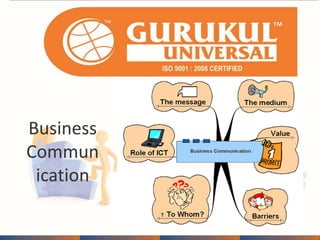
Business Communication 
Message, Medium and Barriers
Business 
Commun 
ication
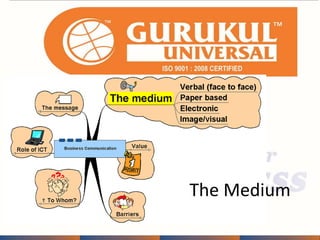
The Medium
The Medium 
• How the communication is to be made 
• Important to select an appropriate medium for the 
message: 
• Need to consider the needs of the sender, the nature 
of the receiver and the aims of the communication 
• Inappropriate medium can be a barrier to effective 
communication
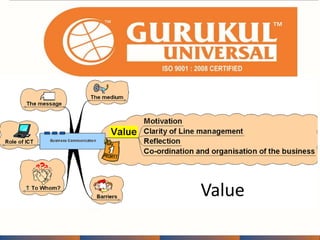
Value
Value 
• Vast majority of problems in business are 
caused by ineffective communication in one 
form or another 
• Businesses essentially human focused 
organisations 
• Value of good communications therefore 
inestimable
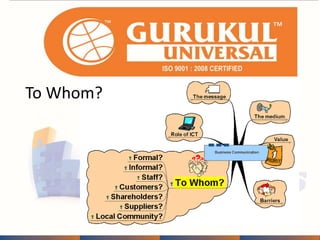
To Whom?
To Whom? 
• Who the communication is aimed at 
is an important factor: 
• The nature of the medium and the content may depend 
on who it is aimed at 
• Necessity of being sensitive 
to the receiver 
• Should communication be formal 
or informal? 
• E.g.
To Whom 
• E-mail communication: 
– Does it need to adhere to normal rules 
of spelling, punctuation and grammar? 
– Is it appropriate to use text speak? 
• Is this OK 4U or is txt 1 stp 2fr? 
– Are there different rules for different situations? 
– How do you know what the receiver expects? 
– What damage can be caused by inappropriate e-mail 
messages?
Type 
• Type of message may be an important factor in 
determining the medium, content, approach, etc. 
• Good news? 
• Bad news? 
• Information? 
• Instruction? 
• Each of the above may require a different approach and a 
different medium.
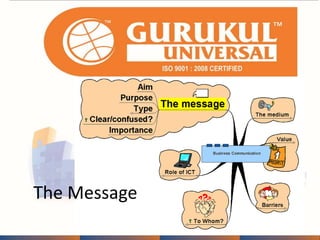
The Message
The Message 
• What is the communication designed to 
achieve? 
• This needs to be considered carefully to judge 
the best method of delivery and to judge the 
effectiveness of the feedback as to whether 
the message has been successful.
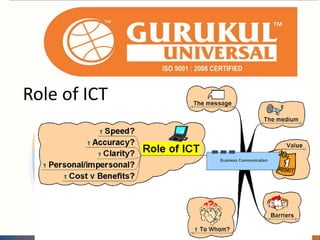
Role of ICT
Role of ICT 
• ICT has brought many advantages but also has 
its limitations: 
– It enables speedy communication 
– It can be cheap and save on costs (e.g. 
videoconferencing) 
– It can be expensive in hardware requirements 
– It can seem impersonal 
– It can be abused
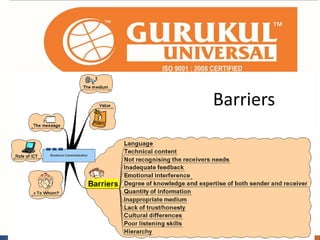
Barriers
Barriers 
• Anything that prevents successful 
communication from occurring 
• Complex and multi-layered 
• Can be technical or generated 
by the medium used, etc. but: 
• Main problem is human behaviour and 
psychology, e.g.

Gurukul benefits

  • 1.
  • 3.
    INTRODUCTION A PUBLICLIMITED ISO 9001:2008 COMPANY PROMOTED BY A GROUP, WHICH HAS EXPERIENCE IN COMPUTER EDUCATION AND FINANCIAL SERVICES
  • 4.
    OUR OBJECTIVES •TO MAKE OUR YOUTH EMPLOYABLE • TO PROVIDE QUALITY EDUCATION TO EVERY STUDENT, AT A REASONABLE PRICE AT HIS/HER PLACE • TO MAKE EVEN SMALL BUSINESSES A PROFITABLE PROPOSITION IN TODAY’S EDUCATION MARKET
  • 5.
    JOB SCENARIO ININDIA There is a huge demand for administrative assistants in offices, factories, trading houses and other business and non-business establishments
  • 6.
    SELF EMPLOYMENT OPPORTUNITIES AFTER COMPLETING HARDWARE, NETWORKING OR DESKTOP PUBLISHING COURSE. A STUDENT CAN BECOME SELF EMPLOYED AS WELL AS GENERATE EMPLOYMENT FOR OTHERS
  • 7.
    Basic Skills Required • UNDERSTANDING OF COMPUTER OPERATION, MAINTENANCE AND TROUBLESHOOTING • KNOWLEDGE OF OFFICE EQUIPMENTS LIKE PRINTERS, PHOTOCOPIERS, SCANNERS, FAX, INTERNET AND OTHERS • BOOK KEEPING
  • 8.
    Additional Skills Required Some management or professional skills acquired through work experience or training- 1. COMMUNICATION SKILLS, 2. ORGANIZATIONAL SKILLS, 3. TIME MANAGEMENT SKILLS, AND 4. MULTI-TASKING SKILLS
  • 9.
    SPECIALIZATIONS REQUIRED Anyof the following or combination of skills can benefit in enhancing career prospects • A BASIC UNDERSTANDING OF MARKETING MANAGEMENT, COSTING, TAXATION, AUDITING AND BUSINESS LAW • ADVANCED COMMUNICATION SKILLS
  • 10.
    QUALITY EDUCATION Weare very keen to maintain an identical level of course delivery at each centres. So, a team is dedicated to centre visits to ensure proper course delivery as well as student’s satisfaction. Universally recognized ISO 9001:2008 certificates, verifiable on the website www.gurukuluniversal.in
  • 11.
    BUSINESS MODEL Ourbusiness model is called hub and spokes model, where an anchor centre; like in present case Shahi Market centre at Cinema Road, Gorakhpur will serve as a hub and all franchisees will be serviced directly from that office. With the removal of distance, we are saved from time wastage as well as mis-communication
  • 12.
    COURSES • MODULARCOURSES LIKE- (MS OFFICE, BUSY AND TALLY) • FOUNDATION COURSE IN BUSINESS • GURUKUL CERTIFICATE IN BUSINESS & FINANCE
  • 13.
    Courses to belaunched Soon • Certificate in DTP • Diploma in Computer Hardware • Advance Diploma in Hardware & Networking
  • 14.
    GOLDEN OPPORTUNITY Anyrunning centre can sign up our franchisee for Rs. 25000 by paying a down payment of Rs. 5000 and post dated cheque of Rs. 20000
  • 15.
    BENEFITS OF GURUKULFRANCHISEE • Quality Study Material • Affordable Fees Structure • Job Oriented Courses • Consolidated Marketing • On Time Certification
  • 16.
    GURUKUL’S UNIQUENESS •FREEDOM OF FEE STRUCTURE, EACH CENTRE CAN DECIDE ITS OWN FEE STRUCTURE • ONLINE CERTIFICATE VERIFICATION • FEEDBACK AND SUPPORT • WEBSITE BASED CRM SUPPORT
  • 17.
    TECHNICAL & TRAINING SUPPORT • COMPANY WILL PROVIDE TRAINING TO FACULTIES FROM TIME TO TIME • ANY OTHER TECHNICAL SUPPORT IF REQUIRED FROM OUR SIDE SHALL BE PROVIDED
  • 18.
    DEPARTMENTS 1. Research& Development 2. Training & Technical Support 3. Examination & Certificates 4. Website & Media 5. CRM & Marketing 6. Legal and Accounts 7. Channel Development 8. Stocks Department
  • 19.
    MARKETING SUPPORT •COMPANY WILL PROVIDE AN ADM ON EVERY 20 CENTRES • MONTHLY VISIT BY ADM • COMMON ADVERTISEMENT IN NEWSPAPERS & RADIO MANTRA
  • 20.
    FEEDBACK Your feedbackis welcome, it will help us improve our product and service
  • 21.
  • 23.
  • 25.
  • 26.
  • 27.
  • 28.
  • 29.
    Letter Contents •Reference, Date, Address, Salutation, Subject (B/A), Body, Complimentary Close, Enclosures • Dear Glenn: or Dear Mr Helms: • Sincerely, and Cordially, • Open (Dear Glenn) and Closed (Dear Glenn:) • Second Page – Reader’s Name, Date, Page Number 29
  • 30.
    Formats for Lettersand Memos • Open and closed punctuation – Full stops at end of addresses – Full stops in abbreviations (am/pm) • Block and Modified Block – Date and Signature – Subject Line – Optional and Rare 30
  • 31.
    Meeting Agenda •Time and place • Whether each item is presented for information, for discussion, or for a decision 31
  • 32.
    Minutes of theMeeting • Decisions Reached • Action Items • Open Issues 32
  • 33.
    Emails • Minutesa day - average worker? • 49 minutes • Hours a day - top managers? • 4 hours 33
  • 34.
    Subject • Bespecific, concise, and catchy. – 28 characters – Will Attend 3 pm Meeting EOM 34
  • 35.
    – Travel Plansfor Sales Meeting – Your Funding Request Approved – ASAP, BTW, FYI, IMHO – Smileys 
  • 36.
    Body of theEmail • Brief • Important points at the top • Bullets and numbering • Emphasize (NOT) • HTML (letterhead) • All rules of good writing 36
  • 37.
    Mailing Lists •Your boss could be reading! • Posts are archived. • Avoid using company email address. • Avoid conversations (one liners). • Do not rush to lists. 37
  • 38.
    Netiquette • Neverflame. • Use FULL CAPS only to emphasize a word or two. 38
  • 39.
    • Send messageson a need basis. • Recipient’s work practice (one long or several short messages) • Quote briefly (B/A) while replying. • Attachments
  • 40.
    Covering Letters •Brief – 3 paragraphs, bullets • Focus on – Major requirements – Differentiators • Research – Web, friends, colleagues 40 Tip: Do not plead.
  • 41.
    Résumé or CurriculumVitae • Name, Address, Contact Details • Objective, Education, Experience, Languages, Personal, References – Reverse chronological order • Personal details – Age, marital status, children 41
  • 42.
    Résumé Tips •Two pages maximum. – Less important details on 2nd page. • Highlight strengths, not weaknesses. – Job hoppers -- period • Create for each company. • Use templates – but enhance them. 42
  • 43.
  • 44.
    Which Reports? 44 Sales Reports Annual Reports Inspection Reports Audit Reports
  • 45.
    Technical Writing Reports • Proposals • User Manuals • Technical Manuals • White Papers 45
  • 46.
    Classification of Reports • Formal Reports and Informal Reports • Information Reports • Analytical Reports • Recommendation Reports 46
  • 47.
    5 Steps toReport Writing 1. Define the problem 2. Gather the necessary information 3. Analyze the information 4. Organize the information 5. Write the report 47
  • 48.
    Organizing Reports •Comparison/contrast • Problem-solution • Elimination of alternatives 48
  • 49.
    • General toparticular • Geographic or spatial • Functional • Chronological
  • 50.
    Words, Words, Words • UK English and US English – International English and Indian English • Denotation and Connotation – Let me know when you’re free next week for a meeting. – Could you let me know what times you have free? 50
  • 51.
    • Tone –Ajit is hung up on trivial details. – Ajit is meticulous and takes care of details that others sometimes ignore.
  • 52.
    Writing Style •Brief writing style – Omit needless words – Combine sentences 52
  • 53.
    – Rewrite –Campus Jewellers' main objective is to increase sales. Specifically, the objective is to double sales in the next five years by becoming a more successful business. – Campus Jewellers' objective is to double sales in the next five years.
  • 54.
    Anatomy of aReport • Cover Page • Title Page • Letter of Transmittal 54
  • 55.
    • Table ofContents • List of Illustrations • Executive Summary • Report Body • Appendices
  • 56.
    Report Body •Introduction – Purpose and Scope; Limitations, Assumptions, and Methods • Background/History of the Problem 56
  • 57.
    • Body –Presents and interprets data • Conclusions and Recommendations • References or Works Cited • Appendixes – Interview transcripts, questionnaires, question tallies, printouts, and previous reports
  • 58.
    Sales Proposal •Schedule • Results • Closing 58 •Budget •Objectives •Strategy and Tactics
  • 59.
    Document Design •Use no more than 5 fonts. • Use no more than 5 colors. • Use glossy paper. 59
  • 60.
    • Use whitespace. • Use templates. • Use parallelism. • Avoid double emphasis.
  • 61.
    Future Reports Proposals • 250-page reports • 90-minute oral presentation • 50-page summary 61
  • 62.
  • 63.
  • 64.
  • 65.
  • 66.
    The Medium •How the communication is to be made • Important to select an appropriate medium for the message: • Need to consider the needs of the sender, the nature of the receiver and the aims of the communication • Inappropriate medium can be a barrier to effective communication
  • 67.
  • 68.
    Value • Vastmajority of problems in business are caused by ineffective communication in one form or another • Businesses essentially human focused organisations • Value of good communications therefore inestimable
  • 69.
  • 70.
    To Whom? •Who the communication is aimed at is an important factor: • The nature of the medium and the content may depend on who it is aimed at • Necessity of being sensitive to the receiver • Should communication be formal or informal? • E.g.
  • 71.
    To Whom •E-mail communication: – Does it need to adhere to normal rules of spelling, punctuation and grammar? – Is it appropriate to use text speak? • Is this OK 4U or is txt 1 stp 2fr? – Are there different rules for different situations? – How do you know what the receiver expects? – What damage can be caused by inappropriate e-mail messages?
  • 72.
    Type • Typeof message may be an important factor in determining the medium, content, approach, etc. • Good news? • Bad news? • Information? • Instruction? • Each of the above may require a different approach and a different medium.
  • 73.
  • 74.
    The Message •What is the communication designed to achieve? • This needs to be considered carefully to judge the best method of delivery and to judge the effectiveness of the feedback as to whether the message has been successful.
  • 75.
  • 76.
    Role of ICT • ICT has brought many advantages but also has its limitations: – It enables speedy communication – It can be cheap and save on costs (e.g. videoconferencing) – It can be expensive in hardware requirements – It can seem impersonal – It can be abused
  • 77.
  • 78.
    Barriers • Anythingthat prevents successful communication from occurring • Complex and multi-layered • Can be technical or generated by the medium used, etc. but: • Main problem is human behaviour and psychology, e.g.