Top Management’s
Role Leading to
High Performance
Organization
Chapter 12
Ray Vasquez
Teams That Run Things
● Teams monitor responsibility and performance throughout (top to
bottom)
● Team challenges include: choice between working group and team, role
of the team leader, problem of transitions
● Large companies like Hewlett-Packard & Motorola generate teams to identify purposes, goals, and
collective work-products.
● For a real team to form there must be a “team purpose”
● Groups of managers discuss & decide and then delegate, this lacks work-productivity of a real team
● Follow up for these teams is required
Top management helps the charge by improving
his or her team leader attitude and skills.
Teams That Recommend Things
● These teams include task forces, projects groups, and audit, quality, or safety groups asked to study and
solve particular problems.
● Two critical issues unique to teams that recommend; getting off to a fast and constructive start & dealing
with the inevitable “handoff” required to get their recommendations implemented.
● Management must ensure teams include people with skills and influence necessary to crafting practical
recommendations will carry weight.
● Recommendations from management must help with cooperation and by opening doors dealing with
political obstacles.
Burlington Northern
A United States-based railroad company formed from a merger of four major U.S. railroads. Burlington
Northern operated between 1970 and 1996.
● The company asked 14 people to take 45 days to study and recommend the best organizational
approach to marketing.
● The head of marketing appointed Steve Brigance to lead.
● Steve sent his concerns in an essay, to be formal clear defined process and charter
● Insisted his task force had freedom to explore entire organization and to senior executives
● Chose his team members, mixed skill sets and corporate knowledge
● Instant teamwork and recommendations
● Failed miserably because the did not have an implementation team, managers assumed “just happen”
● Implementation participation, interviews, analysis, conduct trials and experiments
Teams That Make or
Do Things
● Front Line People - R&D, Operations, Marketing,
Sales, and Service
● “Critical Delivery Points” Places where cost and
value of products and services are determined
i.e. accounts management, customer service,
product design, productivity determined
● Top Management must never appear to
promote teams for their own sake or for the
sake of making teams.
● “Team Culture” based on performance, people
and process must be established.
Teams and The High Performance
Organization
● Focus both on performance and teams that deliver it
● Teams are not the only answer, they are a piece of the puzzle; simply put they are “practical”
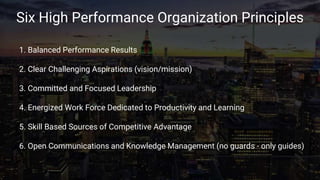
Six High Performance Organization Principles
1. Balanced Performance Results
2. Clear Challenging Aspirations (vision/mission)
3. Committed and Focused Leadership
4. Energized Work Force Dedicated to Productivity and Learning
5. Skill Based Sources of Competitive Advantage
6. Open Communications and Knowledge Management (no guards - only guides)
Conclusion
Teams Are the Vehicle to Performance
Teams Do Not Succeed Without Both Mutual Accountability and Individual Accountability
References
Katzenbach, J. & Smith, D. (2002). The Wisdom of Teams: Creating the High-Performance Organization. Boston, Mass: Harvard
Business School Press. HarperBusiness Publishers.
8 Reasons Why Teams Fail. (2015, September 23). Retrieved from https://leadchangegroup.com/8-reasons-why-teams-fail/
Center For Creative Leadership. (2012, March 14). 7 Ways to BuildAccountable Organizations. Retrieved from
https://www.forbes.com/sites/ccl/2012/02/28/7-ways-to-build-accountable-organizations/#265008873cd3
The Discipline of Teams. (1993, March 1). Retrieved from https://hbr.org/1993/03/the-discipline-of-teams-2
Mutual accountability in teams. (2019, January 10). Retrieved from
https://www.theperformanceroom.co.uk/mutual-accountability-in-teams/

Top Management's Role

  • 1.
    Top Management’s Role Leadingto High Performance Organization Chapter 12 Ray Vasquez
  • 2.
    Teams That RunThings ● Teams monitor responsibility and performance throughout (top to bottom) ● Team challenges include: choice between working group and team, role of the team leader, problem of transitions
  • 3.
    ● Large companieslike Hewlett-Packard & Motorola generate teams to identify purposes, goals, and collective work-products. ● For a real team to form there must be a “team purpose” ● Groups of managers discuss & decide and then delegate, this lacks work-productivity of a real team ● Follow up for these teams is required
  • 4.
    Top management helpsthe charge by improving his or her team leader attitude and skills.
  • 5.
    Teams That RecommendThings ● These teams include task forces, projects groups, and audit, quality, or safety groups asked to study and solve particular problems. ● Two critical issues unique to teams that recommend; getting off to a fast and constructive start & dealing with the inevitable “handoff” required to get their recommendations implemented. ● Management must ensure teams include people with skills and influence necessary to crafting practical recommendations will carry weight. ● Recommendations from management must help with cooperation and by opening doors dealing with political obstacles.
  • 6.
    Burlington Northern A UnitedStates-based railroad company formed from a merger of four major U.S. railroads. Burlington Northern operated between 1970 and 1996. ● The company asked 14 people to take 45 days to study and recommend the best organizational approach to marketing. ● The head of marketing appointed Steve Brigance to lead. ● Steve sent his concerns in an essay, to be formal clear defined process and charter ● Insisted his task force had freedom to explore entire organization and to senior executives ● Chose his team members, mixed skill sets and corporate knowledge ● Instant teamwork and recommendations ● Failed miserably because the did not have an implementation team, managers assumed “just happen” ● Implementation participation, interviews, analysis, conduct trials and experiments
  • 7.
    Teams That Makeor Do Things ● Front Line People - R&D, Operations, Marketing, Sales, and Service ● “Critical Delivery Points” Places where cost and value of products and services are determined i.e. accounts management, customer service, product design, productivity determined ● Top Management must never appear to promote teams for their own sake or for the sake of making teams. ● “Team Culture” based on performance, people and process must be established.
  • 8.
    Teams and TheHigh Performance Organization ● Focus both on performance and teams that deliver it ● Teams are not the only answer, they are a piece of the puzzle; simply put they are “practical”
  • 9.
    Six High PerformanceOrganization Principles 1. Balanced Performance Results 2. Clear Challenging Aspirations (vision/mission) 3. Committed and Focused Leadership 4. Energized Work Force Dedicated to Productivity and Learning 5. Skill Based Sources of Competitive Advantage 6. Open Communications and Knowledge Management (no guards - only guides)
  • 10.
    Conclusion Teams Are theVehicle to Performance Teams Do Not Succeed Without Both Mutual Accountability and Individual Accountability
  • 11.
    References Katzenbach, J. &Smith, D. (2002). The Wisdom of Teams: Creating the High-Performance Organization. Boston, Mass: Harvard Business School Press. HarperBusiness Publishers. 8 Reasons Why Teams Fail. (2015, September 23). Retrieved from https://leadchangegroup.com/8-reasons-why-teams-fail/ Center For Creative Leadership. (2012, March 14). 7 Ways to BuildAccountable Organizations. Retrieved from https://www.forbes.com/sites/ccl/2012/02/28/7-ways-to-build-accountable-organizations/#265008873cd3 The Discipline of Teams. (1993, March 1). Retrieved from https://hbr.org/1993/03/the-discipline-of-teams-2 Mutual accountability in teams. (2019, January 10). Retrieved from https://www.theperformanceroom.co.uk/mutual-accountability-in-teams/

Editor's Notes

  • #5 https://www.youtube.com/watch?v=y0FtXhSu0J0
  • #9 https://www.youtube.com/watch?v=vv2PaZ8Nl2T4 Google 2:23 https://www.youtube.com/watch?v=miiCMak1Qhk Football 3:38