

60 Educators Tips
In 60 Minutes
Rommie L. Duckworth, MPA, LP, EFO, FO
Find me @RomDuck
60 EMS Educator Tips in 60 Minutes
Rommie L. Duckworth, MS, LP, EFO, FO Find me @RomDuck #EMSWorldExpo2024
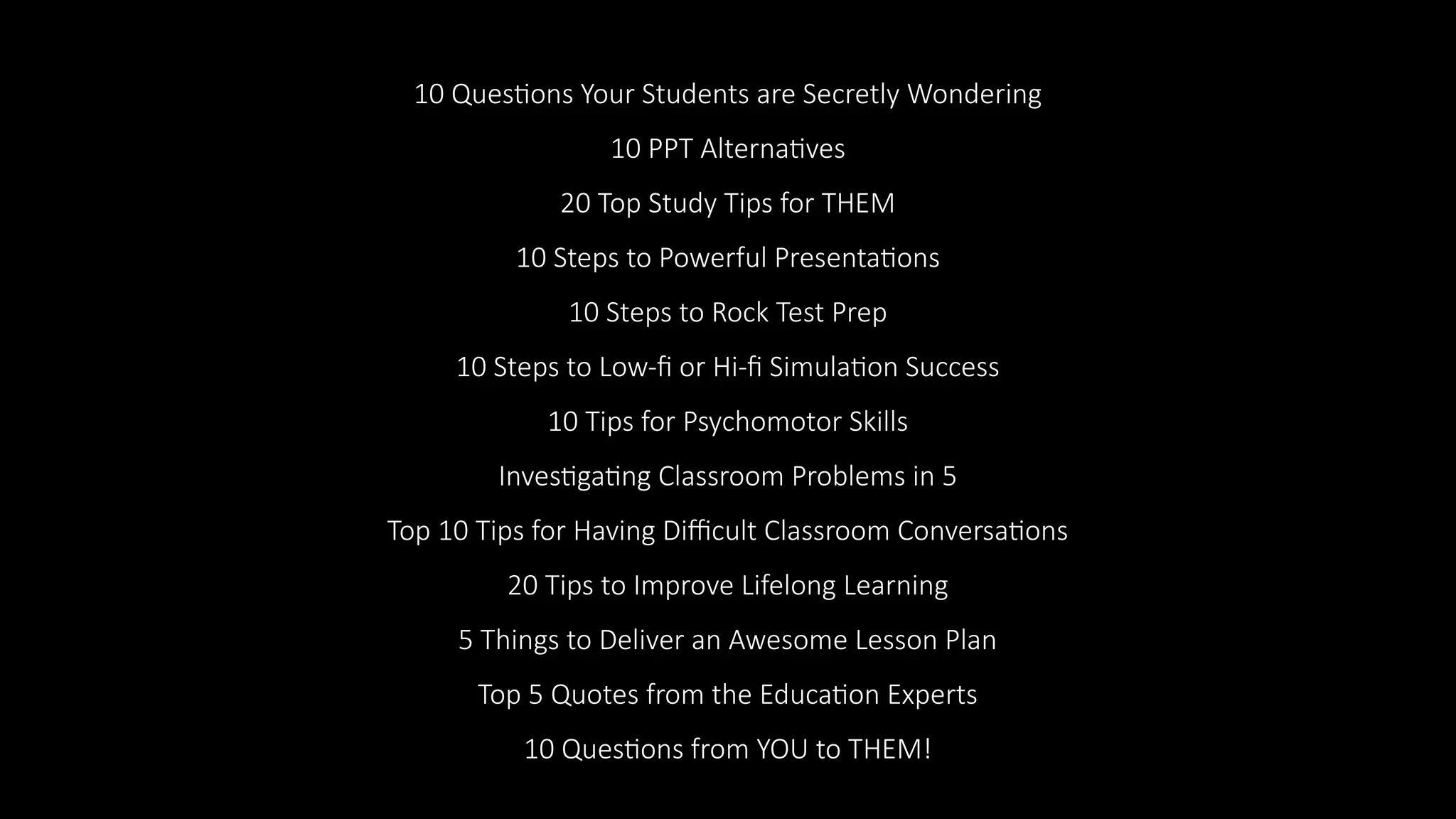
10 Questions Your Students are Secretly Wondering
10 PPT Alternatives
20 Top Study Tips for THEM
10 Steps to Powerful Presentations
10 Steps to Rock Test Prep
10 Steps to Low-fi or Hi-fi Simulation Success
10 Tips for Psychomotor Skills
Investigating Classroom Problems in 5
Top 10 Tips for Having Difficult Classroom Conversations
20 Tips to Improve Lifelong Learning
5 Things to Deliver an Awesome Lesson Plan
Top 5 Quotes from the Education Experts
10 Questions from YOU to THEM!
New educators
New positions
Just looking for new ideas
Duckworth on Education
These tips
6
7 Questions Your Students Are
Wondering (But will never ask)
3 Ways to Address Them
7
1. What is this even about?
2. Why bring that up?
3. For example?
4. Is this on the exam?
5. Why should I care?
6. What am I supposed to do about
it?
7. Where do we go from here?
7 Questions Your Students Are
Wondering (But will never ask)
1. Authority
(Ethos)
2. Emotion
(Pathos)
3. Logic (Logos)
3 Ways to Address Those Questions
9
10
Alternatives
to
PowerPoint
10
10
Alternatives
to
PowerPoint
1. Keynote, Haiku Deck
2. Prezi
3. Google Slides, Zoho Show,
Slides.com, Ludus.one
4. Canva, eMaze, MS Sway, Genial.ly,
Visme, Flowvella
5. Powtoon, Vyond, Animoto,
Animatron
6. Mural.com, MindMeister,
LucidChart
7. NearPod, DisplayNote
8. Beautiful.ai, decktopus, ChatGP
9. Slide Dog
10. PowerPoint
10 Steps to Building a Presentation
11
10 Steps to Building a Presentation
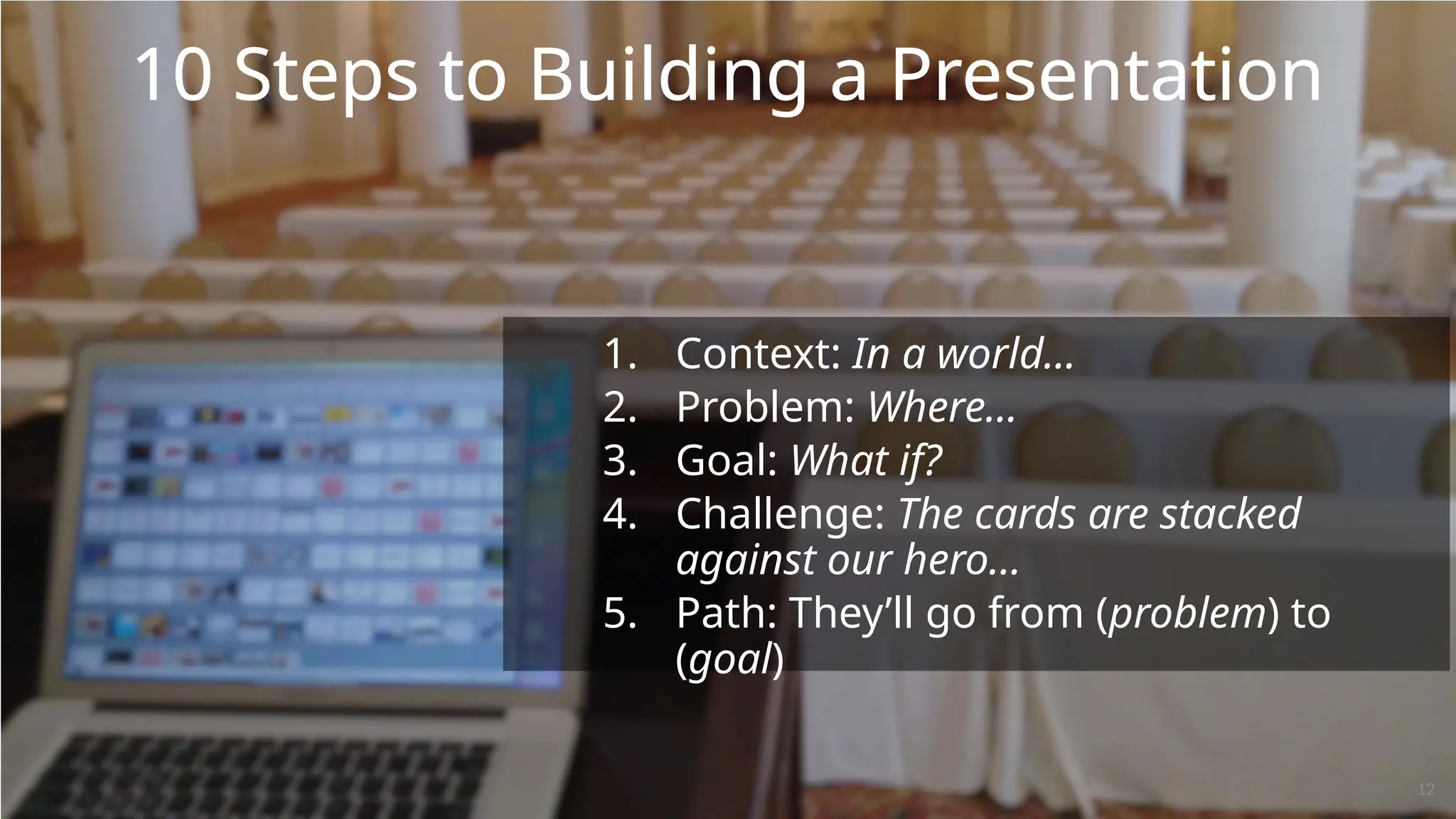
1. Context: In a world…
2. Problem: Where…
3. Goal: What if?
4. Challenge: The cards are stacked
against our hero…
5. Path: They’ll go from (problem) to
(goal)
12
10 Steps to Building a Presentation
6. Action: By doing…
7. Requirements and resistance: They’ll
have to overcome…
8. Support and resources: With the help
of…
9. Contrast and call to action: They will…
10. Take-home and victory: To make a
real difference in this world!
10 Ways To Improve Their Study Time
1. Specify your objectives.
2. Focus on learning and using the information, not on
grades
3. Consider making flow charts, diagrams, or
algorithms of clinical topics.
4. Use a reading/reviewing method like SQ3R
Survey, Question, Read, Recite, Recall
20 Ways To Improve Their Study Time
5. The “Pomodoro Technique”: 25 minute study times
are followed by 5 minute breaks. After 4 or more
sessions, take a longer 15-30 minute break to clear
your head.
6. Today I Learned (TIL). Every day (or after every work
shift, class sessions, or study session) the bullet
points of KEY TAKE-AWAYS.
7. Explain it like I'm five (ELI5). Thinking how you would
explain the material to a five-year-old will help you
break it down to its most essential components.
20 Ways To Improve Their Study Time
8. Read the information that follows each heading to
find the answer to each question that you wrote
down.
9. It is important to understand that this is recite, not
regurgitate.
10.Use the textbook table of contents, objectives,
syllabus, curricula, or other outline of the material
to know what information you should review.
20 Ways To Improve Their Study Time
10 Steps To Rock Their Test Prep
18
10 Steps To Rock Their Test Prep
1. Studying does not come naturally to everyone. Spend
the time and energy to know and understand the
material.
2. Manage your time well. Don't put off
studying/practicing until the last minute and try to
cram.
3. Don't just memorize (except when you have to). For
essay and verbal test items, prepare by thinking about
how you would explain them to other people
19
10 Steps To Rock Your Test Prep
4. It is ok if the exam isn't quite what you expect.
5. It is ok to miss something.
6. Ignore the other students.
10 Steps To Rock Their Test Prep
7. Review good test-taking skills
Read each question and each answer thoroughly.
Don’t simply pick the first answer that looks good to get
the test over with.
If possible, answer the questions that you know first and
return to the more difficult ones.
Outline essays before you write.
10 Steps To Rock Their Test Prep
8. Poll students to see what of these study tips students
actually used.
9. Review the exam with class, having students explain
why answers were correct. (whole class /independent
study)
10.Poll students if their grade accurately reflects their
KSAs.
10 Steps to Successful Scenarios & Simulations
1. Specify clinical competencies (what, not how).
2. Match complexity with student skill level.
3. Do a dry run for the instructors, actors and evaluators.
4. Plan and prepare for things to go off-track.
5. Are we teaching or testing?
6. Will there be pauses and prompts? Injects?
7. Do a walk-through for the students.
8. Clearly communicate expectation (minimize rules).
9. Get everyone involved.
10.Students do the work and do the talking (let things sink
in).
15 Steps to Successful Scenarios & Simulations
Stepping Up Psychomotor Skills
1. Begin with the end in mind (competency vs mastery).
2. Gather a study group to help you practice or find one
that is already together.
3. Change roles when practicing a skill.
4. Change the equipment you use.
5. Change the environment in which you practice.
6. Get quality, preferably expert, performance feedback.
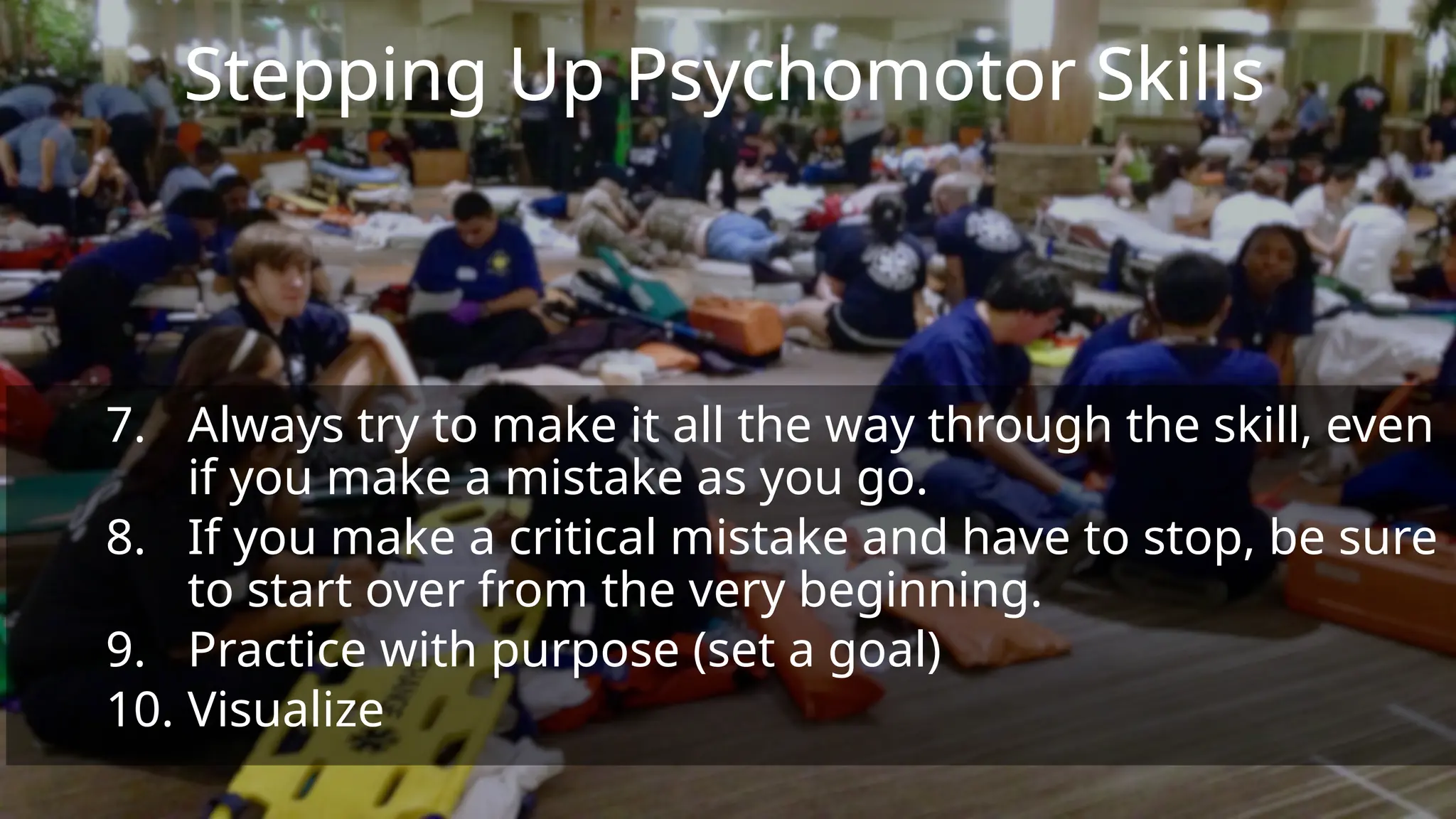
Stepping Up Psychomotor Skills
7. Always try to make it all the way through the skill, even
if you make a mistake as you go.
8. If you make a critical mistake and have to stop, be sure
to start over from the very beginning.
9. Practice with purpose (set a goal)
10. Visualize
28
10 Steps to Classroom Discipline
29
1. There are no difficult students, only difficult
behaviors.
2. Even “good students” have “bad behaviors” and
even “bad students” have “good behaviors”.
3. Educators must focus on building positive
behaviors and eliminating or minimizing negative
behaviors.
10 Steps to Classroom Discipline
30
4. Red Hot Stove: Foreseeable
5. Red Hot Stove: Immediate
6. Red Hot Stove: Impersonal
7. Red Hot Stove: Consistent
8. Just Culture: Counseling for human error
9. Just Culture: Coaching for risky behavior
10.Just Culture: Conversation for reckless behavior
10 Steps to Classroom Discipline
Investigating Classroom Problems in 5
1. What happened?
2. What normally happens in that situation?
3. What do policies require or recommend in the
situations?
4. What was the underlying or root cause here?
5. How did the educator deal with the incident when it
happened?
Top 10 Tips to Improve Difficult Conversations
1. Involve another, preferably neutral, person if possible
2. Listen to the student’s perspective and response
3. Align student goals with course goals
4. Describe the behavior and its impacts
5. Discuss correct behavior & resources for success
6. Reiterate or set parameters for future behaviors
7. Share consequences for noncompliance
8. Summarize the conversation
9. Confirm and document agreement
10. Follow through and follow up
20 Tips For Better Lifelong Learning
Knowles
Adult
Learning
Lave’s
Situationl
Learning
Jarvis’
Learning
Processes
Law of
Exercise
Kolb’s
Experintl
Model
Mezirow
Trnsfmtnl
Learning
Perry’s
Journey
of
Growth
Law of
Primacy
Von
Resteroff
Effect
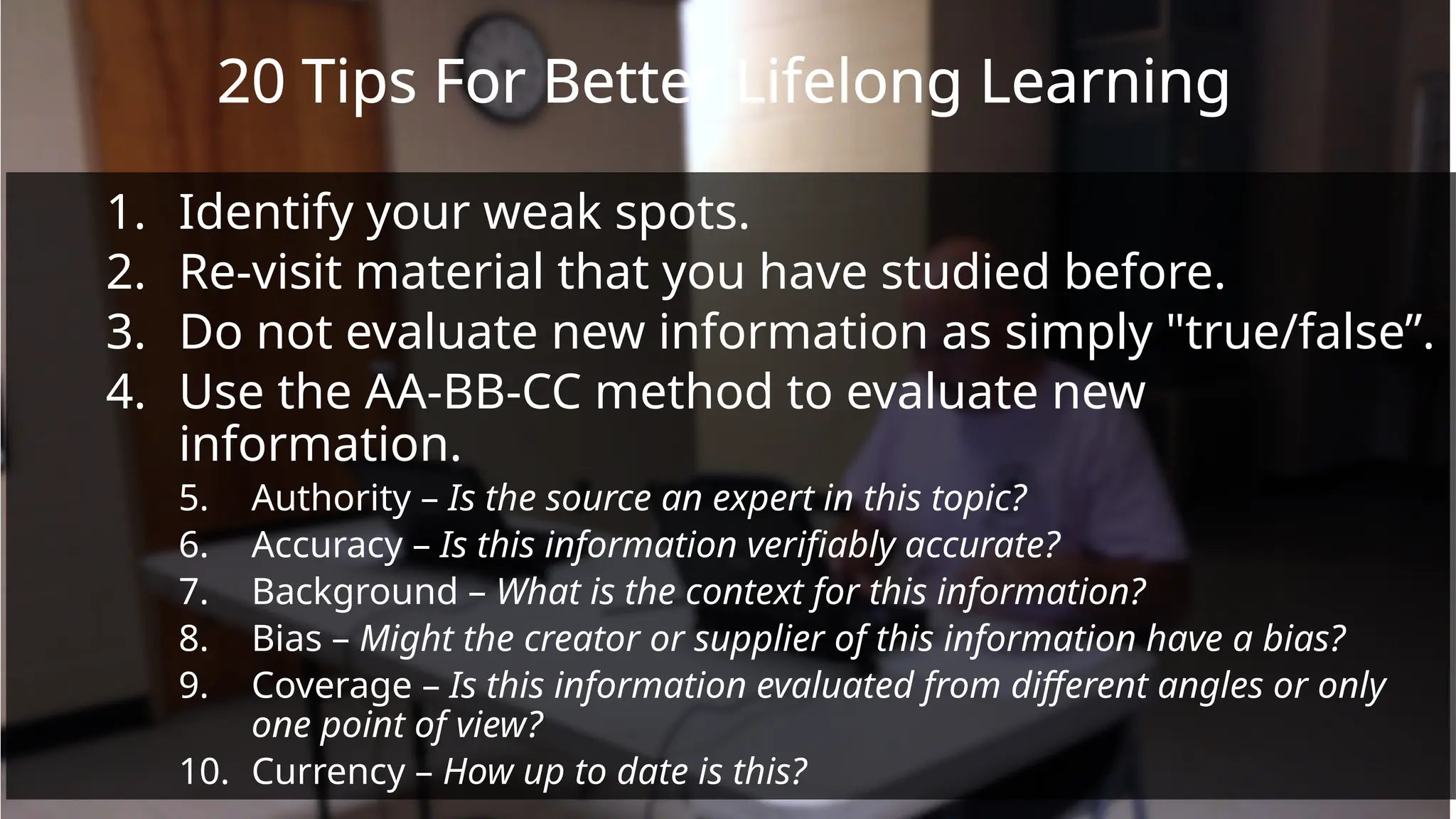
20 Tips For Better Lifelong Learning
1. Identify your weak spots.
2. Re-visit material that you have studied before.
3. Do not evaluate new information as simply "true/false”.
4. Use the AA-BB-CC method to evaluate new
information.
5. Authority – Is the source an expert in this topic?
6. Accuracy – Is this information verifiably accurate?
7. Background – What is the context for this information?
8. Bias – Might the creator or supplier of this information have a bias?
9. Coverage – Is this information evaluated from different angles or only
one point of view?
10. Currency – How up to date is this?
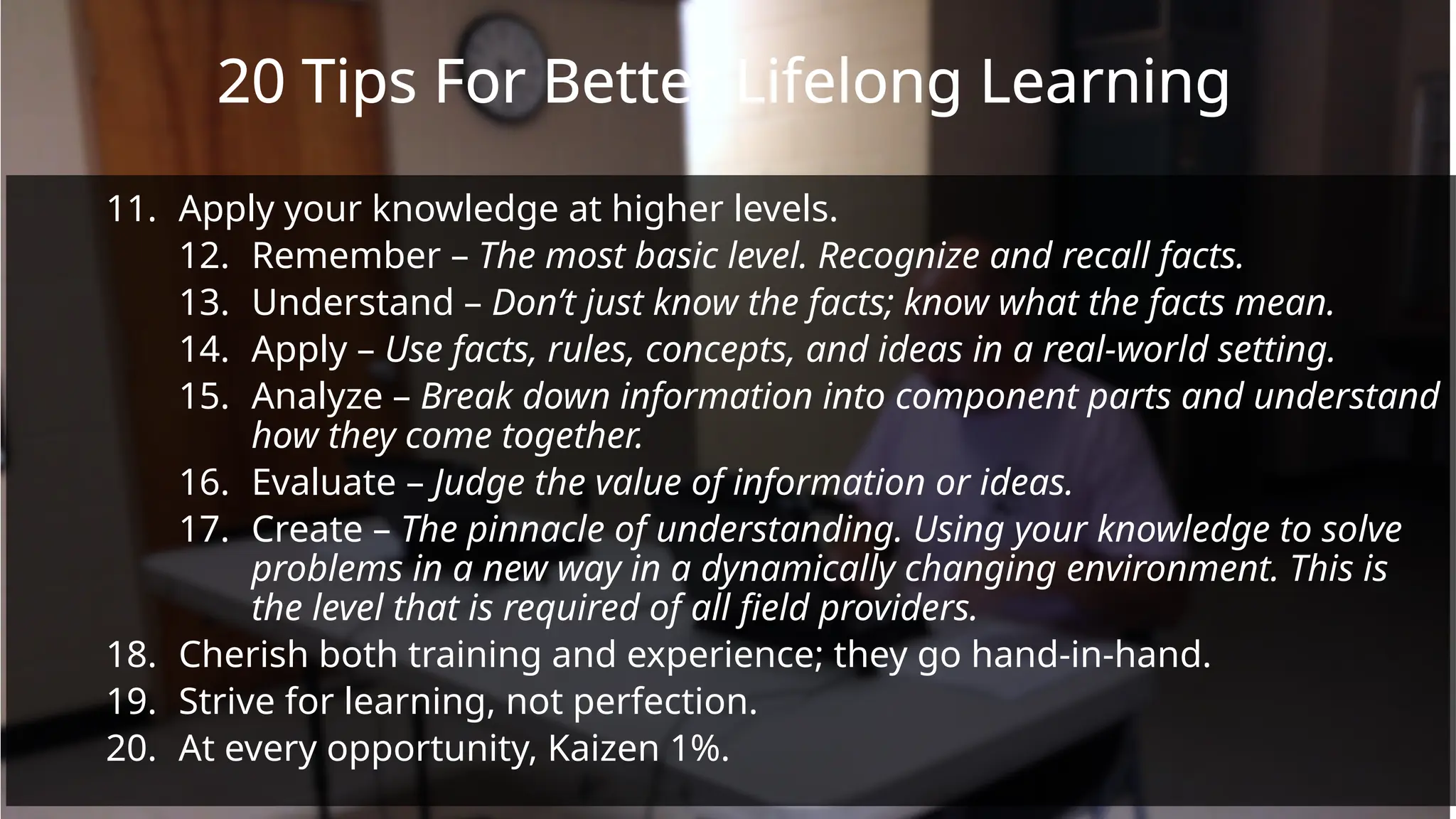
20 Tips For Better Lifelong Learning
11. Apply your knowledge at higher levels.
12. Remember – The most basic level. Recognize and recall facts.
13. Understand – Don’t just know the facts; know what the facts mean.
14. Apply – Use facts, rules, concepts, and ideas in a real-world setting.
15. Analyze – Break down information into component parts and understand
how they come together.
16. Evaluate – Judge the value of information or ideas.
17. Create – The pinnacle of understanding. Using your knowledge to solve
problems in a new way in a dynamically changing environment. This is
the level that is required of all field providers.
18. Cherish both training and experience; they go hand-in-hand.
19. Strive for learning, not perfection.
20. At every opportunity, Kaizen 1%.
5 Steps to Successful Scenarios
1. Ready
2. Realistic
3. Review
4. Reflect
5. Rules
5 Steps to Successful Scenarios
The 5 Things You Need In Your Lesson Plan
Goals
Needs
Objectives
Methods
Evaluation
Summary
http://www.flickr.com/photos/zeetzjones/4130672015/
Improve Performance
Simple / Flexible System
Employ GNOMES
Discussion
Q&A
Resources
The 5 Things You Need In Your Lesson Plan
5 Quotes From The Education Experts
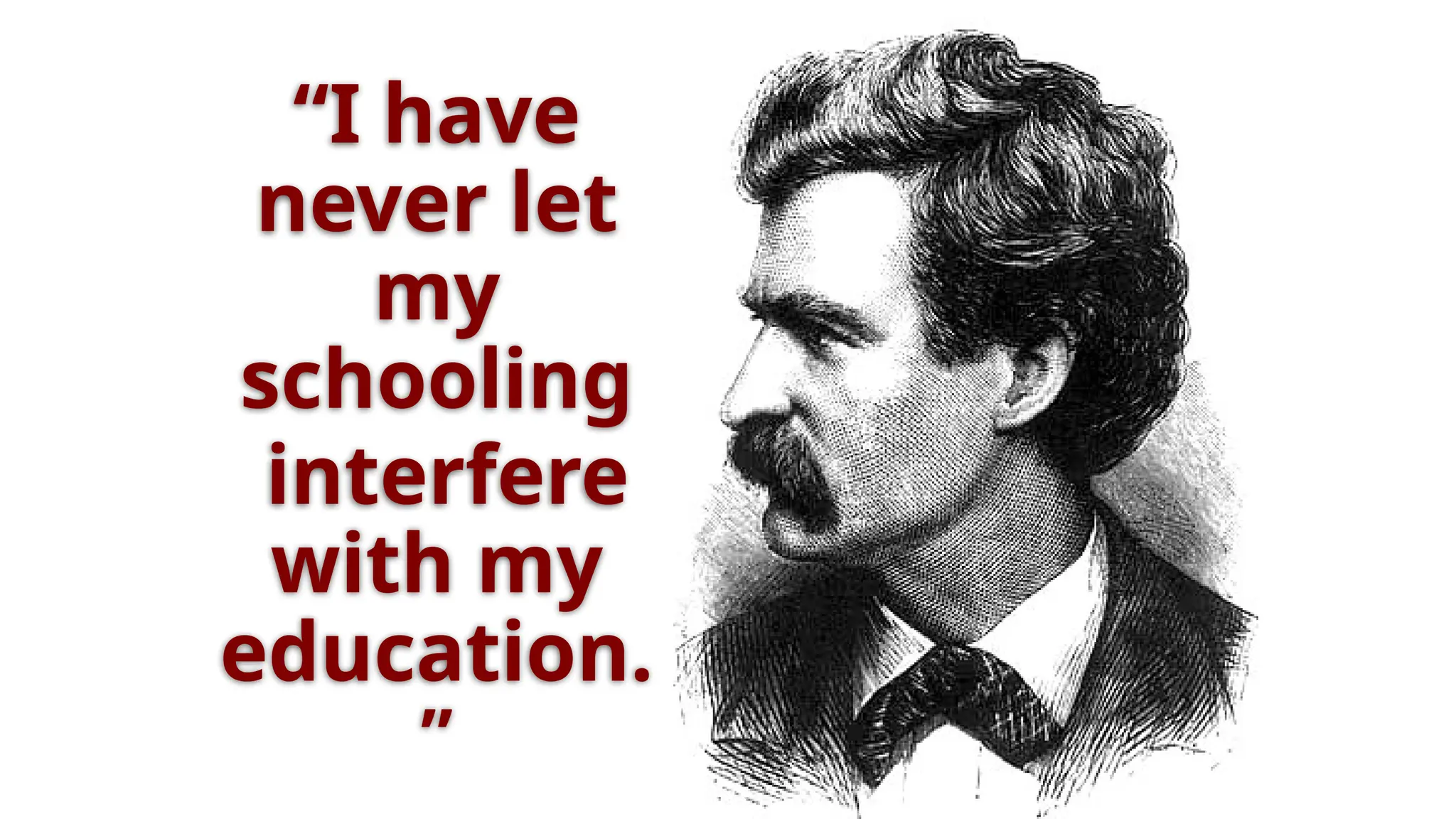
“I have
never let
my
schooling
interfere
with my
education.
”
“The best Learners
often make the
worst Teachers.
They cannot
imagine struggling
to learn something
that comes so
naturally to them”
• Stephen Brookfield
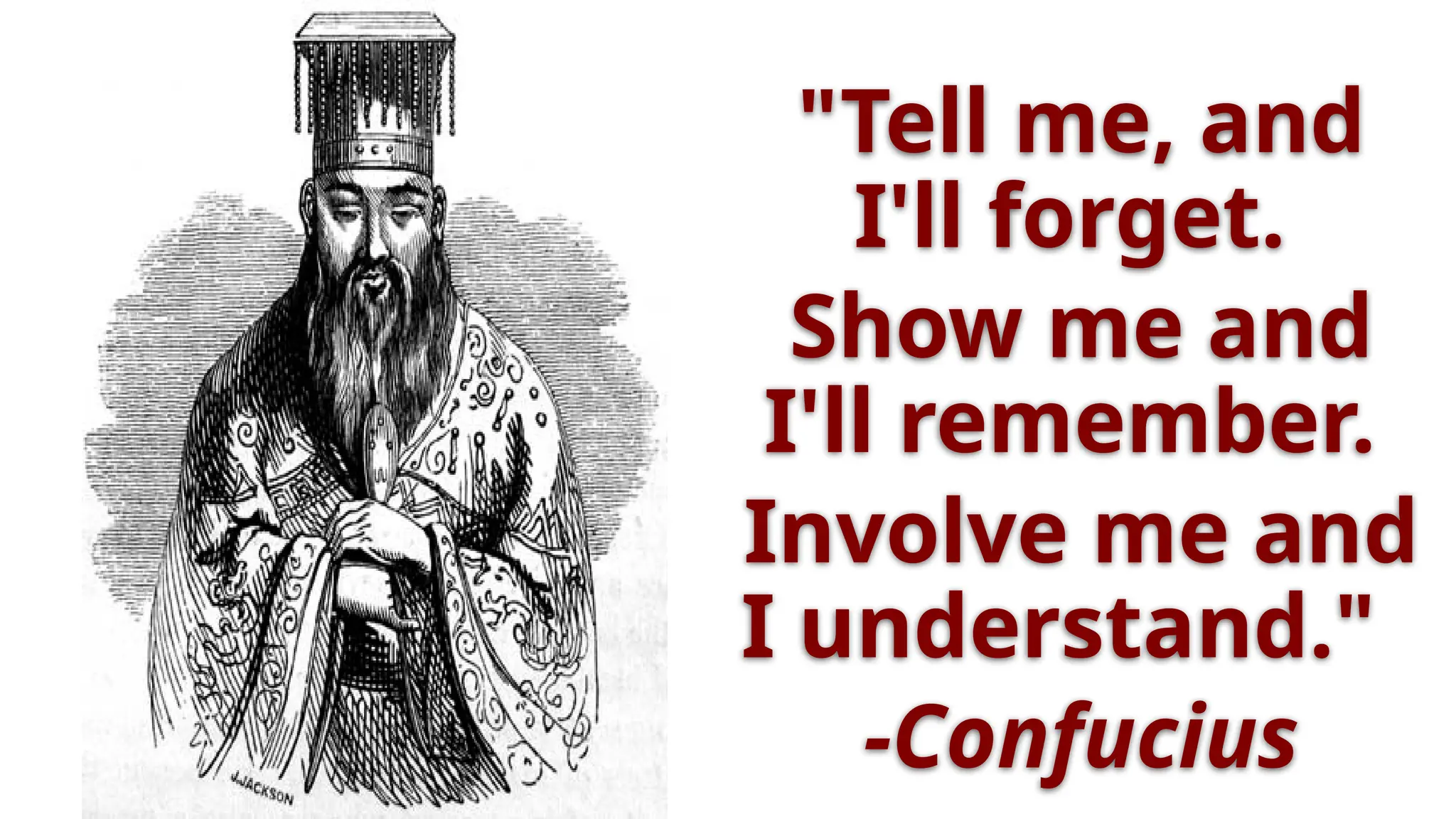
"Tell me, and
I'll forget.
Show me and
I'll remember.
Involve me and
I understand."
-Confucius
“There are
few new ideas
in the world:
But not
everyone
knows the old
ones.”
“You cannot
teach a man
anything;
You can only
help him find
it within
himself.”
• Galileo Galilei
49
5 Questions
from YOU!
50
5 Questions
from YOU!
Here are the top three questions people
ask at the end of this class.
What are your questions?
51
5 Questions
from YOU!
What is your biggest Takeaway?
What did you learn that was new or what
will you be better at now for this
educational program?
52
5 Questions
from YOU!
What are you going to do?
What action are you going to take to solve
the problem that we described in this
session?
53
5 Questions
from YOU!
What are your top tips for taking a test on
this subject?
54
5 Questions
from YOU!
Where do we go from here?
What are your next steps?
55
56
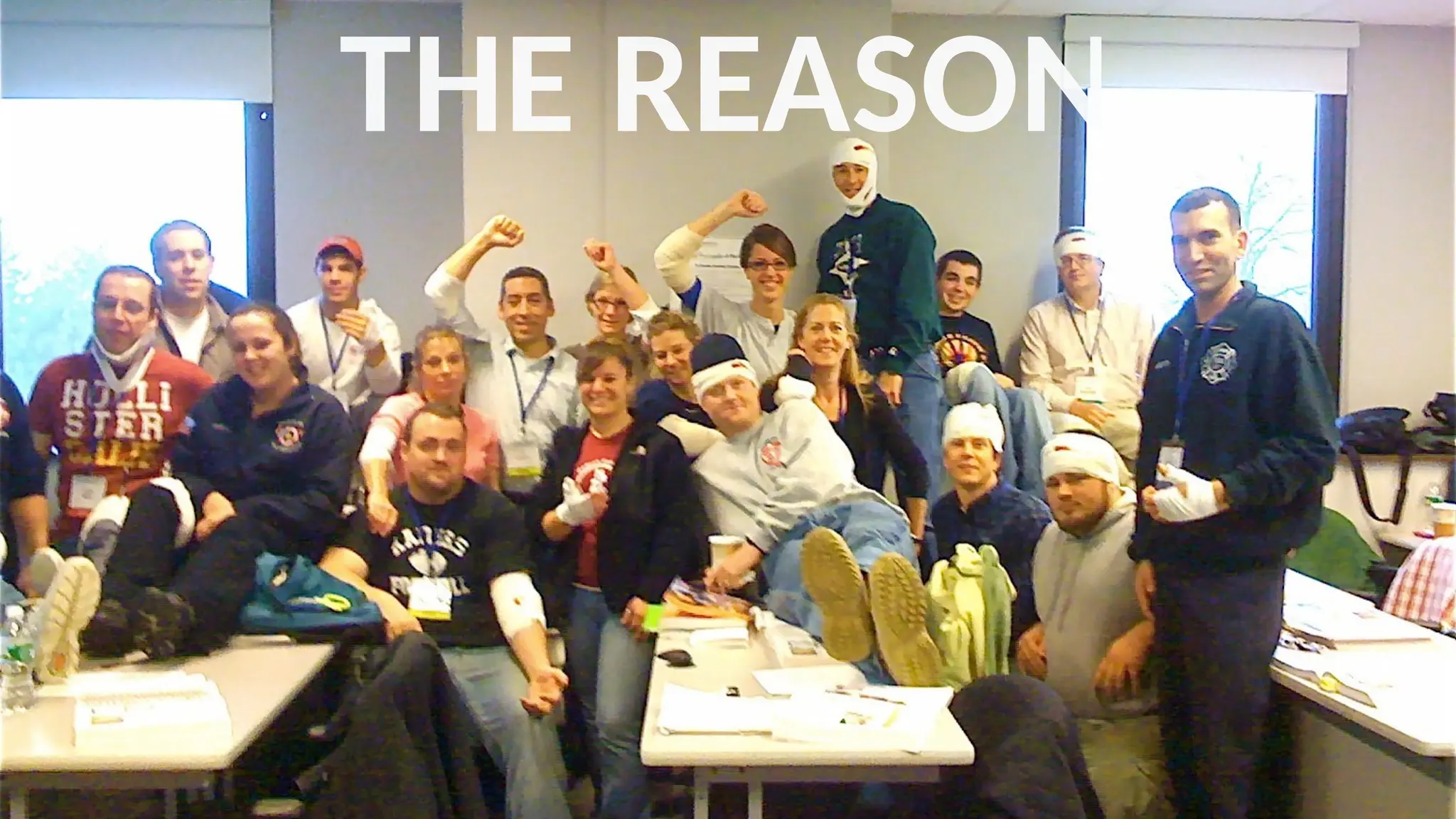
THE REASON
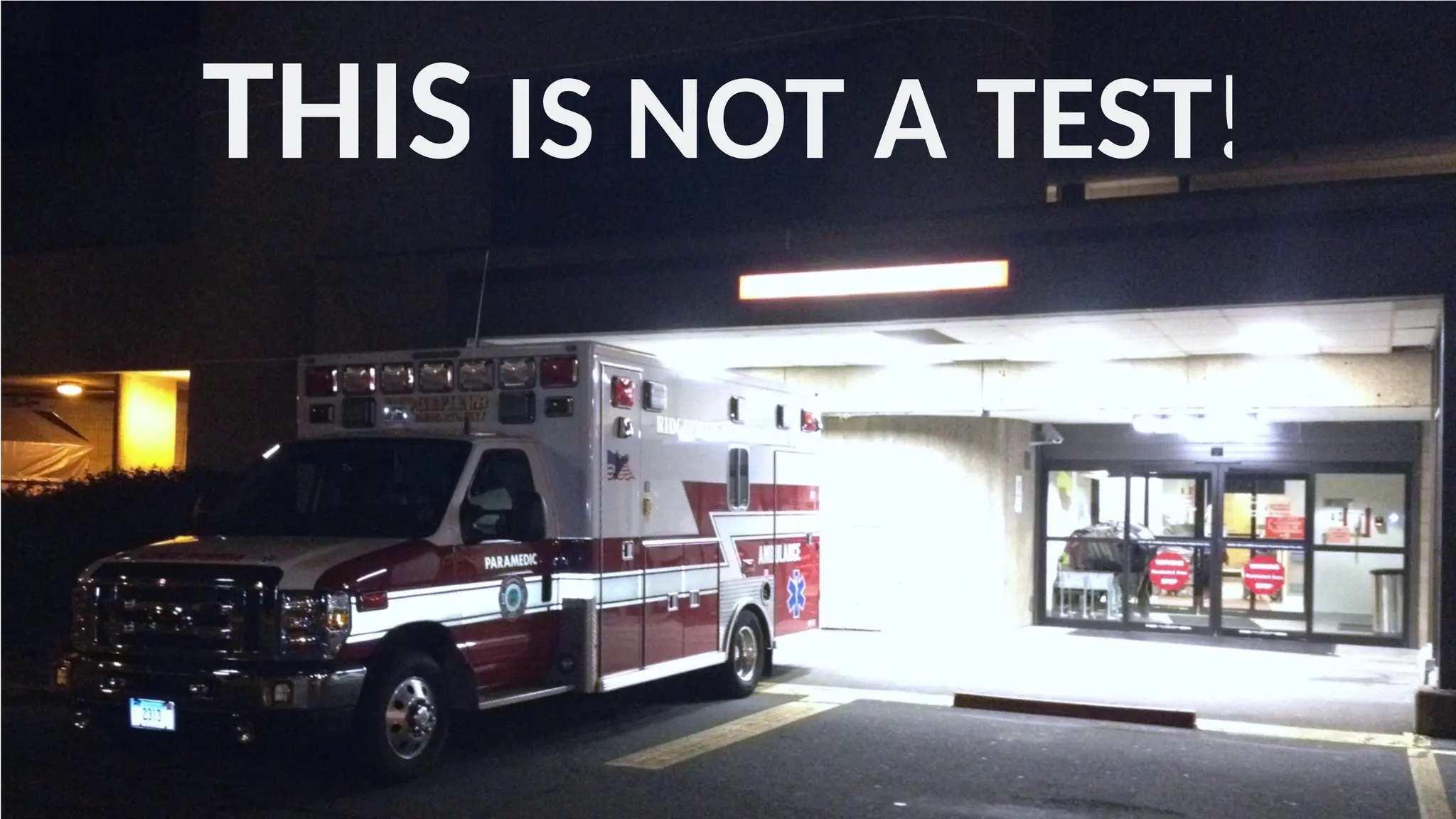
THIS IS NOT A TEST!
@romduck
#EMSWorldExpo
Contact Me:
www.RomDuck.com
Resources:
www.bit.ly/TopEdTips
www.RescueDigest.com

Top Emergency Services Educator Tips Update for 2024

  • 1.
    60 Educators Tips In60 Minutes Rommie L. Duckworth, MPA, LP, EFO, FO Find me @RomDuck
  • 2.
    60 EMS EducatorTips in 60 Minutes Rommie L. Duckworth, MS, LP, EFO, FO Find me @RomDuck #EMSWorldExpo2024
  • 3.
    10 Questions YourStudents are Secretly Wondering 10 PPT Alternatives 20 Top Study Tips for THEM 10 Steps to Powerful Presentations 10 Steps to Rock Test Prep 10 Steps to Low-fi or Hi-fi Simulation Success 10 Tips for Psychomotor Skills Investigating Classroom Problems in 5 Top 10 Tips for Having Difficult Classroom Conversations 20 Tips to Improve Lifelong Learning 5 Things to Deliver an Awesome Lesson Plan Top 5 Quotes from the Education Experts 10 Questions from YOU to THEM!
  • 4.
    New educators New positions Justlooking for new ideas Duckworth on Education These tips
  • 6.
    6 7 Questions YourStudents Are Wondering (But will never ask) 3 Ways to Address Them
  • 7.
    7 1. What isthis even about? 2. Why bring that up? 3. For example? 4. Is this on the exam? 5. Why should I care? 6. What am I supposed to do about it? 7. Where do we go from here? 7 Questions Your Students Are Wondering (But will never ask)
  • 8.
    1. Authority (Ethos) 2. Emotion (Pathos) 3.Logic (Logos) 3 Ways to Address Those Questions
  • 9.
  • 10.
    10 10 Alternatives to PowerPoint 1. Keynote, HaikuDeck 2. Prezi 3. Google Slides, Zoho Show, Slides.com, Ludus.one 4. Canva, eMaze, MS Sway, Genial.ly, Visme, Flowvella 5. Powtoon, Vyond, Animoto, Animatron 6. Mural.com, MindMeister, LucidChart 7. NearPod, DisplayNote 8. Beautiful.ai, decktopus, ChatGP 9. Slide Dog 10. PowerPoint
  • 11.
    10 Steps toBuilding a Presentation 11
  • 12.
    10 Steps toBuilding a Presentation 1. Context: In a world… 2. Problem: Where… 3. Goal: What if? 4. Challenge: The cards are stacked against our hero… 5. Path: They’ll go from (problem) to (goal) 12
  • 13.
    10 Steps toBuilding a Presentation 6. Action: By doing… 7. Requirements and resistance: They’ll have to overcome… 8. Support and resources: With the help of… 9. Contrast and call to action: They will… 10. Take-home and victory: To make a real difference in this world!
  • 14.
    10 Ways ToImprove Their Study Time
  • 15.
    1. Specify yourobjectives. 2. Focus on learning and using the information, not on grades 3. Consider making flow charts, diagrams, or algorithms of clinical topics. 4. Use a reading/reviewing method like SQ3R Survey, Question, Read, Recite, Recall 20 Ways To Improve Their Study Time
  • 16.
    5. The “PomodoroTechnique”: 25 minute study times are followed by 5 minute breaks. After 4 or more sessions, take a longer 15-30 minute break to clear your head. 6. Today I Learned (TIL). Every day (or after every work shift, class sessions, or study session) the bullet points of KEY TAKE-AWAYS. 7. Explain it like I'm five (ELI5). Thinking how you would explain the material to a five-year-old will help you break it down to its most essential components. 20 Ways To Improve Their Study Time
  • 17.
    8. Read theinformation that follows each heading to find the answer to each question that you wrote down. 9. It is important to understand that this is recite, not regurgitate. 10.Use the textbook table of contents, objectives, syllabus, curricula, or other outline of the material to know what information you should review. 20 Ways To Improve Their Study Time
  • 18.
    10 Steps ToRock Their Test Prep 18
  • 19.
    10 Steps ToRock Their Test Prep 1. Studying does not come naturally to everyone. Spend the time and energy to know and understand the material. 2. Manage your time well. Don't put off studying/practicing until the last minute and try to cram. 3. Don't just memorize (except when you have to). For essay and verbal test items, prepare by thinking about how you would explain them to other people 19
  • 20.
    10 Steps ToRock Your Test Prep 4. It is ok if the exam isn't quite what you expect. 5. It is ok to miss something. 6. Ignore the other students.
  • 21.
    10 Steps ToRock Their Test Prep 7. Review good test-taking skills Read each question and each answer thoroughly. Don’t simply pick the first answer that looks good to get the test over with. If possible, answer the questions that you know first and return to the more difficult ones. Outline essays before you write.
  • 22.
    10 Steps ToRock Their Test Prep 8. Poll students to see what of these study tips students actually used. 9. Review the exam with class, having students explain why answers were correct. (whole class /independent study) 10.Poll students if their grade accurately reflects their KSAs.
  • 23.
    10 Steps toSuccessful Scenarios & Simulations
  • 24.
    1. Specify clinicalcompetencies (what, not how). 2. Match complexity with student skill level. 3. Do a dry run for the instructors, actors and evaluators. 4. Plan and prepare for things to go off-track. 5. Are we teaching or testing? 6. Will there be pauses and prompts? Injects? 7. Do a walk-through for the students. 8. Clearly communicate expectation (minimize rules). 9. Get everyone involved. 10.Students do the work and do the talking (let things sink in). 15 Steps to Successful Scenarios & Simulations
  • 25.
  • 26.
    Stepping Up PsychomotorSkills 1. Begin with the end in mind (competency vs mastery). 2. Gather a study group to help you practice or find one that is already together. 3. Change roles when practicing a skill. 4. Change the equipment you use. 5. Change the environment in which you practice. 6. Get quality, preferably expert, performance feedback.
  • 27.
    Stepping Up PsychomotorSkills 7. Always try to make it all the way through the skill, even if you make a mistake as you go. 8. If you make a critical mistake and have to stop, be sure to start over from the very beginning. 9. Practice with purpose (set a goal) 10. Visualize
  • 28.
    28 10 Steps toClassroom Discipline
  • 29.
    29 1. There areno difficult students, only difficult behaviors. 2. Even “good students” have “bad behaviors” and even “bad students” have “good behaviors”. 3. Educators must focus on building positive behaviors and eliminating or minimizing negative behaviors. 10 Steps to Classroom Discipline
  • 30.
    30 4. Red HotStove: Foreseeable 5. Red Hot Stove: Immediate 6. Red Hot Stove: Impersonal 7. Red Hot Stove: Consistent 8. Just Culture: Counseling for human error 9. Just Culture: Coaching for risky behavior 10.Just Culture: Conversation for reckless behavior 10 Steps to Classroom Discipline
  • 31.
  • 32.
    Investigating Classroom Problemsin 5 1. What happened? 2. What normally happens in that situation? 3. What do policies require or recommend in the situations? 4. What was the underlying or root cause here? 5. How did the educator deal with the incident when it happened?
  • 33.
    Top 10 Tipsto Improve Difficult Conversations
  • 34.
    Top 10 Tipsto Improve Difficult Conversations 1. Involve another, preferably neutral, person if possible 2. Listen to the student’s perspective and response 3. Align student goals with course goals 4. Describe the behavior and its impacts 5. Discuss correct behavior & resources for success 6. Reiterate or set parameters for future behaviors 7. Share consequences for noncompliance 8. Summarize the conversation 9. Confirm and document agreement 10. Follow through and follow up
  • 35.
    20 Tips ForBetter Lifelong Learning
  • 36.
  • 37.
    20 Tips ForBetter Lifelong Learning 1. Identify your weak spots. 2. Re-visit material that you have studied before. 3. Do not evaluate new information as simply "true/false”. 4. Use the AA-BB-CC method to evaluate new information. 5. Authority – Is the source an expert in this topic? 6. Accuracy – Is this information verifiably accurate? 7. Background – What is the context for this information? 8. Bias – Might the creator or supplier of this information have a bias? 9. Coverage – Is this information evaluated from different angles or only one point of view? 10. Currency – How up to date is this?
  • 38.
    20 Tips ForBetter Lifelong Learning 11. Apply your knowledge at higher levels. 12. Remember – The most basic level. Recognize and recall facts. 13. Understand – Don’t just know the facts; know what the facts mean. 14. Apply – Use facts, rules, concepts, and ideas in a real-world setting. 15. Analyze – Break down information into component parts and understand how they come together. 16. Evaluate – Judge the value of information or ideas. 17. Create – The pinnacle of understanding. Using your knowledge to solve problems in a new way in a dynamically changing environment. This is the level that is required of all field providers. 18. Cherish both training and experience; they go hand-in-hand. 19. Strive for learning, not perfection. 20. At every opportunity, Kaizen 1%.
  • 39.
    5 Steps toSuccessful Scenarios
  • 40.
    1. Ready 2. Realistic 3.Review 4. Reflect 5. Rules 5 Steps to Successful Scenarios
  • 41.
    The 5 ThingsYou Need In Your Lesson Plan
  • 42.
    Goals Needs Objectives Methods Evaluation Summary http://www.flickr.com/photos/zeetzjones/4130672015/ Improve Performance Simple /Flexible System Employ GNOMES Discussion Q&A Resources The 5 Things You Need In Your Lesson Plan
  • 43.
    5 Quotes FromThe Education Experts
  • 44.
  • 45.
    “The best Learners oftenmake the worst Teachers. They cannot imagine struggling to learn something that comes so naturally to them” • Stephen Brookfield
  • 46.
    "Tell me, and I'llforget. Show me and I'll remember. Involve me and I understand." -Confucius
  • 47.
    “There are few newideas in the world: But not everyone knows the old ones.”
  • 48.
    “You cannot teach aman anything; You can only help him find it within himself.” • Galileo Galilei
  • 49.
  • 50.
    50 5 Questions from YOU! Hereare the top three questions people ask at the end of this class. What are your questions?
  • 51.
    51 5 Questions from YOU! Whatis your biggest Takeaway? What did you learn that was new or what will you be better at now for this educational program?
  • 52.
    52 5 Questions from YOU! Whatare you going to do? What action are you going to take to solve the problem that we described in this session?
  • 53.
    53 5 Questions from YOU! Whatare your top tips for taking a test on this subject?
  • 54.
    54 5 Questions from YOU! Wheredo we go from here? What are your next steps?
  • 55.
  • 56.
  • 57.
    THIS IS NOTA TEST!
  • 58.

Editor's Notes

  • #10 1 – Different creation process 2 – Different presentation format 3 – Collaboration 4 – Composite 5 – Animation 6 – Whiteboard & Mind Mapping 7 – Interaction 8 – A.I. 9 - Mix & Match
  • #15 survey, question, read, recite, and review The method was introduced by Francis P. Robinson, an American education philosopher in his 1946 book Effective Study.
  • #44 It isn’t just what we learn, its how we use it. Don’t get bogged in the PROCESS of education.
  • #45 Not just train, but develop lifelong learners
  • #46 Involve me. Not just hands-on, be engage the brain.
  • #48 Not just train, but develop lifelong learners
  • #49 Ways to end your class so that learning doesn’t end when the clock strikes the hour. Here are the top three questions people ask at the end of this class. What are your questions? What is your biggest Takeaway? What did you learn that was new or what will you be better at now for this educational program.? What are you going to do? What action are you going to take to solve the problem that Meade described in this session?  Based on the instructional objectives for key learning point of the program, ask students to answer these questions. Basically being live as a test.
  • #50 Ways to end your class so that learning doesn’t end when the clock strikes the hour. Here are the top three questions people ask at the end of this class. What are your questions? What is your biggest Takeaway? What did you learn that was new or what will you be better at now for this educational program.? What are you going to do? What action are you going to take to solve the problem that Meade described in this session?  Based on the instructional objectives for key learning point of the program, ask students to answer these questions. Basically being live as a test.
  • #51 Ways to end your class so that learning doesn’t end when the clock strikes the hour. Here are the top three questions people ask at the end of this class. What are your questions? What is your biggest Takeaway? What did you learn that was new or what will you be better at now for this educational program.? What are you going to do? What action are you going to take to solve the problem that Meade described in this session?  Based on the instructional objectives for key learning point of the program, ask students to answer these questions. Basically being live as a test.
  • #52 Ways to end your class so that learning doesn’t end when the clock strikes the hour. Here are the top three questions people ask at the end of this class. What are your questions? What is your biggest Takeaway? What did you learn that was new or what will you be better at now for this educational program.? What are you going to do? What action are you going to take to solve the problem that we described in this session?  Based on the instructional objectives for key learning point of the program, ask students to answer these questions. Basically being live as a test.
  • #53 Ways to end your class so that learning doesn’t end when the clock strikes the hour. Here are the top three questions people ask at the end of this class. What are your questions? What is your biggest Takeaway? What did you learn that was new or what will you be better at now for this educational program.? What are you going to do? What action are you going to take to solve the problem that we described in this session?  Based on the instructional objectives for key learning point of the program, ask students to answer these questions. Basically being live as a test.
  • #54 Ways to end your class so that learning doesn’t end when the clock strikes the hour. Here are the top three questions people ask at the end of this class. What are your questions? What is your biggest Takeaway? What did you learn that was new or what will you be better at now for this educational program.? What are you going to do? What action are you going to take to solve the problem that we described in this session?  Based on the instructional objectives for key learning point of the program, ask students to answer these questions. Basically being live as a test.
  • #57 This is about developing the practical skills that providers need in the real world like dynamic problem solving, communication, team-building, critical thinking, and self-direction. This is not about investing in technology; this is about investing in students and the care they will provide to our communities.