Tools For Economic
Analysis
MRS.PADMAVATI PATIL
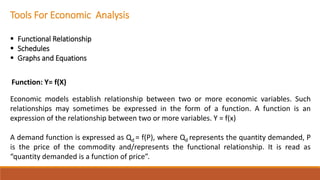
Function: Y= f(X)
Economic models establish relationship between two or more economic variables. Such
relationships may sometimes be expressed in the form of a function. A function is an
expression of the relationship between two or more variables. Y = f(x)
A demand function is expressed as Qd = f(P), where Qd represents the quantity demanded, P
is the price of the commodity and/represents the functional relationship. It is read as
“quantity demanded is a function of price”.
Tools For Economic Analysis
 Functional Relationship
 Schedules
 Graphs and Equations
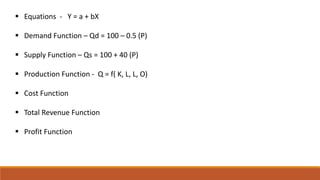
 Equations - Y = a + bX
 Demand Function – Qd = 100 – 0.5 (P)
 Supply Function – Qs = 100 + 40 (P)
 Production Function - Q = f( K, L, L, O)
 Cost Function
 Total Revenue Function
 Profit Function
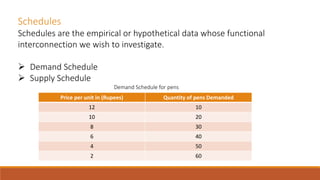
Schedules
Schedules are the empirical or hypothetical data whose functional
interconnection we wish to investigate.
 Demand Schedule
 Supply Schedule
Demand Schedule for pens
Price per unit in (Rupees) Quantity of pens Demanded
12 10
10 20
8 30
6 40
4 50
2 60
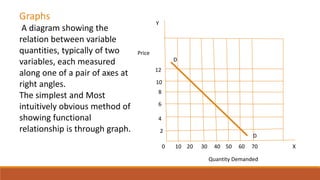
Graphs
A diagram showing the
relation between variable
quantities, typically of two
variables, each measured
along one of a pair of axes at
right angles.
The simplest and Most
intuitively obvious method of
showing functional
relationship is through graph.
10 20 30 40 50 60 70
Quantity Demanded
X
Y
0
12
10
8
6
4
2
D
D
Price
Concepts of Household, Consumer, Firm/ Plant, Industry
Households
A household consists of one or more people who live in the same
dwelling and share meals. It may also consist of a single family or
another group of people. ... The household is the basic unit of analysis in
many social, microeconomic and government models, and is important
to economics and inheritance.
 Owner of the all the factors of Production.
 It is the Basic unit
 Decision Making Unit
 Group of Consumer
Consumers
A Consumer is a person or Organization that uses economic services or
commodities. He is an end user and not necessarily a purchaser.
Role of a Consumer
 Enhancement in supply
 Eradicating Unfair Trade Practices
 Better Relationships
 Consumer Education
 Product Rating
Firm
The term firm refers to the business unit or undertaking which owns
the plant ( the factory, the shop, the warehouse or transport depot),
controls and manages it. Or a firm refers the a group or organization
that focuses on producing goods
Industry
An industry is a group of firms, but it is not easy to decide what type of
firms should be grouped together to make a particular industry. Some
common factor ( Raw material used, Production technique employed and
similarity among the products produced) among all the firms that make up
and industry.
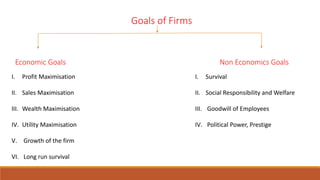
Goals of Firms
Economic Goals Non Economics Goals
I. Profit Maximisation
II. Sales Maximisation
III. Wealth Maximisation
IV. Utility Maximisation
V. Growth of the firm
VI. Long run survival
I. Survival
II. Social Responsibility and Welfare
III. Goodwill of Employees
IV. Political Power, Prestige

Tools for economic analysis

  • 1.
  • 2.
    Function: Y= f(X) Economicmodels establish relationship between two or more economic variables. Such relationships may sometimes be expressed in the form of a function. A function is an expression of the relationship between two or more variables. Y = f(x) A demand function is expressed as Qd = f(P), where Qd represents the quantity demanded, P is the price of the commodity and/represents the functional relationship. It is read as “quantity demanded is a function of price”. Tools For Economic Analysis  Functional Relationship  Schedules  Graphs and Equations
  • 3.
     Equations -Y = a + bX  Demand Function – Qd = 100 – 0.5 (P)  Supply Function – Qs = 100 + 40 (P)  Production Function - Q = f( K, L, L, O)  Cost Function  Total Revenue Function  Profit Function
  • 4.
    Schedules Schedules are theempirical or hypothetical data whose functional interconnection we wish to investigate.  Demand Schedule  Supply Schedule Demand Schedule for pens Price per unit in (Rupees) Quantity of pens Demanded 12 10 10 20 8 30 6 40 4 50 2 60
  • 5.
    Graphs A diagram showingthe relation between variable quantities, typically of two variables, each measured along one of a pair of axes at right angles. The simplest and Most intuitively obvious method of showing functional relationship is through graph. 10 20 30 40 50 60 70 Quantity Demanded X Y 0 12 10 8 6 4 2 D D Price
  • 6.
    Concepts of Household,Consumer, Firm/ Plant, Industry Households A household consists of one or more people who live in the same dwelling and share meals. It may also consist of a single family or another group of people. ... The household is the basic unit of analysis in many social, microeconomic and government models, and is important to economics and inheritance.  Owner of the all the factors of Production.  It is the Basic unit  Decision Making Unit  Group of Consumer
  • 7.
    Consumers A Consumer isa person or Organization that uses economic services or commodities. He is an end user and not necessarily a purchaser. Role of a Consumer  Enhancement in supply  Eradicating Unfair Trade Practices  Better Relationships  Consumer Education  Product Rating
  • 8.
    Firm The term firmrefers to the business unit or undertaking which owns the plant ( the factory, the shop, the warehouse or transport depot), controls and manages it. Or a firm refers the a group or organization that focuses on producing goods
  • 9.
    Industry An industry isa group of firms, but it is not easy to decide what type of firms should be grouped together to make a particular industry. Some common factor ( Raw material used, Production technique employed and similarity among the products produced) among all the firms that make up and industry.
  • 10.
    Goals of Firms EconomicGoals Non Economics Goals I. Profit Maximisation II. Sales Maximisation III. Wealth Maximisation IV. Utility Maximisation V. Growth of the firm VI. Long run survival I. Survival II. Social Responsibility and Welfare III. Goodwill of Employees IV. Political Power, Prestige