María Arredondo
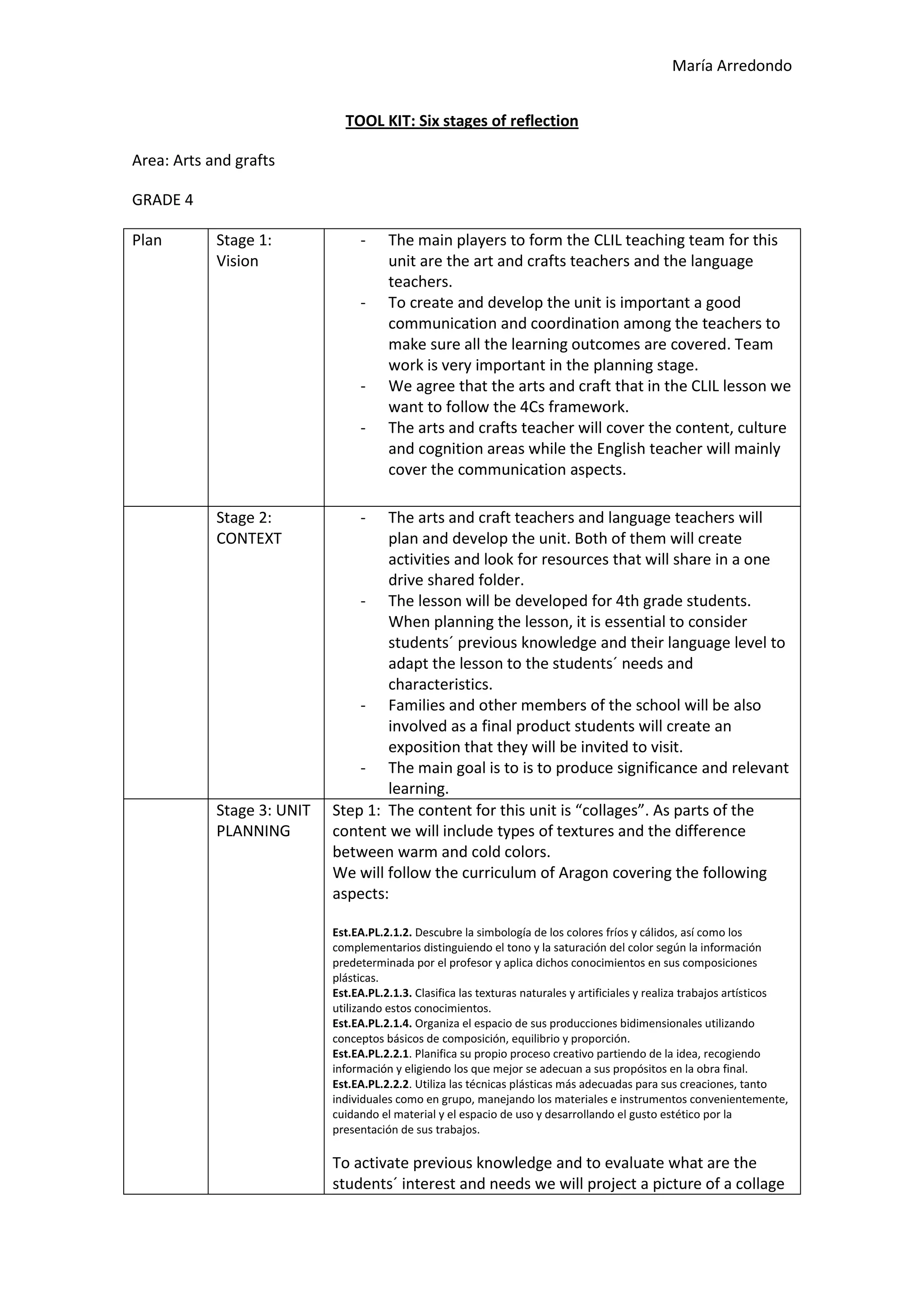
TOOL KIT: Six stages of reflection
Area: Arts and grafts
GRADE 4
Plan Stage 1:
Vision
- The main players to form the CLIL teaching team for this
unit are the art and crafts teachers and the language
teachers.
- To create and develop the unit is important a good
communication and coordination among the teachers to
make sure all the learning outcomes are covered. Team
work is very important in the planning stage.
- We agree that the arts and craft that in the CLIL lesson we
want to follow the 4Cs framework.
- The arts and crafts teacher will cover the content, culture
and cognition areas while the English teacher will mainly
cover the communication aspects.
Stage 2:
CONTEXT
- The arts and craft teachers and language teachers will
plan and develop the unit. Both of them will create
activities and look for resources that will share in a one
drive shared folder.
- The lesson will be developed for 4th grade students.
When planning the lesson, it is essential to consider
students´ previous knowledge and their language level to
adapt the lesson to the students´ needs and
characteristics.
- Families and other members of the school will be also
involved as a final product students will create an
exposition that they will be invited to visit.
- The main goal is to is to produce significance and relevant
learning.
Stage 3: UNIT
PLANNING
Step 1: The content for this unit is “collages”. As parts of the
content we will include types of textures and the difference
between warm and cold colors.
We will follow the curriculum of Aragon covering the following
aspects:
Est.EA.PL.2.1.2. Descubre la simbología de los colores fríos y cálidos, así como los
complementarios distinguiendo el tono y la saturación del color según la información
predeterminada por el profesor y aplica dichos conocimientos en sus composiciones
plásticas.
Est.EA.PL.2.1.3. Clasifica las texturas naturales y artificiales y realiza trabajos artísticos
utilizando estos conocimientos.
Est.EA.PL.2.1.4. Organiza el espacio de sus producciones bidimensionales utilizando
conceptos básicos de composición, equilibrio y proporción.
Est.EA.PL.2.2.1. Planifica su propio proceso creativo partiendo de la idea, recogiendo
información y eligiendo los que mejor se adecuan a sus propósitos en la obra final.
Est.EA.PL.2.2.2. Utiliza las técnicas plásticas más adecuadas para sus creaciones, tanto
individuales como en grupo, manejando los materiales e instrumentos convenientemente,
cuidando el material y el espacio de uso y desarrollando el gusto estético por la
presentación de sus trabajos.
To activate previous knowledge and to evaluate what are the
students´ interest and needs we will project a picture of a collage
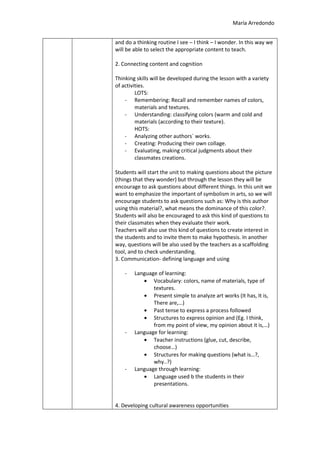
María Arredondo
and do a thinking routine I see – I think – I wonder. In this way we
will be able to select the appropriate content to teach.
2. Connecting content and cognition
Thinking skills will be developed during the lesson with a variety
of activities.
LOTS:
- Remembering: Recall and remember names of colors,
materials and textures.
- Understanding: classifying colors (warm and cold and
materials (according to their texture).
HOTS:
- Analyzing other authors´ works.
- Creating: Producing their own collage.
- Evaluating, making critical judgments about their
classmates creations.
Students will start the unit to making questions about the picture
(things that they wonder) but through the lesson they will be
encourage to ask questions about different things. In this unit we
want to emphasize the important of symbolism in arts, so we will
encourage students to ask questions such as: Why is this author
using this material?, what means the dominance of this color?.
Students will also be encouraged to ask this kind of questions to
their classmates when they evaluate their work.
Teachers will also use this kind of questions to create interest in
the students and to invite them to make hypothesis. In another
way, questions will be also used by the teachers as a scaffolding
tool, and to check understanding.
3. Communication- defining language and using
- Language of learning:
Vocabulary: colors, name of materials, type of
textures.
Present simple to analyze art works (It has, It is,
There are,…)
Past tense to express a process followed
Structures to express opinion and (Eg. I think,
from my point of view, my opinion about it is,…)
- Language for learning:
Teacher instructions (glue, cut, describe,
choose…)
Structures for making questions (what is…?,
why..?)
- Language through learning:
Language used b the students in their
presentations.
4. Developing cultural awareness opportunities
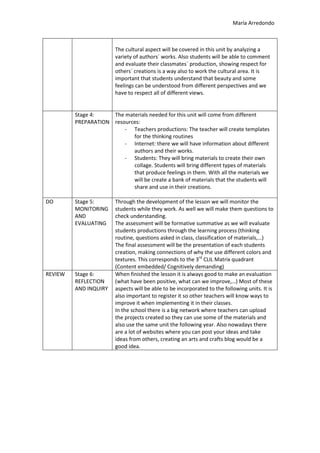
María Arredondo
The cultural aspect will be covered in this unit by analyzing a
variety of authors´ works. Also students will be able to comment
and evaluate their classmates´ production, showing respect for
others´ creations is a way also to work the cultural area. It is
important that students understand that beauty and some
feelings can be understood from different perspectives and we
have to respect all of different views.
Stage 4:
PREPARATION
The materials needed for this unit will come from different
resources:
- Teachers productions: The teacher will create templates
for the thinking routines
- Internet: there we will have information about different
authors and their works.
- Students: They will bring materials to create their own
collage. Students will bring different types of materials
that produce feelings in them. With all the materials we
will be create a bank of materials that the students will
share and use in their creations.
DO Stage 5:
MONITORING
AND
EVALUATING
Through the development of the lesson we will monitor the
students while they work. As well we will make them questions to
check understanding.
The assessment will be formative summative as we will evaluate
students productions through the learning process (thinking
routine, questions asked in class, classification of materials,…)
The final assessment will be the presentation of each students
creation, making connections of why the use different colors and
textures. This corresponds to the 3rd
CLIL Matrix quadrant
(Content embedded/ Cognitively demanding)
REVIEW Stage 6:
REFLECTION
AND INQUIRY
When finished the lesson it is always good to make an evaluation
(what have been positive, what can we improve,…) Most of these
aspects will be able to be incorporated to the following units. It is
also important to register it so other teachers will know ways to
improve it when implementing it in their classes.
In the school there is a big network where teachers can upload
the projects created so they can use some of the materials and
also use the same unit the following year. Also nowadays there
are a lot of websites where you can post your ideas and take
ideas from others, creating an arts and crafts blog would be a
good idea.

Tool kit block 3

  • 1.
    María Arredondo TOOL KIT:Six stages of reflection Area: Arts and grafts GRADE 4 Plan Stage 1: Vision - The main players to form the CLIL teaching team for this unit are the art and crafts teachers and the language teachers. - To create and develop the unit is important a good communication and coordination among the teachers to make sure all the learning outcomes are covered. Team work is very important in the planning stage. - We agree that the arts and craft that in the CLIL lesson we want to follow the 4Cs framework. - The arts and crafts teacher will cover the content, culture and cognition areas while the English teacher will mainly cover the communication aspects. Stage 2: CONTEXT - The arts and craft teachers and language teachers will plan and develop the unit. Both of them will create activities and look for resources that will share in a one drive shared folder. - The lesson will be developed for 4th grade students. When planning the lesson, it is essential to consider students´ previous knowledge and their language level to adapt the lesson to the students´ needs and characteristics. - Families and other members of the school will be also involved as a final product students will create an exposition that they will be invited to visit. - The main goal is to is to produce significance and relevant learning. Stage 3: UNIT PLANNING Step 1: The content for this unit is “collages”. As parts of the content we will include types of textures and the difference between warm and cold colors. We will follow the curriculum of Aragon covering the following aspects: Est.EA.PL.2.1.2. Descubre la simbología de los colores fríos y cálidos, así como los complementarios distinguiendo el tono y la saturación del color según la información predeterminada por el profesor y aplica dichos conocimientos en sus composiciones plásticas. Est.EA.PL.2.1.3. Clasifica las texturas naturales y artificiales y realiza trabajos artísticos utilizando estos conocimientos. Est.EA.PL.2.1.4. Organiza el espacio de sus producciones bidimensionales utilizando conceptos básicos de composición, equilibrio y proporción. Est.EA.PL.2.2.1. Planifica su propio proceso creativo partiendo de la idea, recogiendo información y eligiendo los que mejor se adecuan a sus propósitos en la obra final. Est.EA.PL.2.2.2. Utiliza las técnicas plásticas más adecuadas para sus creaciones, tanto individuales como en grupo, manejando los materiales e instrumentos convenientemente, cuidando el material y el espacio de uso y desarrollando el gusto estético por la presentación de sus trabajos. To activate previous knowledge and to evaluate what are the students´ interest and needs we will project a picture of a collage
  • 2.
    María Arredondo and doa thinking routine I see – I think – I wonder. In this way we will be able to select the appropriate content to teach. 2. Connecting content and cognition Thinking skills will be developed during the lesson with a variety of activities. LOTS: - Remembering: Recall and remember names of colors, materials and textures. - Understanding: classifying colors (warm and cold and materials (according to their texture). HOTS: - Analyzing other authors´ works. - Creating: Producing their own collage. - Evaluating, making critical judgments about their classmates creations. Students will start the unit to making questions about the picture (things that they wonder) but through the lesson they will be encourage to ask questions about different things. In this unit we want to emphasize the important of symbolism in arts, so we will encourage students to ask questions such as: Why is this author using this material?, what means the dominance of this color?. Students will also be encouraged to ask this kind of questions to their classmates when they evaluate their work. Teachers will also use this kind of questions to create interest in the students and to invite them to make hypothesis. In another way, questions will be also used by the teachers as a scaffolding tool, and to check understanding. 3. Communication- defining language and using - Language of learning: Vocabulary: colors, name of materials, type of textures. Present simple to analyze art works (It has, It is, There are,…) Past tense to express a process followed Structures to express opinion and (Eg. I think, from my point of view, my opinion about it is,…) - Language for learning: Teacher instructions (glue, cut, describe, choose…) Structures for making questions (what is…?, why..?) - Language through learning: Language used b the students in their presentations. 4. Developing cultural awareness opportunities
  • 3.
    María Arredondo The culturalaspect will be covered in this unit by analyzing a variety of authors´ works. Also students will be able to comment and evaluate their classmates´ production, showing respect for others´ creations is a way also to work the cultural area. It is important that students understand that beauty and some feelings can be understood from different perspectives and we have to respect all of different views. Stage 4: PREPARATION The materials needed for this unit will come from different resources: - Teachers productions: The teacher will create templates for the thinking routines - Internet: there we will have information about different authors and their works. - Students: They will bring materials to create their own collage. Students will bring different types of materials that produce feelings in them. With all the materials we will be create a bank of materials that the students will share and use in their creations. DO Stage 5: MONITORING AND EVALUATING Through the development of the lesson we will monitor the students while they work. As well we will make them questions to check understanding. The assessment will be formative summative as we will evaluate students productions through the learning process (thinking routine, questions asked in class, classification of materials,…) The final assessment will be the presentation of each students creation, making connections of why the use different colors and textures. This corresponds to the 3rd CLIL Matrix quadrant (Content embedded/ Cognitively demanding) REVIEW Stage 6: REFLECTION AND INQUIRY When finished the lesson it is always good to make an evaluation (what have been positive, what can we improve,…) Most of these aspects will be able to be incorporated to the following units. It is also important to register it so other teachers will know ways to improve it when implementing it in their classes. In the school there is a big network where teachers can upload the projects created so they can use some of the materials and also use the same unit the following year. Also nowadays there are a lot of websites where you can post your ideas and take ideas from others, creating an arts and crafts blog would be a good idea.