Course Teacher
Dr.PARTHASARATHY S
Asst.Prof(Pathology)
Submitted by,
PAVITHRA P
2015021094
TOMATO BIG BUD
Causal organism
Candidatus Phytoplasma aurantifolia
PATHOGEN
 Phytoplasmas (Mycoplasma - like organisms) are
specialised bacteria which do not have cell wall are obligate
parasites found in sieve elements of plants and some insect
vector.
 Candidatus means Unculturable, Grampositive bacteria
(Terrabacteria group) Intracellular in nature and
reproduction through budding and fission.
 It comes under the class Mollicutes
DISTRIBUTION
 Tomato big bud has been reported in China, India, and
other Asian countries, South Africa, and the USA, but the
strains have not been reported.
 Tomato big bud (16SrII) was first recorded in Australia. It
is reported from many Pacific Islands countries in many
different plants,but only in New Caledonia from tomato
SPREAD OF THE DISEASE
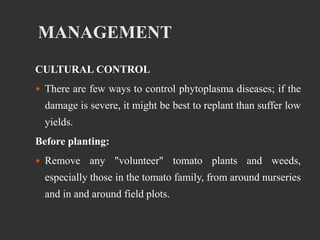
 Spread of the phytoplasma is by leafhoppers - Orosius
albicinctus.
 There is very little spread of the phytoplasma within crops of
tomato.
 The phytoplasma survives in weeds, and in the bodies of the
leafhoppers. Once leafhoppers become infected by feeding on a
plant with phytoplasma, they remain infected for life.
HOSTS
 Beach morning glory (Ipomoea pes-caprae subsp.
basiliensis), Chinese cabbage, peanut, sweetpotato,
and the weeds/ornamentals, Achyranthes, Celosia,
Crotalaria, Cyanthillium, Emilia, and Polygala.
FAVOURABLE CONDITIONS
 Dry weather
 Moderate temperature (25°C)
 Low relative humidity (65%)
 Low rainfall (0.6mm)
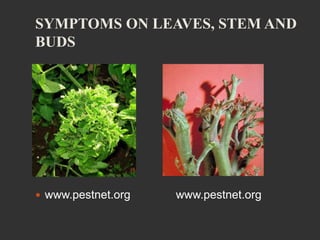
SYMPTOMS
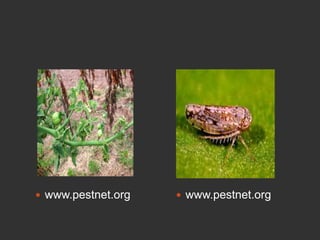
 Leaves are small, curled upwards and yellowish-green or
purple Stems become erect, short, thick and purple ;
 Flower buds become swollen, with green petals - hence the
name of the disease - and normally dormant buds develop
shoots.
 Green fruits are hard, tough and woody.
 Plants infected early are bushy, because of the development
of many branches
SYMPTOMS ON LEAVES, STEM AND
BUDS
 www.pestnet.org www.pestnet.org
 www.pestnet.org  www.pestnet.org
MANAGEMENT
CULTURAL CONTROL
 There are few ways to control phytoplasma diseases; if the
damage is severe, it might be best to replant than suffer low
yields.
Before planting:
 Remove any "volunteer" tomato plants and weeds,
especially those in the tomato family, from around nurseries
and in and around field plots.
 Preferably, raise the tomato seedlings in a screenhouse or
under an insect screen cover.
 Do not plant next to other susceptible crops, such as
eggplant or capsicum.
 Preferably, raise the tomato seedlings in a screenhouse or
under an insect screen cover.
After harvest:
 Collect the plants together with weeds around the planting
and burn or bury them.
CHEMICAL CONTROL
The value of insecticides in the control of this disease
is not clear. Insecticides that are effective against the
leafhoppers, may not give control in the field. If plants
are infected by migrating leafhoppers, they may infect
before the insecticide kills them.
REFERENCE
 Thind. T.S. Diseases of Fruits and Vegetables and their
management, Second edition, 2016, Kalyani
Publishers, New Delhi.
 Saha. L.R. Handbook of plant diseases, 2015, Kalyani
publishers, New Delhi.

Tomato big bud

  • 1.
    Course Teacher Dr.PARTHASARATHY S Asst.Prof(Pathology) Submittedby, PAVITHRA P 2015021094 TOMATO BIG BUD Causal organism Candidatus Phytoplasma aurantifolia
  • 2.
    PATHOGEN  Phytoplasmas (Mycoplasma- like organisms) are specialised bacteria which do not have cell wall are obligate parasites found in sieve elements of plants and some insect vector.  Candidatus means Unculturable, Grampositive bacteria (Terrabacteria group) Intracellular in nature and reproduction through budding and fission.  It comes under the class Mollicutes
  • 3.
    DISTRIBUTION  Tomato bigbud has been reported in China, India, and other Asian countries, South Africa, and the USA, but the strains have not been reported.  Tomato big bud (16SrII) was first recorded in Australia. It is reported from many Pacific Islands countries in many different plants,but only in New Caledonia from tomato
  • 4.
    SPREAD OF THEDISEASE  Spread of the phytoplasma is by leafhoppers - Orosius albicinctus.  There is very little spread of the phytoplasma within crops of tomato.  The phytoplasma survives in weeds, and in the bodies of the leafhoppers. Once leafhoppers become infected by feeding on a plant with phytoplasma, they remain infected for life.
  • 5.
    HOSTS  Beach morningglory (Ipomoea pes-caprae subsp. basiliensis), Chinese cabbage, peanut, sweetpotato, and the weeds/ornamentals, Achyranthes, Celosia, Crotalaria, Cyanthillium, Emilia, and Polygala.
  • 6.
    FAVOURABLE CONDITIONS  Dryweather  Moderate temperature (25°C)  Low relative humidity (65%)  Low rainfall (0.6mm)
  • 7.
    SYMPTOMS  Leaves aresmall, curled upwards and yellowish-green or purple Stems become erect, short, thick and purple ;  Flower buds become swollen, with green petals - hence the name of the disease - and normally dormant buds develop shoots.  Green fruits are hard, tough and woody.  Plants infected early are bushy, because of the development of many branches
  • 8.
    SYMPTOMS ON LEAVES,STEM AND BUDS  www.pestnet.org www.pestnet.org
  • 9.
     www.pestnet.org www.pestnet.org
  • 10.
    MANAGEMENT CULTURAL CONTROL  Thereare few ways to control phytoplasma diseases; if the damage is severe, it might be best to replant than suffer low yields. Before planting:  Remove any "volunteer" tomato plants and weeds, especially those in the tomato family, from around nurseries and in and around field plots.
  • 11.
     Preferably, raisethe tomato seedlings in a screenhouse or under an insect screen cover.  Do not plant next to other susceptible crops, such as eggplant or capsicum.  Preferably, raise the tomato seedlings in a screenhouse or under an insect screen cover. After harvest:  Collect the plants together with weeds around the planting and burn or bury them.
  • 12.
    CHEMICAL CONTROL The valueof insecticides in the control of this disease is not clear. Insecticides that are effective against the leafhoppers, may not give control in the field. If plants are infected by migrating leafhoppers, they may infect before the insecticide kills them.
  • 13.
    REFERENCE  Thind. T.S.Diseases of Fruits and Vegetables and their management, Second edition, 2016, Kalyani Publishers, New Delhi.  Saha. L.R. Handbook of plant diseases, 2015, Kalyani publishers, New Delhi.