Diseases of Tomato and their Management
Speaker
Pranay Pandey
Tomato
 Tomato is one of the world’s major vegetables with a total
area and production of 4.4 million ha and 115 million metric
tons, respectively.
 Tomatoes (Lycopersicum esculentum) can be grown on
almost any moderately well-drained soil type.
 A good supply of organic matter can increase yield and
reduce production problems.
 The average global crop losses of all diseases combined was
approximately 12.8% of the potential production but tomato
alone was subjected to 21.8% loss.
 Corn, an excellent rotation crop with tomatoes, supplies
large amounts of organic matter and does not promote the
growth of disease organisms that attack tomatoes.
Common Disease of tomato
I. Bacterial wilt
II. Fusarium wilt
III. Anthroconose
IV. Bacterial spot
V. Early blight
VI. Late blight
VII. Tomato leaf curl
Bacterial wilt
Deadly disease of tomato.
Tomato cultivation has been abandoned in some
parts of India because of this disease.
 Wilting, stunting, yellowing of the foliage and
finally collapse of the entire plant.
 The lower leaves may droop first before wilting
occurs.
 The vascular system becomes brown.
 If a segment of the lower stem is cut and squeezed
it yields bacterial ooze.
 Development of adventitious roots from the stem
is considerably enhanced.
 In tomato, limits the production from 4.24 to 86.14
per cent while in hot and humid climate, the
disease can cause up to 100% losses
Symptom
Prevention & Treatment
Arka Rakshak
 The pathogen is soil-borne,
 very difficult to control.
 Crop rotation with Cruciferous vegetables is
recommended.
 Use resistant variety (Arka Rakshak, Arka
Samrat) or tolerant variety( NS 501, & 538 etc.)
 Chemical control is not available for this
disease.
 Soil pH 6.2-6.5
NS 501
NS 538
Arka Samrat
Fusarium wilt
Symptom
 Clearing of the veinlets and chlorosis of
the leaf.
 Soon the petiole and leaves droop and
wilt.
 The younger leaves may die
 Dark brown or black discoloration of the
vascular tissues.
 Fungus survives saprophytically in soil.
 Use resistant Variety
 pH 6.5 to 7.0
 Keeping tomato plants weed-free.
 Avoid activity in wet plantings
 Use nitrate-based nitrogen fertilizer, such as calcium nitrate, rather than an ammonia-based nitrogen
fertilizer.
 Seed treatment with 4 g Trichoderma viride formulation or 2.5 g Carbendazim per kg seed is effective.
Prevention & Treatment
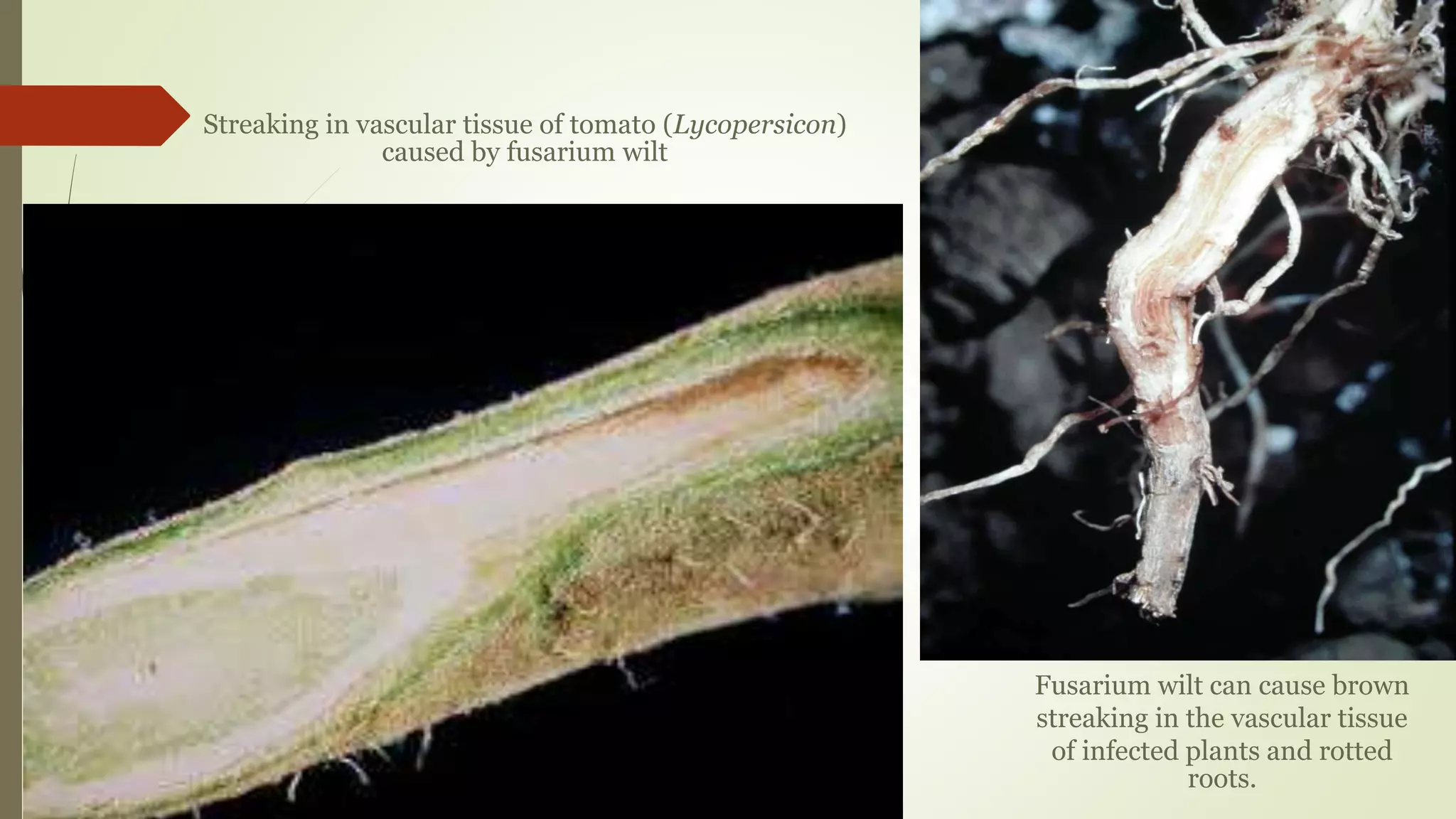
Fusarium wilt can cause brown
streaking in the vascular tissue
of infected plants and rotted
roots.
Streaking in vascular tissue of tomato (Lycopersicon)
caused by fusarium wilt
Anthracnose
 Fruit may be infected when green and small, but symptoms do not appear until it begins
to ripen.
 Symptoms first appear on ripe fruits as small, slightly depressed circular lesions.
 12 mm Lesions and become more sunken, with concentric ring markings.
 Centre is usually tan, and as the lesion matures becomes dotted with small black specks.
 Surface of the mature lesion remains smooth and intact.
 Small, circular, brown lesions surrounded by yellow halos characterize leaf infections.
symptom
 Use resistant plants, or buy healthy transplants.
 Plant your plants in well-drained soil.
 Water your plants with a drip sprinkler.
 Don’t touch the plants when they are wet.
 Keep ripening fruits from touching the soil.
 Remember to rotate your plants every 2 to 3 years.
 Seed Treatment at 122०F (50 ०C)for25mints.
 Spraying Mancozeb 2.5 g/l, chlorothalonil or
Carbendazim 1 g/l gives effective control.
Prevention
Bacterial spot
Symptom
 small circular to irregular water-soaked areas
showing as definite spots on the lower leaf
surface.
 A narrow yellow halo may surround the spots.
 When the spots are too many, the interveinal
tissues become dry and brown.
 If the spots are at the edge, they may break away.
 Annual production loss due to this disease is 10–
20%, which may rise to 80% in some cases
Bacterial spot stem lesions
Bacterial spot leaf lesions
 Use of pathogen-free certified seeds
 Treat seeds with dilute bleach, hydrochloric acid, or
hot water
 Field sanitation and crop rotation reduces the
disease incidence.
 minimize overwatering
 Spraying the plants with a mixture of Streptocycline
200 ppm and Copper oxychloride 3g/l
Prevention
Bacterial spot on tomato fruit
Early Blight of Tomato
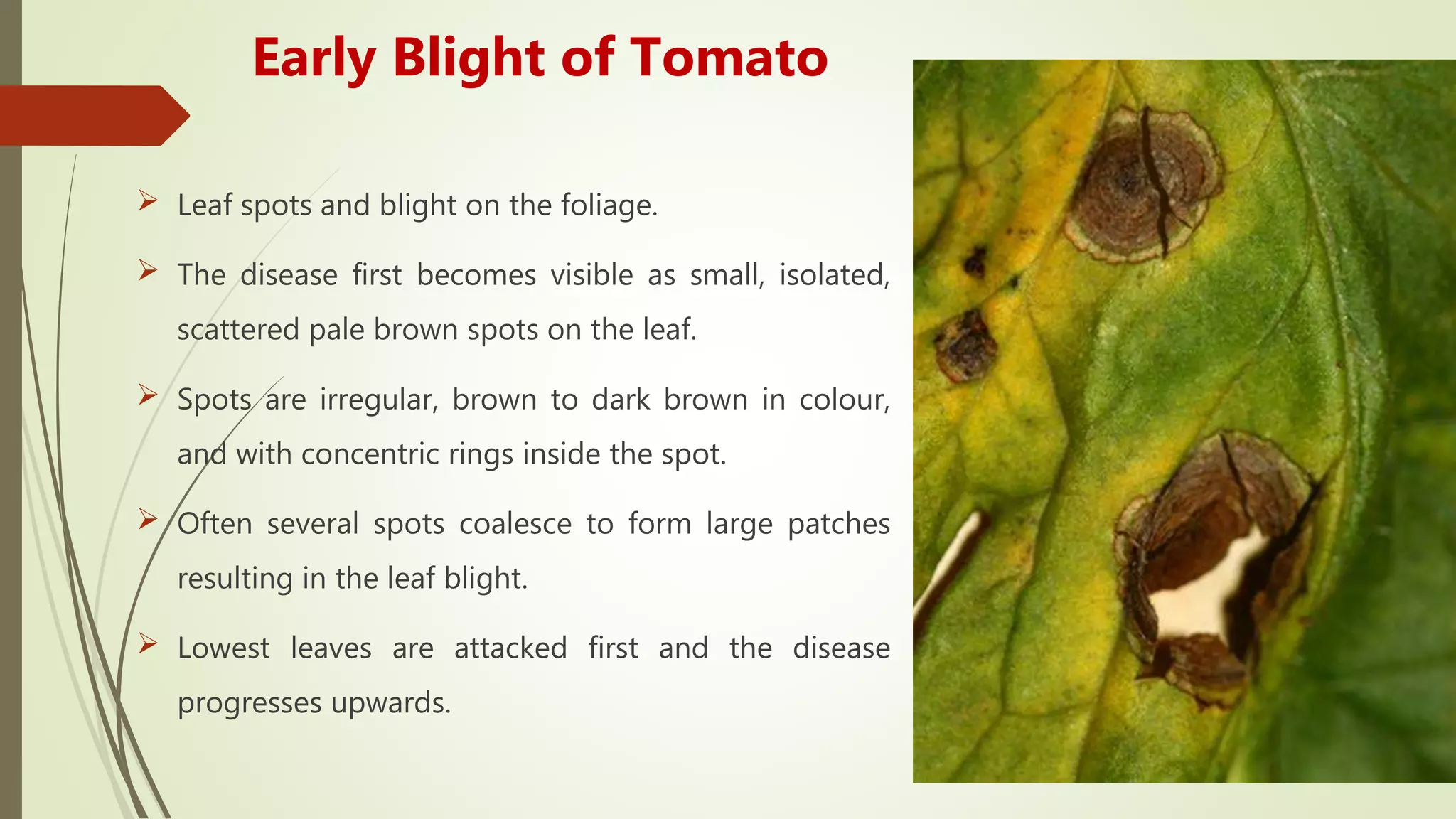
 Leaf spots and blight on the foliage.
 The disease first becomes visible as small, isolated,
scattered pale brown spots on the leaf.
 Spots are irregular, brown to dark brown in colour,
and with concentric rings inside the spot.
 Often several spots coalesce to form large patches
resulting in the leaf blight.
 Lowest leaves are attacked first and the disease
progresses upwards.
Prevention
 Use pathogen-free seeds & resistant cultivars(Arka
Rakshak &Arka samarat).
 Use crop rotation, eradicate weeds
 test the garden soil annually and maintain a sufficient
level of potassium.
 Mancozeb (0.175%), chlorothalonil or copper fungicides
(0.125 %).
 Hot water Treatment of seeds for 25 mints at 50°C.
Late Blight
 Especially damaging during cool, wet weather. The fungus
can affect all plant parts.
 Young leaf lesions are small and appear as dark, water-
soaked spots.
 Complete defoliation (browning and shriveling of leaves
and stems) can occur within 14 days from the first
symptoms.
 Infected tomato fruits develop shiny, dark or olive-colored
lesions, which may cover large areas.
 yield losses reaching up to 100% because of LB infection
Prevention
 Keep foliage dry. Locate your garden where it will
receive morning sun.
 Allow extra room between the plants, and avoid
overhead watering, especially late in the day.
 Purchase certified disease-free seeds and plants.
 Destroy volunteer tomato and potato plants and
nightshade family weeds, which may harbor the
fungus.
 Spraying Mancozeb 2.5 g/l, chlorothalonil or
Carbendazim 1 g/l gives effective control.
Leaf Curl of Tomato
 The leaf curl is characterised by severe stunting of the
plants with downward rolling and crinkling of the leaves.
 Partial or complete sterility of the plant is also common.
 Newly formed leaves show chlorosis. The older, curled
leaves become leathery and brittle.
 Plants are stunted due to shortening of the internodes.
 Diseased plants look pale and produce more lateral
branches resulting in bushy growth.
 The disease is transmitted by the whitefly, Bemisia tabaci.
 Total losses is in between 17.6% to 99.7%.
 92.3% loss when infection occurred at 30 days after
transplanting.
 The yield reductions were 94.9, 90.0, 78.0, and 10.8%
when plants got infected in 2, 4, 6, and 10 weeks after
planting
Prevention
 Use resistant variety Lycopersicon
perurvianum, Akara Ananya, Akara Rakshak,
Akara Samrat.
 Do not smoke near field.
 Use of systemic insecticide such as
Dimethoate (0.05 % ) as spray or Carbofuran
or Phorate granules (50 kg / ha) as soil
application are useful in vector control and
reducing the disease
tomatodiseases-190910102423.pdf

tomatodiseases-190910102423.pdf

  • 1.
    Diseases of Tomatoand their Management Speaker Pranay Pandey
  • 2.
    Tomato  Tomato isone of the world’s major vegetables with a total area and production of 4.4 million ha and 115 million metric tons, respectively.  Tomatoes (Lycopersicum esculentum) can be grown on almost any moderately well-drained soil type.  A good supply of organic matter can increase yield and reduce production problems.  The average global crop losses of all diseases combined was approximately 12.8% of the potential production but tomato alone was subjected to 21.8% loss.  Corn, an excellent rotation crop with tomatoes, supplies large amounts of organic matter and does not promote the growth of disease organisms that attack tomatoes.
  • 3.
    Common Disease oftomato I. Bacterial wilt II. Fusarium wilt III. Anthroconose IV. Bacterial spot V. Early blight VI. Late blight VII. Tomato leaf curl
  • 4.
    Bacterial wilt Deadly diseaseof tomato. Tomato cultivation has been abandoned in some parts of India because of this disease.
  • 5.
     Wilting, stunting,yellowing of the foliage and finally collapse of the entire plant.  The lower leaves may droop first before wilting occurs.  The vascular system becomes brown.  If a segment of the lower stem is cut and squeezed it yields bacterial ooze.  Development of adventitious roots from the stem is considerably enhanced.  In tomato, limits the production from 4.24 to 86.14 per cent while in hot and humid climate, the disease can cause up to 100% losses Symptom
  • 6.
    Prevention & Treatment ArkaRakshak  The pathogen is soil-borne,  very difficult to control.  Crop rotation with Cruciferous vegetables is recommended.  Use resistant variety (Arka Rakshak, Arka Samrat) or tolerant variety( NS 501, & 538 etc.)  Chemical control is not available for this disease.  Soil pH 6.2-6.5
  • 7.
  • 8.
    Fusarium wilt Symptom  Clearingof the veinlets and chlorosis of the leaf.  Soon the petiole and leaves droop and wilt.  The younger leaves may die  Dark brown or black discoloration of the vascular tissues.  Fungus survives saprophytically in soil.
  • 9.
     Use resistantVariety  pH 6.5 to 7.0  Keeping tomato plants weed-free.  Avoid activity in wet plantings  Use nitrate-based nitrogen fertilizer, such as calcium nitrate, rather than an ammonia-based nitrogen fertilizer.  Seed treatment with 4 g Trichoderma viride formulation or 2.5 g Carbendazim per kg seed is effective. Prevention & Treatment
  • 10.
    Fusarium wilt cancause brown streaking in the vascular tissue of infected plants and rotted roots. Streaking in vascular tissue of tomato (Lycopersicon) caused by fusarium wilt
  • 11.
  • 12.
     Fruit maybe infected when green and small, but symptoms do not appear until it begins to ripen.  Symptoms first appear on ripe fruits as small, slightly depressed circular lesions.  12 mm Lesions and become more sunken, with concentric ring markings.  Centre is usually tan, and as the lesion matures becomes dotted with small black specks.  Surface of the mature lesion remains smooth and intact.  Small, circular, brown lesions surrounded by yellow halos characterize leaf infections. symptom
  • 13.
     Use resistantplants, or buy healthy transplants.  Plant your plants in well-drained soil.  Water your plants with a drip sprinkler.  Don’t touch the plants when they are wet.  Keep ripening fruits from touching the soil.  Remember to rotate your plants every 2 to 3 years.  Seed Treatment at 122०F (50 ०C)for25mints.  Spraying Mancozeb 2.5 g/l, chlorothalonil or Carbendazim 1 g/l gives effective control. Prevention
  • 14.
    Bacterial spot Symptom  smallcircular to irregular water-soaked areas showing as definite spots on the lower leaf surface.  A narrow yellow halo may surround the spots.  When the spots are too many, the interveinal tissues become dry and brown.  If the spots are at the edge, they may break away.  Annual production loss due to this disease is 10– 20%, which may rise to 80% in some cases
  • 15.
    Bacterial spot stemlesions Bacterial spot leaf lesions
  • 16.
     Use ofpathogen-free certified seeds  Treat seeds with dilute bleach, hydrochloric acid, or hot water  Field sanitation and crop rotation reduces the disease incidence.  minimize overwatering  Spraying the plants with a mixture of Streptocycline 200 ppm and Copper oxychloride 3g/l Prevention Bacterial spot on tomato fruit
  • 17.
    Early Blight ofTomato  Leaf spots and blight on the foliage.  The disease first becomes visible as small, isolated, scattered pale brown spots on the leaf.  Spots are irregular, brown to dark brown in colour, and with concentric rings inside the spot.  Often several spots coalesce to form large patches resulting in the leaf blight.  Lowest leaves are attacked first and the disease progresses upwards.
  • 19.
    Prevention  Use pathogen-freeseeds & resistant cultivars(Arka Rakshak &Arka samarat).  Use crop rotation, eradicate weeds  test the garden soil annually and maintain a sufficient level of potassium.  Mancozeb (0.175%), chlorothalonil or copper fungicides (0.125 %).  Hot water Treatment of seeds for 25 mints at 50°C.
  • 20.
    Late Blight  Especiallydamaging during cool, wet weather. The fungus can affect all plant parts.  Young leaf lesions are small and appear as dark, water- soaked spots.  Complete defoliation (browning and shriveling of leaves and stems) can occur within 14 days from the first symptoms.  Infected tomato fruits develop shiny, dark or olive-colored lesions, which may cover large areas.  yield losses reaching up to 100% because of LB infection
  • 22.
    Prevention  Keep foliagedry. Locate your garden where it will receive morning sun.  Allow extra room between the plants, and avoid overhead watering, especially late in the day.  Purchase certified disease-free seeds and plants.  Destroy volunteer tomato and potato plants and nightshade family weeds, which may harbor the fungus.  Spraying Mancozeb 2.5 g/l, chlorothalonil or Carbendazim 1 g/l gives effective control.
  • 23.
    Leaf Curl ofTomato  The leaf curl is characterised by severe stunting of the plants with downward rolling and crinkling of the leaves.  Partial or complete sterility of the plant is also common.  Newly formed leaves show chlorosis. The older, curled leaves become leathery and brittle.  Plants are stunted due to shortening of the internodes.  Diseased plants look pale and produce more lateral branches resulting in bushy growth.  The disease is transmitted by the whitefly, Bemisia tabaci.
  • 24.
     Total lossesis in between 17.6% to 99.7%.  92.3% loss when infection occurred at 30 days after transplanting.  The yield reductions were 94.9, 90.0, 78.0, and 10.8% when plants got infected in 2, 4, 6, and 10 weeks after planting
  • 25.
    Prevention  Use resistantvariety Lycopersicon perurvianum, Akara Ananya, Akara Rakshak, Akara Samrat.  Do not smoke near field.  Use of systemic insecticide such as Dimethoate (0.05 % ) as spray or Carbofuran or Phorate granules (50 kg / ha) as soil application are useful in vector control and reducing the disease