Rothamsted Research
where knowledge grows
Rothamsted Research
where knowledge grows
Ammonia and Greenhouse Gas Emissions
– who emits more?
Tom Misselbrook
Rothamsted Research, North Wyke
Overview
 Sources and impacts – ammonia, nitrous oxide, methane
 Current emission estimates
 Influence of management practices
 Potential mitigations
Ammonia - overview
Air quality pollutant
Particulate formation, eutrophication, acidification
Agriculture is major source – c. 90% for UK
NH3 emissions from UK agriculture
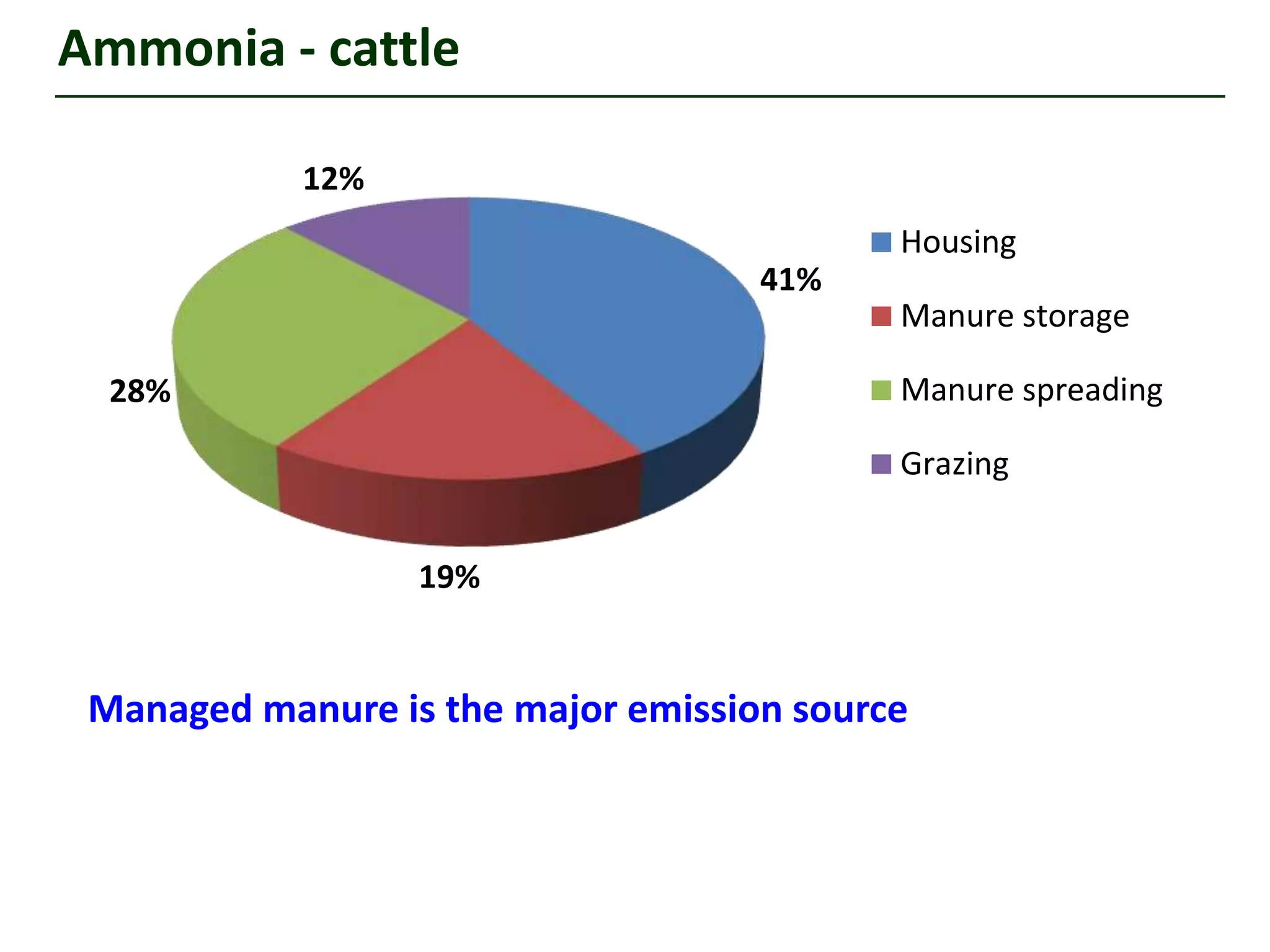
Ammonia - cattle
41%
19%
28%
12%
Housing
Manure storage
Manure spreading
Grazing
Managed manure is the major emission source
Ammonia – influence of management
Annual emission per dairy cow
Extended grazing systems will have lower NH3 emissions
BUT … potential for increased N2O and nitrate leaching
How efficiently are manure nutrients used?
GHG from agriculture - overview
Nitrous oxide and methane are potent GHG (c. 300 and 25x CO2)
Agriculture accounts for 84% N2O and 44% CH4 in UK
GHG emissions from UK agriculture (CO2e)
Enteric methane – influence of management
Production system – large, high yielders vs small, lower yielders
105
110
115
120
125
130
Large, high Medium Small, low
EFkgCH4/head
0
5
10
15
20
25
105
110
115
120
125
130
Large, high Medium Small, low
gCH4/kgmilk
EFkgCH4/head
EF (kg/hd/yr) g/l milk
Based on AC0114 proposed inventory methodology
GHG – influence of management
• Diet and body weight – relatively small effect
• Production level has a greater effect
• Other considerations – longevity, fertility, health
110
115
120
125
130
135
140
450 500 550 600 650
EFkgCH4perhead
Live weight
5,000 Milk yield 10,000
25% Concentrate level 75%
Mitigation – diet, lower N intake
Lower losses
throughout the system
Mitigation - diet
How low can we go? – Defra project AC0122
How to achieve in largely forage-based systems
Mitigation – manure management
Band spreading Slurry injection
Rapid incorporation
 Very effective NH3 emission
reduction
 Potential increase in N2O
Mitigation – nitrification inhibitors
-50
0
50
100
150
200
250
300
350
400
DailymeanN2Oflux(gN2O-Nha-1d-1
Autumn urine application
Control
Urine
Urine + DCD
 Economics – limited evidence of yield benefit
 Delivery mechanism
0
20
40
60
80
100
Spring Summer Autumn
%reduction
GT
NW
Summary and conclusions
 Cattle farming is a significant source of NH3, N2O and CH4
 Ammonia emissions primarily from managed manure
 Methane primarily from enteric fermentation
 Nitrous oxide primarily from soils
 Management practices influence magnitude of emissions – but
potential trade-offs
 Mitigation methods exist – particularly for ammonia
 Accept that there will always be a variety of production systems
 Research to improve nutrient use efficiencies/develop mitigations
within given systems
 Particularly for more precision in grazing/grassland-based systems
THE
END
!
Thanks!

Ammonia and greenhouse gas emissions – who emits more? - Tom Misselbrook

  • 1.
    Rothamsted Research where knowledgegrows Rothamsted Research where knowledge grows Ammonia and Greenhouse Gas Emissions – who emits more? Tom Misselbrook Rothamsted Research, North Wyke
  • 2.
    Overview  Sources andimpacts – ammonia, nitrous oxide, methane  Current emission estimates  Influence of management practices  Potential mitigations
  • 3.
    Ammonia - overview Airquality pollutant Particulate formation, eutrophication, acidification Agriculture is major source – c. 90% for UK NH3 emissions from UK agriculture
  • 4.
    Ammonia - cattle 41% 19% 28% 12% Housing Manurestorage Manure spreading Grazing Managed manure is the major emission source
  • 5.
    Ammonia – influenceof management Annual emission per dairy cow Extended grazing systems will have lower NH3 emissions BUT … potential for increased N2O and nitrate leaching How efficiently are manure nutrients used?
  • 6.
    GHG from agriculture- overview Nitrous oxide and methane are potent GHG (c. 300 and 25x CO2) Agriculture accounts for 84% N2O and 44% CH4 in UK GHG emissions from UK agriculture (CO2e)
  • 7.
    Enteric methane –influence of management Production system – large, high yielders vs small, lower yielders 105 110 115 120 125 130 Large, high Medium Small, low EFkgCH4/head 0 5 10 15 20 25 105 110 115 120 125 130 Large, high Medium Small, low gCH4/kgmilk EFkgCH4/head EF (kg/hd/yr) g/l milk Based on AC0114 proposed inventory methodology
  • 8.
    GHG – influenceof management • Diet and body weight – relatively small effect • Production level has a greater effect • Other considerations – longevity, fertility, health 110 115 120 125 130 135 140 450 500 550 600 650 EFkgCH4perhead Live weight 5,000 Milk yield 10,000 25% Concentrate level 75%
  • 9.
    Mitigation – diet,lower N intake Lower losses throughout the system
  • 10.
    Mitigation - diet Howlow can we go? – Defra project AC0122 How to achieve in largely forage-based systems
  • 11.
    Mitigation – manuremanagement Band spreading Slurry injection Rapid incorporation  Very effective NH3 emission reduction  Potential increase in N2O
  • 12.
    Mitigation – nitrificationinhibitors -50 0 50 100 150 200 250 300 350 400 DailymeanN2Oflux(gN2O-Nha-1d-1 Autumn urine application Control Urine Urine + DCD  Economics – limited evidence of yield benefit  Delivery mechanism 0 20 40 60 80 100 Spring Summer Autumn %reduction GT NW
  • 13.
    Summary and conclusions Cattle farming is a significant source of NH3, N2O and CH4  Ammonia emissions primarily from managed manure  Methane primarily from enteric fermentation  Nitrous oxide primarily from soils  Management practices influence magnitude of emissions – but potential trade-offs  Mitigation methods exist – particularly for ammonia  Accept that there will always be a variety of production systems  Research to improve nutrient use efficiencies/develop mitigations within given systems  Particularly for more precision in grazing/grassland-based systems
  • 14.