Where’s the value: buying investments;
why purchasing behaviour matters
Tom Lewis
Finance Director
Institute of Practitioners in Advertising
- Marketing’s two (main) levers
- The manifold effects of marketing
- Short-termism vs effectiveness
 The myths
- linearity
- shareholder value concept
- financial savings vs economic losses
- the professional-buying myth
- fixed value
- buyer’s behaviour irrelevant
- minimising seller’s profit as a proxy for value
 The reality – Effectiveness (IPA research)
a series of short-term effects does not necessarily lead to successful
long-term effects; long-term effects are more than just an
accumulation of short-term effects
volume growth is quickly achieved (via activation); reducing price
sensitivity (via branding) takes longer. Optimum profit growth requires
both
long-term effects are generated differently from short-term effects
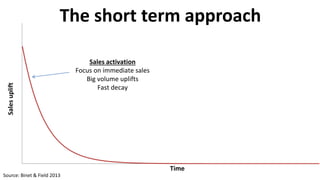
Salesuplift
Time
Sales activation
Focus on immediate sales
Big volume uplifts
Fast decay
The short term approach
Source: Binet & Field 2013
Salesuplift
Time
Brand building
Focus on long-term “saleability"
Smaller volumes, but slower decay
Reduced price sensitivity
The long term approach
Source: Binet & Field 2013
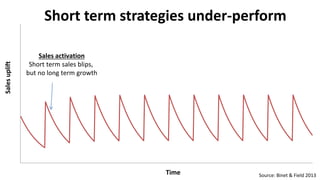
Salesuplift
Time
Sales activation
Short term sales blips,
but no long term growth
Short term strategies under-perform
Source: Binet & Field 2013
Salesuplift
Time
Brand building
Long term sales growth,
Increased margins
Brand-building drives profitable growth
Source: Binet & Field 2013
Short-termism is rising
0%
5%
10%
15%
20%
25%
30%
2006 2008 2010 2012 2014 2016
%casesshort-term
10 years endingSource: Binet & Field 2016
Is effectiveness declining?
-
0.5
1.0
1.5
2.0
2.5
1980
1982
1984
1986
1988
1990
1992
1994
1996
1998
2000
2002
2004
2006
2008
2010
2012
2014
2016
Avg.no.VLbusinesseffects
Source: Binet & Field 2016
Buying investments as investments
The Challenger approach:
How are you buying?
“You can’t table thump for genius” (David Meikle, How to Buy a Gorilla)
What are you buying?
And what does that mean you are getting?
- inputs (hours, timesheets, staff costs)
- outputs (spots, campaigns, media plans)
- outcomes (reduced base erosion, price increases, market entry)
Final thought:
- would the Sex Pistols have gone on a reality talent show?

Tom Lewis – CFO, IPA

Editor's Notes

  • #3 Two levers – short-term sales activation and long term brand-building Manifold effects: -         Reduced price sensitivity -         Reduced base erosion of sales -         Economies of scale -         More-successful new product launches -         Brand extensions -         Reduced risk of competitor entry Short-term activities provide cashflow, but do not build long-term growth
  • #4 The myth of linearity More of a good thing is always better: if you can negotiate a slightly lower price, negotiating a much lower one is better; if data helps your decision-making process, more data will result in a better decision. In practice, however, not everything is linear and there is such a thing as balance – some price reductions are not worth having; getting the right data is better than more data. The shareholder value concept Shareholder value demands short-term, measurable, financial results. However, building brands takes longer and the manifold effects of these activities are not so readily quantifiable. This does not mean that they do not exist, merely that they are more subjective and qualitative
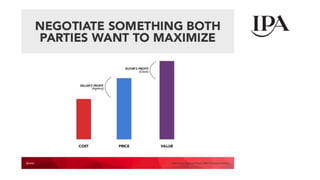
  • #5 Any business looking to maximise its value will seek to increase buyer’s profit; therefore, the buyer’s focus needs to be on increasing value received. However, this is not what generally happens with advertising; value to be received is taken to be fixed, so all the focus is on reducing the price paid, i.e. reducing the seller’s profit becomes a proxy for maximising the buyer’s profit. However, value is not fixed because the way a buyer behaves during the buying process matters. If a buyer signals that it will be a difficult, low-margin client to deal with, it will not be able to secure access to the best talent and to their discretionary effort, regardless of what the buyer demands and what the seller says. Rather, in return for a lower fixed price, the buyer has to accept compromised quality and therefore a reduced buyer’s profit. The financial cost savings achieved are visible, but the loss of future economic value risks being invisible, albeit no less real.
  • #7 If you do sales activation – price promotions, BOGOFs – you will get an immediate sales uplift, but that the effect will decay very quickly. It’s basically a sugar rush for your top line and upsets all your operations people.
  • #8 Brand building does not drive volume in the same way that sales activation does, but its effects last longer. It’s more like eating protein – you don’t get an instant hit, but it keeps you full for longer. BUT, you have to fund the investment until it pays back.
  • #9 This slide essentially shows the results of lots of sales activation – you get lots of little sugar rushes, but you never actually feel full.
  • #10 If you combine short-term sales activation with longer-term brand building, you amplify the effects of both. What you are doing here is feeding the machine with instant cash flow from increased sales, but also decreasing price sensitivity over time. So you stay solvent, because you can generate cash quickly with your sales activation, but you also increase your profitability over the longer term because you charge higher prices – so, more volume at a higher price.
  • #11 In 2016, Les and Peter looked again at short-termism vs long-termism; and they found that short-termism is rising.
  • #12 And effectiveness is declining – it’s back to the earlier chart about how long-term growth is not built by a series of short-term strategies.
  • #13 So what’s going wrong? The Challenge for Procurement is to buy investments as investments; that’s the key challenge in maximising value for your organisations. So, let’s imagine I’m selling my house and I need an estate agent to help me.
  • #14 So, this guy comes round … I’m not going with him.
  • #15 Along comes this lady and she’s more the sort of thing I’m looking for; her suit fits properly and she looks presentable.
  • #16 And then there’s this self-confident, quiffed young man who seems like he can do the job as well; so I now have a shortlist. One offers 1.5% commission and another offers 2.5%, so which one do I choose? The answer of course is the one that can sell my house for the highest price. And in order to make sure they do get me the highest price possible, I need to behave with them in a way that incentivises the discretionary effort required to achieve this. This is an outcomes-based arrangement and my supplier’s time and cost to deliver is of no relevance; I do not care in detail about how profitable my business is for them. I just need to know that they are incentivised to achieve for me the greatest possible value. If I were to pay them on the basis of phone calls made and viewings arranged with no consideration of the final selling price, I would deem every activity as a cost and try to reduce it, even though it might get me a better selling price.
  • #17 Back to buying advertising and other investments. Challengers are the sorts of people who push back on the brief, who question the assumptions, who look at the business outcomes to be achieved. These are by far the most successful people in a complex environment – why? Precisely because they don’t simply do as they are told by their clients. In a complex environment, you want Challengers working on the problem – they have a different view, understand the customer’s business and like to debate; that is the definition of being creative. You don’t want hard-working, problem-solving relationship-builders working on your biggest brand challenges; they won’t succeed.
  • #18 They’ll probably end up having this sort of meeting.
  • #19 So, the overriding question is How are you buying? Are your buying processes designed to buy investments as investments and are the designed to get you access to Challengers? Let me say it again: your buying process impacts on your ability to gain access not just to the best suppliers, but to the best talent within the best suppliers If you buying process signals that you are likely to be an undesirable client, the best agencies simply won’t respond to your pitch documentation and those who do respond will not put their best people on your account for fear of losing them through demotivation – or simply because they can do better work on other clients. Your challenge is not just to select the best agency from a long list, it’s to establish if there are agencies who don’t even make the long list because they would not work with you – and to ensure that you behave in a way that incentivises the agency to put their best talent on your business. If you are interested in this, David Meikle is speaking on this topic at much greater length this afternoon, so do go and listen to him.
  • #20 Next question(s) - what are you buying? And what are you getting in return? - inputs (commodities; these don’t distinguish between busy fools and eureka moments, they increase the conflict and reduce the level of trust and collaboration between buyers and sellers, as in my estate agent example. Buyers will tend to start micro-managing sellers, “not fours hours for that, only three”) - outputs (“stuff” or “stuff that does stuff”, but still stuff) - outcomes (business results, things you can take to the bank)
  • #21 Anyone know who they guy on the right is? It’s Steve Brookstein, this first winner of the X factor who was voted for by the public and disappeared without a trace. On the left? Well, I think you know who these guys are. Questions: who do you think has the stronger brand value – as in, who is distinctive and who is bland? And who do you think would have gladly followed a rigid buying process?