Facebook bids,
budgets & optimization
Markus Ojala
PhD, Chief Data Scientist
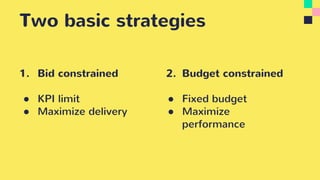
Two basic strategies
1. Bid constrained
● KPI limit
● Maximize delivery
2. Budget constrained
● Fixed budget
● Maximize
performance
You bid $30 for a purchase.
Does John see your ad?
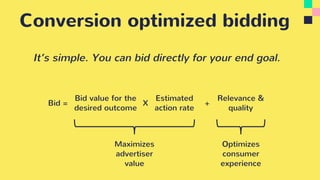
Conversion optimized bidding
It’s simple. You can bid directly for your end goal.
Bid value for the
desired outcome
Estimated
action rate
Relevance &
quality
X +Bid =
Maximizes
advertiser
value
Optimizes
consumer
experience
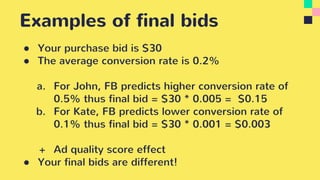
Examples of final bids
● Your purchase bid is $30
● The average conversion rate is 0.2%
a. For John, FB predicts higher conversion rate of
0.5% thus final bid = $30 * 0.005 = $0.15
b. For Kate, FB predicts lower conversion rate of
0.1% thus final bid = $30 * 0.001 = $0.003
+ Ad quality score effect
● Your final bids are different!
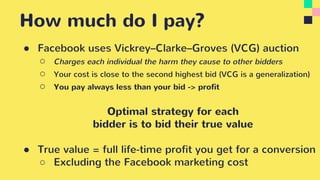
How much do I pay?
● Facebook uses Vickrey–Clarke–Groves (VCG) auction
○ Charges each individual the harm they cause to other bidders
○ Your cost is close to the second highest bid (VCG is a generalization)
○ You pay always less than your bid -> profit
Optimal strategy for each
bidder is to bid their true value
● True value = full life-time profit you get for a conversion
○ Excluding the Facebook marketing cost
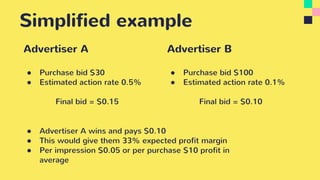
Simplified example
Advertiser B
● Purchase bid $100
● Estimated action rate 0.1%
Final bid = $0.10
Advertiser A
● Purchase bid $30
● Estimated action rate 0.5%
Final bid = $0.15
● Advertiser A wins and pays $0.10
● This would give them 33% expected profit margin
● Per impression $0.05 or per purchase $10 profit in
average
Bid your true value
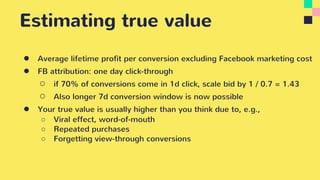
Estimating true value
● Average lifetime profit per conversion excluding Facebook marketing cost
● FB attribution: one day click-through
○ if 70% of conversions come in 1d click, scale bid by 1 / 0.7 = 1.43
○ Also longer 7d conversion window is now possible
● Your true value is usually higher than you think due to, e.g.,
○ Viral effect, word-of-mouth
○ Repeated purchases
○ Forgetting view-through conversions
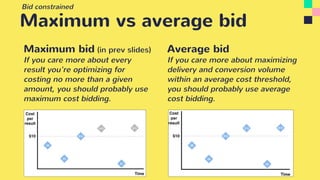
Maximum vs average bid
Average bid
If you care more about maximizing
delivery and conversion volume
within an average cost threshold,
you should probably use average
cost bidding.
Maximum bid (in prev slides)
If you care more about every
result you're optimizing for
costing no more than a given
amount, you should probably use
maximum cost bidding.
Bid constrained
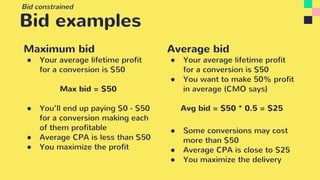
Bid examples
Average bid
● Your average lifetime profit
for a conversion is $50
● You want to make 50% profit
in average (CMO says)
Avg bid = $50 * 0.5 = $25
● Some conversions may cost
more than $50
● Average CPA is close to $25
● You maximize the delivery
Maximum bid
● Your average lifetime profit
for a conversion is $50
Max bid = $50
● You’ll end up paying $0 - $50
for a conversion making each
of them profitable
● Average CPA is less than $50
● You maximize the profit
Bid constrained
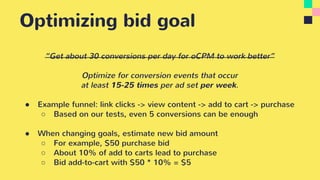
Optimizing bid goal
“Get about 30 conversions per day for oCPM to work better”
Optimize for conversion events that occur
at least 15-25 times per ad set per week.
● Example funnel: link clicks -> view content -> add to cart -> purchase
○ Based on our tests, even 5 conversions can be enough
● When changing goals, estimate new bid amount
○ For example, $50 purchase bid
○ About 10% of add to carts lead to purchase
○ Bid add-to-cart with $50 * 10% = $5
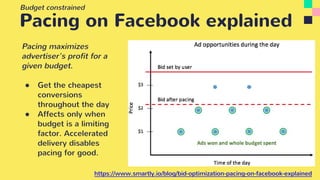
Pacing on Facebook explained
Pacing maximizes
advertiser's profit for a
given budget.
● Get the cheapest
conversions
throughout the day
● Affects only when
budget is a limiting
factor. Accelerated
delivery disables
pacing for good.
https://www.smartly.io/blog/bid-optimization-pacing-on-facebook-explained
Budget constrained
Due to pacing,
budget optimization
is also
bid optimization
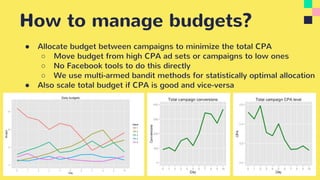
How to manage budgets?
● Allocate budget between campaigns to minimize the total CPA
○ Move budget from high CPA ad sets or campaigns to low ones
○ No Facebook tools to do this directly
○ We use multi-armed bandit methods for statistically optimal allocation
● Also scale total budget if CPA is good and vice-versa
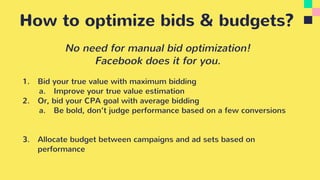
How to optimize bids & budgets?
No need for manual bid optimization!
Facebook does it for you.
1. Bid your true value with maximum bidding
a. Improve your true value estimation
2. Or, bid your CPA goal with average bidding
a. Be bold, don’t judge performance based on a few conversions
3. Allocate budget between campaigns and ad sets based on
performance
Audiences
● Should I split my audiences?
○ Only if they have different LTV per conversion
○ Not due to different conversion rates as FB incorporates that
○ FB has a lot of data to estimate the conversion rates -> no need
to split
● Increase audience sizes
○ Try to limit your reach below 10% of the audience size to utilize
the conversion optimized bidding
○ If you reach all, there’s nothing to optimize
○ Use bigger lookalike audiences or on purpose reach full LAL 1%
● Rule of thumb: budget is at least 20 x bid
○ Otherwise combine audiences
A/B testing with ad studies
● Best practices
○ Test one thing
○ Get at least 100 conversions
○ Both A and B campaign start from scratch (clone original)
○ Use same posts, unless comparing creatives
● Rule of thumb: Any difference less than 2 x sqrt(conversions)
is not statistically significant
○ At least 6% difference to detect with 1000 conversions (±63)
○ At least 20% difference to detect with 100 conversions (±20)
○ At least 37% difference to detect with 30 conversions (±11)
Data science at Smartly.io
Automate
the best practices
in FB marketing
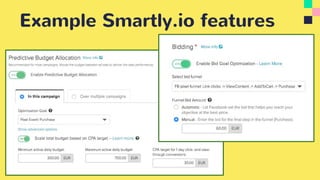
Example Smartly.io features
Thank you.
Markus.Ojala@smartly.io

Facebook bids, budgets & optimization

  • 1.
    Facebook bids, budgets &optimization Markus Ojala PhD, Chief Data Scientist
  • 2.
    Two basic strategies 1.Bid constrained ● KPI limit ● Maximize delivery 2. Budget constrained ● Fixed budget ● Maximize performance
  • 3.
    You bid $30for a purchase. Does John see your ad?
  • 4.
    Conversion optimized bidding It’ssimple. You can bid directly for your end goal. Bid value for the desired outcome Estimated action rate Relevance & quality X +Bid = Maximizes advertiser value Optimizes consumer experience
  • 5.
    Examples of finalbids ● Your purchase bid is $30 ● The average conversion rate is 0.2% a. For John, FB predicts higher conversion rate of 0.5% thus final bid = $30 * 0.005 = $0.15 b. For Kate, FB predicts lower conversion rate of 0.1% thus final bid = $30 * 0.001 = $0.003 + Ad quality score effect ● Your final bids are different!
  • 6.
    How much doI pay? ● Facebook uses Vickrey–Clarke–Groves (VCG) auction ○ Charges each individual the harm they cause to other bidders ○ Your cost is close to the second highest bid (VCG is a generalization) ○ You pay always less than your bid -> profit Optimal strategy for each bidder is to bid their true value ● True value = full life-time profit you get for a conversion ○ Excluding the Facebook marketing cost
  • 7.
    Simplified example Advertiser B ●Purchase bid $100 ● Estimated action rate 0.1% Final bid = $0.10 Advertiser A ● Purchase bid $30 ● Estimated action rate 0.5% Final bid = $0.15 ● Advertiser A wins and pays $0.10 ● This would give them 33% expected profit margin ● Per impression $0.05 or per purchase $10 profit in average
  • 8.
  • 9.
    Estimating true value ●Average lifetime profit per conversion excluding Facebook marketing cost ● FB attribution: one day click-through ○ if 70% of conversions come in 1d click, scale bid by 1 / 0.7 = 1.43 ○ Also longer 7d conversion window is now possible ● Your true value is usually higher than you think due to, e.g., ○ Viral effect, word-of-mouth ○ Repeated purchases ○ Forgetting view-through conversions
  • 10.
    Maximum vs averagebid Average bid If you care more about maximizing delivery and conversion volume within an average cost threshold, you should probably use average cost bidding. Maximum bid (in prev slides) If you care more about every result you're optimizing for costing no more than a given amount, you should probably use maximum cost bidding. Bid constrained
  • 11.
    Bid examples Average bid ●Your average lifetime profit for a conversion is $50 ● You want to make 50% profit in average (CMO says) Avg bid = $50 * 0.5 = $25 ● Some conversions may cost more than $50 ● Average CPA is close to $25 ● You maximize the delivery Maximum bid ● Your average lifetime profit for a conversion is $50 Max bid = $50 ● You’ll end up paying $0 - $50 for a conversion making each of them profitable ● Average CPA is less than $50 ● You maximize the profit Bid constrained
  • 12.
    Optimizing bid goal “Getabout 30 conversions per day for oCPM to work better” Optimize for conversion events that occur at least 15-25 times per ad set per week. ● Example funnel: link clicks -> view content -> add to cart -> purchase ○ Based on our tests, even 5 conversions can be enough ● When changing goals, estimate new bid amount ○ For example, $50 purchase bid ○ About 10% of add to carts lead to purchase ○ Bid add-to-cart with $50 * 10% = $5
  • 13.
    Pacing on Facebookexplained Pacing maximizes advertiser's profit for a given budget. ● Get the cheapest conversions throughout the day ● Affects only when budget is a limiting factor. Accelerated delivery disables pacing for good. https://www.smartly.io/blog/bid-optimization-pacing-on-facebook-explained Budget constrained
  • 14.
    Due to pacing, budgetoptimization is also bid optimization
  • 15.
    How to managebudgets? ● Allocate budget between campaigns to minimize the total CPA ○ Move budget from high CPA ad sets or campaigns to low ones ○ No Facebook tools to do this directly ○ We use multi-armed bandit methods for statistically optimal allocation ● Also scale total budget if CPA is good and vice-versa
  • 16.
    How to optimizebids & budgets? No need for manual bid optimization! Facebook does it for you. 1. Bid your true value with maximum bidding a. Improve your true value estimation 2. Or, bid your CPA goal with average bidding a. Be bold, don’t judge performance based on a few conversions 3. Allocate budget between campaigns and ad sets based on performance
  • 17.
    Audiences ● Should Isplit my audiences? ○ Only if they have different LTV per conversion ○ Not due to different conversion rates as FB incorporates that ○ FB has a lot of data to estimate the conversion rates -> no need to split ● Increase audience sizes ○ Try to limit your reach below 10% of the audience size to utilize the conversion optimized bidding ○ If you reach all, there’s nothing to optimize ○ Use bigger lookalike audiences or on purpose reach full LAL 1% ● Rule of thumb: budget is at least 20 x bid ○ Otherwise combine audiences
  • 18.
    A/B testing withad studies ● Best practices ○ Test one thing ○ Get at least 100 conversions ○ Both A and B campaign start from scratch (clone original) ○ Use same posts, unless comparing creatives ● Rule of thumb: Any difference less than 2 x sqrt(conversions) is not statistically significant ○ At least 6% difference to detect with 1000 conversions (±63) ○ At least 20% difference to detect with 100 conversions (±20) ○ At least 37% difference to detect with 30 conversions (±11)
  • 19.
    Data science atSmartly.io Automate the best practices in FB marketing
  • 20.
  • 21.