The Net Promoter Score: Is There a Better Alternative? Robert East, Kingston Business School, London [email_address]
Plan Summary of some of our findings on WOM Examination of measures of WOM/satisfaction Net Promoter Score (NPS) American Customer Satisfaction Index (ACSI) An alternative
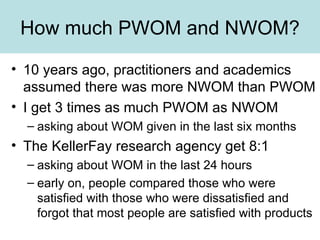
How much PWOM and NWOM? 10 years ago, practitioners and academics assumed there was more NWOM than PWOM I get 3 times as much PWOM as NWOM asking about WOM given in the last six months The KellerFay research agency get 8:1 asking about WOM in the last 24 hours early on, people compared those who were satisfied with those who were dissatisfied and forgot that most people are satisfied with products
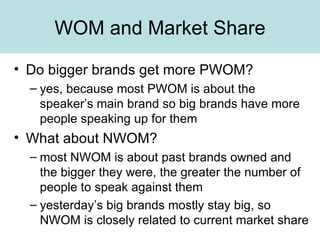
WOM and Market Share Do bigger brands get more PWOM? yes, because most PWOM is about the speaker’s main brand so big brands have more people speaking up for them What about NWOM? most NWOM is about past brands owned and the bigger they were, the greater the number of people to speak against them yesterday’s big brands mostly stay big, so NWOM is closely related to current market share
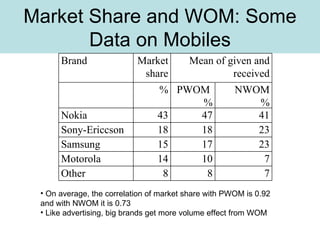
Market Share and WOM: Some Data on Mobiles On average, the correlation of market share with PWOM is 0.92 and with NWOM it is 0.73 Like advertising, big brands get more volume effect from WOM Brand Market share Mean of given and received % PWOM  % NWOM % Nokia 43 47 41 Sony-Ericcson 18 18 23 Samsung 15 17 23 Motorola 14 10 7 Other 8 8 7
Impact of PWOM and NWOM Widely assumed that NWOM has more impact because of one early study (Arndt 1967) and because negative information is unusual, and affects judgments more in some psychological studies but the real question is:  how much do NWOM and PWOM change the propensity to purchase?
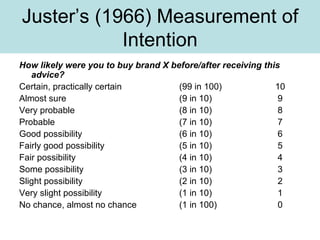
Juster’s (1966) Measurement of Intention How likely were you to buy brand X before/after receiving this advice? Certain, practically certain (99 in 100) 10 Almost sure (9 in 10)  9 Very probable (8 in 10)  8 Probable (7 in 10)  7 Good possibility (6 in 10)  6 Fairly good possibility (5 in 10)  5 Fair possibility (4 in 10)  4 Some possibility (3 in 10)  3 Slight possibility (2 in 10)  2 Very slight possibility (1 in 10)  1 No chance, almost no chance (1 in 100)  0
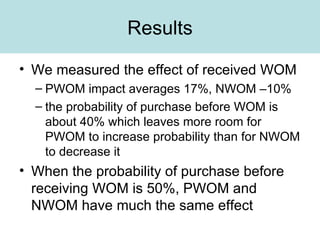
Results We measured the effect of received WOM PWOM impact averages 17%, NWOM  –10% the probability of purchase before WOM is about 40% which leaves more room for PWOM to increase probability than for NWOM to decrease it When the probability of purchase before receiving WOM is 50%, PWOM and NWOM have much the same effect
Section 2: Alternative Measures Issue important because the NPS and ACSI are used to  adjust pay predict sales predict profits predict share price gains (ACSI, Fornell) Our proposed method of measuring sales impact is ...
Measure Using the measures described for measuring the volume and impact of PWOM and NWOM The Net Effect of WOM on market share will be [ (volume × impact) PWOM  + (volume × impact) NWOM ]/MS (It is a + sign because the impact of NWOM is negative)
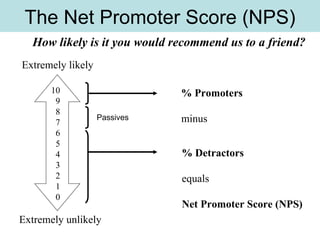
The Net Promoter Score (NPS) How likely is it you would recommend us to a friend? 10 9 8 7 6 5 4 3 2 1 0 Extremely likely Extremely unlikely % Promoters minus % Detractors equals Net Promoter Score (NPS) Passives
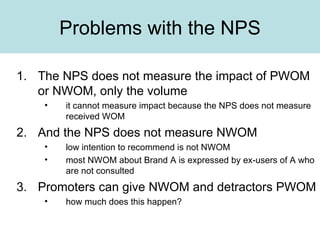
Problems with the NPS The NPS does not measure the impact of PWOM or NWOM, only the volume it cannot measure impact because the NPS does not measure received WOM And the NPS does not measure NWOM low intention to recommend is not NWOM most NWOM about Brand A is expressed by ex-users of A who are not consulted Promoters can give NWOM and detractors PWOM how much does this happen?
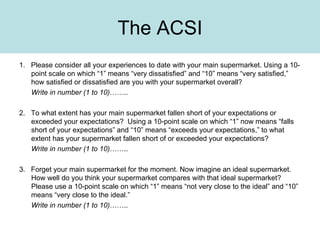
The ACSI 1.  Please consider all your experiences to date with your main supermarket. Using a 10-point scale on which “1” means “very dissatisfied” and “10” means “very satisfied,” how satisfied or dissatisfied are you with your supermarket overall? Write in number (1 to 10) …….. 2.  To what extent has your main supermarket fallen short of your expectations or exceeded your expectations?  Using a 10-point scale on which “1” now means “falls short of your expectations” and “10” means “exceeds your expectations,” to what extent has your supermarket fallen short of or exceeded your expectations? Write in number (1 to 10) ……..   3.  Forget your main supermarket for the moment. Now imagine an ideal supermarket. How well do you think your supermarket compares with that ideal supermarket? Please use a 10-point scale on which “1” means “not very close to the ideal” and “10” means “very close to the ideal.” Write in number (1 to 10) ……..
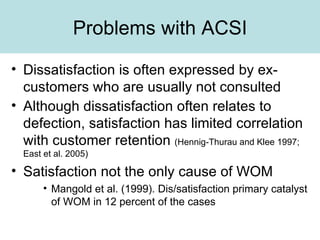
Problems with ACSI Dissatisfaction is often expressed by ex-customers who are usually not consulted Although dissatisfaction often relates to defection, satisfaction has limited correlation with customer retention  (Hennig-Thurau and Klee 1997; East et al. 2005) Satisfaction not the only cause of WOM Mangold et al. (1999). Dis/satisfaction primary catalyst of WOM in 12 percent of the cases
Research Questions What proportions of the total PWOM and NWOM are expressed by promoters and detractors? What are the correlations between alternative metrics? ideally, how well do the alternatives perform in predicting sales, profits and share price,  but we cannot do this
What WOM Have Promoters and Defectors Given We asked them the NPS question to identify promoters, passives and defectors And we asked them what PWOM and NWOM they had given on which brands in the last six months
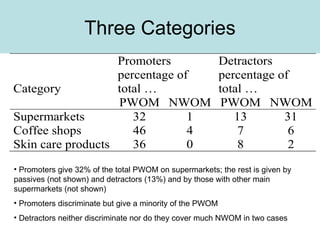
Three Categories Promoters give 32% of the total PWOM on supermarkets; the rest is given by passives (not shown) and detractors (13%) and by those with other main supermarkets (not shown) Promoters discriminate but give a minority of the PWOM Detractors neither discriminate nor do they cover much NWOM in two cases
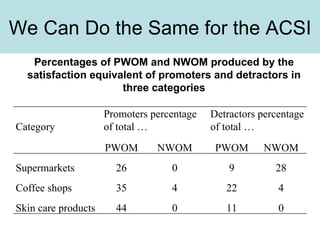
We Can Do the Same for the ACSI Percentages of PWOM and NWOM produced by the satisfaction equivalent of promoters and detractors in three categories Category Promoters percentage of total … Detractors percentage of total … PWOM NWOM PWOM NWOM Supermarkets 26 0 9 28 Coffee shops 35 4 22 4 Skin care products 44 0 11 0
Does our Measure Differ from the NPS and ACSI? This is a limited test, we lack data If our measure, the NPS and the ACSI are highly correlated, then give up What we want to see is whether our measure differs from the other two
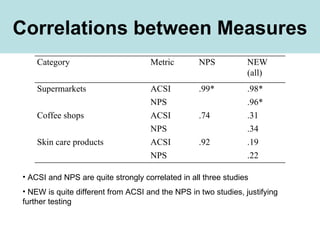
Correlations between Measures ACSI and NPS are quite strongly correlated in all three studies NEW is quite different from ACSI and the NPS in two studies, justifying further testing Category Metric NPS NEW (all) Supermarkets ACSI .99* .98* NPS .96* Coffee shops ACSI .74 .31 NPS .34 Skin care products ACSI .92 .19 NPS .22
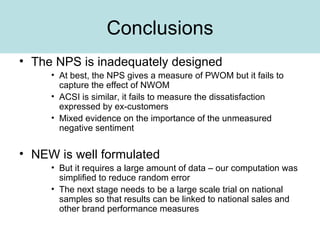
Conclusions The NPS is inadequately designed At best, the NPS gives a measure of PWOM but it fails to capture the effect of NWOM ACSI is similar, it fails to measure the dissatisfaction expressed by ex-customers Mixed evidence on the importance of the unmeasured negative sentiment NEW is well formulated But it requires a large amount of data – our computation was simplified to reduce random error The next stage needs to be a large scale trial on national samples so that results can be linked to national sales and other brand performance measures

Dr Robert East: Net Promoter Score - is there a better alternative?

  • 1.
    The Net PromoterScore: Is There a Better Alternative? Robert East, Kingston Business School, London [email_address]
  • 2.
    Plan Summary ofsome of our findings on WOM Examination of measures of WOM/satisfaction Net Promoter Score (NPS) American Customer Satisfaction Index (ACSI) An alternative
  • 3.
    How much PWOMand NWOM? 10 years ago, practitioners and academics assumed there was more NWOM than PWOM I get 3 times as much PWOM as NWOM asking about WOM given in the last six months The KellerFay research agency get 8:1 asking about WOM in the last 24 hours early on, people compared those who were satisfied with those who were dissatisfied and forgot that most people are satisfied with products
  • 4.
    WOM and MarketShare Do bigger brands get more PWOM? yes, because most PWOM is about the speaker’s main brand so big brands have more people speaking up for them What about NWOM? most NWOM is about past brands owned and the bigger they were, the greater the number of people to speak against them yesterday’s big brands mostly stay big, so NWOM is closely related to current market share
  • 5.
    Market Share andWOM: Some Data on Mobiles On average, the correlation of market share with PWOM is 0.92 and with NWOM it is 0.73 Like advertising, big brands get more volume effect from WOM Brand Market share Mean of given and received % PWOM % NWOM % Nokia 43 47 41 Sony-Ericcson 18 18 23 Samsung 15 17 23 Motorola 14 10 7 Other 8 8 7
  • 6.
    Impact of PWOMand NWOM Widely assumed that NWOM has more impact because of one early study (Arndt 1967) and because negative information is unusual, and affects judgments more in some psychological studies but the real question is: how much do NWOM and PWOM change the propensity to purchase?
  • 7.
    Juster’s (1966) Measurementof Intention How likely were you to buy brand X before/after receiving this advice? Certain, practically certain (99 in 100) 10 Almost sure (9 in 10) 9 Very probable (8 in 10) 8 Probable (7 in 10) 7 Good possibility (6 in 10) 6 Fairly good possibility (5 in 10) 5 Fair possibility (4 in 10) 4 Some possibility (3 in 10) 3 Slight possibility (2 in 10) 2 Very slight possibility (1 in 10) 1 No chance, almost no chance (1 in 100) 0
  • 8.
    Results We measuredthe effect of received WOM PWOM impact averages 17%, NWOM –10% the probability of purchase before WOM is about 40% which leaves more room for PWOM to increase probability than for NWOM to decrease it When the probability of purchase before receiving WOM is 50%, PWOM and NWOM have much the same effect
  • 9.
    Section 2: AlternativeMeasures Issue important because the NPS and ACSI are used to adjust pay predict sales predict profits predict share price gains (ACSI, Fornell) Our proposed method of measuring sales impact is ...
  • 10.
    Measure Using themeasures described for measuring the volume and impact of PWOM and NWOM The Net Effect of WOM on market share will be [ (volume × impact) PWOM + (volume × impact) NWOM ]/MS (It is a + sign because the impact of NWOM is negative)
  • 11.
    The Net PromoterScore (NPS) How likely is it you would recommend us to a friend? 10 9 8 7 6 5 4 3 2 1 0 Extremely likely Extremely unlikely % Promoters minus % Detractors equals Net Promoter Score (NPS) Passives
  • 12.
    Problems with theNPS The NPS does not measure the impact of PWOM or NWOM, only the volume it cannot measure impact because the NPS does not measure received WOM And the NPS does not measure NWOM low intention to recommend is not NWOM most NWOM about Brand A is expressed by ex-users of A who are not consulted Promoters can give NWOM and detractors PWOM how much does this happen?
  • 13.
    The ACSI 1. Please consider all your experiences to date with your main supermarket. Using a 10-point scale on which “1” means “very dissatisfied” and “10” means “very satisfied,” how satisfied or dissatisfied are you with your supermarket overall? Write in number (1 to 10) …….. 2. To what extent has your main supermarket fallen short of your expectations or exceeded your expectations?  Using a 10-point scale on which “1” now means “falls short of your expectations” and “10” means “exceeds your expectations,” to what extent has your supermarket fallen short of or exceeded your expectations? Write in number (1 to 10) ……..   3. Forget your main supermarket for the moment. Now imagine an ideal supermarket. How well do you think your supermarket compares with that ideal supermarket? Please use a 10-point scale on which “1” means “not very close to the ideal” and “10” means “very close to the ideal.” Write in number (1 to 10) ……..
  • 14.
    Problems with ACSIDissatisfaction is often expressed by ex-customers who are usually not consulted Although dissatisfaction often relates to defection, satisfaction has limited correlation with customer retention (Hennig-Thurau and Klee 1997; East et al. 2005) Satisfaction not the only cause of WOM Mangold et al. (1999). Dis/satisfaction primary catalyst of WOM in 12 percent of the cases
  • 15.
    Research Questions Whatproportions of the total PWOM and NWOM are expressed by promoters and detractors? What are the correlations between alternative metrics? ideally, how well do the alternatives perform in predicting sales, profits and share price, but we cannot do this
  • 16.
    What WOM HavePromoters and Defectors Given We asked them the NPS question to identify promoters, passives and defectors And we asked them what PWOM and NWOM they had given on which brands in the last six months
  • 17.
    Three Categories Promotersgive 32% of the total PWOM on supermarkets; the rest is given by passives (not shown) and detractors (13%) and by those with other main supermarkets (not shown) Promoters discriminate but give a minority of the PWOM Detractors neither discriminate nor do they cover much NWOM in two cases
  • 18.
    We Can Dothe Same for the ACSI Percentages of PWOM and NWOM produced by the satisfaction equivalent of promoters and detractors in three categories Category Promoters percentage of total … Detractors percentage of total … PWOM NWOM PWOM NWOM Supermarkets 26 0 9 28 Coffee shops 35 4 22 4 Skin care products 44 0 11 0
  • 19.
    Does our MeasureDiffer from the NPS and ACSI? This is a limited test, we lack data If our measure, the NPS and the ACSI are highly correlated, then give up What we want to see is whether our measure differs from the other two
  • 20.
    Correlations between MeasuresACSI and NPS are quite strongly correlated in all three studies NEW is quite different from ACSI and the NPS in two studies, justifying further testing Category Metric NPS NEW (all) Supermarkets ACSI .99* .98* NPS .96* Coffee shops ACSI .74 .31 NPS .34 Skin care products ACSI .92 .19 NPS .22
  • 21.
    Conclusions The NPSis inadequately designed At best, the NPS gives a measure of PWOM but it fails to capture the effect of NWOM ACSI is similar, it fails to measure the dissatisfaction expressed by ex-customers Mixed evidence on the importance of the unmeasured negative sentiment NEW is well formulated But it requires a large amount of data – our computation was simplified to reduce random error The next stage needs to be a large scale trial on national samples so that results can be linked to national sales and other brand performance measures