READING
STRATEGIES
DAY
8
TABLE OF CONTENTS
General Strategies
2. Stated Detailed
Question
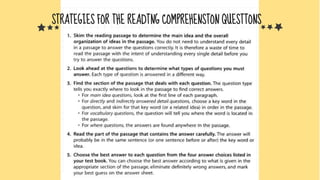
STRATEGIES FOR THE READTNG
COMPREHENSTON QUESTTONS 1. Main Idea Questions
3.Unstated Detailed
Question
NOV
202
0
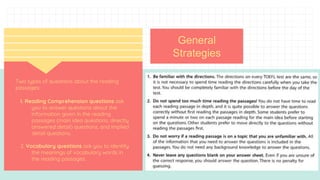
Two types of questions about the reading
passages:
l. Reading Comprehension questions ask
you to answer questions about the
information given in the reading
passages (main idea questions, directly
answered detail) questions, and implied
detail questions.
2. Vocabulary questions ask you to identify
the meanings of vocabulary words in
the reading passages.
General
Strategies
STRATEGIES FOR THE READTNG COMPREHENSTON QUESTTONS
SKILL 1
MAIN IDEA
QUESTION
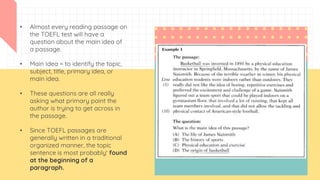
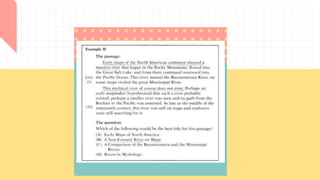
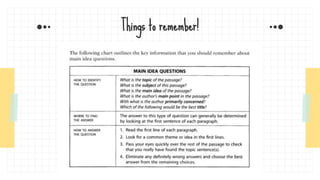
• Almost every reading passage on
the TOEFL test will have a
question about the main idea of
a passage.
• Main Idea = to identify the topic,
subject, title, primary idea, or
main idea.
• These questions are all really
asking what primary point the
author is trying to get across in
the passage.
• Since TOEFL passages are
generally written in a traditional
organized manner, the topic
sentence is most probably' found
at the beginning of a
paragraph.
Things to remember!
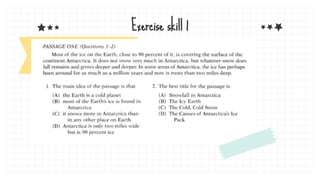
Exercise skill 1
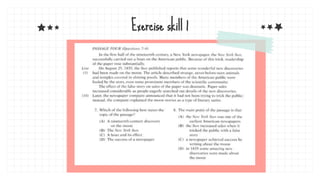
Exercise skill 1
SKILL 2
STATED DETAIL
QUESTION
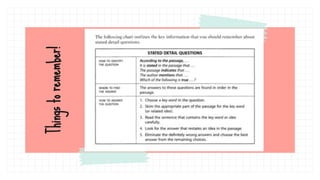
• A stated detail question asks
about one piece of information
in the passage rather than the
passage as a whole.
• The answers to these questions
are generally given in order in
the passage, and the correct
answer is often a restatement of
what is given in the passage.
• This means that the correct
answer often expresses the same
idea as what is written in the
passage, but the words are not
exactly the same.
Things
to
remember!
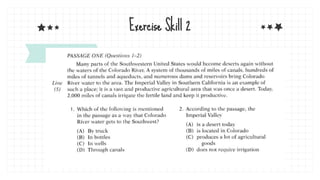
Exercise Skill 2
UNSTATED
DETAILED
QUESTION
Skill #3
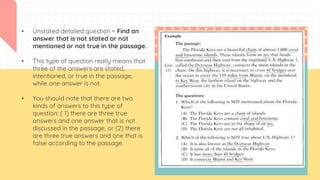
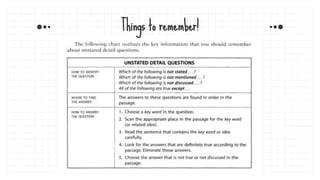
• Unstated detailed question = Find an
answer that is not stated or not
mentioned or not true in the passage.
• This type of question really means that
three of the answers are stated,
intentioned, or true in the passage,
while one answer is not.
• You should note that there are two
kinds of answers to this type of
question: ( 1) there are three true
answers and one answer that is not
discussed in the passage, or (2) there
are three true answers and one that is
false according to the passage.
Things to remember!
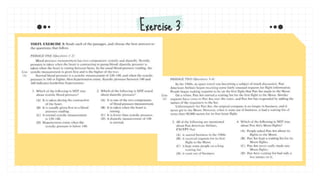
Exercise 3
CREDITS: This presentation template was
created by Slidesgo, including icons from
Flaticon, and infographics & images by Freepik
THANKS!
Please keep this slide as attribution

TOEFL ITP Reading Strategy.pptx

  • 1.
  • 2.
    TABLE OF CONTENTS GeneralStrategies 2. Stated Detailed Question STRATEGIES FOR THE READTNG COMPREHENSTON QUESTTONS 1. Main Idea Questions 3.Unstated Detailed Question
  • 3.
    NOV 202 0 Two types ofquestions about the reading passages: l. Reading Comprehension questions ask you to answer questions about the information given in the reading passages (main idea questions, directly answered detail) questions, and implied detail questions. 2. Vocabulary questions ask you to identify the meanings of vocabulary words in the reading passages. General Strategies
  • 4.
    STRATEGIES FOR THEREADTNG COMPREHENSTON QUESTTONS
  • 5.
  • 6.
    • Almost everyreading passage on the TOEFL test will have a question about the main idea of a passage. • Main Idea = to identify the topic, subject, title, primary idea, or main idea. • These questions are all really asking what primary point the author is trying to get across in the passage. • Since TOEFL passages are generally written in a traditional organized manner, the topic sentence is most probably' found at the beginning of a paragraph.
  • 8.
  • 9.
  • 10.
  • 11.
  • 12.
    • A stateddetail question asks about one piece of information in the passage rather than the passage as a whole. • The answers to these questions are generally given in order in the passage, and the correct answer is often a restatement of what is given in the passage. • This means that the correct answer often expresses the same idea as what is written in the passage, but the words are not exactly the same.
  • 13.
  • 14.
  • 15.
  • 16.
    • Unstated detailedquestion = Find an answer that is not stated or not mentioned or not true in the passage. • This type of question really means that three of the answers are stated, intentioned, or true in the passage, while one answer is not. • You should note that there are two kinds of answers to this type of question: ( 1) there are three true answers and one answer that is not discussed in the passage, or (2) there are three true answers and one that is false according to the passage.
  • 17.
  • 18.
  • 19.
    CREDITS: This presentationtemplate was created by Slidesgo, including icons from Flaticon, and infographics & images by Freepik THANKS! Please keep this slide as attribution