GENERAL STRATEGIES FOR READING
(Paper TOEFL ® Test)
 Be familiar with the directions. The directions on every paper TOEFL test are the
same, so it is not necessary to spend time reading the directions carefully when you
take the test. You should be completely familiar with the directions before the day
of the test.
 Do not spend too much time reading the passages. You do not have time to
read each passage in dept, and it is quite possible to answer the questions correctly
without first reading the passages in depth.
 Do not worry if a reading passage is on a topic you are unfamiliar with. All of
the information that you need to answer the questions is included in the passages.
You do not need any background knowledge to answer the questions.
 Do not spend too much time on a question you are unsure of. If you do not
know the answer to a question, simply guess and go on. You can return to this
question later in the section if you have time.
 Guess to complete the section before time is up. There is no penalty for
guessing so it can only increase your score to guess the answers to questions that
you do not have time to complete
PROCEDURES FOR A READING PASSAGE
(Paper TOEFL Test)
 Skim the reading passage to determine the main idea and overall organization of ideas
in the passage. You do not need to understand every detail in each passage to answer the
question correctly. It is therefore a waste of time to read the passage with the intent of
understanding every single detail before you try to answer the questions.
 Look ahead at the questions to determine what language skills are being tested in the
questions. Questions related to different language skills are answered in different ways.
 Find the section of the passage that deals with each question. The language skill tells you
exactly where to look in the passage to find correct answers.
 For main idea questions, look at the first line of each paragraph.
 For directly and indirectly answered detail questions, choose a key word in the question,
and skim for that key word (or a related idea) in order in the passage.
 For vocabulary questions, the question will tell you where the word is located in the
passage.
 For where-in-the passage questions, the answer choices give you the four possible locations
of the correct answer.
 Read the part of the passage that contains the answer carefully. The answer will probably
be in a very predictable place in the passage.
 Choose the best answer to each question from the four choices listed in your test
book. You can choose the best answer according to what is given in the appropriate section of
the passage, eliminate definitely wrong answers, and mark your best guess on the answer sheet.
TOEFL SKILL : MAIN IDEA QUESTIONS
Almost every reading passage on the paper TOEFL test or
computer test will have a multiple choice question about the
main idea of a passage. Such a question may be worded in a
variety of ways; you may, for example, be asked to identify the
topic, subject, title, primary idea, or main idea. These
questions are all really asking what primary point the author
is trying to get across in the passage. Since TOEFL passages
are generally written in a traditionally organized manner, it is
relatively easy to find the main ideas by studying the topic
sentences, which are most probably found at the beginning
of each paragraph.
MAIN IDEA QUESTIONS 
on both paper and computer tests
 What is the topic of the passage?
 What is the subject of the passage?
 What is the main idea of the passage?
 What is the author’s main point in the passage?
 With what is the author primarily concerned?
EXERCISE
The extremely hot and humid weather that occurs in the United States in July and
August is commonly called the “dog days” of summer. This name comes from the star
Sirius, which is known as the Dog Star. Sirius is the brightest visible star, and in the hot
summer months it rises in the east at approximately the same time as the Sun. As ancient
people saw this star rising with the Sun when the weather was at its hottest, they believed
that Sirius was the cause of the additional heat; they believed that this bright star added
its heat to the heat of the Sun and that these two together made summer weather so
unbearably hot.
The topic of this passage is
(A)the causes of the Dog Star.
(B)the causes of hot and humid weather.
(C)why the hot summer days are known as the “dog days”.
(D)the days that dogs prefer.
The main idea of this passage is that
(A)the name for the summer days came from Sirius, the Dog Star
(B)dogs generally prefer hot summer days
(C)the hottest days occur in the summer because of the movements of the Sun and stars
(D) Sirius rises at almost the same time as the Sun during the summer months.
C C
TOEFL SKILL : FIND “UNSTATED” DETAILS
You will sometimes be asked in the reading
section of both the paper TOEFL test and
the computer TOEFL test to find an answer
that is not stated or not mentioned or not
true in the passage. This type of question
really means that three of the answers are
stated, mentioned, or true in the passage,
while one answer is not.
“UNSTATED” DETAIL QUESTIONS 
On both paper and computer tests
Which of the following is not stated …?
Which of the following is not
mentioned…?
Which of the following is not discussed…?
All of the following are true expect….
EXERCISE
Blood pressure measurement has two components: systolic and diastolic.
Systolic pressure is taken when the heart is contracting to pump blood; diastolic
pressure is taken when the heart is resting between beats. In the usual blood
pressure reading, the systolic measurement is given first and is the higher of the
two.
Normal blood pressure is a systolic measurement of 140, and when the
systolic pressure is 160 or higher, then hypertension exist. Systolic pressure between
140 and 160 indicates borderline hypertension.
Which of the following is NOT true about systolic blood pressure?
(A)It is taken during the contraction of the heart.
(B)It is usually given first in a blood pressure reading.
(C)A normal systolic measurement is 140
(D)Hypertension exists when the systolic pressure is below 140.
Which of the following is NOT stated about diastolic pressure?
(A)It is one of the components of blood pressure measurement.
(B)It is taken when the heart is resting.
(C)It is lower than systolic pressure.
(D)A diastolic measurement of 140 is normal.
D D
TOEFL SKILL : IMPLIED DETAIL QUESTIONS
Implied detail questions may be found on both the paper TOEFL
test and the computer TOEFL test. In this type of question, you
will be asked to answer a multiple choice question about a
reading passage by drawing a conclusion from a specific detail or
details in the passage. Questions of this type contain the words
implied, inferred, likely, or probably to let you know that the
answer to the question is not directly stated. In this type of
question, it is important to understand that you do not have to
“pull the answer out of thin air”. Instead, some information will
be given in the passage, and you will draw a conclusion from that
information. Look at a multiple choice example of an implied
detail question from the paper test TOEFL.
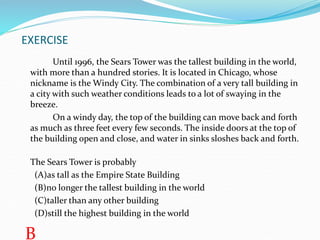
EXERCISE
Until 1996, the Sears Tower was the tallest building in the world,
with more than a hundred stories. It is located in Chicago, whose
nickname is the Windy City. The combination of a very tall building in
a city with such weather conditions leads to a lot of swaying in the
breeze.
On a windy day, the top of the building can move back and forth
as much as three feet every few seconds. The inside doors at the top of
the building open and close, and water in sinks sloshes back and forth.
The Sears Tower is probably
(A)as tall as the Empire State Building
(B)no longer the tallest building in the world
(C)taller than any other building
(D)still the highest building in the world
B
IMPLIED DETAIL QUESTIONS 
On both paper and computer tests
It is implied in the passage that …
It can be inferred from the passage
that…
It is most likely that…
What probably happened…?
TOEFL SKILL : PRONOUN REFERENTS
Reference questions ask what noun (called the
referent) a pronoun or some other expression
refers to. The correct answer is not always the noun
that is closest to the pronoun in the passage.
Incorrect choices are usually other nouns that
appear in the passage. If you are unable to decide
immediately which answer is correct, substitute
the four choices for the word that is being asked
about. Which one is the most logical substitute?
The pronoun “...” in line X refers to which of the
following?
EXERCISE
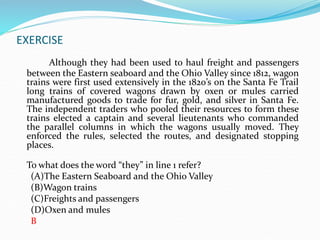
Although they had been used to haul freight and passengers
between the Eastern seaboard and the Ohio Valley since 1812, wagon
trains were first used extensively in the 1820’s on the Santa Fe Trail
long trains of covered wagons drawn by oxen or mules carried
manufactured goods to trade for fur, gold, and silver in Santa Fe.
The independent traders who pooled their resources to form these
trains elected a captain and several lieutenants who commanded
the parallel columns in which the wagons usually moved. They
enforced the rules, selected the routes, and designated stopping
places.
To what does the word “they” in line 1 refer?
(A)The Eastern Seaboard and the Ohio Valley
(B)Wagon trains
(C)Freights and passengers
(D)Oxen and mules
B
DETERMINE MEANINGS FROM WORD PARTS
When you are asked to determine the
meaning of a long word that you do not
know in the reading Comprehension
section of the TOEFL test, it is
sometimes possible to determine the
meaning of the word by studying the
word parts.
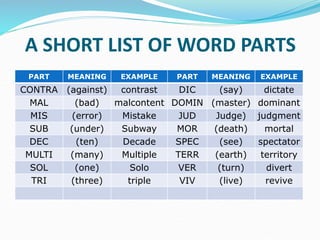
A SHORT LIST OF WORD PARTS
PART MEANING EXAMPLE PART MEANING EXAMPLE
CONTRA (against) contrast DIC (say) dictate
MAL (bad) malcontent DOMIN (master) dominant
MIS (error) Mistake JUD Judge) judgment
SUB (under) Subway MOR (death) mortal
DEC (ten) Decade SPEC (see) spectator
MULTI (many) Multiple TERR (earth) territory
SOL (one) Solo VER (turn) divert
TRI (three) triple VIV (live) revive
EXERCISE
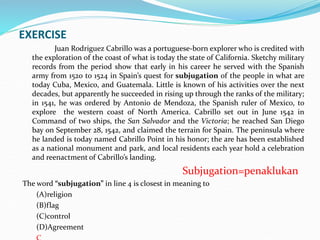
Juan Rodriguez Cabrillo was a portuguese-born explorer who is credited with
the exploration of the coast of what is today the state of California. Sketchy military
records from the period show that early in his career he served with the Spanish
army from 1520 to 1524 in Spain’s quest for subjugation of the people in what are
today Cuba, Mexico, and Guatemala. Little is known of his activities over the next
decades, but apparently he succeeded in rising up through the ranks of the military;
in 1541, he was ordered by Antonio de Mendoza, the Spanish ruler of Mexico, to
explore the western coast of North America. Cabrillo set out in June 1542 in
Command of two ships, the San Salvador and the Victoria; he reached San Diego
bay on September 28, 1542, and claimed the terrain for Spain. The peninsula where
he landed is today named Cabrillo Point in his honor; the are has been established
as a national monument and park, and local residents each year hold a celebration
and reenactment of Cabrillo’s landing.
Subjugation=penaklukan
The word “subjugation” in line 4 is closest in meaning to
(A)religion
(B)flag
(C)control
(D)Agreement
TOEFL WORKSHOP READING SECTION how to tackle Reading Section.ppt

TOEFL WORKSHOP READING SECTION how to tackle Reading Section.ppt

  • 2.
    GENERAL STRATEGIES FORREADING (Paper TOEFL ® Test)  Be familiar with the directions. The directions on every paper TOEFL test are the same, so it is not necessary to spend time reading the directions carefully when you take the test. You should be completely familiar with the directions before the day of the test.  Do not spend too much time reading the passages. You do not have time to read each passage in dept, and it is quite possible to answer the questions correctly without first reading the passages in depth.  Do not worry if a reading passage is on a topic you are unfamiliar with. All of the information that you need to answer the questions is included in the passages. You do not need any background knowledge to answer the questions.  Do not spend too much time on a question you are unsure of. If you do not know the answer to a question, simply guess and go on. You can return to this question later in the section if you have time.  Guess to complete the section before time is up. There is no penalty for guessing so it can only increase your score to guess the answers to questions that you do not have time to complete
  • 3.
    PROCEDURES FOR AREADING PASSAGE (Paper TOEFL Test)  Skim the reading passage to determine the main idea and overall organization of ideas in the passage. You do not need to understand every detail in each passage to answer the question correctly. It is therefore a waste of time to read the passage with the intent of understanding every single detail before you try to answer the questions.  Look ahead at the questions to determine what language skills are being tested in the questions. Questions related to different language skills are answered in different ways.  Find the section of the passage that deals with each question. The language skill tells you exactly where to look in the passage to find correct answers.  For main idea questions, look at the first line of each paragraph.  For directly and indirectly answered detail questions, choose a key word in the question, and skim for that key word (or a related idea) in order in the passage.  For vocabulary questions, the question will tell you where the word is located in the passage.  For where-in-the passage questions, the answer choices give you the four possible locations of the correct answer.  Read the part of the passage that contains the answer carefully. The answer will probably be in a very predictable place in the passage.  Choose the best answer to each question from the four choices listed in your test book. You can choose the best answer according to what is given in the appropriate section of the passage, eliminate definitely wrong answers, and mark your best guess on the answer sheet.
  • 4.
    TOEFL SKILL :MAIN IDEA QUESTIONS Almost every reading passage on the paper TOEFL test or computer test will have a multiple choice question about the main idea of a passage. Such a question may be worded in a variety of ways; you may, for example, be asked to identify the topic, subject, title, primary idea, or main idea. These questions are all really asking what primary point the author is trying to get across in the passage. Since TOEFL passages are generally written in a traditionally organized manner, it is relatively easy to find the main ideas by studying the topic sentences, which are most probably found at the beginning of each paragraph.
  • 5.
    MAIN IDEA QUESTIONS on both paper and computer tests  What is the topic of the passage?  What is the subject of the passage?  What is the main idea of the passage?  What is the author’s main point in the passage?  With what is the author primarily concerned?
  • 6.
    EXERCISE The extremely hotand humid weather that occurs in the United States in July and August is commonly called the “dog days” of summer. This name comes from the star Sirius, which is known as the Dog Star. Sirius is the brightest visible star, and in the hot summer months it rises in the east at approximately the same time as the Sun. As ancient people saw this star rising with the Sun when the weather was at its hottest, they believed that Sirius was the cause of the additional heat; they believed that this bright star added its heat to the heat of the Sun and that these two together made summer weather so unbearably hot. The topic of this passage is (A)the causes of the Dog Star. (B)the causes of hot and humid weather. (C)why the hot summer days are known as the “dog days”. (D)the days that dogs prefer. The main idea of this passage is that (A)the name for the summer days came from Sirius, the Dog Star (B)dogs generally prefer hot summer days (C)the hottest days occur in the summer because of the movements of the Sun and stars (D) Sirius rises at almost the same time as the Sun during the summer months. C C
  • 7.
    TOEFL SKILL :FIND “UNSTATED” DETAILS You will sometimes be asked in the reading section of both the paper TOEFL test and the computer TOEFL test to find an answer that is not stated or not mentioned or not true in the passage. This type of question really means that three of the answers are stated, mentioned, or true in the passage, while one answer is not.
  • 8.
    “UNSTATED” DETAIL QUESTIONS On both paper and computer tests Which of the following is not stated …? Which of the following is not mentioned…? Which of the following is not discussed…? All of the following are true expect….
  • 9.
    EXERCISE Blood pressure measurementhas two components: systolic and diastolic. Systolic pressure is taken when the heart is contracting to pump blood; diastolic pressure is taken when the heart is resting between beats. In the usual blood pressure reading, the systolic measurement is given first and is the higher of the two. Normal blood pressure is a systolic measurement of 140, and when the systolic pressure is 160 or higher, then hypertension exist. Systolic pressure between 140 and 160 indicates borderline hypertension. Which of the following is NOT true about systolic blood pressure? (A)It is taken during the contraction of the heart. (B)It is usually given first in a blood pressure reading. (C)A normal systolic measurement is 140 (D)Hypertension exists when the systolic pressure is below 140. Which of the following is NOT stated about diastolic pressure? (A)It is one of the components of blood pressure measurement. (B)It is taken when the heart is resting. (C)It is lower than systolic pressure. (D)A diastolic measurement of 140 is normal. D D
  • 10.
    TOEFL SKILL :IMPLIED DETAIL QUESTIONS Implied detail questions may be found on both the paper TOEFL test and the computer TOEFL test. In this type of question, you will be asked to answer a multiple choice question about a reading passage by drawing a conclusion from a specific detail or details in the passage. Questions of this type contain the words implied, inferred, likely, or probably to let you know that the answer to the question is not directly stated. In this type of question, it is important to understand that you do not have to “pull the answer out of thin air”. Instead, some information will be given in the passage, and you will draw a conclusion from that information. Look at a multiple choice example of an implied detail question from the paper test TOEFL.
  • 11.
    EXERCISE Until 1996, theSears Tower was the tallest building in the world, with more than a hundred stories. It is located in Chicago, whose nickname is the Windy City. The combination of a very tall building in a city with such weather conditions leads to a lot of swaying in the breeze. On a windy day, the top of the building can move back and forth as much as three feet every few seconds. The inside doors at the top of the building open and close, and water in sinks sloshes back and forth. The Sears Tower is probably (A)as tall as the Empire State Building (B)no longer the tallest building in the world (C)taller than any other building (D)still the highest building in the world B
  • 12.
    IMPLIED DETAIL QUESTIONS On both paper and computer tests It is implied in the passage that … It can be inferred from the passage that… It is most likely that… What probably happened…?
  • 13.
    TOEFL SKILL :PRONOUN REFERENTS Reference questions ask what noun (called the referent) a pronoun or some other expression refers to. The correct answer is not always the noun that is closest to the pronoun in the passage. Incorrect choices are usually other nouns that appear in the passage. If you are unable to decide immediately which answer is correct, substitute the four choices for the word that is being asked about. Which one is the most logical substitute? The pronoun “...” in line X refers to which of the following?
  • 14.
    EXERCISE Although they hadbeen used to haul freight and passengers between the Eastern seaboard and the Ohio Valley since 1812, wagon trains were first used extensively in the 1820’s on the Santa Fe Trail long trains of covered wagons drawn by oxen or mules carried manufactured goods to trade for fur, gold, and silver in Santa Fe. The independent traders who pooled their resources to form these trains elected a captain and several lieutenants who commanded the parallel columns in which the wagons usually moved. They enforced the rules, selected the routes, and designated stopping places. To what does the word “they” in line 1 refer? (A)The Eastern Seaboard and the Ohio Valley (B)Wagon trains (C)Freights and passengers (D)Oxen and mules B
  • 15.
    DETERMINE MEANINGS FROMWORD PARTS When you are asked to determine the meaning of a long word that you do not know in the reading Comprehension section of the TOEFL test, it is sometimes possible to determine the meaning of the word by studying the word parts.
  • 16.
    A SHORT LISTOF WORD PARTS PART MEANING EXAMPLE PART MEANING EXAMPLE CONTRA (against) contrast DIC (say) dictate MAL (bad) malcontent DOMIN (master) dominant MIS (error) Mistake JUD Judge) judgment SUB (under) Subway MOR (death) mortal DEC (ten) Decade SPEC (see) spectator MULTI (many) Multiple TERR (earth) territory SOL (one) Solo VER (turn) divert TRI (three) triple VIV (live) revive
  • 17.
    EXERCISE Juan Rodriguez Cabrillowas a portuguese-born explorer who is credited with the exploration of the coast of what is today the state of California. Sketchy military records from the period show that early in his career he served with the Spanish army from 1520 to 1524 in Spain’s quest for subjugation of the people in what are today Cuba, Mexico, and Guatemala. Little is known of his activities over the next decades, but apparently he succeeded in rising up through the ranks of the military; in 1541, he was ordered by Antonio de Mendoza, the Spanish ruler of Mexico, to explore the western coast of North America. Cabrillo set out in June 1542 in Command of two ships, the San Salvador and the Victoria; he reached San Diego bay on September 28, 1542, and claimed the terrain for Spain. The peninsula where he landed is today named Cabrillo Point in his honor; the are has been established as a national monument and park, and local residents each year hold a celebration and reenactment of Cabrillo’s landing. Subjugation=penaklukan The word “subjugation” in line 4 is closest in meaning to (A)religion (B)flag (C)control (D)Agreement