futureagenda.org
What do you think? Join In | Add your views into the mix
Aging
Cities
Commerce
Connectivity
Data
Education
Energy
Food
Government
Loyalty
Privacy
Resources
Transport
Travel
Water
Wealth
Work
Health
Learning
1
Laura Carstensen - Fairleigh S. Dickinson Jr. Professor in Public Policy,
Professor of Psychology, Director, Stanford Center on Longevity.
The Future of Ageing
Advances in science and technology coupled
with large-scale changes in health practices
involving improved sanitation, water
purification, and a host of lifestyle changes
have led to dramatic increases in longevity
in developed nations around the world. On a
global scale, life expectancies in developed
regions are continuing to rise in the 21st
century and, although most people assume
that there are biological limits on life span,
so far there is little evidence that we are
approaching them.1
Because fertility declined
across the same years that life expectancies
increased, the distribution of age in the
global population changed irrevocably.
The once-universal pyramid shapes of age
distributions of populations in the western
world, with many young ones at the bottom
narrowing to tiny peaks at the tops, are being
rectangularized, reflecting the fact that most
people, not just an exceptional few, are living
into old age.
To the extent that the importance of aging
societies is recognized at all, anxiety is the
typical response. Terms like “grey tsunami”
imply that larger numbers of older citizens
will become a drain on societies. Concern
is warranted. The demographic changes
underway are fundamentally altering virtually
all aspects of life as we know it. Workforces
are becoming older and more age diversified
than ever in history. Families are having
fewer children, yet four and five generations
are alive at the same time. Education has
come to predict well-being and even length
of life, yet is unevenly distributed, creating
heightened disparities across socioeconomic
strata accentuating old age outcomes
between rich and poor.
Lifespan Limits
On a global scale, life
expectancies in developed
regions are continuing to
rise in the 21st century and,
although most people assume
that there are biological limits
on life span, so far there is
little evidence that we are
approaching them.
Age Diversified Workforces
The demographic changes
underway are fundamentally
altering virtually all aspects of
life as we know it. Workforces
are becoming older and more
age diversified than ever in
history.
The Global ChallengeAging
Cities
Commerce
Connectivity
Data
Education
Energy
Food
Government
Loyalty
Privacy
Resources
Transport
Travel
Water
Wealth
Work
Health
Learning
Options and PossibilitesAging
Cities
Commerce
Connectivity
Data
Education
Energy
Food
Government
Loyalty
Privacy
Resources
Transport
Travel
Water
Wealth
Work
Health
Learning
Culture Shift
The culture that guides
people through life today
is a culture that evolved
around shorter lives. The
urgent challenge now is to
create cultures that support
people through ten and more
decades of life.
To date, however, the concern has been
largely misplaced, with the emphasis on
aging as opposed to an emphasis on the
cultures that surrounds very long lives. By
culture, we are referring to the crucible that
holds science, technology, and large scale
behavioral practices and social norms. We
maintain that the more serious problems
concern antiquated social norms and the
lack of cultural supports for people 50 and
older, such as medical treatments for common
diseases of old age and technologies and
services that allow people to age in place,
and social norms that encourage life-long
participation in communities, families and
workplaces.The culture that guides people
through life today is a culture that evolved
around shorter lives.The urgent challenge
now is to create cultures that support people
through ten and more decades of life.
Although predictions about the future are
always perilous, we can comfortably predict
that life will change and can change such
that longer lives improve quality of life at all
ages. Unfortunately to date we have been
decidedly uncreative about ways to use added
years of life.These years have been tacitly
tacked on to the end of life, with old age
the only stage in life that has gotten longer.
Rather than move forward by happenstance,
we need strategic thinking about how to best
use added decades of life. Helping individuals
and nations visualize, plan and prepare is
essential in order to ensure that longer lives
are high quality.
Changing the nature, timing and duration of
work will be key. Individuals and societies
must effectively finance very long lives and so
far we are doing a poor job. Life expectancy
at age 65 for the world’s population increased
by roughly fifty percent from the 1950s to
the present time, while the average age of
retirement has remained relatively constant.2
Between now and 2030, the number of people
in developed countries over the “conventional”
retirement age of 65 will increase by more
than thirty percent.At the same time, the size
of the conventional working-age population
in developed countries is projected to
decline by four percent.To the extent that
nothing changes, the ratio of the working-age
population to retirees will steadily decrease
in the foreseeable future. Of course, these
projections are based on the assumption that
people continue to retire at relatively young
ages. One obvious, although surprisingly
ignored, way to address the challenges
posed by the declining number and share
of working-age population is to expand
the workforce by increasing the workforce
participation of older workers and, in some
countries, women.
Increasingly, research findings suggest that
this is feasible.A substantial majority of
people 60 to 70 years of age report that they
are physically able to work.A 2014 paper
published in the Journal of Gerontology
found that 85% of Americans aged 65-69
report no health-based limitations on paid
work or housework.3
Similar trends are
evident in Europe.4
To be sure, the numbers of
disabled individuals has, and will continue to,
increase in aging societies and it is extremely
important to have policies that support
people who cannot work. We maintain
that the generosity of disability insurance
should increase, yet we must recognize that
chronological age is a poor predictor of the
ability to work. Even at very advanced ages,
substantial numbers of people are sufficiently
healthy to contribute to workplaces.
Societies that find ways to tap older peoples’
contributions will benefit greatly.
Although the idea of longer working lives
often meets resistance, evidence for the
benefits of work to individuals is growing.
Arguably, the most obvious reason to work
longer is the financial benefit. For many,
retirement at age 65 is economically
infeasible. In the words of Stanford economist
John Shoven,“the reality is that few workers
can fund a 30 year retirement with a 40 year
career”.5
Neither can societies. In recent
years, it is becoming clear that remaining
active and engaged in work is also associated
with physical, socioemotional, and cognitive
benefits. Studies of healthy aging suggest
that older adults who are engaged have lower
mortality rates, are less likely to experience
various physical and mental illnesses, and
are more likely to have a strong sense of
identity and well-being.6
Working longer
also has protective effects against cognitive
decline,7
ostensibly by providing a mentally
engaging environment where workers can
“use it” so they don’t “lose it.” Research
suggests that both paid and unpaid work are
associated with enhanced well-being, delayed
disability, decreased mortality risk, and onset
of fewer diseases and associated functional
impairments.8,9,10,11
New models of working
longer can relieve some of the pressure
to save large sums of money for extended
periods of leisure. Importantly, working longer
can mean working differently. Many workers
would be happy to exchange decades-long
retirements in old age for four day work
weeks, regular time off for sabbaticals,
retraining, and part-time work when children
are young as well as at advanced ages as
people fade into retirement.
2
Looking Ahead
Rather than move forward
by happenstance, we need
strategic thinking about how
to best use added decades of
life. Helping individuals and
nations visualize, plan and
prepare is essential in order
to ensure that longer lives
are high quality.
Societal Benefit
85% of Americans aged 65-
69 report no health-based
limitations on paid work or
housework. Similar trends are
evident in Europe… Societies
that find ways to tap older
peoples’ contributions will
benefit greatly.
Infeasible Retirement
For many, retirement at age
65 is economically infeasible.
In the words of Stanford
economist John Shoven,“the
reality is that few workers can
fund a 30 year retirement with
a 40 year career”. Neither
can societies.
What do you think? Join In | Add your views into the mix
Proposed Way ForwardAging
Cities
Commerce
Connectivity
Data
Education
Energy
Food
Government
Loyalty
Privacy
Resources
Transport
Travel
Water
Wealth
Work
Health
Learning
3
From a societal perspective, there is a
pressing need to make use of the human
capital represented in older people. General
knowledge and expertise increase with
age, as do emotional stability and the
motivation to invest in important activities.
If appropriately utilized, older populations
can benefit national and global economies.
Yet the clarion call to workers today is about
saving for increasingly long retirements,
instead of actively planning to work longer.
In the US, the responsibility for saving has
shifted to the individual, reflecting the
move from defined benefit plans to defined
contribution plans. Unfortunately, the
change has resulted in considerable under-
saving for retirements. In a 2014 Retirement
Confidence Survey, only 64% of all workers
age 25 and older reported that they and
their spouse had saved at all for retirement,
a decrease from 75% in 2009.12
Overall, 60%
of workers report that they have less than
$25,000 in total savings and investments,
with over one third reporting less than
$1,000 in total savings.13
If appropriate
steps are not taken, there could be
catastrophic economic implications to both
individuals and societies, as low retirement
savings could lead to major strains on
economies.
For those who have inadequate retirement
savings, the most obvious solution is to work
longer. This approach may hold benefits that
extend beyond income to include better
physical health and cognitive functioning.
One major potential barrier, however, is
that employers remain ambivalent about
older workers. Currently, most employers’
view older workers as expensive and
sometimes less productive than younger
workers. Research findings increasingly
suggest that the latter reflects stereotypes
more than evidence. The productivity of
workers tends to increase with age. This
is especially true for knowledge workers,
yet blue collar workers also can retain
(and perhaps increase) productivity.14
One
study that measured the performance of
more than 400 McDonald’s restaurants
across the UK found that restaurants that
employed mixed-age workforces, including
workers age 60 and above, delivered an
average increase of twenty percent in
customer satisfaction levels compared to
less age diverse workforces.15
Moreover,
there is a net benefit of intergenerational
teams on workplace productivity, including
a broader range of skills and experience
across the workforce, increased mentorship
opportunities and skills transfer, a reduction
in turnover, and increased staff morale.16,17
Companies that adapt to older workers’
needs using cost-efficient measures such
as flexible work arrangements, workplace
modifications, and on-the-job training can
benefit from age diversity in the workforce.18
BMW’s older worker production line at
Dingolfing is an example of how thoughtful
design of blue-collar workplaces can
support high levels of productivity in older
workers. The company collaborated with
its older production workers to tailor one
of its most labor intensive manufacturing
lines to an average worker age of 47. The
resultant line reached its production goals
with defect rate and worker absenteeism
meeting or exceeding the levels achieved by
“younger” lines.19
The cost of older workers
is a real issue for employers. By leveraging
older workers as source of human capital,
employers can better manage their talent,
facilitate knowledge transfer to younger
workers, and help older workers slowly
phase into retirement. Offering bridge jobs
or flexible work arrangements such as
flex hours and part-time work will allow
employers to retain the expertise of older
workers while reducing costs.20,21
What do you think? Join In | Add your views into the mix
Working Longer
For those who have
inadequate retirement
savings, the most obvious
solution is to work longer...
One major potential barrier,
however, is that employers
remain ambivalent about
older workers.
Cost of Older Workers
The cost of older workers is
a real issue for employers.
By leveraging older workers
as source of human capital,
employers can better
manage their talent, facilitate
knowledge transfer to
younger workers, and help
older workers slowly phase
into retirement. Offering
bridge jobs or flexible work
arrangements such as flex
hours and part-time work will
allow employers to retain the
expertise of older workers
while reducing costs
4
What do you think? Join In | Add your views into the mix
Dire predictions that a “Grey Tsunami” will
overwhelm economies with unproductive
societies harken back to Thomas Malthus’
1798 “Essay on the Principle of Population”.
There, Malthus predicted that growing
populations would outrun the food supply,
leading to poverty and starvation. The
prediction did not foresee the development
of agricultural technologies that greatly
increased food production. In the case of
older populations, predictions about economic
disaster change to discussions of economic
growth if people remain productive into
advanced ages. Rather than a problem, we
may be experiencing one of the greatest
opportunities ever in history to dramatically
improve quality of life at all ages.
The Bigger Opportunity
In the case of older
populations, predictions
about economic disaster
change to discussions of
economic growth if people
remain productive into
advanced ages. Rather
than a problem, we may
be experiencing one of the
greatest opportunities ever
in history to dramatically
improve quality of life at
all ages.
Impacts and ImplicationsAging
Cities
Commerce
Connectivity
Data
Education
Energy
Food
Government
Loyalty
Privacy
Resources
Transport
Travel
Water
Wealth
Work
Health
Learning
1
Oeppen, J. and J. W.Vaupel: Broken limits to life expectancy.
Science 296, 1029-1031 (2002).
2
“Population Facts”, United Nations Department of Economic
and Social Affairs, Population Division, December, 20-13
3
Lowsky, Olshansky, Bhattacharya, Goldman,“Heterogeneity in
Healthy Aging”, J Gerontol A Biol Sci Med Sci first published
online November 17, 2013 doi:10.1093/gerona/glt162
4
A. Börsch-Supan, Myths, Scientific Evidence and Economic
Policy in an Aging World, J. Econ.Ageing, 1–2 (2013), pp. 3–15
5
Ford, John Patrick. 2014.“How to support
a 30-year retirement.” San Diego Source.
http://www.sddt.com/Commentary/article.
cfm?SourceCode=20141106tza&Commentary_ID=12&_
t=How+to+support+a+30year+retirement#.VL6ykS6AyjI
6
Rowe, John W. and Robert L. Kahn. 1998. Successful
Aging. New York: Pantheon; Cohen, Sheldon. 2004.“Social
Relationship and Health.”American Psychologist 59:676-684.
7
Rohwedder, Susann and Robert J.Willis. 2010.“Mental
Retirement.” Journal of Economic Perspectives. 24:119-138
8
Rohwedder, Susann, and Robert J.Willis. 2010.“Mental
Retirement.” Journal of Economic Perspectives, 24(1): 119-38.
9
Carr DC, Komp K, editors.“Gerontology in the era of the
third age: implications and next steps.” New York: Springer
Publishers; 2011: 207-224
10
Morrow-Howell N, Hinterlong J, Rozario PA,Tang F.“Effects
of volunteering on the well-being of older adults.” J
Gerontol B Psychol Sci Soc Sci. 2003; 58B:S137–S145. Doi:
10.1093/geronb/58.3.S137
11
Matz-Costa C, Besen E, James JB, Pitt-Catsouphes M.
“Differential impact of multiple levels of productive activity
engagement on psychological well-being in middle and later
life.”The Gerontologist. 2012. Doi: 10.1093/geront/gns148
12
Employee Benefit Research Institute. 2014.“2014
Retirement Confidence Survey.” http://www.ebri.org/pdf/
surveys/rcs/2014/RCS14.FS-6.Prep-Ret.Final.pdf
13
Ibid.
14
Burtless, G.(2013).The Impact of Population Aging and
Delayed Retirement on Work-force Productivity.Tech. rep.,
Center for Retirement Research at Boston College.
15
Department for Work and Pensions (UK). 2011.“Employing
Older Worker Case Studies.” https://www.gov.uk/government/
uploads/system/uploads/attachment_data/file/142752/
employing-older-workers-case-studies.pdf
16
Ilmakunnas et al.“Diversity at the workplace: Whom
does it benefit?” Helsinki School of Economics. http://www.
eale.nl/conference2009/Programme/PapersC/add102508_
wKXraqYSnk.pdf
17
Department for Work and Pensions (UK). 2013.“Employing
an Older Workforce,An Employer’s Guide to Today’s Multi-
generational Workforce. https://www.gov.uk/government/
uploads/system/uploads/attachment_data/file/142751/
emplying-older-workers.pdf
18
Brooks. 2014.“Productivity and Age.”Age UK.
http://www.50plusworks.com/downloads/Age%20and%20
productivity%20briefing%20(March%202014).pdf
19
Loch, C.H, Sting, F.J, Bauer, N, & Mauermann, H. (2010). How
BMW Is Defusing the Demographic Time Bomb. Harvard
Business Review, 88(3), 99–102. Retrieved from http://hdl.
handle.net/1765/20802
20
CIPD. 2012.“Managing a Healthy Ageing Workforce,A
National Business Imperative.” http://www.cipd.co.uk/binaries/
managing-a-healthy-ageing-workforce-a-national-business-
imperative_2012.pdf
21
Backes-Glenner & Veen. 2009.“The Impact of Aging and Age
Diversity on Company Performance.” Institute for Strategy and
Business Economics, University of Zurich. http://www.zora.uzh.
ch/48541/1/Backes Gellner_The_impact_of_aging_and_
age_diversity_on_company_performance-V.pdf
5
Fairleigh S. Dickinson Jr. Professor in Public
Policy, Professor of Psychology, Director,
Stanford Center on Longevity.
Lead expert on the Future of Ageing
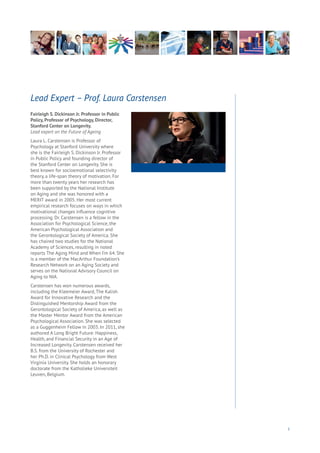
Laura L. Carstensen is Professor of
Psychology at Stanford University where
she is the Fairleigh S. Dickinson Jr. Professor
in Public Policy and founding director of
the Stanford Center on Longevity. She is
best known for socioemotional selectivity
theory, a life-span theory of motivation. For
more than twenty years her research has
been supported by the National Institute
on Aging and she was honored with a
MERIT award in 2005. Her most current
empirical research focuses on ways in which
motivational changes influence cognitive
processing. Dr. Carstensen is a fellow in the
Association for Psychological Science, the
American Psychological Association and
the Gerontological Society of America. She
has chaired two studies for the National
Academy of Sciences, resulting in noted
reports The Aging Mind and When I’m 64. She
is a member of the MacArthur Foundation’s
Research Network on an Aging Society and
serves on the National Advisory Council on
Aging to NIA.
Carstensen has won numerous awards,
including the Kleemeier Award, The Kalish
Award for Innovative Research and the
Distinguished Mentorship Award from the
Gerontological Society of America, as well as
the Master Mentor Award from the American
Psychological Association. She was selected
as a Guggenheim Fellow in 2003. In 2011, she
authored A Long Bright Future: Happiness,
Health, and Financial Security in an Age of
Increased Longevity. Carstensen received her
B.S. from the University of Rochester and
her Ph.D. in Clinical Psychology from West
Virginia University. She holds an honorary
doctorate from the Katholieke Universiteit
Leuven, Belgium.
Lead Expert – Prof. Laura Carstensen
6
What do you think? Join In | Add your views into the mix
Senior Research Scholar and Director,
Mobility Division
Lead expert on the Future of Ageing.
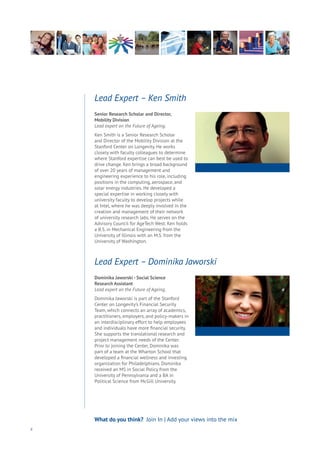
Ken Smith is a Senior Research Scholar
and Director of the Mobility Division at the
Stanford Center on Longevity. He works
closely with faculty colleagues to determine
where Stanford expertise can best be used to
drive change. Ken brings a broad background
of over 20 years of management and
engineering experience to his role, including
positions in the computing, aerospace, and
solar energy industries. He developed a
special expertise in working closely with
university faculty to develop projects while
at Intel, where he was deeply involved in the
creation and management of their network
of university research labs. He serves on the
Advisory Council for AgeTech West. Ken holds
a B.S. in Mechanical Engineering from the
University of Illinois with an M.S. from the
University of Washington.
Lead Expert – Ken Smith
Dominika Jaworski - Social Science
Research Assistant
Lead expert on the Future of Ageing.
Dominika Jaworski is part of the Stanford
Center on Longevity’s Financial Security
Team, which connects an array of academics,
practitioners, employers, and policy-makers in
an interdisciplinary effort to help employees
and individuals have more financial security.
She supports the translational research and
project management needs of the Center.
Prior to joining the Center, Dominika was
part of a team at the Wharton School that
developed a financial wellness and investing
organization for Philadelphians. Dominika
received an MS in Social Policy from the
University of Pennsylvania and a BA in
Political Science from McGill University.
Lead Expert – Dominika Jaworski
About Future Agenda
7
In an increasingly interconnected, complex
and uncertain world, many organisations
are looking for a better understanding
of how the future may unfold. To do this
successfully, many companies, institutions
and governments are working to improve
their use of strategic foresight in order to
anticipate emerging issues and prepare for
new opportunities.
Experience shows that change often occurs
at the intersection of different disciplines,
industries or challenges. This means that
views of the future that focus on one sector
alone have limited relevance in today’s world.
In order to have real value, foresight needs
to bring together multiple informed and
credible views of emerging change to form
a coherent picture of the world ahead. The
Future Agenda programme aims to do this
by providing a global platform for collective
thought and innovation discussions.
Get Involved
To discuss the future agenda programme and
potential participation please contact:
Dr.Tim Jones
Programme Director
Future Agenda
84 Brook Street, London. W1K 5EH
+44 203 0088 141 +44 780 1755 054
tim.jones@futureagenda.org
@futureagenda
The Future Agenda is the world’s largest open
foresight initiative. It was created in 2009 to
bring together views on the future from many
leading organizations. Building on expert
perspectives that addressed everything from
the future of health to the future of money,
over 1500 organizations debated the big
issues and emerging challenges for the next
decade. Sponsored globally by Vodafone
Group, this groundbreaking programme
looked out ten years to the world in 2020
and connected CEOs and mayors with
academics and students across 25 countries.
Additional online interaction connected over
50,000 people from more than 145 countries
who added their views to the mix. All output
from these discussions was shared via the
futureagenda.org website.
The success of the first Future Agenda
Programme stimulated several organizations
to ask that it should be repeated. Therefore
this second programme is running
throughout 2015 looking at key changes
in the world by 2025. Following a similar
approach to the first project, Future Agenda
2.0 builds on the initial success and adds
extra features, such as providing more
workshops in more countries to gain an
even wider input and enable regional
differences to be explored. There is also
a specific focus on the next generation
including collaborating with educational
organizations to engage future leaders. There
is a more refined use of social networks
to share insights and earlier link-ups with
global media organizations to ensure wider
engagement on the pivotal topics. In addition,
rather than having a single global sponsor,
this time multiple hosts are owning specific
topics wither globally or in their regions of
interest. Run as a not for profit project, Future
Agenda 2.0 is a major collaboration involving
many leading, forward-thinking organisations
around the world.
Context – Why Foresight?
Future Agenda 1.0 Future Agenda 2.0
What do you think? Join In | Add your views into the mix www.futureagenda.org

Future of ageing An initial perspective by Prof. Laura Carstensen, Ken Smith and Dominika Jaworski at Stanford Center on Longevityure of ageing initial perspective

  • 1.
    futureagenda.org What do youthink? Join In | Add your views into the mix Aging Cities Commerce Connectivity Data Education Energy Food Government Loyalty Privacy Resources Transport Travel Water Wealth Work Health Learning 1 Laura Carstensen - Fairleigh S. Dickinson Jr. Professor in Public Policy, Professor of Psychology, Director, Stanford Center on Longevity. The Future of Ageing Advances in science and technology coupled with large-scale changes in health practices involving improved sanitation, water purification, and a host of lifestyle changes have led to dramatic increases in longevity in developed nations around the world. On a global scale, life expectancies in developed regions are continuing to rise in the 21st century and, although most people assume that there are biological limits on life span, so far there is little evidence that we are approaching them.1 Because fertility declined across the same years that life expectancies increased, the distribution of age in the global population changed irrevocably. The once-universal pyramid shapes of age distributions of populations in the western world, with many young ones at the bottom narrowing to tiny peaks at the tops, are being rectangularized, reflecting the fact that most people, not just an exceptional few, are living into old age. To the extent that the importance of aging societies is recognized at all, anxiety is the typical response. Terms like “grey tsunami” imply that larger numbers of older citizens will become a drain on societies. Concern is warranted. The demographic changes underway are fundamentally altering virtually all aspects of life as we know it. Workforces are becoming older and more age diversified than ever in history. Families are having fewer children, yet four and five generations are alive at the same time. Education has come to predict well-being and even length of life, yet is unevenly distributed, creating heightened disparities across socioeconomic strata accentuating old age outcomes between rich and poor. Lifespan Limits On a global scale, life expectancies in developed regions are continuing to rise in the 21st century and, although most people assume that there are biological limits on life span, so far there is little evidence that we are approaching them. Age Diversified Workforces The demographic changes underway are fundamentally altering virtually all aspects of life as we know it. Workforces are becoming older and more age diversified than ever in history. The Global ChallengeAging Cities Commerce Connectivity Data Education Energy Food Government Loyalty Privacy Resources Transport Travel Water Wealth Work Health Learning Options and PossibilitesAging Cities Commerce Connectivity Data Education Energy Food Government Loyalty Privacy Resources Transport Travel Water Wealth Work Health Learning Culture Shift The culture that guides people through life today is a culture that evolved around shorter lives. The urgent challenge now is to create cultures that support people through ten and more decades of life. To date, however, the concern has been largely misplaced, with the emphasis on aging as opposed to an emphasis on the cultures that surrounds very long lives. By culture, we are referring to the crucible that holds science, technology, and large scale behavioral practices and social norms. We maintain that the more serious problems concern antiquated social norms and the lack of cultural supports for people 50 and older, such as medical treatments for common diseases of old age and technologies and services that allow people to age in place, and social norms that encourage life-long participation in communities, families and workplaces.The culture that guides people through life today is a culture that evolved around shorter lives.The urgent challenge
  • 2.
    now is tocreate cultures that support people through ten and more decades of life. Although predictions about the future are always perilous, we can comfortably predict that life will change and can change such that longer lives improve quality of life at all ages. Unfortunately to date we have been decidedly uncreative about ways to use added years of life.These years have been tacitly tacked on to the end of life, with old age the only stage in life that has gotten longer. Rather than move forward by happenstance, we need strategic thinking about how to best use added decades of life. Helping individuals and nations visualize, plan and prepare is essential in order to ensure that longer lives are high quality. Changing the nature, timing and duration of work will be key. Individuals and societies must effectively finance very long lives and so far we are doing a poor job. Life expectancy at age 65 for the world’s population increased by roughly fifty percent from the 1950s to the present time, while the average age of retirement has remained relatively constant.2 Between now and 2030, the number of people in developed countries over the “conventional” retirement age of 65 will increase by more than thirty percent.At the same time, the size of the conventional working-age population in developed countries is projected to decline by four percent.To the extent that nothing changes, the ratio of the working-age population to retirees will steadily decrease in the foreseeable future. Of course, these projections are based on the assumption that people continue to retire at relatively young ages. One obvious, although surprisingly ignored, way to address the challenges posed by the declining number and share of working-age population is to expand the workforce by increasing the workforce participation of older workers and, in some countries, women. Increasingly, research findings suggest that this is feasible.A substantial majority of people 60 to 70 years of age report that they are physically able to work.A 2014 paper published in the Journal of Gerontology found that 85% of Americans aged 65-69 report no health-based limitations on paid work or housework.3 Similar trends are evident in Europe.4 To be sure, the numbers of disabled individuals has, and will continue to, increase in aging societies and it is extremely important to have policies that support people who cannot work. We maintain that the generosity of disability insurance should increase, yet we must recognize that chronological age is a poor predictor of the ability to work. Even at very advanced ages, substantial numbers of people are sufficiently healthy to contribute to workplaces. Societies that find ways to tap older peoples’ contributions will benefit greatly. Although the idea of longer working lives often meets resistance, evidence for the benefits of work to individuals is growing. Arguably, the most obvious reason to work longer is the financial benefit. For many, retirement at age 65 is economically infeasible. In the words of Stanford economist John Shoven,“the reality is that few workers can fund a 30 year retirement with a 40 year career”.5 Neither can societies. In recent years, it is becoming clear that remaining active and engaged in work is also associated with physical, socioemotional, and cognitive benefits. Studies of healthy aging suggest that older adults who are engaged have lower mortality rates, are less likely to experience various physical and mental illnesses, and are more likely to have a strong sense of identity and well-being.6 Working longer also has protective effects against cognitive decline,7 ostensibly by providing a mentally engaging environment where workers can “use it” so they don’t “lose it.” Research suggests that both paid and unpaid work are associated with enhanced well-being, delayed disability, decreased mortality risk, and onset of fewer diseases and associated functional impairments.8,9,10,11 New models of working longer can relieve some of the pressure to save large sums of money for extended periods of leisure. Importantly, working longer can mean working differently. Many workers would be happy to exchange decades-long retirements in old age for four day work weeks, regular time off for sabbaticals, retraining, and part-time work when children are young as well as at advanced ages as people fade into retirement. 2 Looking Ahead Rather than move forward by happenstance, we need strategic thinking about how to best use added decades of life. Helping individuals and nations visualize, plan and prepare is essential in order to ensure that longer lives are high quality. Societal Benefit 85% of Americans aged 65- 69 report no health-based limitations on paid work or housework. Similar trends are evident in Europe… Societies that find ways to tap older peoples’ contributions will benefit greatly. Infeasible Retirement For many, retirement at age 65 is economically infeasible. In the words of Stanford economist John Shoven,“the reality is that few workers can fund a 30 year retirement with a 40 year career”. Neither can societies. What do you think? Join In | Add your views into the mix
  • 3.
    Proposed Way ForwardAging Cities Commerce Connectivity Data Education Energy Food Government Loyalty Privacy Resources Transport Travel Water Wealth Work Health Learning 3 Froma societal perspective, there is a pressing need to make use of the human capital represented in older people. General knowledge and expertise increase with age, as do emotional stability and the motivation to invest in important activities. If appropriately utilized, older populations can benefit national and global economies. Yet the clarion call to workers today is about saving for increasingly long retirements, instead of actively planning to work longer. In the US, the responsibility for saving has shifted to the individual, reflecting the move from defined benefit plans to defined contribution plans. Unfortunately, the change has resulted in considerable under- saving for retirements. In a 2014 Retirement Confidence Survey, only 64% of all workers age 25 and older reported that they and their spouse had saved at all for retirement, a decrease from 75% in 2009.12 Overall, 60% of workers report that they have less than $25,000 in total savings and investments, with over one third reporting less than $1,000 in total savings.13 If appropriate steps are not taken, there could be catastrophic economic implications to both individuals and societies, as low retirement savings could lead to major strains on economies. For those who have inadequate retirement savings, the most obvious solution is to work longer. This approach may hold benefits that extend beyond income to include better physical health and cognitive functioning. One major potential barrier, however, is that employers remain ambivalent about older workers. Currently, most employers’ view older workers as expensive and sometimes less productive than younger workers. Research findings increasingly suggest that the latter reflects stereotypes more than evidence. The productivity of workers tends to increase with age. This is especially true for knowledge workers, yet blue collar workers also can retain (and perhaps increase) productivity.14 One study that measured the performance of more than 400 McDonald’s restaurants across the UK found that restaurants that employed mixed-age workforces, including workers age 60 and above, delivered an average increase of twenty percent in customer satisfaction levels compared to less age diverse workforces.15 Moreover, there is a net benefit of intergenerational teams on workplace productivity, including a broader range of skills and experience across the workforce, increased mentorship opportunities and skills transfer, a reduction in turnover, and increased staff morale.16,17 Companies that adapt to older workers’ needs using cost-efficient measures such as flexible work arrangements, workplace modifications, and on-the-job training can benefit from age diversity in the workforce.18 BMW’s older worker production line at Dingolfing is an example of how thoughtful design of blue-collar workplaces can support high levels of productivity in older workers. The company collaborated with its older production workers to tailor one of its most labor intensive manufacturing lines to an average worker age of 47. The resultant line reached its production goals with defect rate and worker absenteeism meeting or exceeding the levels achieved by “younger” lines.19 The cost of older workers is a real issue for employers. By leveraging older workers as source of human capital, employers can better manage their talent, facilitate knowledge transfer to younger workers, and help older workers slowly phase into retirement. Offering bridge jobs or flexible work arrangements such as flex hours and part-time work will allow employers to retain the expertise of older workers while reducing costs.20,21 What do you think? Join In | Add your views into the mix Working Longer For those who have inadequate retirement savings, the most obvious solution is to work longer... One major potential barrier, however, is that employers remain ambivalent about older workers. Cost of Older Workers The cost of older workers is a real issue for employers. By leveraging older workers as source of human capital, employers can better manage their talent, facilitate knowledge transfer to younger workers, and help older workers slowly phase into retirement. Offering bridge jobs or flexible work arrangements such as flex hours and part-time work will allow employers to retain the expertise of older workers while reducing costs
  • 4.
    4 What do youthink? Join In | Add your views into the mix Dire predictions that a “Grey Tsunami” will overwhelm economies with unproductive societies harken back to Thomas Malthus’ 1798 “Essay on the Principle of Population”. There, Malthus predicted that growing populations would outrun the food supply, leading to poverty and starvation. The prediction did not foresee the development of agricultural technologies that greatly increased food production. In the case of older populations, predictions about economic disaster change to discussions of economic growth if people remain productive into advanced ages. Rather than a problem, we may be experiencing one of the greatest opportunities ever in history to dramatically improve quality of life at all ages. The Bigger Opportunity In the case of older populations, predictions about economic disaster change to discussions of economic growth if people remain productive into advanced ages. Rather than a problem, we may be experiencing one of the greatest opportunities ever in history to dramatically improve quality of life at all ages. Impacts and ImplicationsAging Cities Commerce Connectivity Data Education Energy Food Government Loyalty Privacy Resources Transport Travel Water Wealth Work Health Learning 1 Oeppen, J. and J. W.Vaupel: Broken limits to life expectancy. Science 296, 1029-1031 (2002). 2 “Population Facts”, United Nations Department of Economic and Social Affairs, Population Division, December, 20-13 3 Lowsky, Olshansky, Bhattacharya, Goldman,“Heterogeneity in Healthy Aging”, J Gerontol A Biol Sci Med Sci first published online November 17, 2013 doi:10.1093/gerona/glt162 4 A. Börsch-Supan, Myths, Scientific Evidence and Economic Policy in an Aging World, J. Econ.Ageing, 1–2 (2013), pp. 3–15 5 Ford, John Patrick. 2014.“How to support a 30-year retirement.” San Diego Source. http://www.sddt.com/Commentary/article. cfm?SourceCode=20141106tza&Commentary_ID=12&_ t=How+to+support+a+30year+retirement#.VL6ykS6AyjI 6 Rowe, John W. and Robert L. Kahn. 1998. Successful Aging. New York: Pantheon; Cohen, Sheldon. 2004.“Social Relationship and Health.”American Psychologist 59:676-684. 7 Rohwedder, Susann and Robert J.Willis. 2010.“Mental Retirement.” Journal of Economic Perspectives. 24:119-138 8 Rohwedder, Susann, and Robert J.Willis. 2010.“Mental Retirement.” Journal of Economic Perspectives, 24(1): 119-38. 9 Carr DC, Komp K, editors.“Gerontology in the era of the third age: implications and next steps.” New York: Springer Publishers; 2011: 207-224 10 Morrow-Howell N, Hinterlong J, Rozario PA,Tang F.“Effects of volunteering on the well-being of older adults.” J Gerontol B Psychol Sci Soc Sci. 2003; 58B:S137–S145. Doi: 10.1093/geronb/58.3.S137 11 Matz-Costa C, Besen E, James JB, Pitt-Catsouphes M. “Differential impact of multiple levels of productive activity engagement on psychological well-being in middle and later life.”The Gerontologist. 2012. Doi: 10.1093/geront/gns148 12 Employee Benefit Research Institute. 2014.“2014 Retirement Confidence Survey.” http://www.ebri.org/pdf/ surveys/rcs/2014/RCS14.FS-6.Prep-Ret.Final.pdf 13 Ibid. 14 Burtless, G.(2013).The Impact of Population Aging and Delayed Retirement on Work-force Productivity.Tech. rep., Center for Retirement Research at Boston College. 15 Department for Work and Pensions (UK). 2011.“Employing Older Worker Case Studies.” https://www.gov.uk/government/ uploads/system/uploads/attachment_data/file/142752/ employing-older-workers-case-studies.pdf 16 Ilmakunnas et al.“Diversity at the workplace: Whom does it benefit?” Helsinki School of Economics. http://www. eale.nl/conference2009/Programme/PapersC/add102508_ wKXraqYSnk.pdf 17 Department for Work and Pensions (UK). 2013.“Employing an Older Workforce,An Employer’s Guide to Today’s Multi- generational Workforce. https://www.gov.uk/government/ uploads/system/uploads/attachment_data/file/142751/ emplying-older-workers.pdf 18 Brooks. 2014.“Productivity and Age.”Age UK. http://www.50plusworks.com/downloads/Age%20and%20 productivity%20briefing%20(March%202014).pdf 19 Loch, C.H, Sting, F.J, Bauer, N, & Mauermann, H. (2010). How BMW Is Defusing the Demographic Time Bomb. Harvard Business Review, 88(3), 99–102. Retrieved from http://hdl. handle.net/1765/20802 20 CIPD. 2012.“Managing a Healthy Ageing Workforce,A National Business Imperative.” http://www.cipd.co.uk/binaries/ managing-a-healthy-ageing-workforce-a-national-business- imperative_2012.pdf 21 Backes-Glenner & Veen. 2009.“The Impact of Aging and Age Diversity on Company Performance.” Institute for Strategy and Business Economics, University of Zurich. http://www.zora.uzh. ch/48541/1/Backes Gellner_The_impact_of_aging_and_ age_diversity_on_company_performance-V.pdf
  • 5.
    5 Fairleigh S. DickinsonJr. Professor in Public Policy, Professor of Psychology, Director, Stanford Center on Longevity. Lead expert on the Future of Ageing Laura L. Carstensen is Professor of Psychology at Stanford University where she is the Fairleigh S. Dickinson Jr. Professor in Public Policy and founding director of the Stanford Center on Longevity. She is best known for socioemotional selectivity theory, a life-span theory of motivation. For more than twenty years her research has been supported by the National Institute on Aging and she was honored with a MERIT award in 2005. Her most current empirical research focuses on ways in which motivational changes influence cognitive processing. Dr. Carstensen is a fellow in the Association for Psychological Science, the American Psychological Association and the Gerontological Society of America. She has chaired two studies for the National Academy of Sciences, resulting in noted reports The Aging Mind and When I’m 64. She is a member of the MacArthur Foundation’s Research Network on an Aging Society and serves on the National Advisory Council on Aging to NIA. Carstensen has won numerous awards, including the Kleemeier Award, The Kalish Award for Innovative Research and the Distinguished Mentorship Award from the Gerontological Society of America, as well as the Master Mentor Award from the American Psychological Association. She was selected as a Guggenheim Fellow in 2003. In 2011, she authored A Long Bright Future: Happiness, Health, and Financial Security in an Age of Increased Longevity. Carstensen received her B.S. from the University of Rochester and her Ph.D. in Clinical Psychology from West Virginia University. She holds an honorary doctorate from the Katholieke Universiteit Leuven, Belgium. Lead Expert – Prof. Laura Carstensen
  • 6.
    6 What do youthink? Join In | Add your views into the mix Senior Research Scholar and Director, Mobility Division Lead expert on the Future of Ageing. Ken Smith is a Senior Research Scholar and Director of the Mobility Division at the Stanford Center on Longevity. He works closely with faculty colleagues to determine where Stanford expertise can best be used to drive change. Ken brings a broad background of over 20 years of management and engineering experience to his role, including positions in the computing, aerospace, and solar energy industries. He developed a special expertise in working closely with university faculty to develop projects while at Intel, where he was deeply involved in the creation and management of their network of university research labs. He serves on the Advisory Council for AgeTech West. Ken holds a B.S. in Mechanical Engineering from the University of Illinois with an M.S. from the University of Washington. Lead Expert – Ken Smith Dominika Jaworski - Social Science Research Assistant Lead expert on the Future of Ageing. Dominika Jaworski is part of the Stanford Center on Longevity’s Financial Security Team, which connects an array of academics, practitioners, employers, and policy-makers in an interdisciplinary effort to help employees and individuals have more financial security. She supports the translational research and project management needs of the Center. Prior to joining the Center, Dominika was part of a team at the Wharton School that developed a financial wellness and investing organization for Philadelphians. Dominika received an MS in Social Policy from the University of Pennsylvania and a BA in Political Science from McGill University. Lead Expert – Dominika Jaworski
  • 7.
    About Future Agenda 7 Inan increasingly interconnected, complex and uncertain world, many organisations are looking for a better understanding of how the future may unfold. To do this successfully, many companies, institutions and governments are working to improve their use of strategic foresight in order to anticipate emerging issues and prepare for new opportunities. Experience shows that change often occurs at the intersection of different disciplines, industries or challenges. This means that views of the future that focus on one sector alone have limited relevance in today’s world. In order to have real value, foresight needs to bring together multiple informed and credible views of emerging change to form a coherent picture of the world ahead. The Future Agenda programme aims to do this by providing a global platform for collective thought and innovation discussions. Get Involved To discuss the future agenda programme and potential participation please contact: Dr.Tim Jones Programme Director Future Agenda 84 Brook Street, London. W1K 5EH +44 203 0088 141 +44 780 1755 054 tim.jones@futureagenda.org @futureagenda The Future Agenda is the world’s largest open foresight initiative. It was created in 2009 to bring together views on the future from many leading organizations. Building on expert perspectives that addressed everything from the future of health to the future of money, over 1500 organizations debated the big issues and emerging challenges for the next decade. Sponsored globally by Vodafone Group, this groundbreaking programme looked out ten years to the world in 2020 and connected CEOs and mayors with academics and students across 25 countries. Additional online interaction connected over 50,000 people from more than 145 countries who added their views to the mix. All output from these discussions was shared via the futureagenda.org website. The success of the first Future Agenda Programme stimulated several organizations to ask that it should be repeated. Therefore this second programme is running throughout 2015 looking at key changes in the world by 2025. Following a similar approach to the first project, Future Agenda 2.0 builds on the initial success and adds extra features, such as providing more workshops in more countries to gain an even wider input and enable regional differences to be explored. There is also a specific focus on the next generation including collaborating with educational organizations to engage future leaders. There is a more refined use of social networks to share insights and earlier link-ups with global media organizations to ensure wider engagement on the pivotal topics. In addition, rather than having a single global sponsor, this time multiple hosts are owning specific topics wither globally or in their regions of interest. Run as a not for profit project, Future Agenda 2.0 is a major collaboration involving many leading, forward-thinking organisations around the world. Context – Why Foresight? Future Agenda 1.0 Future Agenda 2.0 What do you think? Join In | Add your views into the mix www.futureagenda.org