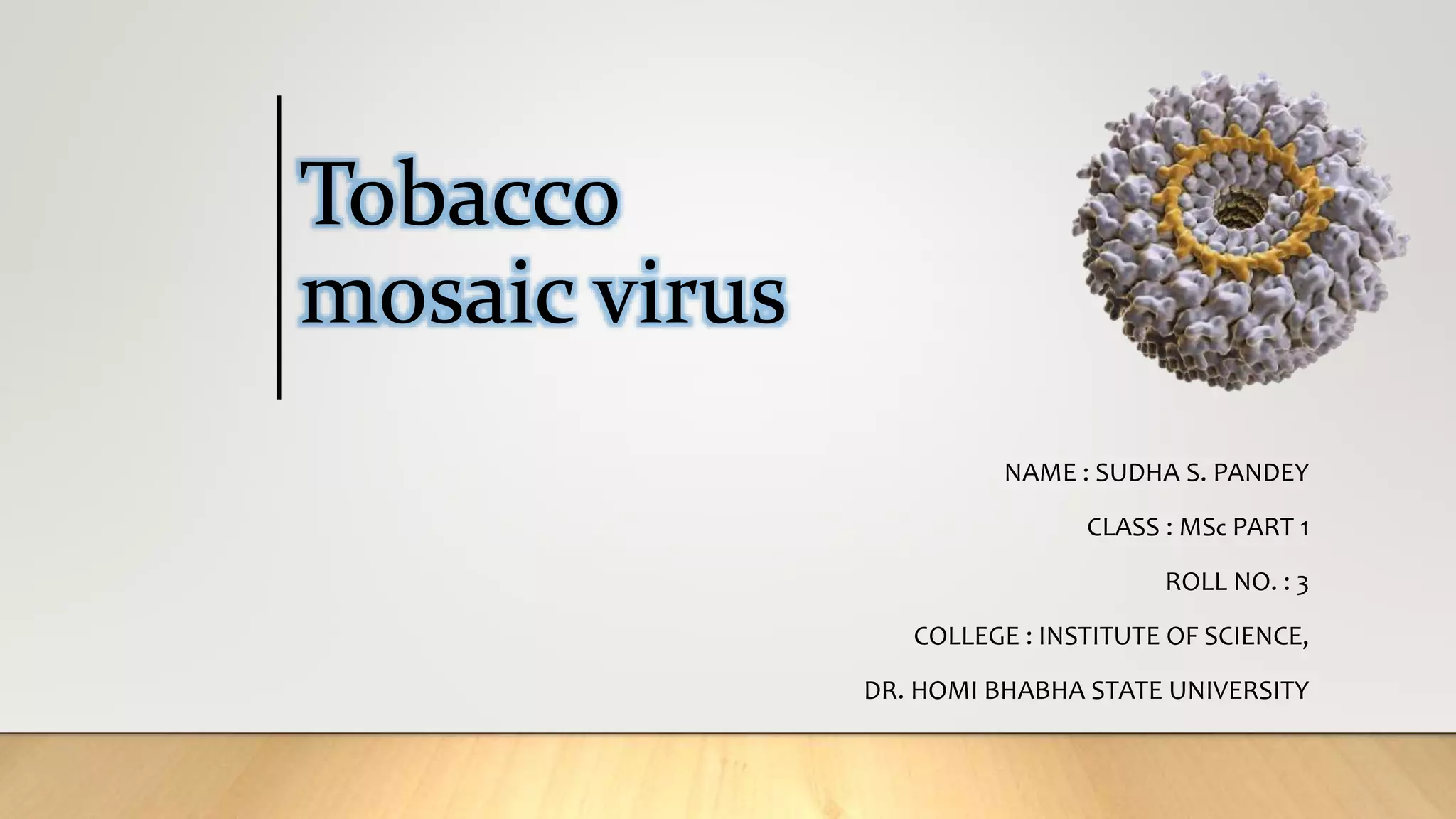
Tobacco
mosaic virus
NAME : SUDHA S. PANDEY
CLASS : MSC PART 1
ROLL NO. : 3
COLLEGE : INSTITUTE OF SCIENCE,
DR. HOMI BHABHA STATE UNIVERSITY
CONTENTS
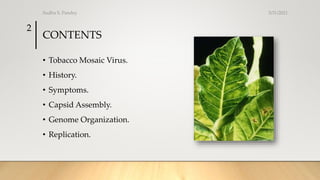
• Tobacco Mosaic Virus.
• History.
• Symptoms.
• Capsid Assembly.
• Genome Organization.
• Replication.
3/31/2021
Sudha S. Pandey
2
Tobacco Mosaic Virus.
• TMV (Tobacco mosaic virus) is the most serious pathogen causing mosaic on
tobacco leaves.
• TMV is the most resistant virus known so far of which the thermal death point is
90 °C for 10 minutes.
• The tobacco mosaic virus affects all dicotyledonous plants of which most
important are tobacco and tomato.
• The tobacco mosaic virus affects photosynthetic tissue of the host leading to
distortion, blistering and necrosis. It also causes dwarfing of affected plants.
3/31/2021
Sudha S. Pandey
3
History
• In 1882, Adolf Mayer first described an important disease of tobacco which he
called tobacco mosaic disease. He showed that the disease was infectious and
could be transmitted to healthy tobacco plants by inoculation with capillary
glass tubes containing sap from diseased plants.
• Dmitri Ivanovsky was studying the same disease and he reported in 1892 that
when sap from a diseased tobacco plant was passed through a bacteria-retaining
filter, the filtrate remained infectious and could be used to infect healthy tobacco
plants.
3/31/2021
Sudha S. Pandey
4
• Ivanovsky was the first person to show that the agent causing the tobacco mosaic
disease passed through a sterilizing filter and this gave rise to the subsequent
characterization of viruses as filterable agents.
• Beijerinck in Holland, again showed in 1898 that sap from tobacco plants
infected with the mosaic disease was still infectious after filtration through
porcelain filters.
• In 1935 Stanley, obtained needle-like crystals of TMV that were infectious and
consisted of protein.
• In 1939, TMV became the first virus to be visualized in the electron microscope
and in 1941, TMV particles were shown to be rods about 280 nm long and 18 nm
wide.
3/31/2021
Sudha S. Pandey
5
Symptoms
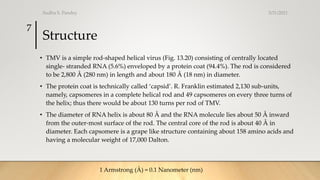
• The symptom is systemic mosaic type. The primary symptom on young leaves is
faint circular chlorotic lesions appear with gradual vein clearing.
• This is followed by the development of characteristic systemic mosaic. With the
maturity of the leaves, abnormally dark-green spots appear which develop into
irregular crumpled blister-like areas.
3/31/2021
Sudha S. Pandey
6
Healthy Leaf TMV infected leaf
Structure
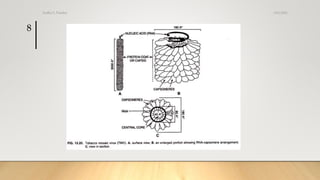
• TMV is a simple rod-shaped helical virus (Fig. 13.20) consisting of centrally located
single- stranded RNA (5.6%) enveloped by a protein coat (94.4%). The rod is considered
to be 2,800 ƅ (280 nm) in length and about 180 ƅ (18 nm) in diameter.
• The protein coat is technically called ā€˜capsid’. R. Franklin estimated 2,130 sub-units,
namely, capsomeres in a complete helical rod and 49 capsomeres on every three turns of
the helix; thus there would be about 130 turns per rod of TMV.
• The diameter of RNA helix is about 80 ƅ and the RNA molecule lies about 50 ƅ inward
from the outer-most surface of the rod. The central core of the rod is about 40 ƅ in
diameter. Each capsomere is a grape like structure containing about 158 amino acids and
having a molecular weight of 17,000 Dalton.
3/31/2021
Sudha S. Pandey
7
1 Armstrong (ƅ) = 0.1 Nanometer (nm)
3/31/2021
Sudha S. Pandey
8
Capsid Assembly.
• One of the many surprises found during the study of TMV was its mode of
assembly. If you mix the RNA and capsid proteins together, they spontaneously
form functional viruses.
• First, the TMV protein forms a two-layer disk, with 17 proteins in each ring. A
special initiation sequence in the RNA then binds in the hole at the center. This
causes the disk to dislocate, forming a lockwasher shaped ring with 49 subunits
per 3 turn . The remaining subunits then stack on this structure, elongating until
the RNA is covered.
3/31/2021
Sudha S. Pandey
9
3/31/2021
Sudha S. Pandey
10
Capsid Assembly video
Genome Organization
• The TMV genome consists of a 6.3–6.5 kb single-stranded (ss) RNA.
• The 3'-terminus has a tRNA-like structure, and the 5' terminus has a methylated
nucleotide cap.
• The genome contains about 6400 nucleotides, with molecular weight of 2.1 X 10⁶.
• The RNA encodes 3 essential proteins.
1. RNA dependent RNA polymerase.
2. Movement Protein.
3. Coat protein.
3/31/2021
Sudha S. Pandey
11
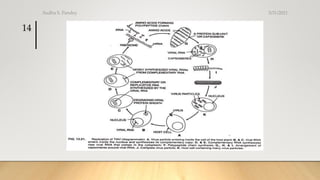
Replication
• The replication of tobacco mosaic virus (TMV) RNA involves synthesis of a
negative-strand RNA using the genomic positive-strand RNA as a template,
followed by the synthesis of positive-strand RNA on the negative-strand RNA
templates.
• The viral-RNA first induces the formation of specific enzymes called ā€˜RNA
polymerases’ the single-stranded viral-RNA synthesizes an additional RNA strand
called replicative RNA.
• This RNA strand is complementary to the viral genome and serves as ā€˜template’ for
producing new RNA single strands which is the copies of the parental viral-RNA.
3/31/2021
Sudha S. Pandey
12
• Now these replicative RNA synthesis new the ssRNA which will be released into
the cytoplasm which along with ribosomes new protein subunits(capsomeres)
are synthesised.
• After the desired protein subunits (Capsomeres) are formed, the new viral
nucleic acid is considered to organize the protein subunit around it resulting in
the formation of complete virus particle, the virion.
• No ā€˜lysis’ of the host cell, as seen in case of virulent bacteriophages, takes place.
The host ells remain alive and viruses move from one cell to the other causing
systemic infection.
3/31/2021
Sudha S. Pandey
13
3/31/2021
Sudha S. Pandey
14
Reference…
• Tobacco mosaic virus: Introduction, Structure & Replication by Biology
Discussion.
• Microbiology Textbook : R.C. Dubey & M.K. Maheshwari.
• Diagrams from Biology discussion.
3/31/2021
Sudha S. Pandey
15
Tobacco mosaic virus General Presentation

Tobacco mosaic virus General Presentation

  • 1.
    Tobacco mosaic virus NAME :SUDHA S. PANDEY CLASS : MSC PART 1 ROLL NO. : 3 COLLEGE : INSTITUTE OF SCIENCE, DR. HOMI BHABHA STATE UNIVERSITY
  • 2.
    CONTENTS • Tobacco MosaicVirus. • History. • Symptoms. • Capsid Assembly. • Genome Organization. • Replication. 3/31/2021 Sudha S. Pandey 2
  • 3.
    Tobacco Mosaic Virus. •TMV (Tobacco mosaic virus) is the most serious pathogen causing mosaic on tobacco leaves. • TMV is the most resistant virus known so far of which the thermal death point is 90 °C for 10 minutes. • The tobacco mosaic virus affects all dicotyledonous plants of which most important are tobacco and tomato. • The tobacco mosaic virus affects photosynthetic tissue of the host leading to distortion, blistering and necrosis. It also causes dwarfing of affected plants. 3/31/2021 Sudha S. Pandey 3
  • 4.
    History • In 1882,Adolf Mayer first described an important disease of tobacco which he called tobacco mosaic disease. He showed that the disease was infectious and could be transmitted to healthy tobacco plants by inoculation with capillary glass tubes containing sap from diseased plants. • Dmitri Ivanovsky was studying the same disease and he reported in 1892 that when sap from a diseased tobacco plant was passed through a bacteria-retaining filter, the filtrate remained infectious and could be used to infect healthy tobacco plants. 3/31/2021 Sudha S. Pandey 4
  • 5.
    • Ivanovsky wasthe first person to show that the agent causing the tobacco mosaic disease passed through a sterilizing filter and this gave rise to the subsequent characterization of viruses as filterable agents. • Beijerinck in Holland, again showed in 1898 that sap from tobacco plants infected with the mosaic disease was still infectious after filtration through porcelain filters. • In 1935 Stanley, obtained needle-like crystals of TMV that were infectious and consisted of protein. • In 1939, TMV became the first virus to be visualized in the electron microscope and in 1941, TMV particles were shown to be rods about 280 nm long and 18 nm wide. 3/31/2021 Sudha S. Pandey 5
  • 6.
    Symptoms • The symptomis systemic mosaic type. The primary symptom on young leaves is faint circular chlorotic lesions appear with gradual vein clearing. • This is followed by the development of characteristic systemic mosaic. With the maturity of the leaves, abnormally dark-green spots appear which develop into irregular crumpled blister-like areas. 3/31/2021 Sudha S. Pandey 6 Healthy Leaf TMV infected leaf
  • 7.
    Structure • TMV isa simple rod-shaped helical virus (Fig. 13.20) consisting of centrally located single- stranded RNA (5.6%) enveloped by a protein coat (94.4%). The rod is considered to be 2,800 ƅ (280 nm) in length and about 180 ƅ (18 nm) in diameter. • The protein coat is technically called ā€˜capsid’. R. Franklin estimated 2,130 sub-units, namely, capsomeres in a complete helical rod and 49 capsomeres on every three turns of the helix; thus there would be about 130 turns per rod of TMV. • The diameter of RNA helix is about 80 ƅ and the RNA molecule lies about 50 ƅ inward from the outer-most surface of the rod. The central core of the rod is about 40 ƅ in diameter. Each capsomere is a grape like structure containing about 158 amino acids and having a molecular weight of 17,000 Dalton. 3/31/2021 Sudha S. Pandey 7 1 Armstrong (ƅ) = 0.1 Nanometer (nm)
  • 8.
  • 9.
    Capsid Assembly. • Oneof the many surprises found during the study of TMV was its mode of assembly. If you mix the RNA and capsid proteins together, they spontaneously form functional viruses. • First, the TMV protein forms a two-layer disk, with 17 proteins in each ring. A special initiation sequence in the RNA then binds in the hole at the center. This causes the disk to dislocate, forming a lockwasher shaped ring with 49 subunits per 3 turn . The remaining subunits then stack on this structure, elongating until the RNA is covered. 3/31/2021 Sudha S. Pandey 9
  • 10.
  • 11.
    Genome Organization • TheTMV genome consists of a 6.3–6.5 kb single-stranded (ss) RNA. • The 3'-terminus has a tRNA-like structure, and the 5' terminus has a methylated nucleotide cap. • The genome contains about 6400 nucleotides, with molecular weight of 2.1 X 10⁶. • The RNA encodes 3 essential proteins. 1. RNA dependent RNA polymerase. 2. Movement Protein. 3. Coat protein. 3/31/2021 Sudha S. Pandey 11
  • 12.
    Replication • The replicationof tobacco mosaic virus (TMV) RNA involves synthesis of a negative-strand RNA using the genomic positive-strand RNA as a template, followed by the synthesis of positive-strand RNA on the negative-strand RNA templates. • The viral-RNA first induces the formation of specific enzymes called ā€˜RNA polymerases’ the single-stranded viral-RNA synthesizes an additional RNA strand called replicative RNA. • This RNA strand is complementary to the viral genome and serves as ā€˜template’ for producing new RNA single strands which is the copies of the parental viral-RNA. 3/31/2021 Sudha S. Pandey 12
  • 13.
    • Now thesereplicative RNA synthesis new the ssRNA which will be released into the cytoplasm which along with ribosomes new protein subunits(capsomeres) are synthesised. • After the desired protein subunits (Capsomeres) are formed, the new viral nucleic acid is considered to organize the protein subunit around it resulting in the formation of complete virus particle, the virion. • No ā€˜lysis’ of the host cell, as seen in case of virulent bacteriophages, takes place. The host ells remain alive and viruses move from one cell to the other causing systemic infection. 3/31/2021 Sudha S. Pandey 13
  • 14.
  • 15.
    Reference… • Tobacco mosaicvirus: Introduction, Structure & Replication by Biology Discussion. • Microbiology Textbook : R.C. Dubey & M.K. Maheshwari. • Diagrams from Biology discussion. 3/31/2021 Sudha S. Pandey 15