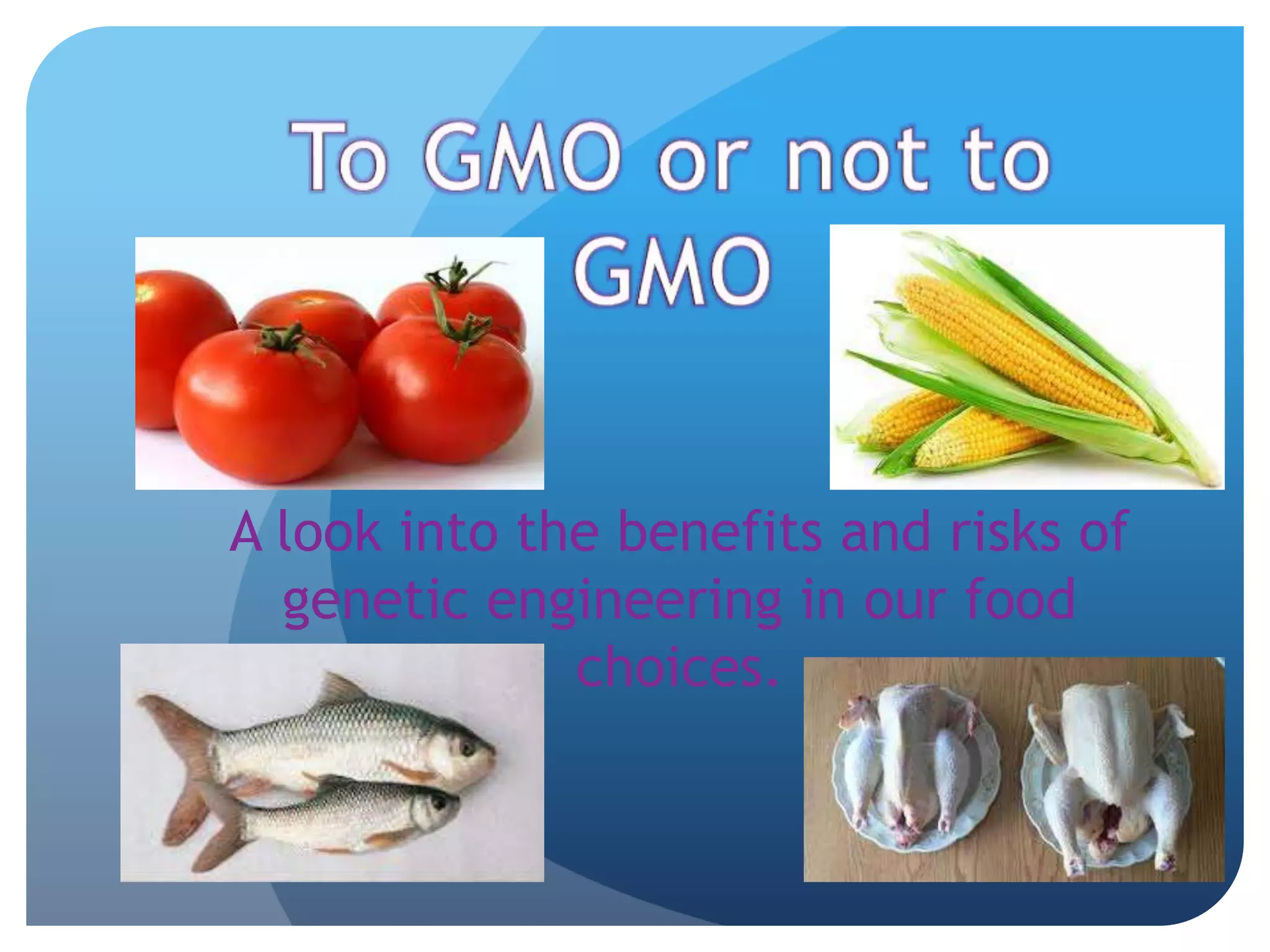
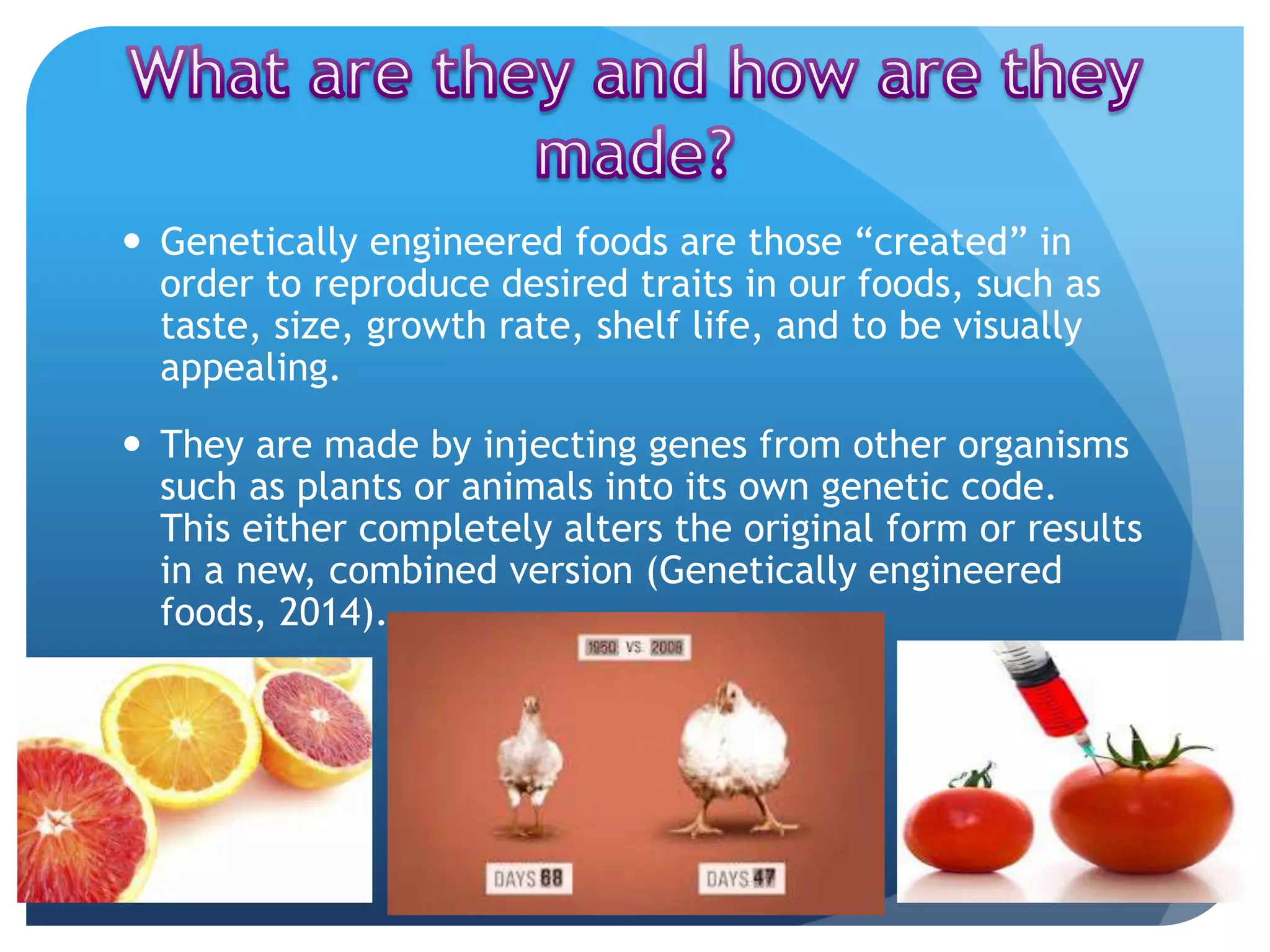
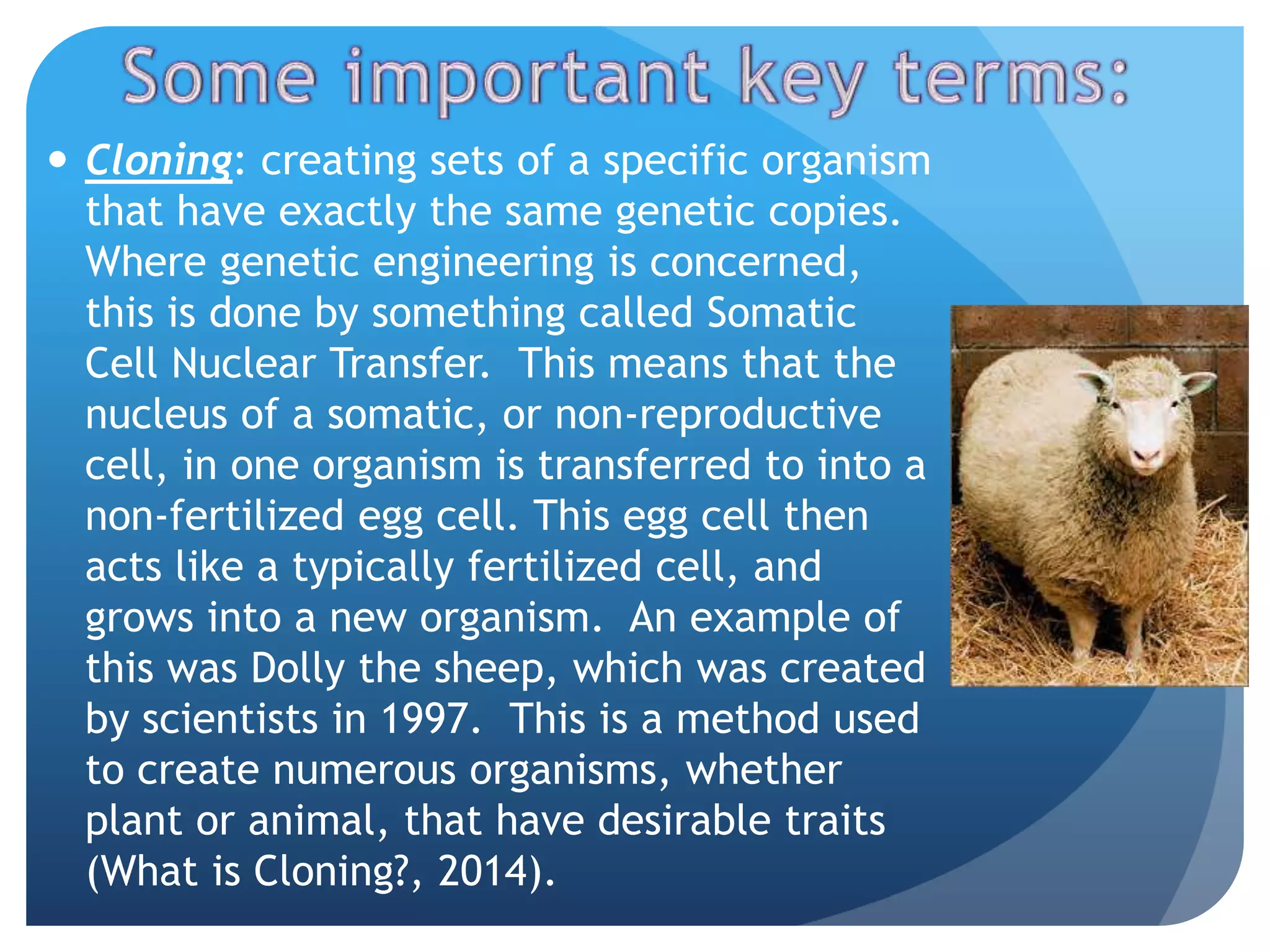
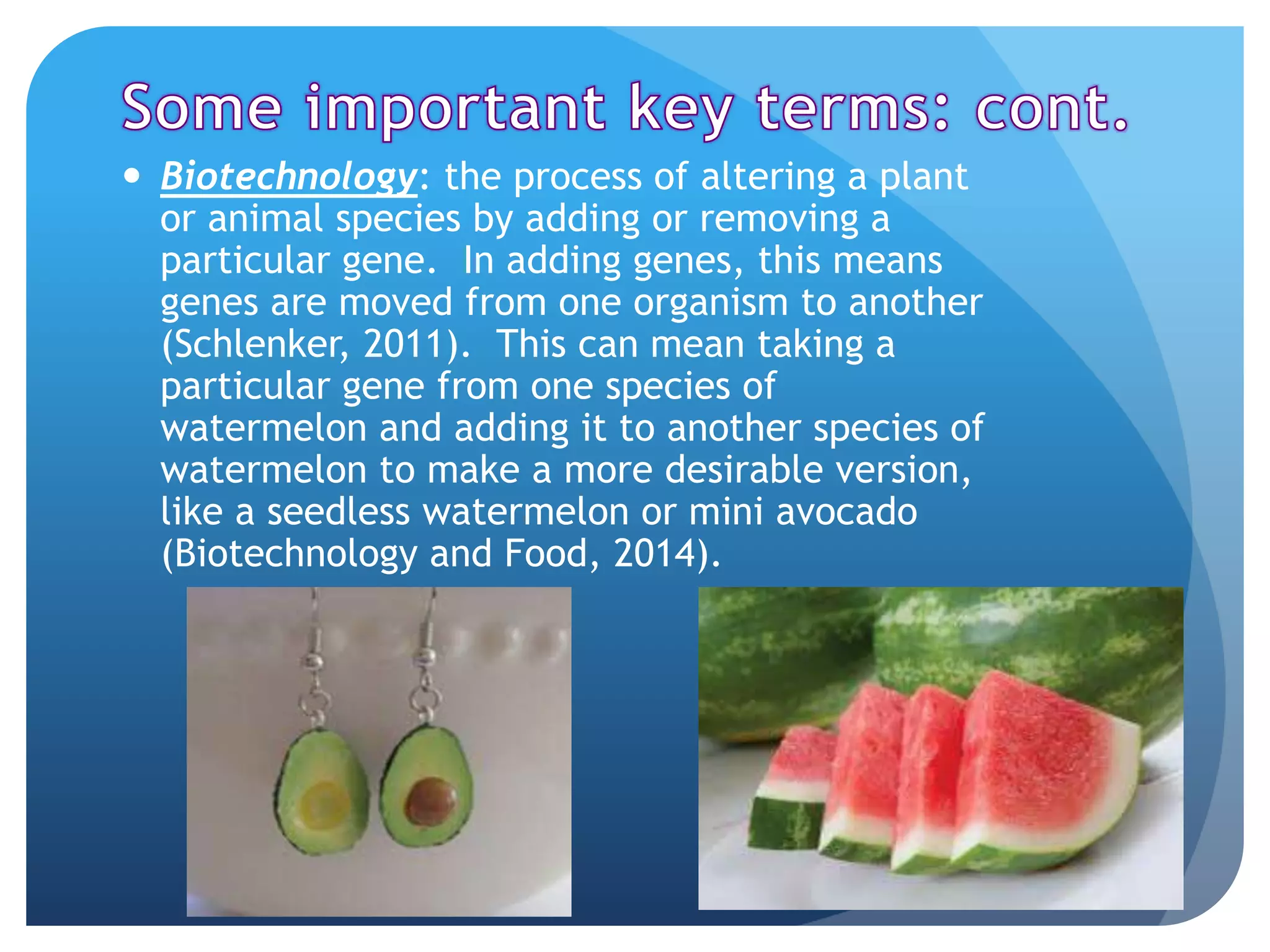
A look into the benefits and risks of
genetic engineering in our food
choices.
 Genetically engineered foods are those “created” in
order to reproduce desired traits in our foods, such as
taste, size, growth rate, shelf life, and to be visually
appealing.
 They are made by injecting genes from other organisms
such as plants or animals into its own genetic code.
This either completely alters the original form or results
in a new, combined version (Genetically engineered
foods, 2014).
 Cloning: creating sets of a specific organism
that have exactly the same genetic copies.
Where genetic engineering is concerned,
this is done by something called Somatic
Cell Nuclear Transfer. This means that the
nucleus of a somatic, or non-reproductive
cell, in one organism is transferred to into a
non-fertilized egg cell. This egg cell then
acts like a typically fertilized cell, and
grows into a new organism. An example of
this was Dolly the sheep, which was created
by scientists in 1997. This is a method used
to create numerous organisms, whether
plant or animal, that have desirable traits
(What is Cloning?, 2014).
 Biotechnology: the process of altering a plant
or animal species by adding or removing a
particular gene. In adding genes, this means
genes are moved from one organism to another
(Schlenker, 2011). This can mean taking a
particular gene from one species of
watermelon and adding it to another species of
watermelon to make a more desirable version,
like a seedless watermelon or mini avocado
(Biotechnology and Food, 2014).
 Hybrid: two varieties of a species are bred together to
create a new variety of a particular type of fruit or
vegetable, or another entirely new product (What's the
difference between GMO foods and hybrid foods? ,
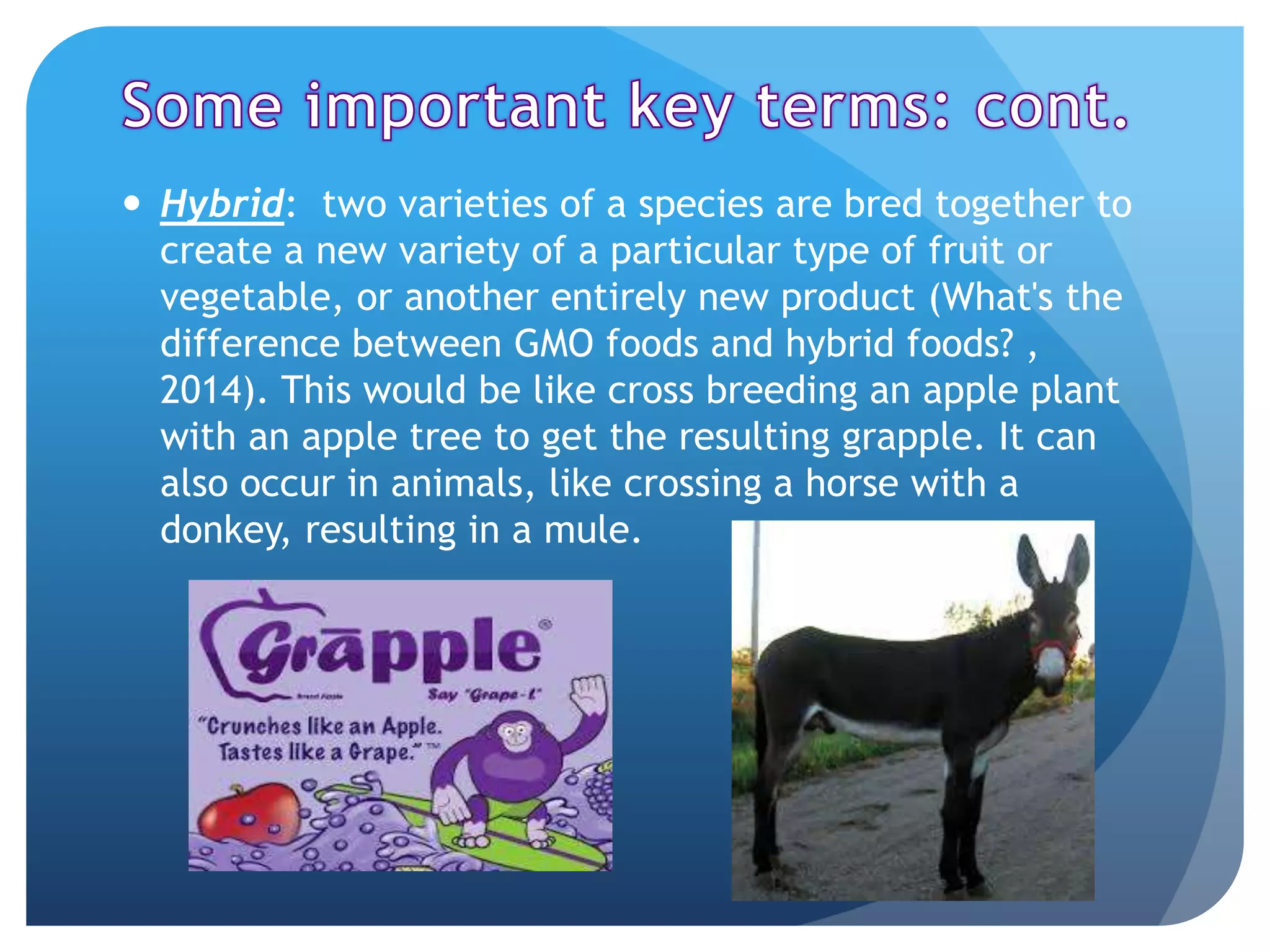
2014). This would be like cross breeding an apple plant
with an apple tree to get the resulting grapple. It can
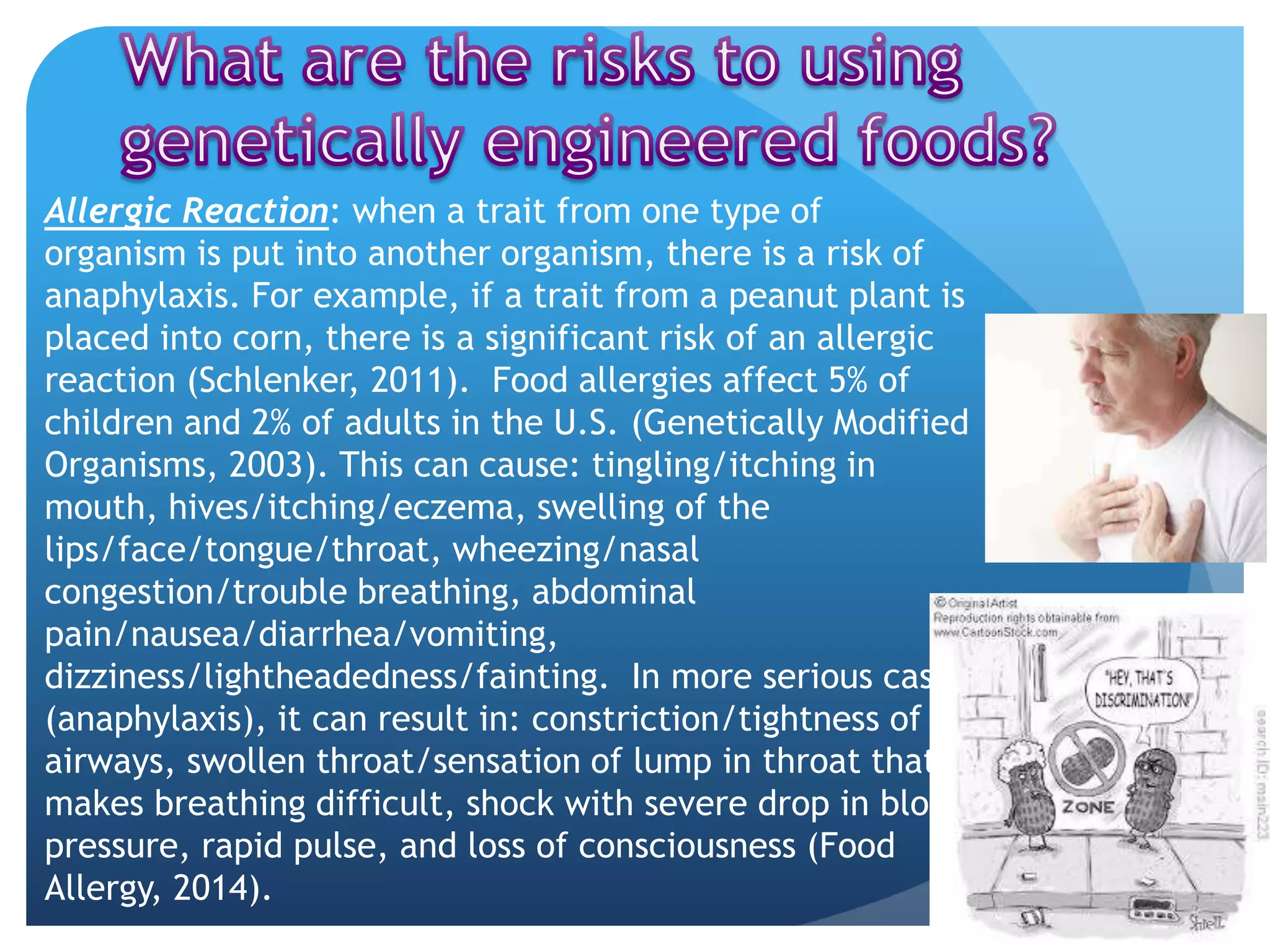
also occur in animals, like crossing a horse with a
donkey, resulting in a mule.
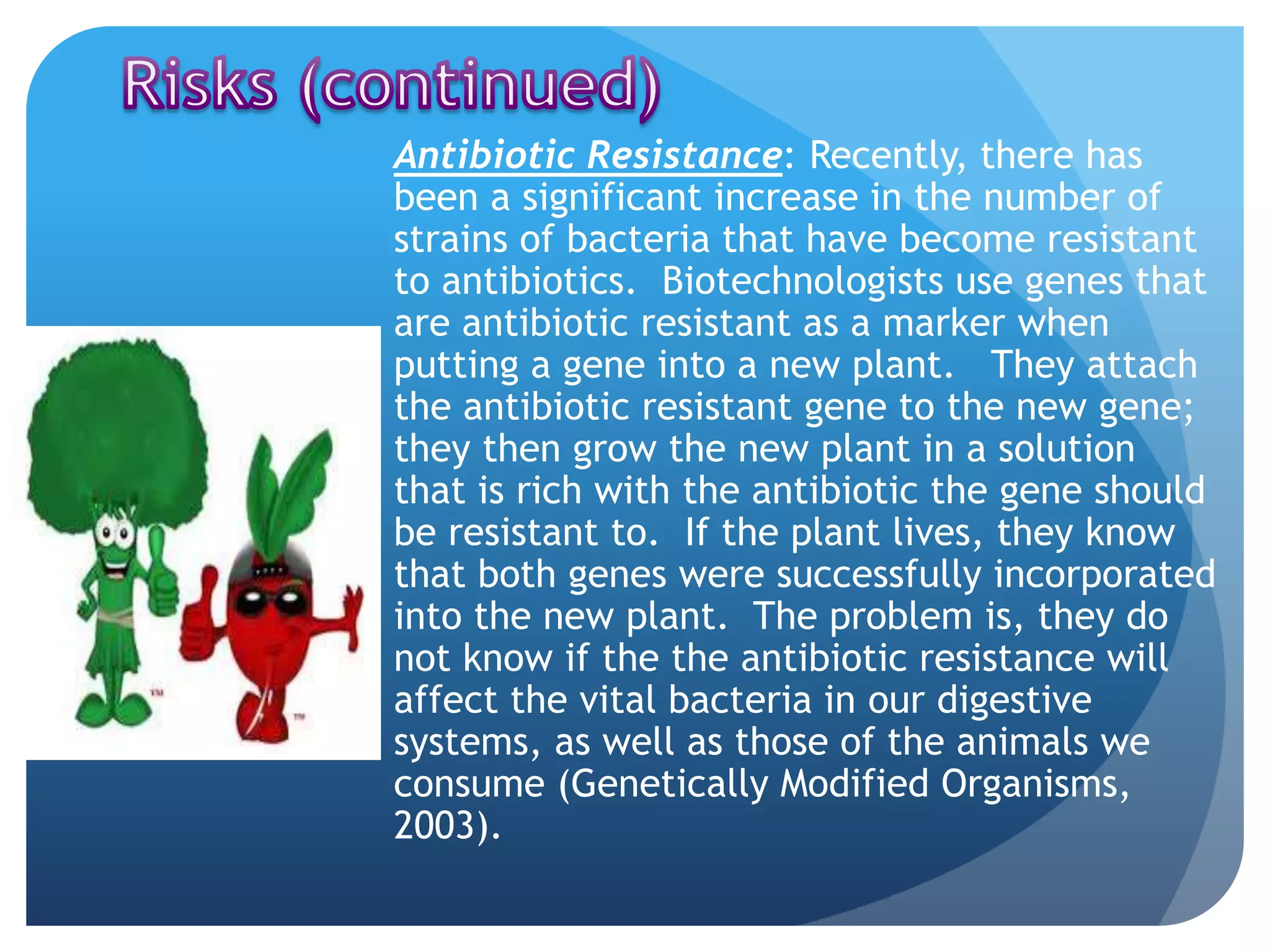
Allergic Reaction: when a trait from one type of
organism is put into another organism, there is a risk of
anaphylaxis. For example, if a trait from a peanut plant is
placed into corn, there is a significant risk of an allergic
reaction (Schlenker, 2011). Food allergies affect 5% of
children and 2% of adults in the U.S. (Genetically Modified
Organisms, 2003). This can cause: tingling/itching in
mouth, hives/itching/eczema, swelling of the
lips/face/tongue/throat, wheezing/nasal
congestion/trouble breathing, abdominal
pain/nausea/diarrhea/vomiting,
dizziness/lightheadedness/fainting. In more serious cases
(anaphylaxis), it can result in: constriction/tightness of
airways, swollen throat/sensation of lump in throat that
makes breathing difficult, shock with severe drop in blood
pressure, rapid pulse, and loss of consciousness (Food
Allergy, 2014).
Antibiotic Resistance: Recently, there has
been a significant increase in the number of
strains of bacteria that have become resistant
to antibiotics. Biotechnologists use genes that
are antibiotic resistant as a marker when
putting a gene into a new plant. They attach
the antibiotic resistant gene to the new gene;
they then grow the new plant in a solution
that is rich with the antibiotic the gene should
be resistant to. If the plant lives, they know
that both genes were successfully incorporated
into the new plant. The problem is, they do
not know if the the antibiotic resistance will
affect the vital bacteria in our digestive
systems, as well as those of the animals we
consume (Genetically Modified Organisms,
2003).
 Danger to the environment: When plants
have genes that will resist insects, there is
a high risk that these plants will also pass
this trait onto weeds and invasive plants
that grow near them. This poses a risk to
the health of butterflies and bees, which
are helpful to the environment (Schlenker,
2011).
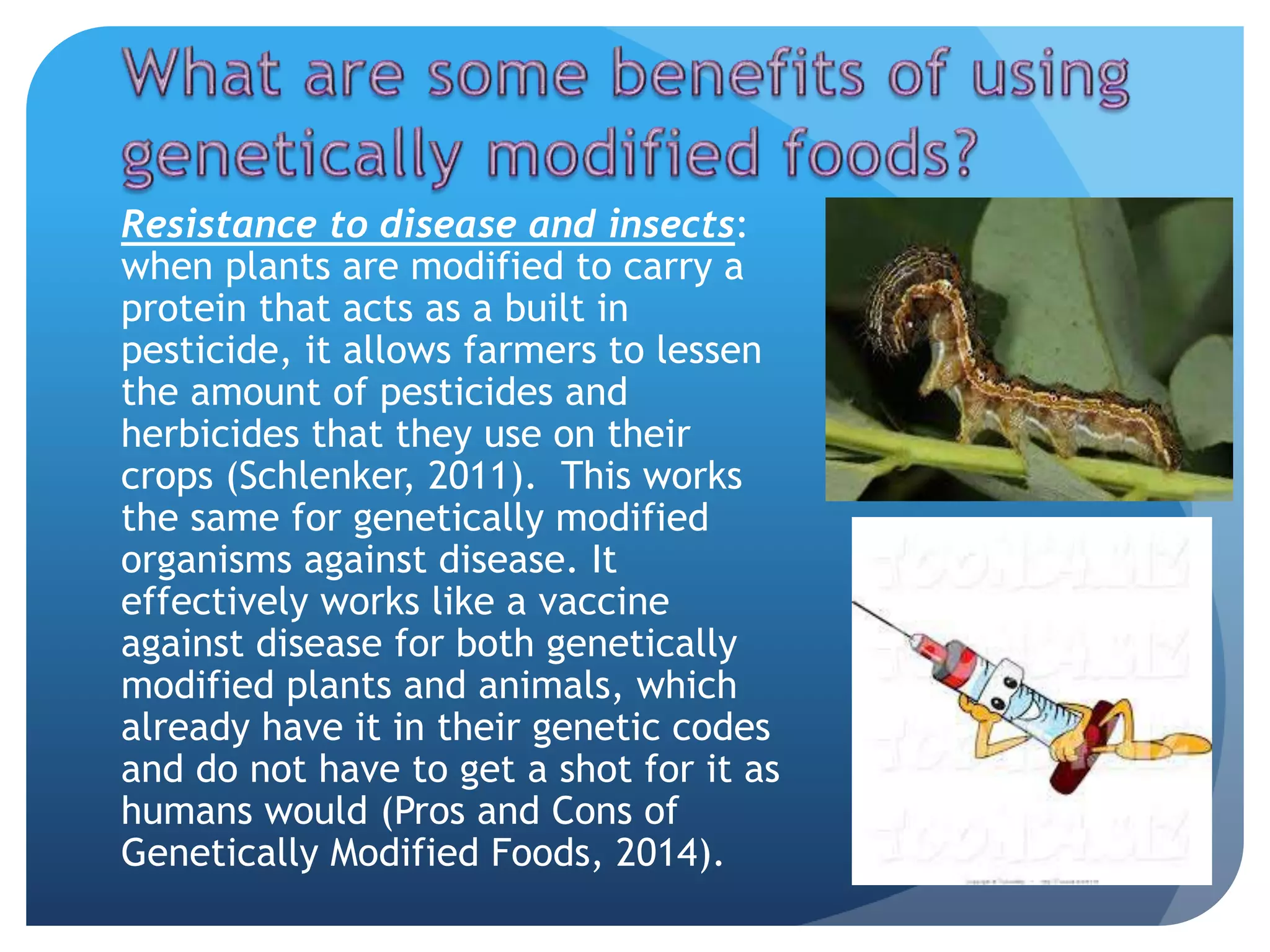
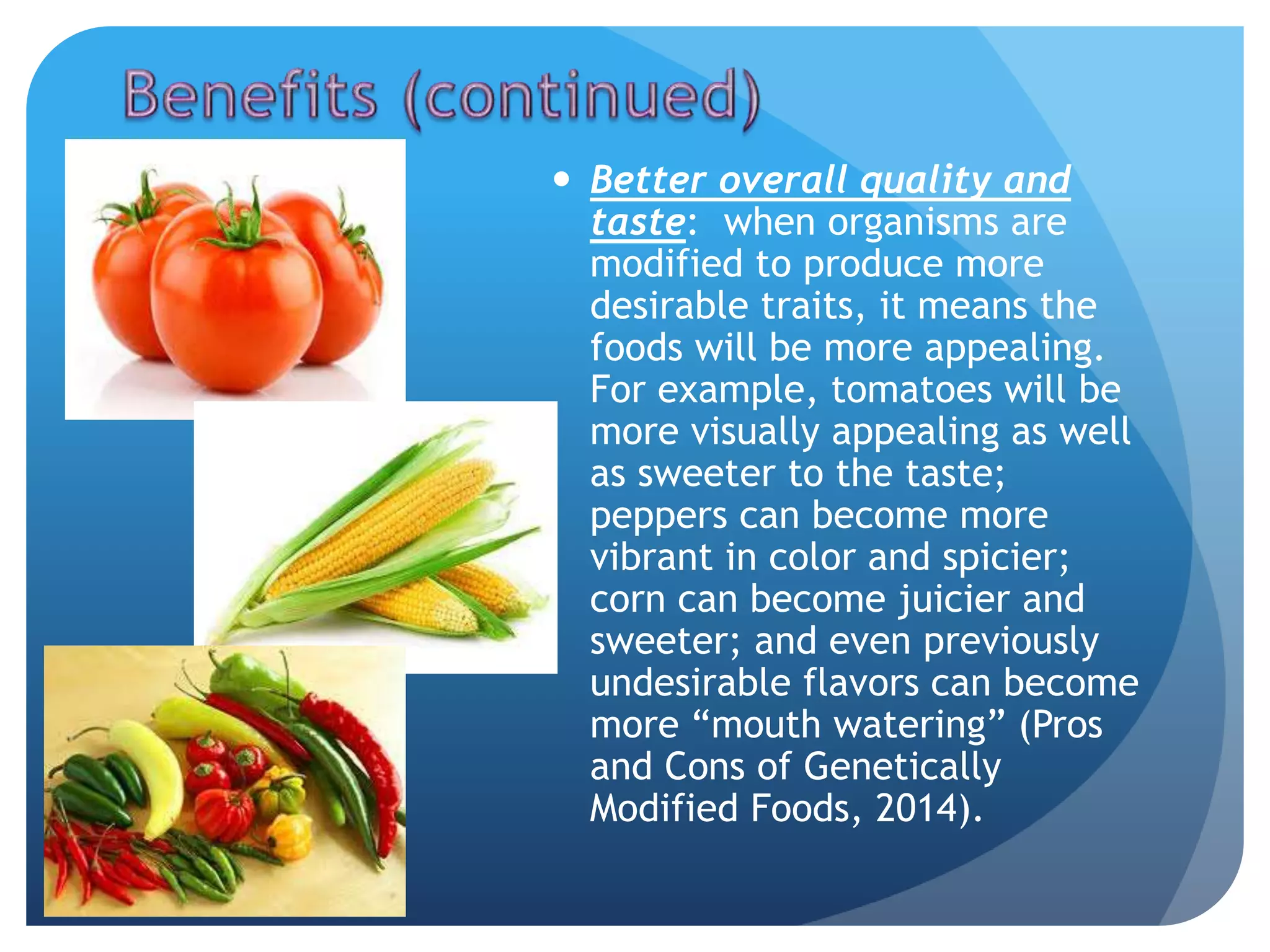
Resistance to disease and insects:
when plants are modified to carry a
protein that acts as a built in
pesticide, it allows farmers to lessen
the amount of pesticides and
herbicides that they use on their
crops (Schlenker, 2011). This works
the same for genetically modified
organisms against disease. It
effectively works like a vaccine
against disease for both genetically
modified plants and animals, which
already have it in their genetic codes
and do not have to get a shot for it as
humans would (Pros and Cons of
Genetically Modified Foods, 2014).
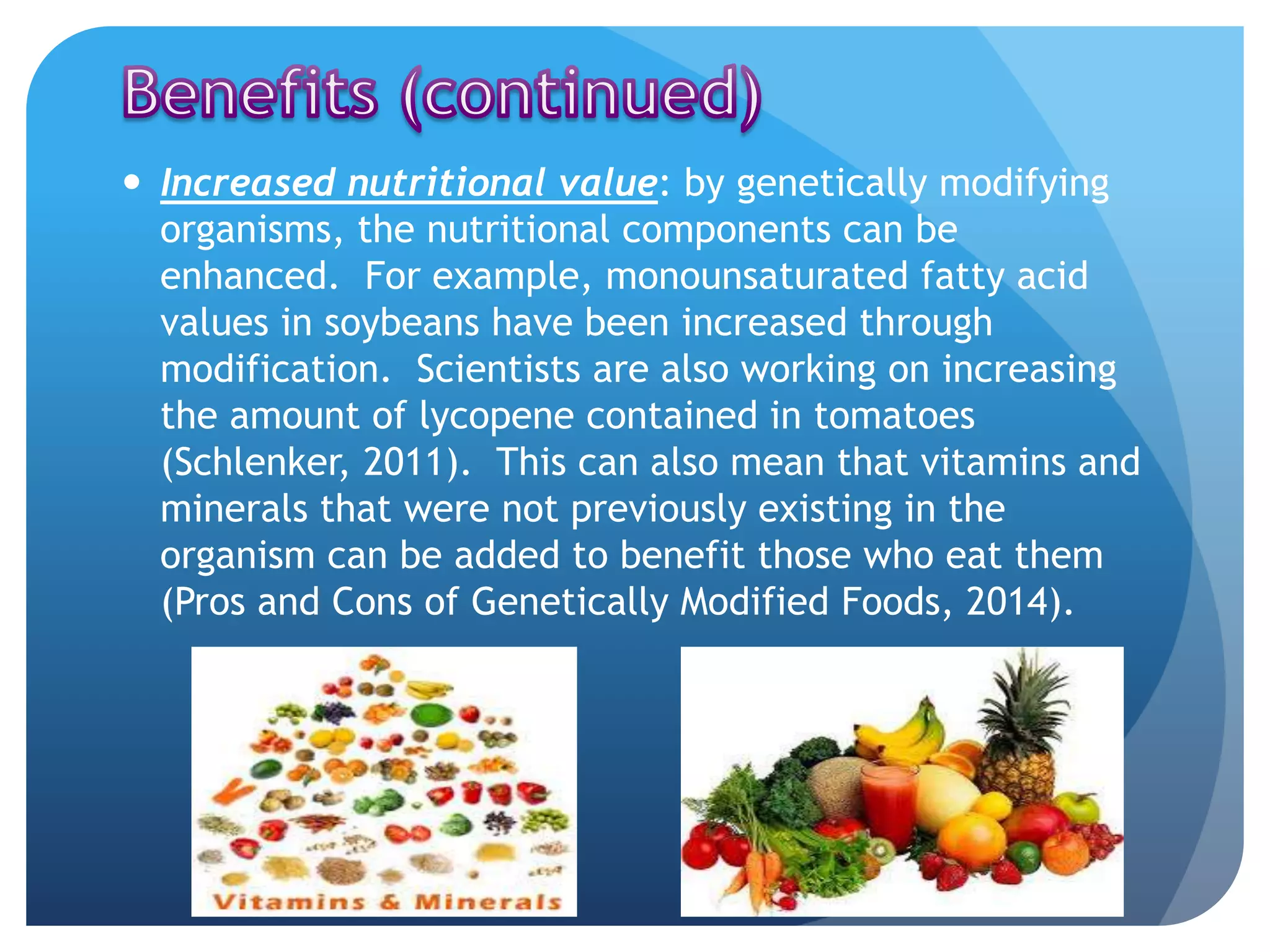
 Better overall quality and
taste: when organisms are
modified to produce more
desirable traits, it means the
foods will be more appealing.
For example, tomatoes will be
more visually appealing as well
as sweeter to the taste;
peppers can become more
vibrant in color and spicier;
corn can become juicier and
sweeter; and even previously
undesirable flavors can become
more “mouth watering” (Pros
and Cons of Genetically
Modified Foods, 2014).
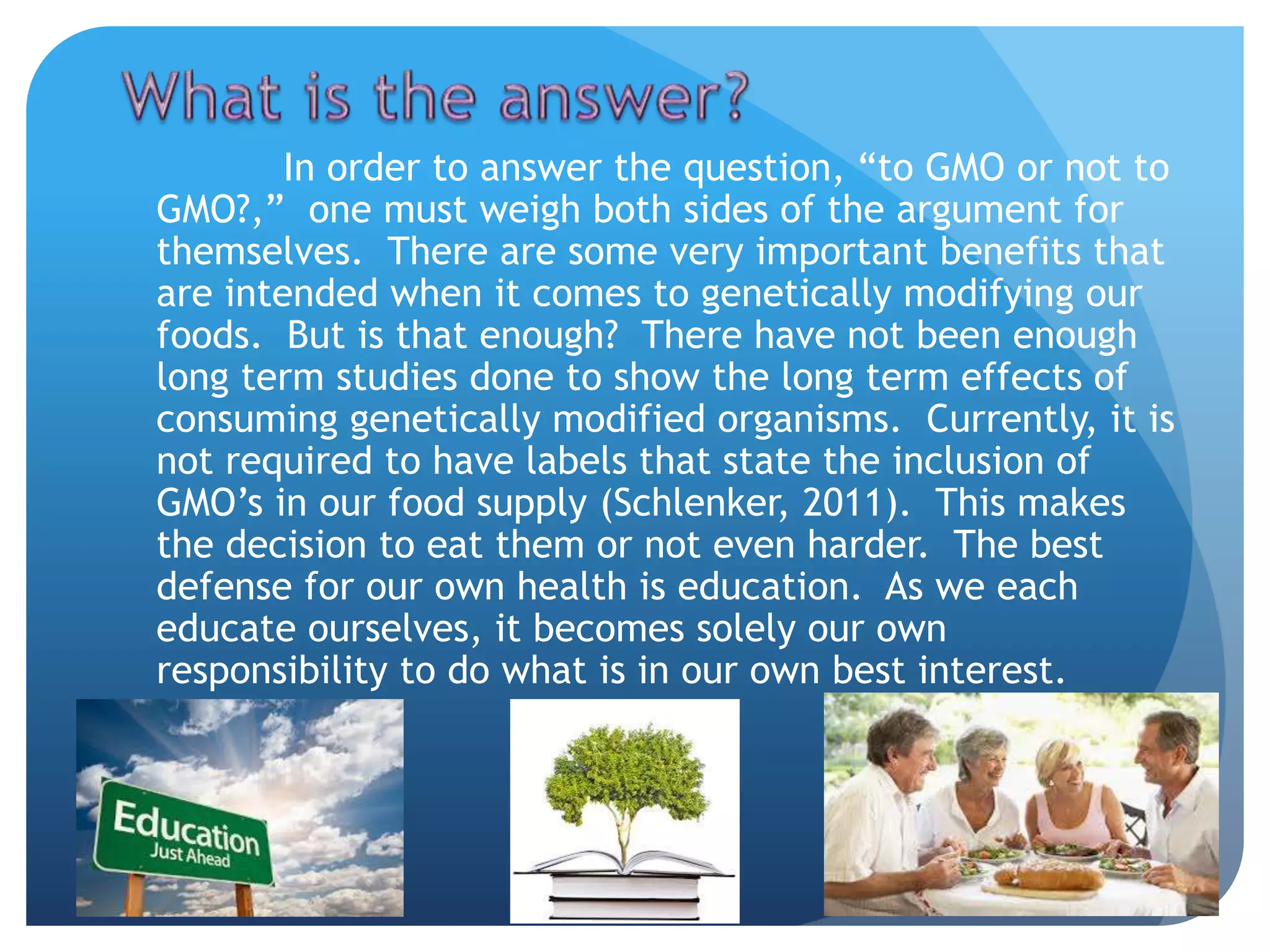
 Increased nutritional value: by genetically modifying
organisms, the nutritional components can be
enhanced. For example, monounsaturated fatty acid
values in soybeans have been increased through
modification. Scientists are also working on increasing
the amount of lycopene contained in tomatoes
(Schlenker, 2011). This can also mean that vitamins and
minerals that were not previously existing in the
organism can be added to benefit those who eat them
(Pros and Cons of Genetically Modified Foods, 2014).
In order to answer the question, “to GMO or not to
GMO?,” one must weigh both sides of the argument for
themselves. There are some very important benefits that
are intended when it comes to genetically modifying our
foods. But is that enough? There have not been enough
long term studies done to show the long term effects of
consuming genetically modified organisms. Currently, it is
not required to have labels that state the inclusion of
GMO’s in our food supply (Schlenker, 2011). This makes
the decision to eat them or not even harder. The best
defense for our own health is education. As we each
educate ourselves, it becomes solely our own
responsibility to do what is in our own best interest.
Works Cited
 Biotechnology and Food. (2014). Retrieved Oct 16, 2014, from University of
Arizona Web Site:
http://extension.arizona.edu/sites/extension.arizona.edu/files/pubs/az1066.pdf
 Food Allergy. (2014). Retrieved Oct 19, 2014, from Mayo Clinic Web Site:
http://www.mayoclinic.org/diseases-conditions/food-
allergy/basics/symptoms/con-20019293
 Genetically engineered foods. (2014). Retrieved Oct 16, 2014, from Medline Plus
Web Site: http://www.nlm.nih.gov/medlineplus/ency/article/002432.htm
 Genetically Modified Organisms. (2003). Retrieved Oct 19, 2014, from University
of Minnesota Web Site: http://enhs.umn.edu/current/5103/gm/harmful.html
 Pros and Cons of Genetically Modified Foods. (2014). Retrieved Oct 19, 2014, from
Health Research Funding Web Site: http://healthresearchfunding.org/pros-cons-
genetically-modified-foods/
 Schlenker, E. D. (2011). Williams' Essentials of Nutritiion & Diet Therapy, 10th Ed.
Mosby.
 What is Cloning? (2014). Retrieved Oct 16, 2014, from Learn Genetics: University
of Utah Web Site: http://learn.genetics.utah.edu/content/cloning/whatiscloning/
 What's the difference between GMO foods and hybrid foods? . (2014). Retrieved
Oct 17, 2014, from Mother Nature Network Web Site:
http://www.mnn.com/food/healthy-eating/blogs/whats-the-difference-between-
gmo-foods-and-hybrid-foods

To GMO or not to GMO

  • 1.
    A look intothe benefits and risks of genetic engineering in our food choices.
  • 2.
     Genetically engineeredfoods are those “created” in order to reproduce desired traits in our foods, such as taste, size, growth rate, shelf life, and to be visually appealing.  They are made by injecting genes from other organisms such as plants or animals into its own genetic code. This either completely alters the original form or results in a new, combined version (Genetically engineered foods, 2014).
  • 3.
     Cloning: creatingsets of a specific organism that have exactly the same genetic copies. Where genetic engineering is concerned, this is done by something called Somatic Cell Nuclear Transfer. This means that the nucleus of a somatic, or non-reproductive cell, in one organism is transferred to into a non-fertilized egg cell. This egg cell then acts like a typically fertilized cell, and grows into a new organism. An example of this was Dolly the sheep, which was created by scientists in 1997. This is a method used to create numerous organisms, whether plant or animal, that have desirable traits (What is Cloning?, 2014).
  • 4.
     Biotechnology: theprocess of altering a plant or animal species by adding or removing a particular gene. In adding genes, this means genes are moved from one organism to another (Schlenker, 2011). This can mean taking a particular gene from one species of watermelon and adding it to another species of watermelon to make a more desirable version, like a seedless watermelon or mini avocado (Biotechnology and Food, 2014).
  • 5.
     Hybrid: twovarieties of a species are bred together to create a new variety of a particular type of fruit or vegetable, or another entirely new product (What's the difference between GMO foods and hybrid foods? , 2014). This would be like cross breeding an apple plant with an apple tree to get the resulting grapple. It can also occur in animals, like crossing a horse with a donkey, resulting in a mule.
  • 6.
    Allergic Reaction: whena trait from one type of organism is put into another organism, there is a risk of anaphylaxis. For example, if a trait from a peanut plant is placed into corn, there is a significant risk of an allergic reaction (Schlenker, 2011). Food allergies affect 5% of children and 2% of adults in the U.S. (Genetically Modified Organisms, 2003). This can cause: tingling/itching in mouth, hives/itching/eczema, swelling of the lips/face/tongue/throat, wheezing/nasal congestion/trouble breathing, abdominal pain/nausea/diarrhea/vomiting, dizziness/lightheadedness/fainting. In more serious cases (anaphylaxis), it can result in: constriction/tightness of airways, swollen throat/sensation of lump in throat that makes breathing difficult, shock with severe drop in blood pressure, rapid pulse, and loss of consciousness (Food Allergy, 2014).
  • 7.
    Antibiotic Resistance: Recently,there has been a significant increase in the number of strains of bacteria that have become resistant to antibiotics. Biotechnologists use genes that are antibiotic resistant as a marker when putting a gene into a new plant. They attach the antibiotic resistant gene to the new gene; they then grow the new plant in a solution that is rich with the antibiotic the gene should be resistant to. If the plant lives, they know that both genes were successfully incorporated into the new plant. The problem is, they do not know if the the antibiotic resistance will affect the vital bacteria in our digestive systems, as well as those of the animals we consume (Genetically Modified Organisms, 2003).
  • 8.
     Danger tothe environment: When plants have genes that will resist insects, there is a high risk that these plants will also pass this trait onto weeds and invasive plants that grow near them. This poses a risk to the health of butterflies and bees, which are helpful to the environment (Schlenker, 2011).
  • 9.
    Resistance to diseaseand insects: when plants are modified to carry a protein that acts as a built in pesticide, it allows farmers to lessen the amount of pesticides and herbicides that they use on their crops (Schlenker, 2011). This works the same for genetically modified organisms against disease. It effectively works like a vaccine against disease for both genetically modified plants and animals, which already have it in their genetic codes and do not have to get a shot for it as humans would (Pros and Cons of Genetically Modified Foods, 2014).
  • 10.
     Better overallquality and taste: when organisms are modified to produce more desirable traits, it means the foods will be more appealing. For example, tomatoes will be more visually appealing as well as sweeter to the taste; peppers can become more vibrant in color and spicier; corn can become juicier and sweeter; and even previously undesirable flavors can become more “mouth watering” (Pros and Cons of Genetically Modified Foods, 2014).
  • 11.
     Increased nutritionalvalue: by genetically modifying organisms, the nutritional components can be enhanced. For example, monounsaturated fatty acid values in soybeans have been increased through modification. Scientists are also working on increasing the amount of lycopene contained in tomatoes (Schlenker, 2011). This can also mean that vitamins and minerals that were not previously existing in the organism can be added to benefit those who eat them (Pros and Cons of Genetically Modified Foods, 2014).
  • 12.
    In order toanswer the question, “to GMO or not to GMO?,” one must weigh both sides of the argument for themselves. There are some very important benefits that are intended when it comes to genetically modifying our foods. But is that enough? There have not been enough long term studies done to show the long term effects of consuming genetically modified organisms. Currently, it is not required to have labels that state the inclusion of GMO’s in our food supply (Schlenker, 2011). This makes the decision to eat them or not even harder. The best defense for our own health is education. As we each educate ourselves, it becomes solely our own responsibility to do what is in our own best interest.
  • 13.
    Works Cited  Biotechnologyand Food. (2014). Retrieved Oct 16, 2014, from University of Arizona Web Site: http://extension.arizona.edu/sites/extension.arizona.edu/files/pubs/az1066.pdf  Food Allergy. (2014). Retrieved Oct 19, 2014, from Mayo Clinic Web Site: http://www.mayoclinic.org/diseases-conditions/food- allergy/basics/symptoms/con-20019293  Genetically engineered foods. (2014). Retrieved Oct 16, 2014, from Medline Plus Web Site: http://www.nlm.nih.gov/medlineplus/ency/article/002432.htm  Genetically Modified Organisms. (2003). Retrieved Oct 19, 2014, from University of Minnesota Web Site: http://enhs.umn.edu/current/5103/gm/harmful.html  Pros and Cons of Genetically Modified Foods. (2014). Retrieved Oct 19, 2014, from Health Research Funding Web Site: http://healthresearchfunding.org/pros-cons- genetically-modified-foods/  Schlenker, E. D. (2011). Williams' Essentials of Nutritiion & Diet Therapy, 10th Ed. Mosby.  What is Cloning? (2014). Retrieved Oct 16, 2014, from Learn Genetics: University of Utah Web Site: http://learn.genetics.utah.edu/content/cloning/whatiscloning/  What's the difference between GMO foods and hybrid foods? . (2014). Retrieved Oct 17, 2014, from Mother Nature Network Web Site: http://www.mnn.com/food/healthy-eating/blogs/whats-the-difference-between- gmo-foods-and-hybrid-foods