Technology, Media
& Telecommunications
Predictions
2011
About Deloitte
Deloitte refers to one or more of Deloitte Touche Tohmatsu Limited, a UK private company
limited by guarantee, and its network of member firms, each of which is a legally separate and
independent entity. Please see www.deloitte.com/about for a detailed description of the legal
structure of Deloitte Touche Tohmatsu Limited and its member firms.
Contents


Foreword                                                                            3

Technology                                                                          4

Smartphones and tablets: more than half of all computers
aren’t computers anymore                                                            5

Operating system diversity: no standard emerges on the smartphone
or tablet                                                                           7

Tablets in the enterprise: more than just a toy                                     9

eGov: from option to obligation                                                     11

Online regulation ratchets up, but cookies live on                                  13

Squeezing the electrons in: batteries don’t follow Moore’s Law                      15

Hydrogen comes out of hiding: the alternative alternative energy source             17

Media                                                                               19

Television’s “super media” status strengthens                                       20

DVRs proliferate! The 30 second spot doesn’t die!                                   22

Push beats pull in the battle for the television viewer                             24

Social network advertising: how big can it get?                                     26

Games go online and on sale: the audience grows, but at what price?                 28

Keeping the life in live: A&R diversifies                                           30

Pop goes pop-up: music retail goes seasonal and temporary                           32

Telecommunications                                                                  34

Getting to 4G cheaply: will many carriers opt for 3.5G instead?                     35

Wi-Fi complements cellular broadband for “data on the move”                         37

What is “in store” for Wi-Fi: online comparison shopping on aisle 3                 39

Video calling: the base goes mainstream, but usage remains niche                    41

Endnotes                                                                            43

Recent thought leadership                                                           51

Contacts at DTTL and its member firms                                               52

Authors                                                                             53


                          Technology, Media & Talecommunications Predictions 2011    1
The goal of Predictions is to
catalyze discussions around
important topics that may
require companies or
government to respond.


2
Foreword


Welcome to the 10th edition of Deloitte’s Predictions       Another key trend over the last 10 years has been
for the technology, media & telecommunications (TMT)        convergence: the technology, media and
sector.                                                     telecommunications sectors are now more
                                                            interconnected and interdependent than ever before.
This annual publication presents Deloitte’s view of the     With that in mind, this year’s Predictions report is for
major trends over the next 12-18 months that are likely     the first time being published as a single report, rather
to have significant medium to long-term impacts for         than three separate ones. Deloitte’s view is that
companies in TMT and other industries. For example,         developments in each sector are now so inextricably
two of this year’s trends are the evolution of battery      linked that TMT executives need easy access to the key
technology, and the continuing popularity of television,    trends in all three sectors.
both of which are likely to be relevant for companies in
many sectors.                                               Also for the first time, each of this year’s Predictions is
                                                            available as a video, a podcast and an app as well as
What makes Deloitte’s Predictions different from others?    written text.

• Rigorous research: We use both primary and                We hope you and your colleagues find this year’s
  secondary sources, looking at both quantitative and       Predictions for the TMT sector useful; as always, we
  qualitative data, including hundreds of discussions,      welcome your feedback.
  thousands of articles and tens of thousands of survey
  responses.                                                Whether you are new to this publication, or have been
                                                            following our Predictions for years, we thank you for
• Innovation: We publish only perspectives that we          your interest. And to the many executives who have
  think are new or counter to existing consensus.           offered their candid input for these reports, we thank
  This includes calling a market where most                 you for your time and valuable insights.
  commentators expect there to be none, or
  identifying markets where the hype is ahead               We look forward to exploring the next 10 years of TMT
  of reality.                                               developments with you.

• Accountability: We try to provide clear Predictions
  endpoints, so that our accuracy can be evaluated
  annually.

The goal of Predictions is to catalyze discussions around
important topics that may require companies or
government to respond. We provide a view on what            Jolyon Barker
we think will happen, what will occur as a consequence,     Managing Director
and what the implications are for various types of          Global Technology, Media & Telecommunications
companies. We never presume that ours is the last           Deloitte Touche Tohmatsu Limited
word on any given topic.

Over the last 10 years, the TMT sector – and its impact
on how we work, live, and are entertained – has
changed markedly. In fact, there have been too many
important developments to list here. But it is worth
remembering that the World Wide Web is just 21 years
young in 2011, that in 2001 many countries had not
yet rolled out national broadband services, and that
only three years ago analog cellular networks were still
functioning in some of the largest mobile markets.


                                                                                        Technology, Media & Telecommunications Predictions 2011   3
Technology


4
Smartphones and tablets: more
than half of all computers aren’t
computers anymore
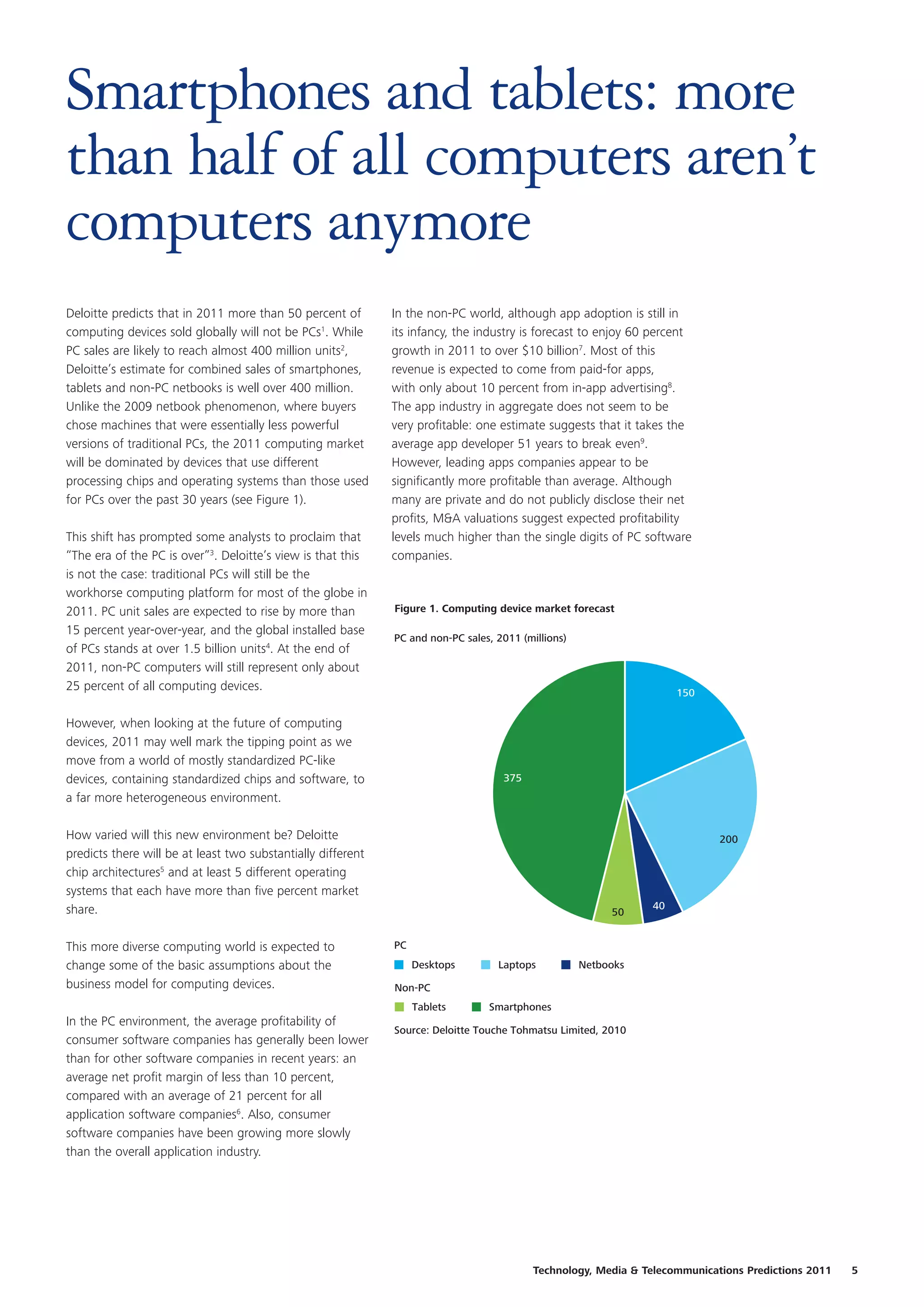
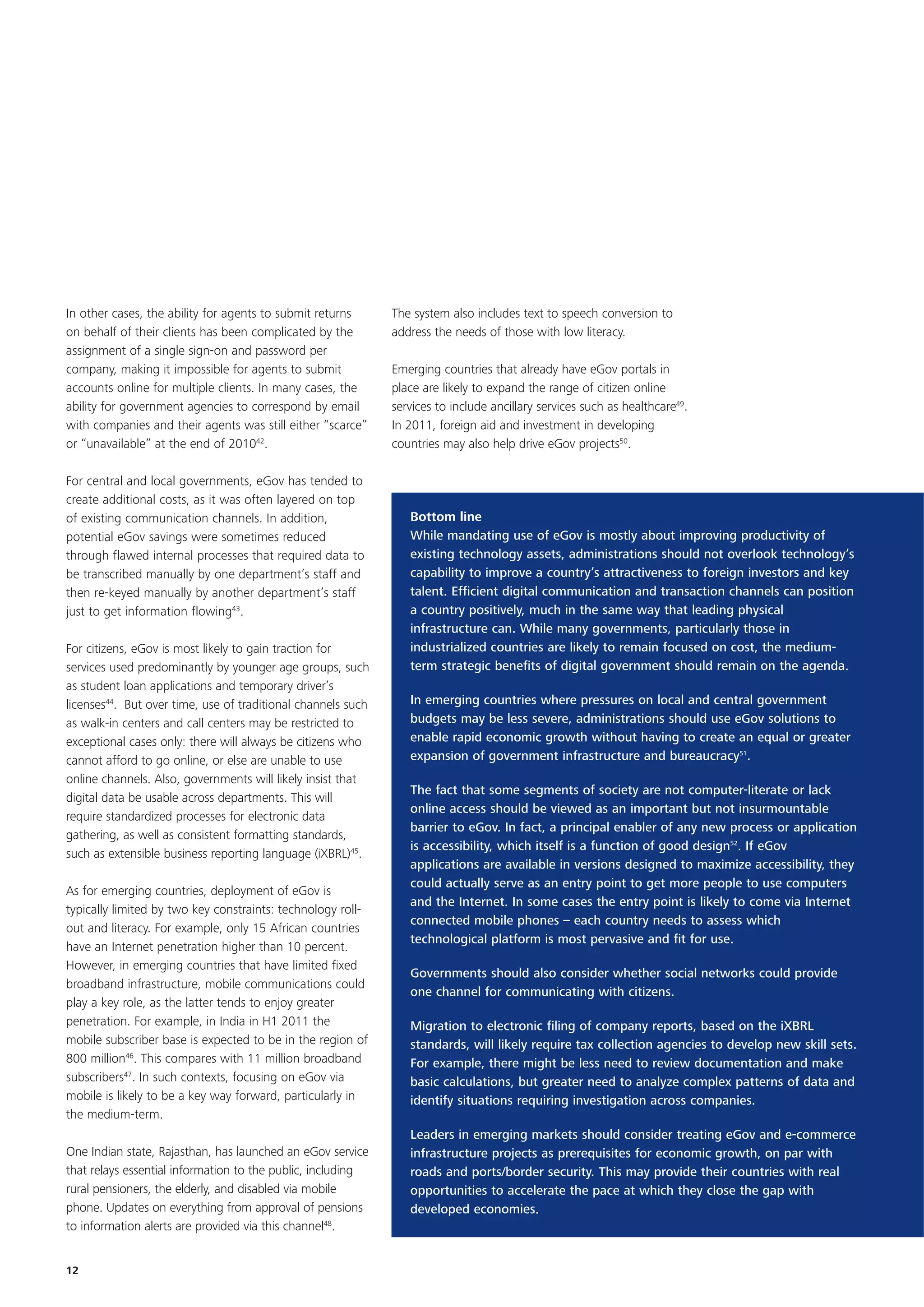
Deloitte predicts that in 2011 more than 50 percent of        In the non-PC world, although app adoption is still in
computing devices sold globally will not be PCs1. While       its infancy, the industry is forecast to enjoy 60 percent
PC sales are likely to reach almost 400 million units2,       growth in 2011 to over $10 billion7. Most of this
Deloitte’s estimate for combined sales of smartphones,        revenue is expected to come from paid-for apps,
tablets and non-PC netbooks is well over 400 million.         with only about 10 percent from in-app advertising8.
Unlike the 2009 netbook phenomenon, where buyers              The app industry in aggregate does not seem to be
chose machines that were essentially less powerful            very profitable: one estimate suggests that it takes the
versions of traditional PCs, the 2011 computing market        average app developer 51 years to break even9.
will be dominated by devices that use different               However, leading apps companies appear to be
processing chips and operating systems than those used        significantly more profitable than average. Although
for PCs over the past 30 years (see Figure 1).                many are private and do not publicly disclose their net
                                                              profits, M&A valuations suggest expected profitability
This shift has prompted some analysts to proclaim that        levels much higher than the single digits of PC software
“The era of the PC is over”3. Deloitte’s view is that this    companies.
is not the case: traditional PCs will still be the
workhorse computing platform for most of the globe in
2011. PC unit sales are expected to rise by more than         Figure 1. Computing device market forecast

15 percent year-over-year, and the global installed base
                                                              PC and non-PC sales, 2011 (millions)
of PCs stands at over 1.5 billion units4. At the end of
2011, non-PC computers will still represent only about
25 percent of all computing devices.                                                                                  150
However, when looking at the future of computing
devices, 2011 may well mark the tipping point as we
move from a world of mostly standardized PC-like
devices, containing standardized chips and software, to                             375
a far more heterogeneous environment.

How varied will this new environment be? Deloitte                                                                            200
predicts there will be at least two substantially different
chip architectures5 and at least 5 different operating
systems that each have more than five percent market
share.                                                                                                           40
                                                                                                          50


This more diverse computing world is expected to              PC
change some of the basic assumptions about the                     Desktops        Laptops           Netbooks
business model for computing devices.                         Non-PC
                                                                   Tablets       Smartphones
In the PC environment, the average profitability of
                                                              Source: Deloitte Touche Tohmatsu Limited, 2010
consumer software companies has generally been lower
than for other software companies in recent years: an
average net profit margin of less than 10 percent,
compared with an average of 21 percent for all
application software companies6. Also, consumer
software companies have been growing more slowly
than the overall application industry.


                                                                                           Technology, Media & Telecommunications Predictions 2011   5
Manufacturing non-PC computing devices should also
be substantially more profitable than making PCs.            Bottom line
PC Original Equipment Manufacturers (OEMs) have              In 2011, buyers of computing functionality, whether in the enterprise or
averaged 10 percent gross profits in recent years, with      consumer sector, will face some interesting choices. In the past, most
2 percent net margins. By contrast, the leading              computer buyers purchased similarly configured machines at similar prices
smartphone and tablet makers generate gross profits of       on similar replacement cycles. Although not quite as limited as the infamous
40-60 percent and operating margins of 25-40 percent10.      paint options on Henry Ford’s Model T – “any color so long as it’s black” –
                                                             the range of variation for PCs was quite narrow. But in this new era where
Distribution is expected to become more profitable as        more than half of all new computing devices sold are non-PCs, the ranges of
well. Traditional PC distribution gross margins average      price, performance, form factor and other variables will be at least an order
about 5 percent11. Although separate figures for the         of magnitude wider. Choosing will take longer, and will need to be done
entire tablet and smartphone distribution industry are       more carefully.
not public, some distributors are reporting operating
margins of 15 percent, which imply gross margins over        For IT departments, the cost of managing a mixed network of both PCs and
30 percent12.                                                non-PCs is likely to be much higher than standardizing on one or the other.
                                                             Yet employees are increasingly being allowed to pick their own devices, and
There will also likely be expanded service opportunities.    tens of millions have already done so – especially smartphones14. If given a
Although many of these non-PC alternatives are               choice, some employees will pick PCs, some will pick non-PCs, and some will
marketed as “easy to use”, the bewildering array of          pick both! Reconciling these two trends and determining the true total cost
hardware and app choices makes it more likely buyers         of ownership will present a significant learning curve.
will be willing to pay for help selecting the best or most
industry-appropriate devices and apps – along with           There will also be major challenges for software and peripheral developers.
subsequent integration, maintenance, and support13.          In the traditional PC world, software that ran on one machine generally ran
                                                             on billions of others. The same was true for peripherals, as long as they
                                                             complied with standard APIs. But in the more fragmented world of 2011
                                                             and beyond, software and hardware will likely require more customization,
                                                             and developers may need to pick and choose which platforms they develop
                                                             for, knowing that they cannot afford to address all markets simultaneously.


6
Operating system diversity:
no standard emerges on the
smartphone or tablet
Smartphones and the new generation of tablets have            In the history of computing devices, no company has
three things in common: (1) they use similar, low-            ever become the standard OS after it was clear that the
powered 1GHz processors; (2) they are being used like         value of the technology involved was likely to be tens
personal computers, although they are not personal            of billions or more. The smartphone and tablet markets
computers; and (3) Deloitte predicts that by the end of       are already generating hundreds of billions in revenues,
2011 no operating system on these devices will have a         and are expected to keep growing rapidly: everyone
dominant market share. Some will have more than a             knows there is “gold in them thar hills.”
5 percent share, but no single player will have yet
become the de facto standard, as has been seen in             Equally important, existing competition in the non-PC
other computing ecosystems in the past.                       market seems unlikely to fade any time soon. In both
                                                              the smartphone and tablet markets, the top five OS
The emergence of a de facto standard is very important        companies based on market share each enjoy annual
to everyone involved in the smartphone and tablet             revenues in the tens of billions: have billions in cash:
markets (i.e., “non-PC computing devices”). Technology        are growing their top and bottom lines: and are gaining
industries with a single dominant provider of hardware        ground with consumers. Even companies that are losing
or software tend to have economics very different from        market share are still growing in absolute terms. None
those with multiple providers.                                appears ready or willing to abandon the market, there
                                                              is no shareholder pressure to exit, and all should have
Moreover, the non-PC computing market is becoming             more than enough resources to develop new products
increasingly important: Deloitte predicts that in 2011        and market them to mass audiences.
more than half of all computers sold – over 400 million
units – will be devices that are not PCs15. In 2012 and       Mobile network providers seem as unlikely to allow a
beyond, non-PCs’ will likely extend this lead. Being the      dominant OS as the OS competitors themselves.
dominant operating system (OS) provider for non-PCs           Providers appear to actively encourage OS diversity,
would be a tremendous prize; however, a clearly               even if they seldom state this explicitly. Whenever any
dominant OS seems unlikely to emerge in 2011.                 operating system or device maker, in any geography or
                                                              segment, approaches 50 percent market share, the
The obvious value of being the standard OS for                carriers seem to deploy their marketing muscle, retail
non-PCs is one reason why a single player is unlikely to      presence, and subsidies to push one device or OS over
dominate. The company that popularized the PC was             another. There is even a name for this strategy: carriers
very adept at making both operating systems and               pick “hero” devices and push them hard. This approach
central processing unit (CPU) chips. But when it decided      can cause major swings in market share within a single
to launch its new computing device, it did not source         quarter18.
its OS or CPU internally; neither did it select other large
OS or CPU manufacturers. Instead it turned to                 Device manufacturers also seem to believe that a
companies that were relatively small at the time16.           diverse OS ecosystem is in their best interest. Perhaps
No one expected that PCs would sell in their billions         seeing the commoditization of some technology
generating trillions of dollars over the next three           industries where de facto standards do exist has shown
decades17. In contrast, the potential value of the            them that having different operating systems to choose
non-PC market is already obvious.                             from allows them to differentiate their products more
                                                              effectively, strike better deals with network providers,
                                                              and generally achieve higher margins.


                                                                                        Technology, Media & Telecommunications Predictions 2011   7
With all of these major players fighting to prevent an
industry-wide standard OS from emerging, it seems that     Bottom line
only a nearly irresistible force could make it happen.     Many stakeholders would be affected if a standard tablet or smartphone
                                                           OS does not emerge in the near term. As noted earlier, mobile network
One possibility for such a force is the “network           providers, device makers, and software companies are all intimately involved
effect.”19 As an emerging standard becomes more and        and all have a keen interest in the battle. However, there are three other
more prevalent, it can rapidly reach a tipping point       groups with a significant stake as well.
where the number of users on its platform relative to
others gives it overwhelming momentum. Software            Application developers might need to get comfortable in a world where they
developers embrace the platform because it has the         must pick and choose their platforms. If a clear standard emerges, then their
most users, which leads to new apps that attract even      choice is made for them. But in the more fragmented OS world that seems
more users, and so on – creating a virtuous circle that    likely, no app developed for a single platform can address the entire market.
eventually locks the platform in as the de facto           Developing customized apps or versions for each OS requires significant time
standard.                                                  and money (typically $5,000-500,000, depending on complexity20), so it is
                                                           likely that many smaller developers will not be able to address all markets.
However, unlike other markets where network effects
have created industry-wide standards, both smartphone      Media companies face a similar challenge. In general, ad-supported media
and tablet devices are highly fragmented at the            are looking for the largest possible audience. In the PC market, the platform
hardware level, and are likely to remain so. The variety   with the largest audience was clear. However, in a diverse, non-PC
of screen sizes, CPUs, text inputs, form factors, and      computing market, publishers will probably need to prioritize some
other configurations means that no single OS version       audiences over others, or even exclude some entirely.
addresses a sufficiently large percentage of devices to
create a powerful network effect.                          Finally, IT departments are likely to face significantly higher costs to support
                                                           this new, more diverse technology environment. Administering a traditional
A market that revolves around a standard OS offers the     PC computing ecosystem centered on a single OS can cost thousands
advantage of simplicity: if an application works on one    of dollars per employee per year21. Supporting five times as many operating
device, it can be counted on to work almost                systems is unlikely to require fewer people and less money. Yet telling
everywhere and with nearly all devices. The current        employees to go back to the days when they had to standardize on one OS
non-PC market is more complex and fragmented, but          or device seems impossible: that particular genie left the bottle long ago.
looks like it may be the new reality. With fewer than      Given these trends, the cost of IT support seems set to rise.
half of all new computing devices being PCs, and if no
non-PC OS becomes dominant, it is mathematically
impossible for any OS to have more than a 75 percent
share of all new computing devices.


8
Tablets in the enterprise:
more than just a toy

Deloitte predicts that in 2011 more than 25 percent of        Second, certain industry verticals seem poised to start
all tablet computers will be bought by enterprises, and       using tablets in fairly large numbers over the course of
that figure is likely to rise in 2012 and beyond.             the year; in fact, trials are already underway. The retail,
Although some commentators view tablets as                    manufacturing, and healthcare industries are considered
underpowered media-consumption toys suitable only             the most likely early adopters, primarily owing to the
for consumers22, more than 10 million of the devices          tablet’s ease of use, long battery life, lack of moving
will likely be purchased by enterprises in 2011.              parts, minimal need for training and rapid app
Consumer demand for tablets is forecast to remain             development environment. Deloitte predicts that during
strong; however, enterprise demand is likely to grow          2011 up to 5 million tablets could be deployed in retail
even faster, albeit from a lower base.                        and healthcare alone.

Four main factors are driving tablet adoption in the          In retail, a tablet can serve as both an easy-to-use,
enterprise market.                                            constantly updated catalog, as well as a point-of-sale
                                                              terminal (when equipped with an optional card reader).
First, and already the most apparent, many consumers          These compelling applications make it likely that retail
initially buy tablet computers as personal media devices,     will be the largest enterprise tablet market in 201125.
but quickly discover they are also useful for work.           Healthcare will probably see a number of trials, but the
Employees are asking their firms to support tablets for       traditional conservatism of healthcare authorities,
various work tasks, including accessing the enterprise        administrators, and practitioners will likely mean that
network. And some people who end up using their               fewer than one million devices will be deployed in
tablets predominantly for work are asking their               healthcare environments by the end of the year26.
employers to cover the cost of their data plans, or
even the cost of the device itself.

It appears that by the end of 2011 a significant number
of firms may be willing to pay for their employees’ tablets
and data plans. By some estimates, 70-80 percent of
Fortune 500 companies will support at least one tablet
variant for some portion of their workforce23; millions of
prosumers will have their tablet data plans at least
partially subsidized by their employer; and millions more
tablets will be purchased by companies as PC
alternatives24.


                                                                                         Technology, Media & Telecommunications Predictions 2011   9
Third, enterprise software providers are rapidly
responding to Fortune 500 customer requests for                 Bottom line
tablet-specific software. Large players in ERP, ECM,            For an enterprise, a key challenge will be deciding whether to support
CRM, and other enterprise applications are combining            multiple types of tablets or standardize on a single type. Employees often
with desktop virtualization providers to create secure          prefer to choose their own devices; however, IT support costs rise with
enterprise-grade apps that can seamlessly and rapidly           device diversity. Balancing the IT department’s desire for a single, cost-
be deployed into even the largest company’s existing IT         effective solution against employees’ desire for freedom of choice will likely
environment27. Enterprise software providers are also           be just as challenging with tablets as it is with smartphones.
embracing the new technology themselves, with one
company rolling out tablets to 35 percent of its                Price is a very important issue for enterprises, especially in the current
employees in 201128.                                            economy. Enterprises (and tablet manufacturers) will need to carefully weigh
                                                                the various trade-offs. Do enterprise tablets need cameras? Do they need to
Fourth, the tablet form factor itself is driving adoption       have the largest possible screen? Is Wi-Fi good enough, or do they need a
in the boardroom. Unlike laptops and smartphones,               more expensive 3G radio – and the data plan that goes with it?
both of which create an obvious physical barrier
between the user and others in the room, a tablet can           The new breed of tablets is not designed to be particularly rugged. In the
be placed flat on a conference table and accessed               past, a variety of ruggedized tablets30 were available; however they tended
unobtrusively29.                                                to be 2-3x heavier than the new tablets and 3-5x more expensive31.
                                                                Although they continue to have their devoted fans, they were not mass
These four growth drivers are likely to foster significant      market devices. For those who worry that the new tablets might not be
tablet diversity. Although certain form factors and             tough enough for constant use in the field, it is worth remembering that
operating systems dominated the market initially, the           workers sometimes treat ruggedized devices less carefully, which can make
different requirements of various enterprises mean that         such devices even more prone to damage. Ultimately, the most effective
one size will probably not fit all. Fortunately, tablets will   “ruggedization” is to produce a machine that the workforce values and takes
be offered in multiple sizes in 2011. For use as catalogs       care not to break.
in retail, a 10 inch diagonal display might be optimal;
but for processes requiring portability, such as accident       Security is already being discussed as a potentially big issue for enterprise
inspection, a smaller 7 inch device would be lighter and        tablets. In some ways tablets are more secure than PCs – at time of writing
probably less expensive.                                        no tablet-specific virus has been reported, and most don’t even have USB
                                                                ports, eliminating a common security weak point. On the other hand, tablets
Some enterprises and their IT departments have strong           are small, portable and a popular target for thieves. As a new device, tablets
preferences for certain operating systems (OS), and             should probably be presumed insecure until proven otherwise.
strong aversions to others. Assuming that tablets will be
connected to the rest of the enterprise IT environment,         App development will need to be monitored closely. Cost per app can range
it is reasonable to expect that OS market shares in             from $5,000-$500,000 (depending on complexity), so not all enterprises will
enterprise tablets might closely mirror OS market shares        be able to develop an app for every type of tablet; nor will they be able to
in smartphones and PCs.                                         fund a large number of custom apps for employees. Although some firms
                                                                are proposing the deployment of web apps that run through a browser and
                                                                therefore work on any tablet, the likely reality in 2011 is that only native
                                                                apps will provide the full tablet experience and be capable of interacting
                                                                with the devices’ built-in cameras, radios, calendars and push capabilities32.


10
eGov: from option to obligation


In 2011 Deloitte predicts e-government (eGov) usage           Figure 2. Internet access, use of e-forms, and use of government websites, Europe, 2009 (percent)
will reach an inflection point. Across developed
countries, the proportion of businesses that use eGov                  Iceland
services for at least one process is expected to average
                                                                  Netherlands
over 90 percent, up from 75 percent in 2010. Similarly,
the proportion of citizens that use eGov in industrialized            Norway

countries should rise by at least 10 percentage points.               Sweden
In some countries, the importance of eGov as a way to
                                                                     Denmark
boost public sector productivity and efficiency may even
                                                                  Luxembourg
prompt the appointment of a national Chief Information
Officer (CIO) where one did not exist previously33.                    Finland

                                                              United Kingdom
Rising demands for government efficiency and
                                                                     Germany
productivity will likely provide a major push for greater
adoption of existing eGov platforms and, in some                      Belgium
countries, increasing e-government roll-out34. Use of                  Estonia
online channels may increasingly be mandatory;35 this
                                                                       Austria
should boost the return on investment for e-government
infrastructures. For example, according to one estimate,      EU-15 countries

mandating electronic invoicing could save the                           France
equivalent of 0.8 percent of GDP annually36.                         EuroZone

                                                                       Ireland
Over the last decade, governments around the world
have collectively invested billions of dollars to deploy       Slovak Republic
an array of e-government infrastructure, from tax                       Latvia
returns to building permits37. However, use of these
                                                                        Malta
portals varies considerably. In most cases, eGov has
been positioned as an additional channel for citizens                 Slovenia

and businesses to interact with the government38.              Czech Republic
Only rarely has it been mandated39.
                                                                      Hungary

                                                                     Lithuania
In the past, one of the main problems with mandating
eGov was the risk of excluding certain segments of                     Poland
society, such as those without Internet access or those                  Spain
who might find online self-service portals too difficult to
                                                                       Croatia
use. However, now that most consumers and almost all
businesses are active online, in some countries eGov use           Macedonia
needs to catch up with the times, and start being                      Cyprus
positioned as the primary channel, not an optional one.
                                                                      Portugal
For example, Figure 2 shows household Internet use
compared with the use of eGov in Europe. In all countries                 Italy

there is a significant gap, with Internet use outpacing               Bulgaria
eGov use by an average of more than 20 percent. And in                 Greece
some countries, the gap is as large as 50 percent.
                                                                                  0             20             40             60            80            100

Use of e-government by businesses has also been limited                               In 2009: Accessed the Internet at home in the last 3 months
– albeit not necessarily due to business’ reluctance: in                              In 2009: Sent official e-forms in the last 12 months
some cases online channels were simply not available.                                 In 2009: Obtained information from public authorities, websites,
For example, in some territories it has only been possible                            in the last 3 months
to submit an electronic invoice since February 201041.        Source: Deloitte Touche Tohmatsu Limited, 2010, based on data from Eurostat, 201040


                                                                                            Technology, Media & Telecommunications Predictions 2011          11
In other cases, the ability for agents to submit returns      The system also includes text to speech conversion to
on behalf of their clients has been complicated by the        address the needs of those with low literacy.
assignment of a single sign-on and password per
company, making it impossible for agents to submit            Emerging countries that already have eGov portals in
accounts online for multiple clients. In many cases, the      place are likely to expand the range of citizen online
ability for government agencies to correspond by email        services to include ancillary services such as healthcare49.
with companies and their agents was still either “scarce”     In 2011, foreign aid and investment in developing
or “unavailable” at the end of 201042.                        countries may also help drive eGov projects50.

For central and local governments, eGov has tended to
create additional costs, as it was often layered on top
of existing communication channels. In addition,                 Bottom line
potential eGov savings were sometimes reduced                    While mandating use of eGov is mostly about improving productivity of
through flawed internal processes that required data to          existing technology assets, administrations should not overlook technology’s
be transcribed manually by one department’s staff and            capability to improve a country’s attractiveness to foreign investors and key
then re-keyed manually by another department’s staff             talent. Efficient digital communication and transaction channels can position
just to get information flowing43.                               a country positively, much in the same way that leading physical
                                                                 infrastructure can. While many governments, particularly those in
For citizens, eGov is most likely to gain traction for           industrialized countries are likely to remain focused on cost, the medium-
services used predominantly by younger age groups, such          term strategic benefits of digital government should remain on the agenda.
as student loan applications and temporary driver’s
licenses44. But over time, use of traditional channels such      In emerging countries where pressures on local and central government
as walk-in centers and call centers may be restricted to         budgets may be less severe, administrations should use eGov solutions to
exceptional cases only: there will always be citizens who        enable rapid economic growth without having to create an equal or greater
cannot afford to go online, or else are unable to use            expansion of government infrastructure and bureaucracy51.
online channels. Also, governments will likely insist that
                                                                 The fact that some segments of society are not computer-literate or lack
digital data be usable across departments. This will
                                                                 online access should be viewed as an important but not insurmountable
require standardized processes for electronic data
                                                                 barrier to eGov. In fact, a principal enabler of any new process or application
gathering, as well as consistent formatting standards,
                                                                 is accessibility, which itself is a function of good design52. If eGov
such as extensible business reporting language (iXBRL)45.
                                                                 applications are available in versions designed to maximize accessibility, they
                                                                 could actually serve as an entry point to get more people to use computers
As for emerging countries, deployment of eGov is
                                                                 and the Internet. In some cases the entry point is likely to come via Internet
typically limited by two key constraints: technology roll-
                                                                 connected mobile phones – each country needs to assess which
out and literacy. For example, only 15 African countries
                                                                 technological platform is most pervasive and fit for use.
have an Internet penetration higher than 10 percent.
However, in emerging countries that have limited fixed
                                                                 Governments should also consider whether social networks could provide
broadband infrastructure, mobile communications could
                                                                 one channel for communicating with citizens.
play a key role, as the latter tends to enjoy greater
penetration. For example, in India in H1 2011 the                Migration to electronic filing of company reports, based on the iXBRL
mobile subscriber base is expected to be in the region of        standards, will likely require tax collection agencies to develop new skill sets.
800 million46. This compares with 11 million broadband           For example, there might be less need to review documentation and make
subscribers47. In such contexts, focusing on eGov via            basic calculations, but greater need to analyze complex patterns of data and
mobile is likely to be a key way forward, particularly in        identify situations requiring investigation across companies.
the medium-term.
                                                                 Leaders in emerging markets should consider treating eGov and e-commerce
One Indian state, Rajasthan, has launched an eGov service        infrastructure projects as prerequisites for economic growth, on par with
that relays essential information to the public, including       roads and ports/border security. This may provide their countries with real
rural pensioners, the elderly, and disabled via mobile           opportunities to accelerate the pace at which they close the gap with
phone. Updates on everything from approval of pensions           developed economies.
to information alerts are provided via this channel48.


12
Online regulation ratchets up,
but cookies live on

Deloitte predicts that during the course of 2011 online       Malpractise related to information sharing is common in
privacy will provoke more irate headlines and                 all types of businesses. But in 2011, online privacy
exasperated calls for action than ever before. However,       breaches – both real and perceived – are more likely to
by year-end a torrent of criticism directed at online         make the news than are offline breaches.
privacy is likely to result in only minor legislative and
regulatory changes to the way websites gather, share,         Some of the reasons for this are contextual. First, online
and otherwise exploit user information. Such changes          companies are simply more effective than their offline
are unlikely to challenge the fundamentals of the online      counterparts at generating, accumulating, and
business model.                                               exploiting vast quantities of data – and at using the
                                                              data automatically in real time. Second, online privacy
Cookies, which are the small files of personal                issues are currently more newsworthy, partly because
information that websites create on a visitor’s               the online environment is newer and less understood,
computer, are very likely to remain core to the online        and partly because of the number of people who are
user experience. Similarly, IP (Internet Protocol)            affected. Web-based businesses seem subject to
addresses will likely still be shared among multiple          heightened economies of scale. Market leaders tend to
online companies.                                             dominate on a global basis, and when problems arise
                                                              they can affect hundreds of millions of users.
A flood of news stories about digital privacy invasion –
combined with the launch of websites created to show          One privacy challenge unique to the online world is the
exactly how compromising online information disclosure        use of personal information in the form of cookies and
can be53 – are unlikely to dissuade Internet users from       IP addresses. New legislation to be enacted in 2011
knowingly or unknowingly sharing their information,           aims to clarify what, how, and with whom data can be
some of which may be personally identifiable54.               shared. Some of this legislation, if enacted in its current
A campaign in 2010 that encouraged users to quit a            draft form, could profoundly change the way that
particular social network en masse in response to its         people use the Web58.
revised privacy policies was taken up by only a tiny
fraction of its members55.                                    Many of today’s websites share IP addresses with
                                                              dozens of other sites. However, one draft law would
But despite a lack of significantly harsher regulations,      require user approval every time an IP address is to be
and the fact that just a small (but vocal) minority of the    shared59. Similarly, a European Union (EU) directive60
public is expected to clamor for more protection, the         passed in 2010 and due for implementation in 2011
online industry will likely undertake increasingly robust     will require websites to obtain consent from users
measures to regulate itself, building on steps that have      whenever cookies are installed61. The EU has also
already been taken over the past few years56.                 proposed that Web users have the right to be
                                                              forgotten: historically a user’s Web trail has been nearly
The underlying rationale for gathering personal               indelible62. The proposed changes would require
information is that companies – be they traditional           websites to delete all personal data on request. In
retailers, business to business specialists, or online pure   addition, there have been calls for “do not track”
plays – like to know about their customers. Knowledge         buttons to be made prominent on websites63.
is power, and understanding the customer is generally
good for business. Sharing leads, reselling customer          These new principles, if applied to the letter, could have
data, and analyzing consumer behavior are all ways to         a major impact on online businesses. Consider, for
boost revenue and help make a sale. Passing along             example, what it would mean if websites could not use
customer data is considered a fair practise if permission     cookies. Recommendations would be impossible, and
is given. So is aggregating customer data and reselling       credit card information would need to be re-entered for
it – as long as permission is given and the user cannot       every transaction, no matter how small.
be personally identified57.


                                                                                         Technology, Media & Telecommunications Predictions 2011   13
However, there are two reasons why it is likely that only
moderate online privacy legislation will be enacted in       Bottom line
2011. First, the legislation that currently exists to        Although changes related to online privacy may not markedly affect revenue
protect personal information – both online and offline –     in 2011, companies should consider increasing their investments in online
is considered generally robust64. Most discussions about     privacy infrastructure, leveraging industry tools and initiatives to improve
new legislation focus only on the narrower category of       self-regulation, and getting in front of future legislation.
personally identifiable information (PII) – and
specifically whether a unique identifier to a computer,      Nearly all of the new and proposed privacy requirements are based on
like an IP address or cookie should fall into this           generally accepted fair information practices. However, businesses should
category. Second, the Internet has become a                  stay abreast of changes in public opinion and regulatory policy, including the
fundamental part of the economy. New legislation that        policies proposed by the Federal Trade Commission in its Staff Report on
might have a significant adverse impact on economic          online consumer privacy released in December 201070.
growth and tax revenues seems quite unlikely.65 Tens of
billions of dollars could be put at risk66, and many         In particular, businesses that operate online might want to invest in
governments are simply not in a position to threaten         programs and industry tools that:
those revenues at this time.
                                                             • integrate “Privacy by Design”71 principles, including data security
For instance, the U.S. Commerce Department recently            measures, reasonable collection limits, sound retention practices and data
released a draft report providing recommendations for          management procedures.
promoting online privacy. However, the recommended           • provide consumers with simple choices about data handling practices that
policies are likely to be enacted in a moderated form          are not “commonly accepted”.
that also emphasizes information innovation, jobs, and       • establish greater transparency about how data will be collected and
economic growth.67 In the EU, probably most member             used – providing simple and easy to understand notices and education,
states will determine that users should provide                and giving customers reasonable access to their own personal
permission within browser settings and that the default        information72.
position in the browser be set to “off” – as suggested
by the directive68. Consent will not need to be given        These types of actions can help organizations stay ahead of the curve,
every time a cookie is used69.                               create competitive advantage, and strike an appropriate balance between
                                                             protecting consumer privacy and fostering performance, innovation and
In 2011, new online privacy legislation is expected to       growth.
be modest and will likely draw upon fair information
practices that are already generally accepted. At the
same time, online companies are likely to become far
more proactive when tackling privacy issues –
expanding their efforts to influence legislation, and
increasing their level of self-regulation with the goal of
avoiding new legislation altogether.


14
Squeezing the electrons in:
batteries don’t follow Moore’s Law

Deloitte predicts that battery technology will make      Nothing seems to beat lithium as a base material for
progress in 2011 and 2012. Energy density should rise    batteries. Lithium is the third lightest element and is
and prices should fall. Plus, batteries should become    highly reactive, making it the best lightweight, high-
more durable and charge faster. Unfortunately, even in   density solution for the near term. Lithium is usually
a good year, advances in battery technology are slow     paired with cobaltate. Other possible partners, such as
compared with advances in the devices they power.        titanate and iron phosphate compounds, offer some
Battery technology rarely attains anything resembling    advantages but deliver significantly lower voltages and
Moore’s Law, which correctly predicted that computer     energy yield. One scientist summed it up: “It will be
processing power would double every 18 months.           refinement of existing chemistry from now on.
For batteries, a mere 5 percent performance              There are no new compounds that will give higher
improvement is a good year.                              energy density.74”

The one big exception is when the battery industry       In future years, it is possible that a 1 percent annual
changes its underlying technology. For example, the      improvement in lithium battery performance may
leap from nickel-based technology to lithium ion         become the norm. Some scientists believe that the
technology nearly doubled battery energy density73.      lithium ion, which has been worked on for decades,
Annual improvements within the same battery              may be close to peaking75. Changing the electrolyte,
technology are generally modest.                         usually to a polymer, may offer some advantages but
                                                         doesn’t appear to provide a significant improvement in
                                                         energy density or cycle issues, which are the key
                                                         attributes.


                                                                                   Technology, Media & Telecommunications Predictions 2011   15
There are other views. Some commentators trumpet
10-fold76, or even 100-fold, improvements to lithium           Bottom line
technologies77. However, even if these claims prove            Although progress in battery technology may seem slow, even 5 percent
true, there is a long way from the laboratory bench to         annual improvement can lead to significant gains over time. The industry will
the consumer. Because refinements in battery                   need to keep innovating, both with lithium and non-lithium technologies.
technology are based on applying new materials and             Maintaining realistic expectations and timelines will likely be key.
chemistry, “overnight” technology breakthroughs
usually take decades. Research initiatives that have           For those who want and need better batteries, it may prove useful to focus
identified potential improvements that could improve           on reducing power consumption rather than increasing energy storage.
energy density and longevity of lithium batteries are          Making more efficient devices may be easier to achieve than trying to force
based on laboratory findings. These new approaches             battery technology to improve at greater than its historical rate of progress.
would still need to be assembled into batteries and            Many of the technologies behind efficiency do improve in line with Moore’s
moved into commercial production, which could take             Law or offer the potential of rapid breakthroughs.
years78.
                                                               Some older or alternative energy storage technologies (such as nickel and
Although there have been hopes of new electrical               lead acid batteries, compressed gas or liquid, miniature fuel cells, and
storage technologies, such as ultra-capacitors, their          flywheels) may remain viable choices if lithium technology continues to
availability does not appear to be imminent according          progress slowly. For example, lead acid batteries can be combined with
to the energy storage and venture capital communities79.       newer technology, such as super-capacitors, to produce surprisingly good
                                                               results using core technology that is 150 years old84.
Even if some entirely new and cost-effective non-lithium
electric storage technology was developed, the industries
that use batteries typically require years to revamp their
manufacturing processes, integrate at the system level,
prove reliability and establish safety. For example, the
adoption of lithium was delayed by years due to
runaway heating problems, which forced extensive
engineering and safety tests80.

Utility and transportation markets would take the
longest to adopt breakthrough battery technologies,
but even adoption by consumer product and computer
markets would take years, not months. The biggest
challenges for any energy storage solution are usually
reliability and durability. The only way to determine
ten-year reliability is to do a ten-year test; there are no
short cuts (although some scientists are working on it)81.

The availability of lithium is another issue. Although it is
the sixth most abundant element in the Earth’s crust,
concentrated deposits that can be extracted in an
economical and environmentally clean way are rare and
found in only a few locations. South American salt lakes
are the primary source of lithium deposits. At one time
there was some concern that a large increase in battery
consumption would create a shortage, resulting in
“peak lithium.”82 However, further studies found that
although the price might need to rise to make less-
accessible deposits practical, the supply is more than
adequate to support even very large growth83.


16
Hydrogen comes out of hiding:
the alternative alternative energy
source
Deloitte predicts that hydrogen will enjoy tremendous       There are many applications where hydrogen’s battery-
success in 2011. However, this success will not be seen     like power is preferable to a combustion engine.
in the automotive market as expected, but in other          Two examples include forklifts used inside warehouses
applications, such as clean standby power generation in     and remote generators that supply backup power for
the telecom industry85 and indoor forklifts86, where        telecom equipment.
hydrogen’s energy density and environmental benefits
outweigh its current limitations of high cost and lack of   Forklifts are often used in large enclosed spaces like
fueling infrastructure.                                     warehouses where combustion engines, which produce
                                                            carbon monoxide, would be unsafe. Batteries have
A decade ago, hydrogen (H2) and hydrogen fuel cells         been the preferred solution for years, but have several
(HFCs) were seen as the most likely technology to           drawbacks: batteries don’t last an entire shift, their
displace the internal combustion engine in vehicles.        power output drops as they discharge, and stacks of
Hydrogen-powered cars were expected to be in                charging batteries take up a lot of floor space. In this
showrooms by now, and some even said that millions          niche environment, an HFC can offer a full shift’s worth
would be on the road by 201087. Engineering                 of power, refuel in one to three minutes and pays for
difficulties, costly fuel cells (more than $1000/kw in      itself in two years88.
2002), and a drop in oil prices contributed to hydrogen
disappearing from the front pages.                          There are many places in the world where back up
                                                            power (for infrequent emergency outages) or standby
However, probably the biggest reason why thinking           power (for more frequent outages related to a less
about HFCs changed in 2002 was due to the nature of         reliable grid) is needed. Many of these locations are not
hydrogen itself. At first glance, hydrogen looked like an   amenable to traditional power sources, such as lead
ideal, safe fuel. Although it was not very dense, and so    acid batteries or diesel generators. In particular, the
needed more compression than natural gas, this              telecom market requires power sources that can be
obstacle could have been dealt with.                        located in harsh environments with extreme
                                                            temperature fluctuations, which reduces the usefulness
The bigger problem was the lack of naturally occurring      of lead acid batteries, or in urban areas where diesel
sources of H2. It can be extracted from water by            exhaust is restricted. Hydrogen is a reliable and
electrolysis or processed from natural gas or ammonia,      environmentally friendly substitute. As more countries
but free hydrogen does not exist in an economically         mandate eight-hours of backup operating time to
useful resource. Unlike coal and petroleum, there are       maintain wireless emergency communications service,
no hydrogen mines or wells. Instead, hydrogen is a          this market is likely to grow89.
substance that stores energy: the only energy you get
out of it is what you put into it. This makes an HFC
more like an H2-powered battery than a traditional
fuel-burning engine.


                                                                                      Technology, Media & Telecommunications Predictions 2011   17
There are other near-term hydrogen applications, such
as distributed energy generation for factories or            Bottom line
residences90 and fleet fuel, including urban buses,          Although HFCs remain a niche, their near-term applications could easily
where cost is less of a concern than air quality. Across     create a billion-dollar market by 2015. The forklift and standby power
all applications, 10,000 HFCs may be sold, representing      markets alone are worth over $5 billion; hydrogen could likely capture at
revenues of $250 million, up 200% from 200991.               least 20 percent of these markets.

Some analysts are expecting H2 to make headlines again       Plus, there are many other possible applications for the technology, such as
in the automotive space92. High oil prices, carbon-          portable electronics. These energy-hungry devices are pushing the limits of
related environmental concerns, and the automotive           lithium ion battery technology; a refuelable energy source might be a
industry’s willingness to consider alternative fuels are     welcome alternative96. Military and space organizations are also likely to
driving the revived interest in H2 technology. Several       continue using HFCs for demanding and high-value applications, although
large auto manufacturers continue to fund tens of            generally in small numbers.
millions of dollars in HFC R&D spending annually,
although the amount is declining. Government support         The HFC sector seems worthy of ongoing R&D support. Current technologies
is also declining: North American HFC research for the       can be made less expensive, more easily manufactured and more resistant to
transportation market was slashed (non-transportation        damage from environmental causes. Research will be needed in the areas of
HFC research was also reduced, but not as sharply)93.        membranes and catalysts, with a special focus on reducing the amount of
                                                             platinum needed: platinum costs are one reason HFCs are so expensive. Also,
Despite R&D investments, the H2-fueled vehicle has           those involved in the production, transportation, and storage of hydrogen
yet to be commercialized, and some pessimistic analysts      should consider improving their products and economics: as hydrogen
say commercial adoption could be decades away94.             demand increases, supply and distribution will need to become more
The energy density is acceptable and the environmental       widespread and economical.
benefits are obvious: you put hydrogen in, and water
vapor is the only exhaust. But the cost of an HFC remains
high compared to other power plants: current (non-
production) vehicles are estimated to cost $300,000
each95. The cells are vulnerable to damage from fuel
contaminants such as carbon monoxide, and they do not
start well in cold temperatures. These problems are likely
to be solved over time, but commercial availability
appears to be at least several years away.


18
Media


        Technology, Media & Telecommunications Predictions 2011   19
Television’s “super media”
status strengthens

                                 Deloitte predicts that in 2011 television will solidify its   Deloitte also expects television to grow its share of
                                 status as the current super media, defying some               audience attention, despite competition from many other
                                 commentators’ prophecies of imminent obsolescence97.          existing and emerging distractions – both online and
                                 Viewers around the world will watch 140 billion more          offline. In 2011, aggregate television viewing will likely
                                 hours of television, revenues from pay TV in the BRIC98       reach 4.49 trillion hours. The global television audience is
                                 countries will rise by 20 percent99; worldwide TV             expected to grow by 40 million to 3.7 billion viewers; yet
                                 advertising will increase by $10 billion, 40 million new      half of the world’s population will remain untapped,
                                 viewers will be added; TV chefs will sell tens of millions    leaving significant headroom for the television market to
                                 more cookbooks than their non-televised peers100; TV          grow. Viewing per person is forecast to rise modestly to
                                 shows will be the most common conversation topic              3 hours and 12 minutes per day. This compares very
                                 around the world and the subject of more than a billion       favorably to the 15 minutes per day per member spent
                                 tweets101. In short, television will likely continue to       on social network sites104, and to the 33 minutes per day
                                 command a growing share of the world’s attention and          spent on the Internet per U.S. citizen105.
                                 pocketbooks.
                                                                                               Television is likely to retain its status as the media that
                                 Deloitte expects television to retain its leadership          most powerfully influences content creation in other
                                 among all media in terms of total revenues, which             media sectors. Television should remain, for example, a
                                 include advertising sales, subscriptions, pay-per-view,       key driver of the book trade. Bestseller lists will likely be
                                 and license fees. Television’s strength as an advertising     well represented by television celebrities and television
                                 medium is likely to be once again proven by a second          chefs106. Television is also likely to drive tens of millions
                                 year of solid growth and a fifth consecutive year of          of magazine sales, including magazines whose principal
                                 increased share of advertising revenue (see Figure 3).        purpose is to provide a printed TV schedule. In the UK,
                                 Television’s five-year growth in advertising revenue,         a country with 23 million households, sales of TV
                                 from $174 billion in 2007 to $191 billion in 2011,            listings magazines are likely to reach several million
                                 contrasts sharply with newspapers’ decline in                 copies per week107. Television should also remain a key
                                 advertising revenue from $126 billion to $93 billion          sales driver of children’s toys around the world: Thomas
                                 over the same period. A forecast 6 percent increase in        the Tank Engine is the number one pre-school toy in
                                 2012 would take TV advertising revenue beyond the             China108. And it seems fair to assume that some of the
                                 $200 billion mark: more than twice as much as for             best-selling music artists of 2011 will have been part of
                                 newspapers, the number two advertising medium102.             a televised talent contest109. In today’s world, TV is the
                                 Forecast TV advertising revenues for 2011 should              medium around which all others revolve.
                                 discourage any lingering doubts that the 30 second
                                 spot is in structural decline.                                Television’s “super media” status is further reinforced by
                                                                                               its impressive ability to sustain momentum.

Figure 3. Television’s share of all advertising revenues, 2007-2012
%

42

41

40

39

38

37

36

35

34
        2007           2008           2009           2010             2011          2012

Source: Deloitte Touche Tohmatsu Limited analysis, ZenithOptimedia, Advertising Expenditure
Forecasts, December 2010103

20
For example, the most successful global TV franchise,
Strictly Come Dancing, currently reaches 250 million         Bottom line
viewers in 38 markets110. This leaves scores of countries    Television’s overall trajectory looks to be strong in 2011 and, most likely, for
and more than 3 billion potential new viewers for            a few years beyond. But allocation of the industry’s spoils may vary widely
television to target. China is of particular interest, as    for different players.
Chinese consumers have just begun to purchase various
formats of television content in earnest111. In 2011,        The outlook for smaller content producers could be challenging. These
Chinese broadcasters may become increasingly                 companies lack the scale and reach to launch global formats. They may even
enthusiastic about new formats as a means to compete         struggle to upgrade to high definition (HD) production, which could be a
against Internet television112. Creating local variants of   major problem if HD becomes the new table stakes for earning a share of
formats that have succeeded in other markets may be a        subscription revenues. Consumers’ growing expectation for HD quality may
way to win back viewers who had turned to the Web            also make life difficult for terrestrial broadcasters whose typical spectrum
for the content they wanted to watch113.                     allocation only enables them to offer a handful of HD channels. By contrast,
                                                             the growth of HD strengthens the hand of cable, satellite and certain
Television seems to be gaining popularity in emerging        telecommunications providers.
markets. In 2011, TV advertising spend is expected to
grow 16 percent in China and 14 percent in India114.         In developing countries, one of the key challenges is likely to be how to
In the BRIC countries, in 2011 pay TV revenues are           increase revenues. A television subscription that only costs a few dollars a
forecast to rise by 20 percent to over $17 billion115.       month might sound like exceptionally good value to U.S. subscribers
                                                             accustomed to paying much more. But to consumers in developing
All the while, television technology continues to            countries, it can represent a huge portion of their income.
improve. The steady migration to high definition should
provide significant opportunities for up-selling to          Technological innovation has so far seemed to bolster the television sector;
premium television subscribers. The growing                  for example, DVRs and online TV content have tended to boost overall
penetration of large flat-panel televisions should           viewing. But as technological innovation increasingly drives viewers to
increase the visual impact of programing and                 consume multiple media simultaneously, its ultimate impact is unclear.
advertising (in effect, 50-inch digital billboards within    It might reduce the attention paid to advertising. Or it might make television
our homes are proliferating). Also, 3D technology may        advertising even more powerful, by enabling viewers to take immediate
provide an additional revenue stream in the medium to        action on their buying impulses.
long term.
                                                             As for other forms of media, television could prove to be a significant
                                                             enabler – both directly (through advertising) and indirectly (as a source of
                                                             new ideas, celebrities and content). Other media sectors should look for
                                                             creative ways for television to help sell their products. For example, a TV
                                                             documentary of a band rehearsal could help promote a forthcoming tour.
                                                             The music sector might also find television to be a growing source of direct
                                                             revenues from licensing songs for use in commercials and TV programs.


                                                                                   Technology, Media & Telecommunications Predictions 2011   21
DVRs proliferate! The 30 second
spot doesn’t die!

                                    Deloitte predicts that digital video recorder (DVR)        Whether or not ad-skipping was as high as was being
                                    penetration in two large markets will exceed 50 percent    claimed, the DVR threat remained only potentially
                                    of TV households by year-end 2011116; but also predicts    devastating while very few viewers owned them.
                                    that TV advertising will be almost entirely unaffected     This remained the case for the first half of last decade:
                                    despite that level of penetration. While DVRs provide      DVR ownership was only 17 percent in the United States
                                    the technological capacity to skip ads, the majority of    in 2006120.
                                    DVR owners are likely to continue watching the vast
                                    majority of their television live. TV ad rates may go up   However, DVR ownership in many major television
                                    or may go down for various reasons this year but DVR       markets took off in the last five years. The falling prices
                                    penetration probably won't be one of them.                 of DVRs have enabled existing pay TV broadcasters to
                                                                                               subsidize the entirety of their cost for a growing
                                    A decade ago, as DVRs became more affordable and           proportion of their customer base; new pay TV entrants
                                    widely adopted, industry commentators claimed that         have typically had no option but to offer a DVR to
                                    the television commercial was in trouble117. Their         attract customers. DVRs have also entered homes
                                    reasoning was that as DVR owners could readily fast        “through the back door”, via the tens of millions of
                                    forward through all advertisements, this would reduce      hard-drive equipped games consoles possessing full
                                    the value of TV advertising118. Initial surveys of DVR     DVR functionality that have shipped in recent years.
                                    owners tended to bear this out: self-reported              And the price of non-subsidized DVRs has been
                                    ad-skipping was high119.                                   dropping steadily to the point where entry models are
                                                                                               available for $100121.

Figure 4. Viewing behaviors of DVR owners                                                      The growth trajectory in DVR ownership suggests that
                                                                                               penetration among television owners in the United
                                                                                               States and United Kingdom should cross 50 percent in
                                                                                               2011-2012 making it theoretically possible for half of all
                                                                                               households in these markets to avoid television
                                                                                               commercials altogether.

                                                                                               However Deloitte’s view is that the DVR, even in
                                                                                               markets where the devices are in the majority of
                                                                                               homes, is unlikely to have a material impact on the
                                                                                               value of television advertising in 2011122. This is
                                                                                               principally because the majority of viewing in these
                                                                                               households will be “appointment to watch” television,
                                                                                               be this sports, a talent show, a soap opera, reality TV, a
                                                                                               game show or a news bulletin. This type of programing
                                                                                               usually crowds out time available to watch pre-recorded
                                                                                               content.
     I always check to see what I have recorded on my DVR first
     I always check to see what is on broadcast television first                                Further, viewers are likely to attach increasing value to
     I always check to see what DVDs I have to see first                                        “first broadcast programing” in the next few years as
     I always check to see what’s available on on-demand television websites                   the volume of social commentary, both that occurring
     None of these                                                                             organically as well as that encouraged by the
                                                                                               broadcaster, steadily grows123: viewers are likely to
Source: Deloitte LLP UK, July 2010. Sample: 958 DVR owners in the United Kingdom
                                                                                               become even more locked into the schedule and
                                                                                               therefore less able to skip advertising124.


22
The 15-25 percent of programming that is fast
forwarded through is not necessarily a squandered              Bottom line
resource. Studies show that even ads viewed at                 Even though DVRs offer the ability to avoid all television advertising, it
12x speed are still retained by viewers, and by                would require two fundamental changes to viewing behavior to happen:
including more distinctive imagery advertisers can             viewers would need to pre-record absolutely everything; and they would
further enhance the impact of fast-forwarded ads125.           need to keep their eyes closed while fast forwarding. Neither is likely.
Programs that have a higher incidence of pre-recording
(often programming targeted at younger audiences),             In an industry adept at creating live television and among a viewership that
advertising at the end of breaks can be sold at a              consumes an average 20 hours per week (and over 35 hours in some
premium as recall for such slots is likely to be highest126:   markets) pre-recording everything is nigh impossible. Secondly skipping
fast forwarders will be concentrating hard to spot the         through every advertisement, including the end “bumper” ad, requires a
last commercial to ensure they do not miss the                 precision that most of us lack. The ad based funding model is not broken, at
resumption of the program.                                     least by the DVR.

These trends notwithstanding, there are likely to be           Even if DVR users only occasionally watch pre-recorded content, this does
some programs that are watched mainly on a                     not mean that the service is not valued or that the devices should not be
pre-recorded basis, just as there will be some DVR             subsidized. Occasional usage will engender loyalty. So if a DVR allows a
owners who only watch pre-recorded content. But such           viewer to watch both his or her simultaneously-broadcast favorite shows or
programming and such behavior will not represent the           if it means that going out does not mean missing out on the latest episode
mainstream. The type of programming that is watched            of a preferred soap opera, this is good for the broadcaster, for the program
mostly pre-recorded will typically be non-mainstream           maker and for the advertiser.
content scheduled outside of peak hours127. DVR
owners who watch everything pre-recorded are likely            Indeed the television industry should constantly look at ways of making their
to be individuals who watch just a few hours of                DVRs easier to use, for example by integrating remote recording of
content per week, rather than the typical average of           programs with Web-based television schedules or program reviews130.
25-35 hours per week128.
                                                               The television industry should also focus on how the DVR can enable it to
In 2011 (and beyond) DVR owners are likely to default          add value for advertisers: is it doing enough to harness data on which ads
to the schedule when turning on the television, and            are watched, which are always fast-forwarded, and which are rewound and
only resort to the menu of pre-recorded content after a        watched again? This data could be combined with repositories of pre-loaded
few minutes of channel surfing have proved fruitless129.       advertisements stored on the DVR that could allow a degree of personalized
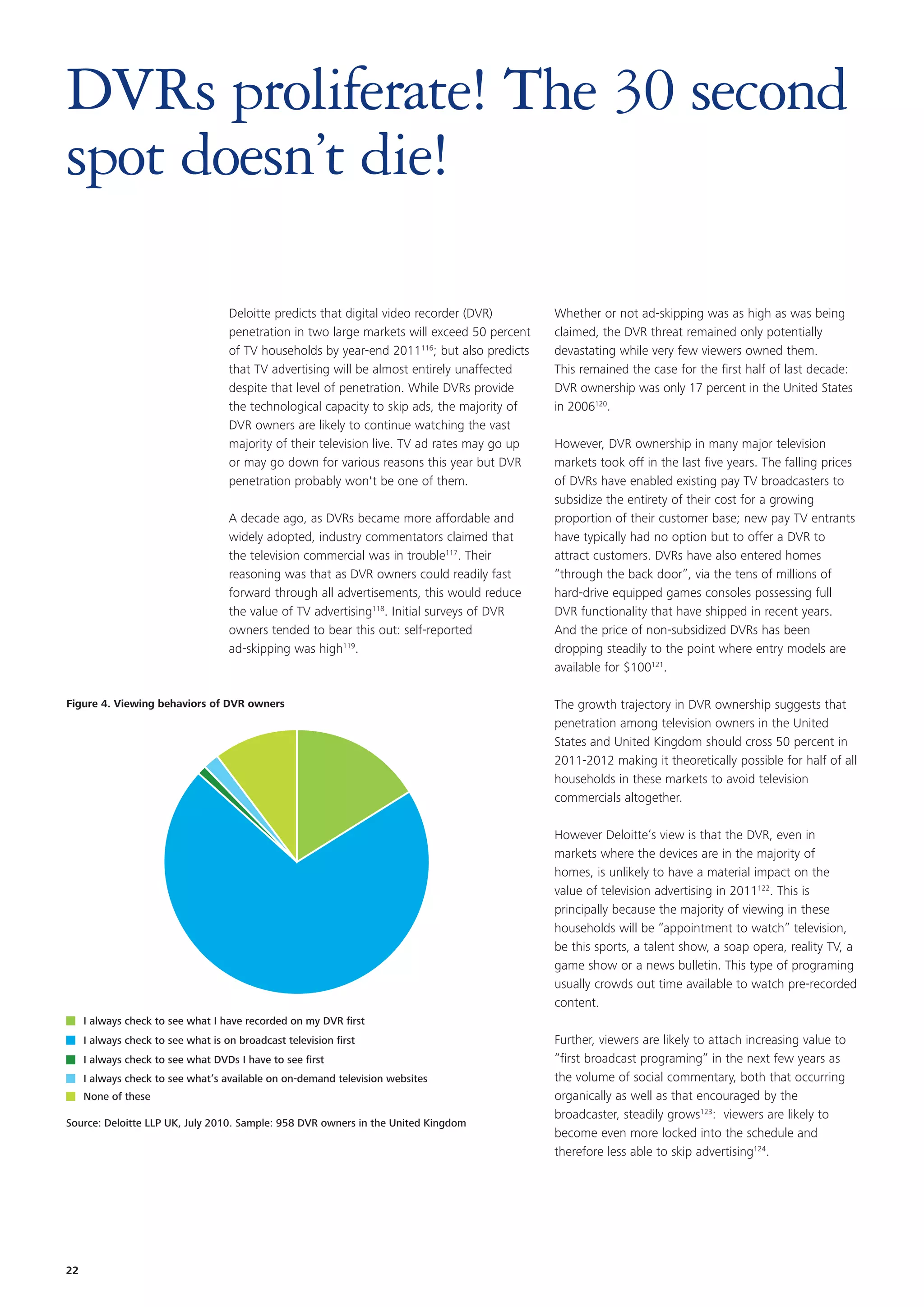
In one study of DVR owners in the United Kingdom,              advertising to be provided. Further, programs watched several days after
70 percent always checked to see what was on                   first transmission could be combined with updated advertising, with a new
broadcast first; only 16 percent checked out their pre-        commercial, for example, replacing an advertisement for a one-day sale.
recorded options first (see Figure 4).
                                                               The rise of the DVR may however pose more of a threat for other parts of
In 2011 and beyond many surveys of consumer                    the entertainment sector. The ability to record with ease may well pose a
behavior are likely to indicate rampant advertising            threat to DVD sales and rentals. Making it easier to record films, regardless
skipping; measured data, rather than self-reported data        of the time they are shown, may well lessen a user’s perceived need to rent
paint a different picture. The television industry needs       or purchase a DVD. Making it easier to record television may crowd out the
to be alert to wherever respondents may distort –              time available to watch any films, including those rented or purchased in
deliberately or subconsciously – their response.               DVD format. According to one survey, of DVR owners who were recording
                                                               more programs than a year back, 40 percent were purchasing fewer DVDs
                                                               and 38 percent were renting fewer DVDs131.


                                                                                    Technology, Media & Telecommunications Predictions 2011   23
Push beats pull in the battle for
the television viewer

       Deloitte predicts that In 2011 despite the sale of tens of   Actively “pulling” content may be even less compelling
       millions of television sets that offer a form of built-in    in 2011 owing to growing availability of
       search capability for television programming, the vast       recommendation applications built into TVs and set top
       majority of viewing will be delivered on a traditional       boxes133. Many of these applications will use previous
       “pushed” basis, in other words the schedules will be         viewing behavior to conveniently recommend new
       determined by channel planners. And a growing                content.
       number of selections may be pushed via
       recommendation engines built into the television or set      Aside from the behavioral challenges involved in pulling
       top box. However the “pulling” of television content by      content, price is likely to be a major obstacle in 2011.
       viewers beyond the selection of a television channel is      Television sets and set top boxes that incorporate the
       likely to remain an exceptional behavior.                    most advanced search capabilities must factor in the
                                                                    cost of additional processors, memory and storage,
       Searching will be available to varying degrees of            which typically add at least $50 (or 10 percent) to retail
       sophistication, ranging from simple search apps              prices134. For low-end units, this additional cost will
       selectable from an on-screen menu, to powerful               likely create a significant drag on sales. Customers
       functionality that enables searching across a wide           pondering the selection of their next television set may
       variety of broadcast, streamed and stored content.           well choose a larger screen rather than paying a
                                                                    premium for enhanced search capabilities135.
       Yet adoption of program searching is likely to remain
       modest, largely because of a lack of need. Although          For consumers buying Internet-ready televisions that
       today’s viewers may value the ability to pull content,       support advanced applications, a major barrier to search
       pushed content remains their default choice. This could      adoption is likely to be the required peripherals and user
       be attributable to the inherently passive nature of the      interface. Such televisions are likely to ship with a
       television medium. Marshall McLuhan famously                 standard numeric keypad that makes it hard to enter
       suggested in Understanding The Media that television         search text. Upgrading to a full QWERTY keypad might
       was a “cool” medium that would require audience              be too expensive given the expected benefits, and
       interactivity; however, remote control and other             current keyboard designs are not generally seen as
       innovations have made TV viewers infamously inert132.        elegant, convenient, or easy to use136.

       Indeed, some argue that on-demand content, delivered         When it comes to television in 2011, the only pulling
       by any technology, may never represent the bulk of           that most viewers may want to do is pulling up a chair.
       viewing for the majority of viewers. Since the time that
       video rental stores first gave viewers the ability to opt
       out of scheduled programming, picking and choosing
       what to watch on TV has remained for most people
       an occasional activity. The monetary cost of selecting
       à la carte is one issue: but even as prices fell for
       purchased or rented video cassettes (in the 90s) and
       DVDs (over the past decade), demand did not rise
       commensurately. Typically households still rent at most
       a few DVDs per month. The biggest barrier might be
       the time and attention required to select content.
       Having choices is wonderful, but choosing can be a
       chore.


24
Bottom line
Technology has always played a fundamental role in television. Since the first TV broadcast, the technology has shifted from black
and white to color, screen size and resolution have grown by a factor of 10, and thousands of new channels have emerged.
Yet one thing has remained constant: for most people, television continues to be a passive experience. Viewers value the option to
choose, but often do not exercise it. Interaction – even among those with multiple ways to control what they watch – has generally
been limited to choosing channels on a remote control or, for the most sophisticated users, selecting from a DVR menu of pre-
recorded content. Technological progress is unlikely to shift these ingrained habits any time soon. Technology enables. But it cannot
oblige.

Younger generations, having grown up searching for content on computers, may bring their search habits into the living room.
But this is not likely to become mass market behavior for many years.

Television is – and will likely remain – more than just a piece of technology or portal to a library of content. For many households, it
is a focal point for family gatherings. For many individuals, it is the principal topic of water cooler conversations with friends and
colleagues. In 2011, mountains of newsprint and terabytes of online chatter will likely continue to focus on TV shows, pushing and
cajoling people into what to watch. And the best search algorithm in the world is not going to change that behavior. At least not in
2011.


                                                                               Technology, Media & Telecommunications Predictions 2011   25
Social network advertising:
how big can it get?

                                Deloitte predicts that in 2011 social networks are likely       Nevertheless, thanks to a low cost base, social networks
                                to surpass the breathtaking milestone of one billion            might still achieve impressive gross margins despite their
                                unique members137. Also, they may deliver over 2 trillion       relatively low revenue per user – particularly when
                                advertisements138. Yet the advertising revenues directly        compared with the traditional media companies they
                                attributable to social networks may remain relatively           are competing against. A social network’s cost of
                                modest compared to other media, at least in the short           content is close to zero since it merely provides the
                                term. With per member annual advertising revenue of             infrastructure, while its users and third party app
                                about $4, that implies total 2011 advertising revenues          developers provide all the content144.
                                of about $4 billion (see Figure 5). Despite social media’s
                                large and growing audience, its advertising revenues            An assessment of social networks’ potential hinges on
                                still represent less than one percent of the worldwide          three metrics: subscriber growth, time spent on the
                                advertising spend total. Other sources of social network        network, and CPMs. Many social networking companies
                                revenues, such as payments systems and e-commerce,              have been recording impressive gains in some of these
                                might exhibit faster growth.                                    metrics, but it is worth examining how much additional
                                                                                                growth they can achieve.

Figure 5. Social networks’ average revenue per user (ARPU) in $                                 When social networks attain the billion unique user
4.5                                                                                             milestone, nearly half of one global user base –
4.0                                                                                             computer-based Internet users – may be signed up by
3.5
3.0                                                                                             year-end 2011. This could put a ceiling on future
2.5                                                                                             growth if global Internet adoption continues to expand
2.0
                                                                                                at the pace that consensus analysts expect145: it might
1.5
1.0                                                                                             be increasingly difficult for social networks to sustain
0.5                                                                                             their impressive subscriber growth trajectories.
  0
                2009                         2010E                         2011E

       Total ARPU ($)       Advertising ARPU ($)
                                                                                                Mobile data might offer a better opportunity,
                                                                                                particularly in developing countries where mobile
Source: Deloitte Touche Tohmatsu Limited, 2010, based on data from: eMarketer, 2010;
NeXt Up Research, 2010; Business Insights, 2010
                                                                                                penetration continues to rise steadily: there are far more
                                                                                                global mobile users than those with access to
                                                                                                computers. However, delivering display advertising to
                                In 2011, it is likely that social networks’ long-term market    mobile phones at volumes and prices sufficient to
                                value will continue to polarize opinions139. Some view          create a significant multi-billion dollar business may not
                                social networking as the technology sector’s “next big          be likely in 2011146. In 2010, mobile advertising
                                thing”, promising even greater rewards than the decade-         revenues for the United Kingdom – the largest
                                old phenomenon of search advertising140. Others                 market in Europe – were only about $40 million147.
                                compare social networks to the dot com bubble and               As smartphones and 3G networks become more
                                argue that monetizing their users at dollar levels similar to   widespread, the base of active social network users
                                those of online search has not yet been demonstrated141.        should rise accordingly.

                                Deloitte’s view is that the advertising revenues from social    Social networks’ growth trajectory is often compared
                                networks in 2011 are likely to be very significant in           with that of paid-for search, which in just 15 years
                                absolute terms: total industry revenues of $4-$5 billion        grew from almost nothing into a $30 billion plus
                                dollars and year-over-year growth of 30 percent are             market that continues to expand. However, a decade
                                impressive numbers; individual companies may experience         ago broadband penetration in most countries was still
                                even higher growth rates. Yet revenue on a per-subscriber       in the single digits and some markets had no
                                basis is unlikely to match search or traditional media in the   broadband service at all. The growth of search was at
                                next year or two. Also, advertising rates, measured on a        least partly fueled by significant growth in online use –
                                cost per thousand impressions (CPM) basis142, are likely to     a trend that social media has already capitalized on.
                                remain low compared to other forms of online advertising
                                as well as traditional media143.


26
If social networks’ advertising revenues are worth only
$4 billion in 2011 with half the potential user base already      Bottom line
signed up, or if future growth is largely restricted to the       In 2011, the story of social networks will continue to be written with no
low-value mobile ad market, most of the upside for social         clear conclusion in sight. Social networks remain an emerging business
networks would need to come from increased time spent             founded on innovation; yet they have already achieved levels of market
on the network, or from improved CPM metrics.                     acceptance that might have seemed inconceivable just a few years ago.
                                                                  The question now is whether social networks can sustain their growth
The amount of time spent on social networks rose                  trajectory and find better ways to monetize value.
sharply in 2010. In fact, according to one analysis, a
popular social network enjoyed a 66 percent increase              Even if social networks’ 2011 ad revenues only meet industry forecasts, they
between Q3 2009 and Q3 2010148. Yet even if the time              may still have other valuable ways to generate revenue. For example, they
spent on social networks grows by a factor of three,              could serve as a payment platform for the hundreds of thousands of
that might not necessarily translate into a threefold             application providers in their ecosystem. Or they could adopt a blended
increase in advertising revenue149. Increasing inventory          e-commerce department store model, where they charge for online floor
could cause CPMs to fall even further150.                         space and earn a commission on any sales. Yet in 2011 these additional
                                                                  revenue streams, although very profitable, are unlikely to surpass advertising
If there are limits to audience growth and time spent,            in importance to social networks (see Figure 6).
then the burden would primarily fall on CPM to drive
                                                                   Figure 6. Global social network revenues
revenue growth. Social networks’ understanding of
                                                                   6
individuals’ backgrounds, preferences, social groups,
                                                                   5
activities, and behaviors are without equal. There have
                                                                   4
been hopes that this would enable social networks to
                                                                   3
deliver superior advertising results: but paradoxically,
                                                                   2
social network CPMs remained among the lowest of all
                                                                   1
forms of online advertising151. That could well change,
                                                                   0
as the ability to mine the myriad data grows or as social                        2009                         2010E                         2011E
networks may find new business models that allow for                     Advertising spending ($ billion)      Social gaming virtual goods ($ billion)
much higher advertising revenues, but for 2011 it is               Source: Deloitte Touche Tohmatsu Limited, 2010, based on data from eMarketer and
difficult to find the levers that would cause social               NextUP Research
network ad revenues to accelerate from their already
rapid pace.                                                       If low CPMs are expected to be the norm, social networks should consider
                                                                  how media agencies – particularly those paid by commission – are likely to
Perhaps the vastness of social networks’ repository of user       respond. Agencies might conclude that commissions based on modest CPMs
information is itself a limiting factor; as of 2011,              are less attractive than other potential clients, and could begin pushing
it remains a challenge to economically extract useful             other forms of advertising. Or they might decide to sell high value advisory
insights from the volumes of user data that social                services, such as public relations and reputation management, to help a
networks generate. The billions of stated “likes” may not         brand manage its presence on social networks.
all necessarily signal an intent to purchase. Also, in 2011, as
in previous years, privacy concerns may constrain the             Advertising firms and their clients will likely need to expand their use of
ability to collect the most valuable data152. Nevertheless,       social media to protect their image and reputation in a world increasingly
once social networks figure out how to rapidly and                influenced by personal opinions and grassroots communications. Studies
economically analyze their data, and to monetize the              have shown that word-of-mouth feedback and peer reviews exert
billions of recommendations made, a new seam of valuable          tremendous influence on purchasing decisions; in fact, one survey found that
customer insights will be available to mine and exploit.          up to 78 percent of people trust peer recommendations, compared to just
                                                                  14 percent who trust advertisements153.

                                                                  Throughout 2011, it seems likely that the forecast for the social network sector
                                                                  will continue to be promising, but unclear. As more information is released and
                                                                  as business models become more developed, advertisers, competitors and
                                                                  analysts will get a better picture of the potential of this industry.


                                                                                          Technology, Media & Telecommunications Predictions 2011        27
Games go online and on sale:
the audience grows, but at
what price?
      Deloitte predicts that in 2011 the global computer and     The existing PC and console game business is
      video game industry will continue growing but from a       confronting various challenges. Increased software
      more diverse set of revenue streams. The industry is       piracy has had a profound effect on sales over the past
      forecast to generate $52 billion in software revenues in   few years, costing the industry billions155. Meanwhile,
      2011, 6 percent higher than in 2010, while hardware is     the higher costs and lengthening development times for
      predicted to generate only $13 billion, a decline of       high-end games have made game development riskier
      19 percent154.                                             (publishers need blockbusters) and has reduced profits
                                                                 across the industry as whole156. For PC game developers
      An increasingly large percentage of games revenue is       and publishers, more and more computing devices are
      likely to come from monthly subscriptions, peripherals,    being sold – but many of them are smartphones,
      fees for services and in-game purchases and advertising    tablets and netbooks that do not have the hardware to
      in the free-to-play (F2P) and “Freemium” markets.          support conventional high-end games.
      Deloitte forecasts that the total revenue from these
      relatively new sources could be as high as $10 billion,    Console revenues and profits tend to be highly cyclical
      or 16 percent of total game revenues, by the end of        as both hardware and software purchases are linked to
      2012, and over time could represent 50 percent of all      the console upgrade cycle157. Five years have passed
      revenues for the industry.                                 since the current generation of consoles was released;
                                                                 the result will likely be relatively flat growth in 2011.
                                                                 Moreover, there are some concerns that the console
                                                                 refresh cycle, which has averaged five years for almost
                                                                 two decades, is about to lengthen into a 10-year cycle,
                                                                 as existing games are not yet putting stress on the
                                                                 hardware capabilities of existing consoles. This would
                                                                 delay the next expansion phase. Console makers hope
                                                                 to bridge the gap by introducing add-on features such
                                                                 as motion control, camera peripherals and 3D.

                                                                 Three major technological drivers – powerful portable
                                                                 devices such as smartphones, ubiquitous network
                                                                 connectivity, and social gaming – are transforming the
                                                                 industry and creating new sources of revenue. As these
                                                                 new revenue streams emerge, the industry should see
                                                                 growth that is both more stable and more profitable.
                                                                 Also, the global audience of gamers will likely continue
                                                                 to expand rapidly, primarily due to an increase in casual
                                                                 gamers on consoles, web and social networks, and
                                                                 most recently smartphones and tablets. However,
                                                                 worldwide games revenues are forecast to grow more
                                                                 slowly than the number of gamers: revenue per gamer
                                                                 is expected to fall.


28
Only a few years ago, very few gamers were
connecting to the Internet for any reason. But today, an    Bottom line
estimated 53-78 percent of gamers (depending on their       The games industry appears to be following in the footsteps of the
console) in the United States use a connected console       enterprise software market. Two decades ago, 90 percent of enterprise
to play multi-player online games, download new             software revenues were one-time license sales – analogous to buying a
content and converse with other players while gaming.       game disc – and there were virtually no follow-on revenues or service fees.
Connected consoles are also used as PC substitutes for      Today, many software companies derive more than half of their revenues
applications such as streaming video158. The benefits to    from services and subscriptions, and license fees are much less critical.
the gamer of a connected machine are enormous – but
the benefits to the games industry are even greater: the    Although this change was disruptive to the industry, most enterprise
arrival of connected gaming has not only slowed the         software companies found that after the transformation they were still able
growth of piracy, but actually reversed it, especially in   to grow profitably while enjoying less revenue volatility. The games industry
geographies where piracy was particularly high159.          might be able to learn from their experience, leveraging best practices from
                                                            the enterprise software industry while developing new best practices of its
As more of their customer base gets connected, game         own.
publishers are likely to see expanding contributions
from revenue sources that aren’t entirely new, but are      The F2P/Freemium revenue model is interesting and potentially lucrative.
becoming increasingly important: micro payments from        However, it could pose a serious disruptive threat to existing console
selling additional levels, characters and costumes;         hardware and software manufacturers if they respond too slowly. The new
online stores; and, possibly, real-time ads placed in       model will likely give rise to new competitors; also, it might reduce the
games (although this has not been a big market so           perceived value of all games.164
far)160. Also, some high-end games are being sold as
monthly online subscriptions. The cloud gaming market       The growing number of non-console and non-PC games and gamers
(or GaaS, gaming as a service) is still nascent but could   suggests that companies focused on traditional console and PC hardware
become a significant revenue source for companies that      sales may need to diversify. We are already seeing high-end graphics chip
have customers with fast Internet connections – even        manufacturers use their technology in non-gaming markets165. Also, the
people with relatively low-powered netbooks or small,       peripheral market seems to be shifting from single-purpose accessories
cheap thin-client devices that can be connected to TVs      (musical instruments, etc.) to multi-purpose peripherals that provide image
should be able to enjoy console-like experiences161.        recognition and motion capture. Peripheral manufacturers and game
                                                            developers alike may need to adapt to this market shift.
The fastest growing games segment will probably
continue to be F2P and Freemium games. These games
are typically based on a revenue model where basic
game play is free, but a premium is charged for add-ons
that enhance the game experience such as extra levels,
accelerated progress and special in-game accessories
such as weapons, supplies and costumes
(micropayments). Many subscription games are
converting to F2P and seeing their revenues increase by
100 percent or more162. Total F2P revenues in 2009
were about $2 billion163; in 2011, that number could
reach $5 billion.

The upshot of all these trends is that the gaming
industry will likely see smoother revenue streams, higher
revenues and profitability and massive user growth.
The existing market of core gamers isn’t about to go
away, but the mix of people who play games is likely to
shift in many ways: age, gender and income, among
others.


                                                                                 Technology, Media & Telecommunications Predictions 2011   29
Keeping the life in live:
A&R diversifies

                                  Deloitte predicts that in 2011, the live music sector,            By contrast, the first decade of this millennium has been
                                  with festival organizers at the forefront, will start             particularly prosperous for the live music industry.
                                  expanding its talent creation and nurturing role, either          Revenues rose steadily and even fared relatively well
                                  as individual companies or joint projects. Until now,             during the recent recession168. However, the decade
                                  that role has been left largely to music labels’ artist and       ahead looks to be more challenging, perhaps due to
                                  repertoire (A&R) divisions. The live sector will identify,        the ongoing decline in A&R investment by the labels.
                                  invest in, develop and commercialize the next generation
                                  of stadium-filling artists, using a variety of approaches,        There are two cyclical factors that could soften live
                                  from talent contests at festivals to dedicated facilities         music revenues in 2011 and beyond, forcing the live
                                  for nurturing new talent. All aspects of the live music           sector to pick up some of the slack in terms of
                                  sector may get involved: venue owners, concert                    identifying and commercializing new acts.
                                  promoters, television production companies, ticket sales
                                  agencies and even some established recording artists.             One factor is the vintage of the current highest grossing
                                                                                                    live acts. Some of the last decade’s biggest draws
                                  The recorded music industry has traditionally built a             appear to be approaching the twilight of their touring
                                  pipeline of up-and-coming music acts through their A&R            careers. In 2011 the lead singers for eight of the
                                  divisions. In 2010, the industry spent almost $5 billion on       20 highest grossing live acts in the United States from
                                  development and promotion of all acts, with about half            2000-2009 will be 60 or older. Only one of the top 20,
                                  going to foster new talent166. However, after a decade of         Rascall Flatts, released its first album this century
                                  declining sales, the labels’ A&R spending is shrinking both       (in 2000). Through 2009, Rascall Flatts grossed
                                  in absolute dollars and as a percentage of sales. In some         $222 million from touring. The other 19 acts, the
                                  countries, A&R investment as a percentage of revenues is          majority of which rose to prominence on the back of
                                  down about 25 percent since 2006.167                              single and album sales (and the associated promotional
                                                                                                    activity) grossed a cumulative $6 billion in ticket sales
                                                                                                    during the last decade: the sexagenarians alone
Figure 7. Share of revenue generated by the top 20 grossing music live acts in the                  brought in more than $2.5 billion (see Figure 7).
United States from 2000-2009, by age of artist/lead singer in 2011

                                                                                                    A second factor is the economy, particularly in
                                           6%                                                       industrialized countries. Stubborn unemployment,
                                                                                                    increases in value added tax, and an austerity-focused
                                                                                                    public sector might keep consumer confidence low and
                                                                                                    concert attendance down170. In fact, a weak economy
                                                                                                    might have been one of the key factors behind the
                                                                    40%                             17 percent decline in the U.S. live market in the first
                      35%                                                                           half of 2010171.


                                                19%


     60s      50s        40s         30s

Source: Deloitte Touche Tohamtsu Limited, 2010, based on live tour data from Pollstar169; ages of
lead singers from various websites


30
While record companies will always exist, they might be
unable or unwilling to handle their previous level of      Bottom line
investment in new acts. If so, another part of the         As festivals start to become more involved in nurturing talent, one of the
industry might need to take up the slack of identifying    promotional activities they are likely to take on is the release of new albums
and publicizing new talent to a point where fans are       and singles (and all of the marketing activity that goes with it). This is likely
willing to pay $100 or more per ticket to see them         to remain the principal way to raise awareness of bands and their latest
perform. The live music industry will need to build this   outputs; for many fans, seeing a number one single performed live is likely
new role into its long-term business model.                to remain a key selling point172.

The role of festivals in A&R is likely to increase as      The live music industry might want to co-invest in the A&R process with
festivals rely most heavily on musicians to sell their     companies outside of the music sector that wish to use music to promote
tickets. This differs from an arena or stadium whose       their products. Given society’s seemingly limitless affection for music, most
major motivation is to book any act that can fill up its   vertical sectors – from fashion to mobile phones to automobiles – would
seats, including, for example, stand-up comedians          likely value an association with music. Live music businesses could tap these
whose staging costs are generally far lower.               brands to help pay for part of the talent development process, such as the
                                                           funding of recording studios173.
Television’s role in identifying new talent may start
placing an increased focus on acts that are great          The record companies’ traditional A&R process was very effective, but also
recording acts but are even better at touring.             very resource intensive. In today’s environment where music fans seem to
                                                           value a live experience more than a recording, the live music industry might
                                                           be in a better position to identify top talent – specifically, the talent that can
                                                           really deliver on stage.

                                                           The various players in the live music industry must recognize their common
                                                           need for an ongoing pipeline of new acts to replace the existing big draws –
                                                           and they must take combined action. Over the next few years, label-sourced
                                                           A&R is likely to decline by roughly $500 million per year globally. It seems
                                                           reasonable to assume that the live music industry – or other source of
                                                           funding – will need to step in to prevent the well from running dry.


                                                                                 Technology, Media & Telecommunications Predictions 2011   31
Pop goes pop-up: music retail
goes seasonal and temporary

      Deloitte predicts that 2011 revenues for digitally           Rather than selling popular hits, other music retailers
      distributed music will exceed physical music sales in at     may specialize in music genres that would be harder to
      least one major market, most likely the United States.       discover on the Web. Their aim would be to attract
      This long-anticipated event will probably be driven by a     fervent music fans who are willing to pay for music.
      sharp decline in CD sales, rather than a significant         These niche markets will likely make up only a small
      increase in digital music subscriptions or downloads174.     portion of total album sales, similar to vinyl record sales.
                                                                   For example, in the United States, vinyl sales grew
      This likelihood leads to a related prediction: CD retail     250 percent from 2006 to 2009. However, the end
      will start becoming a seasonal or event-driven purchase.     result represented only 2.5 million units out of a total
      By the fourth quarter of 2011, there could be 1,000          album market of 374 million179.
      temporary “pop-up” music outlets created to meet
      occasional surges in demand. Pop-up outlets will be a        Despite the shift toward digitally distributed music,
      small, but growing, niche segment175.                        physical music retailing will not vanish: while demand
                                                                   for CDs in the medium term will continue, it will
      In 2011, the United States will likely be the first of the   become increasingly seasonal. In 2010, nearly half of
      big-three recorded music markets to see digital music        all CDs sold in the United Kingdom were expected to
      revenues from downloads, subscriptions and streaming         be purchased during the fourth quarter, driven by
      services advertising surpass revenues from physical          seasonal gifting and the finale of music talent shows180.
      music. The UK is likely to follow, either in 2011 or by
      the end of 2012176, assuming CD sales continue their         Retailers will likely respond to variable demand by
      steep decline177. To put the severity of this decline in     creating pop-up stores. Current music retailers might
      perspective, CDs made up 75 percent of record labels’        establish a variety of temporary stores, including
      2009 revenues in the United Kingdom.                         conventional retail spaces with short-term leases181,
                                                                   temporary outlets in high traffic locations182 and
      The decline in the CD market is likely to cause a marked     small-scale outlets offering curated, exclusive
      reduction in year-round shelf space dedicated to             merchandise183. These curated outlets could be located
      physical music. Even with fewer competitors, dedicated       wherever and whenever there are people who want to
      music retailers may decide that their shrinking revenues     buy CDs, such as at live music venues184.
      and profit margins make physical music retailing less
      viable178. Some may diversify, shifting their focus from     In the medium term, pop-up stores may also be set up
      recorded music to equipment for playing music, concert       to coincide with major record releases. A long line of
      and festival tickets, or music-related clothing.             fans eager to purchase a new release from a pop-up
                                                                   store could generate marketing buzz and increase
                                                                   record sales.


32
General retailers, such as department stores and
supermarkets, may abandon selling CDs year-round if       Bottom line
their turnover and margin targets are not met. Instead,   The next few years will probably remain challenging for music retailers.
they may only stock CDs when demand is stronger,          The one bright spot is that CD prices could rise over the medium term as
such as during gift-giving seasons or major music         dedicated CD buyers have fewer outlets to choose from. CDs could follow
events. In some cases, music might be sold from a         the path of vinyl LPs, which rose significantly in price following their exit
pop-up outlet physically located within the main          from the mainstream.
store185. During the rest of the year, music might only
be available from the main store’s website186.            Music fans who prefer CD audio quality might be willing to pay a higher
                                                          price. However, price increases will not compensate for a continuing decline
                                                          in unit sales; net revenues from recorded music will continue to decline.

                                                          Nevertheless, because recorded music provides crucial exposure for
                                                          musicians, it is likely that record labels and other music promoters will
                                                          continue to produce CDs – even at a loss.


                                                                                Technology, Media & Telecommunications Predictions 2011   33
Telecommunications


34
Getting to 4G cheaply:
will many carriers opt for
3.5G instead?
Deloitte predicts that in 2011 the deployment of                Spectrum for LTE is currently being allocated, and
next generation Long Term Evolution (LTE) wireless              130 carriers were running LTE trials at the end of 2010.
networks will fall short of industry expectations due           Many commentators expected widespread rollouts to
to the continuing viability of the latest third generation      have happened by now187; however, Deloitte expects that
(3G) wireless technologies, such as High Speed                  fewer than 30 LTE carriers in six countries will offer
Packet Access (HSPA+), and the handsets that work               commercial service by the end of 2011188. While a few
with them.                                                      of the world’s largest carriers will likely deploy LTE, most
                                                                networks will stick with transition technologies for the
                                                                next year.


  The technology behind 3.5G and LTE
  There are three basic tricks that carriers can use to wring more capacity out of their existing cellular spectrum.

  • Place cell towers closer together. In most big cities, however, tower density has already been pushed to the
    limit. Cutting-edge innovations such as femtocells and picocells could be used to shrink cell sizes further, but
    have yet to be widely adopted because of cost.

  • Improve how the RF signal is encoded. Advanced modulation techniques that squeeze more information into
    a given frequency band are constantly evolving. However, they require complex chips to implement. The latest is
    called 64 Quadrature Amplitude Modulation or 64QAM (pronounced “kwam”).

  • Put multiple antennas on cell towers and mobile devices. This multiple input-multiple output configuration
    (known as MIMO and pronounced either “me-mo” or “my-mo”) used to be found only in advanced military
    technology. It enables improved wireless communication that uses the spectrum more efficiently, particularly in
    urban areas, where signals bounce off buildings and suffer from multipath distortion190.

  Some aspects of the full 4G standard can be found in current LTE implementations, such as the MIMO antenna
  configuration, QAM encoding and channel allocation and scheduling. However, true 4G must offer mobile speeds
  of 100 Mbit/second, and fixed access speeds of 1 Gbit/second. At the moment, real-world deployments of LTE are
  only achieving fixed download speeds of around 10Mbit/s191. This is much faster than older 3G technologies, but
  not nearly fast enough to qualify as true 4G.

  The latest versions of 3G, such as HSPA and HSPA+, known as “3.5G” because they are a bridge between
  generations, use some of the same tricks as LTE. HSPA+ release 8 uses both 2x2 MIMO and 64QAM, and promises
  real-world mobile data download speeds of 15-30 Mbit/s by the end of 2011.

  Many carriers, especially those with weaker balance sheets or less congested networks, are asking themselves why
  they should move to LTE when real-world deployments of HSPA+ seems to offer comparable speeds (more than
  30 HSPA+ networks around the world currently offer 21 Mbit/s downloads).

  The decision between 3.5G and LTE turns out to be more complex than it seems. Although 3.5G theoretically offers
  competitive speeds, it is less spectrally efficient than LTE and therefore uses more radio spectrum to achieve similar
  data rates. In some real-world circumstances, HSPA+ uses twice as much spectrum as an equivalent LTE
  implementation. Also, 3.5G lacks some of the architectural efficiencies of LTE to support enhanced features and
  services such as video.

  Carriers that invest in LTE now may enjoy an easier, less expensive transition to true 4G when it becomes available.
  However, in 2011, 3.5G will likely be the most commonly deployed “next generation” technology as many carriers
  around the world do not currently have sufficient funding or need for LTE.


                                                                                            Technology, Media & Telecommunications Predictions 2011   35
Aside from the truism that “everything always takes
longer than you think,” there are two main reasons why        Bottom line
4G adoption might be slower than expected. First, not all     The global market for deploying LTE networks is expected to be roughly
mobile providers have made full use of their existing 3G      $10 billion by 2014, and many times higher than that in subsequent years192.
spectrum: weak economic growth, low mobile broadband          Most commentators agree that mobile providers will eventually invest
usage and underutilized networks have allowed some            heavily in 4G, however, a slower than expected rollout could disappoint
providers to defer additional investment.                     some industry observers. Markets where 3G deployment took longer than
                                                              expected saw significant erosion in equipment prices and margins; in some
Second, LTE – as it exists today – does not offer the         markets, late-built 3G networks even produced negative gross margins for
quantum leap in speeds and features over 3G that              the equipment vendors193.
previous generational upgrades did.
                                                              Mobile providers with severe network congestion and weak ownership of
LTE is likely to be a major success in 2011 and beyond,       spectrum have little choice at this point: only LTE’s bandwidth efficiency can
with hundreds of millions of subscribers around the world     solve their problems. By contrast, networks with ample spectrum to handle
gaining access to the benefits that LTE can provide189.       their current and future needs can probably defer LTE for years. In fact, some
But rollout will probably be slower than many people          emerging markets such as rural India and China are still in the process of
expect, especially if some mobile providers that have less    deploying 3G, let alone 4G194.
congested networks – or that operate in markets with less
immediate demand for broadband – decide the need for          The more difficult choice will be for providers that fall between the two
LTE is not as urgent as they previously thought. Providers    extremes. Although they might think they can defer LTE investment for
that do have a need for LTE need it a lot, and they need it   3-4 years, a sudden surge in wireless data devices or usage patterns could
now: the big question is how large that group really is.      create an immediate need for LTE’s spectral efficiency and other features.
                                                              As the last few years have shown, wireless demand can rise very abruptly.
Although LTE networks are being marketed as 4G                Carriers need to be prepared for data volume growth that is measured in the
networks, it would be more precise to describe them as        thousands of percent over three years, as past experience has shown that
“4G ready”. In their current form they do not offer a         those rates can occur and even persist over several years.
quantum leap in performance over 3.5G, which is why
some carriers have been able to postpone upgrading.           A provider could spend hundreds of millions on HSPA+ in order to put off a
                                                              multi-billion dollar investment in LTE, only to find itself facing an immediate
                                                              need to upgrade to LTE and to have to spend the billions anyway.

                                                              Handset vendors also face a difficult choice. Most voice traffic is expected
                                                              to stay on GSM next year, and a large share of data traffic is likely to be
                                                              handled through dongles, personal mobile Wi-Fi hotspots and laptops with
                                                              built-in 3G. Also, LTE networks will probably be more limited than expected
                                                              in 2011; although they will tend to be available in the most affluent and
                                                              data-hungry markets. Handset vendors that are thinking about not offering
                                                              LTE versions of popular phones and tablets must weigh the decision
                                                              carefully.

                                                              Finally, businesses selling services or applications that piggy-back on the
                                                              network may have to adapt their strategies to a data world where most
                                                              customers still connect through some flavor of 3G. This could mean
                                                              deferring launches or finding alternate solutions until the faster networks
                                                              are ready.


36
Wi-Fi complements cellular
broadband for “data on the move”

Deloitte predicts that in 2011 the volume of data uploaded       Mobile data’s appeal as a like-for-like alternative to
or downloaded from portable devices via public Wi-Fi             fixed broadband may recede if the equivalent fixed
networks will grow at a much faster rate (25-50 percent)         broadband offer is cheaper and/or offers higher
than the volume carried over cellular broadband networks.        performance. The number of households that have cut
The bulk of this growth will be video data195; Wi-Fi is likely   their fixed connectivity cord may reduce as some
to become the default network for video applications.            formerly mobile-only households revert to fixed lines for
                                                                 broadband and voice access.
Wi-Fi’s increasing share of the mobile device data load
will likely have a ripple effect in moderating the growth        Wi-Fi’s growing appeal for on-the-move data is likely to
rate of cellular broadband traffic, potentially helping          be based not just on the growing base of Wi-Fi
improve margins for mobile providers’ data services.             hotspots, but on the appropriateness of their location
                                                                 and pricing200. Based on recent growth rates, the
Trends that could contribute to increased use of Wi-Fi           number of public hotspots worldwide could increase by
use include: proliferation of Wi-Fi hotspots, increased          20 percent in 2011, rising to over 400,000. In addition,
penetration of Wi-Fi chips in portable data devices,             some fixed broadband providers are enabling customers
easier log-in procedures to access hotspots,                     to use other customers’ Wi-Fi connections, creating
partnerships between hotspot providers and mobile                networks with millions of hotspots201.
providers, growing awareness of Wi-Fi capabilities in
existing devices, superior battery life in some contexts196,     Meanwhile, the location of public hotspots is becoming
and a steady shift toward tiered mobile data pricing197.         more targeted to actual needs; users may no longer be
                                                                 required to seek out a specific restaurant or coffee
Cellular broadband will increasingly revolve around              chain in the hope of finding Wi-Fi202. Instead, Wi-Fi
specific uses and the users that can take full advantage         providers are likely to locate hotspots where people are
of the technology’s unique strengths – wide-area                 known to need high speed data connections. Shopping
coverage, mobility and integrated security198 – and              centers could be designed from the ground up to
justify the cost premium. These specific uses include:           incorporate Wi-Fi access203. Indeed some retailers might
                                                                 make it a standard policy to include Wi-Fi connectivity
• Users who need to send a file while actually moving199.        in their stores to encourage comparison shopping204.
  (This differs from being “on the move”, which can              Photogenic tourist areas also could provide Wi-Fi
  include periods when the user is stationary, e.g.,             hotspots to enable photographs to be distributed to
  standing on a train platform, parked at a highway              friends and family within seconds205. In addition, Wi-Fi
  service station, or dining at a restaurant);                   may become increasingly available on trains and train
                                                                 platforms206.
• Relatively price-insensitive users (e.g., business users)
  who require a more secure connection;                          The proliferation of free hotspots207 and in some cases
                                                                 competitive Wi-Fi hotspot pricing – should drive
• Locations where public or private Wi-Fi connectivity           adoption. Sponsored Wi-Fi could become increasingly
  is too congested and the user is willing to pay a              common as part of branded marketing initiatives208.
  premium for a better connection;                               Also, for some users, hotspot access will be bundled
                                                                 with another service, such as broadband209.
• Low-bandwidth applications such as e-mail or text-
  based updates to social networks; and                          As Wi-Fi networks expand and tiered pricing becomes
                                                                 increasingly pervasive, users will become accustomed to
• Geographic regions where it is not commercially viable         waiting until they are at a hotspot before streaming
  to deploy a public Wi-Fi network, but where some               content or transferring large files. This will help limit the
  users might still need a wireless data connection.             use of cellular broadband to specialized mobile
                                                                 applications.
Increased focus on these special situations could help boost
margins for cellular broadband and reduce the disconnect
between volumes carried and revenue generated.


                                                                                             Technology, Media & Telecommunications Predictions 2011   37
Although cellular data traffic will likely continue to
increase, the growth rate should moderate significantly         Bottom line
from the levels seen in 2008-2010, when Wi-Fi was a             Mobile providers should view Wi-Fi and cellular broadband as
less well-known and less pervasive alternative.                 complementary and build out blended networks, or partner with Wi-Fi
                                                                providers as appropriate. Mobile providers and device vendors should not
The year 2011 will almost certainly see growing                 view the new, more specialized role for cellular broadband as a failure or a
shipments of Wi-Fi only portable data devices – such as         defeat. Given the significant cost difference between carrying data over a
eReaders, handheld game consoles, tablet computers,             fixed network versus a 3G cellular network, 3G-based broadband may never
digital photo frames and even voice phones210 – largely         be competitive against Wi-Fi on a like-for-like basis for high bandwidth data
due to their lower cost. 3G versions of eReaders cost up        services.
to a third more than Wi-Fi only models211; 3G tablets
cost up to 20 percent more than Wi-Fi only models.              Indeed, mobile providers could benefit the most if cellular broadband use
Customers who occasionally need access to cellular              starts to focus on applications that actually take advantage of its unique
broadband can purchase a MiFi device that converts a            strengths – wide-area coverage, mobility and integrated security. Without
3G signal into a usable Wi-Fi connection.                       such a shift, the current growth trend is expected to produce a 25-fold
                                                                increase in mobile data with only a two-fold increase in revenues over the
If a growing number of customers opt for Wi-Fi only             medium term, which appears to be unsustainable.
devices, some manufacturers may decide not to
produce 3G versions at all, particularly at the low end         The battle between Wi-Fi and cellular broadband should not be seen as a
of the market. Other suppliers may limit their offerings        zero-sum game: both can be winners. For example, a service for sharing
to Wi-Fi only devices for technical reasons. For example,       photos on-the-go could use cellular broadband to immediately upload low
some video calling services might only be available             resolution thumbnails, with the corresponding high resolution images being
when connected via Wi-Fi in order to reduce congestion          uploaded later from a Wi-Fi hotspot or fixed line connection.
on the cellular network212. To promote Wi-Fi use,
manufacturers may start to bundle devices with                  In the face of convergence, mobile providers must think more broadly about
subscriptions for a few free months of hotspot access.          the range of wireless and wireline technologies that people want to use, and
                                                                then help their customers tap into the right mix. The idea is to make the
Wi-Fi use – particularly for video applications – will likely   entire connected experience as seamless as possible, while charging both
also be driven by the shift from all-you-can-eat mobile         business users and consumers an appropriate amount for the privilege of
data plans to capped monthly usage, a move that is              simplified access to a complex set of networks.
already being implemented by mobile providers around
the world. With a 200 megabyte cap, just one hour of            IT managers can help their companies keep costs in check by making it as
video streaming at 500 Kbit/s would eat up an entire            easy as possible for users to log into Wi-Fi networks when available. This is
month’s allowance.                                              especially important for users who access data while roaming; access to
                                                                hotspots could represent a major cost saving.
The introduction of LTE networks – as well as the
ongoing upgrade of existing 3G networks to HSPA+ –              Wi-Fi network providers need to be aware of Wi-Fi’s limitations, particularly
will boost the speeds available for cellular broadband.         the issue of radio interference. Wi-Fi shares unlicensed spectrum with a wide
LTE offers higher spectral efficiency and is less prone to      range of devices from microwave ovens to Bluetooth devices to wireless
interference, but cells may be less ubiquitous and would        game controllers. Connection quality must be continuously monitored to
therefore have higher contention and congestion.                avoid network degradation. Wi-Fi providers must also create networks with
Meanwhile, Wi-Fi connections continue to get faster.            sufficient capacity (particularly backhaul capacity) so the networks are not
The wireless link to a Wi-Fi router already exceeds             overwhelmed by the increasing volume of users and data traffic215.
100 Mbit/s using the latest standard (802.11n)213.
And the fixed networks that link Wi-Fi routers to the
Internet are steadily improving214. In the end, LTE is
unlikely to compete with Wi-Fi hotspots – unless the
latter are congested – but would remain the clear choice
for users requiring high speed data access beyond the
reach of a Wi-Fi or fixed broadband connection.


38
What is “in store” for Wi-Fi:
online comparison shopping
on aisle 3
Deloitte predicts that in 2011, 25 percent of North          A common reason why shoppers do not make a
American big box and anchor tenant retailers will begin      purchase is that they are paralyzed by the lack of
offering free in-store Wi-Fi access to shoppers. In 2012,    knowledge: “is this item available elsewhere for a much
the proportion should continue to rise in North America      better price?” When an online search reveals that
and start to spread around the world.                        competitors’ prices are similar, many shoppers proceed
                                                             with the purchase at the store they are in, rather than
Until now, cellular data was the only connectivity           drive around just to save a few dollars. Although some
available inside most large stores, and many customers       sales are lost, experiences from early adopters and
did not have a phone or data plan that enabled Internet      other comparison technologies suggest that is more
access. Also, cellular signals can be highly variable:       than offset by connected consumers being less likely to
weak signals and low speeds are common, especially           leave without purchasing, and ending up spending
deep inside a store. Without Wi-Fi, the in-store online      more217.
experience is often frustrating and dissatisfying.
                                                             In-store Wi-Fi would enable customers to use the
Offering Wi-Fi access is not yet an accepted retailing       retailer’s digital sales tools to answer basic questions
practice216. Although Wi-Fi has become pervasive in          and to find out if the item they want is in stock.
cafés and in the common areas of malls, individual           This would allow in-store employees to spend their time
retailers feared that consumers would use their              on more valuable activities such as handling detailed
smartphones or tablets and the Internet to comparison        questions and increasing service and sales, instead of
shop. Retailers do not stock flyers or catalogs from their   responding to routine inquiries. Stores could deploy
competition...why would they provide a data pipe that        Wi-Fi tablets as interactive catalogs and order entry
tells customers the same or similar merchandise is           systems. And certain products, such as Wi-Fi enabled
available at a competitor, possibly for a better price?      TVs, could be demonstrated more effectively218. Broadly
                                                             speaking, some retailers view Wi-Fi as a way “to further
Conversations with large North American retailers            enhance the customer in-store experience219.”
suggest that this fear may have been misguided.
When shoppers do in-store online comparison                  Even if shoppers use a store’s Wi-Fi for personal
shopping, preliminary and anecdotal evidence suggests        activities (e.g., checking email, other legitimate web
the likelihood of purchasing appears to go up, not           browsing) they are likely to spend more time in the
down.                                                        store, perhaps increasing their impulse buying and total
                                                             spending. Also, very few customers are likely to “park”
                                                             themselves in the store just to use Wi-Fi, as most
                                                             retailers do not provide tables and chairs.


                                                                                       Technology, Media & Telecommunications Predictions 2011   39
In-store Wi-Fi could enable a variety of advanced push
applications. Localization would allow for precise           Bottom line
targeting: shoppers in the linens section could have         In-store Wi-Fi presents retailers with a number of minor challenges. Retailers
information or discounts pushed to their mobile              will probably need to build more and better apps to enhance the in-store
devices. Up-sell offers could also be pushed: a shopper      experience. They may also need to upgrade their Wi-Fi equipment and
who buys a barbecue grill could be instantly sent an         network connectivity to support additional connections. However, based on
offer on patio furniture that could either be purchased      experiences from some early in-store deployments, the costs to address
in store or though the website for home delivery.            these challenges are not material to most large retailers223.

Another benefit for retailers who offer in-store Wi-Fi is    Far and away the biggest challenge relates to privacy and customer data.
collection of customer data. Depending on Wi-Fi user         This is not a new issue for many retailers, but in the context of Wi-Fi it will
agreements and local privacy laws, various levels of in-     likely require greater awareness of the changing regulatory and legal
store customer information could be collected, retained      environment.
and analyzed. At the most basic level, Wi-Fi would
enable a retailer to map customers’ physical paths           Data monitoring, collection and retention and behavioral advertising have
through the store220. In addition, a retailer could gather   been the subject of much regulatory debate by watchdogs, regulators,
email addresses and cell phone numbers to add to its         privacy advocates, and consumers in the United States, Europe, and Canada
customer database221. Some retailers offer customers         alike224. For example, two separate privacy bills have been introduced in the
the option to sign-up for free Wi-Fi access by logging in    United States, with both the Commerce Department and the Federal Trade
through third-party social media sites such as Facebook.     Commission expected to issue independent reports providing businesses with
This enables a retailer to collect other useful data, such   regulatory guidance on privacy issues225. Collection of customer data over
as age, gender, birth date, relationship status,             Wi-Fi networks has also been in the news recently. Although the story had
occupation and personal interests.222 However, the           nothing to do with the retail industry, and involved inadvertent data
availability of such data depends on what users are          collection, it demonstrates how sensitive this issue is for regulators and the
willing to share publicly via Facebook and in their          public.
privacy settings. Once gathered, customer information
could be retained and used on future visits to direct the    In providing Wi-Fi services to customers, retailers must understand and stay
customer to a personalized landing page with targeted        abreast of regulatory changes and shifting public sensitivities about online
promotions.                                                  tracking practices. This can help them strike the right balance between
                                                             maximizing data performance and respecting customer privacy.
When customers are logged in to a store’s Wi-Fi
network, it is possible to track their online activities,
including the Web searches they conduct and the
websites they view.223 Doing so can provide useful
information about which competitive shopping
destinations are most frequently used. Taken to an
extreme, the precise content of their activities could
even be monitored and acted upon in real time by, for
example, delivering a coupon or sales pitch to
customers’ devices in response to their browsing
behavior. This would enable retailers to serve
advertisements more relevant to a customer’s interests
– a practice known as online behavioral advertising (or
Internet-based advertising). Retailers could also
aggregate data collected from Web based traffic and
then match it against real-time in-store purchases and
subsequent online purchases.


40
Video calling: the base goes
mainstream, but usage
remains niche
Deloitte believes that in 2011 video calling will be          Meanwhile, the quality of video calls – including ease-
cheaper, better and more widely available than ever;          of-use, image resolution, audio-video synchronization,
yet a boom in demand is unlikely. Use of video calling        and reduced jitter and lag – should steadily improve
will likely continue to grow steadily. However, we expect     thanks to technological advances such as improved
the vast majority of calls – both for business and            compression software, higher broadband speeds and
consumer uses, and on fixed and mobile networks – will        increased integration with social networking sites232.
remain purely voice-based, and that most people who           LTE technology – wherever it is deployed in 2011 –
really need to see each other will continue to opt for        should offer a better experience owing to its superior
face-to-face meetings rather than video conferences.          video call handling capabilities relative to HSPA
                                                              variants233.
There are two main reasons why video calling is unlikely
to experience an inflection. First, for conversations that    Despite these broad improvements in video
can be handled by phone, a voice-only call will continue      conferencing, as well as the larger installed base of
to suffice in most cases; video exceeds needs. Second,        devices that can support video calling, Deloitte does not
in situations that require a deeper level of interaction, a   expect a dramatic increase in the volume of video calls.
video call, despite many recent innovations, still cannot
compete with the richness and depth of a face-to-face         For businesses, the use of video calling is likely to remain
meeting.                                                      modest. Most business conversations simply do not
                                                              require a video call. And despite falling prices, the cost
Many commentators have heralded 2011 as a                     of setting up a video conferencing system and dedicated
breakthrough year for video conferencing, citing lower        room may still be prohibitive, even for businesses that
costs, higher quality and an expanding range and              are trying hard to reduce their travel costs.
volume of video-ready devices in the marketplace226.
In fact, one research firm has forecast that the number       There is also a question of who these businesses can call.
of mobile video-calling users in North America will rise      A company that is willing and able to invest in a high-
by a CAGR of 115 percent through 2015, generating             end, multiple-screen video conferencing solution to
9 petabytes of additional data traffic227. But in our view    reduce its carbon footprint may find few peers with
these advances will likely not be sufficient to catalyze      compatible equipment. In fact, during 2011 there may
mass market adoption of video calling in 2011.                still be significantly more airports in the world than
                                                              companies with the ability to hold a high-end video
It is true that television-based video conferencing that      conference234.
offers sufficient quality for business calls should become
significantly cheaper in 2011228. Television                  Business could of course use the embedded cameras
manufacturers and video conferencing specialists are          within laptops to make video calls. However, the quality
both expected to expand their television-based                may not be acceptable given the typical size and
offerings in the sub-$10,000 range229. This contrasts         resolution of such cameras; individuals sitting in front of
sharply with the price range for room-based, multiple-        their laptops cannot recreate the feeling of a group
screen video conferencing solutions, which can start at       meeting. Also, calls from open plan environments and
more than $100,000.                                           offices not dedicated to video conferencing might
                                                              require erasing whiteboards or removing confidential
Also, many more devices are likely to include built-in        materials to prevent them from appearing in the
video-calling capabilities. Deloitte’s estimate is that       background.
about 400 million new devices with the required
forward-facing video cameras will ship in 2011,
including smartphones, tablets230, netbooks, desktop
computers, laptops, MP4 players and GPS units231.


                                                                                          Technology, Media & Telecommunications Predictions 2011   41
For consumers, the volume of video calls should
continue to rise modestly, but a spike in usage seems          Bottom line
unlikely. Many consumers see video calling as an               In the business world, relationships and trust are often built during
undesirable compromise between voice-only calls and            conversations at bars and restaurants, during taxi rides, on golf courses, and
in-person meetings. If people just need to                     at the company water cooler. Video calling cannot replicate these kinds of
communicate, a standard voice call is sufficient. And if       experiences. Moreover, while video conferencing might be price-competitive
they really want to see each other, there is no substitute     with business-class travel and five-star hotels, the growing acceptance of
for an in-person meeting. Can video calls create               low-cost flights and budget accommodations makes in-person business trips
meaningful value in the no-man’s land between these            more economically viable.
two extremes? To date, video calls have proven popular
with families stretched across countries or continents –       Video calling is generally better for the environment than carbon-intensive
especially those with newborns; however, market                travel. However, businesses looking to make a major investment in video
penetration within the segment is already relatively           calling capabilities should consider all of the factors – environmental and
high, which could limit future growth.                         otherwise – including the additional resources required to build a dedicated
                                                               room for video conferences.
Cost is also an important factor. Higher service charges
would likely dampen enthusiasm for video calling, as           The value of any network is linked to its size, which is why interoperability is
would higher charges and stricter caps for mobile data.        critical. Video calling’s potential would be severely constrained if users were
                                                               limited to communicating with others that use the same vendor’s
Last but not least, one of the key factors that could          equipment.
limit the growth of video calling is that it tends to make
people self-conscious235. Many of us are unfamiliar and
uncomfortable with seeing moving images of ourselves;
this can be distracting and dampen spontaneity. Also,
we might feel the need to change clothes or apply
make-up before the call, which creates an extra
inconvenience. Over time, increased familiarity is likely
to boost our comfort level. But it might take a
generation for video calling to become pervasive.

The video call, in all its forms, has advanced significantly
since it was first demonstrated in 1964236.
Technologically it has made major strides over the last
decade, in terms of quality, functionality and price.
But despite these advances, it appears that hundreds of
millions of people equipped with video-calling devices
are not quite ready to make the video call a regular part
of their lives237. At least not in 2011.


42
Endnotes


1    So what is a PC? Almost all laptop, desktop and netbook computers sold in 2009 and before were based on a common architecture. There were some
     variations in operating system, but almost all of them ran on chips that still were compatible with the original x86 architecture specified by the developer of
     the PC in 1981. In contrast, almost all of the non-PC devices (smartphones and tablets) that are expected to ship in 2011 will NOT use that architecture, those
     chips or any of the various PC operating systems. There are exceptions: in some markets some devices that look like PCs use different chips (mainly netbooks)
     and some tablets are expected to ship with chips and OS that are from the PC ecosystem. But the exceptions are just that, and are expected to be less than
     5 percent of either market.
2    PC Sales Forecast Cut Further as Tablet Market Grows, Gartner estimates cited in an article from Channelinsider, 30 November 2010: http://www.channelinsider.com/
     c/a/Spotlight/PC-Sales-Forecast-Cut-Further-as-Tablet-Market-Grows-Gartner-711349/
3    IDC Predicts Cloud Services, Mobile Computing, and Social Networking to Mature and Coalesce in 2011, Creating a New Mainstream for the IT Industry, IDC,
     2 December 2010: http://www.idc.com/about/viewpressrelease.jsp?containerId=prUS22593310&sectionId=null&elementId=null&pageType=SYNOPSIS
4    Installed base of PCs to hit 2B units by 2014, Gartner, 5 May 2010, cited in EE Times Asia, 2 July 2008: http://www.eetasia.com/ART_8800532355_1034362_
     NT_0f60f95b.HTM and http://www.gartner.com/DisplayDocument?id=1364917
5    In the PC world, although there is more than one chip supplier, the two major manufacturers produce chips that are substantially similar to each other at the
     architectural level: x86 compatible Complex Instruction Set Computer (CISC) able to be used virtually interchangeably in most PCs with only minor modifications.
6    Yahoo! Finance, Application Software Companies: http://biz.yahoo.com/p/821conameu.html used as a screen, and excluding OS providers.
7    Mobile App Marketplace: $17.5 Billion by 2012, GetJar report dated 17 March 2010 cited in TechCrunch, 17 March 2010: http://techcrunch.com/2010/03/17/
     getjar-mobile-app-sales-will-overtake-cd-sales-by-2012-video/ and http://blog.getjar.com/developer/sizing-up-the-global-apps-market/
8    Gartner Says Consumers Will Spend $6.2 Billion in Mobile Application Stores in 2010, Gartner Press Release, 18 January 2010:
     http://www.gartner.com/it/page.jsp?id=1282413
9    Full Analysis of iPhone Economics – it is bad news. And then it gets worse, Tomi T Ahonen Blog posted on ‘Communities Dominate Brands’ Website, 22 June 2010:
     http://communities-dominate.blogs.com/brands/2010/06/full-analysis-of-iphone-economics-its-bad-news-and-then-it-gets-worse.html
10   Phone incumbents’ average operating margin: 4.5%. RIM and Apple: 34%, Asymco, 13 August 2010: http://www.asymco.com/2010/08/13/phone-incumbents-
     average-operating-margin-4-5-rim-and-apple-34/
11   Tech Data Corporation Reports Fiscal 2011 Third-Quarter Results, 22 November 2010: http://phx.corporate-ir.net/phoenix.zhtml?c=115264&p=irol-newsArticle&
     ID=1499128&highlight
12   Glentel Q3 2010 Quarterly Report, Glentel website: http://www.glentel.com/images/financials/123/Glentel-Q3-Report-WEB-Nov-10.pdf pages 18 and 27 for
     retail distribution operating income.
13   Deloitte Predictions interviews conducted in November 2010 with wireless carriers in Europe and North America suggest that they see significant service
     revenue opportunities in the small and medium business segments for mobile and tablet app selection and maintenance.
14   The End Of The BlackBerry Elite, Forbes, 20 April 2010: http://www.forbes.com/2010/04/20/smartphone-mobile-iphone-technology-cio-network-blackberry.html
15   For more discussion on this theme, please see the prediction “End of an era: more than half of all computers aren’t computers anymore”, Technology, Media
     and Telecommunications Predictions, Deloitte Global Services Limited, January 2011
16   How the PC Really Got Started, Fast Company, 19 December 2007: http://www.fastcompany.com/articles/archive/pc_bday.html
17   “There is no reason anyone would want a computer in their home.” – Ken Olson, president, chairman and founder of Digital Equipment Corp., 1977 to the
     World Future Society
18   Smartphones shifting power from carriers to OEMs: Yankee Group report dated 8 June 2009 http://www.yankeegroup.com/ResearchDocument.do?id=51584
19   Network effect definition from PC Magazine Encyclopedia: http://www.pcmag.com/encyclopedia_term/0,2542,t=network+effect&i=47879,00.asp
20   How much does it cost to develop a mobile app on iPhone, Android and other platforms? Mobile Marketing Universe website, 7 September 2010:
     http://goldengekko.blogspot.com/2010/09/what-are-costs-of-developing-mobile-app.html
21   Gartner Says Effective Management Can Cut Total Cost of Ownership for Desktop PCs by 42 Per cent, Gartner Press release, 10 March, 2008:
     http://www.gartner.com/it/page.jsp?id=636308
22   Tablets are Toys (Not Mainstream Machines), ReadWrite Enterprise, 4 August 2009: http://www.readwriteweb.com/enterprise/2009/08/tablets-are-toys-not-
     mainstream-machines.php
23   Sprint Says 4G Tablet Coming In 2011, 80% Of CIOs Want To Buy Tablets, Forbes, 9 December 2010:http://blogs.forbes.com/elizabethwoyke/2010/12/09/sprint-
     says-4g-tablet-coming-in-2011-80-of-cios-want-to-buy-tablets/
24   AT&T to sell the iPad to Businesses, Mashable, 15 October 2010: http://mashable.com/2010/10/15/att-ipad-businesses/
25   iPad Poised to Revolutionize Retail Industry, Advertising Age, 21 April 2010: http://adage.com/digital/article?article_id=143416
26   With the iPad, Apple may just revolutionize medicine, The Washington Post, 11 April 2010: http://www.washingtonpost.com/wp-dyn/content/article/2010/04/
     09/AR2010040906341.html
27   SAP NetWeaver on iPad, SAP website, 5 July 2010: http://en.sap.info/apps-ipad-citrix-office/35854/print
28   SAP To Deploy Up To 17,000 iPads In 12 Months, ZDNet, 7 September 2010: http://www.zdnet.com/blog/sybase/sap-to-deploy-up-to-17000-ipads-in-12-
     months/414?tag=mantle_skin;content
29   Gartner to CEOs: Seize the iPad Opportunity Now, Gartner, 4 November 2010: http://www.gartner.com/it/page.jsp?id=1462813
30   Rugged Tablet PC by MobileDemand: http://www.ruggedtabletpc.com/ as one example.
31   The 2010 Group Mobile Best Sellers Guide, GroupMobile Website; http://www.groupmobile.com/bestof.asp
32   Web Apps vs. Native Apps, GigaOm, 30 September 2010: http://gigaom.com/2010/09/30/mobilize-2010-native-mobile-apps-will-be-with-us-for-some-time/
33   New Zealand’s newly appointed Government CIO starts his role on 2 February 2011. Source: Push for e-government creates CIO position, Computerworld,
     23 November 2010: http://computerworld.co.nz/news.nsf/news/push-for-e-government-creates-cio-position In some countries, e.g. the U.S., this role already
     exists.
34   XBRL submission of company accounts and other business reporting should drive significant cost savings for governments and businesses. See: XBRL FOR TAX,
     BANKING, CORPORATE ACTIONS AND CAPITAL MARKETS EXPANDING GLOBALLY, http://www.xbrl.org/LatestNews/; For a view on drivers for e-government
     adoption in Pakistan, see: PM for adoption of modern ICT applications to improve efficiency of public sector organizations, Associated Press for Pakistan,
     26 December 2009: http://www.app.com.pk/en_/index.php?option=com_content&task=view&id=92666&Itemid=2
35   For details of the UK’s “digital by default” strategy, announced 22 November 2010, see: Digital by default proposed for government services, CabinetOffice UK,
     25 November 2010: http://www.cabinetoffice.gov.uk/news/digital-default-proposed-government-services
36   E-Invoicing Could Help Save European Economy Millions And Support Growth – Gertrude Tumpel-Gugerell, European Central Bank, eGov Monitor, 28 April 2010:
     http://www.egovmonitor.com/node/36005


                                                                                                 Technology, Media & Telecommunications Predictions 2011           43
37   E-government is not a financial cure-all, Guardian, 6 April 2010: http://www.guardian.co.uk/commentisfree/libertycentral/2010/apr/06/smarter-government-costs-services
38   In the EU, where electronic invoice submission is an option, and one which was first effected in February 2010. Source: European Commission Receives Its First
     Electronic Invoice From Supplier in Feb 2010, eGov Monitor, 26 February 2010: http://www.egovmonitor.com/node/34057
39   For example in Denmark, electronic submission of invoices for jobs done for the government has been mandatory since 2005. Source: e-Invoicing in Denmark,
     eGov Monitor, 10 July 2006: http://www.egovmonitor.com/node/6669; Finland will mandate electronic submission of invoices to the public sector by end 2010.
     Source: E-Invoicing Could Help Save European Economy Millions And Support Growth – Gertrude Tumpel-Gugerell, European Central Bank, eGov Monitor,
     28 April 2010: http://www.egovmonitor.com/node/36005; also see: Mandatory Requirements (E-government in New Zealand),http://www.e.govt.nz/
     programme/agency-checklist/mandatory-requirements
40   For further information, please see: http://epp.eurostat.ec.europa.eu/portal/eurostat/home
41   European Commission Receives Its First Electronic Invoice From Supplier in Feb 2010, eGov Monitor, 26 February 2010: http://www.egovmonitor.com/node/34057
42   ICAEW survey on HMRC service standards, ICAEW, 19 November 2010: http://www.ion.icaew.com/TaxFaculty/21018
43   For a discussion on the need for data to be exchangeable between departments, see: E-government is not a financial cure-all, Guardian, 6 April 2010:
     http://www.guardian.co.uk/commentisfree/libertycentral/2010/apr/06/smarter-government-costs-services
44   For a view on the UK’s plans for deeper use of e-government channels, see: Government plans to put services online ‘could widen the digital divide’,
     The Telegraph, 21 November 2010: http://www.telegraph.co.uk/technology/broadband/8149609/Government-plans-to-put-services-online-could-widen-the-digital-divide.html
45   For more information on XBRL, see: http://www.xbrl.org/Home/ and www.deloitte.com/iXBRL
46   iSuppli report, 22 September 2010, cited in an article in TechWorld, 23 September 2010: http://www.techworld.com.au/article/361947/rural_markets_hold_key
     _india_mobile_growth/ and http://www.isuppli.com/Mobile-and-Wireless-Communications/News/Pages/India-Cell-Phone-Penetration-to-Reach-97-Percent-in-2014.aspx
47   Broadband Subscriptions in India, eMarketer, March 2010.
48   Rajasthan Government reaches Underprivileged via Mobile Phone, eGov News, 11 May 2010: http://www.egovonline.net/news-list/34-news/8227-rajasthan-
     government-reaches-underprivileged-via-mobile-phone-.html
49   For example Kenya’s AfriAfya, a network of Kenya’s largest health NGOs, is using technology to improve community health in rural areas. In Algeria, an H1N1
     flu information portal has been set up for citizens and healthcare providers. eGovernment innovations are likely to include: new means of communications,
     e.g. in Benin eGovernment portals now include podcasts and online forums; Ghana’s government portal uses social media tools such as YouTube; Facebook
     contacts of key ministerial staff are available. Cape Verde has started implementing e-government by allowing e-voting, which has helped the country tally
     votes within minutes of poll closings and avoid conflicts about results. Gujarat introduced e-voting in 2010. Source: Gujarat introduces e-voting in civic
     elections, Gujarat Global News Network, 28 July 2010: http://www.gujaratglobal.com/index.php?option=com_content&task=view&id=2159&Itemid=38
50   Uganda’s national data backbone and eGovernment implementation, which is in its first phase of implementation, is financed by a US$110 million loan from
     the Chinese government and infrastructure from China’s Huawei Technologies. Source: Huawei Technologies: China’s Go-To Company for African ICT
     Infrastructure Investments, ICTworks, 7 April 2010: http://www.ictworks.org/network/ictworks-network/359; Korea’s Ministry of Knowledge Economy and the
     Korean Trade-investment Promotion Agency, KOTRA recently pledged to help the governments of Kenya and Tanzania by sharing its technological knowledge.
     Source: Africa e-government study to get underway, DatacenterDynamics, 15 November 2010: http://www.datacenterdynamics.com/ME2/dirmod.asp?sid=&nm
     =&type=news&mod=News&mid=9A02E3B96F2A415ABC72CB5F516B4C10&tier=3&nid=2F41921D4E424A67A58EA3E77C6D7DDF
51   For example in Dubai, AED 1.1 billion was collected via its ePay payment gateway during the first half of 2010, a 60 percent year-on-year increase. Source:
     Popularity of ePay growing, says Dubai eGovernment, ITP.net, 11 August 2010: http://www.itp.net/581404-popularity-of-epay-growing-says-dubai-egovernment
52   For an example of how a new computer form facto made technology accessible to a 99 year old, see: iPad has ‘changed’ 99-year-old woman’s life,
     CNET News, 22 April 2010: http://news.cnet.com/8301-13506_3-20003192-17.html and a video on ‘Virginia’s new iPad’: http://www.youtube.com/watch?v=ndkIP7ec3O8
53   Please Rob Me: Site Tells The World When You’re Not Home, The Huffington Post, 17 February 2010: http://www.huffingtonpost.com/2010/02/17/please-rob-
     me-site-tells_n_465966.html
54   For an in-depth explanation of personally identifiable information, see: Guide to Protecting the Confidentiality of Personally Identifiable Information (PII),
     National Institute of Standards and Technology, April 2010:http://csrc.nist.gov/publications/nistpubs/800-122/sp800-122.pdf
55   “Quit Facebook” protest day flops, Telegraph, 1 June 2010: http://www.telegraph.co.uk/technology/facebook/7792970/Quit-Facebook-protest-day-flops.html
56   For example in the US, the online industry has already aggressively made steps to enhance its self-regulatory efforts. These include consumer awareness
     campaigns and opt out tools, such as: NAI opt-out tool; the Interactive Advertising Bureau (IAB) “Privacy Matters” campaign, which consists of headlines;
     (e.g. “Advertising is creepy”) and icons that direct users to the ‘’Privacy Matters” website; TRUSTe icon and its Behavioral Advertising Notice and Choice
     Program; NAI and IAB Control Links for Education and Advertising Responsibly (CLEAR) Ad Notice.
57   It is regarded as unethical and occasionally illegal to target individuals with evident or known weaknesses, even if these would be willing customers.
     For example, those who have drunk too much should be refused a last one for the road; those with gambling habits should not be offered a free bet; female
     adolescents profiled as health conscious, but in fact struggling with eating disorders, should not be offered weight loss products/services.
58   Do Not Track Proposal Unleashes Fresh Furor Over Online Privacy, E-Commerce Times, 12 February 2010:http://www.technewsworld.com/story/71360.html
     ?wlc=1291337891
59   For more information, see: Boucher, Stearns Release Discussion Draft of Privacy Legislation, Congressman Rick Boucher website, 4 May 2010:
     http://www.boucher.house.gov/index.php?option=com_content&view=article&id=1957; Best Practices Act: http://www.house.gov/apps/list/press/il01_rush/
     h_r_5777_the_best_practices_act_2010.pdf
60   A directive requires member states to achieve a particular result without dictating the means of achieving that result. Directives leave member states with a
     certain amount of leeway as to the exact rules to be adopted. So indeed, the exact implementation can vary in every jurisdiction in the EU.
61   EU Chews on Web Cookies, Wall Street Journal, 22 November 2010: http://online.wsj.com/article/SB10001424052748704444304575628610624607130.html
     #ixzz170MrDxm7; The new EU cookie rule – so, we need to get consent then?, Computer Weekly, 23 November 2010: http://www.computerweekly.com/
     Articles/2010/11/23/244068/The-new-EU-cookie-rule-so-we-need-to-get-consent.htm
62   EU proposes online right ‘to be forgotten’, Telegraph, 5 November 2010: http://www.telegraph.co.uk/technology/internet/8112702/EU-proposes-online-right-to-
     be-forgotten.html
63   FTC wants voluntary ‘Do Not Track’ for the Web, CNET News, 1 December 2010: http://news.cnet.com/8301-13578_3-20024332-38.html
64   For example, the Office of the Privacy Commissioner of Canada held public consultations to examine the effectiveness of the Personal Information Protection
     and Electronic Documents Act (PIPEDA) in handling emerging privacy issues online, including online profiling, tracking and targeting. The report issued on
     October 25, 2010 confirmed that PIPEDA provides a sound framework; however, additional guidance is required to clarify how to apply the Act in new and
     emerging contexts. Source: Draft Report on the 2010 Office of the Privacy Commissioner of Canada’s Consultations on Online Tracking, Profiling and Targeting
     and Cloud Computing, Office of the Privacy Commissioner of Canada website, 25 October 2010: http://www.priv.gc.ca/resource/consultations/report _2010_e.cfm


44
65    The new EU cookie rule – so, we need to get consent then?, Computer Weekly, 23 November 2010: http://www.computerweekly.com/Articles/2010/11/23/
      244068/The-new-EU-cookie-rule-so-we-need-to-get-consent.htm
66    Online Privacy Bills Would Hurt E-commerce, Trade Group Says ,PC World, 10 September 2010: http://www.pcworld.com/businesscenter/article/205157/online_
      privacy_bills_would_hurt_ecommerce_trade_group_says.html
67    Summary of Draft Department of Commerce Privacy Green Paper, HL Chronicle of Data Protection, 15 November 2010: http://www.hldataprotection.com/
      2010/11/articles/general/summary-of-draft-department-of-commerce-privacy-green-paper/
68    For example in the Netherlands, the original explanatory memorandum talked about “ondubbelzinnige toestemming” (unambiguous consent);
      the ‘ondubbelzinning’ (unambiguous) has since been dropped. The expected outcome in the Netherlands is probably also a browser based solution.
69    MRS warns strict EU cookie rules could ‘severely disrupt’ online MR, Research Magazine, 9 December 2010: http://www.research-live.com/news/government/
      mrs-warns-strict-eu-cookie-rules-could-severely-disrupt-online-mr/4004220.article
70    A Proposed Framework for Businesses and Policymakers, Federal Trade Commission, December 2010: http://www.ftc.gov/os/2010/12/101201privacyreport.pdf.
71    Privacy by Design is an approach developed and advocated by the Information and Privacy Commissioner of Ontario, Ann Cavoukian.
      See http://www.privacybydesign.ca
72    Expectations for Consumer Consent in Interest Based Advertising: Regulatory and Industry Positions in the United States, Europe, and Canada Jordan Prokopy
      and Megan Brister. BNA Privacy and Security Law Report. Vol. 9. No. 21. Pp. 775-779. 2010.
73    Is lithium-ion the ideal battery?, Battery University: http://batteryuniversity.com/index.php/learn/article/is_lithium_ion_the_ideal_battery
74    What does the future hold for battery technology?, ICIS, 9 July 2008: http://www.icis.com/Articles/2008/07/14/9139058/what-does-the-future-hold-for-battery-
      technology.html
75    Building a better battery, Associated Press, 17 October 2005: http://www.msnbc.msn.com/id/9689826/ns/technology_and_science-innovation/
76    A tenfold improvement in battery life?, CNET News, 15 January 2008: http://news.cnet.com/A-tenfold-improvement-in-battery-life/2100-1041_3-6226196.html
77    A Better Battery? The Lithium Ion Cell Gets Supercharged, Scientific American, 11 March 2009:
      http://www.scientificamerican.com/article.cfm?id=better-battery-lithium-ion-cell-gets-supercharged and Toshiba – Rechargeable Battery: http://www.scib.jp/en/
78    The Innovation Process for Battery Technologies, ATP Working Paper Series, 21 July 2005: http://www.atp.nist.gov/eao/wp05-01/chapt3.htm
79    Deloitte Cleantech in Canada seminar, 4 November 2009: http://cleantechincanada.com/?p=183
80    Is Lithium-ion safe? Isidor Buchmann of Cadex Electronics, September 2006: http://www.buchmann.ca/article28-page1.asp
81    A Quicker Test for Hybrid Batteries, Technology Review, 4 August 2010: http://www.technologyreview.com/energy/25925/
82    Peak Lithium?, EV World, 28 January 2007: http://www.evworld.com/article.cfm?storyid=1180
83    An Abundance of Lithium, R. Keith Evans, March 2008: http://www.che.ncsu.edu/ILEET/phevs/lithium-availability/An_Abundance_of_Lithium.pdf
84    A Cheaper Battery for Hybrid Cars, Technology Review, 24 January 2008: http://www.technologyreview.com/energy/20105/
85    Transact Energy Secures Altergy Systems Fuel Cell Technology for India, TransAct Energy Corp., 2 November 2010: http://www.transactenergy.com/2010/11/
      transact-energy-secures-altergy-systems-fuel-cell-technology-for-india/
86    Plug Power Inc: Fuel Cells Power Walmart Lift Trucks, Business Review Canada, 23 June 2010, http://www.businessreviewcanada.ca/sectors/renewables/plug-
      power-inc-fuel-cells-power-walmart-lift-trucks
87    Hydrotopia, Salon.com, 24 September 2002: http://dir.salon.com/tech/feature/2002/09/24/hydrogen/print.html
88    Economics of Fuel Cell Solutions for Material Handling, Ballard, April 2009: http://www.ballard.com/files/pdf/Case_Studies/Material_Handling_Economic
      _Benefits_041510.pdf
89    FCC moves forward on backup power rules, ITExaminer.com, 14 September 2008: http://www.itexaminer.com/fcc-moves-forward-on-backup-power-rules.aspx
90    Ballard, Tokyo Gas to Develop Fuel Processor for Residential Fuel Cell Generator, HighBeam Research, 13 January 2000: http://www.highbeam.com/doc/ 1G1-
      58575057.html
91    Consensus analyst forecasts; Thomson FirstCall, October 2010.
92    Second Wind for Hydrogen In the Eco-car Race?, CBS News, 19 April 2010: http://www.cbsnews.com/stories/2010/04/17/tech/main6406094.shtml
93    Hard cell, Globe and Mail, 10 June 2009: http://www.theglobeandmail.com/globe-drive/green-driving/news-and-notes/hard-cell/article1176394/
94    Hydrogen/Fuel Cells, US News and World Report, 11 January 2008: http://money.usnews.com/money/personal-finance/articles/2008/01/11/hydrogenfuel-cells.html
95    The hydrogen car fights back, CNN Money, 14 October 2009: http://money.cnn.com/2009/10/13/technology/hydrogen_car.fortune/index.htm
96    Canadian Fuel Cell Commercialization Roadmap Update ,Ballard, December 2008: http://www.ballard.com/files/pdf/PWC_Report.pdf page 31
97    Sorry, There’s No Way To Save The TV Business, Business Insider, 12 June 2009: http://www.businessinsider.com/henry-blodget-analysts-begin-to-realize-that-
      theres-no-way-to-save-television-2009-6; TiVo CEO Declares TV Almost-Dead, Wired, 20 October 2008: http://www.wired.com/epicenter/2008/10/tivo-ceo-declar/
98    Brazil, Russia, India and China.
99    PAY TV subscriber base expands in BRIC Countries while revenues grow more modestly, DatAxis Intelligence, 13 July 2010: http://www.dataxisnews.com/?p=19220
100   A growing genre of cookbooks skips recipes and focuses on science, Globe and Mail, 23 November 2010: http://www.theglobeandmail.com/life/food-and-
      wine/a-growing-genre-of-cookbooks-skips-recipes-and-focuses-on-science/article1810272/
101   According to this article television is responsible for “a lot” of the 90 million daily tweets generated as of November 2010. Assuming that “a lot” is at least
      5 million per day, this would imply over a billion tweets per year. Source: There Are 90 Million Tweets per Day, And A Lot Are TV Related, TechCrunch,
      10 November 2010: http://techcrunch.com/2010/11/10/twitter-tv/. For a list of the most popular television trends topics on Twitter in 2009, see: Top Twitter
      Trends of 2009, Twitter Blog, 15 December 2009: http://blog.twitter.com/2009/12/top-twitter-trends-of-2009.html
102   Advertising Expenditure Forecasts, ZenithOptimedia, 6 December 2010: http://www.zenithoptimedia.com/about-us/press-releases/zenithoptimedia-adspend-
      forecast-update-dec-2010/
103   Ibid
104   Calculation based on Nielsen data measuring time spent on Facebook in U.S., UK, Australia, Brazil for June 2009 and June 2010. Across all four countries,
      average time spent on Facebook was 7.5 minutes in June 2009 and 10.3 minutes a year later. Assuming a similar year-on-year increase in 2011, average time
      spent would be just over 14 minutes. Nielsen data provided in: The ups and downs of social networks, BBC News, 22 July 2010: http://www.bbc.co.uk/
      news/technology-10719042
105   This data point is based on the total population in the U.S. aged 2 or over whether or not they have the technology. Nielsen Three Screen Report, Volume 8,
      1st Quarter 2010.
106   In 2009, 9 of the UK’s top 50 selling books were written by individuals who had television programs, were regular guests on television shows or who had been
      made famous by television. Source: Review of 2009: The Bestsellers, TheBookSeller.com, 7 January 2010: http://www.thebookseller.com/in-depth/feature/
      108940-review-of-2009-the-bestsellers.html


                                                                                                 Technology, Media & Telecommunications Predictions 2011          45
107 The two leading TV magazines sell over 2 million copies between them. Five of the top 10 UK magazines are television related. Source: MAGAZINE ABCs:
    New editor puts Radio Times back over a million, MediaWeek, 11 February 2010: http://www.mediaweek.co.uk/news/983483/MAGAZINE-ABCs-New-editor-
    puts-Radio-Times-back-million/; the UK X Factor magazine sells 300,000 copies per week. Source: Why the ‘x factor’ is A licence to print money, Independent.
    ie, 30 October 2010: http://www.independent.ie/entertainment/music/why-the-x-factor-is-a-licence-to-print-money-2400552.html
108 Apax on track to sell Hit Entertainment, Financial Times, 29 October 2010: http://www.ft.com/cms/s/0/6c92bd10-e2dd-11df-9735-00144feabdc0.html #axzz16Dx4O9nS
109 ‘Got Talent’ Kid Jackie Evancho Makes Chart Impact, Billboard, 19 August 2010: http://www.billboard.com/news/got-talent-kid-jackie-evancho-makes-chart-
    1004110235.story; Susan Boyle achieves transatlantic sales record, monsterandcritics.com, 17 November 2010: http://www.monstersandcritics.com/people/
    news/article_1599771.php/Susan-Boyle-achieves-transatlantic-sales-record
110 Strictly Come Dancing is ‘world’s most successful reality television format’, Telegraph, 23 November 2010: http://www.telegraph.co.uk/news/worldnews/
    northamerica/usa/8155637/Strictly-Come-Dancing-is-worlds-most-successful-reality-television-format.html
111 For more background on the market dynamics of the Chinese television market, see: China’s got viewers, The Economist, 18 November 2010:
    http://www.economist.com/node/17522454
112 China broadcasters strike gold with foreign formats, AFP, 23 November 2010: http://www.google.com/hostednews/afp/article/ALeqM5j5Cdo04NVSYsQwSYE3Lk
    -M1AnYCw?docId=CNG.9d7cb2e161ee25e135303c0ac0ee51ec.281
113 Ibid.
114 Year-on-year change at current prices, ZenithOptimedia, December 2010. For more information see: http://www.zenithoptimedia.com/about-us/press-releases/
    zenithoptimedia-adspend-forecast-update-dec-2010/
115 PAY TV subscriber base expands in BRIC Countries while revenues grow more modestly, DatAxis Intelligence, 13 July 2010: http://www.dataxisnews.com/?p =19220
116 At the end of Q2 2010, 40 percent of all US households had a DVR, a rise of 14 percent on the previous quarter. Source: Bigger TVs, DVR and Wi-Fi among Hot
    U.S. Home Technology Trends, Nielsen, 30 September 2010: http://blog.nielsen.com/nielsenwire/consumer/report-bigger-tvs-dvr-and-wi-fi-among-hot-u-s-home-
    technology-trends/
117 Comment speculating on a DVR-driven end to traditional television advertising has been a constant of the last decade. Source: TV advertising’s DVR challenge,
    CNET News, 23 May 2006: http://news.cnet.com/2100-1024_3-6075233.html; for a view from 2005, which estimated 50 percent of viewing would be skipped
    by 2010, see: Sky+ won’t kill TV ads, says media buyer, Guardian, 28 November 2005: http://www.guardian.co.uk/media/2005/nov/28/advertising.broadcasting1
118 One survey of marketers found that 75 percent would cut their television ad budget as a result of ad-skipping technology. Forrester report from February, 2002
    cited in: The TiVo Effect: Advertisers See Less TV Ad Spending, ClickZ, 25 November 2002: http://www.clickz.com/clickz/news/1704616/the-tivo-effect-
    advertisers-see-less-tv-ad-spending
119 One consumer survey in 2002, found that 72 percent of DVR users skip commercials. Source: Will TiVo revolutionize television viewing?, CNN, 5 December
    2002: http://edition.cnn.com/2002/SHOWBIZ/12/04/hln.connect.tivo/
120 CEA Finds American Adults Spend $1,200 Annually on Consumer Electronics Products, Consumer Electronics Association, 26 April 2007: http://www.ce.org/
    Press/CurrentNews/press_release_detail.asp?id=11274
121 Bush 160GB Top Up TV Digital TV Recorder, Amazon: http://www.amazon.co.uk/Bush-160GB-Top-Digital-Recorder/dp/B002H9G5Z6/ref=sr_1_3?s= electronics
    &ie=UTF8&qid=1289717850&sr=1-3
122 Duke study: TiVo doesn’t hurt TV advertising, Triangle Business Journal, 3 May 2010: http://www.bizjournals.com/triangle/stories/2010/05/03/daily6.html
123 According to Twitter, “a lot” of the tens of millions of daily tweets are about television shows. Source: Twitter Plus TV Creates “Social Viewing”, GigaOM,
    10 November 2010: http://gigaom.com/2010/11/10/twitter-plus-tv-creates-social-viewing/
124 For an example of a smart phone application designed to foster commentary about television programs, see: tvChatter iPhone Application from frog design
    Uses Twitter to Make TV Social, Frog design press release, 16 October 2009: http://www.frogdesign.com/press-release/frog-design-hosts-unique-digital-think-in-
    with-npr-10072009.html
125 Why DVR Viewers Recall Some TV Spots, Wall Street Journal, 26 February 2008: http://online.wsj.com/public/article/SB120398730105292237.html?mod=blog;
    Also see: DVR Fast-Forwarding May Not be Fatal to TV Ads, PRNewswire, 3 November 2008: http://www.prnewswire.com/news-releases/dvr-fast-forwarding-
    may-not-be-fatal-to-tv-ads-65213522.html
126 Study: TiVo, other DVRs don’t negatively affect TV advertising, CrunchGear, 4 May 2010: http://www.crunchgear.com/2010/05/04/study-tivo-other-dvrs-dont-
    negatively-affect-tv-advertising/
127 Programmes that have had this uplift in the UK include True Blood and Glee. Source: PVR pumps up the numbers, Broadcast, 18 March 2010:
    http://www.broadcastnow.co.uk/ratings/pvr-pumps-up-the-numbers/5011886.article?query=0
128 For example, in Canada, while 86 percent of DVR owners pre-record content, only 3 percent of all viewing is actually of pre-recorded content. Canadians watch
    about 30 hours per week on average. Source: One in five Canadians own a PVR, Digital Home, 13 August 2010: http://www.digitalhome.ca/2010/08/one-in-
    five-canadians-own-a-pvr/
129 On TV: perspectives on television in words and numbers, Deloitte LLP UK, August 2010: http://www.deloitte.com/view/en_GB/uk/industries/tmt/media-
    industry/81fdbc5df883a210VgnVCM200000bb42f00aRCRD.htm
130 For example see: SundayTimes.co.uk’s paying readers can set Sky TV recordings, Guardian, 27 April 2010: http://www.guardian.co.uk/media/pda/2010/apr/27/
    times-sky or see this video: TiVo Premiere app for iPad, http://www.youtube.com/watch?v=IQ82HW81t9o
131 Deloitte LLP UK/YouGov, July 2010: sample, 567 DVR owners who were recording more on their DVR than a year back.
132 Marshall McLuhan Theses on “The Television”: http://www.utoronto.ca/mcluhan/mcluhanprojekt/fernsehen2.htm
133 This functionality is now available via the BBC’s iPlayer, see: http://iplayerhelp.external.bbc.co.uk/help/using_bbc_iplayer/friends_feature
134 Google TV reviewed: Did Google get ahead of itself?, Crosscut.com, 8 November 2010: http://crosscut.com/2010/11/08/technology/20319/Google-TV-reviewed:-
    Did-Google-get-ahead-of-itself-/
135 See this article for details of price reductions on some deep-search equipment: Struggling Google TV Devices Have Prices Slashed at Retail, Gizmodo,
    28 November 2010: http://gizmodo.com/5700535/struggling-google-tv-devices-have-prices-slashed-at-retail
136 Sony Google TV Remote Leaked, Designed in 1980?, Wired, 6 October 2010: http://www.wired.com/gadgetlab/2010/10/sony-google-tv-remote-leaked-
    designed-in-1980/
137 Deloitte estimate based on data from Strategy Analytics: Social Networks Set to Conquer Asia, 18 October 2010: http://blogs.strategyanalytics.com/dcp/555/
    and also considering data from: The Social Networking Marketing Opportunity, Business Insights, April 2010, referenced in eMarketer.


46
138 In Q3 2010, Facebook served 297 billion ads in the U.S. and 68 billion in the UK. Source: Facebook Is Dominating The Display Ad Market, Business Insider,
    8 November 2010: http://www.businessinsider.com/chart-of-the-day-online-ad-impressions-2010-11; Facebook Grabs Huge Portion of Display Ad Market for Q3,
    Daily Tech, 9 November 2010: http://www.dailytech.com/Facebook+Grabs+Huge+Portion+of+Display+Ad+Market+for+Q3/article20105c.htm; UK online display
    ads up 34pc – comScore, Business & Leadership, 4 November 2010: http://www.businessandleadership.com/marketing/item/26504-uk-online-display-ads-up/
139 For a view from 2008, see: MySpace and Friends Need to Make Money. And Fast., Wired, 24 March 2008: http://www.wired.com/techbiz/it/magazine/16-
    04/bz_socialnetworks; for a view from 2009, see: MySpace’s Revenue Problems, GigaOM, 6 February 2009: http://gigaom.com/2009/02/06/myspaces-revenue-
    problems/; for a view from 2010, see: Facebook’s $100 Billion Valuation Doesn’t Sound Stupid Anymore, All Facebook, 22 April 2010: http://www.allfacebook.com/
    facebooks-100-billion-valuation-doesnt-sound-stupid-anymore-2010-04
140 One forecast from 2006 estimated mobile social network revenues alone would be worth $52 billion by 2012. Some commentators value Facebook at
    $100 billion. One view of social network valuations as of June 2008 attributed a value of between $3.3 and $19.9 billion to MySpace, and between $2.5 billion
    and $15 billion to Facebook. A sale of B market shares in Facebook in August 2010 implied a valuation of $33.7 billion. Twitter has been valued at up to
    $4 billion. Source: Mobile Social Networking Revenues Could Reach US$52 Billion by 2012, Cellular-news, 11 February 2008: http://www.cellular-news.com/
    story/29233.php; Facebook’s $100 Billion Valuation Doesn’t Sound Stupid Anymore, All Facebook, 22 April 2010: http://www.allfacebook.com/facebooks-100-
    billion-valuation-doesnt-sound-stupid-anymore-2010-04; Could Facebook be Worth $100 Billion by 2015?, DailyFinance.com, 3 April 2010:
    http://www.dailyfinance.com/story/company-news/could-facebook-be-worth-100-billion-by-2015/19383338/; Modeling The Real Market Value Of Social
    Networks, TechCrunch, 23 June 2008: http://techcrunch.com/2008/06/23/modeling-the-real-market-value-of-social-networks/; Facebook’s ‘value’ soars as
    investors seek pre-IPO stake, Financial Times, 24 August 2010: http://www.ft.com/cms/s/0/054fc0ee-afa7-11df-b45b-00144feabdc0.html; Bidding War for
    Twitter Raises Valuation to Nearly $4 Billion. Kleiner Perkins Currently In Pole Position, TechCrunch, 30 November 2010: http://techcrunch.com/2010/11/30/
    bidding-war-for-twitter-raises-valuation-to-nearly-4-billion-kleiner-perkins-currently-in-pole-position/
141 Look upon MySpace, Facebook, and despair, Financial Times, 4 November 2010: http://blogs.ft.com/gapperblog/2010/11/look-upon-myspace-facebook-and-despair/
142 CPM refers to “cost per mille”, which is the cost to the advertiser per thousand impressions. CPM is a common charging metric used in advertising.
143 Valuing Facebook’s Ads, Wall Street Journal, 11 November 2010: http://online.wsj.com/article/SB10001424052748703665904575600482851430358.html
    ?mod=googlenews_wsj; Social Networks Sink Online-Ad Pricing, Adage, 12 July 2010: http://adage.com/digital/article?article_id=144884; Social Networking,
    Financial Times, 28 July 2010: http://www.ft.com/cms/s/3/d3e24a92-9a50-11df-8346-00144feab49a.html
144 Twitter’s 2009 costs have been estimated at $25 million. Source: Twitter Starts Selling Advertising to Boost Revenue, Business Week, 13 April 2010:
    http://www.businessweek.com/news/2010-04-13/twitter-starts-selling-advertising-to-boost-revenue-update1-.html
145 In 2010, the number of Internet users passed 2 billion: Source: The World in 2010, ITU Report: http://www.itu.int/ITU-D/ict/material/FactsFigures2010.pdf
146 Forrester forecasts US mobile display advertising revenue at $1.26 billion in 2015. Forrester report dated 27 October 2010, cited in an article titled ‘Mobile
    search and display ad spending to hit $816 million this year’ from Internet Retailer, 10 November 2010: http://www.internetretailer.com/2010/11/10/2010-
    mobile-search-and-display-ad-spending-hit-816-million and http://www.forrester.com/rb/Research/us_mobile_search_and_display_forecast%2C_2010/q/id/
    57645/t/2?src=RSS_2&cm_mmc=Forrester-_-RSS-_-Document-_-4
147 UK mobile advertising revenues top £27.47 million in 2010, Internet Retailing, 9 September 2010: http://www.internetretailing.net/2010/09/uk-mobile-
    advertising-revenues-top-27-47-million-in-2010/
148 In February 2009, according to comScore data, the average European Facebook user spent 3 hours per month on the site. Source: Fast-Growing Facebook #1 in
    Most of Europe, comScore data referenced in Marketing Charts, 15 April 2009: http://www.marketingcharts.com/interactive/fast-growing-facebook-tops-in-most-
    of-europe-8725/comscore-facebook-time-spent-europe-minutes-february-2009jpg/
149 In Q3 2010, Facebook was estimated to serve up 24 percent of all ad impressions on the Web among U.S. users, but generate only 10 percent of the revenue.
    Source: Facebook Gets 24% Of All Display Ad Impressions, But Only 10% Of All Display Ad Dollars, Business Insider, 11 November 2010: http://www.businessinsider.com/
    facebook-gets-24-of-all-display-ad-impressions-but-only-10-of-all-display-ad-dollars-2010-11
150 Social Networks Sink Online-Ad Pricing, Adage, 12 July 2010: http://adage.com/digital/article?article_id=144884
151 comScore: Social media stifling CPM rates, NewMediaAge, 13 July 2010: http://www.nma.co.uk/news/comscore-social-media-stifling-cpm-rates/3015741.article
152 Google and Facebook face new privacy code, Guardian, 3 November 2010: http://www.guardian.co.uk/technology/2010/nov/03/google-facebook-new-privacy-code;
    NHS Link to Facebook Raises Privacy Concerns, PCWorld, 25 November 2010: http://www.pcworld.com/businesscenter/article/211711/nhs_link_to_facebook
    _raises_privacy_concerns.html
153 A video on ‘The Growth of Social Media’, Mashable: http://www.mashable.com/2010/05/07/social-media-stats-video/
154 World Video Games Market: Data and Forecasts 2010-2014, IDATE, 2 June 2010: http://www.idate.org/en/Research-store/Collection/Market-Data-Reports_23/
    World-Video-Games-Market_515.html
155 One study suggests $41.5 bilion for portable game piracy alone. Japan’s Computer Entertainment Supplier’s Association report dated 4 June 2010 cited in
    Slashdot, 8 June 2010: http://games.slashdot.org/article.pl?sid=10/06/08/057245 and http://www.cesa.or.jp/news/1393/51/ (in Japanese)
156 Homefront Studio: Rising dev costs post greatest challenge to games industry, Interview with Zack Wilson of Homefront/THQ, 14 September, 2010:
    http://www.nowgamer.com/news/4226/thq-studio-dev-costs-biggest-industry-issue
157 Xbox birthday signals death of 5-year console cycle, CNET News, 29 November 2010: http://news.cnet.com/8301-13772_3-20023926-52.html
158 PlayStation 3 is “most connected” console in US, The Diffusion Group Research, 12 April 2010: http://tdgresearch.com/blogs/press-releases/archive/
    2010/04/06/sony-ps3-most-connected-game-console.aspx
159 An article titled ‘Game Hacking 101’ which is sample chapter from the book ‘Exploiting Online Games: Cheating Massively Distributed Systems’ published by
    Addison-Wesley Professional, InformIT, 21 November 2007: http://www.informit.com/articles/article.aspx?p=1074291
160 Microsoft redeploys Massive technology, Microsoft website, 20 October 2010: http://community.microsoftadvertising.com/blogs/advertising/archive/2010/10/20/
    microsoft-redeploys-massive-technology.aspx
161 Cloud gaming means sky’s the limit for any PC, Guardian, 24 November 2010: http://www.guardian.co.uk/technology/2010/nov/24/cloud-gaming-pc-onlive-gaikai.
    Although the issue is complex: some think that GaaS is being pushed out by F2P, while others who went from subscription to F2P are now going back to
    subscriptions.
162 Lord of the Rings Online Revenue Doubles Since Going F2P, MMO Hut, October 2010: http://mmohut.com/news/lord-of-the-rings-online-revenue-doubles-since-
    going-f2p
163 A blog on ‘Top Moneymaking Online Games Of 2009’, Forbes, 10 June 2010: http://blogs.forbes.com/velocity/2010/06/10/top-moneymaking-online-games-of-2009/
164 EA: Free-to-play will threaten console business, News at GameSpot, 5 November 2010: http://www.gamespot.com/news/6283592.html
165 Nvidia describes 10 teraflops processor, EE Times Europe, 18 November 2010: http://eetimes.eu/en/nvidia-describes-10-teraflops-processor.html?cmp_id=7&
    news_id=222904640&vID=209


                                                                                                   Technology, Media & Telecommunications Predictions 2011           47
166 To provide context of the scale of investment that can go into promoting a new release, Taylor Swift’s October 2010 release, “Speak Now”, which sold a
    million copies in its first week on release, was backed by a two-year long marketing campaign. Source: Taylor Swift Album Is a Sales Triumph, New York Times,
    3 November 2010: http://www.nytimes.com/2010/11/04/arts/music/04country.html
167 New report shows how much record companies are “investing in music”, Music Industry Report Press Release, 10 March 2010: http://musicindustryreport.org/?p=17865
168 Live music boom drives off recording blues, Financial Times, 20 August 2010: http://www.ft.com/cms/s/0/c8ff8d50-ac85-11df-8582-00144feabdc0.html
169 Top tours of the decade 2000 – 2009 in North America, Pollstar: http://pollstarpro.com/files/TopTourOfTheDecade.pdf
170 See attached for a discussion on the potential impact of a rise in value added tax on the live music sector. Source: Budget threatens ticket price hike as global
    live music biz sags, Beehivecity.com, 17 June 2010: http://www.beehivecity.com/politics/budget-threatens-ticket-price-hike-as-global-live-music-biz-sags191049/
171 One other factor cited for the performance of the U.S. box office was the concentration of events within the same few months. Source: Live Biz Hit By Summer
    Slump, Cancellations, Billboard.biz, 16 June 2010: http://www.billboard.biz/bbbiz/content_display/industry/e3ic9efda4c1138e1a1d77221cc685b20ae
172 One reason attributed to lacklustre demand for some U.S. touring acts was the lack of recent album or single releases. Source: Live Biz Hit By Summer Slump,
    Cancellations, Billboard.biz, 16 June 2010: http://www.billboard.biz/bbbiz/content_display/industry/e3ic9efda4c1138e1a1d77221cc685b20ae
173 For example, Converse has set up a community-based recording studio in Brooklyn, New York. See: We are opening a community-based recording studio in
    Brooklyn. For real., Converse, 5 October 2010: http://play.converse.com/play/blog/?p=2809
174 According to the IFPI, in 2009 CD sales fell by 12.7%, losing $1.6 billion in value; digital downloads grew by 9.2%, gaining less than $400 million in value.
175 In 2010, one chain, ToysRUs opened 600 pop-up toy stores in the U.S. alone. Source: Boo! Pop-Up Stores Popping Up All Over, NPR, 19 September 2010:
    http://www.npr.org/templates/story/story.php?storyId=129942010
176 Deloitte’s view is that it is feasible that physical sales recapture the lead over digital distribution in markets where it had already been overtaken. If in 2012
    there were a strong roster of album releases by the type of artist that is favored by mature audiences, this would boost CD sales, as this age group tends to
    buy physical product rather than downloads, particularly in gift-giving season. Any regained lead would probably be short-lived.
177 For perspectives on other markets, see: for Canada: Industry looks to the titans to revive flat sales, Metro News, 25 November 2010: http://www.metronews.ca/
    halifax/scene/article/702329--industry-looks-to-the-titans-to-revive-flat-sales
178 One of London’s largest music stores is scheduled to close in 2011. Source: HMV to leave Oxford Street store, Retail Gazette, 18 November 2010:
    http://www.retailgazette.co.uk/articles/22302-hmv-to-leave-oxford-street-store
179 U.S. vinyl record sales. Source: Top Ten Selling Vinyl Albums of 2009, Musicbyday.com, 10 January 2010: http://www.musicbyday.com/top-ten-selling-vinyl-
    albums-of-2009/768/; U.S. 2009 album sales. Source: U.S. album sales fall despite Michael Jackson boost, Reuters, 6 January 2010: http://www.reuters.com/
    article/idUSTRE6055R020100106
180 X Factor finalists top UK chart with Bowie’s Heroes, BBC News, 28 November 2010: http://www.bbc.co.uk/news/entertainment-arts-11858000; Take That
    album sales frenzy, itv.com, 16 November 2010: http://xfactor.itv.com/2010/music/viewer/read_take-that-album-frenzy_item_100929.htm; Industry looks to the
    titans to revive flat sales, Metro News, 25 November 2010: http://www.metronews.ca/halifax/scene/article/702329--industry-looks-to-the-titans-to-revive-flat-sales
181 HMV to open pop-up shops, BBC 6 Music News, 19 October 2009: http://www.bbc.co.uk/6music/news/20091019_hmv.shtml; Pop up shops, LoveCamden.com:
    http://www.lovecamden.org/pop-up-shops
182 For an example of this approach in the jewelry sector, to address demand in the run-up to Valentine’s day, see: Signet Group jewellers open pop-up stores for
    Valentines, MarketingWeek.co.uk, 8 February 2010: http://www.marketingweek.co.uk/signet-group-jewellers-open-pop-up-stores-for-valentines/3009713.article
183 For an example of how pop-up stores have worked in other sectors, see: The pop-up shop phenomenon, Sunday Times, 28 December 2008:
    http://www.timesonline.co.uk/ tol/life_and_style/food_and_drink/eating_out/article5388955.ece; for an example of how pop-up stores have worked in food
    retail, see: Marmite reopens pop-ups, Marketing Week, 20 October 2010: http://www.marketingweek.co.uk/sectors/food-and-drink/marmite-reopens-pop-
    ups/3019578.article
184 For some examples of deployments of music stores, see: Third Man pop-up stores to hit London this week, DrownedinSound.com, 27 October 2009:
    http://drownedinsound.com/news/4138263-third-man-pop-up-stores-to-hit-london-this-week; The Black Keys release Brothers + NYC pop-up store + 2010 tour
    dates, bandweblogs .com, 11 May 2010: http://bandweblogs.com/blog/2010/05/11/the-black-keys-release-brothers-nyc-pop-up-store-2010-tour-dates/
185 Popping for Shoppers, Hub Magazine, February 2010: http://www.hubmagazine.com/archives/the_hub/2010/jan_feb/the_hub34_tracylocke.pdf
186 ‘X Factor effect’ boosts profits, says Sainsbury’s boss, Independent, 10 November 2010: http://www.independent.co.uk/news/business/news/x-factor-effect-
    boosts-profits-says-sainsburys-boss-2130007.html
187 Get Ready for the Next Wave of Wireless, Computerworld, 14 March 2007: http://itreports.computerworld.com/s/article/print/287965/Fast_Furious?taxonomy
    Name=Mobile+and+Wireless&taxonomyId=15
188 The LTE (and LTE-Advanced) Guide, LTE Portal, 15 November 2010: http://lteportal.com/LTE_Business_Guide/; pp 41 and 48
189 Of the population covered by LTE as at year end 2011, virtually all of them will be in Japan, South Korea and the United States. As per LTE Business Guide ibid,
    page 48, IDATE forecast.
190 For more information about modulation and MIMO, see: http://www.pcmag.com/encyclopedia_term/0%2C2542%2Ct%3DMIMO&i%3D47052%2C00.asp and
    http://www.pcmag.com/encyclopedia_term/0,2542,t=QAM64&i=50007,00.asp
191 First Hands-On Impressions of Verizon 4G: It’s Fast!, GigaOM, 1 December 2010: http://gigaom.com/2010/12/01/verizon-4g-review/
192 Who’s Going to Win the LTE Race?, GigaOM, 24 November 2010: http://gigaom.com/2010/11/24/whos-going-to-win-the-lte-race/
193 Nortel reports loss in Q3, sees pickup in Q4, Network World Newsletter, 20 December 2004: http://www.mail-archive.com/nelayan_indo@setio.net/msg 07639.html
194 Analysis: Speedier downloads on your iPhone? Not so fast in Asia, Reuters, 23 November 2010: http://www.reuters.com/article/idUSTRE6AM1OG20101123
195 See Figure 2: Cisco Visual Networking Index: Global Mobile Data Traffic Forecast Update, 2009-2014, Cisco website, 9 February 2010: http://www.cisco.com/
    en/US/solutions/collateral/ns341/ns525/ns537/ns705/ns827/white_paper_c11-520862.html
196 For example, battery life in some Wi-Fi only e-Readers is superior to equivalent mobile models.
197 Vodafone pins future on tiered data pricing, services, Total Telecom, 9 November 2010: http://www.totaltele.com/view.aspx?ID=460094; T-Mobile USA promises
    better value-tiered pricing, Reuters UK edition, 2 November 2010: http://uk.reuters.com/article/idUKTRE6A132U20101102; IBM: Tiered mobile data pricing here
    to stay, Network World, 9 July 2010: http://www.networkworld.com/news/2010/070910-ibm-tiered-mobile-data-pricing.html; Verizon CEO confirms plans for
    tiered data pricing, engadget, 24 September 2010: http://www.engadget.com/2010/09/24/verizon-ceo-confirms-plans-for-tiered-data-pricing/
198 Free public Wi-Fi hotspots are often unsecured so that users can get connected without needing to request a user id or password. Communications over
    unsecured connections can be made secure, for example by switching on a firewall, disabling file and printer sharing and encrypting data. Source: Mobile
    broadband or WiFi? You betcha, The Register, 29 January 2009: http://www.theregister.co.uk/2009/01/29/notebook_connectivity/page2.html


48
199 It is worth noting that one Wi-Fi network operator, Cablevision, plans to deploy Wi-Fi connectivity along the entirety of a metropolitan railway line.
    See: Cablevision Tries To Extend WiFi Network To Trains, paidContent.org, 2 June 2010: http://paidcontent.org/article/419-cablevision-tries-to-extend-wifi-
    network-to-trains/
200 For an example of growth and consolidation in the Wi-Fi hotspot market, see: Bitbuzz grabs majority of Ireland’s public Wi-Fi market and eyes UK, Guardian,
    25 November 2010: http://www.guardian.co.uk/technology/blog/2010/nov/25/irish-bitbuzz-wifi-public-startup
201 For more information, see Fon website: http://corp.fon.com/en/this-is-fon/wifi-everywhere/
202 In the U.S., Cablevision has deployed tens of thousands of hotspots at train stations, streets featuring shops and restaurants, public parks, and beaches. Source;
    Cablevision Ads Attack Slow 3G Networks, Light Reading, 10 June 2010: http://www.lightreading.com/document.asp?doc_id=193085&site=lr_cable
203 Free Wi-Fi at Westfield London, http://uk.westfield.com/london/services/concierge/free-wifi
204 Who’s afraid of free WiFi?, The Globe and Mail, 18 November 2010:
    http://www.theglobeandmail.com/news/technology/duncan-stewart/whos-afraid-of-free-wifi/article1803347/
205 See: AT&T adds Wi-Fi hot zone to relieve Times Square congestion, Computerworld, 25 May 2010: http://www.computerworld.com/s/article/9177327/AT_T_
    adds_Wi_Fi_hot_zone_to_relieve_Times_Square_congestion; AT&T Expands Wi-Fi Hot Zones to Take the Heat Off Its Network, GigaOM, 26 July 2010:
    http://gigaom.com/2010/07/26/att-expands-wi-fi-hot-zones-to-take-the-heat-off-its-network/
206 For example, see: London Underground and BT to trial Wi-Fi at Charing Cross tube station, BT Press Release, 29 October 2010: http://www.btplc.com/news/
    articles/showarticle.cfm?articleid=%7Befb77907-6741-4f53-9b65-fd464785cb2d%7D; Great Scot! Wi-Fi on the Glasgow Subway, Metro Networking,
    26 October 2010: http://www.reghardware.com/2010/10/26/the_cloud_wifi_underground_glasgow/
207 In the U.S., the majority of public hotspots are now free. Source: JiWire Mobile Audience Insights Report, Q2 2010: http://www.jiwire.com/downloads/pdf/
    JiWire_MobileAudienceInsightsReport_Q32010.pdf; In 2010 Starbucks’ U.S. started offering Wi-Fi for free. Source: Starbucks Website: http://www.starbucks.com/
    coffeehouse/wireless-internet; McDonalds offers free Wi-Fi in 11,000 restaurants in the US. Source: McDonalds website: http://www.mcdonalds.com/us/en/
    services/free_wifi.html
208 For example, see: Skype provides free wifi access across the UK for Internet Week, The Telegraph, 8 November 2010: http://www.telegraph.co.uk/technology/
    news/8117427/Skype-provides-free-wifi-access-across-the-UK-for-Internet-Week.html; Free Airplane WiFi Is Google’s Holiday Gift To The Internet Obsessive,
    Taylor Buley blog on Forbes, 8 November 2010: http://blogs.forbes.com/taylorbuley/2010/11/08/free-airplane-wifi-is-googles-holiday-gift-to-the-internet-
    obsessive/?boxes=financechannelforbes; Google Gives Wi-Fi Away Free at 47 U.S. Airports for Holidays, PCWorld Blogs, 10 November 2010: http://www.pcworld.com/
    article/181807/google_gives_wifi_away_free_at_47_us_airports_for_holidays.html
209 For example, BT’s broadband customers have access to 1.6 million Wi-Fi hotspots around the world. Source: BT launches ‘free’ Wi-Fi mobile app, Guardian,
    7 September 2010: http://www.guardian.co.uk/money/2010/sep/07/bt-wi-fi-mobile-app; Virgin Media mulls Wi-Fi network launch, marketingmagazine.co.uk,
    23 November 2010: http://www.brandrepublic.com/news/1042388/virgin-media-mulls-wi-fi-network-launch/
210 Cablevision Preps Network DVR, WiFi Phone, Light Reading, 25 February 2010: http://www.lightreading.com/document.asp?doc_id=188425&site=lr_cable
211 Based on Kindle pricing as of 5 December 2010, see www.amazon.com and other national Amazon sites
212 Apple’s FaceTime service was only available via Wi-Fi as of November 2010. Source: Apple website: http://www.apple.com/iphone/features/facetime.html
213 The long-term target for Wi-Fi speeds is 1 Gigabit. Source: 802.11n: Ratified at Last, Wi-Fi Planet, 14 September 2009: http://www.wi-fiplanet.com/ news/
    article.php/3838991/80211n-Ratified-at-Last.html; The upcoming standard, 802.11 ac may offer 1 Gbit/s. Source: 802.11ac Standard Will Bring Gigabit Speeds
    to WiFi, PCWorld, 9 December 2009: http://www.pcworld.com/article/184067/80211ac_standard_will_bring_gigabit _speeds_to_wifi.html
214 For example Verizon’s 150/35 Mbit/s service offers 100 Mbit/s download speeds via a Wi-Fi router. This service is based on an Actiontec broadband home
    router which includes 802.11n. Source: Verizon debuts 150/35 Mbps FiOS speed tier, FierceTelecom.com, 22 November 2010: http://www.fiercetelecom.com/
    story/verizon-debuts-15035-mbps-fios-speed-tier/2010-11-22
215 For a view on the quality of Wi-Fi networks in the UK, see: Wi-Fi NotSpots: Massive failure rates revealed, Electricpig.co.uk, 19 November 2010:
    http://www.electricpig.co.uk/2010/11/19/wi-fi-notspots-massive-failure-rates-revealed/
216 What’s the TAM and Where Are the Remaining Sweet Spots?, ABI Research, Q1 2007: http://www.abiresearch.com/research/1000462-Wi Fi+in+the+Retail+ Vertical
217 Source: conversations with key U.S. and Canadian retailers, September-November 2010
218 Sam’s Club to offer Wi-Fi access, mobile app, CNET News, 10 August 2010: http://news.cnet.com/8301-1035_3-20013167-94.html?part=rss&subj=news&tag
    =2547-1_3-0-20
219 Nordstrom Upgrades Store, Online Technology as Part of $69 Million Spend, Retail Info System News, 22 November 2010: http://risnews.edgl.com/retail-
    news/Nordstrom-Upgrades-Store,-Online-Technology-as-Part-of-$69-Million-Spend56744
220 Tracking Shoppers with Wi-Fi and RTLS, Datamation, 5 December 2008: http://itmanagement.earthweb.com/mowi/article.php/3789256/Tracking-Shoppers-with-
    Wi-Fi-and-RTLS.htm
221 Many retailers have excellent databases from online shopping done over PCs – they have much less good customer data from mobile devices. Source:
    conversations with key U.S. retailers – September 2010. Some estimate that each email they add to their database can be worth up to $150 in future revenue.
222 Online Privacy Policy, Boldstreet Wireless: http://www.boldstreet.com/privacy.html
223 Easy Wi-Fi at Retail Locations, A Devicescape Application Note, January 2009: http://devicescape.com/assets/docs/DS_EWF_Retail_Whitepaper.pdf
224 Expectations for Consumer Consent in Interest Based Advertising: Regulatory and Industry Positions in the United States, Europe, and Canada, Jordan Prokopy
    and Megan Brister, BNA Privacy and Security Law Report. Vol. 9. No. 21. Pp. 775-779.
225 Stage Set for Showdown on Online Privacy, New York Times, 9 November 2010: http://www.nytimes.com/2010/11/10/business/media/10privacy.html
226 For example see: The Human Cloud Is A Greener Workforce, Reuters, 12 November 2010: http://www.reuters.com/article/idUS278531536120101112; T-Mobile
    and Qik Launch Breakthrough Mobile Video Chat Service, Qik.com, 3 November 2010: http://qik.com/blog/t-mobile-and-qik-launch-breakthrough-mobile-video-
    chat-service/; Polycom Delivers Breakthrough Video Integration for Microsoft Unified Communications Environments, Polycom website, 9 February 2010:
    http://www.polycom.com/company/news_room/press_releases/2010/20100209_1.html
227 Mobile Video Calling Drives for Critical Mass: Revenue to Surpass $1 Billion by 2015, In-Stat, 27 October 2010: http://www.instat.com/newmk.asp?ID=2898&
    SourceID=00000652000000000000
228 Cisco unveils home video conferencing system with $599 price tag, Total Telecom, 7 October 2010: http://www.totaltele.com/view.aspx?ID=459191;
    For a list of Skype-enabled televisions, see: http://shop.skype.com/skype-for-tv/#skype-enabled-tvs
229 Skype Goes HD: Pro-Quality Videoconferencing for Small Business with LG, Panasonic TV’s, TechStartups, 5 January 2010: http://www.techstartups.com/
    2010/01/05/skype-goes-hd-pro-quality-videoconferencing-for-small-business-with-lg-panasonic-tvs/
230 Apple iPad to Have Two Cameras?, Gaj-it.com, 30 October 2010: http://www.gaj-it.com/26553/apple-ipad-to-have-two-cameras/
231 For example, see: https://buy.garmin.com/shop/shop.do?pID=26876&ra=true


                                                                                                 Technology, Media & Telecommunications Predictions 2011           49
232 High-definition video calls will become available on tablet computers. Source: Galaxy Tabs to soon have access to HD videoconferencing, Computerworld,
    9 November 2010: http://www.computerworld.com/s/article/9195659/Galaxy_Tabs_to_soon_have_access_to_HD_videoconferencing; also see this article for a
    view on the improvements in quality available at the smartphone level: Apple’s FaceTime freakin’ rocks, iTWire, 28 October 2010: http://www.itwire.com/your-
    it-news/mobility/42749-apples-facetime-freakin-rocks; see this article on Skype video calling integration into Facebook: Skype and Facebook announce video
    calls deal, Telegraph, 14 October 2010: http://www.telegraph.co.uk/technology/news/8063498/Skype-and-Facebook-announce-video-calls-deal.html
233 This is due to better signalling capability for video calls.
234 There are approaching 50,000 airports in the world. For data on interoperable high-end video conferencing equipment, see: AT&T and BT in telepresence
    exchange, Financial Times, 1 December 2010: http://www.ft.com/cms/s/0/6adeaf40-fcb1-11df-bfdd-00144feab49a.html#axzz16qWDQMf2
235 For example see: Call Me! But Not on Skype or Any Other Videophone, Time, 18 January 2010: http://www.time.com/time/magazine/article/0,9171,1952314,00 .html
236 Will Videoconferencing Replace the Telephone?, PCWorld, 25 November 2010: http://www.pcworld.com/businesscenter/article/211699/will_videoconferencing_
    replace_the_telephone.html
237 As of September 2010, 19 percent of U.S. adults had tried a video call via their PC or mobile phone at some time. Source: Pew Research Center’s Internet &
    American Life Project Survey, PewInternet, 13 October 2010: http://www.pewinternet.org/Reports/2010/Video-chat/Findings.aspx


50
Recent thought leadership


The 2010 Shift Index: Measuring the forces of long-         Perspectives on television in words and numbers,
term change by the Center for the Edge, Deloitte LLP        Deloitte LLP (UK): www.deloitte.co.uk/television
(US): www.deloitte.com/shiftindex
                                                            Technology Fast 500 EMEA 2010 Ranking and CEO
Global Trends in Venture Capital: Outlook for the Future,   Survey, Deloitte Touche Tohmatsu Limited:
Deloitte LLP (US): www.deloitte.com/tmtpublications         www.deloitte.com/fast500emea

2010 State of the Media Democracy Survey, Deloitte          Technology Fast 500 Asia Pacific 2010 Ranking and CEO
Touche Tohmatsu Limited:                                    Survey, Deloitte Touche Tohmatsu Limited:
www.deloitte.com/tmtpublications                            www.deloitte.com/fast500asiapacific

A balancing act: What cloud computing means for
business and how to capitalize on it, Deloitte LLP (US):
www.deloitte.com/tmtpublications

2010 TMT Global Security Study, Bounce Back,
Deloitte Touche Tohmatsu Limited:
www.deloitte.com/tmtsecuritysurvey


To access previous years’ editions of Predictions, please see: www.deloitte.com/tmtpredictions

For additional thought leadership, please visit: www.deloitte.com/tmtpublications


                                                                                      Technology, Media & Telecommunications Predictions 2011   51
Contacts at Deloitte Touche
Tohmatsu Limited (DTTL) and
its member firms
Global TMT                   Americas                        Europe, Middle East, and Africa                          Asia Pacific

Jolyon Barker                Alberto Lopez Carnabucci        Luc Van Coppenolle            Halvor Moen                Damien Tampling
Managing Director            Argentina                       Belgium                       Norway                     Australia
Global Technology, Media &   +54 11 4320 2735                +32 3 800 8905                +47 23 27 97 85            +61 2 9322 5890
Telecommunications           alopezcarnabucci@deloitte.com   lvancoppenolle@deloitte.com   hmoen@deloitte.no          dtampling@deloitte.com.au
Deloitte Touche Tohmatsu
Limited                      Marco Antonio Brandao           Dariusz Nachyla               Joao Luis Silva            William Chou
+44 20 7007 1818             Simurro                         Central Europe                Portugal                   China
jrbarker@deloitte.co.uk      Brazil                          +48 22 511 0631               +351 210 427 635           +86 10 8520 7102
                             +55 11 5186 1232                dnachyla@deloittece.com       joaolsilva@deloitte.pt     wilchou@deloitte.com.cn
                             mbrandao@deloitte.com
                                                             Olga Tabakova                 Mark Casey                 V. Srikumar
                             Richard Lee                     CIS and its Russian office    Southern Africa            India
                             Canada                          +7 495 787 0600 x 2326        +27 11 806 5205            +91 80 6627 6106
                             +1 416 874 3248                 otabakova@deloitte.ru         mcasey@deloitte.co.za      vsrikumar@deloitte.com
                             richlee@deloitte.ca
                                                             Kim Gerner                    Jesus Navarro              Parlindungan Siahaan
                             Fernando Gaziano                Denmark                       Spain                      Indonesia
                             Chile                           +45 36 10 20 30               +34 91 514 5000 ext 2061   +62 21 231 2879 ext 3300
                             +56 2 729 8783                  kgerner@deloitte.dk           jenavarro@deloitte.es      psiahaan@deloitte.com
                             fpgaziano@deloitte.com
                                                             Jussi Sairanen                Tommy Martensson           Yoshitaka Asaeda
                             Nelson Valero Ortega            Finland                       Sweden                     Japan
                             Colombia                        +358 40 752 0082              +46 8 506 731 30           +81 3 6213 3488
                             +571 546 1810                   jussi.sairanen@deloitte.fi    tommy.martensson           yoshitaka.asaeda
                             nvalero@deloitte.com                                          @deloitte.se               @tohmatsu.co.jp
                                                             Ariane Bucaille
                             Carlos Gallegos Echeverria      France                        Andrew Busby               Sang Jin Park
                             Costa Rica                      +33 1 5561 6484               Switzerland                Korea
                             +506 2246 5000                  abucaille@deloitte.fr         +41 44 421 64 77           +82 2 6676 3821
                             cagallegos@deloitte.com                                       abusby@deloitte.ch         sjpark@deloitte.com
                                                             Dieter Schlereth
                             Ernesto Graber                  Germany                       Oktay Aktolun              Robert Tan
                             Ecuador                         +49 211 8772 2638             Turkey                     Malaysia
                             +593 2 2 251319 ext 246         dschlereth@deloitte.de        +90 212 366 6078           +603 7723 6598
                             egraber@deloitte.com                                          oaktolun@deloitte.com      rtan@deloitte.com
                                                             Cormac Hughes
                             Francisco Silva                 Ireland                       Jolyon Barker              John Bell
                             Mexico                          +353 1 4172592                United Kingdom             New Zealand
                             +52 55 5080 6310                cohughes@deloitte.ie          +44 20 7007 1818           +64 9 303 0853
                             fsilva@deloittemx.com                                         jrbarker@deloitte.co.uk    jobell@deloitte.co.nz
                                                             Tal Chen
                             Cesar Chong                     Israel                                                   Shariq Barmaky
                             Panama                          +972 3 608 5580                                          Singapore
                             +507 303 4100                   talchen@deloitte.co.il                                   +65 6530 5508
                             cechong@deloitte.com                                                                     shbarmaky@deloitte.com
                                                             Alberto Donato
                             Gustavo Lopez Ameri             Italy                                                    Philip Chong
                             Peru                            +39 064 780 5595                                         South East Asia
                             +51 1 211 8533                  adonato@deloitte.it                                      +65 6216 3113
                             glopezameri@deloitte.com                                                                 pchong@deloitte.com
                                                             Dan Arendt
                             Phillip Asmundson               Luxembourg                                               Clark C. Chen
                             United States                   +352 451 452 621                                         Taiwan
                             +1 203 708 4860                 darendt@deloitte.lu                                      +886 2 2545 9988 ext 3065
                             pasmundson@deloitte.com                                                                  clarkcchen@deloitte.com.tw
                                                             Saba Sindaha
                             Juan José Cabrera               Middle East                                              Marasri Kanjanataweewat
                             Uruguay                         +971 2 676 0606                                          Thailand
                             +598 2 916 0756                 ssindaha@deloitte.com                                    +662 676 5700 ext 6067
                             jucabrera@deloitte.com                                                                   mkanjanataweewat
                                                             Karel Bakkes                                             @deloitte.com
                             Johan Oliva                     Netherlands
                             Venezuela                       +31 88 288 0633
                             +58 212 206 8886                kbakkes@deloitte.nl
                             joholiva@deloitte.com


52
Researched and written by:

Paul Lee                          Duncan Stewart
Director of TMT Research          Director of TMT Research
United Kingdom                    Canada
Deloitte LLP                      +1 416 864 3536
+44 20 7303 0197                  dunstewart@deloitte.ca
paullee@deloitte.co.uk


For more information please contact:

Amanda Goldstein                  Catie Chiochios                    Yvonne Dow
TMT Marketing Leader              EMEA TMT                           Asia Pacific TMT
Deloitte Touche Tohmatsu          Marketing Manager                  Marketing Manager
Limited                           Deloitte Touche Tohmatsu           Deloitte Touche Tohmatsu
+1 212 436 5203                   Limited                            Limited
agoldstein@deloitte.com           +44 20 7007 3509                   +852 2852 6611
                                  cchiochios@deloitte.co.uk          ydow@deloitte.com


Deloitte refers to one or more of Deloitte Touche Tohmatsu Limited, a UK private company limited by guarantee, and its network
of member firms, each of which is a legally separate and independent entity. Please see www.deloitte.com/about for a detailed
description of the legal structure of Deloitte Touche Tohmatsu Limited and its member firms.

Deloitte Global Profile
Deloitte provides audit, tax, consulting, and financial advisory services to public and private clients spanning multiple industries.
With a globally connected network of member firms in more than 150 countries, Deloitte brings world-class capabilities and deep
local expertise to help clients succeed wherever they operate. Deloitte's approximately 170,000 professionals are committed to
becoming the standard of excellence.

About TMT
The Deloitte Touche Tohmatsu Limited (DTTL) Global Technology, Media & Telecommunications (TMT) Industry Group consists of
TMT practices organized in the various member firms of DTTL. It includes more than 7,000 partners and professionals from around
the world, dedicated to helping their clients evaluate complex issues, develop fresh approaches to problems, and implement
practical solutions.

There are dedicated TMT member firm practices in 45 countries in the Americas, EMEA, and Asia Pacific. Deloitte member firms
provide professional services to 51 (88%) of the 58 TMT companies in the 2010 Fortune Global 500®. Clients of Deloitte’s member
firms’ TMT practices include some of the world’s top software companies, computer manufacturers, semiconductor foundries,
wireless operators, cable companies, advertising agencies, and publishers.

Disclaimer
This publication contains general information only, and none of Deloitte Touche Tohmatsu Limited, its member firms, or their
related entities (collectively, the “Deloitte Network”) is, by means of this publication, rendering professional advice or services.
Before making any decision or taking any action that may affect your finances or your business, you should consult a qualified
professional adviser. No entity in the Deloitte Network shall be responsible for any loss whatsoever sustained by any person who
relies on this publication.

© 2011 Deloitte Global Services Limited

Designed and produced by The Creative Studio at Deloitte, London. 8616A

Tmt predictions 2011

  • 1.
  • 2.
    About Deloitte Deloitte refersto one or more of Deloitte Touche Tohmatsu Limited, a UK private company limited by guarantee, and its network of member firms, each of which is a legally separate and independent entity. Please see www.deloitte.com/about for a detailed description of the legal structure of Deloitte Touche Tohmatsu Limited and its member firms.
  • 3.
    Contents Foreword 3 Technology 4 Smartphones and tablets: more than half of all computers aren’t computers anymore 5 Operating system diversity: no standard emerges on the smartphone or tablet 7 Tablets in the enterprise: more than just a toy 9 eGov: from option to obligation 11 Online regulation ratchets up, but cookies live on 13 Squeezing the electrons in: batteries don’t follow Moore’s Law 15 Hydrogen comes out of hiding: the alternative alternative energy source 17 Media 19 Television’s “super media” status strengthens 20 DVRs proliferate! The 30 second spot doesn’t die! 22 Push beats pull in the battle for the television viewer 24 Social network advertising: how big can it get? 26 Games go online and on sale: the audience grows, but at what price? 28 Keeping the life in live: A&R diversifies 30 Pop goes pop-up: music retail goes seasonal and temporary 32 Telecommunications 34 Getting to 4G cheaply: will many carriers opt for 3.5G instead? 35 Wi-Fi complements cellular broadband for “data on the move” 37 What is “in store” for Wi-Fi: online comparison shopping on aisle 3 39 Video calling: the base goes mainstream, but usage remains niche 41 Endnotes 43 Recent thought leadership 51 Contacts at DTTL and its member firms 52 Authors 53 Technology, Media & Talecommunications Predictions 2011 1
  • 4.
    The goal ofPredictions is to catalyze discussions around important topics that may require companies or government to respond. 2
  • 5.
    Foreword Welcome to the10th edition of Deloitte’s Predictions Another key trend over the last 10 years has been for the technology, media & telecommunications (TMT) convergence: the technology, media and sector. telecommunications sectors are now more interconnected and interdependent than ever before. This annual publication presents Deloitte’s view of the With that in mind, this year’s Predictions report is for major trends over the next 12-18 months that are likely the first time being published as a single report, rather to have significant medium to long-term impacts for than three separate ones. Deloitte’s view is that companies in TMT and other industries. For example, developments in each sector are now so inextricably two of this year’s trends are the evolution of battery linked that TMT executives need easy access to the key technology, and the continuing popularity of television, trends in all three sectors. both of which are likely to be relevant for companies in many sectors. Also for the first time, each of this year’s Predictions is available as a video, a podcast and an app as well as What makes Deloitte’s Predictions different from others? written text. • Rigorous research: We use both primary and We hope you and your colleagues find this year’s secondary sources, looking at both quantitative and Predictions for the TMT sector useful; as always, we qualitative data, including hundreds of discussions, welcome your feedback. thousands of articles and tens of thousands of survey responses. Whether you are new to this publication, or have been following our Predictions for years, we thank you for • Innovation: We publish only perspectives that we your interest. And to the many executives who have think are new or counter to existing consensus. offered their candid input for these reports, we thank This includes calling a market where most you for your time and valuable insights. commentators expect there to be none, or identifying markets where the hype is ahead We look forward to exploring the next 10 years of TMT of reality. developments with you. • Accountability: We try to provide clear Predictions endpoints, so that our accuracy can be evaluated annually. The goal of Predictions is to catalyze discussions around important topics that may require companies or government to respond. We provide a view on what Jolyon Barker we think will happen, what will occur as a consequence, Managing Director and what the implications are for various types of Global Technology, Media & Telecommunications companies. We never presume that ours is the last Deloitte Touche Tohmatsu Limited word on any given topic. Over the last 10 years, the TMT sector – and its impact on how we work, live, and are entertained – has changed markedly. In fact, there have been too many important developments to list here. But it is worth remembering that the World Wide Web is just 21 years young in 2011, that in 2001 many countries had not yet rolled out national broadband services, and that only three years ago analog cellular networks were still functioning in some of the largest mobile markets. Technology, Media & Telecommunications Predictions 2011 3
  • 6.
  • 7.
    Smartphones and tablets:more than half of all computers aren’t computers anymore Deloitte predicts that in 2011 more than 50 percent of In the non-PC world, although app adoption is still in computing devices sold globally will not be PCs1. While its infancy, the industry is forecast to enjoy 60 percent PC sales are likely to reach almost 400 million units2, growth in 2011 to over $10 billion7. Most of this Deloitte’s estimate for combined sales of smartphones, revenue is expected to come from paid-for apps, tablets and non-PC netbooks is well over 400 million. with only about 10 percent from in-app advertising8. Unlike the 2009 netbook phenomenon, where buyers The app industry in aggregate does not seem to be chose machines that were essentially less powerful very profitable: one estimate suggests that it takes the versions of traditional PCs, the 2011 computing market average app developer 51 years to break even9. will be dominated by devices that use different However, leading apps companies appear to be processing chips and operating systems than those used significantly more profitable than average. Although for PCs over the past 30 years (see Figure 1). many are private and do not publicly disclose their net profits, M&A valuations suggest expected profitability This shift has prompted some analysts to proclaim that levels much higher than the single digits of PC software “The era of the PC is over”3. Deloitte’s view is that this companies. is not the case: traditional PCs will still be the workhorse computing platform for most of the globe in 2011. PC unit sales are expected to rise by more than Figure 1. Computing device market forecast 15 percent year-over-year, and the global installed base PC and non-PC sales, 2011 (millions) of PCs stands at over 1.5 billion units4. At the end of 2011, non-PC computers will still represent only about 25 percent of all computing devices. 150 However, when looking at the future of computing devices, 2011 may well mark the tipping point as we move from a world of mostly standardized PC-like devices, containing standardized chips and software, to 375 a far more heterogeneous environment. How varied will this new environment be? Deloitte 200 predicts there will be at least two substantially different chip architectures5 and at least 5 different operating systems that each have more than five percent market share. 40 50 This more diverse computing world is expected to PC change some of the basic assumptions about the Desktops Laptops Netbooks business model for computing devices. Non-PC Tablets Smartphones In the PC environment, the average profitability of Source: Deloitte Touche Tohmatsu Limited, 2010 consumer software companies has generally been lower than for other software companies in recent years: an average net profit margin of less than 10 percent, compared with an average of 21 percent for all application software companies6. Also, consumer software companies have been growing more slowly than the overall application industry. Technology, Media & Telecommunications Predictions 2011 5

  • 8.
    Manufacturing non-PC computingdevices should also be substantially more profitable than making PCs. Bottom line PC Original Equipment Manufacturers (OEMs) have In 2011, buyers of computing functionality, whether in the enterprise or averaged 10 percent gross profits in recent years, with consumer sector, will face some interesting choices. In the past, most 2 percent net margins. By contrast, the leading computer buyers purchased similarly configured machines at similar prices smartphone and tablet makers generate gross profits of on similar replacement cycles. Although not quite as limited as the infamous 40-60 percent and operating margins of 25-40 percent10. paint options on Henry Ford’s Model T – “any color so long as it’s black” – the range of variation for PCs was quite narrow. But in this new era where Distribution is expected to become more profitable as more than half of all new computing devices sold are non-PCs, the ranges of well. Traditional PC distribution gross margins average price, performance, form factor and other variables will be at least an order about 5 percent11. Although separate figures for the of magnitude wider. Choosing will take longer, and will need to be done entire tablet and smartphone distribution industry are more carefully. not public, some distributors are reporting operating margins of 15 percent, which imply gross margins over For IT departments, the cost of managing a mixed network of both PCs and 30 percent12. non-PCs is likely to be much higher than standardizing on one or the other. Yet employees are increasingly being allowed to pick their own devices, and There will also likely be expanded service opportunities. tens of millions have already done so – especially smartphones14. If given a Although many of these non-PC alternatives are choice, some employees will pick PCs, some will pick non-PCs, and some will marketed as “easy to use”, the bewildering array of pick both! Reconciling these two trends and determining the true total cost hardware and app choices makes it more likely buyers of ownership will present a significant learning curve. will be willing to pay for help selecting the best or most industry-appropriate devices and apps – along with There will also be major challenges for software and peripheral developers. subsequent integration, maintenance, and support13. In the traditional PC world, software that ran on one machine generally ran on billions of others. The same was true for peripherals, as long as they complied with standard APIs. But in the more fragmented world of 2011 and beyond, software and hardware will likely require more customization, and developers may need to pick and choose which platforms they develop for, knowing that they cannot afford to address all markets simultaneously. 6
  • 9.
    Operating system diversity: nostandard emerges on the smartphone or tablet Smartphones and the new generation of tablets have In the history of computing devices, no company has three things in common: (1) they use similar, low- ever become the standard OS after it was clear that the powered 1GHz processors; (2) they are being used like value of the technology involved was likely to be tens personal computers, although they are not personal of billions or more. The smartphone and tablet markets computers; and (3) Deloitte predicts that by the end of are already generating hundreds of billions in revenues, 2011 no operating system on these devices will have a and are expected to keep growing rapidly: everyone dominant market share. Some will have more than a knows there is “gold in them thar hills.” 5 percent share, but no single player will have yet become the de facto standard, as has been seen in Equally important, existing competition in the non-PC other computing ecosystems in the past. market seems unlikely to fade any time soon. In both the smartphone and tablet markets, the top five OS The emergence of a de facto standard is very important companies based on market share each enjoy annual to everyone involved in the smartphone and tablet revenues in the tens of billions: have billions in cash: markets (i.e., “non-PC computing devices”). Technology are growing their top and bottom lines: and are gaining industries with a single dominant provider of hardware ground with consumers. Even companies that are losing or software tend to have economics very different from market share are still growing in absolute terms. None those with multiple providers. appears ready or willing to abandon the market, there is no shareholder pressure to exit, and all should have Moreover, the non-PC computing market is becoming more than enough resources to develop new products increasingly important: Deloitte predicts that in 2011 and market them to mass audiences. more than half of all computers sold – over 400 million units – will be devices that are not PCs15. In 2012 and Mobile network providers seem as unlikely to allow a beyond, non-PCs’ will likely extend this lead. Being the dominant OS as the OS competitors themselves. dominant operating system (OS) provider for non-PCs Providers appear to actively encourage OS diversity, would be a tremendous prize; however, a clearly even if they seldom state this explicitly. Whenever any dominant OS seems unlikely to emerge in 2011. operating system or device maker, in any geography or segment, approaches 50 percent market share, the The obvious value of being the standard OS for carriers seem to deploy their marketing muscle, retail non-PCs is one reason why a single player is unlikely to presence, and subsidies to push one device or OS over dominate. The company that popularized the PC was another. There is even a name for this strategy: carriers very adept at making both operating systems and pick “hero” devices and push them hard. This approach central processing unit (CPU) chips. But when it decided can cause major swings in market share within a single to launch its new computing device, it did not source quarter18. its OS or CPU internally; neither did it select other large OS or CPU manufacturers. Instead it turned to Device manufacturers also seem to believe that a companies that were relatively small at the time16. diverse OS ecosystem is in their best interest. Perhaps No one expected that PCs would sell in their billions seeing the commoditization of some technology generating trillions of dollars over the next three industries where de facto standards do exist has shown decades17. In contrast, the potential value of the them that having different operating systems to choose non-PC market is already obvious. from allows them to differentiate their products more effectively, strike better deals with network providers, and generally achieve higher margins. Technology, Media & Telecommunications Predictions 2011 7
  • 10.
    With all ofthese major players fighting to prevent an industry-wide standard OS from emerging, it seems that Bottom line only a nearly irresistible force could make it happen. Many stakeholders would be affected if a standard tablet or smartphone OS does not emerge in the near term. As noted earlier, mobile network One possibility for such a force is the “network providers, device makers, and software companies are all intimately involved effect.”19 As an emerging standard becomes more and and all have a keen interest in the battle. However, there are three other more prevalent, it can rapidly reach a tipping point groups with a significant stake as well. where the number of users on its platform relative to others gives it overwhelming momentum. Software Application developers might need to get comfortable in a world where they developers embrace the platform because it has the must pick and choose their platforms. If a clear standard emerges, then their most users, which leads to new apps that attract even choice is made for them. But in the more fragmented OS world that seems more users, and so on – creating a virtuous circle that likely, no app developed for a single platform can address the entire market. eventually locks the platform in as the de facto Developing customized apps or versions for each OS requires significant time standard. and money (typically $5,000-500,000, depending on complexity20), so it is likely that many smaller developers will not be able to address all markets. However, unlike other markets where network effects have created industry-wide standards, both smartphone Media companies face a similar challenge. In general, ad-supported media and tablet devices are highly fragmented at the are looking for the largest possible audience. In the PC market, the platform hardware level, and are likely to remain so. The variety with the largest audience was clear. However, in a diverse, non-PC of screen sizes, CPUs, text inputs, form factors, and computing market, publishers will probably need to prioritize some other configurations means that no single OS version audiences over others, or even exclude some entirely. addresses a sufficiently large percentage of devices to create a powerful network effect. Finally, IT departments are likely to face significantly higher costs to support this new, more diverse technology environment. Administering a traditional A market that revolves around a standard OS offers the PC computing ecosystem centered on a single OS can cost thousands advantage of simplicity: if an application works on one of dollars per employee per year21. Supporting five times as many operating device, it can be counted on to work almost systems is unlikely to require fewer people and less money. Yet telling everywhere and with nearly all devices. The current employees to go back to the days when they had to standardize on one OS non-PC market is more complex and fragmented, but or device seems impossible: that particular genie left the bottle long ago. looks like it may be the new reality. With fewer than Given these trends, the cost of IT support seems set to rise. half of all new computing devices being PCs, and if no non-PC OS becomes dominant, it is mathematically impossible for any OS to have more than a 75 percent share of all new computing devices. 8
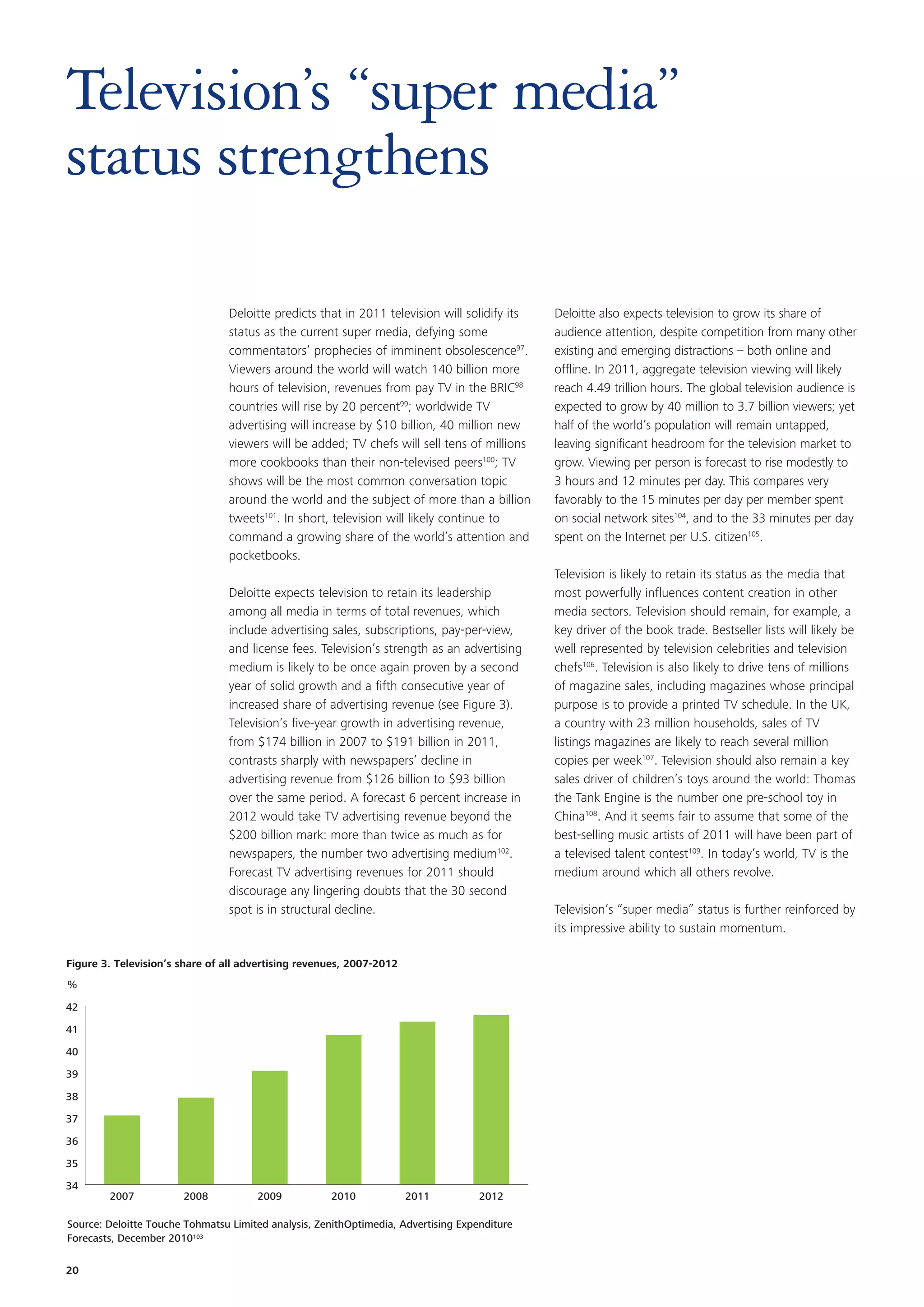
  • 11.
    Tablets in theenterprise: more than just a toy Deloitte predicts that in 2011 more than 25 percent of Second, certain industry verticals seem poised to start all tablet computers will be bought by enterprises, and using tablets in fairly large numbers over the course of that figure is likely to rise in 2012 and beyond. the year; in fact, trials are already underway. The retail, Although some commentators view tablets as manufacturing, and healthcare industries are considered underpowered media-consumption toys suitable only the most likely early adopters, primarily owing to the for consumers22, more than 10 million of the devices tablet’s ease of use, long battery life, lack of moving will likely be purchased by enterprises in 2011. parts, minimal need for training and rapid app Consumer demand for tablets is forecast to remain development environment. Deloitte predicts that during strong; however, enterprise demand is likely to grow 2011 up to 5 million tablets could be deployed in retail even faster, albeit from a lower base. and healthcare alone. Four main factors are driving tablet adoption in the In retail, a tablet can serve as both an easy-to-use, enterprise market. constantly updated catalog, as well as a point-of-sale terminal (when equipped with an optional card reader). First, and already the most apparent, many consumers These compelling applications make it likely that retail initially buy tablet computers as personal media devices, will be the largest enterprise tablet market in 201125. but quickly discover they are also useful for work. Healthcare will probably see a number of trials, but the Employees are asking their firms to support tablets for traditional conservatism of healthcare authorities, various work tasks, including accessing the enterprise administrators, and practitioners will likely mean that network. And some people who end up using their fewer than one million devices will be deployed in tablets predominantly for work are asking their healthcare environments by the end of the year26. employers to cover the cost of their data plans, or even the cost of the device itself. It appears that by the end of 2011 a significant number of firms may be willing to pay for their employees’ tablets and data plans. By some estimates, 70-80 percent of Fortune 500 companies will support at least one tablet variant for some portion of their workforce23; millions of prosumers will have their tablet data plans at least partially subsidized by their employer; and millions more tablets will be purchased by companies as PC alternatives24. Technology, Media & Telecommunications Predictions 2011 9
  • 12.
    Third, enterprise softwareproviders are rapidly responding to Fortune 500 customer requests for Bottom line tablet-specific software. Large players in ERP, ECM, For an enterprise, a key challenge will be deciding whether to support CRM, and other enterprise applications are combining multiple types of tablets or standardize on a single type. Employees often with desktop virtualization providers to create secure prefer to choose their own devices; however, IT support costs rise with enterprise-grade apps that can seamlessly and rapidly device diversity. Balancing the IT department’s desire for a single, cost- be deployed into even the largest company’s existing IT effective solution against employees’ desire for freedom of choice will likely environment27. Enterprise software providers are also be just as challenging with tablets as it is with smartphones. embracing the new technology themselves, with one company rolling out tablets to 35 percent of its Price is a very important issue for enterprises, especially in the current employees in 201128. economy. Enterprises (and tablet manufacturers) will need to carefully weigh the various trade-offs. Do enterprise tablets need cameras? Do they need to Fourth, the tablet form factor itself is driving adoption have the largest possible screen? Is Wi-Fi good enough, or do they need a in the boardroom. Unlike laptops and smartphones, more expensive 3G radio – and the data plan that goes with it? both of which create an obvious physical barrier between the user and others in the room, a tablet can The new breed of tablets is not designed to be particularly rugged. In the be placed flat on a conference table and accessed past, a variety of ruggedized tablets30 were available; however they tended unobtrusively29. to be 2-3x heavier than the new tablets and 3-5x more expensive31. Although they continue to have their devoted fans, they were not mass These four growth drivers are likely to foster significant market devices. For those who worry that the new tablets might not be tablet diversity. Although certain form factors and tough enough for constant use in the field, it is worth remembering that operating systems dominated the market initially, the workers sometimes treat ruggedized devices less carefully, which can make different requirements of various enterprises mean that such devices even more prone to damage. Ultimately, the most effective one size will probably not fit all. Fortunately, tablets will “ruggedization” is to produce a machine that the workforce values and takes be offered in multiple sizes in 2011. For use as catalogs care not to break. in retail, a 10 inch diagonal display might be optimal; but for processes requiring portability, such as accident Security is already being discussed as a potentially big issue for enterprise inspection, a smaller 7 inch device would be lighter and tablets. In some ways tablets are more secure than PCs – at time of writing probably less expensive. no tablet-specific virus has been reported, and most don’t even have USB ports, eliminating a common security weak point. On the other hand, tablets Some enterprises and their IT departments have strong are small, portable and a popular target for thieves. As a new device, tablets preferences for certain operating systems (OS), and should probably be presumed insecure until proven otherwise. strong aversions to others. Assuming that tablets will be connected to the rest of the enterprise IT environment, App development will need to be monitored closely. Cost per app can range it is reasonable to expect that OS market shares in from $5,000-$500,000 (depending on complexity), so not all enterprises will enterprise tablets might closely mirror OS market shares be able to develop an app for every type of tablet; nor will they be able to in smartphones and PCs. fund a large number of custom apps for employees. Although some firms are proposing the deployment of web apps that run through a browser and therefore work on any tablet, the likely reality in 2011 is that only native apps will provide the full tablet experience and be capable of interacting with the devices’ built-in cameras, radios, calendars and push capabilities32. 10

  • 13.
    eGov: from optionto obligation In 2011 Deloitte predicts e-government (eGov) usage Figure 2. Internet access, use of e-forms, and use of government websites, Europe, 2009 (percent) will reach an inflection point. Across developed countries, the proportion of businesses that use eGov Iceland services for at least one process is expected to average Netherlands over 90 percent, up from 75 percent in 2010. Similarly, the proportion of citizens that use eGov in industrialized Norway countries should rise by at least 10 percentage points. Sweden In some countries, the importance of eGov as a way to Denmark boost public sector productivity and efficiency may even Luxembourg prompt the appointment of a national Chief Information Officer (CIO) where one did not exist previously33. Finland United Kingdom Rising demands for government efficiency and Germany productivity will likely provide a major push for greater adoption of existing eGov platforms and, in some Belgium countries, increasing e-government roll-out34. Use of Estonia online channels may increasingly be mandatory;35 this Austria should boost the return on investment for e-government infrastructures. For example, according to one estimate, EU-15 countries mandating electronic invoicing could save the France equivalent of 0.8 percent of GDP annually36. EuroZone Ireland Over the last decade, governments around the world have collectively invested billions of dollars to deploy Slovak Republic an array of e-government infrastructure, from tax Latvia returns to building permits37. However, use of these Malta portals varies considerably. In most cases, eGov has been positioned as an additional channel for citizens Slovenia and businesses to interact with the government38. Czech Republic Only rarely has it been mandated39. Hungary Lithuania In the past, one of the main problems with mandating eGov was the risk of excluding certain segments of Poland society, such as those without Internet access or those Spain who might find online self-service portals too difficult to Croatia use. However, now that most consumers and almost all businesses are active online, in some countries eGov use Macedonia needs to catch up with the times, and start being Cyprus positioned as the primary channel, not an optional one. Portugal For example, Figure 2 shows household Internet use compared with the use of eGov in Europe. In all countries Italy there is a significant gap, with Internet use outpacing Bulgaria eGov use by an average of more than 20 percent. And in Greece some countries, the gap is as large as 50 percent. 0 20 40 60 80 100 Use of e-government by businesses has also been limited In 2009: Accessed the Internet at home in the last 3 months – albeit not necessarily due to business’ reluctance: in In 2009: Sent official e-forms in the last 12 months some cases online channels were simply not available. In 2009: Obtained information from public authorities, websites, For example, in some territories it has only been possible in the last 3 months to submit an electronic invoice since February 201041. Source: Deloitte Touche Tohmatsu Limited, 2010, based on data from Eurostat, 201040 Technology, Media & Telecommunications Predictions 2011 11
  • 14.
    In other cases,the ability for agents to submit returns The system also includes text to speech conversion to on behalf of their clients has been complicated by the address the needs of those with low literacy. assignment of a single sign-on and password per company, making it impossible for agents to submit Emerging countries that already have eGov portals in accounts online for multiple clients. In many cases, the place are likely to expand the range of citizen online ability for government agencies to correspond by email services to include ancillary services such as healthcare49. with companies and their agents was still either “scarce” In 2011, foreign aid and investment in developing or “unavailable” at the end of 201042. countries may also help drive eGov projects50. For central and local governments, eGov has tended to create additional costs, as it was often layered on top of existing communication channels. In addition, Bottom line potential eGov savings were sometimes reduced While mandating use of eGov is mostly about improving productivity of through flawed internal processes that required data to existing technology assets, administrations should not overlook technology’s be transcribed manually by one department’s staff and capability to improve a country’s attractiveness to foreign investors and key then re-keyed manually by another department’s staff talent. Efficient digital communication and transaction channels can position just to get information flowing43. a country positively, much in the same way that leading physical infrastructure can. While many governments, particularly those in For citizens, eGov is most likely to gain traction for industrialized countries are likely to remain focused on cost, the medium- services used predominantly by younger age groups, such term strategic benefits of digital government should remain on the agenda. as student loan applications and temporary driver’s licenses44. But over time, use of traditional channels such In emerging countries where pressures on local and central government as walk-in centers and call centers may be restricted to budgets may be less severe, administrations should use eGov solutions to exceptional cases only: there will always be citizens who enable rapid economic growth without having to create an equal or greater cannot afford to go online, or else are unable to use expansion of government infrastructure and bureaucracy51. online channels. Also, governments will likely insist that The fact that some segments of society are not computer-literate or lack digital data be usable across departments. This will online access should be viewed as an important but not insurmountable require standardized processes for electronic data barrier to eGov. In fact, a principal enabler of any new process or application gathering, as well as consistent formatting standards, is accessibility, which itself is a function of good design52. If eGov such as extensible business reporting language (iXBRL)45. applications are available in versions designed to maximize accessibility, they could actually serve as an entry point to get more people to use computers As for emerging countries, deployment of eGov is and the Internet. In some cases the entry point is likely to come via Internet typically limited by two key constraints: technology roll- connected mobile phones – each country needs to assess which out and literacy. For example, only 15 African countries technological platform is most pervasive and fit for use. have an Internet penetration higher than 10 percent. However, in emerging countries that have limited fixed Governments should also consider whether social networks could provide broadband infrastructure, mobile communications could one channel for communicating with citizens. play a key role, as the latter tends to enjoy greater penetration. For example, in India in H1 2011 the Migration to electronic filing of company reports, based on the iXBRL mobile subscriber base is expected to be in the region of standards, will likely require tax collection agencies to develop new skill sets. 800 million46. This compares with 11 million broadband For example, there might be less need to review documentation and make subscribers47. In such contexts, focusing on eGov via basic calculations, but greater need to analyze complex patterns of data and mobile is likely to be a key way forward, particularly in identify situations requiring investigation across companies. the medium-term. Leaders in emerging markets should consider treating eGov and e-commerce One Indian state, Rajasthan, has launched an eGov service infrastructure projects as prerequisites for economic growth, on par with that relays essential information to the public, including roads and ports/border security. This may provide their countries with real rural pensioners, the elderly, and disabled via mobile opportunities to accelerate the pace at which they close the gap with phone. Updates on everything from approval of pensions developed economies. to information alerts are provided via this channel48. 12
  • 15.
    Online regulation ratchetsup, but cookies live on Deloitte predicts that during the course of 2011 online Malpractise related to information sharing is common in privacy will provoke more irate headlines and all types of businesses. But in 2011, online privacy exasperated calls for action than ever before. However, breaches – both real and perceived – are more likely to by year-end a torrent of criticism directed at online make the news than are offline breaches. privacy is likely to result in only minor legislative and regulatory changes to the way websites gather, share, Some of the reasons for this are contextual. First, online and otherwise exploit user information. Such changes companies are simply more effective than their offline are unlikely to challenge the fundamentals of the online counterparts at generating, accumulating, and business model. exploiting vast quantities of data – and at using the data automatically in real time. Second, online privacy Cookies, which are the small files of personal issues are currently more newsworthy, partly because information that websites create on a visitor’s the online environment is newer and less understood, computer, are very likely to remain core to the online and partly because of the number of people who are user experience. Similarly, IP (Internet Protocol) affected. Web-based businesses seem subject to addresses will likely still be shared among multiple heightened economies of scale. Market leaders tend to online companies. dominate on a global basis, and when problems arise they can affect hundreds of millions of users. A flood of news stories about digital privacy invasion – combined with the launch of websites created to show One privacy challenge unique to the online world is the exactly how compromising online information disclosure use of personal information in the form of cookies and can be53 – are unlikely to dissuade Internet users from IP addresses. New legislation to be enacted in 2011 knowingly or unknowingly sharing their information, aims to clarify what, how, and with whom data can be some of which may be personally identifiable54. shared. Some of this legislation, if enacted in its current A campaign in 2010 that encouraged users to quit a draft form, could profoundly change the way that particular social network en masse in response to its people use the Web58. revised privacy policies was taken up by only a tiny fraction of its members55. Many of today’s websites share IP addresses with dozens of other sites. However, one draft law would But despite a lack of significantly harsher regulations, require user approval every time an IP address is to be and the fact that just a small (but vocal) minority of the shared59. Similarly, a European Union (EU) directive60 public is expected to clamor for more protection, the passed in 2010 and due for implementation in 2011 online industry will likely undertake increasingly robust will require websites to obtain consent from users measures to regulate itself, building on steps that have whenever cookies are installed61. The EU has also already been taken over the past few years56. proposed that Web users have the right to be forgotten: historically a user’s Web trail has been nearly The underlying rationale for gathering personal indelible62. The proposed changes would require information is that companies – be they traditional websites to delete all personal data on request. In retailers, business to business specialists, or online pure addition, there have been calls for “do not track” plays – like to know about their customers. Knowledge buttons to be made prominent on websites63. is power, and understanding the customer is generally good for business. Sharing leads, reselling customer These new principles, if applied to the letter, could have data, and analyzing consumer behavior are all ways to a major impact on online businesses. Consider, for boost revenue and help make a sale. Passing along example, what it would mean if websites could not use customer data is considered a fair practise if permission cookies. Recommendations would be impossible, and is given. So is aggregating customer data and reselling credit card information would need to be re-entered for it – as long as permission is given and the user cannot every transaction, no matter how small. be personally identified57. Technology, Media & Telecommunications Predictions 2011 13
  • 16.
    However, there aretwo reasons why it is likely that only moderate online privacy legislation will be enacted in Bottom line 2011. First, the legislation that currently exists to Although changes related to online privacy may not markedly affect revenue protect personal information – both online and offline – in 2011, companies should consider increasing their investments in online is considered generally robust64. Most discussions about privacy infrastructure, leveraging industry tools and initiatives to improve new legislation focus only on the narrower category of self-regulation, and getting in front of future legislation. personally identifiable information (PII) – and specifically whether a unique identifier to a computer, Nearly all of the new and proposed privacy requirements are based on like an IP address or cookie should fall into this generally accepted fair information practices. However, businesses should category. Second, the Internet has become a stay abreast of changes in public opinion and regulatory policy, including the fundamental part of the economy. New legislation that policies proposed by the Federal Trade Commission in its Staff Report on might have a significant adverse impact on economic online consumer privacy released in December 201070. growth and tax revenues seems quite unlikely.65 Tens of billions of dollars could be put at risk66, and many In particular, businesses that operate online might want to invest in governments are simply not in a position to threaten programs and industry tools that: those revenues at this time. • integrate “Privacy by Design”71 principles, including data security For instance, the U.S. Commerce Department recently measures, reasonable collection limits, sound retention practices and data released a draft report providing recommendations for management procedures. promoting online privacy. However, the recommended • provide consumers with simple choices about data handling practices that policies are likely to be enacted in a moderated form are not “commonly accepted”. that also emphasizes information innovation, jobs, and • establish greater transparency about how data will be collected and economic growth.67 In the EU, probably most member used – providing simple and easy to understand notices and education, states will determine that users should provide and giving customers reasonable access to their own personal permission within browser settings and that the default information72. position in the browser be set to “off” – as suggested by the directive68. Consent will not need to be given These types of actions can help organizations stay ahead of the curve, every time a cookie is used69. create competitive advantage, and strike an appropriate balance between protecting consumer privacy and fostering performance, innovation and In 2011, new online privacy legislation is expected to growth. be modest and will likely draw upon fair information practices that are already generally accepted. At the same time, online companies are likely to become far more proactive when tackling privacy issues – expanding their efforts to influence legislation, and increasing their level of self-regulation with the goal of avoiding new legislation altogether. 14
  • 17.
    Squeezing the electronsin: batteries don’t follow Moore’s Law Deloitte predicts that battery technology will make Nothing seems to beat lithium as a base material for progress in 2011 and 2012. Energy density should rise batteries. Lithium is the third lightest element and is and prices should fall. Plus, batteries should become highly reactive, making it the best lightweight, high- more durable and charge faster. Unfortunately, even in density solution for the near term. Lithium is usually a good year, advances in battery technology are slow paired with cobaltate. Other possible partners, such as compared with advances in the devices they power. titanate and iron phosphate compounds, offer some Battery technology rarely attains anything resembling advantages but deliver significantly lower voltages and Moore’s Law, which correctly predicted that computer energy yield. One scientist summed it up: “It will be processing power would double every 18 months. refinement of existing chemistry from now on. For batteries, a mere 5 percent performance There are no new compounds that will give higher improvement is a good year. energy density.74” The one big exception is when the battery industry In future years, it is possible that a 1 percent annual changes its underlying technology. For example, the improvement in lithium battery performance may leap from nickel-based technology to lithium ion become the norm. Some scientists believe that the technology nearly doubled battery energy density73. lithium ion, which has been worked on for decades, Annual improvements within the same battery may be close to peaking75. Changing the electrolyte, technology are generally modest. usually to a polymer, may offer some advantages but doesn’t appear to provide a significant improvement in energy density or cycle issues, which are the key attributes. Technology, Media & Telecommunications Predictions 2011 15
  • 18.
    There are otherviews. Some commentators trumpet 10-fold76, or even 100-fold, improvements to lithium Bottom line technologies77. However, even if these claims prove Although progress in battery technology may seem slow, even 5 percent true, there is a long way from the laboratory bench to annual improvement can lead to significant gains over time. The industry will the consumer. Because refinements in battery need to keep innovating, both with lithium and non-lithium technologies. technology are based on applying new materials and Maintaining realistic expectations and timelines will likely be key. chemistry, “overnight” technology breakthroughs usually take decades. Research initiatives that have For those who want and need better batteries, it may prove useful to focus identified potential improvements that could improve on reducing power consumption rather than increasing energy storage. energy density and longevity of lithium batteries are Making more efficient devices may be easier to achieve than trying to force based on laboratory findings. These new approaches battery technology to improve at greater than its historical rate of progress. would still need to be assembled into batteries and Many of the technologies behind efficiency do improve in line with Moore’s moved into commercial production, which could take Law or offer the potential of rapid breakthroughs. years78. Some older or alternative energy storage technologies (such as nickel and Although there have been hopes of new electrical lead acid batteries, compressed gas or liquid, miniature fuel cells, and storage technologies, such as ultra-capacitors, their flywheels) may remain viable choices if lithium technology continues to availability does not appear to be imminent according progress slowly. For example, lead acid batteries can be combined with to the energy storage and venture capital communities79. newer technology, such as super-capacitors, to produce surprisingly good results using core technology that is 150 years old84. Even if some entirely new and cost-effective non-lithium electric storage technology was developed, the industries that use batteries typically require years to revamp their manufacturing processes, integrate at the system level, prove reliability and establish safety. For example, the adoption of lithium was delayed by years due to runaway heating problems, which forced extensive engineering and safety tests80. Utility and transportation markets would take the longest to adopt breakthrough battery technologies, but even adoption by consumer product and computer markets would take years, not months. The biggest challenges for any energy storage solution are usually reliability and durability. The only way to determine ten-year reliability is to do a ten-year test; there are no short cuts (although some scientists are working on it)81. The availability of lithium is another issue. Although it is the sixth most abundant element in the Earth’s crust, concentrated deposits that can be extracted in an economical and environmentally clean way are rare and found in only a few locations. South American salt lakes are the primary source of lithium deposits. At one time there was some concern that a large increase in battery consumption would create a shortage, resulting in “peak lithium.”82 However, further studies found that although the price might need to rise to make less- accessible deposits practical, the supply is more than adequate to support even very large growth83. 16
  • 19.
    Hydrogen comes outof hiding: the alternative alternative energy source Deloitte predicts that hydrogen will enjoy tremendous There are many applications where hydrogen’s battery- success in 2011. However, this success will not be seen like power is preferable to a combustion engine. in the automotive market as expected, but in other Two examples include forklifts used inside warehouses applications, such as clean standby power generation in and remote generators that supply backup power for the telecom industry85 and indoor forklifts86, where telecom equipment. hydrogen’s energy density and environmental benefits outweigh its current limitations of high cost and lack of Forklifts are often used in large enclosed spaces like fueling infrastructure. warehouses where combustion engines, which produce carbon monoxide, would be unsafe. Batteries have A decade ago, hydrogen (H2) and hydrogen fuel cells been the preferred solution for years, but have several (HFCs) were seen as the most likely technology to drawbacks: batteries don’t last an entire shift, their displace the internal combustion engine in vehicles. power output drops as they discharge, and stacks of Hydrogen-powered cars were expected to be in charging batteries take up a lot of floor space. In this showrooms by now, and some even said that millions niche environment, an HFC can offer a full shift’s worth would be on the road by 201087. Engineering of power, refuel in one to three minutes and pays for difficulties, costly fuel cells (more than $1000/kw in itself in two years88. 2002), and a drop in oil prices contributed to hydrogen disappearing from the front pages. There are many places in the world where back up power (for infrequent emergency outages) or standby However, probably the biggest reason why thinking power (for more frequent outages related to a less about HFCs changed in 2002 was due to the nature of reliable grid) is needed. Many of these locations are not hydrogen itself. At first glance, hydrogen looked like an amenable to traditional power sources, such as lead ideal, safe fuel. Although it was not very dense, and so acid batteries or diesel generators. In particular, the needed more compression than natural gas, this telecom market requires power sources that can be obstacle could have been dealt with. located in harsh environments with extreme temperature fluctuations, which reduces the usefulness The bigger problem was the lack of naturally occurring of lead acid batteries, or in urban areas where diesel sources of H2. It can be extracted from water by exhaust is restricted. Hydrogen is a reliable and electrolysis or processed from natural gas or ammonia, environmentally friendly substitute. As more countries but free hydrogen does not exist in an economically mandate eight-hours of backup operating time to useful resource. Unlike coal and petroleum, there are maintain wireless emergency communications service, no hydrogen mines or wells. Instead, hydrogen is a this market is likely to grow89. substance that stores energy: the only energy you get out of it is what you put into it. This makes an HFC more like an H2-powered battery than a traditional fuel-burning engine. Technology, Media & Telecommunications Predictions 2011 17
  • 20.
    There are othernear-term hydrogen applications, such as distributed energy generation for factories or Bottom line residences90 and fleet fuel, including urban buses, Although HFCs remain a niche, their near-term applications could easily where cost is less of a concern than air quality. Across create a billion-dollar market by 2015. The forklift and standby power all applications, 10,000 HFCs may be sold, representing markets alone are worth over $5 billion; hydrogen could likely capture at revenues of $250 million, up 200% from 200991. least 20 percent of these markets. Some analysts are expecting H2 to make headlines again Plus, there are many other possible applications for the technology, such as in the automotive space92. High oil prices, carbon- portable electronics. These energy-hungry devices are pushing the limits of related environmental concerns, and the automotive lithium ion battery technology; a refuelable energy source might be a industry’s willingness to consider alternative fuels are welcome alternative96. Military and space organizations are also likely to driving the revived interest in H2 technology. Several continue using HFCs for demanding and high-value applications, although large auto manufacturers continue to fund tens of generally in small numbers. millions of dollars in HFC R&D spending annually, although the amount is declining. Government support The HFC sector seems worthy of ongoing R&D support. Current technologies is also declining: North American HFC research for the can be made less expensive, more easily manufactured and more resistant to transportation market was slashed (non-transportation damage from environmental causes. Research will be needed in the areas of HFC research was also reduced, but not as sharply)93. membranes and catalysts, with a special focus on reducing the amount of platinum needed: platinum costs are one reason HFCs are so expensive. Also, Despite R&D investments, the H2-fueled vehicle has those involved in the production, transportation, and storage of hydrogen yet to be commercialized, and some pessimistic analysts should consider improving their products and economics: as hydrogen say commercial adoption could be decades away94. demand increases, supply and distribution will need to become more The energy density is acceptable and the environmental widespread and economical. benefits are obvious: you put hydrogen in, and water vapor is the only exhaust. But the cost of an HFC remains high compared to other power plants: current (non- production) vehicles are estimated to cost $300,000 each95. The cells are vulnerable to damage from fuel contaminants such as carbon monoxide, and they do not start well in cold temperatures. These problems are likely to be solved over time, but commercial availability appears to be at least several years away. 18
  • 21.
    Media Technology, Media & Telecommunications Predictions 2011 19
  • 22.
    Television’s “super media” statusstrengthens Deloitte predicts that in 2011 television will solidify its Deloitte also expects television to grow its share of status as the current super media, defying some audience attention, despite competition from many other commentators’ prophecies of imminent obsolescence97. existing and emerging distractions – both online and Viewers around the world will watch 140 billion more offline. In 2011, aggregate television viewing will likely hours of television, revenues from pay TV in the BRIC98 reach 4.49 trillion hours. The global television audience is countries will rise by 20 percent99; worldwide TV expected to grow by 40 million to 3.7 billion viewers; yet advertising will increase by $10 billion, 40 million new half of the world’s population will remain untapped, viewers will be added; TV chefs will sell tens of millions leaving significant headroom for the television market to more cookbooks than their non-televised peers100; TV grow. Viewing per person is forecast to rise modestly to shows will be the most common conversation topic 3 hours and 12 minutes per day. This compares very around the world and the subject of more than a billion favorably to the 15 minutes per day per member spent tweets101. In short, television will likely continue to on social network sites104, and to the 33 minutes per day command a growing share of the world’s attention and spent on the Internet per U.S. citizen105. pocketbooks. Television is likely to retain its status as the media that Deloitte expects television to retain its leadership most powerfully influences content creation in other among all media in terms of total revenues, which media sectors. Television should remain, for example, a include advertising sales, subscriptions, pay-per-view, key driver of the book trade. Bestseller lists will likely be and license fees. Television’s strength as an advertising well represented by television celebrities and television medium is likely to be once again proven by a second chefs106. Television is also likely to drive tens of millions year of solid growth and a fifth consecutive year of of magazine sales, including magazines whose principal increased share of advertising revenue (see Figure 3). purpose is to provide a printed TV schedule. In the UK, Television’s five-year growth in advertising revenue, a country with 23 million households, sales of TV from $174 billion in 2007 to $191 billion in 2011, listings magazines are likely to reach several million contrasts sharply with newspapers’ decline in copies per week107. Television should also remain a key advertising revenue from $126 billion to $93 billion sales driver of children’s toys around the world: Thomas over the same period. A forecast 6 percent increase in the Tank Engine is the number one pre-school toy in 2012 would take TV advertising revenue beyond the China108. And it seems fair to assume that some of the $200 billion mark: more than twice as much as for best-selling music artists of 2011 will have been part of newspapers, the number two advertising medium102. a televised talent contest109. In today’s world, TV is the Forecast TV advertising revenues for 2011 should medium around which all others revolve. discourage any lingering doubts that the 30 second spot is in structural decline. Television’s “super media” status is further reinforced by its impressive ability to sustain momentum. Figure 3. Television’s share of all advertising revenues, 2007-2012 % 42 41 40 39 38 37 36 35 34 2007 2008 2009 2010 2011 2012 Source: Deloitte Touche Tohmatsu Limited analysis, ZenithOptimedia, Advertising Expenditure Forecasts, December 2010103 20
  • 23.
    For example, themost successful global TV franchise, Strictly Come Dancing, currently reaches 250 million Bottom line viewers in 38 markets110. This leaves scores of countries Television’s overall trajectory looks to be strong in 2011 and, most likely, for and more than 3 billion potential new viewers for a few years beyond. But allocation of the industry’s spoils may vary widely television to target. China is of particular interest, as for different players. Chinese consumers have just begun to purchase various formats of television content in earnest111. In 2011, The outlook for smaller content producers could be challenging. These Chinese broadcasters may become increasingly companies lack the scale and reach to launch global formats. They may even enthusiastic about new formats as a means to compete struggle to upgrade to high definition (HD) production, which could be a against Internet television112. Creating local variants of major problem if HD becomes the new table stakes for earning a share of formats that have succeeded in other markets may be a subscription revenues. Consumers’ growing expectation for HD quality may way to win back viewers who had turned to the Web also make life difficult for terrestrial broadcasters whose typical spectrum for the content they wanted to watch113. allocation only enables them to offer a handful of HD channels. By contrast, the growth of HD strengthens the hand of cable, satellite and certain Television seems to be gaining popularity in emerging telecommunications providers. markets. In 2011, TV advertising spend is expected to grow 16 percent in China and 14 percent in India114. In developing countries, one of the key challenges is likely to be how to In the BRIC countries, in 2011 pay TV revenues are increase revenues. A television subscription that only costs a few dollars a forecast to rise by 20 percent to over $17 billion115. month might sound like exceptionally good value to U.S. subscribers accustomed to paying much more. But to consumers in developing All the while, television technology continues to countries, it can represent a huge portion of their income. improve. The steady migration to high definition should provide significant opportunities for up-selling to Technological innovation has so far seemed to bolster the television sector; premium television subscribers. The growing for example, DVRs and online TV content have tended to boost overall penetration of large flat-panel televisions should viewing. But as technological innovation increasingly drives viewers to increase the visual impact of programing and consume multiple media simultaneously, its ultimate impact is unclear. advertising (in effect, 50-inch digital billboards within It might reduce the attention paid to advertising. Or it might make television our homes are proliferating). Also, 3D technology may advertising even more powerful, by enabling viewers to take immediate provide an additional revenue stream in the medium to action on their buying impulses. long term. As for other forms of media, television could prove to be a significant enabler – both directly (through advertising) and indirectly (as a source of new ideas, celebrities and content). Other media sectors should look for creative ways for television to help sell their products. For example, a TV documentary of a band rehearsal could help promote a forthcoming tour. The music sector might also find television to be a growing source of direct revenues from licensing songs for use in commercials and TV programs. Technology, Media & Telecommunications Predictions 2011 21
  • 24.
    DVRs proliferate! The30 second spot doesn’t die! Deloitte predicts that digital video recorder (DVR) Whether or not ad-skipping was as high as was being penetration in two large markets will exceed 50 percent claimed, the DVR threat remained only potentially of TV households by year-end 2011116; but also predicts devastating while very few viewers owned them. that TV advertising will be almost entirely unaffected This remained the case for the first half of last decade: despite that level of penetration. While DVRs provide DVR ownership was only 17 percent in the United States the technological capacity to skip ads, the majority of in 2006120. DVR owners are likely to continue watching the vast majority of their television live. TV ad rates may go up However, DVR ownership in many major television or may go down for various reasons this year but DVR markets took off in the last five years. The falling prices penetration probably won't be one of them. of DVRs have enabled existing pay TV broadcasters to subsidize the entirety of their cost for a growing A decade ago, as DVRs became more affordable and proportion of their customer base; new pay TV entrants widely adopted, industry commentators claimed that have typically had no option but to offer a DVR to the television commercial was in trouble117. Their attract customers. DVRs have also entered homes reasoning was that as DVR owners could readily fast “through the back door”, via the tens of millions of forward through all advertisements, this would reduce hard-drive equipped games consoles possessing full the value of TV advertising118. Initial surveys of DVR DVR functionality that have shipped in recent years. owners tended to bear this out: self-reported And the price of non-subsidized DVRs has been ad-skipping was high119. dropping steadily to the point where entry models are available for $100121. Figure 4. Viewing behaviors of DVR owners The growth trajectory in DVR ownership suggests that penetration among television owners in the United States and United Kingdom should cross 50 percent in 2011-2012 making it theoretically possible for half of all households in these markets to avoid television commercials altogether. However Deloitte’s view is that the DVR, even in markets where the devices are in the majority of homes, is unlikely to have a material impact on the value of television advertising in 2011122. This is principally because the majority of viewing in these households will be “appointment to watch” television, be this sports, a talent show, a soap opera, reality TV, a game show or a news bulletin. This type of programing usually crowds out time available to watch pre-recorded content. I always check to see what I have recorded on my DVR first I always check to see what is on broadcast television first Further, viewers are likely to attach increasing value to I always check to see what DVDs I have to see first “first broadcast programing” in the next few years as I always check to see what’s available on on-demand television websites the volume of social commentary, both that occurring None of these organically as well as that encouraged by the broadcaster, steadily grows123: viewers are likely to Source: Deloitte LLP UK, July 2010. Sample: 958 DVR owners in the United Kingdom become even more locked into the schedule and therefore less able to skip advertising124. 22
  • 25.
    The 15-25 percentof programming that is fast forwarded through is not necessarily a squandered Bottom line resource. Studies show that even ads viewed at Even though DVRs offer the ability to avoid all television advertising, it 12x speed are still retained by viewers, and by would require two fundamental changes to viewing behavior to happen: including more distinctive imagery advertisers can viewers would need to pre-record absolutely everything; and they would further enhance the impact of fast-forwarded ads125. need to keep their eyes closed while fast forwarding. Neither is likely. Programs that have a higher incidence of pre-recording (often programming targeted at younger audiences), In an industry adept at creating live television and among a viewership that advertising at the end of breaks can be sold at a consumes an average 20 hours per week (and over 35 hours in some premium as recall for such slots is likely to be highest126: markets) pre-recording everything is nigh impossible. Secondly skipping fast forwarders will be concentrating hard to spot the through every advertisement, including the end “bumper” ad, requires a last commercial to ensure they do not miss the precision that most of us lack. The ad based funding model is not broken, at resumption of the program. least by the DVR. These trends notwithstanding, there are likely to be Even if DVR users only occasionally watch pre-recorded content, this does some programs that are watched mainly on a not mean that the service is not valued or that the devices should not be pre-recorded basis, just as there will be some DVR subsidized. Occasional usage will engender loyalty. So if a DVR allows a owners who only watch pre-recorded content. But such viewer to watch both his or her simultaneously-broadcast favorite shows or programming and such behavior will not represent the if it means that going out does not mean missing out on the latest episode mainstream. The type of programming that is watched of a preferred soap opera, this is good for the broadcaster, for the program mostly pre-recorded will typically be non-mainstream maker and for the advertiser. content scheduled outside of peak hours127. DVR owners who watch everything pre-recorded are likely Indeed the television industry should constantly look at ways of making their to be individuals who watch just a few hours of DVRs easier to use, for example by integrating remote recording of content per week, rather than the typical average of programs with Web-based television schedules or program reviews130. 25-35 hours per week128. The television industry should also focus on how the DVR can enable it to In 2011 (and beyond) DVR owners are likely to default add value for advertisers: is it doing enough to harness data on which ads to the schedule when turning on the television, and are watched, which are always fast-forwarded, and which are rewound and only resort to the menu of pre-recorded content after a watched again? This data could be combined with repositories of pre-loaded few minutes of channel surfing have proved fruitless129. advertisements stored on the DVR that could allow a degree of personalized In one study of DVR owners in the United Kingdom, advertising to be provided. Further, programs watched several days after 70 percent always checked to see what was on first transmission could be combined with updated advertising, with a new broadcast first; only 16 percent checked out their pre- commercial, for example, replacing an advertisement for a one-day sale. recorded options first (see Figure 4). The rise of the DVR may however pose more of a threat for other parts of In 2011 and beyond many surveys of consumer the entertainment sector. The ability to record with ease may well pose a behavior are likely to indicate rampant advertising threat to DVD sales and rentals. Making it easier to record films, regardless skipping; measured data, rather than self-reported data of the time they are shown, may well lessen a user’s perceived need to rent paint a different picture. The television industry needs or purchase a DVD. Making it easier to record television may crowd out the to be alert to wherever respondents may distort – time available to watch any films, including those rented or purchased in deliberately or subconsciously – their response. DVD format. According to one survey, of DVR owners who were recording more programs than a year back, 40 percent were purchasing fewer DVDs and 38 percent were renting fewer DVDs131. Technology, Media & Telecommunications Predictions 2011 23
  • 26.
    Push beats pullin the battle for the television viewer Deloitte predicts that In 2011 despite the sale of tens of Actively “pulling” content may be even less compelling millions of television sets that offer a form of built-in in 2011 owing to growing availability of search capability for television programming, the vast recommendation applications built into TVs and set top majority of viewing will be delivered on a traditional boxes133. Many of these applications will use previous “pushed” basis, in other words the schedules will be viewing behavior to conveniently recommend new determined by channel planners. And a growing content. number of selections may be pushed via recommendation engines built into the television or set Aside from the behavioral challenges involved in pulling top box. However the “pulling” of television content by content, price is likely to be a major obstacle in 2011. viewers beyond the selection of a television channel is Television sets and set top boxes that incorporate the likely to remain an exceptional behavior. most advanced search capabilities must factor in the cost of additional processors, memory and storage, Searching will be available to varying degrees of which typically add at least $50 (or 10 percent) to retail sophistication, ranging from simple search apps prices134. For low-end units, this additional cost will selectable from an on-screen menu, to powerful likely create a significant drag on sales. Customers functionality that enables searching across a wide pondering the selection of their next television set may variety of broadcast, streamed and stored content. well choose a larger screen rather than paying a premium for enhanced search capabilities135. Yet adoption of program searching is likely to remain modest, largely because of a lack of need. Although For consumers buying Internet-ready televisions that today’s viewers may value the ability to pull content, support advanced applications, a major barrier to search pushed content remains their default choice. This could adoption is likely to be the required peripherals and user be attributable to the inherently passive nature of the interface. Such televisions are likely to ship with a television medium. Marshall McLuhan famously standard numeric keypad that makes it hard to enter suggested in Understanding The Media that television search text. Upgrading to a full QWERTY keypad might was a “cool” medium that would require audience be too expensive given the expected benefits, and interactivity; however, remote control and other current keyboard designs are not generally seen as innovations have made TV viewers infamously inert132. elegant, convenient, or easy to use136. Indeed, some argue that on-demand content, delivered When it comes to television in 2011, the only pulling by any technology, may never represent the bulk of that most viewers may want to do is pulling up a chair. viewing for the majority of viewers. Since the time that video rental stores first gave viewers the ability to opt out of scheduled programming, picking and choosing what to watch on TV has remained for most people an occasional activity. The monetary cost of selecting à la carte is one issue: but even as prices fell for purchased or rented video cassettes (in the 90s) and DVDs (over the past decade), demand did not rise commensurately. Typically households still rent at most a few DVDs per month. The biggest barrier might be the time and attention required to select content. Having choices is wonderful, but choosing can be a chore. 24
  • 27.
    Bottom line Technology hasalways played a fundamental role in television. Since the first TV broadcast, the technology has shifted from black and white to color, screen size and resolution have grown by a factor of 10, and thousands of new channels have emerged. Yet one thing has remained constant: for most people, television continues to be a passive experience. Viewers value the option to choose, but often do not exercise it. Interaction – even among those with multiple ways to control what they watch – has generally been limited to choosing channels on a remote control or, for the most sophisticated users, selecting from a DVR menu of pre- recorded content. Technological progress is unlikely to shift these ingrained habits any time soon. Technology enables. But it cannot oblige. Younger generations, having grown up searching for content on computers, may bring their search habits into the living room. But this is not likely to become mass market behavior for many years. Television is – and will likely remain – more than just a piece of technology or portal to a library of content. For many households, it is a focal point for family gatherings. For many individuals, it is the principal topic of water cooler conversations with friends and colleagues. In 2011, mountains of newsprint and terabytes of online chatter will likely continue to focus on TV shows, pushing and cajoling people into what to watch. And the best search algorithm in the world is not going to change that behavior. At least not in 2011. Technology, Media & Telecommunications Predictions 2011 25
  • 28.
    Social network advertising: howbig can it get? Deloitte predicts that in 2011 social networks are likely Nevertheless, thanks to a low cost base, social networks to surpass the breathtaking milestone of one billion might still achieve impressive gross margins despite their unique members137. Also, they may deliver over 2 trillion relatively low revenue per user – particularly when advertisements138. Yet the advertising revenues directly compared with the traditional media companies they attributable to social networks may remain relatively are competing against. A social network’s cost of modest compared to other media, at least in the short content is close to zero since it merely provides the term. With per member annual advertising revenue of infrastructure, while its users and third party app about $4, that implies total 2011 advertising revenues developers provide all the content144. of about $4 billion (see Figure 5). Despite social media’s large and growing audience, its advertising revenues An assessment of social networks’ potential hinges on still represent less than one percent of the worldwide three metrics: subscriber growth, time spent on the advertising spend total. Other sources of social network network, and CPMs. Many social networking companies revenues, such as payments systems and e-commerce, have been recording impressive gains in some of these might exhibit faster growth. metrics, but it is worth examining how much additional growth they can achieve. Figure 5. Social networks’ average revenue per user (ARPU) in $ When social networks attain the billion unique user 4.5 milestone, nearly half of one global user base – 4.0 computer-based Internet users – may be signed up by 3.5 3.0 year-end 2011. This could put a ceiling on future 2.5 growth if global Internet adoption continues to expand 2.0 at the pace that consensus analysts expect145: it might 1.5 1.0 be increasingly difficult for social networks to sustain 0.5 their impressive subscriber growth trajectories. 0 2009 2010E 2011E Total ARPU ($) Advertising ARPU ($) Mobile data might offer a better opportunity, particularly in developing countries where mobile Source: Deloitte Touche Tohmatsu Limited, 2010, based on data from: eMarketer, 2010; NeXt Up Research, 2010; Business Insights, 2010 penetration continues to rise steadily: there are far more global mobile users than those with access to computers. However, delivering display advertising to In 2011, it is likely that social networks’ long-term market mobile phones at volumes and prices sufficient to value will continue to polarize opinions139. Some view create a significant multi-billion dollar business may not social networking as the technology sector’s “next big be likely in 2011146. In 2010, mobile advertising thing”, promising even greater rewards than the decade- revenues for the United Kingdom – the largest old phenomenon of search advertising140. Others market in Europe – were only about $40 million147. compare social networks to the dot com bubble and As smartphones and 3G networks become more argue that monetizing their users at dollar levels similar to widespread, the base of active social network users those of online search has not yet been demonstrated141. should rise accordingly. Deloitte’s view is that the advertising revenues from social Social networks’ growth trajectory is often compared networks in 2011 are likely to be very significant in with that of paid-for search, which in just 15 years absolute terms: total industry revenues of $4-$5 billion grew from almost nothing into a $30 billion plus dollars and year-over-year growth of 30 percent are market that continues to expand. However, a decade impressive numbers; individual companies may experience ago broadband penetration in most countries was still even higher growth rates. Yet revenue on a per-subscriber in the single digits and some markets had no basis is unlikely to match search or traditional media in the broadband service at all. The growth of search was at next year or two. Also, advertising rates, measured on a least partly fueled by significant growth in online use – cost per thousand impressions (CPM) basis142, are likely to a trend that social media has already capitalized on. remain low compared to other forms of online advertising as well as traditional media143. 26
  • 29.
    If social networks’advertising revenues are worth only $4 billion in 2011 with half the potential user base already Bottom line signed up, or if future growth is largely restricted to the In 2011, the story of social networks will continue to be written with no low-value mobile ad market, most of the upside for social clear conclusion in sight. Social networks remain an emerging business networks would need to come from increased time spent founded on innovation; yet they have already achieved levels of market on the network, or from improved CPM metrics. acceptance that might have seemed inconceivable just a few years ago. The question now is whether social networks can sustain their growth The amount of time spent on social networks rose trajectory and find better ways to monetize value. sharply in 2010. In fact, according to one analysis, a popular social network enjoyed a 66 percent increase Even if social networks’ 2011 ad revenues only meet industry forecasts, they between Q3 2009 and Q3 2010148. Yet even if the time may still have other valuable ways to generate revenue. For example, they spent on social networks grows by a factor of three, could serve as a payment platform for the hundreds of thousands of that might not necessarily translate into a threefold application providers in their ecosystem. Or they could adopt a blended increase in advertising revenue149. Increasing inventory e-commerce department store model, where they charge for online floor could cause CPMs to fall even further150. space and earn a commission on any sales. Yet in 2011 these additional revenue streams, although very profitable, are unlikely to surpass advertising If there are limits to audience growth and time spent, in importance to social networks (see Figure 6). then the burden would primarily fall on CPM to drive Figure 6. Global social network revenues revenue growth. Social networks’ understanding of 6 individuals’ backgrounds, preferences, social groups, 5 activities, and behaviors are without equal. There have 4 been hopes that this would enable social networks to 3 deliver superior advertising results: but paradoxically, 2 social network CPMs remained among the lowest of all 1 forms of online advertising151. That could well change, 0 as the ability to mine the myriad data grows or as social 2009 2010E 2011E networks may find new business models that allow for Advertising spending ($ billion) Social gaming virtual goods ($ billion) much higher advertising revenues, but for 2011 it is Source: Deloitte Touche Tohmatsu Limited, 2010, based on data from eMarketer and difficult to find the levers that would cause social NextUP Research network ad revenues to accelerate from their already rapid pace. If low CPMs are expected to be the norm, social networks should consider how media agencies – particularly those paid by commission – are likely to Perhaps the vastness of social networks’ repository of user respond. Agencies might conclude that commissions based on modest CPMs information is itself a limiting factor; as of 2011, are less attractive than other potential clients, and could begin pushing it remains a challenge to economically extract useful other forms of advertising. Or they might decide to sell high value advisory insights from the volumes of user data that social services, such as public relations and reputation management, to help a networks generate. The billions of stated “likes” may not brand manage its presence on social networks. all necessarily signal an intent to purchase. Also, in 2011, as in previous years, privacy concerns may constrain the Advertising firms and their clients will likely need to expand their use of ability to collect the most valuable data152. Nevertheless, social media to protect their image and reputation in a world increasingly once social networks figure out how to rapidly and influenced by personal opinions and grassroots communications. Studies economically analyze their data, and to monetize the have shown that word-of-mouth feedback and peer reviews exert billions of recommendations made, a new seam of valuable tremendous influence on purchasing decisions; in fact, one survey found that customer insights will be available to mine and exploit. up to 78 percent of people trust peer recommendations, compared to just 14 percent who trust advertisements153. Throughout 2011, it seems likely that the forecast for the social network sector will continue to be promising, but unclear. As more information is released and as business models become more developed, advertisers, competitors and analysts will get a better picture of the potential of this industry. Technology, Media & Telecommunications Predictions 2011 27
  • 30.
    Games go onlineand on sale: the audience grows, but at what price? Deloitte predicts that in 2011 the global computer and The existing PC and console game business is video game industry will continue growing but from a confronting various challenges. Increased software more diverse set of revenue streams. The industry is piracy has had a profound effect on sales over the past forecast to generate $52 billion in software revenues in few years, costing the industry billions155. Meanwhile, 2011, 6 percent higher than in 2010, while hardware is the higher costs and lengthening development times for predicted to generate only $13 billion, a decline of high-end games have made game development riskier 19 percent154. (publishers need blockbusters) and has reduced profits across the industry as whole156. For PC game developers An increasingly large percentage of games revenue is and publishers, more and more computing devices are likely to come from monthly subscriptions, peripherals, being sold – but many of them are smartphones, fees for services and in-game purchases and advertising tablets and netbooks that do not have the hardware to in the free-to-play (F2P) and “Freemium” markets. support conventional high-end games. Deloitte forecasts that the total revenue from these relatively new sources could be as high as $10 billion, Console revenues and profits tend to be highly cyclical or 16 percent of total game revenues, by the end of as both hardware and software purchases are linked to 2012, and over time could represent 50 percent of all the console upgrade cycle157. Five years have passed revenues for the industry. since the current generation of consoles was released; the result will likely be relatively flat growth in 2011. Moreover, there are some concerns that the console refresh cycle, which has averaged five years for almost two decades, is about to lengthen into a 10-year cycle, as existing games are not yet putting stress on the hardware capabilities of existing consoles. This would delay the next expansion phase. Console makers hope to bridge the gap by introducing add-on features such as motion control, camera peripherals and 3D. Three major technological drivers – powerful portable devices such as smartphones, ubiquitous network connectivity, and social gaming – are transforming the industry and creating new sources of revenue. As these new revenue streams emerge, the industry should see growth that is both more stable and more profitable. Also, the global audience of gamers will likely continue to expand rapidly, primarily due to an increase in casual gamers on consoles, web and social networks, and most recently smartphones and tablets. However, worldwide games revenues are forecast to grow more slowly than the number of gamers: revenue per gamer is expected to fall. 28
  • 31.
    Only a fewyears ago, very few gamers were connecting to the Internet for any reason. But today, an Bottom line estimated 53-78 percent of gamers (depending on their The games industry appears to be following in the footsteps of the console) in the United States use a connected console enterprise software market. Two decades ago, 90 percent of enterprise to play multi-player online games, download new software revenues were one-time license sales – analogous to buying a content and converse with other players while gaming. game disc – and there were virtually no follow-on revenues or service fees. Connected consoles are also used as PC substitutes for Today, many software companies derive more than half of their revenues applications such as streaming video158. The benefits to from services and subscriptions, and license fees are much less critical. the gamer of a connected machine are enormous – but the benefits to the games industry are even greater: the Although this change was disruptive to the industry, most enterprise arrival of connected gaming has not only slowed the software companies found that after the transformation they were still able growth of piracy, but actually reversed it, especially in to grow profitably while enjoying less revenue volatility. The games industry geographies where piracy was particularly high159. might be able to learn from their experience, leveraging best practices from the enterprise software industry while developing new best practices of its As more of their customer base gets connected, game own. publishers are likely to see expanding contributions from revenue sources that aren’t entirely new, but are The F2P/Freemium revenue model is interesting and potentially lucrative. becoming increasingly important: micro payments from However, it could pose a serious disruptive threat to existing console selling additional levels, characters and costumes; hardware and software manufacturers if they respond too slowly. The new online stores; and, possibly, real-time ads placed in model will likely give rise to new competitors; also, it might reduce the games (although this has not been a big market so perceived value of all games.164 far)160. Also, some high-end games are being sold as monthly online subscriptions. The cloud gaming market The growing number of non-console and non-PC games and gamers (or GaaS, gaming as a service) is still nascent but could suggests that companies focused on traditional console and PC hardware become a significant revenue source for companies that sales may need to diversify. We are already seeing high-end graphics chip have customers with fast Internet connections – even manufacturers use their technology in non-gaming markets165. Also, the people with relatively low-powered netbooks or small, peripheral market seems to be shifting from single-purpose accessories cheap thin-client devices that can be connected to TVs (musical instruments, etc.) to multi-purpose peripherals that provide image should be able to enjoy console-like experiences161. recognition and motion capture. Peripheral manufacturers and game developers alike may need to adapt to this market shift. The fastest growing games segment will probably continue to be F2P and Freemium games. These games are typically based on a revenue model where basic game play is free, but a premium is charged for add-ons that enhance the game experience such as extra levels, accelerated progress and special in-game accessories such as weapons, supplies and costumes (micropayments). Many subscription games are converting to F2P and seeing their revenues increase by 100 percent or more162. Total F2P revenues in 2009 were about $2 billion163; in 2011, that number could reach $5 billion. The upshot of all these trends is that the gaming industry will likely see smoother revenue streams, higher revenues and profitability and massive user growth. The existing market of core gamers isn’t about to go away, but the mix of people who play games is likely to shift in many ways: age, gender and income, among others. Technology, Media & Telecommunications Predictions 2011 29
  • 32.
    Keeping the lifein live: A&R diversifies Deloitte predicts that in 2011, the live music sector, By contrast, the first decade of this millennium has been with festival organizers at the forefront, will start particularly prosperous for the live music industry. expanding its talent creation and nurturing role, either Revenues rose steadily and even fared relatively well as individual companies or joint projects. Until now, during the recent recession168. However, the decade that role has been left largely to music labels’ artist and ahead looks to be more challenging, perhaps due to repertoire (A&R) divisions. The live sector will identify, the ongoing decline in A&R investment by the labels. invest in, develop and commercialize the next generation of stadium-filling artists, using a variety of approaches, There are two cyclical factors that could soften live from talent contests at festivals to dedicated facilities music revenues in 2011 and beyond, forcing the live for nurturing new talent. All aspects of the live music sector to pick up some of the slack in terms of sector may get involved: venue owners, concert identifying and commercializing new acts. promoters, television production companies, ticket sales agencies and even some established recording artists. One factor is the vintage of the current highest grossing live acts. Some of the last decade’s biggest draws The recorded music industry has traditionally built a appear to be approaching the twilight of their touring pipeline of up-and-coming music acts through their A&R careers. In 2011 the lead singers for eight of the divisions. In 2010, the industry spent almost $5 billion on 20 highest grossing live acts in the United States from development and promotion of all acts, with about half 2000-2009 will be 60 or older. Only one of the top 20, going to foster new talent166. However, after a decade of Rascall Flatts, released its first album this century declining sales, the labels’ A&R spending is shrinking both (in 2000). Through 2009, Rascall Flatts grossed in absolute dollars and as a percentage of sales. In some $222 million from touring. The other 19 acts, the countries, A&R investment as a percentage of revenues is majority of which rose to prominence on the back of down about 25 percent since 2006.167 single and album sales (and the associated promotional activity) grossed a cumulative $6 billion in ticket sales during the last decade: the sexagenarians alone Figure 7. Share of revenue generated by the top 20 grossing music live acts in the brought in more than $2.5 billion (see Figure 7). United States from 2000-2009, by age of artist/lead singer in 2011 A second factor is the economy, particularly in 6% industrialized countries. Stubborn unemployment, increases in value added tax, and an austerity-focused public sector might keep consumer confidence low and concert attendance down170. In fact, a weak economy might have been one of the key factors behind the 40% 17 percent decline in the U.S. live market in the first 35% half of 2010171. 19% 60s 50s 40s 30s Source: Deloitte Touche Tohamtsu Limited, 2010, based on live tour data from Pollstar169; ages of lead singers from various websites 30
  • 33.
    While record companieswill always exist, they might be unable or unwilling to handle their previous level of Bottom line investment in new acts. If so, another part of the As festivals start to become more involved in nurturing talent, one of the industry might need to take up the slack of identifying promotional activities they are likely to take on is the release of new albums and publicizing new talent to a point where fans are and singles (and all of the marketing activity that goes with it). This is likely willing to pay $100 or more per ticket to see them to remain the principal way to raise awareness of bands and their latest perform. The live music industry will need to build this outputs; for many fans, seeing a number one single performed live is likely new role into its long-term business model. to remain a key selling point172. The role of festivals in A&R is likely to increase as The live music industry might want to co-invest in the A&R process with festivals rely most heavily on musicians to sell their companies outside of the music sector that wish to use music to promote tickets. This differs from an arena or stadium whose their products. Given society’s seemingly limitless affection for music, most major motivation is to book any act that can fill up its vertical sectors – from fashion to mobile phones to automobiles – would seats, including, for example, stand-up comedians likely value an association with music. Live music businesses could tap these whose staging costs are generally far lower. brands to help pay for part of the talent development process, such as the funding of recording studios173. Television’s role in identifying new talent may start placing an increased focus on acts that are great The record companies’ traditional A&R process was very effective, but also recording acts but are even better at touring. very resource intensive. In today’s environment where music fans seem to value a live experience more than a recording, the live music industry might be in a better position to identify top talent – specifically, the talent that can really deliver on stage. The various players in the live music industry must recognize their common need for an ongoing pipeline of new acts to replace the existing big draws – and they must take combined action. Over the next few years, label-sourced A&R is likely to decline by roughly $500 million per year globally. It seems reasonable to assume that the live music industry – or other source of funding – will need to step in to prevent the well from running dry. Technology, Media & Telecommunications Predictions 2011 31
  • 34.
    Pop goes pop-up:music retail goes seasonal and temporary Deloitte predicts that 2011 revenues for digitally Rather than selling popular hits, other music retailers distributed music will exceed physical music sales in at may specialize in music genres that would be harder to least one major market, most likely the United States. discover on the Web. Their aim would be to attract This long-anticipated event will probably be driven by a fervent music fans who are willing to pay for music. sharp decline in CD sales, rather than a significant These niche markets will likely make up only a small increase in digital music subscriptions or downloads174. portion of total album sales, similar to vinyl record sales. For example, in the United States, vinyl sales grew This likelihood leads to a related prediction: CD retail 250 percent from 2006 to 2009. However, the end will start becoming a seasonal or event-driven purchase. result represented only 2.5 million units out of a total By the fourth quarter of 2011, there could be 1,000 album market of 374 million179. temporary “pop-up” music outlets created to meet occasional surges in demand. Pop-up outlets will be a Despite the shift toward digitally distributed music, small, but growing, niche segment175. physical music retailing will not vanish: while demand for CDs in the medium term will continue, it will In 2011, the United States will likely be the first of the become increasingly seasonal. In 2010, nearly half of big-three recorded music markets to see digital music all CDs sold in the United Kingdom were expected to revenues from downloads, subscriptions and streaming be purchased during the fourth quarter, driven by services advertising surpass revenues from physical seasonal gifting and the finale of music talent shows180. music. The UK is likely to follow, either in 2011 or by the end of 2012176, assuming CD sales continue their Retailers will likely respond to variable demand by steep decline177. To put the severity of this decline in creating pop-up stores. Current music retailers might perspective, CDs made up 75 percent of record labels’ establish a variety of temporary stores, including 2009 revenues in the United Kingdom. conventional retail spaces with short-term leases181, temporary outlets in high traffic locations182 and The decline in the CD market is likely to cause a marked small-scale outlets offering curated, exclusive reduction in year-round shelf space dedicated to merchandise183. These curated outlets could be located physical music. Even with fewer competitors, dedicated wherever and whenever there are people who want to music retailers may decide that their shrinking revenues buy CDs, such as at live music venues184. and profit margins make physical music retailing less viable178. Some may diversify, shifting their focus from In the medium term, pop-up stores may also be set up recorded music to equipment for playing music, concert to coincide with major record releases. A long line of and festival tickets, or music-related clothing. fans eager to purchase a new release from a pop-up store could generate marketing buzz and increase record sales. 32
  • 35.
    General retailers, suchas department stores and supermarkets, may abandon selling CDs year-round if Bottom line their turnover and margin targets are not met. Instead, The next few years will probably remain challenging for music retailers. they may only stock CDs when demand is stronger, The one bright spot is that CD prices could rise over the medium term as such as during gift-giving seasons or major music dedicated CD buyers have fewer outlets to choose from. CDs could follow events. In some cases, music might be sold from a the path of vinyl LPs, which rose significantly in price following their exit pop-up outlet physically located within the main from the mainstream. store185. During the rest of the year, music might only be available from the main store’s website186. Music fans who prefer CD audio quality might be willing to pay a higher price. However, price increases will not compensate for a continuing decline in unit sales; net revenues from recorded music will continue to decline. Nevertheless, because recorded music provides crucial exposure for musicians, it is likely that record labels and other music promoters will continue to produce CDs – even at a loss. Technology, Media & Telecommunications Predictions 2011 33
  • 36.
  • 37.
    Getting to 4Gcheaply: will many carriers opt for 3.5G instead? Deloitte predicts that in 2011 the deployment of Spectrum for LTE is currently being allocated, and next generation Long Term Evolution (LTE) wireless 130 carriers were running LTE trials at the end of 2010. networks will fall short of industry expectations due Many commentators expected widespread rollouts to to the continuing viability of the latest third generation have happened by now187; however, Deloitte expects that (3G) wireless technologies, such as High Speed fewer than 30 LTE carriers in six countries will offer Packet Access (HSPA+), and the handsets that work commercial service by the end of 2011188. While a few with them. of the world’s largest carriers will likely deploy LTE, most networks will stick with transition technologies for the next year. The technology behind 3.5G and LTE There are three basic tricks that carriers can use to wring more capacity out of their existing cellular spectrum. • Place cell towers closer together. In most big cities, however, tower density has already been pushed to the limit. Cutting-edge innovations such as femtocells and picocells could be used to shrink cell sizes further, but have yet to be widely adopted because of cost. • Improve how the RF signal is encoded. Advanced modulation techniques that squeeze more information into a given frequency band are constantly evolving. However, they require complex chips to implement. The latest is called 64 Quadrature Amplitude Modulation or 64QAM (pronounced “kwam”). • Put multiple antennas on cell towers and mobile devices. This multiple input-multiple output configuration (known as MIMO and pronounced either “me-mo” or “my-mo”) used to be found only in advanced military technology. It enables improved wireless communication that uses the spectrum more efficiently, particularly in urban areas, where signals bounce off buildings and suffer from multipath distortion190. Some aspects of the full 4G standard can be found in current LTE implementations, such as the MIMO antenna configuration, QAM encoding and channel allocation and scheduling. However, true 4G must offer mobile speeds of 100 Mbit/second, and fixed access speeds of 1 Gbit/second. At the moment, real-world deployments of LTE are only achieving fixed download speeds of around 10Mbit/s191. This is much faster than older 3G technologies, but not nearly fast enough to qualify as true 4G. The latest versions of 3G, such as HSPA and HSPA+, known as “3.5G” because they are a bridge between generations, use some of the same tricks as LTE. HSPA+ release 8 uses both 2x2 MIMO and 64QAM, and promises real-world mobile data download speeds of 15-30 Mbit/s by the end of 2011. Many carriers, especially those with weaker balance sheets or less congested networks, are asking themselves why they should move to LTE when real-world deployments of HSPA+ seems to offer comparable speeds (more than 30 HSPA+ networks around the world currently offer 21 Mbit/s downloads). The decision between 3.5G and LTE turns out to be more complex than it seems. Although 3.5G theoretically offers competitive speeds, it is less spectrally efficient than LTE and therefore uses more radio spectrum to achieve similar data rates. In some real-world circumstances, HSPA+ uses twice as much spectrum as an equivalent LTE implementation. Also, 3.5G lacks some of the architectural efficiencies of LTE to support enhanced features and services such as video. Carriers that invest in LTE now may enjoy an easier, less expensive transition to true 4G when it becomes available. However, in 2011, 3.5G will likely be the most commonly deployed “next generation” technology as many carriers around the world do not currently have sufficient funding or need for LTE. Technology, Media & Telecommunications Predictions 2011 35

  • 38.
    Aside from thetruism that “everything always takes longer than you think,” there are two main reasons why Bottom line 4G adoption might be slower than expected. First, not all The global market for deploying LTE networks is expected to be roughly mobile providers have made full use of their existing 3G $10 billion by 2014, and many times higher than that in subsequent years192. spectrum: weak economic growth, low mobile broadband Most commentators agree that mobile providers will eventually invest usage and underutilized networks have allowed some heavily in 4G, however, a slower than expected rollout could disappoint providers to defer additional investment. some industry observers. Markets where 3G deployment took longer than expected saw significant erosion in equipment prices and margins; in some Second, LTE – as it exists today – does not offer the markets, late-built 3G networks even produced negative gross margins for quantum leap in speeds and features over 3G that the equipment vendors193. previous generational upgrades did. Mobile providers with severe network congestion and weak ownership of LTE is likely to be a major success in 2011 and beyond, spectrum have little choice at this point: only LTE’s bandwidth efficiency can with hundreds of millions of subscribers around the world solve their problems. By contrast, networks with ample spectrum to handle gaining access to the benefits that LTE can provide189. their current and future needs can probably defer LTE for years. In fact, some But rollout will probably be slower than many people emerging markets such as rural India and China are still in the process of expect, especially if some mobile providers that have less deploying 3G, let alone 4G194. congested networks – or that operate in markets with less immediate demand for broadband – decide the need for The more difficult choice will be for providers that fall between the two LTE is not as urgent as they previously thought. Providers extremes. Although they might think they can defer LTE investment for that do have a need for LTE need it a lot, and they need it 3-4 years, a sudden surge in wireless data devices or usage patterns could now: the big question is how large that group really is. create an immediate need for LTE’s spectral efficiency and other features. As the last few years have shown, wireless demand can rise very abruptly. Although LTE networks are being marketed as 4G Carriers need to be prepared for data volume growth that is measured in the networks, it would be more precise to describe them as thousands of percent over three years, as past experience has shown that “4G ready”. In their current form they do not offer a those rates can occur and even persist over several years. quantum leap in performance over 3.5G, which is why some carriers have been able to postpone upgrading. A provider could spend hundreds of millions on HSPA+ in order to put off a multi-billion dollar investment in LTE, only to find itself facing an immediate need to upgrade to LTE and to have to spend the billions anyway. Handset vendors also face a difficult choice. Most voice traffic is expected to stay on GSM next year, and a large share of data traffic is likely to be handled through dongles, personal mobile Wi-Fi hotspots and laptops with built-in 3G. Also, LTE networks will probably be more limited than expected in 2011; although they will tend to be available in the most affluent and data-hungry markets. Handset vendors that are thinking about not offering LTE versions of popular phones and tablets must weigh the decision carefully. Finally, businesses selling services or applications that piggy-back on the network may have to adapt their strategies to a data world where most customers still connect through some flavor of 3G. This could mean deferring launches or finding alternate solutions until the faster networks are ready. 36
  • 39.
    Wi-Fi complements cellular broadbandfor “data on the move” Deloitte predicts that in 2011 the volume of data uploaded Mobile data’s appeal as a like-for-like alternative to or downloaded from portable devices via public Wi-Fi fixed broadband may recede if the equivalent fixed networks will grow at a much faster rate (25-50 percent) broadband offer is cheaper and/or offers higher than the volume carried over cellular broadband networks. performance. The number of households that have cut The bulk of this growth will be video data195; Wi-Fi is likely their fixed connectivity cord may reduce as some to become the default network for video applications. formerly mobile-only households revert to fixed lines for broadband and voice access. Wi-Fi’s increasing share of the mobile device data load will likely have a ripple effect in moderating the growth Wi-Fi’s growing appeal for on-the-move data is likely to rate of cellular broadband traffic, potentially helping be based not just on the growing base of Wi-Fi improve margins for mobile providers’ data services. hotspots, but on the appropriateness of their location and pricing200. Based on recent growth rates, the Trends that could contribute to increased use of Wi-Fi number of public hotspots worldwide could increase by use include: proliferation of Wi-Fi hotspots, increased 20 percent in 2011, rising to over 400,000. In addition, penetration of Wi-Fi chips in portable data devices, some fixed broadband providers are enabling customers easier log-in procedures to access hotspots, to use other customers’ Wi-Fi connections, creating partnerships between hotspot providers and mobile networks with millions of hotspots201. providers, growing awareness of Wi-Fi capabilities in existing devices, superior battery life in some contexts196, Meanwhile, the location of public hotspots is becoming and a steady shift toward tiered mobile data pricing197. more targeted to actual needs; users may no longer be required to seek out a specific restaurant or coffee Cellular broadband will increasingly revolve around chain in the hope of finding Wi-Fi202. Instead, Wi-Fi specific uses and the users that can take full advantage providers are likely to locate hotspots where people are of the technology’s unique strengths – wide-area known to need high speed data connections. Shopping coverage, mobility and integrated security198 – and centers could be designed from the ground up to justify the cost premium. These specific uses include: incorporate Wi-Fi access203. Indeed some retailers might make it a standard policy to include Wi-Fi connectivity • Users who need to send a file while actually moving199. in their stores to encourage comparison shopping204. (This differs from being “on the move”, which can Photogenic tourist areas also could provide Wi-Fi include periods when the user is stationary, e.g., hotspots to enable photographs to be distributed to standing on a train platform, parked at a highway friends and family within seconds205. In addition, Wi-Fi service station, or dining at a restaurant); may become increasingly available on trains and train platforms206. • Relatively price-insensitive users (e.g., business users) who require a more secure connection; The proliferation of free hotspots207 and in some cases competitive Wi-Fi hotspot pricing – should drive • Locations where public or private Wi-Fi connectivity adoption. Sponsored Wi-Fi could become increasingly is too congested and the user is willing to pay a common as part of branded marketing initiatives208. premium for a better connection; Also, for some users, hotspot access will be bundled with another service, such as broadband209. • Low-bandwidth applications such as e-mail or text- based updates to social networks; and As Wi-Fi networks expand and tiered pricing becomes increasingly pervasive, users will become accustomed to • Geographic regions where it is not commercially viable waiting until they are at a hotspot before streaming to deploy a public Wi-Fi network, but where some content or transferring large files. This will help limit the users might still need a wireless data connection. use of cellular broadband to specialized mobile applications. Increased focus on these special situations could help boost margins for cellular broadband and reduce the disconnect between volumes carried and revenue generated. Technology, Media & Telecommunications Predictions 2011 37
  • 40.
    Although cellular datatraffic will likely continue to increase, the growth rate should moderate significantly Bottom line from the levels seen in 2008-2010, when Wi-Fi was a Mobile providers should view Wi-Fi and cellular broadband as less well-known and less pervasive alternative. complementary and build out blended networks, or partner with Wi-Fi providers as appropriate. Mobile providers and device vendors should not The year 2011 will almost certainly see growing view the new, more specialized role for cellular broadband as a failure or a shipments of Wi-Fi only portable data devices – such as defeat. Given the significant cost difference between carrying data over a eReaders, handheld game consoles, tablet computers, fixed network versus a 3G cellular network, 3G-based broadband may never digital photo frames and even voice phones210 – largely be competitive against Wi-Fi on a like-for-like basis for high bandwidth data due to their lower cost. 3G versions of eReaders cost up services. to a third more than Wi-Fi only models211; 3G tablets cost up to 20 percent more than Wi-Fi only models. Indeed, mobile providers could benefit the most if cellular broadband use Customers who occasionally need access to cellular starts to focus on applications that actually take advantage of its unique broadband can purchase a MiFi device that converts a strengths – wide-area coverage, mobility and integrated security. Without 3G signal into a usable Wi-Fi connection. such a shift, the current growth trend is expected to produce a 25-fold increase in mobile data with only a two-fold increase in revenues over the If a growing number of customers opt for Wi-Fi only medium term, which appears to be unsustainable. devices, some manufacturers may decide not to produce 3G versions at all, particularly at the low end The battle between Wi-Fi and cellular broadband should not be seen as a of the market. Other suppliers may limit their offerings zero-sum game: both can be winners. For example, a service for sharing to Wi-Fi only devices for technical reasons. For example, photos on-the-go could use cellular broadband to immediately upload low some video calling services might only be available resolution thumbnails, with the corresponding high resolution images being when connected via Wi-Fi in order to reduce congestion uploaded later from a Wi-Fi hotspot or fixed line connection. on the cellular network212. To promote Wi-Fi use, manufacturers may start to bundle devices with In the face of convergence, mobile providers must think more broadly about subscriptions for a few free months of hotspot access. the range of wireless and wireline technologies that people want to use, and then help their customers tap into the right mix. The idea is to make the Wi-Fi use – particularly for video applications – will likely entire connected experience as seamless as possible, while charging both also be driven by the shift from all-you-can-eat mobile business users and consumers an appropriate amount for the privilege of data plans to capped monthly usage, a move that is simplified access to a complex set of networks. already being implemented by mobile providers around the world. With a 200 megabyte cap, just one hour of IT managers can help their companies keep costs in check by making it as video streaming at 500 Kbit/s would eat up an entire easy as possible for users to log into Wi-Fi networks when available. This is month’s allowance. especially important for users who access data while roaming; access to hotspots could represent a major cost saving. The introduction of LTE networks – as well as the ongoing upgrade of existing 3G networks to HSPA+ – Wi-Fi network providers need to be aware of Wi-Fi’s limitations, particularly will boost the speeds available for cellular broadband. the issue of radio interference. Wi-Fi shares unlicensed spectrum with a wide LTE offers higher spectral efficiency and is less prone to range of devices from microwave ovens to Bluetooth devices to wireless interference, but cells may be less ubiquitous and would game controllers. Connection quality must be continuously monitored to therefore have higher contention and congestion. avoid network degradation. Wi-Fi providers must also create networks with Meanwhile, Wi-Fi connections continue to get faster. sufficient capacity (particularly backhaul capacity) so the networks are not The wireless link to a Wi-Fi router already exceeds overwhelmed by the increasing volume of users and data traffic215. 100 Mbit/s using the latest standard (802.11n)213. And the fixed networks that link Wi-Fi routers to the Internet are steadily improving214. In the end, LTE is unlikely to compete with Wi-Fi hotspots – unless the latter are congested – but would remain the clear choice for users requiring high speed data access beyond the reach of a Wi-Fi or fixed broadband connection. 38
  • 41.
    What is “instore” for Wi-Fi: online comparison shopping on aisle 3 Deloitte predicts that in 2011, 25 percent of North A common reason why shoppers do not make a American big box and anchor tenant retailers will begin purchase is that they are paralyzed by the lack of offering free in-store Wi-Fi access to shoppers. In 2012, knowledge: “is this item available elsewhere for a much the proportion should continue to rise in North America better price?” When an online search reveals that and start to spread around the world. competitors’ prices are similar, many shoppers proceed with the purchase at the store they are in, rather than Until now, cellular data was the only connectivity drive around just to save a few dollars. Although some available inside most large stores, and many customers sales are lost, experiences from early adopters and did not have a phone or data plan that enabled Internet other comparison technologies suggest that is more access. Also, cellular signals can be highly variable: than offset by connected consumers being less likely to weak signals and low speeds are common, especially leave without purchasing, and ending up spending deep inside a store. Without Wi-Fi, the in-store online more217. experience is often frustrating and dissatisfying. In-store Wi-Fi would enable customers to use the Offering Wi-Fi access is not yet an accepted retailing retailer’s digital sales tools to answer basic questions practice216. Although Wi-Fi has become pervasive in and to find out if the item they want is in stock. cafés and in the common areas of malls, individual This would allow in-store employees to spend their time retailers feared that consumers would use their on more valuable activities such as handling detailed smartphones or tablets and the Internet to comparison questions and increasing service and sales, instead of shop. Retailers do not stock flyers or catalogs from their responding to routine inquiries. Stores could deploy competition...why would they provide a data pipe that Wi-Fi tablets as interactive catalogs and order entry tells customers the same or similar merchandise is systems. And certain products, such as Wi-Fi enabled available at a competitor, possibly for a better price? TVs, could be demonstrated more effectively218. Broadly speaking, some retailers view Wi-Fi as a way “to further Conversations with large North American retailers enhance the customer in-store experience219.” suggest that this fear may have been misguided. When shoppers do in-store online comparison Even if shoppers use a store’s Wi-Fi for personal shopping, preliminary and anecdotal evidence suggests activities (e.g., checking email, other legitimate web the likelihood of purchasing appears to go up, not browsing) they are likely to spend more time in the down. store, perhaps increasing their impulse buying and total spending. Also, very few customers are likely to “park” themselves in the store just to use Wi-Fi, as most retailers do not provide tables and chairs. Technology, Media & Telecommunications Predictions 2011 39
  • 42.
    In-store Wi-Fi couldenable a variety of advanced push applications. Localization would allow for precise Bottom line targeting: shoppers in the linens section could have In-store Wi-Fi presents retailers with a number of minor challenges. Retailers information or discounts pushed to their mobile will probably need to build more and better apps to enhance the in-store devices. Up-sell offers could also be pushed: a shopper experience. They may also need to upgrade their Wi-Fi equipment and who buys a barbecue grill could be instantly sent an network connectivity to support additional connections. However, based on offer on patio furniture that could either be purchased experiences from some early in-store deployments, the costs to address in store or though the website for home delivery. these challenges are not material to most large retailers223. Another benefit for retailers who offer in-store Wi-Fi is Far and away the biggest challenge relates to privacy and customer data. collection of customer data. Depending on Wi-Fi user This is not a new issue for many retailers, but in the context of Wi-Fi it will agreements and local privacy laws, various levels of in- likely require greater awareness of the changing regulatory and legal store customer information could be collected, retained environment. and analyzed. At the most basic level, Wi-Fi would enable a retailer to map customers’ physical paths Data monitoring, collection and retention and behavioral advertising have through the store220. In addition, a retailer could gather been the subject of much regulatory debate by watchdogs, regulators, email addresses and cell phone numbers to add to its privacy advocates, and consumers in the United States, Europe, and Canada customer database221. Some retailers offer customers alike224. For example, two separate privacy bills have been introduced in the the option to sign-up for free Wi-Fi access by logging in United States, with both the Commerce Department and the Federal Trade through third-party social media sites such as Facebook. Commission expected to issue independent reports providing businesses with This enables a retailer to collect other useful data, such regulatory guidance on privacy issues225. Collection of customer data over as age, gender, birth date, relationship status, Wi-Fi networks has also been in the news recently. Although the story had occupation and personal interests.222 However, the nothing to do with the retail industry, and involved inadvertent data availability of such data depends on what users are collection, it demonstrates how sensitive this issue is for regulators and the willing to share publicly via Facebook and in their public. privacy settings. Once gathered, customer information could be retained and used on future visits to direct the In providing Wi-Fi services to customers, retailers must understand and stay customer to a personalized landing page with targeted abreast of regulatory changes and shifting public sensitivities about online promotions. tracking practices. This can help them strike the right balance between maximizing data performance and respecting customer privacy. When customers are logged in to a store’s Wi-Fi network, it is possible to track their online activities, including the Web searches they conduct and the websites they view.223 Doing so can provide useful information about which competitive shopping destinations are most frequently used. Taken to an extreme, the precise content of their activities could even be monitored and acted upon in real time by, for example, delivering a coupon or sales pitch to customers’ devices in response to their browsing behavior. This would enable retailers to serve advertisements more relevant to a customer’s interests – a practice known as online behavioral advertising (or Internet-based advertising). Retailers could also aggregate data collected from Web based traffic and then match it against real-time in-store purchases and subsequent online purchases. 40
  • 43.
    Video calling: thebase goes mainstream, but usage remains niche Deloitte believes that in 2011 video calling will be Meanwhile, the quality of video calls – including ease- cheaper, better and more widely available than ever; of-use, image resolution, audio-video synchronization, yet a boom in demand is unlikely. Use of video calling and reduced jitter and lag – should steadily improve will likely continue to grow steadily. However, we expect thanks to technological advances such as improved the vast majority of calls – both for business and compression software, higher broadband speeds and consumer uses, and on fixed and mobile networks – will increased integration with social networking sites232. remain purely voice-based, and that most people who LTE technology – wherever it is deployed in 2011 – really need to see each other will continue to opt for should offer a better experience owing to its superior face-to-face meetings rather than video conferences. video call handling capabilities relative to HSPA variants233. There are two main reasons why video calling is unlikely to experience an inflection. First, for conversations that Despite these broad improvements in video can be handled by phone, a voice-only call will continue conferencing, as well as the larger installed base of to suffice in most cases; video exceeds needs. Second, devices that can support video calling, Deloitte does not in situations that require a deeper level of interaction, a expect a dramatic increase in the volume of video calls. video call, despite many recent innovations, still cannot compete with the richness and depth of a face-to-face For businesses, the use of video calling is likely to remain meeting. modest. Most business conversations simply do not require a video call. And despite falling prices, the cost Many commentators have heralded 2011 as a of setting up a video conferencing system and dedicated breakthrough year for video conferencing, citing lower room may still be prohibitive, even for businesses that costs, higher quality and an expanding range and are trying hard to reduce their travel costs. volume of video-ready devices in the marketplace226. In fact, one research firm has forecast that the number There is also a question of who these businesses can call. of mobile video-calling users in North America will rise A company that is willing and able to invest in a high- by a CAGR of 115 percent through 2015, generating end, multiple-screen video conferencing solution to 9 petabytes of additional data traffic227. But in our view reduce its carbon footprint may find few peers with these advances will likely not be sufficient to catalyze compatible equipment. In fact, during 2011 there may mass market adoption of video calling in 2011. still be significantly more airports in the world than companies with the ability to hold a high-end video It is true that television-based video conferencing that conference234. offers sufficient quality for business calls should become significantly cheaper in 2011228. Television Business could of course use the embedded cameras manufacturers and video conferencing specialists are within laptops to make video calls. However, the quality both expected to expand their television-based may not be acceptable given the typical size and offerings in the sub-$10,000 range229. This contrasts resolution of such cameras; individuals sitting in front of sharply with the price range for room-based, multiple- their laptops cannot recreate the feeling of a group screen video conferencing solutions, which can start at meeting. Also, calls from open plan environments and more than $100,000. offices not dedicated to video conferencing might require erasing whiteboards or removing confidential Also, many more devices are likely to include built-in materials to prevent them from appearing in the video-calling capabilities. Deloitte’s estimate is that background. about 400 million new devices with the required forward-facing video cameras will ship in 2011, including smartphones, tablets230, netbooks, desktop computers, laptops, MP4 players and GPS units231. Technology, Media & Telecommunications Predictions 2011 41
  • 44.
    For consumers, thevolume of video calls should continue to rise modestly, but a spike in usage seems Bottom line unlikely. Many consumers see video calling as an In the business world, relationships and trust are often built during undesirable compromise between voice-only calls and conversations at bars and restaurants, during taxi rides, on golf courses, and in-person meetings. If people just need to at the company water cooler. Video calling cannot replicate these kinds of communicate, a standard voice call is sufficient. And if experiences. Moreover, while video conferencing might be price-competitive they really want to see each other, there is no substitute with business-class travel and five-star hotels, the growing acceptance of for an in-person meeting. Can video calls create low-cost flights and budget accommodations makes in-person business trips meaningful value in the no-man’s land between these more economically viable. two extremes? To date, video calls have proven popular with families stretched across countries or continents – Video calling is generally better for the environment than carbon-intensive especially those with newborns; however, market travel. However, businesses looking to make a major investment in video penetration within the segment is already relatively calling capabilities should consider all of the factors – environmental and high, which could limit future growth. otherwise – including the additional resources required to build a dedicated room for video conferences. Cost is also an important factor. Higher service charges would likely dampen enthusiasm for video calling, as The value of any network is linked to its size, which is why interoperability is would higher charges and stricter caps for mobile data. critical. Video calling’s potential would be severely constrained if users were limited to communicating with others that use the same vendor’s Last but not least, one of the key factors that could equipment. limit the growth of video calling is that it tends to make people self-conscious235. Many of us are unfamiliar and uncomfortable with seeing moving images of ourselves; this can be distracting and dampen spontaneity. Also, we might feel the need to change clothes or apply make-up before the call, which creates an extra inconvenience. Over time, increased familiarity is likely to boost our comfort level. But it might take a generation for video calling to become pervasive. The video call, in all its forms, has advanced significantly since it was first demonstrated in 1964236. Technologically it has made major strides over the last decade, in terms of quality, functionality and price. But despite these advances, it appears that hundreds of millions of people equipped with video-calling devices are not quite ready to make the video call a regular part of their lives237. At least not in 2011. 42
  • 45.
    Endnotes 1 So what is a PC? Almost all laptop, desktop and netbook computers sold in 2009 and before were based on a common architecture. There were some variations in operating system, but almost all of them ran on chips that still were compatible with the original x86 architecture specified by the developer of the PC in 1981. In contrast, almost all of the non-PC devices (smartphones and tablets) that are expected to ship in 2011 will NOT use that architecture, those chips or any of the various PC operating systems. There are exceptions: in some markets some devices that look like PCs use different chips (mainly netbooks) and some tablets are expected to ship with chips and OS that are from the PC ecosystem. But the exceptions are just that, and are expected to be less than 5 percent of either market. 2 PC Sales Forecast Cut Further as Tablet Market Grows, Gartner estimates cited in an article from Channelinsider, 30 November 2010: http://www.channelinsider.com/ c/a/Spotlight/PC-Sales-Forecast-Cut-Further-as-Tablet-Market-Grows-Gartner-711349/ 3 IDC Predicts Cloud Services, Mobile Computing, and Social Networking to Mature and Coalesce in 2011, Creating a New Mainstream for the IT Industry, IDC, 2 December 2010: http://www.idc.com/about/viewpressrelease.jsp?containerId=prUS22593310&sectionId=null&elementId=null&pageType=SYNOPSIS 4 Installed base of PCs to hit 2B units by 2014, Gartner, 5 May 2010, cited in EE Times Asia, 2 July 2008: http://www.eetasia.com/ART_8800532355_1034362_ NT_0f60f95b.HTM and http://www.gartner.com/DisplayDocument?id=1364917 5 In the PC world, although there is more than one chip supplier, the two major manufacturers produce chips that are substantially similar to each other at the architectural level: x86 compatible Complex Instruction Set Computer (CISC) able to be used virtually interchangeably in most PCs with only minor modifications. 6 Yahoo! Finance, Application Software Companies: http://biz.yahoo.com/p/821conameu.html used as a screen, and excluding OS providers. 7 Mobile App Marketplace: $17.5 Billion by 2012, GetJar report dated 17 March 2010 cited in TechCrunch, 17 March 2010: http://techcrunch.com/2010/03/17/ getjar-mobile-app-sales-will-overtake-cd-sales-by-2012-video/ and http://blog.getjar.com/developer/sizing-up-the-global-apps-market/ 8 Gartner Says Consumers Will Spend $6.2 Billion in Mobile Application Stores in 2010, Gartner Press Release, 18 January 2010: http://www.gartner.com/it/page.jsp?id=1282413 9 Full Analysis of iPhone Economics – it is bad news. And then it gets worse, Tomi T Ahonen Blog posted on ‘Communities Dominate Brands’ Website, 22 June 2010: http://communities-dominate.blogs.com/brands/2010/06/full-analysis-of-iphone-economics-its-bad-news-and-then-it-gets-worse.html 10 Phone incumbents’ average operating margin: 4.5%. RIM and Apple: 34%, Asymco, 13 August 2010: http://www.asymco.com/2010/08/13/phone-incumbents- average-operating-margin-4-5-rim-and-apple-34/ 11 Tech Data Corporation Reports Fiscal 2011 Third-Quarter Results, 22 November 2010: http://phx.corporate-ir.net/phoenix.zhtml?c=115264&p=irol-newsArticle& ID=1499128&highlight 12 Glentel Q3 2010 Quarterly Report, Glentel website: http://www.glentel.com/images/financials/123/Glentel-Q3-Report-WEB-Nov-10.pdf pages 18 and 27 for retail distribution operating income. 13 Deloitte Predictions interviews conducted in November 2010 with wireless carriers in Europe and North America suggest that they see significant service revenue opportunities in the small and medium business segments for mobile and tablet app selection and maintenance. 14 The End Of The BlackBerry Elite, Forbes, 20 April 2010: http://www.forbes.com/2010/04/20/smartphone-mobile-iphone-technology-cio-network-blackberry.html 15 For more discussion on this theme, please see the prediction “End of an era: more than half of all computers aren’t computers anymore”, Technology, Media and Telecommunications Predictions, Deloitte Global Services Limited, January 2011 16 How the PC Really Got Started, Fast Company, 19 December 2007: http://www.fastcompany.com/articles/archive/pc_bday.html 17 “There is no reason anyone would want a computer in their home.” – Ken Olson, president, chairman and founder of Digital Equipment Corp., 1977 to the World Future Society 18 Smartphones shifting power from carriers to OEMs: Yankee Group report dated 8 June 2009 http://www.yankeegroup.com/ResearchDocument.do?id=51584 19 Network effect definition from PC Magazine Encyclopedia: http://www.pcmag.com/encyclopedia_term/0,2542,t=network+effect&i=47879,00.asp 20 How much does it cost to develop a mobile app on iPhone, Android and other platforms? Mobile Marketing Universe website, 7 September 2010: http://goldengekko.blogspot.com/2010/09/what-are-costs-of-developing-mobile-app.html 21 Gartner Says Effective Management Can Cut Total Cost of Ownership for Desktop PCs by 42 Per cent, Gartner Press release, 10 March, 2008: http://www.gartner.com/it/page.jsp?id=636308 22 Tablets are Toys (Not Mainstream Machines), ReadWrite Enterprise, 4 August 2009: http://www.readwriteweb.com/enterprise/2009/08/tablets-are-toys-not- mainstream-machines.php 23 Sprint Says 4G Tablet Coming In 2011, 80% Of CIOs Want To Buy Tablets, Forbes, 9 December 2010:http://blogs.forbes.com/elizabethwoyke/2010/12/09/sprint- says-4g-tablet-coming-in-2011-80-of-cios-want-to-buy-tablets/ 24 AT&T to sell the iPad to Businesses, Mashable, 15 October 2010: http://mashable.com/2010/10/15/att-ipad-businesses/ 25 iPad Poised to Revolutionize Retail Industry, Advertising Age, 21 April 2010: http://adage.com/digital/article?article_id=143416 26 With the iPad, Apple may just revolutionize medicine, The Washington Post, 11 April 2010: http://www.washingtonpost.com/wp-dyn/content/article/2010/04/ 09/AR2010040906341.html 27 SAP NetWeaver on iPad, SAP website, 5 July 2010: http://en.sap.info/apps-ipad-citrix-office/35854/print 28 SAP To Deploy Up To 17,000 iPads In 12 Months, ZDNet, 7 September 2010: http://www.zdnet.com/blog/sybase/sap-to-deploy-up-to-17000-ipads-in-12- months/414?tag=mantle_skin;content 29 Gartner to CEOs: Seize the iPad Opportunity Now, Gartner, 4 November 2010: http://www.gartner.com/it/page.jsp?id=1462813 30 Rugged Tablet PC by MobileDemand: http://www.ruggedtabletpc.com/ as one example. 31 The 2010 Group Mobile Best Sellers Guide, GroupMobile Website; http://www.groupmobile.com/bestof.asp 32 Web Apps vs. Native Apps, GigaOm, 30 September 2010: http://gigaom.com/2010/09/30/mobilize-2010-native-mobile-apps-will-be-with-us-for-some-time/ 33 New Zealand’s newly appointed Government CIO starts his role on 2 February 2011. Source: Push for e-government creates CIO position, Computerworld, 23 November 2010: http://computerworld.co.nz/news.nsf/news/push-for-e-government-creates-cio-position In some countries, e.g. the U.S., this role already exists. 34 XBRL submission of company accounts and other business reporting should drive significant cost savings for governments and businesses. See: XBRL FOR TAX, BANKING, CORPORATE ACTIONS AND CAPITAL MARKETS EXPANDING GLOBALLY, http://www.xbrl.org/LatestNews/; For a view on drivers for e-government adoption in Pakistan, see: PM for adoption of modern ICT applications to improve efficiency of public sector organizations, Associated Press for Pakistan, 26 December 2009: http://www.app.com.pk/en_/index.php?option=com_content&task=view&id=92666&Itemid=2 35 For details of the UK’s “digital by default” strategy, announced 22 November 2010, see: Digital by default proposed for government services, CabinetOffice UK, 25 November 2010: http://www.cabinetoffice.gov.uk/news/digital-default-proposed-government-services 36 E-Invoicing Could Help Save European Economy Millions And Support Growth – Gertrude Tumpel-Gugerell, European Central Bank, eGov Monitor, 28 April 2010: http://www.egovmonitor.com/node/36005 Technology, Media & Telecommunications Predictions 2011 43
  • 46.
    37 E-government is not a financial cure-all, Guardian, 6 April 2010: http://www.guardian.co.uk/commentisfree/libertycentral/2010/apr/06/smarter-government-costs-services 38 In the EU, where electronic invoice submission is an option, and one which was first effected in February 2010. Source: European Commission Receives Its First Electronic Invoice From Supplier in Feb 2010, eGov Monitor, 26 February 2010: http://www.egovmonitor.com/node/34057 39 For example in Denmark, electronic submission of invoices for jobs done for the government has been mandatory since 2005. Source: e-Invoicing in Denmark, eGov Monitor, 10 July 2006: http://www.egovmonitor.com/node/6669; Finland will mandate electronic submission of invoices to the public sector by end 2010. Source: E-Invoicing Could Help Save European Economy Millions And Support Growth – Gertrude Tumpel-Gugerell, European Central Bank, eGov Monitor, 28 April 2010: http://www.egovmonitor.com/node/36005; also see: Mandatory Requirements (E-government in New Zealand),http://www.e.govt.nz/ programme/agency-checklist/mandatory-requirements 40 For further information, please see: http://epp.eurostat.ec.europa.eu/portal/eurostat/home 41 European Commission Receives Its First Electronic Invoice From Supplier in Feb 2010, eGov Monitor, 26 February 2010: http://www.egovmonitor.com/node/34057 42 ICAEW survey on HMRC service standards, ICAEW, 19 November 2010: http://www.ion.icaew.com/TaxFaculty/21018 43 For a discussion on the need for data to be exchangeable between departments, see: E-government is not a financial cure-all, Guardian, 6 April 2010: http://www.guardian.co.uk/commentisfree/libertycentral/2010/apr/06/smarter-government-costs-services 44 For a view on the UK’s plans for deeper use of e-government channels, see: Government plans to put services online ‘could widen the digital divide’, The Telegraph, 21 November 2010: http://www.telegraph.co.uk/technology/broadband/8149609/Government-plans-to-put-services-online-could-widen-the-digital-divide.html 45 For more information on XBRL, see: http://www.xbrl.org/Home/ and www.deloitte.com/iXBRL 46 iSuppli report, 22 September 2010, cited in an article in TechWorld, 23 September 2010: http://www.techworld.com.au/article/361947/rural_markets_hold_key _india_mobile_growth/ and http://www.isuppli.com/Mobile-and-Wireless-Communications/News/Pages/India-Cell-Phone-Penetration-to-Reach-97-Percent-in-2014.aspx 47 Broadband Subscriptions in India, eMarketer, March 2010. 48 Rajasthan Government reaches Underprivileged via Mobile Phone, eGov News, 11 May 2010: http://www.egovonline.net/news-list/34-news/8227-rajasthan- government-reaches-underprivileged-via-mobile-phone-.html 49 For example Kenya’s AfriAfya, a network of Kenya’s largest health NGOs, is using technology to improve community health in rural areas. In Algeria, an H1N1 flu information portal has been set up for citizens and healthcare providers. eGovernment innovations are likely to include: new means of communications, e.g. in Benin eGovernment portals now include podcasts and online forums; Ghana’s government portal uses social media tools such as YouTube; Facebook contacts of key ministerial staff are available. Cape Verde has started implementing e-government by allowing e-voting, which has helped the country tally votes within minutes of poll closings and avoid conflicts about results. Gujarat introduced e-voting in 2010. Source: Gujarat introduces e-voting in civic elections, Gujarat Global News Network, 28 July 2010: http://www.gujaratglobal.com/index.php?option=com_content&task=view&id=2159&Itemid=38 50 Uganda’s national data backbone and eGovernment implementation, which is in its first phase of implementation, is financed by a US$110 million loan from the Chinese government and infrastructure from China’s Huawei Technologies. Source: Huawei Technologies: China’s Go-To Company for African ICT Infrastructure Investments, ICTworks, 7 April 2010: http://www.ictworks.org/network/ictworks-network/359; Korea’s Ministry of Knowledge Economy and the Korean Trade-investment Promotion Agency, KOTRA recently pledged to help the governments of Kenya and Tanzania by sharing its technological knowledge. Source: Africa e-government study to get underway, DatacenterDynamics, 15 November 2010: http://www.datacenterdynamics.com/ME2/dirmod.asp?sid=&nm =&type=news&mod=News&mid=9A02E3B96F2A415ABC72CB5F516B4C10&tier=3&nid=2F41921D4E424A67A58EA3E77C6D7DDF 51 For example in Dubai, AED 1.1 billion was collected via its ePay payment gateway during the first half of 2010, a 60 percent year-on-year increase. Source: Popularity of ePay growing, says Dubai eGovernment, ITP.net, 11 August 2010: http://www.itp.net/581404-popularity-of-epay-growing-says-dubai-egovernment 52 For an example of how a new computer form facto made technology accessible to a 99 year old, see: iPad has ‘changed’ 99-year-old woman’s life, CNET News, 22 April 2010: http://news.cnet.com/8301-13506_3-20003192-17.html and a video on ‘Virginia’s new iPad’: http://www.youtube.com/watch?v=ndkIP7ec3O8 53 Please Rob Me: Site Tells The World When You’re Not Home, The Huffington Post, 17 February 2010: http://www.huffingtonpost.com/2010/02/17/please-rob- me-site-tells_n_465966.html 54 For an in-depth explanation of personally identifiable information, see: Guide to Protecting the Confidentiality of Personally Identifiable Information (PII), National Institute of Standards and Technology, April 2010:http://csrc.nist.gov/publications/nistpubs/800-122/sp800-122.pdf 55 “Quit Facebook” protest day flops, Telegraph, 1 June 2010: http://www.telegraph.co.uk/technology/facebook/7792970/Quit-Facebook-protest-day-flops.html 56 For example in the US, the online industry has already aggressively made steps to enhance its self-regulatory efforts. These include consumer awareness campaigns and opt out tools, such as: NAI opt-out tool; the Interactive Advertising Bureau (IAB) “Privacy Matters” campaign, which consists of headlines; (e.g. “Advertising is creepy”) and icons that direct users to the ‘’Privacy Matters” website; TRUSTe icon and its Behavioral Advertising Notice and Choice Program; NAI and IAB Control Links for Education and Advertising Responsibly (CLEAR) Ad Notice. 57 It is regarded as unethical and occasionally illegal to target individuals with evident or known weaknesses, even if these would be willing customers. For example, those who have drunk too much should be refused a last one for the road; those with gambling habits should not be offered a free bet; female adolescents profiled as health conscious, but in fact struggling with eating disorders, should not be offered weight loss products/services. 58 Do Not Track Proposal Unleashes Fresh Furor Over Online Privacy, E-Commerce Times, 12 February 2010:http://www.technewsworld.com/story/71360.html ?wlc=1291337891 59 For more information, see: Boucher, Stearns Release Discussion Draft of Privacy Legislation, Congressman Rick Boucher website, 4 May 2010: http://www.boucher.house.gov/index.php?option=com_content&view=article&id=1957; Best Practices Act: http://www.house.gov/apps/list/press/il01_rush/ h_r_5777_the_best_practices_act_2010.pdf 60 A directive requires member states to achieve a particular result without dictating the means of achieving that result. Directives leave member states with a certain amount of leeway as to the exact rules to be adopted. So indeed, the exact implementation can vary in every jurisdiction in the EU. 61 EU Chews on Web Cookies, Wall Street Journal, 22 November 2010: http://online.wsj.com/article/SB10001424052748704444304575628610624607130.html #ixzz170MrDxm7; The new EU cookie rule – so, we need to get consent then?, Computer Weekly, 23 November 2010: http://www.computerweekly.com/ Articles/2010/11/23/244068/The-new-EU-cookie-rule-so-we-need-to-get-consent.htm 62 EU proposes online right ‘to be forgotten’, Telegraph, 5 November 2010: http://www.telegraph.co.uk/technology/internet/8112702/EU-proposes-online-right-to- be-forgotten.html 63 FTC wants voluntary ‘Do Not Track’ for the Web, CNET News, 1 December 2010: http://news.cnet.com/8301-13578_3-20024332-38.html 64 For example, the Office of the Privacy Commissioner of Canada held public consultations to examine the effectiveness of the Personal Information Protection and Electronic Documents Act (PIPEDA) in handling emerging privacy issues online, including online profiling, tracking and targeting. The report issued on October 25, 2010 confirmed that PIPEDA provides a sound framework; however, additional guidance is required to clarify how to apply the Act in new and emerging contexts. Source: Draft Report on the 2010 Office of the Privacy Commissioner of Canada’s Consultations on Online Tracking, Profiling and Targeting and Cloud Computing, Office of the Privacy Commissioner of Canada website, 25 October 2010: http://www.priv.gc.ca/resource/consultations/report _2010_e.cfm 44
  • 47.
    65 The new EU cookie rule – so, we need to get consent then?, Computer Weekly, 23 November 2010: http://www.computerweekly.com/Articles/2010/11/23/ 244068/The-new-EU-cookie-rule-so-we-need-to-get-consent.htm 66 Online Privacy Bills Would Hurt E-commerce, Trade Group Says ,PC World, 10 September 2010: http://www.pcworld.com/businesscenter/article/205157/online_ privacy_bills_would_hurt_ecommerce_trade_group_says.html 67 Summary of Draft Department of Commerce Privacy Green Paper, HL Chronicle of Data Protection, 15 November 2010: http://www.hldataprotection.com/ 2010/11/articles/general/summary-of-draft-department-of-commerce-privacy-green-paper/ 68 For example in the Netherlands, the original explanatory memorandum talked about “ondubbelzinnige toestemming” (unambiguous consent); the ‘ondubbelzinning’ (unambiguous) has since been dropped. The expected outcome in the Netherlands is probably also a browser based solution. 69 MRS warns strict EU cookie rules could ‘severely disrupt’ online MR, Research Magazine, 9 December 2010: http://www.research-live.com/news/government/ mrs-warns-strict-eu-cookie-rules-could-severely-disrupt-online-mr/4004220.article 70 A Proposed Framework for Businesses and Policymakers, Federal Trade Commission, December 2010: http://www.ftc.gov/os/2010/12/101201privacyreport.pdf. 71 Privacy by Design is an approach developed and advocated by the Information and Privacy Commissioner of Ontario, Ann Cavoukian. See http://www.privacybydesign.ca 72 Expectations for Consumer Consent in Interest Based Advertising: Regulatory and Industry Positions in the United States, Europe, and Canada Jordan Prokopy and Megan Brister. BNA Privacy and Security Law Report. Vol. 9. No. 21. Pp. 775-779. 2010. 73 Is lithium-ion the ideal battery?, Battery University: http://batteryuniversity.com/index.php/learn/article/is_lithium_ion_the_ideal_battery 74 What does the future hold for battery technology?, ICIS, 9 July 2008: http://www.icis.com/Articles/2008/07/14/9139058/what-does-the-future-hold-for-battery- technology.html 75 Building a better battery, Associated Press, 17 October 2005: http://www.msnbc.msn.com/id/9689826/ns/technology_and_science-innovation/ 76 A tenfold improvement in battery life?, CNET News, 15 January 2008: http://news.cnet.com/A-tenfold-improvement-in-battery-life/2100-1041_3-6226196.html 77 A Better Battery? The Lithium Ion Cell Gets Supercharged, Scientific American, 11 March 2009: http://www.scientificamerican.com/article.cfm?id=better-battery-lithium-ion-cell-gets-supercharged and Toshiba – Rechargeable Battery: http://www.scib.jp/en/ 78 The Innovation Process for Battery Technologies, ATP Working Paper Series, 21 July 2005: http://www.atp.nist.gov/eao/wp05-01/chapt3.htm 79 Deloitte Cleantech in Canada seminar, 4 November 2009: http://cleantechincanada.com/?p=183 80 Is Lithium-ion safe? Isidor Buchmann of Cadex Electronics, September 2006: http://www.buchmann.ca/article28-page1.asp 81 A Quicker Test for Hybrid Batteries, Technology Review, 4 August 2010: http://www.technologyreview.com/energy/25925/ 82 Peak Lithium?, EV World, 28 January 2007: http://www.evworld.com/article.cfm?storyid=1180 83 An Abundance of Lithium, R. Keith Evans, March 2008: http://www.che.ncsu.edu/ILEET/phevs/lithium-availability/An_Abundance_of_Lithium.pdf 84 A Cheaper Battery for Hybrid Cars, Technology Review, 24 January 2008: http://www.technologyreview.com/energy/20105/ 85 Transact Energy Secures Altergy Systems Fuel Cell Technology for India, TransAct Energy Corp., 2 November 2010: http://www.transactenergy.com/2010/11/ transact-energy-secures-altergy-systems-fuel-cell-technology-for-india/ 86 Plug Power Inc: Fuel Cells Power Walmart Lift Trucks, Business Review Canada, 23 June 2010, http://www.businessreviewcanada.ca/sectors/renewables/plug- power-inc-fuel-cells-power-walmart-lift-trucks 87 Hydrotopia, Salon.com, 24 September 2002: http://dir.salon.com/tech/feature/2002/09/24/hydrogen/print.html 88 Economics of Fuel Cell Solutions for Material Handling, Ballard, April 2009: http://www.ballard.com/files/pdf/Case_Studies/Material_Handling_Economic _Benefits_041510.pdf 89 FCC moves forward on backup power rules, ITExaminer.com, 14 September 2008: http://www.itexaminer.com/fcc-moves-forward-on-backup-power-rules.aspx 90 Ballard, Tokyo Gas to Develop Fuel Processor for Residential Fuel Cell Generator, HighBeam Research, 13 January 2000: http://www.highbeam.com/doc/ 1G1- 58575057.html 91 Consensus analyst forecasts; Thomson FirstCall, October 2010. 92 Second Wind for Hydrogen In the Eco-car Race?, CBS News, 19 April 2010: http://www.cbsnews.com/stories/2010/04/17/tech/main6406094.shtml 93 Hard cell, Globe and Mail, 10 June 2009: http://www.theglobeandmail.com/globe-drive/green-driving/news-and-notes/hard-cell/article1176394/ 94 Hydrogen/Fuel Cells, US News and World Report, 11 January 2008: http://money.usnews.com/money/personal-finance/articles/2008/01/11/hydrogenfuel-cells.html 95 The hydrogen car fights back, CNN Money, 14 October 2009: http://money.cnn.com/2009/10/13/technology/hydrogen_car.fortune/index.htm 96 Canadian Fuel Cell Commercialization Roadmap Update ,Ballard, December 2008: http://www.ballard.com/files/pdf/PWC_Report.pdf page 31 97 Sorry, There’s No Way To Save The TV Business, Business Insider, 12 June 2009: http://www.businessinsider.com/henry-blodget-analysts-begin-to-realize-that- theres-no-way-to-save-television-2009-6; TiVo CEO Declares TV Almost-Dead, Wired, 20 October 2008: http://www.wired.com/epicenter/2008/10/tivo-ceo-declar/ 98 Brazil, Russia, India and China. 99 PAY TV subscriber base expands in BRIC Countries while revenues grow more modestly, DatAxis Intelligence, 13 July 2010: http://www.dataxisnews.com/?p=19220 100 A growing genre of cookbooks skips recipes and focuses on science, Globe and Mail, 23 November 2010: http://www.theglobeandmail.com/life/food-and- wine/a-growing-genre-of-cookbooks-skips-recipes-and-focuses-on-science/article1810272/ 101 According to this article television is responsible for “a lot” of the 90 million daily tweets generated as of November 2010. Assuming that “a lot” is at least 5 million per day, this would imply over a billion tweets per year. Source: There Are 90 Million Tweets per Day, And A Lot Are TV Related, TechCrunch, 10 November 2010: http://techcrunch.com/2010/11/10/twitter-tv/. For a list of the most popular television trends topics on Twitter in 2009, see: Top Twitter Trends of 2009, Twitter Blog, 15 December 2009: http://blog.twitter.com/2009/12/top-twitter-trends-of-2009.html 102 Advertising Expenditure Forecasts, ZenithOptimedia, 6 December 2010: http://www.zenithoptimedia.com/about-us/press-releases/zenithoptimedia-adspend- forecast-update-dec-2010/ 103 Ibid 104 Calculation based on Nielsen data measuring time spent on Facebook in U.S., UK, Australia, Brazil for June 2009 and June 2010. Across all four countries, average time spent on Facebook was 7.5 minutes in June 2009 and 10.3 minutes a year later. Assuming a similar year-on-year increase in 2011, average time spent would be just over 14 minutes. Nielsen data provided in: The ups and downs of social networks, BBC News, 22 July 2010: http://www.bbc.co.uk/ news/technology-10719042 105 This data point is based on the total population in the U.S. aged 2 or over whether or not they have the technology. Nielsen Three Screen Report, Volume 8, 1st Quarter 2010. 106 In 2009, 9 of the UK’s top 50 selling books were written by individuals who had television programs, were regular guests on television shows or who had been made famous by television. Source: Review of 2009: The Bestsellers, TheBookSeller.com, 7 January 2010: http://www.thebookseller.com/in-depth/feature/ 108940-review-of-2009-the-bestsellers.html Technology, Media & Telecommunications Predictions 2011 45
  • 48.
    107 The twoleading TV magazines sell over 2 million copies between them. Five of the top 10 UK magazines are television related. Source: MAGAZINE ABCs: New editor puts Radio Times back over a million, MediaWeek, 11 February 2010: http://www.mediaweek.co.uk/news/983483/MAGAZINE-ABCs-New-editor- puts-Radio-Times-back-million/; the UK X Factor magazine sells 300,000 copies per week. Source: Why the ‘x factor’ is A licence to print money, Independent. ie, 30 October 2010: http://www.independent.ie/entertainment/music/why-the-x-factor-is-a-licence-to-print-money-2400552.html 108 Apax on track to sell Hit Entertainment, Financial Times, 29 October 2010: http://www.ft.com/cms/s/0/6c92bd10-e2dd-11df-9735-00144feabdc0.html #axzz16Dx4O9nS 109 ‘Got Talent’ Kid Jackie Evancho Makes Chart Impact, Billboard, 19 August 2010: http://www.billboard.com/news/got-talent-kid-jackie-evancho-makes-chart- 1004110235.story; Susan Boyle achieves transatlantic sales record, monsterandcritics.com, 17 November 2010: http://www.monstersandcritics.com/people/ news/article_1599771.php/Susan-Boyle-achieves-transatlantic-sales-record 110 Strictly Come Dancing is ‘world’s most successful reality television format’, Telegraph, 23 November 2010: http://www.telegraph.co.uk/news/worldnews/ northamerica/usa/8155637/Strictly-Come-Dancing-is-worlds-most-successful-reality-television-format.html 111 For more background on the market dynamics of the Chinese television market, see: China’s got viewers, The Economist, 18 November 2010: http://www.economist.com/node/17522454 112 China broadcasters strike gold with foreign formats, AFP, 23 November 2010: http://www.google.com/hostednews/afp/article/ALeqM5j5Cdo04NVSYsQwSYE3Lk -M1AnYCw?docId=CNG.9d7cb2e161ee25e135303c0ac0ee51ec.281 113 Ibid. 114 Year-on-year change at current prices, ZenithOptimedia, December 2010. For more information see: http://www.zenithoptimedia.com/about-us/press-releases/ zenithoptimedia-adspend-forecast-update-dec-2010/ 115 PAY TV subscriber base expands in BRIC Countries while revenues grow more modestly, DatAxis Intelligence, 13 July 2010: http://www.dataxisnews.com/?p =19220 116 At the end of Q2 2010, 40 percent of all US households had a DVR, a rise of 14 percent on the previous quarter. Source: Bigger TVs, DVR and Wi-Fi among Hot U.S. Home Technology Trends, Nielsen, 30 September 2010: http://blog.nielsen.com/nielsenwire/consumer/report-bigger-tvs-dvr-and-wi-fi-among-hot-u-s-home- technology-trends/ 117 Comment speculating on a DVR-driven end to traditional television advertising has been a constant of the last decade. Source: TV advertising’s DVR challenge, CNET News, 23 May 2006: http://news.cnet.com/2100-1024_3-6075233.html; for a view from 2005, which estimated 50 percent of viewing would be skipped by 2010, see: Sky+ won’t kill TV ads, says media buyer, Guardian, 28 November 2005: http://www.guardian.co.uk/media/2005/nov/28/advertising.broadcasting1 118 One survey of marketers found that 75 percent would cut their television ad budget as a result of ad-skipping technology. Forrester report from February, 2002 cited in: The TiVo Effect: Advertisers See Less TV Ad Spending, ClickZ, 25 November 2002: http://www.clickz.com/clickz/news/1704616/the-tivo-effect- advertisers-see-less-tv-ad-spending 119 One consumer survey in 2002, found that 72 percent of DVR users skip commercials. Source: Will TiVo revolutionize television viewing?, CNN, 5 December 2002: http://edition.cnn.com/2002/SHOWBIZ/12/04/hln.connect.tivo/ 120 CEA Finds American Adults Spend $1,200 Annually on Consumer Electronics Products, Consumer Electronics Association, 26 April 2007: http://www.ce.org/ Press/CurrentNews/press_release_detail.asp?id=11274 121 Bush 160GB Top Up TV Digital TV Recorder, Amazon: http://www.amazon.co.uk/Bush-160GB-Top-Digital-Recorder/dp/B002H9G5Z6/ref=sr_1_3?s= electronics &ie=UTF8&qid=1289717850&sr=1-3 122 Duke study: TiVo doesn’t hurt TV advertising, Triangle Business Journal, 3 May 2010: http://www.bizjournals.com/triangle/stories/2010/05/03/daily6.html 123 According to Twitter, “a lot” of the tens of millions of daily tweets are about television shows. Source: Twitter Plus TV Creates “Social Viewing”, GigaOM, 10 November 2010: http://gigaom.com/2010/11/10/twitter-plus-tv-creates-social-viewing/ 124 For an example of a smart phone application designed to foster commentary about television programs, see: tvChatter iPhone Application from frog design Uses Twitter to Make TV Social, Frog design press release, 16 October 2009: http://www.frogdesign.com/press-release/frog-design-hosts-unique-digital-think-in- with-npr-10072009.html 125 Why DVR Viewers Recall Some TV Spots, Wall Street Journal, 26 February 2008: http://online.wsj.com/public/article/SB120398730105292237.html?mod=blog; Also see: DVR Fast-Forwarding May Not be Fatal to TV Ads, PRNewswire, 3 November 2008: http://www.prnewswire.com/news-releases/dvr-fast-forwarding- may-not-be-fatal-to-tv-ads-65213522.html 126 Study: TiVo, other DVRs don’t negatively affect TV advertising, CrunchGear, 4 May 2010: http://www.crunchgear.com/2010/05/04/study-tivo-other-dvrs-dont- negatively-affect-tv-advertising/ 127 Programmes that have had this uplift in the UK include True Blood and Glee. Source: PVR pumps up the numbers, Broadcast, 18 March 2010: http://www.broadcastnow.co.uk/ratings/pvr-pumps-up-the-numbers/5011886.article?query=0 128 For example, in Canada, while 86 percent of DVR owners pre-record content, only 3 percent of all viewing is actually of pre-recorded content. Canadians watch about 30 hours per week on average. Source: One in five Canadians own a PVR, Digital Home, 13 August 2010: http://www.digitalhome.ca/2010/08/one-in- five-canadians-own-a-pvr/ 129 On TV: perspectives on television in words and numbers, Deloitte LLP UK, August 2010: http://www.deloitte.com/view/en_GB/uk/industries/tmt/media- industry/81fdbc5df883a210VgnVCM200000bb42f00aRCRD.htm 130 For example see: SundayTimes.co.uk’s paying readers can set Sky TV recordings, Guardian, 27 April 2010: http://www.guardian.co.uk/media/pda/2010/apr/27/ times-sky or see this video: TiVo Premiere app for iPad, http://www.youtube.com/watch?v=IQ82HW81t9o 131 Deloitte LLP UK/YouGov, July 2010: sample, 567 DVR owners who were recording more on their DVR than a year back. 132 Marshall McLuhan Theses on “The Television”: http://www.utoronto.ca/mcluhan/mcluhanprojekt/fernsehen2.htm 133 This functionality is now available via the BBC’s iPlayer, see: http://iplayerhelp.external.bbc.co.uk/help/using_bbc_iplayer/friends_feature 134 Google TV reviewed: Did Google get ahead of itself?, Crosscut.com, 8 November 2010: http://crosscut.com/2010/11/08/technology/20319/Google-TV-reviewed:- Did-Google-get-ahead-of-itself-/ 135 See this article for details of price reductions on some deep-search equipment: Struggling Google TV Devices Have Prices Slashed at Retail, Gizmodo, 28 November 2010: http://gizmodo.com/5700535/struggling-google-tv-devices-have-prices-slashed-at-retail 136 Sony Google TV Remote Leaked, Designed in 1980?, Wired, 6 October 2010: http://www.wired.com/gadgetlab/2010/10/sony-google-tv-remote-leaked- designed-in-1980/ 137 Deloitte estimate based on data from Strategy Analytics: Social Networks Set to Conquer Asia, 18 October 2010: http://blogs.strategyanalytics.com/dcp/555/ and also considering data from: The Social Networking Marketing Opportunity, Business Insights, April 2010, referenced in eMarketer. 46
  • 49.
    138 In Q32010, Facebook served 297 billion ads in the U.S. and 68 billion in the UK. Source: Facebook Is Dominating The Display Ad Market, Business Insider, 8 November 2010: http://www.businessinsider.com/chart-of-the-day-online-ad-impressions-2010-11; Facebook Grabs Huge Portion of Display Ad Market for Q3, Daily Tech, 9 November 2010: http://www.dailytech.com/Facebook+Grabs+Huge+Portion+of+Display+Ad+Market+for+Q3/article20105c.htm; UK online display ads up 34pc – comScore, Business & Leadership, 4 November 2010: http://www.businessandleadership.com/marketing/item/26504-uk-online-display-ads-up/ 139 For a view from 2008, see: MySpace and Friends Need to Make Money. And Fast., Wired, 24 March 2008: http://www.wired.com/techbiz/it/magazine/16- 04/bz_socialnetworks; for a view from 2009, see: MySpace’s Revenue Problems, GigaOM, 6 February 2009: http://gigaom.com/2009/02/06/myspaces-revenue- problems/; for a view from 2010, see: Facebook’s $100 Billion Valuation Doesn’t Sound Stupid Anymore, All Facebook, 22 April 2010: http://www.allfacebook.com/ facebooks-100-billion-valuation-doesnt-sound-stupid-anymore-2010-04 140 One forecast from 2006 estimated mobile social network revenues alone would be worth $52 billion by 2012. Some commentators value Facebook at $100 billion. One view of social network valuations as of June 2008 attributed a value of between $3.3 and $19.9 billion to MySpace, and between $2.5 billion and $15 billion to Facebook. A sale of B market shares in Facebook in August 2010 implied a valuation of $33.7 billion. Twitter has been valued at up to $4 billion. Source: Mobile Social Networking Revenues Could Reach US$52 Billion by 2012, Cellular-news, 11 February 2008: http://www.cellular-news.com/ story/29233.php; Facebook’s $100 Billion Valuation Doesn’t Sound Stupid Anymore, All Facebook, 22 April 2010: http://www.allfacebook.com/facebooks-100- billion-valuation-doesnt-sound-stupid-anymore-2010-04; Could Facebook be Worth $100 Billion by 2015?, DailyFinance.com, 3 April 2010: http://www.dailyfinance.com/story/company-news/could-facebook-be-worth-100-billion-by-2015/19383338/; Modeling The Real Market Value Of Social Networks, TechCrunch, 23 June 2008: http://techcrunch.com/2008/06/23/modeling-the-real-market-value-of-social-networks/; Facebook’s ‘value’ soars as investors seek pre-IPO stake, Financial Times, 24 August 2010: http://www.ft.com/cms/s/0/054fc0ee-afa7-11df-b45b-00144feabdc0.html; Bidding War for Twitter Raises Valuation to Nearly $4 Billion. Kleiner Perkins Currently In Pole Position, TechCrunch, 30 November 2010: http://techcrunch.com/2010/11/30/ bidding-war-for-twitter-raises-valuation-to-nearly-4-billion-kleiner-perkins-currently-in-pole-position/ 141 Look upon MySpace, Facebook, and despair, Financial Times, 4 November 2010: http://blogs.ft.com/gapperblog/2010/11/look-upon-myspace-facebook-and-despair/ 142 CPM refers to “cost per mille”, which is the cost to the advertiser per thousand impressions. CPM is a common charging metric used in advertising. 143 Valuing Facebook’s Ads, Wall Street Journal, 11 November 2010: http://online.wsj.com/article/SB10001424052748703665904575600482851430358.html ?mod=googlenews_wsj; Social Networks Sink Online-Ad Pricing, Adage, 12 July 2010: http://adage.com/digital/article?article_id=144884; Social Networking, Financial Times, 28 July 2010: http://www.ft.com/cms/s/3/d3e24a92-9a50-11df-8346-00144feab49a.html 144 Twitter’s 2009 costs have been estimated at $25 million. Source: Twitter Starts Selling Advertising to Boost Revenue, Business Week, 13 April 2010: http://www.businessweek.com/news/2010-04-13/twitter-starts-selling-advertising-to-boost-revenue-update1-.html 145 In 2010, the number of Internet users passed 2 billion: Source: The World in 2010, ITU Report: http://www.itu.int/ITU-D/ict/material/FactsFigures2010.pdf 146 Forrester forecasts US mobile display advertising revenue at $1.26 billion in 2015. Forrester report dated 27 October 2010, cited in an article titled ‘Mobile search and display ad spending to hit $816 million this year’ from Internet Retailer, 10 November 2010: http://www.internetretailer.com/2010/11/10/2010- mobile-search-and-display-ad-spending-hit-816-million and http://www.forrester.com/rb/Research/us_mobile_search_and_display_forecast%2C_2010/q/id/ 57645/t/2?src=RSS_2&cm_mmc=Forrester-_-RSS-_-Document-_-4 147 UK mobile advertising revenues top £27.47 million in 2010, Internet Retailing, 9 September 2010: http://www.internetretailing.net/2010/09/uk-mobile- advertising-revenues-top-27-47-million-in-2010/ 148 In February 2009, according to comScore data, the average European Facebook user spent 3 hours per month on the site. Source: Fast-Growing Facebook #1 in Most of Europe, comScore data referenced in Marketing Charts, 15 April 2009: http://www.marketingcharts.com/interactive/fast-growing-facebook-tops-in-most- of-europe-8725/comscore-facebook-time-spent-europe-minutes-february-2009jpg/ 149 In Q3 2010, Facebook was estimated to serve up 24 percent of all ad impressions on the Web among U.S. users, but generate only 10 percent of the revenue. Source: Facebook Gets 24% Of All Display Ad Impressions, But Only 10% Of All Display Ad Dollars, Business Insider, 11 November 2010: http://www.businessinsider.com/ facebook-gets-24-of-all-display-ad-impressions-but-only-10-of-all-display-ad-dollars-2010-11 150 Social Networks Sink Online-Ad Pricing, Adage, 12 July 2010: http://adage.com/digital/article?article_id=144884 151 comScore: Social media stifling CPM rates, NewMediaAge, 13 July 2010: http://www.nma.co.uk/news/comscore-social-media-stifling-cpm-rates/3015741.article 152 Google and Facebook face new privacy code, Guardian, 3 November 2010: http://www.guardian.co.uk/technology/2010/nov/03/google-facebook-new-privacy-code; NHS Link to Facebook Raises Privacy Concerns, PCWorld, 25 November 2010: http://www.pcworld.com/businesscenter/article/211711/nhs_link_to_facebook _raises_privacy_concerns.html 153 A video on ‘The Growth of Social Media’, Mashable: http://www.mashable.com/2010/05/07/social-media-stats-video/ 154 World Video Games Market: Data and Forecasts 2010-2014, IDATE, 2 June 2010: http://www.idate.org/en/Research-store/Collection/Market-Data-Reports_23/ World-Video-Games-Market_515.html 155 One study suggests $41.5 bilion for portable game piracy alone. Japan’s Computer Entertainment Supplier’s Association report dated 4 June 2010 cited in Slashdot, 8 June 2010: http://games.slashdot.org/article.pl?sid=10/06/08/057245 and http://www.cesa.or.jp/news/1393/51/ (in Japanese) 156 Homefront Studio: Rising dev costs post greatest challenge to games industry, Interview with Zack Wilson of Homefront/THQ, 14 September, 2010: http://www.nowgamer.com/news/4226/thq-studio-dev-costs-biggest-industry-issue 157 Xbox birthday signals death of 5-year console cycle, CNET News, 29 November 2010: http://news.cnet.com/8301-13772_3-20023926-52.html 158 PlayStation 3 is “most connected” console in US, The Diffusion Group Research, 12 April 2010: http://tdgresearch.com/blogs/press-releases/archive/ 2010/04/06/sony-ps3-most-connected-game-console.aspx 159 An article titled ‘Game Hacking 101’ which is sample chapter from the book ‘Exploiting Online Games: Cheating Massively Distributed Systems’ published by Addison-Wesley Professional, InformIT, 21 November 2007: http://www.informit.com/articles/article.aspx?p=1074291 160 Microsoft redeploys Massive technology, Microsoft website, 20 October 2010: http://community.microsoftadvertising.com/blogs/advertising/archive/2010/10/20/ microsoft-redeploys-massive-technology.aspx 161 Cloud gaming means sky’s the limit for any PC, Guardian, 24 November 2010: http://www.guardian.co.uk/technology/2010/nov/24/cloud-gaming-pc-onlive-gaikai. Although the issue is complex: some think that GaaS is being pushed out by F2P, while others who went from subscription to F2P are now going back to subscriptions. 162 Lord of the Rings Online Revenue Doubles Since Going F2P, MMO Hut, October 2010: http://mmohut.com/news/lord-of-the-rings-online-revenue-doubles-since- going-f2p 163 A blog on ‘Top Moneymaking Online Games Of 2009’, Forbes, 10 June 2010: http://blogs.forbes.com/velocity/2010/06/10/top-moneymaking-online-games-of-2009/ 164 EA: Free-to-play will threaten console business, News at GameSpot, 5 November 2010: http://www.gamespot.com/news/6283592.html 165 Nvidia describes 10 teraflops processor, EE Times Europe, 18 November 2010: http://eetimes.eu/en/nvidia-describes-10-teraflops-processor.html?cmp_id=7& news_id=222904640&vID=209 Technology, Media & Telecommunications Predictions 2011 47
  • 50.
    166 To providecontext of the scale of investment that can go into promoting a new release, Taylor Swift’s October 2010 release, “Speak Now”, which sold a million copies in its first week on release, was backed by a two-year long marketing campaign. Source: Taylor Swift Album Is a Sales Triumph, New York Times, 3 November 2010: http://www.nytimes.com/2010/11/04/arts/music/04country.html 167 New report shows how much record companies are “investing in music”, Music Industry Report Press Release, 10 March 2010: http://musicindustryreport.org/?p=17865 168 Live music boom drives off recording blues, Financial Times, 20 August 2010: http://www.ft.com/cms/s/0/c8ff8d50-ac85-11df-8582-00144feabdc0.html 169 Top tours of the decade 2000 – 2009 in North America, Pollstar: http://pollstarpro.com/files/TopTourOfTheDecade.pdf 170 See attached for a discussion on the potential impact of a rise in value added tax on the live music sector. Source: Budget threatens ticket price hike as global live music biz sags, Beehivecity.com, 17 June 2010: http://www.beehivecity.com/politics/budget-threatens-ticket-price-hike-as-global-live-music-biz-sags191049/ 171 One other factor cited for the performance of the U.S. box office was the concentration of events within the same few months. Source: Live Biz Hit By Summer Slump, Cancellations, Billboard.biz, 16 June 2010: http://www.billboard.biz/bbbiz/content_display/industry/e3ic9efda4c1138e1a1d77221cc685b20ae 172 One reason attributed to lacklustre demand for some U.S. touring acts was the lack of recent album or single releases. Source: Live Biz Hit By Summer Slump, Cancellations, Billboard.biz, 16 June 2010: http://www.billboard.biz/bbbiz/content_display/industry/e3ic9efda4c1138e1a1d77221cc685b20ae 173 For example, Converse has set up a community-based recording studio in Brooklyn, New York. See: We are opening a community-based recording studio in Brooklyn. For real., Converse, 5 October 2010: http://play.converse.com/play/blog/?p=2809 174 According to the IFPI, in 2009 CD sales fell by 12.7%, losing $1.6 billion in value; digital downloads grew by 9.2%, gaining less than $400 million in value. 175 In 2010, one chain, ToysRUs opened 600 pop-up toy stores in the U.S. alone. Source: Boo! Pop-Up Stores Popping Up All Over, NPR, 19 September 2010: http://www.npr.org/templates/story/story.php?storyId=129942010 176 Deloitte’s view is that it is feasible that physical sales recapture the lead over digital distribution in markets where it had already been overtaken. If in 2012 there were a strong roster of album releases by the type of artist that is favored by mature audiences, this would boost CD sales, as this age group tends to buy physical product rather than downloads, particularly in gift-giving season. Any regained lead would probably be short-lived. 177 For perspectives on other markets, see: for Canada: Industry looks to the titans to revive flat sales, Metro News, 25 November 2010: http://www.metronews.ca/ halifax/scene/article/702329--industry-looks-to-the-titans-to-revive-flat-sales 178 One of London’s largest music stores is scheduled to close in 2011. Source: HMV to leave Oxford Street store, Retail Gazette, 18 November 2010: http://www.retailgazette.co.uk/articles/22302-hmv-to-leave-oxford-street-store 179 U.S. vinyl record sales. Source: Top Ten Selling Vinyl Albums of 2009, Musicbyday.com, 10 January 2010: http://www.musicbyday.com/top-ten-selling-vinyl- albums-of-2009/768/; U.S. 2009 album sales. Source: U.S. album sales fall despite Michael Jackson boost, Reuters, 6 January 2010: http://www.reuters.com/ article/idUSTRE6055R020100106 180 X Factor finalists top UK chart with Bowie’s Heroes, BBC News, 28 November 2010: http://www.bbc.co.uk/news/entertainment-arts-11858000; Take That album sales frenzy, itv.com, 16 November 2010: http://xfactor.itv.com/2010/music/viewer/read_take-that-album-frenzy_item_100929.htm; Industry looks to the titans to revive flat sales, Metro News, 25 November 2010: http://www.metronews.ca/halifax/scene/article/702329--industry-looks-to-the-titans-to-revive-flat-sales 181 HMV to open pop-up shops, BBC 6 Music News, 19 October 2009: http://www.bbc.co.uk/6music/news/20091019_hmv.shtml; Pop up shops, LoveCamden.com: http://www.lovecamden.org/pop-up-shops 182 For an example of this approach in the jewelry sector, to address demand in the run-up to Valentine’s day, see: Signet Group jewellers open pop-up stores for Valentines, MarketingWeek.co.uk, 8 February 2010: http://www.marketingweek.co.uk/signet-group-jewellers-open-pop-up-stores-for-valentines/3009713.article 183 For an example of how pop-up stores have worked in other sectors, see: The pop-up shop phenomenon, Sunday Times, 28 December 2008: http://www.timesonline.co.uk/ tol/life_and_style/food_and_drink/eating_out/article5388955.ece; for an example of how pop-up stores have worked in food retail, see: Marmite reopens pop-ups, Marketing Week, 20 October 2010: http://www.marketingweek.co.uk/sectors/food-and-drink/marmite-reopens-pop- ups/3019578.article 184 For some examples of deployments of music stores, see: Third Man pop-up stores to hit London this week, DrownedinSound.com, 27 October 2009: http://drownedinsound.com/news/4138263-third-man-pop-up-stores-to-hit-london-this-week; The Black Keys release Brothers + NYC pop-up store + 2010 tour dates, bandweblogs .com, 11 May 2010: http://bandweblogs.com/blog/2010/05/11/the-black-keys-release-brothers-nyc-pop-up-store-2010-tour-dates/ 185 Popping for Shoppers, Hub Magazine, February 2010: http://www.hubmagazine.com/archives/the_hub/2010/jan_feb/the_hub34_tracylocke.pdf 186 ‘X Factor effect’ boosts profits, says Sainsbury’s boss, Independent, 10 November 2010: http://www.independent.co.uk/news/business/news/x-factor-effect- boosts-profits-says-sainsburys-boss-2130007.html 187 Get Ready for the Next Wave of Wireless, Computerworld, 14 March 2007: http://itreports.computerworld.com/s/article/print/287965/Fast_Furious?taxonomy Name=Mobile+and+Wireless&taxonomyId=15 188 The LTE (and LTE-Advanced) Guide, LTE Portal, 15 November 2010: http://lteportal.com/LTE_Business_Guide/; pp 41 and 48 189 Of the population covered by LTE as at year end 2011, virtually all of them will be in Japan, South Korea and the United States. As per LTE Business Guide ibid, page 48, IDATE forecast. 190 For more information about modulation and MIMO, see: http://www.pcmag.com/encyclopedia_term/0%2C2542%2Ct%3DMIMO&i%3D47052%2C00.asp and http://www.pcmag.com/encyclopedia_term/0,2542,t=QAM64&i=50007,00.asp 191 First Hands-On Impressions of Verizon 4G: It’s Fast!, GigaOM, 1 December 2010: http://gigaom.com/2010/12/01/verizon-4g-review/ 192 Who’s Going to Win the LTE Race?, GigaOM, 24 November 2010: http://gigaom.com/2010/11/24/whos-going-to-win-the-lte-race/ 193 Nortel reports loss in Q3, sees pickup in Q4, Network World Newsletter, 20 December 2004: http://www.mail-archive.com/nelayan_indo@setio.net/msg 07639.html 194 Analysis: Speedier downloads on your iPhone? Not so fast in Asia, Reuters, 23 November 2010: http://www.reuters.com/article/idUSTRE6AM1OG20101123 195 See Figure 2: Cisco Visual Networking Index: Global Mobile Data Traffic Forecast Update, 2009-2014, Cisco website, 9 February 2010: http://www.cisco.com/ en/US/solutions/collateral/ns341/ns525/ns537/ns705/ns827/white_paper_c11-520862.html 196 For example, battery life in some Wi-Fi only e-Readers is superior to equivalent mobile models. 197 Vodafone pins future on tiered data pricing, services, Total Telecom, 9 November 2010: http://www.totaltele.com/view.aspx?ID=460094; T-Mobile USA promises better value-tiered pricing, Reuters UK edition, 2 November 2010: http://uk.reuters.com/article/idUKTRE6A132U20101102; IBM: Tiered mobile data pricing here to stay, Network World, 9 July 2010: http://www.networkworld.com/news/2010/070910-ibm-tiered-mobile-data-pricing.html; Verizon CEO confirms plans for tiered data pricing, engadget, 24 September 2010: http://www.engadget.com/2010/09/24/verizon-ceo-confirms-plans-for-tiered-data-pricing/ 198 Free public Wi-Fi hotspots are often unsecured so that users can get connected without needing to request a user id or password. Communications over unsecured connections can be made secure, for example by switching on a firewall, disabling file and printer sharing and encrypting data. Source: Mobile broadband or WiFi? You betcha, The Register, 29 January 2009: http://www.theregister.co.uk/2009/01/29/notebook_connectivity/page2.html 48
  • 51.
    199 It isworth noting that one Wi-Fi network operator, Cablevision, plans to deploy Wi-Fi connectivity along the entirety of a metropolitan railway line. See: Cablevision Tries To Extend WiFi Network To Trains, paidContent.org, 2 June 2010: http://paidcontent.org/article/419-cablevision-tries-to-extend-wifi- network-to-trains/ 200 For an example of growth and consolidation in the Wi-Fi hotspot market, see: Bitbuzz grabs majority of Ireland’s public Wi-Fi market and eyes UK, Guardian, 25 November 2010: http://www.guardian.co.uk/technology/blog/2010/nov/25/irish-bitbuzz-wifi-public-startup 201 For more information, see Fon website: http://corp.fon.com/en/this-is-fon/wifi-everywhere/ 202 In the U.S., Cablevision has deployed tens of thousands of hotspots at train stations, streets featuring shops and restaurants, public parks, and beaches. Source; Cablevision Ads Attack Slow 3G Networks, Light Reading, 10 June 2010: http://www.lightreading.com/document.asp?doc_id=193085&site=lr_cable 203 Free Wi-Fi at Westfield London, http://uk.westfield.com/london/services/concierge/free-wifi 204 Who’s afraid of free WiFi?, The Globe and Mail, 18 November 2010: http://www.theglobeandmail.com/news/technology/duncan-stewart/whos-afraid-of-free-wifi/article1803347/ 205 See: AT&T adds Wi-Fi hot zone to relieve Times Square congestion, Computerworld, 25 May 2010: http://www.computerworld.com/s/article/9177327/AT_T_ adds_Wi_Fi_hot_zone_to_relieve_Times_Square_congestion; AT&T Expands Wi-Fi Hot Zones to Take the Heat Off Its Network, GigaOM, 26 July 2010: http://gigaom.com/2010/07/26/att-expands-wi-fi-hot-zones-to-take-the-heat-off-its-network/ 206 For example, see: London Underground and BT to trial Wi-Fi at Charing Cross tube station, BT Press Release, 29 October 2010: http://www.btplc.com/news/ articles/showarticle.cfm?articleid=%7Befb77907-6741-4f53-9b65-fd464785cb2d%7D; Great Scot! Wi-Fi on the Glasgow Subway, Metro Networking, 26 October 2010: http://www.reghardware.com/2010/10/26/the_cloud_wifi_underground_glasgow/ 207 In the U.S., the majority of public hotspots are now free. Source: JiWire Mobile Audience Insights Report, Q2 2010: http://www.jiwire.com/downloads/pdf/ JiWire_MobileAudienceInsightsReport_Q32010.pdf; In 2010 Starbucks’ U.S. started offering Wi-Fi for free. Source: Starbucks Website: http://www.starbucks.com/ coffeehouse/wireless-internet; McDonalds offers free Wi-Fi in 11,000 restaurants in the US. Source: McDonalds website: http://www.mcdonalds.com/us/en/ services/free_wifi.html 208 For example, see: Skype provides free wifi access across the UK for Internet Week, The Telegraph, 8 November 2010: http://www.telegraph.co.uk/technology/ news/8117427/Skype-provides-free-wifi-access-across-the-UK-for-Internet-Week.html; Free Airplane WiFi Is Google’s Holiday Gift To The Internet Obsessive, Taylor Buley blog on Forbes, 8 November 2010: http://blogs.forbes.com/taylorbuley/2010/11/08/free-airplane-wifi-is-googles-holiday-gift-to-the-internet- obsessive/?boxes=financechannelforbes; Google Gives Wi-Fi Away Free at 47 U.S. Airports for Holidays, PCWorld Blogs, 10 November 2010: http://www.pcworld.com/ article/181807/google_gives_wifi_away_free_at_47_us_airports_for_holidays.html 209 For example, BT’s broadband customers have access to 1.6 million Wi-Fi hotspots around the world. Source: BT launches ‘free’ Wi-Fi mobile app, Guardian, 7 September 2010: http://www.guardian.co.uk/money/2010/sep/07/bt-wi-fi-mobile-app; Virgin Media mulls Wi-Fi network launch, marketingmagazine.co.uk, 23 November 2010: http://www.brandrepublic.com/news/1042388/virgin-media-mulls-wi-fi-network-launch/ 210 Cablevision Preps Network DVR, WiFi Phone, Light Reading, 25 February 2010: http://www.lightreading.com/document.asp?doc_id=188425&site=lr_cable 211 Based on Kindle pricing as of 5 December 2010, see www.amazon.com and other national Amazon sites 212 Apple’s FaceTime service was only available via Wi-Fi as of November 2010. Source: Apple website: http://www.apple.com/iphone/features/facetime.html 213 The long-term target for Wi-Fi speeds is 1 Gigabit. Source: 802.11n: Ratified at Last, Wi-Fi Planet, 14 September 2009: http://www.wi-fiplanet.com/ news/ article.php/3838991/80211n-Ratified-at-Last.html; The upcoming standard, 802.11 ac may offer 1 Gbit/s. Source: 802.11ac Standard Will Bring Gigabit Speeds to WiFi, PCWorld, 9 December 2009: http://www.pcworld.com/article/184067/80211ac_standard_will_bring_gigabit _speeds_to_wifi.html 214 For example Verizon’s 150/35 Mbit/s service offers 100 Mbit/s download speeds via a Wi-Fi router. This service is based on an Actiontec broadband home router which includes 802.11n. Source: Verizon debuts 150/35 Mbps FiOS speed tier, FierceTelecom.com, 22 November 2010: http://www.fiercetelecom.com/ story/verizon-debuts-15035-mbps-fios-speed-tier/2010-11-22 215 For a view on the quality of Wi-Fi networks in the UK, see: Wi-Fi NotSpots: Massive failure rates revealed, Electricpig.co.uk, 19 November 2010: http://www.electricpig.co.uk/2010/11/19/wi-fi-notspots-massive-failure-rates-revealed/ 216 What’s the TAM and Where Are the Remaining Sweet Spots?, ABI Research, Q1 2007: http://www.abiresearch.com/research/1000462-Wi Fi+in+the+Retail+ Vertical 217 Source: conversations with key U.S. and Canadian retailers, September-November 2010 218 Sam’s Club to offer Wi-Fi access, mobile app, CNET News, 10 August 2010: http://news.cnet.com/8301-1035_3-20013167-94.html?part=rss&subj=news&tag =2547-1_3-0-20 219 Nordstrom Upgrades Store, Online Technology as Part of $69 Million Spend, Retail Info System News, 22 November 2010: http://risnews.edgl.com/retail- news/Nordstrom-Upgrades-Store,-Online-Technology-as-Part-of-$69-Million-Spend56744 220 Tracking Shoppers with Wi-Fi and RTLS, Datamation, 5 December 2008: http://itmanagement.earthweb.com/mowi/article.php/3789256/Tracking-Shoppers-with- Wi-Fi-and-RTLS.htm 221 Many retailers have excellent databases from online shopping done over PCs – they have much less good customer data from mobile devices. Source: conversations with key U.S. retailers – September 2010. Some estimate that each email they add to their database can be worth up to $150 in future revenue. 222 Online Privacy Policy, Boldstreet Wireless: http://www.boldstreet.com/privacy.html 223 Easy Wi-Fi at Retail Locations, A Devicescape Application Note, January 2009: http://devicescape.com/assets/docs/DS_EWF_Retail_Whitepaper.pdf 224 Expectations for Consumer Consent in Interest Based Advertising: Regulatory and Industry Positions in the United States, Europe, and Canada, Jordan Prokopy and Megan Brister, BNA Privacy and Security Law Report. Vol. 9. No. 21. Pp. 775-779. 225 Stage Set for Showdown on Online Privacy, New York Times, 9 November 2010: http://www.nytimes.com/2010/11/10/business/media/10privacy.html 226 For example see: The Human Cloud Is A Greener Workforce, Reuters, 12 November 2010: http://www.reuters.com/article/idUS278531536120101112; T-Mobile and Qik Launch Breakthrough Mobile Video Chat Service, Qik.com, 3 November 2010: http://qik.com/blog/t-mobile-and-qik-launch-breakthrough-mobile-video- chat-service/; Polycom Delivers Breakthrough Video Integration for Microsoft Unified Communications Environments, Polycom website, 9 February 2010: http://www.polycom.com/company/news_room/press_releases/2010/20100209_1.html 227 Mobile Video Calling Drives for Critical Mass: Revenue to Surpass $1 Billion by 2015, In-Stat, 27 October 2010: http://www.instat.com/newmk.asp?ID=2898& SourceID=00000652000000000000 228 Cisco unveils home video conferencing system with $599 price tag, Total Telecom, 7 October 2010: http://www.totaltele.com/view.aspx?ID=459191; For a list of Skype-enabled televisions, see: http://shop.skype.com/skype-for-tv/#skype-enabled-tvs 229 Skype Goes HD: Pro-Quality Videoconferencing for Small Business with LG, Panasonic TV’s, TechStartups, 5 January 2010: http://www.techstartups.com/ 2010/01/05/skype-goes-hd-pro-quality-videoconferencing-for-small-business-with-lg-panasonic-tvs/ 230 Apple iPad to Have Two Cameras?, Gaj-it.com, 30 October 2010: http://www.gaj-it.com/26553/apple-ipad-to-have-two-cameras/ 231 For example, see: https://buy.garmin.com/shop/shop.do?pID=26876&ra=true Technology, Media & Telecommunications Predictions 2011 49

  • 52.
    232 High-definition videocalls will become available on tablet computers. Source: Galaxy Tabs to soon have access to HD videoconferencing, Computerworld, 9 November 2010: http://www.computerworld.com/s/article/9195659/Galaxy_Tabs_to_soon_have_access_to_HD_videoconferencing; also see this article for a view on the improvements in quality available at the smartphone level: Apple’s FaceTime freakin’ rocks, iTWire, 28 October 2010: http://www.itwire.com/your- it-news/mobility/42749-apples-facetime-freakin-rocks; see this article on Skype video calling integration into Facebook: Skype and Facebook announce video calls deal, Telegraph, 14 October 2010: http://www.telegraph.co.uk/technology/news/8063498/Skype-and-Facebook-announce-video-calls-deal.html 233 This is due to better signalling capability for video calls. 234 There are approaching 50,000 airports in the world. For data on interoperable high-end video conferencing equipment, see: AT&T and BT in telepresence exchange, Financial Times, 1 December 2010: http://www.ft.com/cms/s/0/6adeaf40-fcb1-11df-bfdd-00144feab49a.html#axzz16qWDQMf2 235 For example see: Call Me! But Not on Skype or Any Other Videophone, Time, 18 January 2010: http://www.time.com/time/magazine/article/0,9171,1952314,00 .html 236 Will Videoconferencing Replace the Telephone?, PCWorld, 25 November 2010: http://www.pcworld.com/businesscenter/article/211699/will_videoconferencing_ replace_the_telephone.html 237 As of September 2010, 19 percent of U.S. adults had tried a video call via their PC or mobile phone at some time. Source: Pew Research Center’s Internet & American Life Project Survey, PewInternet, 13 October 2010: http://www.pewinternet.org/Reports/2010/Video-chat/Findings.aspx 50
  • 53.
    Recent thought leadership The2010 Shift Index: Measuring the forces of long- Perspectives on television in words and numbers, term change by the Center for the Edge, Deloitte LLP Deloitte LLP (UK): www.deloitte.co.uk/television (US): www.deloitte.com/shiftindex Technology Fast 500 EMEA 2010 Ranking and CEO Global Trends in Venture Capital: Outlook for the Future, Survey, Deloitte Touche Tohmatsu Limited: Deloitte LLP (US): www.deloitte.com/tmtpublications www.deloitte.com/fast500emea 2010 State of the Media Democracy Survey, Deloitte Technology Fast 500 Asia Pacific 2010 Ranking and CEO Touche Tohmatsu Limited: Survey, Deloitte Touche Tohmatsu Limited: www.deloitte.com/tmtpublications www.deloitte.com/fast500asiapacific A balancing act: What cloud computing means for business and how to capitalize on it, Deloitte LLP (US): www.deloitte.com/tmtpublications 2010 TMT Global Security Study, Bounce Back, Deloitte Touche Tohmatsu Limited: www.deloitte.com/tmtsecuritysurvey To access previous years’ editions of Predictions, please see: www.deloitte.com/tmtpredictions For additional thought leadership, please visit: www.deloitte.com/tmtpublications Technology, Media & Telecommunications Predictions 2011 51
  • 54.
    Contacts at DeloitteTouche Tohmatsu Limited (DTTL) and its member firms Global TMT Americas Europe, Middle East, and Africa Asia Pacific Jolyon Barker Alberto Lopez Carnabucci Luc Van Coppenolle Halvor Moen Damien Tampling Managing Director Argentina Belgium Norway Australia Global Technology, Media & +54 11 4320 2735 +32 3 800 8905 +47 23 27 97 85 +61 2 9322 5890 Telecommunications alopezcarnabucci@deloitte.com lvancoppenolle@deloitte.com hmoen@deloitte.no dtampling@deloitte.com.au Deloitte Touche Tohmatsu Limited Marco Antonio Brandao Dariusz Nachyla Joao Luis Silva William Chou +44 20 7007 1818 Simurro Central Europe Portugal China jrbarker@deloitte.co.uk Brazil +48 22 511 0631 +351 210 427 635 +86 10 8520 7102 +55 11 5186 1232 dnachyla@deloittece.com joaolsilva@deloitte.pt wilchou@deloitte.com.cn mbrandao@deloitte.com Olga Tabakova Mark Casey V. Srikumar Richard Lee CIS and its Russian office Southern Africa India Canada +7 495 787 0600 x 2326 +27 11 806 5205 +91 80 6627 6106 +1 416 874 3248 otabakova@deloitte.ru mcasey@deloitte.co.za vsrikumar@deloitte.com richlee@deloitte.ca Kim Gerner Jesus Navarro Parlindungan Siahaan Fernando Gaziano Denmark Spain Indonesia Chile +45 36 10 20 30 +34 91 514 5000 ext 2061 +62 21 231 2879 ext 3300 +56 2 729 8783 kgerner@deloitte.dk jenavarro@deloitte.es psiahaan@deloitte.com fpgaziano@deloitte.com Jussi Sairanen Tommy Martensson Yoshitaka Asaeda Nelson Valero Ortega Finland Sweden Japan Colombia +358 40 752 0082 +46 8 506 731 30 +81 3 6213 3488 +571 546 1810 jussi.sairanen@deloitte.fi tommy.martensson yoshitaka.asaeda nvalero@deloitte.com @deloitte.se @tohmatsu.co.jp Ariane Bucaille Carlos Gallegos Echeverria France Andrew Busby Sang Jin Park Costa Rica +33 1 5561 6484 Switzerland Korea +506 2246 5000 abucaille@deloitte.fr +41 44 421 64 77 +82 2 6676 3821 cagallegos@deloitte.com abusby@deloitte.ch sjpark@deloitte.com Dieter Schlereth Ernesto Graber Germany Oktay Aktolun Robert Tan Ecuador +49 211 8772 2638 Turkey Malaysia +593 2 2 251319 ext 246 dschlereth@deloitte.de +90 212 366 6078 +603 7723 6598 egraber@deloitte.com oaktolun@deloitte.com rtan@deloitte.com Cormac Hughes Francisco Silva Ireland Jolyon Barker John Bell Mexico +353 1 4172592 United Kingdom New Zealand +52 55 5080 6310 cohughes@deloitte.ie +44 20 7007 1818 +64 9 303 0853 fsilva@deloittemx.com jrbarker@deloitte.co.uk jobell@deloitte.co.nz Tal Chen Cesar Chong Israel Shariq Barmaky Panama +972 3 608 5580 Singapore +507 303 4100 talchen@deloitte.co.il +65 6530 5508 cechong@deloitte.com shbarmaky@deloitte.com Alberto Donato Gustavo Lopez Ameri Italy Philip Chong Peru +39 064 780 5595 South East Asia +51 1 211 8533 adonato@deloitte.it +65 6216 3113 glopezameri@deloitte.com pchong@deloitte.com Dan Arendt Phillip Asmundson Luxembourg Clark C. Chen United States +352 451 452 621 Taiwan +1 203 708 4860 darendt@deloitte.lu +886 2 2545 9988 ext 3065 pasmundson@deloitte.com clarkcchen@deloitte.com.tw Saba Sindaha Juan José Cabrera Middle East Marasri Kanjanataweewat Uruguay +971 2 676 0606 Thailand +598 2 916 0756 ssindaha@deloitte.com +662 676 5700 ext 6067 jucabrera@deloitte.com mkanjanataweewat Karel Bakkes @deloitte.com Johan Oliva Netherlands Venezuela +31 88 288 0633 +58 212 206 8886 kbakkes@deloitte.nl joholiva@deloitte.com 52
  • 56.
    Researched and writtenby: Paul Lee Duncan Stewart Director of TMT Research Director of TMT Research United Kingdom Canada Deloitte LLP +1 416 864 3536 +44 20 7303 0197 dunstewart@deloitte.ca paullee@deloitte.co.uk For more information please contact: Amanda Goldstein Catie Chiochios Yvonne Dow TMT Marketing Leader EMEA TMT Asia Pacific TMT Deloitte Touche Tohmatsu Marketing Manager Marketing Manager Limited Deloitte Touche Tohmatsu Deloitte Touche Tohmatsu +1 212 436 5203 Limited Limited agoldstein@deloitte.com +44 20 7007 3509 +852 2852 6611 cchiochios@deloitte.co.uk ydow@deloitte.com Deloitte refers to one or more of Deloitte Touche Tohmatsu Limited, a UK private company limited by guarantee, and its network of member firms, each of which is a legally separate and independent entity. Please see www.deloitte.com/about for a detailed description of the legal structure of Deloitte Touche Tohmatsu Limited and its member firms. Deloitte Global Profile Deloitte provides audit, tax, consulting, and financial advisory services to public and private clients spanning multiple industries. With a globally connected network of member firms in more than 150 countries, Deloitte brings world-class capabilities and deep local expertise to help clients succeed wherever they operate. Deloitte's approximately 170,000 professionals are committed to becoming the standard of excellence. About TMT The Deloitte Touche Tohmatsu Limited (DTTL) Global Technology, Media & Telecommunications (TMT) Industry Group consists of TMT practices organized in the various member firms of DTTL. It includes more than 7,000 partners and professionals from around the world, dedicated to helping their clients evaluate complex issues, develop fresh approaches to problems, and implement practical solutions. There are dedicated TMT member firm practices in 45 countries in the Americas, EMEA, and Asia Pacific. Deloitte member firms provide professional services to 51 (88%) of the 58 TMT companies in the 2010 Fortune Global 500®. Clients of Deloitte’s member firms’ TMT practices include some of the world’s top software companies, computer manufacturers, semiconductor foundries, wireless operators, cable companies, advertising agencies, and publishers. Disclaimer This publication contains general information only, and none of Deloitte Touche Tohmatsu Limited, its member firms, or their related entities (collectively, the “Deloitte Network”) is, by means of this publication, rendering professional advice or services. Before making any decision or taking any action that may affect your finances or your business, you should consult a qualified professional adviser. No entity in the Deloitte Network shall be responsible for any loss whatsoever sustained by any person who relies on this publication. © 2011 Deloitte Global Services Limited Designed and produced by The Creative Studio at Deloitte, London. 8616A