Scala Macros

  Eugene Burmako
Jan Christopher Vogt


  London, 2012
Scala Macros
Empower developers to
extend the compiler and stay sane!

This enables compile-time:
  – checks
  – processing
  – AST transformations
  – code generation
  – shipping of ASTs to runtime
Implementation
Compile-time metaprogramming has long
existed in Lisp, so it should be easy to
implement, right?
Trickiness
Homoiconicity for a language with syntax and
types is hard.

Being non-hygienic is evil, being hygienic
imposes a complexity tax on the spec.

Need quasiquotations to make AST
manipulations bearable. Yet another concept.
Beauty
Martin Odersky was suspicious:

“And, we'd need to be convinced that it is
beautifully simple, or it won't go into Scala”.

Here is what convinced Martin:
Cats
The essence
Scala reflection provides a slice of the compiler’s
cake. The infrastructure is already there.

Macros are (Tree*, Type*) => Tree functions.
Just as simple as that.

Hygiene itself is implemented by a macro. Hence
we stay minimalistic and flexible.
USE CASE: SLICK
SLICK overview
val coffees = Queryable[Coffee]( /* db connection */ )
coffees      .filter( c => c.id == 101 )

implemented using macros

                handed over
                to runtime
   compile time (reification)      runtime
                                                    SQL

     SLICK
                           Scala     SLICK Query
   Queryable                                       NoSQL
                           ASTs          ASTs
   frontend
                                                     Web
                                                   services


                                                              9
Macros in SLICK
val coffees = Queryable[Coffee]( /* db connection */ )
coffees      .filter( c => c.id == 101 )


    implemented as a macro that works on argument AST at compile time

def filter[T]( predicate: T => Boolean ) : Queryable[T] =
                                 macro QueryableMacros.filter[T]

object QueryableMacros{
  def filter[T:c.TypeTag] (c: scala.reflect.makro.Context)
                 (predicate : c.mirror.Expr[T => Boolean]) = …
}
A macro body
object QueryableMacros{

  // macro implementation signature
  def filter[T:c.TypeTag] (c: scala.reflect.makro.Context)
                 (predicate: c.mirror.Expr[T => Boolean]) = {

  // reify tree (ship to runtime)

  val reifiedPredicate =
      c.mirror.Expr[ reflect.mirror.Expr[T => Boolean] ](
        c.reifyTree( c.reflectMirrorPrefix, projection.tree ) )
                                                   splicing
   // splice into runtime call
  c.reify{ translate("filter", c.prefix.eval, reifiedPredicate.eval ) }
}}
                          inlined at the call site (macro expansion),
                          translates queries further at runtime, e.g. to SQL
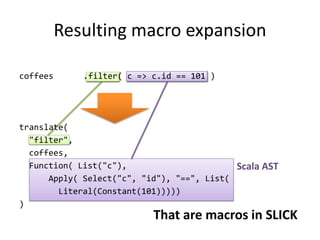
Resulting macro expansion

coffees      .filter( c => c.id == 101 )


translate(
  "filter",
  coffees,
  Function( List("c"),                      Scala AST
      Apply( Select("c", "id"), "==", List(
        Literal(Constant(101)))))
)
                           That are macros in SLICK
Applications in the compiler
• Removed a compiler phase (LiftCode)
• Made a 80% solution (manifests) a 99%
  solution (type tags)
• Manifests à la carte – no longer hardcoded in
  Implicits.scala, it‘s just several macros (you
  can write your own implementations!)
• Ideas: SourceLocations, SourceContexts, static
  requirements on the compiler and the
  compilation environment
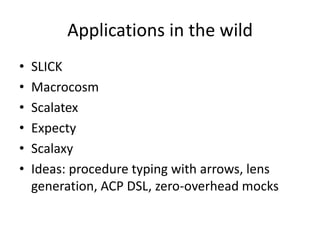
Applications in the wild
•   SLICK
•   Macrocosm
•   Scalatex
•   Expecty
•   Scalaxy
•   Ideas: procedure typing with arrows, lens
    generation, ACP DSL, zero-overhead mocks
Future work
•   Debugging generated code
•   Untyped macros
•   Type macros
•   Macro annotations
•   Replacing the compiler with a macro
Future work
•   Debugging generated code
•   Untyped macros
•   Type macros
•   Macro annotations
•   Replacing the compiler with a macro

Come on, just kidding about the last one!
Thank you!


Questions and answers
www.scalamacros.org

Project kepler compile time metaprogramming for scala

  • 1.
    Scala Macros Eugene Burmako Jan Christopher Vogt London, 2012
  • 2.
    Scala Macros Empower developersto extend the compiler and stay sane! This enables compile-time: – checks – processing – AST transformations – code generation – shipping of ASTs to runtime
  • 3.
    Implementation Compile-time metaprogramming haslong existed in Lisp, so it should be easy to implement, right?
  • 4.
    Trickiness Homoiconicity for alanguage with syntax and types is hard. Being non-hygienic is evil, being hygienic imposes a complexity tax on the spec. Need quasiquotations to make AST manipulations bearable. Yet another concept.
  • 5.
    Beauty Martin Odersky wassuspicious: “And, we'd need to be convinced that it is beautifully simple, or it won't go into Scala”. Here is what convinced Martin:
  • 6.
  • 7.
    The essence Scala reflectionprovides a slice of the compiler’s cake. The infrastructure is already there. Macros are (Tree*, Type*) => Tree functions. Just as simple as that. Hygiene itself is implemented by a macro. Hence we stay minimalistic and flexible.
  • 8.
  • 9.
    SLICK overview val coffees= Queryable[Coffee]( /* db connection */ ) coffees .filter( c => c.id == 101 ) implemented using macros handed over to runtime compile time (reification) runtime SQL SLICK Scala SLICK Query Queryable NoSQL ASTs ASTs frontend Web services 9
  • 10.
    Macros in SLICK valcoffees = Queryable[Coffee]( /* db connection */ ) coffees .filter( c => c.id == 101 ) implemented as a macro that works on argument AST at compile time def filter[T]( predicate: T => Boolean ) : Queryable[T] = macro QueryableMacros.filter[T] object QueryableMacros{ def filter[T:c.TypeTag] (c: scala.reflect.makro.Context) (predicate : c.mirror.Expr[T => Boolean]) = … }
  • 11.
    A macro body objectQueryableMacros{ // macro implementation signature def filter[T:c.TypeTag] (c: scala.reflect.makro.Context) (predicate: c.mirror.Expr[T => Boolean]) = { // reify tree (ship to runtime) val reifiedPredicate = c.mirror.Expr[ reflect.mirror.Expr[T => Boolean] ]( c.reifyTree( c.reflectMirrorPrefix, projection.tree ) ) splicing // splice into runtime call c.reify{ translate("filter", c.prefix.eval, reifiedPredicate.eval ) } }} inlined at the call site (macro expansion), translates queries further at runtime, e.g. to SQL
  • 12.
    Resulting macro expansion coffees .filter( c => c.id == 101 ) translate( "filter", coffees, Function( List("c"), Scala AST Apply( Select("c", "id"), "==", List( Literal(Constant(101))))) ) That are macros in SLICK
  • 13.
    Applications in thecompiler • Removed a compiler phase (LiftCode) • Made a 80% solution (manifests) a 99% solution (type tags) • Manifests à la carte – no longer hardcoded in Implicits.scala, it‘s just several macros (you can write your own implementations!) • Ideas: SourceLocations, SourceContexts, static requirements on the compiler and the compilation environment
  • 14.
    Applications in thewild • SLICK • Macrocosm • Scalatex • Expecty • Scalaxy • Ideas: procedure typing with arrows, lens generation, ACP DSL, zero-overhead mocks
  • 15.
    Future work • Debugging generated code • Untyped macros • Type macros • Macro annotations • Replacing the compiler with a macro
  • 16.
    Future work • Debugging generated code • Untyped macros • Type macros • Macro annotations • Replacing the compiler with a macro Come on, just kidding about the last one!
  • 17.
    Thank you! Questions andanswers www.scalamacros.org