






RP
    N .3o


Se t ting t e trends
           h

                       RP NO.3 1
Contents
            Introduction		                                                           4
            8 Trends for 2013 and beyond	                                            6


            Review 2012
            The Aesthetic Digital Revolution	                                        10
            Learning from those who put mobile first	                                13
            A comfortable truth?	                                                    15
            Microsoft: The comeback kid?	                                            18
            Storytelling and curation: Content partnerships in the digital age	      20
            Mobile and retail: increasingly intimate bedfellows	                     22
            Internet data wars: the first skirmishes	                                25
            Can one strategy really serve two masters? Err, duh!	                    27
            The Battle for the digital future or: the War of the Big Four	           29
            Content and technology: the new normal in brand communication	           31
            Our favorite campaigns of 2012	                                          33


            PReview 2013
            The extraordinary is now essential	                                      38
            Thinking small again	                                                    40
            Predictive media and analytics: ready for show time?	                    42
            Will that be cash or mobile, sir?	                                       44
            Hack it all: the new economy of disruption and disintermediation	        46
            Gartner’s strategic technologies to look out for in 2013	                48
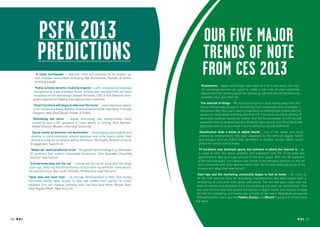
            PSFK 2013 predictions (a hand-picked selection)	                         50
            Our major trends of note from CES 2013	                                  51
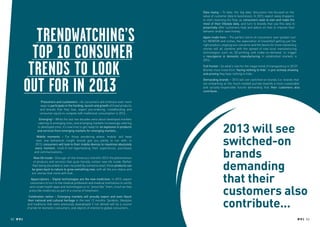
            Trendwatching’s top 10 consumer trends to look out for in 2013	          52


            Hint: hover over our case studies and trend tags for more information.

2 RP NO.3                                                                                 RP NO.3 3
Introduction
            Jeff Hyams
            Chief Strategy Officer, EMEA                                                           Social media continues to evolve and proliferate. The Facebook IPO and subsequent
            Welcome to RP No.3, a series of essays from across the MEC network that cover the      fall in value created a lot of discussion as did the acquisition of Instagram, which
            most significant trends of the past 12 months, while also looking forward to what we   in turn, created another stir towards the end of the year when they changed their
            expect to be the key trends of 2013 and beyond.                                         terms of service. This brought into focus the on-going data and privacy debate
                                                                                                    where alignment between the regulators and practitioners is some way off;
            Looking back, some things developed as we expected especially in the area of
                                                                                                     but, as the Instagram episode demonstrated, the solution has to be rooted in
            technology with mobile and tablet innovation, producing new devices from Google,
                                                                                                     respecting consumer’s needs as they are quick to act.
            Amazon, Apple and the entry into the tablet market by Microsoft. This resulted in
            significant growth for the sector driven by greater choice for the consumer – both       The reality of the connected consumer is now with us, perhaps most obviously
            in terms of screen size and cost.                                                        demonstrated by the Twitter hashtag that accompanies so much of the media
                                                                                                     we consume. Looking forward, we expect to see further marketing benefits
            This growth in screens continues to revitalise television and the opportunities to
                                                                                                      derived from reaching connected consumers across multiple screens.
            create and distribute engaging content was brought to life magnificently during
            the London Olympics and bodes well for the health of the television business and          We have identified eight trends that we believe will be of significance over the
            for marketers to effectively use television to reach their customers.                     next year. These have been developed from the points of view shared in the
                                                                                                      essays. What they demonstrate is that, while the emphasis varies between
            Smartphone growth continued apace globally, with Samsung and Apple leading
                                                                                                      regions, the overall themes are consistent globally. And while technology
            the market but also reflecting tough times ahead for some of their competitors.
                                                                                                       continues to develop at speed, it’s not technology itself that creates change
            As anticipated, we saw further developments in the area of m-commerce as
                                                                                                       but how consumers choose to interact and use it.
            retailers began to see the business opportunities which, when aligned with
            consumer demand, suggests that we will see more significant developments                    It’s another exciting year ahead – let us know what you think. Happy reading.
            in the coming year.


4 RP NO.3                                                                                                                                                                                 RP NO.3 5
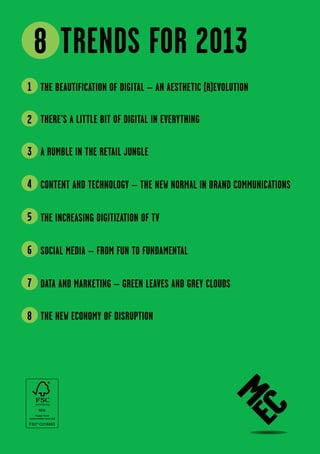
8
                                             Trends
                                             for 2013                                                  Content and technology – the new normal in brand
                                                                                                       communications: Content as a foundation of marketing
                                                                                                       communications has been growing in influence over
                                                                                                       the past few years. We talked last year about the era of
                                                                                                       ‘Content-ricity’, and what we’re seeing now is the growth in


                                             and
                                                                                                       the use of technology at the heart of brands’ content ideas.
                                                                                                       Whether that is creating technology solutions that provide
                                                                                                       utility to consumers and then fuel content stories or using
                                                                                                       the digital infrastructure to amplify a content idea, the lines
                                                                                                       between technology, product and communications are blurring
                                                                                                       like never before.


                                             beyond
                                                                                                       The increasing digitization of TV: No, this is not another death
                                                                                                       knell for TV or high praise for YouTube. TV is alive and well, not
                                                                                                       least because the content that makes so many people love it
                                                                                                       is being enhanced by digital in a myriad of ways. From second
                                                                                                       screening behaviors and applications to Social TV buzz, and
                                                                                                       Connected TV devices to TV Everywhere solutions, the audio-visual

            Andy Wasef                                                                                 world is being digitized piece by piece and bringing with it new
                                                                                                       experiences for consumers and new opportunities for marketers.
                                                                                                       Social media – from fun to fundamental: This has, in various
            Head of Innovation and Technology, North America                                           guises, now been one of our trends for the last three years. Social
                                                                                                       media marketing is maturing and growing up, and, as it does (and
                                                                                                       especially as measurement on business impact has got rapidly
            The beautification of digital – an aesthetic (r)evolution: The first wave of digital       more sophisticated), strategies and tactics have moved from focusing
            design wasn’t particularly pretty, but the next wave (fueled in large part by the ascent   on volume of fans and engagement, to now become increasingly
            and importance of smartphones and tablets) is reinventing digital interfaces and           fundamental to the core parts of a business’ operation.
            storytelling, combining the power of technology with a compelling visual foundation.
            The result will be a new appreciation for the beauty of digital design that influences     Data and marketing – green leaves and grey clouds: Ah, Data. Many an
            all interfaces moving forward and requires a different approach to communicating           industry’s buzz word for the past few years, it remains a perplexing world.
            with consumers.                                                                            Mountains of it are being collected but many companies are still trying to
                                                                                                       work out how to make it all useful. As they do so, we see the green leaves
            There’s a little bit of digital in everything: The phrase ‘the internet of things’ has     of great applications of data in marketing and services to consumers, while
            been thrown about for a few years now – to the point it may even have become               at the same time, those dark clouds of privacy concerns and nefarious
            annoying in its ambiguity. We may still be some way from a world where every single        control of data access continue to gather.
            item is digitally connected but we’re certainly on our way there as everything from
            cars to fridges and thermostats to forks get the digital treatment. The potential is       The new economy of disruption: One of the biggest legacies to come from
            unprecedented and the opportunities for innovation for marketers immense.                  the internet age has been the democratization of innovative disruption. What
                                                                                                       has been apparent for a number of years now in sectors like media and
            A rumble in the retail jungle: The world of retail is changing, and fast. Disrupted        communications (anyone can be a ‘publisher’ today) is now occurring to all
            initially by online e-commerce, physical retail environments of all kinds are now being    manner of services, driving inventiveness across countries and continents, and
            infiltrated by digital technologies. Digital storefronts, mobile payments and data         forcing change in sectors as varied as finance, education and healthcare. The
            driving personalized shopping experiences are just a few ways that our retail world is     result is a new economy of innovation, where disruption may become the norm,
            now being shaken up and the rules of shopper marketing being rewritten.                    not the exception.

6 RP NO.3                                                                                                                                                                               RP NO.3 7
review
8 RP NO.3            RP NO.3 9
the
aesthetic
                                                       2012 saw the mainstream emergence of a new form of
                                                      digital interfaces and storytelling – one that combines
                                                      the power of technology with compelling visual narratives
                                                     designed to drive extended user engagement. The rapid
                                                    proliferation of smartphone and tablet devices into the
                                                   marketplace has had a profound impact on how users
                                                   consume and engage with digital content. At the same time,
                                                  it’s had an equally significant influence on how developers


digital
                                                  are approaching digital design – capitalizing on the unique,
                                                 native sensory features of these devices (i.e. tap, swipe) and by
                                                 elevating the prominence of larger visual formats (i.e. photos).
                                                 It comes as no surprise that some of the year’s greatest
                                                success stories are from those that have embraced these new
                                                design principles into the core of the user experience, and
                                               consequently experienced phenomenal audience growth and
                                               engagement levels. Instagram, Pinterest, Tumblr, Flipboard and
                                              (yes) Facebook have all embraced this design philosophy adding


revolution
                                             in simple layers of social mechanics to help extend the depth and
                                             breadth of this highly shareable content.
                                             Perhaps lost in the hyperbole of Facebook’s IPO this year was the
                                             dramatic redesign of the Facebook news feed (on the desktop site,
                                            but also across their mobile and tablet applications) – a complete
                                            transformation of the user experience that changed the dynamics of
                                           social engagement and discovery and also amplified the prominence
                                           of visual storytelling for both individuals and brands alike.


Gian LaVecchia
managing partner, Digital, North America


10 RP NO.3                                                                                                           RP NO.3 11
In short order, Instagram quickly evolved from a fun and quirky photo


                                                                                                                                   Lroemathrnwihnpgt
                                       app into a +100MM strong community of amateur photo enthusiasts
                                       with more than 7.5MM using the service daily, with much of its
                                      distribution occurring across Facebook and Twitter. Founder Kevin
                                      Systrom’s vision to create an “instant telegram” service has clearly
                                      been realized and it’s simplistic yet visually intensive design has done
                                       an exceptional job of emphasizing its core photo assets, which has
                                                   helped fuel extensive consumption and social sharing


                                                                                                                                           ose o u
                                                          behaviors. Towards the end of 2012, Instagram

                                                                                                                                   f

                                                                                                                                     mobile
                                                              changed their terms of service, incurring the
                                                                  wrath of a large number of users, with some
                                                                    reports suggesting that they had lost over
                                                                      half of active users. While there were

                  CASE STUDIES
   Progressive brands have already begun to explore the
                                                                        probably other reasons for the big drop,
                                                                          the reality is that people do care about
                                                                           the copyright of their content and any
                                                                            compromise of privacy particularly
  publishing boundaries of these new digital canvases, including


                                                                                                                                      First
                                                                             when that is driven by the needs
 AT&T, Coke Zero and LG’s 3D Newsfeed Studio – a rich
                                                                             of a new owner such as Facebook.
visualization tool designed to transform your Facebook posts into
                                                                             Instagram did subsequently alter
dynamic stacks that vary in dimension based on the level of social
                                                                             some of their changes but it will be
engagement generated.
                                                                             interesting to see how their user
 The New York Times’ groundbreaking feature, “Snow Fall”, on an              base evolves.
  avalanche at Tunnel Creek, WA, USA
                                                                            Finally, the emergence of Pinterest
    Fashion brand Oscar de la Renta leveraged the popularity               has created yet another major
      of wedding-based board on Pinterest by live pinning                 market disruption, but this time it
        images of their Bridal catwalk show in April 2012.              looks a bit different – a simple, elegant
                                                                      and beautifully designed “pinboard”
                                                                    experience that may well represent the
                                                                 future of e-commerce. Although we’re clearly
                                                             still in the early days, the e-commerce effect
                                                         is real, with Pinterest users spending an average
                                                  of $179 (vs. Facebook: $80, Twitter: $68) when following
                                      through to a purchase from a product seen on the platform. According
                               to Fast Company, “it’s not a stretch to say that soon, at least on retail sites, a
                                                                                                                             Jide Sobo
                               Pinterest button might become as ubiquitous as a Facebook Like.”1                             Head of Mobile, UNITED KINGDOM
                                                                                     A combination of screen size
                                                                                     necessity, combined with touch          Despite not being the first time the term had been discussed, 2012 was the year
                                                                                     technology features and growth of       when the industry at large began regularly discussing the concept of ‘mobile
                                                                                     time spent on mobile devices, has led   first’. As with any marketing industry buzz words, there was immediately much
                                                                                     to an aesthetic revolution in digital   discourse on what the term actually meant, whether it was new, and whether it
                                                                                     design – one that is both easier on     was useful or not and so on.
                                                                                     the eye as well as more effective.

                                     TREND TAGS
                                                                                                                             To us, it’s about recognising the increasingly central role mobile devices
                                                                                     Expect to see this revolution impact    are playing in the lives of the world’s population and thinking about how you
                                                                                     design of user interfaces across all    place mobility at the start when developing consumer experiences and
                                                                                     platforms moving forward.               communications.
                                                                                                                             While we can learn a great deal from mobile first companies like Instagram,
                                                                                                                             Flipboard and Foursquare, perhaps even more useful is looking at what can
                                                                                                                             be learnt from the increasing number of mobile first countries, where mobile
                                                                                                                             phones are empowering the population in a way that no other platform has
                                                                                                                             done before.
                           1
                               Source: http://www.fastcodesign.com/1670750/infographic-the-astounding-power-of-pinterest#1

   12 RP N .3
           O
                                                                                                                                                                                                               RP NO.3 13
Mobile internet usage in
             countries such as Nigeria,
             Kenya and Indonesia
             already exceeds desktop
                                                       CASE STUDIES
                                              In South Africa, SABMiller ran a campaign for Carling
             internet usage, and
                                            Black Label, called “Be The Coach”. This campaign


                                                                                                                 a
             the three are on a
                                         gave people the chance to live their dream and actually be
             par in countries
                                        a coach of a football team. They organised the Carling Black
             such as India and
                                       Label Cup, between two football teams and asked people to
             China. The ease
                                      vote for the team selection and suggest tactics. There was no
             with which the
                                      smartphone app, instead mobile messaging enabled over 11
             infrastructure can
                                      million interactions, with the average person entering 18 times.
             be rolled out, and


                                                                                                            comfortable
             the comparatively
             low cost of mobile        Google’s re-imagining of the iconic Coca-Cola Hill Top ad featured
             devices, means that        ads on smartphones that linked through to a rich media
             the technology is             experience where people could send a free Coke to one of
             more reliable, as well          five specially adapted vending machines across the globe.
             as more accessible.                Users could send a personalised message with the
                                                   Coke, which was translated on the fly by Google
             Kenya has been leading


                                                                                                              truth?
                                                      Translate.
             the way in mobile banking
             for several years with their
             excellent M-Pesa mobile banking
             service. This has brought banking to the
             masses in Kenya, enabling them to transfer
             money to each other, using SMS, as well as paying for products and services. And the new
             M-Shwari service even allows customers to save money and earn interest, without ever
             visiting a bank. These are services that developed countries are struggling to gain traction
             with, through more complicated smartphone apps such as Google Wallet, O2’s Wallet or
             Barclays Ping-It.                                                                                                         Andy Wasef
                                                  As mobile infiltrates people’s lives all over the world
                                                  at every socio-economic level, it is helping in many
                                                                                                                                  Head of Innovation and
                                                  different ways: changing the lives of people who
                                                  have remained unaffected by technology, until now.
                                                                                                                                Technology, North AmericA
                                                  Fishermen in Indonesia are able to use SMS to find
                                                  which market has the best price for their fish that day
                                                  and can decide on the best harbour to land their catch

             TREND TAGS                           and maximise their profit.
                                                  We can see that mobile first doesn’t have to be
                                                  smartphone first. Instead, we need to be smart about      I’ll confess, I love TV. My job may center around the latest innovations (many
                                                  how we use mobile. Think about what devices our           of which I equally love but I spend a large amount of my media diet consuming
                                                  target audience use? How do they use them (SMS?           many of the great TV shows available yesterday and today (from “The ‘A’ Team” to
                                                  Mobile web? Apps?)? In addition, think about the          “Sherlock Holmes” by way of “The Wire” and “Boardwalk Empire”).
                                                  customer incentive and aim to delight.
                                                                                                            My love of TV shows may cloud my judgment but, as a native of digital marketing
                                                                                                            (as opposed to a digital native!), it’s always somewhat baffled me why the whole
                                                                                                            industry has been so preoccupied with the ‘Death of TV’ for so long, with all
                                                                                                            manner of organizations determined to take a swing at what they evidently view as
                                                                                                            the industry’s cash piñata, and collect their share of the shift in ad dollars.
                                                                                                            Despite the incredible ascension of the internet, the reality is that in many parts
                                                                                                            of the world – including in the US – TV viewing remains steadfastly resilient, often
                                                                                                            growing in time spent over that period.

14 RP NO.3                                                                                                                                                                                         RP NO.3 15
It would be easy to look at                                                    In original long-form content, it’s too early to say whether the first steps made by
                                                                                                      digital video specialists will be a success. However, in the US in particular, they

                      this and feel comfortable in                                                    undoubtedly put their money where their mouths were in 2012 and are not going
                                                                                                      to give up easily. If they can prove successful at generating audiences and revenue

                      continuing doing what we’ve
                                                                                                      at scale, we may begin to see the start of a slight shift in the balance of power.
                                                                                                      Meanwhile, the dominant traditional TV players – while holding the young upstarts
                             always done...                                                           at bay – are also developing their own solutions for the next gen TV world. TV
                                                                                                      everywhere has some way to go yet but gets closer every year, and all the networks
                                                                                                      are embracing the benefits that social TV and 2nd Screening brings.
                                                                                                      Navigating the world of next generation TV and video is a complex task and added
                                                                                                      together with data showing the continued resilience of traditional TV viewing
                                                                                                      means it can be tempting (and comfortable) to believe we can safely continue as
                                                                                                      normal in the way we approach video advertising.
                                                                                                                                                 But just as consumers are seamlessly
               While online video viewing is undoubtedly a rapidly growing phenomenon (1.3                                                       supplementing their main screen
               billion+ monthly viewers worldwide and 185 million+ in the US alone), and new                                                     viewing with internet-delivered video
               methods of content delivery are beginning to establish themselves (YouTube,                                                       and 2nd Screen experiences, we too need
               YouKu Toudu, Hulu and Netflix etc.); the reality is that, in terms of volume of                                                   to re-frame the conversation away from
               viewers and especially weekly time spent, traditional TV viewing continues to                                                     TV vs. Online and think in their terms…
               dominate the landscape in many countries (145 hours per month for traditional                                                     that of the ‘Best Available Screen’ for
               TV viewing compared to 5.5 hours per month for online video viewing in the US
               according to Nielsen).
               These types of numbers could lead us to the ‘The Comfortable Truth’. It would be
                                                                                                        TREND TAGS                               content that they wish to view at any
                                                                                                                                                 particular moment in time, in any place,
                                                                                                                                                 in any mood. We live in an ‘And’ world,
               easy to look at this and feel comfortable in continuing doing what we’ve always                                                   not an ‘Or’ world.
               done; focusing efforts on TV advertising and dabbling with some online and mobile
               video to tick the innovation box.
               However, to do so would mean missing out on the many opportunities next
               generation TV can offer today, leaving us unprepared for tomorrow.
               TV/Video delivered through the internet in some form or other is likely to be the
               future delivery mechanism. And it will offer some benefits that traditional TV lacks
               – flexibility of access to preferred content, interactive features and (sometimes)
               lower ad load for consumers, less ad clutter, more accurate targeting and
               (hopefully) cross-platform measurement for advertisers.
               Apart from the volume and type of video being watched on other platforms than
               the main TV screen, the big story of the past 12-18 months in the US, UK and
               elsewhere has been the explosion of 2nd Screening (aka Dual Screening and


                                                                                                        We live in an
               Social TV).
               The growth of this behavior represents both a threat and an opportunity for
               advertisers. Data from Nielsen points to the concern that viewers’ attention


                                                                                                      ‘And’ world, not
               is being directed away from what they’re watching (57% of 2nd Screeners were
               checking email and 45% doing something else unrelated to the show itself). Even
               during the 2012 Super Bowl (one of the world’s most watched annual TV events),
               data from Flurry Analytics (looking at per second usage of 192k mobile apps)


                                                                                                        an ‘Or’ world
               demonstrated how viewers’ attention is increasingly diverting to mobile devices
               as well as the main screen.
               On the flip side, this increasingly natural and ubiquitous behavior represents
               a potent opportunity for content makers and advertisers alike – something
               demonstrated brilliantly by Heineken’s Star Player app in 2011 and eBay’s ‘Watch
               with eBay’ app in 2012.
16 RP NN.3.3
   RP3 O o                                                                                                                                                                                   RP NO.3 17
Microsoft:
      Guillaume Goudal
                                                                                                     the comeback kid?
      Head of Digital, Australia

                                                                                                     Windows 8 is the “re-imagined” version of traditional Windows operating system.
                                                                                                     It’s touch-centric and tile-based (vs. file-based interfaces in past versions),
                                                                                                     creating a unified ecosystem alongside Windows Phone, Surface and Xbox and
                                                                                                     allowing customers to move to the cloud on their terms.

             The last year has been one of the most significant in Microsoft’s history as            Surface is a latecomer to the tablet market. In November 2011, Forrester Research
             they attempted to reboot the company through technology and design, for the             showed consumers were already losing interest in a (Windows-powered) tablet,
             consumer and for the enterprise customer. Their year can be framed around CES           and Gartner expects Surface to reach the third place by 2015 but with a distant
             – specifically in January 2012 they previewed what was to come, while a year later      11% market share. However, this tablet is all about tight software and hardware
             they were not in attendance. Was this a sign of confidence or concern?                  integration. Surface has a physical keyboard and supports Microsoft Office. We
                                                                                                     believe this combination will accelerate its adoption as the enterprise tablet – a field
             At CES 2012, Microsoft CEO Steve Ballmer unveiled the latest generation of              Apple has yet to surpass Microsoft in – and one that could be key in the cross-sell of
             Windows Phones, Windows 8 including a Windows App Store and updates on Xbox             Windows Phone devices.
             360. Many were expecting the official announcement of Xbox 720 and Surface but
             what we got ended up being much bigger than that. For those who read between            In 2012, with Metro, Microsoft delivered a coherent and intuitive (cloud-based)
             the lines, it was clear that Microsoft was revealing multiple components of a clever    user experience on all screens and across all types of content. For consumers, it’s
             strategy with an important cultural change.                                             a broader and accessible alternative to the pricy Apple experience. However, some
                                                                                                     questions remain. Is Microsoft attractive as a brand, and one that consumers desire
             The tile-based interface, called Metro, announced the shift to a new “no compromise”    to identify with? Can Microsoft Surface begin
             and “make it easy” approach to their design (something sorely lacking at times in the   to take significant share from Apple’s iOS and
             past 10 years), providing a common experience across all platforms. Using their most    Google’s Android devices?
             successful product innovation of the past 10 years, Xbox, as the blueprint, Microsoft
             has begun to move away from offering software that people put up with, to actually      2013 will begin to unveil some of the answers
             enhancing their experience by simplifying it and making it prettier.                    and we’ll see if and where they can grow
                                                                                                     market share; while additionally, they will
             Another company famous for providing a simple and intuitive experience is of course     continue to make further developments with
             Apple. With Metro, Windows Store and Surface, Microsoft is going with the flow by
             building on a competitor’s existing market successes and accepting emerging consumer
             needs. In other words, Microsoft might be moving away from previously used oligopoly
                                                                                                     their Xbox platform as well as integrating
                                                                                                     Skype further into their product portfolio.
                                                                                                     We won’t know for some time whether 2012
                                                                                                                                                                TREND TAGS
             management techniques and towards conquering competitors’ properties, rather than       marked the rebirth of Microsoft or just another
             protecting its own.                                                                     false dawn. We will also know more about the
                                                                                                     significance of their non-appearance at CES
             In October 2012, Microsoft launched Windows 8 and Surface. These were two crucial
                                                                                                     2013 when we see their next product launch.
             components in building a coherent and holistic offer.


18 RP NO.3                                                                                                                                                                                      RP NO.3 19
Over recent years we have begun to see a trend where relevant and compelling
                                            content ideas sit at the heart of strong communication strategies. In 2012, we
                                            saw evidence that Content Marketing is not only alive and well but evolving at an
                                            ever increasing pace with the successes of initiatives like “Red Bull Stratos”, and
                                            “Kony 2012”.
                                            The lines between who creates, brands, curates and distributes content are
                                            blurring. Alongside traditional content creators/distributors, content is now coming
                                            from individuals, entrepreneurs, rights holders and an increasing number
                                            of discerning digital publishers such as Vice and Crane.tv. Brands are also
                                            becoming content creators and media owners in their own right: Red Bull Media
                                            House, LVMH’s NOWNESS, Zegna’s ZegnArt and Coca-Cola’s 2020 Content
                                            vision to name a few!


             Storytelling
                                            While content distributors such as YouTube, Hulu and Vimeo are global
                                            powerhouses, the brand opportunities on these platforms remain largely
                                            outside of editorial conversations. Smaller and more targeted content
                                            distributors (Vice, Protein, Largetail and Glam Media)
                                            and seeders (Unruly, Goviral and ebuzzing) offer
                                            brands more cost effective and targeted ways


             and curation:
                                            to reach consumers. They also enable
                                            brands to reap earned media benefits
                                            rather than simply topping and tailing
                                            other’s content.
                                            Through integrated storytelling
                                                                                                  CASE STUDIES
                                                                                       We have our own successes with Dewar’s @ TED
                                            and content curation, successful


             Content partnerships
                                                                                      2012 and KFC’s South Africa’s Add Hope campaign.
                                            media companies are building
                                                                                     Combining over 2 thousand tweets and a 46 day video
                                            strong relationships between
                                                                                     diary, KFC Add Hope raised over 12 million Rand by
                                            talent, rights holders, brands
                                                                                     following celebrity extreme adventurer Riaan Manser


             in the digital age
                                            and        content       creators/
                                                                                      as he biked across South Africa in the fight against
                                            distributors. They are also acting
                                                                                       hunger. Across both these campaigns, the quality
                                            as     “storytelling”  facilitators,
                                                                                         of the content and talent enable owned and
                                            ensuring brand messages come
                                                                                           earned media value to largely outweigh the
                                            out clearly through the content
                                                                                             value generated by “paid for” activity!
                                            without negating the creative impulse

             Jean-Baptiste Leroux           of the talent at work.
                                            Agencies, publishers and brands alike
             Account Director, MEC Access   are all working to make the cut. With this in
                                            mind, we’ve been ramping up our capabilities
                                            by collaborating with Vice, the publisher come
                                            agency responsible for the development of The
                                            Creators Project with Intel. In its first year, the
                                            content on the site was viewed some 55 million
                                            times and its events were attended by tens of
                                            thousands of people.
                                            As we hit full speed in 2013, let’s remember
                                            that content in the digital world encompasses
                                            creation, branding, curation and distribution. Our
                                                                                                       TREND TAGS
                                            role lies within each as connector, facilitator and
                                            negotiator for the brands we represent.


20 RP NO.3                                                                                                                         RP NO.3 21
2012 was the year that saw the beginning of a beautiful


             Mobile
                                                                romance.
                                                                In the preceding year or two, the affection was very much
                                                                on the side of the consumer, embracing the use of mobile
                                                                as part of their shopping process but with retailers not so
                                                                enamoured. In 2012 we saw that change, with manufacturers
                                                                and retailers taking the attitude ‘if you can’t beat them, join
                                                                them’ and developing mobile tools and services to augment


             and
                                                                consumers’ shopping experiences with them.
                                                                The behavior now commonly known as show-rooming


             Retail:
                                                                (consumers using mobile sites/apps to check quality and price
                                                                comparisons while in store, and often then buying elsewhere or
                                                                abadoning a purchase entirely) became widespread in 2011 and
                                                                2012 among smartphone owners across the world in particular.
                                                                After initially attempting to ‘block’ this behavior, 2012 was the
                                                                year we saw the implementation of a number of strategies aimed
                                                                at minimizing the effect as well as incentivizing the shopper to
                                                                complete their purchase there and then.


             increasingly                                       Those strategies – price matching, private labels, exclusives only
                                                                available in-store, enhanced loyalty programs, complementary
                                                                content, free delivery to name a few – may be aimed at reducing


             intimate
                                                                the impact of show-rooming on the retailer, but, ultimately, it’s the
                                                                shopper who benefits in all this.
                                                                In Latin America, despite e-commerce still being relatively limited
                                                                and smartphone penetration still young, major regional retailers,


             bedfellows                                         like Fallabela, are also embracing this behavior. With 2013 economic
                                                                indicators being strong and smartphone penetration expected to
                                                                experience triple digit growth, expect to see this widely adopted almost
                                                                as much as in markets like the US, Japan and the UK.
                                                                And of course, retail extends beyond banks and department stores.
                                                                Big, complicated cities (of which Latin America has more than its
                                                                share) encourage location based applications in many different physical
                                                                ‘transactions’.


             Cynthia Evans
                                                                It was fascinating to see rules of shopper marketing disrupted by consumer
                                                                behavior and retailer responses last year. The idea of actually enabling list
                                                                creation and locating of items in large retailers would have been unheard of
             Chief strategy officer, Latin America              not too long ago, but that’s exactly what Walmart, Mejer and others have done
                                                                in the US.
                                                                Meanwhile, many other grocery chains are looking at ways of moving away from

             Andy Wasef                                         the traditional checkout process and leveraging the mobile device to scan items
                                                                as the shopper puts items in their bags and checkout on their own, while all
                                                                manner of retailers (large and small) are using mobiles and tablets to enable
             Head of Innovation and technology, North America   inventory searches and remote checkout anywhere on the store floor.


22 RP NO.3                                                                                                                                        RP NO.3 23
CASE STUDIES
            From Chile to Colombia, major regional retailer Fallabela
         offers content responsive to either online or mobile access,
      offering a means of “window-shopping”, price-checking and coupon
     delivery, even though e-commerce is limited.
  Colgate Mexico has mobilized an 18,000-dentist database with a geo-location
based initiative where consumers can locate dentists and click to talk,
providing a brand showcase and customer collaboration with the trade.


                                                                                                        Internet
In the US, retail giant Walmart’s in-store application embraces these challenges
and provides helpful utilities like an aisle map that shows the shopper where the
items on their shopping list are located in their huge stores (something that is
 contrary to traditional retail marketing practices).
  Tesco UK has created many mobile services for customers and promoted them
   heavily – demonstrating their importance. One of which enables people to


                                                                                                     DataSkirmishes
                                                                                                               Wars:
    scan items in the home that have run out, automatically adding them to
      their mobile shopping list.
               Fashion retailer Oasis armed sales associates with iPads
                 to enable customers to check stock availability and
                     buy items without the hassle of waiting,
                          leading to 20% sales lift according
                                  to the brand.


                              Grocery chain Stop and Shop is trialing services that allow shoppers
                             to do away with the in-store ‘wands’ and use their mobile phone to
                            scan and bag items, processing payment on their phone at the end
                                                                                                     The First
                           of their shop.


                                                                                                     Tomasz Kolanowski
                            The developments that really took root in 2012 are fundamentally
                          disrupting the traditional shopper marketing rulebook and require
                         retailers (and manufacturers) to think about how they can enhance
                        the physical shopping experience, how they can reduce the impact of
                       show-rooming behavior and how                                                 Director of Analytics and Insight, Poland
                      they integrate so many parts of
                     their communications mix as well as
                   fundamental parts of their business                                                2012 was a year of change. Change that could have far-reaching implications
                  operations (e.g. stock management, staff                                             even in the near future as internet service providers (ISP) and web browser
                 training, pricing structures, infrastructure,                                          developers look to take advantage of public concerns on cookie tracking,
                data flow).                                                                              distorting the fragile equilibrium of internet data availability and therefore
                                                                                                          threatening a core pillar of digital communications.
          Digital had a hugely disruptive impact on retail
         with the introduction of online ecommerce,
        but mobile is now influencing the physical retail
       environment in profound ways that could have an
                                                                      TREND TAGS                            What’s happening?
                                                                                                              The digital data buzzword of 2012 was DPI (Deep Packet Inspection) –
                                                                                                               technology that allows ISPs to monitor all users’ internet behaviour.
      even greater effect (and benefit) on our daily lives.                                                      Up until now an ISP chose to play solely the role of postman,
    2012 was the year that retailers and manufacturers                                                            seeing only the addresses of users and their online destination.
   got in bed with mobile – long may the romance                                                                    Extensions of DPI means they might now also read the ‘letters’
  continue.                                                                                                            that are being sent and monetize the data they contain.


24 RP NN.3.3
   RP3 O o                                                                                                                                                                                RP NO.3 25
This article is not concerned
             At the same time, Microsoft caused a stir by announcing it would block user                                               about the next platform or the
             tracking by default in its newest internet Explorer (IE10). Some suggested this                                           next new piece of technology. Nor
             was directly aimed to disrupt Google’s cookie-based business model, but if                                                is it bothered with whatever CES


                                                                                                    Can one
             implemented fully (and that remains to be seen), it would have a profound impact                                          sent our way in January. Instead,
             on the wider digital advertising industry and give DPI by internet service providers                                      it predicts the continued rise (or
             further impetus.                                                                                                          return as some may say) of the
                                                                                                                                       ‘integrated strategy’ within our
             Why should you care?
                                                                                                                                       business; the shared critical path


                                                                                                    strategy
             This might all sound very techie but it has much broader significance than at                                             for both medium and message.
             first sight.
                                                                                                                                       We’ve been conditioned to accept
             Developments along the lines of those outlined above could lead to increased                                              that there’s a line that must not be
             online censorship (as seen recently in Russia and China) and also the disruption                                          crossed when devising strategy; an


                                                                                                    really
             of the current equilibrium in data access, shifting control from the many to the                                          imaginary line that dictates media
             hands of a powerful few.                                                                                                  sits on one side, messaging on the
                                                                                                                                       other. And the idea of a strategy
             Open access to data is important to our industry because many of the benefits
                                                                                                                                       serving two masters? A big no no!
             of advertising in a digitised world (across platforms) rely on the capture


                                                                                                    serve two
             and application of data to increase relevance, reduce waste and improve                                                   Yet a strategy that does both is, in
             effectiveness. This ‘holy grail’ of delivering the right message, to the right                                            my opinion, what the marketing
             person, at the right time is in large part reliant on it. Not only do the worst                                           world needs now like never
             case scenarios of these developments threaten that, but they also take choice                                             before. The isolation, or silo-ing of
             away from the consumer and negatively impact their digital experiences.                                                   messaging and media strategies


                                                                                                    masters?
                                                                                                                                       leads to increasingly ineffective
             And it’s not just about pure advertising. Many of the phenomenal examples of
                                                                                                                                       communication. It leads to ideas
             branded utility and personalised services that blur the line between product
                                                                                                                                       never really reaching their fullest
             and communications are fueled by open data access. Nike Fuelband,
                                                                                                                                       potential or arriving without
             Carvalho Hosken’s personalised home tour and Google Now are just three
                                                                                                                                       context. And it leaves money on the


                                                                                                    Err, Duh!
             examples of this.
                                                                                                                                       table.
             While the apocalyptic outcome in data access
                                                                                                                                       The explosion of access to different
             may not be imminent just yet and while
                                                                                                                                       data points or to numbers that
             DPI has many useful applications (internet
                                                                                                                                       actually matter, allows for a more
             security, identifying piracy criminals etc),
                                                                                                                                       informed, more dynamic strategy.
             it’s important for anyone who believes in the
                                                                                                                                       Whether your building blocks
             usefulness of open data access to ensure that:
             a) we keep an eye on developments in this
             space; b) we ensure our industry maintains
                                                                      TREND TAGS                    Pele Cortizo-Burgess               are sourced via Survey Monkey,
                                                                                                                                       Forrester,     Simmons,      Google
                                                                                                                                       Analytics (underused today in this
             the highest standards of privacy compliance
             to avoid further restrictions: and c) we lobby
                                                                                                    Director of Integrated Planning,   writer’s opinion) or by way of social
                                                                                                                                       listening, information has never
             for a consistent approach to data and privacy
             from every stakeholder in this arena.
                                                                                                    Global                             been more readily available.
                                                                                                                                       Augmenting this with tools and
                                                                                                                                       approaches such as BrandZ™, BAV
                                                                                                                                       or our own Momentum (launching
                                                                                                                                       soon) and you’ve got the makings
                                                                                                                                       of a strategy that has the ability


26 RP NO.3                                                                                                                                                        RP NO.3 27
to craft message AND inform media. Think about it. You
                                        not only have access to consumer behaviors, you also


                                                                                                     The Battle for
                                          have access to where and when these behaviors are
                                           carried out. That kind of understanding makes for

   CASE STUDIES                             powerful ideas as demonstrated by a number of
                                            initiatives in 2012.


                                                                                                   the Digital Future
Johannes Leonardo’s Send a Free              This same approach is reflected in a number of
 Coca-Cola across the world app for         other segments of marketing communications and
  Google.                                   advertising that saw continued uptake in 2012.
   Austria Solar’s Annual Report          Native advertising is either the ‘Next Big ThingTM’ or
                                        the ‘Emperor’s New Clothes’ depending on your point of
                                     view but it continues to see growth on platforms such as
                                   BuzzFeed, Twitter, Facebook and IMDB.
                                                                                                                                              or:
                         Meanwhile, the growth of a content-centric approach to
              communications was one of our predictions for 2012 and saw
              continued fantastic examples such as TNT’s ‘Push for Drama’
              and Only Jeans’ ‘The Liberation’.                                                       t h e Wa r o f t h e
                                                                                                           Big Four
              Real Time Buying (RTB) also continued to grow in 2012
              and to use it to its full potential requires immediate
              optimization of message, media and user.


                                                                       This
              This isn’t about full-service agencies or
              everyone trying to grab food from each
              other’s tables. Instead, it’s about creating


                                                                isn’t about
              an environment that enables real
              collaboration and partnership between
              clients and agencies that will allow


                                                               full-service
              for the exchange and sharing of
              intelligence in order to create not
              only a dynamic idea, but a dynamic


                                                                  agencies                          Juan BongiovannI
              media landscape for the consumer
              to experience.


                                                               or everyone
              In simple terms, these days, an idea
              is nothing without the medium it
              lives within…Therefore you need an
                                                                                                    Head of Digital, Latin America

                                                             trying to grab
              integrated strategy to do both!
                                                                                                    Over the past few years we’ve witnessed how the four big giants of the digital
                                                                                                    world – Google, Apple, Amazon and Facebook – have collided as they started


                                                                 food from
                                                                                                    playing in each other’s territories. This battle will continue to have a great impact
                                                                                                    in redefining how people communicate, find information, consume content,
                                                                                                    purchase and beyond.


                                                               each other’s
                                                                                                    2012 saw the arena of this epic battle advance to new territories, in a mix of
                                                                                                    threats and opportunities for each of the companies involved. These battlefields

                  TREND TAGS                                                                        are numerous and messy, and the lines between hardware and software continue


                                                                     tables
                                                                                                    to blur.
                                                                                                    Apple and Google continue to fight it out in mobile operating systems (Android’s
                                                                                                    open platform for manufacturer’s means it’s share of global unit sales in Q3 2012
                                                                                                    rose to 75% vs. Apple’s 14%), but they are also butting heads in search interfaces.
                                                                                                    Google replied to Apple’s acquisition of Siri by launching Google Now with an
                                                                                                    improved version of Google Voice Search.

 28 RP NO.3                                                                                                                                                                                 RP NO.3 29
Meanwhile, Amazon is also after Google’s search business as more and more
             people bypass Google to go straight to Amazon for their purchases. In response,
                                                                                                    Content and
                                                                                                    technology:
             Google has enhanced its shopping products and search results, and is testing
             same-day delivery, which helps physical retailers bridge the gap with the digital
             world; in addition to protecting Google’s huge retail ad business. Meanwhile,
             rumor has it that Facebook is building a search ad business to be able to
             compete.


                                                                                                    the new
             The search fight extends to location-based services, powered by mobile ubiquity.
             While Apple struggles with its own maps app, Facebook re-launched its
             ‘Facebook Nearby’ feature tapping into the local search business. The previous
             balance of power in this territory is shaken, and the big four all now have a foot
             in it.
             The display ad business territory is also under increasing attack. Google


                                                                                                    normal
             and Facebook, well known enemies in the social arena, took their fight to the
             advertising space with the launch of Facebook Exchange. And the threat of
             Facebook developing their own ad-network will compete head-to-head with
             Google’s display business. Amazon is joining this battlefield with their proprietary
             real-time bidding platform that plugs into exchanges and SSPs.


                                                                                                    in brand
             This ad business territory is increasingly enhanced with consumer data, and to
             date Google has collected the largest set (their every move can be seen in large
             part as another method to collect data and enhance their ad business). However,
             Amazon’s consumer-driven data is arguably more interesting currently, and
             potentially more profitable. Facebook also sits on a treasure trove of data about
             consumers but is still scared to use it in full scale.


                                                                                                    communication
             The battlegrounds could be infinite if we looked in detail at what these big four
             platforms are developing and acquiring.
             In 2013, this battle is definitely set to escalate to involve hardware, search,
             e-commerce, ads and data. Google will expand in all aspects of Android thanks
             to the purchase of Motorola. Facebook will become more aggressive with its own
             search technology, an extended display business, and online retailing. The fight


                                                                                                    Raj Gupta
             for hardware and content will be amplified between Apple, Amazon and Google.
             Apple won’t only play defense, and
             will increasingly look to move into
             new territories like TV and more
             software.                                                                              Head of Strategy, Asia Pacific
             The digital future depends on how
             this epic battle develops, but so far,
             the big winner seems to be one: the
             consumer.
                                                              TREND TAGS                            A number of years ago a colleague of mine proposed a shift in the way in which we looked at
                                                                                                    amplifying ideas. His conjecture was that digital technology and applications touch all parts of
                                                                                                    our world and this now needs to be an integral part of the idea or strategy rather than “just”
                                                                                                    another message. In 2012, it appears a lot of brands started to heed my colleague’s vision
                                                                                                    as they have observed that digital technology is changing consumer behaviour faster than
                                                                                                    ever before. The new normal in their brand communication is to bring technology into the
                                                                                                    infrastructure of their ideas.


30 RP NO.3                                                                                                                                                                                RP NO.3 31
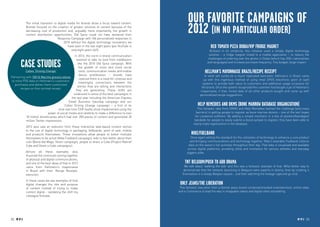
Our favorite campaigns of
                                                                                                          2012 (in no particular order)
             The initial transition to digital media for brands drove a focus toward content.
             Brands focused on the creation of greater volumes of content because of the
             decreasing cost of production and, arguably more importantly, the growth in
             content distribution opportunities. Old Spice could not have delivered their
                                       Response Campaign with 186 personalised responses in
                                            2010 without the digital technology innovations we
                                               have seen in the last eight years (yes YouTube is                           Red Tomato Pizza Dubai/VIP Fridge Magnet
                                                 only eight years old!).                                                   Brilliant in its simplicity, this initiative used a simple digital technology
                                                  In 2012, the norm in brand communication                                solution – a fridge magnet linked to a mobile application – to reduce the
                                                    seemed to take its lead from trailblazers                            challenges of ordering over the phone in Dubai (which has 200+ nationalities

        CASE STUDIES                                 like the 2010 Old Spice campaign. With
                                                      the growth of more and more social
                                                                                                                         and languages) and increase purchase frequency. Tiny budget, large impact.

           Caltex ‘Driving Change’                    tools, communication media and mobile                            Hellman’s Mayonnaise Brazil/Recipe Receipt
                                                      device proliferation – brands have                               In what will surely be a much replicated execution, Hellman’s in Brazil came
Partnering with 100 St Marche grocery stores
                                                      realised there is a need for cohesive and                       up with this ingenious method of using retail EPOS (electronic point of sale)
 to mine POS data on Hellmann’s customers’
                                                      meaningful connections between the                             systems to provide both value to customers and additional usage occasions for
   purchases and deliver them customized
                                                     stories they are telling and interactions                      the brand. Once the system recognized the customer had bought a jar of Hellman’s
       recipes on their printed receipt.
                                                   they are generating. These shifts are                           mayonnaise, it then mined data of all other products bought and came up with
                                                  evidenced in some of the best campaigns in                       personalized recipe suggestions.
                                                the last year including the American Express
                                             Small Business Saturday campaign and our
                                         Caltex Driving Change campaign – a first of its                         Help Remedies and DKMS (bone marrow database organization)
                                     kind real time CSR reality show implemented using the                       This fantastic idea from DKMS and Help Remedies tackled the challenge (and many
                             power of social media and celebrity to make a difference to over                   barriers) in getting people to register as bone marrow donors – one of the last hopes
           18 million beneficiaries which had over 200 pieces of content and generated 30                      for Leukemia sufferers. By adding a simple mechanic in a box of plasters/bandages/
           million Twitter impressions.                                                                       bandaids for people to easily submit a blood sample to register, they have been able to
                                                                                                              nearly triple registrations in the database.
             2012 also saw an evolution from these interactive web-based content stories
             to the use of digital technology in packaging, billboards, point of sale, mobile
             and products themselves. These innovations allow people to better motivate                     Nike/Fuelband
             themselves to be active (Nike Fuelband campaign), kids to feel better about their              Once again setting the standard for the utilization of technology to enhance a core product
             cuts (Band-Aid Magic Vision campaign), people to share a Coke (Project Rebrief                 and bringing communications and technology together, Nike’s wearable Fuelband collects
             Coke and Share a Coke campaigns).                                                             data on the owner’s full activities throughout their day. That data is visualized and available
                                                                                                          across digital platforms, providing utility and motivation for serious athletes and everyday
             Almost all these examples also                                                              joggers alike.
             illustrate the continued coming together
             of physical and digital communications,
             and one of the best ideas of that in 2012                                                 TNT Belgium/Push to Add Drama
             came from Hellmann’s mayonnaise                                                           We talk about ‘walking the talk’ and this was a fantastic example of that. What better way to
             in Brazil with their ‘Recipe Receipts’                                                    demonstrate that the network launching in Belgium were experts in drama, then by creating it
             execution.                                                                               themselves in a sleepy Belgian square... and then watching the footage captured go viral.

             In these cases we see examples of how
             digital changes the role and purpose
             of content instead of trying to make
             content digital – validating the shift my
                                                                TREND TAGS                          Only Jeans/The Liberation
                                                                                                    This fantastic execution from a Danish jeans brand combined branded entertainment, online video
                                                                                                   and e-Commerce to lead the way in shoppable videos and digital video storytelling.
             colleague foresaw.


32 RP NO.3                                                                                                                                                                                      RP NO.3 33
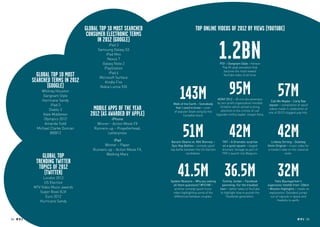
Global top 10 most searched                          Top online videos of 2012 by views (YouTube)
                                        consumer electronic terms
                                             in 2012 (Google)
                                                    iPad 3
                                             Samsung Galaxy S3
                                                  iPad Mini
                                                   Nexus 7
                                               Galaxy Note 2
                                                 PlayStation
                                                                                                                 1.2BN
                                                                                                                 PSY – Gangnam Style – Korean
                                                                                                                   Pop (K-pop) sensation that
                                                                                                                    become the most viewed
                                                    iPad 4
               Global top 10 most             Microsoft Surface
                                                                                                                    YouTube video of all time.
             searched terms in 2012
                                                                                                                         95M
                                                 Kindle Fire
                    (Google)
                  Whitney Houston
                  Gangnam Style
                  Hurricane Sandy
                                              Nokia Lumia 920

                                                                                 143M
                                                                            Walk of the Earth – Somebody
                                                                                                                KONY 2012 – 30 min documentary
                                                                                                                by non-profit organization Invisible
                                                                                                                                                               57M
                                                                                                                                                        Call Me Maybe – Carly Rae
                       iPad 3                                                                                                                          Jepsen – compilation of spoof
                      Diablo 3            Mobile Apps of the Year            that I used to know – cover
                                                                            of popular Goyte song by this
                                                                                                                  Children which aimed to bring
                                                                                                                  attention to the crimes of cult
                                                                                                                                                       videos made in celebration of
                  Kate Middleton         2012 (as awarded by Apple)                 Canadian band.             Ugandan militia leader Joseph Kony.
                                                                                                                                                       one of 2012’s biggest pop hits.

                   Olympics 2012                    iPhone
                   Amanda Todd              Winner – Action Movie FX
               Michael Clarke Duncan
                      BBB12
                                           Runners-up – Propellerhead,
                                                  Letterpress
                                                     iPad
                                                                                   51M
                                                                           Barack Obama vs. Mitt Romney –
                                                                                                                         42M
                                                                                                                   TNT – A Dramatic surprise
                                                                                                                                                               42M
                                                                                                                                                          Lindsey Stirling – Dubstep
                                                Winner – Paper             Epic Rap Battles – comedy spoof         on a quiet square – staged          Violin Original – music video for
                                          Runners-up – Action Movie FX,   rap battle between the US election       dramatic footage as part of         a modern take on the classical
                                                 Walking Mars                         candidates.                  TNT’s launch into Belgium.                        violin.
                  Global Top
               trending Twitter
                topics of 2012
                   (Twitter)
                  London 2012
                   US Election
                                                                               41.5M 36.5M
                                                                          Spoken Reasons – Why you asking           Tommy Jordan – Facebook
                                                                                                                                                              32M
                                                                                                                                                            Felix Baumgartner’s
                                                                            all them questions? #FCHW –             parenting: For the troubled        supersonic freefall from 120km
             MTV Video Music awards                                          another comedy spoof music           teen – father takes to YouTube       – Mission Highlights – needs no
                Super Bowl XLVI                                             video highlighting some of the        to highlight how to punish the        explanation. Daredevil jumps
                    Euro 2012                                               differences between couples.              Facebook generation.               out of capsule in space and
                Hurricane Sandy                                                                                                                               freefalls to earth.


34 RP NO.3                                                                                                                                                                    RP NO.3 35
Preview
36 RP NO.3         RP NO.3 37
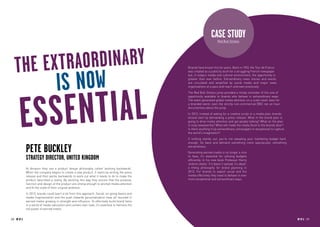
CASE STUDY
                                                                                                                           Red Bull Stratos


   The e x tr aordinary                                                                            Brands have known this for years. Back in 1903, the Tour de France


                                     is now
                                                                                                   was created as a publicity stunt for a struggling French newspaper
                                                                                                   but, in today’s media and cultural environment, the opportunity is
                                                                                                   greater than ever before. Extraordinary news stories and events
                                                                                                   are circulated and amplified by social media and major news


           ential
                                                                                                   organisations at a pace and reach unknown previously.


       ess
                                                                                                   The Red Bull Stratos jump provided a timely reminder of the size of
                                                                                                   opportunity available to brands who behave in extraordinary ways.
                                                                                                   The event generated global media attention on a scale never seen for
                                                                                                   a branded event; even the strictly non-commercial BBC ran an hour
                                                                                                   documentary about the jump.
                                                                                                   In 2013, instead of asking for a creative script or a media plan, brands
                                                                                                   should start by demanding a press release. What in the brand plan is
                                                                                                   going to drive media attention and get people talking? What on the plan
                                                                                                   is truly newsworthy? What will make the media flock to the brands door?
                                                                                                   Is there anything truly extraordinary, extravagant or exceptional to capture
                                                                                                   the world’s imagination?
                                                                                                   If nothing stands out, you’re not sweating your marketing budget hard
                                                                                                   enough. Go back and demand something more spectacular, something

             Pete Buckley                                                                          extraordinary.
                                                                                                   Generating earned media is no longer a nice

             Strategy Director, United kingdom                                                     to have, it’s essential for utilising budgets
                                                                                                   efficiently. In his new book Professor Henry
                                                                                                   Jenkins states ‘if it doesn’t spread, it’s dead’,
             At Amazon they use a product design philosophy called ‘working backwards’.            a fitting philosophy for brand planning in
             When the company begins to create a new product, it starts by writing the press       2013. For brands to exploit social and the
             release and then works backwards to work out what it needs to do to make the
             product described a reality. By working this way they ensure that the purpose,
             function and design of the product are strong enough to prompt media attention
                                                                                                   media effectively they need to behave in ever
                                                                                                   more exceptional and extraordinary ways.
                                                                                                                                                           TREND TAGS
             and fit the scale of their original ambition.
             In 2013, brands could learn a lot from this approach. Social, on-going device and
             media fragmentation and the push towards personalisation have all resulted in
             earned media growing in strength and influence. To effectively build brand fame
             in a world of media saturation and content over-load, it’s essential to harness the
             full power of earned media.


38 RP NO.3                                                                                                                                                                        RP NO.3 39
True, most social networks may never reach the scale of
                                                                                                   Facebook. But unlike Facebook, which tries to cater to the
                                                                                                   needs of everyone, such networks are much more focused in
                                                                                                   the way they serve their target audiences. And, whereas sites
                                      Thinking small again                                         such as Instagram and Pinterest have shown a meteoric growth
                                                                                                   in numbers, others may stay limited in size but enjoy high levels
                                                                                                   of engagement, driven by united interests, skills and passions.
                                                                                                   For marketers, niche networks offer golden opportunities in
                                                                                                   the ability to reach very targeted and engaged audiences. They
                                                                                                   operate in highly contextual environments and with forms of
                                                                                                   content that play to each networks’ attributes and help enhance its
                                                                                                   users’ interactions.
                                                                                                   Operating in these areas allows brands to be very focused on their
                                                                                                   content strategy. No matter your brand or what category you operate
                                                                                                   in, it is becoming increasingly likely that there is a specific-interest
                                                                                                   community where you and your content will be very welcome.
                                                                                                   The smaller universe of these networks make it easier to stand out

             Guy Kedar                                                                             (and to that cross-reference with advertisers’ increasing challenges,
                                                                                                   and costs, in reaching their fans on Facebook) and being present in
                                                                                                   multiple arenas increases brands online footprints and supports their
             Regional Director, Social and Emerging Platforms, EMEA                                crucial SEO efforts. Operating in niche networks also has its downsides
                                                                                                   – it requires higher resources in learning each platform’s own ‘rules of
                                                                                                   play’, in creating forms of content native to their environments, and in
                                                                                                   activating and maintaining multiple presences.
                                                                                                   But are niche networks sustainable? Maintaining an
                                                                                                   online profile and activity is time and effort consuming
             Do you know what Cowbird, Stylitics and Raverly have in common?
                                                                                                   – two resources that are not abundant. So is there a
             The answer is they are all highly interest-centric social networks – and the          limit to the number of networks consumers will opt in to
             chances are you’ve never heard of them! Cowbird.com is a community of                 participate, and manage to maintain?
             passionate storytellers, Stylitics.com is a network for sharing and discovering
                                                                                                   The answer to that probably lies in reaching equilibrium. As
             fashion items and Raverly.com is a network of people who are into… knitting.
             The world of social networks is proliferating. Fast.
             Driven by a) the feeling that the current dominant networks don’t answer all
                                                                                                   the industry matures, we may find that one network shapes
                                                                                                   to serve as a meta-platform or social infrastructure for
                                                                                                   the web (it may be Facebook or a new entrant) and others
                                                                                                   are centered on catering to the long tail of consumers’
                                                                                                                                                                         TREND TAGS
             consumers’ needs, limited as they are by function and design; too ubiquitous          interests.
             and cluttered by data to allow an effective way to filter content and interact with
             like-minded peers; b) new and creative ideas to deliver content and facilitate        It’s still early days, of course, but working on how you can
             interactions and c) low-entry barriers to develop new platforms and promote them      ‘think small’ and still create scale (‘Mass Niche’ was the
             – we see new and differentiated networks sprout on a daily basis.                     phrase not too long ago) could well become a necessary art
                                                                                                   in our industry in 2013 and beyond.

40 RP NO.3                                                                                                                                                                        RP NO.3 41
Predictive Media                                                                                                                                                        A more
                                                                                                                                                                             sophisticated
                                                                                                                                                                     example is an alert that


             and Analytics:
                                                                                                                                                              you should leave now to make
                                                                                                                                                        your meeting and the recommended
                                                                                                                                                   route and mode of transport – all based
                                                                                                                                               on mining your calendar, weather and traffic
                                                                                                                                           data. Or movie show times for the kind of films
                                                                                                                                       that Google knows you like based on your search and


             Ready for
                                                                                                                                    email history. Google is building such a vast amount of
                                                                                                                                data – via mail, video, calendar, search, and most recently
                                                                                                                              and importantly thanks to Android, location – and it has such
                                                                                                                           engineering muscle and algorithmic know-how, that its predictive


             show time?
                                                                                                                         content will surprise and delight people, and start to become the
                                                                                                                       norm in 2013. It will be Google’s most game-changing consumer
                                                                                                                     product since search.
                                                                                                                  This really is the beginning of the kind of artificial intelligence capabilities
                                                                                                                seen in many an 80’s movie – personalised suggestions based on deep data
                                                                                                               mining of your existing behavioural patterns. Of course, nothing will completely
                                                                                                             replace our own human nature and intuitiveness (or randomness) but, for many,
                                                                                                            many tasks in our lives, we’re surprisingly attached to a routine and these types of

             Ben Poole                                                                                     services will be of free help to us.
                                                                                                           Of course, using data and algorithms to make predictions is not a new phenomenon.
                                                                                                          In fact, the marketing world is far behind some other categories. In the music industry,
             Head of Interaction, Asia Pacific                                                           algorithms compare the structure of a song to tunes of the past, to determine whether
                                                                                                        it will become a hit for music labels. In the movie business, algorithms analyse scripts
                                                                                                       and predict box office grosses. In the customer call industry, algorithms determine
                                                                                                       what personality type you are when making a call, and connect you with like-minded
                                                                                                      service reps. In the pharma industry, algorithms recommend prescriptions with a 100%
                                                                                                      success rate (compared with 99% for humans). And, on Wall Street, algorithms have
                                                                                                      taken over, with an estimated 70% of all trading decisions handled by machines.
                                                                                                      In the digital marketing world, we are starting to see some fairly simple algorithm-based
                                                                                                      decision making. Paid search tools auto-manage keyword bids in order to maintain a
                                                                                                      pre-set target ROI. Display ad server systems make decisions on up and down weighting
             If I were to tell you that search will be less popular in the future, you probably
                                                                                                       creative and targeting options, based on pre-determined
             wouldn’t believe me. How could such a fundamental part of the online revolution,
                                                                                                        ROI targets. Increasingly, data management platforms
             one that spawned a new verb – ‘to Google’, fade in significance? But it’s true. And
                                                                                                        are using algorithms to identify new prospect audiences
             what’s more, it’s a Google ambition.
                                                                                                         based on them exhibiting behavioural characteristics
             In 2012 Google’s CEO Larry Page stated that “People shouldn’t have to navigate               that are similar to existing customers. 2013 will see
             Google to get stuff done. It should just happen.” Google wants to pre-empt what               more of this machine-based campaign management
             you want, without you having to look for it. Early iterations of this include searches         and optimisation, which will free up human resource
             for “weather in Beijing”, where the first result delivers a five-day weather forecast,          to focus on higher value areas such as client service,
             or “flights from New York to Washington”, where real time flight prices are served
             up in the results. This form of predictive content is, however, just the beginning.
             One of the most significant product launches of 2012 was Google Now – a personal
                                                                                                              ideation, strategy and analytics integration.
                                                                                                              Further down the line, can we expect to see
                                                                                                               algorithms get smarter and recommend
                                                                                                                                                                           TREND TAGS
             assistant that sits on your phone and proactively feeds you content based on what                  new ad copy, colouring on creative, media
             it thinks you need. A basic example is that when your alarm goes off, the weather                    placements and search keywords? I predict
             forecast in your location appears on your phone.                                                       a feature on this in RP No. 4 or 5.


42 RP NO.3                                                                                                                                                                                           RP NO.3 43
That view is seemingly shared by a few other companies who, while not giving up on
                                                                                                      NFC-enabled mobile technology just yet, have nonetheless begun implementing alternative
                                                                                                      solutions. Disruptive start-up Square introduced ‘Square Mobile Wallet’ that allows users to
                                                                                                      sync their device with participating retailers’ POS (incl. Starbucks who invested $25m in the


                    b e c as h
                                                                                                      company in 2012). Once synced and in the retailer’s system, they can then ask for purchases to


           ill that ir?
                                                                                                      be put on their tab, with their face being matched to a photo stored on the ePOS.


         W
                                                                                                      eBay’s PayPal has gone a step further and posed the question of whether the mobile phone is
                                                                                                      even needed to process contactless payments. They’ve begun testing solutions that enables
                                                                                                      users to pay in-store with PayPal just by entering their mobile number and pin number. This


               obile , s
                                                                                                      is an interesting development: storing all payment and loyalty info in the cloud and requiring


         or m
                                                                                                      the user to only remember a pin number. It also helps overcome infrastructure challenges
                                                                                                      and consumer concerns about having all their payment info on their mobiles and the fear of
                                                                                                      then losing the device.
                                                                                                      Of course PayPal and Square are primarily software solutions and can afford to hedge their
                                                                                                      bets on which technology solution(s) will ‘win’. For device manufacturers, a much bigger
                                                                                                      commitment is required and not everyone (including Apple) has been willing to bet on NFC
                                                                                                      just yet.
                                                                                                      It’s not just in payments that mobile is becoming a disruptive force. The constant presence of
                                                                                                      mobile devices in people’s lives means they’re likely to become the home of loyalty services
                                                                                                      from retailers, restaurants and manufacturers alike. While Apple didn’t embed NFC into the
                                                                                                      iPhone 5, they did release Passbook in their latest iOS software update, creating a home

             Rafis Kadir                                                                              for everything else that sits in your wallet from tickets, hotel room keys and loyalty cards.
                                                                                                      Mobile services like Glyph and Wallaby allow users to store all their cards in an app and
             Head of Mobile, Asia Pacific                                                             advise on which one to use to maximise returns for certain purchases, while Shopkick
                                                                                                      rewards users for their loyalty on frequenting participating retailers. Even bar tabs are
                                                                                                      being revamped with companies, such as TabbedOut in the US just launching a service that
                                                                                                      enables people to open a bar tab on their phone and pay without having sign a bill.
             Without a doubt, 2012 saw significant progress in the world of mobile payments and       So what should you do in 2013? Experiment of
             commerce. Despite projections of slow growth, some disruptive technologies – and         course. 2013 will be a breakout year in mobile
             perhaps consumers’ continuing speed of adoption of new technology behaviours –           payments and loyalty, and starting early allows
             have accelerated what is a very interesting and hugely significant area.                 you to work out all the glitches to provide not only
                                                                                                      a smooth payment experience for consumers
             NFC has long been seen as the necessary facilitator of mobile payments, and
                                                                                                      (seamlessly linking communications and
             some progress has been made recently after a few years of inflated expectations.
                                                                                                      commerce through the phone), but also
             Since 2010, Turkey’s Turkcell, KT of South Korea and Zantel of Tanzania have
             been providing SIM-based NFC services, where your SIM-card is your NFC-chip
             too. In the UK, BarclayCard and Orange teamed up to provide mobile payment of
                                                                                                      importantly giving you time to innovate and stay
                                                                                                      ahead of the others.
                                                                                                      Online shopping has been a hugely disruptive
                                                                                                                                                              TREND TAGS
             not more than £15 in 15,000 retail outlets using NFC-enabled phones. CityZi in
                                                                                                      force over the past 15 years, but mobile has
             France recently announced that they will issue 1million NFC phones. With more
                                                                                                      the potential to be even more so – facilitating
             than 800 million subscribers between them, China Mobile and China Unicom have
                                                                                                      payments on sites and apps, as well as in
             also made a commitment to implement SIM-based NFC services. Add in the US’s
                                                                                                      physical locations... the opportunities for
             AT&T, Verizon and T-Mobile and their ISIS partnership, Google Wallet, and Japan’s
                                                                                                      brands of all kinds will be many, don’t miss out!
             major operators shifting their RFID-based mobile payment to NFC and the result
             is that we are finally seeing real scale and traction.
             One notable NFC omission in 2012 came from Apple, who were widely expected to
             have launched the iPhone 5 with NFC capabilities. They didn’t. Given Apple’s track
             record, many people summised that they either don’t have faith in the technology
             and current supporting infrastructure as it stands (and therefore won’t support it
             until it does), and/or they don’t believe that NFC will necessarily be the sole future
             for mobile payments.

44 RP NO.3                                                                                                                                                                                  RP NO.3 45
ck
                                        Ha l
                                                                                                    In healthcare, a number of applications are
                                                                                                    springing up to enable people to manage their
                                                                                                    own health and diagnosis rather than visit
                                                                                                    doctors for everything. Not necessarily a bad
                                                                                                    thing in the West – where healthcare costs need
                                                                                                    reducing – or parts of Africa – where the nearest


                                           al
                                                                                                    doctor or hospital can be hundreds of miles away.


                                        it
                                                                                                    In the world of investment, crowdfunding has been
                                                                                                    popularized by organizations such as Kickstarter
                                                                                                    and Indiegogo, and is spreading further with
                                                                                                    companies like CircleUp and SoMoLend, showing us
                                                                                                    a glimpse of what the future of finance could look like.
                                                                                                    This type of disruption requires regulation but could

                                                                  y
                                                            conomnd
                                                                                                    be a vital catalyst to fueling the innovation economy, so
                                                                                                    important to economic growth at a local and global level.
                                                          e
                                                   he newuption a
                                                                                                    In manufacturing, we will likely see the continued
                                                  T sr                                              attention to 3D printing capabilities as costs of equipment


                                                  of di termediation
                                                                                                    come down and sophistication of what can be produced
                                                                                                    rises. Rather than wait for a spare part to be produced and


                                                   disin
                                                                                                    shipped, digital templates could be sent to individuals (or
                                                                                                    small businesses) to print in 3D – MakerBot is one company
                                                                                                    leading this disruption.
                                                                                                    In retail and delivery, services from Amazon, eBay Now, and
                                                                                                    soon likely Google too, have connected consumers directly with

             Andy Wasef                                                                             manufacturers and are enabling more seamless delivery and
                                                                                                    returns of all types of physical purchases. On a smaller scale,
                                                                                                    services like Taskrabbit (general chores), Uber (car services), and
             Head of Innovation and Technology, North America                                       Cater2.me (food delivery) also cut out the middleman.
                                                                                                    Even in education we’re seeing disruption, with open online courses
             As the huge global impact of the advent of the internet became apparent over           able to enlist hundreds of thousands of students to learn from
             a decade ago, some people began referring to this age as the ‘Third Industrial         prominent professors (see Walter Sinnot-Armstrong’s Coursera
             Revolution’. For once when referring to anything digital, this reflected the genuine   class) without having to be a pupil at costly institutions. Many people
             significance of the internet age and wasn’t just hyperbole.                            feel education in mature countries is ripe for
                                                                                                    change, and digital technology could be a
             Among the most significant impact the internet has had is to create a certain          significant driver of that soon.
             degree of democratization in society, demonstrated most visibly in the worlds of
             media and communications and more recently in politics (facilitating – not causing     Of course, it’s important not too overhype these
             – change in many countries).                                                           developments. We’re not going to see the end of
                                                                                                    doctors, banks, investment firms, universities
             As online access becomes near ubiquitous in many, if not most, parts of the            or factories soon or probably ever. But what

                                                                                                                                                                TREND TAGS
             world, digital technology’s ability to enable and facilitate disruption of almost      is happening is the democratization of all
             any industry is becoming readily apparent. A large part of this disruption is the      manner of services, driving innovation, forcing
             disintermediation of many organizations, jobs and roles in society that were until     change in traditional institutions that might not
             recently presumed sacred and untouchable. In other words, digital technology is        otherwise do so, and creating complementary
             enabling disruption of an untold number of institutions and industries by cutting      services that offer greater choice to people.
             out the middle man.                                                                    And that, we believe, should be fully embraced.
             The disintermediation of traditional publishers is well known (if overhyped), but as
             we began to see in 2012 and will see gather speed in 2013 and beyond, it’s not only
             media companies who are looking nervously over their shoulders at the coming
             wave of start-ups and DIY activists.
46 RP NO.3                                                                                                                                                                    RP NO.3 47
Gartner’s
                 Strategic
                Technologies                                                                    The internet of things
                                                                                                As the internet expands into more physical items, ‘mobile’ will no
                                                                                                longer refer to just handsets and tablets, but to the internet embedded


                to look out
                                                                                                in a myriad of physical objects (ex. NEST – the digitally enabled home
                                                                                                temperature control system).
                                                                                                Hybrid IT and cloud computing
                                                                                                Emergence of new roles in IT divisions of organizations, focused on


                for in 2013
                                                                                                providing value through the provision and management of complex cloud
                                                                                                computing systems.
                                                                                                Strategic big data
                                                                                                Big Data is moving from a focus on individual projects to an influence on
                                                                                                enterprises’ strategic information architecture.
                                                                                                Actionable analytics
                                                                                                Analytics is increasingly delivered to users at the point of action and in
                                                                                                context. With the improvement of performance and costs, IT leaders can
                                                                                                empower even more decision flexibility at the time and place of every
                                                                                                business process action.
              Mobile device battles                                                             In memory computing
             Mobile devices, smartphones and tablets, will dominate the computing landscape.    Millions of events can be scanned in a matter of a few tens of millisecond
             Microsoft’s Windows 8 operating system for all computers will likely be third      to detect correlations and patterns pointing at emerging opportunities and
             behind Google’s Android and Apple’s iOS.                                           threats “as things happen.”
             Mobile applications and HTML 5                                                     Integrated ecosystems
         Native applications will continue to offer the best experience overall, but web apps   The market is undergoing a shift to more integrated systems and ecosystems
         built on the improving HTML 5 platform will grow in importance for reasons of          and away from loosely coupled heterogeneous approaches.
         practicality and efficiency.
         Personal cloud
        The personal cloud will gradually replace the PC as the location where individuals
        keep their personal content.
        Enterprise app stores
       Growth of private app stores for mobile and tablet solutions tailored to individual
       organizations (ex. a WPP app store).


48 RP NO.3                                                                                                                                                                RP NO.3 49
PSFK 2013                                                                           Our FIVE major
                   Predictions                                                                         trends of note
                  ‘A retail earthquake’ – physical retail will continue to be shaken up,
                 with multiple new models emerging. Abe Burmeister, Founder of Outlier
                 (clothing brand)
                                                                                                       from CES 2013
                                                                                                     Ecosystems – Apple and Google have been at it for a few years, but now
                ‘Public schools become creativity engines’ – with innovation increasingly
                                                                                                     it’s seemingly become de rigeur to create a full suite of inter-connected
                recognized as a key economic driver, schools and educators will put more
                                                                                                     devices from the same supplier (ex. Samsung, LG), with the full benefits only
                emphasis on art and design. Gerald Richards, CEO of 826 National (non-
                                                                                                     available if you own them all.
                profit organization helping kids explore their creativity)
                                                                                                     The internet of things – We may have begun to move slowly away from this
                ‘Smart furniture will begin to take over the home’ – more and more objects
                                                                                                     being a throwaway phrase to something more meaningful and actionable in
                in our homes are being digitally enhanced and enabled. Gadi Amit, Principal
                                                                                                     the present day. One major reason projections of showing total mobile internet
                Designer, New Deal Design (maker of FitBit)
                                                                                                     devices to vastly dwarf anything seen from PC internet is the sheer volume of
               ‘Rethinking the norm’ – digital technology has democratized many                     items that could be classed as ‘mobile’ that will be connected. At CES we saw
               industries and a DIY approach to many others is coming. Nick Barham,                 wearable internet-enabled watches (Pebble), open source cars (Ford Sync) and
               Global Director, Wieden + Kennedy Tomorrow                                           digitalized forks to let you know if you’re eating too quickly (HAPIfork).

              ‘Social media as behavior not destination’ – encouraging participation and             Gamification finds a home in digital health – one of the newer and more
              sharing in communications around passions and niche topics rather than                interesting developments this year appeared in the form of digital health
              driving to a big social network will be the future. Tom Evans, Director of Social     technologies such as FitBit’s Flex wristband to monitor activity, uBox’s smart
              Engagement, Saatchi LA                                                                pillbox for seniors and Scanadu.

              ‘Makernet’ shifts production to all’ – the growth of technology (e.g. affordable       TV hardware may dominate space, but software is where the interest is – as
              3D printers) that enables homemade production. Stan Stalnaker, Founding               is usual at CES, the latest, greatest, and outlandish new TVs of all sizes and
              Director, Hub Culture                                                                 specifications take up a huge amount of the floor space. After the 3D explosion
                                                                                                   of the past few years, the interest now comes in the software solutions in the set
             ‘Entrepreneurship will die out’ – money will dry up for early and late stage          and connectivity with other devices rather than the kit itself (although some of the
             start-ups, reducing the attractiveness of tech start-up world for many would-         screens still retain that wow factor!).
             be entrepreneurs. Ben Lerer, Founder, Thrillist and Lerer Ventures
                                                                                                     Start-ups and the marketing community began to feel at home – for most of
             ‘Open data will save lives’ – as already demonstrated in New York during               its life, CES was the show for technology manufacturers and retail buyers (with a
             Hurricane Sandy, open access to data will enable third parties to create               smattering of consumer tech geeks and press). The last few years have seen an
             solutions that can improve everyday lives, but also save them. Rachel Haot,           influx of interest and attendees from the marketing and start-up communities. This
             Chief Digital Officer, New York City                                                  year was the first year that beyond the parties in Vegas’ hotels and casinos, it really
                                                                                                  felt that the marketing community was at home at the event. Meanwhile among the
                                                                                                  OEM behemoths, start-ups like Pebble, Oculus and ZBoard managed to almost steal
                                                                                                  the show.


50 RP NO.3                                                                                                                                                                        RP NO.3 51
Data mying – To date, the ‘big data’ discussion has focused on the
                                                                                                 value of customer data to businesses. In 2013, expect savvy shoppers
                                                                                                 to start reversing the flow, as consumers seek to own and make the
                                                                                                 most of their lifestyle data, and turn to brands that use this data to


                Trendwatching’s
                                                                                                 proactively offer customers help and advice on how to improve their
                                                                                                 behavior and/or save money...
                                                                                                 Again made here – The perfect storm of consumers’ ever-greater lust
                                                                                                 for NEWISM and niches, the expectation of (instantly!) getting just the


               Top 10 Consumer
                                                                                                 right product, ongoing eco-concerns and the desire for more interesting
                                                                                                 stories will all combine with the spread of new local manufacturing
                                                                                                 technologies such as 3D-printing and make-on-demand, to trigger
                                                                                                 a  resurgence in domestic manufacturing  in established markets in
                                                                                                 2013...


              trends to look                                                                     Full frontal – So what’s next for the mega-trend of transparency in 2013?
                                                                                                 Brands must move from ‘having nothing to hide’, to pro-actively showing
                                                                                                 and proving they have nothing to hide...


             out for in 2013
                                                                                                 Demanding brands – 2013 will see switched-on brands (i.e. brands that
                                                                                                 are embarking on the much-needed journey towards a more sustainable
                                                                                                 and socially-responsible future) demanding that their customers also
                                                                                                 contribute...


                       Presumers and custowners – As consumers will embrace even more
                       ways to participate in the funding, launch and growth of (new) products
                      and brands that they love, expect pre-ordering, crowdfunding and
                      consumer equity to compete with traditional consumption in 2013...
                     Emerging2 – While the last two decades were about developed markets


                                                                                                                2013 will see
                    catering to emerging ones, and emerging markets increasingly catering
                    to developed ones, it’s now time to get ready for an explosion in products
                    and services from emerging markets for emerging markets…


                                                                                                                switched-on
                    Mobile moments – For those wondering where ‘mobile’ will head
                   next, one behavioral insight should give you plenty to run with: in
                   2013, consumers will look to their mobile devices to maximize absolutely


                                                                                                                brands
                  every moment, multi-if-not-hypertasking their experiences, purchases
                  and communications...


                                                                                                                demanding
                 New life inside – One sign-of-the-times eco-trend for 2013: the phenomenon
                 of products and services that quite literally contain new life inside. Rather
                than being discarded or even recycled (by someone else), these products can
                be given back to nature to grow something new, with all the eco-status and


                                                                                                                that their
                eco-stories that come with that...
               Appscriptions – Digital technologies are the new medicines. In 2013, expect


                                                                                                                customers also
              consumers to turn to the medical profession and medical institutions to certify
              and curate health apps and technologies or to “prescribe” them, much as they
              prescribe medicines as part of a course of treatment...


                                                                                                                contribute...
              Celebration nation – Emerging markets will proudly export and even flaunt
             their national and cultural heritage in the next 12 months. Symbols, lifestyles
             and traditions that were previously downplayed if not denied will be a source
             of pride for domestic consumers, and objects of interest to global consumers...


52 RP NO.3                                                                                                                                                                 RP NO.3 53
Global                                       Charles Courtier
1 Paris Garden                               Chief Executive Officer, Global
London                                       charles.courtier@mecglobal.com
SE1 8NU                                      Alastair Aird
United Kingdom                               Chief Operating Officer, Global
Tel +44 20 7803 2000                         alastair.aird@mecglobal.com
                                             Melanie Varley
825 Seventh Avenue                           Chief Strategy Officer, Global
New York                                     melanie.varley@mecglobal.com
NY 10019                                     Caroline Foster Kenny
USA                                          Chief Client Officer, Global
Tel +1 212 474 0000                          caroline.fosterkenny@mecglobal.com


Asia Pacific                                Latin America
700 Beach Road                              601 Brickell Key Drive, Suite 804
#04/01                                      Miami
Singapore                                   FL 33131
199598                                      USA
Tel +65 6225 1262                           Tel +1 786 264 7600
Stephen Li                                  Michael Jones
Chief Executive Officer, Asia Pacific       Chief Executive Officer, Latin America
stephen.li@mecglobal.com                    michael.jones@mecglobal.com


Europe, Middle East and Africa              North America
1 Paris Garden                              825 Seventh Avenue
London                                      New York
SE1 8NU                                     NY 10019
United Kingdom                              USA
Tel +44 20 7803 2000                        Tel +1 212 474 0000
Alastair Aird                               Marla Kaplowitz
Chairman, Europe, Middle East and Africa    Chief Executive Officer, North America
alastair.aird@mecglobal.com                 marla.kaplowitz@mecglobal.com
Tom George
Chairman, UK and North Europe
tom.george@mecglobal.com


www.mecglobal.com
           www.mecglobal.com

© MEC All content, logos and trademarks used within this publication
are protected by copyright and cannot be used without permission
from MEC or the permission of the relevant trademark owners.

54 RP NO.3                                                                           RP NO.3 55
8 Trends for 2013
1 The beautification of digital – an aesthetic (r)evolution

2 There’s a little bit of digital in everything

3 A rumble in the retail jungle

4 Content and Technology – the new normal in brand communications

5 The increasing digitization of TV

6 Social Media – From Fun to Fundamental

7 Data and Marketing – Green leaves and grey clouds

8 The new economy of Disruption

тренды на 13 год

  • 1.
    RP N .3o Se t ting t e trends h RP NO.3 1
  • 2.
    Contents Introduction 4 8 Trends for 2013 and beyond 6 Review 2012 The Aesthetic Digital Revolution 10 Learning from those who put mobile first 13 A comfortable truth? 15 Microsoft: The comeback kid? 18 Storytelling and curation: Content partnerships in the digital age 20 Mobile and retail: increasingly intimate bedfellows 22 Internet data wars: the first skirmishes 25 Can one strategy really serve two masters? Err, duh! 27 The Battle for the digital future or: the War of the Big Four 29 Content and technology: the new normal in brand communication 31 Our favorite campaigns of 2012 33 PReview 2013 The extraordinary is now essential 38 Thinking small again 40 Predictive media and analytics: ready for show time? 42 Will that be cash or mobile, sir? 44 Hack it all: the new economy of disruption and disintermediation 46 Gartner’s strategic technologies to look out for in 2013 48 PSFK 2013 predictions (a hand-picked selection) 50 Our major trends of note from CES 2013 51 Trendwatching’s top 10 consumer trends to look out for in 2013 52 Hint: hover over our case studies and trend tags for more information. 2 RP NO.3 RP NO.3 3
  • 3.
    Introduction Jeff Hyams Chief Strategy Officer, EMEA Social media continues to evolve and proliferate. The Facebook IPO and subsequent Welcome to RP No.3, a series of essays from across the MEC network that cover the fall in value created a lot of discussion as did the acquisition of Instagram, which most significant trends of the past 12 months, while also looking forward to what we in turn, created another stir towards the end of the year when they changed their expect to be the key trends of 2013 and beyond. terms of service. This brought into focus the on-going data and privacy debate where alignment between the regulators and practitioners is some way off; Looking back, some things developed as we expected especially in the area of but, as the Instagram episode demonstrated, the solution has to be rooted in technology with mobile and tablet innovation, producing new devices from Google, respecting consumer’s needs as they are quick to act. Amazon, Apple and the entry into the tablet market by Microsoft. This resulted in significant growth for the sector driven by greater choice for the consumer – both The reality of the connected consumer is now with us, perhaps most obviously in terms of screen size and cost. demonstrated by the Twitter hashtag that accompanies so much of the media we consume. Looking forward, we expect to see further marketing benefits This growth in screens continues to revitalise television and the opportunities to derived from reaching connected consumers across multiple screens. create and distribute engaging content was brought to life magnificently during the London Olympics and bodes well for the health of the television business and We have identified eight trends that we believe will be of significance over the for marketers to effectively use television to reach their customers. next year. These have been developed from the points of view shared in the essays. What they demonstrate is that, while the emphasis varies between Smartphone growth continued apace globally, with Samsung and Apple leading regions, the overall themes are consistent globally. And while technology the market but also reflecting tough times ahead for some of their competitors. continues to develop at speed, it’s not technology itself that creates change As anticipated, we saw further developments in the area of m-commerce as but how consumers choose to interact and use it. retailers began to see the business opportunities which, when aligned with consumer demand, suggests that we will see more significant developments It’s another exciting year ahead – let us know what you think. Happy reading. in the coming year. 4 RP NO.3 RP NO.3 5
  • 4.
    8 Trends for 2013 Content and technology – the new normal in brand communications: Content as a foundation of marketing communications has been growing in influence over the past few years. We talked last year about the era of ‘Content-ricity’, and what we’re seeing now is the growth in and the use of technology at the heart of brands’ content ideas. Whether that is creating technology solutions that provide utility to consumers and then fuel content stories or using the digital infrastructure to amplify a content idea, the lines between technology, product and communications are blurring like never before. beyond The increasing digitization of TV: No, this is not another death knell for TV or high praise for YouTube. TV is alive and well, not least because the content that makes so many people love it is being enhanced by digital in a myriad of ways. From second screening behaviors and applications to Social TV buzz, and Connected TV devices to TV Everywhere solutions, the audio-visual Andy Wasef world is being digitized piece by piece and bringing with it new experiences for consumers and new opportunities for marketers. Social media – from fun to fundamental: This has, in various Head of Innovation and Technology, North America guises, now been one of our trends for the last three years. Social media marketing is maturing and growing up, and, as it does (and especially as measurement on business impact has got rapidly The beautification of digital – an aesthetic (r)evolution: The first wave of digital more sophisticated), strategies and tactics have moved from focusing design wasn’t particularly pretty, but the next wave (fueled in large part by the ascent on volume of fans and engagement, to now become increasingly and importance of smartphones and tablets) is reinventing digital interfaces and fundamental to the core parts of a business’ operation. storytelling, combining the power of technology with a compelling visual foundation. The result will be a new appreciation for the beauty of digital design that influences Data and marketing – green leaves and grey clouds: Ah, Data. Many an all interfaces moving forward and requires a different approach to communicating industry’s buzz word for the past few years, it remains a perplexing world. with consumers. Mountains of it are being collected but many companies are still trying to work out how to make it all useful. As they do so, we see the green leaves There’s a little bit of digital in everything: The phrase ‘the internet of things’ has of great applications of data in marketing and services to consumers, while been thrown about for a few years now – to the point it may even have become at the same time, those dark clouds of privacy concerns and nefarious annoying in its ambiguity. We may still be some way from a world where every single control of data access continue to gather. item is digitally connected but we’re certainly on our way there as everything from cars to fridges and thermostats to forks get the digital treatment. The potential is The new economy of disruption: One of the biggest legacies to come from unprecedented and the opportunities for innovation for marketers immense. the internet age has been the democratization of innovative disruption. What has been apparent for a number of years now in sectors like media and A rumble in the retail jungle: The world of retail is changing, and fast. Disrupted communications (anyone can be a ‘publisher’ today) is now occurring to all initially by online e-commerce, physical retail environments of all kinds are now being manner of services, driving inventiveness across countries and continents, and infiltrated by digital technologies. Digital storefronts, mobile payments and data forcing change in sectors as varied as finance, education and healthcare. The driving personalized shopping experiences are just a few ways that our retail world is result is a new economy of innovation, where disruption may become the norm, now being shaken up and the rules of shopper marketing being rewritten. not the exception. 6 RP NO.3 RP NO.3 7
  • 5.
    review 8 RP NO.3 RP NO.3 9
  • 6.
    the aesthetic 2012 saw the mainstream emergence of a new form of digital interfaces and storytelling – one that combines the power of technology with compelling visual narratives designed to drive extended user engagement. The rapid proliferation of smartphone and tablet devices into the marketplace has had a profound impact on how users consume and engage with digital content. At the same time, it’s had an equally significant influence on how developers digital are approaching digital design – capitalizing on the unique, native sensory features of these devices (i.e. tap, swipe) and by elevating the prominence of larger visual formats (i.e. photos). It comes as no surprise that some of the year’s greatest success stories are from those that have embraced these new design principles into the core of the user experience, and consequently experienced phenomenal audience growth and engagement levels. Instagram, Pinterest, Tumblr, Flipboard and (yes) Facebook have all embraced this design philosophy adding revolution in simple layers of social mechanics to help extend the depth and breadth of this highly shareable content. Perhaps lost in the hyperbole of Facebook’s IPO this year was the dramatic redesign of the Facebook news feed (on the desktop site, but also across their mobile and tablet applications) – a complete transformation of the user experience that changed the dynamics of social engagement and discovery and also amplified the prominence of visual storytelling for both individuals and brands alike. Gian LaVecchia managing partner, Digital, North America 10 RP NO.3 RP NO.3 11
  • 7.
    In short order,Instagram quickly evolved from a fun and quirky photo Lroemathrnwihnpgt app into a +100MM strong community of amateur photo enthusiasts with more than 7.5MM using the service daily, with much of its distribution occurring across Facebook and Twitter. Founder Kevin Systrom’s vision to create an “instant telegram” service has clearly been realized and it’s simplistic yet visually intensive design has done an exceptional job of emphasizing its core photo assets, which has helped fuel extensive consumption and social sharing ose o u behaviors. Towards the end of 2012, Instagram f mobile changed their terms of service, incurring the wrath of a large number of users, with some reports suggesting that they had lost over half of active users. While there were CASE STUDIES Progressive brands have already begun to explore the probably other reasons for the big drop, the reality is that people do care about the copyright of their content and any compromise of privacy particularly publishing boundaries of these new digital canvases, including First when that is driven by the needs AT&T, Coke Zero and LG’s 3D Newsfeed Studio – a rich of a new owner such as Facebook. visualization tool designed to transform your Facebook posts into Instagram did subsequently alter dynamic stacks that vary in dimension based on the level of social some of their changes but it will be engagement generated. interesting to see how their user The New York Times’ groundbreaking feature, “Snow Fall”, on an base evolves. avalanche at Tunnel Creek, WA, USA Finally, the emergence of Pinterest Fashion brand Oscar de la Renta leveraged the popularity has created yet another major of wedding-based board on Pinterest by live pinning market disruption, but this time it images of their Bridal catwalk show in April 2012. looks a bit different – a simple, elegant and beautifully designed “pinboard” experience that may well represent the future of e-commerce. Although we’re clearly still in the early days, the e-commerce effect is real, with Pinterest users spending an average of $179 (vs. Facebook: $80, Twitter: $68) when following through to a purchase from a product seen on the platform. According to Fast Company, “it’s not a stretch to say that soon, at least on retail sites, a Jide Sobo Pinterest button might become as ubiquitous as a Facebook Like.”1 Head of Mobile, UNITED KINGDOM A combination of screen size necessity, combined with touch Despite not being the first time the term had been discussed, 2012 was the year technology features and growth of when the industry at large began regularly discussing the concept of ‘mobile time spent on mobile devices, has led first’. As with any marketing industry buzz words, there was immediately much to an aesthetic revolution in digital discourse on what the term actually meant, whether it was new, and whether it design – one that is both easier on was useful or not and so on. the eye as well as more effective. TREND TAGS To us, it’s about recognising the increasingly central role mobile devices Expect to see this revolution impact are playing in the lives of the world’s population and thinking about how you design of user interfaces across all place mobility at the start when developing consumer experiences and platforms moving forward. communications. While we can learn a great deal from mobile first companies like Instagram, Flipboard and Foursquare, perhaps even more useful is looking at what can be learnt from the increasing number of mobile first countries, where mobile phones are empowering the population in a way that no other platform has done before. 1 Source: http://www.fastcodesign.com/1670750/infographic-the-astounding-power-of-pinterest#1 12 RP N .3 O RP NO.3 13
  • 8.
    Mobile internet usagein countries such as Nigeria, Kenya and Indonesia already exceeds desktop CASE STUDIES In South Africa, SABMiller ran a campaign for Carling internet usage, and Black Label, called “Be The Coach”. This campaign a the three are on a gave people the chance to live their dream and actually be par in countries a coach of a football team. They organised the Carling Black such as India and Label Cup, between two football teams and asked people to China. The ease vote for the team selection and suggest tactics. There was no with which the smartphone app, instead mobile messaging enabled over 11 infrastructure can million interactions, with the average person entering 18 times. be rolled out, and comfortable the comparatively low cost of mobile Google’s re-imagining of the iconic Coca-Cola Hill Top ad featured devices, means that ads on smartphones that linked through to a rich media the technology is experience where people could send a free Coke to one of more reliable, as well five specially adapted vending machines across the globe. as more accessible. Users could send a personalised message with the Coke, which was translated on the fly by Google Kenya has been leading truth? Translate. the way in mobile banking for several years with their excellent M-Pesa mobile banking service. This has brought banking to the masses in Kenya, enabling them to transfer money to each other, using SMS, as well as paying for products and services. And the new M-Shwari service even allows customers to save money and earn interest, without ever visiting a bank. These are services that developed countries are struggling to gain traction with, through more complicated smartphone apps such as Google Wallet, O2’s Wallet or Barclays Ping-It. Andy Wasef As mobile infiltrates people’s lives all over the world at every socio-economic level, it is helping in many Head of Innovation and different ways: changing the lives of people who have remained unaffected by technology, until now. Technology, North AmericA Fishermen in Indonesia are able to use SMS to find which market has the best price for their fish that day and can decide on the best harbour to land their catch TREND TAGS and maximise their profit. We can see that mobile first doesn’t have to be smartphone first. Instead, we need to be smart about I’ll confess, I love TV. My job may center around the latest innovations (many how we use mobile. Think about what devices our of which I equally love but I spend a large amount of my media diet consuming target audience use? How do they use them (SMS? many of the great TV shows available yesterday and today (from “The ‘A’ Team” to Mobile web? Apps?)? In addition, think about the “Sherlock Holmes” by way of “The Wire” and “Boardwalk Empire”). customer incentive and aim to delight. My love of TV shows may cloud my judgment but, as a native of digital marketing (as opposed to a digital native!), it’s always somewhat baffled me why the whole industry has been so preoccupied with the ‘Death of TV’ for so long, with all manner of organizations determined to take a swing at what they evidently view as the industry’s cash piñata, and collect their share of the shift in ad dollars. Despite the incredible ascension of the internet, the reality is that in many parts of the world – including in the US – TV viewing remains steadfastly resilient, often growing in time spent over that period. 14 RP NO.3 RP NO.3 15
  • 9.
    It would beeasy to look at In original long-form content, it’s too early to say whether the first steps made by digital video specialists will be a success. However, in the US in particular, they this and feel comfortable in undoubtedly put their money where their mouths were in 2012 and are not going to give up easily. If they can prove successful at generating audiences and revenue continuing doing what we’ve at scale, we may begin to see the start of a slight shift in the balance of power. Meanwhile, the dominant traditional TV players – while holding the young upstarts always done... at bay – are also developing their own solutions for the next gen TV world. TV everywhere has some way to go yet but gets closer every year, and all the networks are embracing the benefits that social TV and 2nd Screening brings. Navigating the world of next generation TV and video is a complex task and added together with data showing the continued resilience of traditional TV viewing means it can be tempting (and comfortable) to believe we can safely continue as normal in the way we approach video advertising. But just as consumers are seamlessly While online video viewing is undoubtedly a rapidly growing phenomenon (1.3 supplementing their main screen billion+ monthly viewers worldwide and 185 million+ in the US alone), and new viewing with internet-delivered video methods of content delivery are beginning to establish themselves (YouTube, and 2nd Screen experiences, we too need YouKu Toudu, Hulu and Netflix etc.); the reality is that, in terms of volume of to re-frame the conversation away from viewers and especially weekly time spent, traditional TV viewing continues to TV vs. Online and think in their terms… dominate the landscape in many countries (145 hours per month for traditional that of the ‘Best Available Screen’ for TV viewing compared to 5.5 hours per month for online video viewing in the US according to Nielsen). These types of numbers could lead us to the ‘The Comfortable Truth’. It would be TREND TAGS content that they wish to view at any particular moment in time, in any place, in any mood. We live in an ‘And’ world, easy to look at this and feel comfortable in continuing doing what we’ve always not an ‘Or’ world. done; focusing efforts on TV advertising and dabbling with some online and mobile video to tick the innovation box. However, to do so would mean missing out on the many opportunities next generation TV can offer today, leaving us unprepared for tomorrow. TV/Video delivered through the internet in some form or other is likely to be the future delivery mechanism. And it will offer some benefits that traditional TV lacks – flexibility of access to preferred content, interactive features and (sometimes) lower ad load for consumers, less ad clutter, more accurate targeting and (hopefully) cross-platform measurement for advertisers. Apart from the volume and type of video being watched on other platforms than the main TV screen, the big story of the past 12-18 months in the US, UK and elsewhere has been the explosion of 2nd Screening (aka Dual Screening and We live in an Social TV). The growth of this behavior represents both a threat and an opportunity for advertisers. Data from Nielsen points to the concern that viewers’ attention ‘And’ world, not is being directed away from what they’re watching (57% of 2nd Screeners were checking email and 45% doing something else unrelated to the show itself). Even during the 2012 Super Bowl (one of the world’s most watched annual TV events), data from Flurry Analytics (looking at per second usage of 192k mobile apps) an ‘Or’ world demonstrated how viewers’ attention is increasingly diverting to mobile devices as well as the main screen. On the flip side, this increasingly natural and ubiquitous behavior represents a potent opportunity for content makers and advertisers alike – something demonstrated brilliantly by Heineken’s Star Player app in 2011 and eBay’s ‘Watch with eBay’ app in 2012. 16 RP NN.3.3 RP3 O o RP NO.3 17
  • 10.
    Microsoft: Guillaume Goudal the comeback kid? Head of Digital, Australia Windows 8 is the “re-imagined” version of traditional Windows operating system. It’s touch-centric and tile-based (vs. file-based interfaces in past versions), creating a unified ecosystem alongside Windows Phone, Surface and Xbox and allowing customers to move to the cloud on their terms. The last year has been one of the most significant in Microsoft’s history as Surface is a latecomer to the tablet market. In November 2011, Forrester Research they attempted to reboot the company through technology and design, for the showed consumers were already losing interest in a (Windows-powered) tablet, consumer and for the enterprise customer. Their year can be framed around CES and Gartner expects Surface to reach the third place by 2015 but with a distant – specifically in January 2012 they previewed what was to come, while a year later 11% market share. However, this tablet is all about tight software and hardware they were not in attendance. Was this a sign of confidence or concern? integration. Surface has a physical keyboard and supports Microsoft Office. We believe this combination will accelerate its adoption as the enterprise tablet – a field At CES 2012, Microsoft CEO Steve Ballmer unveiled the latest generation of Apple has yet to surpass Microsoft in – and one that could be key in the cross-sell of Windows Phones, Windows 8 including a Windows App Store and updates on Xbox Windows Phone devices. 360. Many were expecting the official announcement of Xbox 720 and Surface but what we got ended up being much bigger than that. For those who read between In 2012, with Metro, Microsoft delivered a coherent and intuitive (cloud-based) the lines, it was clear that Microsoft was revealing multiple components of a clever user experience on all screens and across all types of content. For consumers, it’s strategy with an important cultural change. a broader and accessible alternative to the pricy Apple experience. However, some questions remain. Is Microsoft attractive as a brand, and one that consumers desire The tile-based interface, called Metro, announced the shift to a new “no compromise” to identify with? Can Microsoft Surface begin and “make it easy” approach to their design (something sorely lacking at times in the to take significant share from Apple’s iOS and past 10 years), providing a common experience across all platforms. Using their most Google’s Android devices? successful product innovation of the past 10 years, Xbox, as the blueprint, Microsoft has begun to move away from offering software that people put up with, to actually 2013 will begin to unveil some of the answers enhancing their experience by simplifying it and making it prettier. and we’ll see if and where they can grow market share; while additionally, they will Another company famous for providing a simple and intuitive experience is of course continue to make further developments with Apple. With Metro, Windows Store and Surface, Microsoft is going with the flow by building on a competitor’s existing market successes and accepting emerging consumer needs. In other words, Microsoft might be moving away from previously used oligopoly their Xbox platform as well as integrating Skype further into their product portfolio. We won’t know for some time whether 2012 TREND TAGS management techniques and towards conquering competitors’ properties, rather than marked the rebirth of Microsoft or just another protecting its own. false dawn. We will also know more about the significance of their non-appearance at CES In October 2012, Microsoft launched Windows 8 and Surface. These were two crucial 2013 when we see their next product launch. components in building a coherent and holistic offer. 18 RP NO.3 RP NO.3 19
  • 11.
    Over recent yearswe have begun to see a trend where relevant and compelling content ideas sit at the heart of strong communication strategies. In 2012, we saw evidence that Content Marketing is not only alive and well but evolving at an ever increasing pace with the successes of initiatives like “Red Bull Stratos”, and “Kony 2012”. The lines between who creates, brands, curates and distributes content are blurring. Alongside traditional content creators/distributors, content is now coming from individuals, entrepreneurs, rights holders and an increasing number of discerning digital publishers such as Vice and Crane.tv. Brands are also becoming content creators and media owners in their own right: Red Bull Media House, LVMH’s NOWNESS, Zegna’s ZegnArt and Coca-Cola’s 2020 Content vision to name a few! Storytelling While content distributors such as YouTube, Hulu and Vimeo are global powerhouses, the brand opportunities on these platforms remain largely outside of editorial conversations. Smaller and more targeted content distributors (Vice, Protein, Largetail and Glam Media) and seeders (Unruly, Goviral and ebuzzing) offer brands more cost effective and targeted ways and curation: to reach consumers. They also enable brands to reap earned media benefits rather than simply topping and tailing other’s content. Through integrated storytelling CASE STUDIES We have our own successes with Dewar’s @ TED and content curation, successful Content partnerships 2012 and KFC’s South Africa’s Add Hope campaign. media companies are building Combining over 2 thousand tweets and a 46 day video strong relationships between diary, KFC Add Hope raised over 12 million Rand by talent, rights holders, brands following celebrity extreme adventurer Riaan Manser in the digital age and content creators/ as he biked across South Africa in the fight against distributors. They are also acting hunger. Across both these campaigns, the quality as “storytelling” facilitators, of the content and talent enable owned and ensuring brand messages come earned media value to largely outweigh the out clearly through the content value generated by “paid for” activity! without negating the creative impulse Jean-Baptiste Leroux of the talent at work. Agencies, publishers and brands alike Account Director, MEC Access are all working to make the cut. With this in mind, we’ve been ramping up our capabilities by collaborating with Vice, the publisher come agency responsible for the development of The Creators Project with Intel. In its first year, the content on the site was viewed some 55 million times and its events were attended by tens of thousands of people. As we hit full speed in 2013, let’s remember that content in the digital world encompasses creation, branding, curation and distribution. Our TREND TAGS role lies within each as connector, facilitator and negotiator for the brands we represent. 20 RP NO.3 RP NO.3 21
  • 12.
    2012 was theyear that saw the beginning of a beautiful Mobile romance. In the preceding year or two, the affection was very much on the side of the consumer, embracing the use of mobile as part of their shopping process but with retailers not so enamoured. In 2012 we saw that change, with manufacturers and retailers taking the attitude ‘if you can’t beat them, join them’ and developing mobile tools and services to augment and consumers’ shopping experiences with them. The behavior now commonly known as show-rooming Retail: (consumers using mobile sites/apps to check quality and price comparisons while in store, and often then buying elsewhere or abadoning a purchase entirely) became widespread in 2011 and 2012 among smartphone owners across the world in particular. After initially attempting to ‘block’ this behavior, 2012 was the year we saw the implementation of a number of strategies aimed at minimizing the effect as well as incentivizing the shopper to complete their purchase there and then. increasingly Those strategies – price matching, private labels, exclusives only available in-store, enhanced loyalty programs, complementary content, free delivery to name a few – may be aimed at reducing intimate the impact of show-rooming on the retailer, but, ultimately, it’s the shopper who benefits in all this. In Latin America, despite e-commerce still being relatively limited and smartphone penetration still young, major regional retailers, bedfellows like Fallabela, are also embracing this behavior. With 2013 economic indicators being strong and smartphone penetration expected to experience triple digit growth, expect to see this widely adopted almost as much as in markets like the US, Japan and the UK. And of course, retail extends beyond banks and department stores. Big, complicated cities (of which Latin America has more than its share) encourage location based applications in many different physical ‘transactions’. Cynthia Evans It was fascinating to see rules of shopper marketing disrupted by consumer behavior and retailer responses last year. The idea of actually enabling list creation and locating of items in large retailers would have been unheard of Chief strategy officer, Latin America not too long ago, but that’s exactly what Walmart, Mejer and others have done in the US. Meanwhile, many other grocery chains are looking at ways of moving away from Andy Wasef the traditional checkout process and leveraging the mobile device to scan items as the shopper puts items in their bags and checkout on their own, while all manner of retailers (large and small) are using mobiles and tablets to enable Head of Innovation and technology, North America inventory searches and remote checkout anywhere on the store floor. 22 RP NO.3 RP NO.3 23
  • 13.
    CASE STUDIES From Chile to Colombia, major regional retailer Fallabela offers content responsive to either online or mobile access, offering a means of “window-shopping”, price-checking and coupon delivery, even though e-commerce is limited. Colgate Mexico has mobilized an 18,000-dentist database with a geo-location based initiative where consumers can locate dentists and click to talk, providing a brand showcase and customer collaboration with the trade. Internet In the US, retail giant Walmart’s in-store application embraces these challenges and provides helpful utilities like an aisle map that shows the shopper where the items on their shopping list are located in their huge stores (something that is contrary to traditional retail marketing practices). Tesco UK has created many mobile services for customers and promoted them heavily – demonstrating their importance. One of which enables people to DataSkirmishes Wars: scan items in the home that have run out, automatically adding them to their mobile shopping list. Fashion retailer Oasis armed sales associates with iPads to enable customers to check stock availability and buy items without the hassle of waiting, leading to 20% sales lift according to the brand. Grocery chain Stop and Shop is trialing services that allow shoppers to do away with the in-store ‘wands’ and use their mobile phone to scan and bag items, processing payment on their phone at the end The First of their shop. Tomasz Kolanowski The developments that really took root in 2012 are fundamentally disrupting the traditional shopper marketing rulebook and require retailers (and manufacturers) to think about how they can enhance the physical shopping experience, how they can reduce the impact of show-rooming behavior and how Director of Analytics and Insight, Poland they integrate so many parts of their communications mix as well as fundamental parts of their business 2012 was a year of change. Change that could have far-reaching implications operations (e.g. stock management, staff even in the near future as internet service providers (ISP) and web browser training, pricing structures, infrastructure, developers look to take advantage of public concerns on cookie tracking, data flow). distorting the fragile equilibrium of internet data availability and therefore threatening a core pillar of digital communications. Digital had a hugely disruptive impact on retail with the introduction of online ecommerce, but mobile is now influencing the physical retail environment in profound ways that could have an TREND TAGS What’s happening? The digital data buzzword of 2012 was DPI (Deep Packet Inspection) – technology that allows ISPs to monitor all users’ internet behaviour. even greater effect (and benefit) on our daily lives. Up until now an ISP chose to play solely the role of postman, 2012 was the year that retailers and manufacturers seeing only the addresses of users and their online destination. got in bed with mobile – long may the romance Extensions of DPI means they might now also read the ‘letters’ continue. that are being sent and monetize the data they contain. 24 RP NN.3.3 RP3 O o RP NO.3 25
  • 14.
    This article isnot concerned At the same time, Microsoft caused a stir by announcing it would block user about the next platform or the tracking by default in its newest internet Explorer (IE10). Some suggested this next new piece of technology. Nor was directly aimed to disrupt Google’s cookie-based business model, but if is it bothered with whatever CES Can one implemented fully (and that remains to be seen), it would have a profound impact sent our way in January. Instead, on the wider digital advertising industry and give DPI by internet service providers it predicts the continued rise (or further impetus. return as some may say) of the ‘integrated strategy’ within our Why should you care? business; the shared critical path strategy This might all sound very techie but it has much broader significance than at for both medium and message. first sight. We’ve been conditioned to accept Developments along the lines of those outlined above could lead to increased that there’s a line that must not be online censorship (as seen recently in Russia and China) and also the disruption crossed when devising strategy; an really of the current equilibrium in data access, shifting control from the many to the imaginary line that dictates media hands of a powerful few. sits on one side, messaging on the other. And the idea of a strategy Open access to data is important to our industry because many of the benefits serving two masters? A big no no! of advertising in a digitised world (across platforms) rely on the capture serve two and application of data to increase relevance, reduce waste and improve Yet a strategy that does both is, in effectiveness. This ‘holy grail’ of delivering the right message, to the right my opinion, what the marketing person, at the right time is in large part reliant on it. Not only do the worst world needs now like never case scenarios of these developments threaten that, but they also take choice before. The isolation, or silo-ing of away from the consumer and negatively impact their digital experiences. messaging and media strategies masters? leads to increasingly ineffective And it’s not just about pure advertising. Many of the phenomenal examples of communication. It leads to ideas branded utility and personalised services that blur the line between product never really reaching their fullest and communications are fueled by open data access. Nike Fuelband, potential or arriving without Carvalho Hosken’s personalised home tour and Google Now are just three context. And it leaves money on the Err, Duh! examples of this. table. While the apocalyptic outcome in data access The explosion of access to different may not be imminent just yet and while data points or to numbers that DPI has many useful applications (internet actually matter, allows for a more security, identifying piracy criminals etc), informed, more dynamic strategy. it’s important for anyone who believes in the Whether your building blocks usefulness of open data access to ensure that: a) we keep an eye on developments in this space; b) we ensure our industry maintains TREND TAGS Pele Cortizo-Burgess are sourced via Survey Monkey, Forrester, Simmons, Google Analytics (underused today in this the highest standards of privacy compliance to avoid further restrictions: and c) we lobby Director of Integrated Planning, writer’s opinion) or by way of social listening, information has never for a consistent approach to data and privacy from every stakeholder in this arena. Global been more readily available. Augmenting this with tools and approaches such as BrandZ™, BAV or our own Momentum (launching soon) and you’ve got the makings of a strategy that has the ability 26 RP NO.3 RP NO.3 27
  • 15.
    to craft messageAND inform media. Think about it. You not only have access to consumer behaviors, you also The Battle for have access to where and when these behaviors are carried out. That kind of understanding makes for CASE STUDIES powerful ideas as demonstrated by a number of initiatives in 2012. the Digital Future Johannes Leonardo’s Send a Free This same approach is reflected in a number of Coca-Cola across the world app for other segments of marketing communications and Google. advertising that saw continued uptake in 2012. Austria Solar’s Annual Report Native advertising is either the ‘Next Big ThingTM’ or the ‘Emperor’s New Clothes’ depending on your point of view but it continues to see growth on platforms such as BuzzFeed, Twitter, Facebook and IMDB. or: Meanwhile, the growth of a content-centric approach to communications was one of our predictions for 2012 and saw continued fantastic examples such as TNT’s ‘Push for Drama’ and Only Jeans’ ‘The Liberation’. t h e Wa r o f t h e Big Four Real Time Buying (RTB) also continued to grow in 2012 and to use it to its full potential requires immediate optimization of message, media and user. This This isn’t about full-service agencies or everyone trying to grab food from each other’s tables. Instead, it’s about creating isn’t about an environment that enables real collaboration and partnership between clients and agencies that will allow full-service for the exchange and sharing of intelligence in order to create not only a dynamic idea, but a dynamic agencies Juan BongiovannI media landscape for the consumer to experience. or everyone In simple terms, these days, an idea is nothing without the medium it lives within…Therefore you need an Head of Digital, Latin America trying to grab integrated strategy to do both! Over the past few years we’ve witnessed how the four big giants of the digital world – Google, Apple, Amazon and Facebook – have collided as they started food from playing in each other’s territories. This battle will continue to have a great impact in redefining how people communicate, find information, consume content, purchase and beyond. each other’s 2012 saw the arena of this epic battle advance to new territories, in a mix of threats and opportunities for each of the companies involved. These battlefields TREND TAGS are numerous and messy, and the lines between hardware and software continue tables to blur. Apple and Google continue to fight it out in mobile operating systems (Android’s open platform for manufacturer’s means it’s share of global unit sales in Q3 2012 rose to 75% vs. Apple’s 14%), but they are also butting heads in search interfaces. Google replied to Apple’s acquisition of Siri by launching Google Now with an improved version of Google Voice Search. 28 RP NO.3 RP NO.3 29
  • 16.
    Meanwhile, Amazon isalso after Google’s search business as more and more people bypass Google to go straight to Amazon for their purchases. In response, Content and technology: Google has enhanced its shopping products and search results, and is testing same-day delivery, which helps physical retailers bridge the gap with the digital world; in addition to protecting Google’s huge retail ad business. Meanwhile, rumor has it that Facebook is building a search ad business to be able to compete. the new The search fight extends to location-based services, powered by mobile ubiquity. While Apple struggles with its own maps app, Facebook re-launched its ‘Facebook Nearby’ feature tapping into the local search business. The previous balance of power in this territory is shaken, and the big four all now have a foot in it. The display ad business territory is also under increasing attack. Google normal and Facebook, well known enemies in the social arena, took their fight to the advertising space with the launch of Facebook Exchange. And the threat of Facebook developing their own ad-network will compete head-to-head with Google’s display business. Amazon is joining this battlefield with their proprietary real-time bidding platform that plugs into exchanges and SSPs. in brand This ad business territory is increasingly enhanced with consumer data, and to date Google has collected the largest set (their every move can be seen in large part as another method to collect data and enhance their ad business). However, Amazon’s consumer-driven data is arguably more interesting currently, and potentially more profitable. Facebook also sits on a treasure trove of data about consumers but is still scared to use it in full scale. communication The battlegrounds could be infinite if we looked in detail at what these big four platforms are developing and acquiring. In 2013, this battle is definitely set to escalate to involve hardware, search, e-commerce, ads and data. Google will expand in all aspects of Android thanks to the purchase of Motorola. Facebook will become more aggressive with its own search technology, an extended display business, and online retailing. The fight Raj Gupta for hardware and content will be amplified between Apple, Amazon and Google. Apple won’t only play defense, and will increasingly look to move into new territories like TV and more software. Head of Strategy, Asia Pacific The digital future depends on how this epic battle develops, but so far, the big winner seems to be one: the consumer. TREND TAGS A number of years ago a colleague of mine proposed a shift in the way in which we looked at amplifying ideas. His conjecture was that digital technology and applications touch all parts of our world and this now needs to be an integral part of the idea or strategy rather than “just” another message. In 2012, it appears a lot of brands started to heed my colleague’s vision as they have observed that digital technology is changing consumer behaviour faster than ever before. The new normal in their brand communication is to bring technology into the infrastructure of their ideas. 30 RP NO.3 RP NO.3 31
  • 17.
    Our favorite campaignsof 2012 (in no particular order) The initial transition to digital media for brands drove a focus toward content. Brands focused on the creation of greater volumes of content because of the decreasing cost of production and, arguably more importantly, the growth in content distribution opportunities. Old Spice could not have delivered their Response Campaign with 186 personalised responses in 2010 without the digital technology innovations we have seen in the last eight years (yes YouTube is Red Tomato Pizza Dubai/VIP Fridge Magnet only eight years old!). Brilliant in its simplicity, this initiative used a simple digital technology In 2012, the norm in brand communication solution – a fridge magnet linked to a mobile application – to reduce the seemed to take its lead from trailblazers challenges of ordering over the phone in Dubai (which has 200+ nationalities CASE STUDIES like the 2010 Old Spice campaign. With the growth of more and more social and languages) and increase purchase frequency. Tiny budget, large impact. Caltex ‘Driving Change’ tools, communication media and mobile Hellman’s Mayonnaise Brazil/Recipe Receipt device proliferation – brands have In what will surely be a much replicated execution, Hellman’s in Brazil came Partnering with 100 St Marche grocery stores realised there is a need for cohesive and up with this ingenious method of using retail EPOS (electronic point of sale) to mine POS data on Hellmann’s customers’ meaningful connections between the systems to provide both value to customers and additional usage occasions for purchases and deliver them customized stories they are telling and interactions the brand. Once the system recognized the customer had bought a jar of Hellman’s recipes on their printed receipt. they are generating. These shifts are mayonnaise, it then mined data of all other products bought and came up with evidenced in some of the best campaigns in personalized recipe suggestions. the last year including the American Express Small Business Saturday campaign and our Caltex Driving Change campaign – a first of its Help Remedies and DKMS (bone marrow database organization) kind real time CSR reality show implemented using the This fantastic idea from DKMS and Help Remedies tackled the challenge (and many power of social media and celebrity to make a difference to over barriers) in getting people to register as bone marrow donors – one of the last hopes 18 million beneficiaries which had over 200 pieces of content and generated 30 for Leukemia sufferers. By adding a simple mechanic in a box of plasters/bandages/ million Twitter impressions. bandaids for people to easily submit a blood sample to register, they have been able to nearly triple registrations in the database. 2012 also saw an evolution from these interactive web-based content stories to the use of digital technology in packaging, billboards, point of sale, mobile and products themselves. These innovations allow people to better motivate Nike/Fuelband themselves to be active (Nike Fuelband campaign), kids to feel better about their Once again setting the standard for the utilization of technology to enhance a core product cuts (Band-Aid Magic Vision campaign), people to share a Coke (Project Rebrief and bringing communications and technology together, Nike’s wearable Fuelband collects Coke and Share a Coke campaigns). data on the owner’s full activities throughout their day. That data is visualized and available across digital platforms, providing utility and motivation for serious athletes and everyday Almost all these examples also joggers alike. illustrate the continued coming together of physical and digital communications, and one of the best ideas of that in 2012 TNT Belgium/Push to Add Drama came from Hellmann’s mayonnaise We talk about ‘walking the talk’ and this was a fantastic example of that. What better way to in Brazil with their ‘Recipe Receipts’ demonstrate that the network launching in Belgium were experts in drama, then by creating it execution. themselves in a sleepy Belgian square... and then watching the footage captured go viral. In these cases we see examples of how digital changes the role and purpose of content instead of trying to make content digital – validating the shift my TREND TAGS Only Jeans/The Liberation This fantastic execution from a Danish jeans brand combined branded entertainment, online video and e-Commerce to lead the way in shoppable videos and digital video storytelling. colleague foresaw. 32 RP NO.3 RP NO.3 33
  • 18.
    Global top 10most searched Top online videos of 2012 by views (YouTube) consumer electronic terms in 2012 (Google) iPad 3 Samsung Galaxy S3 iPad Mini Nexus 7 Galaxy Note 2 PlayStation 1.2BN PSY – Gangnam Style – Korean Pop (K-pop) sensation that become the most viewed iPad 4 Global top 10 most Microsoft Surface YouTube video of all time. searched terms in 2012 95M Kindle Fire (Google) Whitney Houston Gangnam Style Hurricane Sandy Nokia Lumia 920 143M Walk of the Earth – Somebody KONY 2012 – 30 min documentary by non-profit organization Invisible 57M Call Me Maybe – Carly Rae iPad 3 Jepsen – compilation of spoof Diablo 3 Mobile Apps of the Year that I used to know – cover of popular Goyte song by this Children which aimed to bring attention to the crimes of cult videos made in celebration of Kate Middleton 2012 (as awarded by Apple) Canadian band. Ugandan militia leader Joseph Kony. one of 2012’s biggest pop hits. Olympics 2012 iPhone Amanda Todd Winner – Action Movie FX Michael Clarke Duncan BBB12 Runners-up – Propellerhead, Letterpress iPad 51M Barack Obama vs. Mitt Romney – 42M TNT – A Dramatic surprise 42M Lindsey Stirling – Dubstep Winner – Paper Epic Rap Battles – comedy spoof on a quiet square – staged Violin Original – music video for Runners-up – Action Movie FX, rap battle between the US election dramatic footage as part of a modern take on the classical Walking Mars candidates. TNT’s launch into Belgium. violin. Global Top trending Twitter topics of 2012 (Twitter) London 2012 US Election 41.5M 36.5M Spoken Reasons – Why you asking Tommy Jordan – Facebook 32M Felix Baumgartner’s all them questions? #FCHW – parenting: For the troubled supersonic freefall from 120km MTV Video Music awards another comedy spoof music teen – father takes to YouTube – Mission Highlights – needs no Super Bowl XLVI video highlighting some of the to highlight how to punish the explanation. Daredevil jumps Euro 2012 differences between couples. Facebook generation. out of capsule in space and Hurricane Sandy freefalls to earth. 34 RP NO.3 RP NO.3 35
  • 19.
    Preview 36 RP NO.3 RP NO.3 37
  • 20.
    CASE STUDY Red Bull Stratos The e x tr aordinary Brands have known this for years. Back in 1903, the Tour de France is now was created as a publicity stunt for a struggling French newspaper but, in today’s media and cultural environment, the opportunity is greater than ever before. Extraordinary news stories and events are circulated and amplified by social media and major news ential organisations at a pace and reach unknown previously. ess The Red Bull Stratos jump provided a timely reminder of the size of opportunity available to brands who behave in extraordinary ways. The event generated global media attention on a scale never seen for a branded event; even the strictly non-commercial BBC ran an hour documentary about the jump. In 2013, instead of asking for a creative script or a media plan, brands should start by demanding a press release. What in the brand plan is going to drive media attention and get people talking? What on the plan is truly newsworthy? What will make the media flock to the brands door? Is there anything truly extraordinary, extravagant or exceptional to capture the world’s imagination? If nothing stands out, you’re not sweating your marketing budget hard enough. Go back and demand something more spectacular, something Pete Buckley extraordinary. Generating earned media is no longer a nice Strategy Director, United kingdom to have, it’s essential for utilising budgets efficiently. In his new book Professor Henry Jenkins states ‘if it doesn’t spread, it’s dead’, At Amazon they use a product design philosophy called ‘working backwards’. a fitting philosophy for brand planning in When the company begins to create a new product, it starts by writing the press 2013. For brands to exploit social and the release and then works backwards to work out what it needs to do to make the product described a reality. By working this way they ensure that the purpose, function and design of the product are strong enough to prompt media attention media effectively they need to behave in ever more exceptional and extraordinary ways. TREND TAGS and fit the scale of their original ambition. In 2013, brands could learn a lot from this approach. Social, on-going device and media fragmentation and the push towards personalisation have all resulted in earned media growing in strength and influence. To effectively build brand fame in a world of media saturation and content over-load, it’s essential to harness the full power of earned media. 38 RP NO.3 RP NO.3 39
  • 21.
    True, most socialnetworks may never reach the scale of Facebook. But unlike Facebook, which tries to cater to the needs of everyone, such networks are much more focused in the way they serve their target audiences. And, whereas sites Thinking small again such as Instagram and Pinterest have shown a meteoric growth in numbers, others may stay limited in size but enjoy high levels of engagement, driven by united interests, skills and passions. For marketers, niche networks offer golden opportunities in the ability to reach very targeted and engaged audiences. They operate in highly contextual environments and with forms of content that play to each networks’ attributes and help enhance its users’ interactions. Operating in these areas allows brands to be very focused on their content strategy. No matter your brand or what category you operate in, it is becoming increasingly likely that there is a specific-interest community where you and your content will be very welcome. The smaller universe of these networks make it easier to stand out Guy Kedar (and to that cross-reference with advertisers’ increasing challenges, and costs, in reaching their fans on Facebook) and being present in multiple arenas increases brands online footprints and supports their Regional Director, Social and Emerging Platforms, EMEA crucial SEO efforts. Operating in niche networks also has its downsides – it requires higher resources in learning each platform’s own ‘rules of play’, in creating forms of content native to their environments, and in activating and maintaining multiple presences. But are niche networks sustainable? Maintaining an online profile and activity is time and effort consuming Do you know what Cowbird, Stylitics and Raverly have in common? – two resources that are not abundant. So is there a The answer is they are all highly interest-centric social networks – and the limit to the number of networks consumers will opt in to chances are you’ve never heard of them! Cowbird.com is a community of participate, and manage to maintain? passionate storytellers, Stylitics.com is a network for sharing and discovering The answer to that probably lies in reaching equilibrium. As fashion items and Raverly.com is a network of people who are into… knitting. The world of social networks is proliferating. Fast. Driven by a) the feeling that the current dominant networks don’t answer all the industry matures, we may find that one network shapes to serve as a meta-platform or social infrastructure for the web (it may be Facebook or a new entrant) and others are centered on catering to the long tail of consumers’ TREND TAGS consumers’ needs, limited as they are by function and design; too ubiquitous interests. and cluttered by data to allow an effective way to filter content and interact with like-minded peers; b) new and creative ideas to deliver content and facilitate It’s still early days, of course, but working on how you can interactions and c) low-entry barriers to develop new platforms and promote them ‘think small’ and still create scale (‘Mass Niche’ was the – we see new and differentiated networks sprout on a daily basis. phrase not too long ago) could well become a necessary art in our industry in 2013 and beyond. 40 RP NO.3 RP NO.3 41
  • 22.
    Predictive Media A more sophisticated example is an alert that and Analytics: you should leave now to make your meeting and the recommended route and mode of transport – all based on mining your calendar, weather and traffic data. Or movie show times for the kind of films that Google knows you like based on your search and Ready for email history. Google is building such a vast amount of data – via mail, video, calendar, search, and most recently and importantly thanks to Android, location – and it has such engineering muscle and algorithmic know-how, that its predictive show time? content will surprise and delight people, and start to become the norm in 2013. It will be Google’s most game-changing consumer product since search. This really is the beginning of the kind of artificial intelligence capabilities seen in many an 80’s movie – personalised suggestions based on deep data mining of your existing behavioural patterns. Of course, nothing will completely replace our own human nature and intuitiveness (or randomness) but, for many, many tasks in our lives, we’re surprisingly attached to a routine and these types of Ben Poole services will be of free help to us. Of course, using data and algorithms to make predictions is not a new phenomenon. In fact, the marketing world is far behind some other categories. In the music industry, Head of Interaction, Asia Pacific algorithms compare the structure of a song to tunes of the past, to determine whether it will become a hit for music labels. In the movie business, algorithms analyse scripts and predict box office grosses. In the customer call industry, algorithms determine what personality type you are when making a call, and connect you with like-minded service reps. In the pharma industry, algorithms recommend prescriptions with a 100% success rate (compared with 99% for humans). And, on Wall Street, algorithms have taken over, with an estimated 70% of all trading decisions handled by machines. In the digital marketing world, we are starting to see some fairly simple algorithm-based decision making. Paid search tools auto-manage keyword bids in order to maintain a pre-set target ROI. Display ad server systems make decisions on up and down weighting If I were to tell you that search will be less popular in the future, you probably creative and targeting options, based on pre-determined wouldn’t believe me. How could such a fundamental part of the online revolution, ROI targets. Increasingly, data management platforms one that spawned a new verb – ‘to Google’, fade in significance? But it’s true. And are using algorithms to identify new prospect audiences what’s more, it’s a Google ambition. based on them exhibiting behavioural characteristics In 2012 Google’s CEO Larry Page stated that “People shouldn’t have to navigate that are similar to existing customers. 2013 will see Google to get stuff done. It should just happen.” Google wants to pre-empt what more of this machine-based campaign management you want, without you having to look for it. Early iterations of this include searches and optimisation, which will free up human resource for “weather in Beijing”, where the first result delivers a five-day weather forecast, to focus on higher value areas such as client service, or “flights from New York to Washington”, where real time flight prices are served up in the results. This form of predictive content is, however, just the beginning. One of the most significant product launches of 2012 was Google Now – a personal ideation, strategy and analytics integration. Further down the line, can we expect to see algorithms get smarter and recommend TREND TAGS assistant that sits on your phone and proactively feeds you content based on what new ad copy, colouring on creative, media it thinks you need. A basic example is that when your alarm goes off, the weather placements and search keywords? I predict forecast in your location appears on your phone. a feature on this in RP No. 4 or 5. 42 RP NO.3 RP NO.3 43
  • 23.
    That view isseemingly shared by a few other companies who, while not giving up on NFC-enabled mobile technology just yet, have nonetheless begun implementing alternative solutions. Disruptive start-up Square introduced ‘Square Mobile Wallet’ that allows users to sync their device with participating retailers’ POS (incl. Starbucks who invested $25m in the b e c as h company in 2012). Once synced and in the retailer’s system, they can then ask for purchases to ill that ir? be put on their tab, with their face being matched to a photo stored on the ePOS. W eBay’s PayPal has gone a step further and posed the question of whether the mobile phone is even needed to process contactless payments. They’ve begun testing solutions that enables users to pay in-store with PayPal just by entering their mobile number and pin number. This obile , s is an interesting development: storing all payment and loyalty info in the cloud and requiring or m the user to only remember a pin number. It also helps overcome infrastructure challenges and consumer concerns about having all their payment info on their mobiles and the fear of then losing the device. Of course PayPal and Square are primarily software solutions and can afford to hedge their bets on which technology solution(s) will ‘win’. For device manufacturers, a much bigger commitment is required and not everyone (including Apple) has been willing to bet on NFC just yet. It’s not just in payments that mobile is becoming a disruptive force. The constant presence of mobile devices in people’s lives means they’re likely to become the home of loyalty services from retailers, restaurants and manufacturers alike. While Apple didn’t embed NFC into the iPhone 5, they did release Passbook in their latest iOS software update, creating a home Rafis Kadir for everything else that sits in your wallet from tickets, hotel room keys and loyalty cards. Mobile services like Glyph and Wallaby allow users to store all their cards in an app and Head of Mobile, Asia Pacific advise on which one to use to maximise returns for certain purchases, while Shopkick rewards users for their loyalty on frequenting participating retailers. Even bar tabs are being revamped with companies, such as TabbedOut in the US just launching a service that enables people to open a bar tab on their phone and pay without having sign a bill. Without a doubt, 2012 saw significant progress in the world of mobile payments and So what should you do in 2013? Experiment of commerce. Despite projections of slow growth, some disruptive technologies – and course. 2013 will be a breakout year in mobile perhaps consumers’ continuing speed of adoption of new technology behaviours – payments and loyalty, and starting early allows have accelerated what is a very interesting and hugely significant area. you to work out all the glitches to provide not only a smooth payment experience for consumers NFC has long been seen as the necessary facilitator of mobile payments, and (seamlessly linking communications and some progress has been made recently after a few years of inflated expectations. commerce through the phone), but also Since 2010, Turkey’s Turkcell, KT of South Korea and Zantel of Tanzania have been providing SIM-based NFC services, where your SIM-card is your NFC-chip too. In the UK, BarclayCard and Orange teamed up to provide mobile payment of importantly giving you time to innovate and stay ahead of the others. Online shopping has been a hugely disruptive TREND TAGS not more than £15 in 15,000 retail outlets using NFC-enabled phones. CityZi in force over the past 15 years, but mobile has France recently announced that they will issue 1million NFC phones. With more the potential to be even more so – facilitating than 800 million subscribers between them, China Mobile and China Unicom have payments on sites and apps, as well as in also made a commitment to implement SIM-based NFC services. Add in the US’s physical locations... the opportunities for AT&T, Verizon and T-Mobile and their ISIS partnership, Google Wallet, and Japan’s brands of all kinds will be many, don’t miss out! major operators shifting their RFID-based mobile payment to NFC and the result is that we are finally seeing real scale and traction. One notable NFC omission in 2012 came from Apple, who were widely expected to have launched the iPhone 5 with NFC capabilities. They didn’t. Given Apple’s track record, many people summised that they either don’t have faith in the technology and current supporting infrastructure as it stands (and therefore won’t support it until it does), and/or they don’t believe that NFC will necessarily be the sole future for mobile payments. 44 RP NO.3 RP NO.3 45
  • 24.
    ck Ha l In healthcare, a number of applications are springing up to enable people to manage their own health and diagnosis rather than visit doctors for everything. Not necessarily a bad thing in the West – where healthcare costs need reducing – or parts of Africa – where the nearest al doctor or hospital can be hundreds of miles away. it In the world of investment, crowdfunding has been popularized by organizations such as Kickstarter and Indiegogo, and is spreading further with companies like CircleUp and SoMoLend, showing us a glimpse of what the future of finance could look like. This type of disruption requires regulation but could y conomnd be a vital catalyst to fueling the innovation economy, so important to economic growth at a local and global level. e he newuption a In manufacturing, we will likely see the continued T sr attention to 3D printing capabilities as costs of equipment of di termediation come down and sophistication of what can be produced rises. Rather than wait for a spare part to be produced and disin shipped, digital templates could be sent to individuals (or small businesses) to print in 3D – MakerBot is one company leading this disruption. In retail and delivery, services from Amazon, eBay Now, and soon likely Google too, have connected consumers directly with Andy Wasef manufacturers and are enabling more seamless delivery and returns of all types of physical purchases. On a smaller scale, services like Taskrabbit (general chores), Uber (car services), and Head of Innovation and Technology, North America Cater2.me (food delivery) also cut out the middleman. Even in education we’re seeing disruption, with open online courses As the huge global impact of the advent of the internet became apparent over able to enlist hundreds of thousands of students to learn from a decade ago, some people began referring to this age as the ‘Third Industrial prominent professors (see Walter Sinnot-Armstrong’s Coursera Revolution’. For once when referring to anything digital, this reflected the genuine class) without having to be a pupil at costly institutions. Many people significance of the internet age and wasn’t just hyperbole. feel education in mature countries is ripe for change, and digital technology could be a Among the most significant impact the internet has had is to create a certain significant driver of that soon. degree of democratization in society, demonstrated most visibly in the worlds of media and communications and more recently in politics (facilitating – not causing Of course, it’s important not too overhype these – change in many countries). developments. We’re not going to see the end of doctors, banks, investment firms, universities As online access becomes near ubiquitous in many, if not most, parts of the or factories soon or probably ever. But what TREND TAGS world, digital technology’s ability to enable and facilitate disruption of almost is happening is the democratization of all any industry is becoming readily apparent. A large part of this disruption is the manner of services, driving innovation, forcing disintermediation of many organizations, jobs and roles in society that were until change in traditional institutions that might not recently presumed sacred and untouchable. In other words, digital technology is otherwise do so, and creating complementary enabling disruption of an untold number of institutions and industries by cutting services that offer greater choice to people. out the middle man. And that, we believe, should be fully embraced. The disintermediation of traditional publishers is well known (if overhyped), but as we began to see in 2012 and will see gather speed in 2013 and beyond, it’s not only media companies who are looking nervously over their shoulders at the coming wave of start-ups and DIY activists. 46 RP NO.3 RP NO.3 47
  • 25.
    Gartner’s Strategic Technologies The internet of things As the internet expands into more physical items, ‘mobile’ will no longer refer to just handsets and tablets, but to the internet embedded to look out in a myriad of physical objects (ex. NEST – the digitally enabled home temperature control system). Hybrid IT and cloud computing Emergence of new roles in IT divisions of organizations, focused on for in 2013 providing value through the provision and management of complex cloud computing systems. Strategic big data Big Data is moving from a focus on individual projects to an influence on enterprises’ strategic information architecture. Actionable analytics Analytics is increasingly delivered to users at the point of action and in context. With the improvement of performance and costs, IT leaders can empower even more decision flexibility at the time and place of every business process action. Mobile device battles In memory computing Mobile devices, smartphones and tablets, will dominate the computing landscape. Millions of events can be scanned in a matter of a few tens of millisecond Microsoft’s Windows 8 operating system for all computers will likely be third to detect correlations and patterns pointing at emerging opportunities and behind Google’s Android and Apple’s iOS. threats “as things happen.” Mobile applications and HTML 5 Integrated ecosystems Native applications will continue to offer the best experience overall, but web apps The market is undergoing a shift to more integrated systems and ecosystems built on the improving HTML 5 platform will grow in importance for reasons of and away from loosely coupled heterogeneous approaches. practicality and efficiency. Personal cloud The personal cloud will gradually replace the PC as the location where individuals keep their personal content. Enterprise app stores Growth of private app stores for mobile and tablet solutions tailored to individual organizations (ex. a WPP app store). 48 RP NO.3 RP NO.3 49
  • 26.
    PSFK 2013 Our FIVE major Predictions trends of note ‘A retail earthquake’ – physical retail will continue to be shaken up, with multiple new models emerging. Abe Burmeister, Founder of Outlier (clothing brand) from CES 2013 Ecosystems – Apple and Google have been at it for a few years, but now ‘Public schools become creativity engines’ – with innovation increasingly it’s seemingly become de rigeur to create a full suite of inter-connected recognized as a key economic driver, schools and educators will put more devices from the same supplier (ex. Samsung, LG), with the full benefits only emphasis on art and design. Gerald Richards, CEO of 826 National (non- available if you own them all. profit organization helping kids explore their creativity) The internet of things – We may have begun to move slowly away from this ‘Smart furniture will begin to take over the home’ – more and more objects being a throwaway phrase to something more meaningful and actionable in in our homes are being digitally enhanced and enabled. Gadi Amit, Principal the present day. One major reason projections of showing total mobile internet Designer, New Deal Design (maker of FitBit) devices to vastly dwarf anything seen from PC internet is the sheer volume of ‘Rethinking the norm’ – digital technology has democratized many items that could be classed as ‘mobile’ that will be connected. At CES we saw industries and a DIY approach to many others is coming. Nick Barham, wearable internet-enabled watches (Pebble), open source cars (Ford Sync) and Global Director, Wieden + Kennedy Tomorrow digitalized forks to let you know if you’re eating too quickly (HAPIfork). ‘Social media as behavior not destination’ – encouraging participation and Gamification finds a home in digital health – one of the newer and more sharing in communications around passions and niche topics rather than interesting developments this year appeared in the form of digital health driving to a big social network will be the future. Tom Evans, Director of Social technologies such as FitBit’s Flex wristband to monitor activity, uBox’s smart Engagement, Saatchi LA pillbox for seniors and Scanadu. ‘Makernet’ shifts production to all’ – the growth of technology (e.g. affordable TV hardware may dominate space, but software is where the interest is – as 3D printers) that enables homemade production. Stan Stalnaker, Founding is usual at CES, the latest, greatest, and outlandish new TVs of all sizes and Director, Hub Culture specifications take up a huge amount of the floor space. After the 3D explosion of the past few years, the interest now comes in the software solutions in the set ‘Entrepreneurship will die out’ – money will dry up for early and late stage and connectivity with other devices rather than the kit itself (although some of the start-ups, reducing the attractiveness of tech start-up world for many would- screens still retain that wow factor!). be entrepreneurs. Ben Lerer, Founder, Thrillist and Lerer Ventures Start-ups and the marketing community began to feel at home – for most of ‘Open data will save lives’ – as already demonstrated in New York during its life, CES was the show for technology manufacturers and retail buyers (with a Hurricane Sandy, open access to data will enable third parties to create smattering of consumer tech geeks and press). The last few years have seen an solutions that can improve everyday lives, but also save them. Rachel Haot, influx of interest and attendees from the marketing and start-up communities. This Chief Digital Officer, New York City year was the first year that beyond the parties in Vegas’ hotels and casinos, it really felt that the marketing community was at home at the event. Meanwhile among the OEM behemoths, start-ups like Pebble, Oculus and ZBoard managed to almost steal the show. 50 RP NO.3 RP NO.3 51
  • 27.
    Data mying –To date, the ‘big data’ discussion has focused on the value of customer data to businesses. In 2013, expect savvy shoppers to start reversing the flow, as consumers seek to own and make the most of their lifestyle data, and turn to brands that use this data to Trendwatching’s proactively offer customers help and advice on how to improve their behavior and/or save money... Again made here – The perfect storm of consumers’ ever-greater lust for NEWISM and niches, the expectation of (instantly!) getting just the Top 10 Consumer right product, ongoing eco-concerns and the desire for more interesting stories will all combine with the spread of new local manufacturing technologies such as 3D-printing and make-on-demand, to trigger a  resurgence in domestic manufacturing  in established markets in 2013... trends to look Full frontal – So what’s next for the mega-trend of transparency in 2013? Brands must move from ‘having nothing to hide’, to pro-actively showing and proving they have nothing to hide... out for in 2013 Demanding brands – 2013 will see switched-on brands (i.e. brands that are embarking on the much-needed journey towards a more sustainable and socially-responsible future) demanding that their customers also contribute... Presumers and custowners – As consumers will embrace even more ways to participate in the funding, launch and growth of (new) products and brands that they love, expect pre-ordering, crowdfunding and consumer equity to compete with traditional consumption in 2013... Emerging2 – While the last two decades were about developed markets 2013 will see catering to emerging ones, and emerging markets increasingly catering to developed ones, it’s now time to get ready for an explosion in products and services from emerging markets for emerging markets… switched-on Mobile moments – For those wondering where ‘mobile’ will head next, one behavioral insight should give you plenty to run with: in 2013, consumers will look to their mobile devices to maximize absolutely brands every moment, multi-if-not-hypertasking their experiences, purchases and communications... demanding New life inside – One sign-of-the-times eco-trend for 2013: the phenomenon of products and services that quite literally contain new life inside. Rather than being discarded or even recycled (by someone else), these products can be given back to nature to grow something new, with all the eco-status and that their eco-stories that come with that... Appscriptions – Digital technologies are the new medicines. In 2013, expect customers also consumers to turn to the medical profession and medical institutions to certify and curate health apps and technologies or to “prescribe” them, much as they prescribe medicines as part of a course of treatment... contribute... Celebration nation – Emerging markets will proudly export and even flaunt their national and cultural heritage in the next 12 months. Symbols, lifestyles and traditions that were previously downplayed if not denied will be a source of pride for domestic consumers, and objects of interest to global consumers... 52 RP NO.3 RP NO.3 53
  • 28.
    Global Charles Courtier 1 Paris Garden Chief Executive Officer, Global London charles.courtier@mecglobal.com SE1 8NU Alastair Aird United Kingdom Chief Operating Officer, Global Tel +44 20 7803 2000 alastair.aird@mecglobal.com Melanie Varley 825 Seventh Avenue Chief Strategy Officer, Global New York melanie.varley@mecglobal.com NY 10019 Caroline Foster Kenny USA Chief Client Officer, Global Tel +1 212 474 0000 caroline.fosterkenny@mecglobal.com Asia Pacific Latin America 700 Beach Road 601 Brickell Key Drive, Suite 804 #04/01 Miami Singapore FL 33131 199598 USA Tel +65 6225 1262 Tel +1 786 264 7600 Stephen Li Michael Jones Chief Executive Officer, Asia Pacific Chief Executive Officer, Latin America stephen.li@mecglobal.com michael.jones@mecglobal.com Europe, Middle East and Africa North America 1 Paris Garden 825 Seventh Avenue London New York SE1 8NU NY 10019 United Kingdom USA Tel +44 20 7803 2000 Tel +1 212 474 0000 Alastair Aird Marla Kaplowitz Chairman, Europe, Middle East and Africa Chief Executive Officer, North America alastair.aird@mecglobal.com marla.kaplowitz@mecglobal.com Tom George Chairman, UK and North Europe tom.george@mecglobal.com www.mecglobal.com www.mecglobal.com © MEC All content, logos and trademarks used within this publication are protected by copyright and cannot be used without permission from MEC or the permission of the relevant trademark owners. 54 RP NO.3 RP NO.3 55
  • 29.
    8 Trends for2013 1 The beautification of digital – an aesthetic (r)evolution 2 There’s a little bit of digital in everything 3 A rumble in the retail jungle 4 Content and Technology – the new normal in brand communications 5 The increasing digitization of TV 6 Social Media – From Fun to Fundamental 7 Data and Marketing – Green leaves and grey clouds 8 The new economy of Disruption