TELENET&
STARTUPS.BE
TME Startup Study 2017
contents
Table of
1. ABOUT THE STUDY
2. PROFILE OF THE START-UPS
AND FOUNDERS INCLUDED IN
THE SURVEY
3. KEY FINDINGS
3.1 Sustainable growth
3.2 War on talent
3.3 Going global
ABOUT THE STUDY
1Quantitative & Qualitative
Study by Telenet Kickstart
and startups.be
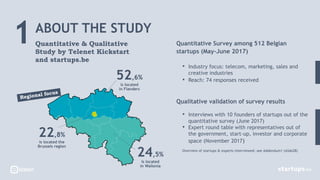
Quantitative Survey among 512 Belgian
startups (May-June 2017)
• Industry focus: telecom, marketing, sales and
creative industries
• Reach: 74 responses received
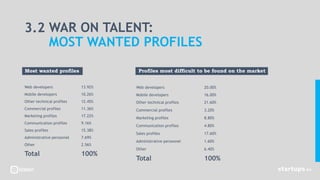
Qualitative validation of survey results
• Interviews with 10 founders of startups out of the
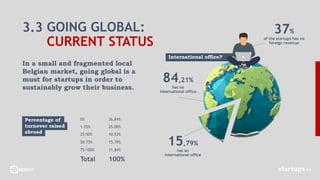
quantitative survey (June 2017)
• Expert round table with representatives out of
the government, start-up, investor and corporate
space (November 2017)
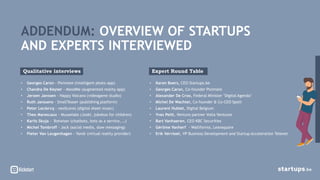
Overview of startups & experts interviewed: see Addendum1 (slide28)
52,6%
is located
in Flanders
22,8%
is located the
Brussels region
24,5%
is located
in Wallonia
PROFILE OF
THE FOUNDER2
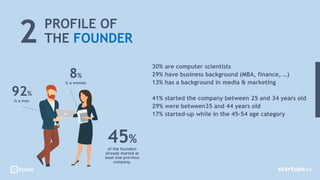
30% are computer scientists
29% have business background (MBA, finance, …)
13% has a background in media & marketing
41% started the company between 25 and 34 years old
29% were between35 and 44 years old
17% started-up while in the 45-54 age category
92%
is a man
8%
is a woman
45%
of the founders
already started at
least one previous
company.
PROFILE OF
THE STARTUP2
17%
is less than
1 year old
75%
is between 1
and 5 years old
8%
is between 5
and 10 years old
25%
in Antwerp
24%
East Flanders
8%
Flemish Brabant
7%
in Limburg
21% in Brussels
11%
in Brabant Wallon
3%
in Liège
1%
in Hainaut
Media & Entertainment (Social Media,
Music, Gaming, Movies, Video ... ) 40.79%
Creative Industries (Advertising,
Architecture, Graphic design ... ) 9.21%
Marketing & Sales (CRM, ManTech,
AdTech ...) 15.79%
Messaging & Telecom (Comm,
Messaging, Telecom ...) 13.16%
Other: 21.05%
Total 100%
PROFILE OF
THE STARTUP2
63,81%
of the startups
targets B2B
36,19%
targets B2C
Industry/Sector focus
KEY FINDINGS
3
3.1 SUSTAINABLE GROWTH
3.2 WAR ON TALENT
3.3 GOING GLOBAL
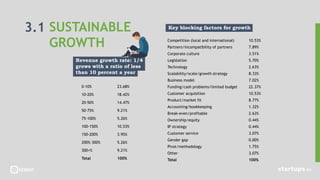
3.1 SUSTAINABLE GROWTH
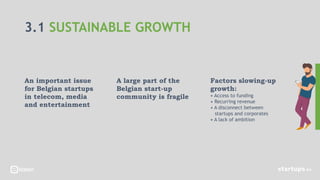
An important issue
for Belgian startups
in telecom, media
and entertainment
A large part of the
Belgian start-up
community is fragile
Factors slowing-up
growth:
• Access to funding
• Recurring revenue
• A disconnect between
startups and corporates
• A lack of ambition
Competition (local and international) 10.53%
Partners/incompatibility of partners 7.89%
Corporate culture 3.51%
Legislation 5.70%
Technology 2.63%
Scalability/scale/growth strategy 8.33%
Business model 7.02%
Funding/cash problems/limited budget 22.37%
Customer acquisition 10.53%
Product/market fit 8.77%
Accounting/bookkeeping 1.32%
Break-even/profitable 2.63%
Ownership/equity 0.44%
IP strategy 0.44%
Customer service 3.07%
Gender gap 0.00%
Pivot/methodology 1.75%
Other 3.07%
Total 100%
Key blocking factors for growth
0-10% 23.68%
10-20% 18.42%
20-50% 14.47%
50-75% 9.21%
75-100% 5.26%
100-150% 10.53%
150-200% 3.95%
200%-300% 5.26%
300+% 9.21%
Total 100%
Revenue growth rate: 1/4
grows with a ratio of less
than 10 percent a year
3.1 SUSTAINABLE
GROWTH
There is a shortage in
funding streams which
slows down growth
Startups have
difficulties raising
enough money to be
able to grow fast at an
international scale
“There’s no money shortage in Belgium. We have quite a
few ‘older’ financial flows and financial sources in our
country. A big part of that money goes into real estate,
for instance. Risks are smaller there, so the question is
how to make sure that for every million that goes into
real estate, we have 50.000 going to startups.”
Alexander De Croo
(Federal Minister Digital Agenda)
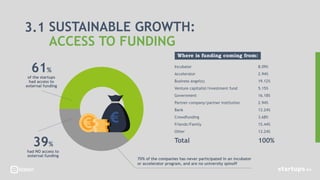
3.1 SUSTAINABLE GROWTH:
ACCESS TO FUNDING
61%
of the startups
had access to
external funding
39%
had NO access to
external funding
Incubator 8.09%
Accelerator 2.94%
Business angel(s) 19.12%
Venture capitalist/investment fund 5.15%
Government 16.18%
Partner company/partner institution 2.94%
Bank 13.24%
Crowdfunding 3.68%
Friends/Family 15.44%
Other 13.24%
Total 100%
Where is funding coming from:
70% of the companies has never participated in an incubator
or accelerator program, and are no university spinoff
3.1 SUSTAINABLE GROWTH:
ACCESS TO FUNDING
Almost half of the startups has an
annual revenue of less than €100.000
0-100k€ 46.05%
100-300k€ 26.32%
300-500k€ 9.21%
500-750k€ 7.89%
750k-1M€ 5.26%
1-1,5M€ 0.00%
1.5M-2M€ 1.32%
2+M€ 3.95%
Total 100%
“Startups cannot accept a revenue
of 100.000 euro for a long time. It’s
ok for the first year, but it definitely
becomes a problem after five years.
You’re not a digital startup when
you do this for years in a row.”
Georges Caron (Piximate)
Revenue per year
3.1 SUSTAINABLE GROWTH:
RECURRING REVENUE
Recurring revenue is one of the
most important issues to be tackled
Factors hindering startup growth:
• Long sales cycles
• Slow decision making processes
• Payment terms up to 90 business days at
corporates and government institutions
“Recurring revenue is more important than
funding. Recurring revenue eases all the
next steps you should take as a starting
company. When you receive too much
money in the beginning, you start resting
on your laurels.”
Michel De Wachter (Spott)
3.1 SUSTAINABLE GROWTH:
RECURRING REVENUE
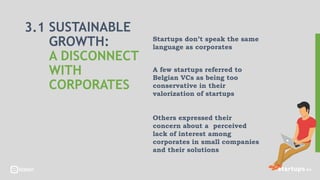
Startups don’t speak the same
language as corporates
A few startups referred to
Belgian VCs as being too
conservative in their
valorization of startups
Others expressed their
concern about a perceived
lack of interest among
corporates in small companies
and their solutions
3.1 SUSTAINABLE
GROWTH:
A DISCONNECT
WITH
CORPORATES
“Without a structural recurring revenue, this can be
a problem. We once had a big telco as a client, and
more than one year after an initial agreement to
cooperate, they concluded they could not work with
us due to an issue with their set top boxes. That’s
why it is so important to focus on recurring revenue
from the very beginning!”
Michel De Wachter (Spott)
“Try to negotiate with corporates about exceptions for
startups. That’s often hard, but it’s not impossible! If you
deal with someone in the corporate that understands
startups, there are a lot of opportunities.”
Erik Vervloet (Telenet)
“Shorten the sales cycle to close deals faster. We
managed to go from 60 to 30 days with one of our
clients. We want something in return for our work,
otherwise you’ll kill us, and nobody wins.”
Georges Caron (Piximate)
3.1 SUSTAINABLE GROWTH:
A DISCONNECT WITH CORPORATES
“I don’t think there is a huge disconnect
between corporates and startups. All the
big corporates are doing something with
startups, with incubators, with internal
funds, with innovation hubs. That was
completely different five years ago. But
the journey isn’t finished. The language
between corporates and startups needs to
be clearer, mechanisms must be put in
place to see which models work.”
Bart Vanhaeren (KBC Securities)
“Solution for B2C startups and for startups in general could be to work
more closely together with corporates. Corps should try to become a
client faster. Again: first recurring revenue is important for a startup.
Banks or telcoes could help with the distribution of startup products.
Great for cash flow and internationalization.”
Michel De Wachter (‎Spott)
“Telenet is very interested in new tech, but the problem that we see is
that startups often are ill prepared when they come to us. Their
pitches are not good enough, and they don’t really understand what
we need as a media-company.”
Erik Vervloet (Telenet)
3.1 SUSTAINABLE GROWTH:
A DISCONNECT WITH CORPORATES
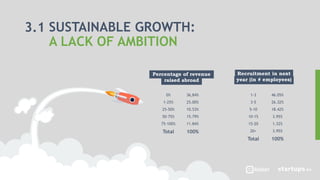
The lack of ambition among startups is
reflected in the results of the survey:
• 37% of the startups has no foreign revenue
• 25% refers to a revenue coming from abroad of 1 to 25%
• When looking at recruitment in the next year,
46% of the surveyed startups speaks in numbers of 1 to 3
3.1 SUSTAINABLE GROWTH:
A LACK OF AMBITION
1-3 46.05%
3-5 26.32%
5-10 18.42%
10-15 3.95%
15-20 1.32%
20+ 3.95%
Total 100%
Recruitment in next
year (in # employees)
Percentage of revenue
raised abroad
0% 36,84%
1-25% 25.00%
25-50% 10.53%
50-75% 15.79%
75-100% 11.84%
Total 100%
3.1 SUSTAINABLE GROWTH:
A LACK OF AMBITION
“Most of the Belgian startups are too conservative in their thinking. They don’t
look abroad fast enough, but they should! Growing with ten percent a year is not
acceptable when you’re a startup. Where does this lack of ambition come from? Is
it in our culture? Is it due to our education? Our entrepreneurs also lack
confidence, but you have to be confident when you want to accomplish something.
Clients must get the feeling that you know what you’re talking about.”
Alexander De Croo (Federal Minister Digital Agenda)
3.1 SUSTAINABLE GROWTH:
A LACK OF AMBITION
Factors harming the sustainable
growth of startups on a global scale:
• A lack in staffing resources
• Funding and revenue shortages
63%
of the startups is relying on a
team up to 5 employees
Current number of employees
1-3 3-5 5-10 10-15 15-20 20-30 30-50 50-75 75-100 +100
38%
25% 24%
8% 2,6% 1,3%1,3%
3.2 WAR ON TALENT:
CURRENT STATUS
“Our startups fear the consequences of having too much
people on the payroll and burning cash. They try to do as much
as possible with a small team and then, when the market
improves, they don’t have the right people in the right place.”
Karen Boers (Startups.be)
3.2 WAR ON TALENT:
CURRENT STATUS
There’s a real war for
talent going on, not only
in Belgium, but in Europe
as a whole
Startups have a hard time
finding the right profiles.
Attracting talent is costly,
especially for young
startups that still need to
build their reputation
Startups are looking for:
35%
Technical profiles
17%
Marketing profiles
15%
Sales people
3.2 WAR ON TALENT:
MOST WANTED PROFILES
Most wanted profiles
Web developers 13.92%
Mobile developers 10.26%
Other technical profiles 12.45%
Commercial profiles 11.36%
Marketing profiles 17.22%
Communication profiles 9.16%
Sales profiles 15.38%
Administrative personnel 7.69%
Other 2.56%
Total 100%
Profiles most difficult to be found on the market
Web developers 20.00%
Mobile developers 16.00%
Other technical profiles 21.60%
Commercial profiles 3.20%
Marketing profiles 8.80%
Communication profiles 4.80%
Sales profiles 17.60%
Administrative personnel 1.60%
Other 6.40%
Total 100%
3.2 WAR ON TALENT:
MOST WANTED PROFILES
In a small and fragmented local
Belgian market, going global is a
must for startups in order to
sustainably grow their business.
37%
of the startups has no
foreign revenue
International office?
0% 36,84%
1-25% 25.00%
25-50% 10.53%
50-75% 15.79%
75-100% 11.84%
Total 100%
Percentage of
turnover raised
abroad
15,79%
has an
international office
84,21%
has no
international office
3.3 GOING GLOBAL:
CURRENT STATUS
Most important stumbling blocks
for international growth:
stumbling blocks for international growth
23,50%
Insufficient
resources
15,30%
Wrong partners
13,66%
Inefficient
marketing strategy
Time difference 4.37%
Tax & legal issues 7.65%
Language & cultural barriers 8.74%
Insufficient resources to make a difference 23.50%
Wrong partners 15.30%
Poor follow-up of metrics, bad data analysis 3.28%
Bad due diligence. Not doing your homework 7.65%
Inefficient marketing strategy 13.66%
Limited potential customers 4.37%
Attracting the wrong profiles 5.46%
Too much competition 3.28%
Other: 2.73%
Total 100%
3.3 GOING GLOBAL:
STUMBLING BLOCKS
A need for:
• Extra marketing efforts to put Belgium
on the map as a startup nation
• More high scale events to sell Belgian
startups to the world
European
countries
leading
the way:
The Netherlands:
The Next Web,
Startup Delta
Portugal:
Web Summit
Finland:
Slush
3.3 GOING GLOBAL:
PUTTING BELGIUM
ON THE MAP
“A big startup event is the best
marketing tool to put Belgium on the
map as startup nation. But when you
want to organize a good event, you
need all the stakeholders on board, and
you need an international flavor.”
Bart Vanhaeren (KBC Securities)
“Three years ago we asked ourselves the question
if we would need big startup events in Belgium, as
a sort of promo tool. Back then, we felt that it was
too soon, that we didn’t have enough to showcase.
It’s certainly true that a lot has changed, and that
maybe we should reconsider this.”
Alexander De Croo (Federal Minister Digital Agenda)
3.3 GOING GLOBAL:
PUTTING BELGIUM ON THE MAP
• Georges Caron - Piximate (intelligent photo app)
• Chandra De Keyser - MoodMe (augmented reality app)
• Jeroen Janssen - Happy Volcano (videogame studio)
• Ruth Janssens - SmallTeaser (publishing platform)
• Peter Leclercq - neoScores (digital sheet music)
• Theo Marescaux - Muuselabs (Jooki, jukebox for children)
• Karlis Skuja - Botwiser (chatbots, bots as a service, …)
• Michel Tombroff - Jack (social media, slow messaging)
• Pieter Van Leugenhagen - Yondr (virtual reality provider)
ADDENDUM: OVERVIEW OF STARTUPS
AND EXPERTS INTERVIEWED
Qualitative interviews
• Karen Boers, CEO Startups.be
• Georges Caron, Co-founder Piximate
• Alexander De Croo, Federal Minister ‘Digital Agenda’
• Michel De Wachter, Co-founder & Co-CEO Spott
• Laurent Hublet, Digital Belgium
• Yves Petit, Venture partner Volta Ventures
• Bart Vanhaeren, CEO KBC Securities
• Gérôme Vanherf - Wallifornia, Leansquare
• Erik Vervloet, VP Business Development and Startup Acceleration Telenet
Expert Round Table
Thanks

TME Startup Study 2017

  • 1.
  • 2.
    contents Table of 1. ABOUTTHE STUDY 2. PROFILE OF THE START-UPS AND FOUNDERS INCLUDED IN THE SURVEY 3. KEY FINDINGS 3.1 Sustainable growth 3.2 War on talent 3.3 Going global
  • 3.
    ABOUT THE STUDY 1Quantitative& Qualitative Study by Telenet Kickstart and startups.be Quantitative Survey among 512 Belgian startups (May-June 2017) • Industry focus: telecom, marketing, sales and creative industries • Reach: 74 responses received Qualitative validation of survey results • Interviews with 10 founders of startups out of the quantitative survey (June 2017) • Expert round table with representatives out of the government, start-up, investor and corporate space (November 2017) Overview of startups & experts interviewed: see Addendum1 (slide28) 52,6% is located in Flanders 22,8% is located the Brussels region 24,5% is located in Wallonia
  • 4.
    PROFILE OF THE FOUNDER2 30%are computer scientists 29% have business background (MBA, finance, …) 13% has a background in media & marketing 41% started the company between 25 and 34 years old 29% were between35 and 44 years old 17% started-up while in the 45-54 age category 92% is a man 8% is a woman 45% of the founders already started at least one previous company.
  • 5.
    PROFILE OF THE STARTUP2 17% isless than 1 year old 75% is between 1 and 5 years old 8% is between 5 and 10 years old 25% in Antwerp 24% East Flanders 8% Flemish Brabant 7% in Limburg 21% in Brussels 11% in Brabant Wallon 3% in Liège 1% in Hainaut
  • 6.
    Media & Entertainment(Social Media, Music, Gaming, Movies, Video ... ) 40.79% Creative Industries (Advertising, Architecture, Graphic design ... ) 9.21% Marketing & Sales (CRM, ManTech, AdTech ...) 15.79% Messaging & Telecom (Comm, Messaging, Telecom ...) 13.16% Other: 21.05% Total 100% PROFILE OF THE STARTUP2 63,81% of the startups targets B2B 36,19% targets B2C Industry/Sector focus
  • 7.
    KEY FINDINGS 3 3.1 SUSTAINABLEGROWTH 3.2 WAR ON TALENT 3.3 GOING GLOBAL
  • 8.
    3.1 SUSTAINABLE GROWTH Animportant issue for Belgian startups in telecom, media and entertainment A large part of the Belgian start-up community is fragile Factors slowing-up growth: • Access to funding • Recurring revenue • A disconnect between startups and corporates • A lack of ambition
  • 9.
    Competition (local andinternational) 10.53% Partners/incompatibility of partners 7.89% Corporate culture 3.51% Legislation 5.70% Technology 2.63% Scalability/scale/growth strategy 8.33% Business model 7.02% Funding/cash problems/limited budget 22.37% Customer acquisition 10.53% Product/market fit 8.77% Accounting/bookkeeping 1.32% Break-even/profitable 2.63% Ownership/equity 0.44% IP strategy 0.44% Customer service 3.07% Gender gap 0.00% Pivot/methodology 1.75% Other 3.07% Total 100% Key blocking factors for growth 0-10% 23.68% 10-20% 18.42% 20-50% 14.47% 50-75% 9.21% 75-100% 5.26% 100-150% 10.53% 150-200% 3.95% 200%-300% 5.26% 300+% 9.21% Total 100% Revenue growth rate: 1/4 grows with a ratio of less than 10 percent a year 3.1 SUSTAINABLE GROWTH
  • 10.
    There is ashortage in funding streams which slows down growth Startups have difficulties raising enough money to be able to grow fast at an international scale “There’s no money shortage in Belgium. We have quite a few ‘older’ financial flows and financial sources in our country. A big part of that money goes into real estate, for instance. Risks are smaller there, so the question is how to make sure that for every million that goes into real estate, we have 50.000 going to startups.” Alexander De Croo (Federal Minister Digital Agenda) 3.1 SUSTAINABLE GROWTH: ACCESS TO FUNDING
  • 11.
    61% of the startups hadaccess to external funding 39% had NO access to external funding Incubator 8.09% Accelerator 2.94% Business angel(s) 19.12% Venture capitalist/investment fund 5.15% Government 16.18% Partner company/partner institution 2.94% Bank 13.24% Crowdfunding 3.68% Friends/Family 15.44% Other 13.24% Total 100% Where is funding coming from: 70% of the companies has never participated in an incubator or accelerator program, and are no university spinoff 3.1 SUSTAINABLE GROWTH: ACCESS TO FUNDING
  • 12.
    Almost half ofthe startups has an annual revenue of less than €100.000 0-100k€ 46.05% 100-300k€ 26.32% 300-500k€ 9.21% 500-750k€ 7.89% 750k-1M€ 5.26% 1-1,5M€ 0.00% 1.5M-2M€ 1.32% 2+M€ 3.95% Total 100% “Startups cannot accept a revenue of 100.000 euro for a long time. It’s ok for the first year, but it definitely becomes a problem after five years. You’re not a digital startup when you do this for years in a row.” Georges Caron (Piximate) Revenue per year 3.1 SUSTAINABLE GROWTH: RECURRING REVENUE
  • 13.
    Recurring revenue isone of the most important issues to be tackled Factors hindering startup growth: • Long sales cycles • Slow decision making processes • Payment terms up to 90 business days at corporates and government institutions “Recurring revenue is more important than funding. Recurring revenue eases all the next steps you should take as a starting company. When you receive too much money in the beginning, you start resting on your laurels.” Michel De Wachter (Spott) 3.1 SUSTAINABLE GROWTH: RECURRING REVENUE
  • 14.
    Startups don’t speakthe same language as corporates A few startups referred to Belgian VCs as being too conservative in their valorization of startups Others expressed their concern about a perceived lack of interest among corporates in small companies and their solutions 3.1 SUSTAINABLE GROWTH: A DISCONNECT WITH CORPORATES
  • 15.
    “Without a structuralrecurring revenue, this can be a problem. We once had a big telco as a client, and more than one year after an initial agreement to cooperate, they concluded they could not work with us due to an issue with their set top boxes. That’s why it is so important to focus on recurring revenue from the very beginning!” Michel De Wachter (Spott) “Try to negotiate with corporates about exceptions for startups. That’s often hard, but it’s not impossible! If you deal with someone in the corporate that understands startups, there are a lot of opportunities.” Erik Vervloet (Telenet) “Shorten the sales cycle to close deals faster. We managed to go from 60 to 30 days with one of our clients. We want something in return for our work, otherwise you’ll kill us, and nobody wins.” Georges Caron (Piximate) 3.1 SUSTAINABLE GROWTH: A DISCONNECT WITH CORPORATES
  • 16.
    “I don’t thinkthere is a huge disconnect between corporates and startups. All the big corporates are doing something with startups, with incubators, with internal funds, with innovation hubs. That was completely different five years ago. But the journey isn’t finished. The language between corporates and startups needs to be clearer, mechanisms must be put in place to see which models work.” Bart Vanhaeren (KBC Securities) “Solution for B2C startups and for startups in general could be to work more closely together with corporates. Corps should try to become a client faster. Again: first recurring revenue is important for a startup. Banks or telcoes could help with the distribution of startup products. Great for cash flow and internationalization.” Michel De Wachter (‎Spott) “Telenet is very interested in new tech, but the problem that we see is that startups often are ill prepared when they come to us. Their pitches are not good enough, and they don’t really understand what we need as a media-company.” Erik Vervloet (Telenet) 3.1 SUSTAINABLE GROWTH: A DISCONNECT WITH CORPORATES
  • 17.
    The lack ofambition among startups is reflected in the results of the survey: • 37% of the startups has no foreign revenue • 25% refers to a revenue coming from abroad of 1 to 25% • When looking at recruitment in the next year, 46% of the surveyed startups speaks in numbers of 1 to 3 3.1 SUSTAINABLE GROWTH: A LACK OF AMBITION
  • 18.
    1-3 46.05% 3-5 26.32% 5-1018.42% 10-15 3.95% 15-20 1.32% 20+ 3.95% Total 100% Recruitment in next year (in # employees) Percentage of revenue raised abroad 0% 36,84% 1-25% 25.00% 25-50% 10.53% 50-75% 15.79% 75-100% 11.84% Total 100% 3.1 SUSTAINABLE GROWTH: A LACK OF AMBITION
  • 19.
    “Most of theBelgian startups are too conservative in their thinking. They don’t look abroad fast enough, but they should! Growing with ten percent a year is not acceptable when you’re a startup. Where does this lack of ambition come from? Is it in our culture? Is it due to our education? Our entrepreneurs also lack confidence, but you have to be confident when you want to accomplish something. Clients must get the feeling that you know what you’re talking about.” Alexander De Croo (Federal Minister Digital Agenda) 3.1 SUSTAINABLE GROWTH: A LACK OF AMBITION
  • 20.
    Factors harming thesustainable growth of startups on a global scale: • A lack in staffing resources • Funding and revenue shortages 63% of the startups is relying on a team up to 5 employees Current number of employees 1-3 3-5 5-10 10-15 15-20 20-30 30-50 50-75 75-100 +100 38% 25% 24% 8% 2,6% 1,3%1,3% 3.2 WAR ON TALENT: CURRENT STATUS
  • 21.
    “Our startups fearthe consequences of having too much people on the payroll and burning cash. They try to do as much as possible with a small team and then, when the market improves, they don’t have the right people in the right place.” Karen Boers (Startups.be) 3.2 WAR ON TALENT: CURRENT STATUS
  • 22.
    There’s a realwar for talent going on, not only in Belgium, but in Europe as a whole Startups have a hard time finding the right profiles. Attracting talent is costly, especially for young startups that still need to build their reputation Startups are looking for: 35% Technical profiles 17% Marketing profiles 15% Sales people 3.2 WAR ON TALENT: MOST WANTED PROFILES
  • 23.
    Most wanted profiles Webdevelopers 13.92% Mobile developers 10.26% Other technical profiles 12.45% Commercial profiles 11.36% Marketing profiles 17.22% Communication profiles 9.16% Sales profiles 15.38% Administrative personnel 7.69% Other 2.56% Total 100% Profiles most difficult to be found on the market Web developers 20.00% Mobile developers 16.00% Other technical profiles 21.60% Commercial profiles 3.20% Marketing profiles 8.80% Communication profiles 4.80% Sales profiles 17.60% Administrative personnel 1.60% Other 6.40% Total 100% 3.2 WAR ON TALENT: MOST WANTED PROFILES
  • 24.
    In a smalland fragmented local Belgian market, going global is a must for startups in order to sustainably grow their business. 37% of the startups has no foreign revenue International office? 0% 36,84% 1-25% 25.00% 25-50% 10.53% 50-75% 15.79% 75-100% 11.84% Total 100% Percentage of turnover raised abroad 15,79% has an international office 84,21% has no international office 3.3 GOING GLOBAL: CURRENT STATUS
  • 25.
    Most important stumblingblocks for international growth: stumbling blocks for international growth 23,50% Insufficient resources 15,30% Wrong partners 13,66% Inefficient marketing strategy Time difference 4.37% Tax & legal issues 7.65% Language & cultural barriers 8.74% Insufficient resources to make a difference 23.50% Wrong partners 15.30% Poor follow-up of metrics, bad data analysis 3.28% Bad due diligence. Not doing your homework 7.65% Inefficient marketing strategy 13.66% Limited potential customers 4.37% Attracting the wrong profiles 5.46% Too much competition 3.28% Other: 2.73% Total 100% 3.3 GOING GLOBAL: STUMBLING BLOCKS
  • 26.
    A need for: •Extra marketing efforts to put Belgium on the map as a startup nation • More high scale events to sell Belgian startups to the world European countries leading the way: The Netherlands: The Next Web, Startup Delta Portugal: Web Summit Finland: Slush 3.3 GOING GLOBAL: PUTTING BELGIUM ON THE MAP
  • 27.
    “A big startupevent is the best marketing tool to put Belgium on the map as startup nation. But when you want to organize a good event, you need all the stakeholders on board, and you need an international flavor.” Bart Vanhaeren (KBC Securities) “Three years ago we asked ourselves the question if we would need big startup events in Belgium, as a sort of promo tool. Back then, we felt that it was too soon, that we didn’t have enough to showcase. It’s certainly true that a lot has changed, and that maybe we should reconsider this.” Alexander De Croo (Federal Minister Digital Agenda) 3.3 GOING GLOBAL: PUTTING BELGIUM ON THE MAP
  • 28.
    • Georges Caron- Piximate (intelligent photo app) • Chandra De Keyser - MoodMe (augmented reality app) • Jeroen Janssen - Happy Volcano (videogame studio) • Ruth Janssens - SmallTeaser (publishing platform) • Peter Leclercq - neoScores (digital sheet music) • Theo Marescaux - Muuselabs (Jooki, jukebox for children) • Karlis Skuja - Botwiser (chatbots, bots as a service, …) • Michel Tombroff - Jack (social media, slow messaging) • Pieter Van Leugenhagen - Yondr (virtual reality provider) ADDENDUM: OVERVIEW OF STARTUPS AND EXPERTS INTERVIEWED Qualitative interviews • Karen Boers, CEO Startups.be • Georges Caron, Co-founder Piximate • Alexander De Croo, Federal Minister ‘Digital Agenda’ • Michel De Wachter, Co-founder & Co-CEO Spott • Laurent Hublet, Digital Belgium • Yves Petit, Venture partner Volta Ventures • Bart Vanhaeren, CEO KBC Securities • Gérôme Vanherf - Wallifornia, Leansquare • Erik Vervloet, VP Business Development and Startup Acceleration Telenet Expert Round Table
  • 29.