STATE OF
STARTUPS
2 0 1 7
About
the
Survey
Every year, we survey as many venture-backed
startup founders as possible to figure out what it's
like to run a technology company right now. This
year, we got more responses than ever before
— 869 — giving us an even more precise pulse on
what entrepreneurs think, feel, fear, and value. As
we have since 2015, we're excited to present the
results here — starting with the trends and insights
that stood out as important or counterintuitive.
This year, we asked about everything ranging from
the fundraising environment to politics, as well as
perspectives on sexual harassment and diversity
and inclusion.
At First Round, whenever we ask founders what
data they most want and need, they almost always
say the same thing: they want to know what other
entrepreneurs are thinking and doing (and
whether what they're doing is normal or in line
with their peers). To answer these questions, we're
pleased to publish the industry's largest set of data
specific to the founder and startup experience —
we hope you find it informative and insightful.
HIGHLIGHTS
1Half of founders have had personal
experience with sexual harassment.
Over 50% of the 869 founders who took the
survey have been or know someone who's
been sexually harassed in the workplace.
Unfortunately and unsurprisingly, the results
to this question were extremely gendered —
78% of female founders said they've been
or know someone who's been sexually
harassed, compared to 48% of male founders.
They also split on public perception of the
issue. 70% of female founders said sexual
harassment in the industry is still
underreported vs. 35% of male founders. And
men were 4 times more likely than women
to say the media's overblown the issue (22%
vs. 5%).
2 Women and men disagree on what will help
solve tech's sexual harassment problem.
Female founders' top solutions:
More women VCs and pressure from limited
partners to prevent bad behavior (tied with
blacklists publicly calling out offenders).
Male founders' top solutions:
Sensitivity training and more media
coverage of incidents when they occur.
Both genders agreed that decency
pledges alone won't cut it — only 1% of
women and 4% of men thought they were
the best solution.
3 1 in 3 founders think ICOs can compete
with venture capital.
With Bitcoin and Ethereum hitting record
highs, and ICO financing outpacing early-
stage venture this year, the founder
community seems to be embracing this new
form of funding.
The most eye-popping stat:
In Q2 and Q3, a whopping 90% of the $2.3
billion raised by blockchain startups came
through ICOs.
4Politics impact who founders want in
their corner.
25% of founders said someone's perceived
or known political affiliation would influence
whether or not they'd offer them a job.
29% said an investor's politics would
affect whether they'd take the money.
37% said they'd be swayed in
choosing a board member based on
the person's political views.
5 Founders remain unfazed
by competition.
Despite giants like Amazon and
Google making bold moves this year,
only 5% of founders said they think
their company will fail because a
competitor outdid them.
Many more respondents said they fear
not raising enough follow-on capital
(22%), missing product-market fit
(17%), growth stagnating (15%), or
hiring the wrong people (11%).
6 For the first time, sales leaders take the
title of hardest to hire.
In 2015 and 2016, engineering leaders
were far and away the hardest executive
hires to make.
But this year, the tables turned, and
sales leaders became the most coveted
and difficult hires (with 26% saying
sales was the hardest vs. 24% saying
engineering).
This looks like the start of a sea change
as more enterprise companies enter the
fray, compete for talent, and see
firsthand how costly a bad VP of Sales
hire can be.
7
Compared to their peers who think
fundraising's a piece of cake,
founders who struggle made the
same mistakes more often:
3x as many said they monetized too
late; 2x more chose the wrong co-
founder; almost 2x more pursued the
wrong business model; 40% more of
them botched their go-to-market
strategy; and 40% more let their burn
rate get too high.
Founders who struggle to fundraise
make the same mistakes.
8 Investors now have the power
in negotiations.
For the last two years, the majority of
founders (64% in 2015 and 61% in
2016) said that entrepreneurs had the
upper hand when negotiating terms
with investors.
This year, for the first time, this power
dynamic has flipped, with 53% of
founders saying investors now have
more sway. Notably, this is a shift that
67% of respondents said they saw
coming last year.
9 2 out of 3 women founders say their
gender hurt their ability to fundraise.
66% of women respondents said
they think their gender made it more
difficult for them to raise venture
capital. So, it's not surprising that
female founders are also much more
likely to say that investors hold the
power in negotiations — they have
every year.
Kudos to the third of male respondents
who acknowledged that gender
probably helped their fundraising ability.
To the 12 men who said it hurt their
chances... really?
10 Good character is the #1 reason
founders pick a lead VC.
By far, good character stood out as
the #1 criterion founders said they
look for in a lead investor.
28% said so, compared to the
runners up: partner expertise
(15%), deal terms (14%), and long-
term funding potential (11%).
COMPLETE
FINDINGS
On the
Market
1
Is now a good time to be starting a company?
2
Are we in a bubble for technology companies?
3
Rank these technology trends from underhyped
to overhyped:
4
Do you expect it to get harder or easier to raise
venture capital in the next 12 months?
5
Do you think ICOs pose a legitimate alternative
to venture capital funding?
On the
Market
6
If you have at least one co-founder, how would
you define your co-founder relationship?
7
Do you think you'll still be CEO in 10 years?
8
As a founder, how do you allocate your time
percentage-wise?
9
How concerned are you about the
following issues?
10
Which of the following mistakes have you made
in growing your business?
On
Fundraising
11
In your last round, did you raise more or less
than you targeted?
12
How long was your entire fundraising process
for your most recent round?
13
How many firms did you pitch when raising your
last round?
14
Has your company ever raised a bridge round?
15
Has your gender helped or hindered your ability
to fundraise?
16
How challenging do you think it will be to raise
your next round of capital?
On
Investors
17
Over the past few years, do you think power
has generally been in the hands of
entrepreneurs or investors?
18
Over the next few years, do you think power
will be more in the hands of entrepreneurs or
more in the hands of investors?
19
What was the most important factor in picking
your lead investor?
On Exits
20
Compared to today, over the next 18 months...
21
How do you think the number of M&A deals for
startups will change over the next year?
22
If you intend to go public, how long do you
think it will be until your IPO?
23
How confident are you that you're building a
billion dollar company?
24
If you're not successful, why do you think that
will be? (Choose one)
On the
Bottom Line
25
How many years until you think you'll
be profitable?
26
Are you optimizing for growth or profitability?
27
How is your burn rate different now than it was a
year ago?
28
Do you consider curbing burn rate to be a
critical priority?
29
What’s the price per square foot at your current
office this year?
On Hiring
and Firing
30
Is it easier or harder to recruit talent this year
than last year?
31
Are you ahead or behind your hiring plan?
32
How many people do you think you're going to
hire in the next 12 months?
33
What’s the hardest executive hire you've made
(choose one)?
34
What is the average tenure of a non-executive
employee at your company?
35
Have you done a RIF (layoff) in the last year?
36
A person's political affiliation would influence
how you think about:
On
Compensation
37
How much does a mid-level engineer at your
company make (salary + bonus)?
38
How much equity does a mid-level engineer at
your company receive?
39
What’s your policy on employees selling
secondary shares?
40
How much time do employees have to exercise
their options after leaving the company?
On Diversity
and Inclusion
41
What is the male to female ratio of your board?
42
What is the male to female ratio of your
entire team?
43
In the past year, has your company talked
about diversity and inclusion internally or
externally?
44
Does your organization have a strategy to
promote diversity and inclusion?
45
What is the primary cause of
underrepresentation of women and minorities
in tech? (choose one)
46
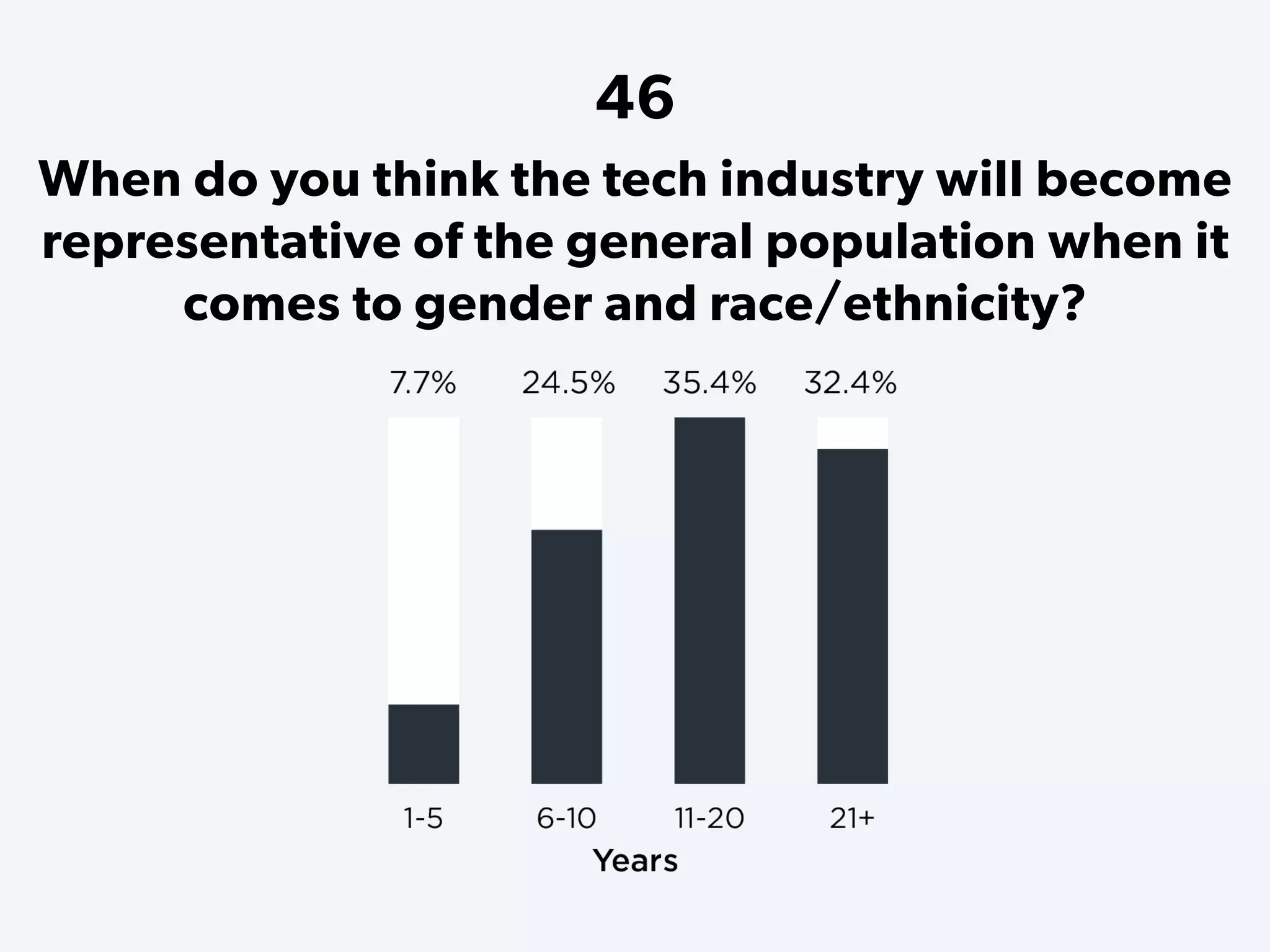
When do you think the tech industry will become
representative of the general population when it
comes to gender and race/ethnicity?
On Sexual
Harassment
47
Have you or has someone you know
personally experienced sexual harassment in
the workplace?
48
How big in scope is the problem posed by
sexual harassment in tech?
49
What do you think will be the most effective
way to address sexual harassment in the
technology industry?
About the
Respondents
50
What was your last funding round?
51
Where is your company headquartered?
52
I identify as:
53
How old are you?
54
How long ago did you start your company?
55
How many founders does your company have?
56
How large is your team today?
57
Which sector best describes the type of
company you are running?
58
Which platform are you most focused on?
THANKS
A team of phenomenal people made this year's State of Startups possible.
Many thanks to Andreas Weiland, Jarom Vogel and July Camp Design for
building this beautiful site. And to Mike Goodwin, our indefatigable data
scientist, who made sure we did everything right (especially our math).
Last but not least, we're grateful to the hundreds of founders who took the
time to share their perspectives so that we could create an accurate
snapshot of startup life in 2017.
stateofstartups.firstround.com/2017

First Round State of Startups 2017

  • 1.
  • 2.
    About the Survey Every year, wesurvey as many venture-backed startup founders as possible to figure out what it's like to run a technology company right now. This year, we got more responses than ever before — 869 — giving us an even more precise pulse on what entrepreneurs think, feel, fear, and value. As we have since 2015, we're excited to present the results here — starting with the trends and insights that stood out as important or counterintuitive. This year, we asked about everything ranging from the fundraising environment to politics, as well as perspectives on sexual harassment and diversity and inclusion. At First Round, whenever we ask founders what data they most want and need, they almost always say the same thing: they want to know what other entrepreneurs are thinking and doing (and whether what they're doing is normal or in line with their peers). To answer these questions, we're pleased to publish the industry's largest set of data specific to the founder and startup experience — we hope you find it informative and insightful.
  • 3.
  • 4.
    1Half of foundershave had personal experience with sexual harassment. Over 50% of the 869 founders who took the survey have been or know someone who's been sexually harassed in the workplace. Unfortunately and unsurprisingly, the results to this question were extremely gendered — 78% of female founders said they've been or know someone who's been sexually harassed, compared to 48% of male founders. They also split on public perception of the issue. 70% of female founders said sexual harassment in the industry is still underreported vs. 35% of male founders. And men were 4 times more likely than women to say the media's overblown the issue (22% vs. 5%).
  • 5.
    2 Women andmen disagree on what will help solve tech's sexual harassment problem. Female founders' top solutions: More women VCs and pressure from limited partners to prevent bad behavior (tied with blacklists publicly calling out offenders). Male founders' top solutions: Sensitivity training and more media coverage of incidents when they occur. Both genders agreed that decency pledges alone won't cut it — only 1% of women and 4% of men thought they were the best solution.
  • 6.
    3 1 in3 founders think ICOs can compete with venture capital. With Bitcoin and Ethereum hitting record highs, and ICO financing outpacing early- stage venture this year, the founder community seems to be embracing this new form of funding. The most eye-popping stat: In Q2 and Q3, a whopping 90% of the $2.3 billion raised by blockchain startups came through ICOs.
  • 7.
    4Politics impact whofounders want in their corner. 25% of founders said someone's perceived or known political affiliation would influence whether or not they'd offer them a job. 29% said an investor's politics would affect whether they'd take the money. 37% said they'd be swayed in choosing a board member based on the person's political views.
  • 8.
    5 Founders remainunfazed by competition. Despite giants like Amazon and Google making bold moves this year, only 5% of founders said they think their company will fail because a competitor outdid them. Many more respondents said they fear not raising enough follow-on capital (22%), missing product-market fit (17%), growth stagnating (15%), or hiring the wrong people (11%).
  • 9.
    6 For thefirst time, sales leaders take the title of hardest to hire. In 2015 and 2016, engineering leaders were far and away the hardest executive hires to make. But this year, the tables turned, and sales leaders became the most coveted and difficult hires (with 26% saying sales was the hardest vs. 24% saying engineering). This looks like the start of a sea change as more enterprise companies enter the fray, compete for talent, and see firsthand how costly a bad VP of Sales hire can be.
  • 10.
    7 Compared to theirpeers who think fundraising's a piece of cake, founders who struggle made the same mistakes more often: 3x as many said they monetized too late; 2x more chose the wrong co- founder; almost 2x more pursued the wrong business model; 40% more of them botched their go-to-market strategy; and 40% more let their burn rate get too high. Founders who struggle to fundraise make the same mistakes.
  • 11.
    8 Investors nowhave the power in negotiations. For the last two years, the majority of founders (64% in 2015 and 61% in 2016) said that entrepreneurs had the upper hand when negotiating terms with investors. This year, for the first time, this power dynamic has flipped, with 53% of founders saying investors now have more sway. Notably, this is a shift that 67% of respondents said they saw coming last year.
  • 12.
    9 2 outof 3 women founders say their gender hurt their ability to fundraise. 66% of women respondents said they think their gender made it more difficult for them to raise venture capital. So, it's not surprising that female founders are also much more likely to say that investors hold the power in negotiations — they have every year. Kudos to the third of male respondents who acknowledged that gender probably helped their fundraising ability. To the 12 men who said it hurt their chances... really?
  • 13.
    10 Good characteris the #1 reason founders pick a lead VC. By far, good character stood out as the #1 criterion founders said they look for in a lead investor. 28% said so, compared to the runners up: partner expertise (15%), deal terms (14%), and long- term funding potential (11%).
  • 14.
  • 15.
  • 16.
    1 Is now agood time to be starting a company?
  • 17.
    2 Are we ina bubble for technology companies?
  • 18.
    3 Rank these technologytrends from underhyped to overhyped:
  • 19.
    4 Do you expectit to get harder or easier to raise venture capital in the next 12 months?
  • 20.
    5 Do you thinkICOs pose a legitimate alternative to venture capital funding?
  • 21.
  • 22.
    6 If you haveat least one co-founder, how would you define your co-founder relationship?
  • 23.
    7 Do you thinkyou'll still be CEO in 10 years?
  • 24.
    8 As a founder,how do you allocate your time percentage-wise?
  • 25.
    9 How concerned areyou about the following issues?
  • 26.
    10 Which of thefollowing mistakes have you made in growing your business?
  • 27.
  • 28.
    11 In your lastround, did you raise more or less than you targeted?
  • 29.
    12 How long wasyour entire fundraising process for your most recent round?
  • 30.
    13 How many firmsdid you pitch when raising your last round?
  • 31.
    14 Has your companyever raised a bridge round?
  • 32.
    15 Has your genderhelped or hindered your ability to fundraise?
  • 33.
    16 How challenging doyou think it will be to raise your next round of capital?
  • 34.
  • 35.
    17 Over the pastfew years, do you think power has generally been in the hands of entrepreneurs or investors?
  • 36.
    18 Over the nextfew years, do you think power will be more in the hands of entrepreneurs or more in the hands of investors?
  • 37.
    19 What was themost important factor in picking your lead investor?
  • 38.
  • 39.
    20 Compared to today,over the next 18 months...
  • 40.
    21 How do youthink the number of M&A deals for startups will change over the next year?
  • 41.
    22 If you intendto go public, how long do you think it will be until your IPO?
  • 42.
    23 How confident areyou that you're building a billion dollar company?
  • 43.
    24 If you're notsuccessful, why do you think that will be? (Choose one)
  • 44.
  • 45.
    25 How many yearsuntil you think you'll be profitable?
  • 46.
    26 Are you optimizingfor growth or profitability?
  • 47.
    27 How is yourburn rate different now than it was a year ago?
  • 48.
    28 Do you considercurbing burn rate to be a critical priority?
  • 49.
    29 What’s the priceper square foot at your current office this year?
  • 50.
  • 51.
    30 Is it easieror harder to recruit talent this year than last year?
  • 52.
    31 Are you aheador behind your hiring plan?
  • 53.
    32 How many peopledo you think you're going to hire in the next 12 months?
  • 54.
    33 What’s the hardestexecutive hire you've made (choose one)?
  • 55.
    34 What is theaverage tenure of a non-executive employee at your company?
  • 56.
    35 Have you donea RIF (layoff) in the last year?
  • 57.
    36 A person's politicalaffiliation would influence how you think about:
  • 58.
  • 59.
    37 How much doesa mid-level engineer at your company make (salary + bonus)?
  • 60.
    38 How much equitydoes a mid-level engineer at your company receive?
  • 61.
    39 What’s your policyon employees selling secondary shares?
  • 62.
    40 How much timedo employees have to exercise their options after leaving the company?
  • 63.
  • 64.
    41 What is themale to female ratio of your board?
  • 65.
    42 What is themale to female ratio of your entire team?
  • 66.
    43 In the pastyear, has your company talked about diversity and inclusion internally or externally?
  • 67.
    44 Does your organizationhave a strategy to promote diversity and inclusion?
  • 68.
    45 What is theprimary cause of underrepresentation of women and minorities in tech? (choose one)
  • 69.
    46 When do youthink the tech industry will become representative of the general population when it comes to gender and race/ethnicity?
  • 70.
  • 71.
    47 Have you orhas someone you know personally experienced sexual harassment in the workplace?
  • 72.
    48 How big inscope is the problem posed by sexual harassment in tech?
  • 73.
    49 What do youthink will be the most effective way to address sexual harassment in the technology industry?
  • 74.
  • 75.
    50 What was yourlast funding round?
  • 76.
    51 Where is yourcompany headquartered?
  • 77.
  • 78.
  • 79.
    54 How long agodid you start your company?
  • 80.
    55 How many foundersdoes your company have?
  • 81.
    56 How large isyour team today?
  • 82.
    57 Which sector bestdescribes the type of company you are running?
  • 83.
    58 Which platform areyou most focused on?
  • 84.
    THANKS A team ofphenomenal people made this year's State of Startups possible. Many thanks to Andreas Weiland, Jarom Vogel and July Camp Design for building this beautiful site. And to Mike Goodwin, our indefatigable data scientist, who made sure we did everything right (especially our math). Last but not least, we're grateful to the hundreds of founders who took the time to share their perspectives so that we could create an accurate snapshot of startup life in 2017.
  • 85.