Frontiersin Finance
Driving competitive
advantage through
a new investment
banking culture
Page 4
Frontiers in Finance
For decision-makers
in financial services
June 2015
Staying one step ahead
with social media risk
analytics
Page 36
Lessons from the recent
currency fluctuations in
Switzerland and the eurozone
Page 12
The financial stories which hit the headlines tend to be those involving global developments or macroeconomic issues:
the impact of quantitative easing, low interest rates, rolling waves of regulation and the like. It is easy to forget that
most of the challenges which occupy CEOs, CFOs and other leaders in financial services companies are found closer
to home: How to sustain and improve competitive advantage? How to develop new products and services which
satisfy the changing demands of customers? How to move faster and more effectively than the competition?
These are traditional and familiar challenges. Nevertheless, the context in which they must be tackled is constantly
changing, so the response must change too. The data revolution provides one obvious example. The explosion of
data available on customers, their needs and their behaviors offers massive potential. But retail and investment
banks, insurers and investment management companies are still having challenges exploiting it fully. Few insurers,
in particular, have a plan for identifying, adopting and implementing new data-driven approaches and models into
their business. There are opportunities to improve performance, reduce risk and drive growth through better use
of data and analytics.
In banking, better data management strategies can not only form the basis for more profitable management
decisions but also underpin compliance with the continuing evolution of financial regulation. The role of
chief data officer is increasingly important here and has a critical contribution to make, quite distinct from
that of the chief information officer. The new social media exemplified by Twitter and Facebook not only
provide new routes for communication with customers and clients, they constitute a further rich source
of information about them. In an interview carried out specially for this issue, we talk to Sandy Pentland
from MIT about how his development of ‘social physics’ opens up a new way of understanding human
behavior by using big data to explore how ideas move, evolve and spread. This can open the path
towards more resilient and more profitable organizations.
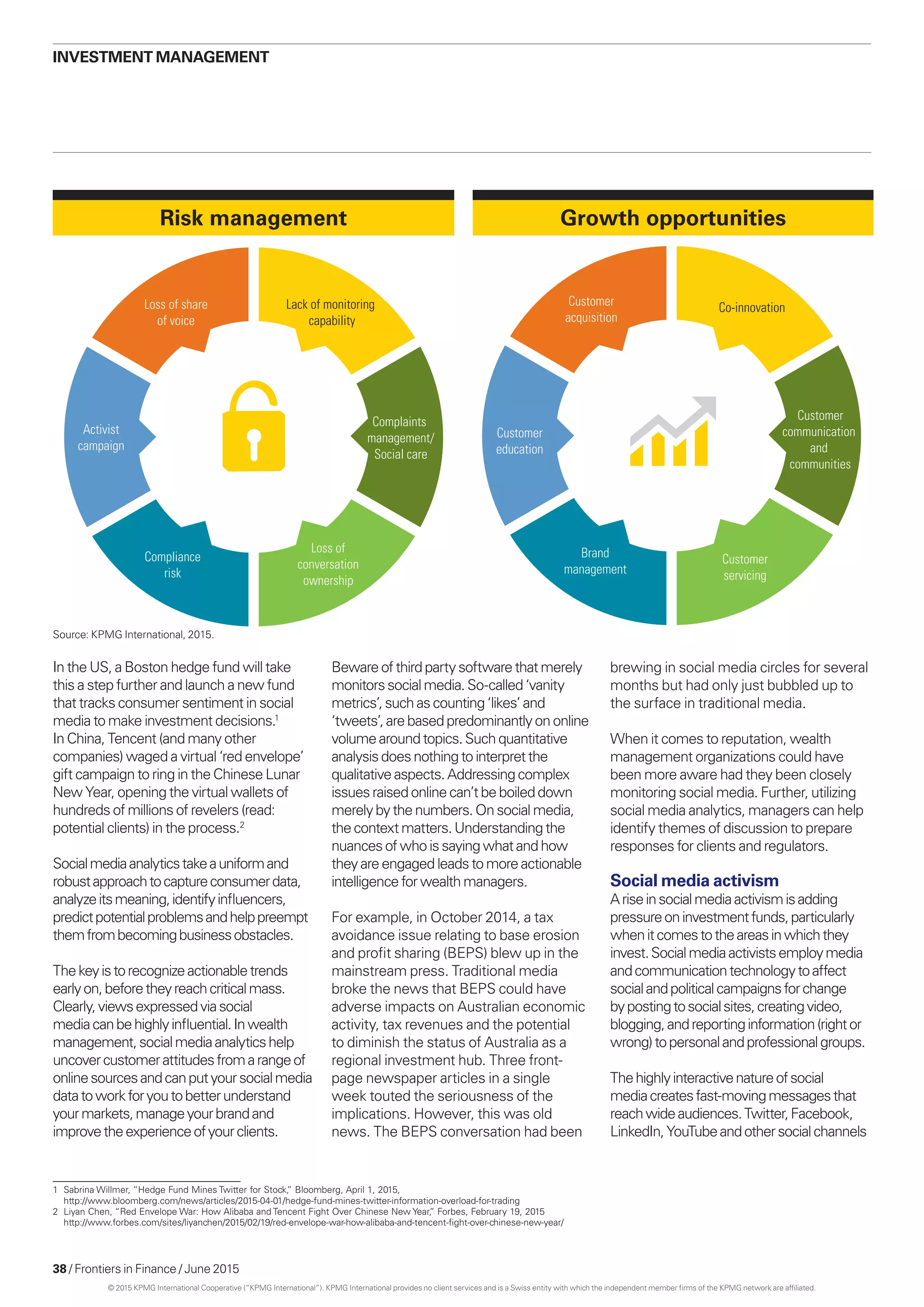
Socialmediaalsocarriesrisksand candamagebrandandreputationifitisnotproperlyusedand
understood.Activemonitoring and effective participationarerequiredtoenhancebrands,understand
activistcampaignactivities andmanagecomplaints.Theemergingtechnologyofsocialmedia
analytics canprovidedeepinsightsinto theinterplaybetweensocialandtraditionalmedia.
Uncoveringcustomerattitudesfrom arangeofonlinesourcescanputsocialmediadatatoworkin
bettermarketingandbrandmanagement,andinimprovingthecustomerexperience.
Many of these insights and developments, especially in communication technology and the
data revolution, are apparent in this year’s ‘next big thing’: FinTech – the use of software and
IT to deliver better financial services through financial technology. Its impact and potential
are one of the principal themes of Jeremy Anderson’s article. FinTech is potentially highly
disruptive of banks’ ‘business-as-usual’ models. Insurers are now actively competing head-
on with banks, private equity firms and global technology companies to secure the latest
technologies – whether these are bought, leased or developed in joint ventures and new
forms of partnership.
All of these issues are addressed in the articles in this edition. We like to think that
Frontiers in Finance continues to illuminate some of the most pressing opportunities
and challenges in the continuing fight for competitive advantage.
FOREWORD
Foreword
Giles Williams
KPMG in the UK
Andrew Dickinson
KPMG in Australia
Ton Reijns
KPMG in the Netherlands
Jim Suglia
KPMG in the US
© 2015 KPMG International Cooperative (“KPMG International”). KPMG International provides no client services and is a Swiss entity with which the independent member firms of the KPMG network are affiliated.
CONTENTS
FRONTIERS in finance June 2015
EXECUTIVE ISSUES
02
Chairman’s message
Developingstrategydoesn’tgetanyeasier.
Overthenext5years,financialservices
institutionsarelikelytoexperiencean
extremelyrapidperiodofprofoundchange
intheirexternalenvironment.
04
Driving competitive advantage
through a new investment banking
culture
Conduct, culture and technology are vital –
in addition to traditional thinking around the
strategic role investment banking plays in a
diversified financial institution model.
08
Bridging the talent gap to secure
competitive advantage
Ensuring competitive advantage starts
and ends with the caliber of your
workforce and your ability to attract top
talent to your organization.
TRENDS AND OPPORTUNITIES
12
Lessons from the recent currency
fluctuations in Switzerland and the
eurozone
TheEuropeanCentralBank’s(ECB’S)
decisiontoexpanditsquantitativeeasing
programtoincludegovernmentbond
purchasesspurredrecentfluctuationsinthe
Swissfranc(CHF).
16
Big data: The BIG factor driving
competitive advantage
By now, most insurers understand the
potential value that big data could deliver
to their organizations. But our experience
suggests that few insurers today are
ready to take full advantage of the many
opportunities that could be captured with
greater data insights.
36
Staying one step ahead with social
media risk analytics
Socialmediaareevolvingrapidly.The
conservativewealthmanagementindustry
iscertainlynotimmune,andsocialmedia
areimpactingitinsignificant,often
unforeseenandlikelyirreversibleways.
40
Tapping into insurance FinTech: Own
it, lease it or share it?
Facing increasing pressure on
performance and a growing desire to
get closer to their customers, most
insurers are now looking for virtually any
technology that may help them get – and
keep – a competitive edge.
28
Social physics: How good ideas
spread and lessons for the banking
sector
There is a strong and growing
conversation around the pace and
speed of innovation in today’s banking
model, and how banks can pivot to
take advantage of the latest advance in
FinTech innovation and big data.
31
The perfect storm of technology and
capital markets: The modern history
of FinTech
Is2015the‘yearofFinTech’?Aperfect
stormofconditionsisbrewingthatmakes
FinTechtherightsolutionfortheright
conditionsattherighttime.Andthattime
isnow.
44
Effective wealth management
transformation requires focus and
alignment
Theworld’swealthmanagementfirms
haverecognizedtheneedtorespondto
shiftingclientexpectations,agilenewrivals
andrisingoperatingcosts,byembarking
ontransformationprograms.
CHANGE AND INNOVATION
20
Chief data officers: The next
generation of leaders transforming
banks
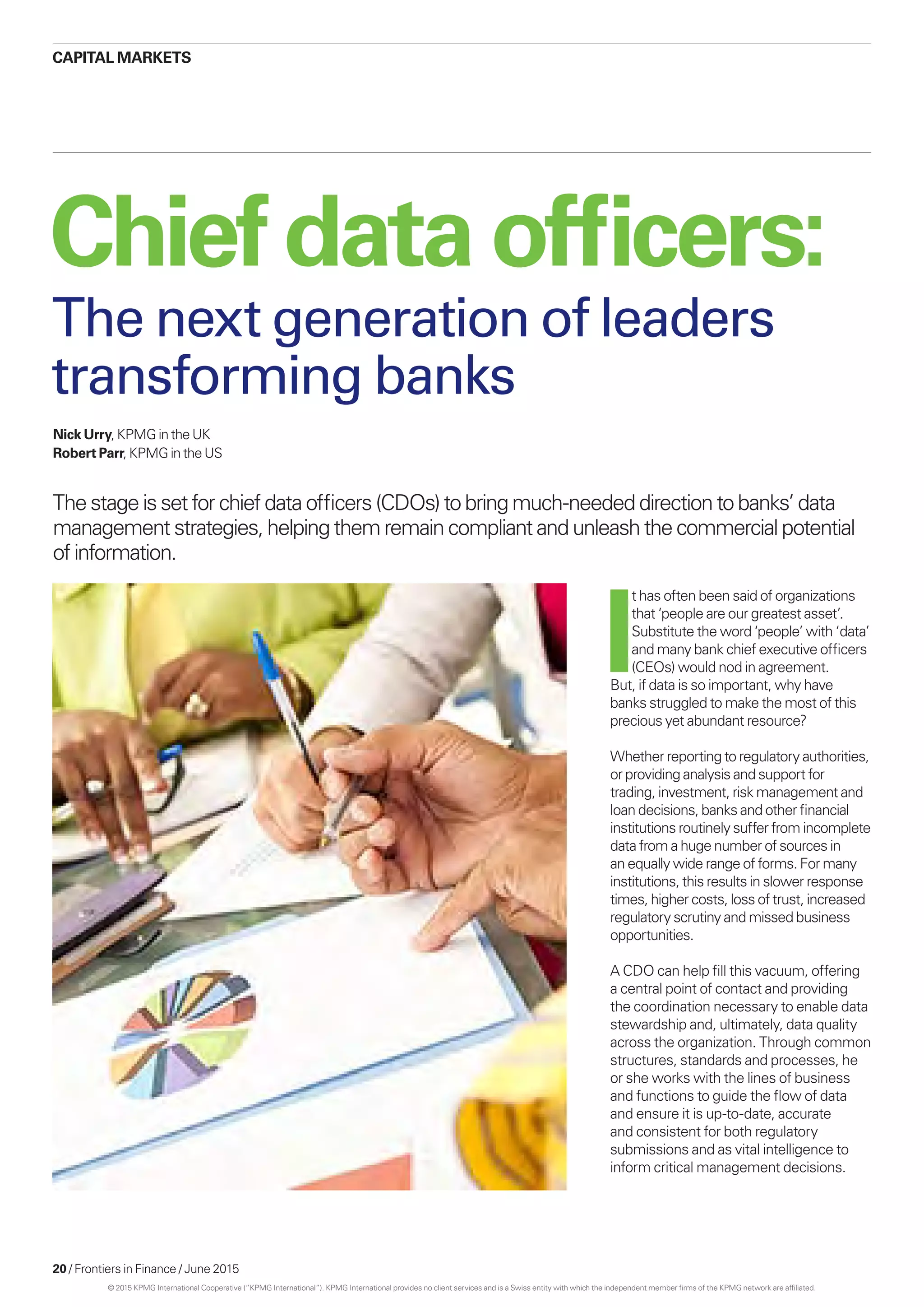
The stage is set for chief data officers
(CDOs) to bring much-needed direction
to banks’ data management strategies,
helping them remain compliant and
unleash the commercial potential of
information.
24
Hedge funds and institutional
investors: A changing future
As the environment for alternative
investments continues to evolve, hedge
fund managers are starting to rethink
their products, fee structures and investor
mix to refocus on institutional investors –
particularly pension funds.
PUBLICATIONS
48
Updates from KPMG member firms,
thought leadership and contacts, including
our Evolving Regulation series.
© 2015 KPMG International Cooperative (“KPMG International”). KPMG International provides no client services and is a Swiss entity with which the independent member firms of the KPMG network are affiliated.
2 / Frontiers in Finance / June 2015
CHAIRMAN’S MESSAGE
Developing strategy doesn’t get any easier. Although the immediate ordeals of the financial
crisis may have been overcome, new and even more disruptive challenges are looming. Over
the next 5 years, financial services institutions are likely to experience an extremely rapid period
of profound change in their external environment. The response to the crisis has been focused
on increased regulation, changes to corporate structures and business models and the need
to find new ways of generating earnings in the context of prolonged yield depression. These
have placed heavy burdens on everyone involved in the industry, but especially on those in
senior executive positions. The problem, though, is that developing effective responses may
have crowded out the capacity to step back, to reflect deeply on how best to meet the future
demands of customers over the coming period of change.
Signposts to the future:
Jeremy Anderson
Chairman, Global Financial Services
T
here’s no doubt that strategic
thinking is increasingly vital.
Technology is evolving more
quickly than ever. Reliance
on social media is becoming
ubiquitous, not only for casual conversation
but also for corporate communication
and business processes. Consumers
are increasingly demanding constant,
online access to every service. In turn,
the explosive growth of information
technology and communication is
generating vast quantities of data about
customers, markets, products and
preferences – which will be invaluable to
those companies that learn to exploit it.
These trends are accelerating. So it is more
than ever critical to ensure that the vital
task of absorbing the current regulatory
overhang is not the sole focus of attention.
The very real challenge of getting fit for
the ‘new normal’ has to run hand-in-
hand with preparing both for short-term
disruptors and for the impact of long-term
megatrends.1
In the first category, we
have already seen significant inroads
made into the traditional financial services
industry by companies such as Apple,
PayPal and others. In the slightly longer
term, the industry will see major impacts
from demographic and social change, and
from the increasing consumer tendency to
value ease of transactional operations over
enduring relationships and brand loyalty.
The foresight challenge
It is, of course, easy to argue for
greater foresight, strategic thinking and
preparedness. But it is far from clear
actually how to begin engaging with
the ‘unknown unknowns’. In recent
conversations with senior banking
executives, a number have said to me that
they find today’s environment intellectually
verychallenging.The5years after the crisis
were tough, but the objectives remained
clear. Now, however, fundamental
decisions need to be taken about global
and regional business models: which
businesses to remain in, withdraw from
or try to enter; whether the present
low-interest, low-yield environment
will ease soon or persist to drive more
fundamental changes of strategy. Yet
the foundation on which to base these
decisions remains obscure.
Aclient ofKPMGinSwitzerlandarticulated
hisdilemmaacutely:althoughhecouldsee
multipleexamplesofinnovationemerging
anddisruptionchallenginghismarket,he
stilldidnotknowifhewasseeingthefull
pictureorwhereelsetolook.Sowhile
manyleadersagreethatfinancialservices
willlookverydifferentin5years’time,
thereislittlecertaintyabouthowtheywill
look.Andthere isnodoubtthateventhe
mostfar-sightedwillbothunderestimate
andoverestimatethepaceandextentof
change.Foresightanddecisivenesswillbe
critical;sowillflexibilityand agility.
Sustaining competitive advantage
through major change
1	 For an extended review, see Future State 2030: The global megatrends shaping government, KPMG, 2014.
© 2015 KPMG International Cooperative (“KPMG International”). KPMG International provides no client services and is a Swiss entity with which the independent member firms of the KPMG network are affiliated.
June 2015 / Frontiers in Finance / 3
Jeremy Anderson
Chairman, Global Financial Services
Signposting the future? The
FinTech contribution
In clarifying the picture, the rapidly-
growing FinTech sector could have a major
role to play. Rapid innovation in financial
technology – the use of software and
information technology to deliver better
financial services – in the context of start-
ups, partnerships and other structures,
has the potential to bring together
established players in need of strategic
insight with leading-edge developments
from products and marketing to
transaction processing. Engagement
with the burgeoning FinTech environment
has the potential to give much-needed
direction to the formulation of new
strategy in an increasingly uncertain world.
Investment in FinTech initiatives is growing
rapidly in all major financial and technology
locations, from Silicon Valley to New
York, London and Sydney.2
Depending on
definitions, financing activity is estimated
to be running at more than $12 billion
annually, having tripled during 2014.3
Much of this reflects the understandable
lure of the ‘next big thing’. However, it also
acknowledges the massive transformation
in how financial services are conceived,
developed, delivered and experienced,
which will be the inevitable outcome
of the current convergence of digital
technologies and financial expertise.
As with any new and exciting field,
a lot of different initiatives are being
explored, with many different approaches
and a great deal of experimentation.
A key area of focus is the potential of
combining exploitation of ‘big data’ with
new technology to streamline existing
processes and transactions, or to develop
much more personalized products and
services. But scalability is a crucial issue.
The challenge is not only to find ways of
creating promising ideas but of identifying
those which are capable of being scaled
up into the mainstream business models
of major financial institutions.
New forms of partnership
We see a number of different approaches
being adopted. Traditionally, financial
institutions have relied on trusted
technology vendors to offer them solutions
to underpin their transaction processing
or customer relationship management.
Sometimes, these providers have been
acquired and taken in-house; at other times,
in-house operations have been spun out
or outsourced. But the essential customer-
contractor relationship has persisted.
InthenewFinTechenvironment,though,
itisincreasinglyrecognizedthatmore
fundamentalformsofpartnershipare
required.Soweseemultiplestakeholders
comingtogethertokick-startnewinitiatives,
ofteninnewphysicalcontextssuchas
dedicatedfacilitiesandinnovationlabs.
Theseprovideanenvironmentinwhich
toincubate,encourageandnurturenew
FinTechventuresuntiltheycanbescaled
upandcommercialized.Participantsin
theseinitiativesincludefinancialinstitutions,
venturecapitalists,technologystart-
ups,nationalauthoritiesandthelocal
governmentsofmajorcitieslikeLondonor
Sydney –whereKPMGhashelpedestablish
Australia’sfirstdedicatedFinTechfacility.
We are also seeing institutions such as
Santander and Barclays Bank setting up
in-house venture capital funds to invest in
new start-ups, both gaining access to new
ideas and, in the longer term, acquiring
profitable new business lines. In the
insurance sector, as we outline elsewhere
in this issue, companies are now
beginning to look to FinTech opportunities
to stimulate innovative product design,
platforms and distribution models. Our
own KPMG Capital business is investing
in creating smarter data and analytics
capabilities and has recently taken an
equity stake in Bottlenose, a leader in real-
time enterprise trend analysis.
The benefits of these various alliances
and partnerships flow to all participants.
By joining with other stakeholders,
established financial institutions can
reduce risk, stimulate innovation and
develop products and services to
increase customer satisfaction and
engagement. Start-ups gain injections
of funding, but also, more importantly,
access to business expertise and an
understanding of how financial services
are developed, marketed and delivered in
the real world. New talent and skills can
be developed in an atmosphere which
preserves entrepreneurial attitudes and
behavior.
New thinking, new investment,
new approaches
If FinTech can offer a way out of the
foresight challenge and signpost some
clear directions of travel, the question for
senior finance executives remains acute:
how to embrace the current explosion
of new thinking and nascent solutions,
products and innovations, and sift through
the rapidly changing environment, to
identify those opportunities which will
make a real contribution to the responses
required. My feeling is that, as we have
argued before, the guiding principle has
to remain the need to focus on delivering
what customers want in the way that they
want it, even as these change profoundly.
The last 5 years have seen many
financial institutions concentrating first
on survival and then on rebuilding their
balance sheets and strengthening capital
structures. In the next 5 years we shall see
a re-intensified battle for the customer.
Those companies which can create lasting
competitive advantage will be those which
are most relentlessly focused on satisfying
emerging customer needs and demands.
The potential value of any new FinTech
initiative, technology development or other
disruptor has to be assessed against this
standard.
The present low-yield situation makes
the requirement for new thinking and
new investment more acute even while
funding it becomes more difficult. For the
foreseeable future, the financial services
industry needs to adopt the attitudes of
lean manufacturers finding ways of doing
business cheaper, faster and better in a
low-margin environment. This is likely
to be the best – or even only – way of
surviving the coming wave of change.
And if this frame of mind is sustained
over a longer period, there will be
corresponding longer-term benefits, both
for the industry and for the customers we
presume to serve.
2	 For a recent overview, see, for example Unlocking the potential: The FinTech opportunity for Sydney, KPMG, 2014.
3	 Investment in financial technology groups triples to $12bn in year, Financial Times, 26 March 2015.
© 2015 KPMG International Cooperative (“KPMG International”). KPMG International provides no client services and is a Swiss entity with which the independent member firms of the KPMG network are affiliated.
4 / Frontiers in Finance / June 2015
Driving
competitive
advantage
throughanew
investment
bankingculture
F
inancial institutions are currently
rethinking the future success
of their investment banks
post-crisis. They have come
to realize that conduct, culture
and technology (including cyber security)
are now vital elements of their agenda,
which already includes traditional thinking
around the strategic role investment
banking plays in a diversified Financial
Institution model, the right mix for the
organization, the impact of new regulatory
requirements, the cost of capital, and the
ROE needs of the institution.
There is much work to be done. While
some within the industry continue
to hunker down post-crisis, fresh
opportunities for competitive advantage
are emerging for organizations able to take
a leap forward in key areas such as culture
and technology.
But first, let’s frame the issues.
In the decade prior to the financial crisis,
the investment banking industry took
huge leaps forward. Volume, volatility
and customized complexity were the
name of the game during this period of
massive innovation and unprecedented
profitability. Some of this was shown
later to be recklessness, but there was
also genuine and valuable innovation and
improvement.
But it couldn’t last. The profitability
allowed greed to seep in and this drove
some irresponsible behaviors. Oversight
by management and regulators was
different in the last decade and the free
economy model which had delivered
so much benefit globally in preceding
decades got out of hand. The checks and
balances in standards, regulations and
governance structures couldn’t prevent a
bubble from building – then bursting.
Capital markets management are still
adjusting to the ensuing financial crisis and
the severe contraction in the industry.
CAPITAL MARKETS
Mike Conover, KPMG in the US
David Todd, KPMG in the UK
© 2015 KPMG International Cooperative (“KPMG International”). KPMG International provides no client services and is a Swiss entity with which the independent member firms of the KPMG network are affiliated.
June 2015 / Frontiers in Finance / 5
Contacts (from left)
Mike Conover
David Todd
So on which of the many competing
priorities should boards of banks focus? To
begin with, it’s instructive to examine the
lingering effects of the pre-crisis hangover
today:
1.	 Optimism in investment banking has
waned.
2.	Lower volumes and electronic trading/
settlement are the new normal.
3.	Cultural shortcomings are still
common.
4.	There is meager investment in back-
office improvements.
5.	Many organizations have taken a wait-
and-see approach.
While the flow of new regulations has
begun to slow, the marketplace has not
yet settled.
Bankstodaystillgenerallyviewtheirfuture
outlooksthrough a‘post-crisis’lens.This
mindset,thoughconservative,isprobably
appropriategiventheseverityoftherecent
crisis.Assuch,banksseemcontenttopause
to consider next steps before developing
a new business model and maybe a new
identity to their culture to supplant the
formerly profitable trading environment.
But what is next? Clearly, there is no way
to ‘future-proof’ the investment banking
business. However, there are ways to
better prepare for what’s to come.
Culture: the next big arena in the
banking industry
As big banks focus on the implementation
of new regulations, a new back- and
middle-office model and how the new
world of technology can transform their
business, there seems to be a shift to a
clearer client focus (putting the client’s
needs first) that can potentially break the
logjam in industry stagnation.
In particular, with regulatory issues on
the mend and new technology being
installed, how does management drive
their business forward on the path to
growth? And let’s not forget the last item to
be addressed from the crises hangover –
culture. This is a good time for banks to turn
their attention to fixing their culture issues,
which will drive their business forward and
differentiate them from their competitors.
Taking a new approach to culture and
harnessing client-centricity can help
uncover new opportunities for growth.
Based on prior problems within the
industry, clearly changes are necessary.
In a nutshell, the combination of crises,
losses and bailouts has focused a
spotlight on how banks do business.
Such illumination has exposed all of
the deficiencies within the industry,
and there is no indication that the focus
will shift anytime soon. In fact, late last
year, New York Fed President William
Dudley reportedly used the word ‘culture’
more than 40 times in a speech to bank
executives.
We believe this is a true watershed
moment in the 100+ year history of
the sector. The public backlash against
misbehavior and excessive pay within the
industry is spurring real change and public
outcry for change. We’ve already come a
long way since the wild days of The Wolf
of Wall Street, but we still have far to go as
the new generation of investment bankers
joins the ranks having grown up with a
different ’purpose in life’. In the name
of profitability, it’s time to clean up the
cultures that allowed bad behaviors to live
in the industry.
Customers need to ‘beware’ in many
industries. For example, the automotive
industry has had recalls that came a little
too late. You only need to buy your child a
mobile phone to worry about the value of
some insurance products being sold; and
even weather-related price fluctuations for
snow shovels driven by supply and demand
make the news. When it comes to banks,
politicians are rapidly shifting the standard
from ‘buyer beware’ to ‘seller beware’. If
you cannot produce analysis to show why
a product was good for your customer,
you may have to compensate them. Not
only does bank conduct and culture need
to improve on past performance, it also
needs to lead the world in developing new
approaches to customer-centricity.
Banks must redefine
their culture to help
drive strategy, as a
great strategy is only
great if the culture
accepts it.
© 2015 KPMG International Cooperative (“KPMG International”). KPMG International provides no client services and is a Swiss entity with which the independent member firms of the KPMG network are affiliated.
6 / Frontiers in Finance / June 2015
If culture is the key to investment banks
moving forward in the current economy,
those who discover how to baseline and
measure where their culture is today,
then design and implement measurable
improvements for the new world of
investment banking, will have a significant
advantage over their competitors.
Banks must redefine their culture to help
drive strategy as a great strategy is only
great if the culture accepts it – so make
sure culture is aligned so the strategy can
be executed.
One final area of opportunity within culture
is the culture of high pay. It has been
argued that pay did not reflect the risk
adjusted capital that was needed to hold
such risk, and as a result bigger payouts
may have been viewed as reasonable for
the profit margin on the needed capital.
In the boom years, the argument was
made that the advances being made in
re-engineering the financial world justified
premium pay for bankers. This argument
isn’t accepted today because the new
capital charges on these highly complex
trades now make these trades much less
profitable. However, pay levels have still
not adequately normalized yet. If boards
can keep pay levels trending down,
heading for the point where their talent is
paid equally with the return on capital in
the industry now, they can reap a stream
of long-term cost savings and throw some
good news into the mix for shareholders.
Technology: Revolution or
evolution?
Beyond culture, banks must also embrace
new technology to advance their business
interests. If the culture of an organization
does not embrace new and changing
technologies and reverts back to doing
things the old way, a great deal of money
will be spent with little benefit to the
bottom line. In fact, technology can be a
foundation for the future of the industry
through which investment banks advance
the quality of regulatory compliance,
increase transparency, reduce costs,
and improve overall profitability through
technology implementation.
Manyfinancialinstitutionsinthecapital
marketsaresaddledwithinformation
technology(IT)systemsappropriateto
anotherera.Inourview,banksshouldfocus
asmuchattentionaspossibleontechnology
tobringthesectorintothe21st
century
andpotentiallygeneratemoresustainable
revenueinthischangingindustry.
In the past, investments in IT and data
projects largely went into the front-end of
the business. IT investment now should
focus on middle- and back-office functions
and architectures to streamline duplicative,
siloed and inefficient operations.
Afteryearsofignoringtheimportance
thatcultureplaysintheindustry,we
proposeeightstrategicquestionsto
askinordertocleantheslateandwin
backthetrustofcustomers:
1.	Break down silos – How can
we connect systems to find
commonalities and drive a one-
firm culture?
2.	 Buildacultureoftrust –Where
canweshiftthefocustothegood
oftheclient?Remember,public
perceptionmatters,soworkto
rebuildyourreputationandtrytobe
humble(yes,wemademistakes,
butnowlet’smove on).
3.	 Focusoncapitallevels –How
canwebalanceouttheculture
oftakingonwhateverriskis
neededtodriveprofits?Capital
requirementsoftodayseemto
havebiggerchargesfor‘culture
risk’thaneverbefore.
4.	 Simplifyoperations –Knowing
thatthesystemwasbuiltfor
biggervolumesandmore
complexcustomizationthan
existtoday,howcanwedrivea
cultureofsimplicitywithenabling
technology?
5.	 Continuetorespondwellto
regulatorychange –Isn’titbetter
towillinglychangetheinvestment
bankingculturethanthrowlawyers
attheissue?
6.	Raise IT spending to budget
for system improvements –
How can we digitize our
work flows and automate the
back-office as a collective team
versus the culture of individual
profit?
7.	 Createefficiencies –There
arelessexpensivemethodsof
processing,suchasbigdata:
Wherecanwelooktoreengineer
processesandcutthemassive
costbasis?
8.	Improve culture – How can
we improve our culture of
understanding exposure to risk,
cyber security, etc.?
CAPITAL MARKETS
“The need for
values is inbred.
Their content is
not.”
Alan Greenspan,
2008, inThe Age
ofTurbulence:
Adventures in a
NewWorld
Most bankers will tell you that regulatory
firefighting has necessarily dominated
IT spend in each of the last 5 years.
Gartner supports this claim, estimating
that banking and securities institutions’ IT
investments grew 3.6 percent from 2013
to 2014, to about $480 billion (Forecast:
Enterprise IT Spending for the Banking and
Securities Market, Worldwide, April 23,
2014). This includes regulatory compliance
and reporting purposes, as well as
addressing cost-reduction strategies.
From our interaction with industry
executives, regulators and industry
observers, it appears there is a long
road ahead to transformation. A 2014
USD480billion
3.6%from 2013 to 2014, to about
IT investments grew
© 2015 KPMG International Cooperative (“KPMG International”). KPMG International provides no client services and is a Swiss entity with which the independent member firms of the KPMG network are affiliated.
June 2015 / Frontiers in Finance / 7
Contributors
Mike Conover
Global Head of Capital Markets
KPMG in the US
T: +1 212 872 6402
E: mconover@kpmg.com
Michael Conover is the founding Partner
of KPMG’s Financial Risk Management
Practice in the United States. He is involved
in a wide array of financial advisory and risk
management assignments for financial
institutions.
David Todd
Partner
KPMG in the UK
T: +44 20 76942868
E: david.todd@kpmg.co.uk
David has worked as a partner in the
investment banking sector for over 15 years,
in both New York and London. David
specializes in investment bank audits –
he leads this sector in London, and is
responsible for some of KPMG’s biggest
investment bank audits.
KPMG survey on transformation (From
Burden to Competitive Advantage,
KPMG, 2014) revealed that nearly half
of capital markets businesses are still
in the ‘assessing and planning’ stage of
transformation, while another 20 percent
admitted to only having just begun.
Either way, it remains essential
for capital markets institutions to
upgrade technologies – in-house
or through joint ventures, strategic
alliances or acquisitions of ‘permitted’
technology firms that are closely
aligned with banking – to make
valuable operational and financial
decisions associated with:
•	 real-time analysis for risk and pricing
purposes
•	 portfolio-composition decisions
•	 executing trades that take advantage
of fast movements in markets around
the world
•	 maintaining and reporting on
compliance with regulations
•	 constructing optimized cost
processes and structures
•	 enablingand/ormonitoringestablished
internal governancediscipline
•	 enhancing cybersecurity capabilities.
Few institutions fully understand the
huge potential that resides within their
data, and fewer still are making the
right changes to their business strategy
to take advantage of that potential. A
major stumbling block is that existing
technology systems and business
models represent the greatest challenge
to integrating data and analytics programs
into their business.
Hunker down or charge ahead?
Large investment and wholesale banks
generally take a cautious approach
to their strategy. But culture and
technology are two areas in which
a more proactive approach can help
improve their outlook. We have found
that culture beats strategy every time,
so don’t roll out a new strategy unless
you roll out a new culture first, and then
be sure to enable it with the appropriate
technology.
New regulations have taken hold.
While next steps are not always clear
or tangible, it is clear that a fundamental
and permanent shift for the sector is
underway. How it will look in the future
is still difficult to determine, but some
important components like customer-
centricity are clear already.
Fornow,banksmustdecidewhether
theywanttohunkerdownortrytomove
ahead.Merelymaintainingthestatusquo
inthecurrentenvironmentischallenging
enoughwithouttheaddedpressureof
planningnowtoprofitinthefuture.
By examining the context on current
marketplace thinking, banks can equip
themselves with the tools and insights
required to make more strategic and
forward-thinking decisions. However,
it’s up to them to actually move ahead
with changes.
	 It is essential for institutions operating
in the capital markets to accelerate efforts to
simplify and standardize their operational and
technological infrastructure.The job will be
long-term and complex – but the need to pick
up the pace is absolutely necessary.
– Brian Stephens, National Sector Leader, Banking
and Capital Markets Practice, KPMG LLP (US)
© 2015 KPMG International Cooperative (“KPMG International”). KPMG International provides no client services and is a Swiss entity with which the independent member firms of the KPMG network are affiliated.
8 / Frontiers in Finance / June 2015
Bridging the talent gap
to secure competitive
advantage
T
he insurance industry is facing
more acute challenges than
many other sectors when
it comes to recruitment,
engagement, talent
development and culture. Intensified
by regulatory requirements, demands
of a multigenerational workforce and
evolving customer needs, we believe that
rethinking talent strategies and addressing
the 5Cs (capability, cost, compliance,
capacity and connection) will help
the industry bridge the talent gap. We will
explore these further in this article.
Beforewedivein,let’slookathowinsurers’
currentcapabilitiesstack-upcomparedto
banksandtechnology/ITcompaniesinthe
followingaspectsofpeoplemanagement.
INSURANCE
Mark Spears, KPMG in the UK
Harold de Bruijn, KPMG in the Netherlands
Mary Trussell, KPMG in Canada
W Jean Kwon, KPMG in the US
Theskillsgapwidens.Areinsurers
abletocompete?
Digging deeper, we see that, while many
industries are struggling to respond to the
challenges of an ageing workforce and
shortages of suitably qualified replacement
recruits, the insurance industry appears to
have a more unbalanced workforce age
structure than most. In a recent article for
the International Insurance Society, W
Jean Kwon quotes a number of disturbing
statistics.1
Analyses drawn from a range of
studies indicate, for example, that:
•	 the percentage of workers at the 55–64
and 65+ age groups in the US insurance
sector rose by about 38 and 10 percent,
respectively, during the 2000–07 period,
more than the national average
•	 thenumberofemployeesaged
55+increasedby74percentinthe
10yearsto2008(ascompared
witha45percentincreaseinthe
aggregateofallemployees).
Otherstudiessuggestthatupto40 percent
ofinsurancesectoremployees –bydefinition
includingmostofthesenior,experienced
andhigh-skilledstaff –aresettoretirein
thenextfewyears.Researchindicatesthat
thiswillhaveadisproportionatelysevere
impactintheareasofclaimsmanagement,
underwritingandreinsurance.Skills
shortagesarealreadybecomingapparent.
Alongsidethemassivewaveofimminent
retirements,twoothertrendsarehavingan
increasinglysevereimpactontheinsurance
sector’smanpowerchallenge.Asthesector
1	 Human Capital Risk and Talent Management Issues in the Insurance Market: Public Policy, Industry and Collegiate Education
Perspectives, The Geneva Papers, 2014;39:173–196.
Ensuring competitive advantage starts and ends with the caliber of your
workforce and your ability to attract top talent to your organization.
In a period where technology and business models are evolving faster than
individual skill sets, it is becoming increasingly challenging for organizations
to attract, engage and retain the talent needed to deliver desired business
benefits to their customers, shareholders, regulators and other key
stakeholders.
What we are seeing across all regions and all industries are chief executive
officers (CEOs) being faced with skills shortages for the most ‘critical
talent’ – the people within the organization that contribute a more than
proportionate share of the organization’s business value.
© 2015 KPMG International Cooperative (“KPMG International”). KPMG International provides no client services and is a Swiss entity with which the independent member firms of the KPMG network are affiliated.
June 2015 / Frontiers in Finance / 9
Contacts (from left)
Mark Spears
Harold de Bruijn
Mary Trussell
W. Jean Kwon
expands,sodoesthenumberofvacancies:
theUSBureauofLaborStatisticsforecasts
thatover200,000newjobswillbecreated,
andwillneedtobefilled,withinthesector
by2022.2
Atthesametime,however,a
numberoffactorsarerenderingthesector
comparativelylessattractivetonewrecruits:
•	 althoughthedemandforpricing,product
development,underwriting,claims,IT
anddatamanagementisskyrocketing,
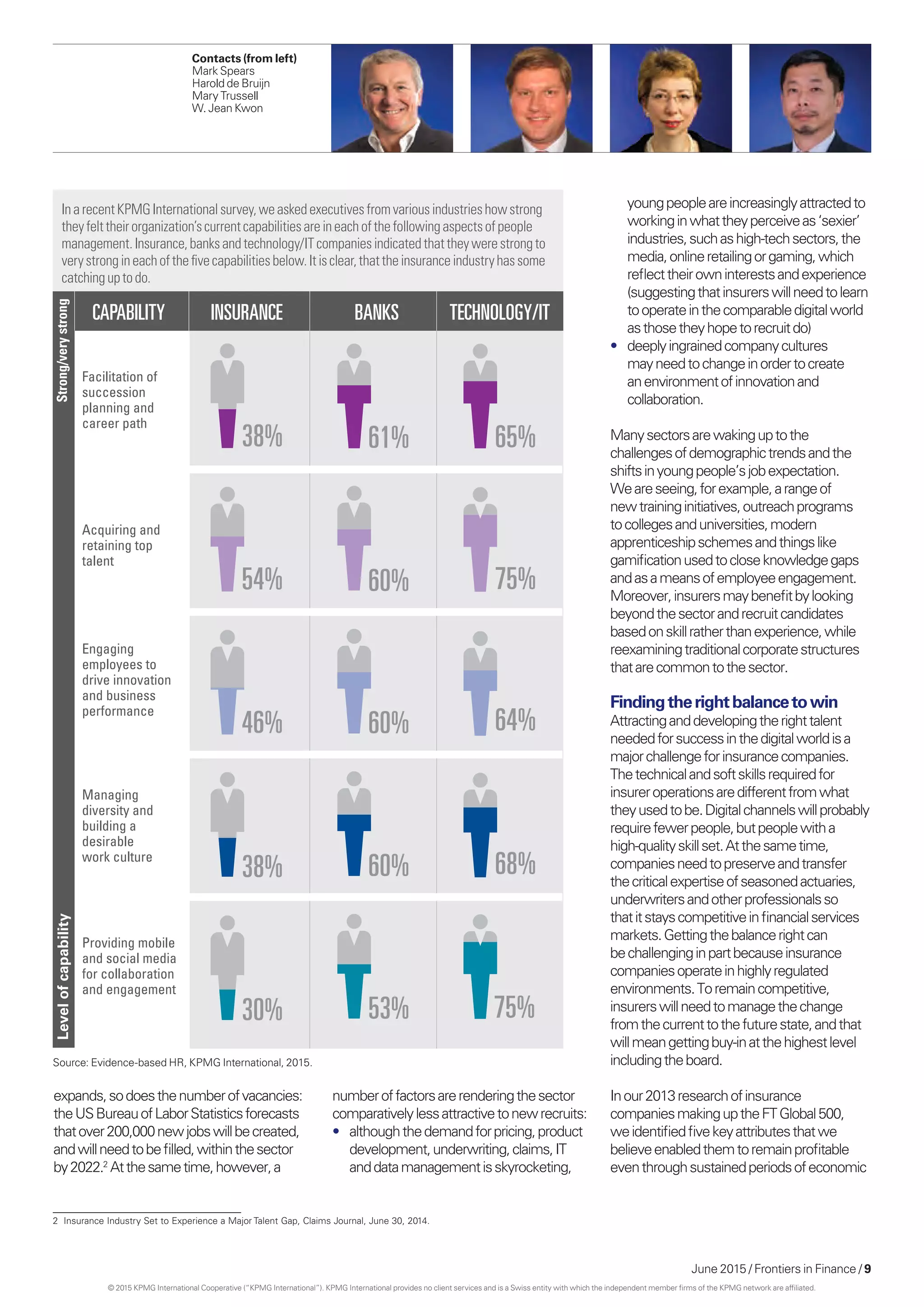
Facilitation of
succession
planning and
career path
Acquiring and
retaining top
talent
Engaging
employees to
drive innovation
and business
performance
Providing mobile
and social media
for collaboration
and engagement
LevelofcapabilityStrong/verystrong
INSURANCECAPABILITY BANKS TECHNOLOGY/IT
38%
54%
46%
38%
30%
61%
60%
60%
60%
53%
65%
75%
64%
68%
75%
Managing
diversity and
building a
desirable
work culture
youngpeopleareincreasinglyattractedto
workinginwhattheyperceiveas‘sexier’
industries,suchashigh-techsectors,the
media,onlineretailingorgaming,which
reflecttheirowninterestsandexperience
(suggestingthatinsurerswillneedtolearn
tooperateinthecomparabledigitalworld
asthosetheyhopetorecruitdo)
•	 deeplyingrainedcompanycultures
mayneedtochangeinordertocreate
anenvironmentofinnovationand
collaboration.
Manysectorsarewakinguptothe
challengesofdemographictrendsandthe
shiftsinyoungpeople’sjobexpectation.
Weareseeing,forexample, arangeof
newtraininginitiatives,outreachprograms
tocollegesanduniversities,modern
apprenticeshipschemesandthingslike
gamificationusedtocloseknowledgegaps
andasameansofemployeeengagement.
Moreover,insurersmaybenefitbylooking
beyondthesectorandrecruitcandidates
basedonskillratherthanexperience,while
reexaminingtraditionalcorporatestructures
thatarecommontothesector.
Findingtherightbalancetowin
Attractinganddevelopingtherighttalent
neededforsuccessinthedigitalworldisa
majorchallengeforinsurancecompanies.
Thetechnicalandsoftskillsrequiredfor
insureroperationsaredifferentfromwhat
theyusedtobe.Digitalchannelswillprobably
requirefewerpeople,butpeoplewitha
high-qualityskillset.Atthesametime,
companiesneedtopreserveandtransfer
thecriticalexpertiseofseasonedactuaries,
underwritersandotherprofessionalsso
thatitstayscompetitiveinfinancialservices
markets.Gettingthebalancerightcan
bechallenginginpartbecauseinsurance
companiesoperateinhighlyregulated
environments.Toremaincompetitive,
insurerswillneedtomanagethechange
fromthecurrenttothefuturestate,andthat
willmeangettingbuy-inatthehighestlevel
includingtheboard.
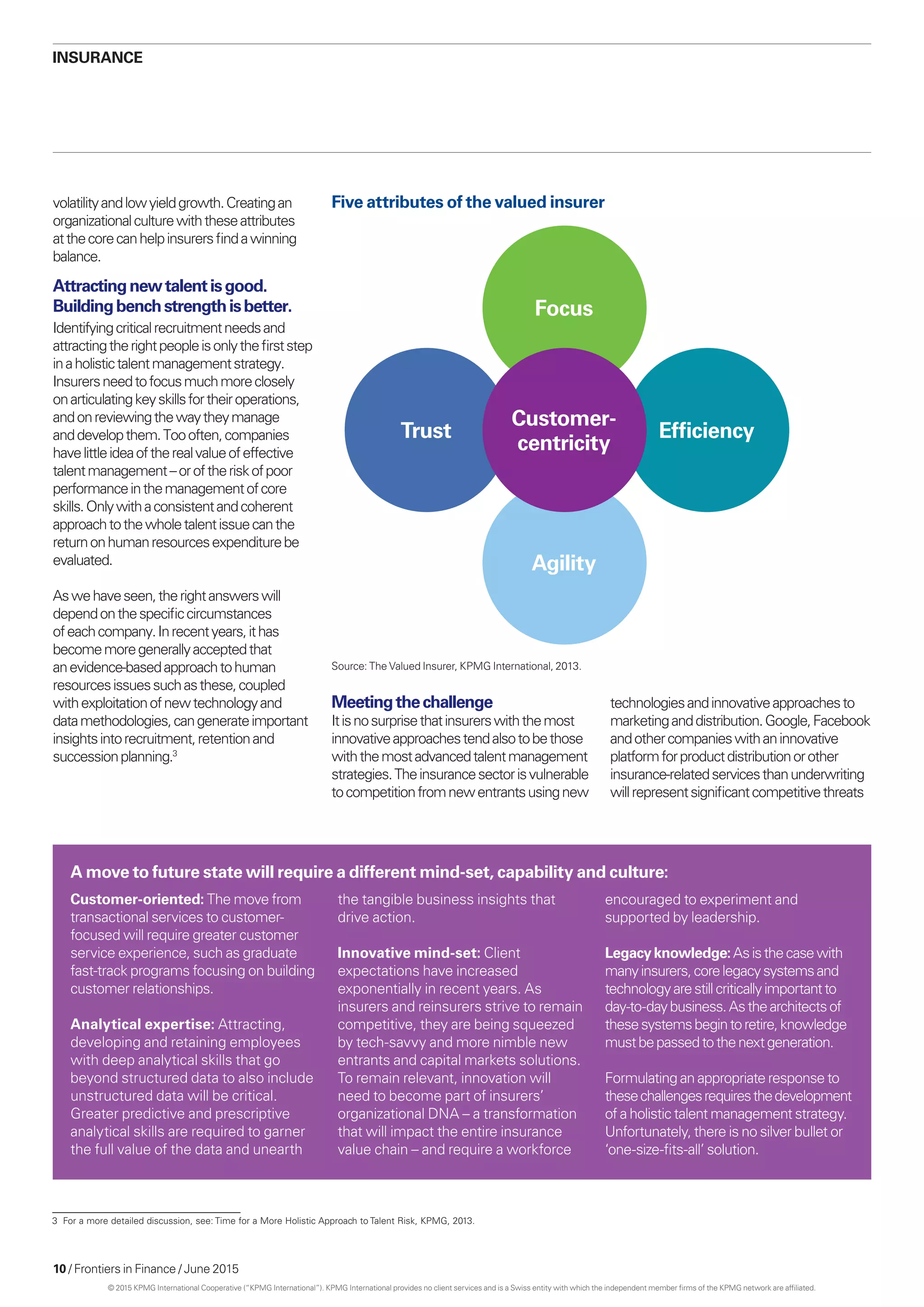
Inour2013researchofinsurance
companiesmakinguptheFTGlobal500,
weidentifiedfivekeyattributesthatwe
believeenabledthemtoremainprofitable
eventhroughsustainedperiodsofeconomic
2	 Insurance Industry Set to Experience a Major Talent Gap, Claims Journal, June 30, 2014.
Source: Evidence-based HR, KPMG International, 2015.
InarecentKPMGInternationalsurvey,weaskedexecutivesfromvariousindustrieshowstrong
theyfelttheirorganization’scurrentcapabilitiesareineachofthefollowingaspectsofpeople
management.Insurance,banksandtechnology/ITcompaniesindicatedthattheywerestrongto
verystrongineachofthefivecapabilitiesbelow.Itisclear,thattheinsuranceindustryhassome
catchinguptodo.
© 2015 KPMG International Cooperative (“KPMG International”). KPMG International provides no client services and is a Swiss entity with which the independent member firms of the KPMG network are affiliated.
10 / Frontiers in Finance / June 2015
volatilityandlowyieldgrowth.Creatingan
organizationalculturewiththeseattributes
atthecorecanhelpinsurersfindawinning
balance.
Attractingnewtalentisgood.
Buildingbenchstrengthisbetter.
Identifyingcriticalrecruitmentneedsand
attractingtherightpeopleisonlythefirststep
inaholistictalentmanagementstrategy.
Insurersneedtofocusmuchmoreclosely
onarticulatingkeyskillsfortheiroperations,
andonreviewingthewaytheymanage
anddevelopthem.Toooften,companies
havelittleideaoftherealvalueofeffective
talentmanagement –oroftheriskofpoor
performanceinthemanagementofcore
skills.Onlywithaconsistentandcoherent
approachtothewholetalentissuecanthe
returnonhumanresourcesexpenditurebe
evaluated.
Aswehaveseen,therightanswerswill
dependonthespecificcircumstances
ofeachcompany.Inrecentyears,ithas
becomemoregenerallyacceptedthat
anevidence-basedapproachtohuman
resourcesissuessuchasthese,coupled
withexploitationofnewtechnologyand
datamethodologies,cangenerateimportant
insightsintorecruitment,retentionand
successionplanning.3
3	 For a more detailed discussion, see: Time for a More Holistic Approach to Talent Risk, KPMG, 2013.
A move to future state will require a different mind-set, capability and culture:
Customer-oriented: The move from
transactional services to customer-
focused will require greater customer
service experience, such as graduate
fast-track programs focusing on building
customer relationships.
Analytical expertise: Attracting,
developing and retaining employees
with deep analytical skills that go
beyond structured data to also include
unstructured data will be critical.
Greater predictive and prescriptive
analytical skills are required to garner
the full value of the data and unearth
the tangible business insights that
drive action.
Innovative mind-set: Client
expectations have increased
exponentially in recent years. As
insurers and reinsurers strive to remain
competitive, they are being squeezed
by tech-savvy and more nimble new
entrants and capital markets solutions.
To remain relevant, innovation will
need to become part of insurers’
organizational DNA – a transformation
that will impact the entire insurance
value chain – and require a workforce
encouraged to experiment and
supported by leadership.
Legacyknowledge:Asisthecasewith
manyinsurers,corelegacysystemsand
technologyarestillcriticallyimportantto
day-to-daybusiness.Asthearchitectsof
thesesystemsbegintoretire,knowledge
mustbepassedtothenextgeneration.
Formulating an appropriate response to
thesechallengesrequiresthedevelopment
of a holistic talent management strategy.
Unfortunately, there is no silver bullet or
‘one-size-fits-all’ solution.
INSURANCE
Focus
Trust Efficiency
Agility
Customer-
centricity
Five attributes of the valued insurer
Source: The Valued Insurer, KPMG International, 2013.
Meetingthechallenge
Itisnosurprisethatinsurerswiththemost
innovativeapproachestendalsotobethose
withthemostadvancedtalentmanagement
strategies.Theinsurancesectorisvulnerable
tocompetitionfromnewentrantsusingnew
technologiesandinnovativeapproachesto
marketinganddistribution.Google,Facebook
andothercompanieswithaninnovative
platformforproductdistributionorother
insurance-relatedservicesthanunderwriting
willrepresentsignificantcompetitivethreats
© 2015 KPMG International Cooperative (“KPMG International”). KPMG International provides no client services and is a Swiss entity with which the independent member firms of the KPMG network are affiliated.
June 2015 / Frontiers in Finance / 11
4	 Compare, for example, The Business of HR: What You Don’t Know, An Evidence-based Approach to Talent Management,
KPMG/EIU, 2014.
intheinsurancemarket.Theyareeventoday
attractingandnurturinghigh-flyingyoung
talent.
Talentmanagementisnowabusiness-critical
processforeveryorganization.Insurersneed
toisolateandaddressamuchbroaderarray
oftalentrisks,takingintoaccountthecritical
needtoconnecttheirpeopletoeachother
andtoleadership;toforecastandmanage
costs.Theymustmoveawayfroman
outdatedapproachofsimplytickingthebox
onperformancereviews.Beyondtacklingthe
‘5Cs’,insurersmustalsohardwiretalentrisk
intotheirwiderenterpriseriskmanagement
framework –therebyplacinghumancapital
riskfirmlyontheradaroftheright peopleat
therightlevel.
Addressingthefivekeytalent
riskcategories –the‘5Cs’ –
is critical:4
•	 Capability:Risksassociated
withbuildingtheskillsaninsurer
needstocompetenowandinthe
future –thebreadthanddepthof
skillsandcapabilitiespresentwithin
aworkforce,andhowwell-aligned
thesearetotheinsurer’sneeds.
•	 Cost:Whatistheriskofa
workforcebecomingunaffordable?
Whatwillitcostaninsurertorecruit
andretainthepeopleitneeds?Will
itbeabletoaffordtheoverallcostof
itsworkforce?
•	 Compliance:Risksrelatingto
employeebehavior,regulations
andlaws.Thiscategorycovers
boththeneedtoensuretalent
processescomplywithlocallaws
andregulations,aswellaswhether
talentmanagementisseenas
abusiness-criticalprocessoran
administrativeprocesssimplyto
‘be compliedwith’.
•	 Capacity:Risksaroundthe
successionintocriticalroles
andretentionofcriticalpeople
andteams.Inotherwords,will
aninsurerbeabletocreateand
maintainthesizeandshapeofthe
workforceneededtodeliverits
businessplan?
•	 Connection:Whatistheriskof
aninsurer’stoptalentbecoming
disengaged?Inaddition,willan
insurer’stalent-relatedprocesses
remainsufficientlyjoined-up?Will
itbeabletosharetalentbetween
unitsinthewayitneedsto?Isitable
toconnectgroupsofhigh-potential
peopletogether?Areleadersable
tocreateanemotionalconnection
betweenhigh-potentialsandthe
business?
Contributors
MarkSpears
GlobalHeadofPeopleandChange
KPMGintheUK
T:+442073114753
E:mark.spears@KPMG.co.uk
MarkistheglobalheadofKPMG’sPeople
andChangepracticeandthegloballeaderof
theHRCentreofExcellence.Inadditionto
hisleadershipresponsibilities,Markhasled
anumberofsignificant,large-scaleHRand
changetransformationprojects.Typically,these
engagementsaremulti-national,addressing
complexcrossborderculturalissuesandthe
needfortailoredcommunicationstrategies.
HarolddeBruijn
HeadofPeople&Change
KPMGintheNetherlands
T:+31206568574
E:debruijn.harold@kpmg.nl
HaroldleadsthePeopleandChangepractice
ofKPMGintheNetherlands,focusingon
HRtransformation,changemanagement,
talentmanagementandinnovation.Harold
hasledseveralglobaltransformationprojects
acrossavarietyofsectors(financialservices,
telecommunications,energyandnatural
resources,foodandbeverage).
MaryTrussell
GlobalInsuranceInnovationLead
KPMGinCanada
T:+14167775428
E:mtrussell@kpmg.ca
Marybringsdeepexpertisecoveringaentire
broadrangeofinsurancemarkets,fromlifeand
healthandpersonallinestospecialtyrisksand
reinsurance,acrossAsiaPacific,Europeand
NorthAmerica.Havingspentmostofhercareer
basedinLondon,MarymovedtoHongKong
in2009andmostrecentlytoTorontoin2014.
AsamemberofKPMG’sGlobalInsurance
Leadershipteam,Maryfocusesoninnovation
andhighgrowthmarketsandleadsthe
developmentofmanyofKPMGInternational’s
globalthoughtleadershipfortheinsurance
industry.
WJeanKwon
Professor,St.John’sUniversity
SchoolofRiskManagement,
InsuranceandActuarialScience
NewYork,NewYork
E:kwonw@stjohns.edu
JeanholdstheManton/AIGEndowedChair
ProfessorshipinInternationalInsuranceand
RiskManagementatSt.John’sUniversity.He
co-foundedtheAsia-PacificRiskandInsurance
Association,hasauthoredseveralbooks
includingKulp-Wrightaward-winningRisk
ManagementandInsurancePerspectivesina
GlobalEconomy.Jeanspecializesininsurance
marketandcountryanalysis,strategic,financial
andoperationalperformanceanalysis,and
insurancelawsandregulation.
© 2015 KPMG International Cooperative (“KPMG International”). KPMG International provides no client services and is a Swiss entity with which the independent member firms of the KPMG network are affiliated.
12 / Frontiers in Finance / June 2015
Lessons from the recent
currency fluctuations
in Switzerland and the
eurozone
T
he European Central Bank’s
(ECB’s) decision to expand its
quantitative easing program
to include government bond
purchases spurred recent
fluctuations in the Swiss franc (CHF). The
Swiss National Bank’s (SNB’s) response
to the ECB was an about-face from the
policy instituted in 2011 to peg the CHF
to the euro. The CHF had become a
popular currency in which to park funds
and borrow money, but all this popularity
made the peg even more expensive to
sustain.
Many firms and households were
impacted by the change and immediate
volatility that followed in currency markets.
The most severely affected firms tended
to cluster in one or more overlapping
categories. For our purposes, we’ll focus
primarily on: trading, hedging and funding.
Carry trades are defined as borrowing in a
low-rate currency and investing an asset
that is likely to provide a higher return.
When any market experiences a large
spike in volatility there is fallout. In the
case of currencies, abrupt moves can be
especially disruptive, as they impact not
only financial markets but also all manner
of commerce in that currency. The most
destructive events are often those that
are widely considered to be impossible or
highly unlikely.
Banking
John Budzyna, KPMG in the US
Constance Hunter, KPMG in the US
© 2015 KPMG International Cooperative (“KPMG International”). KPMG International provides no client services and is a Swiss entity with which the independent member firms of the KPMG network are affiliated.
June 2015 / Frontiers in Finance / 13
Modern history of
‘crowded trades’
Recent trends show volatility
is the latest in a long line of
such trades. A trading position
becomes ‘crowded’ when it is
held by enough investors that
exiting the position could be
difficult if the fundamentals of
the situation change.
Crowded trades increase the
risk of contagion, and when
that trade reverses, the number
of investors trying to get out
of it makes the market very
volatile – sometimes leaving
major gaps in pricing.
This is a recognized risk in
trading markets. In 2004, then-
Federal Reserve Bank of New
York President Tim Geithner
reported that monitoring
whether or not trades are
crowded is something the
Fed has done for more than a
decade.
In 2009, economist Lasse Heje
Pederson likened crowded
trades to shouting ‘fire’ in
a packed theater: “You’re
just as likely to be killed by a
stampeding crowd as you are
by the fire itself.” There was
fateful truth to Pederson’s
metaphor recently in Europe,
as the markets reacted to
an unexpected event, and a
panicked rush for the exits
ensued.
The CHF has since stabilized
to the euro, and had market
participants waited it out, such
losses would not have been
incurred.
Contacts (from left)
John Budzyna
Constance Hunter
CHF and euro instability
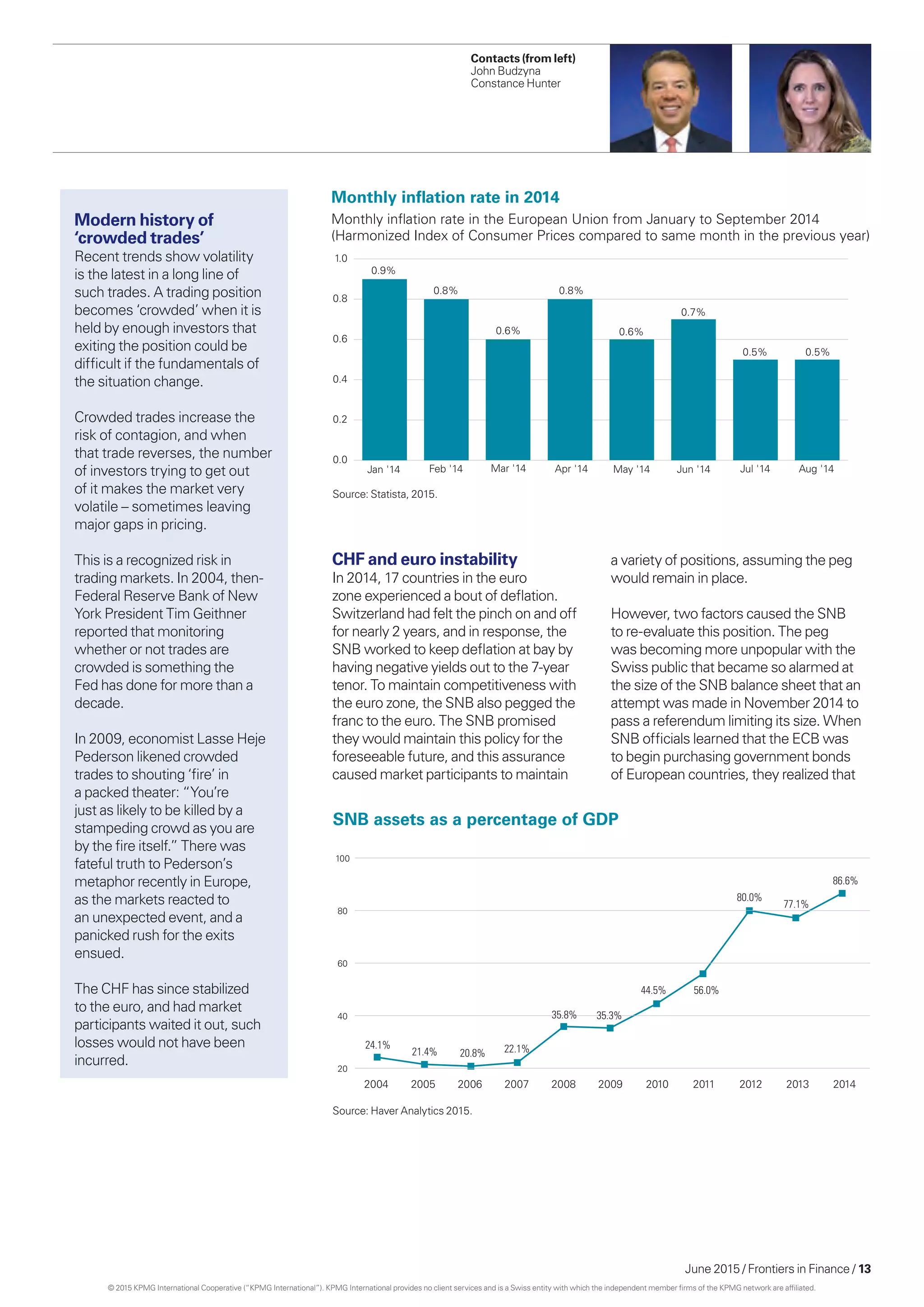
In 2014, 17 countries in the euro
zone experienced a bout of deflation.
Switzerland had felt the pinch on and off
for nearly 2 years, and in response, the
SNB worked to keep deflation at bay by
having negative yields out to the 7-year
tenor. To maintain competitiveness with
the euro zone, the SNB also pegged the
franc to the euro. The SNB promised
they would maintain this policy for the
foreseeable future, and this assurance
caused market participants to maintain
a variety of positions, assuming the peg
would remain in place.
However, two factors caused the SNB
to re-evaluate this position. The peg
was becoming more unpopular with the
Swiss public that became so alarmed at
the size of the SNB balance sheet that an
attempt was made in November 2014 to
pass a referendum limiting its size. When
SNB officials learned that the ECB was
to begin purchasing government bonds
of European countries, they realized that
Source: Statista, 2015.
Source: Haver Analytics 2015.
0.0
0.2
0.4
0.6
0.8
1.0
Jan '14 Feb '14 Mar '14 Apr '14 May '14 Jun '14 Jul '14 Aug '14
0.9%
0.8%
0.6%
0.8%
0.6%
0.7%
0.5% 0.5%
Monthly inflation rate in 2014
Monthly inflation rate in the European Union from January to September 2014
(Harmonized Index of Consumer Prices compared to same month in the previous year)
2004 2005 2006 2007 2008 2009 2010 2011 2012 2013 2014
24.1%
21.4% 20.8% 22.1%
20
40
60
80
100
35.8% 35.3%
44.5% 56.0%
80.0%
77.1%
86.6%
SNB assets as a percentage of GDP
© 2015 KPMG International Cooperative (“KPMG International”). KPMG International provides no client services and is a Swiss entity with which the independent member firms of the KPMG network are affiliated.
14 / Frontiers in Finance / June 2015
Banking
negative yields in Europe would only put
accelerated downward pressure on the
euro versus other currencies in the world,
especially the US dollar and the British
pound. Meanwhile, the market wanted to
be long CHF, putting upward pressure on
it versus the euro. Thus, maintaining a peg
of the Swiss franc to the euro would cost
even more to sustain than it had in the
past. To prevent the balance sheet of the
SNB from growing larger than its already
bloated 86.6 percent of GDP, the decision
was made to end the peg.
Part of the problem was that with interest
rates so low, the Swiss franc was used
as a funding currency for carry trades.
Some carry trades were versus emerging
markets and focused in high-yield
corporate debt, but many were versus
developed markets, including government
debt and high-grade fixed income.
At the same time the ECB decided to
purchase government bonds, the US
Federal Reserve Bank reiterated its
intention to raise short-term interest
rates and begin to normalize monetary
policy. Historically, when the major central
banks of the world engage in opposing
monetary policy actions, market volatility
ratchets higher. As a result, the turbulence
beyond the Swiss exchange rate has been
substantial, particularly with emerging
market currencies, such as the Mexican
peso, which is now trading over 15.
Meanwhile,theeurohaddevalued
20 percentfromlastyear’shighagainstthe
USdollar;theyenwasdown50percent
versustheUSdollarover20months;and
eventheChineseyuanwasallowedtosink
totheverybottomofitstradingrangeversus
theUSdollarinthelastquarterof2014.
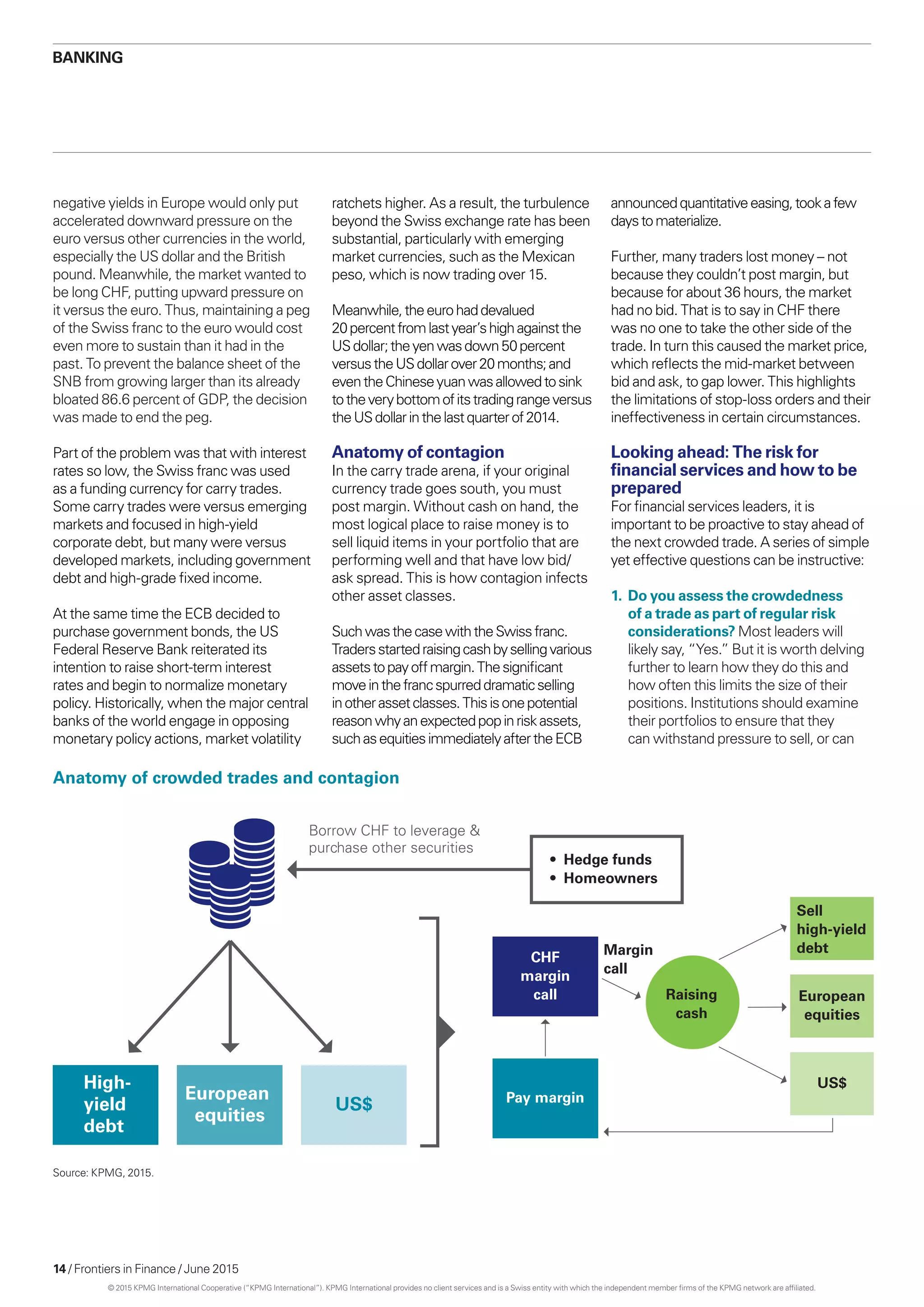
Anatomy of contagion
In the carry trade arena, if your original
currency trade goes south, you must
post margin. Without cash on hand, the
most logical place to raise money is to
sell liquid items in your portfolio that are
performing well and that have low bid/
ask spread. This is how contagion infects
other asset classes.
SuchwasthecasewiththeSwissfranc.
Tradersstartedraisingcashbysellingvarious
assetstopayoffmargin.Thesignificant
moveinthefrancspurreddramaticselling
inotherassetclasses.Thisisonepotential
reasonwhyanexpectedpopinriskassets,
suchasequitiesimmediatelyaftertheECB
announcedquantitativeeasing,tookafew
daystomaterialize.
Further, many traders lost money – not
because they couldn’t post margin, but
because for about 36 hours, the market
had no bid. That is to say in CHF there
was no one to take the other side of the
trade. In turn this caused the market price,
which reflects the mid-market between
bid and ask, to gap lower. This highlights
the limitations of stop-loss orders and their
ineffectiveness in certain circumstances.
Looking ahead: The risk for
financial services and how to be
prepared
For financial services leaders, it is
important to be proactive to stay ahead of
the next crowded trade. A series of simple
yet effective questions can be instructive:
1.	 Do you assess the crowdedness
of a trade as part of regular risk
considerations? Most leaders will
likely say, “Yes.” But it is worth delving
further to learn how they do this and
how often this limits the size of their
positions. Institutions should examine
their portfolios to ensure that they
can withstand pressure to sell, or can
Anatomy of crowded trades and contagion
Borrow CHF to leverage &
purchase other securities
• Hedge funds
• Homeowners
High-
yield
debt
European
equities
US$
CHF
margin
call
Pay margin
Margin
call
Raising
cash
Sell
high-yield
debt
European
equities
US$
Source: KPMG, 2015.
© 2015 KPMG International Cooperative (“KPMG International”). KPMG International provides no client services and is a Swiss entity with which the independent member firms of the KPMG network are affiliated.
June 2015 / Frontiers in Finance / 15
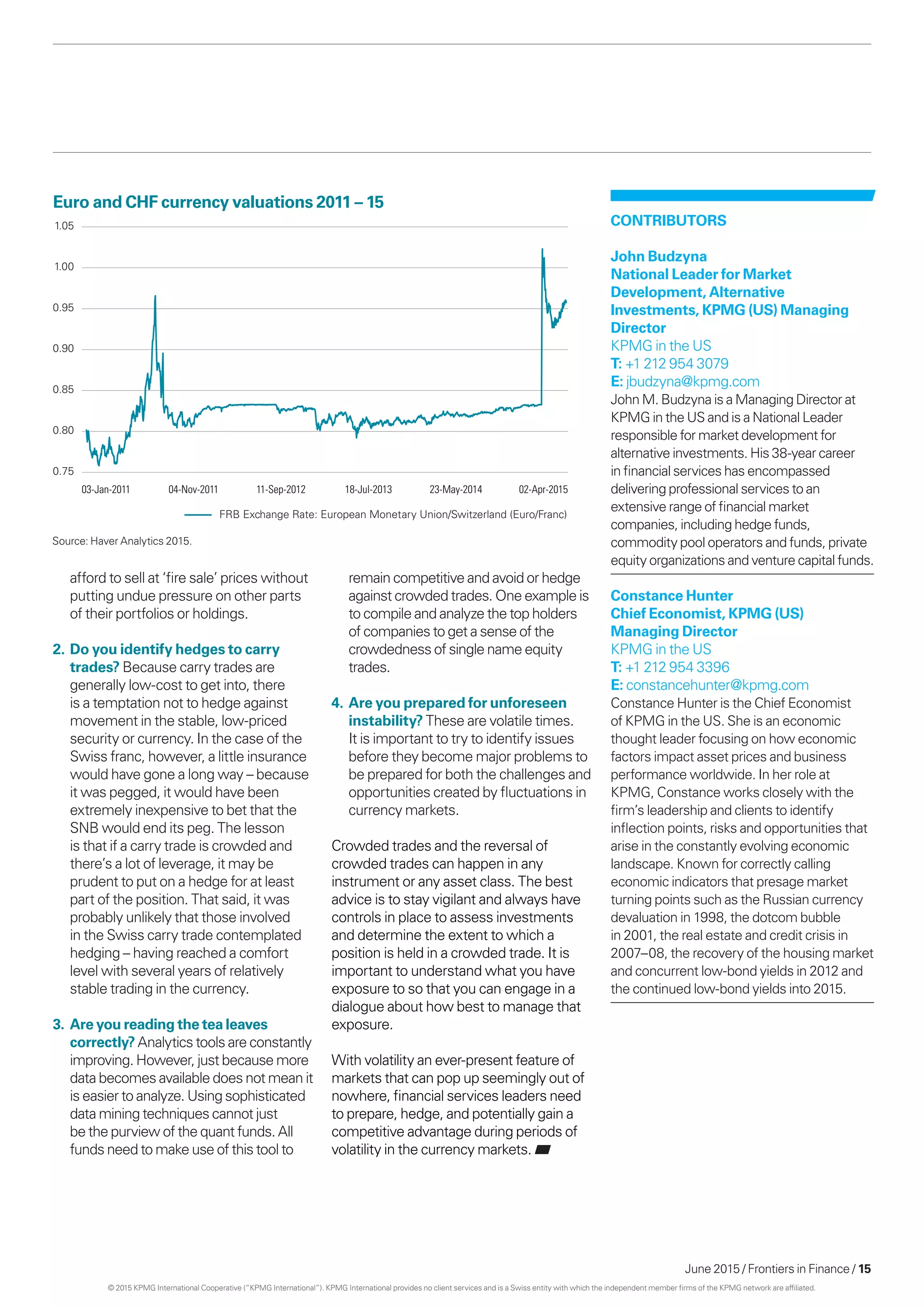
FRB Exchange Rate: European Monetary Union/Switzerland (Euro/Franc)
0.75
0.80
0.85
0.90
0.95
1.00
1.05
03-Jan-2011 04-Nov-2011 11-Sep-2012 18-Jul-2013 23-May-2014 02-Apr-2015
afford to sell at ‘fire sale’ prices without
putting undue pressure on other parts
of their portfolios or holdings.
2.	Do you identify hedges to carry
trades? Because carry trades are
generally low-cost to get into, there
is a temptation not to hedge against
movement in the stable, low-priced
security or currency. In the case of the
Swiss franc, however, a little insurance
would have gone a long way – because
it was pegged, it would have been
extremely inexpensive to bet that the
SNB would end its peg. The lesson
is that if a carry trade is crowded and
there’s a lot of leverage, it may be
prudent to put on a hedge for at least
part of the position. That said, it was
probably unlikely that those involved
in the Swiss carry trade contemplated
hedging – having reached a comfort
level with several years of relatively
stable trading in the currency.
3.	 Are you reading the tea leaves
correctly? Analytics tools are constantly
improving. However, just because more
data becomes available does not mean it
is easier to analyze. Using sophisticated
data mining techniques cannot just
be the purview of the quant funds. All
funds need to make use of this tool to
Euro and CHF currency valuations 2011 – 15
remain competitive and avoid or hedge
against crowded trades. One example is
to compile and analyze the top holders
of companies to get a sense of the
crowdedness of single name equity
trades.
4.	Are you prepared for unforeseen
instability? These are volatile times.
It is important to try to identify issues
before they become major problems to
be prepared for both the challenges and
opportunities created by fluctuations in
currency markets.
Crowded trades and the reversal of
crowded trades can happen in any
instrument or any asset class. The best
advice is to stay vigilant and always have
controls in place to assess investments
and determine the extent to which a
position is held in a crowded trade. It is
important to understand what you have
exposure to so that you can engage in a
dialogue about how best to manage that
exposure.
With volatility an ever-present feature of
markets that can pop up seemingly out of
nowhere, financial services leaders need
to prepare, hedge, and potentially gain a
competitive advantage during periods of
volatility in the currency markets.
Contributors
John Budzyna
National Leader for Market
Development, Alternative
Investments, KPMG (US) Managing
Director
KPMG in the US
T: +1 212 954 3079
E: jbudzyna@kpmg.com
John M. Budzyna is a Managing Director at
KPMG in the US and is a National Leader
responsible for market development for
alternative investments. His 38-year career
in financial services has encompassed
delivering professional services to an
extensive range of financial market
companies, including hedge funds,
commodity pool operators and funds, private
equity organizations and venture capital funds.
Constance Hunter
Chief Economist, KPMG (US)
Managing Director
KPMG in the US
T: +1 212 954 3396
E: constancehunter@kpmg.com
Constance Hunter is the Chief Economist
of KPMG in the US. She is an economic
thought leader focusing on how economic
factors impact asset prices and business
performance worldwide. In her role at
KPMG, Constance works closely with the
firm’s leadership and clients to identify
inflection points, risks and opportunities that
arise in the constantly evolving economic
landscape. Known for correctly calling
economic indicators that presage market
turning points such as the Russian currency
devaluation in 1998, the dotcom bubble
in 2001, the real estate and credit crisis in
2007–08, the recovery of the housing market
and concurrent low-bond yields in 2012 and
the continued low-bond yields into 2015.
Source: Haver Analytics 2015.
© 2015 KPMG International Cooperative (“KPMG International”). KPMG International provides no client services and is a Swiss entity with which the independent member firms of the KPMG network are affiliated.
16 / Frontiers in Finance / June 2015
Bigdata:
The BIG factor driving
competitive advantage
Garrett Flynn, KPMG in the US
James Griffin, KPMG in Australia
Eddie Short, KPMG in the UK
By now, most insurers understand the potential value that big data could deliver
to their organizations. But our experience suggests that few insurers today are
ready to take full advantage of the many opportunities that could be captured with
greater data insights. Thankfully, there are a number of ways that insurers could
start improving their data and analytics capabilities immediately.
Insurance
T
o start the transformational
journey into the type of
data-driven, insight-led
organizations seen in other
sectors, insurers will need to
be bold in their approach. We see several
opportunities for insurers to catalyze
change including reducing the ‘bloat’ and
sprawl of internal data and infrastructure
before starting to add new data into the
mix; instituting a data governance model
that is flexible across the business;
enthusing a culture of experimentation;
and creating an enterprise data
management function that is empowered
to break down internal silos. It will be
critical for organizations to look for ways
to shake-up their business model and
challenge the status quo, while moving
towards profitability-based analytics.
© 2015 KPMG International Cooperative (“KPMG International”). KPMG International provides no client services and is a Swiss entity with which the independent member firms of the KPMG network are affiliated.
June 2015 / Frontiers in Finance / 17
Contacts (from left)
Garrett Flynn
James Griffin
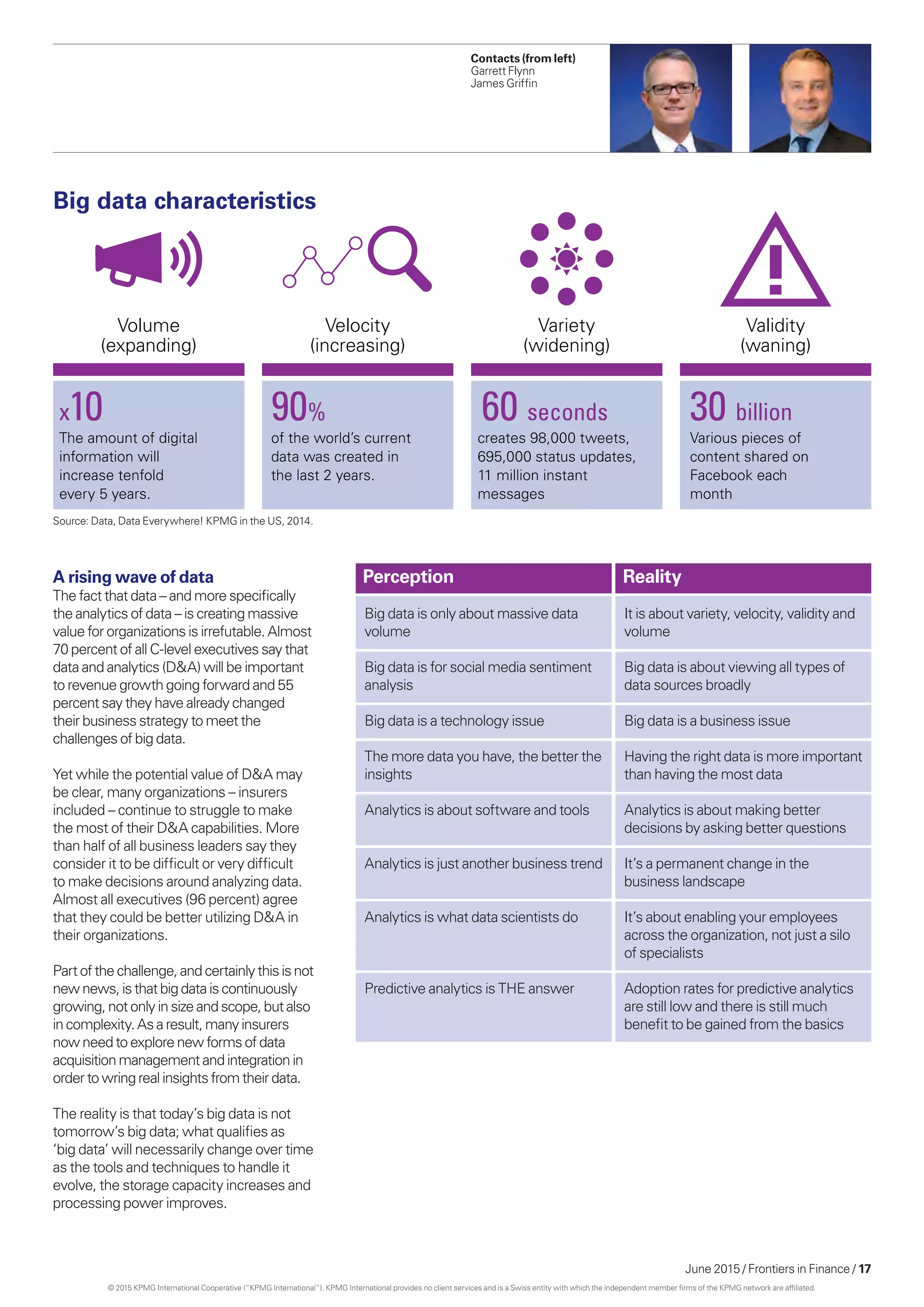
Big data characteristics
Volume
(expanding)
Velocity
(increasing)
Variety
(widening)
Validity
(waning)
x10
The amount of digital
information will
increase tenfold
every 5 years.
90%
of the world’s current
data was created in
the last 2 years.
60 seconds
creates 98,000 tweets,
695,000 status updates,
11 million instant
messages
30 billion
Various pieces of
content shared on
Facebook each
month
A rising wave of data
The fact that data – and more specifically
the analytics of data – is creating massive
value for organizations is irrefutable. Almost
70 percent of all C-level executives say that
data and analytics (D&A) will be important
to revenue growth going forward and 55
percent say they have already changed
their business strategy to meet the
challenges of big data.
Yet while the potential value of D&A may
be clear, many organizations – insurers
included – continue to struggle to make
the most of their D&A capabilities. More
than half of all business leaders say they
consider it to be difficult or very difficult
to make decisions around analyzing data.
Almost all executives (96 percent) agree
that they could be better utilizing D&A in
their organizations.
Part of thechallenge,andcertainlythisisnot
newnews,isthatbigdataiscontinuously
growing,notonlyinsize andscope,but also
incomplexity.Asaresult,manyinsurers
nowneed toexplore newformsofdata
acquisitionmanagementandintegrationin
ordertowringreal insightsfromtheirdata.
The reality is that today’s big data is not
tomorrow’s big data; what qualifies as
‘big data’ will necessarily change over time
as the tools and techniques to handle it
evolve, the storage capacity increases and
processing power improves.
Big data is only about massive data
volume
Big data is for social media sentiment
analysis
Big data is a technology issue
The more data you have, the better the
insights
Analytics is about software and tools
Analytics is just another business trend
Analytics is what data scientists do
Predictive analytics is THE answer
It is about variety, velocity, validity and
volume
Big data is about viewing all types of
data sources broadly
Big data is a business issue
Having the right data is more important
than having the most data
Analytics is about making better
decisions by asking better questions
It’s a permanent change in the
business landscape
It’s about enabling your employees
across the organization, not just a silo
of specialists
Adoption rates for predictive analytics
are still low and there is still much
benefit to be gained from the basics
Perception Reality
Source: Data, Data Everywhere! KPMG in the US, 2014.
© 2015 KPMG International Cooperative (“KPMG International”). KPMG International provides no client services and is a Swiss entity with which the independent member firms of the KPMG network are affiliated.
18 / Frontiers in Finance / June 2015
A world of opportunity
Some of the opportunities are fairly easy
to recognize. Consider, for example, the
insights that could be gained simply by
integrating social media data with claims
data to identify potentially fraudulent
activity (such as pictures of a worker’s
compensation claimant riding a roller-
coaster) or to quickly verify evidence
of flood damage through geo-tagged
photos on Flickr. Claims could be
reduced, liabilities more accurately
assessed and risks better monitored.
Think more broadly, however, and the
possibilities are almost endless. We
recently worked with one insurer to create
a ‘risk dashboard’ that integrates data
from more than 40 different social media
sources to provide real-time monitoring
of a range of risks in key geographies.
Shipping clients, for example, can use the
tool to keep track of storm activity; mining
companies may use the tool to monitor
for political or social unrest around their
operations; infrastructure providers could
use the dashboard to track for service
interruptions.
For the insurer, the tool is a potential
game-changer. Not only does it provide
its customers with the ability to more
actively manage and monitor their risks,
which, in turn, reduces overall risk for the
insurer, it also improves the ‘stickiness’
of its larger corporate customers who
see the service as a significant value-
add. Better yet, the insurer can now also
use the tool (or sell it on as a service)
to proactively warn other customers
of potential risks and emerging issues,
thereby further reinforcing their overall
customer experience.
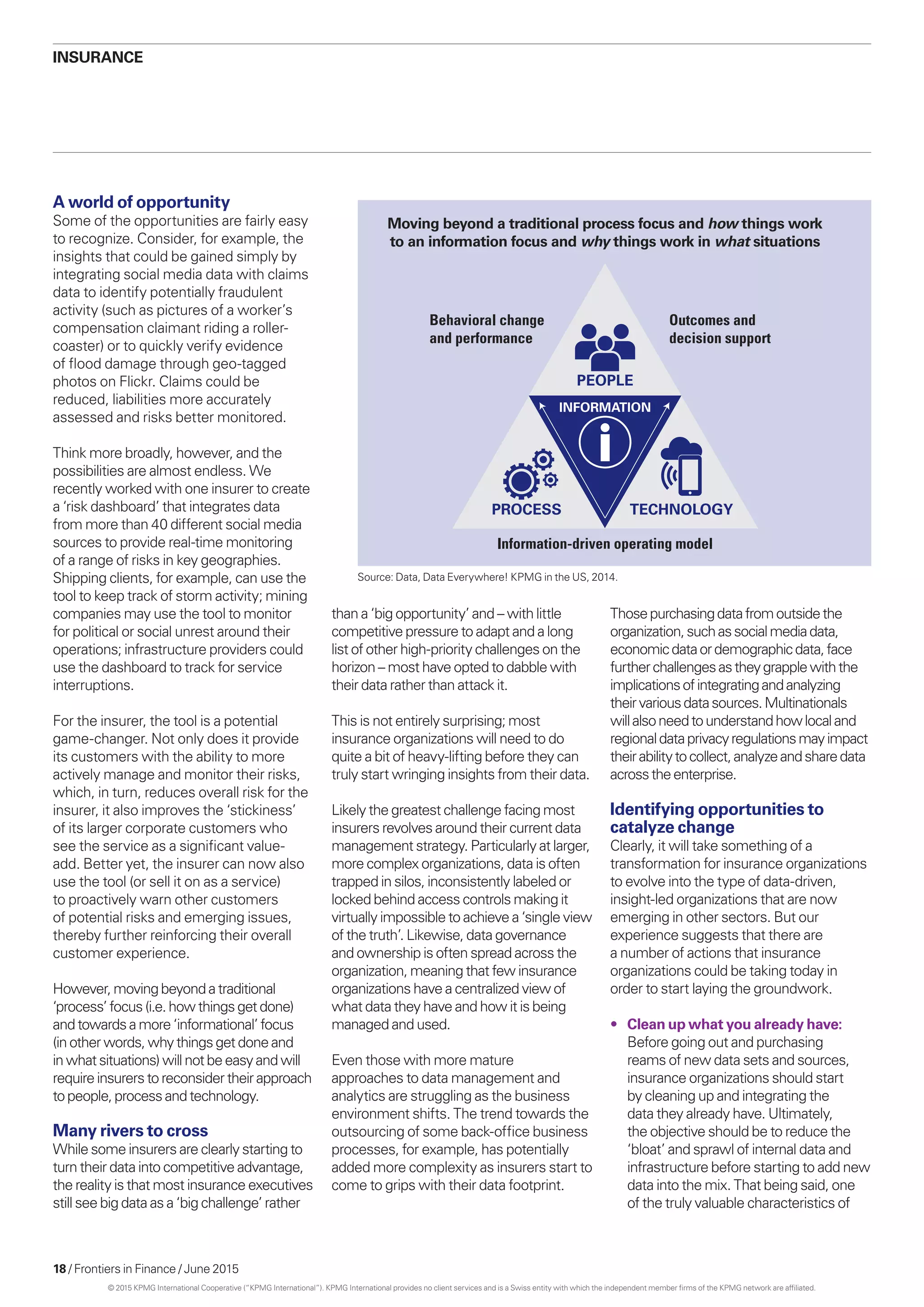
However,movingbeyondatraditional
‘process’focus(i.e.howthingsgetdone)
andtowardsamore‘informational’ focus
(inotherwords,whythingsgetdoneand
inwhat situations)will notbeeasyandwill
requireinsurersto reconsidertheirapproach
topeople,processandtechnology.
Many rivers to cross
While some insurers are clearly starting to
turn their data into competitive advantage,
the reality is that most insurance executives
still see big data as a ‘big challenge’ rather
Behavioral change
and performance
Information-driven operating model
Outcomes and
decision support
PEOPLE
INFORMATION
PROCESS TECHNOLOGY
Moving beyond a traditional process focus and how things work
to an information focus and why things work in what situations
Thosepurchasingdatafromoutsidethe
organization,suchassocialmediadata,
economicdataordemographicdata,face
furtherchallengesastheygrapplewiththe
implicationsofintegratingandanalyzing
theirvariousdatasources.Multinationals
willalsoneedtounderstandhowlocaland
regionaldataprivacyregulationsmayimpact
theirabilitytocollect,analyzeandsharedata
acrosstheenterprise.
Identifying opportunities to
catalyze change
Clearly, it will take something of a
transformation for insurance organizations
to evolve into the type of data-driven,
insight-led organizations that are now
emerging in other sectors. But our
experience suggests that there are
a number of actions that insurance
organizations could be taking today in
order to start laying the groundwork.
•	 Clean up what you already have:
Before going out and purchasing
reams of new data sets and sources,
insurance organizations should start
by cleaning up and integrating the
data they already have. Ultimately,
the objective should be to reduce the
‘bloat’ and sprawl of internal data and
infrastructure before starting to add new
data into the mix. That being said, one
of the truly valuable characteristics of
Insurance
than a ‘big opportunity’ and – with little
competitive pressure to adapt and a long
list of other high-priority challenges on the
horizon – most have opted to dabble with
their data rather than attack it.
This is not entirely surprising; most
insurance organizations will need to do
quite a bit of heavy-lifting before they can
truly start wringing insights from their data.
Likely the greatest challenge facing most
insurers revolves around their current data
management strategy. Particularly at larger,
more complex organizations, data is often
trapped in silos, inconsistently labeled or
locked behind access controls making it
virtually impossible to achieve a ‘single view
of the truth’. Likewise, data governance
and ownership is often spread across the
organization, meaning that few insurance
organizations have a centralized view of
what data they have and how it is being
managed and used.
Even those with more mature
approaches to data management and
analytics are struggling as the business
environment shifts. The trend towards the
outsourcing of some back-office business
processes, for example, has potentially
added more complexity as insurers start to
come to grips with their data footprint.
Source: Data, Data Everywhere! KPMG in the US, 2014.
© 2015 KPMG International Cooperative (“KPMG International”). KPMG International provides no client services and is a Swiss entity with which the independent member firms of the KPMG network are affiliated.
June 2015 / Frontiers in Finance / 19
big data is that organizations can often
start identifying important insights from
data sets that aren’t technically ‘clean’,
meaning that big data can quickly
and easily be overlaid on top of the
organizations existing (and clean) data.
•	 Develop a data governance model:
With dozens of data warehouses and
often blurred lines of data ownership,
most insurance organizations will need
to focus on creating an enterprise-
wide approach to data governance
that provides flexibility to the business
while also giving consistency in the
standards and controls guiding data
usage. Those hoping to eventually start
leveraging big data and external sources
may want to consider developing a
‘hybrid’ governance model that provides
different controls for proprietary
information (such as core CDCs) versus
external data.
•	 Createan enterprise data
management function: Whilemany
insurance organizationsalreadyhave
someform ofdatastewardshipfunction,
suchasachiefdata officer,mostare
rathersingle-mindedlyfocusedon
creatingpoliciesratherthanimproving
informationflowandusage.Insurers
maywanttoconsidercreatingan
enterprise datamanagementfunction
that can actasabridgebetweenIT,the
businessandthe datatohelpensure
that the rightinformationisbeingused–
consistently–acrosstheorganization.
Ideally,the enterprise datamanagement
groupwouldbe empoweredasthe
primarysourceforall datarequeststhat
come fromthe business.
•	 Build a culture of experimentation:
Given the level of regulation governing
the insurance sector, it is not surprising
that most organizations tend towards
a more risk-averse corporate culture.
What this means, however, is that
few employees or business units
feel incentivized to innovate. Those
seeking to encourage new ideas and
approaches will want to consider
how they might implement a culture
of experimentation that recognizes
the fact that some projects will fail
and therefore provides employees
and business units with the right
guidelines – and the flexibility – to safely
test out new approaches.
•	 Look for the blue sky: Rather than
trying to force your data to tell you
things you already know about your
business, focus your attention on
creating new areas for improvement or
value creation. Whether opportunities
are found in commercializing your
existing data and insights or in
leveraging your data to develop
entirely new products and services
that suit more targeted demographics,
insurance organizations should be
looking for ways to use their data to
shake-up the business model and
transform the status quo.
•	 Move towards probability-based
analytics: When dealing with big data,
the key to driving insights is being able
to eliminate the 95 to 99 percent of
information that isn’t relevant to your
needs (i.e. the ‘noisy data’). This can’t
be accomplished through traditional
root cause or ‘regression’ analytics;
finding value in big data will require
insurers to understand, and embed,
probability-based approaches and
techniques into their core data and
analytics capabilities.
•	 Make sure you are asking the right
questions: Getting useful insights
from your data all depends on your
ability to ask the right questions. But
it also means being able to identify
which questions you can’t currently
answer with your existing tools and
techniques. However, if insurers invest
in identifying the right questions to ask
of big data – and then couple the right
questions with smart probability-based
analytics – insights can start to flow
very quickly.
At the end of the day, the biggest
technology risk for insurers is that they
are left behind in the race to turn data
into insights and insights into value. Our
experience suggests that it will be those
that are able to create the right environment
and governance models to support data-
driven experimentation and exploration
that will win in the more customer-centric
insurance model of the future.
Given the pace of change in the market,
those who continue to merely ‘dabble’
with their data may soon find it difficult to
catch up.
CONTRIBUTORS
Garrett Flynn
Principal
KPMG in the US
T: +1 312 665 1608
E: gflynn@kpmg.com
Garretthas spenthiscareerhelping
organizationstransformtheirbusinessthrough
carefullyplannedandeffectivelyexecuted
ITandprocessenablement.Hehasworked
withnationalandglobalorganizationsto
bothmanageanddeliverlargeprograms
thatfocusedontheintegrationofbusiness
function,process,technology,dataand
people.
James Griffin
Director, Risk Consulting
and Innovation Practice
KPMG in Australia
T: +61 2 9346 5402
E: jgriffin1@kpmg.com.au
James has worked with many of the
world’s leading corporations, government
departments and political leaders to help
them understand the opportunities and
challenges they face from digital disruption,
in particular social media. He has been the
recipient of the ‘Young Business Person
of the Year’ award from Australia’s largest
Chamber of Commerce, the NSW Business
Chamber. James joined KPMG Australia as
part of its acquisitionofSR7.
Wondering whether it is
better to buy, lease or build
new technology solutions to
garner data insights? Read our
article on page 31, Tapping
into Insurance FinTech.
© 2015 KPMG International Cooperative (“KPMG International”). KPMG International provides no client services and is a Swiss entity with which the independent member firms of the KPMG network are affiliated.
20 / Frontiers in Finance / June 2015
Chief dataofficers:
Nick Urry, KPMG in the UK
Robert Parr, KPMG in the US
The stage is set for chief data officers (CDOs) to bring much-needed direction to banks’ data
management strategies, helping them remain compliant and unleash the commercial potential
of information.
The next generation of leaders
transforming banks
I
t has often been said of organizations
that ‘people are our greatest asset’.
Substitute the word ‘people’ with ‘data’
and many bank chief executive officers
(CEOs) would nod in agreement.
But, if data is so important, why have
banks struggled to make the most of this
precious yet abundant resource?
Whether reporting to regulatory authorities,
or providing analysis and support for
trading, investment, risk management and
loan decisions, banks and other financial
institutions routinely suffer from incomplete
data from a huge number of sources in
an equally wide range of forms. For many
institutions, this results in slower response
times, higher costs, loss of trust, increased
regulatory scrutiny and missed business
opportunities.
A CDO can help fill this vacuum, offering
a central point of contact and providing
the coordination necessary to enable data
stewardship and, ultimately, data quality
across the organization. Through common
structures, standards and processes, he
or she works with the lines of business
and functions to guide the flow of data
and ensure it is up-to-date, accurate
and consistent for both regulatory
submissions and as vital intelligence to
inform critical management decisions.
CAPITAL MARKETS
© 2015 KPMG International Cooperative (“KPMG International”). KPMG International provides no client services and is a Swiss entity with which the independent member firms of the KPMG network are affiliated.
June 2015 / Frontiers in Finance / 21
and second order risks created by political
and economic events, for example, the
Ukraine or Greece crises. These stressed
scenarios need to be accurately and
consistently assessed within different
banking divisions of a global bank as well
as within different banking entities or
specific country boundaries. Global banks
have multiple lines of business, yet capital
and liquidity are often managed at group
or worldwide level. With local regulators
taking an increasing interest in risk, country
or business unit managers can find it hard
to access the right information and may
find it impossible to manage the required
transformation to the underlying data
architecture or processes. This is where
the chief data officer can play a significant
role in co-ordinating the activities of data
owners, data stewards and data architects
to create the target state data architecture
and to influence the portfolio of change
projects to create an effective delivery
roadmap and to manage convergence to
the roadmap across a global bank.
Additional regulations on transactional
reporting can put a huge strain on fragile
systems. In a trading environment, it
is not unusual to see millions of trades
a day, each of which must have an
accurate time recording. Failure to meet
such requirements, or prove that controls
are in place to spot discrepancies, can lead
to fines and higher capital limits that push
up costs.
In the fast-moving banking environment
or trading room, it is easy for incorrect
data to be entered, and worse still, be
labeled in a multitude of ways, making it
extremely difficult to trace. As multiple
extracts use this source data and
proliferate it to various warehouses,
models and reports, the error is then
multiplied a hundred- or thousand-fold.
Onboarding new clients through a (largely
manual) Know Your Customer (KYC)
process provides similar scope for error.
Rather than catch discrepancies at point
of entry, financial institutions devote
valuable resources and cost trying to
unravel a trail at the data warehouse.
Often resorting to social networks or
word of mouth, analysts can spend
a significant proportion of their time
in relatively low-level detective work,
finding, fixing and presenting data – time
that would be better spent on delivering
insights that could drive the business
forward.
Establishing accountability for
data beyond the CIO
As data proliferates at a meteoric rate,
most, if not all, banks lack a person or
team responsible for assuring quality and
standardization of inputs and outputs, and
coordinating information across complex
organizational structures. The chief
information officer (CIO) may be assumed
to be the go-to person, but he or she is
typically not a data expert and is unlikely
The lack of a
coordinated
approach to data
management across
countries, lines and
functions has real
demonstrative cost
to the institution.
Contacts (from left)
Nick Urry
Robert Parr
Keeping on the right side of the
regulators
Sincetheglobal financialcrisis, thehand
of riskhasweighed heavyonthefinancial
servicessector,withorganizationsunder
constant pressuretodemonstratesound
riskmanagement.Regulatorsexpect
accurateandcomplete reporting,signed
offat boardlevel,to proveanabsenceof
unauthorized trading andcorruption,suchas
fixing LIBORor foreign exchangerates,or
moneylaundering.Providingtransparency
todatalineageanddataqualitycontrolsis
anessential element.Regulatorsexpect
accurateandcomplete reportingthatcovers
allofthe majorrisksandappropriately
informsdecision-making.Theyalso
expectthatanymaterial inaccuraciesor
deficienciesinthe qualityorcompleteness
of areportwill be highlightedtothe
recipient,where‘material’deficiencymeans
that itwouldhave impactedonthedecision.
Theregulatorsandexecutivemanagement
arealsoexpectingthatdatawill beavailable
toprovideearlyidentificationofactivities
such asunauthorized trading,ratefixing,
moneylaundering,corruption,insider
trading,misreportingoftransactions,etc.,
bothtoavoid directlossesbutalsotoavoid
thesignificantregulatorypenalties that
haveoccurred recently.Thisrequiresboth
accuratereportsand highqualitydata,
combinedwitheffectiveandpragmaticdata
ownership andgovernance.
Wary of the potential for future
catastrophes, authorities also want
evidence that banks can avoid crises –
or react appropriately should the worst
happen. This needs to reflect the first
Key responsibilities of a CDO
Increasingly the CDO will sit outside of IT. Many bank CDOs will sit within risk or
another non-IT area of the bank as recognition of their need to be independent
from technology. In general, their key areas of focus include:
•	 collaborating with lines of business and functions; defining strategic priorities
for data; identifying data capabilities to support new business opportunities
•	 managing a technology team focused on building, maintaining and evolving
the data supply chain
•	 overseeing enterprise data programs and capital investments aimed at
enhancing the data supply chain either through tools or new processes
•	 governingthedatasupplychainbyimplementingenterprise-widedata
governancestandards,creatingtransparencyfromlinesofbusinesstotheboardfor
criticaldata
•	 advocating and evangelizing the strategic value of data and linking that to the
needed business disciplines and required capacity
•	 building analytic communities across the organizational scope.
© 2015 KPMG International Cooperative (“KPMG International”). KPMG International provides no client services and is a Swiss entity with which the independent member firms of the KPMG network are affiliated.
22 / Frontiers in Finance / June 2015
to have a mandate to control the way that
data is managed. This individual owns
the information technology (IT) people,
architecture, equipment and budget, and
sets the technical direction, but lacks the
critical levers to govern and control data
quality at the source.
The individuals that enter data typically
will not report to the CIO, nor to the
Finance team that prepare reports for the
regulator, management and the board.
Ownership and responsibility for data
should rest jointly with business owners,
modelers of source data in finance
and risk management, and the initial
‘producers’ of the data in the front office.
But who can guide them?
Enter the CDO. As a ‘custodian’, rather
than an owner of data, this person and
their team creates a more accurate,
orderly and up-to-date information flow
from the source (point of input) to the
point of consumption (reports, models,
analysis, dashboards). Most bank
regulators are actively advocating for this
central point of contact.
The CDO needs to work in conjunction
with IT and the business to:
•	 engage businesses and functions to
build ownership and competency in
data stewardship
•	 craft an integrated data strategy
focusing on the capabilities across
the data supply chain covering
infrastructure, roles and organization,
processes and standards, advanced
analytics and reporting
•	 develop funding models for shared
capabilities and align with project
funding processes
•	 define, fund and oversee the
implementation of the new
capabilities
•	 develop data governance and quality
standards, processes, measurement
and decision rights
•	 enhance overall analytic efficiency
and competency within finance, risk
Why the CDO?
Chief data officer on the rise
Key responsibilities
+100
2x
17%
25%
In 2014, there were more than 100 chief data
officers in large global companies.
The number of large global company CDOs
has already doubled since 2012.
By the end of 2014, 17% of larger
organizations plan to have a CDO, requiring
CIOs to adjust their role expectations.
More than 25% of CDOs are female.
Managing a
technology team
focused on
building and
evolving the data
supply chain.
Creating
transparency,
greater levels of
quality and reuse
of critical data.
Building
analytic
communities
across the
organizational
scope.
CAPITAL MARKETS
and lines of business by reducing time
spent finding and fixing data after an
error is spread.
Value – broader than the
foundational plumbing
The structure, effort and alignment
enabling data quality is often below the
waterline. Many organizations struggle to
articulate the value beyond establishing
basic discipline around data quality to
enable regulatory and management
confidence in data quality. In fact, through
their role, CDOs have line of sight into
efficiencies in the area of third party data
spend (e.g. payment and credit bureaus)
and sourcing simplification to name a
few. But the value and momentum is felt
the greatest through finance, risk and
the lines of business where the CDO is
focused on improving analyst cycle times
and model development efficiency – this
leads to improved targeting, pricing, more
predictive credit and liquidity models, and
better capital planning that can all have
dramatic impacts on the bottom line.
Source: Gartner, CIO Advisory: The Chief Data Officer Trend Gains Momentum, Jan 2014.
© 2015 KPMG International Cooperative (“KPMG International”). KPMG International provides no client services and is a Swiss entity with which the independent member firms of the KPMG network are affiliated.
June 2015 / Frontiers in Finance / 23
CONTRIBUTORS
Nick Urry
Partner
Management Consulting
KPMG in the UK
T: +44 20 76942330
E: nick.urry@kpmg.co.uk
Nick is the Partner responsible for KPMG in
the UK’sTechnology Enablement Practice
and has been working in banking for
over 25 years. He has a specific focus on
strategic data architecture projects and on
transformational projects in data quality, data
governance and data management at global
banks. In the last 5 years, he has worked
extensively on finance, risk and treasury
data architectures, and risk data aggregation
and reporting (BCBS 239), either working
for management or as independent quality
assurance on behalf of regulatory authorities.
Robert Parr
Managing Director
Banking Data Strategy and
Operations
KPMG in the US
T: +1 312 665 8410
E: rparr@kpmg.com
Bob is a Managing Director with over
22 years of banking and financial services
experience in both the US and Canada
and a leader of the US Banking and Capital
Markets Data Governance and Quality
Solution. He hosts KPMG’s North American
Data Share Forum that brings 15 financial
services CDOs together every 6 months to
discuss current issues in this space.
Do you need a CDO?
•	 Take a collection of your most critical regulatory submissions and
reports: Are your data quality controls sufficient across your supply
chain from source to warehouse, to models, and are you confident that
you know the underlying data is sound? Is there a string of unbroken
accountability from source to report?
•	 When the regulators want to talk about data, is there a central point of
contact and accountability?
•	 Are analysts spending a significant portion of their time finding and
fixing the data underlying these reports?
•	 Do you have a common repository for metadata (information about your
data) that can be leveraged by analysts across each of your business
functions?
Successful CDOs focus on
transformation not just
implementation
With all the moving parts involved in data
management, it’s easy to plan and treat
this like another technical implementation.
However, a long list of failed attempts
across the industry show otherwise.
Rather, those CDOs that focus on the
transformative nature of what they are
doing – focus on building engagement and
adoption across the C-suite on down –
recognize the trade-offs that will have to be
made and the need to work the complete
data supply chain. The focus needs to be
on people, processes and technology, in
that order.
The role of CDO is not for the faint
hearted. It requires patience and
persistence, plus an ability to exercise a
high degree of influence, often without
formal authority. The CDO must possess
excellent communication and networking
skills, to work across the business at both
senior and junior levels. They have to
understand the organizational data value
chain and foster a structured, sustainable
approach to data management, with
appropriate controls, providing oversight
of enterprise data programs and
implementing enterprise-wide data
governance that is ingrained into the
management fabric.
By forging a perception of data as a vital
business asset that can drive revenue
and reduce costs, the CDO acts as an
evangelist, helping leaders understand
their roles and accountabilities in
maintaining high quality data.
Such a rare individual must possess a
unique combination of strategic and
operational capabilities along with change
management skills, topped up with a
tremendous drive to push through new
ideas and ways of working that will
stretch the organization and its people.
If successful, the notion that ‘data is our
most valuable asset’ should be more than
just hot air, and will reflect an organization
that truly understands and appreciates the
links between data and business value.
Although not all financial institutions
have chosen to appoint a CDO, such
a position has enormous potential to
speed up response times to regulatory
demands, reduce data management
costs and use information to drive
important strategic decisions.
© 2015 KPMG International Cooperative (“KPMG International”). KPMG International provides no client services and is a Swiss entity with which the independent member firms of the KPMG network are affiliated.
24 / Frontiers in Finance / June 2015
Achanging
future
As the environment for alternative investments continues to evolve, hedge fund managers are
rethinking their products, fee structures and investor mix to refocus on institutional investors –
particularly pension funds. But, at the same time, the world’s pension funds are also starting
to shift their investment criteria and objectives, creating new demands on the managers they
choose to invest with. Clearly, the long-term impacts will be significant for both hedge fund
managers and their investors.
Robert Mirsky, KPMG in the US
Aidan Dunne, KPMG in the US
investment management
1 Growing Up: A New Environment for Hedge Funds, KPMG/AIMA/MFA, 2015.
Hedge funds
and institutional
investors:
New investors, new dynamics
The fact that hedge fund investor
demographics and types are changing
should come as no surprise to
managers around the world. The shift
towards institutional investors has
been evident for some time. However,
recent evidence suggests that most
hedge fund managers now believe that
institutional investors – pension funds
in particular – will soon become their
largest investor group.
Many expect the shift to happen quickly.
Indeed, according to a recent report
published by KPMG, the Alternative
Investment Management Association
(AIMA) and the Managed Funds
Association (MFA),1
most managers
© 2015 KPMG International Cooperative (“KPMG International”). KPMG International provides no client services and is a Swiss entity with which the independent member firms of the KPMG network are affiliated.
June 2015 / Frontiers in Finance / 25
expect to see a significant shift in their
primary sources of capital over the next
5 years.
The change in investor demographics will
be remarkable. Slightly less than a quarter
of respondents (23 percent) said that – by
2020 – corporate pension funds would
be their primary source of capital while
21 percent said they expected public
pension funds to be their primary source
of capital in 5 years. Only 13 percent
pointed to high net worth investors
(hitherto the ‘bread and butter’ of hedge
fund management) and just 10 percent
pointed to family offices as their primary
source of capital in the future.
Source: Growing Up: A New Environment for Hedge Funds, KPMG International, 2015. (Top 5 responses.)
23%
Corporate pension funds
23%
54%
12%
32%
Public pension funds
21%
31%
6%
24%
6%
High net worth
13% 21%
8%
Family offices
10%
13%
Fund of funds
9% 9%
All respondents Small HFs < $500m Medium HFs $500m–$1bn Large HFs > $1bn
Corporate and public pension funds will be the primary
sources of investment for medium and large hedge funds
over the next 5 years
Hedge fund managers have good reason
to shift their long-term focus towards
pension funds. Isolated high-profile exits
aside, all evidence suggests that most
pension fund managers are committed
to maintaining alternative investments
as part of their investment portfolio.
However, if hedge fund managers hope
to secure part of the anticipated funding,
it is clear they will need to dramatically
change their models, structures and
products to meet the needs of their new
investment audiences.
Shifting strategies and structures
To start, hedge fund managers will need
to rethink whether their current fund
The fact that hedge
fund investor
demographics and
types are changing
should come as no
surprise to managers
around the world.
The shift towards
institutional investors
has been evident for
some time.
strategies are suitable for attracting these
new investors. The reality is that many
institutional investors have been focused
on cutting their investment management
costs for some time now, and this has
already had a significant impact on the
hedge fund sector.
In some cases, pension funds have
conducted a general consolidation of
investments towards a smaller number
of large (and, therefore, presumably less
risky) managers. While this trend towards
fewer investments may make life easier
for investment managers, it will likely
also make it more difficult for new and
smaller managers. With this in mind,
three-quarters of respondents said that
they expect the number of hedge fund
managers to either decrease or stay the
same over the next 5 years.
For other pension fund managers, cost
cutting has focused on negotiating more
flexible fee arrangement. Management
fees, in particular, seem set to fluctuate
with the vast majority (84 percent)
of hedge fund managers now saying
they expect to compromise on fee
arrangement over the next 5 years. That
being said, our experience also suggests
that – while pension fund managers are
now pushing back on high management
fees and questionable expenses –
Contacts (from left)
Robert Mirsky
Aidan Dunne
© 2015 KPMG International Cooperative (“KPMG International”). KPMG International provides no client services and is a Swiss entity with which the independent member firms of the KPMG network are affiliated.
26 / Frontiers in Finance / June 2015
agree
84%
91%
85%
Small
Hedge funds
Medium
Hedge funds
76%
Large
Hedge funds
80%
86%
North America
Europe
79%
Asia Pacific
Over the next 5 years,
customized fee structures
are expected to be more
prevalent
Source: Growing Up: A New Environment for
Hedge Funds, KPMG International, 2015.
most are still willing to compensate
handsomely for the right levels of
performance.
Both investors and managers must
remember, however, that pressure to
reduce fees must be balanced against
expectations for performance. Simply
put, to attract the brightest talent, hedge
funds need to offer above-average
compensation, and to do that, they
need secure fee income. Squeeze fees
too far, therefore, and performance will
likely suffer.
A future of customized strategies
Hedge fund managers will also find
that pension funds are increasingly
focusing on securing highly customized
products – such as funds of one and
managed accounts – rather than
participating in co-mingled funds and
limited partnerships.
These realities are not lost on the
hedge fund sector. Almost two-thirds
(64 percent) of respondents said they
were witnessing increased demand for
‘solutions’ such as managed accounts
and funds of one from their investors.
And managers are responding:
44 percent say they already offer
customized solutions to their investors
and a further 22 percent say they are
preparing to do so.
Over the next decade, we expect to
see customization become increasingly
commonplace in the hedge fund sector.
Indeed, our experience working with
pension funds and other institutional
investors suggests that investment
managers are becoming less concerned
about the specific asset class they are
buying, preferring instead to focus on
investing in whatever asset class will
provide the right risk, fees and returns
to fill specific gaps in their portfolios. If
hedge fund managers hope to compete
for that investment, they will need to
customize their products to suit their
investors’ needs.
More transparency, new targets
The shift towards institutional investors
will also force hedge fund managers
to rethink their performance targets
and reporting processes. Pension
funds (particularly public ones) and
most sovereign wealth funds demand
significant transparency from their
managers; some may struggle to
meet the more stringent reporting
requirements of these investors.
Interestingly, greater participation by
institutional investors may also change
the return profile of the industry, as
pension funds opt for lower-volatility and
more stable returns, driven largely by the
desire to lower the risk for pensioners.
Indeed, many pension funds aim for
targets of 7 to 8 percent, which requires
a different approach from the traditional
hedge model of high returns with higher
volatility.
Recognizing the potential for increased
scrutiny from institutional investors,
almost half (46 percent) of the
respondents in our survey said they
worried about the potential impacts
of underperformance, while four in 10
said they saw pricing pressures as a
significant barrier to future growth.
Does size matter?
It’s not just large funds that are gearing
up to attract new investor types and
demographics; smaller funds also report
shifting towards greater customization
of fees and products to suit new investor
audiences. More than a quarter of
smaller funds already say they offer a
fund of one solution. More than half say
they plan to offer one within the next
5 years.
However, the reality is that most larger
pension funds and institutional investors
investment management
© 2015 KPMG International Cooperative (“KPMG International”). KPMG International provides no client services and is a Swiss entity with which the independent member firms of the KPMG network are affiliated.
June 2015 / Frontiers in Finance / 27
tend to cap their investments as a
certain percentage of the manager’s
total assets under management (AUM),
meaning that many smaller managers
may not be able to compete on their
own for a share of the anticipated
institutional investments (a 10 percent
cap on a $30 million AUM manager,
for example, allows only a $3 million
investment, far below the usual
investment threshold for many larger
institutional investors).
Looking ahead, platforms seem to offer
a strong solution for both smaller hedge
funds seeking to attract institutional
investors and for institutional investors
looking to tap into new sources of talent.
Most of today’s platforms provide a full
suite of investor services – from the
due diligence on the underlying fund
managers through to the audit and tax
processes – making it fairly easy for
institutional investors seeking to reduce
complexity.
Managers of smaller funds understand
this and increasingly recognize the long-
term need to leverage platforms to attract
new investors. One in five managers
of smaller funds said they would use
platforms as their preferred method for
launching new products into the market
(versus just 8 percent of medium funds
and 3 percent of larger funds).
The future state of the industry
Clearly, the hedge fund sector is in the
midst of an era of unprecedented change.
Institutional investors will continue to
eclipse high net worth individuals as the
industry’s primary sources of investment.
Traditional fee arrangements will erode
in the face of more customized models.
And new markets will emerge both as
investment destinations and as potential
customers. It is also likely that larger
investors will increasingly turn to specialist
programs aimed at finding emerging
managers.
Against this backdrop, we believe
that assets currently considered as
‘alternative investments’ will soon
become more mainstream as products
become more available across multiple
platforms and through to retail investors.
When combined with the cost of
regulation, we expect to see increased
use of technology within the sector as
smaller funds start to band together to
achieve the mass they require to attract
institutional investors.
Change will also come to the institutional
investors themselves as the current
approach shifts quickly towards a more
bespoke model within the next 5 to
10 years. Partly as a result, we may start
to see co-mingled funds disappear as
part of institutional investors’ portfolios.
It is also likely that larger investors will
increasingly turn to specialist programs
aimed at finding emerging managers.
Small investors, family offices and
high net worth individuals, though, are
expected to continue to invest in
co-mingled funds.
We believe that the increasingly rapid shift
towards pension funds, in particular, will
catalyze significant changes in the way
that managers structure, manage and
market their products in the long-term. So,
too, will the opening up of Asian markets,
as funds from mainland China start to
flood into the market.
What is clear is that hedge fund
managers and their investors will need
to start working closer together to
develop the right products with the right
returns in the right markets to achieve
everyone’s future objectives. And as
customization becomes more accepted,
managers will need to think seriously
about how these arrangements
impact their business models and fund
strategies going forward.
CONTRIBUTORS
Robert Mirsky
Principal, Tax, FS Asset Management
KPMG in the US
T: +1 212 954 6162
E: robertmirsky@kpmg.com
Robert is a senior alternative investment
management professional and Global Head
of KPMG’s Hedge Fund Practice. Robert
recently moved to the US firm from the UK
member firm, based in London, where he
spent the last 10 years. In the UK, he also
worked with KPMG in a similar capacity.
Aidan Dunne
Partner, Audit, Asset Management
KPMG in the US
T: +1 415 963 7881
E: adunne@kpmg.com
Aidan has over 15 years of experience serving
primarily financial services companies
including commercial and community banks,
investment banks, broker-dealers, investment
partnerships, venture funds, investment
advisors and mutual funds.
© 2015 KPMG International Cooperative (“KPMG International”). KPMG International provides no client services and is a Swiss entity with which the independent member firms of the KPMG network are affiliated.
28 / Frontiers in Finance / June 2015
I
n the same vein, when Alex ‘Sandy’
Pentland published his research on
social physics last year, business
leaders in a variety of sectors paid
attention. People had already been
talking about Sandy’s team at the
Massachusetts Institute of Technology
(MIT); his approach to social physics helped
his team win the highly publicized DARPA
Network Challenge in 2009, proving that
social networks can be leveraged as a
powerful source of information and sharing.
His recent book on the topic, entitled
Social Physics: How Social Networks
Can Make Us Smarter, was selected
by Strategy + Business as a Best Book
in Business Innovation. The Economist
described the book as “filled with rich
findings about what makes people
tick ... a fascinating look at a new field by
one of its principal geeks.” In 2012, Forbes
named Sandy as one of the seven most
powerful data scientists in the world.
I recently exchanged views with Sandy
to talk about his book and to find out how
his powerful ideas can be applied to the
banking sector. Here is what he had to say.
DS: Your book has received fantastic
reviews from business leaders and
publications around the world. What
exactly is ‘social physics’, and why is
the concept becoming increasingly
important to business leaders today?
SP: I think the book and the concept have
captured business leaders’ attention
because social physics offers an entirely
different way to improve businesses at
a time where technology and change
are putting extreme pressure on
organizations.
Simplyput,socialphysicsisanewwayof
understandinghumanbehaviorbyusingbig
data –essentiallythe‘digitalbreadcrumbs’
ofsociety –totellusmoreaboutallaspects
ofhumanlifeandhowideasmove,evolve
andspread.Forbusinesses,thisunlocks
allsortsofamazingpossibilitiesandoffers
apathtowardsbuildingmorecooperative,
productiveandcreativeorganizations.
Andthatmeansmoreresilientandmore
profitableorganizationsasaresult.
Today, people tend to view management
as an ‘art’. Social physics takes this art
and turns it into a science by allowing
decision-makers to qualify things, find the
patterns, visualize them and then manage
towards them. In other words, it’s adding
discipline to the art by taking a ‘major’ in
interaction and understanding the patterns
of interaction that lead to innovation.
DS: Banks are certainly feeling pressure
to change in today’s environment. Are
there ways that banks can benefit from
using social physics?
SP: I think banks, in particular, have a real
challenge in that the fundamentals of
their business model haven’t changed
much over the years and – as a result –
everybody thinks they know what it
means to be a bank. In fact, there may
be various ways to successfully organize
a bank but people haven’t thought of
them yet because they’re constrained
Social physics:
Thereisastrongandgrowingconversationaroundthepaceandspeed
ofinnovationintoday’sbankingmodelandhowbankscanpivottotake
advantageofthelatestadvancesinFinTechinnovationandbigdata.
However,manyfeelthatifbanksaretoachievesuccessininnovation,more
thanjusttechnologyacquisitionmusttakeplace.Theypointoutthatbanks
mustalsoconsiderhowtheycanbepreparedasanorganizationalculture
tobereadyandequippedtofullyembracethechallengesandbenefitsof
innovationand,ultimately,businesstransformation.
David Sayer, KPMG in the UK
Banking
Howgoodideasspreadand
lessonsfor thebankingsector
© 2015 KPMG International Cooperative (“KPMG International”). KPMG International provides no client services and is a Swiss entity with which the independent member firms of the KPMG network are affiliated.
June 2015 / Frontiers in Finance / 29
Contact
David Sayer
by pre-conceived notions of how a bank
traditionally works.
The idea behind social physics is to
understand how people interact not
only with organizations (such as banks)
but also with each other and to use that
information to find new ways to inspire
innovation. Even at the more operational
level, banks can benefit tremendously
from social physics approaches.
DS: In your book, you show some very
compelling examples of how social
physics has been practically applied
at a variety of organizations. Can you
give a few examples of how banks
might use social physics to solve a
current challenge?
SP: One of the clearest practical examples
of how social physics can be applied in the
banking sector relates to credit scoring.
As part of our research, we looked at a
large body of bank data from developing
countries and found that we could achieve
almost 50 percent more accurate credit
scoring than the bank could because we
were looking at the social physics – the
behavior of the people – rather than
traditional bank data such as age, income
or repayment history.1
What we found was that you can get
a much more accurate prediction of
whether someone will pay back their
loan by looking at the space and time
pattern of how they spend their money,
irrespective of the amounts of money.
So knowing where the person goes and
how often they go there will often provide
more insight into their future activities and
creditworthiness than simply knowing
how much they made that year.
The same approach can be taken for
assessing SME loans. Instead of looking at
their business income and collateral, banks
should instead be trying to figure out
where that merchant sits in the network.
What we do with social physics is use
Big Data to identify who the potential
customers of the new enterprise would
be, understand what other stores they go
to and then find out if those stores are also
regularly profitable. If they are, chances
are very high that your new enterprise will
be as well.
DS: I think it’s fair to say that
the mainstream banks struggle
with innovation, largely due to
organizational size, complexity and
fears that any change in the model may
bring unwanted regulatory scrutiny.
Are banks too big and constrained by
compliance concerns to apply social
physics concepts to the business?
SP: Not at all. We’ve worked with some
really big banks to improve their customer-
facing channels with really huge effect. In
fact, the concept of social physics and the
sort of things we talk about actually help
big, complex organizations break down
their silos and become more agile. And
banks could certainly benefit from breaking
down the silos.
That being said, banks are certainly
struggling, in part because they tend to
manage themselves very rigidly. And
what that means is that you tend to cut
off all of your latent capabilities – all of your
‘green sprouts’ for growth as it were – and
that dulls the ability of the organization to
change and innovate.
But it’s exactly this sort of exploration that
banks will actually need in order to succeed
in the long term. Yes, it may cause some
disruption in the model and it may take
some thinking to get there, but when
market conditions start to change again,
or when times get tough, those that have
adopted social physics approaches will be
the ones that know where to go, how to
change things and what to do next.
DS: Culture is clearly an important
aspect of incorporating social physics
into the enterprise. Do you have any
advice for banking executives?
SP: Culture is very important and banks
really need to start building up a culture
of innovation within which these ‘green
sprouts’ can grow. This is about looking
for wisdom from the leaves of the tree,
not from the top of it. The top of the tree
needs to be able to say what direction
it wants to grow in, but coming up with
the right way to achieve those goals
requires creative solutions from the people
that are actually spread right across the
organization, doing the day-to-day stuff.
Part of this culture change will come from
rethinking the way bank employees are
incentivized. The truth is that people don’t
actually respond all that well to financial
incentives; they work hard to meet their
goals,butiftheycanfindwaystocutcorners
andachievethesamegoal,theyusuallywill.
Socialincentives,ontheotherhand,have
verydifferentproperties.Thinkofitabitlike
thewaysomesportsteamsrewardtheir
playersforbeingonthefieldwhenthegoal
getsscored.Everyoneonthefieldworks
togetherbecausetheyallseeabenefit
whentheyhelpeachotherreachthegoal.In
fact,socialincentivestendtobemuchmore
sophisticatedbecauseyouareincentivizing
agroupofpeople whoaredoingajob
togetherandtheyaretheonesthatknow
bestwhether theircolleaguesaredoing
whattheyneedto dotoachievetheirgoals.
DS:Asyourbooksuggests,partofthe
challengeforexecutivesismovingfrom
sayingthattheywanttobreakupthe
silostoactuallydoingit.Doyouhaveany
suggestionstohelpbanksmoveforward
quicklyusingsocialphysicsapproaches?
SP: Ibelievethat executivesandthose
responsibleforcatalyzinginnovationneedto
startbypilotingsocialphysicsapproaches
inawaythat allowsthemtoreallyvisualize
whatthatmeans fortheirorganizationand
theirdecision-makingprocess.
I also think banks should start thinking
about ways to encourage new ideas
within the business, possibly by starting
new businesses within the umbrella of the
overall organization; trying to build groups
that have different cultures and different
bases of funding which, in turn, allow
them to operate differently than the core
bank. Examples of other industries the
same are automobile companies and their
captive car loan services, or (somewhat
differently) banks and the Visa network.
1	 The Predictability of Consumer Visitation Patterns, Coco Krumme, Alejandro Llorente, Manuel Cebrian, Alex (‘Sandy’) Pentland
& Esteban Moro Scientific Reports 3, No.1645 doi:10.1038/srep01645.
© 2015 KPMG International Cooperative (“KPMG International”). KPMG International provides no client services and is a Swiss entity with which the independent member firms of the KPMG network are affiliated.
30 / Frontiers in Finance / June 2015
One area where this might deliver
significant benefits is in the way banks
think about digital technology. Over the
past few years, there have been a raft of
new technologies and innovations that
could easily disrupt the status quo for
banks and they often have a very different
logic behind them that doesn’t necessarily
translate into the traditional business
model for banks. You really need to create
a new space for them that uses non-
traditional banking capabilities and skills to
look down the road and take a longer-term
view to building an all-digital model.
DS: Can social physics deliver short-
term benefits?
SP: There are a number of examples in
the book about cases where we’ve gone
in and applied social physics principles to
a particular problem and delivered some
very quick benefits through very simple
fixes.
One example we use in the book was for a
German bank that wanted to improve their
productivity within a certain department
but weren’t making much headway. Using
social physics approaches, we showed
them that the root of the problem was
that they didn’t have enough informal
communication between groups in the
department, simply because some groups
were spread throughout the building. They
rearranged the office space to improve
communication flow and collaboration and
finally fixed some of their major challenges.
But I believe that the longer-term benefits
of applying social physics principles
can be very significant. It starts with
a real change in the level of innovation
and the ‘esprit de corps’ within the
organization. That, in turn, improves
organizational agility and that’s where
the ‘green sprouts’ will come from. And,
when done right, that can happen pretty
quickly as is evident from the 1990s with
other industry icons such as IBM and
the change from hardware to services
business or Microsoft’s shift from stand-
alone computing to web computing.
One tends to think of banks as big
monolithic structures, but I believe that it’s
possible to begin to shine the light in and
unfreeze the frozen relatively quickly. At
least enough in the short-term to be able
to start to plot where your organization
should be going next.
DS: What struck me when reading
your book was that banks really need
to start considering how they can
embed some of the ideas you discuss
and make their capacity to innovate
and transform more consistent,
measureable and achievable.
Creating a corporate culture that is
socially incentivized to share and
adapt will maximize the pace and
impact of innovation by encouraging
strong creative idea flow within and
across the bank. The implications
for our global banking clients are
significant as it demonstrates
the need to think creatively and
comprehensively to achieve true
business transformation and an
enduring culture of innovation.
Thank you for sharing your ideas,
Sandy.
Changing the corporate culture to adopt innovation is a compelling
concern for banks but so, too, is their ability to partner externally
with clients and partners to move their innovation agenda forward.
An interesting example of how KPMG is creating partner/alliance
innovation is our connection with McLaren Applied Technology
(MAT) where we combine the engineering prowess of MAT with
the academic lens of the KPMG Centre for Advanced Analytics
and the business acumen of KPMG. Partnering with MAT, we are
innovating our audit process to allow us to provide McLaren more
actionable insights, enhanced quality and greater efficiency in areas
of judgment. In turn, KPMG is taking the innovation we co-develop
in this alliance and applying these innovations to client needs in
other sectors, including a new approach to the audit of and loan loss
provisions in the financial services sector. For more information on
this unique approach to partner-based innovation go to:
kpmg.com/mclaren
CONTRIBUTORS
David Sayer,
Head, Global Banking KPMG
KPMG in the UK
T: +44 20 73115404
E: david.sayer@kpmg.co.uk
David leads the Global Banking team which
provides audit, tax and advisory services to a
very wide range of clients from global banks
to small savings and loan providers. He has
had 26 years of experience as an advisor
and practitioner and oversees the more than
16,000 professional KPMG staff working
with banks.
Case study
Banking
© 2015 KPMG International Cooperative (“KPMG International”). KPMG International provides no client services and is a Swiss entity with which the independent member firms of the KPMG network are affiliated.
June 2015 / Frontiers in Finance / 31
The investment banking industry is in
a state of flux. Seismic shifts, brought
about in large part by the monumental
costs and complexities associated
with increasing regulation, have altered
the economics of investment banking
forever. The challenges posed by the
regulatory environment added to the
pressures from customers for higher
yields and lower fees present challenges
for banks’ capital markets businesses.
And as the digital revolution and reduced
information asymmetry continue to
transfer more power to the buy-side
with greater levels of electronic, or
self-directed trading, the sustainability
of intermediation must, at some point,
come into question.
There is also the issue of trust. Beyond
the investment banking and capital
markets sector’s legacy technology
systems, trust has weakened between
customers, investors and the banks that
serve them, between counterparties that
trade with each other and even between
regulators.
Power to the buy-side
Technological advances will continue to
reshape capital markets’ operating models
and service delivery paradigms over the
next several years. The ‘democratization’
of technology has already seen buy-side
institutions assuming more control over
the trading systems they employ, reducing
their dependency on the sell-side to
supply them with the tools they need. This
shift will continue to gather momentum as
the buy-side becomes more empowered,
seeks to preserve returns in a difficult
market, takes more control over the quality
of execution and the sell-side struggles
with its capacity to respond.
For those investment banks that wish
to thrive, now is the time to adapt with
new business processes and operational
models, steeped in innovation and
engineered for a new set of business
realities and more intense levels of
competition, particularly from ‘new world’
entrants. Therefore, the emergence of
FinTech represents both a threat and an
opportunity for the capital markets sector.
High technology, low barriers to
entry
Interestingly, technology itself has
eroded barriers to entry in the FinTech
marketplace. It’s never been easier and
less expensive to start a new financial
services venture than today. It only
takes a little capital to tap into almost
any capability required – all delivered
on demand ‘as a service’ through cloud
computing anywhere in the world and
requiring no upfront investment. Some
of the leading financial institutions are
encouraging this wave of innovation
Theperfectstorm
oftechnologyand
capital markets:
The modern history of FinTech
Is2015the‘yearofFinTech’?Aperfectstormofconditionsisbrewingthatmakesfinancialtechnology
(FinTech)therightsolutionfortherightconditionsattherighttime.Andthattimeisnow.
	 The future is
already here – it’s
just not very evenly
distributed.
– William Gibson1
Bob Hayward, KPMG in Singapore
Ian Pollari, KPMG in Australia
1	 “The Science in Science Fiction” on Talk of the Nation, NPR (30 November 1999, Timecode 11:55).
Contacts (from left)
Bob Hayward
Ian Pollari
CAPITAL MARKETS
© 2015 KPMG International Cooperative (“KPMG International”). KPMG International provides no client services and is a Swiss entity with which the independent member firms of the KPMG network are affiliated.
32 / Frontiers in Finance / June 2015
CAPITAL MARKETS
by opening up their existing systems
through new Application Program
Interfaces (APIs) that can help build
new global-caliber FinTech software
applications.
The price and timing couldn’t be
better for development: The cost of
computing and IT has fallen dramatically,
even as the large banks continue to
struggle under the weight of their
legacy infrastructure and traditional
application burden.
A symbiotic relationship is emerging in
which traditional companies saddled
by internal technology constraints are
cultivating relationships with smaller,
more nimble FinTech companies. Banks
with more than 100 years of history
are suddenly creating FinTech-focused
venture capitalist (VC) funds, asking
staff to mentor start-ups in FinTech
incubators, forming research teams to
understand every emerging FinTech
business model, writing API layers across
their current systems and inviting newly
formed ventures to company-sponsored
accelerators and hackathons.
Demand for tech-inspired innovation is
trickling into the thinking of investment
banks. This traditional world is primed for
21st century modernization. Though this
transition can be a challenge, outmoded
IT systems are slowly being replaced
with modern technology often born of
innovation outside the banking industry.
In some instances, investment banks
are beginning to outsource critical IT
infrastructure and explore the creation
of industry utilities in non-competitive,
manually intensive and costly processes,
such as anti-money laundering (AML),
Know Your Customer (KYC) and customer
onboarding. We expect to see further
development of these approaches and
a new level of flexibility in technology
implementation, particularly as legacy
back-office IT systems are gradually
removed from service.
Timing is everything
We believe the shift in the current
environment is more than a mere
window of opportunity. In fact, we
foresee a long-term and permanent
shift in the way of doing business, as
investment banks embrace financial
technology in their daily dealings. So,
if you are not already engaged with
FinTech, the time is now.
We are already seeing a change in capital
markets. Though these changes are not
nearly as evident as online and mobile
banking on the consumer side, a revolution
is underway in the back-office space as the
new business model takes hold.
Disruptive effects
FinTech is disruptive to banks’ ‘business-
as-usual’ models. The advent of FinTech
is generational – figuratively and literally –
with a younger breed of innovators
providing timely and creative solutions.
FinTechs bring radical ideas to build, deliver,
access and advance IT infrastructure
at investment banks. This union of
pacesetters and the established banking
order seems to work: FinTechs innovate in
ways that banks find hard to do. And the
banks need this infusion of fresh thinking to
remain competitive – or get ahead.
In capital markets, these disruptive
players are getting a seat at the table.
Boards and bank leadership face a
© 2015 KPMG International Cooperative (“KPMG International”). KPMG International provides no client services and is a Swiss entity with which the independent member firms of the KPMG network are affiliated.
June 2015 / Frontiers in Finance / 33
dilemma: They often are aware of
FinTech innovation but can’t duplicate
it within their own walls. The solution?
Bypass their own IT providers in favor of
FinTechs born in the digital age and not
burdened by the entrenched constraints
in the industry.
The downsides of disruptive
FinTech
It is not surprising that for all of the benefits
of FinTech, there are an equal number
of potential pitfalls. There are always
some downsides with new disruptive
technologies, and the effects here are
compounded in the world of investment
banking and capital markets.
1.	 Security risks – Therearenewrisk
exposuresinthe newworld.Whilethe
banks andmarketprovidersgenerally
considerthemselvestobeimpenetrable
fortresses,FinTech canopenthevirtual
vaultdoorto criminal activities.Asthe
technologiesadvance,sotoodohackers’
abilitiesandresources.Today,wesee
that the nature ofattackershasgrown
highlyorganized andevenreachesthe
levelofnationstates.Weareonlynow
discoveringhow bigtheriskwillreally
beforthe industry,andwhetherornot
thethreatswill hamperacceptanceof
FinTech onabroader level.
2.	Regulatory attention – When it
comes to regulatory issues, the
downsides for FinTech might even be
Areas of
FinTech
Digitalization
Falling cost
of computing
Cost
reduction
Technology
innovation
Ubiquitous
data
Changing
customer
behavior
24 hr
Source: KPMG’s ‘Unlocking the potential: The FinTech opportunity for Sydney.’ October 2014.
more profound and immediate than
potential security risks. Technology
generally helps circumnavigate
traditional national borders. In the case
of FinTech, national borders might
seem less relevant, but regulatory
agencies on all sides are keeping a
close watch, particularly when it comes
to international sovereignty issues, legal
jurisdiction, protecting customer data
and taxation.
	 While regulators with risk management
on their agenda currently are a perceived
barrier to FinTech ventures, we expect to
see a higher level of coordination among
the banks, FinTech firms and regulatory
officials. This might be easier said than
done, but it would be a disservice to
stifle such a promising industry change
at this stage of development.
3.	Culture – There is a cultural challenge
on how technology will be accepted
in institutional banks. For example, in
Seoul, the South Korean government
realizes that FinTech is changing the
nature of financial services. But the
industry there is highly regulated,
and the government worries about
the viability of their existing banking
infrastructure going forward; without
FinTech innovation, is there a new
risk of technology complacency and
eventual obsolescence relative to other
countries? Without taking some steps
to advance their financial technologies,
South Korea’s financial institutions
risk losing competitive advantage by
allowing their financial environment
to become non-competitive on the
global arena.
While innovation usually emerges
from highly refined areas of the world,
sometimes, true innovation emerges
from more constrained environments,
such as China and India, where
they are accustomed to working in
environments of low cost expectations,
unsophisticated consumers of financial
products, spotty infrastructure and a
rapid rate of change.
Revolutionizing financial
markets
In the highly globalized world of
investment and commercial banking,
the financial capitals of New York and
London are becoming the hubs of FinTech
innovation. FinTech firms are sprouting
up in places where the technology is
needed most and where innovators
congregate. This crossroad where
finance meets technology is potentially
a whole new marketplace in the making.
Capital markets need to work with these
FinTechs to adapt to new opportunities –
and they seem to be catching on.
Competitive advantage is the name of the
game. As FinTech takes hold, innovation
matters most where it can impact
the stability, simplicity, costs of doing
© 2015 KPMG International Cooperative (“KPMG International”). KPMG International provides no client services and is a Swiss entity with which the independent member firms of the KPMG network are affiliated.
34 / Frontiers in Finance / June 2015
The capital markets sector is seeing
a number of exciting new FinTech
companies emerge, across the
full spectrum of the marketplace
(exchanges, investment, networks,
brokerage, research and risk
management).
•	 Cinnober – started as four men
working in a basement in Sweden,
now employs over 230 people.
Cinnober is an independent provider
of mission-critical solutions and
services to major trading and clearing
venues including exchanges. Their
TRADEExpress trading system is a
multi-asset trading platform serving
high-volume trading venues globally.
•	eToro – an online social trading tool
with social investment network, lets
investors and traders tap into the
crowd and copy traders they like.
eToro encourages people to connect
with one another to discuss, trade,
invest, learn and share knowledge
across the network.
•	 Metamako – a technology company
based in Australia that specializes
in solutions for latency sensitive
businesses. They build smarter
trading networks through ultra-low
latency devices for exchanges and the
trading community.
•	Robinhood – is a zero commission
stock brokerage based in Palo Alto,
US. It allows traders to place orders
to buy and sell stocks, and the self-
directed orders will receive the best
possible trade execution (across all
stock exchanges).
•	Magna – KPMG’s Magna solution
provides a tool for the proactive
detection of unauthorized trading
activity, allowing organizations to
monitor risk exposure in real time,
flag instances of abnormal or risky
behavior, and investigate and resolve
cases before the risk escalates.
•	 Estimize – based in New York, is an
open financial estimates platform
which facilitates the aggregation
of fundamental estimates from
independent, buy-side and sell-side
analysts along with those of private
investors and students.
Some of these FinTech companies
are featured in The 50 Best FinTech
Innovators report, produced by
KPMG in Australia in partnership with
the Financial Services Council and
Australasian Wealth Investments.
KPMG’s magna solution – trader surveillance
There are new
risk exposures
in the new
world.While
the banks and
market providers
generally
consider
themselves to
be impenetrable
fortresses,
FinTech can open
the virtual vault
door to criminal
activities.
CAPITAL MARKETS
© 2015 KPMG International Cooperative (“KPMG International”). KPMG International provides no client services and is a Swiss entity with which the independent member firms of the KPMG network are affiliated.
June 2015 / Frontiers in Finance / 35
business and profitability in financial
institutions. The futures of FinTech and
the investment banking industry will
become more interconnected. The
so-called perfect storm of technology
and capital markets will not blow over
– particularly as new advances on the
technology front coupled with evolving
thinking from banking leaders hold such
great promise for the industry.
The investment banking landscape is
changing rapidly and the stakes are
high. Ultimately, the firms that emerge
as the leaders in the decades to come
will be those that are best able to
quickly respond to changes in their
external environment, business mix
and operating models, as well as meet
the needs of increasingly sophisticated
and empowered corporate clients and
investors.
Incumbent organizations will not be able
to successfully innovate on their own.
Partnering with FinTech companies
provides large banks a broader range
and lower cost access to innovation,
greater agility, potential investment
opportunities and, above all, strategic
optionality for an uncertain future, where
collaboration will be king.
Vision and
strategy
Commitment Alignment Accessibility Collaboration Promotion
• FinTech start-up
activity tends to
occur in large
metropolitan areas
• Establish a coherent
and supportive
entrepreneurial
vision and strategy
for FinTech at a city
level (Sydney)
• Consider FinTech in
a broader global
capital markets
context and
particularly Asia as
an export
opportunity.
• It is important for
government (and
regulatory
agencies) to
publicly state their
commitment to
supporting the
development of
the FinTech sector
• Maximizing the
opportunity will
take strong
commitment from
government and
industry.
• To accelerate the
development of the
FinTech sector,
alignment and
coordination of
activity and
investment is
required
(government,
regulators,
start-ups, industry,
academia)
• Explore adjacent
opportunities and
benefits across
sectors, e.g.
financial services,
professional
services.
• Critical to any
start-up is access to
funds and expertise
• Beyond this, there
is also a need for
access to
regulators,
government and
data
• Government
providing a single
point of contact for
start-ups to remove
bureaucracy
• Banks need a
clear point of
entry for FinTech
where various
stakeholders can
come together.
• A ‘centre of gravity’
or physical focal
point needs to be
established
• FinTech requires
established
capital markets'
organizations and
new ventures to
come together
• Problems need to
be shared and safe
environments
created to truly
foster innovation.
• Capital markets
and FinTech both
need a champion
and voice at local
and global levels
• This needs to be
at both an industry
level and also at a
political level
• Promotion can be
used as an
effective tool to
attract capital,
investment and
the best talent
(locally, regionally
and globally).
1 2 3 4 5 6
Six steps to capital markets FinTech adoption
Source: Unlocking the Potential: The FinTech Opportunity for Sydney, October 2014.
Contributors
BobHayward
PrincipalAdvisor
ManagementConsulting
KPMGinSingapore
T:+6564118172
E:bobhayward@kpmg.com.sg
BobistheleaderofKPMG’sCIOCenterof
ExcellenceforAsia-Pacific.Inthisrole,Bob
workswithITleadersacrosstheregiontotake
maximumadvantageoftechnologyinnovations
todrivegrowth,enhancecustomerexperience
andimprovebottomlineresults.
IanPollari
Partner,Banking
KPMGinAustralia
T:+61293358408
E:ipollari@kpmg.com.au
IanPollariisapartneratKPMGinAustraliaand
iscurrentlytheHeadofKPMG’sBankingsector
inAustralia,leadingthefirm’sbankingpractice
acrossAudit,TaxandAdvisory.Ianco-authored
thefirstAustralianstudyintoFinancialservices
technologytitled,BuildingMomentum:The
FinTechOpportunityforSydney.
© 2015 KPMG International Cooperative (“KPMG International”). KPMG International provides no client services and is a Swiss entity with which the independent member firms of the KPMG network are affiliated.
36 / Frontiers in Finance / June 2015
investment management
Staying
one step ahead
with social media
risk analytics
Martin Blake, KPMG in Australia
James Griffin, KPMG in Australia
Socialmediaareevolvingrapidly.Oldlinearcommunications
havebeensupplantedbyaninteractive,multichanneluniverse
withinformationflowinginalldirections.Socialmediaare
topplinggovernmentsanddictators,andinfluencingthe
market.Theyhavechangedthewayconsumersseek
information,howbrandandproductawarenessaregenerated,
andhowfriends,companiesandgovernmentsinteract.The
conservativewealthmanagementindustryiscertainlynot
immune,andsocialmediaareimpactingitinsignificant,often
unforeseenandlikelyirreversibleways.
O
f course, there are both
opportunities and risks for
wealth managers: Ignore
social media and they risk
damage to their brand and
industry; embrace social media and they
might just discover new prospects to
extend their client base. Social media
can be a blessing or a curse, though we
believe the positives far outweigh the
negatives, particularly when it comes
to advancing the wealth management
conversation. But this takes work.
Social media are quickly becoming
integral to the risk management
process. Active monitoring and effective
participation are required to enhance
a wealth brand, understand activist
campaign activities, and manage client
kudos and complaints. As never before,
there is a real opportunity to educate
and converse with clients, and enhance
wealth management service offerings.
Wealthmanagement’stimeisnow
The industry still is recovering from
its crisis of confidence following the
Eurozone and US debt crises. In 2014,
the wealth management industry totaled
some US$87 trillion. In the next 5 years,
we expect to see growth upward of
US$100 trillion.
© 2015 KPMG International Cooperative (“KPMG International”). KPMG International provides no client services and is a Swiss entity with which the independent member firms of the KPMG network are affiliated.
June 2015 / Frontiers in Finance / 37
Financial loss
Copyright
Misuse by
employees
Media
scrutiny
Information
leakage
Regulatory requirements Brandjacking
Social media
crisis
Loss of market
share
Defamation
Customer
complaints
Activism
Reputational damage
Competitor intelligence
Regulatoryrisk
Reputation risk
Operationalrisk
Social media risks
Thekeydriverstogrowthinthewealth
managementindustryarerealand
immediate:Theprospectivepoolofglobal
saversisgrowinglarger,olderandricher,
andhasagreatercapacitytoconsume.
Further,globallifeexpectanciescontinue
torise,theratioofglobalwealthtoincome
isgoingup,andpensionprogramsare
becomingcompulsoryinmanycountries.
Thesedriversbodewellfortheindustry.The
scaleandpaceintheindustryisthegreatest
ever,withwealthgrowingexponentiallyon
aglobalscale. Withsuchhighvolumesof
cashflowingintoretirementsavings,the
upsidepotential–andpossibledownside
risks–aresignificant,andrequireadded
vigilanceacrossoldandnewmedia
channels.
New media, new vulnerabilities ...
and new opportunities
It comes as little surprise that a rise
in available assets is spurring intense
a function of marketing. The chief risk
officer and head of public affairs must
be fully engaged to ensure a productive
outcome from the corporate social
media footprint.
Many firms are still in the early stages of
social media planning, despite the urgent
need to more quickly get up to speed.
Social media are not merely a passing
fad. In fact, they are becoming systemic
in how influence is created. The power
to persuade has shifted and now firmly
resides in the hands of individuals with
computers, tablets, smartphones and
Internet connections.
Social media are so pervasive that the
1-hour news cycle has shrunk again – this
time to 2 minutes ... or less. The old adage
“good news travels fast” has never been
more valid; but in this viral social media
age, bad news seems to travel even faster.
Failing to understand this presents risks
that wealth managers cannot afford to
take.
Social media analytics
It is always helpful to understand which
way the wind is blowing within the wealth
management industry. Social media are
instant indicators of sentiment that have
the potential to merely dissipate over
time or blow up into the latest crisis. As
such, social media analytics provide deep
insights into the interplay between social
and traditional media, and are vital tools for
handling risk in wealth management.
In the context of social media, ‘sentiment’
has become both measurable and
meaningful (and potentially profitable).
The power to
persuade has shifted
and now firmly
resides in the hands
of individuals with
computers, tablets,
smartphones and
Internet connections.
competition in wealth management.
However, the conservative nature of
the industry makes it slow to address
lurking reputational vulnerabilities
and embrace the new level of
communications and risk management
required to succeed in the social
media age. The disruptive nature
of social media is helping to evolve
client expectations on how they
receive information and interact with
wealth managers. Clients already
embrace social media in their daily
lives; the industry must shift focus
to social media to better influence
the influencers and take better
control of its reputation – or else risk
disintermediation.
Wealth management organizations must
also come to a new understanding about
who is responsible for handling social
media risk. Social media are not strictly
Source: KPMG International, 2015.
Contacts (from left)
Martin Blake
James Griffin
© 2015 KPMG International Cooperative (“KPMG International”). KPMG International provides no client services and is a Swiss entity with which the independent member firms of the KPMG network are affiliated.
38 / Frontiers in Finance / June 2015
investment management
In the US, a Boston hedge fund will take
this a step further and launch a new fund
that tracks consumer sentiment in social
media to make investment decisions.1
In China, Tencent (and many other
companies) waged a virtual ‘red envelope’
gift campaign to ring in the Chinese Lunar
New Year, opening the virtual wallets of
hundreds of millions of revelers (read:
potential clients) in the process.2
Socialmediaanalyticstakeauniformand
robustapproachtocaptureconsumerdata,
analyzeitsmeaning,identifyinfluencers,
predictpotentialproblemsandhelppreempt
themfrombecomingbusinessobstacles.
Thekeyistorecognizeactionabletrends
earlyon,beforetheyreachcriticalmass.
Clearly,viewsexpressedviasocial
mediacanbehighlyinfluential.Inwealth
management,socialmediaanalyticshelp
uncovercustomerattitudesfromarangeof
onlinesourcesandcanputyoursocialmedia
datatoworkforyoutobetterunderstand
yourmarkets,manageyourbrandand
improvetheexperienceofyourclients.
Bewareof thirdpartysoftwarethatmerely
monitorssocialmedia.So-called‘vanity
metrics’, suchascounting‘likes’and
‘tweets’,are basedpredominantlyononline
volumearound topics.Suchquantitative
analysisdoesnothingtointerpretthe
qualitativeaspects.Addressingcomplex
issuesraised onlinecan’tbeboileddown
merelybythenumbers.Onsocialmedia,
thecontextmatters.Understandingthe
nuancesofwhoissayingwhatandhow
theyareengagedleadstomoreactionable
intelligencefor wealthmanagers.
For example, in October 2014, a tax
avoidance issue relating to base erosion
and profit sharing (BEPS) blew up in the
mainstream press. Traditional media
broke the news that BEPS could have
adverse impacts on Australian economic
activity, tax revenues and the potential
to diminish the status of Australia as a
regional investment hub. Three front-
page newspaper articles in a single
week touted the seriousness of the
implications. However, this was old
news. The BEPS conversation had been
brewing in social media circles for several
months but had only just bubbled up to
the surface in traditional media.
When it comes to reputation, wealth
management organizations could have
been more aware had they been closely
monitoring social media. Further, utilizing
social media analytics, managers can help
identify themes of discussion to prepare
responses for clients and regulators.
Social media activism
Ariseinsocialmediaactivismisadding
pressureoninvestmentfunds,particularly
whenitcomestotheareasinwhichthey
invest.Socialmediaactivistsemploymedia
andcommunicationtechnologytoaffect
socialandpoliticalcampaignsforchange
bypostingtosocialsites,creatingvideo,
blogging,andreportinginformation(rightor
wrong)topersonalandprofessionalgroups.
Thehighlyinteractivenatureofsocial
mediacreatesfast-movingmessagesthat
reachwideaudiences.Twitter,Facebook,
LinkedIn,YouTubeandothersocialchannels
Activist
campaign
Compliance
risk
Lack of monitoring
capability
Complaints
management/
Social care
Loss of
conversation
ownership
Loss of share
of voice
Growth opportunities
Customer
education
Brand
management
Co-innovation
Customer
communication
and
communities
Customer
servicing
Customer
acquisition
Risk management
1	 Sabrina Willmer, “Hedge Fund Mines Twitter for Stock,” Bloomberg, April 1, 2015,
http://www.bloomberg.com/news/articles/2015-04-01/hedge-fund-mines-twitter-information-overload-for-trading
2	 Liyan Chen, “Red Envelope War: How Alibaba and Tencent Fight Over Chinese New Year,” Forbes, February 19, 2015
http://www.forbes.com/sites/liyanchen/2015/02/19/red-envelope-war-how-alibaba-and-tencent-fight-over-chinese-new-year/
Source: KPMG International, 2015.
© 2015 KPMG International Cooperative (“KPMG International”). KPMG International provides no client services and is a Swiss entity with which the independent member firms of the KPMG network are affiliated.
June 2015 / Frontiers in Finance / 39
canreachthousands–ifnotmillions–of
peoplewithafewkeystrokesandazerocost
ofentry.Therulesoftraditionalmediagoout
thewindow.Thereisnofact-checkingor
approvalprocessinthemodernequivalent
of“I hearditthroughthegrapevine.”
This can be dangerous. In the world
of wealth management, social media
activists target customers to help dissuade
investment in what they perceive as
immoral or unethical assets, or encourage
investments in more ‘virtuous’ funds. Take
for example several large funds in Australia.
Social media activists are working to
prevent these superfunds from investing
in certain areas. In these cases, ‘word
of mouth’ can drastically hinder wealth
management fund success.
Thebottomline
Social media are effective tools to build
competitive advantage, when executives
get on board. So what’s today’s wealth
management CEO to do? Here are a few
next steps.
1.	Get with it. You can’t put this genie
back in the bottle. Social media are
here to stay.
2.	Embrace it. Get to understand your
organization’s social media footprint.
Commission an audit or review. This
is increasingly done as part of internal
audit or traditional review processes.
3.	Understand it. There are both social
media opportunities and threats to your
business. Use social media to bring
customers into your community, and
listen to what they have to say.
4.	Focus on it. Pay attention, request
reports on social media activity to be
shared across the organization, not just
in marketing.
5.	Take it all in. Don’t ignore your
weaknesses. Your head of risk, CFO
and audit committee chair should be in
on the good, the bad and the ugly. Be
prepared to manage crises.
Social media: The ups and downs
The downsides
Ignore social media
Hope nothing
bad happens
Plead ignorance
Have your legal team
on standby
Be reactive to problems
Be surprised when
things boil over
Lose customers
The upsides
Meet your
customers
Engage your
customers
Understand your
customers
Give customers
what they want
Be proactive about
problems
Let them vent
Build customer
loyalty
Contributors
MartinBlake
Chairman,NewSouthWales
KPMGinAustralia
T:+61293358316
E:mblake@kpmg.com.au
Martinhasover20years,experiencein
managinglargetransformationprogramsand
developingbusinessstrategiesforcorporations
inAustraliaandAsia.Hisareasofexpertise
includebusinessandgrowthstrategies,merger
integrationandseparation,targetoperating
modeldevelopment,processandorganization
designtosupportlargescaletransformation
programs.Inaddition,tohisChairmanrole,
MartinwasrecentlyappointedHeadof
InsuranceforKPMGinAustralia.
JamesGriffin
Director,RiskConsulting
andInnovationPractice
KPMGinAustralia
T:+61293465402
E:jgriffen1@kpmg.com.au
Jameshasworkedwithmanyoftheworld’s
leadingcorporations,governmentdepartments
andpoliticalleaderstohelpthemunderstand
theopportunitiesandchallengestheyfacefrom
digitaldisruption,inparticularsocialmedia.He
hasbeentherecipientofthe‘YoungBusiness
PersonoftheYear’awardfromAustralia’s
largestChamberofCommerce,theNSW
BusinessChamber.Hehasalsobeenlisted
asoneofAustralia’sTopEntrepreneursUnder
30.JamesjoinedKPMGAustraliaaspartofits
acquisitionofSR7.
Social media facts
•	 Social media is the number
one activity on the Web, with
1.8 billion users globally.3
•	 Facebook has 1.4 billion active
users.4
	 – 45–54 year olds are the fastest-
growing demographic.
•	 QZone,China’smostpopularsocial
mediaplatform,has629million
activeusers.5
•	 The 2014 Australian Budget
produced over 80,000 Tweets in
31/2
hours.
3	http://www.statista.com/statistics/278414/number-of-worldwide-social-network-users/
4	 http://www.statista.com/statistics/272014/global-social-networks-ranked-by-number-of-users/
5	ibid
6.	Have a POV or two. Compete on your
own terms. Your points of view and
points of differentiation can help create
value for your customers, investors and
distributors, and ultimately manage any
downside risks.
7.	Don’t be afraid. This is too important
to let fear get in the way. Respect what
your users are saying. Think about the
short- and long-term effects.
The future for wealth management is
quite promising, particularly as new media
technologies take hold. Clearly, social
media are a disruptive technology in the
wealth management industry with the
potential to keep connected firms one
step ahead of nascent trends. Additionally,
social media have created new channels,
by which investors can more easily
obtain information and interact directly
with asset managers. As digital natives
come up the ranks, we expect to see
strong users rise to executive-level
positions in asset management firms.
This, accompanied by a systemic shift
in attitudes toward social media, will
help smart asset firms gain strategic
advantage over less tech-capable
competitors.
Source: KPMG International, 2015.
© 2015 KPMG International Cooperative (“KPMG International”). KPMG International provides no client services and is a Swiss entity with which the independent member firms of the KPMG network are affiliated.
40 / Frontiers in Finance / June 2015
Insurance
Martin Blake, KPMG in Australia
Sam Evans, KPMG in the UK
Ralf Baukloh, KPMG in Germany
Eddie Short, KPMG in the UK
Facing increasing pressure on performance and a growing desire to get closer to their
customers, most insurers are now looking for virtually any technology that may help them
get – and keep – a competitive edge. Not surprisingly, activity in the Financial Technology sector
(better known as FinTech) has exploded with insurers actively competing head-on with banks,
private equity firms and global technology companies to secure some of the latest technologies.
Tapping into insurance FinTech:
Own it, lease it or share it?
R
ather than snapping up the
latest technology and forcing
it onto the organization,
today’s insurers seem to be
taking a variety of approaches
to securing FinTech innovations, often
running multiple initiatives at the same
time. And in doing so, many are finding
that ‘owning’ the technology may not be
as important as they once believed.
Pressure for change
Over the past decade, the pace of
change in the insurance sector has been
unprecedented with new models, new
competitors, new technologies and new
regulations quickly changing the rules of
the game for insurers around the world.
All signs seem to indicate that the pace
of change is only going to increase in the
future.
Indeed, tomorrow’s insurance customer
is likely to be even more demanding – and
potentially less loyal – driven by increasing
demand for a more personalized service
level that delivers immediacy, simplicity and
transparency. As a result, competition for
customers is also moving into hyperdrive
catalyzed (in large part) by the emergence
of a set of new non-traditional players who
are using technology and data to create a
new value proposition to the market.
© 2015 KPMG International Cooperative (“KPMG International”). KPMG International provides no client services and is a Swiss entity with which the independent member firms of the KPMG network are affiliated.
June 2015 / Frontiers in Finance / 41
Competition heats up
The idea of leveraging technology to
improve customer experience and
business performance is certainly
not new to the insurance sector. The
widespread adoption of telematics for
auto insurance policies, for example,
shows how open the sector can be to
incorporating new technologies into the
business model. And most insurers are
already using some form of data and
analytics (DA) to improve their customer
segmentation and experience.
However, the rapid introduction of new
technologies such as telematics also
demonstrated to insurance executives
just how quickly the market could
be disrupted by a ‘good idea’ or non-
traditional competitor. Technology
suddenly rocketed up the insurance
agenda and FinTech – long the darling of
the banking sector – became the new
‘hot topic’ at insurance gatherings and
conferences.
Competition for the newest financial
services technologies has become fierce.
In 2008, FinTech firms attracted just
US$100 million in financing; by 2013,
that number had increased to more than
US$3 billion. And it’s not just insurers
and banks that are fighting to secure the
‘next big thing’; private equity and venture
capital houses have also proven to be
voracious for deals in the FinTech sector.
Some estimates suggest that total global
investments into FinTech may have
topped US$7 billion in 2014.1
Governments, too, are vying to attract
FinTech start-ups, incubators and talent.
Sydney, Australia, for example, recently
launched a new FinTech hub – known as
Stone and Chalk – in an effort to improve
collaboration between FinTech start-ups
and industry while providing access to the
‘4 Cs’ needed for successful incubation:
capital, collaboration, connections and
coaching. Sydney’s hub brings the city in
competition with other existing FinTech
centers such as Silicon Valley, New York,
London, Berlin, Tel Aviv, Singapore and
Hong Kong.
Incubating innovation
Against a backdrop of strong competition
and rising prices for new technologies, a
growing number of insurers have started
to take matters into their own hands
by developing their own technology
incubators or venture capital funds. In
2013, AXA set up the AXA Lab in Silicon
Valley with the stated aim of accelerating
the groups’ digital transformation.2
Allianz’s
Digital Accelerator initiative, also launched
in 2013, is focused on building new
business models that can ultimately better
serve and build value for their customers.3
By taking this approach, both organizations
have seemingly recognized that their
existing corporate culture may not be
conducive to incubating and growing new –
and more radical – ideas. Allianz’s group,
for example, makes it clear that they are
looking for ‘partnerships’ for the testing
of new business models but categorically
denies any interest in ‘taking control’ of the
technology or idea.
Group-level labs can also help reduce some
of the disruption that often comes with the
introduction of new ideas into the insurance
sector. The reality is that changing an
insurance business is a complex endeavor
and many insurers suffer from a type
of ‘back-book inertia’ that prioritizes the
protection of the existing book of business
over the need for long-term change. One
of the stated missions for AXA’s initiative,
therefore, is to help change the culture
within the wider Group to become more
accepting of new technologies.
Another key benefit of elevating ‘labs’ to
the group level is that organizations are
freeing their innovation machines from
the (often short-term) financial pressures
of the business, thereby affording them
greater flexibility and autonomy in the
development process. For entrepreneurs
who want to keep some level of control
over their new ideas, the labs approach
can be very appealing.
1	http://www.statista.com/statistics/376891/value-of-global-fintech-investment-areas/
2	http://www.axa.com/en/news/2013/f1a097vwo1pxn59s4zwl.aspx
3	http://digital-accelerator.com/#
FinTech financing activity (US$)
500 3,500
3,000
2,500
2,000
1,500
1,000
500
0
400
300
200
100
0
Dealvolume
Investments(US$M)
US Europe Asia-Pacific Other Global investment
2008 2009 2010 2011 2012 2013
Over the past
decade, the pace
of change in the
insurance sector has
been unprecedented
with new models,
new competitors,
new technologies
and new regulations
quickly changing the
rules of the game for
insurers around the
world.
Source: Pitchbook Accenture: CB Insights.
Contacts (from left)
Martin Blake
Sam Evans
Ralf Baukloh
© 2015 KPMG International Cooperative (“KPMG International”). KPMG International provides no client services and is a Swiss entity with which the independent member firms of the KPMG network are affiliated.
42 / Frontiers in Finance / June 2015
Insurance
Sharing risks and benefits
While Allianz and AXA may be taking a
more independent path, other insurers
are creating their own models for tapping
into new FinTech innovations. The Ergo
Insurance Group, for example, has
partnered with Axel Springer, a Berlin-
based technology accelerator, to focus
on ‘innovation in new technologies’
and to encourage new start-ups
in the FinTech sector.4
The Talanx
Group teamed up with Mercedes-
Benz and Bosch in an initiative called
Startupbootcamp in order to share not
only new ideas but (presumably) also
costs and risks.5
Sydney’s Stone and Chalk hub shows
that many insurers believe that
collaboration within the industry can also
lead to strong commercial outcomes.
The endeavor has been funded by
some of Australia’s largest financial
institutions, with ANZ Banking Group,
HSBC, Macquarie Group, Suncorp
Bank, Westpac Banking Corp, AMP and
Insurance Australia Group announced as
foundation corporate partners.6
At the same time, many insurers are also
scouring the FinTech sector for potential
acquisition targets that could help them
expand or ‘scale up’ their business. Last
year’s purchase of bswift (a private health
insurance exchange platform in the US)
by Aetna wasn’t just about capturing
part of the US private health exchange
business, it also gave the company
unfettered access to bswift’s consumer-
friendly technologies.7
Taking the optimal approach
With so much activity swirling around
the FinTech sector, many insurance
executives are now starting to reconsider
their optimal approach to investing in
innovation. Many of the conversations
we have with our clients center around
finding the right model – or, more often,
models – to make the most of their
FinTech investments. Unfortunately,
there is no cut-and-dry answer.
Most often, the choice of ownership
structure comes down to what you are
trying to achieve with your investments.
Those seeking to create a new customer-
interaction process will likely want to
exercise tight control over things like
customer outcomes and service levels
and, as a result, may want to consider an
outright purchase of the technology or
company (as Aetna did with bswift).
Those looking to tap into a highly
technical or niche FinTech innovation,
on the other hand, may prefer to select
a partnership or outsourcing model that
provides access to the new technology
without requiring significant up-front
development costs or risks. Initiatives
that impact the core of the underwriting
decision capability, on the other hand,
may need to be developed fully in-
house or by leveraging a combination
of purchases and partnerships.
A multi-strategy approach
Many organizations are using a
combination of strategies to maximize
their investments and reduce their
risk. We are working with one insurer,
for example, who is pursuing an
MA strategy to lock down specific
technology solutions that support their
target operating model; partnerships to
improve aspects of their distribution and
sales models; and in-house developers
to bring new ideas for their core
underwriting engine.
At KPMG, we are taking a similar
approach to maximize our global
network’s investments into DA and
FinTech. In 2013, we set up KPMG
Capital as an investment vehicle to
help our network develop partnerships,
incubate and commercialize new ideas
and technologies.
At the same time, our individual
member firms and practices have also
been entering into partnerships and
conducting acquisitions to fill specific
gaps within their own business areas,
Strategy development
•	 What are you trying to achieve?
•	 How much control do you require
over the technology?
•	 What is your long-term vision for
the technology or innovation?
Partner selection
•	 Which organizations currently
have the capabilities or
technologies you require?
•	 How will you prioritize partner
identification and selection?
•	 What is the right way to
approach the new partner?
Due diligence
•	 Do you know exactly what you
are investing in and what you will
receive in return?
•	 Have you assessed any and all
third party risks?
•	 Have you created key
performance indicators and
metrics to monitor progress?
Valuation
•	 What is the appropriate way to
value the investment?
•	 What are the associated
implementation costs?
Post-deal considerations
•	 What changes are required to
your operating model to embrace
and maximize value from the
investment?
•	 How will you integrate two
potentially very different
cultures?
•	 Who will own any new
innovations or technologies that
emerge?
•	 What Transitional Service
Agreements may be required to
integrate the operations?
Insurance executives will
need to consider a number
of key questions as they
develop their optimal
FinTech investment strategy.
The right model for
the right strategy
4	http://www.axelspringerplugandplay.com/2014/corporate-partner-program-ergo-insurance-group-axel-springer-plug-play/
5	http://techcrunch.com/2013/04/16/mercedes-benz-bosch-and-hdi-create-new-accelerator-with-startupbootcamp-berlin/
6	http://www.smh.com.au/business/banking-and-finance/craig-dunn-to-chair-fintech-hub-stone-and-chalk-20150303-13tgnk.html
7	http://finance.yahoo.com/news/aetna-aet-acquires-bswift-focuses-202002944.html
© 2015 KPMG International Cooperative (“KPMG International”). KPMG International provides no client services and is a Swiss entity with which the independent member firms of the KPMG network are affiliated.
June 2015 / Frontiers in Finance / 43
CONTRIBUTORS
Sam Evans
Global Insurance Deal Advisory
Lead
KPMG in the UK
T: +44 20 7694 1326
E: sam.evans@kpmg.co.uk
Sam has significant insurance transaction
experience, having worked on deals in many
of the major global insurance markets. Sam
has worked with KPMG member firms in the
UK, Australia, Switzerland and Hong Kong.
He currently leads KPMG International’s
Global Insurance Deal Advisory team.
Martin Blake
Chairman, New South Wales
KPMG in Australia
T: +61 2 9335 8316
E: mblake@kpmg.com.au
Martin has over twenty years’ experience
in managing large transformation programs
and developing business strategies for
corporations in Australia and Asia. His areas
of expertise include business and growth
strategies, merger integration and separation,
target operating model development,
process and organization design to support
large scale transformation programs. In
addition to his Chairman role, Martin was
recently appointed Head of Insurance for
KPMG in Australia.
Ralf Baukloh
Partner
KPMG in Germany
T: +49 69 9587 3440
E: rbaukloh@kpmg.com
Ralf joined KPMG in Germany in 2010. He
is heading the Financial Services team with
a focus on Strategic Advisory as well as
Deal Advisory, which he also represents in
the insurance sector. Ralf is member of the
German Financial Services Leadership team
and is the Global Head of MA for financial
services. In addition to that, he is heading
the Corporate Development team of KPMG
in Germany.
for example, KPMG in Australia recently
purchased SR7, a social media ‘listening’
firm, and KPMG in the UK recently
entered into a partnership with McLaren
Applied Technologies. We’ve also been
developing our own unique solutions
and platforms in-house – such as KPMG
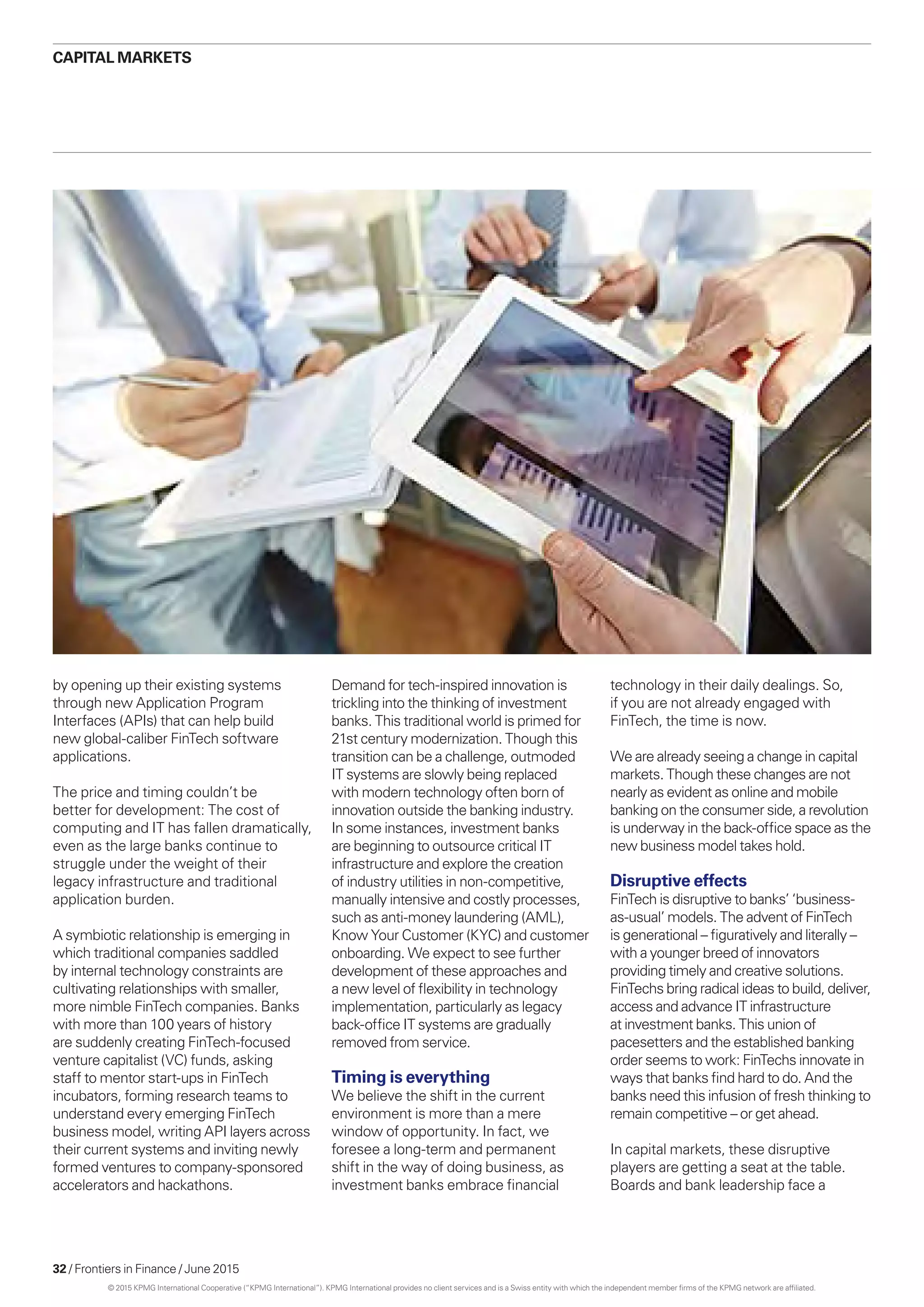
Magna, a financial risk tool, and KPMG
Konduct, a customer insight platform.
Our experience suggests that this type of
multi-strategy approach may be the best
way forward, particularly for national and
mid-sized organizations seeking to create
a new competitive differentiator through
technology enablement.
The reality is that the market is moving
quickly and good ideas may emerge
from a range of different sources.
For more information on
how insurers are leveraging
data and analytics see Big
data: The BIG factor driving
competitive advantage,
page 16.
Those that put all of their investment
dollars and efforts into just one or two
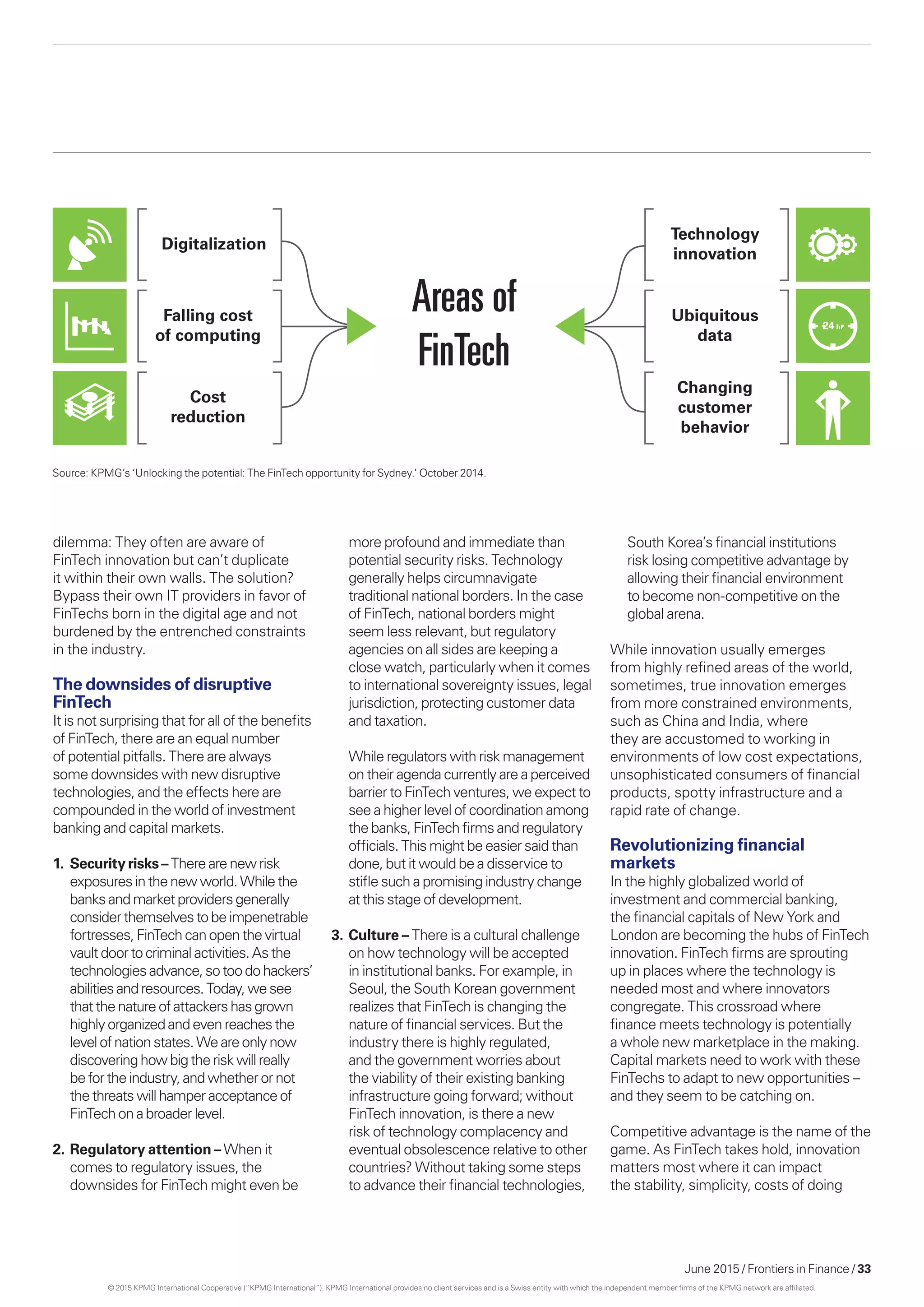
initiatives – or those that are tied to a
specific investment model – may lack the
flexibility to adapt to new market changes
in the future.
In today’s FinTech market, ownership
clearly isn’t everything.
© 2015 KPMG International Cooperative (“KPMG International”). KPMG International provides no client services and is a Swiss entity with which the independent member firms of the KPMG network are affiliated.
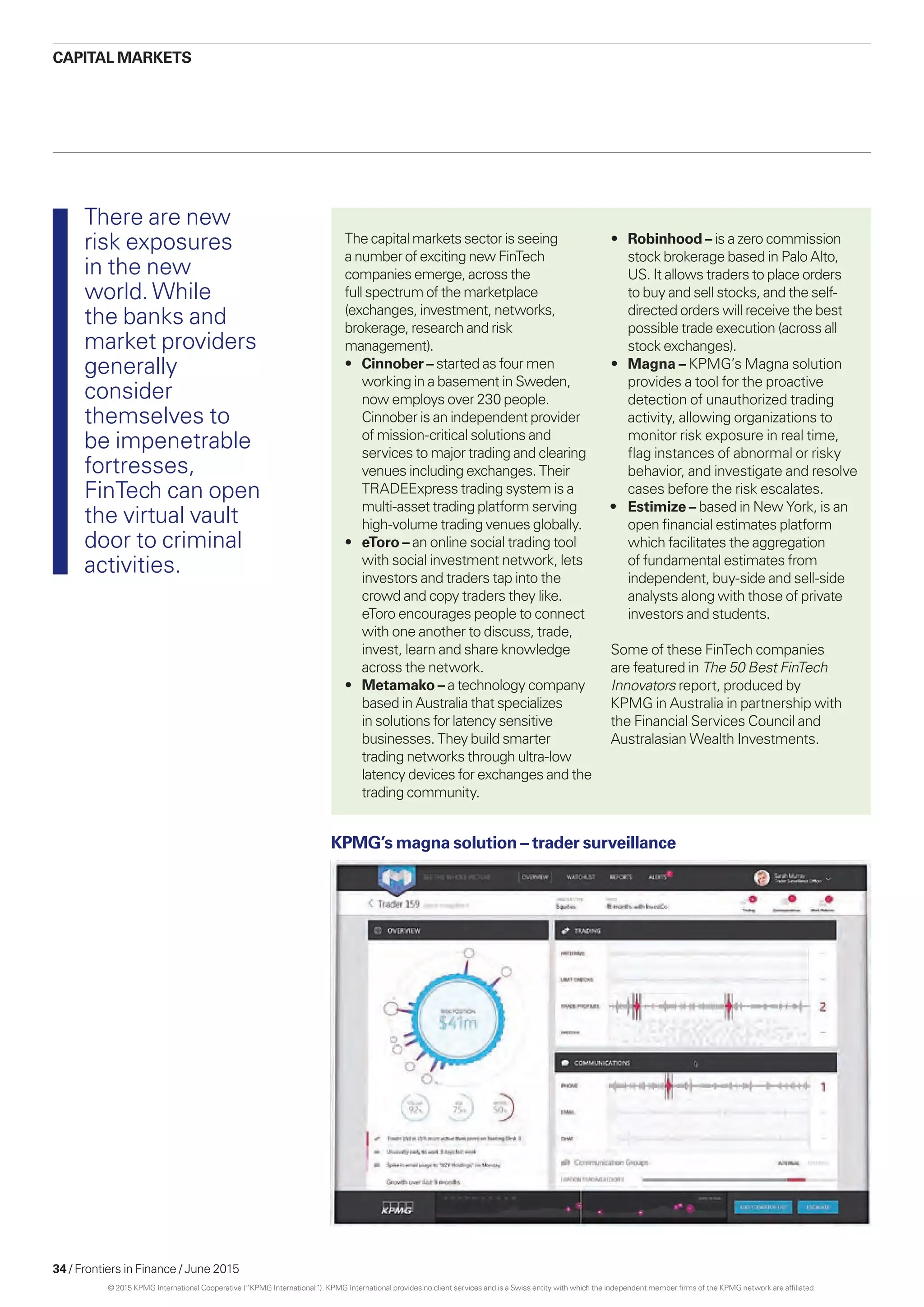
44 / Frontiers in Finance / June 2015
focus and
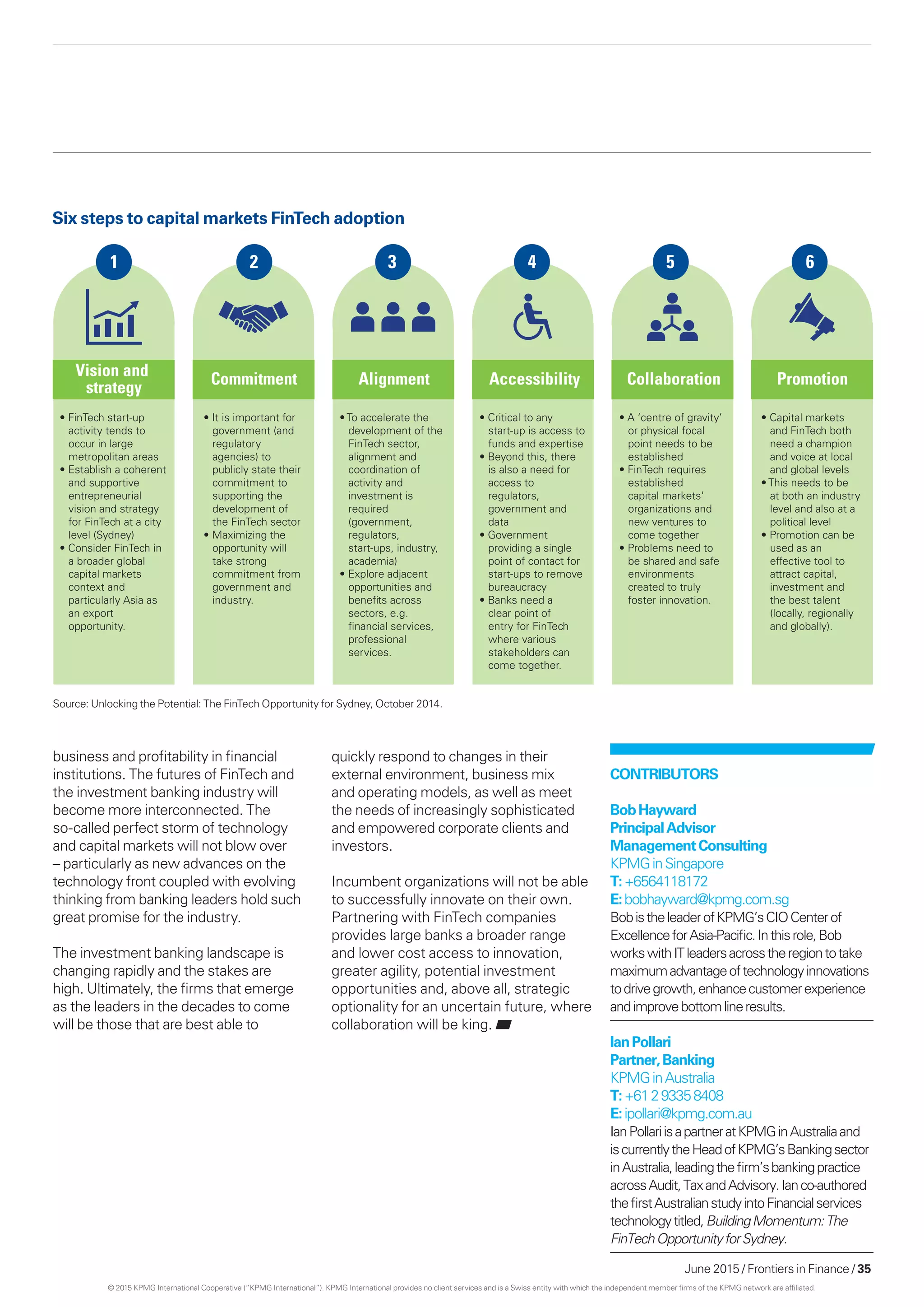
alignment
Effective wealth management
transformation requires
Robert McGraw, KPMG in the US
Tracey Ah Hee, KPMG in the US
Thewealthsectoris
experiencingunprecedented
competitivepressuresas
traditionalfirms,registered
investmentadvisorsand
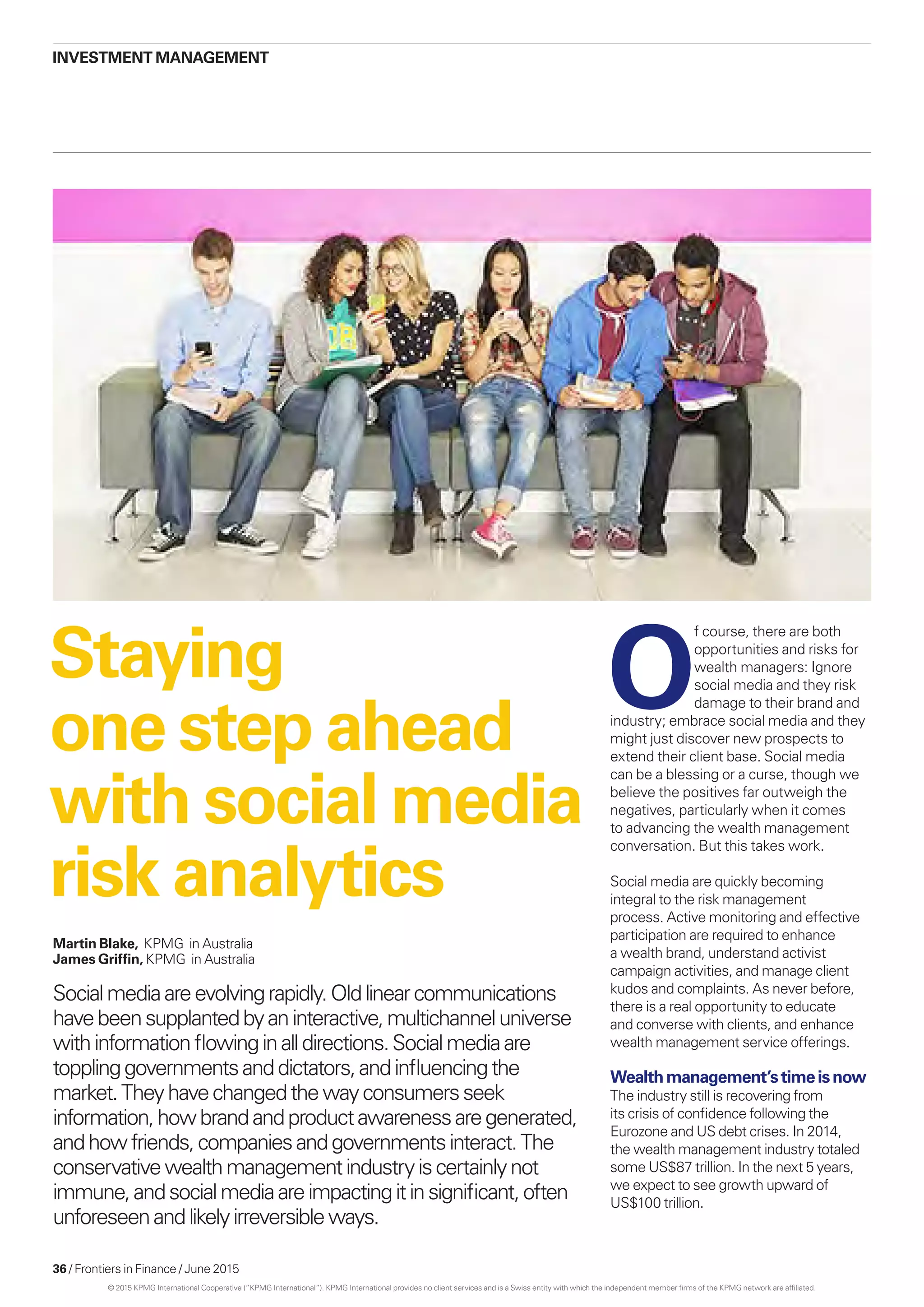
disruptivenewmarketentrants
convergeonthesamebase
oflucrativeinvestors.Margin
improvementsaredifficultto
achievewithoutre-thinking
keyaspectsofthebusiness
andoperatingmodeltounlock
structuralcoststooffsetthe
impactsoffeeerosionand
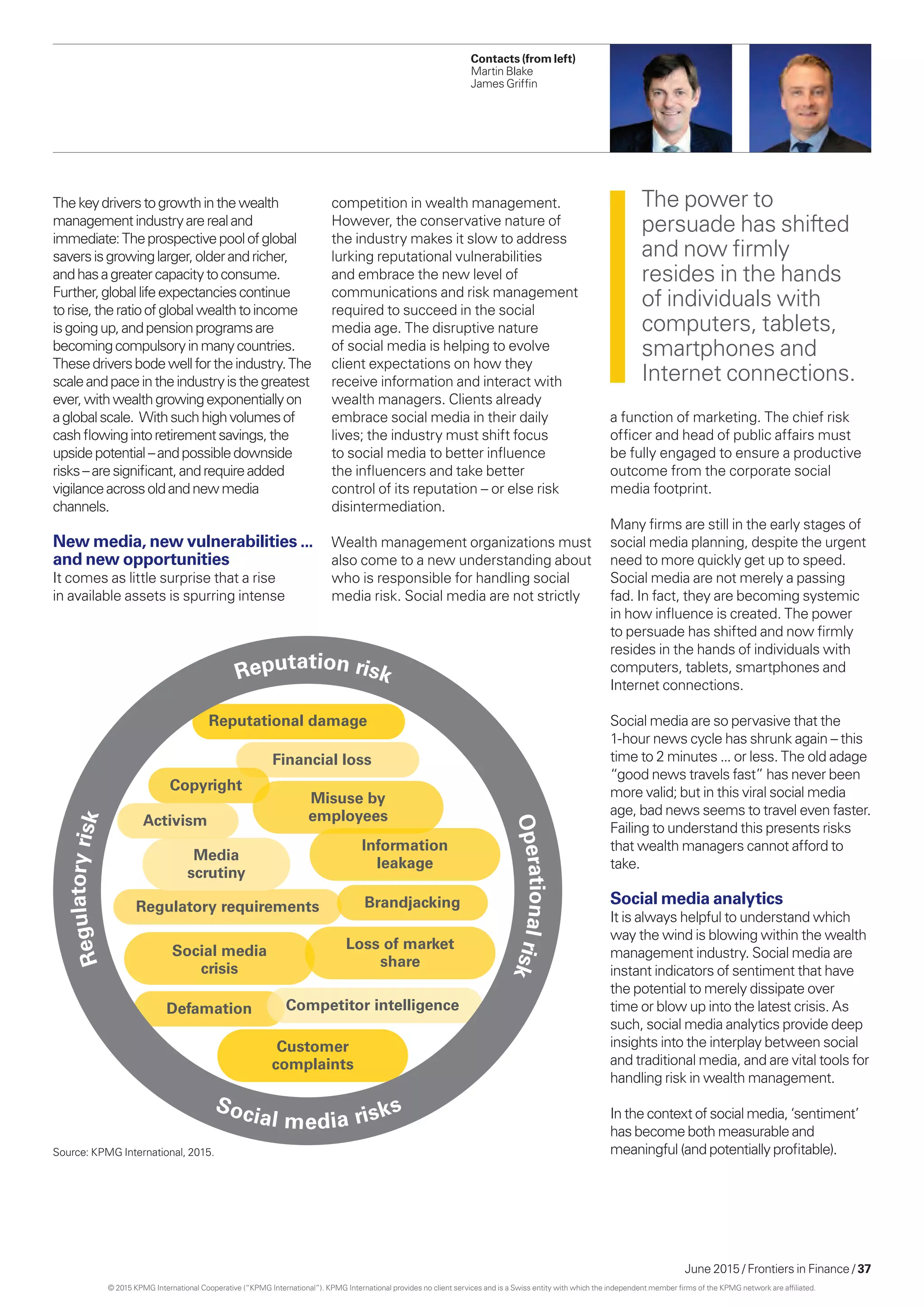
higherembeddedcostsforrisk
andcompliance.
investment management
strategy that addresses how the firm
supports advisors and clients across
channels
•	 a strong core digital offering, with
additional capabilities added in specific
segments to differentiate service
•	 insights from data analytics to focus
the business model, operationalize
the strategies and deliver a
personalized customer experience –
sponsorship and senior level
leadership to execute the strategy
and remove organizational barriers to
change.
The path to transformation
The critical and logical first step for
organizational transformation is to refine
the business model and place strategic
bets around key growth markets and
segments. Investments in deeper
insights into customer needs and
The growth challenge has already hit many
firms. An examination of net new asset
inflows highlights the challenges many
firms are facing – the traditional value
propositions and service models offered by
incumbent providers are not attracting new
investors at the same rate as the overall
high net worth (HNW) and ultra-high net
worth (UHNW) market growth. Across the
industry, firms are seeking ways to attract
the next generation of wealth during their
asset accumulation stages to offset natural
outflows from retirees in the boomer and
silent generation.
The world’s wealth management firms
have recognized the need to respond
by embarking on customer-driven
transformation programs that will require:
•	 a business model focused on key
growth areas
•	 an integrated multichannel service
© 2015 KPMG International Cooperative (“KPMG International”). KPMG International provides no client services and is a Swiss entity with which the independent member firms of the KPMG network are affiliated.
June 2015 / Frontiers in Finance / 45
behaviors are often required to then
sharpen the value propositions and
service offerings delivered to meet these
needs. With this foundation in place,
many firms are then able to realize that
there are opportunities to simplify
customer offerings by focusing on
the core services that will drive future
growth and exiting tertiary services
that are not contributing to customer
and shareholder value creation.
With a sharpened business model in place,
the firm can adapt their operating model
to architect a differentiated service model
Measuringtheeconom
ic
m
odel Understan
dingthebusinessmodel
• Markets/segments
• Products/services
• Value propositions
• Optimizing channels and service
delivery
• Integrated digital capabilities to drive
collaboration, customer engagement
and service differentiation
• Cost-competitive IT services
Business model refinement Operating model design
Services,
functions and
process
Organization and
governance
Technology
Sourcing and location
Performance
management
People and skills
Business
model
Designing the operating model
2
3
4
5
6
1
Transformation starts with optimizing the business
and operating model
a significant change in how programs
are justified and managed. Traditional
business cases and initiatives were
defined around satisfying discrete
objectives centered on product,
internal effectiveness and operational
efficiencies versus external drivers
and the impact potential investments
have on market and customer
differentiation.
Aligning customer and channel
capabilities
An integrated multichannel service
strategy, enabled by the right business
architecture and customer focus can
help firms realize growth and margin
improvements. In order to achieve this
business potential, firms need to re-think
key aspects of how the firm supports
advisors and clients across channels.
For full-service firms, the services
performed from the branch channel
can be streamlined to focus primarily
on client-intimate processes.
Administrative and support functions can
be either digitized or migrated to more
cost-effective channels. Call center and
digital channels are being repositioned
to raise client awareness of additional
service capabilities and satisfy growing
demands for immediacy, personalization
and self-service.
We have found that an in-depth analysis
of customer, channel and product
profitability – including an examination
of high cost, inefficient and toxic
customer servicing processes – can
serve as a catalyst for re-thinking existing
transformation program investments.
Digital delivery responds to
changing clients
While the robo-advisor debate plays
out in the press, the role of the digital
channel in a traditional full-service wealth
management model is beginning to
crystallize. The role of an advisor remains
central to serving HNW and UHNW
clients. Digital strategies can drive
new forms of customer engagement
between advisors, the firm and clients to
strengthen the overall client relationship.
To achieve customer experience ‘parity’
with the experiences being delivered by
Contacts (from left)
Robert McGraw
Tracey Ah Hee
which is positioned to attract and retain
clients and deliver a more engaged and
integrated customer experience across
channels. By overlaying the new business
model upon the current models, leaders
can identify the significant capability gaps
that require attention and then prioritize the
transformation program investments that
are best positioned to deliver meaningful
client and financial outcomes.
Existing governance models and
leadership roles need to adapt to ensure
proper business, customer and channel
alignment. For many firms, this can be
Source: KPMG International, 2015.
© 2015 KPMG International Cooperative (“KPMG International”). KPMG International provides no client services and is a Swiss entity with which the independent member firms of the KPMG network are affiliated.
46 / Frontiers in Finance / June 2015
Changing customer dynamics
Service capability gaps (i.e. advisor,
customer, service team)
Channel alignment
Business view
Ease of doing business
Accessibility
Customer view
PROSPECT ONBOARD EXECUTE SERVICE MONITOR
Personalization
Collaboration
Simplicity
Immediacy
Peer influence
Transparency
UHNW
Segments
HNW
Call center
Channels
Branch
Digital
An integrated approach to align the firm’s investment priorities to enable growth, differentiation and margin improvement
Aligning business capabilities with customer expectations
Tailored offering
Speed to delivery
Value for the money
Cost to serve
Profitability
digitally enabled wealth start-ups, traditional
providers will need to deliver a very strong
digital ‘core’ offering, which addresses
crucial customer experience priorities
and strengthens the overall relationship
between the firm, client and advisor.
Service differentiation is enabled by
providing additional digital capabilities in
specific segments to deliver enhanced
services including risk management,
estate and trust, and banking.
By instilling this degree of service delivery
innovation across the spectrum of client
needs, wealth managers can leverage
their unique brand and specialization to
compete effectively, improve service,
address a broader set of investor needs
and reduce operating expenses.
Customer analytics to focus and
operationalize the transformation
•	 Customer analytics and insights
are critical inputs to re-focusing the
business model, shaping new value
propositions and refining customer
segmentation strategies:
–	 Mining internal and external
information sources can drive
deeper insights into customer wallet
share and relationship penetration.
–	 Integration of sociodemographic and
behavioral characteristic data can
help firms identify micro-customer
segments. With these insights,
marketing and communication
strategies can be honed to deliver
a more personalized approach to
relationship development.
–	 Predictive analytics and scenario-
based modeling can improve the
effectiveness of relationship-based
pricing strategies to attract additional
assets and penetrate banking and
lending needs.
•	 Advanced analytics can also be used
to operationalize growth strategies and
enable a more personalized customer
experience across channels.
•	 Whilepracticemanagementand
customerbookofbusinessanalysis
analyticshavebeenutilizedformany
yearsnowtohelpadvisorsprioritize
clientdevelopmenttime,therehasbeen
unevenadoptionofthesetools.Thenext
investment management
evolutionofthesecapabilitiesistoprovide
moreactionableinsightsandideasatthe
customerlevel,whichcanbeexecuted
bytheadvisor,promptedbyaservice
centersupportassociate,orintroduced
totheclientdirectlyasatopicofpotential
interestthroughdigitalchannels.
•	 Digital customer experiences become
much more personalized and relevant
to addressing relationship needs,
by leveraging customer insights
and tailoring the communications
messaging to the unique servicing
needs of micro-segments.
•	 Several firms are integrating natural
language solutions to deliver timely and
relevant information to advisors and
clients around key market or thematic
trends. Behind the scenes, analytics
are being used to examine customer
portfolios, and use business rules and
event triggering to deliver a tailored
client message that quantifies the
impacts to the client’s balance sheet.
•	 Predictiveanalyticsarebeingapplied
toidentifyearlywarningindicatorsof
clientattrition.Withtheseinsights,firms
canoperationalizetheappropriateclient
Source: KPMG International, 2015.
© 2015 KPMG International Cooperative (“KPMG International”). KPMG International provides no client services and is a Swiss entity with which the independent member firms of the KPMG network are affiliated.
June 2015 / Frontiers in Finance / 47
Customer
•	 Is your growth strategy focused on
defined and actionable customer
segments?
•	 Do you have a clear understanding
of customer behavior, buyer values
and needs by micro-segments?
•	 Are there defined discrete value
propositions for each segment?
Service delivery
•	 Do you have a clear understanding
of the cost to serve customers by
segment and channel?
Where is your firm on the
transformation continuum?
These questions can help to identify
areas for program acceleration or
improved alignment.
Banking and lending
Securities-based lending
Real estate financing
Cash management
Investment management
Tax optimization
Alternative investments
Co-investment
Hedging strategies
Interest rate risk
Currency exposure
Current will, trust and insurance
Stock option analysis
Creditor protection
Philanthropic services
Lifestyle advisory
Health advisory
Segment-specific differentiatorsAspects of digital core capabilities
Financial
Family office
services Risk
management
Trust, estate
and legacy
planning
Digital core
capabilities
Portfolio
Account Custom
er
Collaboration
Planning/Advice
allocation
o
pening engagem
ent
Wealth managers can focus on mastering digital core capabilities
and selectively integrating segment specific capabilities
engagementstrategiestoaddress
unmetneeds.Whiletheseanalytical
approacheshavebeenusedformany
yearsnow,thedegreeofprecisionthatis
now possiblewithadvanceddatamining
andintegrationof‘bigdata’is yielding
muchdeeperandactionableinsights.
Conclusions
The wealth sector remains a very
attractive business for continued growth
across the globe. There are opportunities
for firms both large and small to thrive in
this competitive landscape. Over the next
3–5 years, some firms will emerge as the
clear leaders and ‘providers of choice’ in
serving investors for the next decade.
Capitalizing on this window of opportunity
will require firms to embrace change,
sharpen their transformation agenda,
and accelerate the delivery of innovative
advisor and client-facing solutions to
deliver a differentiated service experience.
Opportunities to grow will only be
realized when firms integrate strategy
with rapid execution as the market
becomes much more competitive.
•	 Is the digital strategy fully
integrated with the business and
customer strategy?
•	 Are you investing in the right
capabilities to deliver a more
engaged and collaborative client
experience to attract and retain a
more digitally savvy investor?
Leadership
•	 Are the existing governance
and oversight functions aligning
investments across the
organization to drive clear market
and customer differentiation?
•	 Is the transformation agenda
bold enough to address market
and competitor movements and
the need to significantly reduce
structural costs through channel
optimization?
Contributors
Robert McGraw
Principal, Financial Services Advisory
KPMG in the US
T: +1 917 861 3151
E: rmcgraw@kpmg.com
Robertadviseswealthandassetmanagement
firmsonstrategicchangeinitiatives–helping
themtoprofitablygrow– addressinga
spectrumofchallenges:improvingoverall
advisorproductivity,respondingtoregulatory
changeanddeliveringadifferentiated
multichannelcustomerexperience.
Tracey Ah Hee
Principal, Customer Experience and
Customer Strategy  Growth
KPMG in the US
T: +1 212 954 2076
E: tahhee@kpmg.com
Tracy specializes in building businesses
from the ground up, customer profitability
optimization, business development, MAs
customer base valuation, development and
implementation of customer strategy.
Source: KPMG International, 2015.
© 2015 KPMG International Cooperative (“KPMG International”). KPMG International provides no client services and is a Swiss entity with which the independent member firms of the KPMG network are affiliated.
48 / Frontiers in Finance / June 2015
Publications
KPMG member firms provide a wide-ranging offering of studies, analysis
and insights on the financial services industry. For more information,
please go to kpmg.com/financialservices
EmbracingTechnology for Rapid
Transformation: Data, Digitization and
Disruption
March 2015
Capital markets businesses have a lot of
distance to cover on the road to leveraging better
technology for faster business transformation
that so many entities seek. KPMG’s Capital
Markets practice takes a view of where the
industry is now and where it is headed.
Evolving Banking Regulation
April 2015
In the current business environment, banks
face a complex mix of inter-related regulatory,
economic and commercial pressures that are
driving changes in bank structure.This report
looks at recent and forthcoming banking
regulation.
The Evolving Role of Corporate
Development in Banking
April 2015
Insight into the changing role of corporate
development since 2010 and what lies ahead
for banking MA.
Transforming Client Onboarding
October 2014
KPMG lays out a multifaceted strategy to
coordinate the business, regulatory and
technology imperatives involved in bringing
on new customers in a highly automated,
digital-based fashion.
Evolving Insurance Regulation
April 2015
2015 is seeing international developments
dominate regulatory change in the
insurance industry.The IAIS’s proposed
new global insurance capital standard,
the implementation of Solvency ll, and
the completion of IFRS 4 Phase 2, leave
no doubt we are witnessing a new era in
insurance regulation
Growing Up:A New Environment for
Hedge Funds: 2015 KPMG/AIMA/MFA
Global Hedge Fund Survey
March 2015
The hedge fund industry is in the midst of
a transformation. Managers have become
more focused on improving performance and
operational effectiveness. New strategies,
new investors, new markets and new
products and services are forever changing
the market dynamics.
FINANCIAL SERVICES
Transforming
Insurance
Securing competitive
advantage
kpmg.com
KPMG INtERNAtIoNAL
Transforming Insurance: Securing
competitive advantage
October 2014
Transforming Insurance delivers a vivid
picture of the global insurance landscape,
as market players respond to the digital and
technological changes that are transforming
all aspects of their business. Based on
extensive research and interviews with
clients and KPMG professionals.
Perspective:Trends Driving the Insurance
MA Landscape in 2015
March 2015
A strategic focus for many insurers and
reinsurers as they look to enter new markets,
secure partnerships or rationalize non-core
operations, MA can offer competitive
advantage and profitable growth. In this report,
we share our insights on four broad trends we
predict will have the biggest influence on deal
activity over the coming months.
© 2015 KPMG International Cooperative (“KPMG International”). KPMG International provides no client services and is a Swiss entity with which the independent member firms of the KPMG network are affiliated.
June 2015 / Frontiers in Finance / 49
Missed an issue
of Frontiers in Finance?
Frontiersin Finance
Frontiers in Finance
For decision-makers
in financial services
January 2013
Derivatives reporting:
Deadlines looming
Page 14
The rise of
non-bank credit:
Revolution or evolution?
Page 16
Cost Optimization:
Better data, efficient
processes and lower costs
Page 8
Frontiersin Finance
Governance strategies for
managing the data lifecycle:
Knowing when to fold versus
Page 12
Frontiers in Finance
For decision-makers
in financial services
Summer 2014
Cyber threats in the
Spanish banking sector
Page 6
Cyber crime:
Insurers in the firing line
Page 8
Frontiersin Finance
Frontiers in Finance
For decision-makers
in financial services
September 2013
Making a bank
marriage work:
Overcoming the
cultural barriers
Page 08
Moving on – Does
the industry get it?
Page 18
Embedding real
culture change
and managing
talent risk
Page 10
Frontiersin Finance
Driving claims
transformation:
Reclaiming the
insurance customer
experience with
digital tools
Page 7
Frontiers in Finance
For decision-makers
in financial services
Winter 2014
Cutting through concepts:
Virtual currencies get real
Page 10
Rethinking the finance
offshoring model
Page 14
Back issues are available to download from www.kpmg.com/frontiersinfinance
Frontiers in Finance is a forward-looking collection of market insights, thought
provoking perspectives and sector-specific issues that impact key
decision-makers of financial services organizations around the world. All articles
are written by industry leading and experienced professionals from across our
Global Financial Services practice.
KPMG’s Global Financial Services practice has more than 34,000 partners and
professionals across our global network of 155 member firms, providing audit, tax
and advisory services to the retail banking, corporate and investment banking,
investment management and insurance sectors. Each one of our professionals
brings ideas, innovation and experience from across this vast network, to the
benefit of each of our financial services clients around the world. We serve leading
financial institutions with practical advice and strategies backed by world class
implementation. We believe our commitment to the industry, our sector-specific
insights and our passion for serving our member firms’ clients to the very best of
our abilities help us stand out.
We welcome the opportunity to discuss how KPMG member firms can help you
achieve your business objectives.
member firms and
155
global financial
services
practitioners
34,000
© 2015 KPMG International Cooperative (“KPMG International”). KPMG International provides no client services and is a Swiss entity with which the independent member firms of the KPMG network are affiliated.
Global leaders
Jeremy Anderson
Chairman, Global Financial Services
KPMG in the UK
T: +44 20 7311 5800
E: jeremy.anderson@kpmg.co.uk
David Sayer
Global Sector Leader
Banking
KPMG in the UK
T: +44 20 7311 5404
E: david.sayer@kpmg.co.uk
Scott Marcello
Regional Coordinating Partner
Financial Services
Americas region
KPMG in the US
T: +1 212 954 6960
E: smarcello@kpmg.com
Bill Michael
Europe, Middle East and Africa (EMA)
Head of Financial Services
KPMG in the UK
T: +44 20 7311 5292
E: bill.michael@kpmg.co.uk
Simon Gleave
Joint Regional Coordinating Partner
Financial Services
ASPAC region
KPMG China
T: +86 10 8508 7007
E: simon.gleave@kpmg.com
Tom Brown
Global Sector Leader
Investment Management
KPMG in the UK
T: +44 20 7694 2011
E: tom.brown@kpmg.co.uk
Gary Reader
Global Sector Leader
Insurance
KPMG in the UK
T: +44 20 7694 4040
E: gary.reader@kpmg.co.uk
Michael Conover
Global Sector Leader
Capital Markets
KPMG in the US
T: +1 212 872 6402
E: mconover@kpmg.com
The information contained herein is of a general nature and is not intended to address the circumstances of any particular individual
or entity. Although we endeavour to provide accurate and timely information, there can be no guarantee that such information
is accurate as of the date it is received or that it will continue to be accurate in the future. No one should act on such information
without appropriate professional advice after a thorough examination of the particular situation.
© 2015 KPMG International Cooperative (“KPMG International”), a Swiss entity. Member firms of the KPMG network of independent
firms are affiliated with KPMG International. KPMG International provides no client services. No member firm has any authority to
obligate or bind KPMG International or any other member firm vis-à-vis third parties, nor does KPMG International have any such
authority to obligate or bind any member firm. All rights reserved.
The KPMG name, logo and “cutting through complexity” are registered trademarks or trademarks of KPMG International.
Produced by KPMG’s Global Financial Services Practice
Designed by Evalueserve.
Publication name: Frontiers in Finance – June 2015
Publication number: 132368-G
Publication date: June 2015
Printed on recycled material.
kpmg.com/socialmedia
kpmg.com kpmg.com/frontiersinfinance
kpmg.com/app

frontiers-june-2015-fs

  • 1.
    Frontiersin Finance Driving competitive advantagethrough a new investment banking culture Page 4 Frontiers in Finance For decision-makers in financial services June 2015 Staying one step ahead with social media risk analytics Page 36 Lessons from the recent currency fluctuations in Switzerland and the eurozone Page 12
  • 2.
    The financial storieswhich hit the headlines tend to be those involving global developments or macroeconomic issues: the impact of quantitative easing, low interest rates, rolling waves of regulation and the like. It is easy to forget that most of the challenges which occupy CEOs, CFOs and other leaders in financial services companies are found closer to home: How to sustain and improve competitive advantage? How to develop new products and services which satisfy the changing demands of customers? How to move faster and more effectively than the competition? These are traditional and familiar challenges. Nevertheless, the context in which they must be tackled is constantly changing, so the response must change too. The data revolution provides one obvious example. The explosion of data available on customers, their needs and their behaviors offers massive potential. But retail and investment banks, insurers and investment management companies are still having challenges exploiting it fully. Few insurers, in particular, have a plan for identifying, adopting and implementing new data-driven approaches and models into their business. There are opportunities to improve performance, reduce risk and drive growth through better use of data and analytics. In banking, better data management strategies can not only form the basis for more profitable management decisions but also underpin compliance with the continuing evolution of financial regulation. The role of chief data officer is increasingly important here and has a critical contribution to make, quite distinct from that of the chief information officer. The new social media exemplified by Twitter and Facebook not only provide new routes for communication with customers and clients, they constitute a further rich source of information about them. In an interview carried out specially for this issue, we talk to Sandy Pentland from MIT about how his development of ‘social physics’ opens up a new way of understanding human behavior by using big data to explore how ideas move, evolve and spread. This can open the path towards more resilient and more profitable organizations. Socialmediaalsocarriesrisksand candamagebrandandreputationifitisnotproperlyusedand understood.Activemonitoring and effective participationarerequiredtoenhancebrands,understand activistcampaignactivities andmanagecomplaints.Theemergingtechnologyofsocialmedia analytics canprovidedeepinsightsinto theinterplaybetweensocialandtraditionalmedia. Uncoveringcustomerattitudesfrom arangeofonlinesourcescanputsocialmediadatatoworkin bettermarketingandbrandmanagement,andinimprovingthecustomerexperience. Many of these insights and developments, especially in communication technology and the data revolution, are apparent in this year’s ‘next big thing’: FinTech – the use of software and IT to deliver better financial services through financial technology. Its impact and potential are one of the principal themes of Jeremy Anderson’s article. FinTech is potentially highly disruptive of banks’ ‘business-as-usual’ models. Insurers are now actively competing head- on with banks, private equity firms and global technology companies to secure the latest technologies – whether these are bought, leased or developed in joint ventures and new forms of partnership. All of these issues are addressed in the articles in this edition. We like to think that Frontiers in Finance continues to illuminate some of the most pressing opportunities and challenges in the continuing fight for competitive advantage. FOREWORD Foreword Giles Williams KPMG in the UK Andrew Dickinson KPMG in Australia Ton Reijns KPMG in the Netherlands Jim Suglia KPMG in the US © 2015 KPMG International Cooperative (“KPMG International”). KPMG International provides no client services and is a Swiss entity with which the independent member firms of the KPMG network are affiliated.
  • 3.
    CONTENTS FRONTIERS in financeJune 2015 EXECUTIVE ISSUES 02 Chairman’s message Developingstrategydoesn’tgetanyeasier. Overthenext5years,financialservices institutionsarelikelytoexperiencean extremelyrapidperiodofprofoundchange intheirexternalenvironment. 04 Driving competitive advantage through a new investment banking culture Conduct, culture and technology are vital – in addition to traditional thinking around the strategic role investment banking plays in a diversified financial institution model. 08 Bridging the talent gap to secure competitive advantage Ensuring competitive advantage starts and ends with the caliber of your workforce and your ability to attract top talent to your organization. TRENDS AND OPPORTUNITIES 12 Lessons from the recent currency fluctuations in Switzerland and the eurozone TheEuropeanCentralBank’s(ECB’S) decisiontoexpanditsquantitativeeasing programtoincludegovernmentbond purchasesspurredrecentfluctuationsinthe Swissfranc(CHF). 16 Big data: The BIG factor driving competitive advantage By now, most insurers understand the potential value that big data could deliver to their organizations. But our experience suggests that few insurers today are ready to take full advantage of the many opportunities that could be captured with greater data insights. 36 Staying one step ahead with social media risk analytics Socialmediaareevolvingrapidly.The conservativewealthmanagementindustry iscertainlynotimmune,andsocialmedia areimpactingitinsignificant,often unforeseenandlikelyirreversibleways. 40 Tapping into insurance FinTech: Own it, lease it or share it? Facing increasing pressure on performance and a growing desire to get closer to their customers, most insurers are now looking for virtually any technology that may help them get – and keep – a competitive edge. 28 Social physics: How good ideas spread and lessons for the banking sector There is a strong and growing conversation around the pace and speed of innovation in today’s banking model, and how banks can pivot to take advantage of the latest advance in FinTech innovation and big data. 31 The perfect storm of technology and capital markets: The modern history of FinTech Is2015the‘yearofFinTech’?Aperfect stormofconditionsisbrewingthatmakes FinTechtherightsolutionfortheright conditionsattherighttime.Andthattime isnow. 44 Effective wealth management transformation requires focus and alignment Theworld’swealthmanagementfirms haverecognizedtheneedtorespondto shiftingclientexpectations,agilenewrivals andrisingoperatingcosts,byembarking ontransformationprograms. CHANGE AND INNOVATION 20 Chief data officers: The next generation of leaders transforming banks The stage is set for chief data officers (CDOs) to bring much-needed direction to banks’ data management strategies, helping them remain compliant and unleash the commercial potential of information. 24 Hedge funds and institutional investors: A changing future As the environment for alternative investments continues to evolve, hedge fund managers are starting to rethink their products, fee structures and investor mix to refocus on institutional investors – particularly pension funds. PUBLICATIONS 48 Updates from KPMG member firms, thought leadership and contacts, including our Evolving Regulation series. © 2015 KPMG International Cooperative (“KPMG International”). KPMG International provides no client services and is a Swiss entity with which the independent member firms of the KPMG network are affiliated.
  • 4.
    2 / Frontiersin Finance / June 2015 CHAIRMAN’S MESSAGE Developing strategy doesn’t get any easier. Although the immediate ordeals of the financial crisis may have been overcome, new and even more disruptive challenges are looming. Over the next 5 years, financial services institutions are likely to experience an extremely rapid period of profound change in their external environment. The response to the crisis has been focused on increased regulation, changes to corporate structures and business models and the need to find new ways of generating earnings in the context of prolonged yield depression. These have placed heavy burdens on everyone involved in the industry, but especially on those in senior executive positions. The problem, though, is that developing effective responses may have crowded out the capacity to step back, to reflect deeply on how best to meet the future demands of customers over the coming period of change. Signposts to the future: Jeremy Anderson Chairman, Global Financial Services T here’s no doubt that strategic thinking is increasingly vital. Technology is evolving more quickly than ever. Reliance on social media is becoming ubiquitous, not only for casual conversation but also for corporate communication and business processes. Consumers are increasingly demanding constant, online access to every service. In turn, the explosive growth of information technology and communication is generating vast quantities of data about customers, markets, products and preferences – which will be invaluable to those companies that learn to exploit it. These trends are accelerating. So it is more than ever critical to ensure that the vital task of absorbing the current regulatory overhang is not the sole focus of attention. The very real challenge of getting fit for the ‘new normal’ has to run hand-in- hand with preparing both for short-term disruptors and for the impact of long-term megatrends.1 In the first category, we have already seen significant inroads made into the traditional financial services industry by companies such as Apple, PayPal and others. In the slightly longer term, the industry will see major impacts from demographic and social change, and from the increasing consumer tendency to value ease of transactional operations over enduring relationships and brand loyalty. The foresight challenge It is, of course, easy to argue for greater foresight, strategic thinking and preparedness. But it is far from clear actually how to begin engaging with the ‘unknown unknowns’. In recent conversations with senior banking executives, a number have said to me that they find today’s environment intellectually verychallenging.The5years after the crisis were tough, but the objectives remained clear. Now, however, fundamental decisions need to be taken about global and regional business models: which businesses to remain in, withdraw from or try to enter; whether the present low-interest, low-yield environment will ease soon or persist to drive more fundamental changes of strategy. Yet the foundation on which to base these decisions remains obscure. Aclient ofKPMGinSwitzerlandarticulated hisdilemmaacutely:althoughhecouldsee multipleexamplesofinnovationemerging anddisruptionchallenginghismarket,he stilldidnotknowifhewasseeingthefull pictureorwhereelsetolook.Sowhile manyleadersagreethatfinancialservices willlookverydifferentin5years’time, thereislittlecertaintyabouthowtheywill look.Andthere isnodoubtthateventhe mostfar-sightedwillbothunderestimate andoverestimatethepaceandextentof change.Foresightanddecisivenesswillbe critical;sowillflexibilityand agility. Sustaining competitive advantage through major change 1 For an extended review, see Future State 2030: The global megatrends shaping government, KPMG, 2014. © 2015 KPMG International Cooperative (“KPMG International”). KPMG International provides no client services and is a Swiss entity with which the independent member firms of the KPMG network are affiliated.
  • 5.
    June 2015 /Frontiers in Finance / 3 Jeremy Anderson Chairman, Global Financial Services Signposting the future? The FinTech contribution In clarifying the picture, the rapidly- growing FinTech sector could have a major role to play. Rapid innovation in financial technology – the use of software and information technology to deliver better financial services – in the context of start- ups, partnerships and other structures, has the potential to bring together established players in need of strategic insight with leading-edge developments from products and marketing to transaction processing. Engagement with the burgeoning FinTech environment has the potential to give much-needed direction to the formulation of new strategy in an increasingly uncertain world. Investment in FinTech initiatives is growing rapidly in all major financial and technology locations, from Silicon Valley to New York, London and Sydney.2 Depending on definitions, financing activity is estimated to be running at more than $12 billion annually, having tripled during 2014.3 Much of this reflects the understandable lure of the ‘next big thing’. However, it also acknowledges the massive transformation in how financial services are conceived, developed, delivered and experienced, which will be the inevitable outcome of the current convergence of digital technologies and financial expertise. As with any new and exciting field, a lot of different initiatives are being explored, with many different approaches and a great deal of experimentation. A key area of focus is the potential of combining exploitation of ‘big data’ with new technology to streamline existing processes and transactions, or to develop much more personalized products and services. But scalability is a crucial issue. The challenge is not only to find ways of creating promising ideas but of identifying those which are capable of being scaled up into the mainstream business models of major financial institutions. New forms of partnership We see a number of different approaches being adopted. Traditionally, financial institutions have relied on trusted technology vendors to offer them solutions to underpin their transaction processing or customer relationship management. Sometimes, these providers have been acquired and taken in-house; at other times, in-house operations have been spun out or outsourced. But the essential customer- contractor relationship has persisted. InthenewFinTechenvironment,though, itisincreasinglyrecognizedthatmore fundamentalformsofpartnershipare required.Soweseemultiplestakeholders comingtogethertokick-startnewinitiatives, ofteninnewphysicalcontextssuchas dedicatedfacilitiesandinnovationlabs. Theseprovideanenvironmentinwhich toincubate,encourageandnurturenew FinTechventuresuntiltheycanbescaled upandcommercialized.Participantsin theseinitiativesincludefinancialinstitutions, venturecapitalists,technologystart- ups,nationalauthoritiesandthelocal governmentsofmajorcitieslikeLondonor Sydney –whereKPMGhashelpedestablish Australia’sfirstdedicatedFinTechfacility. We are also seeing institutions such as Santander and Barclays Bank setting up in-house venture capital funds to invest in new start-ups, both gaining access to new ideas and, in the longer term, acquiring profitable new business lines. In the insurance sector, as we outline elsewhere in this issue, companies are now beginning to look to FinTech opportunities to stimulate innovative product design, platforms and distribution models. Our own KPMG Capital business is investing in creating smarter data and analytics capabilities and has recently taken an equity stake in Bottlenose, a leader in real- time enterprise trend analysis. The benefits of these various alliances and partnerships flow to all participants. By joining with other stakeholders, established financial institutions can reduce risk, stimulate innovation and develop products and services to increase customer satisfaction and engagement. Start-ups gain injections of funding, but also, more importantly, access to business expertise and an understanding of how financial services are developed, marketed and delivered in the real world. New talent and skills can be developed in an atmosphere which preserves entrepreneurial attitudes and behavior. New thinking, new investment, new approaches If FinTech can offer a way out of the foresight challenge and signpost some clear directions of travel, the question for senior finance executives remains acute: how to embrace the current explosion of new thinking and nascent solutions, products and innovations, and sift through the rapidly changing environment, to identify those opportunities which will make a real contribution to the responses required. My feeling is that, as we have argued before, the guiding principle has to remain the need to focus on delivering what customers want in the way that they want it, even as these change profoundly. The last 5 years have seen many financial institutions concentrating first on survival and then on rebuilding their balance sheets and strengthening capital structures. In the next 5 years we shall see a re-intensified battle for the customer. Those companies which can create lasting competitive advantage will be those which are most relentlessly focused on satisfying emerging customer needs and demands. The potential value of any new FinTech initiative, technology development or other disruptor has to be assessed against this standard. The present low-yield situation makes the requirement for new thinking and new investment more acute even while funding it becomes more difficult. For the foreseeable future, the financial services industry needs to adopt the attitudes of lean manufacturers finding ways of doing business cheaper, faster and better in a low-margin environment. This is likely to be the best – or even only – way of surviving the coming wave of change. And if this frame of mind is sustained over a longer period, there will be corresponding longer-term benefits, both for the industry and for the customers we presume to serve. 2 For a recent overview, see, for example Unlocking the potential: The FinTech opportunity for Sydney, KPMG, 2014. 3 Investment in financial technology groups triples to $12bn in year, Financial Times, 26 March 2015. © 2015 KPMG International Cooperative (“KPMG International”). KPMG International provides no client services and is a Swiss entity with which the independent member firms of the KPMG network are affiliated.
  • 6.
    4 / Frontiersin Finance / June 2015 Driving competitive advantage throughanew investment bankingculture F inancial institutions are currently rethinking the future success of their investment banks post-crisis. They have come to realize that conduct, culture and technology (including cyber security) are now vital elements of their agenda, which already includes traditional thinking around the strategic role investment banking plays in a diversified Financial Institution model, the right mix for the organization, the impact of new regulatory requirements, the cost of capital, and the ROE needs of the institution. There is much work to be done. While some within the industry continue to hunker down post-crisis, fresh opportunities for competitive advantage are emerging for organizations able to take a leap forward in key areas such as culture and technology. But first, let’s frame the issues. In the decade prior to the financial crisis, the investment banking industry took huge leaps forward. Volume, volatility and customized complexity were the name of the game during this period of massive innovation and unprecedented profitability. Some of this was shown later to be recklessness, but there was also genuine and valuable innovation and improvement. But it couldn’t last. The profitability allowed greed to seep in and this drove some irresponsible behaviors. Oversight by management and regulators was different in the last decade and the free economy model which had delivered so much benefit globally in preceding decades got out of hand. The checks and balances in standards, regulations and governance structures couldn’t prevent a bubble from building – then bursting. Capital markets management are still adjusting to the ensuing financial crisis and the severe contraction in the industry. CAPITAL MARKETS Mike Conover, KPMG in the US David Todd, KPMG in the UK © 2015 KPMG International Cooperative (“KPMG International”). KPMG International provides no client services and is a Swiss entity with which the independent member firms of the KPMG network are affiliated.
  • 7.
    June 2015 /Frontiers in Finance / 5 Contacts (from left) Mike Conover David Todd So on which of the many competing priorities should boards of banks focus? To begin with, it’s instructive to examine the lingering effects of the pre-crisis hangover today: 1. Optimism in investment banking has waned. 2. Lower volumes and electronic trading/ settlement are the new normal. 3. Cultural shortcomings are still common. 4. There is meager investment in back- office improvements. 5. Many organizations have taken a wait- and-see approach. While the flow of new regulations has begun to slow, the marketplace has not yet settled. Bankstodaystillgenerallyviewtheirfuture outlooksthrough a‘post-crisis’lens.This mindset,thoughconservative,isprobably appropriategiventheseverityoftherecent crisis.Assuch,banksseemcontenttopause to consider next steps before developing a new business model and maybe a new identity to their culture to supplant the formerly profitable trading environment. But what is next? Clearly, there is no way to ‘future-proof’ the investment banking business. However, there are ways to better prepare for what’s to come. Culture: the next big arena in the banking industry As big banks focus on the implementation of new regulations, a new back- and middle-office model and how the new world of technology can transform their business, there seems to be a shift to a clearer client focus (putting the client’s needs first) that can potentially break the logjam in industry stagnation. In particular, with regulatory issues on the mend and new technology being installed, how does management drive their business forward on the path to growth? And let’s not forget the last item to be addressed from the crises hangover – culture. This is a good time for banks to turn their attention to fixing their culture issues, which will drive their business forward and differentiate them from their competitors. Taking a new approach to culture and harnessing client-centricity can help uncover new opportunities for growth. Based on prior problems within the industry, clearly changes are necessary. In a nutshell, the combination of crises, losses and bailouts has focused a spotlight on how banks do business. Such illumination has exposed all of the deficiencies within the industry, and there is no indication that the focus will shift anytime soon. In fact, late last year, New York Fed President William Dudley reportedly used the word ‘culture’ more than 40 times in a speech to bank executives. We believe this is a true watershed moment in the 100+ year history of the sector. The public backlash against misbehavior and excessive pay within the industry is spurring real change and public outcry for change. We’ve already come a long way since the wild days of The Wolf of Wall Street, but we still have far to go as the new generation of investment bankers joins the ranks having grown up with a different ’purpose in life’. In the name of profitability, it’s time to clean up the cultures that allowed bad behaviors to live in the industry. Customers need to ‘beware’ in many industries. For example, the automotive industry has had recalls that came a little too late. You only need to buy your child a mobile phone to worry about the value of some insurance products being sold; and even weather-related price fluctuations for snow shovels driven by supply and demand make the news. When it comes to banks, politicians are rapidly shifting the standard from ‘buyer beware’ to ‘seller beware’. If you cannot produce analysis to show why a product was good for your customer, you may have to compensate them. Not only does bank conduct and culture need to improve on past performance, it also needs to lead the world in developing new approaches to customer-centricity. Banks must redefine their culture to help drive strategy, as a great strategy is only great if the culture accepts it. © 2015 KPMG International Cooperative (“KPMG International”). KPMG International provides no client services and is a Swiss entity with which the independent member firms of the KPMG network are affiliated.
  • 8.
    6 / Frontiersin Finance / June 2015 If culture is the key to investment banks moving forward in the current economy, those who discover how to baseline and measure where their culture is today, then design and implement measurable improvements for the new world of investment banking, will have a significant advantage over their competitors. Banks must redefine their culture to help drive strategy as a great strategy is only great if the culture accepts it – so make sure culture is aligned so the strategy can be executed. One final area of opportunity within culture is the culture of high pay. It has been argued that pay did not reflect the risk adjusted capital that was needed to hold such risk, and as a result bigger payouts may have been viewed as reasonable for the profit margin on the needed capital. In the boom years, the argument was made that the advances being made in re-engineering the financial world justified premium pay for bankers. This argument isn’t accepted today because the new capital charges on these highly complex trades now make these trades much less profitable. However, pay levels have still not adequately normalized yet. If boards can keep pay levels trending down, heading for the point where their talent is paid equally with the return on capital in the industry now, they can reap a stream of long-term cost savings and throw some good news into the mix for shareholders. Technology: Revolution or evolution? Beyond culture, banks must also embrace new technology to advance their business interests. If the culture of an organization does not embrace new and changing technologies and reverts back to doing things the old way, a great deal of money will be spent with little benefit to the bottom line. In fact, technology can be a foundation for the future of the industry through which investment banks advance the quality of regulatory compliance, increase transparency, reduce costs, and improve overall profitability through technology implementation. Manyfinancialinstitutionsinthecapital marketsaresaddledwithinformation technology(IT)systemsappropriateto anotherera.Inourview,banksshouldfocus asmuchattentionaspossibleontechnology tobringthesectorintothe21st century andpotentiallygeneratemoresustainable revenueinthischangingindustry. In the past, investments in IT and data projects largely went into the front-end of the business. IT investment now should focus on middle- and back-office functions and architectures to streamline duplicative, siloed and inefficient operations. Afteryearsofignoringtheimportance thatcultureplaysintheindustry,we proposeeightstrategicquestionsto askinordertocleantheslateandwin backthetrustofcustomers: 1. Break down silos – How can we connect systems to find commonalities and drive a one- firm culture? 2. Buildacultureoftrust –Where canweshiftthefocustothegood oftheclient?Remember,public perceptionmatters,soworkto rebuildyourreputationandtrytobe humble(yes,wemademistakes, butnowlet’smove on). 3. Focusoncapitallevels –How canwebalanceouttheculture oftakingonwhateverriskis neededtodriveprofits?Capital requirementsoftodayseemto havebiggerchargesfor‘culture risk’thaneverbefore. 4. Simplifyoperations –Knowing thatthesystemwasbuiltfor biggervolumesandmore complexcustomizationthan existtoday,howcanwedrivea cultureofsimplicitywithenabling technology? 5. Continuetorespondwellto regulatorychange –Isn’titbetter towillinglychangetheinvestment bankingculturethanthrowlawyers attheissue? 6. Raise IT spending to budget for system improvements – How can we digitize our work flows and automate the back-office as a collective team versus the culture of individual profit? 7. Createefficiencies –There arelessexpensivemethodsof processing,suchasbigdata: Wherecanwelooktoreengineer processesandcutthemassive costbasis? 8. Improve culture – How can we improve our culture of understanding exposure to risk, cyber security, etc.? CAPITAL MARKETS “The need for values is inbred. Their content is not.” Alan Greenspan, 2008, inThe Age ofTurbulence: Adventures in a NewWorld Most bankers will tell you that regulatory firefighting has necessarily dominated IT spend in each of the last 5 years. Gartner supports this claim, estimating that banking and securities institutions’ IT investments grew 3.6 percent from 2013 to 2014, to about $480 billion (Forecast: Enterprise IT Spending for the Banking and Securities Market, Worldwide, April 23, 2014). This includes regulatory compliance and reporting purposes, as well as addressing cost-reduction strategies. From our interaction with industry executives, regulators and industry observers, it appears there is a long road ahead to transformation. A 2014 USD480billion 3.6%from 2013 to 2014, to about IT investments grew © 2015 KPMG International Cooperative (“KPMG International”). KPMG International provides no client services and is a Swiss entity with which the independent member firms of the KPMG network are affiliated.
  • 9.
    June 2015 /Frontiers in Finance / 7 Contributors Mike Conover Global Head of Capital Markets KPMG in the US T: +1 212 872 6402 E: mconover@kpmg.com Michael Conover is the founding Partner of KPMG’s Financial Risk Management Practice in the United States. He is involved in a wide array of financial advisory and risk management assignments for financial institutions. David Todd Partner KPMG in the UK T: +44 20 76942868 E: david.todd@kpmg.co.uk David has worked as a partner in the investment banking sector for over 15 years, in both New York and London. David specializes in investment bank audits – he leads this sector in London, and is responsible for some of KPMG’s biggest investment bank audits. KPMG survey on transformation (From Burden to Competitive Advantage, KPMG, 2014) revealed that nearly half of capital markets businesses are still in the ‘assessing and planning’ stage of transformation, while another 20 percent admitted to only having just begun. Either way, it remains essential for capital markets institutions to upgrade technologies – in-house or through joint ventures, strategic alliances or acquisitions of ‘permitted’ technology firms that are closely aligned with banking – to make valuable operational and financial decisions associated with: • real-time analysis for risk and pricing purposes • portfolio-composition decisions • executing trades that take advantage of fast movements in markets around the world • maintaining and reporting on compliance with regulations • constructing optimized cost processes and structures • enablingand/ormonitoringestablished internal governancediscipline • enhancing cybersecurity capabilities. Few institutions fully understand the huge potential that resides within their data, and fewer still are making the right changes to their business strategy to take advantage of that potential. A major stumbling block is that existing technology systems and business models represent the greatest challenge to integrating data and analytics programs into their business. Hunker down or charge ahead? Large investment and wholesale banks generally take a cautious approach to their strategy. But culture and technology are two areas in which a more proactive approach can help improve their outlook. We have found that culture beats strategy every time, so don’t roll out a new strategy unless you roll out a new culture first, and then be sure to enable it with the appropriate technology. New regulations have taken hold. While next steps are not always clear or tangible, it is clear that a fundamental and permanent shift for the sector is underway. How it will look in the future is still difficult to determine, but some important components like customer- centricity are clear already. Fornow,banksmustdecidewhether theywanttohunkerdownortrytomove ahead.Merelymaintainingthestatusquo inthecurrentenvironmentischallenging enoughwithouttheaddedpressureof planningnowtoprofitinthefuture. By examining the context on current marketplace thinking, banks can equip themselves with the tools and insights required to make more strategic and forward-thinking decisions. However, it’s up to them to actually move ahead with changes. It is essential for institutions operating in the capital markets to accelerate efforts to simplify and standardize their operational and technological infrastructure.The job will be long-term and complex – but the need to pick up the pace is absolutely necessary. – Brian Stephens, National Sector Leader, Banking and Capital Markets Practice, KPMG LLP (US) © 2015 KPMG International Cooperative (“KPMG International”). KPMG International provides no client services and is a Swiss entity with which the independent member firms of the KPMG network are affiliated.
  • 10.
    8 / Frontiersin Finance / June 2015 Bridging the talent gap to secure competitive advantage T he insurance industry is facing more acute challenges than many other sectors when it comes to recruitment, engagement, talent development and culture. Intensified by regulatory requirements, demands of a multigenerational workforce and evolving customer needs, we believe that rethinking talent strategies and addressing the 5Cs (capability, cost, compliance, capacity and connection) will help the industry bridge the talent gap. We will explore these further in this article. Beforewedivein,let’slookathowinsurers’ currentcapabilitiesstack-upcomparedto banksandtechnology/ITcompaniesinthe followingaspectsofpeoplemanagement. INSURANCE Mark Spears, KPMG in the UK Harold de Bruijn, KPMG in the Netherlands Mary Trussell, KPMG in Canada W Jean Kwon, KPMG in the US Theskillsgapwidens.Areinsurers abletocompete? Digging deeper, we see that, while many industries are struggling to respond to the challenges of an ageing workforce and shortages of suitably qualified replacement recruits, the insurance industry appears to have a more unbalanced workforce age structure than most. In a recent article for the International Insurance Society, W Jean Kwon quotes a number of disturbing statistics.1 Analyses drawn from a range of studies indicate, for example, that: • the percentage of workers at the 55–64 and 65+ age groups in the US insurance sector rose by about 38 and 10 percent, respectively, during the 2000–07 period, more than the national average • thenumberofemployeesaged 55+increasedby74percentinthe 10yearsto2008(ascompared witha45percentincreaseinthe aggregateofallemployees). Otherstudiessuggestthatupto40 percent ofinsurancesectoremployees –bydefinition includingmostofthesenior,experienced andhigh-skilledstaff –aresettoretirein thenextfewyears.Researchindicatesthat thiswillhaveadisproportionatelysevere impactintheareasofclaimsmanagement, underwritingandreinsurance.Skills shortagesarealreadybecomingapparent. Alongsidethemassivewaveofimminent retirements,twoothertrendsarehavingan increasinglysevereimpactontheinsurance sector’smanpowerchallenge.Asthesector 1 Human Capital Risk and Talent Management Issues in the Insurance Market: Public Policy, Industry and Collegiate Education Perspectives, The Geneva Papers, 2014;39:173–196. Ensuring competitive advantage starts and ends with the caliber of your workforce and your ability to attract top talent to your organization. In a period where technology and business models are evolving faster than individual skill sets, it is becoming increasingly challenging for organizations to attract, engage and retain the talent needed to deliver desired business benefits to their customers, shareholders, regulators and other key stakeholders. What we are seeing across all regions and all industries are chief executive officers (CEOs) being faced with skills shortages for the most ‘critical talent’ – the people within the organization that contribute a more than proportionate share of the organization’s business value. © 2015 KPMG International Cooperative (“KPMG International”). KPMG International provides no client services and is a Swiss entity with which the independent member firms of the KPMG network are affiliated.
  • 11.
    June 2015 /Frontiers in Finance / 9 Contacts (from left) Mark Spears Harold de Bruijn Mary Trussell W. Jean Kwon expands,sodoesthenumberofvacancies: theUSBureauofLaborStatisticsforecasts thatover200,000newjobswillbecreated, andwillneedtobefilled,withinthesector by2022.2 Atthesametime,however,a numberoffactorsarerenderingthesector comparativelylessattractivetonewrecruits: • althoughthedemandforpricing,product development,underwriting,claims,IT anddatamanagementisskyrocketing, Facilitation of succession planning and career path Acquiring and retaining top talent Engaging employees to drive innovation and business performance Providing mobile and social media for collaboration and engagement LevelofcapabilityStrong/verystrong INSURANCECAPABILITY BANKS TECHNOLOGY/IT 38% 54% 46% 38% 30% 61% 60% 60% 60% 53% 65% 75% 64% 68% 75% Managing diversity and building a desirable work culture youngpeopleareincreasinglyattractedto workinginwhattheyperceiveas‘sexier’ industries,suchashigh-techsectors,the media,onlineretailingorgaming,which reflecttheirowninterestsandexperience (suggestingthatinsurerswillneedtolearn tooperateinthecomparabledigitalworld asthosetheyhopetorecruitdo) • deeplyingrainedcompanycultures mayneedtochangeinordertocreate anenvironmentofinnovationand collaboration. Manysectorsarewakinguptothe challengesofdemographictrendsandthe shiftsinyoungpeople’sjobexpectation. Weareseeing,forexample, arangeof newtraininginitiatives,outreachprograms tocollegesanduniversities,modern apprenticeshipschemesandthingslike gamificationusedtocloseknowledgegaps andasameansofemployeeengagement. Moreover,insurersmaybenefitbylooking beyondthesectorandrecruitcandidates basedonskillratherthanexperience,while reexaminingtraditionalcorporatestructures thatarecommontothesector. Findingtherightbalancetowin Attractinganddevelopingtherighttalent neededforsuccessinthedigitalworldisa majorchallengeforinsurancecompanies. Thetechnicalandsoftskillsrequiredfor insureroperationsaredifferentfromwhat theyusedtobe.Digitalchannelswillprobably requirefewerpeople,butpeoplewitha high-qualityskillset.Atthesametime, companiesneedtopreserveandtransfer thecriticalexpertiseofseasonedactuaries, underwritersandotherprofessionalsso thatitstayscompetitiveinfinancialservices markets.Gettingthebalancerightcan bechallenginginpartbecauseinsurance companiesoperateinhighlyregulated environments.Toremaincompetitive, insurerswillneedtomanagethechange fromthecurrenttothefuturestate,andthat willmeangettingbuy-inatthehighestlevel includingtheboard. Inour2013researchofinsurance companiesmakinguptheFTGlobal500, weidentifiedfivekeyattributesthatwe believeenabledthemtoremainprofitable eventhroughsustainedperiodsofeconomic 2 Insurance Industry Set to Experience a Major Talent Gap, Claims Journal, June 30, 2014. Source: Evidence-based HR, KPMG International, 2015. InarecentKPMGInternationalsurvey,weaskedexecutivesfromvariousindustrieshowstrong theyfelttheirorganization’scurrentcapabilitiesareineachofthefollowingaspectsofpeople management.Insurance,banksandtechnology/ITcompaniesindicatedthattheywerestrongto verystrongineachofthefivecapabilitiesbelow.Itisclear,thattheinsuranceindustryhassome catchinguptodo. © 2015 KPMG International Cooperative (“KPMG International”). KPMG International provides no client services and is a Swiss entity with which the independent member firms of the KPMG network are affiliated.
  • 12.
    10 / Frontiersin Finance / June 2015 volatilityandlowyieldgrowth.Creatingan organizationalculturewiththeseattributes atthecorecanhelpinsurersfindawinning balance. Attractingnewtalentisgood. Buildingbenchstrengthisbetter. Identifyingcriticalrecruitmentneedsand attractingtherightpeopleisonlythefirststep inaholistictalentmanagementstrategy. Insurersneedtofocusmuchmoreclosely onarticulatingkeyskillsfortheiroperations, andonreviewingthewaytheymanage anddevelopthem.Toooften,companies havelittleideaoftherealvalueofeffective talentmanagement –oroftheriskofpoor performanceinthemanagementofcore skills.Onlywithaconsistentandcoherent approachtothewholetalentissuecanthe returnonhumanresourcesexpenditurebe evaluated. Aswehaveseen,therightanswerswill dependonthespecificcircumstances ofeachcompany.Inrecentyears,ithas becomemoregenerallyacceptedthat anevidence-basedapproachtohuman resourcesissuessuchasthese,coupled withexploitationofnewtechnologyand datamethodologies,cangenerateimportant insightsintorecruitment,retentionand successionplanning.3 3 For a more detailed discussion, see: Time for a More Holistic Approach to Talent Risk, KPMG, 2013. A move to future state will require a different mind-set, capability and culture: Customer-oriented: The move from transactional services to customer- focused will require greater customer service experience, such as graduate fast-track programs focusing on building customer relationships. Analytical expertise: Attracting, developing and retaining employees with deep analytical skills that go beyond structured data to also include unstructured data will be critical. Greater predictive and prescriptive analytical skills are required to garner the full value of the data and unearth the tangible business insights that drive action. Innovative mind-set: Client expectations have increased exponentially in recent years. As insurers and reinsurers strive to remain competitive, they are being squeezed by tech-savvy and more nimble new entrants and capital markets solutions. To remain relevant, innovation will need to become part of insurers’ organizational DNA – a transformation that will impact the entire insurance value chain – and require a workforce encouraged to experiment and supported by leadership. Legacyknowledge:Asisthecasewith manyinsurers,corelegacysystemsand technologyarestillcriticallyimportantto day-to-daybusiness.Asthearchitectsof thesesystemsbegintoretire,knowledge mustbepassedtothenextgeneration. Formulating an appropriate response to thesechallengesrequiresthedevelopment of a holistic talent management strategy. Unfortunately, there is no silver bullet or ‘one-size-fits-all’ solution. INSURANCE Focus Trust Efficiency Agility Customer- centricity Five attributes of the valued insurer Source: The Valued Insurer, KPMG International, 2013. Meetingthechallenge Itisnosurprisethatinsurerswiththemost innovativeapproachestendalsotobethose withthemostadvancedtalentmanagement strategies.Theinsurancesectorisvulnerable tocompetitionfromnewentrantsusingnew technologiesandinnovativeapproachesto marketinganddistribution.Google,Facebook andothercompanieswithaninnovative platformforproductdistributionorother insurance-relatedservicesthanunderwriting willrepresentsignificantcompetitivethreats © 2015 KPMG International Cooperative (“KPMG International”). KPMG International provides no client services and is a Swiss entity with which the independent member firms of the KPMG network are affiliated.
  • 13.
    June 2015 /Frontiers in Finance / 11 4 Compare, for example, The Business of HR: What You Don’t Know, An Evidence-based Approach to Talent Management, KPMG/EIU, 2014. intheinsurancemarket.Theyareeventoday attractingandnurturinghigh-flyingyoung talent. Talentmanagementisnowabusiness-critical processforeveryorganization.Insurersneed toisolateandaddressamuchbroaderarray oftalentrisks,takingintoaccountthecritical needtoconnecttheirpeopletoeachother andtoleadership;toforecastandmanage costs.Theymustmoveawayfroman outdatedapproachofsimplytickingthebox onperformancereviews.Beyondtacklingthe ‘5Cs’,insurersmustalsohardwiretalentrisk intotheirwiderenterpriseriskmanagement framework –therebyplacinghumancapital riskfirmlyontheradaroftheright peopleat therightlevel. Addressingthefivekeytalent riskcategories –the‘5Cs’ – is critical:4 • Capability:Risksassociated withbuildingtheskillsaninsurer needstocompetenowandinthe future –thebreadthanddepthof skillsandcapabilitiespresentwithin aworkforce,andhowwell-aligned thesearetotheinsurer’sneeds. • Cost:Whatistheriskofa workforcebecomingunaffordable? Whatwillitcostaninsurertorecruit andretainthepeopleitneeds?Will itbeabletoaffordtheoverallcostof itsworkforce? • Compliance:Risksrelatingto employeebehavior,regulations andlaws.Thiscategorycovers boththeneedtoensuretalent processescomplywithlocallaws andregulations,aswellaswhether talentmanagementisseenas abusiness-criticalprocessoran administrativeprocesssimplyto ‘be compliedwith’. • Capacity:Risksaroundthe successionintocriticalroles andretentionofcriticalpeople andteams.Inotherwords,will aninsurerbeabletocreateand maintainthesizeandshapeofthe workforceneededtodeliverits businessplan? • Connection:Whatistheriskof aninsurer’stoptalentbecoming disengaged?Inaddition,willan insurer’stalent-relatedprocesses remainsufficientlyjoined-up?Will itbeabletosharetalentbetween unitsinthewayitneedsto?Isitable toconnectgroupsofhigh-potential peopletogether?Areleadersable tocreateanemotionalconnection betweenhigh-potentialsandthe business? Contributors MarkSpears GlobalHeadofPeopleandChange KPMGintheUK T:+442073114753 E:mark.spears@KPMG.co.uk MarkistheglobalheadofKPMG’sPeople andChangepracticeandthegloballeaderof theHRCentreofExcellence.Inadditionto hisleadershipresponsibilities,Markhasled anumberofsignificant,large-scaleHRand changetransformationprojects.Typically,these engagementsaremulti-national,addressing complexcrossborderculturalissuesandthe needfortailoredcommunicationstrategies. HarolddeBruijn HeadofPeople&Change KPMGintheNetherlands T:+31206568574 E:debruijn.harold@kpmg.nl HaroldleadsthePeopleandChangepractice ofKPMGintheNetherlands,focusingon HRtransformation,changemanagement, talentmanagementandinnovation.Harold hasledseveralglobaltransformationprojects acrossavarietyofsectors(financialservices, telecommunications,energyandnatural resources,foodandbeverage). MaryTrussell GlobalInsuranceInnovationLead KPMGinCanada T:+14167775428 E:mtrussell@kpmg.ca Marybringsdeepexpertisecoveringaentire broadrangeofinsurancemarkets,fromlifeand healthandpersonallinestospecialtyrisksand reinsurance,acrossAsiaPacific,Europeand NorthAmerica.Havingspentmostofhercareer basedinLondon,MarymovedtoHongKong in2009andmostrecentlytoTorontoin2014. AsamemberofKPMG’sGlobalInsurance Leadershipteam,Maryfocusesoninnovation andhighgrowthmarketsandleadsthe developmentofmanyofKPMGInternational’s globalthoughtleadershipfortheinsurance industry. WJeanKwon Professor,St.John’sUniversity SchoolofRiskManagement, InsuranceandActuarialScience NewYork,NewYork E:kwonw@stjohns.edu JeanholdstheManton/AIGEndowedChair ProfessorshipinInternationalInsuranceand RiskManagementatSt.John’sUniversity.He co-foundedtheAsia-PacificRiskandInsurance Association,hasauthoredseveralbooks includingKulp-Wrightaward-winningRisk ManagementandInsurancePerspectivesina GlobalEconomy.Jeanspecializesininsurance marketandcountryanalysis,strategic,financial andoperationalperformanceanalysis,and insurancelawsandregulation. © 2015 KPMG International Cooperative (“KPMG International”). KPMG International provides no client services and is a Swiss entity with which the independent member firms of the KPMG network are affiliated.
  • 14.
    12 / Frontiersin Finance / June 2015 Lessons from the recent currency fluctuations in Switzerland and the eurozone T he European Central Bank’s (ECB’s) decision to expand its quantitative easing program to include government bond purchases spurred recent fluctuations in the Swiss franc (CHF). The Swiss National Bank’s (SNB’s) response to the ECB was an about-face from the policy instituted in 2011 to peg the CHF to the euro. The CHF had become a popular currency in which to park funds and borrow money, but all this popularity made the peg even more expensive to sustain. Many firms and households were impacted by the change and immediate volatility that followed in currency markets. The most severely affected firms tended to cluster in one or more overlapping categories. For our purposes, we’ll focus primarily on: trading, hedging and funding. Carry trades are defined as borrowing in a low-rate currency and investing an asset that is likely to provide a higher return. When any market experiences a large spike in volatility there is fallout. In the case of currencies, abrupt moves can be especially disruptive, as they impact not only financial markets but also all manner of commerce in that currency. The most destructive events are often those that are widely considered to be impossible or highly unlikely. Banking John Budzyna, KPMG in the US Constance Hunter, KPMG in the US © 2015 KPMG International Cooperative (“KPMG International”). KPMG International provides no client services and is a Swiss entity with which the independent member firms of the KPMG network are affiliated.
  • 15.
    June 2015 /Frontiers in Finance / 13 Modern history of ‘crowded trades’ Recent trends show volatility is the latest in a long line of such trades. A trading position becomes ‘crowded’ when it is held by enough investors that exiting the position could be difficult if the fundamentals of the situation change. Crowded trades increase the risk of contagion, and when that trade reverses, the number of investors trying to get out of it makes the market very volatile – sometimes leaving major gaps in pricing. This is a recognized risk in trading markets. In 2004, then- Federal Reserve Bank of New York President Tim Geithner reported that monitoring whether or not trades are crowded is something the Fed has done for more than a decade. In 2009, economist Lasse Heje Pederson likened crowded trades to shouting ‘fire’ in a packed theater: “You’re just as likely to be killed by a stampeding crowd as you are by the fire itself.” There was fateful truth to Pederson’s metaphor recently in Europe, as the markets reacted to an unexpected event, and a panicked rush for the exits ensued. The CHF has since stabilized to the euro, and had market participants waited it out, such losses would not have been incurred. Contacts (from left) John Budzyna Constance Hunter CHF and euro instability In 2014, 17 countries in the euro zone experienced a bout of deflation. Switzerland had felt the pinch on and off for nearly 2 years, and in response, the SNB worked to keep deflation at bay by having negative yields out to the 7-year tenor. To maintain competitiveness with the euro zone, the SNB also pegged the franc to the euro. The SNB promised they would maintain this policy for the foreseeable future, and this assurance caused market participants to maintain a variety of positions, assuming the peg would remain in place. However, two factors caused the SNB to re-evaluate this position. The peg was becoming more unpopular with the Swiss public that became so alarmed at the size of the SNB balance sheet that an attempt was made in November 2014 to pass a referendum limiting its size. When SNB officials learned that the ECB was to begin purchasing government bonds of European countries, they realized that Source: Statista, 2015. Source: Haver Analytics 2015. 0.0 0.2 0.4 0.6 0.8 1.0 Jan '14 Feb '14 Mar '14 Apr '14 May '14 Jun '14 Jul '14 Aug '14 0.9% 0.8% 0.6% 0.8% 0.6% 0.7% 0.5% 0.5% Monthly inflation rate in 2014 Monthly inflation rate in the European Union from January to September 2014 (Harmonized Index of Consumer Prices compared to same month in the previous year) 2004 2005 2006 2007 2008 2009 2010 2011 2012 2013 2014 24.1% 21.4% 20.8% 22.1% 20 40 60 80 100 35.8% 35.3% 44.5% 56.0% 80.0% 77.1% 86.6% SNB assets as a percentage of GDP © 2015 KPMG International Cooperative (“KPMG International”). KPMG International provides no client services and is a Swiss entity with which the independent member firms of the KPMG network are affiliated.
  • 16.
    14 / Frontiersin Finance / June 2015 Banking negative yields in Europe would only put accelerated downward pressure on the euro versus other currencies in the world, especially the US dollar and the British pound. Meanwhile, the market wanted to be long CHF, putting upward pressure on it versus the euro. Thus, maintaining a peg of the Swiss franc to the euro would cost even more to sustain than it had in the past. To prevent the balance sheet of the SNB from growing larger than its already bloated 86.6 percent of GDP, the decision was made to end the peg. Part of the problem was that with interest rates so low, the Swiss franc was used as a funding currency for carry trades. Some carry trades were versus emerging markets and focused in high-yield corporate debt, but many were versus developed markets, including government debt and high-grade fixed income. At the same time the ECB decided to purchase government bonds, the US Federal Reserve Bank reiterated its intention to raise short-term interest rates and begin to normalize monetary policy. Historically, when the major central banks of the world engage in opposing monetary policy actions, market volatility ratchets higher. As a result, the turbulence beyond the Swiss exchange rate has been substantial, particularly with emerging market currencies, such as the Mexican peso, which is now trading over 15. Meanwhile,theeurohaddevalued 20 percentfromlastyear’shighagainstthe USdollar;theyenwasdown50percent versustheUSdollarover20months;and eventheChineseyuanwasallowedtosink totheverybottomofitstradingrangeversus theUSdollarinthelastquarterof2014. Anatomy of contagion In the carry trade arena, if your original currency trade goes south, you must post margin. Without cash on hand, the most logical place to raise money is to sell liquid items in your portfolio that are performing well and that have low bid/ ask spread. This is how contagion infects other asset classes. SuchwasthecasewiththeSwissfranc. Tradersstartedraisingcashbysellingvarious assetstopayoffmargin.Thesignificant moveinthefrancspurreddramaticselling inotherassetclasses.Thisisonepotential reasonwhyanexpectedpopinriskassets, suchasequitiesimmediatelyaftertheECB announcedquantitativeeasing,tookafew daystomaterialize. Further, many traders lost money – not because they couldn’t post margin, but because for about 36 hours, the market had no bid. That is to say in CHF there was no one to take the other side of the trade. In turn this caused the market price, which reflects the mid-market between bid and ask, to gap lower. This highlights the limitations of stop-loss orders and their ineffectiveness in certain circumstances. Looking ahead: The risk for financial services and how to be prepared For financial services leaders, it is important to be proactive to stay ahead of the next crowded trade. A series of simple yet effective questions can be instructive: 1. Do you assess the crowdedness of a trade as part of regular risk considerations? Most leaders will likely say, “Yes.” But it is worth delving further to learn how they do this and how often this limits the size of their positions. Institutions should examine their portfolios to ensure that they can withstand pressure to sell, or can Anatomy of crowded trades and contagion Borrow CHF to leverage & purchase other securities • Hedge funds • Homeowners High- yield debt European equities US$ CHF margin call Pay margin Margin call Raising cash Sell high-yield debt European equities US$ Source: KPMG, 2015. © 2015 KPMG International Cooperative (“KPMG International”). KPMG International provides no client services and is a Swiss entity with which the independent member firms of the KPMG network are affiliated.
  • 17.
    June 2015 /Frontiers in Finance / 15 FRB Exchange Rate: European Monetary Union/Switzerland (Euro/Franc) 0.75 0.80 0.85 0.90 0.95 1.00 1.05 03-Jan-2011 04-Nov-2011 11-Sep-2012 18-Jul-2013 23-May-2014 02-Apr-2015 afford to sell at ‘fire sale’ prices without putting undue pressure on other parts of their portfolios or holdings. 2. Do you identify hedges to carry trades? Because carry trades are generally low-cost to get into, there is a temptation not to hedge against movement in the stable, low-priced security or currency. In the case of the Swiss franc, however, a little insurance would have gone a long way – because it was pegged, it would have been extremely inexpensive to bet that the SNB would end its peg. The lesson is that if a carry trade is crowded and there’s a lot of leverage, it may be prudent to put on a hedge for at least part of the position. That said, it was probably unlikely that those involved in the Swiss carry trade contemplated hedging – having reached a comfort level with several years of relatively stable trading in the currency. 3. Are you reading the tea leaves correctly? Analytics tools are constantly improving. However, just because more data becomes available does not mean it is easier to analyze. Using sophisticated data mining techniques cannot just be the purview of the quant funds. All funds need to make use of this tool to Euro and CHF currency valuations 2011 – 15 remain competitive and avoid or hedge against crowded trades. One example is to compile and analyze the top holders of companies to get a sense of the crowdedness of single name equity trades. 4. Are you prepared for unforeseen instability? These are volatile times. It is important to try to identify issues before they become major problems to be prepared for both the challenges and opportunities created by fluctuations in currency markets. Crowded trades and the reversal of crowded trades can happen in any instrument or any asset class. The best advice is to stay vigilant and always have controls in place to assess investments and determine the extent to which a position is held in a crowded trade. It is important to understand what you have exposure to so that you can engage in a dialogue about how best to manage that exposure. With volatility an ever-present feature of markets that can pop up seemingly out of nowhere, financial services leaders need to prepare, hedge, and potentially gain a competitive advantage during periods of volatility in the currency markets. Contributors John Budzyna National Leader for Market Development, Alternative Investments, KPMG (US) Managing Director KPMG in the US T: +1 212 954 3079 E: jbudzyna@kpmg.com John M. Budzyna is a Managing Director at KPMG in the US and is a National Leader responsible for market development for alternative investments. His 38-year career in financial services has encompassed delivering professional services to an extensive range of financial market companies, including hedge funds, commodity pool operators and funds, private equity organizations and venture capital funds. Constance Hunter Chief Economist, KPMG (US) Managing Director KPMG in the US T: +1 212 954 3396 E: constancehunter@kpmg.com Constance Hunter is the Chief Economist of KPMG in the US. She is an economic thought leader focusing on how economic factors impact asset prices and business performance worldwide. In her role at KPMG, Constance works closely with the firm’s leadership and clients to identify inflection points, risks and opportunities that arise in the constantly evolving economic landscape. Known for correctly calling economic indicators that presage market turning points such as the Russian currency devaluation in 1998, the dotcom bubble in 2001, the real estate and credit crisis in 2007–08, the recovery of the housing market and concurrent low-bond yields in 2012 and the continued low-bond yields into 2015. Source: Haver Analytics 2015. © 2015 KPMG International Cooperative (“KPMG International”). KPMG International provides no client services and is a Swiss entity with which the independent member firms of the KPMG network are affiliated.
  • 18.
    16 / Frontiersin Finance / June 2015 Bigdata: The BIG factor driving competitive advantage Garrett Flynn, KPMG in the US James Griffin, KPMG in Australia Eddie Short, KPMG in the UK By now, most insurers understand the potential value that big data could deliver to their organizations. But our experience suggests that few insurers today are ready to take full advantage of the many opportunities that could be captured with greater data insights. Thankfully, there are a number of ways that insurers could start improving their data and analytics capabilities immediately. Insurance T o start the transformational journey into the type of data-driven, insight-led organizations seen in other sectors, insurers will need to be bold in their approach. We see several opportunities for insurers to catalyze change including reducing the ‘bloat’ and sprawl of internal data and infrastructure before starting to add new data into the mix; instituting a data governance model that is flexible across the business; enthusing a culture of experimentation; and creating an enterprise data management function that is empowered to break down internal silos. It will be critical for organizations to look for ways to shake-up their business model and challenge the status quo, while moving towards profitability-based analytics. © 2015 KPMG International Cooperative (“KPMG International”). KPMG International provides no client services and is a Swiss entity with which the independent member firms of the KPMG network are affiliated.
  • 19.
    June 2015 /Frontiers in Finance / 17 Contacts (from left) Garrett Flynn James Griffin Big data characteristics Volume (expanding) Velocity (increasing) Variety (widening) Validity (waning) x10 The amount of digital information will increase tenfold every 5 years. 90% of the world’s current data was created in the last 2 years. 60 seconds creates 98,000 tweets, 695,000 status updates, 11 million instant messages 30 billion Various pieces of content shared on Facebook each month A rising wave of data The fact that data – and more specifically the analytics of data – is creating massive value for organizations is irrefutable. Almost 70 percent of all C-level executives say that data and analytics (D&A) will be important to revenue growth going forward and 55 percent say they have already changed their business strategy to meet the challenges of big data. Yet while the potential value of D&A may be clear, many organizations – insurers included – continue to struggle to make the most of their D&A capabilities. More than half of all business leaders say they consider it to be difficult or very difficult to make decisions around analyzing data. Almost all executives (96 percent) agree that they could be better utilizing D&A in their organizations. Part of thechallenge,andcertainlythisisnot newnews,isthatbigdataiscontinuously growing,notonlyinsize andscope,but also incomplexity.Asaresult,manyinsurers nowneed toexplore newformsofdata acquisitionmanagementandintegrationin ordertowringreal insightsfromtheirdata. The reality is that today’s big data is not tomorrow’s big data; what qualifies as ‘big data’ will necessarily change over time as the tools and techniques to handle it evolve, the storage capacity increases and processing power improves. Big data is only about massive data volume Big data is for social media sentiment analysis Big data is a technology issue The more data you have, the better the insights Analytics is about software and tools Analytics is just another business trend Analytics is what data scientists do Predictive analytics is THE answer It is about variety, velocity, validity and volume Big data is about viewing all types of data sources broadly Big data is a business issue Having the right data is more important than having the most data Analytics is about making better decisions by asking better questions It’s a permanent change in the business landscape It’s about enabling your employees across the organization, not just a silo of specialists Adoption rates for predictive analytics are still low and there is still much benefit to be gained from the basics Perception Reality Source: Data, Data Everywhere! KPMG in the US, 2014. © 2015 KPMG International Cooperative (“KPMG International”). KPMG International provides no client services and is a Swiss entity with which the independent member firms of the KPMG network are affiliated.
  • 20.
    18 / Frontiersin Finance / June 2015 A world of opportunity Some of the opportunities are fairly easy to recognize. Consider, for example, the insights that could be gained simply by integrating social media data with claims data to identify potentially fraudulent activity (such as pictures of a worker’s compensation claimant riding a roller- coaster) or to quickly verify evidence of flood damage through geo-tagged photos on Flickr. Claims could be reduced, liabilities more accurately assessed and risks better monitored. Think more broadly, however, and the possibilities are almost endless. We recently worked with one insurer to create a ‘risk dashboard’ that integrates data from more than 40 different social media sources to provide real-time monitoring of a range of risks in key geographies. Shipping clients, for example, can use the tool to keep track of storm activity; mining companies may use the tool to monitor for political or social unrest around their operations; infrastructure providers could use the dashboard to track for service interruptions. For the insurer, the tool is a potential game-changer. Not only does it provide its customers with the ability to more actively manage and monitor their risks, which, in turn, reduces overall risk for the insurer, it also improves the ‘stickiness’ of its larger corporate customers who see the service as a significant value- add. Better yet, the insurer can now also use the tool (or sell it on as a service) to proactively warn other customers of potential risks and emerging issues, thereby further reinforcing their overall customer experience. However,movingbeyondatraditional ‘process’focus(i.e.howthingsgetdone) andtowardsamore‘informational’ focus (inotherwords,whythingsgetdoneand inwhat situations)will notbeeasyandwill requireinsurersto reconsidertheirapproach topeople,processandtechnology. Many rivers to cross While some insurers are clearly starting to turn their data into competitive advantage, the reality is that most insurance executives still see big data as a ‘big challenge’ rather Behavioral change and performance Information-driven operating model Outcomes and decision support PEOPLE INFORMATION PROCESS TECHNOLOGY Moving beyond a traditional process focus and how things work to an information focus and why things work in what situations Thosepurchasingdatafromoutsidethe organization,suchassocialmediadata, economicdataordemographicdata,face furtherchallengesastheygrapplewiththe implicationsofintegratingandanalyzing theirvariousdatasources.Multinationals willalsoneedtounderstandhowlocaland regionaldataprivacyregulationsmayimpact theirabilitytocollect,analyzeandsharedata acrosstheenterprise. Identifying opportunities to catalyze change Clearly, it will take something of a transformation for insurance organizations to evolve into the type of data-driven, insight-led organizations that are now emerging in other sectors. But our experience suggests that there are a number of actions that insurance organizations could be taking today in order to start laying the groundwork. • Clean up what you already have: Before going out and purchasing reams of new data sets and sources, insurance organizations should start by cleaning up and integrating the data they already have. Ultimately, the objective should be to reduce the ‘bloat’ and sprawl of internal data and infrastructure before starting to add new data into the mix. That being said, one of the truly valuable characteristics of Insurance than a ‘big opportunity’ and – with little competitive pressure to adapt and a long list of other high-priority challenges on the horizon – most have opted to dabble with their data rather than attack it. This is not entirely surprising; most insurance organizations will need to do quite a bit of heavy-lifting before they can truly start wringing insights from their data. Likely the greatest challenge facing most insurers revolves around their current data management strategy. Particularly at larger, more complex organizations, data is often trapped in silos, inconsistently labeled or locked behind access controls making it virtually impossible to achieve a ‘single view of the truth’. Likewise, data governance and ownership is often spread across the organization, meaning that few insurance organizations have a centralized view of what data they have and how it is being managed and used. Even those with more mature approaches to data management and analytics are struggling as the business environment shifts. The trend towards the outsourcing of some back-office business processes, for example, has potentially added more complexity as insurers start to come to grips with their data footprint. Source: Data, Data Everywhere! KPMG in the US, 2014. © 2015 KPMG International Cooperative (“KPMG International”). KPMG International provides no client services and is a Swiss entity with which the independent member firms of the KPMG network are affiliated.
  • 21.
    June 2015 /Frontiers in Finance / 19 big data is that organizations can often start identifying important insights from data sets that aren’t technically ‘clean’, meaning that big data can quickly and easily be overlaid on top of the organizations existing (and clean) data. • Develop a data governance model: With dozens of data warehouses and often blurred lines of data ownership, most insurance organizations will need to focus on creating an enterprise- wide approach to data governance that provides flexibility to the business while also giving consistency in the standards and controls guiding data usage. Those hoping to eventually start leveraging big data and external sources may want to consider developing a ‘hybrid’ governance model that provides different controls for proprietary information (such as core CDCs) versus external data. • Createan enterprise data management function: Whilemany insurance organizationsalreadyhave someform ofdatastewardshipfunction, suchasachiefdata officer,mostare rathersingle-mindedlyfocusedon creatingpoliciesratherthanimproving informationflowandusage.Insurers maywanttoconsidercreatingan enterprise datamanagementfunction that can actasabridgebetweenIT,the businessandthe datatohelpensure that the rightinformationisbeingused– consistently–acrosstheorganization. Ideally,the enterprise datamanagement groupwouldbe empoweredasthe primarysourceforall datarequeststhat come fromthe business. • Build a culture of experimentation: Given the level of regulation governing the insurance sector, it is not surprising that most organizations tend towards a more risk-averse corporate culture. What this means, however, is that few employees or business units feel incentivized to innovate. Those seeking to encourage new ideas and approaches will want to consider how they might implement a culture of experimentation that recognizes the fact that some projects will fail and therefore provides employees and business units with the right guidelines – and the flexibility – to safely test out new approaches. • Look for the blue sky: Rather than trying to force your data to tell you things you already know about your business, focus your attention on creating new areas for improvement or value creation. Whether opportunities are found in commercializing your existing data and insights or in leveraging your data to develop entirely new products and services that suit more targeted demographics, insurance organizations should be looking for ways to use their data to shake-up the business model and transform the status quo. • Move towards probability-based analytics: When dealing with big data, the key to driving insights is being able to eliminate the 95 to 99 percent of information that isn’t relevant to your needs (i.e. the ‘noisy data’). This can’t be accomplished through traditional root cause or ‘regression’ analytics; finding value in big data will require insurers to understand, and embed, probability-based approaches and techniques into their core data and analytics capabilities. • Make sure you are asking the right questions: Getting useful insights from your data all depends on your ability to ask the right questions. But it also means being able to identify which questions you can’t currently answer with your existing tools and techniques. However, if insurers invest in identifying the right questions to ask of big data – and then couple the right questions with smart probability-based analytics – insights can start to flow very quickly. At the end of the day, the biggest technology risk for insurers is that they are left behind in the race to turn data into insights and insights into value. Our experience suggests that it will be those that are able to create the right environment and governance models to support data- driven experimentation and exploration that will win in the more customer-centric insurance model of the future. Given the pace of change in the market, those who continue to merely ‘dabble’ with their data may soon find it difficult to catch up. CONTRIBUTORS Garrett Flynn Principal KPMG in the US T: +1 312 665 1608 E: gflynn@kpmg.com Garretthas spenthiscareerhelping organizationstransformtheirbusinessthrough carefullyplannedandeffectivelyexecuted ITandprocessenablement.Hehasworked withnationalandglobalorganizationsto bothmanageanddeliverlargeprograms thatfocusedontheintegrationofbusiness function,process,technology,dataand people. James Griffin Director, Risk Consulting and Innovation Practice KPMG in Australia T: +61 2 9346 5402 E: jgriffin1@kpmg.com.au James has worked with many of the world’s leading corporations, government departments and political leaders to help them understand the opportunities and challenges they face from digital disruption, in particular social media. He has been the recipient of the ‘Young Business Person of the Year’ award from Australia’s largest Chamber of Commerce, the NSW Business Chamber. James joined KPMG Australia as part of its acquisitionofSR7. Wondering whether it is better to buy, lease or build new technology solutions to garner data insights? Read our article on page 31, Tapping into Insurance FinTech. © 2015 KPMG International Cooperative (“KPMG International”). KPMG International provides no client services and is a Swiss entity with which the independent member firms of the KPMG network are affiliated.
  • 22.
    20 / Frontiersin Finance / June 2015 Chief dataofficers: Nick Urry, KPMG in the UK Robert Parr, KPMG in the US The stage is set for chief data officers (CDOs) to bring much-needed direction to banks’ data management strategies, helping them remain compliant and unleash the commercial potential of information. The next generation of leaders transforming banks I t has often been said of organizations that ‘people are our greatest asset’. Substitute the word ‘people’ with ‘data’ and many bank chief executive officers (CEOs) would nod in agreement. But, if data is so important, why have banks struggled to make the most of this precious yet abundant resource? Whether reporting to regulatory authorities, or providing analysis and support for trading, investment, risk management and loan decisions, banks and other financial institutions routinely suffer from incomplete data from a huge number of sources in an equally wide range of forms. For many institutions, this results in slower response times, higher costs, loss of trust, increased regulatory scrutiny and missed business opportunities. A CDO can help fill this vacuum, offering a central point of contact and providing the coordination necessary to enable data stewardship and, ultimately, data quality across the organization. Through common structures, standards and processes, he or she works with the lines of business and functions to guide the flow of data and ensure it is up-to-date, accurate and consistent for both regulatory submissions and as vital intelligence to inform critical management decisions. CAPITAL MARKETS © 2015 KPMG International Cooperative (“KPMG International”). KPMG International provides no client services and is a Swiss entity with which the independent member firms of the KPMG network are affiliated.
  • 23.
    June 2015 /Frontiers in Finance / 21 and second order risks created by political and economic events, for example, the Ukraine or Greece crises. These stressed scenarios need to be accurately and consistently assessed within different banking divisions of a global bank as well as within different banking entities or specific country boundaries. Global banks have multiple lines of business, yet capital and liquidity are often managed at group or worldwide level. With local regulators taking an increasing interest in risk, country or business unit managers can find it hard to access the right information and may find it impossible to manage the required transformation to the underlying data architecture or processes. This is where the chief data officer can play a significant role in co-ordinating the activities of data owners, data stewards and data architects to create the target state data architecture and to influence the portfolio of change projects to create an effective delivery roadmap and to manage convergence to the roadmap across a global bank. Additional regulations on transactional reporting can put a huge strain on fragile systems. In a trading environment, it is not unusual to see millions of trades a day, each of which must have an accurate time recording. Failure to meet such requirements, or prove that controls are in place to spot discrepancies, can lead to fines and higher capital limits that push up costs. In the fast-moving banking environment or trading room, it is easy for incorrect data to be entered, and worse still, be labeled in a multitude of ways, making it extremely difficult to trace. As multiple extracts use this source data and proliferate it to various warehouses, models and reports, the error is then multiplied a hundred- or thousand-fold. Onboarding new clients through a (largely manual) Know Your Customer (KYC) process provides similar scope for error. Rather than catch discrepancies at point of entry, financial institutions devote valuable resources and cost trying to unravel a trail at the data warehouse. Often resorting to social networks or word of mouth, analysts can spend a significant proportion of their time in relatively low-level detective work, finding, fixing and presenting data – time that would be better spent on delivering insights that could drive the business forward. Establishing accountability for data beyond the CIO As data proliferates at a meteoric rate, most, if not all, banks lack a person or team responsible for assuring quality and standardization of inputs and outputs, and coordinating information across complex organizational structures. The chief information officer (CIO) may be assumed to be the go-to person, but he or she is typically not a data expert and is unlikely The lack of a coordinated approach to data management across countries, lines and functions has real demonstrative cost to the institution. Contacts (from left) Nick Urry Robert Parr Keeping on the right side of the regulators Sincetheglobal financialcrisis, thehand of riskhasweighed heavyonthefinancial servicessector,withorganizationsunder constant pressuretodemonstratesound riskmanagement.Regulatorsexpect accurateandcomplete reporting,signed offat boardlevel,to proveanabsenceof unauthorized trading andcorruption,suchas fixing LIBORor foreign exchangerates,or moneylaundering.Providingtransparency todatalineageanddataqualitycontrolsis anessential element.Regulatorsexpect accurateandcomplete reportingthatcovers allofthe majorrisksandappropriately informsdecision-making.Theyalso expectthatanymaterial inaccuraciesor deficienciesinthe qualityorcompleteness of areportwill be highlightedtothe recipient,where‘material’deficiencymeans that itwouldhave impactedonthedecision. Theregulatorsandexecutivemanagement arealsoexpectingthatdatawill beavailable toprovideearlyidentificationofactivities such asunauthorized trading,ratefixing, moneylaundering,corruption,insider trading,misreportingoftransactions,etc., bothtoavoid directlossesbutalsotoavoid thesignificantregulatorypenalties that haveoccurred recently.Thisrequiresboth accuratereportsand highqualitydata, combinedwitheffectiveandpragmaticdata ownership andgovernance. Wary of the potential for future catastrophes, authorities also want evidence that banks can avoid crises – or react appropriately should the worst happen. This needs to reflect the first Key responsibilities of a CDO Increasingly the CDO will sit outside of IT. Many bank CDOs will sit within risk or another non-IT area of the bank as recognition of their need to be independent from technology. In general, their key areas of focus include: • collaborating with lines of business and functions; defining strategic priorities for data; identifying data capabilities to support new business opportunities • managing a technology team focused on building, maintaining and evolving the data supply chain • overseeing enterprise data programs and capital investments aimed at enhancing the data supply chain either through tools or new processes • governingthedatasupplychainbyimplementingenterprise-widedata governancestandards,creatingtransparencyfromlinesofbusinesstotheboardfor criticaldata • advocating and evangelizing the strategic value of data and linking that to the needed business disciplines and required capacity • building analytic communities across the organizational scope. © 2015 KPMG International Cooperative (“KPMG International”). KPMG International provides no client services and is a Swiss entity with which the independent member firms of the KPMG network are affiliated.
  • 24.
    22 / Frontiersin Finance / June 2015 to have a mandate to control the way that data is managed. This individual owns the information technology (IT) people, architecture, equipment and budget, and sets the technical direction, but lacks the critical levers to govern and control data quality at the source. The individuals that enter data typically will not report to the CIO, nor to the Finance team that prepare reports for the regulator, management and the board. Ownership and responsibility for data should rest jointly with business owners, modelers of source data in finance and risk management, and the initial ‘producers’ of the data in the front office. But who can guide them? Enter the CDO. As a ‘custodian’, rather than an owner of data, this person and their team creates a more accurate, orderly and up-to-date information flow from the source (point of input) to the point of consumption (reports, models, analysis, dashboards). Most bank regulators are actively advocating for this central point of contact. The CDO needs to work in conjunction with IT and the business to: • engage businesses and functions to build ownership and competency in data stewardship • craft an integrated data strategy focusing on the capabilities across the data supply chain covering infrastructure, roles and organization, processes and standards, advanced analytics and reporting • develop funding models for shared capabilities and align with project funding processes • define, fund and oversee the implementation of the new capabilities • develop data governance and quality standards, processes, measurement and decision rights • enhance overall analytic efficiency and competency within finance, risk Why the CDO? Chief data officer on the rise Key responsibilities +100 2x 17% 25% In 2014, there were more than 100 chief data officers in large global companies. The number of large global company CDOs has already doubled since 2012. By the end of 2014, 17% of larger organizations plan to have a CDO, requiring CIOs to adjust their role expectations. More than 25% of CDOs are female. Managing a technology team focused on building and evolving the data supply chain. Creating transparency, greater levels of quality and reuse of critical data. Building analytic communities across the organizational scope. CAPITAL MARKETS and lines of business by reducing time spent finding and fixing data after an error is spread. Value – broader than the foundational plumbing The structure, effort and alignment enabling data quality is often below the waterline. Many organizations struggle to articulate the value beyond establishing basic discipline around data quality to enable regulatory and management confidence in data quality. In fact, through their role, CDOs have line of sight into efficiencies in the area of third party data spend (e.g. payment and credit bureaus) and sourcing simplification to name a few. But the value and momentum is felt the greatest through finance, risk and the lines of business where the CDO is focused on improving analyst cycle times and model development efficiency – this leads to improved targeting, pricing, more predictive credit and liquidity models, and better capital planning that can all have dramatic impacts on the bottom line. Source: Gartner, CIO Advisory: The Chief Data Officer Trend Gains Momentum, Jan 2014. © 2015 KPMG International Cooperative (“KPMG International”). KPMG International provides no client services and is a Swiss entity with which the independent member firms of the KPMG network are affiliated.
  • 25.
    June 2015 /Frontiers in Finance / 23 CONTRIBUTORS Nick Urry Partner Management Consulting KPMG in the UK T: +44 20 76942330 E: nick.urry@kpmg.co.uk Nick is the Partner responsible for KPMG in the UK’sTechnology Enablement Practice and has been working in banking for over 25 years. He has a specific focus on strategic data architecture projects and on transformational projects in data quality, data governance and data management at global banks. In the last 5 years, he has worked extensively on finance, risk and treasury data architectures, and risk data aggregation and reporting (BCBS 239), either working for management or as independent quality assurance on behalf of regulatory authorities. Robert Parr Managing Director Banking Data Strategy and Operations KPMG in the US T: +1 312 665 8410 E: rparr@kpmg.com Bob is a Managing Director with over 22 years of banking and financial services experience in both the US and Canada and a leader of the US Banking and Capital Markets Data Governance and Quality Solution. He hosts KPMG’s North American Data Share Forum that brings 15 financial services CDOs together every 6 months to discuss current issues in this space. Do you need a CDO? • Take a collection of your most critical regulatory submissions and reports: Are your data quality controls sufficient across your supply chain from source to warehouse, to models, and are you confident that you know the underlying data is sound? Is there a string of unbroken accountability from source to report? • When the regulators want to talk about data, is there a central point of contact and accountability? • Are analysts spending a significant portion of their time finding and fixing the data underlying these reports? • Do you have a common repository for metadata (information about your data) that can be leveraged by analysts across each of your business functions? Successful CDOs focus on transformation not just implementation With all the moving parts involved in data management, it’s easy to plan and treat this like another technical implementation. However, a long list of failed attempts across the industry show otherwise. Rather, those CDOs that focus on the transformative nature of what they are doing – focus on building engagement and adoption across the C-suite on down – recognize the trade-offs that will have to be made and the need to work the complete data supply chain. The focus needs to be on people, processes and technology, in that order. The role of CDO is not for the faint hearted. It requires patience and persistence, plus an ability to exercise a high degree of influence, often without formal authority. The CDO must possess excellent communication and networking skills, to work across the business at both senior and junior levels. They have to understand the organizational data value chain and foster a structured, sustainable approach to data management, with appropriate controls, providing oversight of enterprise data programs and implementing enterprise-wide data governance that is ingrained into the management fabric. By forging a perception of data as a vital business asset that can drive revenue and reduce costs, the CDO acts as an evangelist, helping leaders understand their roles and accountabilities in maintaining high quality data. Such a rare individual must possess a unique combination of strategic and operational capabilities along with change management skills, topped up with a tremendous drive to push through new ideas and ways of working that will stretch the organization and its people. If successful, the notion that ‘data is our most valuable asset’ should be more than just hot air, and will reflect an organization that truly understands and appreciates the links between data and business value. Although not all financial institutions have chosen to appoint a CDO, such a position has enormous potential to speed up response times to regulatory demands, reduce data management costs and use information to drive important strategic decisions. © 2015 KPMG International Cooperative (“KPMG International”). KPMG International provides no client services and is a Swiss entity with which the independent member firms of the KPMG network are affiliated.
  • 26.
    24 / Frontiersin Finance / June 2015 Achanging future As the environment for alternative investments continues to evolve, hedge fund managers are rethinking their products, fee structures and investor mix to refocus on institutional investors – particularly pension funds. But, at the same time, the world’s pension funds are also starting to shift their investment criteria and objectives, creating new demands on the managers they choose to invest with. Clearly, the long-term impacts will be significant for both hedge fund managers and their investors. Robert Mirsky, KPMG in the US Aidan Dunne, KPMG in the US investment management 1 Growing Up: A New Environment for Hedge Funds, KPMG/AIMA/MFA, 2015. Hedge funds and institutional investors: New investors, new dynamics The fact that hedge fund investor demographics and types are changing should come as no surprise to managers around the world. The shift towards institutional investors has been evident for some time. However, recent evidence suggests that most hedge fund managers now believe that institutional investors – pension funds in particular – will soon become their largest investor group. Many expect the shift to happen quickly. Indeed, according to a recent report published by KPMG, the Alternative Investment Management Association (AIMA) and the Managed Funds Association (MFA),1 most managers © 2015 KPMG International Cooperative (“KPMG International”). KPMG International provides no client services and is a Swiss entity with which the independent member firms of the KPMG network are affiliated.
  • 27.
    June 2015 /Frontiers in Finance / 25 expect to see a significant shift in their primary sources of capital over the next 5 years. The change in investor demographics will be remarkable. Slightly less than a quarter of respondents (23 percent) said that – by 2020 – corporate pension funds would be their primary source of capital while 21 percent said they expected public pension funds to be their primary source of capital in 5 years. Only 13 percent pointed to high net worth investors (hitherto the ‘bread and butter’ of hedge fund management) and just 10 percent pointed to family offices as their primary source of capital in the future. Source: Growing Up: A New Environment for Hedge Funds, KPMG International, 2015. (Top 5 responses.) 23% Corporate pension funds 23% 54% 12% 32% Public pension funds 21% 31% 6% 24% 6% High net worth 13% 21% 8% Family offices 10% 13% Fund of funds 9% 9% All respondents Small HFs < $500m Medium HFs $500m–$1bn Large HFs > $1bn Corporate and public pension funds will be the primary sources of investment for medium and large hedge funds over the next 5 years Hedge fund managers have good reason to shift their long-term focus towards pension funds. Isolated high-profile exits aside, all evidence suggests that most pension fund managers are committed to maintaining alternative investments as part of their investment portfolio. However, if hedge fund managers hope to secure part of the anticipated funding, it is clear they will need to dramatically change their models, structures and products to meet the needs of their new investment audiences. Shifting strategies and structures To start, hedge fund managers will need to rethink whether their current fund The fact that hedge fund investor demographics and types are changing should come as no surprise to managers around the world. The shift towards institutional investors has been evident for some time. strategies are suitable for attracting these new investors. The reality is that many institutional investors have been focused on cutting their investment management costs for some time now, and this has already had a significant impact on the hedge fund sector. In some cases, pension funds have conducted a general consolidation of investments towards a smaller number of large (and, therefore, presumably less risky) managers. While this trend towards fewer investments may make life easier for investment managers, it will likely also make it more difficult for new and smaller managers. With this in mind, three-quarters of respondents said that they expect the number of hedge fund managers to either decrease or stay the same over the next 5 years. For other pension fund managers, cost cutting has focused on negotiating more flexible fee arrangement. Management fees, in particular, seem set to fluctuate with the vast majority (84 percent) of hedge fund managers now saying they expect to compromise on fee arrangement over the next 5 years. That being said, our experience also suggests that – while pension fund managers are now pushing back on high management fees and questionable expenses – Contacts (from left) Robert Mirsky Aidan Dunne © 2015 KPMG International Cooperative (“KPMG International”). KPMG International provides no client services and is a Swiss entity with which the independent member firms of the KPMG network are affiliated.
  • 28.
    26 / Frontiersin Finance / June 2015 agree 84% 91% 85% Small Hedge funds Medium Hedge funds 76% Large Hedge funds 80% 86% North America Europe 79% Asia Pacific Over the next 5 years, customized fee structures are expected to be more prevalent Source: Growing Up: A New Environment for Hedge Funds, KPMG International, 2015. most are still willing to compensate handsomely for the right levels of performance. Both investors and managers must remember, however, that pressure to reduce fees must be balanced against expectations for performance. Simply put, to attract the brightest talent, hedge funds need to offer above-average compensation, and to do that, they need secure fee income. Squeeze fees too far, therefore, and performance will likely suffer. A future of customized strategies Hedge fund managers will also find that pension funds are increasingly focusing on securing highly customized products – such as funds of one and managed accounts – rather than participating in co-mingled funds and limited partnerships. These realities are not lost on the hedge fund sector. Almost two-thirds (64 percent) of respondents said they were witnessing increased demand for ‘solutions’ such as managed accounts and funds of one from their investors. And managers are responding: 44 percent say they already offer customized solutions to their investors and a further 22 percent say they are preparing to do so. Over the next decade, we expect to see customization become increasingly commonplace in the hedge fund sector. Indeed, our experience working with pension funds and other institutional investors suggests that investment managers are becoming less concerned about the specific asset class they are buying, preferring instead to focus on investing in whatever asset class will provide the right risk, fees and returns to fill specific gaps in their portfolios. If hedge fund managers hope to compete for that investment, they will need to customize their products to suit their investors’ needs. More transparency, new targets The shift towards institutional investors will also force hedge fund managers to rethink their performance targets and reporting processes. Pension funds (particularly public ones) and most sovereign wealth funds demand significant transparency from their managers; some may struggle to meet the more stringent reporting requirements of these investors. Interestingly, greater participation by institutional investors may also change the return profile of the industry, as pension funds opt for lower-volatility and more stable returns, driven largely by the desire to lower the risk for pensioners. Indeed, many pension funds aim for targets of 7 to 8 percent, which requires a different approach from the traditional hedge model of high returns with higher volatility. Recognizing the potential for increased scrutiny from institutional investors, almost half (46 percent) of the respondents in our survey said they worried about the potential impacts of underperformance, while four in 10 said they saw pricing pressures as a significant barrier to future growth. Does size matter? It’s not just large funds that are gearing up to attract new investor types and demographics; smaller funds also report shifting towards greater customization of fees and products to suit new investor audiences. More than a quarter of smaller funds already say they offer a fund of one solution. More than half say they plan to offer one within the next 5 years. However, the reality is that most larger pension funds and institutional investors investment management © 2015 KPMG International Cooperative (“KPMG International”). KPMG International provides no client services and is a Swiss entity with which the independent member firms of the KPMG network are affiliated.
  • 29.
    June 2015 /Frontiers in Finance / 27 tend to cap their investments as a certain percentage of the manager’s total assets under management (AUM), meaning that many smaller managers may not be able to compete on their own for a share of the anticipated institutional investments (a 10 percent cap on a $30 million AUM manager, for example, allows only a $3 million investment, far below the usual investment threshold for many larger institutional investors). Looking ahead, platforms seem to offer a strong solution for both smaller hedge funds seeking to attract institutional investors and for institutional investors looking to tap into new sources of talent. Most of today’s platforms provide a full suite of investor services – from the due diligence on the underlying fund managers through to the audit and tax processes – making it fairly easy for institutional investors seeking to reduce complexity. Managers of smaller funds understand this and increasingly recognize the long- term need to leverage platforms to attract new investors. One in five managers of smaller funds said they would use platforms as their preferred method for launching new products into the market (versus just 8 percent of medium funds and 3 percent of larger funds). The future state of the industry Clearly, the hedge fund sector is in the midst of an era of unprecedented change. Institutional investors will continue to eclipse high net worth individuals as the industry’s primary sources of investment. Traditional fee arrangements will erode in the face of more customized models. And new markets will emerge both as investment destinations and as potential customers. It is also likely that larger investors will increasingly turn to specialist programs aimed at finding emerging managers. Against this backdrop, we believe that assets currently considered as ‘alternative investments’ will soon become more mainstream as products become more available across multiple platforms and through to retail investors. When combined with the cost of regulation, we expect to see increased use of technology within the sector as smaller funds start to band together to achieve the mass they require to attract institutional investors. Change will also come to the institutional investors themselves as the current approach shifts quickly towards a more bespoke model within the next 5 to 10 years. Partly as a result, we may start to see co-mingled funds disappear as part of institutional investors’ portfolios. It is also likely that larger investors will increasingly turn to specialist programs aimed at finding emerging managers. Small investors, family offices and high net worth individuals, though, are expected to continue to invest in co-mingled funds. We believe that the increasingly rapid shift towards pension funds, in particular, will catalyze significant changes in the way that managers structure, manage and market their products in the long-term. So, too, will the opening up of Asian markets, as funds from mainland China start to flood into the market. What is clear is that hedge fund managers and their investors will need to start working closer together to develop the right products with the right returns in the right markets to achieve everyone’s future objectives. And as customization becomes more accepted, managers will need to think seriously about how these arrangements impact their business models and fund strategies going forward. CONTRIBUTORS Robert Mirsky Principal, Tax, FS Asset Management KPMG in the US T: +1 212 954 6162 E: robertmirsky@kpmg.com Robert is a senior alternative investment management professional and Global Head of KPMG’s Hedge Fund Practice. Robert recently moved to the US firm from the UK member firm, based in London, where he spent the last 10 years. In the UK, he also worked with KPMG in a similar capacity. Aidan Dunne Partner, Audit, Asset Management KPMG in the US T: +1 415 963 7881 E: adunne@kpmg.com Aidan has over 15 years of experience serving primarily financial services companies including commercial and community banks, investment banks, broker-dealers, investment partnerships, venture funds, investment advisors and mutual funds. © 2015 KPMG International Cooperative (“KPMG International”). KPMG International provides no client services and is a Swiss entity with which the independent member firms of the KPMG network are affiliated.
  • 30.
    28 / Frontiersin Finance / June 2015 I n the same vein, when Alex ‘Sandy’ Pentland published his research on social physics last year, business leaders in a variety of sectors paid attention. People had already been talking about Sandy’s team at the Massachusetts Institute of Technology (MIT); his approach to social physics helped his team win the highly publicized DARPA Network Challenge in 2009, proving that social networks can be leveraged as a powerful source of information and sharing. His recent book on the topic, entitled Social Physics: How Social Networks Can Make Us Smarter, was selected by Strategy + Business as a Best Book in Business Innovation. The Economist described the book as “filled with rich findings about what makes people tick ... a fascinating look at a new field by one of its principal geeks.” In 2012, Forbes named Sandy as one of the seven most powerful data scientists in the world. I recently exchanged views with Sandy to talk about his book and to find out how his powerful ideas can be applied to the banking sector. Here is what he had to say. DS: Your book has received fantastic reviews from business leaders and publications around the world. What exactly is ‘social physics’, and why is the concept becoming increasingly important to business leaders today? SP: I think the book and the concept have captured business leaders’ attention because social physics offers an entirely different way to improve businesses at a time where technology and change are putting extreme pressure on organizations. Simplyput,socialphysicsisanewwayof understandinghumanbehaviorbyusingbig data –essentiallythe‘digitalbreadcrumbs’ ofsociety –totellusmoreaboutallaspects ofhumanlifeandhowideasmove,evolve andspread.Forbusinesses,thisunlocks allsortsofamazingpossibilitiesandoffers apathtowardsbuildingmorecooperative, productiveandcreativeorganizations. Andthatmeansmoreresilientandmore profitableorganizationsasaresult. Today, people tend to view management as an ‘art’. Social physics takes this art and turns it into a science by allowing decision-makers to qualify things, find the patterns, visualize them and then manage towards them. In other words, it’s adding discipline to the art by taking a ‘major’ in interaction and understanding the patterns of interaction that lead to innovation. DS: Banks are certainly feeling pressure to change in today’s environment. Are there ways that banks can benefit from using social physics? SP: I think banks, in particular, have a real challenge in that the fundamentals of their business model haven’t changed much over the years and – as a result – everybody thinks they know what it means to be a bank. In fact, there may be various ways to successfully organize a bank but people haven’t thought of them yet because they’re constrained Social physics: Thereisastrongandgrowingconversationaroundthepaceandspeed ofinnovationintoday’sbankingmodelandhowbankscanpivottotake advantageofthelatestadvancesinFinTechinnovationandbigdata. However,manyfeelthatifbanksaretoachievesuccessininnovation,more thanjusttechnologyacquisitionmusttakeplace.Theypointoutthatbanks mustalsoconsiderhowtheycanbepreparedasanorganizationalculture tobereadyandequippedtofullyembracethechallengesandbenefitsof innovationand,ultimately,businesstransformation. David Sayer, KPMG in the UK Banking Howgoodideasspreadand lessonsfor thebankingsector © 2015 KPMG International Cooperative (“KPMG International”). KPMG International provides no client services and is a Swiss entity with which the independent member firms of the KPMG network are affiliated.
  • 31.
    June 2015 /Frontiers in Finance / 29 Contact David Sayer by pre-conceived notions of how a bank traditionally works. The idea behind social physics is to understand how people interact not only with organizations (such as banks) but also with each other and to use that information to find new ways to inspire innovation. Even at the more operational level, banks can benefit tremendously from social physics approaches. DS: In your book, you show some very compelling examples of how social physics has been practically applied at a variety of organizations. Can you give a few examples of how banks might use social physics to solve a current challenge? SP: One of the clearest practical examples of how social physics can be applied in the banking sector relates to credit scoring. As part of our research, we looked at a large body of bank data from developing countries and found that we could achieve almost 50 percent more accurate credit scoring than the bank could because we were looking at the social physics – the behavior of the people – rather than traditional bank data such as age, income or repayment history.1 What we found was that you can get a much more accurate prediction of whether someone will pay back their loan by looking at the space and time pattern of how they spend their money, irrespective of the amounts of money. So knowing where the person goes and how often they go there will often provide more insight into their future activities and creditworthiness than simply knowing how much they made that year. The same approach can be taken for assessing SME loans. Instead of looking at their business income and collateral, banks should instead be trying to figure out where that merchant sits in the network. What we do with social physics is use Big Data to identify who the potential customers of the new enterprise would be, understand what other stores they go to and then find out if those stores are also regularly profitable. If they are, chances are very high that your new enterprise will be as well. DS: I think it’s fair to say that the mainstream banks struggle with innovation, largely due to organizational size, complexity and fears that any change in the model may bring unwanted regulatory scrutiny. Are banks too big and constrained by compliance concerns to apply social physics concepts to the business? SP: Not at all. We’ve worked with some really big banks to improve their customer- facing channels with really huge effect. In fact, the concept of social physics and the sort of things we talk about actually help big, complex organizations break down their silos and become more agile. And banks could certainly benefit from breaking down the silos. That being said, banks are certainly struggling, in part because they tend to manage themselves very rigidly. And what that means is that you tend to cut off all of your latent capabilities – all of your ‘green sprouts’ for growth as it were – and that dulls the ability of the organization to change and innovate. But it’s exactly this sort of exploration that banks will actually need in order to succeed in the long term. Yes, it may cause some disruption in the model and it may take some thinking to get there, but when market conditions start to change again, or when times get tough, those that have adopted social physics approaches will be the ones that know where to go, how to change things and what to do next. DS: Culture is clearly an important aspect of incorporating social physics into the enterprise. Do you have any advice for banking executives? SP: Culture is very important and banks really need to start building up a culture of innovation within which these ‘green sprouts’ can grow. This is about looking for wisdom from the leaves of the tree, not from the top of it. The top of the tree needs to be able to say what direction it wants to grow in, but coming up with the right way to achieve those goals requires creative solutions from the people that are actually spread right across the organization, doing the day-to-day stuff. Part of this culture change will come from rethinking the way bank employees are incentivized. The truth is that people don’t actually respond all that well to financial incentives; they work hard to meet their goals,butiftheycanfindwaystocutcorners andachievethesamegoal,theyusuallywill. Socialincentives,ontheotherhand,have verydifferentproperties.Thinkofitabitlike thewaysomesportsteamsrewardtheir playersforbeingonthefieldwhenthegoal getsscored.Everyoneonthefieldworks togetherbecausetheyallseeabenefit whentheyhelpeachotherreachthegoal.In fact,socialincentivestendtobemuchmore sophisticatedbecauseyouareincentivizing agroupofpeople whoaredoingajob togetherandtheyaretheonesthatknow bestwhether theircolleaguesaredoing whattheyneedto dotoachievetheirgoals. DS:Asyourbooksuggests,partofthe challengeforexecutivesismovingfrom sayingthattheywanttobreakupthe silostoactuallydoingit.Doyouhaveany suggestionstohelpbanksmoveforward quicklyusingsocialphysicsapproaches? SP: Ibelievethat executivesandthose responsibleforcatalyzinginnovationneedto startbypilotingsocialphysicsapproaches inawaythat allowsthemtoreallyvisualize whatthatmeans fortheirorganizationand theirdecision-makingprocess. I also think banks should start thinking about ways to encourage new ideas within the business, possibly by starting new businesses within the umbrella of the overall organization; trying to build groups that have different cultures and different bases of funding which, in turn, allow them to operate differently than the core bank. Examples of other industries the same are automobile companies and their captive car loan services, or (somewhat differently) banks and the Visa network. 1 The Predictability of Consumer Visitation Patterns, Coco Krumme, Alejandro Llorente, Manuel Cebrian, Alex (‘Sandy’) Pentland & Esteban Moro Scientific Reports 3, No.1645 doi:10.1038/srep01645. © 2015 KPMG International Cooperative (“KPMG International”). KPMG International provides no client services and is a Swiss entity with which the independent member firms of the KPMG network are affiliated.
  • 32.
    30 / Frontiersin Finance / June 2015 One area where this might deliver significant benefits is in the way banks think about digital technology. Over the past few years, there have been a raft of new technologies and innovations that could easily disrupt the status quo for banks and they often have a very different logic behind them that doesn’t necessarily translate into the traditional business model for banks. You really need to create a new space for them that uses non- traditional banking capabilities and skills to look down the road and take a longer-term view to building an all-digital model. DS: Can social physics deliver short- term benefits? SP: There are a number of examples in the book about cases where we’ve gone in and applied social physics principles to a particular problem and delivered some very quick benefits through very simple fixes. One example we use in the book was for a German bank that wanted to improve their productivity within a certain department but weren’t making much headway. Using social physics approaches, we showed them that the root of the problem was that they didn’t have enough informal communication between groups in the department, simply because some groups were spread throughout the building. They rearranged the office space to improve communication flow and collaboration and finally fixed some of their major challenges. But I believe that the longer-term benefits of applying social physics principles can be very significant. It starts with a real change in the level of innovation and the ‘esprit de corps’ within the organization. That, in turn, improves organizational agility and that’s where the ‘green sprouts’ will come from. And, when done right, that can happen pretty quickly as is evident from the 1990s with other industry icons such as IBM and the change from hardware to services business or Microsoft’s shift from stand- alone computing to web computing. One tends to think of banks as big monolithic structures, but I believe that it’s possible to begin to shine the light in and unfreeze the frozen relatively quickly. At least enough in the short-term to be able to start to plot where your organization should be going next. DS: What struck me when reading your book was that banks really need to start considering how they can embed some of the ideas you discuss and make their capacity to innovate and transform more consistent, measureable and achievable. Creating a corporate culture that is socially incentivized to share and adapt will maximize the pace and impact of innovation by encouraging strong creative idea flow within and across the bank. The implications for our global banking clients are significant as it demonstrates the need to think creatively and comprehensively to achieve true business transformation and an enduring culture of innovation. Thank you for sharing your ideas, Sandy. Changing the corporate culture to adopt innovation is a compelling concern for banks but so, too, is their ability to partner externally with clients and partners to move their innovation agenda forward. An interesting example of how KPMG is creating partner/alliance innovation is our connection with McLaren Applied Technology (MAT) where we combine the engineering prowess of MAT with the academic lens of the KPMG Centre for Advanced Analytics and the business acumen of KPMG. Partnering with MAT, we are innovating our audit process to allow us to provide McLaren more actionable insights, enhanced quality and greater efficiency in areas of judgment. In turn, KPMG is taking the innovation we co-develop in this alliance and applying these innovations to client needs in other sectors, including a new approach to the audit of and loan loss provisions in the financial services sector. For more information on this unique approach to partner-based innovation go to: kpmg.com/mclaren CONTRIBUTORS David Sayer, Head, Global Banking KPMG KPMG in the UK T: +44 20 73115404 E: david.sayer@kpmg.co.uk David leads the Global Banking team which provides audit, tax and advisory services to a very wide range of clients from global banks to small savings and loan providers. He has had 26 years of experience as an advisor and practitioner and oversees the more than 16,000 professional KPMG staff working with banks. Case study Banking © 2015 KPMG International Cooperative (“KPMG International”). KPMG International provides no client services and is a Swiss entity with which the independent member firms of the KPMG network are affiliated.
  • 33.
    June 2015 /Frontiers in Finance / 31 The investment banking industry is in a state of flux. Seismic shifts, brought about in large part by the monumental costs and complexities associated with increasing regulation, have altered the economics of investment banking forever. The challenges posed by the regulatory environment added to the pressures from customers for higher yields and lower fees present challenges for banks’ capital markets businesses. And as the digital revolution and reduced information asymmetry continue to transfer more power to the buy-side with greater levels of electronic, or self-directed trading, the sustainability of intermediation must, at some point, come into question. There is also the issue of trust. Beyond the investment banking and capital markets sector’s legacy technology systems, trust has weakened between customers, investors and the banks that serve them, between counterparties that trade with each other and even between regulators. Power to the buy-side Technological advances will continue to reshape capital markets’ operating models and service delivery paradigms over the next several years. The ‘democratization’ of technology has already seen buy-side institutions assuming more control over the trading systems they employ, reducing their dependency on the sell-side to supply them with the tools they need. This shift will continue to gather momentum as the buy-side becomes more empowered, seeks to preserve returns in a difficult market, takes more control over the quality of execution and the sell-side struggles with its capacity to respond. For those investment banks that wish to thrive, now is the time to adapt with new business processes and operational models, steeped in innovation and engineered for a new set of business realities and more intense levels of competition, particularly from ‘new world’ entrants. Therefore, the emergence of FinTech represents both a threat and an opportunity for the capital markets sector. High technology, low barriers to entry Interestingly, technology itself has eroded barriers to entry in the FinTech marketplace. It’s never been easier and less expensive to start a new financial services venture than today. It only takes a little capital to tap into almost any capability required – all delivered on demand ‘as a service’ through cloud computing anywhere in the world and requiring no upfront investment. Some of the leading financial institutions are encouraging this wave of innovation Theperfectstorm oftechnologyand capital markets: The modern history of FinTech Is2015the‘yearofFinTech’?Aperfectstormofconditionsisbrewingthatmakesfinancialtechnology (FinTech)therightsolutionfortherightconditionsattherighttime.Andthattimeisnow. The future is already here – it’s just not very evenly distributed. – William Gibson1 Bob Hayward, KPMG in Singapore Ian Pollari, KPMG in Australia 1 “The Science in Science Fiction” on Talk of the Nation, NPR (30 November 1999, Timecode 11:55). Contacts (from left) Bob Hayward Ian Pollari CAPITAL MARKETS © 2015 KPMG International Cooperative (“KPMG International”). KPMG International provides no client services and is a Swiss entity with which the independent member firms of the KPMG network are affiliated.
  • 34.
    32 / Frontiersin Finance / June 2015 CAPITAL MARKETS by opening up their existing systems through new Application Program Interfaces (APIs) that can help build new global-caliber FinTech software applications. The price and timing couldn’t be better for development: The cost of computing and IT has fallen dramatically, even as the large banks continue to struggle under the weight of their legacy infrastructure and traditional application burden. A symbiotic relationship is emerging in which traditional companies saddled by internal technology constraints are cultivating relationships with smaller, more nimble FinTech companies. Banks with more than 100 years of history are suddenly creating FinTech-focused venture capitalist (VC) funds, asking staff to mentor start-ups in FinTech incubators, forming research teams to understand every emerging FinTech business model, writing API layers across their current systems and inviting newly formed ventures to company-sponsored accelerators and hackathons. Demand for tech-inspired innovation is trickling into the thinking of investment banks. This traditional world is primed for 21st century modernization. Though this transition can be a challenge, outmoded IT systems are slowly being replaced with modern technology often born of innovation outside the banking industry. In some instances, investment banks are beginning to outsource critical IT infrastructure and explore the creation of industry utilities in non-competitive, manually intensive and costly processes, such as anti-money laundering (AML), Know Your Customer (KYC) and customer onboarding. We expect to see further development of these approaches and a new level of flexibility in technology implementation, particularly as legacy back-office IT systems are gradually removed from service. Timing is everything We believe the shift in the current environment is more than a mere window of opportunity. In fact, we foresee a long-term and permanent shift in the way of doing business, as investment banks embrace financial technology in their daily dealings. So, if you are not already engaged with FinTech, the time is now. We are already seeing a change in capital markets. Though these changes are not nearly as evident as online and mobile banking on the consumer side, a revolution is underway in the back-office space as the new business model takes hold. Disruptive effects FinTech is disruptive to banks’ ‘business- as-usual’ models. The advent of FinTech is generational – figuratively and literally – with a younger breed of innovators providing timely and creative solutions. FinTechs bring radical ideas to build, deliver, access and advance IT infrastructure at investment banks. This union of pacesetters and the established banking order seems to work: FinTechs innovate in ways that banks find hard to do. And the banks need this infusion of fresh thinking to remain competitive – or get ahead. In capital markets, these disruptive players are getting a seat at the table. Boards and bank leadership face a © 2015 KPMG International Cooperative (“KPMG International”). KPMG International provides no client services and is a Swiss entity with which the independent member firms of the KPMG network are affiliated.
  • 35.
    June 2015 /Frontiers in Finance / 33 dilemma: They often are aware of FinTech innovation but can’t duplicate it within their own walls. The solution? Bypass their own IT providers in favor of FinTechs born in the digital age and not burdened by the entrenched constraints in the industry. The downsides of disruptive FinTech It is not surprising that for all of the benefits of FinTech, there are an equal number of potential pitfalls. There are always some downsides with new disruptive technologies, and the effects here are compounded in the world of investment banking and capital markets. 1. Security risks – Therearenewrisk exposuresinthe newworld.Whilethe banks andmarketprovidersgenerally considerthemselvestobeimpenetrable fortresses,FinTech canopenthevirtual vaultdoorto criminal activities.Asthe technologiesadvance,sotoodohackers’ abilitiesandresources.Today,wesee that the nature ofattackershasgrown highlyorganized andevenreachesthe levelofnationstates.Weareonlynow discoveringhow bigtheriskwillreally beforthe industry,andwhetherornot thethreatswill hamperacceptanceof FinTech onabroader level. 2. Regulatory attention – When it comes to regulatory issues, the downsides for FinTech might even be Areas of FinTech Digitalization Falling cost of computing Cost reduction Technology innovation Ubiquitous data Changing customer behavior 24 hr Source: KPMG’s ‘Unlocking the potential: The FinTech opportunity for Sydney.’ October 2014. more profound and immediate than potential security risks. Technology generally helps circumnavigate traditional national borders. In the case of FinTech, national borders might seem less relevant, but regulatory agencies on all sides are keeping a close watch, particularly when it comes to international sovereignty issues, legal jurisdiction, protecting customer data and taxation. While regulators with risk management on their agenda currently are a perceived barrier to FinTech ventures, we expect to see a higher level of coordination among the banks, FinTech firms and regulatory officials. This might be easier said than done, but it would be a disservice to stifle such a promising industry change at this stage of development. 3. Culture – There is a cultural challenge on how technology will be accepted in institutional banks. For example, in Seoul, the South Korean government realizes that FinTech is changing the nature of financial services. But the industry there is highly regulated, and the government worries about the viability of their existing banking infrastructure going forward; without FinTech innovation, is there a new risk of technology complacency and eventual obsolescence relative to other countries? Without taking some steps to advance their financial technologies, South Korea’s financial institutions risk losing competitive advantage by allowing their financial environment to become non-competitive on the global arena. While innovation usually emerges from highly refined areas of the world, sometimes, true innovation emerges from more constrained environments, such as China and India, where they are accustomed to working in environments of low cost expectations, unsophisticated consumers of financial products, spotty infrastructure and a rapid rate of change. Revolutionizing financial markets In the highly globalized world of investment and commercial banking, the financial capitals of New York and London are becoming the hubs of FinTech innovation. FinTech firms are sprouting up in places where the technology is needed most and where innovators congregate. This crossroad where finance meets technology is potentially a whole new marketplace in the making. Capital markets need to work with these FinTechs to adapt to new opportunities – and they seem to be catching on. Competitive advantage is the name of the game. As FinTech takes hold, innovation matters most where it can impact the stability, simplicity, costs of doing © 2015 KPMG International Cooperative (“KPMG International”). KPMG International provides no client services and is a Swiss entity with which the independent member firms of the KPMG network are affiliated.
  • 36.
    34 / Frontiersin Finance / June 2015 The capital markets sector is seeing a number of exciting new FinTech companies emerge, across the full spectrum of the marketplace (exchanges, investment, networks, brokerage, research and risk management). • Cinnober – started as four men working in a basement in Sweden, now employs over 230 people. Cinnober is an independent provider of mission-critical solutions and services to major trading and clearing venues including exchanges. Their TRADEExpress trading system is a multi-asset trading platform serving high-volume trading venues globally. • eToro – an online social trading tool with social investment network, lets investors and traders tap into the crowd and copy traders they like. eToro encourages people to connect with one another to discuss, trade, invest, learn and share knowledge across the network. • Metamako – a technology company based in Australia that specializes in solutions for latency sensitive businesses. They build smarter trading networks through ultra-low latency devices for exchanges and the trading community. • Robinhood – is a zero commission stock brokerage based in Palo Alto, US. It allows traders to place orders to buy and sell stocks, and the self- directed orders will receive the best possible trade execution (across all stock exchanges). • Magna – KPMG’s Magna solution provides a tool for the proactive detection of unauthorized trading activity, allowing organizations to monitor risk exposure in real time, flag instances of abnormal or risky behavior, and investigate and resolve cases before the risk escalates. • Estimize – based in New York, is an open financial estimates platform which facilitates the aggregation of fundamental estimates from independent, buy-side and sell-side analysts along with those of private investors and students. Some of these FinTech companies are featured in The 50 Best FinTech Innovators report, produced by KPMG in Australia in partnership with the Financial Services Council and Australasian Wealth Investments. KPMG’s magna solution – trader surveillance There are new risk exposures in the new world.While the banks and market providers generally consider themselves to be impenetrable fortresses, FinTech can open the virtual vault door to criminal activities. CAPITAL MARKETS © 2015 KPMG International Cooperative (“KPMG International”). KPMG International provides no client services and is a Swiss entity with which the independent member firms of the KPMG network are affiliated.
  • 37.
    June 2015 /Frontiers in Finance / 35 business and profitability in financial institutions. The futures of FinTech and the investment banking industry will become more interconnected. The so-called perfect storm of technology and capital markets will not blow over – particularly as new advances on the technology front coupled with evolving thinking from banking leaders hold such great promise for the industry. The investment banking landscape is changing rapidly and the stakes are high. Ultimately, the firms that emerge as the leaders in the decades to come will be those that are best able to quickly respond to changes in their external environment, business mix and operating models, as well as meet the needs of increasingly sophisticated and empowered corporate clients and investors. Incumbent organizations will not be able to successfully innovate on their own. Partnering with FinTech companies provides large banks a broader range and lower cost access to innovation, greater agility, potential investment opportunities and, above all, strategic optionality for an uncertain future, where collaboration will be king. Vision and strategy Commitment Alignment Accessibility Collaboration Promotion • FinTech start-up activity tends to occur in large metropolitan areas • Establish a coherent and supportive entrepreneurial vision and strategy for FinTech at a city level (Sydney) • Consider FinTech in a broader global capital markets context and particularly Asia as an export opportunity. • It is important for government (and regulatory agencies) to publicly state their commitment to supporting the development of the FinTech sector • Maximizing the opportunity will take strong commitment from government and industry. • To accelerate the development of the FinTech sector, alignment and coordination of activity and investment is required (government, regulators, start-ups, industry, academia) • Explore adjacent opportunities and benefits across sectors, e.g. financial services, professional services. • Critical to any start-up is access to funds and expertise • Beyond this, there is also a need for access to regulators, government and data • Government providing a single point of contact for start-ups to remove bureaucracy • Banks need a clear point of entry for FinTech where various stakeholders can come together. • A ‘centre of gravity’ or physical focal point needs to be established • FinTech requires established capital markets' organizations and new ventures to come together • Problems need to be shared and safe environments created to truly foster innovation. • Capital markets and FinTech both need a champion and voice at local and global levels • This needs to be at both an industry level and also at a political level • Promotion can be used as an effective tool to attract capital, investment and the best talent (locally, regionally and globally). 1 2 3 4 5 6 Six steps to capital markets FinTech adoption Source: Unlocking the Potential: The FinTech Opportunity for Sydney, October 2014. Contributors BobHayward PrincipalAdvisor ManagementConsulting KPMGinSingapore T:+6564118172 E:bobhayward@kpmg.com.sg BobistheleaderofKPMG’sCIOCenterof ExcellenceforAsia-Pacific.Inthisrole,Bob workswithITleadersacrosstheregiontotake maximumadvantageoftechnologyinnovations todrivegrowth,enhancecustomerexperience andimprovebottomlineresults. IanPollari Partner,Banking KPMGinAustralia T:+61293358408 E:ipollari@kpmg.com.au IanPollariisapartneratKPMGinAustraliaand iscurrentlytheHeadofKPMG’sBankingsector inAustralia,leadingthefirm’sbankingpractice acrossAudit,TaxandAdvisory.Ianco-authored thefirstAustralianstudyintoFinancialservices technologytitled,BuildingMomentum:The FinTechOpportunityforSydney. © 2015 KPMG International Cooperative (“KPMG International”). KPMG International provides no client services and is a Swiss entity with which the independent member firms of the KPMG network are affiliated.
  • 38.
    36 / Frontiersin Finance / June 2015 investment management Staying one step ahead with social media risk analytics Martin Blake, KPMG in Australia James Griffin, KPMG in Australia Socialmediaareevolvingrapidly.Oldlinearcommunications havebeensupplantedbyaninteractive,multichanneluniverse withinformationflowinginalldirections.Socialmediaare topplinggovernmentsanddictators,andinfluencingthe market.Theyhavechangedthewayconsumersseek information,howbrandandproductawarenessaregenerated, andhowfriends,companiesandgovernmentsinteract.The conservativewealthmanagementindustryiscertainlynot immune,andsocialmediaareimpactingitinsignificant,often unforeseenandlikelyirreversibleways. O f course, there are both opportunities and risks for wealth managers: Ignore social media and they risk damage to their brand and industry; embrace social media and they might just discover new prospects to extend their client base. Social media can be a blessing or a curse, though we believe the positives far outweigh the negatives, particularly when it comes to advancing the wealth management conversation. But this takes work. Social media are quickly becoming integral to the risk management process. Active monitoring and effective participation are required to enhance a wealth brand, understand activist campaign activities, and manage client kudos and complaints. As never before, there is a real opportunity to educate and converse with clients, and enhance wealth management service offerings. Wealthmanagement’stimeisnow The industry still is recovering from its crisis of confidence following the Eurozone and US debt crises. In 2014, the wealth management industry totaled some US$87 trillion. In the next 5 years, we expect to see growth upward of US$100 trillion. © 2015 KPMG International Cooperative (“KPMG International”). KPMG International provides no client services and is a Swiss entity with which the independent member firms of the KPMG network are affiliated.
  • 39.
    June 2015 /Frontiers in Finance / 37 Financial loss Copyright Misuse by employees Media scrutiny Information leakage Regulatory requirements Brandjacking Social media crisis Loss of market share Defamation Customer complaints Activism Reputational damage Competitor intelligence Regulatoryrisk Reputation risk Operationalrisk Social media risks Thekeydriverstogrowthinthewealth managementindustryarerealand immediate:Theprospectivepoolofglobal saversisgrowinglarger,olderandricher, andhasagreatercapacitytoconsume. Further,globallifeexpectanciescontinue torise,theratioofglobalwealthtoincome isgoingup,andpensionprogramsare becomingcompulsoryinmanycountries. Thesedriversbodewellfortheindustry.The scaleandpaceintheindustryisthegreatest ever,withwealthgrowingexponentiallyon aglobalscale. Withsuchhighvolumesof cashflowingintoretirementsavings,the upsidepotential–andpossibledownside risks–aresignificant,andrequireadded vigilanceacrossoldandnewmedia channels. New media, new vulnerabilities ... and new opportunities It comes as little surprise that a rise in available assets is spurring intense a function of marketing. The chief risk officer and head of public affairs must be fully engaged to ensure a productive outcome from the corporate social media footprint. Many firms are still in the early stages of social media planning, despite the urgent need to more quickly get up to speed. Social media are not merely a passing fad. In fact, they are becoming systemic in how influence is created. The power to persuade has shifted and now firmly resides in the hands of individuals with computers, tablets, smartphones and Internet connections. Social media are so pervasive that the 1-hour news cycle has shrunk again – this time to 2 minutes ... or less. The old adage “good news travels fast” has never been more valid; but in this viral social media age, bad news seems to travel even faster. Failing to understand this presents risks that wealth managers cannot afford to take. Social media analytics It is always helpful to understand which way the wind is blowing within the wealth management industry. Social media are instant indicators of sentiment that have the potential to merely dissipate over time or blow up into the latest crisis. As such, social media analytics provide deep insights into the interplay between social and traditional media, and are vital tools for handling risk in wealth management. In the context of social media, ‘sentiment’ has become both measurable and meaningful (and potentially profitable). The power to persuade has shifted and now firmly resides in the hands of individuals with computers, tablets, smartphones and Internet connections. competition in wealth management. However, the conservative nature of the industry makes it slow to address lurking reputational vulnerabilities and embrace the new level of communications and risk management required to succeed in the social media age. The disruptive nature of social media is helping to evolve client expectations on how they receive information and interact with wealth managers. Clients already embrace social media in their daily lives; the industry must shift focus to social media to better influence the influencers and take better control of its reputation – or else risk disintermediation. Wealth management organizations must also come to a new understanding about who is responsible for handling social media risk. Social media are not strictly Source: KPMG International, 2015. Contacts (from left) Martin Blake James Griffin © 2015 KPMG International Cooperative (“KPMG International”). KPMG International provides no client services and is a Swiss entity with which the independent member firms of the KPMG network are affiliated.
  • 40.
    38 / Frontiersin Finance / June 2015 investment management In the US, a Boston hedge fund will take this a step further and launch a new fund that tracks consumer sentiment in social media to make investment decisions.1 In China, Tencent (and many other companies) waged a virtual ‘red envelope’ gift campaign to ring in the Chinese Lunar New Year, opening the virtual wallets of hundreds of millions of revelers (read: potential clients) in the process.2 Socialmediaanalyticstakeauniformand robustapproachtocaptureconsumerdata, analyzeitsmeaning,identifyinfluencers, predictpotentialproblemsandhelppreempt themfrombecomingbusinessobstacles. Thekeyistorecognizeactionabletrends earlyon,beforetheyreachcriticalmass. Clearly,viewsexpressedviasocial mediacanbehighlyinfluential.Inwealth management,socialmediaanalyticshelp uncovercustomerattitudesfromarangeof onlinesourcesandcanputyoursocialmedia datatoworkforyoutobetterunderstand yourmarkets,manageyourbrandand improvetheexperienceofyourclients. Bewareof thirdpartysoftwarethatmerely monitorssocialmedia.So-called‘vanity metrics’, suchascounting‘likes’and ‘tweets’,are basedpredominantlyononline volumearound topics.Suchquantitative analysisdoesnothingtointerpretthe qualitativeaspects.Addressingcomplex issuesraised onlinecan’tbeboileddown merelybythenumbers.Onsocialmedia, thecontextmatters.Understandingthe nuancesofwhoissayingwhatandhow theyareengagedleadstomoreactionable intelligencefor wealthmanagers. For example, in October 2014, a tax avoidance issue relating to base erosion and profit sharing (BEPS) blew up in the mainstream press. Traditional media broke the news that BEPS could have adverse impacts on Australian economic activity, tax revenues and the potential to diminish the status of Australia as a regional investment hub. Three front- page newspaper articles in a single week touted the seriousness of the implications. However, this was old news. The BEPS conversation had been brewing in social media circles for several months but had only just bubbled up to the surface in traditional media. When it comes to reputation, wealth management organizations could have been more aware had they been closely monitoring social media. Further, utilizing social media analytics, managers can help identify themes of discussion to prepare responses for clients and regulators. Social media activism Ariseinsocialmediaactivismisadding pressureoninvestmentfunds,particularly whenitcomestotheareasinwhichthey invest.Socialmediaactivistsemploymedia andcommunicationtechnologytoaffect socialandpoliticalcampaignsforchange bypostingtosocialsites,creatingvideo, blogging,andreportinginformation(rightor wrong)topersonalandprofessionalgroups. Thehighlyinteractivenatureofsocial mediacreatesfast-movingmessagesthat reachwideaudiences.Twitter,Facebook, LinkedIn,YouTubeandothersocialchannels Activist campaign Compliance risk Lack of monitoring capability Complaints management/ Social care Loss of conversation ownership Loss of share of voice Growth opportunities Customer education Brand management Co-innovation Customer communication and communities Customer servicing Customer acquisition Risk management 1 Sabrina Willmer, “Hedge Fund Mines Twitter for Stock,” Bloomberg, April 1, 2015, http://www.bloomberg.com/news/articles/2015-04-01/hedge-fund-mines-twitter-information-overload-for-trading 2 Liyan Chen, “Red Envelope War: How Alibaba and Tencent Fight Over Chinese New Year,” Forbes, February 19, 2015 http://www.forbes.com/sites/liyanchen/2015/02/19/red-envelope-war-how-alibaba-and-tencent-fight-over-chinese-new-year/ Source: KPMG International, 2015. © 2015 KPMG International Cooperative (“KPMG International”). KPMG International provides no client services and is a Swiss entity with which the independent member firms of the KPMG network are affiliated.
  • 41.
    June 2015 /Frontiers in Finance / 39 canreachthousands–ifnotmillions–of peoplewithafewkeystrokesandazerocost ofentry.Therulesoftraditionalmediagoout thewindow.Thereisnofact-checkingor approvalprocessinthemodernequivalent of“I hearditthroughthegrapevine.” This can be dangerous. In the world of wealth management, social media activists target customers to help dissuade investment in what they perceive as immoral or unethical assets, or encourage investments in more ‘virtuous’ funds. Take for example several large funds in Australia. Social media activists are working to prevent these superfunds from investing in certain areas. In these cases, ‘word of mouth’ can drastically hinder wealth management fund success. Thebottomline Social media are effective tools to build competitive advantage, when executives get on board. So what’s today’s wealth management CEO to do? Here are a few next steps. 1. Get with it. You can’t put this genie back in the bottle. Social media are here to stay. 2. Embrace it. Get to understand your organization’s social media footprint. Commission an audit or review. This is increasingly done as part of internal audit or traditional review processes. 3. Understand it. There are both social media opportunities and threats to your business. Use social media to bring customers into your community, and listen to what they have to say. 4. Focus on it. Pay attention, request reports on social media activity to be shared across the organization, not just in marketing. 5. Take it all in. Don’t ignore your weaknesses. Your head of risk, CFO and audit committee chair should be in on the good, the bad and the ugly. Be prepared to manage crises. Social media: The ups and downs The downsides Ignore social media Hope nothing bad happens Plead ignorance Have your legal team on standby Be reactive to problems Be surprised when things boil over Lose customers The upsides Meet your customers Engage your customers Understand your customers Give customers what they want Be proactive about problems Let them vent Build customer loyalty Contributors MartinBlake Chairman,NewSouthWales KPMGinAustralia T:+61293358316 E:mblake@kpmg.com.au Martinhasover20years,experiencein managinglargetransformationprogramsand developingbusinessstrategiesforcorporations inAustraliaandAsia.Hisareasofexpertise includebusinessandgrowthstrategies,merger integrationandseparation,targetoperating modeldevelopment,processandorganization designtosupportlargescaletransformation programs.Inaddition,tohisChairmanrole, MartinwasrecentlyappointedHeadof InsuranceforKPMGinAustralia. JamesGriffin Director,RiskConsulting andInnovationPractice KPMGinAustralia T:+61293465402 E:jgriffen1@kpmg.com.au Jameshasworkedwithmanyoftheworld’s leadingcorporations,governmentdepartments andpoliticalleaderstohelpthemunderstand theopportunitiesandchallengestheyfacefrom digitaldisruption,inparticularsocialmedia.He hasbeentherecipientofthe‘YoungBusiness PersonoftheYear’awardfromAustralia’s largestChamberofCommerce,theNSW BusinessChamber.Hehasalsobeenlisted asoneofAustralia’sTopEntrepreneursUnder 30.JamesjoinedKPMGAustraliaaspartofits acquisitionofSR7. Social media facts • Social media is the number one activity on the Web, with 1.8 billion users globally.3 • Facebook has 1.4 billion active users.4 – 45–54 year olds are the fastest- growing demographic. • QZone,China’smostpopularsocial mediaplatform,has629million activeusers.5 • The 2014 Australian Budget produced over 80,000 Tweets in 31/2 hours. 3 http://www.statista.com/statistics/278414/number-of-worldwide-social-network-users/ 4 http://www.statista.com/statistics/272014/global-social-networks-ranked-by-number-of-users/ 5 ibid 6. Have a POV or two. Compete on your own terms. Your points of view and points of differentiation can help create value for your customers, investors and distributors, and ultimately manage any downside risks. 7. Don’t be afraid. This is too important to let fear get in the way. Respect what your users are saying. Think about the short- and long-term effects. The future for wealth management is quite promising, particularly as new media technologies take hold. Clearly, social media are a disruptive technology in the wealth management industry with the potential to keep connected firms one step ahead of nascent trends. Additionally, social media have created new channels, by which investors can more easily obtain information and interact directly with asset managers. As digital natives come up the ranks, we expect to see strong users rise to executive-level positions in asset management firms. This, accompanied by a systemic shift in attitudes toward social media, will help smart asset firms gain strategic advantage over less tech-capable competitors. Source: KPMG International, 2015. © 2015 KPMG International Cooperative (“KPMG International”). KPMG International provides no client services and is a Swiss entity with which the independent member firms of the KPMG network are affiliated.
  • 42.
    40 / Frontiersin Finance / June 2015 Insurance Martin Blake, KPMG in Australia Sam Evans, KPMG in the UK Ralf Baukloh, KPMG in Germany Eddie Short, KPMG in the UK Facing increasing pressure on performance and a growing desire to get closer to their customers, most insurers are now looking for virtually any technology that may help them get – and keep – a competitive edge. Not surprisingly, activity in the Financial Technology sector (better known as FinTech) has exploded with insurers actively competing head-on with banks, private equity firms and global technology companies to secure some of the latest technologies. Tapping into insurance FinTech: Own it, lease it or share it? R ather than snapping up the latest technology and forcing it onto the organization, today’s insurers seem to be taking a variety of approaches to securing FinTech innovations, often running multiple initiatives at the same time. And in doing so, many are finding that ‘owning’ the technology may not be as important as they once believed. Pressure for change Over the past decade, the pace of change in the insurance sector has been unprecedented with new models, new competitors, new technologies and new regulations quickly changing the rules of the game for insurers around the world. All signs seem to indicate that the pace of change is only going to increase in the future. Indeed, tomorrow’s insurance customer is likely to be even more demanding – and potentially less loyal – driven by increasing demand for a more personalized service level that delivers immediacy, simplicity and transparency. As a result, competition for customers is also moving into hyperdrive catalyzed (in large part) by the emergence of a set of new non-traditional players who are using technology and data to create a new value proposition to the market. © 2015 KPMG International Cooperative (“KPMG International”). KPMG International provides no client services and is a Swiss entity with which the independent member firms of the KPMG network are affiliated.
  • 43.
    June 2015 /Frontiers in Finance / 41 Competition heats up The idea of leveraging technology to improve customer experience and business performance is certainly not new to the insurance sector. The widespread adoption of telematics for auto insurance policies, for example, shows how open the sector can be to incorporating new technologies into the business model. And most insurers are already using some form of data and analytics (DA) to improve their customer segmentation and experience. However, the rapid introduction of new technologies such as telematics also demonstrated to insurance executives just how quickly the market could be disrupted by a ‘good idea’ or non- traditional competitor. Technology suddenly rocketed up the insurance agenda and FinTech – long the darling of the banking sector – became the new ‘hot topic’ at insurance gatherings and conferences. Competition for the newest financial services technologies has become fierce. In 2008, FinTech firms attracted just US$100 million in financing; by 2013, that number had increased to more than US$3 billion. And it’s not just insurers and banks that are fighting to secure the ‘next big thing’; private equity and venture capital houses have also proven to be voracious for deals in the FinTech sector. Some estimates suggest that total global investments into FinTech may have topped US$7 billion in 2014.1 Governments, too, are vying to attract FinTech start-ups, incubators and talent. Sydney, Australia, for example, recently launched a new FinTech hub – known as Stone and Chalk – in an effort to improve collaboration between FinTech start-ups and industry while providing access to the ‘4 Cs’ needed for successful incubation: capital, collaboration, connections and coaching. Sydney’s hub brings the city in competition with other existing FinTech centers such as Silicon Valley, New York, London, Berlin, Tel Aviv, Singapore and Hong Kong. Incubating innovation Against a backdrop of strong competition and rising prices for new technologies, a growing number of insurers have started to take matters into their own hands by developing their own technology incubators or venture capital funds. In 2013, AXA set up the AXA Lab in Silicon Valley with the stated aim of accelerating the groups’ digital transformation.2 Allianz’s Digital Accelerator initiative, also launched in 2013, is focused on building new business models that can ultimately better serve and build value for their customers.3 By taking this approach, both organizations have seemingly recognized that their existing corporate culture may not be conducive to incubating and growing new – and more radical – ideas. Allianz’s group, for example, makes it clear that they are looking for ‘partnerships’ for the testing of new business models but categorically denies any interest in ‘taking control’ of the technology or idea. Group-level labs can also help reduce some of the disruption that often comes with the introduction of new ideas into the insurance sector. The reality is that changing an insurance business is a complex endeavor and many insurers suffer from a type of ‘back-book inertia’ that prioritizes the protection of the existing book of business over the need for long-term change. One of the stated missions for AXA’s initiative, therefore, is to help change the culture within the wider Group to become more accepting of new technologies. Another key benefit of elevating ‘labs’ to the group level is that organizations are freeing their innovation machines from the (often short-term) financial pressures of the business, thereby affording them greater flexibility and autonomy in the development process. For entrepreneurs who want to keep some level of control over their new ideas, the labs approach can be very appealing. 1 http://www.statista.com/statistics/376891/value-of-global-fintech-investment-areas/ 2 http://www.axa.com/en/news/2013/f1a097vwo1pxn59s4zwl.aspx 3 http://digital-accelerator.com/# FinTech financing activity (US$) 500 3,500 3,000 2,500 2,000 1,500 1,000 500 0 400 300 200 100 0 Dealvolume Investments(US$M) US Europe Asia-Pacific Other Global investment 2008 2009 2010 2011 2012 2013 Over the past decade, the pace of change in the insurance sector has been unprecedented with new models, new competitors, new technologies and new regulations quickly changing the rules of the game for insurers around the world. Source: Pitchbook Accenture: CB Insights. Contacts (from left) Martin Blake Sam Evans Ralf Baukloh © 2015 KPMG International Cooperative (“KPMG International”). KPMG International provides no client services and is a Swiss entity with which the independent member firms of the KPMG network are affiliated.
  • 44.
    42 / Frontiersin Finance / June 2015 Insurance Sharing risks and benefits While Allianz and AXA may be taking a more independent path, other insurers are creating their own models for tapping into new FinTech innovations. The Ergo Insurance Group, for example, has partnered with Axel Springer, a Berlin- based technology accelerator, to focus on ‘innovation in new technologies’ and to encourage new start-ups in the FinTech sector.4 The Talanx Group teamed up with Mercedes- Benz and Bosch in an initiative called Startupbootcamp in order to share not only new ideas but (presumably) also costs and risks.5 Sydney’s Stone and Chalk hub shows that many insurers believe that collaboration within the industry can also lead to strong commercial outcomes. The endeavor has been funded by some of Australia’s largest financial institutions, with ANZ Banking Group, HSBC, Macquarie Group, Suncorp Bank, Westpac Banking Corp, AMP and Insurance Australia Group announced as foundation corporate partners.6 At the same time, many insurers are also scouring the FinTech sector for potential acquisition targets that could help them expand or ‘scale up’ their business. Last year’s purchase of bswift (a private health insurance exchange platform in the US) by Aetna wasn’t just about capturing part of the US private health exchange business, it also gave the company unfettered access to bswift’s consumer- friendly technologies.7 Taking the optimal approach With so much activity swirling around the FinTech sector, many insurance executives are now starting to reconsider their optimal approach to investing in innovation. Many of the conversations we have with our clients center around finding the right model – or, more often, models – to make the most of their FinTech investments. Unfortunately, there is no cut-and-dry answer. Most often, the choice of ownership structure comes down to what you are trying to achieve with your investments. Those seeking to create a new customer- interaction process will likely want to exercise tight control over things like customer outcomes and service levels and, as a result, may want to consider an outright purchase of the technology or company (as Aetna did with bswift). Those looking to tap into a highly technical or niche FinTech innovation, on the other hand, may prefer to select a partnership or outsourcing model that provides access to the new technology without requiring significant up-front development costs or risks. Initiatives that impact the core of the underwriting decision capability, on the other hand, may need to be developed fully in- house or by leveraging a combination of purchases and partnerships. A multi-strategy approach Many organizations are using a combination of strategies to maximize their investments and reduce their risk. We are working with one insurer, for example, who is pursuing an MA strategy to lock down specific technology solutions that support their target operating model; partnerships to improve aspects of their distribution and sales models; and in-house developers to bring new ideas for their core underwriting engine. At KPMG, we are taking a similar approach to maximize our global network’s investments into DA and FinTech. In 2013, we set up KPMG Capital as an investment vehicle to help our network develop partnerships, incubate and commercialize new ideas and technologies. At the same time, our individual member firms and practices have also been entering into partnerships and conducting acquisitions to fill specific gaps within their own business areas, Strategy development • What are you trying to achieve? • How much control do you require over the technology? • What is your long-term vision for the technology or innovation? Partner selection • Which organizations currently have the capabilities or technologies you require? • How will you prioritize partner identification and selection? • What is the right way to approach the new partner? Due diligence • Do you know exactly what you are investing in and what you will receive in return? • Have you assessed any and all third party risks? • Have you created key performance indicators and metrics to monitor progress? Valuation • What is the appropriate way to value the investment? • What are the associated implementation costs? Post-deal considerations • What changes are required to your operating model to embrace and maximize value from the investment? • How will you integrate two potentially very different cultures? • Who will own any new innovations or technologies that emerge? • What Transitional Service Agreements may be required to integrate the operations? Insurance executives will need to consider a number of key questions as they develop their optimal FinTech investment strategy. The right model for the right strategy 4 http://www.axelspringerplugandplay.com/2014/corporate-partner-program-ergo-insurance-group-axel-springer-plug-play/ 5 http://techcrunch.com/2013/04/16/mercedes-benz-bosch-and-hdi-create-new-accelerator-with-startupbootcamp-berlin/ 6 http://www.smh.com.au/business/banking-and-finance/craig-dunn-to-chair-fintech-hub-stone-and-chalk-20150303-13tgnk.html 7 http://finance.yahoo.com/news/aetna-aet-acquires-bswift-focuses-202002944.html © 2015 KPMG International Cooperative (“KPMG International”). KPMG International provides no client services and is a Swiss entity with which the independent member firms of the KPMG network are affiliated.
  • 45.
    June 2015 /Frontiers in Finance / 43 CONTRIBUTORS Sam Evans Global Insurance Deal Advisory Lead KPMG in the UK T: +44 20 7694 1326 E: sam.evans@kpmg.co.uk Sam has significant insurance transaction experience, having worked on deals in many of the major global insurance markets. Sam has worked with KPMG member firms in the UK, Australia, Switzerland and Hong Kong. He currently leads KPMG International’s Global Insurance Deal Advisory team. Martin Blake Chairman, New South Wales KPMG in Australia T: +61 2 9335 8316 E: mblake@kpmg.com.au Martin has over twenty years’ experience in managing large transformation programs and developing business strategies for corporations in Australia and Asia. His areas of expertise include business and growth strategies, merger integration and separation, target operating model development, process and organization design to support large scale transformation programs. In addition to his Chairman role, Martin was recently appointed Head of Insurance for KPMG in Australia. Ralf Baukloh Partner KPMG in Germany T: +49 69 9587 3440 E: rbaukloh@kpmg.com Ralf joined KPMG in Germany in 2010. He is heading the Financial Services team with a focus on Strategic Advisory as well as Deal Advisory, which he also represents in the insurance sector. Ralf is member of the German Financial Services Leadership team and is the Global Head of MA for financial services. In addition to that, he is heading the Corporate Development team of KPMG in Germany. for example, KPMG in Australia recently purchased SR7, a social media ‘listening’ firm, and KPMG in the UK recently entered into a partnership with McLaren Applied Technologies. We’ve also been developing our own unique solutions and platforms in-house – such as KPMG Magna, a financial risk tool, and KPMG Konduct, a customer insight platform. Our experience suggests that this type of multi-strategy approach may be the best way forward, particularly for national and mid-sized organizations seeking to create a new competitive differentiator through technology enablement. The reality is that the market is moving quickly and good ideas may emerge from a range of different sources. For more information on how insurers are leveraging data and analytics see Big data: The BIG factor driving competitive advantage, page 16. Those that put all of their investment dollars and efforts into just one or two initiatives – or those that are tied to a specific investment model – may lack the flexibility to adapt to new market changes in the future. In today’s FinTech market, ownership clearly isn’t everything. © 2015 KPMG International Cooperative (“KPMG International”). KPMG International provides no client services and is a Swiss entity with which the independent member firms of the KPMG network are affiliated.
  • 46.
    44 / Frontiersin Finance / June 2015 focus and alignment Effective wealth management transformation requires Robert McGraw, KPMG in the US Tracey Ah Hee, KPMG in the US Thewealthsectoris experiencingunprecedented competitivepressuresas traditionalfirms,registered investmentadvisorsand disruptivenewmarketentrants convergeonthesamebase oflucrativeinvestors.Margin improvementsaredifficultto achievewithoutre-thinking keyaspectsofthebusiness andoperatingmodeltounlock structuralcoststooffsetthe impactsoffeeerosionand higherembeddedcostsforrisk andcompliance. investment management strategy that addresses how the firm supports advisors and clients across channels • a strong core digital offering, with additional capabilities added in specific segments to differentiate service • insights from data analytics to focus the business model, operationalize the strategies and deliver a personalized customer experience – sponsorship and senior level leadership to execute the strategy and remove organizational barriers to change. The path to transformation The critical and logical first step for organizational transformation is to refine the business model and place strategic bets around key growth markets and segments. Investments in deeper insights into customer needs and The growth challenge has already hit many firms. An examination of net new asset inflows highlights the challenges many firms are facing – the traditional value propositions and service models offered by incumbent providers are not attracting new investors at the same rate as the overall high net worth (HNW) and ultra-high net worth (UHNW) market growth. Across the industry, firms are seeking ways to attract the next generation of wealth during their asset accumulation stages to offset natural outflows from retirees in the boomer and silent generation. The world’s wealth management firms have recognized the need to respond by embarking on customer-driven transformation programs that will require: • a business model focused on key growth areas • an integrated multichannel service © 2015 KPMG International Cooperative (“KPMG International”). KPMG International provides no client services and is a Swiss entity with which the independent member firms of the KPMG network are affiliated.
  • 47.
    June 2015 /Frontiers in Finance / 45 behaviors are often required to then sharpen the value propositions and service offerings delivered to meet these needs. With this foundation in place, many firms are then able to realize that there are opportunities to simplify customer offerings by focusing on the core services that will drive future growth and exiting tertiary services that are not contributing to customer and shareholder value creation. With a sharpened business model in place, the firm can adapt their operating model to architect a differentiated service model Measuringtheeconom ic m odel Understan dingthebusinessmodel • Markets/segments • Products/services • Value propositions • Optimizing channels and service delivery • Integrated digital capabilities to drive collaboration, customer engagement and service differentiation • Cost-competitive IT services Business model refinement Operating model design Services, functions and process Organization and governance Technology Sourcing and location Performance management People and skills Business model Designing the operating model 2 3 4 5 6 1 Transformation starts with optimizing the business and operating model a significant change in how programs are justified and managed. Traditional business cases and initiatives were defined around satisfying discrete objectives centered on product, internal effectiveness and operational efficiencies versus external drivers and the impact potential investments have on market and customer differentiation. Aligning customer and channel capabilities An integrated multichannel service strategy, enabled by the right business architecture and customer focus can help firms realize growth and margin improvements. In order to achieve this business potential, firms need to re-think key aspects of how the firm supports advisors and clients across channels. For full-service firms, the services performed from the branch channel can be streamlined to focus primarily on client-intimate processes. Administrative and support functions can be either digitized or migrated to more cost-effective channels. Call center and digital channels are being repositioned to raise client awareness of additional service capabilities and satisfy growing demands for immediacy, personalization and self-service. We have found that an in-depth analysis of customer, channel and product profitability – including an examination of high cost, inefficient and toxic customer servicing processes – can serve as a catalyst for re-thinking existing transformation program investments. Digital delivery responds to changing clients While the robo-advisor debate plays out in the press, the role of the digital channel in a traditional full-service wealth management model is beginning to crystallize. The role of an advisor remains central to serving HNW and UHNW clients. Digital strategies can drive new forms of customer engagement between advisors, the firm and clients to strengthen the overall client relationship. To achieve customer experience ‘parity’ with the experiences being delivered by Contacts (from left) Robert McGraw Tracey Ah Hee which is positioned to attract and retain clients and deliver a more engaged and integrated customer experience across channels. By overlaying the new business model upon the current models, leaders can identify the significant capability gaps that require attention and then prioritize the transformation program investments that are best positioned to deliver meaningful client and financial outcomes. Existing governance models and leadership roles need to adapt to ensure proper business, customer and channel alignment. For many firms, this can be Source: KPMG International, 2015. © 2015 KPMG International Cooperative (“KPMG International”). KPMG International provides no client services and is a Swiss entity with which the independent member firms of the KPMG network are affiliated.
  • 48.
    46 / Frontiersin Finance / June 2015 Changing customer dynamics Service capability gaps (i.e. advisor, customer, service team) Channel alignment Business view Ease of doing business Accessibility Customer view PROSPECT ONBOARD EXECUTE SERVICE MONITOR Personalization Collaboration Simplicity Immediacy Peer influence Transparency UHNW Segments HNW Call center Channels Branch Digital An integrated approach to align the firm’s investment priorities to enable growth, differentiation and margin improvement Aligning business capabilities with customer expectations Tailored offering Speed to delivery Value for the money Cost to serve Profitability digitally enabled wealth start-ups, traditional providers will need to deliver a very strong digital ‘core’ offering, which addresses crucial customer experience priorities and strengthens the overall relationship between the firm, client and advisor. Service differentiation is enabled by providing additional digital capabilities in specific segments to deliver enhanced services including risk management, estate and trust, and banking. By instilling this degree of service delivery innovation across the spectrum of client needs, wealth managers can leverage their unique brand and specialization to compete effectively, improve service, address a broader set of investor needs and reduce operating expenses. Customer analytics to focus and operationalize the transformation • Customer analytics and insights are critical inputs to re-focusing the business model, shaping new value propositions and refining customer segmentation strategies: – Mining internal and external information sources can drive deeper insights into customer wallet share and relationship penetration. – Integration of sociodemographic and behavioral characteristic data can help firms identify micro-customer segments. With these insights, marketing and communication strategies can be honed to deliver a more personalized approach to relationship development. – Predictive analytics and scenario- based modeling can improve the effectiveness of relationship-based pricing strategies to attract additional assets and penetrate banking and lending needs. • Advanced analytics can also be used to operationalize growth strategies and enable a more personalized customer experience across channels. • Whilepracticemanagementand customerbookofbusinessanalysis analyticshavebeenutilizedformany yearsnowtohelpadvisorsprioritize clientdevelopmenttime,therehasbeen unevenadoptionofthesetools.Thenext investment management evolutionofthesecapabilitiesistoprovide moreactionableinsightsandideasatthe customerlevel,whichcanbeexecuted bytheadvisor,promptedbyaservice centersupportassociate,orintroduced totheclientdirectlyasatopicofpotential interestthroughdigitalchannels. • Digital customer experiences become much more personalized and relevant to addressing relationship needs, by leveraging customer insights and tailoring the communications messaging to the unique servicing needs of micro-segments. • Several firms are integrating natural language solutions to deliver timely and relevant information to advisors and clients around key market or thematic trends. Behind the scenes, analytics are being used to examine customer portfolios, and use business rules and event triggering to deliver a tailored client message that quantifies the impacts to the client’s balance sheet. • Predictiveanalyticsarebeingapplied toidentifyearlywarningindicatorsof clientattrition.Withtheseinsights,firms canoperationalizetheappropriateclient Source: KPMG International, 2015. © 2015 KPMG International Cooperative (“KPMG International”). KPMG International provides no client services and is a Swiss entity with which the independent member firms of the KPMG network are affiliated.
  • 49.
    June 2015 /Frontiers in Finance / 47 Customer • Is your growth strategy focused on defined and actionable customer segments? • Do you have a clear understanding of customer behavior, buyer values and needs by micro-segments? • Are there defined discrete value propositions for each segment? Service delivery • Do you have a clear understanding of the cost to serve customers by segment and channel? Where is your firm on the transformation continuum? These questions can help to identify areas for program acceleration or improved alignment. Banking and lending Securities-based lending Real estate financing Cash management Investment management Tax optimization Alternative investments Co-investment Hedging strategies Interest rate risk Currency exposure Current will, trust and insurance Stock option analysis Creditor protection Philanthropic services Lifestyle advisory Health advisory Segment-specific differentiatorsAspects of digital core capabilities Financial Family office services Risk management Trust, estate and legacy planning Digital core capabilities Portfolio Account Custom er Collaboration Planning/Advice allocation o pening engagem ent Wealth managers can focus on mastering digital core capabilities and selectively integrating segment specific capabilities engagementstrategiestoaddress unmetneeds.Whiletheseanalytical approacheshavebeenusedformany yearsnow,thedegreeofprecisionthatis now possiblewithadvanceddatamining andintegrationof‘bigdata’is yielding muchdeeperandactionableinsights. Conclusions The wealth sector remains a very attractive business for continued growth across the globe. There are opportunities for firms both large and small to thrive in this competitive landscape. Over the next 3–5 years, some firms will emerge as the clear leaders and ‘providers of choice’ in serving investors for the next decade. Capitalizing on this window of opportunity will require firms to embrace change, sharpen their transformation agenda, and accelerate the delivery of innovative advisor and client-facing solutions to deliver a differentiated service experience. Opportunities to grow will only be realized when firms integrate strategy with rapid execution as the market becomes much more competitive. • Is the digital strategy fully integrated with the business and customer strategy? • Are you investing in the right capabilities to deliver a more engaged and collaborative client experience to attract and retain a more digitally savvy investor? Leadership • Are the existing governance and oversight functions aligning investments across the organization to drive clear market and customer differentiation? • Is the transformation agenda bold enough to address market and competitor movements and the need to significantly reduce structural costs through channel optimization? Contributors Robert McGraw Principal, Financial Services Advisory KPMG in the US T: +1 917 861 3151 E: rmcgraw@kpmg.com Robertadviseswealthandassetmanagement firmsonstrategicchangeinitiatives–helping themtoprofitablygrow– addressinga spectrumofchallenges:improvingoverall advisorproductivity,respondingtoregulatory changeanddeliveringadifferentiated multichannelcustomerexperience. Tracey Ah Hee Principal, Customer Experience and Customer Strategy Growth KPMG in the US T: +1 212 954 2076 E: tahhee@kpmg.com Tracy specializes in building businesses from the ground up, customer profitability optimization, business development, MAs customer base valuation, development and implementation of customer strategy. Source: KPMG International, 2015. © 2015 KPMG International Cooperative (“KPMG International”). KPMG International provides no client services and is a Swiss entity with which the independent member firms of the KPMG network are affiliated.
  • 50.
    48 / Frontiersin Finance / June 2015 Publications KPMG member firms provide a wide-ranging offering of studies, analysis and insights on the financial services industry. For more information, please go to kpmg.com/financialservices EmbracingTechnology for Rapid Transformation: Data, Digitization and Disruption March 2015 Capital markets businesses have a lot of distance to cover on the road to leveraging better technology for faster business transformation that so many entities seek. KPMG’s Capital Markets practice takes a view of where the industry is now and where it is headed. Evolving Banking Regulation April 2015 In the current business environment, banks face a complex mix of inter-related regulatory, economic and commercial pressures that are driving changes in bank structure.This report looks at recent and forthcoming banking regulation. The Evolving Role of Corporate Development in Banking April 2015 Insight into the changing role of corporate development since 2010 and what lies ahead for banking MA. Transforming Client Onboarding October 2014 KPMG lays out a multifaceted strategy to coordinate the business, regulatory and technology imperatives involved in bringing on new customers in a highly automated, digital-based fashion. Evolving Insurance Regulation April 2015 2015 is seeing international developments dominate regulatory change in the insurance industry.The IAIS’s proposed new global insurance capital standard, the implementation of Solvency ll, and the completion of IFRS 4 Phase 2, leave no doubt we are witnessing a new era in insurance regulation Growing Up:A New Environment for Hedge Funds: 2015 KPMG/AIMA/MFA Global Hedge Fund Survey March 2015 The hedge fund industry is in the midst of a transformation. Managers have become more focused on improving performance and operational effectiveness. New strategies, new investors, new markets and new products and services are forever changing the market dynamics. FINANCIAL SERVICES Transforming Insurance Securing competitive advantage kpmg.com KPMG INtERNAtIoNAL Transforming Insurance: Securing competitive advantage October 2014 Transforming Insurance delivers a vivid picture of the global insurance landscape, as market players respond to the digital and technological changes that are transforming all aspects of their business. Based on extensive research and interviews with clients and KPMG professionals. Perspective:Trends Driving the Insurance MA Landscape in 2015 March 2015 A strategic focus for many insurers and reinsurers as they look to enter new markets, secure partnerships or rationalize non-core operations, MA can offer competitive advantage and profitable growth. In this report, we share our insights on four broad trends we predict will have the biggest influence on deal activity over the coming months. © 2015 KPMG International Cooperative (“KPMG International”). KPMG International provides no client services and is a Swiss entity with which the independent member firms of the KPMG network are affiliated.
  • 51.
    June 2015 /Frontiers in Finance / 49 Missed an issue of Frontiers in Finance? Frontiersin Finance Frontiers in Finance For decision-makers in financial services January 2013 Derivatives reporting: Deadlines looming Page 14 The rise of non-bank credit: Revolution or evolution? Page 16 Cost Optimization: Better data, efficient processes and lower costs Page 8 Frontiersin Finance Governance strategies for managing the data lifecycle: Knowing when to fold versus Page 12 Frontiers in Finance For decision-makers in financial services Summer 2014 Cyber threats in the Spanish banking sector Page 6 Cyber crime: Insurers in the firing line Page 8 Frontiersin Finance Frontiers in Finance For decision-makers in financial services September 2013 Making a bank marriage work: Overcoming the cultural barriers Page 08 Moving on – Does the industry get it? Page 18 Embedding real culture change and managing talent risk Page 10 Frontiersin Finance Driving claims transformation: Reclaiming the insurance customer experience with digital tools Page 7 Frontiers in Finance For decision-makers in financial services Winter 2014 Cutting through concepts: Virtual currencies get real Page 10 Rethinking the finance offshoring model Page 14 Back issues are available to download from www.kpmg.com/frontiersinfinance Frontiers in Finance is a forward-looking collection of market insights, thought provoking perspectives and sector-specific issues that impact key decision-makers of financial services organizations around the world. All articles are written by industry leading and experienced professionals from across our Global Financial Services practice. KPMG’s Global Financial Services practice has more than 34,000 partners and professionals across our global network of 155 member firms, providing audit, tax and advisory services to the retail banking, corporate and investment banking, investment management and insurance sectors. Each one of our professionals brings ideas, innovation and experience from across this vast network, to the benefit of each of our financial services clients around the world. We serve leading financial institutions with practical advice and strategies backed by world class implementation. We believe our commitment to the industry, our sector-specific insights and our passion for serving our member firms’ clients to the very best of our abilities help us stand out. We welcome the opportunity to discuss how KPMG member firms can help you achieve your business objectives. member firms and 155 global financial services practitioners 34,000 © 2015 KPMG International Cooperative (“KPMG International”). KPMG International provides no client services and is a Swiss entity with which the independent member firms of the KPMG network are affiliated.
  • 52.
    Global leaders Jeremy Anderson Chairman,Global Financial Services KPMG in the UK T: +44 20 7311 5800 E: jeremy.anderson@kpmg.co.uk David Sayer Global Sector Leader Banking KPMG in the UK T: +44 20 7311 5404 E: david.sayer@kpmg.co.uk Scott Marcello Regional Coordinating Partner Financial Services Americas region KPMG in the US T: +1 212 954 6960 E: smarcello@kpmg.com Bill Michael Europe, Middle East and Africa (EMA) Head of Financial Services KPMG in the UK T: +44 20 7311 5292 E: bill.michael@kpmg.co.uk Simon Gleave Joint Regional Coordinating Partner Financial Services ASPAC region KPMG China T: +86 10 8508 7007 E: simon.gleave@kpmg.com Tom Brown Global Sector Leader Investment Management KPMG in the UK T: +44 20 7694 2011 E: tom.brown@kpmg.co.uk Gary Reader Global Sector Leader Insurance KPMG in the UK T: +44 20 7694 4040 E: gary.reader@kpmg.co.uk Michael Conover Global Sector Leader Capital Markets KPMG in the US T: +1 212 872 6402 E: mconover@kpmg.com The information contained herein is of a general nature and is not intended to address the circumstances of any particular individual or entity. Although we endeavour to provide accurate and timely information, there can be no guarantee that such information is accurate as of the date it is received or that it will continue to be accurate in the future. No one should act on such information without appropriate professional advice after a thorough examination of the particular situation. © 2015 KPMG International Cooperative (“KPMG International”), a Swiss entity. Member firms of the KPMG network of independent firms are affiliated with KPMG International. KPMG International provides no client services. No member firm has any authority to obligate or bind KPMG International or any other member firm vis-à-vis third parties, nor does KPMG International have any such authority to obligate or bind any member firm. All rights reserved. The KPMG name, logo and “cutting through complexity” are registered trademarks or trademarks of KPMG International. Produced by KPMG’s Global Financial Services Practice Designed by Evalueserve. Publication name: Frontiers in Finance – June 2015 Publication number: 132368-G Publication date: June 2015 Printed on recycled material. kpmg.com/socialmedia kpmg.com kpmg.com/frontiersinfinance kpmg.com/app