A PROPOSAL TO USE STRATEGIC AND
PERFORMANCE MANAGEMENT TOOLS TO MARKET
VIRTUAL HUMAN RESOURCES SERVICES TO FIRMS
PROVIDING TECHNOLOGY AND HUMAN CAPITAL
INTENSIVE SERVICES*
Robert Chan, TMAN 680
*Or, how we can monetize what we just learned without waiting for a degree…
Traditional marketing processes leave too
much to chance
A strategic and performance based process:
• Targets resources and effort
• Realizes competitive advantage
• Integrates strategy with cultural &
organizational development
A STRATEGIC MANAGEMENT APPROACH TO
SELLING STRATEGIC AND PERFORMANCE
MANAGEMENT SERVICES
This presentation is about using the tools of strategic and performance management to market bidding
services to firms and provide strategic and virtual human resource management to firms.
•Clients: Small minority businesses entering the Commerce
Department's 8a set aside program
• Providing technology services: Information Technology, Special
Studies & Analyses, Research & Development, Professional
Services
•Methodology: Consultative approach (Gallessich, 1982)
•Firm entering this market are often unprepared
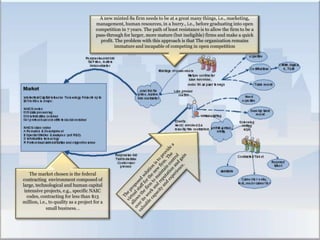
The market chosen is the federal
contracting environment composed of
large, technological and human capital
intensive projects, e.g., specific NAICs
codes, contracting for less than $13
million, i.e., to quality as a project for a
small business. .
A new minted 8a firm needs to be at a great many things, i.e., marketing,
management, human resources, in a hurry., i.e., before graduating into open
competition in 7 years. The path of least resistance is to allow the firm to be a
pass-through for larger, more mature (but ineligible) firms and make a quick
profit. The problem with this approach is that The organization remains
immature and incapable of competing in open competition
•Technology projects are heavily dependant upon
human capital and knowledge resources.
•Entrepreneurs may have strength in one core
area, but weaknesses in others.
•Potential clients have deficits or gaps in one or
more core competencies
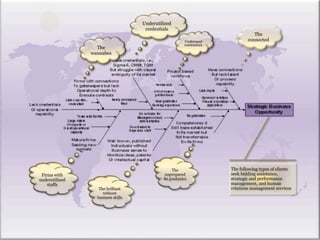
CLIENT PROFILES The
connected
The
wannabes
Underused
contractors
Underutilized
credentials
The following types of clients
seek bidding assistance,
strategic and performance
management, and human
relations management services
The
unprepared
8a graduates
The brilliant
without
business skills
Firms with
underutilized
staffs
THE PROSPECTING PROCESS
The tools of strategic and performance
management are applied in 3 phases to:
•Identify strategic opportunities which would
benefit clients
•Match clients to opportunities
•Engage clients
Horizontal Integration
Stage 1 Operations Orientation: resolve deficits in
core
competencies by providing providing virtual human
resource management (Lepak & Snell, 1998, Price,
2000, Strohmeier, 2007) and bidding services to
establish a business base.
Stage 2: Strategic Orientation: create multiple lines of
business from core competencies integrated with
overall mission & vision
Vertical Integration
Stage 3: Integrated Process Orientation: Align firm
with
customers, markets & innovation
THE EVOLUTION OF PERFORMANCE
MANAGEMENT
Stage 1: Strategy for Organizational Entry: help newly minted 8a firms capitalize on
strategic opportunities and provide virtual human resources to execute the contract.
Stage 2: Ensure
growth and
sustainability by
establishing and fine
tuning basic business
processes
Stage 3:Prepare firm for open
competition by consolidating its
strategic competencies, key
performance indicators, and
streamlining its asset supply chain
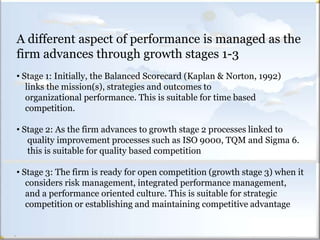
LINKING STRATEGY TO PERFORMANCEA different aspect of performance is managed as the
firm advances through growth stages 1-3
• Stage 1: Initially, the Balanced Scorecard (Kaplan & Norton, 1992)
links the mission(s), strategies and outcomes to
organizational performance. This is suitable for time based
competition.
• Stage 2: As the firm advances to growth stage 2 processes linked to
quality improvement processes such as ISO 9000, TQM and Sigma 6.
this is suitable for quality based competition
• Stage 3: The firm is ready for open competition (growth stage 3) when it
considers risk management, integrated performance management,
and a performance oriented culture. This is suitable for strategic
competition or establishing and maintaining competitive advantage
A Balanced Scorecard strategy map illustrates the
pathways between strategies and each balanced
scorecard perspective leading to the mission of
resolving deficits in core competencies.
ANNOTATED BALANCED SCORECARD STRATEGY
MAP (KAPLAN & NORTON, 1992)
Linkages between the Problem(s) , Service
Portfolio of business processes to resolve
them and organizational strategy elements
and where outcomes are found in the
product
Mission(s):
Resolve
barriers to
realizing
Critical
competencies
Strategy:
Form of services
offered to reduce
barrier to critical
competency by
functional area
Outcome:
Where
problem
resolved
Intervention
Strategies
Strategy Map: Identify, Diagnose and Provide
Strategic Capabilities for 8a Firms
Lacking Depth
Lacking Credentials
Or Capacity
Break Into
New
Markets
FillStaffing
Deficits
FillProcess
Deficits
MonitizeAssets;
Connected
IndividualsOr
Firms;
Realize
Opportunities/
Capabilities
MatureFirms;Ex
8-AFirms
Functional Element Addressed
Finance Facilitate Business Development Process By Filling In Gaps In Capacity, Depth Or Credentials
Marketing
Establish Or
Expand New
Capabilities
And Capacities
Establish Or
Expand New
Capabilities
And Capacities
Focus On Strategic
Opportunity Or
Niche
Develop Strategic
Opportunity Or
Niche
Exploit Strategic
Opportunity Or
Niche
Production
Provide
Knowledge,
Technical
Workers
Create Process
Alternatives
Develop Process Develop Process Increase Utilization
Technology
Technology &
Knowledge
Transfer
Technology &
Knowledge
Transfer
Developmental
Support
Technology &
Knowledge Transfer
Increase Utilization
Human Resources
Provide
Human Capital
Process
Creation &
Engineering
Development &
Support Staffing
Process Creation &
Engineering
Increase Utilization
Bidding Element Addressed
Technical Approach √ √
Management Plan √ √ √
History & Credentials √ √
The market develops with each procurement, regardless of which firm wins
the bid.
• Small Business Utilization Specialists (CFE, 1996) become familiar with
firm capacities
• Bidding firms fine tune (at least on paper) their processes,
− Develop valuable relationships and connections
− Enhance their knowledge of client/agency interests and future
directions.
The following table illustrates these interfaces by deficiency, performance
dimension, i.e., financial, customer and value, internal and learning and
growth views, and specific key performance indicator (David, 2007).
CRITICAL SUCCESS FACTORS
Mission(s):
Resolve barriers
to realizing
Critical
competencies
Key Performance indicators
Interface between Mission, Problem elements and
Organizational Performance, by Financial, Customer & Value,
Internal and Learning and Growth Perspectives
SUMMARY
Proposed is a prospecting approach to
identifying and engaging new clients in need of
strategy and performance management
services. Initially, clients are identified and
engaged by providing virtual human resource
management to fill deficits in firm competence
to bid projects. After contract award, services
are added to enhance organizational growth
and sustainability, including strategic
management services to promote niche
expertise and performance management
services to ensure quality, effectiveness and
efficiency. These services are expanded to
ensure sustainability by providing risk
management services.
CONCLUSIONS
REFERENCES

TMAN 680 class project

  • 1.
    A PROPOSAL TOUSE STRATEGIC AND PERFORMANCE MANAGEMENT TOOLS TO MARKET VIRTUAL HUMAN RESOURCES SERVICES TO FIRMS PROVIDING TECHNOLOGY AND HUMAN CAPITAL INTENSIVE SERVICES* Robert Chan, TMAN 680 *Or, how we can monetize what we just learned without waiting for a degree…
  • 2.
    Traditional marketing processesleave too much to chance A strategic and performance based process: • Targets resources and effort • Realizes competitive advantage • Integrates strategy with cultural & organizational development A STRATEGIC MANAGEMENT APPROACH TO SELLING STRATEGIC AND PERFORMANCE MANAGEMENT SERVICES This presentation is about using the tools of strategic and performance management to market bidding services to firms and provide strategic and virtual human resource management to firms.
  • 3.
    •Clients: Small minoritybusinesses entering the Commerce Department's 8a set aside program • Providing technology services: Information Technology, Special Studies & Analyses, Research & Development, Professional Services •Methodology: Consultative approach (Gallessich, 1982) •Firm entering this market are often unprepared The market chosen is the federal contracting environment composed of large, technological and human capital intensive projects, e.g., specific NAICs codes, contracting for less than $13 million, i.e., to quality as a project for a small business. . A new minted 8a firm needs to be at a great many things, i.e., marketing, management, human resources, in a hurry., i.e., before graduating into open competition in 7 years. The path of least resistance is to allow the firm to be a pass-through for larger, more mature (but ineligible) firms and make a quick profit. The problem with this approach is that The organization remains immature and incapable of competing in open competition
  • 4.
    •Technology projects areheavily dependant upon human capital and knowledge resources. •Entrepreneurs may have strength in one core area, but weaknesses in others. •Potential clients have deficits or gaps in one or more core competencies CLIENT PROFILES The connected The wannabes Underused contractors Underutilized credentials The following types of clients seek bidding assistance, strategic and performance management, and human relations management services The unprepared 8a graduates The brilliant without business skills Firms with underutilized staffs
  • 5.
    THE PROSPECTING PROCESS Thetools of strategic and performance management are applied in 3 phases to: •Identify strategic opportunities which would benefit clients •Match clients to opportunities •Engage clients
  • 6.
    Horizontal Integration Stage 1Operations Orientation: resolve deficits in core competencies by providing providing virtual human resource management (Lepak & Snell, 1998, Price, 2000, Strohmeier, 2007) and bidding services to establish a business base. Stage 2: Strategic Orientation: create multiple lines of business from core competencies integrated with overall mission & vision Vertical Integration Stage 3: Integrated Process Orientation: Align firm with customers, markets & innovation THE EVOLUTION OF PERFORMANCE MANAGEMENT Stage 1: Strategy for Organizational Entry: help newly minted 8a firms capitalize on strategic opportunities and provide virtual human resources to execute the contract. Stage 2: Ensure growth and sustainability by establishing and fine tuning basic business processes Stage 3:Prepare firm for open competition by consolidating its strategic competencies, key performance indicators, and streamlining its asset supply chain
  • 7.
    LINKING STRATEGY TOPERFORMANCEA different aspect of performance is managed as the firm advances through growth stages 1-3 • Stage 1: Initially, the Balanced Scorecard (Kaplan & Norton, 1992) links the mission(s), strategies and outcomes to organizational performance. This is suitable for time based competition. • Stage 2: As the firm advances to growth stage 2 processes linked to quality improvement processes such as ISO 9000, TQM and Sigma 6. this is suitable for quality based competition • Stage 3: The firm is ready for open competition (growth stage 3) when it considers risk management, integrated performance management, and a performance oriented culture. This is suitable for strategic competition or establishing and maintaining competitive advantage
  • 8.
    A Balanced Scorecardstrategy map illustrates the pathways between strategies and each balanced scorecard perspective leading to the mission of resolving deficits in core competencies. ANNOTATED BALANCED SCORECARD STRATEGY MAP (KAPLAN & NORTON, 1992) Linkages between the Problem(s) , Service Portfolio of business processes to resolve them and organizational strategy elements and where outcomes are found in the product Mission(s): Resolve barriers to realizing Critical competencies Strategy: Form of services offered to reduce barrier to critical competency by functional area Outcome: Where problem resolved Intervention Strategies Strategy Map: Identify, Diagnose and Provide Strategic Capabilities for 8a Firms Lacking Depth Lacking Credentials Or Capacity Break Into New Markets FillStaffing Deficits FillProcess Deficits MonitizeAssets; Connected IndividualsOr Firms; Realize Opportunities/ Capabilities MatureFirms;Ex 8-AFirms Functional Element Addressed Finance Facilitate Business Development Process By Filling In Gaps In Capacity, Depth Or Credentials Marketing Establish Or Expand New Capabilities And Capacities Establish Or Expand New Capabilities And Capacities Focus On Strategic Opportunity Or Niche Develop Strategic Opportunity Or Niche Exploit Strategic Opportunity Or Niche Production Provide Knowledge, Technical Workers Create Process Alternatives Develop Process Develop Process Increase Utilization Technology Technology & Knowledge Transfer Technology & Knowledge Transfer Developmental Support Technology & Knowledge Transfer Increase Utilization Human Resources Provide Human Capital Process Creation & Engineering Development & Support Staffing Process Creation & Engineering Increase Utilization Bidding Element Addressed Technical Approach √ √ Management Plan √ √ √ History & Credentials √ √
  • 9.
    The market developswith each procurement, regardless of which firm wins the bid. • Small Business Utilization Specialists (CFE, 1996) become familiar with firm capacities • Bidding firms fine tune (at least on paper) their processes, − Develop valuable relationships and connections − Enhance their knowledge of client/agency interests and future directions. The following table illustrates these interfaces by deficiency, performance dimension, i.e., financial, customer and value, internal and learning and growth views, and specific key performance indicator (David, 2007). CRITICAL SUCCESS FACTORS Mission(s): Resolve barriers to realizing Critical competencies Key Performance indicators Interface between Mission, Problem elements and Organizational Performance, by Financial, Customer & Value, Internal and Learning and Growth Perspectives
  • 10.
    SUMMARY Proposed is aprospecting approach to identifying and engaging new clients in need of strategy and performance management services. Initially, clients are identified and engaged by providing virtual human resource management to fill deficits in firm competence to bid projects. After contract award, services are added to enhance organizational growth and sustainability, including strategic management services to promote niche expertise and performance management services to ensure quality, effectiveness and efficiency. These services are expanded to ensure sustainability by providing risk management services.
  • 11.
  • 12.