Innovation in the Online Music
Industry: Past, Present & Future
TM6006
Student ID: U1338360
(Online Music Library, 2014)
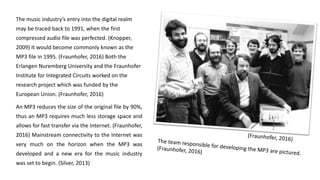
The music industry’s entry into the digital realm
may be traced back to 1991, when the first
compressed audio file was perfected. (Knopper,
2009) It would become commonly known as the
MP3 file in 1995. (Fraunhofer, 2016) Both the
Erlangen Nuremberg University and the Fraunhofer
Institute for Integrated Circuits worked on the
research project which was funded by the
European Union. (Fraunhofer, 2016)
An MP3 reduces the size of the original file by 90%,
thus an MP3 requires much less storage space and
allows for fast transfer via the Internet. (Fraunhofer,
2016) Mainstream connectivity to the Internet was
very much on the horizon when the MP3 was
developed and a new era for the music industry
was set to begin. (Silver, 2013)
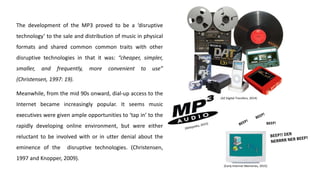
The development of the MP3 proved to be a ‘disruptive
technology’ to the sale and distribution of music in physical
formats and shared common common traits with other
disruptive technologies in that it was: “cheaper, simpler,
smaller, and frequently, more convenient to use”
(Christensen, 1997: 19).
Meanwhile, from the mid 90s onward, dial-up access to the
Internet became increasingly popular. It seems music
executives were given ample opportunities to ‘tap in’ to the
rapidly developing online environment, but were either
reluctant to be involved with or in utter denial about the
eminence of the disruptive technologies. (Christensen,
1997 and Knopper, 2009).
(AZ Digital Transfers, 2014)
(Early Internet Memories, 2015)
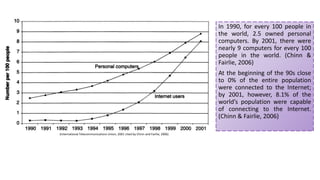
In 1990, for every 100 people in
the world, 2.5 owned personal
computers. By 2001, there were
nearly 9 computers for every 100
people in the world. (Chinn &
Fairlie, 2006)
At the beginning of the 90s close
to 0% of the entire population
were connected to the Internet;
by 2001, however, 8.1% of the
world’s population were capable
of connecting to the Internet.
(Chinn & Fairlie, 2006)
(International Telecommunications Union, 2001 cited by Chinn and Fairlie, 2006)
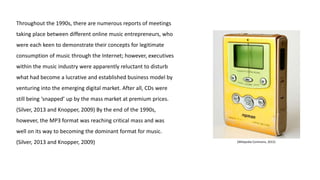
Throughout the 1990s, there are numerous reports of meetings
taking place between different online music entrepreneurs, who
were each keen to demonstrate their concepts for legitimate
consumption of music through the Internet; however, executives
within the music industry were apparently reluctant to disturb
what had become a lucrative and established business model by
venturing into the emerging digital market. After all, CDs were
still being ‘snapped’ up by the mass market at premium prices.
(Silver, 2013 and Knopper, 2009) By the end of the 1990s,
however, the MP3 format was reaching critical mass and was
well on its way to becoming the dominant format for music.
(Silver, 2013 and Knopper, 2009) (Wikipedia Commons, 2015)
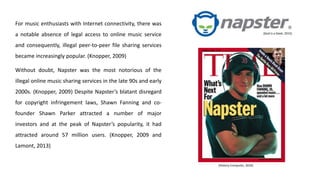
For music enthusiasts with Internet connectivity, there was
a notable absence of legal access to online music service
and consequently, illegal peer-to-peer file sharing services
became increasingly popular. (Knopper, 2009)
Without doubt, Napster was the most notorious of the
illegal online music sharing services in the late 90s and early
2000s. (Knopper, 2009) Despite Napster’s blatant disregard
for copyright infringement laws, Shawn Fanning and co-
founder Shawn Parker attracted a number of major
investors and at the peak of Napster’s popularity, it had
attracted around 57 million users. (Knopper, 2009 and
Lamont, 2013)
(History-Computer, 2016)
(God is a Geek, 2015)
Instead of recognizing the potential revenue that could
likely be gleaned from licensing Napster in order to
profit from a legal version of its service, numerous
music corporations along with the Recording Industry
Association of America (RIAA) initiated litigation against
Napster. (Silver, 2013 and Knopper, 2009)
Notwithstanding numerous attempts to save the
company, Napster ceased to offer its service in 2001
and filed for bankruptcy in 2002. (Knopper, 2009)
(sdcitybeat.com, 2012)
(via Newser, 2010)
(P2P Filesharing History, 2010)
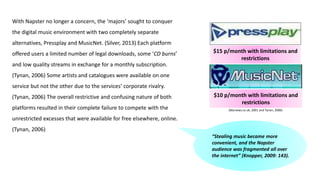
With Napster no longer a concern, the ‘majors’ sought to conquer
the digital music environment with two completely separate
alternatives, Pressplay and MusicNet. (Silver, 2013) Each platform
offered users a limited number of legal downloads, some ‘CD burns’
and low quality streams in exchange for a monthly subscription.
(Tynan, 2006) Some artists and catalogues were available on one
service but not the other due to the services’ corporate rivalry.
(Tynan, 2006) The overall restrictive and confusing nature of both
platforms resulted in their complete failure to compete with the
unrestricted excesses that were available for free elsewhere, online.
(Tynan, 2006)
$15 p/month with limitations and
restrictions
“Stealing music became more
convenient, and the Napster
audience was fragmented all over
the internet” (Knopper, 2009: 143).
(bbcnews.co.uk, 2001 and Tynan, 2006)
$10 p/month with limitations and
restrictions
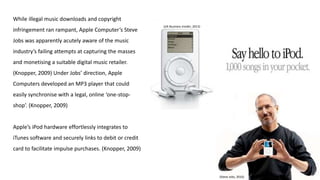
While illegal music downloads and copyright
infringement ran rampant, Apple Computer’s Steve
Jobs was apparently acutely aware of the music
industry’s failing attempts at capturing the masses
and monetising a suitable digital music retailer.
(Knopper, 2009) Under Jobs’ direction, Apple
Computers developed an MP3 player that could
easily synchronise with a legal, online ‘one-stop-
shop’. (Knopper, 2009)
Apple’s iPod hardware effortlessly integrates to
iTunes software and securely links to debit or credit
card to facilitate impulse purchases. (Knopper, 2009)
(Steve Jobs, 2016)
(UK Business Insider, 2013)
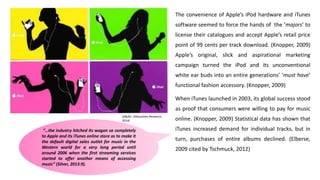
The convenience of Apple’s iPod hardware and iTunes
software seemed to force the hands of the ‘majors’ to
license their catalogues and accept Apple’s retail price
point of 99 cents per track download. (Knopper, 2009)
Apple’s original, slick and aspirational marketing
campaign turned the iPod and its unconventional
white ear buds into an entire generations’ ‘must have’
functional fashion accessory. (Knopper, 2009)
When iTunes launched in 2003, its global success stood
as proof that consumers were willing to pay for music
online. (Knopper, 2009) Statistical data has shown that
iTunes increased demand for individual tracks, but in
turn, purchases of entire albums declined. (Elberse,
2009 cited by Tschmuck, 2012)
(D&AD- Silhouettes Research,
2014)
“…the industry hitched its wagon so completely
to Apple and its iTunes online store as to make it
the default digital sales outlet for music in the
Western world for a very long period until
around 2006 when the first streaming services
started to offer another means of accessing
music” (Silver, 2013:9).
(Zilio, 2014) (Anon, 2016) (freelargeimages, 2016)
Social media exploded into popular culture around 2005.
(Tschmuck, 2012) Through MySpace and YouTube, Artists were
able to directly engage with their audiences in ways that were
never possible before. (Tschmuck, 2012) Through YouTube,
viewers are access millions of recordings for free in exchange
for watching a short advertisment before the commencement
of their selected video; meanwhile, YouTube’s earns its revenue
through advertising. (Tun, 2015)
(MTV, 2007)
(YouTube Logo, 2016)
(Msfitmag.com,2016)
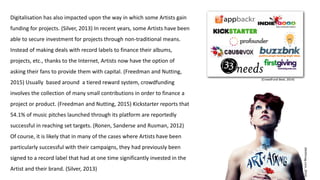
Digitalisation has also impacted upon the way in which some Artists gain
funding for projects. (Silver, 2013) In recent years, some Artists have been
able to secure investment for projects through non-traditional means.
Instead of making deals with record labels to finance their albums,
projects, etc., thanks to the Internet, Artists now have the option of
asking their fans to provide them with capital. (Freedman and Nutting,
2015) Usually based around a tiered reward system, crowdfunding
involves the collection of many small contributions in order to finance a
project or product. (Freedman and Nutting, 2015) Kickstarter reports that
54.1% of music pitches launched through its platform are reportedly
successful in reaching set targets. (Ronen, Sanderse and Rusman, 2012)
Of course, it is likely that in many of the cases where Artists have been
particularly successful with their campaigns, they had previously been
signed to a record label that had at one time significantly invested in the
Artist and their brand. (Silver, 2013)
(CrowdFund Beat, 2014)
As music distribution models continue to adapt in order to meet customer
needs that are based upon access to music instead of ownership of music, a
series of tiered premium and ‘freemium’ subscription based streaming
platforms have emerged in the last decade, including the leading tiered
streaming subscription service provider, Spotify. (Stutz, 2015)
Other services have since entered the streaming market including Amazon
Prime Music, Tidal and Apple Music. Apple’s launch of its streaming service in
2015 saw the platform amass more than 10 million paying subscribers within
a period of 6 months; the same milestone which took Spotify six years to
achieve. (Garrahan, 2016) The instantaneous popularity could be attributed
to Apple’s clever marketing or a general heightened consumer awareness of
streaming in general. While music downloads are in a state of steady decline,
streaming may be categorised as a definite growth area for the music
industry, with demand for streaming increasing by 50% in 2014. (Nielsen
2014, cited by Financial Times, 2016)
(Amazon Prime Music Logo, 2016)
(Rotunda Media, 2015)
(Stutz, 2015)
(iPhone No Sound, 2015)
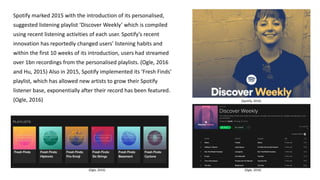
Spotify marked 2015 with the introduction of its personalised,
suggested listening playlist ‘Discover Weekly’ which is compiled
using recent listening activities of each user. Spotify’s recent
innovation has reportedly changed users’ listening habits and
within the first 10 weeks of its introduction, users had streamed
over 1bn recordings from the personalised playlists. (Ogle, 2016
and Hu, 2015) Also in 2015, Spotify implemented its ‘Fresh Finds’
playlist, which has allowed new artists to grow their Spotify
listener base, exponentially after their record has been featured.
(Ogle, 2016) (Spotify, 2016)
(Ogle, 2016)(Ogle, 2016)
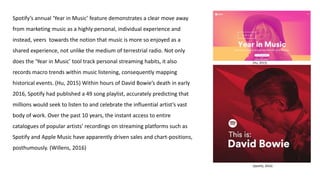
Spotify’s annual ‘Year in Music’ feature demonstrates a clear move away
from marketing music as a highly personal, individual experience and
instead, veers towards the notion that music is more so enjoyed as a
shared experience, not unlike the medium of terrestrial radio. Not only
does the ‘Year in Music’ tool track personal streaming habits, it also
records macro trends within music listening, consequently mapping
historical events. (Hu, 2015) Within hours of David Bowie’s death in early
2016, Spotify had published a 49 song playlist, accurately predicting that
millions would seek to listen to and celebrate the influential artist’s vast
body of work. Over the past 10 years, the instant access to entire
catalogues of popular artists’ recordings on streaming platforms such as
Spotify and Apple Music have apparently driven sales and chart-positions,
posthumously. (Willens, 2016)
(Hu, 2015)
(Spotify, 2016)
YouTube should be recognised as the behemoth of music
streaming, with over 1 billion users visiting the site each day,
many of which are allegedly visiting to watch music videos.
(Graham et al., 2015) YouTube has been accused of exploiting
safe harbor laws that were designed to protect Internet
service providers from suffering any liability from their
customers’ infringement of copyright laws. (Cooke, 2015)
YouTube’s parent company, Google, credits YouTube’s success
as a a key factor in the corporation’s ability to achieve
impressive growth, year-on year. With the launch of ad-free
app’s, YouTube Music and YouTube Red, Google seems
determined to continue in its focus to dominate and profit
from the digital music industry. (Graham et al., 2015)
(Google.co.uk, 2016)
(YouTube logo, 2016)
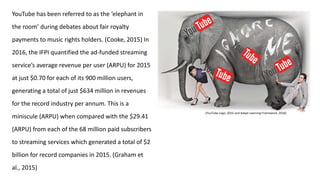
YouTube has been referred to as the ‘elephant in
the room’ during debates about fair royalty
payments to music rights holders. (Cooke, 2015) In
2016, the IFPI quantified the ad-funded streaming
service’s average revenue per user (ARPU) for 2015
at just $0.70 for each of its 900 million users,
generating a total of just $634 million in revenues
for the record industry per annum. This is a
miniscule (ARPU) when compared with the $29.41
(ARPU) from each of the 68 million paid subscribers
to streaming services which generated a total of $2
billion for record companies in 2015. (Graham et
al., 2015)
(YouTube Logo, 2016 and Adapt Learning Framework, 2016)
Major record labels may be looking towards closing
the ‘value gap’ which results from ad-funded
YouTube streaming, soon. All three of the major
labels’ licensing agreements with YouTube have
either expired or in Universal Music’s case, the two
corporations are currently operating on a ‘rolling
contractual basis’. The remaining two labels’
agreements are also due to expire shortly;
therefore, renegotiation of higher rates for ad-
funded streaming of the majors’ catalogues has
been predicted by some music industry insiders.
(Ingham, 2016)
(Cross, 2016)
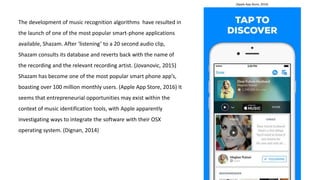
The development of music recognition algorithms have resulted in
the launch of one of the most popular smart-phone applications
available, Shazam. After ‘listening’ to a 20 second audio clip,
Shazam consults its database and reverts back with the name of
the recording and the relevant recording artist. (Jovanovic, 2015)
Shazam has become one of the most popular smart phone app’s,
boasting over 100 million monthly users. (Apple App Store, 2016) It
seems that entrepreneurial opportunities may exist within the
context of music identification tools, with Apple apparently
investigating ways to integrate the software with their OSX
operating system. (Dignan, 2014)
(Apple App Store, 2016)
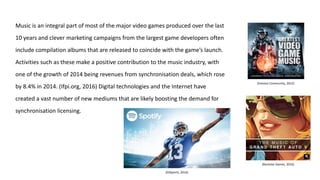
Music is an integral part of most of the major video games produced over the last
10 years and clever marketing campaigns from the largest game developers often
include compilation albums that are released to coincide with the game’s launch.
Activities such as these make a positive contribution to the music industry, with
one of the growth of 2014 being revenues from synchronisation deals, which rose
by 8.4% in 2014. (Ifpi.org, 2016) Digital technologies and the Internet have
created a vast number of new mediums that are likely boosting the demand for
synchronisation licensing.
(EASports, 2016)
(Rockstar Games, 2016)
(Invision Community, 2012)
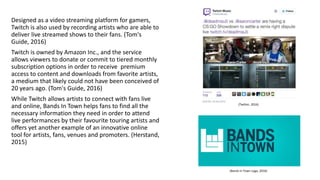
Designed as a video streaming platform for gamers,
Twitch is also used by recording artists who are able to
deliver live streamed shows to their fans. (Tom's
Guide, 2016)
Twitch is owned by Amazon Inc., and the service
allows viewers to donate or commit to tiered monthly
subscription options in order to receive premium
access to content and downloads from favorite artists,
a medium that likely could not have been conceived of
20 years ago. (Tom's Guide, 2016)
While Twitch allows artists to connect with fans live
and online, Bands In Town helps fans to find all the
necessary information they need in order to attend
live performances by their favourite touring artists and
offers yet another example of an innovative online
tool for artists, fans, venues and promoters. (Herstand,
2015)
(Twitter, 2016)
(Bands In Town Logo, 2016)
Although there is no doubt digital technologies and the
Internet have irrevocably changed the way in which the
industry operates, the Internet and associated digital
technologies have also produced new mediums which have
provided opportunities for new businesses to emerge and
operate within the new environment.
The Internet allows artists and music businesses to engage
with fans in ways never before thought possible, whether it
be through video streaming platforms such as YouTube and
Twitch, crowd-funding campaigns or social networking sites
such as Facebook, Twitter and so on. All of these platforms
have produced potential revenue earning opportunities
which have only become possible as a result of the online
economy that has developed over the past two decades.
There have been some ‘casualties’ along the way, however
the new music economy has produced some very clear
winners, with companies such as Apple, Google and Spotify
leading the way for effecting innovation and ongoing
transformation within the context of the digital music
industry and beyond.
(Support.apple.com, 2016)
(Google.co.uk, 2016)
(YouTube logo, 2016)
(Commons.wikimedia.org, 2013)
References (A-C):
Adapt Learning Framework, (2016). Adapt Learning Framework. [image] Available at: http://www.appitierre.com/blog/2015/07/30/the-adapt-learning-framework-and-the-elephant-in-the-room/ [Accessed 22
Apr. 2016].
Amazon Prime Music Logo. (2016). [image] Available at: http://logos.wikia.com/wiki/Amazon_Prime_Music [Accessed 4 Apr. 2016].
Anon, (2016). [image] Available at: http://www.wheelerpl.michlibrary.org/Facebook-Logo-Wallpaper-Full-HD.png/image_view_fullscreen [Accessed 2 Apr. 2016].
Apple App Store. (2016). Shazam - Discover music, artists, videos & lyrics on the App Store. [online] Available at: https://itunes.apple.com/gb/app/shazam-discover-music-artists/id284993459?mt=8 [Accessed
22 Apr. 2016].
AZ Digital Transfers, (2014). Physical Music Formats. [image] Available at: http://www.azdigitaltransfers.com/catalog/i84.html [Accessed 31 Mar. 2016].
Bands In Town Logo. (2016). [image] Available at: http://20wattsmag.com/2013/02/keep-on-top-of-the-local-scene-with-bandsintown/ [Accessed 22 Apr. 2016].
bbcnews.co.uk. (2001). BBC News | NEW MEDIA | Getting the best out of net music. [online] Available at: http://news.bbc.co.uk/1/hi/entertainment/1719779.stm [Accessed 1 Apr. 2016].
Chinn, M. and Fairlie, R. (2006). The determinants of the global digital divide: a cross-country analysis of computer and internet penetration. Oxford Economic Papers, 59(1), pp.16-44.
Christensen, C. (1997). The innovator's dilemma. Boston, Mass.: Harvard Business Review Press.
Commons.wikimedia.org. (2013). File:Spotify logo horizontal black.jpg - Wikimedia Commons. [online] Available at: https://commons.wikimedia.org/wiki/File:Spotify_logo_horizontal_black.jpg [Accessed 22
Apr. 2016].
Cooke, C. (2015). IFPI puts ‘safe harbours’ at the top of its copyright action list | Complete Music Update. [online] Completemusicupdate.com. Available at: http://www.completemusicupdate.com/article/ifpi-
puts-safe-harbours-at-the-top-of-its-copyright-action-list/ [Accessed 22 Apr. 2016].
Cracked, (2011). RIAA Logo. [image] Available at: http://www.cracked.com/funny-2153-riaa/ [Accessed 31 Mar. 2016].
Cross, A. (2016). Major Record Labels. [image] Available at: http://ajournalofmusicalthings.com/how-the-major-record-labels-took-back-their-power/ [Accessed 22 Apr. 2016].
CrowdFund Beat. (2014). Music Crowdfunding. [online] Available at: http://crowdfundbeat.com/2014/08/01/top-10-music-crowdfunding-campaigns/ [Accessed 4 Apr. 2016].
References (D-G):
D&AD- Silhouettes Research. (2014). [image] Available at: https://farrellgeorgia.wordpress.com/category/research/ [Accessed 2 Apr. 2016].
Digital Music News, (2015). [image] Available at: http://www.digitalmusicnews.com/2015/07/27/why-the-music-industry-is-starting-to-hate-youtube/ [Accessed 3 Apr. 2016].
Dignan, L. (2014). The business of Shazam: Why an Apple iOS partnership would be a boon | ZDNet. [online] ZDNet. Available at: http://www.zdnet.com/article/the-business-of-shazam-why-an-apple-ios-
partnership-would-be-a-boon/ [Accessed 22 Apr. 2016].
Early Internet Memories. (2015). [image] Available at: http://www.bustle.com/articles/117548-10-early-memories-of-the-internet-according-to-reddit-that-will-make-you-wish-you-could [Accessed 31 Mar.
2016].
EASports, (2016). Madden NFL 2016: Soundtrack. [image] Available at: https://www.easports.com/madden-nfl/news/2015/madden-16-soundtrack [Accessed 22 Apr. 2016].
Financial Times. (2016). Apple’s music streaming subscribers top 10m - FT.com. [online] Available at: http://www.ft.com/cms/s/0/742955d2-b79b-11e5-bf7e-8a339b6f2164.html#axzz44sR2l0JP [Accessed 4 Apr.
2016].
Fraunhofer. (2016). Timeline. [online] Available at: http://www.mp3-history.com/en/timeline.html [Accessed 31 Mar. 2016].
Freedman, D. and Nutting, M. (2015). A Brief History of Crowdfunding: Including Rewards, Donation, Debt, and Equity Platforms in the USA. [online] Available at: http://www.freedman-chicago.com/ec4i/History-
of-Crowdfunding.pdf [Accessed 4 Apr. 2016].
freelargeimages. (2016). [image] Available at: http://www.freelargeimages.com/twitter-logo-hd-png-4557/ [Accessed 3 Apr. 2016].
Garrahan, M. (2016). Apple’s music streaming subscribers top 10m - FT.com. [online] Financial Times. Available at: http://www.ft.com/cms/s/0/742955d2-b79b-11e5-bf7e-8a339b6f2164.html#axzz44sR2l0JP
[Accessed 4 Apr. 2016].
God is a Geek, (2015). Tapster to Wii. [image] Available at: http://www.godisageek.com/2015/12/tapster-coming-to-wii-u/ [Accessed 31 Mar. 2016].
Google.co.uk. (2016). Google logo. [online] Available at:
https://www.google.co.uk/url?sa=i&rct=j&q=&esrc=s&source=images&cd=&ved=0ahUKEwiruPj796LMAhXIPxoKHUseCcMQjhwIBQ&url=http%3A%2F%2Fwww.popsci.com%2Fgoogle-unveils-new-flatter-logo-
for-post-pc-world&psig=AFQjCNGezftjMi6elxuHRpu5ZbrpAek2NA&ust=1461438272014074 [Accessed 22 Apr. 2016].
Graham, B., Maliphant, R., Graham, B., Maliphant, R. and Grieve, R. (2015). 'Pedestrian At Best' - 11 Winners And Losers In Digital Music In 2015 - Pivotl. [online] Pivotl. Available at:
http://www.pivotl.com/2015/12/15/pedestrian-at-best-11-winners-and-losers-in-digital-music-in-2015/ [Accessed 22 Apr. 2016].
References (H-M):
Herstand, A. (2015). Bandsintown's 15 Million User Milestone Comes With Serious Oversights - Digital Music News. [online] Digital Music News. Available at:
http://www.digitalmusicnews.com/2015/01/20/bandsintowns-15-million-user-milestone-comes-with-serious-oversights/ [Accessed 22 Apr. 2016].
History-Computer. (2016). [image] Available at: http://history-computer.com/Internet/Conquering/Napster.html [Accessed 31 Mar. 2016].
Hu, C. (2016). Spotify's 2015 Year In Music And The New 'Streaming Monoculture'. [online] Forbes.com. Available at: http://www.forbes.com/sites/cheriehu/2015/12/23/what-spotifys-2015-year-in-music-says-
about-shifting-priorities-in-streaming-culture/#7d6d82f4590a [Accessed 22 Apr. 2016].
Ifpi.org. (2016). Facts & Stats — IFPI — Representing the recording industry worldwide. [online] Available at: http://www.ifpi.org/facts-and-stats.php [Accessed 22 Apr. 2016].
Ingham, T. (2016). Universal Music Group is 'out of contract' with YouTube - sources - Music Business Worldwide. [online] Music Business Worldwide. Available at:
http://www.musicbusinessworldwide.com/universal-contract-youtube-sources/ [Accessed 22 Apr. 2016].
Invision Community. (2012). Video Games in a Exciting New Classical Compilation Album - Invision Community. [online] Available at: http://invisioncommunity.co.uk/2012/10/22/video-games-in-a-exciting-new-
classical-compilation-album/ [Accessed 22 Apr. 2016].
iPhone No Sound. (2015). Download and Install Apple Music on iPhone with iOS 8.4. [online] Available at: http://iphonenosound.com/download-and-install-apple-music-on-iphone-with-ios-8-4/ [Accessed 4 Apr.
2016].
Jovanovic, J. (2015). Shazam It! Music Recognition Algorithms, Fingerprinting, and Processing. [online] Toptal Engineering Blog. Available at: https://www.toptal.com/algorithms/shazam-it-music-processing-
fingerprinting-and-recognition [Accessed 22 Apr. 2016].
Knopper, S. (2009). Appetite for self-destruction. New York: Simon & Schuster UK Ltd.
Lamont, T. (2013). Napster: the day the music was set free. [online] the Guardian. Available at: http://www.theguardian.com/music/2013/feb/24/napster-music-free-file-sharing [Accessed 22 Apr. 2016].
McArdle, M. (2007). Amazon starts selling MP3s. [online] The Atlantic. Available at: http://www.theatlantic.com/business/archive/2007/09/amazon-starts-selling-mp3s/1995/ [Accessed 4 Apr. 2016].
Msfitmag.com. (2016). Asking, Telling, Accepting, Being: Why You Should Read Amanda Palmer’s The Art of Asking | Ms. Fit Magazine. [online] Available at: http://msfitmag.com/asking-telling-accepting-being-
why-you-should-read-amanda-palmers-the-art-of-asking/ [Accessed 3 Apr. 2016].
MTV, (2007). Who's really 1 itunes myspace. [image] Available at: http://www.mtv.com/news/1551241/whos-really-1-itunes-myspace-throwing-music-charts-for-a-loop/ [Accessed 3 Apr. 2016].
References (O-Z):
Ogle, M. (2016). Matt Ogle talks Discover Weekly and Spotify evolution. [online] Musically.com. Available at: http://musically.com/2016/03/21/matt-ogle-discover-weekly-spotify/ [Accessed 22 Apr. 2016].
Online Music Library. (2014). [image] Available at: http://projectsgeek.com/2014/05/online-music-library-project-in-php.html [Accessed 1 Apr. 2016].
P2P Filesharing History. (2010). [image] Available at: http://i-downloader.blogspot.co.uk/2010/12/brief-history-of-file-sharing.html [Accessed 1 Apr. 2016].
Rockstar Games. (2016). The Music of Grand Theft Auto V: Three Volume Digital Album Now Available on iTunes | Rockstar Games. [online] Available at: http://www.rockstargames.com/newswire/article/51411/the-
music-of-grand-theft-auto-v-three-volume-digital-album-now-a.html [Accessed 22 Apr. 2016].
Ronen, G., Sanderse, W. and Rusman, H. (2012). Kickstarting the crowdfunding trends. [online] Masters of Media. Available at: http://mastersofmedia.hum.uva.nl/2012/10/05/kickstarting-the-crowdfunding-trends/
[Accessed 3 Apr. 2016].
Ronson, J. (2013). Amanda Palmer: visionary or egotist?. [online] the Guardian. Available at: http://www.theguardian.com/music/2013/jun/22/amanda-palmer-visionary-egotist-interview [Accessed 3 Apr. 2016].
Rotunda Media. (2015). An Idiots Guide to Tidal. [online] Available at: http://rotundamedia.com.au/2015/04/09/an-idiots-guide-to-tidal/ [Accessed 4 Apr. 2016].
sdcitybeat.com. (2012). [image] Available at: http://www.conquerblog.com/a-date-which-will-live-in-infamy-the-other-infamy-the-napster-lawsuit/2012/12/07/546/ [Accessed 31 Mar. 2016].
Silver, J. (2013). Digital Medieval: The first twenty years of music on the web...and the next twenty. London: Xstorical Publications Media.
Spotify, (2016). How to Keep Your Awesome Spotify Playlists. [image] Available at: http://forums.techweez.com/t/how-to-keep-your-awesome-spotify-discover-weekly-playlists-for-good/278 [Accessed 22 Apr. 2016].
Steve Jobs. (2016). [image] Available at: http://allaboutstevejobs.com/bio/longbio/longbio_10.php [Accessed 2 Apr. 2016].
Stutz, C. (2015). Spotify Tops Pandora as World's Most Popular Music Streaming App. [online] Billboard. Available at: http://www.billboard.com/articles/news/6784774/spotify-pandora-most-popular-music-
streaming-app-worldwide [Accessed 4 Apr. 2016].
Support.apple.com. (2016). Apple logo with progress bar after updating or restoring iPhone, iPad, or iPod touch - Apple Support. [online] Available at: https://support.apple.com/en-us/HT203435 [Accessed 22 Apr.
2016].
Tom's Guide. (2016). The Ultimate Guide to Twitch Streaming - The Ultimate Guide to Twitch Streaming. [online] Available at: http://www.tomsguide.com/us/twitch-streaming-guide,review-3009.html [Accessed 4
Apr. 2016].
Tschmuck, P. (2006). Creativity and innovation in the music industry. Dordrecht: Springer.
Twitter. (2016). Twitch Music on Twitter. [online] Available at: https://twitter.com/twitchmusic/status/669629267060260864 [Accessed 3 Apr. 2016].
Tynan, D. (2006). The 25 Worst Tech Products of All Time. [online] Web Archive - PC World/reviews. Available at:
https://web.archive.org/web/20060615224159/http://www.pcworld.com/reviews/article/0,aid,125772,pg,1,00.asp [Accessed 1 Apr. 2016].
UK Business Insider, (2013). UK Business Insider iPod 12 years-old. [image] Available at: http://uk.businessinsider.com/apple-ipod-12-years-old-2013-11?r=US&IR=T [Accessed 2 Apr. 2016].
via Newser. (2010). [image] Available at: http://streetknowledge.nyc/2010/10/27/judge-shuts-down-file-sharing-site-limewire/ [Accessed 1 Apr. 2016].
Wikipedia Commons, (2015). MPMan. [image] Available at: http://www.makeuseof.com/tag/the-evolution-of-music-consumption-how-we-got-here/ [Accessed 22 Apr. 2016].
Wikipedia, (2015). Official MP3 Logo. [image] Available at: https://commons.wikimedia.org/wiki/File:MP3_logo.png [Accessed 31 Mar. 2016].
Willens, M. (2016). Why The Most Important David Bowie Tributes Are Streaming On Spotify, Apple Music And Tidal. [online] International Business Times. Available at: http://www.ibtimes.com/why-most-important-
david-bowie-tributes-are-streaming-spotify-apple-music-tidal-2259694 [Accessed 22 Apr. 2016].
YouTube Logo. (2016). [image] Available at: http://logok.org/youtube-logo/ [Accessed 3 Apr. 2016].
YouTube Logo. (2016). [image] Available at: https://sites.google.com/site/seourpicz/1/tv-and-video/us/1/youtube-logo-3 [Accessed 22 Apr. 2016].
Zilio, L. (2014). MySpace Mobile | Social Media: The way I see it.. [online] Lzilio.wordpress.com. Available at: https://lzilio.wordpress.com/tag/myspace-mobile/ [Accessed 2 Apr. 2016].

Innovation in the Online Music Industry: Past, Present and Future

  • 1.
    Innovation in theOnline Music Industry: Past, Present & Future TM6006 Student ID: U1338360 (Online Music Library, 2014)
  • 2.
    The music industry’sentry into the digital realm may be traced back to 1991, when the first compressed audio file was perfected. (Knopper, 2009) It would become commonly known as the MP3 file in 1995. (Fraunhofer, 2016) Both the Erlangen Nuremberg University and the Fraunhofer Institute for Integrated Circuits worked on the research project which was funded by the European Union. (Fraunhofer, 2016) An MP3 reduces the size of the original file by 90%, thus an MP3 requires much less storage space and allows for fast transfer via the Internet. (Fraunhofer, 2016) Mainstream connectivity to the Internet was very much on the horizon when the MP3 was developed and a new era for the music industry was set to begin. (Silver, 2013)
  • 3.
    The development ofthe MP3 proved to be a ‘disruptive technology’ to the sale and distribution of music in physical formats and shared common common traits with other disruptive technologies in that it was: “cheaper, simpler, smaller, and frequently, more convenient to use” (Christensen, 1997: 19). Meanwhile, from the mid 90s onward, dial-up access to the Internet became increasingly popular. It seems music executives were given ample opportunities to ‘tap in’ to the rapidly developing online environment, but were either reluctant to be involved with or in utter denial about the eminence of the disruptive technologies. (Christensen, 1997 and Knopper, 2009). (AZ Digital Transfers, 2014) (Early Internet Memories, 2015)
  • 4.
    In 1990, forevery 100 people in the world, 2.5 owned personal computers. By 2001, there were nearly 9 computers for every 100 people in the world. (Chinn & Fairlie, 2006) At the beginning of the 90s close to 0% of the entire population were connected to the Internet; by 2001, however, 8.1% of the world’s population were capable of connecting to the Internet. (Chinn & Fairlie, 2006) (International Telecommunications Union, 2001 cited by Chinn and Fairlie, 2006)
  • 5.
    Throughout the 1990s,there are numerous reports of meetings taking place between different online music entrepreneurs, who were each keen to demonstrate their concepts for legitimate consumption of music through the Internet; however, executives within the music industry were apparently reluctant to disturb what had become a lucrative and established business model by venturing into the emerging digital market. After all, CDs were still being ‘snapped’ up by the mass market at premium prices. (Silver, 2013 and Knopper, 2009) By the end of the 1990s, however, the MP3 format was reaching critical mass and was well on its way to becoming the dominant format for music. (Silver, 2013 and Knopper, 2009) (Wikipedia Commons, 2015)
  • 6.
    For music enthusiastswith Internet connectivity, there was a notable absence of legal access to online music service and consequently, illegal peer-to-peer file sharing services became increasingly popular. (Knopper, 2009) Without doubt, Napster was the most notorious of the illegal online music sharing services in the late 90s and early 2000s. (Knopper, 2009) Despite Napster’s blatant disregard for copyright infringement laws, Shawn Fanning and co- founder Shawn Parker attracted a number of major investors and at the peak of Napster’s popularity, it had attracted around 57 million users. (Knopper, 2009 and Lamont, 2013) (History-Computer, 2016) (God is a Geek, 2015)
  • 7.
    Instead of recognizingthe potential revenue that could likely be gleaned from licensing Napster in order to profit from a legal version of its service, numerous music corporations along with the Recording Industry Association of America (RIAA) initiated litigation against Napster. (Silver, 2013 and Knopper, 2009) Notwithstanding numerous attempts to save the company, Napster ceased to offer its service in 2001 and filed for bankruptcy in 2002. (Knopper, 2009) (sdcitybeat.com, 2012) (via Newser, 2010) (P2P Filesharing History, 2010)
  • 8.
    With Napster nolonger a concern, the ‘majors’ sought to conquer the digital music environment with two completely separate alternatives, Pressplay and MusicNet. (Silver, 2013) Each platform offered users a limited number of legal downloads, some ‘CD burns’ and low quality streams in exchange for a monthly subscription. (Tynan, 2006) Some artists and catalogues were available on one service but not the other due to the services’ corporate rivalry. (Tynan, 2006) The overall restrictive and confusing nature of both platforms resulted in their complete failure to compete with the unrestricted excesses that were available for free elsewhere, online. (Tynan, 2006) $15 p/month with limitations and restrictions “Stealing music became more convenient, and the Napster audience was fragmented all over the internet” (Knopper, 2009: 143). (bbcnews.co.uk, 2001 and Tynan, 2006) $10 p/month with limitations and restrictions
  • 9.
    While illegal musicdownloads and copyright infringement ran rampant, Apple Computer’s Steve Jobs was apparently acutely aware of the music industry’s failing attempts at capturing the masses and monetising a suitable digital music retailer. (Knopper, 2009) Under Jobs’ direction, Apple Computers developed an MP3 player that could easily synchronise with a legal, online ‘one-stop- shop’. (Knopper, 2009) Apple’s iPod hardware effortlessly integrates to iTunes software and securely links to debit or credit card to facilitate impulse purchases. (Knopper, 2009) (Steve Jobs, 2016) (UK Business Insider, 2013)
  • 10.
    The convenience ofApple’s iPod hardware and iTunes software seemed to force the hands of the ‘majors’ to license their catalogues and accept Apple’s retail price point of 99 cents per track download. (Knopper, 2009) Apple’s original, slick and aspirational marketing campaign turned the iPod and its unconventional white ear buds into an entire generations’ ‘must have’ functional fashion accessory. (Knopper, 2009) When iTunes launched in 2003, its global success stood as proof that consumers were willing to pay for music online. (Knopper, 2009) Statistical data has shown that iTunes increased demand for individual tracks, but in turn, purchases of entire albums declined. (Elberse, 2009 cited by Tschmuck, 2012) (D&AD- Silhouettes Research, 2014) “…the industry hitched its wagon so completely to Apple and its iTunes online store as to make it the default digital sales outlet for music in the Western world for a very long period until around 2006 when the first streaming services started to offer another means of accessing music” (Silver, 2013:9).
  • 11.
    (Zilio, 2014) (Anon,2016) (freelargeimages, 2016) Social media exploded into popular culture around 2005. (Tschmuck, 2012) Through MySpace and YouTube, Artists were able to directly engage with their audiences in ways that were never possible before. (Tschmuck, 2012) Through YouTube, viewers are access millions of recordings for free in exchange for watching a short advertisment before the commencement of their selected video; meanwhile, YouTube’s earns its revenue through advertising. (Tun, 2015) (MTV, 2007) (YouTube Logo, 2016)
  • 12.
    (Msfitmag.com,2016) Digitalisation has alsoimpacted upon the way in which some Artists gain funding for projects. (Silver, 2013) In recent years, some Artists have been able to secure investment for projects through non-traditional means. Instead of making deals with record labels to finance their albums, projects, etc., thanks to the Internet, Artists now have the option of asking their fans to provide them with capital. (Freedman and Nutting, 2015) Usually based around a tiered reward system, crowdfunding involves the collection of many small contributions in order to finance a project or product. (Freedman and Nutting, 2015) Kickstarter reports that 54.1% of music pitches launched through its platform are reportedly successful in reaching set targets. (Ronen, Sanderse and Rusman, 2012) Of course, it is likely that in many of the cases where Artists have been particularly successful with their campaigns, they had previously been signed to a record label that had at one time significantly invested in the Artist and their brand. (Silver, 2013) (CrowdFund Beat, 2014)
  • 13.
    As music distributionmodels continue to adapt in order to meet customer needs that are based upon access to music instead of ownership of music, a series of tiered premium and ‘freemium’ subscription based streaming platforms have emerged in the last decade, including the leading tiered streaming subscription service provider, Spotify. (Stutz, 2015) Other services have since entered the streaming market including Amazon Prime Music, Tidal and Apple Music. Apple’s launch of its streaming service in 2015 saw the platform amass more than 10 million paying subscribers within a period of 6 months; the same milestone which took Spotify six years to achieve. (Garrahan, 2016) The instantaneous popularity could be attributed to Apple’s clever marketing or a general heightened consumer awareness of streaming in general. While music downloads are in a state of steady decline, streaming may be categorised as a definite growth area for the music industry, with demand for streaming increasing by 50% in 2014. (Nielsen 2014, cited by Financial Times, 2016) (Amazon Prime Music Logo, 2016) (Rotunda Media, 2015) (Stutz, 2015) (iPhone No Sound, 2015)
  • 14.
    Spotify marked 2015with the introduction of its personalised, suggested listening playlist ‘Discover Weekly’ which is compiled using recent listening activities of each user. Spotify’s recent innovation has reportedly changed users’ listening habits and within the first 10 weeks of its introduction, users had streamed over 1bn recordings from the personalised playlists. (Ogle, 2016 and Hu, 2015) Also in 2015, Spotify implemented its ‘Fresh Finds’ playlist, which has allowed new artists to grow their Spotify listener base, exponentially after their record has been featured. (Ogle, 2016) (Spotify, 2016) (Ogle, 2016)(Ogle, 2016)
  • 15.
    Spotify’s annual ‘Yearin Music’ feature demonstrates a clear move away from marketing music as a highly personal, individual experience and instead, veers towards the notion that music is more so enjoyed as a shared experience, not unlike the medium of terrestrial radio. Not only does the ‘Year in Music’ tool track personal streaming habits, it also records macro trends within music listening, consequently mapping historical events. (Hu, 2015) Within hours of David Bowie’s death in early 2016, Spotify had published a 49 song playlist, accurately predicting that millions would seek to listen to and celebrate the influential artist’s vast body of work. Over the past 10 years, the instant access to entire catalogues of popular artists’ recordings on streaming platforms such as Spotify and Apple Music have apparently driven sales and chart-positions, posthumously. (Willens, 2016) (Hu, 2015) (Spotify, 2016)
  • 16.
    YouTube should berecognised as the behemoth of music streaming, with over 1 billion users visiting the site each day, many of which are allegedly visiting to watch music videos. (Graham et al., 2015) YouTube has been accused of exploiting safe harbor laws that were designed to protect Internet service providers from suffering any liability from their customers’ infringement of copyright laws. (Cooke, 2015) YouTube’s parent company, Google, credits YouTube’s success as a a key factor in the corporation’s ability to achieve impressive growth, year-on year. With the launch of ad-free app’s, YouTube Music and YouTube Red, Google seems determined to continue in its focus to dominate and profit from the digital music industry. (Graham et al., 2015) (Google.co.uk, 2016) (YouTube logo, 2016)
  • 17.
    YouTube has beenreferred to as the ‘elephant in the room’ during debates about fair royalty payments to music rights holders. (Cooke, 2015) In 2016, the IFPI quantified the ad-funded streaming service’s average revenue per user (ARPU) for 2015 at just $0.70 for each of its 900 million users, generating a total of just $634 million in revenues for the record industry per annum. This is a miniscule (ARPU) when compared with the $29.41 (ARPU) from each of the 68 million paid subscribers to streaming services which generated a total of $2 billion for record companies in 2015. (Graham et al., 2015) (YouTube Logo, 2016 and Adapt Learning Framework, 2016)
  • 18.
    Major record labelsmay be looking towards closing the ‘value gap’ which results from ad-funded YouTube streaming, soon. All three of the major labels’ licensing agreements with YouTube have either expired or in Universal Music’s case, the two corporations are currently operating on a ‘rolling contractual basis’. The remaining two labels’ agreements are also due to expire shortly; therefore, renegotiation of higher rates for ad- funded streaming of the majors’ catalogues has been predicted by some music industry insiders. (Ingham, 2016) (Cross, 2016)
  • 19.
    The development ofmusic recognition algorithms have resulted in the launch of one of the most popular smart-phone applications available, Shazam. After ‘listening’ to a 20 second audio clip, Shazam consults its database and reverts back with the name of the recording and the relevant recording artist. (Jovanovic, 2015) Shazam has become one of the most popular smart phone app’s, boasting over 100 million monthly users. (Apple App Store, 2016) It seems that entrepreneurial opportunities may exist within the context of music identification tools, with Apple apparently investigating ways to integrate the software with their OSX operating system. (Dignan, 2014) (Apple App Store, 2016)
  • 20.
    Music is anintegral part of most of the major video games produced over the last 10 years and clever marketing campaigns from the largest game developers often include compilation albums that are released to coincide with the game’s launch. Activities such as these make a positive contribution to the music industry, with one of the growth of 2014 being revenues from synchronisation deals, which rose by 8.4% in 2014. (Ifpi.org, 2016) Digital technologies and the Internet have created a vast number of new mediums that are likely boosting the demand for synchronisation licensing. (EASports, 2016) (Rockstar Games, 2016) (Invision Community, 2012)
  • 21.
    Designed as avideo streaming platform for gamers, Twitch is also used by recording artists who are able to deliver live streamed shows to their fans. (Tom's Guide, 2016) Twitch is owned by Amazon Inc., and the service allows viewers to donate or commit to tiered monthly subscription options in order to receive premium access to content and downloads from favorite artists, a medium that likely could not have been conceived of 20 years ago. (Tom's Guide, 2016) While Twitch allows artists to connect with fans live and online, Bands In Town helps fans to find all the necessary information they need in order to attend live performances by their favourite touring artists and offers yet another example of an innovative online tool for artists, fans, venues and promoters. (Herstand, 2015) (Twitter, 2016) (Bands In Town Logo, 2016)
  • 22.
    Although there isno doubt digital technologies and the Internet have irrevocably changed the way in which the industry operates, the Internet and associated digital technologies have also produced new mediums which have provided opportunities for new businesses to emerge and operate within the new environment. The Internet allows artists and music businesses to engage with fans in ways never before thought possible, whether it be through video streaming platforms such as YouTube and Twitch, crowd-funding campaigns or social networking sites such as Facebook, Twitter and so on. All of these platforms have produced potential revenue earning opportunities which have only become possible as a result of the online economy that has developed over the past two decades. There have been some ‘casualties’ along the way, however the new music economy has produced some very clear winners, with companies such as Apple, Google and Spotify leading the way for effecting innovation and ongoing transformation within the context of the digital music industry and beyond. (Support.apple.com, 2016) (Google.co.uk, 2016) (YouTube logo, 2016) (Commons.wikimedia.org, 2013)
  • 23.
    References (A-C): Adapt LearningFramework, (2016). Adapt Learning Framework. [image] Available at: http://www.appitierre.com/blog/2015/07/30/the-adapt-learning-framework-and-the-elephant-in-the-room/ [Accessed 22 Apr. 2016]. Amazon Prime Music Logo. (2016). [image] Available at: http://logos.wikia.com/wiki/Amazon_Prime_Music [Accessed 4 Apr. 2016]. Anon, (2016). [image] Available at: http://www.wheelerpl.michlibrary.org/Facebook-Logo-Wallpaper-Full-HD.png/image_view_fullscreen [Accessed 2 Apr. 2016]. Apple App Store. (2016). Shazam - Discover music, artists, videos & lyrics on the App Store. [online] Available at: https://itunes.apple.com/gb/app/shazam-discover-music-artists/id284993459?mt=8 [Accessed 22 Apr. 2016]. AZ Digital Transfers, (2014). Physical Music Formats. [image] Available at: http://www.azdigitaltransfers.com/catalog/i84.html [Accessed 31 Mar. 2016]. Bands In Town Logo. (2016). [image] Available at: http://20wattsmag.com/2013/02/keep-on-top-of-the-local-scene-with-bandsintown/ [Accessed 22 Apr. 2016]. bbcnews.co.uk. (2001). BBC News | NEW MEDIA | Getting the best out of net music. [online] Available at: http://news.bbc.co.uk/1/hi/entertainment/1719779.stm [Accessed 1 Apr. 2016]. Chinn, M. and Fairlie, R. (2006). The determinants of the global digital divide: a cross-country analysis of computer and internet penetration. Oxford Economic Papers, 59(1), pp.16-44. Christensen, C. (1997). The innovator's dilemma. Boston, Mass.: Harvard Business Review Press. Commons.wikimedia.org. (2013). File:Spotify logo horizontal black.jpg - Wikimedia Commons. [online] Available at: https://commons.wikimedia.org/wiki/File:Spotify_logo_horizontal_black.jpg [Accessed 22 Apr. 2016]. Cooke, C. (2015). IFPI puts ‘safe harbours’ at the top of its copyright action list | Complete Music Update. [online] Completemusicupdate.com. Available at: http://www.completemusicupdate.com/article/ifpi- puts-safe-harbours-at-the-top-of-its-copyright-action-list/ [Accessed 22 Apr. 2016]. Cracked, (2011). RIAA Logo. [image] Available at: http://www.cracked.com/funny-2153-riaa/ [Accessed 31 Mar. 2016]. Cross, A. (2016). Major Record Labels. [image] Available at: http://ajournalofmusicalthings.com/how-the-major-record-labels-took-back-their-power/ [Accessed 22 Apr. 2016]. CrowdFund Beat. (2014). Music Crowdfunding. [online] Available at: http://crowdfundbeat.com/2014/08/01/top-10-music-crowdfunding-campaigns/ [Accessed 4 Apr. 2016].
  • 24.
    References (D-G): D&AD- SilhouettesResearch. (2014). [image] Available at: https://farrellgeorgia.wordpress.com/category/research/ [Accessed 2 Apr. 2016]. Digital Music News, (2015). [image] Available at: http://www.digitalmusicnews.com/2015/07/27/why-the-music-industry-is-starting-to-hate-youtube/ [Accessed 3 Apr. 2016]. Dignan, L. (2014). The business of Shazam: Why an Apple iOS partnership would be a boon | ZDNet. [online] ZDNet. Available at: http://www.zdnet.com/article/the-business-of-shazam-why-an-apple-ios- partnership-would-be-a-boon/ [Accessed 22 Apr. 2016]. Early Internet Memories. (2015). [image] Available at: http://www.bustle.com/articles/117548-10-early-memories-of-the-internet-according-to-reddit-that-will-make-you-wish-you-could [Accessed 31 Mar. 2016]. EASports, (2016). Madden NFL 2016: Soundtrack. [image] Available at: https://www.easports.com/madden-nfl/news/2015/madden-16-soundtrack [Accessed 22 Apr. 2016]. Financial Times. (2016). Apple’s music streaming subscribers top 10m - FT.com. [online] Available at: http://www.ft.com/cms/s/0/742955d2-b79b-11e5-bf7e-8a339b6f2164.html#axzz44sR2l0JP [Accessed 4 Apr. 2016]. Fraunhofer. (2016). Timeline. [online] Available at: http://www.mp3-history.com/en/timeline.html [Accessed 31 Mar. 2016]. Freedman, D. and Nutting, M. (2015). A Brief History of Crowdfunding: Including Rewards, Donation, Debt, and Equity Platforms in the USA. [online] Available at: http://www.freedman-chicago.com/ec4i/History- of-Crowdfunding.pdf [Accessed 4 Apr. 2016]. freelargeimages. (2016). [image] Available at: http://www.freelargeimages.com/twitter-logo-hd-png-4557/ [Accessed 3 Apr. 2016]. Garrahan, M. (2016). Apple’s music streaming subscribers top 10m - FT.com. [online] Financial Times. Available at: http://www.ft.com/cms/s/0/742955d2-b79b-11e5-bf7e-8a339b6f2164.html#axzz44sR2l0JP [Accessed 4 Apr. 2016]. God is a Geek, (2015). Tapster to Wii. [image] Available at: http://www.godisageek.com/2015/12/tapster-coming-to-wii-u/ [Accessed 31 Mar. 2016]. Google.co.uk. (2016). Google logo. [online] Available at: https://www.google.co.uk/url?sa=i&rct=j&q=&esrc=s&source=images&cd=&ved=0ahUKEwiruPj796LMAhXIPxoKHUseCcMQjhwIBQ&url=http%3A%2F%2Fwww.popsci.com%2Fgoogle-unveils-new-flatter-logo- for-post-pc-world&psig=AFQjCNGezftjMi6elxuHRpu5ZbrpAek2NA&ust=1461438272014074 [Accessed 22 Apr. 2016]. Graham, B., Maliphant, R., Graham, B., Maliphant, R. and Grieve, R. (2015). 'Pedestrian At Best' - 11 Winners And Losers In Digital Music In 2015 - Pivotl. [online] Pivotl. Available at: http://www.pivotl.com/2015/12/15/pedestrian-at-best-11-winners-and-losers-in-digital-music-in-2015/ [Accessed 22 Apr. 2016].
  • 25.
    References (H-M): Herstand, A.(2015). Bandsintown's 15 Million User Milestone Comes With Serious Oversights - Digital Music News. [online] Digital Music News. Available at: http://www.digitalmusicnews.com/2015/01/20/bandsintowns-15-million-user-milestone-comes-with-serious-oversights/ [Accessed 22 Apr. 2016]. History-Computer. (2016). [image] Available at: http://history-computer.com/Internet/Conquering/Napster.html [Accessed 31 Mar. 2016]. Hu, C. (2016). Spotify's 2015 Year In Music And The New 'Streaming Monoculture'. [online] Forbes.com. Available at: http://www.forbes.com/sites/cheriehu/2015/12/23/what-spotifys-2015-year-in-music-says- about-shifting-priorities-in-streaming-culture/#7d6d82f4590a [Accessed 22 Apr. 2016]. Ifpi.org. (2016). Facts & Stats — IFPI — Representing the recording industry worldwide. [online] Available at: http://www.ifpi.org/facts-and-stats.php [Accessed 22 Apr. 2016]. Ingham, T. (2016). Universal Music Group is 'out of contract' with YouTube - sources - Music Business Worldwide. [online] Music Business Worldwide. Available at: http://www.musicbusinessworldwide.com/universal-contract-youtube-sources/ [Accessed 22 Apr. 2016]. Invision Community. (2012). Video Games in a Exciting New Classical Compilation Album - Invision Community. [online] Available at: http://invisioncommunity.co.uk/2012/10/22/video-games-in-a-exciting-new- classical-compilation-album/ [Accessed 22 Apr. 2016]. iPhone No Sound. (2015). Download and Install Apple Music on iPhone with iOS 8.4. [online] Available at: http://iphonenosound.com/download-and-install-apple-music-on-iphone-with-ios-8-4/ [Accessed 4 Apr. 2016]. Jovanovic, J. (2015). Shazam It! Music Recognition Algorithms, Fingerprinting, and Processing. [online] Toptal Engineering Blog. Available at: https://www.toptal.com/algorithms/shazam-it-music-processing- fingerprinting-and-recognition [Accessed 22 Apr. 2016]. Knopper, S. (2009). Appetite for self-destruction. New York: Simon & Schuster UK Ltd. Lamont, T. (2013). Napster: the day the music was set free. [online] the Guardian. Available at: http://www.theguardian.com/music/2013/feb/24/napster-music-free-file-sharing [Accessed 22 Apr. 2016]. McArdle, M. (2007). Amazon starts selling MP3s. [online] The Atlantic. Available at: http://www.theatlantic.com/business/archive/2007/09/amazon-starts-selling-mp3s/1995/ [Accessed 4 Apr. 2016]. Msfitmag.com. (2016). Asking, Telling, Accepting, Being: Why You Should Read Amanda Palmer’s The Art of Asking | Ms. Fit Magazine. [online] Available at: http://msfitmag.com/asking-telling-accepting-being- why-you-should-read-amanda-palmers-the-art-of-asking/ [Accessed 3 Apr. 2016]. MTV, (2007). Who's really 1 itunes myspace. [image] Available at: http://www.mtv.com/news/1551241/whos-really-1-itunes-myspace-throwing-music-charts-for-a-loop/ [Accessed 3 Apr. 2016].
  • 26.
    References (O-Z): Ogle, M.(2016). Matt Ogle talks Discover Weekly and Spotify evolution. [online] Musically.com. Available at: http://musically.com/2016/03/21/matt-ogle-discover-weekly-spotify/ [Accessed 22 Apr. 2016]. Online Music Library. (2014). [image] Available at: http://projectsgeek.com/2014/05/online-music-library-project-in-php.html [Accessed 1 Apr. 2016]. P2P Filesharing History. (2010). [image] Available at: http://i-downloader.blogspot.co.uk/2010/12/brief-history-of-file-sharing.html [Accessed 1 Apr. 2016]. Rockstar Games. (2016). The Music of Grand Theft Auto V: Three Volume Digital Album Now Available on iTunes | Rockstar Games. [online] Available at: http://www.rockstargames.com/newswire/article/51411/the- music-of-grand-theft-auto-v-three-volume-digital-album-now-a.html [Accessed 22 Apr. 2016]. Ronen, G., Sanderse, W. and Rusman, H. (2012). Kickstarting the crowdfunding trends. [online] Masters of Media. Available at: http://mastersofmedia.hum.uva.nl/2012/10/05/kickstarting-the-crowdfunding-trends/ [Accessed 3 Apr. 2016]. Ronson, J. (2013). Amanda Palmer: visionary or egotist?. [online] the Guardian. Available at: http://www.theguardian.com/music/2013/jun/22/amanda-palmer-visionary-egotist-interview [Accessed 3 Apr. 2016]. Rotunda Media. (2015). An Idiots Guide to Tidal. [online] Available at: http://rotundamedia.com.au/2015/04/09/an-idiots-guide-to-tidal/ [Accessed 4 Apr. 2016]. sdcitybeat.com. (2012). [image] Available at: http://www.conquerblog.com/a-date-which-will-live-in-infamy-the-other-infamy-the-napster-lawsuit/2012/12/07/546/ [Accessed 31 Mar. 2016]. Silver, J. (2013). Digital Medieval: The first twenty years of music on the web...and the next twenty. London: Xstorical Publications Media. Spotify, (2016). How to Keep Your Awesome Spotify Playlists. [image] Available at: http://forums.techweez.com/t/how-to-keep-your-awesome-spotify-discover-weekly-playlists-for-good/278 [Accessed 22 Apr. 2016]. Steve Jobs. (2016). [image] Available at: http://allaboutstevejobs.com/bio/longbio/longbio_10.php [Accessed 2 Apr. 2016]. Stutz, C. (2015). Spotify Tops Pandora as World's Most Popular Music Streaming App. [online] Billboard. Available at: http://www.billboard.com/articles/news/6784774/spotify-pandora-most-popular-music- streaming-app-worldwide [Accessed 4 Apr. 2016]. Support.apple.com. (2016). Apple logo with progress bar after updating or restoring iPhone, iPad, or iPod touch - Apple Support. [online] Available at: https://support.apple.com/en-us/HT203435 [Accessed 22 Apr. 2016]. Tom's Guide. (2016). The Ultimate Guide to Twitch Streaming - The Ultimate Guide to Twitch Streaming. [online] Available at: http://www.tomsguide.com/us/twitch-streaming-guide,review-3009.html [Accessed 4 Apr. 2016]. Tschmuck, P. (2006). Creativity and innovation in the music industry. Dordrecht: Springer. Twitter. (2016). Twitch Music on Twitter. [online] Available at: https://twitter.com/twitchmusic/status/669629267060260864 [Accessed 3 Apr. 2016]. Tynan, D. (2006). The 25 Worst Tech Products of All Time. [online] Web Archive - PC World/reviews. Available at: https://web.archive.org/web/20060615224159/http://www.pcworld.com/reviews/article/0,aid,125772,pg,1,00.asp [Accessed 1 Apr. 2016]. UK Business Insider, (2013). UK Business Insider iPod 12 years-old. [image] Available at: http://uk.businessinsider.com/apple-ipod-12-years-old-2013-11?r=US&IR=T [Accessed 2 Apr. 2016]. via Newser. (2010). [image] Available at: http://streetknowledge.nyc/2010/10/27/judge-shuts-down-file-sharing-site-limewire/ [Accessed 1 Apr. 2016]. Wikipedia Commons, (2015). MPMan. [image] Available at: http://www.makeuseof.com/tag/the-evolution-of-music-consumption-how-we-got-here/ [Accessed 22 Apr. 2016]. Wikipedia, (2015). Official MP3 Logo. [image] Available at: https://commons.wikimedia.org/wiki/File:MP3_logo.png [Accessed 31 Mar. 2016]. Willens, M. (2016). Why The Most Important David Bowie Tributes Are Streaming On Spotify, Apple Music And Tidal. [online] International Business Times. Available at: http://www.ibtimes.com/why-most-important- david-bowie-tributes-are-streaming-spotify-apple-music-tidal-2259694 [Accessed 22 Apr. 2016]. YouTube Logo. (2016). [image] Available at: http://logok.org/youtube-logo/ [Accessed 3 Apr. 2016]. YouTube Logo. (2016). [image] Available at: https://sites.google.com/site/seourpicz/1/tv-and-video/us/1/youtube-logo-3 [Accessed 22 Apr. 2016]. Zilio, L. (2014). MySpace Mobile | Social Media: The way I see it.. [online] Lzilio.wordpress.com. Available at: https://lzilio.wordpress.com/tag/myspace-mobile/ [Accessed 2 Apr. 2016].