Business Analytics Methods, Techniques and Applications Innovation
- A Bentley Thought Leadership Network for Analytics Challenges
Mingfei Li, PhD1, Alina Chircu, PhD2, Gang Li, PhD3, Yannan Shen, PhD4 , Lan Xia, PhD5, Jennifer Xu, PhD6
Ganesh Kumar1, Jing Li1, Yi Qi1, Lu Yuan5
1Mathematical Sciences, 2Information Process Management, 3Management, 4Accounting, 5Marketing, 6Computer Information Sciences
Introduction
The business world today is entering a new era.
With the widespread use of mobile devices, smart
systems, social media, and e-commerce activities,
2.5 quintillion bytes of data are being generated
every day in the world, according to computer giant
IBM. These data featured by high volumes of
extremely varied and high velocity data are now
called “big data.”
In particular, there is an increased interest in
“business analytics,” an emerging area focused on
obtaining valuable and actionable insights from big
data. Experts agree that business analytics requires
new skills and knowledge. Unfortunately, current
gaps between business and academia make it
difficult to respond to this new era’s needs. In this
study, we use text mining in literatures in academia
and industry to identify these gaps and opportunities.
Informational Systems and
Technology
Marketing Education
No. Topic Theme
1 Customer loyalty,
segmentation, loyalty
optimization, email
campaign, promotional
campaign,
2 Supply chain, supply
operations, marketing
revenue
3 Market analytics, web
customer analysis, predictive
analytics, advertise
management
4 Big data, data visualization,
real-time analytics, data
algorithms
Skills taught in
current Analytic
programs
Perce
nt
Regression analysis 61%
Time series analysis 49%
Analytics 46%
Management 40%
Neural network 37%
Data visualization 33%
Machine learning 33%
Experimental design 32%
Optimization 26%
Database 26%
No. Topic Theme Key Terms
1
Social media
and online
community
user, social media, community,
web, networks, online services,
twitter …
2
Mining
algorithms and
databases
algorithms, classification,
experimental, model, database,
query, efficient, learning, accuracy
…
3 Theory
projects, organizational,
theoretical, systems, field, theory,
researchers …
4
Business
process
management
process, model, business
processes, management …
Operations and Supply Chain
Management
No. Topic Theme
1 General discussion
2
Company
initiatives/projects
3 Game changer
4 Government projects
4
Technical advances
and breakthroughs
Industry Top 5 skill keywords in jobs
Information
Services
data analytics, experience, statistical analysis, python,
and SQL
Health
data analytics, experience, statistical analysis, data
mining, and healthcare
Financial
services
data analytics, statistical analysis, experience, SAS,
and communication
Manufacturing
experience, teamwork, data analytics, statistical
analysis, and management
Computer
data analytics, experience, machine learning, R, and
statistical analysis
Government
data analytics, experience, database, management,
SQL, and SAS
Management
experience, data analytics, communication, statistical
analysis, and research
Marketing experience, presentation, analytics, R, and SQL
Other
data analytics, experience, SQL, database, and
management
Accounting
We collect 93 current analytics programs in US: 7
bachelor’s degree programs, 64 master’s programs, 9
doctoral programs, and 13 certificate programs.
No. Topic Theme
1
Profit time, forecast, sale,
mathematical model,
operations, regression,
information system
2
Big data, data mine, social
network, e-commerce,
satisfaction research, ROI,
retention.
3
Correlation, acquisition,
consumer behavior,
consumer impact, retention,
revenue.
4
Predictive analytics,
strategy, web analytics,
advertise optimization,
market intelligence.
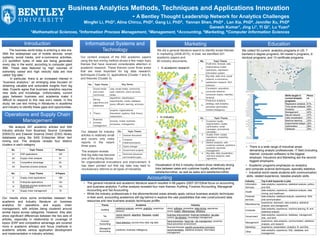
Our content analysis of the 650 academic papers
using the text mining method shows a few major topic
themes that have received considerable attention in
academic research. These themes cover three areas
that are most important for big data research:
techniques (Cluster 2), applications (Cluster 1 and 4),
and theories (Cluster 3).
Our dataset for industry
articles is relatively small
and covers only news
reports in the recent
three years.
The analysis reveals
that big data has become
one of the driving forces
for organizational innovations and improvement. It
has been pointed out that big data may lead to
revolutionary reforms to all types of industries
We did a general literature search to identify broad themes
in marketing (2008-2015), In total, we identified 201
academic papers and
80 industry documents.
Visualization of the 4 industry clusters show relatively strong
links between sales and customer loyalty, advertising and
satisfaction/other, as well as sales and satisfaction/other.
• In Industry
• In academic research
• Academic programs emphasize on analytics
and computer science techniques, specially statistics.
• Industrial world needs students with communication
skills, related experience, besides analytic skills.
• There is a wide range of industrial areas
demanding analytic professionals. IT field (including
internet, computer software) is the biggest
employer. Insurance and Marketing are the second
biggest employers.
Theme Academia Industry
Auditing
statistical analysis, sample, analytics, suspicious
behavior
cloud, software, procedure, data mining, assurance,
social, insight, effectiveness, efficiency
Tax
neural network, algorithm, Bayesian, model,
behavior
business improvement, financial implication, tax plan,
control, tax decision, knowledge management
Forensic
Accounting
fraud detection, journal entry data, big data
fraud prevention, fraud risk, risk management, proactive
fraud prevention environment
Managerial
Accounting
predictive, business intelligence,
financial forecast, specific accounting curriculum
recommendation, statistical analysis, information
management
• The general industrial and academic literature search resulted in 68 papers (2007-2015)that focus on accounting
and business analytics. Further analysis revealed four main themes: Auditing, Forensic Accounting, Managerial
Accounting and Tax Accounting
• While the industry professionals in the aforementioned areas already apply various business analytic techniques
in their work, accounting academics still lag behind in explore the vast possibilities that new (unstructured) data
resources and new business analytic techniques proffer.
We analyze 297 academic articles and 544
industry articles from Business Source Complete
(EBSCO) and Elsevier Science Direct (ESD) library
databases using the SAS Enterprise Miner text
mining tool. The analysis reveals four distinct
clusters in each category.
Our results show some similarities between the
academic and industry literature on business
analytics for operations and supply chain
management, with articles being clustered around
similar topics across categories. However, they also
show significant differences between the two sets of
articles, especially in relationship to coverage of
topics (ERP and competitive advantage are covered
more in academic articles) and focus (methods in
academic articles versus application development
and implementation in industry articles).
No. Topic Theme # Papers
A1 ERP applications 125
A2 Supply chain analysis 91
A3 Competitive advantage 62
A4 Business process analysis 19
No. Topic Theme # Papers
I1 Supply chain applications 186
I2 Enterprise applications 154
I3 Business process analysis and
improvement 134
I4 Supply chain management 70

TLNBusinessAnalytics_researchPoster_Final

  • 1.
    Business Analytics Methods,Techniques and Applications Innovation - A Bentley Thought Leadership Network for Analytics Challenges Mingfei Li, PhD1, Alina Chircu, PhD2, Gang Li, PhD3, Yannan Shen, PhD4 , Lan Xia, PhD5, Jennifer Xu, PhD6 Ganesh Kumar1, Jing Li1, Yi Qi1, Lu Yuan5 1Mathematical Sciences, 2Information Process Management, 3Management, 4Accounting, 5Marketing, 6Computer Information Sciences Introduction The business world today is entering a new era. With the widespread use of mobile devices, smart systems, social media, and e-commerce activities, 2.5 quintillion bytes of data are being generated every day in the world, according to computer giant IBM. These data featured by high volumes of extremely varied and high velocity data are now called “big data.” In particular, there is an increased interest in “business analytics,” an emerging area focused on obtaining valuable and actionable insights from big data. Experts agree that business analytics requires new skills and knowledge. Unfortunately, current gaps between business and academia make it difficult to respond to this new era’s needs. In this study, we use text mining in literatures in academia and industry to identify these gaps and opportunities. Informational Systems and Technology Marketing Education No. Topic Theme 1 Customer loyalty, segmentation, loyalty optimization, email campaign, promotional campaign, 2 Supply chain, supply operations, marketing revenue 3 Market analytics, web customer analysis, predictive analytics, advertise management 4 Big data, data visualization, real-time analytics, data algorithms Skills taught in current Analytic programs Perce nt Regression analysis 61% Time series analysis 49% Analytics 46% Management 40% Neural network 37% Data visualization 33% Machine learning 33% Experimental design 32% Optimization 26% Database 26% No. Topic Theme Key Terms 1 Social media and online community user, social media, community, web, networks, online services, twitter … 2 Mining algorithms and databases algorithms, classification, experimental, model, database, query, efficient, learning, accuracy … 3 Theory projects, organizational, theoretical, systems, field, theory, researchers … 4 Business process management process, model, business processes, management … Operations and Supply Chain Management No. Topic Theme 1 General discussion 2 Company initiatives/projects 3 Game changer 4 Government projects 4 Technical advances and breakthroughs Industry Top 5 skill keywords in jobs Information Services data analytics, experience, statistical analysis, python, and SQL Health data analytics, experience, statistical analysis, data mining, and healthcare Financial services data analytics, statistical analysis, experience, SAS, and communication Manufacturing experience, teamwork, data analytics, statistical analysis, and management Computer data analytics, experience, machine learning, R, and statistical analysis Government data analytics, experience, database, management, SQL, and SAS Management experience, data analytics, communication, statistical analysis, and research Marketing experience, presentation, analytics, R, and SQL Other data analytics, experience, SQL, database, and management Accounting We collect 93 current analytics programs in US: 7 bachelor’s degree programs, 64 master’s programs, 9 doctoral programs, and 13 certificate programs. No. Topic Theme 1 Profit time, forecast, sale, mathematical model, operations, regression, information system 2 Big data, data mine, social network, e-commerce, satisfaction research, ROI, retention. 3 Correlation, acquisition, consumer behavior, consumer impact, retention, revenue. 4 Predictive analytics, strategy, web analytics, advertise optimization, market intelligence. Our content analysis of the 650 academic papers using the text mining method shows a few major topic themes that have received considerable attention in academic research. These themes cover three areas that are most important for big data research: techniques (Cluster 2), applications (Cluster 1 and 4), and theories (Cluster 3). Our dataset for industry articles is relatively small and covers only news reports in the recent three years. The analysis reveals that big data has become one of the driving forces for organizational innovations and improvement. It has been pointed out that big data may lead to revolutionary reforms to all types of industries We did a general literature search to identify broad themes in marketing (2008-2015), In total, we identified 201 academic papers and 80 industry documents. Visualization of the 4 industry clusters show relatively strong links between sales and customer loyalty, advertising and satisfaction/other, as well as sales and satisfaction/other. • In Industry • In academic research • Academic programs emphasize on analytics and computer science techniques, specially statistics. • Industrial world needs students with communication skills, related experience, besides analytic skills. • There is a wide range of industrial areas demanding analytic professionals. IT field (including internet, computer software) is the biggest employer. Insurance and Marketing are the second biggest employers. Theme Academia Industry Auditing statistical analysis, sample, analytics, suspicious behavior cloud, software, procedure, data mining, assurance, social, insight, effectiveness, efficiency Tax neural network, algorithm, Bayesian, model, behavior business improvement, financial implication, tax plan, control, tax decision, knowledge management Forensic Accounting fraud detection, journal entry data, big data fraud prevention, fraud risk, risk management, proactive fraud prevention environment Managerial Accounting predictive, business intelligence, financial forecast, specific accounting curriculum recommendation, statistical analysis, information management • The general industrial and academic literature search resulted in 68 papers (2007-2015)that focus on accounting and business analytics. Further analysis revealed four main themes: Auditing, Forensic Accounting, Managerial Accounting and Tax Accounting • While the industry professionals in the aforementioned areas already apply various business analytic techniques in their work, accounting academics still lag behind in explore the vast possibilities that new (unstructured) data resources and new business analytic techniques proffer. We analyze 297 academic articles and 544 industry articles from Business Source Complete (EBSCO) and Elsevier Science Direct (ESD) library databases using the SAS Enterprise Miner text mining tool. The analysis reveals four distinct clusters in each category. Our results show some similarities between the academic and industry literature on business analytics for operations and supply chain management, with articles being clustered around similar topics across categories. However, they also show significant differences between the two sets of articles, especially in relationship to coverage of topics (ERP and competitive advantage are covered more in academic articles) and focus (methods in academic articles versus application development and implementation in industry articles). No. Topic Theme # Papers A1 ERP applications 125 A2 Supply chain analysis 91 A3 Competitive advantage 62 A4 Business process analysis 19 No. Topic Theme # Papers I1 Supply chain applications 186 I2 Enterprise applications 154 I3 Business process analysis and improvement 134 I4 Supply chain management 70