Advanced Analytics
ARTICLE BY DOMINIC BARTON AND DAVID COURT
JANUARY 2018 PREPARED BY: ANSHUMAN RAINA
Work for You
MAKING
WHAT'S HAPPENING NOW
Big Data and Analytics have
skyrocketed over the past decade
and now increasingly, companies
are integrating it into their System.
The Recent successes of companies
like Google and Amazon have
garnered widespread applause from
Executives around the Globe.
DATA
BOOM GOES THE
Big Data thus, is seeing an unprecedented expenditure
investment by technology leaders like IBM and
Hewlett-Packard.
This triggering in companies with such widespread changes
was last seen in 1990s, when organizations redesigned
their core processes.
Even though many organizations have
pioneered for this change, some view it with
Skepticism and compare its likeness to what
happened with CRM Systems, which led to a
huge uproar and hype with too less a future as
well as huge losses.
Nevertheless, we believe that the time has
come to define a pragmatic approach to big
data and advanced analytics—one tightly
focused on how to use the data to make better
decisions.
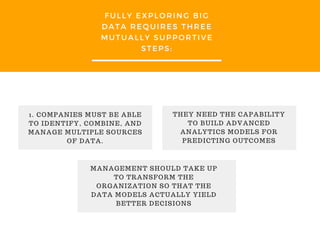
FULLY EXPLORING BIG
DATA REQUIRES THREE
MUTUALLY SUPPORTIVE
STEPS:
1. COMPANIES MUST BE ABLE
TO IDENTIFY, COMBINE, AND
MANAGE MULTIPLE SOURCES
OF DATA.
THEY NEED THE CAPABILITY
TO BUILD ADVANCED
ANALYTICS MODELS FOR
PREDICTING OUTCOMES
MANAGEMENT SHOULD TAKE UP
TO TRANSFORM THE
ORGANIZATION SO THAT THE
DATA MODELS ACTUALLY YIELD
BETTER DECISIONS
THE RIGHT DATA
CHOOSING
The universe of data has changed
vastly over the past few years.
The ability to see what was
previously invisible improves
operations, customer experiences,
and strategy.
But mastering that environment
means finding deliberate ways to
identify usable data you already
have, and exploring sources of
information.
SOURCE DATA CREATIVELY.
Often companies already have the data they need
to tackle business problems.
But managers simply don’t know how the
information can be used for key decisions.
Companies can impel a more comprehensive look at
information sources by being specific about
business problems they want to solve .
For Example: In a TED Talk , the speaker noticed
that TED was an independent data set in itself and
analyzed it so as to give The "Ultimate" TED Talk.
IT SUPPORT
GET THE NECESSARY
Legacy IT structures may hinder new types of data
sourcing, storage, and analysis.Ā  Ā  Ā  Ā  Ā  Ā  Ā  Ā  Ā  Ā  Ā  Ā  Ā  Ā  Ā  Ā 
Ā Ā 
But Slowly and Steadily integrating technology to
equipment can be successful.Ā  Ā  Ā  Ā  Ā  Ā  Ā  Ā  Ā  Ā  Ā  Ā  Ā  Ā  Ā  Ā  Ā  Ā 
Ā 
This process will be time and cost dependent, but
the technology required for analysis and
visualization is a one time investment needing
constant upgradation.
BUSINESS
OUTCOMES
BUILDING MODELS THAT PREDICT AND OPTIMIZEĀ 
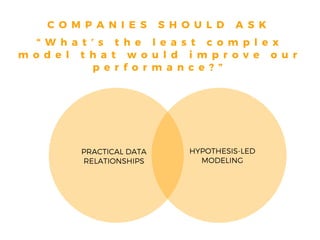
C O M P A N I E S S H O U L D A S K
HYPOTHESIS-LED
MODELING
ā€œ W h a t ’ s t h e l e a s t c o m p l e x
m o d e l t h a t w o u l d i m p r o v e o u r
p e r f o r m a n c e ? ā€
PRACTICAL DATA
RELATIONSHIPS
Transform YourĀ 
COMPANY’S
CAPABILITIES
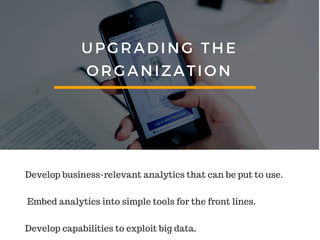
UPGRADING THE
ORGANIZATION
Develop business-relevant analytics that can be put to use.
Embed analytics into simple tools for the front lines.
Develop capabilities to exploit big data.
IN CONCLUSION
The era of big data is evolving rapidly, and companies
should decide whether to act or not.
But rather than changing drastically, slow yet simple
changes should be integrated at first. Clear, short-sighted
goals should be targeted till the time everyone becomes
comfortable
The transition should be slow and steady so as to give
everyone a time to adapt.
As more companies learn the core skills of using big data,
analyzing customer needs may soon become an essential
and decisive competitive asset.
You!
Thank
IT'S BEEN FUN

Article Evaluation 4

  • 1.
    Advanced Analytics ARTICLE BYDOMINIC BARTON AND DAVID COURT JANUARY 2018 PREPARED BY: ANSHUMAN RAINA Work for You MAKING
  • 2.
    WHAT'S HAPPENING NOW BigData and Analytics have skyrocketed over the past decade and now increasingly, companies are integrating it into their System. The Recent successes of companies like Google and Amazon have garnered widespread applause from Executives around the Globe.
  • 3.
    DATA BOOM GOES THE BigData thus, is seeing an unprecedented expenditure investment by technology leaders like IBM and Hewlett-Packard. This triggering in companies with such widespread changes was last seen in 1990s, when organizations redesigned their core processes.
  • 4.
    Even though manyorganizations have pioneered for this change, some view it with Skepticism and compare its likeness to what happened with CRM Systems, which led to a huge uproar and hype with too less a future as well as huge losses. Nevertheless, we believe that the time has come to define a pragmatic approach to big data and advanced analytics—one tightly focused on how to use the data to make better decisions.
  • 5.
    FULLY EXPLORING BIG DATAREQUIRES THREE MUTUALLY SUPPORTIVE STEPS: 1. COMPANIES MUST BE ABLE TO IDENTIFY, COMBINE, AND MANAGE MULTIPLE SOURCES OF DATA. THEY NEED THE CAPABILITY TO BUILD ADVANCED ANALYTICS MODELS FOR PREDICTING OUTCOMES MANAGEMENT SHOULD TAKE UP TO TRANSFORM THE ORGANIZATION SO THAT THE DATA MODELS ACTUALLY YIELD BETTER DECISIONS
  • 6.
  • 7.
    The universe ofdata has changed vastly over the past few years. The ability to see what was previously invisible improves operations, customer experiences, and strategy. But mastering that environment means finding deliberate ways to identify usable data you already have, and exploring sources of information.
  • 8.
    SOURCE DATA CREATIVELY. Oftencompanies already have the data they need to tackle business problems. But managers simply don’t know how the information can be used for key decisions. Companies can impel a more comprehensive look at information sources by being specific about business problems they want to solve . For Example: In a TED Talk , the speaker noticed that TED was an independent data set in itself and analyzed it so as to give The "Ultimate" TED Talk.
  • 9.
    IT SUPPORT GET THENECESSARY Legacy IT structures may hinder new types of data sourcing, storage, and analysis.Ā  Ā  Ā  Ā  Ā  Ā  Ā  Ā  Ā  Ā  Ā  Ā  Ā  Ā  Ā  Ā  Ā Ā  But Slowly and Steadily integrating technology to equipment can be successful.Ā  Ā  Ā  Ā  Ā  Ā  Ā  Ā  Ā  Ā  Ā  Ā  Ā  Ā  Ā  Ā  Ā  Ā  Ā  This process will be time and cost dependent, but the technology required for analysis and visualization is a one time investment needing constant upgradation.
  • 10.
  • 11.
    C O MP A N I E S S H O U L D A S K HYPOTHESIS-LED MODELING ā€œ W h a t ’ s t h e l e a s t c o m p l e x m o d e l t h a t w o u l d i m p r o v e o u r p e r f o r m a n c e ? ā€ PRACTICAL DATA RELATIONSHIPS
  • 12.
  • 13.
    UPGRADING THE ORGANIZATION Develop business-relevantanalytics that can be put to use. Embed analytics into simple tools for the front lines. Develop capabilities to exploit big data.
  • 14.
    IN CONCLUSION The eraof big data is evolving rapidly, and companies should decide whether to act or not. But rather than changing drastically, slow yet simple changes should be integrated at first. Clear, short-sighted goals should be targeted till the time everyone becomes comfortable The transition should be slow and steady so as to give everyone a time to adapt. As more companies learn the core skills of using big data, analyzing customer needs may soon become an essential and decisive competitive asset.
  • 15.