Titration
A quantitative analytic technique for measuring the concentration of
solution
Titration is a common laboratory method to determine the concentration of an analyte (a
substance to be analyzed).
In this process the concentration of analyte is compared with that of a standard solution
A standard solution is a solution containing a precisely known concentration of an element or
a substance.
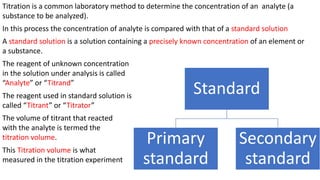
Standard
Primary
standard
Secondary
standard
The reagent used in standard solution is
called “Titrant” or “Titrator”
The reagent of unknown concentration
in the solution under analysis is called
“Analyte” or “Titrand”
The volume of titrant that reacted
with the analyte is termed the
titration volume.
This Titration volume is what
measured in the titration experiment
A primary standard is a highly purified compound that serves as a reference material in titrations
Properties of a primary standard (titrant)
• It should be highly pure
• It should be highly stale
• It should be less hygroscopic so that
its weight may not vary by moisture
absorbed from the atmosphere
• It should be reasonably soluble in the
titration medium
• Its molecular mass should be high
enough to avoid minor errors in
weighing
• It should have low or modest cost
If the substance being used to prepare the standard
solution has these properties, the actual
concentration of the solution will be very close to
the calculated (expected) concentration
Lets see how can we prepare a standard solution
Take a weighing scale and measure the
mass of the substance being used as a
primary standard
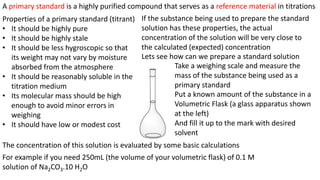
Put a known amount of the substance in a
Volumetric Flask (a glass apparatus shown
at the left)
And fill it up to the mark with desired
solvent
The concentration of this solution is evaluated by some basic calculations
For example if you need 250mL (the volume of your volumetric flask) of 0.1 M
solution of Na2CO3.10 H2O
So how much Na2CO3.10 H2O you would need to produce 250mL of 0.1M Na2CO3.10 H2O solution
𝑀𝑜𝑙𝑎𝑟𝑖𝑡𝑦 =
𝑁𝑜. 𝑜𝑓 𝑚𝑜𝑙𝑒𝑠 𝑜𝑓 𝑠𝑜𝑙𝑢𝑡𝑒
𝑉𝑜𝑙𝑢𝑚𝑒 𝑜𝑓 𝑠𝑜𝑙𝑢𝑡𝑖𝑜𝑛 𝑖𝑛 𝐿
=
𝑀𝑎𝑠𝑠 𝑜𝑓 𝑠𝑜𝑙𝑢𝑡𝑒
𝑀𝑜𝑙𝑎𝑟 𝑚𝑎𝑠𝑠 𝑜𝑓 𝑠𝑜𝑙𝑢𝑡𝑒
×
1000
𝑉𝑜𝑙𝑢𝑚𝑒 𝑜𝑓 𝑠𝑜𝑙𝑢𝑡𝑖𝑜𝑛 𝑖𝑛 𝑚𝐿
We know that,
We can solve the above equation for mass of solute,
𝑀𝑎𝑠𝑠 𝑜𝑓 𝑠𝑜𝑙𝑢𝑡𝑒 =
𝑀𝑜𝑙𝑎𝑟𝑖𝑡𝑦 × 𝑀𝑜𝑙𝑎𝑟 𝑚𝑎𝑠𝑠 𝑜𝑓 𝑠𝑜𝑙𝑢𝑡𝑒 × 𝑉𝑜𝑙𝑢𝑚𝑒 𝑜𝑓 𝑠𝑜𝑙𝑢𝑡𝑖𝑜𝑛 𝑖𝑛 𝑚𝐿
1000
𝑀𝑜𝑙𝑎𝑟𝑖𝑡𝑦 =
𝑀𝑎𝑠𝑠 𝑜𝑓 𝑠𝑜𝑙𝑢𝑡𝑒
𝑀𝑜𝑙𝑎𝑟 𝑚𝑎𝑠𝑠 𝑜𝑓 𝑠𝑜𝑙𝑢𝑡𝑒
×
1000
𝑉𝑜𝑙𝑢𝑚𝑒 𝑜𝑓 𝑠𝑜𝑙𝑢𝑡𝑖𝑜𝑛 𝑖𝑛 𝑚𝐿
Now lets solve this equation for our problem,
𝑀𝑎𝑠𝑠 𝑜𝑓 𝑠𝑜𝑙𝑢𝑡𝑒 =
0.1 × 286.14 × 250
1000
=
7153.5
100
= 7.1535𝑔
So, to prepare the solution of required strength in this case you just need put 7.1535g of
Na2CO3.10 H2O in a volumetric flask of 250mL and fill it up to the mark with water and
shake it gently
This primary standard that we just prepared is used to determine the concertation of another
solution
This solution is now said to be standardized and its concentration is known so it is now a
standard solution
Such a standard solution is known as Secondary standard solution
Now Lets see how titration will actually occur
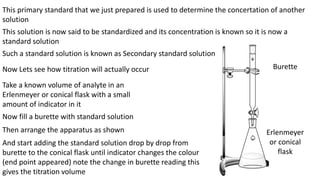
Take a known volume of analyte in an
Erlenmeyer or conical flask with a small
amount of indicator in it
Erlenmeyer
or conical
flask
Burette
Now fill a burette with standard solution
Then arrange the apparatus as shown
And start adding the standard solution drop by drop from
burette to the conical flask until indicator changes the colour
(end point appeared) note the change in burette reading this
gives the titration volume
So now what we know
1. The concentration of standard solution
(already known from calculation) lets call
that M1
2. The volume of standard solution (from
burette reading), V1
3. The volume of the solution the analyte,
V2
We don’t know the concentration of the
analyte, M2
For a reaction as,
NaOH + HCl → NaCl + H2O
Titrant Analyte
nNaOH = nHCl
𝑀 =
𝑛
𝑉
𝑛 = 𝑀 × 𝑉
𝑀 𝑁𝑎𝑂𝐻 × 𝑉𝑁𝑎𝑂𝐻 = 𝑀 𝐻𝐶𝑙 × 𝑉𝐻𝐶𝑙
𝑀 𝐻𝐶𝑙 =
𝑀 𝑁𝑎𝑂𝐻 × 𝑉𝑁𝑎𝑂𝐻
𝑉𝐻𝐶𝑙
But for a reaction as,
Ba(OH)2 + 2HCl → BaCl2 + 2H2O
𝑛 𝐻𝐶𝑙 = 2 × 𝑛 𝐵𝑎 𝑂𝐻 2
𝑀 𝐻𝐶𝑙 × 𝑉𝐻𝐶𝑙 = 2 × 𝑀 𝐵𝑎 𝑂𝐻 2
× 𝑉𝐵𝑎 𝑂𝐻 2
𝑀 𝐵𝑎 𝑂𝐻 2
× 𝑉𝐵𝑎 𝑂𝐻 2
𝑛 𝐵𝑎 𝑂𝐻 2
=
𝑀 𝐻𝐶𝑙 × 𝑉𝐻𝐶𝑙
𝑛 𝐻𝐶𝑙
From the balanced equation we
know,
Ba(OH)2 + 2HCl → BaCl2 + 2H2O
𝑛 𝐵𝑎 𝑂𝐻 2
= 1 𝑎𝑛𝑑 𝑛 𝐻𝐶𝑙 = 2
𝑀 𝐵𝑎 𝑂𝐻 2
× 𝑉𝐵𝑎 𝑂𝐻 2
1
=
𝑀 𝐻𝐶𝑙 × 𝑉𝐻𝐶𝑙
2
𝑀 𝐻𝐶𝑙 × 𝑉𝐻𝐶𝑙 = 2 × 𝑀 𝐵𝑎 𝑂𝐻 2
× 𝑉𝐵𝑎 𝑂𝐻 2
𝑀𝐴𝑛𝑎𝑙𝑦𝑡𝑒 × 𝑉𝐴𝑛𝑎𝑙𝑦𝑡𝑒
𝑛 𝐴𝑛𝑎𝑙𝑦𝑡𝑒
=
𝑀 𝑇𝑖𝑡𝑟𝑎𝑛𝑡 × 𝑉𝑇𝑖𝑡𝑟𝑎𝑛𝑡
𝑛 𝑇𝑖𝑡𝑟𝑎𝑛𝑡

Titration

  • 1.
    Titration A quantitative analytictechnique for measuring the concentration of solution
  • 2.
    Titration is acommon laboratory method to determine the concentration of an analyte (a substance to be analyzed). In this process the concentration of analyte is compared with that of a standard solution A standard solution is a solution containing a precisely known concentration of an element or a substance. Standard Primary standard Secondary standard The reagent used in standard solution is called “Titrant” or “Titrator” The reagent of unknown concentration in the solution under analysis is called “Analyte” or “Titrand” The volume of titrant that reacted with the analyte is termed the titration volume. This Titration volume is what measured in the titration experiment
  • 3.
    A primary standardis a highly purified compound that serves as a reference material in titrations Properties of a primary standard (titrant) • It should be highly pure • It should be highly stale • It should be less hygroscopic so that its weight may not vary by moisture absorbed from the atmosphere • It should be reasonably soluble in the titration medium • Its molecular mass should be high enough to avoid minor errors in weighing • It should have low or modest cost If the substance being used to prepare the standard solution has these properties, the actual concentration of the solution will be very close to the calculated (expected) concentration Lets see how can we prepare a standard solution Take a weighing scale and measure the mass of the substance being used as a primary standard Put a known amount of the substance in a Volumetric Flask (a glass apparatus shown at the left) And fill it up to the mark with desired solvent The concentration of this solution is evaluated by some basic calculations For example if you need 250mL (the volume of your volumetric flask) of 0.1 M solution of Na2CO3.10 H2O
  • 4.
    So how muchNa2CO3.10 H2O you would need to produce 250mL of 0.1M Na2CO3.10 H2O solution 𝑀𝑜𝑙𝑎𝑟𝑖𝑡𝑦 = 𝑁𝑜. 𝑜𝑓 𝑚𝑜𝑙𝑒𝑠 𝑜𝑓 𝑠𝑜𝑙𝑢𝑡𝑒 𝑉𝑜𝑙𝑢𝑚𝑒 𝑜𝑓 𝑠𝑜𝑙𝑢𝑡𝑖𝑜𝑛 𝑖𝑛 𝐿 = 𝑀𝑎𝑠𝑠 𝑜𝑓 𝑠𝑜𝑙𝑢𝑡𝑒 𝑀𝑜𝑙𝑎𝑟 𝑚𝑎𝑠𝑠 𝑜𝑓 𝑠𝑜𝑙𝑢𝑡𝑒 × 1000 𝑉𝑜𝑙𝑢𝑚𝑒 𝑜𝑓 𝑠𝑜𝑙𝑢𝑡𝑖𝑜𝑛 𝑖𝑛 𝑚𝐿 We know that, We can solve the above equation for mass of solute, 𝑀𝑎𝑠𝑠 𝑜𝑓 𝑠𝑜𝑙𝑢𝑡𝑒 = 𝑀𝑜𝑙𝑎𝑟𝑖𝑡𝑦 × 𝑀𝑜𝑙𝑎𝑟 𝑚𝑎𝑠𝑠 𝑜𝑓 𝑠𝑜𝑙𝑢𝑡𝑒 × 𝑉𝑜𝑙𝑢𝑚𝑒 𝑜𝑓 𝑠𝑜𝑙𝑢𝑡𝑖𝑜𝑛 𝑖𝑛 𝑚𝐿 1000 𝑀𝑜𝑙𝑎𝑟𝑖𝑡𝑦 = 𝑀𝑎𝑠𝑠 𝑜𝑓 𝑠𝑜𝑙𝑢𝑡𝑒 𝑀𝑜𝑙𝑎𝑟 𝑚𝑎𝑠𝑠 𝑜𝑓 𝑠𝑜𝑙𝑢𝑡𝑒 × 1000 𝑉𝑜𝑙𝑢𝑚𝑒 𝑜𝑓 𝑠𝑜𝑙𝑢𝑡𝑖𝑜𝑛 𝑖𝑛 𝑚𝐿 Now lets solve this equation for our problem, 𝑀𝑎𝑠𝑠 𝑜𝑓 𝑠𝑜𝑙𝑢𝑡𝑒 = 0.1 × 286.14 × 250 1000 = 7153.5 100 = 7.1535𝑔 So, to prepare the solution of required strength in this case you just need put 7.1535g of Na2CO3.10 H2O in a volumetric flask of 250mL and fill it up to the mark with water and shake it gently
  • 5.
    This primary standardthat we just prepared is used to determine the concertation of another solution This solution is now said to be standardized and its concentration is known so it is now a standard solution Such a standard solution is known as Secondary standard solution Now Lets see how titration will actually occur Take a known volume of analyte in an Erlenmeyer or conical flask with a small amount of indicator in it Erlenmeyer or conical flask Burette Now fill a burette with standard solution Then arrange the apparatus as shown And start adding the standard solution drop by drop from burette to the conical flask until indicator changes the colour (end point appeared) note the change in burette reading this gives the titration volume
  • 6.
    So now whatwe know 1. The concentration of standard solution (already known from calculation) lets call that M1 2. The volume of standard solution (from burette reading), V1 3. The volume of the solution the analyte, V2 We don’t know the concentration of the analyte, M2 For a reaction as, NaOH + HCl → NaCl + H2O Titrant Analyte nNaOH = nHCl 𝑀 = 𝑛 𝑉 𝑛 = 𝑀 × 𝑉 𝑀 𝑁𝑎𝑂𝐻 × 𝑉𝑁𝑎𝑂𝐻 = 𝑀 𝐻𝐶𝑙 × 𝑉𝐻𝐶𝑙 𝑀 𝐻𝐶𝑙 = 𝑀 𝑁𝑎𝑂𝐻 × 𝑉𝑁𝑎𝑂𝐻 𝑉𝐻𝐶𝑙 But for a reaction as, Ba(OH)2 + 2HCl → BaCl2 + 2H2O 𝑛 𝐻𝐶𝑙 = 2 × 𝑛 𝐵𝑎 𝑂𝐻 2 𝑀 𝐻𝐶𝑙 × 𝑉𝐻𝐶𝑙 = 2 × 𝑀 𝐵𝑎 𝑂𝐻 2 × 𝑉𝐵𝑎 𝑂𝐻 2 𝑀 𝐵𝑎 𝑂𝐻 2 × 𝑉𝐵𝑎 𝑂𝐻 2 𝑛 𝐵𝑎 𝑂𝐻 2 = 𝑀 𝐻𝐶𝑙 × 𝑉𝐻𝐶𝑙 𝑛 𝐻𝐶𝑙 From the balanced equation we know, Ba(OH)2 + 2HCl → BaCl2 + 2H2O 𝑛 𝐵𝑎 𝑂𝐻 2 = 1 𝑎𝑛𝑑 𝑛 𝐻𝐶𝑙 = 2 𝑀 𝐵𝑎 𝑂𝐻 2 × 𝑉𝐵𝑎 𝑂𝐻 2 1 = 𝑀 𝐻𝐶𝑙 × 𝑉𝐻𝐶𝑙 2 𝑀 𝐻𝐶𝑙 × 𝑉𝐻𝐶𝑙 = 2 × 𝑀 𝐵𝑎 𝑂𝐻 2 × 𝑉𝐵𝑎 𝑂𝐻 2 𝑀𝐴𝑛𝑎𝑙𝑦𝑡𝑒 × 𝑉𝐴𝑛𝑎𝑙𝑦𝑡𝑒 𝑛 𝐴𝑛𝑎𝑙𝑦𝑡𝑒 = 𝑀 𝑇𝑖𝑡𝑟𝑎𝑛𝑡 × 𝑉𝑇𝑖𝑡𝑟𝑎𝑛𝑡 𝑛 𝑇𝑖𝑡𝑟𝑎𝑛𝑡