Let Us Recap:
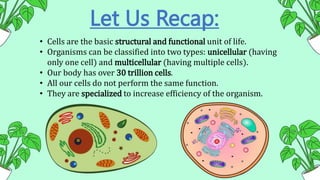
• Cells are the basic structural and functional unit of life.
• Organisms can be classified into two types: unicellular (having
only one cell) and multicellular (having multiple cells).
• Our body has over 30 trillion cells.
• All our cells do not perform the same function.
• They are specialized to increase efficiency of the organism.
What are Tissues?
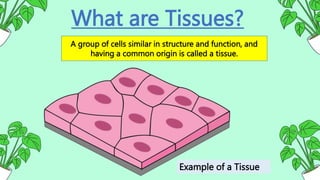
A group of cells similar in structure and function, and
having a common origin is called a tissue.
Example of a Tissue
Types of Tissues
Tissues are of two types – plant tissues and animal tissues.
Both plants and animals are living organisms. However, there are various
differences in their structure, function, nutrition and growth.
• Most plant cells are dead and thick-walled while most animal cells are living.
• Plants are autotrophic and stationary, while animals are heterotrophic and mobile.
• Plants grow throughout their life, while animals stop growing after a point.

Tissues Biology.pptx

  • 2.
    Let Us Recap: •Cells are the basic structural and functional unit of life. • Organisms can be classified into two types: unicellular (having only one cell) and multicellular (having multiple cells). • Our body has over 30 trillion cells. • All our cells do not perform the same function. • They are specialized to increase efficiency of the organism.
  • 3.
    What are Tissues? Agroup of cells similar in structure and function, and having a common origin is called a tissue. Example of a Tissue
  • 4.
    Types of Tissues Tissuesare of two types – plant tissues and animal tissues. Both plants and animals are living organisms. However, there are various differences in their structure, function, nutrition and growth. • Most plant cells are dead and thick-walled while most animal cells are living. • Plants are autotrophic and stationary, while animals are heterotrophic and mobile. • Plants grow throughout their life, while animals stop growing after a point.