


What is This Thing  Called “TIRF”? Kathi Bailey and Ryan Damerow Monterey Institute of International Studies
TIRF T he  I nternational  R esearch  F oundation   for English Language Education Visit TIRF’s website at http://www.tirfonline.org
TIRF TIRF was established by the TESOL Board of Directors in June, 1998. TESOL provided the start-up money for the foundation.  TIRF was recognized as a charitable foundation under US tax law in 1999.
TIRF’s Four Major Goals 1. To implement a research and development program that will generate new knowledge and inform and improve the quality of English language teaching and learning
TIRF’s Four Major Goals 2. to promote the application of research to practical language problems  3. to collect, organize, and disseminate information and research on the teaching and learning of languages
TIRF’s Four Major Goals 4. to influence the formation and implementation of appropriate language education policies, being cognizant of the complementarity  of English as an  international language  and indigenous languages  and cultures worldwide.
TIRF’s Activities  Research Development  Dissemination Activities in Three Domains
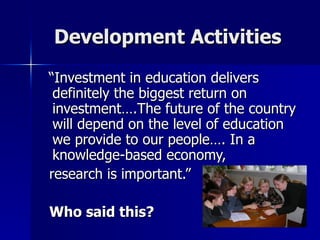
Development Activities  “Investment in education delivers definitely the biggest return on investment….The future of the country will depend on the level of education we provide to our people…. In a knowledge-based economy,  research is important.” Who said this?
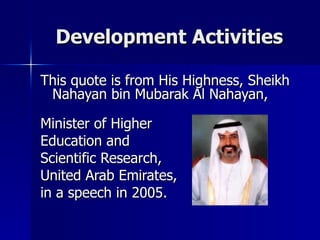
Development Activities This quote is from His Highness, Sheikh Nahayan bin Mubarak Al Nahayan, Minister of Higher  Education and  Scientific Research, United Arab Emirates, in a speech in 2005.
Development Activities Sheikh Nahayan has given TIRF a generous gift to promote research on English language teaching and learning  in the Arab world.  For the past two years, this gift has supported three doctoral candidates at $25,000 per student.
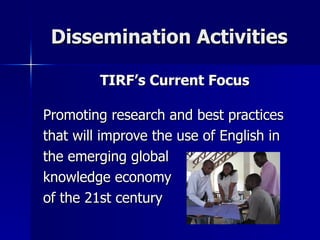
Dissemination Activities TIRF’s Current Focus Promoting research and best practices that will improve the use of English in  the emerging global  knowledge economy  of the 21st century
Dissemination Activities TIRF has hosted dissemination and information gathering activities in  Washington D.C. São Paulo Dubai
Research Activities As of March 1, 2010, TIRF has funded   37 research projects  involving 57 researchers working on various topics  for a total of US $476,450.
Research Activities Key Questions Initiative The Impact of English and Plurilingualism  in Global Corporations  (TIRF, 2009) Focus chosen by the Board of Trustees The paper and an executive summary are available free on TIRF’s website:  www.tirfonline.org
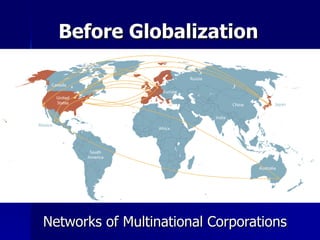
Before Globalization  Networks of Multinational Corporations
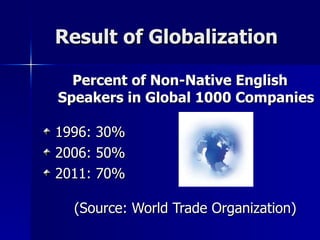
Result of Globalization  Percent of Non-Native English Speakers in Global 1000 Companies 1996: 30% 2006: 50% 2011: 70% (Source: World Trade Organization)
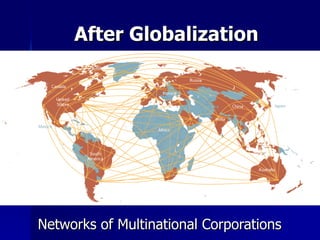
After Globalization   Networks of Multinational Corporations
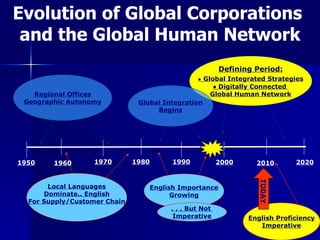
Evolution of Global Corporations  and the Global Human Network 1960 1970 1980 1990 2000 2010 2020 1950 . . . But Not  Imperative TODAY Defining Period: ●   Global Integrated Strategies ●   Digitally Connected  Global Human Network Local Languages Dominate.. English For Supply/Customer Chain English Proficiency Imperative Global Integration Begins English Importance Growing Regional Offices Geographic Autonomy
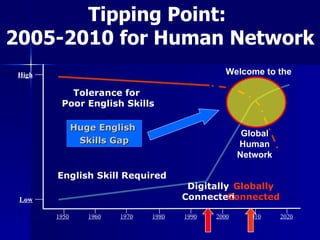
Tipping Point:  2005-2010 for Human Network Low High 1950 1960 1970 1980 1990 2000 2010 2020 English Skill Required Tolerance for  Poor English Skills Huge English  Skills Gap Global Human Network Digitally Connected Globally Connected Welcome to the
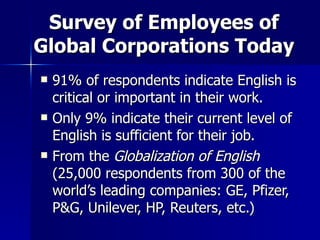
Survey of Employees of Global Corporations Today 91% of respondents indicate English is critical or important in their work. Only 9% indicate their current level of English is sufficient for their job. From the  Globalization of English  (25,000 respondents from 300 of the world’s leading companies: GE, Pfizer, P&G, Unilever, HP, Reuters, etc.)
Can be rapidly deployed Can deliver consistent results Are measurable on a global basis  Are cost effective Are scalable Corporations need solutions that  Desired Solutions
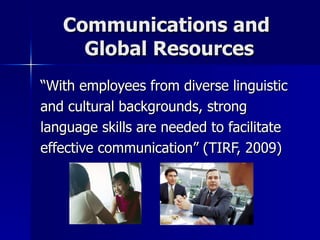
Communications and  Global Resources “With employees from diverse linguistic and cultural backgrounds, strong language skills are needed to facilitate effective communication” (TIRF, 2009)
The Human  Capital Challenge  “ Faced with this challenge, global corporations are increasingly engaged in talent search and development efforts to ensure they can attract, keep, and develop workers that can add value to their globally integrated operations” (TIRF, 2009).
21 st  Century Skills “ In addition to strong academic skills, corporations want workers with skills and attributes that depend on strong social, emotional, and cognitive development, including professionalism, teamwork, communication, and critical thinking” (Corporate Voices, 2008).
Language Development Investments  “ GlobalEnglish has conducted case studies of the language challenges, solutions, and impacts faced by its global corporate partners.... Revenue and cost impact are the two main areas where English proficiency adversely affects the corporate bottom line” (TIRF, 2009).
The Case of Reuters The Need Wanted to improve communications among regional offices 2.  Wanted to manage negative consequence of complexity of managing projects across times zones, cultures, and languages
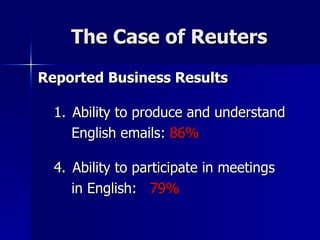
The Case of Reuters Reported Business Results Ability to produce and understand English emails:  86% Ability to participate in meetings  in English:  79%
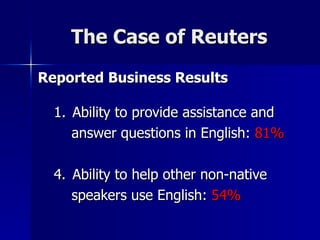
The Case of Reuters Reported Business Results Ability to provide assistance and answer questions in English:  81% Ability to help other non-native  speakers use English:  54%
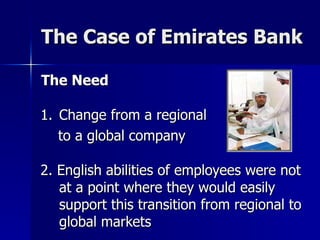
The Case of Emirates Bank The Need Change from a regional  to a global company 2. English abilities of employees were not at a point where they would easily support this transition from regional to global markets
The Case of Emirates Bank Reported Business Results Earned the first European Association of Quality Language Services (EAQUALS) Certification awarded in their region 2. Increased number of employees trained by over  300%  through use of online learning
The Case of Emirates Bank Reported Business Results 3. High satisfaction and completion rates of English programs  (85%) 4. Improved job performance after three months due to improved English abilities
Research Activities Implications For corporations For teachers of business students in higher education contexts and adult schools For English language learners
Funding Opportunities This topic is one of TIRF’s current research priorities for Doctoral Dissertation Grants. Deadline for proposals is May 31, 2010.
Funding Opportunities Up to US $5,000 is available for Doctoral Dissertation Grants.  Proposals should address any of TIRF’s priority research topics.
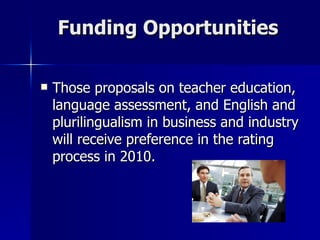
Funding Opportunities Those proposals on teacher education, language assessment, and English and plurilingualism in business and industry will receive preference in the rating process in 2010.
Closing Comments Next Steps for TIRF Seek major sources of funding from corporate and private sponsors to support targeted research projects Influence policy makers with the findings of research
Resources for Researchers TIRF is pleased to share several reference lists with researchers throughout the world.  The lists are stored as Word documents so that they will be dynamic tools.
Resources for Researchers You are also welcome to contribute new references to these lists, or send an entirely new reference list to share. Please visit  www.tirfonline.org  and click on “Resources for Researchers.”
Resources for Researchers Anxiety in Language Learning and Assessment Communication Strategies Communicative Language Testing Content-based Instruction Diagnostic Assessment
Resources for Researchers Diary Studies in Language Learning and Teaching Identity and Language Learning Language Classroom Research Listening Assessment Observation Portfolio Assessment
Resources for Researchers Reading Assessment Reflective Teaching Self-Assessment Speaking Assessment Washback Writing Assessment
Closing Comments TIRF’s initiatives are supported by contributions from Individuals Corporations Funding Organizations
Closing Comments Main Sponsoring Organizations Cambridge University Press Cengage (formerly Heinle) Delta Systems Educational Testing Service LaCentra-Sumerlin Foundation  National Geographic
Closing Comments Main Sponsoring Organizations Pearson Longman The Society for Testing English Proficiency The Spencer Foundation TESOL University of Cambridge ESOL Exams Walt Disney Corporation
Closing Comments 2010 Doctoral Dissertation Grant Competition Deadline May 15, 2010 Awards up to US $5,000  Applicants need  not  be CATESOL or TESOL members, US citizens, etc. Must be advanced to candidacy in a legitimate doctoral program
Closing Comments 2010 Doctoral Dissertation Grant Competition Proposals accepted on all research  priorities listed on the website  Proposals on teacher education, language assessment, and English and plurilingualism in business and industry will receive preference in 2010.
Closing Comments TIRF is an all-volunteer Board of trustees. Your help is needed. Donate online by  credit card Donate by check  in US dollars
Closing Comments Levels of Support Founders : Over $75,000 Benefactors : $5,000 to $74,999 Patrons : $1,000 to $4,999 Supporters : up to $1,000
Closing Comments Donate online at  www.tirfonline.org Donate by mail at TIRF 177 Webster Street, Box 220 Monterey, CA 93940 USA
Closing Comments For Further Information To learn more about TIRF, The International Research Foundation for English Language Education, please visit our website: http://www.tirfonline.org
Thank you!
TIRF T he  I nternational R esearch  F oundation  for English Language Education http://www.tirfonline.org

TIRF at 2010 CATESOL Convention - Dr. Kathi Bailey & Ryan Damerow

  • 1.
  • 2.
    What is ThisThing Called “TIRF”? Kathi Bailey and Ryan Damerow Monterey Institute of International Studies
  • 3.
    TIRF T he I nternational R esearch F oundation for English Language Education Visit TIRF’s website at http://www.tirfonline.org
  • 4.
    TIRF TIRF wasestablished by the TESOL Board of Directors in June, 1998. TESOL provided the start-up money for the foundation. TIRF was recognized as a charitable foundation under US tax law in 1999.
  • 5.
    TIRF’s Four MajorGoals 1. To implement a research and development program that will generate new knowledge and inform and improve the quality of English language teaching and learning
  • 6.
    TIRF’s Four MajorGoals 2. to promote the application of research to practical language problems 3. to collect, organize, and disseminate information and research on the teaching and learning of languages
  • 7.
    TIRF’s Four MajorGoals 4. to influence the formation and implementation of appropriate language education policies, being cognizant of the complementarity of English as an international language and indigenous languages and cultures worldwide.
  • 8.
    TIRF’s Activities Research Development Dissemination Activities in Three Domains
  • 9.
    Development Activities “Investment in education delivers definitely the biggest return on investment….The future of the country will depend on the level of education we provide to our people…. In a knowledge-based economy, research is important.” Who said this?
  • 10.
    Development Activities Thisquote is from His Highness, Sheikh Nahayan bin Mubarak Al Nahayan, Minister of Higher Education and Scientific Research, United Arab Emirates, in a speech in 2005.
  • 11.
    Development Activities SheikhNahayan has given TIRF a generous gift to promote research on English language teaching and learning in the Arab world. For the past two years, this gift has supported three doctoral candidates at $25,000 per student.
  • 12.
    Dissemination Activities TIRF’sCurrent Focus Promoting research and best practices that will improve the use of English in the emerging global knowledge economy of the 21st century
  • 13.
    Dissemination Activities TIRFhas hosted dissemination and information gathering activities in Washington D.C. São Paulo Dubai
  • 14.
    Research Activities Asof March 1, 2010, TIRF has funded 37 research projects involving 57 researchers working on various topics for a total of US $476,450.
  • 15.
    Research Activities KeyQuestions Initiative The Impact of English and Plurilingualism in Global Corporations (TIRF, 2009) Focus chosen by the Board of Trustees The paper and an executive summary are available free on TIRF’s website: www.tirfonline.org
  • 16.
    Before Globalization Networks of Multinational Corporations
  • 17.
    Result of Globalization Percent of Non-Native English Speakers in Global 1000 Companies 1996: 30% 2006: 50% 2011: 70% (Source: World Trade Organization)
  • 18.
    After Globalization Networks of Multinational Corporations
  • 19.
    Evolution of GlobalCorporations and the Global Human Network 1960 1970 1980 1990 2000 2010 2020 1950 . . . But Not Imperative TODAY Defining Period: ● Global Integrated Strategies ● Digitally Connected Global Human Network Local Languages Dominate.. English For Supply/Customer Chain English Proficiency Imperative Global Integration Begins English Importance Growing Regional Offices Geographic Autonomy
  • 20.
    Tipping Point: 2005-2010 for Human Network Low High 1950 1960 1970 1980 1990 2000 2010 2020 English Skill Required Tolerance for Poor English Skills Huge English Skills Gap Global Human Network Digitally Connected Globally Connected Welcome to the
  • 21.
    Survey of Employeesof Global Corporations Today 91% of respondents indicate English is critical or important in their work. Only 9% indicate their current level of English is sufficient for their job. From the Globalization of English (25,000 respondents from 300 of the world’s leading companies: GE, Pfizer, P&G, Unilever, HP, Reuters, etc.)
  • 22.
    Can be rapidlydeployed Can deliver consistent results Are measurable on a global basis Are cost effective Are scalable Corporations need solutions that Desired Solutions
  • 23.
    Communications and Global Resources “With employees from diverse linguistic and cultural backgrounds, strong language skills are needed to facilitate effective communication” (TIRF, 2009)
  • 24.
    The Human Capital Challenge “ Faced with this challenge, global corporations are increasingly engaged in talent search and development efforts to ensure they can attract, keep, and develop workers that can add value to their globally integrated operations” (TIRF, 2009).
  • 25.
    21 st Century Skills “ In addition to strong academic skills, corporations want workers with skills and attributes that depend on strong social, emotional, and cognitive development, including professionalism, teamwork, communication, and critical thinking” (Corporate Voices, 2008).
  • 26.
    Language Development Investments “ GlobalEnglish has conducted case studies of the language challenges, solutions, and impacts faced by its global corporate partners.... Revenue and cost impact are the two main areas where English proficiency adversely affects the corporate bottom line” (TIRF, 2009).
  • 27.
    The Case ofReuters The Need Wanted to improve communications among regional offices 2. Wanted to manage negative consequence of complexity of managing projects across times zones, cultures, and languages
  • 28.
    The Case ofReuters Reported Business Results Ability to produce and understand English emails: 86% Ability to participate in meetings in English: 79%
  • 29.
    The Case ofReuters Reported Business Results Ability to provide assistance and answer questions in English: 81% Ability to help other non-native speakers use English: 54%
  • 30.
    The Case ofEmirates Bank The Need Change from a regional to a global company 2. English abilities of employees were not at a point where they would easily support this transition from regional to global markets
  • 31.
    The Case ofEmirates Bank Reported Business Results Earned the first European Association of Quality Language Services (EAQUALS) Certification awarded in their region 2. Increased number of employees trained by over 300% through use of online learning
  • 32.
    The Case ofEmirates Bank Reported Business Results 3. High satisfaction and completion rates of English programs (85%) 4. Improved job performance after three months due to improved English abilities
  • 33.
    Research Activities ImplicationsFor corporations For teachers of business students in higher education contexts and adult schools For English language learners
  • 34.
    Funding Opportunities Thistopic is one of TIRF’s current research priorities for Doctoral Dissertation Grants. Deadline for proposals is May 31, 2010.
  • 35.
    Funding Opportunities Upto US $5,000 is available for Doctoral Dissertation Grants. Proposals should address any of TIRF’s priority research topics.
  • 36.
    Funding Opportunities Thoseproposals on teacher education, language assessment, and English and plurilingualism in business and industry will receive preference in the rating process in 2010.
  • 37.
    Closing Comments NextSteps for TIRF Seek major sources of funding from corporate and private sponsors to support targeted research projects Influence policy makers with the findings of research
  • 38.
    Resources for ResearchersTIRF is pleased to share several reference lists with researchers throughout the world. The lists are stored as Word documents so that they will be dynamic tools.
  • 39.
    Resources for ResearchersYou are also welcome to contribute new references to these lists, or send an entirely new reference list to share. Please visit www.tirfonline.org and click on “Resources for Researchers.”
  • 40.
    Resources for ResearchersAnxiety in Language Learning and Assessment Communication Strategies Communicative Language Testing Content-based Instruction Diagnostic Assessment
  • 41.
    Resources for ResearchersDiary Studies in Language Learning and Teaching Identity and Language Learning Language Classroom Research Listening Assessment Observation Portfolio Assessment
  • 42.
    Resources for ResearchersReading Assessment Reflective Teaching Self-Assessment Speaking Assessment Washback Writing Assessment
  • 43.
    Closing Comments TIRF’sinitiatives are supported by contributions from Individuals Corporations Funding Organizations
  • 44.
    Closing Comments MainSponsoring Organizations Cambridge University Press Cengage (formerly Heinle) Delta Systems Educational Testing Service LaCentra-Sumerlin Foundation National Geographic
  • 45.
    Closing Comments MainSponsoring Organizations Pearson Longman The Society for Testing English Proficiency The Spencer Foundation TESOL University of Cambridge ESOL Exams Walt Disney Corporation
  • 46.
    Closing Comments 2010Doctoral Dissertation Grant Competition Deadline May 15, 2010 Awards up to US $5,000 Applicants need not be CATESOL or TESOL members, US citizens, etc. Must be advanced to candidacy in a legitimate doctoral program
  • 47.
    Closing Comments 2010Doctoral Dissertation Grant Competition Proposals accepted on all research priorities listed on the website Proposals on teacher education, language assessment, and English and plurilingualism in business and industry will receive preference in 2010.
  • 48.
    Closing Comments TIRFis an all-volunteer Board of trustees. Your help is needed. Donate online by credit card Donate by check in US dollars
  • 49.
    Closing Comments Levelsof Support Founders : Over $75,000 Benefactors : $5,000 to $74,999 Patrons : $1,000 to $4,999 Supporters : up to $1,000
  • 50.
    Closing Comments Donateonline at www.tirfonline.org Donate by mail at TIRF 177 Webster Street, Box 220 Monterey, CA 93940 USA
  • 51.
    Closing Comments ForFurther Information To learn more about TIRF, The International Research Foundation for English Language Education, please visit our website: http://www.tirfonline.org
  • 52.
  • 53.
    TIRF T he I nternational R esearch F oundation for English Language Education http://www.tirfonline.org